❤️ Would you like to save this?
In the 1960s, party clothes knew how to make an entrance before the wearer said a word. A portrait collar could command the whole upper half of a dress. Brocade could turn slim trousers into a major event. A sculptural bow, a sweep of chiffon or one extravagant sleeve could take an otherwise simple silhouette somewhere unforgettable.
That confidence is what gives the decade its charge. The best looks were not just festive; they were engineered. Shape, proportion and surface all mattered. Velvet had weight. Organza had lift. Satin had sweep. Metallic discs, jeweled buttons and sharp tailoring were used with enough precision that one strong detail could carry an entire outfit.
That is the part worth stealing now. Not the costume, not the nostalgia, and not a head-to-toe recreation. The real lesson is restraint with nerve: choose the collar, the cape, the brocade trouser, the opera glove, the cut that makes the back view as memorable as the front — then let it do the work.
These 39 retro-inspired looks move from polished early-1960s tailoring to mod geometry and the freer shapes that followed. Some are razor-sharp, some are gloriously excessive, and a few come very close to stealing the whole Christmas party before anyone has even reached the drinks table.
FYI, thanks to AI imagery software, we’re able to create very specific fashion and hairstyle examples to illustrate the points being made. In some cases, imagery is exaggerated to hammer home the point. Also, assume links that take you off the site are affiliate links such as links to Amazon. this means we may earn a commission if you buy something.
39. Ruby Brocade Dress and Matching Coat
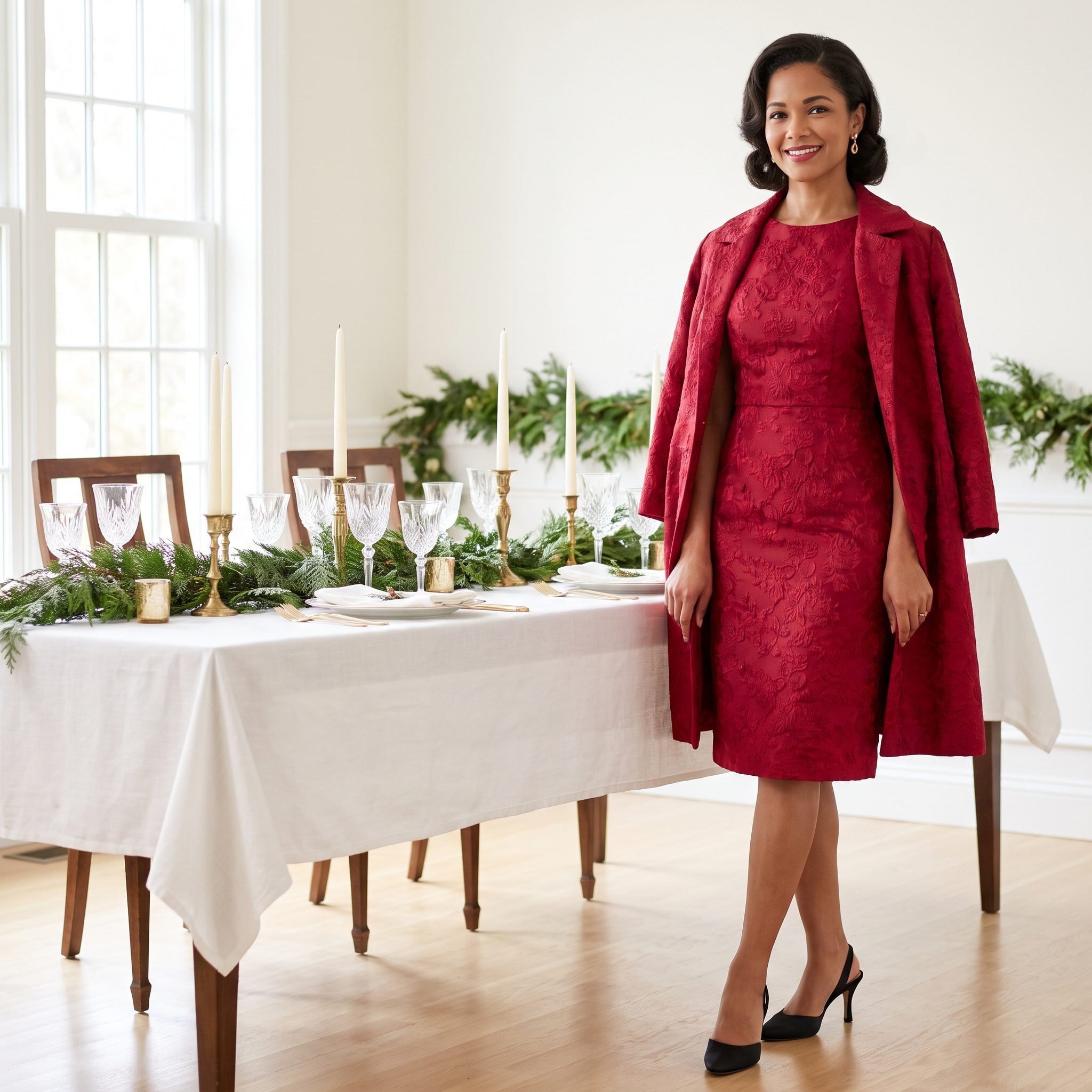
A matching dress and coat turns ruby brocade into an entire composition rather than a single festive note. The sheath keeps the silhouette narrow while the open coat repeats the fabric on a larger scale, giving the pattern room to register without burying the shape underneath.
Black satin slingback heels and small gold earrings are enough. Their restraint matters beside fabric this ornate, and the black shoes pull the coordinated retro richness back toward the present.
38. Silver Space Age Shift
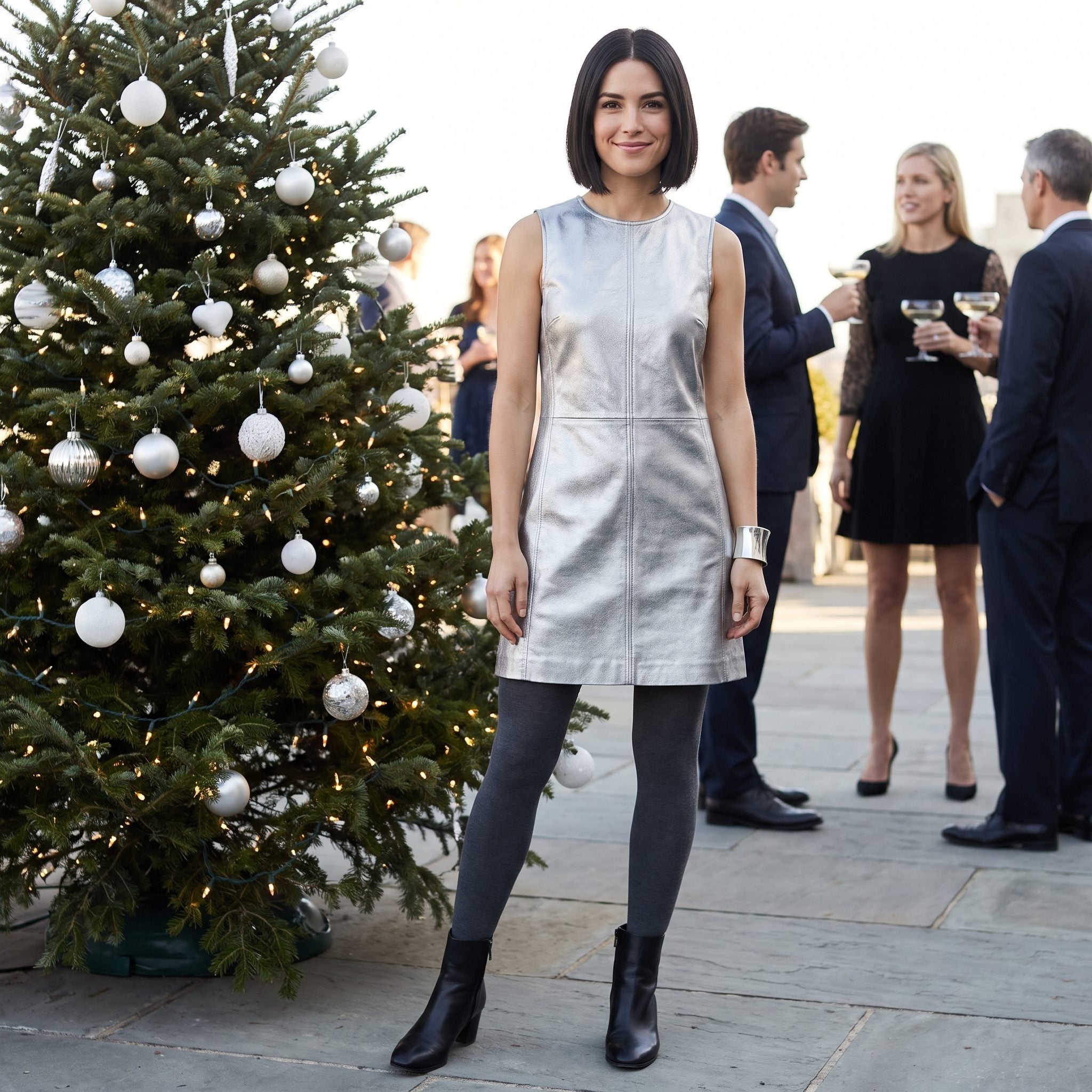
The silhouette could hardly be simpler, which leaves the metallic surface nowhere to hide. Silver reacts to every change of angle while the straight shift remains almost severe beneath all that shimmer.
Charcoal tights and black ankle boots give the shine a firm foundation. Precise seaming matters too: when the material is this assertive, clean construction keeps the dress looking futuristic rather than merely flashy.
37. Black Velvet Top and Full Ivory Ball Skirt
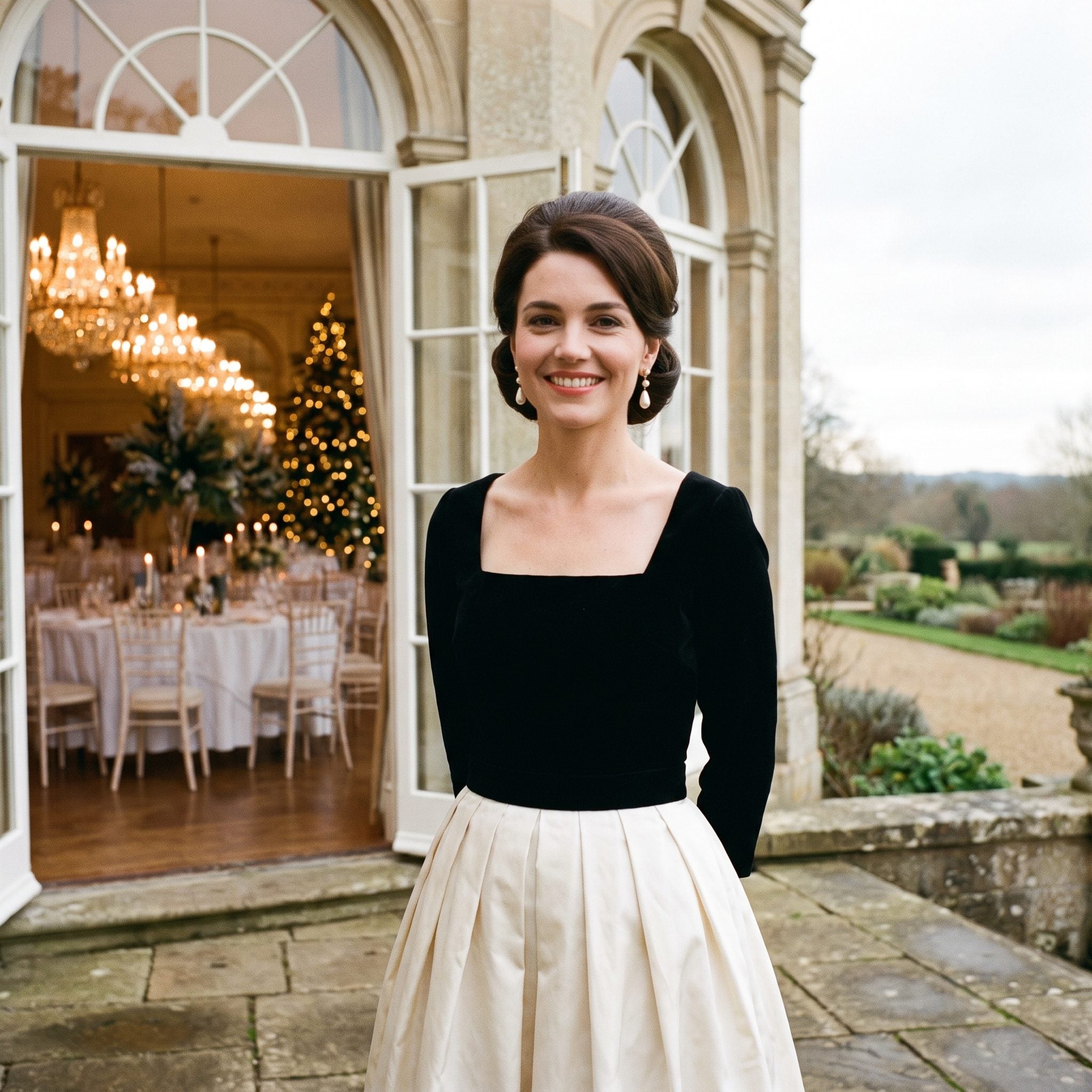
Black velvet and ivory silk behave almost like opposites. One looks dense and matte; the other looks fluid and lustrous. Put them together and two familiar evening fabrics become considerably more dramatic.
Broad pleats build volume without turning the skirt frothy, while the clean waistband creates a sharp break between black and ivory. Separates also make the formality feel less predetermined than a single gown: the skirt can be grand while the square-neck top remains almost austere.
36. Peacock-Print Jersey Maxi
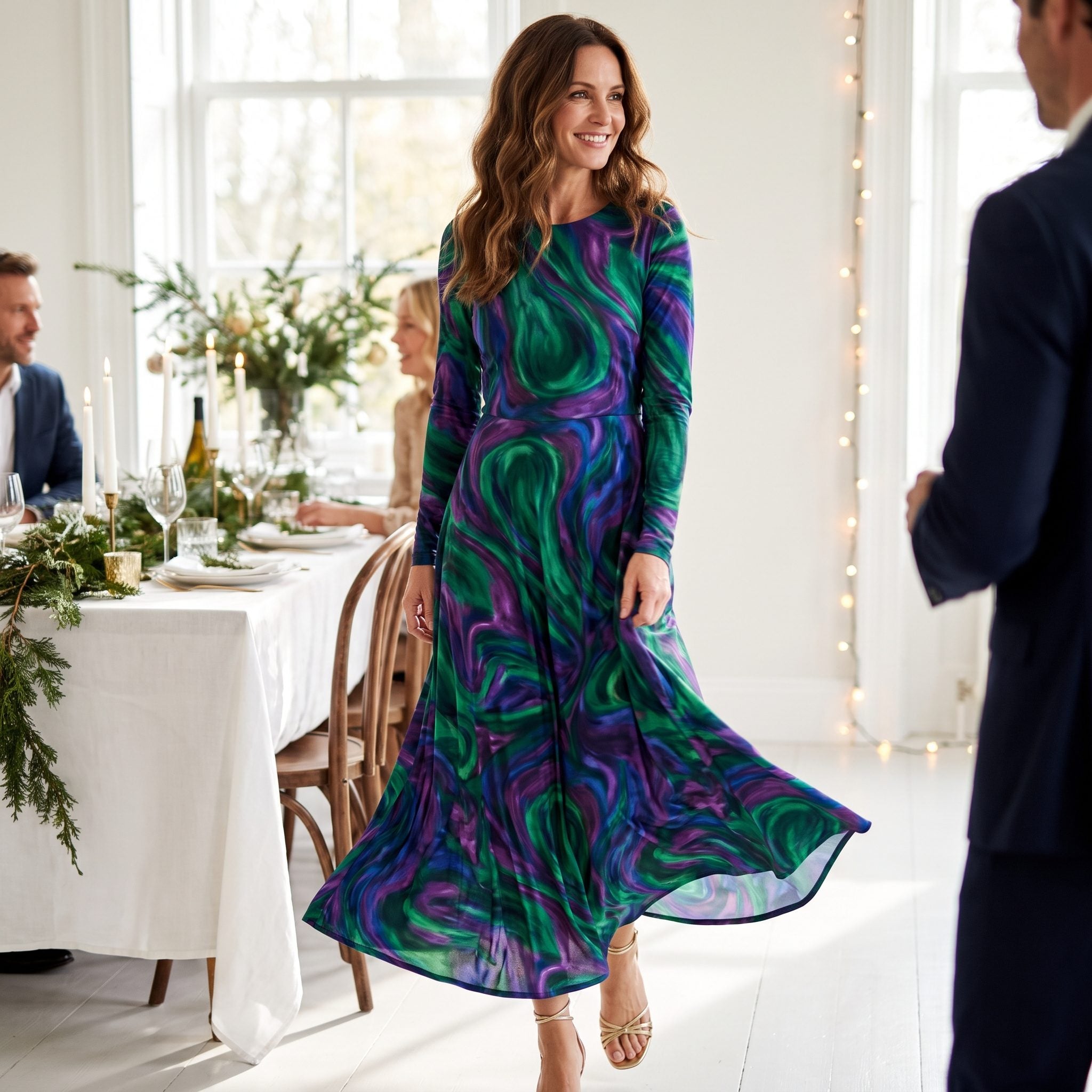
Emerald, violet and sapphire swirl across nearly the entire dress, so the cut refuses to compete. A simple neckline and uninterrupted sleeves turn the body into one long field for the print.
Jersey changes the picture once the dress moves. The fabric swings rather than standing away from the body, making the pattern shift with every step. Delicate gold sandals barely register beneath the hem, exactly where they belong.
35. Emerald Portrait-Collar Suit
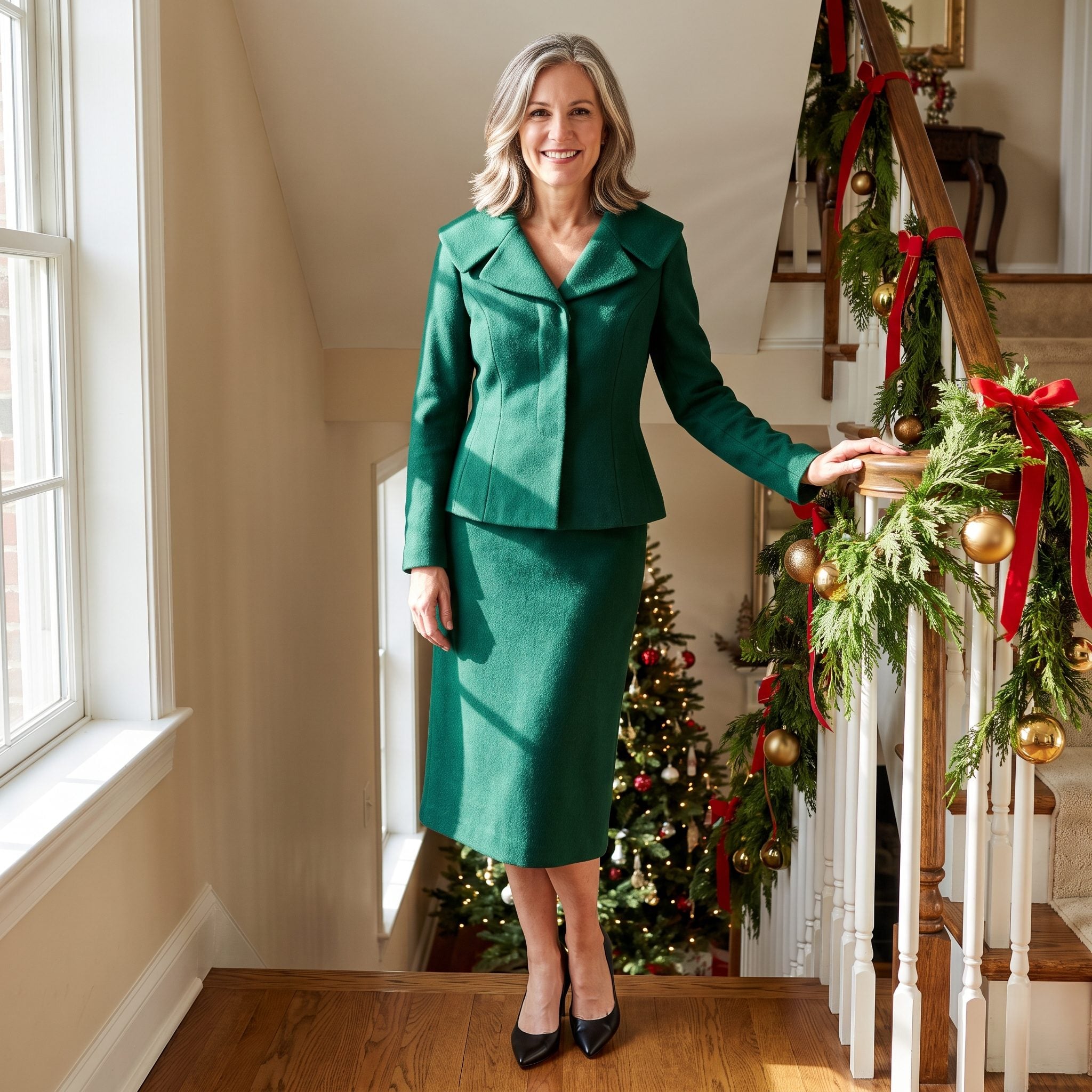
The portrait collar gives this suit its scale. Broad and folded away from the neck, it frames the face while breaking up what would otherwise be a long column of emerald.
A shaped waist and narrow below-knee skirt keep the color from becoming visually heavy. Black pointed pumps provide a clean stop at the bottom, leaving the collar — not a necklace or elaborate shoe — as the strongest piece of geometry.
34. Gold Brocade Cigarette Trousers
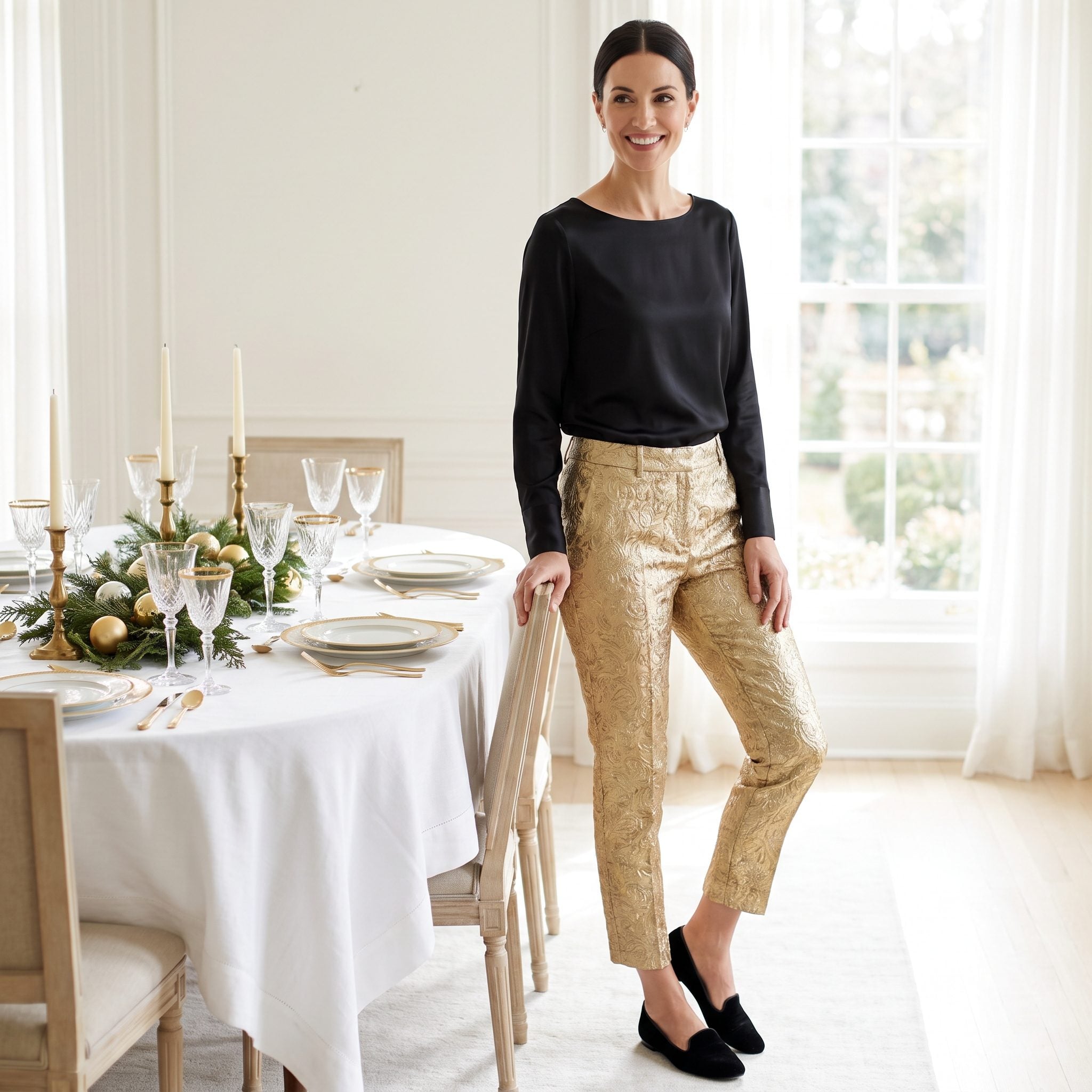
Dressy trousers became an increasingly visible alternative to conventional evening skirts and dresses as the 1960s progressed, and brocade makes the proposition especially hard to miss. The narrow cigarette cut gives the ornate gold fabric a disciplined outline.
A tucked black bateau blouse clears the visual field above the waist. Velvet flats are an equally useful counterweight: low, unfussy and restrained beneath trousers already carrying more than enough ceremony.
33. Burgundy Velvet Evening Coat Over a Black Cocktail Dress
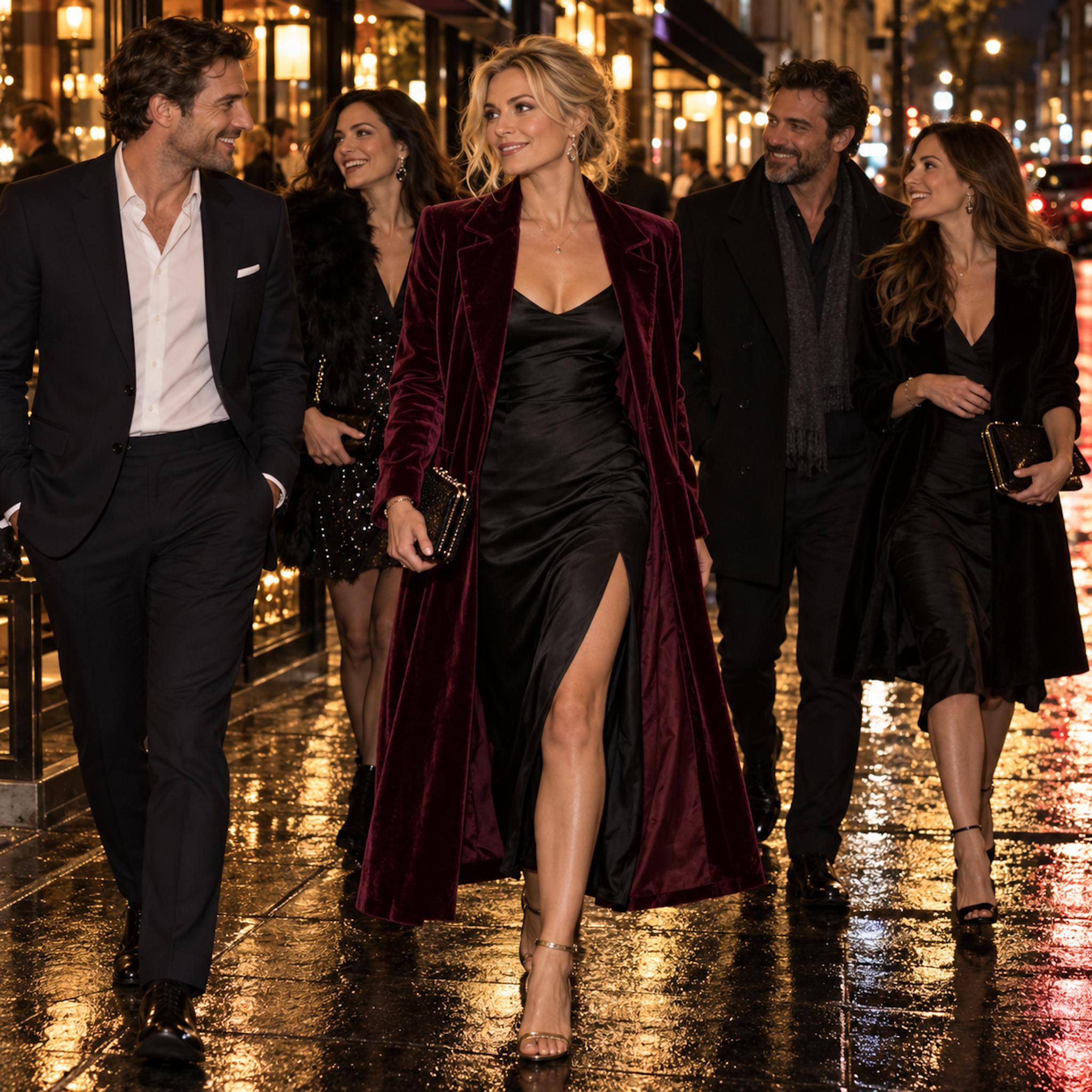
A long burgundy velvet coat left open over a black satin cocktail dress makes the outer layer every bit as important as what sits underneath it. The coat provides almost all the color, while the narrow black dress creates an uninterrupted center that lets the velvet dominate without overwhelming the silhouette.
That relationship feels particularly faithful to 1960s occasion dressing: outerwear could be part of the composition rather than something merely thrown over it. Gold sandals and a compact evening clutch provide the finish without challenging the coat’s scale or texture.
32. Ice-Blue Chiffon Cape Dress
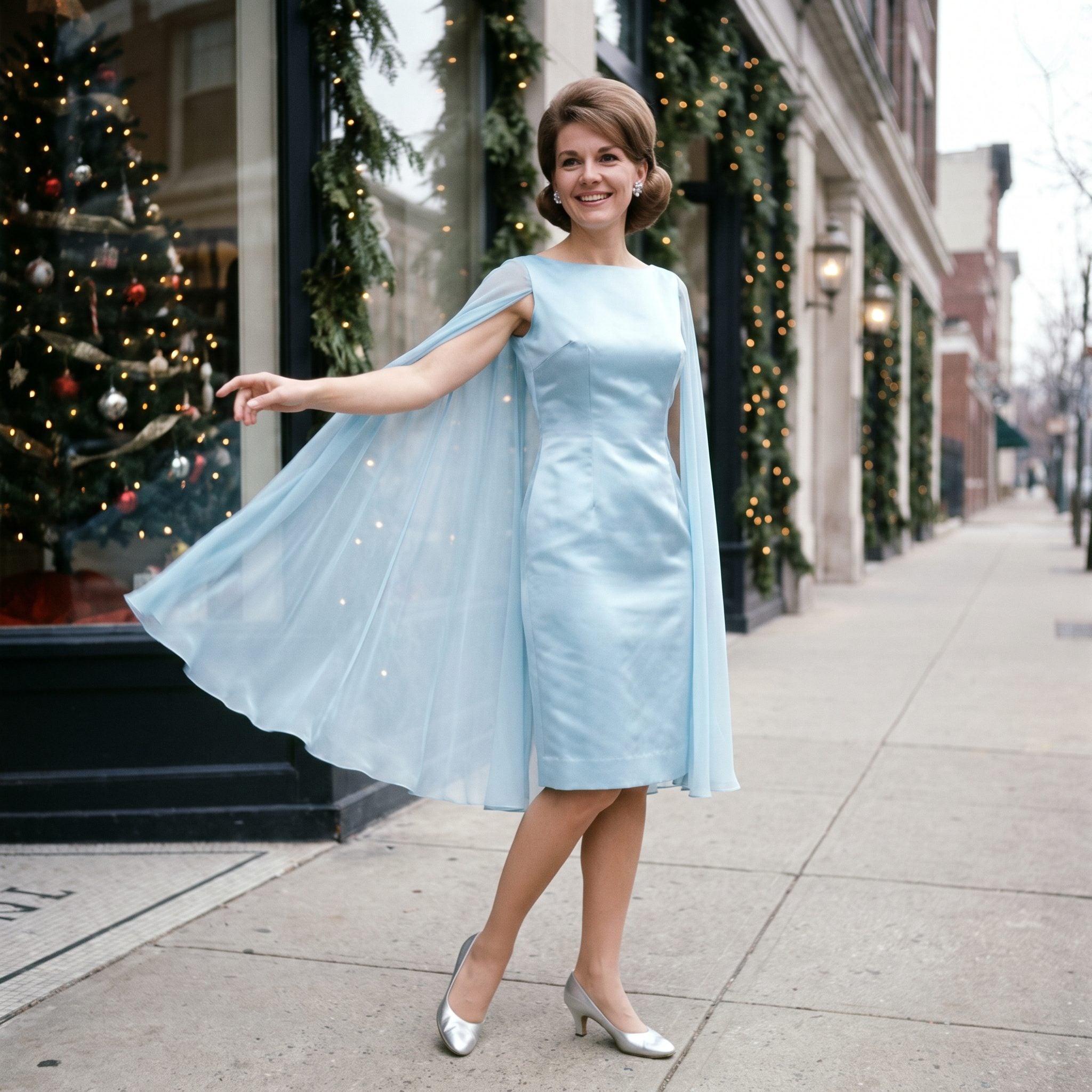
The narrow sheath gives the dress its discipline; the attached chiffon gives it air. Every movement of the shoulders sends the translucent layer away from the body while the opaque dress beneath remains almost still.
Using the same pale blue in two different finishes prevents the monochrome palette from going flat. Silver heels and crystal studs stay small enough to let the floating layer dominate.
31. Cranberry Mod Pinafore
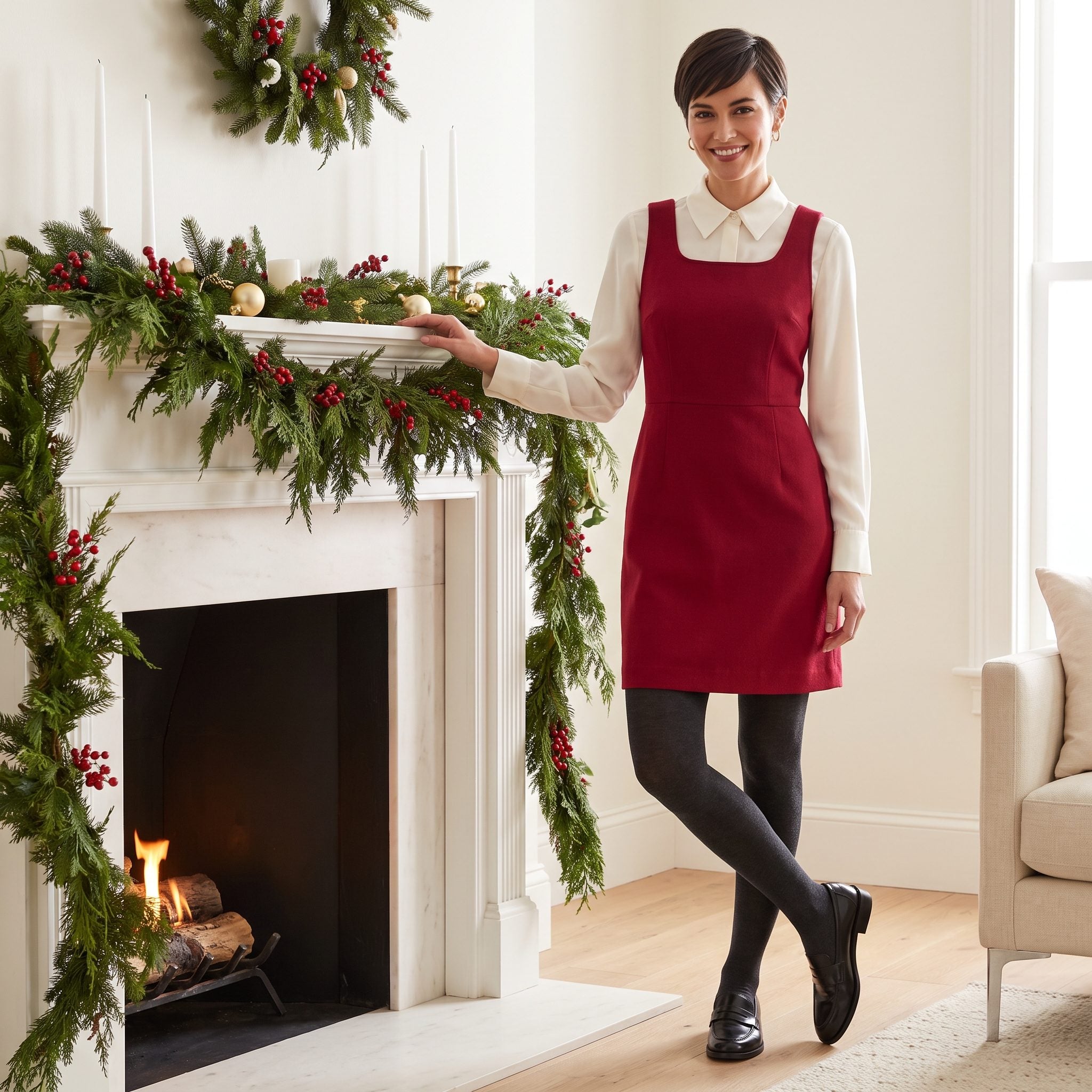
An ivory pointed collar emerging from cranberry gives this simple pinafore nearly all the definition it needs. The contrast is small in square inches and enormous in effect.
Opaque tights and polished loafers keep the styling clean rather than sugary. Cranberry also gives the holiday palette a more interesting route than literal red-and-green while still feeling unmistakably seasonal.
30. Chocolate Velvet Empire Gown
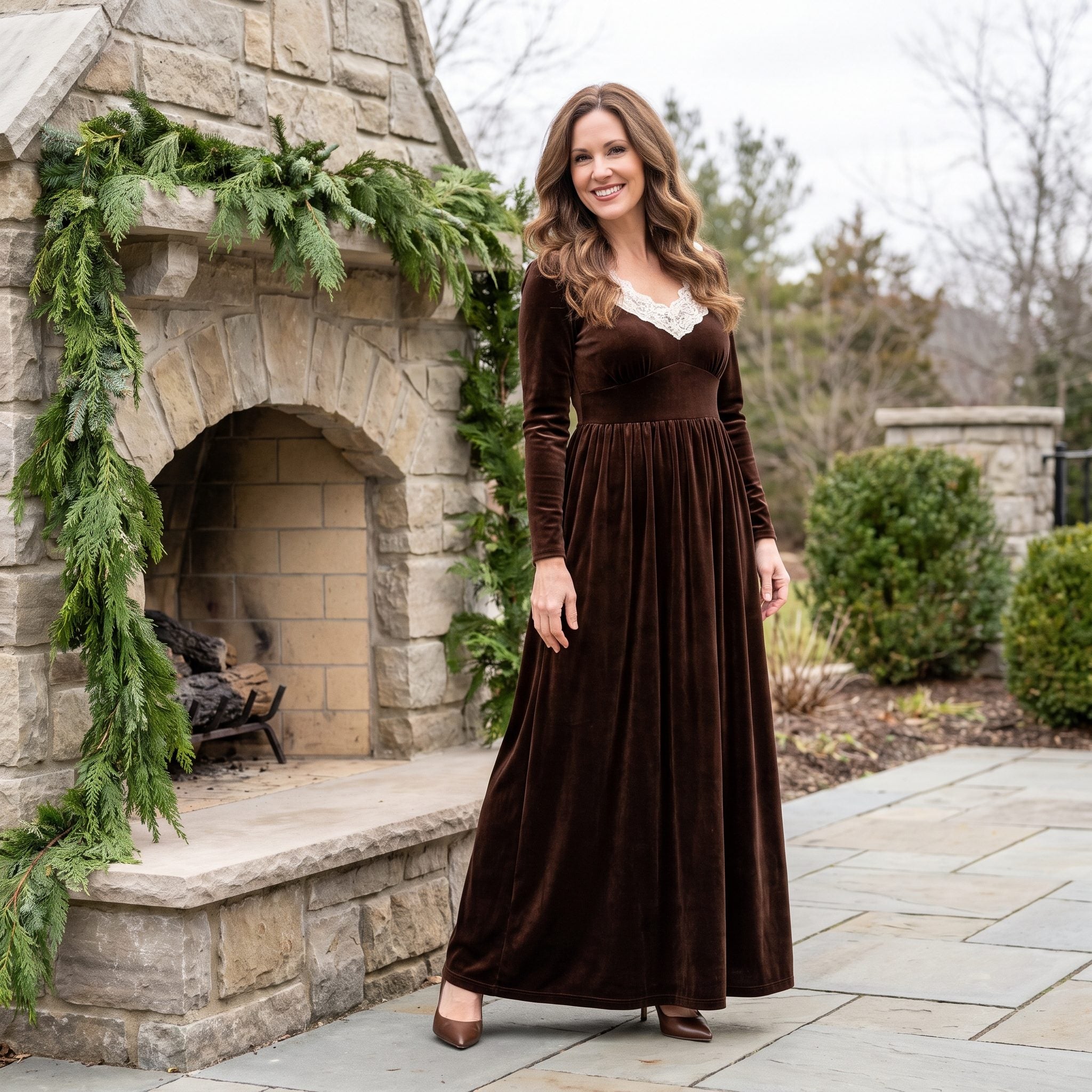
Chocolate velvet shifts from near-black to warm brown across its folds, giving the gown far more surface variation than a flatter fabric would provide.
The raised waist lets the skirt fall freely below the bodice, giving all that substantial velvet a surprisingly easy line. Ivory lace at the neckline introduces the only pale note and prevents the deep brown from closing in around the face.
29. Op-Art Blouse and Black Velvet Pencil Skirt
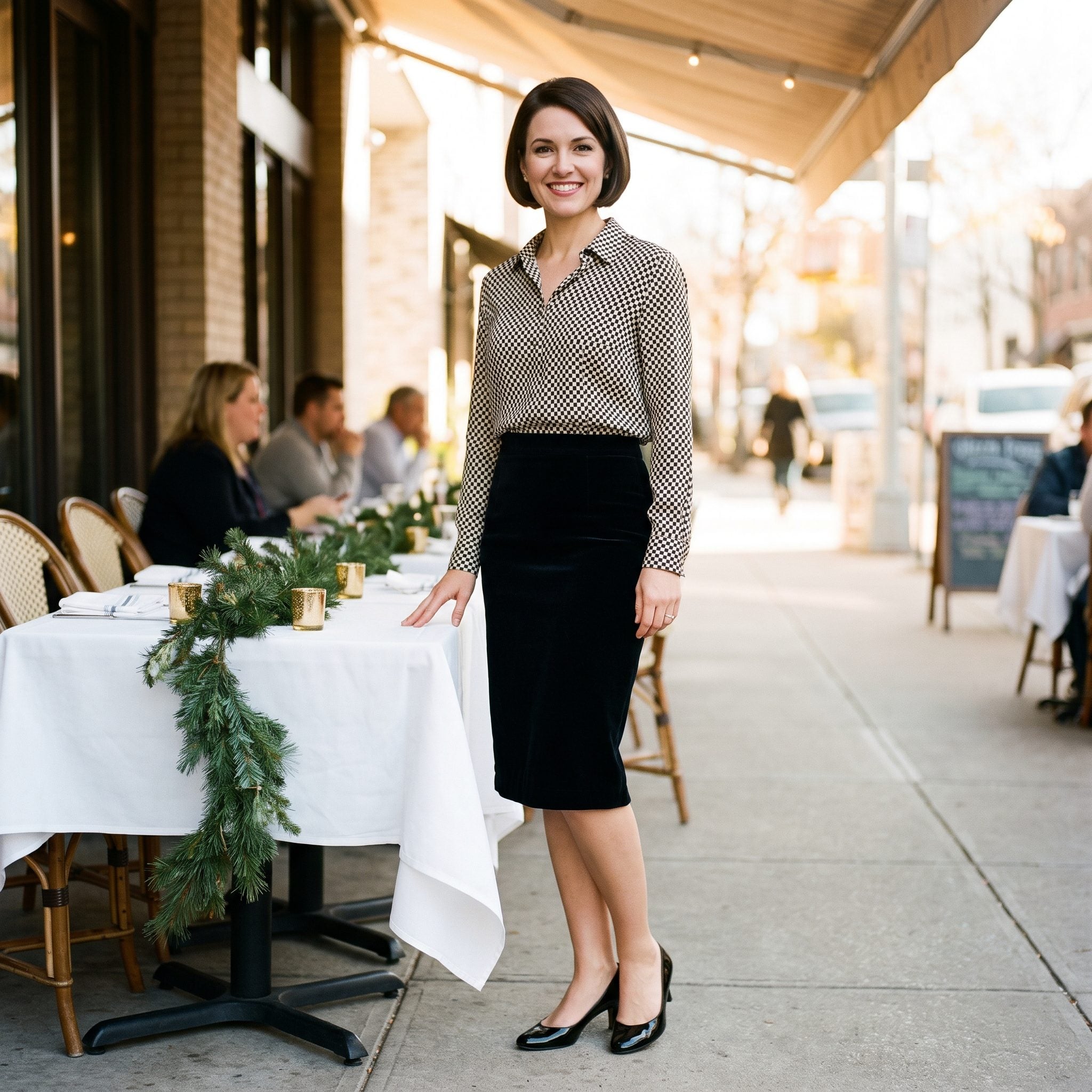
The blouse refuses to sit still visually. Black-and-ivory lines bend, repeat and pull in different directions, while the velvet pencil skirt beneath gives the eye one solid place to land.
That division saves the outfit from becoming a full optical experiment. Printed silk supplies speed; matte velvet supplies weight. The contrast between the two surfaces is nearly as important as the pattern itself.
28. Sapphire One-Shoulder Dress
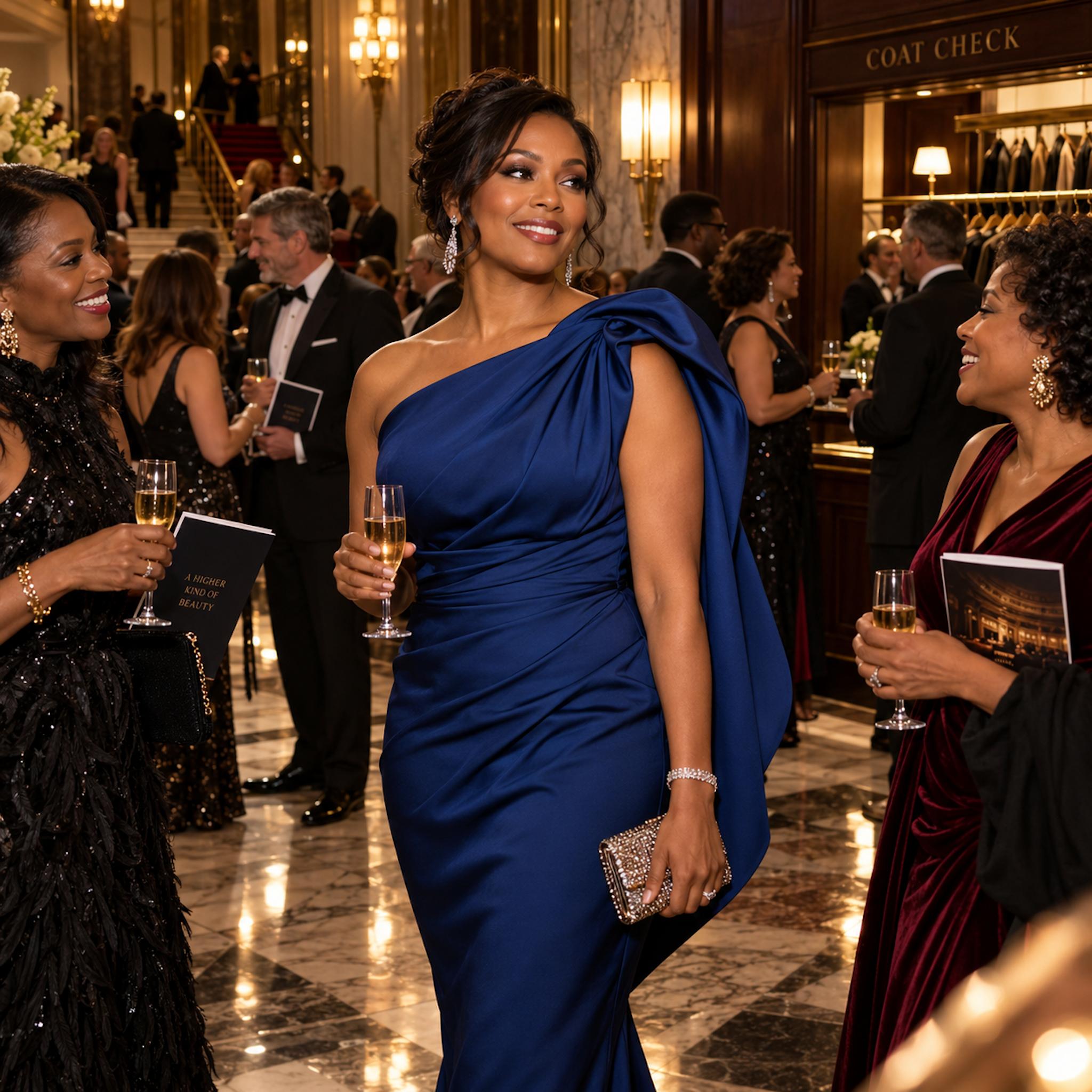
A sapphire dress with a sculptural shoulder drape shows how decisively one asymmetric gesture can alter a conventional cocktail silhouette. The draped shoulder creates width and movement on one side while the fitted body of the dress remains clean and controlled.
Crystal earrings and a compact jeweled clutch repeat that sense of precision without crowding the neckline. The theater setting reinforces the larger point: this was party dressing built around shape, finish and occasion rather than simply adding more decoration.
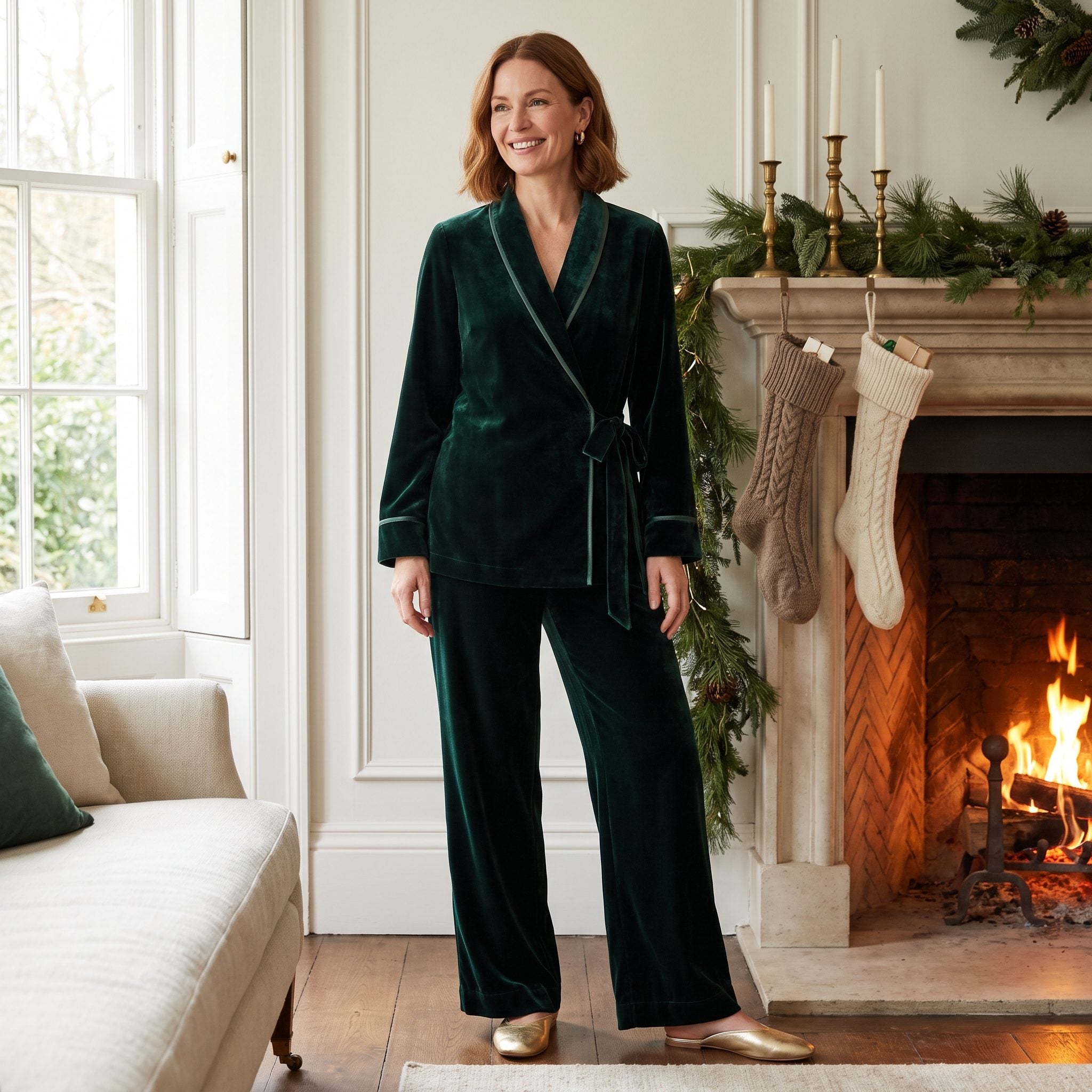
27. Green Velvet Evening Pajamas by the Fire
❤️ Would you like to save this?
Evening pajamas had appeared in fashionable wardrobes well before the 1960s, but the decade’s growing appetite for unconventional evening separates gave the idea fresh relevance. In deep green velvet, the format lands somewhere between tailored suit and drawing-room luxury.
Wide trousers provide the ease; satin edging along the wrap jacket supplies the necessary polish. Gold slippers keep the line low and relaxed without making the velvet feel casual.
26. Ivory Satin Dress With a Sculptural Back Bow
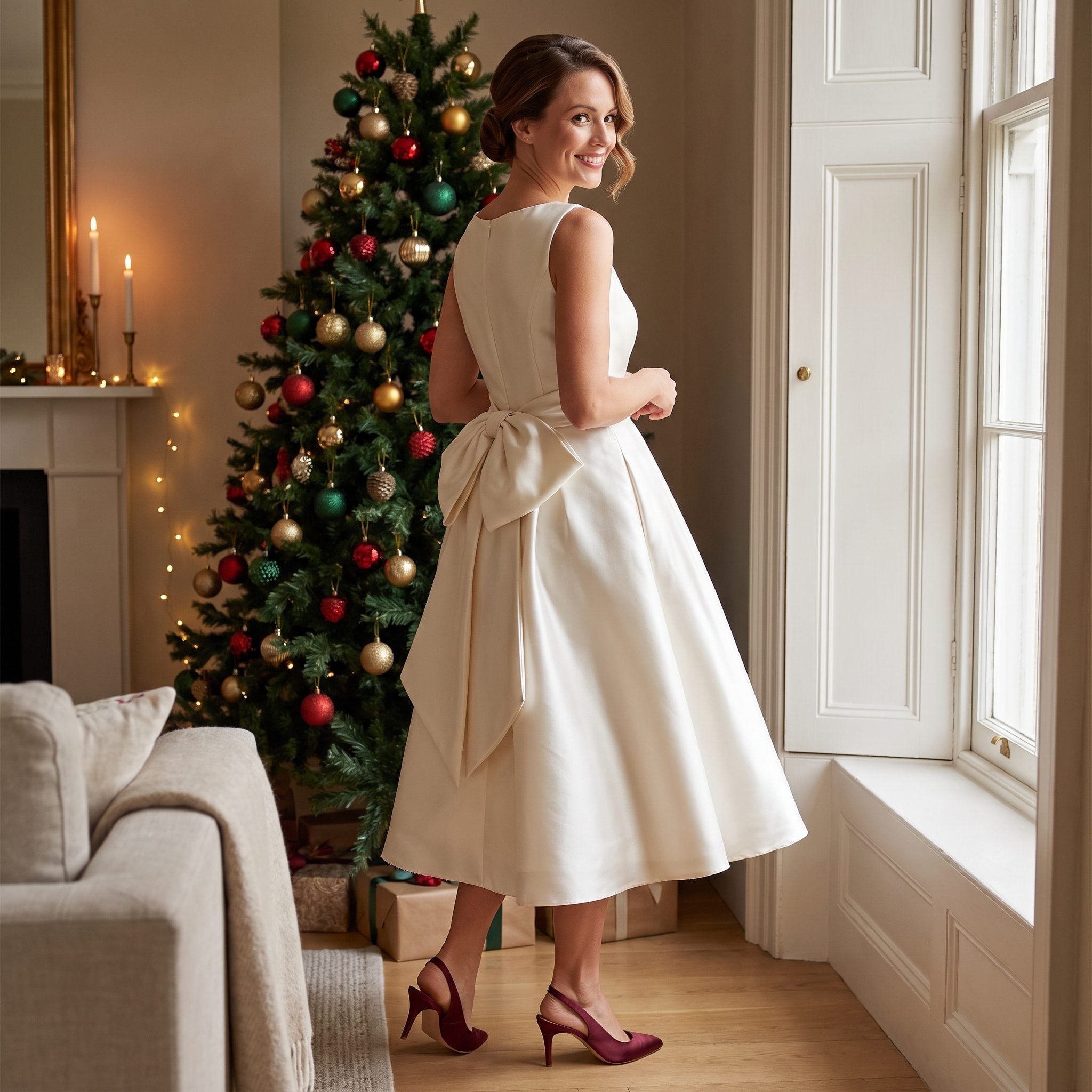
From the front, the ivory column is almost severe. The surprise waits at the back, where a large folded bow turns the waist into the dress’s architectural moment.
Burgundy slingbacks are especially useful here. The deep wine color cuts through all that ivory and gives the satin a distinctly holiday register without introducing sequins, beading or another major embellishment.
25. Cobalt Graphic Mini With Ivory Knee-High Boots
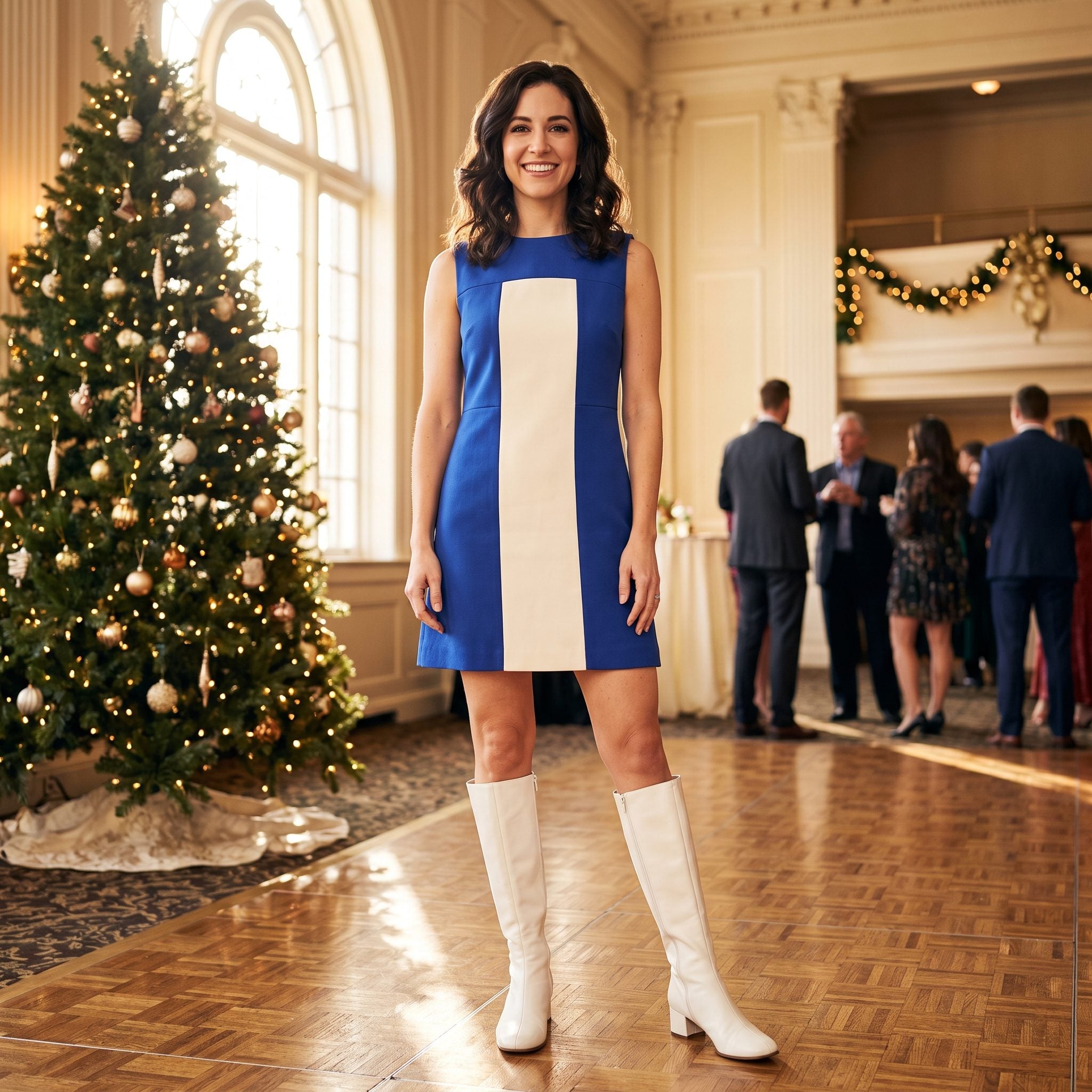
The ivory panel turns a straightforward cobalt mini into a piece of graphic design. Its placement changes how the dress is read before the A-line shape even enters the equation.
Ivory knee-high boots repeat that pale block at the opposite end of the body, sending the color down the full silhouette. The geometry is pure mid-1960s energy; the limited palette stops it from becoming visual noise.
24. Jade Silk Embroidered Kaftan
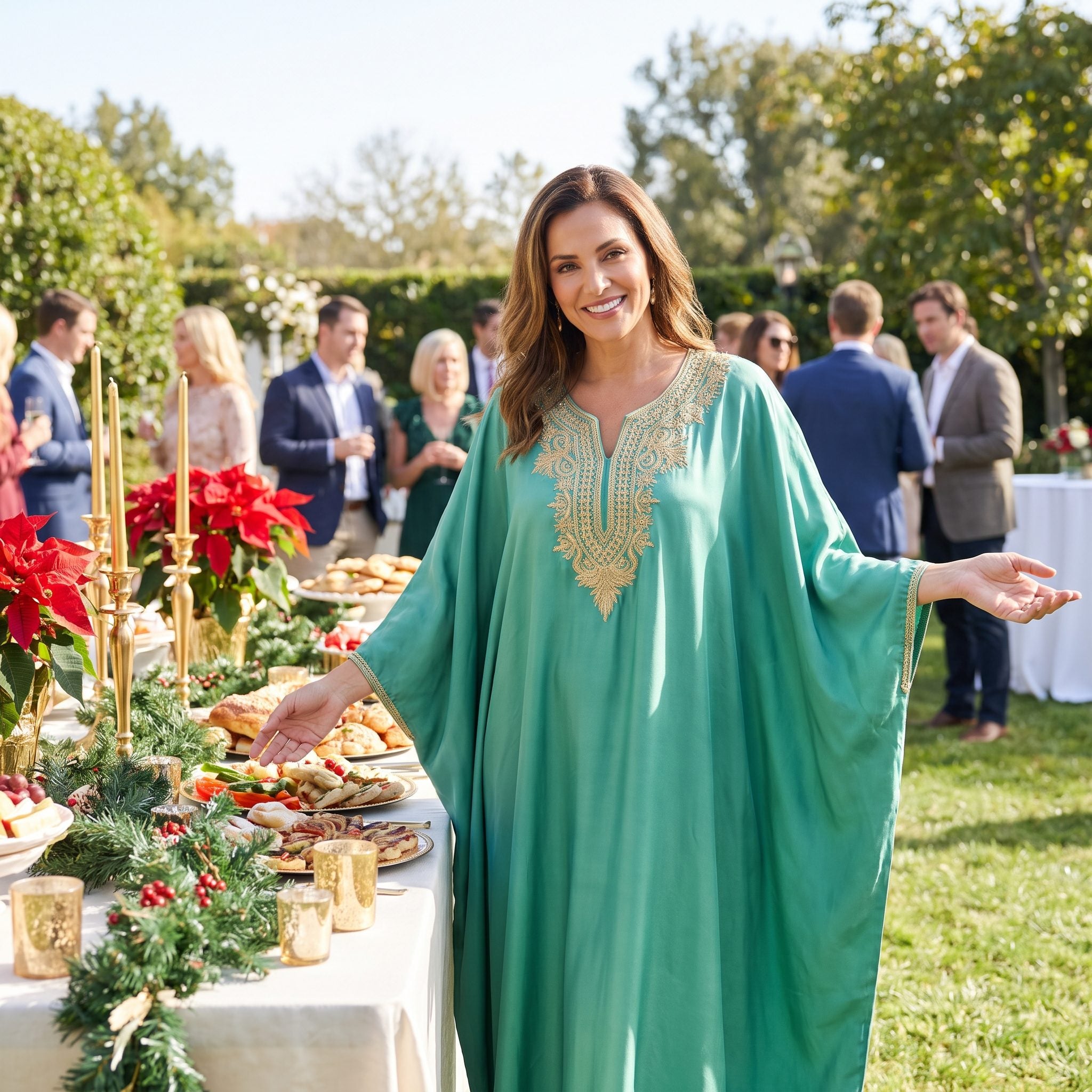
The attraction here is width without bulk. Jade silk falls away from the body, and side slits prevent the generous shape from turning into one unbroken rectangle.
Gold embroidery around the neckline provides a firm visual edge amid all that fluid fabric, giving the jade silk enough ceremony for a Christmas party without loading the neckline with jewelry. Gold flats carry the metallic note downward while preserving the kaftan’s relaxed line.
23. Silver Linked-Disc Sleeveless Top
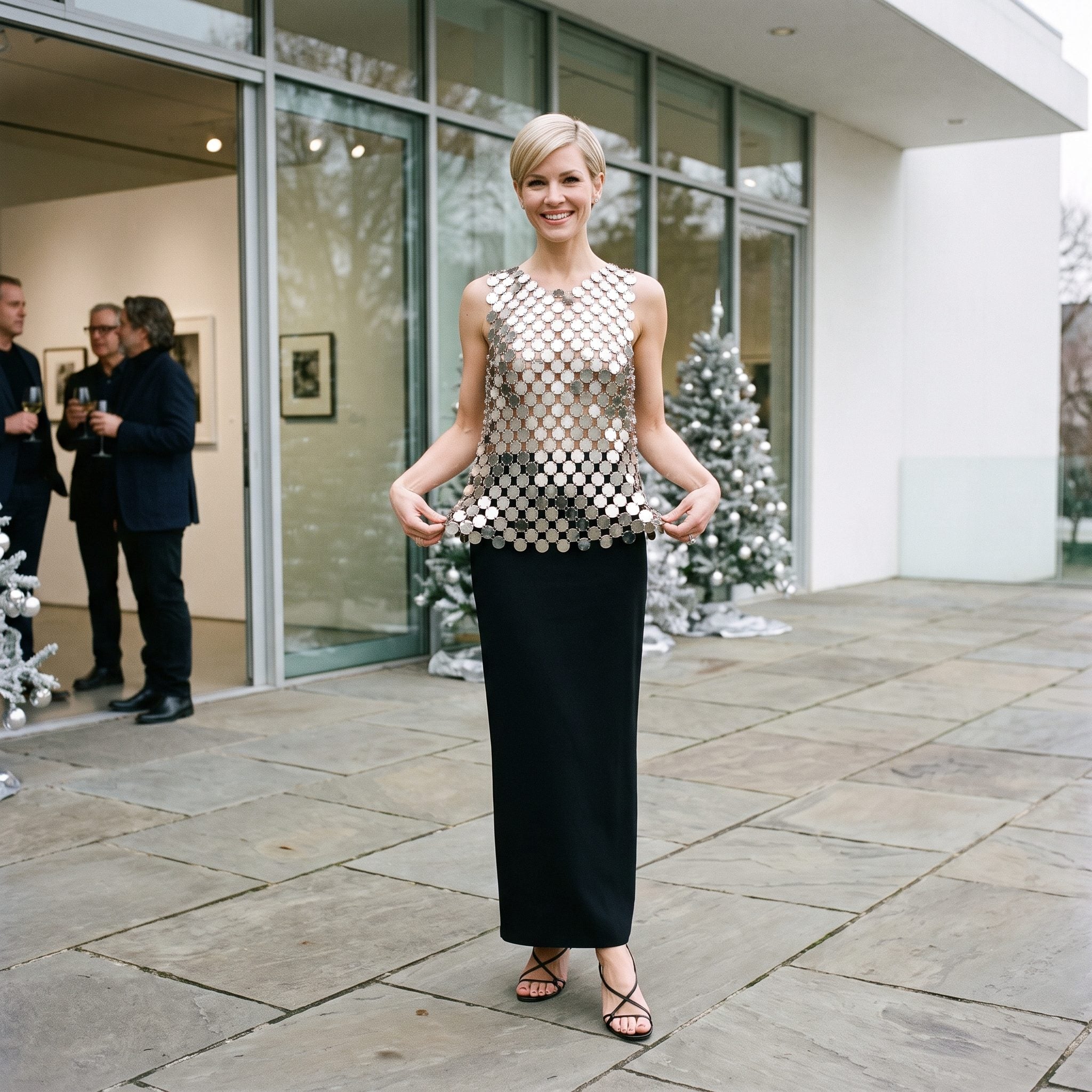
A linked-disc top behaves almost more like jewelry than cloth. Each small metal piece moves independently, so the surface flickers and shifts instead of behaving like one uninterrupted sheet.
The plain black skirt is exactly the right partner because almost anything more complicated would compete with the construction. Delicate sandals and tiny earrings keep the metallic surface from becoming head-to-toe armor.
22. Garnet Dress Under a Black Cocoon Jacket
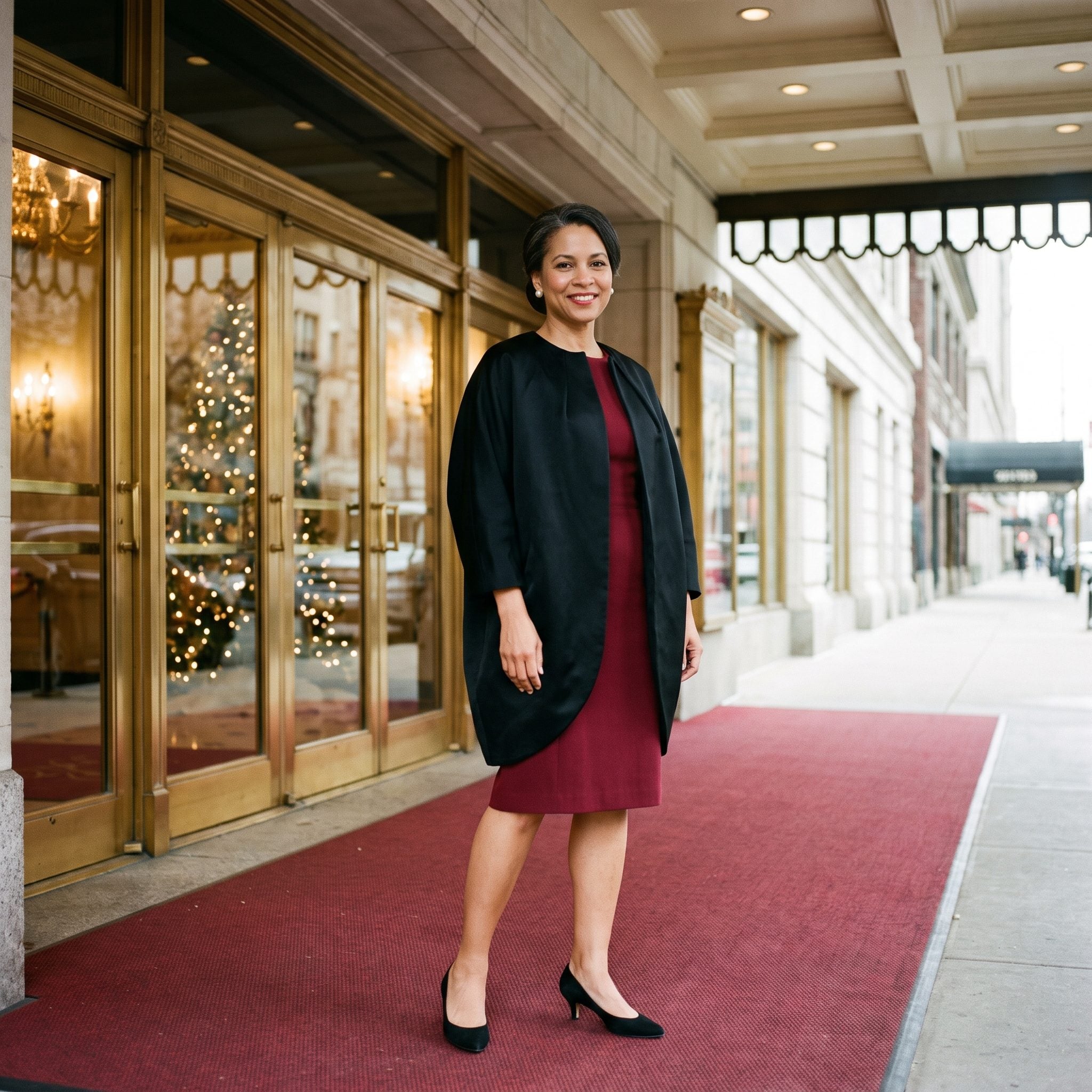
The cocoon jacket pushes outward while the garnet dress underneath stays close to the body. That opposition — rounded volume outside, narrow line inside — gives the outfit its authority before color even enters the picture.
Glossy black over deep garnet is strong enough to need very little ornament. Kitten heels and sparse jewelry leave the jacket’s curved silhouette completely unobstructed.
21. Navy Beaded Twinset Worn Open Over a Christmas Table
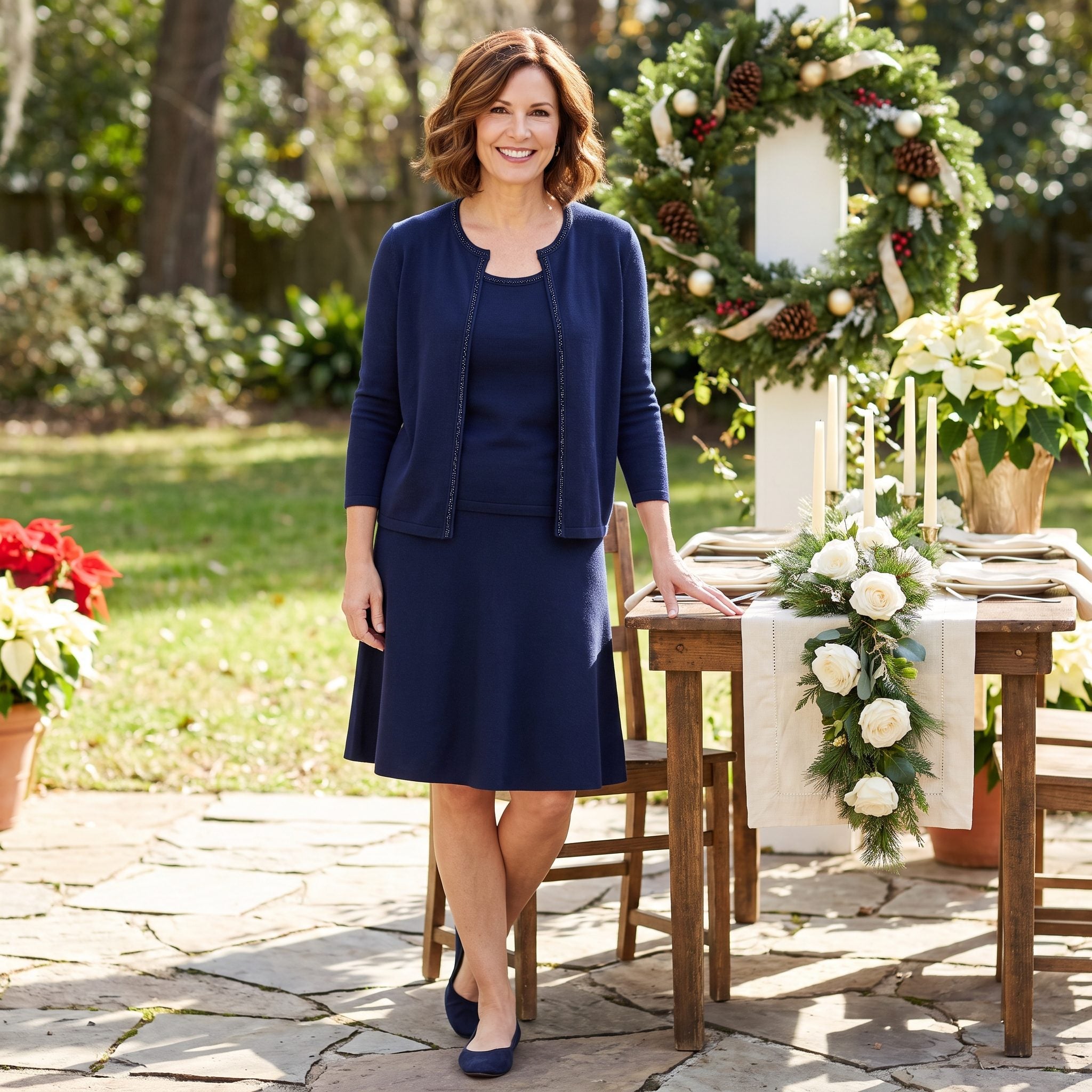
Opening the cardigan changes the twinset immediately. Instead of one compact block of navy knit, the beaded shell becomes visible beneath it and creates a second layer of texture at the neckline.
A plain knee-length skirt and pointed flats give the beadwork space to register. Nothing about the silhouette is complicated; the interest comes from what happens when simple knit construction meets concentrated embellishment.
20. Rose Satin Dress With a Sculptural Rolled Collar
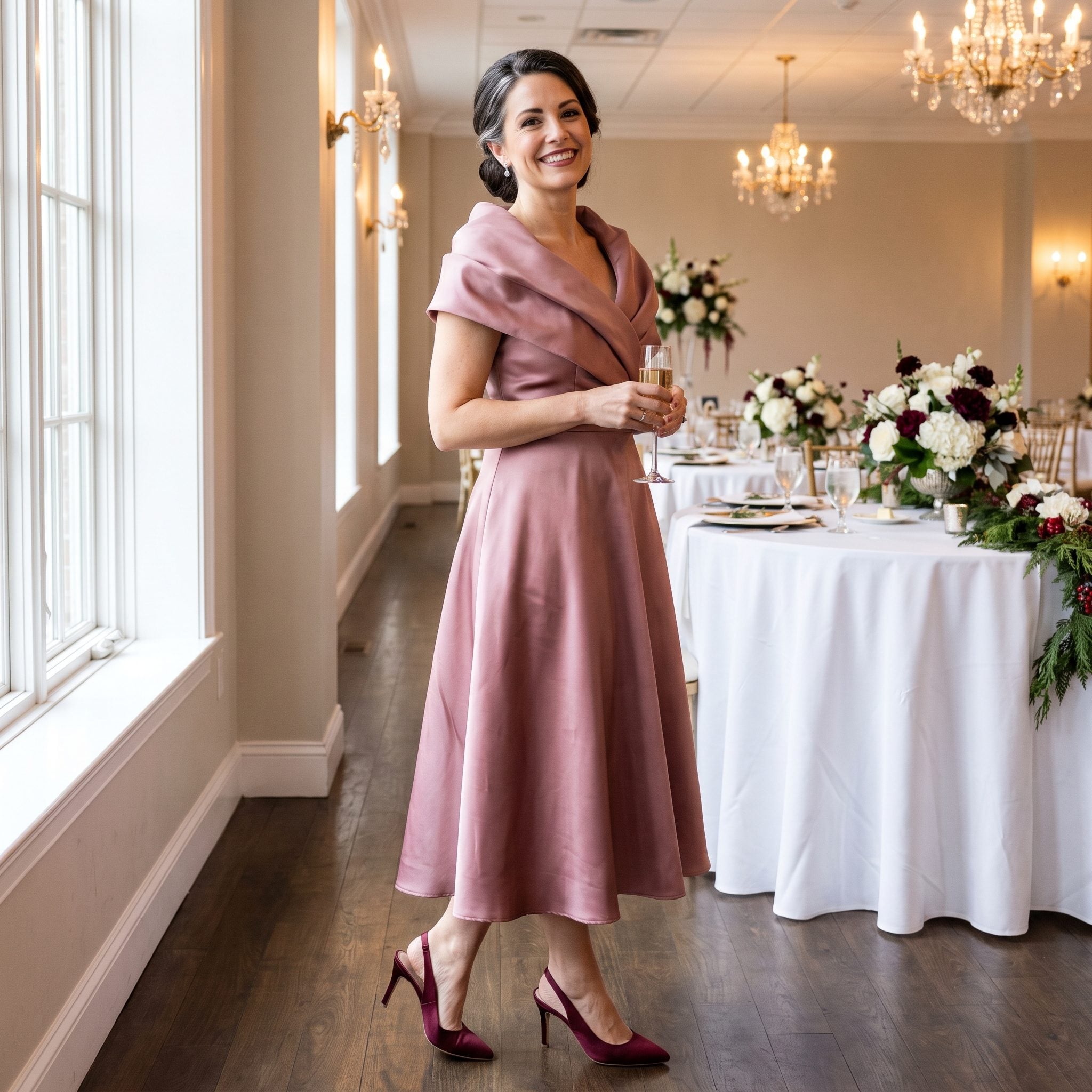
The rolled collar gives the rose satin something solid to do. Instead of relying on jewelry, the neckline itself rises into a smooth sculptural curve that distinguishes it from the flatter bodice below.
Burgundy slingbacks deepen the palette without matching it exactly. A lightly fitted waist keeps the lustrous fabric under control, allowing the unusual neckline to carry the design.
19. Black Lace Cocktail Dress at Dinner
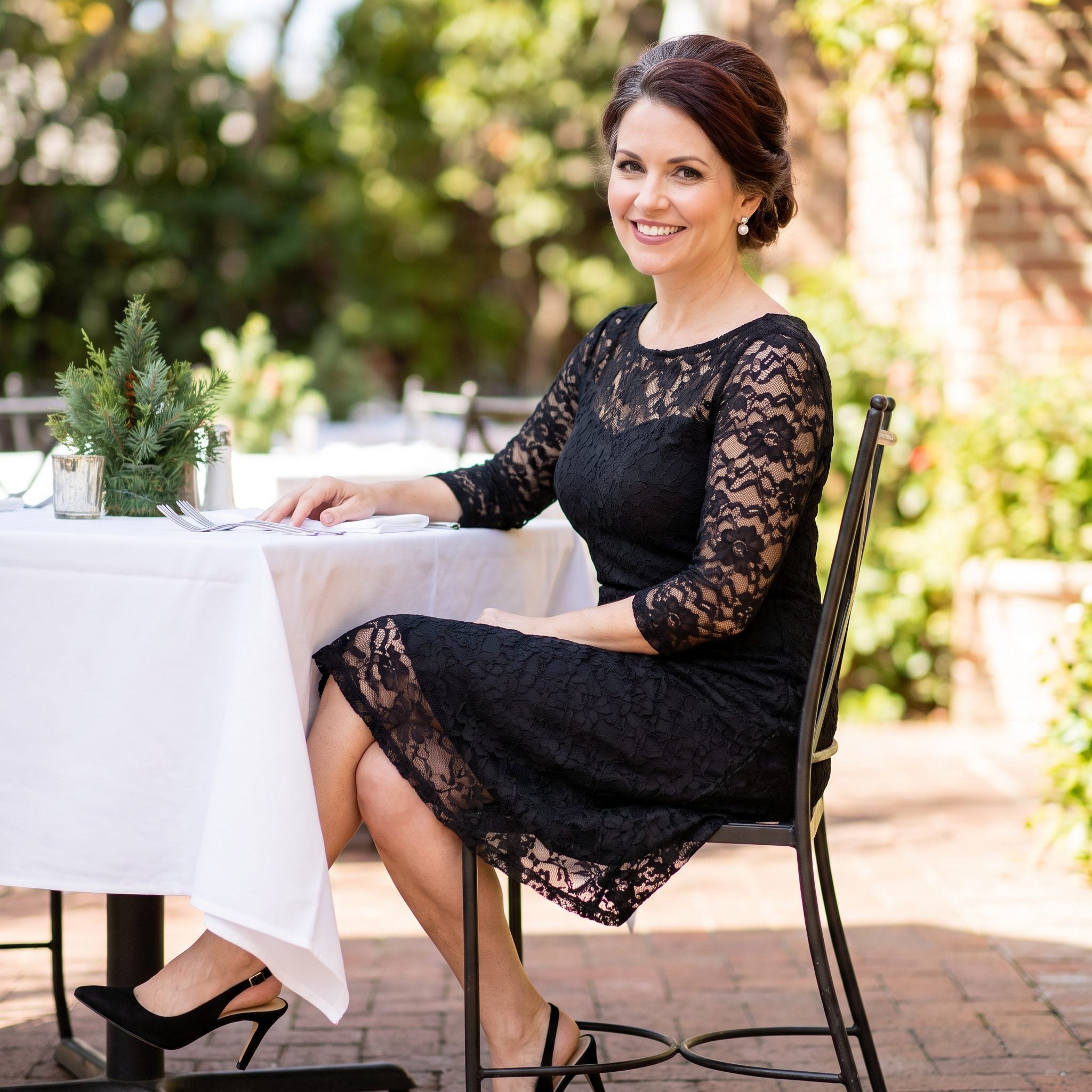
Lace depends almost entirely on what sits behind it. Opaque black beneath the body sharpens the pattern, while sheer sleeves expose the same motif against skin, giving one fabric two completely different effects.
Pearl studs and a deep rose lip are sufficient because the scalloped lace already supplies plenty of surface detail. The useful contrast happens within the dress itself: solid through the body, transparent through the sleeves.
18. Copper Lamé Tunic and Black Trousers
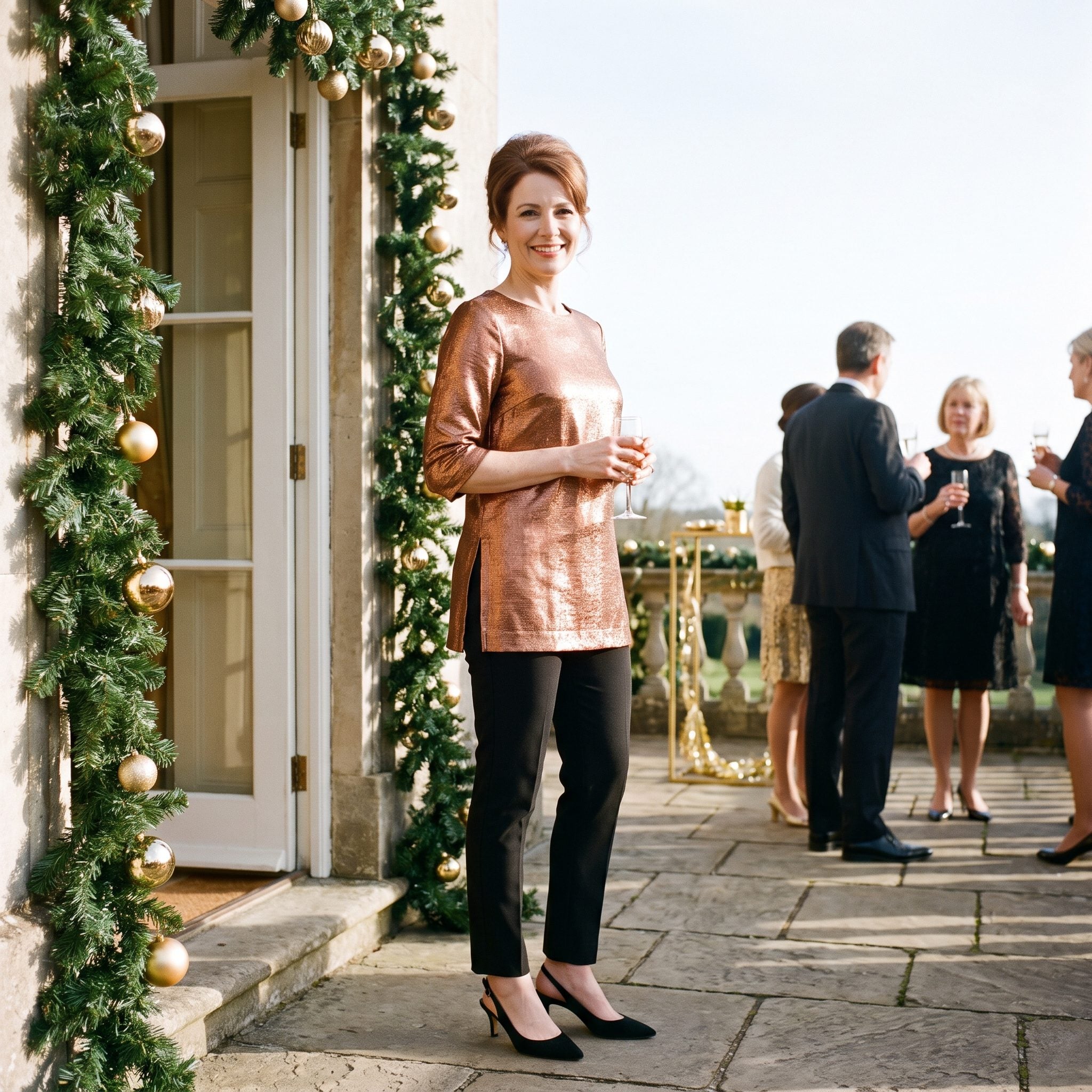
Copper lamé brings almost all the visual activity to the upper half while matte black trousers provide a calm field beneath it. Putting those two surfaces together gives the metallic fabric enough room to be extravagant without turning the entire outfit into one continuous shimmer.
A long tunic with side slits allows the copper fabric to skim over the trousers rather than stopping abruptly at the waist. Plain slingbacks continue the clean lower line without introducing another competing texture.
17. Floral Maxi Under a Fitted Velvet Waistcoat
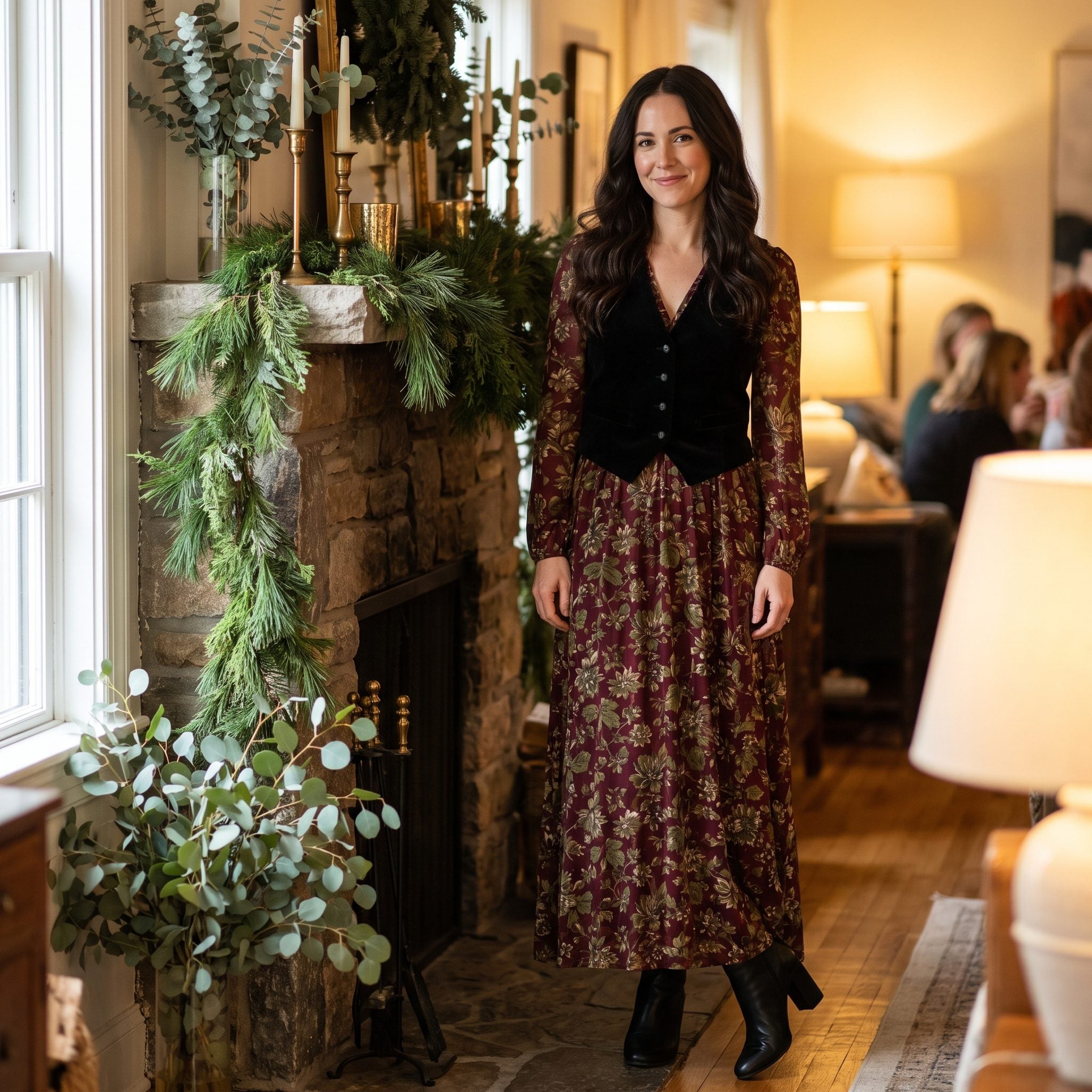
A flowing floral maxi can drift toward full bohemian softness. The fitted black velvet waistcoat interrupts that flow with a hard-edged shape through the torso.
Small burgundy-and-olive flowers keep the pattern dense but controlled, while the black velvet waistcoat supplies the richer surface that pulls the maxi toward Christmas-party dressing. Sleek heeled boots bring a narrow black line beneath the hem.
16. Ivory Dinner Suit With Black Satin Lapels
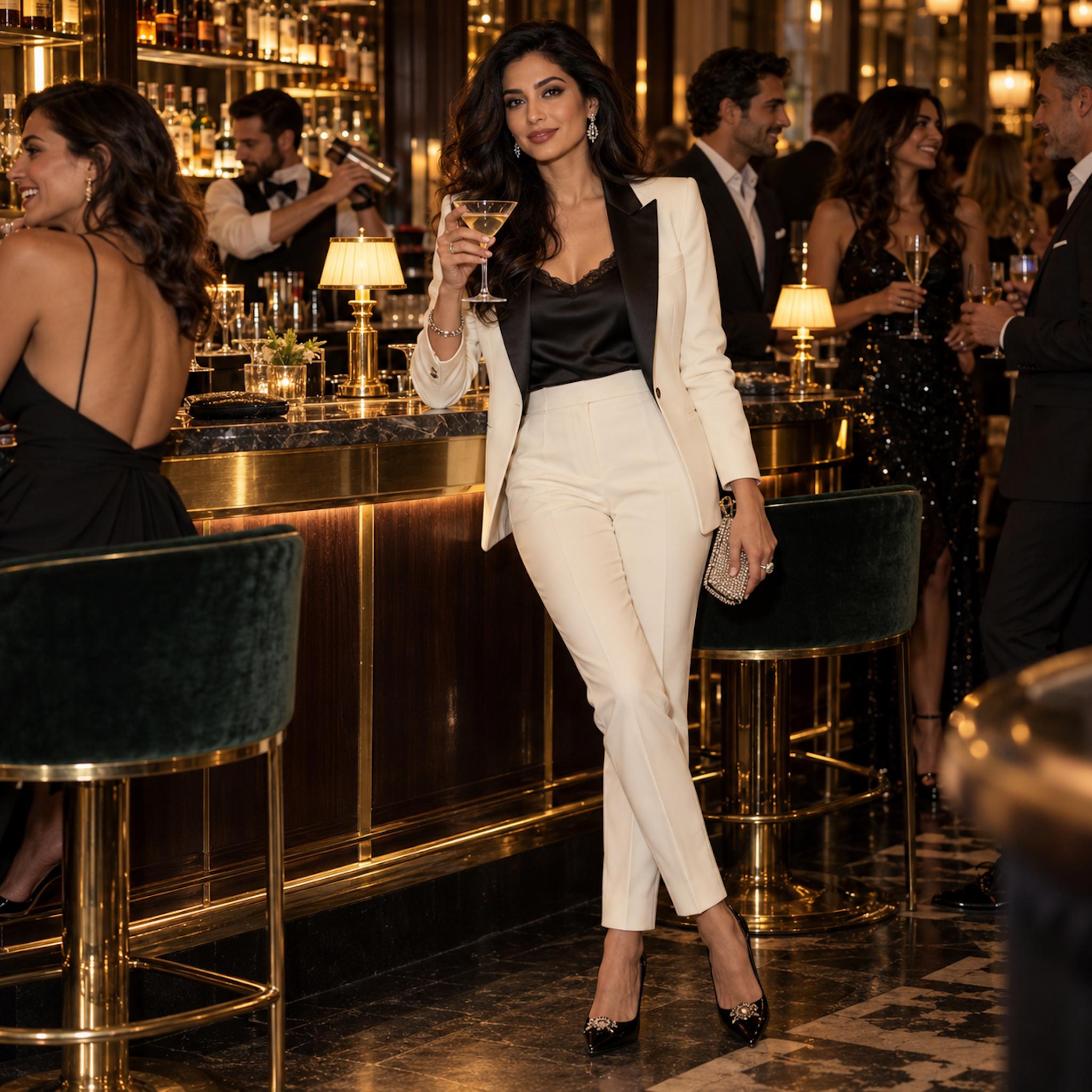
An ivory dinner suit has exactly the kind of nerve this gallery needs. Black satin lapels connect the tailoring to traditional formalwear, but the pale jacket and trousers reverse the usual black-tuxedo formula and give the silhouette considerably more graphic punch.
The black silk camisole creates a strong vertical center and prevents the ivory from becoming too uniform. A crystal clutch, jeweled earrings and black evening pumps provide small points of ornament while the suit remains unmistakably the main event.
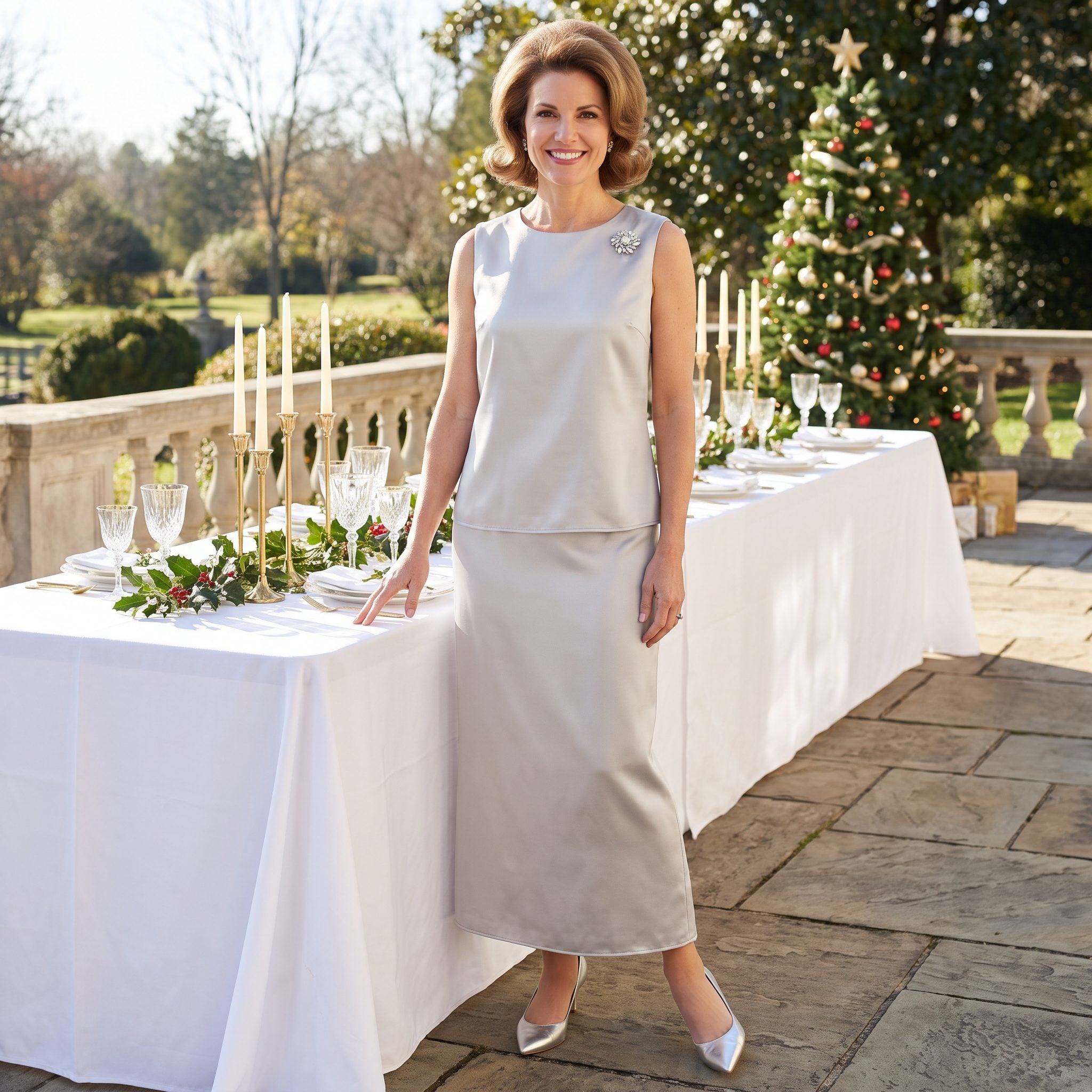
15. Pearl-Gray Satin Evening Separates
❤️ Would you like to save this?
The hip-length overblouse and narrow skirt are cut from the same pearl-gray satin, so the two pieces initially register almost like a single dress. Look again and the horizontal hem creates a subtle break without cinching the waist.
Satin rewards precise construction because every seam and fold remains visible. Here the narrow cut keeps the surface controlled, while a crystal shoulder brooch and silver pointed-toe heels place small decorative accents at opposite ends of the silhouette.
14. Bronze Sequined Shell With Ivory Trousers
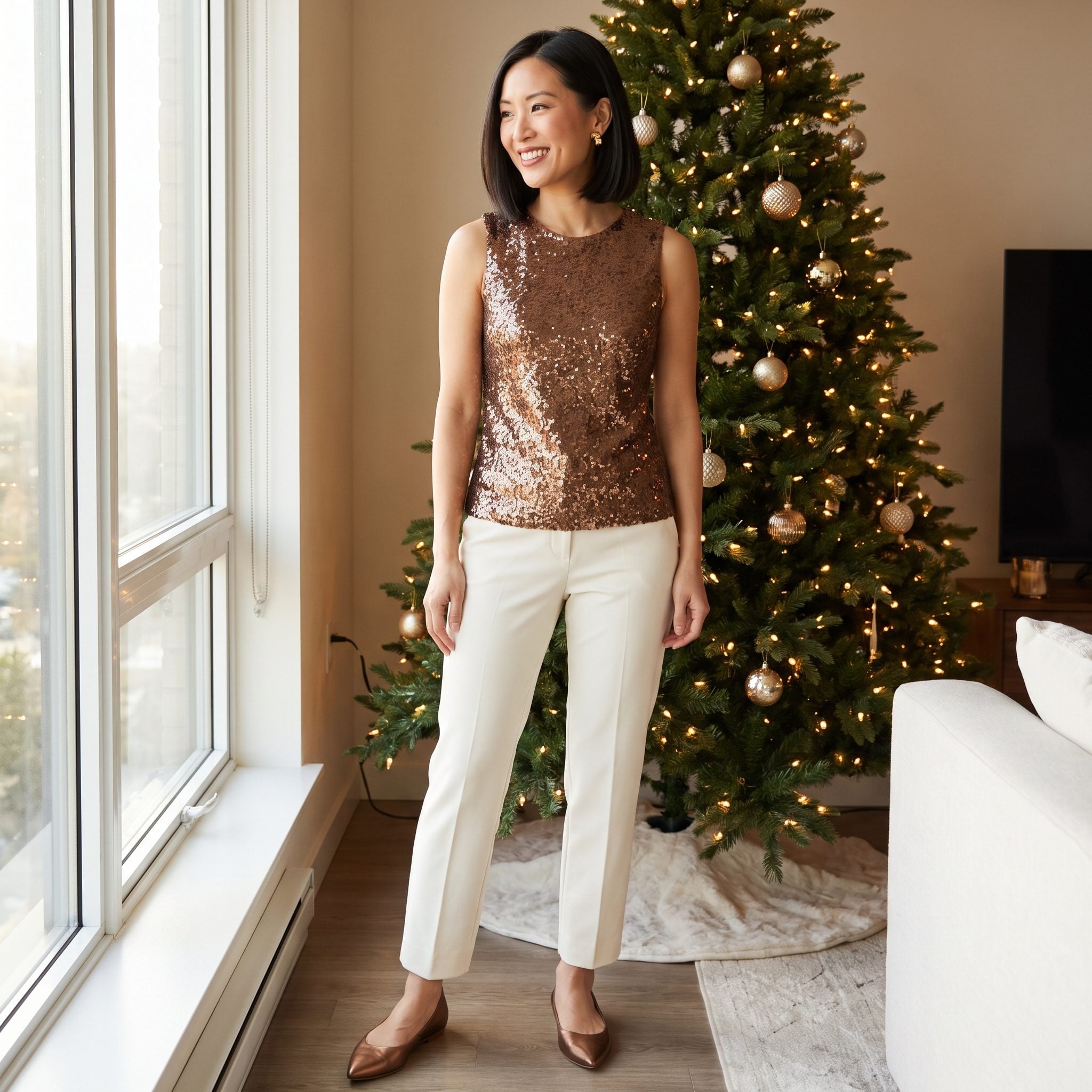
The sequins stop at the waist, which is precisely why the sparkle feels controlled. A bronze shell carries the ornament while straight ivory trousers provide a broad, quiet counterweight beneath it.
Bronze flats echo the top without turning the lower half into another spectacle. The warmer metallic also sits more softly beside ivory than bright yellow gold would.
13. Emerald One-Shoulder Dress With a Shoulder Drape
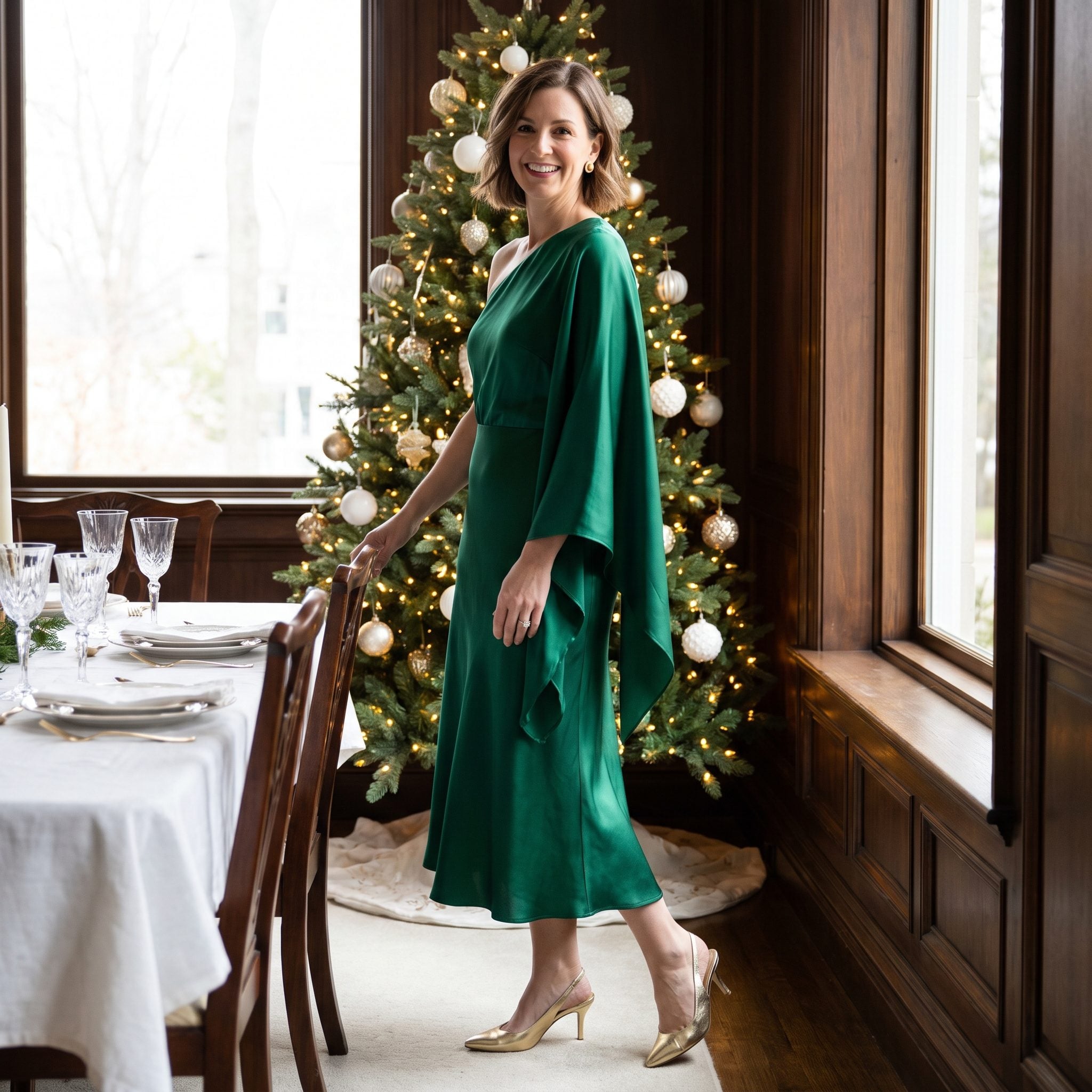
One fall of silk from the shoulder changes this dress more than another dozen decorative details could. The fitted cocktail silhouette remains visible underneath while the drape introduces an off-center vertical sweep down the back.
A softly shaped waist, below-knee hem and gold slingbacks leave the emerald silk dress unusually uncluttered. The asymmetry supplies enough drama on its own.
12. Scarlet Pleated-Chiffon Dress Mid-Step
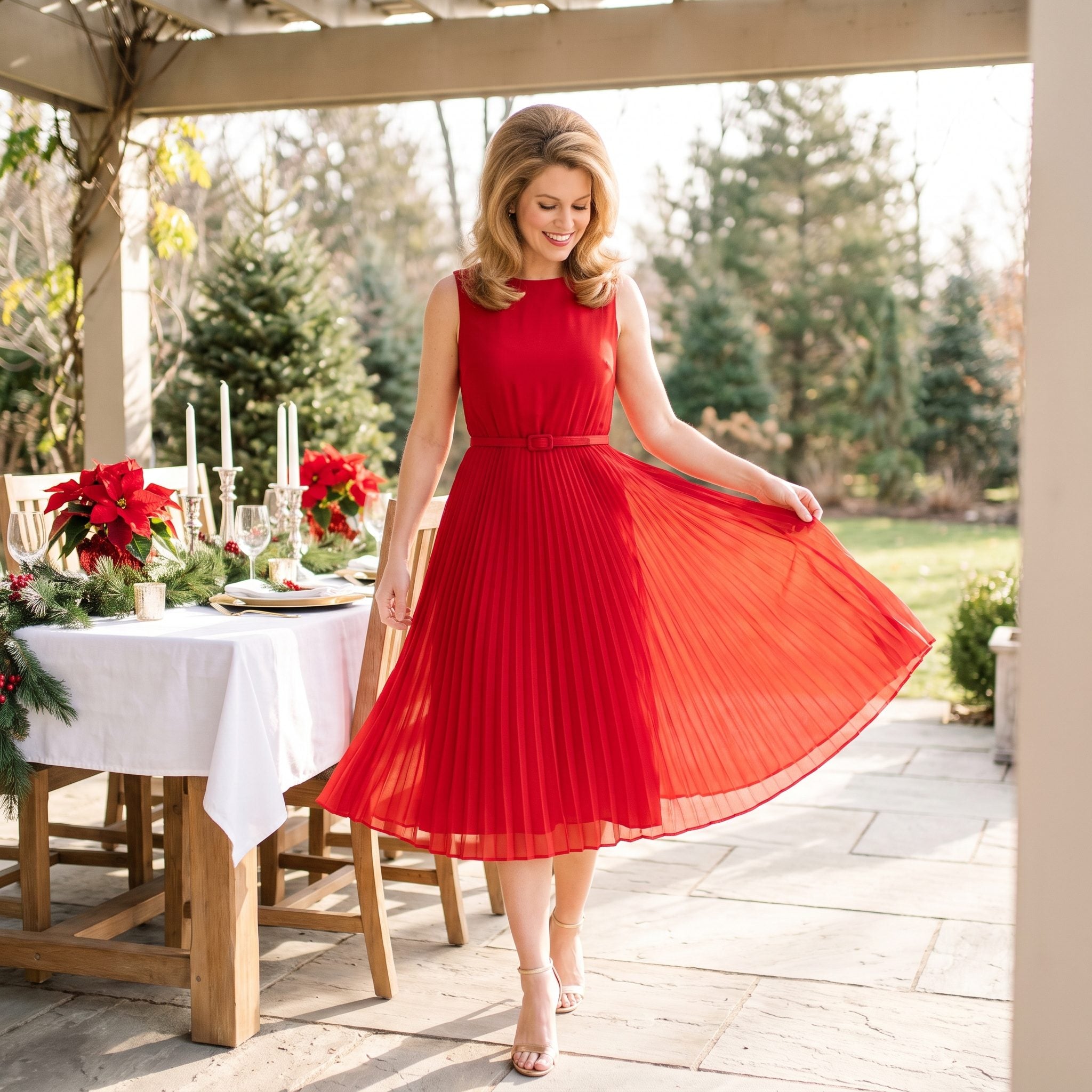
Pleated chiffon changes most when it moves. At rest, the skirt hangs in narrow vertical folds; mid-step, those folds open into a fan and reveal how much volume has been compressed into the fabric.
A slim scarlet belt provides the hinge between smooth bodice and expanding skirt. Gold heels add warmth at the bottom without interrupting the red column, leaving the pleats to supply almost all the motion.
11. Gold-Brocade Skirt With a Black Cashmere Turtleneck
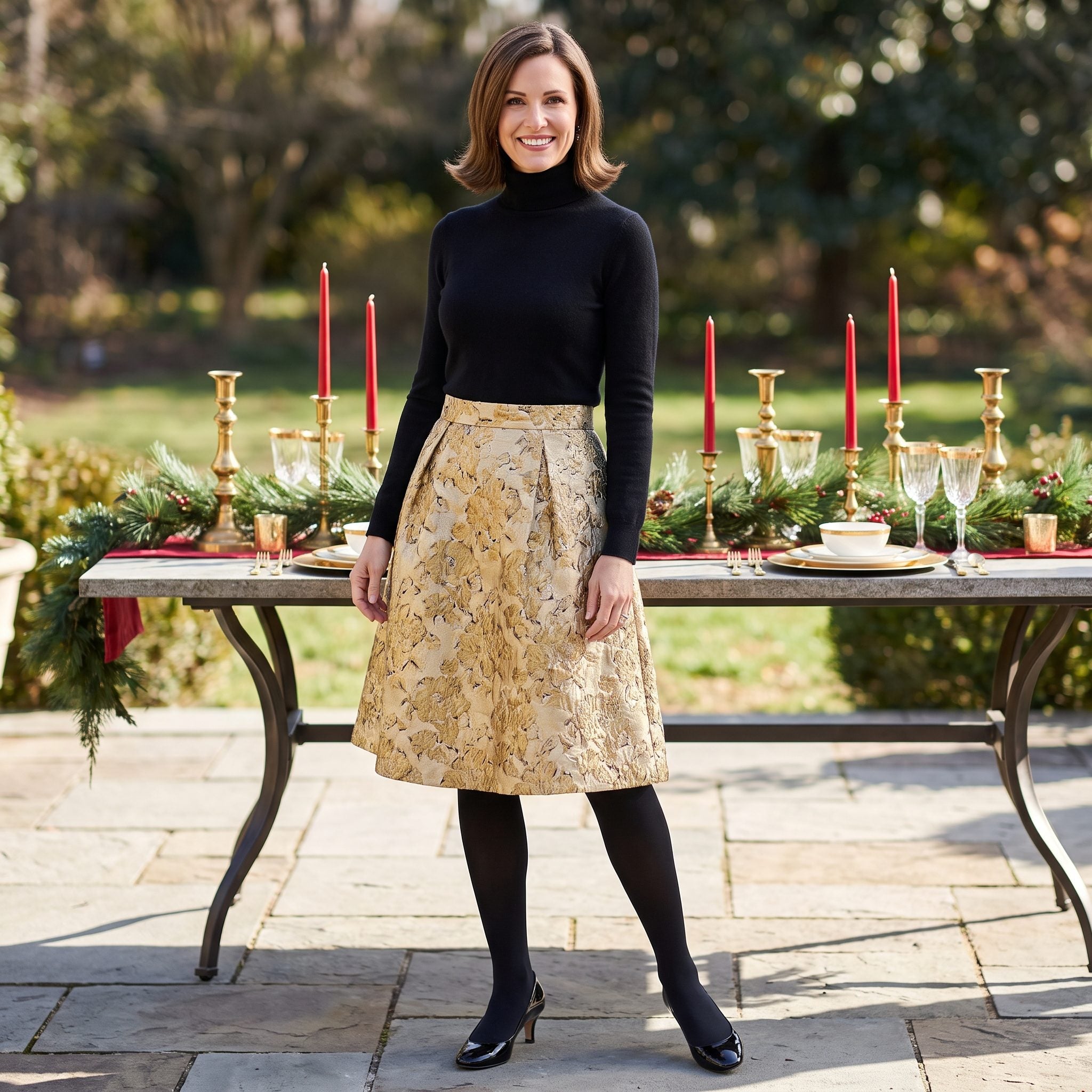
Stiff gold brocade and soft black cashmere could hardly behave more differently. The skirt holds its shape and supplies the ornament; the turtleneck follows the body and keeps the upper half almost severe.
Black tights and low patent heels extend that restraint downward, allowing the metallic skirt to sit between them like one uninterrupted band of decoration.
10. Aubergine Velvet Bell-Sleeve Dress
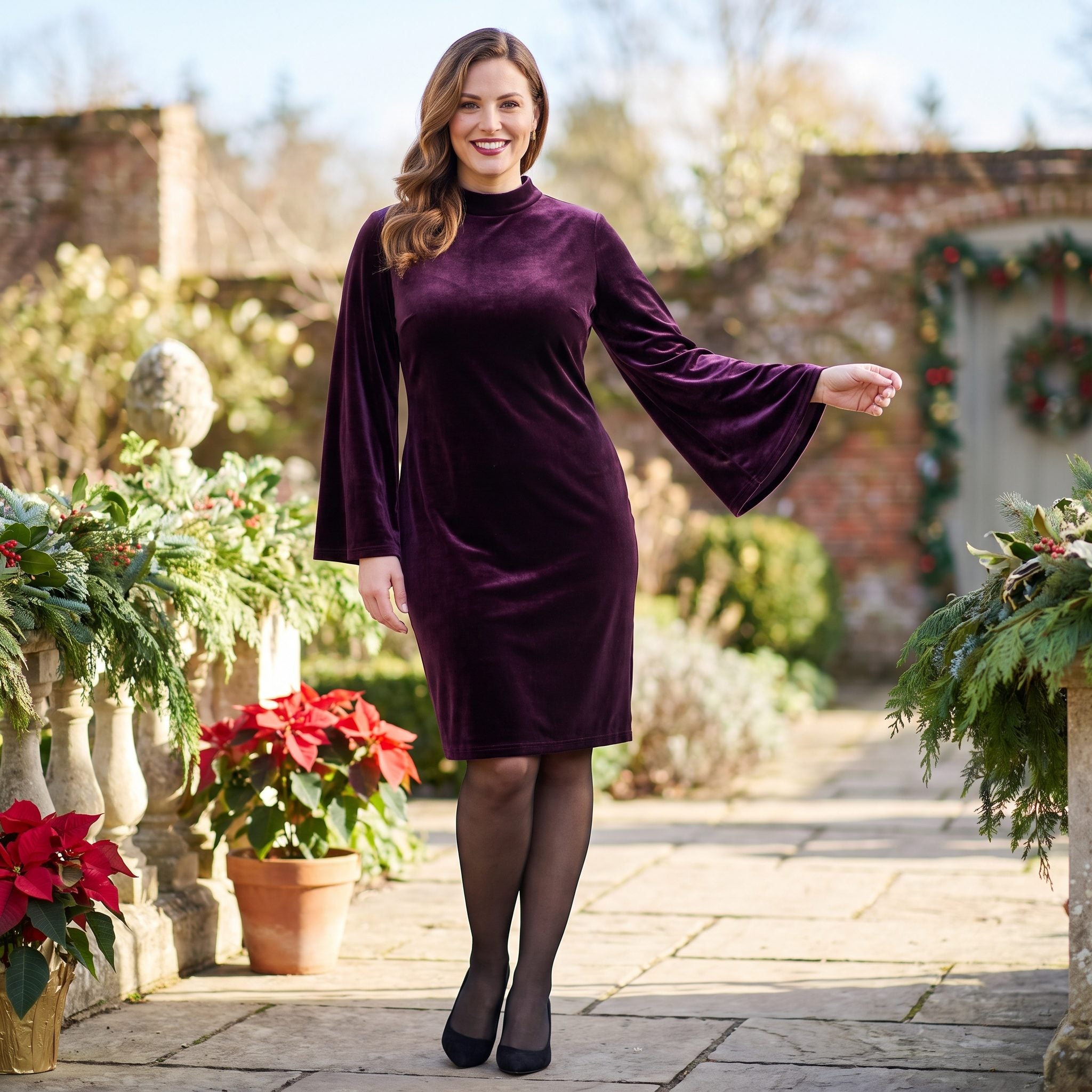
Bell sleeves reveal their full shape only once the arm moves away from the body. The widening velvet creates a soft triangular flare at each wrist while the high neckline and knee-length body remain comparatively spare.
Aubergine moves between plum and near-black across the folds. Sheer tights and streamlined pumps keep the bottom half narrow enough for the sleeves to remain the dominant silhouette.
9. Ivory Organza Blouse Over a Ruby Satin Skirt
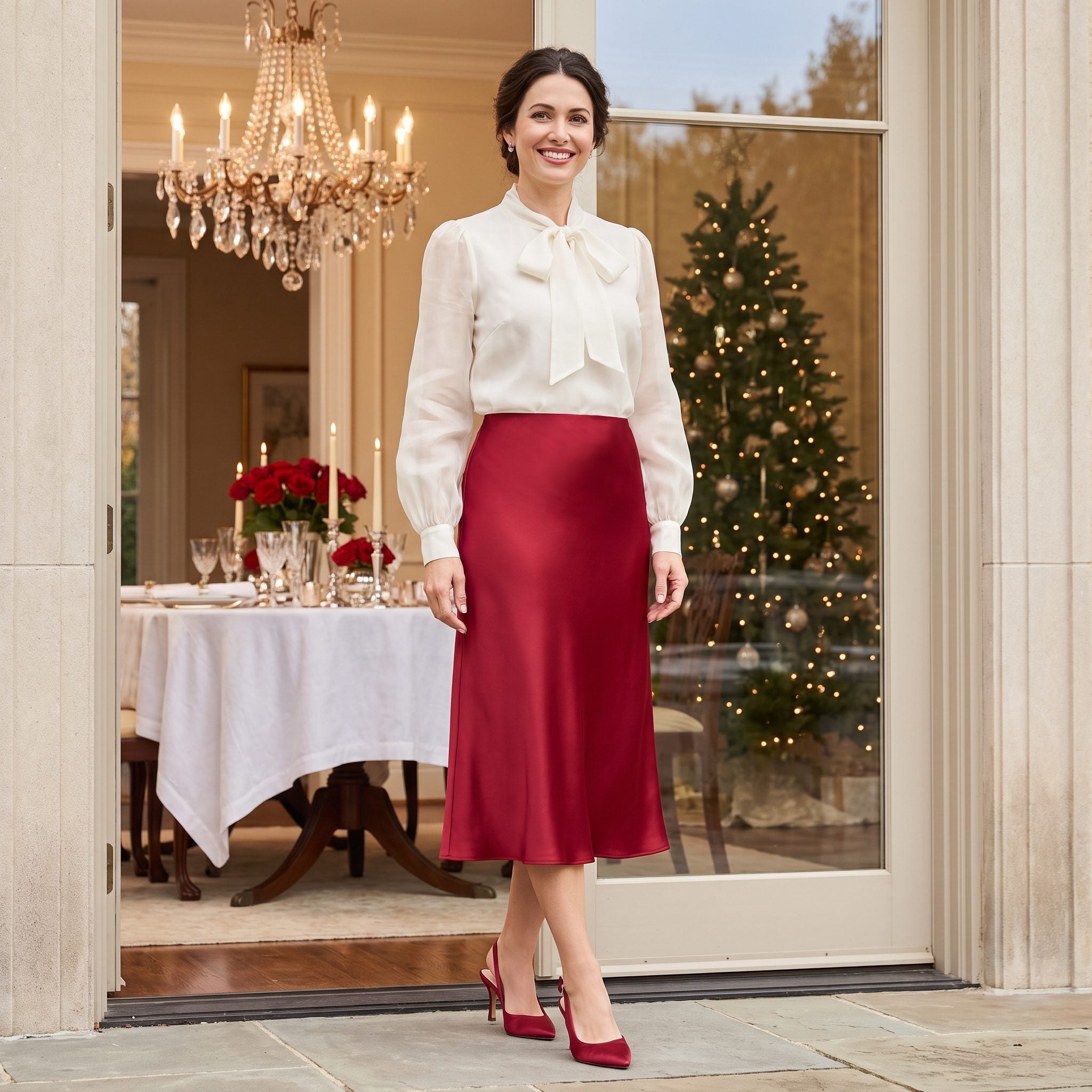
Organza floats above the body while ruby satin falls in a far denser vertical line. Putting those two weights together keeps the blouse airy without allowing the entire outfit to become soft.
Tied and gathered necklines were prominent in later-1960s romantic dressing, and the bow here gives the translucent blouse a clear finish at the throat. Matching ruby slingbacks repeat the skirt color at the floor and close the composition neatly.
8. Embroidered Black Cocktail Jumpsuit
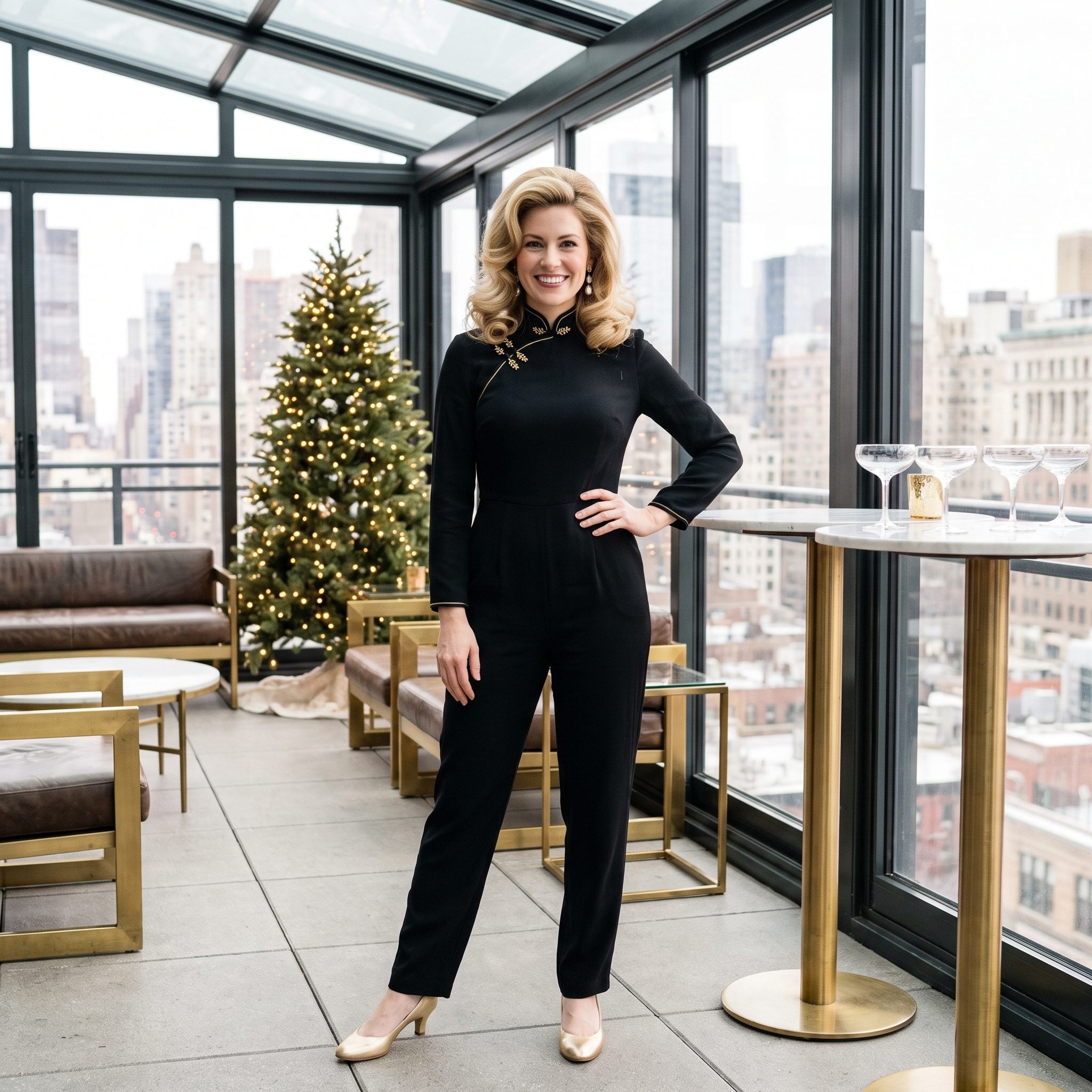
Jumpsuits became an increasingly visible fashion proposition during the mid- and late 1960s, offering a clean alternative to the expected cocktail dress. Straight legs and a defined waist make this black version particularly graphic.
The gold embroidery is deliberately narrow, tracing the standing neckline rather than spreading across the bodice. Low gold heels and small earrings repeat the metallic note without disturbing the long black column.
7. Sapphire Bubble-Hem Cocktail Dress
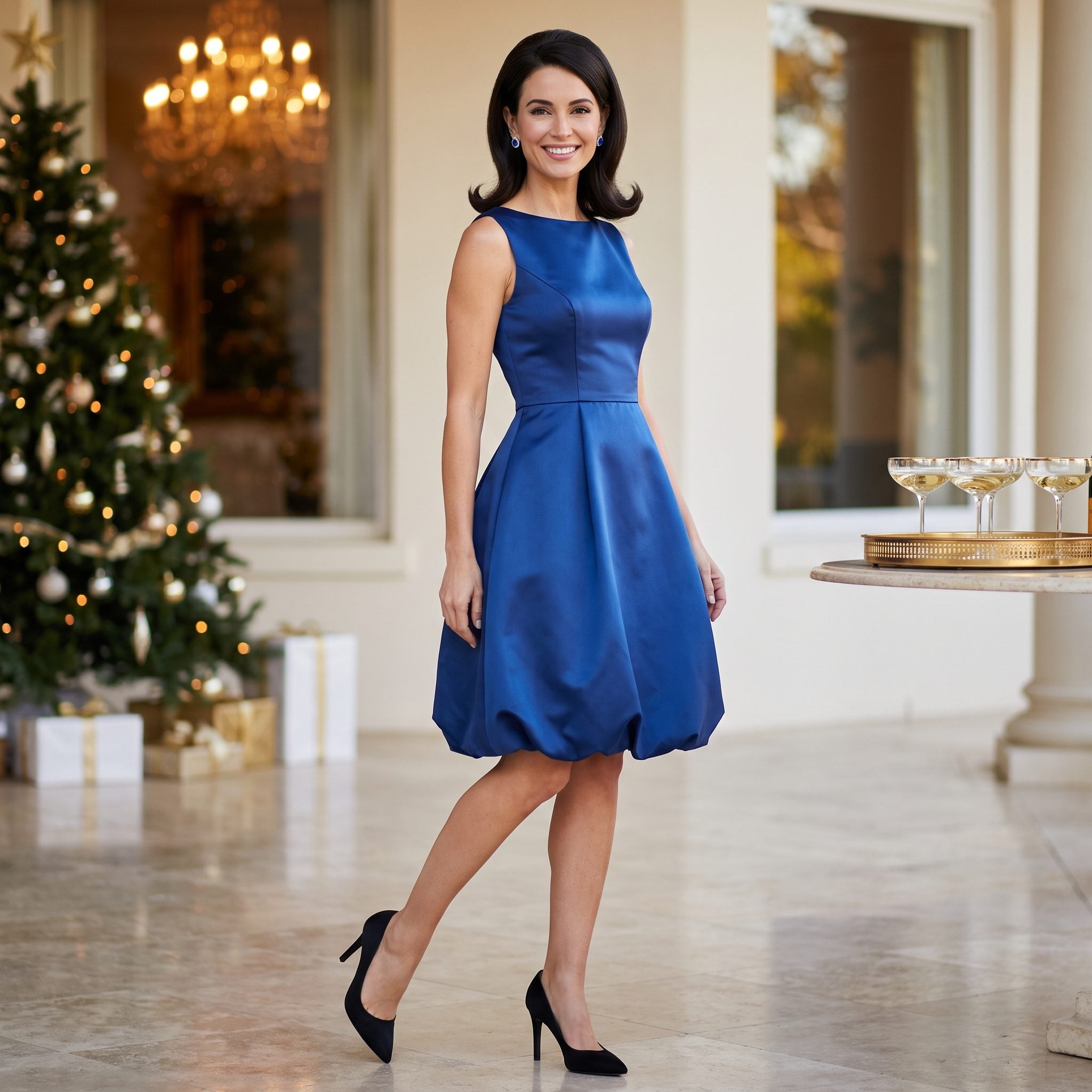
The hem curves inward beneath a rounded skirt, giving the sapphire dress a compressed, sculptural volume at the knee. Bubble silhouettes had appeared before the 1960s, but the shape fits easily beside the decade’s continuing experiments with engineered volume.
A fitted bodice provides the necessary counterpoint above. Sleek black heels and tiny earrings leave the unusual skirt construction completely exposed rather than adding another competing shape.
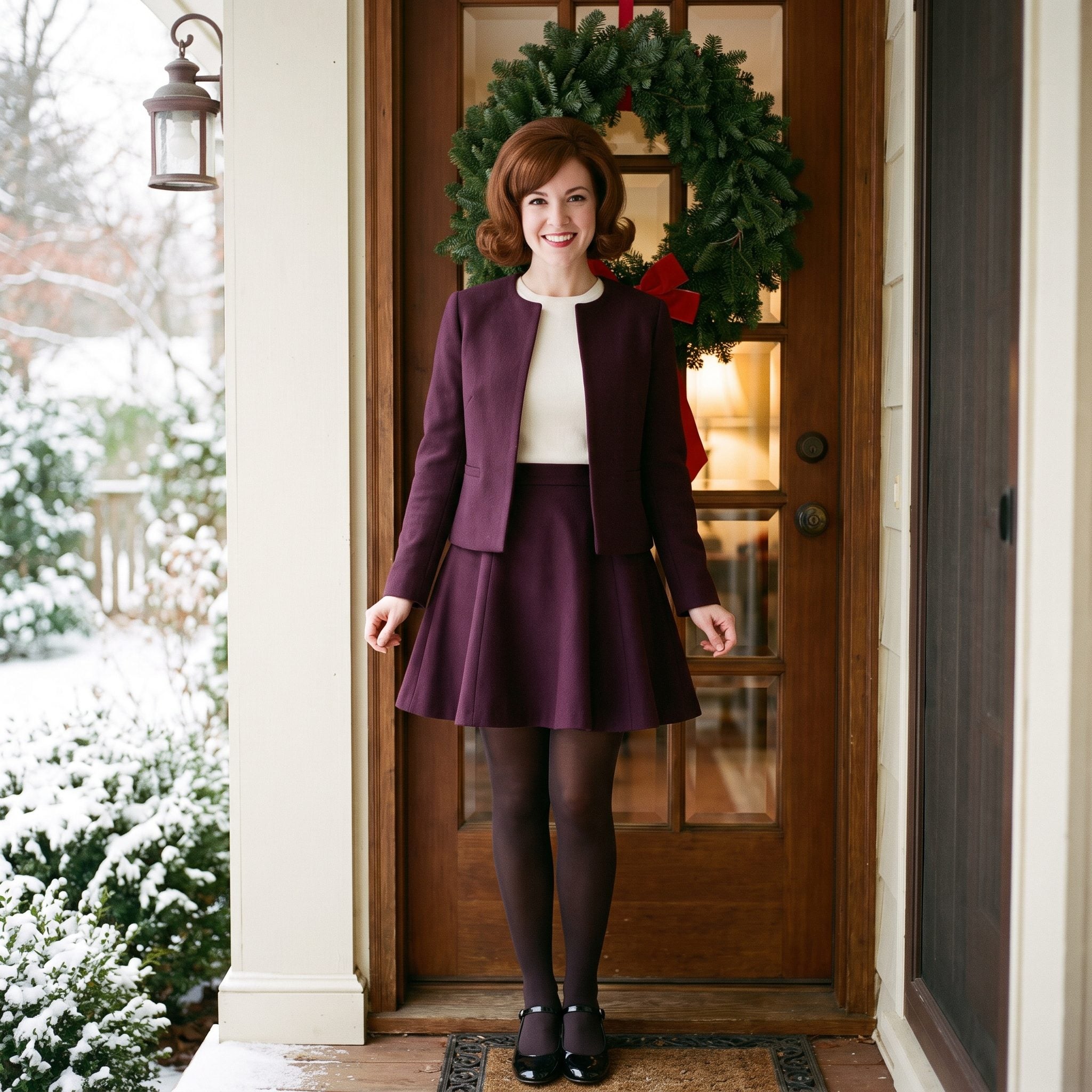
6. Plum Collarless Jacket and Flared Mini
❤️ Would you like to save this?
The cropped jacket and flared mini work because they reverse one another. The upper half stops cleanly at the waist; the skirt immediately opens outward beneath it.
An ivory knit shell gives the eye a pause between two blocks of plum. Opaque tights and Mary Janes sharpen the mod reference without requiring a single additional pattern.
5. Midnight-Blue Velvet Evening Coatdress
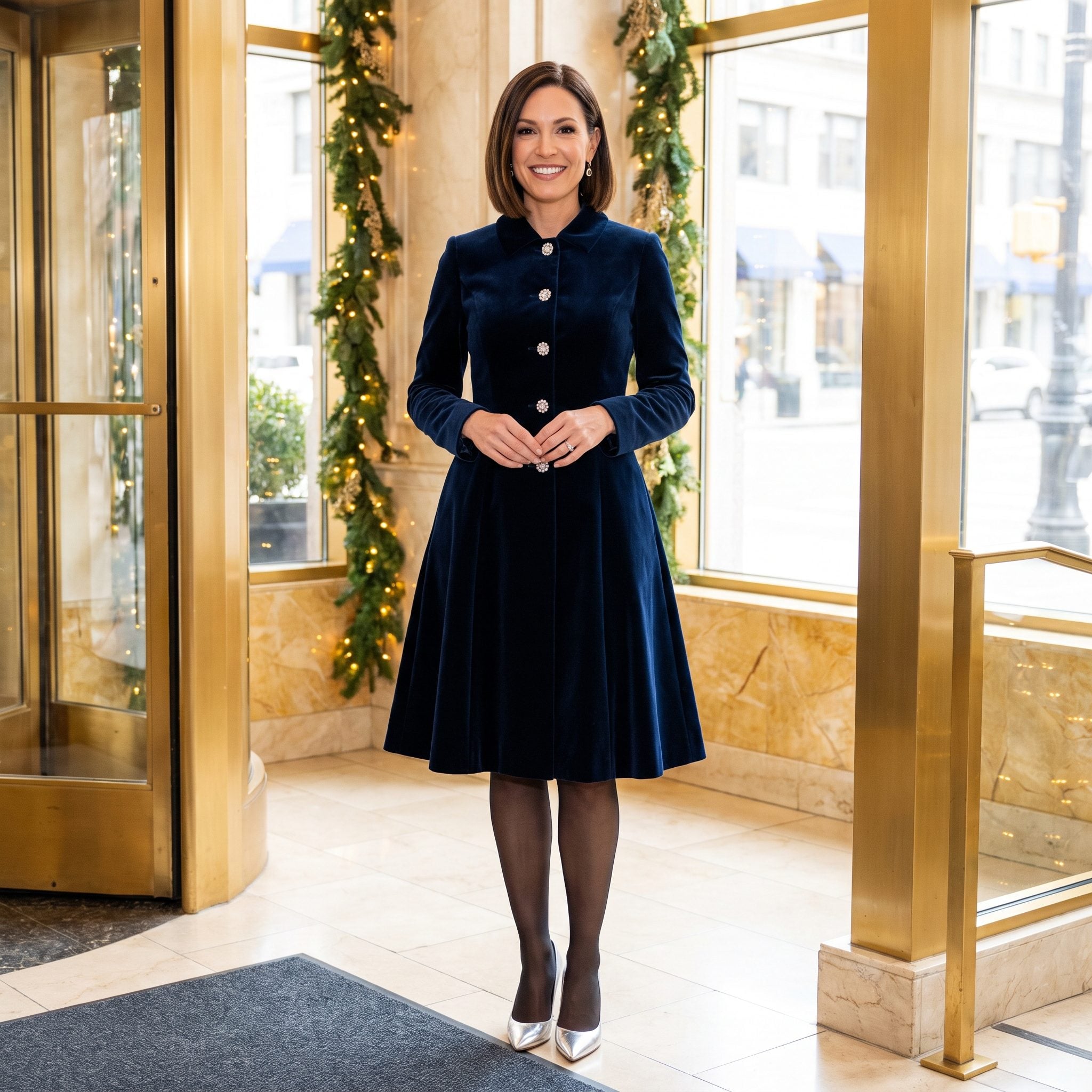
A coatdress gives velvet something it does not always get: strict tailoring. The notched collar, bracelet sleeves and straight front keep the midnight-blue fabric from dissolving into softness.
Jeweled buttons form a strong vertical line down the velvet coatdress. Sheer black tights and pointed silver heels continue the cool palette while giving the deep blue a crisp metallic accent.
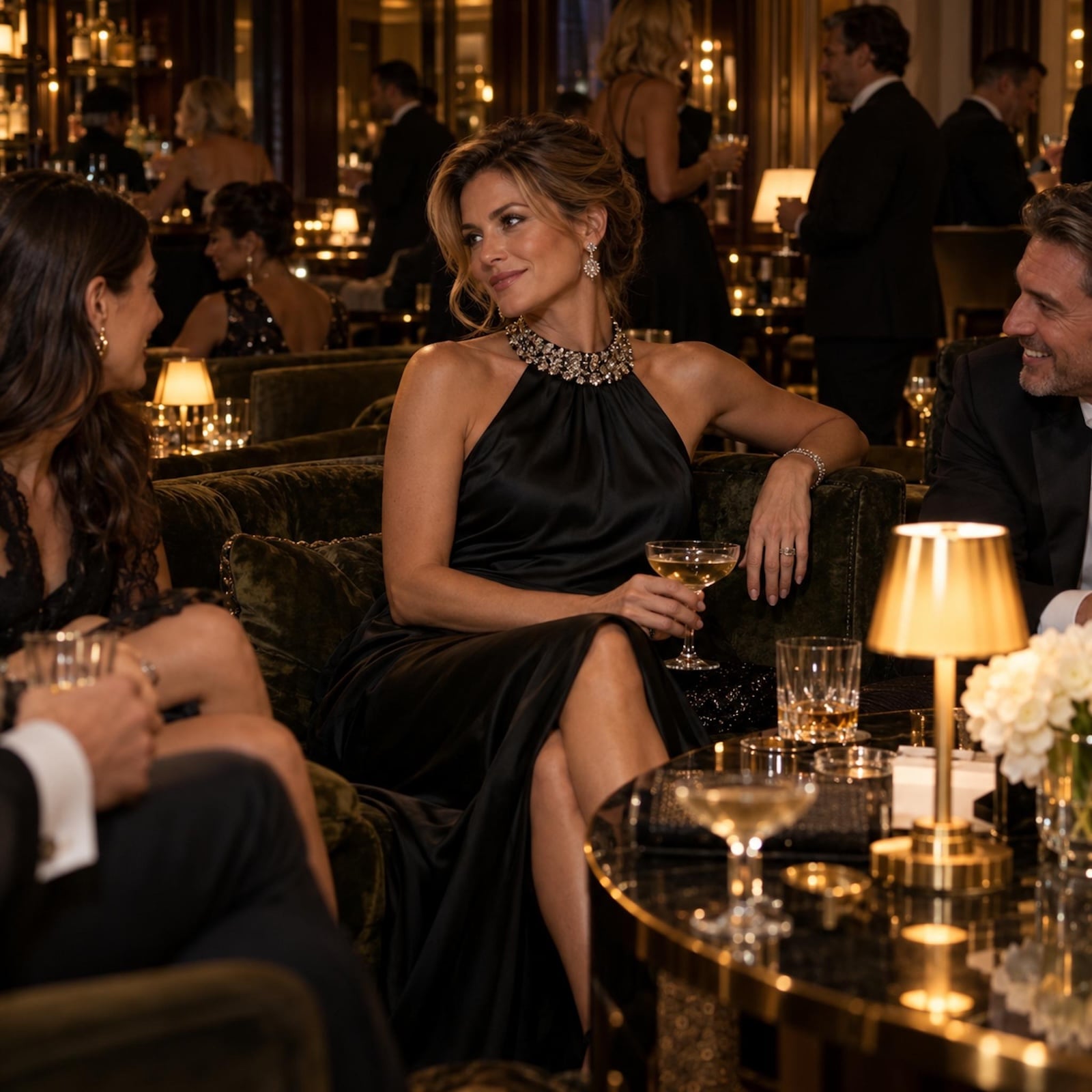
4. Black Satin Cocktail Dress With a Jeweled Collar
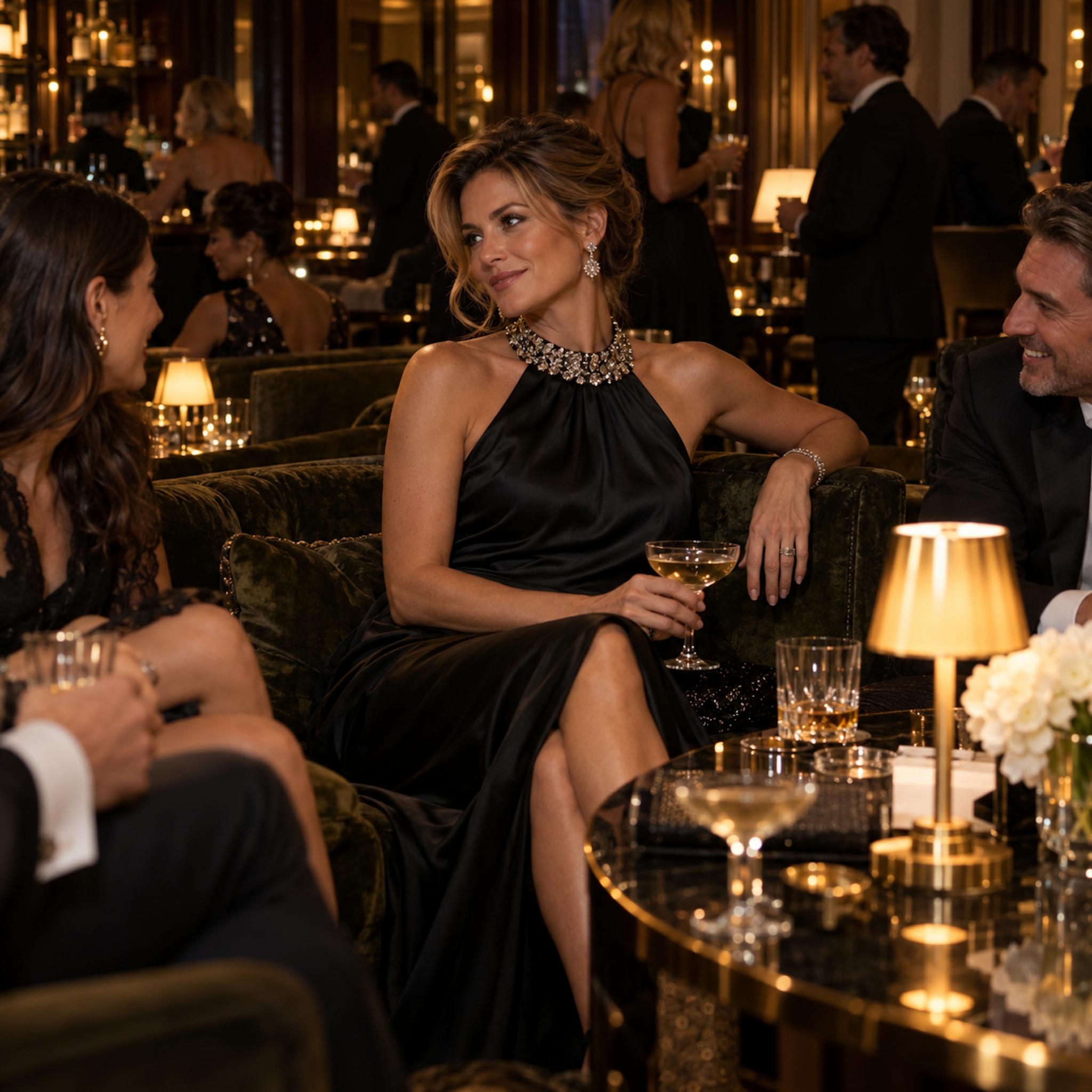
A black satin dress already has a strong, clean silhouette, but a densely jeweled collar changes where the entire design begins. Instead of adding a necklace afterward, the ornament is built directly into the neckline, concentrating all the decoration around the face while the rest of the dress falls away in an uninterrupted black sweep.
The lounge setting makes the design logic especially clear. Satin, crystal, brass and plush upholstery all have distinct surfaces, yet the dress never becomes visually overloaded because its embellishment is concentrated in one precise place. That economy is very much the point: one decisive feature can do more than five competing ones.
3. Champagne Bell-Skirt Dress
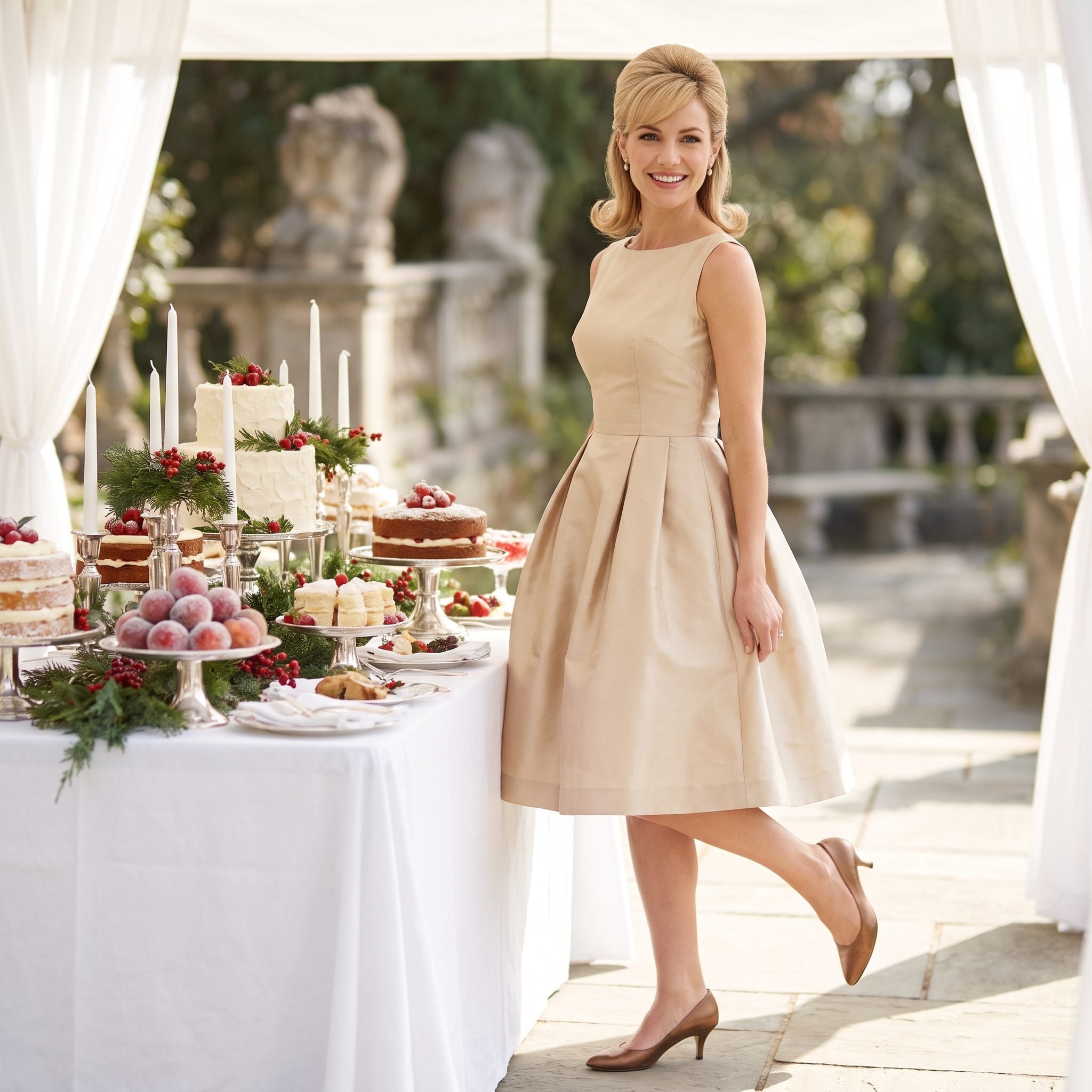
Silk faille has enough crispness to hold pronounced curves, which makes it particularly effective for this rounded bell skirt. The volume looks carved rather than frothy.
A fitted bodice gives the skirt a narrow point of departure at the waist, while bronze kitten heels warm the champagne color without duplicating it. The silhouette carries the decoration; the fabric does not need embroidery or beading on top.
2. Midnight-Blue Watteau-Back Gown
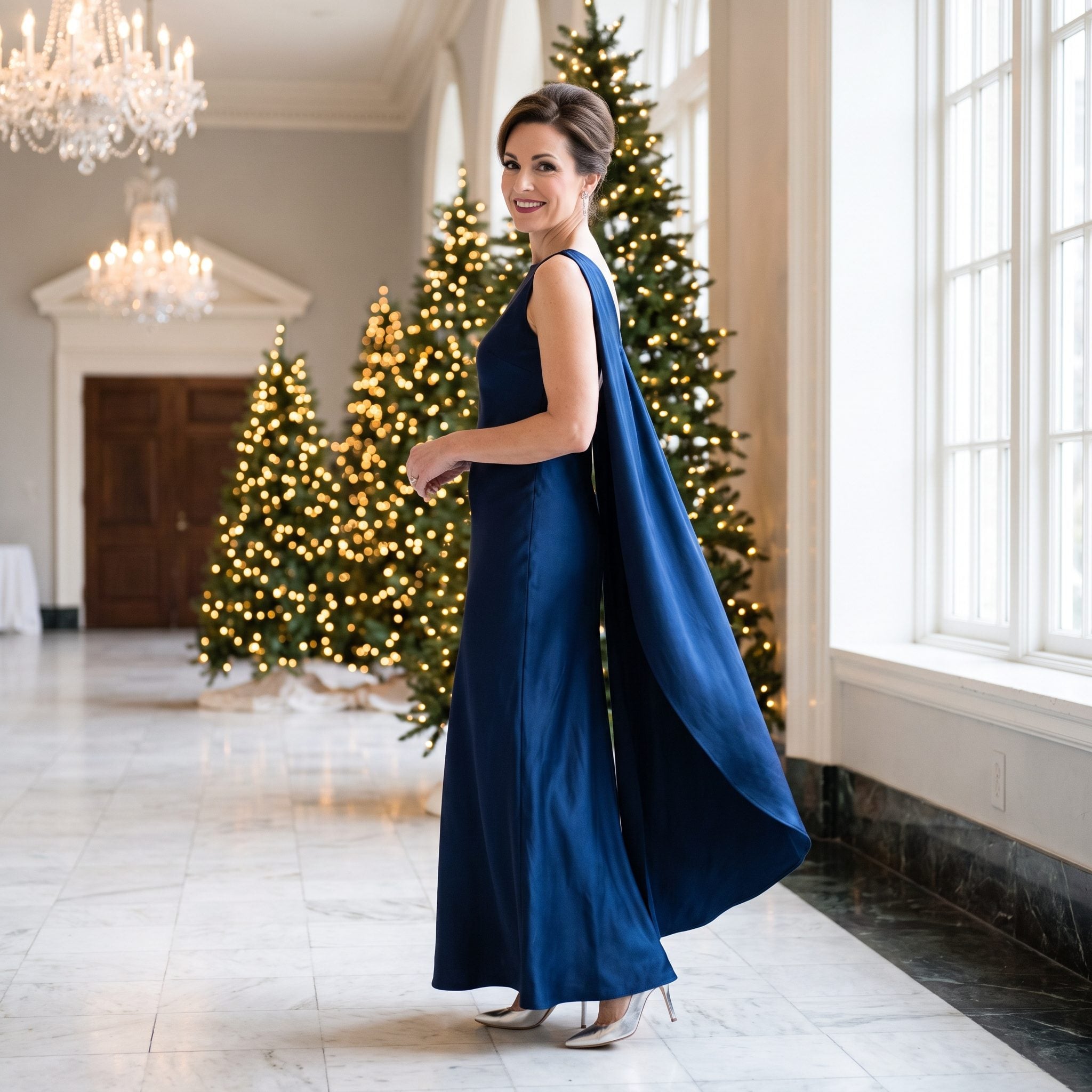
The Watteau back has a history far older than the 1960s, but its theatrical potential translates easily into midcentury eveningwear. Here a broad panel falls from the shoulders behind an otherwise spare sleeveless gown.
That contrast makes the turn more important than the front view. Midnight blue gives the silk more visible depth than flat black, while silver shoes keep the finishing details cool and unobtrusive.
A Watteau back saves much of its drama for the moment the gown turns and the loose panel finally moves.
1. Black Column and Opera Gloves
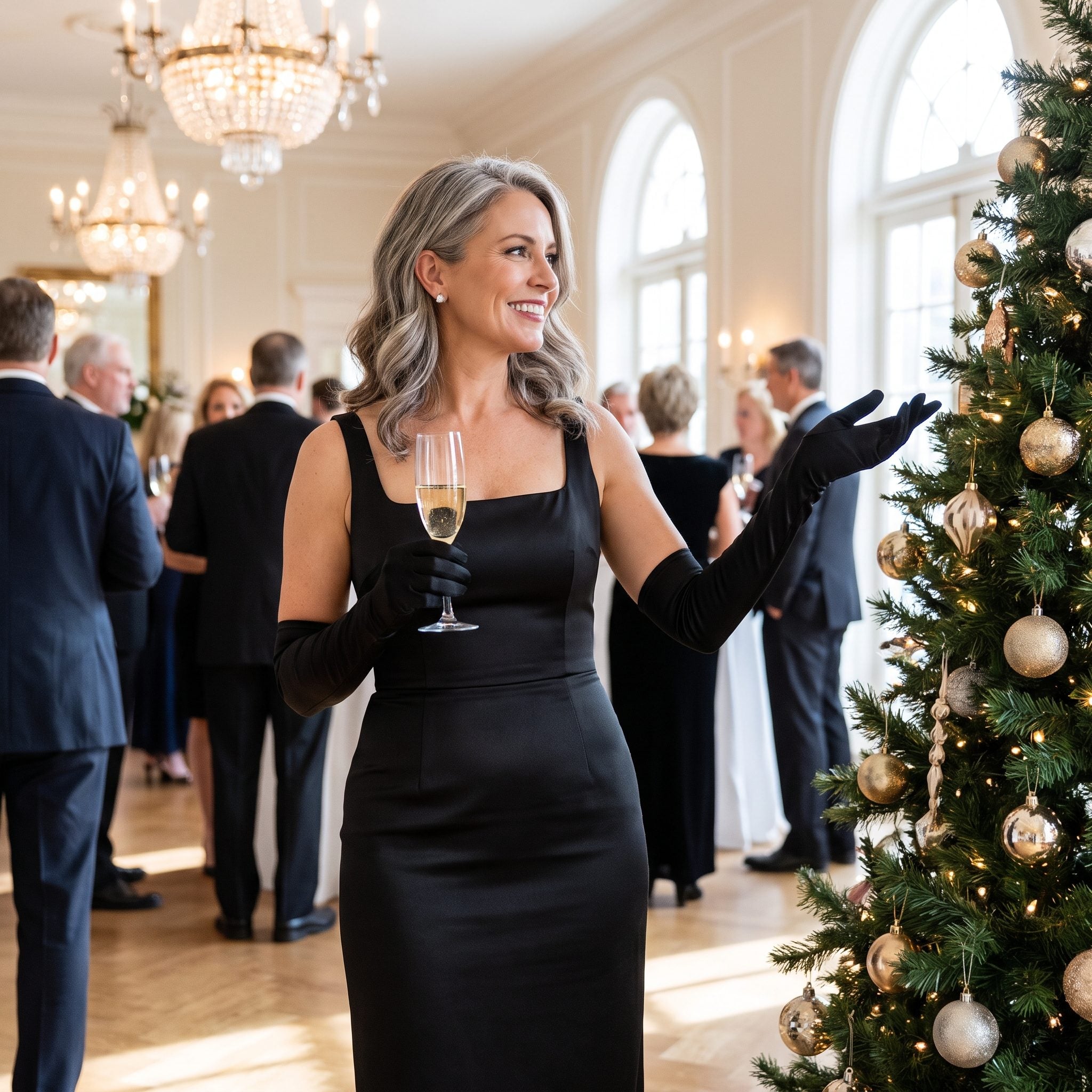
A black column dress is almost aggressively simple. Opera gloves change the scale immediately, carrying the uninterrupted black line from the square neckline nearly to the fingertips and turning minimalism into ceremony.
Small diamond studs and loose contemporary waves are enough to keep the effect from becoming a head-to-toe period reconstruction. The drama comes from proportion rather than ornament: one long dress, two long gloves and almost nothing else.
Sometimes the most extravagant thing a party look can do is add one formal gesture to an otherwise severe silhouette.