❤️ Would you like to save this?
Raid your mother’s closet from 1975 and the first surprise wouldn’t be how strange everything looks. It would be how much of it suddenly doesn’t. Wide trousers, ribbed knits, suede boots, wrap dresses, crochet, patchwork, pussy bows, oversized sunglasses — pieces once filed away with avocado kitchens and macramé owls have quietly worked their way back into contemporary wardrobes.
The interesting part isn’t that fashion has developed a case of nostalgia. It’s that the proportions that gave the 1970s such a recognizable silhouette still have enormous visual power: a high waist under a long flare, a narrow knit against a sweeping skirt, suede beside chiffon, polished leather interrupting all those earthy textiles. The decade understood contrast particularly well. Soft met structured. Handmade met glamorous. A woman could wear a prairie dress one day and a sharply tailored jumpsuit the next without either outfit feeling like it belonged to somebody else.
What changes now is the edit. Nobody needs to reproduce 1976 from neckline to platform heel. One strong reference is usually enough — a patchwork skirt with a stripped-back knit, a paisley dress with cleaner boots, a dramatic bow blouse without the rest of the secretary set. These 27 pieces show just how much of your mother’s closet deserves another look, not because the past has returned intact, but because some very good design ideas were sitting there waiting for us to notice them again.
FYI, thanks to AI imagery software, we’re able to create very specific fashion and hairstyle examples to illustrate the points being made. In some cases, imagery is exaggerated to hammer home the point. Also, assume links that take you off the site are affiliate links such as links to Amazon. this means we may earn a commission if you buy something.
27. Wide-Leg Jumpsuits Still Know How to Make an Entrance
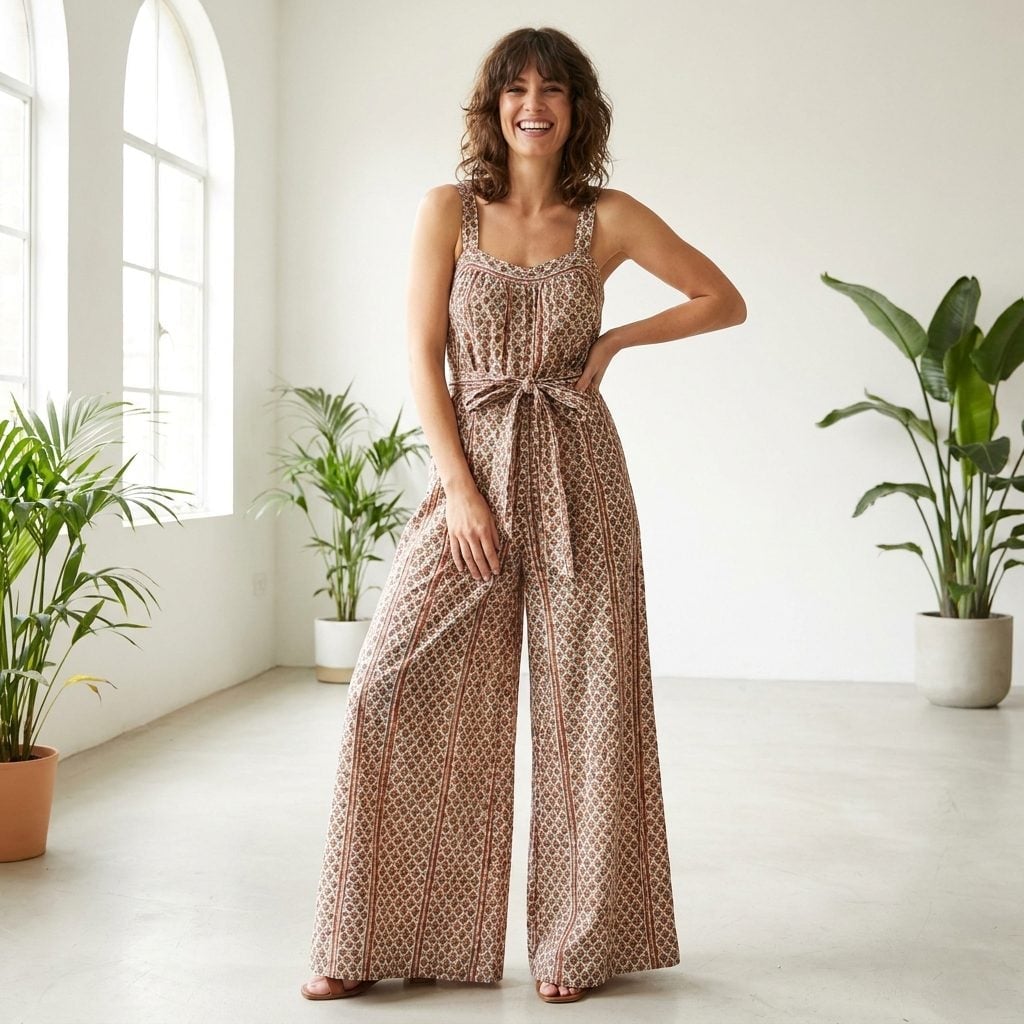
The 1970s gave the jumpsuit an unusually broad brief. It could be glamorous, utilitarian, bohemian, disco-ready, or all four before dinner. This cream-and-rust version leans into the decade’s earthier side without surrendering the drama.
The wide leg moves almost like a skirt, while the vertical pattern keeps all that fabric traveling in one direction. Thick shoulder straps and a square neckline give the bodice enough structure to stand up to the volume below. Then the self-tie belt pulls the whole silhouette back to the waist.
That’s the trick with a jumpsuit this generous: the fabric gets to sweep, but the body never disappears inside it.
26. Ribbed Turtlenecks Made Simplicity Look Like a Choice
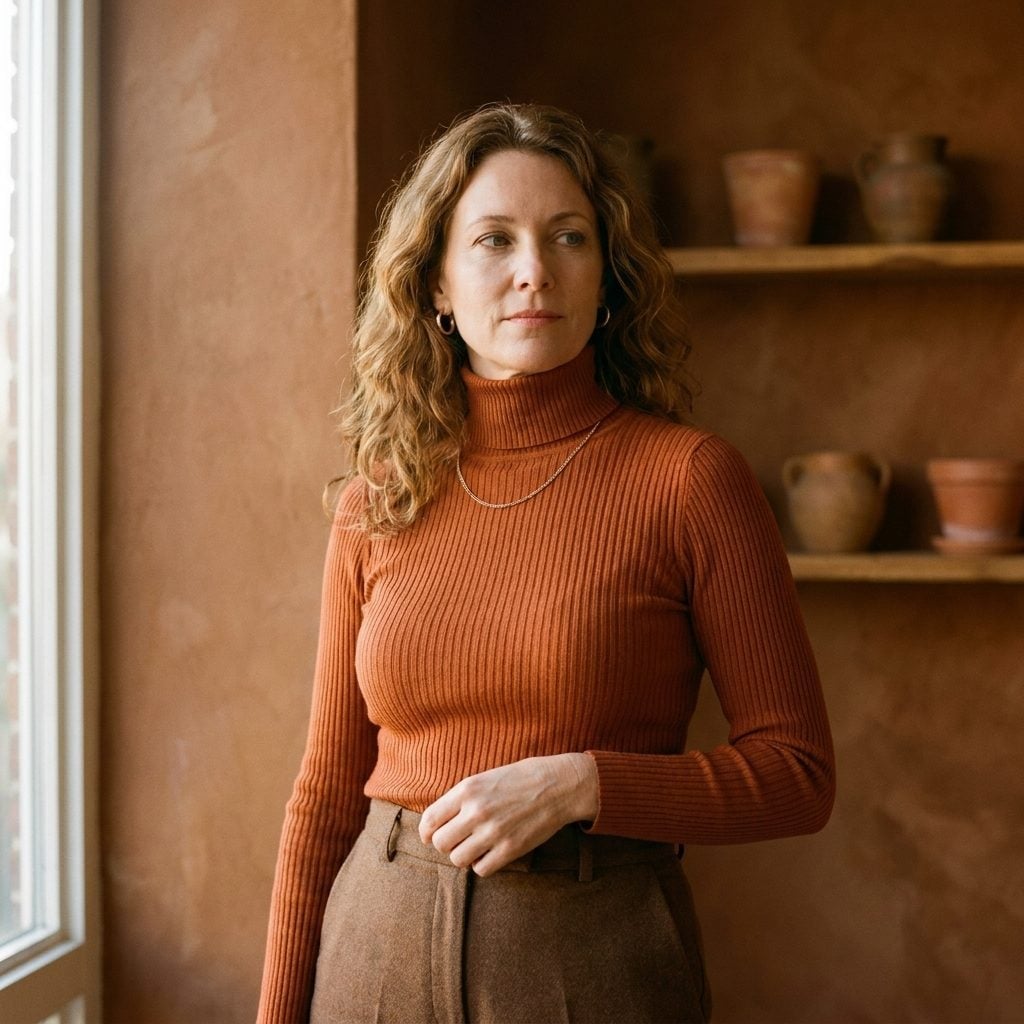
Rust was one of the decade’s defining colors, and ribbed knitwear gave it somewhere particularly good to live. The vertical texture sharpens an otherwise simple top without adding bulk, so the silhouette stays close and clean.
Paired with high-waisted trousers in warm camel, the outfit relies almost entirely on tone and proportion. A fine chain necklace worn over the folded neck adds just enough glint to break the expanse of knit.
Nothing here needs novelty. The pleasure comes from how efficiently three very simple elements — fitted knit, high waist, long trouser line — organize the entire body.
25. The Fabric Headband Was Doing More Than Keeping Hair Out of Your Face
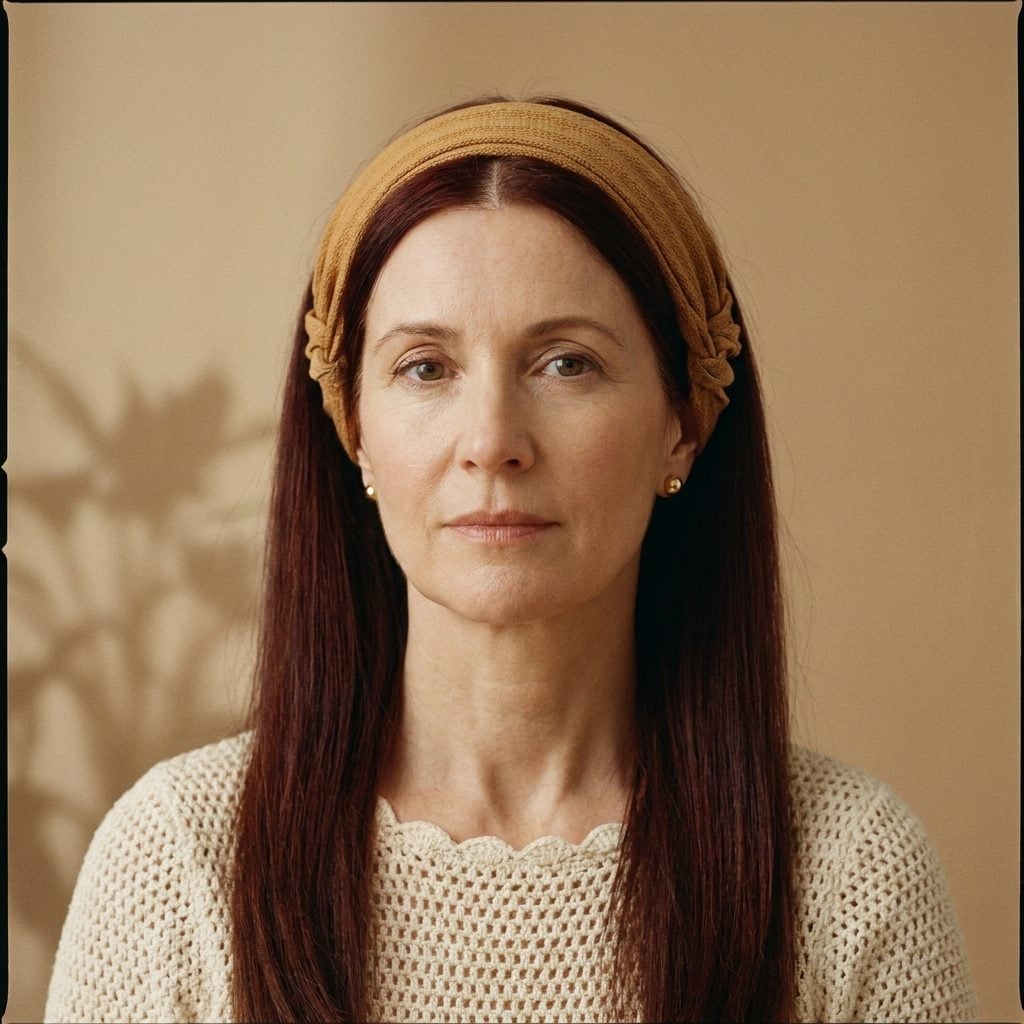
Fabric headbands were a familiar part of early-’70s dressing, especially when long hair was meant to look loose without actually behaving loose. This mustard-gold version sits just behind the hairline and pulls the length away from the face without flattening the crown.
Against dark auburn hair, that ochre tone becomes part accessory, part color story. The gold studs are small enough to stay out of the argument.
The result is useful rather than precious, which may explain why the idea keeps returning. Sometimes the best hair accessory is the one that appears to be decorative while quietly handling logistics.
24. The Trench Coat Never Left — the Styling Around It Just Changed
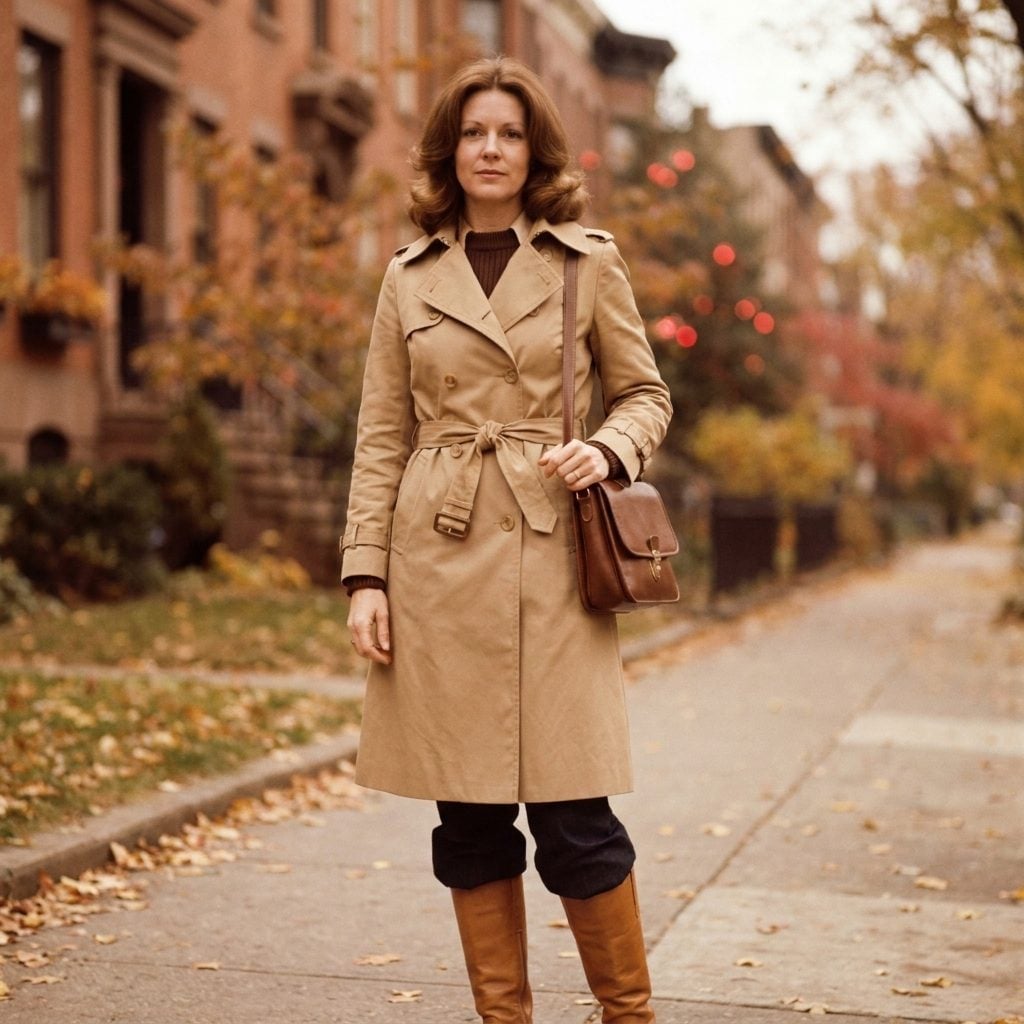
A classic khaki trench doesn’t need a revival because it never really disappeared. What changes from decade to decade is everything surrounding it.
Here, the double-breasted coat is belted at the natural waist over dark trousers tucked into cognac knee-high boots. The boot shaft gives the lower half more weight than a pump or loafer would, while the chestnut crossbody breaks up the khaki without introducing another color family.
The coat remains almost stubbornly traditional. The proportions around it are what pull it forward.
23. Oversized Turtleneck Sweaters Were Never Interested in Trying Too Hard

An oatmeal sweater with a loose cowl neck and enough room through the body to forget about posture could have been pulled from a Sunday morning in 1974. That is precisely its appeal.
The collar folds rather than stands, the shoulder line relaxes, and dark brown corduroy underneath gives all that pale knit something substantial to sit against. Oatmeal and chocolate sound like breakfast because, visually, they behave much the same way: warm, familiar, difficult to improve upon.
The mug helps, naturally. But this outfit would still know exactly what kind of morning it wanted without one.
Occasion Guide: Keep an oversized knit for weekend mornings, casual dinners, travel days, or any afternoon when structure sounds exhausting. Corduroy, dark denim, and wide-leg trousers all give the sweater enough weight below the waist to keep the volume balanced.
22. Pussy-Bow Blouses Never Really Disappeared — They Just Keep Changing Jobs
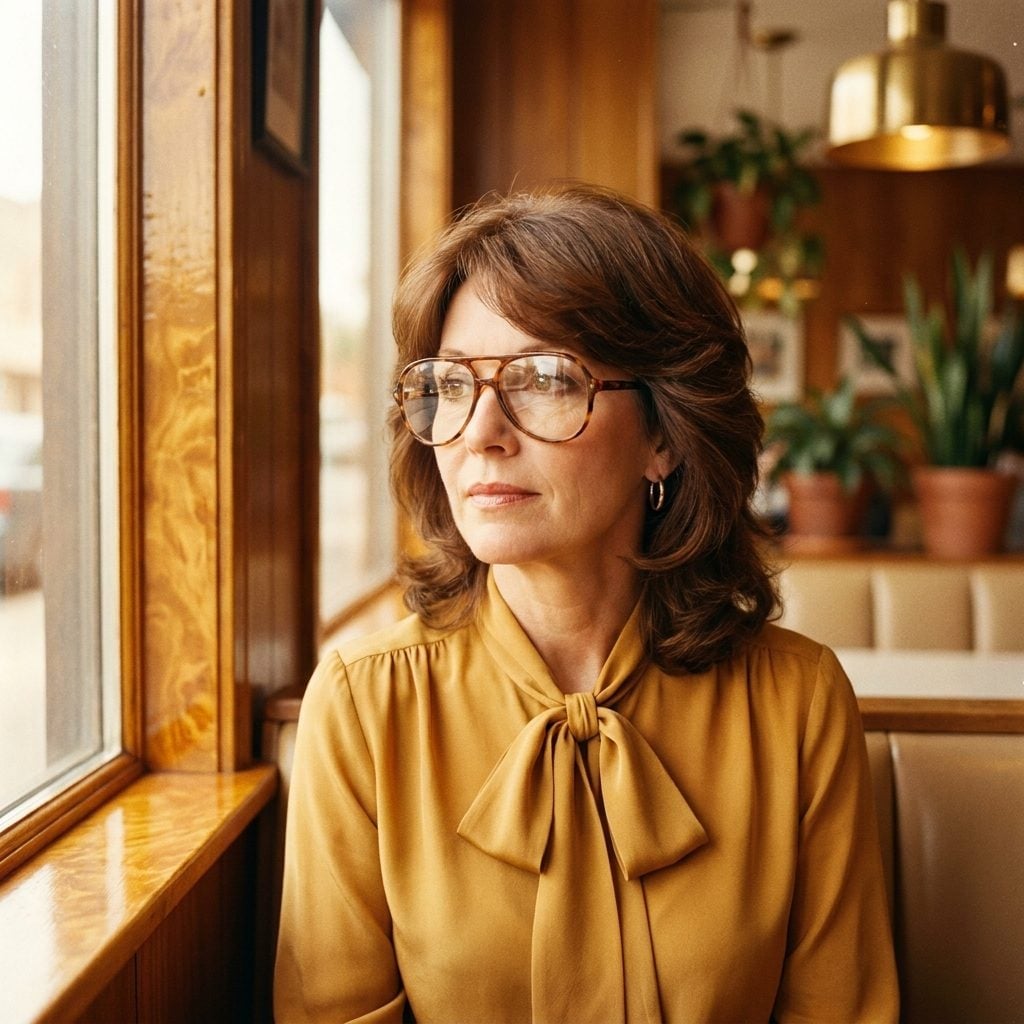
Mustard silk, a generous tie at the throat, and tortoiseshell aviators make an argument for the pussy bow without requiring a skirt suit, briefcase, or executive desk.
The bow has enough scale to become the focal point, but the rest is kept deliberately spare. That shift matters. Once separated from the full period uniform, the blouse stops looking like a reenactment and starts behaving like what it always was: a very effective way to put architecture around the face.
21. Paisley Scarves Were Too Useful to Stay in One Place
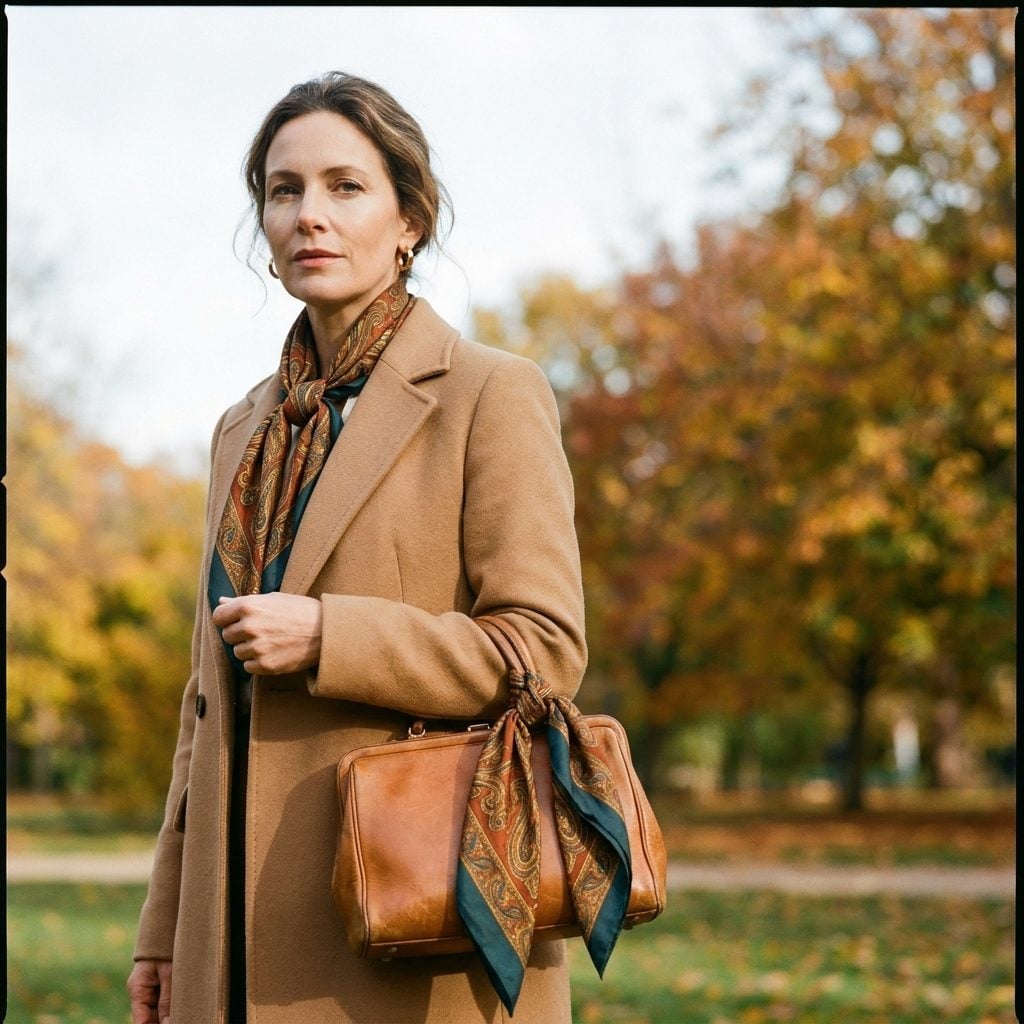
Draped at the neck and knotted again around the handle of a tan leather doctor bag, the same paisley scarf earns its keep twice.
Teal and rust against a camel wool coat give the look enough pattern to wake up all those neutrals without letting print take over. The scarf is small, mobile, inexpensive compared with the coat or bag, and capable of changing both.
No wonder women kept drawers full of them.
20. The Corduroy Button-Front Skirt Came Back Looking Almost Exactly Like Itself
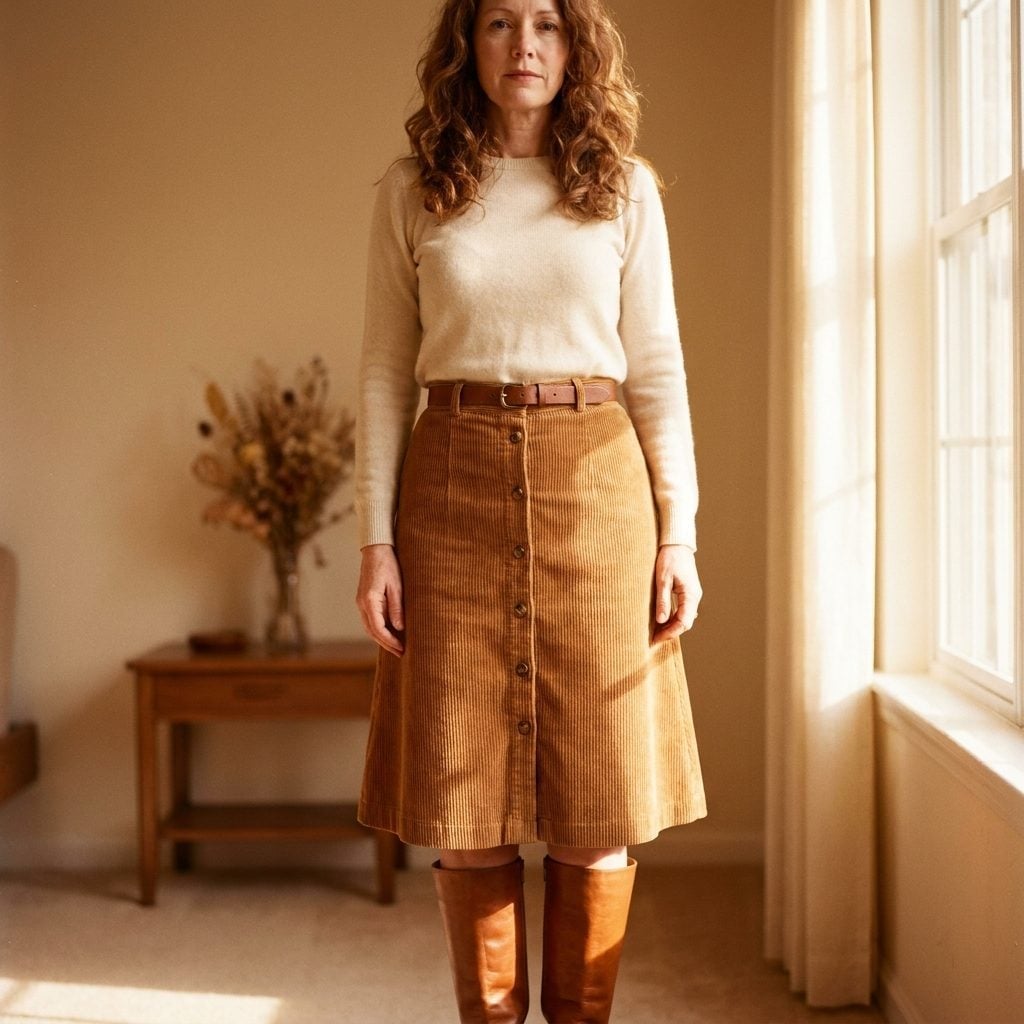
Camel corduroy, midi length, buttons marching straight down the front — this is one of those designs that doesn’t gain much from modernization because the original geometry was already sound.
The wide wale gives the skirt enough texture to hold its own beside a cream knit, while a cognac belt marks the natural waist and knee-high boots continue the warm brown line downward.
Nothing is disguised as new. That’s part of the charm. Sometimes a comeback is simply an admission that the first version had very little wrong with it.
19. Satin Wrap Dresses Came Back With the Volume Turned Down

Chocolate-brown satin cut into a wrap silhouette manages to look dressed up without becoming ceremonial. The fabric falls cleanly across the waist, while the V-neck and self-tie create enough structure to keep all that sheen from turning slippery.
Gold hoops and a coin pendant are the only interruptions. No elaborate bag, no competing print, no attempt to turn every inch into an event.
The dress already has movement, shine, and a strong diagonal line across the body. Giving it fewer accessories lets those qualities speak first.
Shopping Tip: With a satin wrap dress, pay attention to drape before almost anything else. A fluid fabric should fall away from the tie rather than bunch around it. A midi hem also gives the shine more room to settle before the shoe begins.
18. Espadrille Wedges Still Know Exactly What Summer Is Supposed to Look Like
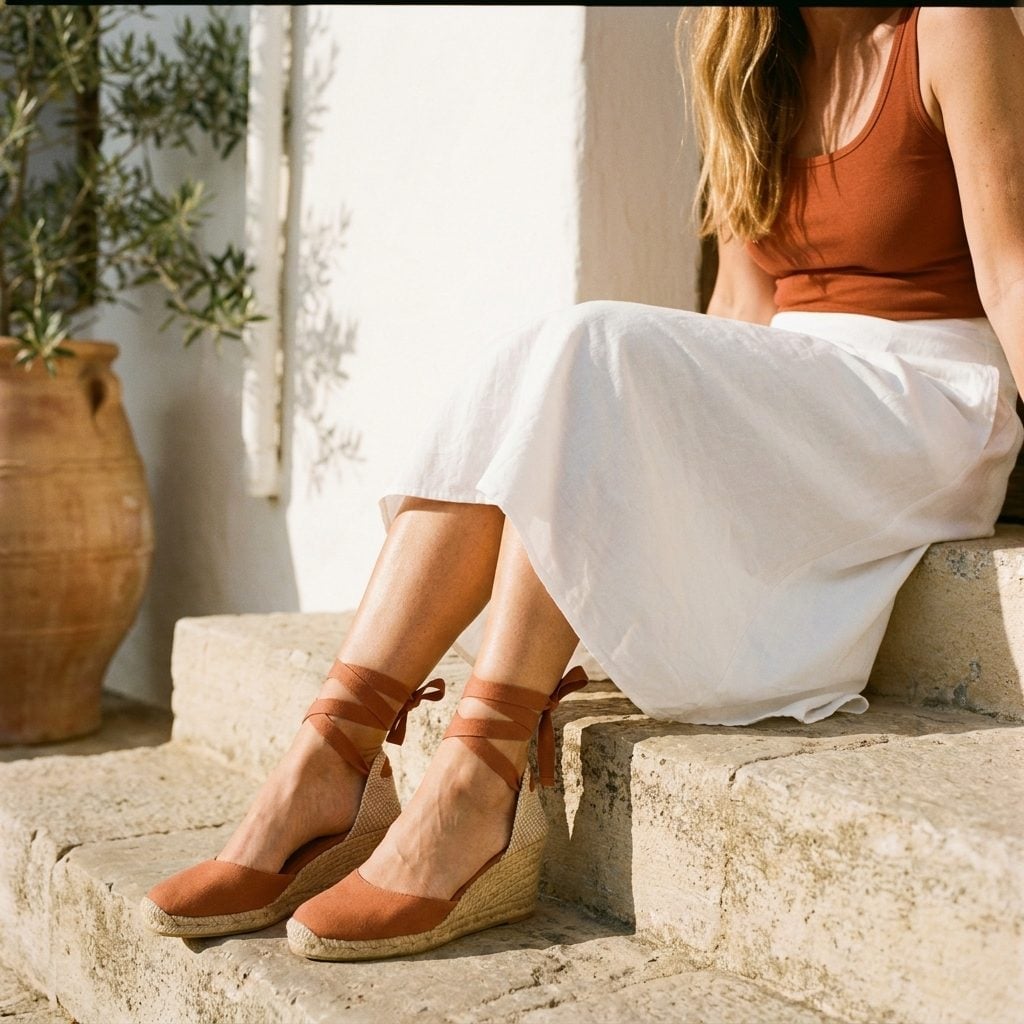
Terracotta canvas, braided jute, ribbon straps crossing the ankle — the espadrille wedge has enough texture packed into one shoe that very little else needs to happen below the knee.
Here, the color is echoed in a ribbed tank while a white linen midi creates breathing room between the two. That small repetition makes the outfit feel connected without turning it into a matching set.
The whole thing lands somewhere between a Greek island and a Sunday that got unexpectedly good.
17. Knee-High Suede Boots Still Give Soft Clothes Some Backbone
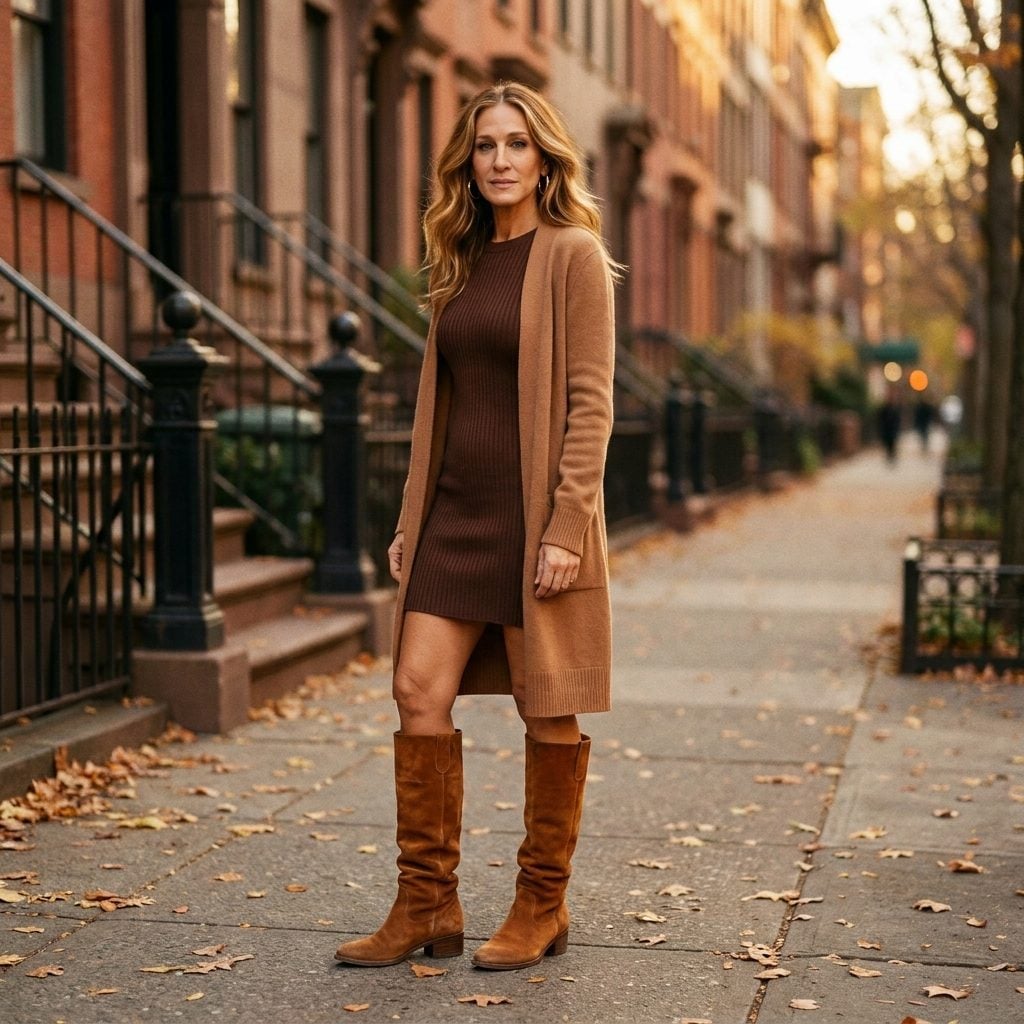
A ribbed mini dress and long camel cardigan could easily dissolve into one soft column. Cognac suede boots stop that from happening.
The shaft reaches just below the knee, giving the lower half enough visual weight to balance the cardigan’s length. Three related browns — deep dress, camel knit, cognac suede — keep the outfit tonal without making every piece identical.
The boots aren’t an accessory added at the end. They’re the punctuation mark.
16. Prairie Dresses Grew Up. They Still Want to Stand in a Field.
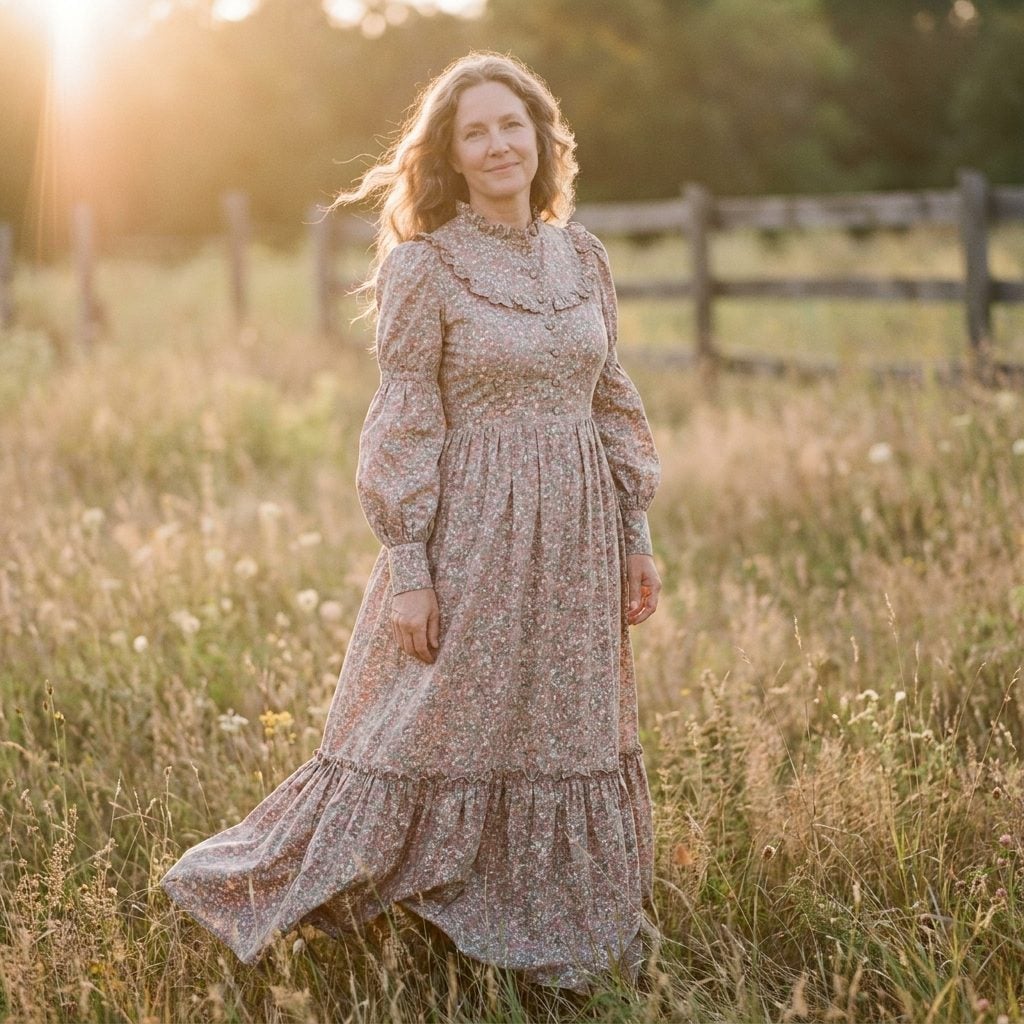
Floor-grazing florals, bishop sleeves, a smocked waist, and a tiered ruffle hem do not arrive quietly. Nor should they.
The print here stays small — dusty rose, sage, and cream scattered over a warm neutral ground — so the dress can carry all that volume without the pattern overwhelming it. The high neck and scalloped bib bring in another clear 1970s reference, but the defined waist prevents the fabric from becoming one uninterrupted cloud.
This is a dress built to move. Golden-hour photographs are merely a side effect.
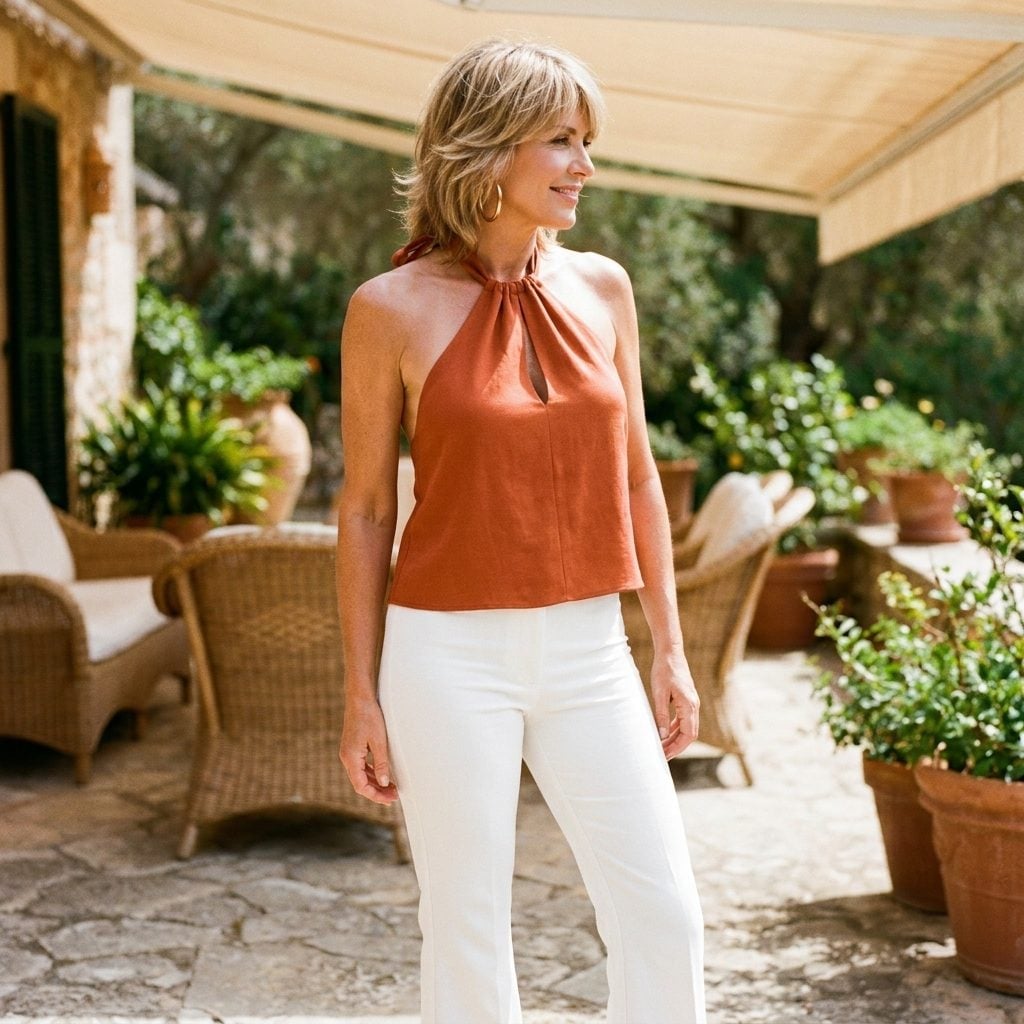
15. Halter Tops Returned With a Little More Breathing Room
❤️ Would you like to save this?
Rust-toned halters fit naturally into 1970s fashion, when exposing the shoulders often came with more fabric everywhere else.
This terracotta version gathers at a high halterneck, ties behind the neck, and opens into a small keyhole at the chest. The body stays comparatively loose and meets the waistband of wide white trousers rather than continuing into a tiny cropped triangle.
That’s enough updating. The shoulders still get the drama; the rest of the outfit gets room to breathe.
14. The Printed Wrap Dress Has Been Solving the Same Problem for Fifty Years
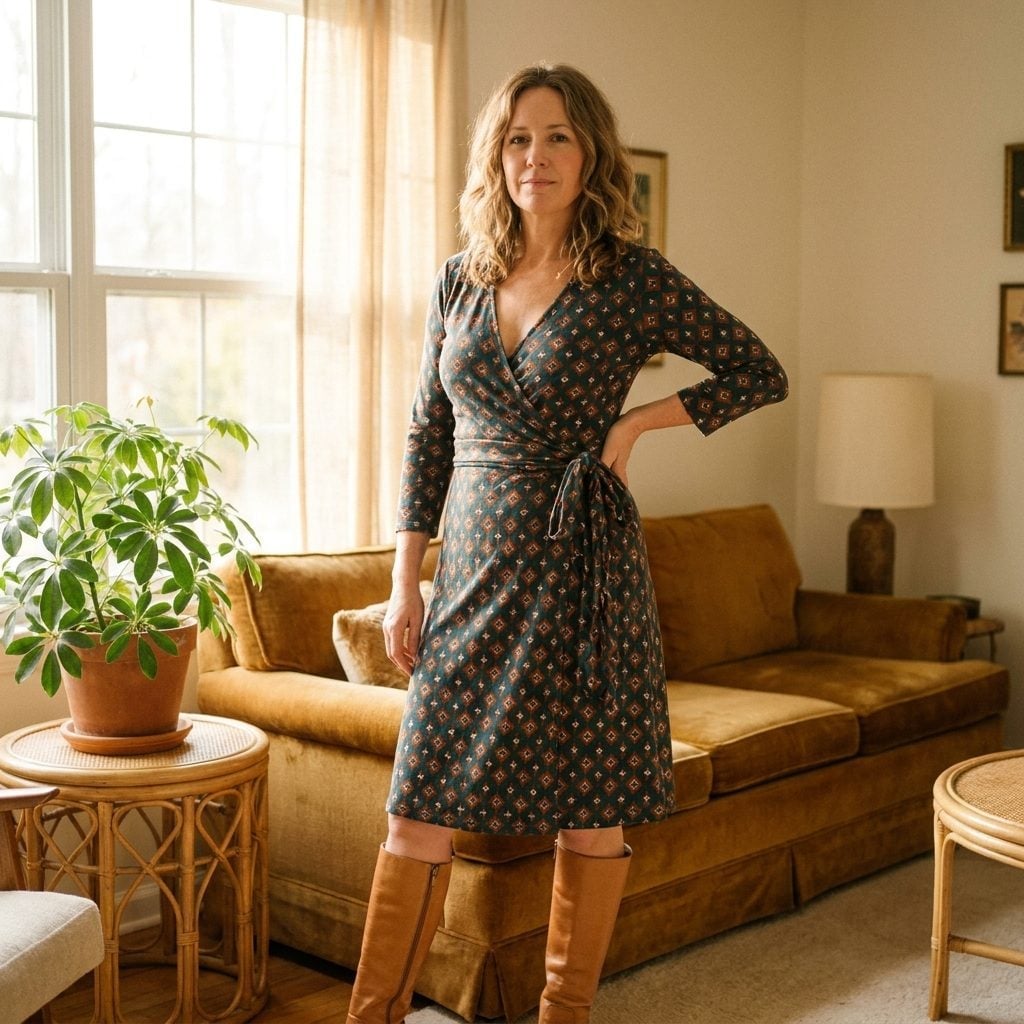
A deep teal ground scattered with small rust-and-cream diamonds gives this wrap dress unmistakable period flavor without requiring an enormous print.
Three-quarter sleeves, a crossover neckline, and a self-tie waist create the familiar diagonal structure. The midi skirt then loosens below the hip, keeping the dress useful rather than rigid.
Tan leather boots pull one of the print’s warmer tones downward, which is enough to connect the whole outfit without matching anything literally. The appeal of a printed wrap dress has always been efficiency: put it on and most of the decisions have already been made.
13. Corduroy Wide-Legs and a Suede Vest Make a Very Good Case for 1974
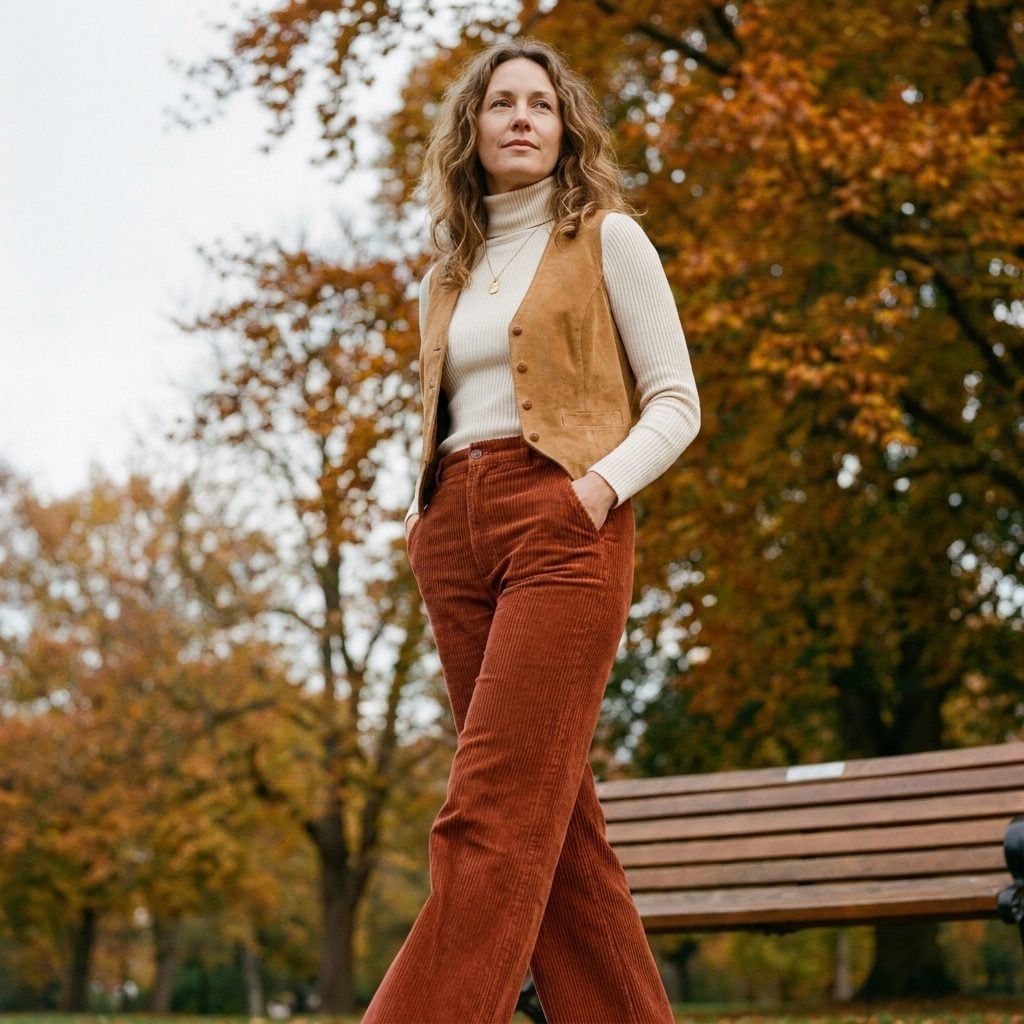
Burnt-sienna corduroy trousers, camel suede, cream ribbing: this is the 1970s reduced to three textures and a very disciplined palette.
The vest is the important piece. Buttoned through the front, it gives the torso a clean outline without adding the bulk of a jacket. Underneath, the fitted turtleneck keeps the layering compact while the corduroy is allowed to widen dramatically below.
A small pendant is all the jewelry the neckline needs. Texture has already taken care of the decoration.
12. Shearling-Lined Suede Coats Never Really Left the Farm
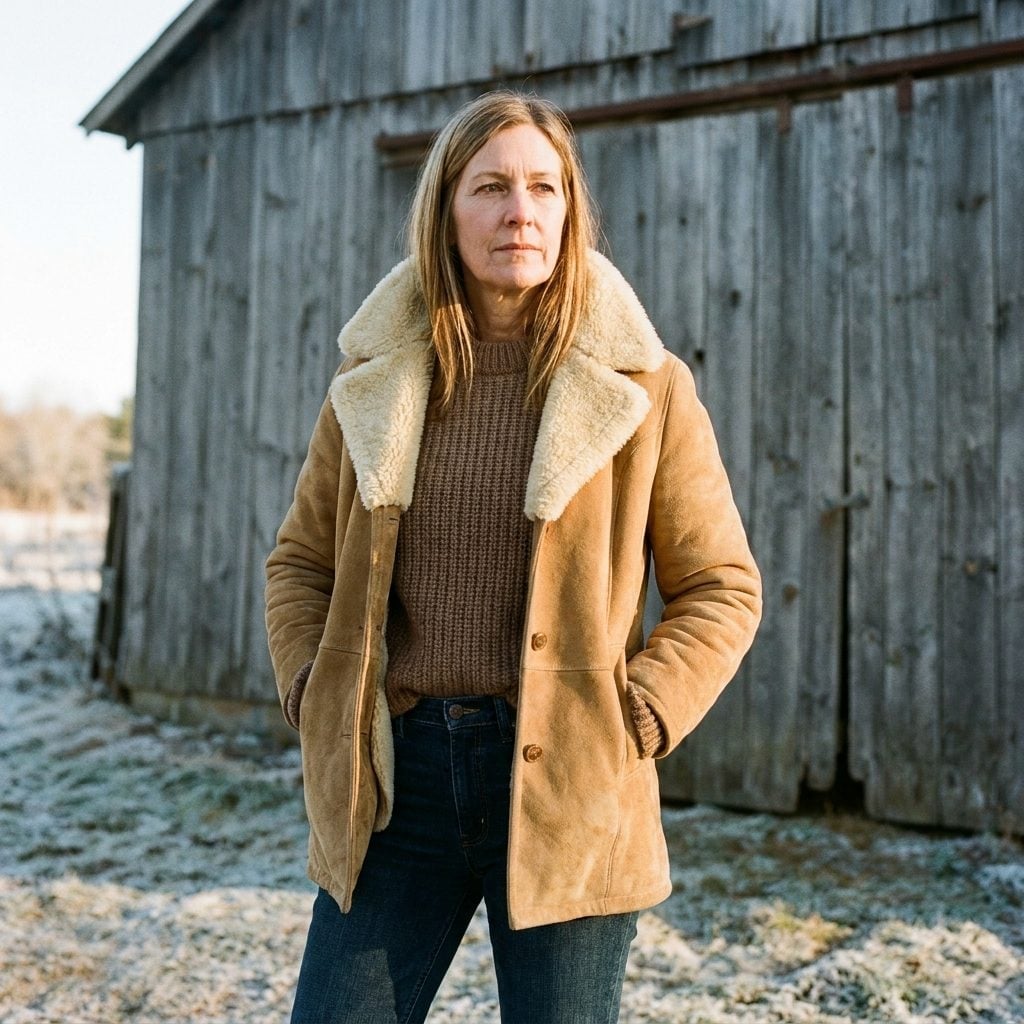
Somewhere between a ranch coat and something your mother might have worn to a football game in 1976, this tan suede jacket refuses to become precious.
The cream shearling collar provides the contrast; the relaxed hip-length cut handles the practicality. Worn open over a chunky brown knit, it looks substantial without becoming formal.
That may be why the style keeps escaping fashion’s usual expiration dates. Warmth is difficult to make obsolete.
11. Floral Dresses and Cowboy Boots Found Each Other Again
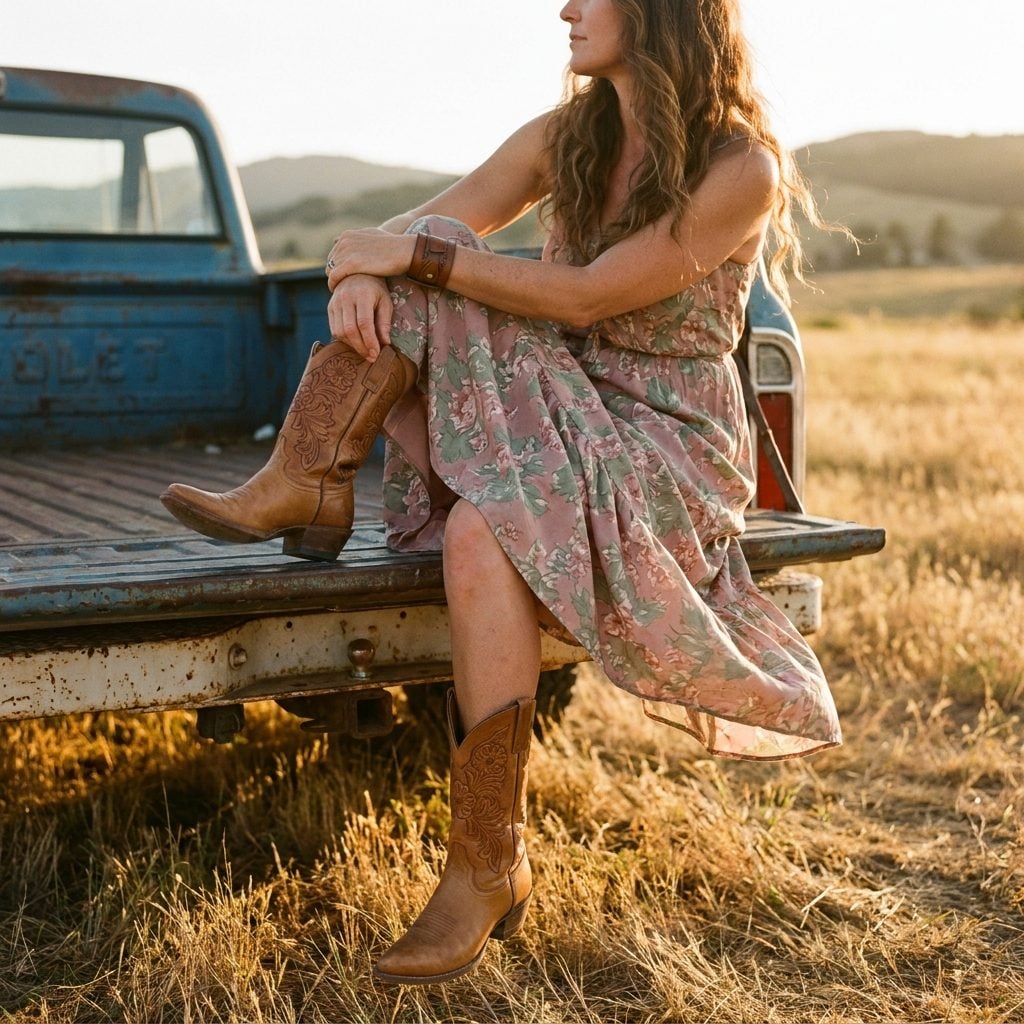
She’s sitting on the tailgate of an old Chevrolet pickup in a dusty-rose floral dress light enough to move with the slightest breeze. That movement is what keeps the dress from becoming overly sweet.
Then come the boots: substantial tan leather, tooled floral detail, mid-calf shaft, block heel. The Western weight below changes the personality of everything above it.
The pairing has deep roots in the decade’s bohemian-meets-Western vocabulary. Soft print against serious leather still creates the same useful friction. A leather cuff at the wrist is enough to carry the boot color upward without making the outfit feel arranged by committee.
10. Embroidered Peasant Blouses Still Make Plain Denim Look Like a Decision
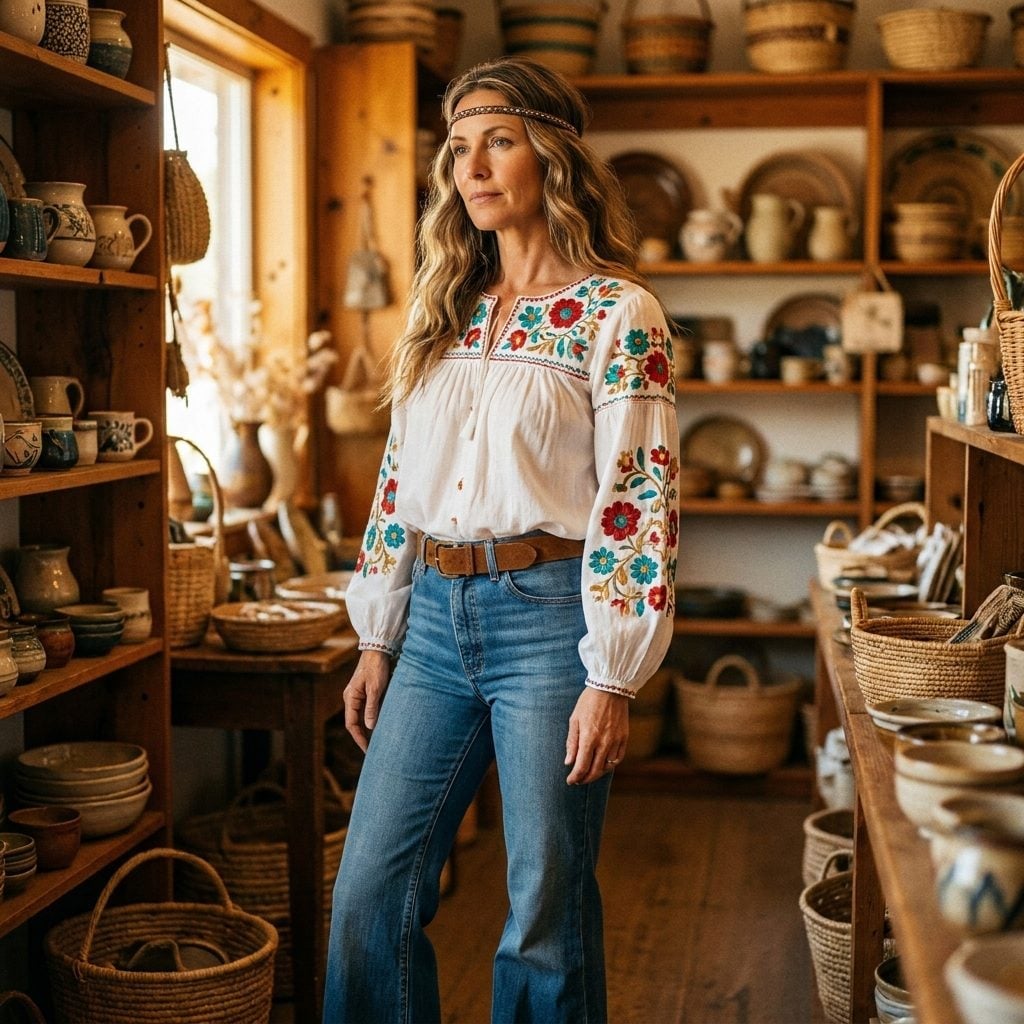
Folk embroidery supplied some of the 1970s’ most recognizable color: flowers running across yokes, sleeves, cuffs, and necklines on otherwise simple cotton blouses.
Here, red, teal, and gold stitching wakes up a white blouse before it gets tucked into wide-leg denim. The brown leather belt gives the eye a stopping point between all that embroidery and all that blue.
The best versions don’t need extra jewelry competing with the needlework. The blouse has already brought its own decoration.
The Fit Fix: Look at how the embroidery travels around the garment rather than simply counting how much of it there is. Motifs that continue onto the sleeve or cuff give the blouse more dimension. With wide-leg denim, a clean tuck also keeps the volume concentrated where you actually want it.
9. High-Waisted Flares Still Know Every Trick for Making a Leg Look Longer
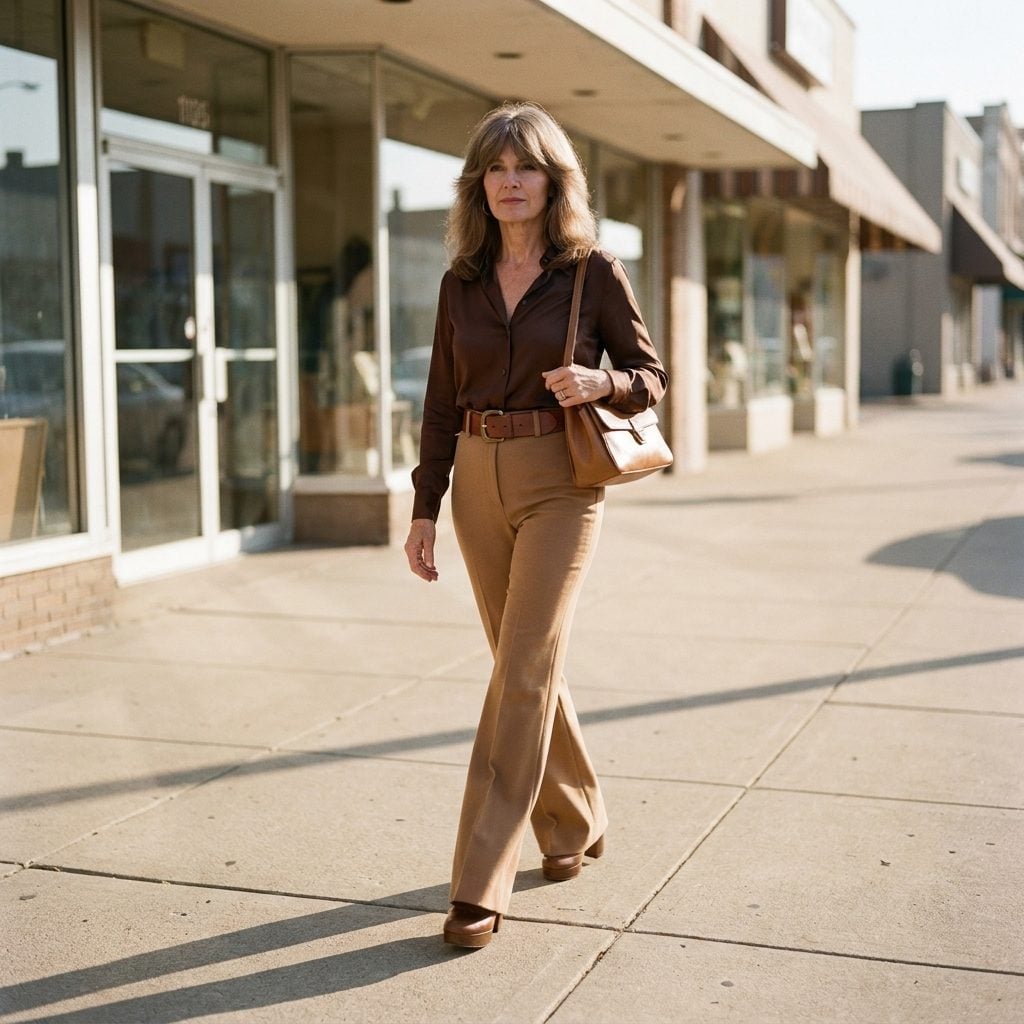
Camel flares rising to the natural waist create one long line before they even begin widening toward the floor. That’s why the silhouette can look dramatic without looking busy.
The dark chocolate blouse is tucked cleanly inside that high waist, then a cognac belt draws a narrow horizontal line through all the vertical movement. A tan shoulder bag stays compact enough not to interrupt the trousers.
This is less about a specific 1970s garment than a piece of visual engineering the decade understood exceptionally well: put the waist high, let the hem travel low, and don’t clutter the distance between them.
8. Wide-Leg Trousers and a Ribbed Knit Prove Texture Can Carry an Outfit
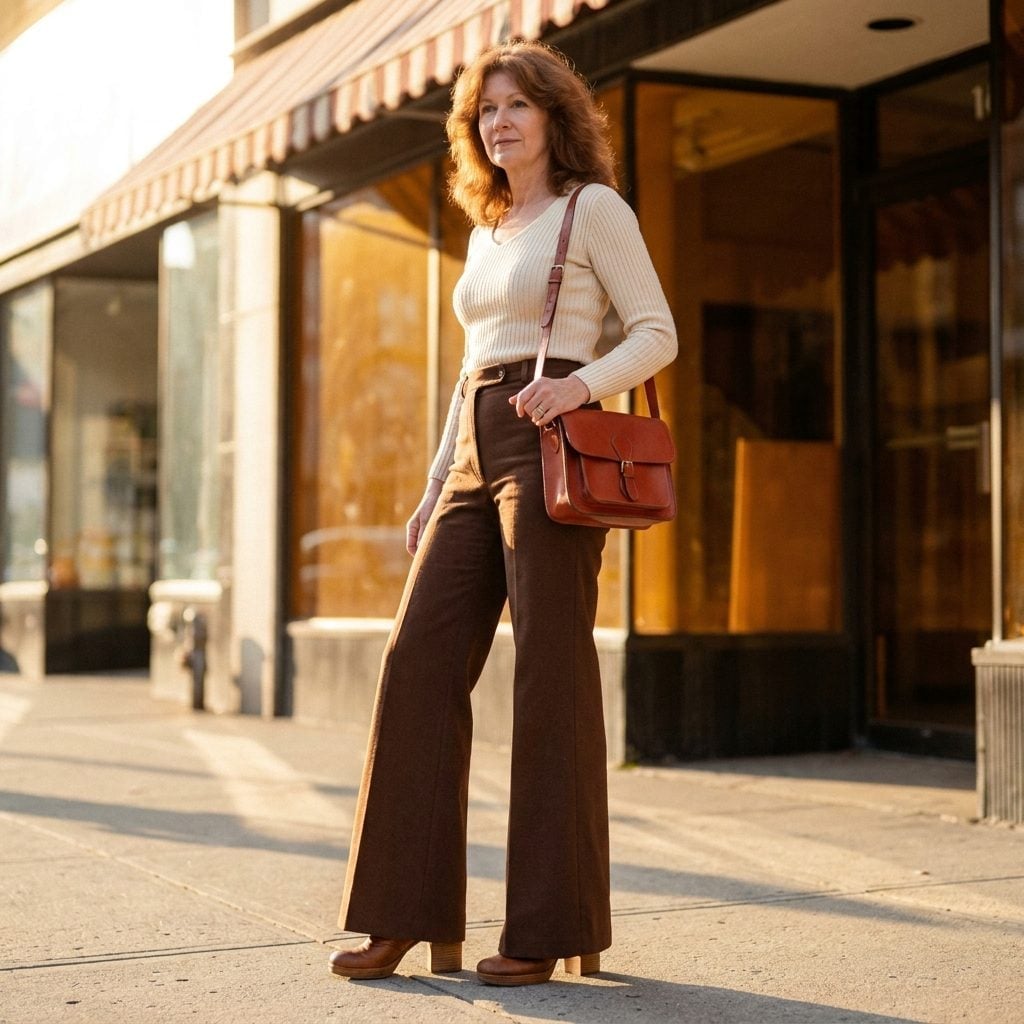
These brown trousers are broad enough to pool slightly over the heel, but the cream ribbed knit above them stays narrow and precise. That’s the contrast worth noticing here.
One half of the outfit is about sweep; the other is about vertical texture close to the body. The high waist is where those two ideas meet.
A small cognac crossbody and warm tan platforms finish the line without adding another competing shape. Unlike the silk-blouse-and-flare look, this one gets most of its interest from surface rather than color.
7. Gauze Blouses Are at Their Best When Nobody Tries to Tame Them
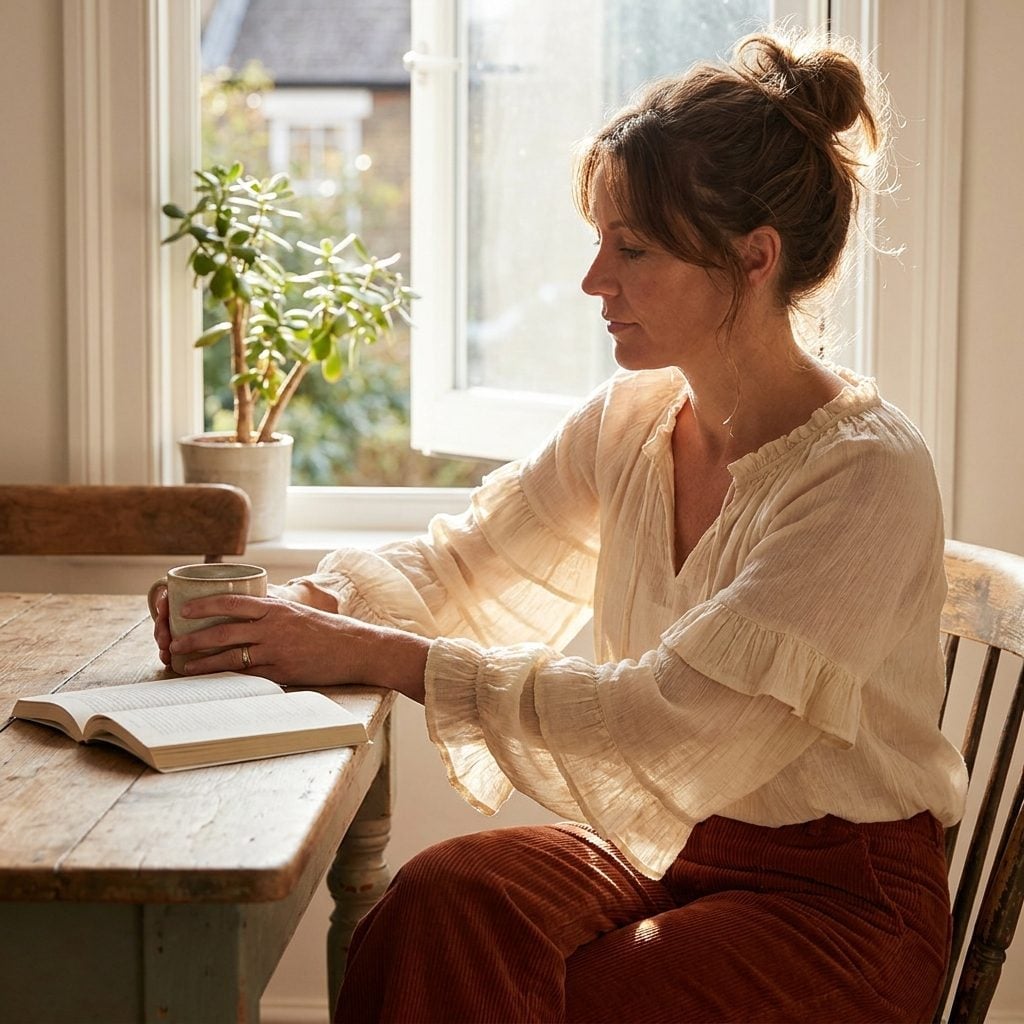
Ivory gauze with tiered flutter sleeves and a gathered neckline has no interest in behaving like a crisp shirt. Good.
The fabric needs air around it, and the loose cut allows light to move through those layers rather than pinning them to the body. Deep-rust corduroy below provides the opposite texture: dense, ribbed, grounded.
A messy bun keeps the neckline exposed and leaves the sleeves alone to make their case. Morning-coffee dressing rarely gets this much choreography.
6. Paisley Dresses Don’t Need a Full 1970s Supporting Cast
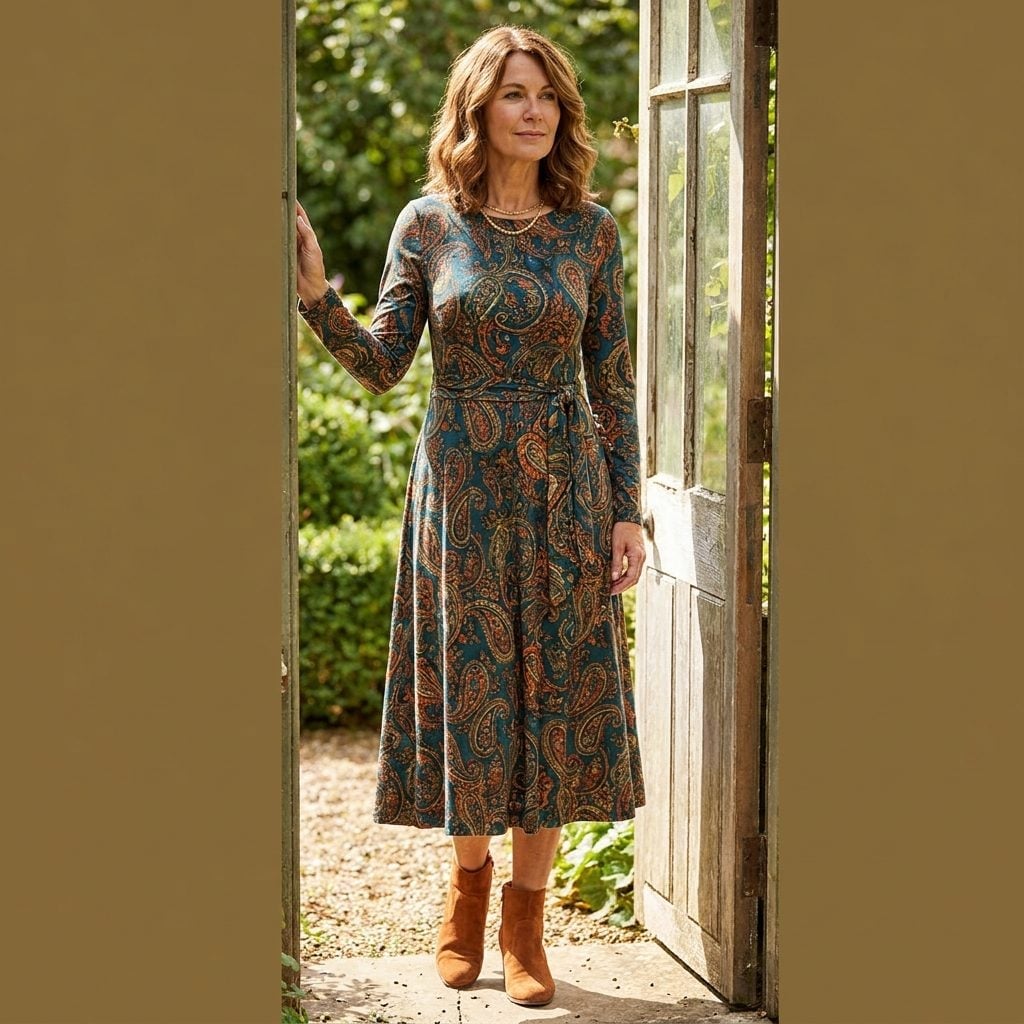
Teal, rust, and ochre paisley give this midi dress all the historical reference it needs.
The upper half stays relatively close through the shoulder and chest before releasing into a fuller skirt. A drawstring defines the waist without turning it rigid, while tan suede ankle boots give the hem a clean stopping point.
No floppy hat required. No waistcoat. No fringe. When the print already knows what decade it’s quoting, the accessories can stay in the present.
5. Striped Maxi Skirts Still Understand the Power of One Big Gesture
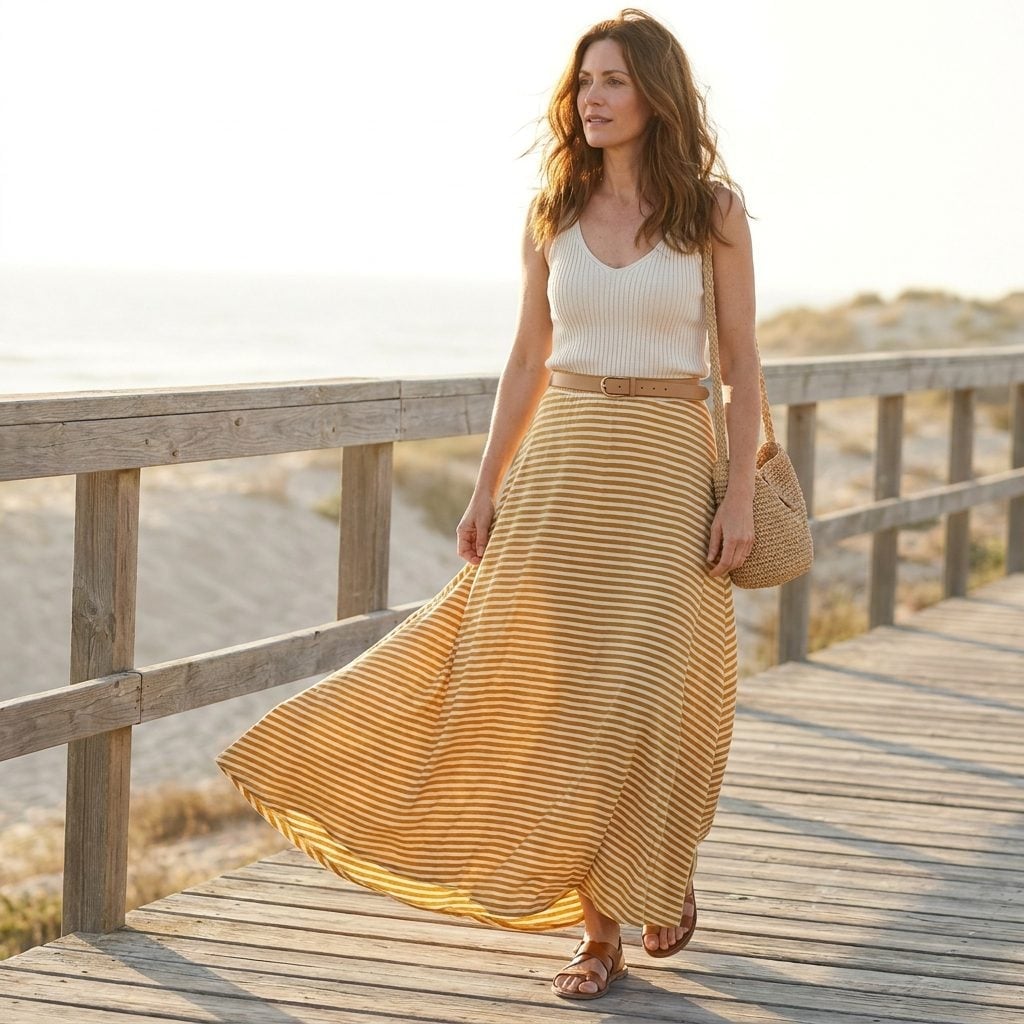
Gold-and-cream horizontal stripes sweep across a floor-length skirt with enough volume to move almost independently of the wearer. That’s already a lot of visual information, so the ribbed tank above it wisely stays quiet.
A slim tan belt gives the waist definition without dividing the outfit too harshly, while the woven crossbody introduces another natural texture without challenging the stripe.
- Let the skirt lead and keep everything above the waist in one neutral family.
- Choose sandals practical enough for the length; a maxi loses some charm when you’re fighting the hem.
- Woven or rattan bags work especially well because their texture echoes the skirt without introducing another print.
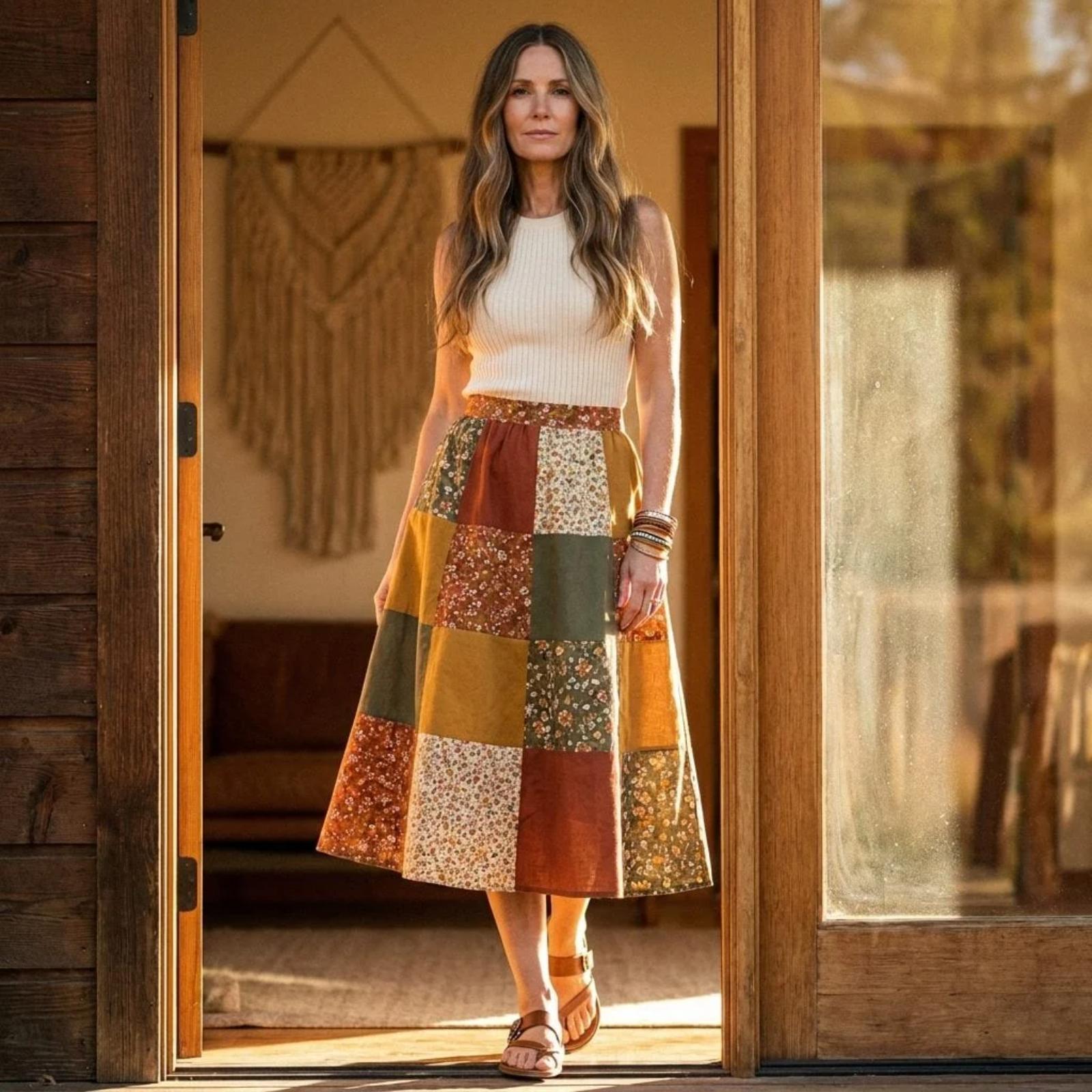
4. Patchwork Skirts Pulled Every Fall Color Into One Hem and Somehow Got Away With It
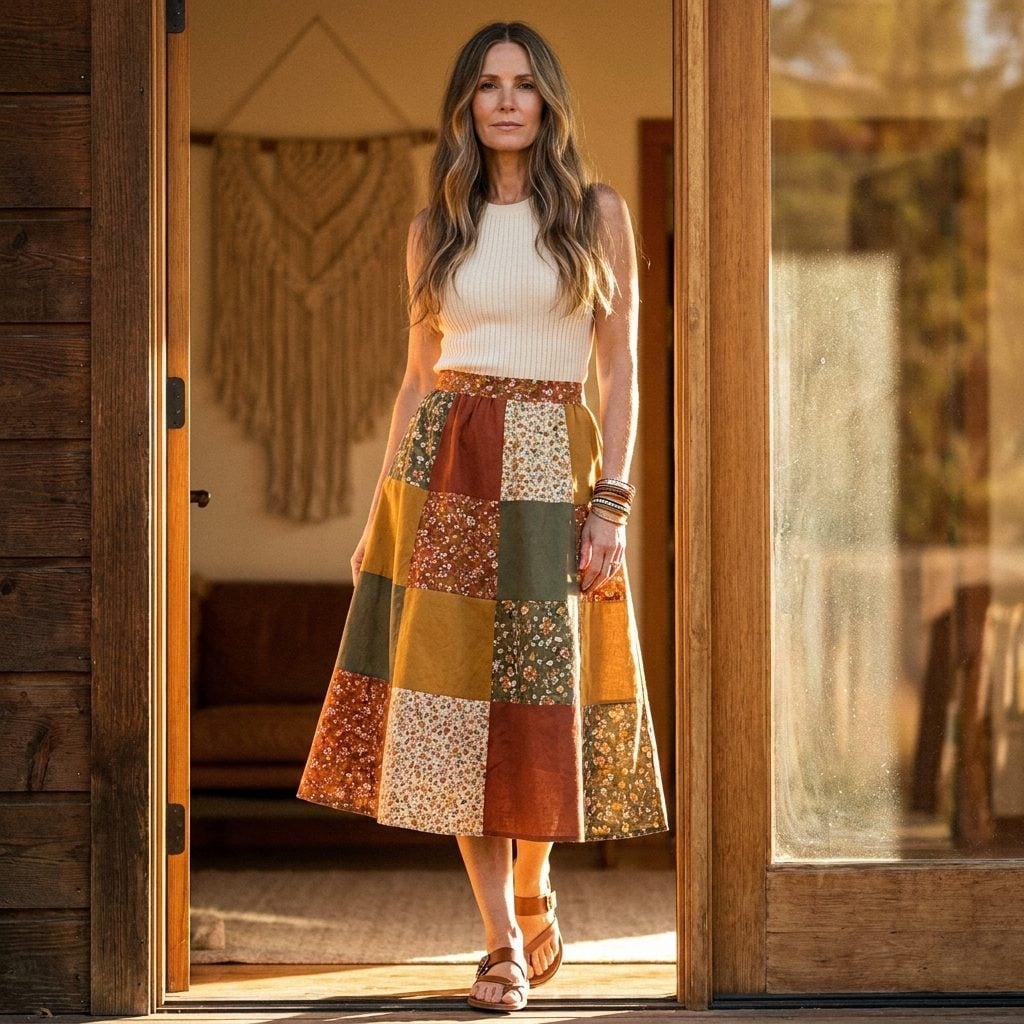
Olive, rust, mustard, cream, tiny florals — this skirt contains enough competing fabric to furnish a small sewing room, yet the finished effect is remarkably composed.
Part of that comes from repetition. The colors recur from square to square, so the patchwork has rhythm instead of randomness. The other part comes from the silhouette: a clean waistband, controlled fullness, and a midi hem give all those scraps a strong underlying shape.
Then the styling gets out of the way. A fitted cream ribbed top, stacked bangles, and simple flat sandals leave the skirt to carry the history. What might once have been read as homespun or hippie now looks almost graphic — a grid of autumn color moving around the body.
That’s why this particular 1970s idea feels so convincing again. The patchwork didn’t need to become quieter. Everything around it did.
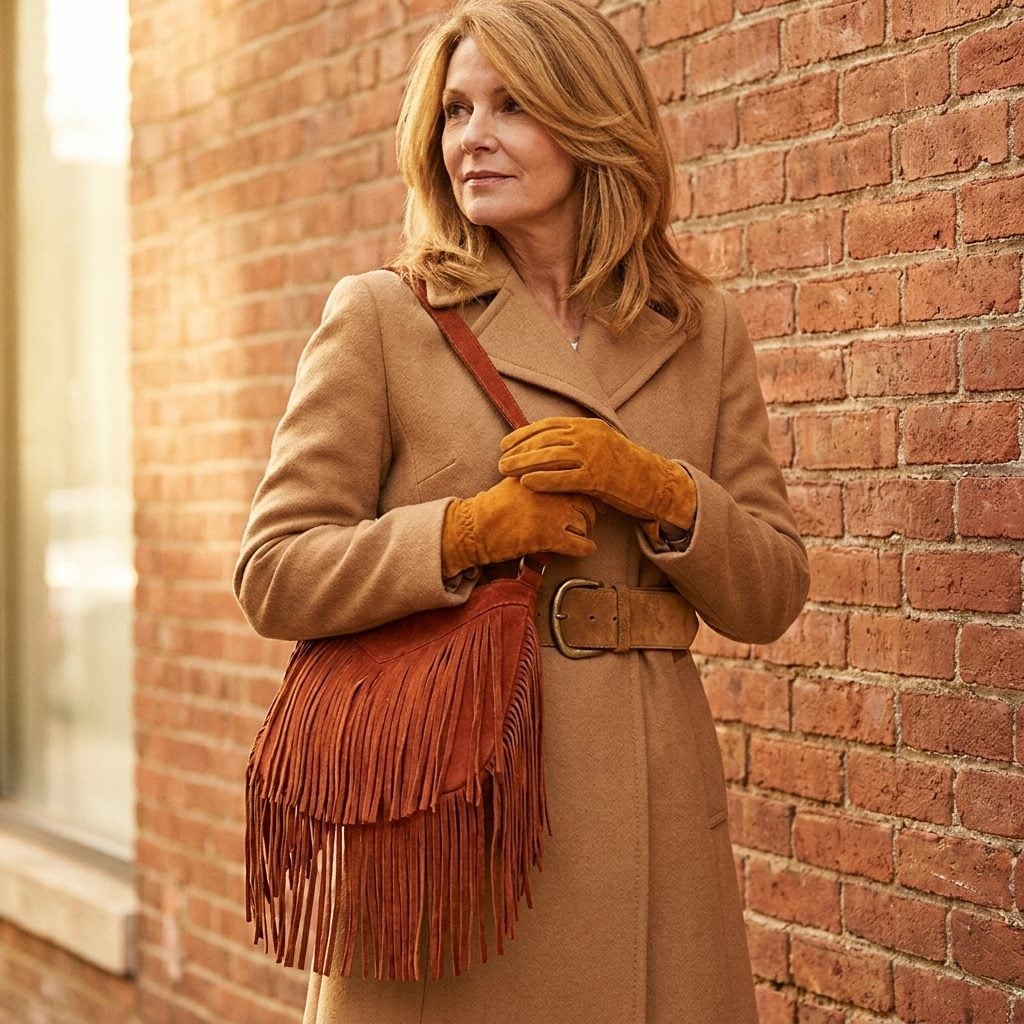
3. Fringe Bags and Suede Gloves Walked Back Into Fall Like They Owned It
❤️ Would you like to save this?
Rust-colored fringe on a suede crossbody should arguably be enough 1970s reference for one outfit. The belted wool coat keeps it from floating away into festival territory.
The fringe falls in two tiers and moves whenever the wearer does, which is exactly why fringe exists. The gloves pick up the warmer tones in the bag without matching them exactly, while the coat stays a quieter tan.
The old instinct might have been to coordinate every brown. The more interesting version lets them disagree slightly.
2. Crochet Dresses Have Moved Well Beyond the Beach
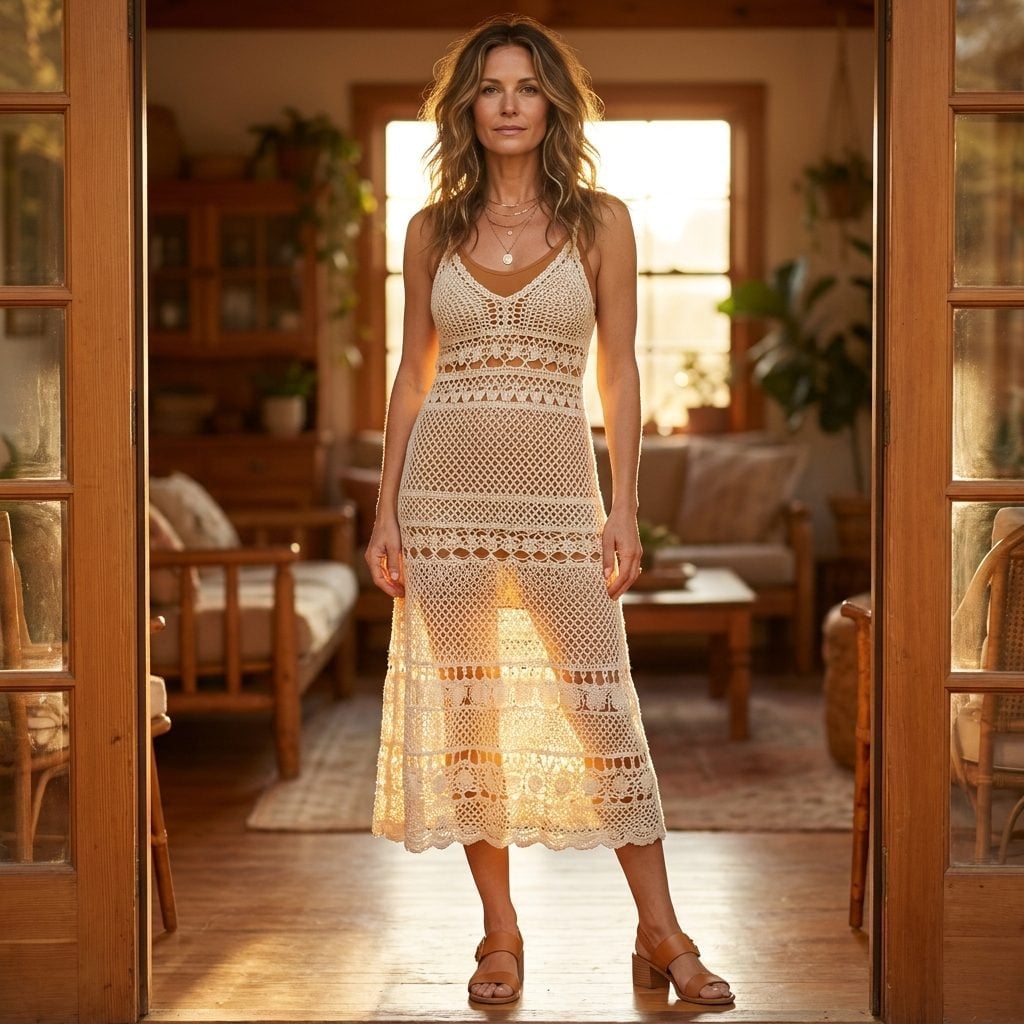
Midi-length crochet in an unbleached natural tone has very different ambitions from a little beach cover-up.
The open weave changes across the body in horizontal bands, alternating larger diamond mesh with finer lace-like sections near the hem. That variation gives the surface definition even though the palette barely changes at all.
Layered gold-tone necklaces sit close to the collarbone, while block-heeled tan sandals give the dress something substantial to meet at the floor. The result keeps crochet’s handmade character without requiring seashells, bare feet, or proximity to Ibiza.
1. Wide-Brim Felt and Oversized Tortoiseshell Still Know How to Own a Café
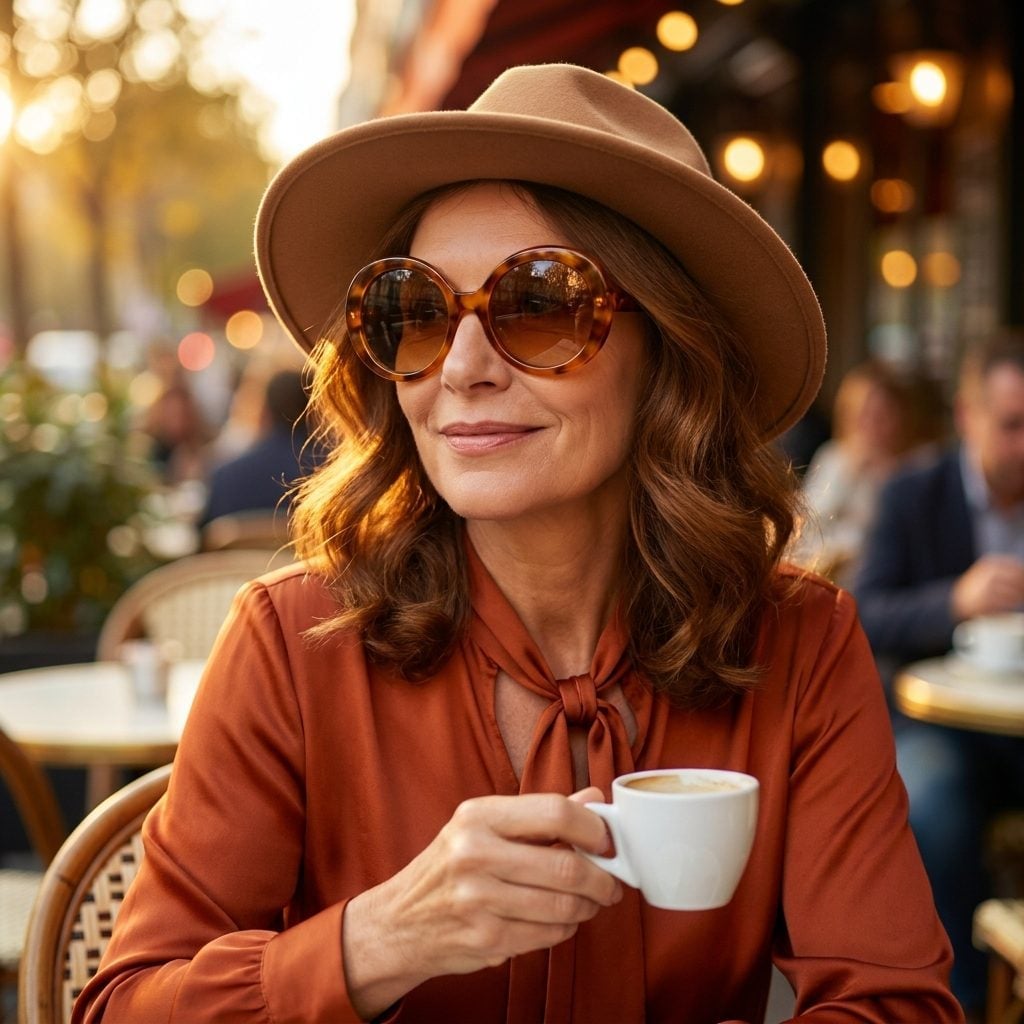
A camel felt hat with a broad structured brim and genuinely oversized tortoiseshell sunglasses is not an outfit for somebody hoping to disappear into the corner.
That’s exactly why the combination works. Both accessories have scale, so neither looks accidental. Underneath, a terracotta blouse with a loose self-tie neck and long ruffled cuffs carries the same warm palette without trying to compete with the face.
The tie stays relaxed rather than knotted into a prim bow, which keeps the blouse on the bohemian side of the decade. Add the hat and glasses, and suddenly the whole look suggests a woman who has somewhere to be, even if that somewhere is only the table by the window.