❤️ Would you like to save this?
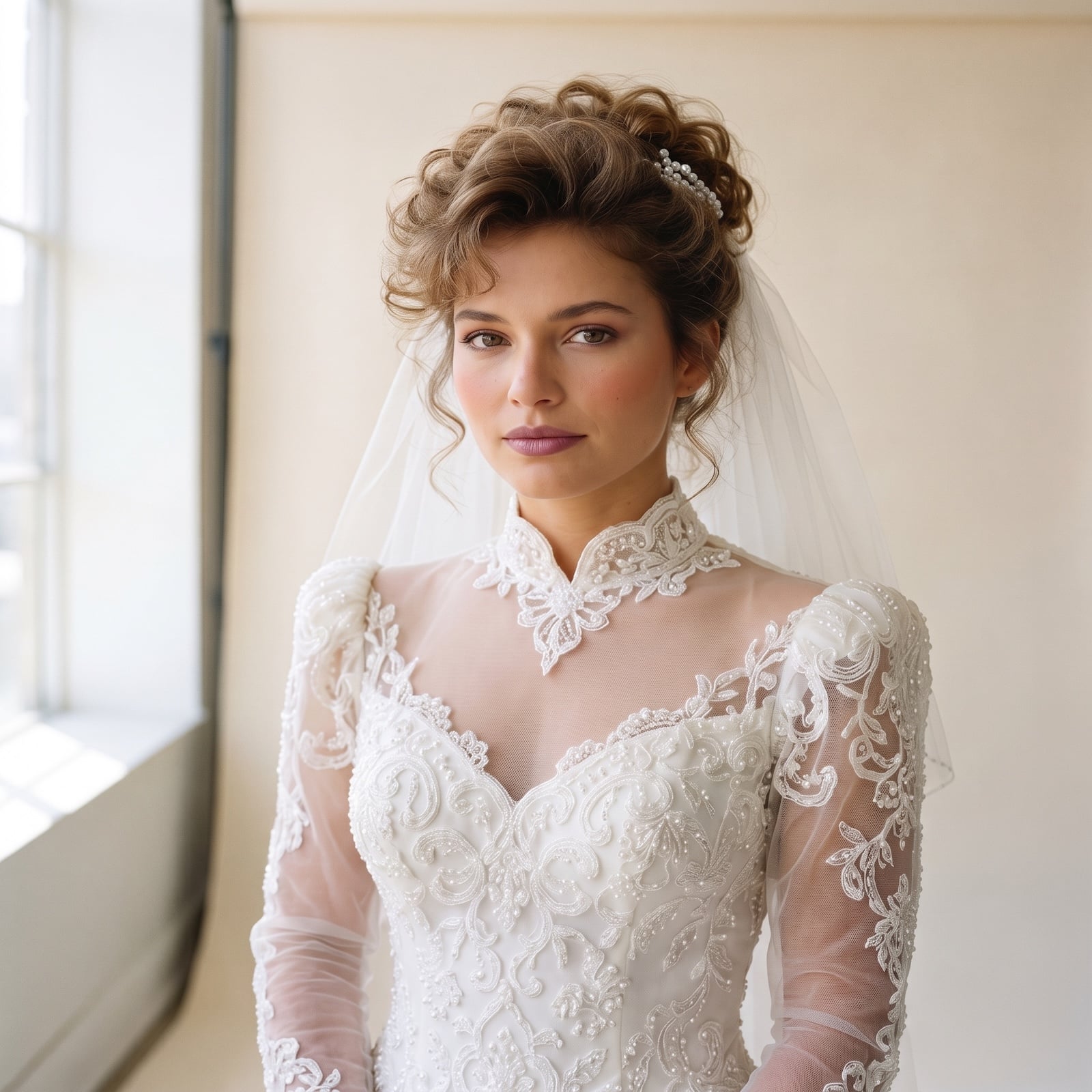
Aqua Net in the church vestibule. Seed pearls climbing the bodice. Lace at the throat, lace at the wrist, lace running all the way down the train. The wedding dress of the era treated restraint as a problem somebody else could solve later.
What makes these gowns interesting now isn’t the excess by itself. It’s how many of the underlying ideas still hold up once the decoration is stripped back: elongated waists, dramatic shoulders, sculptural sleeves, open backs, exaggerated trains, oversized bows, sharply framed necklines.
Across these 35 transformations, the surprise is how little some of the strongest concepts actually changed. The volume moved. The ornament thinned out. The construction became easier to see. What looked dated was often the styling around the idea, not the idea itself.
FYI, thanks to AI imagery software, we’re able to create very specific fashion and hairstyle examples to illustrate the points being made. In some cases, imagery is exaggerated to hammer home the point. Also, assume links that take you off the site are affiliate links such as links to Amazon. this means we may earn a commission if you buy something.
35. The Diana-Era Princess Gown Became an Architectural Ball Gown
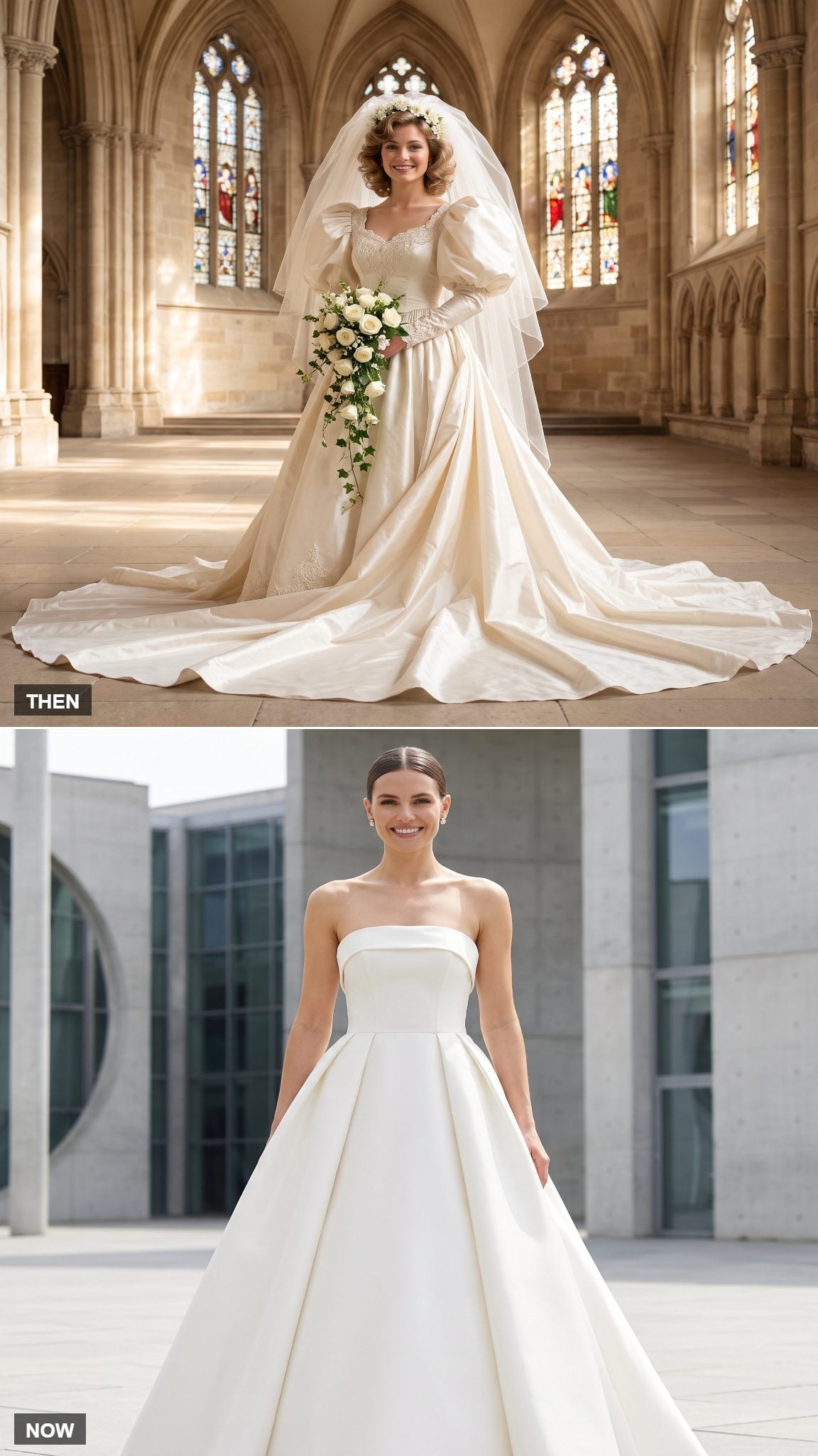
The 1980s princess gown did not believe in editing. Taffeta, inflated sleeves, cathedral-scale skirts, and enough fabric to command an entire aisle all arrived together. The silhouette was designed to register from the back pew.
The modern ball gown keeps the grandeur and changes the source of the drama. A sculpted strapless bodice, sharply defined waist, and broad folds of structured Mikado create volume through construction rather than decoration. Nothing is shy about the scale. The difference is that every line now has somewhere to go.
34. The Bridal Skirt Suit Traded Its Hemline for Trousers
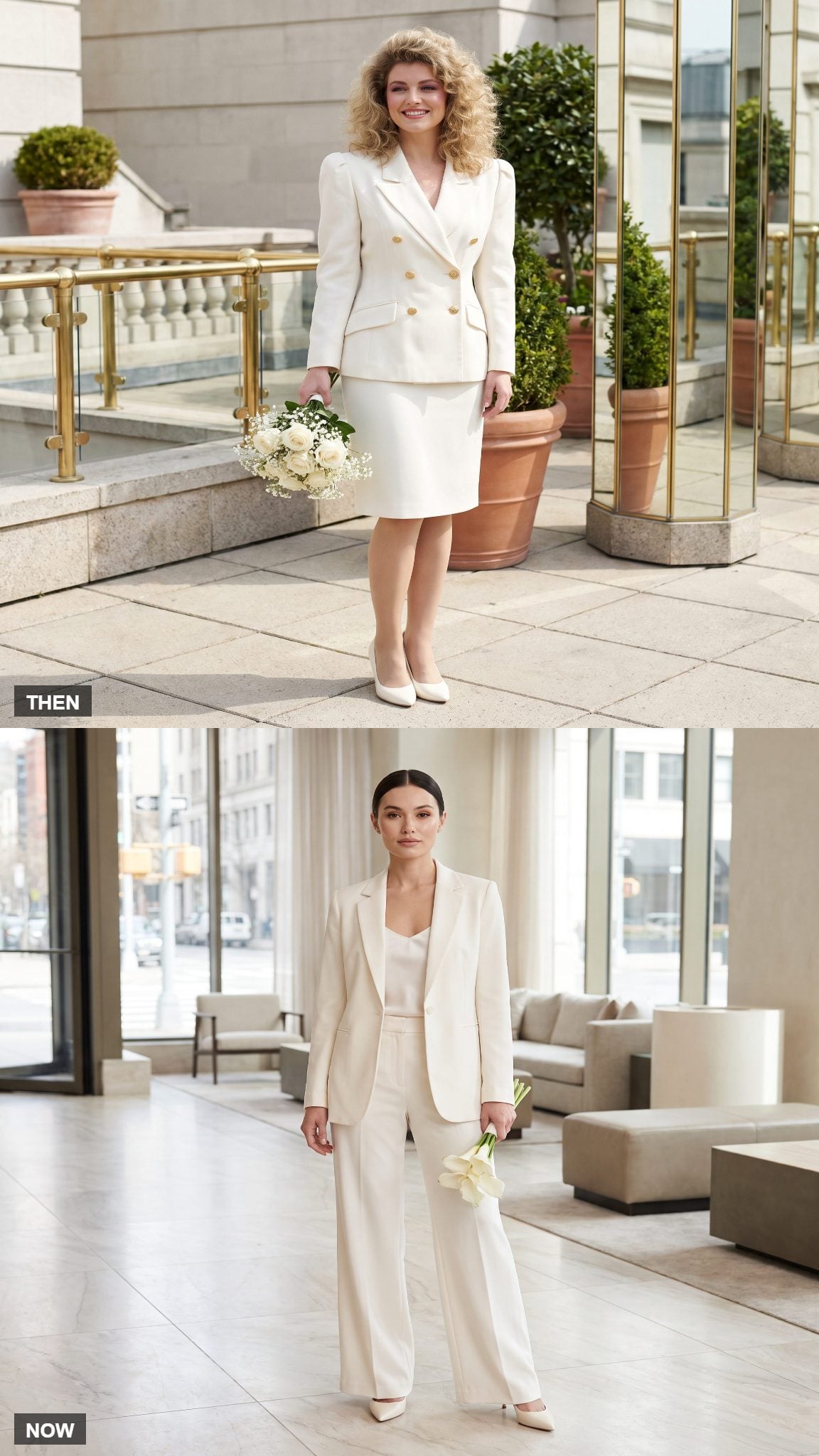
Padded shoulders, a double-breasted jacket, a straight skirt below the knee: the 1980s bridal suit looked ready to sign a merger agreement immediately after the vows. That was part of its charm. This was bridal dressing with no interest in pretending every woman wanted tulle.
The contemporary version stretches the idea vertically. A single-breasted blazer, silk camisole, and wide-leg trousers create one long tailored line, with pointed heels disappearing underneath. The power is still there; the proportions have simply gone longer, leaner, and more relaxed. The same thinking carries into sharp modern occasion dressing away from the aisle.
The skirt disappeared. The authority did not.
33. Pearls and Sequins Gave Way to a Bias-Cut Slip
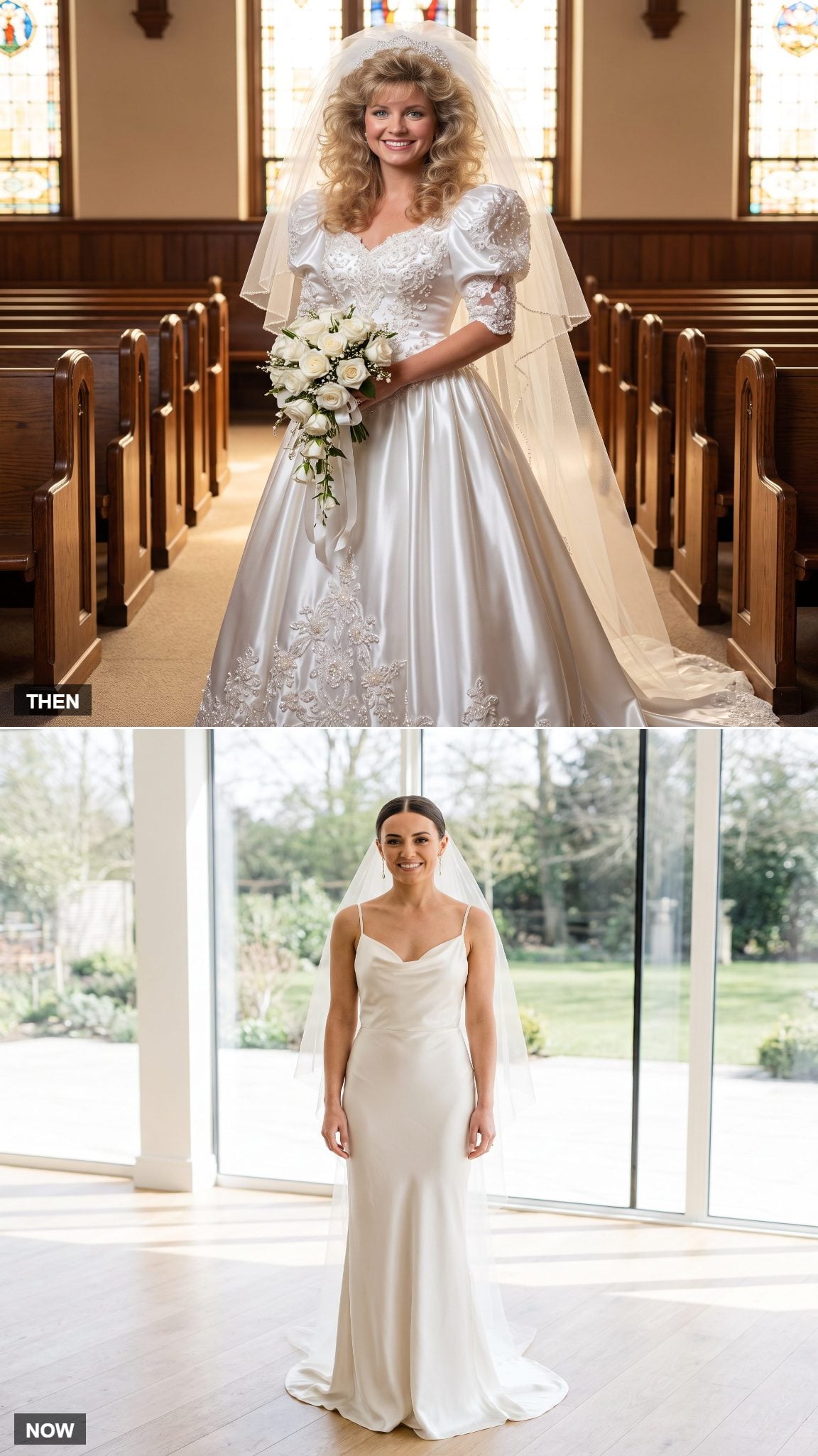
The 1980s bride wore her gown like a chandelier. Pearls, sequins, appliqué, puffed shoulders — every surface was asked to participate.
The modern slip makes the opposite wager: if the cut and fabric are beautiful enough, almost nothing needs to be added. Silk-satin falls on the bias, skims rather than stands away from the body, and catches light as the bride moves. A sheer bridal veil and fine earrings are enough.
32. The Leg-of-Mutton Sleeve Came Back With Better Proportions
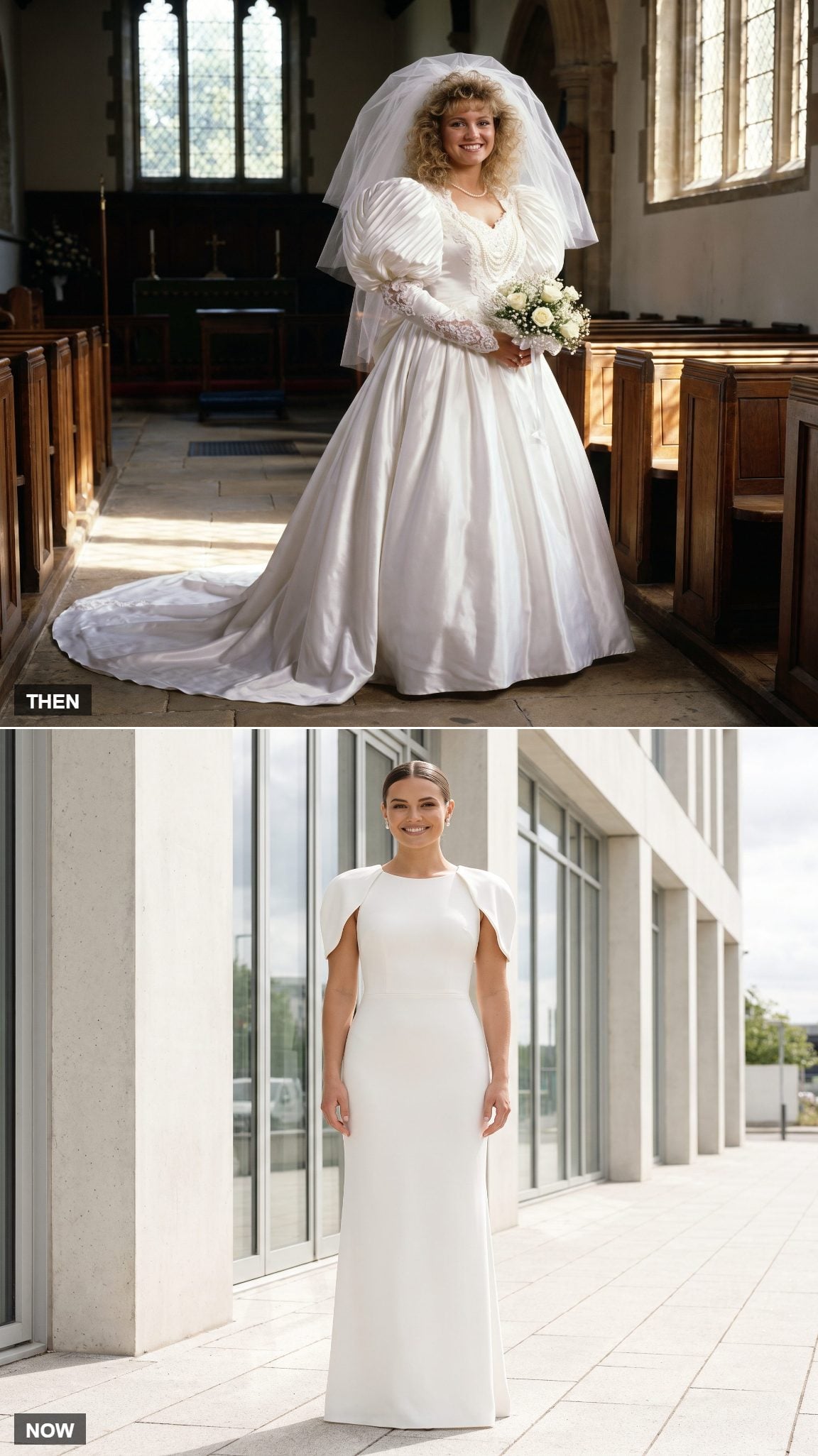
The leg-of-mutton sleeve is pure silhouette: enormous at the shoulder, narrow at the wrist, impossible to ignore. On an already full 1980s bridal gown, that volume could swallow everything around it.
The contemporary version keeps the sculptural shoulder but gives it a quieter frame. Detachable sleeves provide a controlled puff against a slim column, so the eye gets one dramatic gesture instead of an entire dress competing for altitude. Best of all, the sleeves can leave before the dancing starts.
31. Tea Length Lost the Lace and Found a Sharper Line
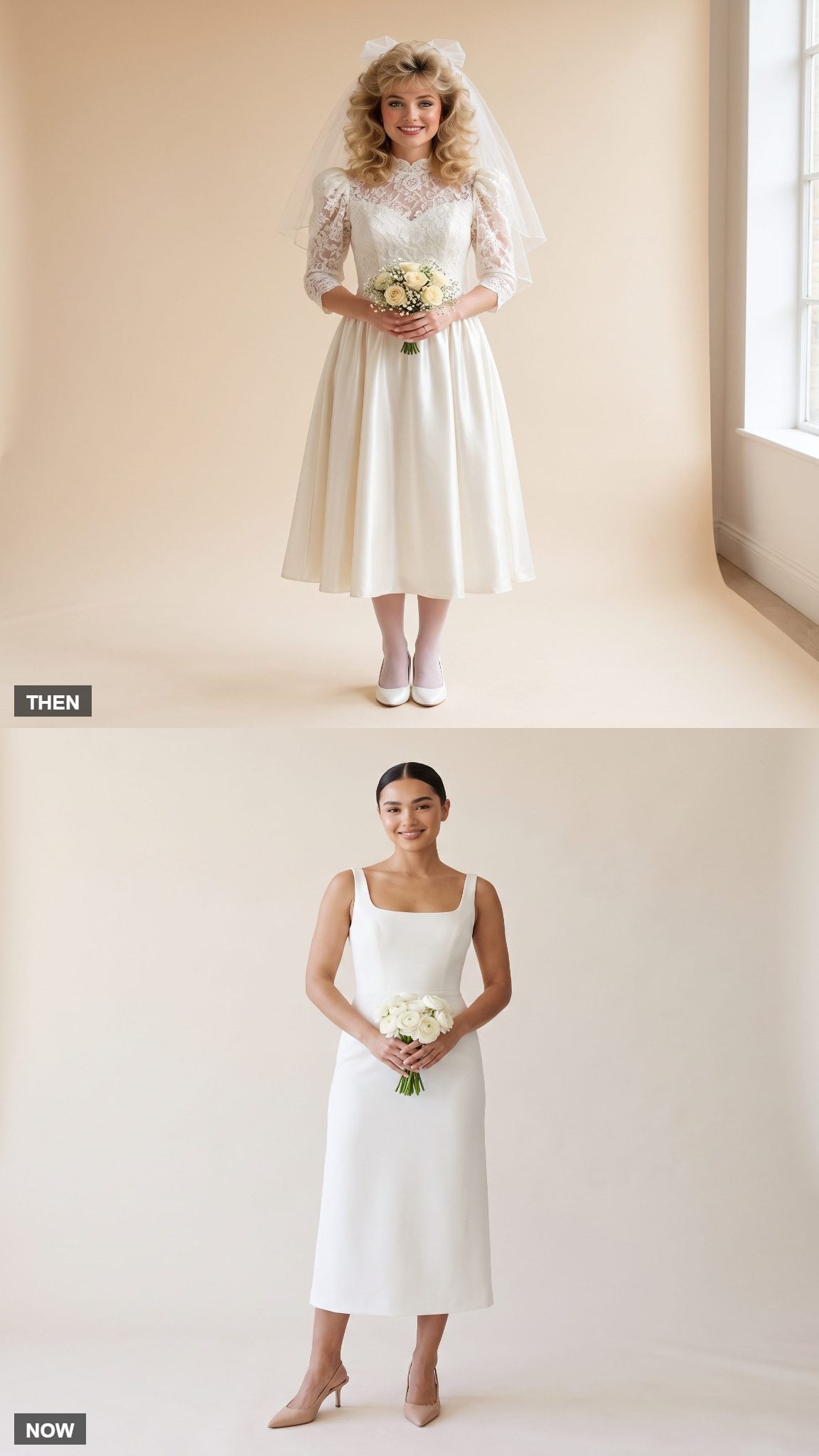
Tea-length bridal dresses have long made sense when a full train is beside the point. The 1980s version here leans into that practicality with lace, three-quarter sleeves, a calf-length skirt, and white pumps.
The newer midi turns the same shorter proportion into something cleaner and more graphic: square neckline, sleeveless bodice, smooth skirt, pointed slingbacks. The hem is still practical. The attitude is considerably less demure.
30. The Cathedral Train Stopped Decorating Every Inch
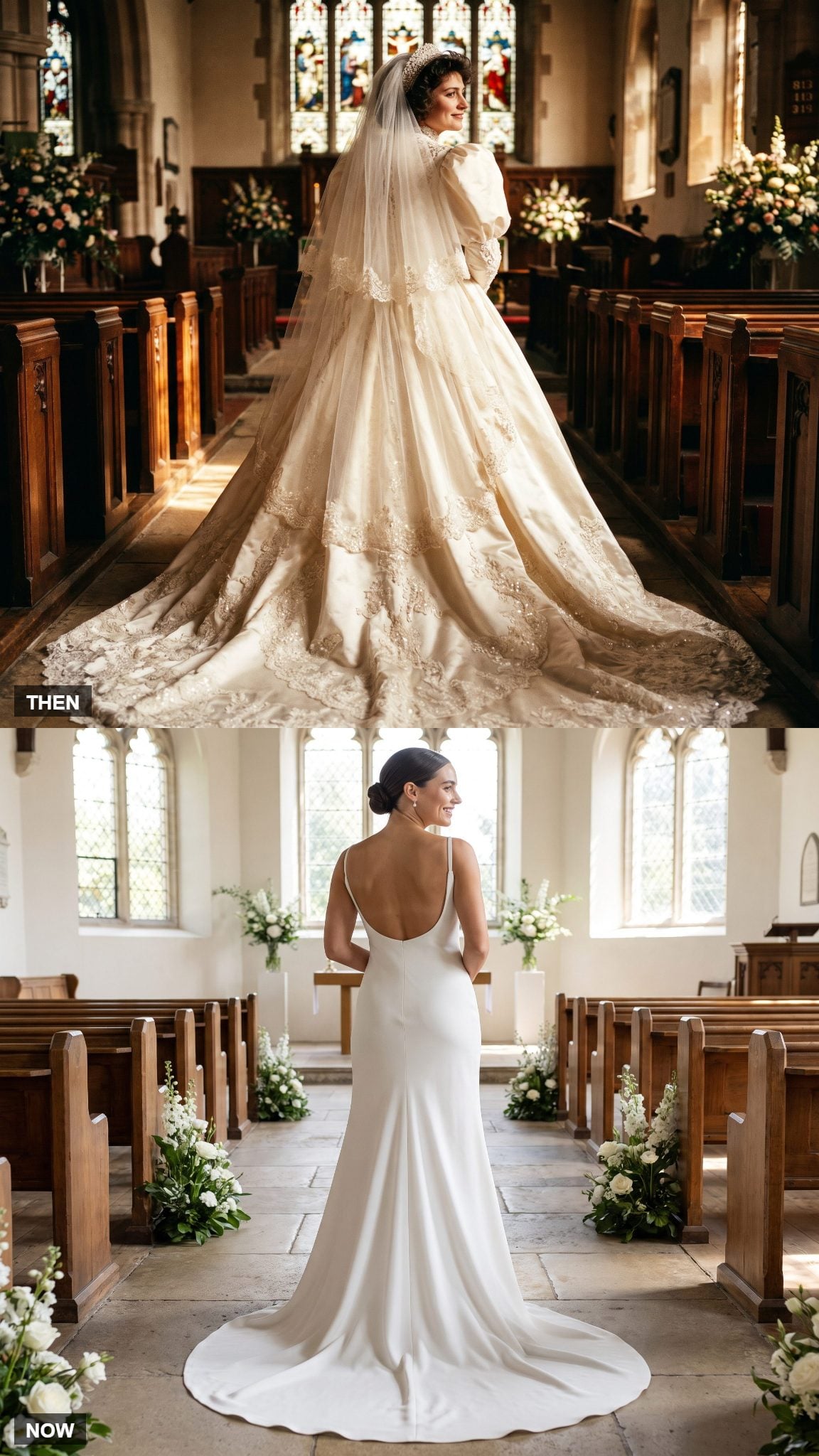
Somewhere in the late 1980s, a train could feel unfinished until lace had crawled all the way to the last inch and a veil had been layered over it for insurance.
The newer version understands that length is already decoration. A broad sweep of unembellished fabric trails behind the body with nothing outlining the edge and nothing interrupting the fall. Shot from behind, the contrast is almost comic: one train announces itself in lace; the other simply occupies the room beautifully.
Sometimes the most extravagant thing a gown can do is leave a very large surface alone.
29. The Basque Waist Finally Let Its Seam Line Show
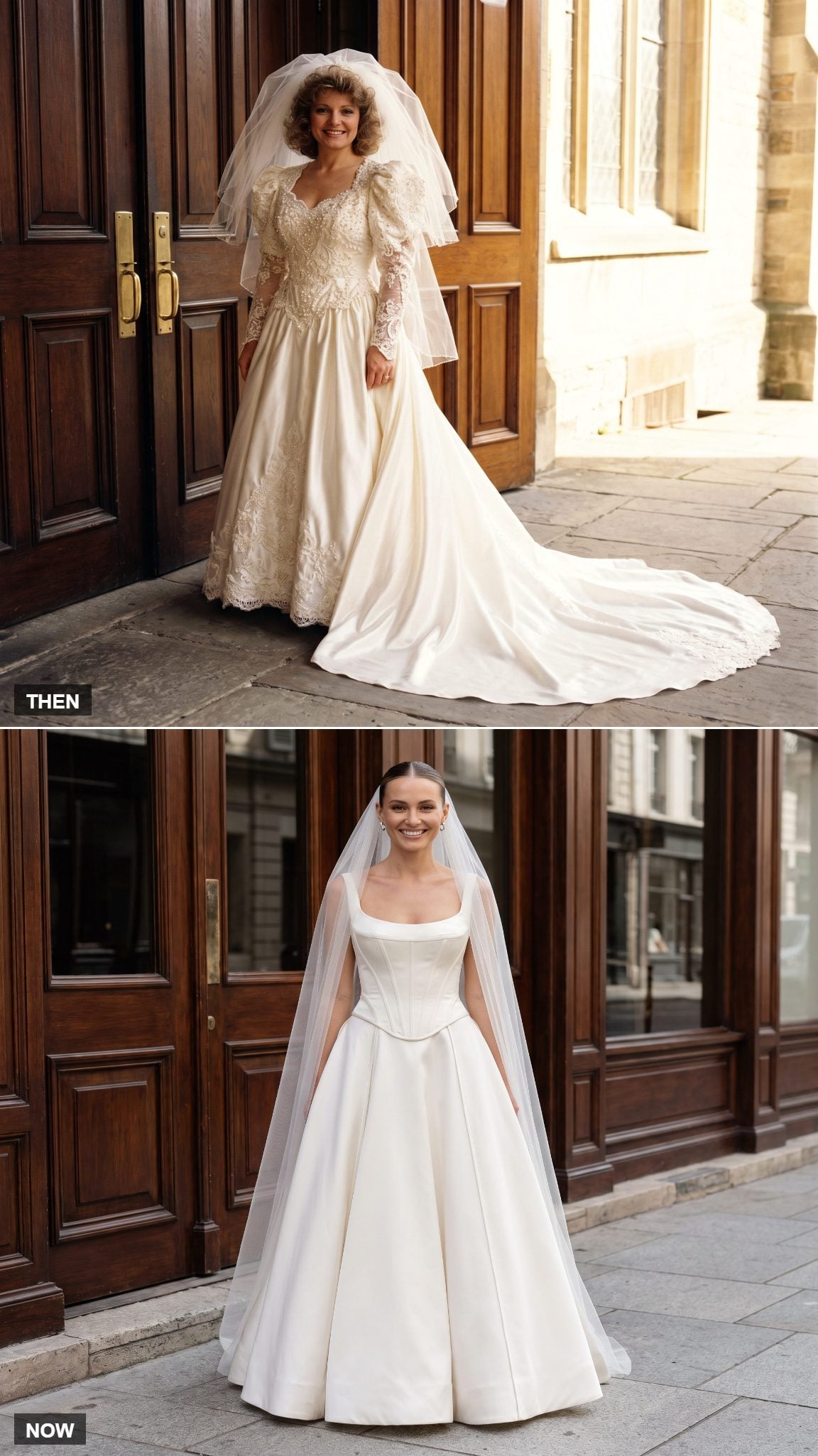
A Basque waist drops below the natural waist in a pointed line, and that downward sweep is already a piece of design. The 1980s version nearly buries it beneath pearls, lace, and surface detail.
The newer gown clears the view. Corsetry shapes the bodice, the seam traces the elongated point, and the full skirt begins exactly where the construction wants it to. The interest is no longer sitting on top of the dress. It is built into the dress.
28. Dozens of Rosettes Became One Sculptural Bloom
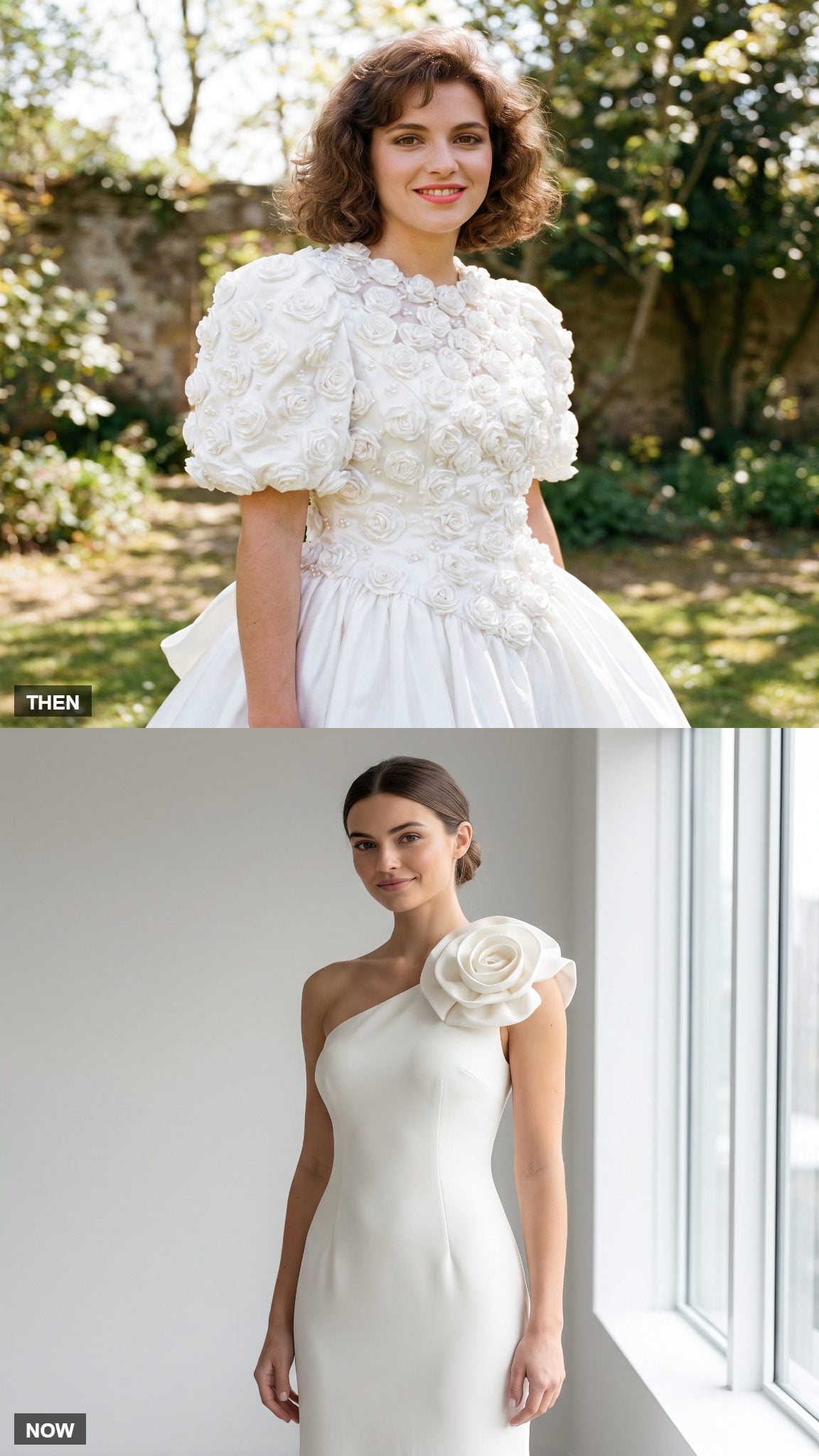
The 1980s did not sprinkle rosettes so much as deploy them. Sleeves, bodice, skirt — if there was an empty patch of satin, another flower could probably fit.
Now one oversized bloom gets an almost empty stage. Instead of distributing decoration across the entire gown, the design concentrates attention in one place and lets scale do what repetition used to.
27. The High Neckline Survived. The Lace Did Not
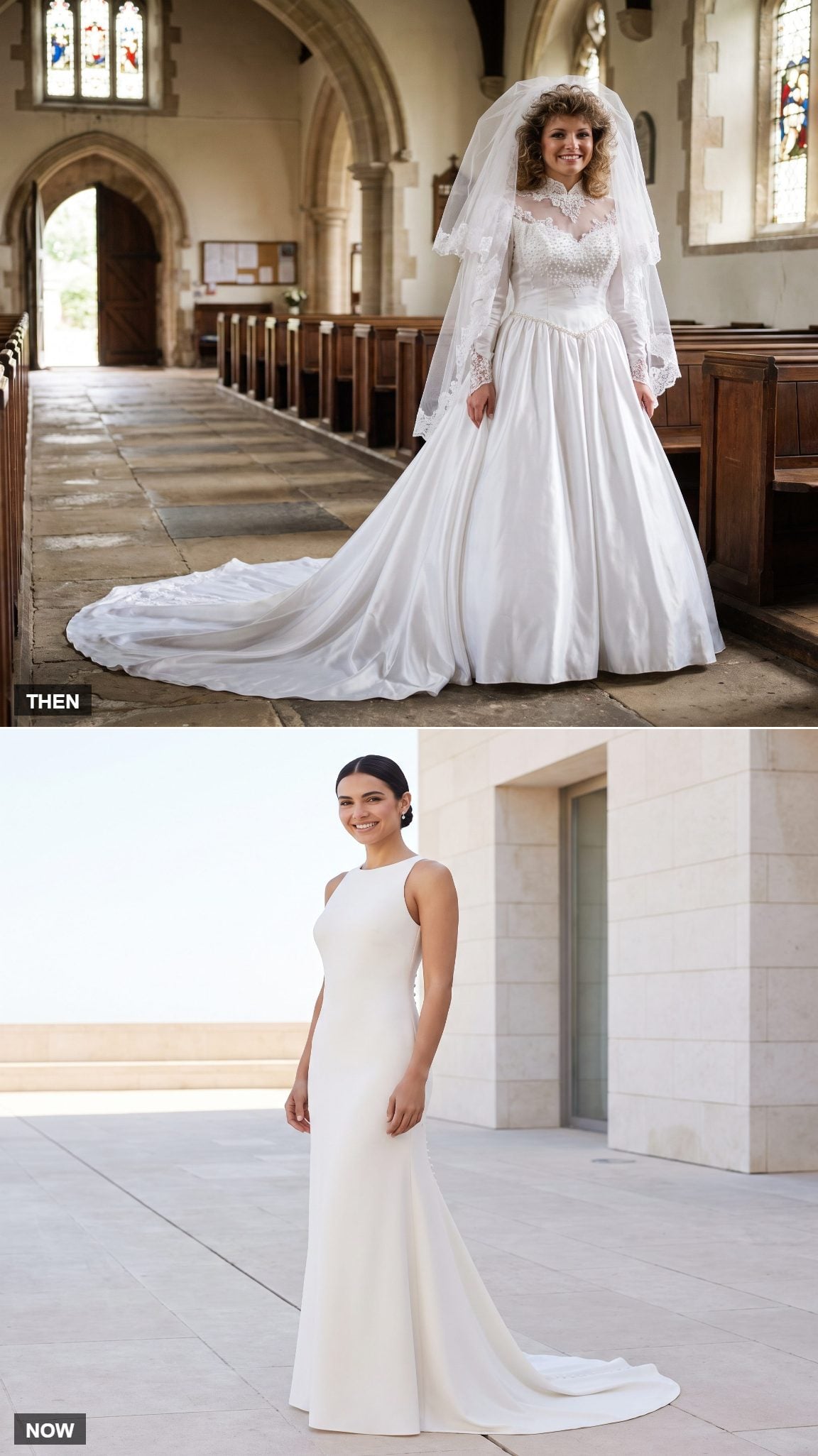
High-neck bridal dressing used to arrive with lace at the throat, sleeves to the wrist, and very little skin anywhere in between. The neckline was only one element in a much busier composition.
The column isolates it. A smooth high neck sits above bare shoulders and arms, while crepe falls in one uninterrupted line toward the floor. The contrast makes the neckline feel sharper: coverage at the throat, openness everywhere around it.
26. The Pickup Skirt Reduced a Dozen Decisions to One Drape
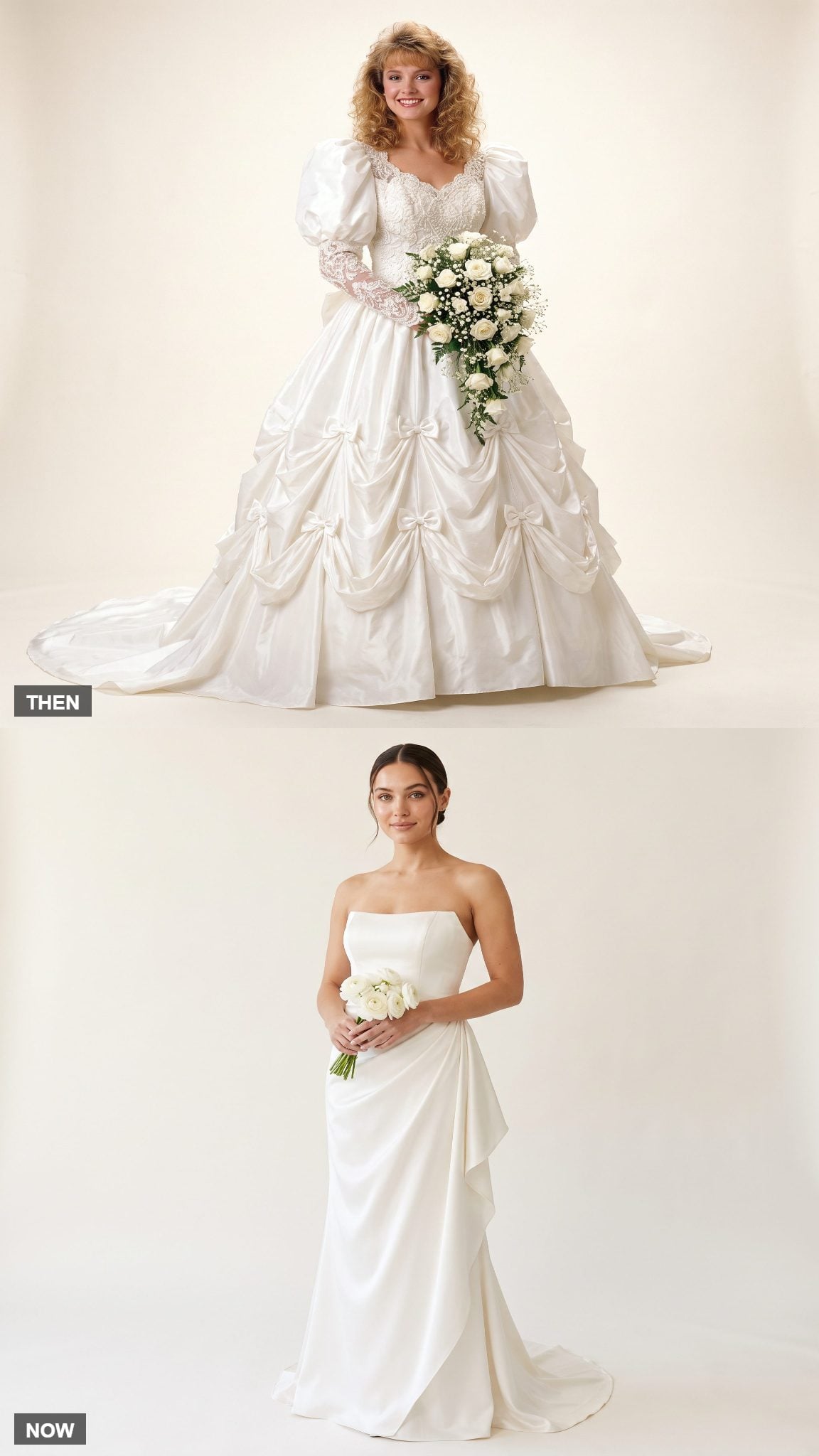
The pickup skirt was the 1980s at maximum enthusiasm: glossy taffeta hoisted into poufs, bows pinning every gather in place, lace and pearls continuing the argument above the waist. It was fabric refusing to behave quietly.
The newer gown keeps the appetite for movement but edits the mechanism. One asymmetrical sweep gathers at the hip, then releases into a smooth skirt beneath a bare strapless bodice. A collection of decorative events has become one deliberate fold.
25. Illusion Tulle Moved From Beading Ground to Negative Space
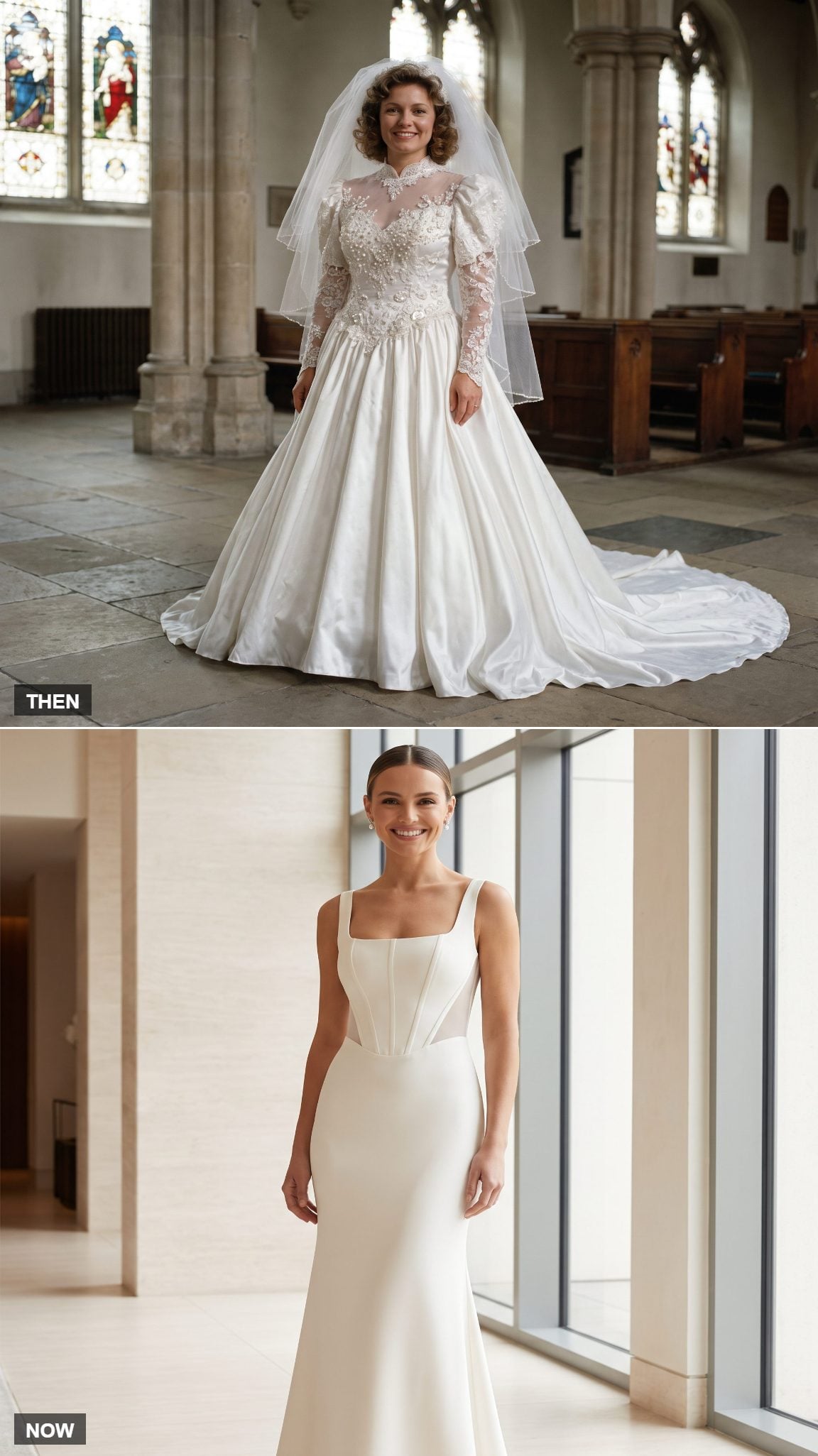
Illusion tulle once functioned like an invisible bulletin board for pearls and appliqué. The fabric was technically sheer, but the point was often how much decoration could be suspended across it.
Here transparency survives in a completely different role. Narrow sheer panels disappear into a sculpted corset, exposing just enough skin to sharpen the construction. The square neckline stays solid and precise. Same material trick, opposite visual strategy.
24. Power Shoulders Became Tailoring Instead of Padding
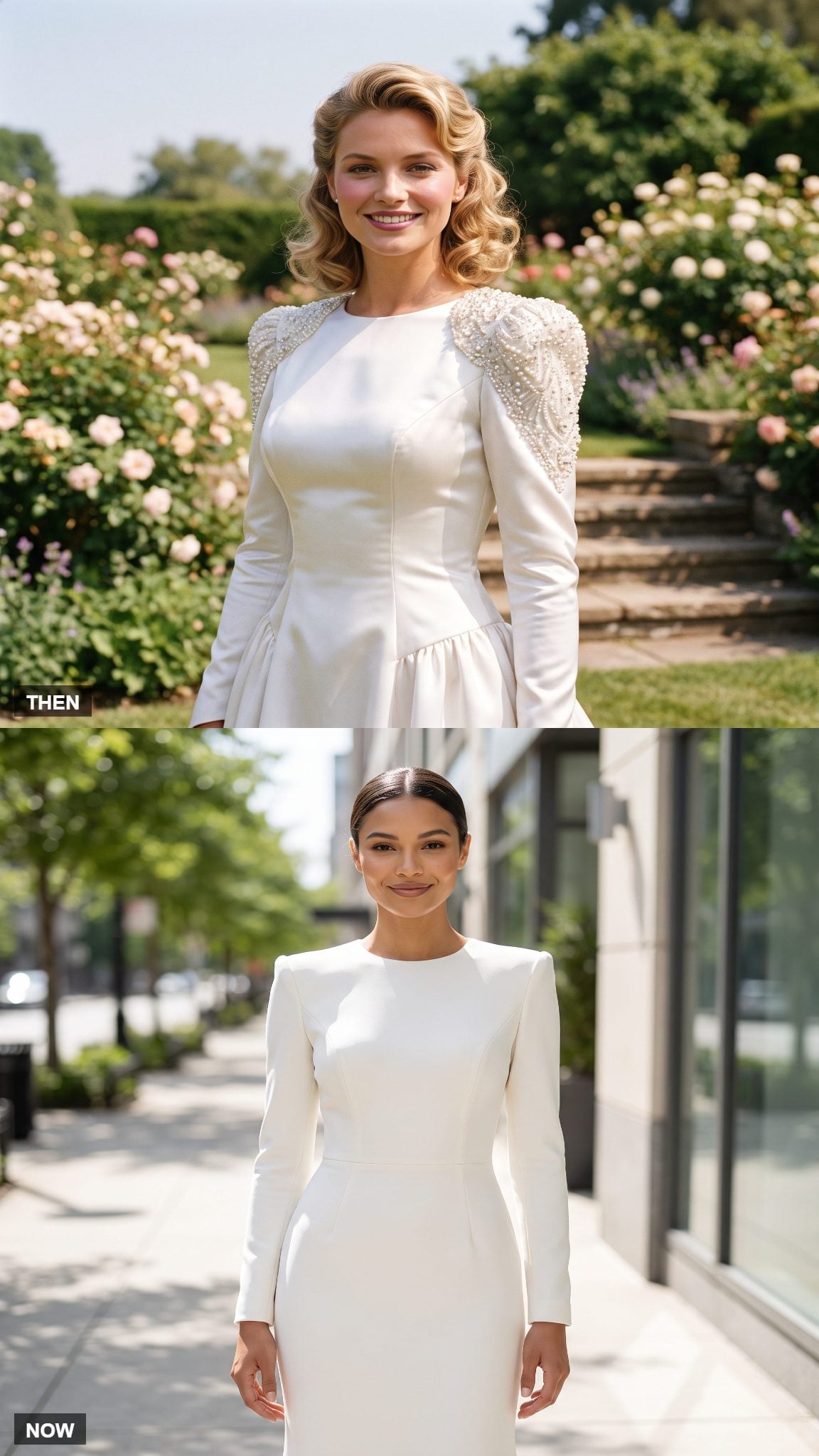
Here the bride borrowed her shoulders straight from the boardroom. Padded, embellished, unmistakably 1980s, they turned the upper body into the widest part of the silhouette and made the shoulder line impossible to miss across the reception hall.
The newer version keeps that strength but gets there through cut rather than bulk. Long sleeves, subtle structure, a sculpted waist, a narrow skirt: the geometry is firmer and the padding quieter. The same principle carries into modern sharp-shouldered styling well beyond bridalwear.
23. Tiered Organza Learned How to Float
❤️ Would you like to save this?
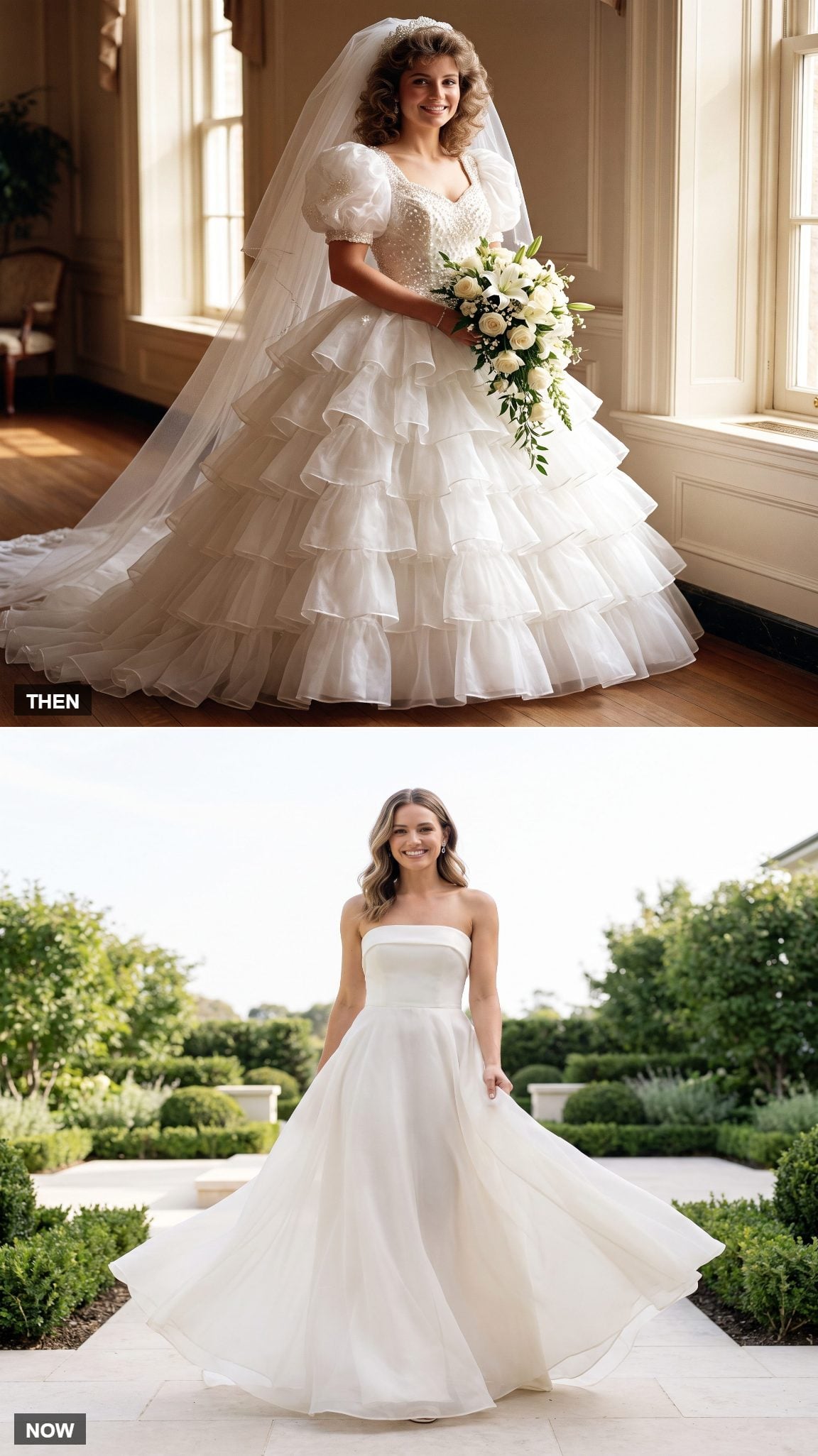
Tiered organza once treated airiness as something that required layer after layer. Ruffles stacked from the waist down until a fabric famous for lightness had somehow become visually busy.
The A-line uses the same translucent material in one broad uninterrupted sweep. A strapless bodice gives the skirt a firm starting point; below it, the organza is allowed to lift, glow, and move without being cut into horizontal bands.
22. The Sweetheart Neckline Kept the Romance and Lost the Noise
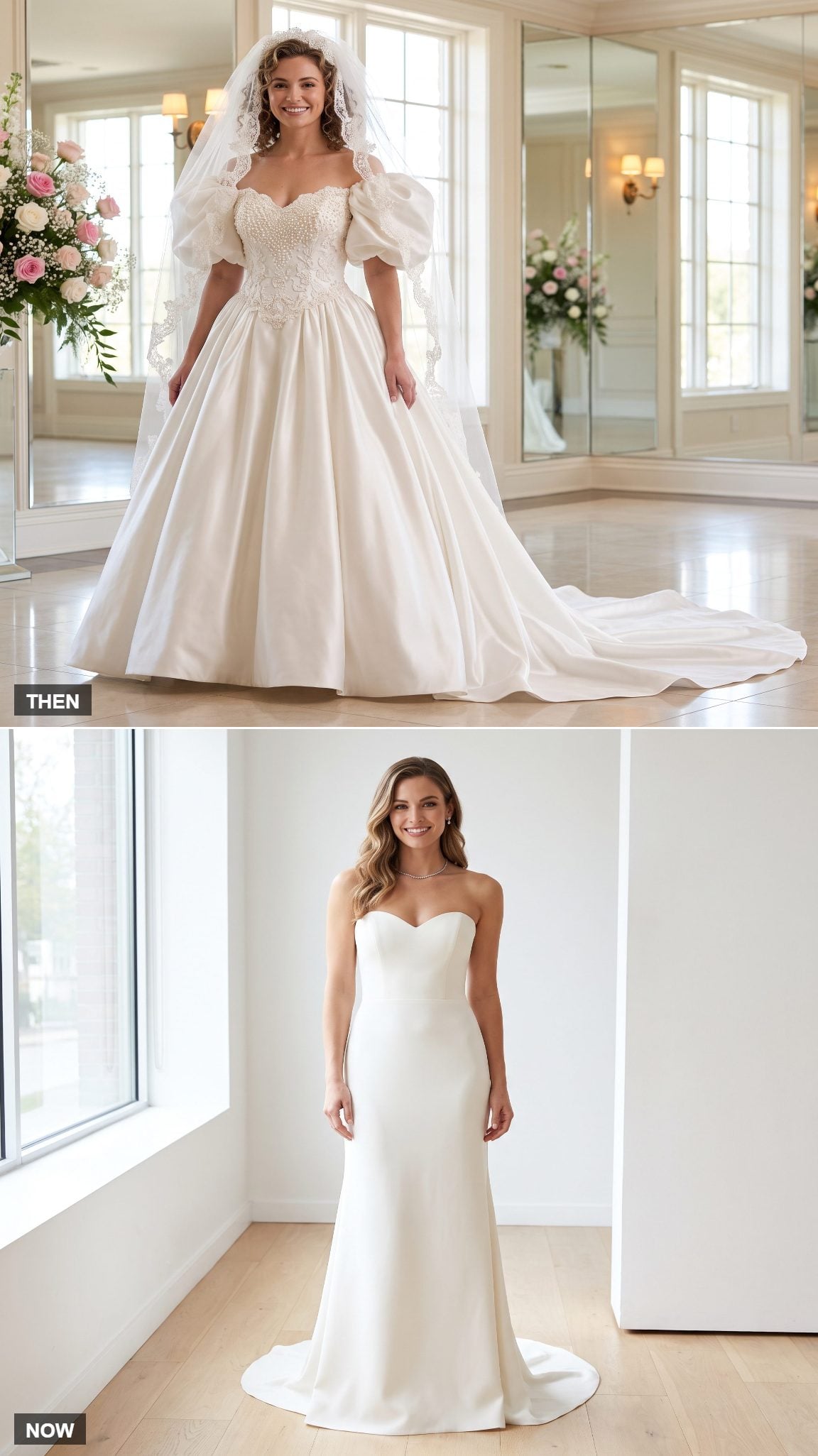
The sweetheart neckline survived the decades. Everything around it got fired.
Take away the puff sleeves and beadwork and that shallow dip at the bust suddenly becomes the romantic detail rather than one of six competing ones. On a strapless column, the curve reads clearly against an otherwise disciplined silhouette.
21. The Giant Back Bow Shrunk Into a Single Graphic Gesture
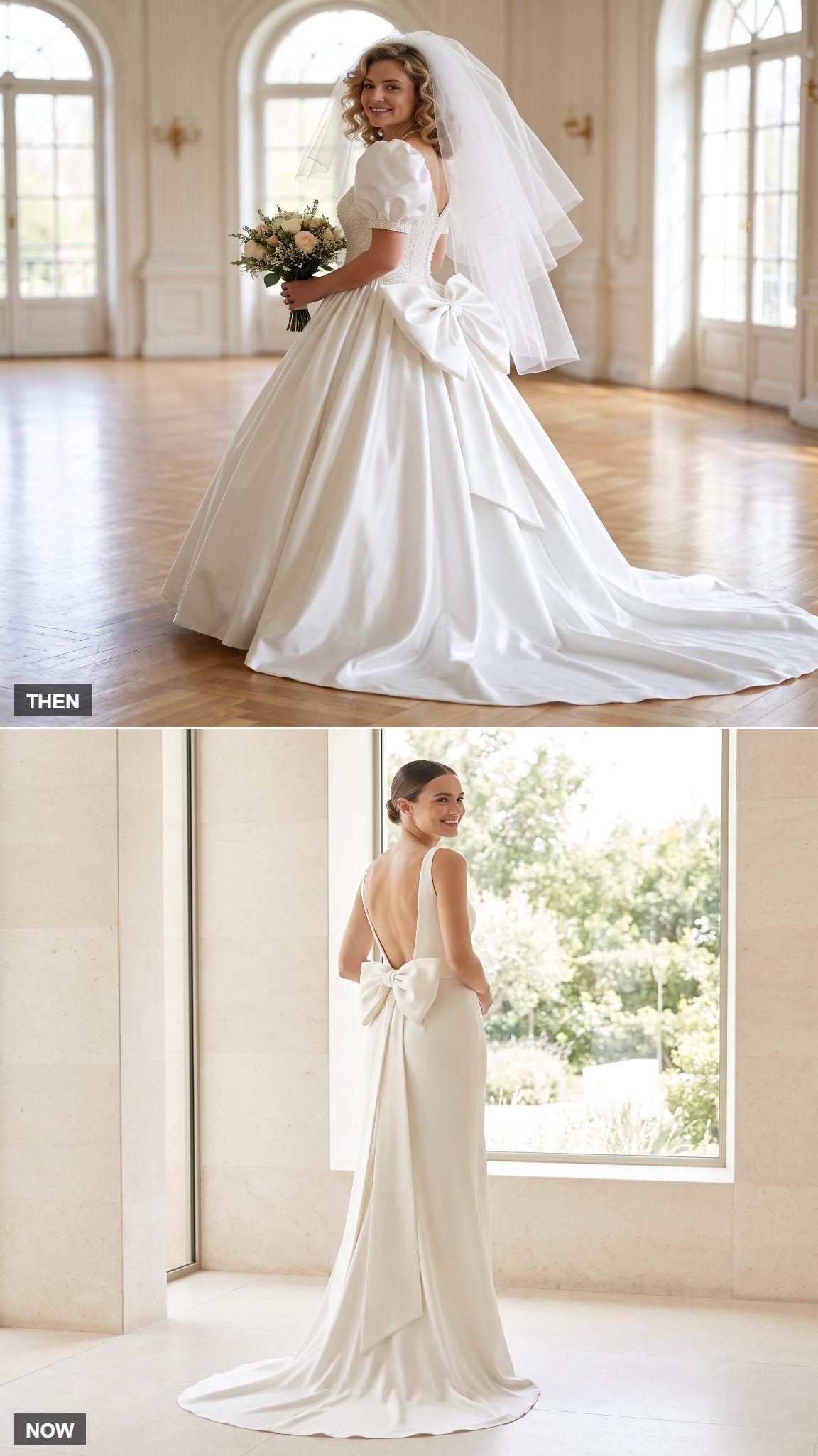
The bow-back gown never vanished. It simply learned that a bow did not need its own postal code.
In the 1980s version, the bow competes with a full skirt, puff sleeves, and pearls. The newer gown gives it an almost empty stage: low open back, narrow tails, spare column. Suddenly the bow reads as punctuation instead of upholstery.
20. Pleated Chiffon Went From Airy Layers to One Fluid Line
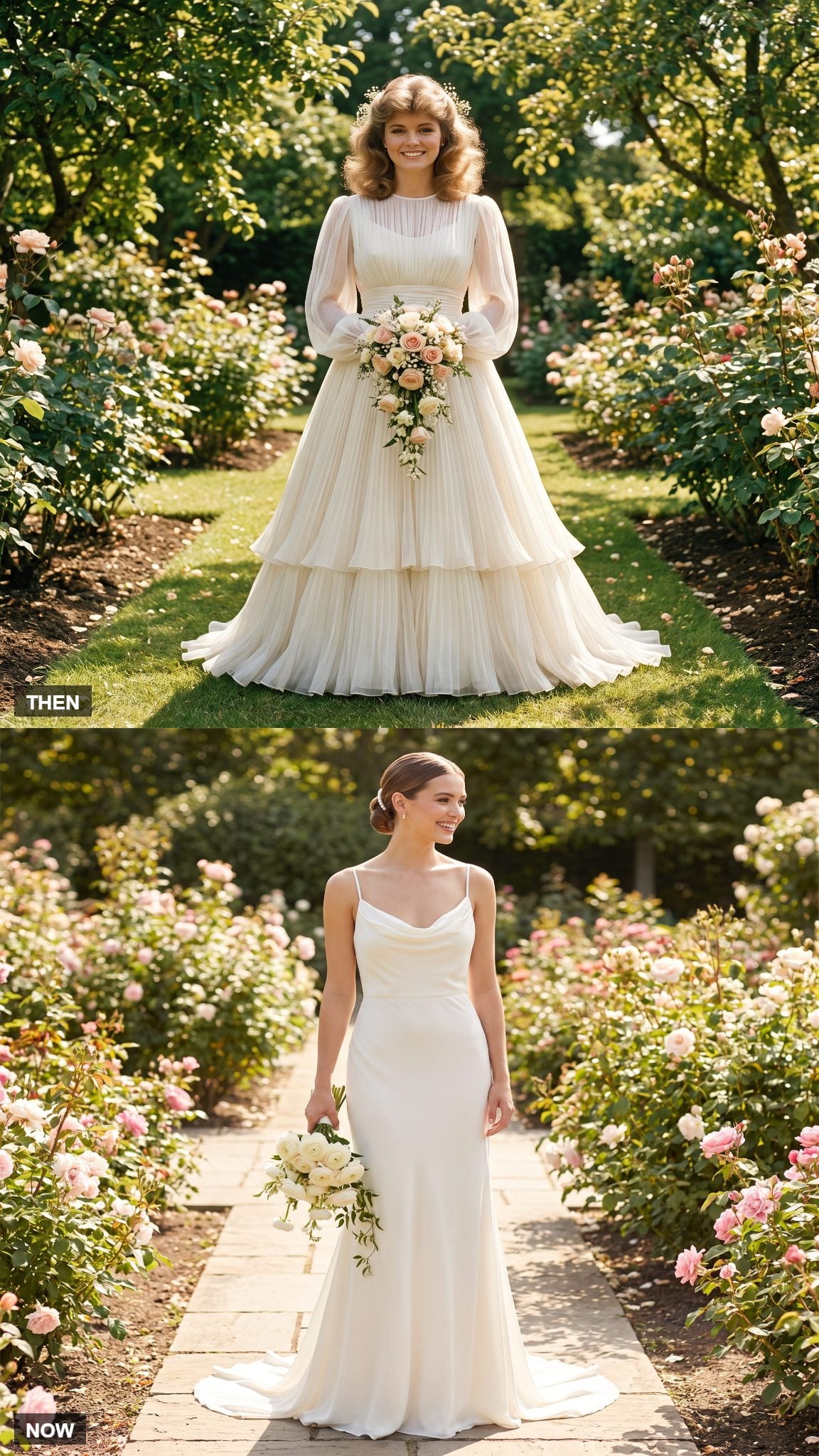
Accordion-pleated chiffon may have been one of the 1980s’ softer instincts. Sheer sleeves and fine pleats caught light beautifully, but the cumulative layering still kept the dress visibly busy.
The newer gown gets its movement from cut instead. Chiffon drapes across the body on the diagonal, a cowl softens the neckline, and one fluid layer follows the bride rather than floating away from her. Less fabric architecture, more motion.
19. The Lace Peplum Became a Waist Built Into the Cut
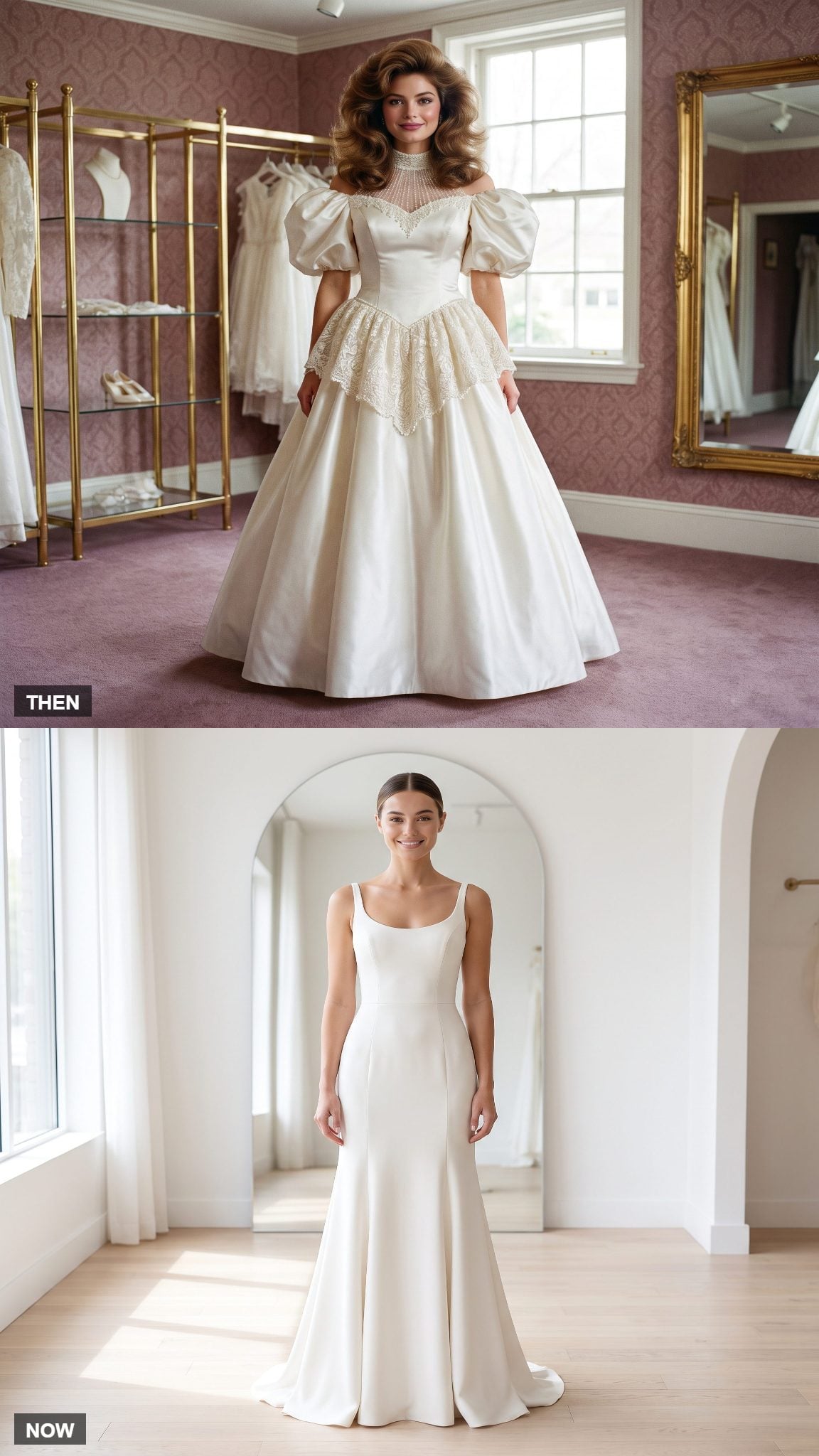
The peplum announced the waist by adding another piece of fabric to it. Lace flared over the hips, pearls marked the surface, and a full skirt waited immediately underneath. The middle of the dress became its own event.
The newer gown removes the extra layer and lets curved seams do the shaping. Ivory crepe narrows through the waist and releases into a fit-and-flare skirt with no visible add-on. The body line is still emphasized; the mechanism has simply moved inside the tailoring.
18. Victorian Revival Gave Way to Long-Sleeve Precision
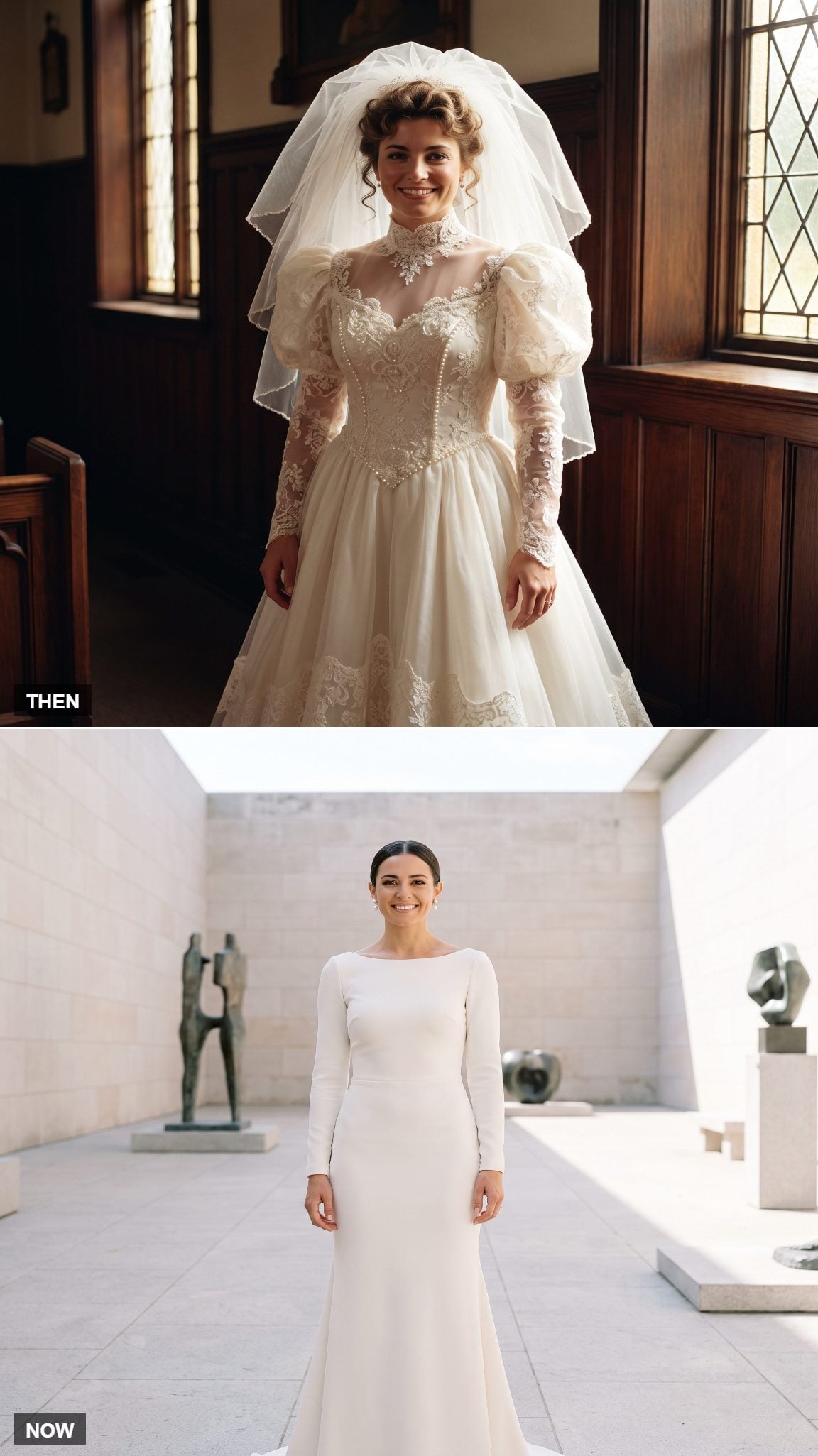
The Victorian-revival gown wears its reference openly: ruffled collar, sheer yoke, lace to the wrist, decorative detail stacked around every edge. Historical romance, volume turned all the way up.
The long-sleeve reinvention keeps the coverage but removes the quotation marks. Matte crepe follows the arm, a bateau neckline draws one clean line across the collarbone, and the rest comes down to fit and drape. Sleeves can look romantic without looking upholstered.
17. The Dropped Waist Stopped Hiding Under Decoration
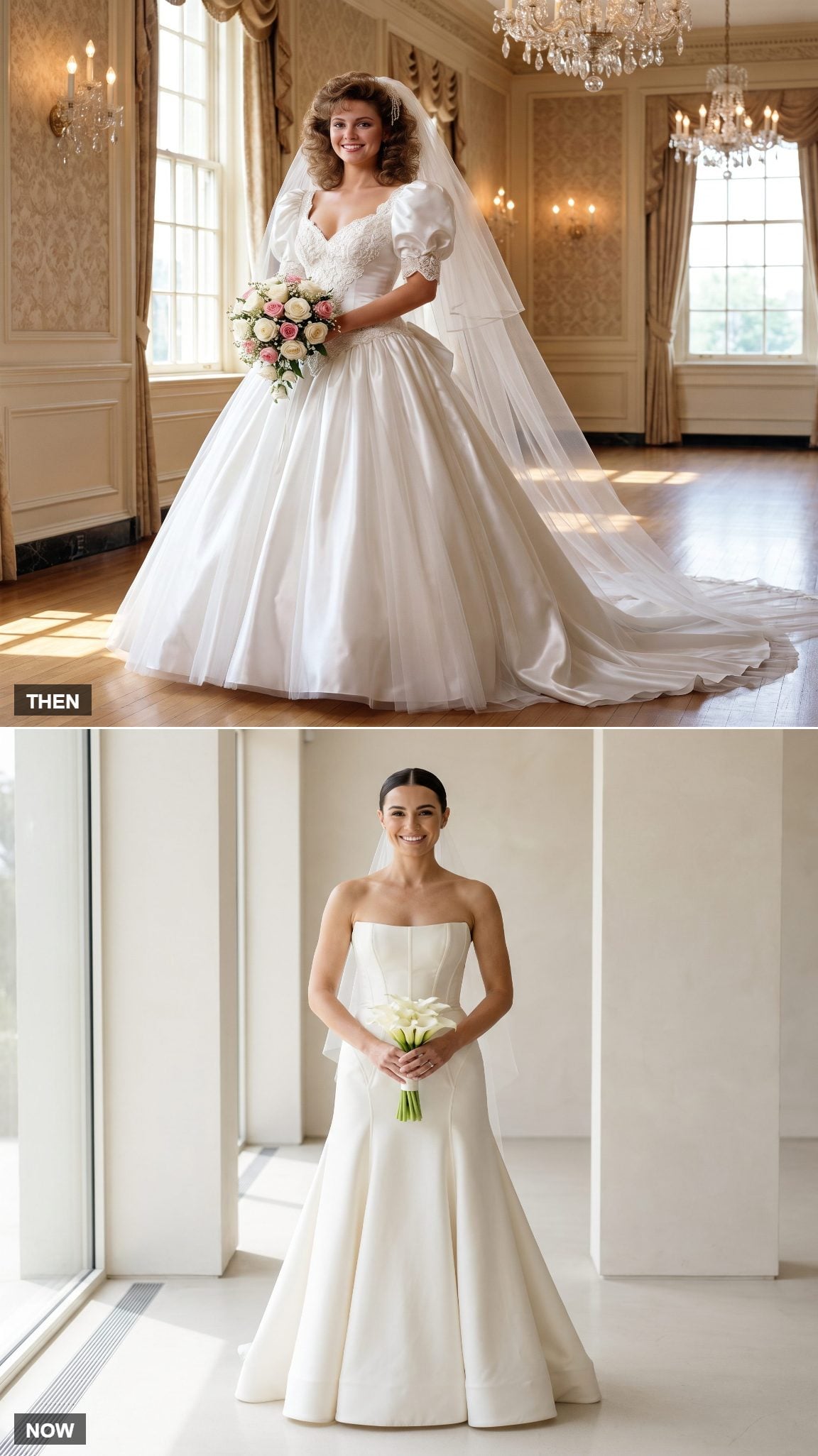
Both gowns extend the bodice toward the hip. Only one lets you notice that before the embellishment arrives.
The contemporary drop waist is almost diagrammatic by comparison: smooth corsetry, an elongated torso, then a skirt releasing in controlled folds from the lower seam. Instead of decoration explaining where to look, the construction tells you.
16. The Scalloped Lace Neckline Made Room for Skin
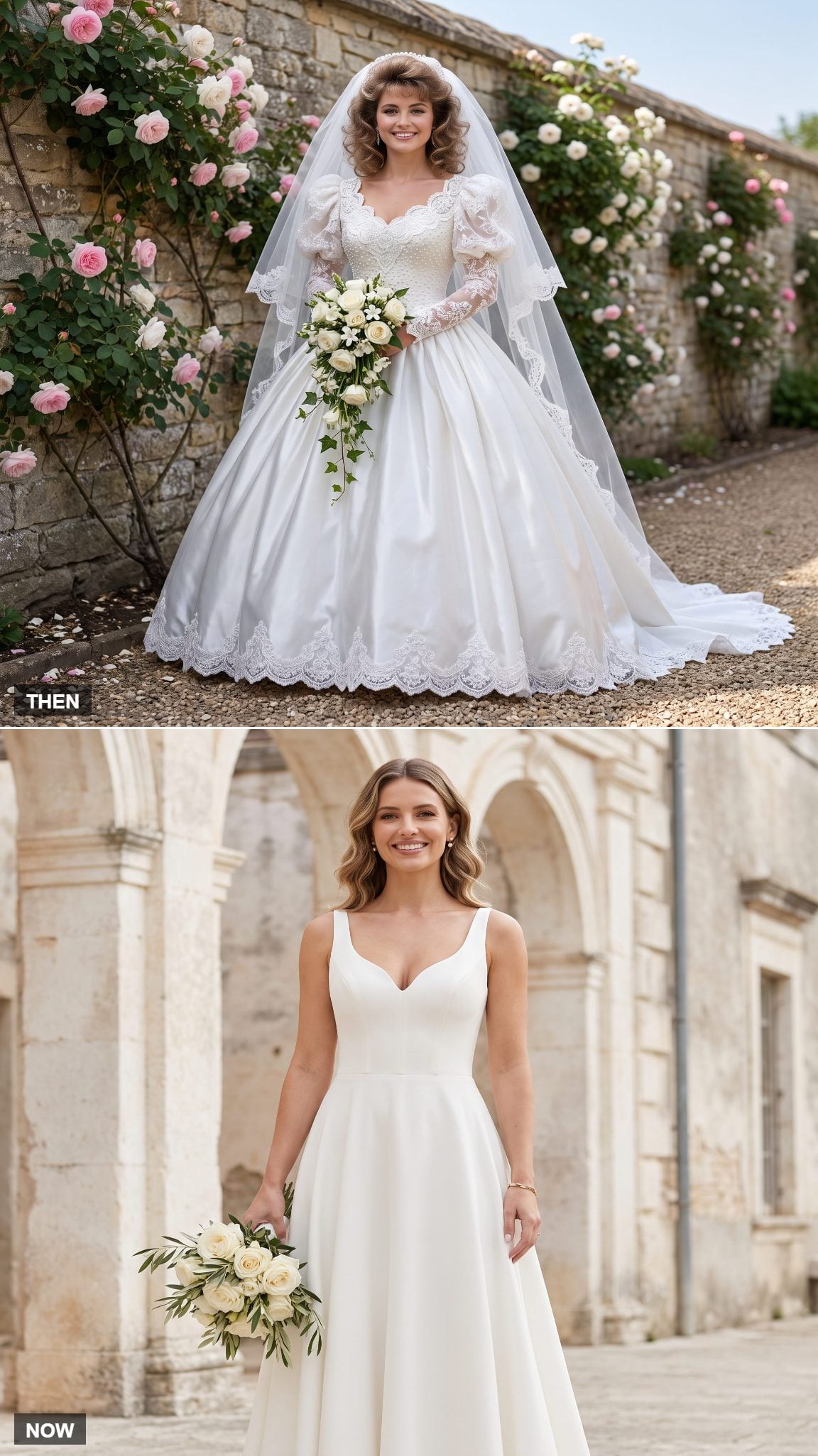
Scalloped lace had a habit of multiplying. Once it appeared at the neckline, it could continue around the sleeves, hem, and veil until the entire gown was edged in the same little wave.
The scoop neck keeps the openness and removes the border. Broad straps frame the shoulders, the neckline curves deeply but cleanly, and the fitted torso releases into a smooth A-line. The negative space around the neck does what the scallops once tried to do: it creates a frame.
15. Bishop Sleeves Became Detachable, Sheer and Almost Weightless
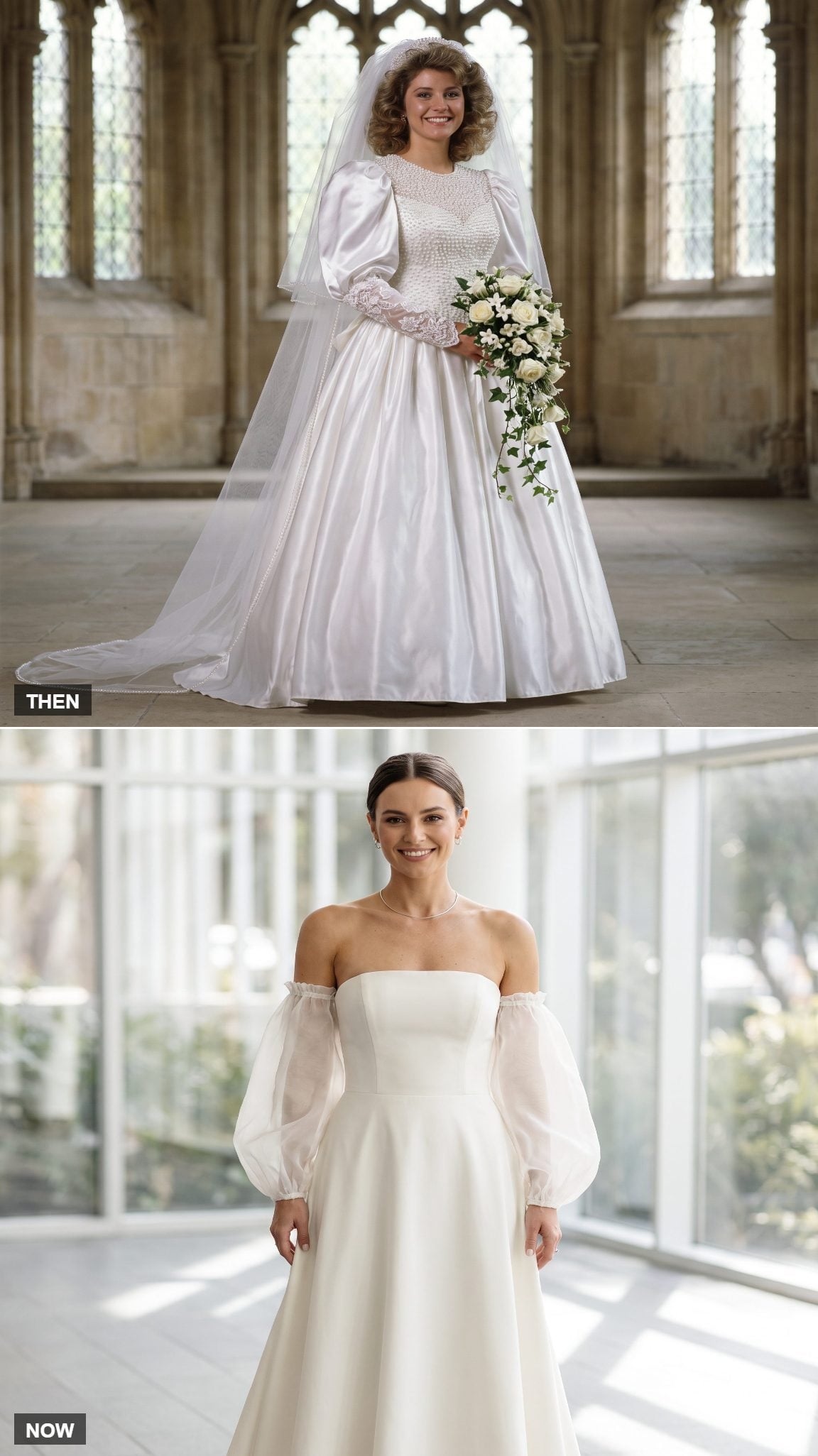
The 1980s bishop sleeve was a full production: satin ballooning from shoulder to wrist before collapsing into a stiff cuff. Romantic, certainly. Also a great deal of sleeve to manage through dinner.
The newer solution separates drama from permanence. Sheer detachable sleeves float off a sculpted strapless bodice, giving the ceremony a softer silhouette without committing the reception to the same volume. It is the kind of adaptable idea that works naturally with more flexible modern occasion styling.
14. Glossy Taffeta Gave Way to Structured Mikado
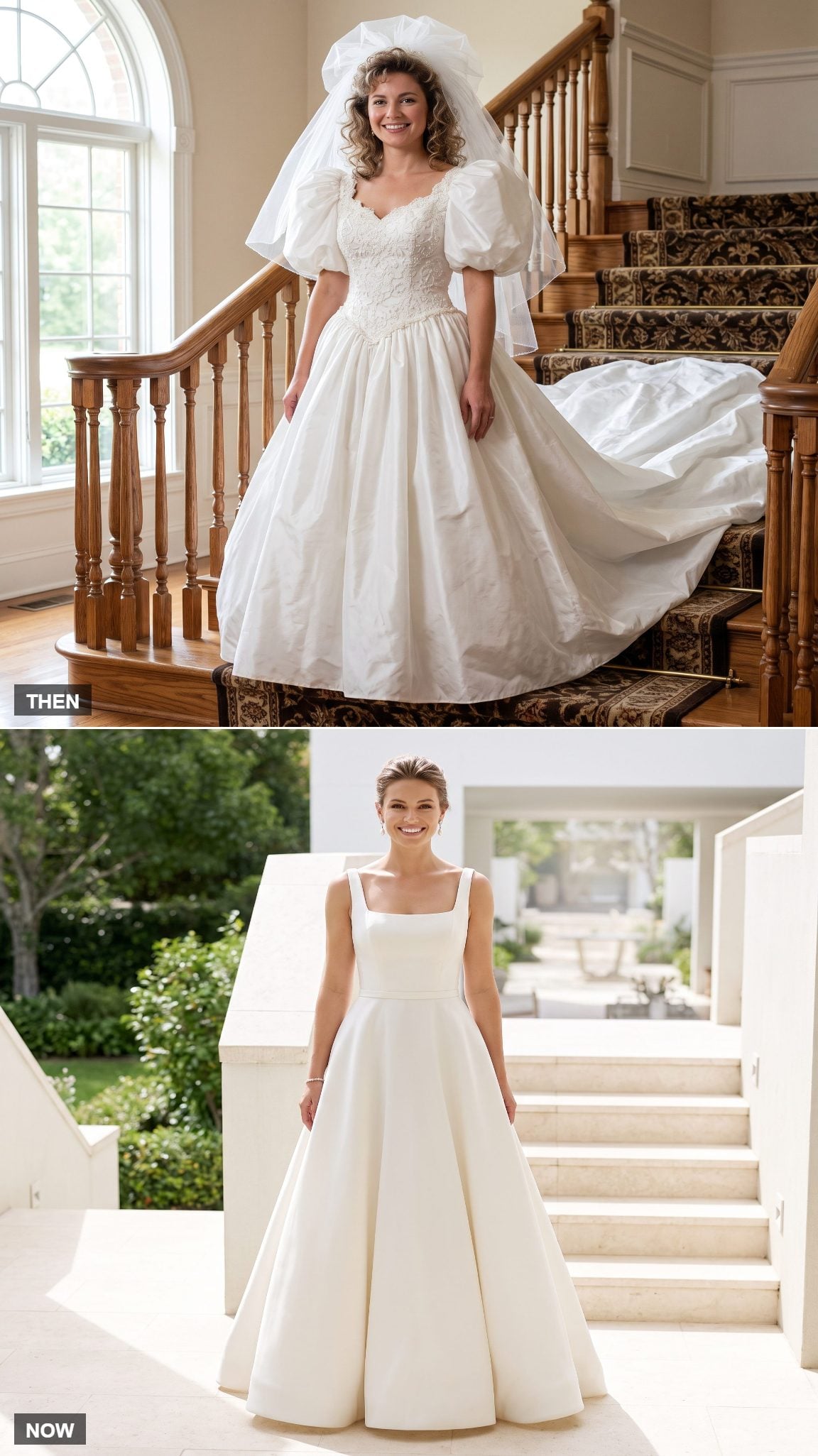
Taffeta rustles, crinkles, and catches light with enthusiasm. Add puff sleeves and dense gathering and the fabric becomes part of the spectacle before you even register the shape.
Mikado approaches structure differently. Its substantial hand can hold a sculpted A-line and a firm square neckline without relying on layers of applied decoration. The surface may still carry luster, but the effect is controlled rather than busy.
The square neck is doing more than it first appears to. That strong horizontal line gives the upper body definition and makes the entire gown feel deliberately engineered.
13. The Enormous Back Bow Disappeared and the Back Took Over
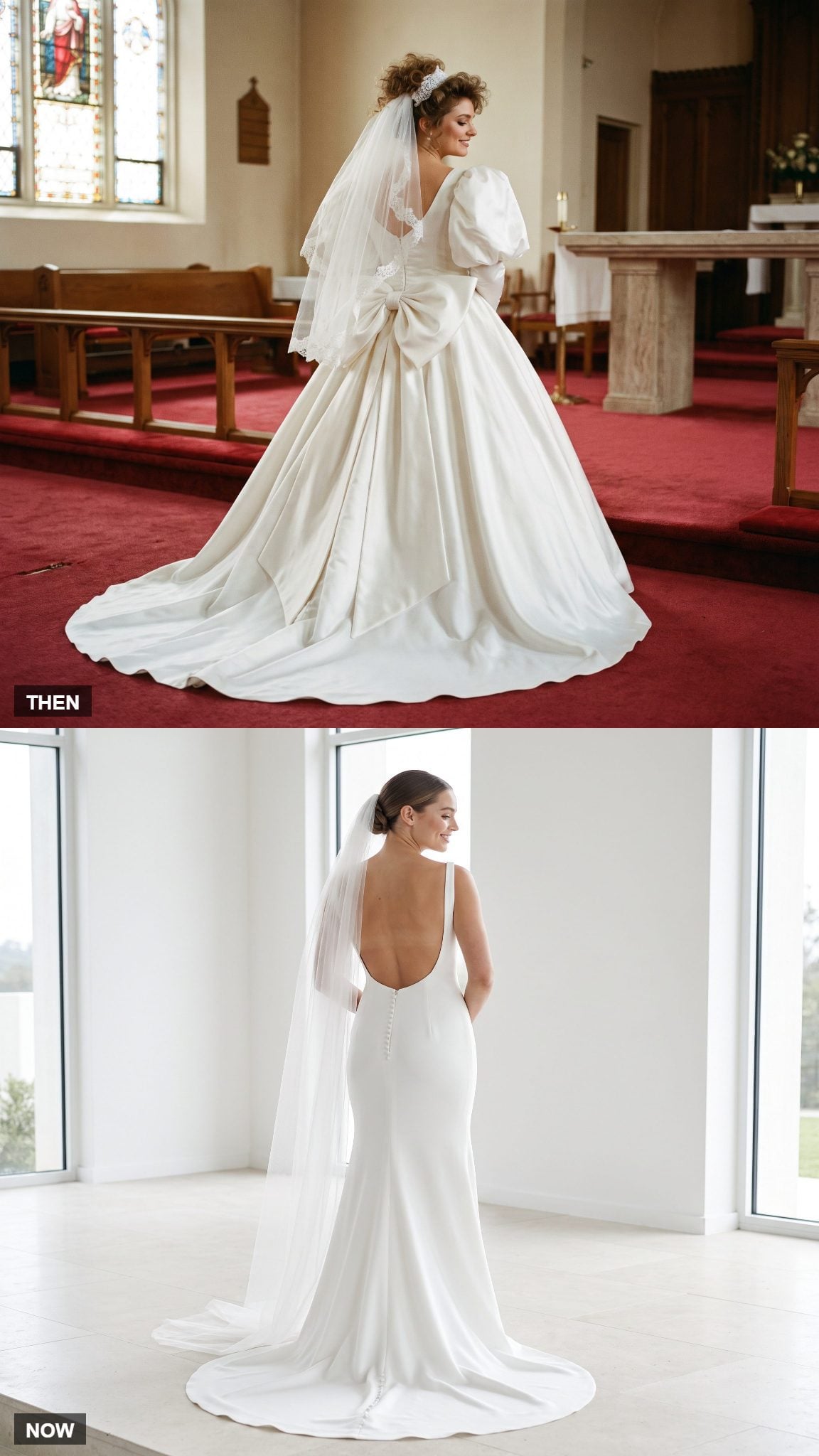
From behind, the 1980s gown is pure spectacle: colossal satin bow, puffed shoulders, cathedral train, every design decision pointing toward the rear view.
The contemporary gown keeps that emphasis but removes the object that once created it. A low open back, covered buttons, fitted line, and extended train turn the body itself into the composition. The earlier bow demanded attention. The newer version directs it.
12. The Ruffled High Collar Became a Severe Mock Neck
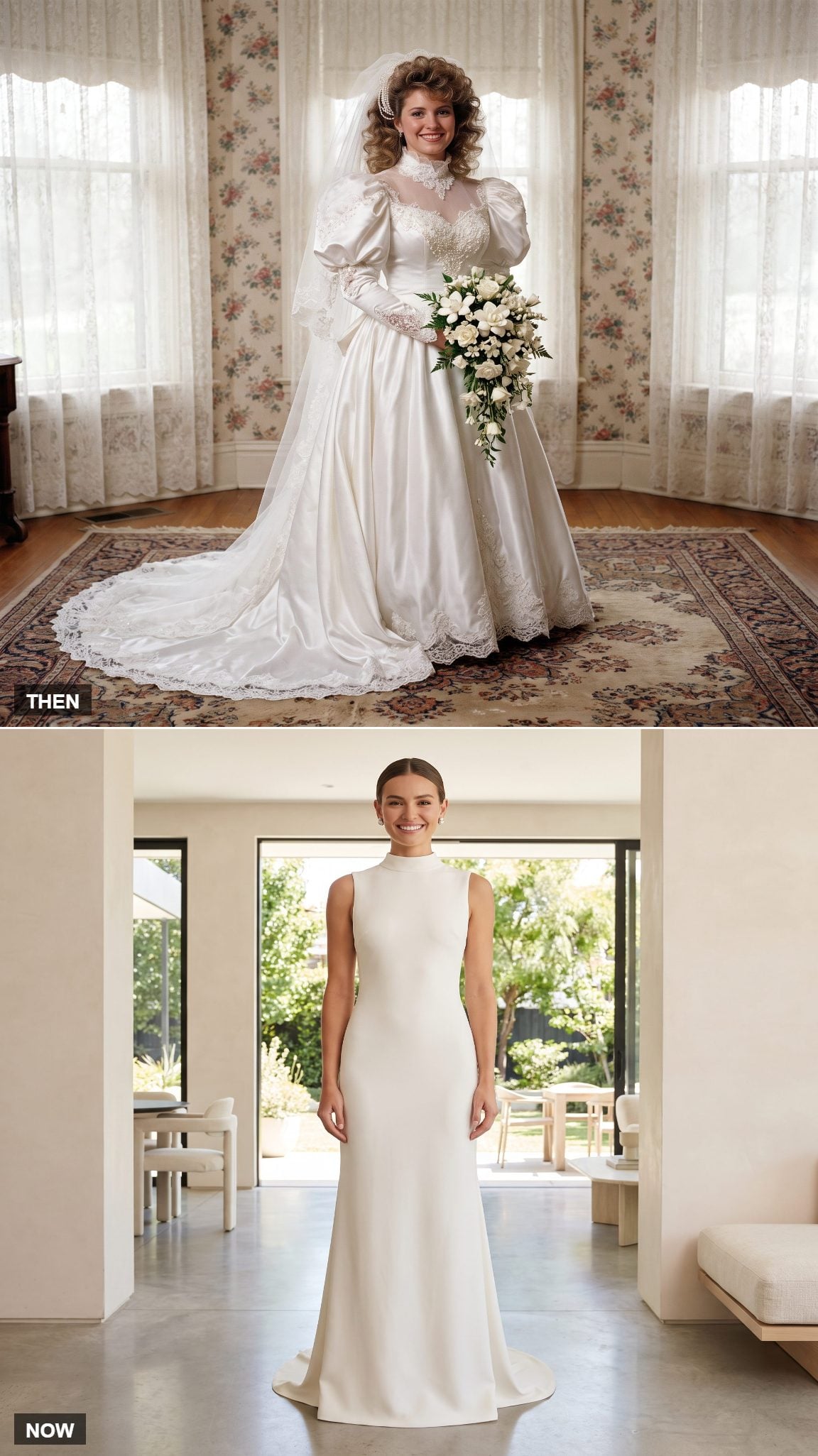
The old high collar framed the face with lace, ruffles, and pearls until the frame nearly became the picture.
The mock neck keeps the vertical emphasis and removes the ornamental border. Matte crepe rises cleanly to the throat, then drops through a narrow waist into an uninterrupted column. The result is not softer. It is sharper — proof that restraint does not have to mean polite.
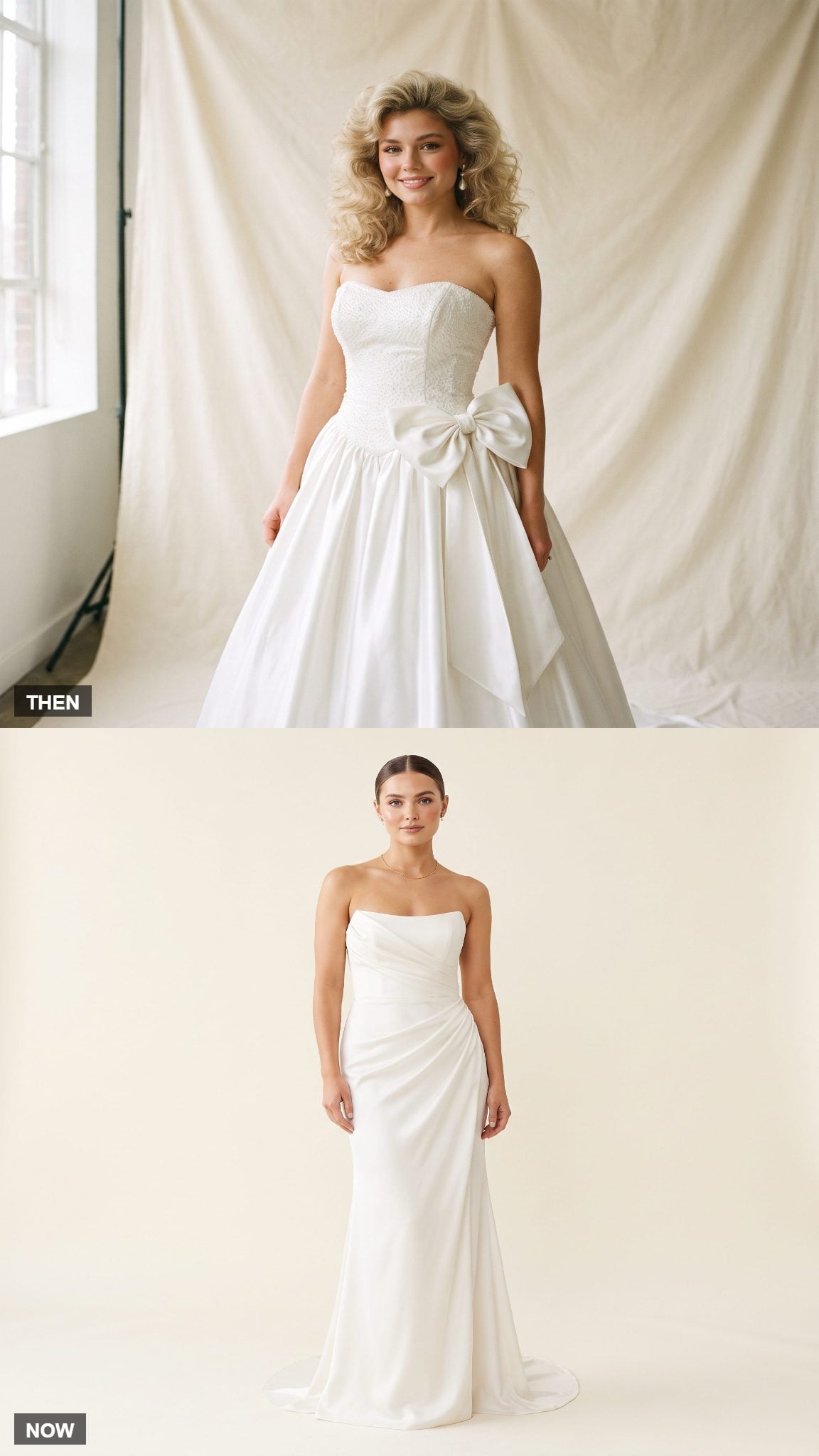
11. The Hip Sash Became the Drape
❤️ Would you like to save this?
The 1980s sash wanted credit for finding the waist. It wrapped tightly, tied off-center, and sent long tails down the skirt as if one focal point were not quite enough.
The newer gown builds that same diagonal movement into the cut. Silk sweeps across a strapless bodice, gathers softly at one hip, then continues into the skirt without a knot or bow interrupting the line. The waist still controls the composition. It simply stopped explaining itself.
10. The Puff-Sleeve Ball Gown Kept the Volume and Lost the Surface Noise
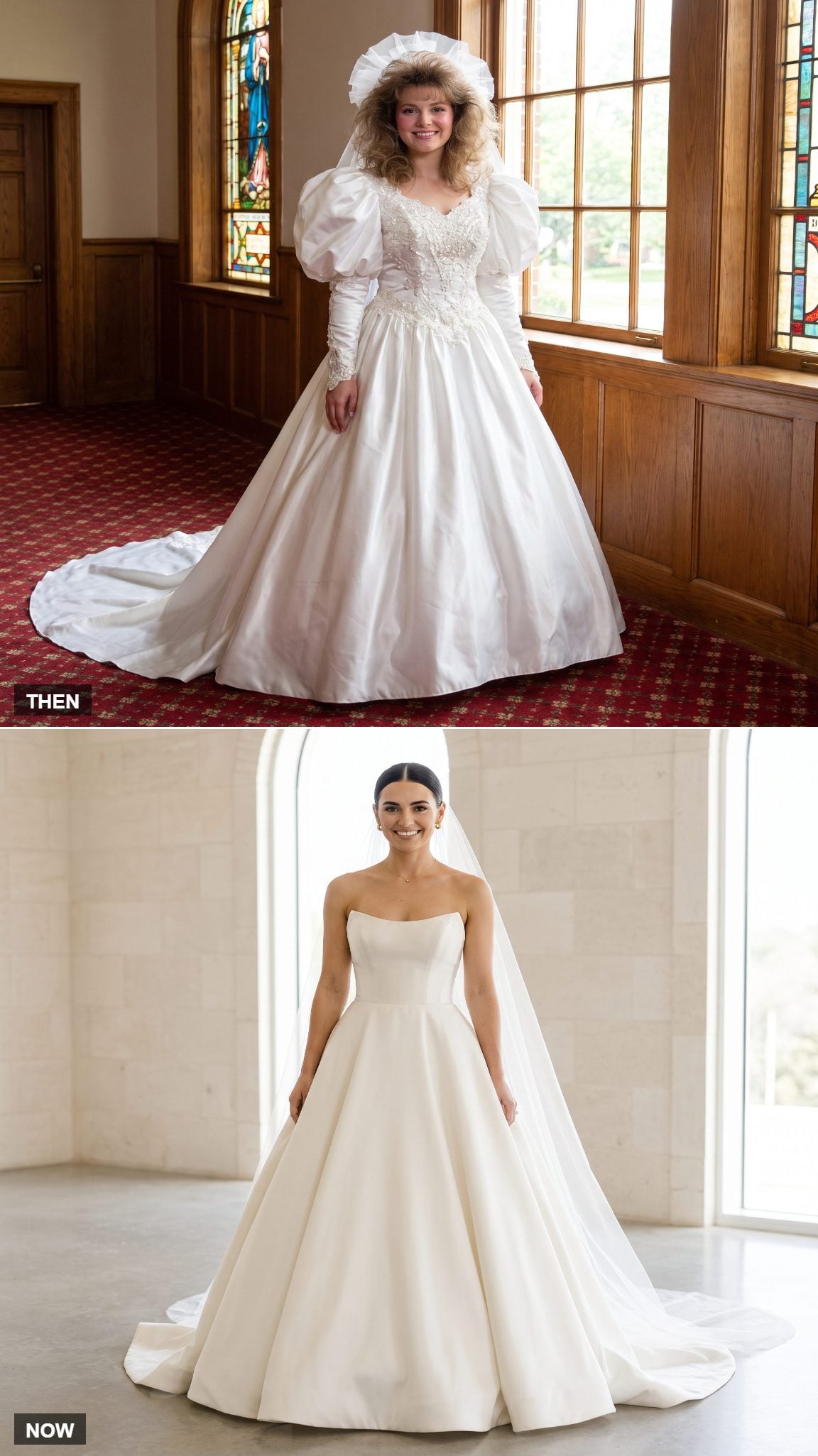
The 1980s version fights for attention on three fronts at once: sleeve, beadwork, skirt. Every surface has a job, and none of those jobs involve resting quietly.
The strapless reinvention proves the scale was never the problem. The skirt can remain unapologetically huge when the bodice is pared back, the neckline is precise, and the satin is allowed to read as a continuous surface.
9. Batwing Sleeves Shifted the Drama Into a Cape
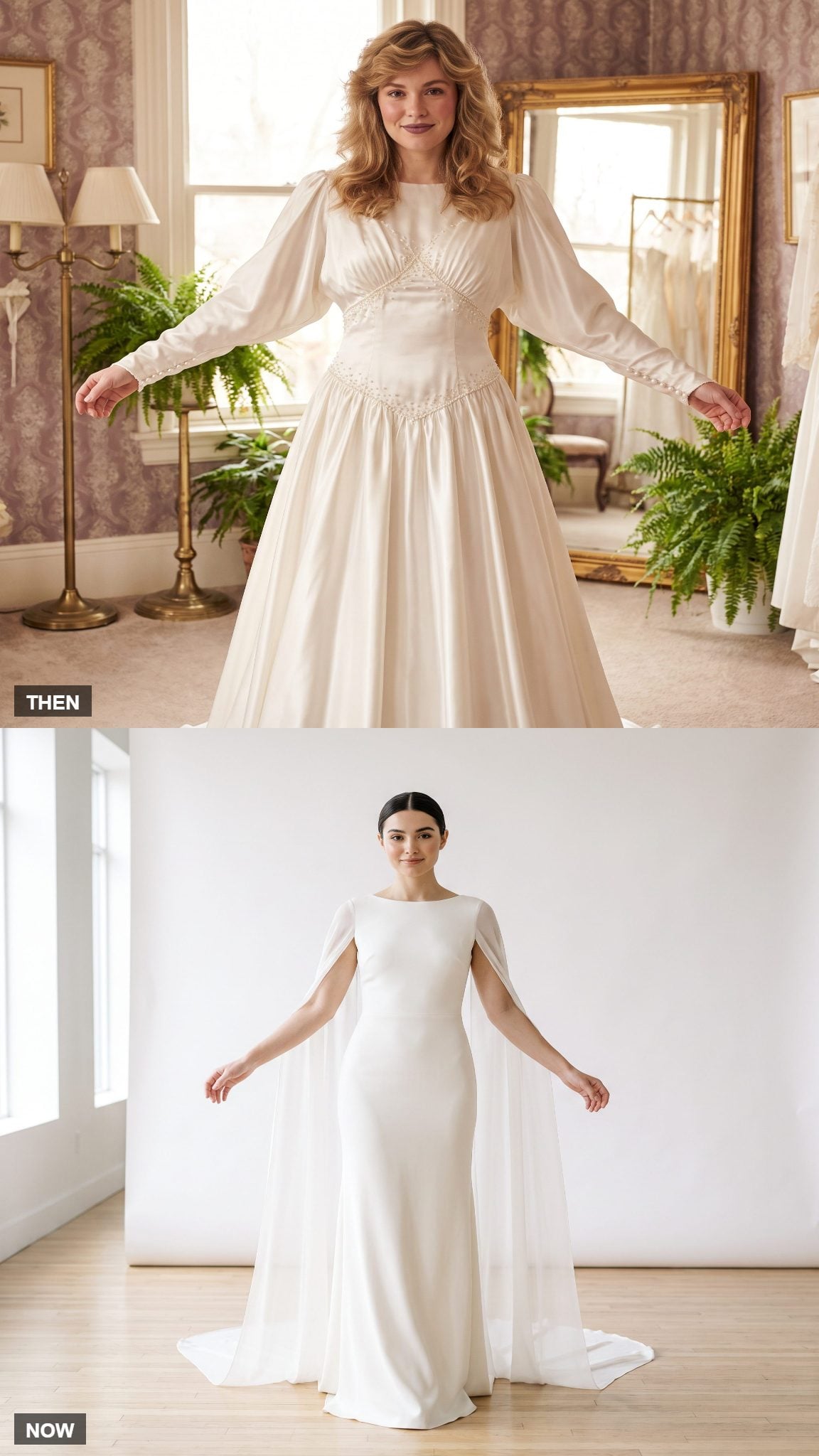
Batwing sleeves made movement visible. Fabric dropped from shoulder to wrist in one broad sweep, then snapped into a cuff, turning every raised arm into a small piece of theater.
The cape-sleeve gown relocates that motion behind the body. Long panels fall from the shoulders while a narrow crepe sheath stays close underneath. The bride still gets sweep and coverage, but the volume no longer sits around the arms.
8. The V-Waist Traded Sparkle for Sculpture
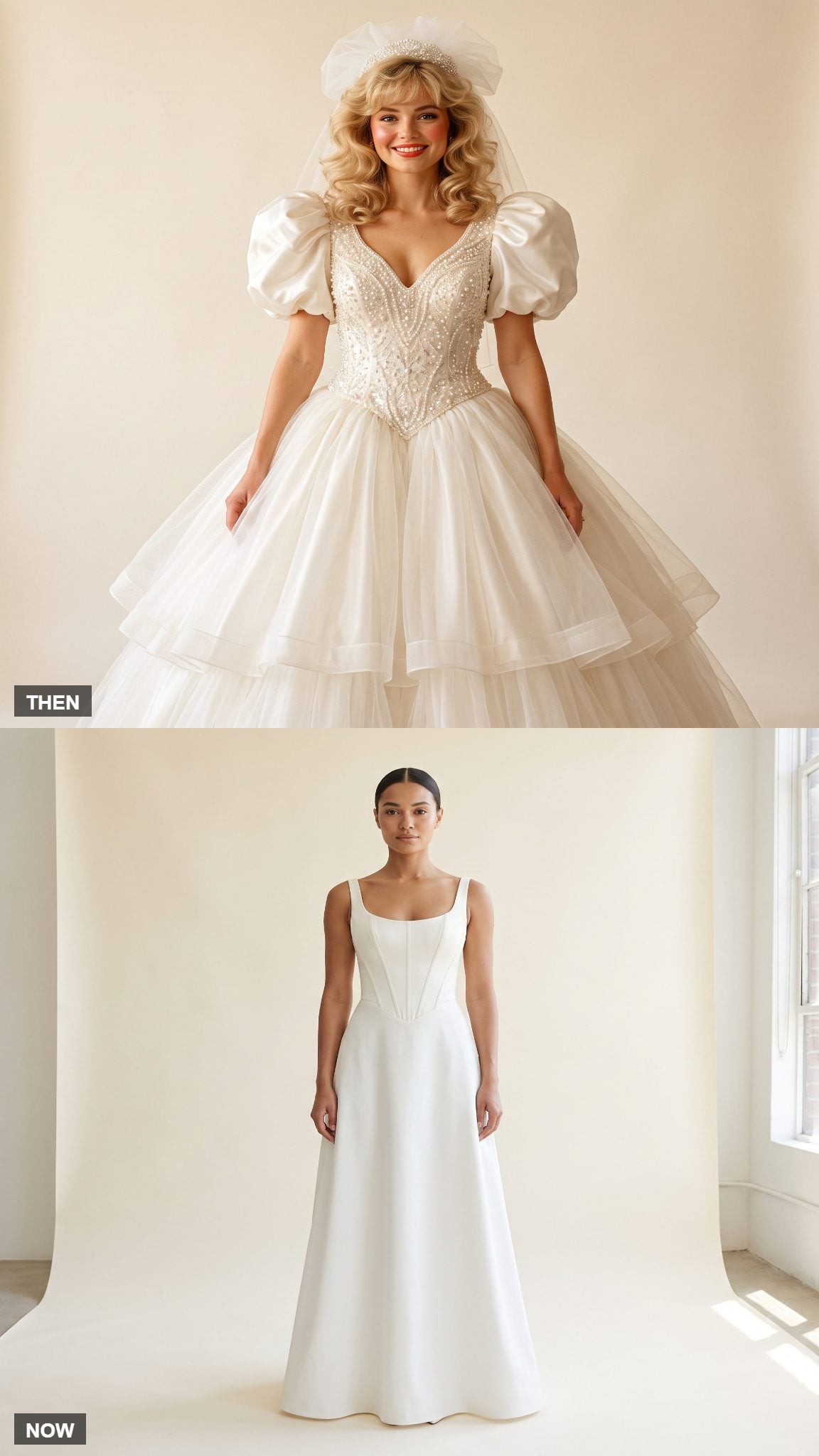
The 1980s V-waist bodice was a surface waiting to be embellished. Pearls, sequins, puff sleeves — the downward point at the waist had plenty of company.
The contemporary version makes that point the event. A corseted satin bodice drives the eye downward through seam and shape alone, then releases into a full skirt. The lineage is easier to read once the decoration stops standing in front of it.
7. All-Over Lace Stepped Aside for the Fabric Itself
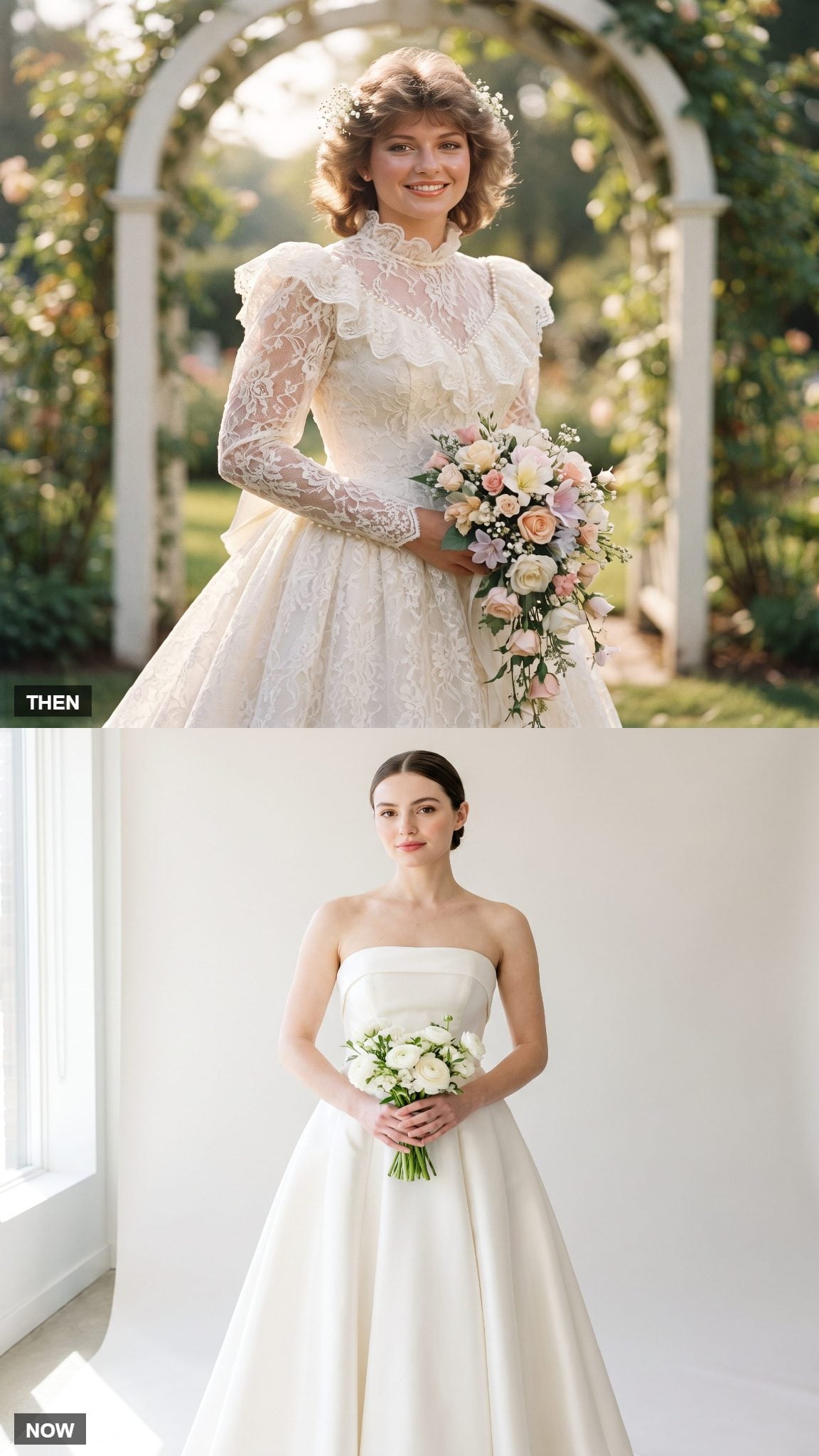
There was a point when lace did not decorate the gown so much as occupy it. Sleeves, bodice, skirt panels, veil — romance was measured in coverage.
The contemporary rethink is almost severe by comparison: an unembellished Mikado gown, sculptural strapless bodice, precise seams, full skirt. The luxury lives in weight, finish, and the way the material holds its shape rather than in anything stitched on top.
When the fabric is this expressive, decoration becomes optional.
6. The Portrait Neckline Became One Clean Off-Shoulder Band
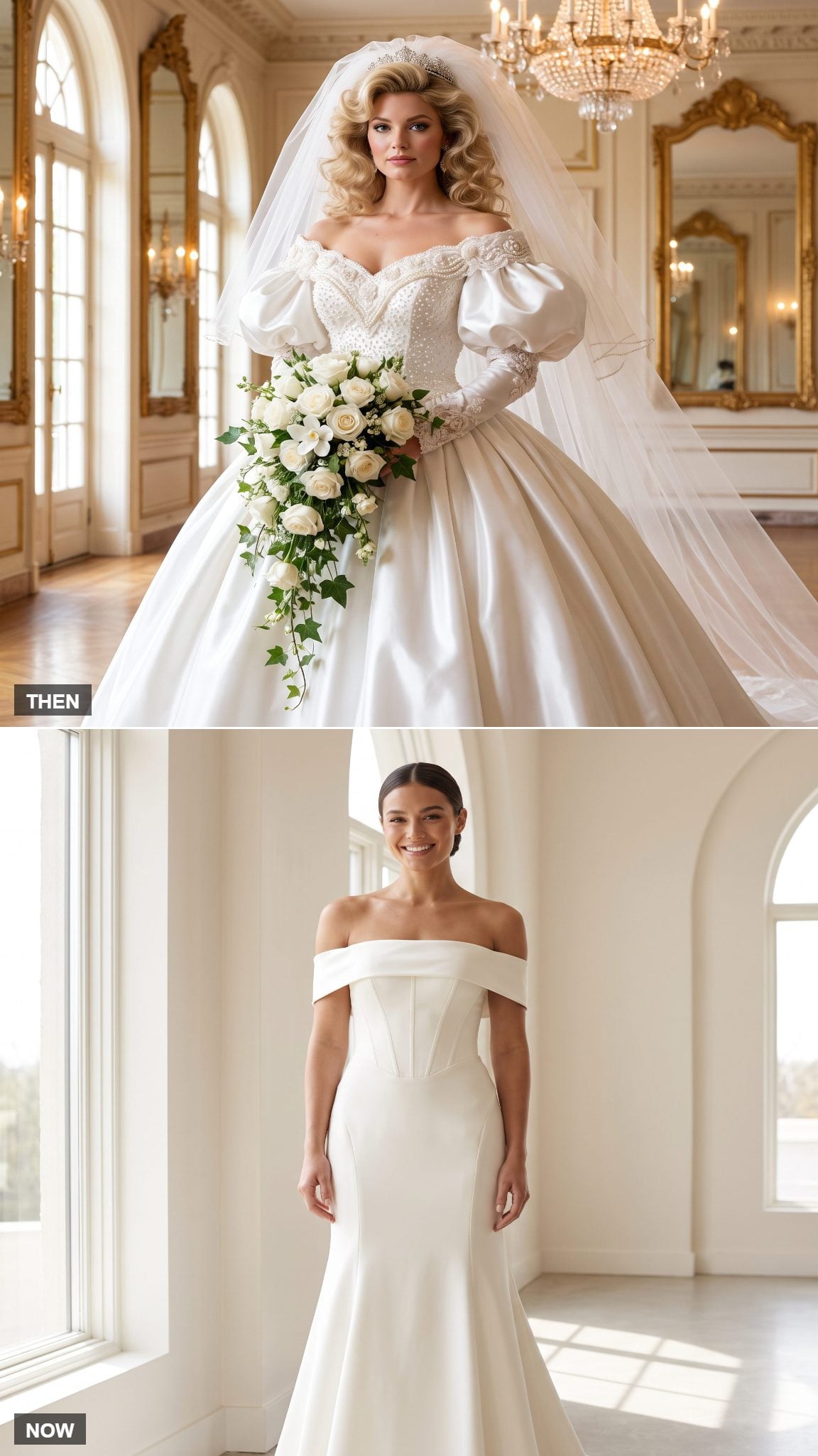
The 1980s portrait neckline understood the appeal of bare shoulders but could not resist decorating the border around them. Pearls, appliqué, and inflated sleeves crowded the very frame that was supposed to open up the upper body.
The newer version trusts one folded band of satin. Beneath it, a sculpted corset and fit-and-flare skirt provide structure; above it, skin becomes the negative space. The neckline works because almost nothing interrupts its sweep.
5. Ruffles Became Drape
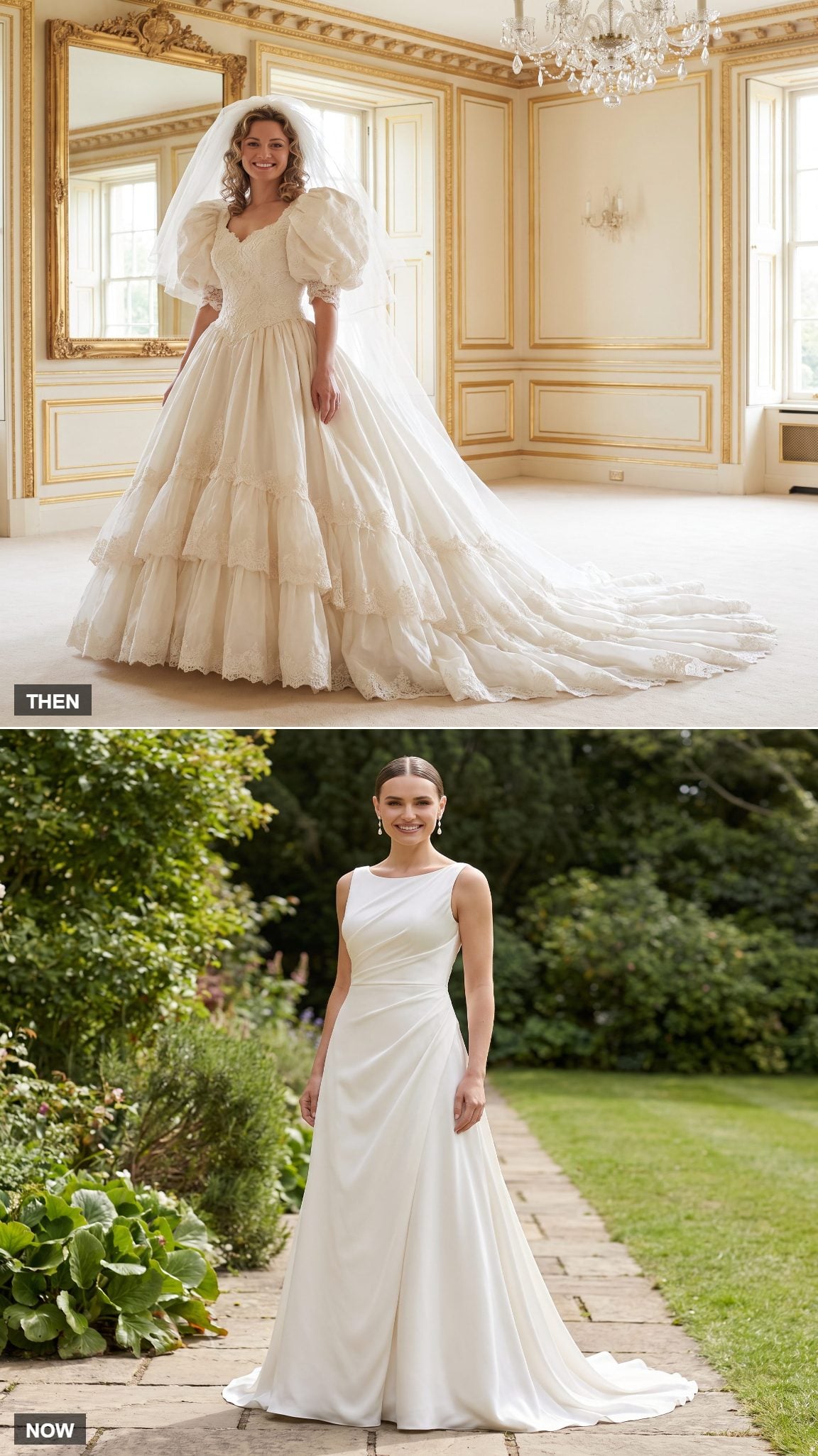
The 1980s often created movement by adding material: tier after tier of lace-edged ruffle until the skirt seemed to move even while standing still.
The A-line gets there through direction instead. Silk drapes diagonally across the bodice, gathers at the waist, then releases into a fluid skirt that responds to the body rather than surrounding it with layers. Same appetite for motion, far fewer moving parts.
4. The Long-Sleeve Ball Gown Narrowed Into a Sheath
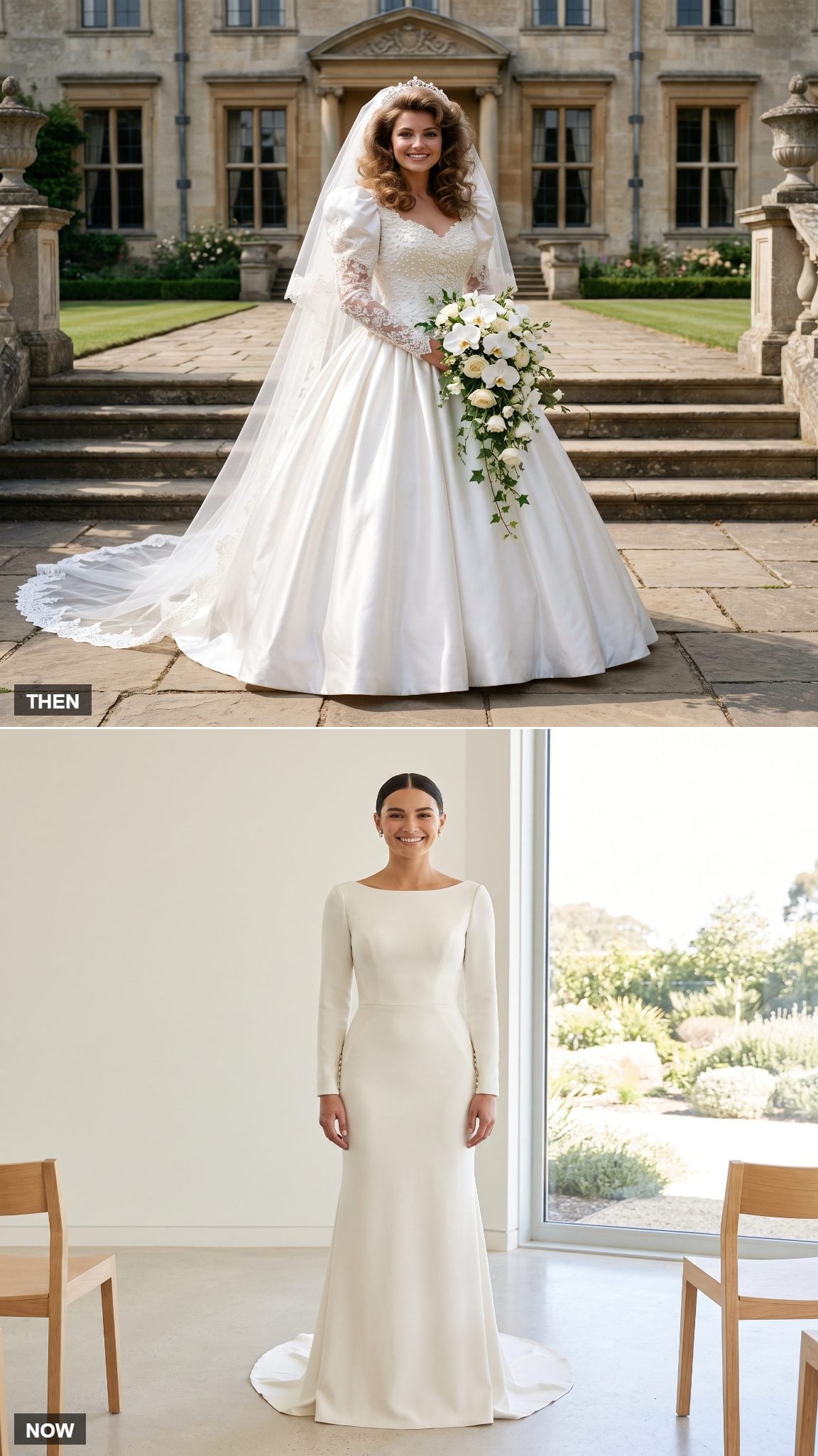
Long sleeves once arrived attached to a great deal of everything else: full skirt, dense beading, substantial shoulders, long train. The sleeve was only one part of a composition designed for maximum ceremony.
The sheath lets the sleeves become part of a continuous line. Fitted crepe follows the arms and torso, a bateau neck keeps the upper edge quiet, and covered buttons draw a narrow path down the back. The gown has lost acreage without losing presence.
The sleeve never needed the ball gown. It just needed room to be seen.
3. The Queen Anne Neckline and the Halter Solve the Same Problem Differently
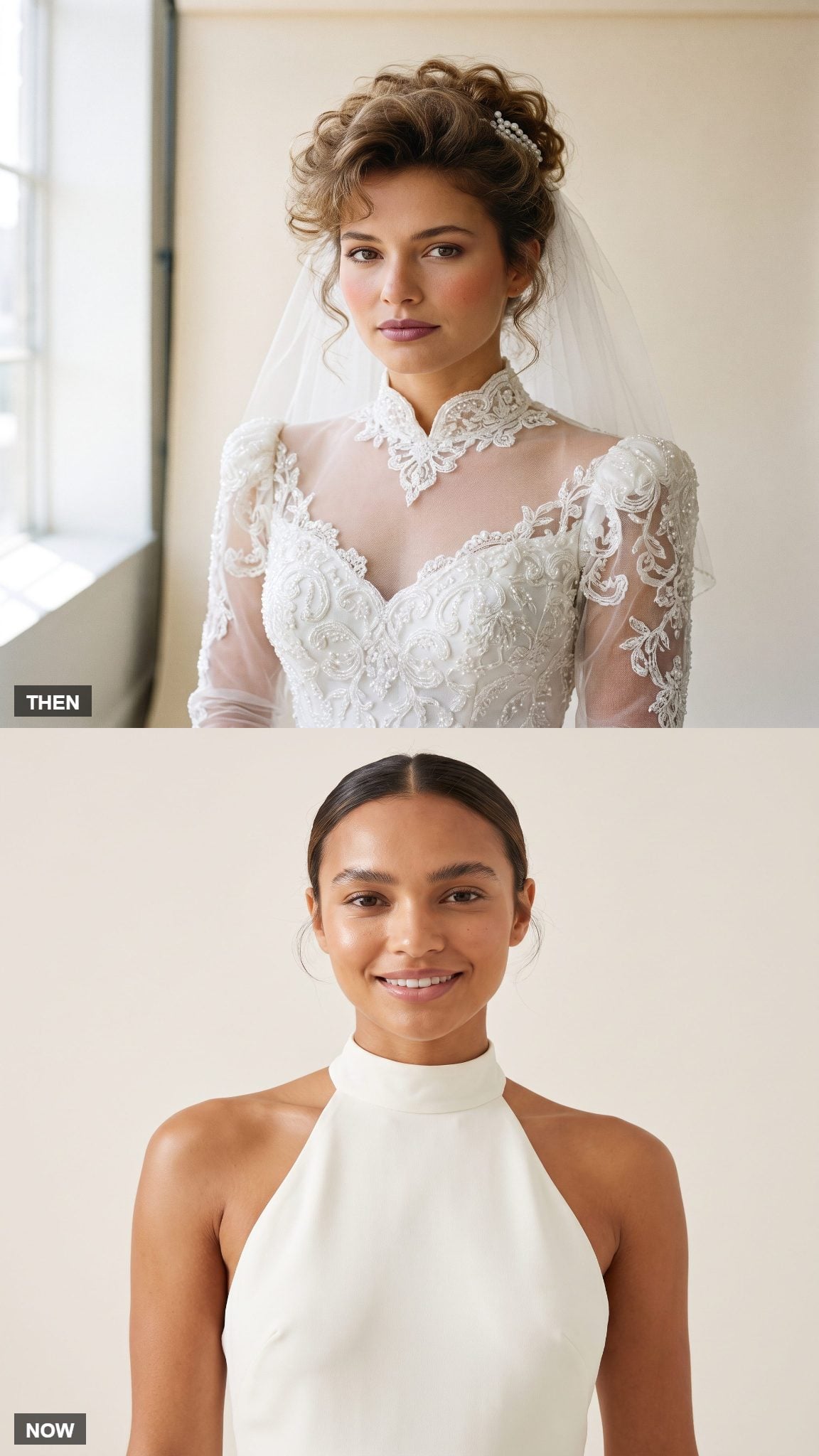
A Queen Anne neckline frames the face with height, coverage, and a strong shoulder line. The 1980s bridal version adds lace and formality until the upper body feels almost architectural.
A halter is not the same neckline, but it shares the instinct to pull attention upward. The difference is subtraction: bare arms, open back, fluid column, almost no surface decoration. One approach frames with fabric; the other frames by removing it. That lighter hand also fits naturally into more relaxed bridal and rehearsal-dinner styling.
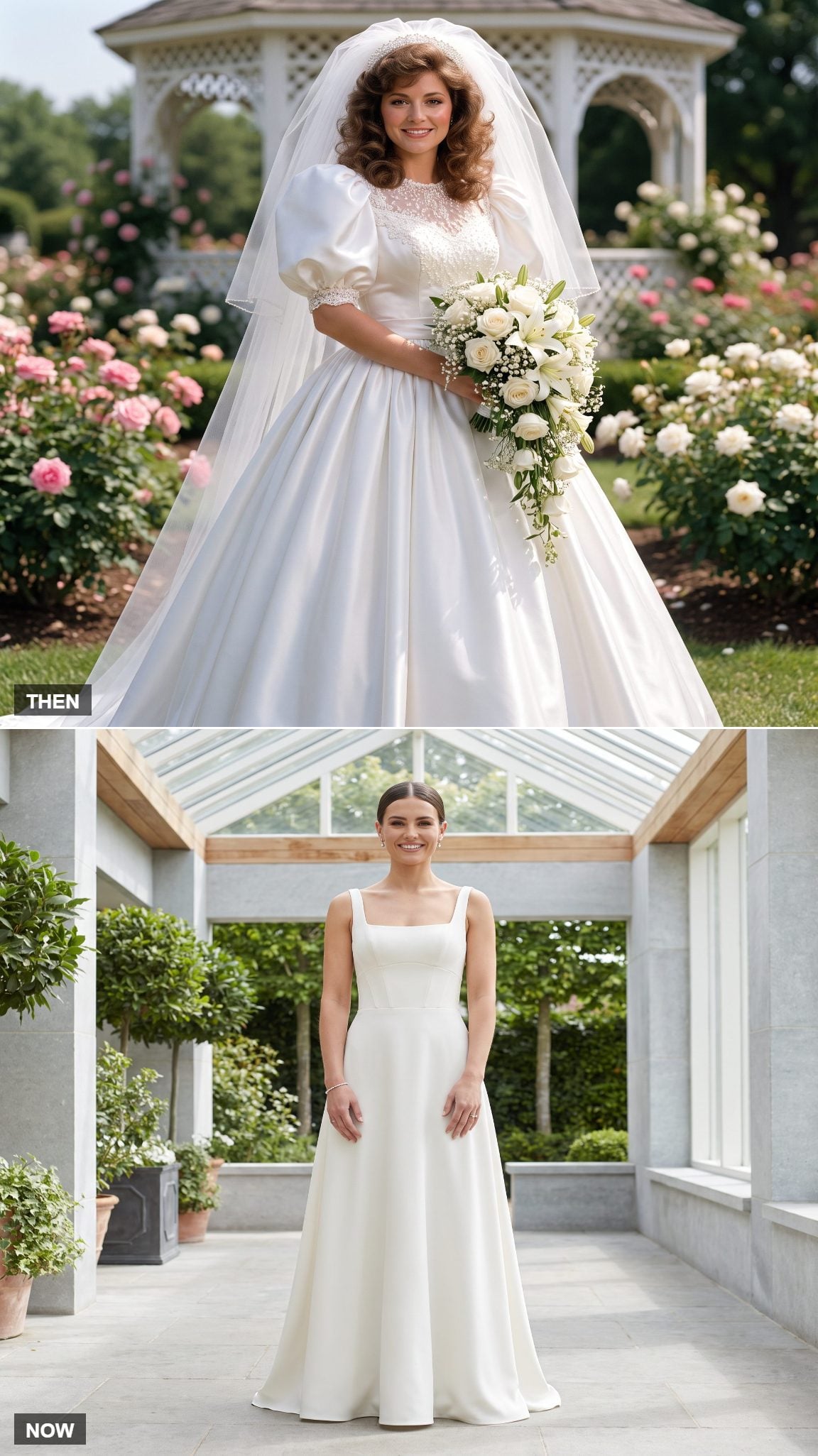
2. Puff Sleeves Made Way for a Square Neckline
❤️ Would you like to save this?
In the earlier gown, softness is everywhere: rounded lace bodice, elbow-length puff sleeves, gathered skirt. The shoulder line never quite gets a clean edge.
The newer A-line changes that with one decisive shape. A square neckline and wide straps draw a crisp frame around the collarbone while the skirt remains simple underneath. The gown still feels romantic, but the geometry has moved to the top.
1. The Bridal Capelet Grew Into a Full-Length Cape
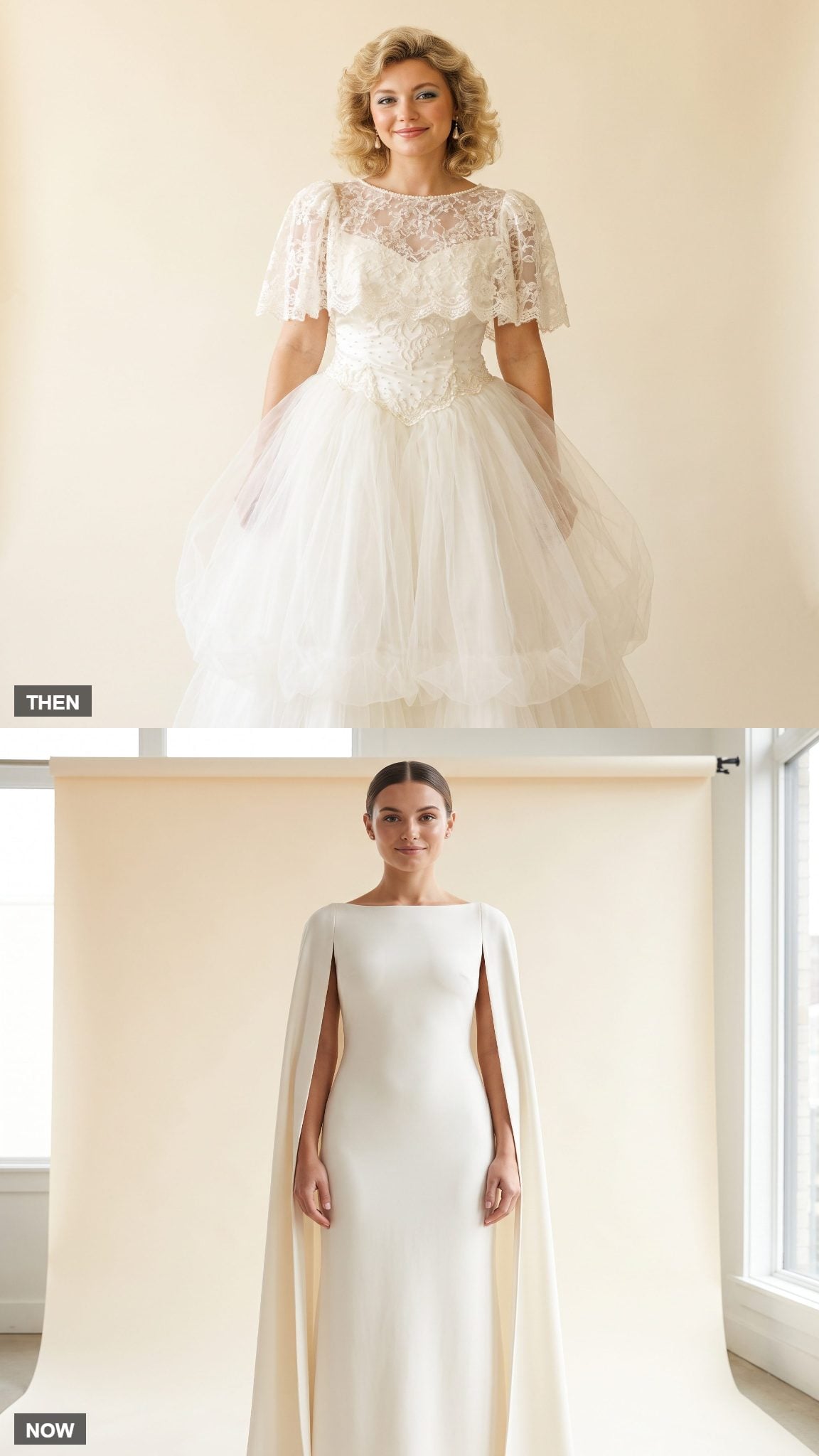
The 1980s lace capelet offered a little modesty, a little ceremony, and another surface for scallops and pearls. It hovered around the shoulders like a decorative parenthesis around an already decorated bodice.
The full-length cape thinks much bigger and somehow looks calmer. A long panel falls from the shoulders and trails behind a sculpted crepe column, creating movement without covering the dress in detail. The cape is no longer an accessory sitting on the gown. It becomes the gown’s moving architecture.