❤️ Would you like to save this?
The coat hanging in your closet right now would have looked like science fiction in 1985. Back then, winter dressing meant shoulder pads wide enough to clear a doorframe, lapels with territorial ambitions, hardware that could double as jewelry, and enough wool to make walking into a room feel like an entrance.
Forty years later, coats are lighter on their feet. Some changes came from fabric technology and practicality. Others were simply fashion deciding it had made its point. These 24 before-and-afters track what happened when the volume came down, the details got quieter, and a generation of very determined winter coats finally loosened its grip.
FYI, thanks to AI imagery software, we’re able to create very specific fashion and hairstyle examples to illustrate the points being made. In some cases, imagery is exaggerated to hammer home the point. Also, assume links that take you off the site are affiliate links such as links to Amazon. this means we may earn a commission if you buy something.
24. The Shoulder Situation Nobody Warned Us About
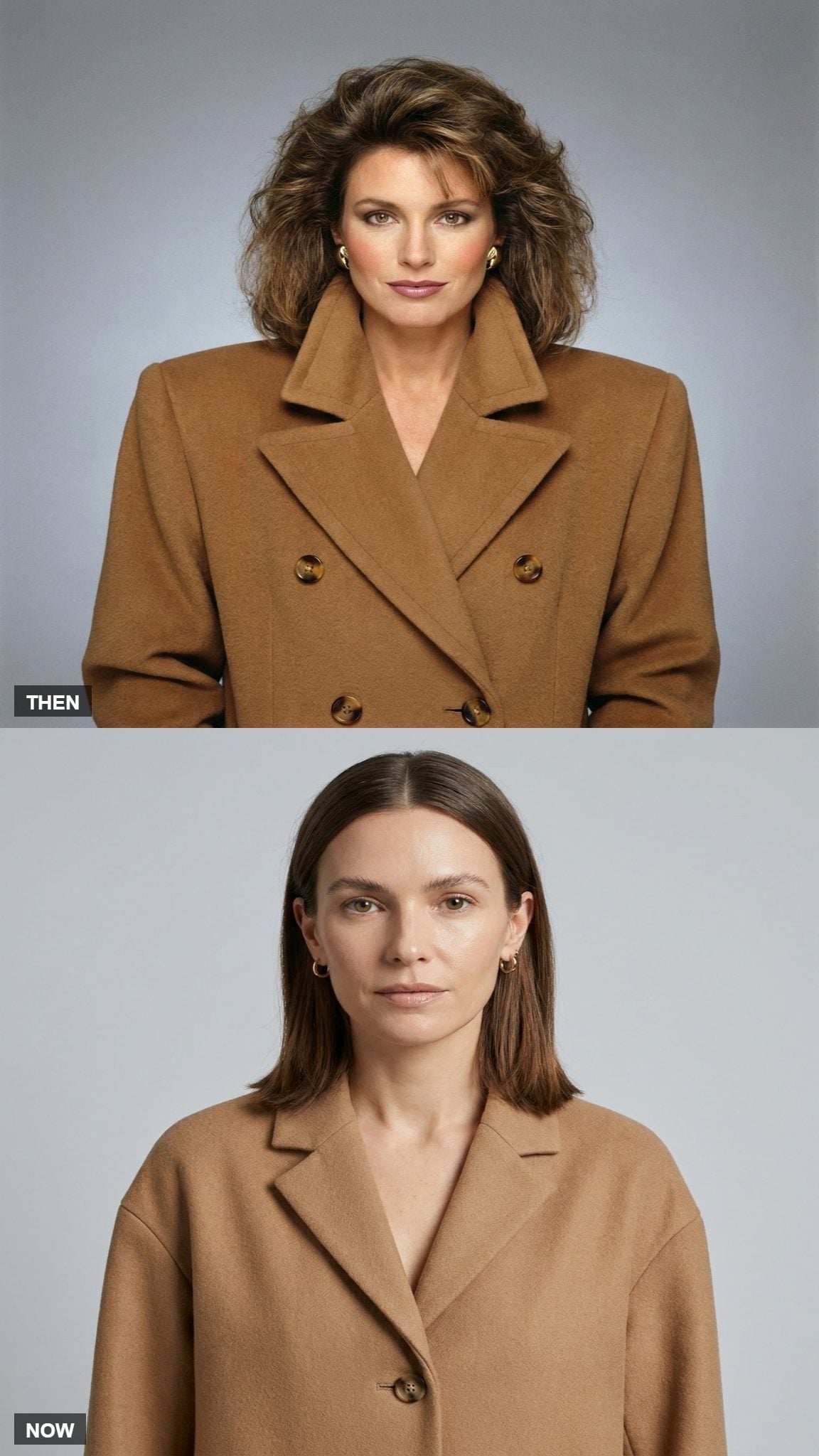
In 1985, your winter coat did not just keep you warm. It announced your arrival. Shoulder pads pushed wool blazers and full-length overcoats toward an inverted-triangle silhouette that looked equally prepared for a boardroom or a defensive line.
Today’s shoulder sits considerably closer to the person wearing it. The line can be natural, softly dropped, or deliberately relaxed, but it rarely needs to extend into neighboring airspace. The authority is still there. It just stopped requiring structural reinforcement.
23. That Electric Blue Could Only Have Come From the 1980s
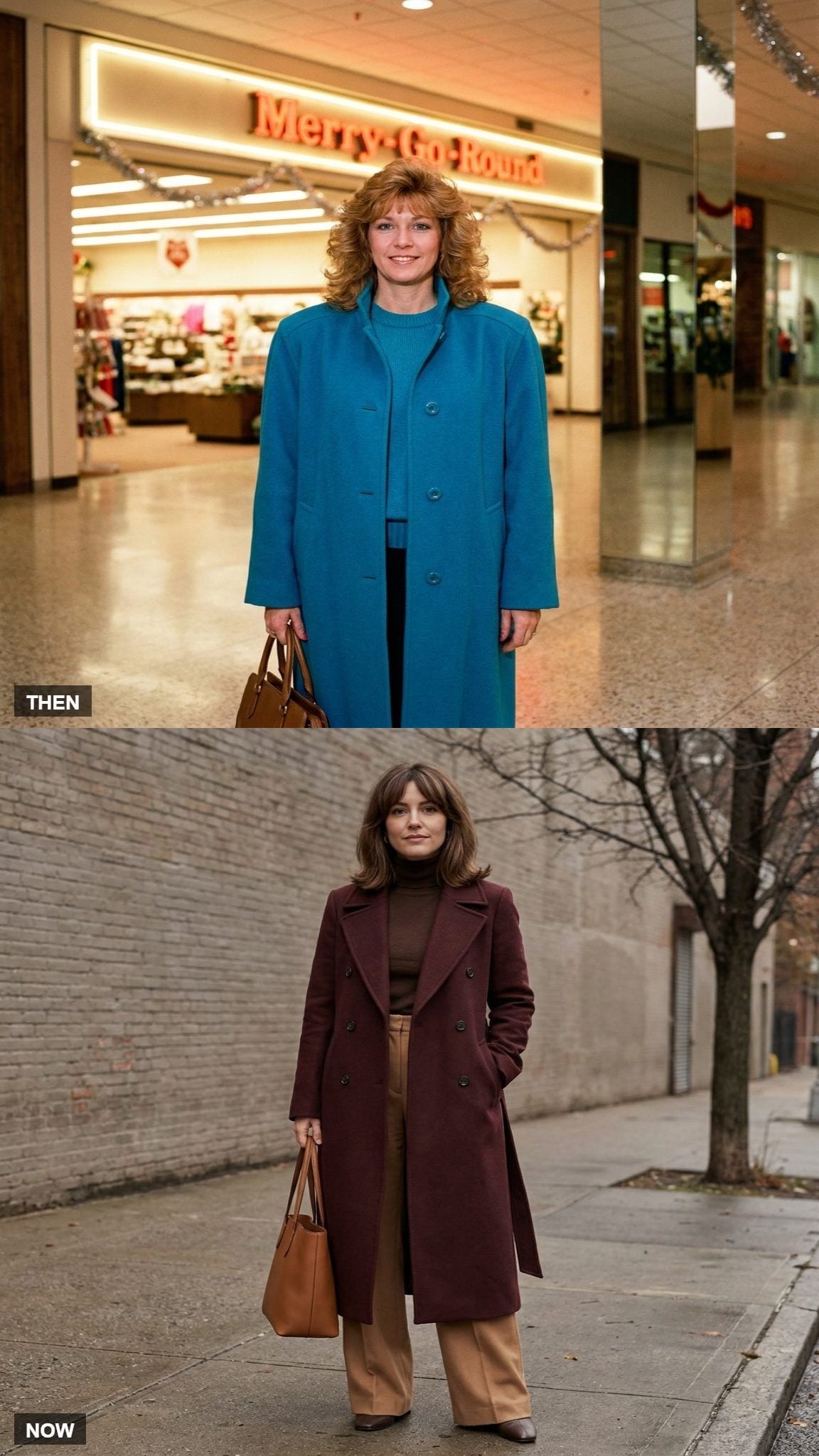
There was a particular blue running around winter coats in the mid-1980s that seemed electrically charged. Too bright for navy, less pure than cobalt, and almost impossible to ignore under department-store lighting. It did not want to coordinate quietly with anything. Coordination was everybody else’s problem.
Modern blue outerwear tends to arrive deeper, dustier, or more restrained. That’s what makes this shade such a useful time stamp. Forget the shoulder pads for a second. Sometimes one aggressively confident color can date a coat all by itself.
22. The Length Debate: When a Serious Coat Practically Reached Your Ankles
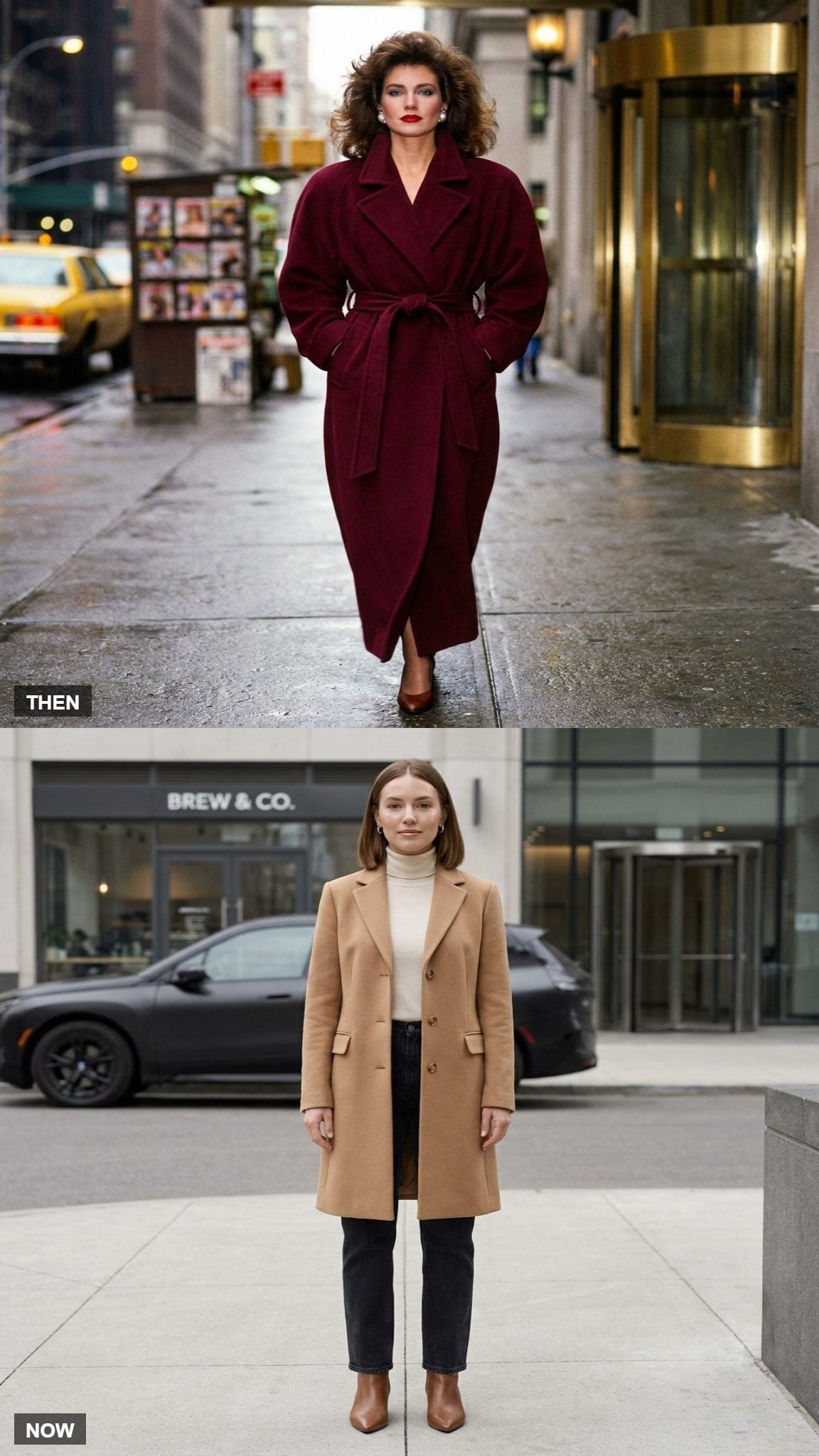
The full-length overcoat of the mid-1980s was not merely outerwear. It was theater. Hem grazing the ankle, enough fabric to conceal nearly everything underneath, moving through the world like a curtain that had learned to walk.
Current coats still reach the calf and occasionally the floor, but length now shares the rack with cropped, knee-length, and three-quarter silhouettes without an obvious hierarchy. The modern question is less “How much coat can we fit into this coat?” and more “Where should the proportion actually end?”
21. The Button Was Basically Jewelry With a Job
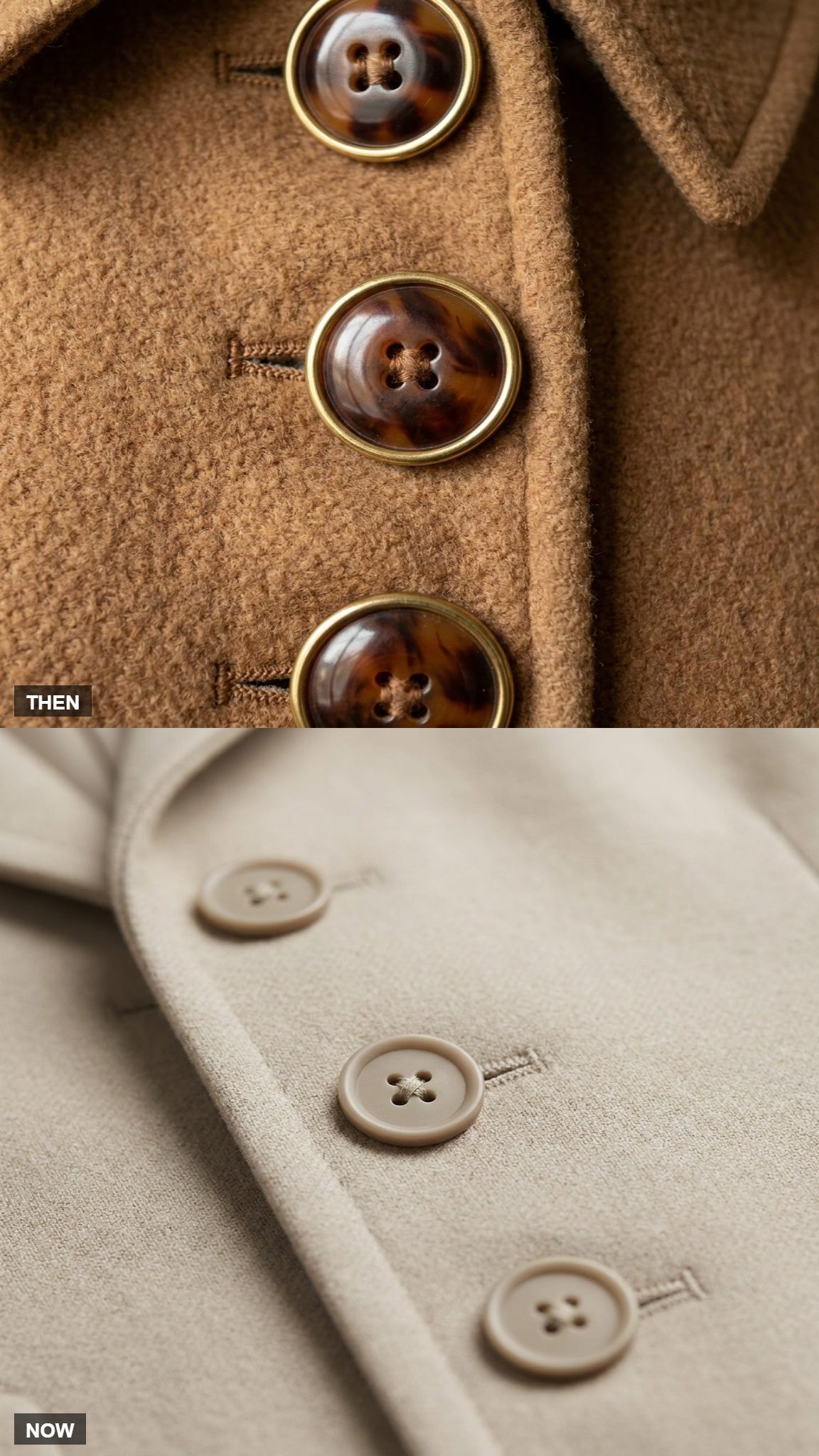
Buttons were not incidental in 1985. Tortoiseshell-look resin, brass, black lacquer, gold rims — coat fronts regularly carried hardware large enough to become part of the outfit from several feet away.
Modern buttons are far more likely to disappear into the cloth. Smaller, tonal, sometimes hidden entirely. The cleaner result makes sense, but an entire generation has lost the oddly satisfying experience of fastening a coat with something that felt halfway between hardware and costume jewelry.
20. The Fur Collar Wasn’t Trim. It Was the Main Event.
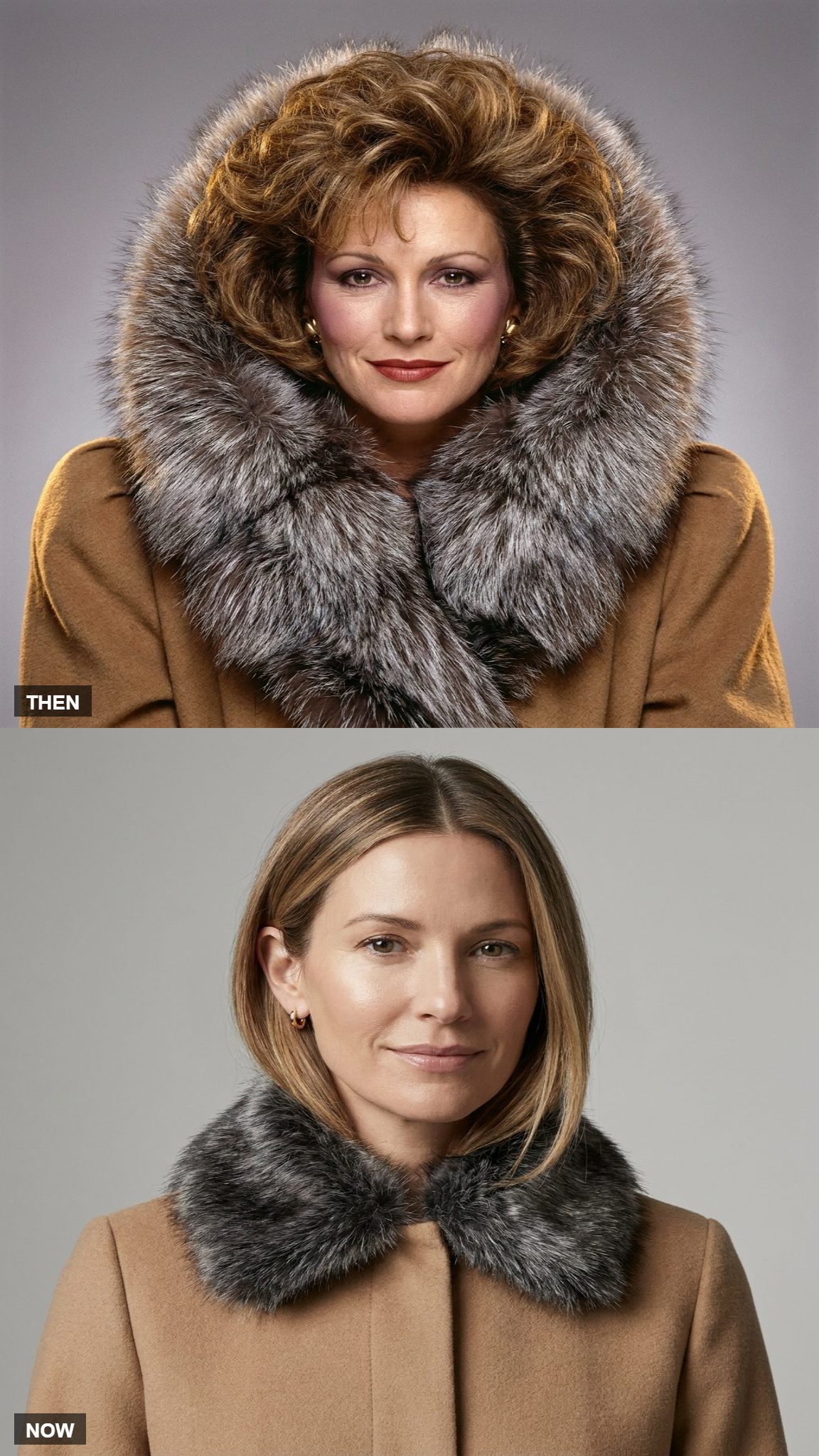
A large fur collar was one of the clearest luxury signals a winter coat could carry in the 1980s. Dense, broad, and often dramatically scaled, it wrapped around the face like the frame around a portrait.
Real fur has become far less common across mainstream fashion, while faux versions now deliver much of the visual drama without requiring the same material. The oversized collar never completely disappeared. What changed most dramatically was what people expected it to be made from.
19. The Puffer Had to Survive Its Sleeping-Bag Phase
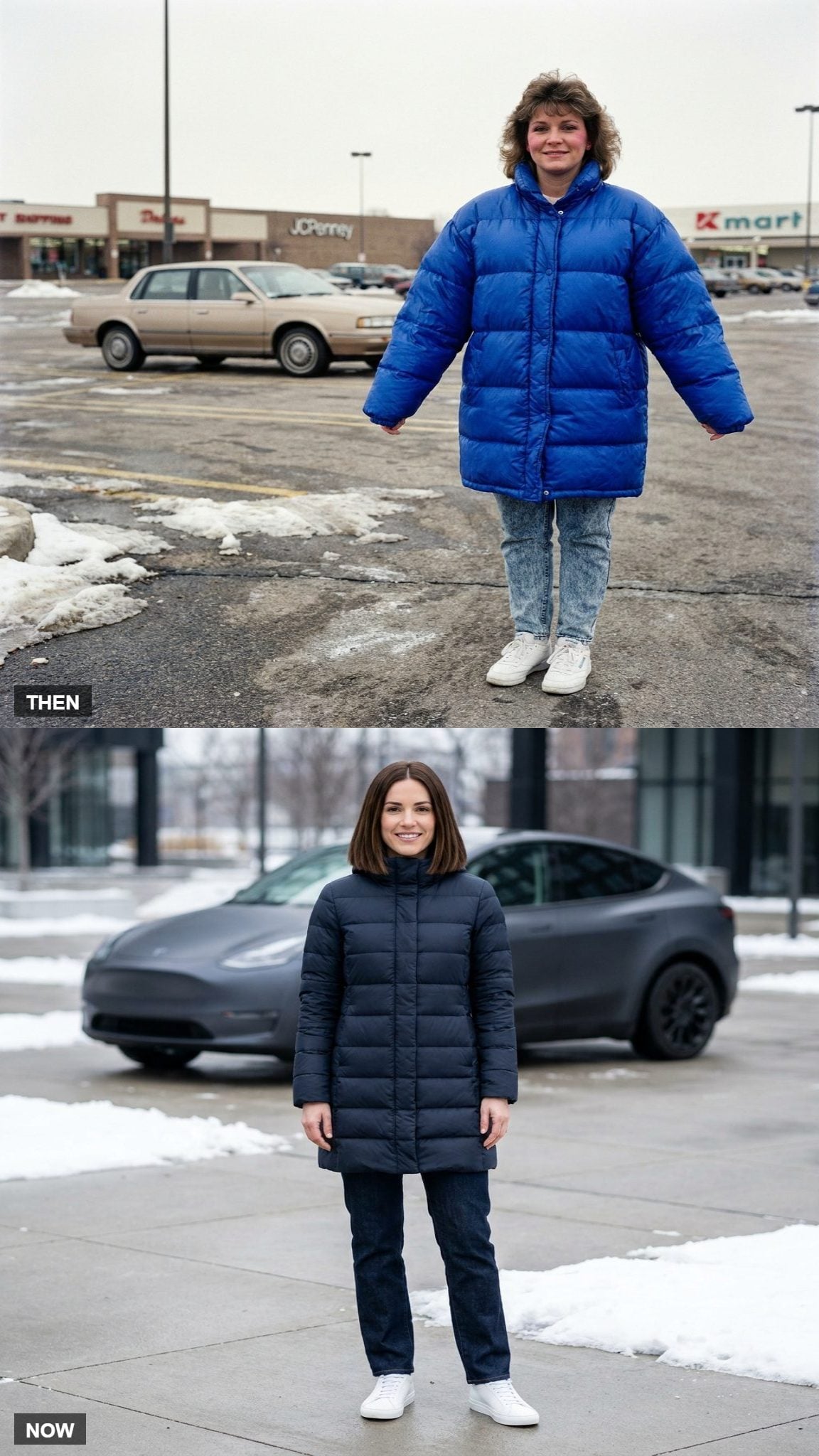
The 1985 puffer had the warmth part figured out. The silhouette was another matter. Wide quilted channels, glossy nylon, and enough bulk to suggest emergency bedding gave early versions a wonderfully unapologetic roundness.
Today’s puffers can still be enormous by choice, but technical fabrics, narrower baffles, improved pattern cutting, and a wider range of insulation options mean bulk is no longer mandatory. The modern puffer can whisper or shout. The 1985 version mostly shouted from across the parking lot.
18. The Belt Was Four Inches of Architectural Determination
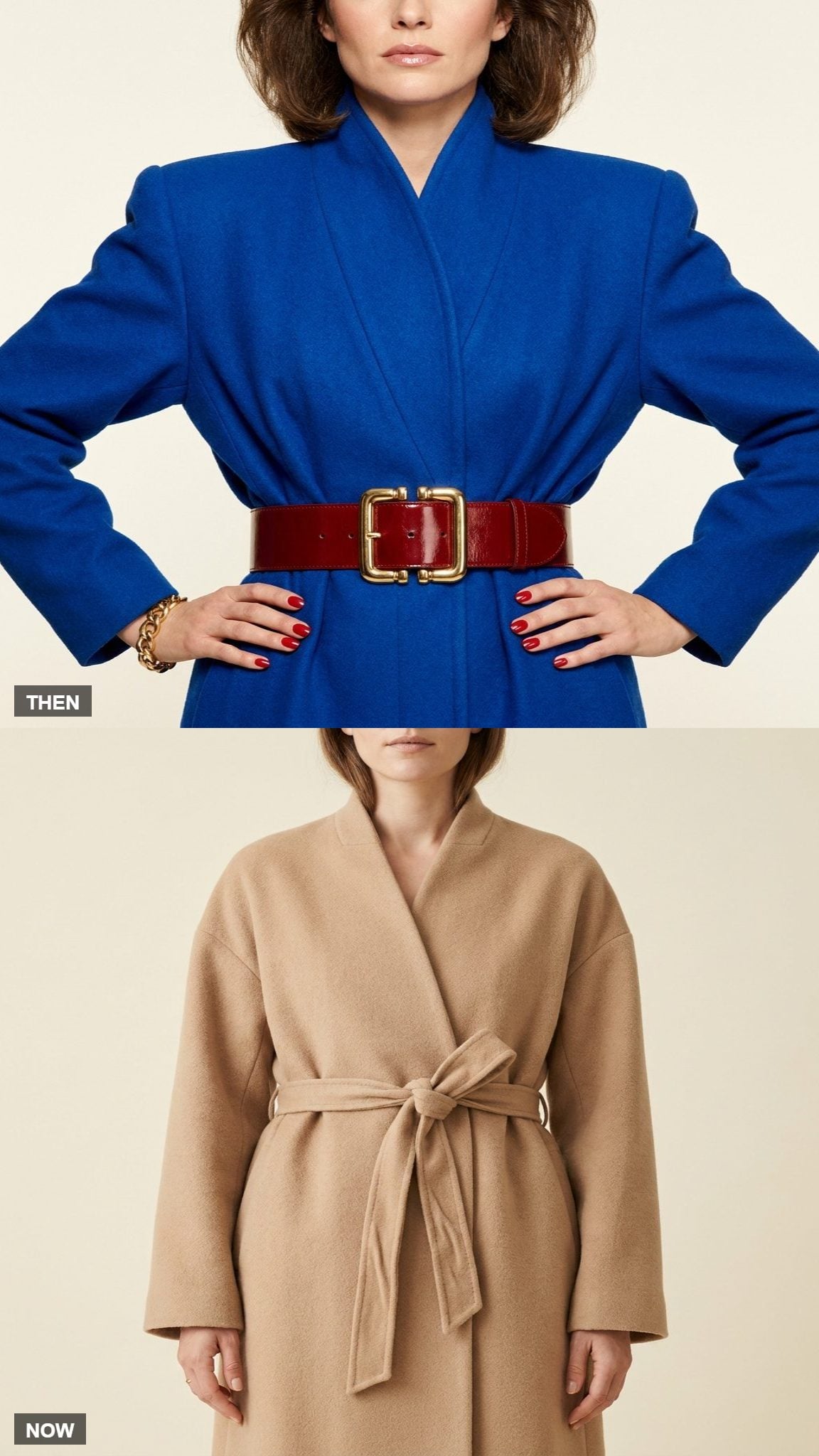
Wide leather pulled tight enough to reorganize the entire silhouette — that was the 1985 coat belt. It lived outside the coat, carried a buckle that wanted attention, and treated the waist less like a body part than a design problem requiring immediate emphasis.
Today’s version is more likely to be a self-fabric tie, narrow leather strap, or no belt at all. The waist can still be defined. It just isn’t being underlined three times in red ink.
17. The Plaid Didn’t Enter the Room Quietly Either
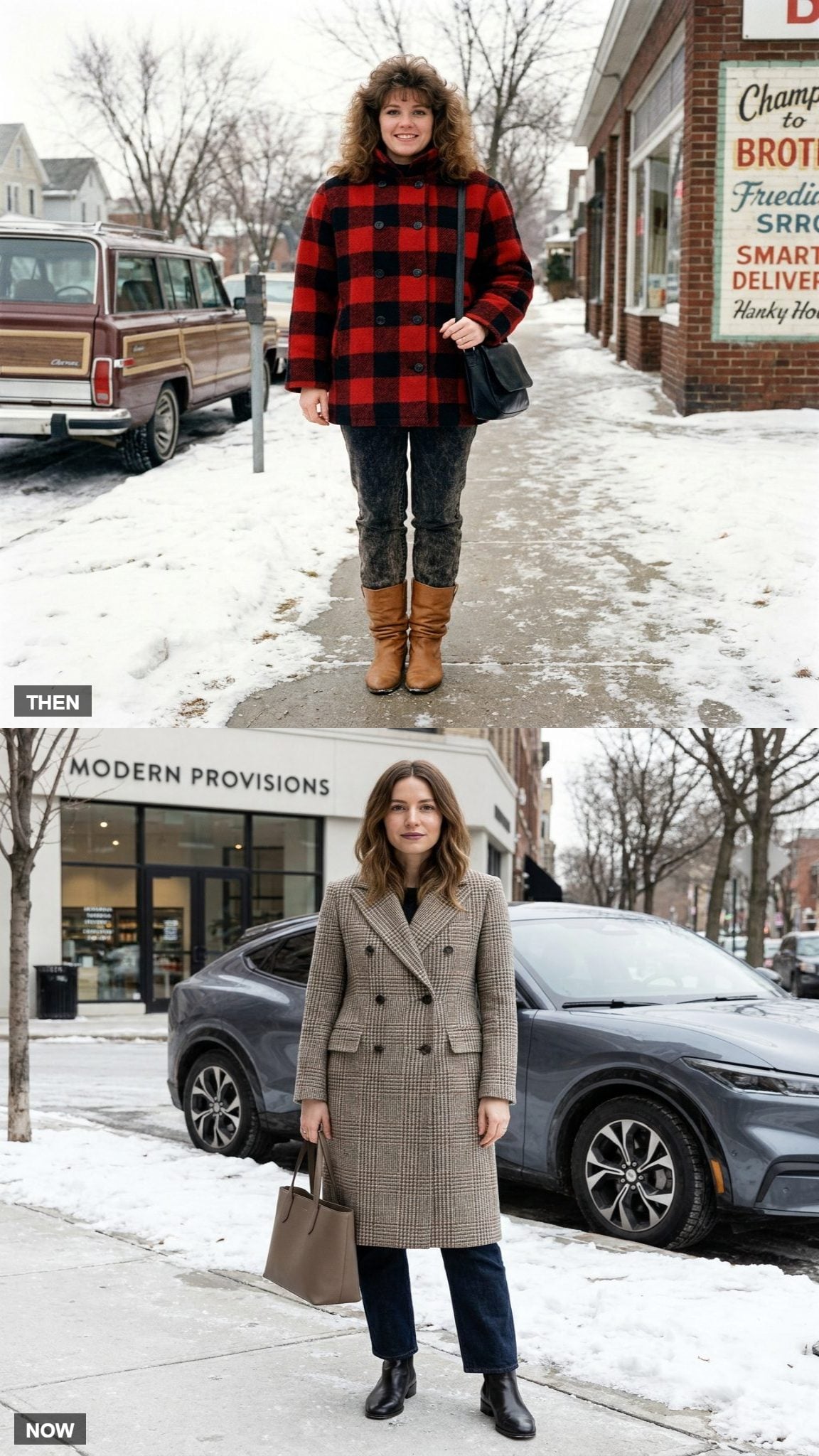
The 1985 plaid coat was not a coat with a pattern. It was a pattern that happened to have sleeves. Large-scale checks, strong contrast, and color combinations that remained legible from the other side of the street were entirely capable of becoming the whole outfit.
Today’s plaid outerwear often shrinks the scale and lowers the volume: muted windowpanes, herringbone-adjacent checks, heritage browns and grays. Both versions are plaid. Only one of them needs to be introduced before it enters the room.
“Some coats whisper. The 1985 plaid coat had a full speaking voice and used it.”
16. The Lapel Needed Its Own Zip Code
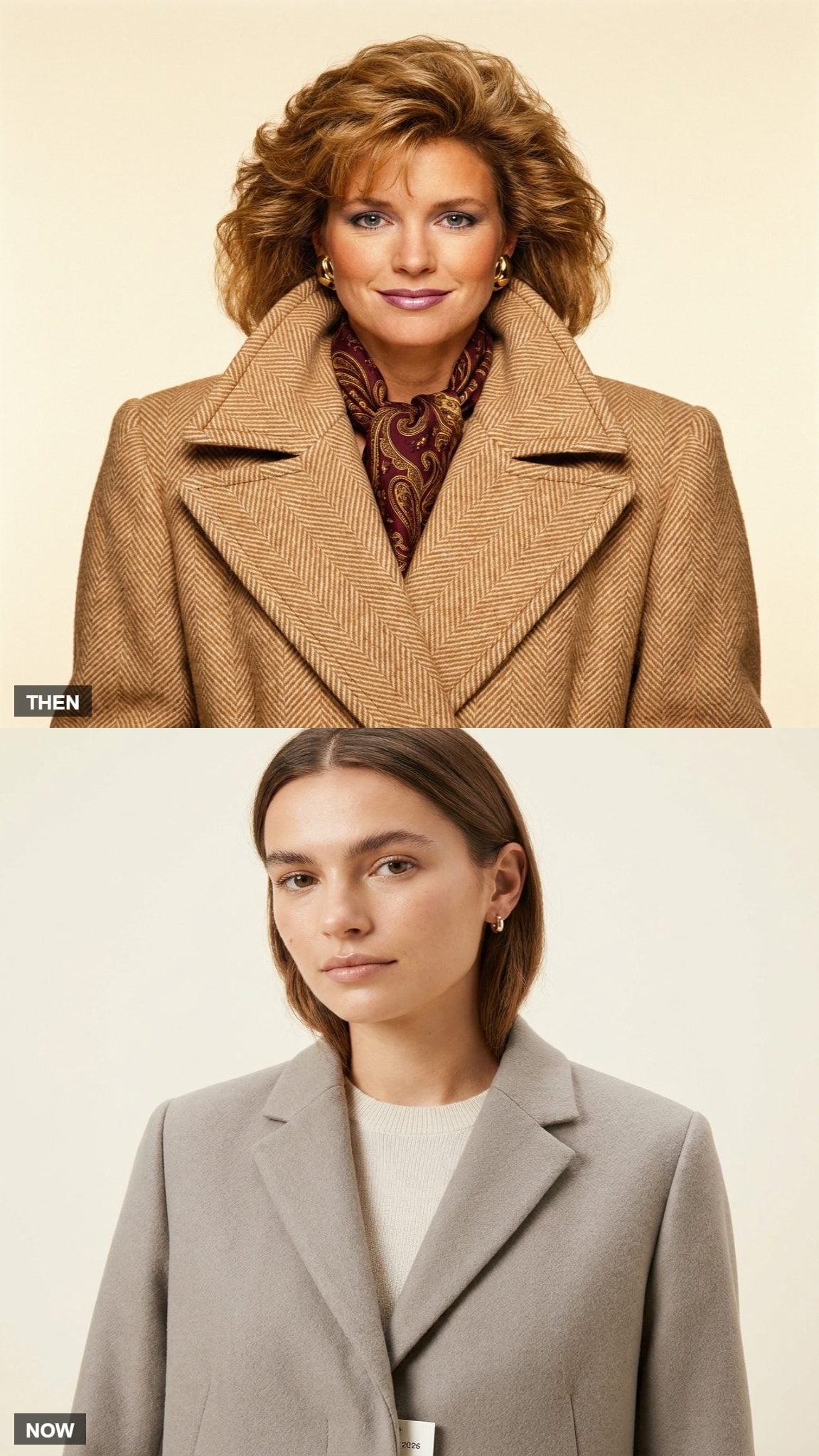
The 1985 lapel was not content to frame the chest. It wanted territory. Wide, sharply defined, and often stiff enough to hold its shape independently, it turned the front of a coat into architecture.
Modern coat silhouettes frequently run narrower through the collar and lapel, letting the front fall in one long line. Elegant, certainly. But nobody is going to confuse today’s lapel with an emergency landing strip.
15. The Lining Was a Secret Second Outfit
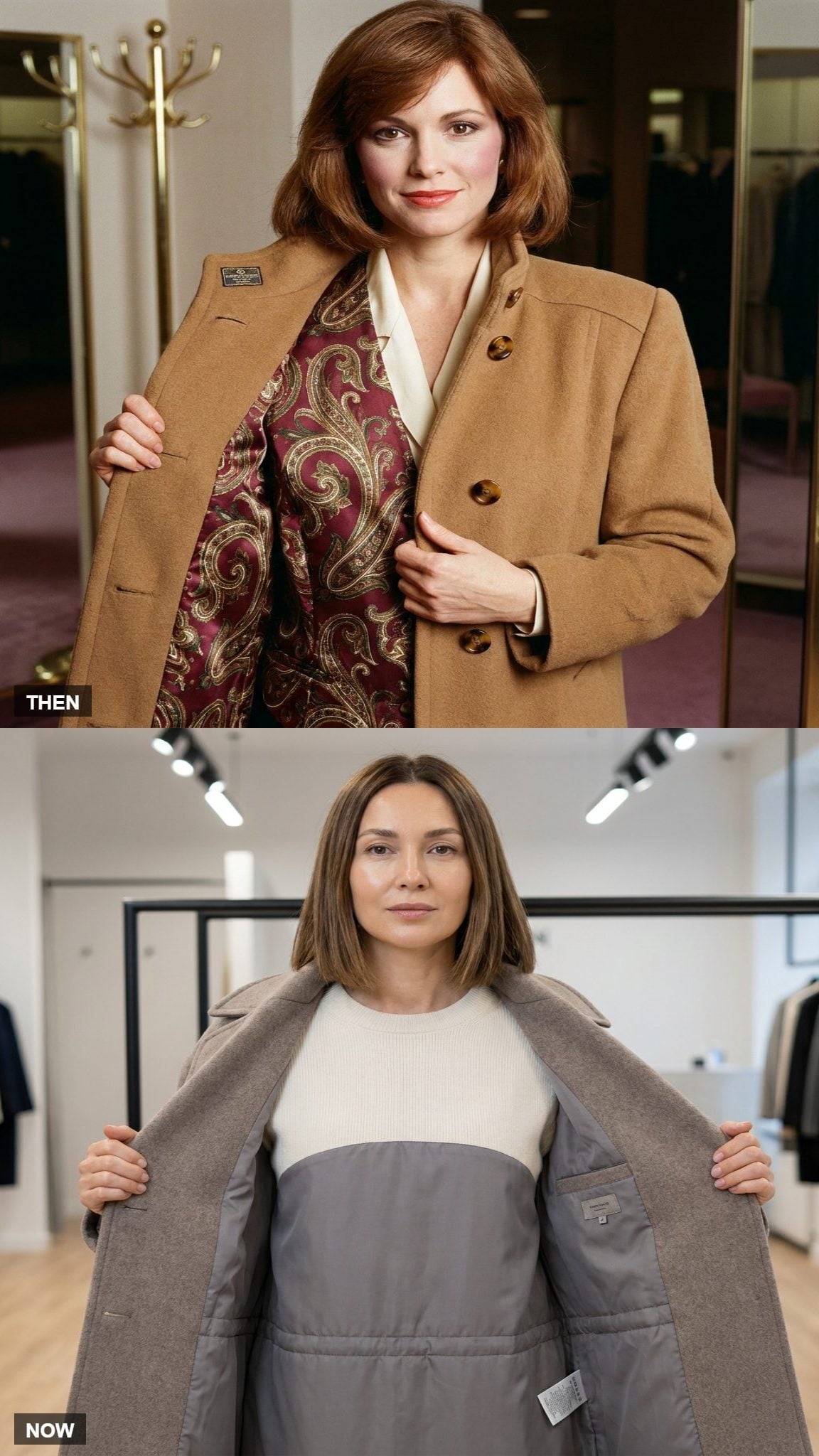
Open a good-looking 1980s coat and the exterior sometimes turned out to be the quiet part. Paisley, florals, geometric motifs, jewel tones — linings could carry far more pattern than anyone standing beside you would ever know.
Modern coats often favor tonal acetate, viscose, polyester, quilted insulation, or subtle branding instead. Nothing wrong with any of it. But opening a charcoal coat and discovering an entirely unreasonable burgundy paisley inside remains difficult to improve upon.
14. The Toggle Coat Refused to Die, Which Turns Out to Be Its Best Quality
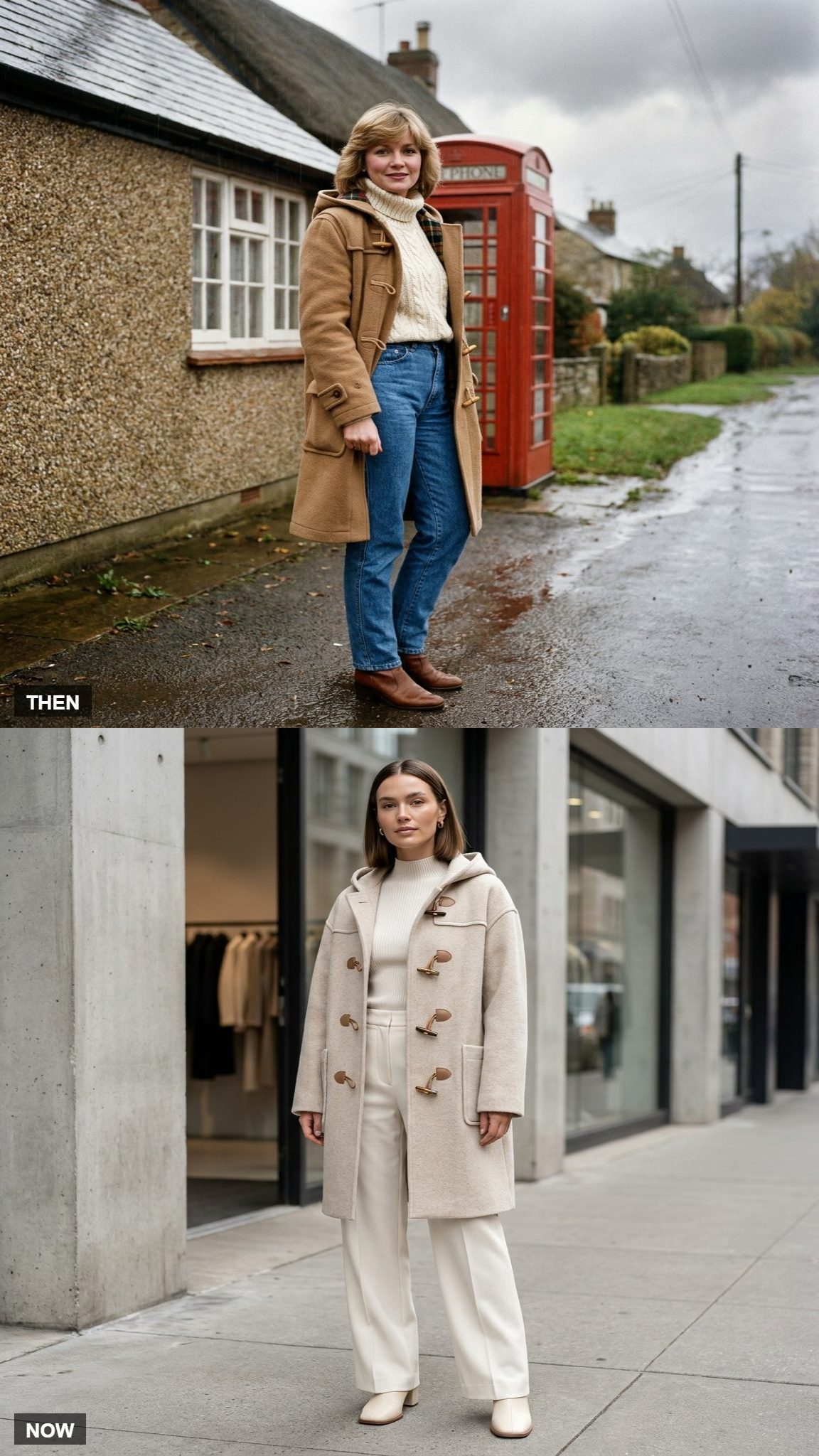
The toggle coat was never interested in looking dangerous. It was warm, practical, slightly professorial, and entirely capable of making you look as though you had strong opinions about maps.
It also never really left. Designers keep sharpening the cut, changing the length, reducing the bulk, and sending it back out again. The horn-style toggles remain because the basic idea was good the first time. Some garments evolve by refusing to surrender their weirdest feature.
13. Epaulettes Put Military Hardware on the Morning Commute
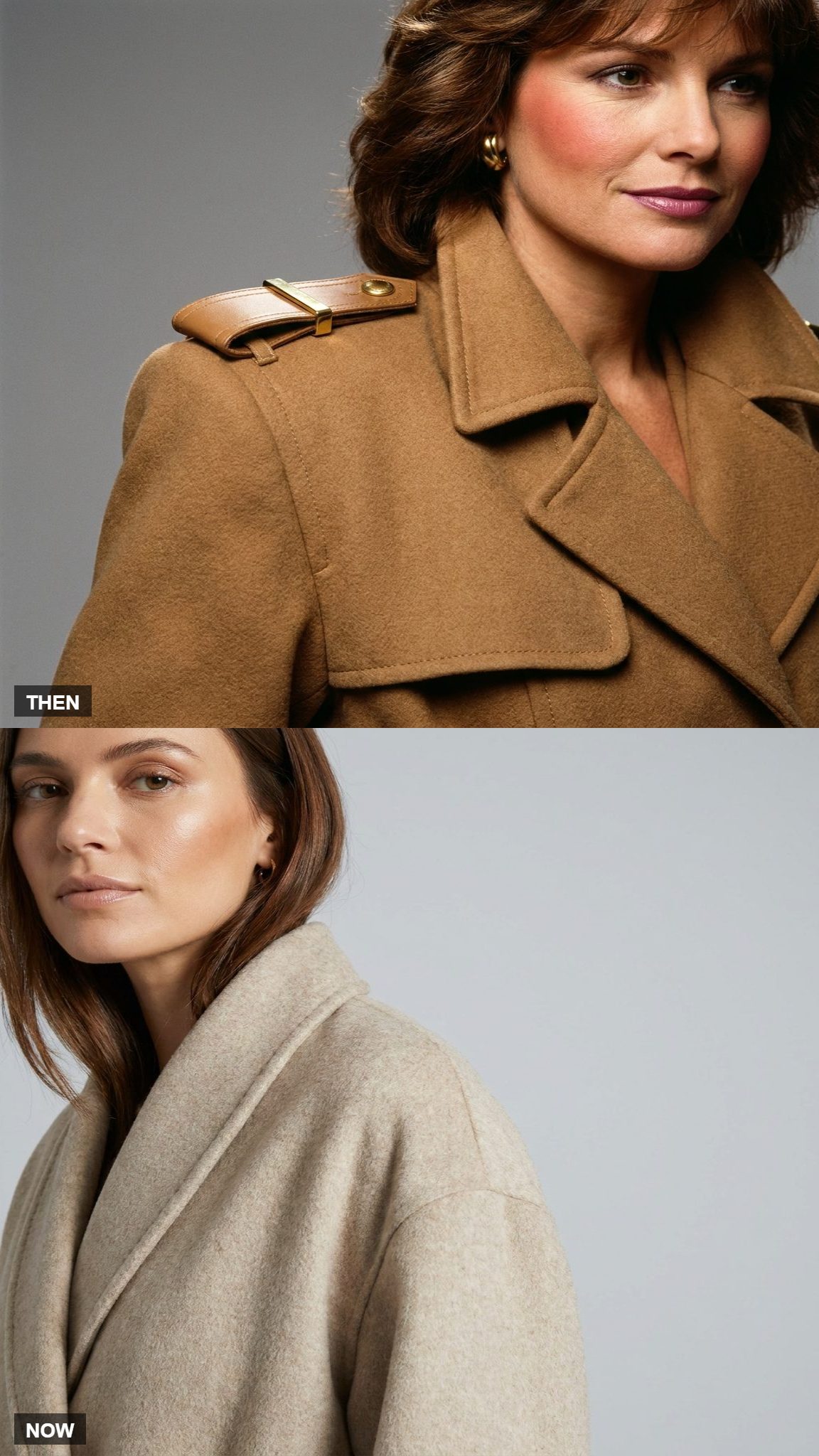
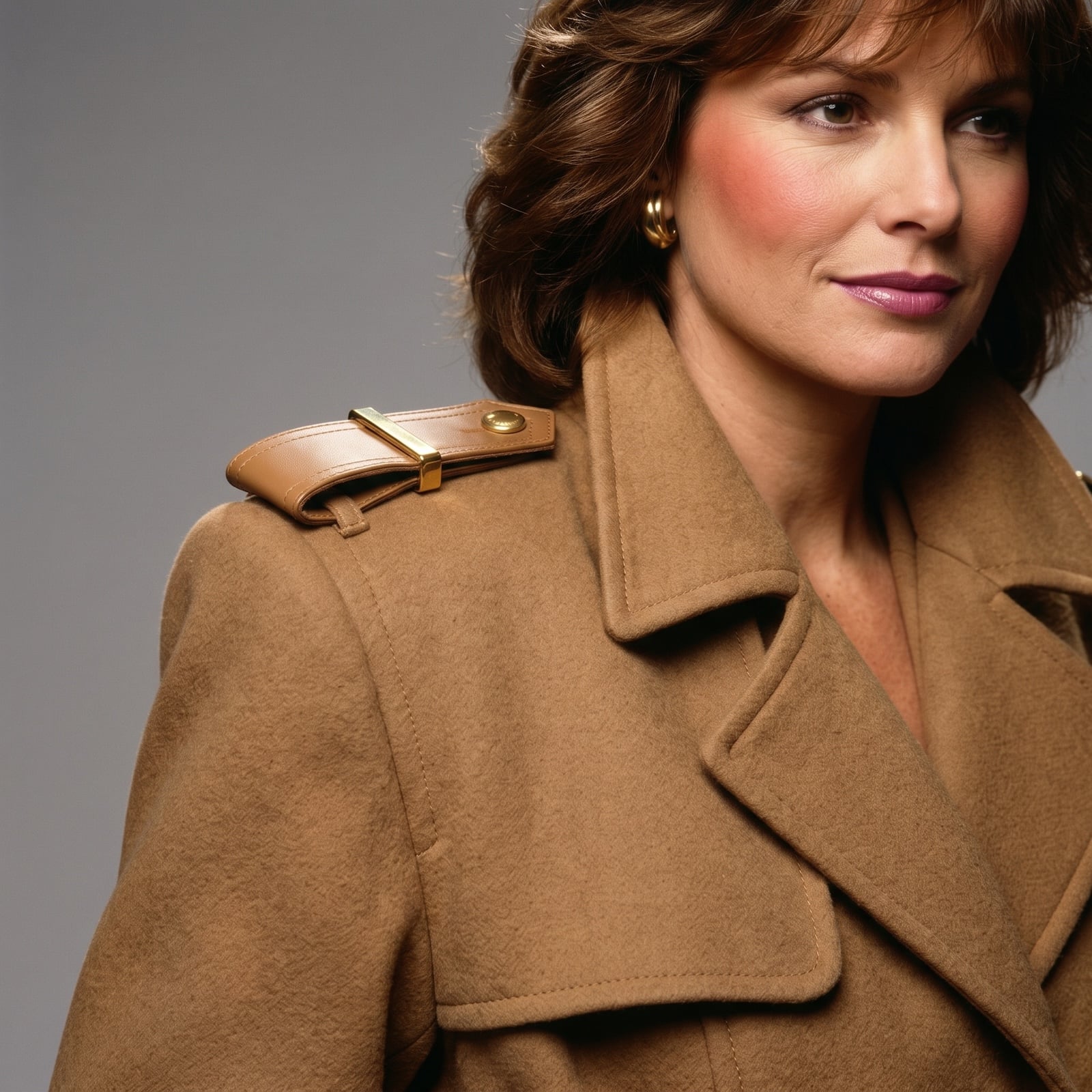
Epaulettes came from military dress, but by the 1980s they were perfectly comfortable riding the bus to an office job. Shoulder straps, buttons, tabs, and occasional metal hardware turned an already assertive shoulder line into something that appeared to come with rank.
The modern look usually leaves the shoulder alone. Cleaner, softer, easier to layer. Sensible, certainly. Still, there are mornings when a small piece of unnecessary military hardware feels emotionally correct.
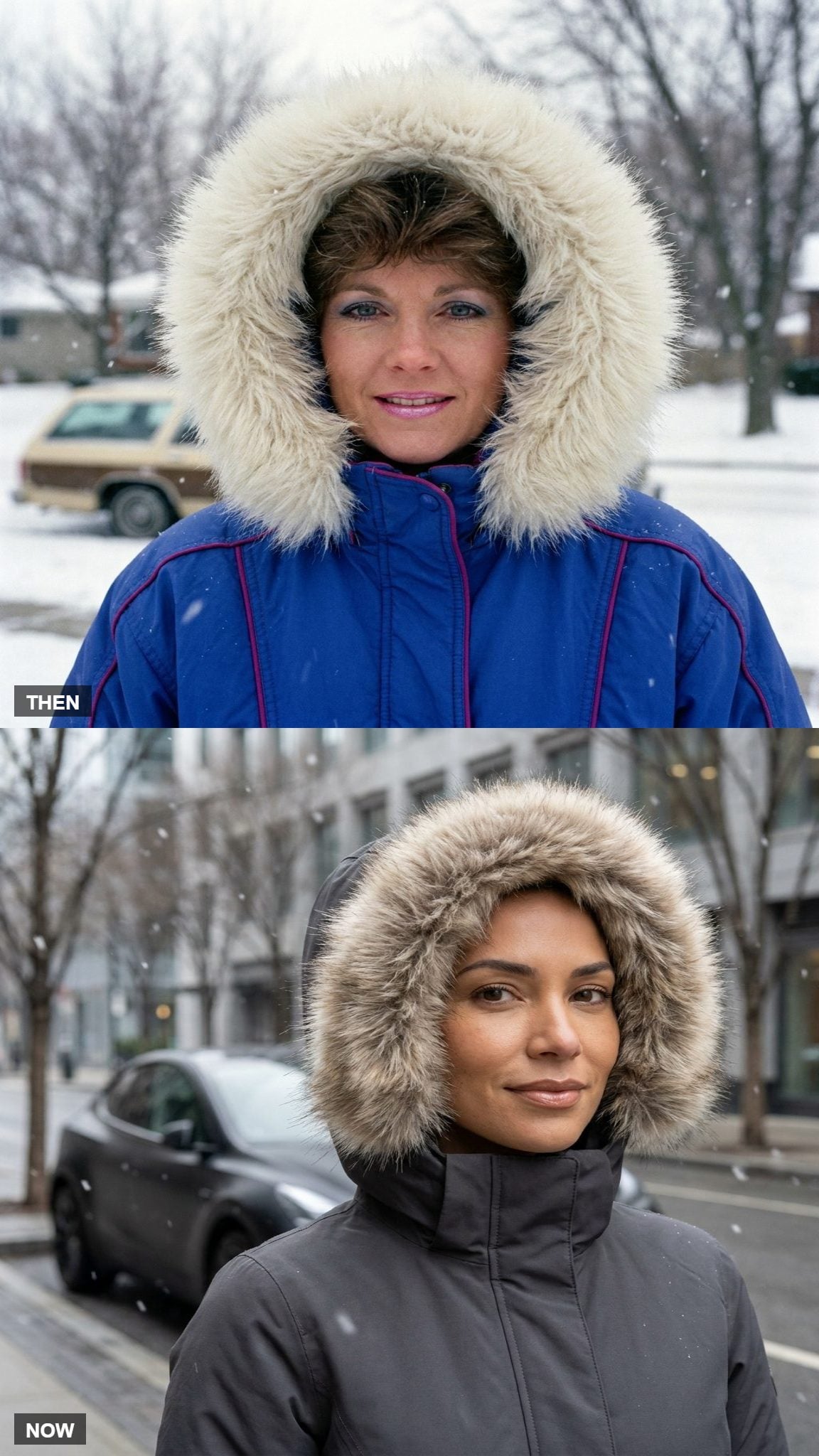
12. The Hood Was Trying to Build You a Private Weather System
❤️ Would you like to save this?
A big 1980s hood could create its own climate around your head. Deep, heavily framed, sometimes edged in synthetic fur, it offered serious coverage and the minor inconvenience of periodically attempting to swallow your peripheral vision.
Modern hood design tends to sit closer, articulate better with the neck, and add drawcords or adjusters that keep the opening where you actually put it. Less dramatic, considerably easier to cross a windy intersection in.
11. The Cocoon Coat Was Oversized Before Oversized Learned Restraint
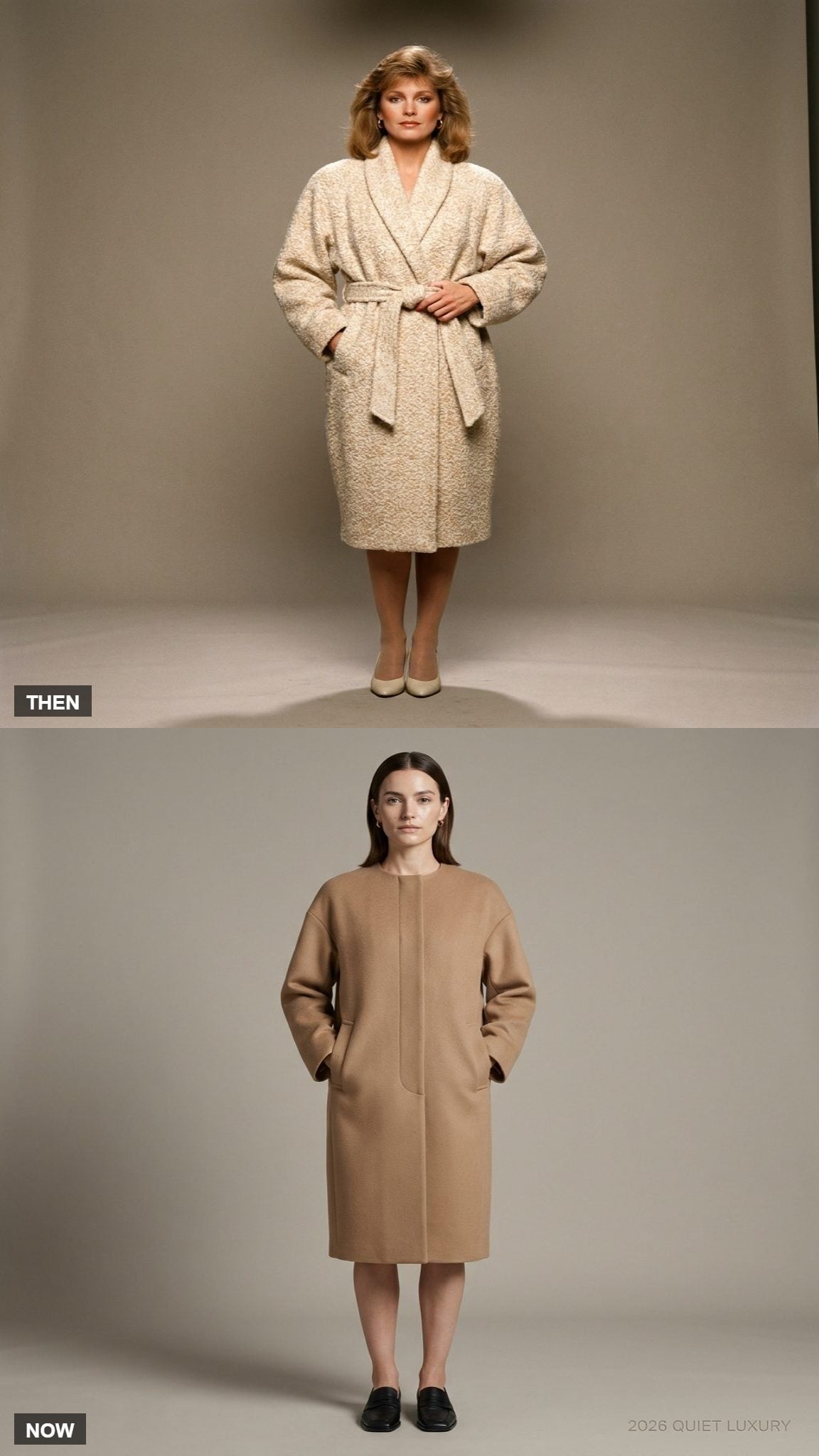
The cocoon silhouette is far older than the 1980s, but the decade certainly knew what to do with volume. Cream, camel, boucle-like texture, rounded shoulders, generous cloth — the body could all but disappear inside the shape.
Contemporary cocoon coats borrow the generous outline and edit almost everything else. Cleaner closures, quieter fabrics, fewer competing details. Same basic geometry, very different relationship with self-control.
10. The Pocket Looked Ready for Groceries. Your Hand Barely Fit.
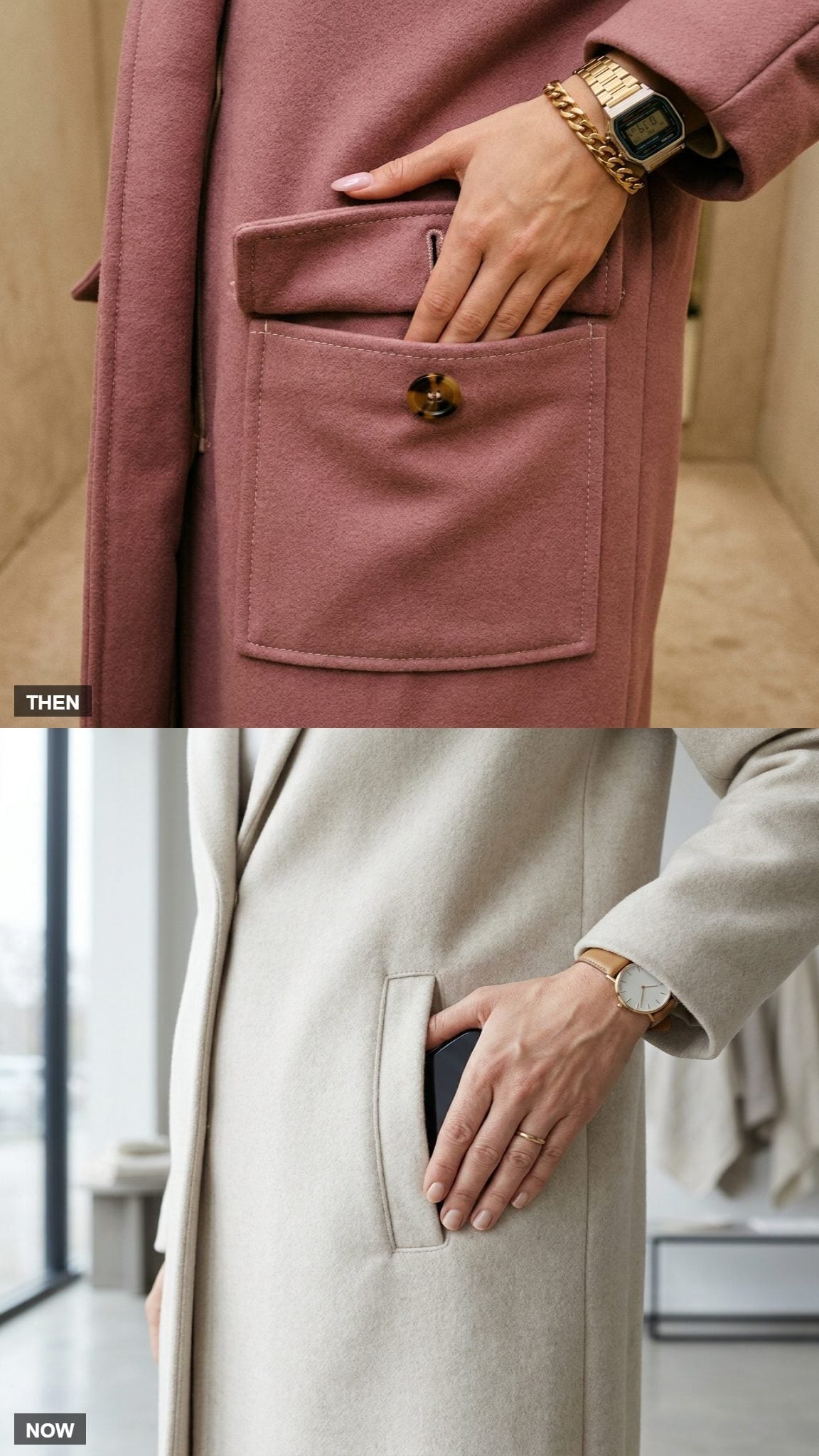
Some 1980s coat pockets were magnificent pieces of theater: oversized flaps, contrast stitching, decorative buttons, enough visual real estate to imply you could store lunch in there.
Whether the opening actually cooperated was another matter. Modern outerwear often reverses the priorities — less visible pocket, more usable depth. No flap, no fanfare, just somewhere to put a phone, a glove, and your accumulated skepticism about decorative storage.
9. The Wrist Got Its Own Tiny Piece of Architecture
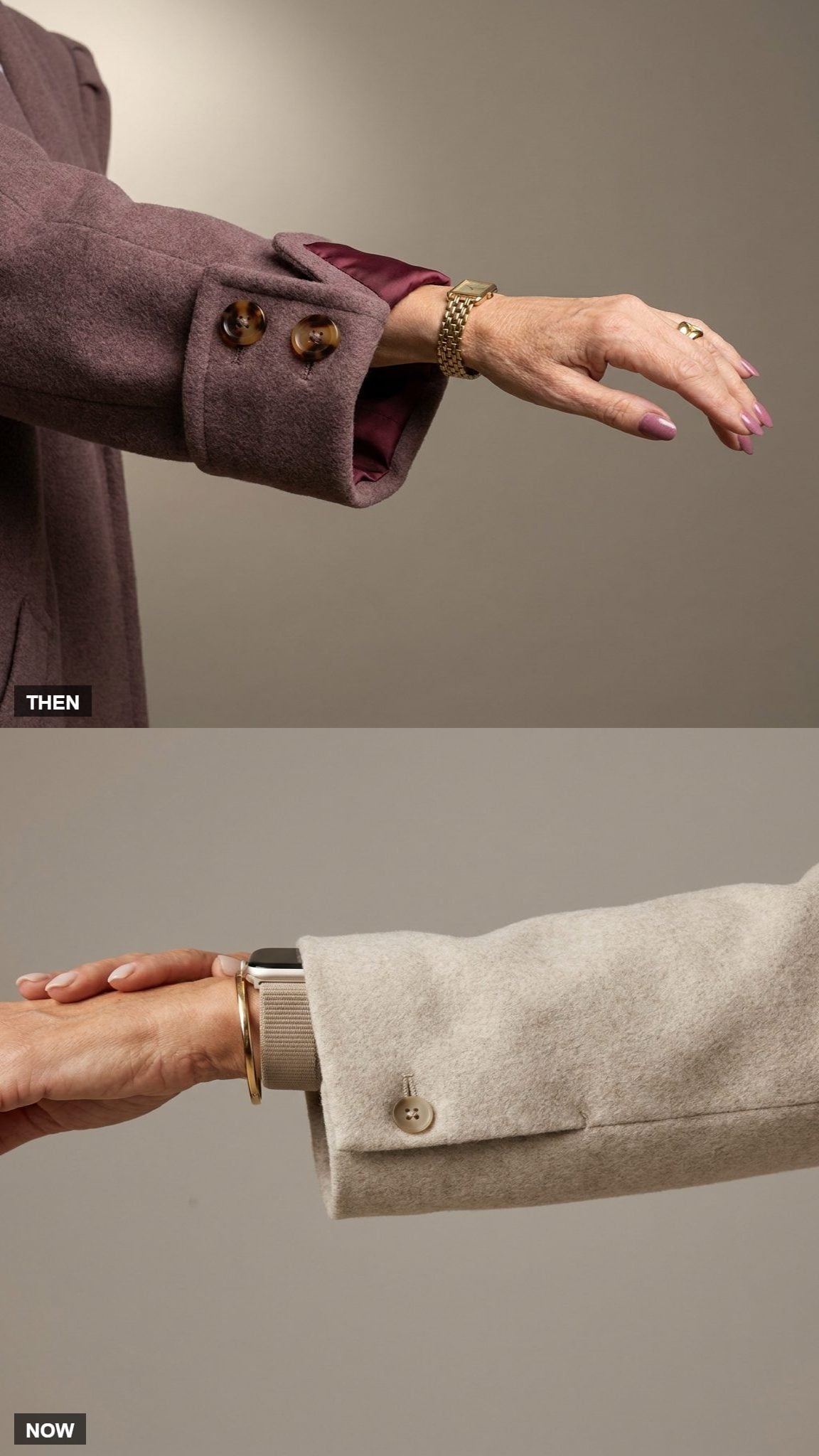
Coat cuffs in 1985 had opinions. Wide, structured, sometimes turned back to expose the lining, frequently finished with a decorative button that had no relationship whatsoever with keeping the coat closed.
The current sleeve ending is more likely to be a clean hem, discreet tab, or hidden knit cuff. Function survived. Ceremony did not. There are days when you miss a cuff that behaved as though your wrist deserved an architectural feature.
8. The Double-Breasted Coat Put Every Button on Active Duty
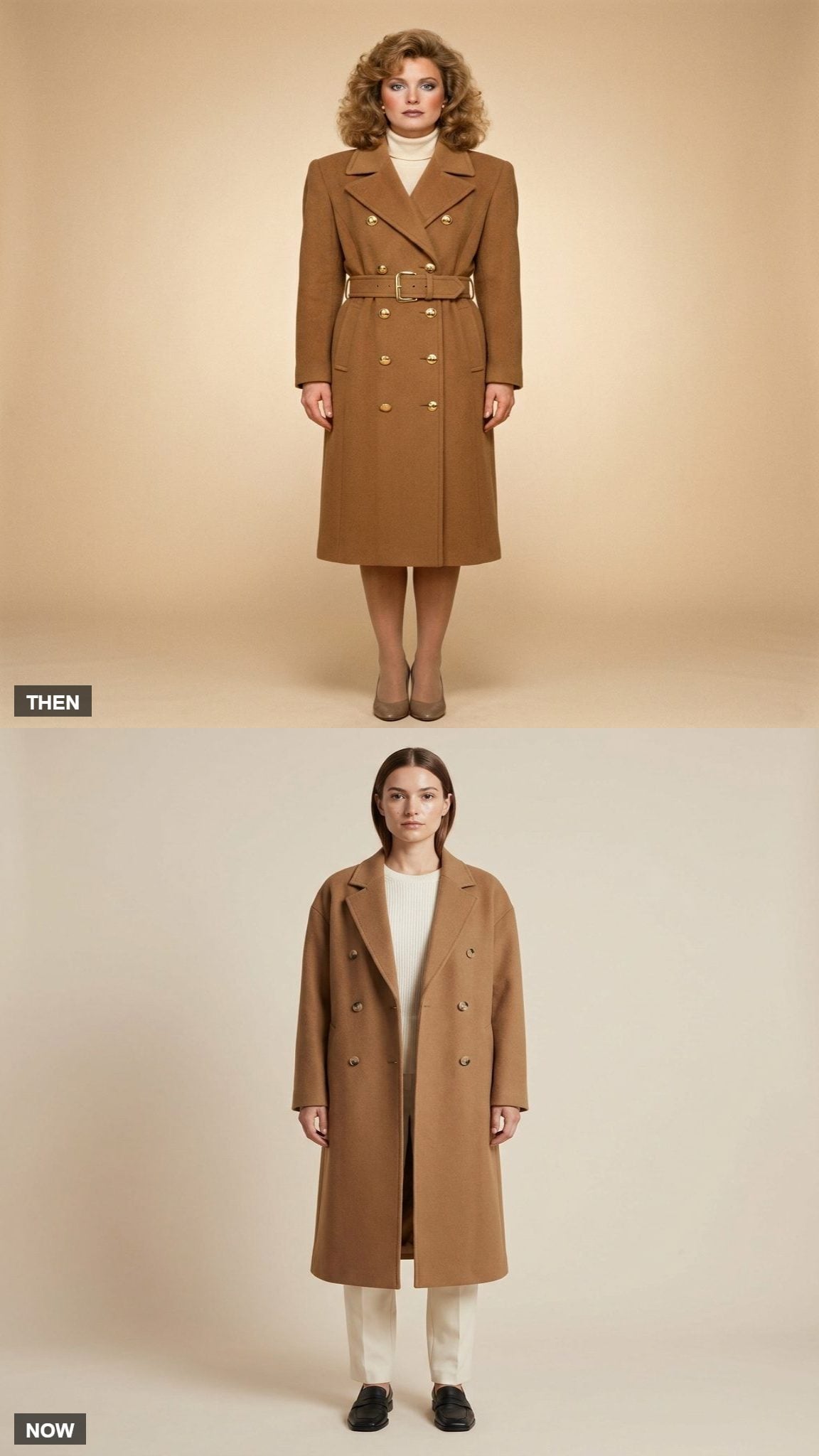
This particular 1985 version goes all the way to ten buttons: two vertical rows marching down the front, gold-toned and conspicuous enough to remain readable from a moving car. Restraint was never invited to the fitting.
Today’s double-breasted coat often cuts the button count down and gives each one more breathing room. The overlapping front survives because it still looks sharp. The parade-ground quantity of hardware was apparently negotiable.
7. The Wrap Coat Spent Forty Years Learning When to Stop
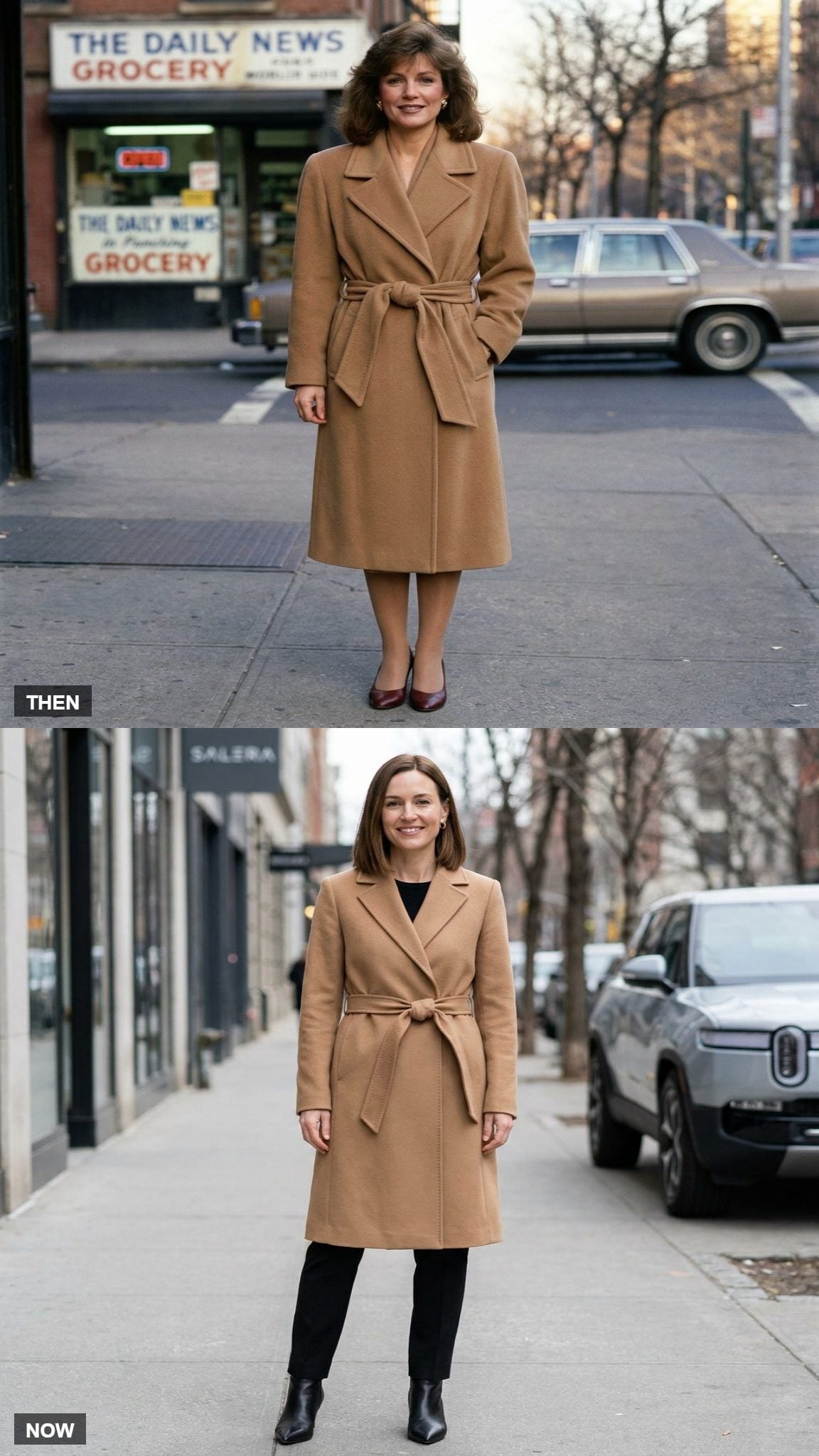
The wrap coat existed in 1985, and it came prepared. Wide lapels, a substantial sash, padded shoulders, and enough volume for the belt to feel less like an accessory than crowd control.
The modern version has the same basic DNA and a fraction of the noise: softer shoulder, narrower lapel, cleaner wrap, slimmer tie. It turns out the silhouette never needed to disappear. It just needed everyone else in the room to lower their voices.
6. The Shoulder Seam Moved Back Toward the Human Body
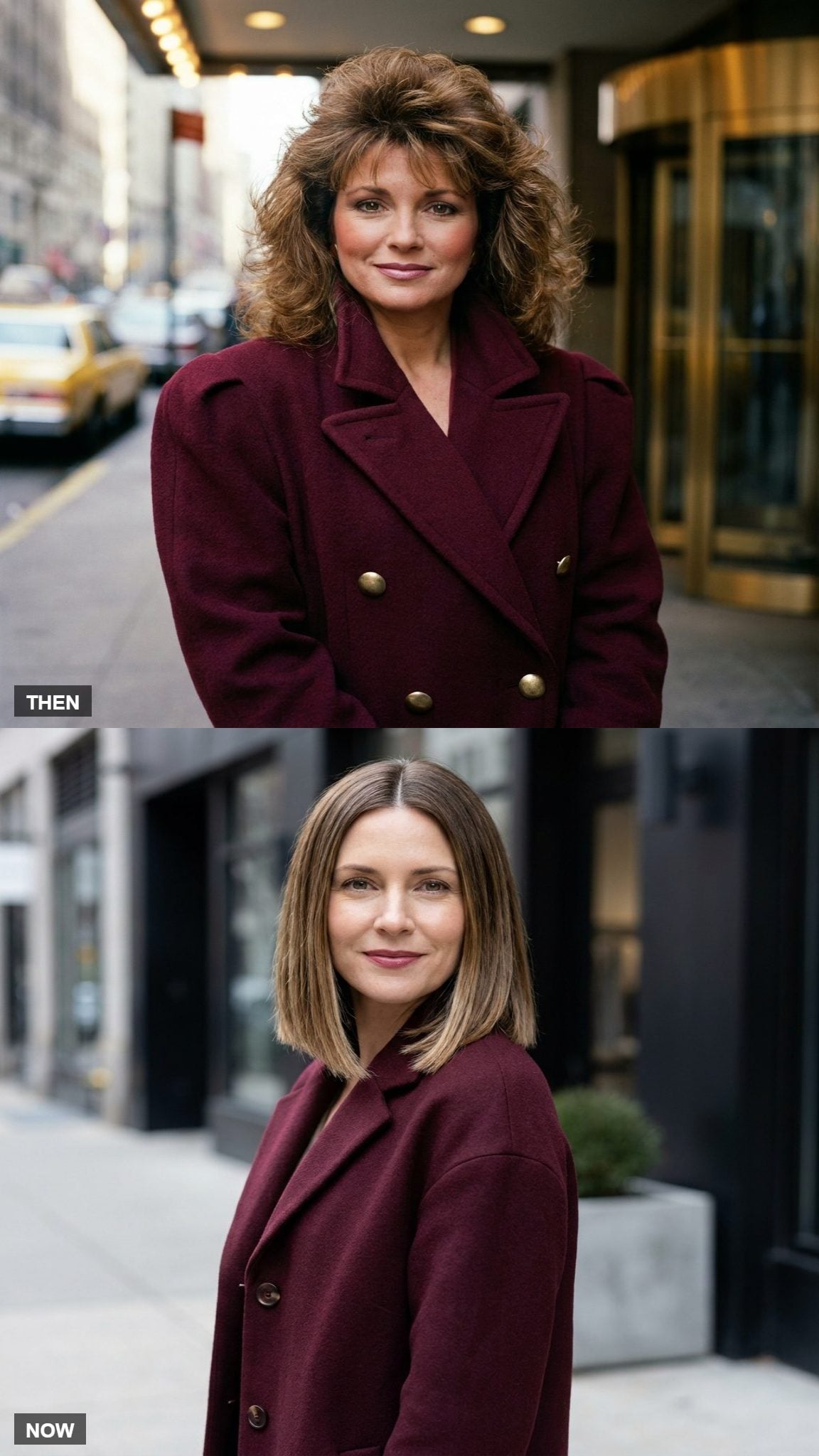
The dramatic 1980s shoulder was not only about padding. Placement mattered. A seam could sit beyond the actual shoulder joint, letting the sleeve fall from a wider point and making even a straightforward wool coat look broader and more formal.
Today’s tailoring has more options. A set-in sleeve can sit cleanly at the shoulder, while deliberately dropped seams create softness rather than authority. Same piece of construction, entirely different message. Sometimes fashion history is hiding in an inch of fabric.
5. The Buckle Was Large Enough to Negotiate Its Own Contract
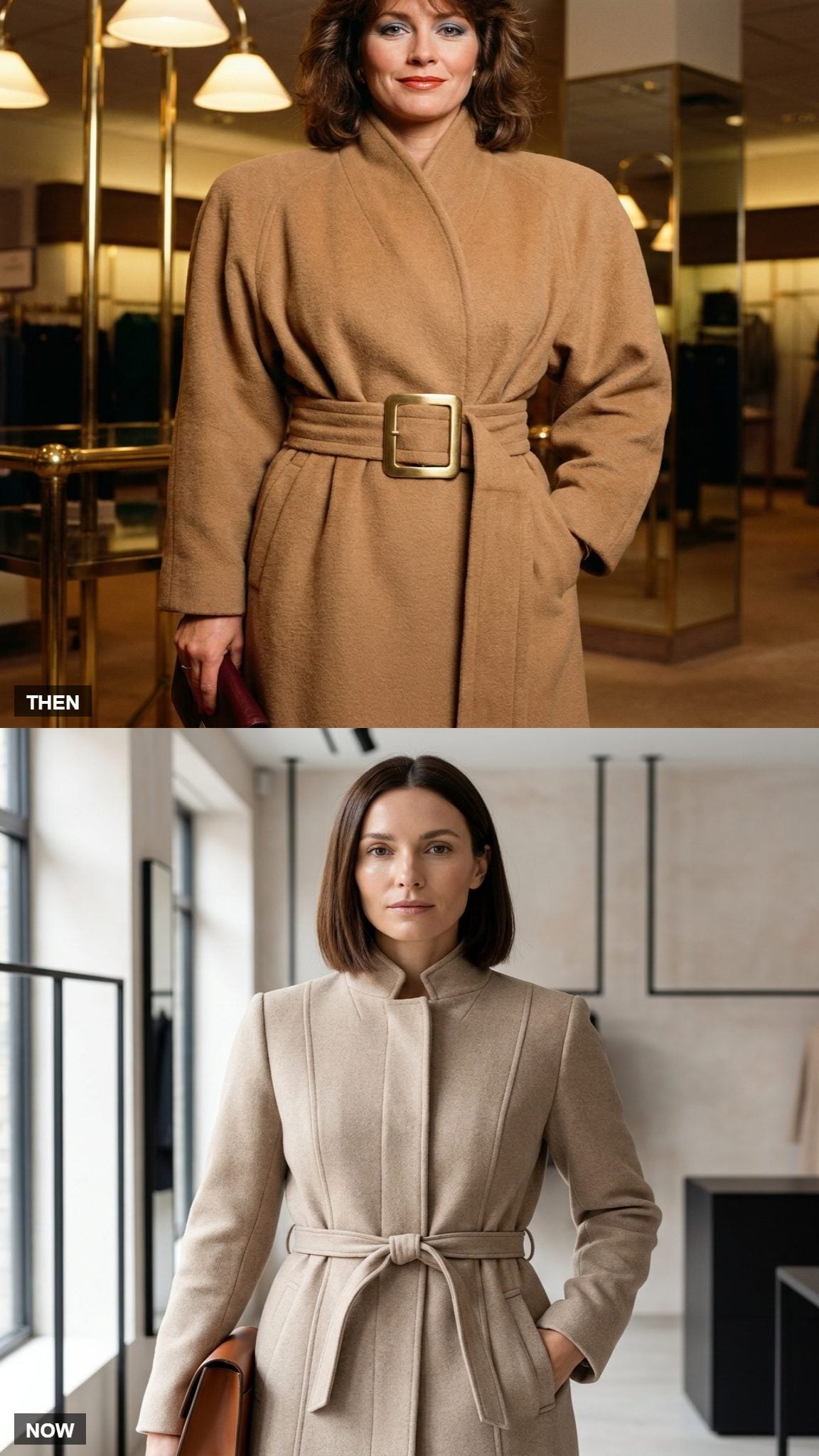
Forget the belt for a moment and look at the hardware. Mid-1980s outerwear could put a substantial buckle at the center of the coat and expect it to behave like jewelry, focal point, and fastening device all at once.
Modern hardware tends to shrink, disappear under self-fabric ties, or match the coat closely enough that you stop noticing it. The older buckle wanted credit for the entire silhouette. The new one is lucky if anyone remembers it was there.
4. Color Theory, 1985 Edition: Subtle Was Not the Assignment
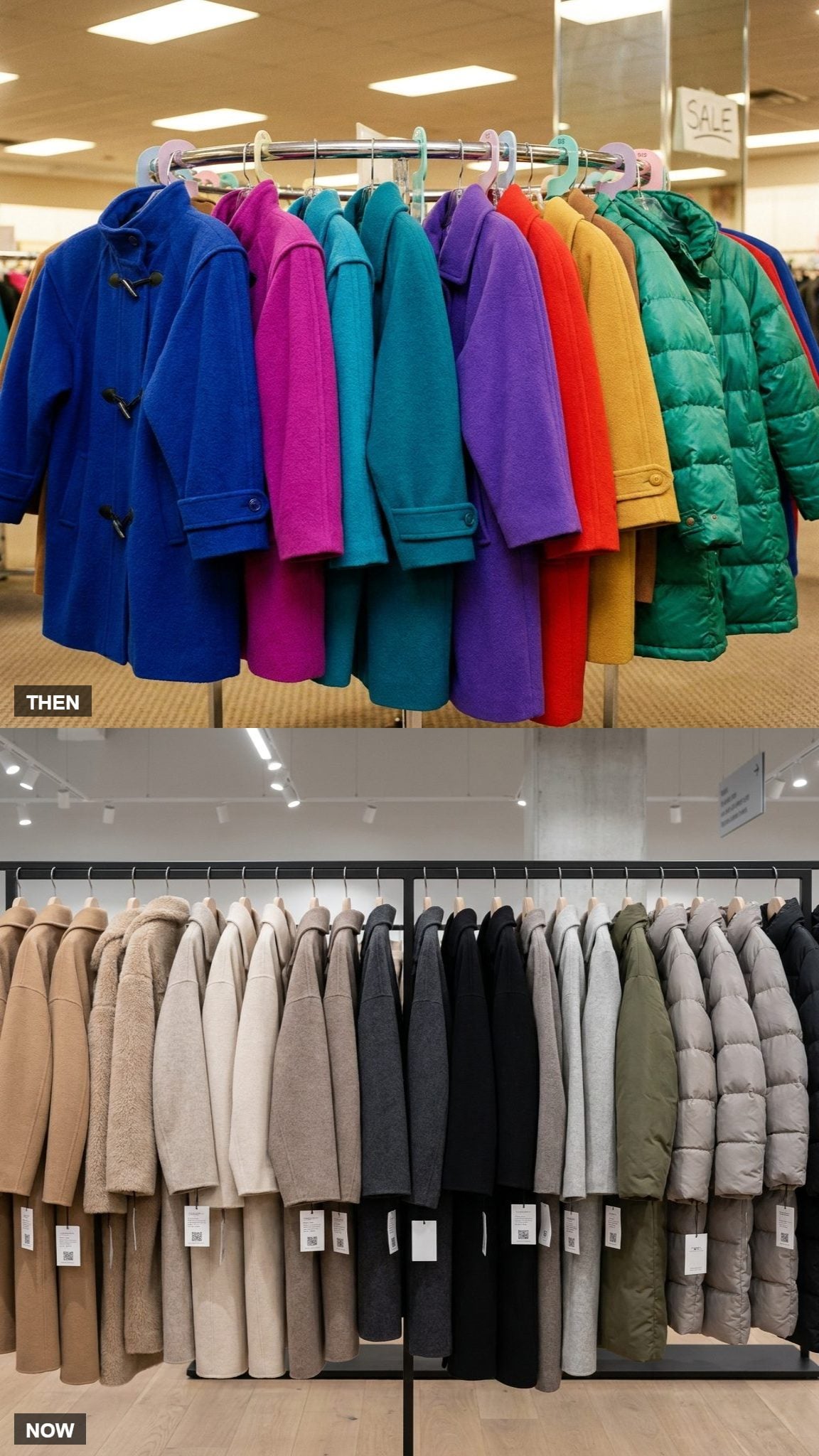
Cobalt. Magenta. Saturated teal. Bright red. The 1980s winter coat was perfectly willing to become the loudest thing in a gray parking lot. Color did not have to behave like a neutral just because the garment was expensive.
Today’s racks devote far more acreage to camel, oatmeal, black, charcoal, chocolate, and olive. Versatile, certainly. Easier to fold into a small wardrobe, absolutely. But something undeniably entertaining got quieter in the exchange.
3. The Printed Lining Saved Its Wildest Behavior for Indoors
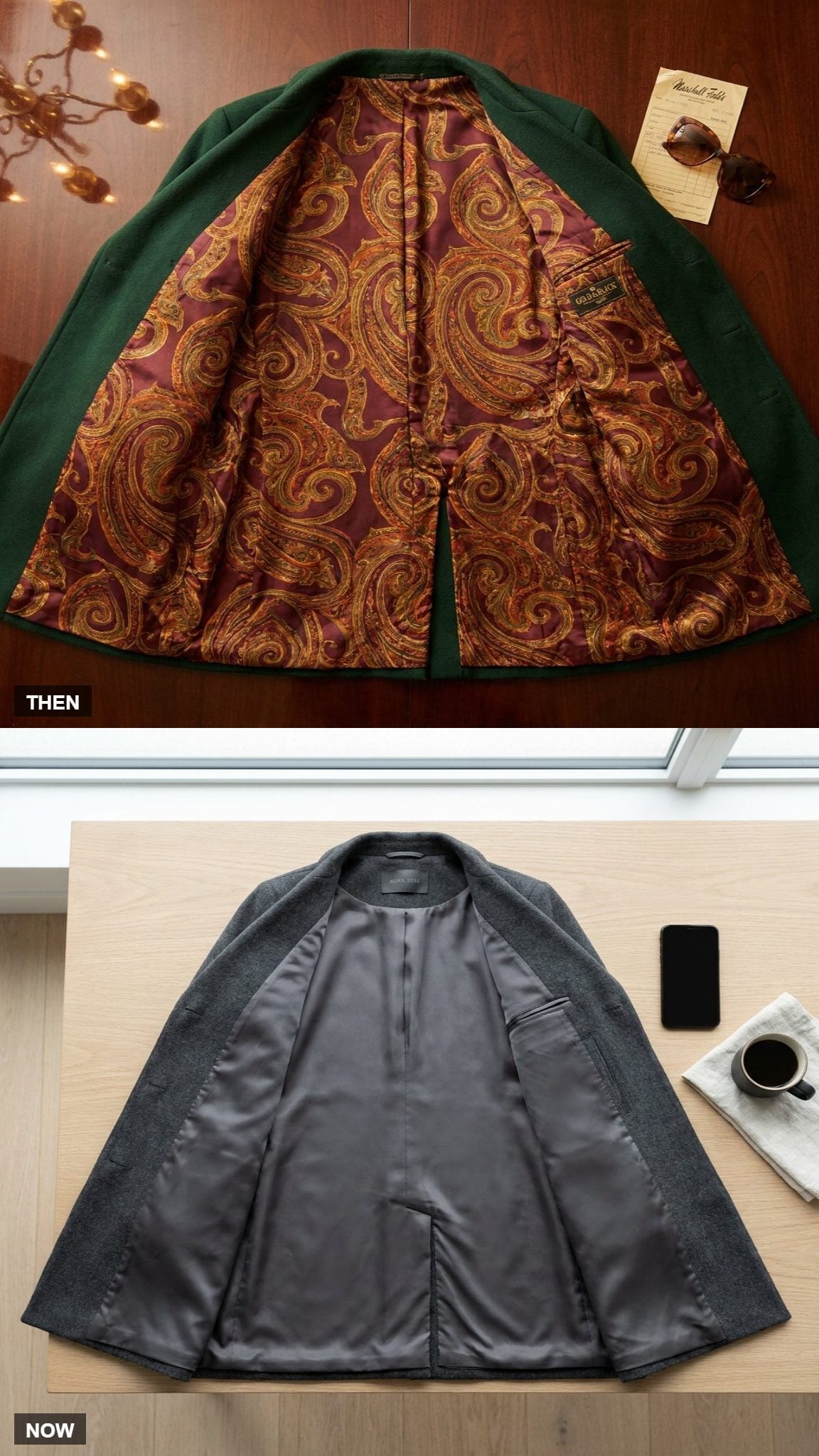
A forest-green wool coat could look completely respectable from the outside and then flash burgundy, gold, rust, paisley, or some geometric situation the moment it opened. The lining was private decoration, which may be why designers allowed it to behave so badly.
Modern linings are more often tonal, monochromatic, or quietly branded. Cleaner, yes. But the hidden print gave an otherwise serious coat one detail that belonged entirely to the wearer. Nobody on the sidewalk needed to know it was there.
2. The Fur Collar Came Back With a Sense of Humor
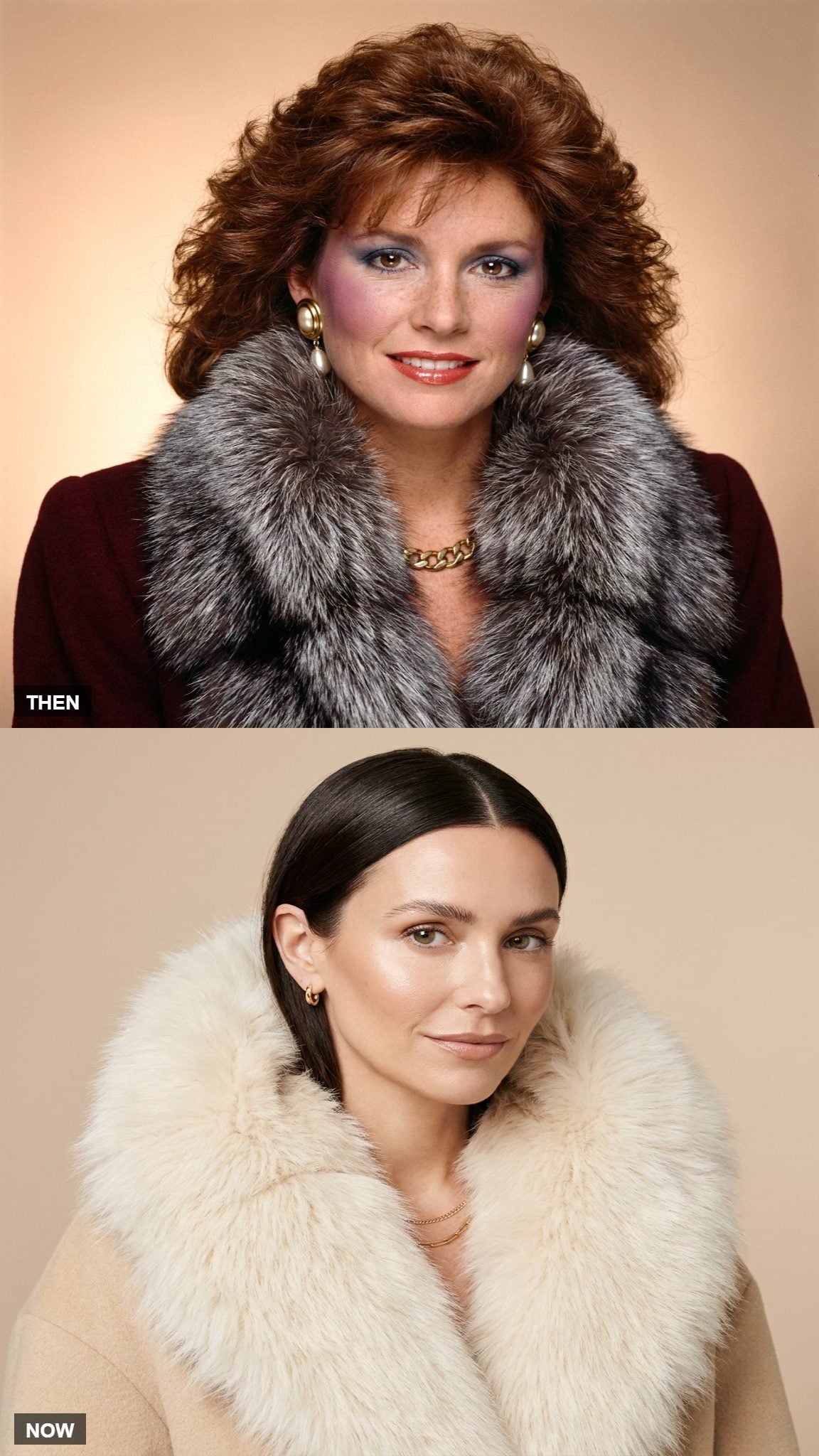
The 1985 fur collar was a declaration. Wide, dense, and visible from across the parking lot, it framed the face with an energy that said I have arrived somewhere, even if it’s only the mall.
What feels different in contemporary versions is the scale becoming playful again. Oversized faux trim, detachable pieces, and deliberately exaggerated collars can be added to an otherwise very simple coat. Instead of pretending the fur is natural or discreet, the contrast can be the whole joke.
1. The Length That Settled Every Argument — and Then Stopped Having To
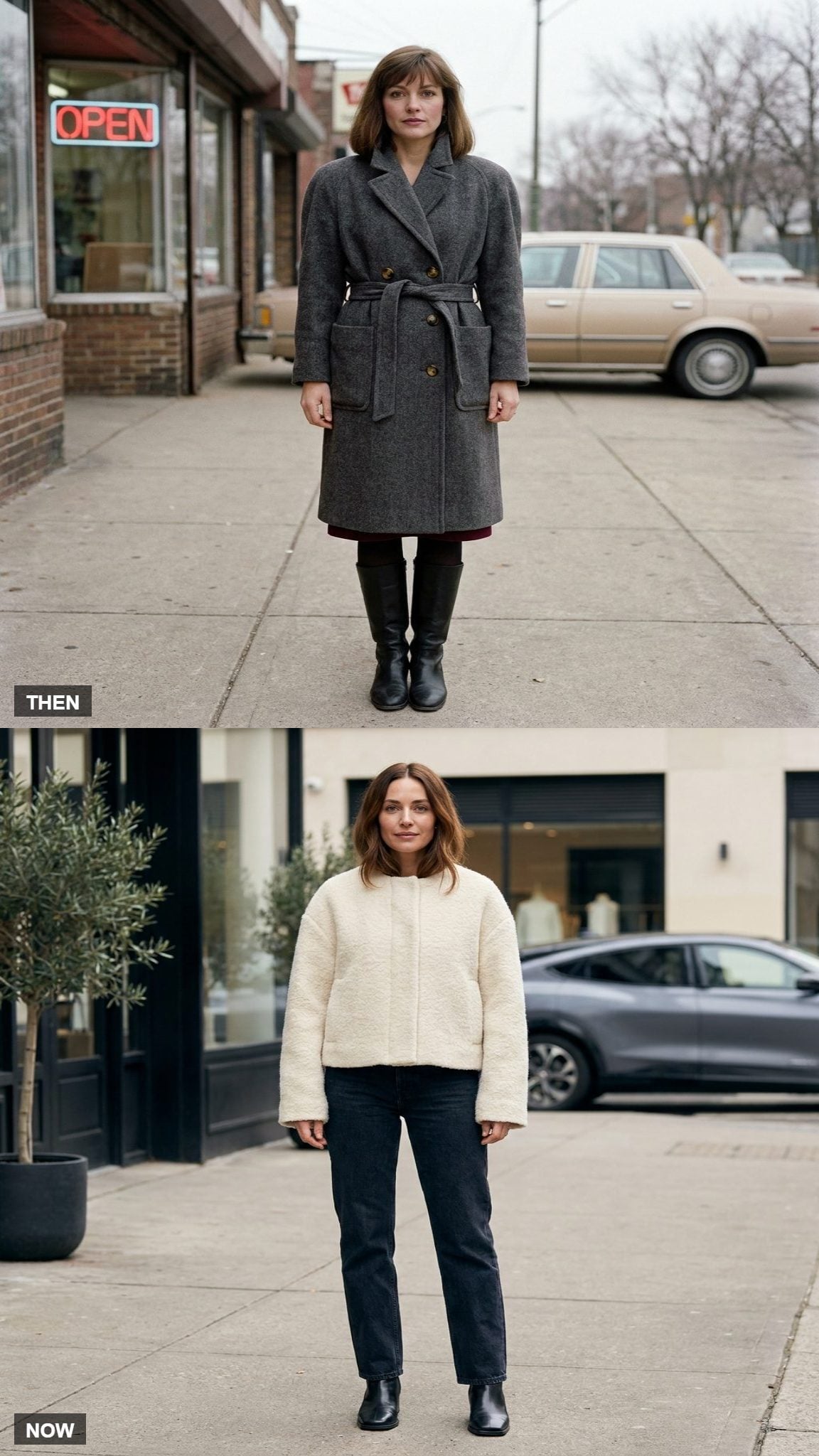
Winter 1985 loved a coat that covered the outfit almost completely. Mid-calf and lower lengths created one continuous outer silhouette, meaning whatever was happening underneath remained classified information until you got indoors.
The 2020s treat the hem as another styling decision. Cropped coats reveal trousers and skirts. Knee-length versions divide the outfit differently. Long coats still bring drama, but they no longer automatically outrank shorter ones.
That may be the biggest change running through all 24 comparisons. The 1985 coat wanted to be the outfit. The modern coat is much more willing to let everything underneath have a speaking part.