
❤️ Would you like to save this?
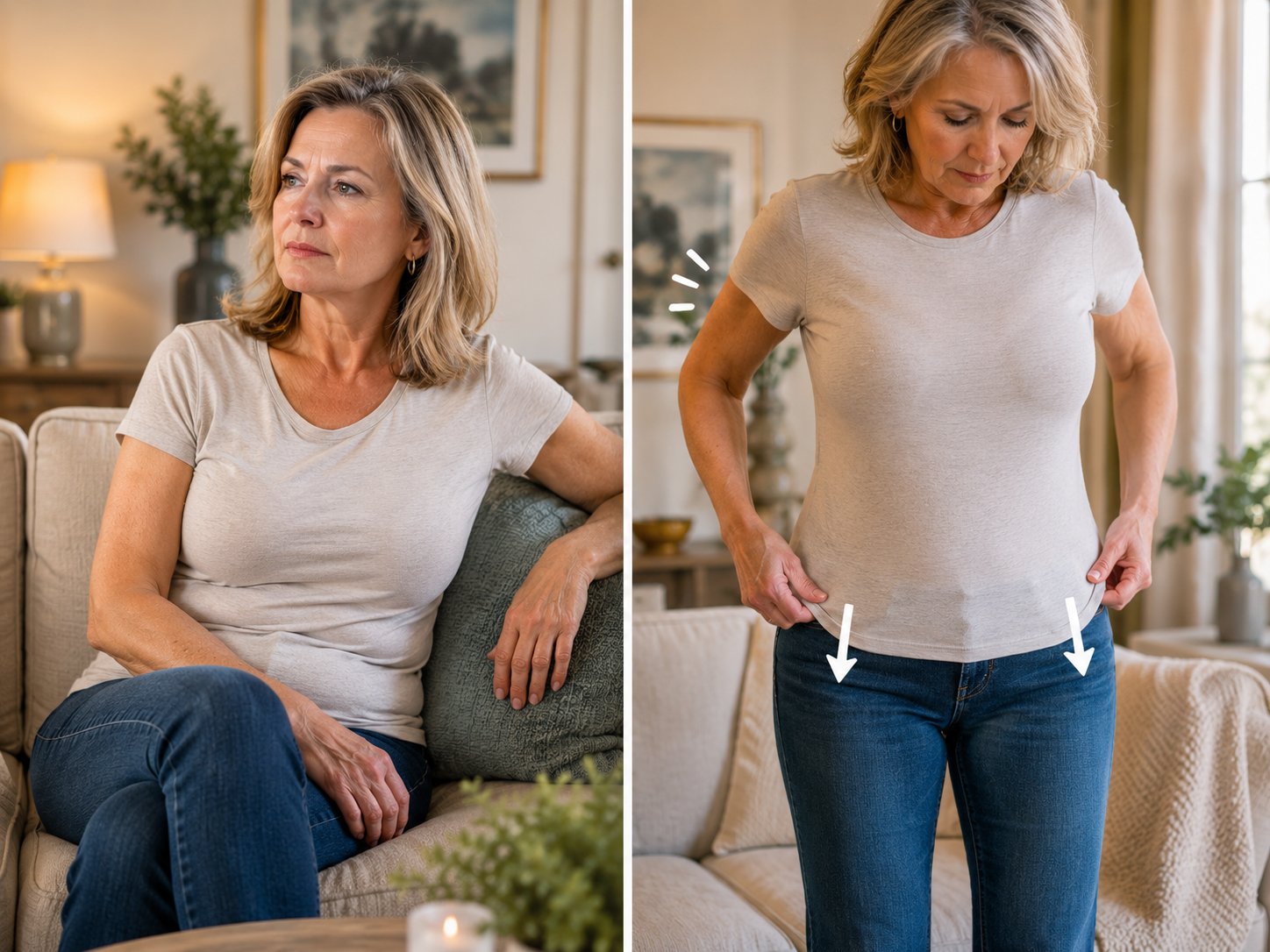
Watch a woman rise from a restaurant chair. Before she’s fully upright, both hands sweep down to the hem of her shirt and give it a little tug. She didn’t decide to do it. She doesn’t remember doing it. She’ll do it again the next time she stands, and the time after that.
It looks like nothing. A reflex, a fidget, a habit not worth a second thought. But this half-second move is one of the most revealing gestures a body can make, and it’s carrying decades of information about self-image, memory, and a mirror only she can see.
So what’s really happening in that pull? Why does it fire before conscious thought? And why do women over 50 do it more, not less? The answer sits somewhere between neuroscience and a fashion moment from 1997, and it’s stranger than you’d guess.
FYI, thanks to AI imagery software, we’re able to create very specific fashion and hairstyle examples to illustrate the points being made. In some cases, imagery is exaggerated to hammer home the point. Also, assume links that take you off the site are affiliate links such as links to Amazon. this means we may earn a commission if you buy something.
The 200-Millisecond Habit You’ve Never Once Decided to Do

Nobody wakes up and adds “tug shirt hem when standing” to the day’s list. The hand does it on its own. You rise from the restaurant booth, the church pew, the office chair, and before your knees are fully straight, your fingers have already found the fabric and pulled it down over your hips.
That’s not a choice. That’s a program running underneath choice. Psychologists call it procedural memory, the same system that lets you tie a shoe or ride a bike without narrating a single step. (Source). The tug got repeated ten thousand times. It stopped needing you.
Which raises the real question. A gesture this automatic didn’t install itself. Something taught your hands to guard your hips every time you change height. And whatever that something was, it’s still giving orders.
The Mirror in Your Head That Nobody Else Can See

Here’s a strange fact about the tug. You do it even when there’s no mirror in the room. No one is looking. The gesture fires anyway, because you’re not checking the shirt against reality. You’re checking it against an image that lives inside your own skull.
That inner image has a name in psychology: self-objectification. It’s the habit of watching yourself from the outside, as if a camera hovered over your shoulder recording how you look. (Source).
So the tug isn’t about the fabric. It’s you adjusting the picture in the imaginary mirror. The catch is that the woman in that mirror is often years out of date, and far harsher than any stranger would ever be.
Why Your Hands Reach for the Hem Before Your Brain Catches Up

Timing is the tell. If the tug were a decision, there’d be a gap. A flicker of thought, then the movement. There isn’t. The hands move first, and awareness, if it arrives at all, arrives late, like a manager showing up after the work is already done.
That order of operations points to implicit memory, the unconscious system that runs sensorimotor behavior we typically never notice. (Source). Your fingers are executing an old instruction, not responding to a present threat.
The One Moment of Transition That Undoes Every Woman’s Confidence

Sitting feels safe. Standing feels exposed. The tug lives precisely in the crack between them, in the two seconds of transition when the body reorganizes itself and, for a beat, feels unaccounted for.
There’s a reason vulnerability spikes right there. The spotlight effect, our tendency to wildly overestimate how much others notice us, gets stronger the more exposed we feel. (Source). Standing up is a small piece of theater. You leave one posture, take the floor, and for a moment believe the room turned to watch.
It didn’t. But the belief is enough to send the hands to the hem.
What the Body Learned in 1997 and Never Unlearned

The gesture is older than the shirt you’re wearing. It was trained decades ago, in a specific cultural climate, and the training stuck long after the climate changed.
Consider what those decades taught. Women’s clothing was treated as a symbol of morality and character (Source). A generation absorbed the lesson that the body was always potentially on display and therefore always in need of managing.
The magazines from that era are gone. The message got wired into muscle. And procedural habits, once learned, are famously durable.
The Invisible Audience That Follows You Out of Every Chair

You know the feeling of walking into a room and sensing every head turn. It’s vivid, physical, almost warm on the back of your neck. It’s also, most of the time, a fiction your brain wrote.
The classic demonstration is almost funny. Students forced to wear an embarrassing T-shirt wildly overestimated how many people noticed (Source). The audience they feared was mostly staffed by their own imagination.
Your hem-tug plays to that same phantom crowd. The people in the actual room are busy tugging their own shirts, worrying about their own invisible audience.
Why the Fabric Feels Like It’s Betraying You the Second You Move
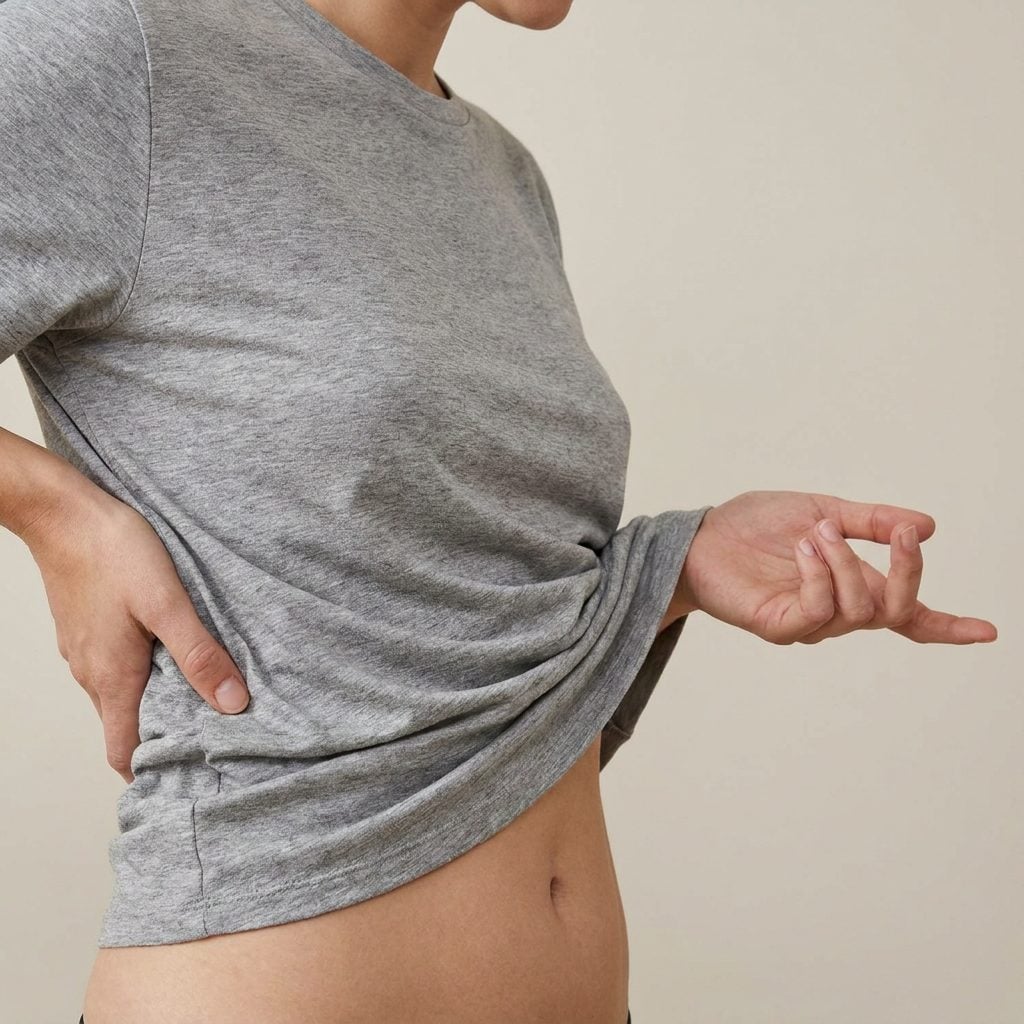
Some tops earn the tug. You sit, the fabric rides, the hem creeps, and standing feels like a small negotiation with a garment that won’t hold its ground. That’s not paranoia. That’s poor engineering, and your nervous system is reacting to a real signal.
Tight and clinging fabric changes how you feel about your body in the moment, not just how you look. (Source). The clothing itself pulls attention onto the body and keeps it there.
A ribbed top that grips the ribcage, a thin jersey that maps every contour, a hem cut just short enough to migrate. These are the garments that keep your hands on high alert. Fix the fabric and you quiet the reflex. A slightly heavier shirt with body and a hem that stays put does more for peace of mind than any amount of talking yourself out of the tug. Look for a structured cotton top or a longer-line merino wool tunic that holds its line when you move.
The Difference Between a Shirt That Covers and a Shirt That Reassures
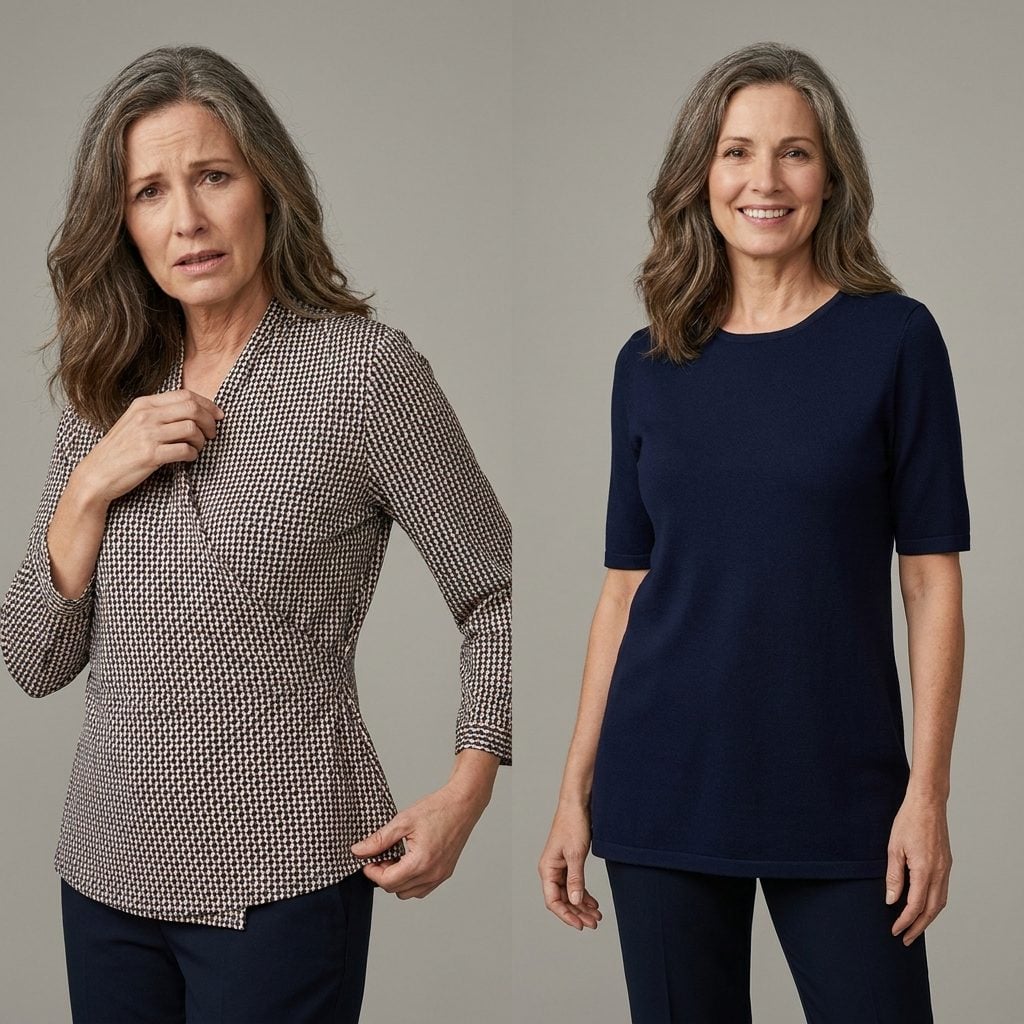
Two tops can cover the exact same square inches of skin. One sends your hands to the hem all day. The other, you forget you’re wearing. The difference isn’t coverage. It’s whether the garment makes you feel like someone with things to do, or someone being looked at.
This is where the psychology turns useful instead of just interesting. Clothing doesn’t only affect how others read you. It changes how you think and carry yourself. Psychologists call this enclothed cognition (Source). A top that stays put, sits right, and asks nothing of you frees the attention that the tug keeps hijacking.
The fix was never willpower. Stop trying to un-learn a reflex that took thirty years to build. Change the garment instead. Buy the one you don’t have to manage. That’s the whole trick, and by fifty you’ve earned the right to dress for your own comfort and no one else’s imagined opinion.
The Silhouette Anxiety That Peaks at the Exact Wrong Second

Watch the moment closely. Seated, the shirt sits fine. Then the body rises, gravity does its thing, fabric shifts, and the hand goes down before the brain even asks. It’s not vanity. It’s a brief spike of what researchers call habitual body monitoring, and standing up is the trigger.
Here’s the strange part. The transition is the danger zone, not the destination. Sitting, you’re settled. Standing, you’re settled. But the two seconds between them are when the silhouette changes shape without permission, and the internal observer flags it. Objectification theory calls this the observer’s perspective: women learn to watch their own bodies from the outside, as something to be looked at and evaluated. Source
A study of women aged 40 to 87 found that body surveillance stays remarkably steady across the decades, though its emotional grip loosens a little with age. Source So the tug is old muscle memory. The good news buried in that data is that it holds you less tightly now than it did at 30.
Why ‘Comfortable’ and ‘Safe’ Are Two Completely Different Feelings

A shirt can fit perfectly and still feel wrong. That’s the distinction most people never name. Comfortable is the fabric. Safe is the mind. One is about how a garment touches your skin. The other is about how it stands between you and being looked at.
The nervous system is always running a quiet background scan, reading the body for cues of threat or ease. (Source) A soft shirt in a forgiving cut can pass the physical test and fail the psychological one, because the second concern isn’t texture. It’s exposure.
Anxiety is largely social. It’s the low hum of wondering how you’re being perceived. Personal style can quiet that hum by reinforcing a sense of authenticity and control. Source The reach for the hem is a bid for that control. A drape of fabric becomes a small, portable shield.
This is why two women can wear the identical ivory linen shirt and only one keeps tugging. Same comfort. Different sense of safety. The garment isn’t the variable. The internal weather is.
The Self-Surveillance Loop That Runs on Autopilot All Day
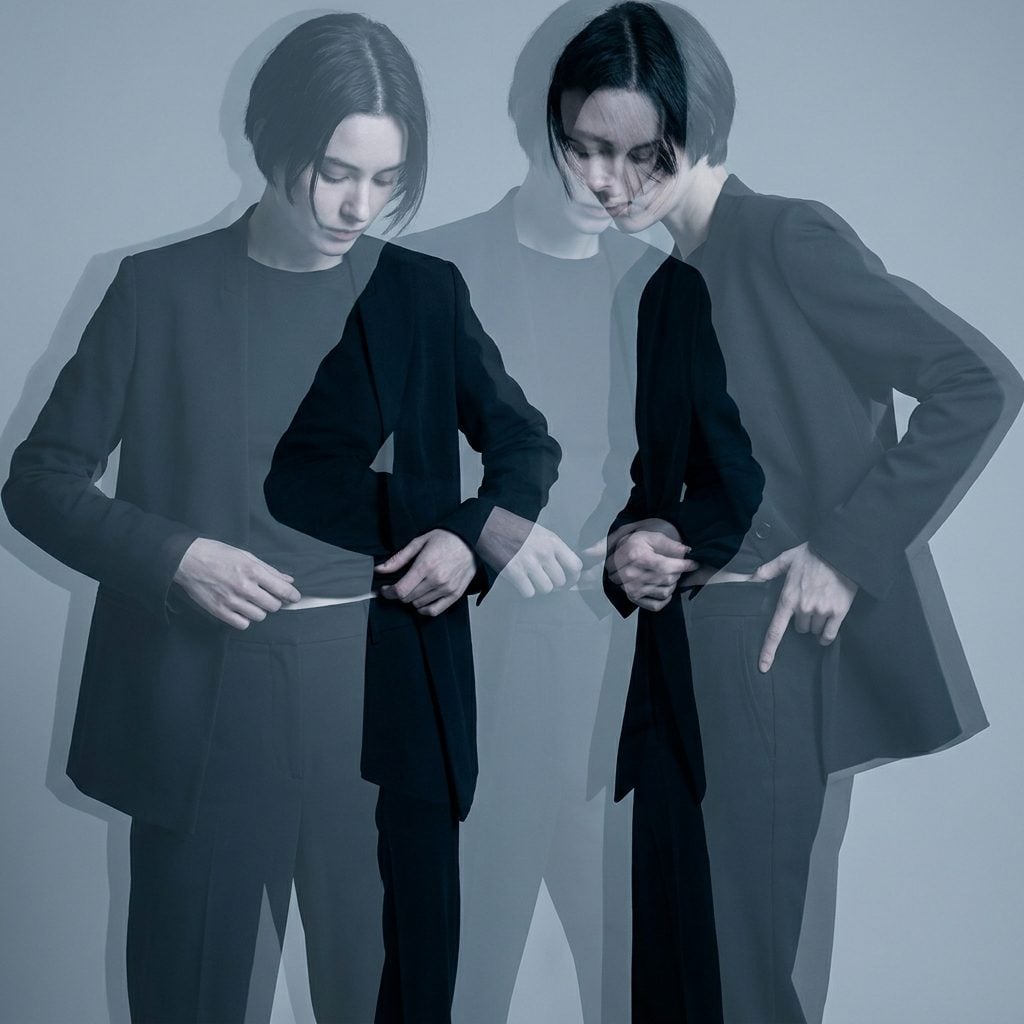
Count the times in one afternoon your hand drifts to your hem, your waistband, the seam at your hip. You’ll lose track. That’s the point. Psychologists have a name for the mental habit underneath it: body surveillance, the low hum of monitoring how you look from the outside, as if a stranger were watching over your shoulder.
It comes from what researchers call objectification theory. Living in a culture that constantly evaluates women on appearance, women learn to view their own bodies from an outside observer’s perspective (Source). One of the standard survey items measuring it is blunt: during the day, I think about how I look many times.
The shirt tug is that thought made physical. A tiny course-correction, fired off before you’ve even registered wanting to make it. By 50 you’ve been running the loop for decades. The hand knows the route by heart.
The One Wardrobe Detail That Quietly Ends the Whole Habit

Fit does what willpower can’t. You can tell yourself to stop fussing all day and lose by lunch. Change what you’re wearing and the hand simply has nothing left to do.
Here’s the mechanism. When clothing fits and feels right, you settle. Research points to what some call enclothed harmony, where your brain spends less energy on physical discomfort (Source). A hem that lands where it should when you sit. A waistband that doesn’t migrate when you stand. Nothing to fix, so nothing gets fixed.
The garment that tends to end the tugging is a longer, slightly structured top or tunic cut to skim rather than cling. A crisp shirt with real body to the fabric. Look for a longline structured tunic top or a ponte longline top that holds its shape through movement. The fabric stays put on its own. Your hands get the day off.
What Actually Happens in Your Brain When You Feel ‘On Display’

❤️ Would you like to save this?
Stand up in a crowded room and it can feel like a spotlight swings toward you. Everyone clocking the top that rode up, the outline of your midsection, the thing you were sure would go unnoticed sitting down.
Almost none of it is real. There’s a famous experiment for this. Cornell researchers had students walk into a room wearing an embarrassing T-shirt, then overestimated how many observers would notice and recall the shirt (Source). They named it the spotlight effect.
Why the gap? Because you are the permanent center of your own experience, so you assume everyone else is paying as much attention to you (Source). They don’t. They’re busy managing their own spotlight.
The feeling of being on display is your brain’s math error. The shirt tug is you responding to an audience that mostly isn’t watching.
The Gesture That Signals Something Deeper Than a Wrinkle

Watch anyone waiting for test results. The hand rubbing, the sleeve straightening, the collar adjusting. Body language researchers call these adaptors, and they’ve been studied for decades.
They’re not about the clothes. Adaptors are movements that signal internal states like anxiety (Source). The straw you peel, the pen you click, the hem you smooth. Same family of gesture, different prop.
There’s a soothing function underneath it too. When we’re stressed, we use self-soothing touches like hand rubbing to calm our anxieties (Source). Tugging your shirt is partly a self-hug you don’t notice giving.
So the gesture is honest, even when the wrinkle is imaginary. It’s not reporting a fashion problem. It’s reporting a feeling. Which means the fix was never really about the fabric.
How to Get Dressed So Your Hands Have Nothing to Fix

Dressing on purpose beats dressing on hope. The morning you throw on whatever’s clean and spend all day negotiating with it, you’ve handed the day to your nervous hands.
Start with the science of what clothes do to your head. In the study that launched the whole field, participants who wore a white lab coat they believed signaled carefulness performed better on tasks requiring attention and carefulness (Source). What you put on becomes what you feel.
Build outfits that stay put through real movement. Test them sitting, standing, reaching.
- Choose weightier fabrics that hold their line: ponte, structured cotton, a substantial blue shirt with body to it.
- Pick tops long enough to stay covered when you rise. A merino longline cardigan settles the whole equation.
- Anchor with a waistband that doesn’t shift, in a high-rise tailored trouser.
Get the fit right at the mirror and you close the argument before it starts. Then walk out and forget you’re wearing anything at all. That’s the whole trick.
The Bottom Line
The move is this: the two-handed tug that pulls the hem of your top down over your hips the instant you stand up from a chair. It’s a reflex built from decades of catching yourself in mirrors and imagining how you look mid-transition, and your hands do it before you’ve consciously felt a thing. The next time you feel your fingers reach for that hem, pause for one second and notice it, because a habit you can see is a habit you finally get to choose.