
❤️ Would you like to save this?
There was a time when an airline ticket came with an unspoken dress code. Gloves were immaculate, hats were carefully chosen, and a tailored skirt suit could look entirely at home beside a departure board. The airport wasn’t merely somewhere you passed through. It was somewhere you expected to be seen.
Then came the great loosening. Hemlines shifted, trousers replaced skirts, sneakers conquered the concourse, and the elaborate business of looking respectable gave way to something considerably easier to sit in. Along the way, fashion gained freedom but occasionally misplaced a little of its nerve.
Yet the old glamour never disappeared completely. Look closely at today’s best travel outfits and you’ll find the same clever proportions, striking colors, and disciplined tailoring that made midcentury airport dressing so memorable. The difference is in what women are willing to put up with to achieve the effect.
Across these 34 then-and-now comparisons, the transformation is sometimes dramatic, sometimes no more than a change of fabric or footwear. Either way, the clothes tell a fascinating story about what happened when air travel stopped being a special occasion and became part of ordinary life.
FYI, thanks to AI imagery software, we’re able to create very specific fashion and hairstyle examples to illustrate the points being made. In some cases, imagery is exaggerated to hammer home the point. Also, assume links that take you off the site are affiliate links such as links to Amazon. this means we may earn a commission if you buy something.
34. The Navy Skirt Suit Gives Up Its Strict Dress Code
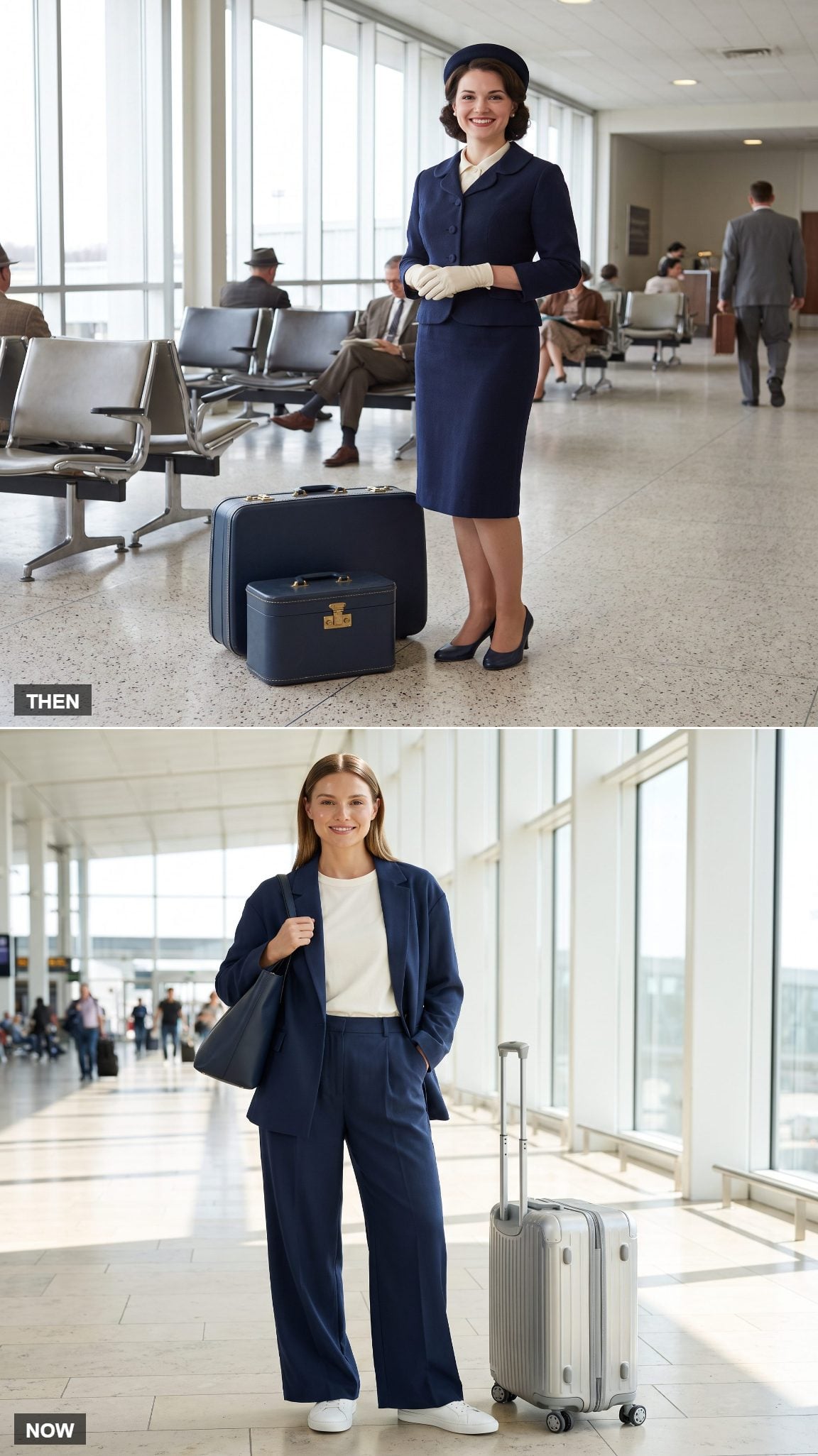
The vintage navy suit is a master class in keeping everything under control. A defined waist, precisely shaped collar, below-the-knee pencil skirt, and matching pumps establish an unmistakably formal silhouette. Gloves supply the finishing flourish. Even the restrained navy-and-ivory palette seems determined not to put a foot wrong.
Now the skirt gives way to wide-leg trousers, the tailored jacket relaxes, and white sneakers replace the pumps. What survives is the color combination and the instinct for looking composed. The modern outfit has considerably more room to move, but its clean lines make the old-fashioned polish recognizable.
33. The Red Box Jacket Finds an Unexpected Partner in Denim
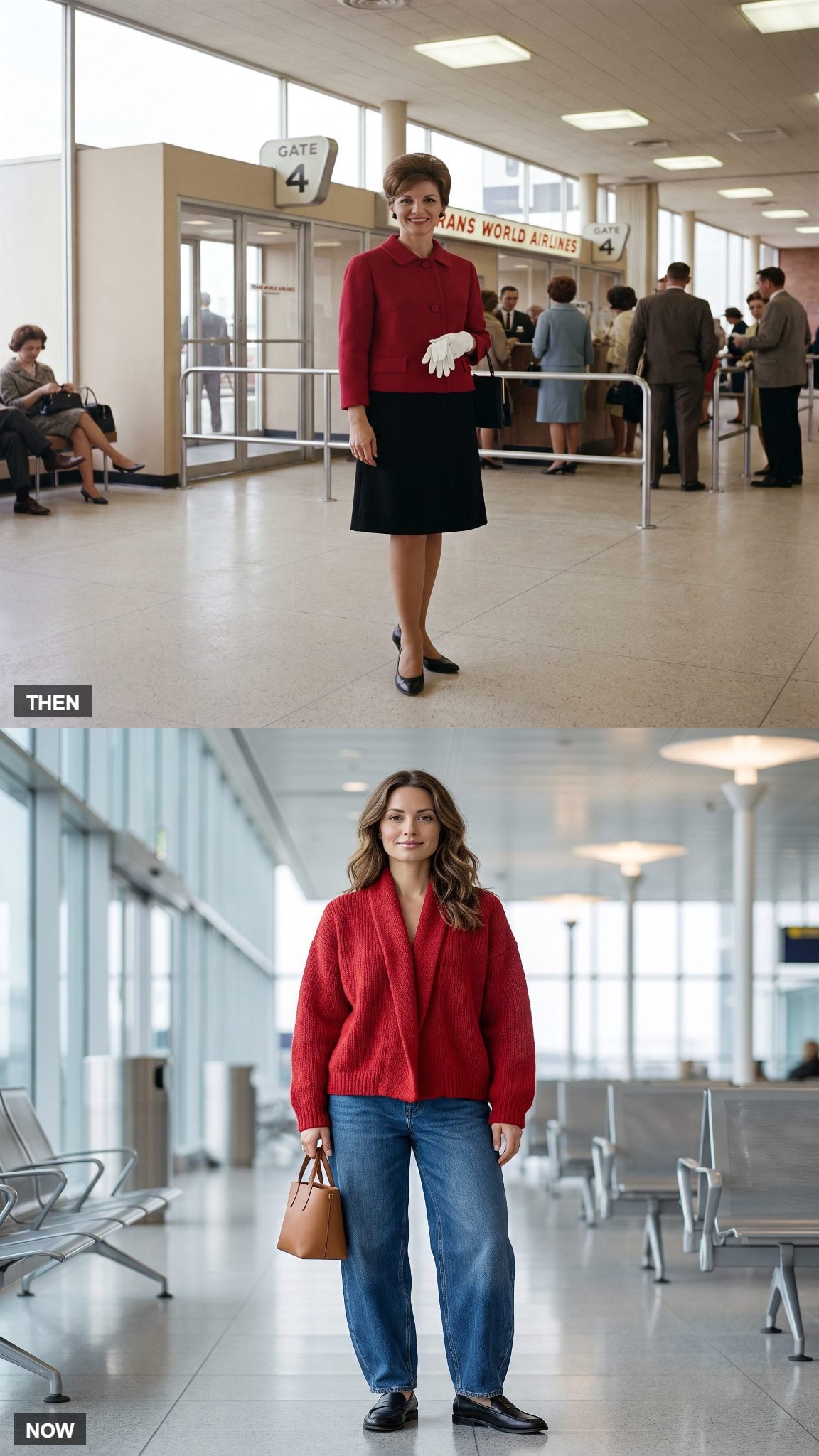
Cherry red doesn’t believe in making a discreet entrance. The vintage box jacket, with its squared-off shape and bracelet-length sleeves, puts the color squarely in charge. A dark skirt supplies the necessary restraint, while the short jacket creates that unmistakably crisp midcentury proportion.
The contemporary version takes a delightful detour through denim. A softer red jacket meets curved barrel-leg jeans, with black leather loafers keeping the outfit from becoming too casual. The silhouette is less formal, but the combination of vivid color and carefully controlled volume remains wonderfully assertive.
32. The Swing Coat Trades Its Grand Entrance for a Softer Shape
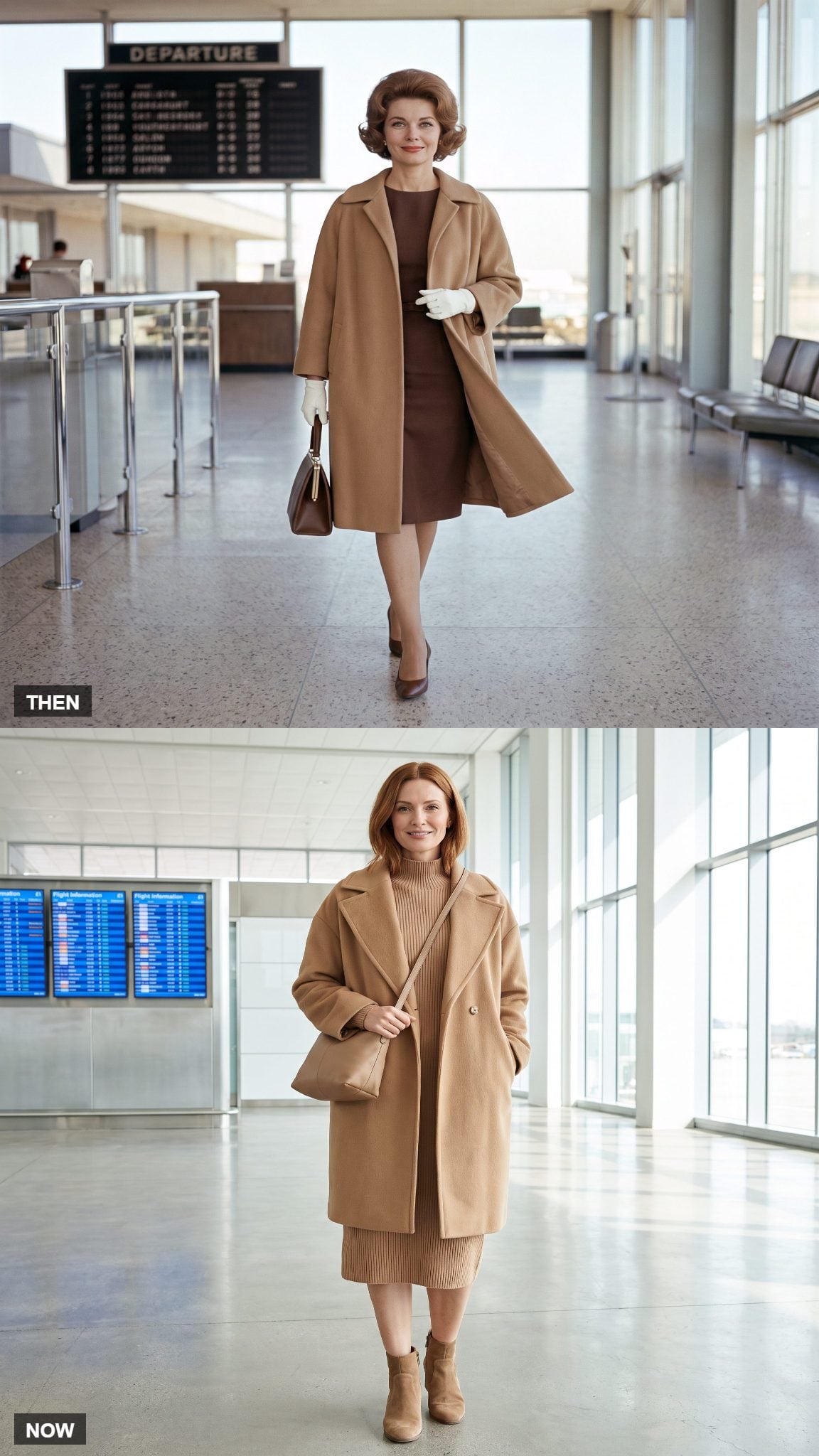
Few coats understand the value of an entrance quite like a swing coat. The vintage camel version flares generously from the shoulders, its moving hem providing all the drama a narrow chocolate dress could possibly need. The contrast between the two silhouettes is the secret to its elegance.
Today’s camel cocoon coat redistributes that volume, curving around the body rather than sweeping outward at the hem. A streamlined sweater dress and flat ankle boots complete the update. The old coat wanted room to make an impression. The new one makes its point without demanding quite so much floor space.
31. Powder-Blue Mod Dressing Learns to Move Differently
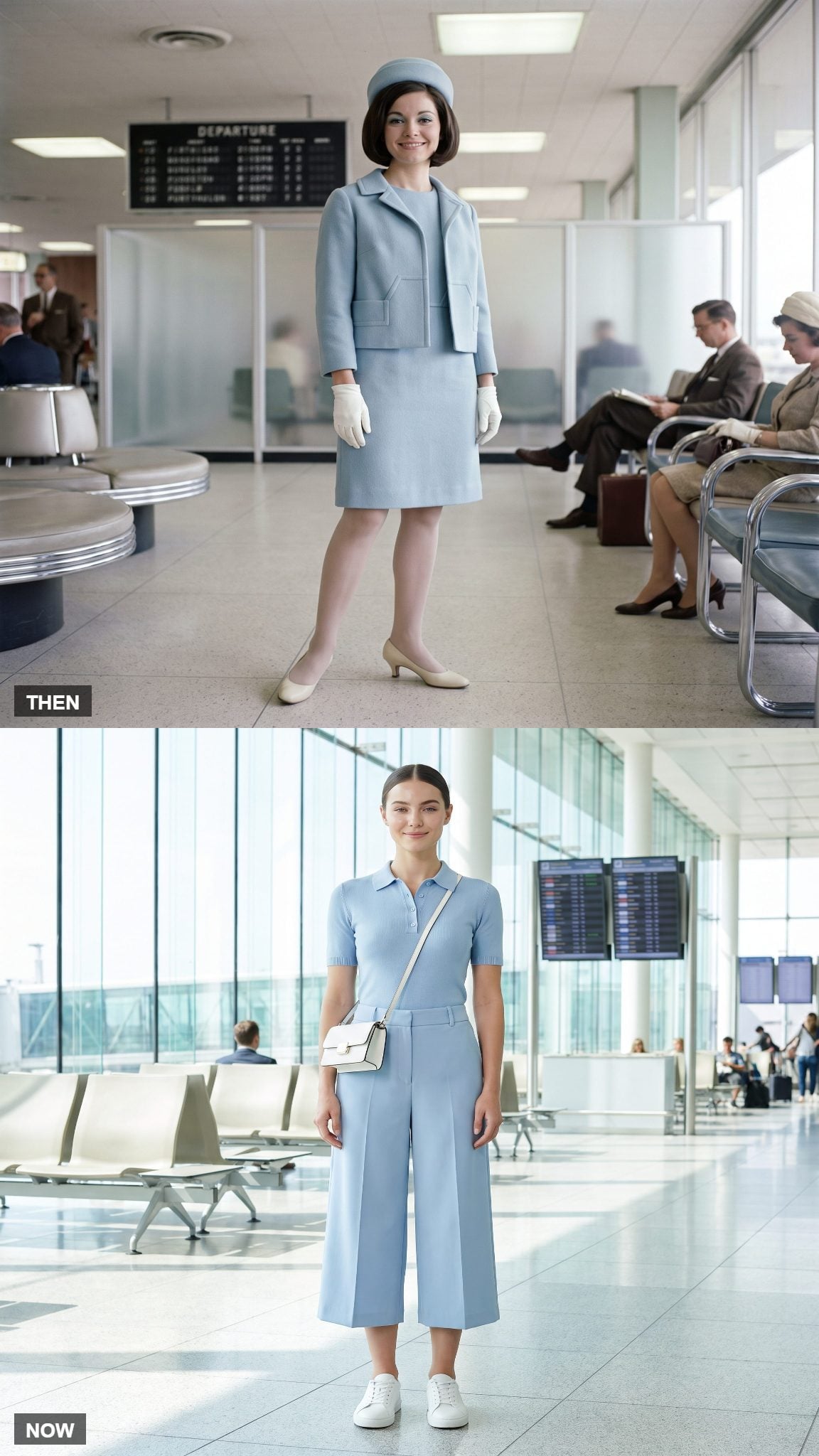
Powder blue, geometric simplicity, and a pillbox hat: the vintage outfit has all the visual confidence of the 1960s at their most architecturally minded. The shift dress and cropped coat establish a neat, almost graphic silhouette, with little need for ornament.
In the modern interpretation, a knit polo and A-line culottes take over. The pale blue remains, but the rigid little dress becomes two pieces with a more fluid relationship to the body. The culottes introduce movement where the original relied on precision, proving that a restrained color can accommodate an entirely different shape.
30. The Polka-Dot Dress Breaks Up Its Perfect Match
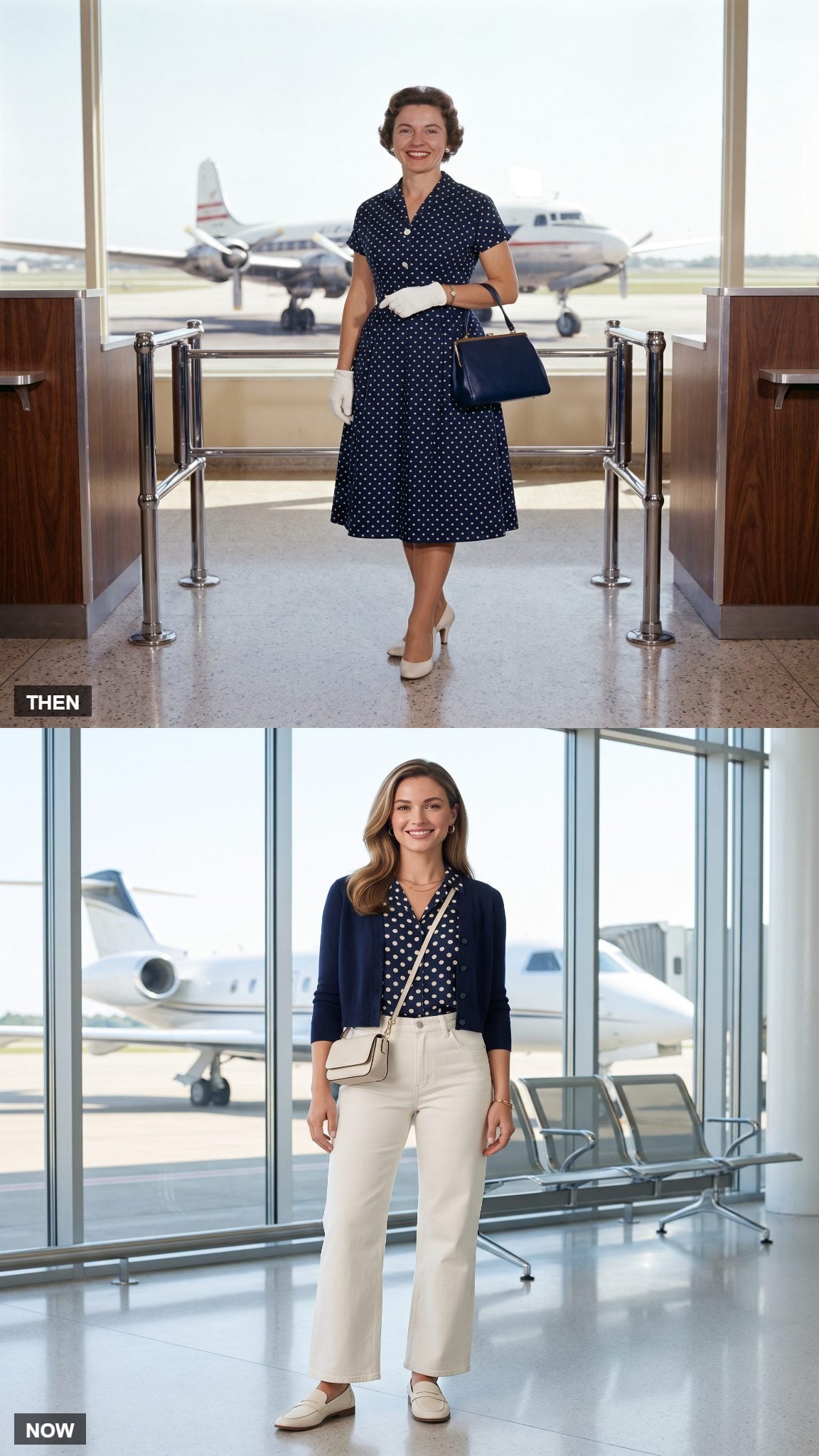
Navy and ivory polka dots give the vintage dress its cheerful authority. The fitted waist and flared skirt keep the print orderly, while gloves complete an outfit in which every component seems to have been chosen together.
The contemporary look separates the pattern from the silhouette. A polka-dot blouse sits beneath a cropped navy cardigan, while ivory wide-leg jeans introduce a fresh, expansive shape. The dots still have personality, but they’re no longer responsible for carrying the entire outfit.
29. Safari Tailoring Leaves the Matching Set Behind
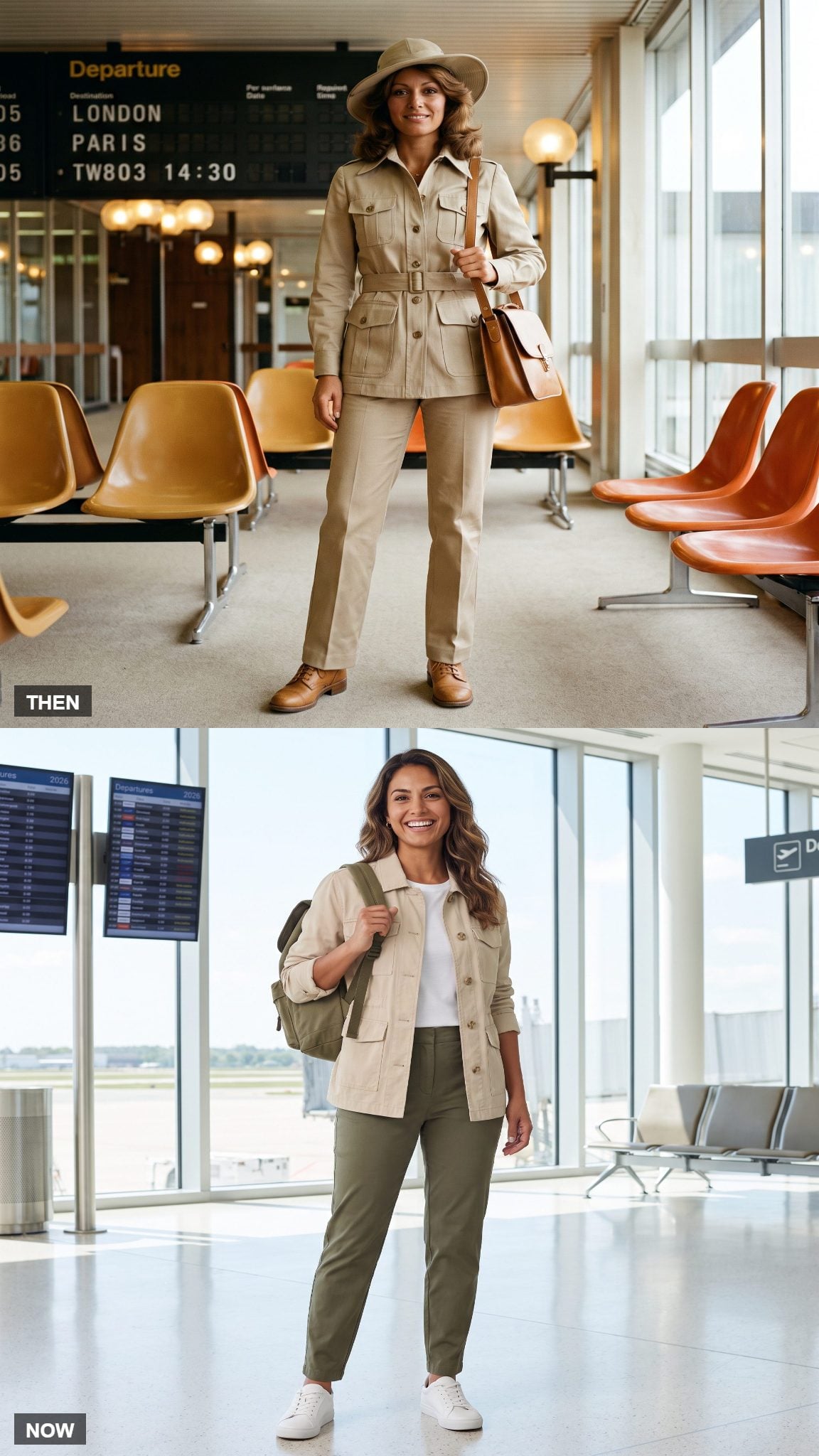
Safari-inspired fashion brought a sense of adventure to 1970s wardrobes, even when the destination was considerably less exotic than the clothes suggested. A belted sand-colored jacket, matching trousers, and brimmed hat created a coordinated look with enough pockets and purposeful detailing to imply serious plans.
The update abandons the uniform effect. A sand utility jacket pairs with olive tapered trousers, a white tee, and a practical backpack. Separating the colors makes the outfit feel less like a costume and more like a collection of pieces chosen for an actual journey.
28. The Ivory Coatdress Turns Into a Sharply Belted Vest
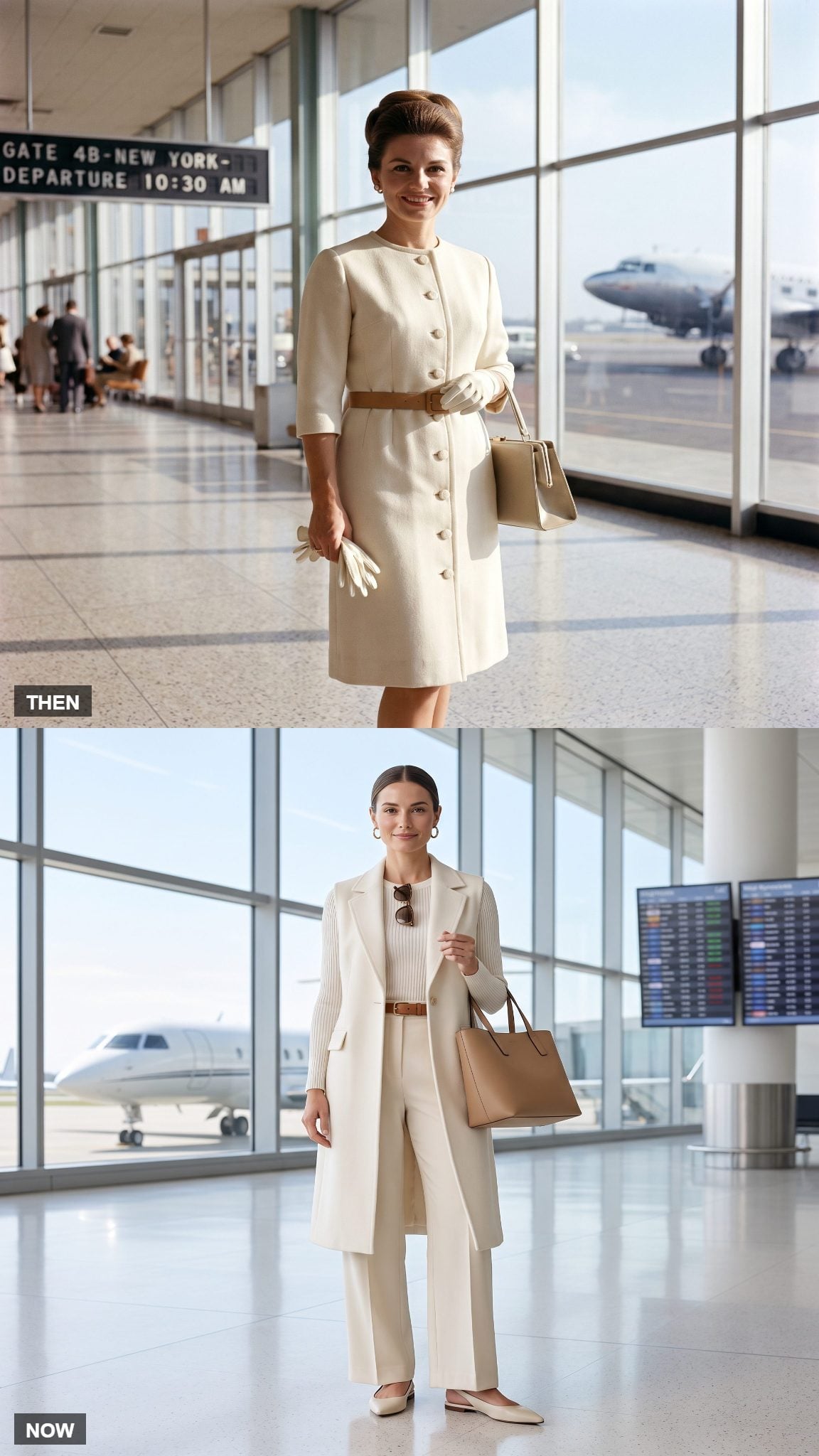
The ivory coatdress accomplishes a remarkable amount with very little visual noise. Buttons form a disciplined vertical line, a tan belt defines the waist, and the uninterrupted fabric gives the garment an almost architectural neatness.
Remove the sleeves, lengthen the layering possibilities, and the idea becomes a contemporary tailored vest. Worn over fine knitwear and trousers, the belted vest retains the coatdress’s elegant central line without requiring a complete outfit to be built into one garment. It’s a particularly convincing example of old tailoring finding a new purpose.
27. The Cape Refuses to Surrender Its Theatrical Streak
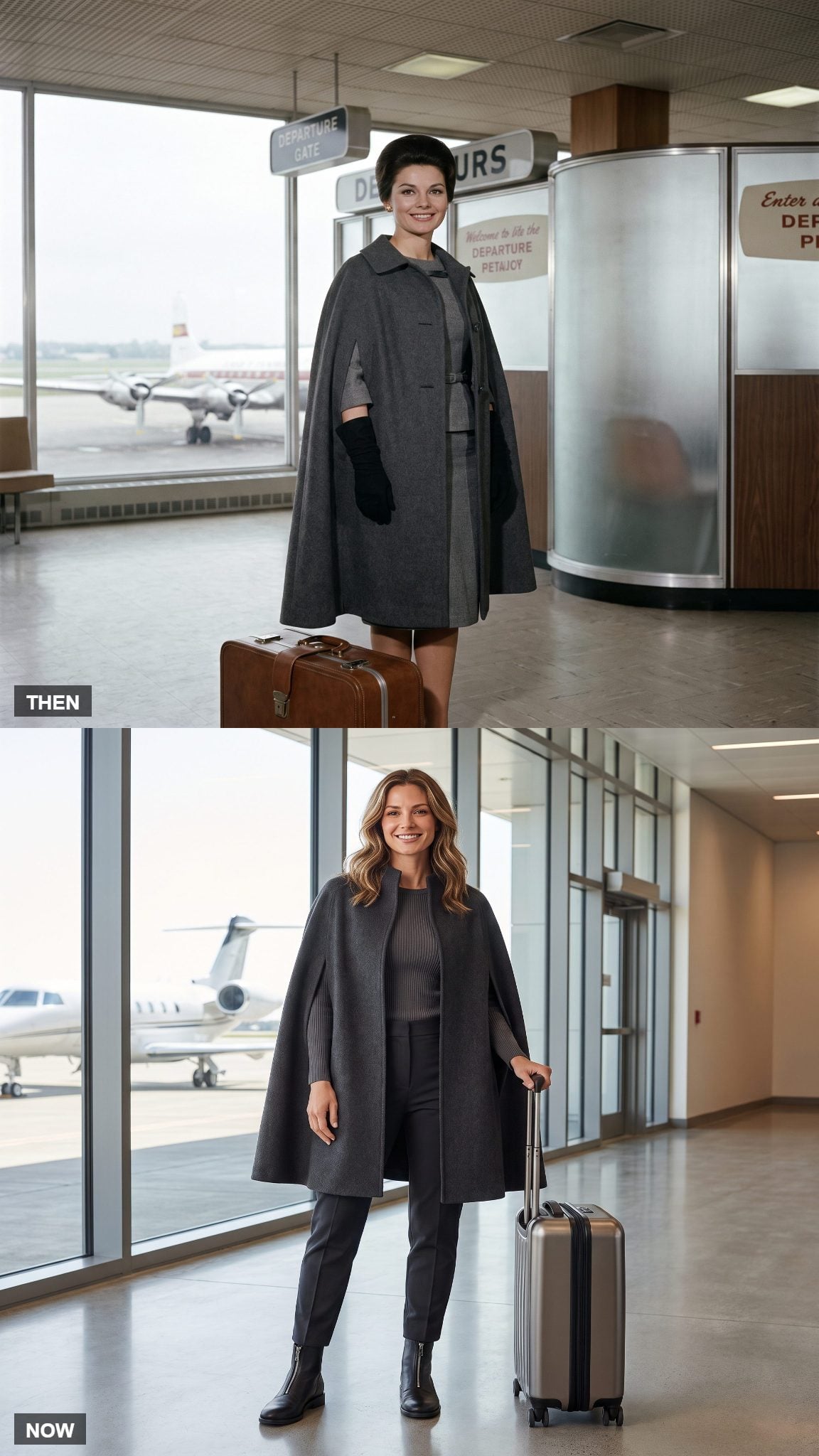
A charcoal wool cape sweeping over a narrow gray dress is not the outfit of someone hoping to go unnoticed. Long black gloves sharpen the silhouette, while the generous outer layer gives the vintage look a wonderfully dramatic outline.
The contemporary cape retains that unmistakable presence but pairs it with fitted separates, ankle trousers, and flat zip-front boots. The result is less ceremonial without being remotely ordinary. Capes can be awkward around shoulder bags and luggage, but as an exercise in making simple clothes look spectacular, the silhouette remains difficult to beat.
26. The Green Shirtwaist Exchanges Starch for Stretch
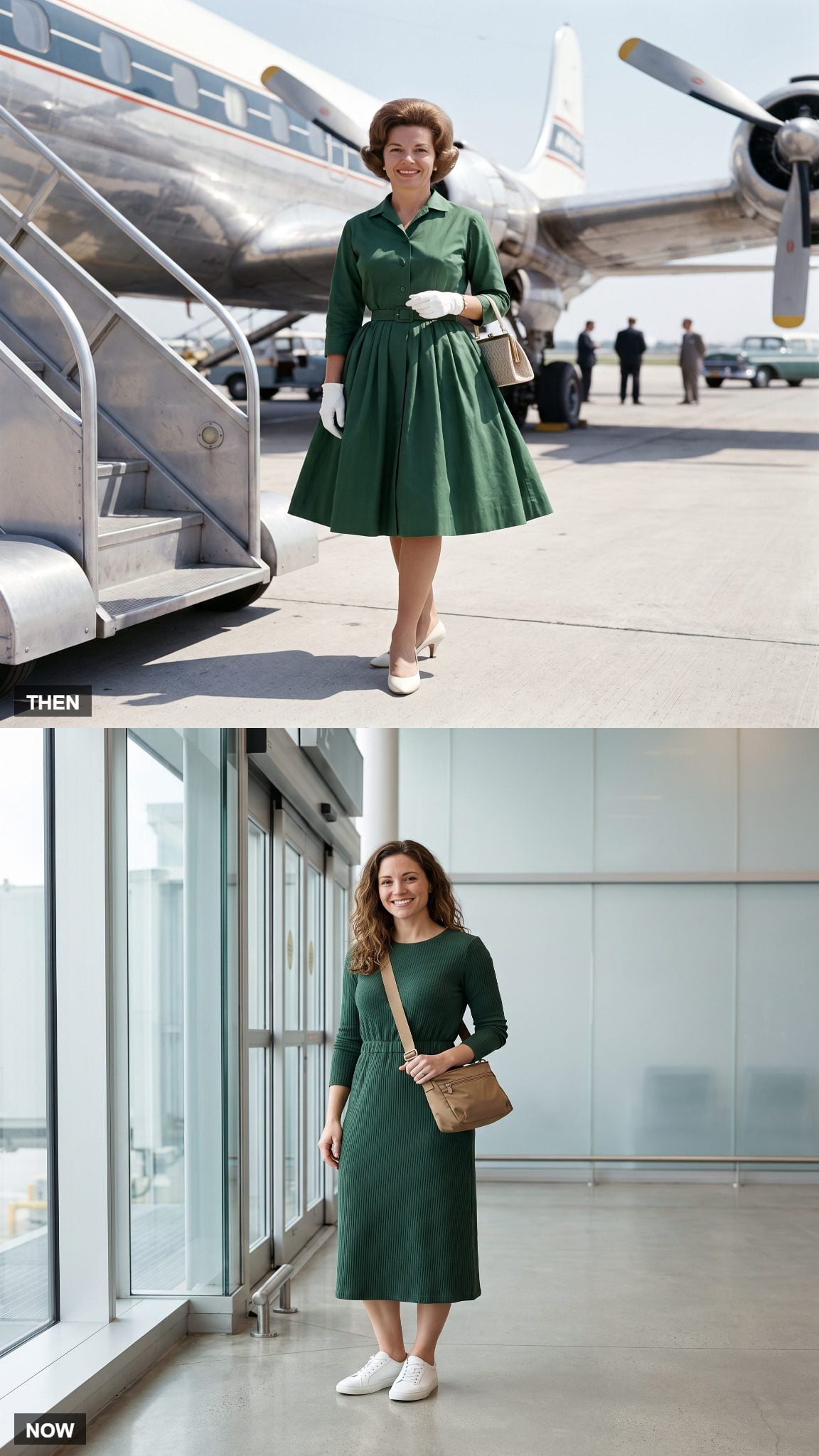
The forest-green shirtwaist has the reassuring crispness of a garment that knows exactly what shape it intends to keep. Its buttoned bodice and defined waist lead into a skirt with enough structure to hold a handsome silhouette.
A forest-green knit midi dress offers a softer interpretation. The color and waist definition survive, but the fabric moves more easily with the wearer. For a long flight, that distinction matters. The outfit still looks like a proper dress, only without demanding the same commitment to sitting perfectly still.
25. Houndstooth Escapes the Confines of the Skirt Suit
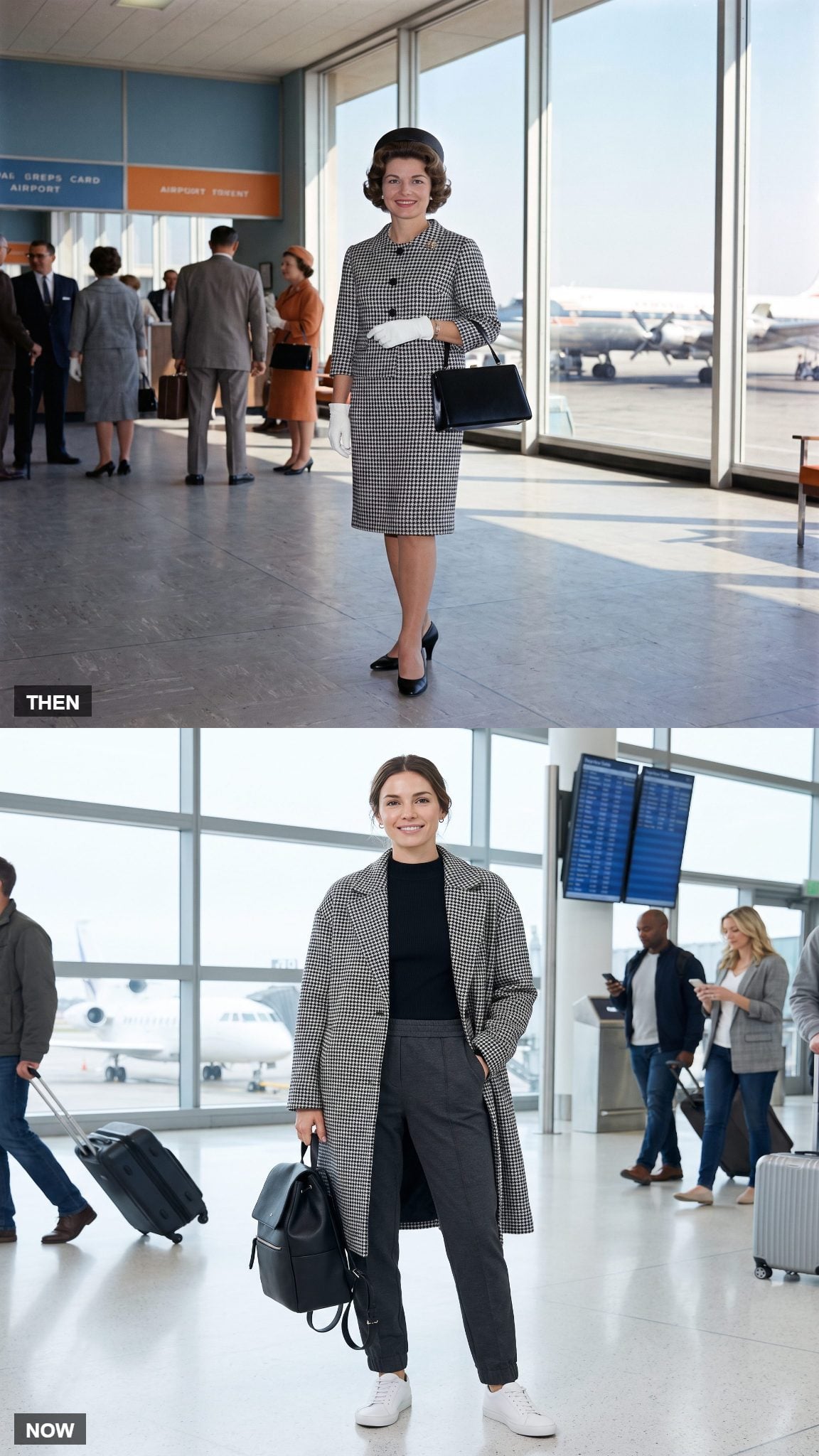
In the vintage ensemble, houndstooth is all business. The closely patterned skirt suit, gloves, and hat present a coordinated appearance that leaves very little to chance. Its authority comes from both the graphic check and the precision of the tailoring.
Now the pattern moves onto a relaxed car coat, layered over a mock-neck and tailored joggers. A structured black bag gives the outfit a firm visual anchor, while comfortable footwear changes its practical character completely. Houndstooth hasn’t lost its sophistication; it simply no longer insists that every garment underneath follow the same rules.
24. The Yellow Coatdress Finds a More Casual Kind of Sunshine
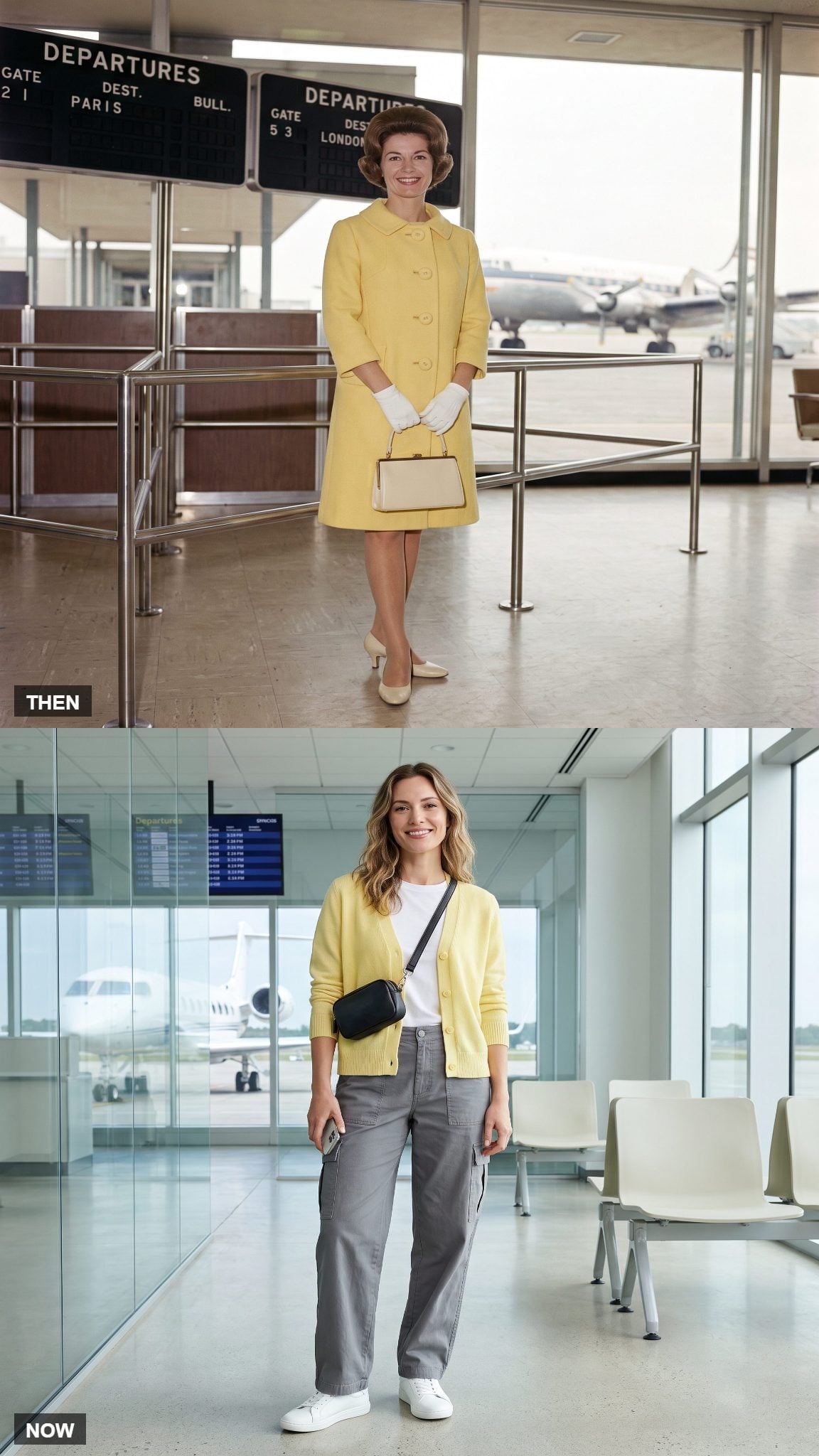
Lemon yellow is already an exuberant choice. Add a structured coatdress, covered buttons, and white gloves, and the vintage result becomes a remarkably cheerful statement in coordinated dressing.
The modern version concentrates the color in a yellow cardigan, then lets a white tee, gray utility trousers, and white sneakers handle the quieter work. A crossbody belt bag supplies a practical finishing detail. Instead of dressing entirely in sunshine, the traveler carries one bright piece into an otherwise understated outfit.
23. The Pleated Skirt Discovers a Less Formal Rhythm
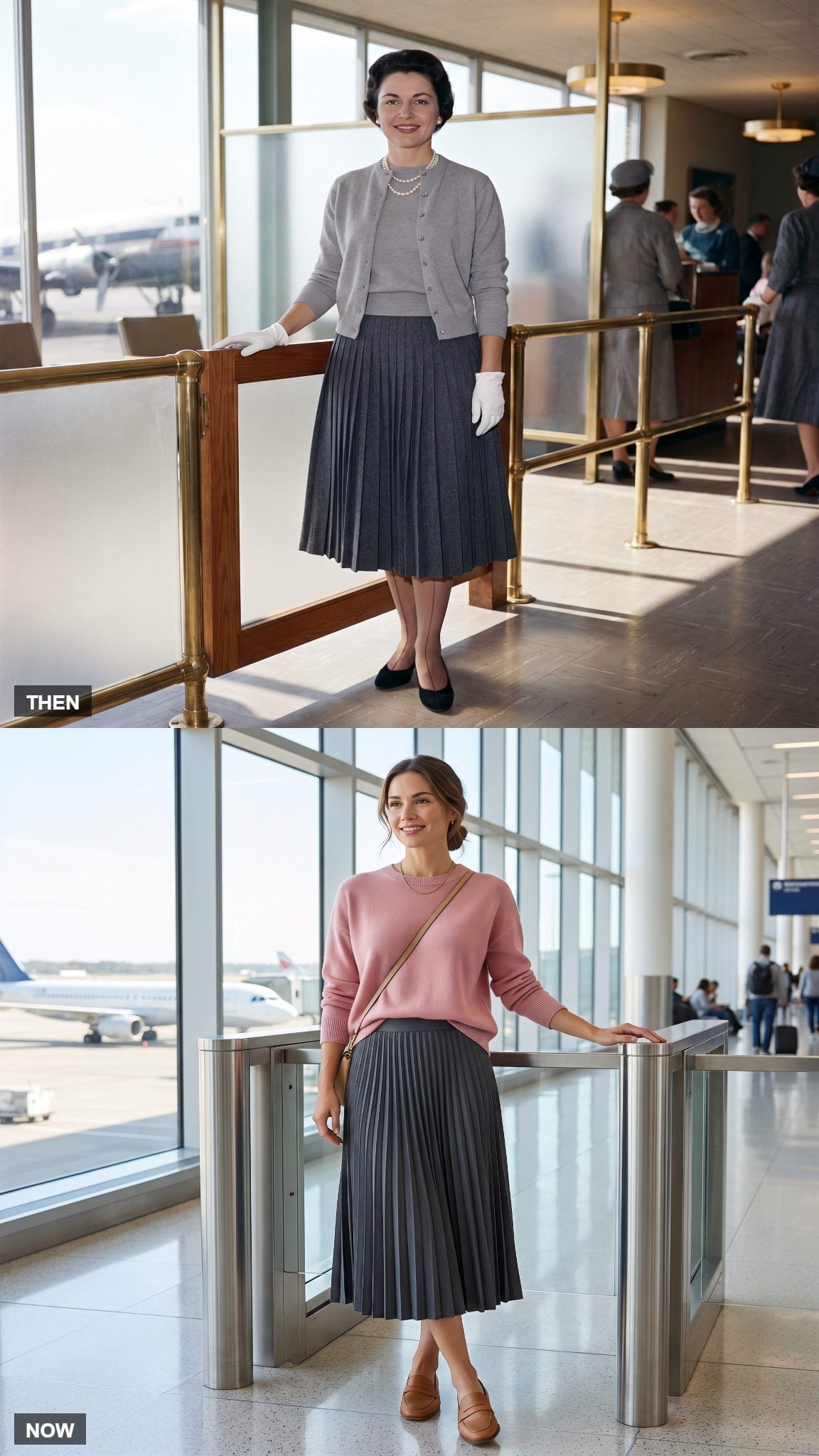
The vintage pleated skirt arrives with the full supporting cast: a cashmere twinset, pearls, and gloves. Its knife-sharp folds give the charcoal fabric a disciplined rhythm, while the accessories reinforce the outfit’s careful formality.
The contemporary charcoal pleated midi skirt meets a pink crewneck sweater and loafers. Soft knitwear provides a pleasing contrast to the skirt’s crisp folds. The pleats still supply structure, but the outfit no longer needs pearls and gloves to explain itself.
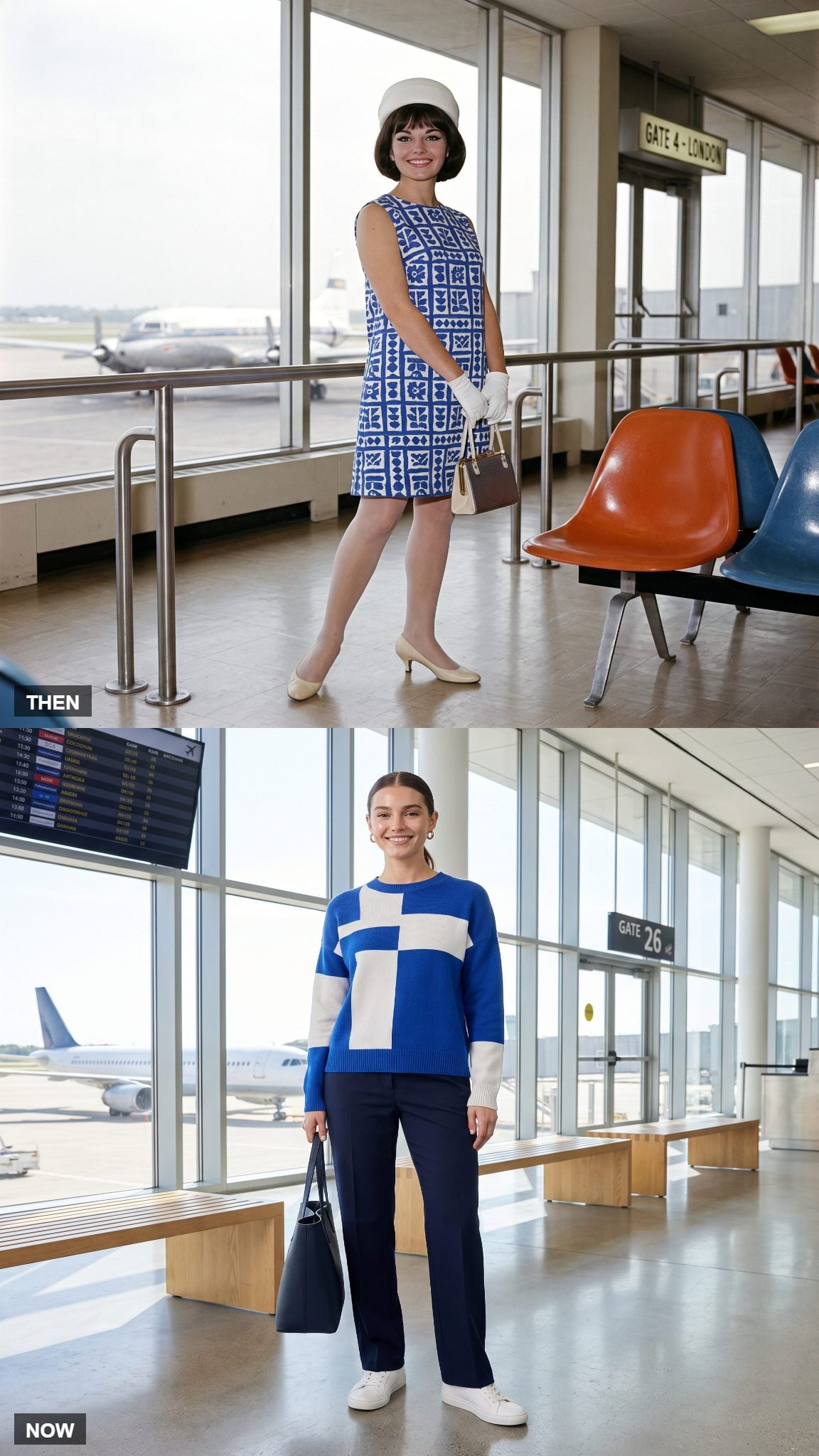
22. The Geometric Shift Moves Its Artwork Upstairs
❤️ Would you like to save this?
Hard-edged blocks of cobalt and white give the vintage shift dress an almost poster-like quality. Gloves and a small white hat complete a look that understands the importance of keeping the silhouette simple when the pattern is doing something ambitious.
In the modern outfit, the geometry migrates onto a geometric intarsia sweater. Navy column trousers and white sneakers provide a clean foundation. The graphic impact is still there, but now it’s concentrated above the waist rather than spread across an entire dress.
21. The Long Waistcoat Reverses Its Color Strategy
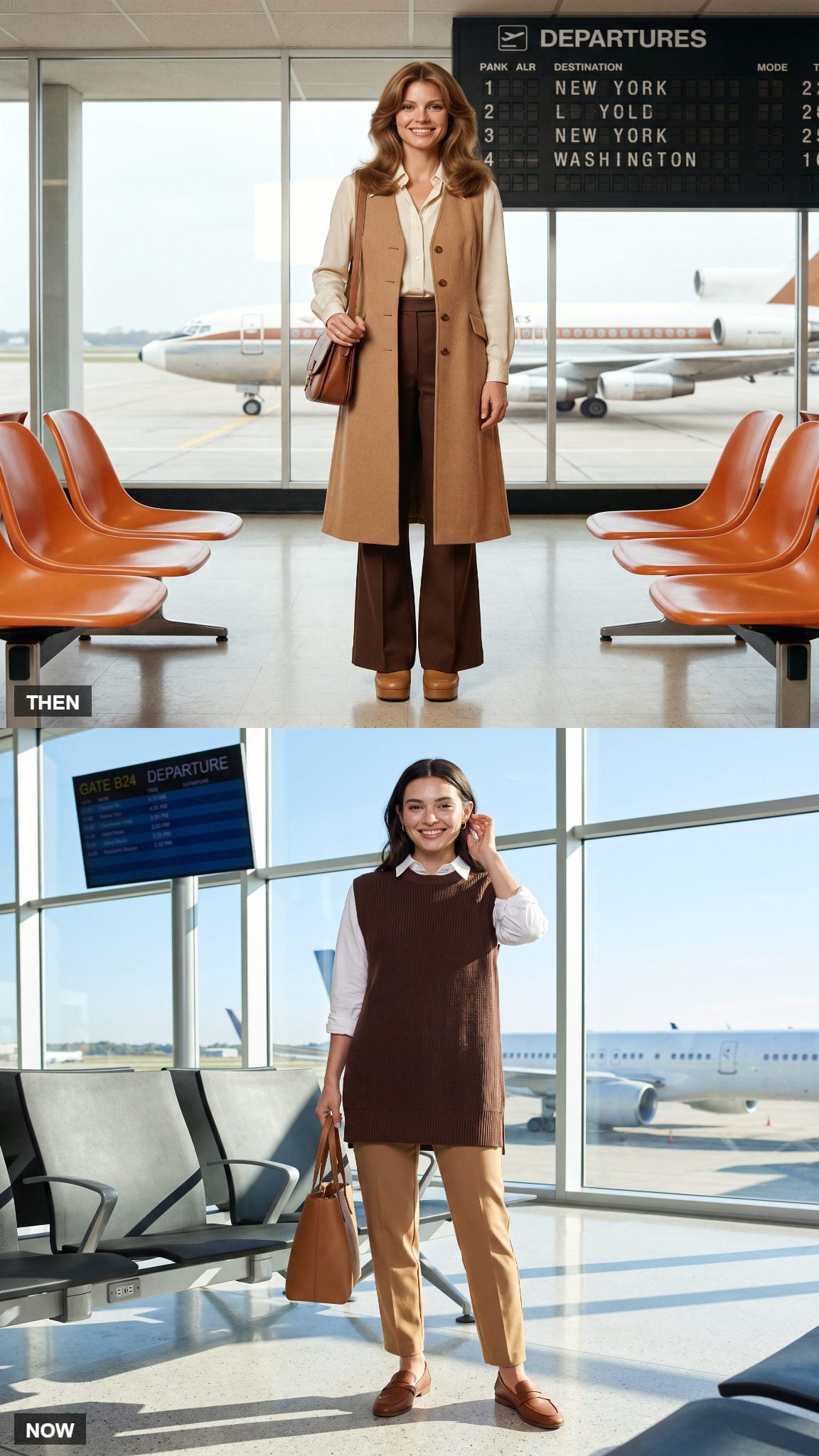
Long waistcoats were a familiar part of the tailored, menswear-influenced dressing that enjoyed renewed popularity during the 1970s. Here, a camel version stretches over a cream blouse and chocolate flares, creating a long, uninterrupted layer through the torso.
The modern look reverses the balance. A chocolate longline knit vest sits over a white poplin shirt, while camel tapered trousers carry the lighter brown below. The curved shirt hem peeking beneath the vest is a small but valuable detail, giving the layers definition without adding another color.
20. The Wrap Dress Makes a Strong Case for Staying Put
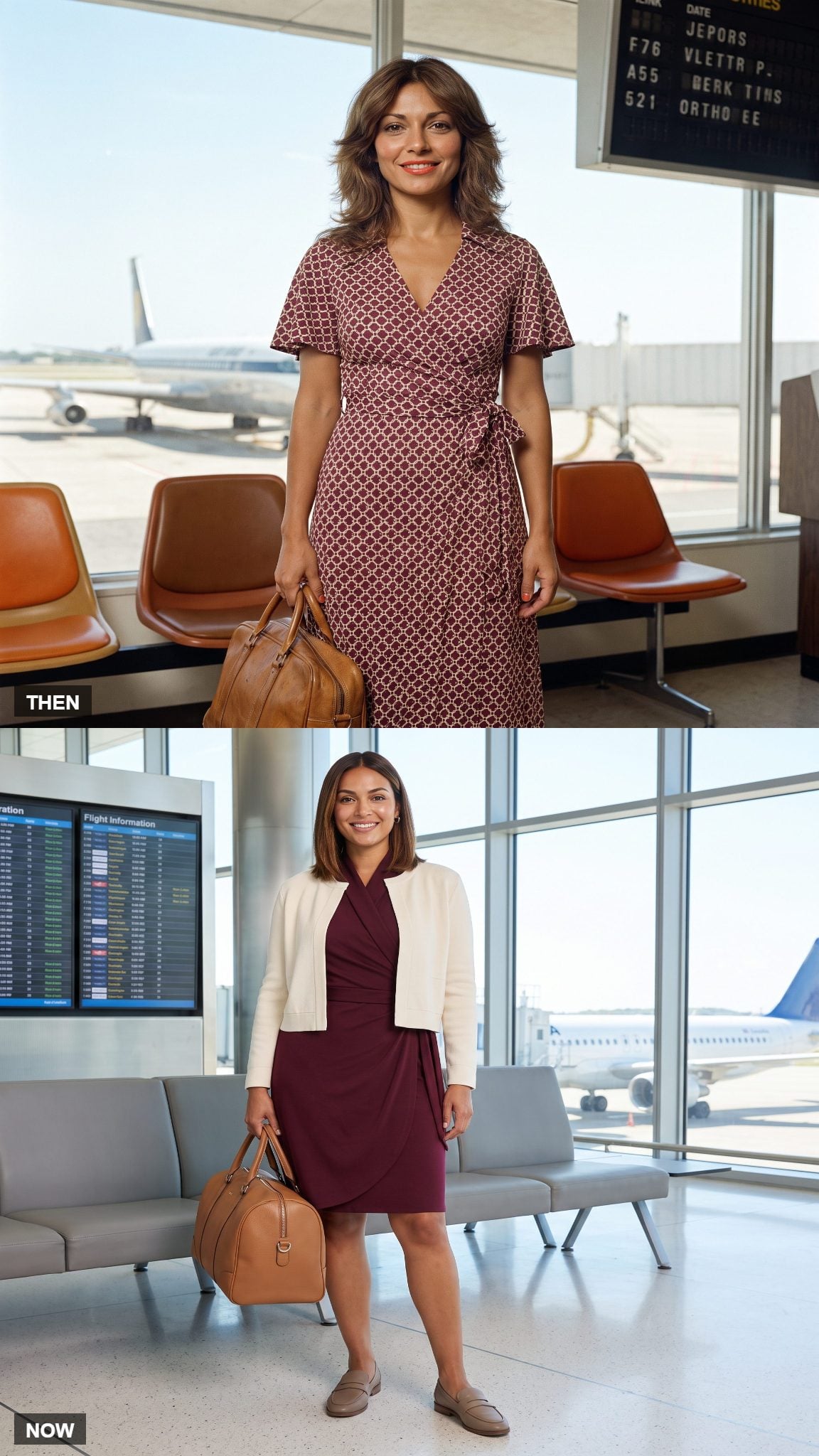
Wrap dresses existed long before the 1970s, but Diane von Furstenberg’s famous version helped turn the silhouette into a modern wardrobe staple. The vintage burgundy-and-cream example shows its enduring appeal: a defined waist, flowing skirt, and diagonal neckline that give the dress shape without complicated tailoring.
The contemporary version keeps the wrap construction while choosing a more secure neckline and comfortable jersey fabric. A cropped knit jacket handles changing temperatures, and cushioned loafers make the outfit more practical for a terminal. Of all the garments in this gallery, the wrap dress needs relatively little reinvention.
19. The Bow Blouse Loosens Up for a Different Kind of Departure
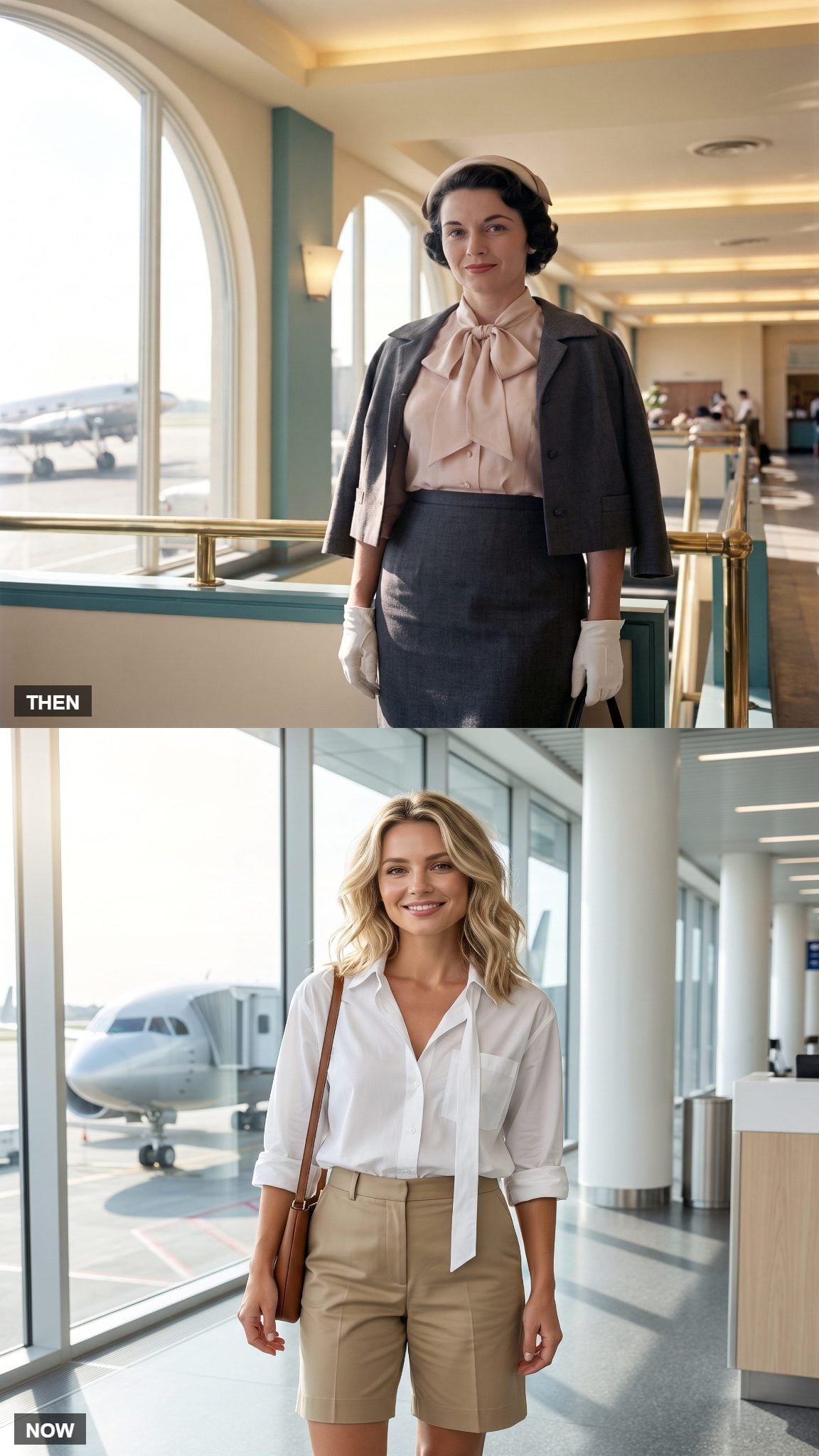
The vintage pussy-bow blouse adds softness to an otherwise exacting outfit. A cropped jacket, high-waisted pencil skirt, gloves, and hat surround the bow with carefully controlled tailoring. Nothing about the ensemble suggests dressing in a hurry.
Its modern counterpart unties the formality altogether. A generous white button-down, sleeves turned back and front tucked, meets sharply tailored Bermuda shorts. The pressed shorts retain some of the original skirt’s precision, while the open collar and relaxed shirt create a completely different mood. It’s a convincing warm-weather alternative to the old matched ensemble.
18. The Nautical Stripe Changes Everything Except Its Stripes
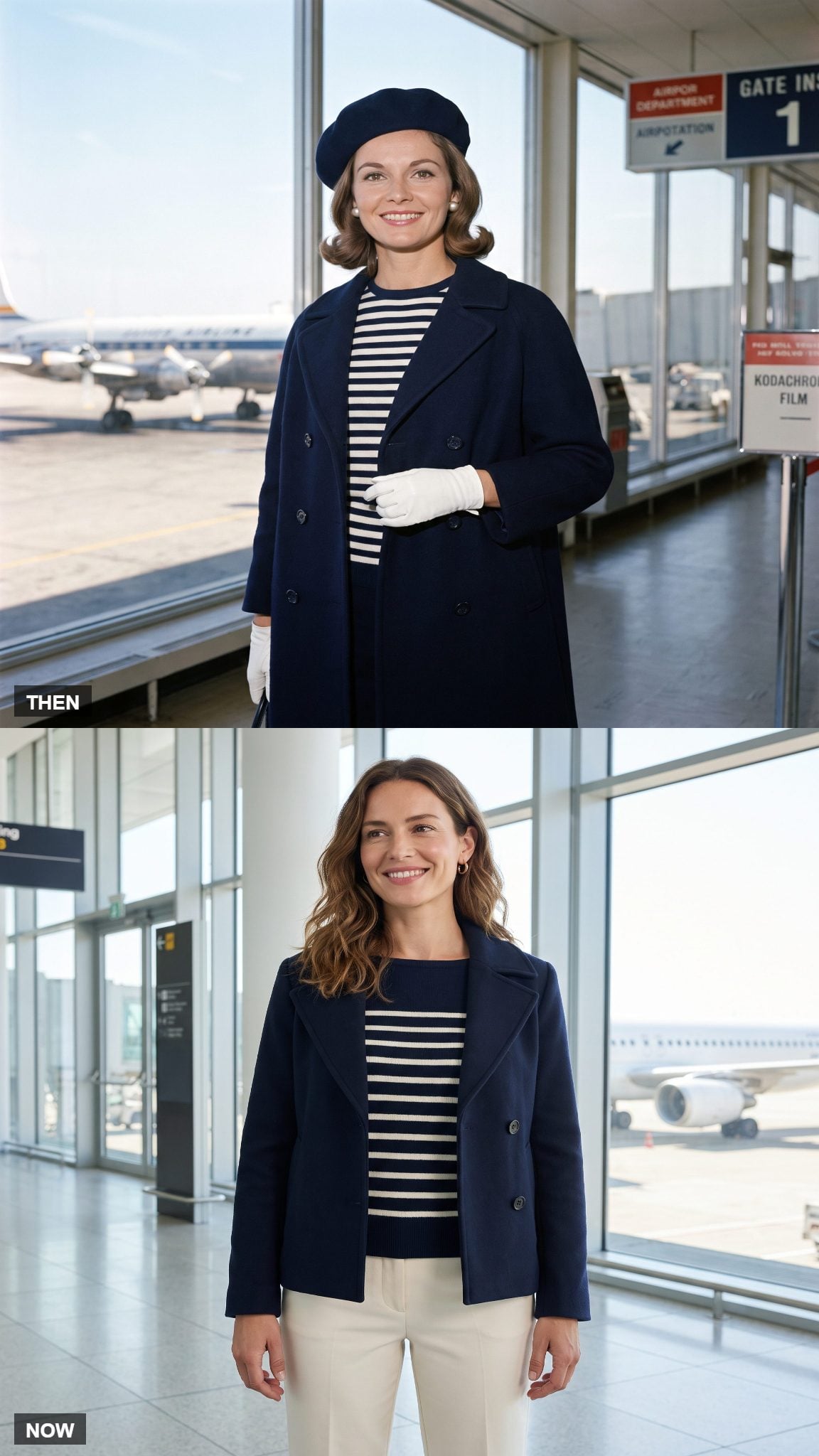
The Breton stripe has a history stretching back to nineteenth-century French naval dress, and fashion has been borrowing its graphic simplicity ever since. In the vintage outfit, a beret, gloves, and double-breasted coat give navy and ivory a distinctly formal character.
The contemporary traveler chooses a boatneck striped sweater, straight-leg cream trousers, and a shorter peacoat. The horizontal pattern remains the central attraction, but the surrounding pieces are considerably easier. Some combinations last because they can absorb decades of changing fashion without losing their identity.
17. The Rust Sweater Dress Splits Into Two
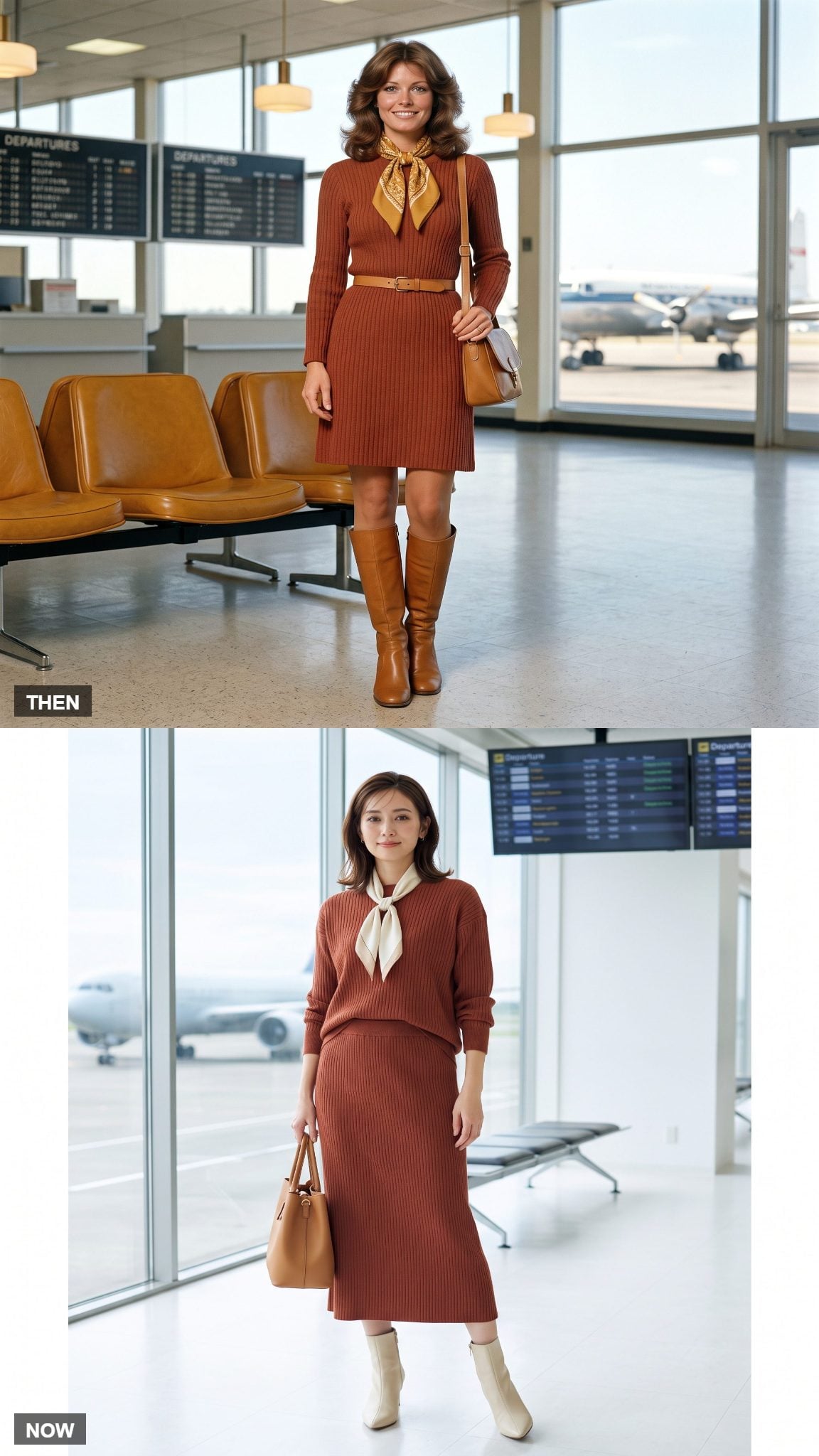
Rust-colored ribbed knitwear has a particular warmth that suits the 1970s beautifully. The vintage sweater dress follows the body in one continuous piece, with a belt shaping the waist and a scarf introducing color at the neckline.
Today, a rust ribbed midi skirt and matching rust sweater recreate the effect with more flexibility. A partial tuck gives the waist definition, while the separate pieces can be worn independently. The color remains wonderfully rich; the outfit simply offers more ways to use it.
16. The Leather Coat Finds a New Supporting Cast
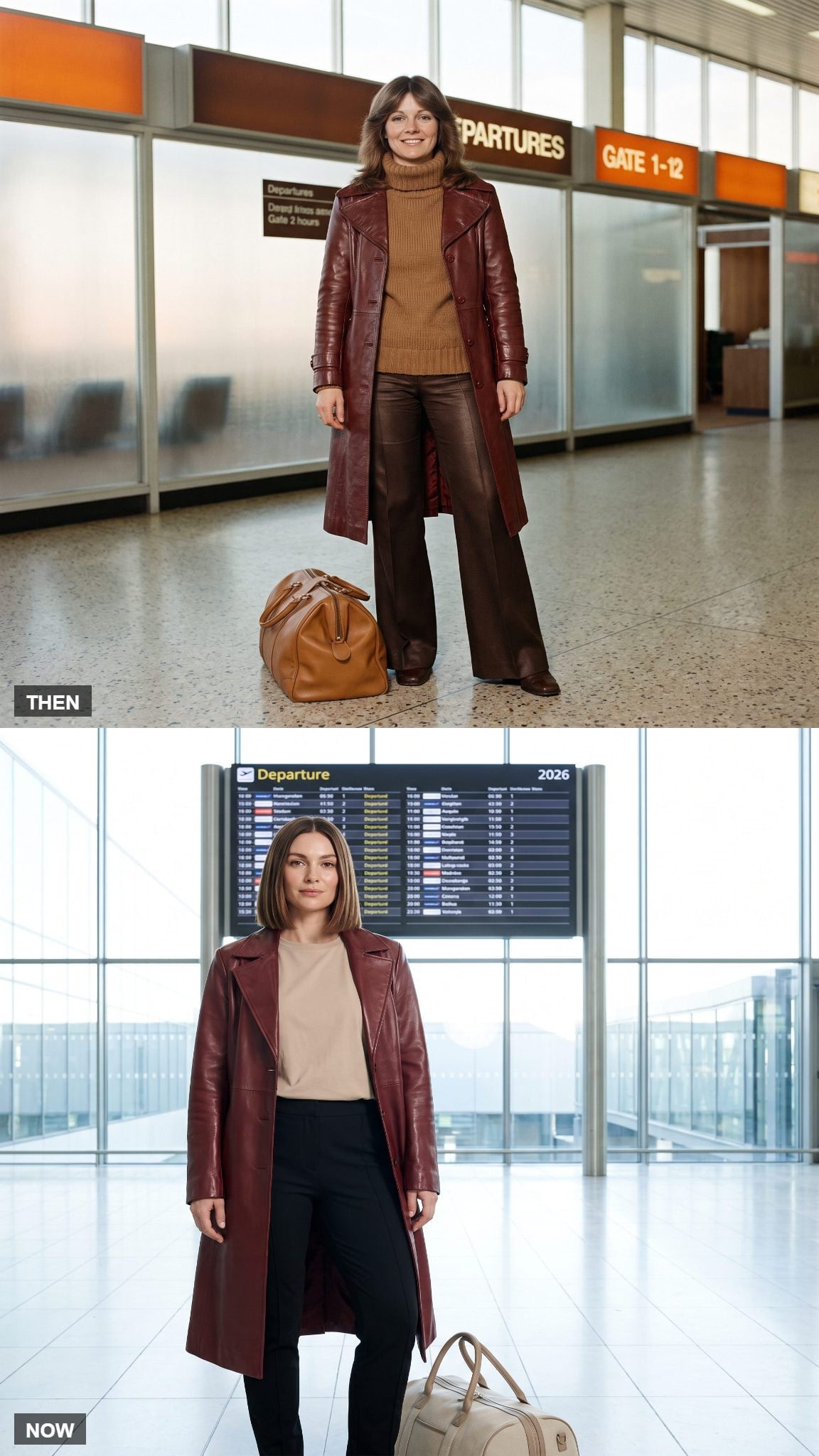
Oxblood leather has enough presence to make almost anything worn beneath it look deliberate. The vintage coat leans into its 1970s setting with a roll-neck sweater and flared trousers, building a long, dramatic silhouette in deep, earthy colors.
Rather than replacing the coat, the contemporary outfit changes its supporting pieces. A beige tee and black ponte trousers bring the silhouette closer to the body, allowing the leather’s rich color and smooth surface to dominate. It’s an excellent reminder that a distinctive outer layer can outlast several generations of fashion beneath it.
15. The Scarf Travels from Hair Protection to Pure Style
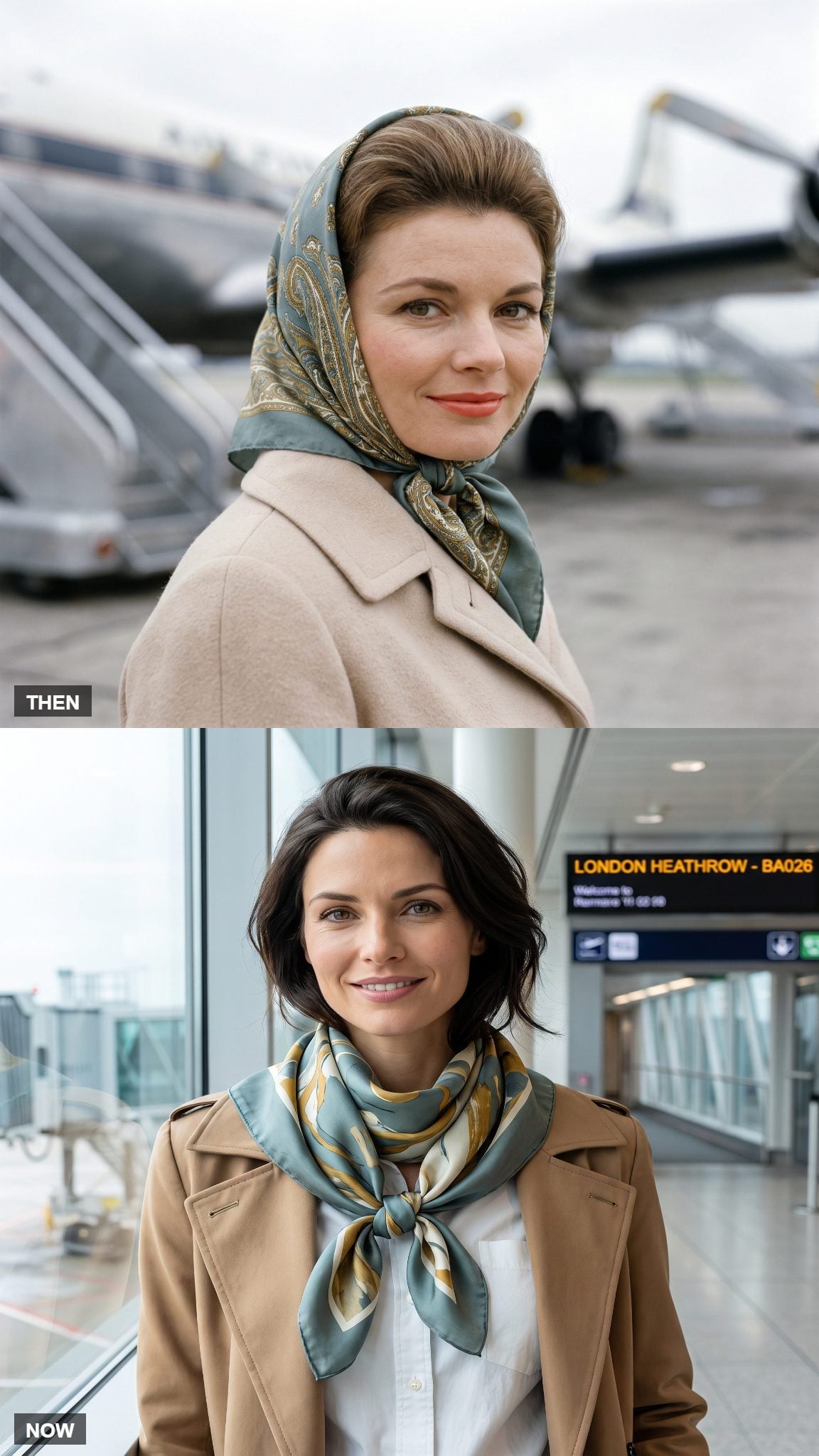
Few accessories can change an outfit so completely with such a small amount of fabric. The vintage silk scarf is tied beneath the chin, framing the face and helping protect a carefully styled hairstyle from wind during outdoor boarding or travel between buildings and aircraft.
The contemporary version moves to the neck, loosely knotted above an Oxford shirt and trench coat. The print now functions primarily as decoration, supplying color and movement to otherwise familiar separates. The scarf hasn’t changed much. What changed is where it’s worn and what the rest of the outfit expects from it.
14. The Culotte Suit Trades Its Straight Lines for Curves
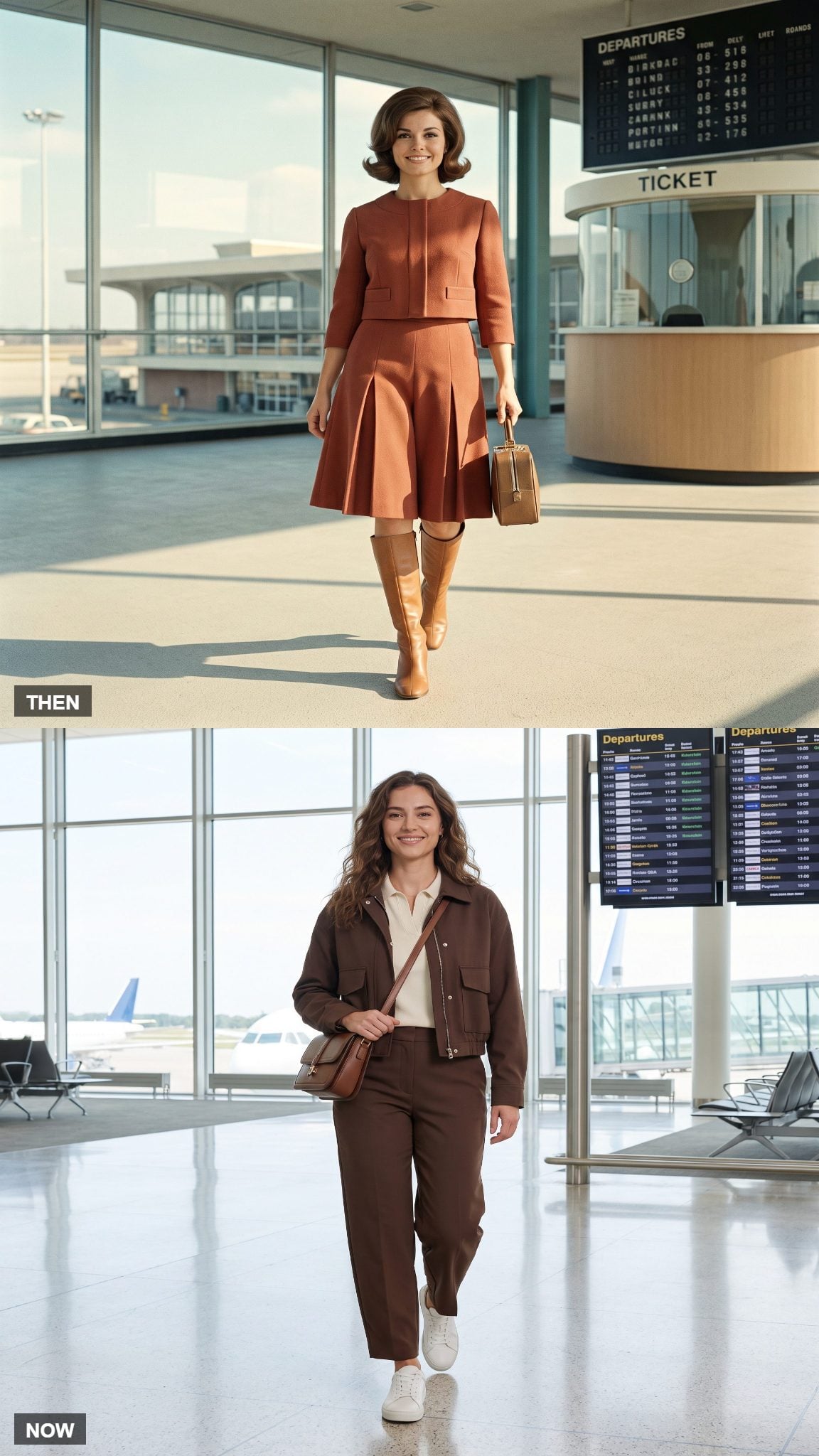
The vintage terracotta culotte suit plays an ingenious visual trick. Its divided skirt suggests the fullness of a conventional skirt until movement reveals the separate legs. A cropped jacket and knee boots keep the proportions distinctly of their period.
The contemporary answer takes a different approach to volume. Barrel-leg trousers curve outward through the thigh before narrowing toward the ankle, paired with a cream polo, cropped chocolate jacket, and sneakers. Where the culottes emphasize width at the hem, the barrel shape creates its drama through the middle of the leg. Two unconventional silhouettes, separated by decades of changing taste.
13. The Sweater-and-Trousers Outfit Gets a Tailored Promotion
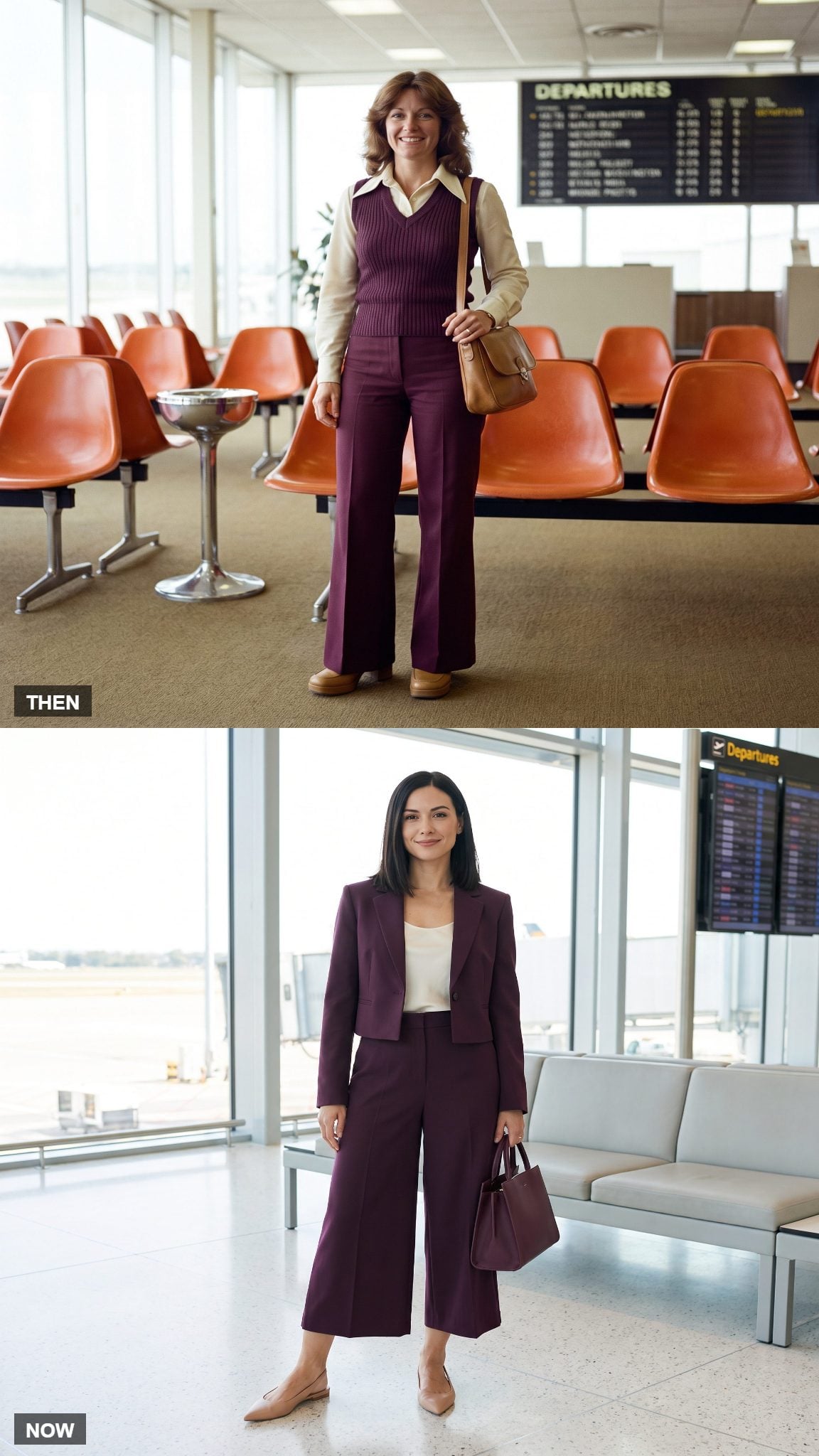
The 1970s version relies on an easy combination of plum knitwear, a pointed-collar blouse, and flared trousers. Its personality comes from the soft layers and the generous movement of the pants rather than a formally constructed jacket.
The modern outfit unexpectedly becomes more tailored. A cropped plum blazer and matching culottes establish a coordinated shape, with an ivory shell breaking up the color. The shortened jacket and wide cropped trousers give the outfit a striking geometry that feels sharper than its relaxed predecessor.
12. The White Collar Refuses to Disappear Into Black
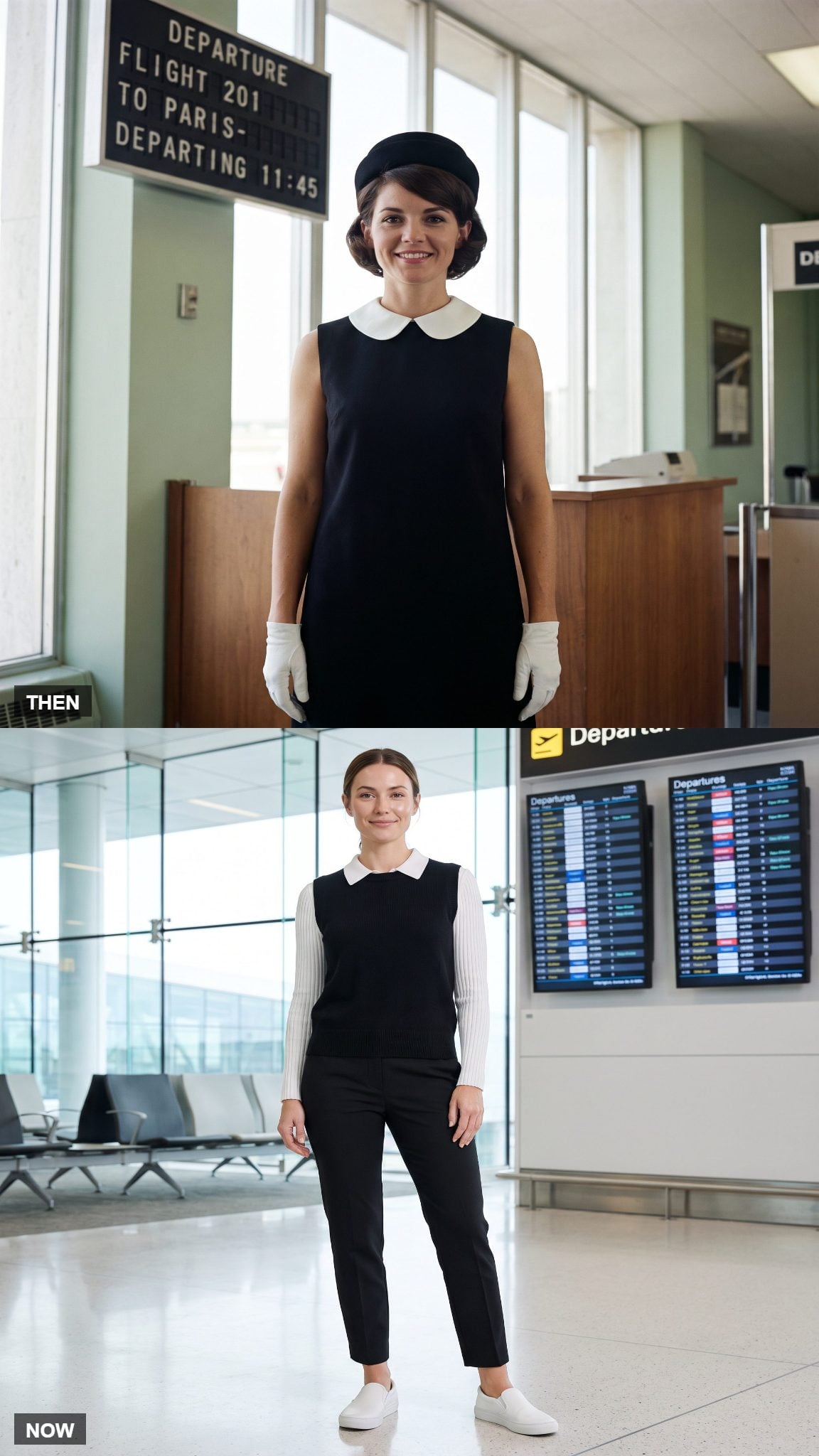
Black and white make a formidable partnership in the vintage shift dress. A crisp white collar brightens the neckline, while wrist gloves and a pillbox hat reinforce the outfit’s disciplined character. The effect depends on precise placement rather than decorative excess.
Now the white collar emerges beneath a black sweater vest, with black cigarette trousers and white slip-ons completing the look. The light detail near the face remains a focal point, but the fitted dress has become an easy collection of separates. A very small amount of white still accomplishes a surprising amount.
11. The Suede Waistcoat Trades Texture Without Losing Its Character
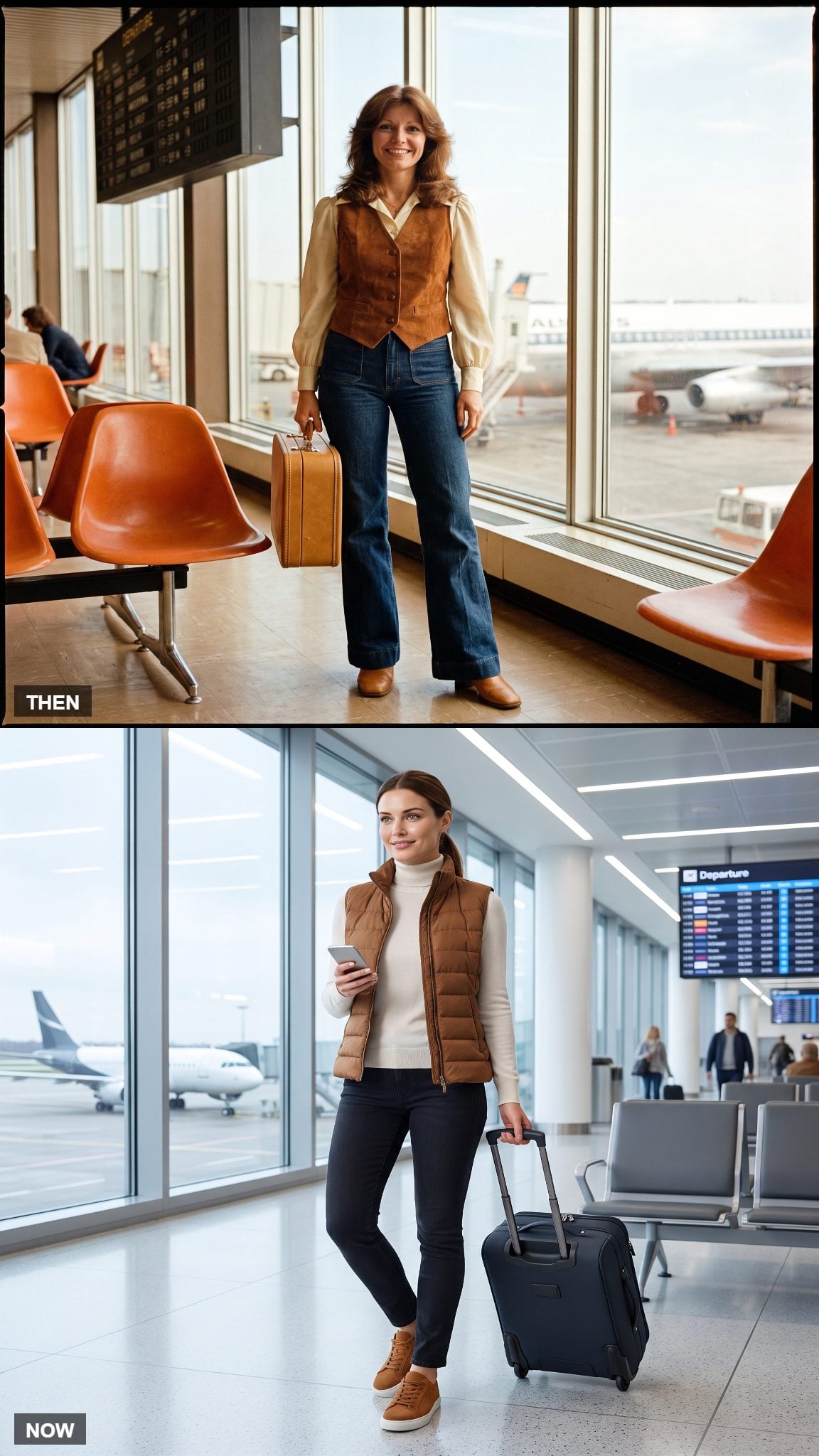
Tobacco suede, an ivory blouse with gathered sleeves, denim, and knee boots make a handsome argument for 1970s layering. The waistcoat adds warmth and texture without concealing the blouse, while the boots give the outfit a distinctly grounded finish.
In the modern version, quilting replaces suede and a merino turtleneck takes the place of the gathered blouse. Suede sneakers bring the warm brown palette down to the feet without repeating the original boots. The silhouette is familiar, but the change in materials makes the outfit feel considerably lighter and more practical.
10. The Linen Suit Stops Fighting Its Own Fabric
❤️ Would you like to save this?
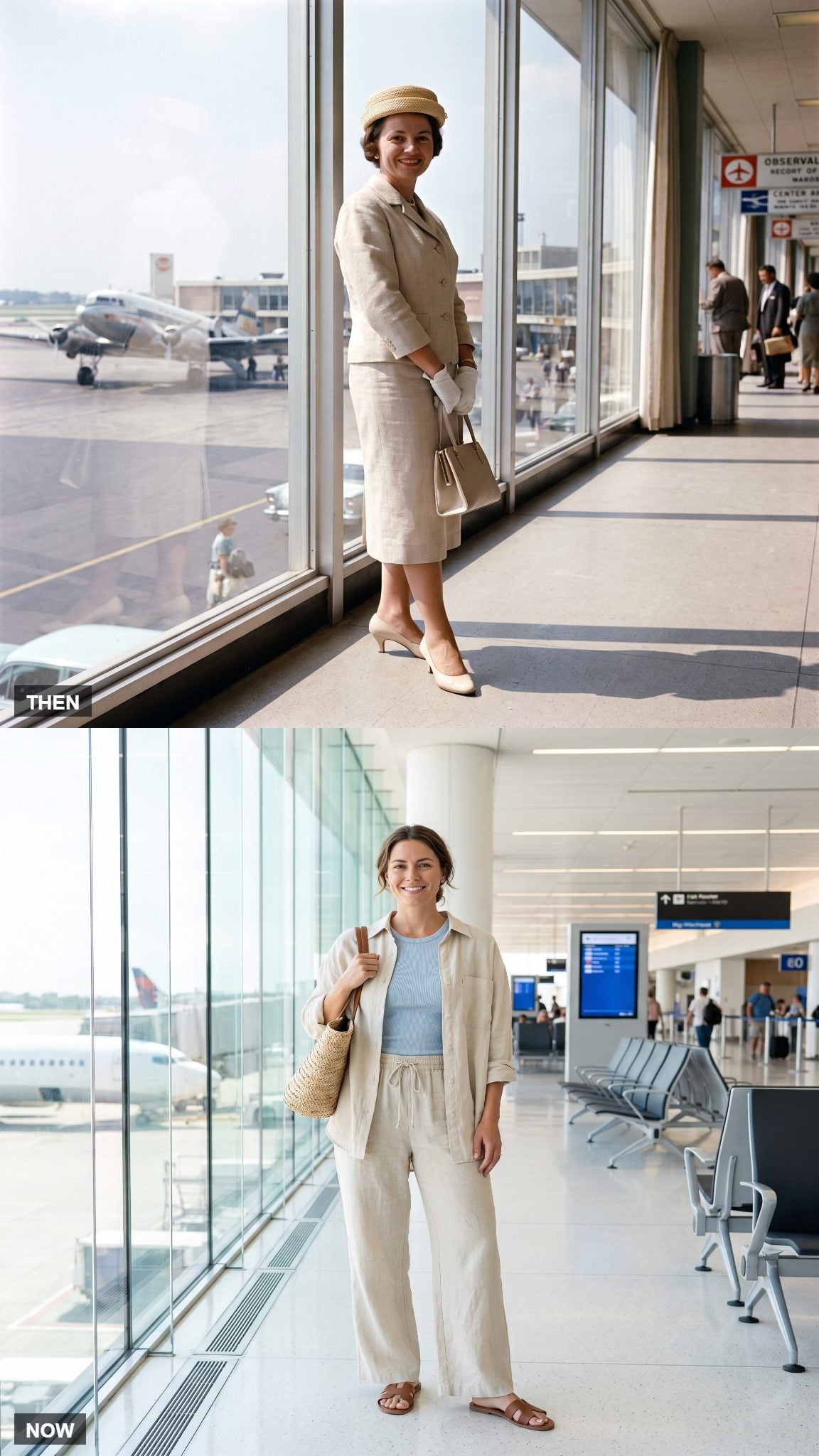
The vintage linen ensemble asks a naturally relaxed fabric to behave with extraordinary discipline. A fitted skirt suit, gloves, and straw hat create a beautifully coordinated warm-weather outfit, even though linen’s tendency to crease is hardly a secret.
Modern linen dressing is much happier to acknowledge the material’s character. Wide-leg drawstring trousers and a relaxed shirt in pale beige allow the fabric to fall naturally, while a light blue tank adds a subtle change of color. The comparison isn’t about abandoning elegance. It’s about letting the fabric behave like linen rather than expecting it to imitate something stiffer.
9. The Tunic Breaks Its Monochromatic Spell
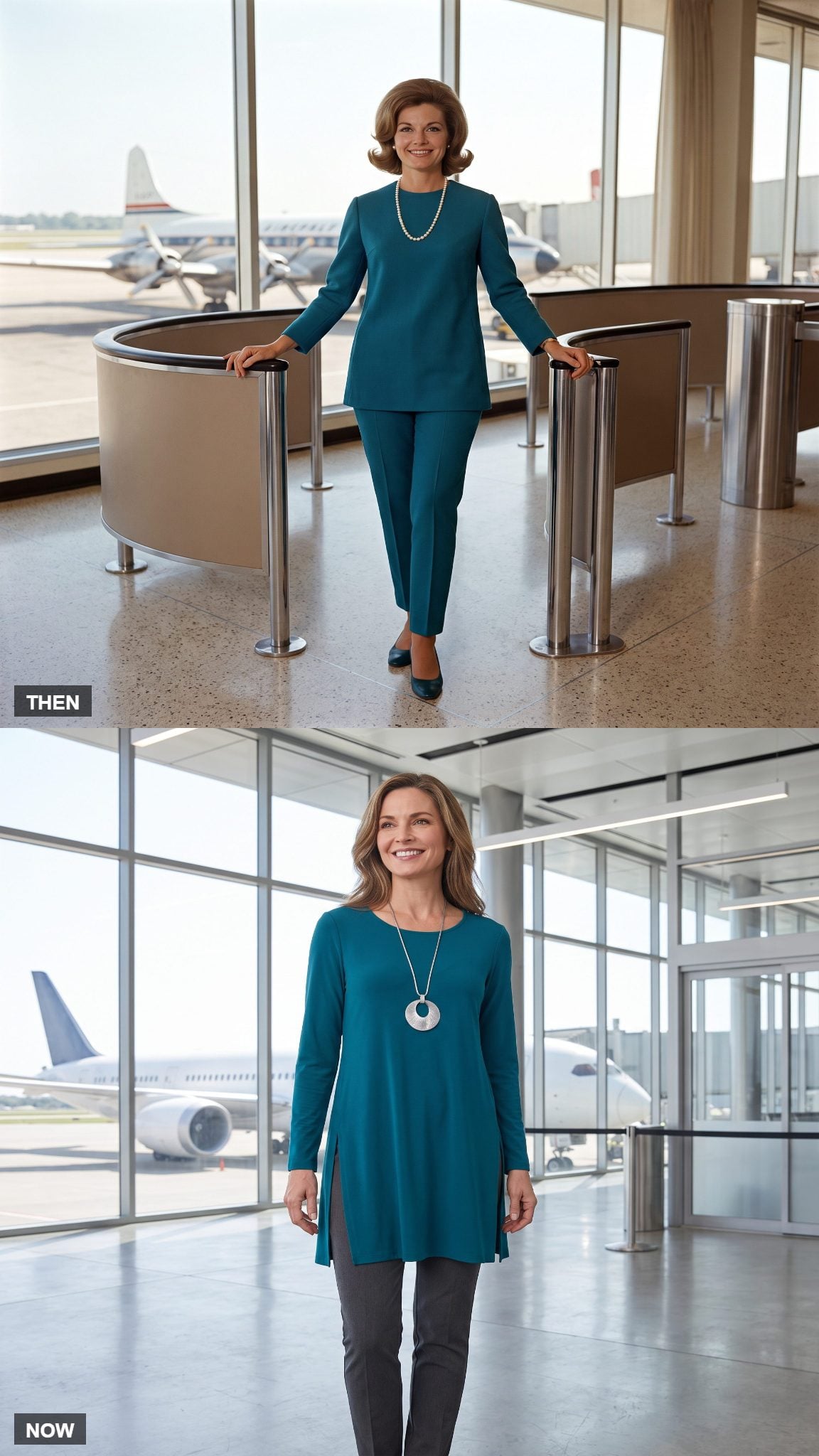
Peacock teal from shoulder to ankle gives the vintage tunic-and-trousers combination its impact. The narrow cigarette pants extend the color beneath the long top, while pearls provide a restrained point of contrast.
The modern interpretation interrupts that continuous column with charcoal trousers. Side slits loosen the teal tunic around the hips, and a sculptural silver pendant replaces the pearls. The stronger contrast between top and bottom gives the outfit a different set of proportions, demonstrating how much a single color change can alter a familiar silhouette.
8. The Maxi Coat Loses Its Length but Keeps Its Attitude
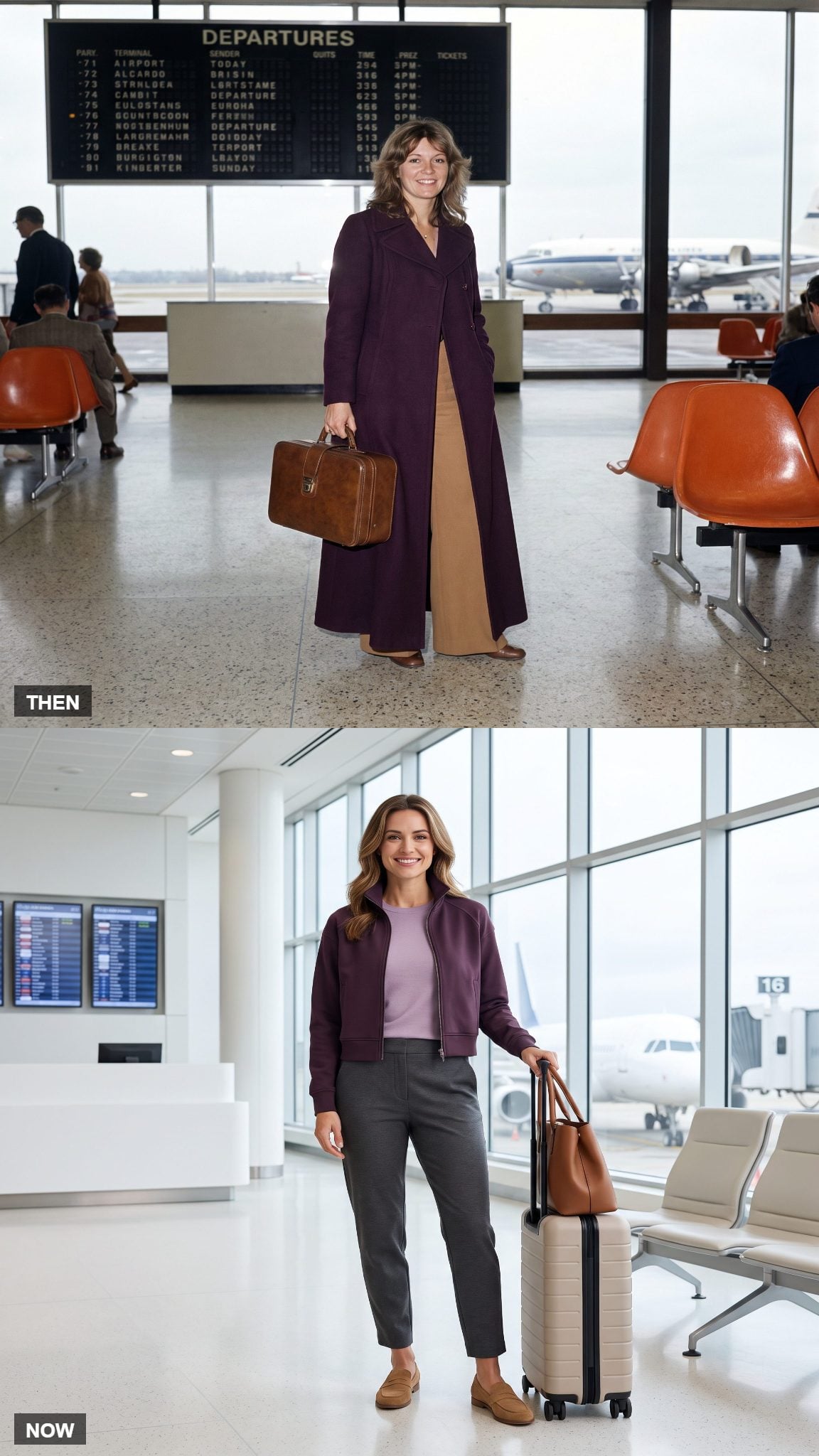
The aubergine maxi coat makes length its defining feature. Sweeping over flared trousers, the vintage garment turns a rich purple-brown color into an even more dramatic silhouette. Beautiful as it is, a coat approaching the floor can present practical challenges around stairs, escalators, and luggage.
The contemporary jacket ends at the hip, bringing the aubergine color into a compact, sporty shape. Lilac merino, tapered ankle trousers, and suede loafers replace the flowing lines below. The contrast is almost comical in scale: one outfit stretches dramatically toward the ground, while the other gathers its personality into a short, purposeful jacket.
7. The Shirt Dress Becomes a Wardrobe of Separates
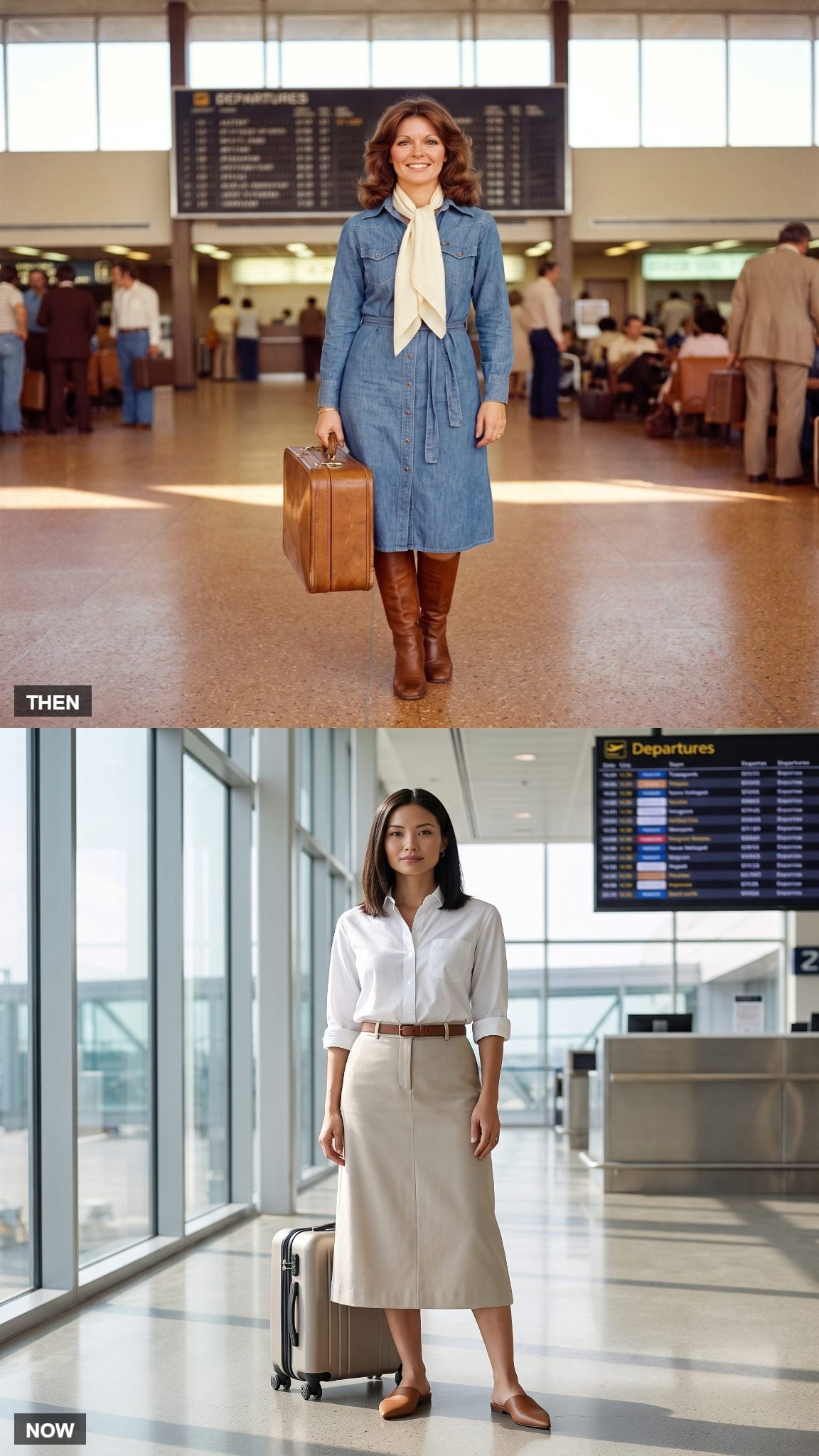
The vintage denim-blue shirt dress has the efficient appeal of a complete outfit in one piece. A self-tie belt shapes the waist, a neck scarf adds a little ceremony, and the buttoned front gives the dress the familiar authority of a well-cut shirt.
The contemporary interpretation separates those ideas into a crisp poplin shirt and a stone-colored column skirt. A back vent makes the narrow skirt easier to walk in, while the shirt can be styled independently. The original dress offers immediate coordination; the modern pieces offer more combinations. Neither approach lacks intelligence.
6. The Vacation Print Learns the Value of Restraint
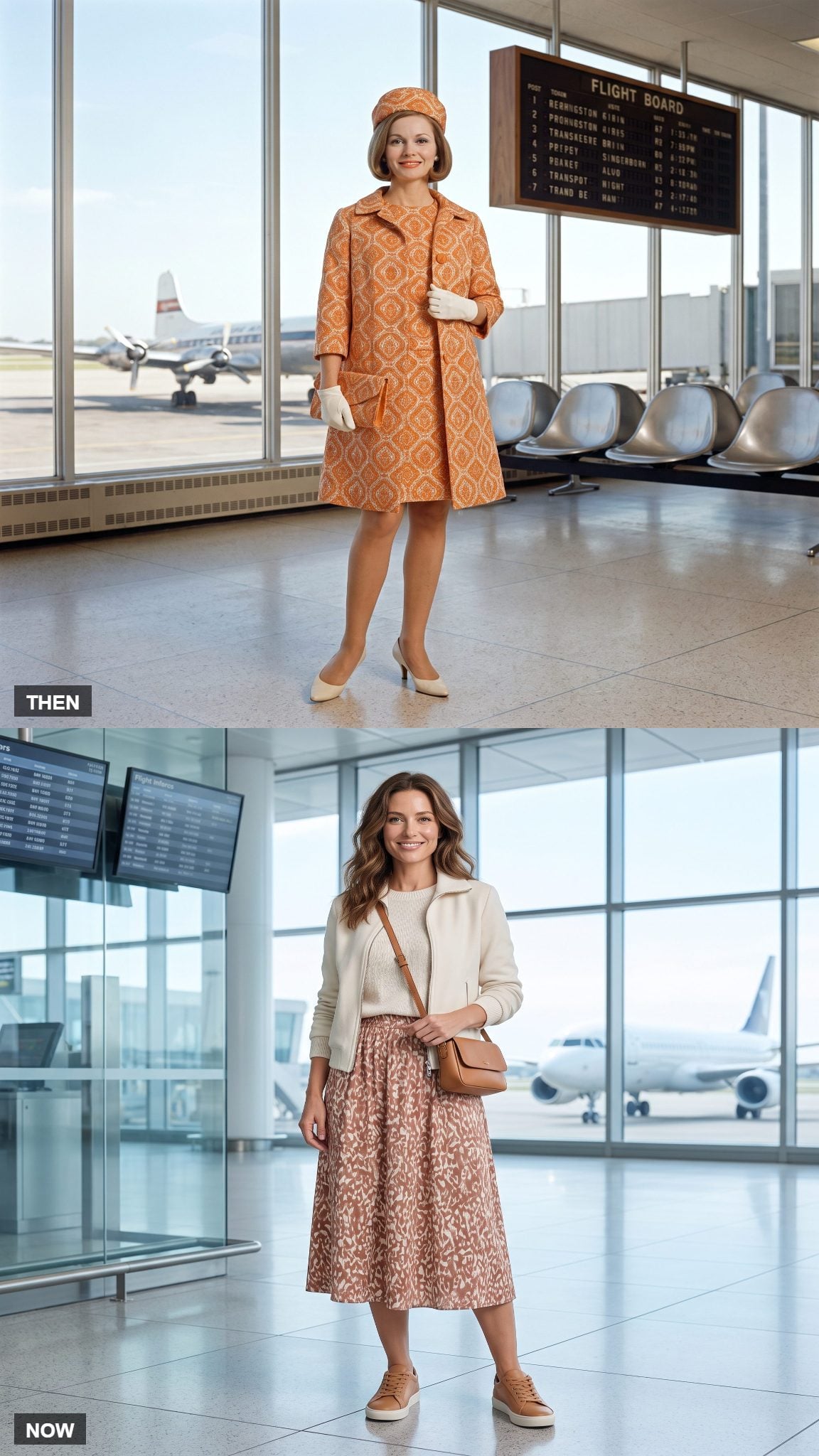
Orange-and-cream print covers the vintage tunic dress and matching coat with unapologetic enthusiasm. The coordinated ensemble is a particularly vivid example of late-1960s fashion’s willingness to commit completely to a pattern.
The modern outfit gives the print a smaller stage: a midi skirt beneath a cream sweater and short zip jacket, finished with tan sneakers. The pattern remains the most memorable element, but the neutral pieces allow its shapes and colors to register more clearly. Instead of matching every surface, the outfit chooses where the excitement belongs.
5. The Jumpsuit Keeps Its One-Piece Advantage
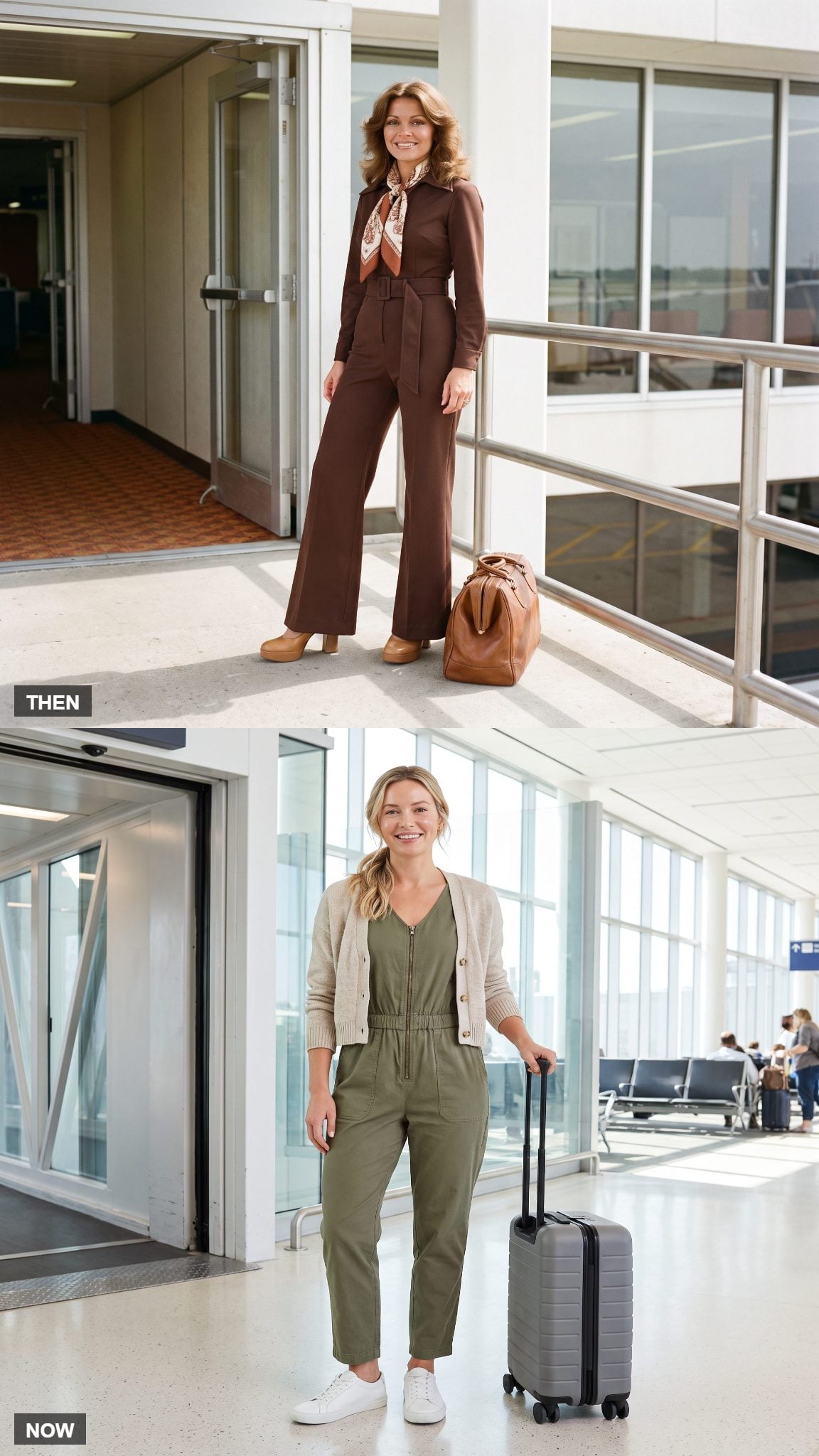
Jumpsuits have roots in practical workwear and aviation, but fashion designers transformed the one-piece garment into something altogether more glamorous. The vintage chocolate version embraces its 1970s character with flared legs, a defined waist, and a silk scarf.
The modern olive jumpsuit is less interested in theatrical tailoring. Stretch cotton, a front zipper, an elasticized waist, and straight legs make it easier to wear for extended periods. A cropped cardigan and clean sneakers complete the practical transformation. The appeal remains remarkably consistent: one garment can still make an entire outfit.
4. The Sweater Coat Unfastens Its Belt
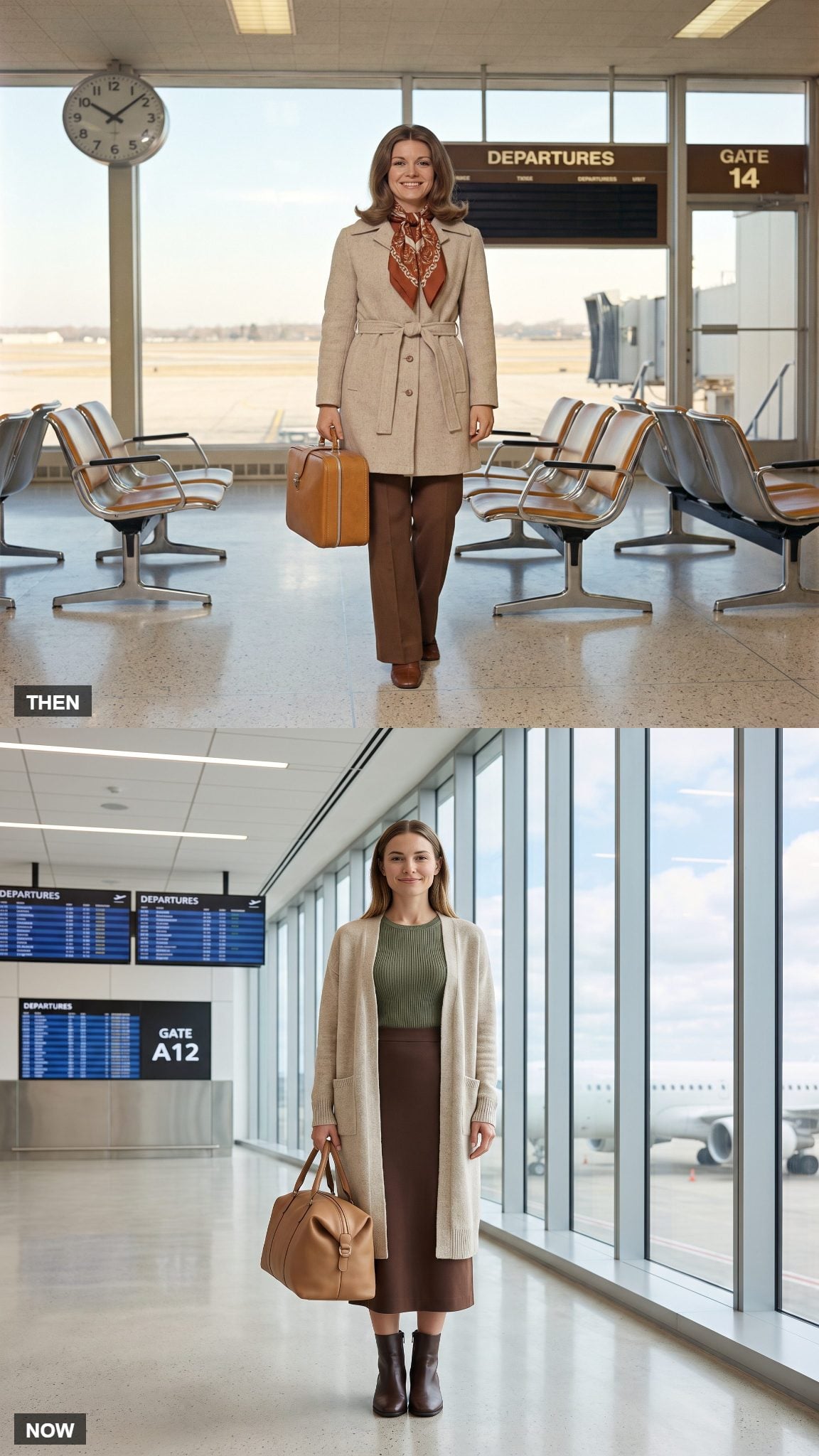
The vintage belted sweater coat turns oatmeal knitwear into a softly tailored silhouette. A silk scarf supplies polish at the neckline, while the belt gives the otherwise relaxed fabric a defined shape.
Its contemporary relative is an open oatmeal cardigan layered over moss knitwear and a chocolate ponte midi. The three muted colors create depth without relying on sharp contrast, and the open front frames the outfit beneath rather than enclosing it. Where the earlier coat depends on a belt for definition, the modern layers use their different lengths and colors.
3. Evening Travel Trades Its Gloves for a Beautiful Drape
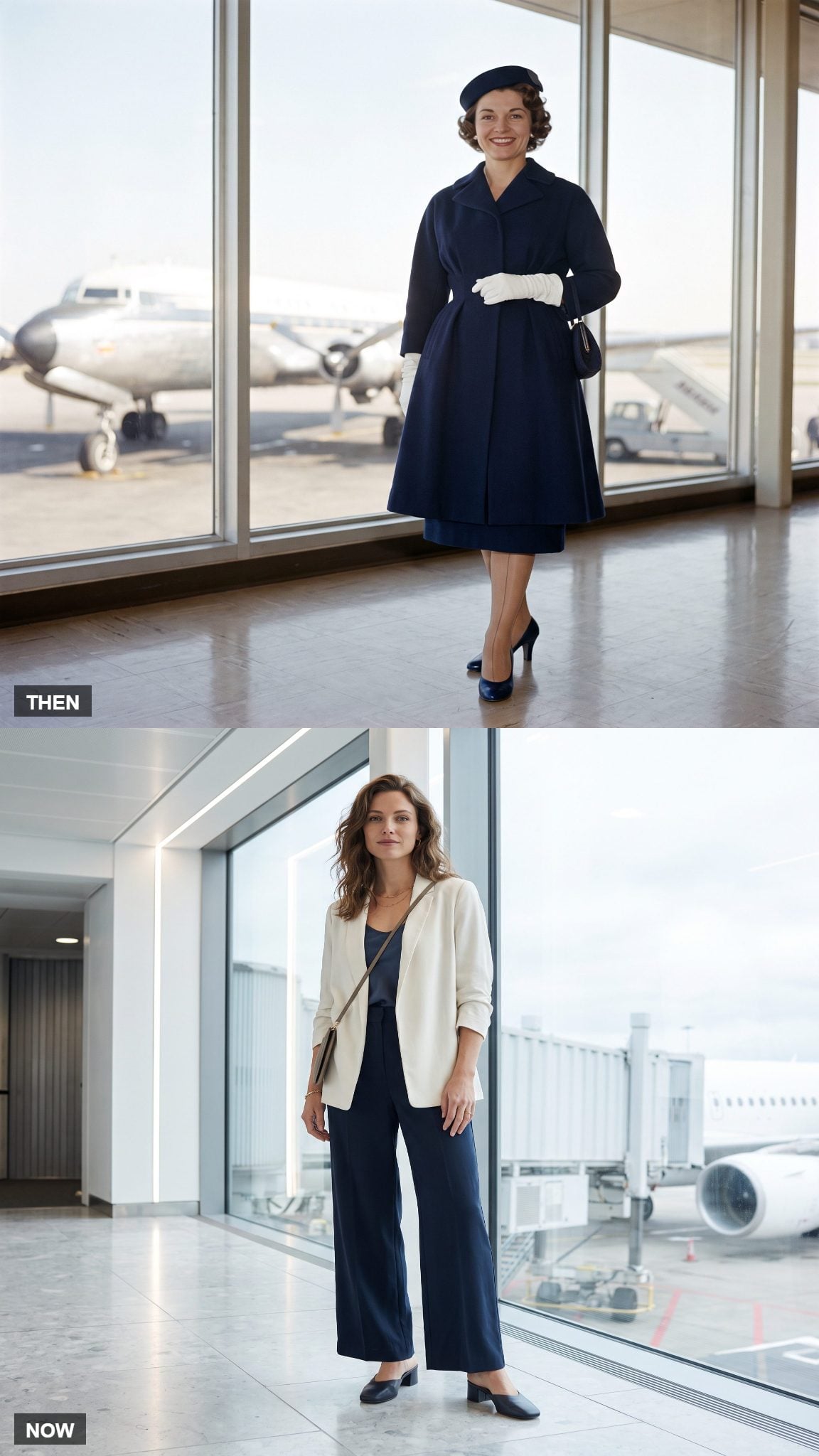
Midnight blue, a folded-collar coat, and elegant gloves give the vintage evening outfit an unmistakable sense of occasion. The clothes belong to an era when airlines frequently promoted the glamour of flying, and passengers who could afford the journey often dressed accordingly.
The modern interpretation finds elegance in movement rather than ceremony. Fluid palazzo trousers and a softly draped ivory jacket retain the sophisticated color story, while allowing the fabrics to fall more naturally around the body. There are no gloves, no elaborate hat, and no rigid coat. The outfit still looks ready for an occasion, even if the occasion is simply arriving somewhere wonderful.
2. Burgundy and Blush Discover the Appeal of Soft Tailoring
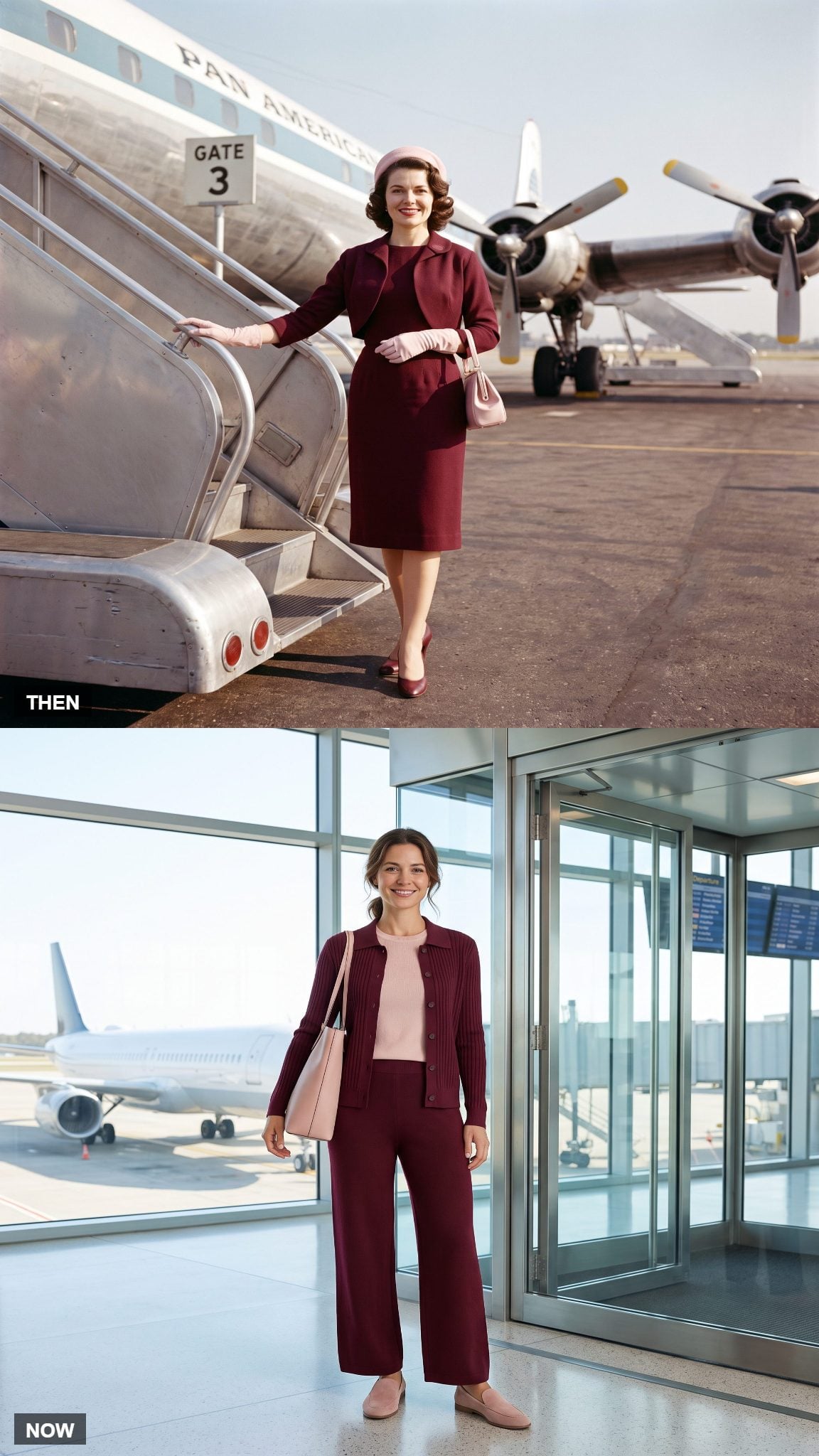
Burgundy and pale pink make an unexpectedly sophisticated pairing in the vintage sheath-and-jacket ensemble. Wine-colored pumps and blush gloves extend the palette into the accessories, creating a look that feels coordinated without relying on a single color from head to toe.
The contemporary knit set uses the same relationship between rich and pale tones. A collared burgundy cardigan sits over a pink shell, while wide-leg burgundy trousers and suede slip-ons bring the outfit into the present. The fabrics are softer and the silhouette roomier, but the color combination retains every bit of its appeal. Sometimes the smartest modernization is knowing what not to change.
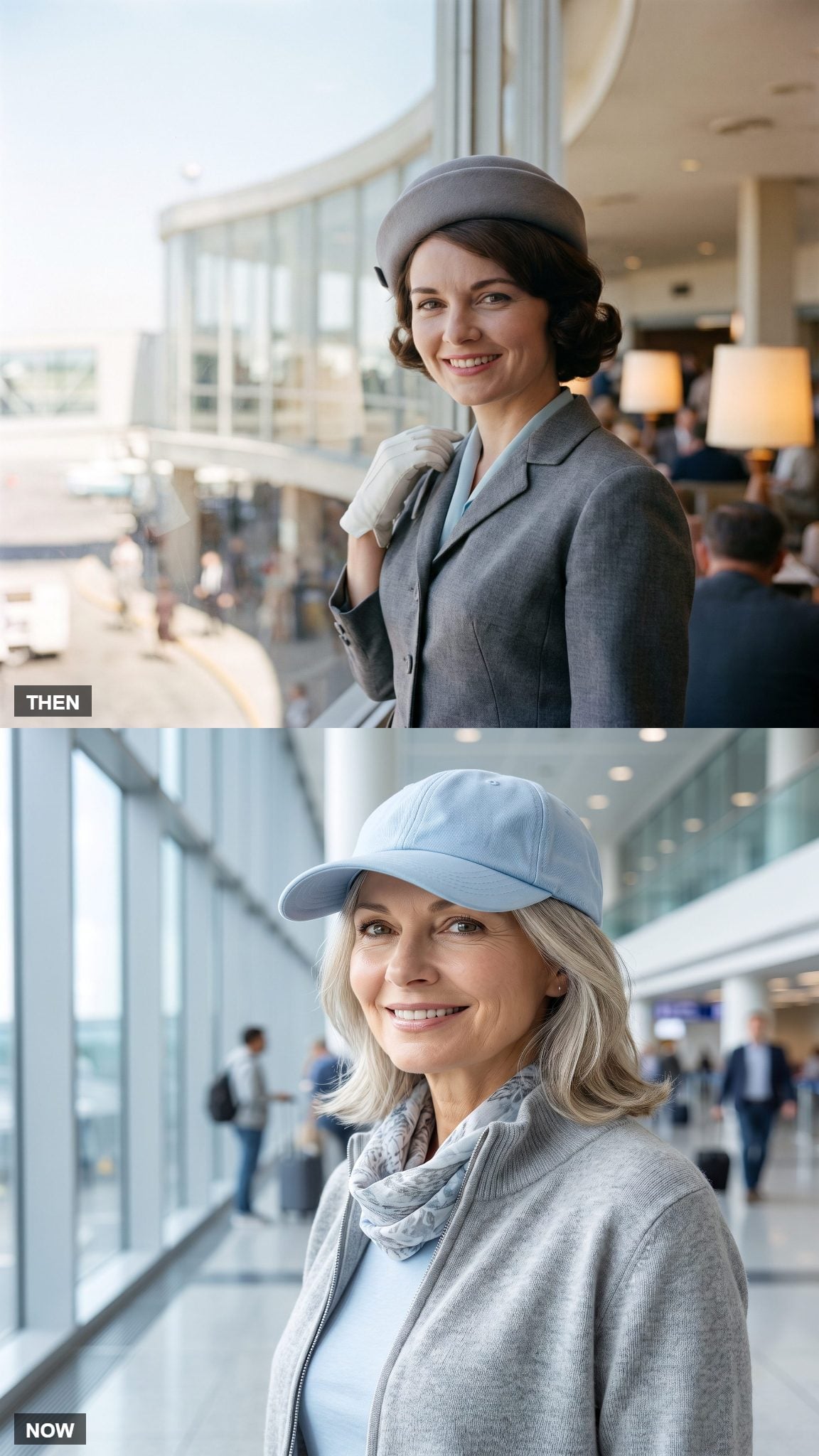
1. The Cabin Hat Makes Its Last Stand — and Returns as a Baseball Cap
❤️ Would you like to save this?
Nothing captures the old ceremony of air travel quite like a pillbox hat. The vintage dove-gray suit, pale blue blouse, and white wrist gloves already form a beautifully controlled outfit, but the little hat supplies the unmistakable finishing touch. It’s an accessory chosen to complete the silhouette, not merely to cover the head.
The modern traveler wears a pale blue baseball cap with a gray zip cardigan and ankle trousers. The colors are surprisingly faithful to the original, even as the formality disappears almost completely. One hat demanded careful positioning; the other can be pulled on in seconds. Between them lies an extraordinary change in how women dress to fly—and a reminder that even the most casual outfit can benefit from one well-chosen finishing detail.