
❤️ Would you like to save this?
Cut six inches off the back and everyone notices the haircut. Cut two inches across the forehead and suddenly everyone notices the face. The eyes look different. Cheekbones that barely registered before take center stage. A familiar jawline acquires a new relationship with everything above it. All because a few strands of hair have moved into territory they never occupied before.
Bangs after 50 are far more interesting than the old argument about covering forehead lines. A blunt fringe can bring architectural precision to a soft haircut. Curtain bangs can open the center of the face while giving the temples a new outline. A diagonal sweep can interrupt a heavy silhouette, while a short, feathered fringe introduces movement where a straight hairline once dominated. Sometimes the difference is barely an inch. Sometimes the entire balance of the haircut changes.
These 33 transformations put those decisions under scrutiny. Copper waves meet sharp fringes. Brunette lengths acquire new structure. Platinum blonde, burgundy, auburn, and even silver reveal how color can amplify the effect of a new front edge. The most revealing changes aren’t necessarily the most dramatic cuts. They’re the ones that make you look twice at a face you thought you already understood.
FYI, thanks to AI imagery software, we’re able to create very specific fashion and hairstyle examples to illustrate the points being made. In some cases, imagery is exaggerated to hammer home the point. Also, assume links that take you off the site are affiliate links such as links to Amazon. this means we may earn a commission if you buy something.
33. Copper Waves Meet a Straight Fringe, and Suddenly the Haircut Has Two Personalities
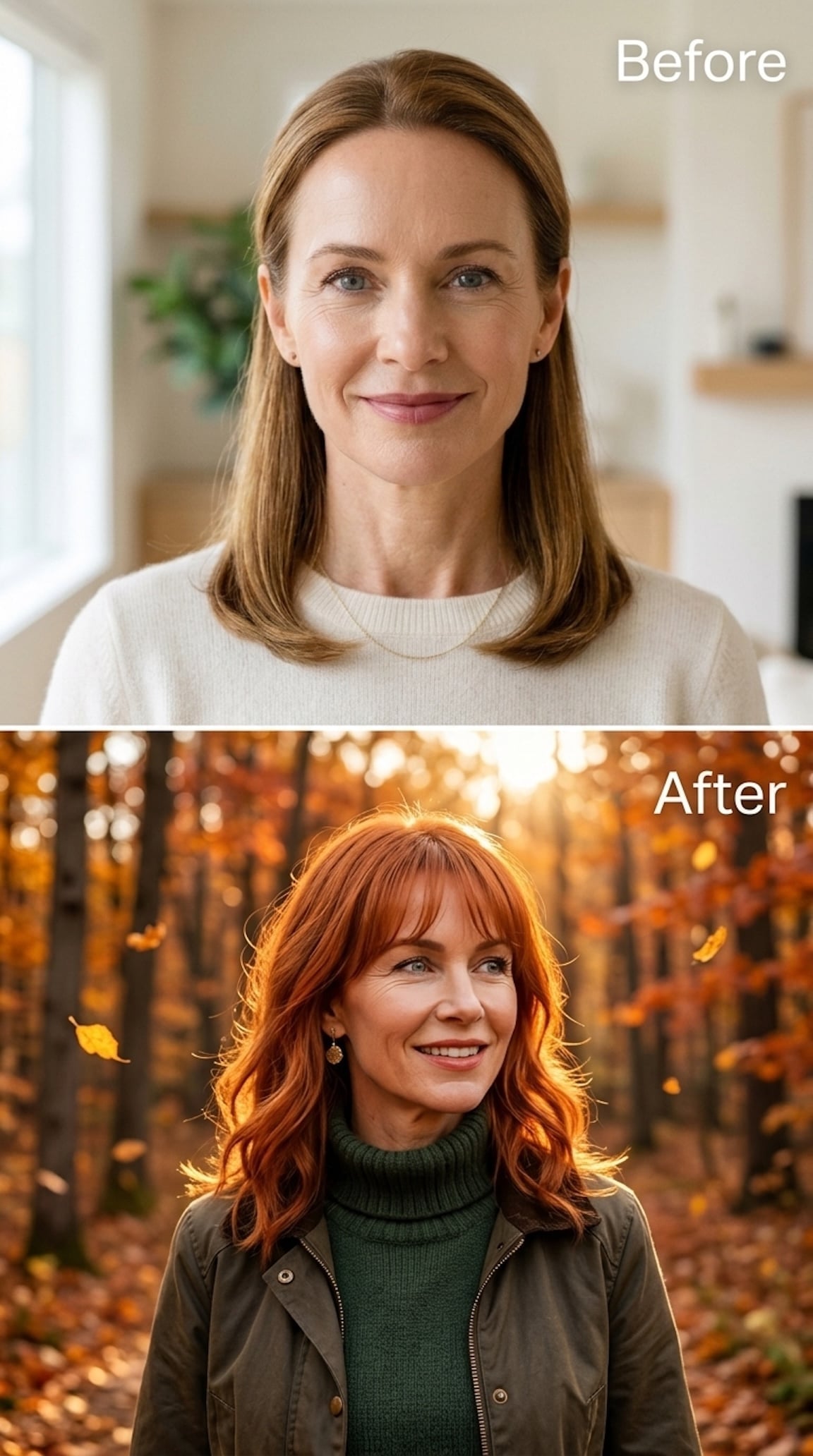
Loose copper waves bring movement through the sides and ends, but the new fringe introduces a completely different kind of line. Instead of following the bends beneath it, the hair across the forehead remains comparatively smooth and controlled.
That tension gives the style its character. The waves soften the outline around the jaw and shoulders, while the bangs establish a firmer edge above the eyes. Warm copper catches the autumn daylight along every bend, making the contrast between the straight fringe and flowing lengths especially apparent.
32. The Black Bob Gets Two Sharp Edges Instead of One
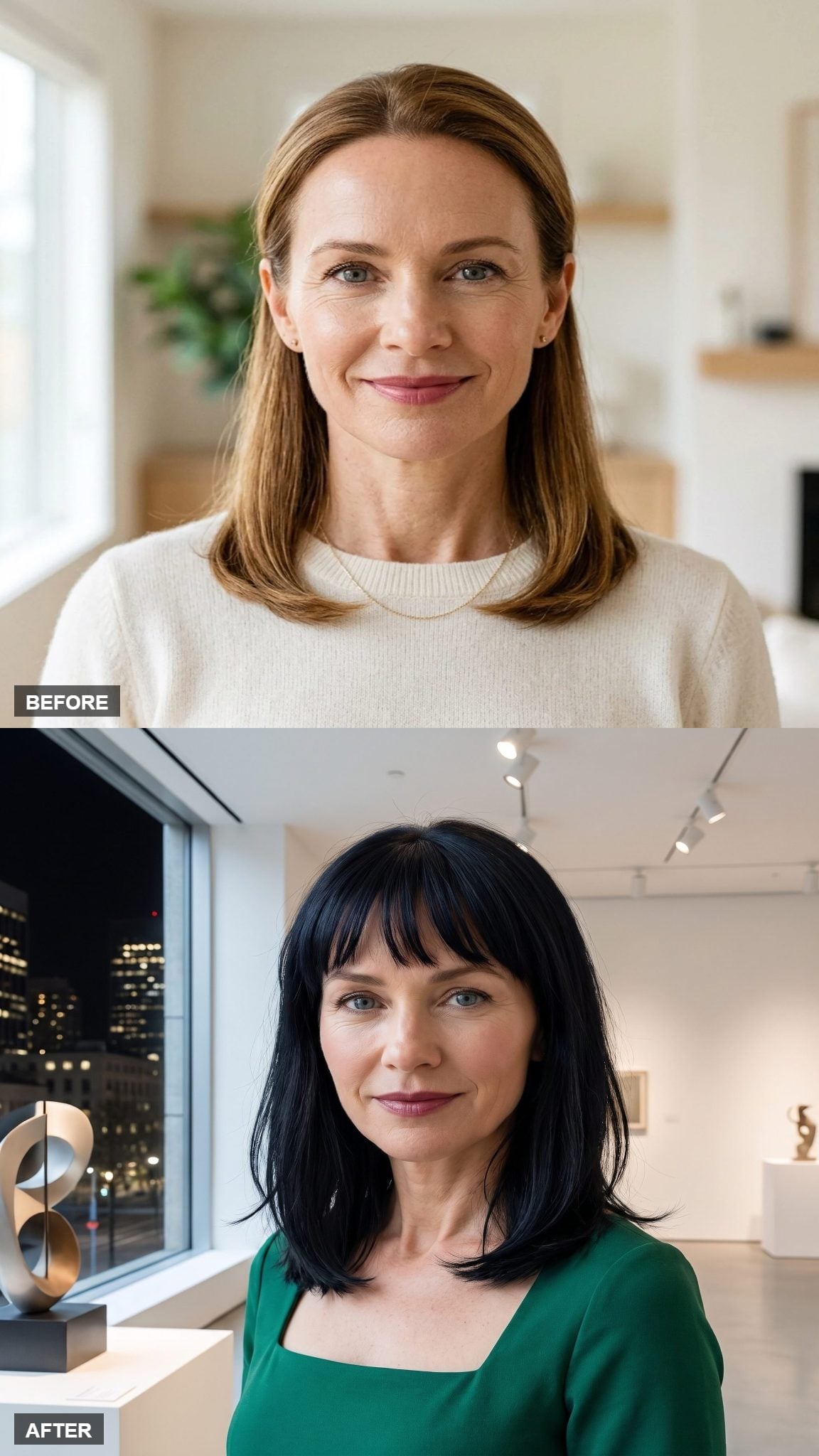
A jaw-length black bob already has a strong silhouette. Add a full fringe cut straight across the eyebrows, and the haircut gains a second defining boundary. One line establishes the upper frame of the face; the other finishes the shape beside the chin.
Near-black color makes both edges especially crisp. The green square-neck top introduces another geometric element, but the haircut remains the dominant feature. Unlike a softer layered style, this bob depends on precision. A slight change in fringe width or jaw-length volume can alter the entire balance.
31. Platinum Blonde and a Full Fringe Make an Unusually Strong Pair
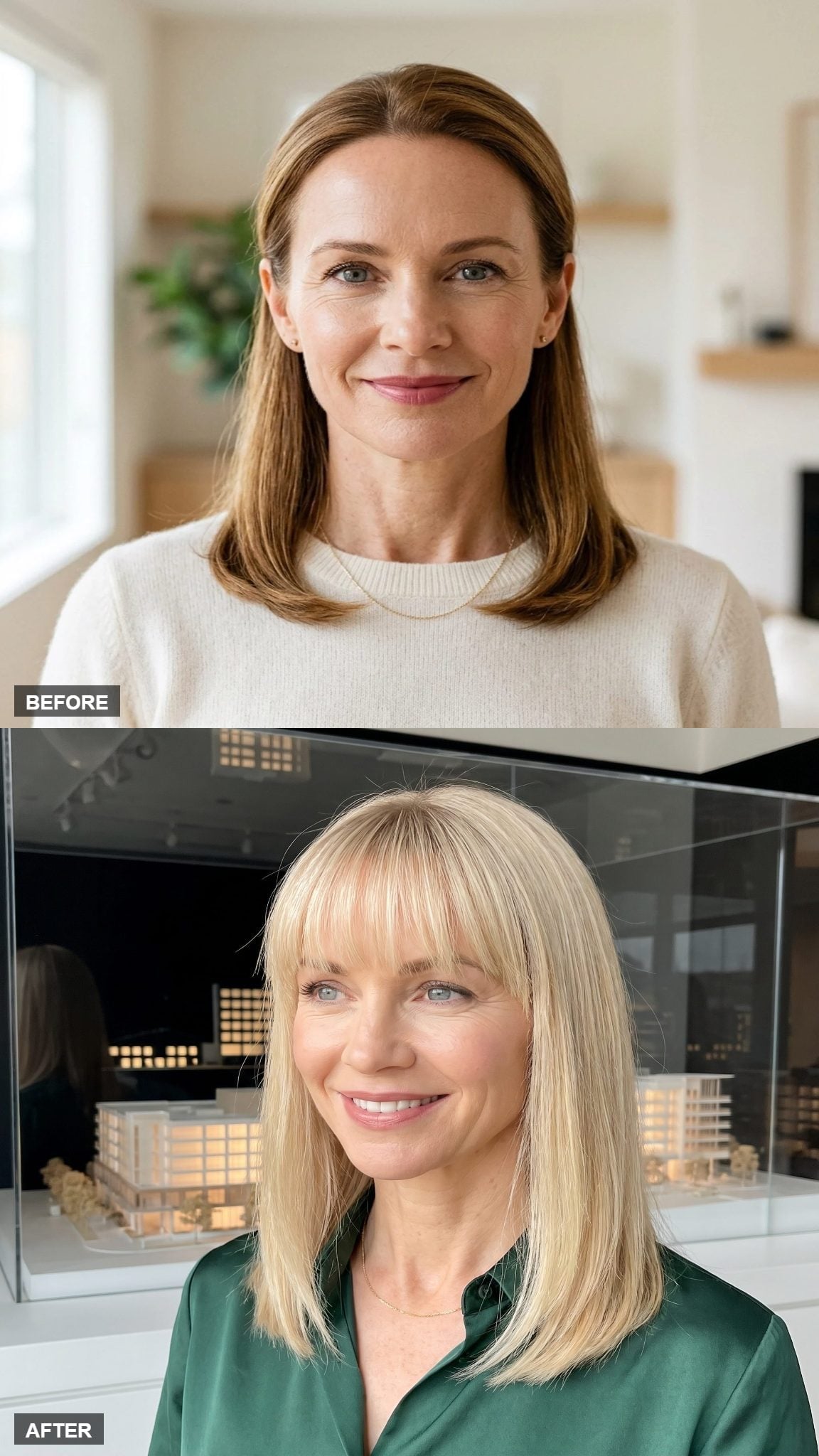
Platinum blonde can appear almost weightless when the hair is finely layered. A dense fringe changes that impression. The bangs create a substantial horizontal edge, giving the pale color a stronger outline against the forehead.
The longer hair remains smooth and relatively blunt past the shoulders, allowing the fringe to establish the main point of contrast. An emerald silk blouse provides saturated color beneath the pale lengths. Maintaining this kind of precision requires attention to density as well as length: too much thinning weakens the edge, while excessive weight can make the bangs difficult to control.
What Our Readers Say
- Asked whether bangs work with glasses, ThreadCurve readers split almost down the middle, 52% yes and 48% no, so it really comes down to the frames and the fringe.
- When we asked our readers about hair colour, silver, brunette, blonde and red copper all had their fans, and the result was too close to name a clear winner.
From ThreadCurve reader polls and votes.
30. A Side-Swept Copper Fringe Gives a Straight Lob an Unexpected Angle
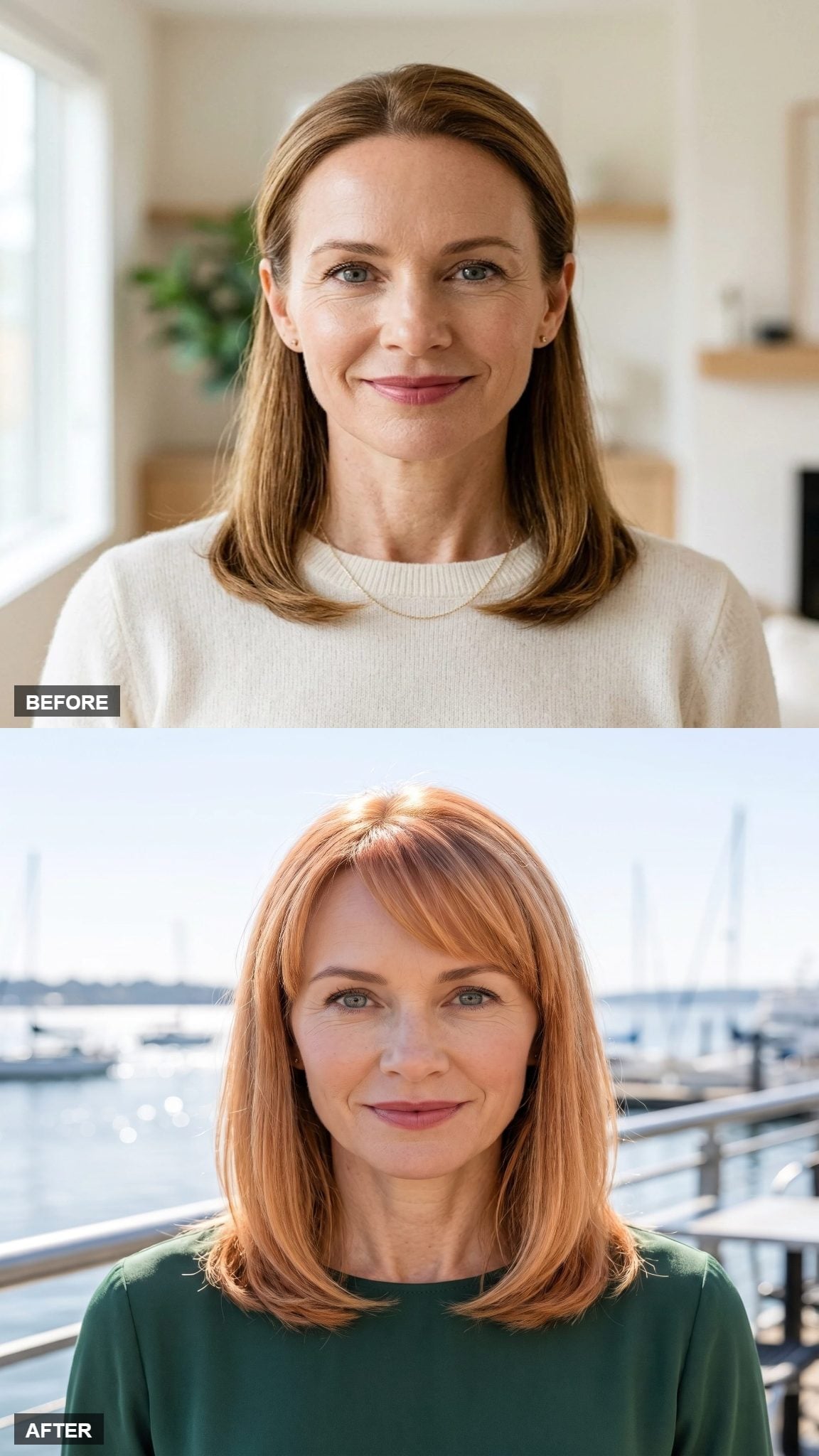
The collarbone-length copper lob has a relatively simple outline. Its transformation comes from the diagonal fringe, which crosses the forehead before blending into the longer hair at one side.
That sweep creates movement without requiring heavy layering throughout the haircut. The longer side can be styled farther across the forehead or directed toward the temple as it grows, making the fringe more adaptable than a short blunt cut. Against the teal boatneck top and bright marina backdrop, the warm copper remains vivid without overwhelming the softer silhouette.
29. Burgundy Bangs Give a Classic Bob a Much More Dramatic Outline
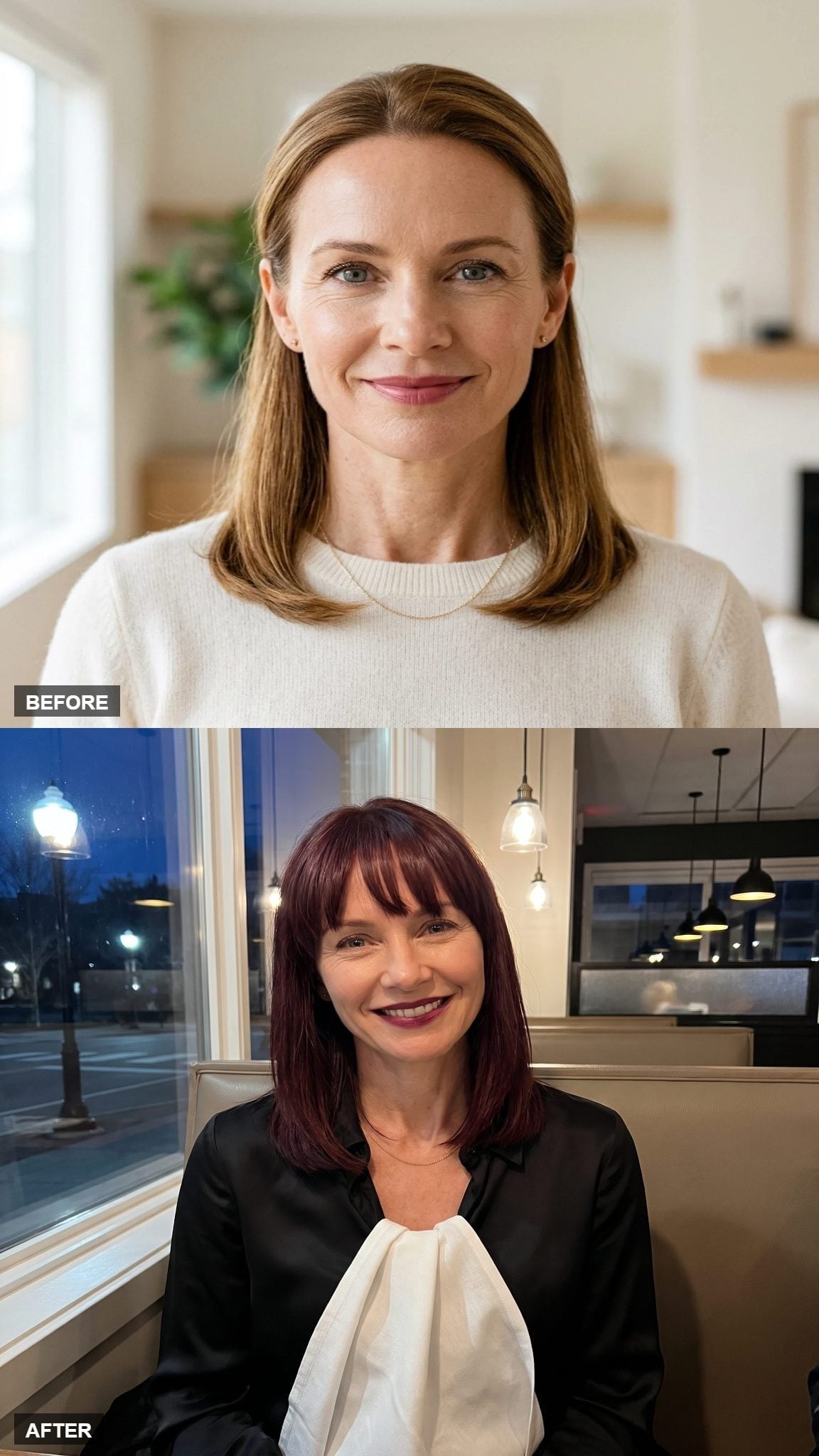
Burgundy brings wine and plum undertones to a compact bob, but the fringe is what gives the color a more commanding position. Instead of appearing only around the sides of the face, the rich shade now forms a continuous band across the forehead.
The jaw-length ends retain a little softness, preventing the haircut from becoming a rigid geometric shape. Under the restaurant’s warm pendant lighting, the red-violet color shifts in intensity. The black jacket and pale neckline provide contrast without competing with the saturated hair.
28. Feathered Blonde Bangs Break Up the Heavy Fringe Look
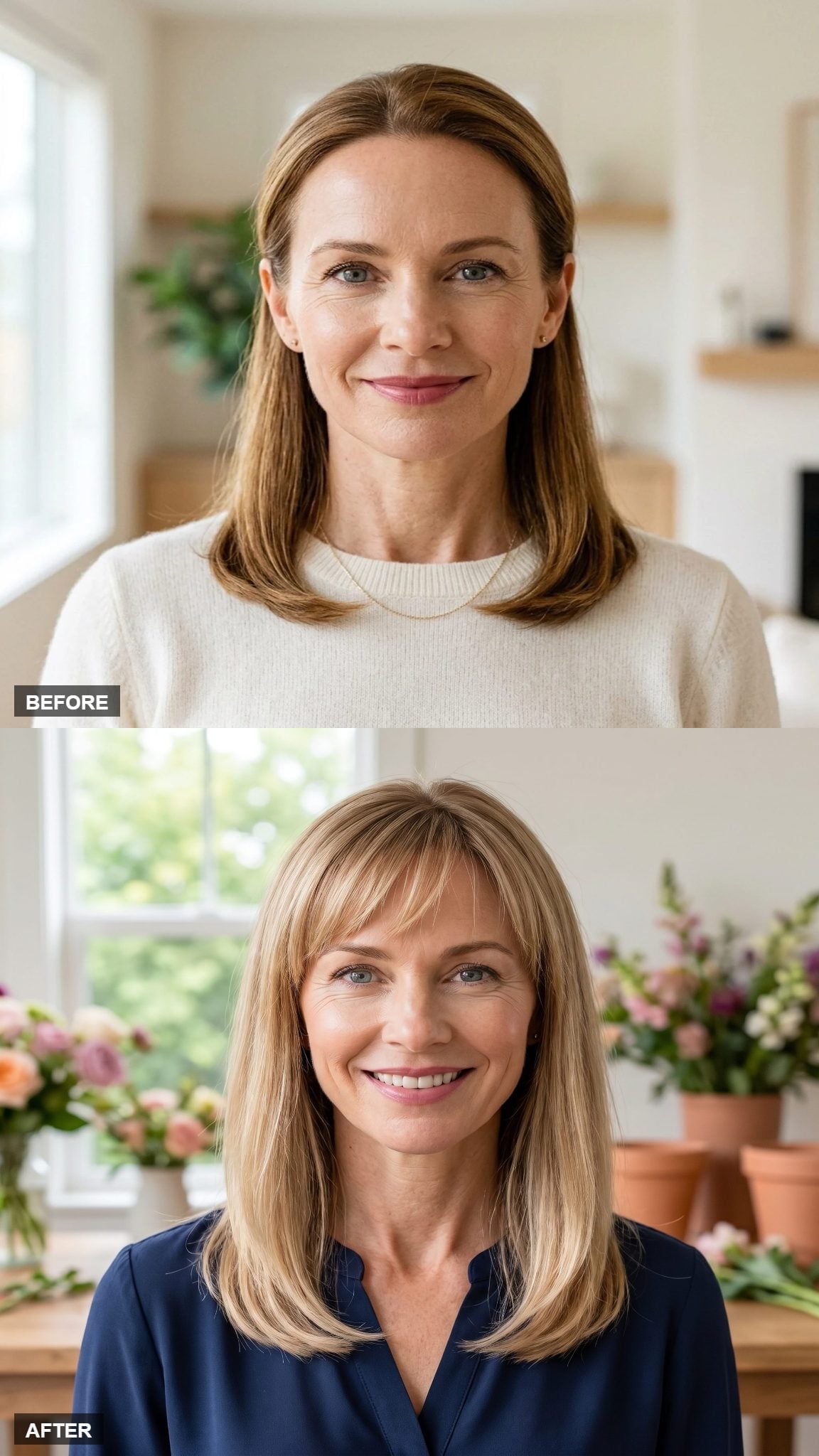
A full fringe isn’t the only way to change the front of a haircut. These blonde bangs have small separations between the strands, allowing the forehead to remain partially visible while establishing a softer outline above the eyes.
The feathering complements the lighter blonde lengths rather than creating a hard division between the bangs and the rest of the hair. A navy V-notch top and flower-filled interior reinforce the relaxed presentation. The advantage is flexibility: the fringe can be brought together for more fullness or styled with greater separation when a lighter finish is wanted.
27. Dark Brunette Bangs Bring a New Precision to Shoulder-Length Hair
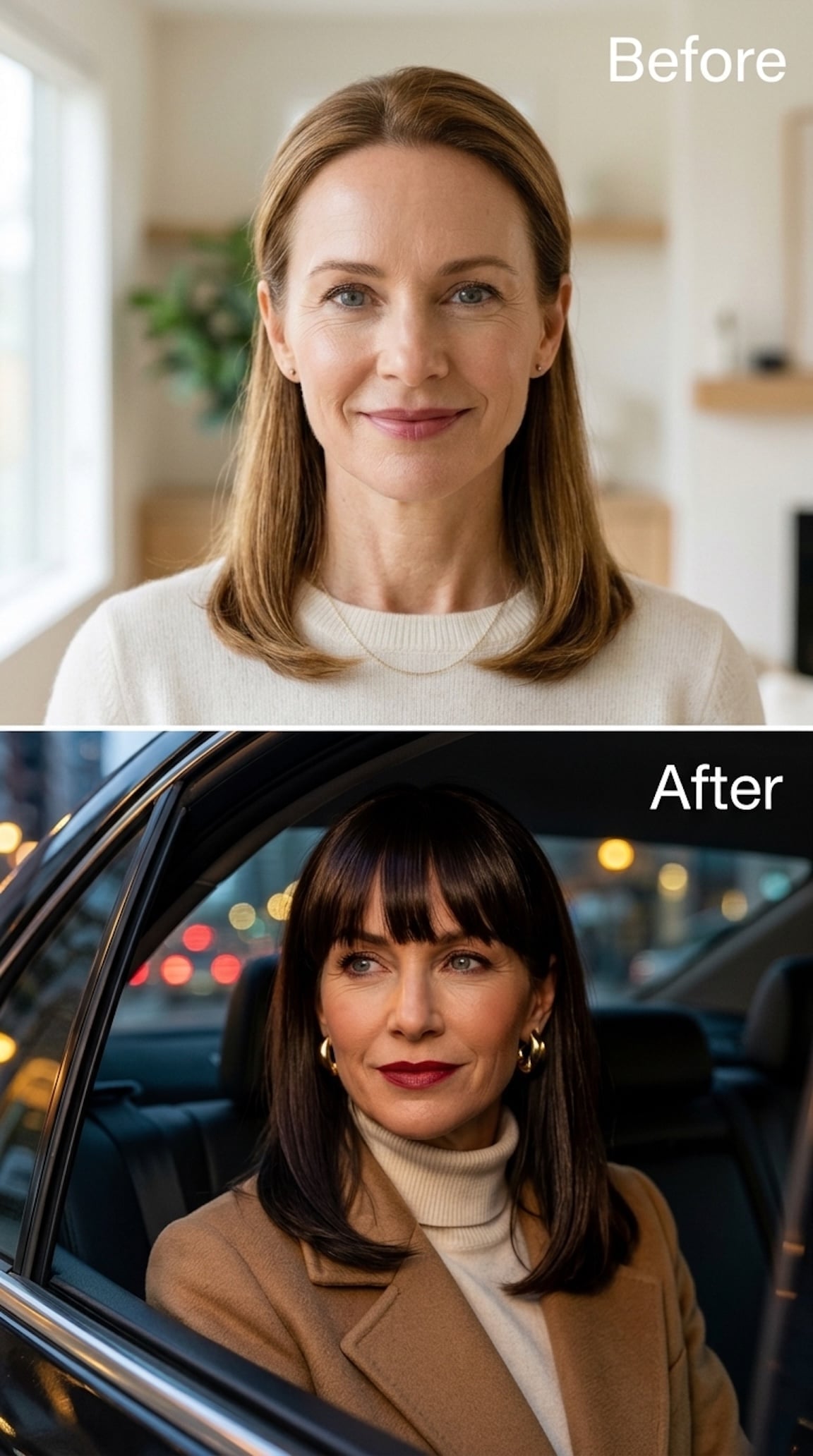
Deep brunette hair falling to the shoulders already has visual weight. Cutting a straight fringe at eyebrow level redistributes some of that weight across the forehead, replacing the open hairline with a deliberate horizontal edge.
The longer lengths keep the silhouette balanced, while the dark color makes the fringe particularly prominent. A camel blazer, cream turtleneck, burgundy lipstick, and gold hoops add warmth around the haircut. The combination is polished, but the real distinction is the contrast between the strong front edge and the softer shoulder-length perimeter.
26. Dusty-Rose Hair Makes a Classic Fringe Look Anything but Conventional
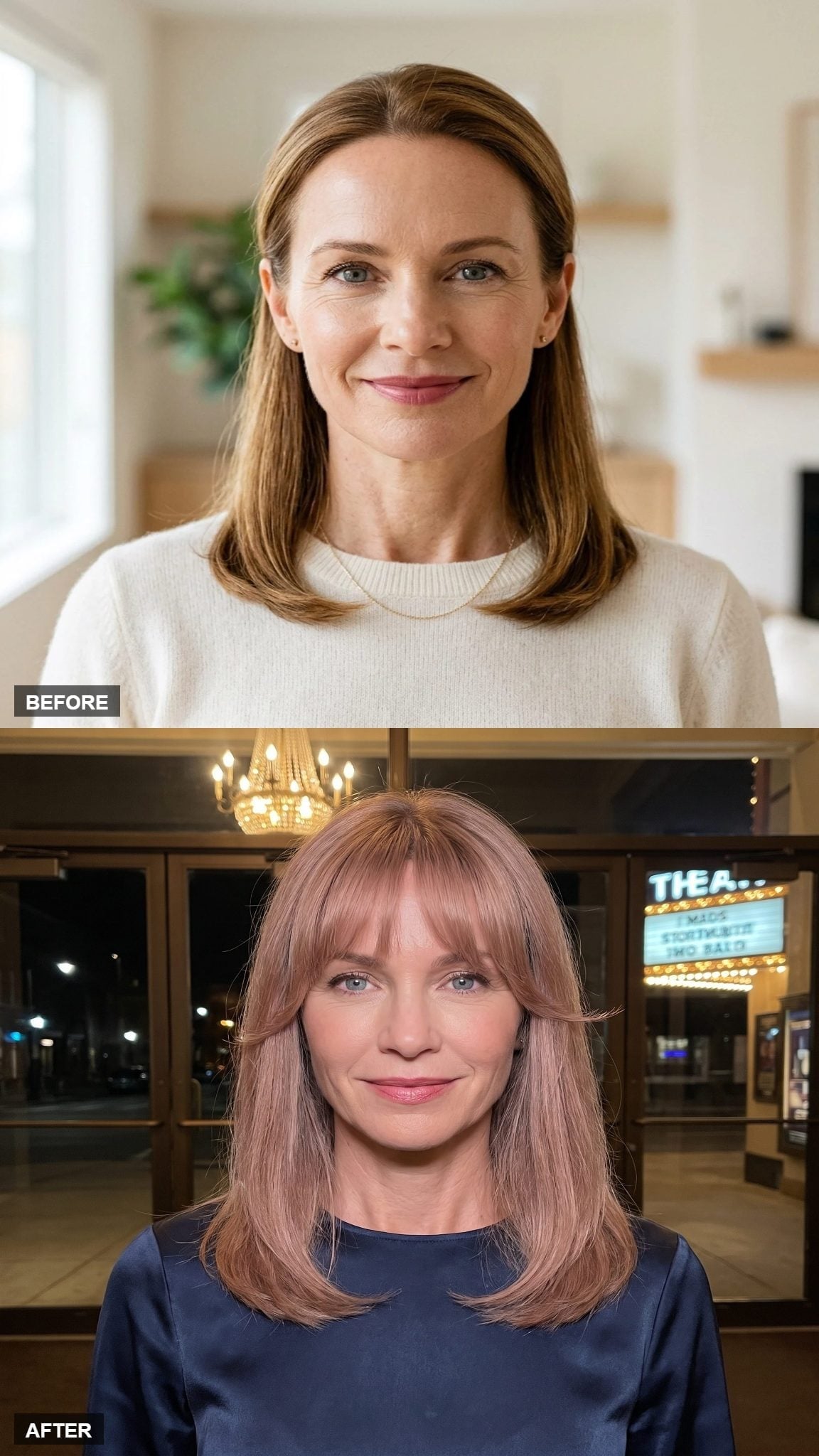
Dusty rose sits between muted pink and warm copper, giving this shoulder-length haircut a distinctive color without the intensity of a brighter fashion shade. The bangs remain conventional in construction: straight at the brow, with enough density to form a clear front edge.
That restraint matters. The color supplies the surprise, while the haircut provides a familiar structure. Gentle movement through the ends keeps the style from appearing too rigid, and the navy top offers a dark contrast to the unusual pink-copper tones.
25. Honey-Brown Layers Get a Fringe That Knows How to Move
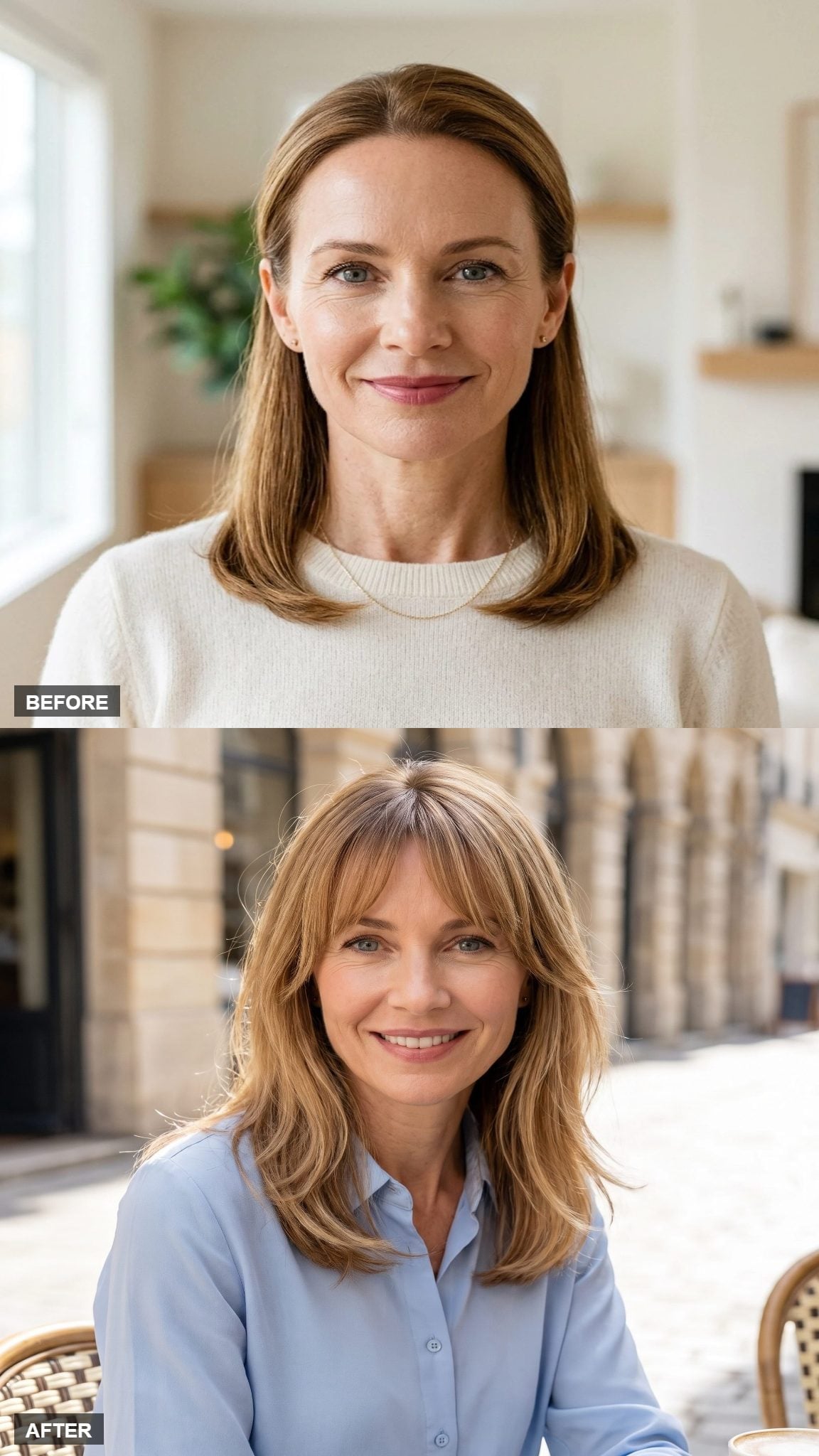
Soft layers already give honey-brown hair movement around the collarbone. The side-swept bangs continue that movement across the forehead instead of interrupting it with a blunt line.
The ends remain deliberately uneven, allowing individual pieces to fall at slightly different lengths. The result has more texture than a polished one-length cut, particularly in natural daylight. A light blue button-down complements the warm highlights without adding another strong element to the composition.
24. A Copper Bob Gets Its Strongest Line Just Above the Eyebrows
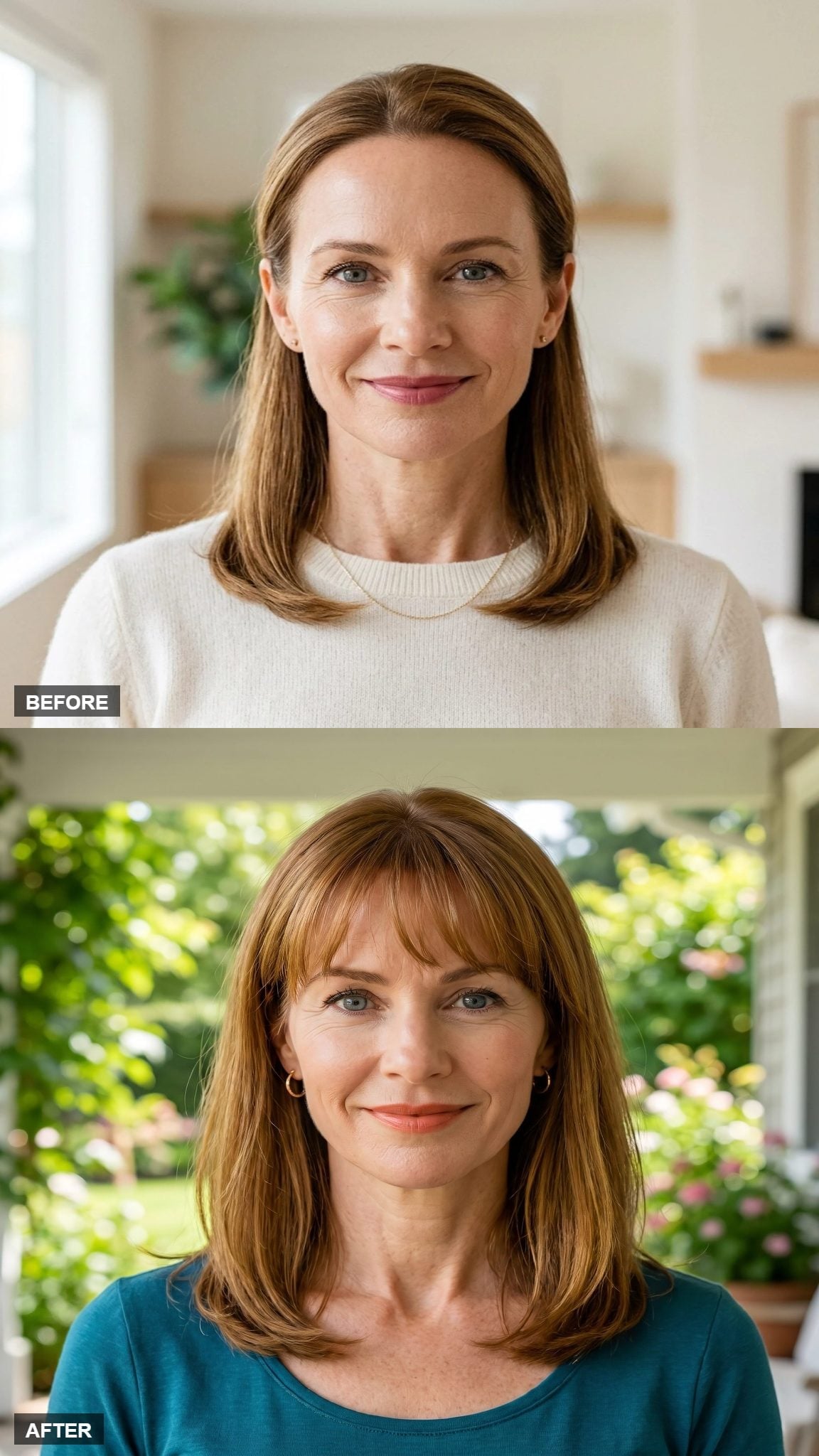
Warm auburn gives this compact bob its richness, but the straight fringe establishes the haircut’s discipline. A firm edge at the forehead echoes the controlled perimeter near the collarbone, producing a silhouette built around two clear boundaries.
The teal crewneck provides a cool contrast to the copper. Unlike a heavily layered hairstyle, this cut relies on the relationship between its lengths. The bangs cannot become too wispy without changing the character of the bob, while the ends need enough control to maintain the clean outline.
23. Long Side-Swept Brunette Bangs Offer a Softer Kind of Transformation
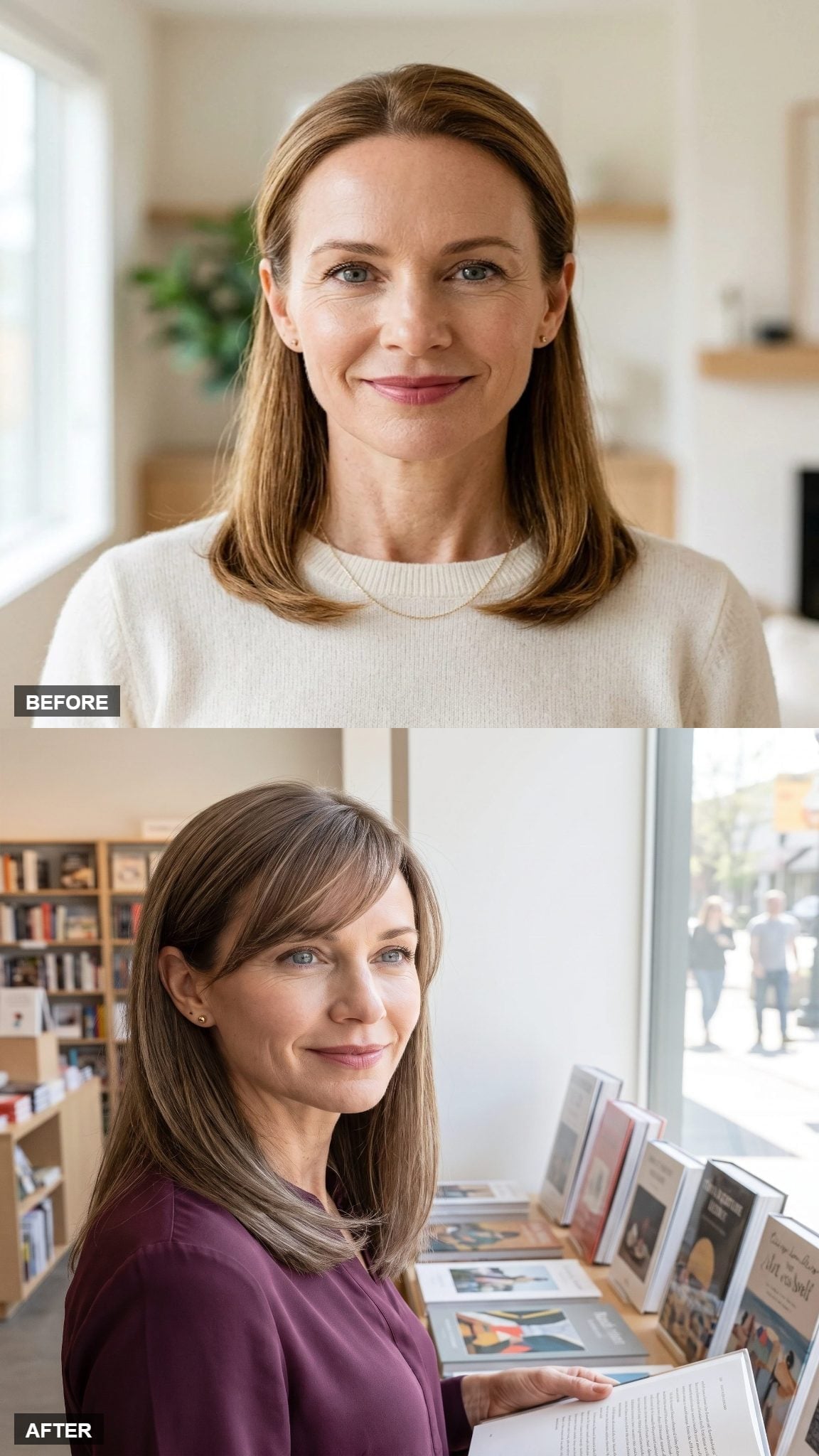
Longer bangs crossing the forehead at an angle create a different effect from a dense horizontal fringe. The diagonal line interrupts the original hairline but blends gradually into the surrounding brunette lengths.
Subtle warm highlights make the sweep easier to see, particularly where the shorter pieces overlap the longer hair. The burgundy top complements those tones. This is also a practical choice for anyone uncertain about maintaining short bangs: the extra length offers more styling options as the fringe grows.
22. Ash-Blonde Curtain Bangs Open Up a Blunt Bob

A blunt bob creates a solid outline around the lower face. Curtain-style bangs introduce a break in that geometry, opening near the center before moving outward toward the temples.
The ash-blonde color reinforces the haircut’s cool, understated character. A black-and-white striped sweater adds another graphic element, but the most interesting contrast remains within the cut itself: a firm lower perimeter paired with a fringe that separates and moves. The result retains the bob’s precision without making every edge equally severe.
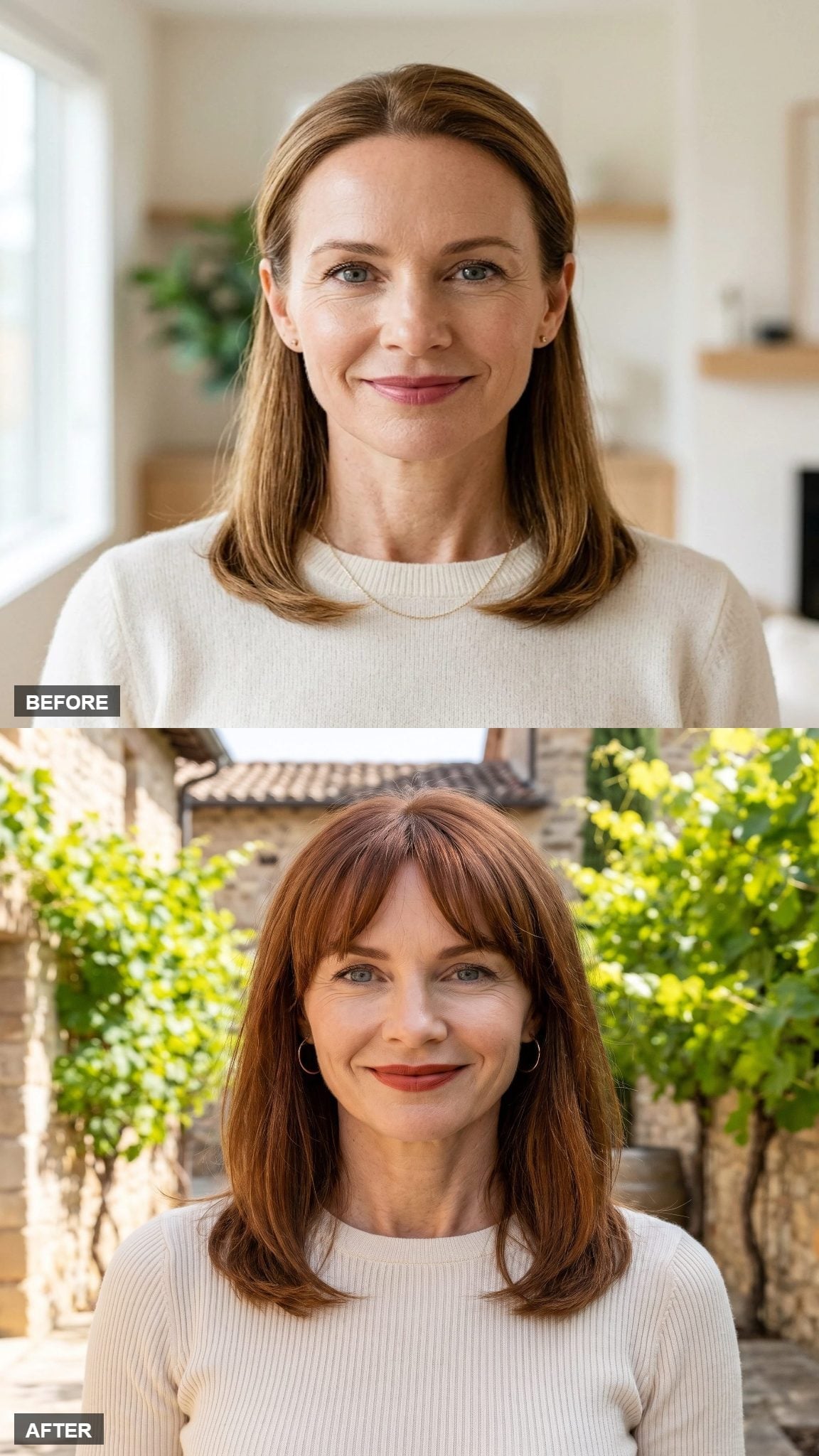
21. Deep Auburn Bangs Bring New Definition to a Shoulder-Length Cut
❤️ Would you like to save this?
Deep auburn hair curves gently inward at the shoulders, creating a smooth outline around the lower face. The eyebrow-length fringe introduces a shorter, straighter line above it, giving the haircut a more defined front.
The copper-brown shade is warm without becoming excessively bright. A cream knit and hoop earrings keep the styling simple, allowing the relationship between the curved ends and the controlled bangs to remain clear. The transformation comes from the new proportions rather than a complicated arrangement of layers.
20. Soft Brunette Bangs Find the Middle Ground Between Blunt and Curtain
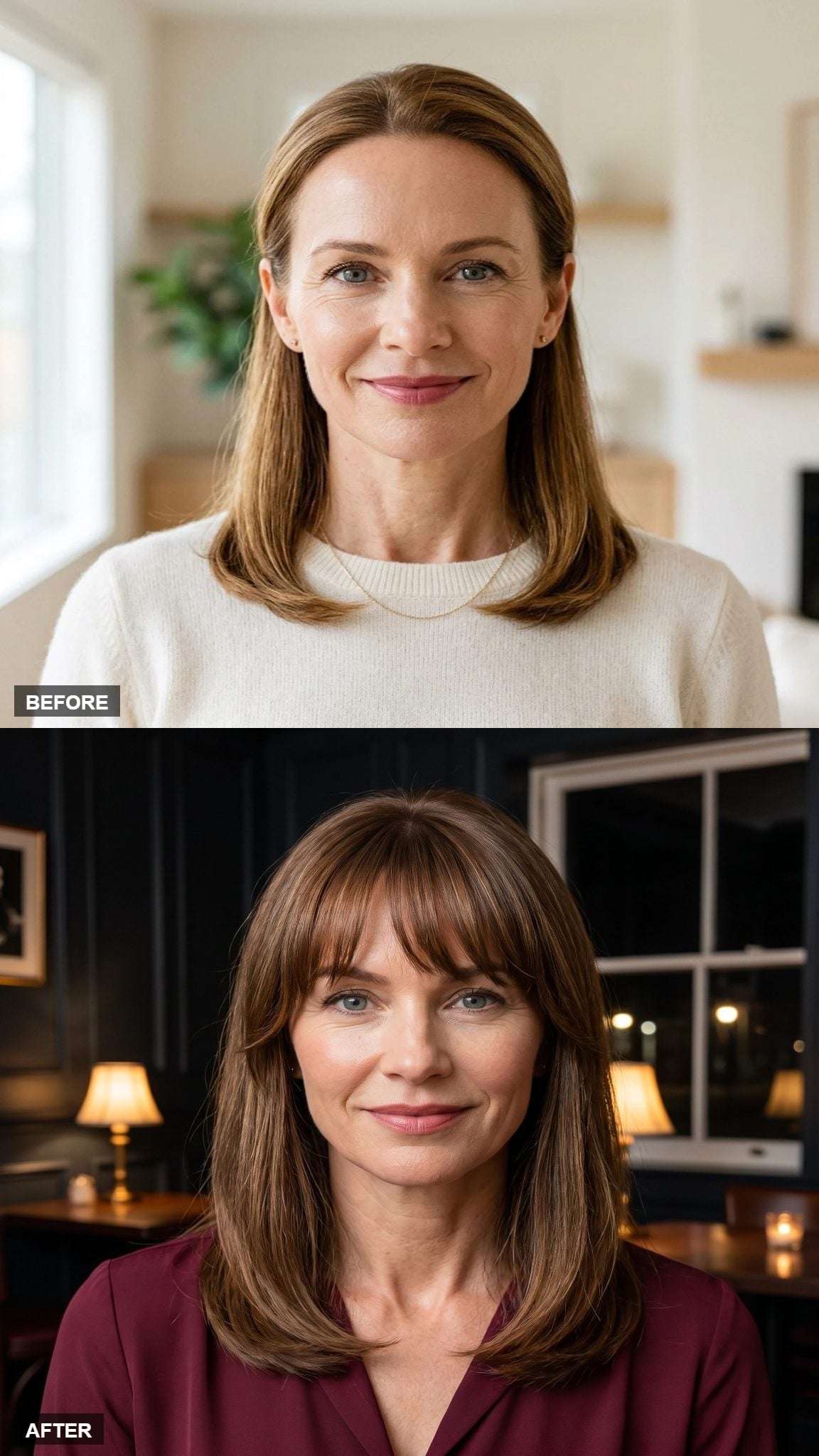
These brunette bangs sit between two familiar approaches. They’re shorter than conventional curtain bangs but less dense than a full blunt fringe. Small separations allow the forehead to show through, while the outer pieces connect naturally with the longer layers.
Subtle auburn tones become richer under the warm lamplight, and the burgundy V-neck reinforces the color. The haircut offers definition without the rigid front edge of a heavier fringe, making it a useful option when the surrounding hair already has softness and movement.
19. Copper Bangs Under Greenhouse Light Reveal Every Detail of the Cut
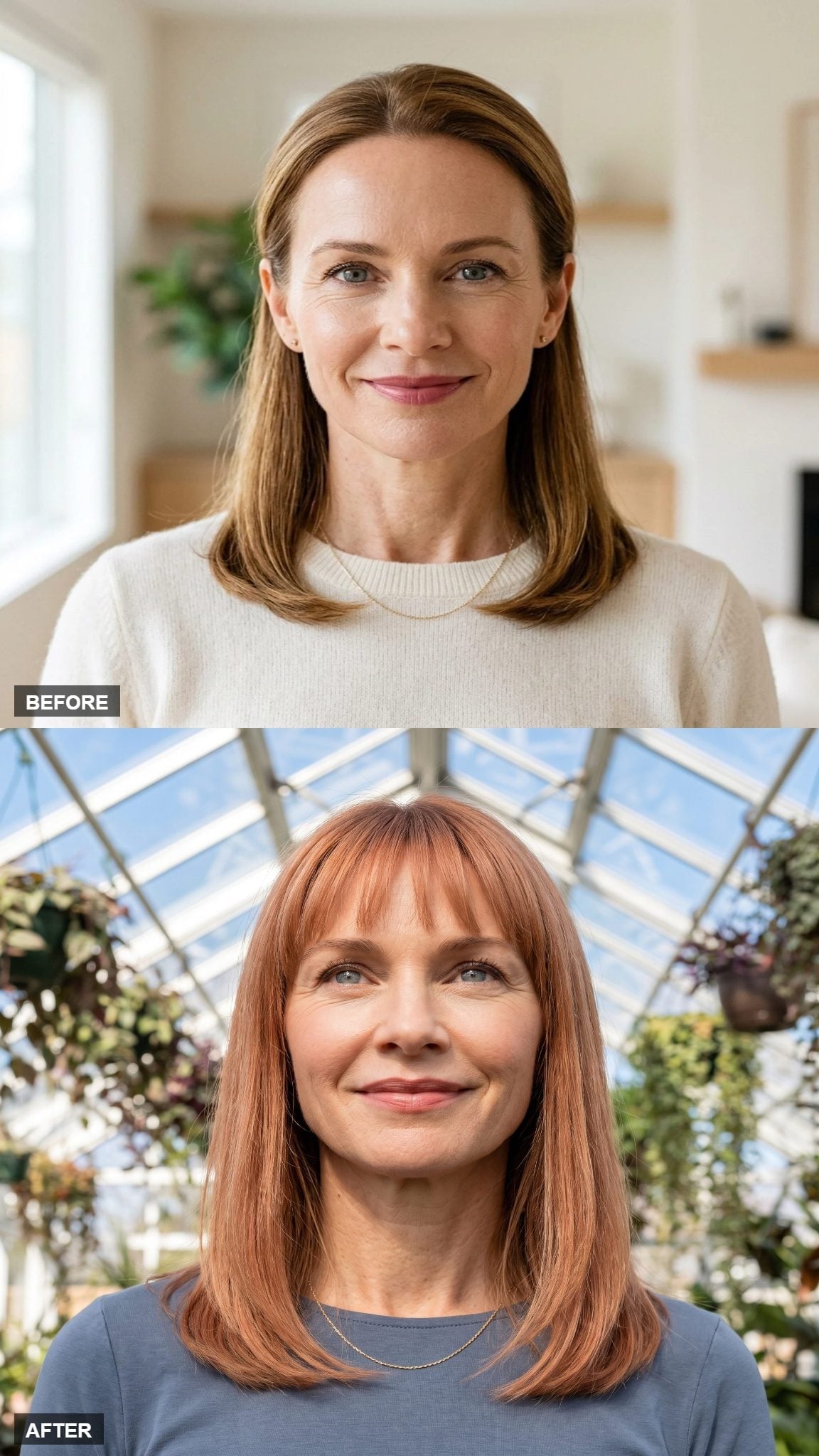
Bright daylight reveals the precision of this copper-auburn bob. The bangs sit straight across the forehead, while the surrounding hair forms a smooth, medium-length shape with only modest movement at the ends.
The greenhouse greenery and slate-blue crewneck provide cooler colors against the warm copper. Compared with a feathered or side-swept fringe, this version makes a stronger statement through consistency. Its appeal depends on an even front edge and a controlled overall silhouette rather than elaborate styling.
18. A Brown Fringe Keeps Its Straight Edge but Softens at the Temples
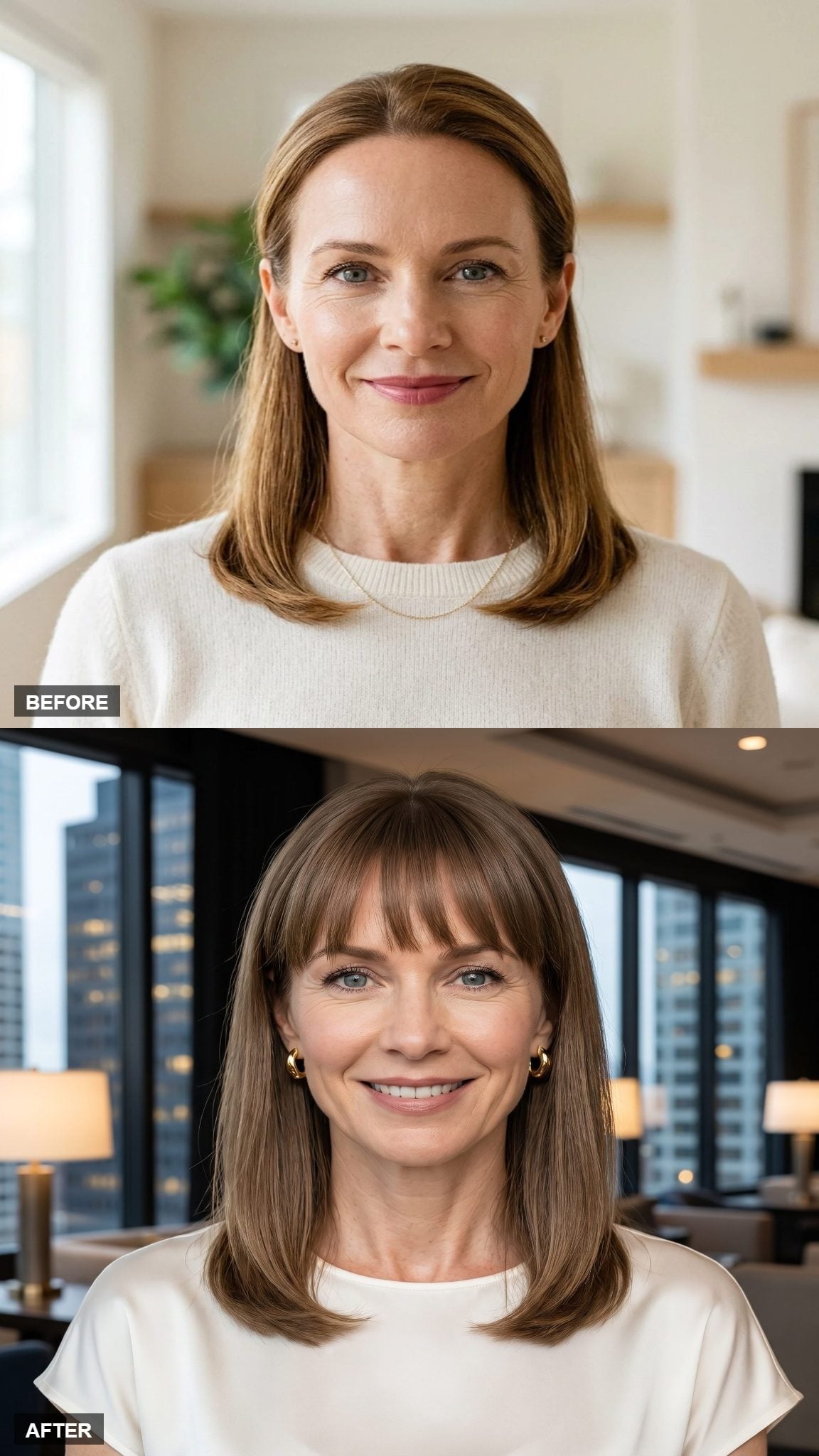
The brown hair falls to the collarbone with subtle movement at the ends. Across the forehead, the new fringe remains relatively straight through the center before softening toward the temples.
That small adjustment keeps the bangs from looking like a separate block of hair. Medium gold hoops add a rounded detail beside the jaw, while the white crewneck leaves the hairstyle visually uncluttered. The finished look balances a defined brow line with softer movement through the sides.
17. Blonde Highlights Give a New Fringe More Than One Dimension
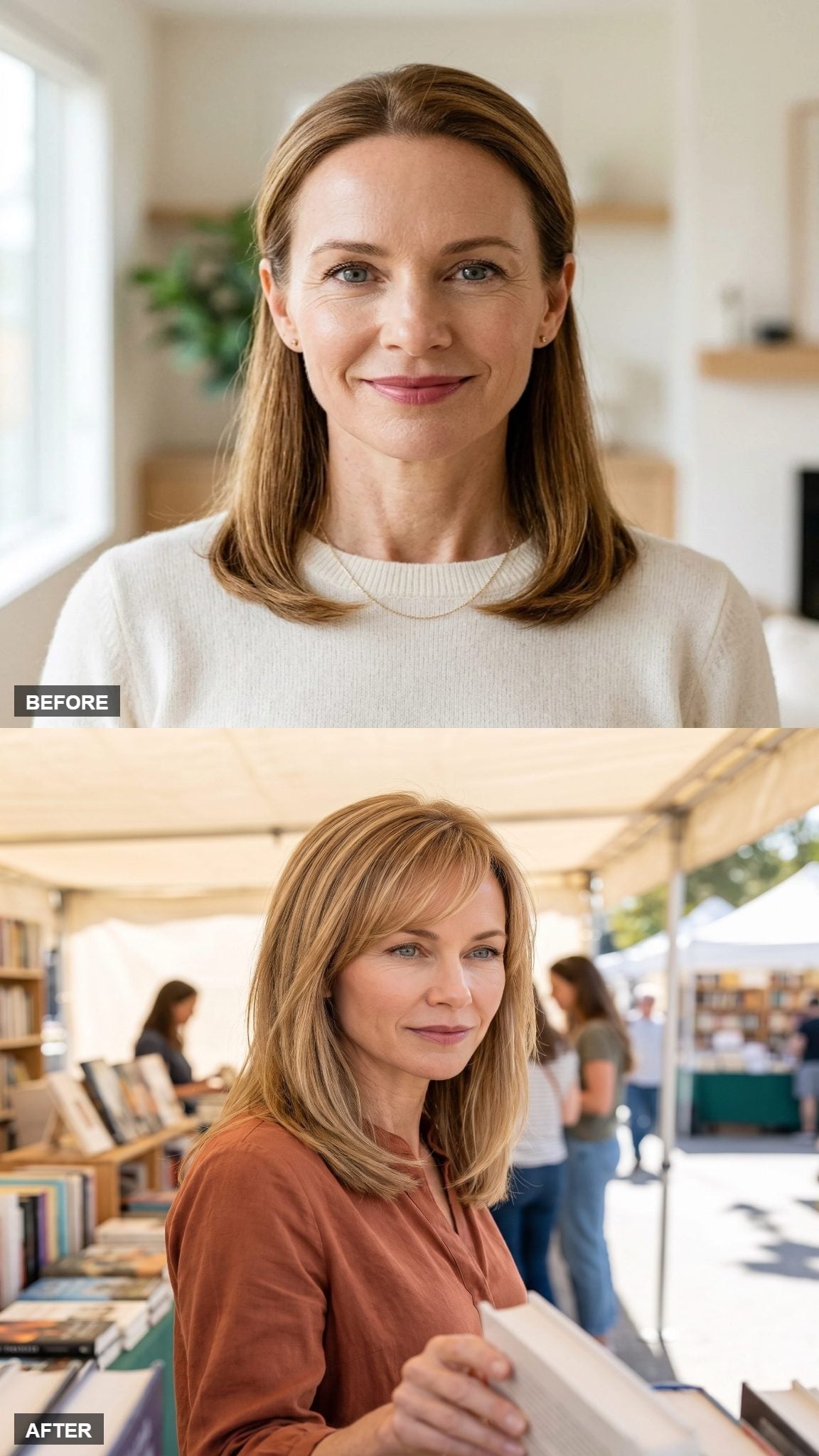
Seen from an angle, the highlighted blonde layers reveal how the fringe joins the longer sections. The bangs sit just above the eyebrows, but the variation in color prevents them from appearing as one uninterrupted block.
Lighter strands create separation through the front, while warmer tones remain visible beneath. The rust-colored top complements the highlights. This is a useful example of how color placement can reinforce the shape of a new fringe without requiring extensive thinning or feathering.
16. Burgundy Bangs Turn a Smooth Collarbone Cut Into an Evening Statement
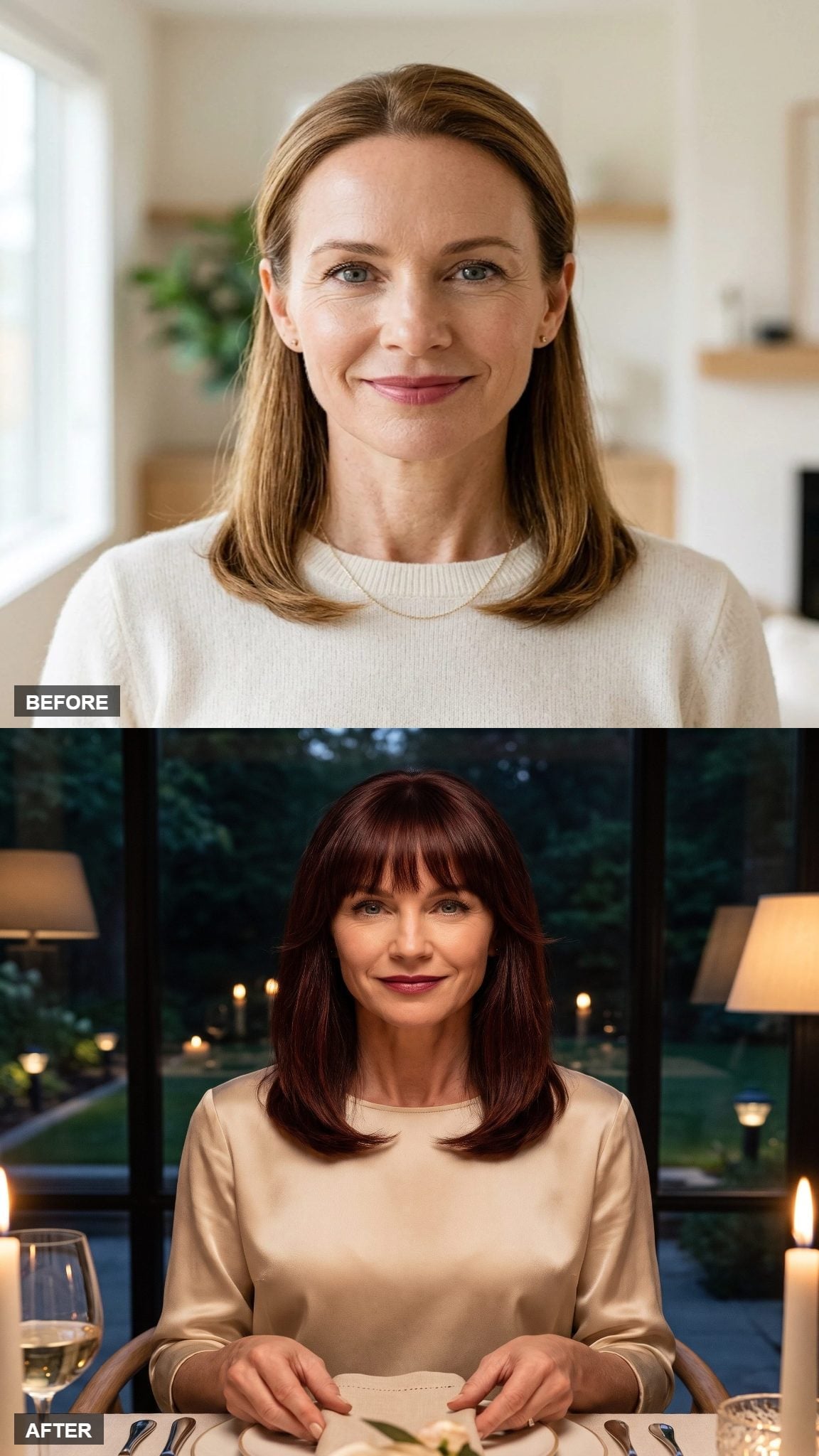
Saturated burgundy gives this collarbone-length haircut depth, while the straight fringe establishes a new boundary across the forehead. The ends angle slightly forward, introducing another controlled line around the lower face.
Champagne-gold satin and candlelight bring warm reflections into the composition, contrasting with the cooler red-violet hair. The haircut remains smooth rather than heavily layered, allowing the fringe and forward-angled ends to provide its principal structure.
15. Feathered Blonde Bangs Keep Their Weight in the Middle
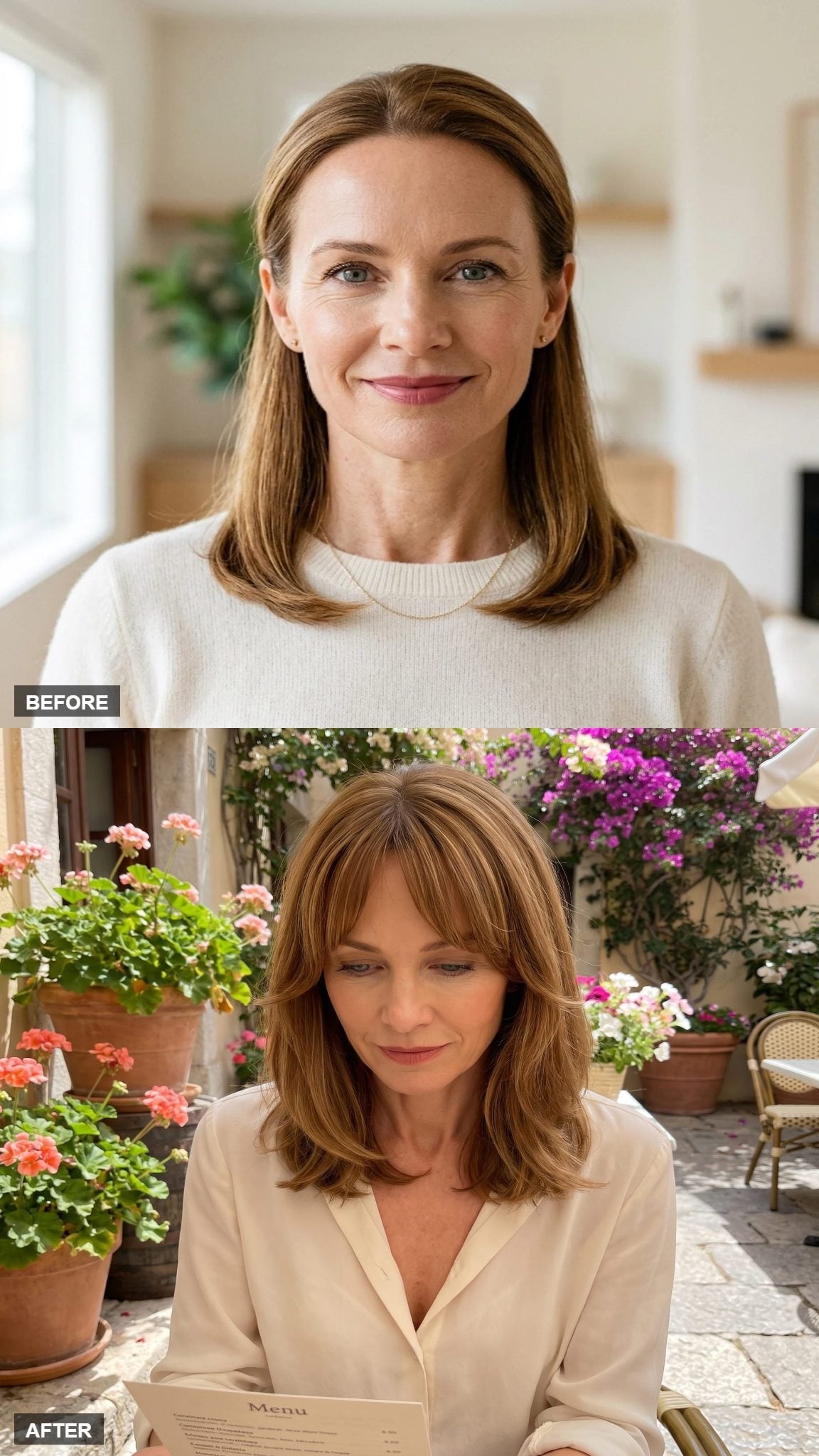
This blonde lob uses a fringe that is fuller near the center and progressively lighter toward the sides. The change in density allows the bangs to remain visible without creating an equally heavy line from temple to temple.
Warm highlights run through the shoulder-length layers, giving the ends a soft, airy finish. The cream blouse and sunlit terrace suit the relaxed styling. The cutting distinction is subtle but important: the fringe has enough central weight to establish shape, while the feathered outer sections blend into the longer hair.
14. Red-Violet Auburn Gives Straight Bangs an Unexpected Depth
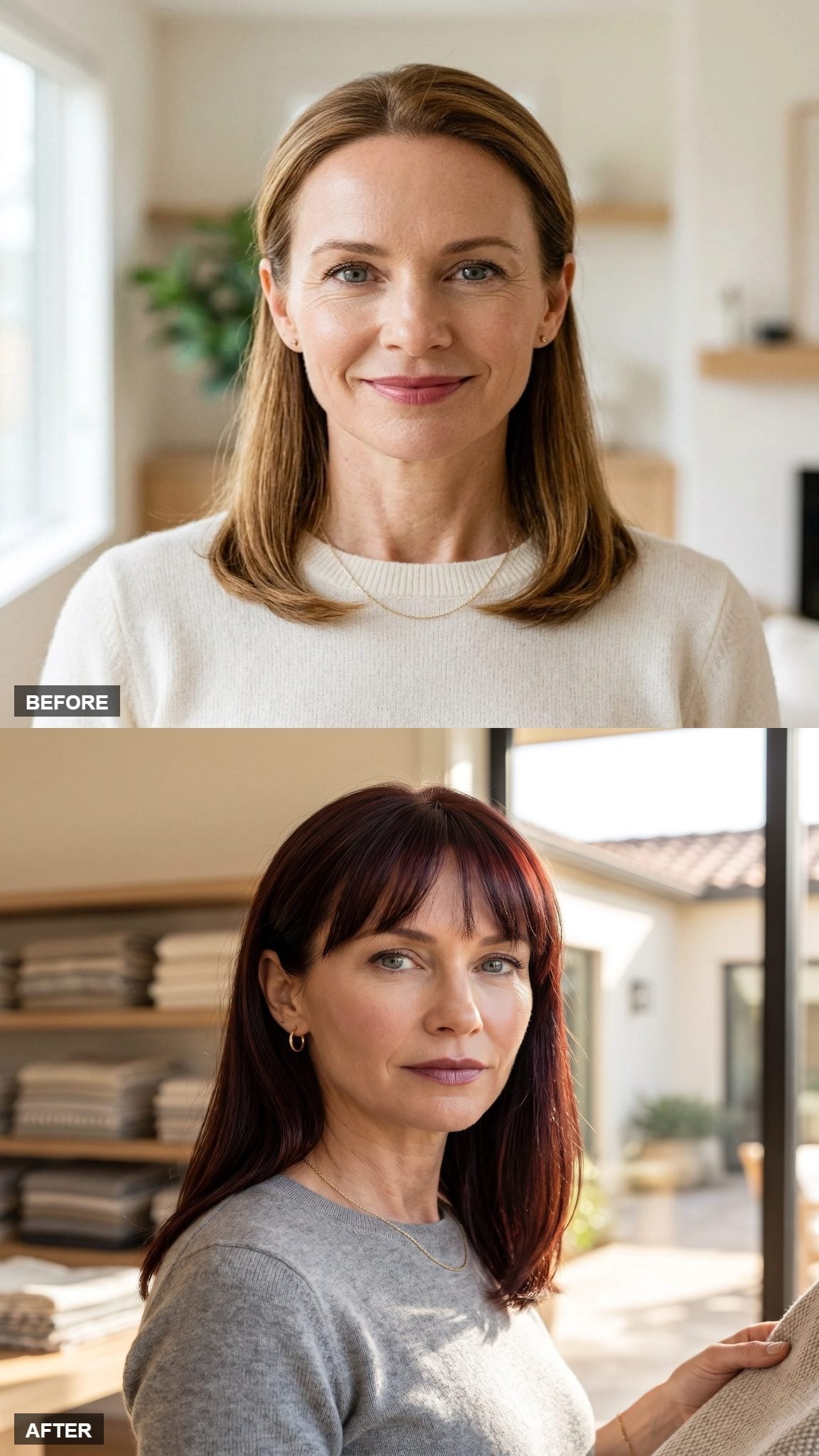
Not all auburn hair belongs to the same color family. This shade carries a pronounced red-violet undertone, giving it a cooler finish than orange-based copper. The straight fringe brings that color into a concentrated band above the eyes.
The longer lengths soften the overall outline, while the gray crewneck and neutral interior provide a restrained setting. Small gold hoops introduce a little warmth. The distinction between copper and red-violet becomes particularly apparent when the fringe places the color directly against the forehead.
13. Honey Highlights and Swept Bangs Take the Hard Edge Off a Straight Hairline
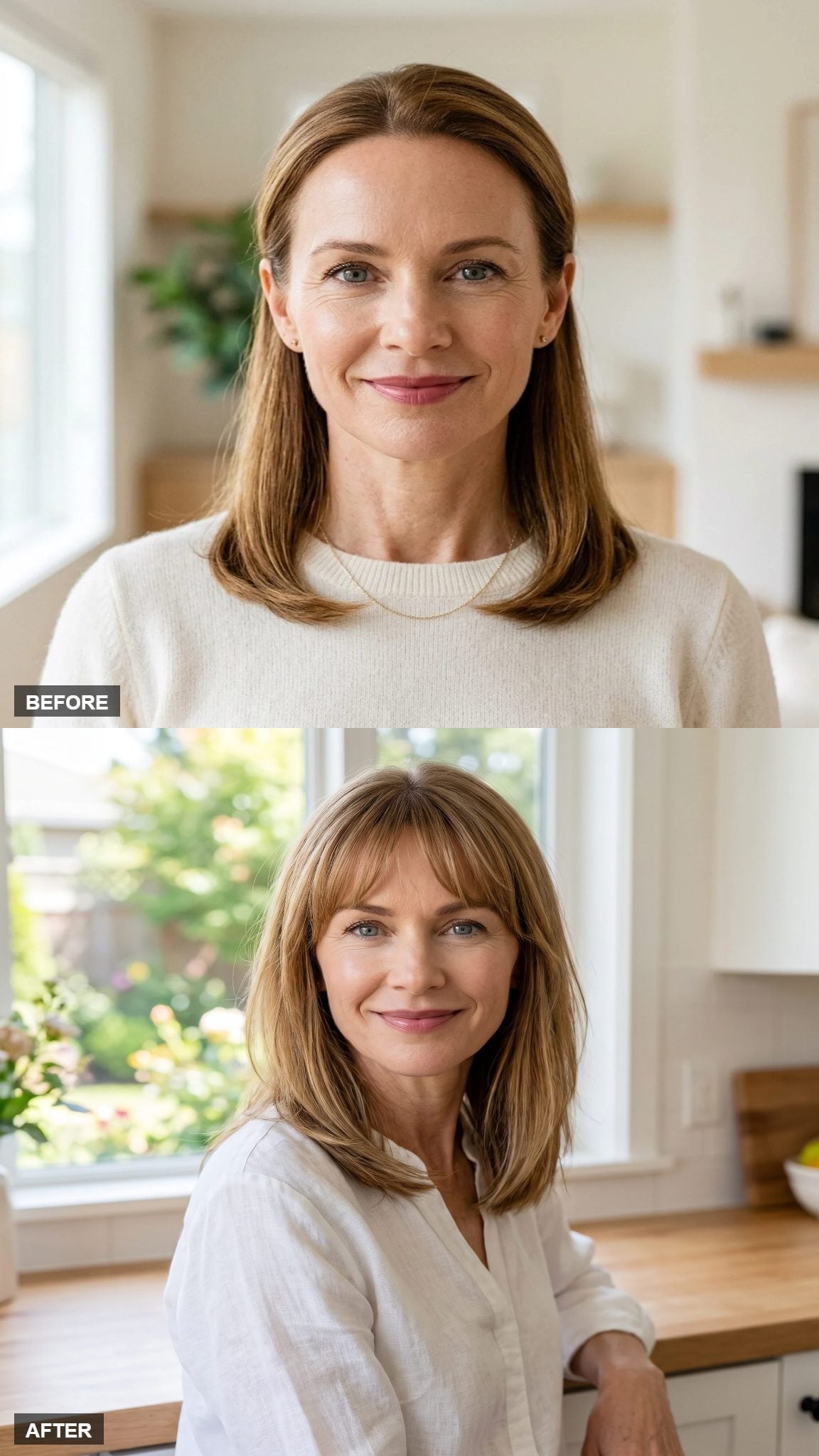
Shoulder-length hair curves inward at the ends, while a lightly swept fringe moves across the forehead without forming a heavy horizontal edge. The result has more movement at the front than a conventional blunt-bang cut.
Highlights at different depths create a blend of blonde and warm brown, making the fringe appear lighter where individual strands separate. The loose linen shirt and window light complement the understated finish. The bangs participate in the existing haircut rather than establishing a completely separate shape.
12. Curtain Bangs Give Straight Brunette Hair a Completely Different Center of Gravity
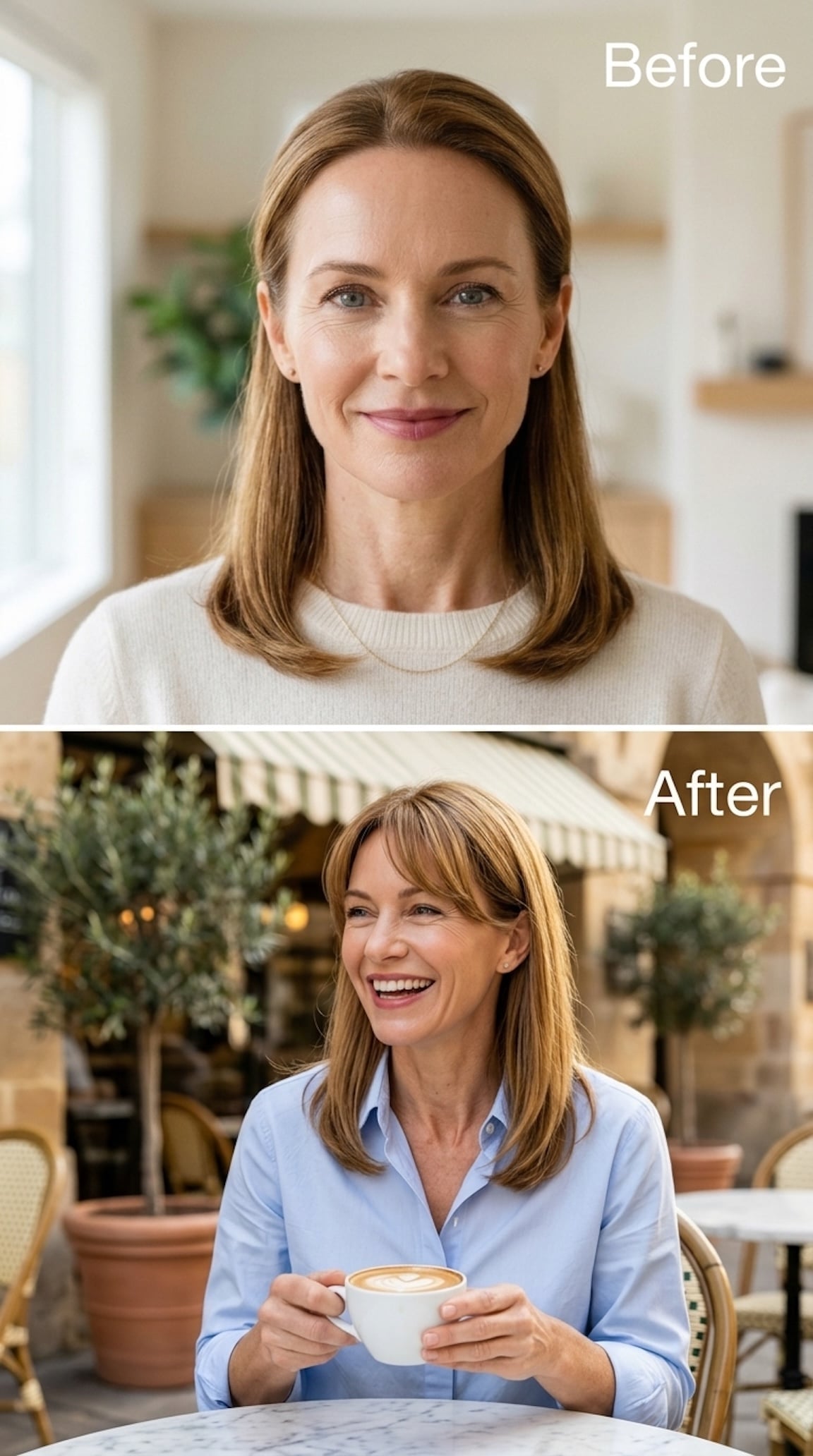
Without bangs, straight hair falling to the collarbone can create an uninterrupted vertical outline. Introducing curtain bangs changes that arrangement immediately. The fringe separates near the center and travels outward toward the temples, creating two shorter lines that interrupt the longer lengths.
The haircut retains its clean perimeter, but the face gains a more deliberate frame. The opening between the bangs is particularly important: too narrow and the fringe becomes heavy; too wide and the effect begins to disappear. The light blue shirt and relaxed café setting suit the result, which has structure without looking overly styled.
11. Espresso-Brown Bangs Show How Much Definition Dark Hair Can Carry
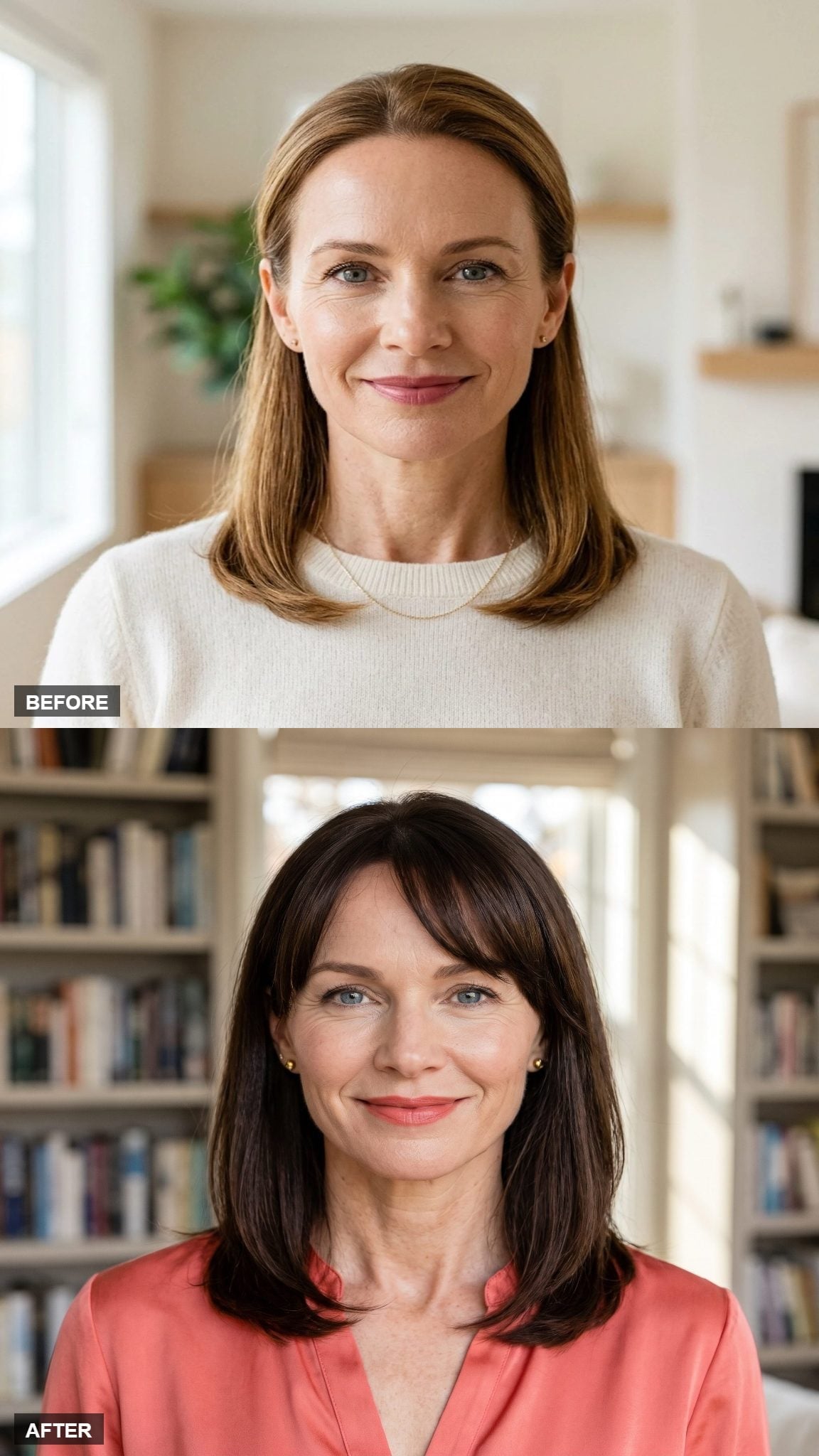
Espresso-brown hair creates a strong outline across the forehead, especially when the bangs are cut close to a straight line. Here, the outer edges soften slightly, allowing the fringe to connect with the surrounding lengths without losing its definition.
The coral silk top provides a vivid warm contrast to the dark hair, while small gold studs remain understated. The transformation demonstrates that a fringe doesn’t need exceptional thickness to have presence. A deep color and carefully placed lower edge can provide much of the definition.
10. Platinum-to-Wheat Blonde Finds a Stronger Shape With Full Bangs
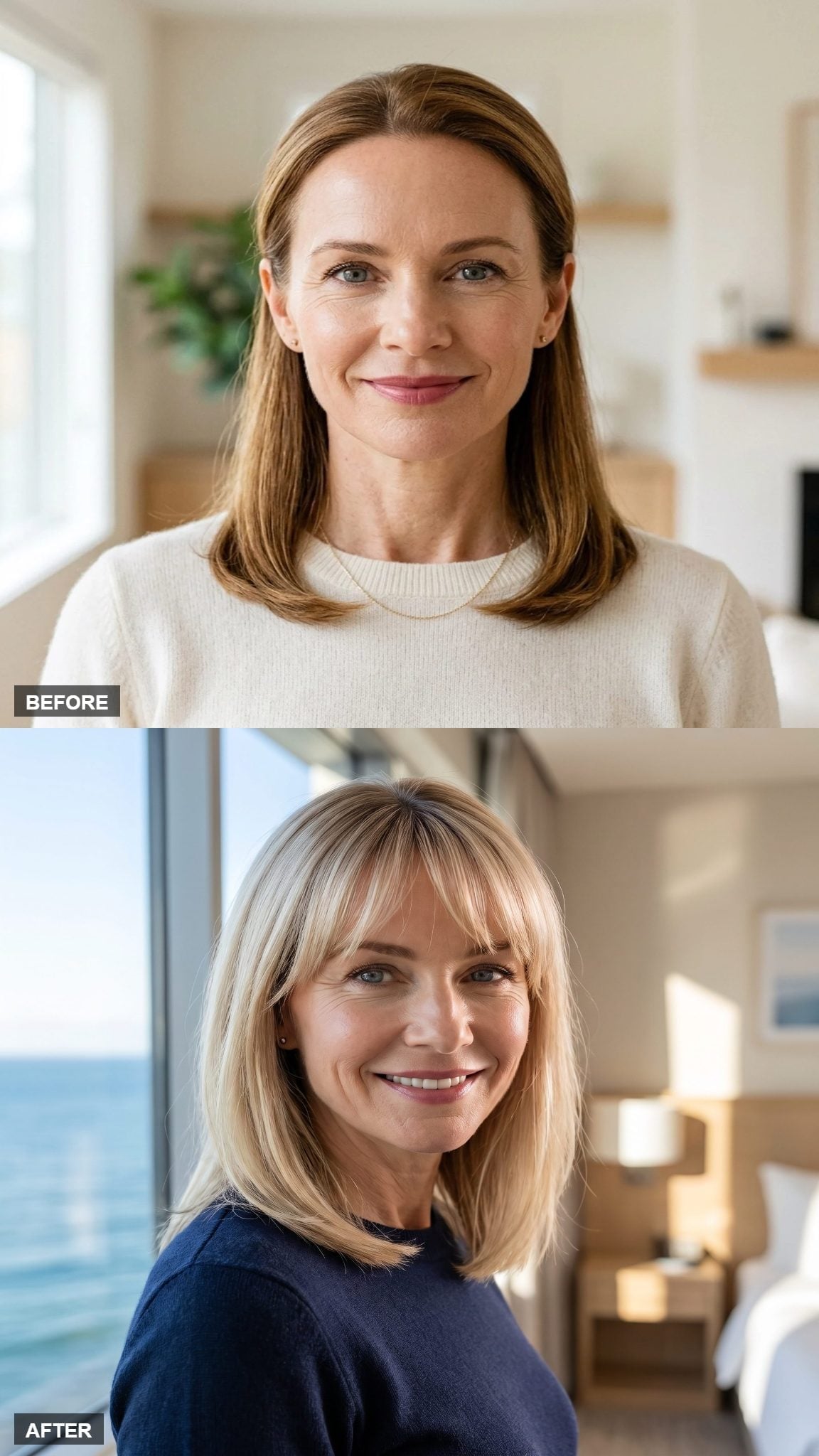
Blonde ranging from platinum to wheat has a softer character than a uniform icy shade. The addition of full bangs gives that varied color a stronger outline, placing a defined edge above the eyes while the longer hair falls smoothly to the collarbone.
The navy crewneck offers contrast beneath the pale lengths, and natural light from the ocean-facing window reveals the warm and cool blonde tones. The fringe relies on density rather than heavy texturizing, creating a substantial front without changing the smooth character of the rest of the haircut.
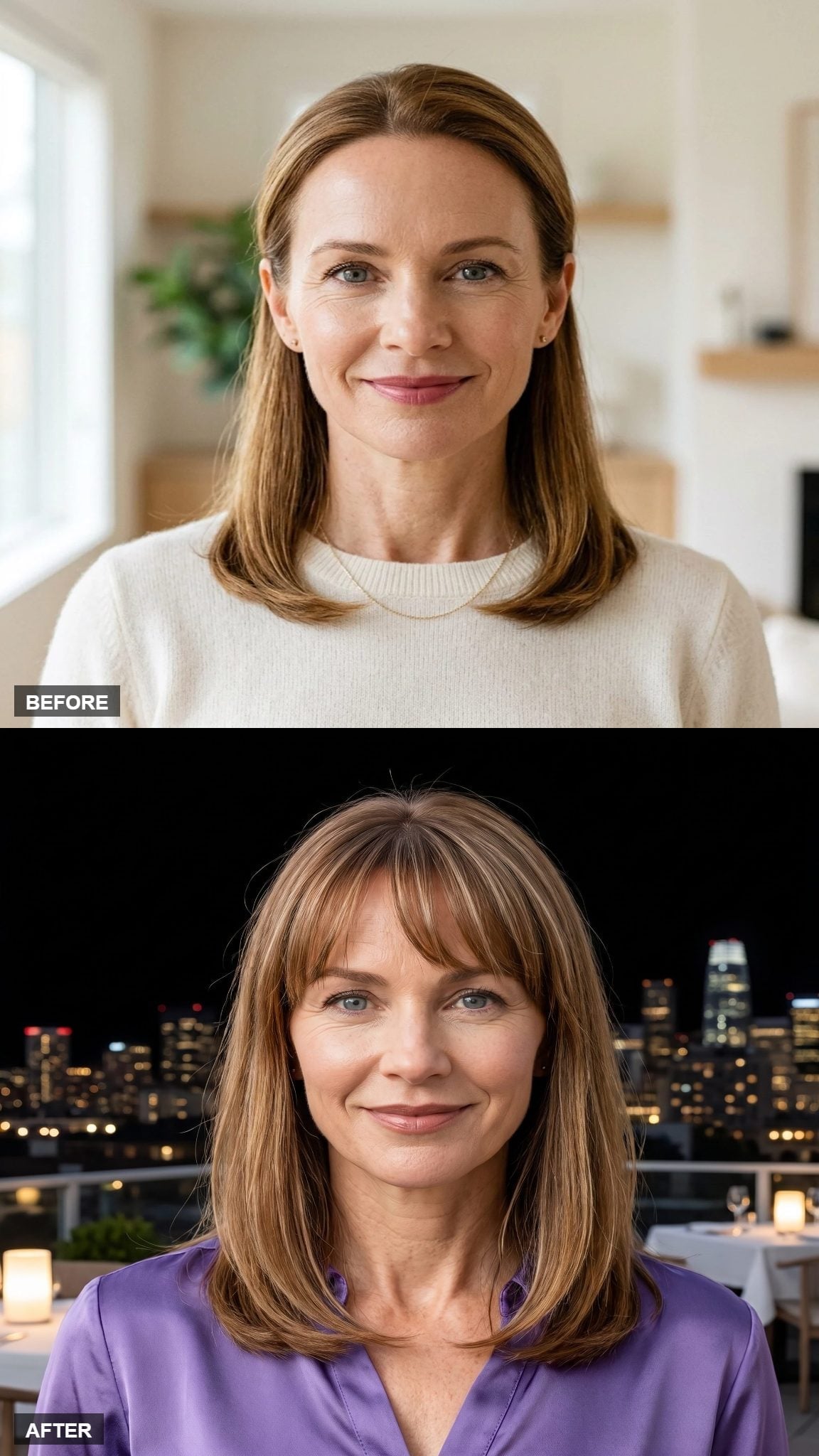
9. Purple Silk Meets Brunette Bangs Cut With Almost Mathematical Precision
❤️ Would you like to save this?
The brunette hair carries subtle highlights, but the fringe introduces the strongest new line. Its straight edge sits close to brow level, creating a controlled finish against the softer lengths beneath it.
The purple silk shirt adds color and sheen without distracting from the haircut’s precision. This is the kind of fringe where a small difference in length becomes conspicuous. Raise the edge slightly and more forehead appears; lower it toward the lashes and the eyes begin to sit beneath a heavier frame.
8. Silver Hair and Black Glasses Turn a Familiar Fringe Into Graphic Design
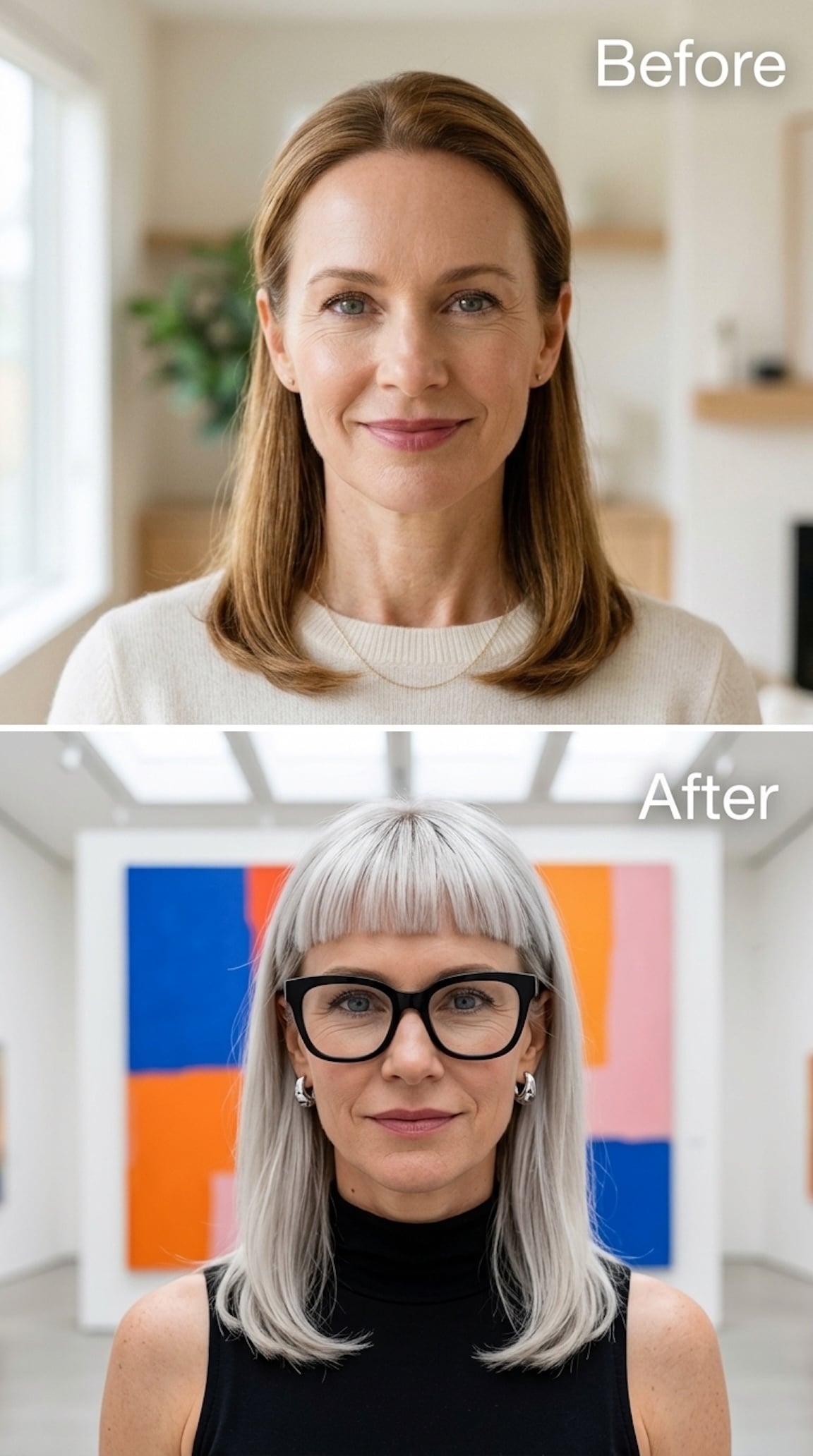
The change from warm brunette to silver is dramatic enough, but the blunt fringe introduces an entirely new shape across the forehead. Dense, pale bangs sit above black square-framed glasses, creating a striking arrangement of horizontal and angular lines.
The shoulder-length hair retains softness beneath that strong front edge. A sleeveless black turtleneck reinforces the contrast between silver and black, while the glasses repeat the fringe’s geometric character. The result is unusually graphic without requiring an elaborate haircut.
7. A Soft Auburn Sweep Gives a Shorter Layered Cut More Direction
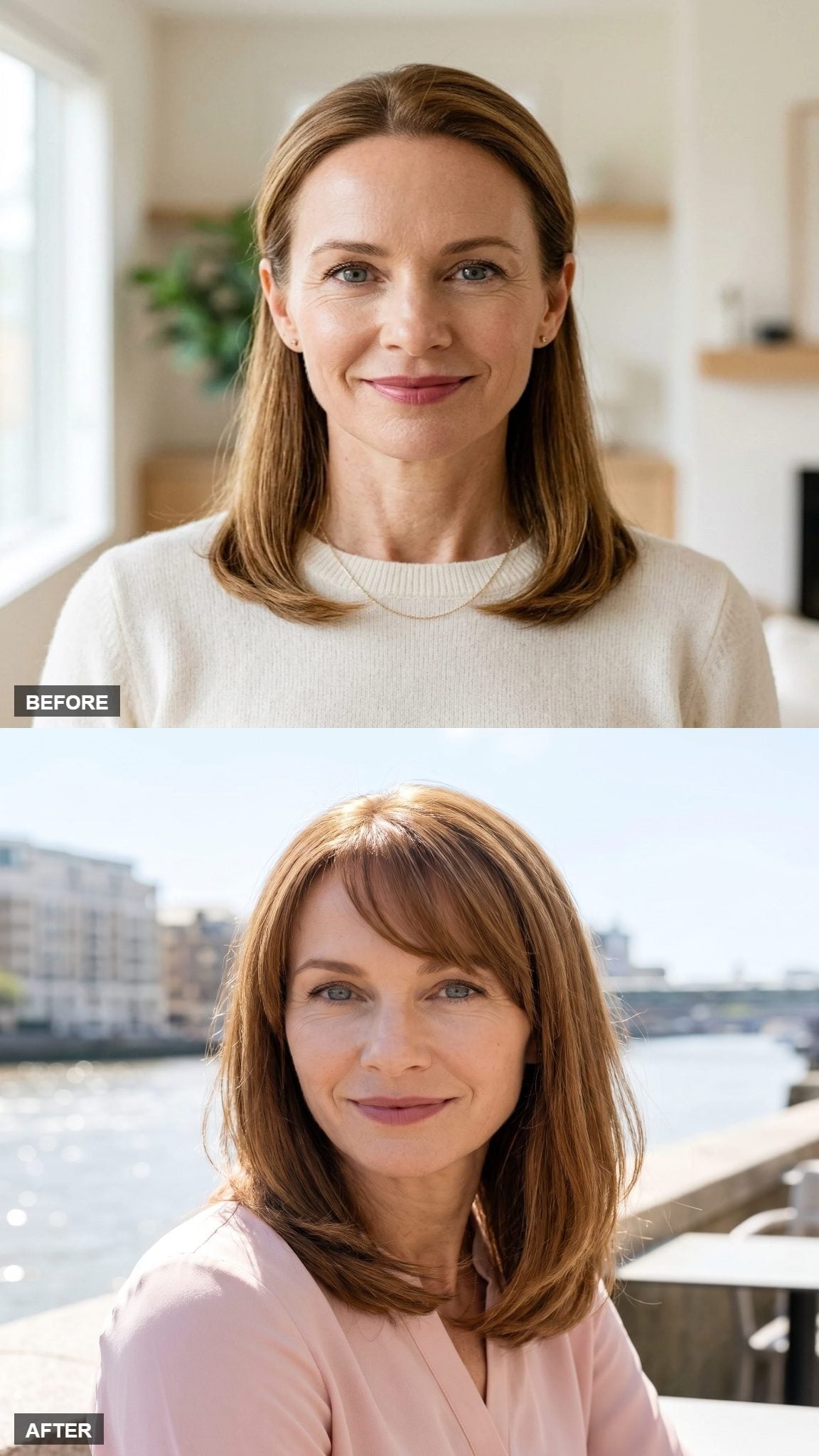
Shorter auburn layers fall just past the chin, creating a fluid outline around the lower face. The fringe follows that movement across the forehead instead of introducing a separate straight edge.
The blush V-neck and bright waterfront setting complement the warm reddish color. Unlike a dense blunt fringe, this approach relies on direction and continuity. The bangs become part of the layered haircut, carrying the same movement from the forehead into the sides.
6. Copper Waves and Short Bangs Turn a Smooth Hairstyle Into Something Far More Expressive
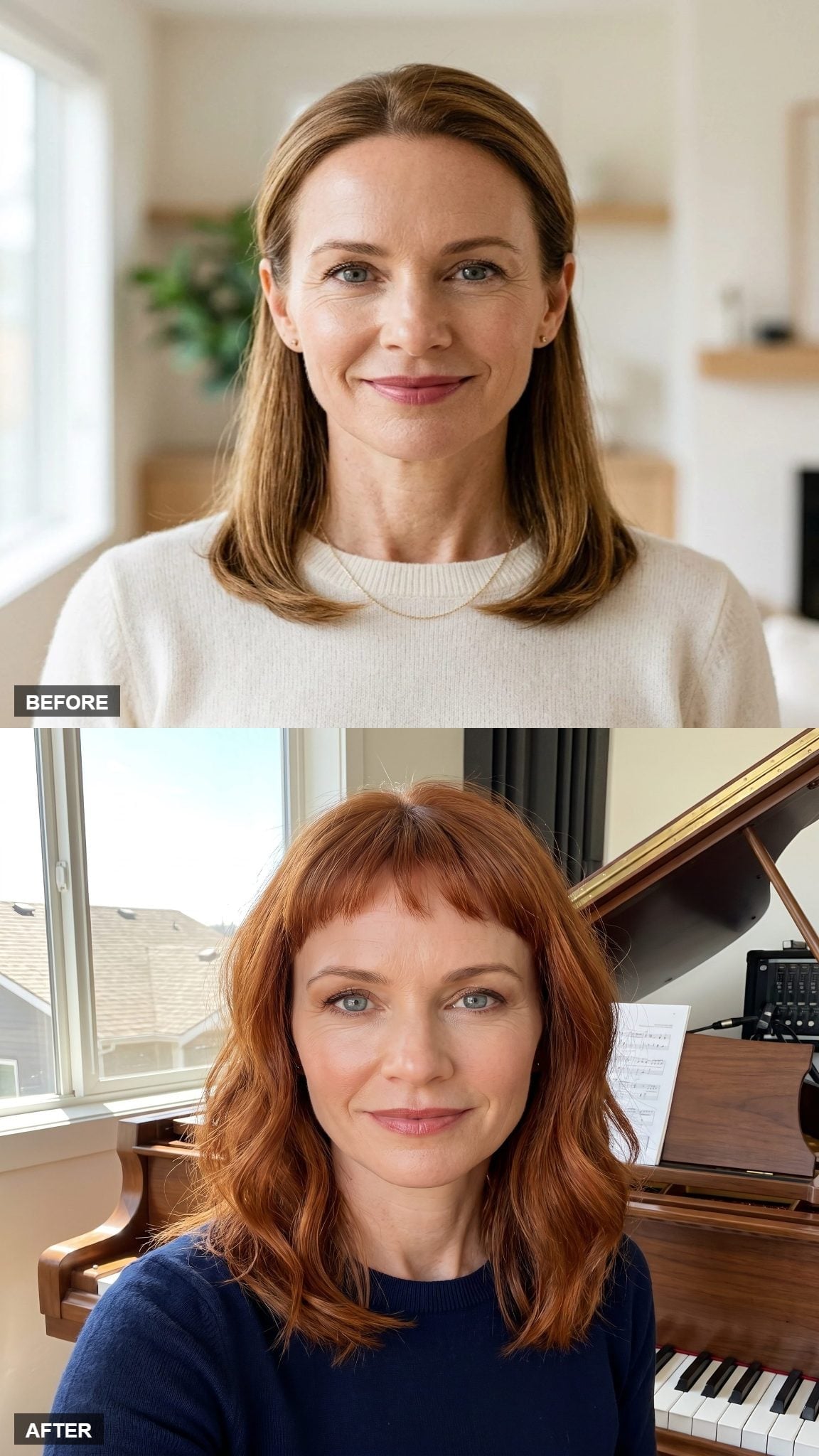
The original smooth, unfringed hairstyle gives way to copper waves and a short, straight fringe. The length remains broadly comparable, but the texture, color, and new front edge produce a much more animated silhouette.
The bangs stay relatively controlled while the waves move around the jaw and shoulders. That contrast prevents the haircut from becoming uniformly tousled. A navy crewneck and grand piano provide a restrained backdrop for a transformation whose strongest details are concentrated in the hair itself.
ThreadCurve readers seem to like added texture: pictures with wavy hair won 64% of their head-to-head matchups, well above the 53% expected.
5. A Brown Fringe Keeps Its Blunt Center but Lets the Temples Breathe
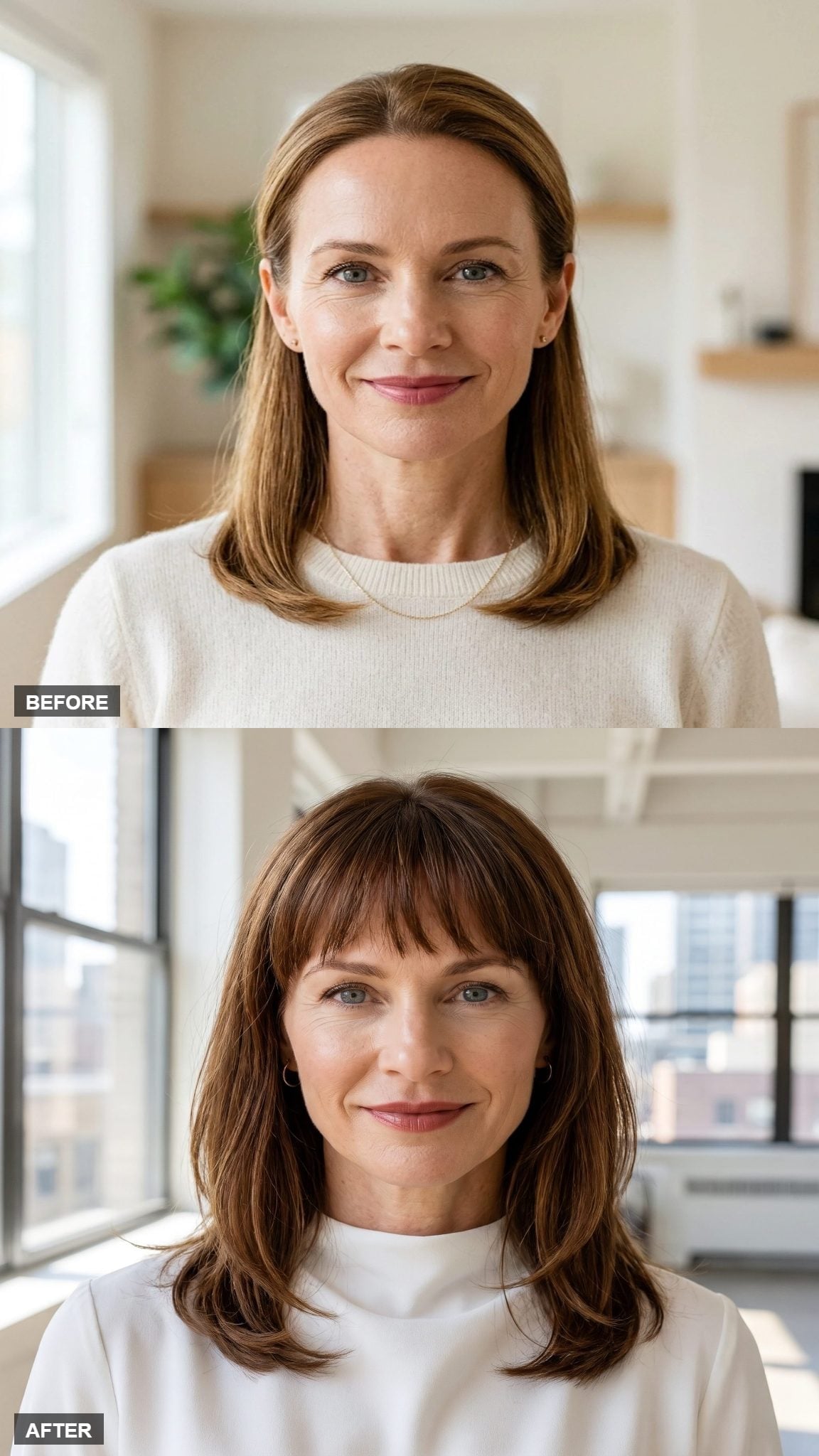
Deep brown hair falls to the collarbone with gentle movement at the ends. The fringe remains blunt through the center but becomes softer toward the temples, avoiding the abrupt corners of a uniformly dense cut.
That graduation is a small detail with a noticeable effect. The central bangs provide definition, while the outer pieces connect more naturally with the longer hair. The transformation has the precision of a blunt fringe without requiring every section to end at the same length.
4. Auburn Bangs Give Long Layers a New Starting Point
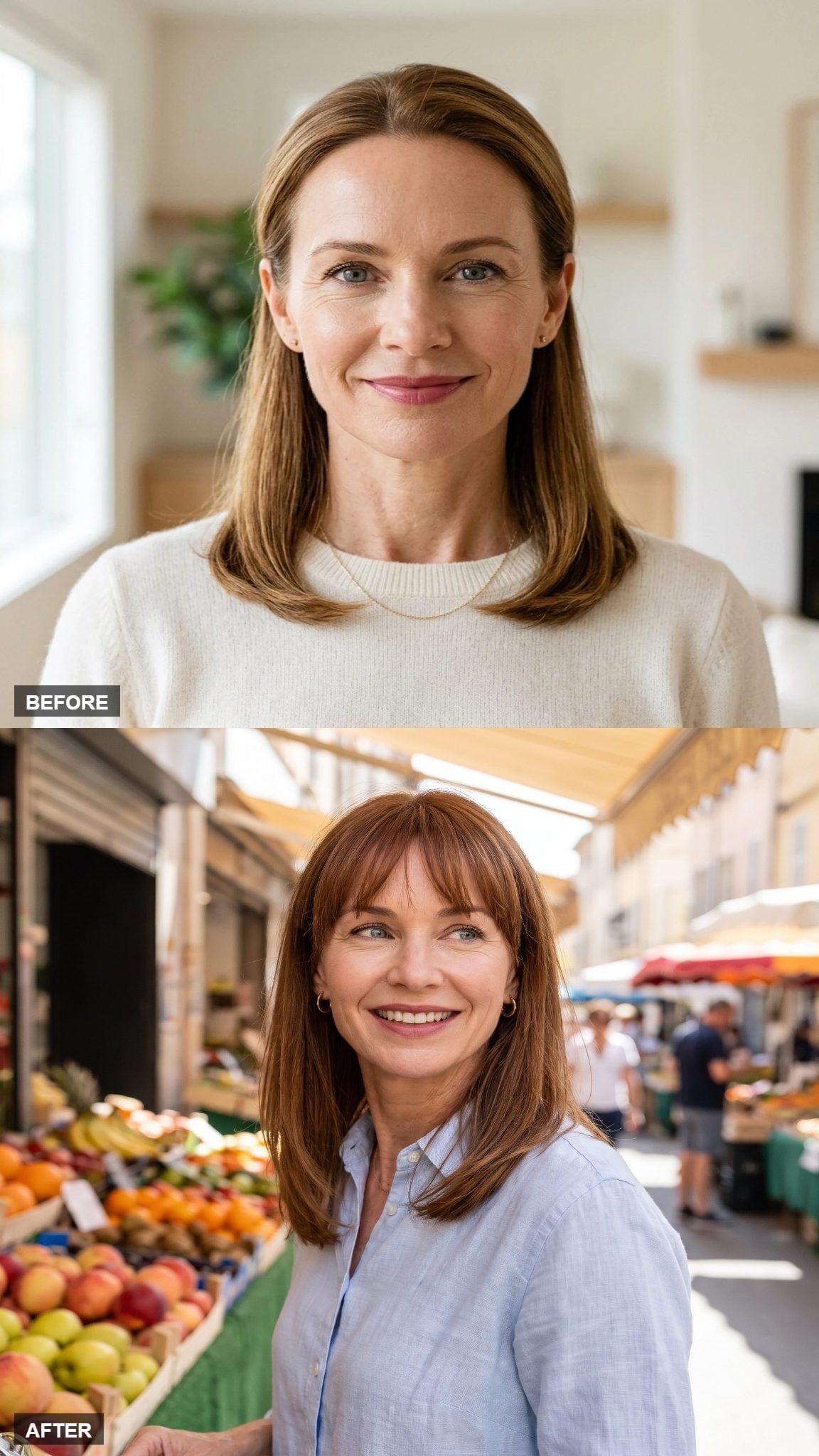
Long auburn layers retain their relaxed movement past the shoulders, but the new brow-length fringe changes where the haircut begins visually. Instead of an open forehead leading into the longer hair, a defined band of copper now establishes the front.
The washed-blue chambray shirt provides a cool contrast, and the outdoor market setting reveals the reddish tones in daylight. The bangs are full without being excessively heavy, giving the familiar long-layered cut a stronger identity around the face.
3. Midnight-Blue Bangs Give a Familiar Blunt Cut an Unexpected Edge
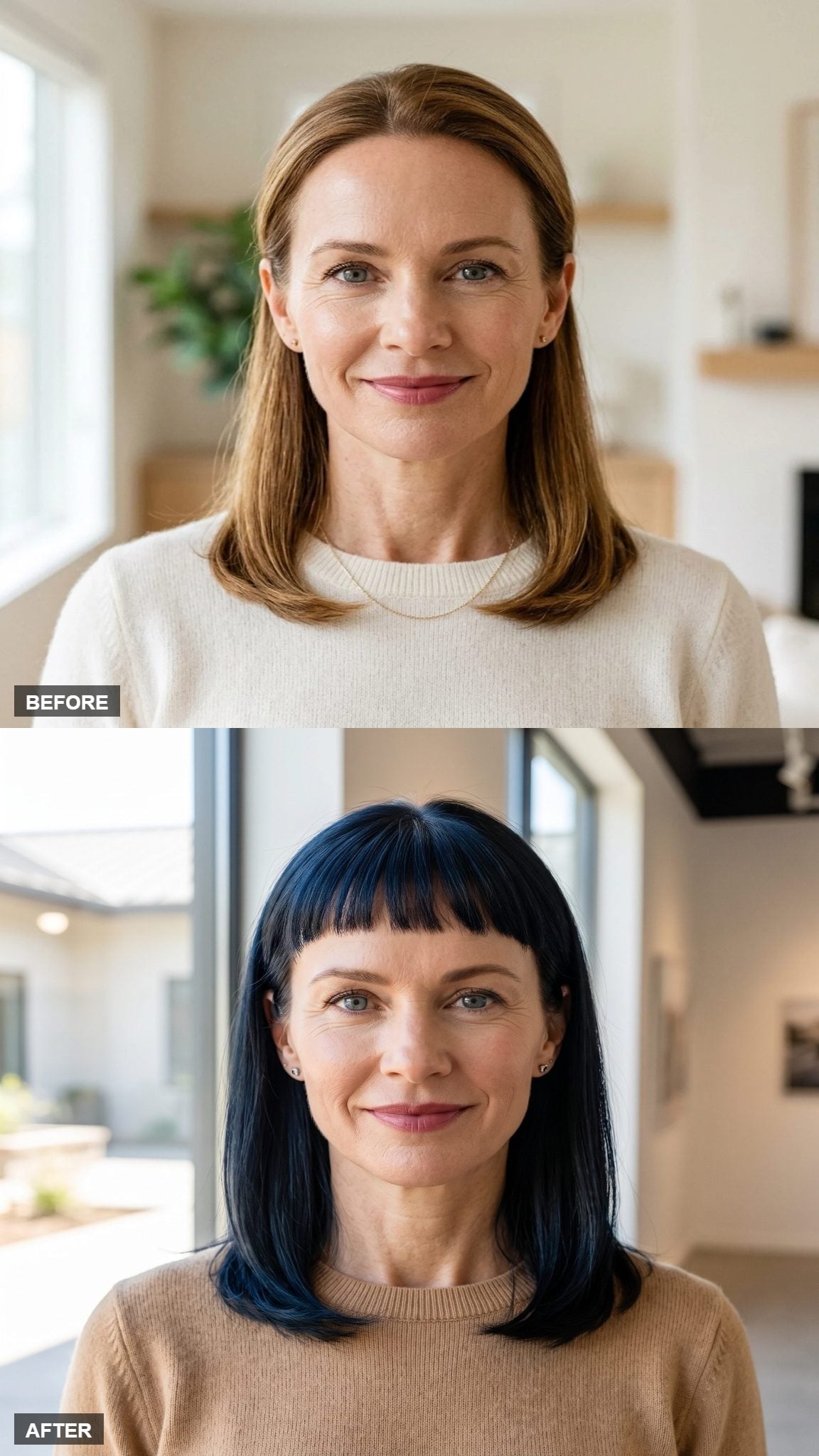
Midnight blue can resemble black until the light reveals its cooler undertone. Across a dense blunt fringe, that subtle color becomes particularly noticeable, creating a strong band above the eyes.
The collarbone-length cut remains simple, with a relatively straight perimeter and little elaborate layering. A camel ribbed knit supplies warmth beneath the cool hair color. The transformation draws its strength from the combination of unusual color and disciplined cutting rather than a complicated silhouette.
2. Dark Bangs and a Caramel Blazer Give a Familiar Face a Sharper Outline
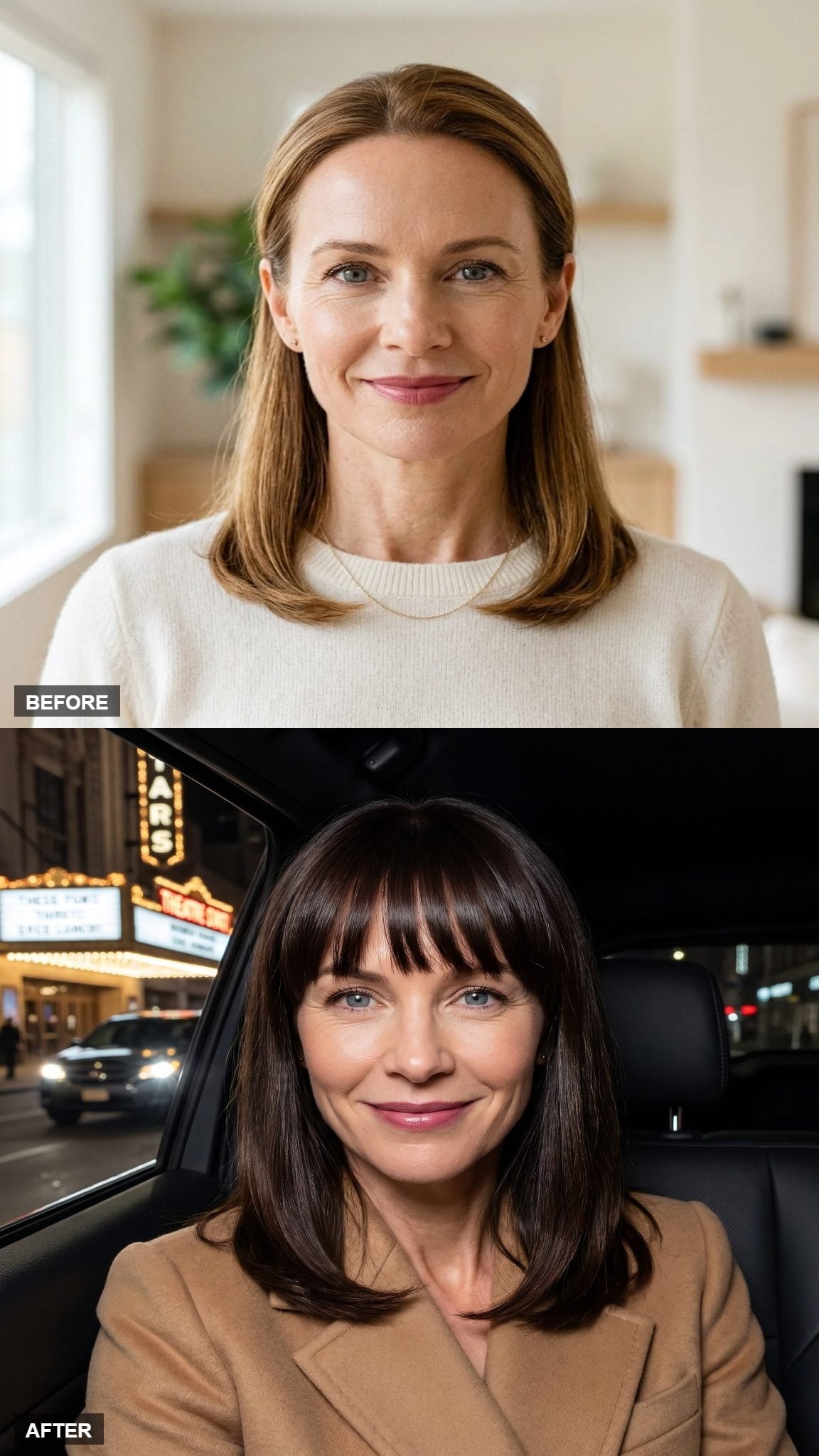
The original center-parted brunette hairstyle leaves the forehead open and allows the longer hair to establish the main outline. The after image replaces that openness with a dense, straight fringe, while the darker finish gives the haircut a more defined silhouette.
The structured caramel blazer complements the precision of the new cut. Against the illuminated city backdrop, the bangs form a distinct upper boundary, while the shoulder-length hair retains enough softness to keep the result balanced. A relatively familiar haircut acquires a noticeably different character through its front edge.
1. A Long Side-Swept Fringe Changes the Profile Without Demanding a Full Set of Bangs
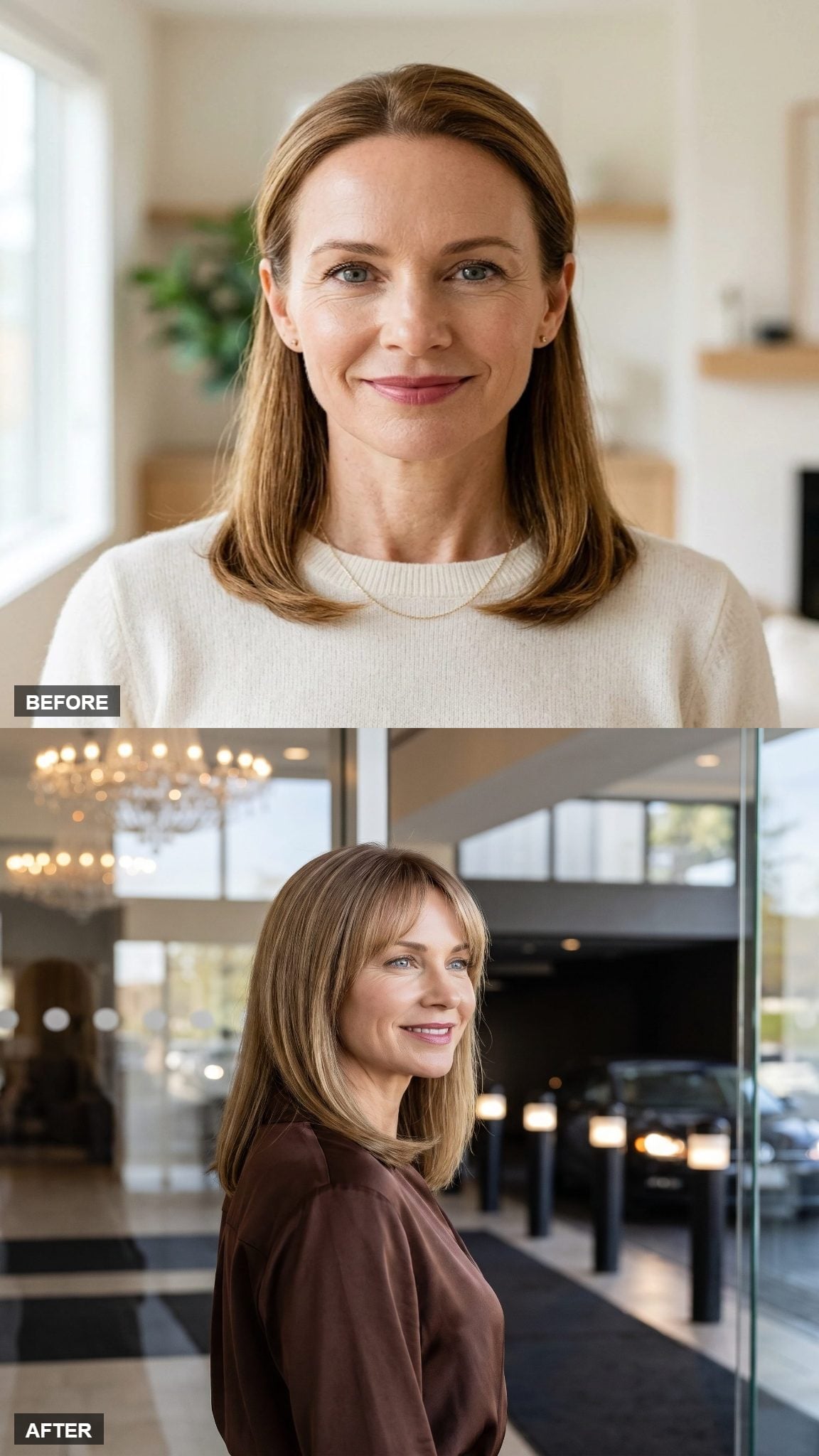
Seen from the side, a longer fringe reveals something that a straight-on portrait can conceal: the importance of the haircut’s front outline. The hair now sweeps across the forehead before joining the surrounding lengths, replacing an open hairline with a diagonal edge.
Warm honey highlights emphasize the movement, while the burgundy satin blouse provides a rich contrast. The fringe falls low enough to make its presence felt but retains the flexibility to be directed away from the face. Unlike a dense, straight-across cut, this approach changes the profile without making the bangs the only thing the haircut has to say.