

❤️ Would you like to save this?
A woman walks into a room and other women clock her in about four seconds. Not the price of her bag. Not the label she’s wearing. Something smaller, quieter, and almost impossible to fake.
It’s on the blouse. A single detail that says, plainly, this woman handled her own morning. She didn’t outsource it, didn’t rush it, didn’t hope nobody would look too closely. And here’s the strange part: instead of reading as fussy or old-fashioned, it registers as authority. As competence. As a kind of self-respect that money genuinely cannot buy.
What is it? Why does the female brain respond to it before a single word is spoken? And why do the women who get this right seem to move through the world with a little more ease? Ten sections in, you’ll never look at your own collar the same way.
FYI, thanks to AI imagery software, we’re able to create very specific fashion and hairstyle examples to illustrate the points being made. In some cases, imagery is exaggerated to hammer home the point. Also, assume links that take you off the site are affiliate links such as links to Amazon. this means we may earn a commission if you buy something.
The Crease Line That Signals You Take Yourself Seriously

A pressed line down a sleeve is a tiny act of self-regard, and other women clock it before they can name it. The crease isn’t for them. It’s for you. It’s the residue of a morning where you decided you were worth ten minutes with a hot plate of metal.
There’s real science under the instinct. The concept of enclothed cognition, coined by Hajo Adam and Adam Galinsky, holds that (Source). A crisp garment doesn’t just broadcast seriousness outward. It routes it back into your own head. You stand differently in something you pressed.
By your 40s, that self-signal matters more than the outward one. The crease says you have stopped waiting for an occasion to bother.
Why a Sharp Collar Reads as Emotional Stability to Everyone Around You

You’ve watched it happen across a conference table. Two women, similar outfits, but one collar sits flat and squared and the other curls up at the point like it gave up around noon. Your eye goes to the flat one. Your trust goes there too, before you’ve heard either of them speak.
A collar is the frame around the face, and a controlled frame reads as a controlled person. This tracks with how quickly we judge on clothing cues at all. Princeton and NYU researchers found that (Source). A collar that holds its shape signals a person who holds hers.
Fair? No. Automatic? Completely. The sharp collar becomes shorthand for someone whose internal weather is settled.
The Wrinkle Nobody Mentions But Everybody Registers
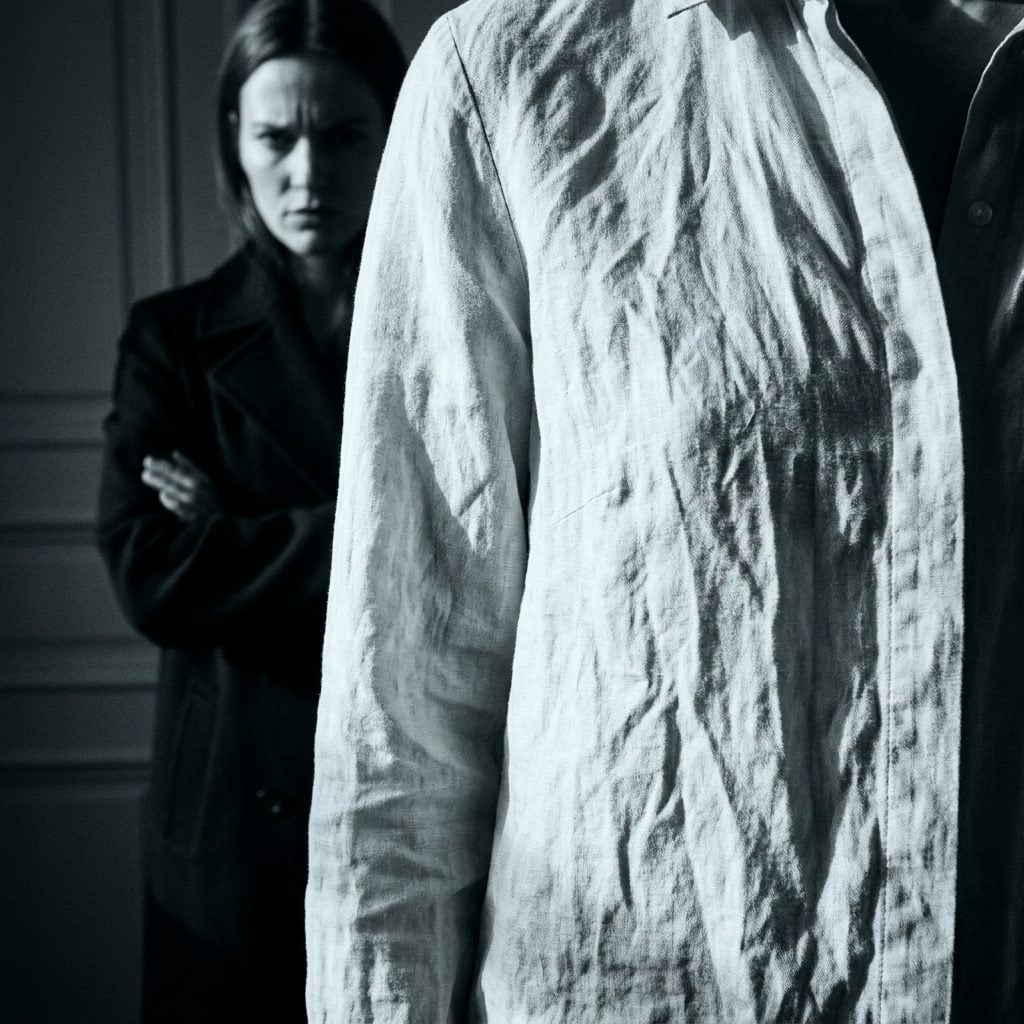
Nobody will tell you your blouse is creased across the front. They’ll just quietly adjust their read of you and move on. That’s the cruelty of it. The wrinkle operates below the level of comment but well within the level of judgment.
Style writers put it bluntly: people (Source). It isn’t about vanity. It’s about the story a rumpled placket tells before you open your mouth.
The good news is the reverse runs just as strong. Smooth the front panel and you’ve closed a door on an assumption nobody would have voiced but everybody would have made.
What a Pressed Cuff Says That Your Resume Never Could
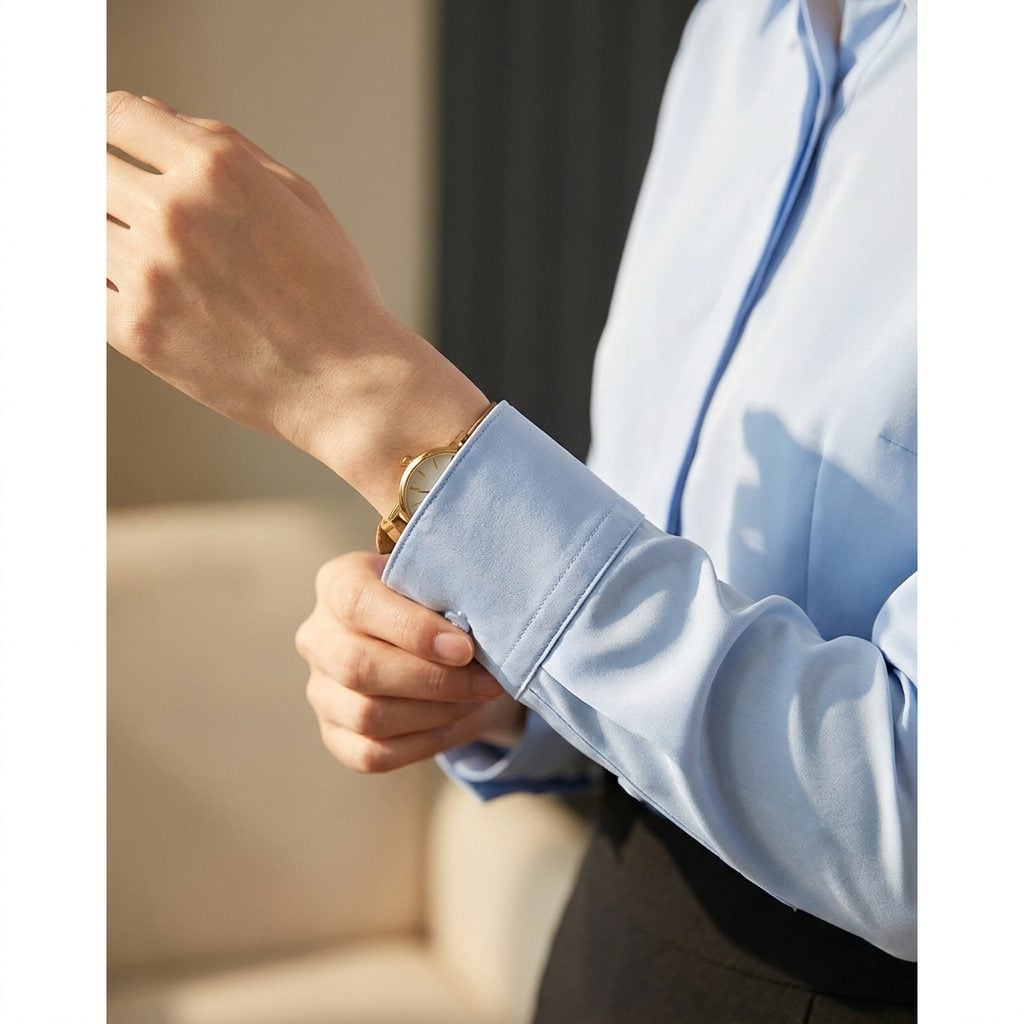
A resume lists what you’ve done. A pressed cuff tells people how you do it. The cuff is the last thing a garment forgets and the first thing that betrays a rushed morning, which is exactly why the sharp one carries such weight.
Here’s the mechanism worth knowing about. Princeton’s DongWon Oh and colleagues showed that (Source). The cuff sits at the wrist, right where a handshake lives, right in the frame of every gesture you make while you talk.
So when you press the cuff, you’re editing the sentence people read every time your hands move. No line on paper can do that in real time.
The Quiet Status Symbol That Money Can’t Actually Buy
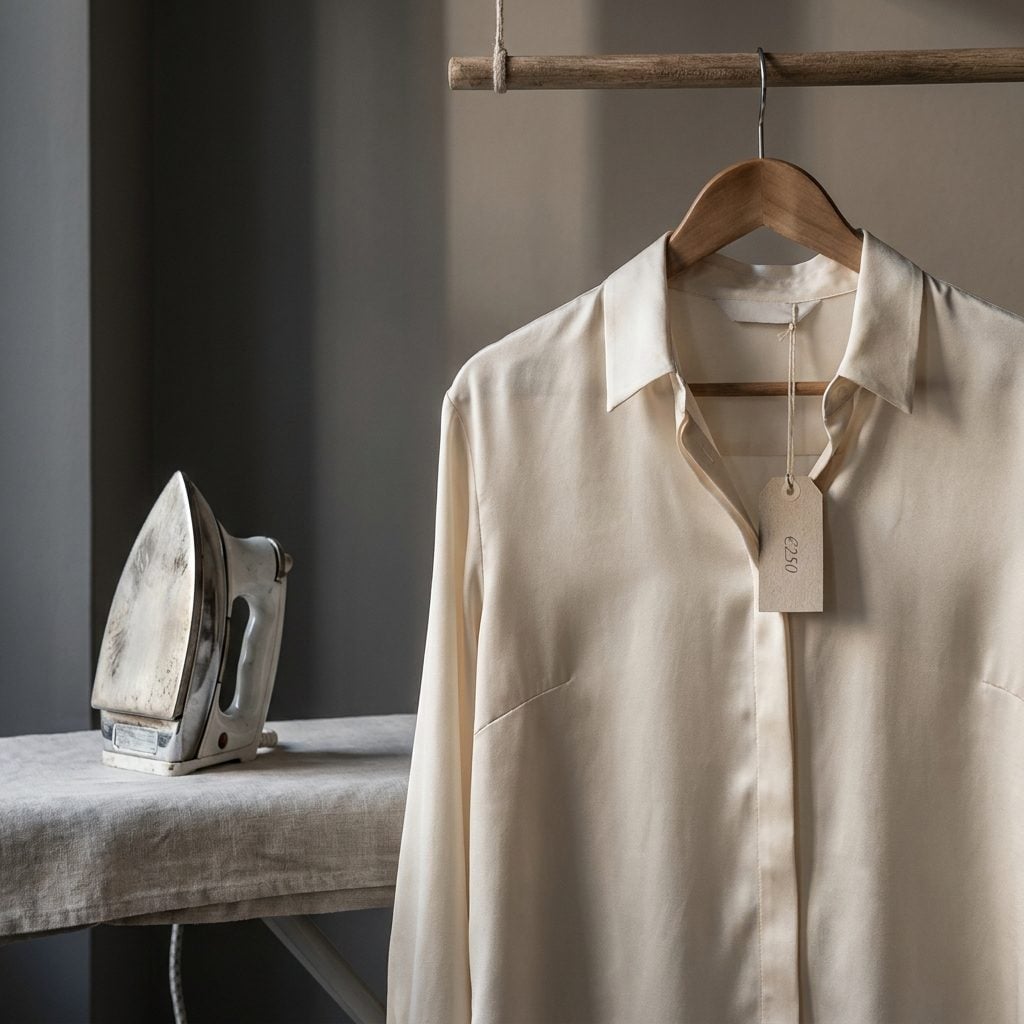
You can buy the silk. You can buy the label sewn discreetly into the seam. What you cannot buy is the ten minutes and the attention it takes to send that blouse out into the world without a crease in it. That’s the tell that separates real polish from purchased polish.
Research on clothing and competence keeps landing on economic cues, richer versus poorer fabrics. But (Source). A pressed cotton shirt can out-signal an expensive one left rumpled in a bag.
That’s the quiet part. Care reads as a resource. And care is one status marker no amount of money guarantees, because it takes the one thing the wealthy and the rest of us share equally: time you chose to spend.
Why Effort Left Visible Triggers Respect Instead of Pity

Somewhere along the way we got told to hide our effort. Look effortless. Make it seem like you rolled out of bed this pulled together. That advice gets the psychology backwards.
The effort heuristic, first documented by Kruger and colleagues, is our tendency to (Source). Visible care doesn’t cheapen you. It appraises you upward. And there’s a moral layer too. Researchers have found that (Source).
A pressed blouse is effort you left in plain sight. Other women don’t pity that. They respect it, because they know what it costs, and they clock that you paid it.
The woman who hides her effort disappears. The woman who wears hers gets read as someone worth taking seriously.
The Detail That Separates ‘Put Together’ From ‘Trying Too Hard’

There’s a fine line, and every woman over 40 has watched someone stumble across it. Too much matching. Too many trends stacked at once. An outfit that announces how long it took. That reads as anxiety, and anxiety is contagious.
The press is different, and that’s the whole trick. A pressed shirt reads as restraint, not striving. It’s the quiet governor on an outfit. Enclothed cognition research reminds us the effect depends on (Source), so a crisp shirt works on you as much as on your audience.
Put-together says “I handled this.” Trying-too-hard says “please notice I handled this.” The pressed cotton lands on the right side of that line because it whispers instead of shouts. Pair it with a good white cotton blouse and let the crease do the talking.
How a Flat Placket Becomes a Trust Signal Between Women
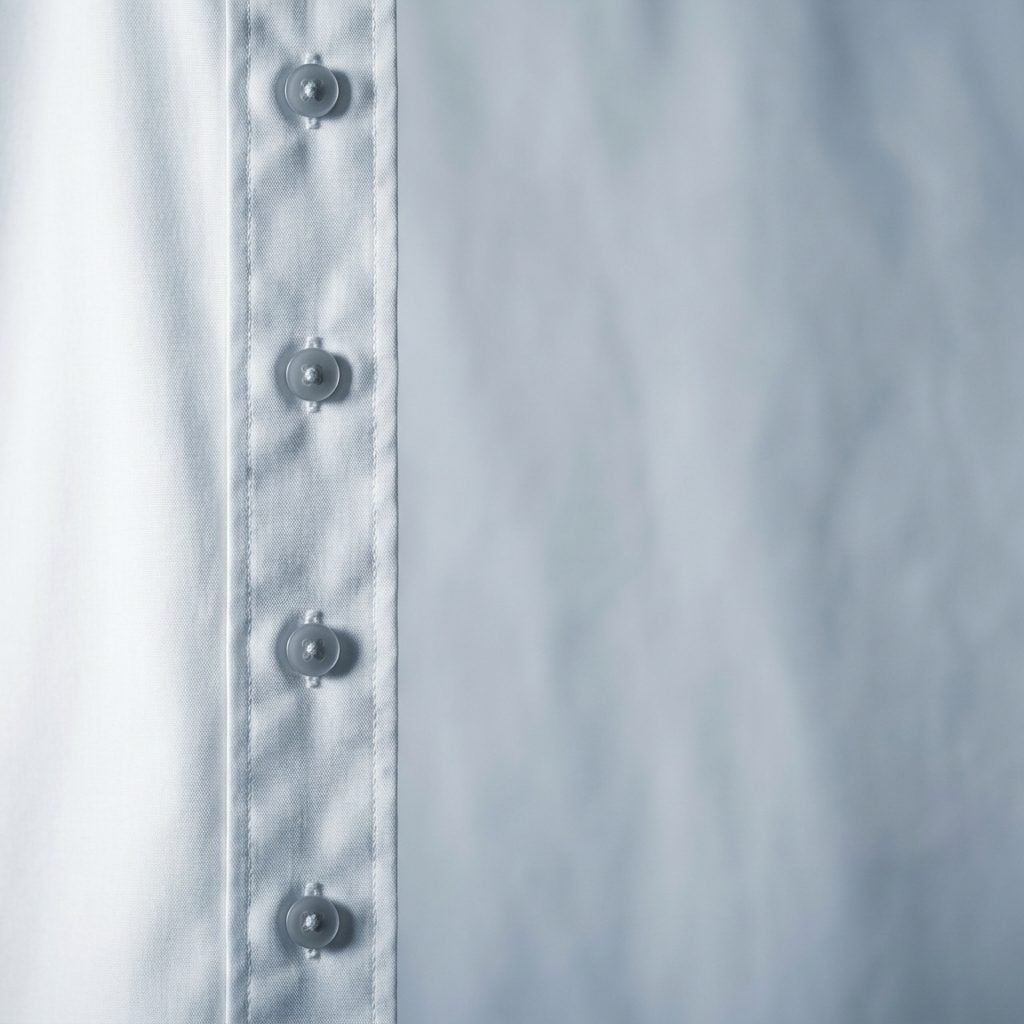
The placket is that strip of fabric running down the front where the buttons live. When it’s pressed flat, it lies clean and straight. When it isn’t, it puckers and gaps and pulls the eye like a loose thread on a sweater you can’t stop staring at.
Between women, a flat placket reads as trustworthiness, and there’s structure behind that instinct. A 2023 review in a psychology journal argued that (Source). Order in the small, central detail becomes a proxy for reliability in the whole person.
Here’s why it lands harder woman to woman. She knows the placket is the hardest bit to press. She knows you fought that pucker. And she trusts the woman who won that particular small battle, because it tells her exactly how you treat the things that matter and the things that don’t.
The Psychology of the Woman Who Irons at 6am (And Why Others Notice)

Nobody sees you do it. The board unfolded in the half-dark, the hiss of steam against cotton, the collar pressed twice because the first pass wasn’t right. It’s a private act. And yet somehow, hours later, a stranger in a meeting registers it without knowing what she’s registering.
That’s the strange part. The effort was invisible, but the result is not. (Source) places dress at the center of how we read another person, right alongside their face and body. A pressed blouse isn’t decoration. It’s data.
What the 6am ironer signals is control. Not wealth, not trend-chasing. Control over her own morning, her own standards, her own small corner of chaos. Other women clock this instantly because they’ve stood at that same board. They know what a crisp white cotton blouse costs in minutes and attention. The respect isn’t for the fabric. It’s for the discipline the fabric announces.
Why Care Reads as Competence Before You Say a Word

Here’s the uncomfortable truth. You are being scored before you open your mouth.
(Source), faster than conscious thought can catch up. Long before your first sentence, someone has already decided whether you seem capable. And one of the loudest inputs they’re using is what you’re wearing and how well you’re wearing it.
A pressed garment does something specific in that split second. (Source), while wrinkles quietly whisper the opposite. It’s not fair. It’s just fast.
By your forties and beyond, this works in your favor. You’ve stopped confusing effort with anxiety. The care you put into a smooth collar reads as self-knowledge, not striving. Other women recognize the difference immediately, because they’ve learned it too.
Care is the only competence signal you can send from across a room.
I got this wrong for years. I thought the right label did the talking. It doesn’t. A drape that hangs clean says more than any logo, and it says it before you’ve shaken a single hand.
The Small Ritual That Rewires How You Walk Into a Room
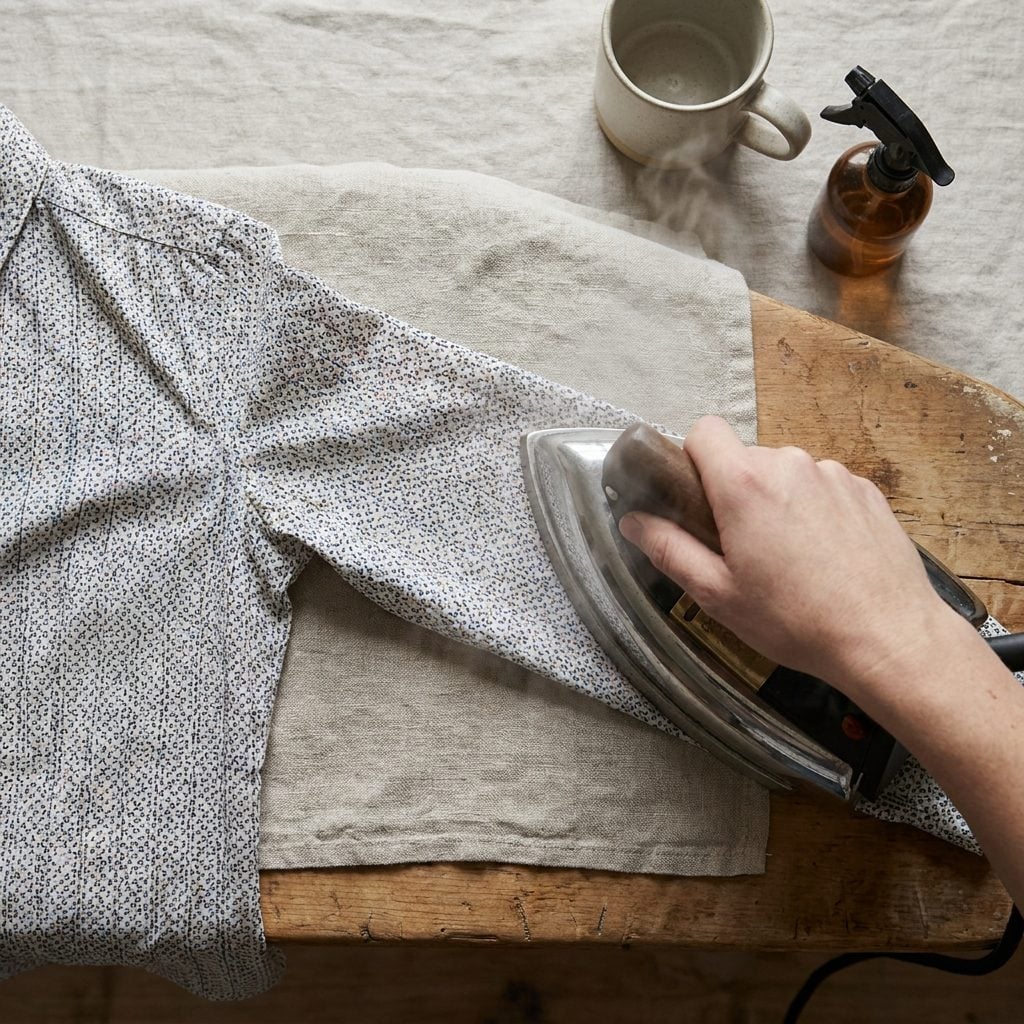
The ironing board comes out. The water hisses against hot cotton. You draw the plate down a sleeve and watch the wrinkles surrender. Two minutes of nothing important, and yet you walk into the room afterward like the floor belongs to you.
That’s not vanity talking. It’s the brain doing what brains do with ritual. Researchers using EEG found that a fixed, repeated sequence of actions performed before a task literally quiets the brain’s alarm response to failure, buffering against uncertainty and anxiety. Source A ritual isn’t a habit. It’s a chunked, predictable act that hands you back a sense of control right when you need it most, which is why Source psychologists point to it before interviews, exams, anything with jitters attached.
The pressed blouse is the outcome. The ritual is the point. You didn’t just remove creases. You told your nervous system the day is handled.
What Other Women Read in the Fold You Didn’t Skip

Another woman clocks it in half a second. The collar sits flat. The placket runs clean down the front with no rippled shadow. The cuff has a real edge to it. She couldn’t tell you how she knows. She just knows you handled that yourself.
Here’s the mechanism underneath. First impressions lock in within seconds, and the brain runs a shortcut called the halo effect, where one visible signal of care gets read as a whole set of unrelated traits. Source A well-kept appearance reads as conscientious, organized, disciplined, before a single word is exchanged. Source
The fold you didn’t skip is a tiny piece of evidence. It says nobody did this for you and you didn’t outsource it and you didn’t let it slide. Women who run their own lives recognize that in each other instantly. It’s not about the shirt. It’s about the standard the shirt implies.
The Reason Crisp Fabric Feels Like Armor You Made Yourself

❤️ Would you like to save this?
Structure changes how you stand. Slip into something soft and shapeless and the body goes soft with it. Put on something with a real edge and the spine finds itself.
This is enclothed cognition, the finding that clothing shapes your thoughts and behavior through both the physical sensation of wearing it and the symbolic weight it carries. The term came out of a 2012 experiment by Hajo Adam and Adam Galinsky, where people wearing a lab coat showed measurably sharper focus than those in their own clothes. Source Structured pieces, crisp shirts among them, get linked in the mind to authority and discipline, and wearing them nudges you toward those states. Source
The difference with a blouse you pressed yourself is the armor has your fingerprints on it. You didn’t buy the composure off a rack. You made it, panel by panel, at your own board. That changes what it means when you button it up.
Why the Ironed Blouse Outperforms the Expensive One
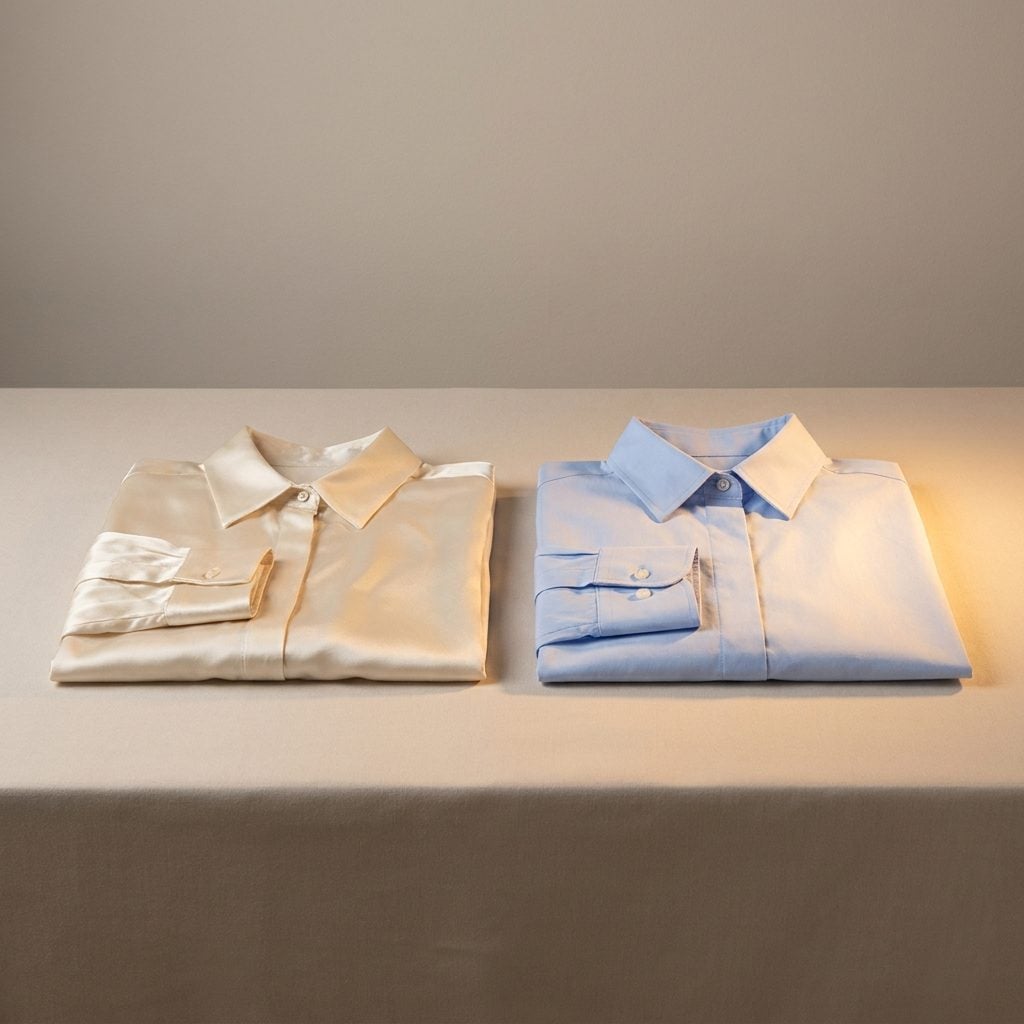
You’ve stood next to it. The pricey silk shirt worn straight off the hanger, still holding the memory of the drawer it slept in. Creased at the elbow, puckered at the placket. Money spent, message lost.
Perception doesn’t run on price tags. It runs on care. A modest outfit worn with real attention to detail beats an expensive one worn carelessly, because a well-groomed appearance signals attentiveness and discipline, and people equate visible care with internal competence. Source Neglect signals the opposite regardless of what you paid, and it does it just as fast. Source
An expensive shirt says you had the budget. A pressed shirt says you had the intention. By 40-something you already know which of those actually holds a room, and it isn’t the one with the higher receipt.
The Invisible Line Between Self-Respect and Self-Neglect on Your Sleeve
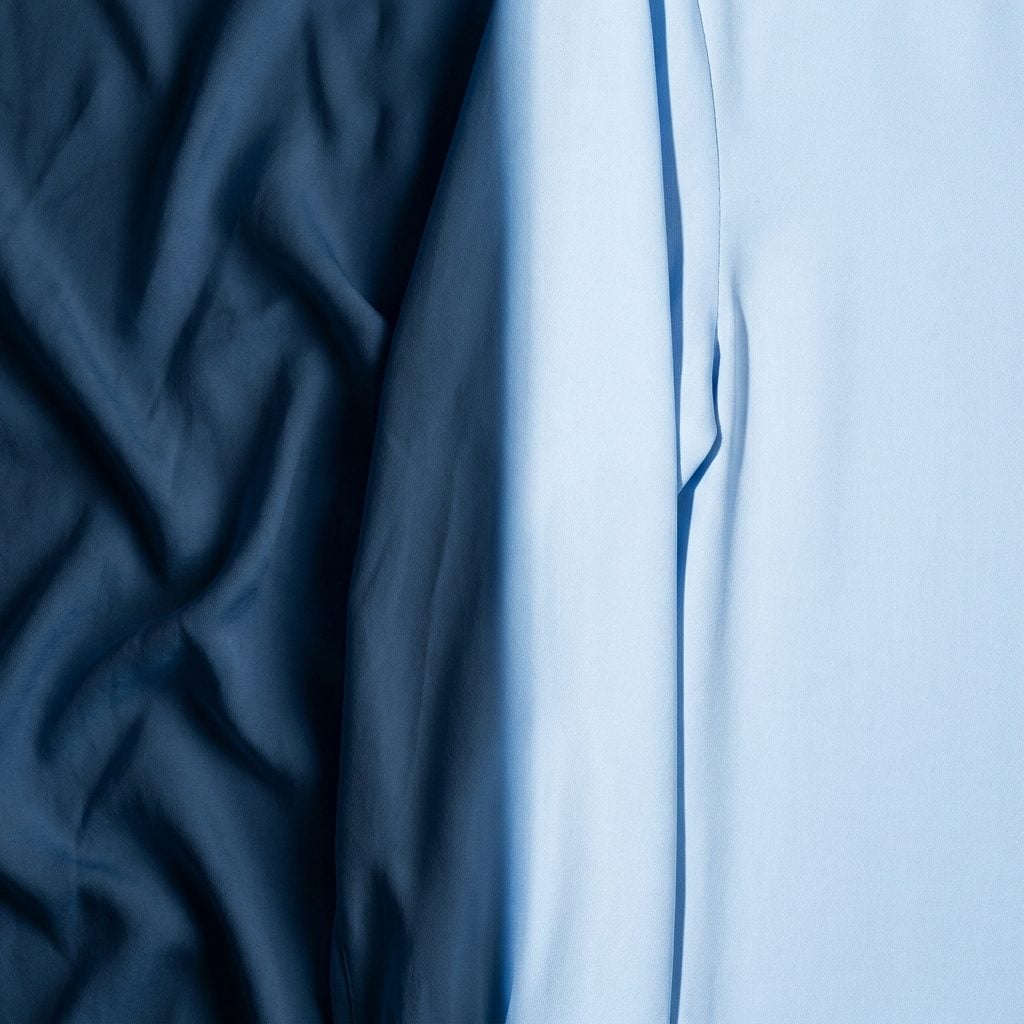
Nobody says it out loud, but everyone reads it. The wrinkled sleeve at the meeting. The blouse that clearly went from hamper to body. It reads as a small surrender, and the woman wearing it usually feels the surrender before anyone else names it.
The act of caring for how you present yourself sends a signal inward first: that you’re worth the effort. Source Taking the time to look after your appearance is read, by yourself and others, as self-respect, and it shifts how you carry the whole day. Source Skip it long enough and the neglect stops being about laundry and starts being about how much you think you’re worth bothering for.
That’s the line the sleeve sits on. Pressed says I’m still here, still paying attention, still mine. It’s the smallest possible vote for yourself, cast every morning. Other women respect the pressed sleeve because they know exactly what it costs to keep casting it. Go press the collar. That’s the whole secret.
The Bottom Line
It’s the placket, that vertical strip of fabric running down the front where the buttons sit. When it lies perfectly flat, without the faint puckering that a rushed press or a dryer leaves behind, other women read it instantly as proof you handled it yourself, deliberately, with your own hands and your own time. Look down at your placket tomorrow morning: a flat one says you decided you were worth the ten extra minutes, and that decision is visible to everyone before you open your mouth.