❤️ Would you like to save this?
The coat is supposed to be the easy part. After the velvet dress, the satin skirt, the carefully chosen boots, and the earrings that finally make sense of everything, winter outerwear can seem like a minor administrative detail. Then the wrong hem cuts a beautiful skirt in half. A narrow sleeve crushes a dramatic blouse. A heavy collar swallows the neckline. Suddenly, the outfit that looked magnificent in the mirror has lost half its charm somewhere between the bedroom and the front door.
And Christmas is hardly the season for restraint. Velvet, lamé, brocade, feathers, sequins, and sweeping skirts weren’t chosen to disappear beneath three feet of sensible wool. The trick is knowing where the coat should end, how its shoulders should sit, and which details deserve an uninterrupted view. A cropped ivory jacket gives a ruby velvet skirt room to billow. A collarless camel coat lets a cashmere turtleneck hold its own. A midnight-blue opera coat turns silver satin into something positively theatrical. Length, volume, texture, and proportion do the heavy lifting, with color supplying the occasional glorious surprise.
Then comes the more delicious possibility: what if the coat is the best part of the outfit? Burgundy plaid can make a simple black dress look positively intentional. Chocolate faux fur gives a satin column dress an entirely different attitude. A shimmering silver statement coat makes black velvet seem almost modest. These 37 looks explore both sides of the equation, from outerwear that quietly protects a beautiful silhouette to coats that demand the starring role. The dress may have started the conversation, but there’s no reason the coat shouldn’t have the last word.
FYI, thanks to AI imagery software, we’re able to create very specific fashion and hairstyle examples to illustrate the points being made. In some cases, imagery is exaggerated to hammer home the point. Also, assume links that take you off the site are affiliate links such as links to Amazon. this means we may earn a commission if you buy something.
37. The Ivory Waist-Length Jacket That Lets the Ruby Skirt Keep Its Shape
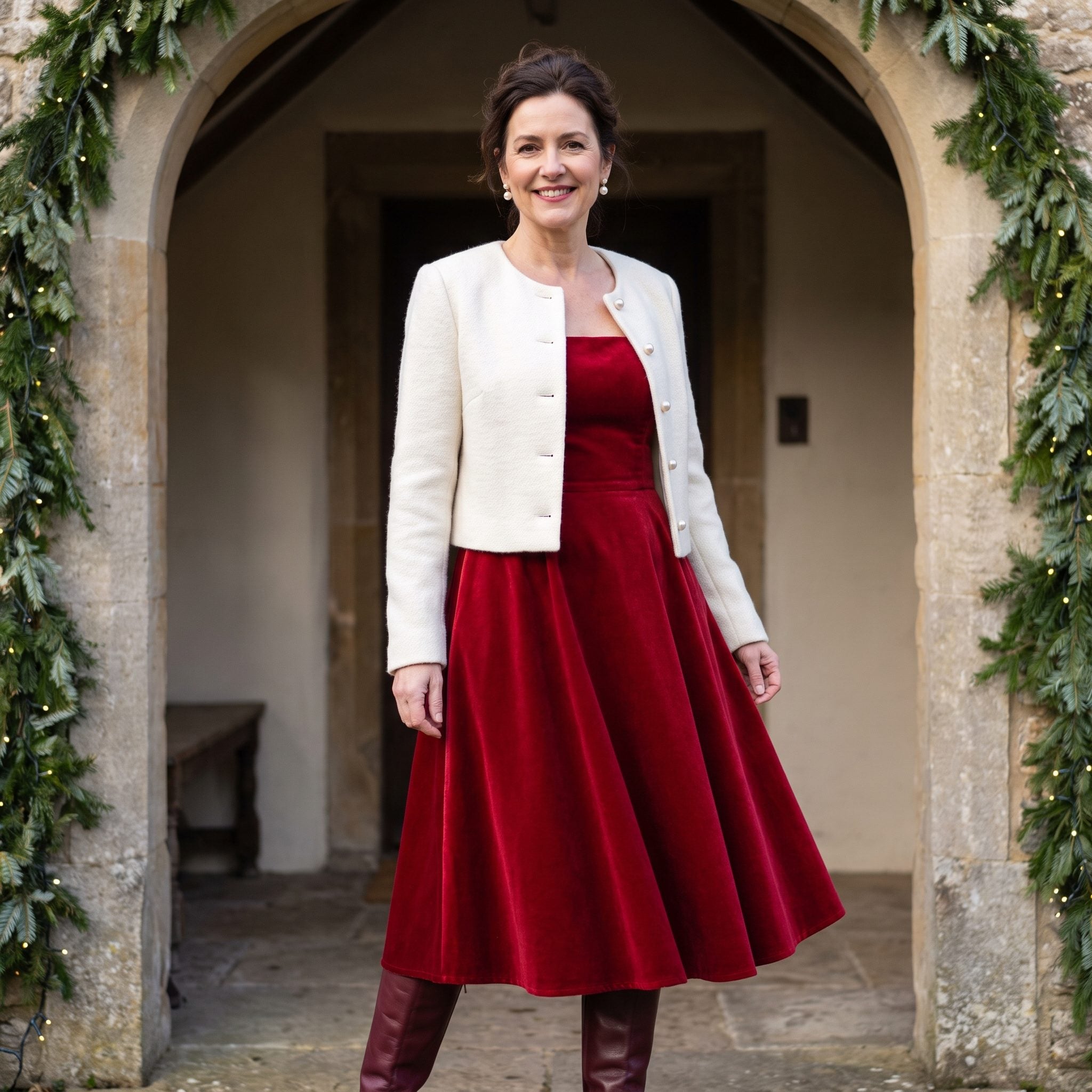
Ruby velvet has enough presence without a coat trying to rearrange it. The circle skirt needs room to fall from the waist, and this ivory jacket ends precisely where that movement begins. Pearl buttons add a little polish without drawing attention away from the skirt’s generous sweep.
The cropped shape also gives the burgundy knee boots a clear role. They extend the rich color below the hem while the ivory jacket keeps the upper half light. Rather than hiding the outfit’s most interesting proportion, the outerwear makes it easier to see.
36. The Charcoal Raglan Coat That Makes Room for Bishop Sleeves
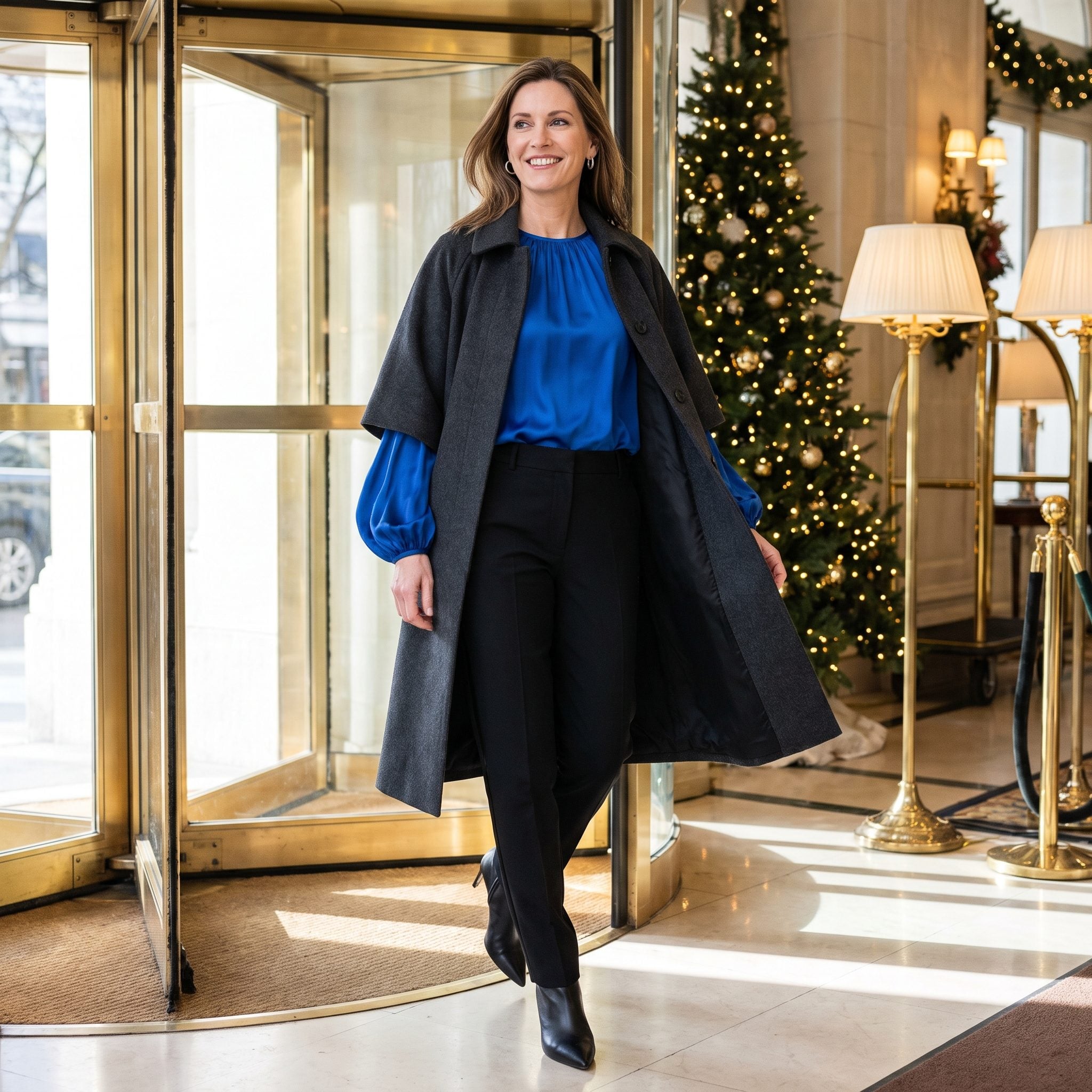
Bishop sleeves look magnificent until they’re forced into a coat with narrow arms. Gathered silk needs space around the upper arm and elbow, or the blouse emerges with considerably less drama than it had before leaving home.
This charcoal coat combines raglan construction with generous sleeve and armhole ease. The diagonal shoulder seams soften the transition from neck to arm, while the extra room accommodates the blouse’s fullness. Sapphire fabric appears beneath the dark wool, adding a flash of color without competing with the coat’s relaxed structure.
35. The Collarless Camel Coat That Gives Cream Cashmere a Clear Neckline
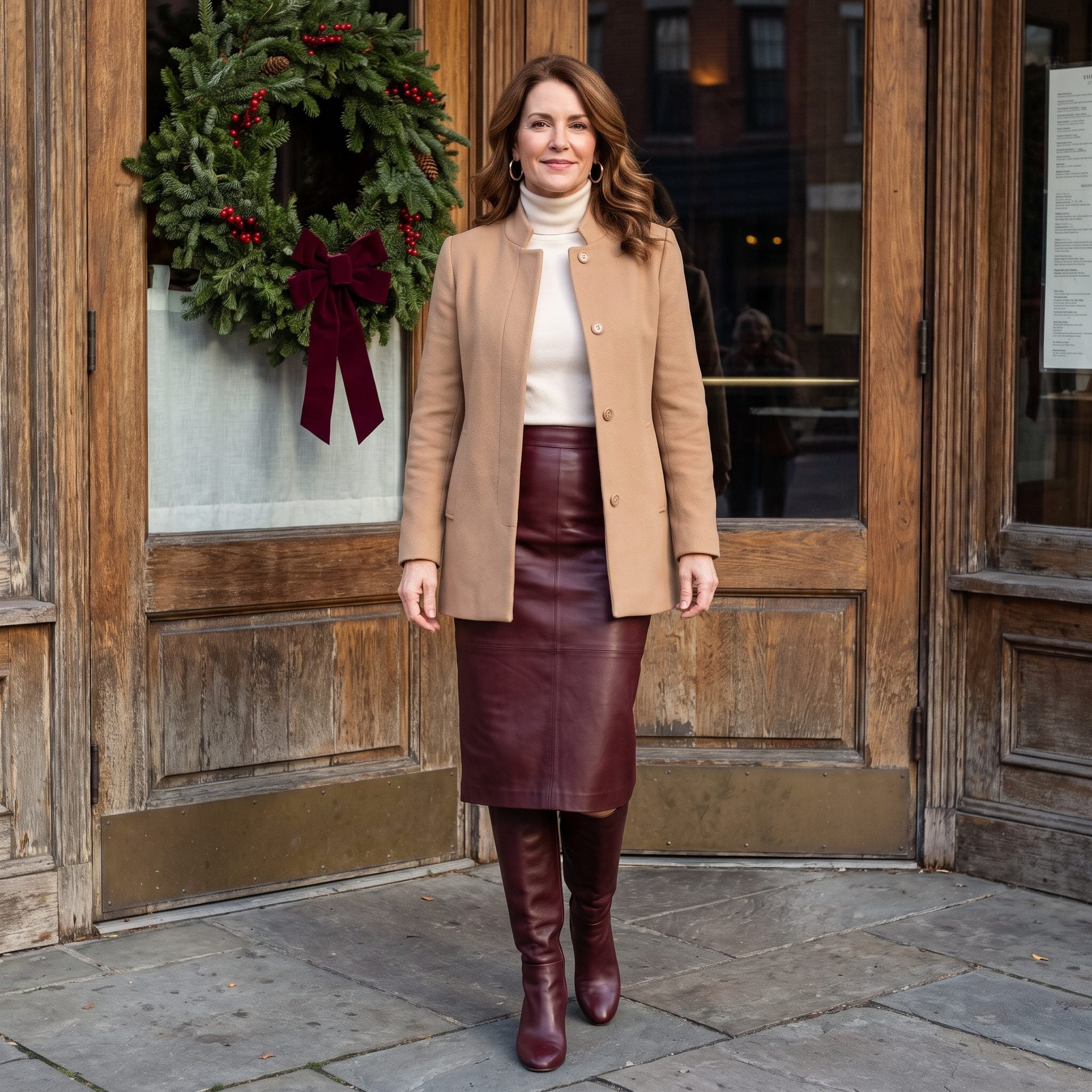
A cream cashmere turtleneck already provides a beautifully defined neckline. Add a bulky coat collar and that clean shape can disappear beneath overlapping layers of fabric.
The collarless camel coat avoids the congestion. Its uninterrupted opening frames the knit, while the upper-thigh length reveals enough of the oxblood leather skirt to keep the combination interesting. Camel, cream, and oxblood offer three different degrees of warmth, with the leather supplying a welcome change in texture.
34. Winter White Gets Its Drama From Wool and Satin
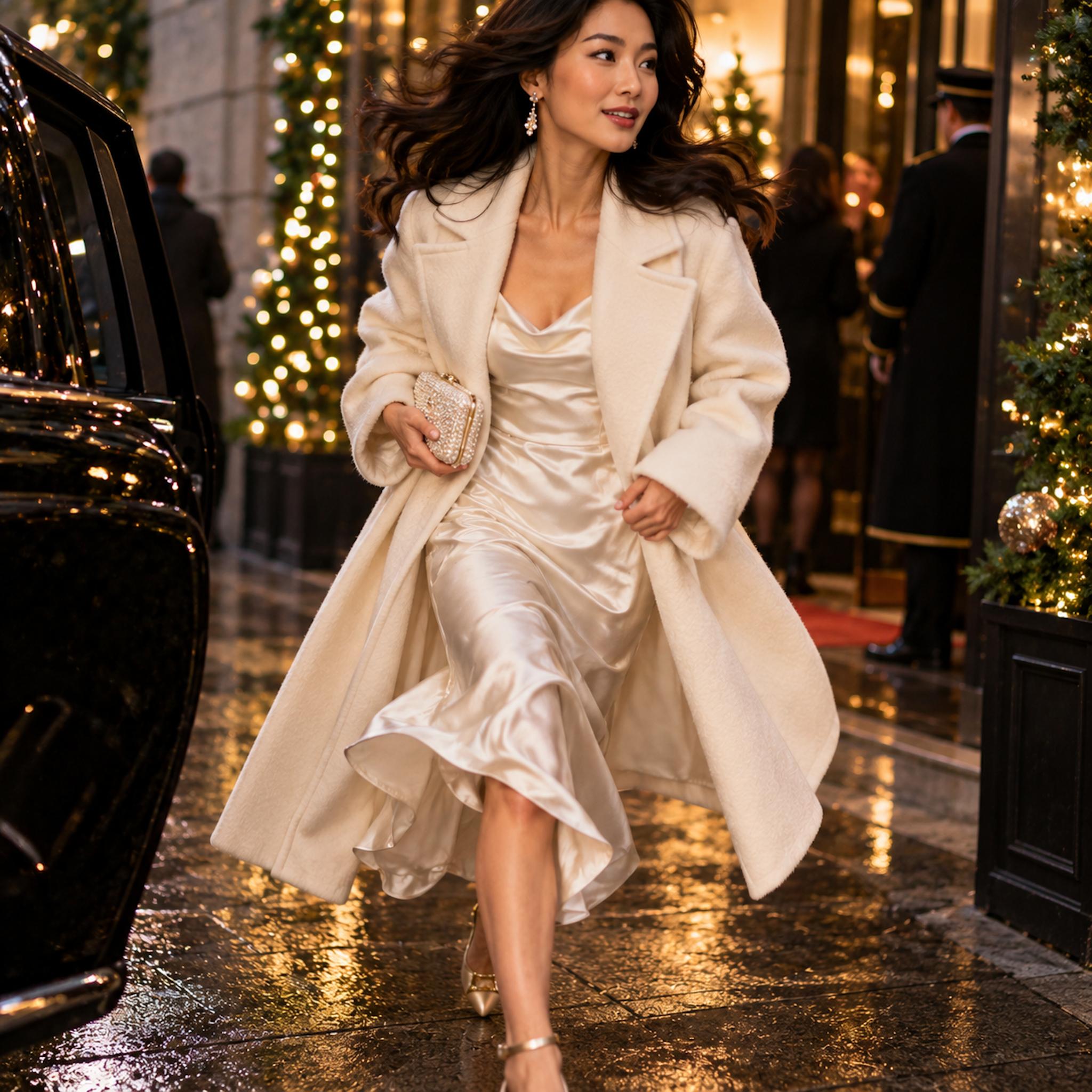
Winter white becomes much more interesting when the fabrics have entirely different ideas about light. The ivory wool coat has a substantial, softly textured surface, while the satin dress underneath catches the illumination in liquid folds. Both belong to the same pale color family, but one absorbs light gently while the other sends it dancing across every crease.
The coat swings open as the woman walks, revealing the satin without introducing a competing color. Metallic accessories add a discreet glimmer. The result has the impact of a dramatic evening outfit without relying on red, green, or a single conspicuous holiday motif.
33. Midnight Blue Gives a Silver Taffeta Skirt Room to Move
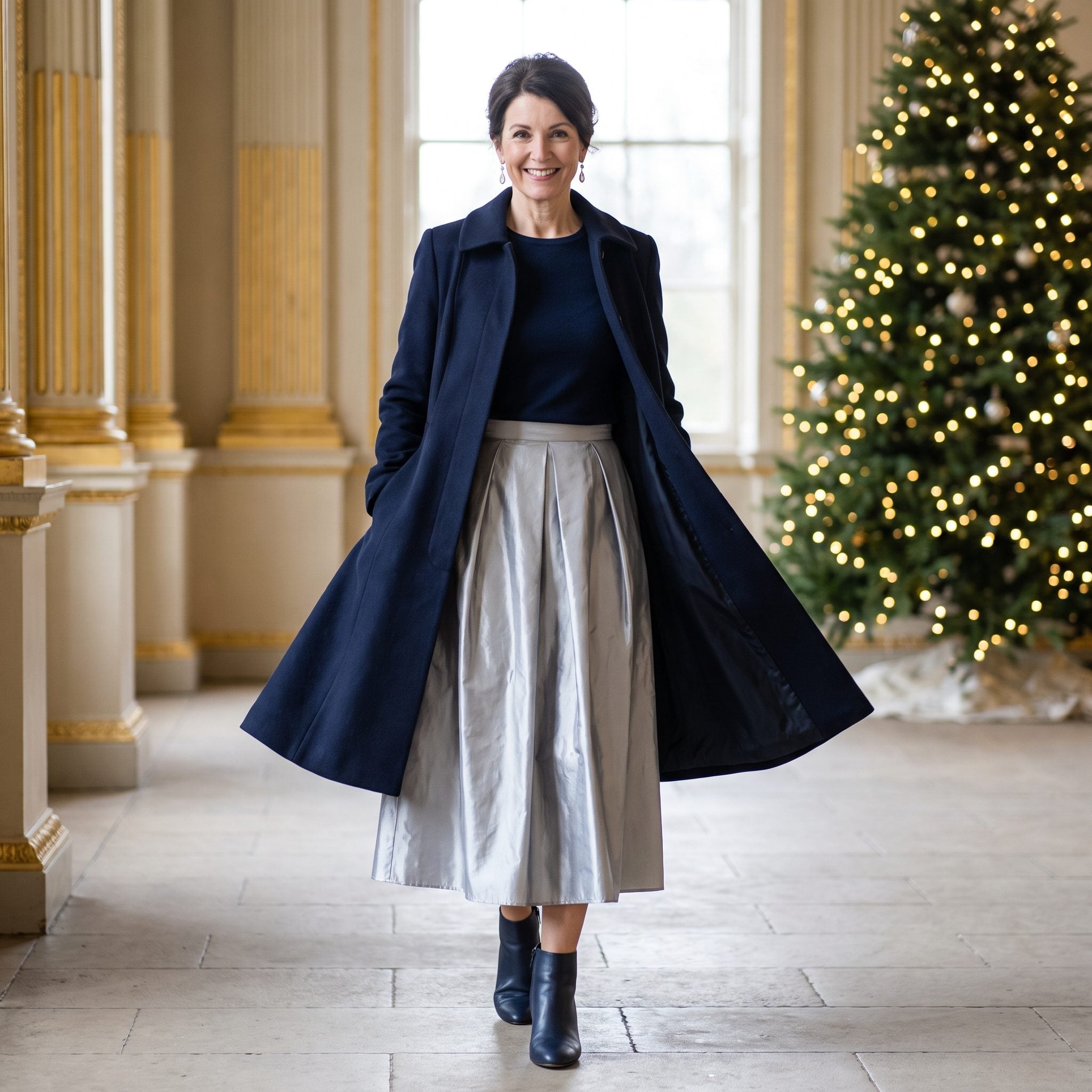
Taffeta has a mind of its own. Its crisp folds create volume that a narrow coat can compress, particularly when the wearer sits or moves through a crowded room.
Princess seams give this midnight-blue coat definition through the torso before the fabric opens into a generous hem. That sweep accommodates the silver skirt rather than pressing it flat. Every step reveals a different flash of metallic fabric against the deep blue wool.
32. A Plum Side-Fastening Coat Gives Emerald Velvet an Unexpected Partner
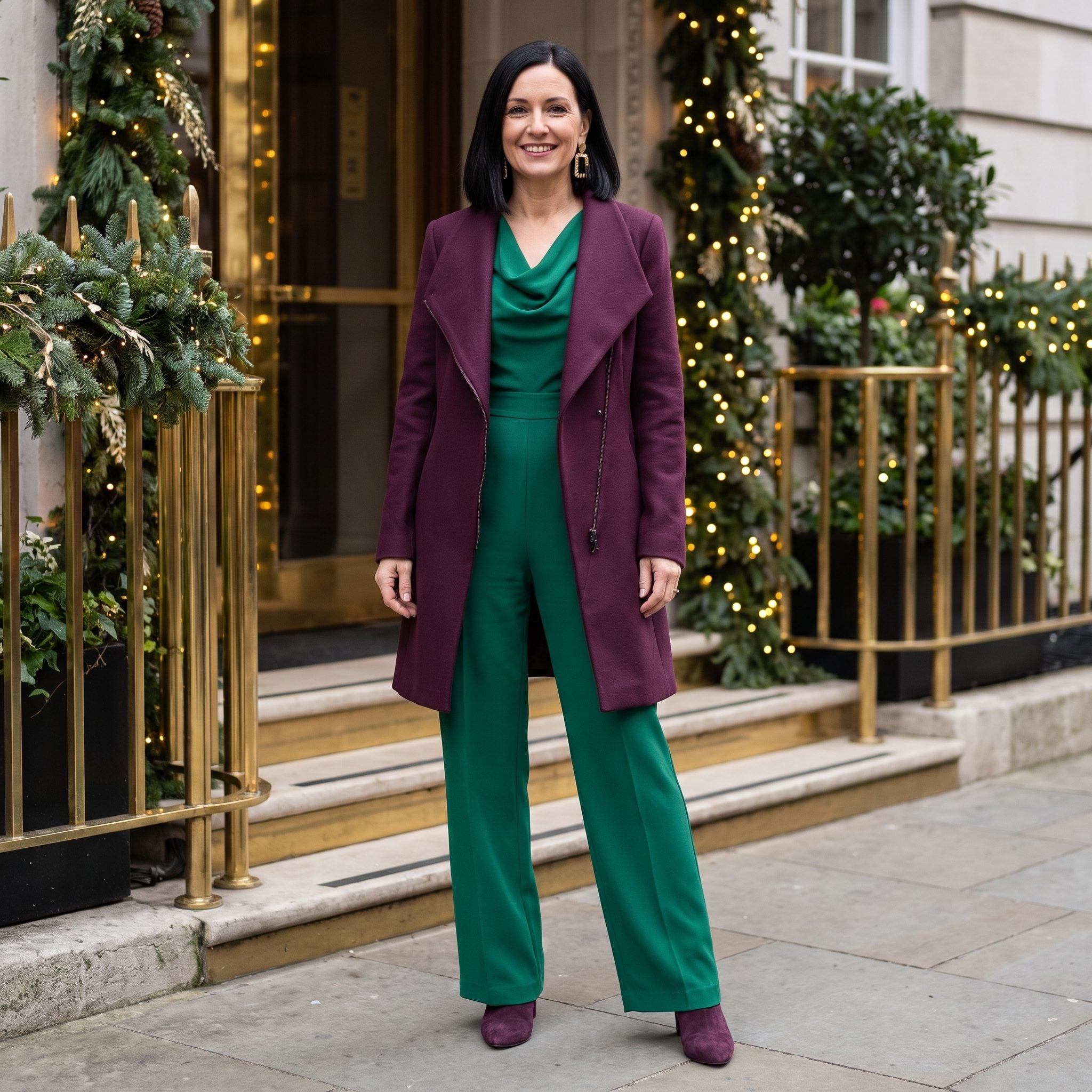
Plum and emerald could easily become a contest between two jewel tones. Here, the asymmetric coat closure changes the equation. Its diagonal fastening introduces movement across the upper body while allowing the emerald jumpsuit to remain visible.
The upper-thigh hem exposes the trouser legs, preserving much of the jumpsuit’s continuous line. Gold earrings warm the combination, but the real attraction is the relationship between the coat’s off-center construction and the fluid velvet beneath it.
31. The Black Swing Coat That Makes a Gold Mini Look Deliberate

A gold brocade mini doesn’t need much assistance in attracting attention. What it needs is an outer layer that gives the short hem a convincing winter context.
The black swing coat falls just beyond the dress, creating one strong outer silhouette. Opaque tights and knee-high boots continue the dark color below, while the gold appears as a concentrated flash of pattern. The coat’s movement keeps the combination playful without making the short skirt seem like an afterthought.
30. Cobalt and Black Find Their Match in Velvet Lapels
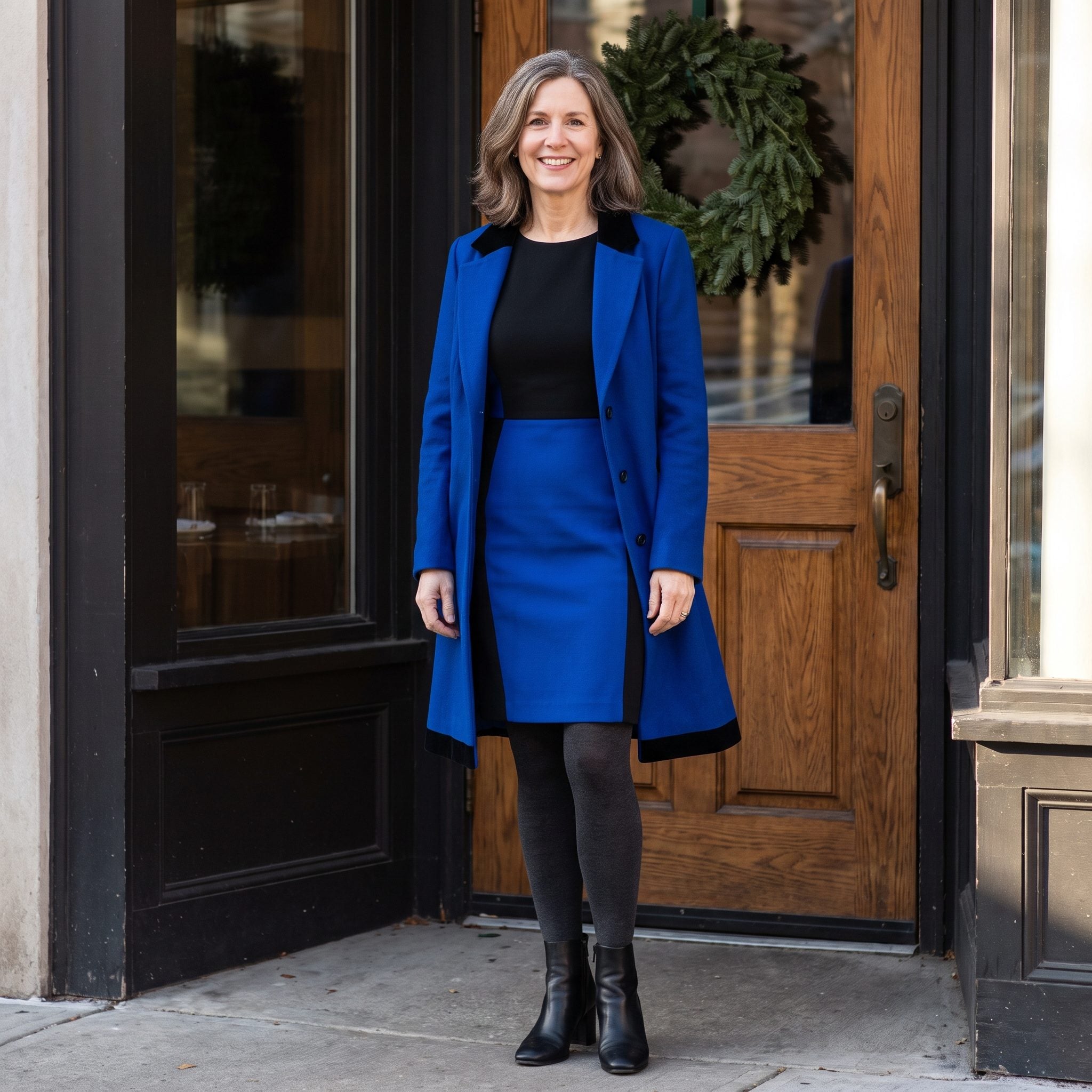
The dress establishes the palette: black across the bodice, cobalt below. Rather than introducing a third dominant color, the coat repeats both. Cobalt wool carries the blue outward, and black velvet lapels pick up the darker section of the sheath.
Charcoal tights and black block-heel boots finish the arrangement without disturbing it. The cobalt wool coat becomes part of the original composition, with the velvet lapels providing just enough contrast in surface and sheen.
29. Camel Double-Breasted Tailoring Meets Burgundy Velvet
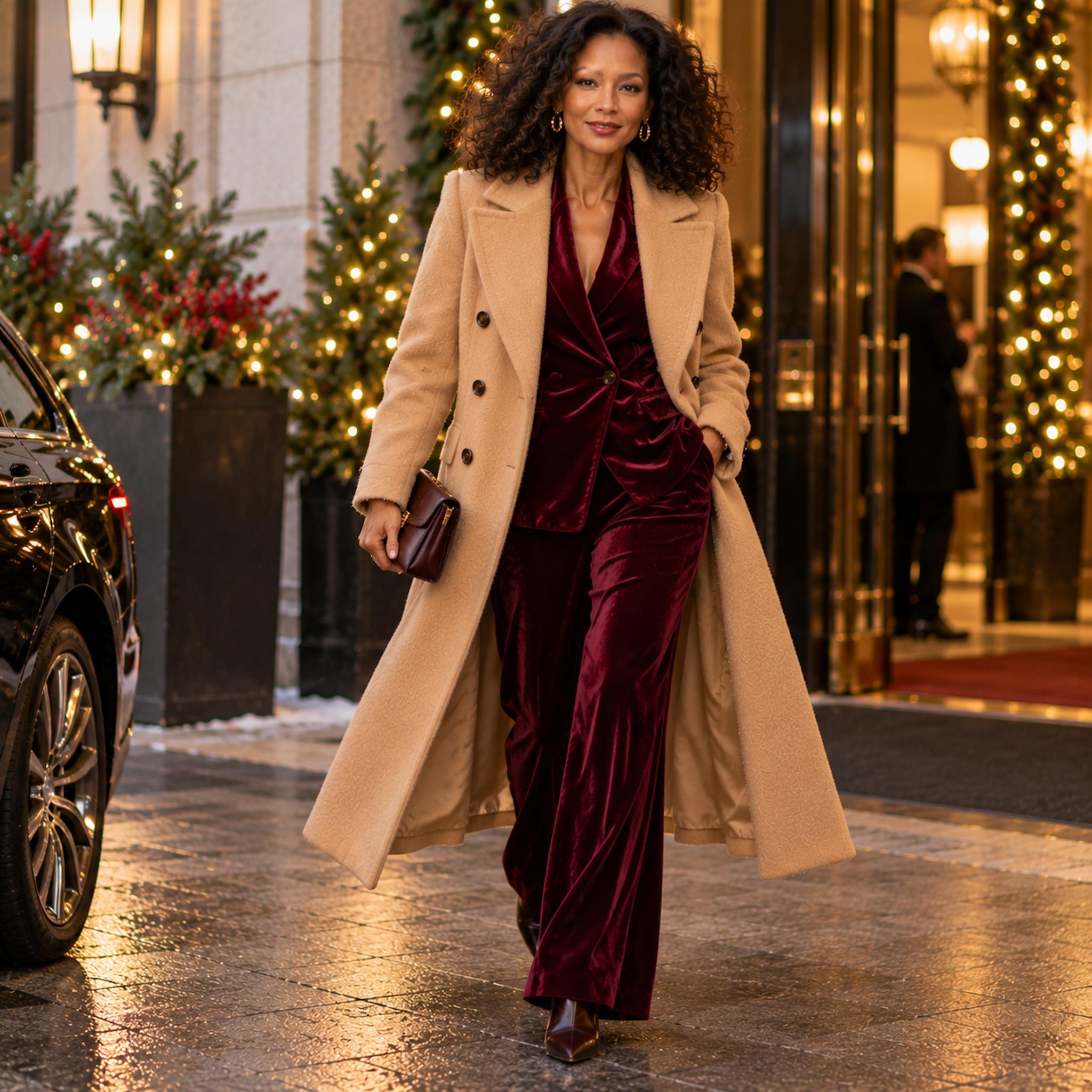
A long camel coat brings architectural discipline to a burgundy velvet pantsuit. Broad lapels, structured shoulders, and two rows of dark buttons establish a strong outer frame, while the velvet beneath supplies depth, softness, and a beautiful play of light.
The coat is worn open, allowing the burgundy blazer and fluid trousers to remain clearly visible. Camel wool and wine-colored velvet are both luxurious materials, but they communicate that luxury differently: one through precise tailoring, the other through its rich pile. Together, they give formal trousers the presence usually reserved for an evening gown.
28. The Navy Quilted Coat That Makes an Oatmeal Knit Dress Winter-Ready
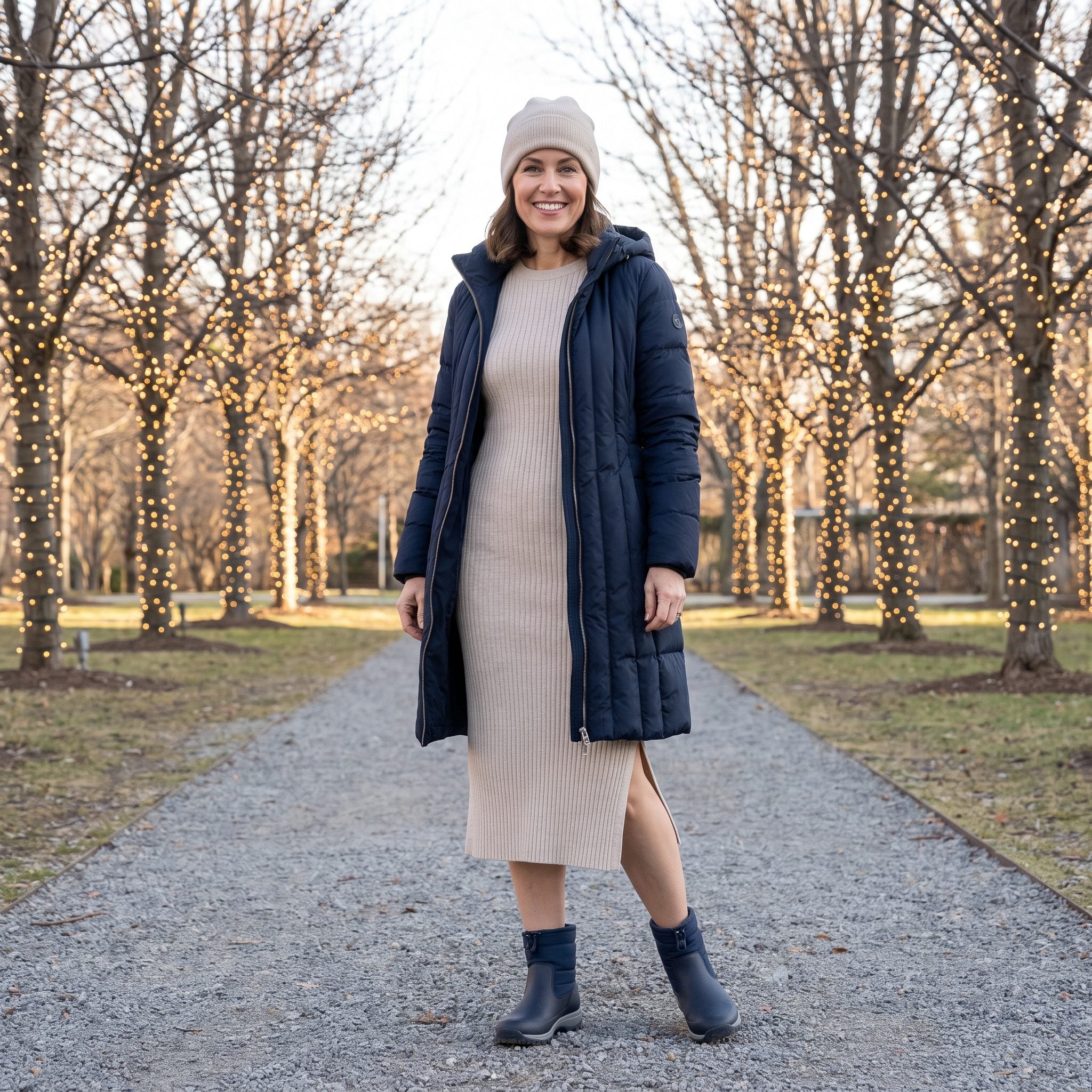
Christmas dressing isn’t confined to formal dinners. A walk through an illuminated garden or an outdoor market calls for genuine insulation, even when the outfit underneath happens to be a dress.
The navy quilted coat provides warmth without abandoning the oatmeal knit’s relaxed appeal. Its two-way zipper can open from the hem, creating additional walking room and revealing the ribbed dress beneath. An oatmeal cashmere hat connects the colors, while the navy quilted coat keeps the outfit firmly in practical winter territory.
27. The Black V-Neck Jacket That Gives a Champagne Bow Center Stage
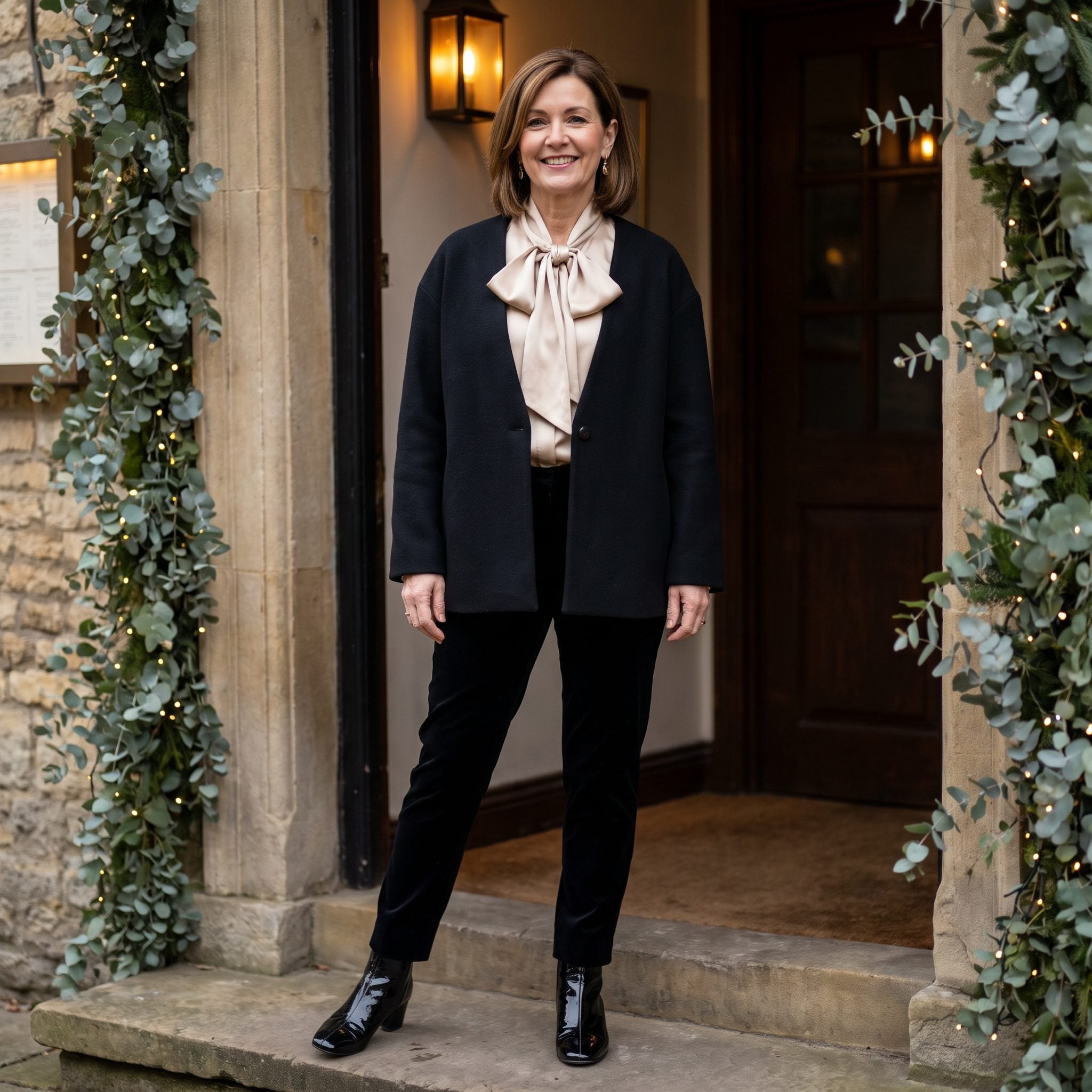
A generous champagne bow is an accessory, a neckline, and a considerable amount of fabric occupying the same small space. Covering it with a conventional high-buttoning coat rather defeats the point.
The collarless V-neck jacket opens beneath the bow, leaving its loops and tails visible. Velvet cigarette trousers and patent boots provide a sleek foundation. The champagne silk supplies the softness, and the black wool gives the arrangement enough structure to feel dressed for an occasion.
26. A Red Cocoon Coat Turns Gold Knitwear Into a Winter Statement
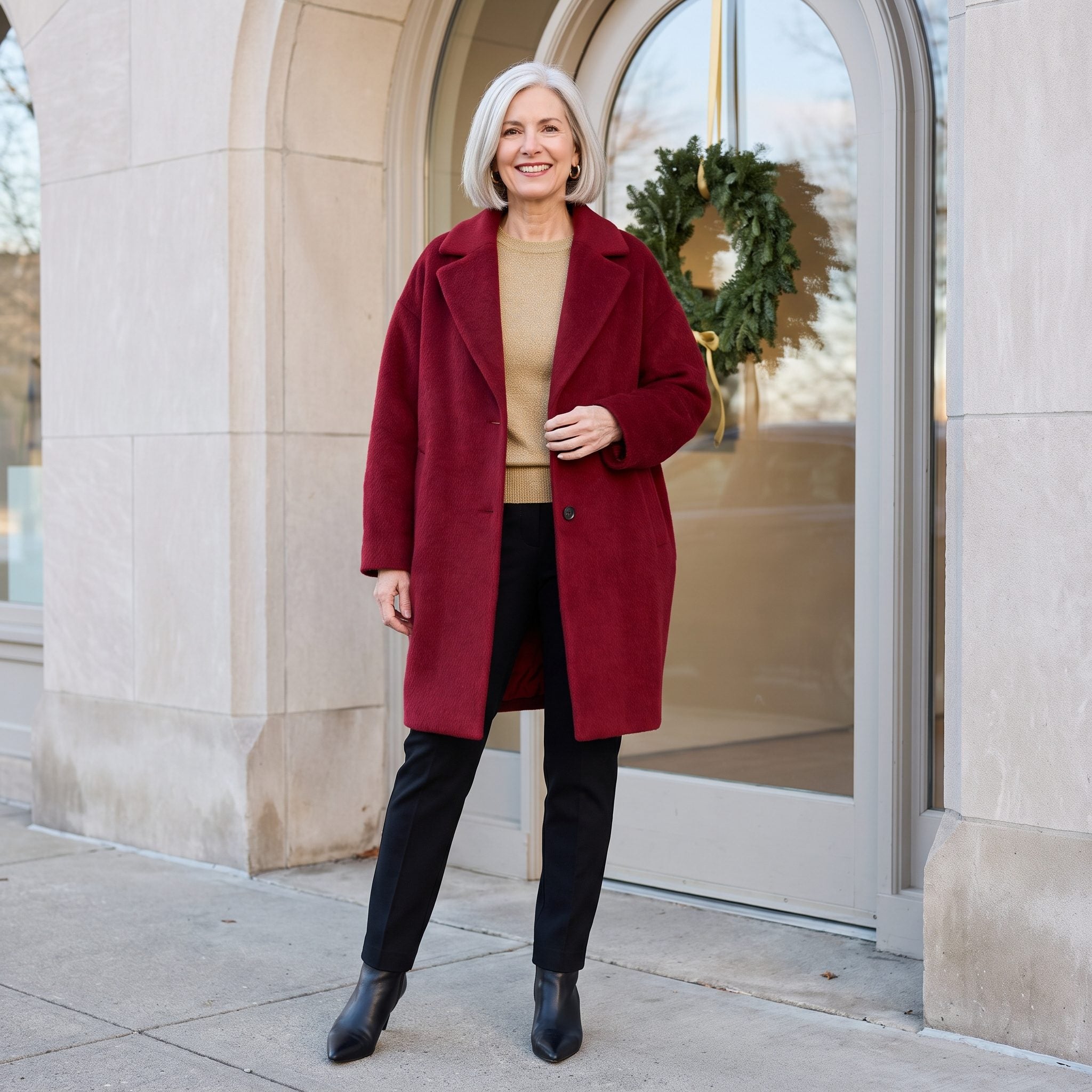
The red cocoon coat is all rounded volume, a silhouette that becomes especially effective against narrow black trousers. The generous upper shape contrasts with the straight line of the legs, while pointed boots add a crisp finish.
Partially fastened, the coat reveals a gold metallic knit sweater at the neckline. That small flash of gold is enough to make the outfit festive. The coat supplies the drama, the trousers provide the counterweight, and the knit brings the light.
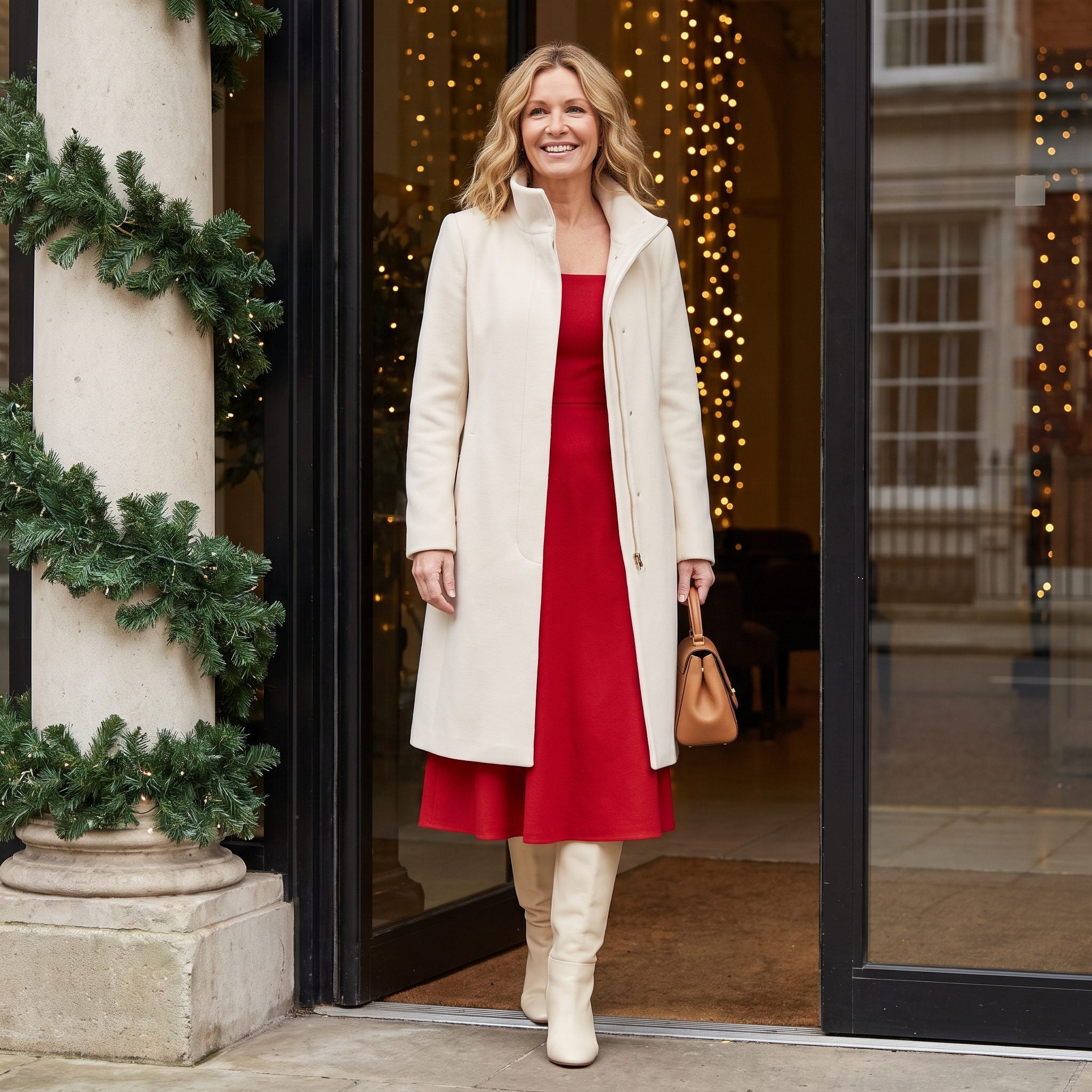
25. Cream Wool Frames a Red Square Neckline
❤️ Would you like to save this?
A cream funnel-neck coat has a substantial presence around the face, but the red square-neck dress introduces a clean geometric opening beneath it. The combination works because the coat’s upper fastenings are released, allowing the two necklines to occupy separate visual spaces.
The cream coat and cream knee boots create a pale frame around the red. The dress supplies the saturated color, while the outerwear gives the look a polished winter finish.
24. Chocolate Faux Fur Gives a Black Column Dress Its Own Entrance
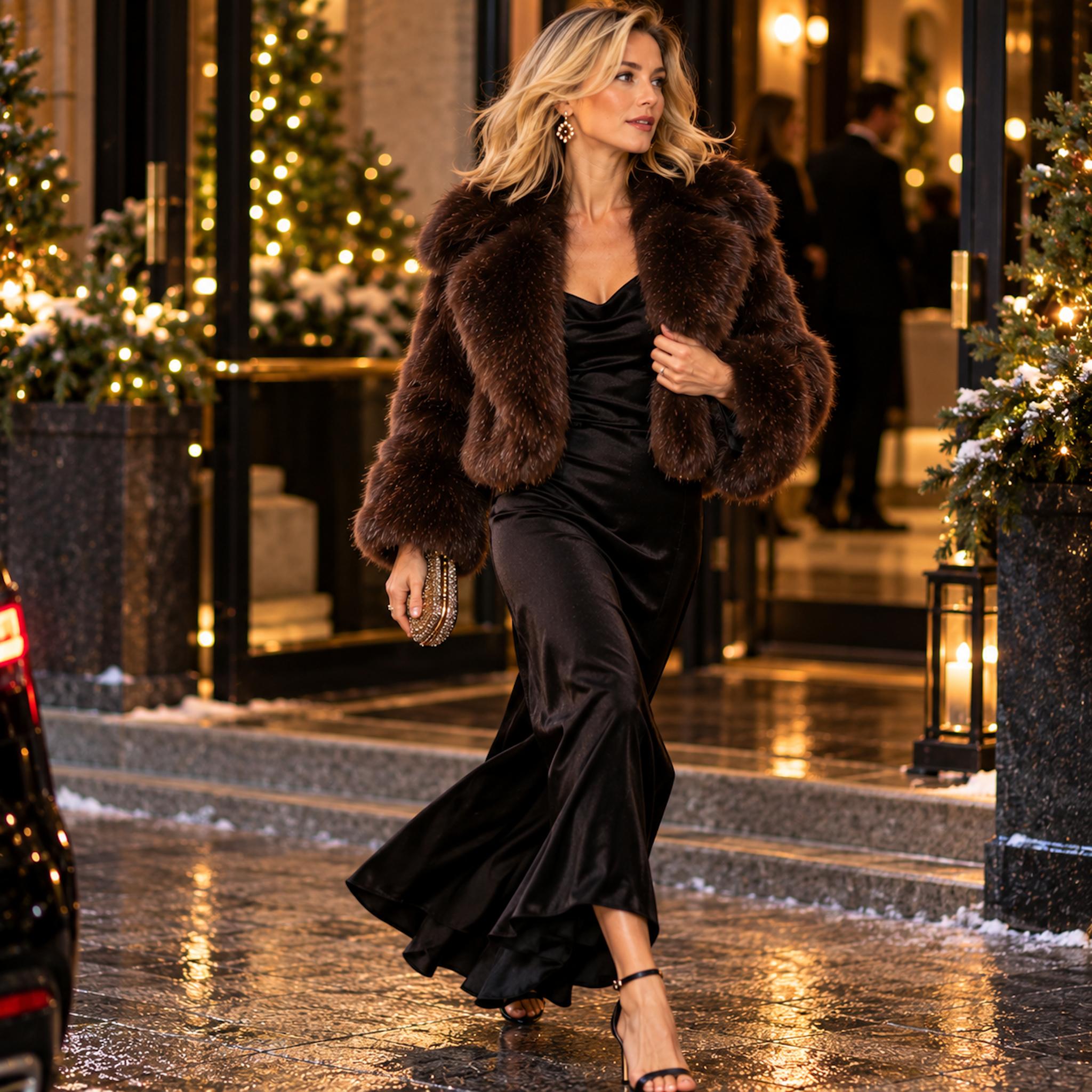
Black satin is sleek, understated, and beautifully fluid. Chocolate faux fur has no intention of being understated. The cropped jacket brings plush volume across the shoulders and upper torso, turning a simple black column dress into a much more glamorous evening combination.
The contrast is particularly effective because the two fabrics catch light differently. Satin produces smooth highlights along the dress, while the faux fur creates a deep, textured surface around the face. The short jacket also leaves the dress’s long line visible, allowing the outerwear to become the attraction without overwhelming the silhouette.
23. The Charcoal Cape That Accommodates Dramatic Kimono Sleeves
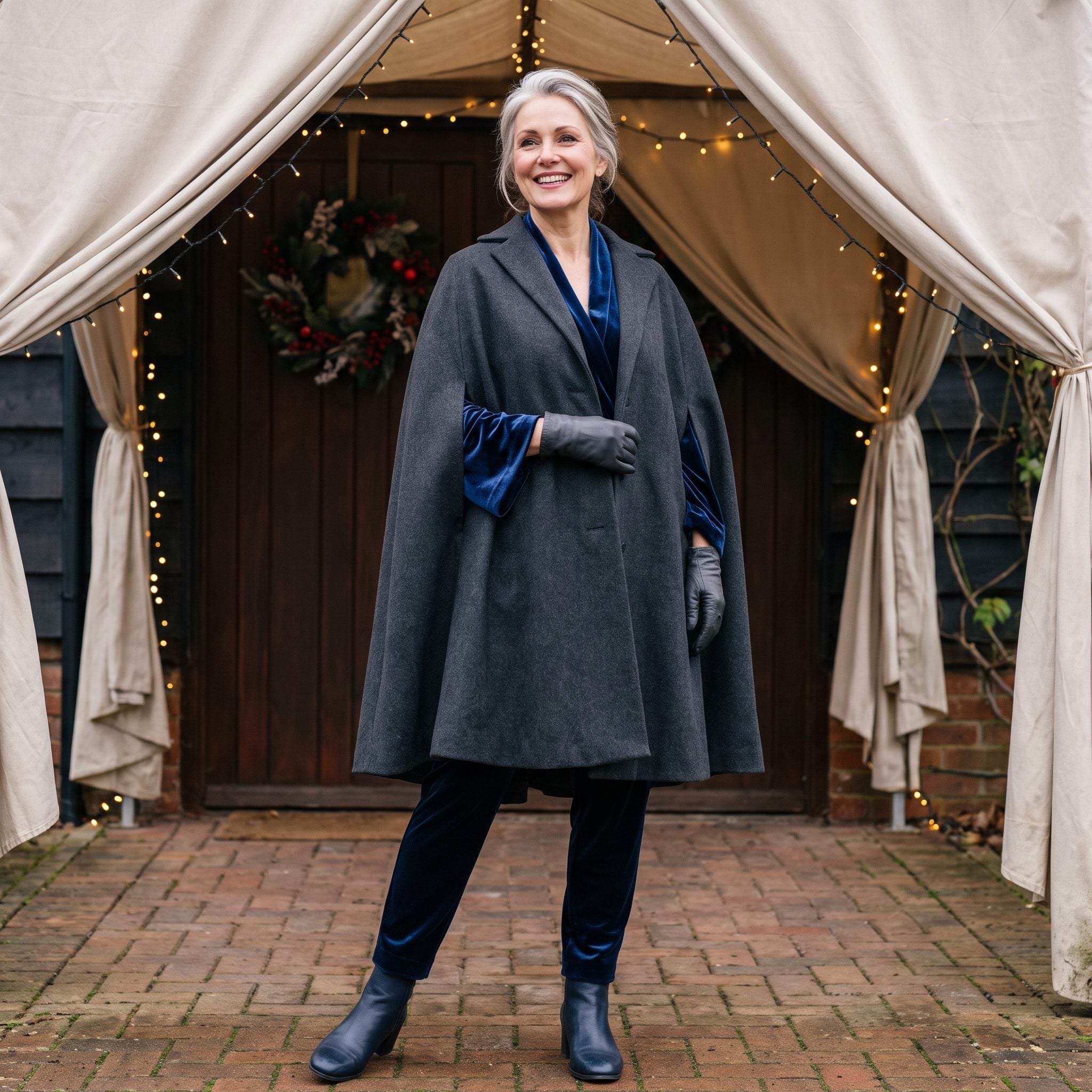
Wide kimono sleeves are magnificent until a fitted coat attempts to fold them into narrow tubes. A cape takes a different approach: instead of forcing the garment into conventional sleeves, it provides an open volume around the upper body.
This charcoal wool cape accommodates the midnight-blue velvet beneath it. Discreet arm openings allow movement, while charcoal leather gloves reinforce the restrained palette. The result has the sweep of formal outerwear without requiring the blouse to surrender its distinctive sleeves.
22. Pearl Gray Leaves Aubergine Ruching Undisturbed
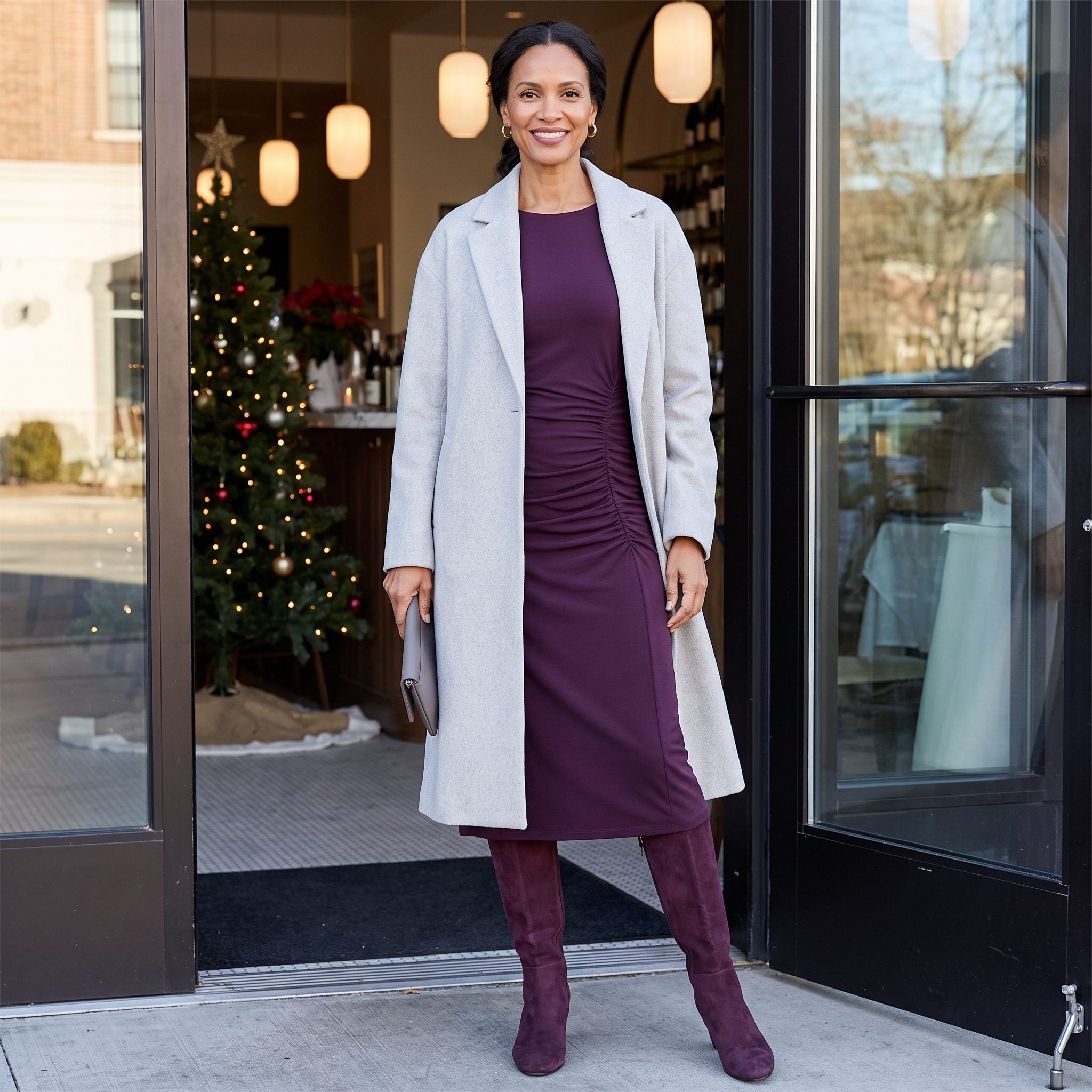
The aubergine dress uses asymmetric ruching to create shape and movement around the hip. A tightly belted coat could press directly across those gathers, changing the dress’s carefully arranged silhouette.
An unbelted pearl-gray wool coat avoids that complication. Its straight cut provides a quiet outer frame, and the ruched dress remains visible through the open front. The cool gray also gives the rich purple a particularly elegant contrast.
21. Navy Duffle-Coat Practicality Meets Green Velvet
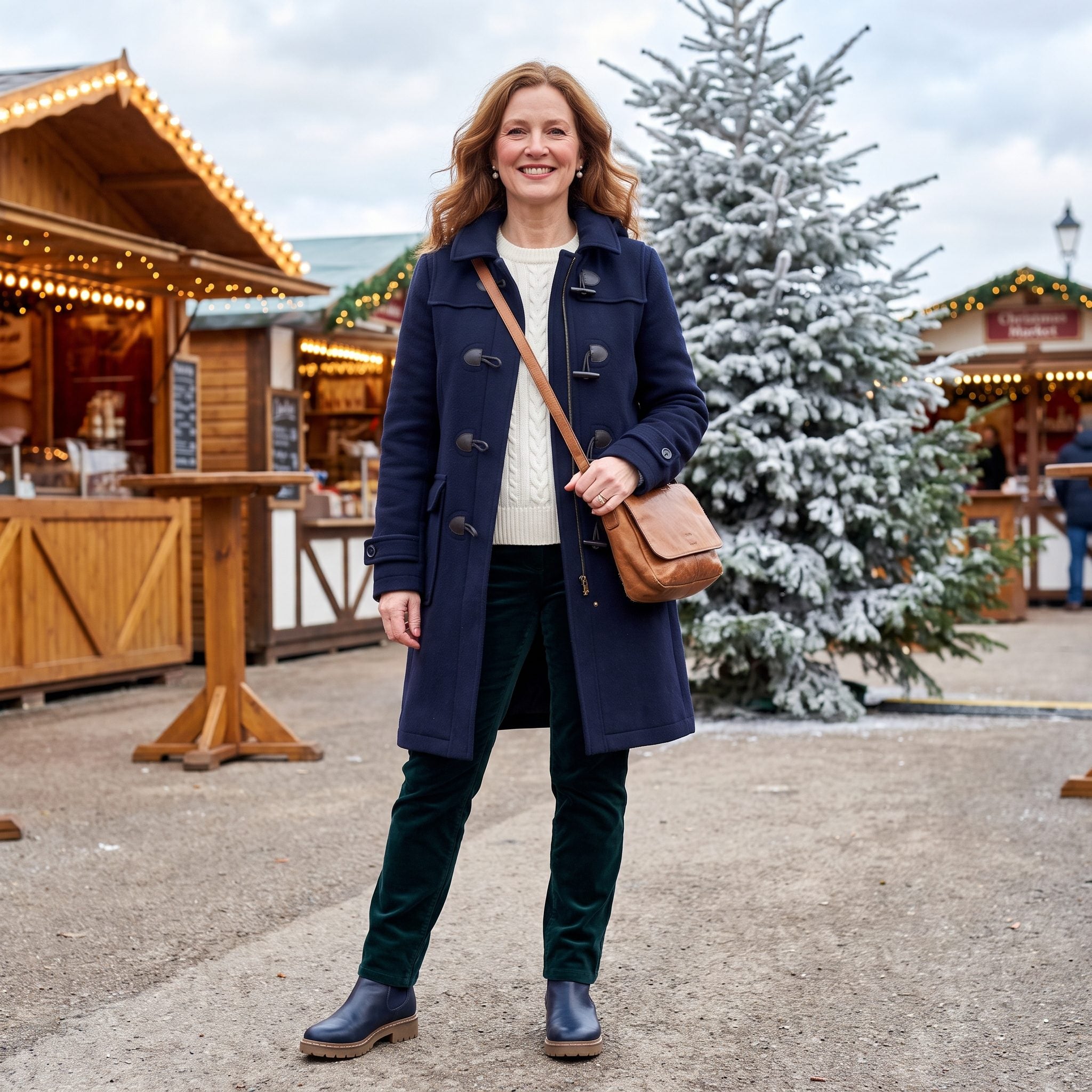
Green velvet trousers and an ivory cable-knit sweater belong to a more relaxed kind of Christmas dressing. A severely tailored evening coat could feel unnecessarily formal over such tactile, comfortable pieces.
The navy duffle coat introduces traditional toggles and a practical winter silhouette. Its roomy cut accommodates the ivory cable knit, while the green velvet trousers remain visible below. Sturdy boots complete a combination that makes sense for outdoor festivities without losing its holiday richness.
20. The Black Coat That Leaves a Burgundy Feather Hem Untouched
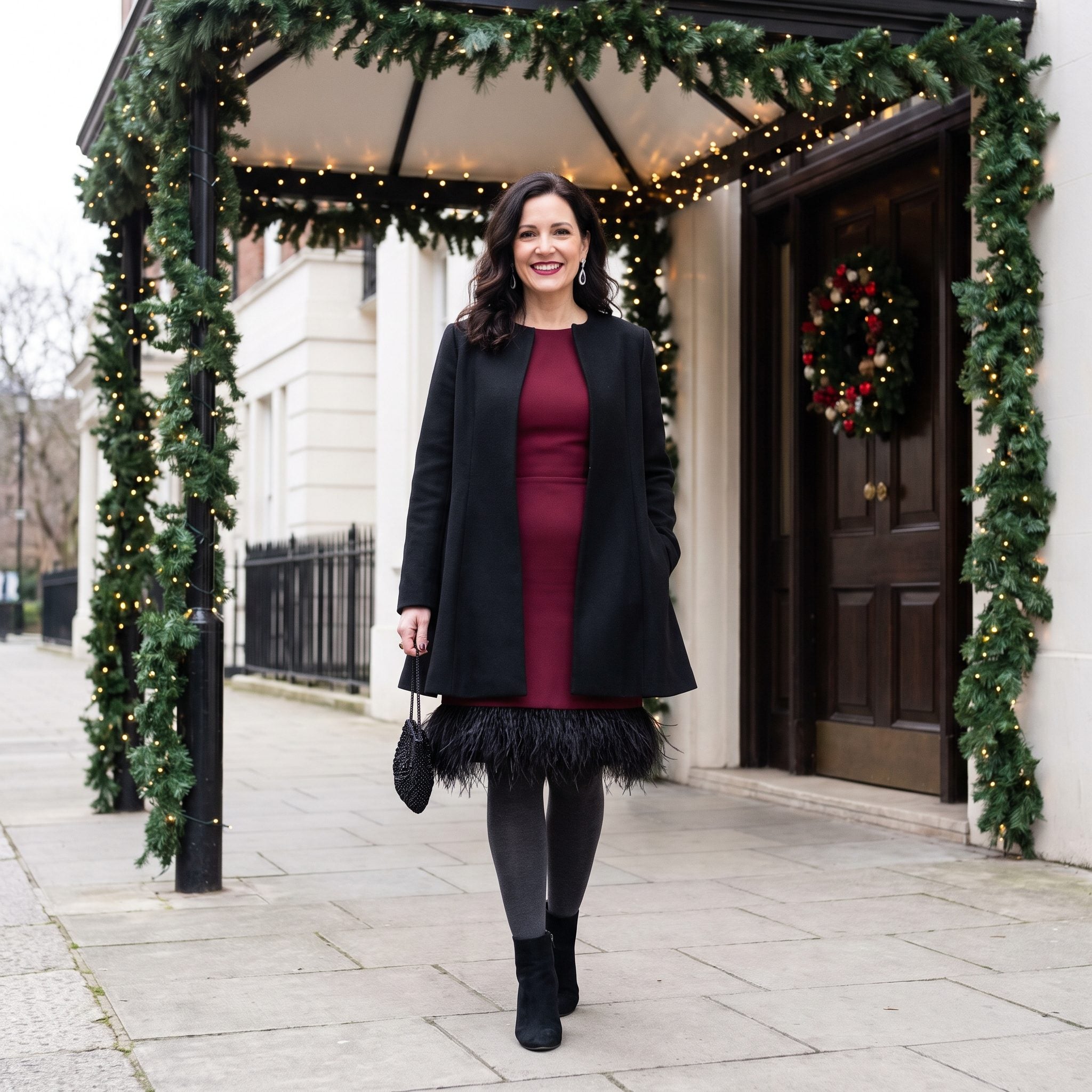
Feather trim is designed to move. A long, restrictive coat can compress that delicate texture, leaving the most entertaining part of the dress hidden or flattened.
This black wool coat ends above the feather band on the burgundy cocktail dress. The trim remains visible, charcoal tights provide warmth, and black ankle boots keep the overall look grounded.
19. Burgundy Plaid Turns a Simple Black Dress Into the Supporting Act
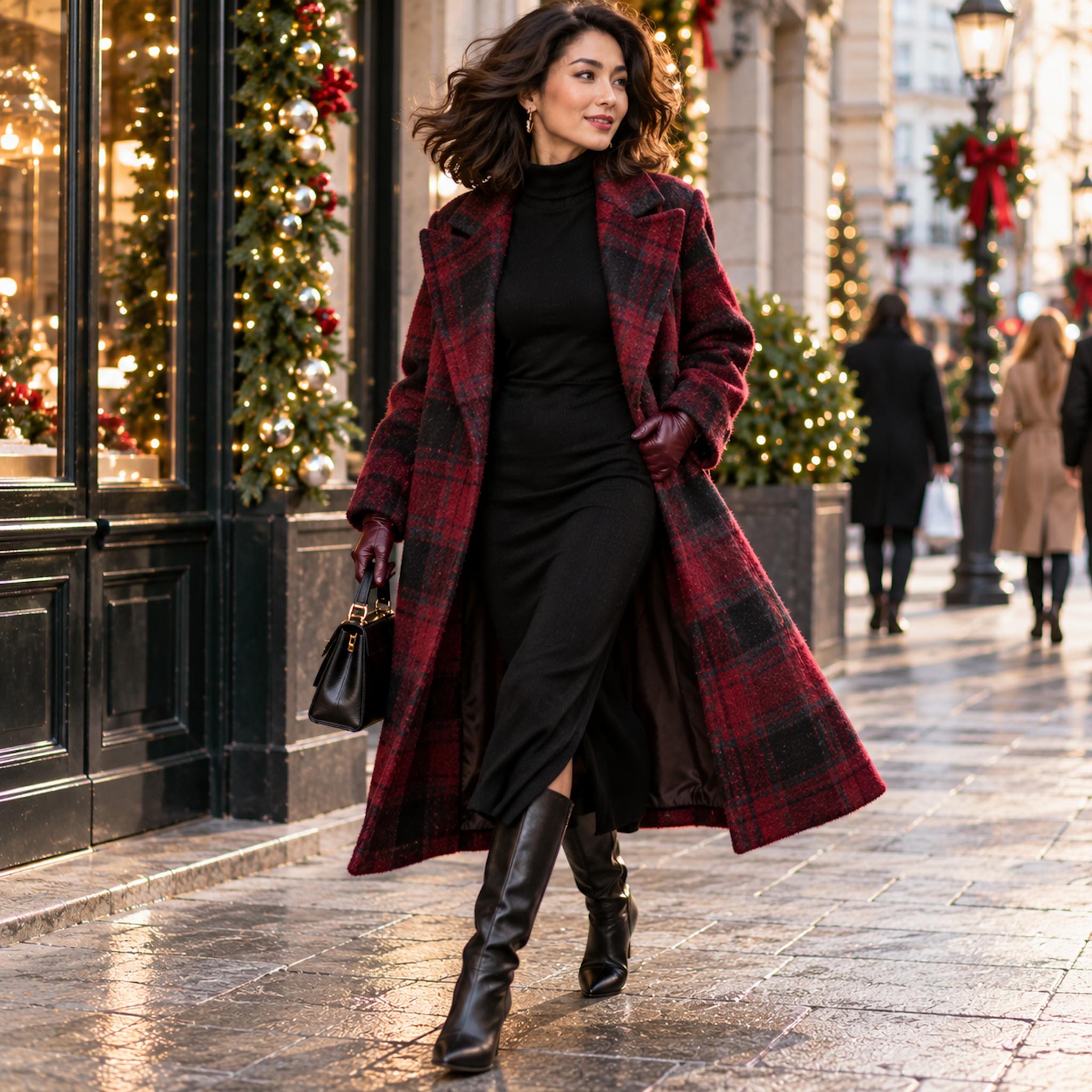
Not every holiday outfit needs a decorated dress. Sometimes the coat can carry the entire pattern. This oversized burgundy-and-charcoal plaid wool coat does exactly that, bringing rich color, bold checks, and generous movement to a fitted black knit dress.
The dark dress provides a remarkably effective backdrop. Black leather boots extend its line, while the coat swings outward with each step, revealing the quieter outfit beneath. The large-scale plaid has enough visual authority to stand alone, making the coat the principal design decision rather than the last layer added before leaving home.
18. A Black Trapeze Coat Makes Space for a Garnet Peplum
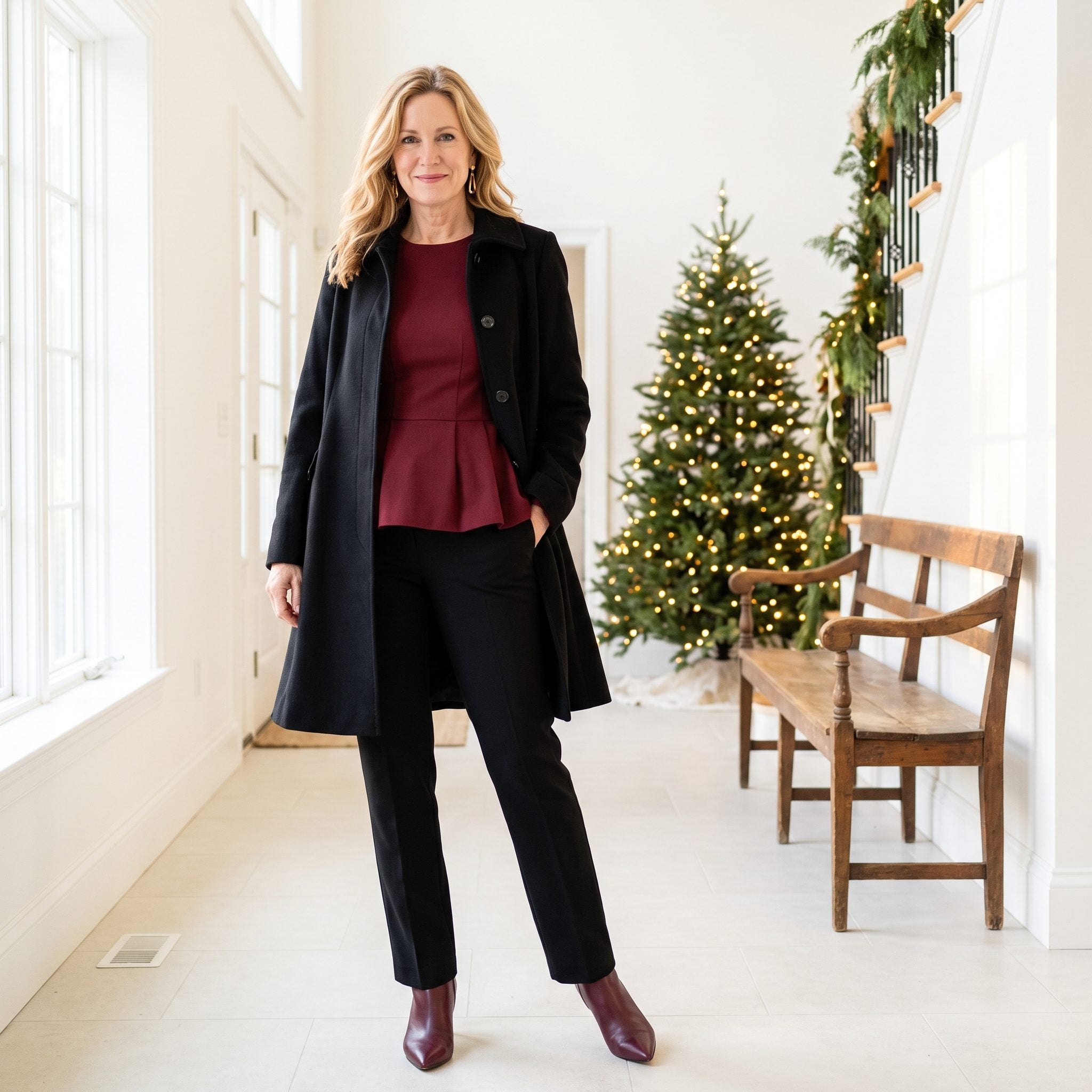
The peplum blouse introduces a controlled flare at the hips, a detail that can disappear beneath outerwear cut too close to the body.
This black wool trapeze coat offers a generous A-line sweep and an inverted back pleat, allowing the garnet blouse to retain its shape. The contrast between the coat’s broader silhouette and the peplum’s smaller flare gives the outfit a subtle architectural quality.
17. A Red Wool Blouson Finds the Right Proportion for Culottes
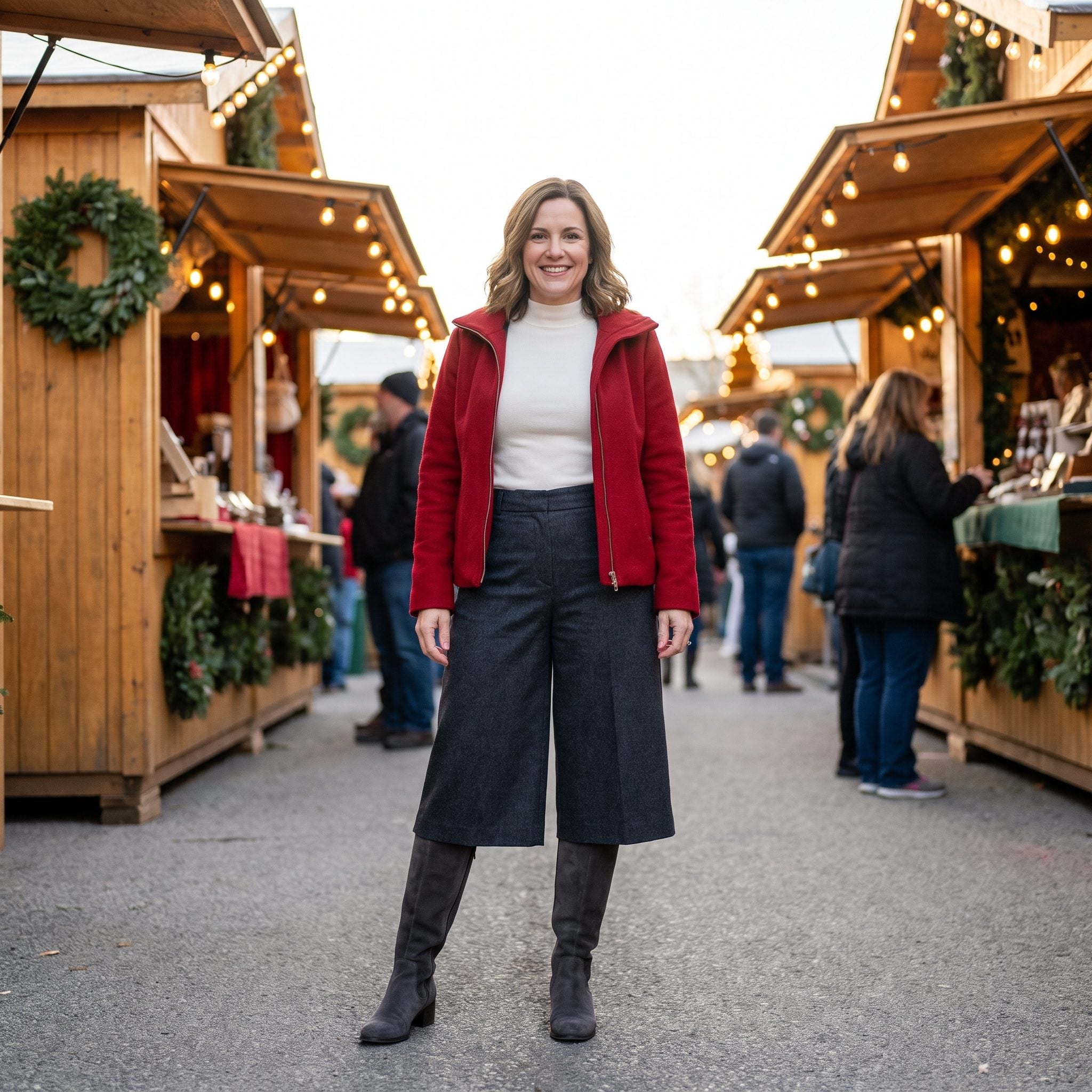
Culottes create a distinctive cropped, wide-legged silhouette. The red wool blouson answers with a compact upper shape, its gathered hem sitting near the waist rather than covering the trousers’ volume.
Charcoal wool provides a quiet counterpoint to the red jacket, while knee-high boots meet the culotte hems to create a continuous dark section below. The combination has a sporty, slightly unexpected quality that makes it especially appealing for less formal Christmas outings.
16. Chocolate Wool and Antique-Gold Jacquard Agree on the Waist
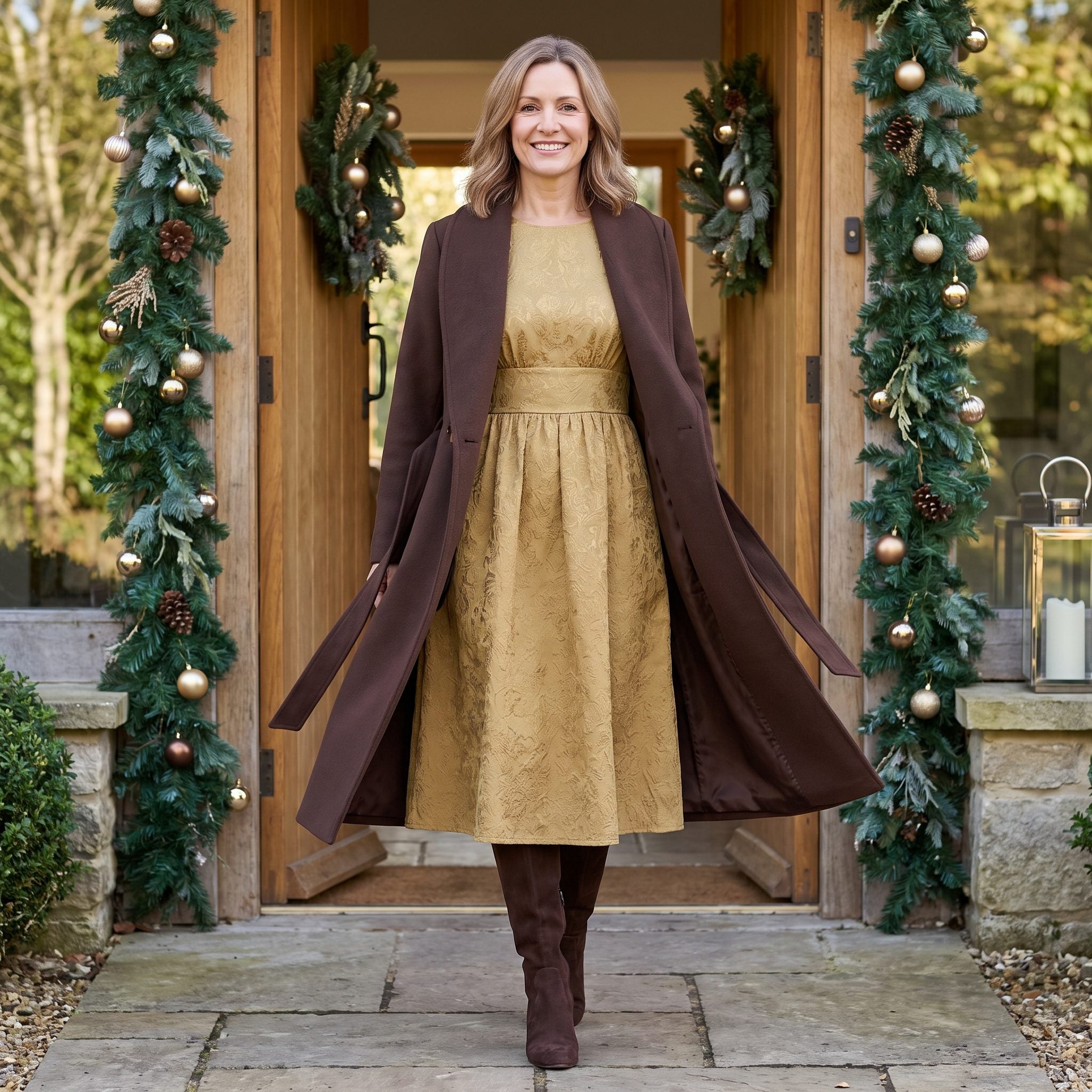
Chocolate brown and antique gold make an exceptionally rich winter pairing. The jacquard dress supplies intricate pattern and a defined waist, while the wool wrap coat repeats that waist emphasis through its tie belt.
Worn loosely, the coat reveals the patterned skirt through its overlapping front panels. The deep brown gives the metallic gold a softer setting than black would, and the shared waist placement helps the two garments read as one considered outfit.
15. Navy Leather Gives a Silver Sequin Skirt a Sleek Counterpoint
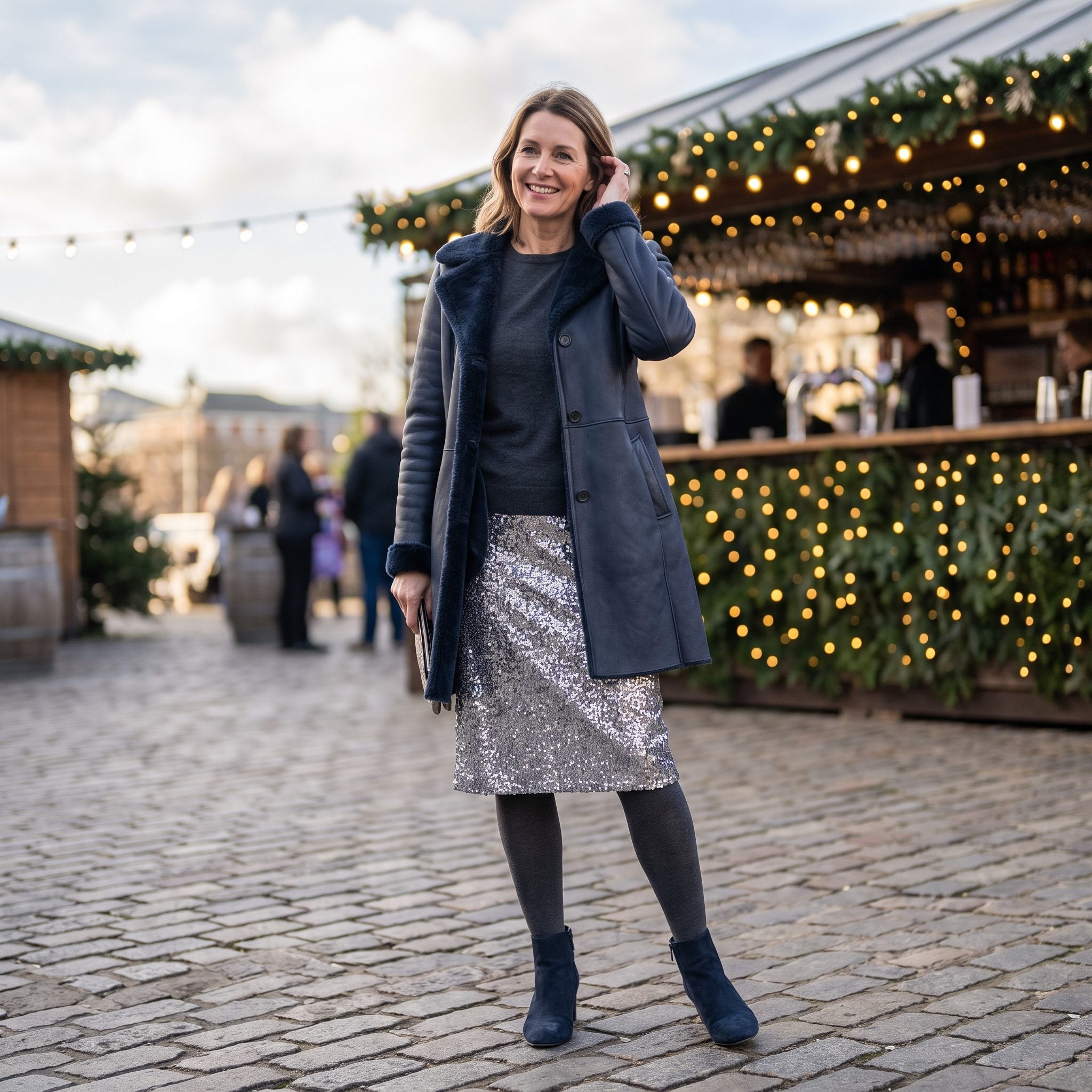
The silver sequin skirt brings enough sparkle to dominate a room. A smooth navy leather coat introduces a contrasting surface without adding another conspicuous pattern.
Partially fastened, the coat allows a band of silver to appear below the hem. The dark leather gives the sequins a crisp frame, while the overall silhouette remains streamlined. The interesting contrast isn’t simply dark against light; it’s smooth, substantial leather against hundreds of small reflective surfaces.
14. Midnight-Blue Velvet Brings Opera-House Drama to Silver Satin
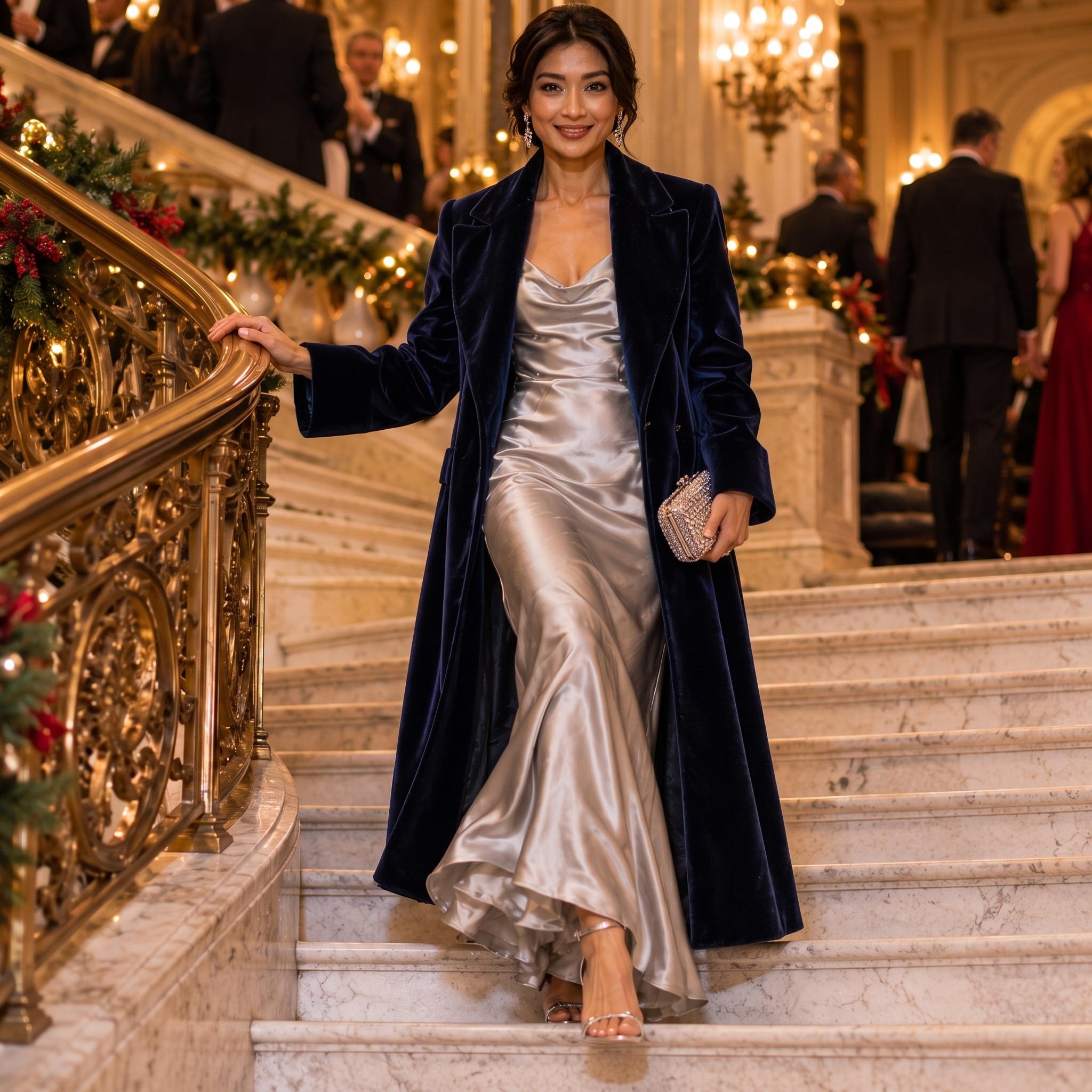
A full-length midnight-blue velvet coat belongs to the grander end of evening dressing. Its substantial fabric, elongated silhouette, and tailored lapels create a dramatic dark frame around a fluid silver satin gown.
The gown reflects the warm light of the staircase, while the velvet absorbs much of it, making the contrast between the two materials unusually pronounced. The coat’s open front preserves the silver dress’s movement, and the long length gives the entire combination the formality of an opera-house occasion. Neither garment is merely an accessory to the other.
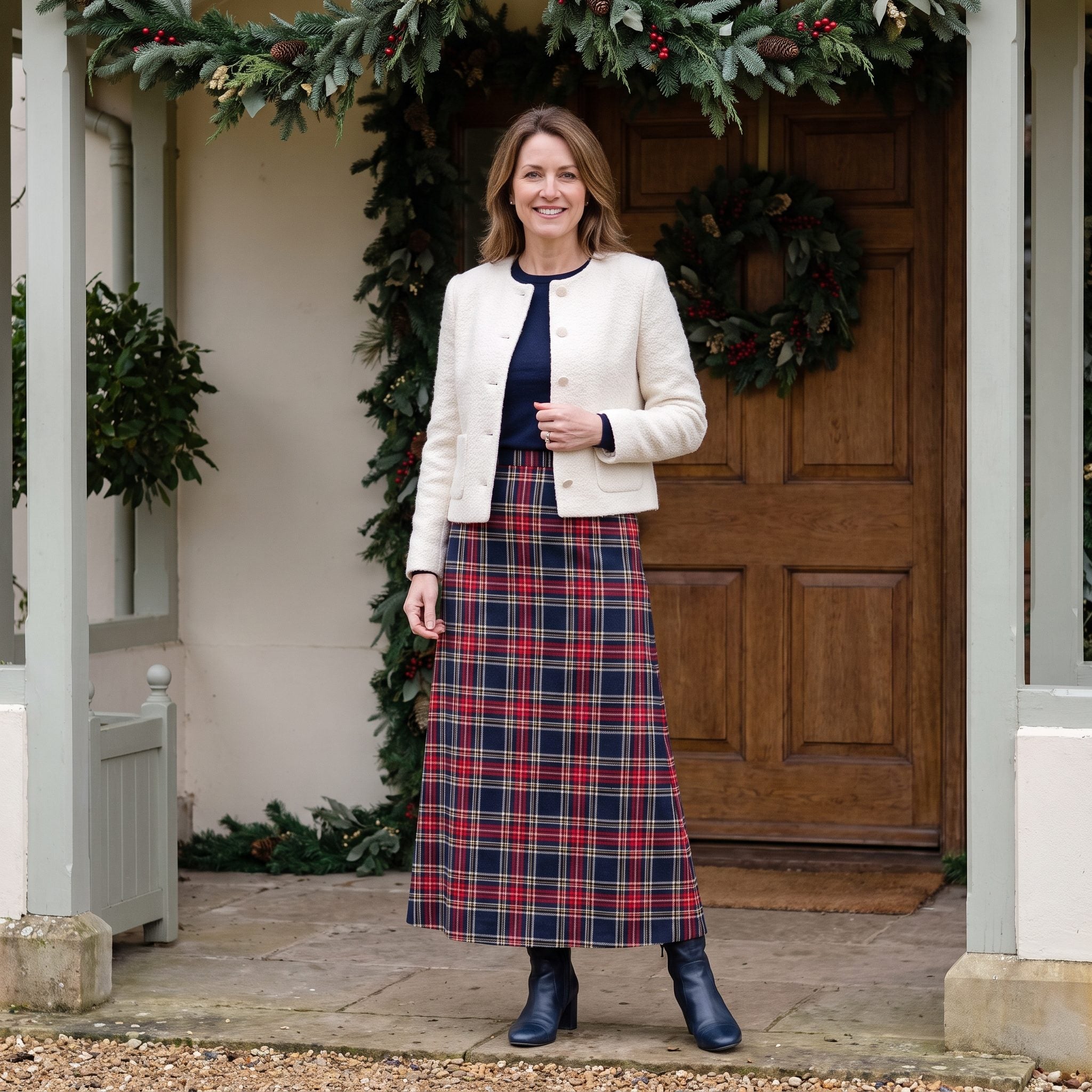
13. Cream Bouclé Gives a Tartan Maxi Skirt a Softer Upper Half
❤️ Would you like to save this?
The tartan maxi skirt supplies broad areas of red and navy pattern. Above it, a waist-length cream bouclé jacket introduces a completely different texture without another competing print.
The jacket stops where the skirt begins, allowing the tartan to remain visible across its full length. The nubby cream weave softens the arrangement, while the skirt provides all the graphic structure. It’s a traditional holiday palette handled with considerably more restraint than a matching plaid jacket would allow.
12. A Short Charcoal Jacket Respects the Dropped Waist
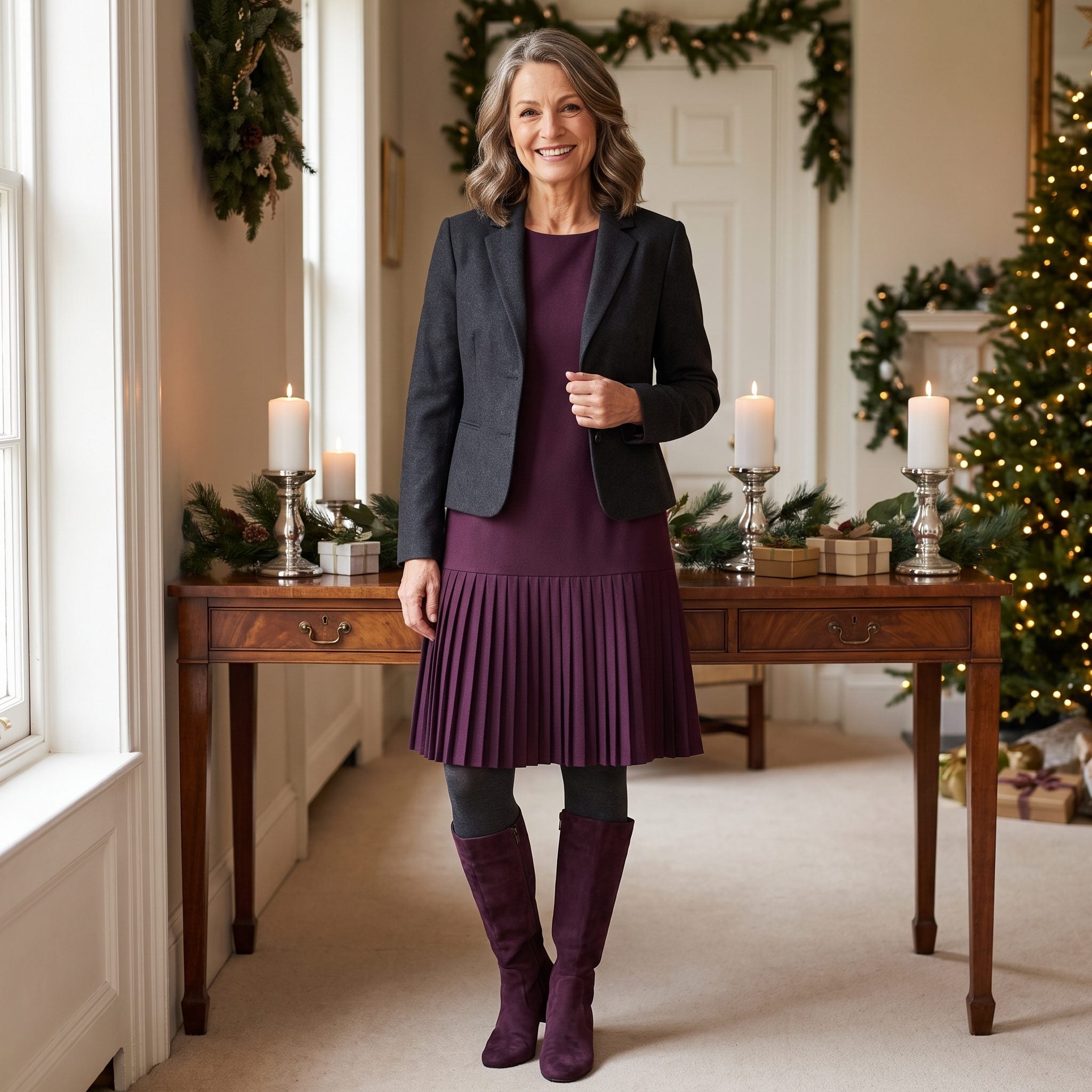
The defining feature of the plum dress is its lowered waist seam and the pleated fabric beneath it. Cover that transition with a long jacket and much of the dress’s character disappears.
This short charcoal jacket ends above the seam, leaving the unusual proportion intact. The charcoal wool provides structure at the shoulders, while the plum fabric remains the dominant color. The contrast is quiet but sophisticated, particularly where the tailored jacket meets the softer pleats.
11. The Insulated Taupe Trench That Makes Ivory Trousers Work in Winter
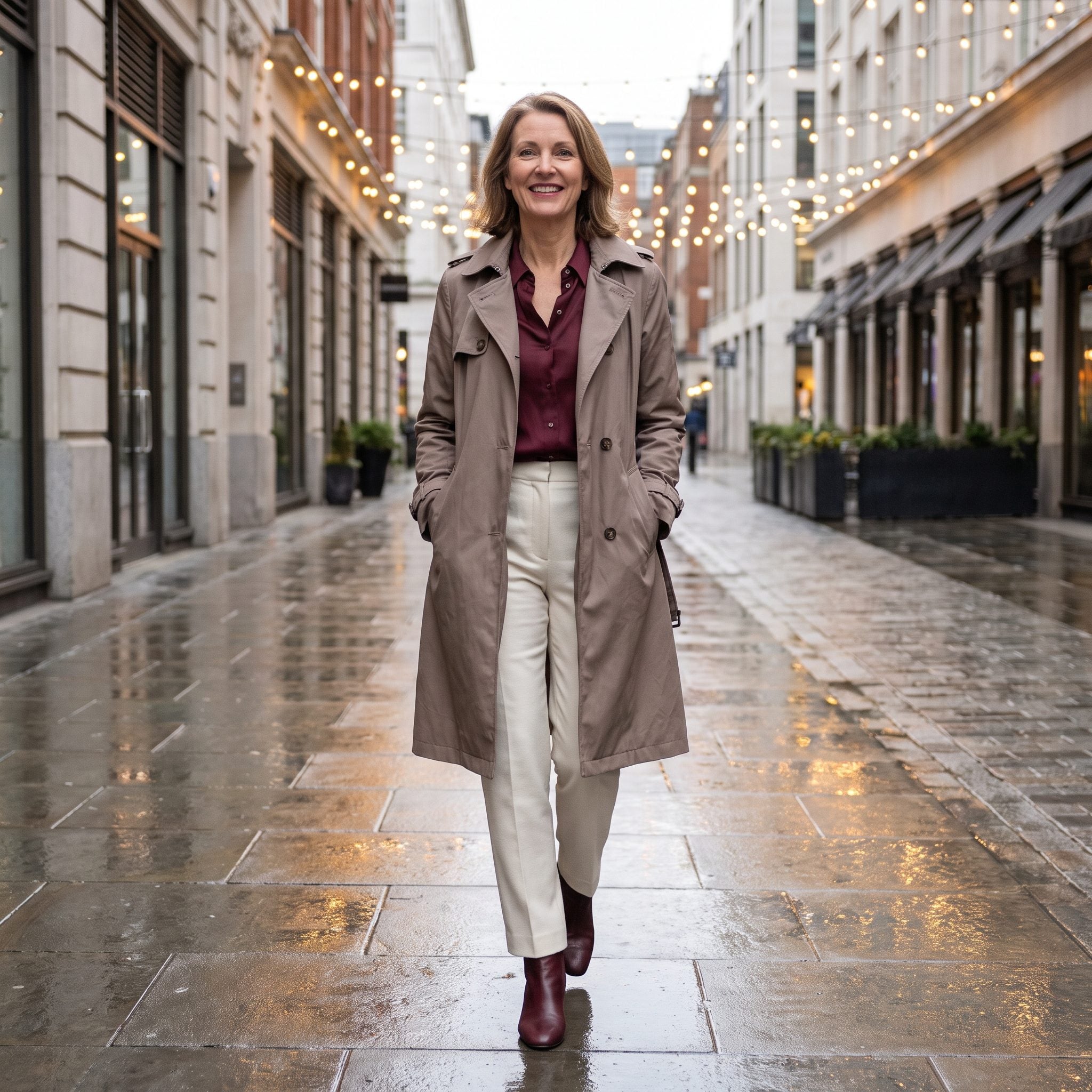
A trench coat has a naturally crisp silhouette, but traditional lightweight versions aren’t necessarily suitable for December weather. This insulated taupe version retains the familiar belted shape while providing a warmer outer layer.
The palette is especially appealing: two soft neutrals, taupe and ivory, with a burgundy shirt adding depth. The insulated trench creates a tailored frame around the ivory trousers, and the belt adds definition without concealing the lighter fabric beneath.
10. Smooth Black Cashmere Protects the Shine of Rose-Gold Sequins
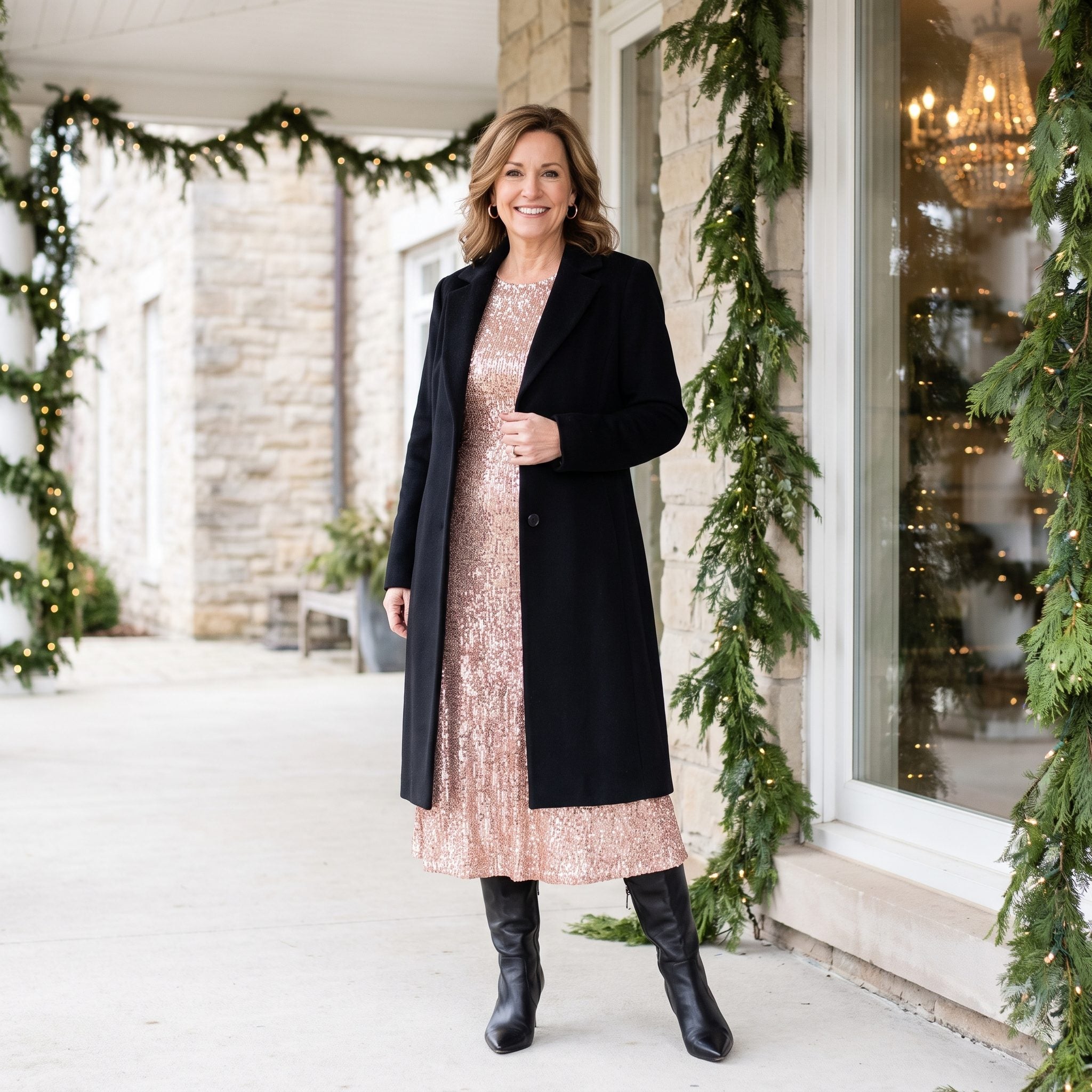
Sequined fabric can catch on exposed fastenings, rough linings, and decorative hardware. This black cashmere coat takes a more discreet approach, using smooth lining, concealed buttons, and simple cuffs over the rose-gold sequin dress.
Black cashmere absorbs much of the surrounding light, making the rose-gold embellishment appear even more luminous by contrast. The coat doesn’t compete for attention, but its restrained construction is an important part of why the combination looks so polished.
9. Forest Green Frames an Ivory Portrait Collar
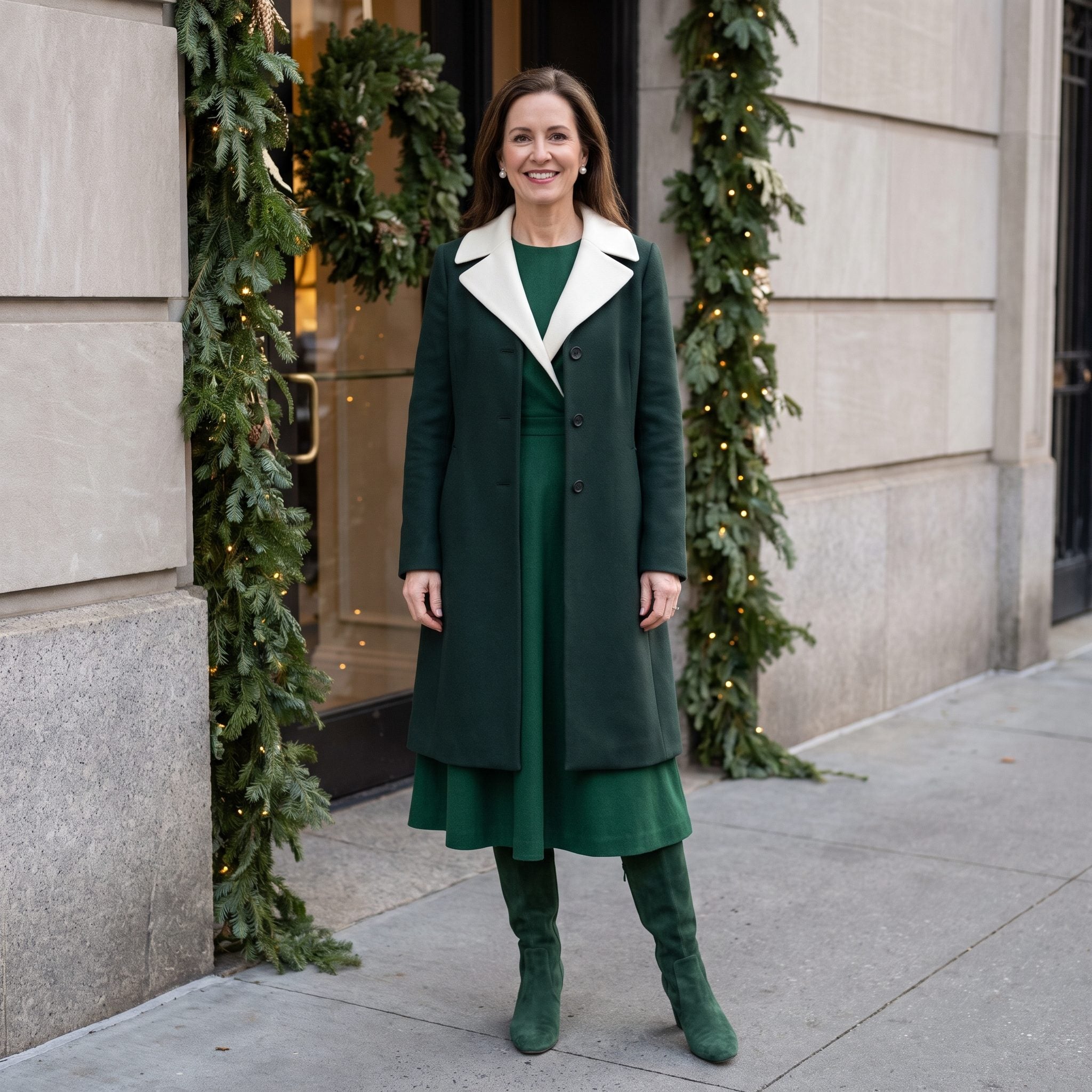
The ivory portrait collar is the unmistakable centerpiece of this outfit. Its broad, elegant shape extends across the shoulders, creating a bright contrast against the dark green dress.
A low-neck, collarless green coat leaves the portrait collar visible instead of covering it. The ivory collar becomes a striking frame around the face, while the closely related green tones keep the rest of the outfit cohesive.
8. An Emerald Hourglass Coat Gives Black Velvet a Defined Waist
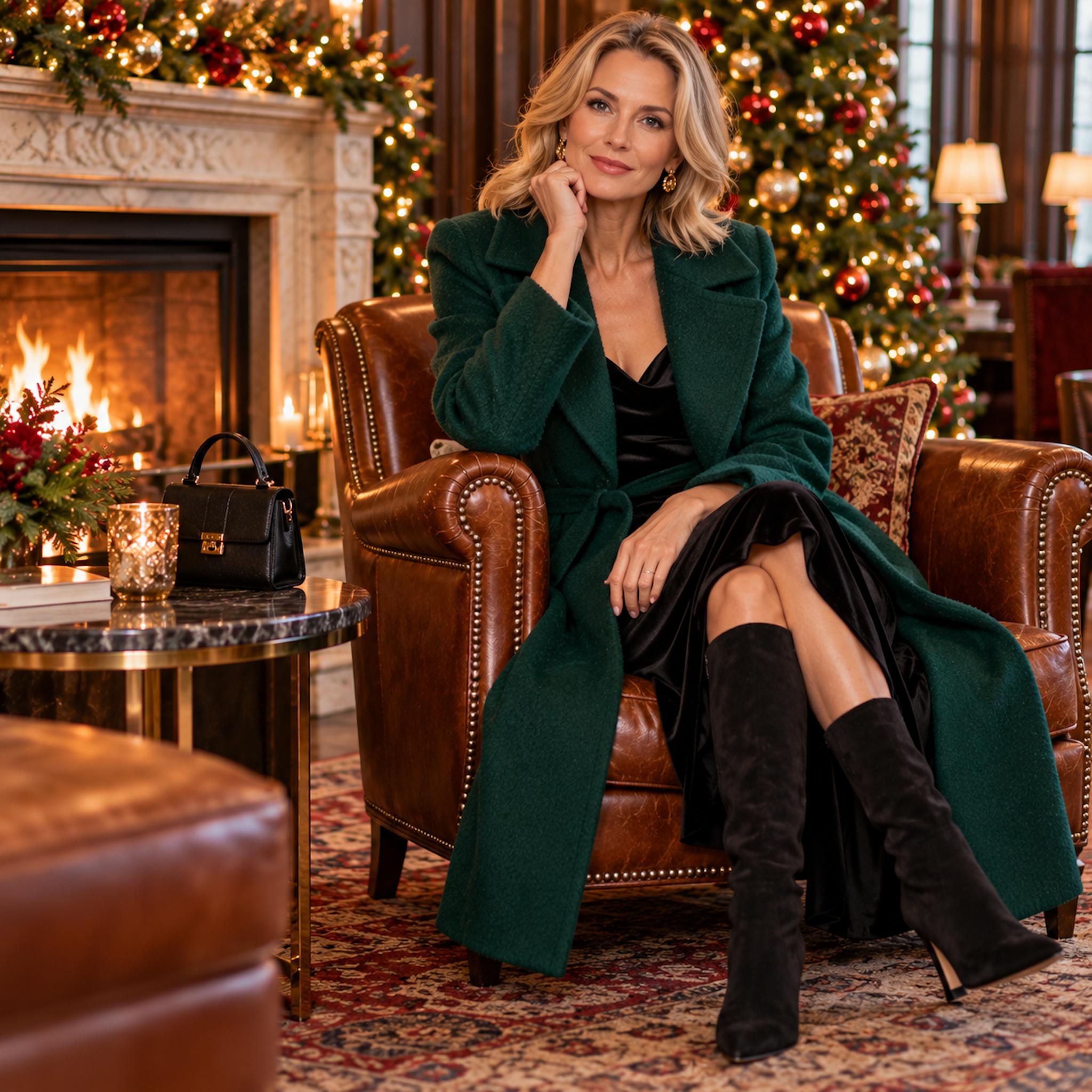
The emerald wool coat brings a strong tailored waist to a simple black velvet dress. Its broad lapels, matching belt, and substantial fabric create a beautifully defined outer silhouette, while the velvet beneath adds a quieter, softer texture.
Seated in a leather armchair, the woman reveals how the coat behaves beyond a standing fashion pose. The green wool falls naturally around the chair, the black dress remains visible, and tall suede boots continue the dark line below. Against the warm leather and Christmas decorations, the emerald becomes the room’s most commanding color.
7. Ink-Blue Wool Gives a Champagne Tunic a Long, Clean Frame
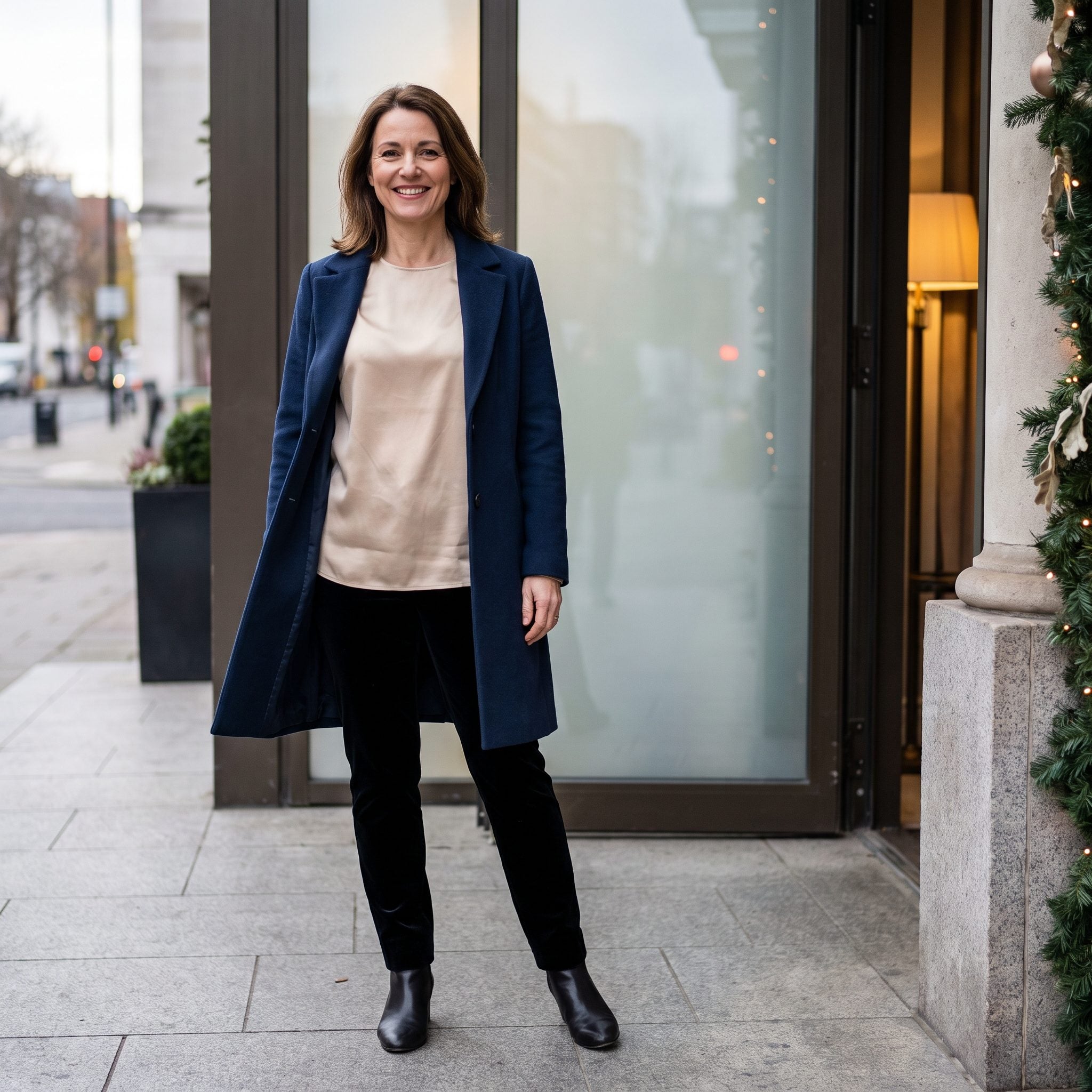
The champagne silk tunic introduces a distinct mid-thigh hem above narrow black velvet trousers. The ink-blue wool coat extends beyond the tunic, framing both layers within one longer silhouette.
Deep blue provides a softer color contrast than black while remaining suitably formal for evening. The champagne tunic catches the light through the open front, and the velvet trousers give the lower half a sleek finish.
6. Blush Wool Makes Burgundy Lace Look Even Richer
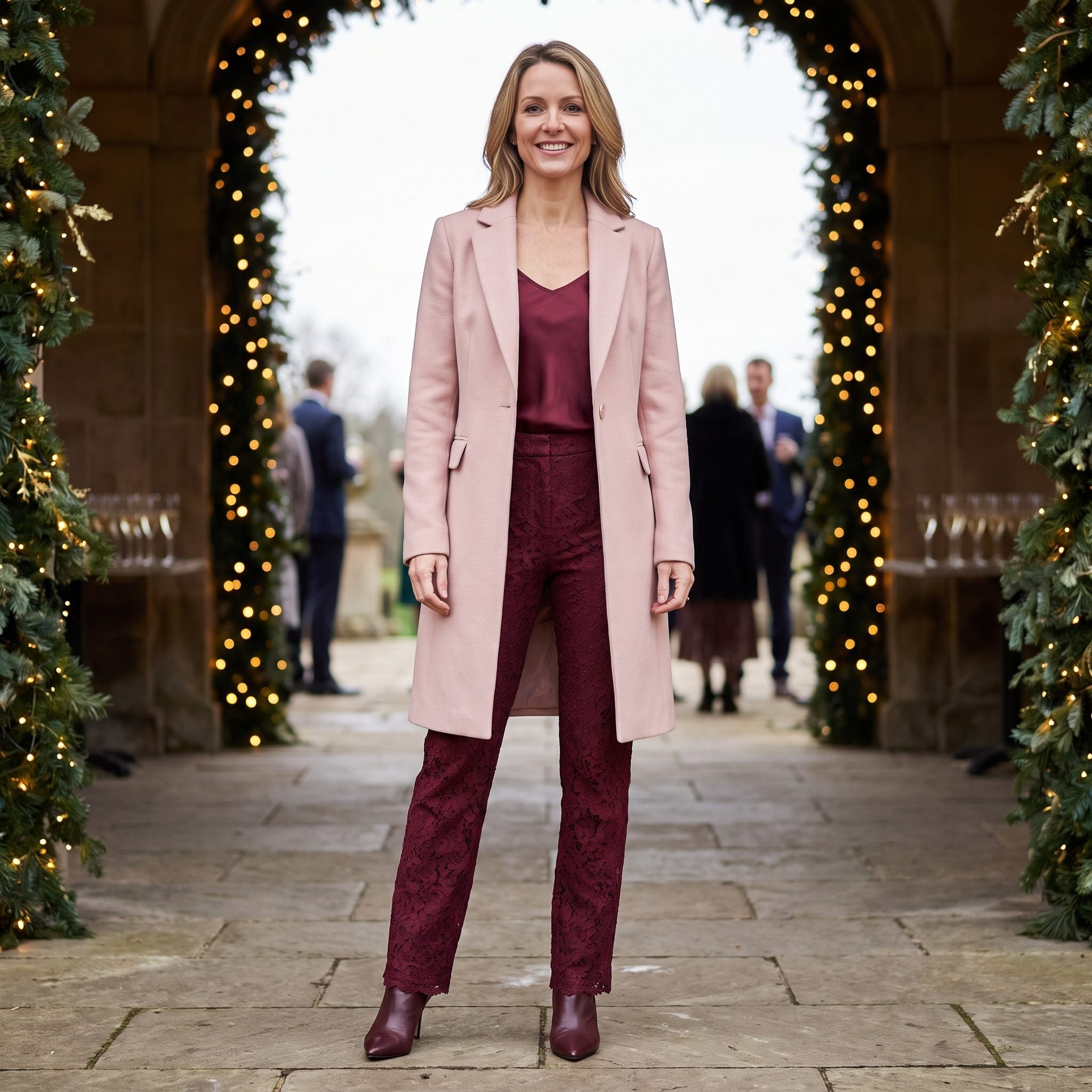
Burgundy lace has a delicate pattern and a remarkably rich color. A blush wool coat introduces a softer, paler variation of the same warm color family, allowing the lace to remain the more intricate surface.
The narrow lapels create an open channel through which the lace trousers and matching camisole remain visible. Burgundy ankle boots reinforce the darker shade below, giving the blush coat a beautifully coordinated foundation.
5. A Silver-Blue Puffer Finds Unexpected Company in Evening Satin
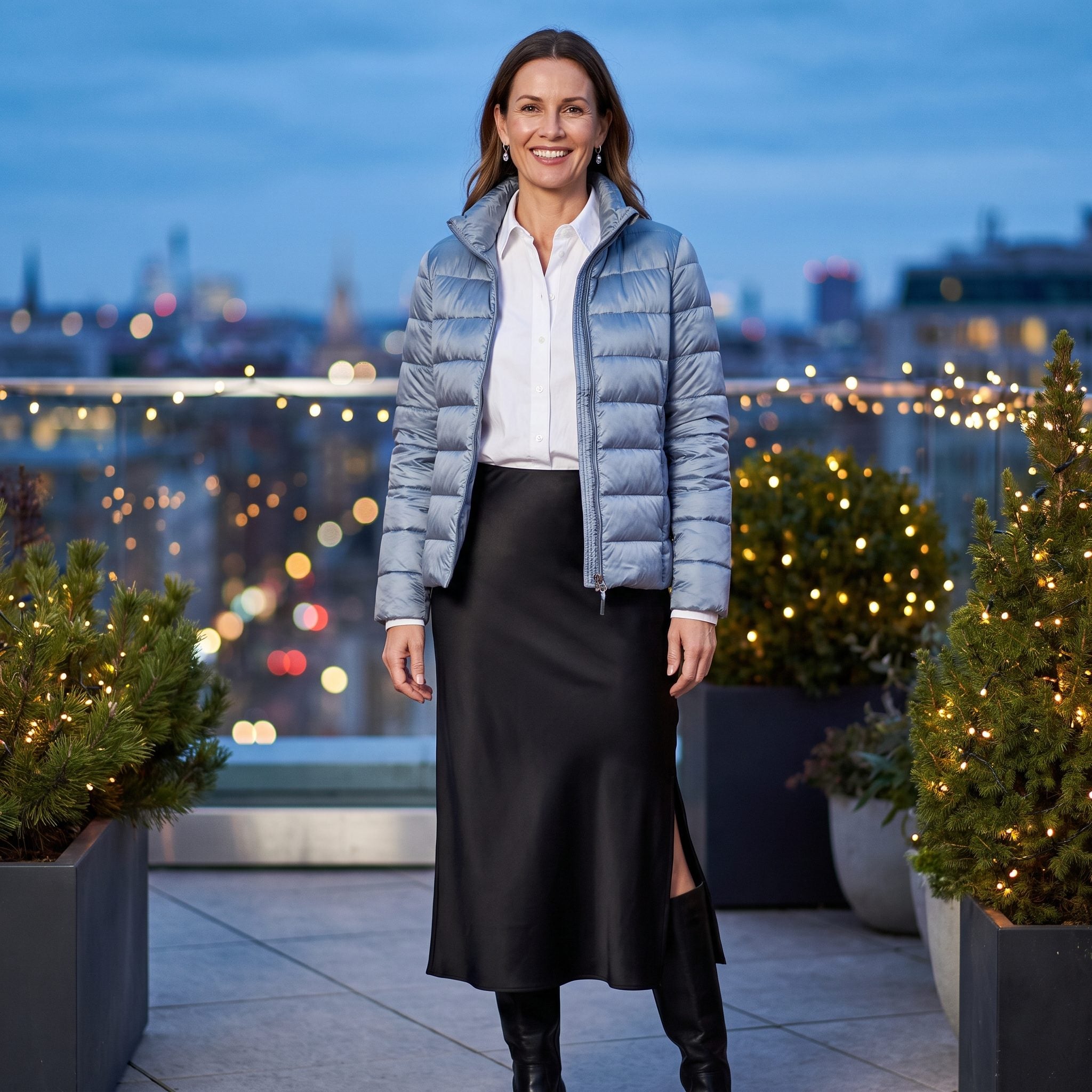
A technical puffer and a black satin evening skirt aren’t obvious companions. That’s precisely what makes this combination interesting. The silver-blue jacket brings a practical, quilted surface to an outfit otherwise built around a crisp white shirt and flowing satin.
Vertical quilting gives the puffer a distinct texture, while its hip-length cut leaves the black satin skirt visible below. Black knee boots anchor the look. The contrast between outdoor practicality and evening polish feels contemporary rather than contradictory.
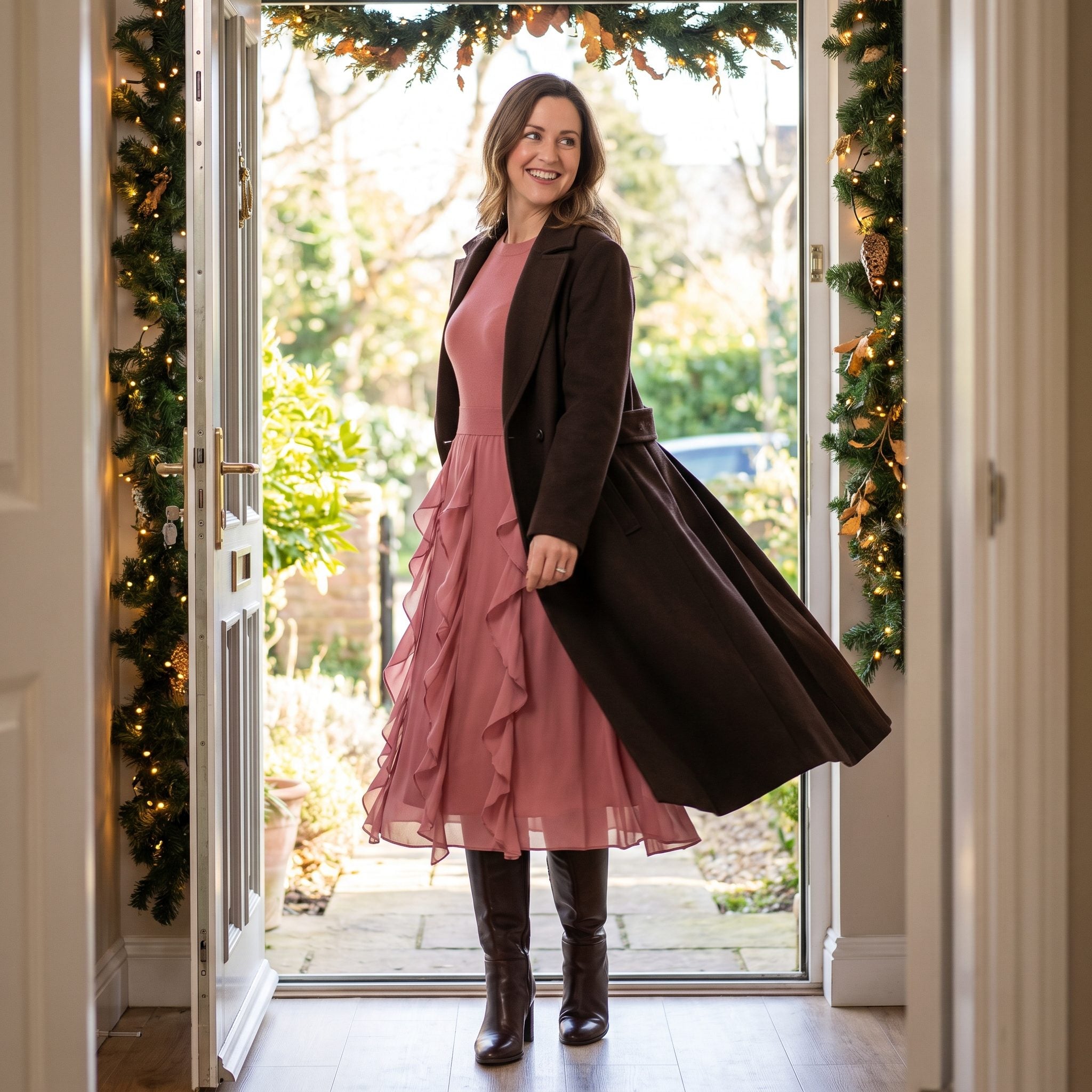
4. Espresso Wool Lets Rose-Pink Ruffles Do Their Work
❤️ Would you like to save this?
Rose-pink ruffles create a soft cascade beneath the structured espresso coat. A back box pleat and gently flared lower panels give the wool coat enough movement to accommodate the ruffled midi dress.
The color pairing is particularly appealing. Espresso brown gives pink a warm, substantial counterpoint without the sharper contrast of black. Matching brown boots repeat the outerwear color below, leaving the rose-pink fabric as the bright center of the outfit.
3. The Silver Statement Coat That Makes Black Velvet Look Understated
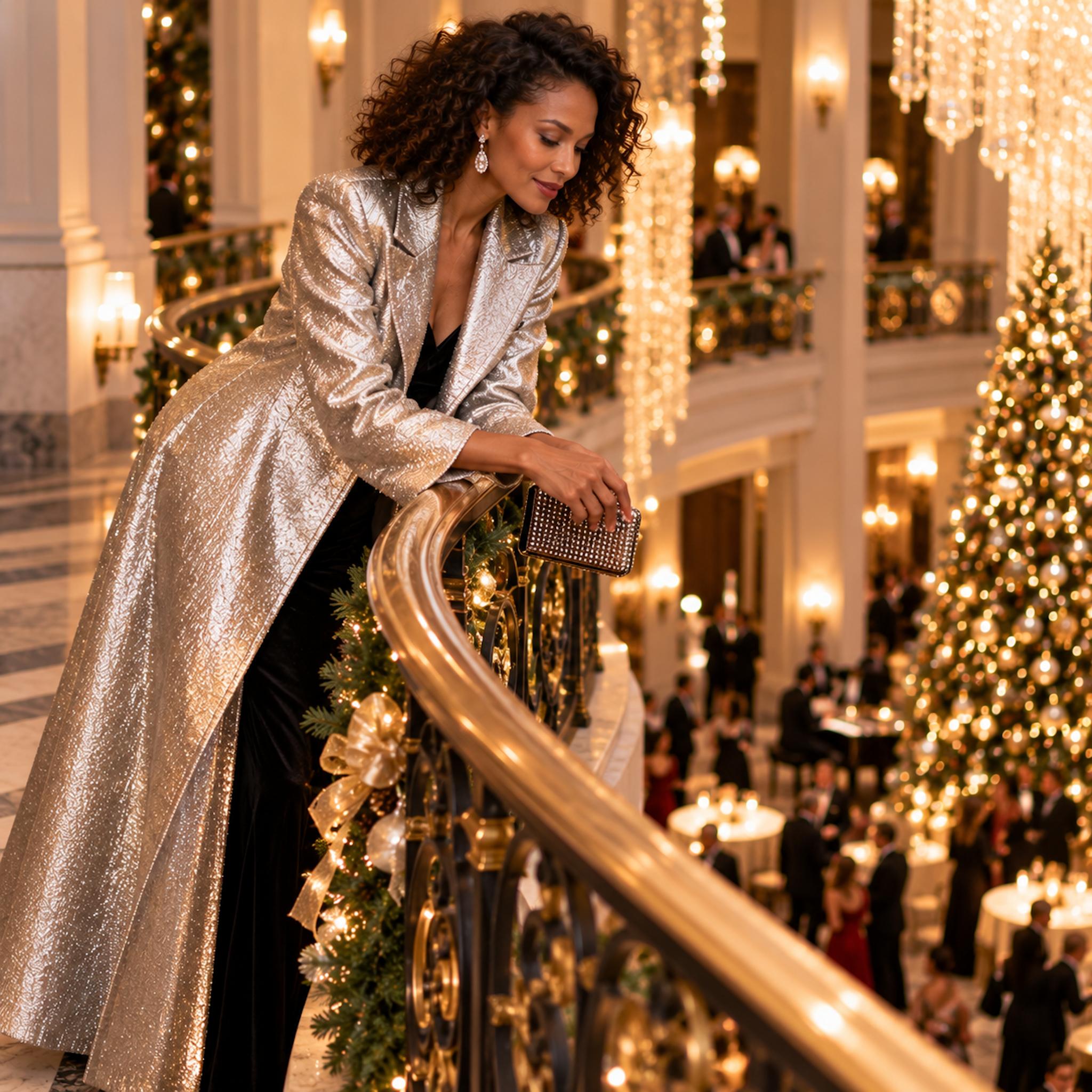
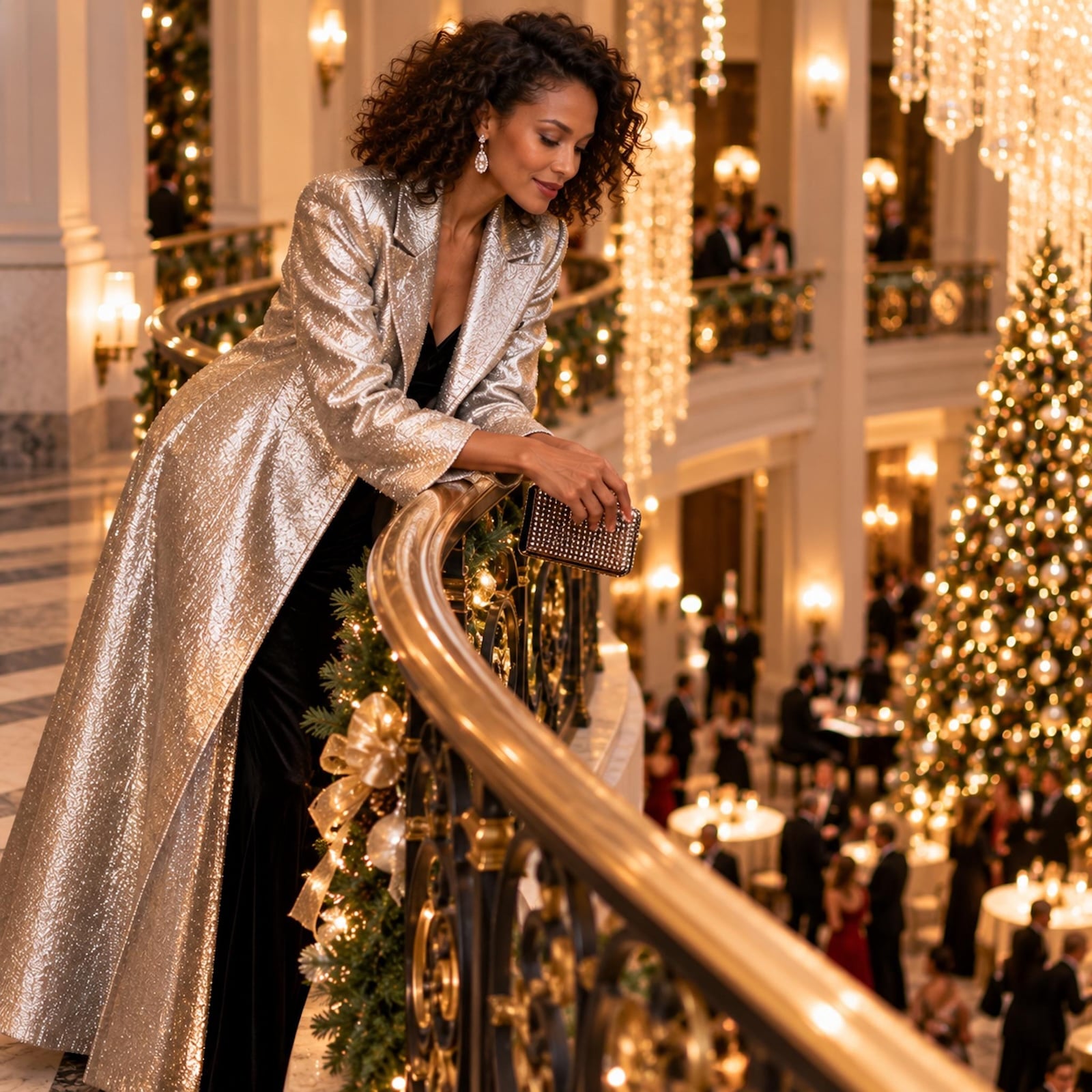
Here the coat is unquestionably the star. Its shimmering silver surface catches the warm light of the grand interior, while the black velvet outfit beneath provides a dark, almost architectural foundation. Sharp lapels and structured shoulders give the metallic fabric the discipline of traditional tailoring.
The woman leans over an ornate balustrade, looking toward the gathering below. That unusual angle allows the silver coat to fall in long, reflective folds, with black velvet visible through the open front. Rather than using outerwear to quiet a festive outfit, this combination places the shine on the outside and lets everything beneath support it.
2. Forest-Green Wool Gives an Ivory Cable-Knit Set Room to Breathe
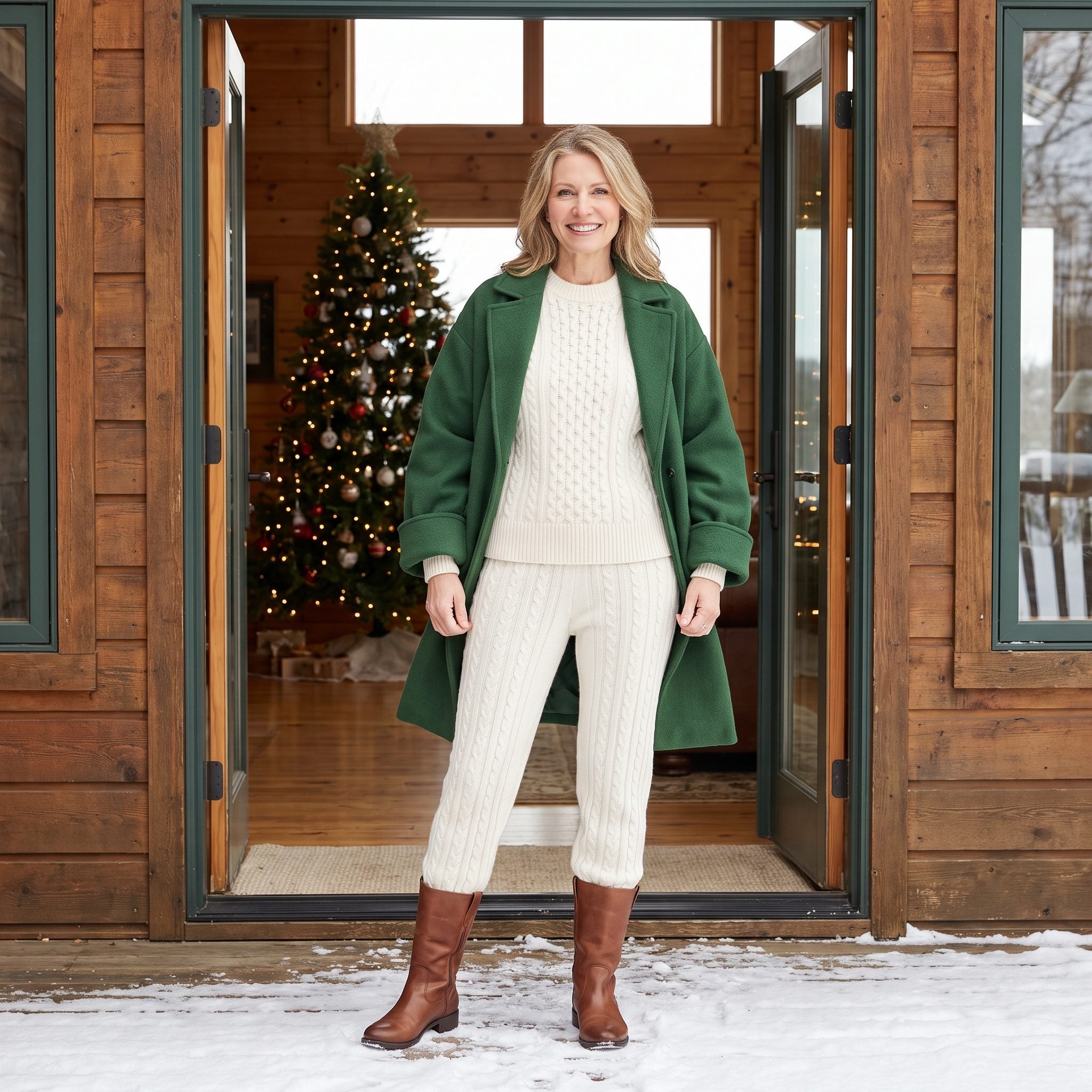
Chunky cable knit needs more space than a fine-gauge sweater. The generous sleeves and relaxed cut of this forest-green wool coat accommodate the ivory sweater without pressing its raised texture flat.
The matching knit trousers create a continuous pale foundation beneath the dark green outer layer. Cream and forest green offer a familiar Christmas palette, but the emphasis on texture and relaxed tailoring makes the outfit feel contemporary rather than themed.
1. Black Shearling and Gold Lamé Make a Dramatic Final Pairing
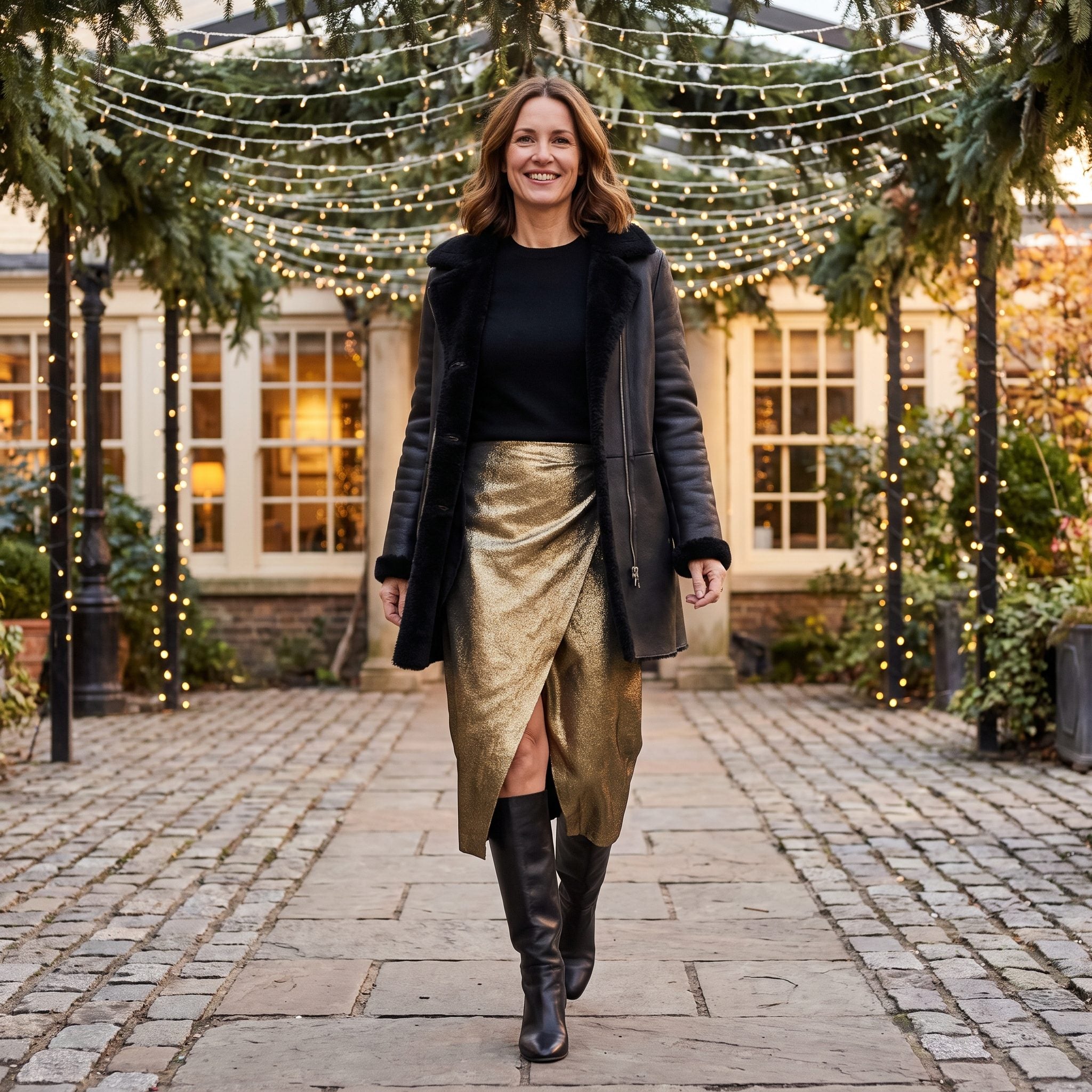
Gold lamé has an almost liquid quality, particularly when cut into a wrap skirt with a diagonal opening. Above it, a short black shearling coat provides the opposite texture: plush, matte, and substantial.
The coat ends above the skirt’s most distinctive diagonal detail, keeping that construction visible. Partially fastened, it frames the gold wrap skirt without covering its movement. The pairing brings together two fabrics that couldn’t be more different, yet the short outer silhouette and dark upper half give the metallic skirt exactly the presence it deserves.