❤️ Would you like to save this?
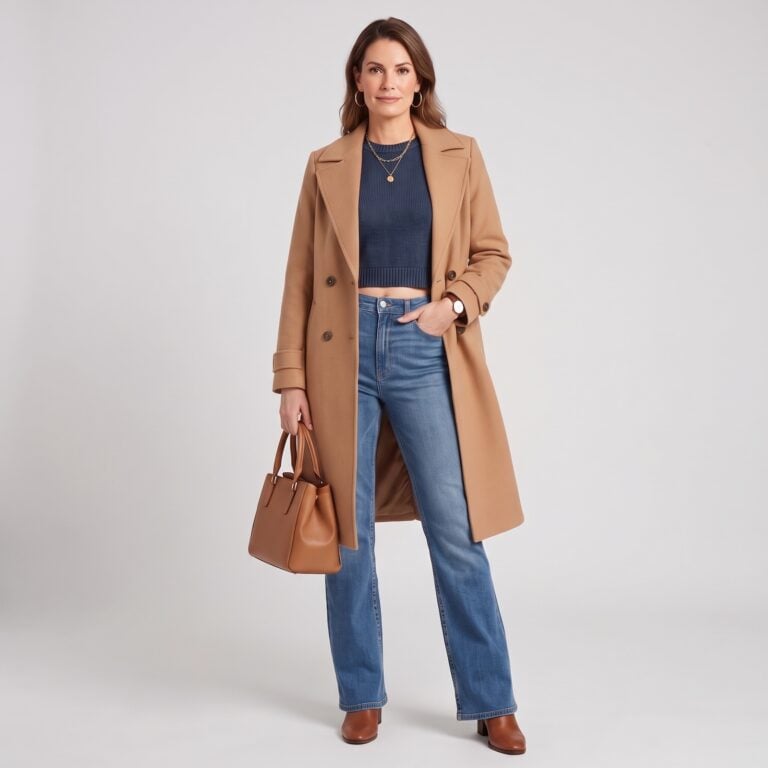
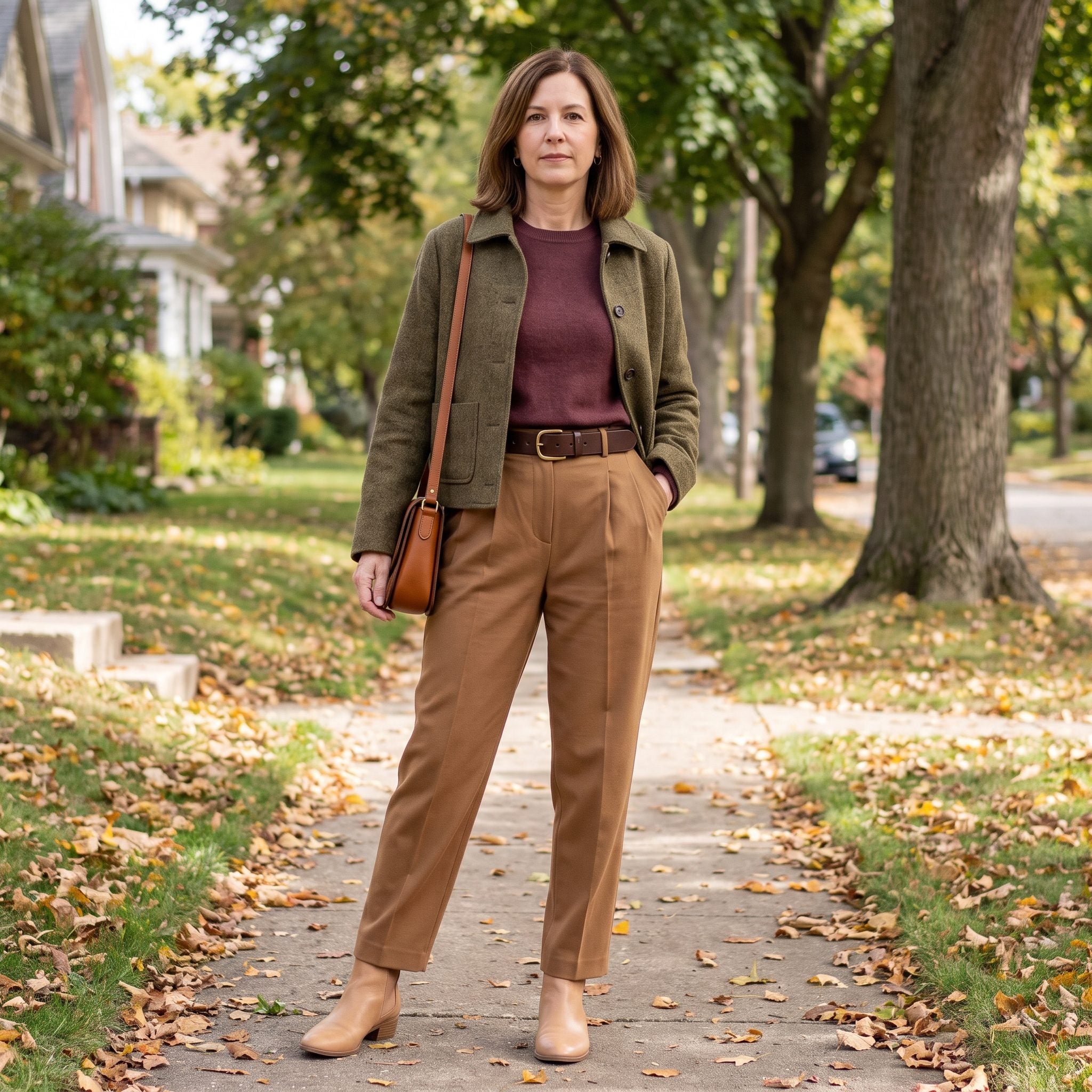
A short waist is not a flaw to disguise. It is a proportion to understand. The trouble begins when clothes pile their strongest horizontal lines into the few inches between ribs and hips: a cropped jacket ends where a waistband begins, a thick belt arrives immediately below it, and a bulky sweater hem joins the traffic. Nothing is technically wrong with any individual piece. Together, they can make the torso look compressed and the outfit feel strangely crowded.
The more interesting response is not a list of things she is forbidden to wear. It is learning where a garment begins, where it stops, and which line the eye notices first. A jacket can finish several inches lower. A neckline can open the upper torso. Trousers can continue into shoes instead of ending in a hard color change. A belt can nearly disappear into a skirt. Long lapels, button plackets, side slits, bias-cut fabric, tonal color, and even the humble scarf can redirect the architecture of an outfit without pretending the body underneath needs correcting.
These 29 AI before-and-after fall looks explore that proportional sleight of hand on the same 47-year-old short-waisted model. Some use one-piece simplicity; others rely on tailoring, denim, skirts, outerwear, or unapologetic color. The lesson is not “dress taller.” It is more useful than that: decide which lines deserve attention, move the ones that do not, and give the clothes enough room to make the proportions look deliberate.
FYI, thanks to AI imagery software, we’re able to create very specific fashion and hairstyle examples to illustrate the points being made. In some cases, imagery is exaggerated to hammer home the point. Also, assume links that take you off the site are affiliate links such as links to Amazon. this means we may earn a commission if you buy something.
29. Forest-Green Seaming Shows What Happens When the Waist Stops Being the Main Event
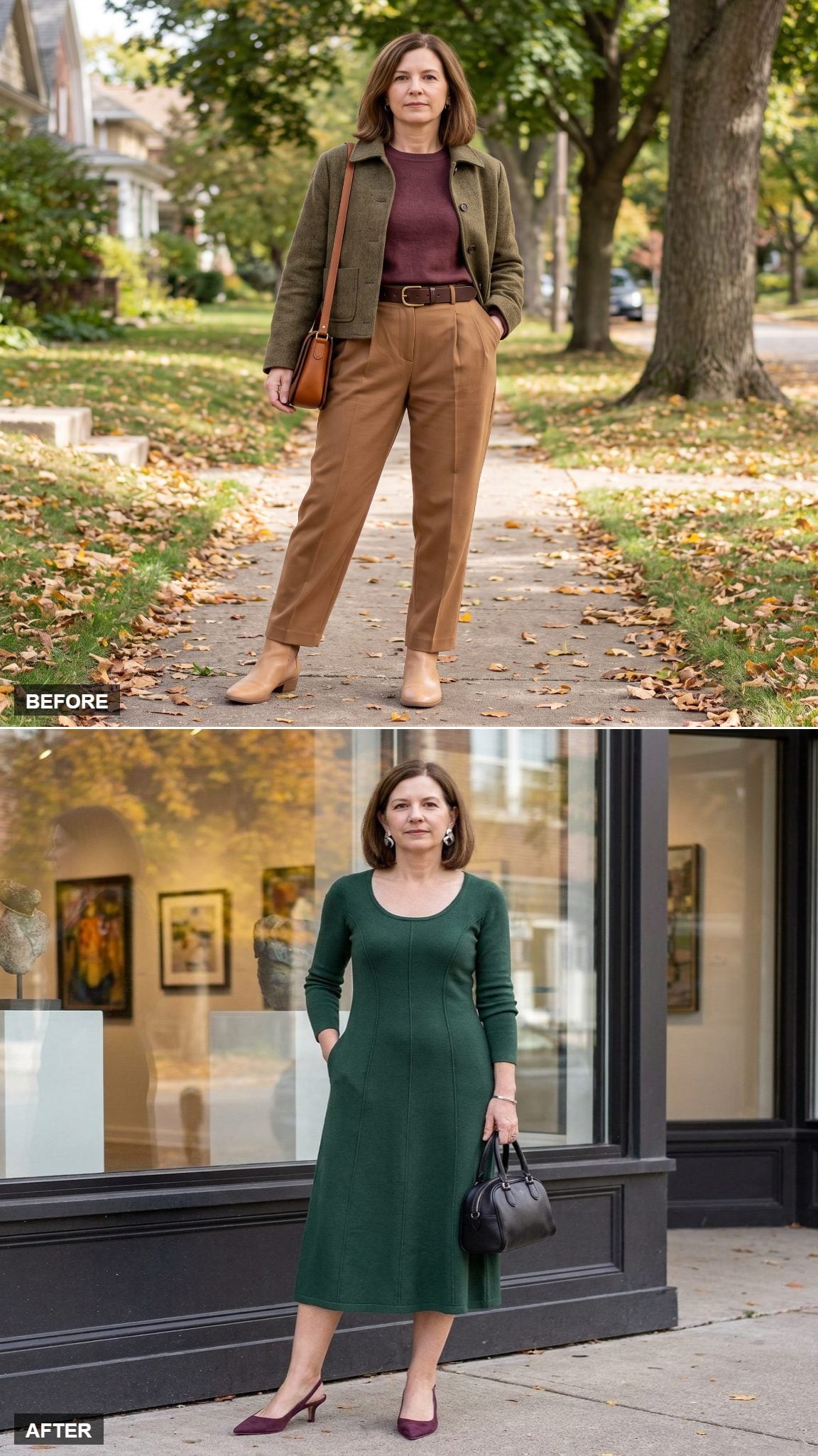
One garment, no traffic jam at the middle. The forest-green knit dress replaces the before look’s stacked tee hem, waistband, belt, and jacket edge with one continuous shape. Princess seams give the fabric structure from shoulder to skirt, while the elongated scoop neckline opens the upper body without requiring another layer.
The softly flared midi hem keeps the silhouette from becoming severe. Plum slingback kitten heels give the green a sophisticated color counterpoint, and the compact black bowling bag stays clear of the waist altogether.
28. A Burgundy Leather Jacket Moves the Most Important Hem Several Inches Lower
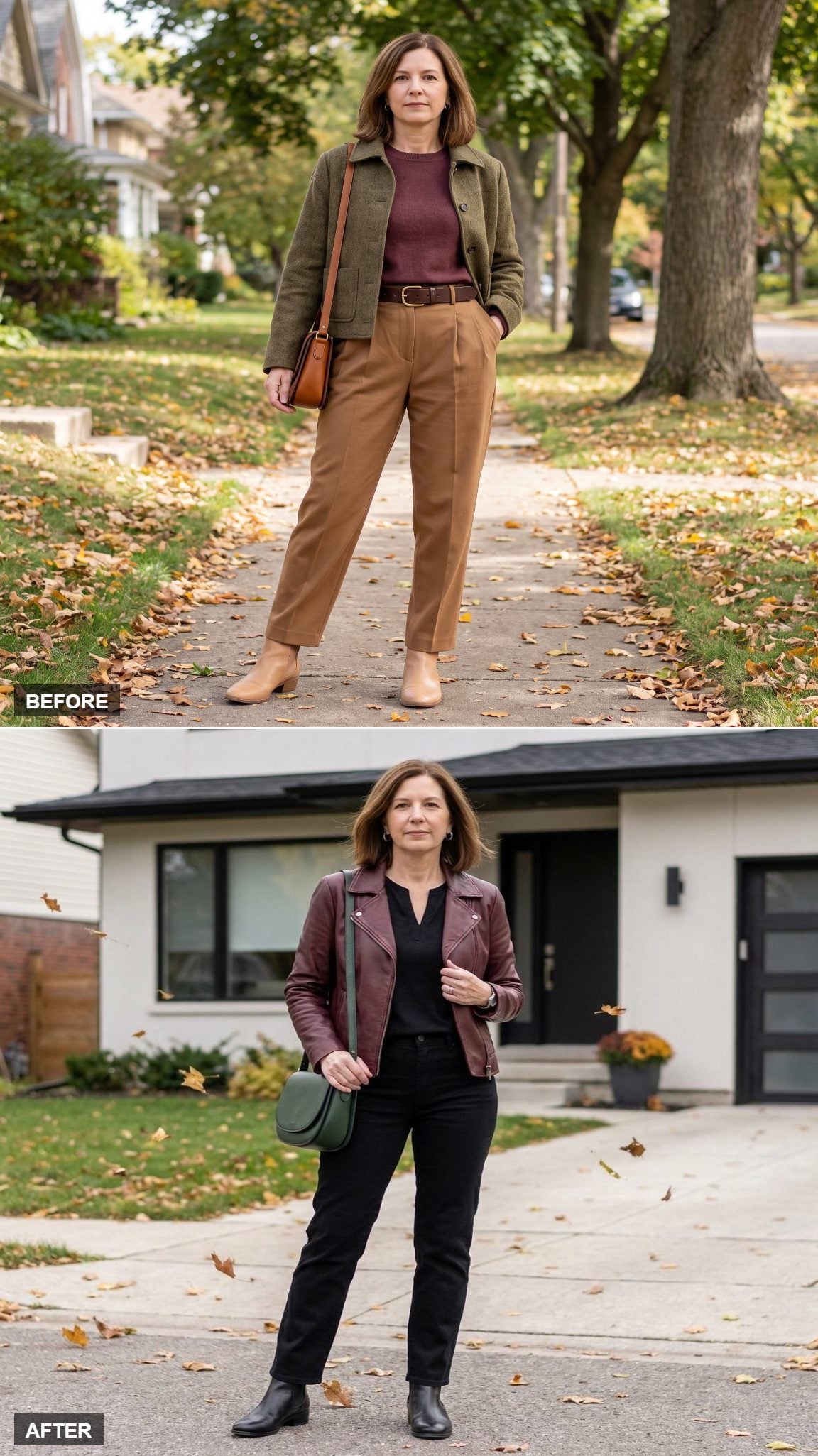
Jacket length is doing the interesting work here. The burgundy leather jacket continues beyond the natural waist and finishes around the hip, moving its strongest horizontal edge away from the most compact part of the torso.
Underneath, a black split-neck jersey and straight black jeans form a dark, uncomplicated base. Chelsea boots continue that color to the ground. A forest-green saddle bag stays on the shoulder rather than cutting diagonally across the middle. The whole outfit looks current because the proportion trick is almost invisible.
27. Aubergine Tailoring Turns Three Pieces Into One Long Color Story
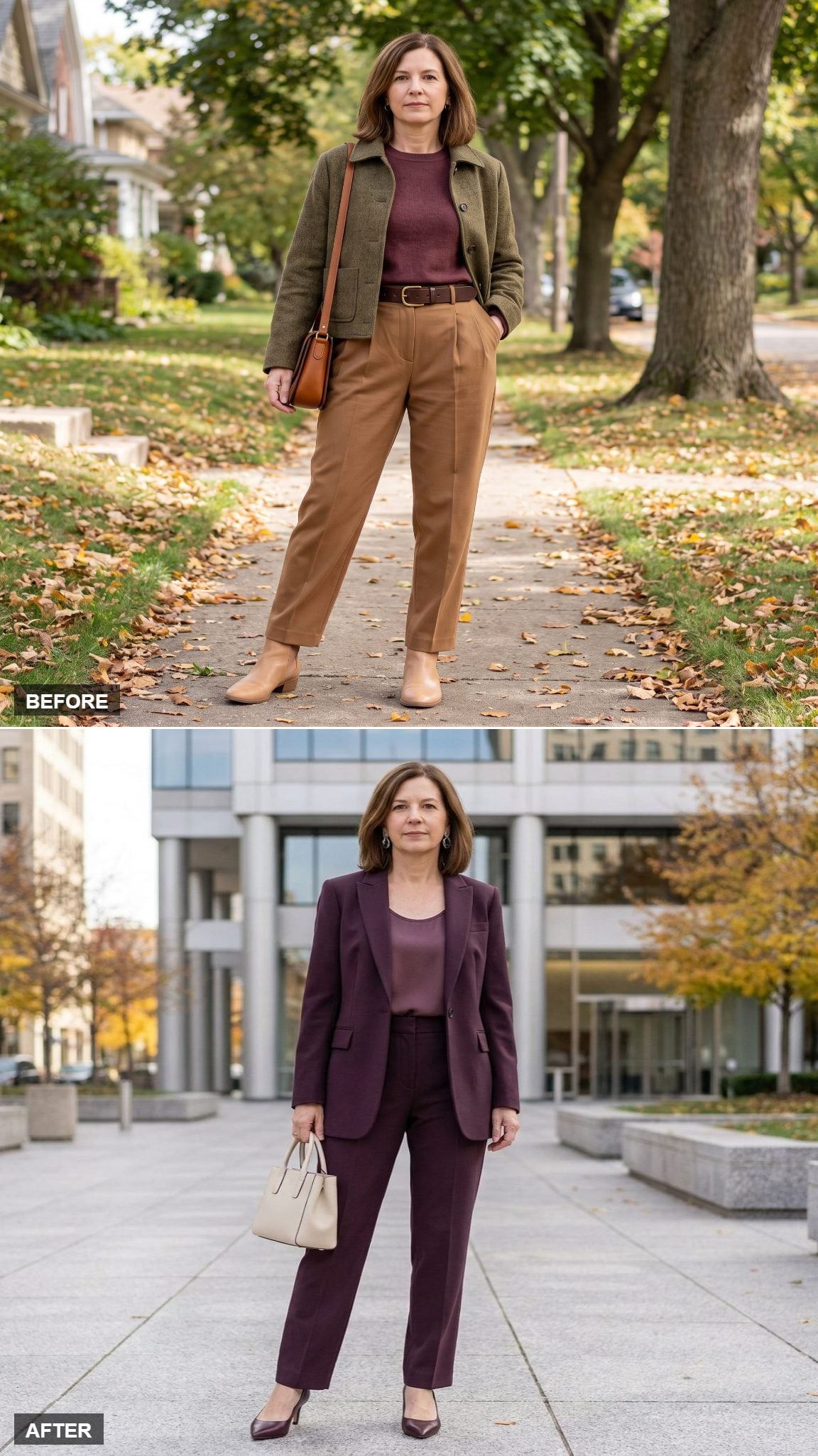
A single-breasted aubergine blazer stays open over a muted-plum silk shell and matching full-length trousers. The effect comes from color continuity and the long lapel edges rather than from hiding the waist itself.
Dark-plum pointed pumps carry that saturation below the trouser hem. A structured cream mini tote and architectural silver earrings supply contrast away from the center of the body. Tailoring this monochromatic could have felt severe; the plum variations keep it rich instead.
26. A Long Silk Scarf Draws the Line Where a Belt Would Have Put a Stop Sign
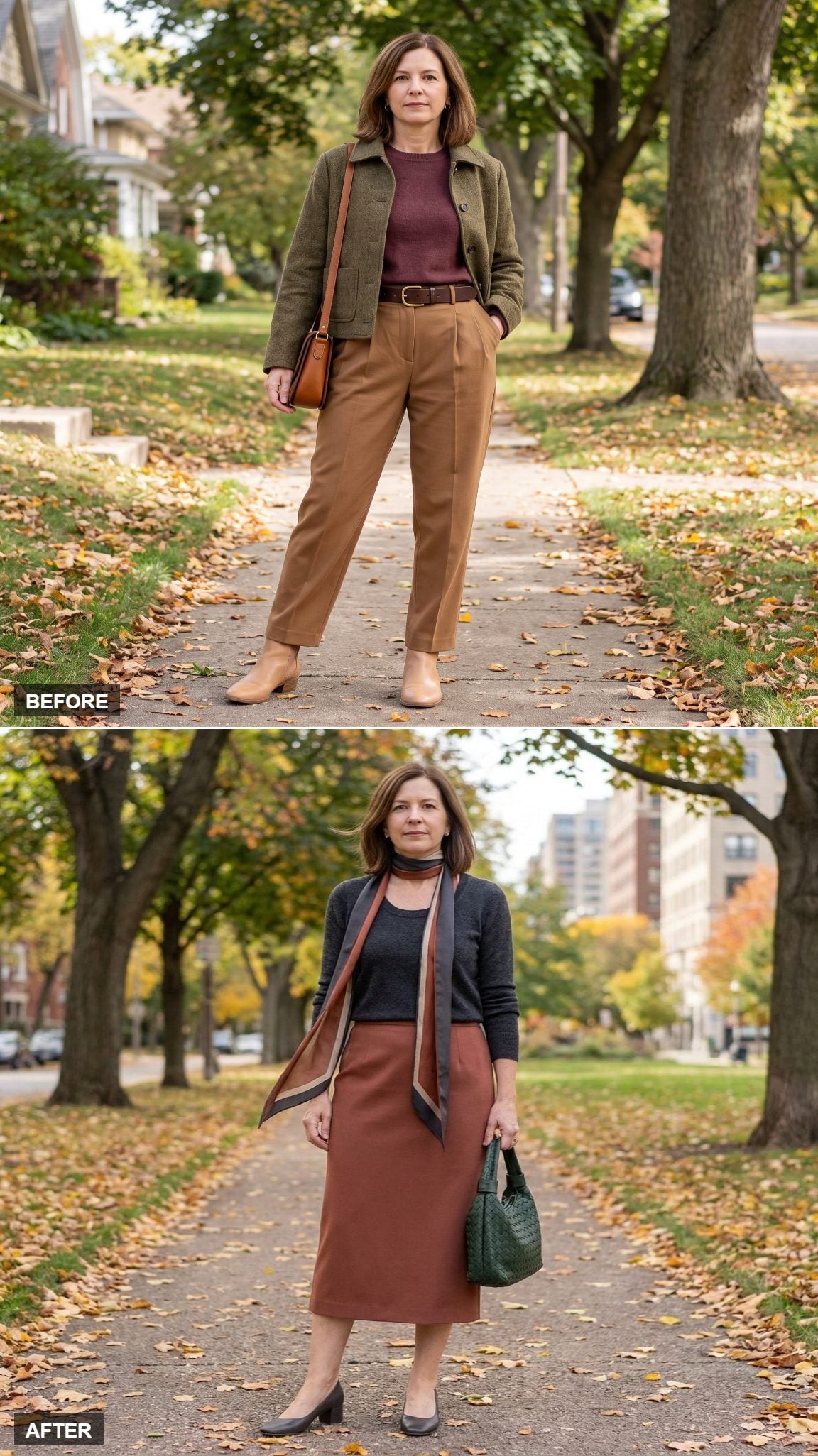
Here, the accessory is structural. A long charcoal, rust, and cream silk scarf hangs loose over a charcoal fine-gauge sweater and muted-rust straight midi skirt, pulling attention down the center rather than circling the torso.
Dark charcoal block heels settle the look, while a forest-green woven-leather handbag introduces one cooler note. The breeze lifting the scarf in the image is not a styling device so much as physics deciding to cooperate.
25. Deep-Teal Silk and Bootcut Denim Give Casual Clothes Better Proportions
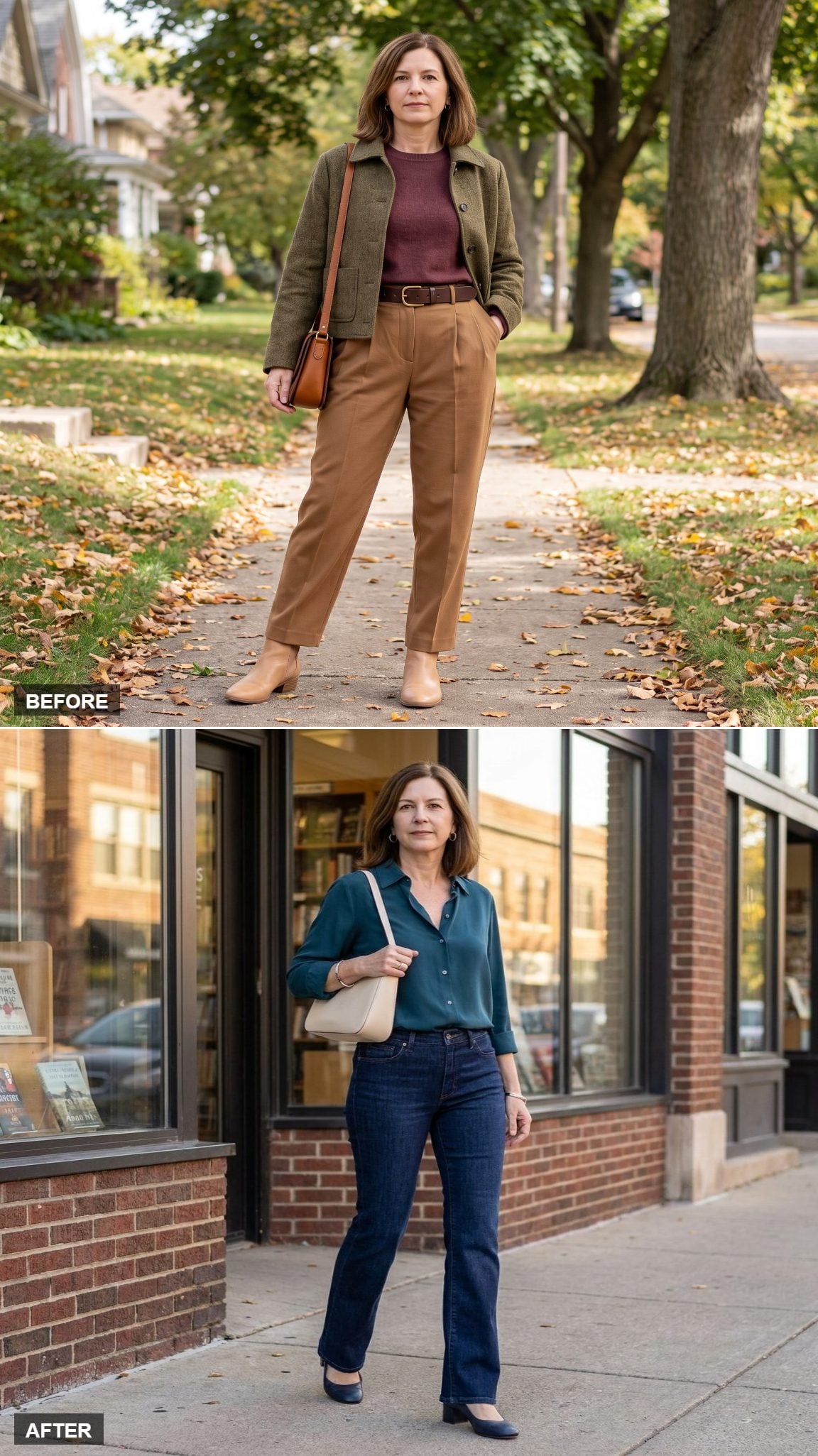
The deep-teal silk blouse stays untucked and finishes around the upper hip, with side slits allowing the hem to separate rather than bunch around the waistband. An open collar gives the compact upper torso a little more visual breathing room.
Below, dark-indigo bootcut jeans broaden gently beneath the knee and nearly cover dark-indigo low block-heel shoes. The cream east-west shoulder bag is the single light interruption. This is a casual look with surprisingly careful geometry hiding underneath it.
24. A Camel Belt Proves the Answer Is Not to Ban Belts
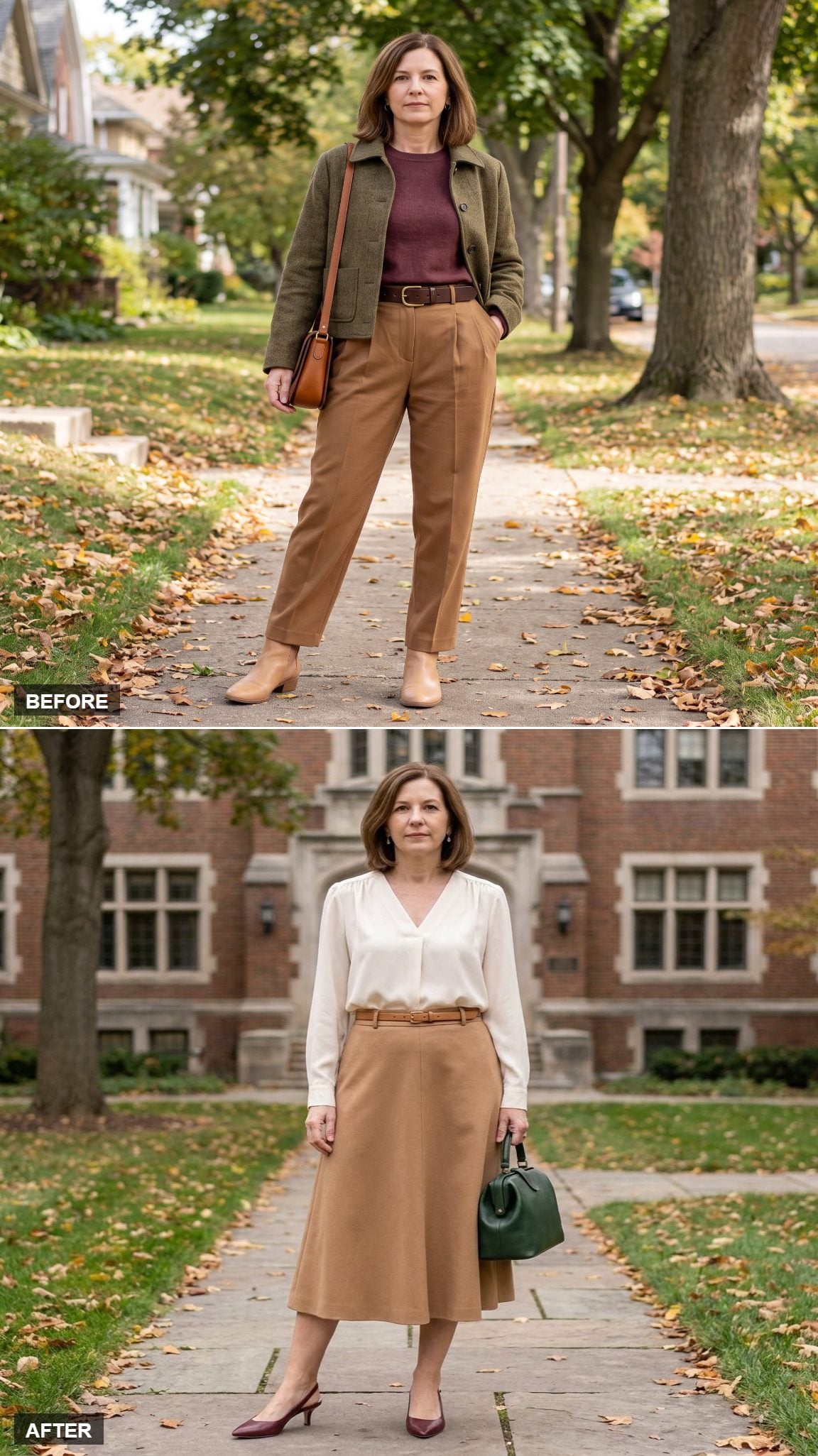
The belt is the argument. It is narrow, quiet, and almost identical in tone to the camel A-line midi skirt. Instead of drawing a dark stripe around the body, it gives the waist a subtle definition and then gets out of the way.
A fluid warm-cream V-neck blouse brings softness above it, while burgundy slingback kitten heels and a forest-green doctor bag make the restrained camel palette look much more intentional.
23. Forest-Green Suede and Rust Corduroy Bring Some 1970s Swagger Into the Equation
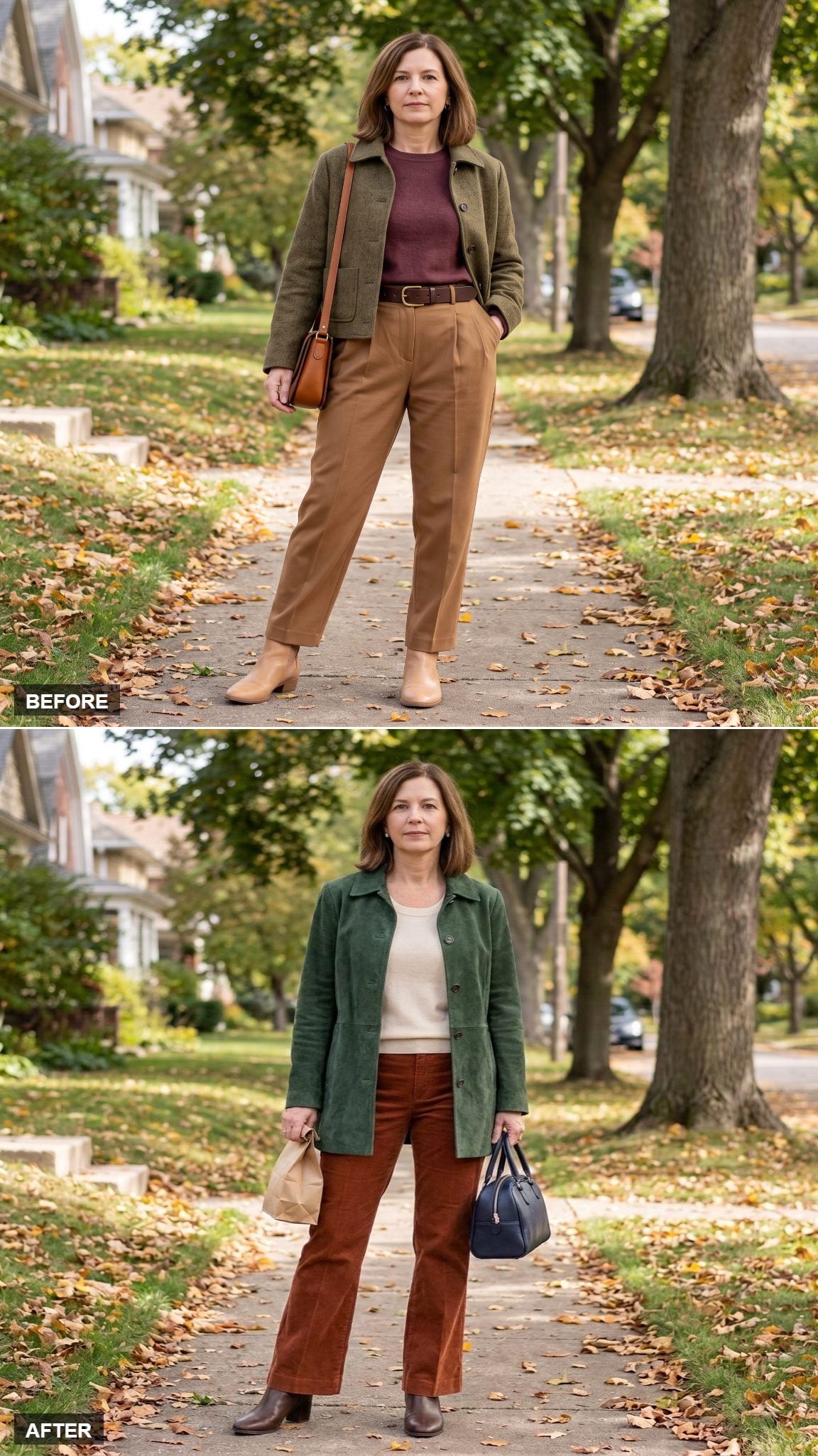
The forest-green suede jacket finishes at the hip rather than the waist, allowing the rust fine-wale corduroy flares to become the strongest shape below it.
A cream lightweight knit stays untucked beneath the jacket without billowing around the middle. Dark-chocolate boots disappear mostly under the flares, while a navy bowling bag gives the hand something darker to carry.
That’s forty-five minutes of outfit logic doing more than years of shapewear.
22. An Aubergine Wrap Dress Uses a Diagonal Where the Before Used Four Horizontals
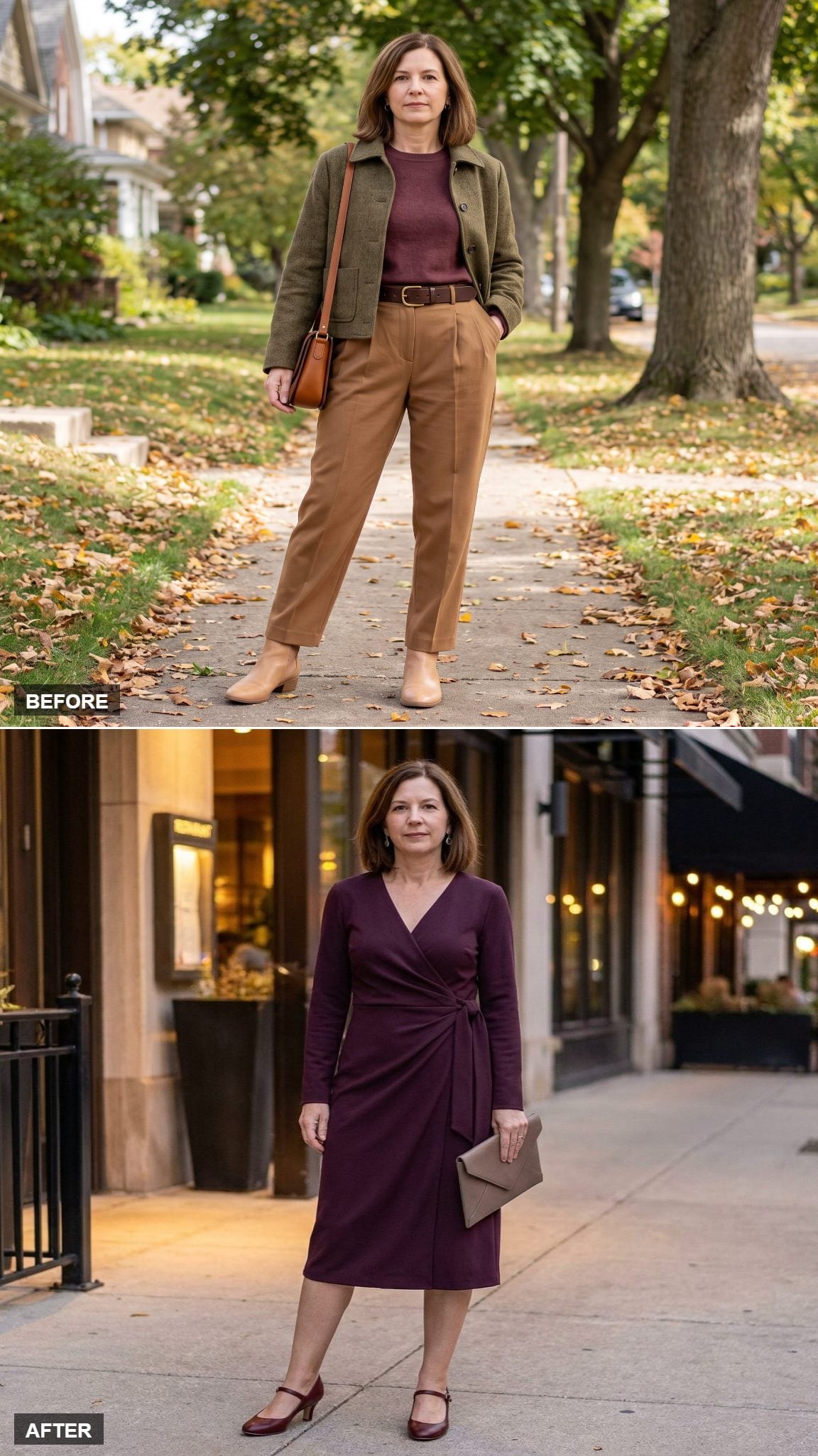
Wrap construction gives this dress a completely different geometry from a waistband-heavy outfit. The surplice neckline crosses the torso on an angle, while the self-fabric tie stays close enough to the aubergine dress that it does not become a contrasting stripe.
Oxblood Mary Jane pumps deepen the same red-violet family without matching it exactly. The muted taupe clutch remains deliberately quiet. A red-adjacent palette this confident needs very little decoration.
21. Cream and Olive Make the Partial Tuck Look Like a Choice, Not a Compromise
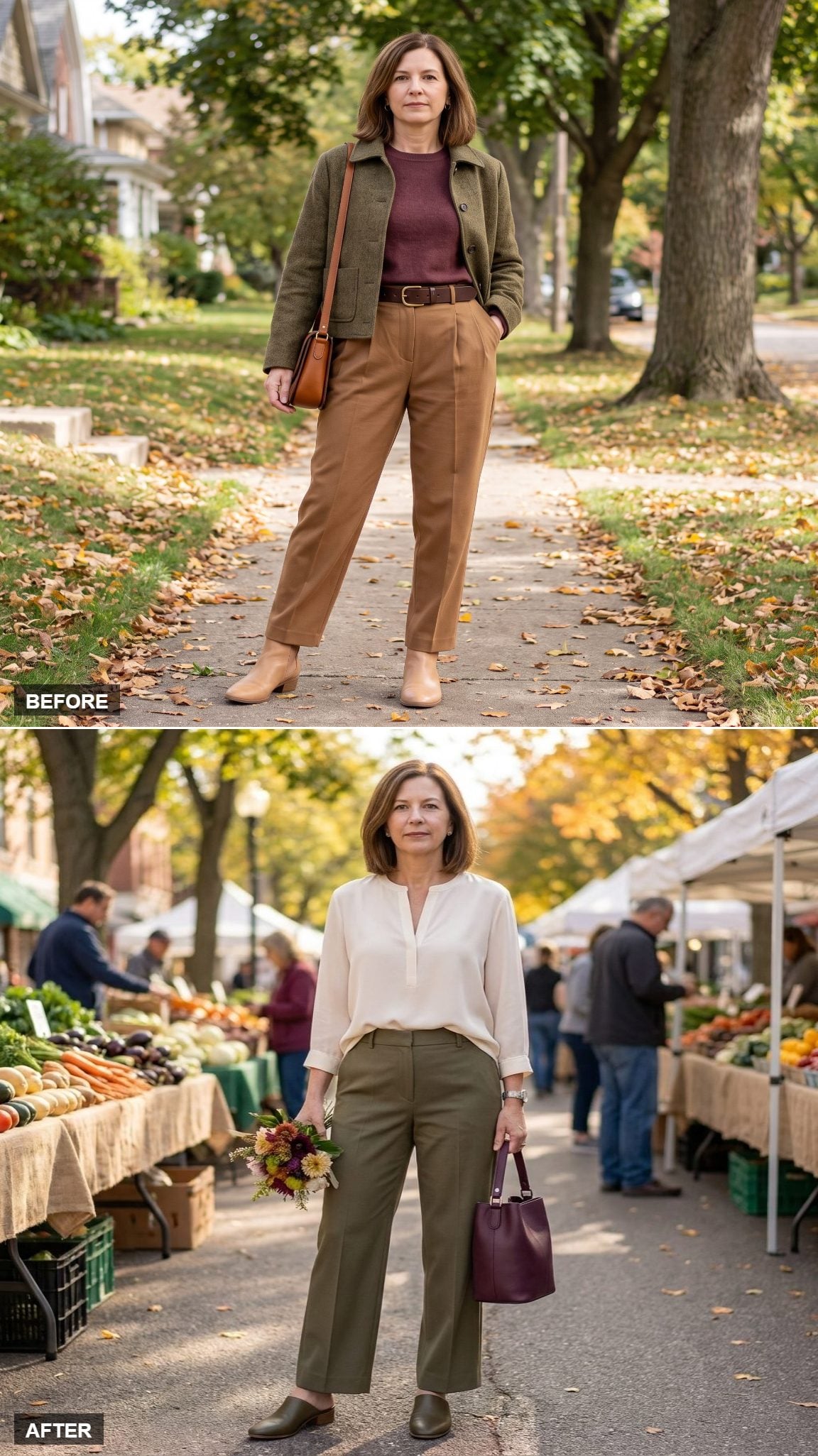
Only a small front section of the cream blouse is tucked into the olive trousers. That glimpse of waistband suggests shape without turning the entire waist into the focal point. The split neckline introduces another opening above, while the wide trouser leg gives the lower half generous movement.
Dark-olive mules continue the trouser color and the plum bucket bag adds a richer autumn note. The result has the easy practicality of an athleisure outfit without looking remotely like gym clothes.
20. A Charcoal Vest Creates Structure Without Adding Another Jacket Hem
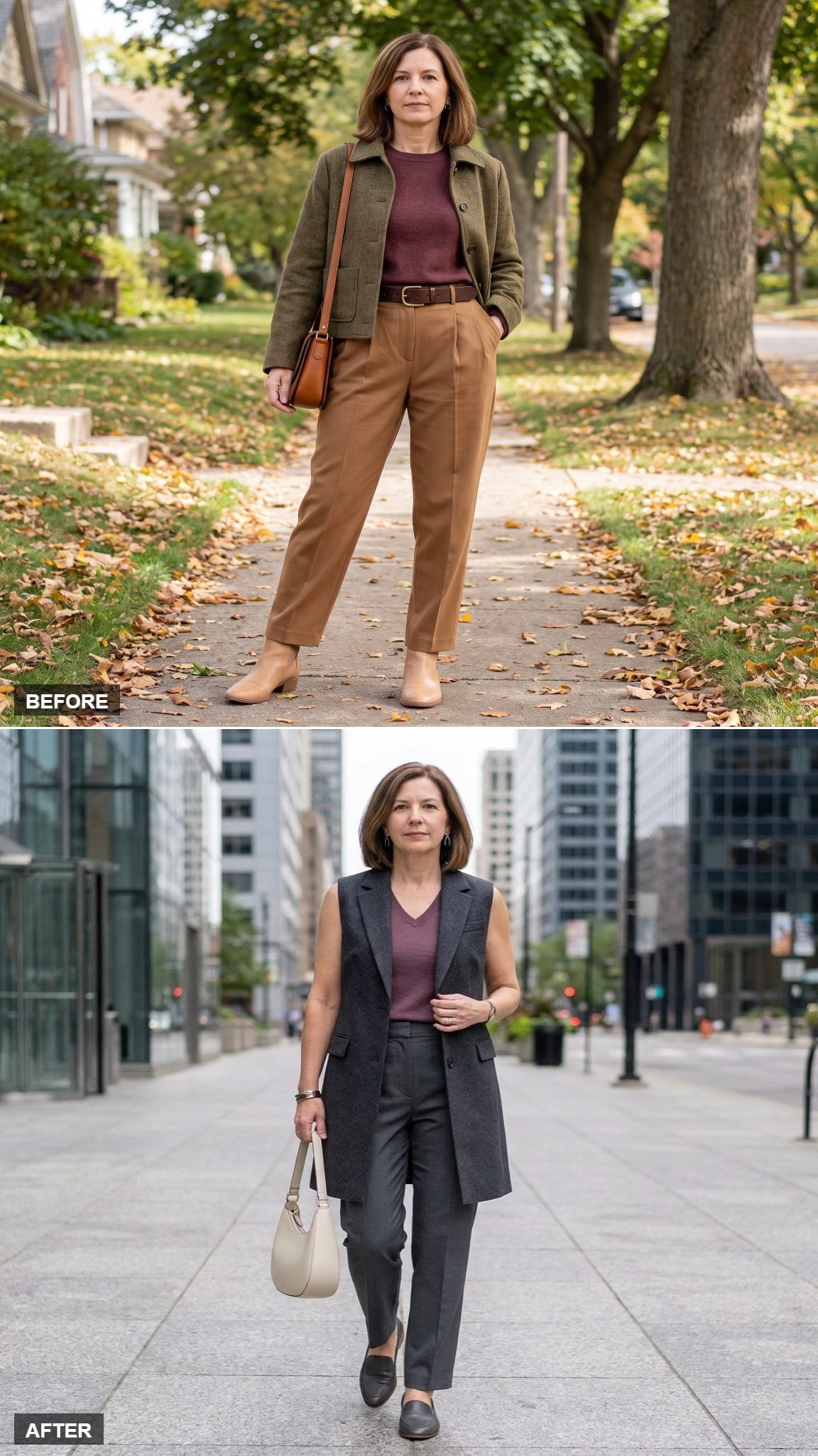
The charcoal tailored vest reaches mid-thigh and stays open, creating a long frame around the muted-plum V-neck underneath. Because it has no sleeves, it adds tailoring without the bulk of another full jacket.
Graphite straight trousers keep the lower half narrow and clean. The cream crescent bag and geometric cuff brighten the darker palette without planting more detail at the waist.
19. Cream Cashmere and Chocolate Leather Change the Story With Texture Instead of Color Tricks
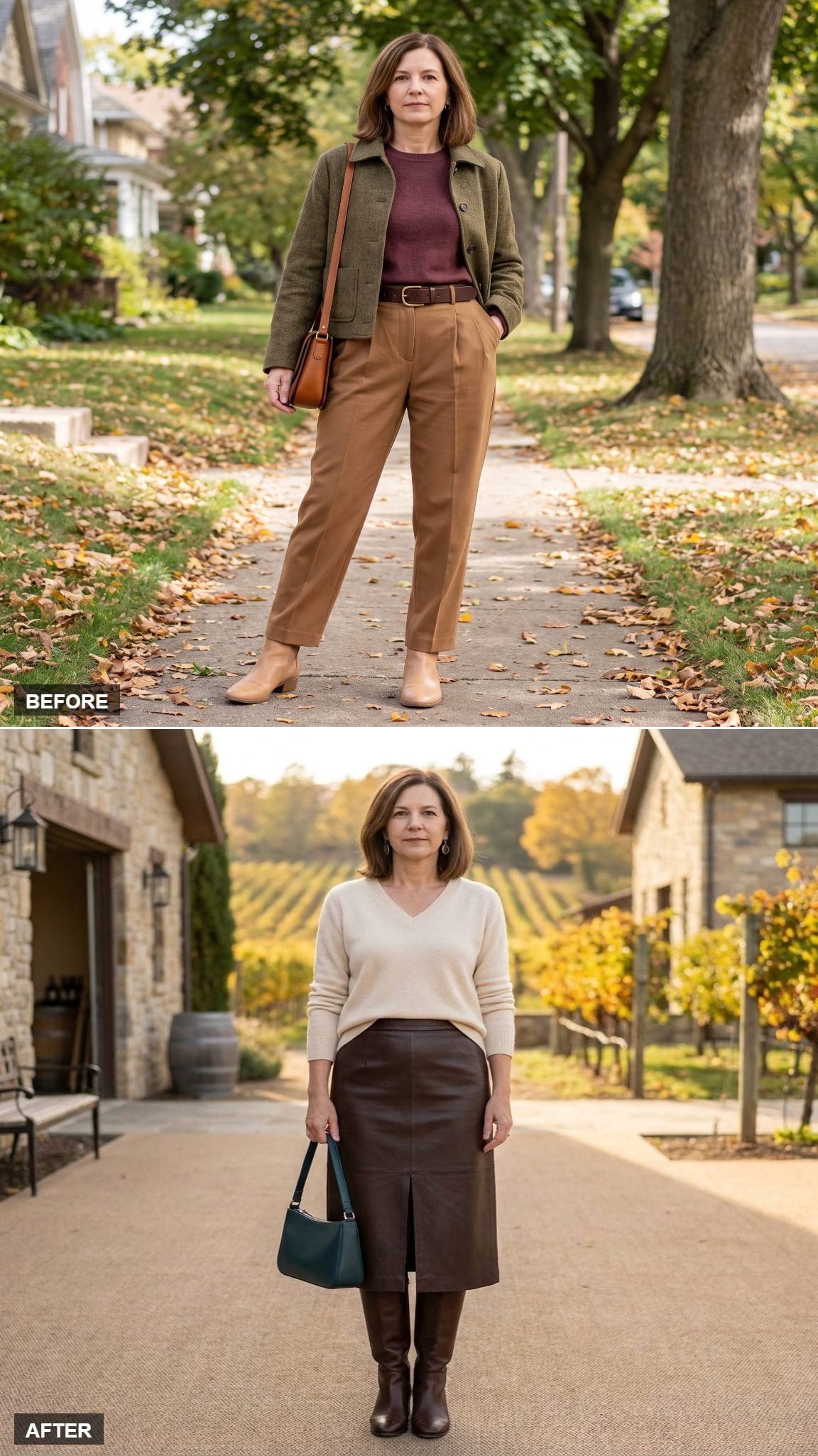
The cream cashmere V-neck opens the neckline while a deep-chocolate leather midi skirt keeps the lower half sleek and substantial. A small asymmetric tuck gives the sweater shape without exposing the entire waistband.
Chocolate knee-high boots disappear beneath the skirt hem, turning skirt and footwear into one dark lower section. The deep-teal east-west shoulder bag is the one saturated interruption—and a good one.
18. Deep Teal From Coat to Trouser Shows How Tonal Dressing Can Still Have Depth
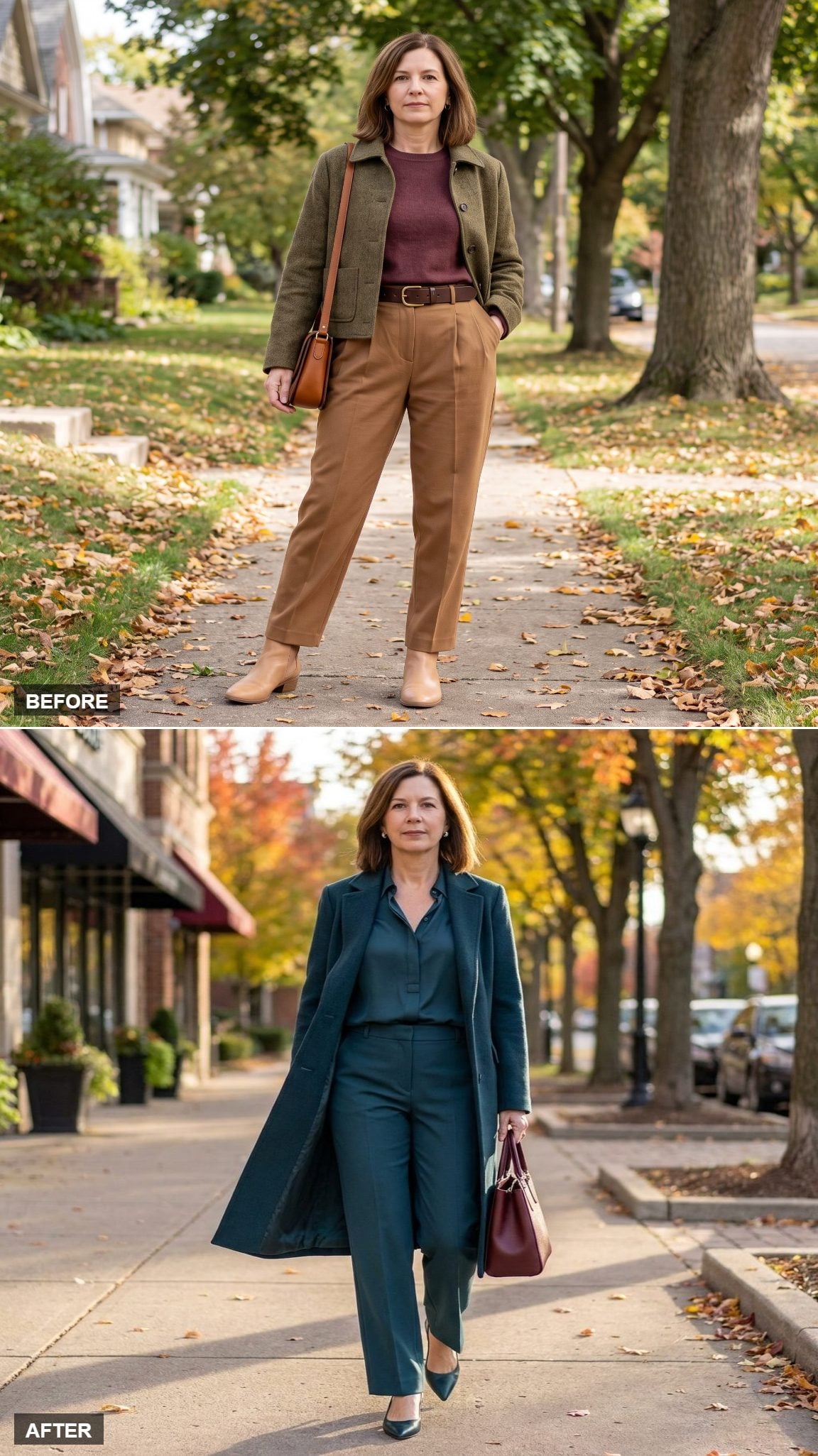
Tonal dressing is useful here because the pieces are related rather than identical. A fluid deep-teal look combines a silk open-neck blouse, petrol-teal wide-leg trousers, and a lightweight coat worn open. Slight shifts in depth keep the outfit dimensional while avoiding a hard color boundary at the waist.
Dark-teal slingbacks extend the trouser color downward. A rich burgundy structured handbag becomes the deliberate interruption, while a silver cuff adds light at the wrist.
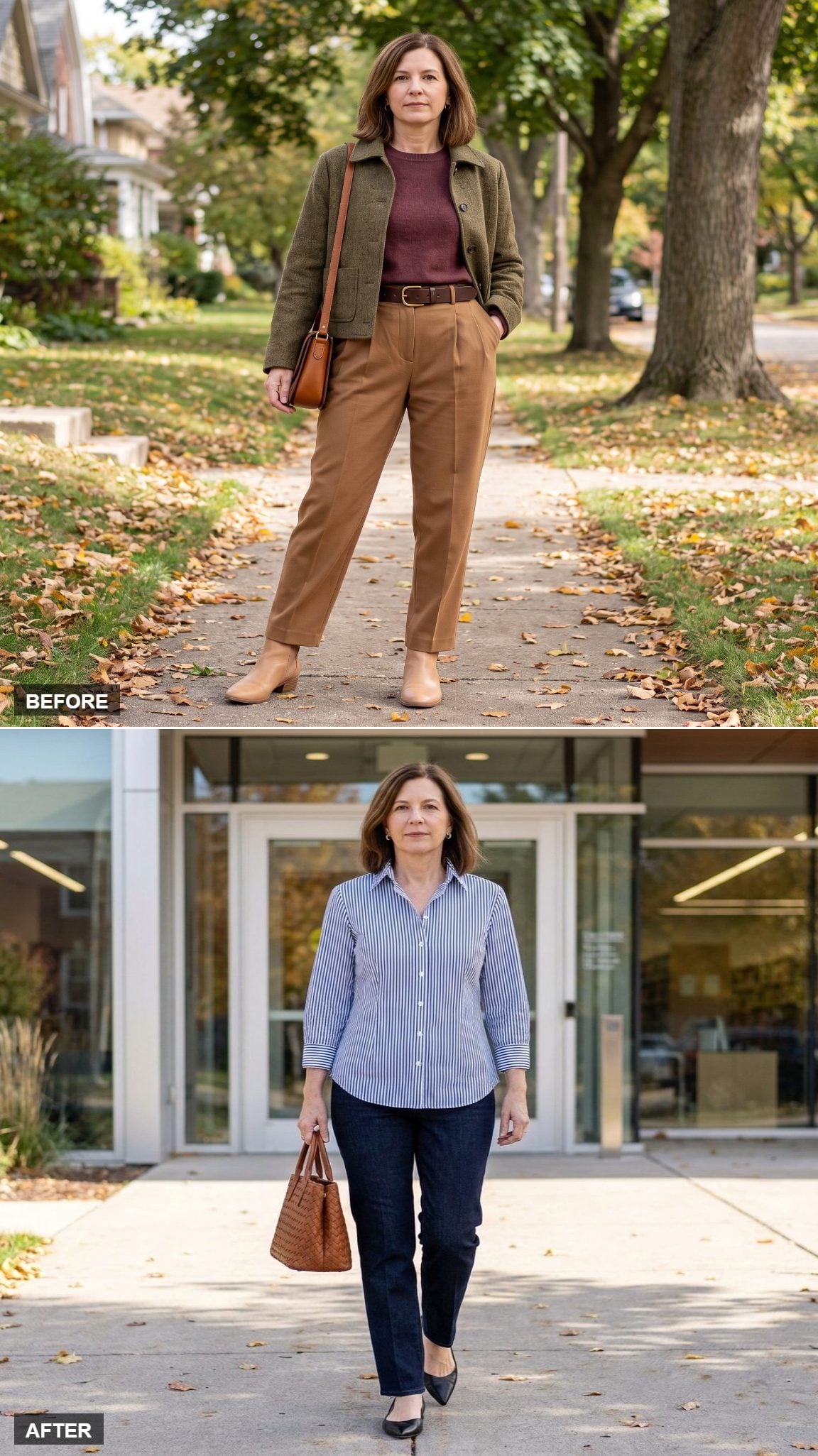
17. Blue Stripes and an Ink Placket Turn an Ordinary Shirt Into Directional Design
❤️ Would you like to save this?
The button placket is hiding in plain sight. The narrow-striped shirt keeps that center line visible from the open collar downward, while the hip-skimming hem bypasses the need to showcase the waistband.
Very dark trouser-cut denim gives the bottom half a clean tailored fall. Black pointed slingback flats and a cognac woven-leather top-handle bag finish a look that appears relaxed despite all the proportion decisions underneath it.
16. An Olive Shirt Dress Builds Its Own Line From Collar to Hem
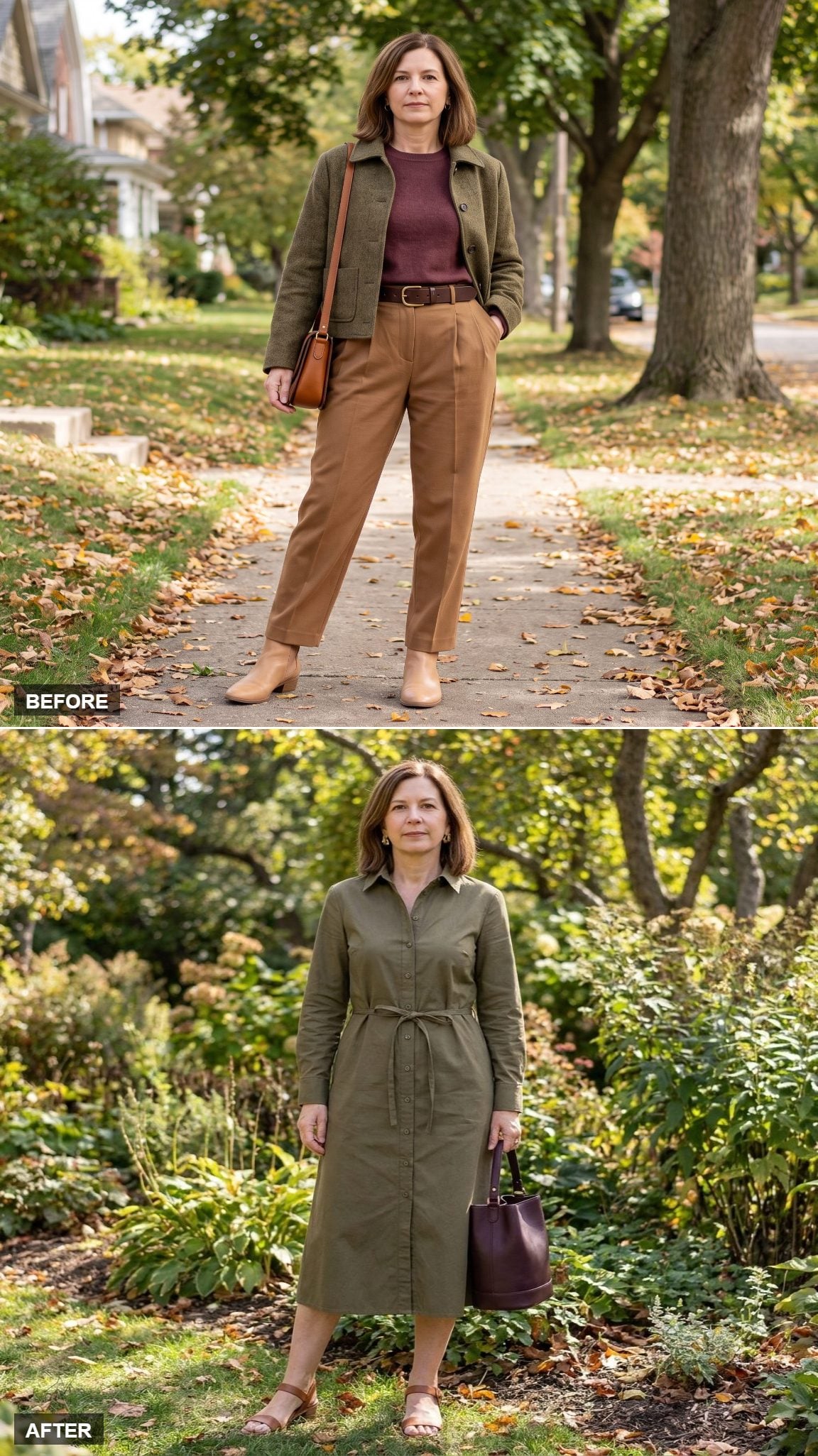
The continuous button placket on this olive midi shirt dress gives the garment a strong center from open collar to A-line hem.
The narrow self-tie is deliberately low contrast, defining the waist without turning it into the loudest feature. Cognac block-heel leather sandals warm the olive, while a dark-plum bucket bag supplies one deeper fall color. One dress, one clear idea, remarkably little fuss.
15. Deep Wine on Burgundy Makes Texture More Important Than the Waist Seam
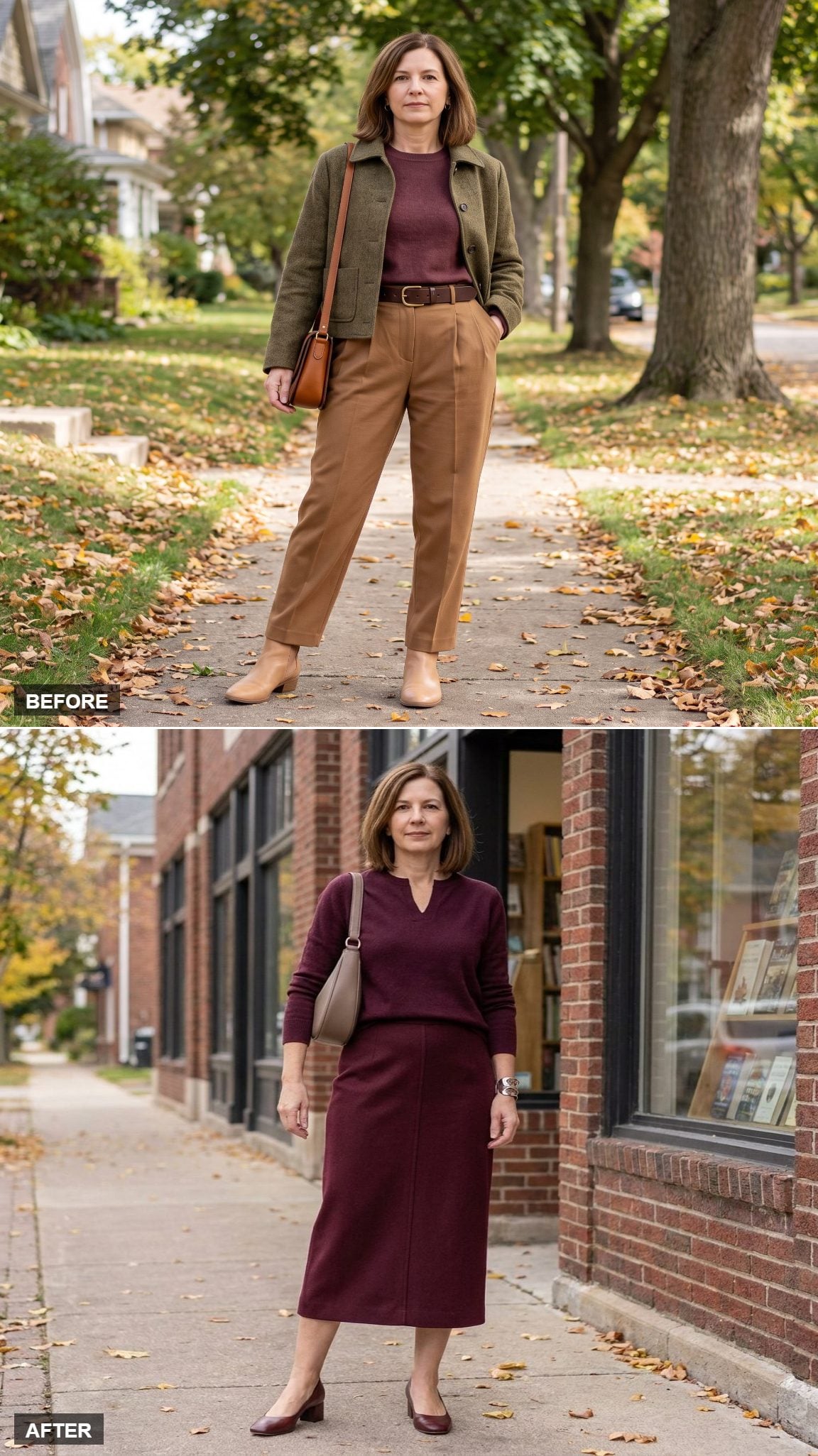
A deep-wine split-neck fine-knit sweater overlaps the waistband of a burgundy wool column midi skirt, softening the transition between knit and wool.
The split neckline opens the top while a subtle front seam gives the skirt a clean center. An oxblood block-heel pump, taupe crescent bag, and sculptural cuff add finish without turning the middle of the outfit into an accessory rack.
14. A Dark-Olive Utility Jacket Makes Casual Dressing Pay Attention to Hem Placement
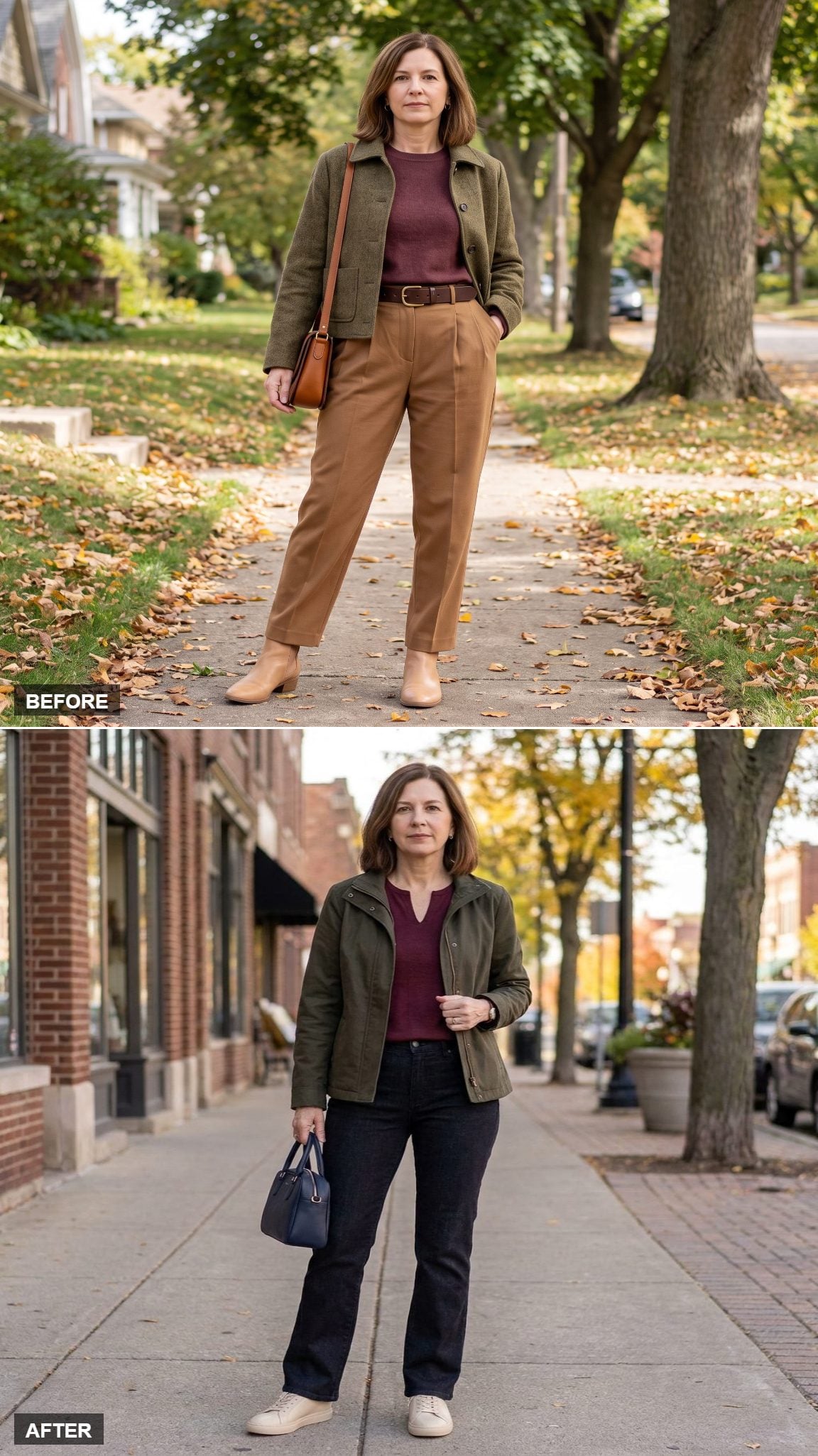
The dark-olive utility jacket reaches the lower hip, allowing dark trouser-cut jeans to establish the lower silhouette instead of forcing another line directly onto the waist.
A soft burgundy split-neck jersey top remains untucked beneath it. Cream leather sneakers and a navy satchel keep this firmly in everyday territory—the athleisure outfit cousin that owns a good jacket and remembers where it left its keys.
13. Teal, Burgundy, and Oxblood Show That Contrast Does Not Have to Be Harsh
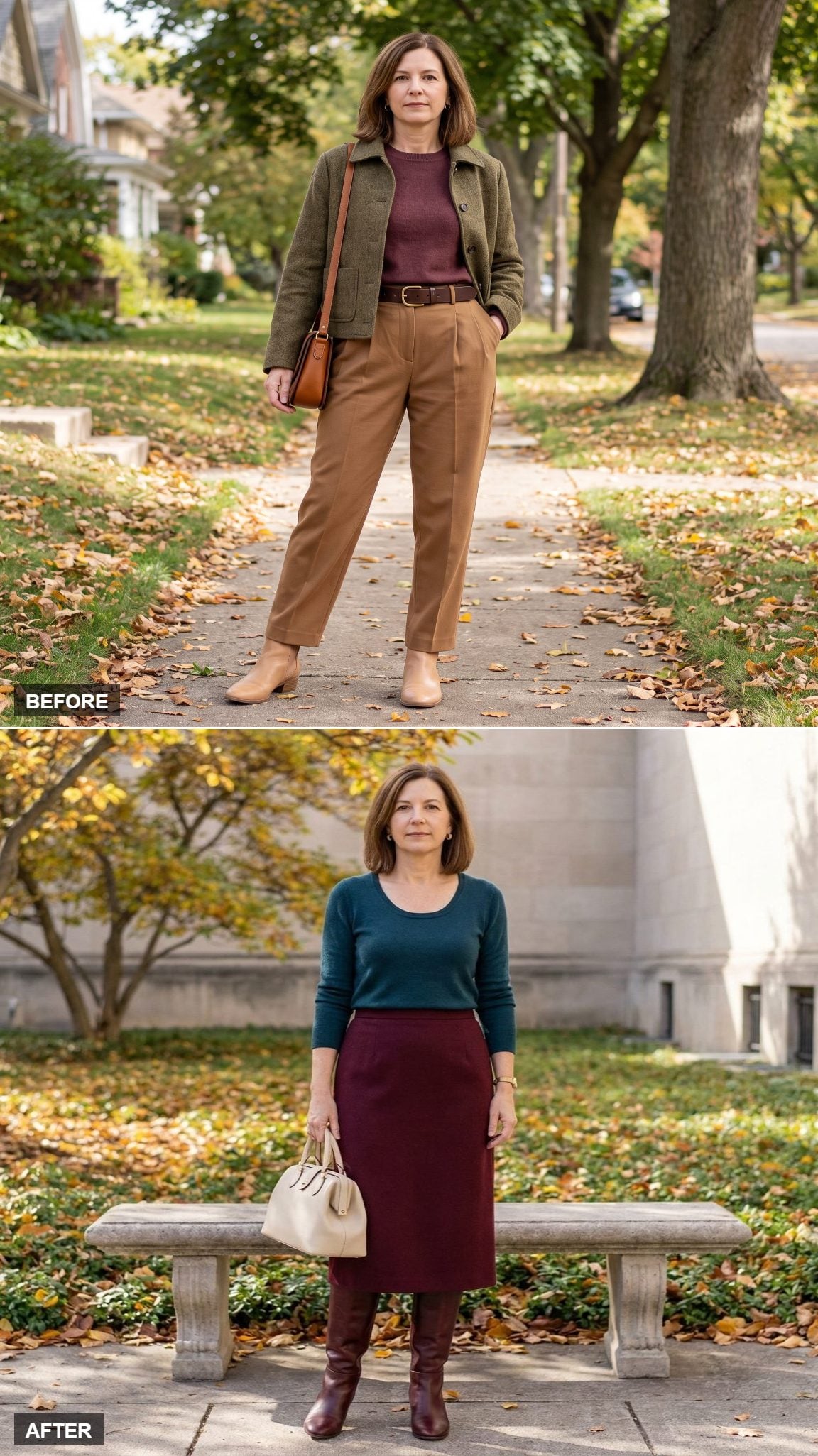
The fine-gauge teal scoop-neck knit and burgundy wool midi skirt are clearly different colors, but they share enough depth that the junction between them does not become a bright stripe around the body.
Oxblood knee-high boots disappear beneath the skirt, giving the lower half a darker continuation. The cream doctor-style bag becomes the crisp light note instead, safely away from the waistband.
12. A Long Navy Blazer Turns Three Familiar Basics Into a Cleaner Framework
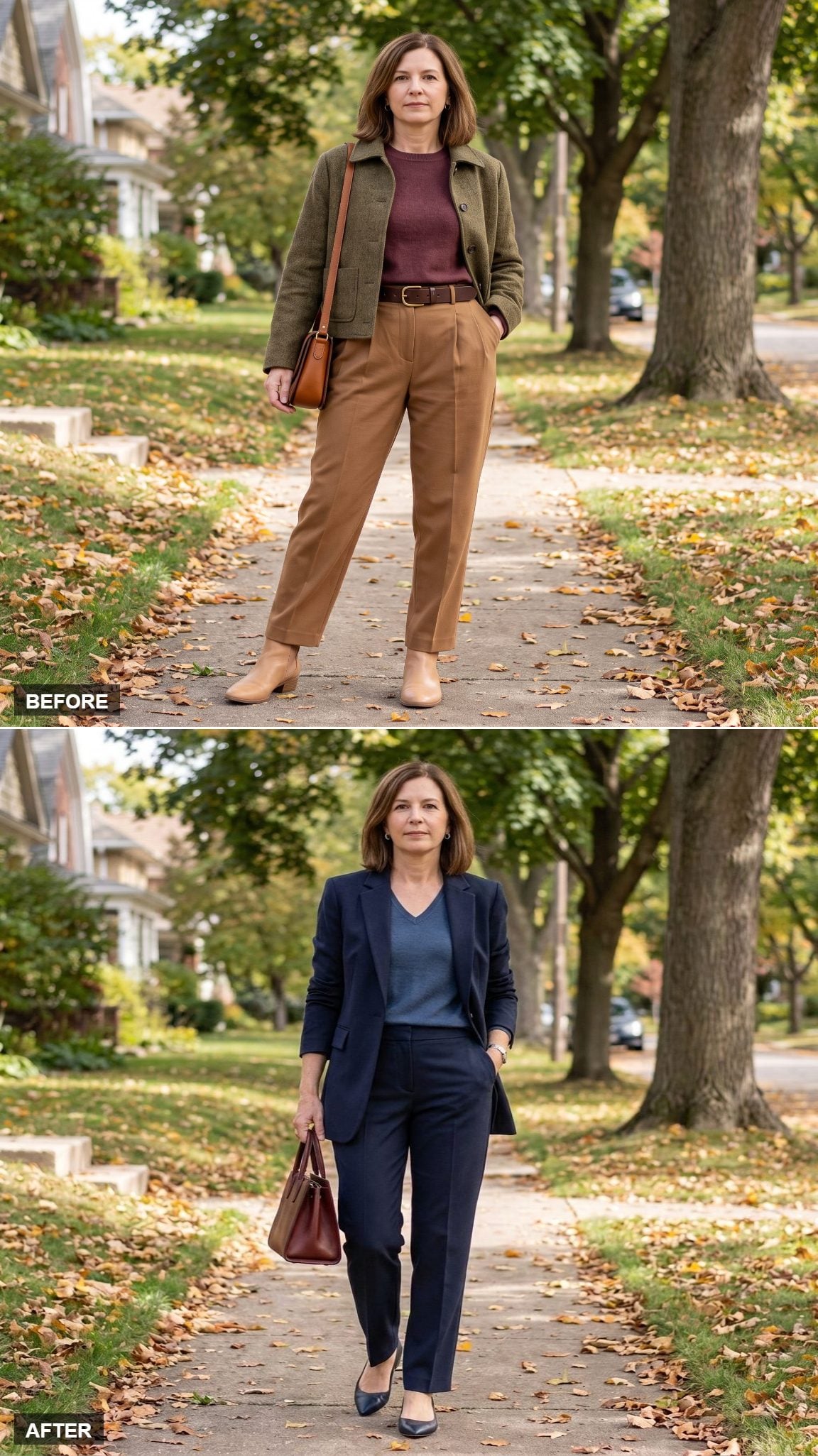
An elongated navy blazer worn open frames the ink-blue merino beneath it, while fluid full-length trousers carry the same dark family downward.
The outfit avoids making any one waistband or hem the headline. An oxblood top-handle handbag gives the composition a warmer punctuation mark, and dark-navy leather flats keep the bottom quiet. This outfit gets its authority from the blazer’s length, not from squeezing anything into submission.
11. Rust Satin Makes the Untucked Blouse Look Deliberate Rather Than Defensive
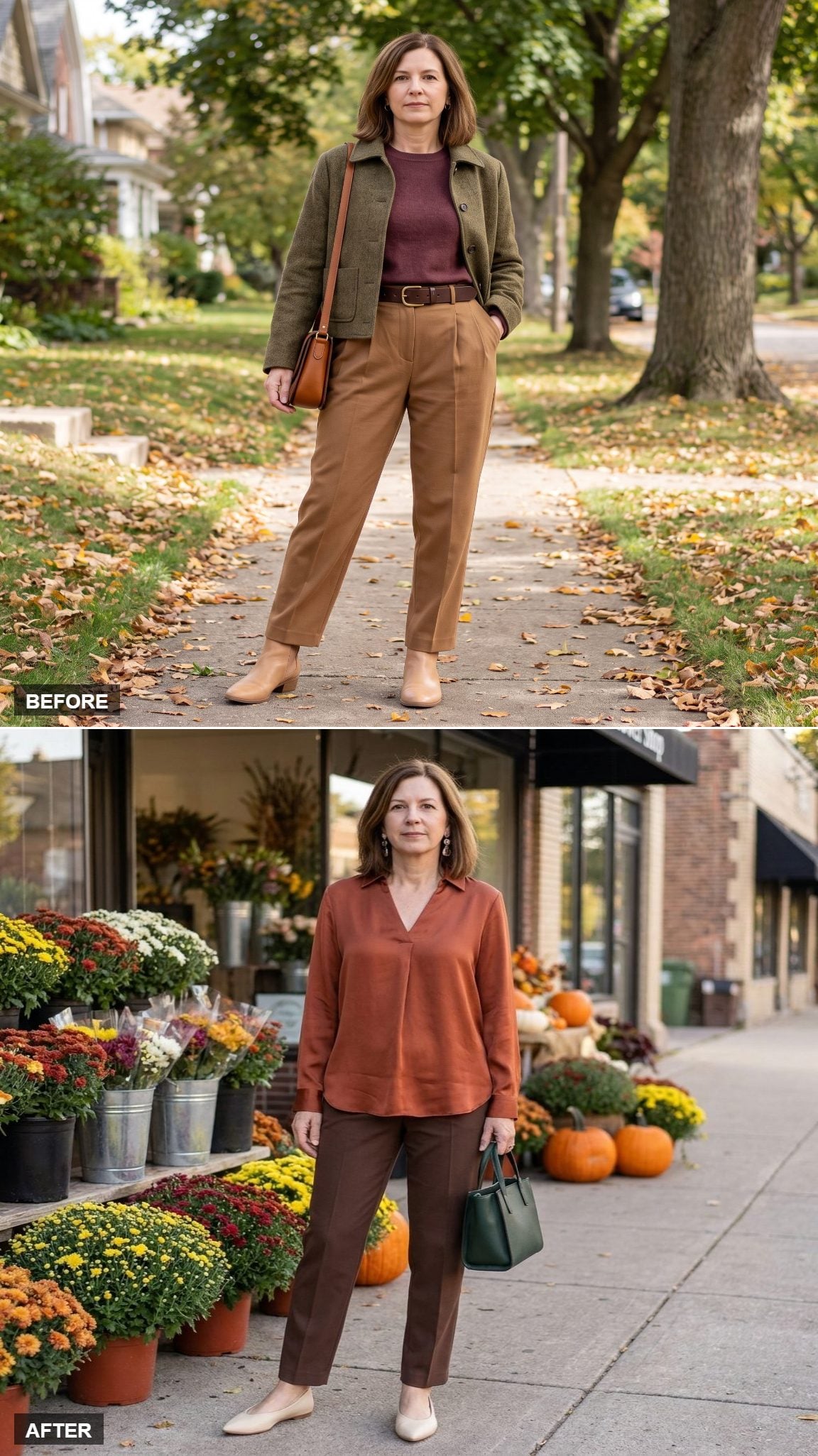
The rust satin blouse finishes around the upper hip, allowing its V-neck and narrow center seam to provide the structure instead of a tuck or belt. Because the cut stays relatively close to the body, leaving it loose looks purposeful rather than oversized.
Cream pointed ballet flats lighten the darker chocolate trousers, while a structured dark-green mini tote adds another autumn color without landing on the waist.
10. A Deep-Plum Bias Skirt Sends the Fabric on a Diagonal Instead of Across the Body
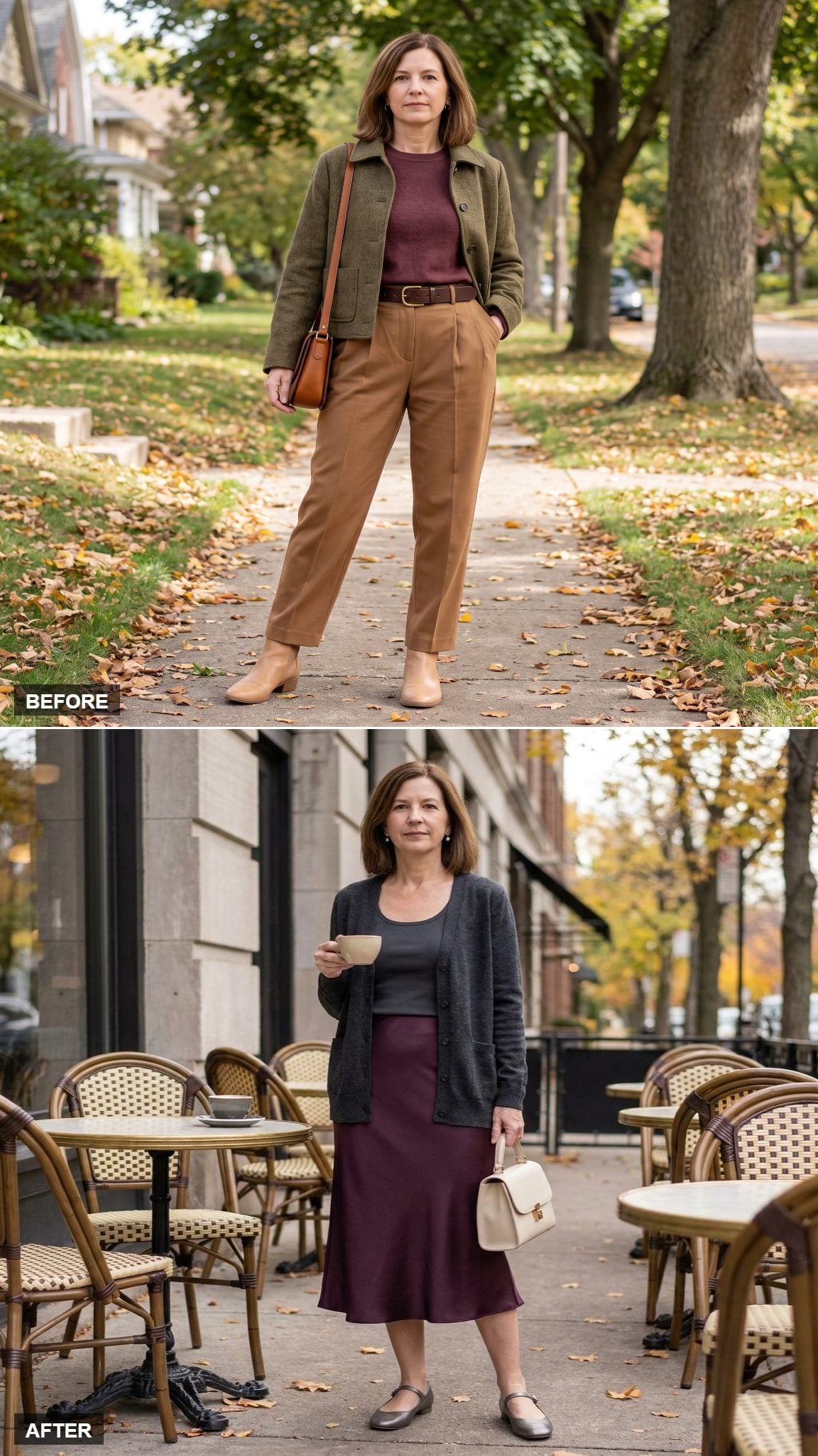
Bias-cut satin brings a different kind of movement into the gallery. The deep-plum satin midi skirt drapes on the diagonal while an open charcoal V-neck merino cardigan falls to the upper thigh.
A graphite shell sits quietly beneath it. Pewter Mary Janes, a cream compact satchel, and pearl earrings keep the finish soft rather than severe. The result is less about “lengthening” than about replacing rigid intersections with movement.
9. Ink Denim From Shirt to Midi Skirt Makes Double Denim Look Almost Elegant
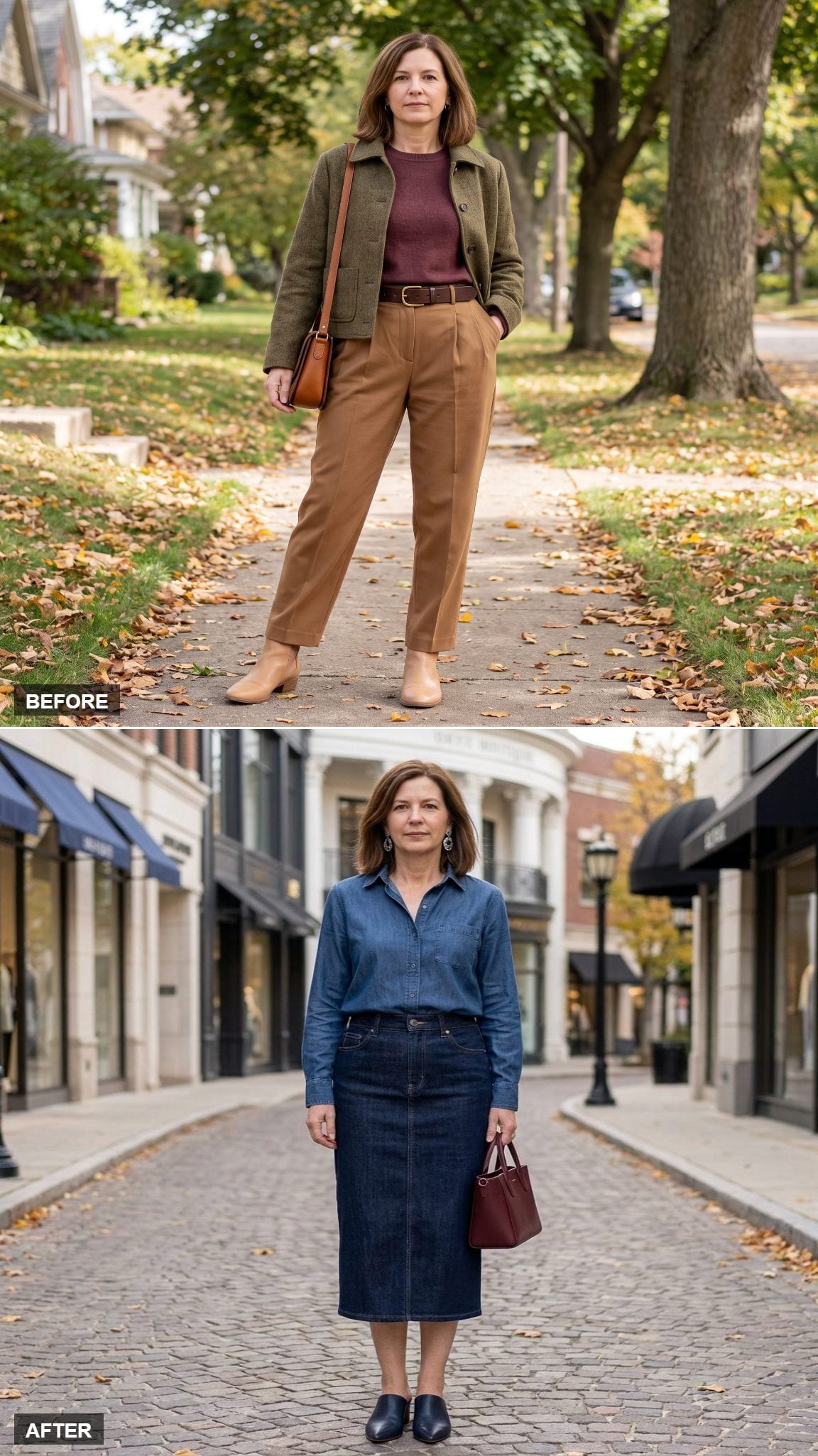
An open-collar ink-denim shirt meets a dark-indigo straight denim midi skirt in tones close enough that the waistband nearly disappears into the outfit.
Dark-navy pointed mules continue the dark palette while a burgundy structured mini tote keeps the outfit from becoming one flat expanse of blue. Statement silver earrings take the detail upward.
8. Camel Over Chocolate Lets the Coat Frame the Outfit Instead of Cutting Into It
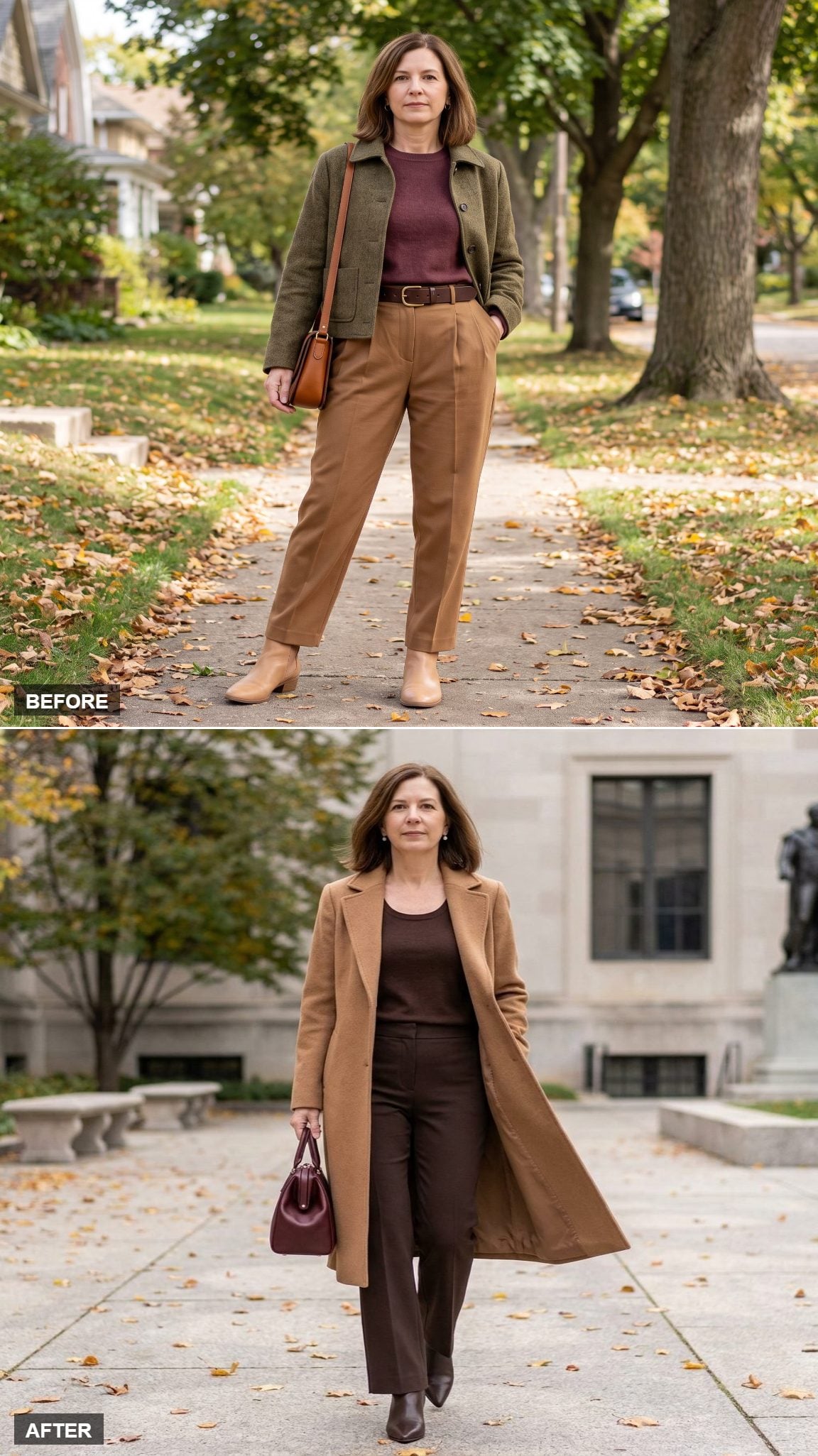
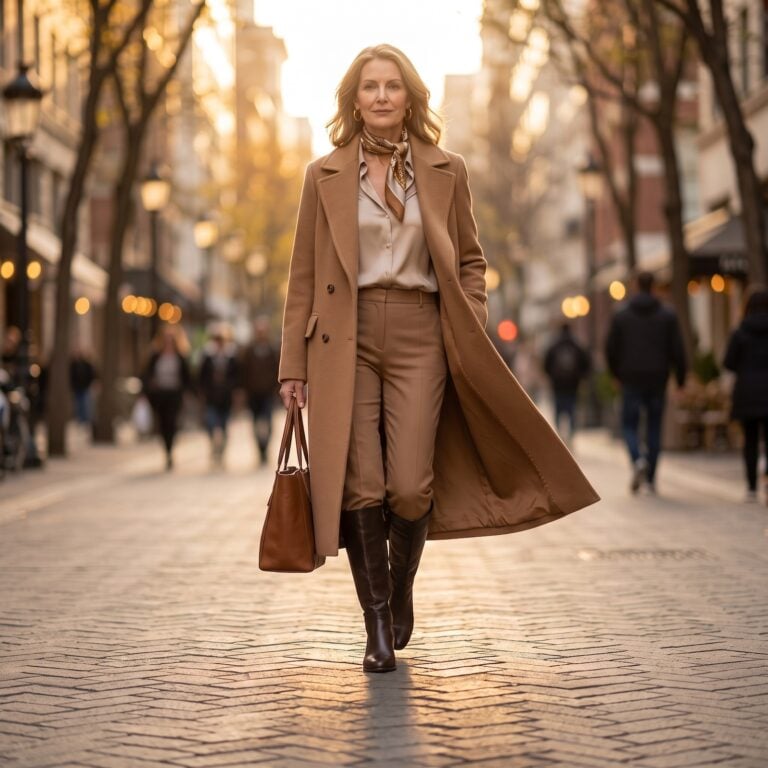
Chocolate merino and espresso flared trousers create a closely related inner palette, while the camel coat stays open over the top rather than cinching the waist.
Espresso pointed ankle boots vanish beneath the trouser hem. A burgundy doctor-style handbag and pearl studs provide the only ornament. Sometimes a single warm accent is much more interesting than five.
7. Stone Trench, Navy Column, No Need to Fasten Anything
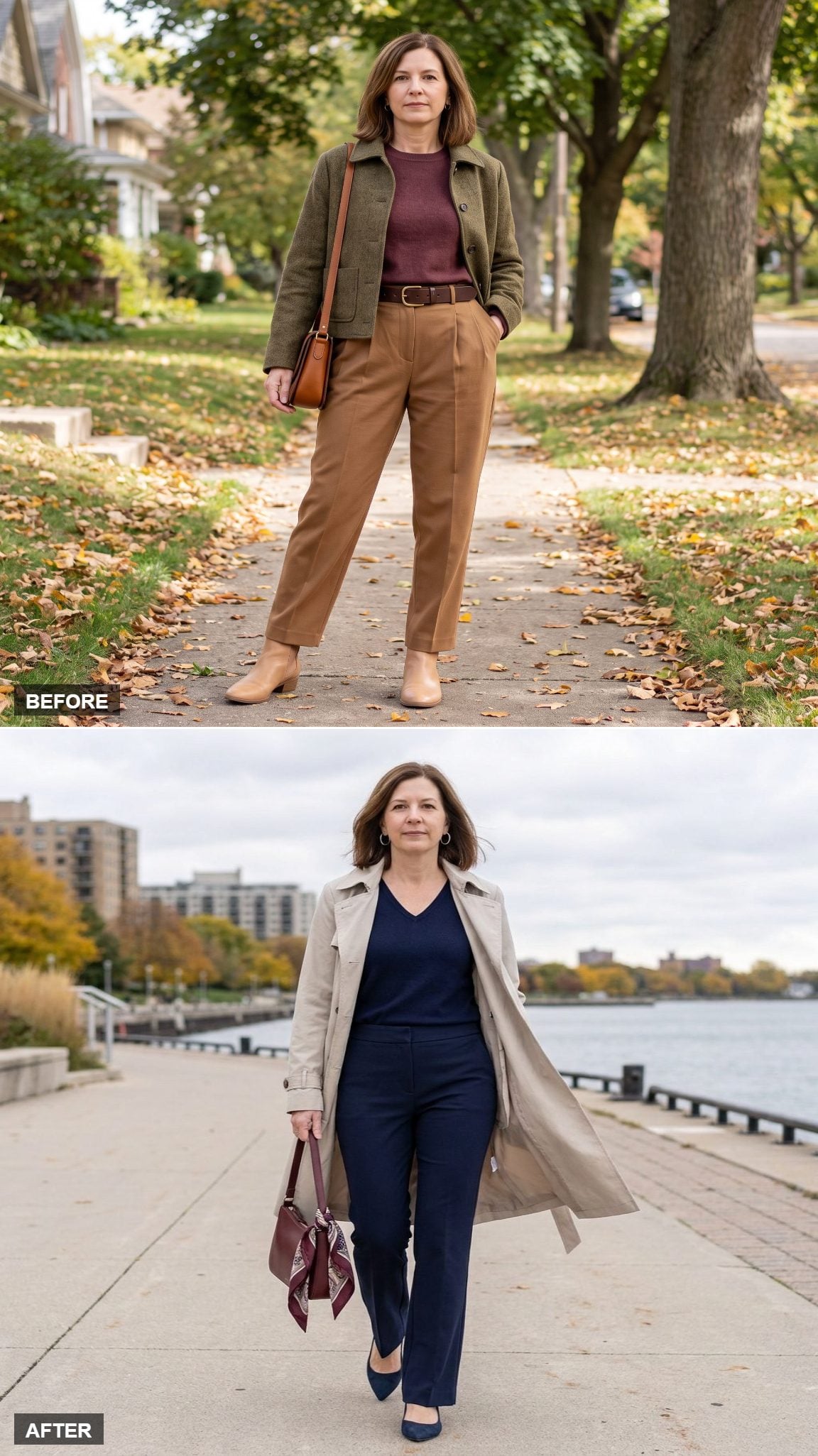
The stone trench coat stays open around a navy V-neck knit and matching navy softly flared trousers. The light outer layer acts as a frame while the darker center retains most of the visual continuity.
A patterned scarf is tied to the burgundy east-west bag rather than around the neck, leaving the upper torso uncluttered. Navy pointed flats sit beneath the trousers. The red-adjacent bag provides enough color without demanding a belt on the coat.
6. Forest Green Outside, Charcoal Inside: Let the Coat Carry the Personality
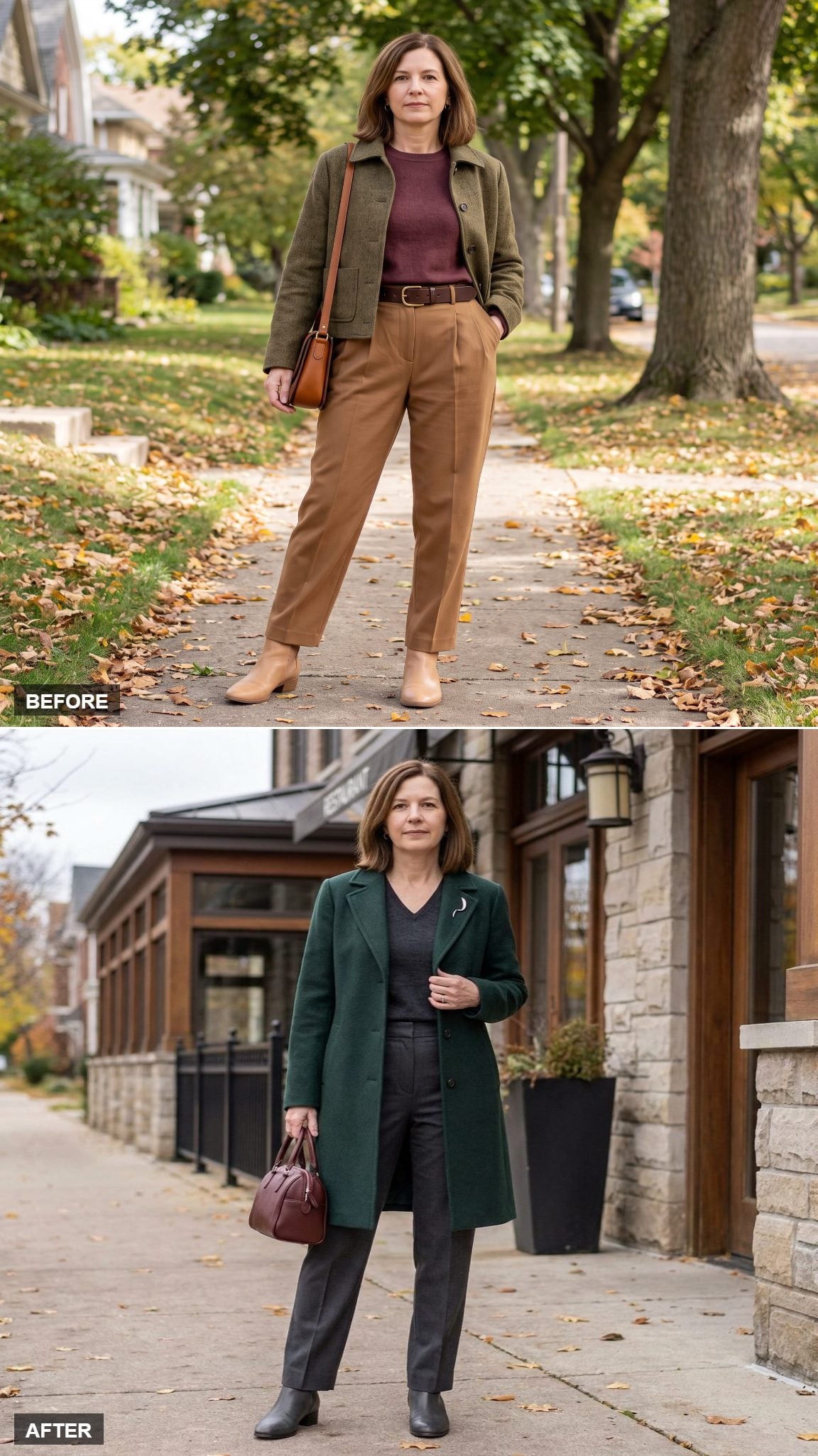
The charcoal V-neck merino and graphite trousers create a dark center, while the forest-green wool coat supplies the drama around it. Instead of asking every layer to compete for attention, the outfit gives the jobs out separately: continuity underneath, color outside.
An oxblood bowling handbag adds another autumn tone, while charcoal ankle boots disappear beneath the trouser hem. A minimalist brooch keeps the eye near the lapel rather than the waist.
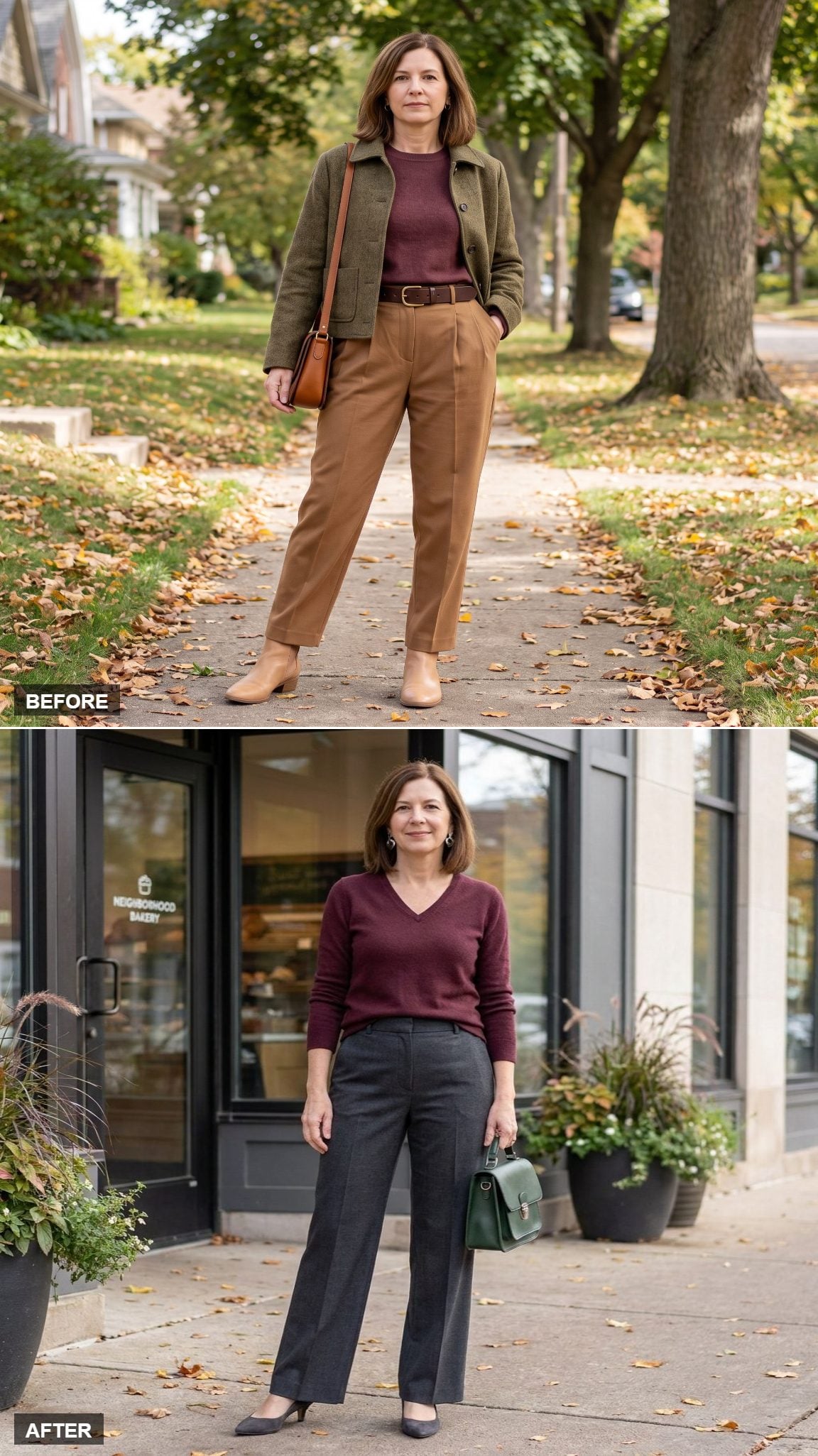
5. Burgundy Cashmere and Charcoal Trousers Let the Rise Stay Quiet
❤️ Would you like to save this?
A softly fitted burgundy cashmere V-neck tucks into charcoal wide-leg trousers without adding a contrasting belt. The waistband sits at a comfortable rise rather than climbing high into the ribcage.
The trousers fall almost to the floor over charcoal kitten-heel pumps, keeping the lower half visually consistent. A compact forest-green satchel provides the deliberate color break.
4. Deep Teal and Graphite Make the Open Collar More Important Than the Waistband
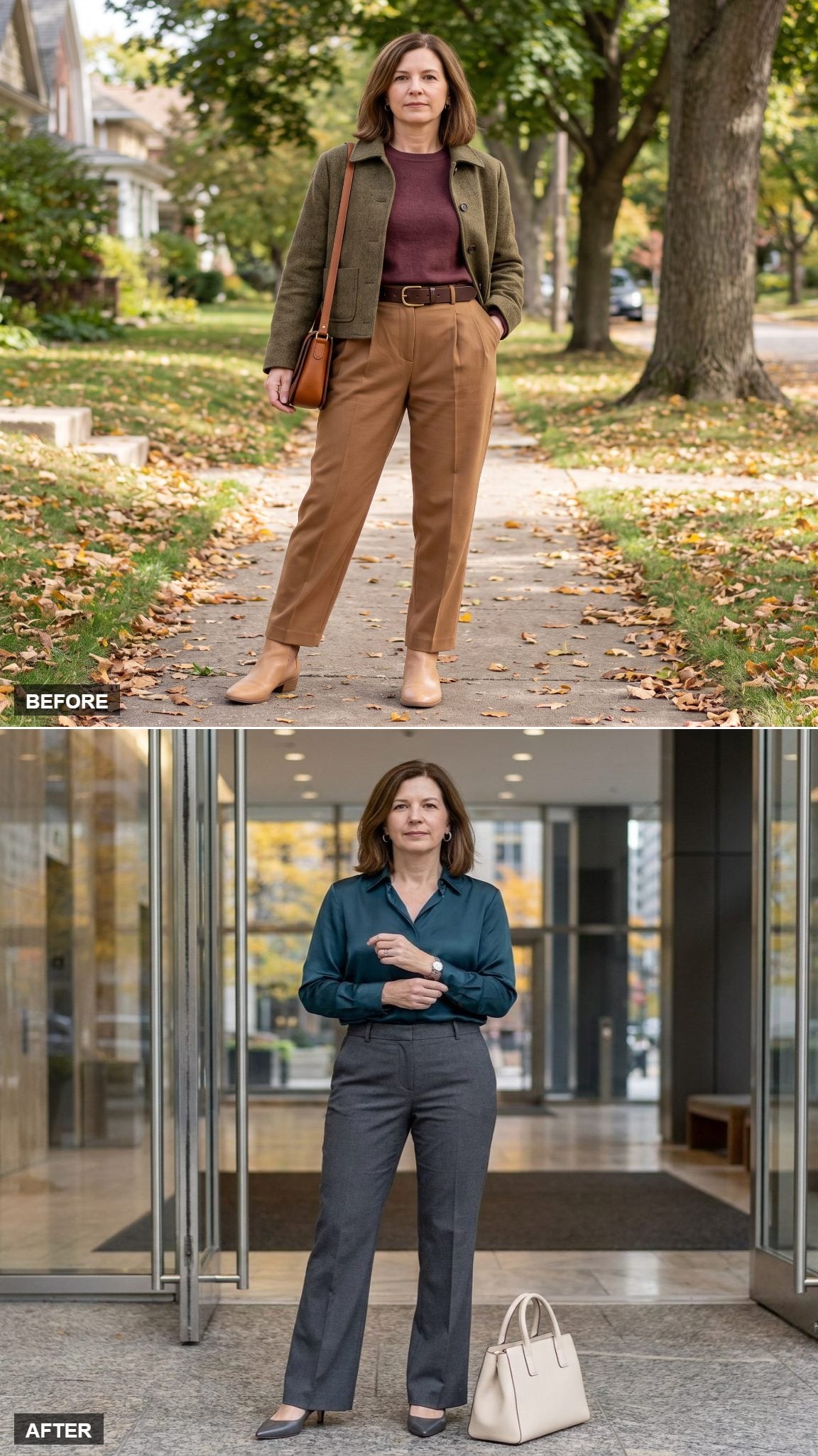
A deep-teal open-collar silk blouse meets graphite moderate-rise flared trousers with crisp pressed creases. The neckline brings space to the upper torso, while the trousers run nearly floor-length over graphite pointed low heels.
A cream structured top-handle bag and silver watch keep the palette from becoming too solemn. Anyone who assumes a compact frame automatically rules out wide or flared trousers should look closely at how much the hem length changes the equation.
3. Chocolate and Espresso Turn Tonal Dressing Into an Exercise in Texture
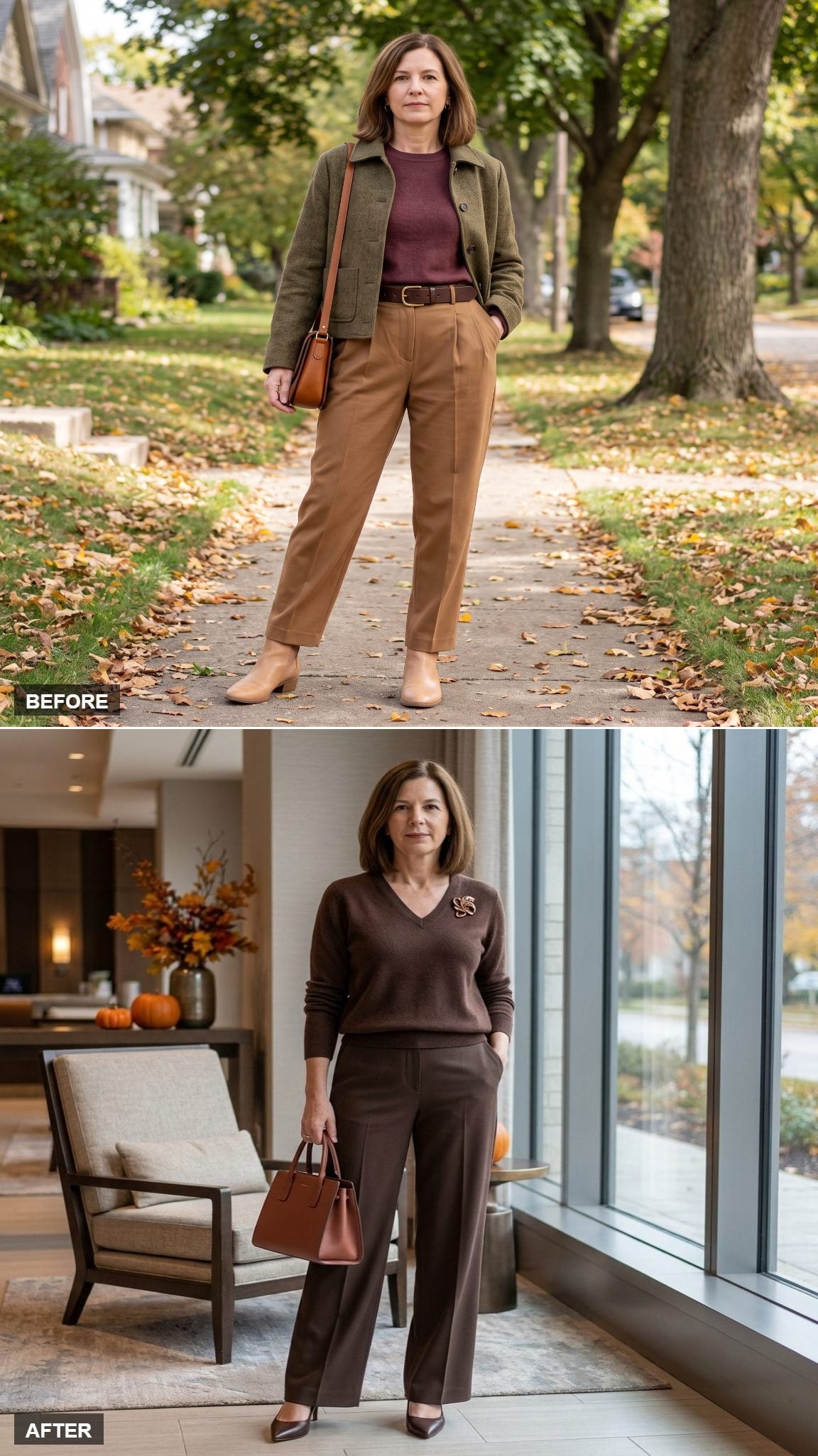
A chocolate cashmere V-neck sweater flows into espresso fluid wide-leg trousers with very little contrast at the waistband.
The sweater blouses gently over the top rather than disappearing into a hard tuck. Espresso pointed pumps continue the dark lower line, while a sculptural brooch moves attention toward the shoulder. The muted-rust bag is carried away from the torso, turning the sole strong color break into an accessory rather than a dividing line.
2. A Deep-Navy Jumpsuit Makes the Waistband Question Disappear Entirely
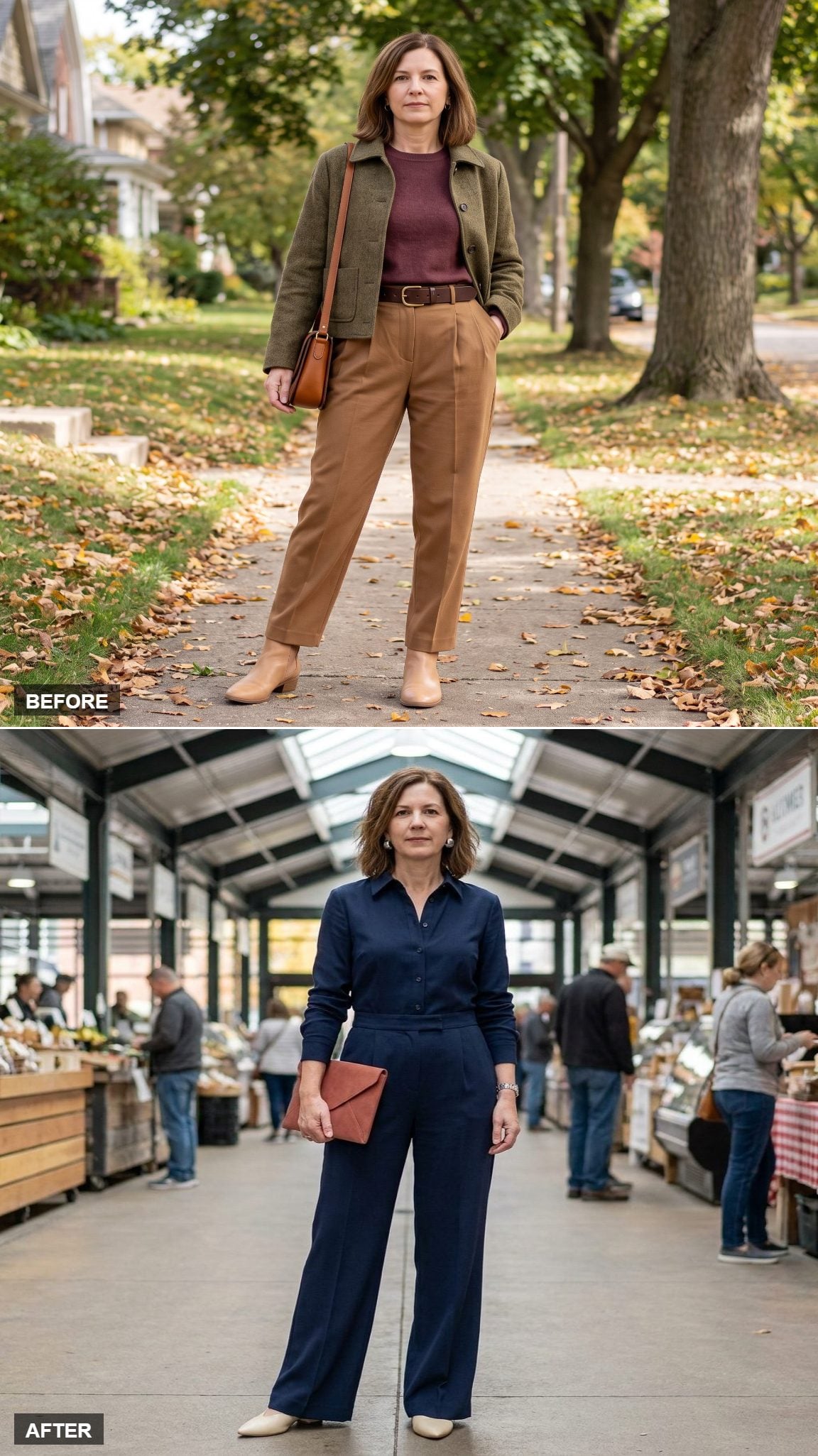
The deep-navy wide-leg jumpsuit handles proportion by refusing to create separate top and bottom zones in the first place. An open shirt collar and button placket give the upper half definition while fluid legs take over below.
Cream pointed flats, a muted-rust clutch, and bold silver studs are enough. The accessories finish the outfit rather than rescuing it.
1. Deep Blue Ends the Gallery With the Simplest Piece of Proportion Engineering
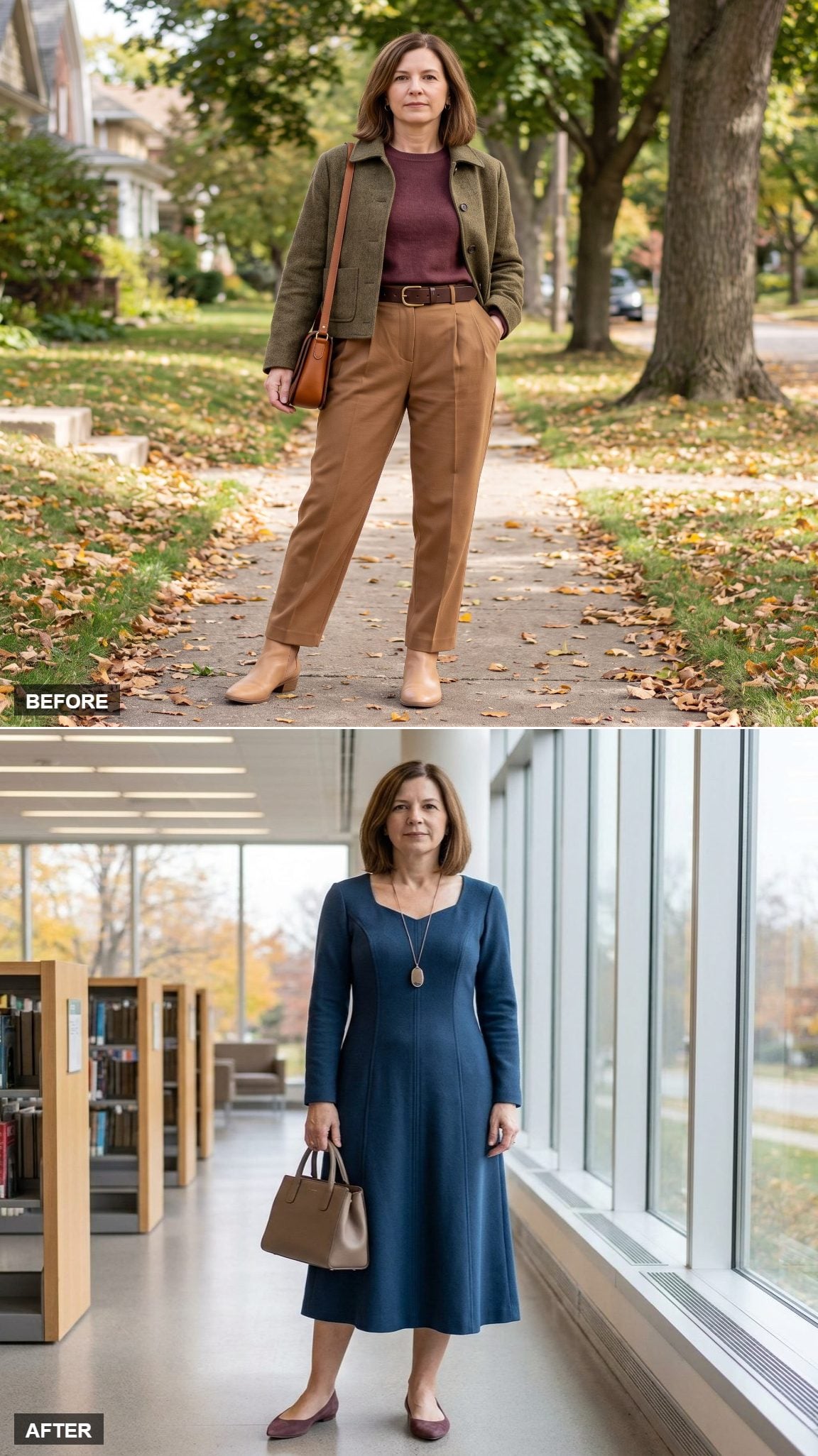
The last look returns to one dress and very little negotiation. Deep-blue wool crepe falls to mid-calf, with subtle front seaming providing structure and a neckline that opens from square toward a soft V.
One long pendant ends above the waist rather than landing directly across it. Muted-plum pointed ballet flats and a structured taupe top-handle bag supply the finishing details. Nothing is fighting for control of the middle.
That is really the argument underneath all 29 looks. Dressing a short waist is not about pretending the waist sits somewhere else, nor is it a campaign against belts, cropped jackets, contrast, or tucked shirts. It is about understanding how several garment edges interact when they arrive in the same small area.
Sometimes the smartest move is a longer jacket. Sometimes it is a low-contrast belt, an open neckline, a blouse allowed to fall loose, or trousers given enough length to establish their own proportion. And sometimes the most sophisticated answer is simply one very good dress. The body never needed fixing. The lines just needed better editing.