
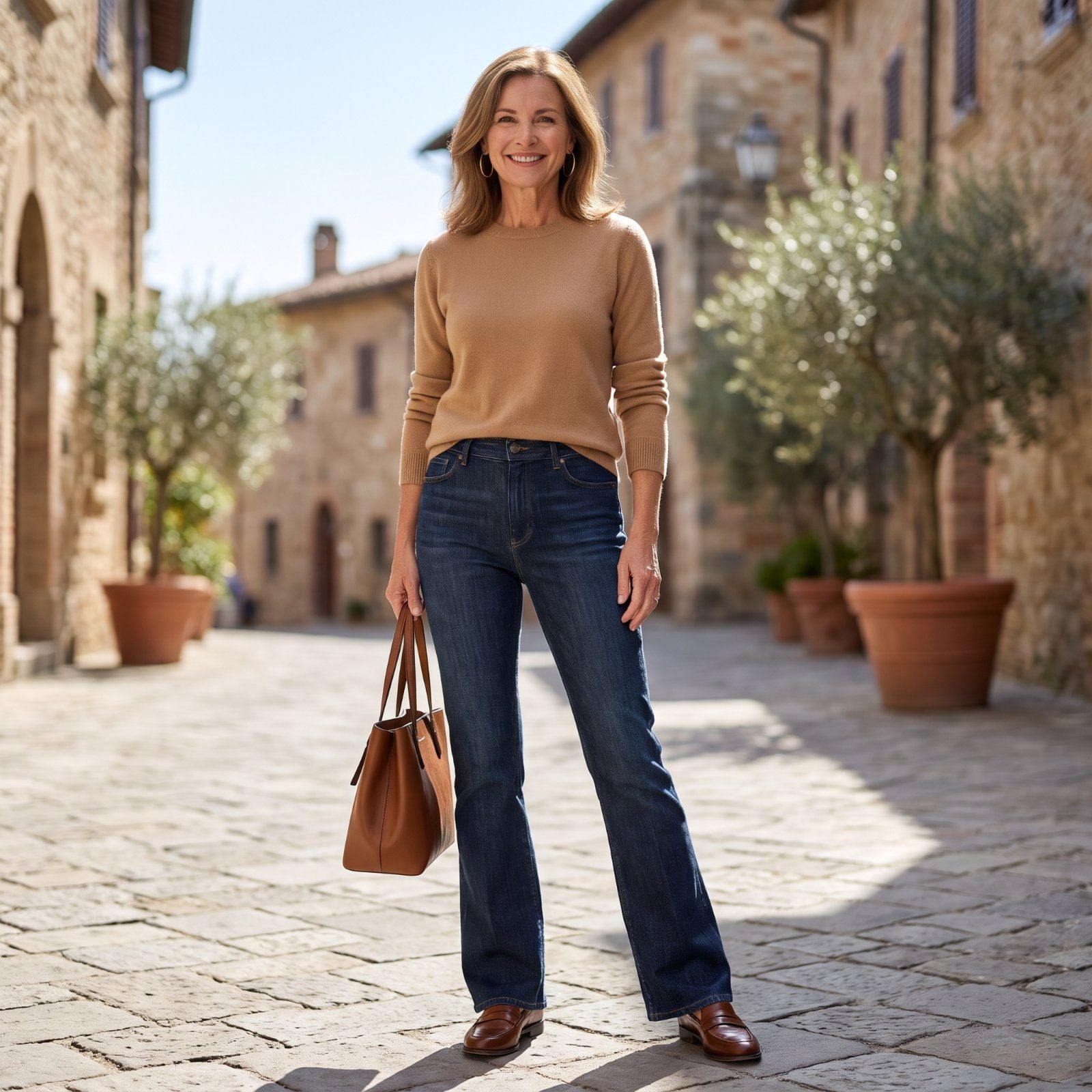
The smell of patchouli, a bell-bottom hem scraping across gravel, denim so wide it swung like a church bell when you walked. That was 1975, and the flare said plenty before you opened your mouth. The shape never actually left — it just grew up. These side-by-side looks show one silhouette living two lives: loud and loose then, sharp and deliberate now.
FYI, thanks to AI imagery software, we’re able to create very specific fashion and hairstyle examples to illustrate the points being made. In some cases, imagery is exaggerated to hammer home the point. Also, assume links that take you off the site are affiliate links such as links to Amazon. this means we may earn a commission if you buy something.
40. Patchwork Denim With Clogs Becomes Dark-Wash Flares With Loafers
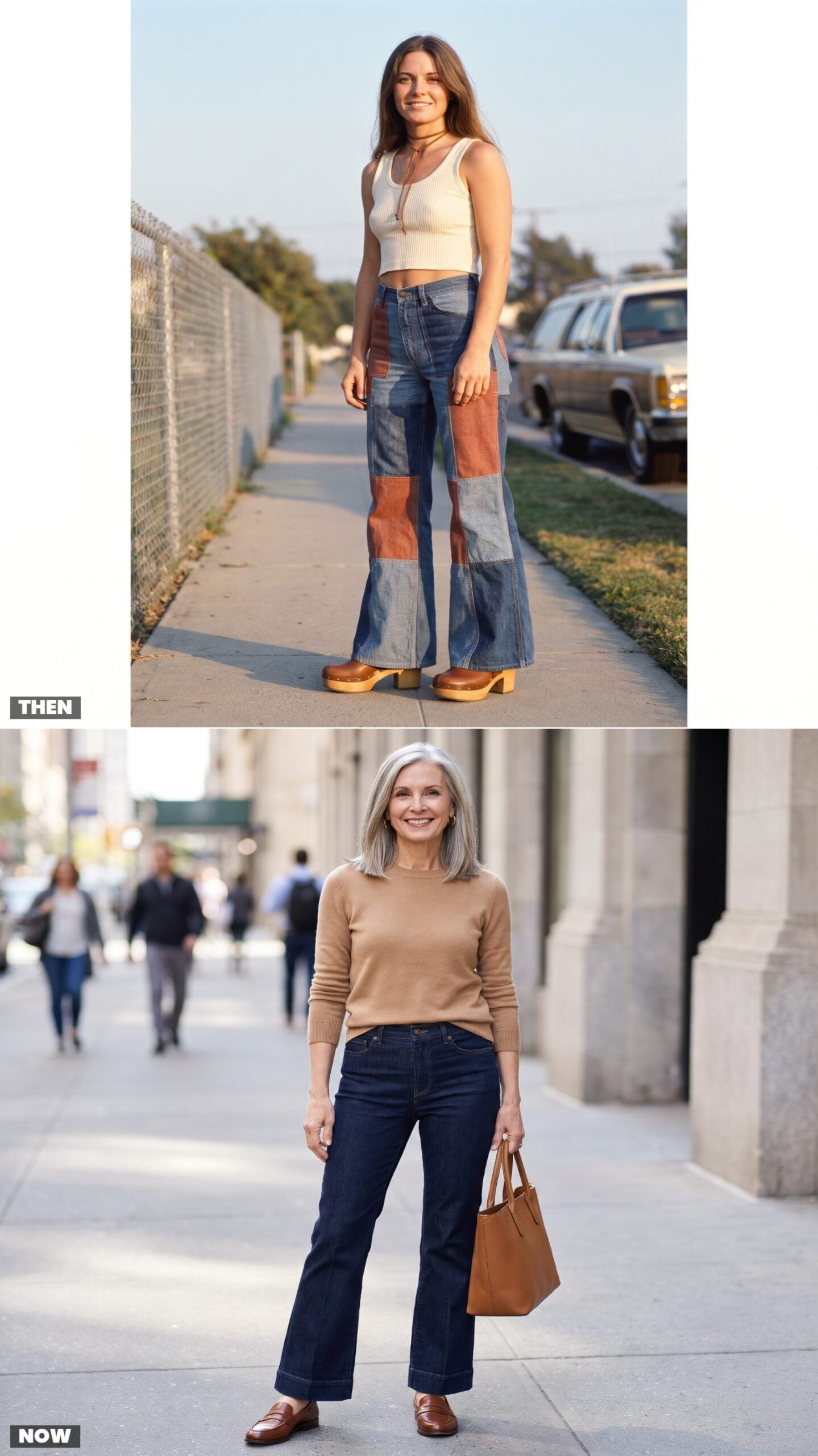
Patchwork in 1975 was about making one pair of jeans look like five — charming, scrappy, a little chaotic. The dark-wash update does the opposite job. One clean indigo tells the whole story, and the loafer gives that wide leg somewhere serious to land.
It comes down to the hem. A kick flare that grazes the top of a brown leather loafer reads as intentional, where a dragging hem over clogs always read as careless. Tuck the camel cashmere crewneck at the front only and you keep the waist in the conversation.
39. Faded Bell-Bottoms With a Graphic Tee Becomes Tailored Flares With a Refined Print Top
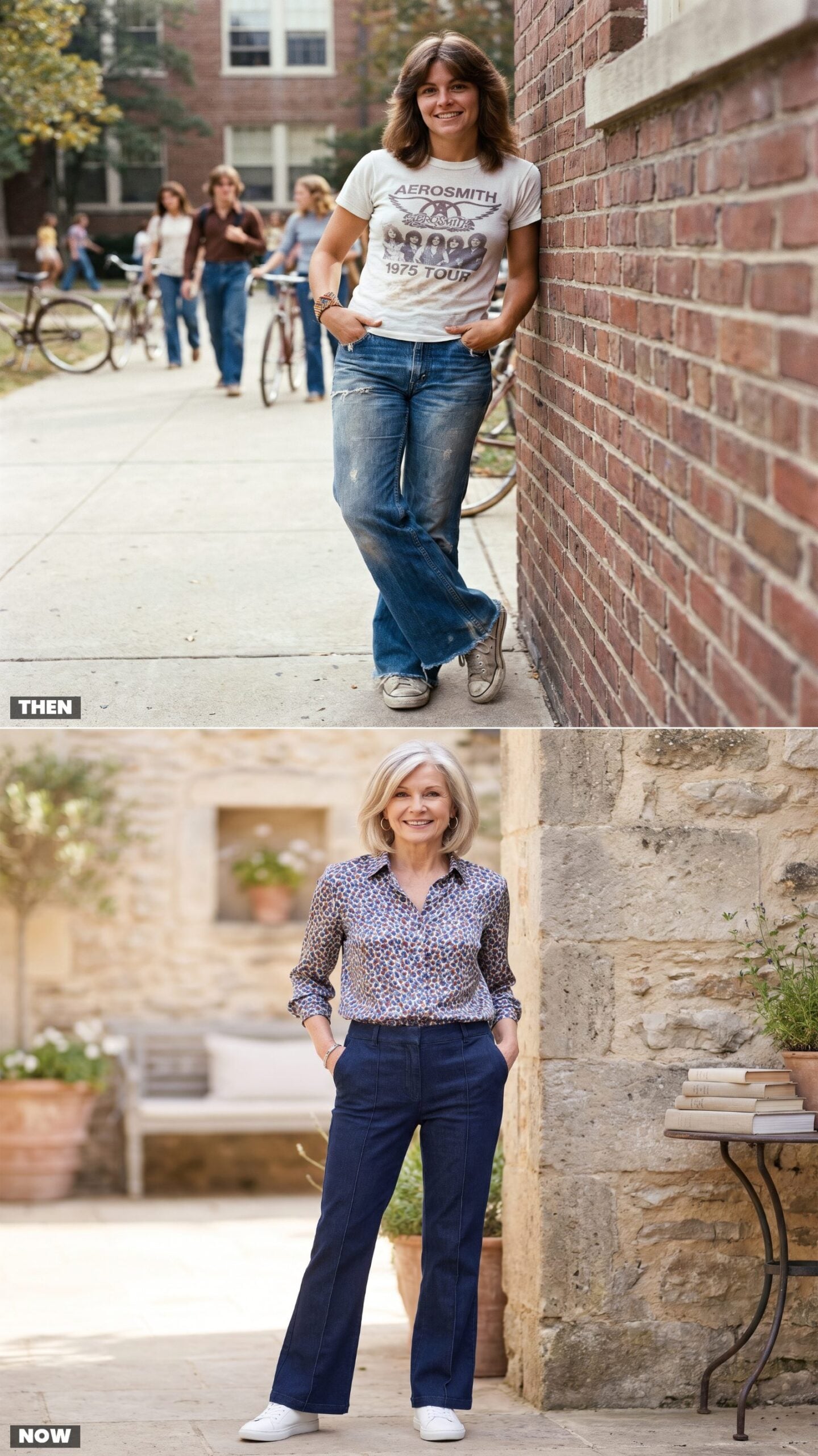
The graphic tee was the whole mood in 1975 — a band, a slogan, a sun you squinted at. That print still lives in the update, just smaller and softer, carried in a silk blouse instead of shouted across the chest.
What makes the modern version sing is the tension between a crisp pressed denim seam and the fluid drape of silk up top. Structured bottom, liquid top. Clean white sneakers keep it from tipping too formal and let the printed silk blouse do the talking.
38. White Flares With a Peasant Blouse Becomes Ivory Flares With a Tonal Knit
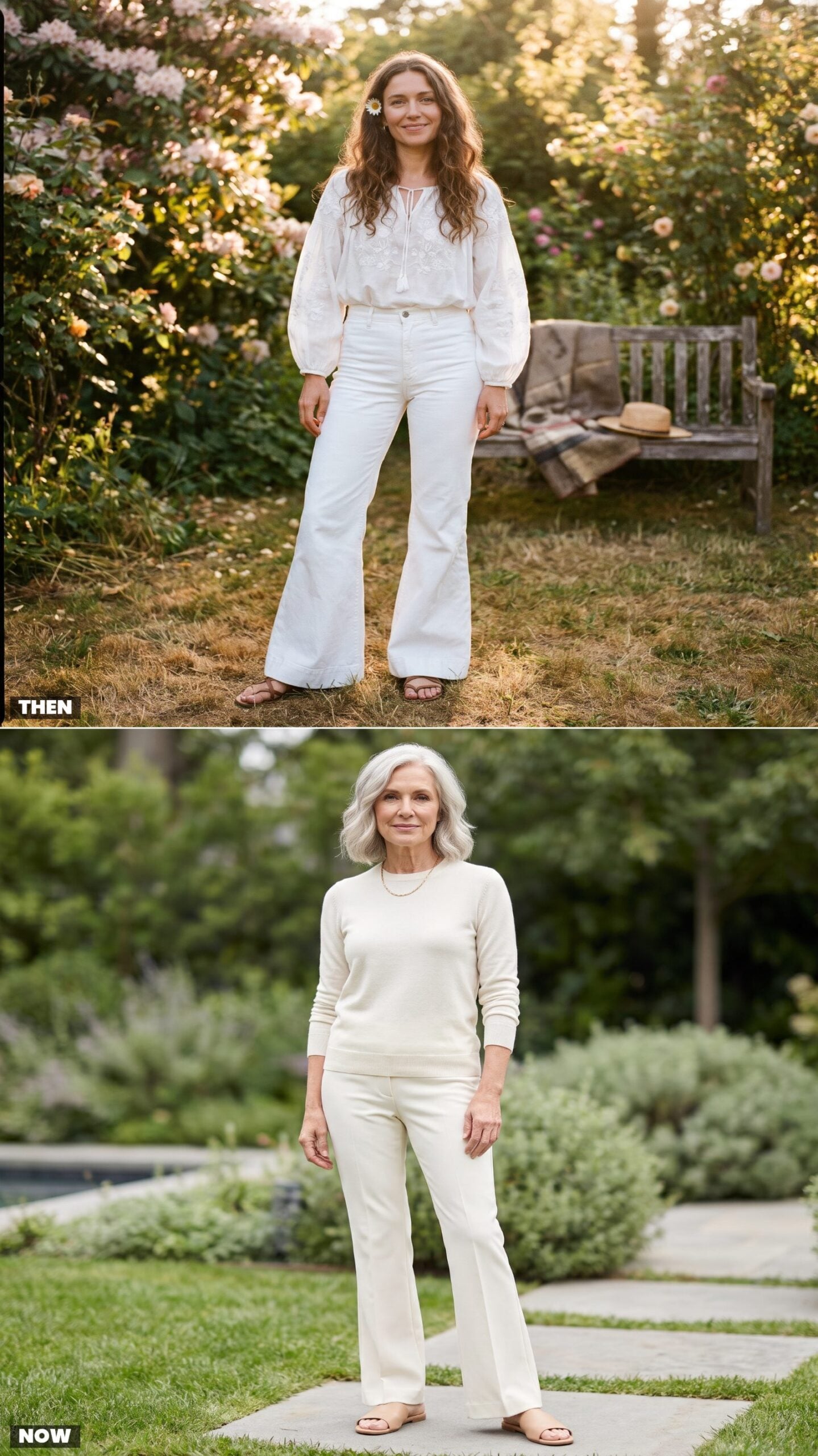
Head-to-toe white in 1975 meant airy and a little undone, that peasant blouse breathing in the breeze. The tonal ivory version keeps the glow but trades the froth for a clean line.
Monochrome does all the work. When the ivory flares and the ivory knit sit in the same quiet shade, nothing cuts the body in half, so you read as one long warm column. A fine-gauge knit keeps the top close, which lets the flare be the only drama in the look.
37. Brown Corduroy Bells With a Turtleneck Becomes Chocolate Cords With Cashmere
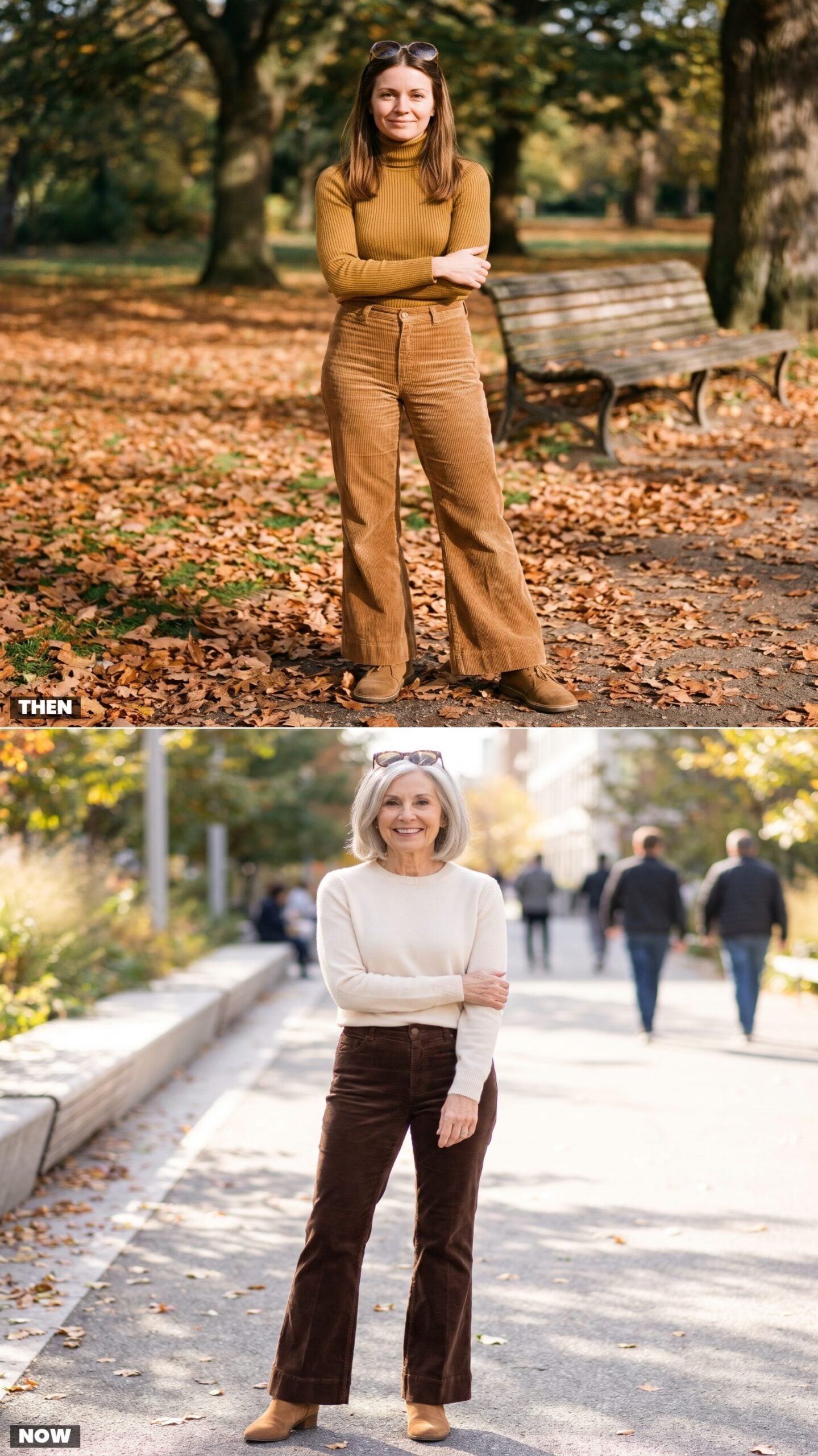
Wide-wale corduroy in 1975 had real heft, the kind of fabric that swished and held its shape even when the flare got out of hand. The modern chocolate version keeps the warmth and loses the bulk with a finer wale and a cleaner leg.
Texture is the quiet star. Matte corduroy against a cream cashmere crewneck gives you depth without a single bright color, so the look feels rich rather than loud. Swapping mustard rib for soft cashmere pulls it decades forward without losing a thread of that cozy autumn feeling.
36. Polyester Flares With a Dagger Collar Becomes Fluid Flares With a Silk Button-Down
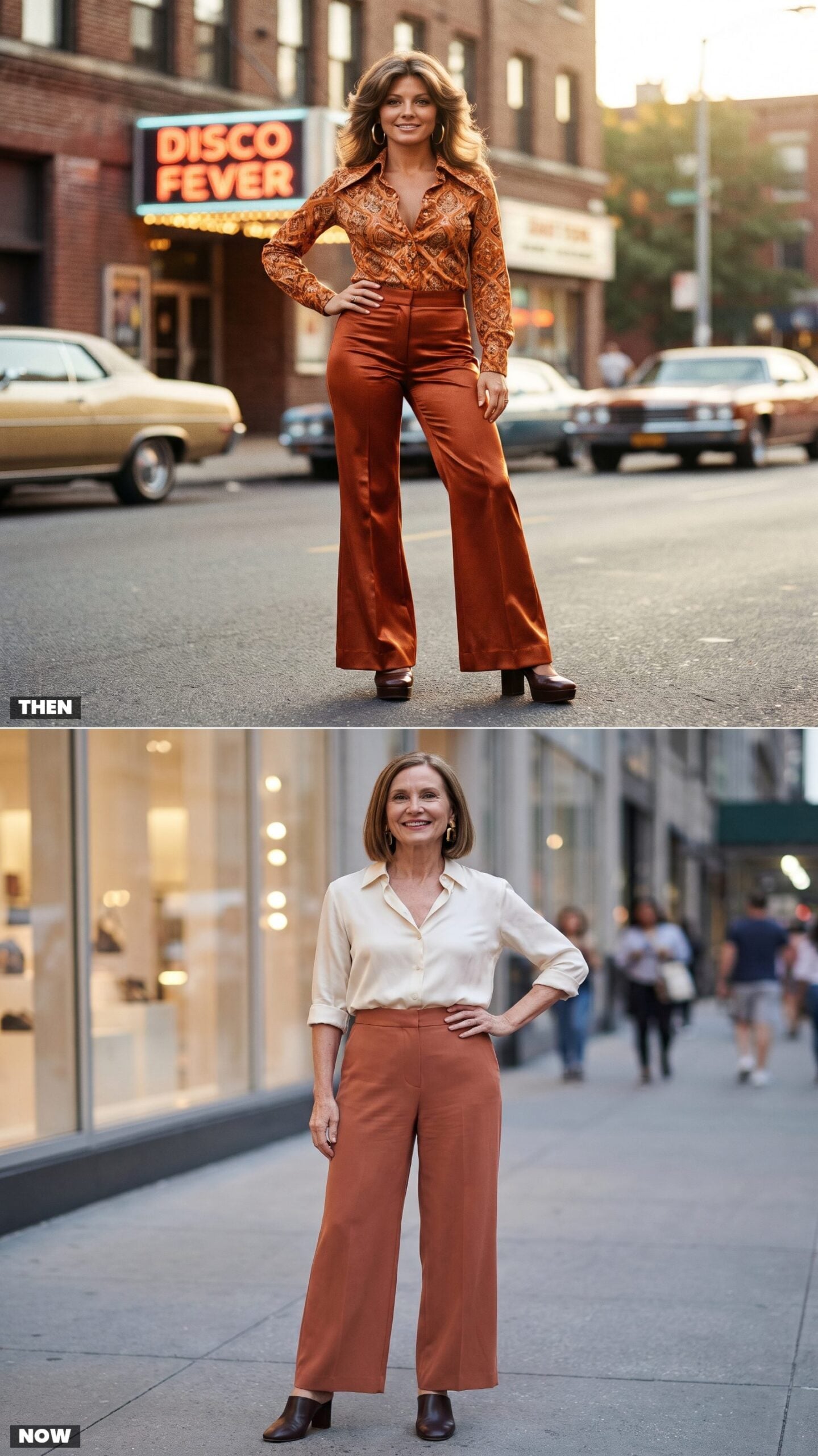
That dagger collar was pure 1975 swagger, pointing halfway to the shoulders and catching every bit of disco light off the polyester. The update swaps shine for drape and keeps all the nerve.
Fluid is the word that changed. Where old polyester held a stiff bell shape, a terracotta fluid flare moves like water, and a silk button-down with pushed sleeves softens that sharp collar into something you’d actually wear to dinner. It’s easy to assume flares only work loud. This one proves they can whisper and still own the room.
35. Embroidered Jeans With a Crochet Vest Becomes Subtle Flares With a Longline Vest
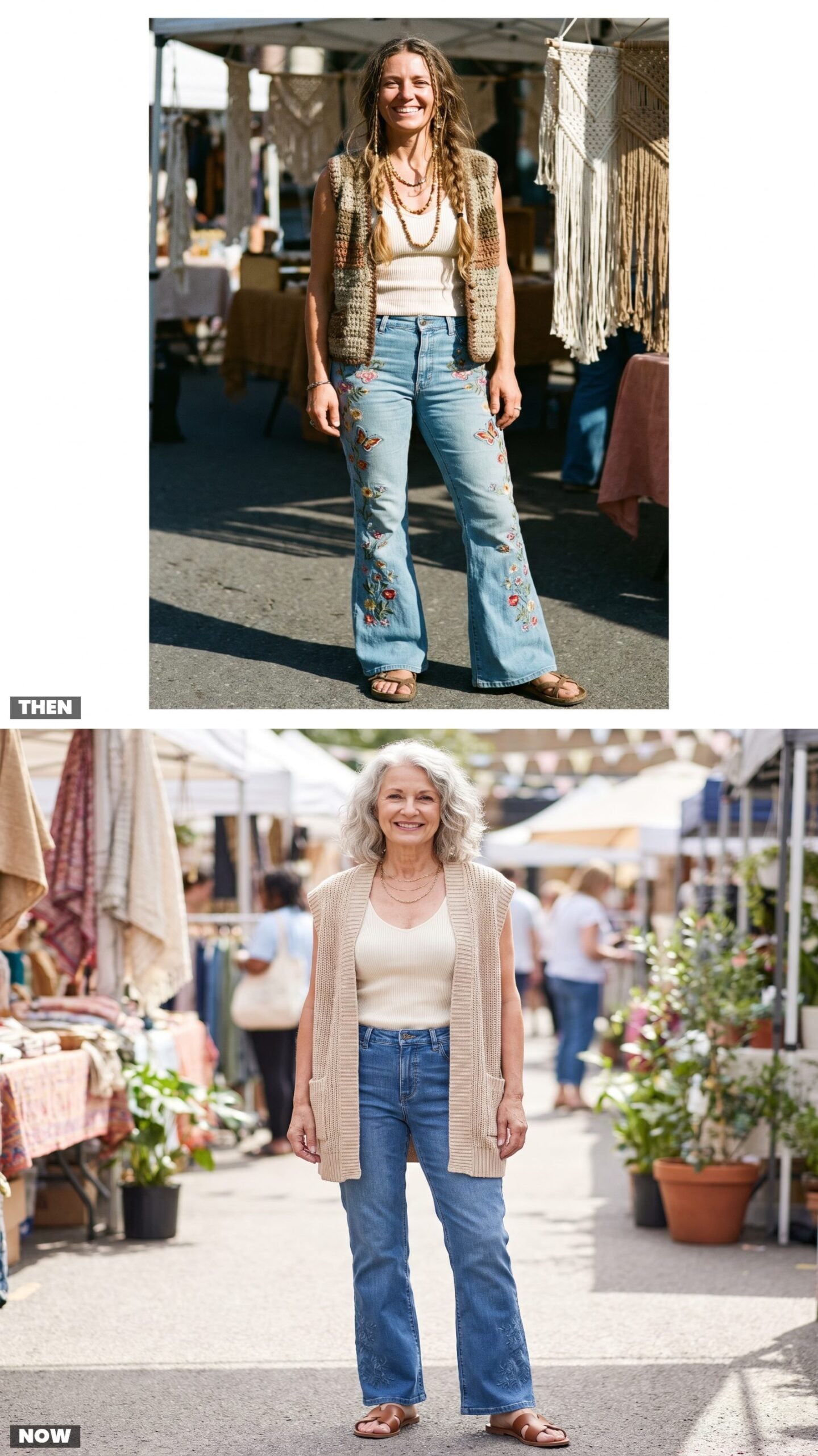
Embroidery in 1975 covered acreage. Butterflies up the thigh, flowers down the flare, a whole garden on your legs. The grown-up take keeps a whisper of it tucked at the hem and lets a longline vest carry the layered mood instead.
Proportion is the lead decision. A longline vest left open draws a clean vertical line right down past the hip, lengthening the whole frame and keeping the eye moving. The bohemian spirit survives. The visual noise does not.
34. Low-Rise Bells With a Halter Becomes High-Rise Flares With a Draped Blouse
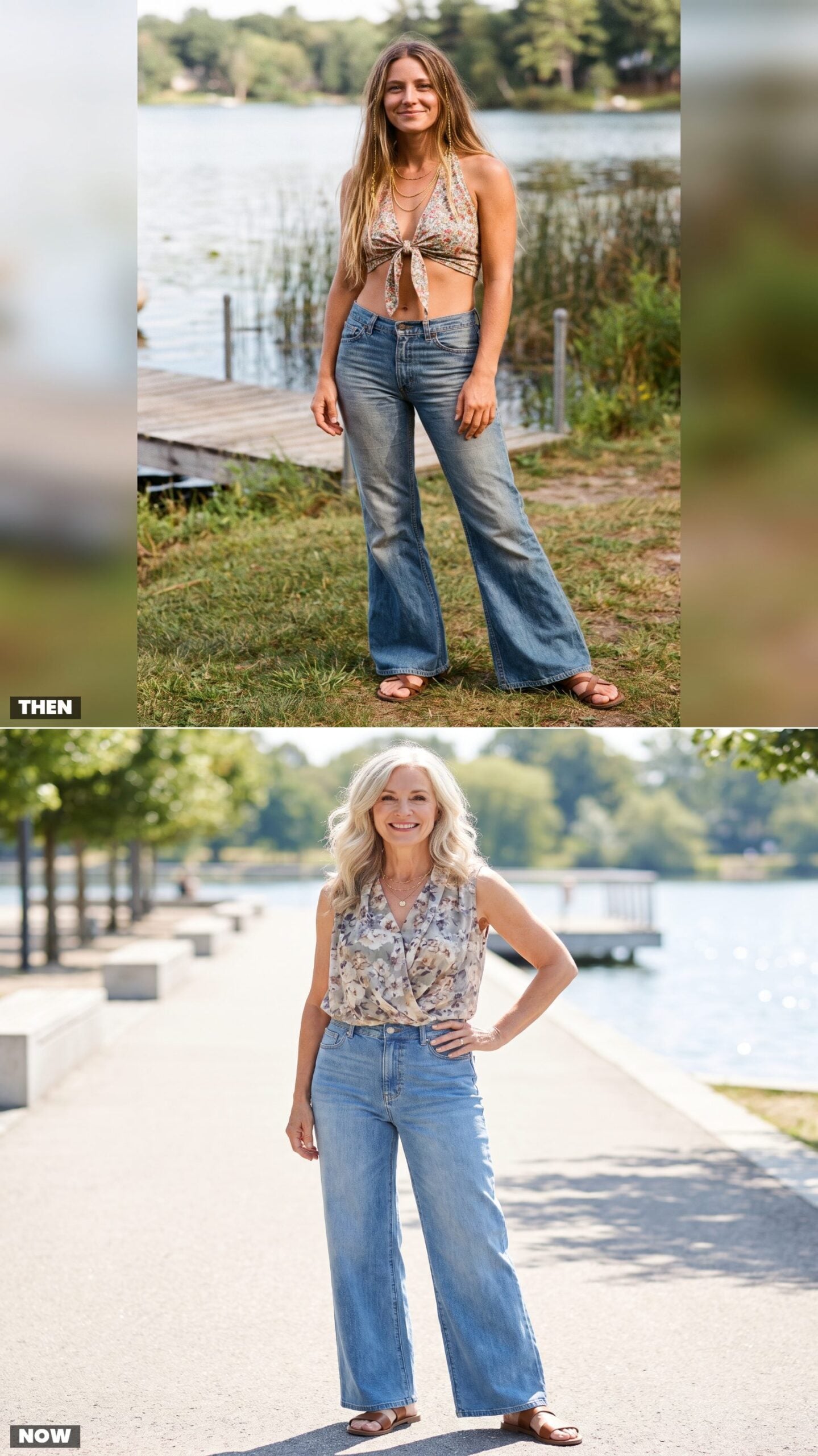
Low-rise and a halter was the summer uniform in 1975, waistbands sliding lower every season until the flare did all the covering. The high-rise flip? Smartest update on this whole list.
Raising the waistline changes everything. A high-rise flare sits where the body is narrowest and sends the leg line soaring, while a draped sleeveless blouse keeps the shoulders on show without the bare-midriff gamble. Half-tuck the front and you mark the waist exactly where you want the eye to stop.
33. Navy Sailor Flares With a Striped Tee Becomes Sailor Flares With a Breton Knit
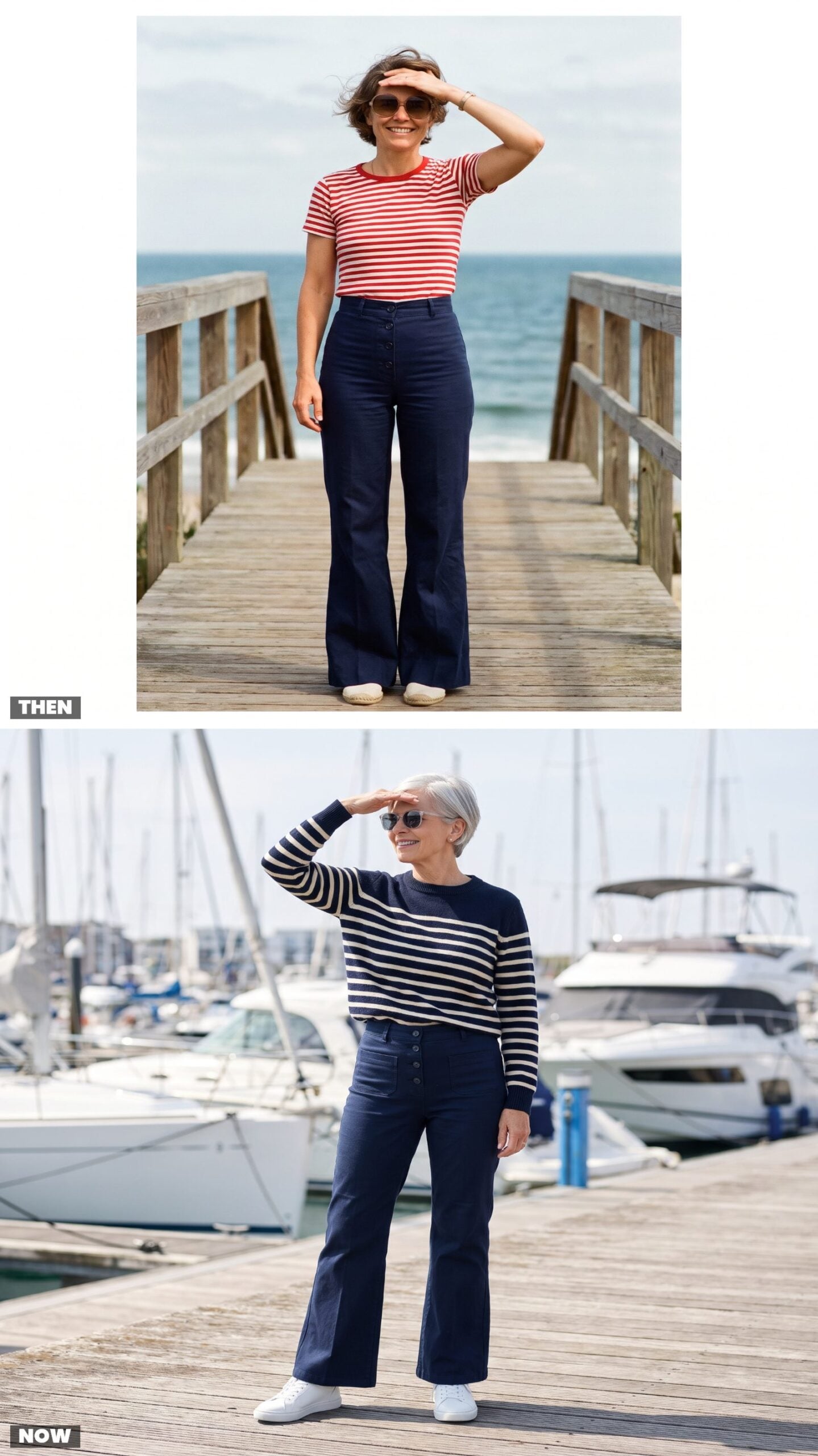
The sailor flare already looked timeless in 1975, those front buttons marching up the high waist like a naval uniform that went on holiday. Barely anything needed fixing.
What modernizes it is swapping a thin striped tee for a proper Breton knit with real weight. The thicker stripe sits cleaner against the button placket, and the structure holds its shape against the breeze. One of those festival style staples that works just as well on a boardwalk as it does in a field.
32. Plaid Flares With a Ribbed Sweater Becomes Windowpane Flares With Fine-Gauge Knit
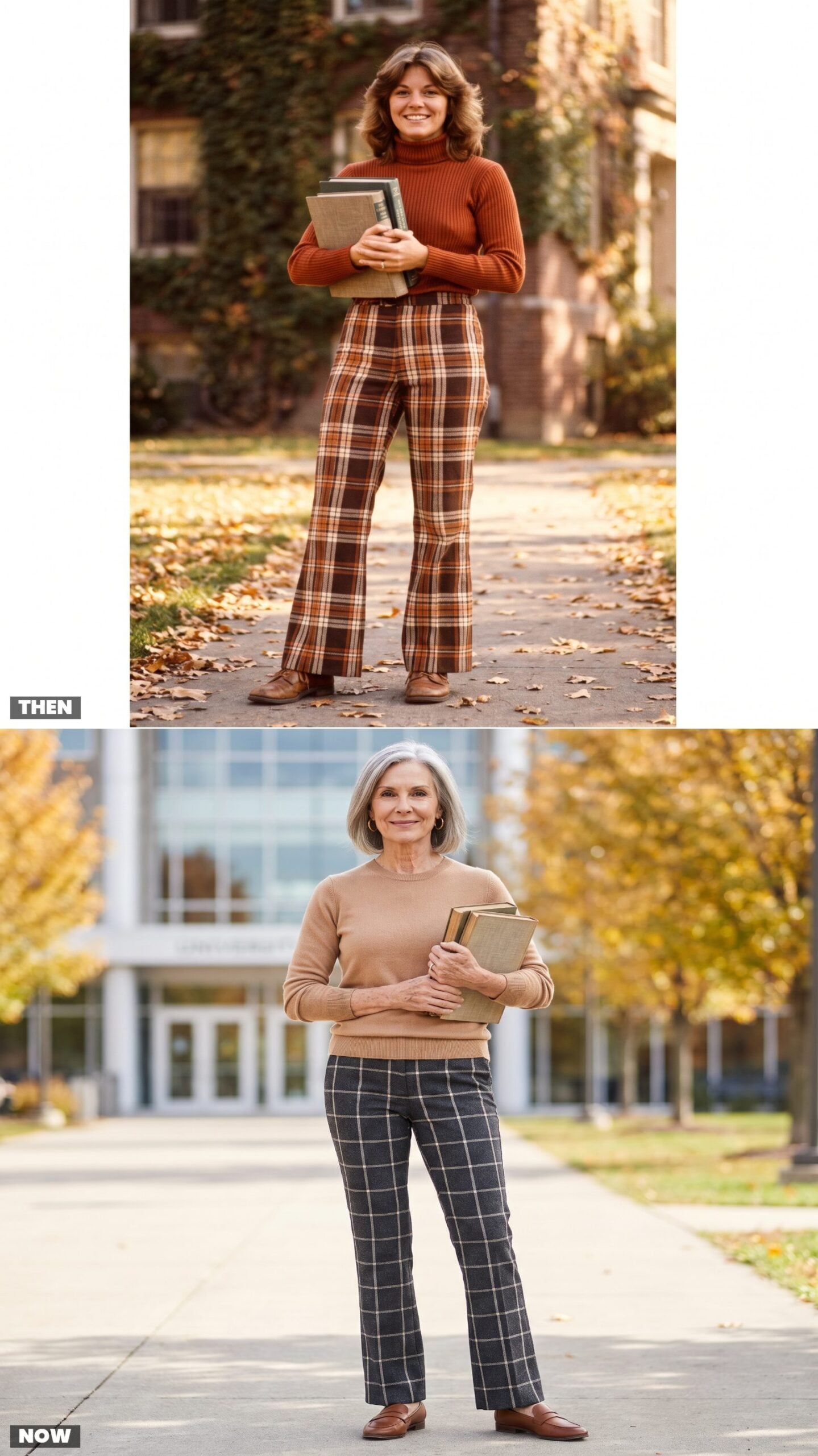
Big, brawny plaid defined the 1975 flare, those oversized blocks of brown and orange reading loud from across the lawn. Scale is what the update dials way back.
A fine windowpane check keeps the heritage pattern but shrinks the grid, so the leg reads as a clean line with a quiet grid laid over it. Pair it with a soft camel knit and the whole thing goes from dorm-room to boardroom-adjacent. Your wardrobe is better for one restrained pattern than three loud ones.
31. Suede Flares With a Fringe Jacket Becomes Faux-Suede Flares With a Blazer
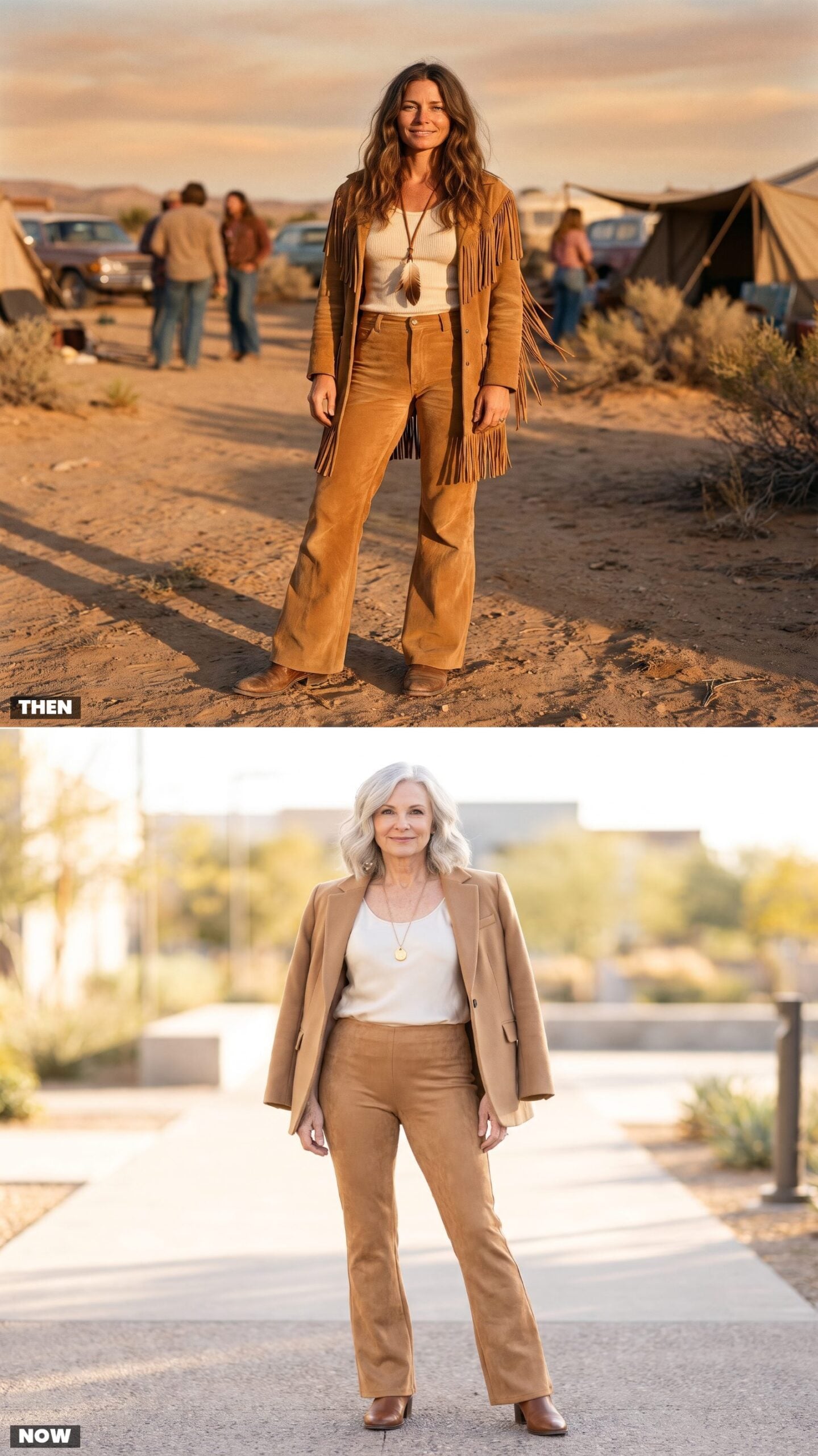
Fringe was the sound of 1975, swinging off a suede jacket with every step, the whole look practically in motion before you moved. The update trades that swing for structure and ends up more powerful for it.
A structured camel blazer thrown over the shoulders does what fringe never could — it gives the soft faux-suede flares a sharp shoulder to answer to. Soft leg, hard shoulder. That contrast is where the authority lives, and a woman over fifty wears it like she invented it. Flares aged well. We all did.
30. Crushed-Velvet Bells With Platform Boots → Velvet Flares With Sleek Ankle Boots
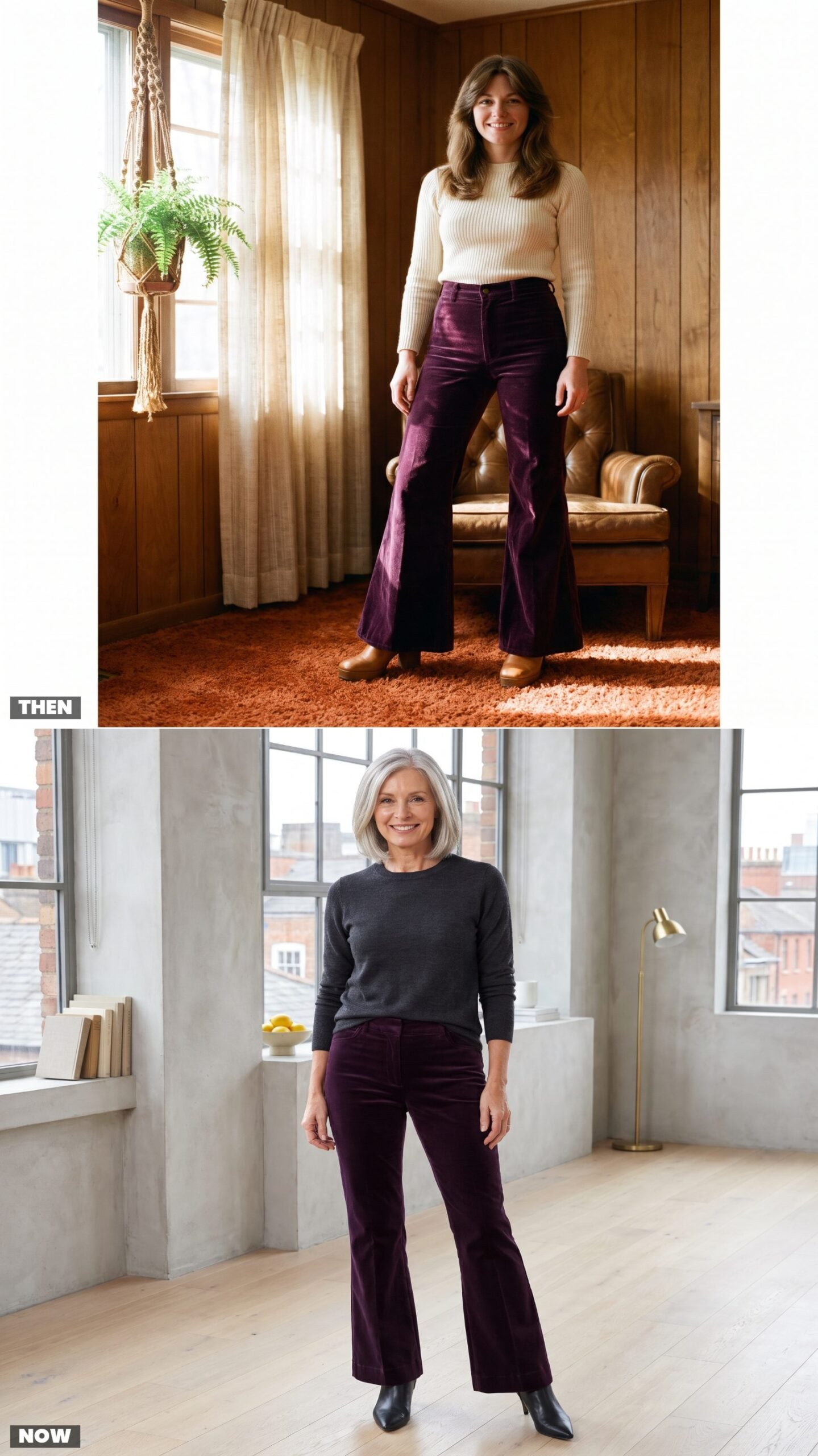
Crushed velvet in 1975 was a mood, not a fabric. That plum sheen moved with every step, the platform sole added an extra couple of inches, and the whole look was built to shimmer under a lamp. Texture ran the show — velvet pile against warm light, nothing else required.
The modern read keeps the pile but drops the drama. A smooth aubergine velvet flare paired with black pointed ankle boots trades the clunk of platforms for a clean vertical line. The velvet still catches light. It just stopped shouting about it.
29. Denim Bells With a Waistcoat → Trouser Flares With a Tailored Vest
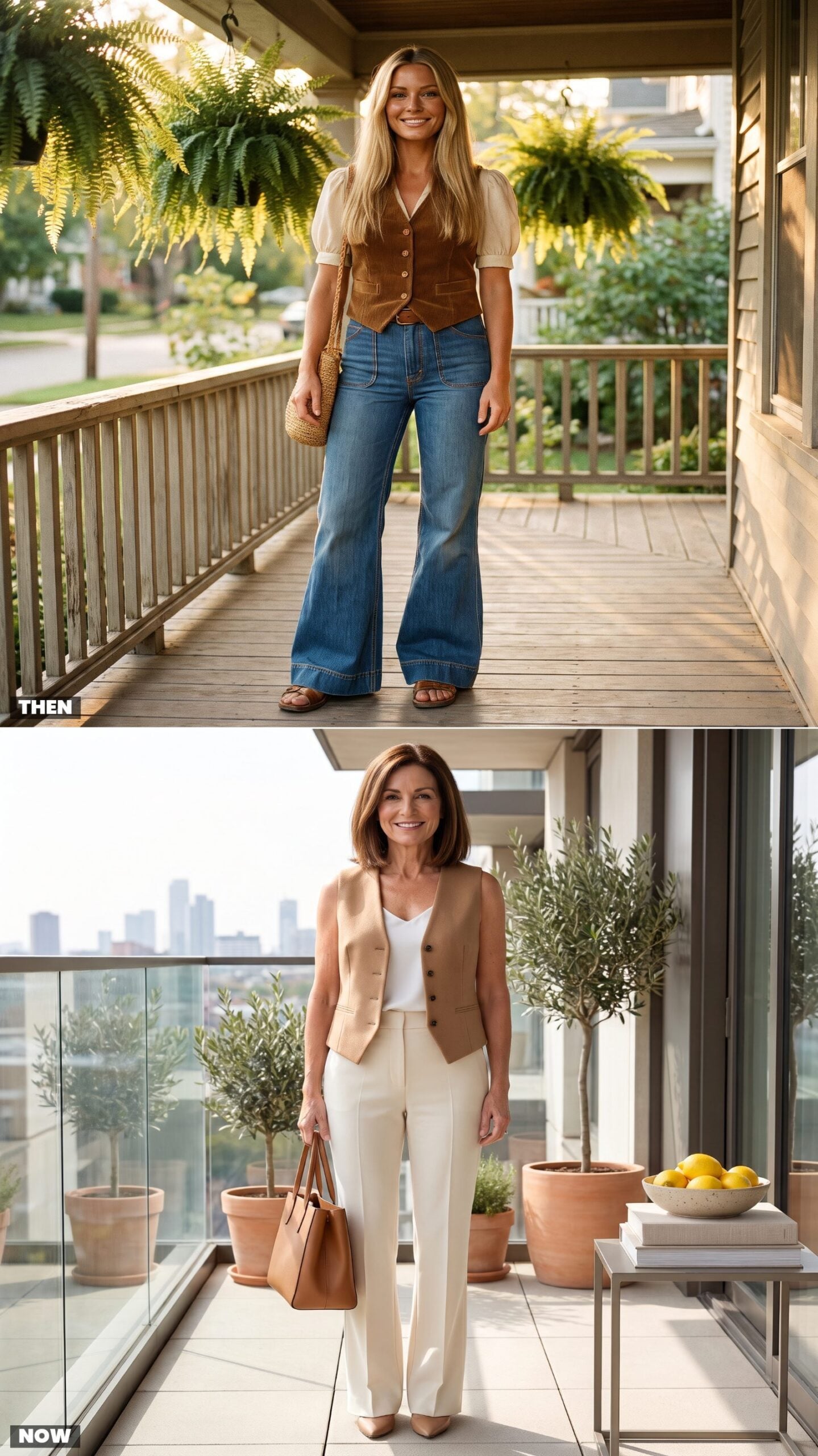
The waistcoat-over-bells formula was pure 1975 shorthand for pulled-together. A corduroy vest buttoned over a blouse, denim flaring wide underneath, that earthy brown-and-cream palette everyone wore to the cider festival.
Now the vest does the tailoring work the denim used to resist. A camel tailored vest over cream crepe trouser flares turns the whole thing crisp. The flare stays. The scruff is gone. And that half-structured, half-fluid tension is the reason it reads as intentional — one of the best ways to show off a good pair of festival pants without looking like you tried too hard.
28. Khaki Flares With a Safari Shirt → Olive Flares With a Polished Utility Jacket
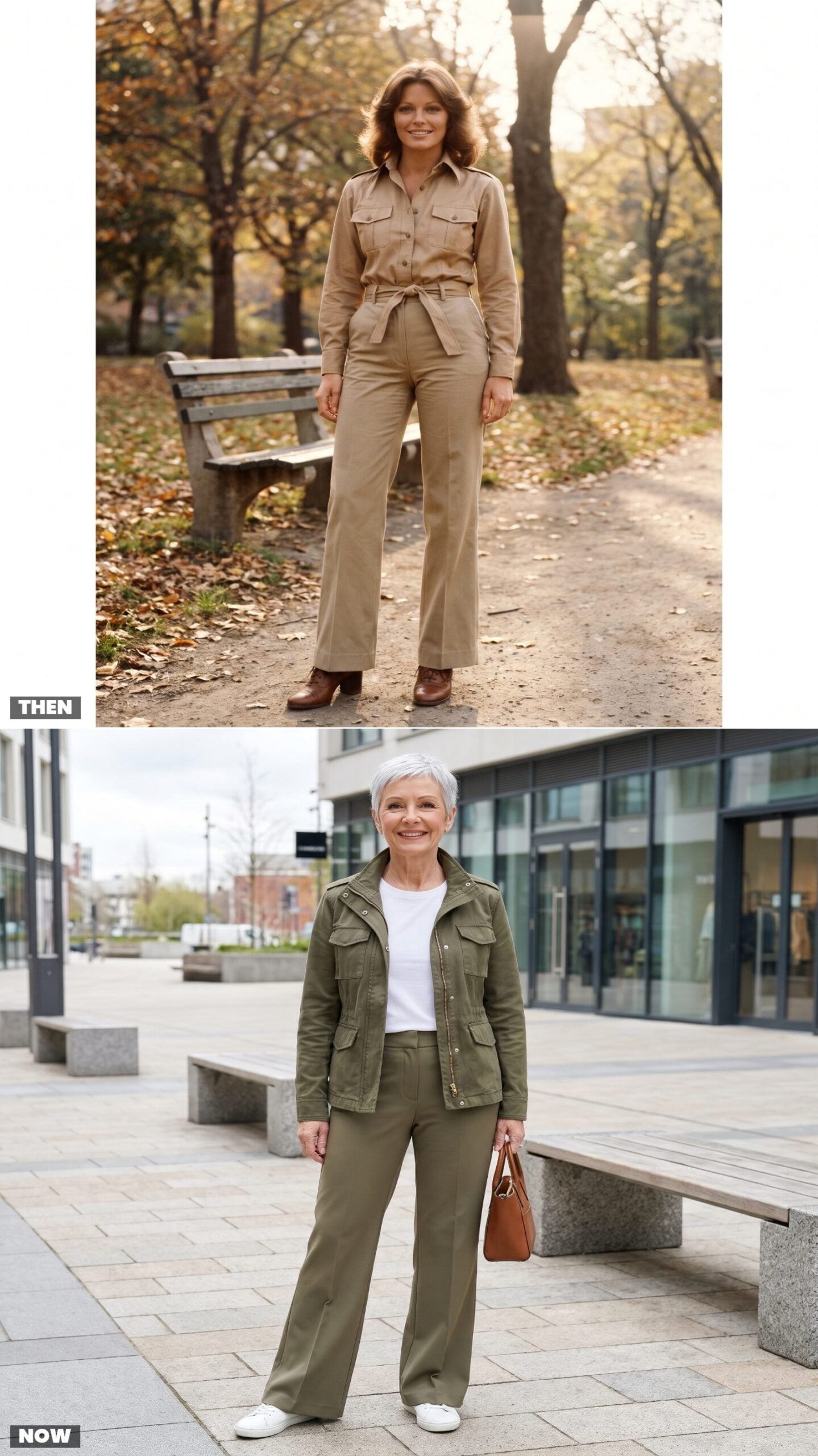
Safari dressing in 1975 meant epaulettes, tie-belts and enough pockets to lose your keys in. The khaki flare softened all that hardware, and the look read as adventurous without anyone going anywhere.
The update swaps the fussy safari shirt for a clean olive utility jacket and lets a crisp olive wide-leg flare carry the movement. Same rugged mood, half the pockets. What drives it is tonal commitment — olive on olive, broken only by a white tee, so the shape gets to do the talking.
27. Black Flares With a Sequined Top → Black Evening Flares With a Satin Blouse
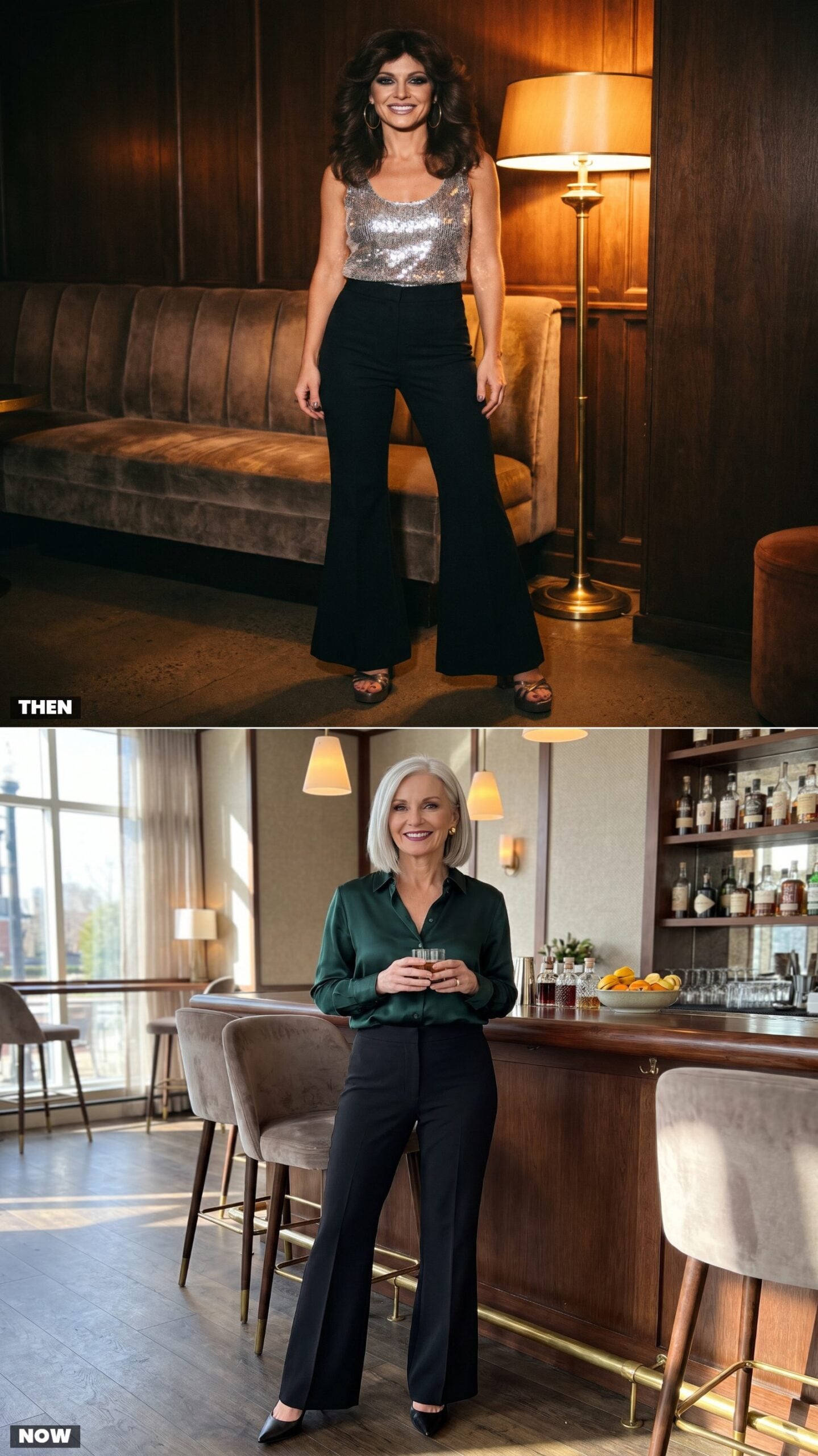
Sequins after dark were practically a dress code in 1975. A silver scoop-neck catching every amber bulb in the lounge, hair teased for altitude, platforms doing the rest.
The grown-up version swaps shine for sheen. A emerald satin blouse, half-tucked into fluid black crepe flares, reads as evening without the light show. The texture contrast is the whole trick — matte black below, liquid satin above. These are the kind of date outfits that look better the more composed you keep them.
26. Pinstriped Flares With a Wide-Lapel Jacket → Pinstriped Flares With a Single-Button Blazer
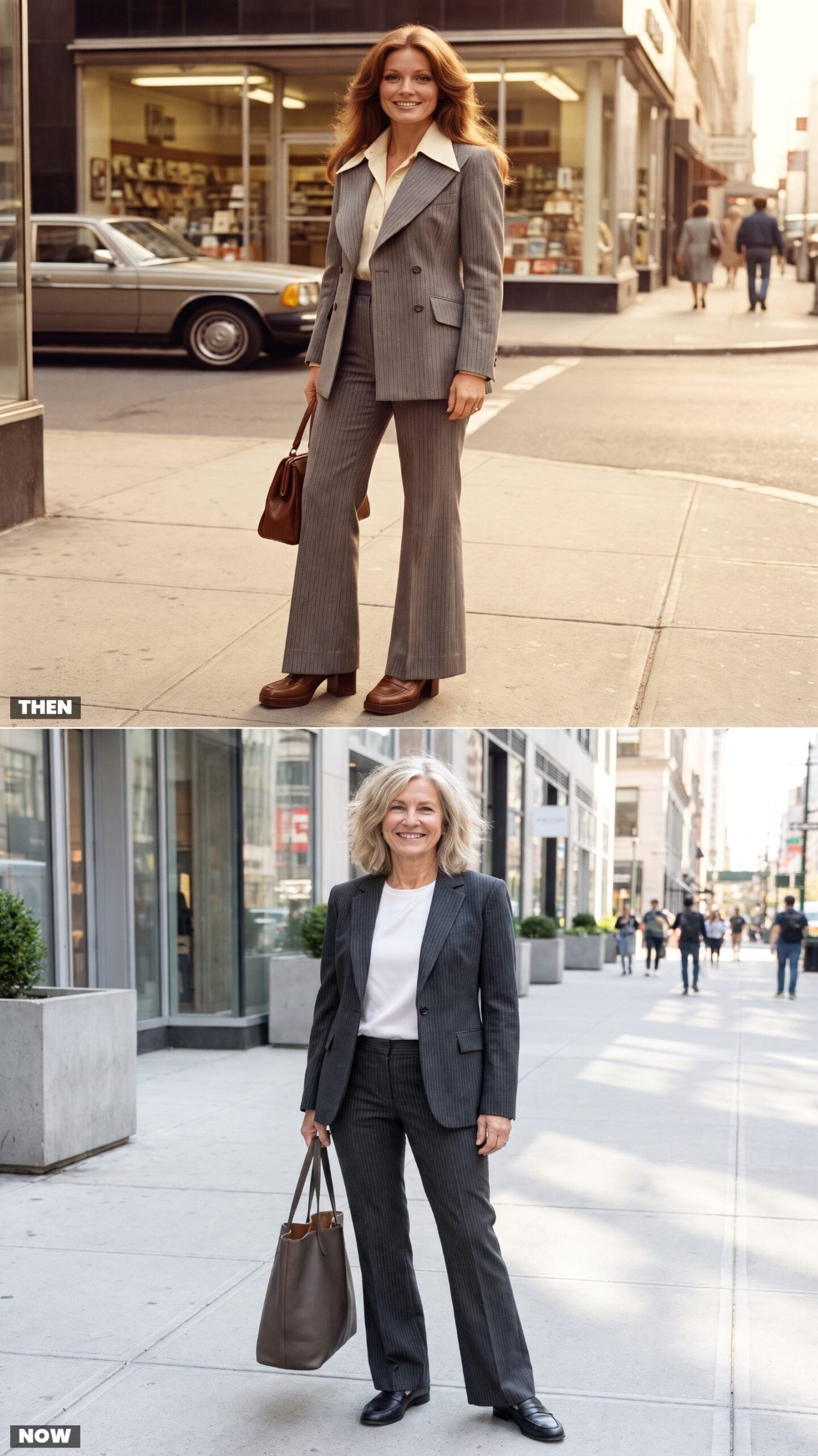
Those 1975 lapels could have doubled as airplane wings. The pinstriped flare suit was serious business dressing — all width and nip, worn with a pointed collar flopped out over the whole thing.
Shrink the lapel, keep the suit. A charcoal pinstripe blazer with a single clean button and slim notch, over matching grey pinstriped flares, still reads authority. It just whispers it now.
25. Floral Flares With a Matching Tunic → Printed Flares With a Solid Draped Top
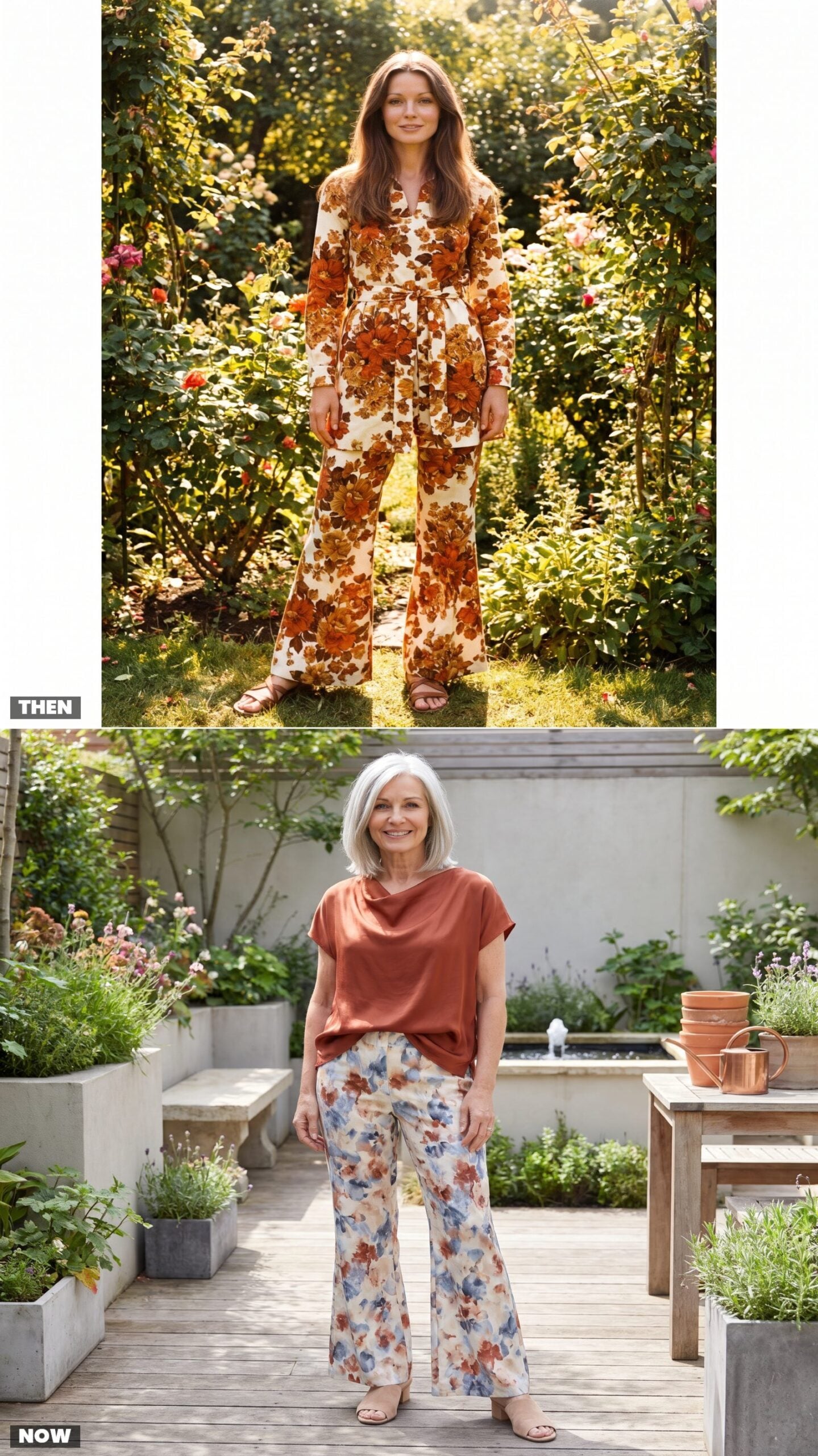
Print-on-matching-print was the 1975 power move, and bless them for the confidence. Head-to-toe flowers, no break — just a wall of orange and gold blooms from shoulder to ankle.
The modern version lets one printed piece breathe. Keep the printed flares, then pull the top back to a solid rust draped top that picks up one color from the print. Now the eye has somewhere to rest. That single calm block is what makes the print look chosen instead of worn by default.
24. Red Flares With a Pussy-Bow Blouse → Burgundy Flares With a Relaxed Tie-Neck Top
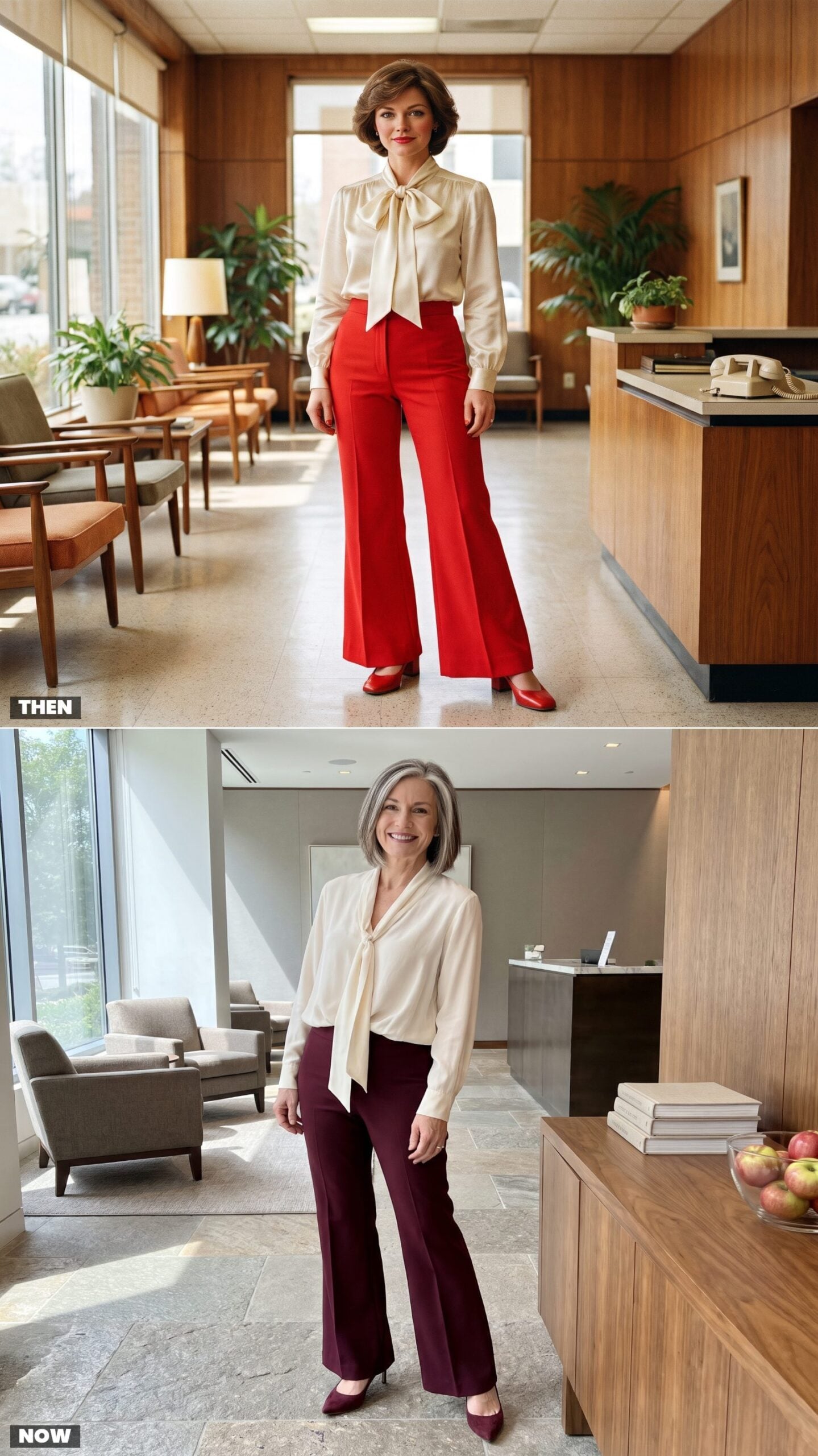
The pussy-bow in 1975 was cinched tight and sat high, formal to the point of a little breathless. Paired with fire-engine red flares, it was a look that walked into a room before you did.
Dial the color down, loosen the knot. A burgundy flare with a softly tied cream tie-neck blouse keeps the heritage of the look while letting you breathe. Burgundy over bright red is the smartest swap on this list — richer, less shouty, and far kinder near the face as your woman style matures.
23. Denim Flares With a Shearling Coat → Dark Flares With a Cropped Teddy Jacket
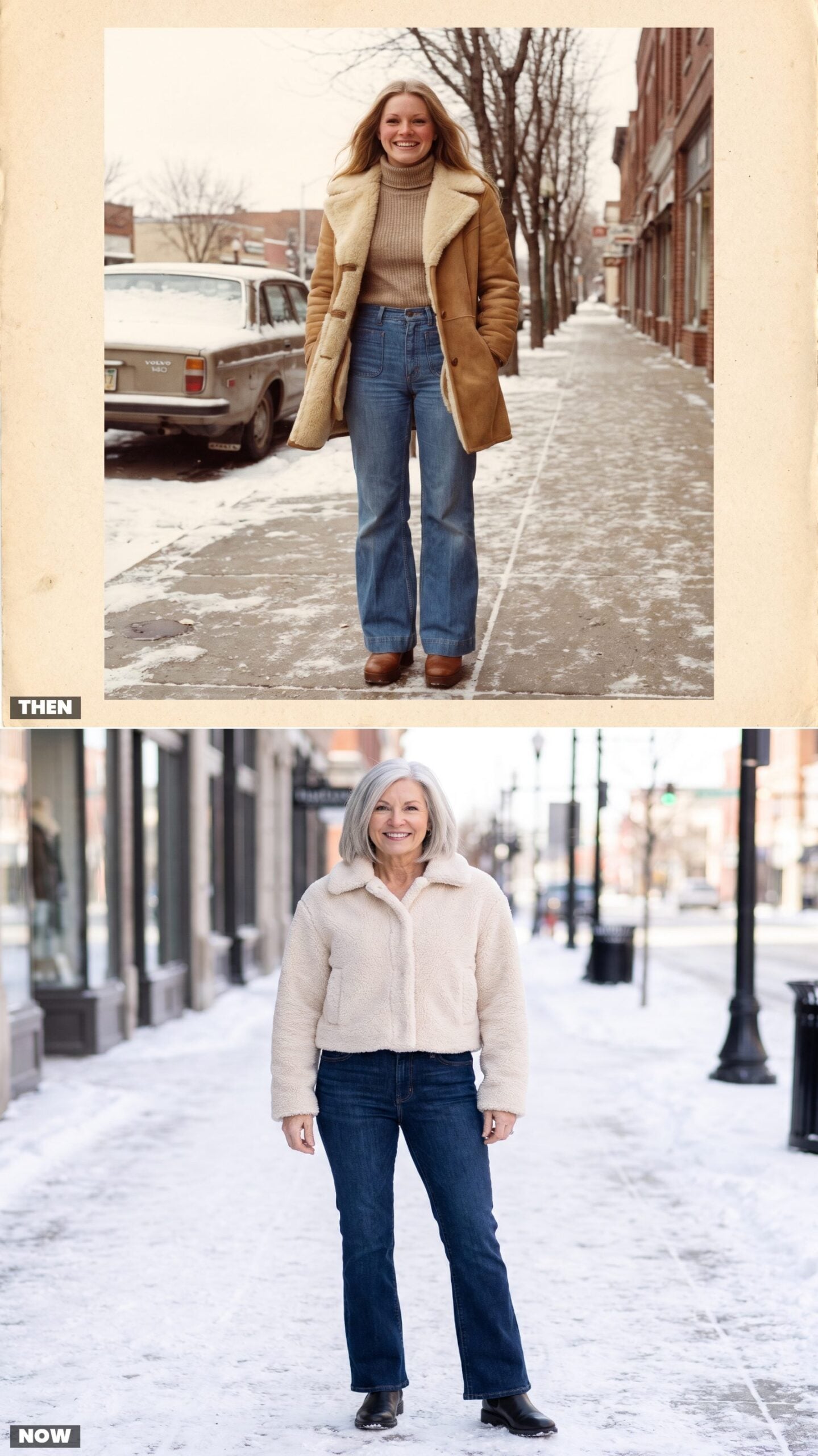
The long shearling of 1975 was warm, dramatic, and swallowed you whole. Worn open over denim bells, it was equal parts coat and declaration — the collar practically its own weather system.
Crop it and the proportions click. A cream teddy jacket ending at the high hip lets the full length of a dark indigo flare run uninterrupted. Short on top, long and lean below, so the eye reads one clean vertical instead of a coat eating a person.
22. Wide-Bell Jumpsuit → Belted Utility Jumpsuit With Subtle Flares
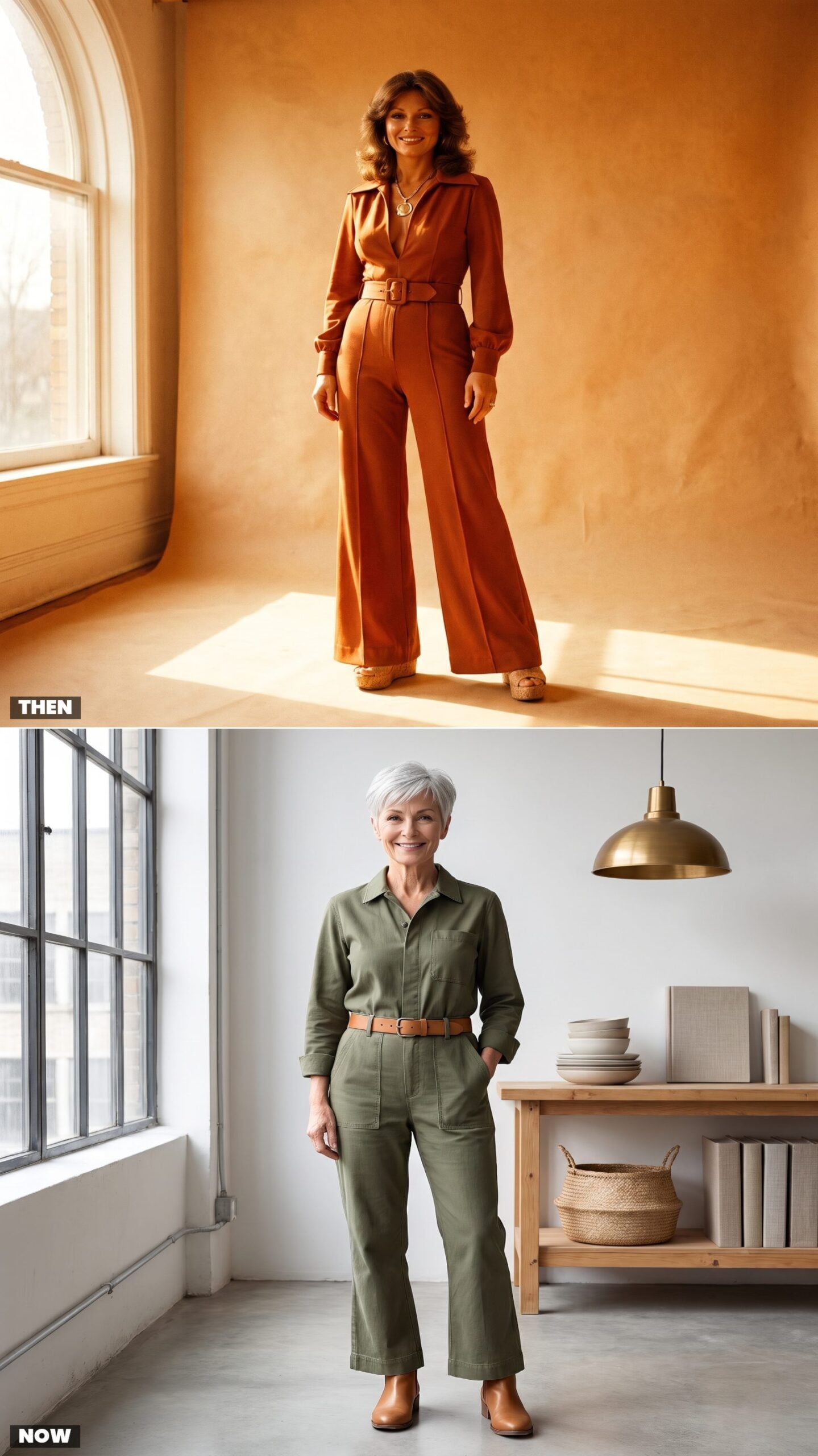
The 1975 jumpsuit went full commitment: one zip, a plunging collar, legs that flared like trumpet mouths. Glamorous, borderline impossible in a bathroom, and everyone wore it anyway.
Now the jumpsuit works for you instead of against you. A olive utility jumpsuit with pockets, a tan leather belt and a quieter flare at the hem keeps the one-and-done ease without the fuss. The belt is the hero piece — it breaks the long column so the silhouette has a defined waist instead of running straight.
21. Pastel Flares With a Fitted Polo → Powder-Blue Flares With a Relaxed Collared Knit
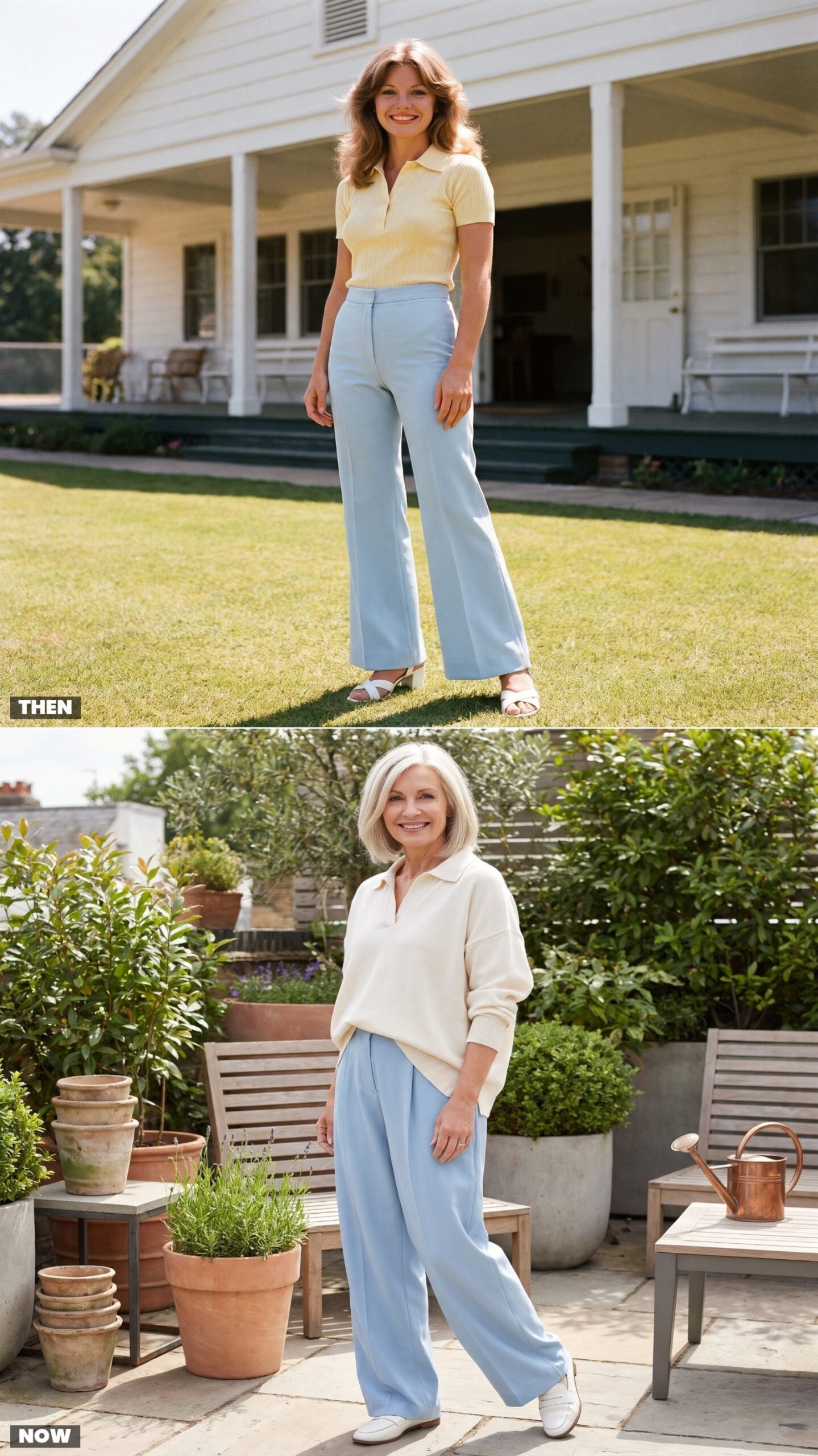
Preppy pastels in 1975 meant a polo buttoned to attention, tucked tight into powder-blue flares, everything crisp and a little starched for the club lawn.
Ease is the whole update. A relaxed cream collared knit half-tucked into soft powder-blue flares keeps the prep but loses the stiffness. That powder-blue-and-cream pairing is deliberately quiet, and the quietness is exactly why it lands as polished rather than sporty. Proof that a soft palette ages a lot better than a loud one — which is really what good style is about once you stop chasing trends.
20. Double-Denim Bells With Western Boots, Then Dark Flares With a Chambray Shirt and Pointed Boots
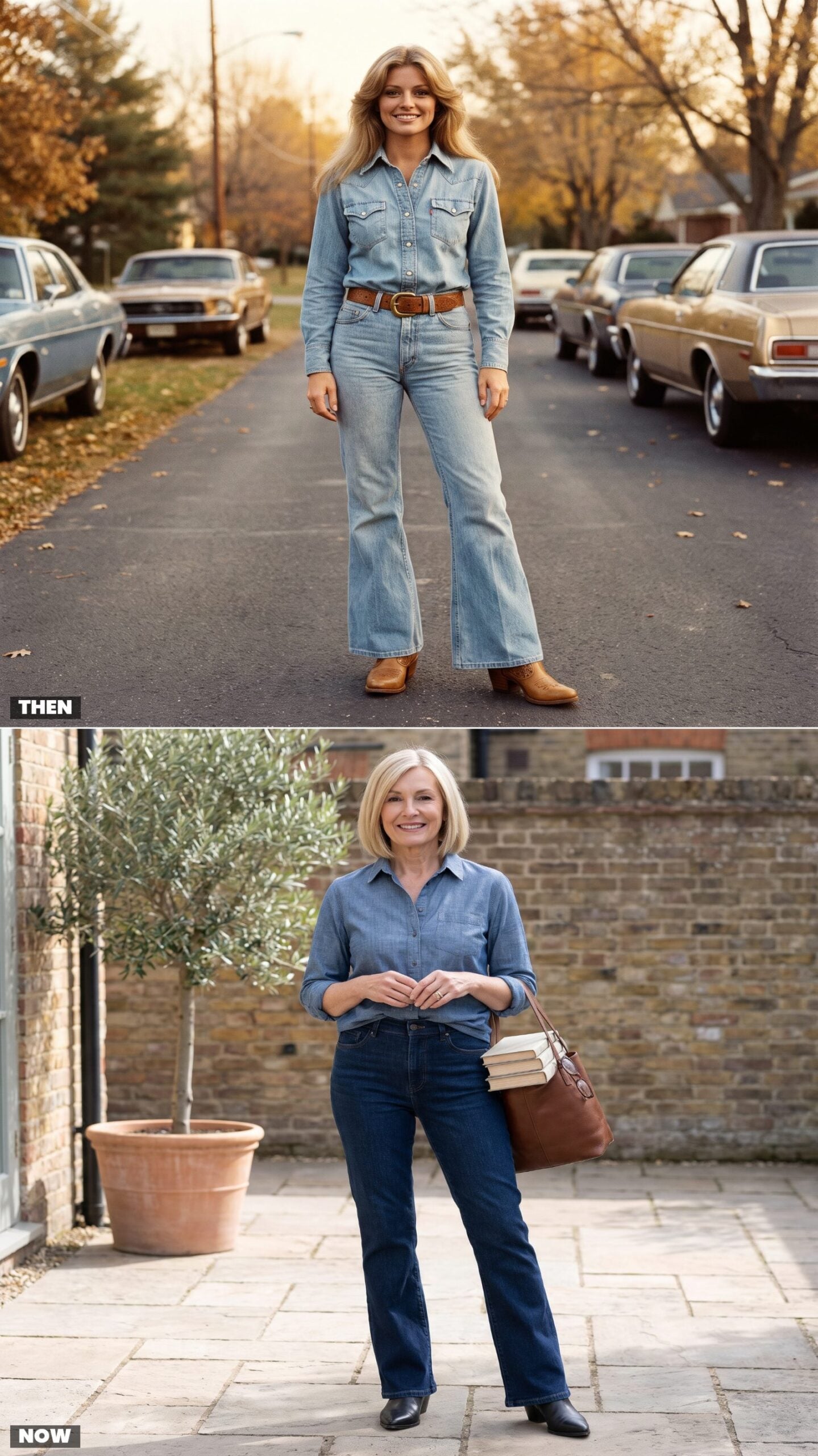
Two denims that should fight but don’t. In 1975 the trick was matching the washes loose and letting the Western boot do the talking under a puddled hem. Today the same double-denim idea reads sharper because the wardrobe is built on contrast of depth, not sameness.
Dark indigo flare, a lighter chambray shirt, a pointed black boot — and you’ve got the exact silhouette without any of the costume. What drives it is proportion: slim thigh, strong flare, nothing pooling.
19. Cuffed Flares and Chunky Platforms Become Full-Length Flares With Low Block Heels
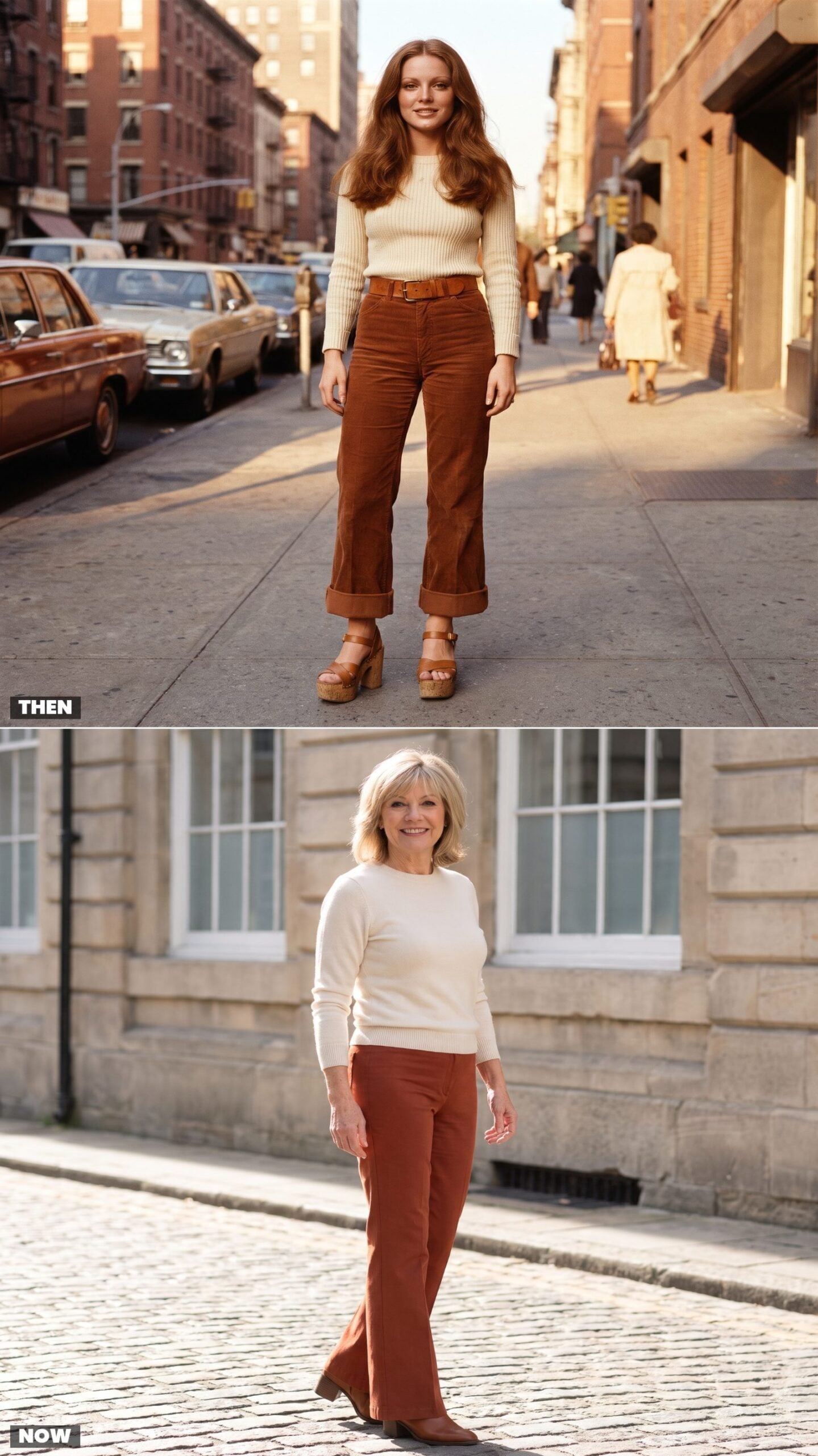
In 1975 you cuffed the flare on purpose so the platform could show off. Height was the point, and everyone wobbled a little. The modern read flips that logic entirely: you let the festival pants run full-length to the floor and tuck a quiet low block heel boot away underneath where nobody has to think about it.
The long uncut hem does all the work, stretching the leg into one unbroken line, which is exactly why the whole look reads taller than those towering platforms ever managed. Same rust corduroy mood. Zero wobble.
18. Raw-Hem Bells With Tie-Dye, Reworked as Released-Hem Flares and a Minimal Tee
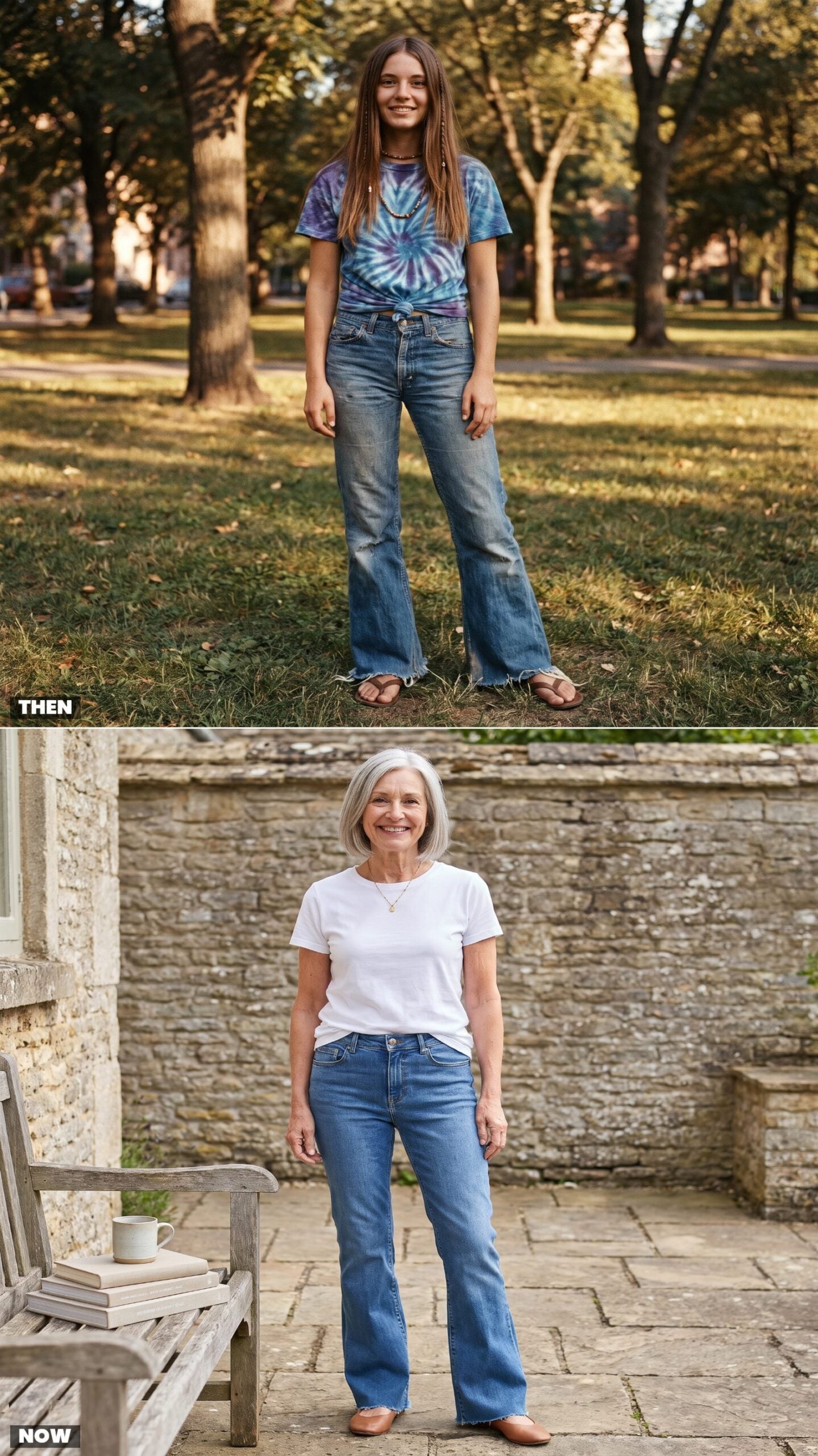
The raw hem was accidental in 1975. You walked the cuff to shreds and the tie-dye announced itself from across the quad. Loud on loud, and nobody minded.
Now the frayed edge is a decision, not a casualty. A released-hem flare with a plain white cotton tee lets the denim texture speak while the top stays quiet. Restraint is the whole trick, so resist overcomplicating the top half.
17. Summer Tube Top and Flares Grow Up Into a Square-Neck Top With Lightweight Flares
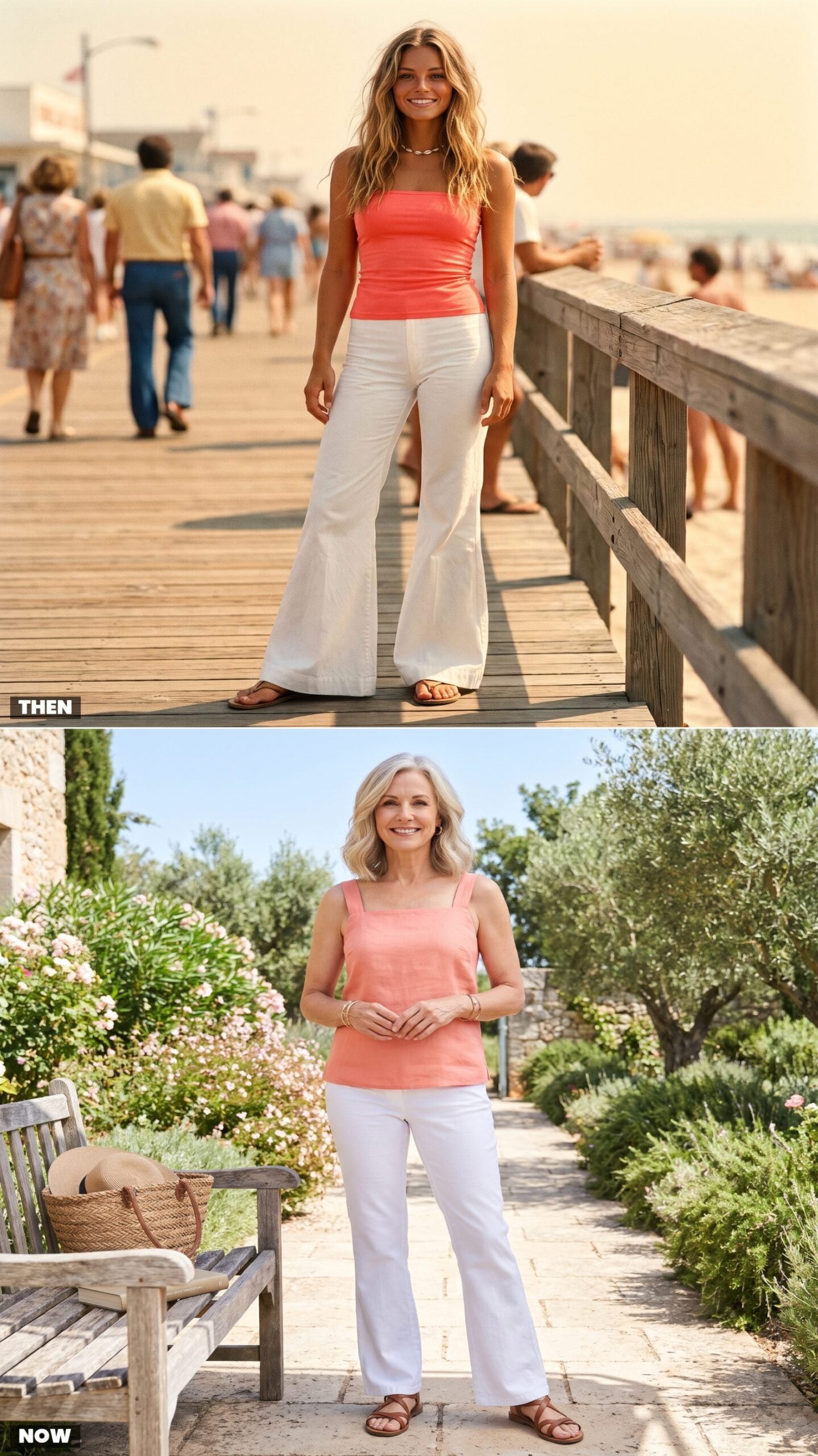
The tube top was pure summer bravado in 1975, a band of stretch cotton and a dare. It worked on the boardwalk and nowhere else.
The square neckline keeps that same open, warm-weather spirit but puts structure where the body wants it. That clean horizontal line across the collarbone frames the face and gives the coral square-neck top a defined edge to lean on. Pair it with lightweight white flares and it reads breezy without reading undressed. Your woman style at this point has nothing to prove, and it shows.
16. Shaggy Coat Over Winter Flares Becomes a Streamlined Long Coat and Wool-Blend Flares
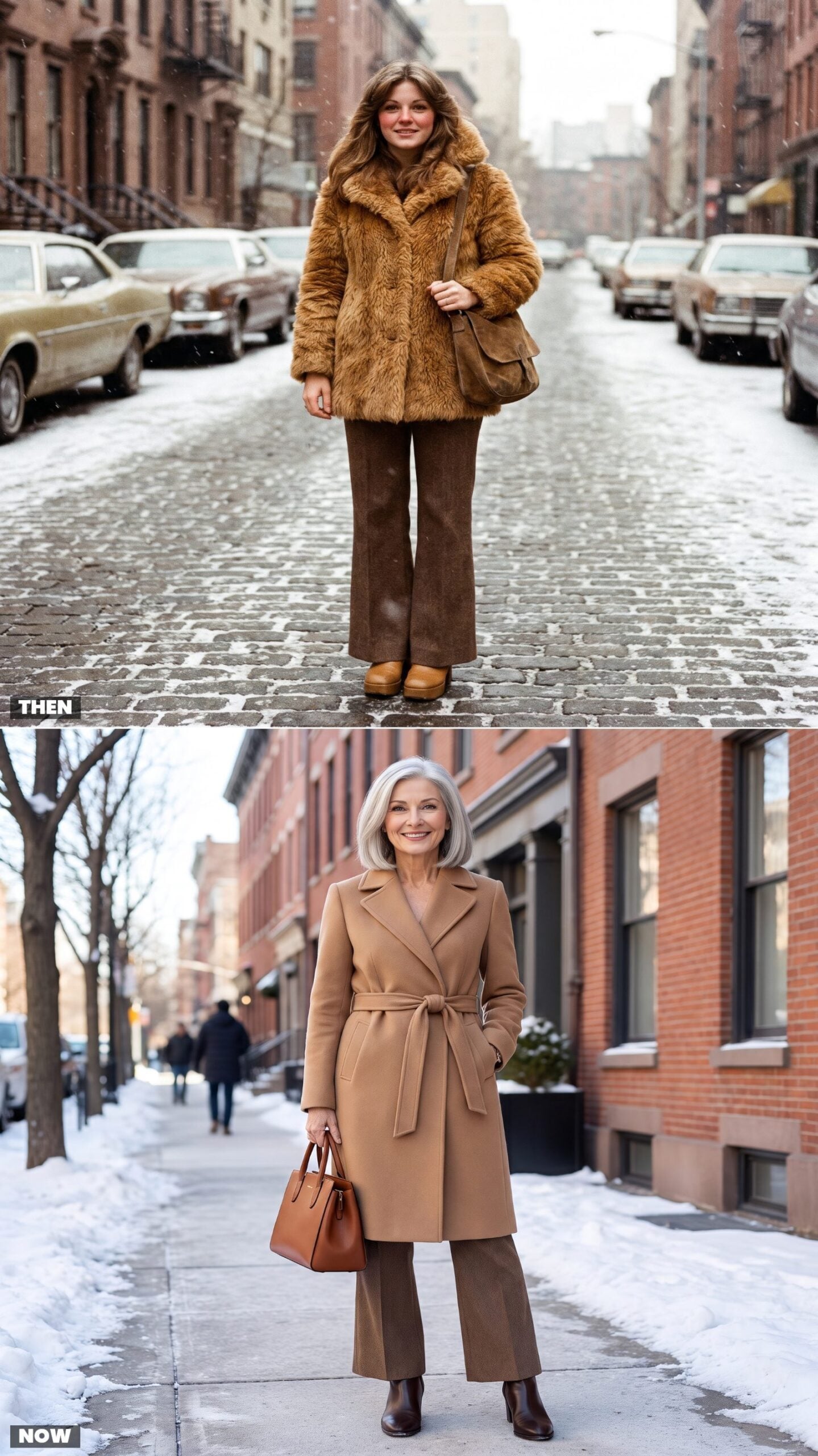
That shaggy coat in 1975 was all texture and no line. Fuzzy, warm, slightly chaotic, and it swallowed the flare underneath.
Trade it for a camel wool coat cut long and straight, and suddenly the wool-blend flare has a column to live inside. The coat leads here: a clean vertical that falls past the knee, letting the flared hem emerge below like a finishing note. Texture gave way to line, and in cold weather line always wins.
15. Poncho-and-Flares Softness Sharpens Into a Tailored Cape Over Slim-Thigh Flares
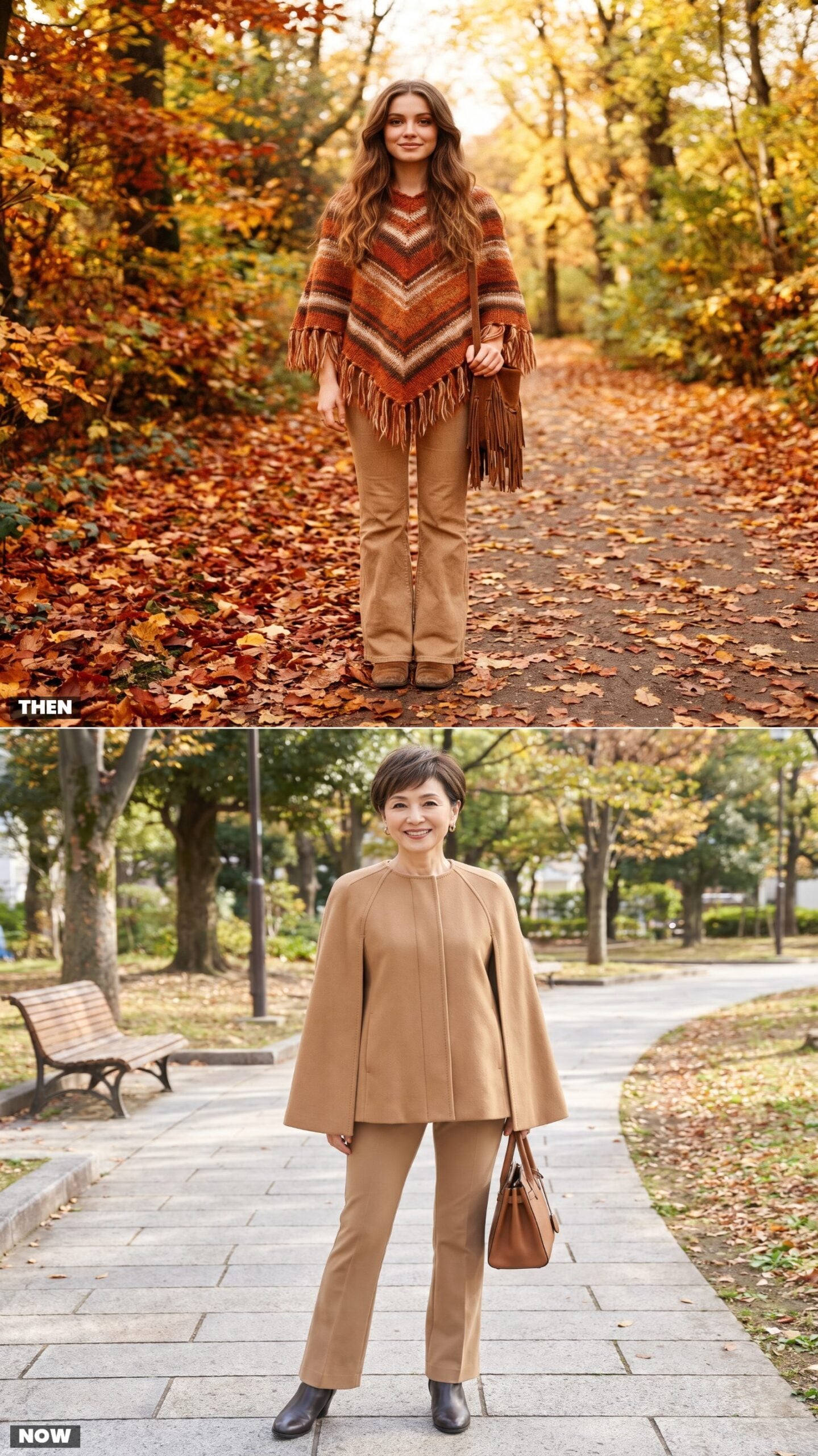
A poncho in 1975 hid everything and committed to nothing. Cozy, fringed, and shapeless by design.
The camel wool cape keeps that same throw-it-over ease but gives the shoulders a defined edge, and that structure is the whole difference. Below it, a slim-thigh flare keeps the bottom half lean so the volume up top stays balanced instead of overwhelming. Drama where you want it, clean lines where you need them.
14. Bandana-Top Bell-Bottoms Updated as Denim Flares With a Printed Silk Scarf
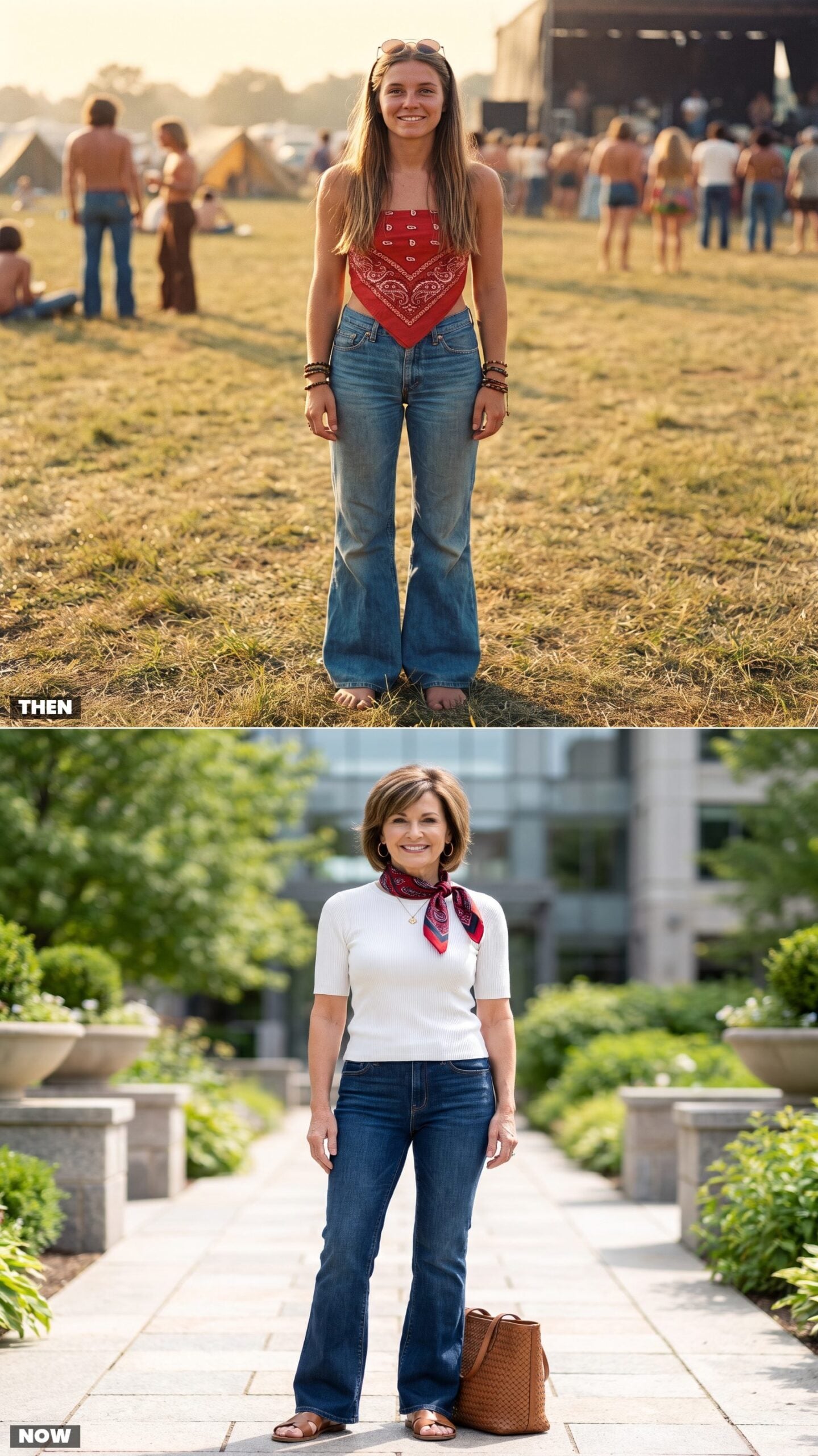
The bandana halter was festival improvisation at its finest, a square of printed cotton and a knot. Nobody was buying a top when a scarf would do.
Now that same paisley moves up to the neck as a printed silk scarf, knotted over a clean fitted top, where the pattern becomes a punctuation mark rather than the whole sentence. Denim flares hold the festival style in place while the scarf carries the memory. Same spirit, grown up and far more wearable past breakfast.
13. Geometric-Blouse Green Flares Reimagined as Forest Flares With an Abstract-Print Blouse
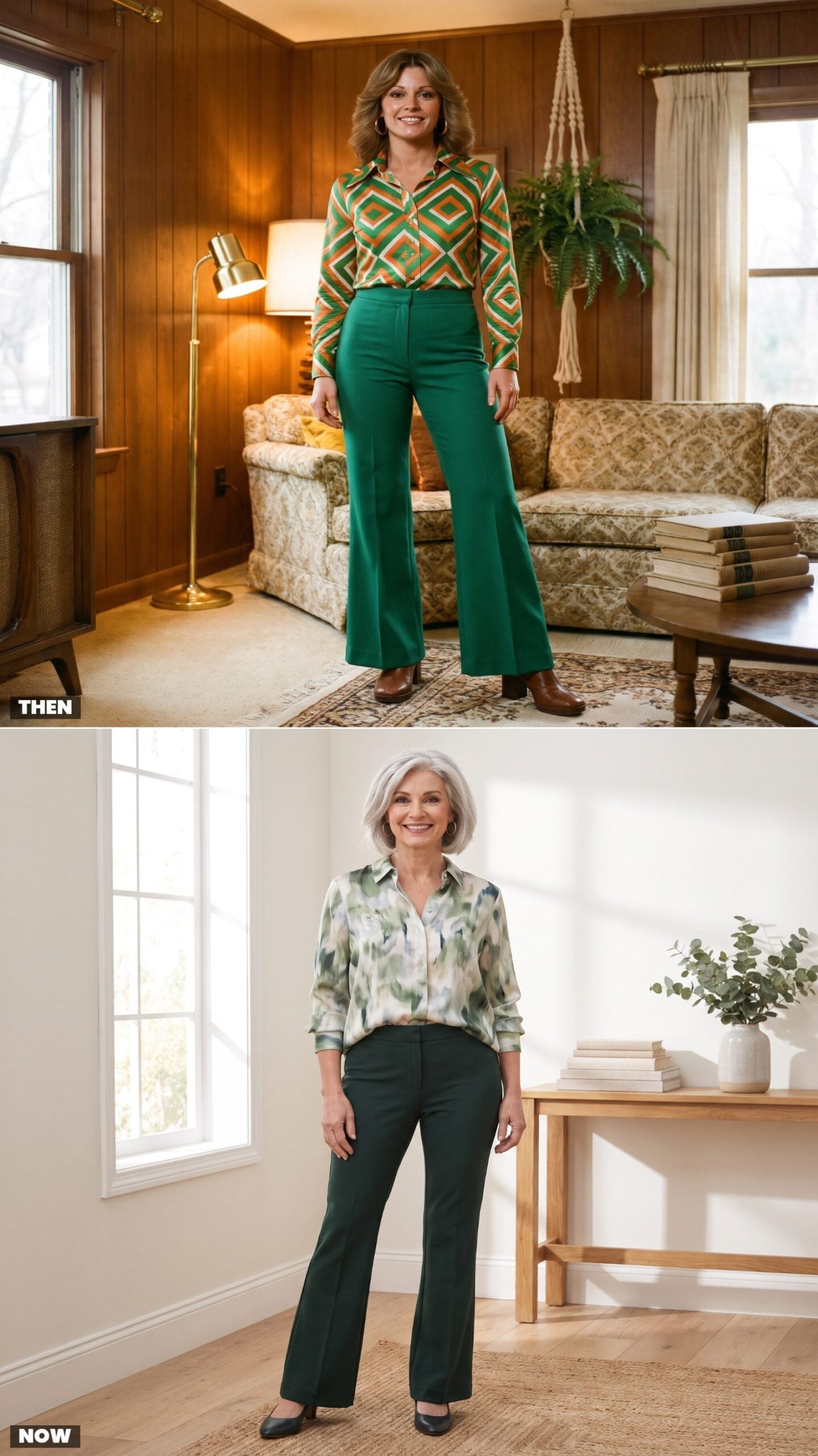
Seventies print logic said more edges, more color, more chevrons. That emerald-and-orange geometric blouse practically hummed.
The modern version keeps the green commitment but swaps rigid geometry for a soft abstract-print silk blouse that moves with the body. Here it’s tone doing the heavy lifting: forest flares and a watercolor green print build depth without the visual noise, and a half-tuck breaks the line so the tone-on-tone never flattens into a single slab of green.
12. High-Waisted Bells and a Bodysuit Become High-Rise Flares With a Smooth Layering Top
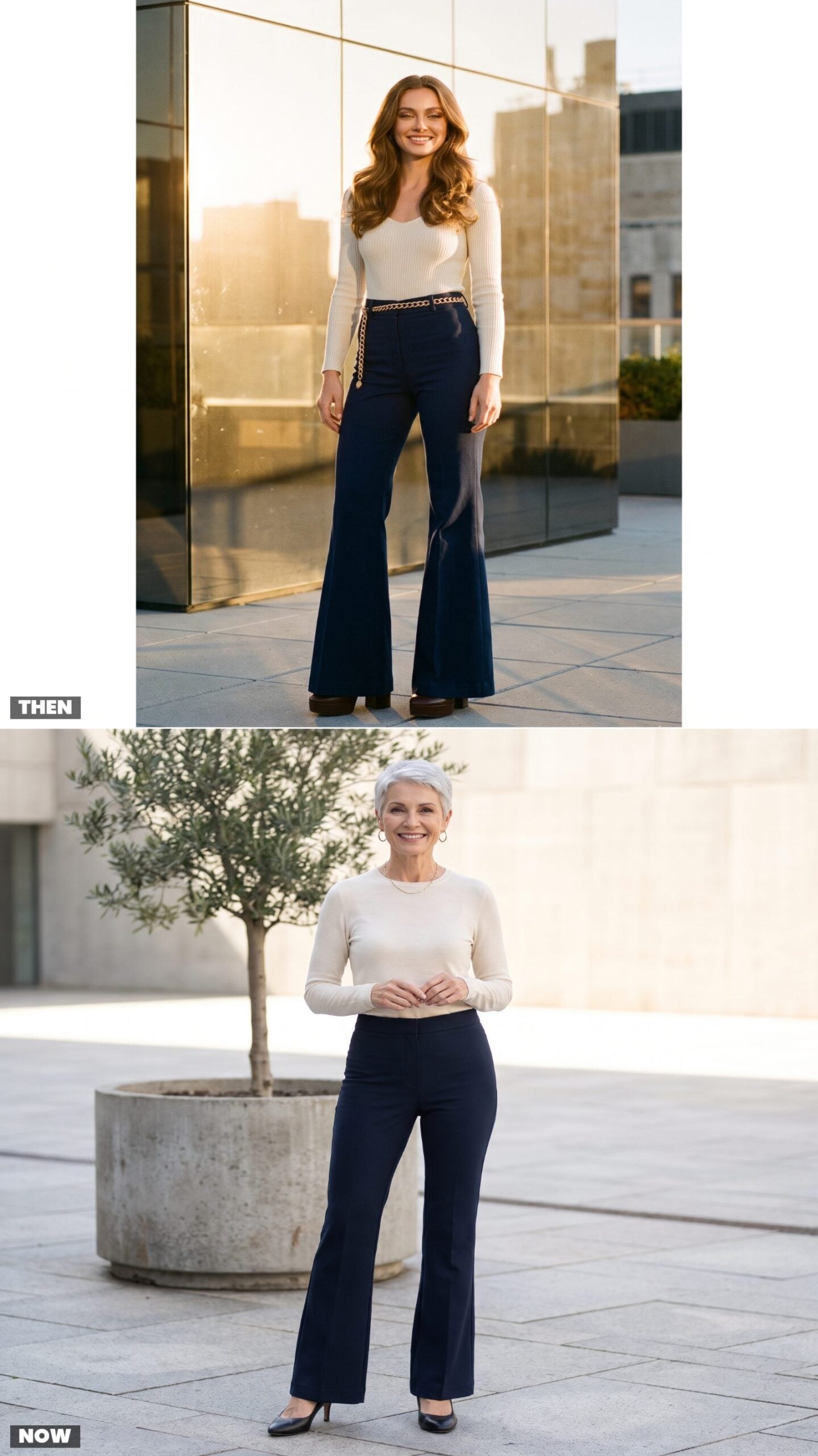
The bodysuit solved one problem in 1975: nothing to untuck, nothing to bunch, a smooth line straight into the high waistband. It also required contortion to fasten.
The cream layering top delivers the same uninterrupted line into a high-rise flare without the gymnastics. The high waist is the real star here, defining the smallest point and letting the leg read long and clean all the way down. A great style is about the tuck, not the trend.
11. Hippie-Tunic Flared Jeans Refined Into a Split-Hem Longline Shirt and Balanced Flares
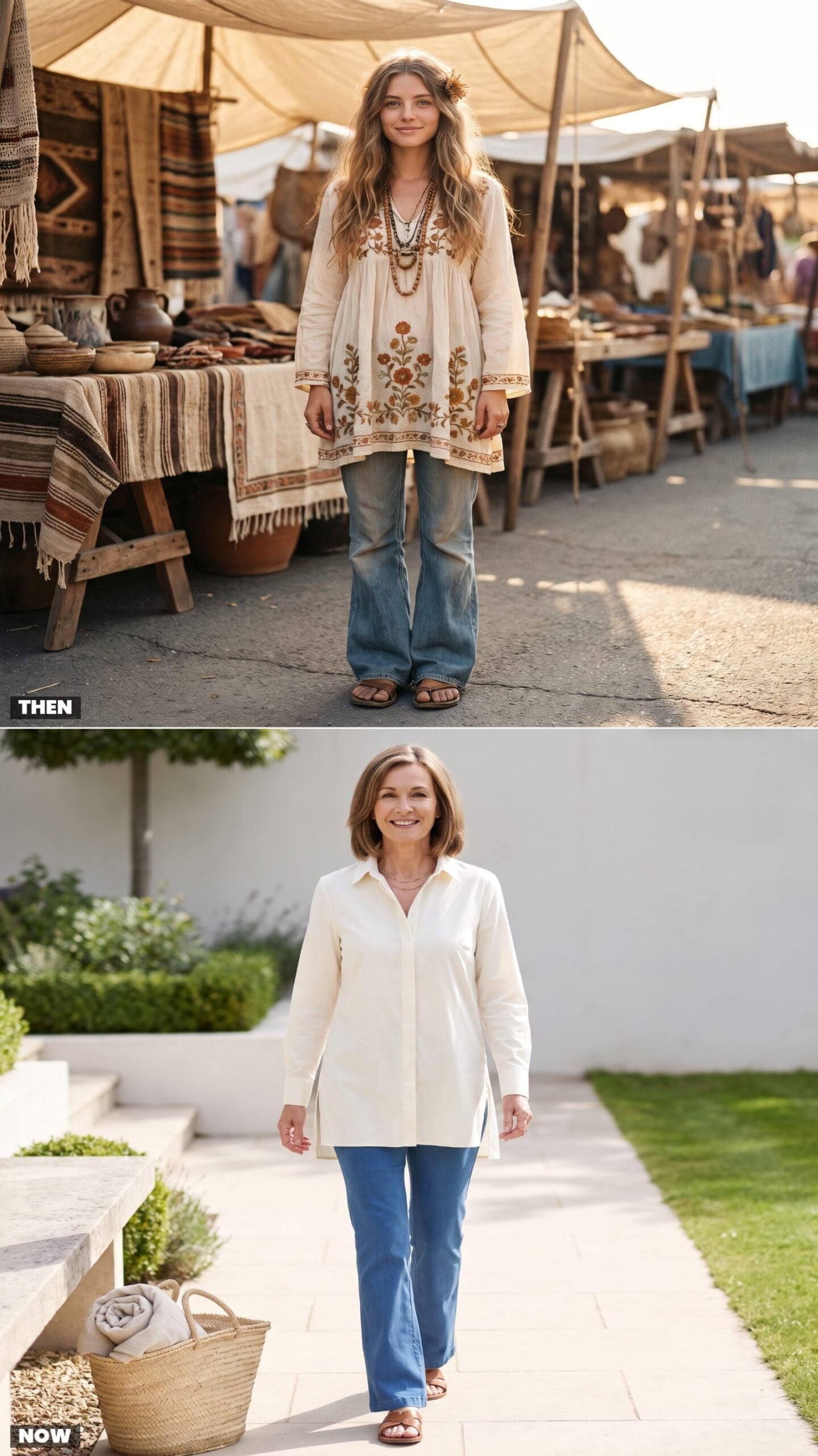
The hippie tunic hid the whole upper body in 1975 and billowed over the flare like a tent. Lovely in motion, formless at rest.
The split-hem longline shirt keeps that long, easy coverage but earns its shape. Those side splits do quiet proportional work, breaking up the length so the longline glides over a balanced flare instead of smothering it. You get the free, drifty ease of the original with a silhouette that actually holds up when you stand still. That’s the whole evolution, honestly: loose hippie spirit with grown-up bones.
10. Polyester Knit Flares With a Matching Cardigan → Ponte Flares With a Modern Knit Co-ord
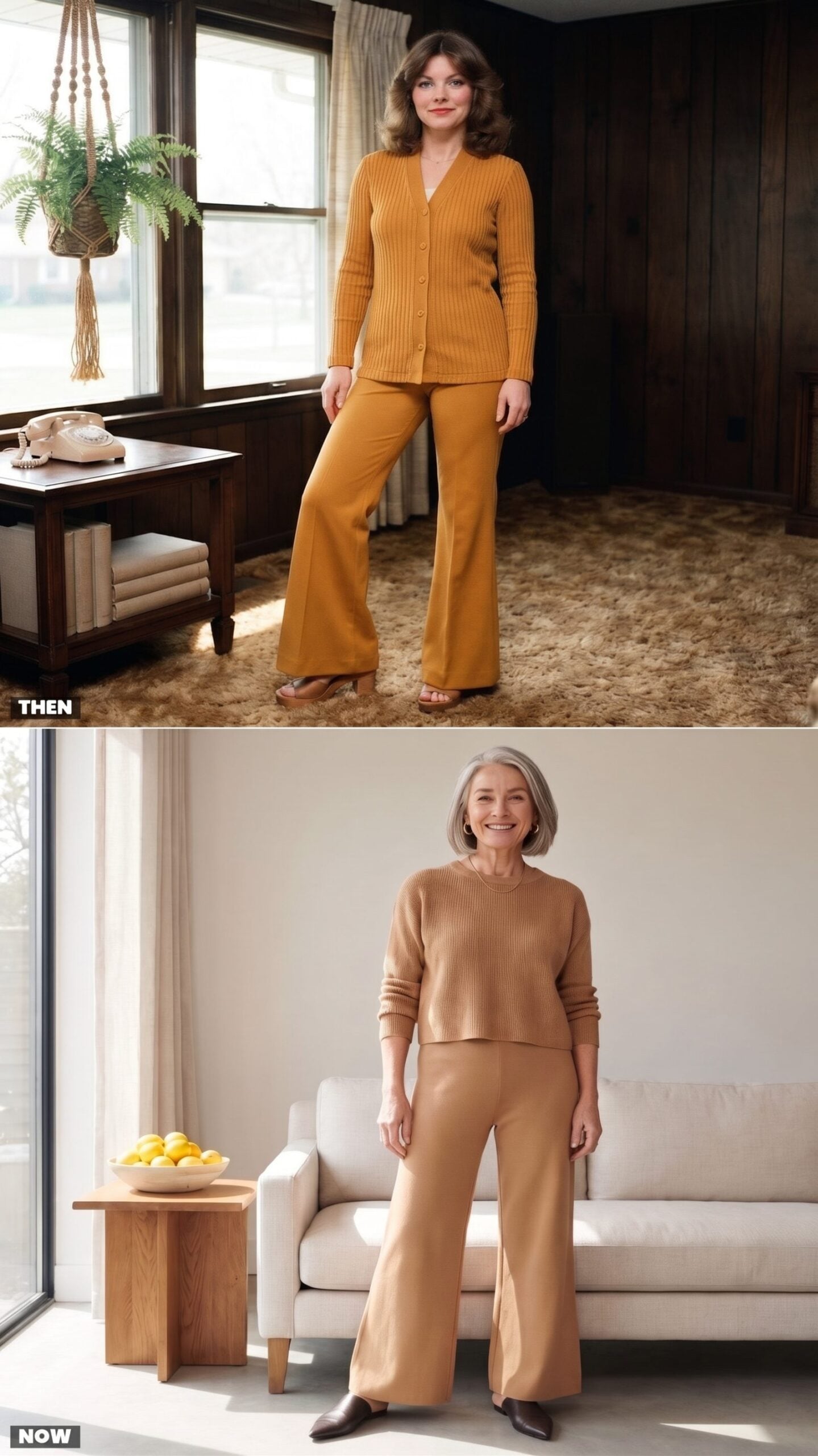
The matching set never died. It just got better fabric. In 1975 the polyester knit co-ord clung and crackled with static, the cardigan buttoned tight, the whole thing one shade of gold from collar to flare — it read as effort, but the kind that sat a little stiff on the body.
The modern version works because ponte moves. That same tonal commitment, top and bottom in one warm camel, now drapes instead of grips. The cropped knit sits at the natural waist and lets the flare do its elongating job underneath. One color, two textures, zero static cling.
9. Wide White Bells With a Navy Blazer → Soft-White Flares With a Collarless Navy Jacket
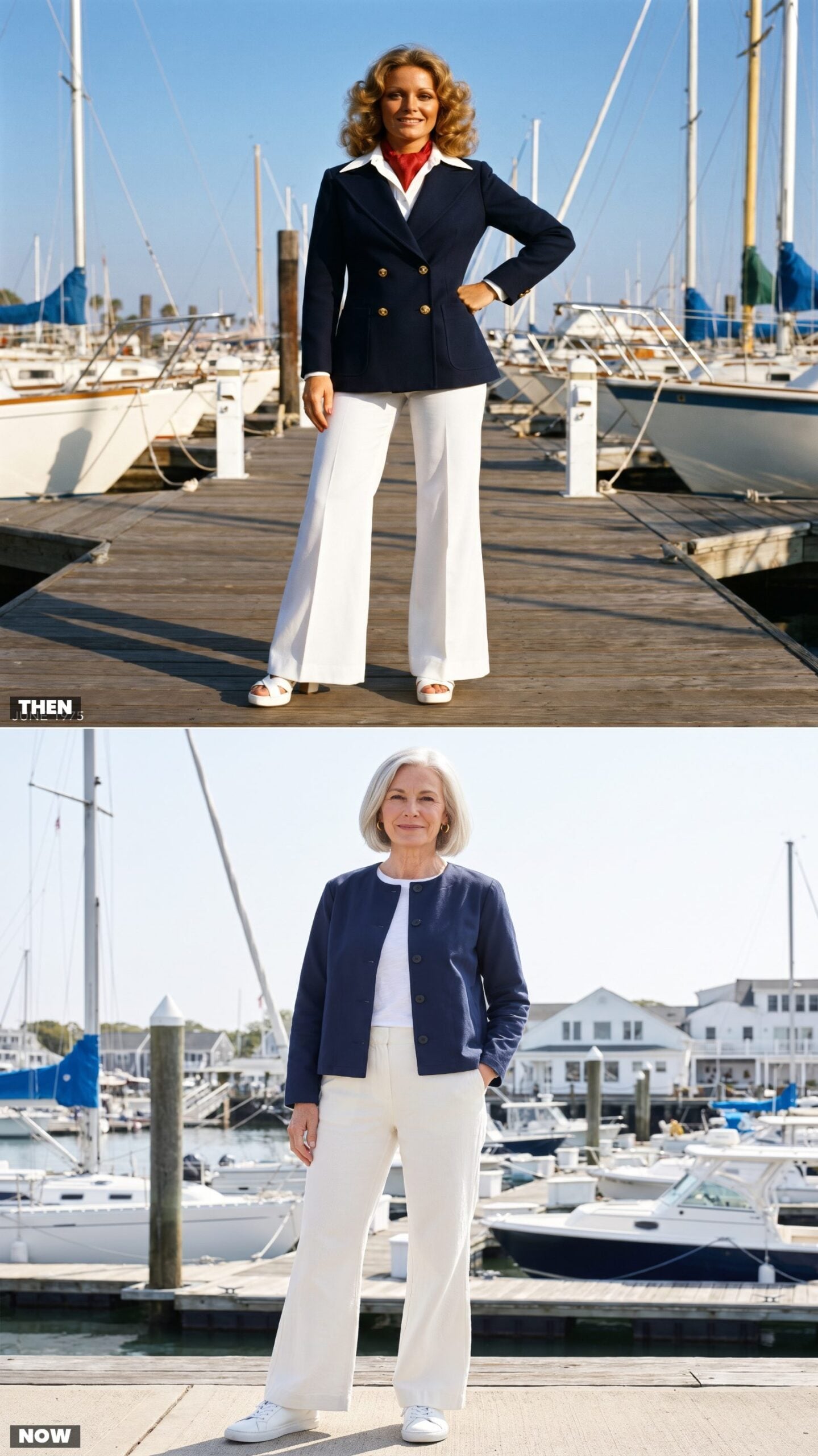
Navy and white is the pairing that refuses to age. The 1975 take leaned nautical to the point of costume — gold anchor buttons, wide lapels, a scarf knotted at the throat. Handsome, sure, but it shouted its reference across the whole boardwalk.
Drop the collar and the whole thing calms down. A collarless navy jacket removes the only hard line in the outfit, so the eye travels uninterrupted from shoulder to the soft-white flare. Same crisp contrast, none of the yacht-club theatrics. And that restraint is exactly what makes it read expensive now.
8. Short-Cropped Flares With Platforms → Ankle Flares With Slingback Heels
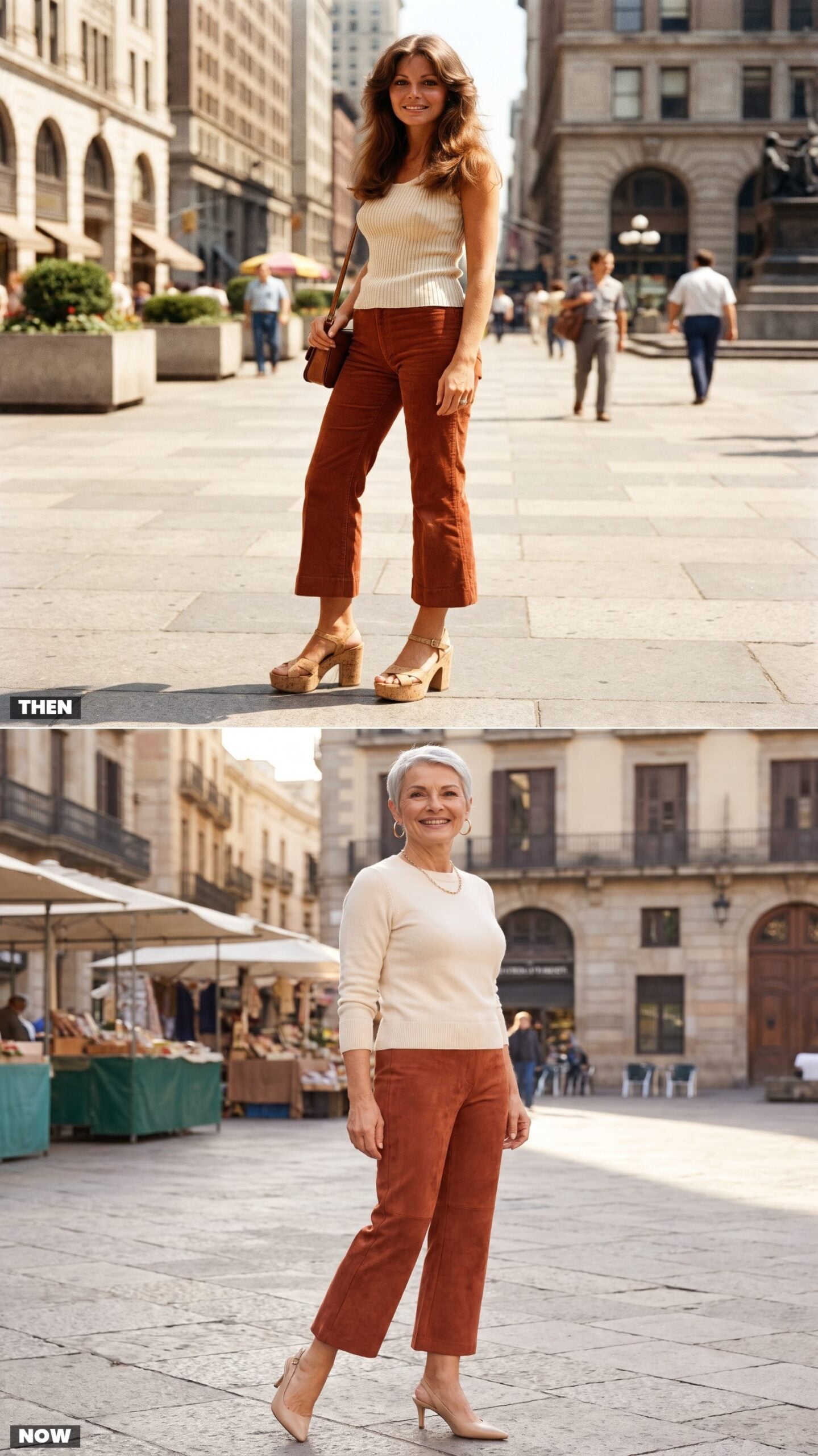
Cropping a flare so the shoe gets its moment is not a new idea. It just changed shoes. Chunky cork platforms did the talking in 1975, adding height and a bit of swagger below the rust corduroy hem.
The slingback does the opposite and somehow wins. Slip a pointed slingback heel below an ankle flare and the whole bottom of the look slims to a fine point, where the platform widened it. Same reveal-the-shoe strategy, cleaner geometry. For anyone who finds a full floor-length bell too much pant to manage, the ankle flare is one of the easiest ways in.
7. Extra-Long Bells Hiding Platform Shoes → Floor-Skimming Flares With Pointed-Toe Pumps
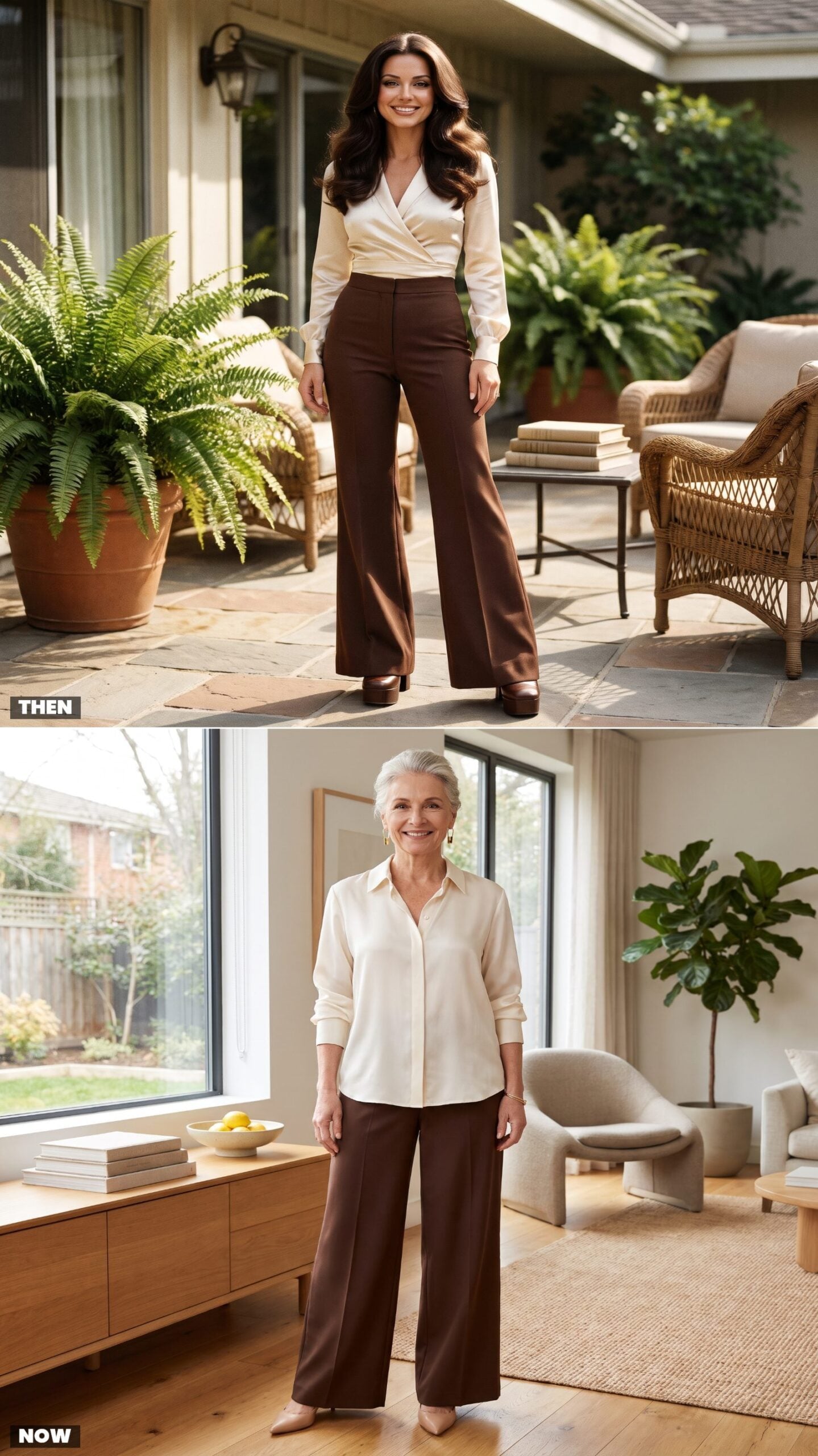
The long bell always hid a secret — a towering shoe underneath, doing the heavy lifting on height while the hem skimmed the dance floor. That trick came back, and nobody admits it.
Now a floor-skimming flare rides over a pointed-toe pump, and the effect is pure elongation: one unbroken vertical line from waist to toe. The hem break is what makes or breaks it. The fabric should just graze the ground when you stand, no more. Get the length right and you look like you were born with three extra inches of leg.
6. Flared Jeans With a Faux-Fur Vest → Dark Denim Flares With a Sleek Quilted Vest
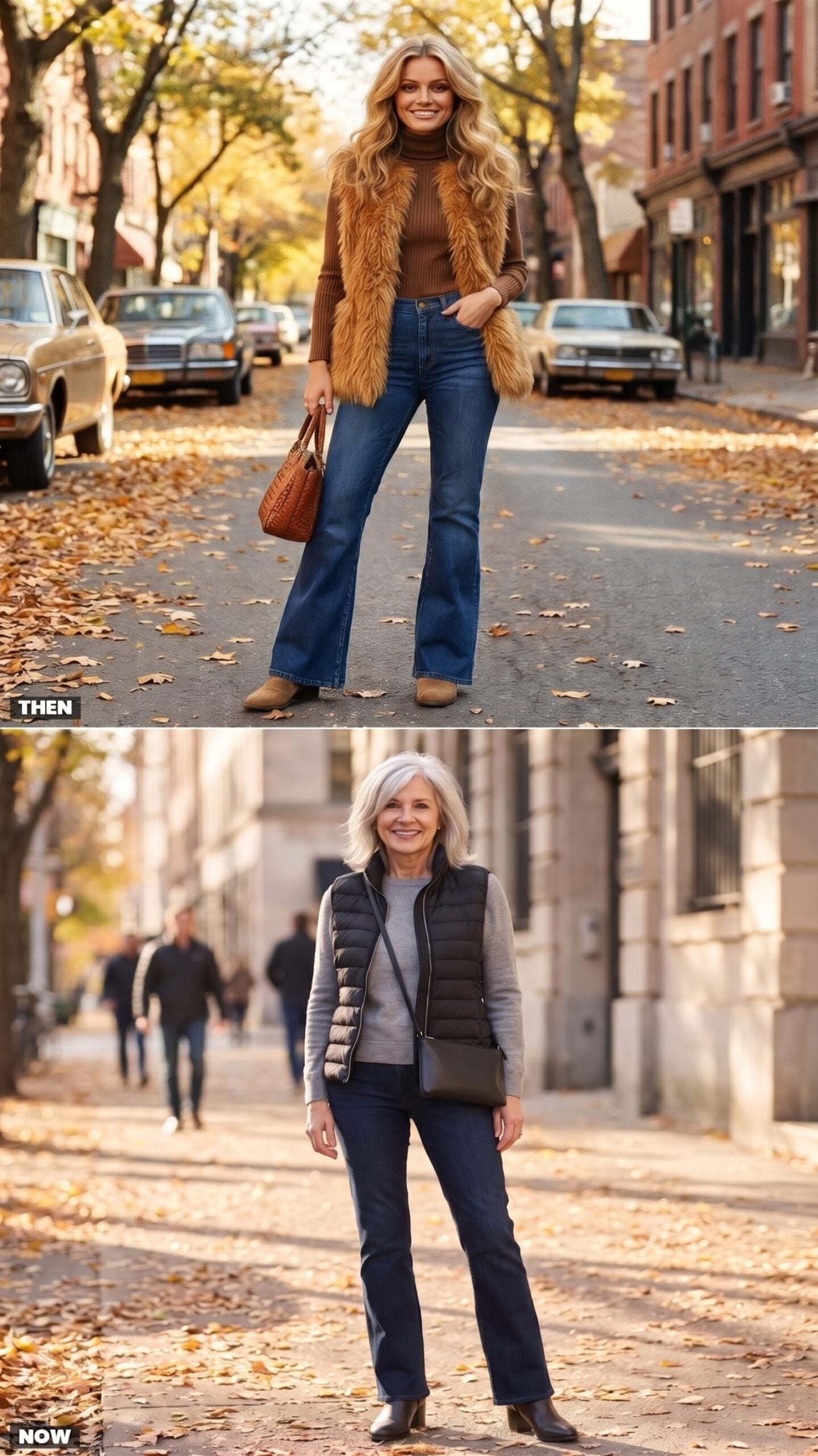
The vest-over-flare combo lives on. It just traded volume for structure. That caramel faux-fur in 1975 added warmth and a lot of width across the shoulders, which fought the flare for attention.
A sleek quilted vest warms you without the bulk. It sits close to the body, so the shape stays streamlined top to bottom and the dark denim flare gets to be the shape of the outfit. Matte quilting against rigid indigo is a quieter texture play — and it photographs sharp instead of fuzzy.
5. Patch-Pocket Bells With a Fitted Shirt → Front-Pocket Flares With a Fluid Blouse
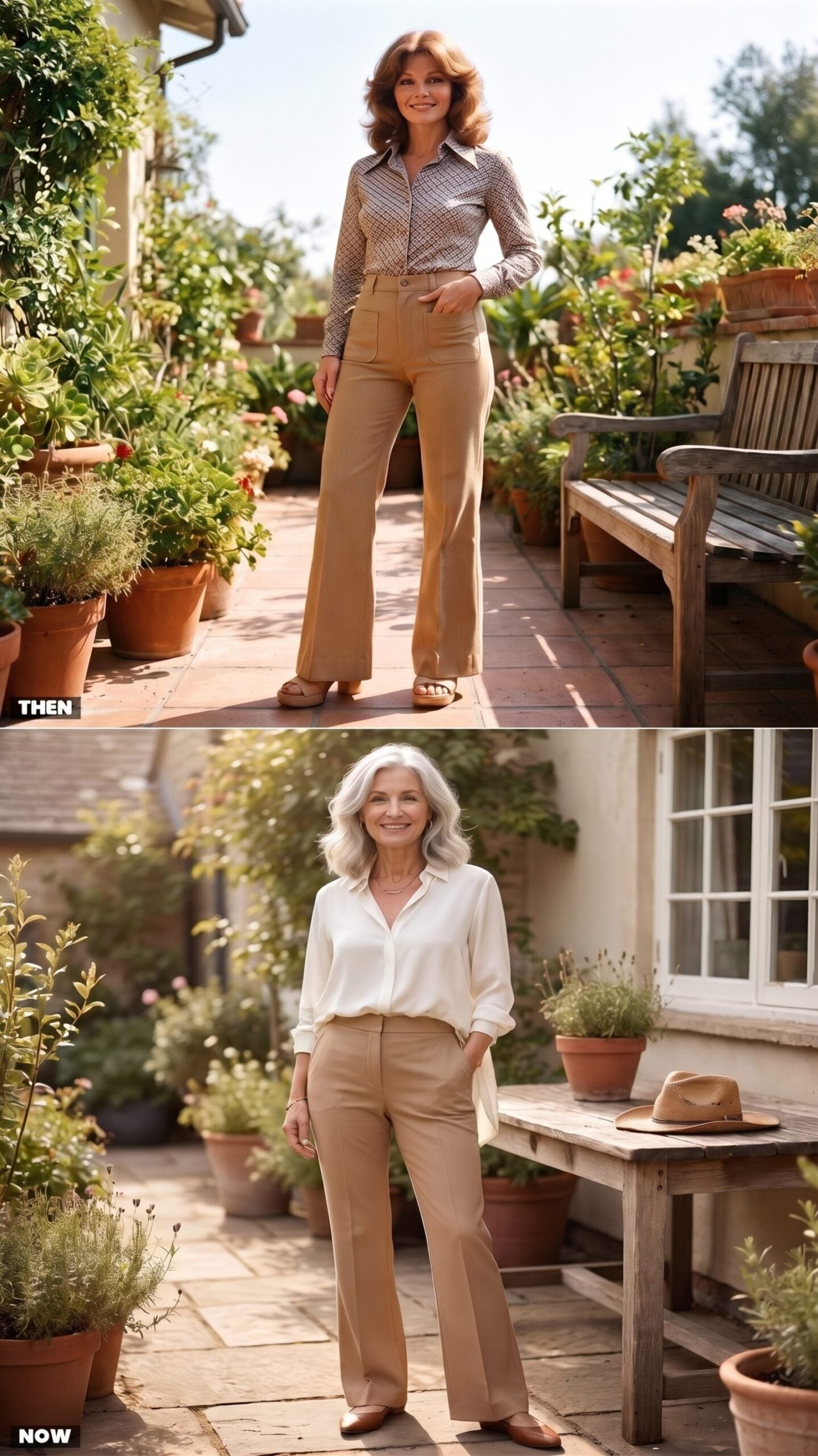
Those big patch pockets stitched across the thighs were pure 1975 — decorative, busy, pulling the eye straight to the widest part of the leg. Not everyone’s friend.
Swap to a clean slash pocket and the front of the pant goes smooth, which lets the flare read as one long line again. The real upgrade is the blouse. A fluid silk against a tailored flare gives you movement up top and a firm line below, and a loose half-tuck marks the waist without the stiff full tuck that old pointed-collar shirt demanded.
4. Paisley Flares With a Solid Turtleneck → Muted-Print Flares With a Neutral Mock Neck
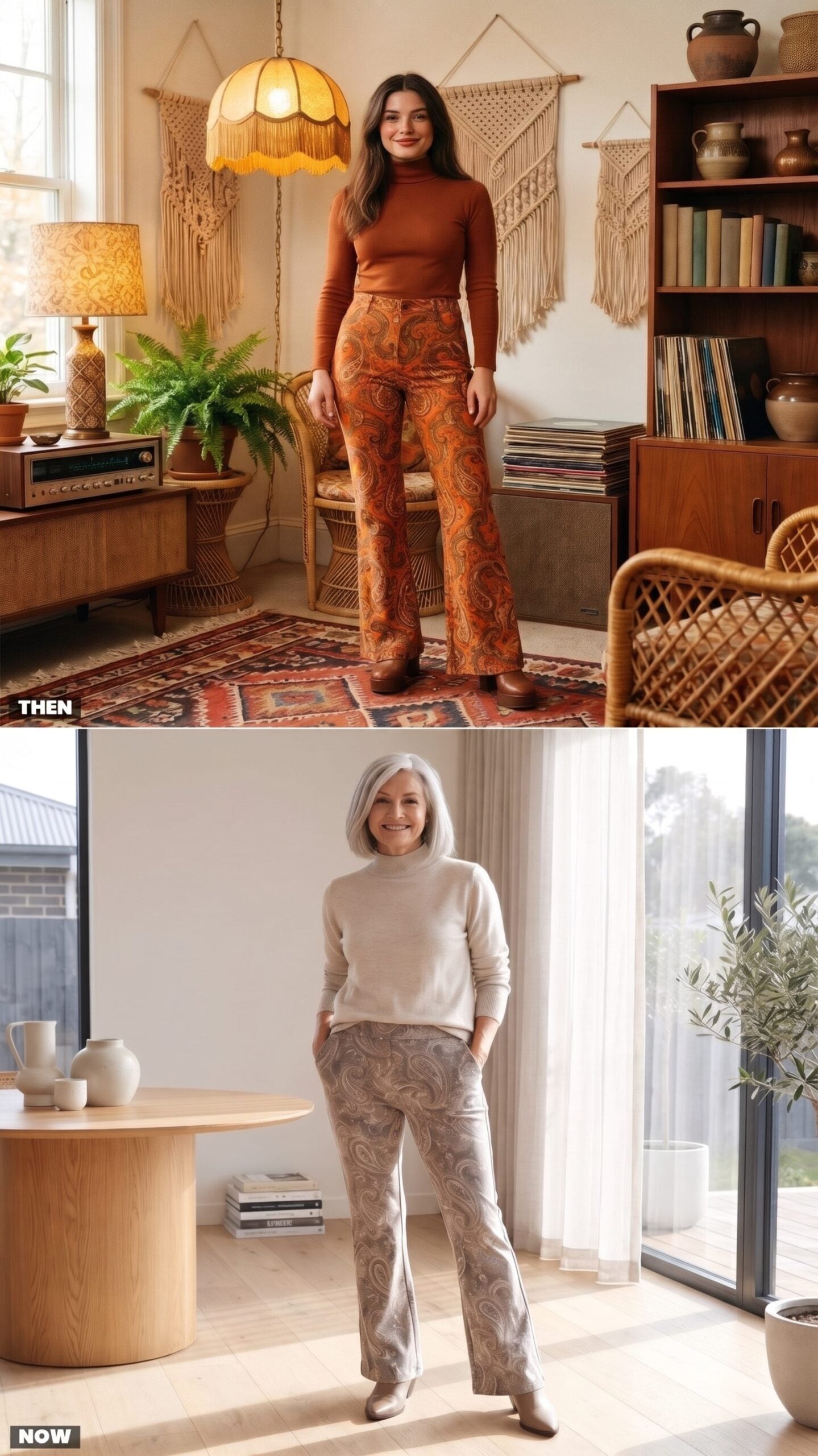
Paisley hasn’t gone anywhere. The volume dial just moved. The 1975 version blasted orange and brown at full saturation, loud enough that the turtleneck had to shout back in solid rust to keep up.
Bring the print down to a muted taupe and sand and it turns into a near-neutral you can build on. The soft oatmeal mock neck sits in the same quiet register, so the pattern whispers. You still get interest, texture, something to look at — it just stops being the only thing anyone sees.
3. Denim Flares With an Army Surplus Jacket → Indigo Flares With a Polished Field Jacket
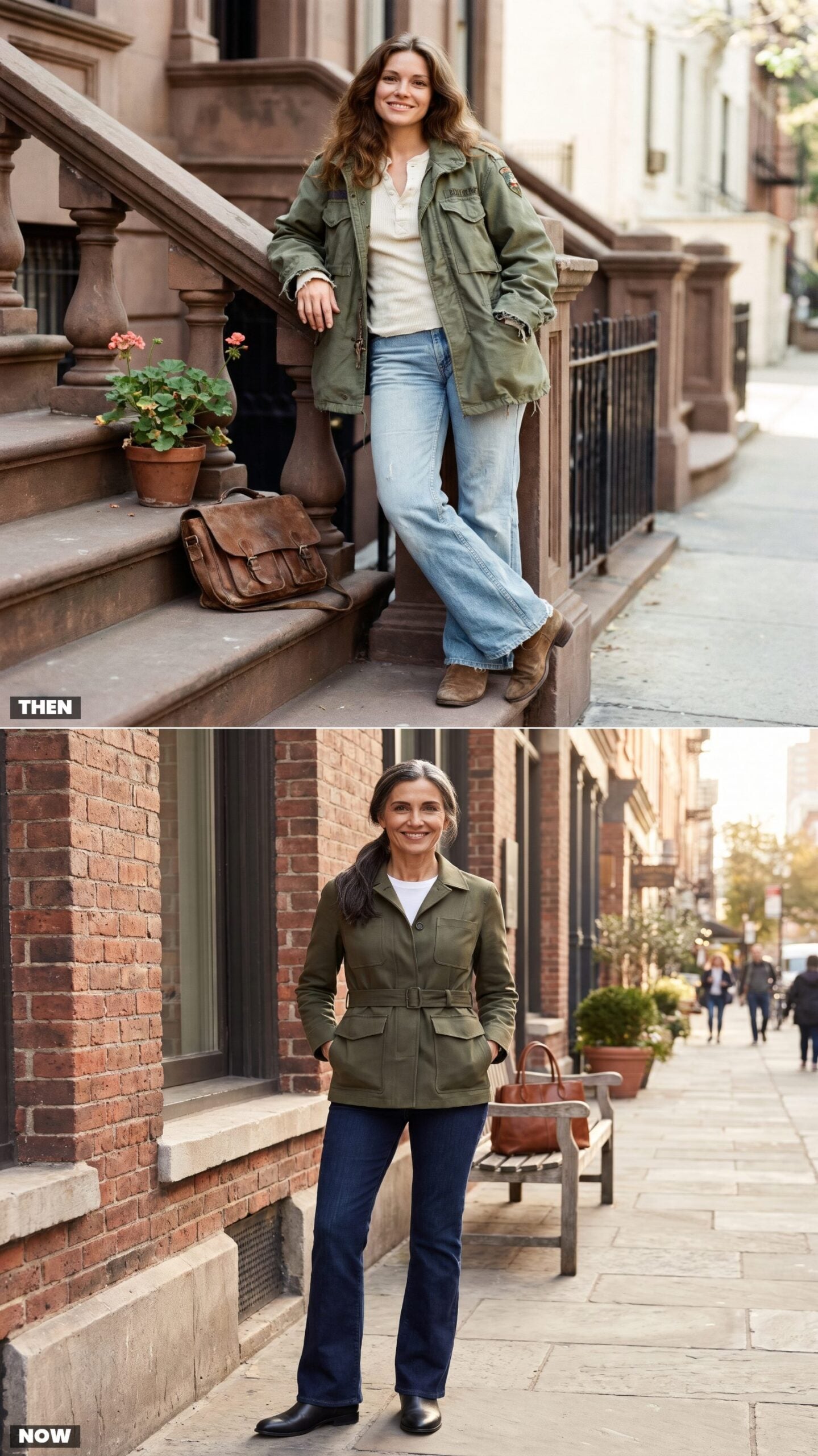
Military surplus over flares was the uniform of a certain kind of 1975 cool — deliberately slouchy, oversized, a little undone. The jacket drowned the frame, and that was rather the idea.
Tailoring the field jacket keeps the spirit and loses the sag. Nip it at the waist, clean up the pockets, and that utilitarian olive finally has a shape. Over dark indigo flares it reads intentional rather than thrifted. Want to see how a worn-in field jacket slots into real-world flare festival style? This is the proportion that holds up all day.
2. Tweed Flares: From the Matching Waistcoat to the Collarless Jacket
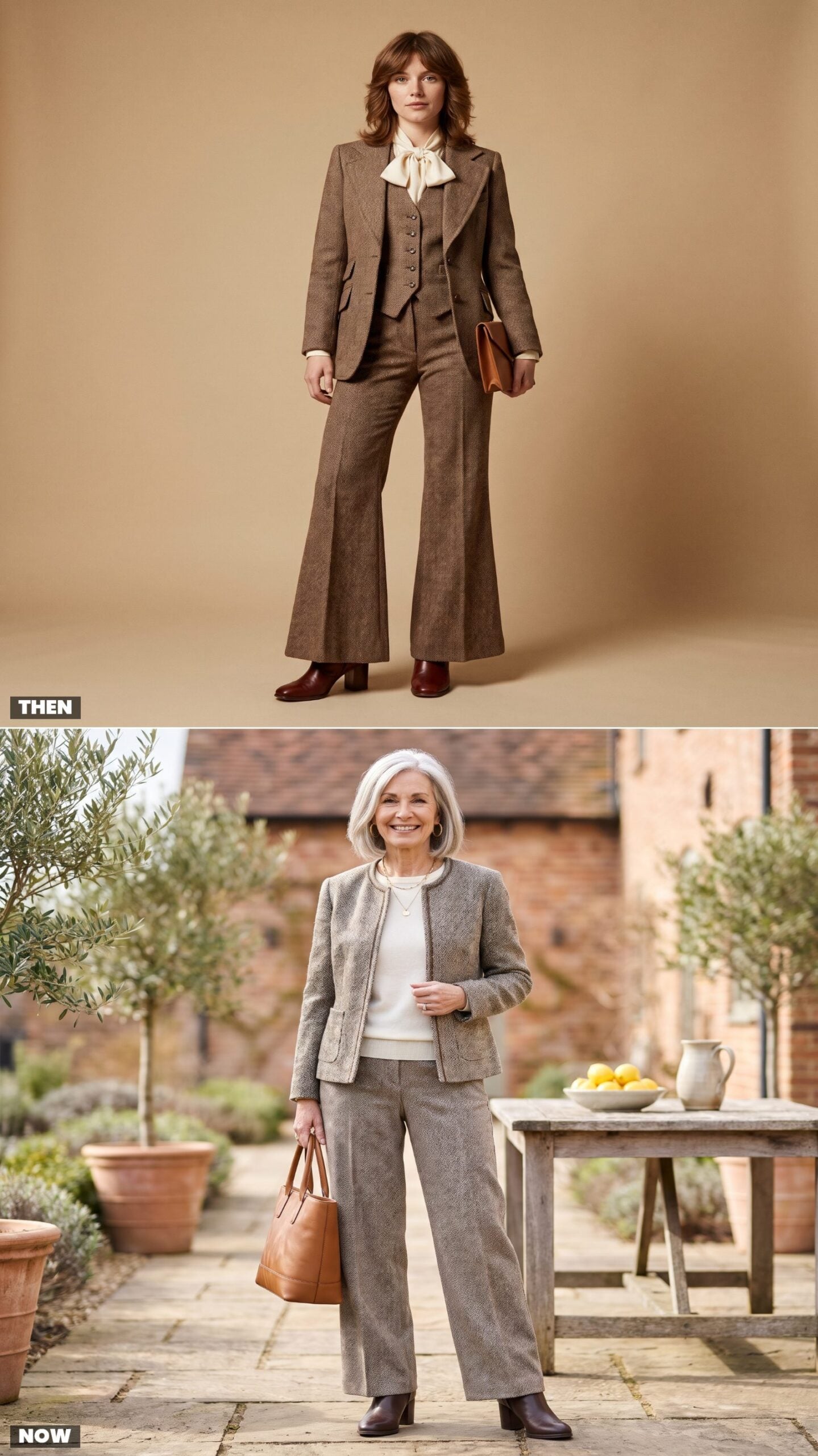
The 1975 version buttoned you into the whole kit — waistcoat, blazer, flare, all in the same herringbone, all pulling in the same direction. Matchy on purpose. And that waistcoat cinched the middle so hard it did the proportional work the flare couldn’t manage alone.
The update loosens the grip. Throw a collarless tweed jacket open over a fine ivory knit, drop the hard tailoring, and the shoulders finally get to breathe. The flare still leads. But now it’s the texture that carries the interest — rough tweed set against smooth knit — instead of three identical panels of wool stacked on top of each other. An open collarless line keeps the whole thing from reading as fancy dress. Library-smart, not costume.
1. Bell-Bottoms for a 1975 Flight vs. Stretch Flares for Modern Travel
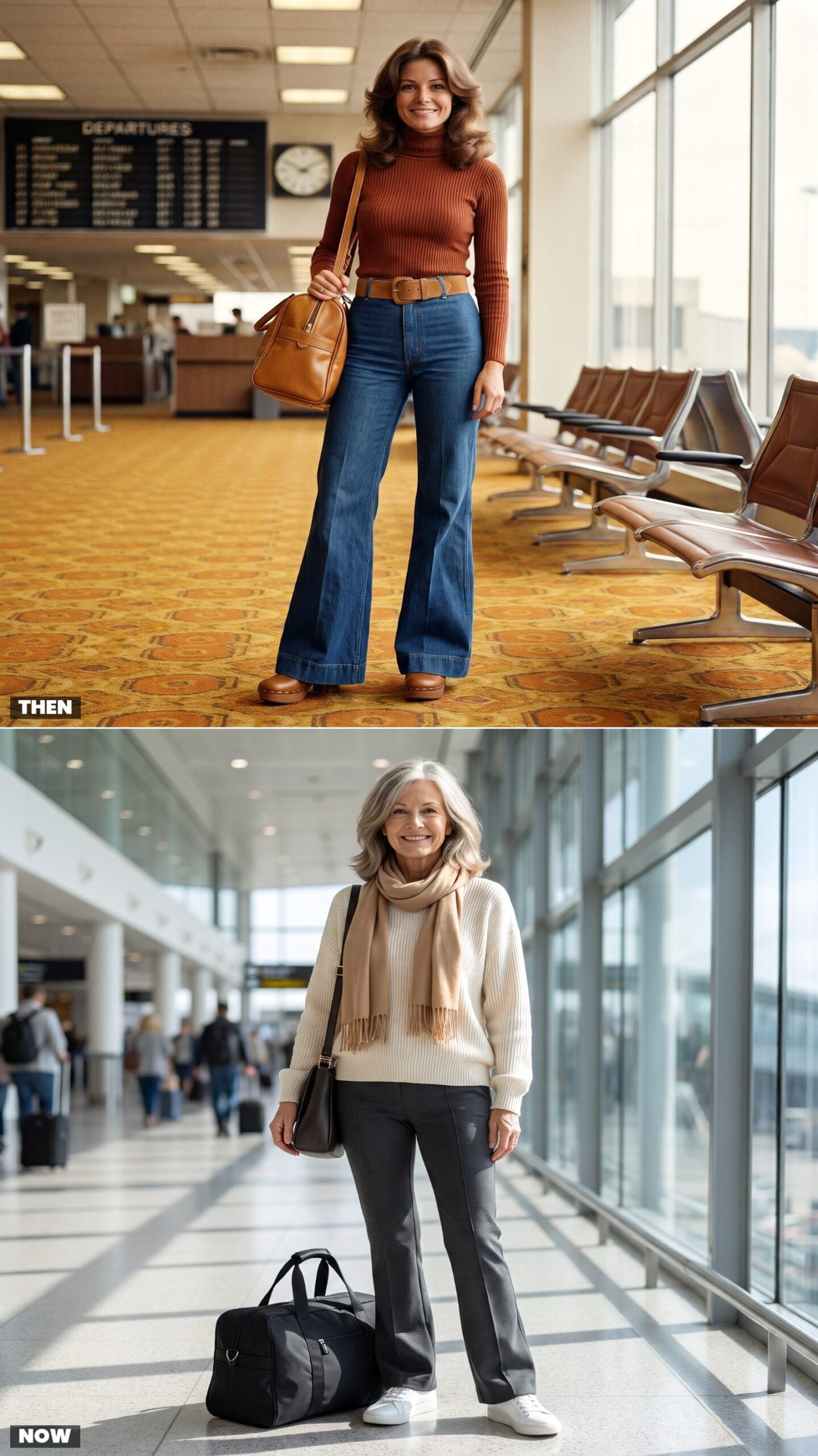
Flying in 1975 meant dressing up for the plane, and the bell-bottom traveler committed hard: rigid high-waisted denim, a tucked rust turtleneck, platform clogs you could barely climb the air-stairs in. Sharp on the ground. A corset by hour two.
The modern take keeps the flare and ditches the suffering. Soft ponte stretch flares move with you through a long haul, a relaxed cream ribbed knit replaces the strangling turtleneck, and white leather sneakers mean you can actually sprint a connection without regret. A camel travel scarf handles the finishing that the old suede belt used to. Same flattering flare, same photographs-well silhouette — except now you arrive looking like yourself and not a wrinkled rough draft of whoever boarded. Want more aisle-friendly ideas? Our festival pants edit runs on the same comfort-first logic.