❤️ Would you like to save this?
Round-face haircut advice has a habit of arriving as commandments. Add height. Avoid blunt bangs. Never cut at the jaw. Keep everything long. Then somebody breaks three of those rules at once and looks terrific.
These 28 before-and-afters treat the usual advice as a starting point rather than law. Long layers, severe bobs, curtain bangs, pixies, copper waves, graphic streaks, center parts — the same face shape keeps meeting completely different proportions. What matters isn’t making a round face look like something else. It’s seeing how length, weight, movement, parting, and color placement change the frame around it.
FYI, thanks to AI imagery software, we’re able to create very specific fashion and hairstyle examples to illustrate the points being made. In some cases, imagery is exaggerated to hammer home the point. Also, assume links that take you off the site are affiliate links such as links to Amazon. this means we may earn a commission if you buy something.
28. The Angled Bob Starts With Light, Then Lets the Cut Take Over
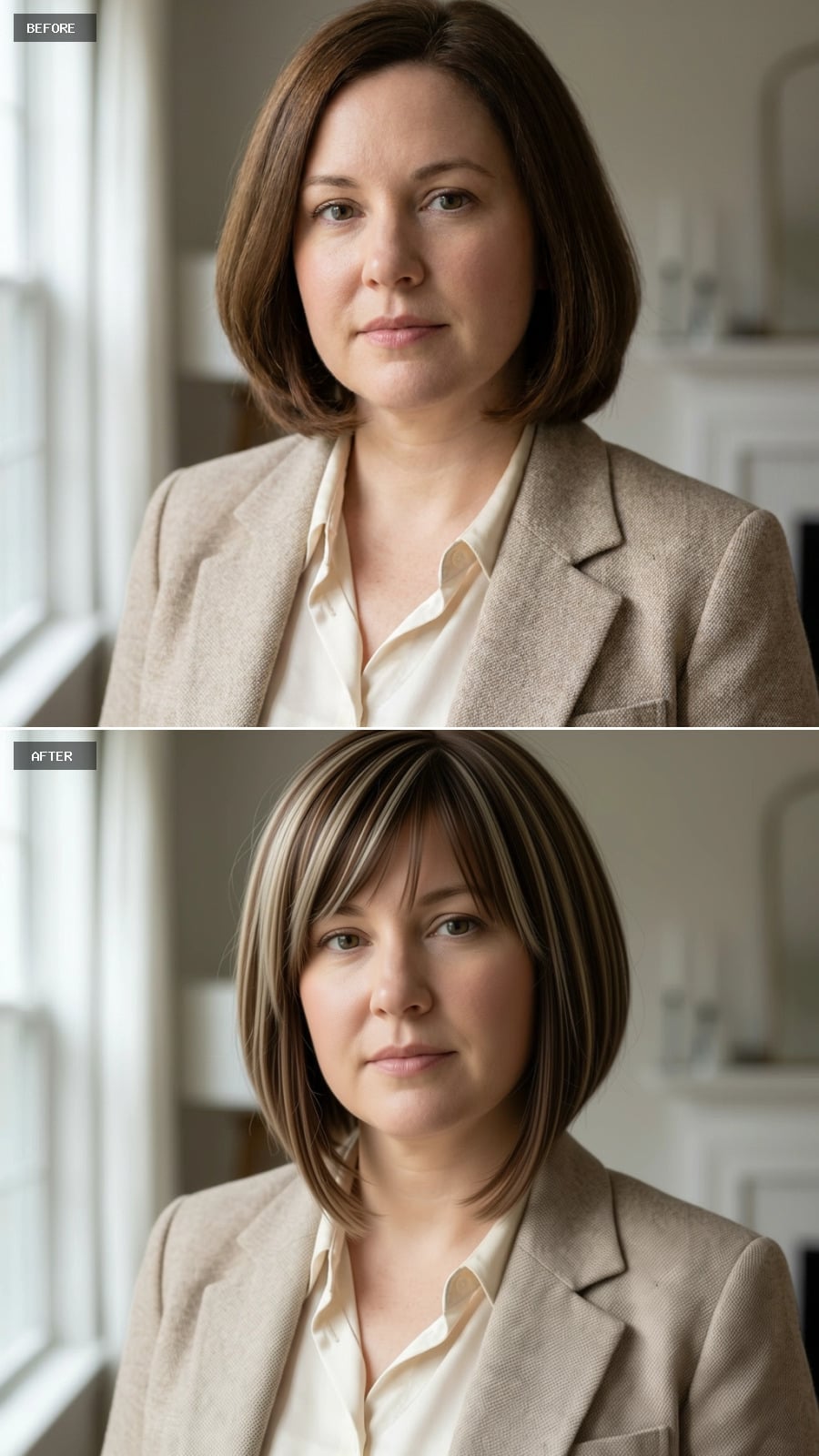
The first transformation wastes no time playing safe. The bob sits shorter at the back and travels forward toward the chin, immediately replacing the softer before silhouette with a sharper diagonal.
Then the highlights start moving through it. Pale blonde pieces break up the darker brown through the crown and mid-lengths, giving the eye several places to travel instead of one solid block of color. Straight-across bangs make the whole thing even more graphic.
Nothing here is trying to erase roundness. The cut simply gives it stronger lines to push against.
27. The Pixie Proves Length Was Never the Only Answer
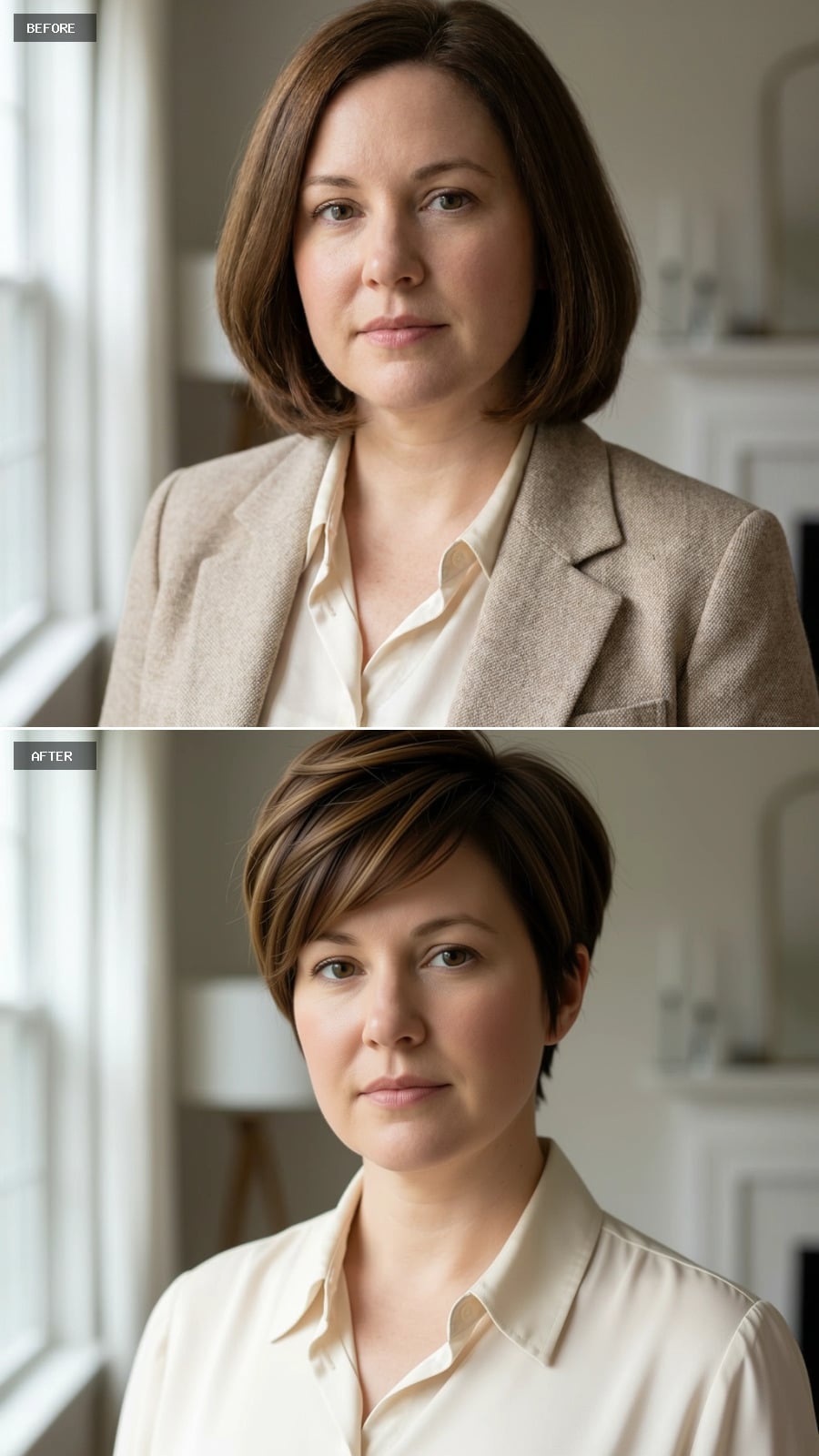
Dark brown hair is cut close through the sides and back while enough length remains on top to sweep diagonally across the forehead. That contrast — compact below, movement above — gives the short cut a very different kind of balance than any of the long styles in this gallery.
Warm caramel pieces appear mostly through the top, emphasizing the direction of the sweep rather than striping every section equally.
The clean neckline helps too. Once the hair stops competing for space around the jaw and neck, the face gets a much clearer frame.
Why It Works: Keeping the sides close while preserving length and movement on top can create more vertical emphasis. The side sweep adds a second direction, so the cut feels intentionally asymmetrical rather than uniformly round.
26. Long Layers and Caramel Ribbons Make the Case for Going Longer
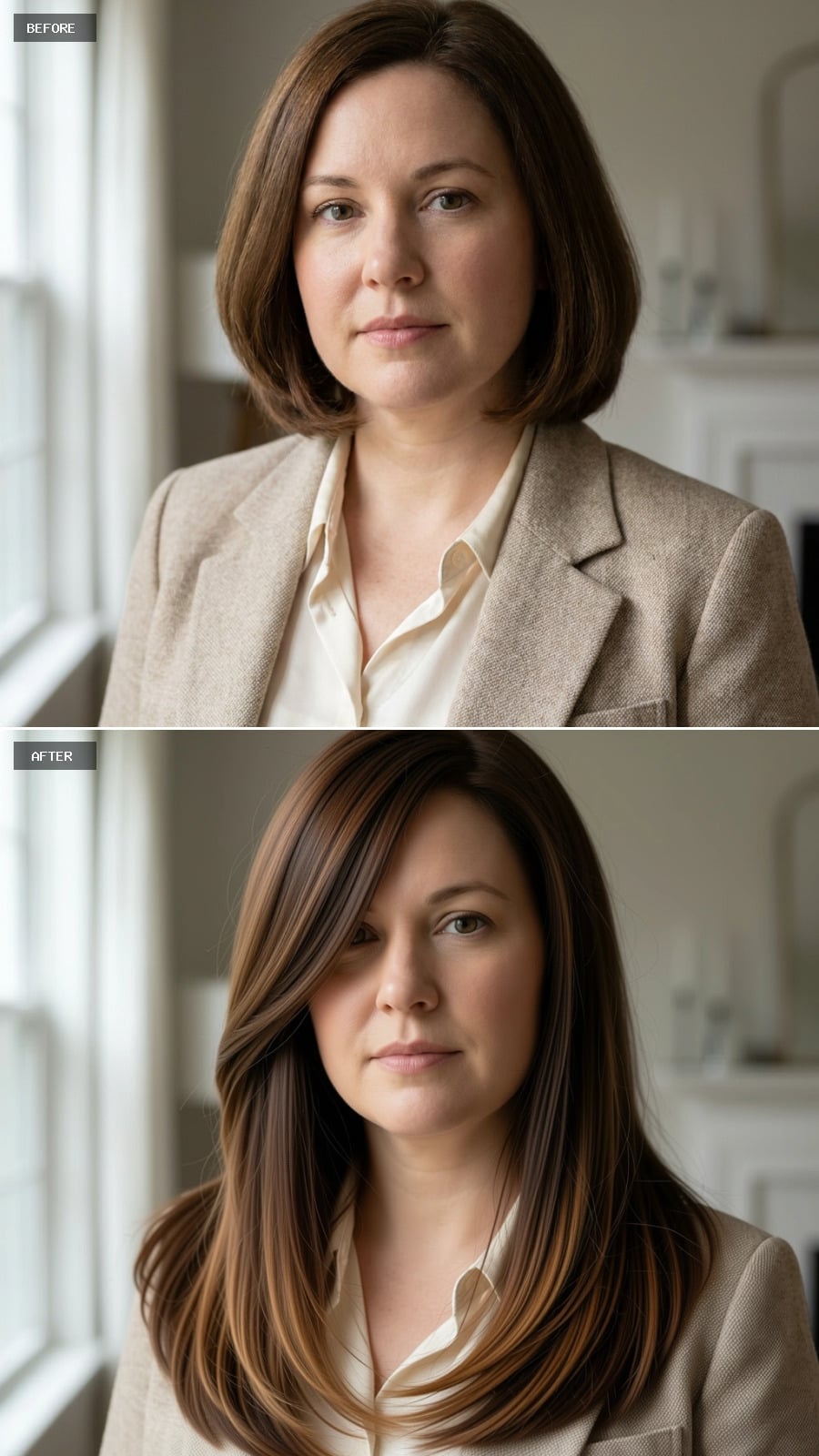
This one moves in the opposite direction. Hair falls past the collarbone in long layers with very little bulk near the cheeks, while a side-swept fringe interrupts the forehead without closing it off.
Caramel ribbons sit through the mid-lengths rather than beginning as obvious stripes at the root. They catch enough light to keep the length from becoming one heavy curtain of brown.
The result is less about a magic face-shape rule than simple proportion: more hair continues below the face, so the overall silhouette has somewhere else to go.
25. Black Hair, Full Bangs, and Highlight Stripes Refuse to Behave Quietly
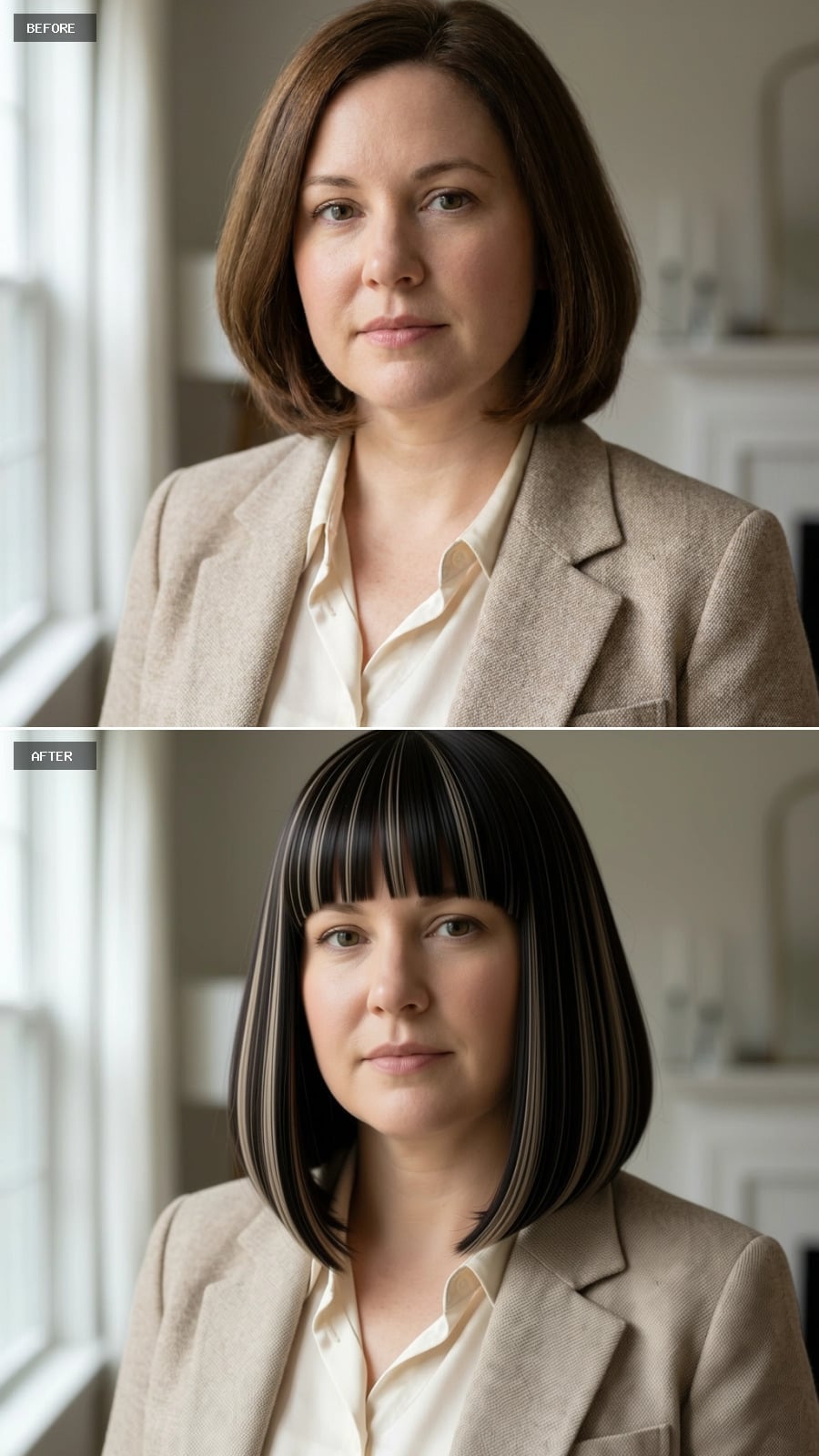
Black hair with visible highlight striping sounds like a risk, and it absolutely pays off.
The bob lands just below the jaw with a blunt hem, while the fringe cuts straight across the forehead. Instead of softening everything, the after image leans into hard edges.
The highlights are equally unapologetic. Distinct lighter columns run through the near-black base instead of disappearing into a conventional blend. That color pattern gives the bob an almost graphic rhythm from crown to ends.
A blunt fringe can shorten the visible forehead, while the longer bob below provides a competing downward line. The tension between those two directions is what makes the look interesting.
24. Copper Waves Change the Shape Without a Single Sharp Edge
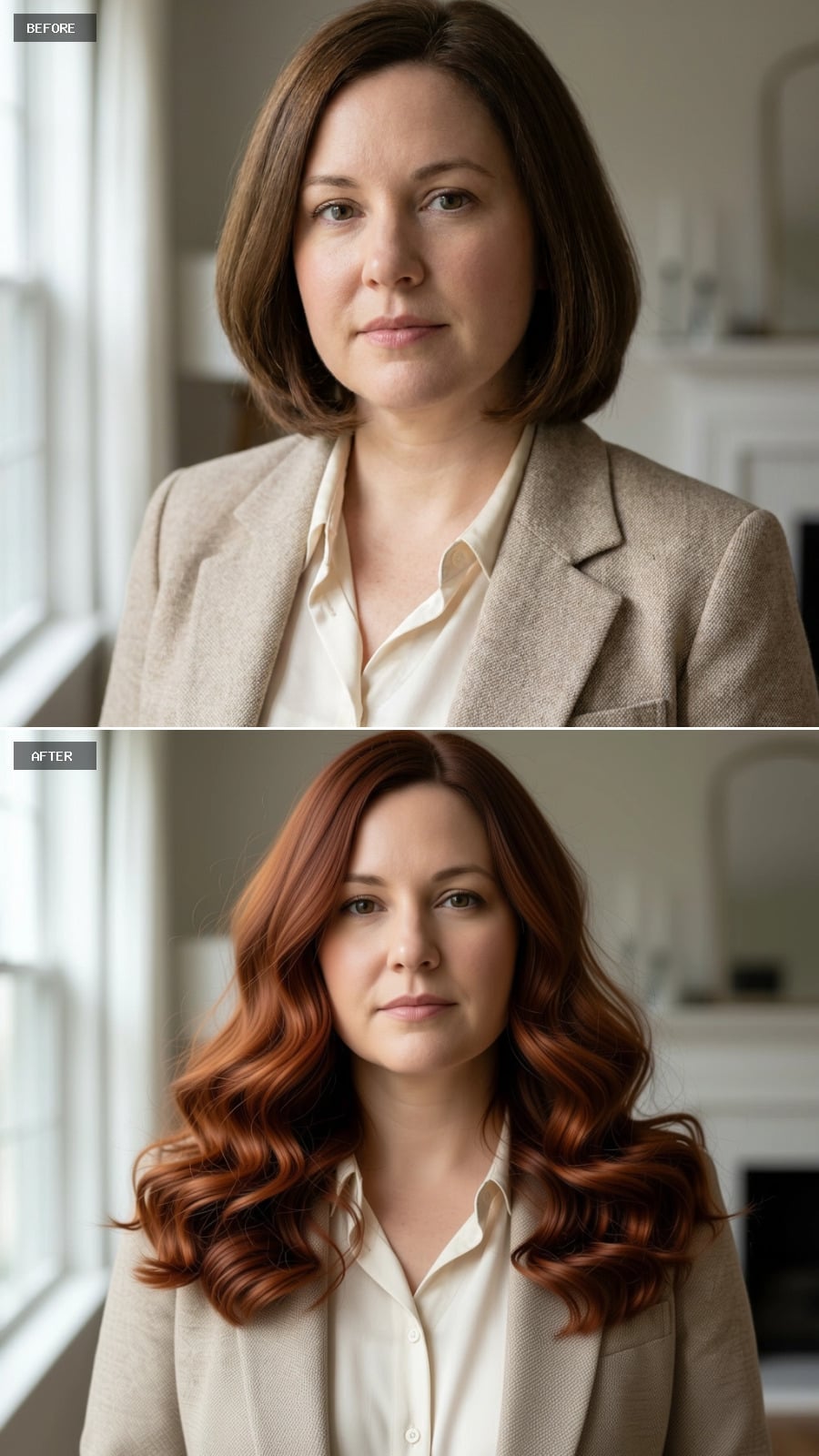
Rich copper-red waves fall well past the collarbone, replacing precision geometry with movement. The curls begin around the mid-lengths rather than ballooning immediately beside the cheeks, so most of the fullness collects lower down.
Color gives the movement another layer. Deeper copper near the roots warms through the mid-lengths, making the waves look even more dimensional as they turn.
This is the softer answer to the sharp bob before it. Same face, almost none of the same visual tools.
23. The Center-Part Bob Shows What Happens When Symmetry Is the Point
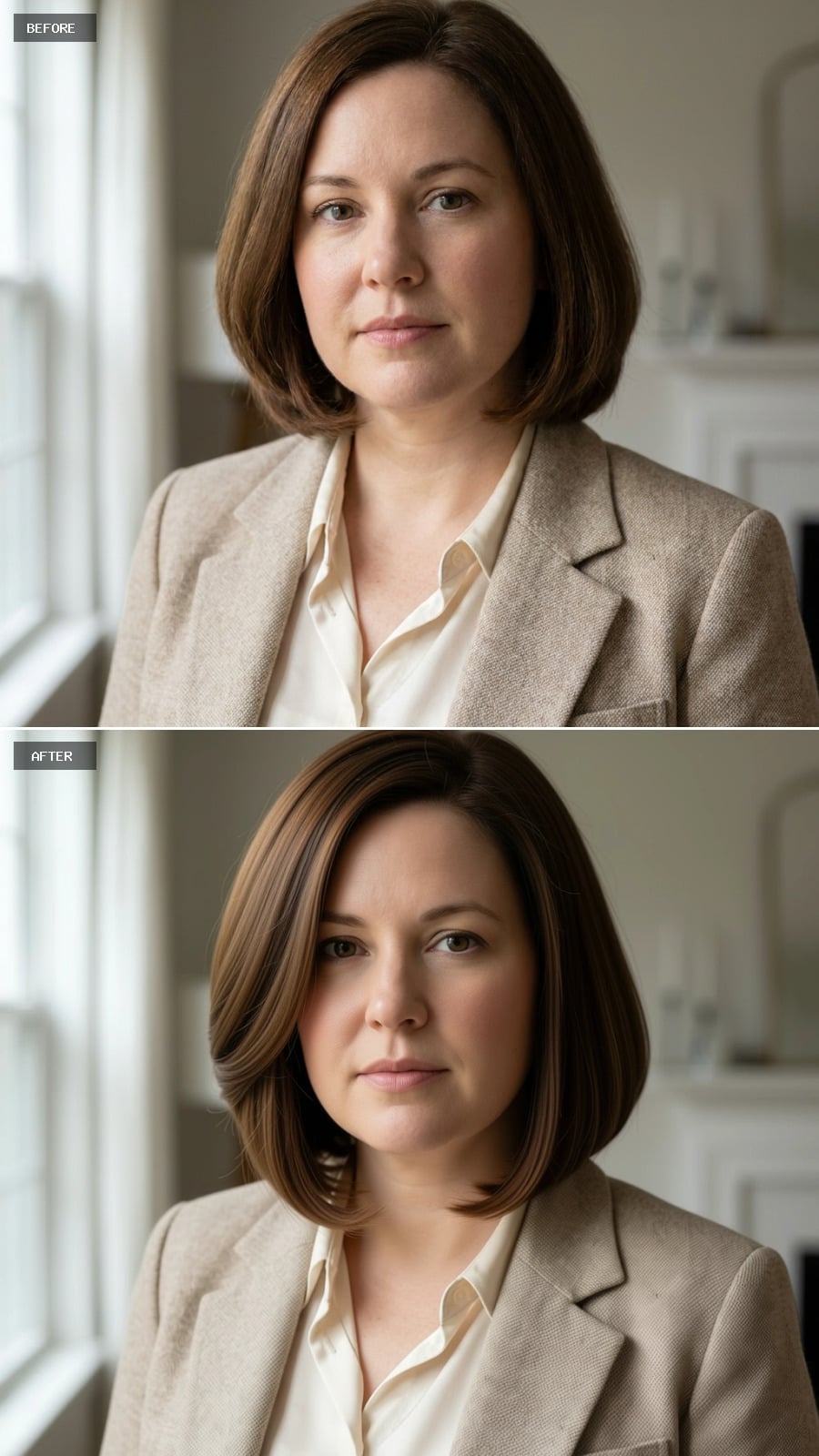
A blunt bob falls to around collarbone length and parts cleanly through the center. There is no side sweep rescuing it, no curls creating distraction, and very little layering to soften the outline.
That restraint is what makes it useful. Smooth hair falls in two dense panels past the jaw, creating an uninterrupted frame on both sides of the face.
Center parts are often treated as forbidden territory for round faces. This one is a good reminder that the effect depends on the rest of the cut, not the part in isolation.
22. Curtain Bangs Turn the Forehead Into Two Diagonals Instead of One Line
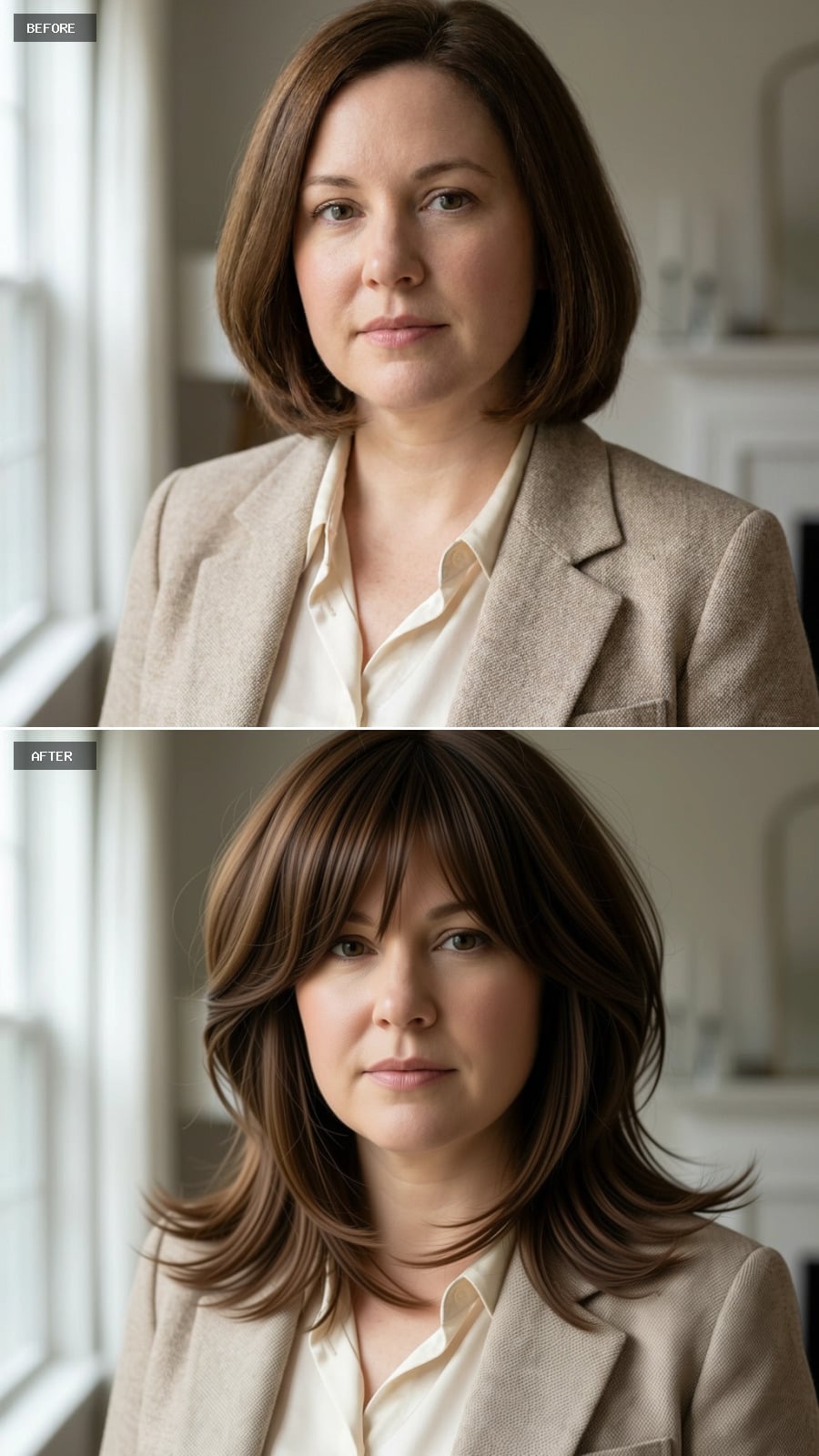
The curtain bangs split through the center and fall outward toward the cheekbones, giving the front of the haircut two sloping lines instead of a hard horizontal edge.
Shoulder-length layers pick up that movement and flip loosely near the ends. Lighter ribbons through the brown mid-lengths keep those bends visible without making the color the entire story.
The strongest part of this transformation is that nothing looks over-engineered. The cut has movement, but it still feels loose enough to live in.
Flatness is the real enemy here, not roundness itself.
21. A Cropped Side-Swept Bob Makes Asymmetry Do the Talking
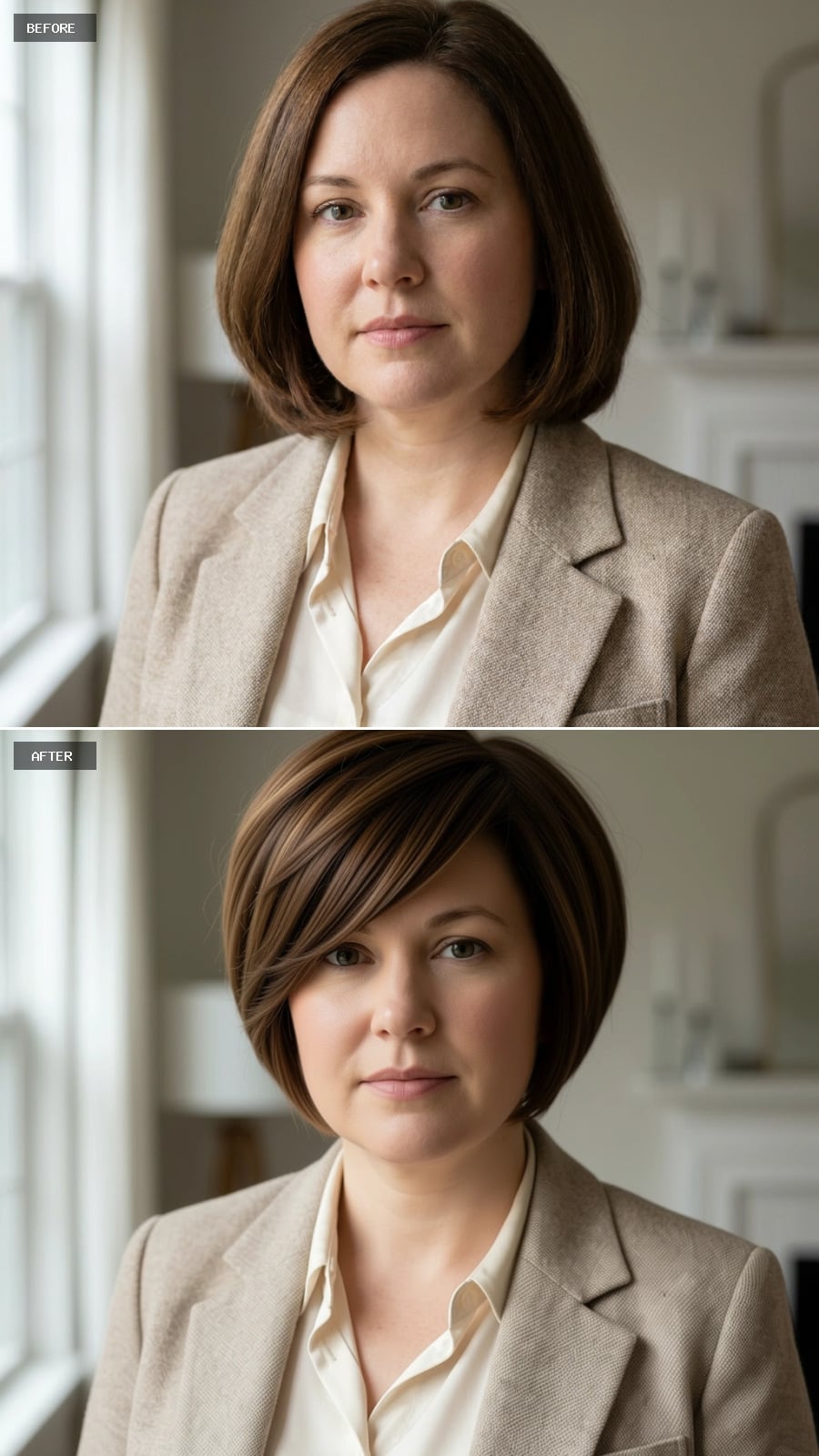
This bob grazes the jaw at an angle and stays close through the nape. The side-swept fringe does not hide the face so much as redirect the front of the silhouette.
Caramel ribbons sit through the upper layers of the brunette base, breaking up what could otherwise become a very solid helmet of color.
The compact nape is especially important visually. It keeps the cut from expanding equally in every direction and lets the front sweep become the obvious gesture.
20. Mahogany Length Lets Color Do More of the Work
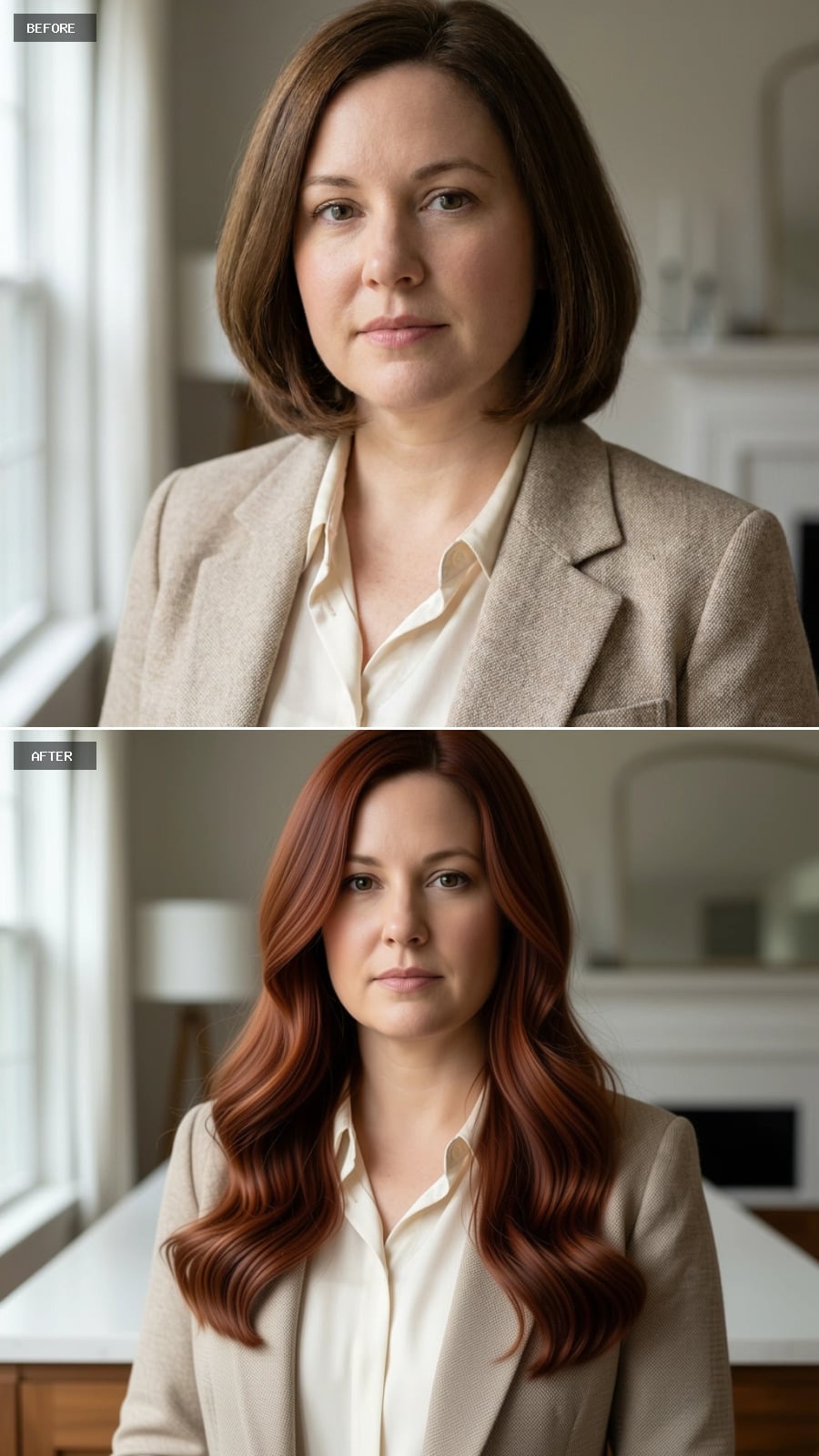
Auburn-to-mahogany hair falls well below the collarbone in loose waves, with deeper roots gradually warming through the length.
There is no elaborate fringe or aggressive layering to explain away here. The after image relies on sheer length, lower-set movement, and a saturated color that makes every bend visible.
It’s a lot of hair. That’s the point.
19. Blunt Bangs Meet Long Layers and Ignore the Usual Warning Labels
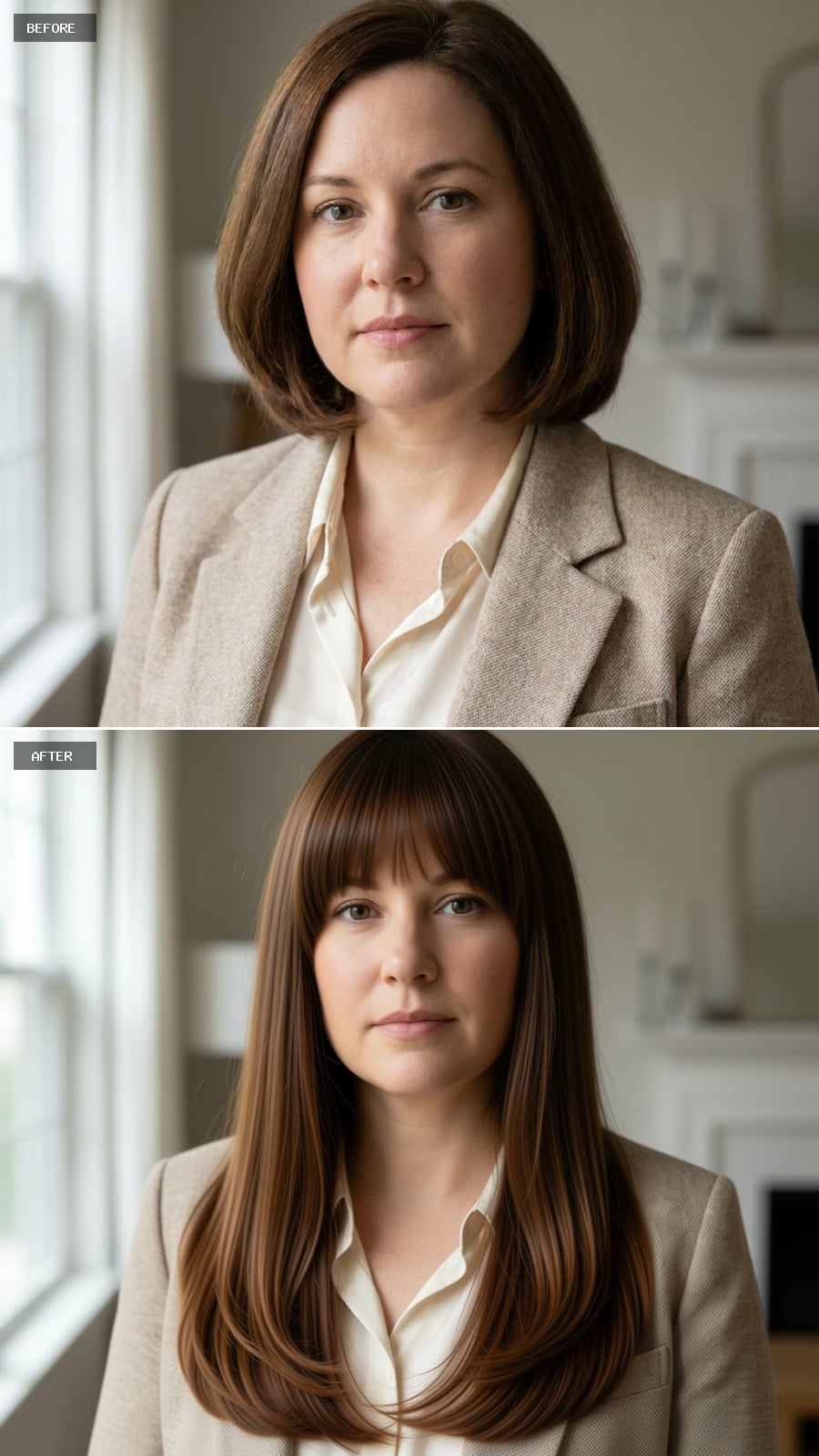
Straight-across bangs sit just above the brows while the rest of the hair continues well past the collarbone.
Those two lengths pull in opposite directions. The fringe creates a strong horizontal stop at the top; the long, sleek body of the cut continues below the face.
That contradiction is what makes this one useful. Blunt bangs are not automatically flattering or unflattering on a round face. Their effect changes with width, density, length, and everything happening beneath them.
18. The Ear-Grazing Crop Uses Concentrated Highlights Instead of More Hair
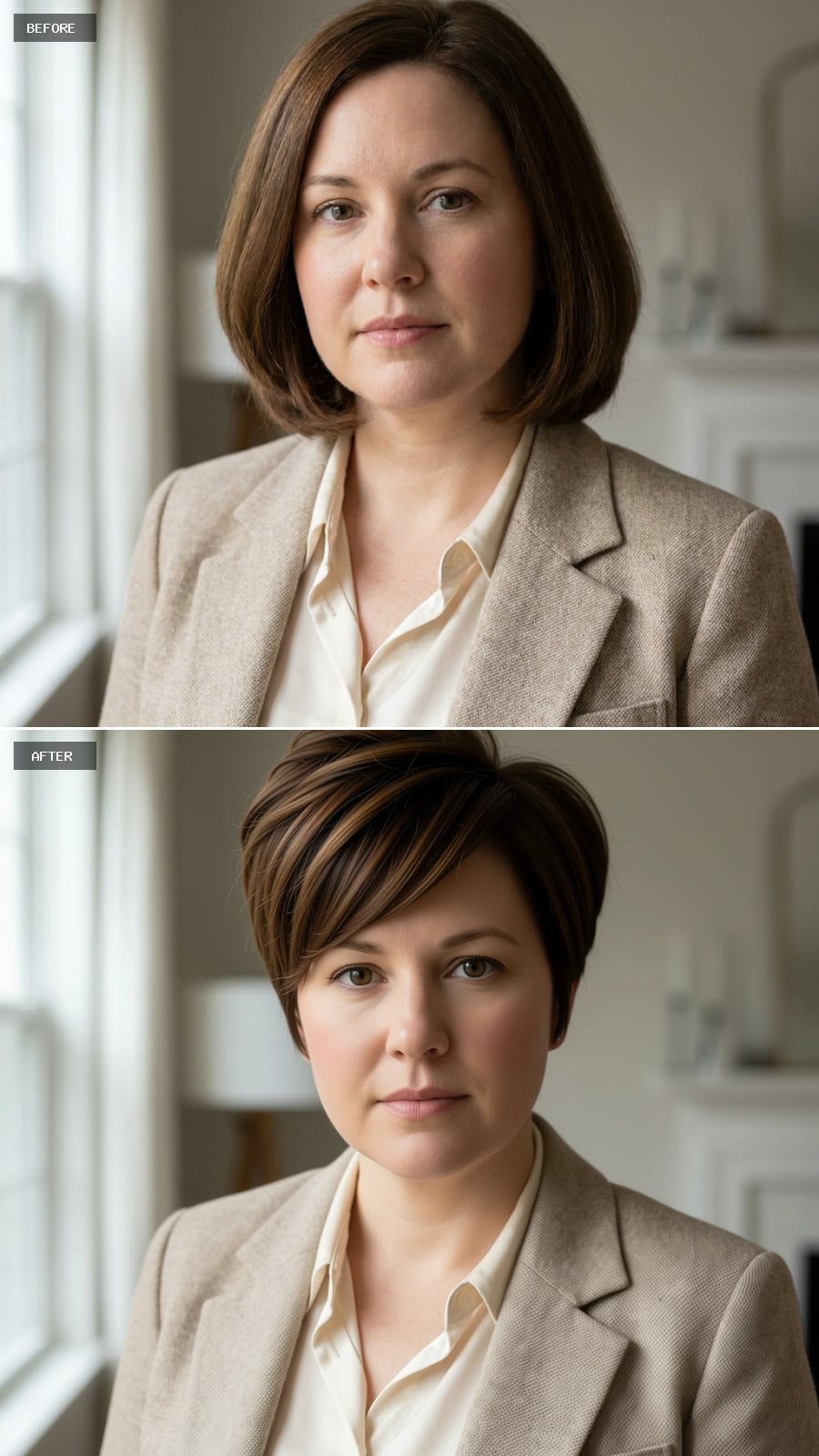
Cropped to just below the ear, this cut has far less length to work with than most of the gallery. The deep side sweep supplies the movement instead.
Caramel highlights concentrate near the crown and top layers rather than running evenly through every section. That makes the lighter color follow the same direction as the haircut.
It’s a compact little piece of architecture without looking severe.
17. Balayage Turns Long Layers Into a Moving Field of Light
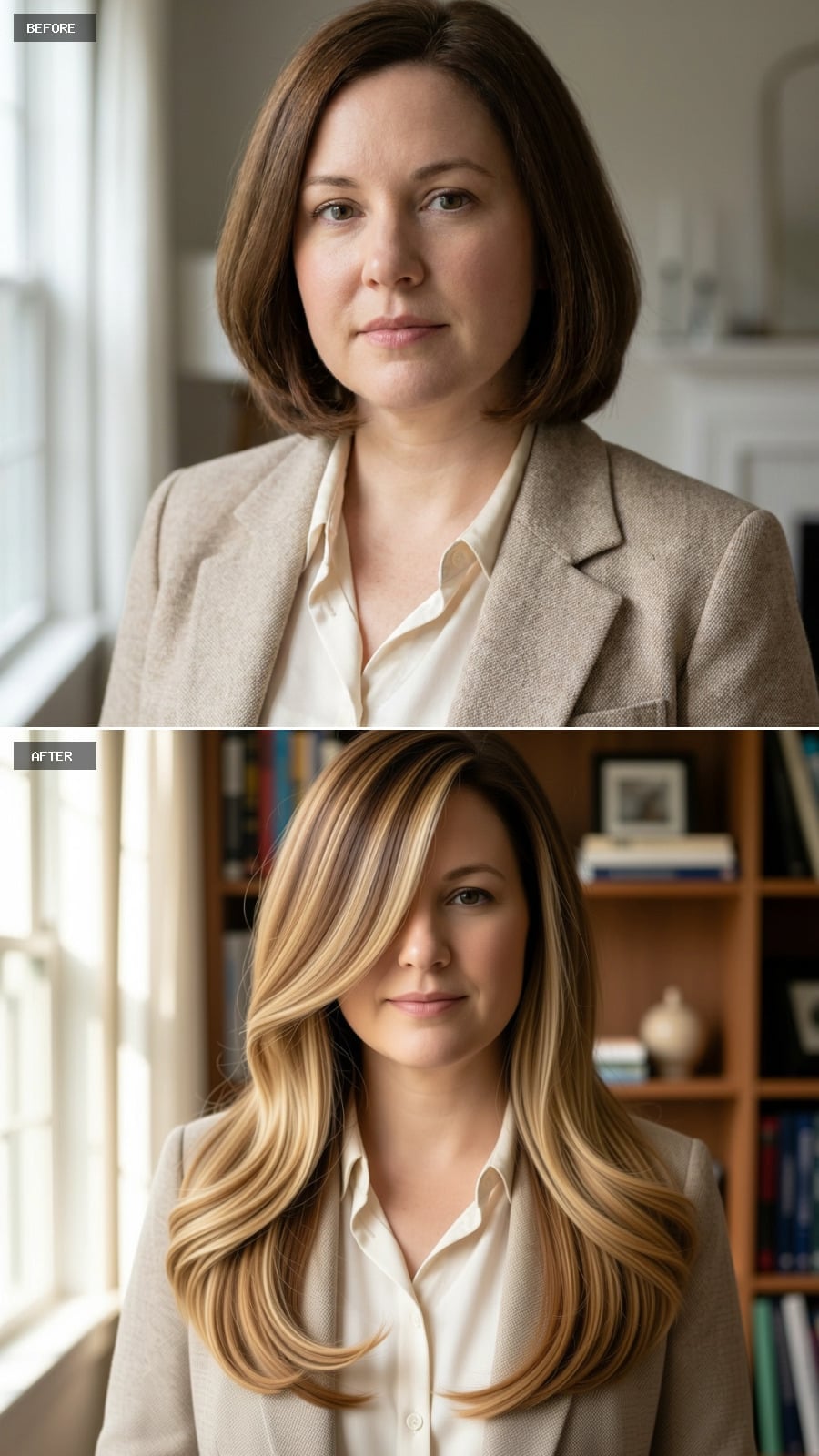
Layers fall past the collarbone while the color shifts from a brunette root through honey and pale gold toward the ends.
The most successful part is not simply that the hair is lighter. Brightness sits through the moving lengths rather than forming a solid halo around the face.
Face-framing sections sweep softly across the forehead, adding another diagonal without making the cut look chopped into separate tricks.
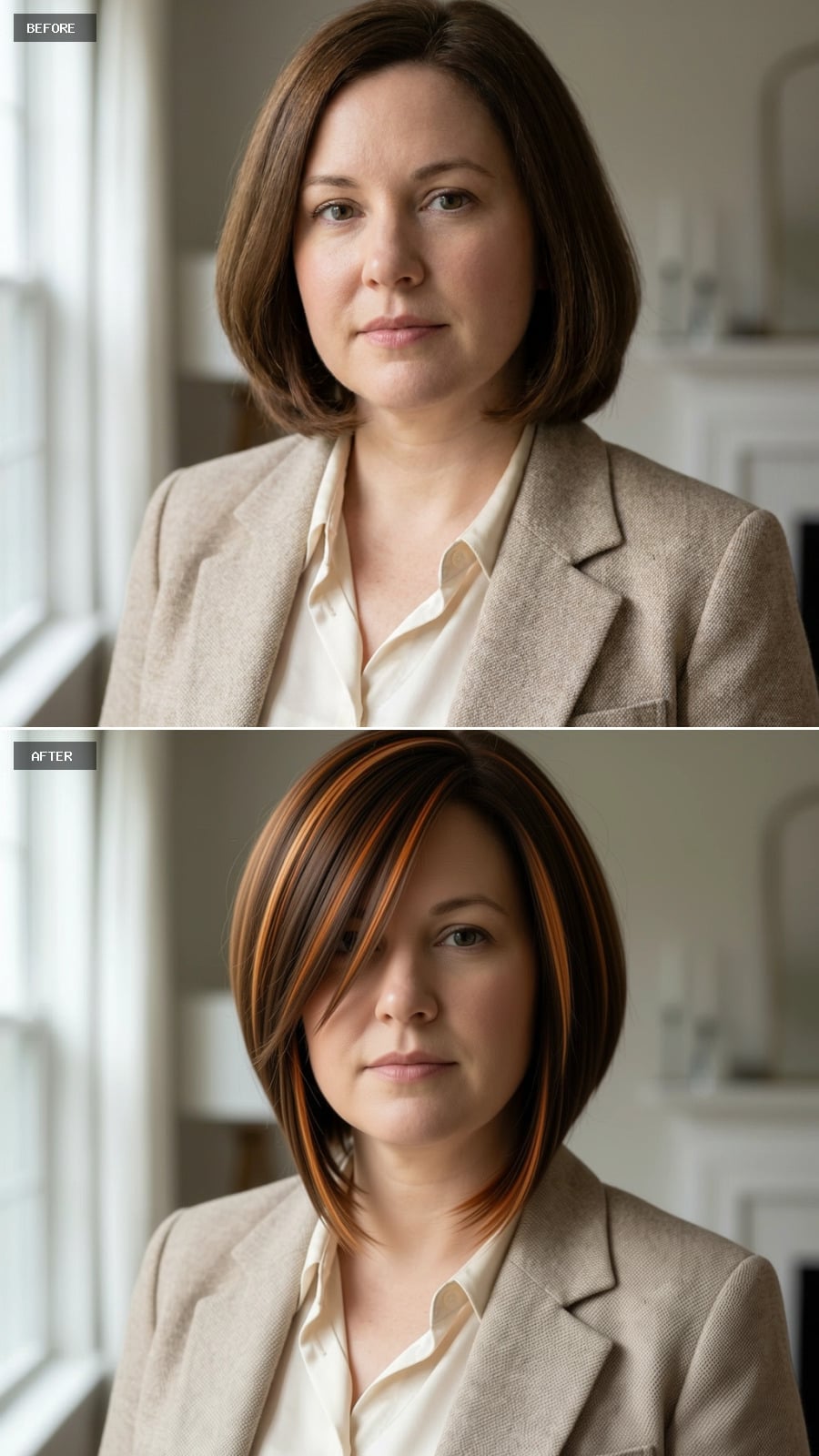
16. Copper-Orange Panels Make the Bob Look Almost Illustrated
❤️ Would you like to save this?
Dark brown is interrupted by wide copper-orange panels running through the front sections from root to tip.
These are not subtle highlights. They are deliberate stripes, and the cut gives them a route to follow: longer toward the chin on one side, swept across the forehead on the other.
The combination turns asymmetry into the entire point. Instead of trying to make the face look perfectly balanced, the hairstyle makes perfect balance look unnecessary.
15. Face-Framing Caramel Keeps Long Hair From Becoming a Curtain
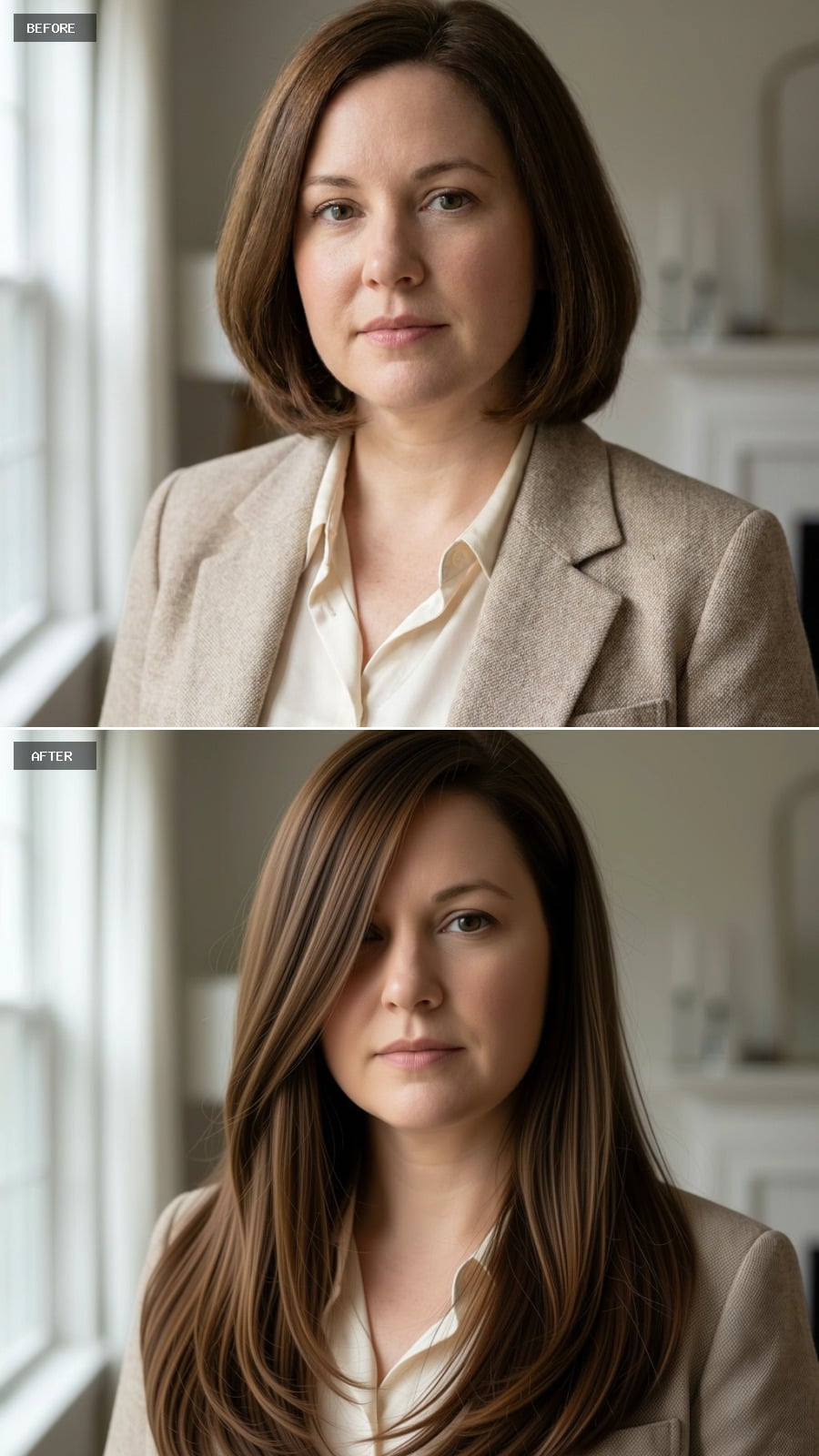
Hair falls well past the shoulders in long layers that taper toward the ends. The distinction from the earlier caramel look is where the brightness concentrates: more of it stays near the front sections.
Those lighter pieces follow the face before continuing down into the length, which gives the eye a path without surrounding the cheeks with equal brightness on both sides.
A diagonal sweep across the forehead keeps the front from becoming too symmetrical. The overall result feels fluid rather than flat.
14. A Chin-Length Center-Part Bob Goes Almost Brutally Simple
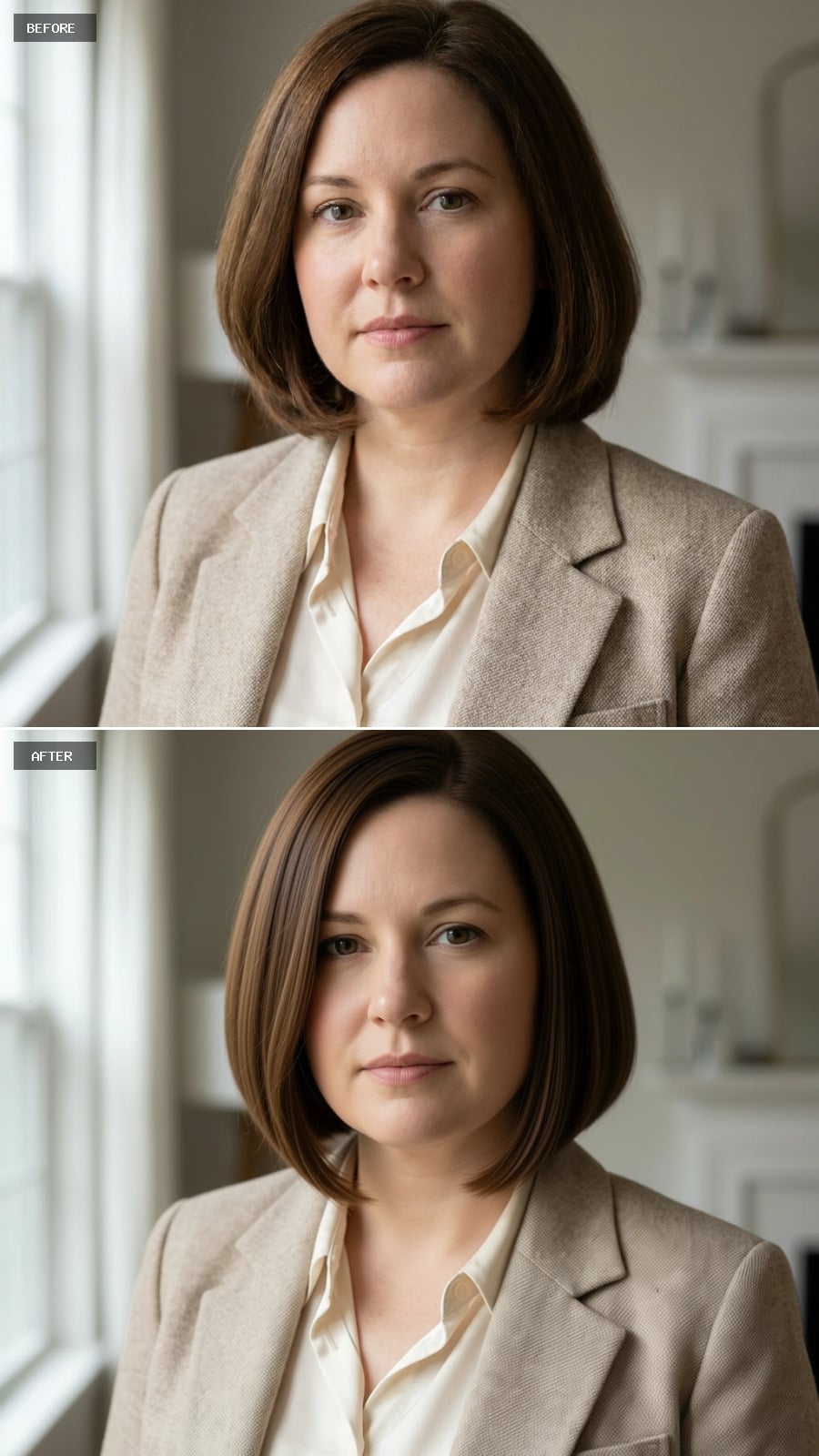
The first thing you notice is how little the cut is trying to distract you. Dark brown hair parts precisely in the center and falls in two polished panels around the face.
Unlike the longer center-part bob earlier, this one sits much closer to the chin and makes the compactness part of the effect. There is no crown volume and almost no visible layering.
The finish is disciplined, not fussy. Sometimes the most interesting experiment is removing nearly every trick from the table.
The Details: A bob that ends around the jaw behaves differently from one extending farther toward the collarbone because the surrounding proportions change. Keeping the ends sleek emphasizes the outline, while bending or curling them outward would create a different silhouette entirely. Product and heat-tool choices depend on hair texture and the finish you’re trying to achieve.
13. Crown Volume and Caramel Waves Give the Mid-Length Cut More Lift
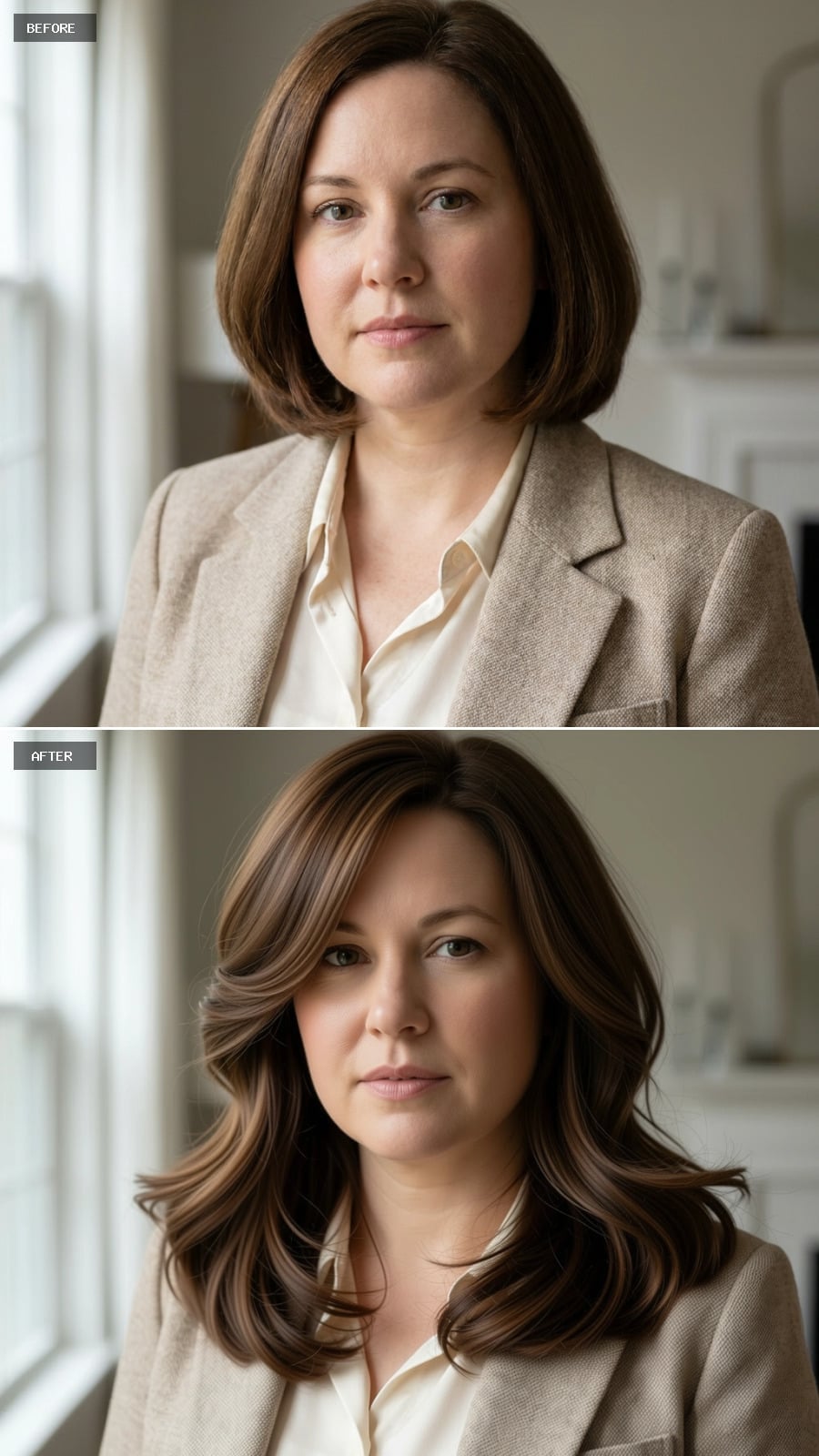
Shoulder-grazing waves bring back fullness, but not in one uniform mass. The crown has lift, while the sides fall into softer bends toward the ends.
Caramel highlights cluster through the face-framing layers, so the lighter color follows the shape of the cut instead of appearing randomly scattered.
The silhouette is fuller than several earlier looks, yet it avoids becoming equally wide from roots to ends. That’s the distinction that keeps all that volume lively rather than blocky.
12. Warm Brunette Panels Give the Sleek Angled Bob More Depth
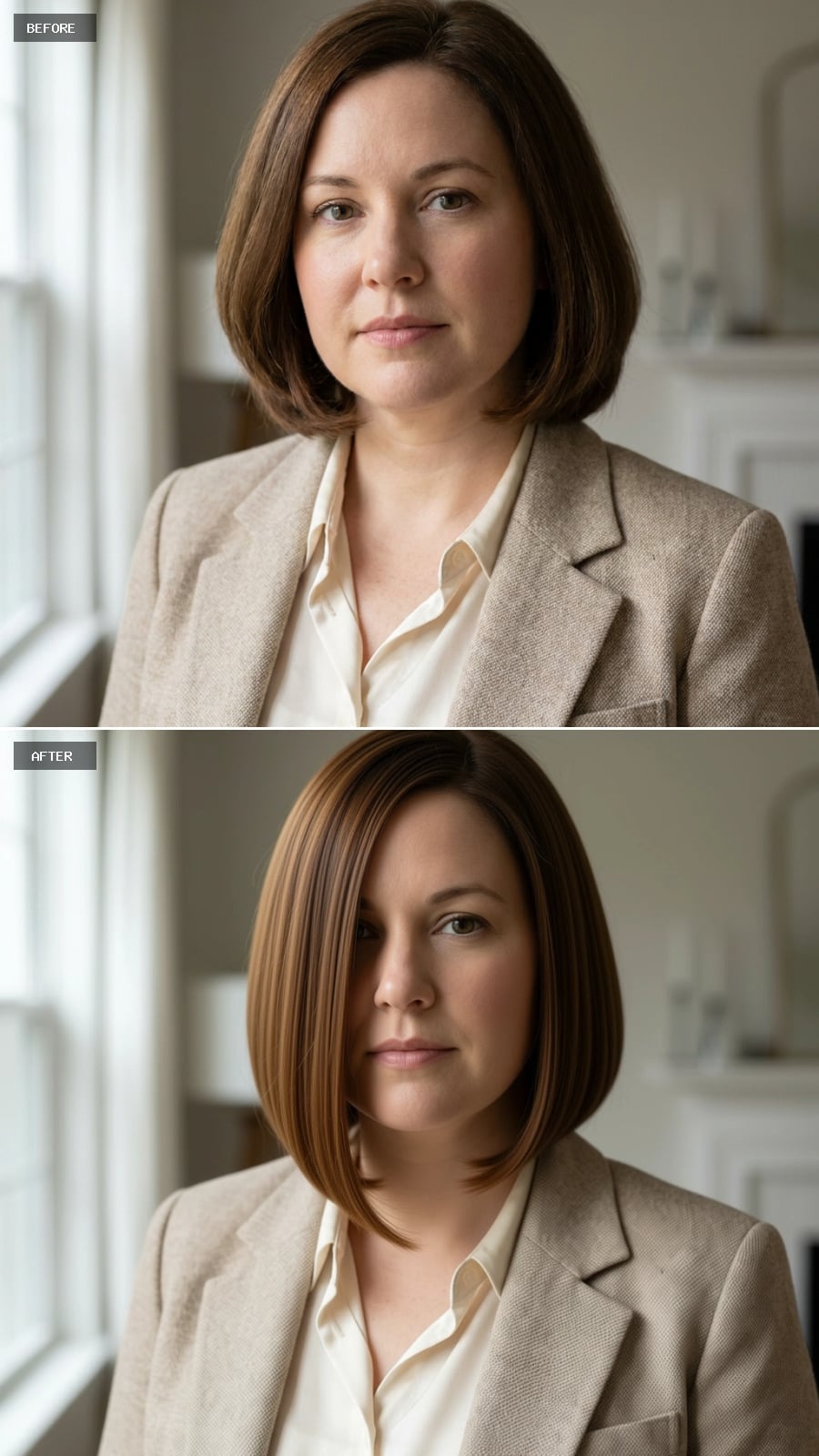
Razor-straight ends and a side sweep create a bob that sits shorter behind and longer toward the front.
Auburn-toned panels move through the brunette mid-lengths, but the effect stays restrained. They appear when the hair separates and catches light rather than taking over the entire cut.
The shape would still work without the color. The warmer panels simply make the movement easier to see.
11. Burnished Copper Waves Take the Softer Route Again
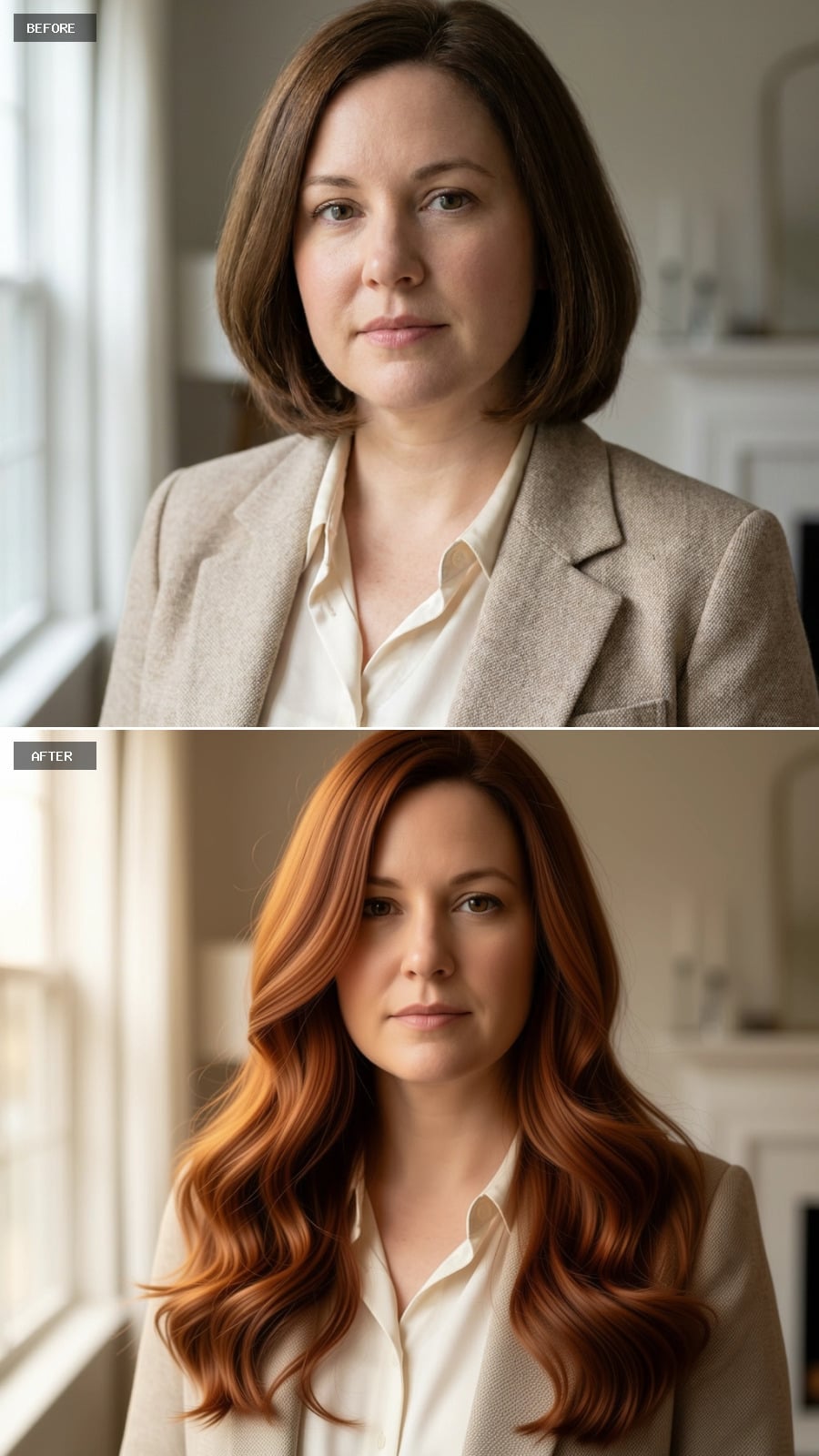
This second copper look earns its place because the wave pattern is looser and more relaxed. Auburn runs from deeper roots toward a brighter burnished orange through the lengths, while the curls open into broad bends rather than springier spirals.
The fullness falls mostly below the cheeks and continues well past the collarbone.
Instead of precision, the entire cut depends on flow. After several engineered bobs, that looseness feels almost extravagant.
10. Collarbone Layers and Barely-There Waves Keep the Caramel Quiet
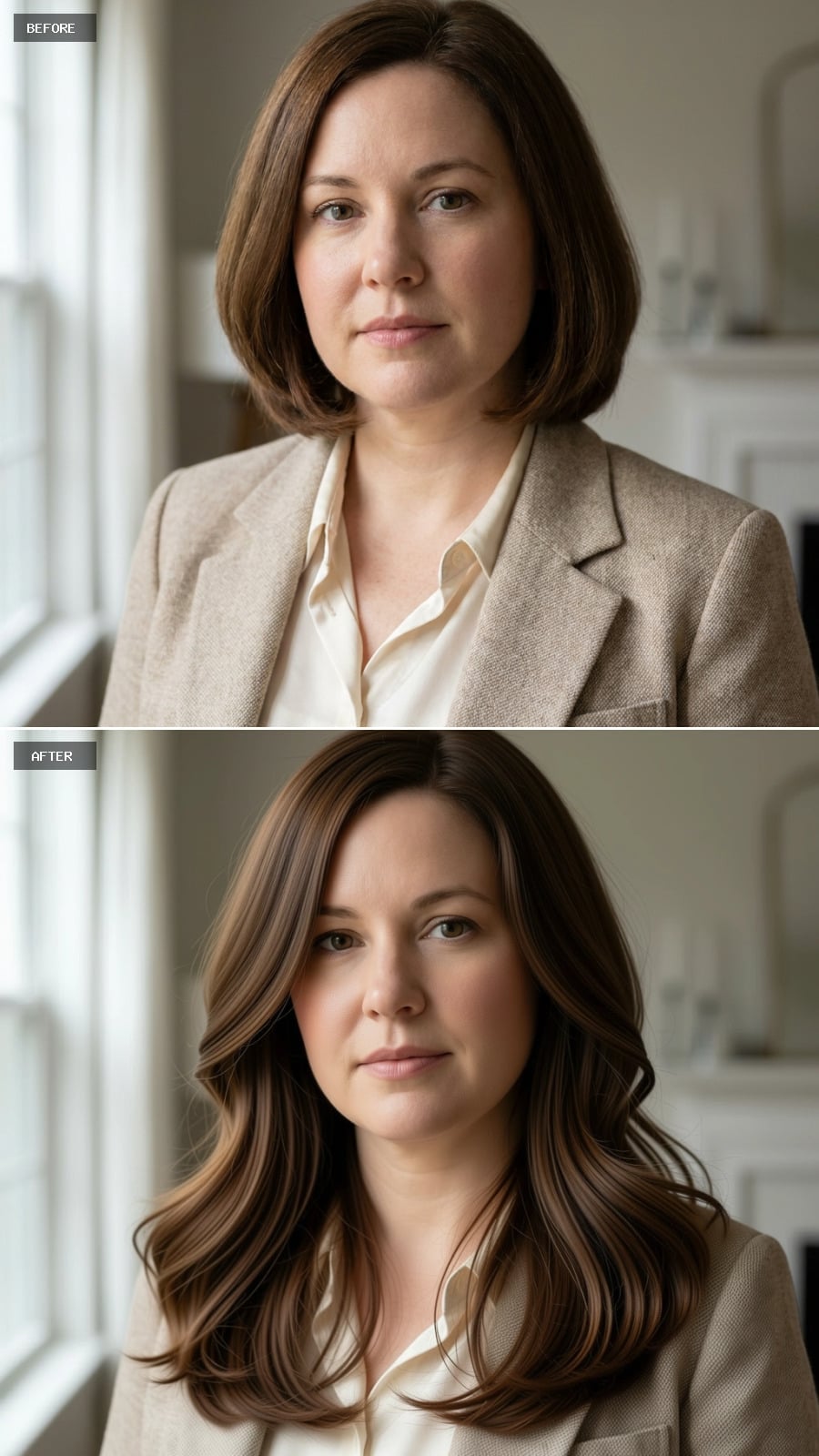
Longer layers graze the collarbone while caramel ribbons sit through the darker brown mid-lengths.
What separates this one from the more heavily highlighted looks is restraint. The waves appear mostly at the ends, just enough to keep the lower half from hanging motionless.
Nothing here is shouting about face shape. It’s simply a very wearable combination of length, soft movement, and controlled brightness.
9. The Blunt Interior Line Gives the Side-Swept Bob Some Weight
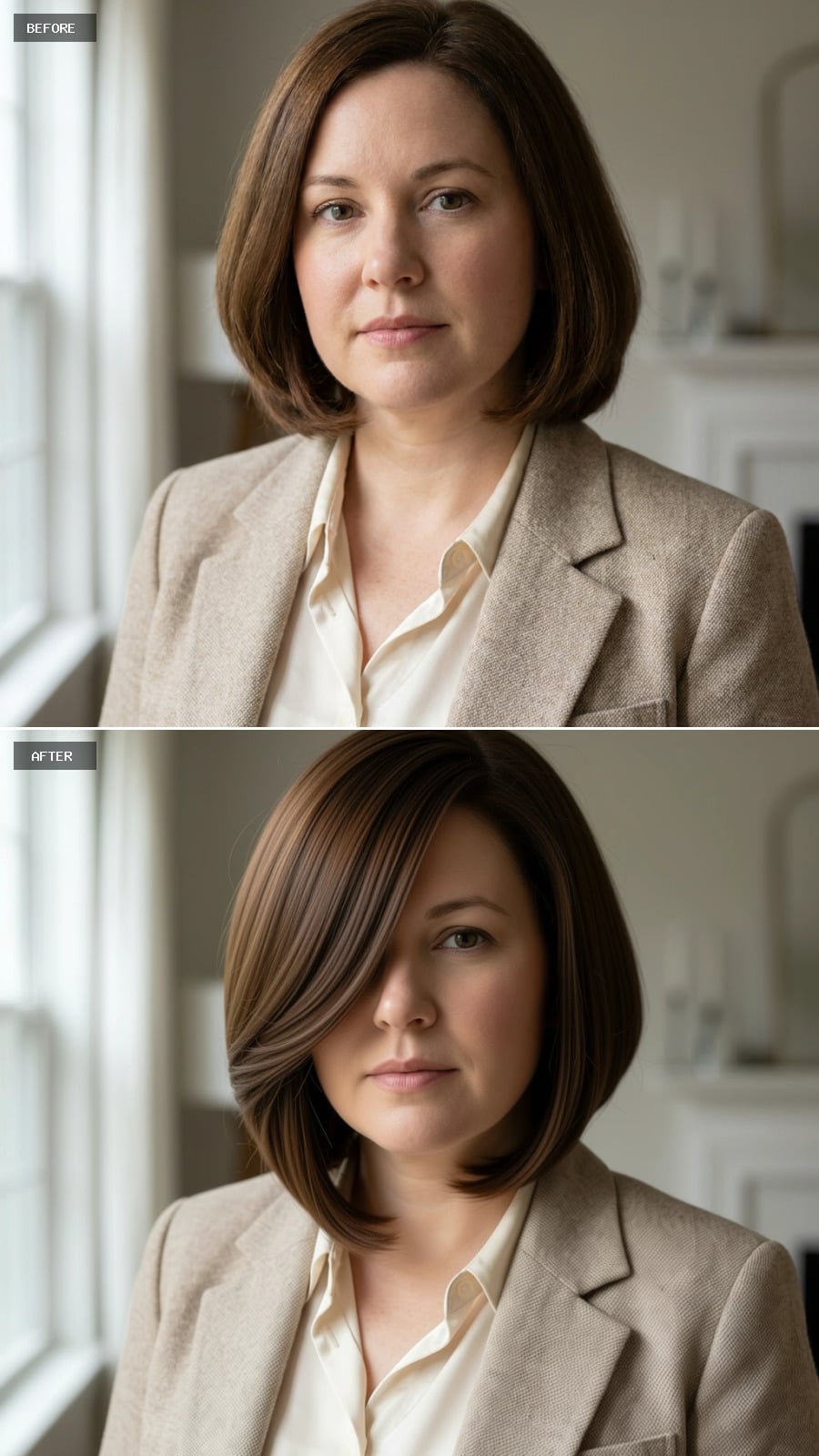
A deep side sweep sends the front of the haircut diagonally across the face while the bob itself lands just below the jaw.
The lower edge remains blunt enough to hold a clear shape instead of dissolving into feathered ends. That weight is what distinguishes it from the softer cropped bob earlier.
Warm brunette variation keeps the polished surface from becoming visually flat under indoor light.
8. Long, Straight Chestnut Hair Makes Simplicity Look Deliberate
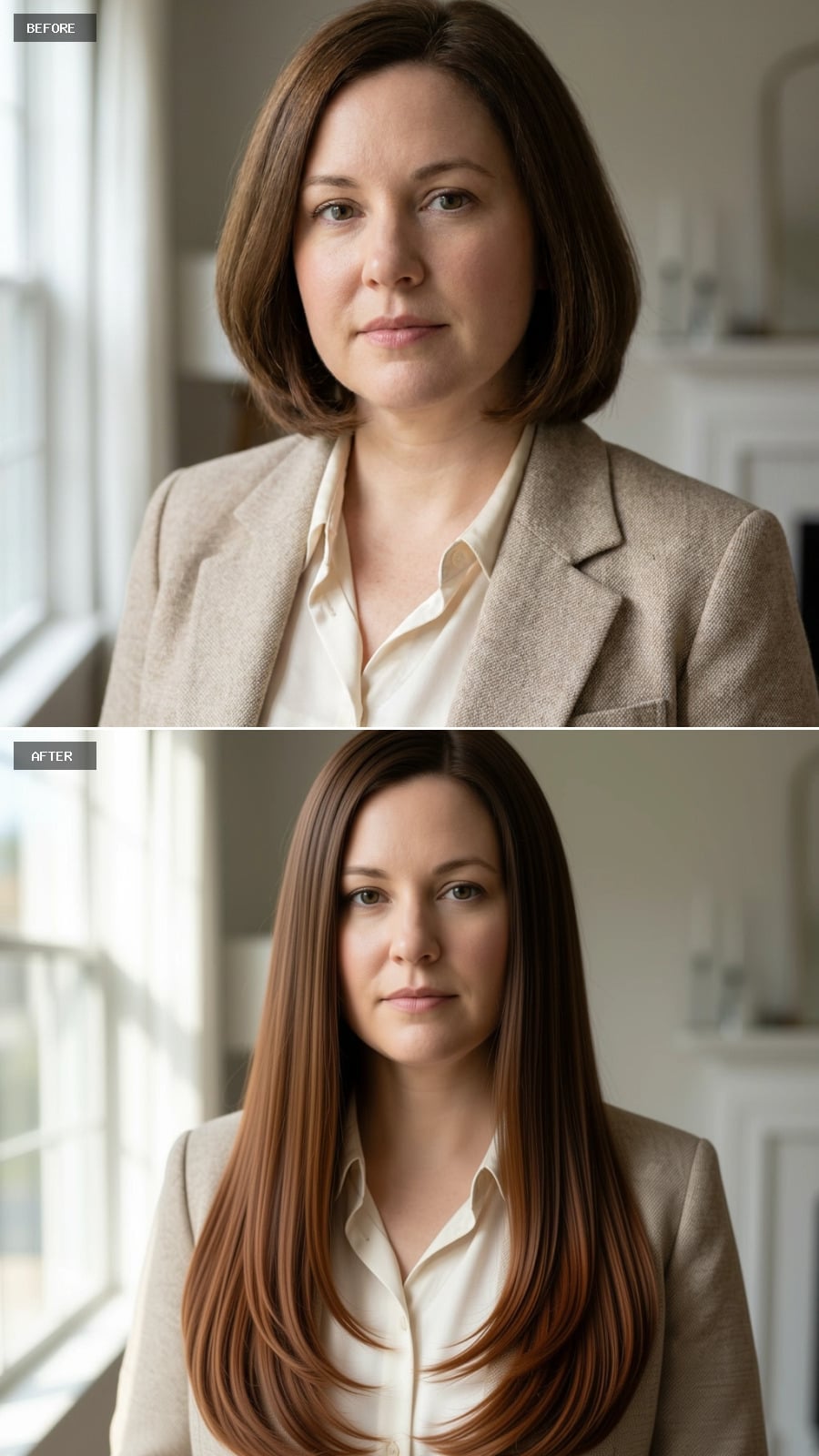
Hair drops well below the collarbone in long, restrained layers with a deeper brown root warming into chestnut through the mid-lengths.
There is very little curl or dramatic framing to distract from the length itself. The front pieces angle inward slightly near the jaw, but the rest of the cut stays almost stubbornly simple.
That makes this a useful counterpoint to the highlighted versions. Sometimes the silhouette can carry the transformation without a complicated color strategy.
7. Glass-Straight Length and Blunt Fringe Push the Contrast Even Harder
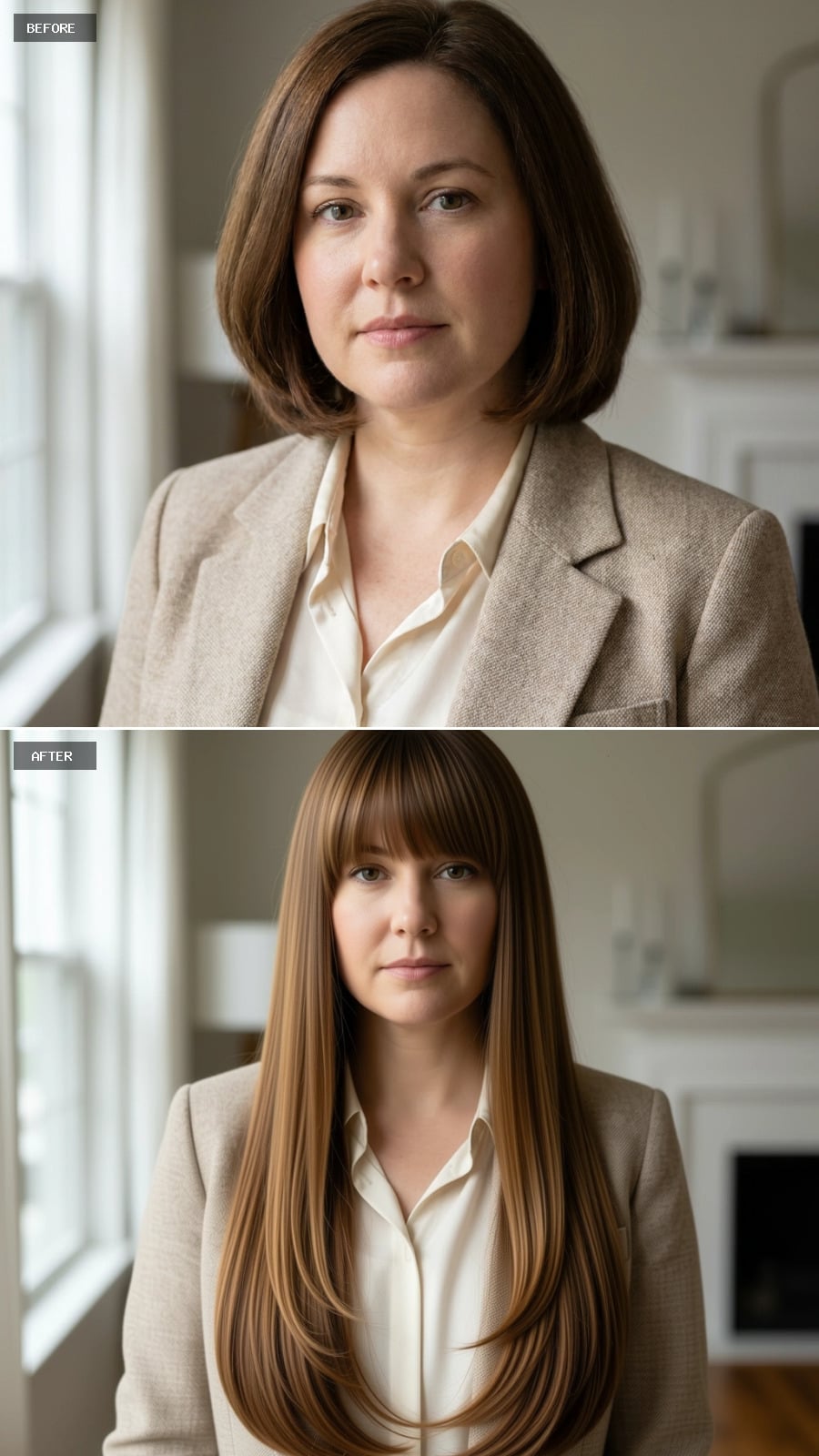
Blunt fringe cuts cleanly across the forehead while the rest of the hair falls in long, nearly glass-straight panels beyond the shoulders.
Unlike the earlier blunt-bang look, this version is less layered and more graphic. The center part begins behind the fringe, and warm brown lengths carry subtle caramel threading through the mid-sections rather than at the root.
Blunt bangs can emphasize width in some cuts and look beautifully balanced in others. Here the long, uninterrupted hair below them is doing enough visual work to keep the fringe from becoming the only line you notice.
6. Caramel Ribboning Follows the Sweep Instead of Fighting It
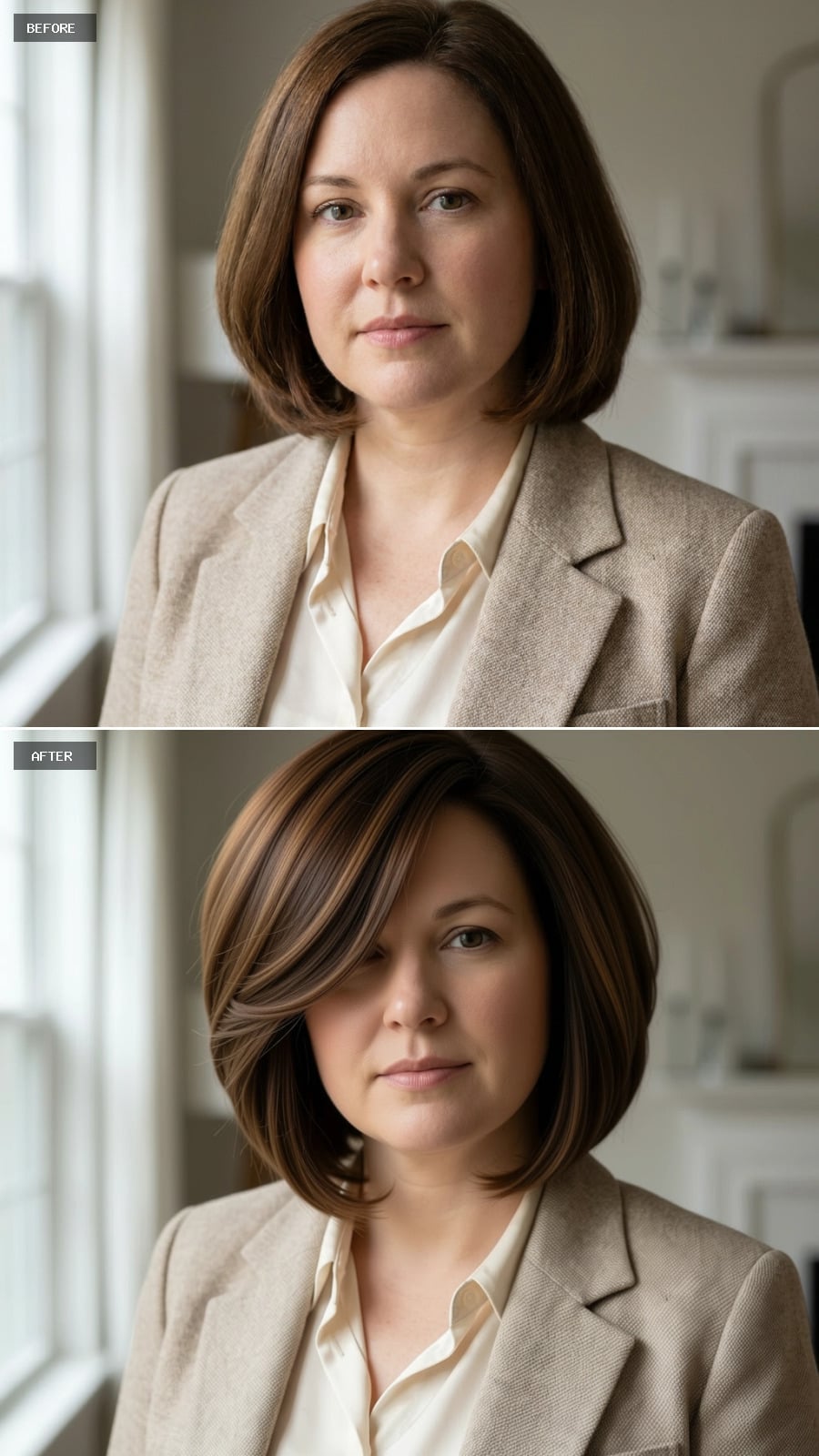
This rounded bob skims the jaw with more side volume than several of the precision cuts, but the styling refuses to let that fullness sit still.
The side part creates a broad sweep across the forehead, and caramel ribbons follow that same curve through the mid-lengths.
Color and cut are moving in one direction instead of competing for attention. That’s what gives this bob its own identity among a gallery crowded with them.
5. Soft Waves and a Deep Side Part Make the Mid-Length Cut Feel Effortless
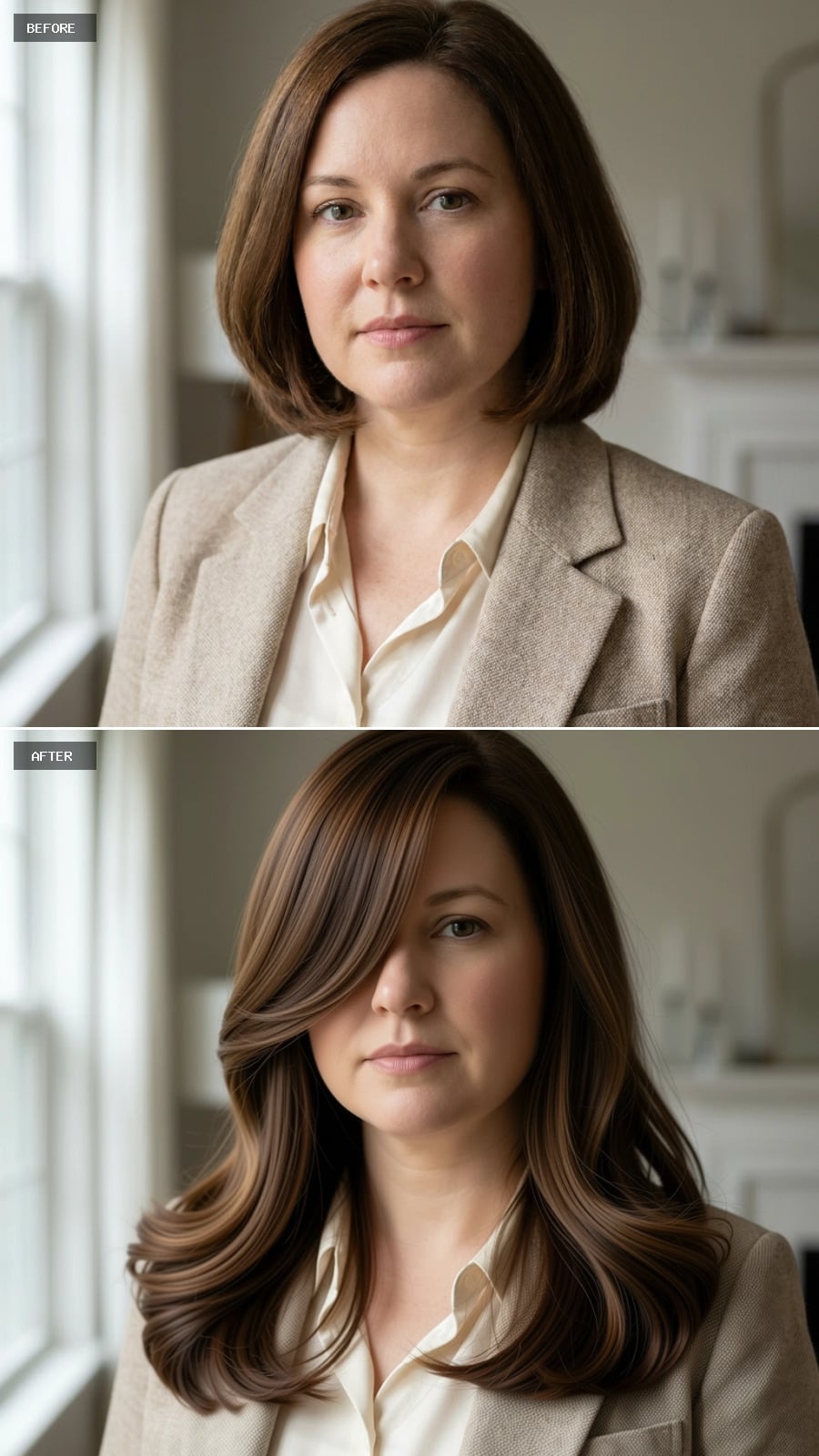
The deep side part sends a long section of hair across the forehead before the waves begin lower down.
That smooth stretch from crown to mid-length gives the cut a different rhythm from the crown-heavy wave look earlier. Warm caramel pieces sit through the darker brown and brighten the movement without becoming chunky stripes.
This is one of the easiest-looking styles in the gallery, which may be why it works so well as a late reset.
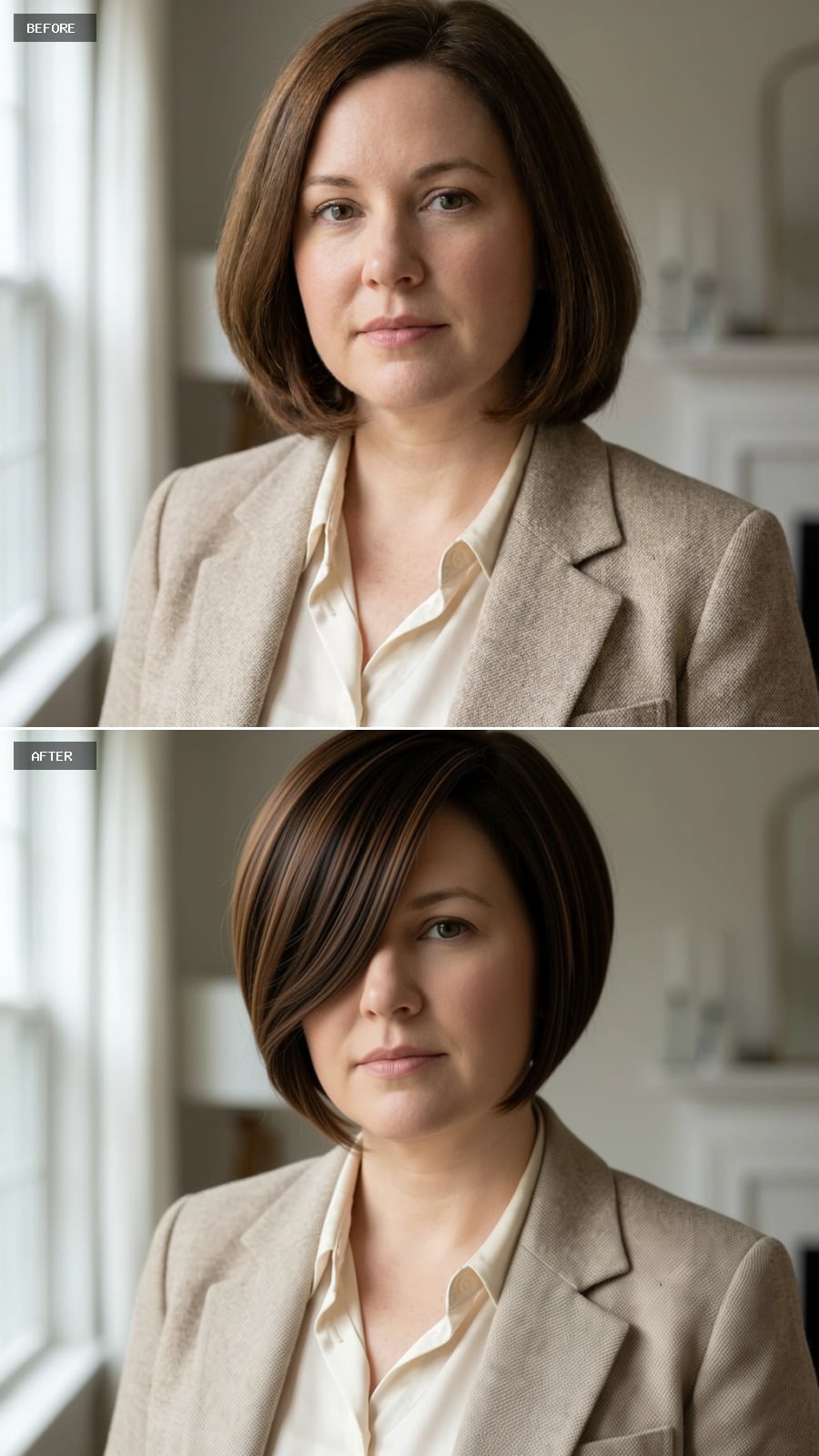
4. A Precision Bob Turns Caramel Streaks Into Directional Markers
❤️ Would you like to save this?
Darker roots warm through the mid-shaft while caramel ribbons concentrate where the bob already changes direction.
The cut lands just below the jaw and sits slightly shorter toward the back. A weighted fringe sweeps across the forehead while the sides stay comparatively controlled.
What matters here is placement. Volume is not spread evenly around the head, and the color is not spread evenly through the haircut. Everything is following the same geometry.
3. Espresso Length Creates a Frame With Almost No Ornament
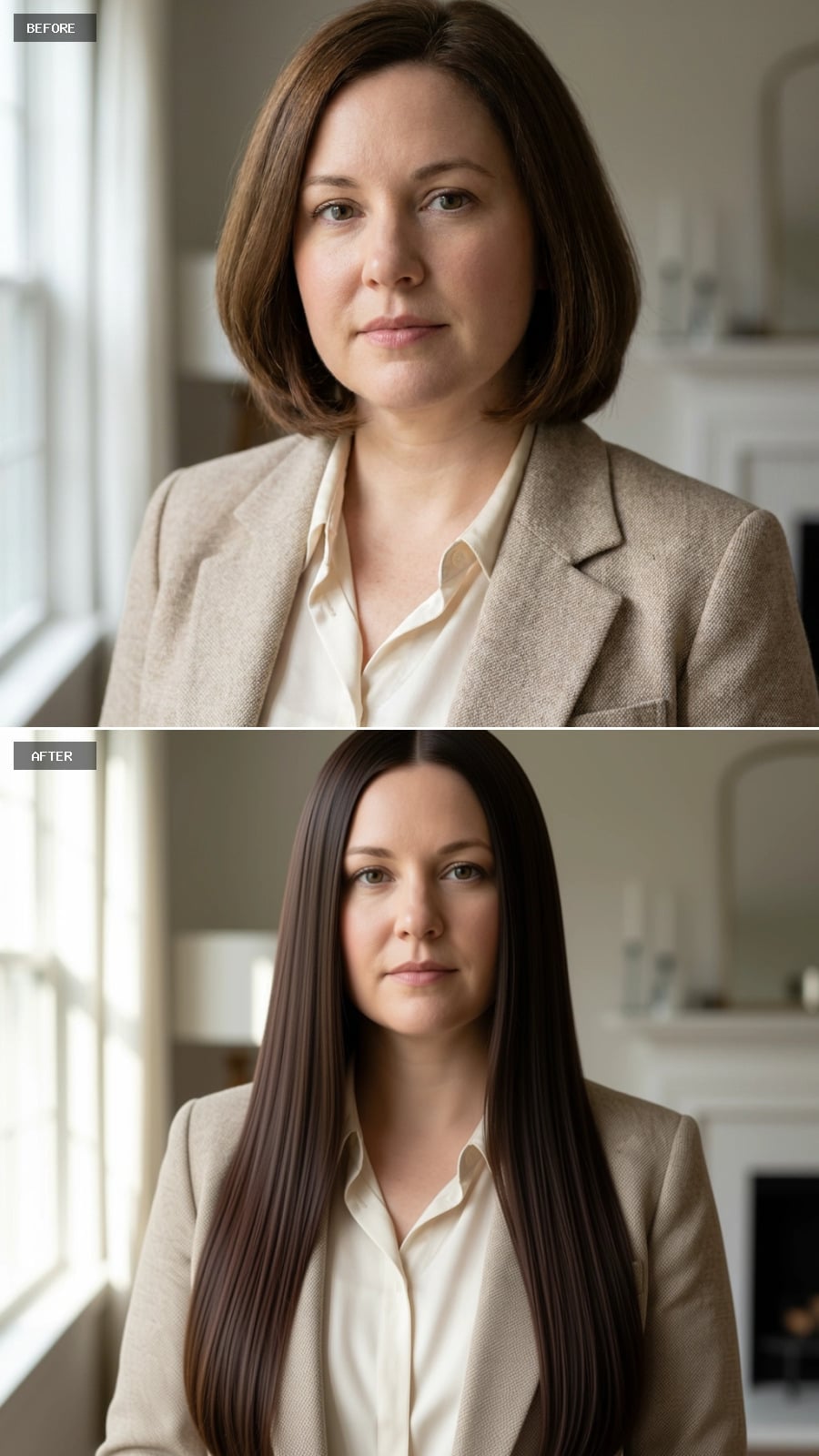
Center-parted and worn past the collarbone, the after hair falls in long, dense panels with almost no curl.
The color sits somewhere between espresso and dark chocolate, deep enough to look saturated while still showing dimension under light.
There are no dramatic streaks here and very little obvious layering. The long vertical edges are the entire event.
Round faces don’t shrink. They just get reframed.
2. Copper Against Black Gives the Angled Bob a Graphic Shock
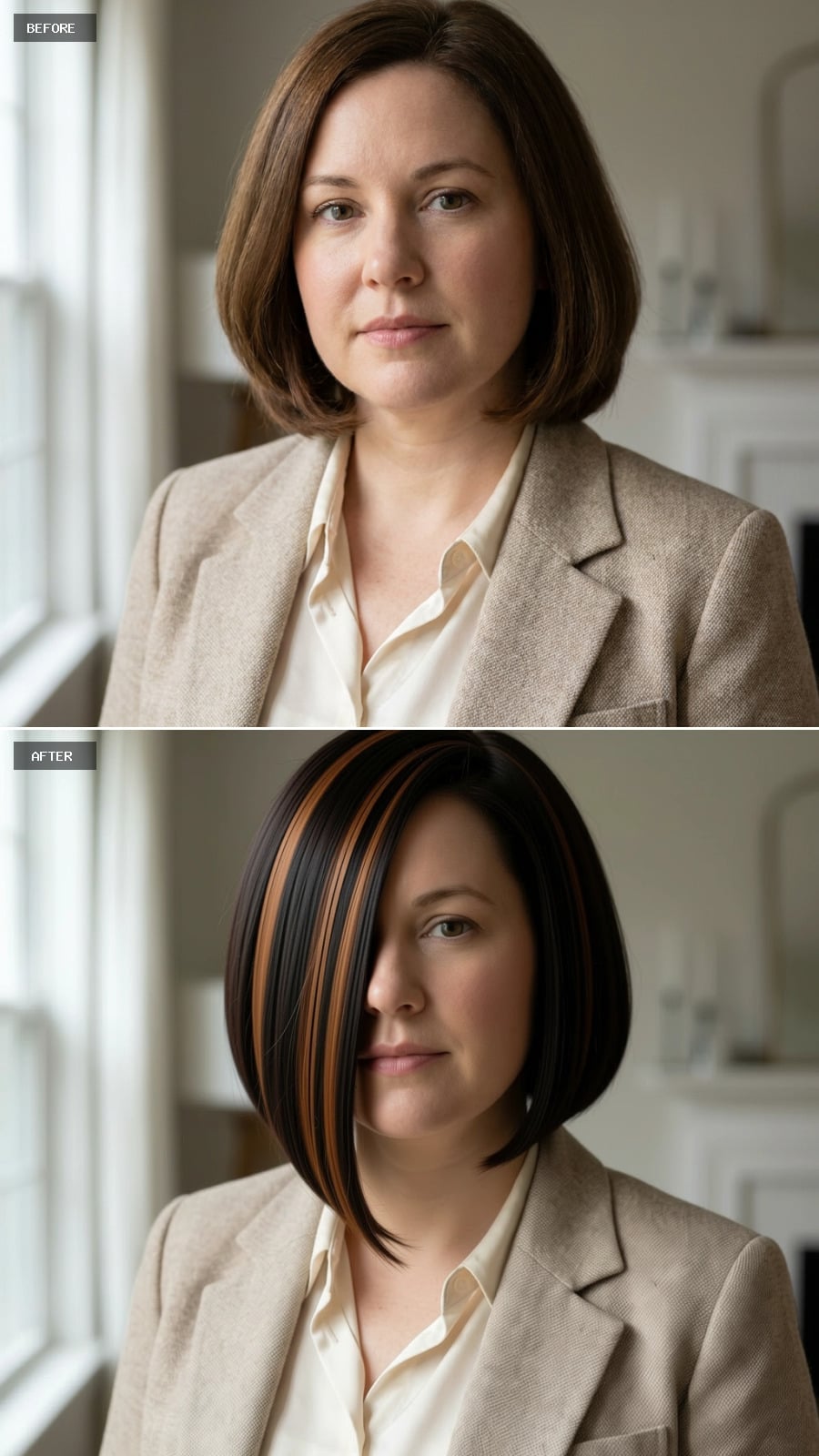
Near-black hair is interrupted by thick copper-toned sections that run through the angled bob like deliberate brushstrokes.
The cut sits around the jaw and travels forward, while the side part tilts the whole silhouette rather than dividing it evenly.
The color follows that tilt. Instead of quietly adding dimension, the copper sections announce exactly where the haircut is moving.
1. Warm Blonde Against Near-Black Takes the Final Bob Even Further
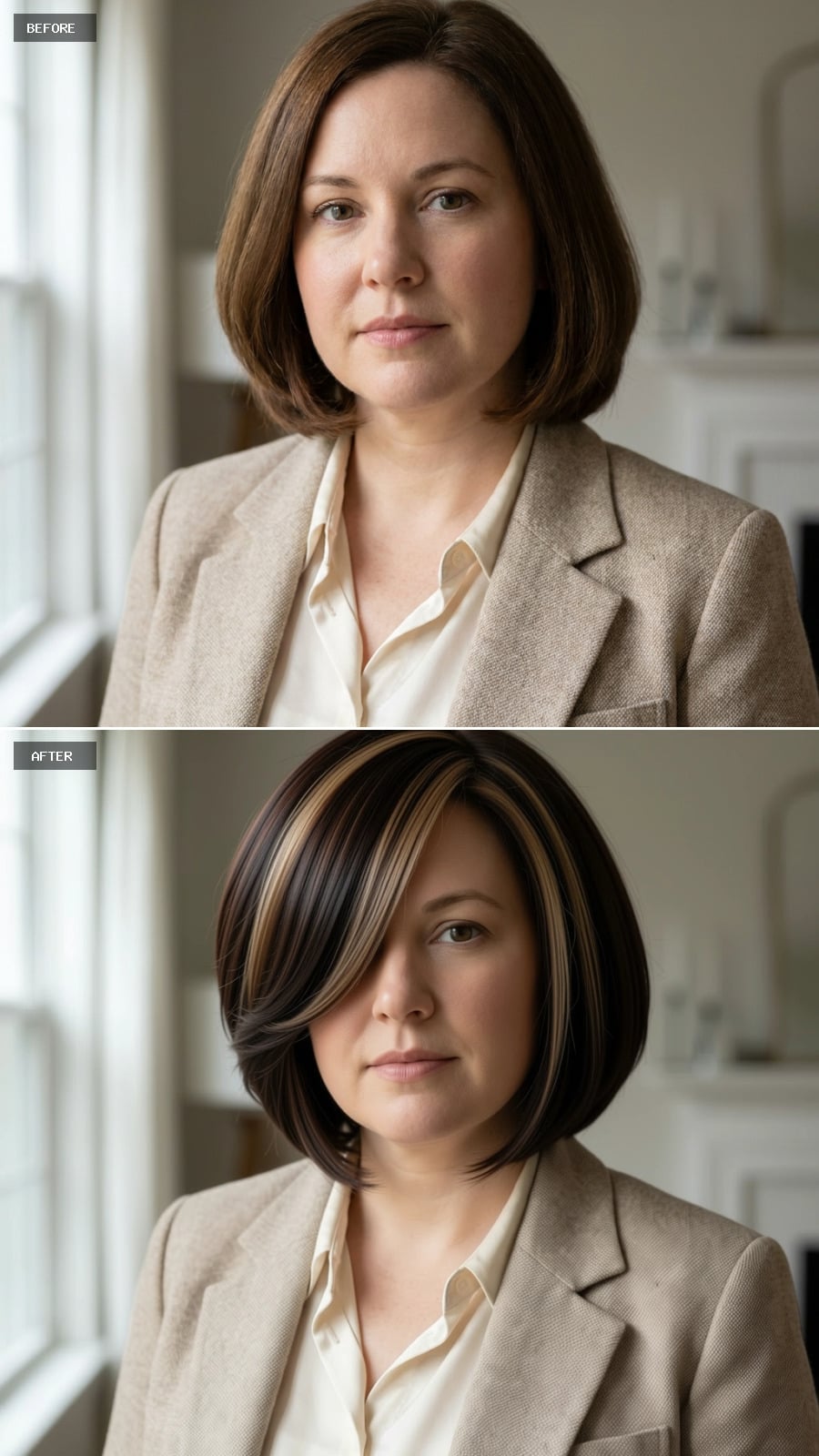
Razor-sharp ends and a strong side sweep already give this bob plenty of direction. Then thick warm-blonde sections arrive against the near-black base and turn that direction into the entire visual story.
The highlights follow a diagonal path instead of forming an even striped pattern around the head. The asymmetric fringe reinforces the same motion across the forehead.
After 28 versions of long layers, blunt bangs, soft waves, pixies, center parts, copper, caramel, and nearly every bob geometry available, that’s the useful takeaway: there is no single haircut that “fixes” a round face. The interesting cuts are the ones that give it contrast — softness against precision, length against fringe, symmetry against sweep, dark against light — and let the face remain recognizably itself.