❤️ Would you like to save this?
A round face isn’t a problem to solve. But a haircut that sits wrong can make cheekbones disappear and jawlines blur in ways that have nothing to do with actual bone structure, and that’s worth fixing. One woman decided she was done guessing and handed the question to AI, describing exactly what bothered her: her current style was adding visual weight to her face and making her look softer than she felt. What she got back was 34 specific before-and-after ideas, each one targeting the exact issue she’d been struggling to articulate.
Some of the suggestions are the kind you’d expect from any decent stylist. Others are more specific, and honestly, a few of them are things she probably wouldn’t have found on her own. The consistent thread across all 34 is strategic length and volume placement, because where a cut ends and where it lifts matters more than most women realize. If you’ve ever stood in front of a mirror thinking your hair is making your face look wider than it is, this one’s for you.
FYI, thanks to AI imagery software, we’re able to create very specific fashion and hairstyle examples to illustrate the points being made. In some cases, imagery is exaggerated to hammer home the point. Also, assume links that take you off the site are affiliate links such as links to Amazon. this means we may earn a commission if you buy something.
34. Wavy Layers With Side-Swept Bangs That Soften Without Shrinking
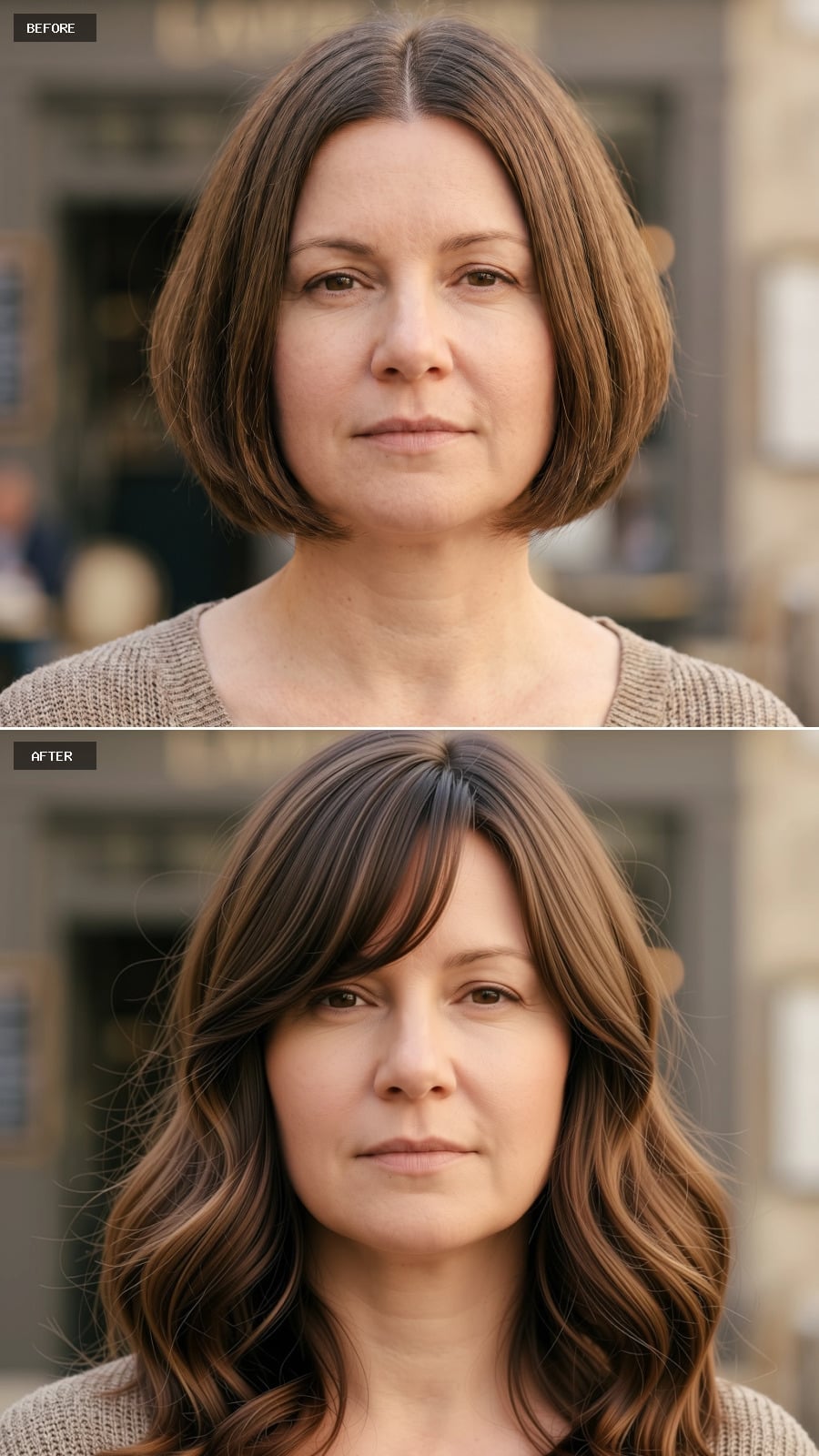
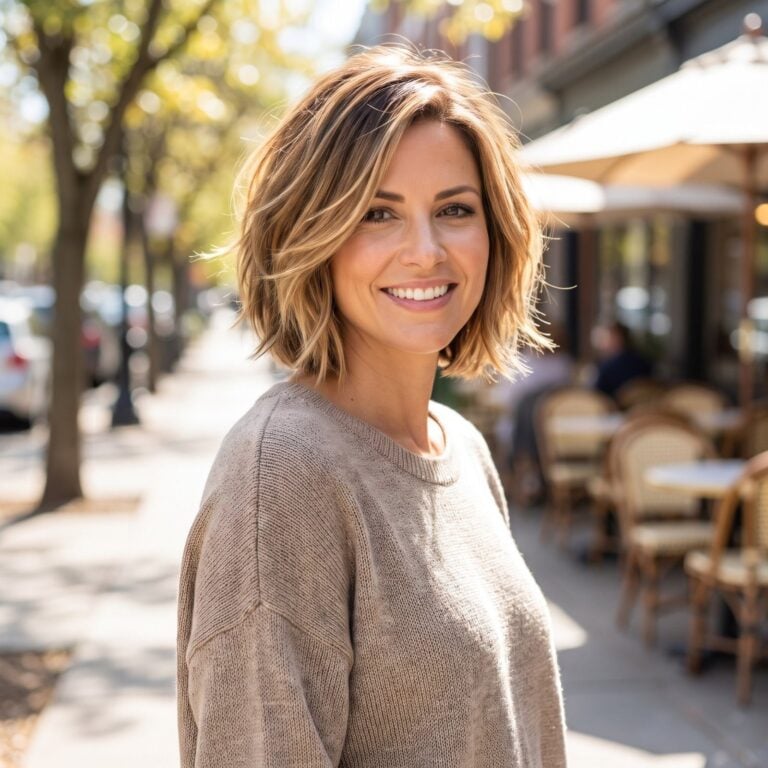
What the AI suggested here was length, and it’s doing exactly what a short bob can’t: framing the face with movement instead of cutting it off at the jaw. The style lands at collarbone level, with loose waves that have just enough texture to look lived-in rather than styled-within-an-inch. Side-swept bangs graze the brow at an angle, which draws the eye across the face horizontally rather than letting it settle on width. The highlights are subtle, a warm chestnut woven through darker brown, adding dimension without announcing themselves.
33. Longer Layers With Curtain Bangs That Reframe the Whole Face
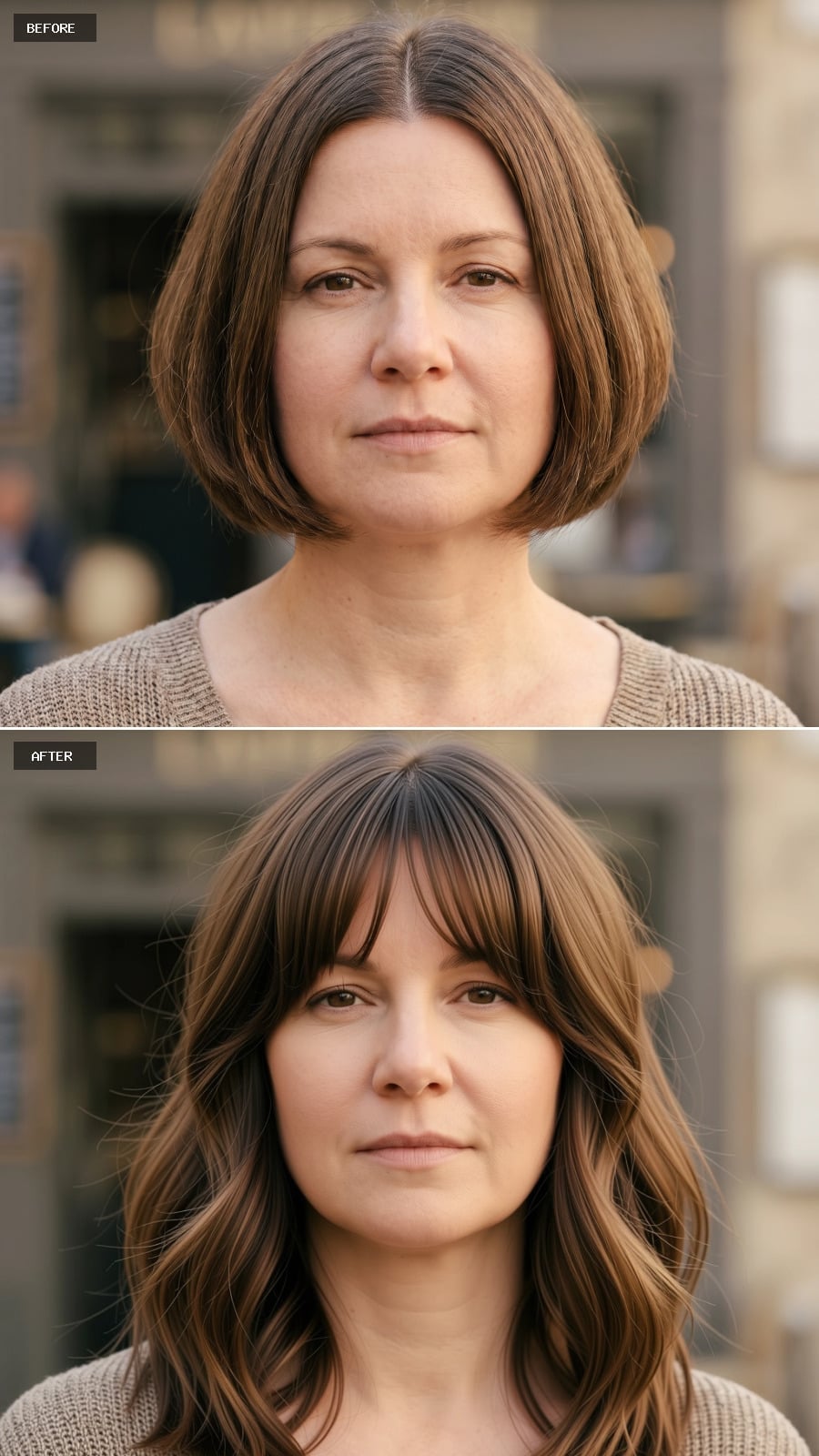
Curtain bangs do something a blunt fringe can’t: they break the forehead into sections rather than cutting straight across it, and that diagonal sweep toward the outer corners draws the eye outward instead of down. Here, they’re worn slightly wispy at the tips, which keeps the forehead from feeling capped. The effect is less “I got bangs” and more “my face just looks different somehow.”
The length itself does the real work. Falling past the collarbone with loose, lived-in waves, it creates vertical movement on both sides of the face. That’s not nothing. Length pulls the eye down and out, and paired with layers that start around the cheekbone, it gently redirects where fullness registers.
Brown tones with subtly warmer strands through the mid-lengths add dimension without a dramatic color change. The waves aren’t styled tight, they’re soft and slightly separated, the kind of texture that reads as relaxed rather than done. For anyone who’s felt like a shorter cut was compressing their face rather than framing it, seeing this much movement around the jaw changes the math entirely.
32. Long, Dark, and Side-Parted: How Straight Lengths Redefine a Round Face
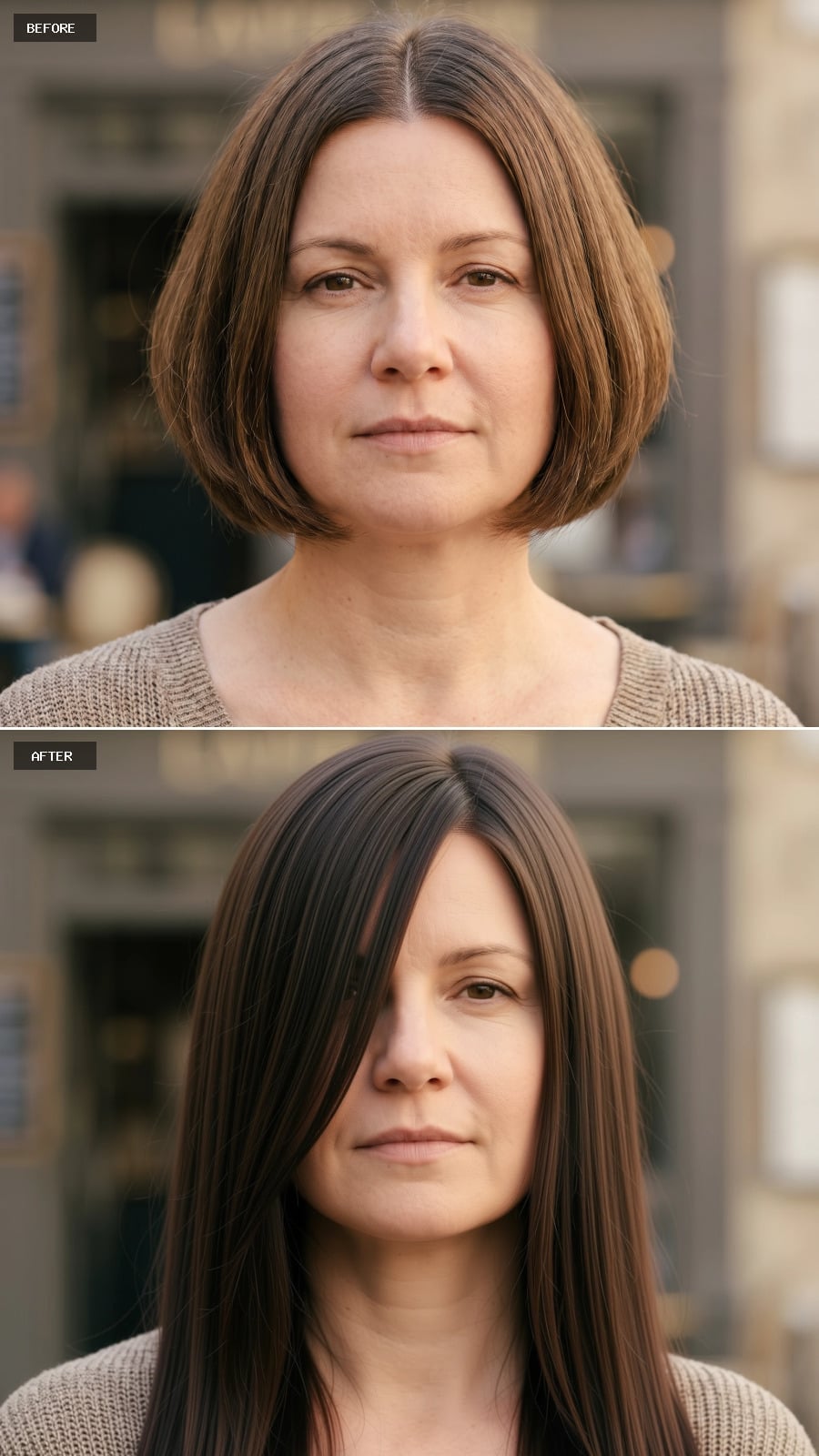
Straight hair worn past the collarbone does something a short cut rarely can: it creates a vertical line that draws the eye downward rather than outward. The deep side part here is doing real work, letting the hair fall across one side of the forehead and break the symmetry that tends to widen a face. It’s a darker shade than the before, closer to espresso than chestnut, and that depth at the roots pulls focus toward the center. Length, simply left straight, is enough.
Moving away from pin-straight lengths, soft waves offer a different kind of face-framing geometry entirely.
31. Loose Waves With Shoulder-Grazing Length That Actually Change the Math on Round Faces
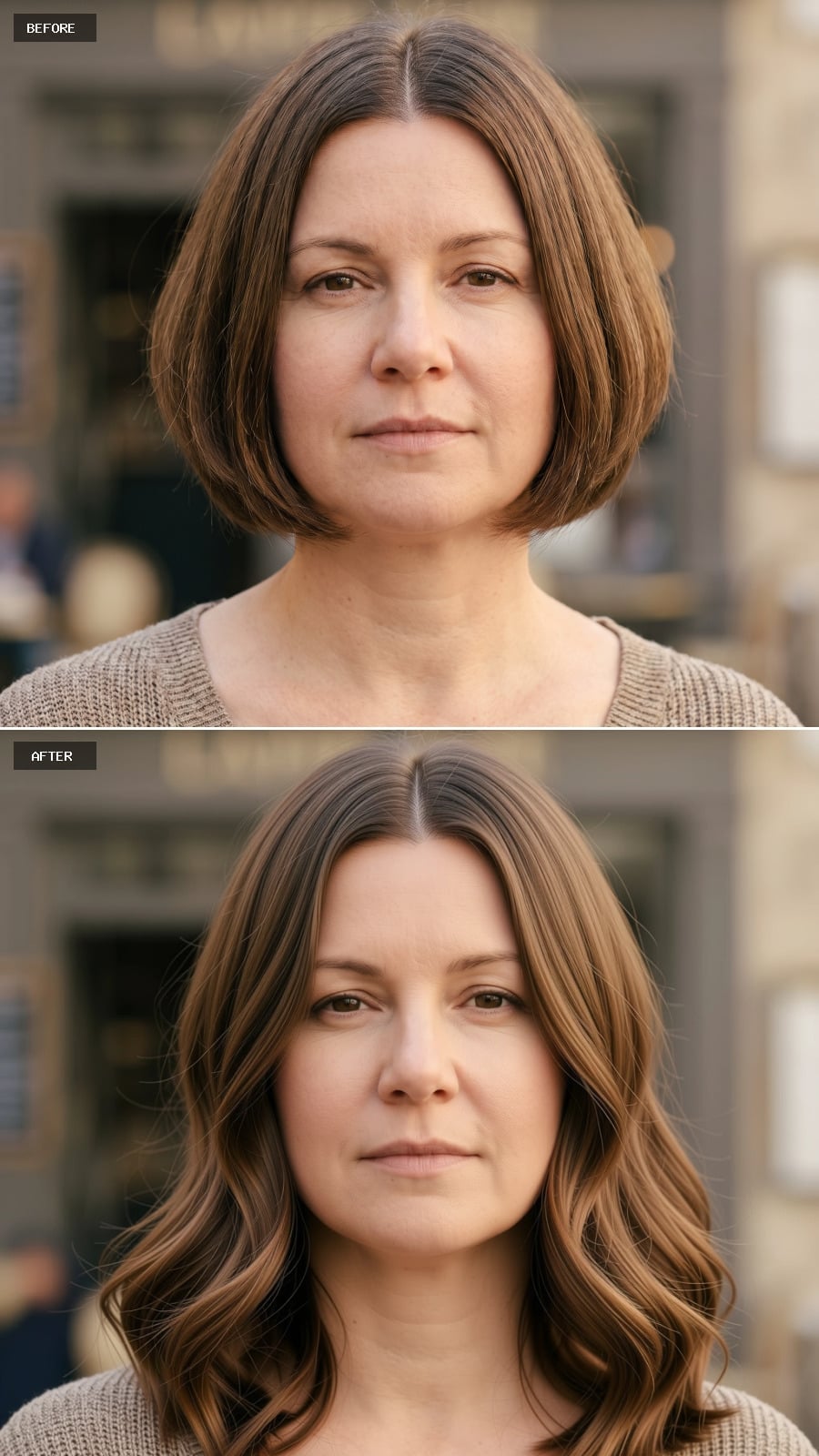
Longer hair doesn’t automatically slim a face, but volume placed at the right vertical points does. Here, the length lands just past the collarbone, with waves that build gradually from mid-shaft rather than starting at the root. That distinction matters more than most people realize. Root-heavy volume pushes width outward. Length-weighted waves pull the eye downward, which is exactly the direction a round face needs. The center part reinforces that vertical line without any styling tricks required. It’s a shape that earns its effect honestly.
30. Voluminous Waves With Fringe That Pulls the Eye Down, Not Out
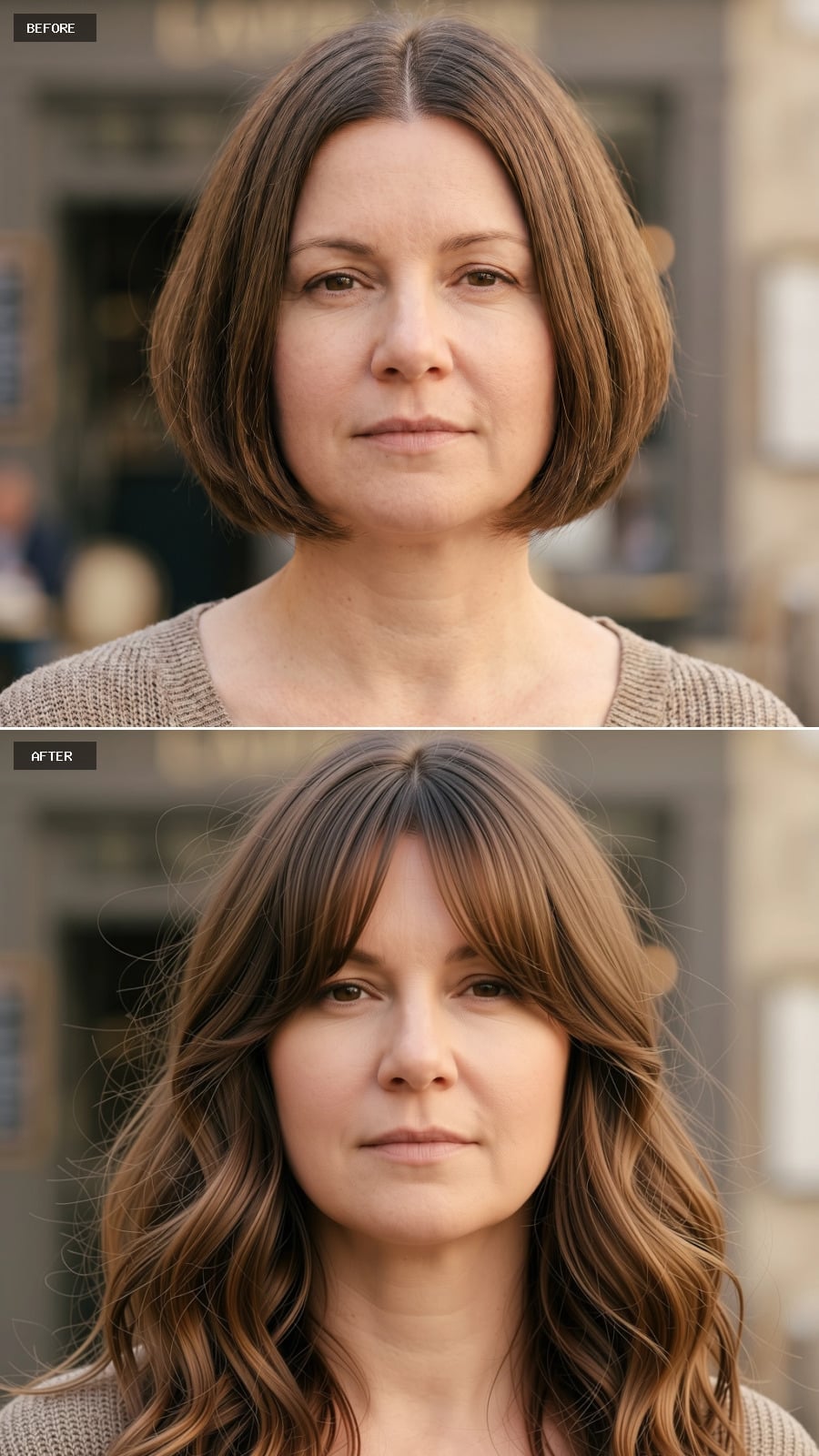
Her hair falls past her shoulders in loose, voluminous waves with visible movement through the mid-lengths. The fringe is the real shift here. Soft and feathered, it skims her brows and draws attention straight down the center of her face rather than letting the eye settle on width. Highlights woven through warm brown add vertical dimension. Round faces don’t need less hair. They need hair placed with intent.
29. Voluminous Layers Swept Back From the Face, Making Room for Cheekbones to Show Up
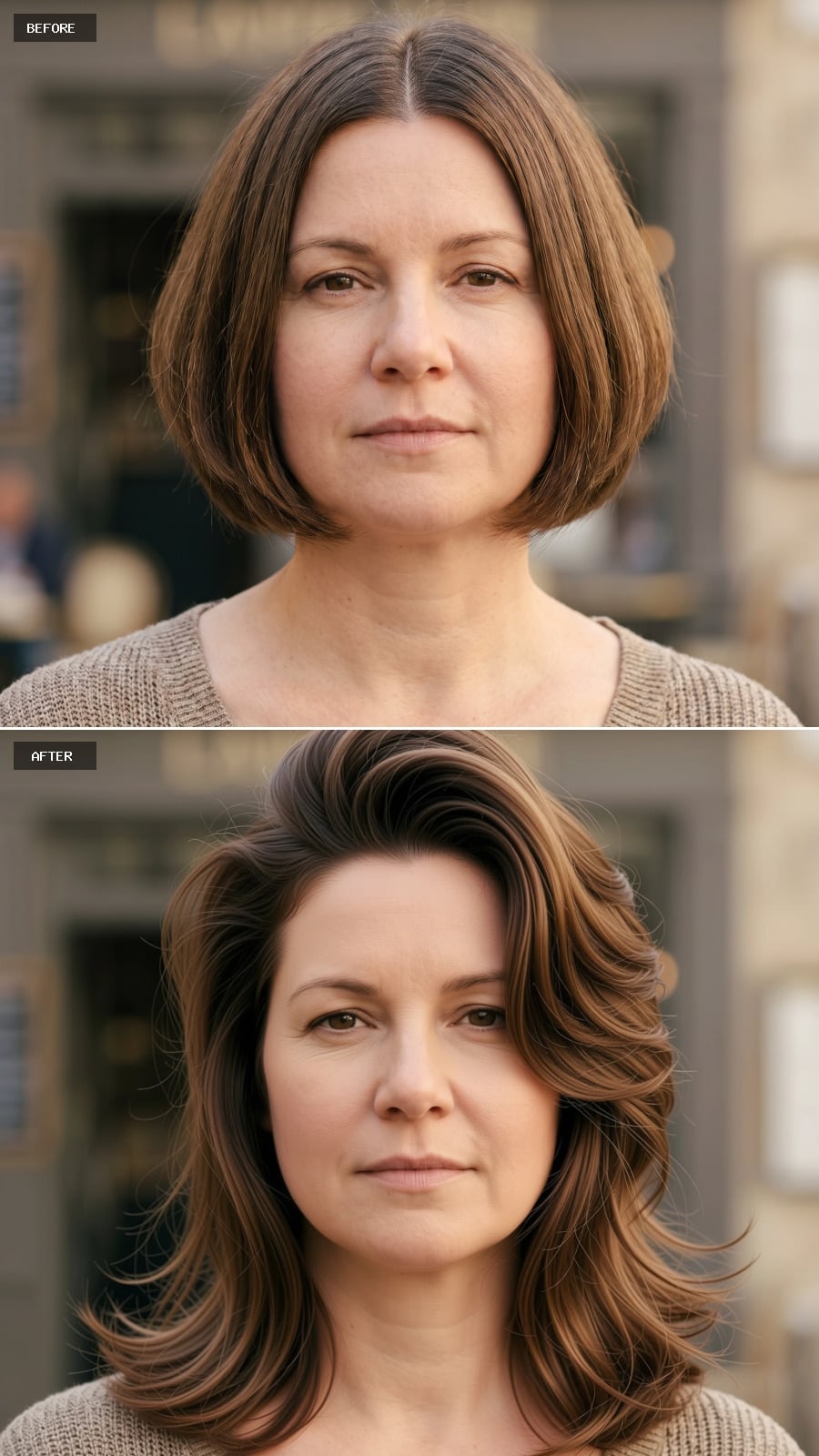
Medium-length layers with a blown-back sweep at the crown are doing a lot of structural work here. The volume sits high and slightly behind the head rather than out to the sides, which keeps width from reading across the face. Highlights run through the mid-lengths in a warm caramel tone against the darker brown base, and that contrast pulls the eye along the length of the hair rather than across it. The layers fall past the collarbone, long enough to draw the gaze downward. It’s the kind of result that looks like a good blowout maintained it, but the cut itself is carrying most of the weight.
28. Curls That Add Height, Not Width, and Finally Give Round Faces a Fair Shot
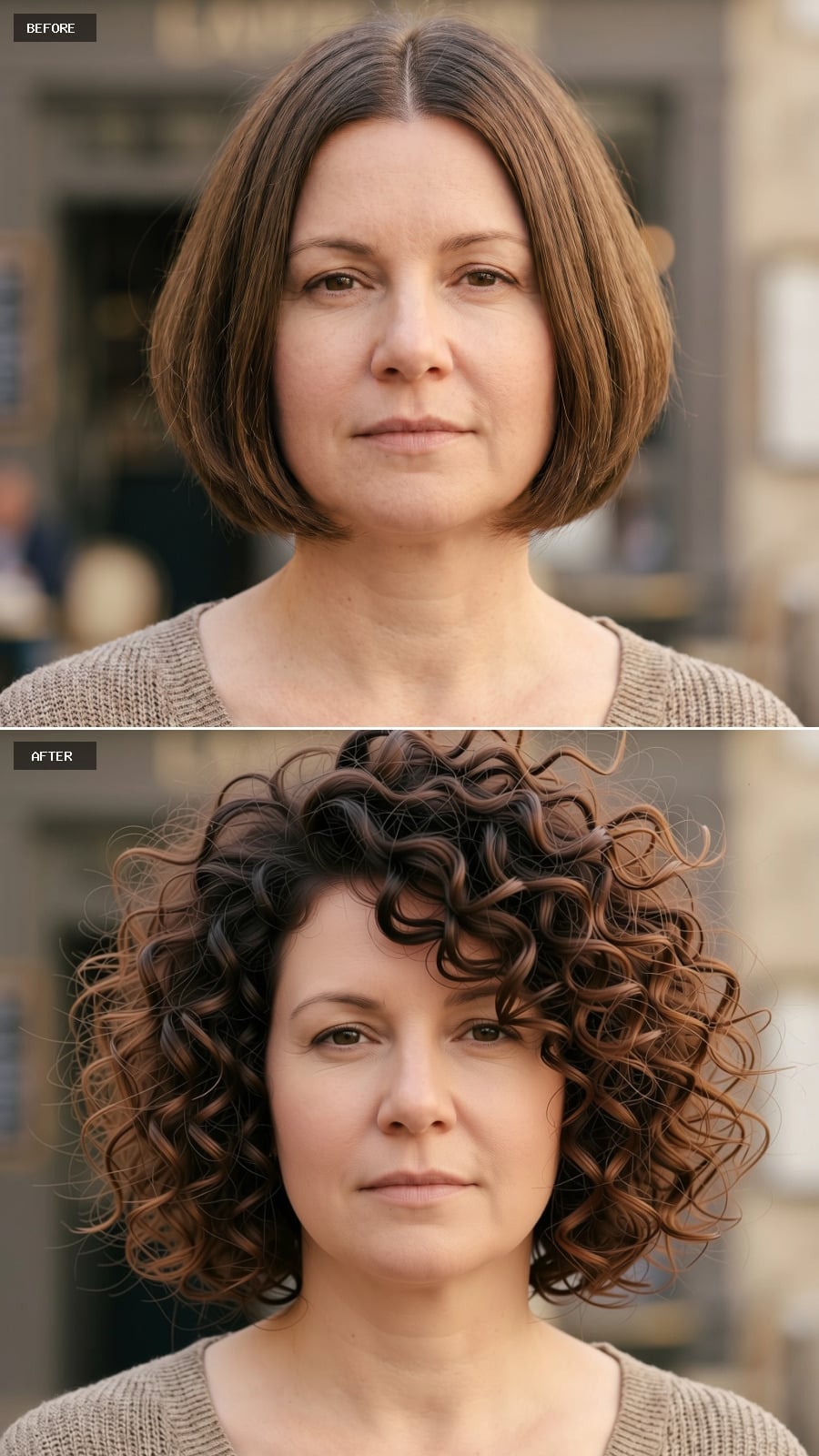
Volume placed at the crown, not the sides, is doing most of the work here. The curls are loose and defined, brown with warmer highlights pulled through the mid-lengths, and they spiral down just past the jaw rather than fanning out at cheek level. That distinction matters more than people expect. Keeping the width low and the lift high draws the eye up, which quietly lengthens the face without requiring anyone to grow their hair out six inches. The shorter pieces around the face curl inward rather than out, which keeps the silhouette from spreading. It’s a small technical choice with a visible payoff.
27. Cropped and Layered at the Crown, With Bangs That Do the Heavy Lifting
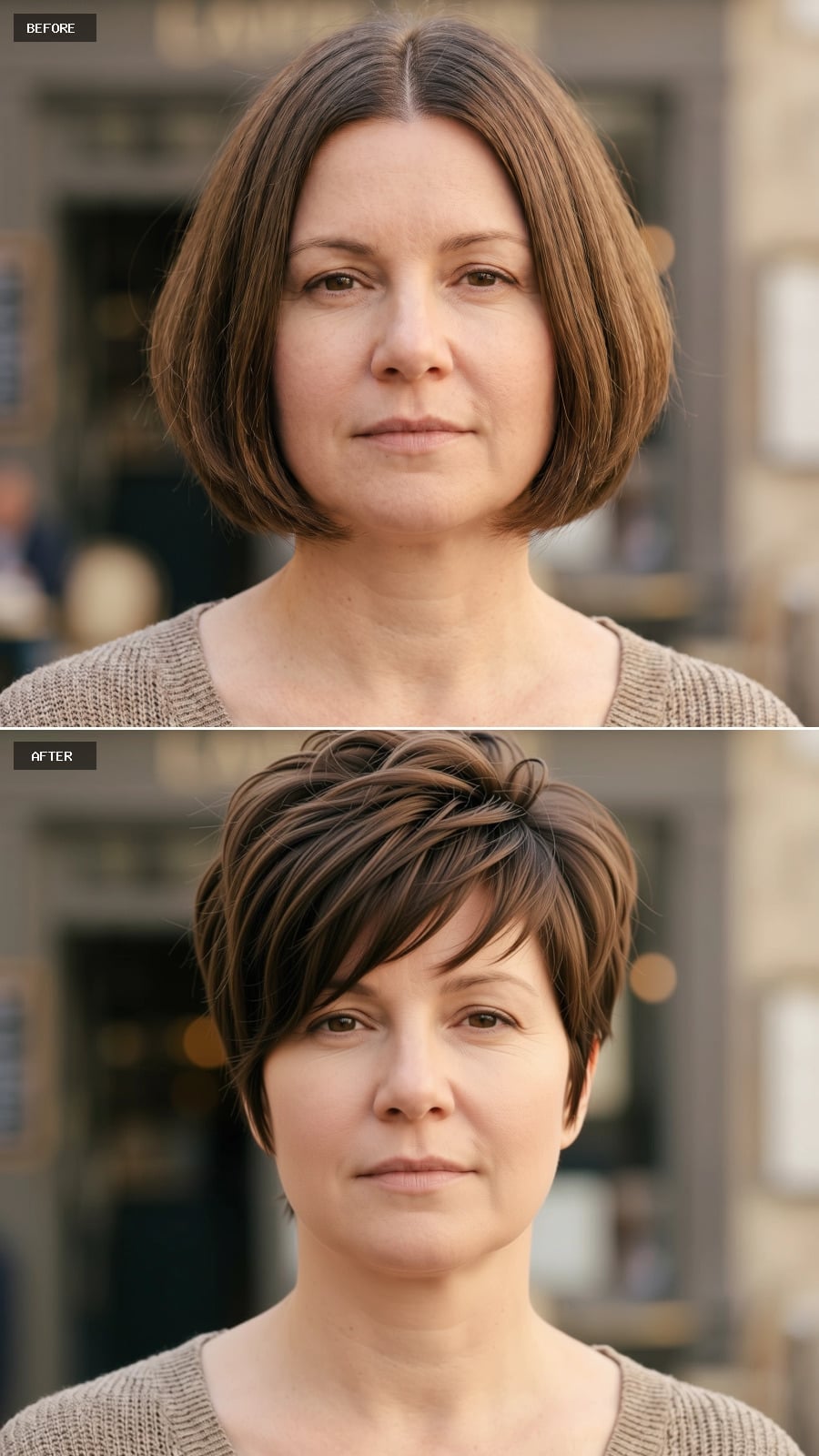
Pixie-length layers swept upward at the crown add height where round faces need it most. The side-swept fringe cuts across the forehead at an angle, redirecting attention toward the eyes rather than the jaw. It’s a short cut that doesn’t read small.
The Psychology Behind This: Diagonal lines are processed by the brain as movement, which is why angled bangs feel so different from blunt ones on a round face. Psychologically, the eye follows the sweep and lands on the cheekbone, not the widest point. That redirection happens fast, and it sticks.
26. Side-Swept and Dark: The Layered Cut That Gives Round Faces Vertical Authority
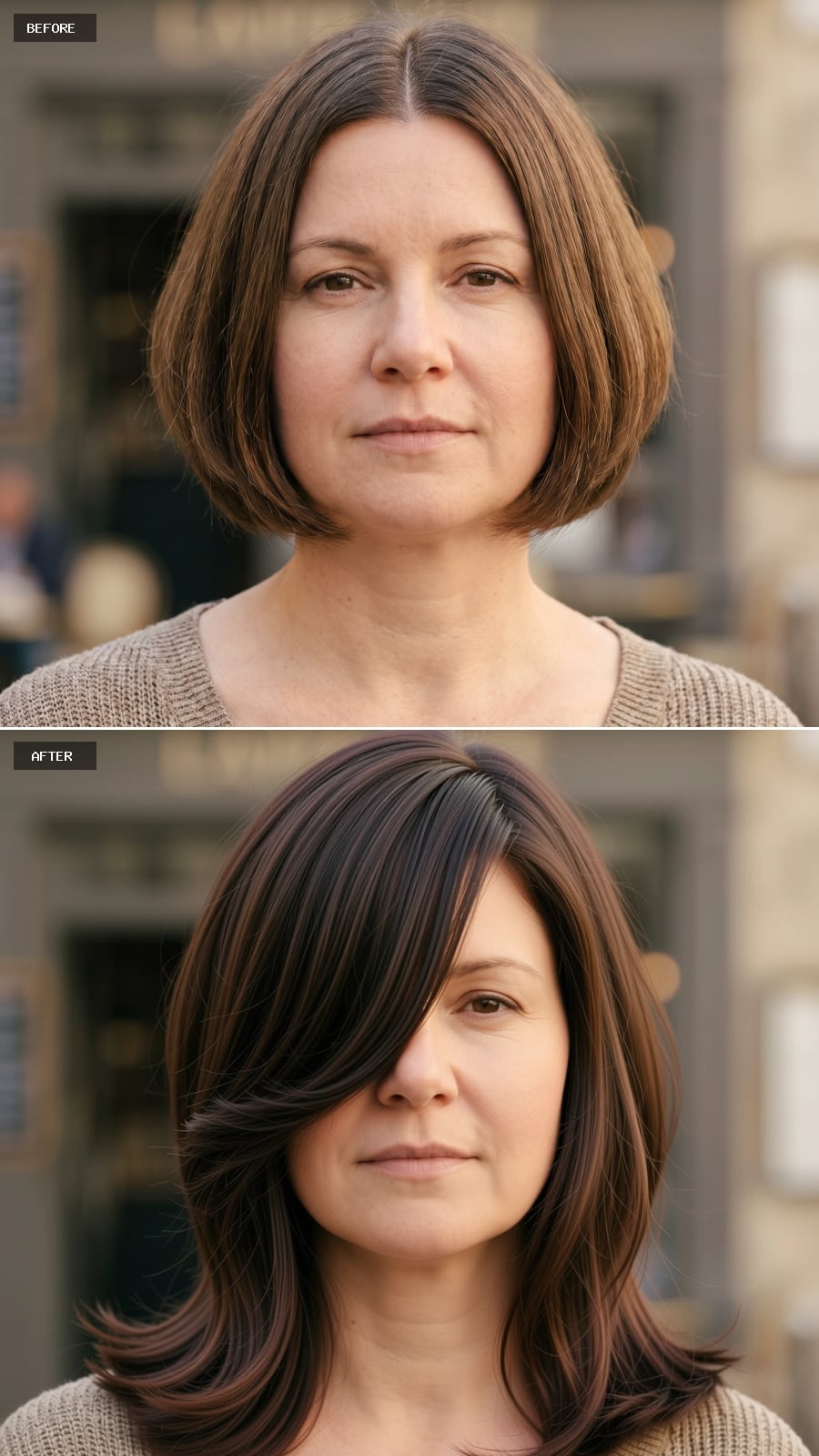
Dark chocolate brown, swept hard to one side, falling just past the shoulders in face-framing layers that pull the eye downward rather than outward. The diagonal sweep across the forehead does the real work here, cutting across the face at an angle that reads as length. Soft, barely-there highlights warm the ends without breaking the dark, unified silhouette that round faces need most.
25. Bold Highlights and a Side Part That Redirect Every Eye Away From Width
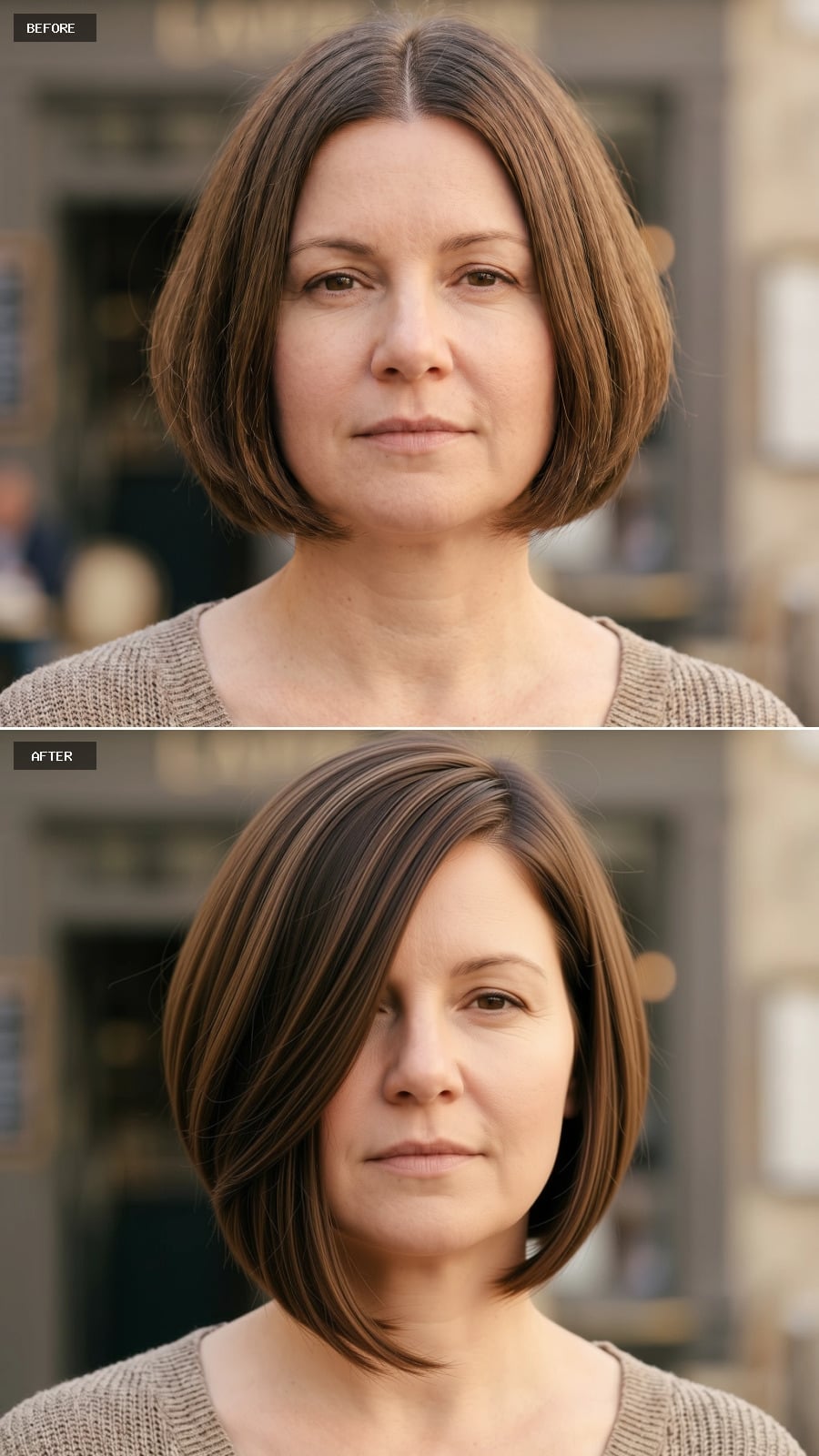
Side-parted bobs don’t automatically do anything. But cut at this angle, with highlights pulled through only the top layer, and the geometry shifts fast. The part sits well off-center, and the front section sweeps long across the forehead before falling toward the jaw at a diagonal. That line alone changes how wide the face reads.
The highlights here aren’t scattered. They run in clean, warm ribbons through the upper lengths, creating vertical movement from crown to collarbone. Against the deeper base, they pull the eye downward rather than outward. It’s a technique colorists reach for specifically on rounder face shapes, and it’s doing real work in the after image.
The length grazes just below the jaw on one side and sits slightly shorter on the other. Asymmetry at that scale doesn’t read as dramatic. It reads as intentional, and that difference matters more than most people expect.
24. Swept to One Side, Layered Through the Length, Built to Add Height Where It Counts
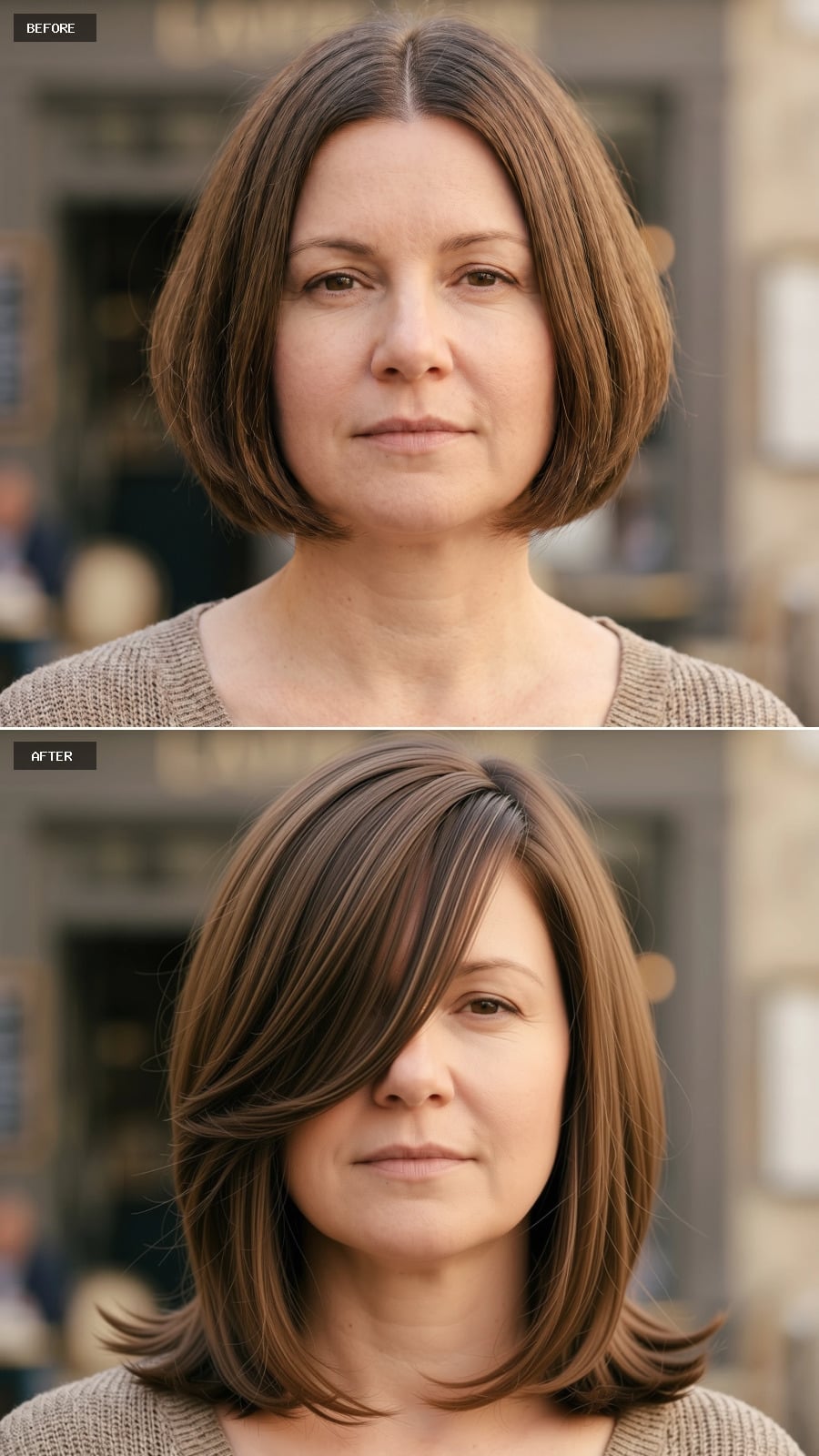
What’s happening in the after image is a shoulder-length cut with strong internal layering, swept hard to one side so that the hair creates diagonal movement across the forehead rather than falling flat on either side. The part sits off-center, and the front sections angle across the face at a slope that draws the eye upward and inward. It’s the angle doing the work, not the length.
The color adds another layer of dimension: a base of warm medium brown with lighter pieces woven through the mid-shaft, which creates visual depth without going full highlight. That subtle variation keeps the hair from reading as a flat curtain. The ends have a slight outward bend that adds volume at the collarbone rather than at the cheeks, which is exactly where round faces don’t need it.
23. Curtain Bangs and Wavy Length That Convince a Round Face to Read Oval
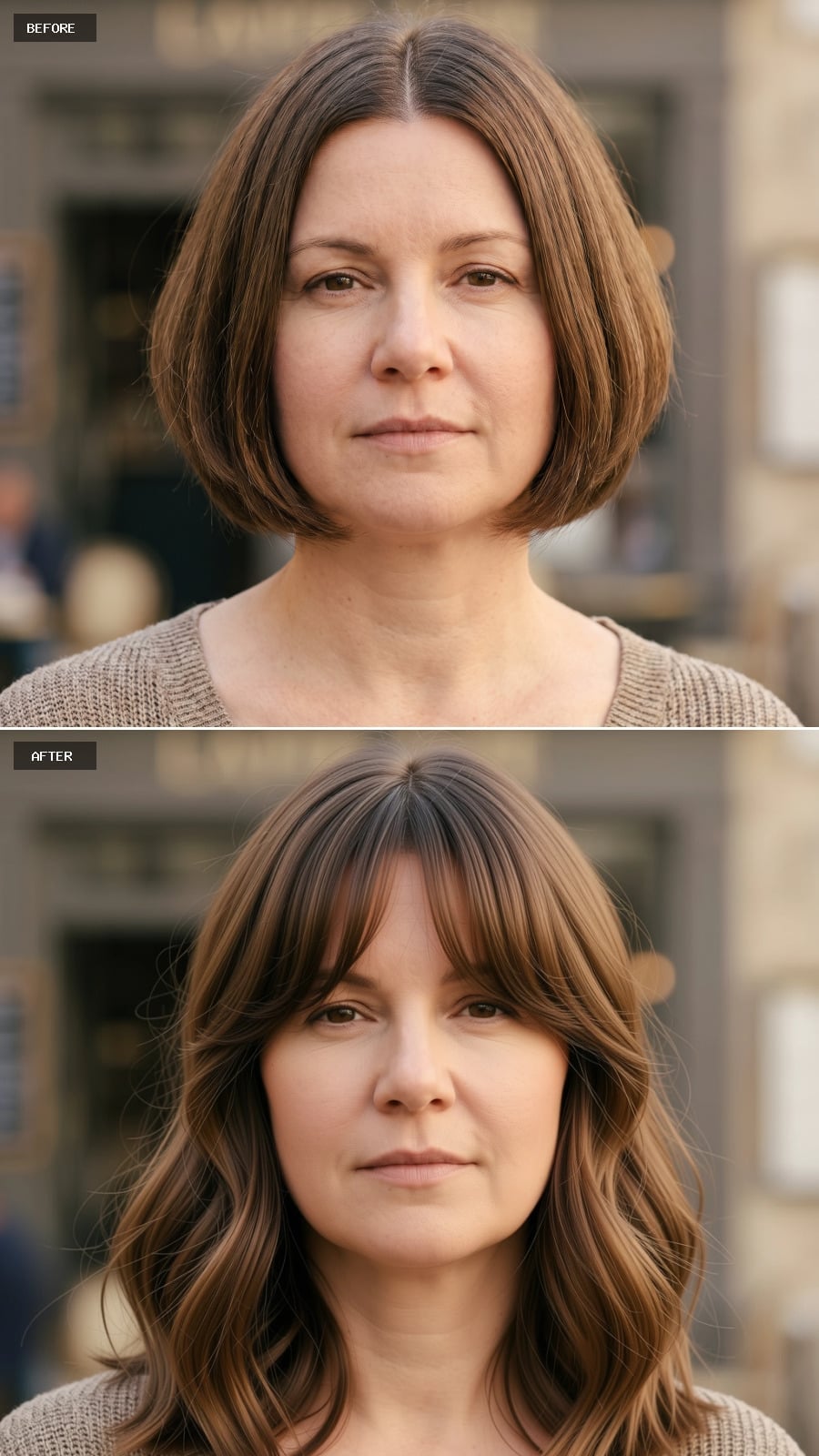
Wispy curtain bangs parted softly at the center do something a blunt fringe can’t: they create a vertical break right at the forehead while still letting the face breathe. Below that, wavy lengths fall past the collarbone with enough movement to draw the eye downward rather than across. The waves aren’t tight or uniform — they’re the kind that look like they happened on their own, which is exactly why they work. Fullness sits at the ends, not at the cheeks, and that shift in weight is what changes the whole silhouette.
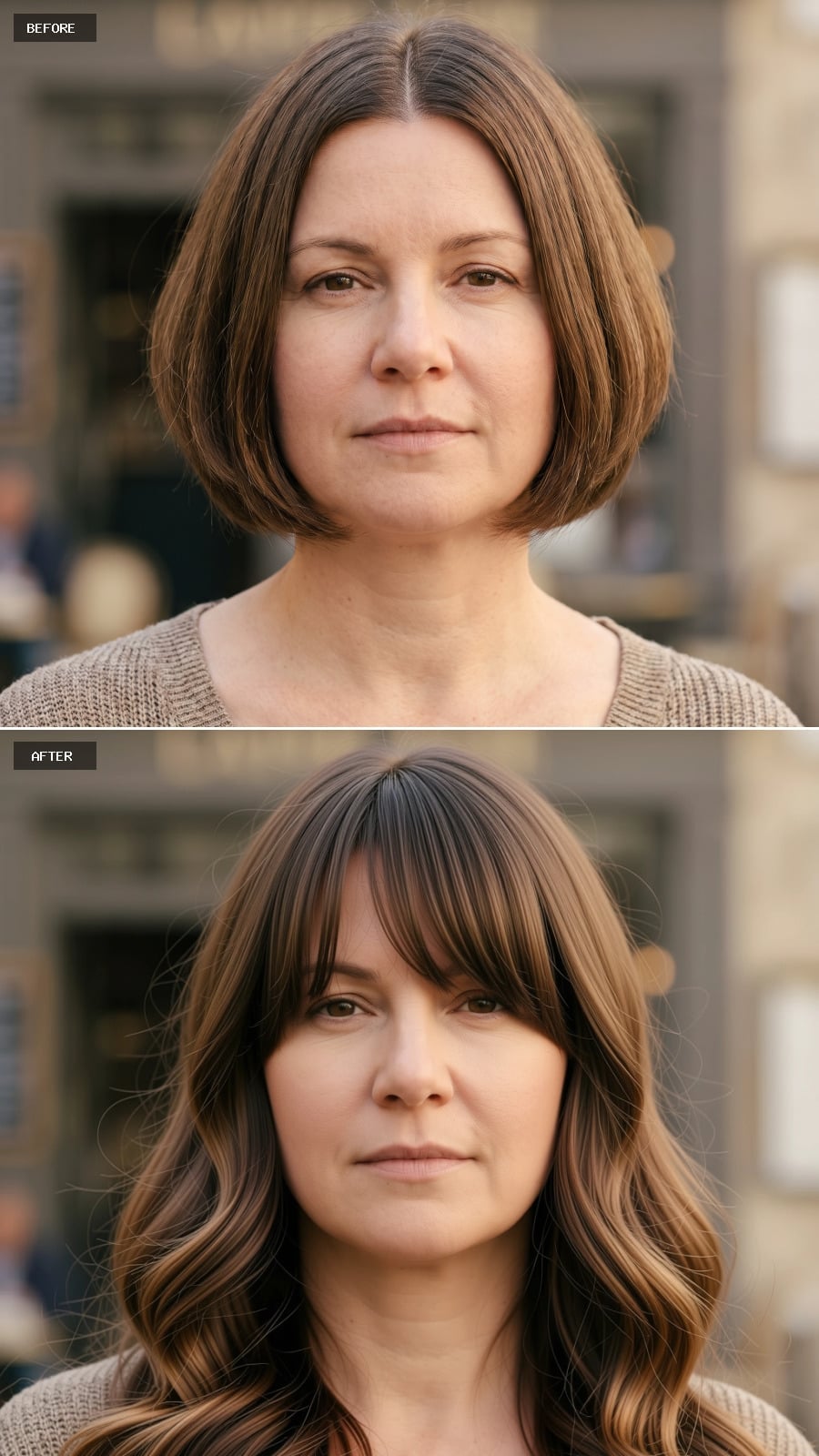
22. Bangs and Waves Working Together to Pull a Round Face Into a Longer Shape
❤️ Would you like to save this?
Rounded faces tend to read wider when the hair ends cleanly at the jaw. Here, the cut pushes past that boundary, letting soft waves carry the eye downward toward the collarbone, which adds visual length where the face needs it most. The fringe is the other half of the strategy. It falls with a slight arch, grazing the brow, and that downward movement cues the eye to travel vertically rather than scan across the widest part of the face.
The color does quiet work here too. The base is a cool medium brown, with warmer caramel pieces woven through the length. Those lighter sections catch light at the ends, drawing attention to where the hair falls rather than where the cheeks sit. It’s a small thing. But small things are often exactly what’s doing the actual work.
Color Note: Balayage placed below the chin pulls the eye toward the ends of the hair rather than the center of the face, which is exactly where a rounder face benefits from the attention going. Lighter pieces concentrated in the lower half of a style create an optical pull downward. It works best when the root stays cooler and the warmth builds gradually through the length.
21. Long Bob Cut With a Center Part That Gives Round Faces a Vertical Running Line
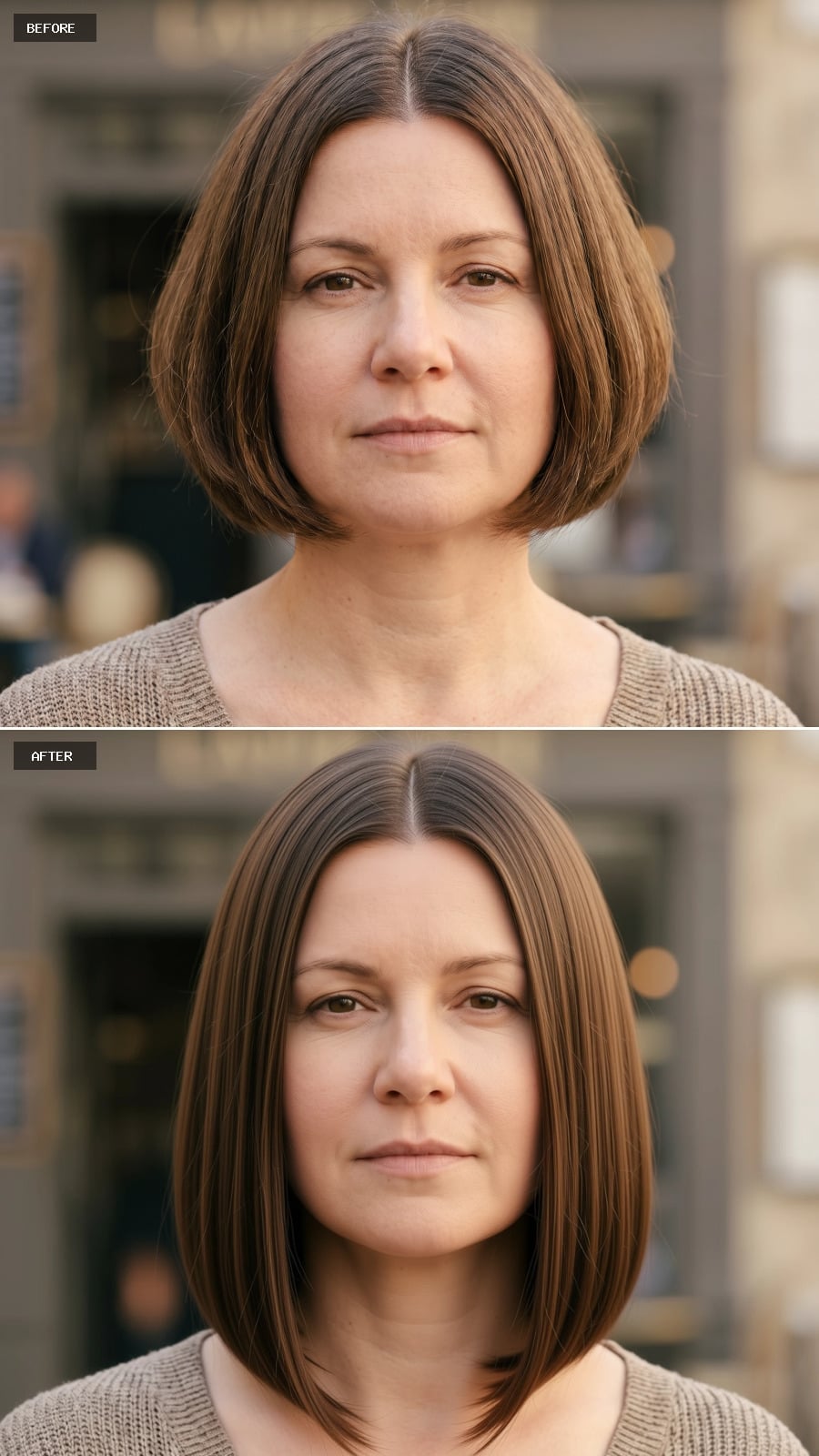
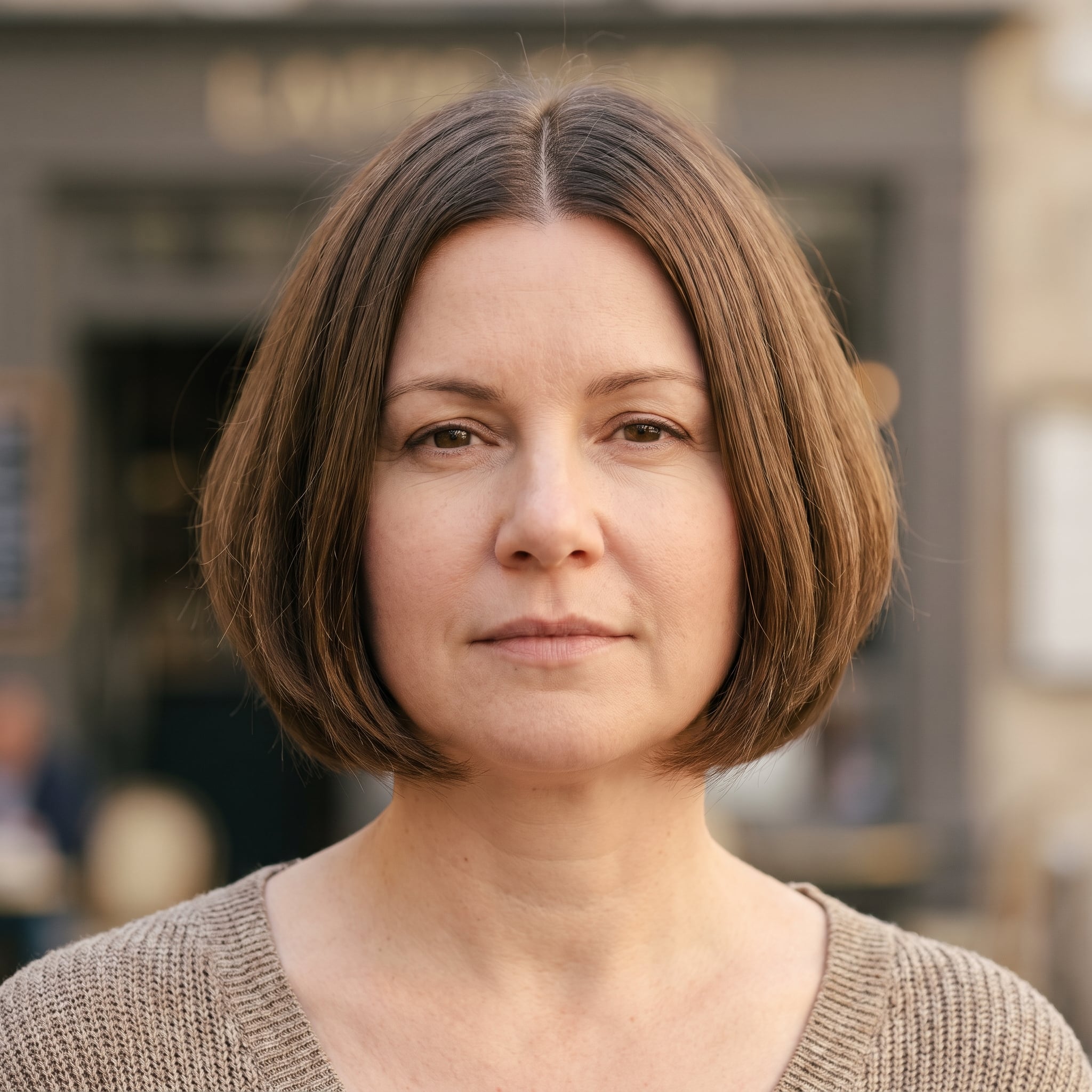
Grown out past the collarbone and cut blunt at the ends, the bob here does something a shorter version rarely manages: it gives the face a clear bottom edge to measure against, and that distance does real slimming work. The center part draws a straight line from crown to chin, and that line doesn’t stop at the jaw. It keeps going. Hair this straight, this smooth, with this much fall on either side of the face, pulls every glance downward rather than outward.
20. Swept Bangs and a Rounded Bob That Redirect Width Into Shape
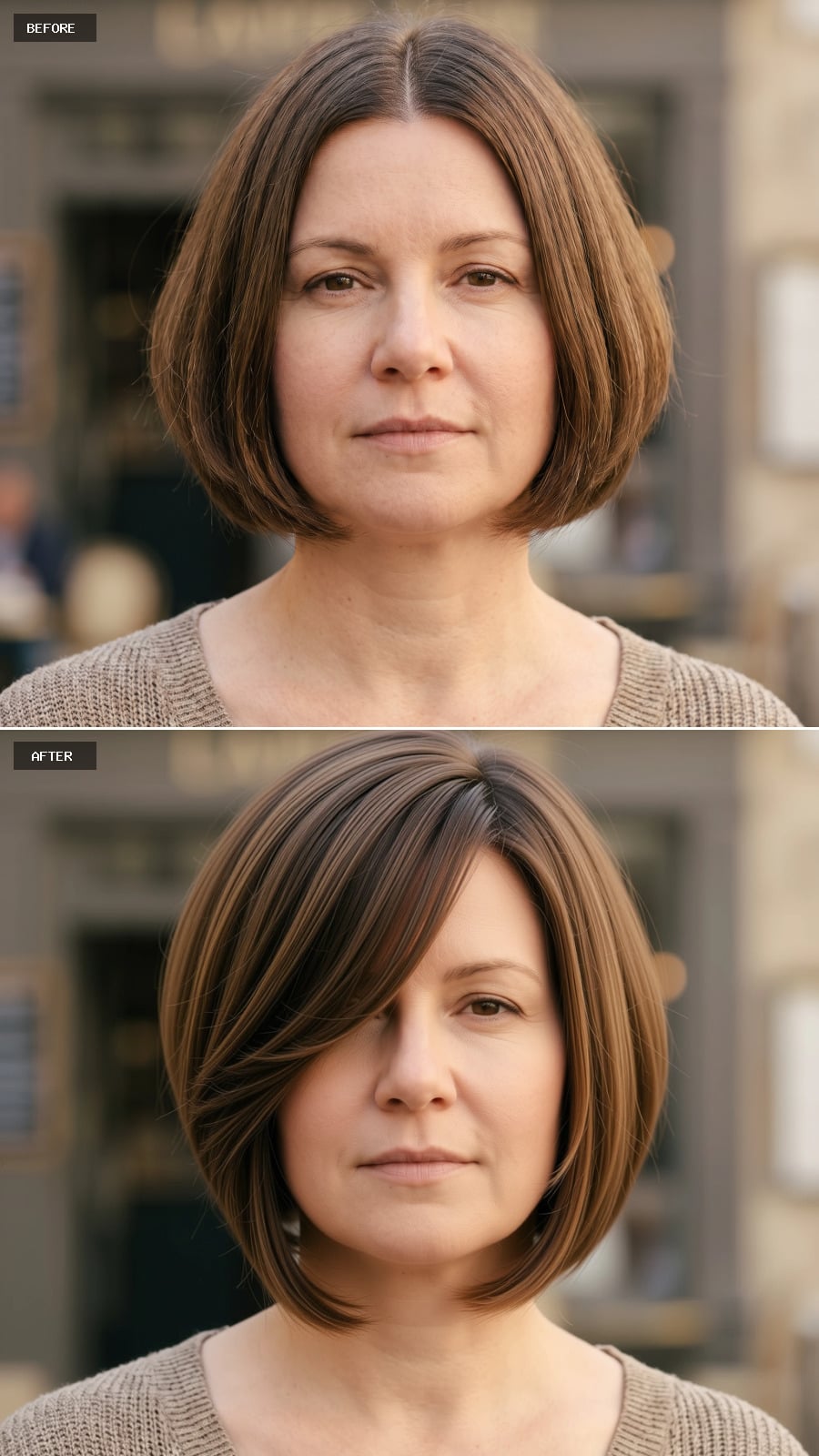
Side-swept bangs cut at an angle do something specific here: they break the horizontal line across the forehead and pull the eye diagonally instead. That diagonal matters. The bob itself is fuller through the back and crown, with layers that separate and catch light individually rather than sitting flat, and the whole shape rounds outward rather than dropping straight down. A few lighter strands run through the mid-lengths, creating just enough contrast to give the cut dimension without reading as highlighted. The part sits slightly off-center, which keeps the face from being divided into two equal halves. Equal halves are what make a round face read rounder. The bangs graze the cheekbone rather than cutting across it, leaving the cheek visible rather than framed, and that small distinction is genuinely the difference between a style that flatters and one that doesn’t.
19. Bangs That Sweep Across the Forehead and Quietly Steal Width From a Round Face
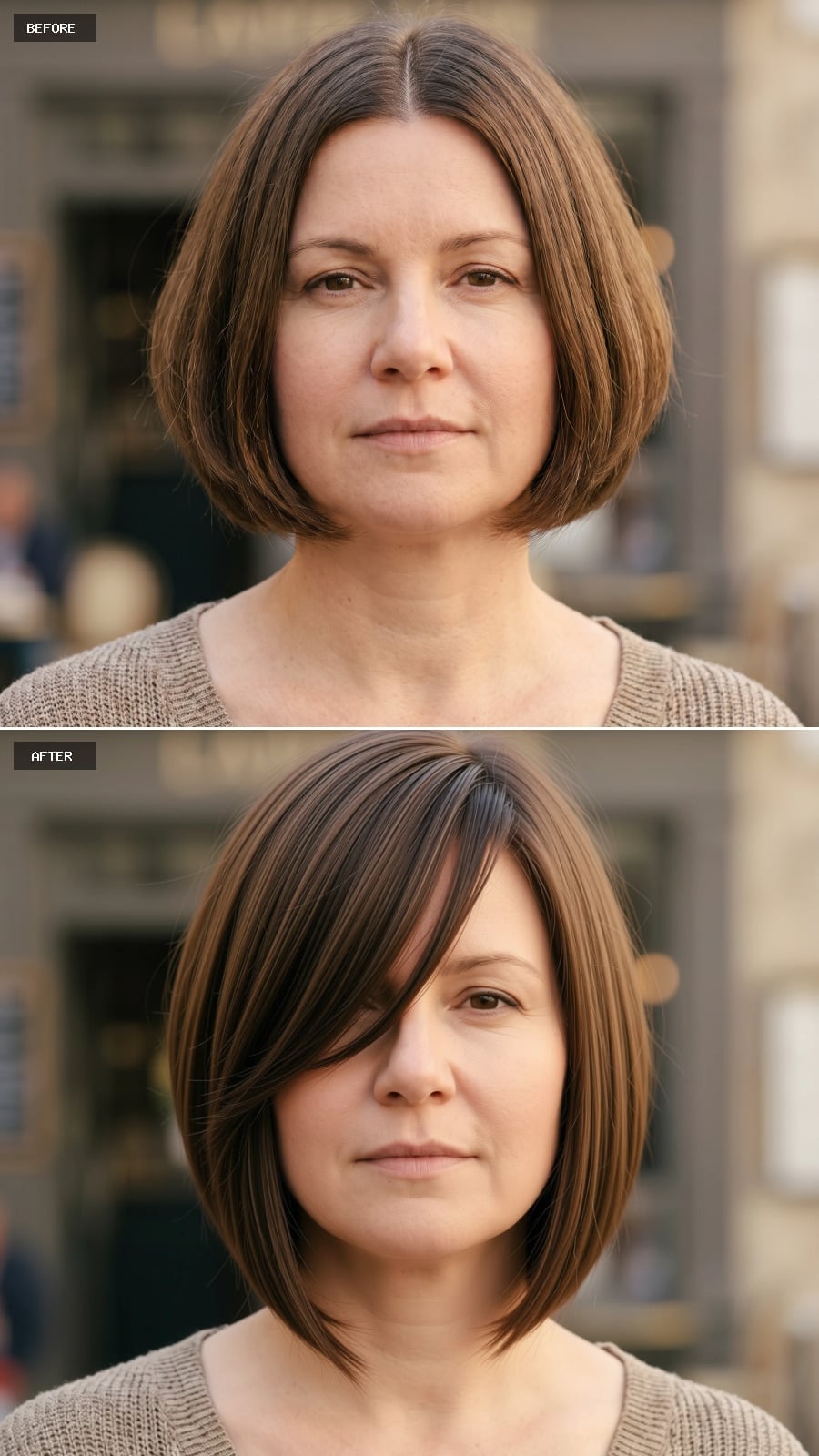
Her bob gets cut slightly longer at the front, which gives those side-swept bangs somewhere to land instead of just grazing the cheekbone. The part sits off-center, angled enough to break the face’s symmetry without making it obvious. Brown with warm undertones, nothing dramatic.
18. Upswept and Loose at the Edges, Built to Give a Round Face Something to Follow
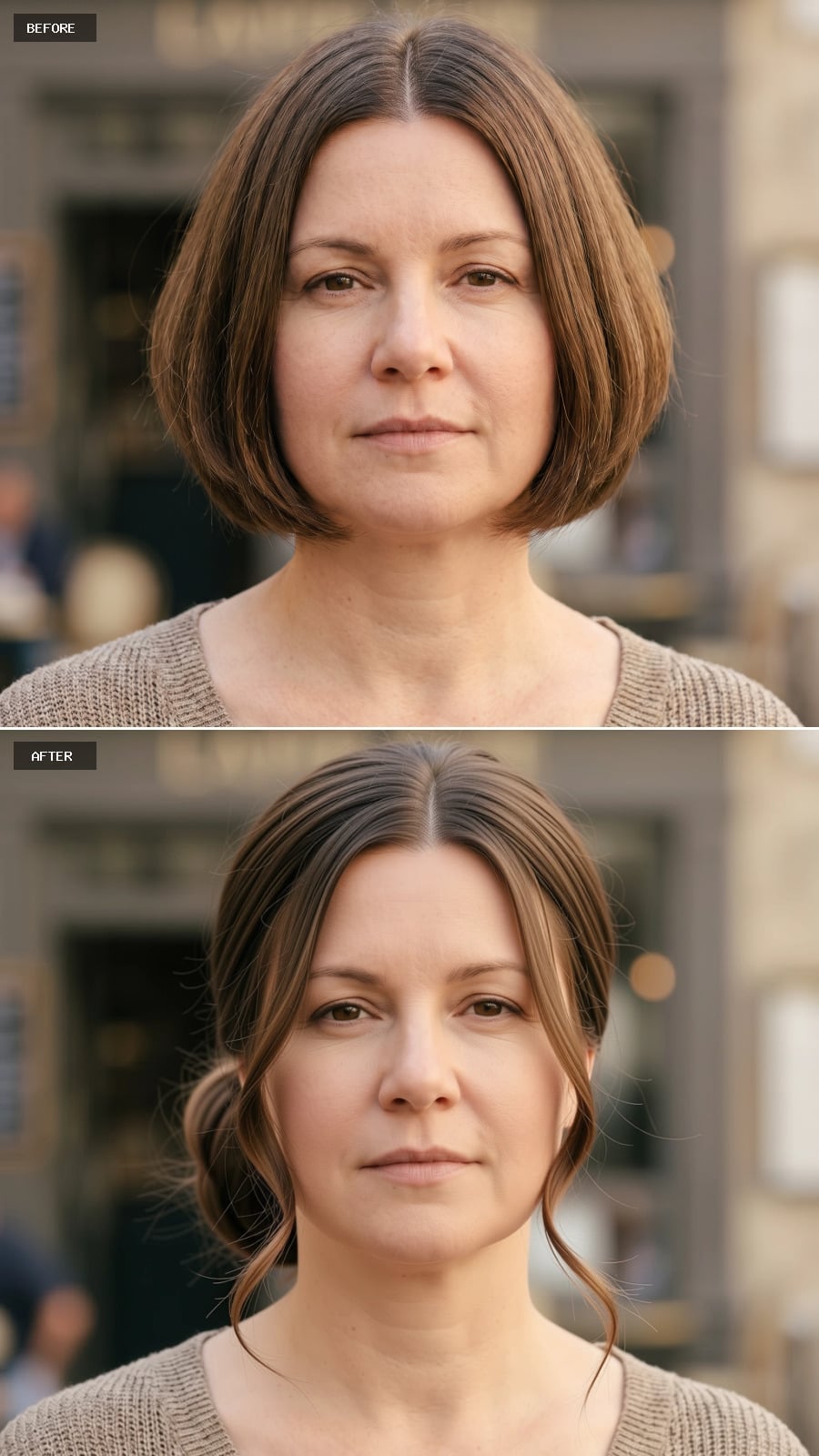
Pulled into a soft updo with face-framing tendrils left loose at the jaw, this style creates vertical interest at the crown while keeping the sides open. The wispy pieces don’t just soften things. They draw the eye downward along the jawline, making width disappear without announcing it.
Beauty Pairing: A thin necklace sitting at the collarbone works with an upswept style because it continues the vertical line the hair starts at the crown. Avoid chokers here. They cut the neck at exactly the point where length is most useful.
17. Bangs and a High Ponytail Doing Exactly What a Round Face Needs
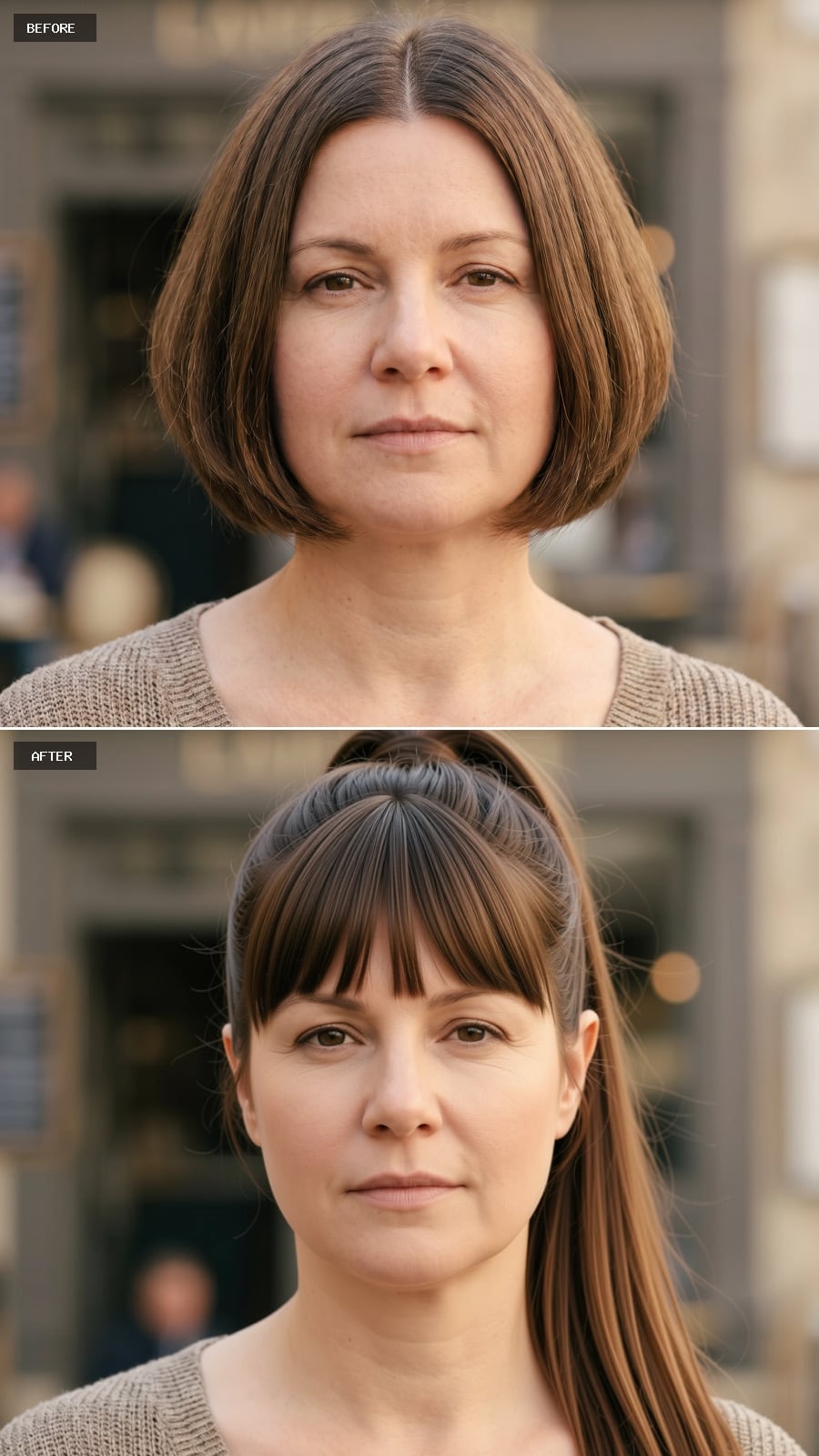
Blunt fringe cut straight across the forehead, then hair pulled up and back into a ponytail that falls long past the shoulders. That combination does something specific: it creates a hard horizontal line at the brow and a vertical drop at the back, and the face reads longer because of both at once. The bangs are dense enough to be intentional, not wispy, which matters. Thin bangs on a round face tend to disappear and take their slimming geometry with them. The length of the ponytail, hitting well below the collarbone, keeps drawing the eye downward long after it’s left the face.
16. Braided Crown That Wraps the Head and Pulls Every Eye Upward
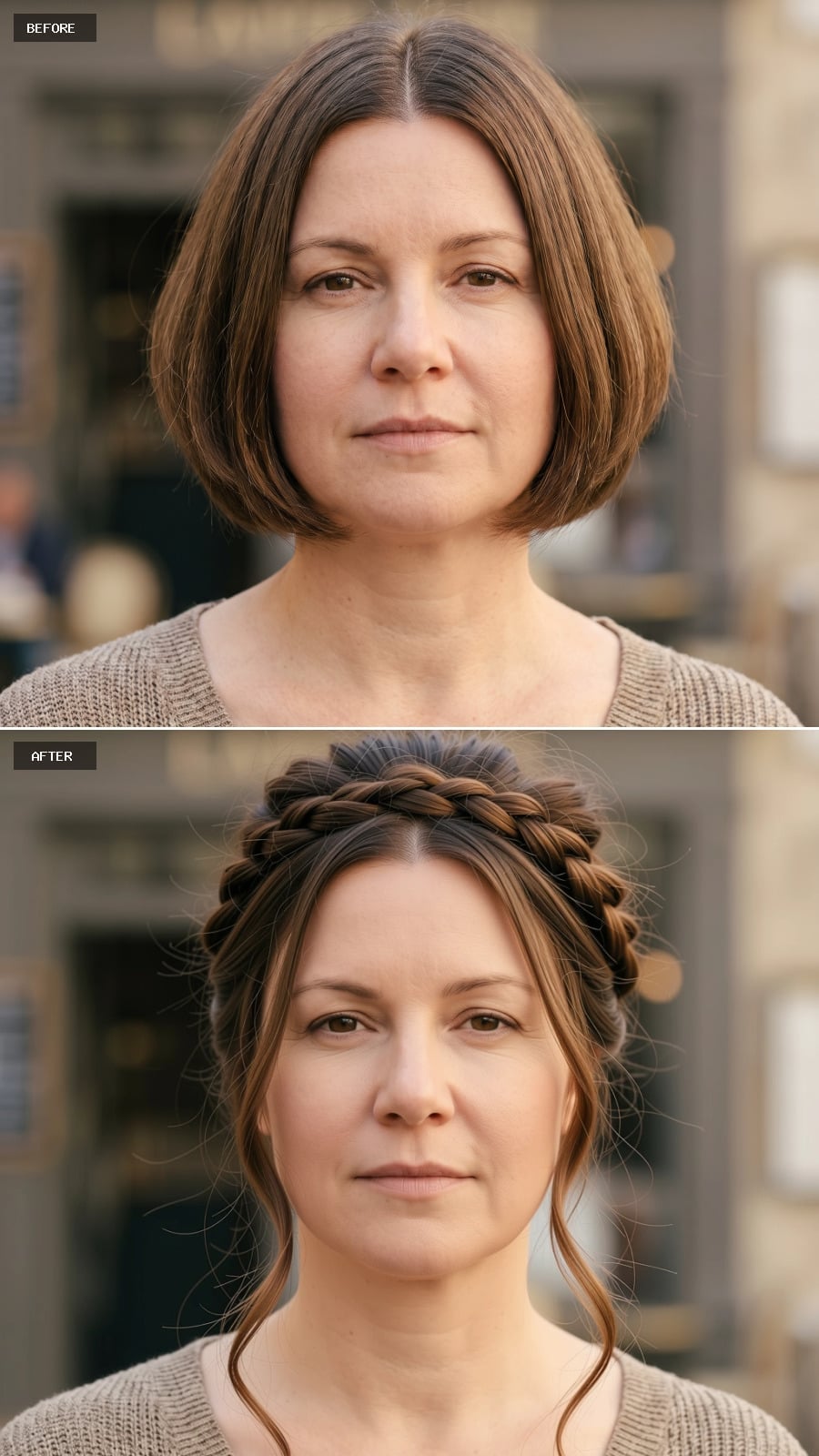
Crown braids work because they create a halo of height that reads taller, not wider. Here, thick rope-style plaits circle the top of the head, woven close enough to stay architectural but loose enough to avoid looking rigid. Soft tendrils fall at the jaw and temples, which keeps the overall shape from feeling too formal or severe.
The warm brown tones in the braid pick up exactly what’s already in the natural hair color, so nothing looks added or forced. Loose pieces framing the face soften what’s underneath without undoing the height the crown creates. It’s the kind of style that opens up the forehead and draws the eye on a vertical path rather than a horizontal one.
15. Loose Bun Pinned High, Tendrils Left Free to Soften What the Structure Holds
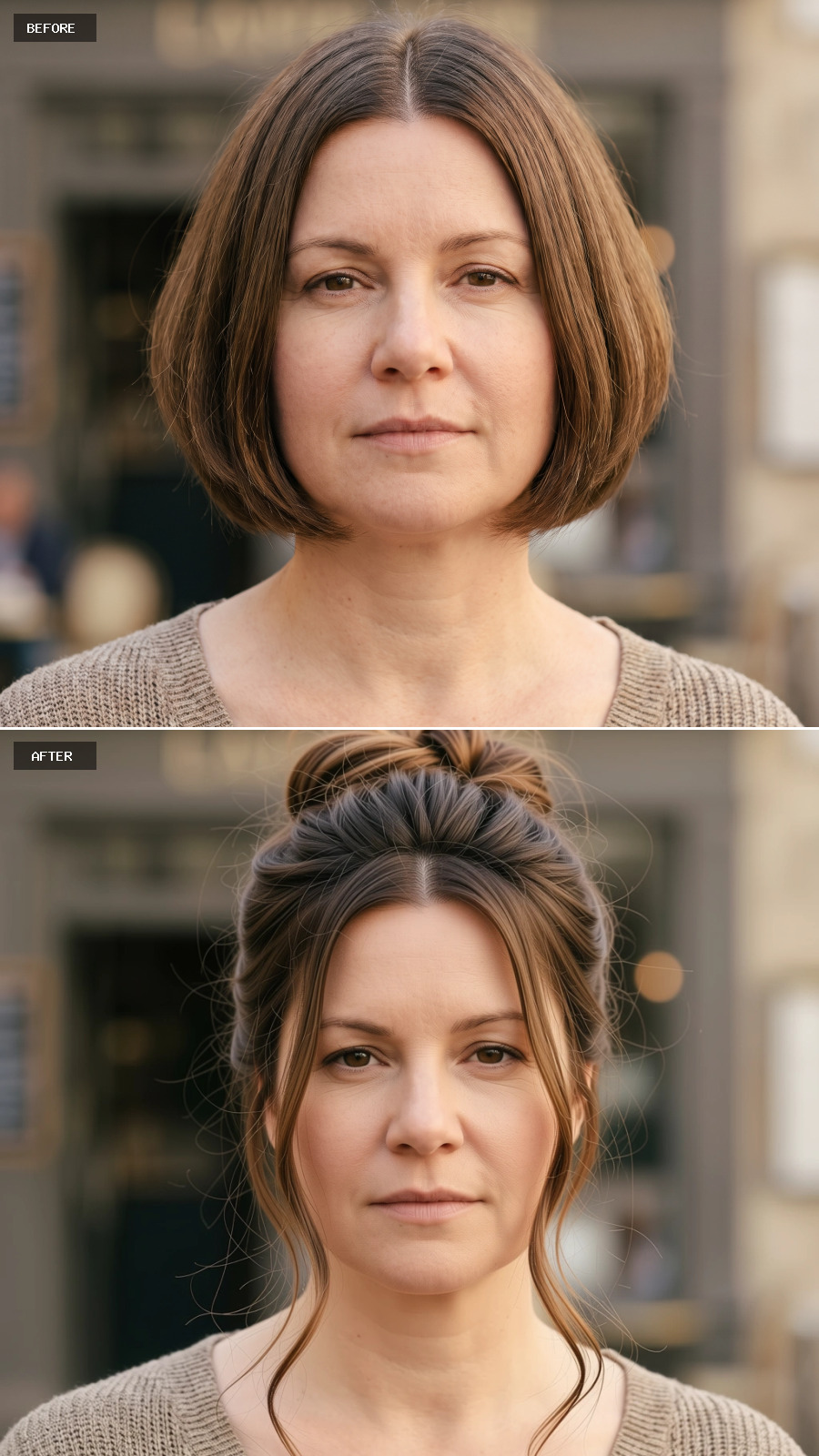
Gathered to the top of the head and pinned into a relaxed bun, the style does something a shorter cut can’t: it creates genuine vertical height while leaving the face completely open. The bun itself isn’t neat or formal. It’s deliberately imperfect, with sections fanning out in different directions and a few pieces of hair escaping around the ears and jaw. Those loose tendrils matter more than they look like they should.
Face-framing pieces that fall forward near the cheekbones pull focus down and inward rather than across. The effect is a face that reads longer than wide, which is the whole point of the exercise. Lighter color running through the front sections, warmer than the deeper base at the crown, adds dimension without looking like highlights were the goal. The soft neckline of the knit top keeps the neck visible and doesn’t compete with what the hair is doing above it.
14. Loose Waves and Balayage Length That Talk a Round Face Into Reading Longer
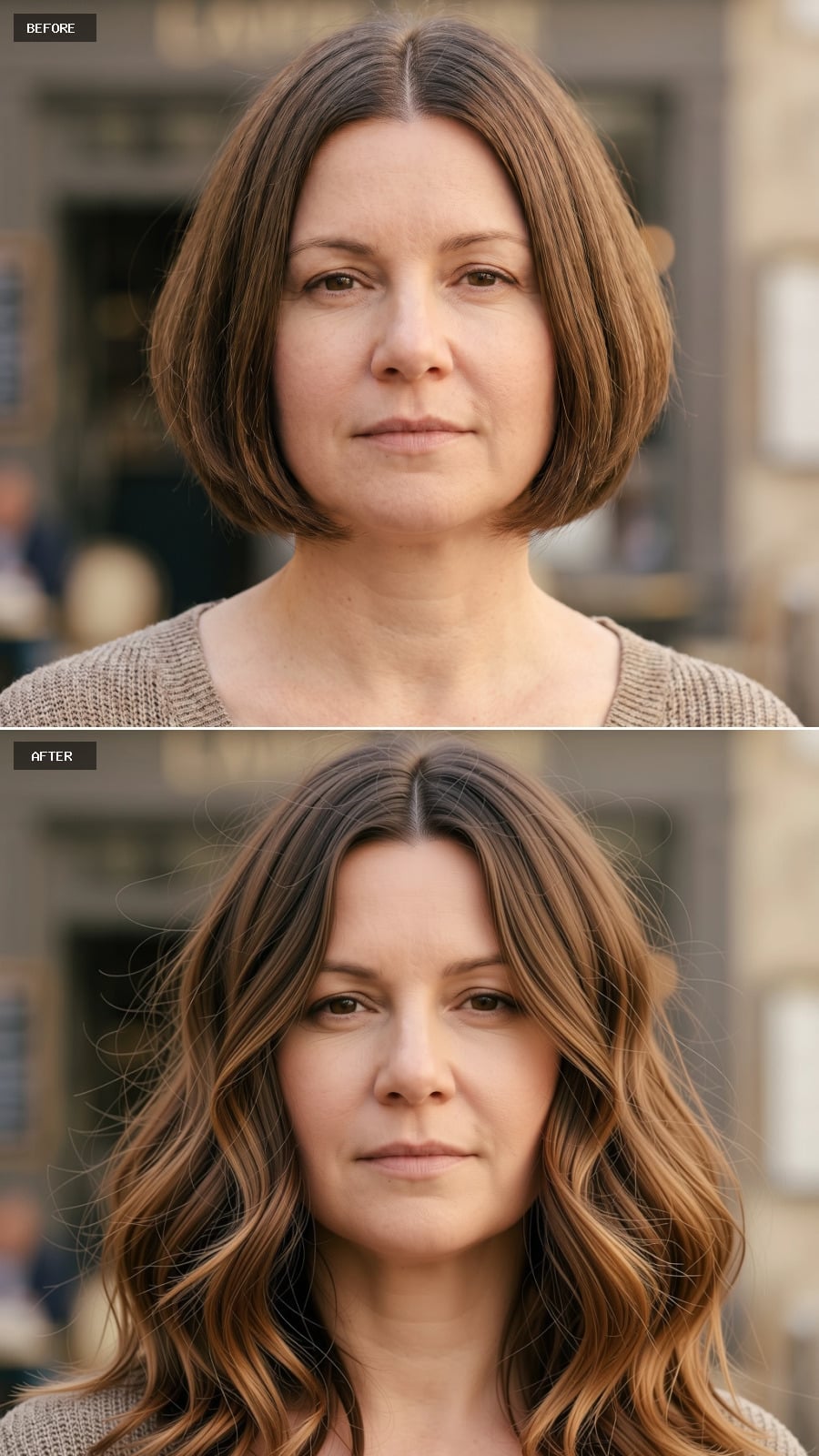
Long layers cut to fall past the collarbone do something a shorter style can’t: they give the eye a path that keeps traveling downward. The waves here aren’t tight or uniform. They move loosely, almost casually, which means the volume sits at the ends rather than at the sides of the face where it would only add width.
The color does real work too. Dark roots fading into warm caramel and honey tones through the mid-lengths and ends pull attention toward the bottom third of the hair rather than the cheekbones. That placement matters on a rounder face shape. Face-framing pieces are kept soft and fine, not chunky, so they skim the jawline without landing heavily on it. The result is a face that reads longer before anyone consciously notices why.
13. Waves That Fall Past the Jaw Give a Round Face Somewhere to Go
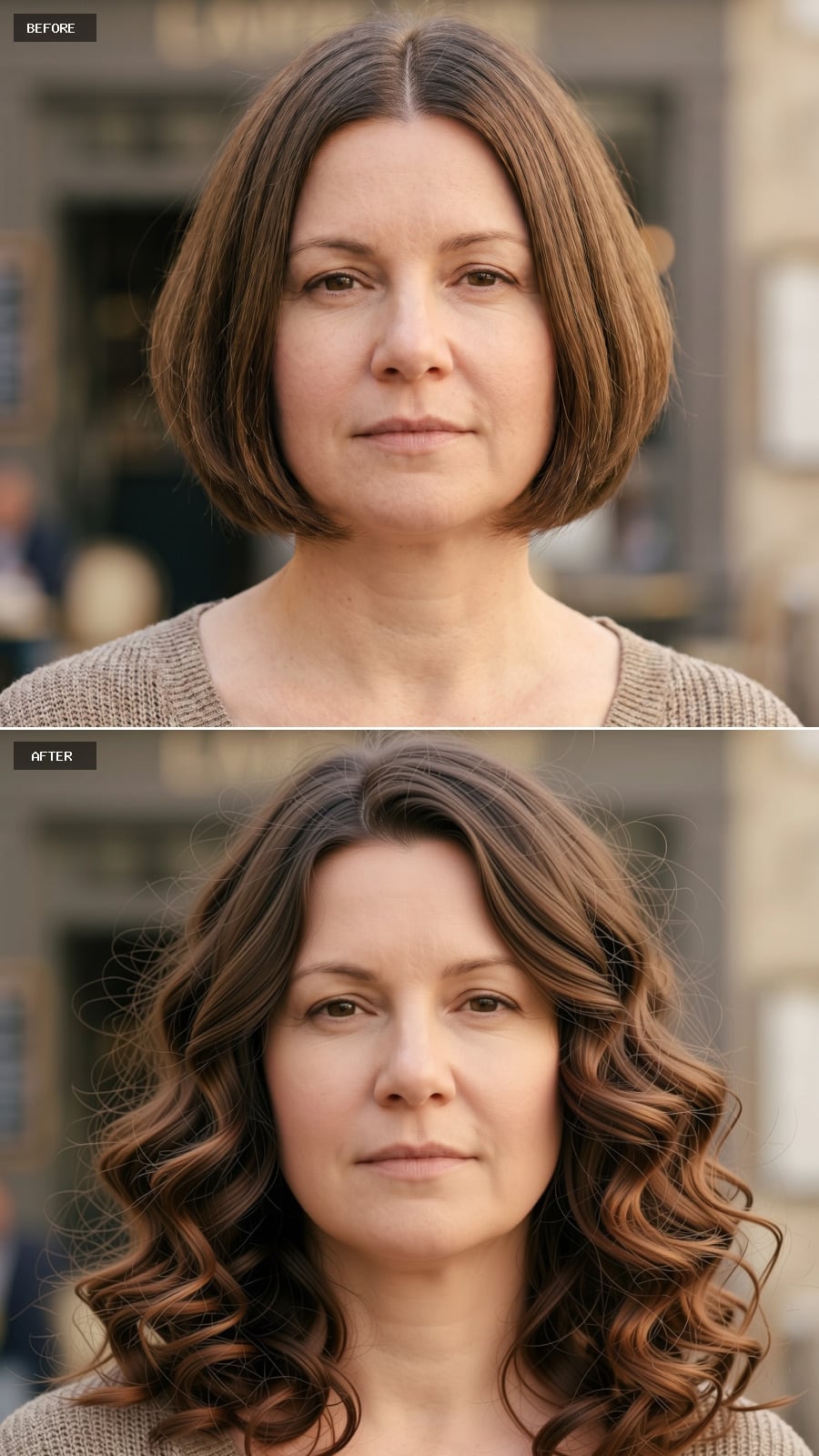
Voluminous curls starting at the crown and spiraling down past the collarbone do something a shorter cut can’t: they give the eye a vertical path to follow. The movement here isn’t random. Loose ringlets with warm auburn tones woven through a dark brown base catch light at the ends, which pulls attention downward rather than outward across the cheeks.
The length landing near the chest is doing real structural work. Where width used to read across the jaw, now the eye tracks the curl pattern instead. It’s a redirection, not a disguise.
- Curls that begin at the crown and end below the collarbone create a continuous vertical line
- Warm highlights placed at the ends draw the eye away from the widest part of the face
- Volume positioned above the ears rather than beside them keeps the face from reading wider than it is
12. Wavy Length With Balayage Ends That Coax a Round Face Into Oval Territory
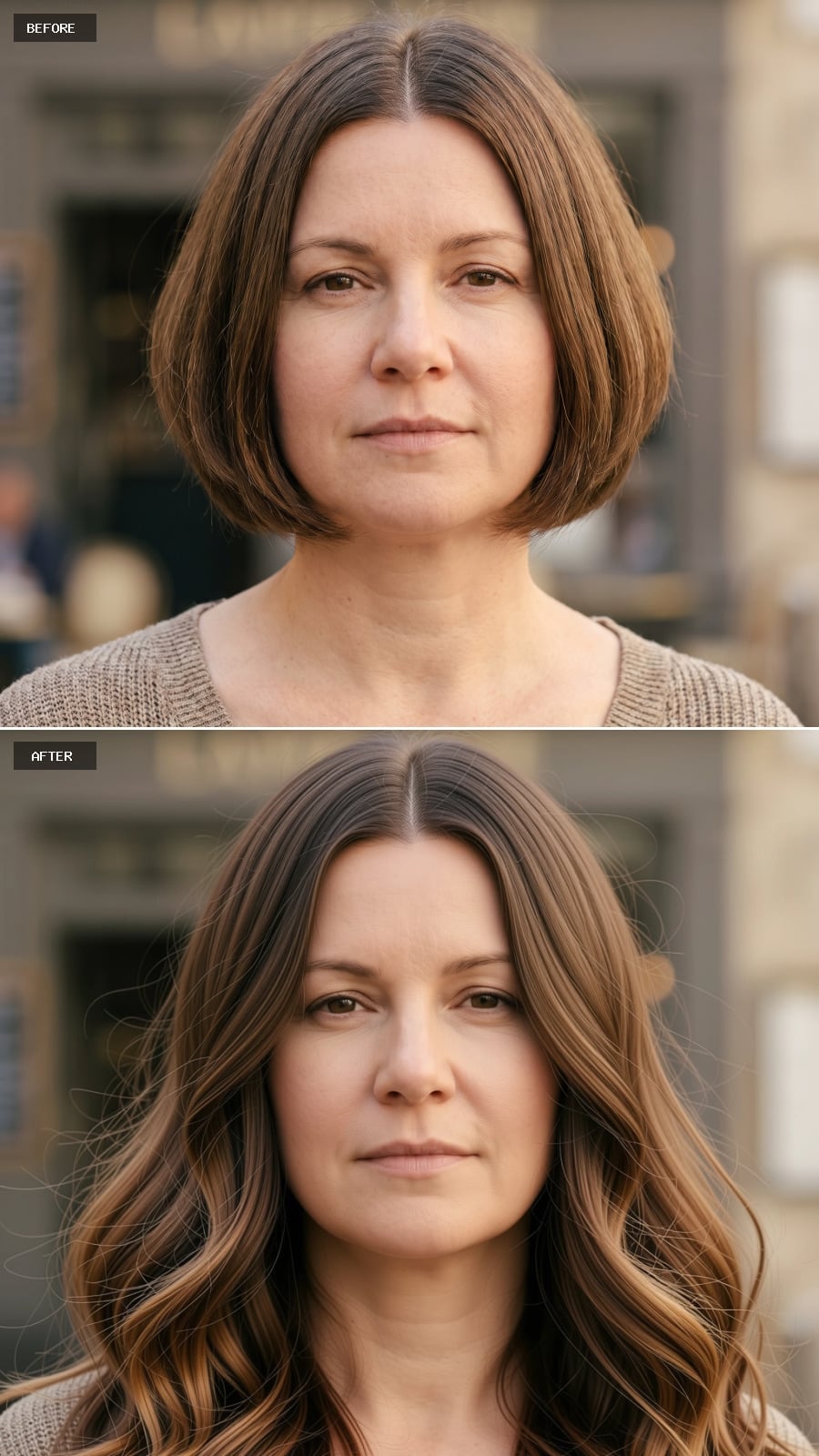
Waves that begin just below the ear and travel past the collarbone do most of the work here. The balayage shifts from a darker root into a warm caramel at the ends, and that gradient pulls attention downward rather than outward. It’s a simple redirect. Soft movement through the mid-lengths keeps the silhouette from going flat, while the center part draws a clean vertical line straight through the face.
11. Straight Lengths and a Fringe Line That Give a Round Face a New Geometry
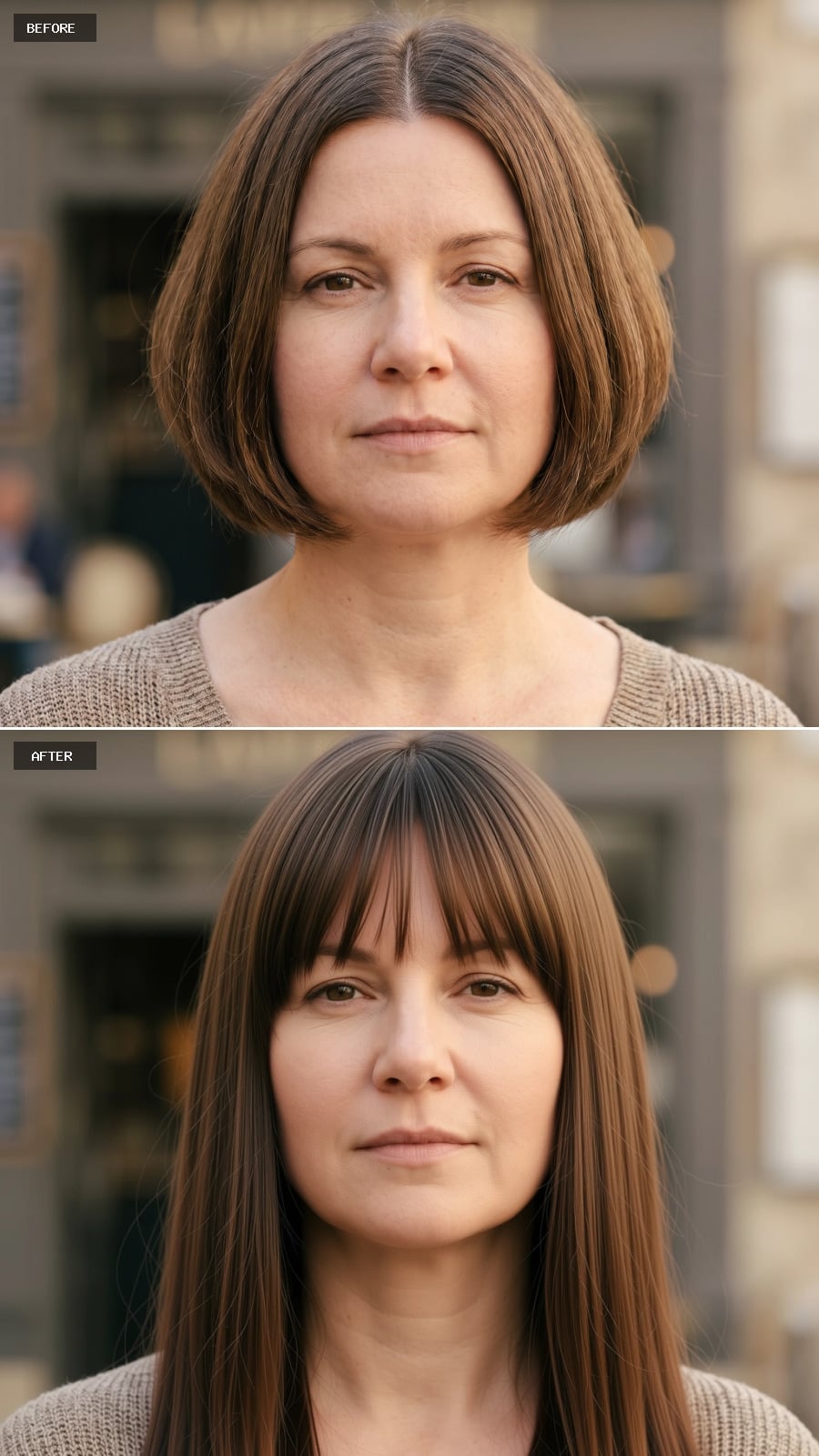
Straight, center-parted lengths fall well past the collarbone, and the fringe sits just above the brow in a clean horizontal line that reads narrower than it sounds. The combination works because the eye gets two opposing signals: the flat bang anchors the forehead, while the weight of the hair pulls attention downward toward the ends. That downward pull is doing most of the work here.
The brown stays consistent from root to tip, no highlights, no gradient. That single-tone depth keeps the silhouette reading as one long vertical rather than breaking the face into sections. Fringe like this tends to look either very polished or very unfinished depending on texture, and the flatness here keeps it firmly in the polished column. Worn with a ribbed scoop-neck in warm taupe, nothing competes with the shape the hair is already building.
10. Highlights That Climb Toward the Crown and Pull Every Eye With Them
❤️ Would you like to save this?
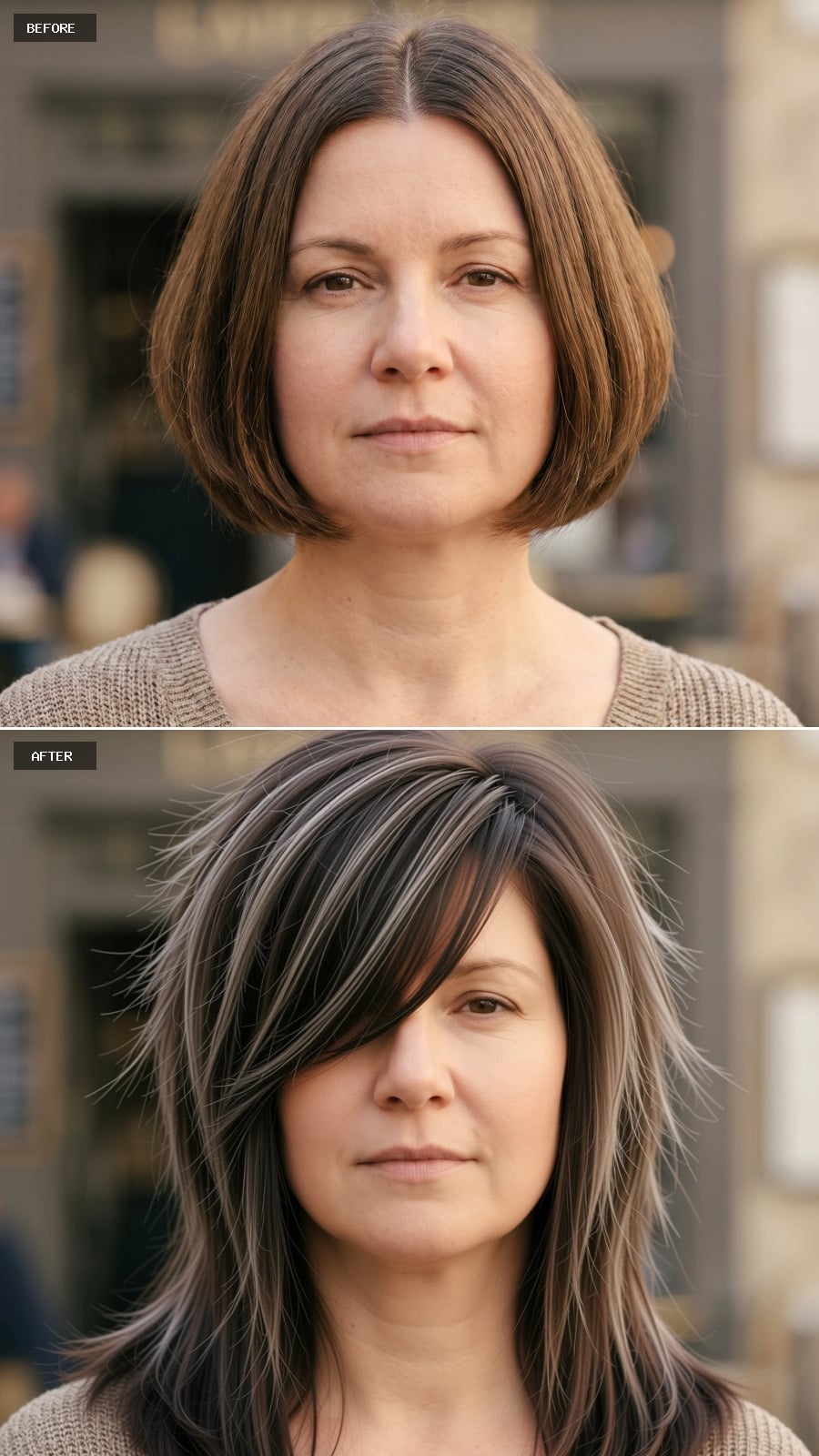
Dark brown roots bleeding into silver-white highlights that sweep upward through the layers do something specific here: they create vertical movement before anyone even registers the cut. The layers are long enough to graze the collarbone, which gives the face a clear downward line to follow rather than a horizontal stopping point at the jaw. Side-parted with a soft diagonal across the forehead, the fringe skims just past the brow without sitting flat, which keeps the upper face from feeling boxed in. Volume sits at the top of the head and disperses outward as the lengths fall, so fullness reads as height first. It’s a smart trick. The color does half the structural work before the scissors even matter.
9. Longer Length With Face-Framing Layers That Quietly Reframe the Jaw
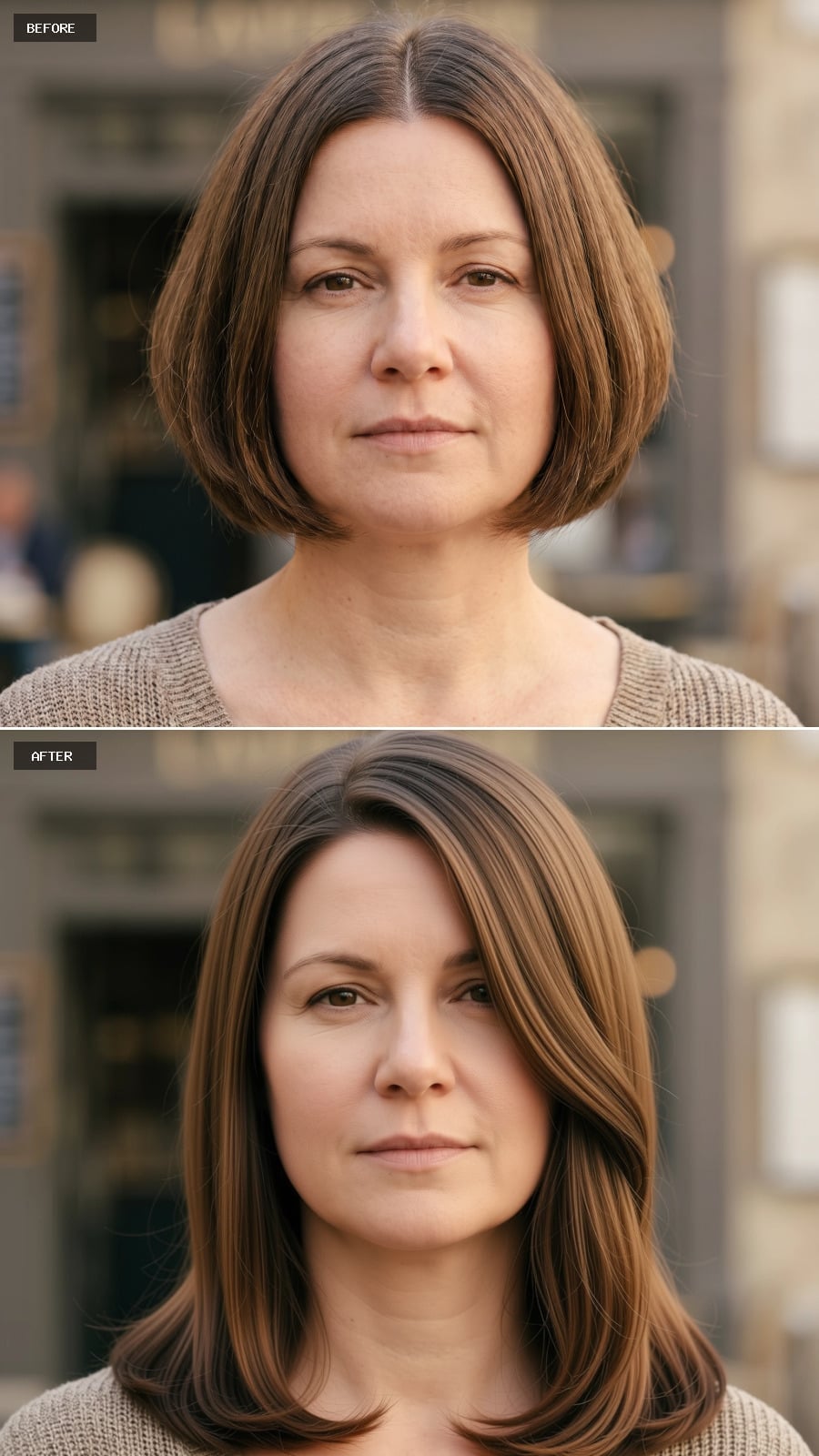
Shoulder-grazing hair with layers that open at the cheekbones does something a shorter cut can’t: it gives the face a vertical line to follow all the way down. The color does its share too. Warm brown at the roots shifts into lighter, almost honey-toned pieces through the mid-lengths, and that gradient draws the eye along the length of the hair rather than across the widest part of the face. The part sits slightly off-center, which breaks the symmetry just enough to keep things from reading too wide at the forehead. Ends are smooth and fall close to the body, no flick or curl pulling outward.
8. Longer Lengths With a Soft Wave That Give a Round Face Room to Breathe
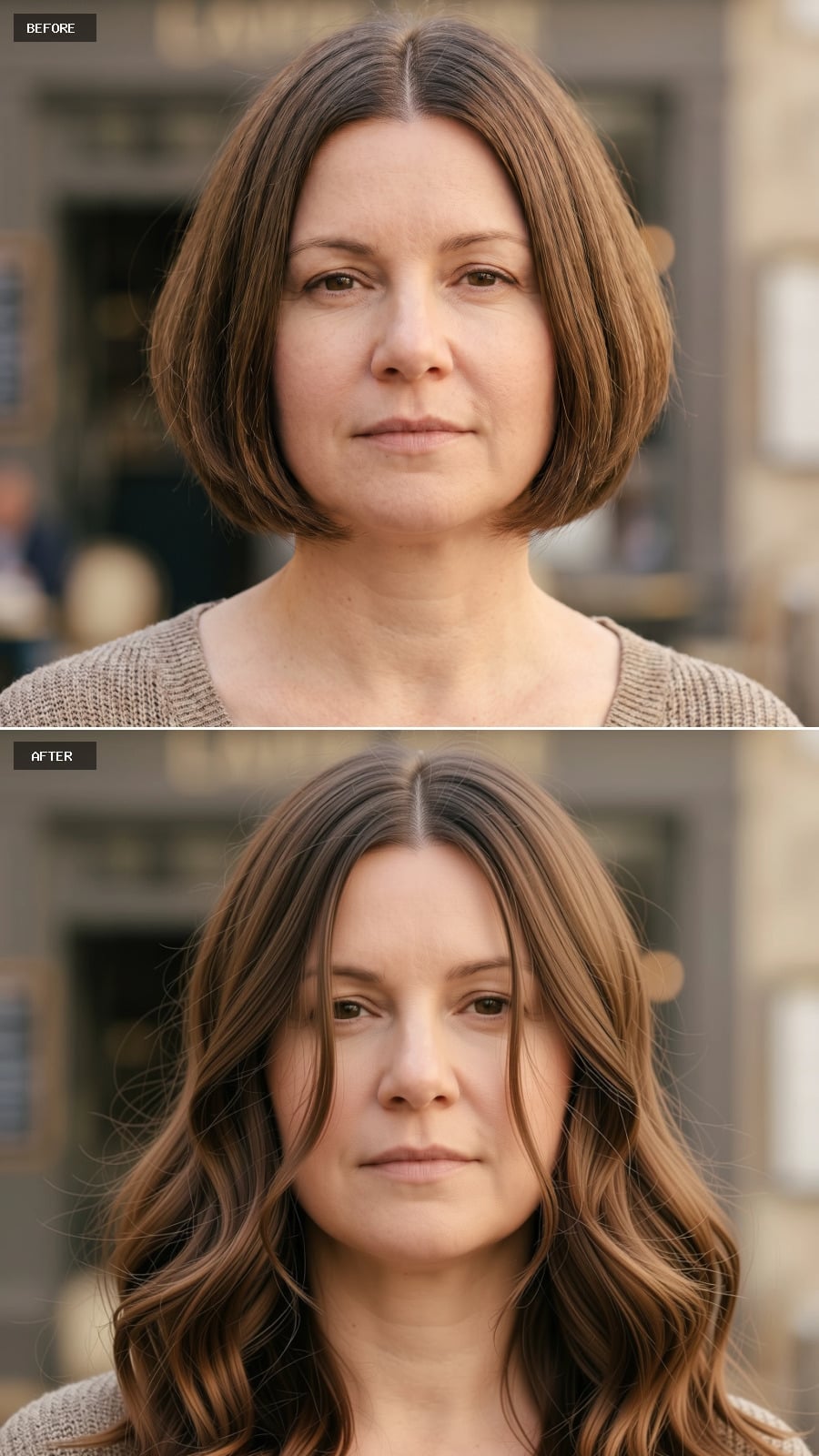
Mid-length hair landing past the collarbone does something a shorter cut often can’t: it gives the eye a path downward instead of stopping at the jaw. The loose waves here aren’t uniform. They shift and break at different points through the length, which keeps the silhouette from reading as a solid block of width. Face-framing pieces fall forward around the cheekbones and chin, drawing attention toward the center of the face rather than its widest horizontal points. The brunette base picks up warmth toward the ends without going full highlight, and that subtle shift in tone is doing quiet work.
Fun Fact: Hair that moves creates what stylists call “visual interruption,” and it genuinely changes how the brain reads the shape of a face. A uniform, static style reads as a solid mass, while a wavy or layered one draws the eye through the hair rather than across it. On rounder face shapes, that distinction matters more than most people realize.
7. Darker Color and Swept-Back Length That Redraws the Whole Face
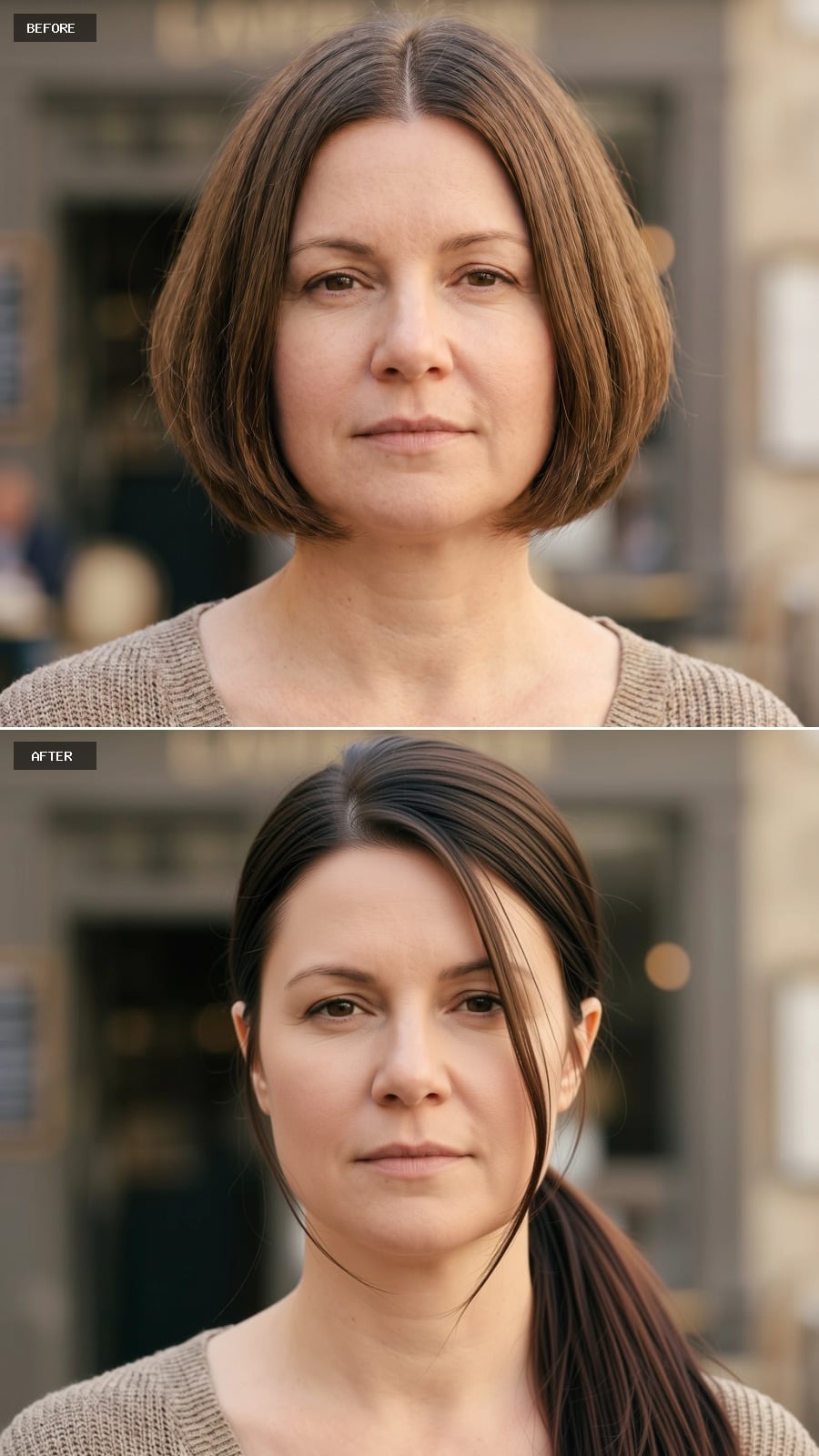
Her hair’s been deepened to near-black with a cool brunette tone, then pulled back and off the face entirely, which does something a bob simply can’t: it removes width from the sides and lets the face read vertically instead of horizontally. A few strands fall forward at the temple, loose enough to soften without disrupting the line. That swept-back structure is where the real work happens.
6. Swept Side-Part Length With Highlights That Rewrite a Round Face’s Proportions
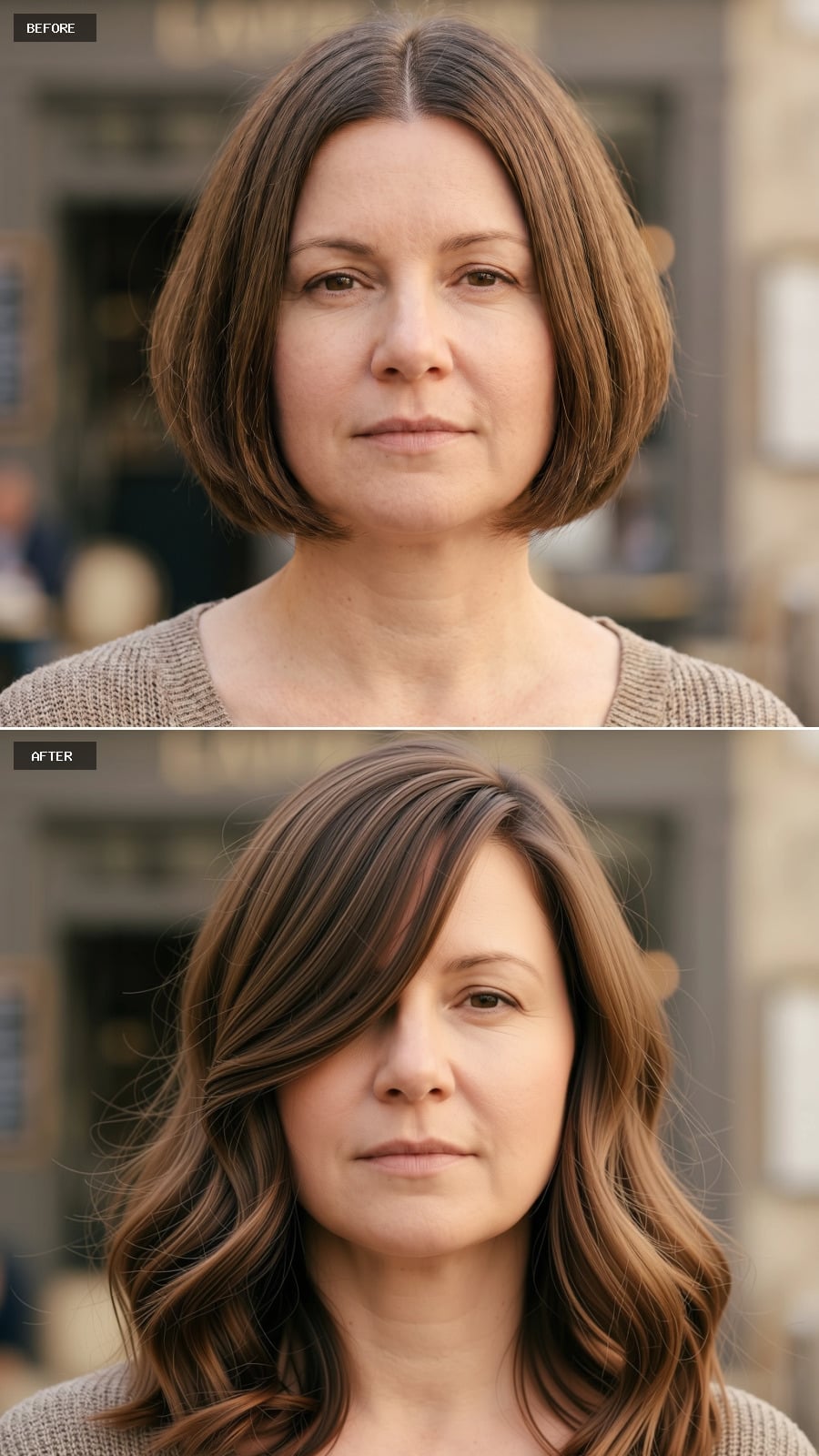
Balayage does a lot of work here, but placement is what makes it count. The highlights run in warm, caramel-toned ribbons that start mid-shaft and pull toward the ends, keeping brightness away from the widest part of the face. Length falls past the collarbone, and the soft wave at the bottom gives the eye a reason to travel downward rather than settling across the cheeks.
The side part is doing something specific. By sweeping volume to one side, it creates an asymmetry that interrupts the roundness a centered part would reinforce. Hair falling across one eye is rarely just a style choice. It’s geometry.
Face-framing layers curve inward at the jaw without stopping there, which lets the length continue and the oval illusion hold. The overall color stays in a rich brunette base, so the highlights read as dimension rather than contrast. Subtle enough that the shape does the actual work.
5. Side-Swept Bangs and Shoulder Length That Quietly Renegotiate a Round Face
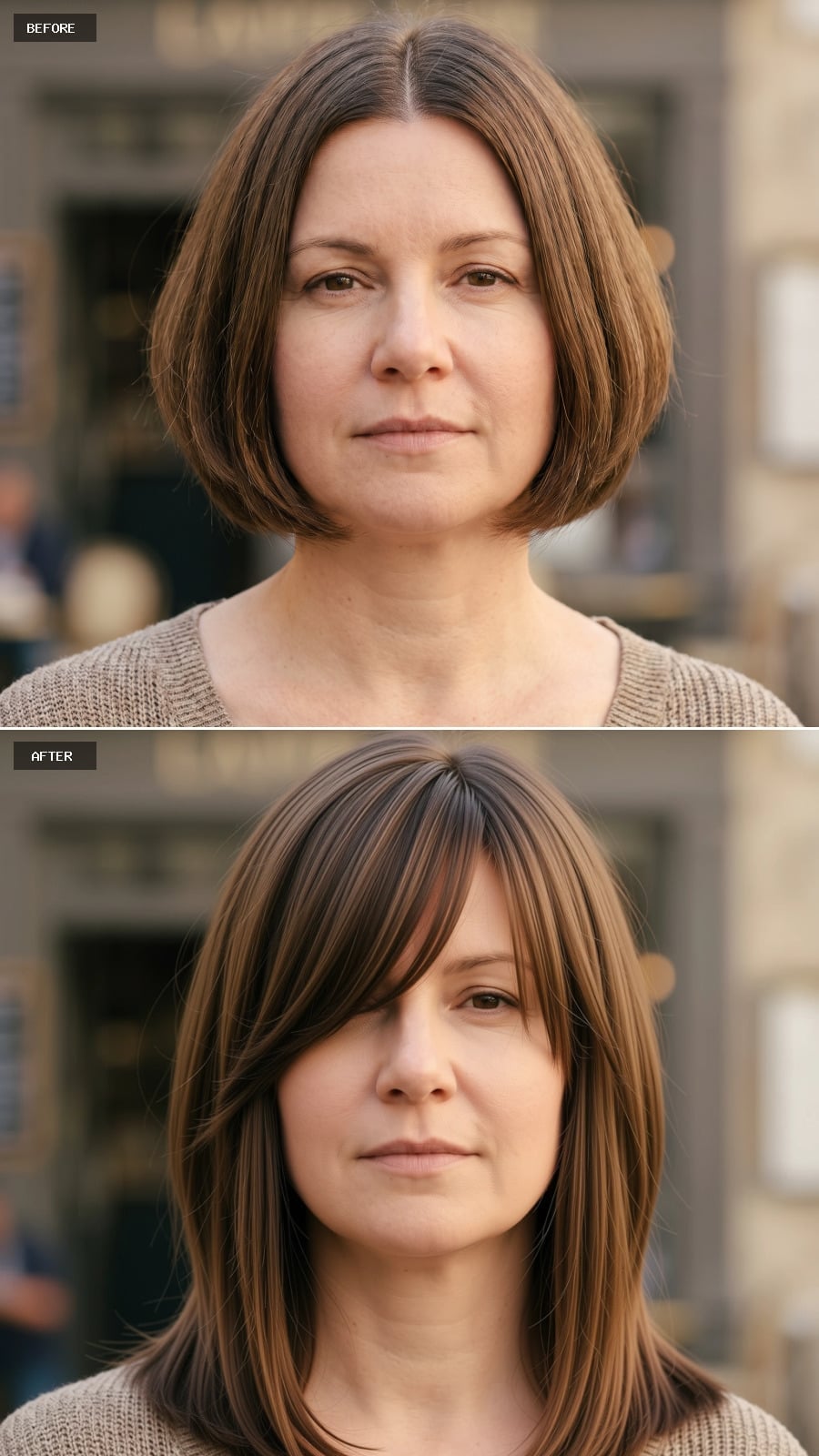
Side-swept bangs cut to fall past one brow and angle toward the cheekbone do most of the work here. They break the forehead’s width without covering it completely, which keeps the face from reading as heavy up top. The length lands just past the shoulder, with face-framing layers that taper toward the jaw and pull the eye downward. It’s a cut that doesn’t shout. The brown reads warm but not flat, with slightly lighter movement through the mid-lengths that keeps the whole thing from sitting too heavy around the face.
Side-swept bangs angled past one brow break forehead width without closing the face in, which is the detail most blunt cuts miss entirely.
4. Wavy Lengths With Warm Balayage That Coax a Round Face Into Reading Narrower
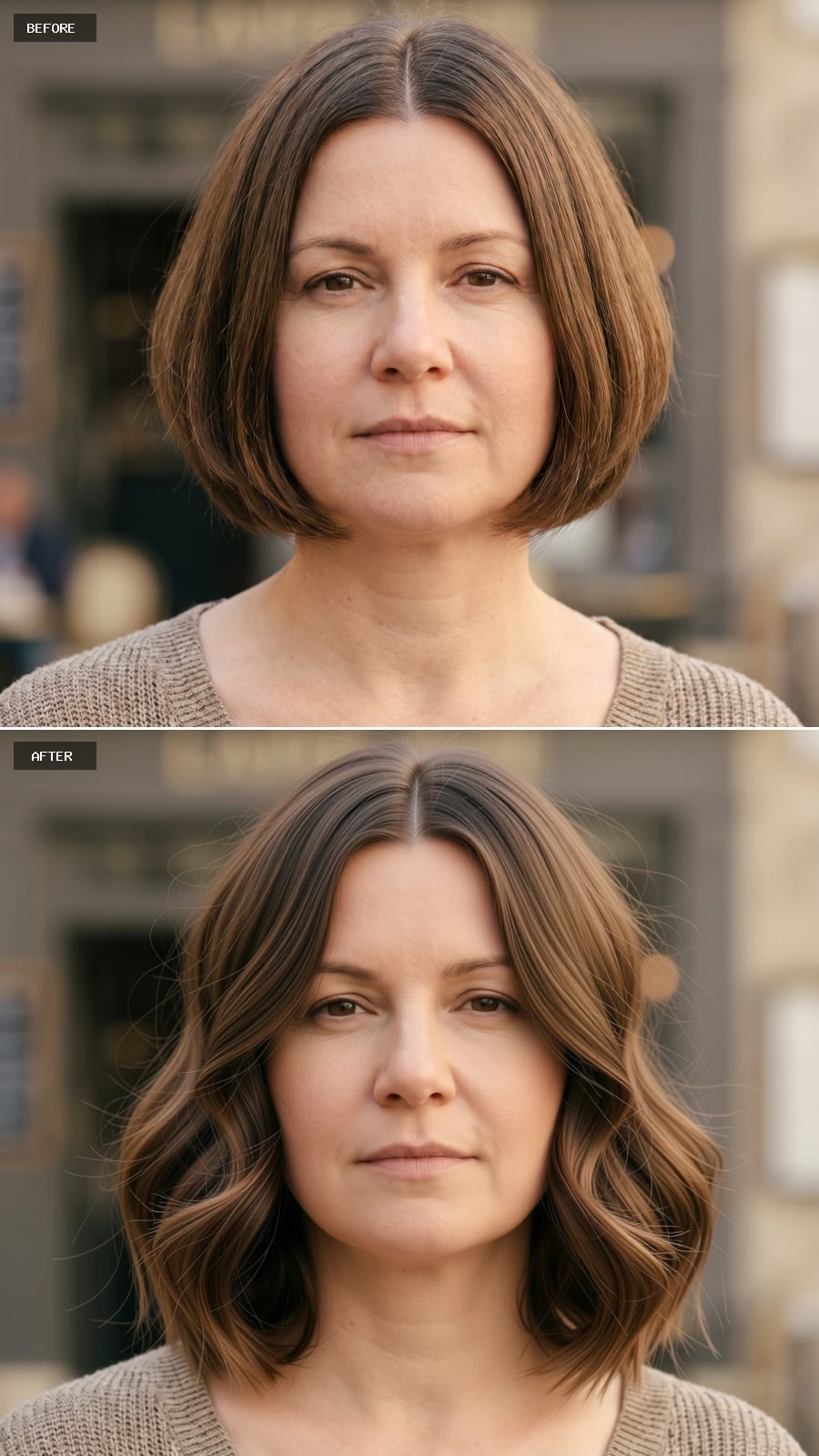
Soft, mid-length waves that curl gently at the ends do something specific for a rounder face: they redirect attention downward and outward rather than across. The color does real work here too. Warm caramel tones are woven through brunette base hair, and they’re placed strategically toward the mid-shaft and ends rather than close to the scalp. That placement draws the eye along the length of the hair instead of across the widest point of the face.
The waves aren’t uniform. Some sections fall straighter near the root before curling below the jaw, and that variation creates shadow and dimension that a smooth blowout can’t replicate. Where the hair falls slightly forward at the sides, it narrows the perceived width of the face without requiring any product or technique to maintain the effect. It just sits there and does its job. The overall silhouette reads fuller at the ends than at the crown, which is the opposite of what rounds a face out.
3. Pinned Up and Piece-y, With Bangs That Finally Give a Round Face a Diagonal to Follow
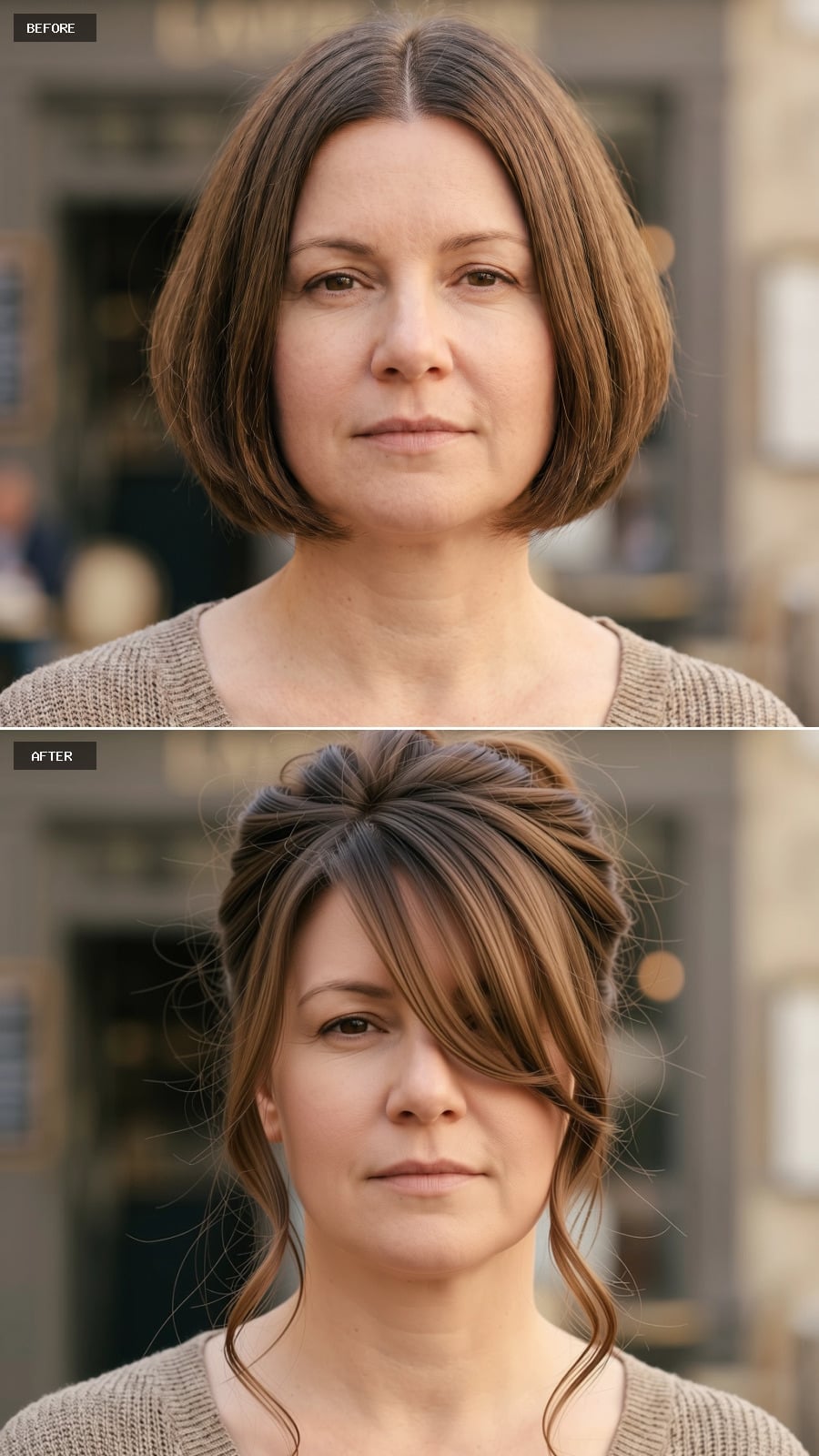
Loose strands escape the updo at the nape and temples, and that’s exactly what makes it work. The swept fringe cuts across the forehead at an angle, giving the eye a line to travel rather than a boundary to stop at. Tendrils at the jaw do the same. Nothing is tight, nothing is symmetrical, and the face reads longer for it.
An updo that lets hair fall where it wants reads as shaped, not severe, and that distinction matters on a rounder face.
2. Long Layers With a Side Part That Quietly Argue Against Every Round Contour
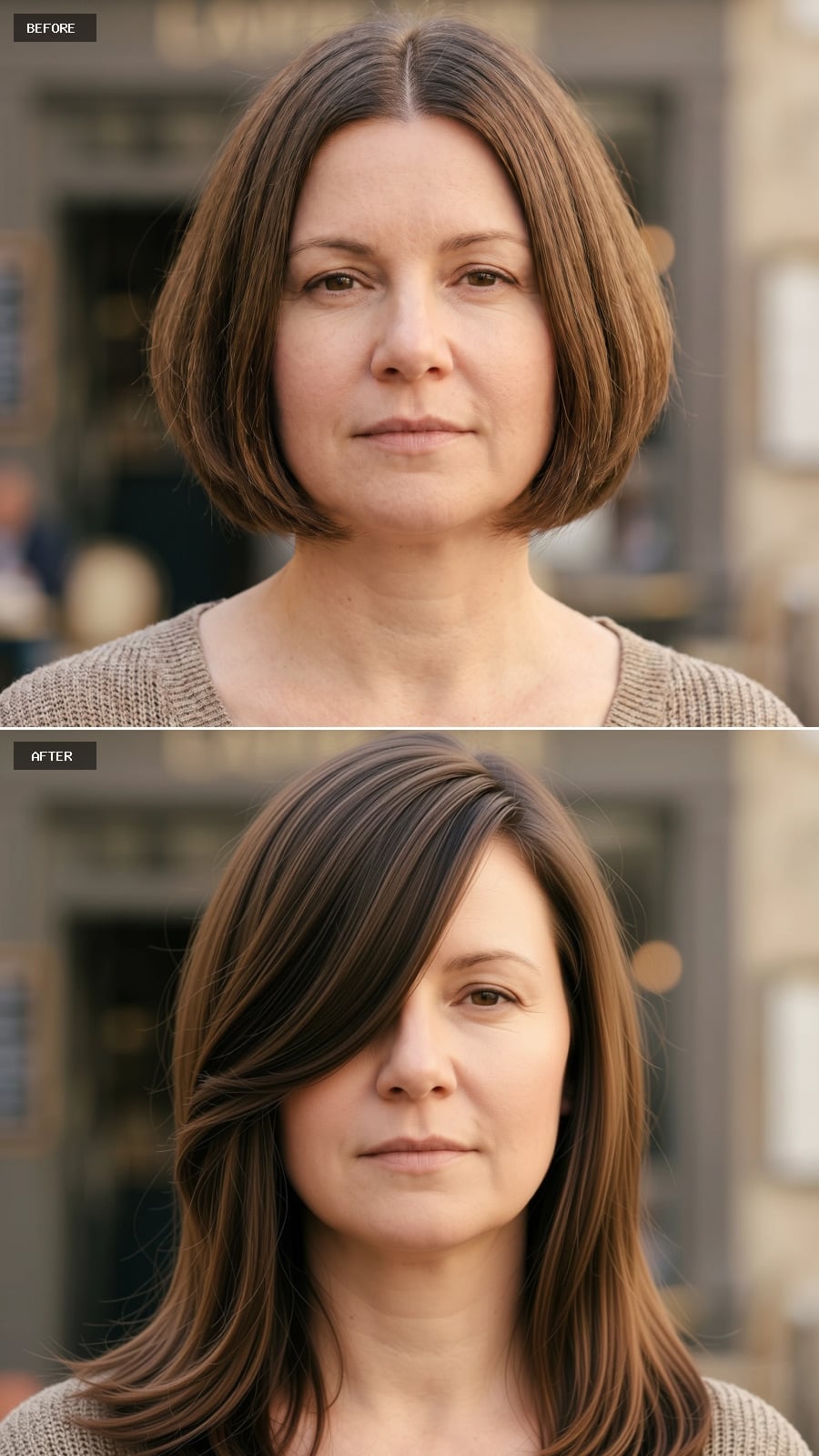
Length is doing the structural work here, but the side part is what makes it land. By pulling the hair across the forehead at an angle rather than splitting it down the center, the whole upper face reads longer before the eye even travels down to the jaw. The layers fall past the collarbone, and because they’re cut to move apart rather than blunt at the ends, they create a tapered vertical line on each side of the face. The color is a cool-leaning brunette with just enough dimensional shift in the midshaft to keep the length from reading flat against the skin.
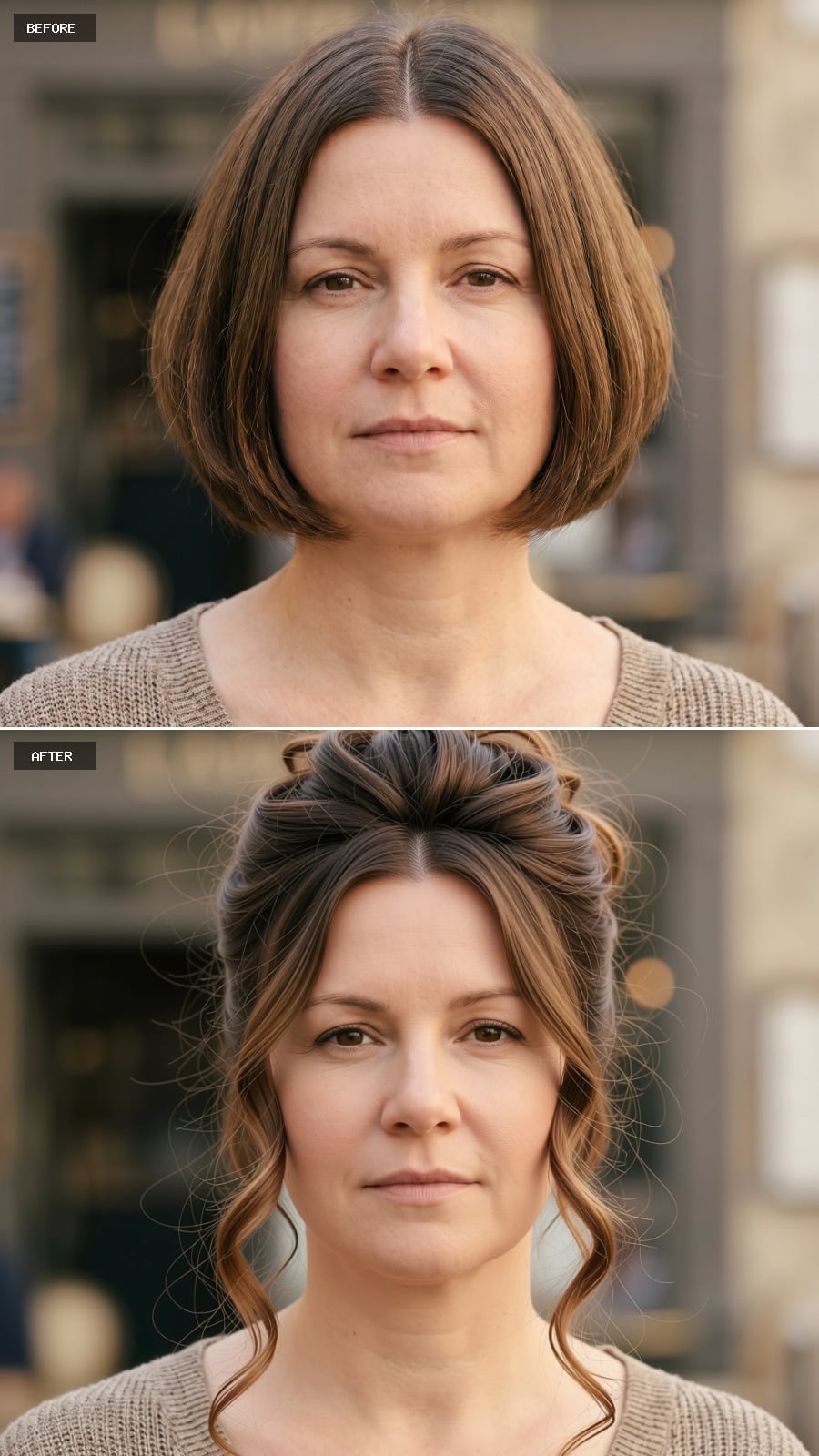
1. Pinned Up With Cascading Tendrils That Rewrite the Rules for Round Faces
❤️ Would you like to save this?
What’s doing the real work here is the vertical mass built at the crown, a gathered twist that pulls the eye upward before it ever settles on the jaw. The tendrils that fall alongside the face aren’t decorative afterthoughts. They hang just past the ear, and that placement creates a framing effect that draws the face longer without competing with the upswept volume above. Mint ceramic earrings add a cool contrast against the warm brunette tones, and that pairing keeps the whole look from reading too formal for everyday wear.