❤️ Would you like to save this?
A certain kind of 1990s handbag seemed determined to prove that leather could behave like architecture. Bases stayed flat. Corners stayed square. Flaps snapped shut. Frames, piping, gussets, clasps, and reinforced seams kept everything exactly where the designer put it.
Then the geometry started loosening. The same familiar bag families — satchels, shoppers, flap bags, buckets, hobos, quilted purses — began losing their hard edges. Handles lengthened. Bodies widened. Leather folded against the hip instead of standing away from it. Hardware became quieter while the material itself became more visible.
These 26 comparisons show the change without pretending every handbag followed the same timeline. Some shapes stretched east-west. Others collapsed downward, puffed up, rounded off, or simply stopped insisting on a perfectly flat base. The common thread is not that structure disappeared. It is that softness became something designers were willing to show.
FYI, thanks to AI imagery software, we’re able to create very specific fashion and hairstyle examples to illustrate the points being made. In some cases, imagery is exaggerated to hammer home the point. Also, assume links that take you off the site are affiliate links such as links to Amazon. this means we may earn a commission if you buy something.
26. The Structured Rectangular Shoulder Bag Learns to Slouch
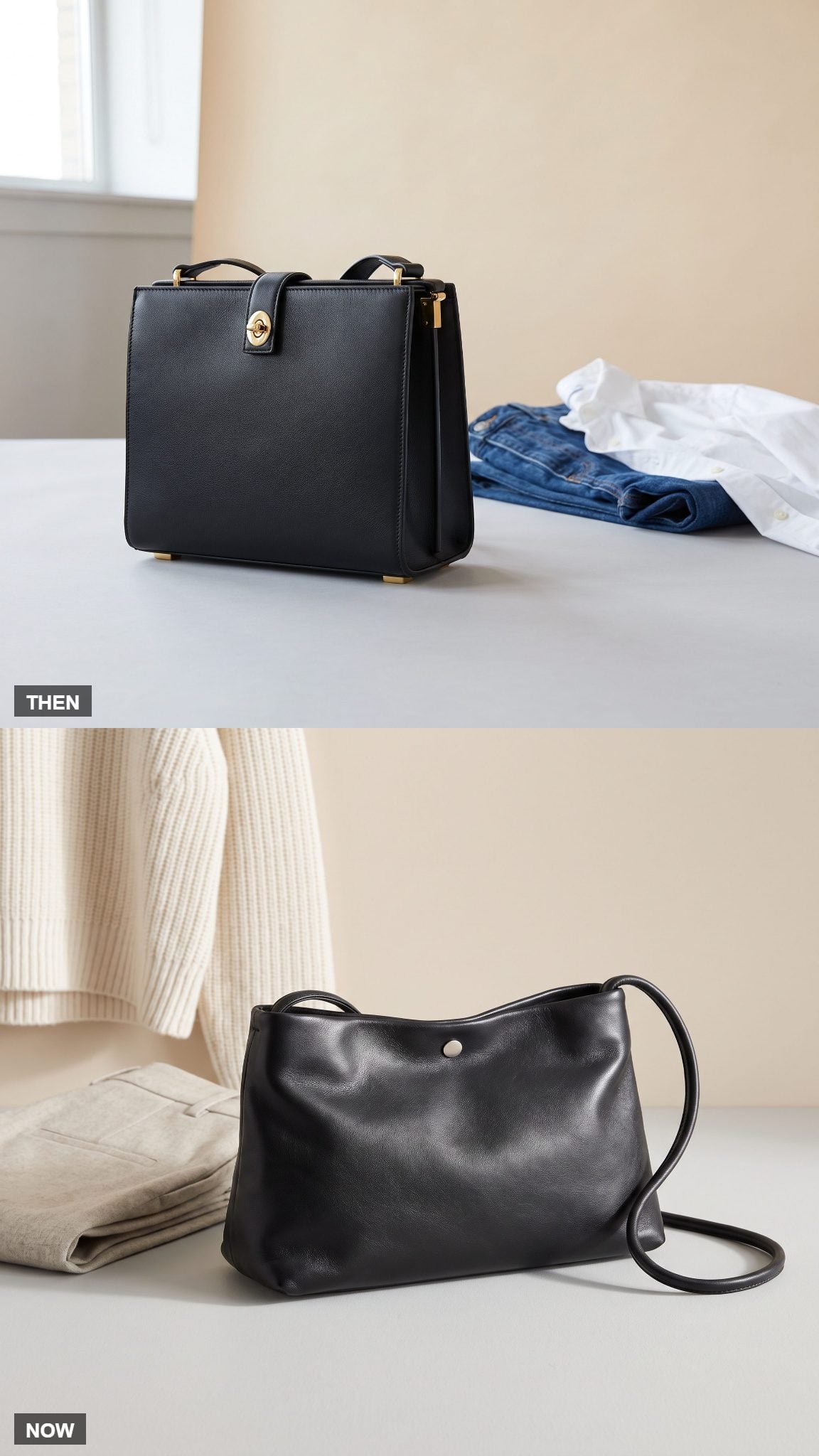
The earlier black shoulder bag makes its geometry impossible to miss: square corners, a flat base, short strap, and enough internal structure to keep the body upright even when little is inside it.
The newer version retains the everyday shoulder-bag scale but lets the leather sag through the middle. Corners fold, the body settles closer to the hip, and visible hardware retreats. Against wide-leg trousers and a soft knit, the bag no longer adds another rigid rectangle to the outfit.
25. The Structured Leather Bucket Bag Loses Its Upright Stance
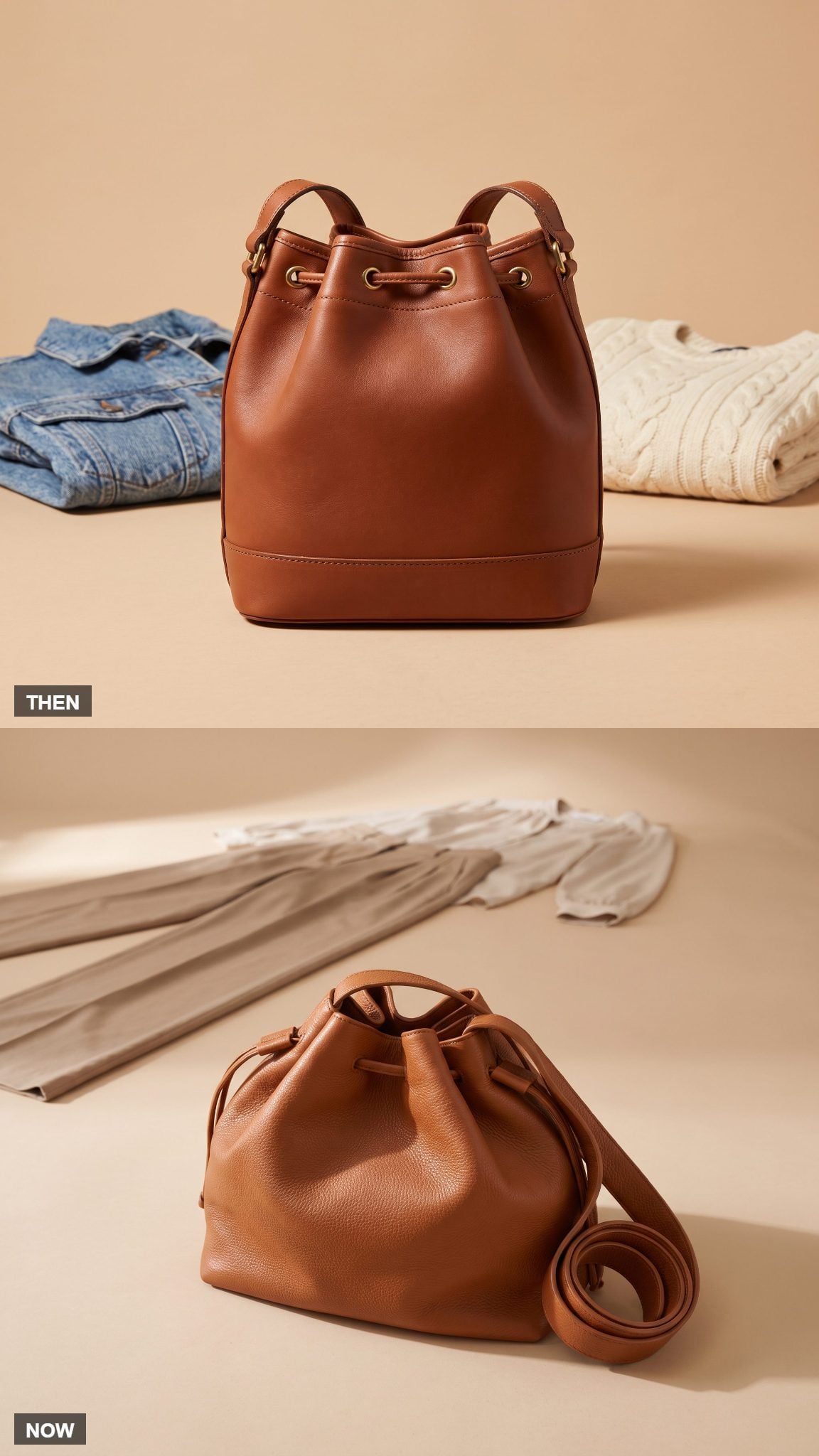
The older bucket keeps the vertical logic of its name. Firm walls rise from a reinforced circular base, while the drawstring gathers an opening that still intends to remain upright.
The contemporary version lets gravity redraw the shape. Buttery cognac leather collapses inward, the base rounds as it lands, and the drawstring creates folds instead of simply closing a cylinder. Same basic bag family, much less architectural discipline.
24. The Patent Rectangle Keeps the Shine and Drops the Stiffness
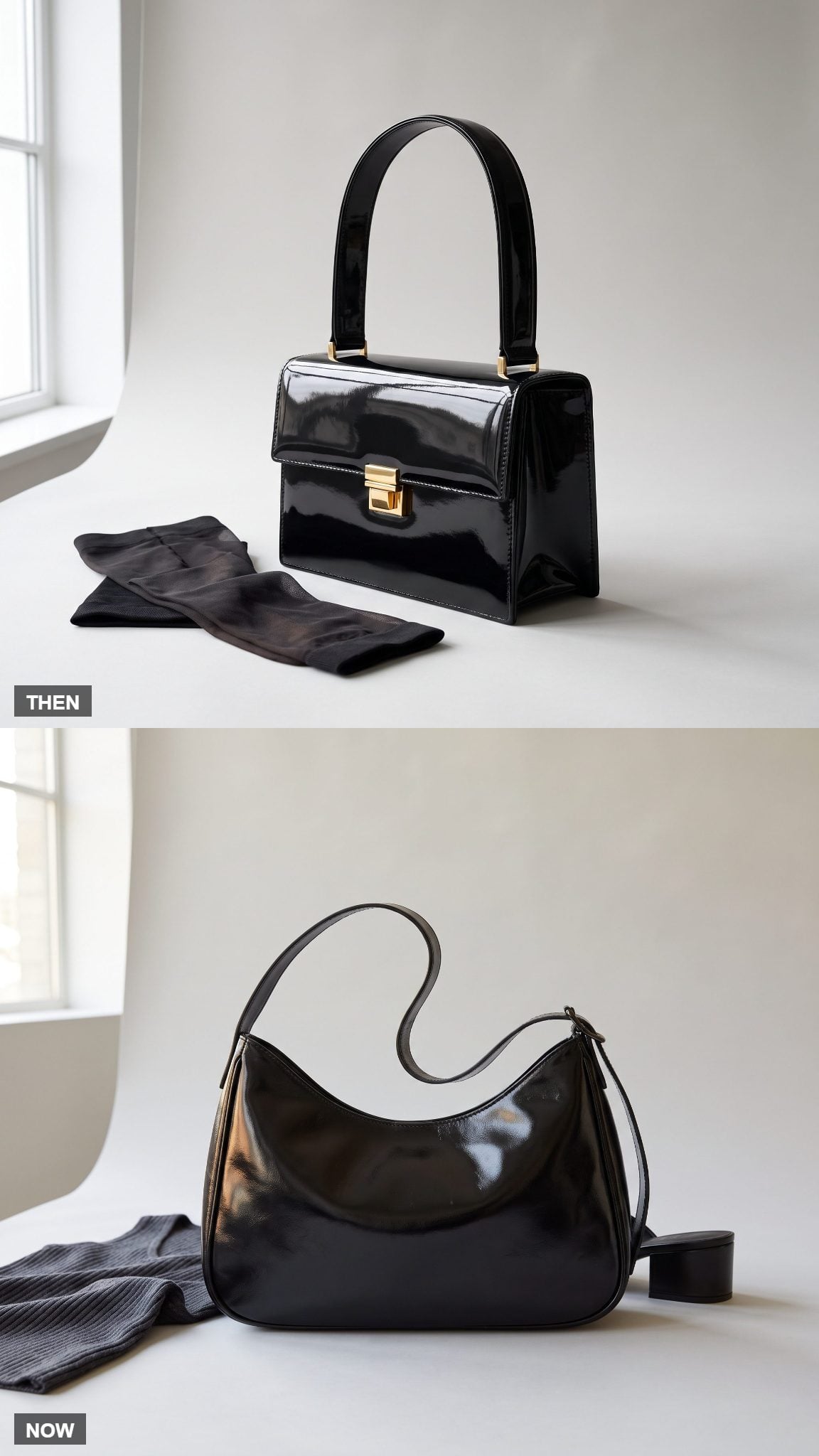
Gloss once arrived with geometry here. The black patent shoulder bag holds a crisp rectangle, its sharp edges making the reflective finish look even harder.
The newer glossy bag preserves the shine but allows the surface to curve. Rounded edges interrupt those mirror-like reflections, while a softer body lets the bag sit closer to the wearer. The material still catches every light source in reach; it simply no longer behaves like a lacquered box.
23. A Small Top-Handle Purse Rounds Off Its Formal Edges
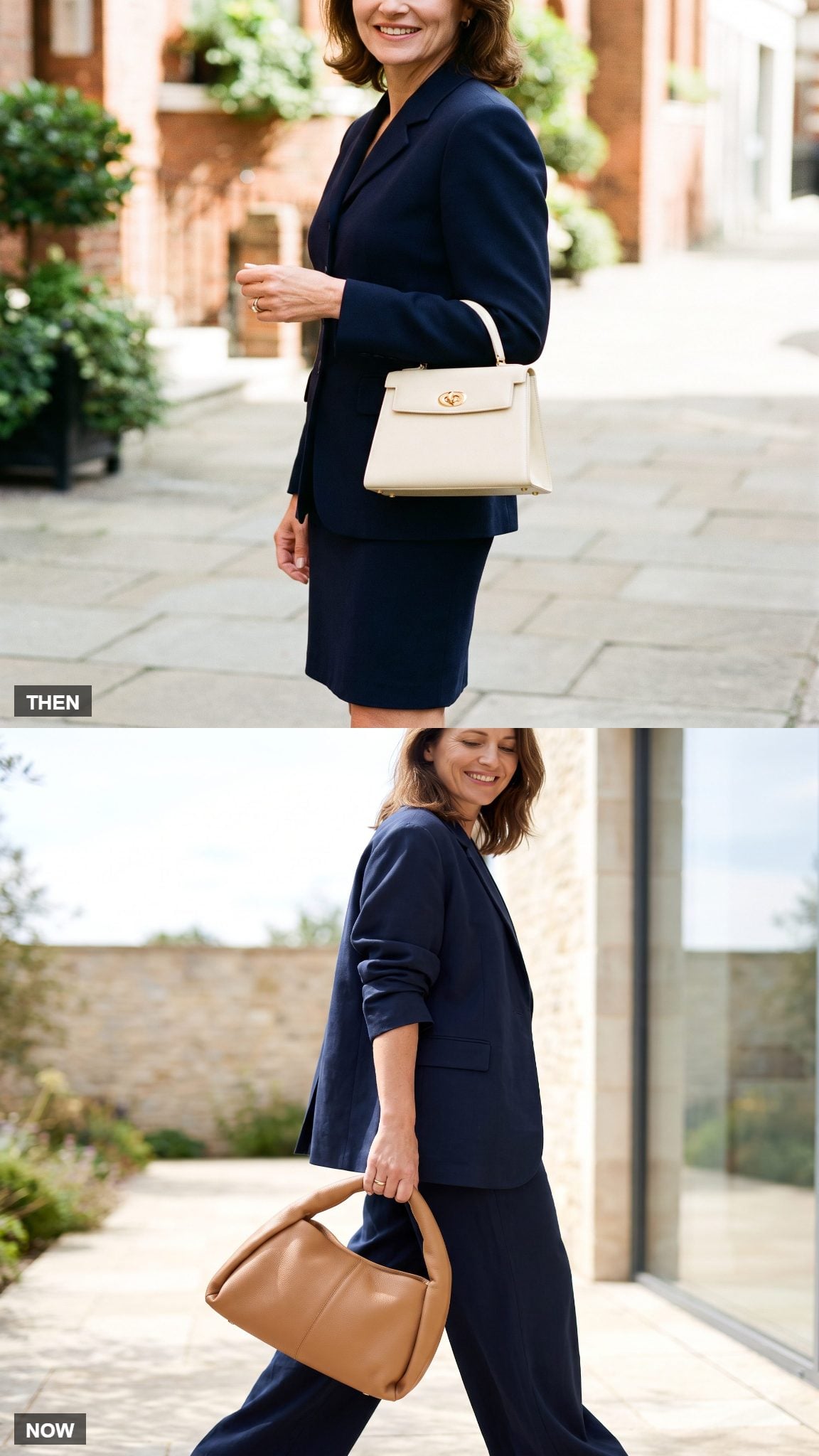
The compact cream purse is all crisp manners: trapezoidal body, defined corners, short top handle, small clasp. Its size may be modest, but the structure makes every edge register clearly.
The updated version keeps the top handle and compact proportions while softening almost everything around them. Folded sides replace rigid walls, the base curves, and even the handle gives slightly in the hand. The reference remains ladylike without requiring the bag to hold a perfect pose.
22. Croc Embossing Looks Completely Different Once the Bag Starts Folding
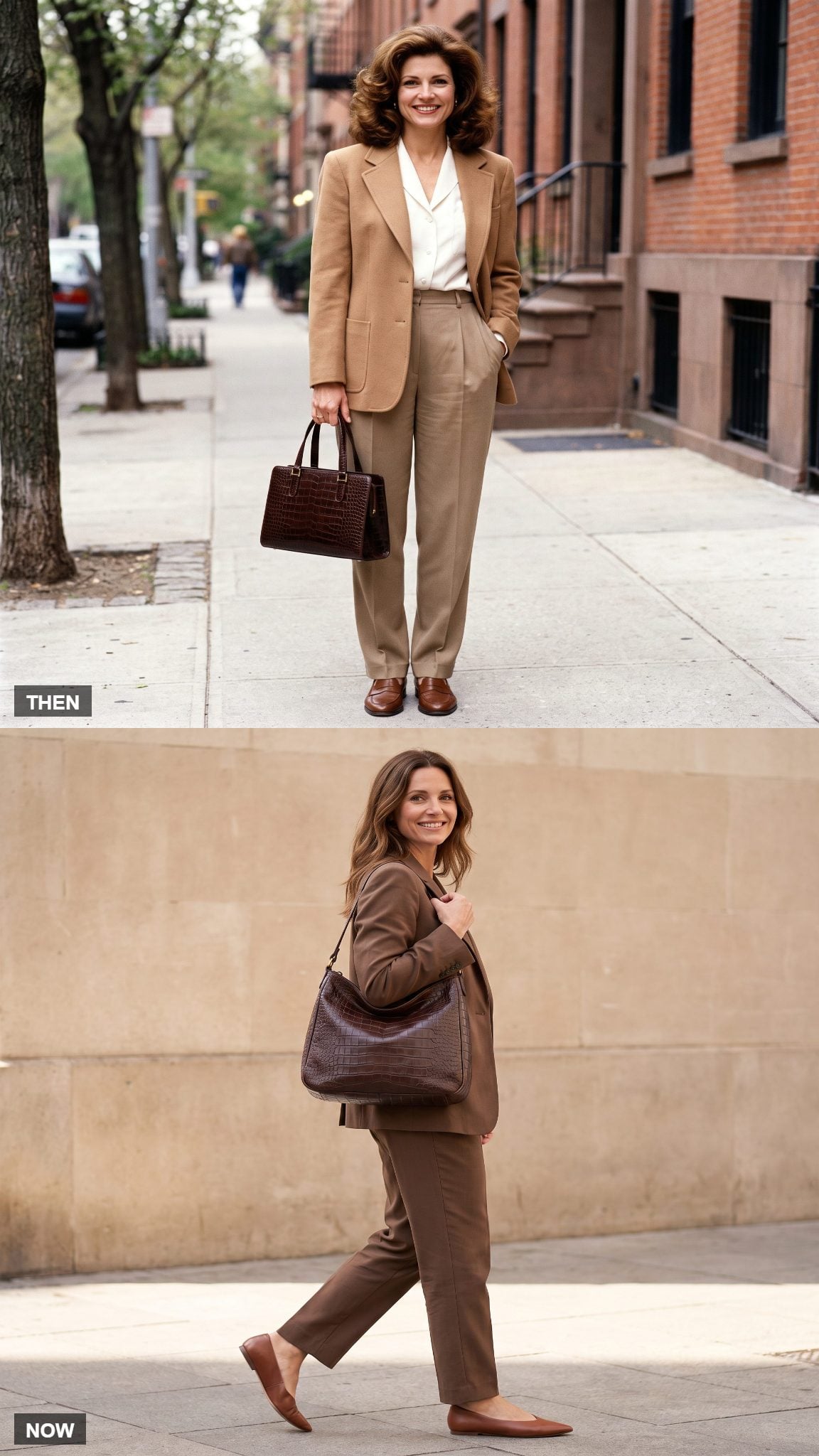
Croc embossing exaggerates every plane on the structured version. The regular reptile pattern crosses a firm rectangular body, so texture and geometry reinforce one another.
On the softer shoulder bag, the same type of embossed surface behaves differently. Scales bend around folds, highlights break across curved sections, and the bottom no longer presents one hard horizontal line. Texture becomes more prominent precisely because the surface beneath it moves.
21. Nylon Goes From Neat Little Rectangle to Padded and Relaxed
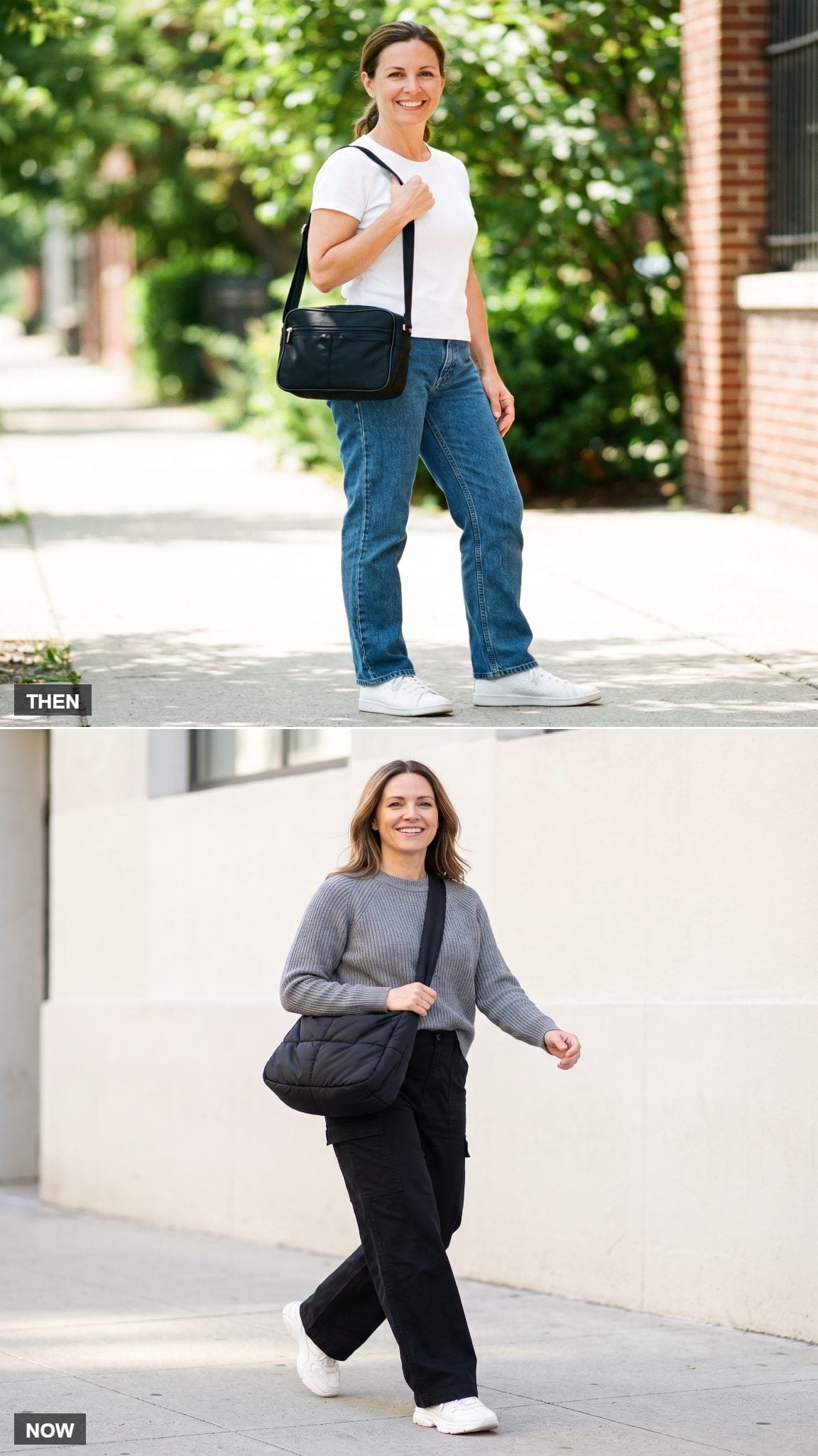
The older nylon bag treats a practical material almost like leather: reinforced piping defines the rectangle, zip pockets divide the front, and the edges stay visibly controlled.
The newer version lets nylon advertise its lightness instead. Soft padding rounds the surface, the sides fold naturally, and the whole bag looks less engineered. With utility trousers and sneakers, the shape moves toward the sportier end of the wardrobe without needing extra pockets or visible hardware to announce practicality.
More athleisure outfit ideas use the same contrast between soft technical fabrics and stronger garment silhouettes.
20. The Compact Underarm Bag Stretches East-West
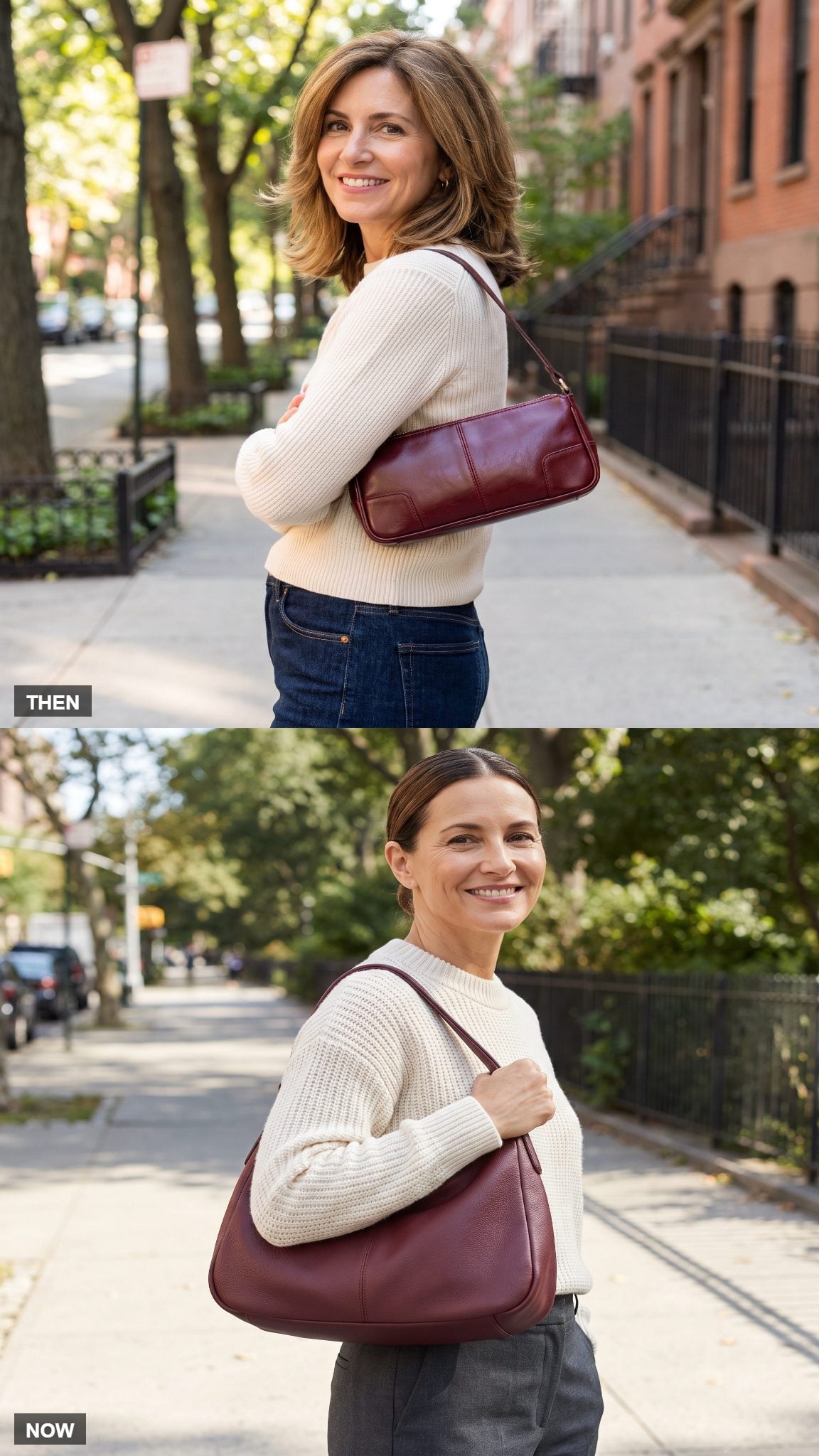
The burgundy underarm bag begins as a tight little package: narrow body, squared ends, short strap, straight zipper. Its proportions concentrate everything close to the ribs.
The newer east-west bag pulls that idea horizontally. The body becomes longer than it is tall, the ends soften, and a slight dip develops through the center. The result changes more than structure; it changes the bag’s entire line across the outfit.
19. The Boxy Office Satchel Becomes a Soft Oversized Work Bag
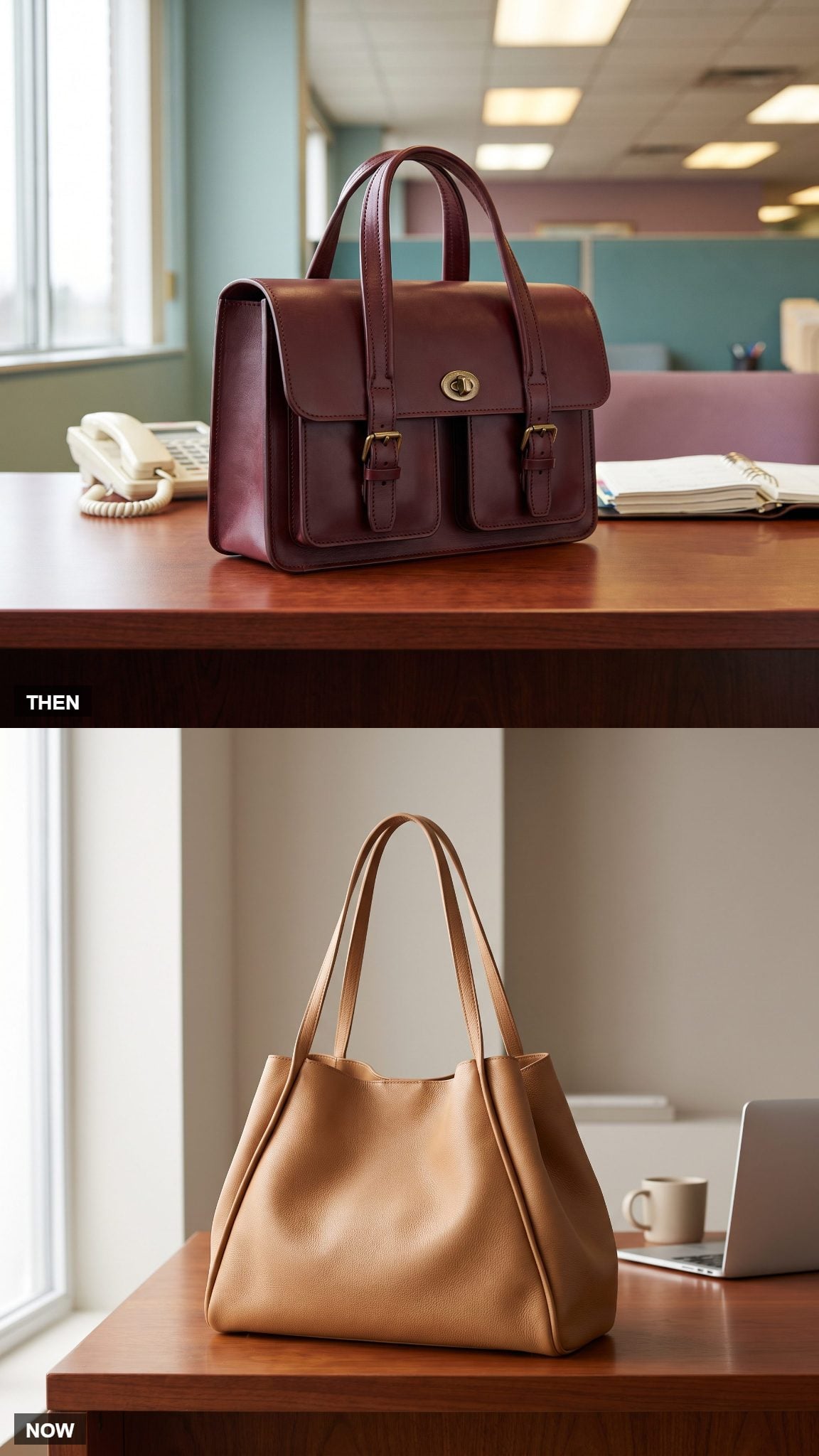
The older work satchel borrows heavily from briefcase construction: straight walls, a defined flap, organized compartments, and a body that keeps its dimensions whether full or not.
The contemporary work bag trades that compartmentalized exterior for volume. Long handles clear a coat sleeve, flexible sides bend inward, and the rounded base allows the bag to change shape with its contents. It still reads as a substantial work bag; the structure simply comes from scale rather than stiffness.
18. The Metal Frame Stays at the Closure While the Rest of the Bag Goes Soft
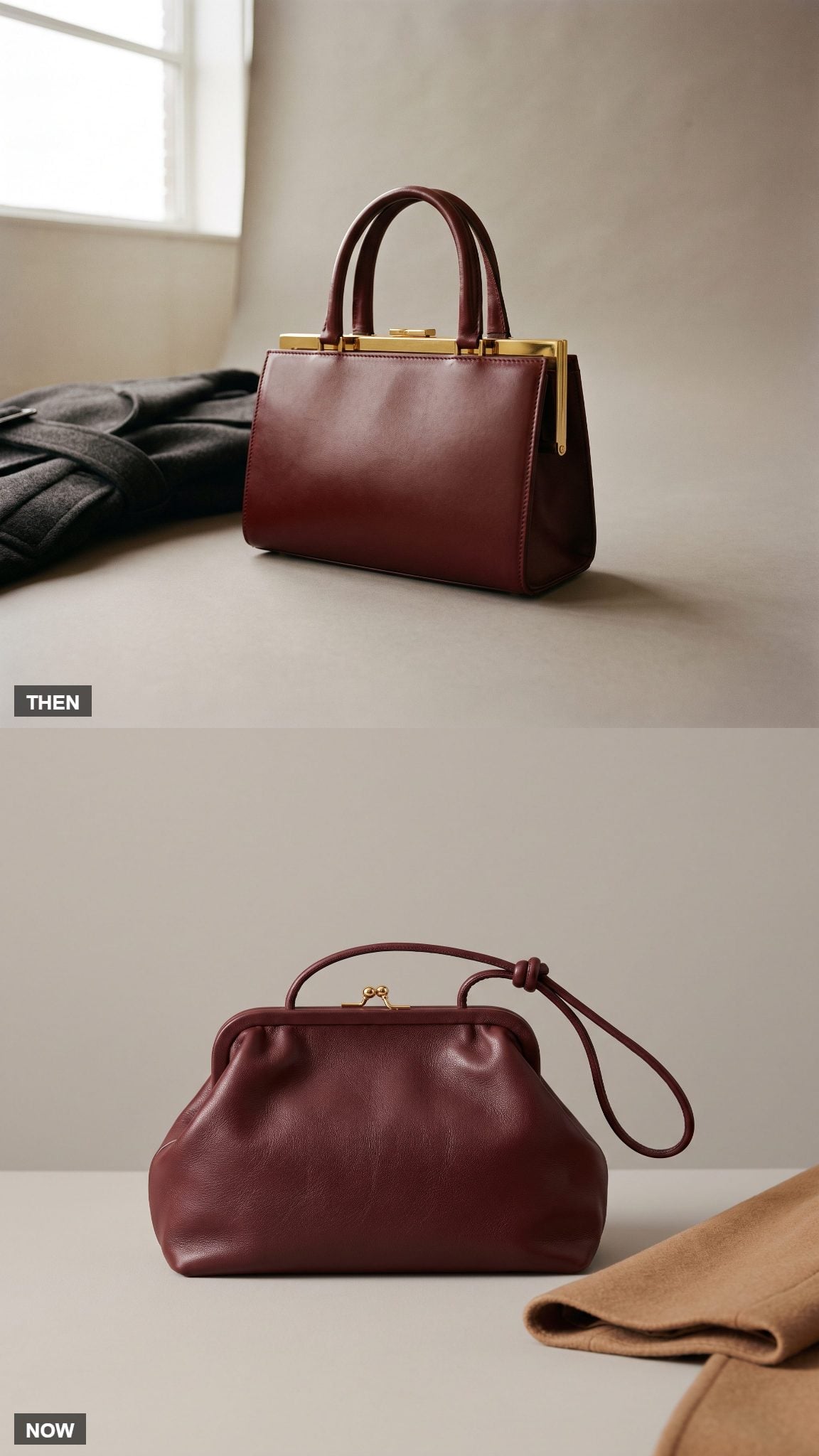
The older frame bag uses its metal mouth as a skeleton. The opening snaps shut, the sides remain firm below it, and the whole oxblood body holds a polished, almost architectural profile.
The softer clasp-top preserves the satisfying framed closure while letting the leather beneath it gather and swell. A rounded bottom replaces the rigid base, producing something closer to a pouch suspended from a piece of hardware than a box built beneath it.
17. The Boxy Little Purse Curves Into a Crescent
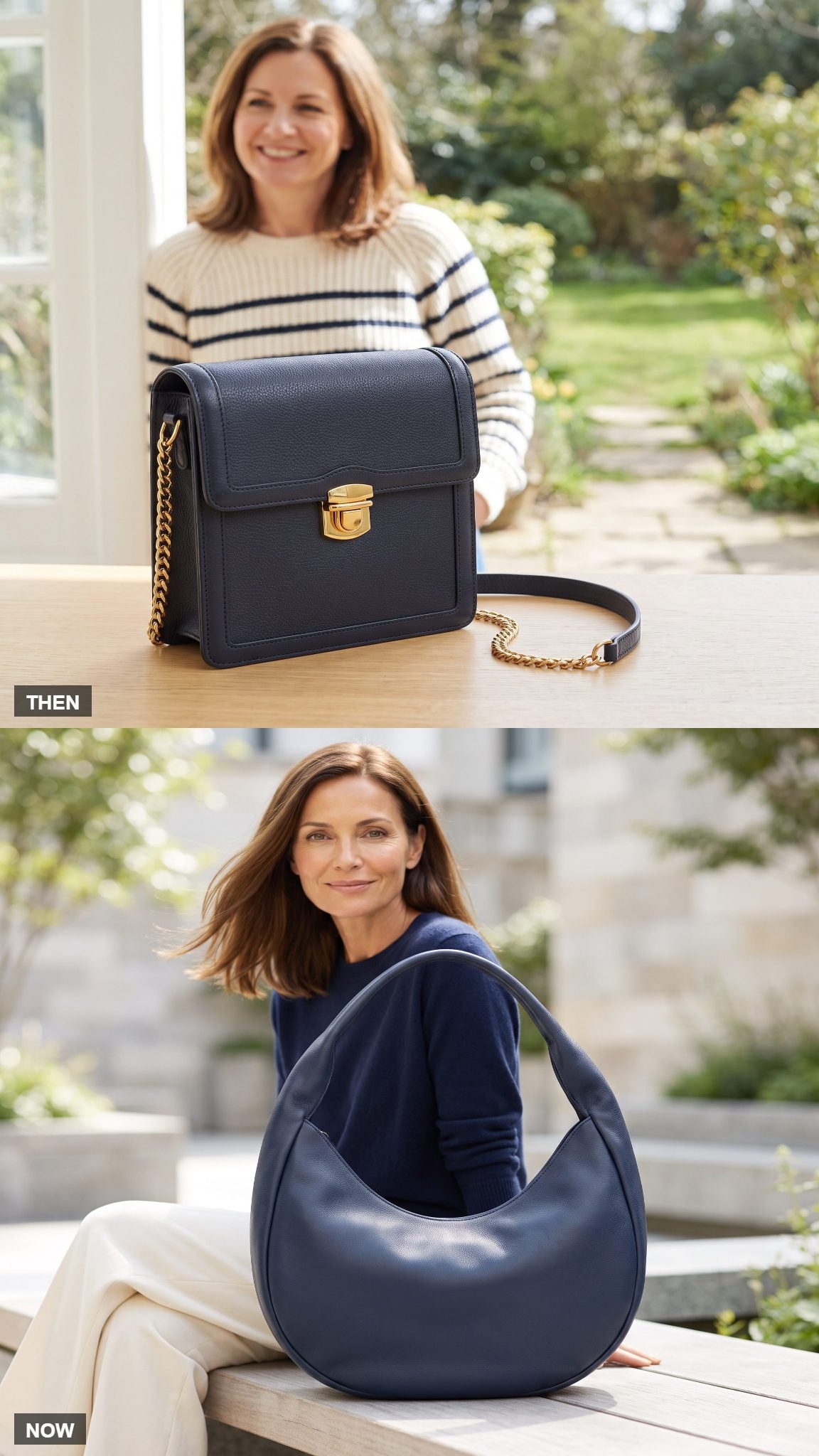
Small, navy, and almost jewelry-box neat, the earlier purse depends on four visible corners and a level base. Its compact size makes that geometry feel even more pronounced.
The crescent version replaces the rectangle with one continuous sweep. Supple navy leather curves beneath the arm, the bottom rounds upward at both ends, and the hardware almost disappears. Keeping the color constant makes the transformation unusually easy to see: the entire difference is in the line.
16. The Structured Work Tote Gets Bigger as Its Walls Get Softer
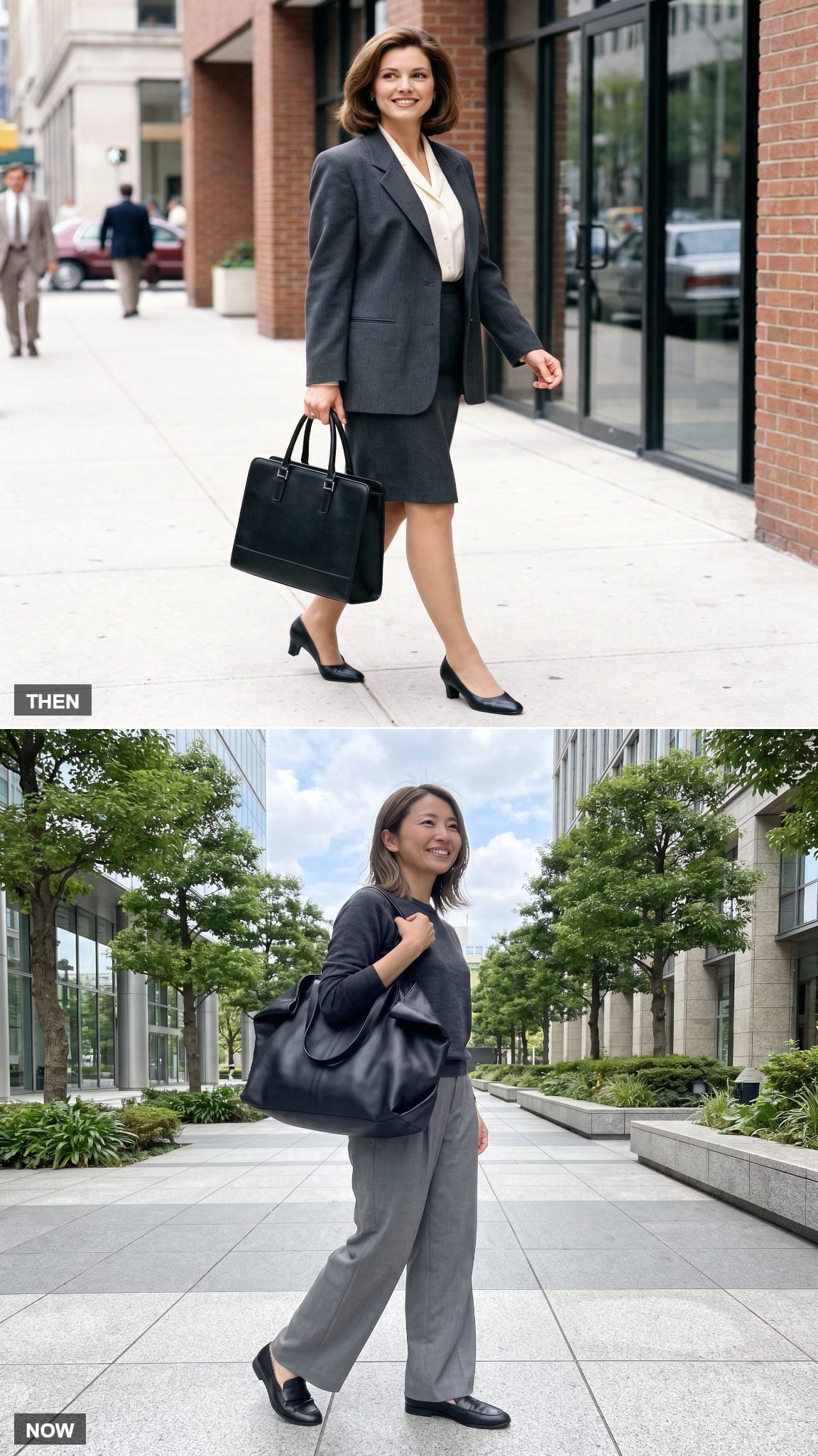
The earlier work tote depends on vertical walls, a reinforced base, and firm double handles. Its capacity is easy to read because the bag presents roughly the same outline empty or full.
The current version increases the volume while reducing the scaffolding. Upper edges bend inward, broad handles soften at the hand, and leather folds around whatever is actually being carried. Relaxed tailoring around it repeats the same idea: generous proportion without a hard perimeter.
15. One Big Buckle Gives Way to a Fold of Leather
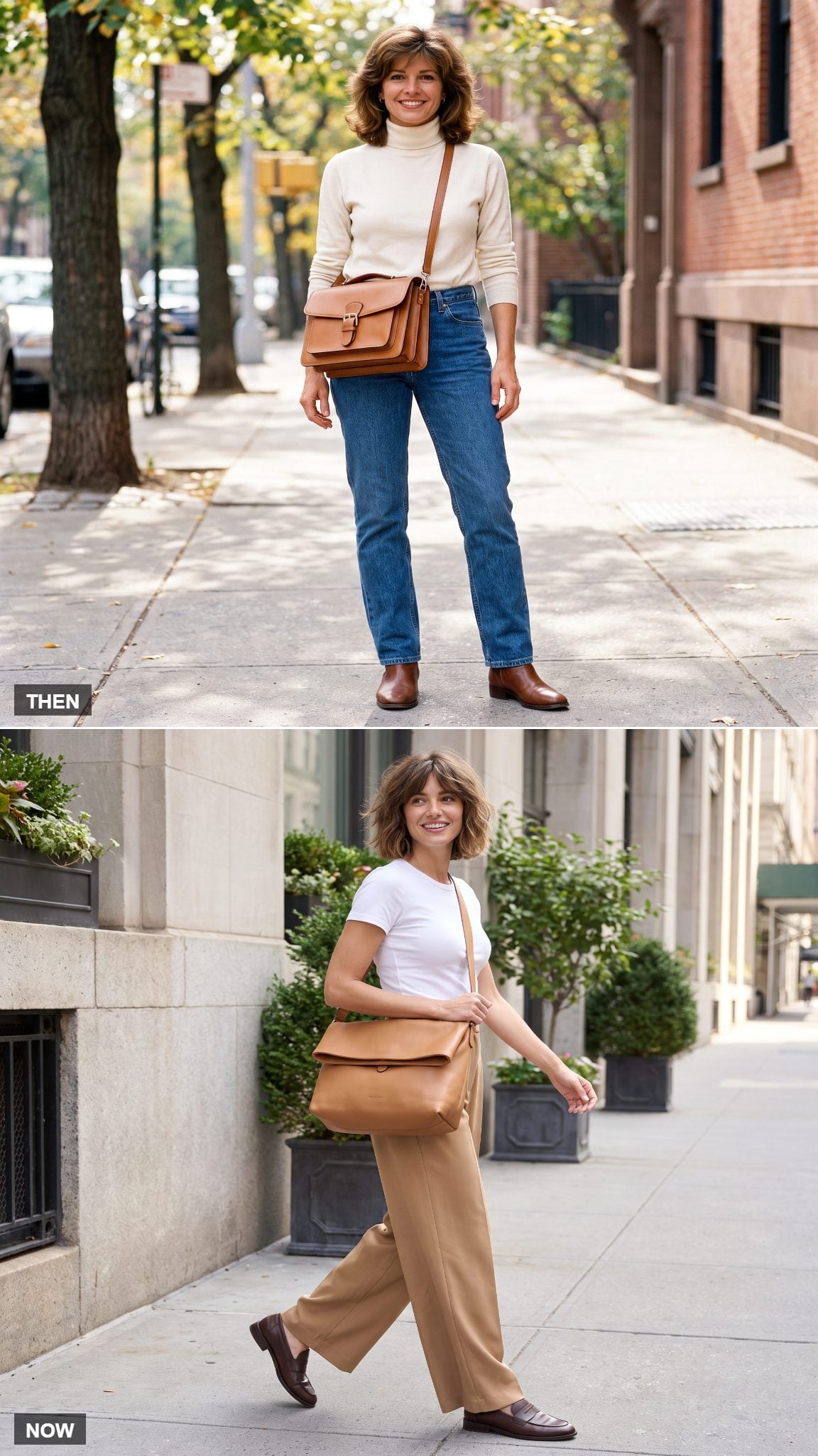
The older tan bag makes its closure part of the architecture. A large buckle sits over a firm flap, side gussets remain sharply defined, and the flat base keeps the entire bag upright.
The newer fold-over bag achieves closure with far less visible machinery. Supple leather bends across the front, the fastening disappears beneath it, and the bottom gives rather than holding a straight line. The change is as much about hardware as softness: one conspicuous metal focal point has vanished.
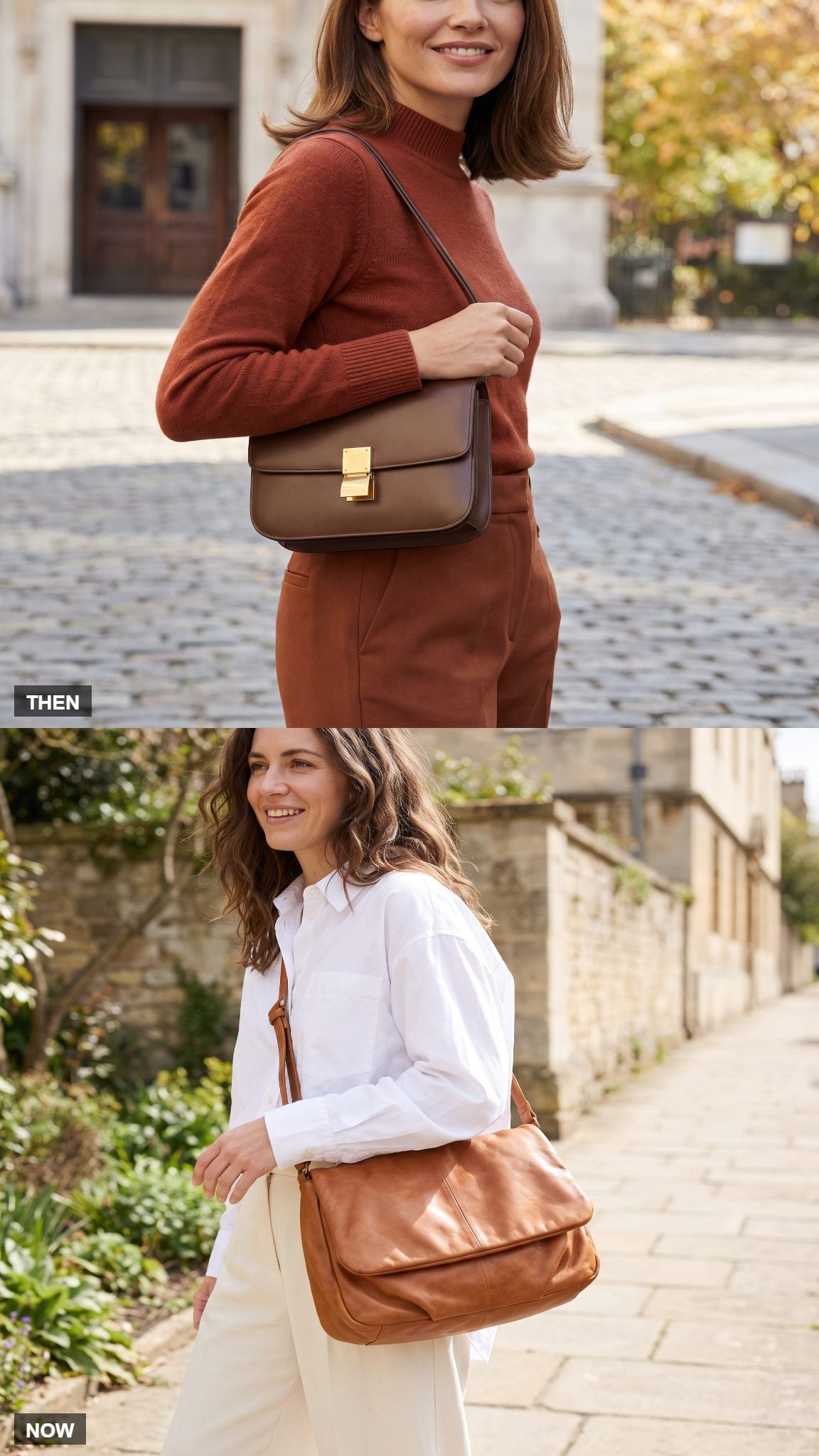
14. The Structured Flap Bag Keeps the Flap and Loses the Geometry
❤️ Would you like to save this?
A straight-edged flap, squared base, and compact clasp make the older chocolate shoulder bag read almost as a stack of rectangles.
The successor changes the construction without abandoning the recognizable flap-bag family. Leather rounds around the sides, the flap bends rather than remaining perfectly flat, and the base follows the curve instead of interrupting it. An oversized shirt and fluid trousers make that softer outline particularly visible.
The shift also shows why a bag doesn’t have to match the shoes to feel connected to an outfit; proportion and material can create the relationship instead.
13. The Slim Minimalist Bag Gets Longer Without Getting Busier
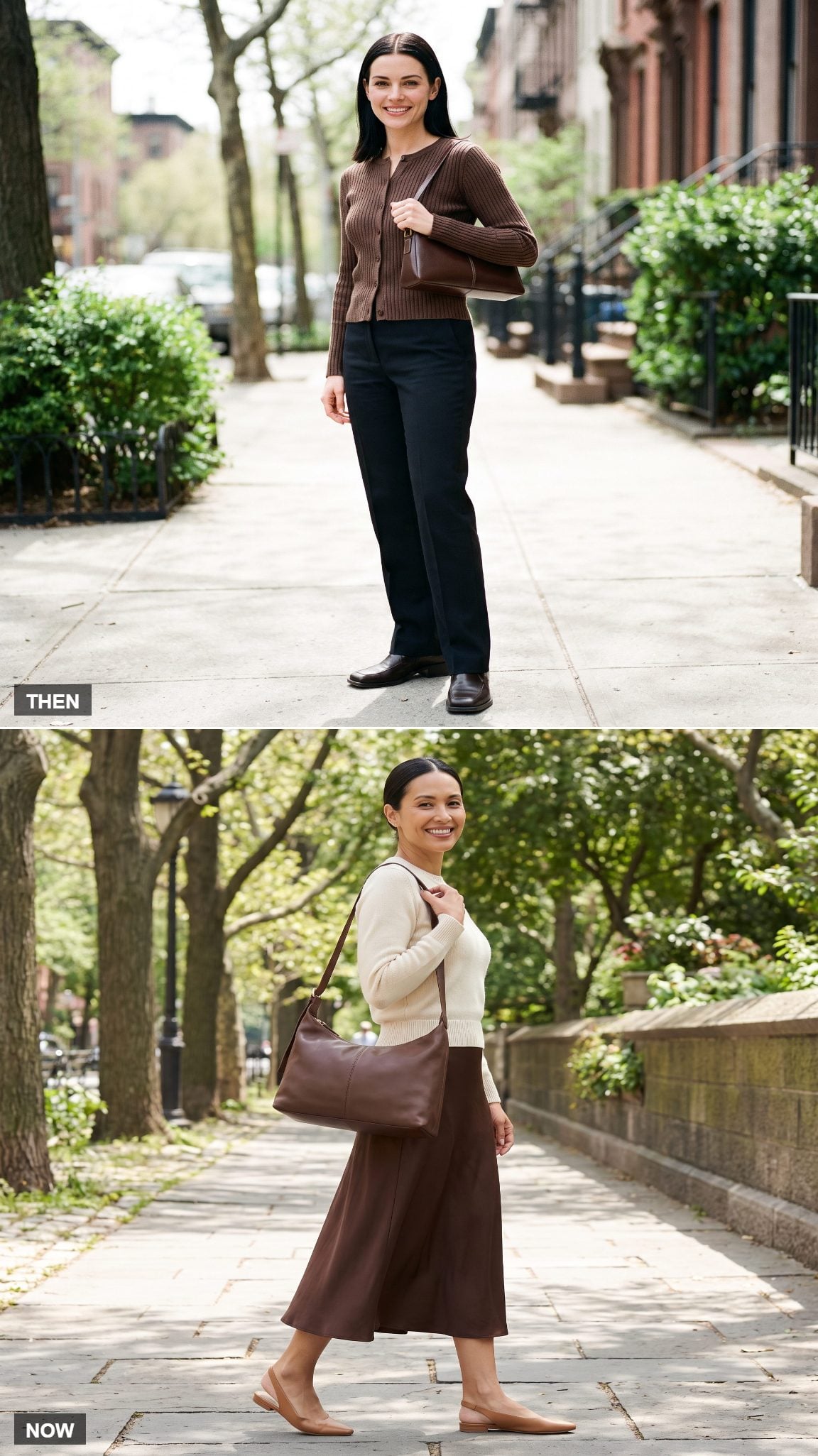
One late-’90s minimalist approach produced bags that were narrow, compact, and taut: small surfaces, clean seams, little hardware, almost no excess volume.
The newer version remains visually spare but becomes more generous in proportion. The body stretches outward, the ends soften, and the center develops a shallow sag. Minimalism stays; rigidity does not.
12. The Structured Saddle Bag Keeps the Curve and Relaxes Everything Around It
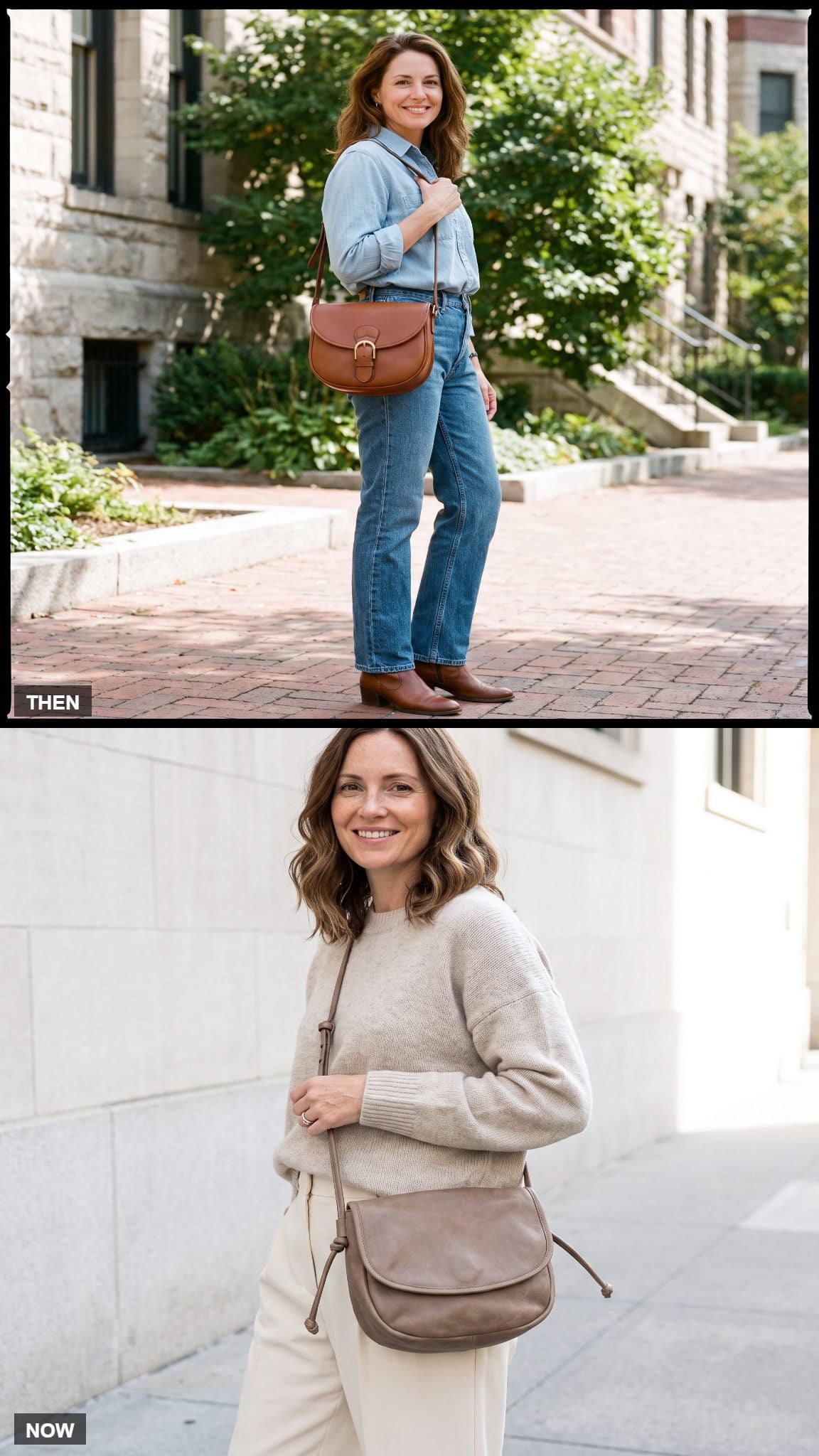
The earlier saddle bag turns its equestrian reference into precise construction: a firm semicircular body, crisp piping, defined flap, and visible brass hardware.
The newer version keeps that recognizable downward curve but lets it become asymmetric and fluid. The leather moves more freely, the flap bends, and the closure recedes. What survives is the saddle outline; what disappears is the insistence that every edge remain fixed.
11. The Rectangular Leather Shopper Loses Its Backbone
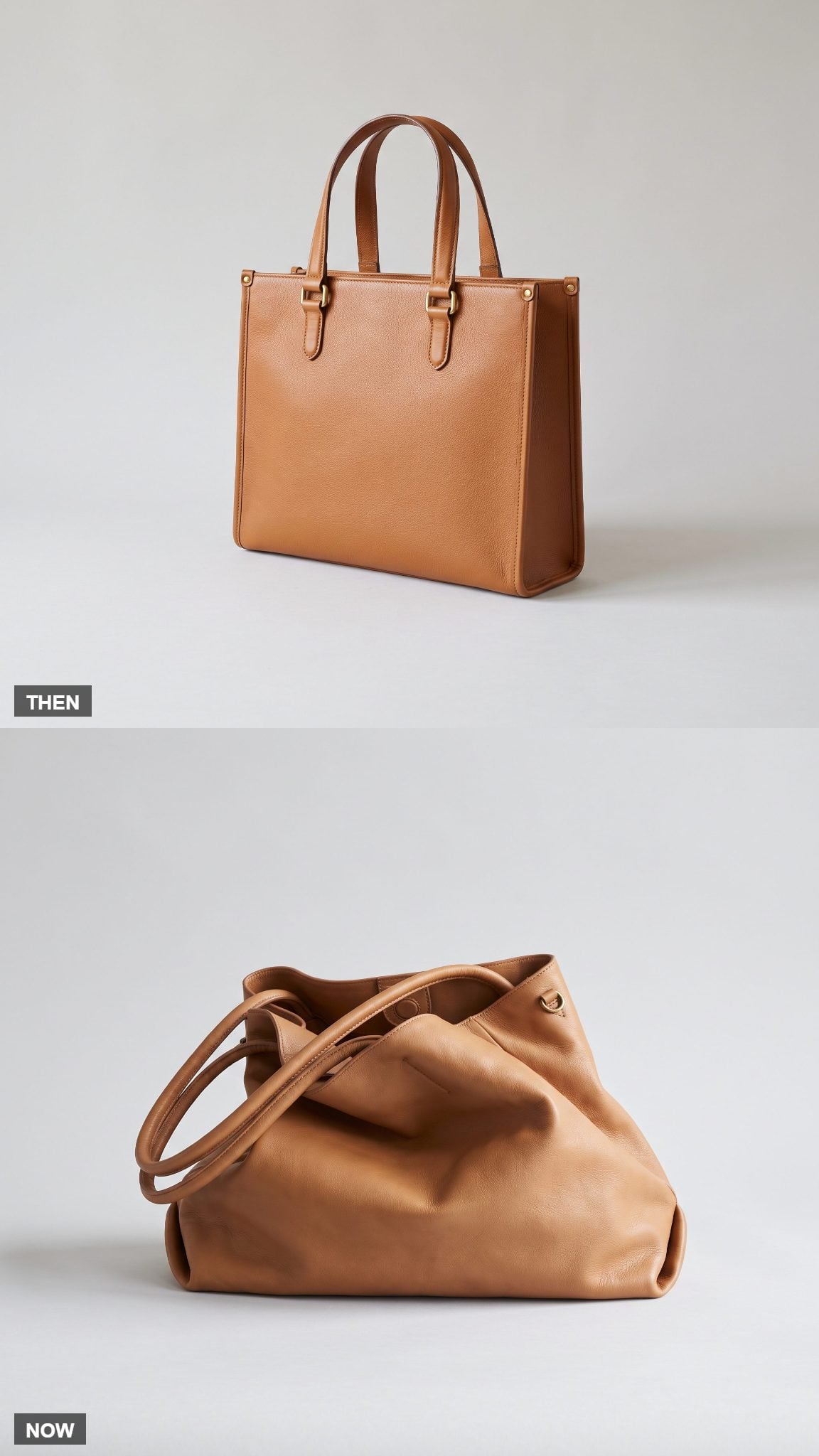
The tan shopper begins with the most basic tote geometry possible: two long handles, two straight sides, four obvious corners, and a base sturdy enough to keep the bag upright.
The newer shopper deliberately lets those reference points move. The mouth falls open, corners buckle, side panels lean inward, and the leather changes shape from one moment to the next. With an oversized shirt and fluid trousers, the bag becomes another loose plane instead of a rigid block.
10. Hard Side Gussets Turn Into Soft Pleats
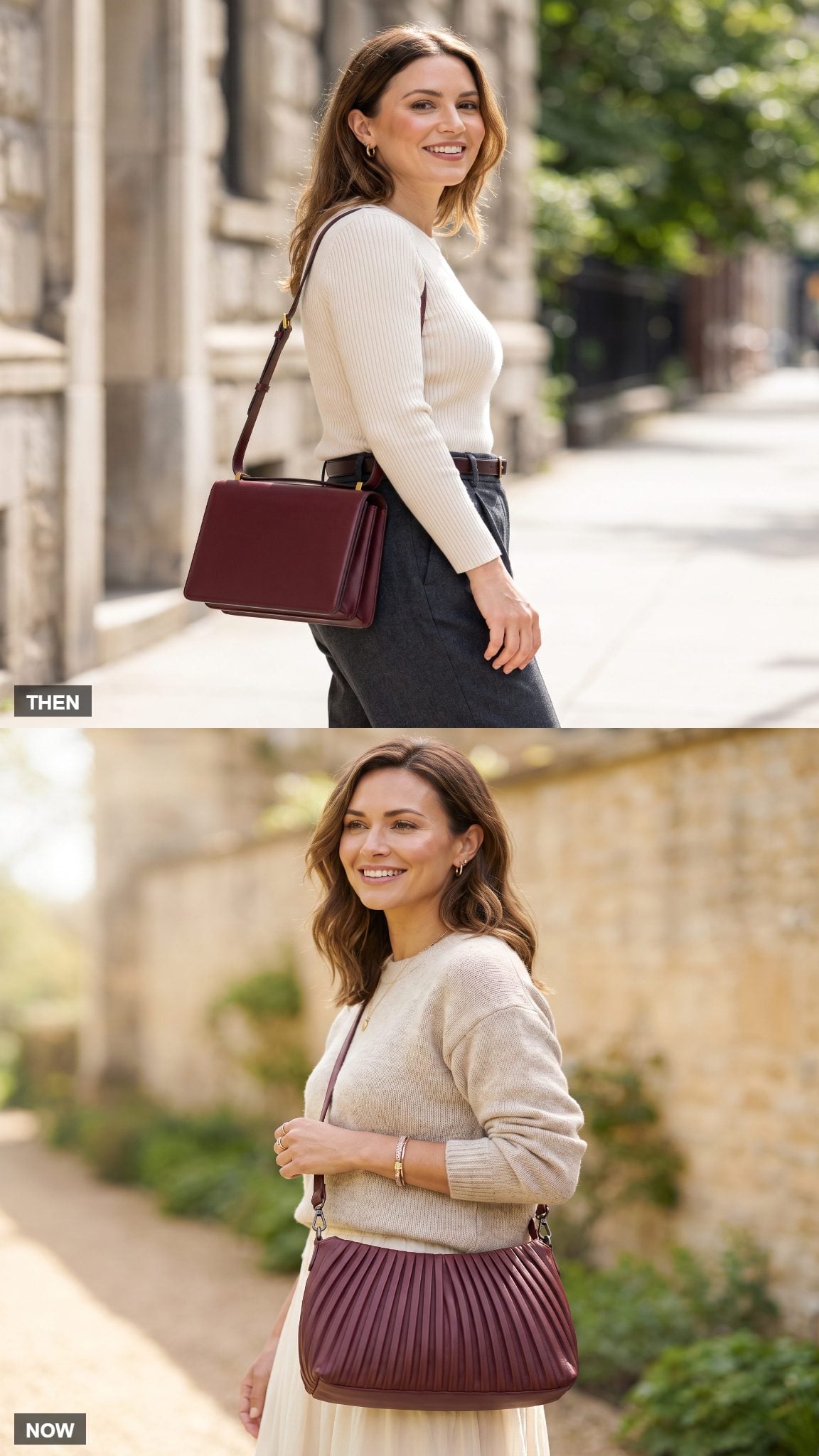
The older burgundy shoulder bag creates capacity with crisp side gussets. They expand outward like an accordion while allowing the front and back panels to retain their rectangular shape.
The newer bag finds volume another way. Leather gathers into pleats, creating vertical folds that expand and contract without preserving a hard side wall. Burgundy stays constant; the engineering changes completely.
9. The Structured Quilted Flap Goes Pillowy
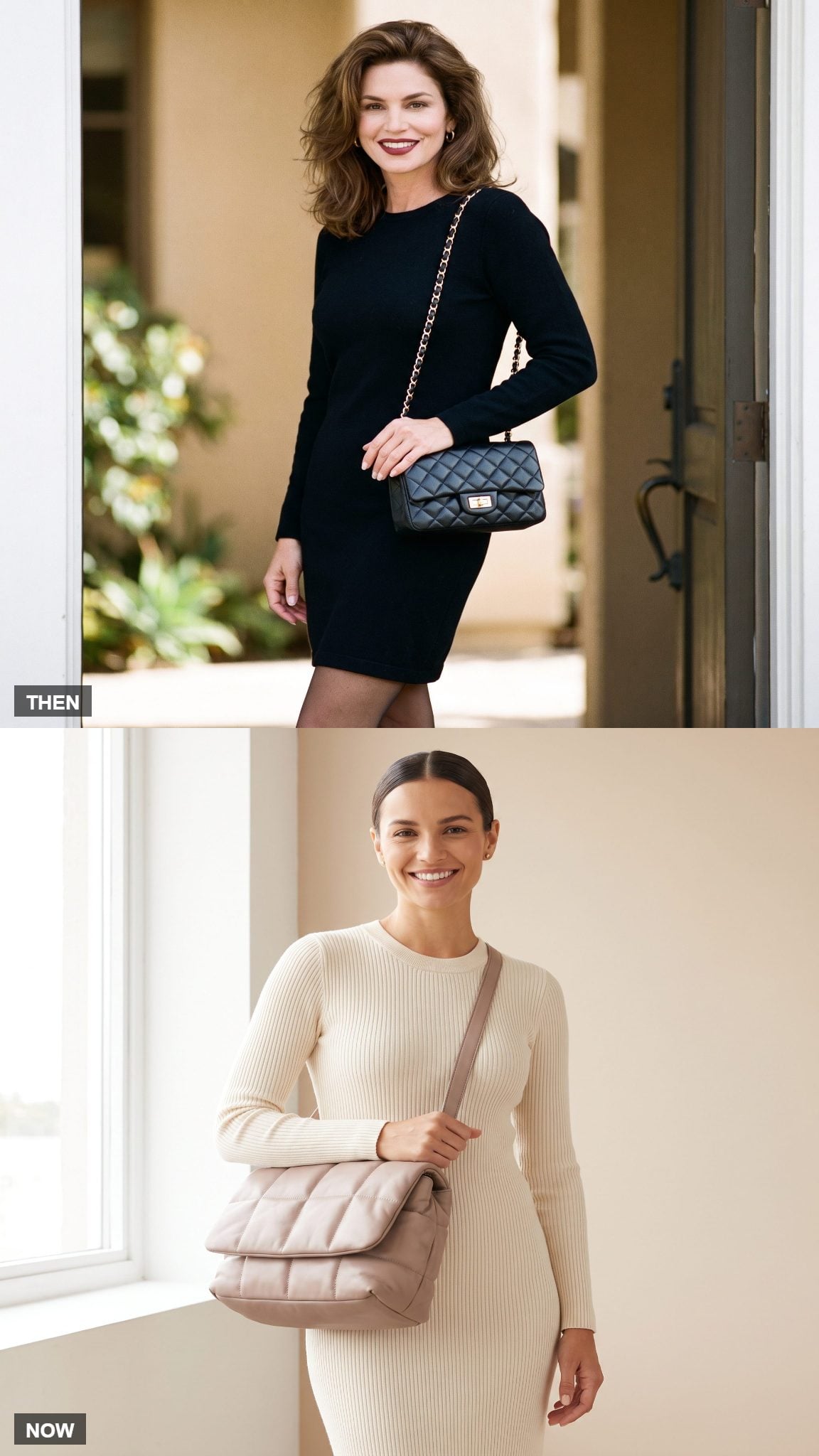
Quilting on the older black flap bag emphasizes precision. Tight diamonds sit inside a compact rectangle with sharp edges, so padding reads almost as surface decoration rather than volume.
The newer version exaggerates the padding itself. Quilted sections swell outward, corners round off, and the bag yields against the hip. Same basic technique, but the stuffing is now allowed to change the silhouette rather than merely decorate it.
8. Compact Suede Shoulder Bag → Slouchy Suede Hobo
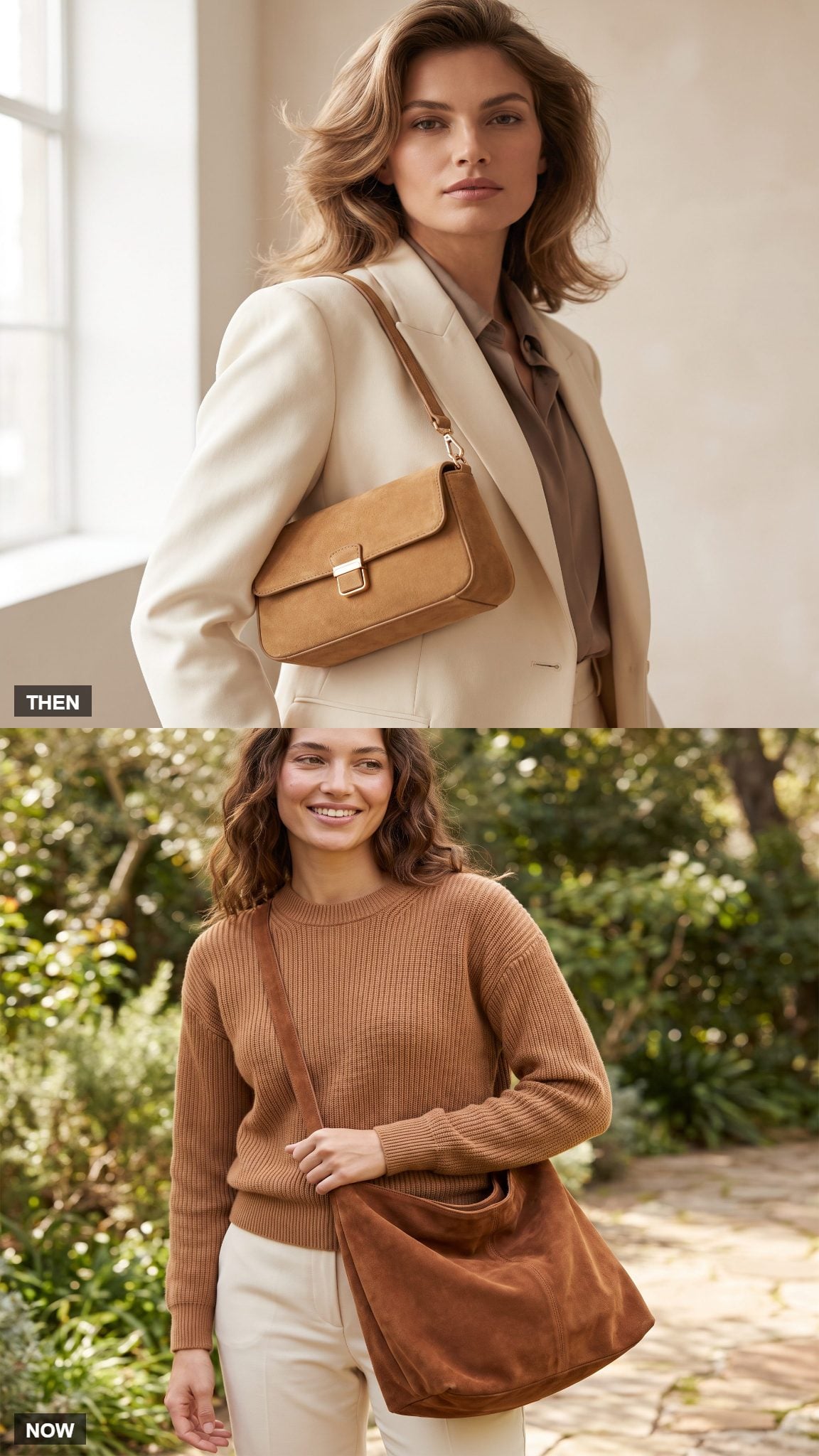
The earlier suede shoulder bag keeps a notoriously soft-looking material under strict control. Defined seams, a flat base, compact rectangle, and short strap hold the warm tan suede high against the body.
The hobo lets the material behave almost in the opposite way. Chestnut suede drops toward the hip, the body widens dramatically, and broad folds collect through the lower half. The nap catches daylight differently on every bend, making softness visible before the bag is even touched.
7. The Double-Handle Satchel Turns Into a Carryall
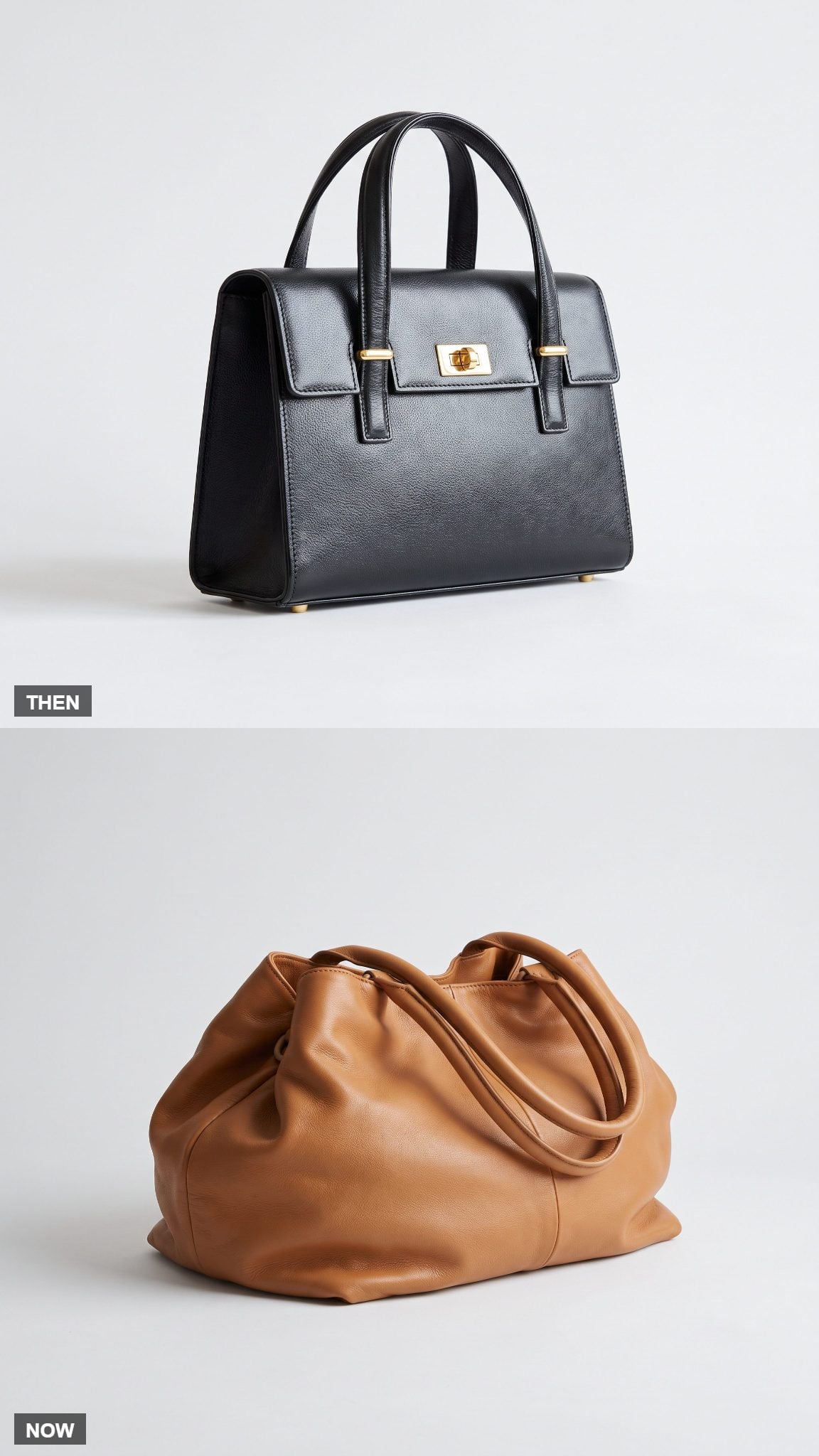
The older satchel uses two rolled handles, vertical sides, and a reinforced floor to create something close to miniature luggage. The handles stand up even when nobody is holding them.
The softer carryall keeps the double-handle format but allows almost every part to bend. Leather folds around the contents, the handles fall to one side, and extra width becomes drape instead of another firm panel. It is a useful distinction from the top-handle satchel: this transformation is about increased volume as much as softened construction.
6. The Short-Strap Underarm Bag Finally Gives at the Sides
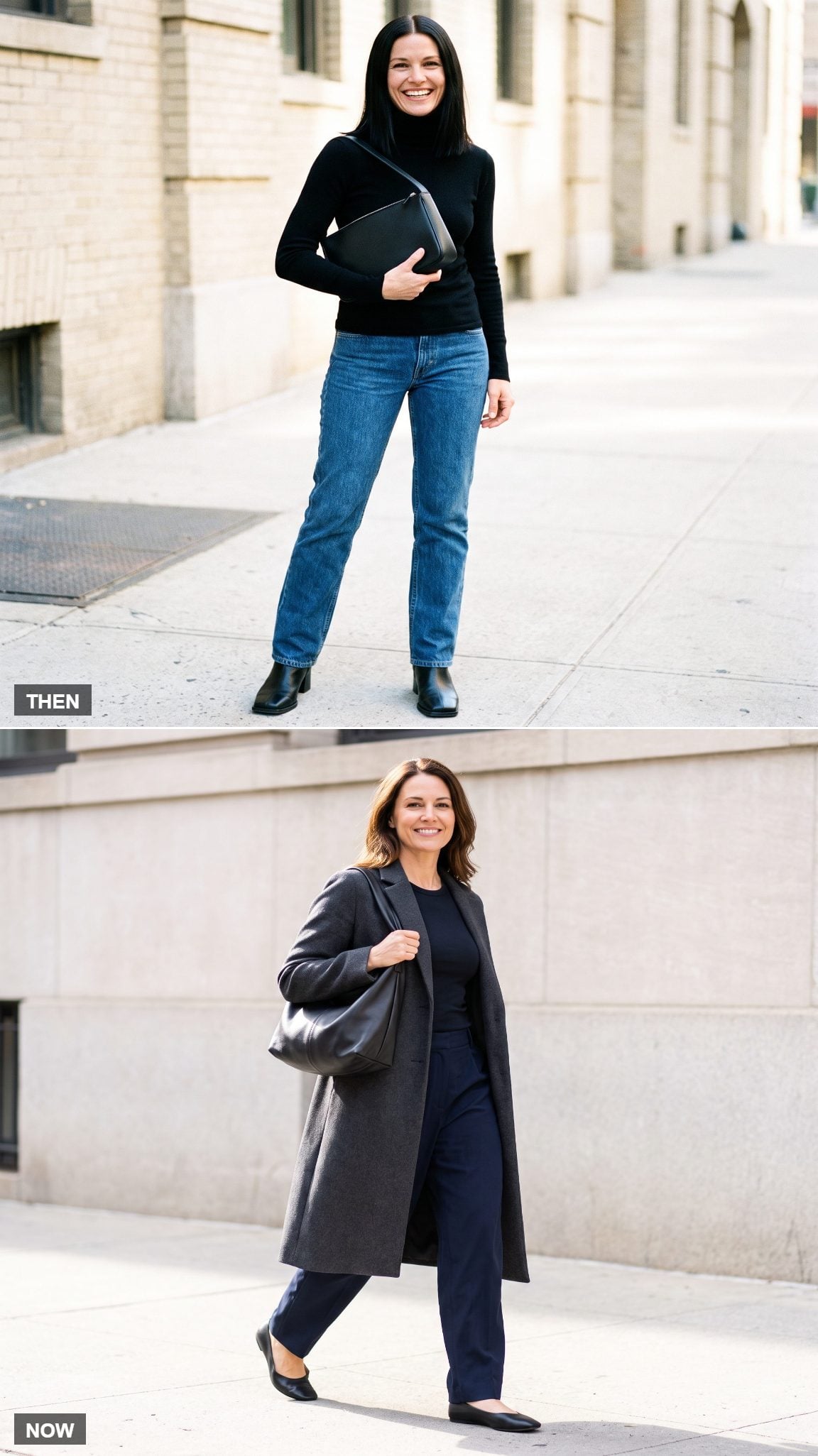
The late-’90s version stays tucked tightly under the arm with squared ends, a straight zipper, and a short strap that fixes the bag high against the ribs.
The modern version keeps that close underarm position but lets the body itself relax. Curved sides crease into the wearer, the strap bends more freely, and the bottom no longer needs to stay level. Unlike the east-west bag earlier in the gallery, the major change here is construction rather than dramatic horizontal elongation.
5. Pebbled Leather Goes From Workhorse Rectangle to Deep Hobo
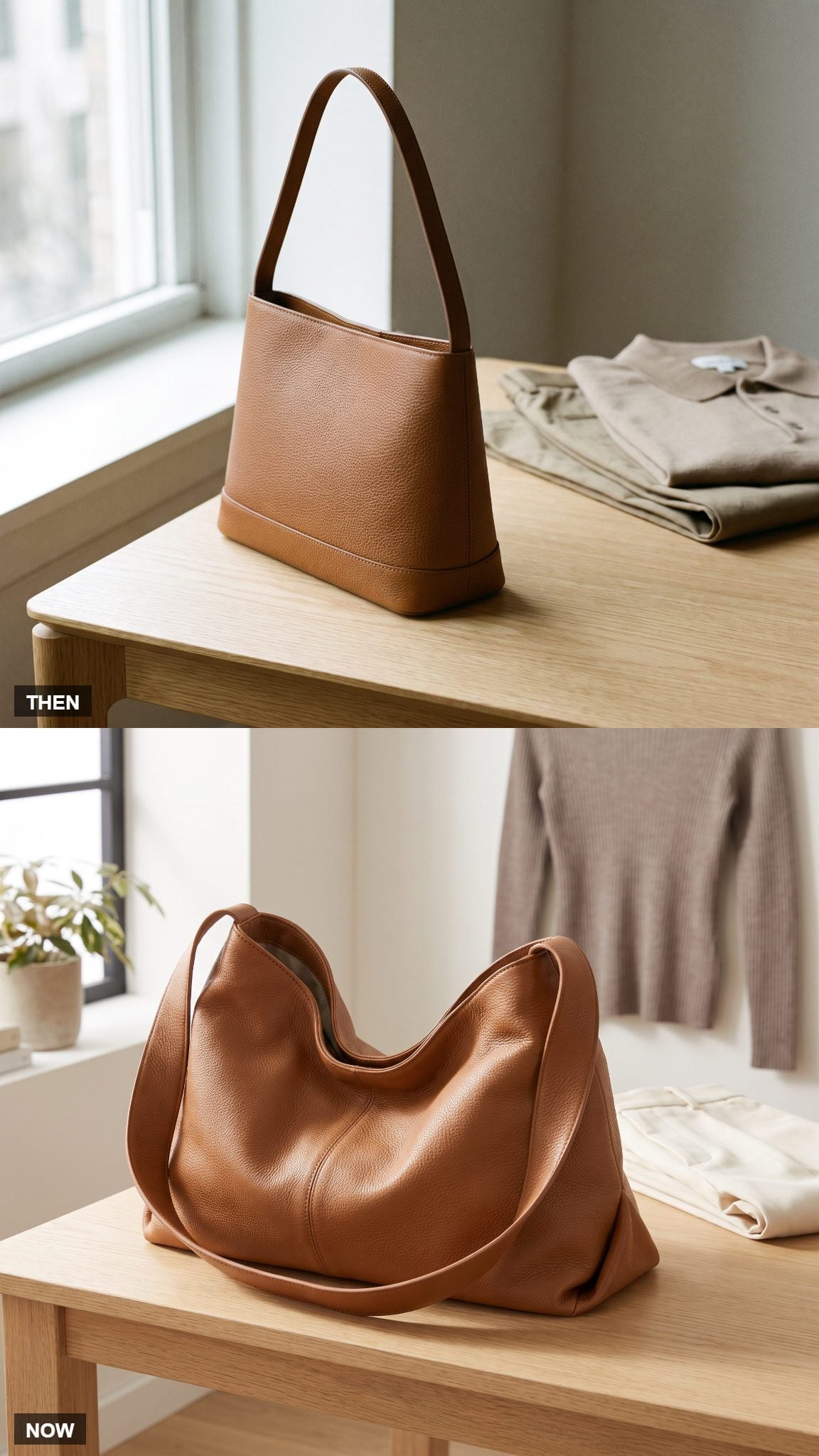
The earlier caramel bag combines pebbled grain with workmanlike structure: straight zip, flat base, firm seams, compact shoulder-bag proportions.
The hobo version expands that same textured leather into a deep curve. The sides collapse toward the center, the broad strap carries the bag lower, and the bottom hangs rather than standing. Pebbling remains practical because it breaks up small marks visually; the silhouette no longer needs to look practical in the same way.
4. The Boxy Top-Handle Satchel Goes Sculptural
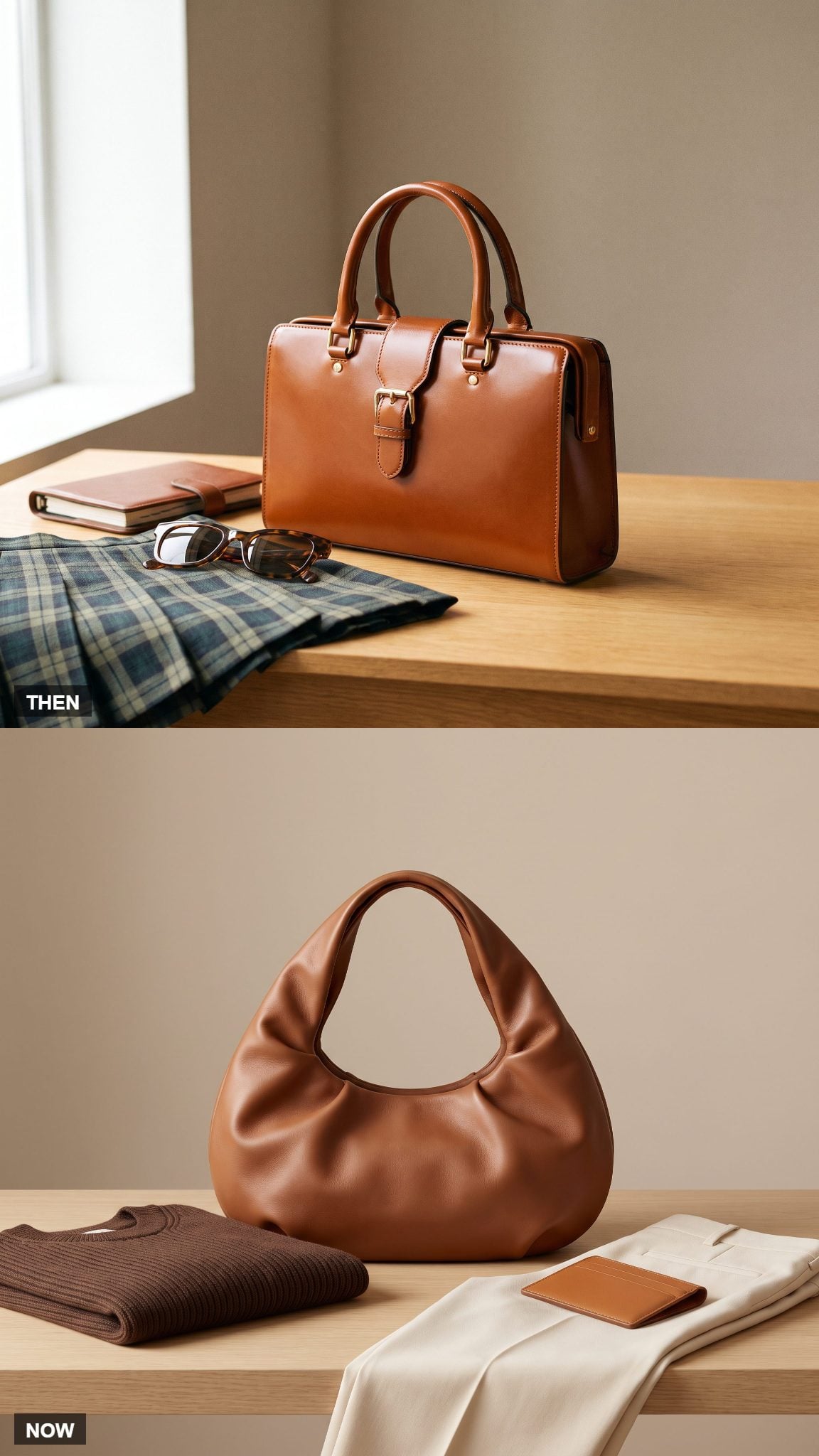
The cognac satchel begins like a compact piece of luggage: squared shoulders, rolled handles, defined side walls, and a base that establishes a clear footprint.
Its successor keeps the same warm leather family but replaces the rectangular body with something almost molded. Sides bow outward, the bottom curves, and the handles flex over the top. Chocolate and cream around it keep the palette quiet enough for that sculptural change to remain the focal point.
3. A Turn-Lock Flap Gives Up the Little Green Mailbox Shape
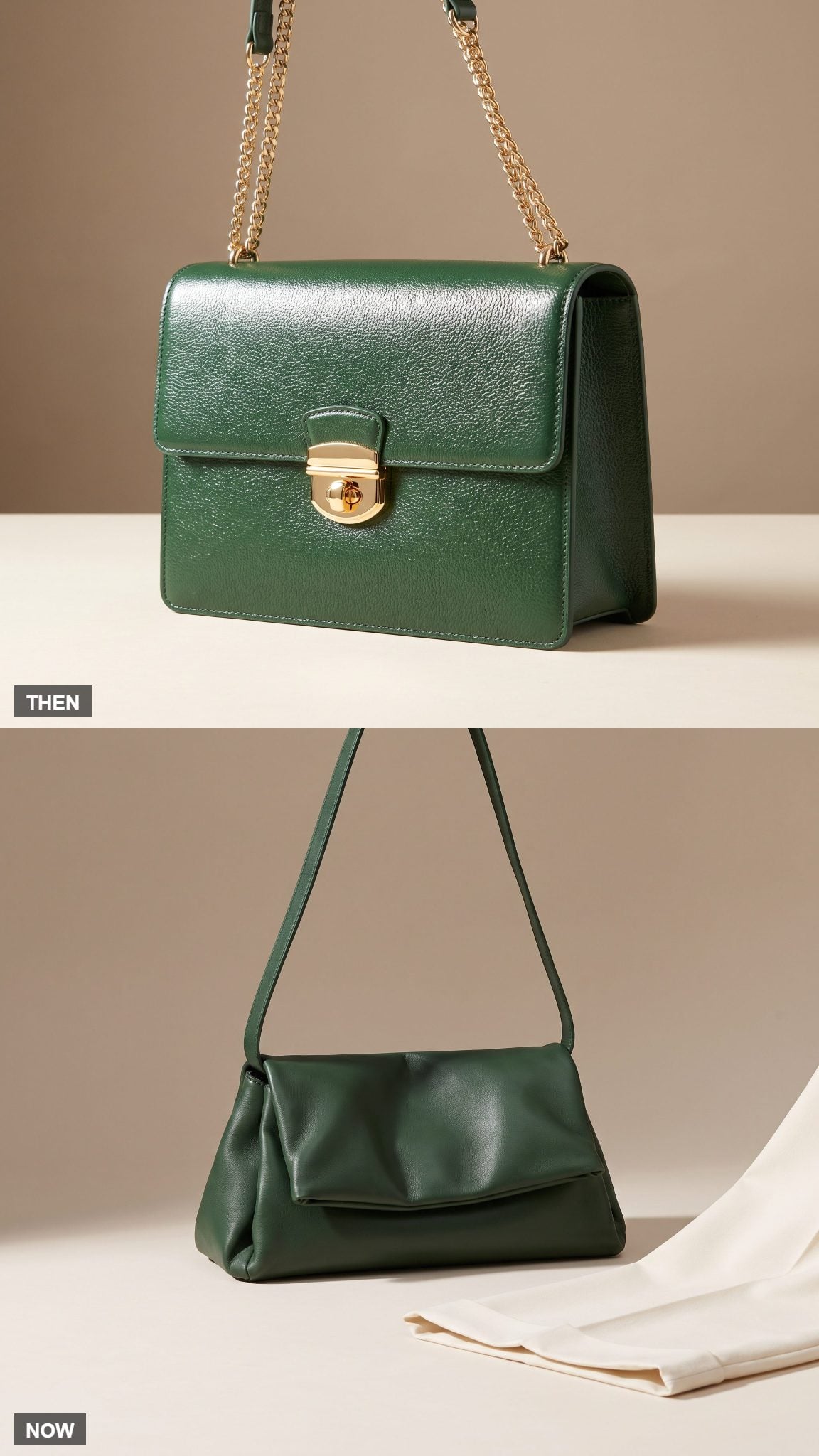
The older forest-green bag makes a gold turn-lock the center of a rigid little rectangle. Straight flap, squared body, obvious closure: every component reinforces the others.
The newer version holds onto the deep green but lets the hardware fade away. Leather folds over a softer body, the corners round, and the closure nearly disappears. Against ivory trousers, the saturated color becomes more noticeable precisely because the construction has become quieter.
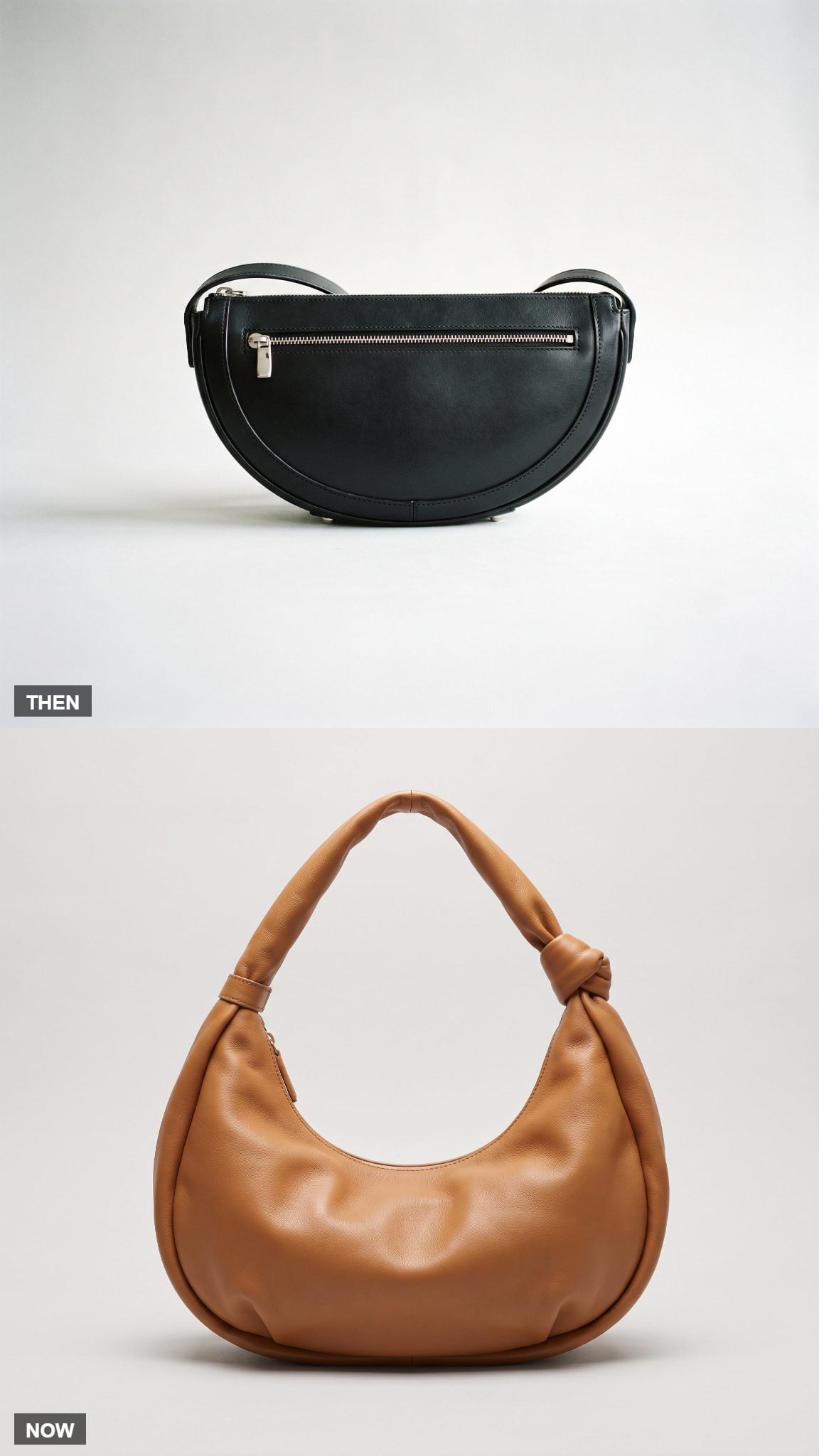
2. The Firm Half-Moon Melts Into a Supple Crescent
❤️ Would you like to save this?
The late-’90s half-moon already has a curve, but it treats that curve like geometry. Reinforced seams hold a precise arc beneath a straight zipper, producing a bag that remains almost diagrammatically semicircular.
The contemporary crescent exaggerates the same idea until the geometry starts moving. Leather molds into the side, the arc deepens, and the hardware recedes. This is not rectangle-to-curve like several earlier transformations. The curve was always there; softness simply releases it.
1. The Quilted Evening Bag Stops Waiting for an Occasion
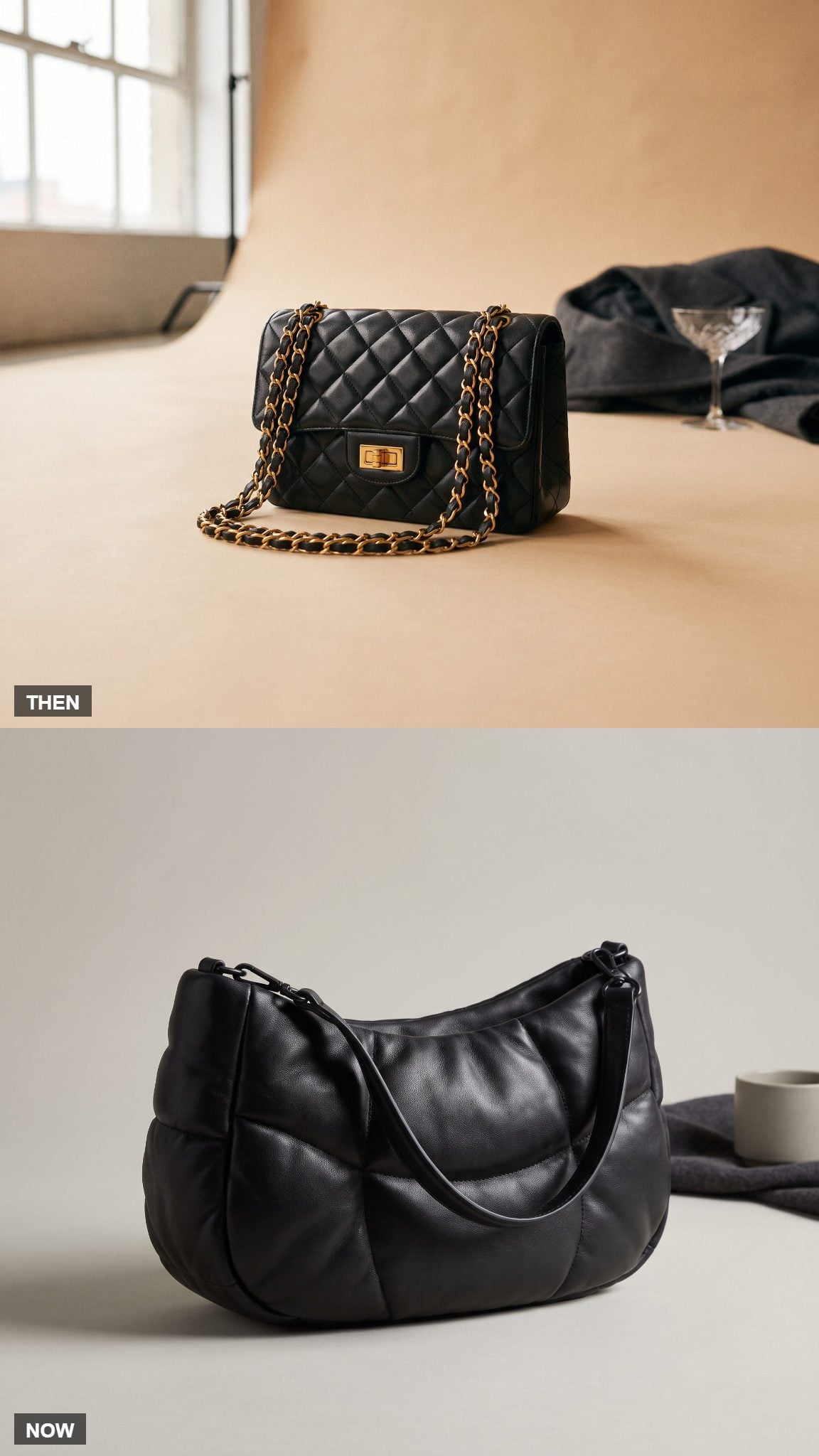
The earlier quilted flap is compact, crisp, and visibly formal: tight diamond stitching, straight edges, chain strap, and a silhouette that keeps its shape through the evening.
The newer shoulder bag turns quilting into volume. Padding becomes fuller, corners lose their points, and the body settles rather than standing away from the wearer. With a black quilted shoulder bag and a charcoal midi dress, the same decorative language no longer needs a formal setting.
That may be the clearest thread running through all 26 transformations. The old shapes often made their construction visible first: frame, base, buckle, gusset, piping, clasp. The softer versions let leather, suede, nylon, quilting, and proportion take over. Structure still exists — it simply stopped needing to look like scaffolding.