
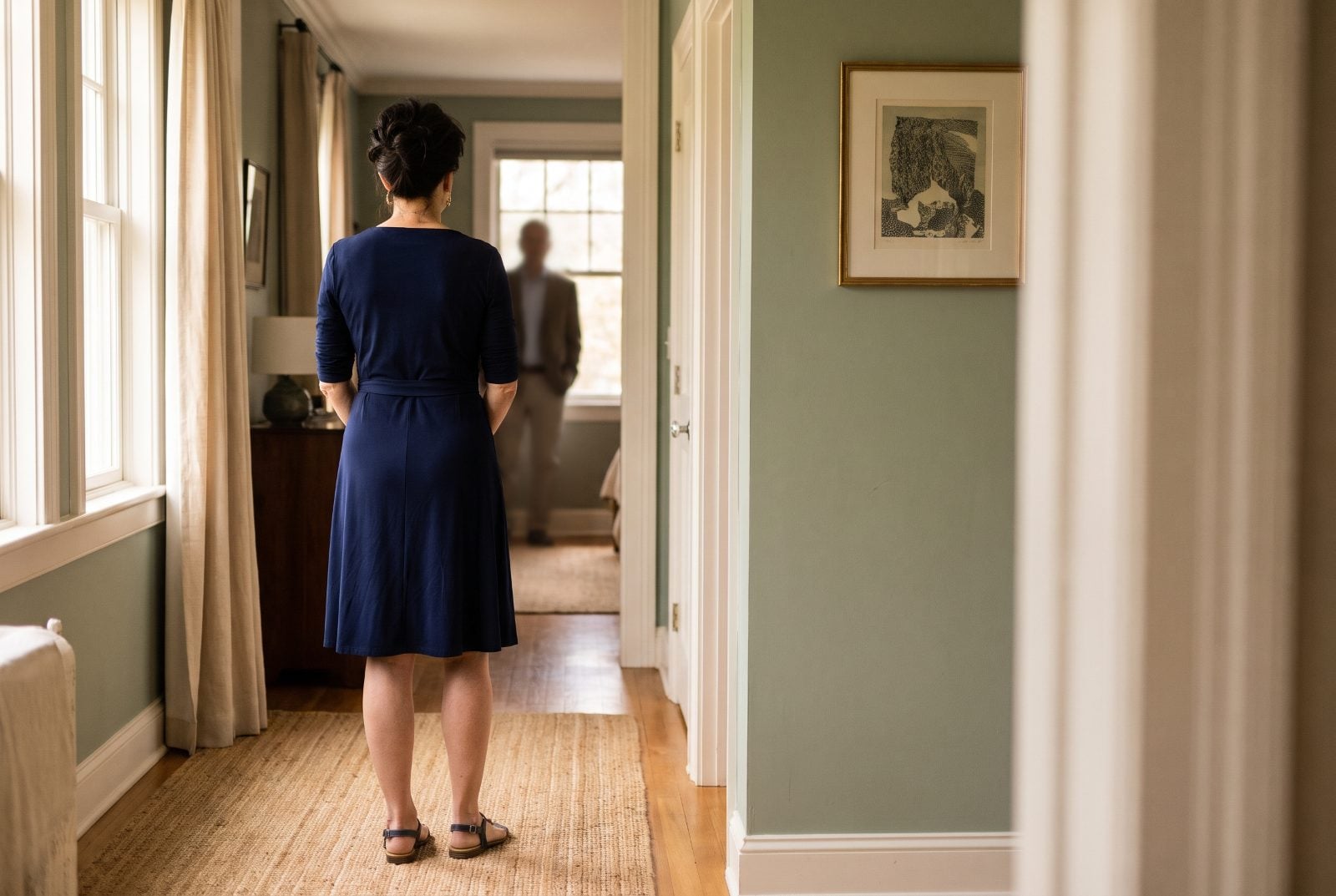
FYI, thanks to AI imagery software, we’re able to create very specific fashion and hairstyle examples to illustrate the points being made. In some cases, imagery is exaggerated to hammer home the point. Also, assume links that take you off the site are affiliate links such as links to Amazon. this means we may earn a commission if you buy something.
Two verdicts, ten minutes apart
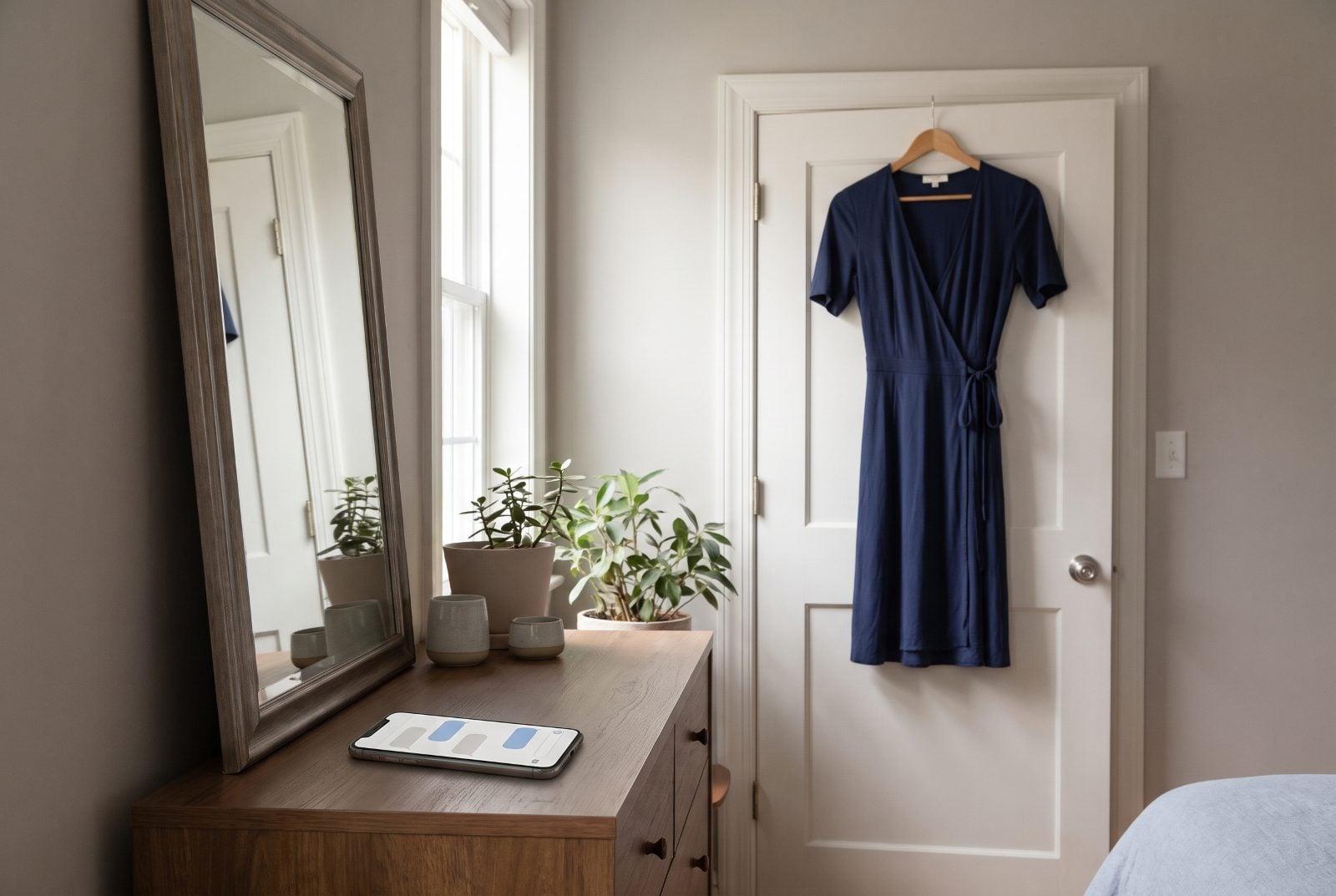
It’s the new dress for your niece’s wedding. Navy, wrap front, hits just below the knee. You liked it in the store. You’re less sure now.
So you do what a lot of women do these days. You take a mirror selfie and ask an AI.
The answer comes back fast and polite. The wrap style “may draw attention to the midsection.” The length “could shorten your frame.” It suggests a V-neck, a column silhouette, maybe a heel. It finishes with something encouraging, the way these things always do.
Ten minutes later your husband walks past the bedroom door, stops, and says, “Wow. You look beautiful.”
And you think: he has to say that.
The machine doesn’t have to say anything. It has no reason to be nice to you, no dinner to get through, no marriage to protect. So surely the machine is the honest one?
Not necessarily. It turns out both of them are measuring something real. They’re just measuring different things, and neither is quite what you think.
Why the machine feels more believable
There’s a name for the instinct that made you trust the AI over him. Researchers call it algorithm appreciation.
The research
In a 2019 paper, Jennifer Logg, Julia Minson and Don Moore ran six experiments. People were given advice labelled either as coming from an algorithm or from a person. They leaned on it more when they thought an algorithm had produced it. That held for estimating something they could see, for predicting how popular songs would be, and even for predicting romantic attraction.1
Two details from that study matter here.
First, the effect faded when people were choosing between an algorithm’s judgment and their own. Given the choice between the machine and a stranger, they picked the machine. Weighed against their own sense of things, they were less impressed.1
Second, experts relied on algorithms less than lay people did, and it made the experts less accurate.1 Nobody is immune.
So when the AI’s verdict feels more “true” than your husband’s, part of that is just how people are wired. A machine sounds objective because it has nothing to gain. But sounding objective and being right about your body in your dress are two different things.
And you’ll notice something about that first finding. Your own judgment, the part of you that liked the dress in the store, is where people’s preference for the algorithm starts to fade. Keep that in mind. We’ll come back to it.
What the AI is actually judging
An AI stylist hasn’t looked at a thousand women your age and learned what suits them. It has learned from the internet. And the internet has a very particular idea of what a woman looks like.
It learned from a world where women are always young
In October 2025, researchers from Stanford, UC Berkeley and Oxford published a study in Nature. They analyzed 1.4 million online images and videos, from Google, Wikipedia, IMDb, Flickr and YouTube, along with nine large language models. Across more than 3,400 categories, women were consistently shown as younger than men. That was true whether age was judged by people, by software, or by actual birthdates.2
The skew wasn’t only in pictures. When the team had ChatGPT write nearly 40,000 résumés, the ones with women’s names came out about 1.6 years younger, with less experience.2 The study was about jobs, not fashion. But the point carries over. Online images and text, the raw material these systems are built from, show women as younger than men.
Unflattering compared to what?
So when an AI calls a silhouette “unflattering,” it’s worth asking: unflattering compared to what? Very often the answer is a body the internet treats as the default, which is a younger one.
It answers the question you asked
Here’s the part most people miss. Chatbots tend to go along with the person asking.
A Stanford study published in Science in March 2026 tested 11 leading AI models on personal advice. They sided with the user about 49% more often than humans did.3 That study looked at conflicts between people, not outfits. Still, the pattern is worth knowing.
Think about how you asked. If you typed “Is this unflattering?” or “What’s wrong with this dress?”, you told the machine there was a problem to find. A tool built to be helpful will usually find one.
Try it yourself
Upload the same photo twice. Ask once “What’s working in this outfit?” and once “What’s unflattering about this outfit?” Then compare the two answers.
It can't see the room
The AI saw one flat photo, taken at one angle, in your bedroom light. It didn’t see you move, laugh, or sit down. It doesn’t know it’s a garden wedding, that you’ll be chasing a toddler, or that navy is the colour your late mother always wore. All of that changes whether a dress is right. None of it is in the picture.
What his compliment is actually measuring
Now the other verdict. The one you were quick to dismiss.
He's not seeing you the way a camera does, and that's the point
In the 1990s, psychologists Sandra Murray, John Holmes and Dale Griffin studied what they called positive illusions. People tend to see their partners a bit more generously than the partners see themselves. That gap isn’t a defect in the relationship. Those who do it more tend to be more satisfied.4
A later study by Murray and colleagues followed 193 newlywed couples for three years. Satisfaction usually drops in the early years of marriage. But the partners who idealized each other most didn’t show a significant decline.5 The benefit held even after the researchers accounted for how positively people saw their partners in general. It came from seeing an imperfect partner as a match for their ideals. Think of it as: she’s not perfect, but she’s perfect for me.
He isn’t grading the dress against a catalogue.
So when your husband says you look beautiful, he isn’t grading the dress against a catalogue. He’s seeing you through years of history, and the research links that view to marriages that stay steady. It’s not the same as lying.
But he isn't a stylist either
To be fair to the machine, “you look beautiful” doesn’t tell you whether the hem is hitting at the best spot. Most husbands are not reliable judges of proportion, and many will say the same thing about every outfit. That’s sweet. It’s also not very useful when you’re trying to choose between two dresses.
There’s another thing to watch for. A 2014 paper by Andrea Meltzer and James McNulty found that a committed partner valuing a woman’s body was linked to higher relationship satisfaction, but only when he also valued her for her other qualities.6 If his compliments are only ever about your looks, they may land hollow no matter how sincere they are.
How to use both, without letting either one decide for you
You don’t have to pick a winner. Each voice is good at one thing, and you’re the one who gets to combine them.
| Ask | Who’s better at it |
|---|---|
| Does the hem, waist or neckline sit where it should? | AI, or better, a mirror and a second photo from the side |
| Is there a technical fit problem (pulling, gaping, wrong length)? | AI can flag it. A tailor can fix it. |
| Do I look like myself in this? | Him, and you |
| Will I feel good wearing this for six hours? | Only you |
| Is this "flattering" by today's internet standard? | AI, but ask whether that standard is one you care about |
A five-minute routine before the next big event
Your five-minute routine
- Ask the AI a neutral question. Try “Describe how this outfit fits” instead of “Is this unflattering?” You’ll get observations rather than a verdict.
- Ask it the opposite question too. Ask what’s working as well as what isn’t. If the answers mostly cancel out, the dress is probably fine.
- Treat specific notes as useful and vague ones as noise. “The shoulder seam sits past your shoulder” is useful. “May not be the most flattering choice” isn’t.
- Ask him a better question. Instead of “Do I look okay?”, try “Navy or the green one?” or “Does this look like me?” You’ll get a real answer more often.
- Go back to how you felt in the store. Remember the algorithm study. People’s preference for the machine fades when the alternative is their own judgment.1 If you liked it before you asked anyone, that counts for something.
The fit point is real
One thing the AI may be right about, even when its taste is off, is fit. In a 2026 study of 252 UK women aged 38 to 67, being satisfied with your clothes predicted overall wellbeing. Part of the link was that women who felt good in their clothes were less likely to skip social events. Poor fit after the body changes was one of the most common complaints.7
So if the AI flags something specific, like a waistline sitting in the wrong place, it may be worth a trip to a tailor. Just don’t let it talk you out of the colour, the style or the dress you love.
So who do you believe?
Believe the AI about the seams. Believe your husband about you.
Believe the AI about the seams. Believe your husband about you. And when the two disagree, believe the woman who liked the dress before she asked either of them.
The machine compares you to a picture of women that skews younger than you. Your husband compares you to someone he’s watched for years and still chooses. Neither of them is neutral, and neither of them gets the final say.
Wear the navy.
Have you ever had an AI tell you one thing and your partner the opposite? Who did you listen to?
Notes
- Logg, J. M., Minson, J. A., & Moore, D. A. (2019). “Algorithm appreciation: People prefer algorithmic to human judgment.” Organizational Behavior and Human Decision Processes, 151, 90 to 103. https://doi.org/10.1016/j.obhdp.2018.12.005 (open copy: eScholarship). ↩
- Guilbeault, D., Delecourt, S., & Desikan, B. S. (2025). “Age and gender distortion in online media and large language models.” Nature, 646, 1129 to 1137. https://doi.org/10.1038/s41586-025-09581-z. Summary: University of California, "Women portrayed as younger than men online, and AI amplifies the bias". ↩
- Cheng, M., Lee, C., Khadpe, P., Yu, S., Han, D., & Jurafsky, D. (2026). “Sycophantic AI decreases prosocial intentions and promotes dependence.” Science, 391(6792), eaec8352. https://doi.org/10.1126/science.aec8352. Summary: Stanford Report, "AI overly affirms users asking for personal advice". ↩
- Murray, S. L., Holmes, J. G., & Griffin, D. W. (1996). “The benefits of positive illusions: Idealization and the construction of satisfaction in close relationships.” Journal of Personality and Social Psychology, 70(1), 79 to 98. https://doi.org/10.1037/0022-3514.70.1.79. ↩
- Murray, S. L., Griffin, D. W., Derrick, J. L., Harris, B., Aloni, M., & Leder, S. (2011). “Tempting fate or inviting happiness? Unrealistic idealization prevents the decline of marital satisfaction.” Psychological Science, 22(5), 619 to 626. https://doi.org/10.1177/0956797611403155 (open copy: PMC). ↩
- Meltzer, A. L., & McNulty, J. K. (2014). “Tell me I’m sexy . . . and otherwise valuable”: Body valuation and relationship satisfaction. Personal Relationships, 21(1), 68 to 87. https://doi.org/10.1111/pere.12018 (open copy: PMC). ↩
- Rogaten, J., & Rullo, V. (2026). “Invisible Women: The Relationship Between Satisfaction with Fashion Clothing Choices and Well-being in Middle-aged Women.” Journal of Macromarketing, 46(2), 116 to 130. https://doi.org/10.1177/02761467261429834. Summary: PsyPost, "New study links fashion satisfaction to mental well-being and social confidence in middle-aged women". ↩