
❤️ Would you like to save this?
A $2,000 suit can look cheap. All it takes is the wrong necklace, or three of them at once. The clothes almost never fail — the jewelry does. A tired chain against pristine silk. Earrings that yank every eye away from a beautiful neckline. A hand loaded with rings until expensive pieces start reading as clutter.
Most of these fixes cost nothing and take seconds, which is the maddening part. The problem usually isn’t the jewelry itself. It’s scale, placement, condition, proportion, or that last piece you added when the outfit was already finished. Here are 35 small mistakes that can quietly undo an otherwise expensive-looking outfit — and exactly what to do instead.
FYI, thanks to AI imagery software, we’re able to create very specific fashion and hairstyle examples to illustrate the points being made. In some cases, imagery is exaggerated to hammer home the point. Also, assume links that take you off the site are affiliate links such as links to Amazon. this means we may earn a commission if you buy something.
35. Wearing Three Statement Pieces at Once With No Clear Lead

Three statement pieces, all shouting at the same volume. The earrings pull one way, the necklace another, the cuff a third. Nothing gets enough room to matter, so the whole composition turns into noise.
The problem isn’t abundance. It’s hierarchy. An outfit can handle drama beautifully when one element owns the room and everything else knows its job.
Pick your lead. Keep the sculptural jewelry earrings and lose the necklace, then reduce the cuff to a thin band — or nothing. One decisive piece often has more impact than three pieces campaigning for attention.
34. A Tarnished Necklace Against an Immaculate Dress
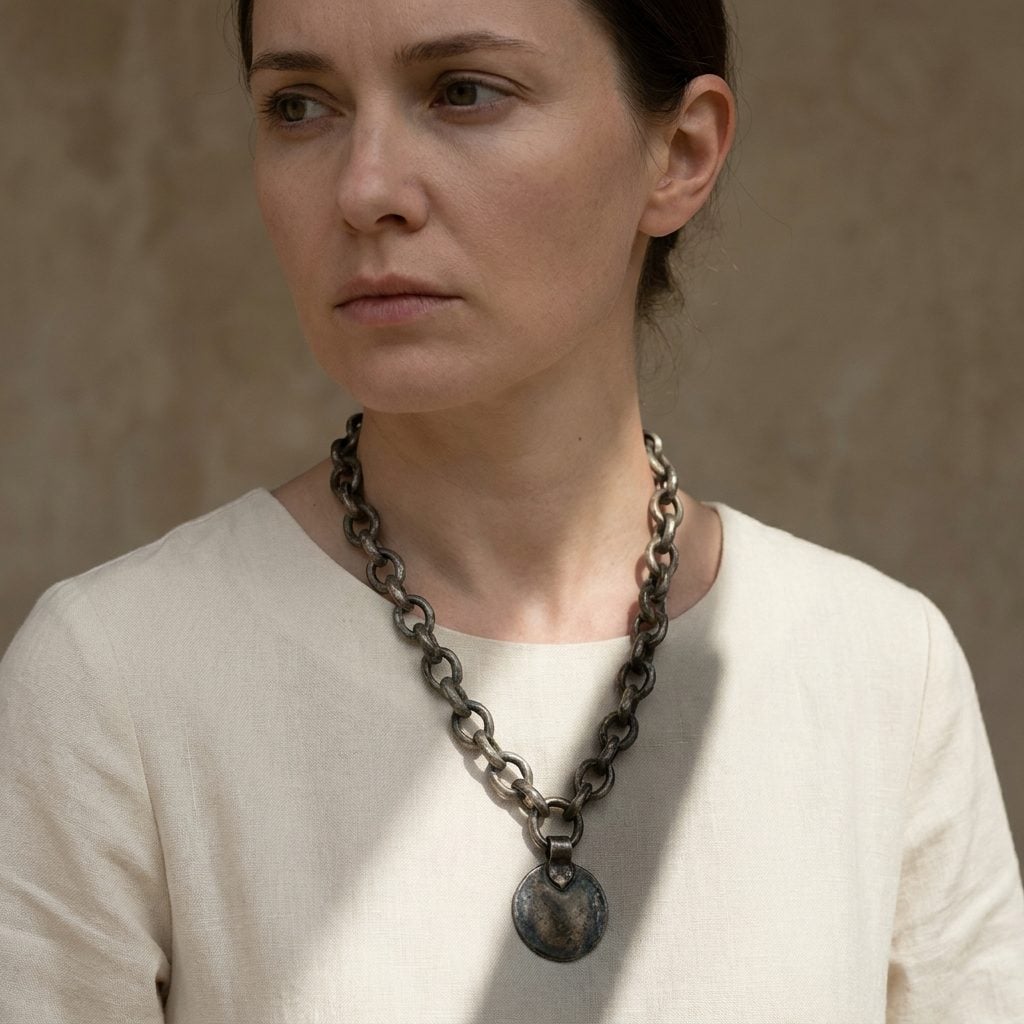
Everything about her is pressed and pristine except the thing sitting closest to her face. The navy silk drapes exactly right. The belt is precise. Then the necklace arrives with darkened, tired-looking links and breaks the spell.
Condition can matter more than price here. A modest chain with a clean finish can look terrific; an expensive one that looks neglected can drag everything around it down.
Clean jewelry according to the metal and finish rather than attacking every piece with the same polish. Some surface discoloration responds beautifully to careful cleaning. If plating has actually worn away, however, polishing won’t put it back.
33. Chandelier Earrings That Swallow a Minimalist Dress
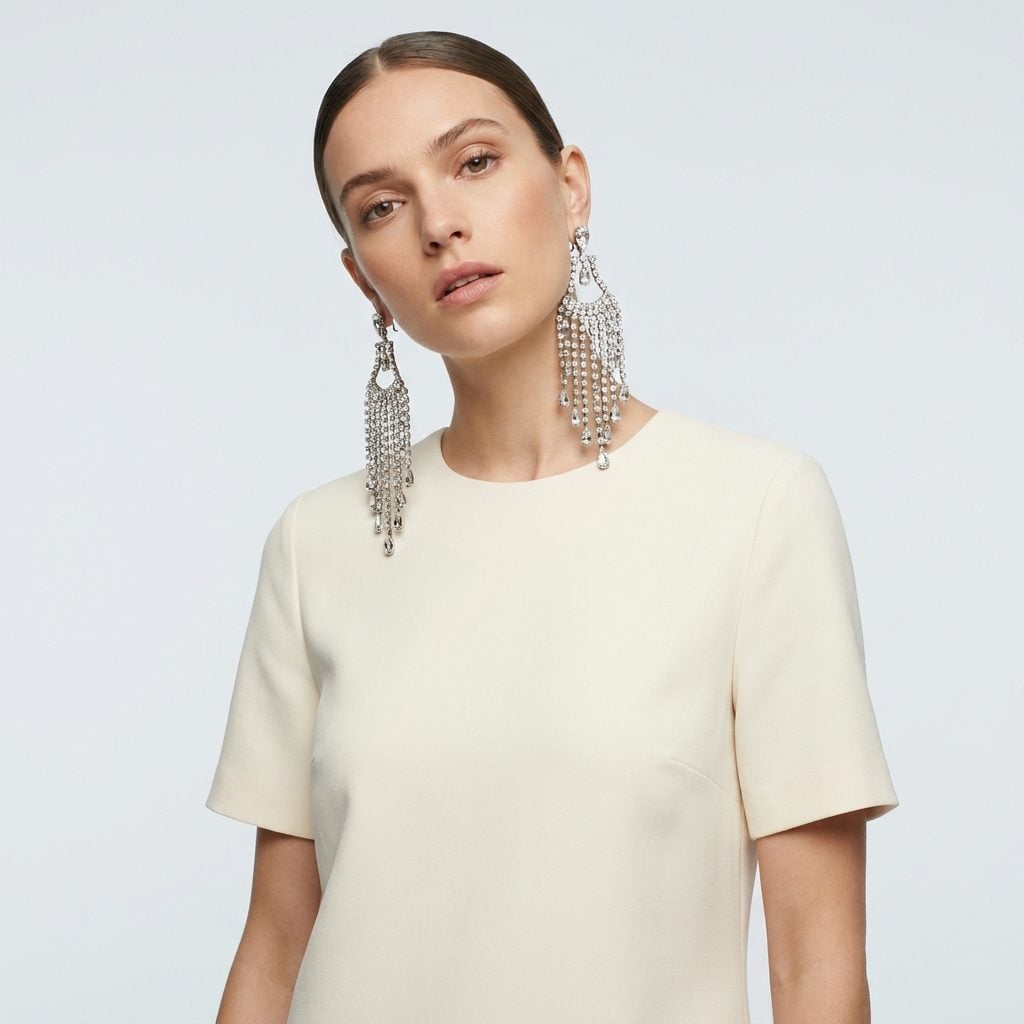
Beautiful dress. But your eyes go straight to those earrings and never quite make it back. The chandelier drops nearly reach her shoulders, and against that spare bateau neckline they become the entire composition.
Big earrings with a minimalist dress can be spectacular when that contrast is the intention. Here, though, the scale overwhelms rather than sharpens the simplicity.
Try a sculptural stud or a cleaner drop and suddenly the dress comes back into focus. Save the shoulder-grazing chandeliers for an outfit where you genuinely want the earrings to be the event.
32. Mixing Four Unrelated Metal Finishes With No Bridge
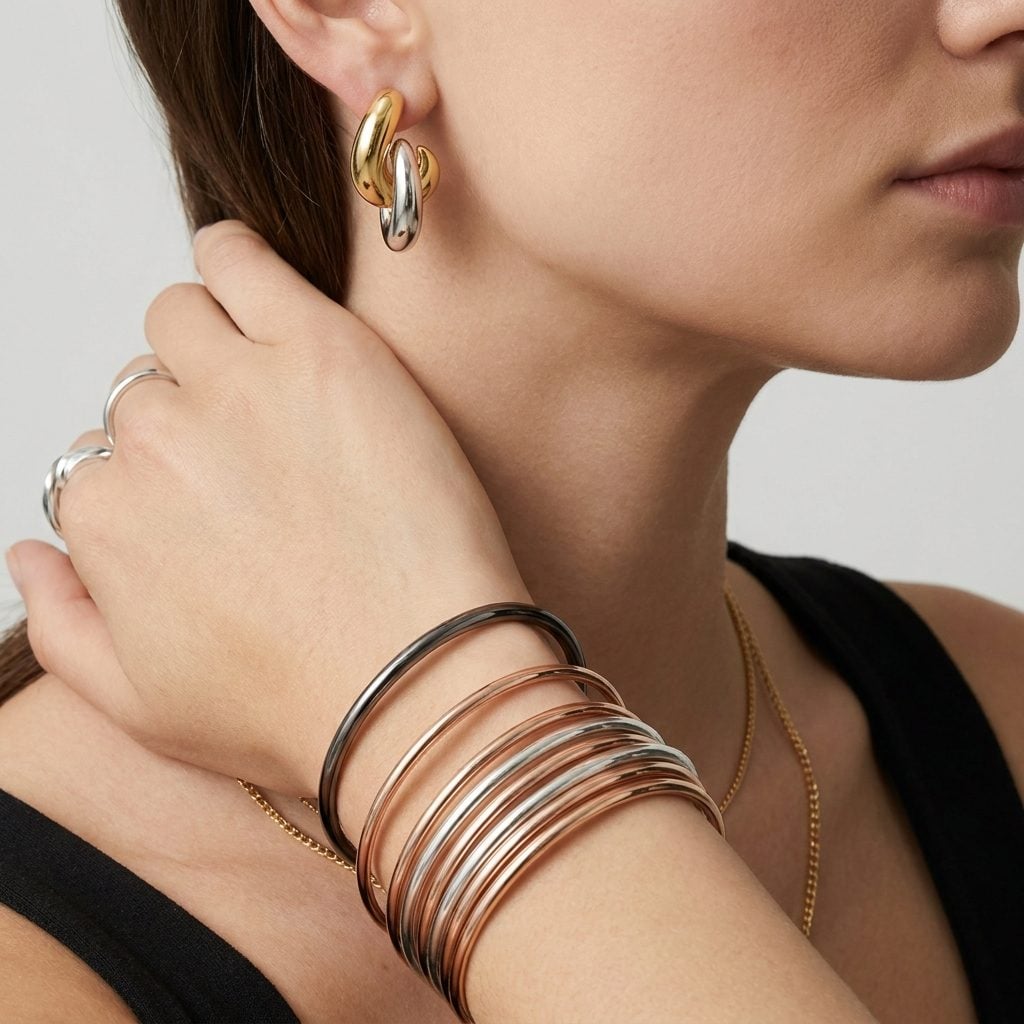
Mixed metals are modern. Four unrelated finishes appearing once each can look like four separate decisions that never met before breakfast. Yellow gold at the ears, silver at the neck, rose gold at the wrist, gunmetal on the other hand — the eye keeps searching for the connection.
That’s especially noticeable against a beautifully controlled palette of camel, chocolate, and burgundy. The clothes have a rhythm; the metals don’t.
Create a bridge. Use two finishes and repeat one of them, or wear a single piece that already combines both metals. Suddenly the contrast looks deliberate rather than accidental.
31. Five Fine Chains Tangling at the Same Length
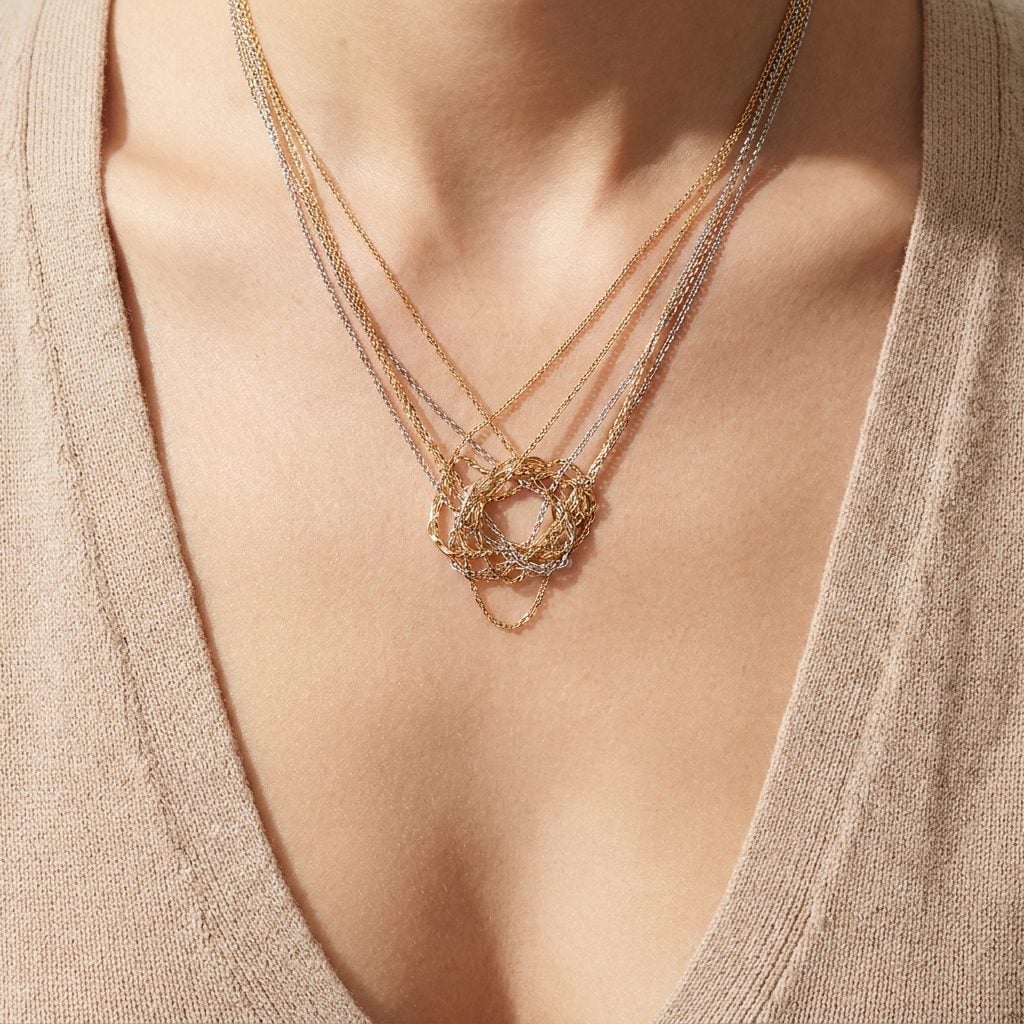
Layered necklaces can look effortless. Five chains hovering at almost exactly the same length look like a knot forming in real time. They overlap, twist, and push their tiny pendants into one nervous little meeting at the center of the chest.
Good layering needs visible separation. The point is to create a cascade, not a traffic jam.
Try two or three clearly different drops — perhaps around 16, 18, and 22 inches, depending on the neckline and wearer. The exact measurements matter less than creating enough space for every chain to draw its own line.
30. Too Many Competing Gemstone Colors at Once

Red at the ears, green at the throat, blue at the wrist, purple on the hand. Each stone could be gorgeous. Scattered across four unrelated pieces, they turn a sophisticated neutral outfit into a color chart.
The charcoal ensemble was built to be a calm backdrop. Give it four separate jewel-tone focal points and the eye spends more time sorting them than enjoying them.
Multicolored jewelry works beautifully when the colors are already composed within one piece. With separates, repeat a color or stay within a related palette. You don’t need less color. You need a reason for the colors to be together.
29. A Pendant That Lands Right on the Point of the V

The wrap dress gives you a beautiful clean V. Then the pendant parks itself directly on the apex, and suddenly necklace and neckline appear to have collided at an intersection.
It’s a tiny placement issue with a surprisingly visible effect. The pendant usually looks cleaner when it sits distinctly above the point or falls comfortably into the open space beneath it.
Adjust the chain rather than changing the necklace. A couple of inches can restore the geometry of the entire neckline.
28. The Flat, Too-Yellow Faux-Gold Finish

The palette is expensive on purpose: espresso wool, ivory silk, cream leather. Then the necklace arrives in an intensely bright yellow finish that jumps several feet forward from everything else.
This isn’t really about real gold versus affordable jewelry. Gold tones vary enormously at every price. The trouble here is that this particular color and shine don’t harmonize with the clothes around them.
Look for a finish that works with the palette — perhaps softer yellow gold, brushed metal, antique gold, or another treatment with less glare. Affordable jewelry can look superb when its color and surface belong in the outfit.
27. An Ornate Necklace Fighting a Busy Print
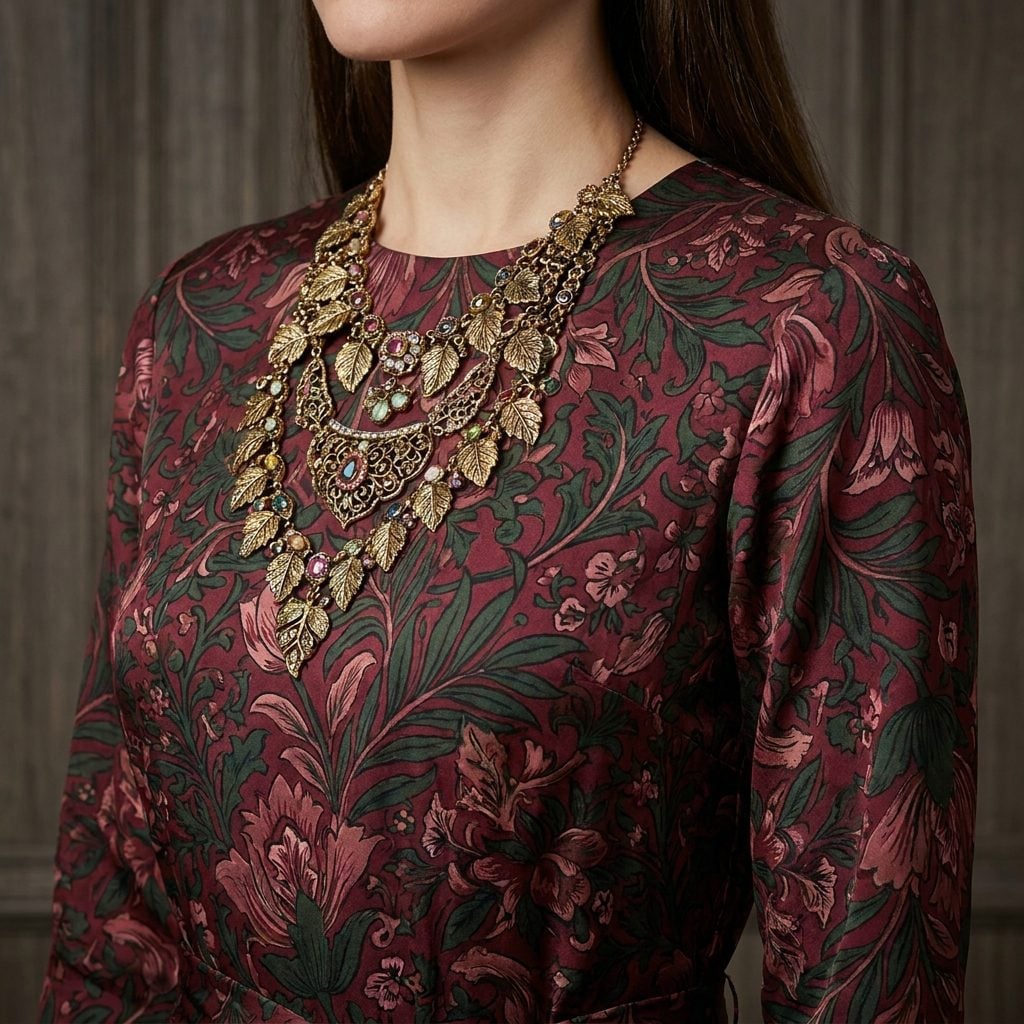
The print is already doing plenty. Burgundy and green botanicals move across the silk, giving your eye pattern, color, and detail to explore. Then a multistrand necklace crowded with links and colored stones lands directly on top of it.
Neither piece is the problem. That’s precisely why the combination is frustrating. Two interesting things occupy the same visual territory and turn a beautiful bodice into static.
Let the pattern carry that zone. Small studs, a restrained pendant, or even a bare neck gives the outfit room to do what it was designed to do.
26. A Different Ring on Nearly Every Finger
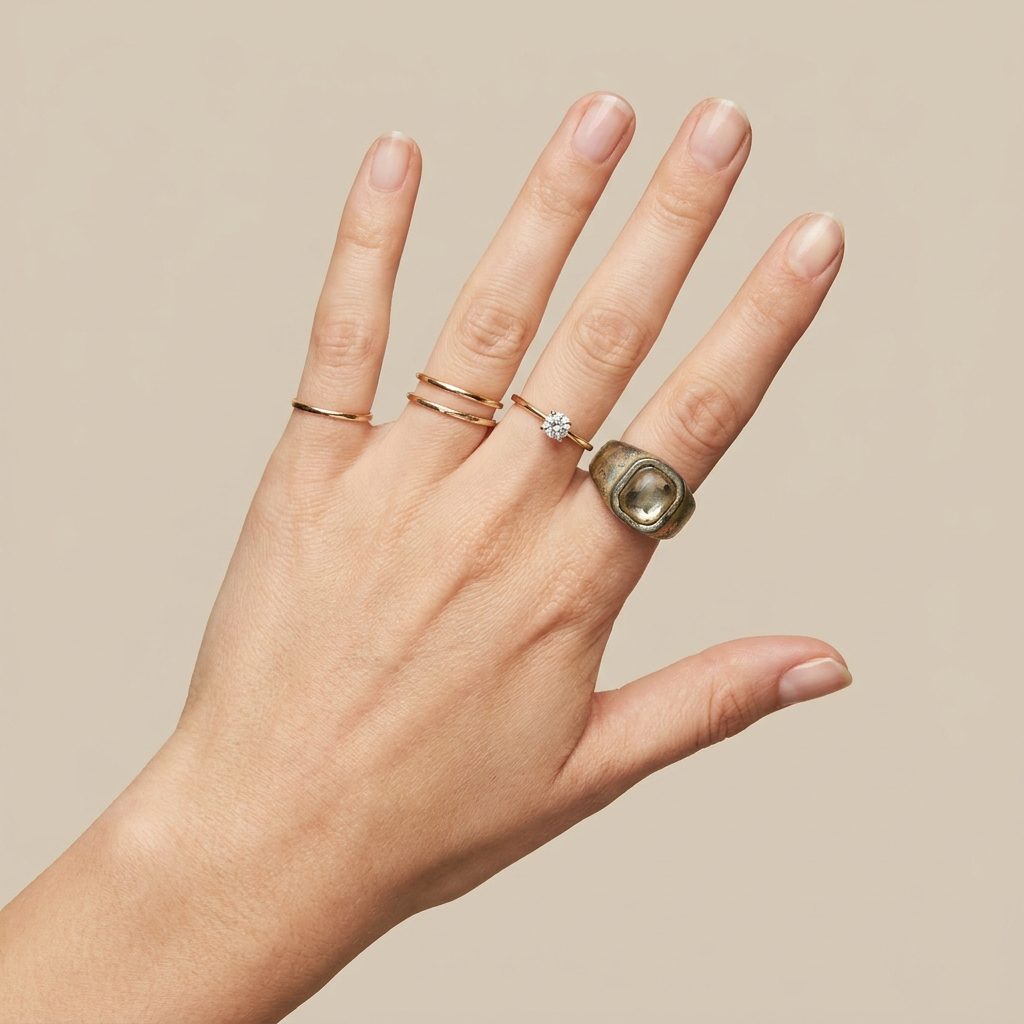
A signet here, a stone there, several bands, a decorative twist. None of the rings is necessarily wrong. The hand just has so many separate ideas that you stop seeing the individual pieces.
This is an editing problem rather than a taste problem. Hands are constantly moving — holding a glass, opening a door, turning a page — so visual clutter gets amplified.
Leave some negative space. A statement ring, a considered stack, or a few bands with a shared language can make the whole hand feel intentional without stripping it bare.
Empty space is part of the jewelry composition too.
25. Jewelry Far Too Formal for a Weekend Outfit
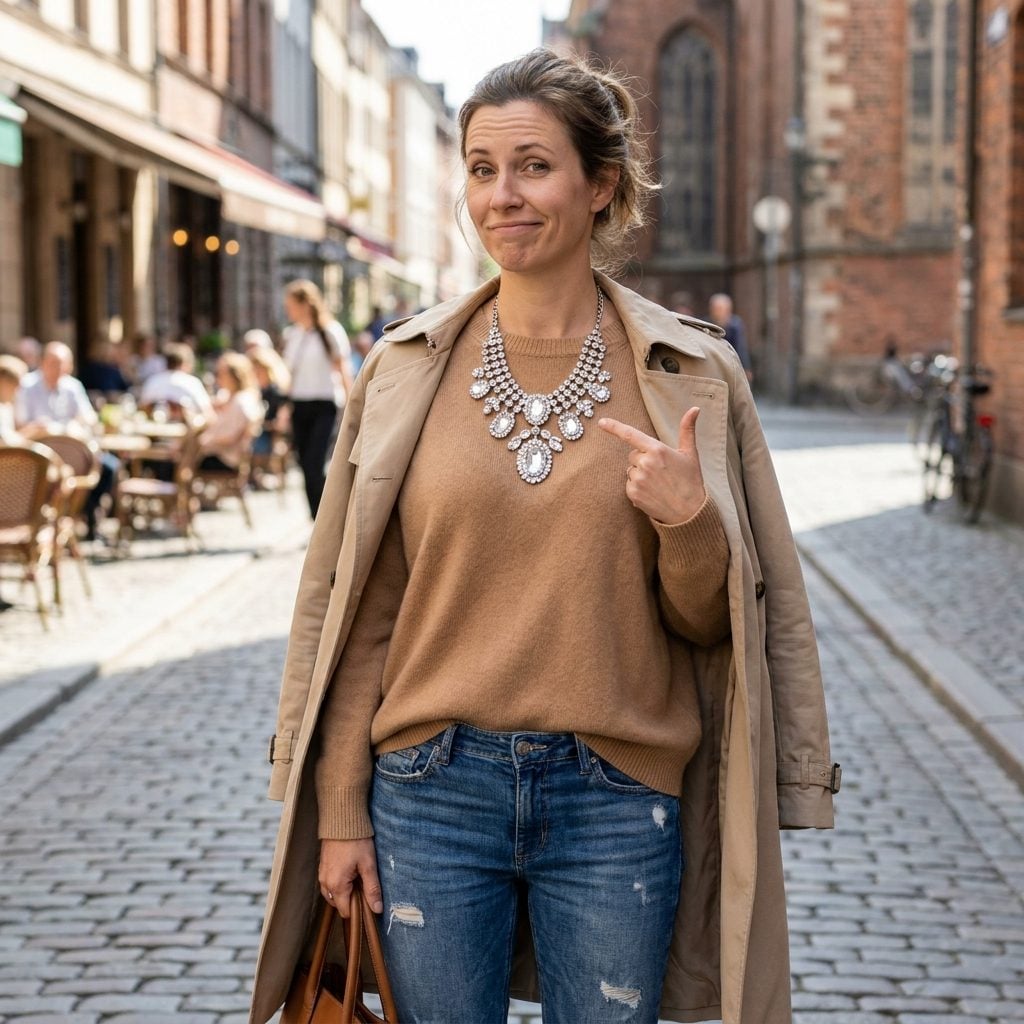
The weekend outfit has itself figured out: dark jeans, camel cashmere, a navy trench. Then a crystal bib necklace and elaborate earrings arrive looking as though they took a wrong turn on the way to a gala.
There is no law against sparkle in daylight. In fact, evening jewelry with casual clothes can look fantastic when the contrast feels intentional. Here, the scale and formality simply overpower the relaxed mood.
Try a hoop, fine chain, signet ring, or one piece of crystal rather than the full production. The objective isn’t to dress jewelry down. It’s to make the contrast look chosen.
24. A Statement Necklace Over an Already Embellished Neckline
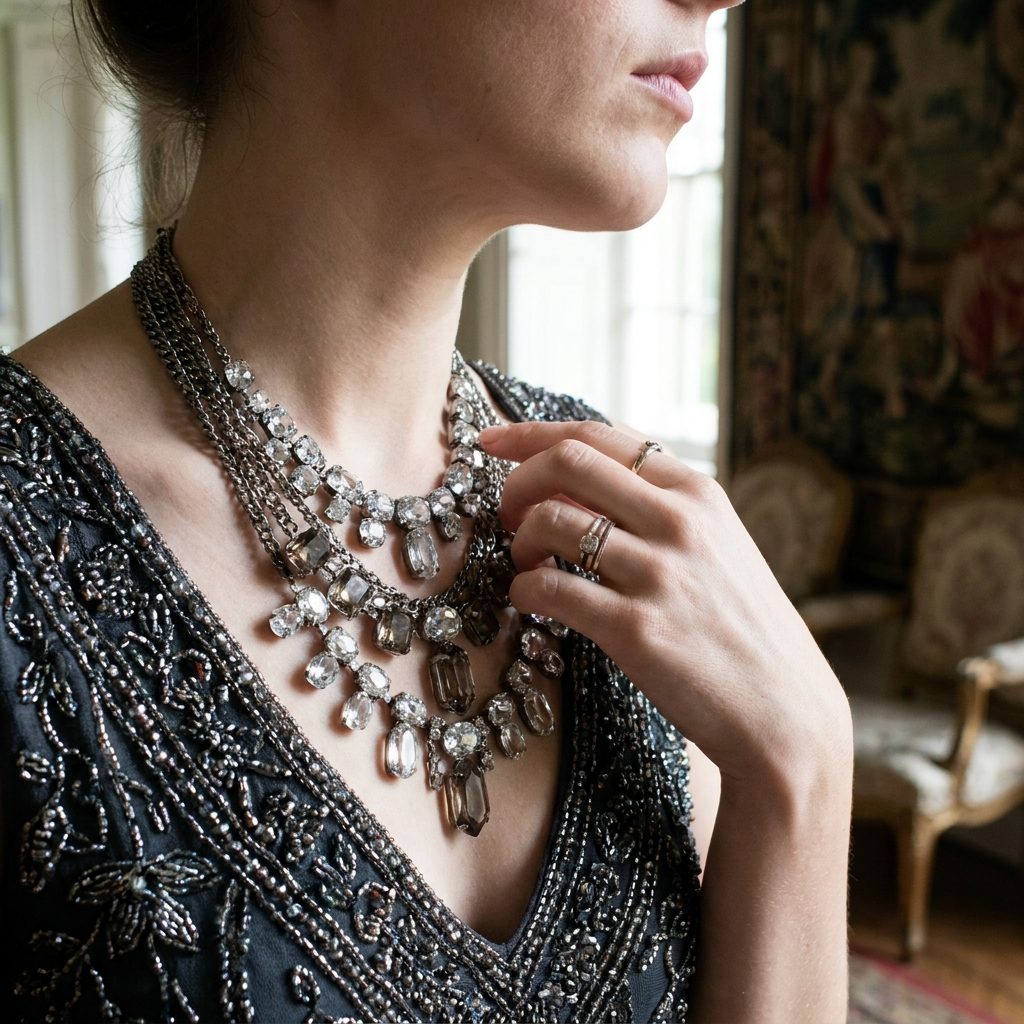
The blouse already did the jewelry work for you. That tonal beading along the collar is the detail. Add a crystal-and-metal statement necklace directly over it and two expensive-looking elements collapse into one heavy band.
The trouble is location. Both are trying to occupy the same few inches.
Skip the necklace and move the interest somewhere else: earrings, a ring, a cuff. Once the beaded collar gets the space it was designed for, both blouse and jewelry look more considered.
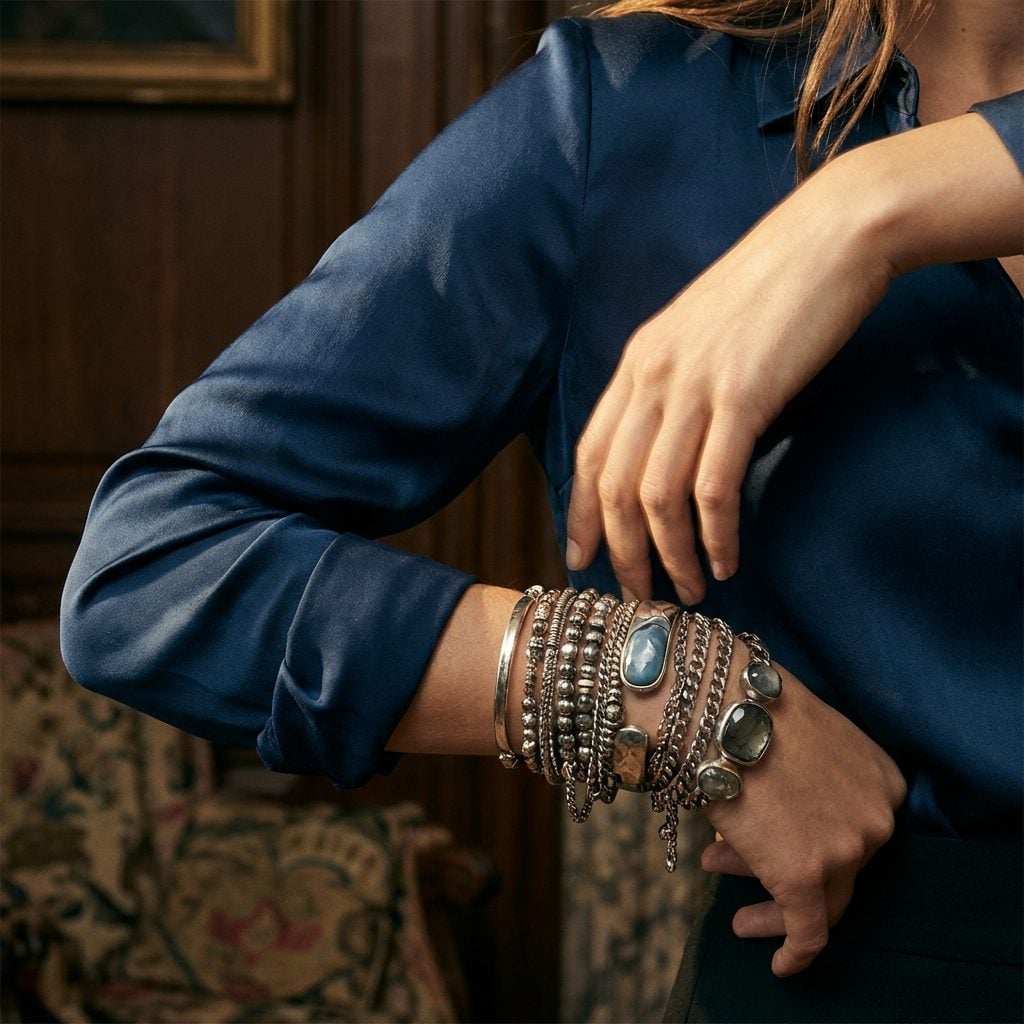
23. An Overloaded Bracelet Stack on One Wrist
❤️ Would you like to save this?
The blouse is the color of deep water and the trousers move beautifully, but then the wrist takes over. Bangles, chains, textures, and widths are compressed into a dense metallic block.
Bracelet stacking isn’t the problem. A maximal stack can look terrific. Here, the stack has so much visual mass that it drags attention away from everything the outfit is doing well.
Edit by proportion rather than by some magic number. Remove enough pieces to expose skin between forms, repeat a finish or shape, and decide whether the wrist is supposed to be the focal point.
22. A Pendant Fighting With Sculptural Jacket Buttons
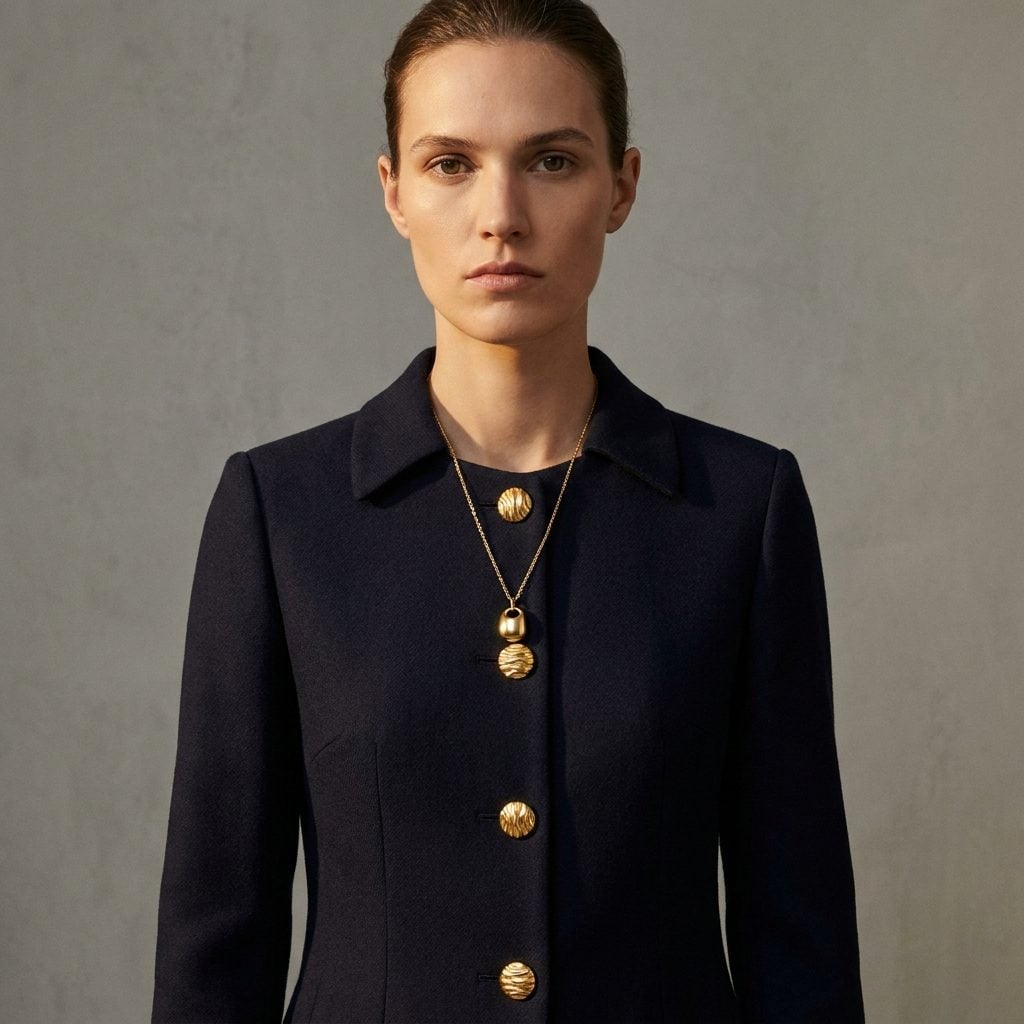
Those sculptural gold buttons are already functioning as jewelry. They catch the light, create rhythm down the jacket, and give the front its character. Then a long gold pendant drops straight into their path.
Suddenly there’s a traffic jam of metal shapes where there used to be a clean line.
Shorten the necklace so it sits above the button field, or remove it entirely and let the jacket hardware have the front of the outfit. Some clothes arrive accessorized.
21. Too Many Pearl Treatments at Once

Pearls never really disappeared. What dates this look isn’t the pearl itself — it’s the insistence on repeating it everywhere.
Triple strand, cluster earrings, multirow bracelet, cocktail ring. Each can work beautifully. Together they become so literal that the woman disappears behind the theme.
Break up the set. Let the strand have small metal earrings, or wear the pearl clusters with a bare neck. Pearls look freshest when they appear because you chose them, not because every accessory received the same memo.
20. A Brooch Pinned Too Low on the Coat
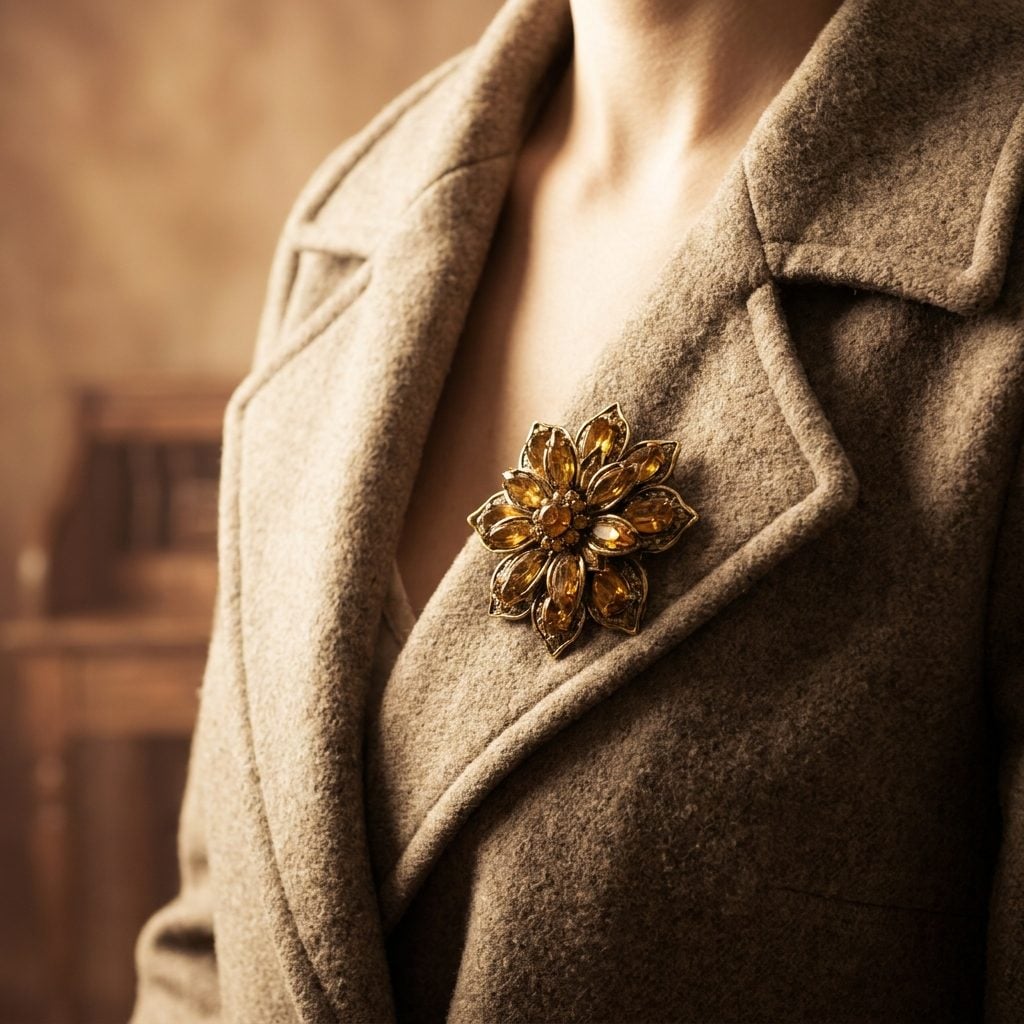
The brooch is beautiful. The placement is the whole problem. Pinned low around the bust, it becomes a weight hanging off the coat’s clean vertical instead of an accent framing the upper body.
Move it higher — toward the lapel, shoulder, or collarbone — and the relationship changes immediately.
Four inches can be the difference between “Why is that there?” and “Where did you get that?”
19. Wearing the Entire Identical Matching Jewelry Set

Same burgundy stone at the ears, neck, wrist, and hand. The individual pieces may be lovely, but all four together make the styling feel prepackaged.
The problem isn’t matching. Repetition can be extremely elegant. The issue is repeating the exact same motif so many times that there is no hierarchy or surprise left.
Break the set apart. Keep the earrings and ring, perhaps, then add a plain cuff. Or wear the necklace alone. The pieces start looking more individual the moment they stop traveling as a delegation.
18. Statement Earrings Fighting Statement Glasses

Bold geometric tortoiseshell frames already occupy serious visual territory around the face. Add earrings of almost exactly the same scale and angularity, and suddenly there’s a lot of architecture happening within six inches.
Glasses count as an accessory whether an outfit plan acknowledges them or not.
With a powerful frame, try a smaller stud, huggie, or fine hoop and see whether your face comes forward again. Or keep the dramatic earrings and choose a quieter frame. The point isn’t that two bold pieces can never coexist — it’s making sure you’re deliberately creating that density.
17. A Choker Crowding a High Neckline

The plum mock-neck already creates a strong, clean band at the throat. Put a rigid gold choker directly over it and suddenly there are two collars occupying almost exactly the same space.
That’s the issue here: not some universal ban on chokers over fabric, but visual compression.
An open neckline would give this choker skin and breathing room. With the mock-neck, earrings or a cuff move the interest away from an area that’s already fully designed.
16. Novelty Jewelry With a Sophisticated Outfit
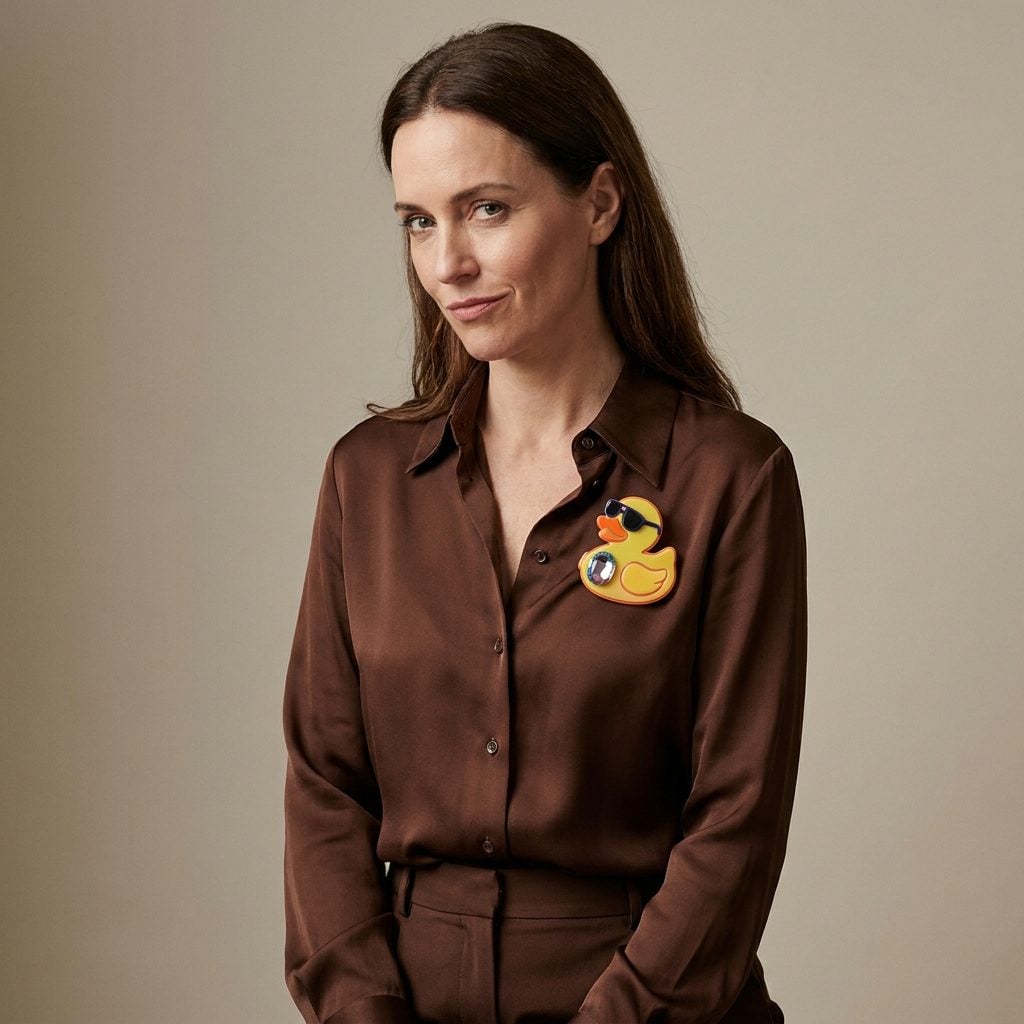
Chocolate silk that drapes, cream trousers with a clean line, cognac pumps. Then a necklace of little fruit charms swings into view and changes the entire conversation.
That can be brilliant when the clash is intentional. Fashion has made a career out of putting playful things next to serious tailoring. Here, however, the whimsical necklace feels disconnected rather than subversive.
Either build the contrast into the outfit — perhaps with color or another playful reference — or choose jewelry that continues the clothes’ quieter register. A joke lands better when the setup is there.
15. A Bracelet Stack Burying a Statement Watch
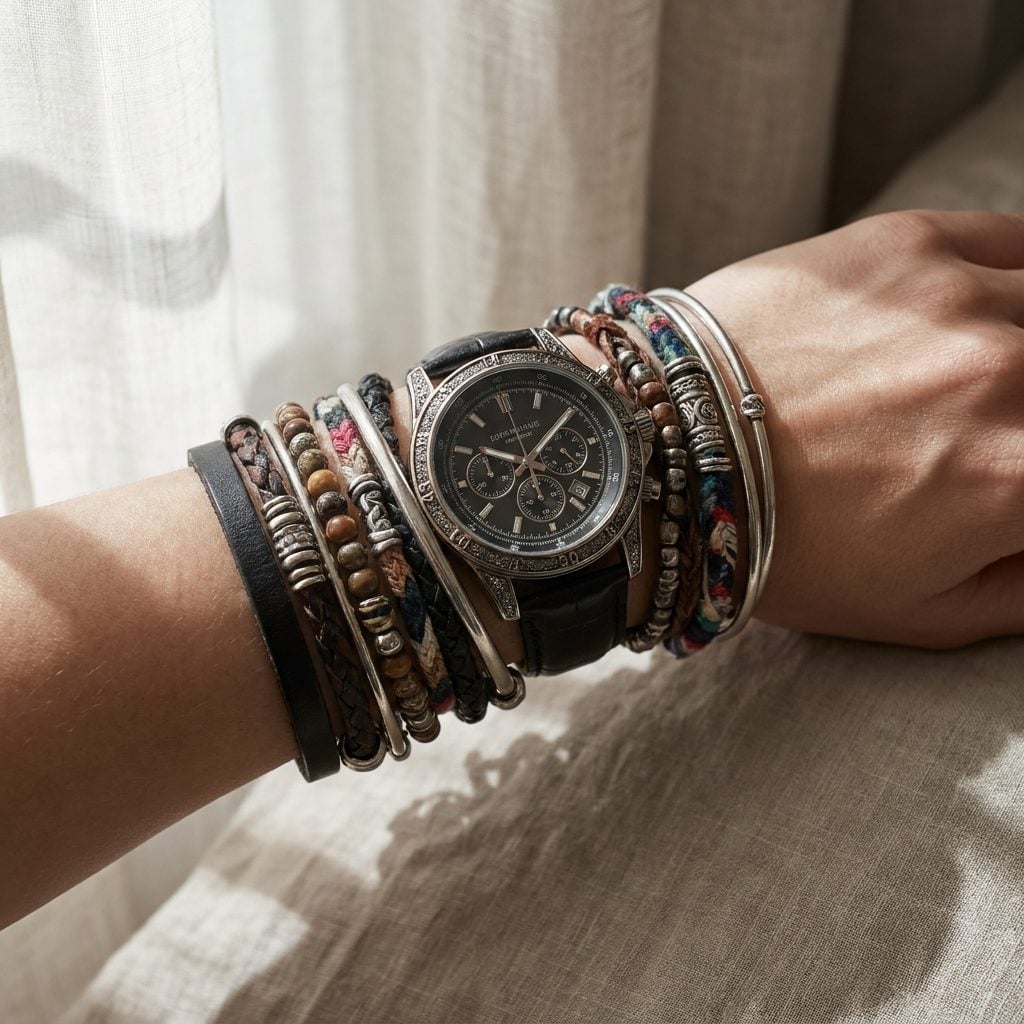
The watch is supposed to be the wrist’s main event. Instead, six bracelets surround it so tightly that its shape, face, and hardware disappear into more metal.
That’s different from simply wearing a big bracelet stack. Here, the stack is hiding the piece you presumably wanted noticed.
Give the watch some breathing room. Wear it alone, pair it with one complementary bracelet, or move the larger stack to the opposite wrist. Suddenly the watch looks like a choice again rather than another link in the pile.
14. A Necklace Half-Trapped Under the Shirt Collar
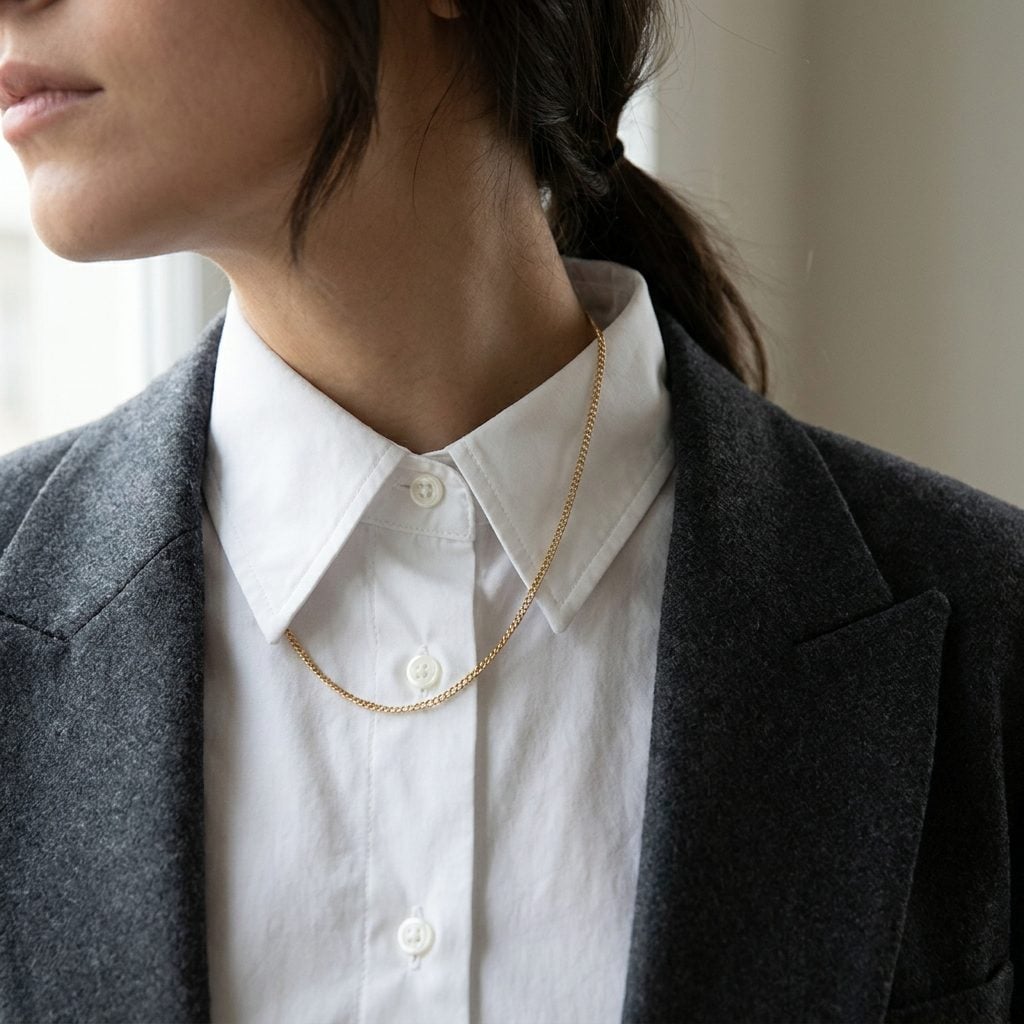
One side of the chain rides on top of the collar while the other vanishes underneath a collar point. The necklace looks as though it got dressed in a hurry and nobody checked before leaving.
The shirt is immaculate. The necklace is good. Their collision is the accident.
Pick a plane. Wear the chain deliberately over an open collar, or position it completely underneath so the pendant appears cleanly in the opening. The problem isn’t layering jewelry with a shirt. It’s getting caught halfway between two ideas.
13. Multiple Competing Statement Rings on Both Hands
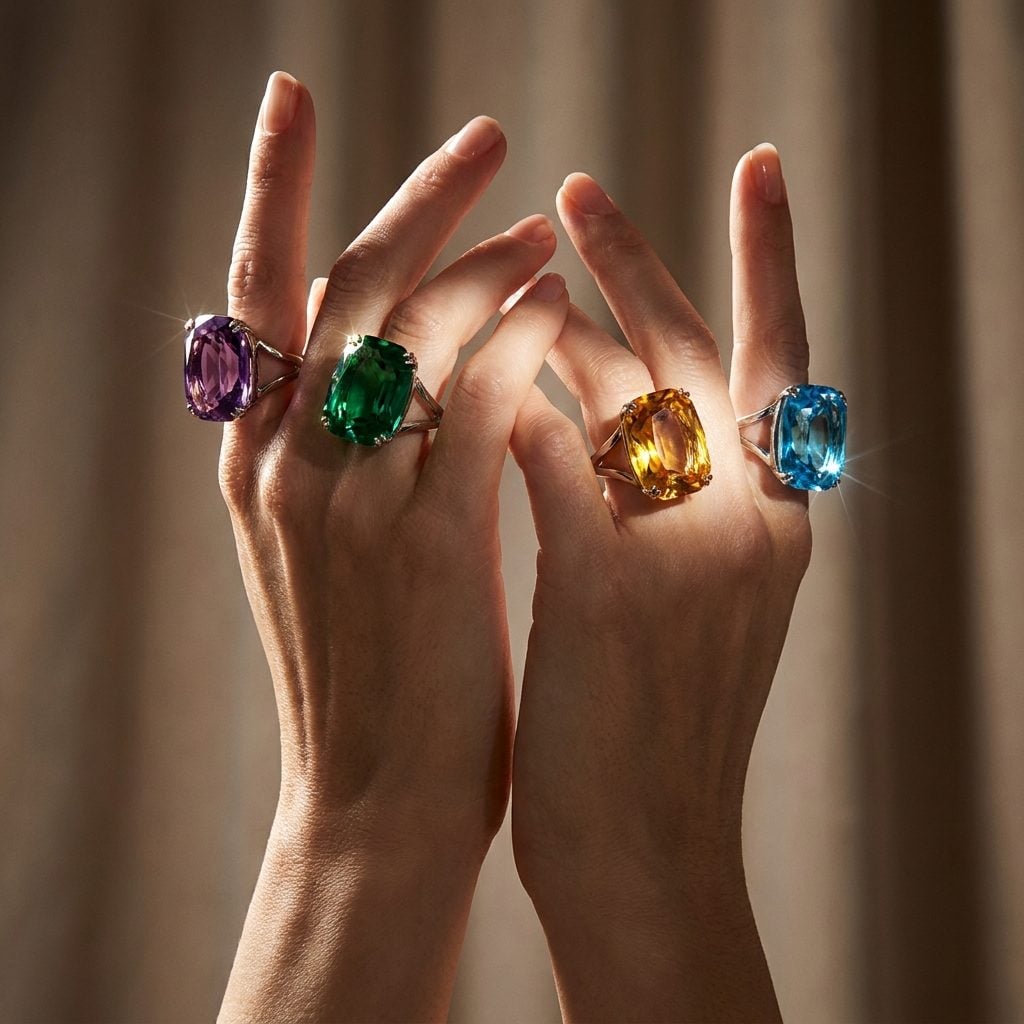
This isn’t the same problem as simply wearing rings on lots of fingers. Here, every ring wants to be the statement ring.
Four large stones, four different shapes, four separate focal points. The eye doesn’t know which one deserves the close-up, so none gets it.
If you want multiple rings, vary their visual weight. Let one large stone lead while slimmer bands and smaller forms create rhythm around it. A hand can carry plenty of jewelry when every piece isn’t demanding top billing.
12. A Long Pendant Breaking a Clean Tailored Line
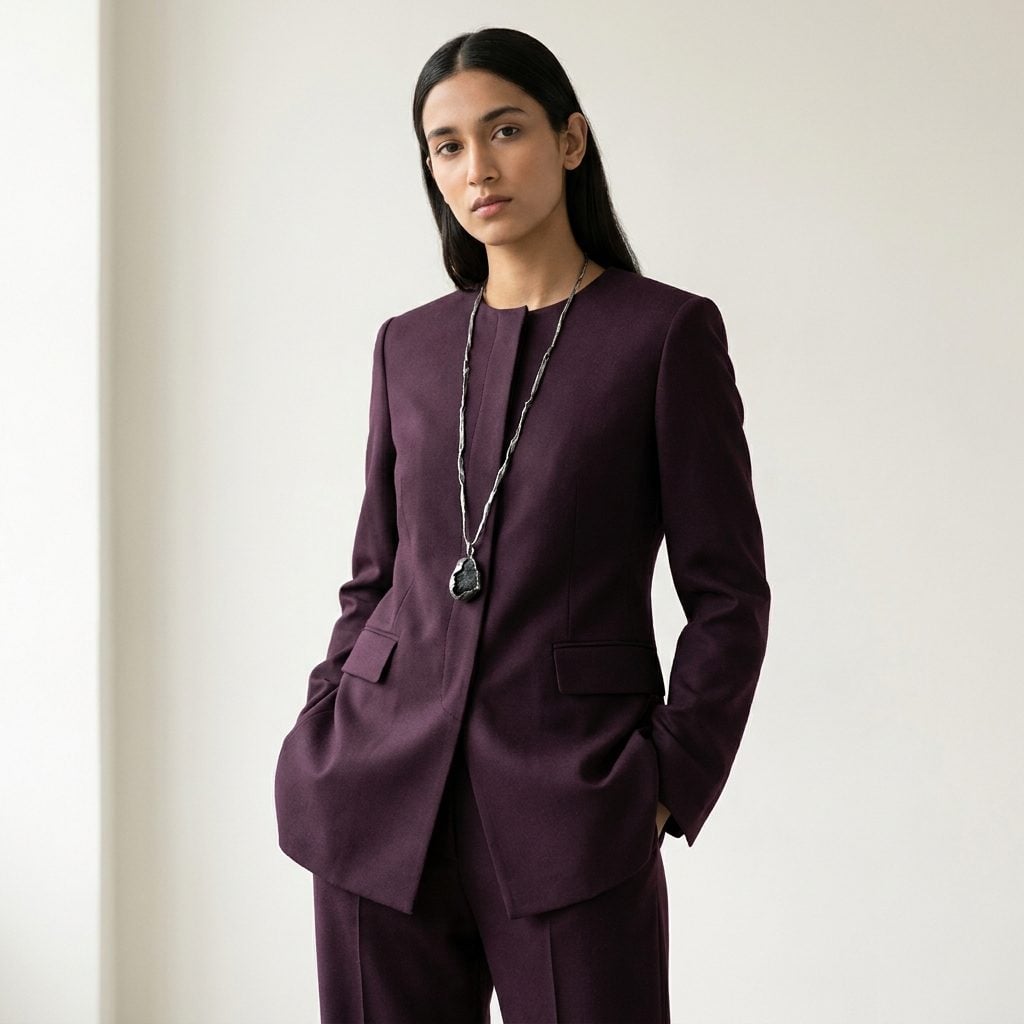
A long pendant can create a terrific vertical — until the outfit already has a stronger one. This plum suit has a beautiful uninterrupted line built into the tailoring. The extra-long necklace swings across the jacket opening and interrupts it.
The necklace isn’t intrinsically wrong. Its direction is simply fighting the architecture of these clothes.
A shorter chain at the collarbone would leave that strong vertical intact. Save the waist-length pendant for softer knits, dresses, or open layers where it can create the long line rather than cut across one.
11. Too Many Logo-Heavy Jewelry Pieces at Once
❤️ Would you like to save this?
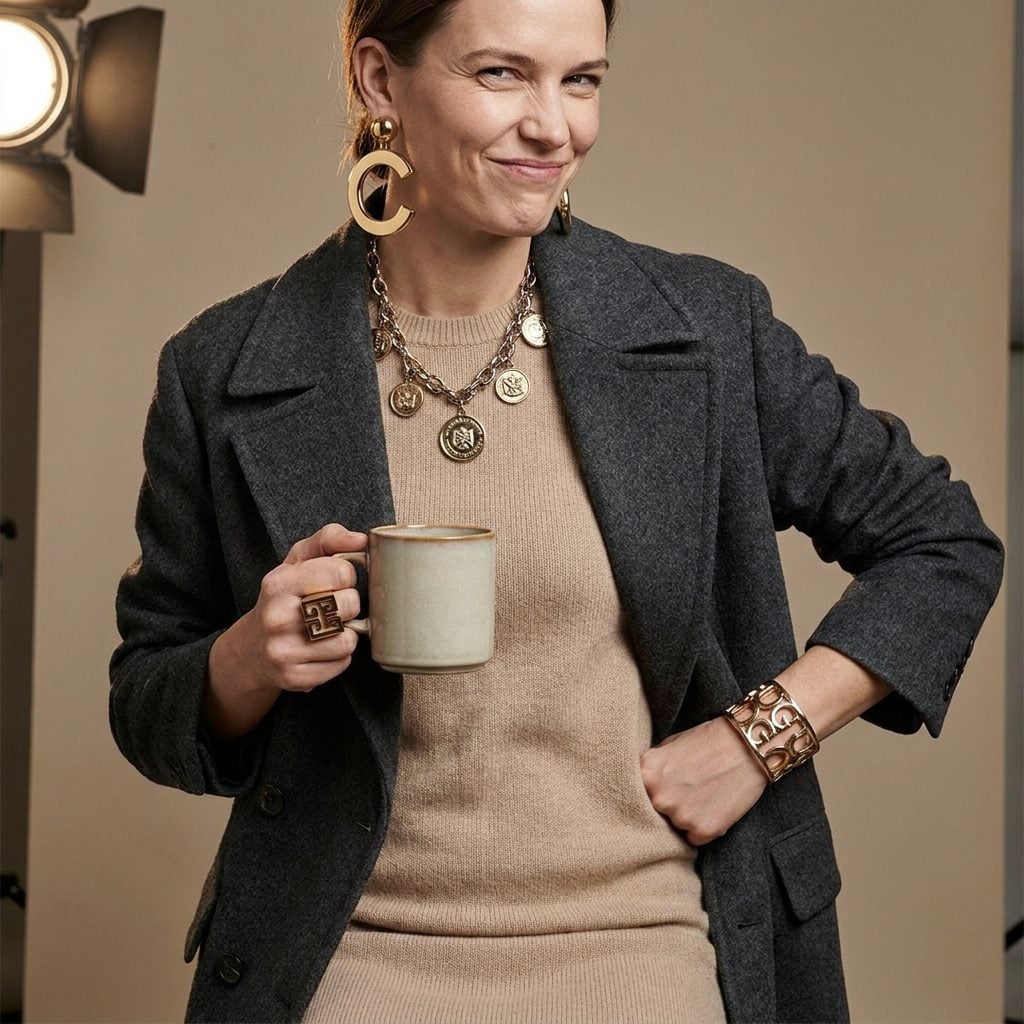
The dress is quiet. The coat is quiet. Then the jewelry starts repeating the same label from four directions: monogram earrings, chain, cuff, ring.
Branded jewelry isn’t inherently the issue. Repetition is. One logo can function as a graphic motif. Repeat it everywhere and the outfit starts becoming more about branding than styling.
Let one recognizable piece have its moment. A monogram cuff against bare skin can look sharp. The entire matching logo family at once turns a wink into a billboard.
10. Earrings Too Large for the Visual Space Around a Short Haircut

Short hair changes the equation because suddenly the entire earring is visible. There is no hair softening its outline or partially obscuring its scale.
That can make enormous earrings look spectacular with a pixie. It can also make them appear much larger than expected. In this case, the wide circles extend well beyond the jaw and dominate the entire head-and-neck area.
The answer isn’t “short hair means small earrings.” It’s to judge the earring at full visual strength. If these hoops are stealing more attention than you want, try a narrower hoop, sculptural stud, or lean drop. With cropped hair, every millimeter gets seen.
9. Peeling or Worn Plating That Reveals the Base Metal Underneath
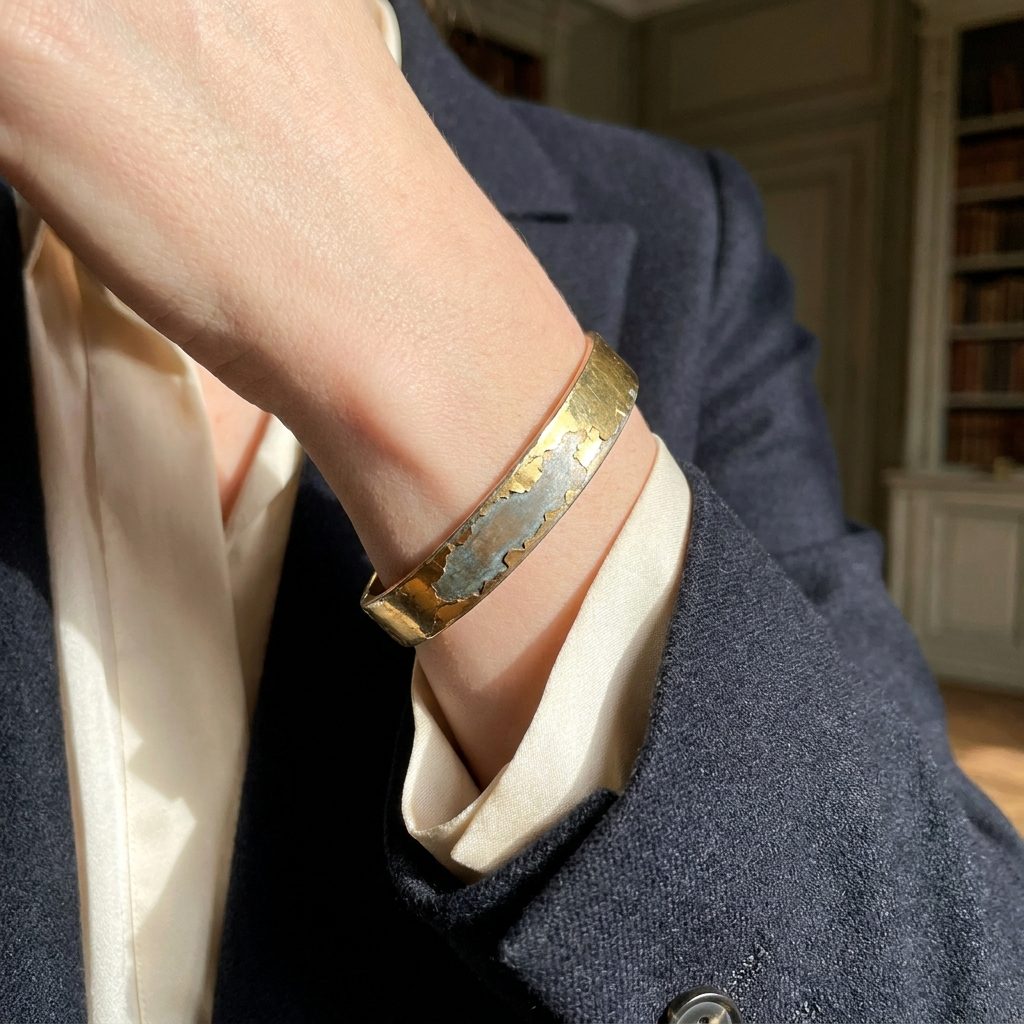
Here is a woman who did everything right. The blazer sits cleanly at the shoulder, the silk catches the light, and then the bracelet reveals worn areas where the outer finish has disappeared.
That is different from simple surface tarnish. If plating itself has worn through to the underlying metal, polishing cannot recreate the missing layer.
Replating may be worthwhile for a piece you love. For jewelry that gets heavy everyday wear, consider materials and construction designed to tolerate more friction. Gold-filled jewelry generally contains a substantially thicker bonded gold layer than ordinary electroplating; vermeil uses gold plating over sterling silver but can still wear with time.
8. Dramatic Earrings Plus an Equally Dramatic Necklace

Both pieces are gorgeous, which is exactly how this happens. Long sculptural earrings could carry the emerald dress by themselves. The broad collar necklace could too. Put both around the same face and the drama doubles without necessarily getting better.
This is less about how much jewelry you’re wearing than where you’ve concentrated it. All the visual weight has been pushed into one small zone.
Choose which feature you want framed. Keep the long earrings and open the neck, or keep the collar and drop the earrings closer to the lobe. Maximum impact doesn’t always require maximum inventory.
7. Wearing a Ring Guard or Sizer That Peeks Out Beside the Band
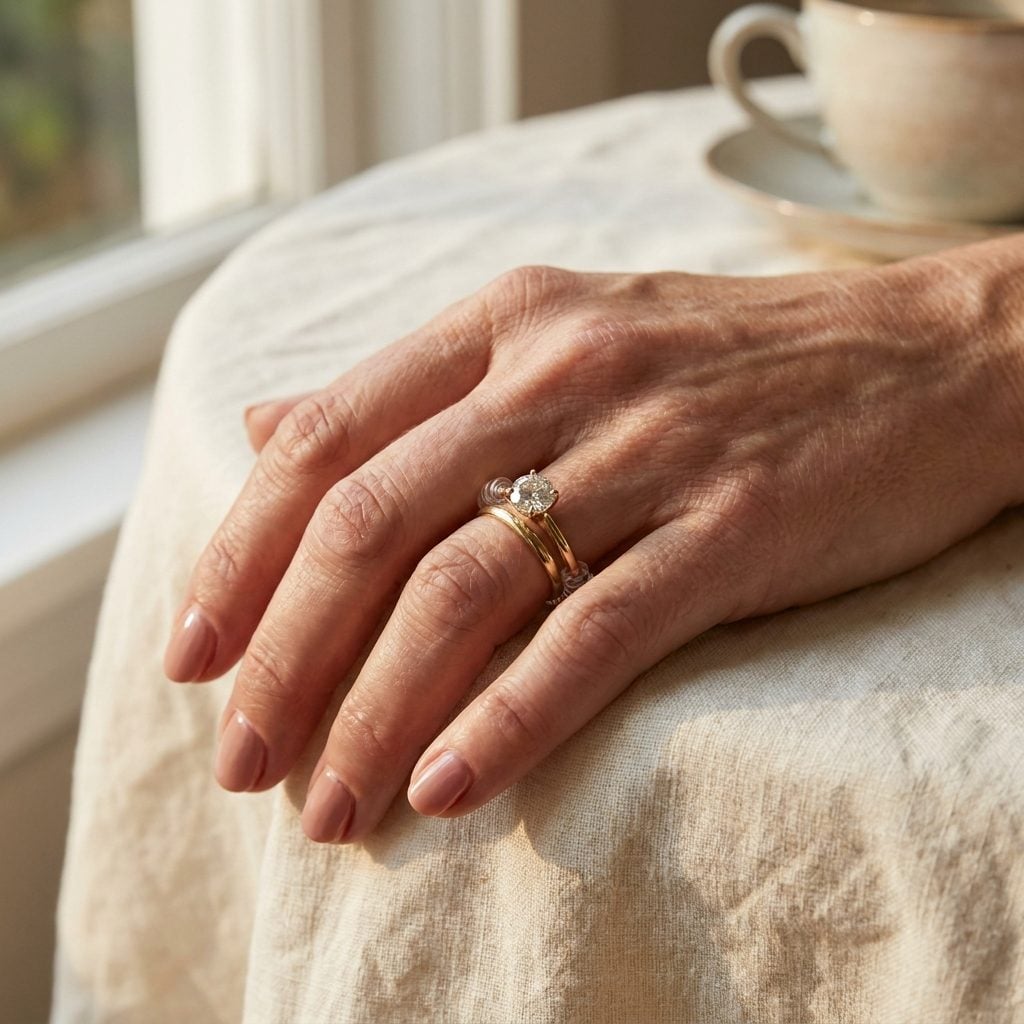
The ring still matters. Your finger size changed. So you slipped on a clear guard and moved on with your life — perfectly reasonable until that little coil rotates into view beside an otherwise beautiful band.
Temporary sizers are useful, but they’re much less charming when they become part of the visible design.
If the fit change is lasting, ask a jeweler about resizing, sizing beads, or another appropriate internal adjustment. The right solution depends on the ring’s metal, construction, stones, and how much the size needs to change.
6. Earring Backs Pinched So Tight the Lobe Folds Forward

The back gets pushed too far up the post, the lobe folds, and suddenly the earring tips forward like it’s making an escape attempt.
On studs and smaller hoops, this tiny fit problem can make an otherwise beautiful pair sit awkwardly.
Ease the backing to a secure but comfortable position so the earring sits properly. Heavier earrings may benefit from larger supportive backs or stabilizing discs designed to distribute the weight across more of the lobe. Well-set jewelry should look as though it belongs there — not as though gravity is winning.
5. A Necklace Clasp Rotated Around to the Front
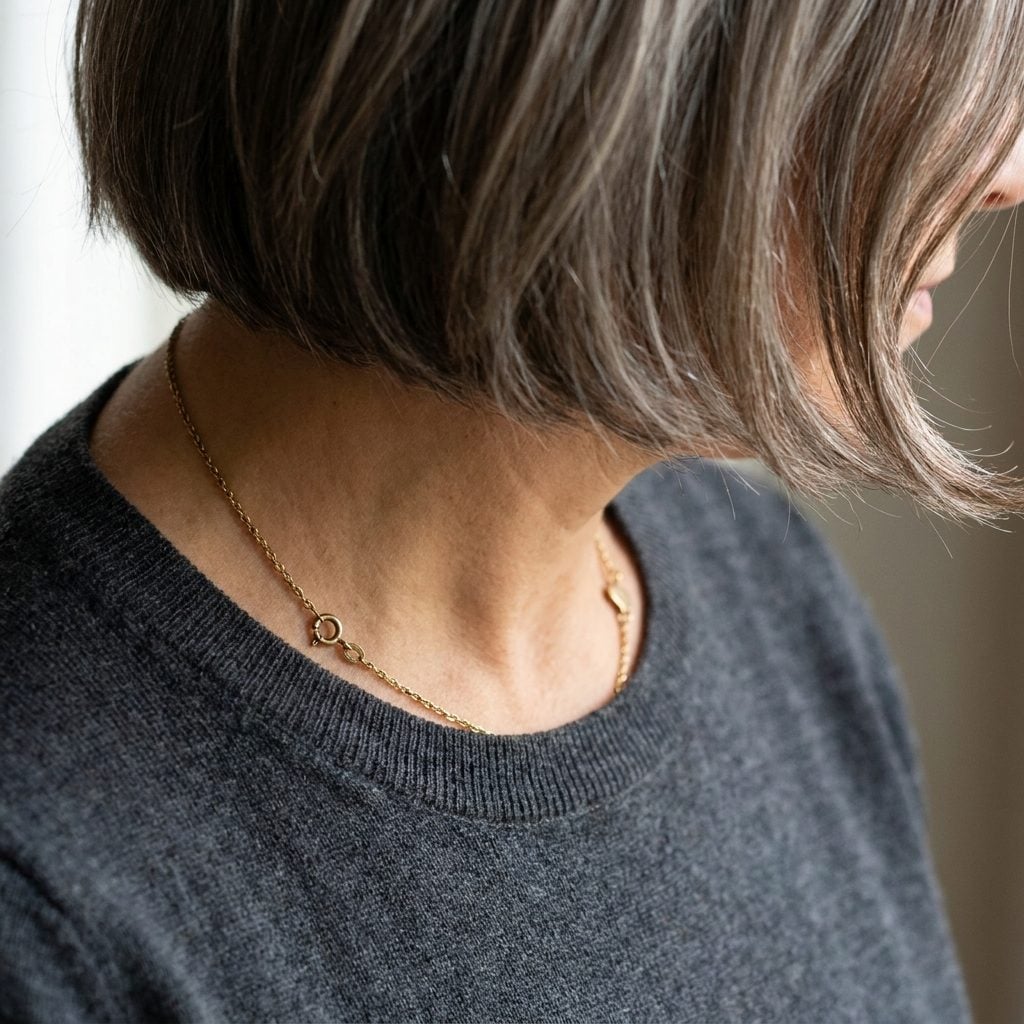
Half the day passes and the clasp has migrated around to the front, hanging beside the pendant like an accidental second charm.
Nobody styles this on purpose. Necklaces shift as we move, and some designs migrate more stubbornly than others.
Slide the clasp back when you notice it. If a favorite necklace does this constantly, a jeweler may be able to suggest a balancing adjustment, different clasp, extender, or other modification suited to the actual chain. If you’re replacing the piece entirely, the proportions of a slightly heavier gold chain may behave differently — but the best fix depends on the necklace.
4. A Pendant Threaded on a Chain Two Gauges Too Thin
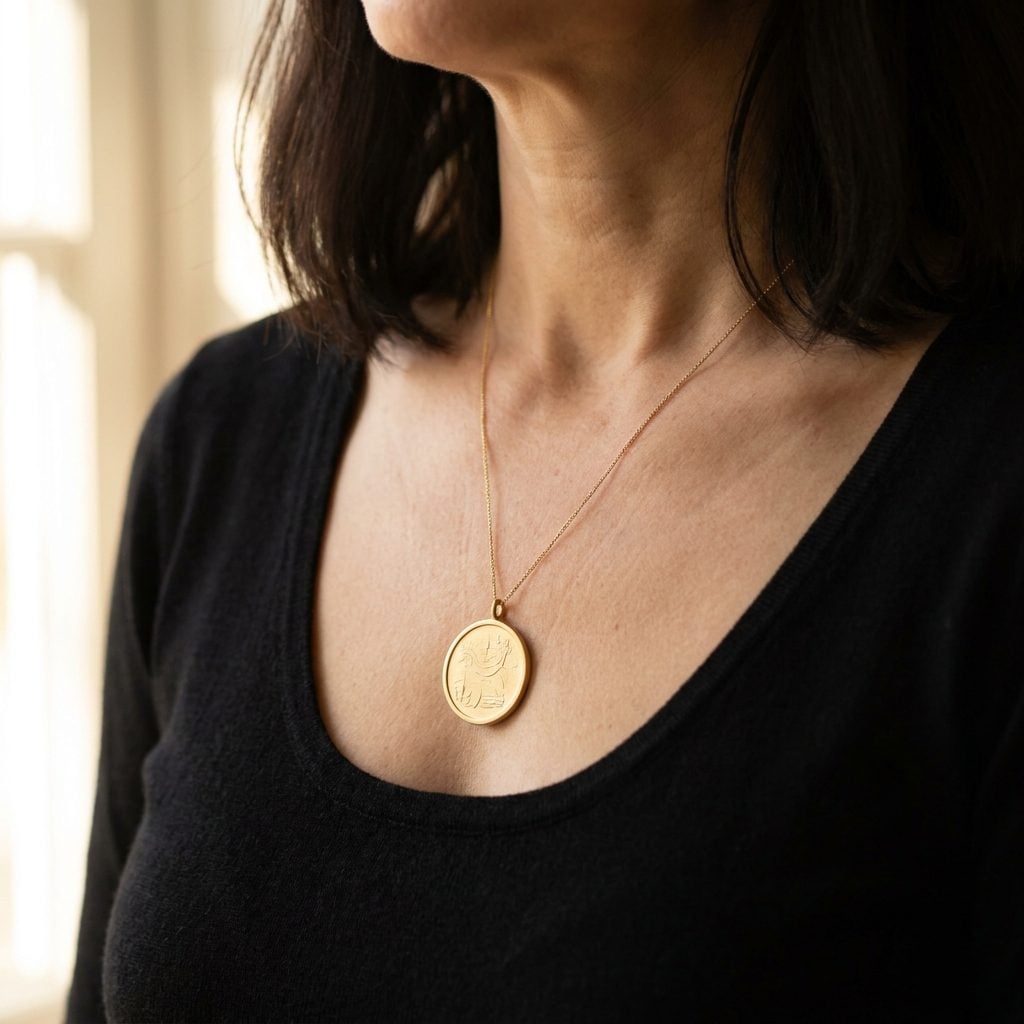
Beautiful medallion. Wisp of a chain. The two were never properly introduced, and the mismatch becomes obvious as the pendant drags those delicate links into a strained-looking droop.
A pendant with real visual weight usually benefits from a chain that can answer it — perhaps a rolo, curb, box, or another link substantial enough for the pendant’s size and weight.
The right match isn’t only aesthetic; the chain also has to be suitable for carrying the pendant safely. Get those proportions aligned and the necklace becomes one coherent object instead of a heavy charm hanging from a thread.
3. Adding One Statement Piece After the Outfit Was Already Finished
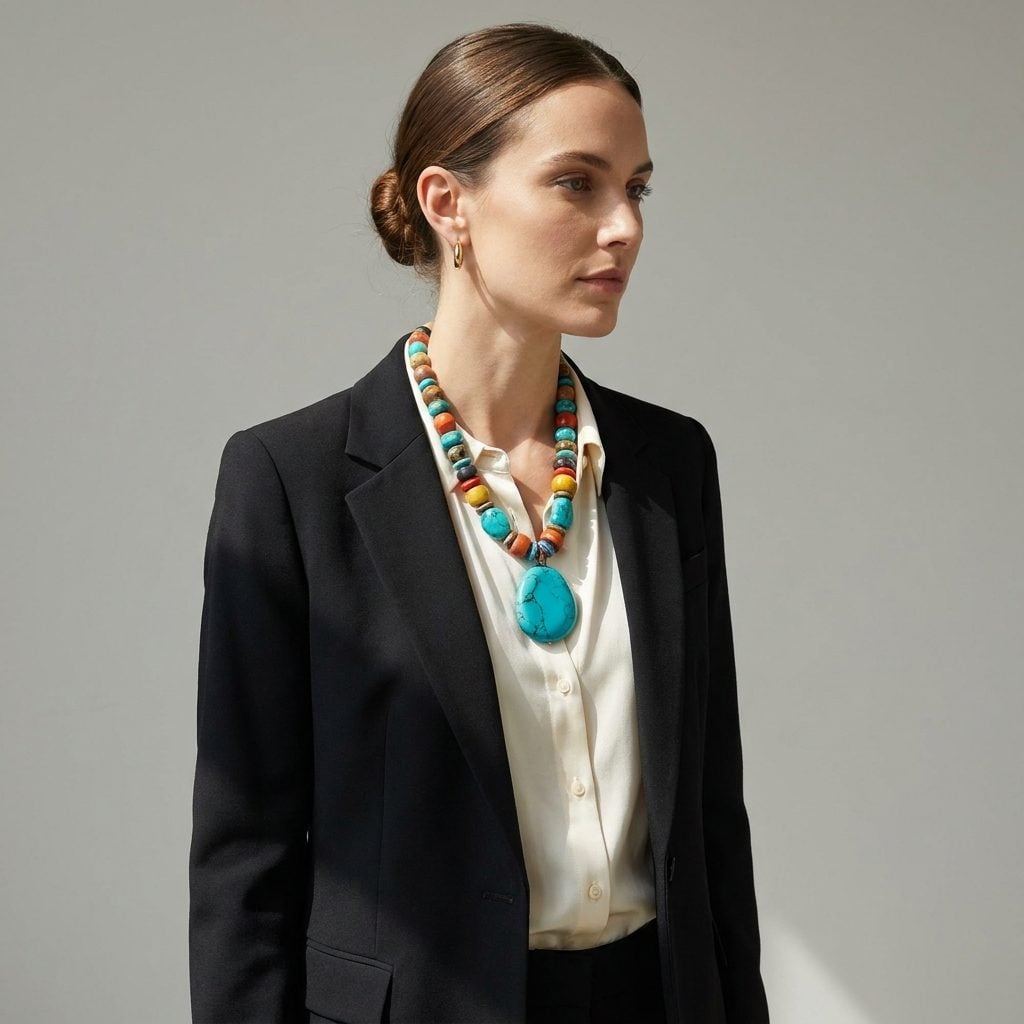
The look was done. Black blazer, ivory silk, camel trousers, small gold hoops, quiet watch. Everything knew exactly what it was doing.
Then came the multistrand necklace.
The necklace isn’t bad. That’s what makes this mistake so seductive. Nothing about the outfit required another idea, but that empty inch of skin whispered, “Surely we can fit something else.”
Look at the outfit before you add the statement piece. If it already feels complete, believe your first draft.
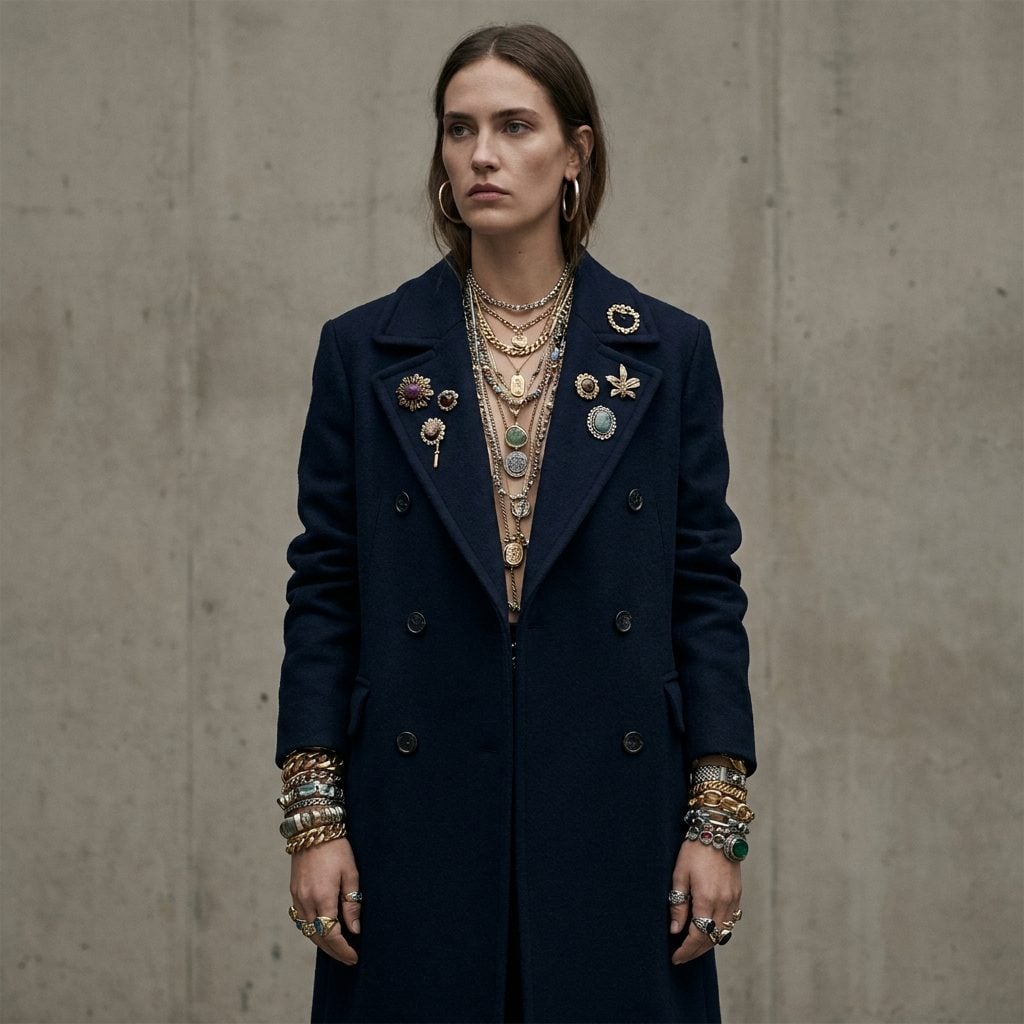
2. Wearing Every Favorite Piece at Once
❤️ Would you like to save this?
This is the sentimental version of over-accessorizing, and it’s much harder to spot because every single piece has earned its place in your jewelry box.
Navy wool coat, cream cashmere, straight trousers, oxblood pumps — faultless. Then start counting. Two necklaces. Big hoops. Brooch. Statement watch. Bracelets. Rings across both hands. Nothing is ugly. Nothing is random. There is simply too much biography happening at the same time.
The cure isn’t minimalism. Rotate your treasures. Let tonight belong to the brooch and tomorrow to the rings. Jewelry looks more valuable when you can actually see it.
The pieces left in the jewelry box can do almost as much for an outfit as the pieces you put on.
1. Earrings and a Necklace Fighting for the Same Two Inches of Space

The problem isn’t that both pieces are bold. It’s that they’re practically sitting on each other’s laps. Jaw-length drops and a close collar necklace occupy the same narrow strip between ear and collarbone, compressing everything around the face.
Give them vertical distance.
Keep the drops and move the necklace lower onto the chest, or keep the short collar and switch to earrings that sit closer to the lobe. There is no universal magic necklace length — bodies, necklines, and earrings vary too much for that — but visible separation is easy to recognize in the mirror.
This is one of those jewelry problems that hides in plain sight. Each piece looked fabulous when you bought it separately. Nobody warned you they’d become roommates once you put them on together.