❤️ Would you like to save this?
Midi dresses and skirts have become one of fashion’s safest bets.
They’re long without being floor-length. They offer plenty of coverage without feeling overly formal. Retailers can sell them to women across a huge range of ages. And they’re everywhere.
Which is exactly the kind of assumption nobody checks. Midi goes in the line because midi goes in the line.
Our readers aren’t responding to it the way the assortment would suggest.
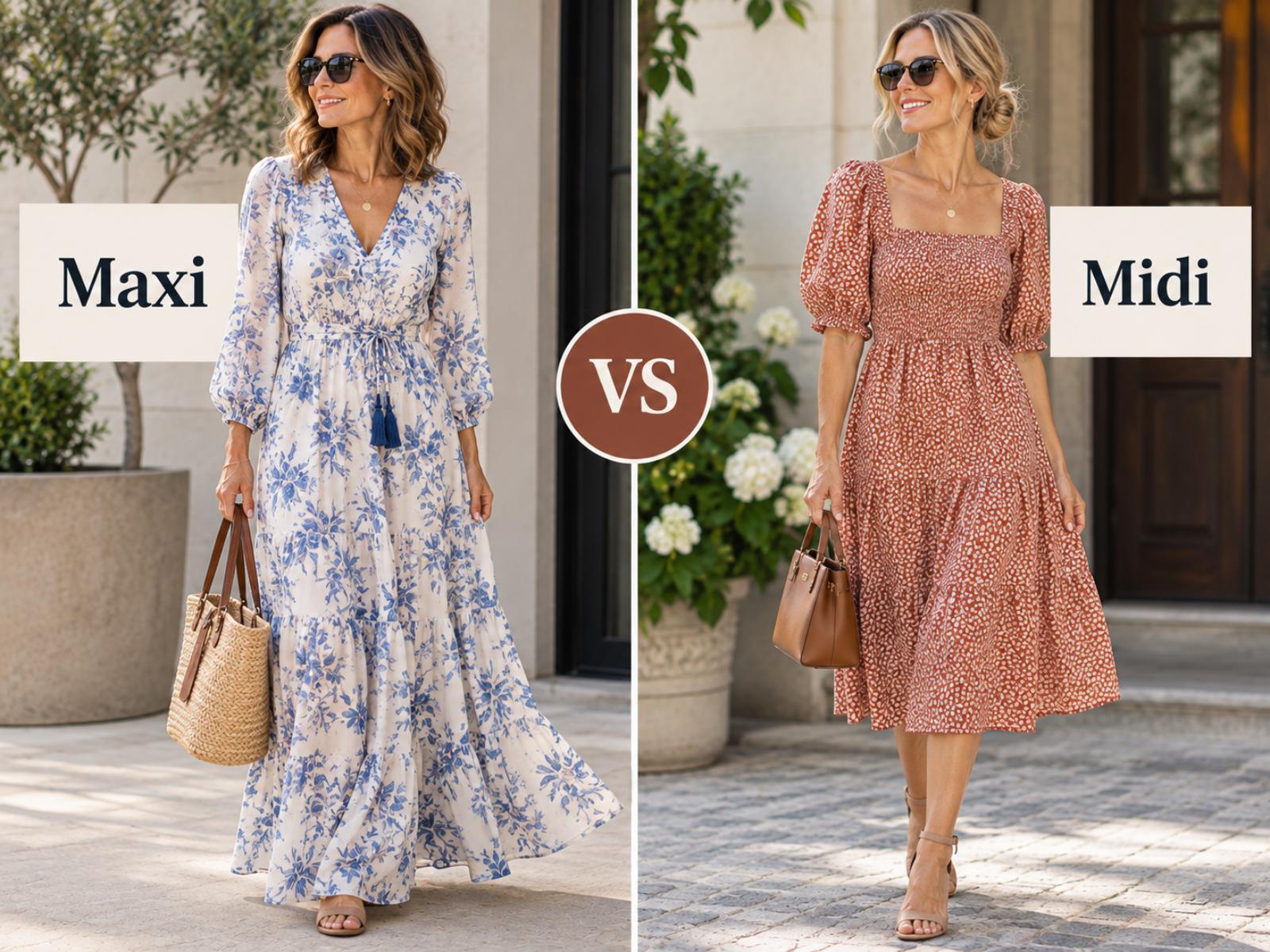
In ThreadCurve’s reader preference data, maxi and floor-length fashion recorded a Preference Index of 156.
Midi came in at just 81.
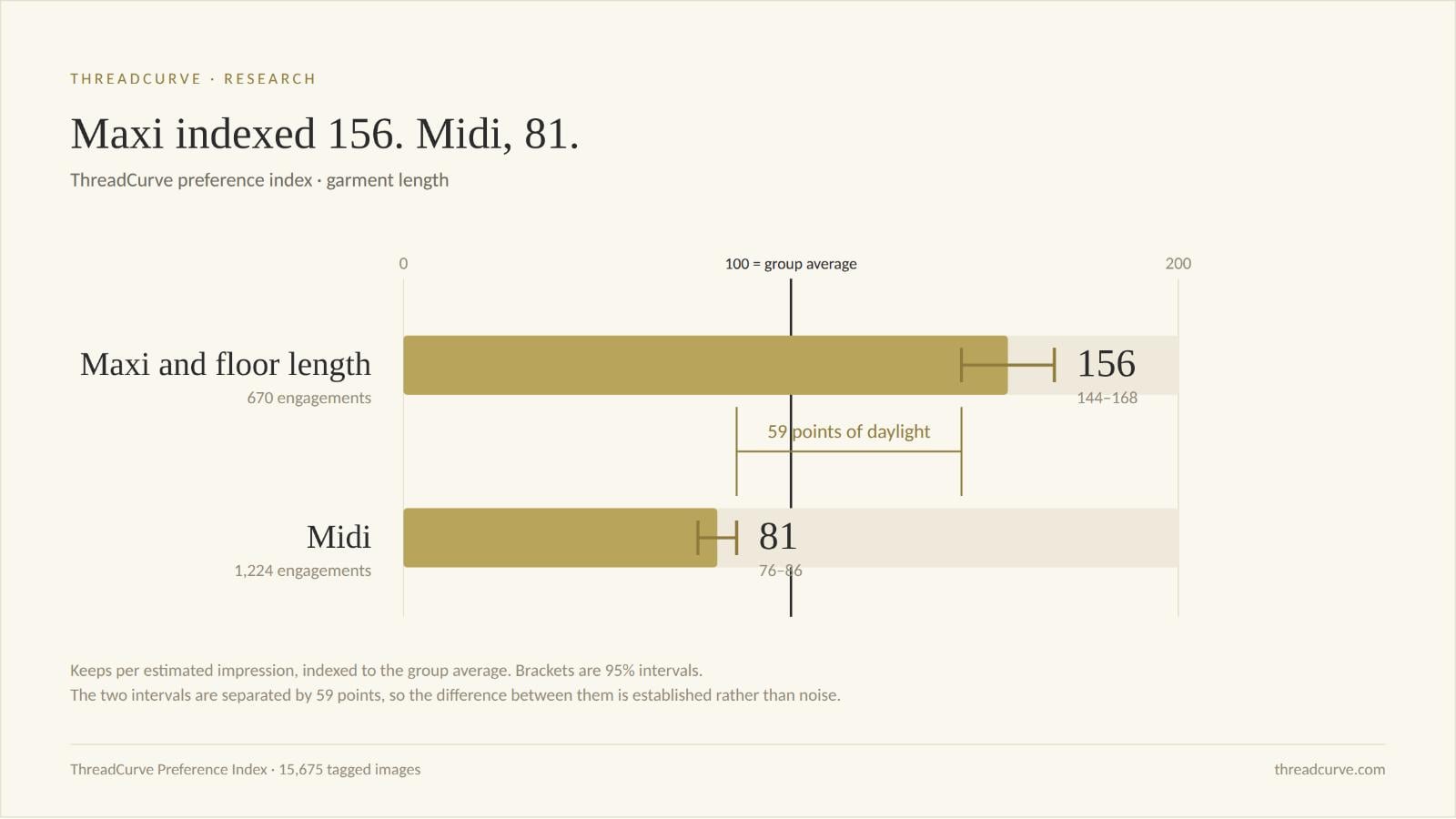
That’s nearly a 2-to-1 difference, and it isn’t close enough to argue with.
Maxi Is Beating Midi by a Huge Margin
ThreadCurve’s Preference Index measures reader keeps—love and save actions relative to estimated image exposure—against the average for the relevant fashion group.
An index of 100 represents average performance.
| Length | Preference Index | 95% CI | Engagements | vs. group average |
|---|---|---|---|---|
| Maxi / floor length | 156 | 144–168 | 670 | +56% |
| Midi | 81 | 76–86 | 1,224 | −19% |
This isn’t a case where some obscure fashion choice produced a spectacular number based on 40 reactions.
Maxi runs from 144 to 168. Midi runs from 76 to 86. Both ranges sit entirely on their own side of the average, and at their closest point they’re still 59 index points apart.
That’s the widest clean gap I’ve measured in the ThreadCurve data.
And it isn’t a sample-size story. Midi has almost twice as many engagements as maxi—1,224 against 670. The weaker result is the one we know more about.
The Midi Has Become Fashion’s Default Length
There’s a reason retailers love midi lengths.
They’re safe.
A midi dress doesn’t have the impracticality that can come with a floor-sweeping maxi. It provides more coverage than a mini. It works for the office, dinner, weddings, vacations and everyday wear.
If you’re designing something to appeal to a broad customer base, midi makes a ton of sense.
But there’s a downside to becoming the default.
You start looking like the default.
Maxi Has Something Midi Often Doesn’t: Drama
This part is interpretation. The data tells us what readers responded to, not why.
But there’s a plausible explanation.
Maxi and floor-length garments create a stronger silhouette. More movement. More fabric. More vertical line. A long skirt or dress can completely change the shape of an image.
Midi is often more practical. Maxi can be more dramatic.
And when we’re measuring response to fashion imagery, that distinction could matter quite a bit.
A woman standing in front of a mirror deciding what to buy and a woman scrolling through fashion images aren’t making the same judgment.
One is asking, “Would I wear this?”
The other may simply be thinking, “Damn, that looks good.”
Which Is Exactly What This Data Is For
Our data doesn’t show that maxi dresses outsell midi dresses. We aren’t measuring transactions. Nobody in this data bought anything.
What it does is tell you which assumptions are worth questioning.
“Midi is the safe length” is an assumption. It’s held widely enough that it shapes entire assortments without anyone testing it. And in front of an image, with our readers, it’s the assumption that doesn’t hold.
That’s a different kind of useful than a forecast. A forecast tells you what to do. This tells you where you might be wrong, which is cheaper to act on and much harder to get anywhere else.
It matters commercially because images are how an enormous amount of fashion gets sold. Product pages. Emails. Paid social. Pinterest. Lookbooks. Homepage heroes.
Before somebody can buy the dress, something has to make her stop and look at it.
The Experiment I’d Run
If I ran a women’s fashion retailer, I wouldn’t look at this and slash my midi inventory.
I’d do something much cheaper first.
I’d test the photography.
Take comparable midi and maxi looks and put them into paid social. Try maxi in email hero images. Test floor-length against midi on Pinterest. Same model, similar colors, similar styling wherever possible.
Then see whether the engagement gap shows up again.
That’s the appeal of a finding like this. You don’t need to bet the fall collection on it. You can test it for a few hundred dollars, using inventory you already own and photography you were going to shoot anyway.
There Could Be More Going On Here
Garment length isn’t isolated from everything else in an outfit.
Maxi garments could be more likely to appear in styles our readers already prefer. They may use different fabrics. They may be photographed differently, or appear more often in vacation and occasion imagery. Season could matter. Age could matter. Even footwear could matter.
So I’m not prepared to say the extra length itself caused the difference. That isn’t something observational preference data can establish.
There’s also a question the index can’t answer on its own: whether midi’s 81 comes from a broad, uniform weakness or from a strong minority dragged down by a weak majority. Those are completely different business problems, and our current data can’t separate them.
What we can say is simpler:
Maxi and floor-length fashion imagery is generating a substantially stronger preference signal than midi-length imagery in our data, by a margin that holds at 95% confidence.
The Numbers at a Glance
| Metric | Maxi / floor | Midi |
|---|---|---|
| Preference Index | 156 | 81 |
| 95% confidence interval | 144–168 | 76–86 |
| Difference from average | +56% | −19% |
| Engagements | 670 | 1,224 |
| Relative Preference Index | 1.93X | 1.00X |
What I’d Look at Next
The next step is breaking the result apart.
Does maxi beat midi among dresses specifically? What about skirts? Does the result hold for women presented as 40+, 50+ and 60+? Does it change by body type? Are casual maxis driving it, or dressier floor-length looks?
And most interestingly: what happens when garment length is combined with the other strong styling signals we’re seeing?
That’s where this data becomes much more useful than declaring one length the winner.
The Takeaway
Midi may be one of the safest lengths in women’s fashion.
Our readers aren’t rewarding it that way.
Maxi and floor-length looks recorded a Preference Index of 156. Midi came in at 81. That’s a 1.93X difference, with 59 points of daylight between the two confidence intervals—and the larger sample sits on the losing side.
I wouldn’t read that as an instruction to stop selling midi dresses.
I’d read it as something more useful:
Maybe the safest length in the assortment isn’t the one that belongs in the hero image.
About the Data
ThreadCurve measures reader interactions with individual fashion images. The Preference Index compares keeps—love and save actions relative to estimated image exposure—against the average for the relevant group. An index of 100 represents average performance.
This is observational image-preference data, not sales or purchase-intent data. Impressions are sampled and scaled estimates, and results are most useful for comparisons within the dataset. Where two intervals overlap, no difference between those values is claimed.
The current ThreadCurve export covers 15,675 tagged images across 541 articles.