
Pearls have spent a century refusing to behave. They’ve swung from the necks of Jazz Age partygoers, sat primly above cashmere twinsets, grown to outrageous proportions in the 1980s, and turned up on cotton tank tops as though nobody had ever suggested they belonged in a jewelry box. Every generation inherits the same little white spheres. Every generation finds a new way to cause trouble with them.
Sometimes the rebellion amounts to two inches of chain, a clasp moved to the front, or a perfectly respectable strand acquiring a safety pin. Elsewhere, pearls abandon the necklace altogether, climbing lapels, tracing seams, and dangling from chains that connect an ear to a shoulder. The material remains familiar. The rules surrounding it have become almost unrecognizable.
These 30 looks move through period-inspired styles from the 1920s to the 1990s before arriving at contemporary designs that barely resemble traditional jewelry. Along the way, the pearl loses its innocence, finds its swagger, and proves remarkably willing to go wherever fashion takes it.
FYI, thanks to AI imagery software, we’re able to create very specific fashion and hairstyle examples to illustrate the points being made. In some cases, imagery is exaggerated to hammer home the point. Also, assume links that take you off the site are affiliate links such as links to Amazon. this means we may earn a commission if you buy something.
30. Three Strands, Three Lengths, and Chanel’s Favorite Jewelry Rebellion (1924)
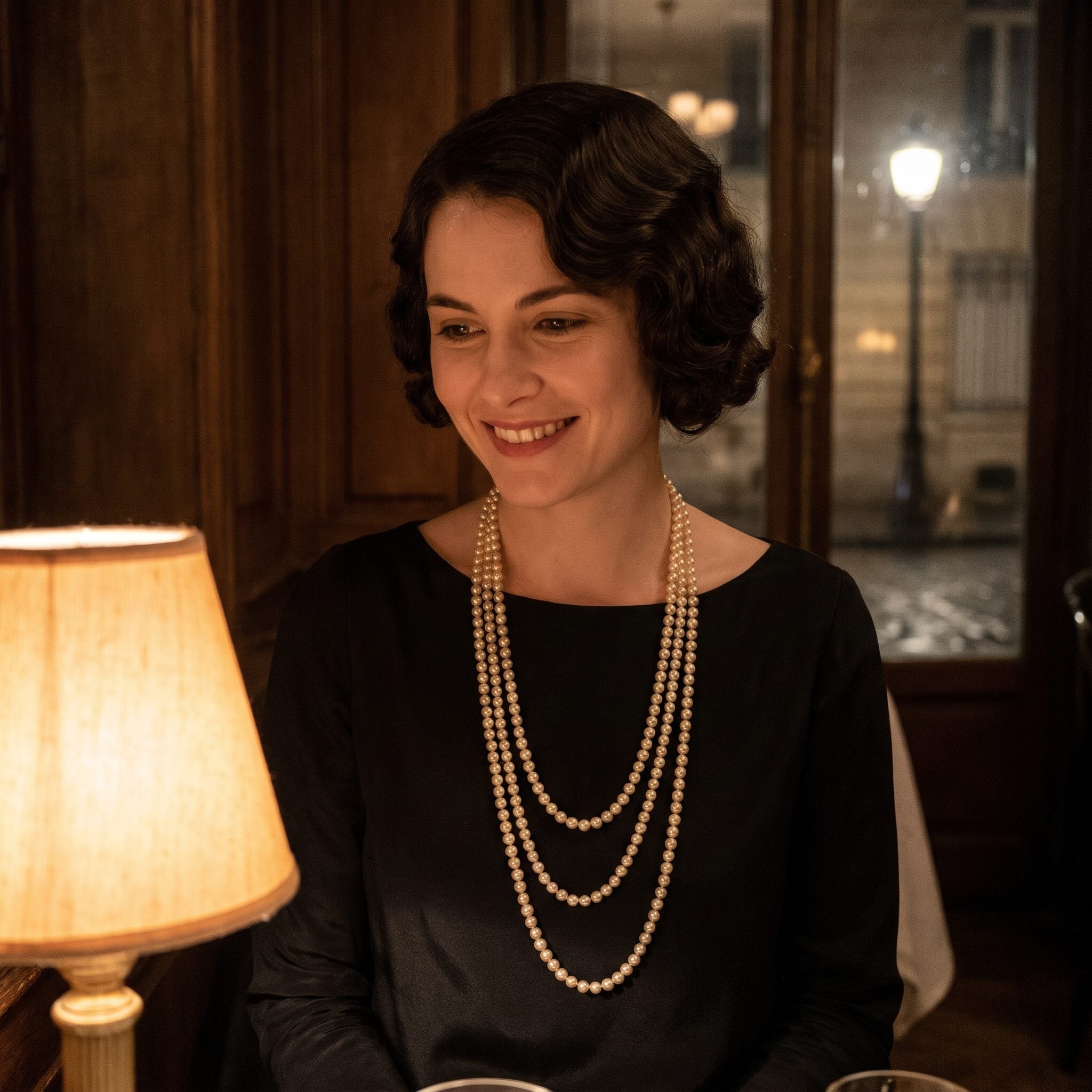
Enough pearls to make a conventional necklace look distinctly underdressed. The Chanel-inspired approach took the pearl out of its precious little box and gave it room to swing, overlap, and occupy an entire bodice.
One strand sits near the collarbone, another falls across the chest, and the longest extends toward the waist. Against black crepe, the pale beads establish three separate curves, turning an otherwise restrained evening dress into a composition built around movement.
Real pearls and convincing imitations could share the same outfit. Coco Chanel helped make that mixture fashionable, challenging the assumption that jewelry needed an impressive pedigree before it deserved attention.
All the visual extravagance of expensive jewels, without requiring every bead to come with a family history.
29. The Pearl Tassel Sautoir That Made Every Turn of the Head an Event (1926)

The sautoir had one considerable advantage over the short pearl strand: gravity. Long enough to fall toward the waist and finished with a tassel, it responded to every movement with a little performance of its own.
Cream beads descend against tobacco-colored silk, their pale surfaces sharply defined by the warm fabric. The V-neck creates an opening for the necklace, while the tassel extends the line well below the neckline.
Unlike a pendant suspended at the throat, the decorative weight sits near the bottom. That changes the balance of the outfit, pulling attention down the torso and giving a relatively simple dress a distinctly elongated silhouette.
The long strand supplies the elegance. The tassel gets the final word, usually several inches below everyone else’s.
28. Champagne Pearls, Black Beads, and an Evening Look With a Darker Streak (1929)

Ivory pearls have always known how to behave. Add faceted black beads and the conversation changes. Dark surfaces interrupt the soft, rounded gleam with sharp flashes of reflected light.
Against plum velvet, the champagne-colored pearls bring warmth while the black elements introduce a harder graphic rhythm. Alternating finishes give the necklace depth, making individual sections stand apart rather than merge into one continuous strand.
The combination recalls the long tradition of pairing luminous pearls with darker ornamental materials, including jet, which was particularly prominent in nineteenth-century jewelry.
No enormous pendant, no elaborate setting. One pale bead after another, then a flash of black that changes the entire mood.
27. The Twinset Got Its Pearls, and Suddenly Everything Looked Deliberate (1953)

After the swinging ropes of the Jazz Age, the pearl settled into a much more disciplined arrangement. One strand. One twinset. No tassel threatening to join the conversation.
Dove-blue cashmere provides a soft background for a graduated necklace, its smallest beads positioned near the clasp and its largest at the center. That subtle progression establishes a focal point without requiring a pendant.
The jewel neckline follows the necklace’s curve, allowing the two shapes to sit together rather than compete. With the cardigan buttoned and the knitwear kept simple, the pearls supply the outfit’s clearest decorative element.
Midcentury restraint at its most exacting. The necklace doesn’t need to be enormous. Every bead knows precisely where it belongs.
26. A Portrait Collar Gave These Little Pearls Their Own Frame (1956)
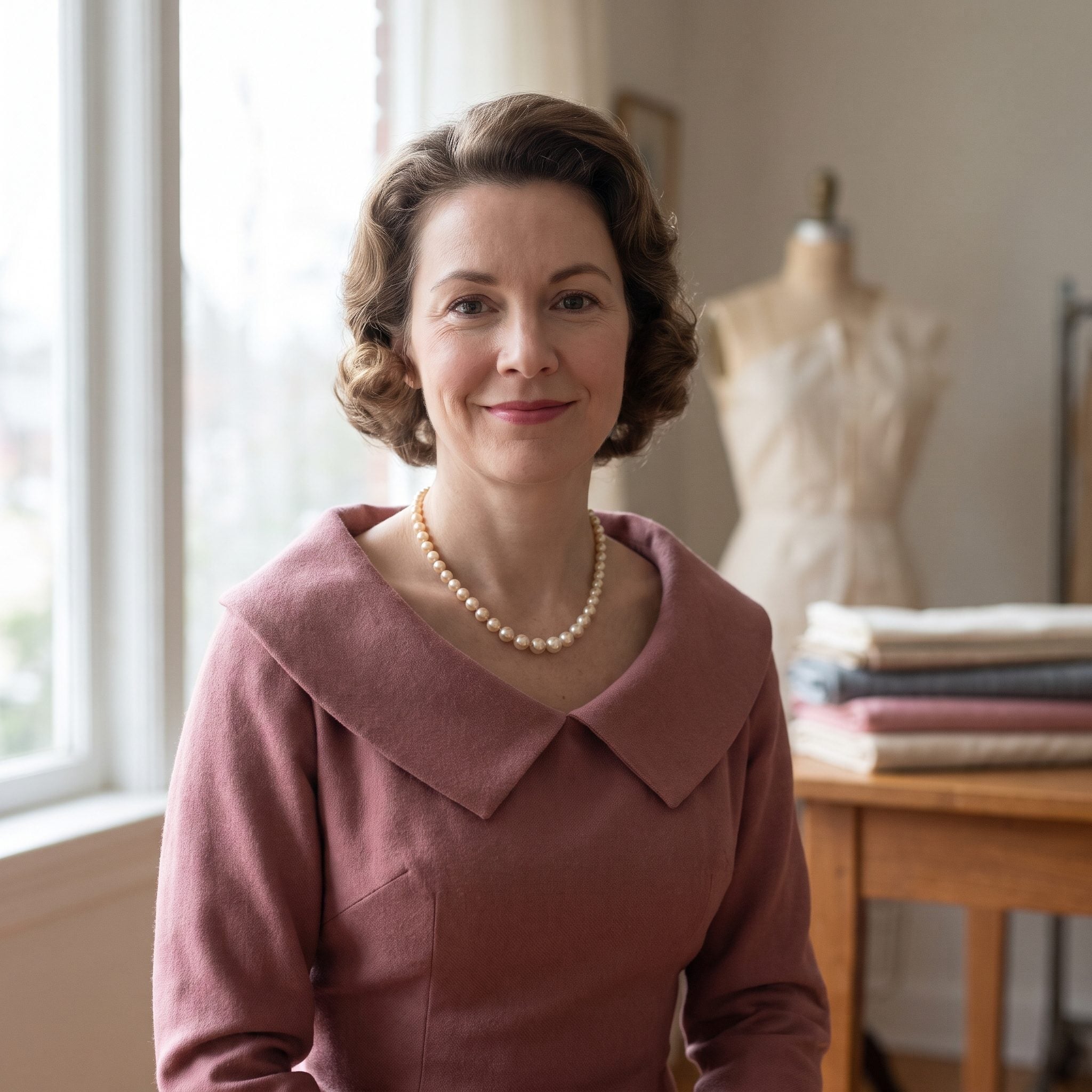
The portrait collar turns the space around the throat into a carefully defined shape. A short pearl necklace sits inside that opening, occupying the center without extending beyond its borders.
The beads are small and relatively uniform, producing an even line rather than the graduated emphasis of the previous look. Against rose-colored wool, their cream finish takes on a warmer appearance.
The collar’s broad sweep gives the necklace room to register, while its folded fabric provides considerably more volume than the jewelry itself. Generous tailoring surrounds a remarkably modest strand.
Those little pearls would look entirely different against a plain crewneck. Here, the collar has done most of the architectural work before the necklace even arrives.
25. One Ivory Strand, Black Duchess Satin, and a Sliver of Bare Skin (1959)
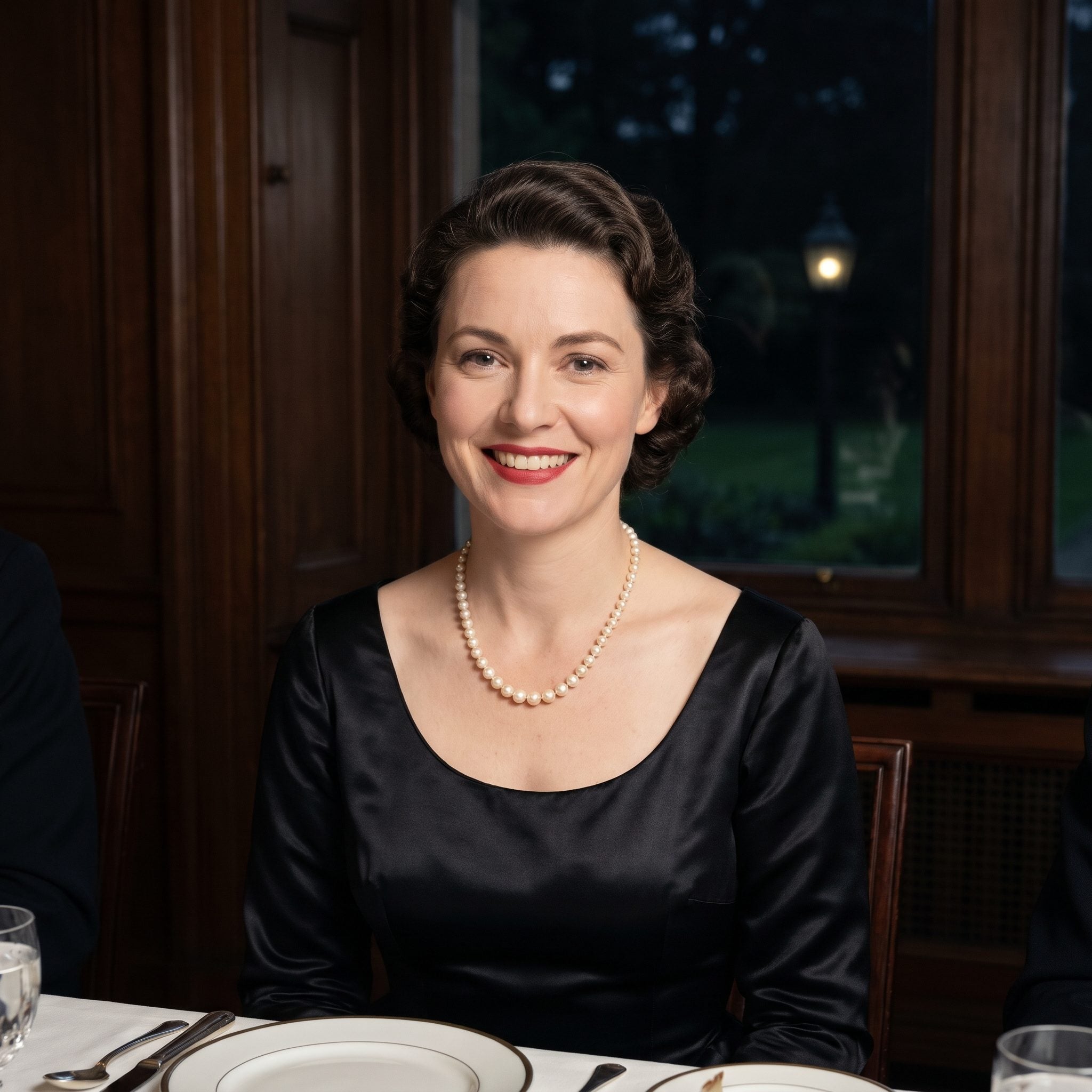
The most interesting part of this necklace may be the space beneath it. The ivory strand sits low enough to leave a narrow band of bare skin between the pearls and the black satin neckline.
That separation gives each curve its own identity. The necklace follows the throat, the dress follows the bust, and the exposed skin prevents the two from merging into one continuous shape.
Duchess satin brings its own substantial, lustrous surface to the arrangement. Under evening light, the fabric reflects in broad, smooth passages while the pearls catch smaller highlights bead by bead.
No elaborate pendant, no extra strands, no decorative clasp brought around for attention. Move the necklace higher or lower, and the entire composition changes.
Sometimes the most expensive-looking detail is the inch of nothing between two perfectly good things.
24. One Long Pearl Rope Gave a Marigold Mod Shift Something to Swing About (1965)

The marigold shift is almost aggressively simple: straight sides, clean shoulders, and a high bateau neckline. Then a long pearl rope drops down the front, introducing a swinging vertical element to the dress’s otherwise graphic silhouette.
The necklace forms an elongated oval against the saturated fabric. As the wearer moves, the strand shifts independently of the dress, adding an element of unpredictability to the clean-cut shape.
Cream against marigold provides a strong color contrast without requiring another saturated hue. The high neckline leaves an uninterrupted background for the pearls, making their full length visible.
Midcentury pearls had spent years sitting politely near the throat. This rope takes the scenic route toward the waist.
23. Cobalt Blue Met a Double Pearl Loop and Neither Backed Down (1967)

Cobalt blue doesn’t leave much room for hesitation. The mock-neck covers the upper body in one uninterrupted field of saturated color, demanding something equally decisive from the jewelry.
The doubled pearl rope answers with two distinct curves. A shorter loop sits high on the chest, while the longer one extends toward the waist, dividing the blue into separate visual sections.
That compact upper loop relates directly to the raised neckline. Beneath it, the second loop creates length and movement, giving the arrangement enough presence to stand against the brilliant color.
The pearls don’t soften the cobalt into submission. They give the color something to argue with, and both emerge looking sharper.
22. The Pearl Rope Got Knotted Off-Center and Lost Its Good Manners (1969)
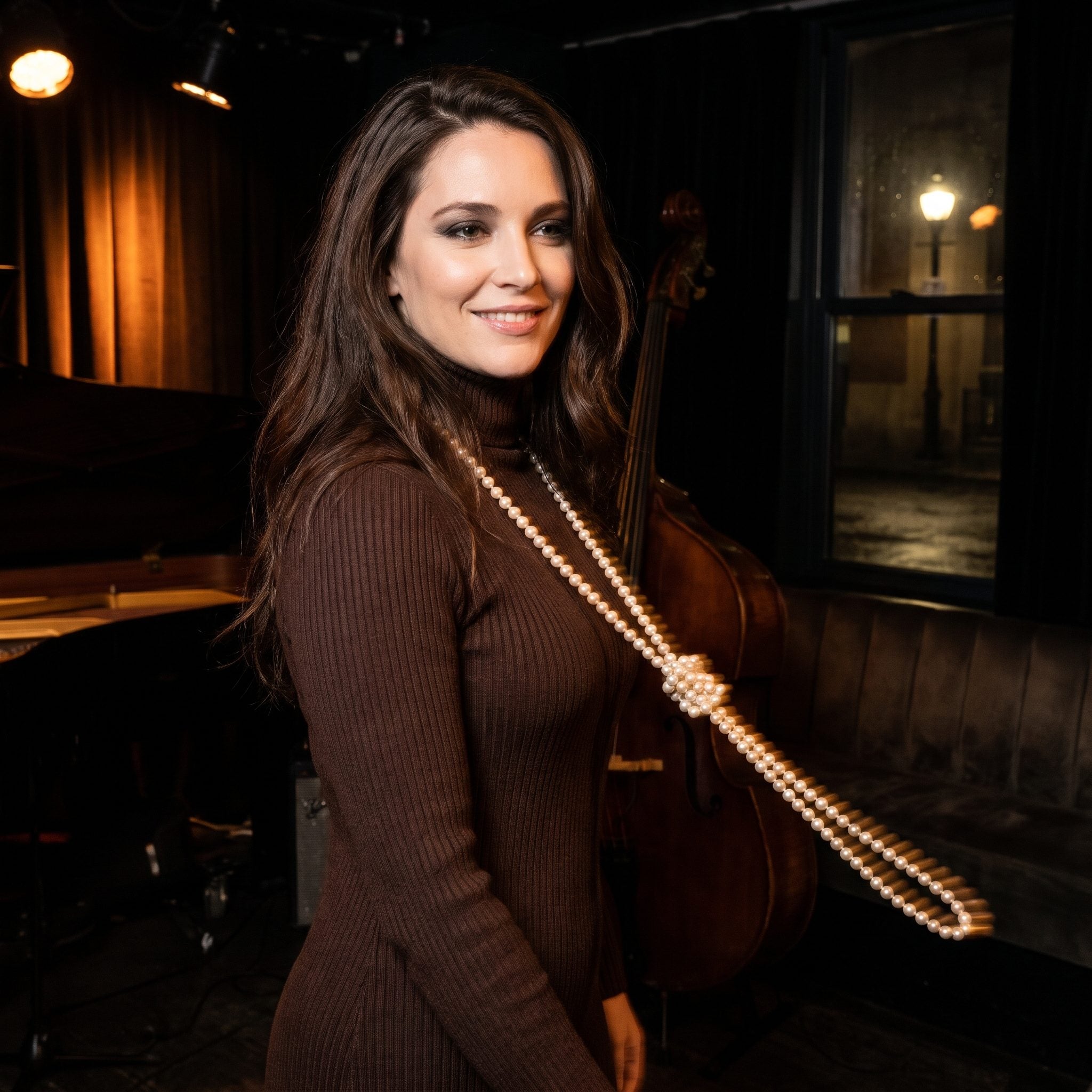
One knot changes the entire behavior of a long pearl necklace. Instead of hanging in a predictable loop, the strand gathers off-center, with a loose tail extending below the knot.
Against a chocolate-brown ribbed turtleneck, the cream beads form a striking irregular line. The knit provides a close-fitting, textured background, while the knot introduces a point of tension that a conventional strand lacks.
The asymmetry gives the necklace a more casual character. The pearls appear arranged rather than formally fastened, with the loose end moving as the wearer turns.
There is no need for a complicated pendant when the necklace can create its own. Tie the rope once, leave the tail hanging, and let gravity finish the design.
21. Pearl Clip-Ons Got Bigger Because the Shoulder Pads Started It (1984)

The shoulders grew. The earrings responded. By the 1980s, an ordinary little pearl stud could disappear beside a power blazer, so costume jewelry began occupying considerably more territory around the face.
These domed faux-pearl clip-ons sit inside folded gold-tone settings, giving each earring a substantial outline. Their scale balances the red blazer’s pronounced shoulders, while the swept-back hair leaves the jewelry completely exposed.
The gold surrounds the pale pearl surfaces with another reflective finish, creating more visual complexity than a simple round stud.
Everything about the arrangement is assertive, from the broad tailoring to the earrings’ oversized proportions. The pearl hasn’t abandoned its association with polish. It has acquired the volume of a small public announcement.
20. Pearl Clusters Turned a Teal Boat Neck Into an Eighties Power Move (1986)
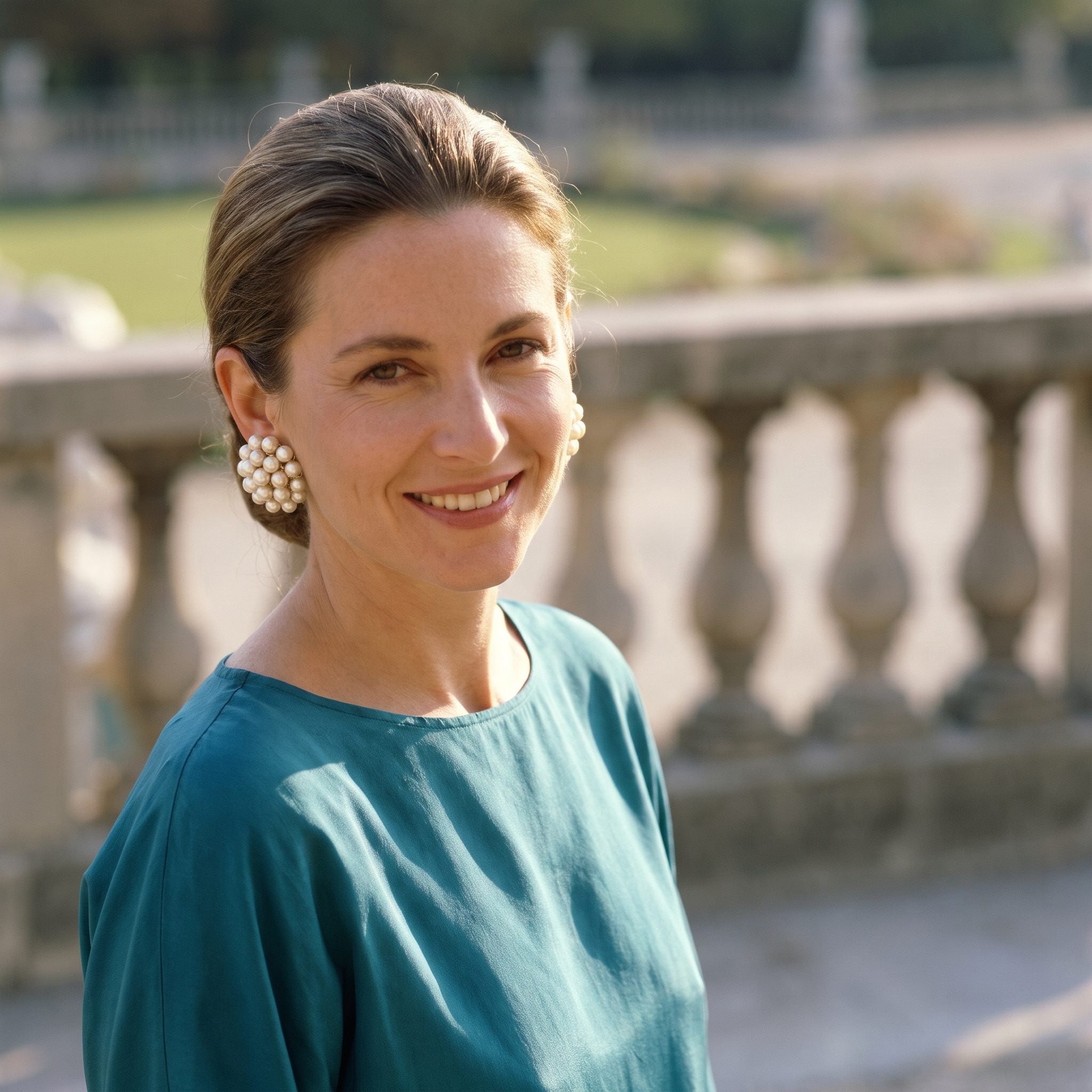
Forget the solitary pearl stud. These earrings gather multiple rounded beads into compact clusters, creating a little bouquet of pale highlights beside each ear.
The teal silk boat neck provides a clean horizontal line beneath them. With the neckline stretching toward the shoulders, the earrings occupy the open space around the face rather than competing with a necklace.
Several beads catch light from slightly different directions, giving the clusters depth and a textured silhouette. Their construction creates a more elaborate effect than one large domed pearl, even though the overall proportions remain compact.
Teal supplies the saturated color, silk brings a smooth sheen, and the earrings introduce a concentration of smaller rounded forms. Plenty of presence without requiring another accessory below the collarbone.
19. Baroque Pearl Drops Refused to Be Perfectly Round, and Looked Better for It (1989)

The pearl drops are irregular, elongated, and far more interesting than a matched pair of perfect spheres. Suspended beneath hammered gold settings, they move independently of the earrings’ upper sections.
Against violet satin, the warm gold creates a transition between the saturated fabric and the lighter pearls. The one-shoulder neckline leaves the upper body relatively uncluttered, giving the earrings room to establish their own vertical lines.
Baroque pearls owe much of their appeal to their unusual shapes. Ridges, curves, and uneven surfaces make individual pearls distinctive, turning natural variation into the central decorative feature.
After the tightly packed clusters of the mid-1980s, these drops offer a different kind of extravagance. Fewer beads, more movement, and absolutely no obligation to be symmetrical.
18. Three Rows of Pearls Met a Black Velvet Corset and Lost Their Innocence (1990)
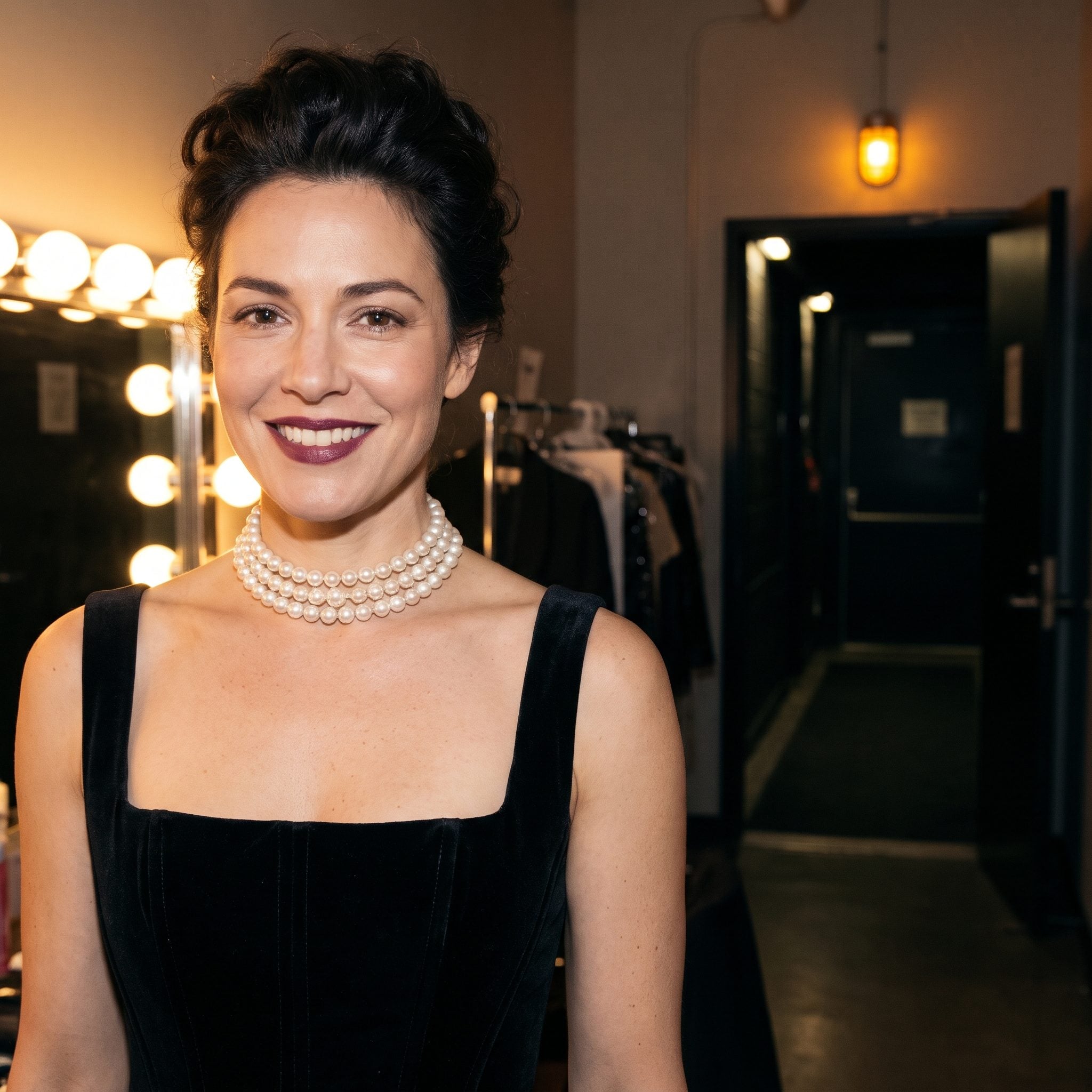
Three tight rows of pearls circle the throat, creating a broad, luminous band above a black velvet corset. Between them sits a narrow strip of bare skin that makes the contrast even more pronounced.
The necklace borrows the formal structure of traditional pearl jewelry, while the corset introduces strong vertical shaping beneath it. The two pieces operate with different proportions: one compact and horizontal, the other fitted and elongated.
Black velvet provides a rich background for the exposed neckline, making the pale choker particularly prominent. Its repeated curves create an orderly pattern above the garment’s more dramatic construction.
Neither piece needs to disguise its character. The choker remains unmistakably traditional. The corset refuses to be. Their disagreement is the entire attraction.
17. A Tiny Pearl Choker and a Cotton Tank Made Dressing Up Look Almost Accidental (1993)

A narrow row of cream pearls sits above a graphite cotton tank. No evening dress, no elaborate neckline, no suggestion that the jewelry needs a special occasion.
The ribbed cotton brings a familiar everyday texture to the arrangement. Against it, the pearls look less ceremonial, their small scale keeping the necklace close to the body rather than turning it into an obvious statement piece.
This pairing captures an important shift in the way traditional accessories could be worn during the 1990s. Something associated with formal dressing becomes part of an outfit built around ordinary casual clothing.
A little pearl choker, a cotton tank, and nothing else demanding attention. The necklace looks as though it has finally been given the afternoon off.
16. One Pearl on Black Velvet Was Enough to Rewrite the Slip Dress (1996)

One oval pearl hangs from a narrow black velvet ribbon. That’s the entire necklace. Against a rust-colored satin slip dress, the arrangement makes a persuasive case for doing considerably less.
The ribbon creates a dark horizontal line at the throat, while the pearl supplies one concentrated point of light. Its smooth surface stands out against the velvet, and the satin introduces another kind of sheen below.
The slip dress’s fine straps and fluid silhouette make the compact choker particularly effective. A longer necklace would introduce another vertical element; this one leaves the neckline almost entirely open.
The 1990s had room for plenty of oversized jewelry, yet this little arrangement takes the opposite approach. One ribbon, one pearl, and not a spare bead in sight.
15. A Broad Pearl Choker and a Leather Jacket Had Absolutely Different Plans (1999)

The pearl choker sits high and close to the throat, its tightly arranged beads forming a substantial pale band. Beneath it, a black leather jacket opens into a deep V, creating a sharp contrast between the necklace’s compact shape and the garment’s angular neckline.
The jacket’s dark surface gives the pearls a particularly clear outline. Rather than softening the leather into something conventional, the choker introduces an unexpected degree of formality.
There is no delicate balancing act here. The necklace occupies the throat with considerable authority, while the open jacket directs attention straight toward it.
The choker keeps its composure, the leather keeps its edge, and neither appears particularly interested in meeting the other halfway.
14. One Baroque Pearl, an Open Tuxedo Shirt, and Nothing Else to Prove (2026)

Now the pearl takes another turn. After decades of ropes, chokers, clusters, and elaborate drops, a single irregular bead becomes enough to carry an entire neckline.
Suspended from a fine gold chain, the baroque pearl falls inside the open collar of a crisp tuxedo shirt. Its uneven surface makes it unmistakably individual, while the chain provides little visual competition.
The shirt supplies strong tailoring around the soft, organic pendant. Its collar frames the necklace, and the deep opening directs attention toward the pearl without requiring additional jewelry.
Baroque pearls have been valued for their distinctive forms for centuries. In this contemporary interpretation, that individuality becomes the whole point: one unusual pearl, left entirely visible.
The necklace has abandoned the idea that more beads necessarily mean more impact.
13. Rice Pearls, Olive Cord, and a Rugby Shirt That Doesn’t Know It’s Dressed Up

Small rice-shaped pearls sit along olive-colored cord, their elongated forms giving the necklace a completely different rhythm from a conventional round-bead strand.
The brushed-silver toggle rests slightly off-center, adding a functional detail that looks entirely at home with the necklace’s casual construction. Beneath it, the thick collar of a rugby shirt provides a substantial, sporty background.
The cord matters as much as the pearls. Instead of disappearing between the beads like traditional silk thread, it becomes part of the design, introducing color and a more utilitarian character.
Nothing here asks the rugby shirt to become formal. The necklace has done the adapting, trading a delicate setting for visible cord and practical hardware.
The pearls have traded silk thread for something that looks ready to survive a weekend outdoors.
12. The Pearls Left the Necklace and Started Climbing a Shoulder Seam

The pearls aren’t hanging from anything. They’re attached directly to the garment, tracing a diagonal seam across one shoulder and into an asymmetric neckline.
That changes their purpose. Instead of decorating the space above the clothing, the pearls emphasize the garment’s construction, making the seam itself a prominent design feature.
Charcoal fabric provides a quiet background for the small pale studs. Their spacing creates a dotted line that follows the shoulder’s angle, drawing attention to the unusual cut without requiring a separate necklace.
There is no clasp to conceal, no chain to adjust, and no pendant to position. The seam has become the accessory, and the pearls have found themselves a permanent address.
11. Half Pearls, Half Silver Chain, and a Necklace That Refuses to Pick a Side

One half of the necklace is a familiar freshwater pearl strand. The other is made from substantial brushed-silver links. Their meeting point sits slightly off-center, leaving the contrast fully exposed.
The pearls supply a regular succession of rounded shapes, while the chain introduces larger openings and more angular surfaces. Their different weights and textures make the join a feature rather than something to conceal.
Against an open plum leather collar, the arrangement looks particularly decisive. The dark material frames the pale pearls and silver hardware, while the asymmetric construction prevents the piece from settling into a conventional centered composition.
Neither half attempts to resemble the other. Two jewelry traditions, one fastening, and absolutely no diplomatic compromise.
10. A Fan of Seed Pearls Turns an Oxblood Strapless Dress Into Something Sharper
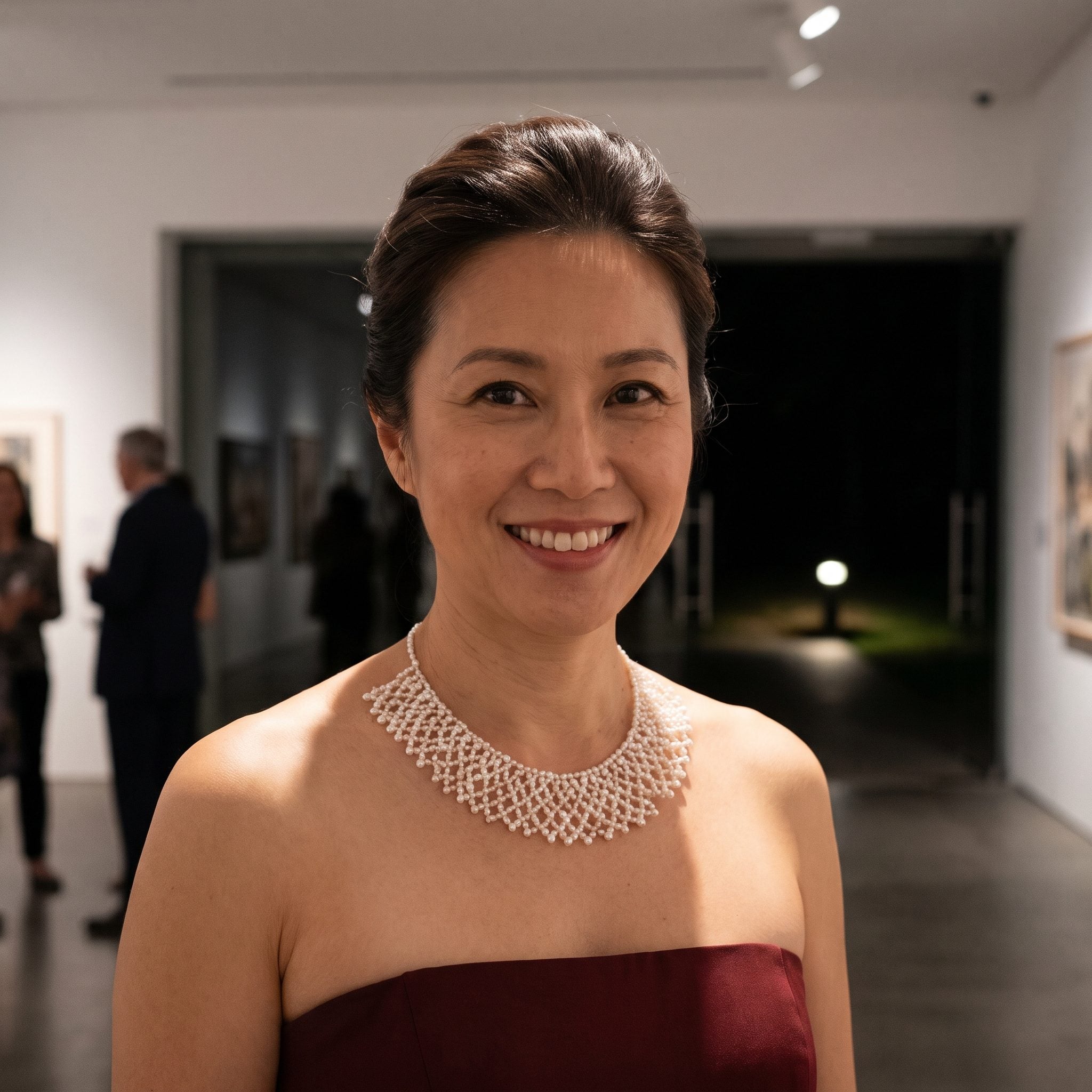
Instead of following the collarbone in a conventional line, the seed pearls spread outward into a shallow fan. The necklace becomes a delicate arrangement of radiating strands, with small gaps between the beads allowing the skin beneath to remain visible.
The oxblood strapless dress provides a strong horizontal neckline. Above it, the fan introduces a series of curves that soften the geometry without losing definition.
The dark dress makes the pale pearls especially prominent, while its clean neckline leaves the fan-shaped construction unobstructed. Individual beads may be tiny, but the arrangement occupies a surprisingly substantial area.
Small beads, ambitious architecture. The necklace has discovered that scale and impact aren’t necessarily the same thing.
9. One Peacock Pearl Goes Almost Black Against a Silver Collar

One end of the open silver collar holds a dark peacock pearl. The other finishes in a smooth silver sphere. Their unequal colors and materials give the necklace an intentionally unbalanced appearance.
The pearl’s green and violet overtones shift with the light, sometimes making the surface appear almost black. Beside it, the silver sphere provides a brighter, more uniform finish.
A pale-gray off-shoulder neckline leaves the collar fully visible, allowing its open shape to sit across the upper chest without interruption.
There is no central pendant, no matched pair of pearls, and no attempt to disguise the asymmetry. The design depends on the contrast between two different endings.
One dark, iridescent pearl has taken the place of an entire strand. The silver sphere looks perfectly content to be its opposite.
8. Pearls Scatter Across Black Mesh and Turn a Theater Top Into Jewelry

Small pearls scatter across a sheer black mesh mock-neck, creating individual points of light against the transparent fabric. No strand, no pendant, and no obvious pattern connecting one bead to the next.
The irregular spacing prevents the embellishment from resembling a conventional necklace or decorative border. Each pearl occupies its own position, with the mesh allowing skin to show between the small highlights.
An opaque bodice beneath the sheer upper section establishes a clear division between transparent and solid fabric. The pearls remain concentrated where the material is lightest, making their placement particularly noticeable.
The effect is closer to a constellation than a necklace. Tiny pale points appear suspended against the skin, while the black fabric provides just enough structure to hold them in place.
7. Pastel Pearls Meet Beat-Up Denim and Neither Bothers Dressing for Dinner

Blush and apricot freshwater pearls introduce gentle color against faded indigo denim. The combination feels far removed from the black satin and cashmere traditionally associated with pearl necklaces.
The beads are irregular rather than perfectly round, with slight differences in shape that give the strand a more relaxed character. Their warm pastel tones contrast with the jacket’s cooler blue, while the worn denim adds a rougher texture.
The necklace doesn’t need an elaborate setting. Its color and uneven surfaces provide enough detail against the familiar jacket, allowing the pearls to look polished without becoming precious.
Faded seams, substantial cotton, and luminous little beads. Nobody has to change clothes, and the pearls seem particularly pleased about it.
6. The Pearl Clasp Came Around Front and Became the Best Part

The clasp has spent generations hiding at the back of the neck. Here, it moves toward the shoulder and becomes an intentional part of the necklace’s design.
Brushed-silver hardware joins two strands of elongated silver-gray pearls, their unequal lengths producing an overlapping arrangement across an aubergine halter neckline.
The pearls’ cool color gives the necklace a different character from a traditional cream strand, while the visible fastening introduces a more mechanical detail. Its position interrupts the smooth succession of beads, drawing attention to the construction itself.
Nothing about the clasp is disguised. The fastening has finally received the promotion it spent decades waiting for.
5. The Pearl Necklace Disappeared, and a Moss-Green Lapel Took Over
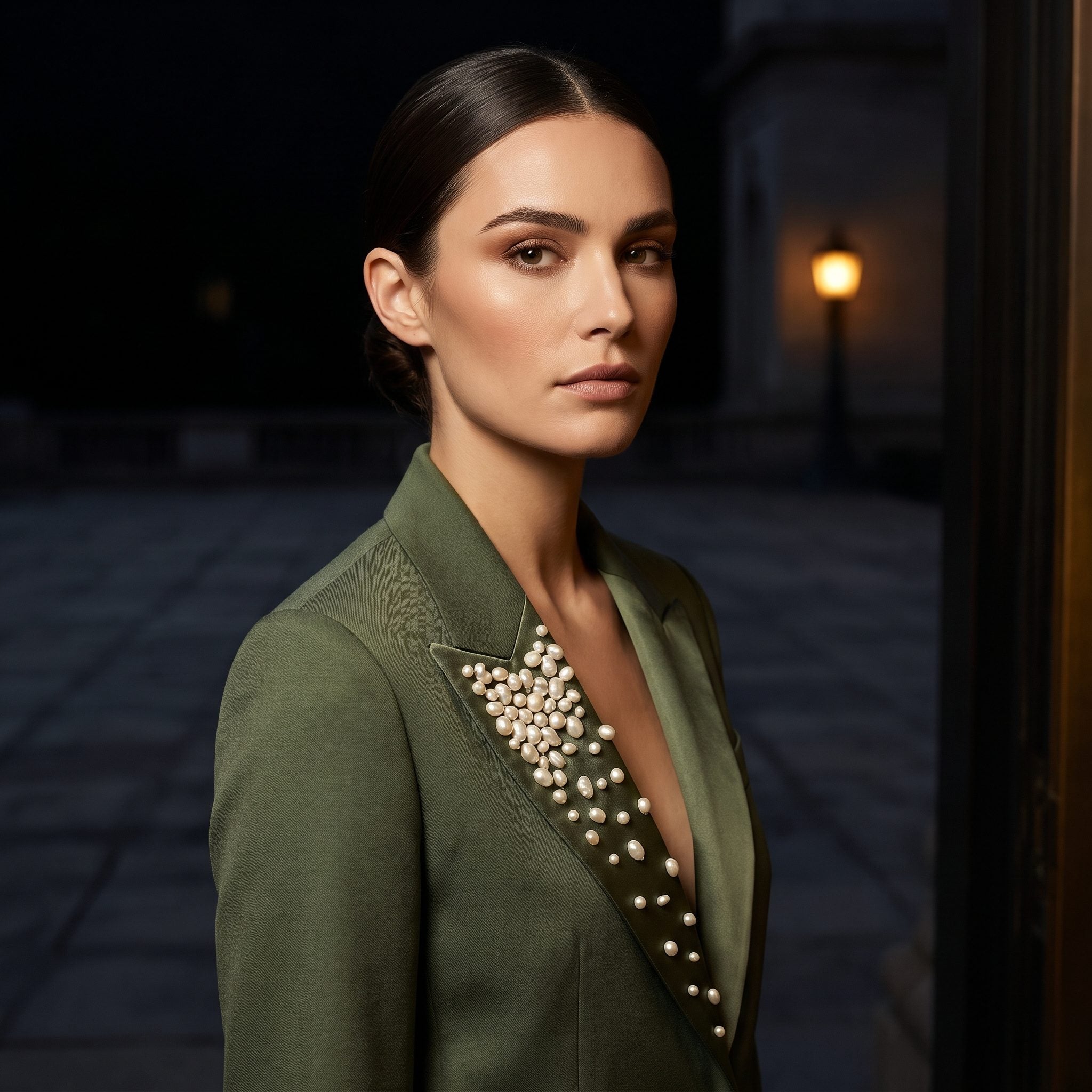
There is no pearl necklace here. Instead, irregular keshi pearls gather along the satin lapel of a moss-green tuxedo jacket, turning the tailoring itself into the decorative feature.
The embellishment is densest near the notch, then becomes more widely spaced as it travels downward. That gradual change gives the arrangement movement without requiring a separate chain or strand.
Keshi pearls are prized for their distinctive, often irregular forms, making them well suited to a design that doesn’t depend on perfect symmetry.
The satin lapel supplies a glossy background for the pale beads, while the moss-green fabric establishes the jacket’s substantial shape. The pearls emphasize the tailoring instead of competing with it.
A conventional necklace would occupy the space inside the jacket. This one has decided the lapel is better real estate.
4. A Pearl Strand Acquired a Safety Pin and Changed Its Entire Attitude

A short freshwater pearl strand sits close to the throat, fastened at the front with an oversized silver safety-pin-style detail. The hardware interrupts the familiar rhythm of the beads and becomes the necklace’s most conspicuous feature.
Beneath it, a white scoop-neck tank and black bomber jacket establish an everyday setting for the jewelry. The ribbed cotton provides a simple background, while the jacket introduces a more substantial, utilitarian silhouette.
The fastening borrows the visual language of an ordinary sewing accessory. Its elongated metal form introduces a deliberately improvised quality to an otherwise carefully arranged strand.
The pearls remain polished and orderly. The pin looks as though it came straight from the sewing drawer. Together, they make an unexpectedly persuasive argument for mixing good jewelry with everyday hardware.
3. The Necklace Saved Its Best Detail for the Moment She Walked Away
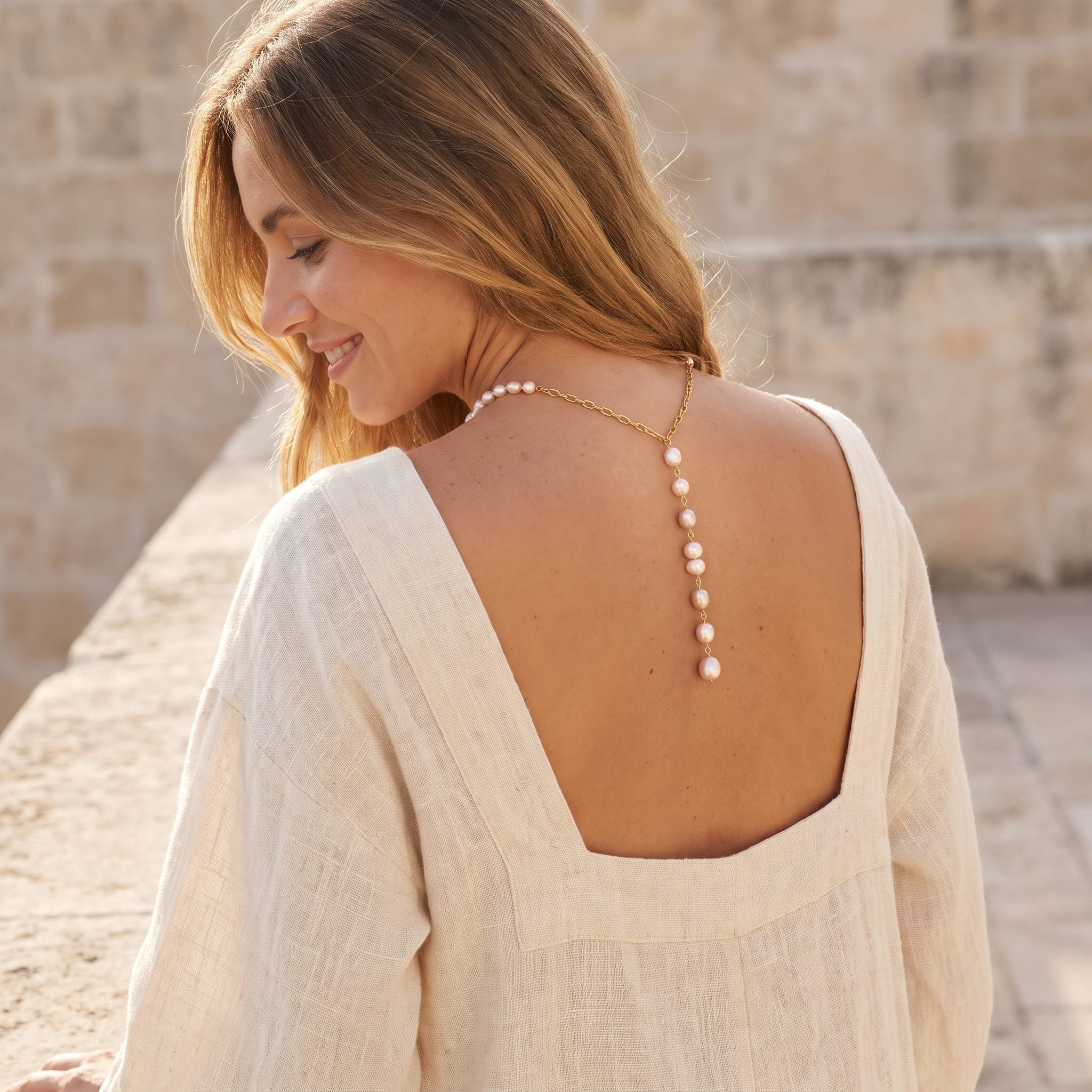
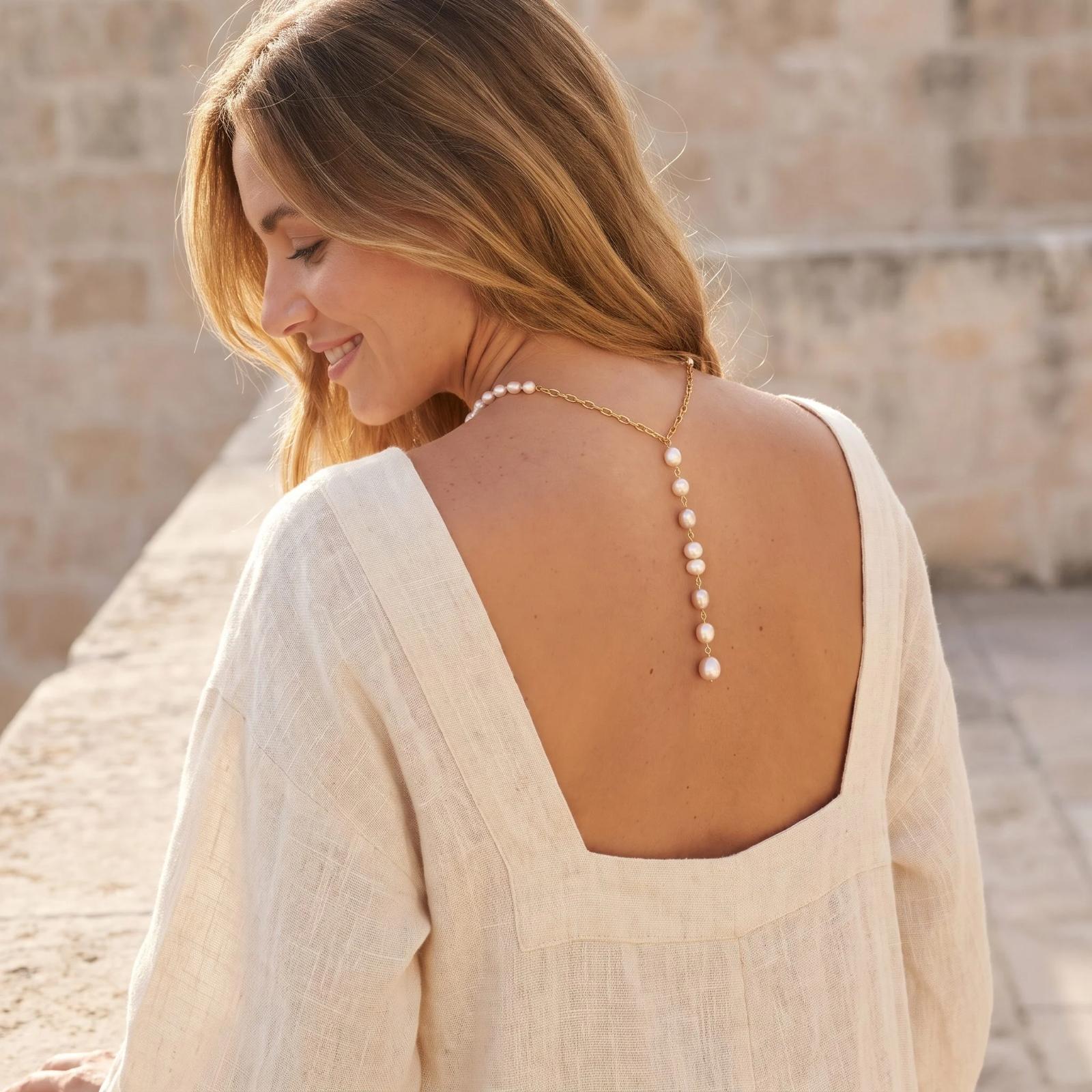
The necklace’s most interesting feature isn’t visible from the front. A delicate pearl drop extends down the open square back of an ivory linen dress, creating a focal point where conventional necklaces usually offer little decoration.
The hair is swept forward over one shoulder, leaving the chain and drop unobstructed. Against bare skin, the blush pearls introduce a gentle color variation, while the linen’s visible weave supplies a textured frame around the opening.
The unusual placement changes the direction of the entire design. Its principal decorative element sits behind the shoulders, following the open section of the dress rather than the familiar curve of the throat.
Without the square opening, the drop would lose much of its impact. Here, the dress and necklace depend on each other, with the fabric framing the jewelry as carefully as a conventional neckline would.
Most necklaces are designed for the entrance. This one has thought considerably harder about the exit.
2. Pearl Fringe Turned a Sapphire Silk Cowl Into Something That Moves
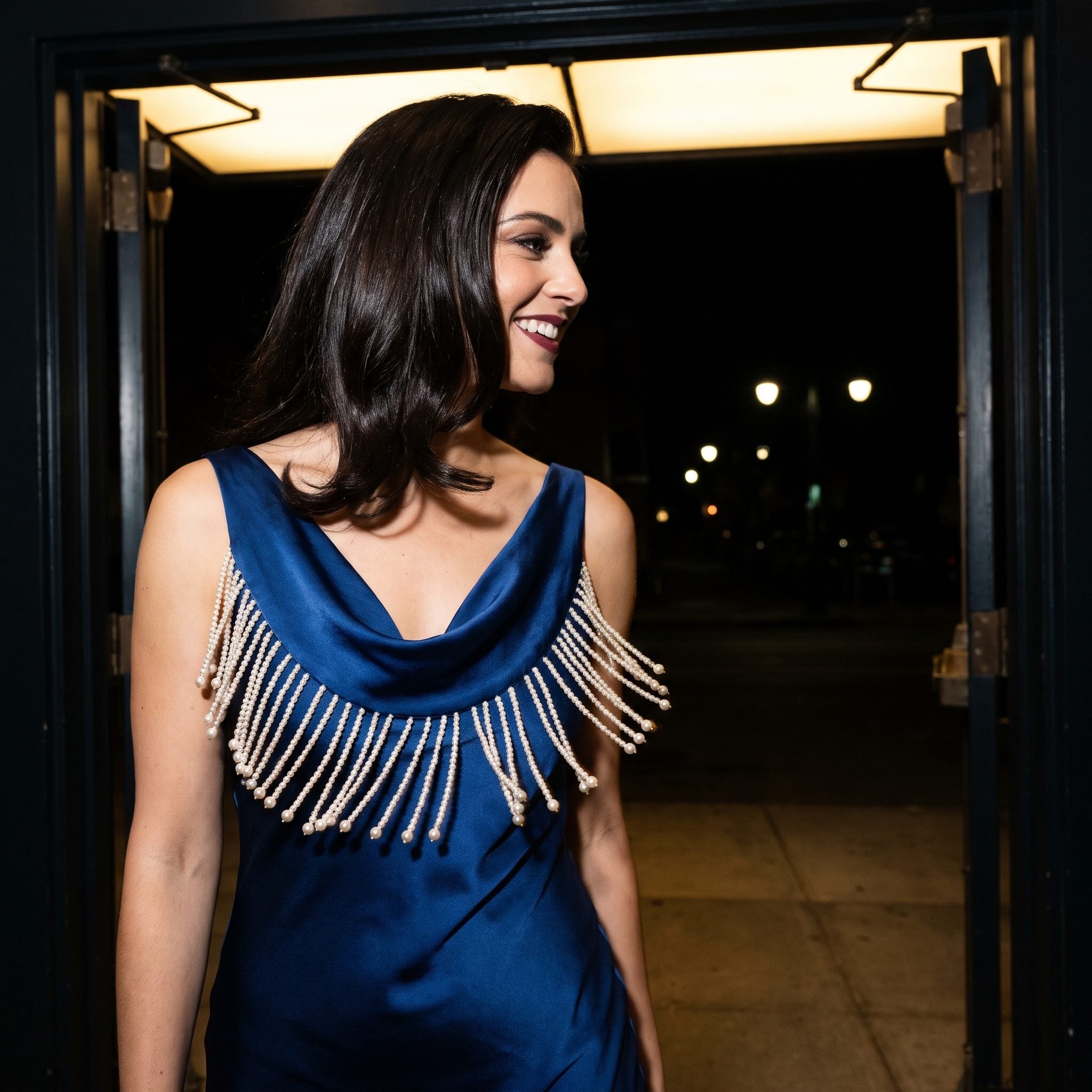
Tiny ivory pearls hang from the lowest fold of a sapphire silk cowl, forming a delicate fringe along the neckline. Rather than occupying a separate chain, the beads become part of the garment itself.
The cowl’s draped construction gives the pearls a curved foundation instead of a rigid straight edge. Each drop hangs independently, catching small highlights as the silk shifts beneath it.
Sapphire blue supplies a saturated background for the pale beads, while the fabric’s smooth folds establish a fluid shape around the upper body. The pearls introduce a finer, more detailed edge to that broad sweep of silk.
The result has the decorative impact of jewelry without requiring a separate accessory. The cowl supplies the shape, the pearls finish its edge, and every movement brings the two materials together.
1. The Pearl Earring Grew a Chain and Took Over the Entire Collarbone

The pearl has traveled a considerable distance from the three-strand evening necklace that opened this gallery. Here, three freshwater pearls sit along a fine silver chain stretching from an ear cuff to a fastening at the shoulder.
The chain follows a diagonal route across the collarbone, turning the upper body into part of the jewelry’s composition. A midnight-blue asymmetric top leaves one shoulder exposed, giving the metal a clear path across the skin.
Unlike a conventional necklace, the design doesn’t circle the throat. Its two attachment points establish a line that responds directly to the body’s shape and the garment’s cut.
The pearls are small and widely spaced, providing three pale interruptions along the silver. Their familiar rounded forms make the unconventional construction immediately recognizable as pearl jewelry, even though almost everything about its arrangement has changed.
From layered ropes to pearl-covered seams, exposed clasps, and chains crossing the collarbone, the material has proved remarkably adaptable. A pearl can still sit quietly at the throat whenever the occasion calls for it.
Or it can leave the necklace behind altogether, cross an entire collarbone, and make a century of jewelry etiquette look wonderfully outdated.