❤️ Would you like to save this?
There is apparently such a thing as looking a little too finished.
We analysed how ThreadCurve readers interacted with hairstyle images—which looks they loved and which they saved. When we separated hairstyles by styling finish, the winner wasn’t the sleekest, smoothest or most meticulously arranged hair.
It was tousled hair.
Not bedhead. Not hair that looks like you forgot to brush it.
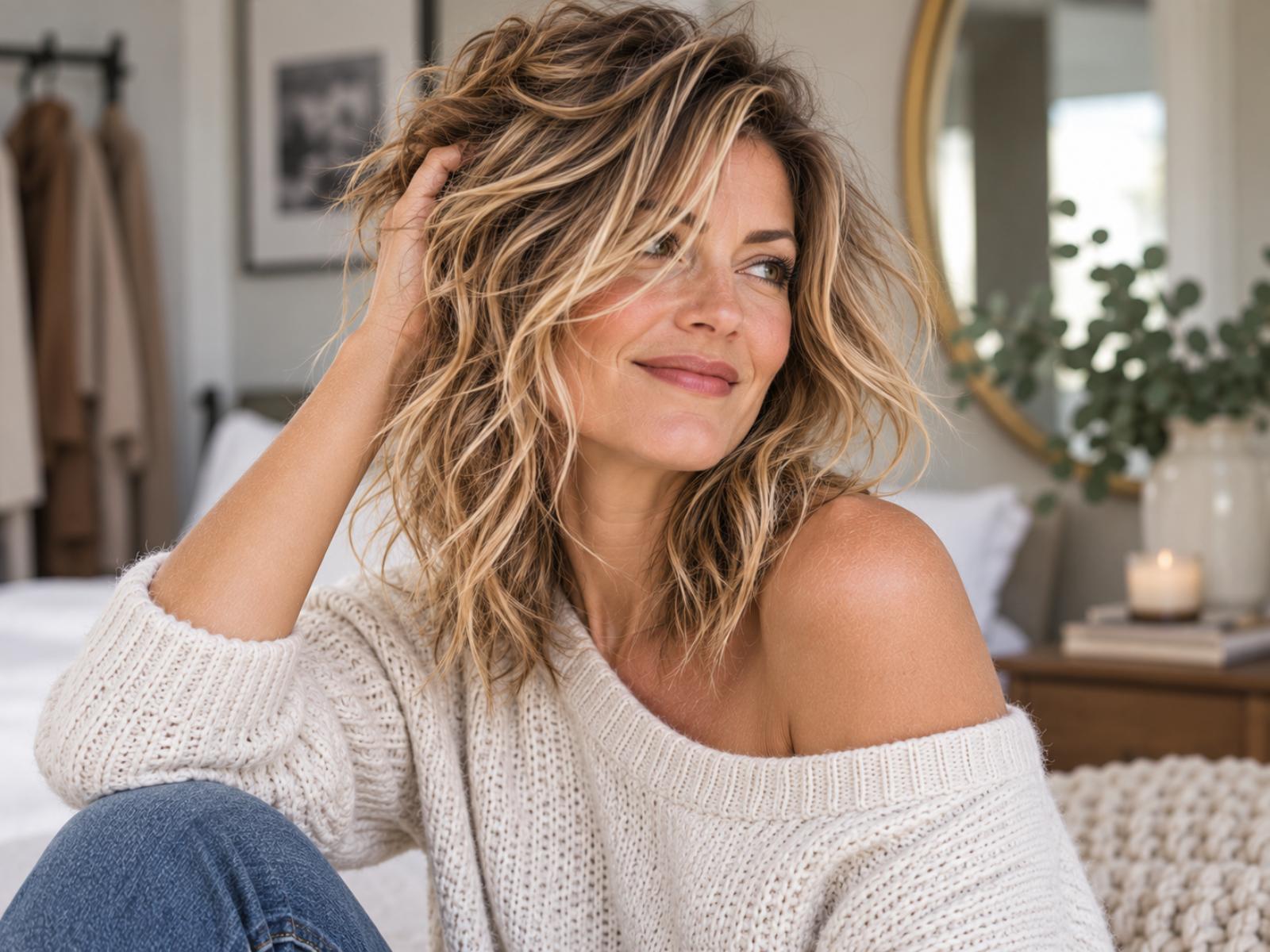
I mean the intentionally imperfect stuff: loose movement, separated pieces, slightly undone waves, hair that looks as though someone ran their fingers through it five minutes after leaving the salon.
Readers are keeping that look substantially more often than average. And when you put it beside sleek hair, the gap is enormous.
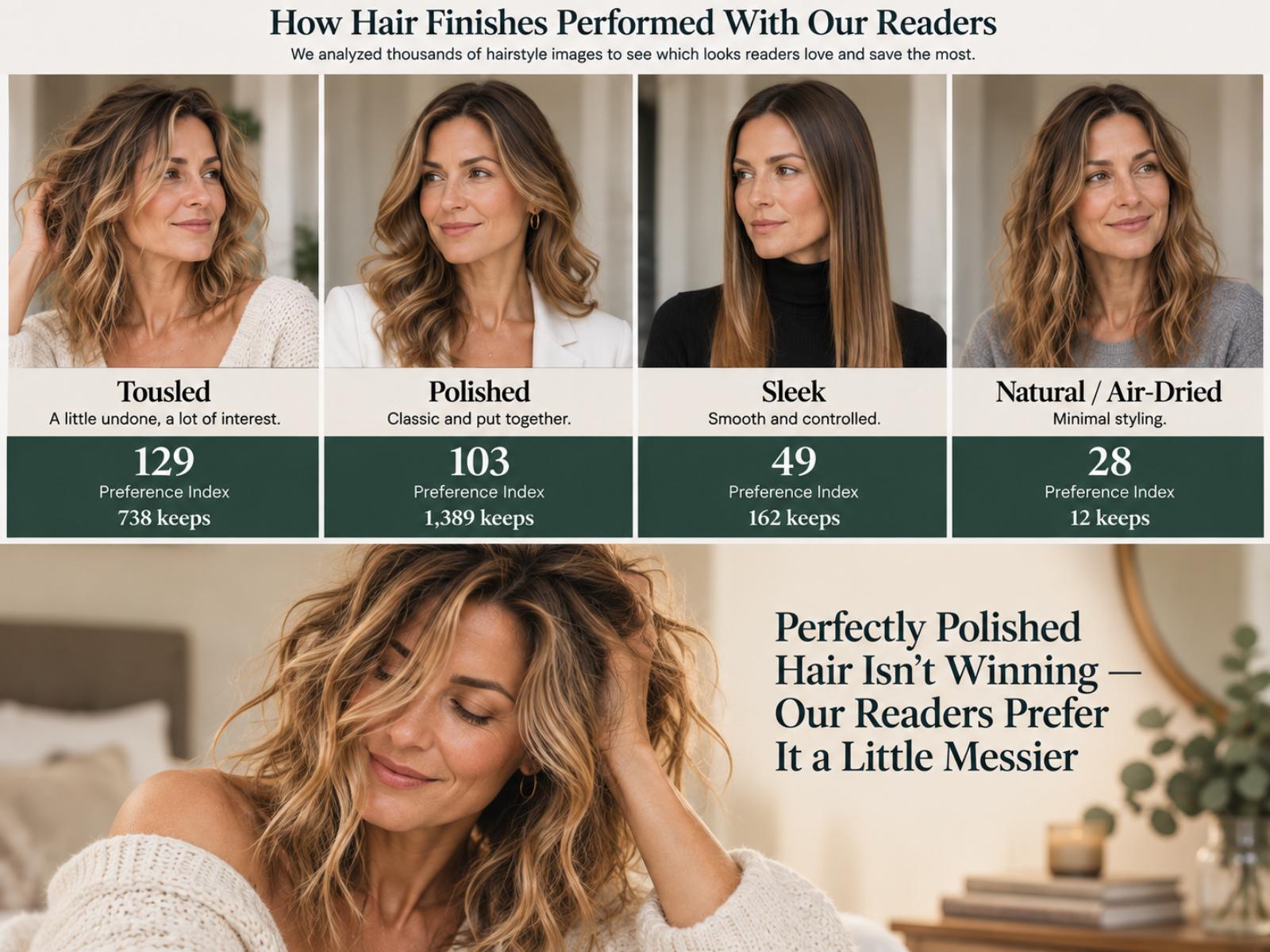
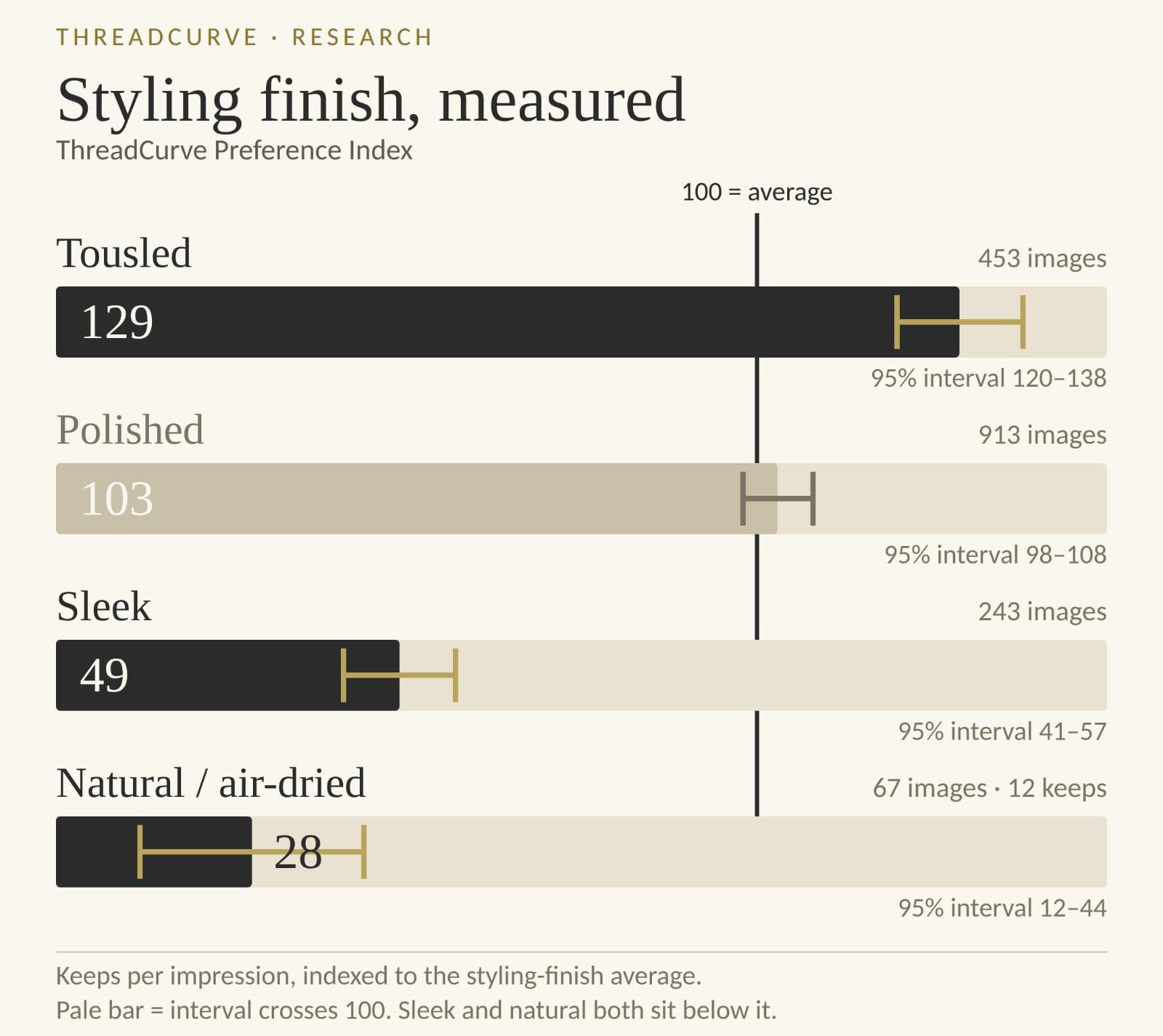
Tousled Hair Is Performing 29% Above Average
We identified 453 hairstyle images with a tousled finish across 57 different articles.
Those images generated 600 loves and 138 saves, for 738 keeps in total, and a 129 preference index with an interval running from 120 to 138.
An index of 100 represents the average keep rate for styling finishes in our dataset. That whole interval sits above it.
| Styling finish | Images | Keeps | Index | 95% CI | Verdict |
|---|---|---|---|---|---|
| Tousled | 453 | 738 | 129 | 120–138 | Above average |
| Polished | 913 | 1,389 | 103 | 98–108 | Average |
| Sleek | 243 | 162 | 49 | 41–57 | Below average |
| Natural / air-dried | 67 | 12 | 28 | 12–44 | Below average, thin |
Tousled separates cleanly from polished, and polished separates cleanly from sleek. Three of the four verdicts here are solid.
There’s an important distinction hiding in that table.
Readers don’t appear to want hair that looks completely unstyled.
They want hair that looks styled without looking too styled.
Polished Hair Does Fine. It Just Doesn’t Excite Anyone.
Polished hairstyles are everywhere in our data. We identified 913 polished hairstyle images, twice as many as the tousled group, generating 1,389 keeps.
But raw totals mislead, because readers had far more opportunities to see polished hair.
Once we account for impressions, polished scores 103, running 98 to 108. That interval straddles the average, which means our data doesn’t establish that polished hair performs any differently from the category norm at all.
It’s not underperforming. It’s just not doing anything.
Tousled scored 129, and the two intervals don’t overlap.
So this isn’t a story about readers rejecting beautiful, finished hairstyles. It’s about the extra response generated when some of that perfection loosens up.
Sleek Hair Is Where It Gets Interesting
The biggest surprise is sleek.
Sleek hairstyles are a fashion-editorial staple. Smooth, controlled, glossy, deliberate. On paper they should look expensive.
Our readers weren’t interested.
Across 243 sleek hairstyle images, readers generated only 162 keeps, producing a preference index of 49 with an interval of 41 to 57.
Less than half the category average, and the whole range sits well below it. This one is not ambiguous.
Compare that with 129 for tousled. That’s an 80-point gap between the deliberately undone look and the deliberately perfect one, and the intervals aren’t remotely close to touching.
Nor is it a handful of odd images. Sleek hair appeared across 47 different articles.
The Same Result Before Any Indexing
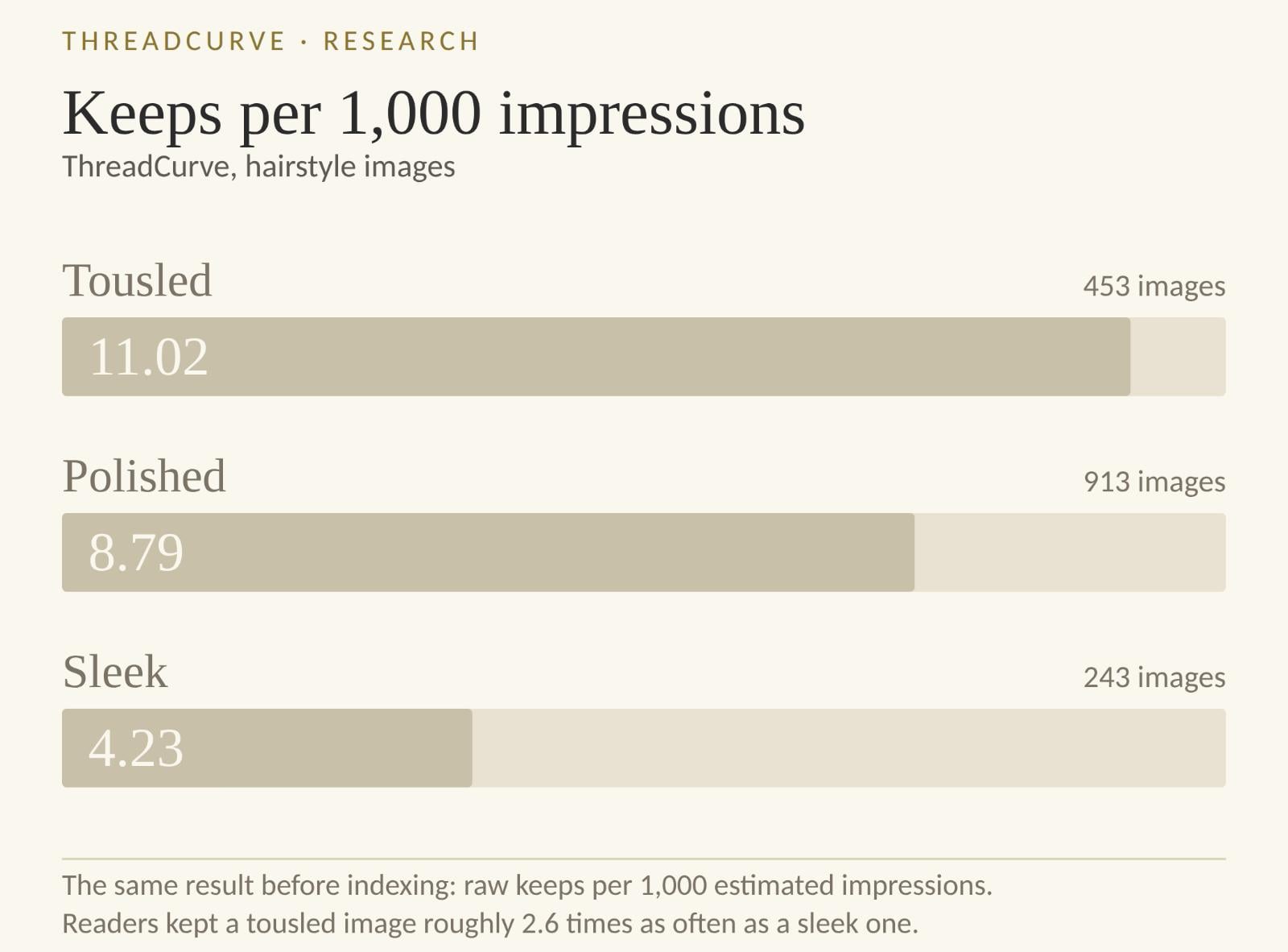
If you don’t trust the index, look at the underlying rate.
Tousled hairstyles generated 11.02 keeps per 1,000 estimated impressions. Polished generated 8.79. Sleek generated 4.23.
For every 1,000 impressions, readers were roughly 2.6 times as likely to keep a tousled hairstyle image as a sleek one.
That’s the same finding arrived at without normalising anything, which is a useful check on the index rather than a separate result.
But Readers Don’t Want Actual Bedhead Either
If messy is good, you might assume messier is better.
It isn’t.
The natural/air-dried category scored just 28, with an interval from 12 to 44. Even the optimistic end of that range is far below average.
But I want to be honest about how thin this one is. It rests on 12 keeps—by a wide margin the smallest cell in this analysis. The interval technically clears, but with a count that small I’d treat it as a direction rather than a measurement, and I can’t tell you it performs worse than sleek: those two intervals overlap.
Directionally, though, the pattern is intriguing:
Too perfect isn’t winning. Completely undone isn’t winning either.
The sweet spot appears to be somewhere in between.
“Effortless” Hair Apparently Requires Effort
Fashion has been playing this trick forever.
The white shirt that’s meant to look casually half-tucked took three attempts to tuck correctly. The jeans are cuffed just enough to look as though nobody thought about cuffing them. The blazer sleeves are pushed up in exactly the way someone supposedly pushes them up without thinking.
Hair may work the same way.
A successful tousled hairstyle doesn’t look unfinished. It looks finished and then slightly undone.
That’s a very different thing. The waves still have shape. The cut still has structure. There’s volume where you want it. There’s probably product involved.
You just can’t see as much evidence of the work.
Movement May Matter More Than Smoothness
One reason tousled hair photographs well is movement.
Sleek hair creates one clean, controlled silhouette. Tousled hair creates dozens of smaller shapes. Pieces separate around the face. Waves catch light differently. Ends move in different directions. Layers become visible.
That can make an ordinary haircut considerably more interesting.
A shoulder-length cut with a perfectly smooth blowout looks perfectly nice. Give the same cut loose bends, lift at the roots and slightly separated ends, and there’s much more happening.
Our reader data suggests people notice.
It also might explain why so many of the cuts that have taken over the last few years—shags, lobs, butterfly cuts, bixies, layered bobs, curtain bangs—depend on movement and separation. Iron every strand into submission and you remove much of what makes the haircut interesting. A tousled finish lets the layers and ends become visible.
The imperfection isn’t hiding the haircut. It may be showing it off.
A Second Measure, and What It Does and Doesn’t Confirm

Readers also vote between pairs of images directly, which is a different measurement method entirely.
Sleek hairstyles won just 39.1% of their 92 matchups, with an interval of 29.1 to 49.1. That’s below even, and it confirms the index result.
Tousled won 56% of 218 votes. But the interval runs 49.4 to 62.6, which crosses 50. So while it leans in the expected direction, the head-to-head data doesn’t independently establish that tousled beats the field. Polished at 50.9% is the same story.
I’d rather say that plainly than claim two measures agree when only one of them clears.
What we have is one strong result from the index and one confirming result on the losing end. That’s still worth something. It just isn’t the neat double-confirmation it looks like at first glance.
Maybe We’re Trying Too Hard to Make Hair Look Perfect
A lot of hair advice is about control. Control the frizz. Smooth the ends. Flatten the flyaways. Perfect the wave pattern. Get every piece exactly where it belongs.
There’s nothing wrong with beautifully polished hair, and our readers certainly aren’t rejecting it—103 is average, not bad.
But they respond measurably more when some of that control disappears.
This doesn’t tell a salon or a haircare brand that tousled styles will sell more product. We’re not measuring purchases. Nobody in this data bought anything.
What it does is tell you which assumptions are worth questioning. “Smoother is better” is an assumption, and it’s built into an enormous amount of how hair gets photographed and marketed. In front of an image, with our readers, it’s the assumption that fails hardest—sleek is the worst-performing finish we can measure with confidence.
The message isn’t that women should stop styling their hair.
It’s almost the opposite.
Style it. Then make it look like you didn’t try quite so hard.
About the Data
ThreadCurve measures reader interactions with individual fashion and hairstyle images. The Preference Index compares keeps—love and save actions relative to estimated image exposure—against the average for the relevant group. An index of 100 represents average performance.
This is observational image-preference data, not sales or purchase-intent data. Impressions are sampled and scaled estimates, and results are most useful for comparisons within the dataset. Where an interval crosses the baseline, no difference from average is claimed. Where two intervals overlap, no difference between those values is claimed.