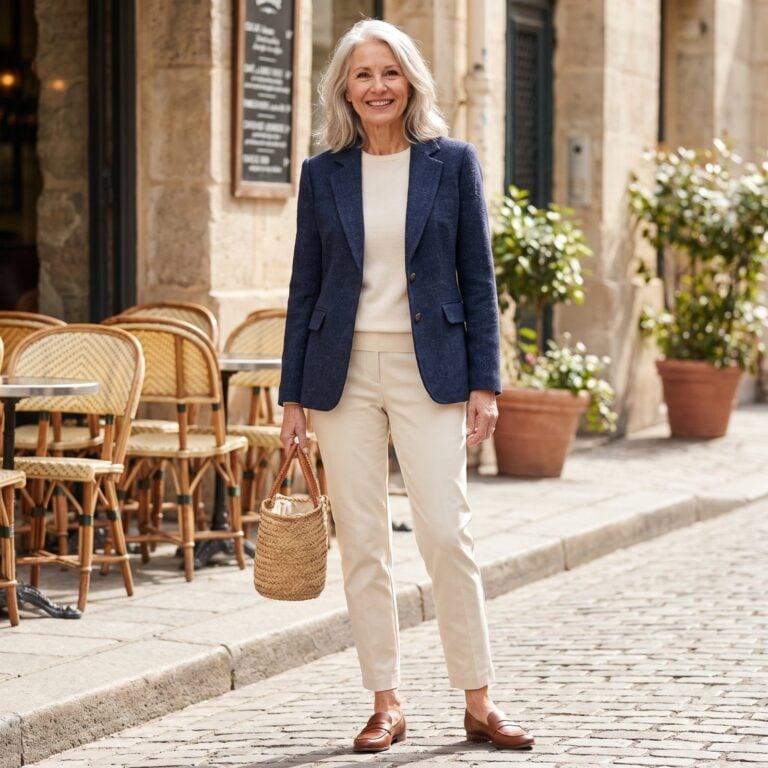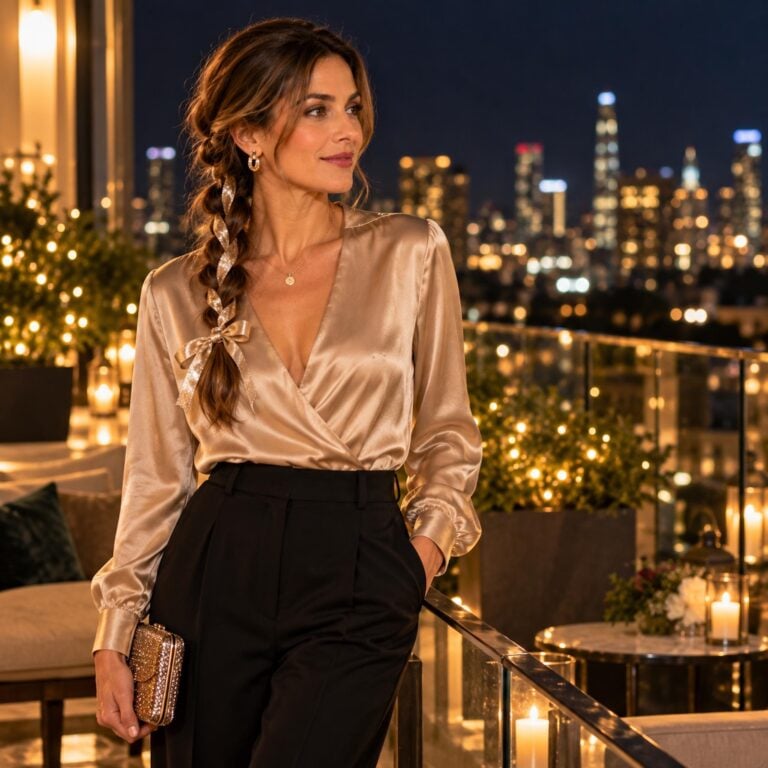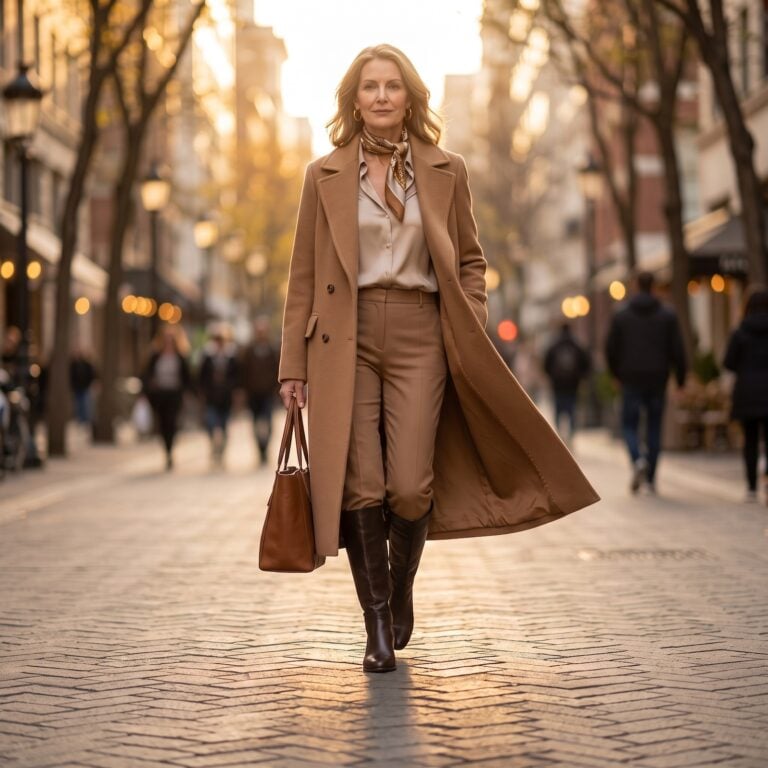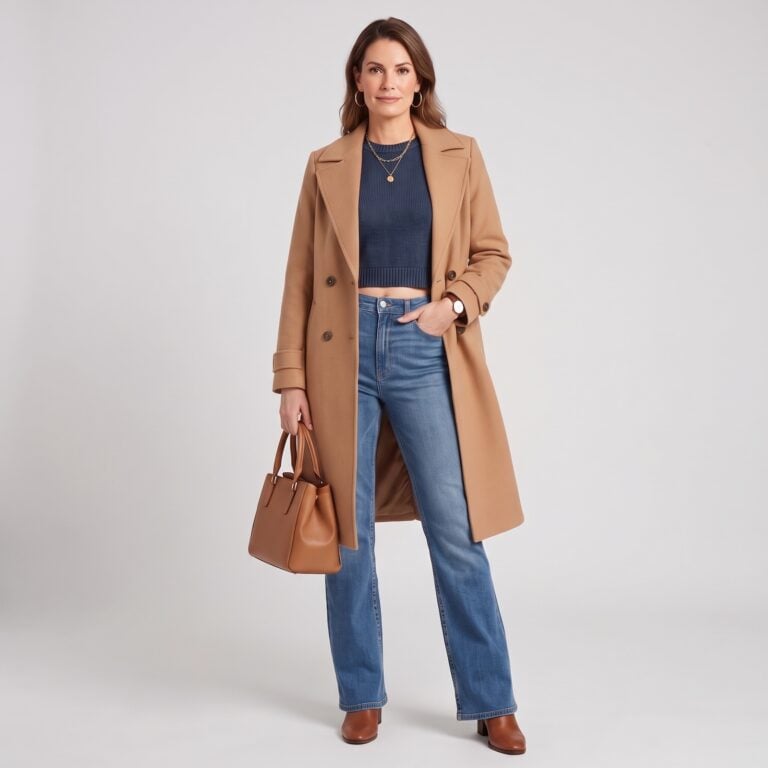
❤️ Would you like to save this?
Sometimes the strongest fashion signal isn’t a particular pair of jeans, a color or whatever trend TikTok has decided we’re all supposed to wear this month.
Sometimes it’s something much simpler.
In this case, it’s layering.
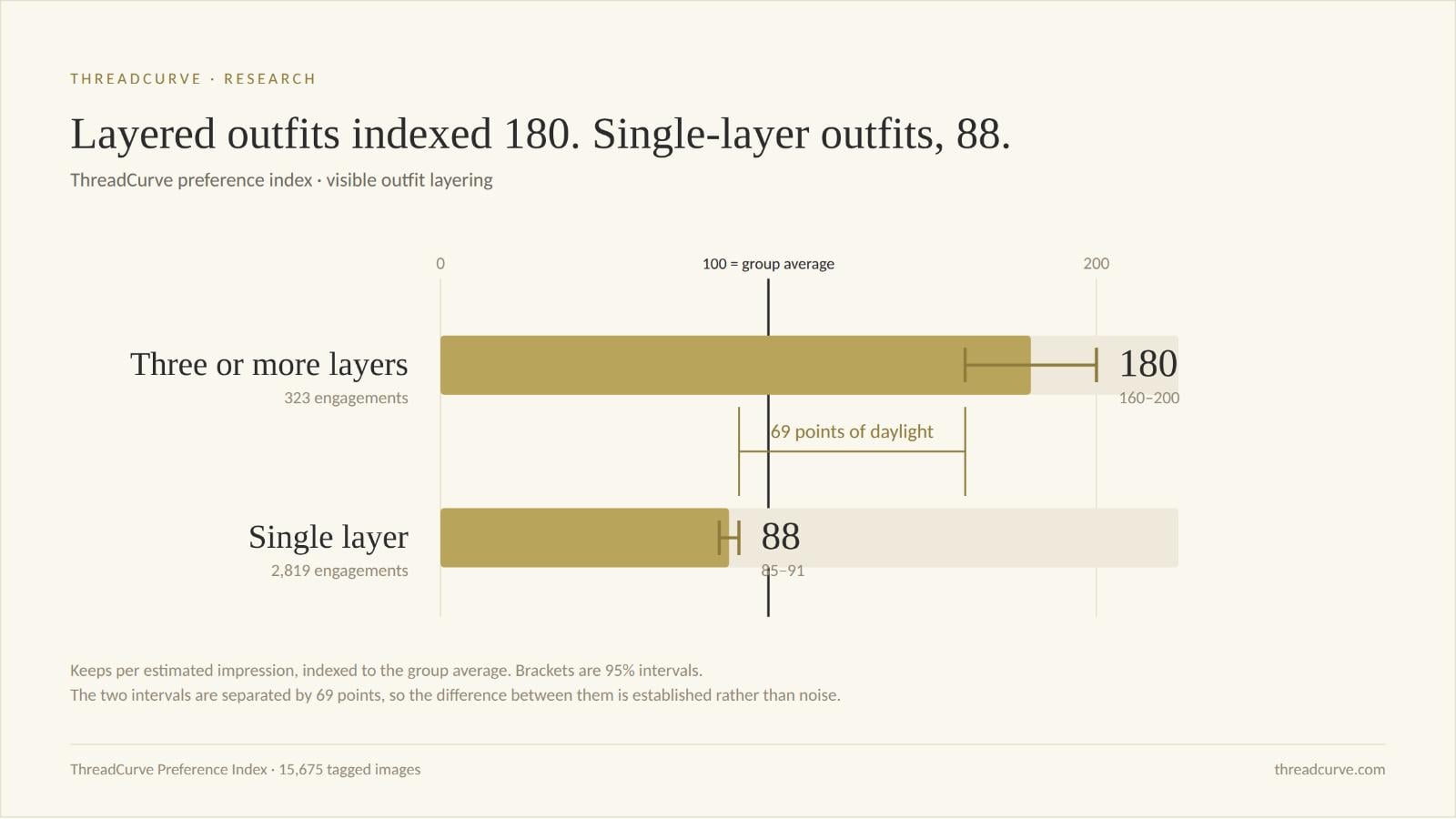
When we looked at how ThreadCurve readers responded to fashion images, outfits featuring three or more visible layers recorded a Preference Index of 180.
Single-layer outfits scored 88.
That’s a huge gap for a styling technique that doesn’t require designing a new product, chasing a trend or reinventing a collection.
It basically amounts to this: put more thought—and a few more pieces—into the outfit.
The Layering Effect Is Huge
ThreadCurve’s Preference Index measures reader keeps—love and save actions relative to estimated image exposure—against the average for the fashion group.
An index of 100 represents average performance.
| Outfit styling | Preference Index | 95% CI | Engagements | vs. group average |
|---|---|---|---|---|
| 3+ layers | 180 | 160–200 | 323 | +80% |
| Single layer | 88 | 85–91 | 2,819 | −12% |
Three-plus-layer outfits scored 80% above average.
Single-layer looks came in 12% below average.
More strikingly, the Preference Index for heavily layered outfits was just over twice that of single-layer outfits: 180 versus 88.
That’s a pretty darn big difference for something so simple.
It’s Not a Small-Sample Fluke
This is important.
I’ve been digging through a lot of our preference data lately, and it’s very easy to find an interesting-looking number based on a tiny sample.
I’m not particularly interested in those.
For these research pieces, I’m requiring at least 100 engagements behind every data point I’m using to make the argument.
These clear that bar easily—and more importantly, the confidence intervals don’t come close to touching.
Layered outfits run from 160 to 200. Single-layer outfits run from 85 to 91. There are 69 index points of empty space between the bottom of one interval and the top of the other.
That’s about as clean a separation as I’ve found in any of our data.
| Metric | 3+ layers | Single layer |
|---|---|---|
| Preference Index | 180 | 88 |
| 95% confidence interval | 160–200 | 85–91 |
| Difference from average | +80% | −12% |
| Engagements | 323 | 2,819 |
| Relative Preference Index | 2.05X | 1.00X |
The three-plus-layer group has 323 engagements. The single-layer group has 2,819.
In fact, the much larger sample is on the losing side of the comparison.
Why Would Adding Layers Make Such a Difference?
The data doesn’t answer that question.
But I have a theory.
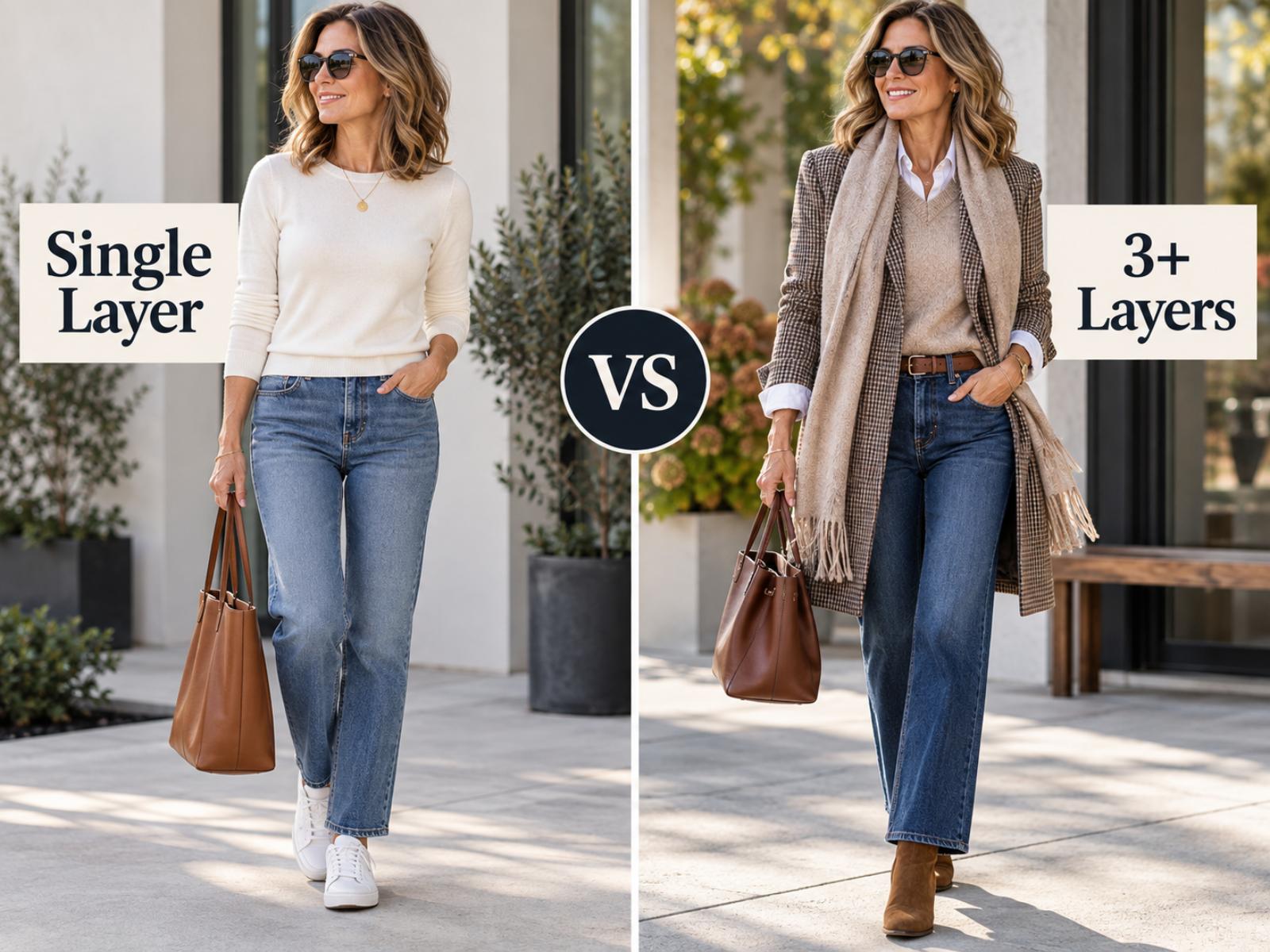
Take a woman wearing jeans and a sweater.
Perfectly good outfit. Nothing wrong with it.
Now put a shirt under the sweater, add a jacket and maybe introduce another texture or accessory.
Suddenly the image has more going on.
There are more textures. More shapes. More contrast. More depth. More places for your eye to land.
The clothes don’t necessarily get dramatically better.
The styling does.
And when you’re trying to stop somebody who’s scrolling through a feed, email, shopping page or article, visual interest matters.
The interesting part is just how large the difference appears to be in our data.
This Could Be Particularly Useful for Fashion Retailers
Here’s where I think this gets commercially interesting.
A retailer doesn’t necessarily need a new product to apply this finding.
It can use products already sitting in inventory.
Instead of photographing a model in jeans and a sweater, style the same look with a blouse, sweater and jacket.
Now you’ve potentially accomplished two things.
You’ve created an image our data suggests may be more visually compelling.
And you’ve put more sellable products into the image.
That’s a pretty attractive combination.
A two-piece outfit might merchandise two primary SKUs.
A layered look could merchandise four.
If the four-product outfit also generates more engagement, that’s something I’d want to test immediately.
The Product May Not Be the Problem
There’s another implication here I find interesting.
Suppose a fashion brand is running social creative and certain looks aren’t getting much response.
It’s easy to blame the product.
Wrong jeans. Wrong sweater. Wrong colors. Wrong collection.
Maybe.
But the problem could also be how the clothes are being styled.
That’s a much cheaper problem to fix.
Take exactly the same core outfit and shoot it two ways. Version A is simple. Version B adds another two visible layers.
Run both. See what happens.
Our reader data gives a pretty compelling reason to run that experiment before deciding the clothes themselves aren’t working.
More Products May Actually Make the Image Better
There’s a little paradox here.
Normally, you’d expect adding products to an image to create clutter.
Keep it simple. Don’t distract people. Let the hero product breathe.
All perfectly reasonable advice.
But fashion isn’t a toaster sitting on a white background.
People are looking at the entire outfit.
And our data suggests additional layers may make that complete look substantially more interesting.
That’s potentially useful for retailers because the thing that makes the image more engaging may also increase the number of products that can be sold from it.
That’s not a bad outcome.
What I’d Test Next
I wouldn’t conclude from one result that every retailer should start piling five garments onto every model.
The next step is figuring out what’s actually driving the effect.
Does two layers provide most of the benefit, or does performance keep climbing with three and four? Do jackets matter more than cardigans? Does layering work particularly well with jeans? Is the effect stronger in fall than spring? Does it work across age groups?
And perhaps most importantly for retailers: do images with more layers merely attract more engagement, or do they also generate more product clicks?
Those are much more commercially valuable questions.
The current result tells us where to start looking.
There’s an Important Limitation
We’re measuring observed response to fashion imagery.
We’re not measuring purchases.
A Preference Index of 180 does not mean somebody is 80% more likely to buy an outfit, and it certainly doesn’t mean a retailer will generate twice the sales by adding another jacket.
There could also be confounding factors.
Heavily layered outfits may be more common in fall content. They may use richer fabrics. They may feature better styling overall. They could simply make for better photographs.
That’s why I view this data as a way to identify promising things to test rather than proclaim universal fashion rules.
But when one styling approach scores 180 and another scores 88—with 69 points of daylight between their confidence intervals—I’m paying attention.
The Takeaway
One of the strongest fashion signals we’re seeing doesn’t require inventing anything new.
It’s layering.
Three-plus-layer outfits recorded a Preference Index of 180. Single-layer outfits scored 88.
That’s a little more than a 2X difference, and the two intervals don’t overlap by a wide margin.
For fashion brands, retailers, stylists and creative teams, that raises a surprisingly useful question:
Could one of the easiest ways to make an outfit perform better simply be to put more of the outfit into the picture?
Based on what our readers are responding to, it’s certainly worth testing.
About the Data
ThreadCurve measures reader interactions with individual fashion images. The Preference Index compares keeps—love and save actions relative to estimated image exposure—against the average for the relevant group. An index of 100 represents average performance.
This is observational image-preference data, not sales or purchase-intent data. Impressions are sampled and scaled estimates, and results are most useful for comparisons within the dataset. Where two intervals overlap, no difference between those values is claimed.
The current ThreadCurve export contains 15,675 tagged images across 541 articles.