
❤️ Would you like to save this?
A statement necklace is not shy jewelry. It arrives with acreage, color, shine, weight and a fairly convincing argument that everything within six inches of it should lower its voice. That is exactly why the good ones can transform a plain black dress in ten seconds and why the wrong pairing can turn an otherwise elegant neckline into rush-hour traffic. The necklace itself is rarely the entire problem. The trouble starts with what it lands on.
Design-wise, this is a game of negative space and visual hierarchy. A necklace needs enough quiet around it for its silhouette to register. The neckline supplies geometry. Fabric supplies texture and reflectivity. Hair, collars, bows, embroidery, earrings and even a belt buckle can become competing architecture. Sometimes contrast is the answer: polished metal against matte wool, saturated stones against a clean solid. Sometimes the smartest move is repetition, letting the jewelry echo the angle of a V or the disciplined structure of a tailored neckline. What matters is that somebody gets to be in charge.
These 30 looks live right on that border between commanding and crowded. Some need nothing more dramatic than shorter earrings or a different necklace length. Others prove that no amount of styling diplomacy can make three focal points share the same square foot peacefully. The point is not to make statement jewelry behave. It is to give the statement enough room to actually be heard.
FYI, thanks to AI imagery software, we’re able to create very specific fashion and hairstyle examples to illustrate the points being made. In some cases, imagery is exaggerated to hammer home the point. Also, assume links that take you off the site are affiliate links such as links to Amazon. this means we may earn a commission if you buy something.
30. The Busy Necklace Landing on an Already-Busy Floral
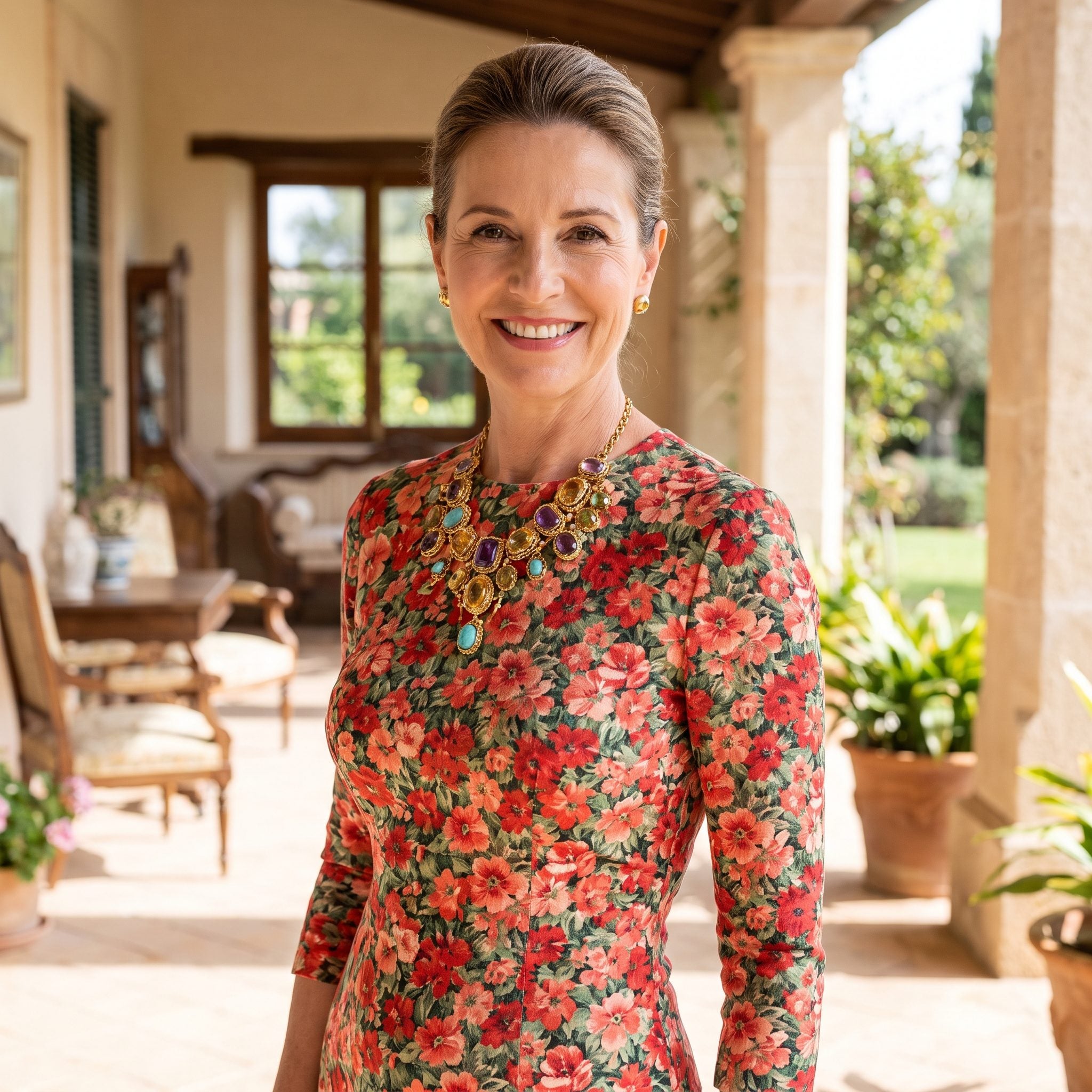
The floral has already occupied the territory. Color, movement and tiny changes of scale run all the way to the collarbone, then the gemstone necklace arrives with another complete composition of its own. Instead of framing the jewelry, the dress breaks its outline into pieces.
Give one of them the clean field. The floral can handle tiny studs or a fine chain sitting above the print. Move the gemstone necklace to a solid dress and suddenly every stone has an edge again.
29. Statement Necklace Wrestling Giant Chandelier Earrings

The emerald blouse is behaving beautifully. The accessories are not. A sculptural necklace frames the base of the face while enormous chandelier earrings frame both sides, leaving almost no visual pause between jaw and collarbone.
Keep the piece that deserves the close-up. If the necklace stays, reduce the earrings to a small gold button or stud. If the chandeliers stay, clear the throat. Both can be spectacular; they simply do not need to audition simultaneously.
28. A Necklace Landing Right on the Point of the V Instead of Above It

This is a one-inch problem with an outsized effect. The necklace reaches its lowest point exactly where the V-neck reaches its own, piling two endings onto the same spot instead of letting either shape finish cleanly.
Move the necklace decisively. A shorter piece can sit above the opening with skin between jewelry and fabric. A longer pendant can follow the V downward and reinforce its direction. The awkward zone is the middle, where both shapes terminate together.
27. A Crystal Necklace Over a Fully Sequined Top

A crystal necklace needs light, but it also needs somewhere for that light to stop. Against a fully sequined blouse, every surface is reflecting at once. The stones lose their outline and the necklace becomes another patch of glitter inside an already glittering field.
Put crystal against matte velvet, silk crepe or a deep solid knit and the facets reappear immediately. With the sequined top, skip the neck jewelry and move the metal elsewhere: a cuff, ring or clean earring lets the shirt keep the spotlight it already seized.
26. The Statement Piece Tangled and Half-Swallowed by Long Hair

You bought the necklace for its shape. Then half that shape disappeared behind waves of hair and the other half became a series of gold flashes peeking through strands.
This one does not need a new outfit. It needs clearance. A low twist, half-up style or simple sweep over one shoulder opens the collarbone and lets the necklace appear as a complete object instead of scattered glints. The more elaborate the jewelry, the more useful a little empty space around it becomes.
25. A Heavy Gold Chain Crushing a Delicate Slip Dress

The slip dress is built almost entirely from lightness: narrow straps, liquid satin, very little visible structure. Then an industrial-scale chain arrives at the collarbone and changes the vocabulary completely.
That contrast can be deliberate, but this version overwhelms the fine straps rather than playing against them. A smaller sculptural chain or slender pendant would preserve the dress’s airiness. Save the heaviest gold for tailoring, denim or crisp poplin, where the clothing has enough visual substance to answer back.
24. A Round Necklace Against the Straight Lines of a Square Neckline

A square neckline gives you hard corners, clean horizontals and a very obvious frame. Drop a large circular necklace inside it and the contrast becomes the whole story.
That can work beautifully if contrast is what you want. If you want a quieter, more architectural relationship, echo the neckline with a rigid collar, linear pendant or piece with defined edges. The question is not whether circles are forbidden inside squares. It is whether you want the jewelry to harmonize with the frame or deliberately interrupt it.
23. Statement Necklace Plus an Oversized Brooch
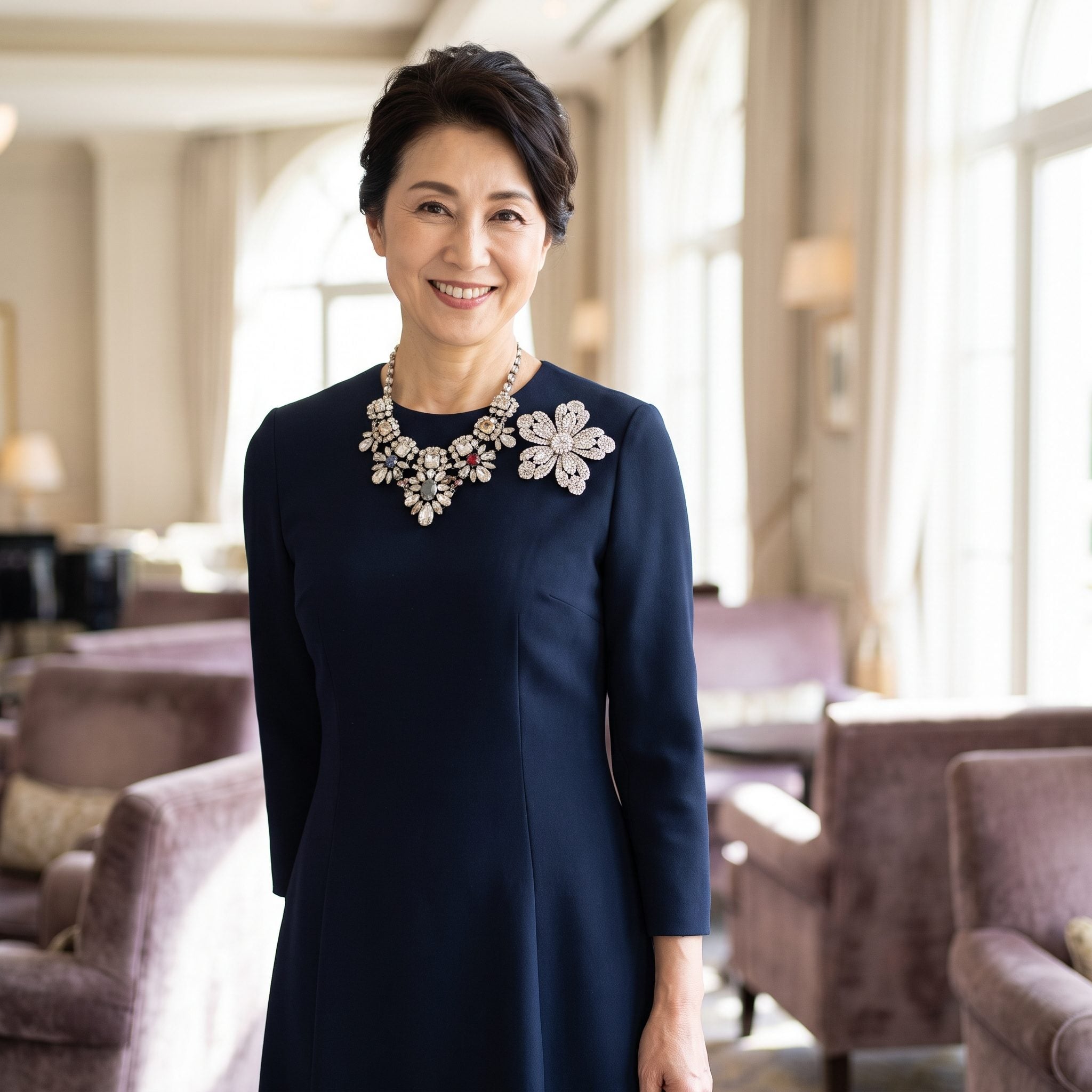
The navy dress gives these accessories exactly the neutral background they need. Unfortunately, it gives that background to both of them at once. Necklace above, giant floral brooch below: two self-contained centerpieces occupying the same plane.
Choose the hero. A jeweled necklace with a clean bodice looks decisive. A dramatic brooch on its own can do the same. Empty fabric around either piece is not wasted space; it is what makes the ornament look important.
22. A Rigid Collar Necklace Crammed Beneath a Thick Turtleneck

The sweater has already built a three-dimensional collar around the neck. Shoving another rigid ring directly underneath gives the metal nowhere to settle, so it rides up against the knit instead of lying cleanly.
Give heavy knitwear some vertical breathing room. A longer pendant or chain can rest on the sweater itself and turn the textured surface into a backdrop rather than an obstacle. A shorter rigid collar can work over a very fine turtleneck, but thick cable knit is asking for something with more drop.
21. Too Many Colors Fighting Inside One Necklace

The black blouse has done everything requested of it: clean neckline, quiet surface, no competition. This time the chaos is entirely self-contained.
Multicolor jewelry does not have to be restrained, but some relationship between the colors helps the piece hold together. Repeat a few shades. Build around warm stones, cool stones or one dominant color with smaller accents. When every gem introduces a new hue, shape and scale, the necklace stops having a center of gravity.
20. A Symmetrical Necklace Cutting Across a Dramatic One-Shoulder Neckline

The one-shoulder neckline gets its drama from imbalance. One side climbs, the other opens, and that diagonal movement is the design.
A perfectly centered necklace imposes symmetry right across the middle of it. Better options are deliberately asymmetrical jewelry, one major earring on the exposed side or no necklace at all. Sometimes the neckline has already supplied the jewelry.
19. Statement Necklace Slapped Across a Graphic Tee

The graphic tee is already communicating at chest level. Letters, illustration and color occupy exactly the same area the necklace needs, so the jewelry lands halfway through somebody else’s sentence.
Let the tee keep its headline. Tiny hoops or a fine chain above the print are enough. Move the statement necklace to a plain crewneck and suddenly the jewelry gets an entire page instead of the margin.
18. A Shoulder-to-Shoulder Necklace Swallowing a Petite Frame

❤️ Would you like to save this?
This necklace is not especially long or ornate. It is simply enormous in width, stretching so far across the upper body that everything else becomes supporting scenery.
That may be exactly the effect you want. If the goal is for the jewelry to accent rather than dominate, a more compact cluster or bold pendant will preserve impact while leaving more of the shoulder line visible. Scale is not a prohibition; it is a decision about who gets most of the frame.
17. The Necklace Fighting a Giant Neck Bow
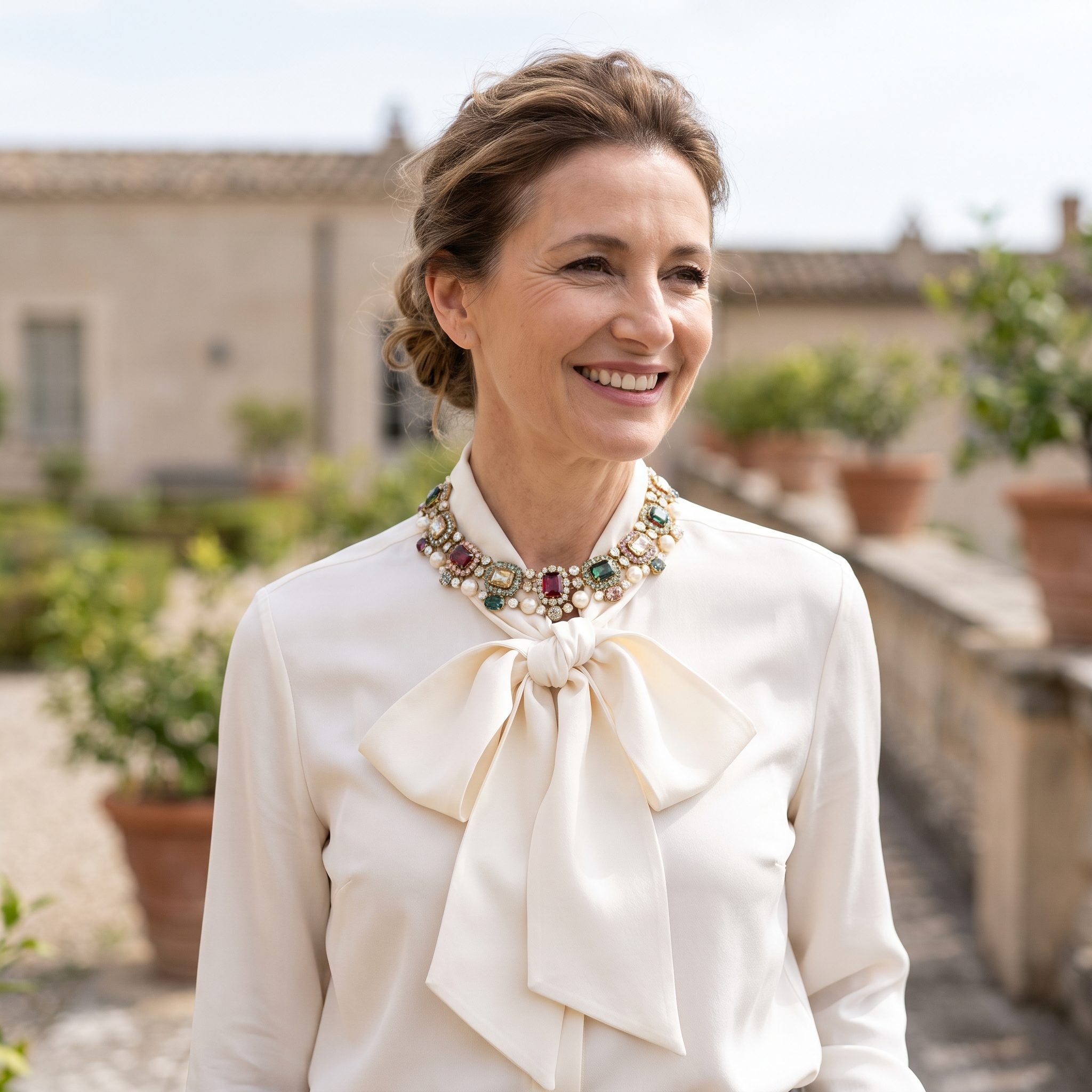
A large pussy-bow is already performing the job jewelry usually does. It brings volume, movement and a focal shape directly to the throat. The jeweled necklace underneath gets trapped in its shadow.
Move the ornament elsewhere. Statement earrings give the bow a companion without crowding it. If the necklace is the piece you want people to notice, swap the blouse for a clean collarless neckline and let the bow have another day.
16. A Silver Necklace That Vanishes Into a Metallic Silver Blouse

This is less about color than finish. Polished silver against reflective silver fabric creates almost no surface contrast, so the necklace loses its boundary every time the blouse catches the light.
Move the same piece onto matte black, navy or deep green and its sculptural outline comes back immediately. If the metallic blouse stays, try jewelry with a different surface quality: brushed metal, dark enamel or stones that do not mimic the fabric’s shine.
15. A Dense Gemstone Necklace Erasing a Strapless Neckline

A strapless dress deliberately creates open space above the bodice. That exposed neck and shoulder line is part of the design, not an empty area begging to be filled.
This dense multi-row necklace covers nearly all of it. A smaller high-set piece, a single pendant or no necklace at all would leave more of the original neckline intact. The goal is not necessarily minimal jewelry; it is preserving enough bare space for the strapless cut to remain visible.
14. Piling a Statement Necklace on Top of a Large Printed Scarf

A printed scarf brings pattern, color and physical volume directly around the neck. Dropping a turquoise necklace over it does not add a finishing touch; it introduces a second neckline on top of the first.
Choose which one gets the territory. Keep the scarf and finish with earrings, or remove it and let the necklace sit against the beige blouse. Both pieces become stronger when they stop sharing the same few inches.
13. A Statement Necklace Hanging So Low It Orphans the Neckline

The decorative weight of this necklace lands well below the scoop, leaving an awkward stretch of untouched fabric between neckline and jewelry. The piece is technically on the outfit but visually detached from it.
Shortening the necklace would bring the focal section back toward the collarbone and reconnect it to the opening of the blouse. Longer necklaces can absolutely work, but the extra drop needs a reason: a pendant, tassel or deliberate vertical line rather than a statement cluster drifting south on its own.
12. Setting a Bold Gemstone Necklace Against Loud Leopard Print

Unlike the tiny all-over floral, leopard has larger shapes and a limited palette, so bold jewelry is not automatically impossible. The problem here is that the red-and-gold necklace introduces another forceful color story directly across the print.
Either simplify the jewelry or make the relationship more deliberate. Gold alone can work beautifully with leopard because it picks up the warm tones without adding a second pattern. If the red gemstones are the priority, put the necklace on camel, black or rust and let the animal print sit elsewhere in the outfit.
11. The Necklace Fighting a Stiff Pointed Shirt Collar

This problem is mechanical as much as visual. The collar points push against the necklace, the links catch, and a piece designed to sit flat spends the day tilting in different directions.
Open the top buttons and place the necklace inside the shirt so the resulting V frames it, or move the jewelry onto a smooth crewneck where nothing interferes with the structure. A substantial necklace needs a stable place to land.
10. Three Statement Necklaces Layered at Once

Layering delicate chains creates rhythm. Layering three major pieces creates a committee. Gold chain, pearl collar and gemstone bib each bring their own scale, texture and visual center, then spend the outfit obscuring one another.
If layering is the goal, establish a hierarchy. Let one piece carry the weight and use finer chains at clearly different lengths around it. The ivory blouse is already the perfect blank canvas; it does not need every necklace in the box at once.
9. The Bib Necklace That Chops a Beautiful Plunging Neckline in Half

The dress has built one long descending line from shoulder to center front. Then the broad bib drops a horizontal band straight across it and changes the direction abruptly.
If you want to emphasize the plunge, follow it. A long pendant or fine layered chain can continue the downward movement. If the bib is the piece you care about, move it to a crewneck or another neckline with enough uninterrupted surface to support its width.
8. The Gemstone Necklace Lost on an Embroidered Bodice

There is beautiful workmanship everywhere and almost nowhere to look. Botanical embroidery fills the bodice, while the necklace adds another layer of stones, edges and tiny color changes across the same surface.
This is not simply “busy plus busy.” It is a detail-resolution problem. Fine embroidery needs enough unobstructed area for the threadwork to remain legible. Move the jewelry to the ears or choose a slim chain sitting above the embroidered field and both crafts get their definition back.
7. A Long Pendant and a Giant Belt Buckle Stacked Right on Top of Each Other
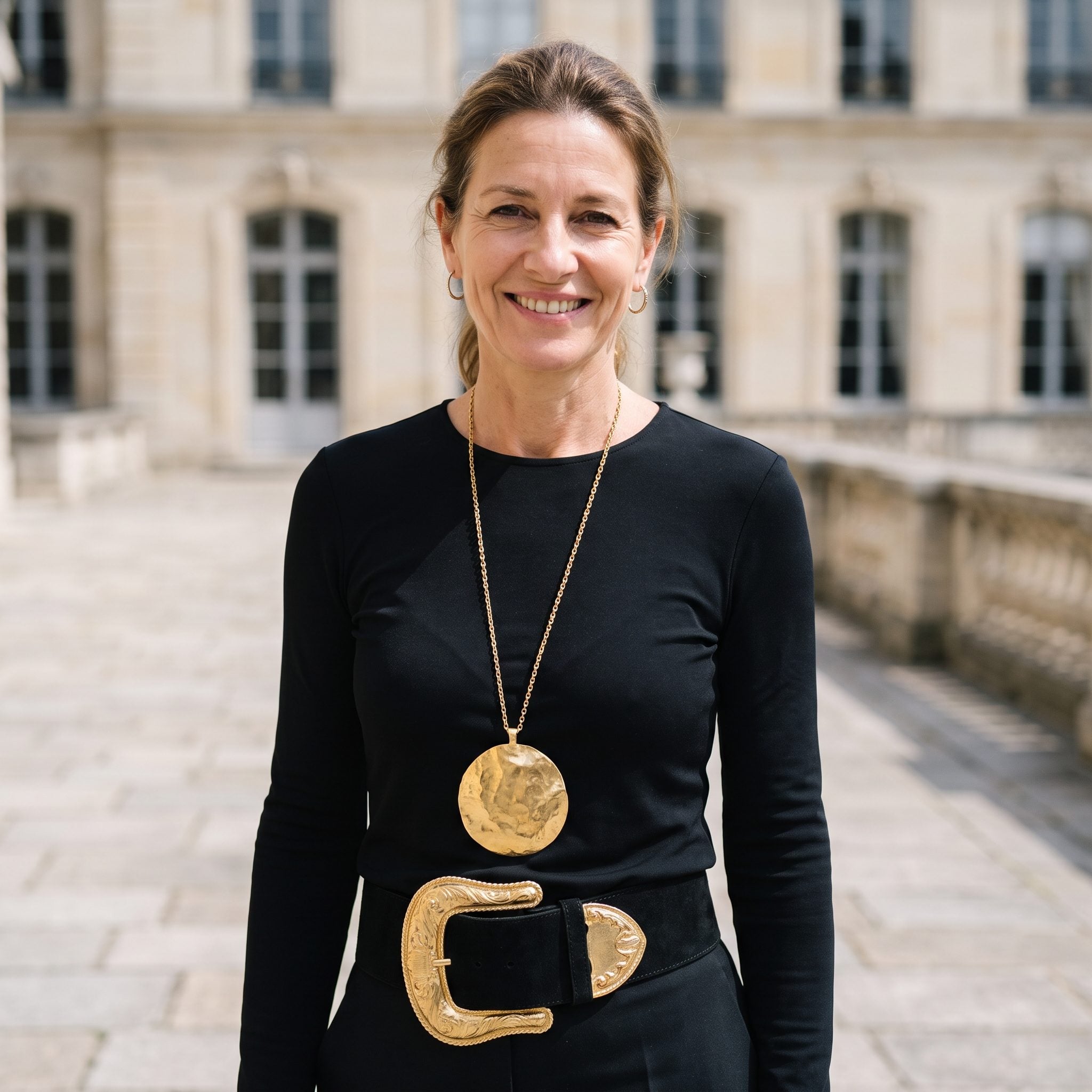
The pendant creates a vertical path down the torso and then runs directly into an enormous buckle. Instead of two separate accents, the hardware piles into one dense zone around the middle.
Create distance. Shorten the necklace if the belt is the hero, or swap the ornate buckle for simpler hardware if the pendant deserves the full drop. Two bold accessories can coexist more easily when there is enough plain fabric between them to reset the composition.
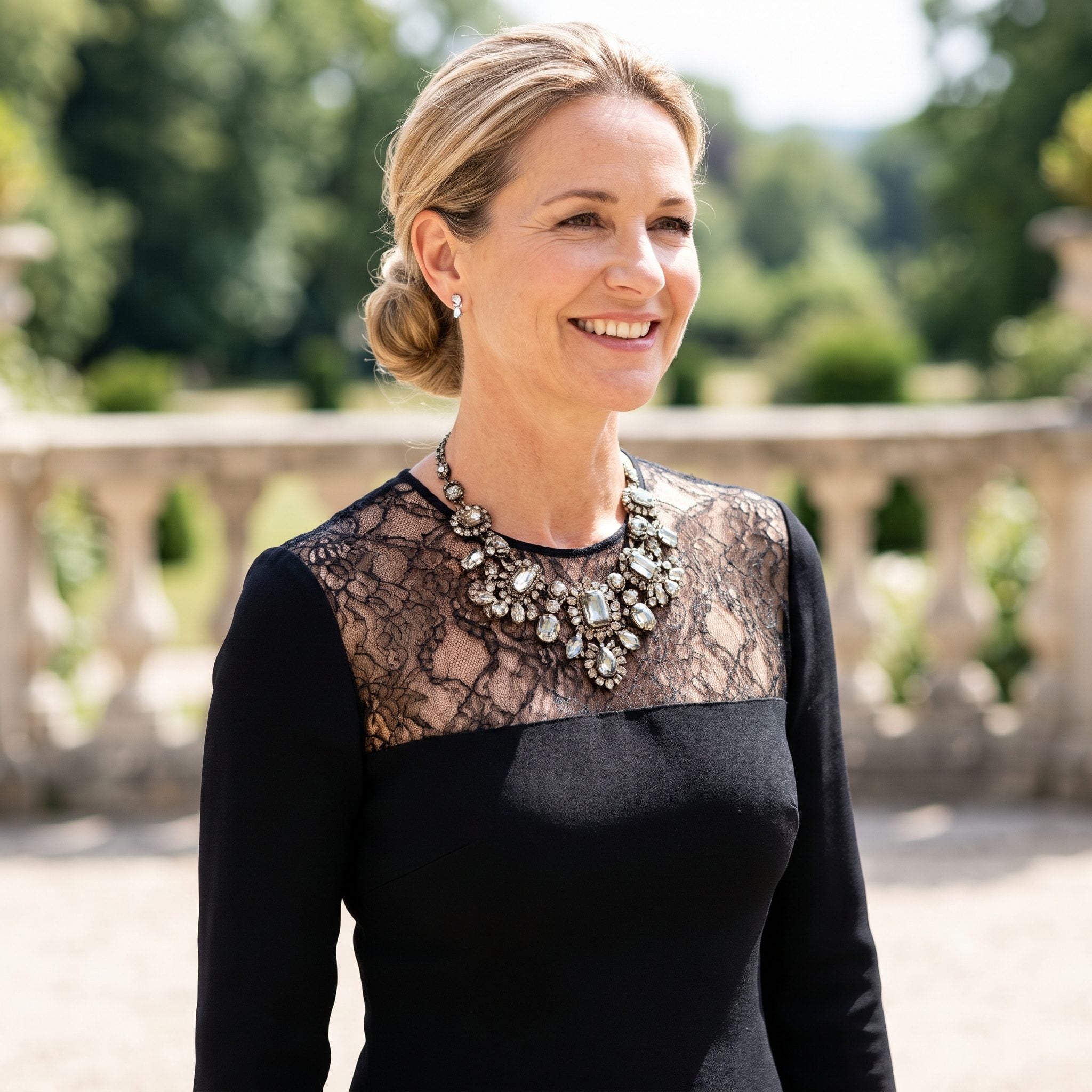
6. The Statement Necklace Competing With a Sheer Lace Yoke
❤️ Would you like to save this?
Lace is doing several quiet things at once: drawing a pattern, revealing skin and changing opacity across the upper chest. The gemstone necklace sits directly on top of that fine detail and turns subtle texture into a much denser surface.
Unlike embroidery, lace benefits from the skin showing through it. Leave the throat bare or move the ornament to statement earrings so that transparency remains part of the design. If a necklace is essential, choose one simple enough that the lace can still be seen around it.
5. A Necklace So Large It Turns Into a Bib

There is statement jewelry, and then there is portable breastplate. This necklace keeps expanding downward until most of the burgundy bodice has become nothing more than a background color between metal plates.
An enormous bib can absolutely be the outfit, but then everything else has to surrender accordingly. A deeper open neckline and completely quiet accessories would give a piece this large a clearer frame. If the goal is jewelry rather than armor, stop the mass higher and leave more skin or fabric visible beneath it.
4. The Structured Necklace Drowning in a Cascade of Ruffles

Ruffles refuse to provide a flat surface. They rise, fold and move, while a rigid necklace wants precisely the opposite: one stable plane where its geometry can sit undisturbed.
This is why the jewelry looks physically stranded rather than merely decorative. Let the ruffles occupy the neckline and move the shine to the ears or wrist. A delicate chain can disappear pleasantly into soft folds; a structured collar will spend the day trying to build a table on them.
3. The Necklace That Vanishes Because It Matches the Blouse Too Closely

The silver-on-silver problem was about reflectivity. This one is about value and hue. Burgundy beads against burgundy silk stay so close in color that the necklace becomes a faintly textured extension of the blouse.
Tonal dressing can still support statement jewelry. Give the piece another source of contrast: polished metal links, lighter or darker stones, translucent beads or a noticeably different finish. This necklace does not necessarily need another color; it simply needs an edge.
2. A Bold Necklace Wrestling an Already-Dramatic Sculptural Collar

The collar has already become sculpture. Those broad folded planes rise around the neck, create their own shadows and turn the upper half of the blouse into an architectural feature before the jewelry arrives.
That does not make a necklace impossible, but this substantial one occupies the exact opening the collar has created. A smaller piece tucked cleanly inside could work. So could striking earrings and a completely bare throat. When the garment has built this much structure around the neck, the jewelry needs to respond to the architecture rather than compete for the same blueprint.
1. The One Necklace Trying to Be Six Necklaces at Once

Clean white blouse. Hair off the neck. No rival accessories. The stage could not be clearer, and still the necklace manages to crowd itself.
Pearls, tassels, crystal flowers, medallions and multiple chain weights are all asking to define the piece. Any one of those ideas could carry a spectacular necklace. Together they erase the hierarchy that makes a statement readable in the first place.
The strongest statement jewelry does not have to be simple. It does need a point of view. Big pearls, extravagant color, monumental chain, wild scale: choose the obsession and commit to it. Boldness gets much more interesting once the necklace knows what it wants to say.