

❤️ Would you like to save this?
Nobody books a curtain bang because they thought it through. They book it because a reel autoplayed three times, a friend got one Tuesday, and suddenly the face in the mirror looks wrong without it. That same itch drags people into markets at the top, right as the smart money files out the side door. Same wiring, same rush, same regret growing out at the temples. The brain treats a sold-out salon slot and a stock everyone’s talking about as one signal: get in now, before you’re left behind. Here’s how a hot haircut and an overheated bubble run on identical fuel, and why you keep falling for both.
FYI, thanks to AI imagery software, we’re able to create very specific fashion and hairstyle examples to illustrate the points being made. In some cases, imagery is exaggerated to hammer home the point. Also, assume links that take you off the site are affiliate links such as links to Amazon. this means we may earn a commission if you buy something.
12. One Celebrity Pixie Becomes Your Hottest Salon Tip

A photo of someone famous turns up with a cropped pixie, and within days three women in your circle are asking their stylist for “that cut.” Not because their hair, face shape, or growth pattern suits it. Because one admired person did it first, and admiration bleeds into imitation faster than logic can catch up.
Markets pull the same trick. One respected investor buys a stock, word spreads, and suddenly everyone wants in on a thing they couldn’t have named last month. That’s the halo effect: we assume a person we like has good judgment across the board, so their choice becomes our shortcut. A short crop on the right head is genuinely great, and an androgynous hairstyle can be the most confident move you make all year. But the reason you want it this week is social, not personal.
11. A Fancy New Name Makes an Old Shag Feel Revolutionary

The shag has been around since the seventies. Rod Stewart wore it, Jane Fonda wore it. But call it a “modern lived-in layered shag” and suddenly it feels like a discovery, something you invented by walking into the salon.
Rebranding sells. Financial products do this constantly, taking a tired old instrument, slapping a sleek new name on it, and watching money pour in like it’s something nobody’s ever seen. The thing itself hasn’t changed; the story around it has. Those balayage styles layered into a shag today are the same feathered idea your mother had, just with a better publicist.
Plenty of us have fallen for this one: ask for something “fresh,” get handed a cut an aunt wore in 1978, and love it. The naming did its job.
10. TikTok Makes Curtain Bangs Feel Urgent by Friday

You weren’t thinking about bangs on Monday. By Friday you’ve watched enough fifteen-second clips of women flipping their soft, face-framing curtain fringe that going another weekend without them feels like missing a train.
That urgency isn’t yours. It’s engineered. The feed shows you the same cut from forty angles in two days, and your brain mistakes repetition for importance. Bubbles run on that same drumbeat, the everyone-is-doing-this-right-now pulse that makes waiting feel like loss. Social proof plus speed equals a decision you didn’t actually make.
Here’s the tell. A cut that will look good in six weeks looks exactly as good if you book it next month. The urgency belongs to the trend, not the hair.
9. A Six-Week Salon Waitlist Makes the Shag More Desirable

Tell someone the stylist who does the good shag is booked out six weeks, and watch the cut go from “maybe” to “I have to have it.” Scarcity does that. The harder a thing is to get, the more we assume it’s worth getting.
Same reason a “limited allocation” or a “closed fund reopening to a few investors” sends people scrambling. The wall around the thing becomes the reason to want it. Those backpack styles that sell out in an hour aren’t six times better than the ones still sitting in stock, but the sellout tag makes your brain treat them like they are.
Camel wool coat, structured leather tote, and you’ll still stand at that reception desk feeling faintly rejected because a haircut has a velvet rope. Scarcity hijacks desire. Noticing it is half the cure.
8. Filtered Hair Reels Hide Every Trend That Flopped
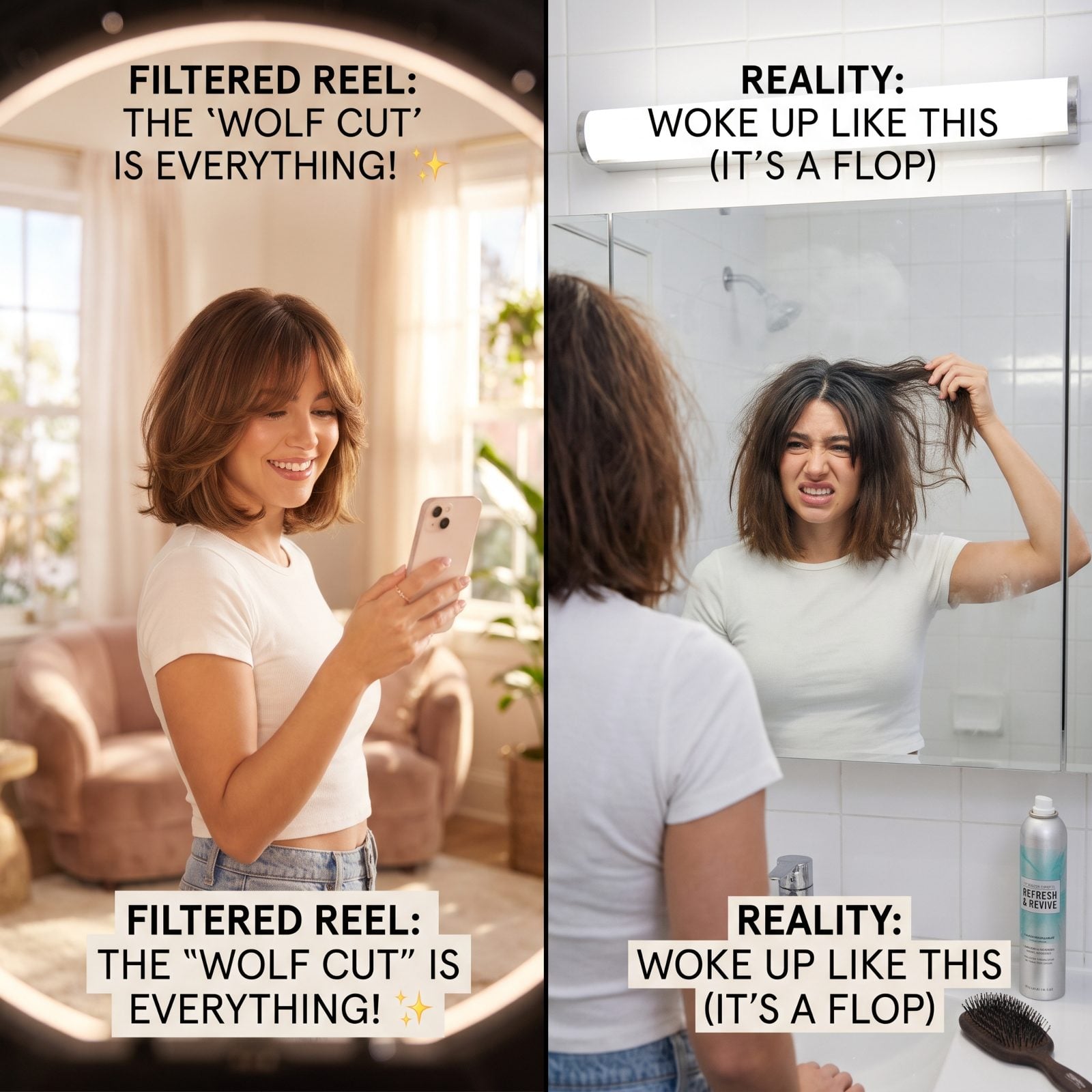
Scroll any hair feed and every cut looks like a triumph. Perfect light, perfect angle, perfect day-one bounce. What you never see is the woman three weeks later fighting her cowlick, the wolf cut that grew into a mullet nobody asked for, the perm that frizzed in August humidity.
That’s survivorship bias, the quiet engine behind every bubble. You only hear about the winners because the losers go silent. Nobody posts the flop. Markets look unstoppable because the failures quietly delist while the success stories keep talking. The beach hairstyle that photographs like a dream in golden hour behaves very differently at a rainy school pickup.
Cream linen blazer, sun-kissed waves, golden-hour glow, it’s all real, and it’s all the top one percent of outcomes. The average result is sitting in a group chat somewhere, unphotographed.
7. You Assume Today’s Fastest-Growing Cut Will Keep Climbing

The wolf cut is everywhere, so the logic goes: it’ll be even bigger next year. That’s how we think about anything on the rise. We draw the line straight up and assume it keeps going, because a thing growing feels like a thing that will always grow.
It never does. Every bubble is built on that same extrapolation, the belief that this year’s rocket climbs forever. Hair trends peak and crash on a predictable arc, and the fastest-growing cut usually sits closest to its top, not its beginning.
6. You Ignore Your Cowlick Because the Bob Is Booming

Your hairline has a cowlick that will fight a blunt bob every single morning. You know this. You get the bob anyway, because the bob is having a moment and the moment outshouts the evidence sitting right there on your forehead.
Confirmation bias, dressed in a cutting cape. Once you’ve decided you want something, you quietly file away every reason it might not work and spotlight every reason it will. Investors do this in bubbles too, waving off the obvious warning signs because the story they’ve fallen for is louder than the data.
Espresso bob, stubborn cowlick, chunky cream knit sweater, and a mirror telling you a truth you’d rather not hear. A cut should work with your hair, not against the way it actually grows. Listen to the cowlick. It’s been there your whole life, and the trend has only been around since March.
5. The Trend Gets Called Timeless Right at Peak Hype

Right when a cut hits maximum saturation, when every third woman in the room has it, that’s exactly when someone pronounces it “a timeless classic.” The word “timeless” is almost never a prediction. It’s reassurance, offered at the precise moment people start to wonder if they’re late.
Bubbles get the same treatment. At the top, the loudest voices insist this one’s different, this one’s permanent, this one’s a new normal. The word is doing emotional work, soothing the buyers who already bought.
Sleek blonde bob, gray suit, a flash of blue scarf, it genuinely is a lovely cut. But “timeless” said at peak hype is a comfort blanket, not a fact. A cut that actually lasts doesn’t need a crowd telling you so.
4. You Finally Get the Lob When Early Adopters Leave

You spent a year thinking about the lob. By the time you finally booked it, the women who started the trend had already moved on to something shaggier. You bought at the top, right as the early adopters cashed out.
This is the exact rhythm of a bubble. The first-movers get in early, ride it up, and slip out just as the latecomers pile in, convinced they’re joining something still rising. Nobody rings a bell. You just notice the cool crowd has a different haircut now.
And here’s the part that matters: being late doesn’t make the cut wrong. A good cut on your head is a good cut regardless of who left. The only mistake is thinking you’re first when you’re last, then letting that sour something that genuinely suits you. Wear it because it works, not because it’s winning.
3. You Recruit Friends Into the Cut You Just Bought

The minute you get a cut you love, you start campaigning. You tell a friend she’d look amazing with it, you send the reference photo, you offer to come along. You are now, officially, a one-woman recruitment drive for your own haircut.
There’s a reason for it. Once we commit to something, we need other people to validate the choice, because their agreement proves we were right. Same instinct that makes new buyers evangelize whatever they just bought, talking it up to anyone who’ll listen. Every convert is reassurance.
Denim jacket, a phone held up between you while you scroll for the perfect angle to sell your friend on the wolf cut. The urge is real and mostly harmless. Just know you’re not purely being generous, you’re buying yourself a little certainty. And honestly? A cut you love is worth sharing. Just be honest about why you’re so eager.
2. You Buy More Products to Defend a Bad Perm

The perm came out tighter and frizzier than the photo. So what do you do? You don’t admit defeat. You drive to the store and buy the curl cream, then the leave-in serum, then the diffuser, then the special pillowcase. Each purchase is a small argument that the perm was a good idea and just needs the right support team.
This is the sunk-cost fallacy wearing a shower cap. You’ve already spent the money and sat in the chair for two hours, so backing out feels like admitting the whole thing was a loss. Spending more to rescue the decision hurts less than calling it a mistake. Same wiring that keeps someone pouring savings into a stock that’s already tanked: “I’m too deep to stop” is exactly the thought that gets you deeper.
It happens with color too: a balayage grow-out that seems to need gloss after gloss to “fix.” The products weren’t the problem. The decision was. You can’t cream your way out of a cut you don’t love.
1. One Snarky Reel Starts a Rush Back to Long Hair

For two years everyone wanted the chop. The bob, the lob, the pixie, the clean nape. Then one afternoon a snarky reel calls short hair “aging,” and suddenly every chair in the salon is clipping in extensions. The same tide that pushed you toward the scissors now drags you back toward your shoulders, and nobody can say exactly when the mood flipped.
That’s a bubble popping in real time. A trend climbs because everyone sees everyone else doing it — social proof doing the heavy lifting. One loud voice of doubt, and the crowd that rushed in rushes for the exit. Financial manias crash the same way, not on new facts but on a vibe shift. The herd that made the thing hot is the herd that makes it suddenly embarrassing.
The haircut didn’t change overnight. The audience did.
Here’s the part worth sitting with. That sharp Monday cut is the identical cut on Friday — nothing about it got worse. What changed was permission, and permission inflates and deflates on nothing at all. Grow your hair back out because a stranger with a ring light made you nervous, and you’re reacting to crowd pressure, not to your own mirror.