
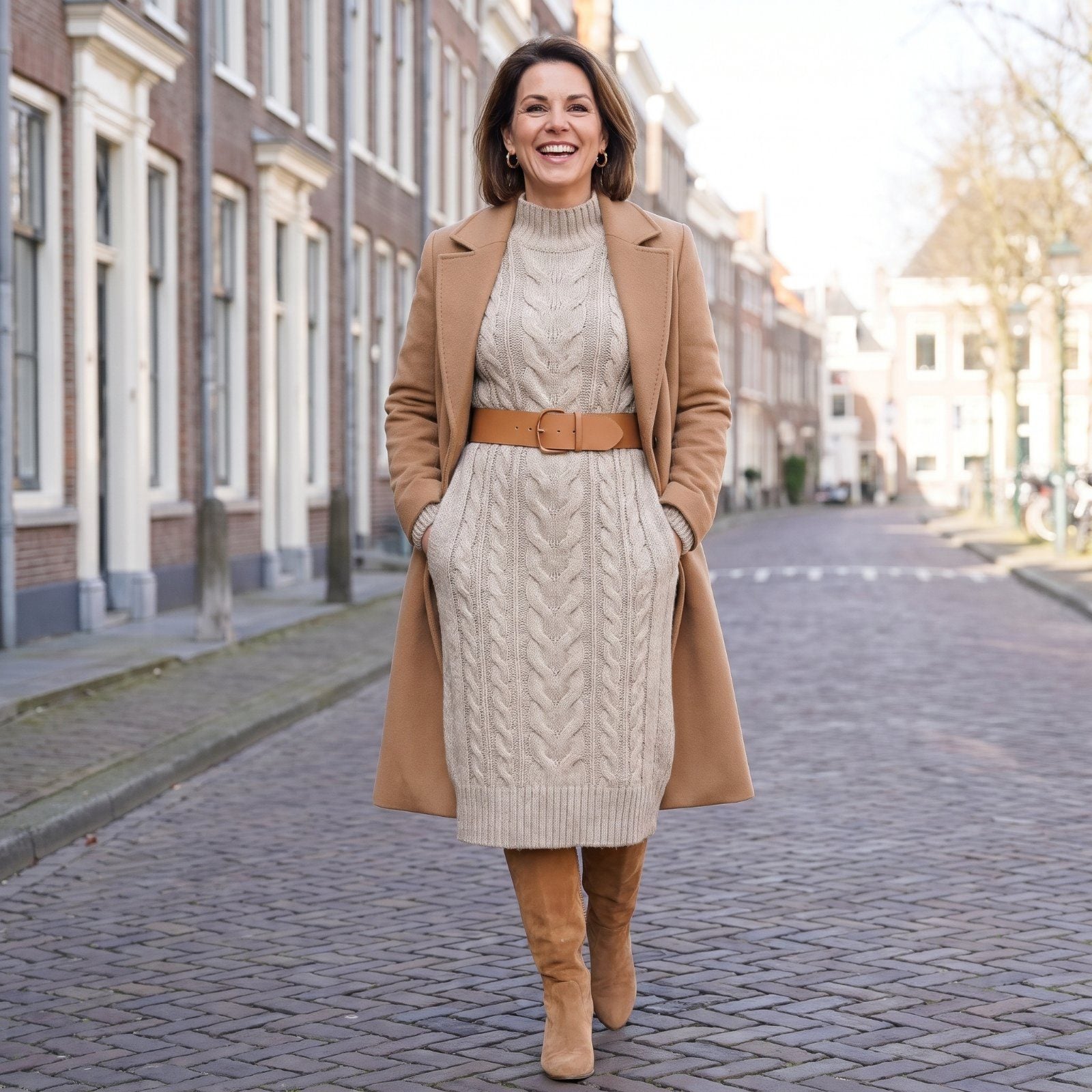
A sweater dress is the easiest thing in your closet. Pull it over your head, done. And that’s exactly the problem. These pieces are so comfortable and so forgiving that you miss the one spot where the whole thing goes sideways. A hem that lands wrong. A boot that chops the leg in half. A puffer that eats your waist alive. Each one looks fine in the mirror for the two seconds you glance at it, and then you catch yourself in a shop window later and wonder what on earth happened. So here’s where it goes wrong, and how to spot it before you walk out the door.
FYI, thanks to AI imagery software, we’re able to create very specific fashion and hairstyle examples to illustrate the points being made. In some cases, imagery is exaggerated to hammer home the point. Also, assume links that take you off the site are affiliate links such as links to Amazon. this means we may earn a commission if you buy something.
36. A Micro Sweater Dress With Thigh-High Boots and No Visual Break
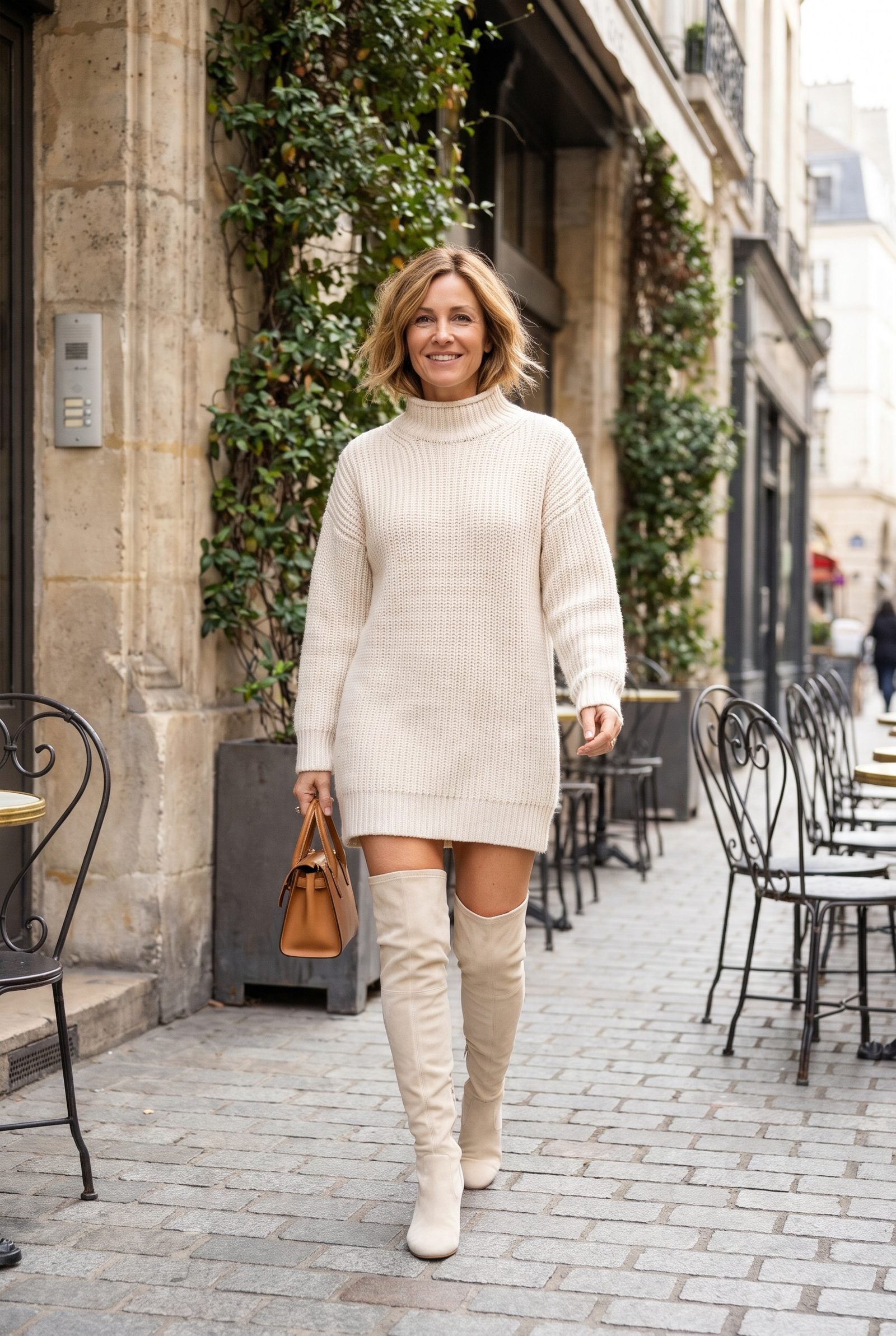
Here the boot stops a few inches short of the micro hem, leaving a clear band of bare thigh, a shift and a moment for the eye to rest. Without it, the whole lower half would read as one solid tube of fabric, and you couldn’t tell where the body actually is underneath it.
The fix is a deliberate break. Drop the boot to mid-thigh or lower and let a real stretch of leg show. That sliver of skin is what tells the eye how long your legs are. Cover it completely and you erase your own proportions.
Summing up how to pair boots with sweater dresses, a shoe blogger advises: “Keep a gap between the dress hem and boot top of at least a couple of inches (3+ is ideal).”
35. A Calf-Length Sweater Dress Ending at the Widest Part of the Leg
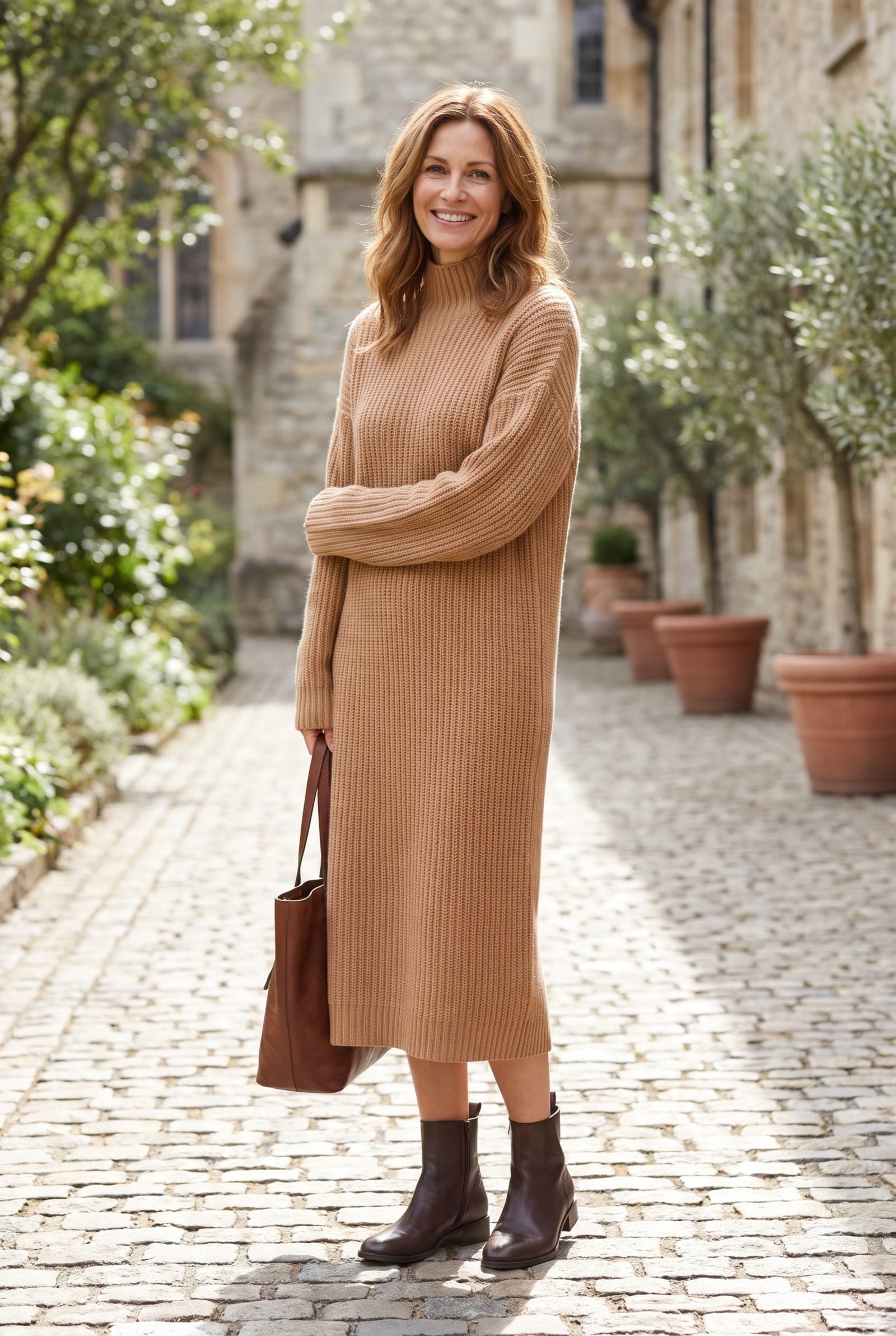
Hem placement is quiet but ruthless. A sweater dress that stops at the thickest part of the calf draws a hard horizontal line exactly where you don’t want the eye to stop, and the leg looks shorter and heavier than it really is.
Length is everything here. Just below the knee flatters. Down at the ankle flatters. The calf’s widest point almost never does. Caught between sizes on length? Go longer and get it tailored, or go shorter and land above the knee. The middle is the trap.
What Our Readers Say
- Asked about dress length in general, 54% of ThreadCurve readers picked knee length, ahead of midi at 28% and maxi at 18%.
- When readers chose which dress they would actually buy, midi and knee length came out as a near coin toss, with maxi trailing well behind.
From ThreadCurve reader polls and votes.
34. A Knee-Length Sweater Dress With Mid-Calf Boots
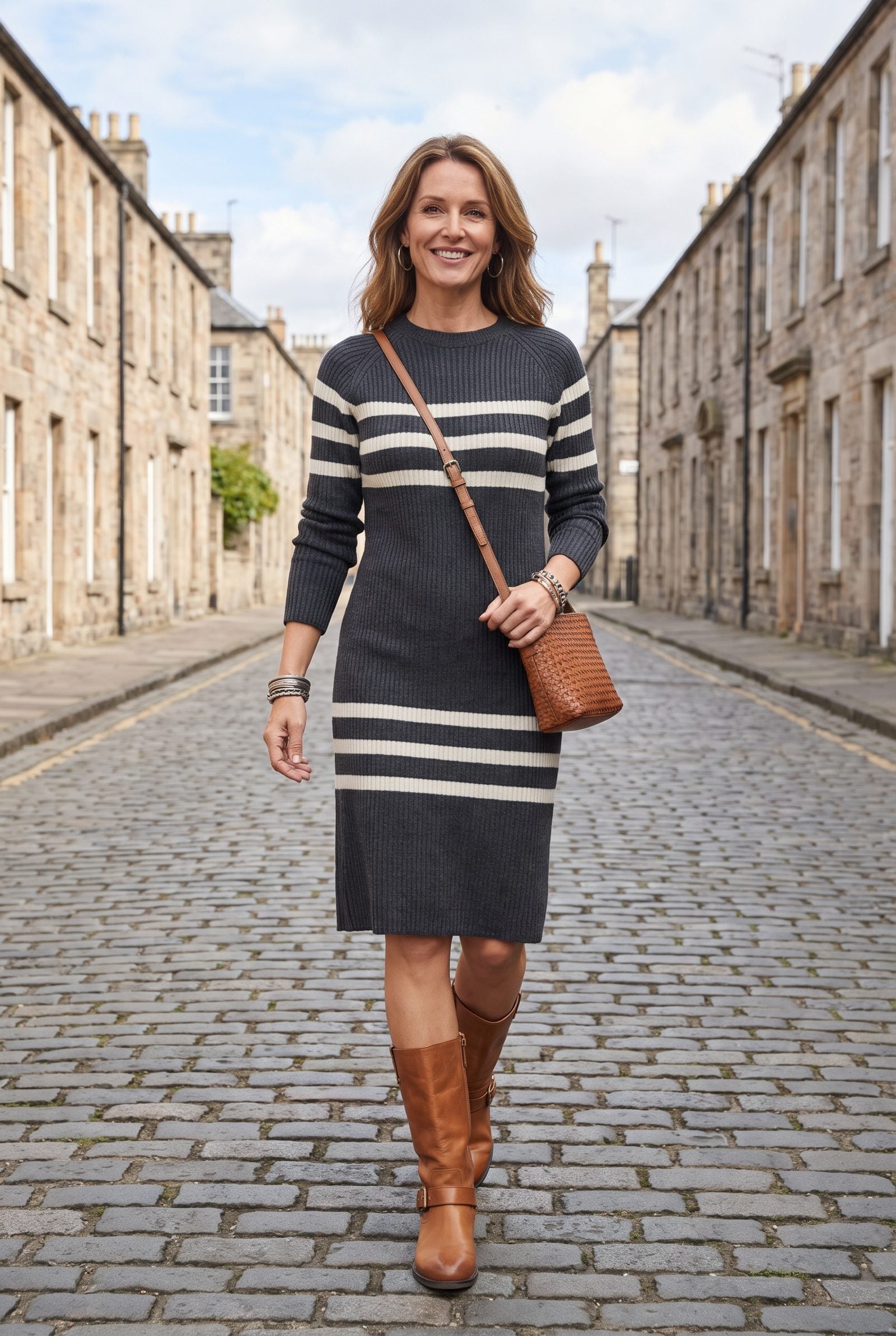
Two horizontal lines fighting over the same few inches of leg. The dress hem lands at the knee, the boot top lands at mid-calf, and the short stretch of skin between them gets chopped into a stubby little segment that shortens everything above and below it.
Either close the gap or open it wide. A tall boot that meets the hem reads as one clean line. A low ankle boot sitting well below the hem gives the leg room to breathe. It’s the near-miss in between that trips people up.
33. A Tunic-Length Sweater Dress Worn as a Full Dress
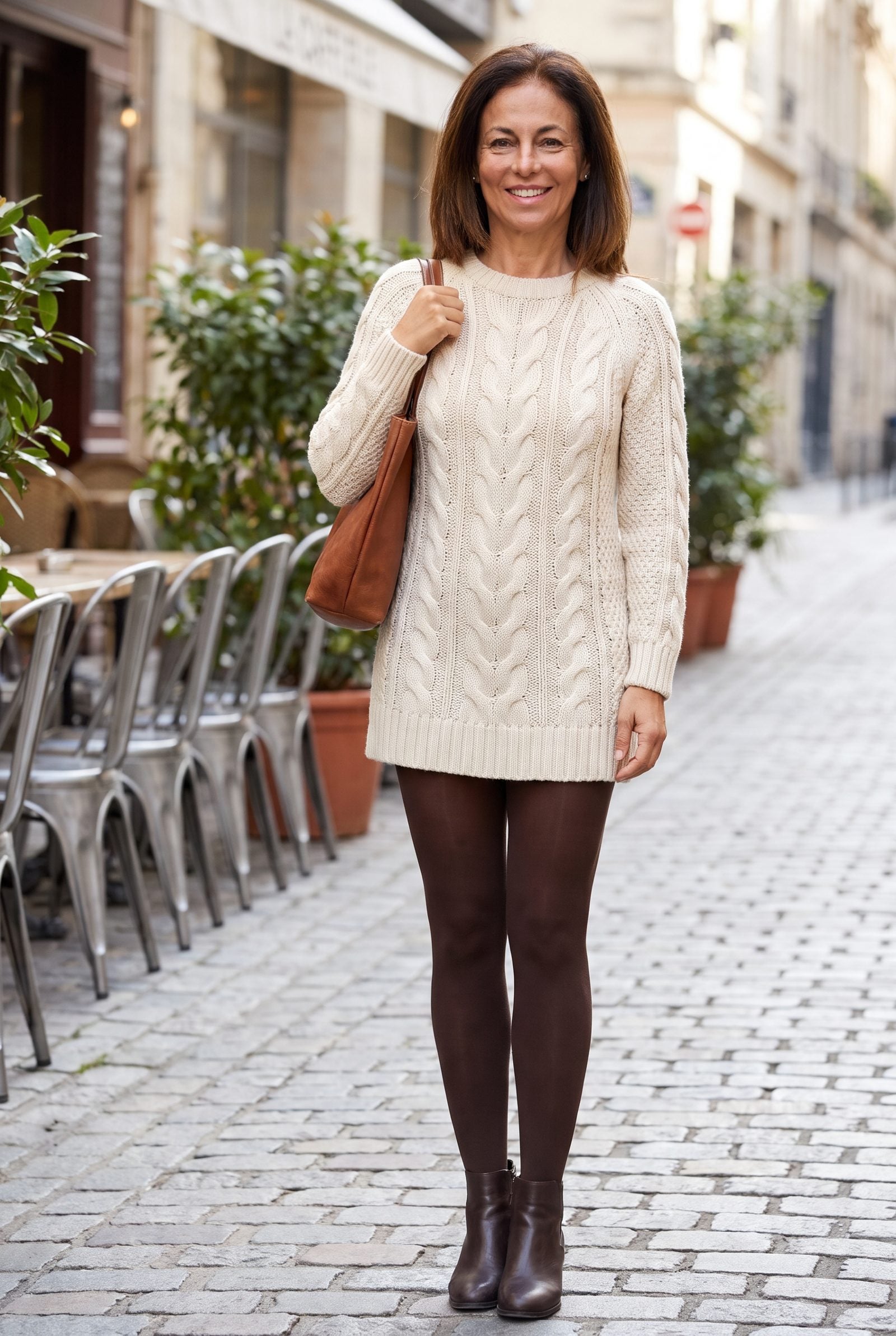
A tunic is built to go over something else. This cream cable knit is worn differently: it stops at mid-thigh, a tunic length worn here as a dress, and brown opaque tights with dark brown ankle boots cover the long stretch of leg between boots and hem so the whole look feels finished.
If yours stops at tunic length, add the bottom half back. Slim trousers, straight jeans, or leggings underneath turn the tunic into exactly what it was made for. Want it as a dress instead? Then you need true dress length, not a top that happens to run long.
32. An Oversized Mini Sweater Dress With Tiny Ballet Flats
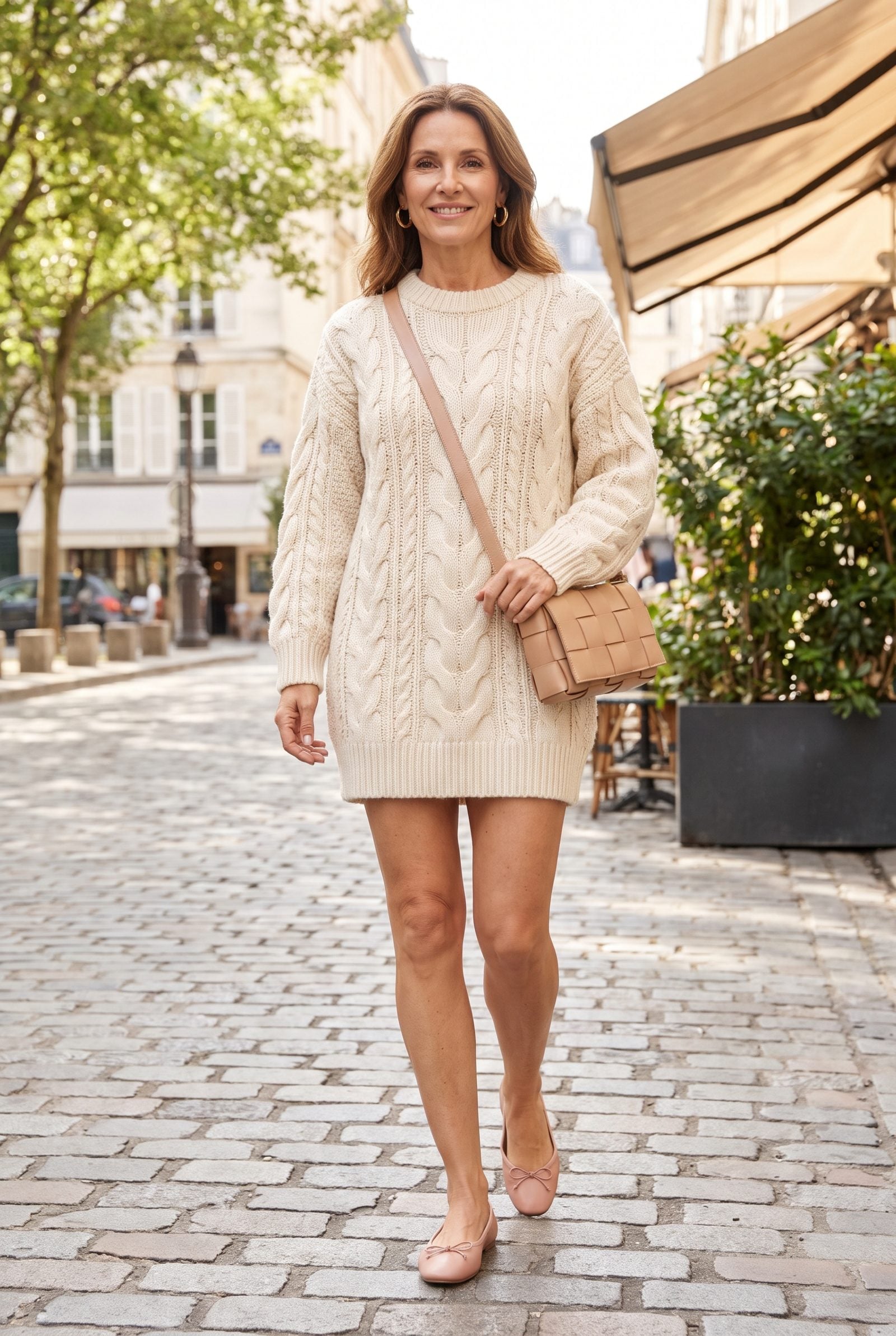
Big volume up top, tiny shoe at the bottom. The oversized knit needs a shoe with some presence to anchor it, and a wispy ballet flat just gets visually swallowed, leaving the whole look unbalanced and bottom-light.
Give the volume something to stand on. A chunky loafer, a low block-heel boot, or a sturdier flat holds its own against all that fabric. The shoe doesn’t have to be heavy. It just has to register. One of my favorite fall outfit styles resets is swapping a flimsy flat for a chunky loafers and watching the whole thing lock into place.
31. A Midi Sweater Dress Pooled Over Ankle Boots
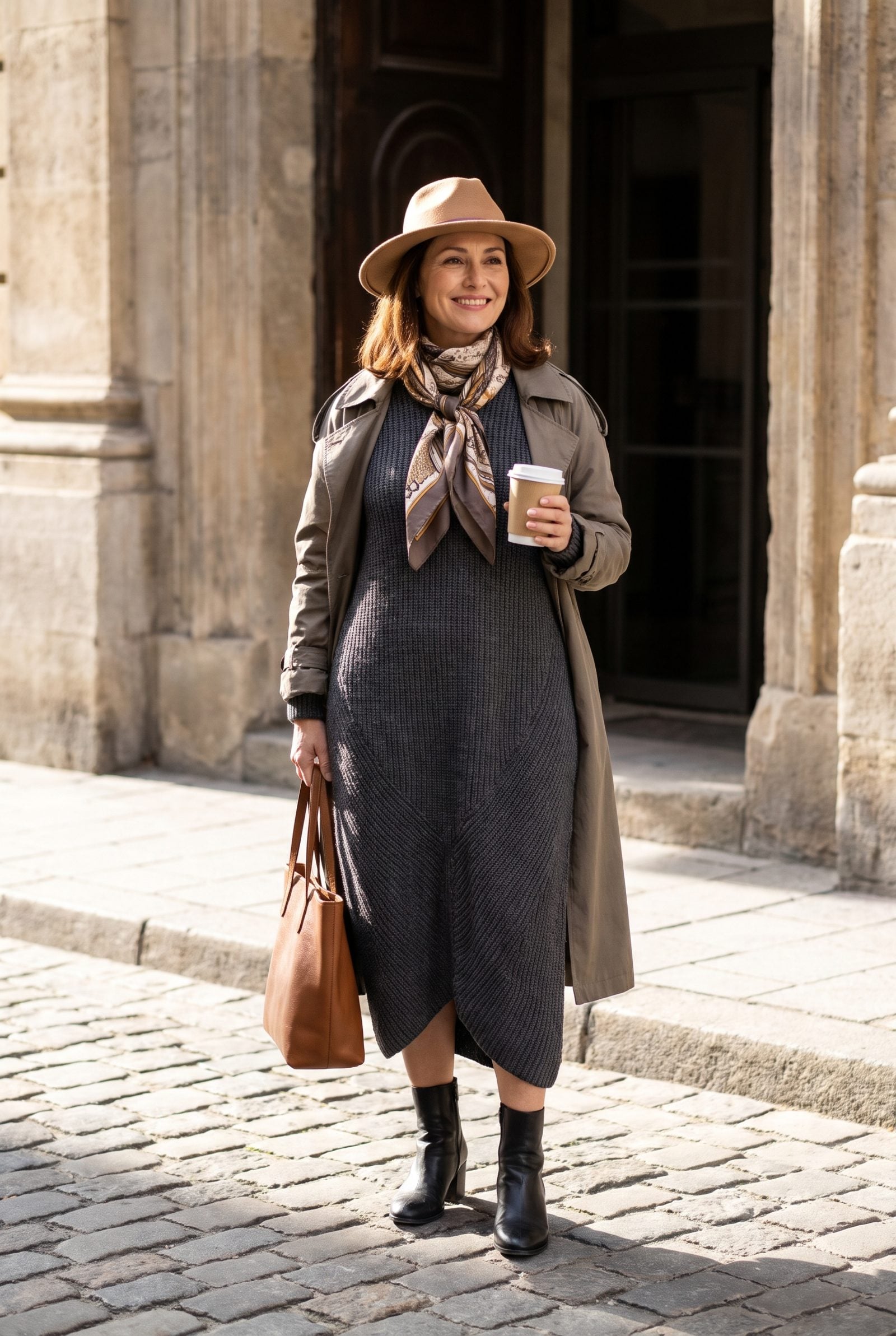
A midi that ends at mid-calf doesn’t pile on top of the boot, it clears it. The hem stops above the boot top, leaving a clear stretch of bare leg right where the leg is narrowest, and that gap keeps the line clean exactly where you want a clean finish.
Length precision matters more with knits because they drape and pool. Hem it to clear the boot top by a couple of inches, or wear it with a taller boot so the hem meets the shaft cleanly. The ankle is the finish line. Keep it tidy.
On wearing ankle boots with sweater dresses, a longtime fashion blogger says “The secret is balance. You want more than just a sliver of space between your hem and the top of your boot.”
30. A Fine-Knit Column Dress With Bulky Snow Boots
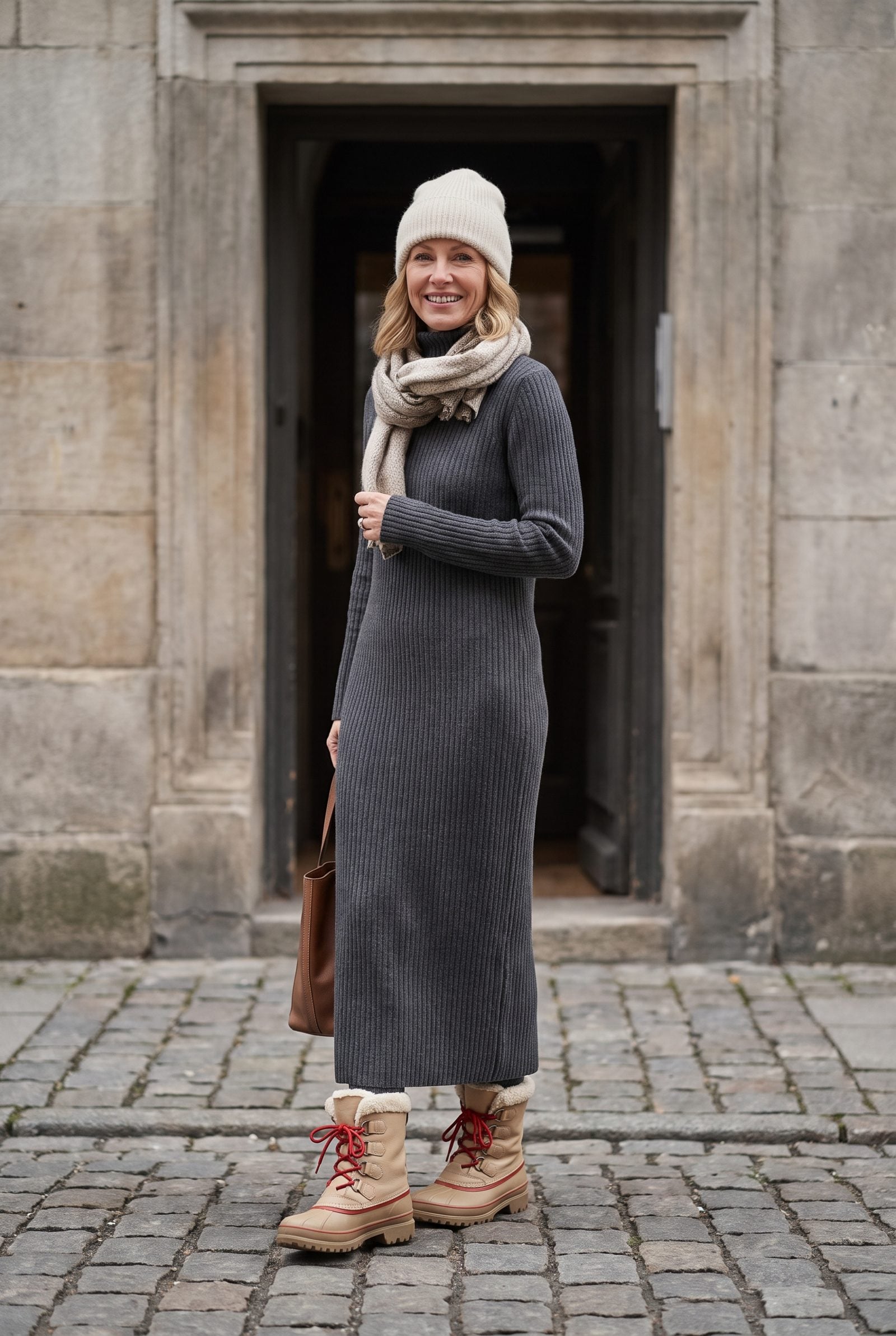
A fine-knit column dress lives or dies on one long slim line. Plant a pair of padded snow boots at the bottom and the delicate silhouette collides with heavy, oversized footwear, and the eye snags on that mismatch in weight.
Match the fineness. A sleek tall boot, a leather riding boot, a slim-shafted style — any of them keeps the line going. Save the snow boots for a chunkier knit that can hold its own against all that bulk. Weight should talk to weight.
29. A Flared Sweater Dress With Western Boots That Cut Across the Hemline
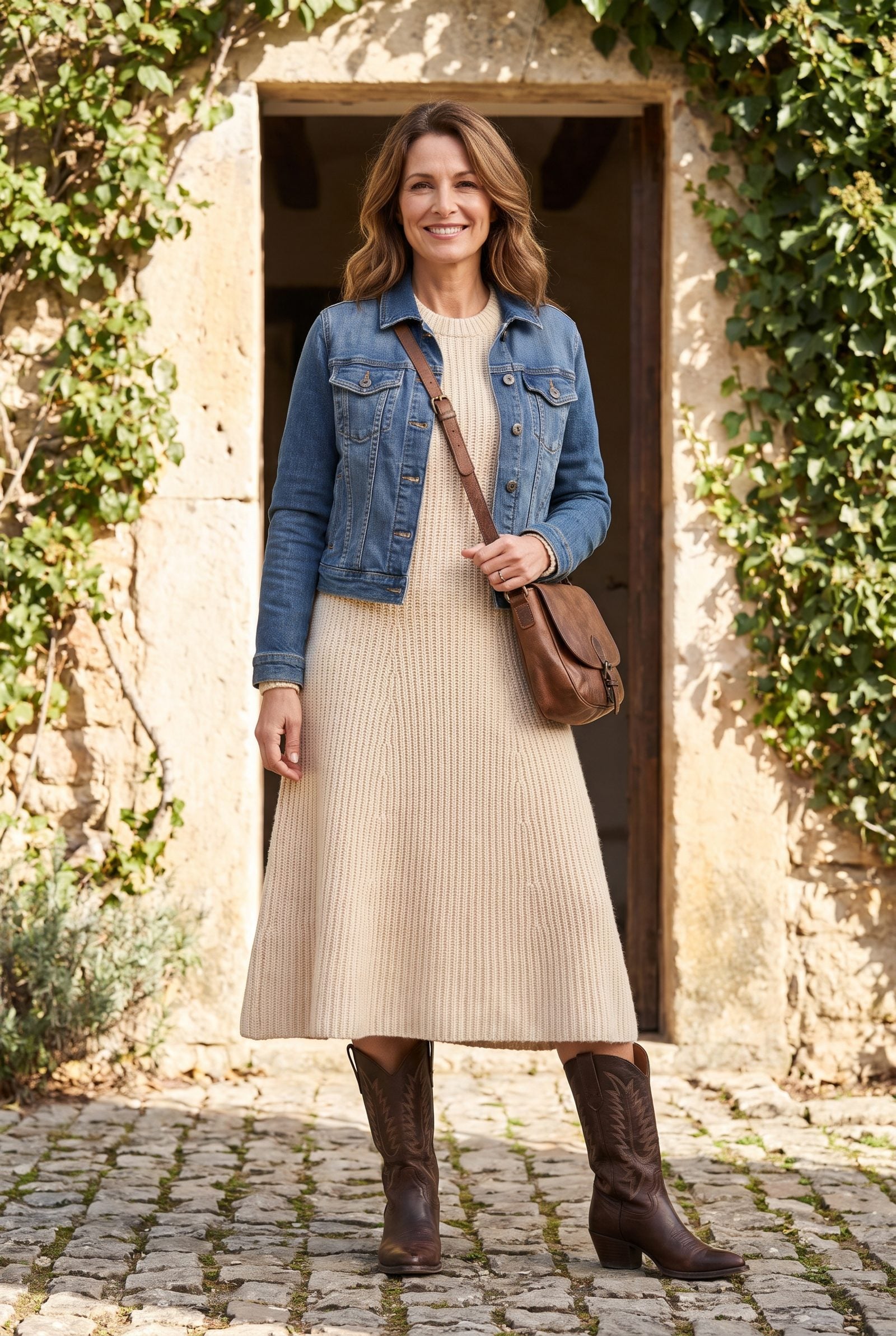
The flare of the dress swings out exactly where the boot shaft climbs up, and the two lines cross at the widest part of the calf. Competing curves, both fighting for the same spot, and the leg ends up looking wider and shorter than it is.
A flared hem wants a cleaner boot bottom. A sleek ankle boot or a pointed shoe lets the dress do the moving. Can’t give up the western boot? Pair it with a straighter, slimmer knit so the two shapes aren’t both flaring at once. Those dark brown western boots deserve a dress that gives them room.
28. A Midi Sweater Dress With High-Tops and Visible Ankle Bunching
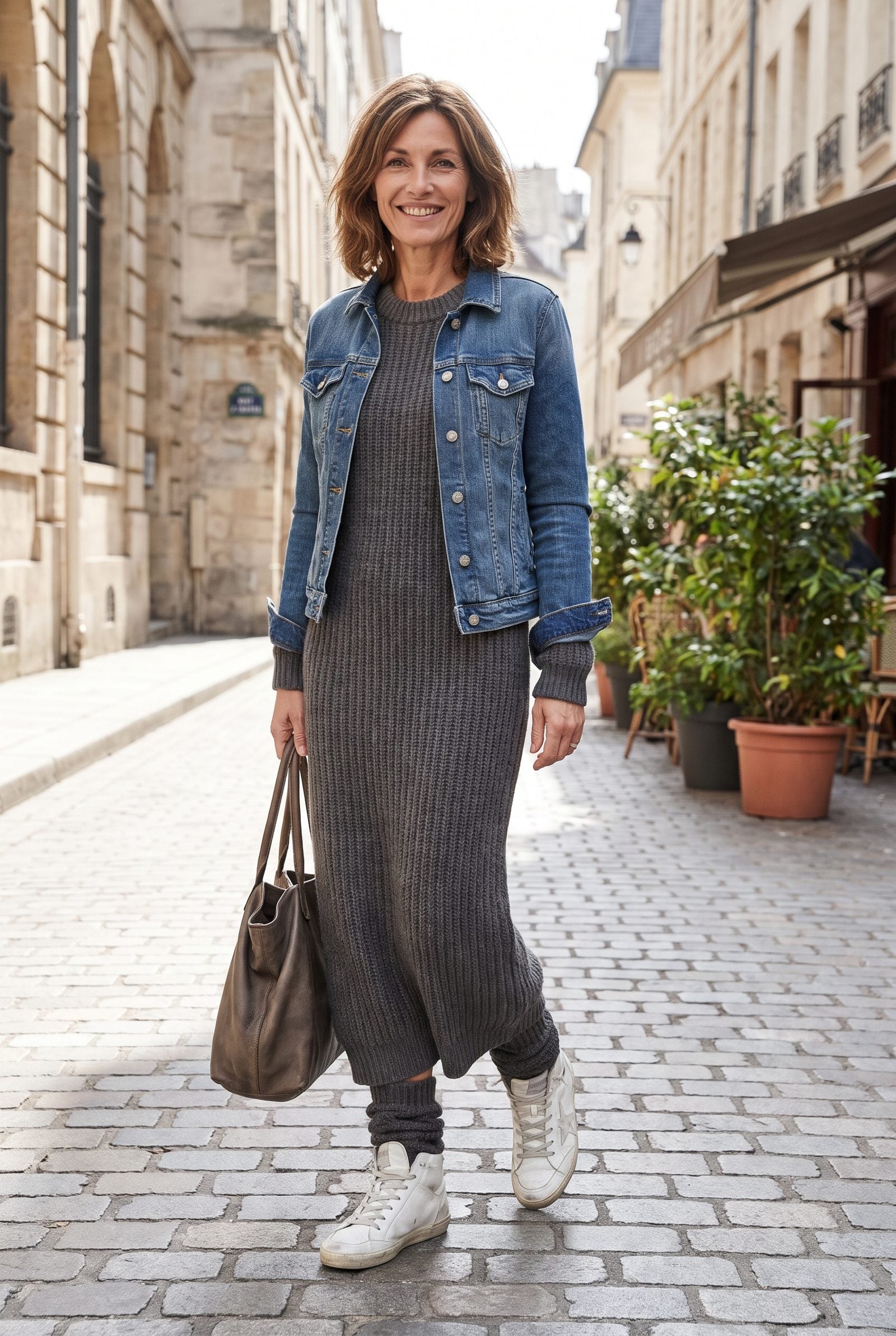
High-tops already pack bulk at the ankle with that padded collar. Run a knit midi hem down into it and the fabric bunches over the top, stacking thickness on thickness right where the leg should taper clean.
Low sneakers solve this instantly. A low-profile trainer or a slip-on keeps the ankle visible and the hem falling clean. Want the sneaker-dress look? Let the ankle show. Bunching at the narrowest point is never the move.
27. A Chunky Turtleneck Dress With a Cropped Puffer
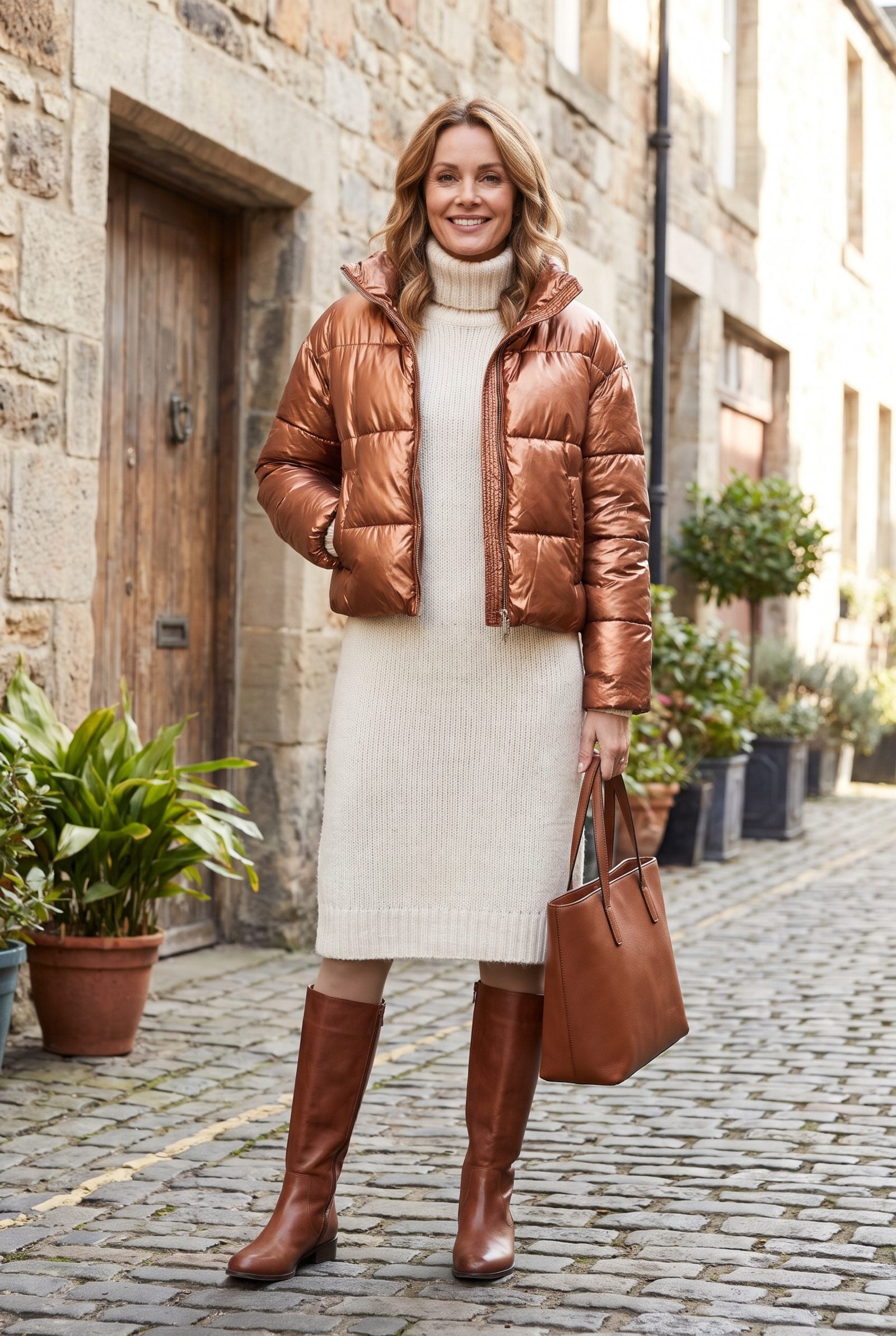
A cropped puffer over a chunky turtleneck dress stacks volume on volume across the top half. The jacket ends high at the waist and piles padded bulk exactly where the knit is already thick, so the upper body balloons while the long dress keeps rolling on underneath.
Chunky needs sleek nearby. A longer, slimmer coat in a smooth fabric — a wool overcoat, a belted trench — balances the fullness of the knit instead of doubling down on it. If you love a puffer, pick a longline one that follows the dress down rather than guillotining you at the waist. Two volumes competing never flatters. Let one piece carry the bulk and let the other go lean.
Puffers were a hard sell anyway: in our reader poll on which coat to pick, only 9% chose a puffer, while wool led at 40%.
26. A Maxi Sweater Dress Under a Short, Boxy Blazer
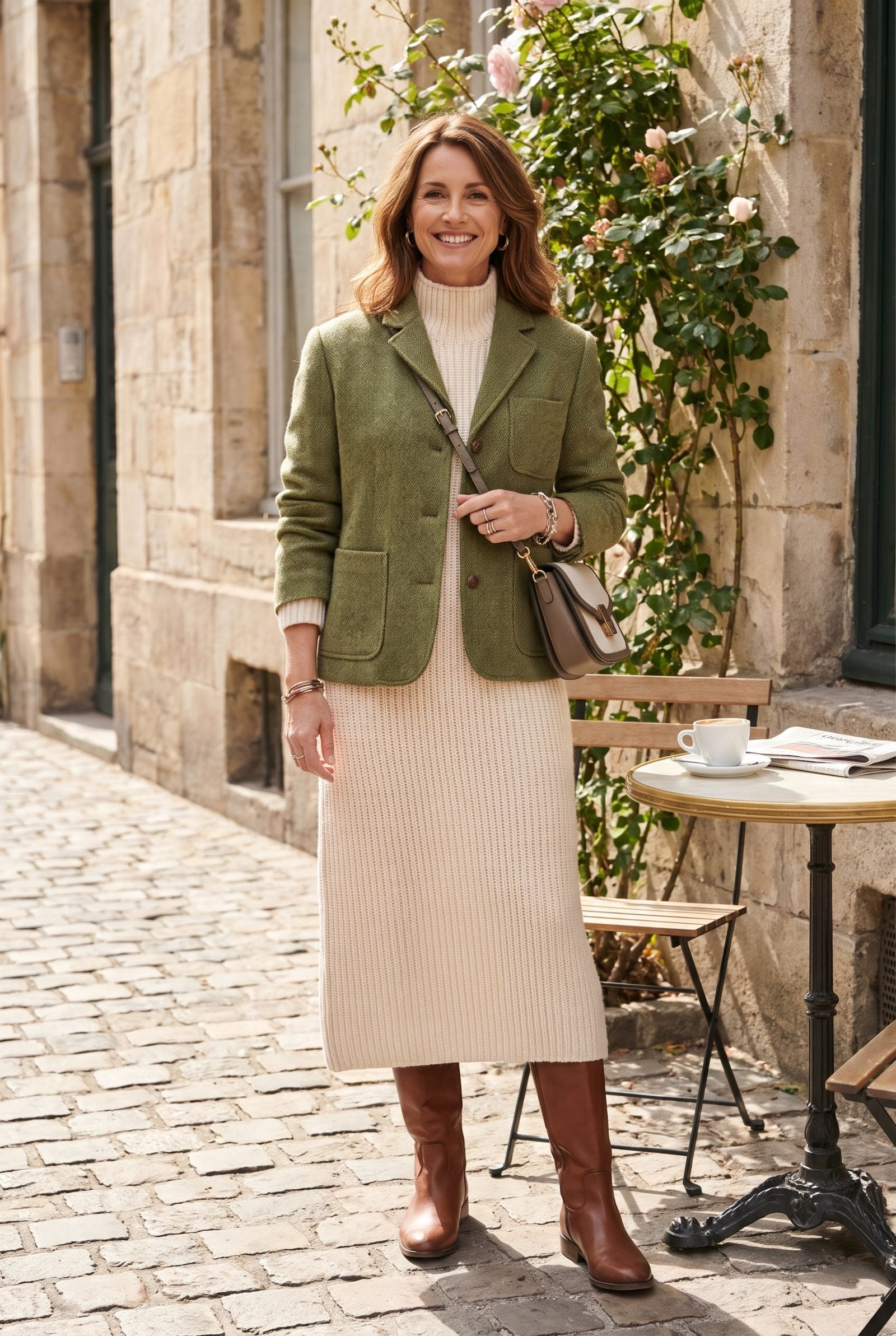
A cropped blazer cuts you off at the waist, while a maxi sweater dress wants to run uninterrupted to the ankle. Put them together and you get a hard horizontal line slicing your midsection, with a river of knit pouring out below.
The eye stops dead at the blazer hem, and everything below reads as separate, longer, heavier than it actually is. The fix isn’t abandoning the maxi. You want a longer line on top — a belted wool coat or a duster that lets the column breathe.
25. A Loose Sweater Dress With an Equally Loose Shacket
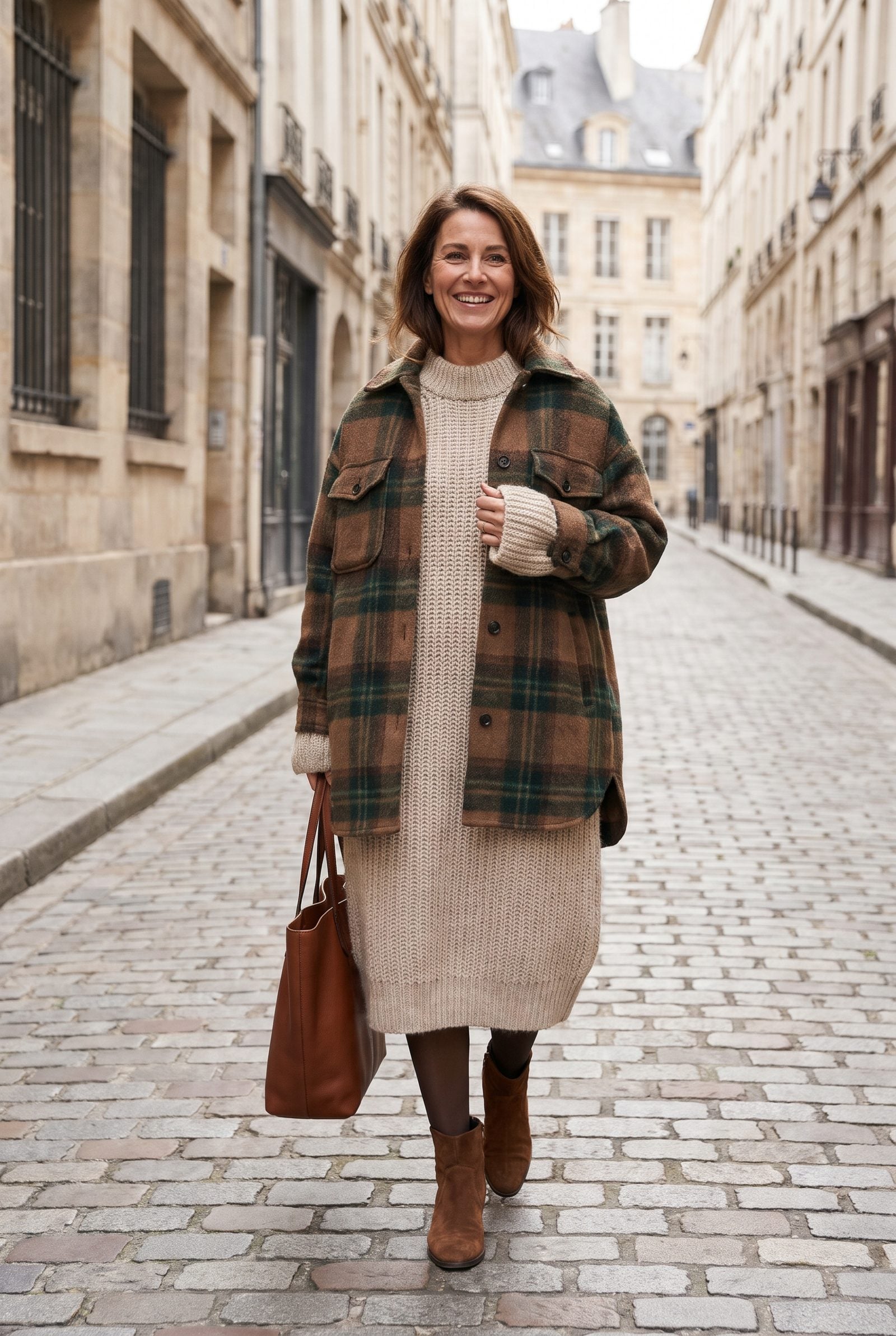
Volume on volume is a texture, not a shape. Here the loose sweater dress and the loose shacket cancel each other out, leaving one shapeless rectangle from shoulder to knee.
Soft fabrics are gorgeous. But two soft, wide layers with nothing anchoring them read as more fabric, not more style. You need one fixed point — a belt over the shacket, or swap that second loose layer for a slim leather jacket that gives the eye an edge to grip.
24. A Balloon-Sleeve Sweater Dress Under a Tight-Sleeved Jacket
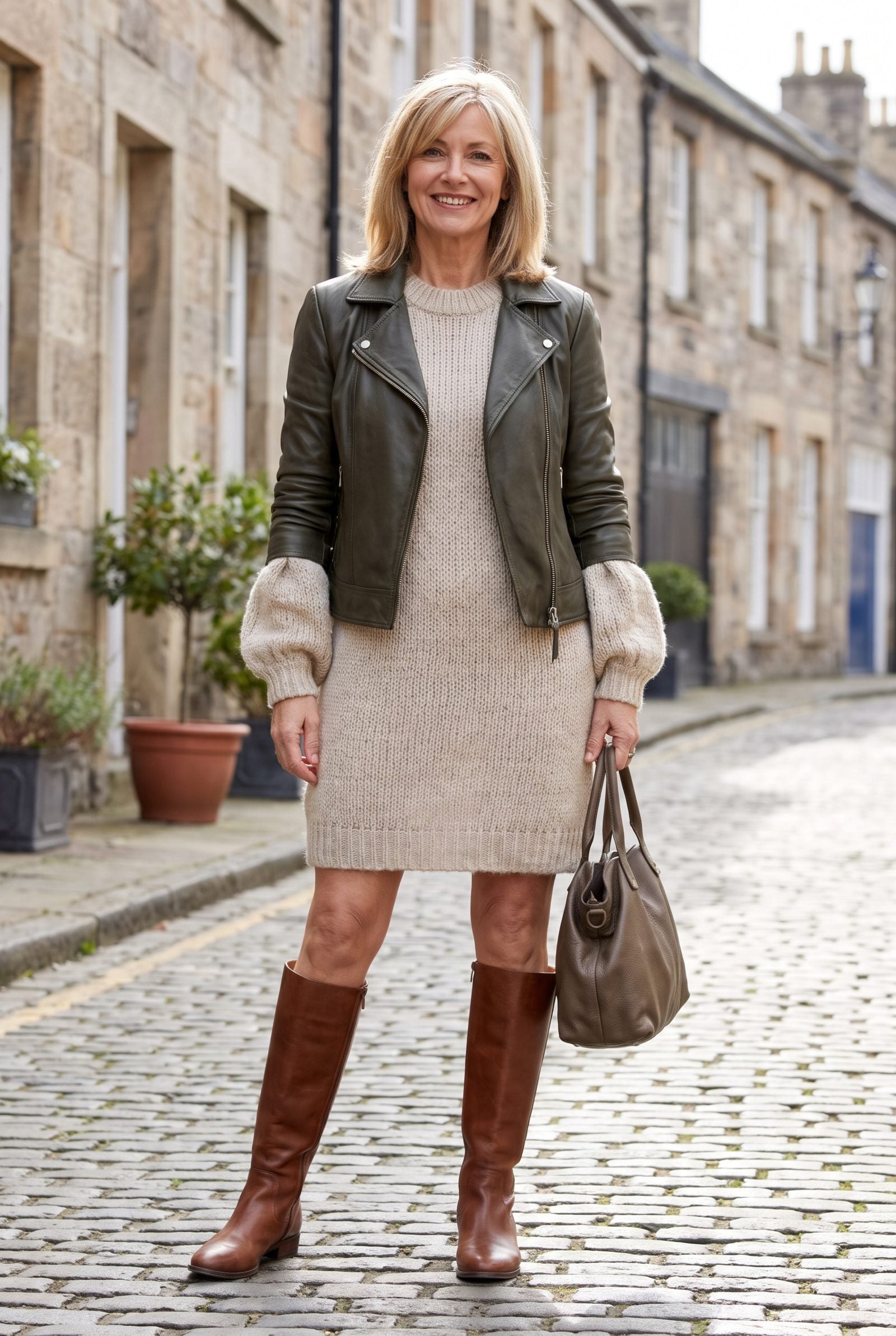
The whole point of a balloon sleeve is the air inside it. Here the slim jacket sleeve stops short at mid-forearm, so the one feature the dress was built around billows out below it, fully inflated, with no bulk piled where your arm bends.
Your upper arm stays streamlined and the drama lives at the cuff. A balloon sleeve wants no outer layer, a topper with matching room, or a cropped sleeve like this one — something that respects the volume instead of crushing it.
23. A Cowl-Neck Sweater Dress Under a Bulky Scarf
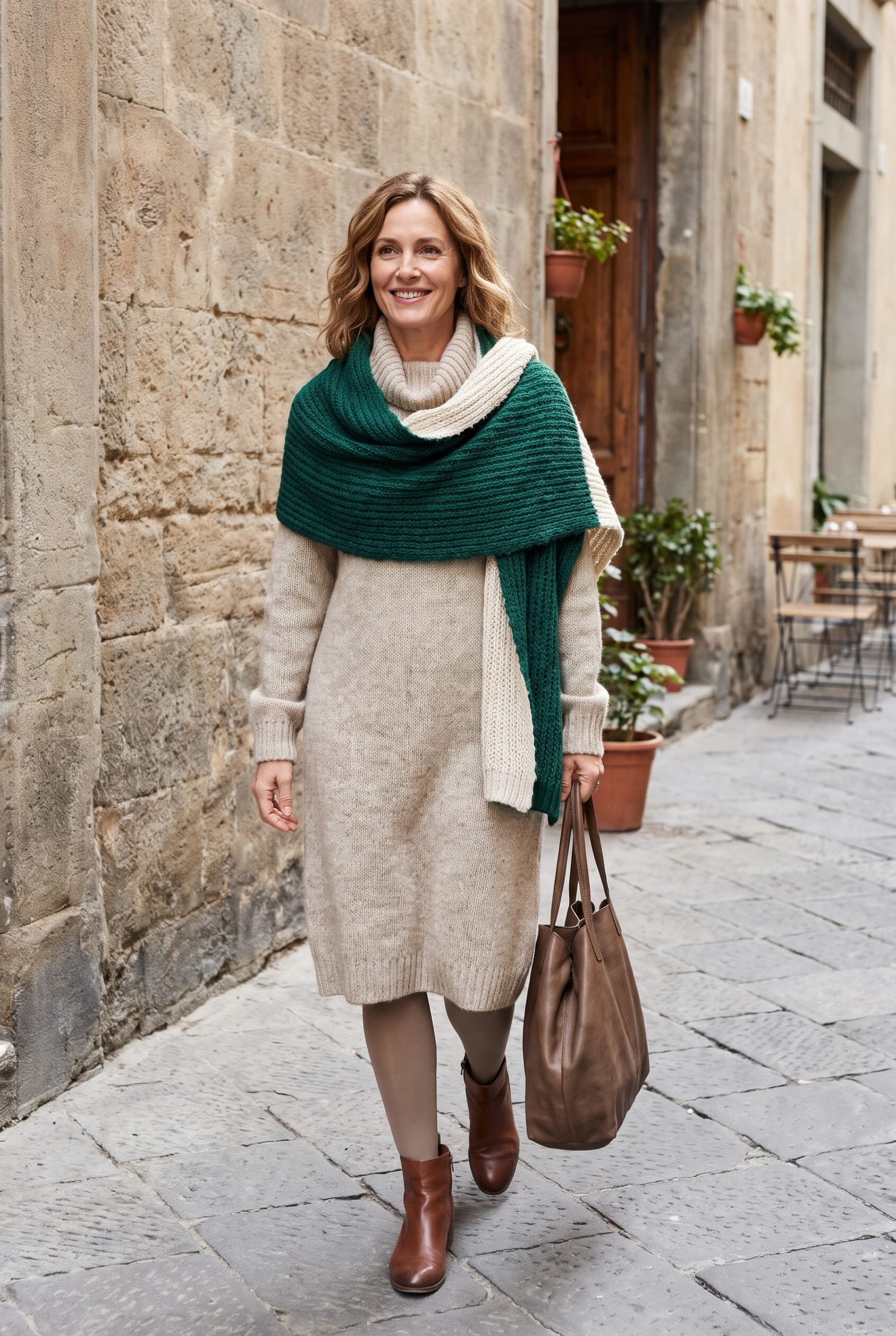
A cowl neck already gives you soft folds of fabric at the throat. Pile a chunky scarf on top and you’ve built a wall of knit running from collarbone to chin.
The neck disappears. Your face sits on a mound of wool. The cowl was the statement — it didn’t need a co-star. If the day really calls for a scarf, go thin and silky, or save the blanket scarf for a crewneck with the bare neckline to carry it. A cowl works best as a holiday accessory left to speak on its own.
22. A Short Sweater Dress Under a Knee-Length Cardigan
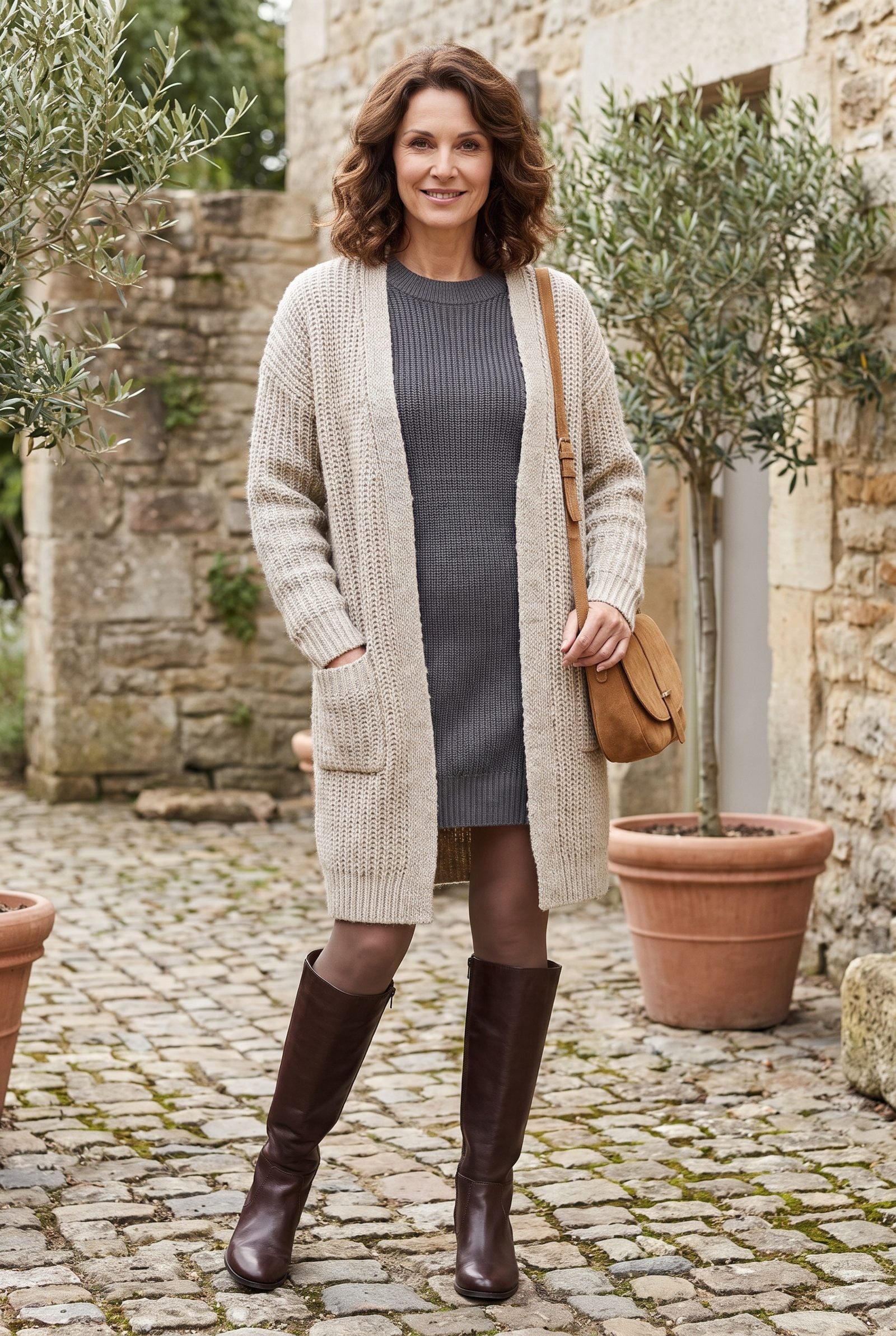
When the cardigan runs longer than the dress, the dress gets boxed in. All anyone sees is a long open sweater with a strip of grey down the front over brown tights, which reads as half-finished rather than layered.
Your mini is barely doing anything because its hem sits above the cardigan’s. Either the cardigan comes up short so the dress hem clears it, or the dress gains length to clear the cardigan line. Two hems should talk to each other — not have one swallow the other whole.
21. A Drop-Waist Sweater Dress With a Hip-Length Jacket
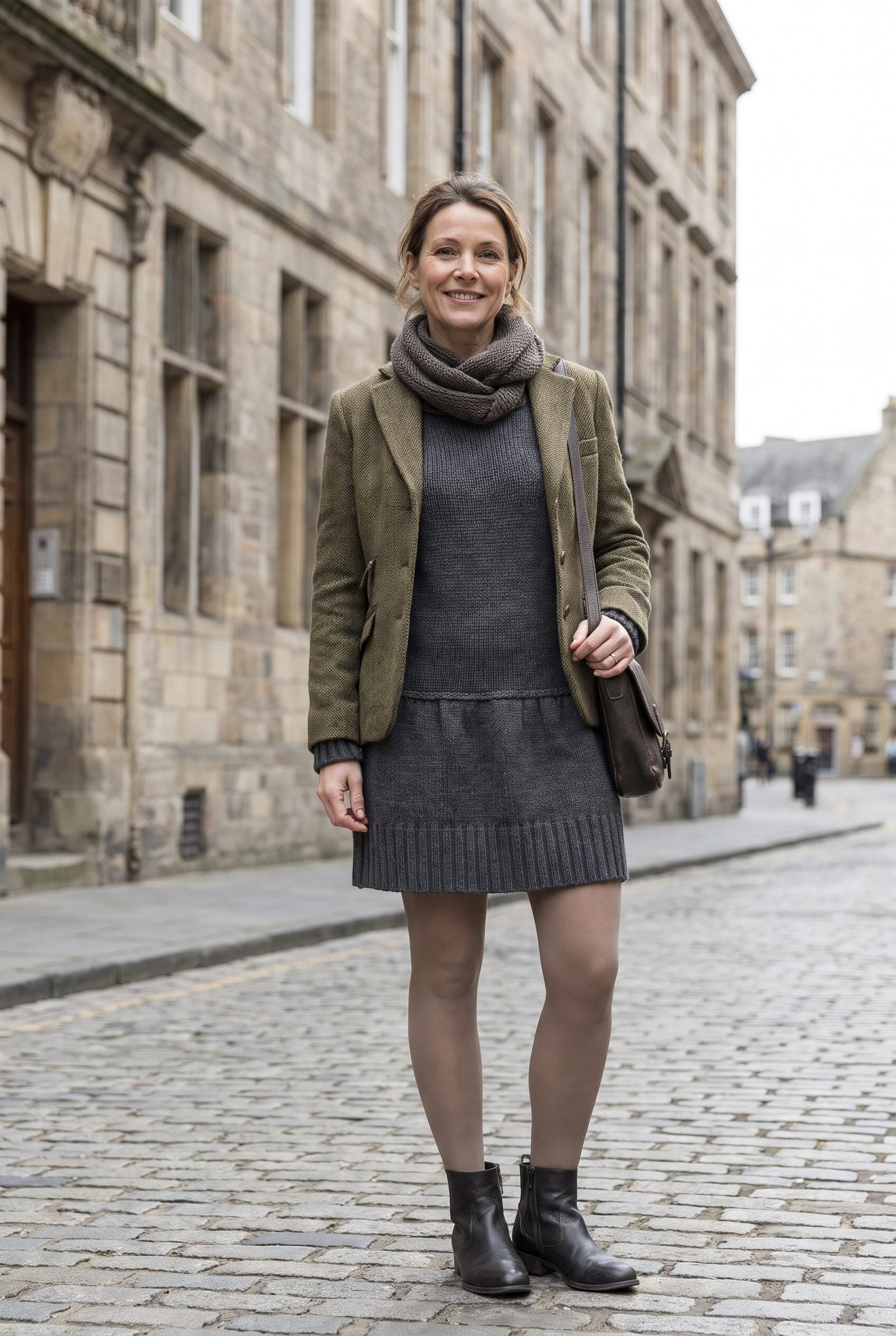
A drop-waist already pulls the eye down to the hip. Add a jacket that ends at that exact line and you double down on the lowest, widest point of the whole look.
Both hems hit together and the waist seems to vanish. The outfit styles that rescue a drop-waist go long and lean over the top — a duster coat — or short and sharp above the drop seam. Never a topper that lands right on it.
20. A Belted Sweater Dress With a Coat That Cuts Across the Belt
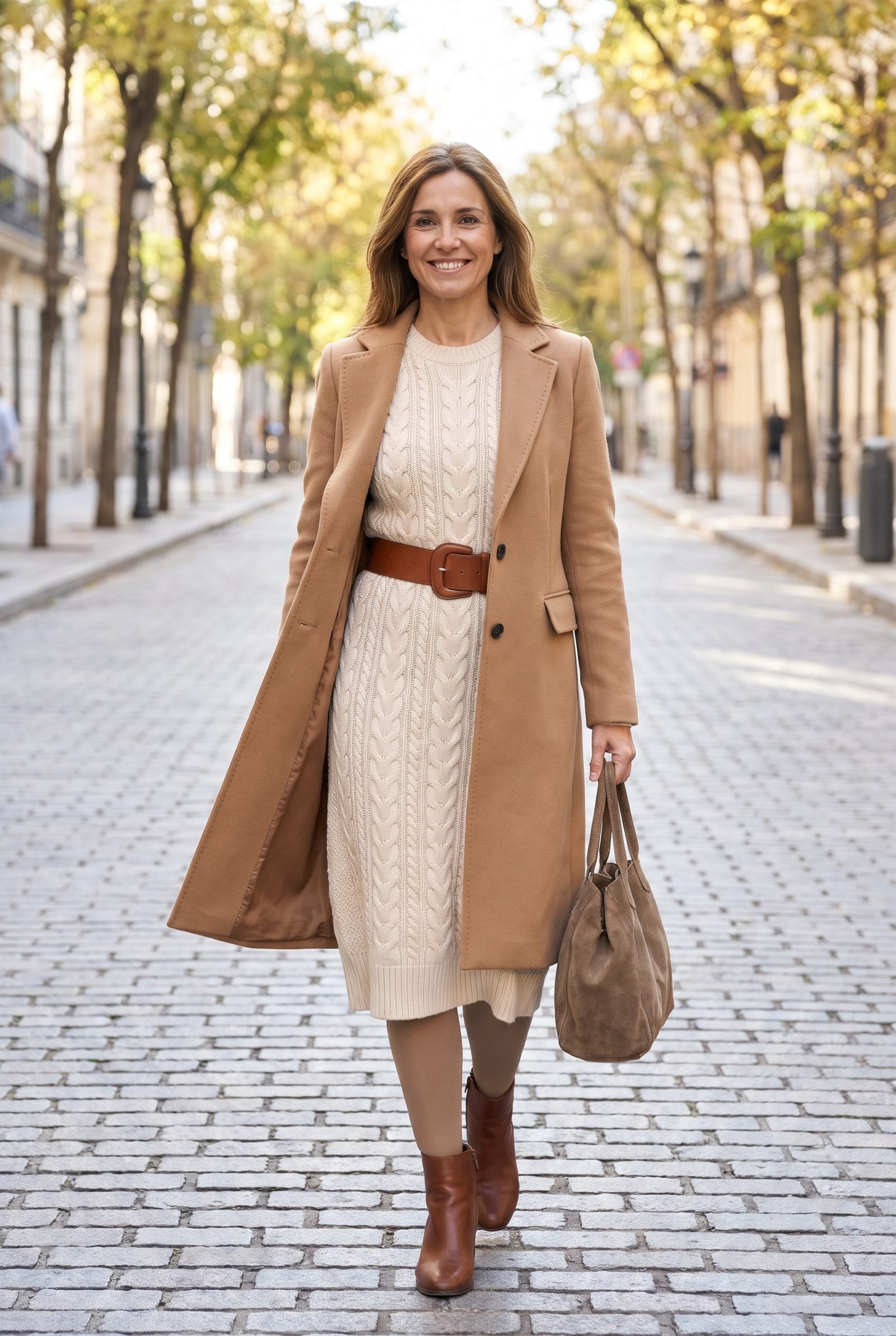
You belted the dress to define the waist. Then you threw on a coat, worn wide open, whose front panel still cuts across the far end of the belt. The cognac buckle sits front and centre, but the band vanishes behind the coat, so the waistline reads chopped off rather than cinched all the way round.
If the belt matters, belt the coat too — over everything — so the shape reads through all the layers. Or go beltless and let the coat do the shaping. One cinch point, visible, beats two that cancel.
19. A Mini Sweater Dress With a Maxi Coat That Swallows It
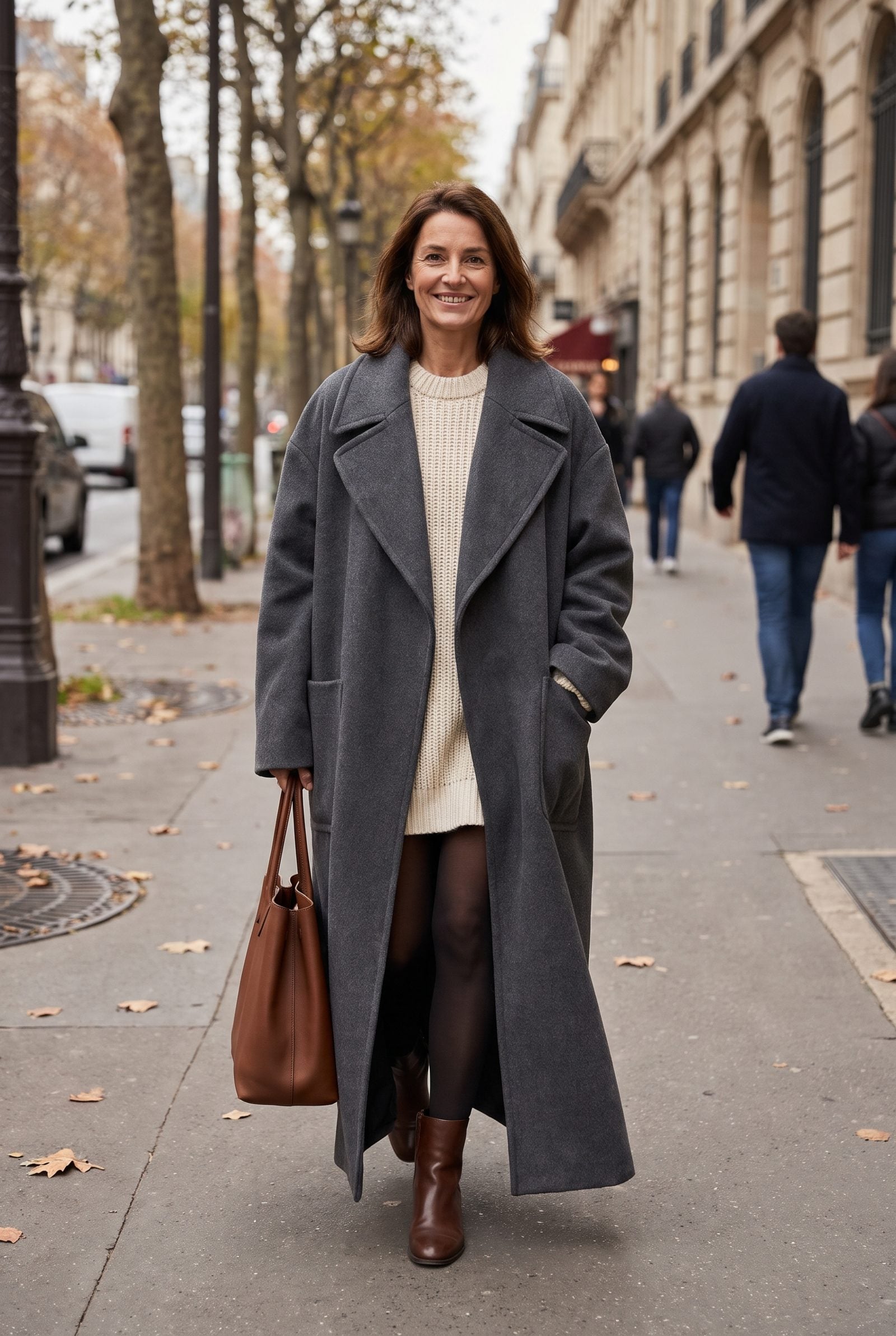
A maxi coat over a mini dress isn’t layering. It’s a disappearing act — the coat eats the dress whole and leaves you with a column of outerwear and a few inches of leg peeking out below.
Nothing wrong with a long charcoal-grey wool maxi coat. It just wants a trouser or a longer dress underneath so the proportions have somewhere to go. Over a mini, it reads like a coat you forgot to put clothes under.
18. A Thick Sweater Dress Stuffed Under a Slim Trench
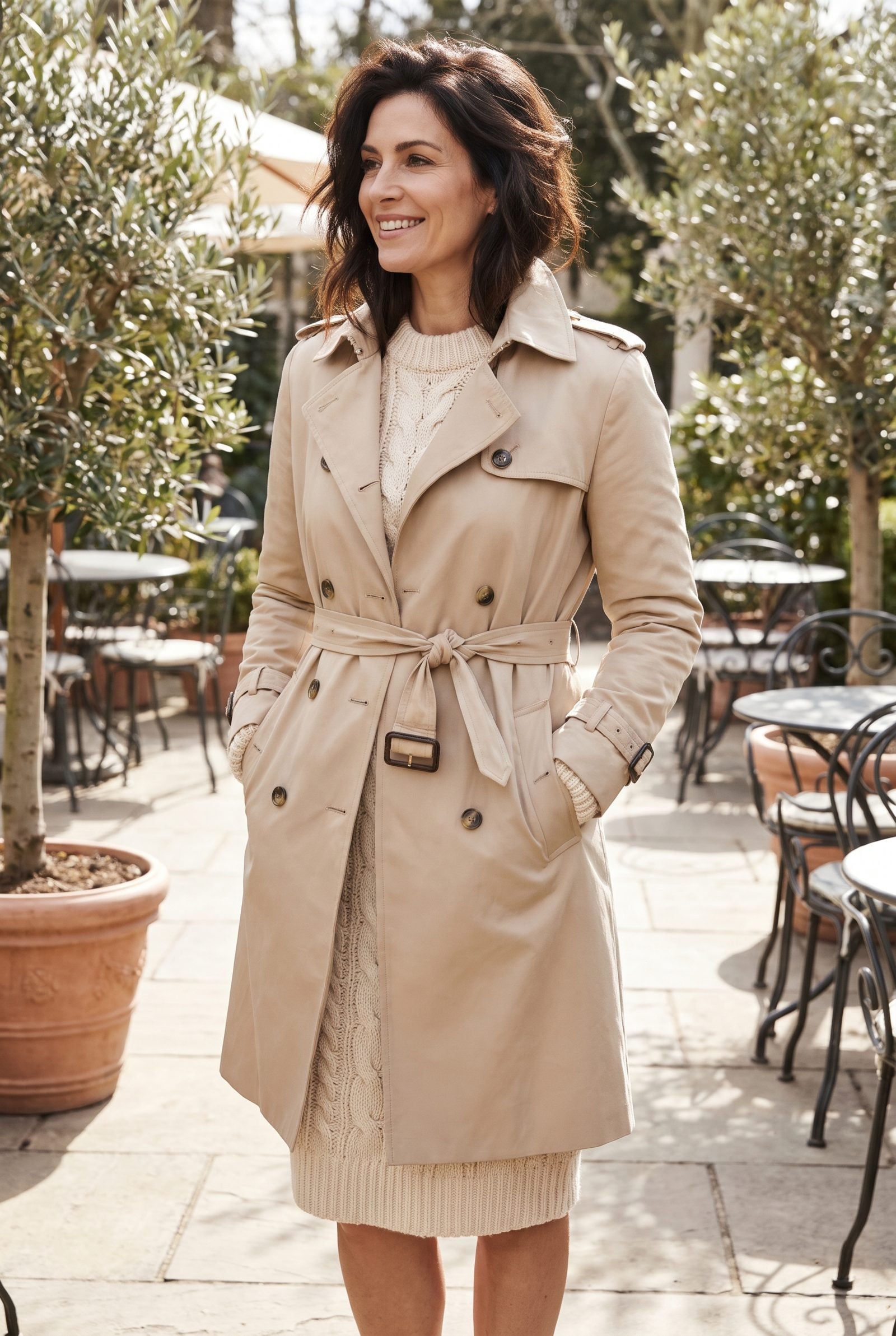
A trench cut with enough room can take a cable-knit dress. Here the trench hangs smoothly over the knit, with no pulling at the buttons, no knit bulging through the cotton, and a belt that cinches without digging into lumps of wool.
The result is flattering and well-proportioned. Thick knits want a coat built with room, like this relaxed trench, an oversized cocoon or a wide wrap. Save a truly slim trench for the fine-gauge dresses it was designed to glide over.
17. A Wide Belt Placed Directly Under a Heavy Bust
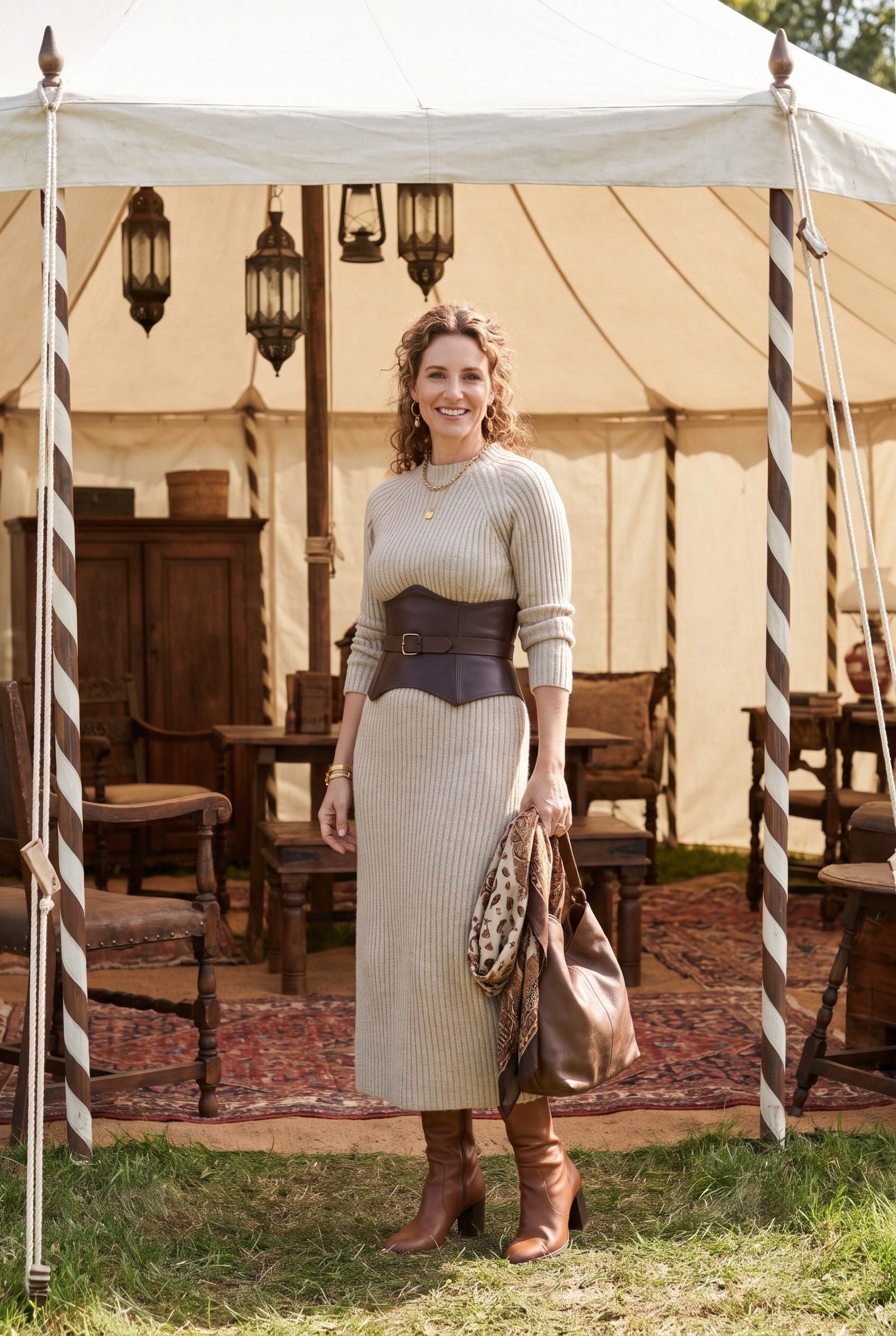
A wide belt sitting right under the bust shoves the waistline up to the ribcage and sends fabric tenting straight down from there. Here, the wide corset belt runs from just under the bust down to the natural waist, the narrowest point, so the waist is defined instead of skipped.
The result is a sleek hourglass, not a maternity silhouette. The belt covers the true waist, where the body curves in, and the ribbed dress below hugs the hips. A wide leather belt is a powerful tool. Placement is the whole game.
16. A Skinny Belt Lost Inside a Chunky Cable-Knit Dress
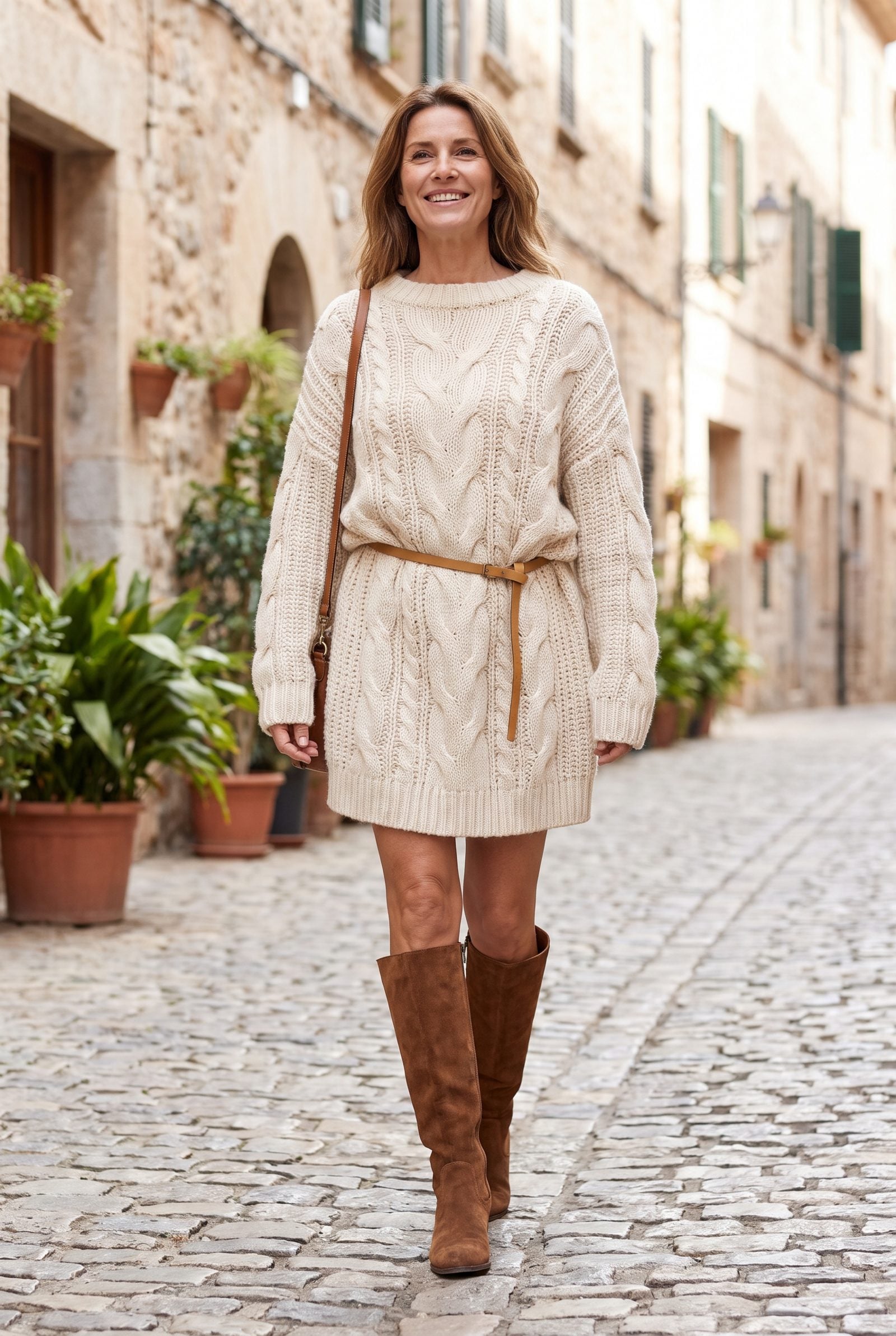
The belt is there, and you can see it: a tan strap against the cream wool, with a long tail dangling down the front. But a quarter-inch strap has no hope of shaping a cable knit this dense, which puffs out above and below it.
Thin belts work on thin fabric. The heavier the knit, the more presence a belt needs to read as a deliberate choice instead of a mistake. Here the wool wins, the waist disappears, and the belt ends up doing the opposite of its one job.
So scale the belt to the knit. A two-inch leather belt with real weight would press the wool into an actual shape. Try a wider style in tan leather belt and watch the whole dress change its mind.
15. A Low-Slung Belt That Lengthens the Torso Too Far
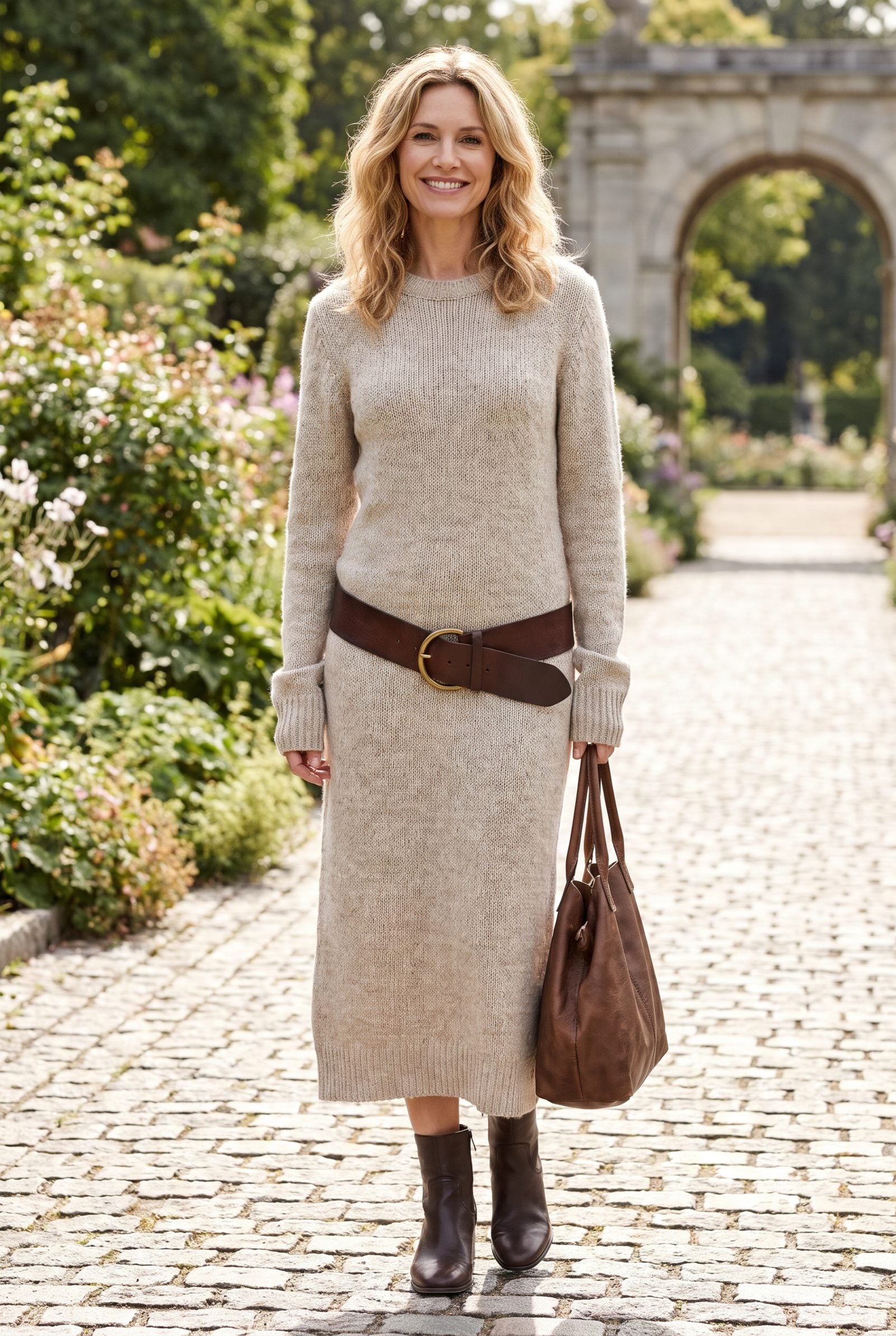
Drop a belt to the hips and you hand all your length to the top half. The torso stretches, the legs shrink, and the vertical read tips off balance.
A belt is really a line that tells the eye where you divide. At the natural waist, it splits you at the narrowest point. Dragged down over a knit, it buries that waist and stretches out the body’s longest run of fabric instead.
Want the hip-slung look? It genuinely works on a drop-waist dress built for it. On a straight sweater dress, keep the belt up where the eye already expects to find your waist.
14. A Contrasting Belt That Chops a Monochrome Column in Half
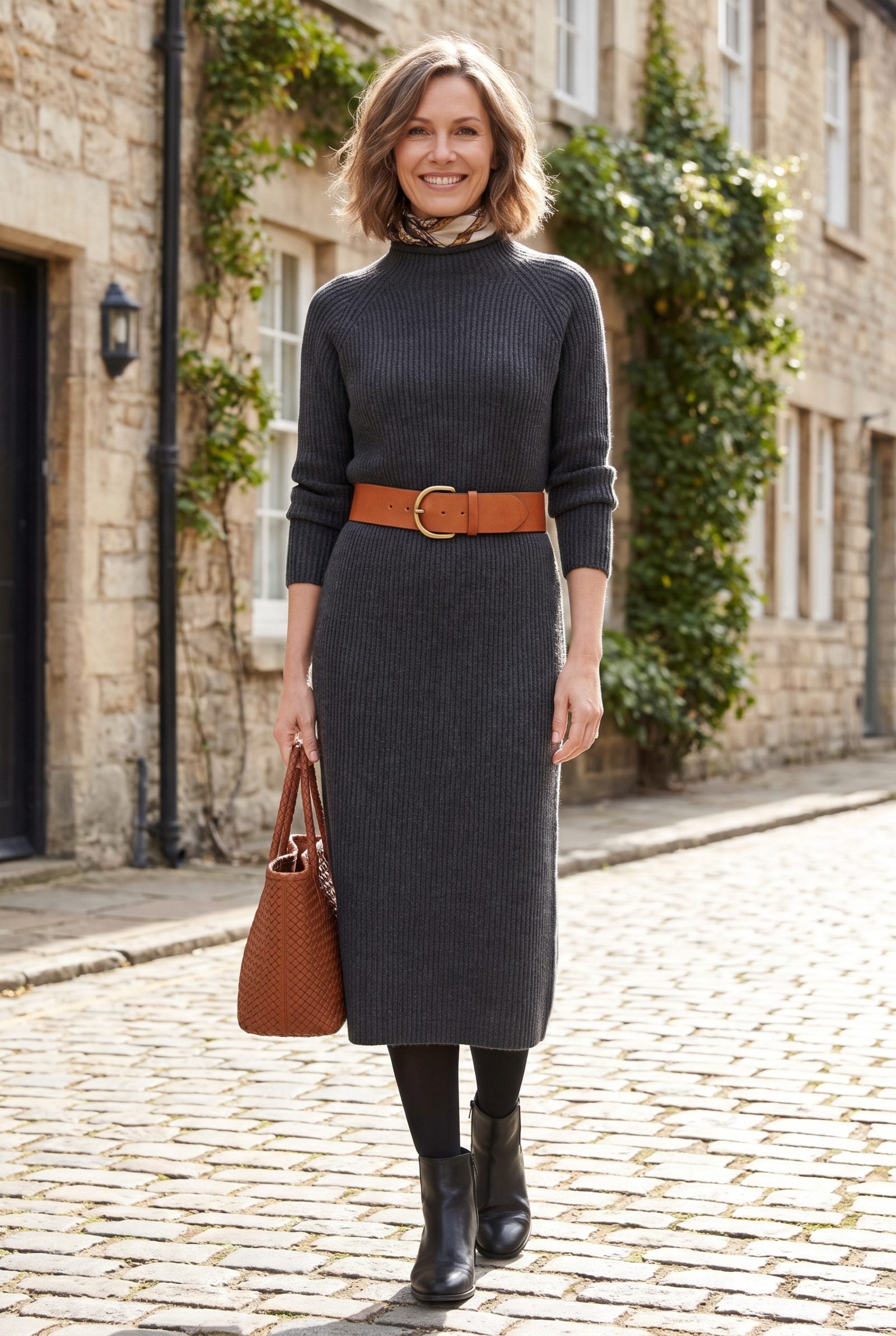
A monochrome column does one job beautifully: it reads as a single long line, head to toe. Then a high-contrast belt slams across the middle and snaps that line into two short halves.
The charcoal ribbed sweater dress was quietly handling all the elongating. The wide cognac leather belt isn’t wrong on its own, it just wins a fight nobody asked it to pick, and the column loses.
Keep the belt tonal. A charcoal or soft grey belt marks the waist without severing anything. Save the hard contrast for outfits where you actually want a break. A matching charcoal suede belt keeps the charcoal outfit reading as one tall, uninterrupted sweep.
13. A Belt Cinched Over a Bulky Kangaroo Pocket
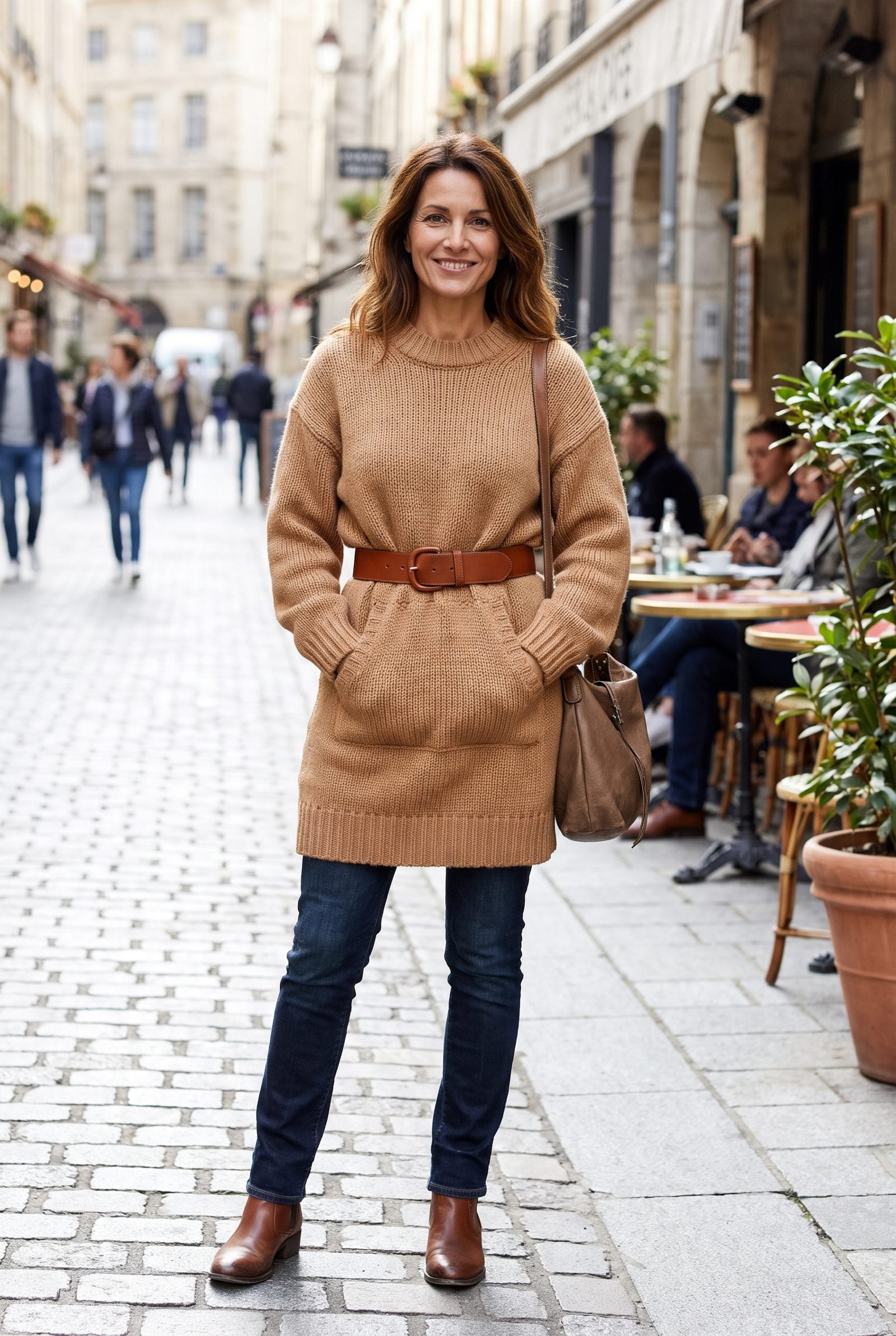
The pocket was always going to be trouble. Cinch a belt right over it and you compress a pouch of fabric into a pillow that sits exactly where you least want extra volume.
Belts remove bulk by pressing a surface flat, and they simply can’t flatten a double layer of knit plus a pocket. So instead of a defined waist you get a cinched line with a cushion blooming above and below it.
On a pocketed sweater dress, skip the belt and let the dress hang clean. Or pick a pocketless style for belting. Fighting a kangaroo pocket is a battle the belt won’t win.
12. A Corset Belt Over a Thick Turtleneck Dress
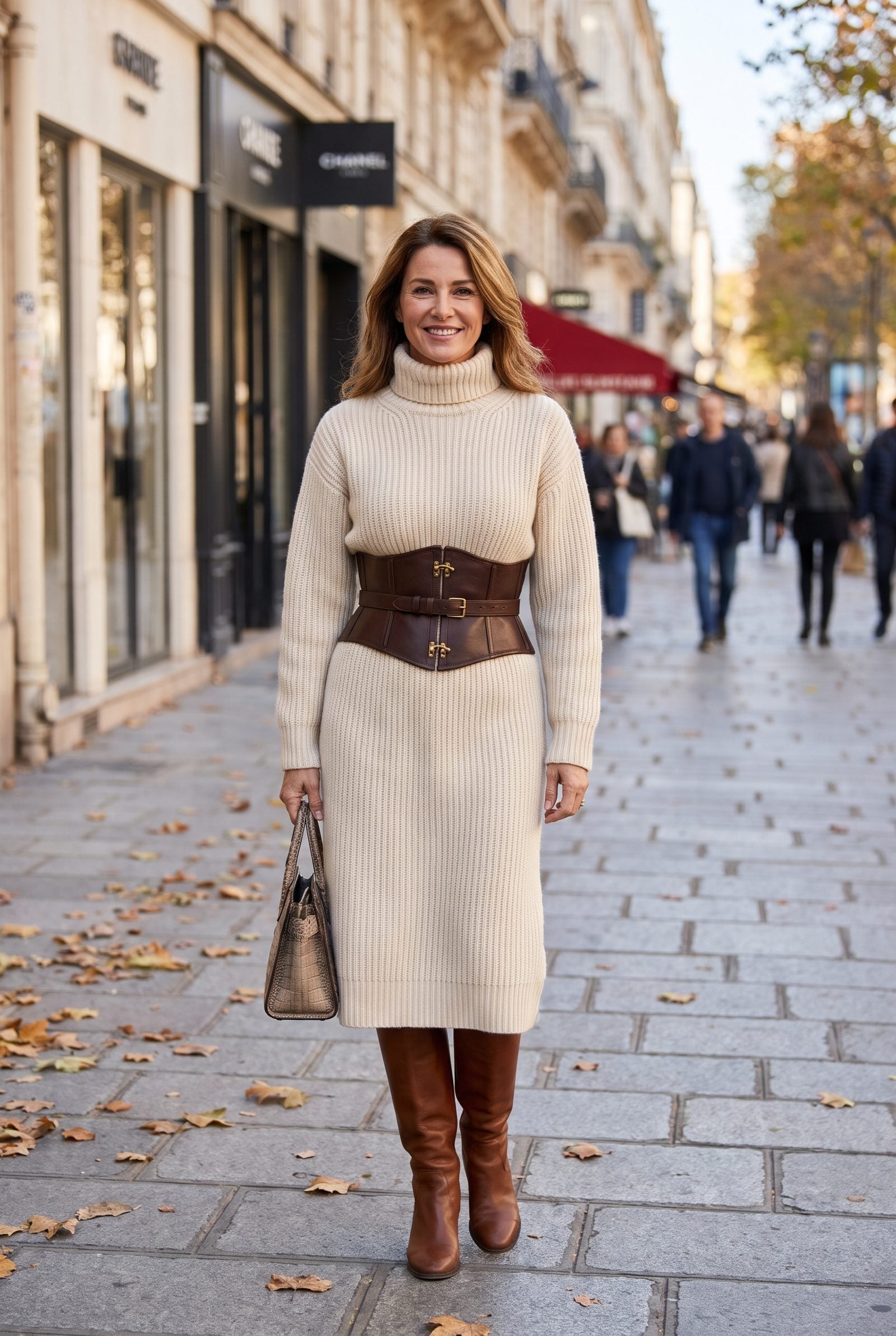
A corset belt wants a smooth surface to sculpt. Lace it over a dense turtleneck knit and the thick wool just squeezes out above and below the stiff edges in two rolled ridges.
Corset structure shines over fluid or fine fabric that can mold to its shape. Against heavy knit it looks like it’s restraining the dress rather than shaping a body, and all that rigid boning set against puffed wool feels at war with itself.
Save it for a silk slip, a fine-rib dress, a shirt dress. On a chunky turtleneck, a soft wide wrap belt gives you waist definition without the brawl.
11. A Belted Asymmetric Hem Pulled Off Balance
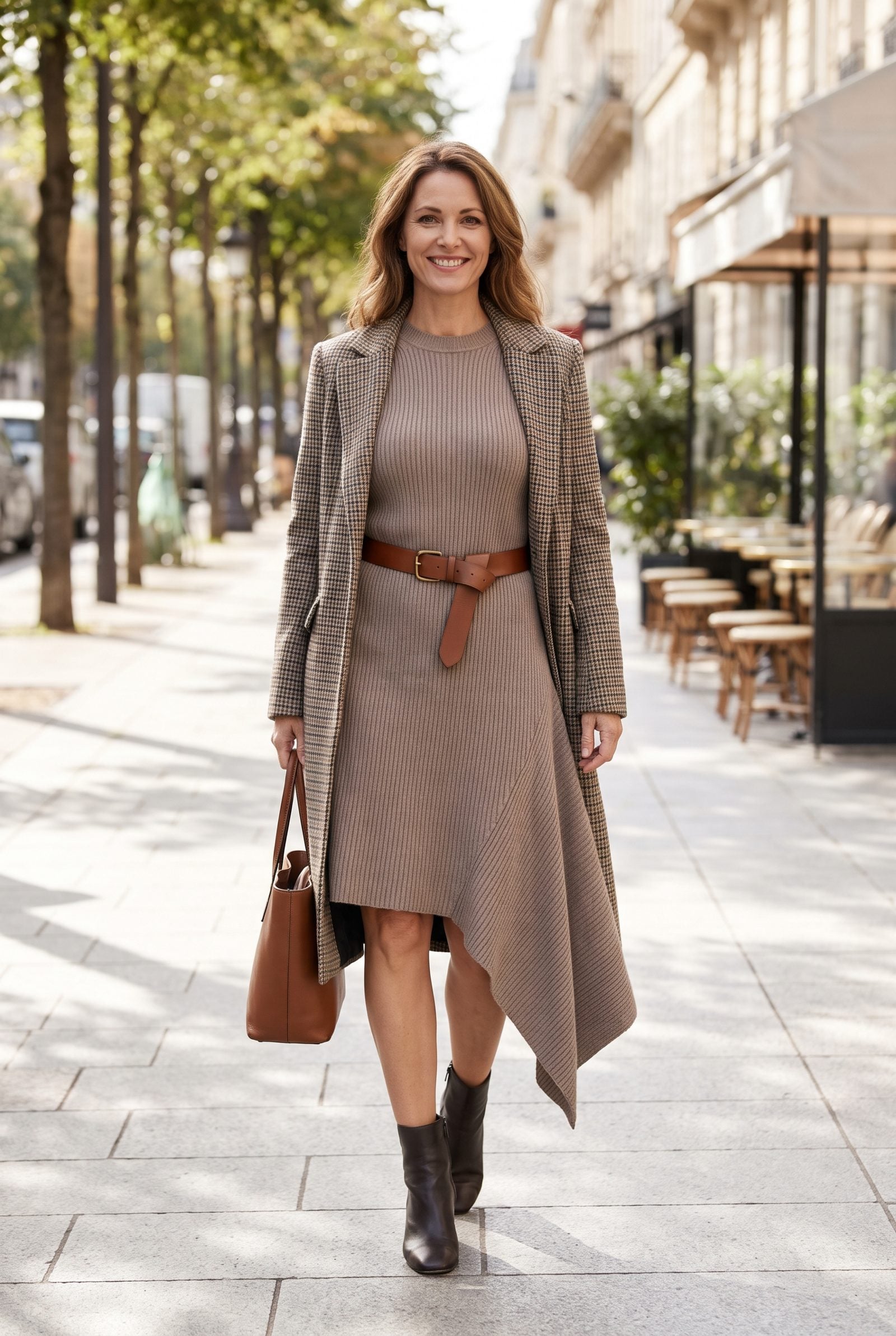
An asymmetric hem is already a deliberate off-kilter line. Add a snug belt, pull the fabric up at the waist, and you drag that diagonal even further off balance until the dress looks like it’s sliding off to one side.
The hem was meant to do the interesting work by itself. Belting it stacks a second asymmetry on the first, and suddenly nothing in the silhouette reads as intentional.
Let an asymmetric sweater dress hang loose and make the hem the event. Still want shape? A slim belt worn loose keeps the drape intact without hiking the fabric crooked.
10. A Shapeless Sweater Dress With No Deliberate Focal Point
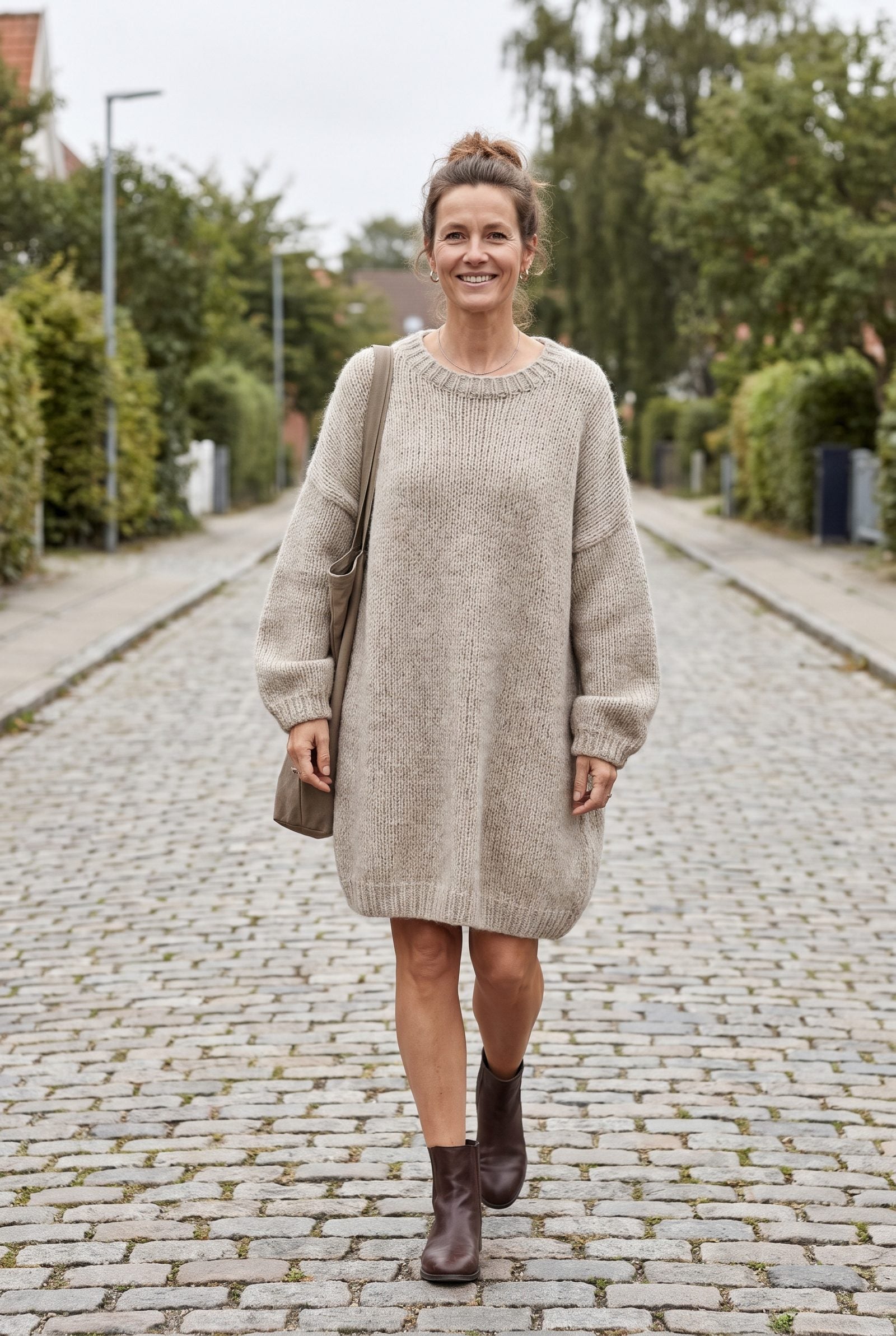
Nothing is wrong here, and that’s the whole problem. An unbelted oversized dress with no accessory, no color break, no shape gives the eye nowhere to go, so the whole thing reads as a soft gray rectangle.
Loose and shapeless can be gorgeous. But only with one deliberate anchor: a statement earring, a structured boot, a bold bag, a cuffed sleeve. Some single decision that says a person chose this.
Add that one focal point and the same dress reads relaxed-on-purpose instead of forgotten. A pair of sculptural gold statement earrings or a structured bag hands this silhouette the intention it’s missing.
9. A Petite Frame Buried in a Floor-Length Cable-Knit Dress
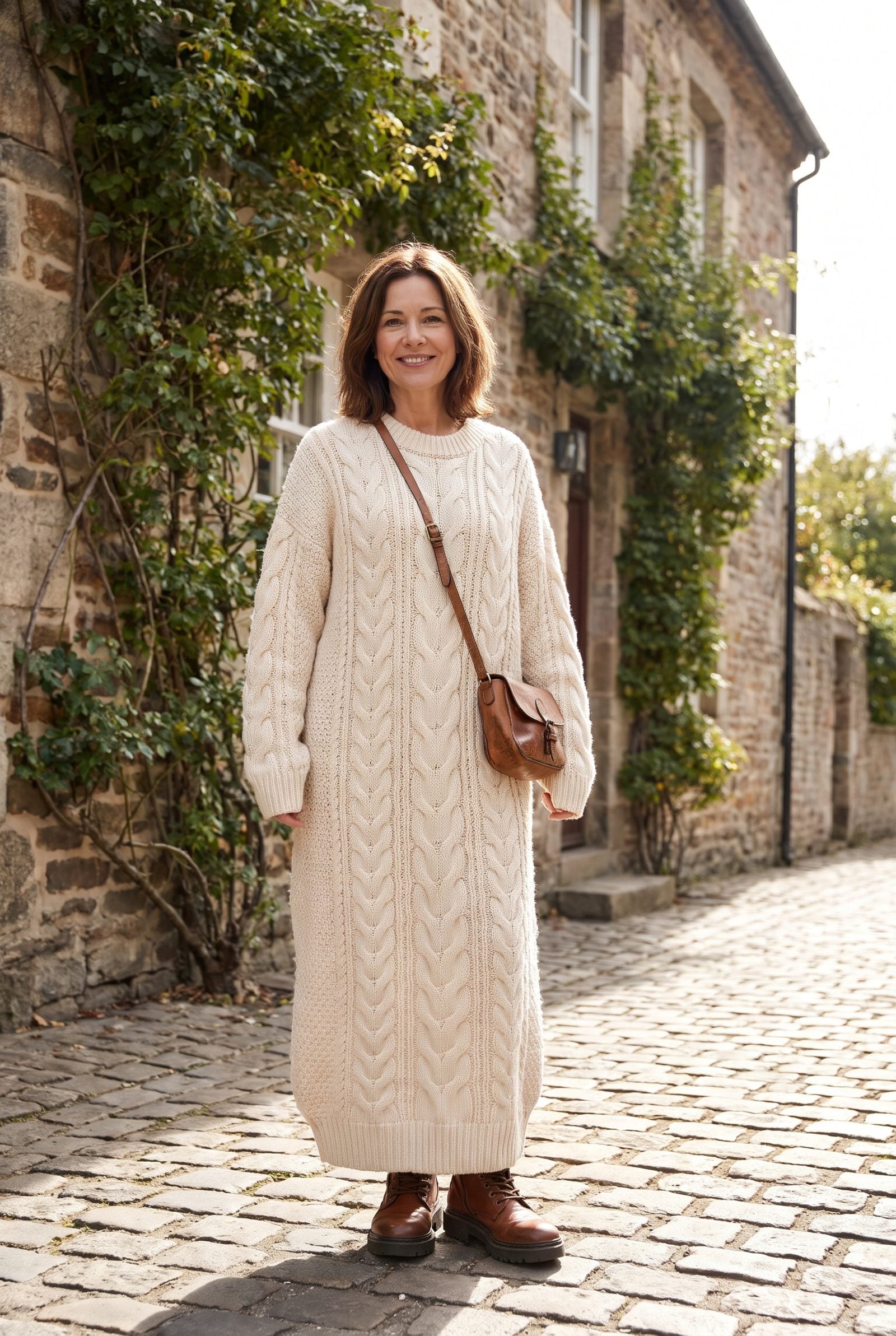
Floor-length chunky knit is a mountain of fabric for a petite frame to carry. The dense cable pushes bulk outward while the full length piles mass downward, and the body underneath gets lost in all of it.
Scale matters more than people admit. A maxi cable dress that looks dramatic on a tall frame can flat-out overwhelm a shorter one, pooling at the ankle and erasing the leg line that reads as height.
A petite frame gets far more mileage from a midi that shows ankle, a finer-gauge knit, or a hem that lands at the narrowest part of the calf. Show a little leg and the proportions snap right back.
8. A Tall Frame in a Too-Short Dropped-Waist Dress
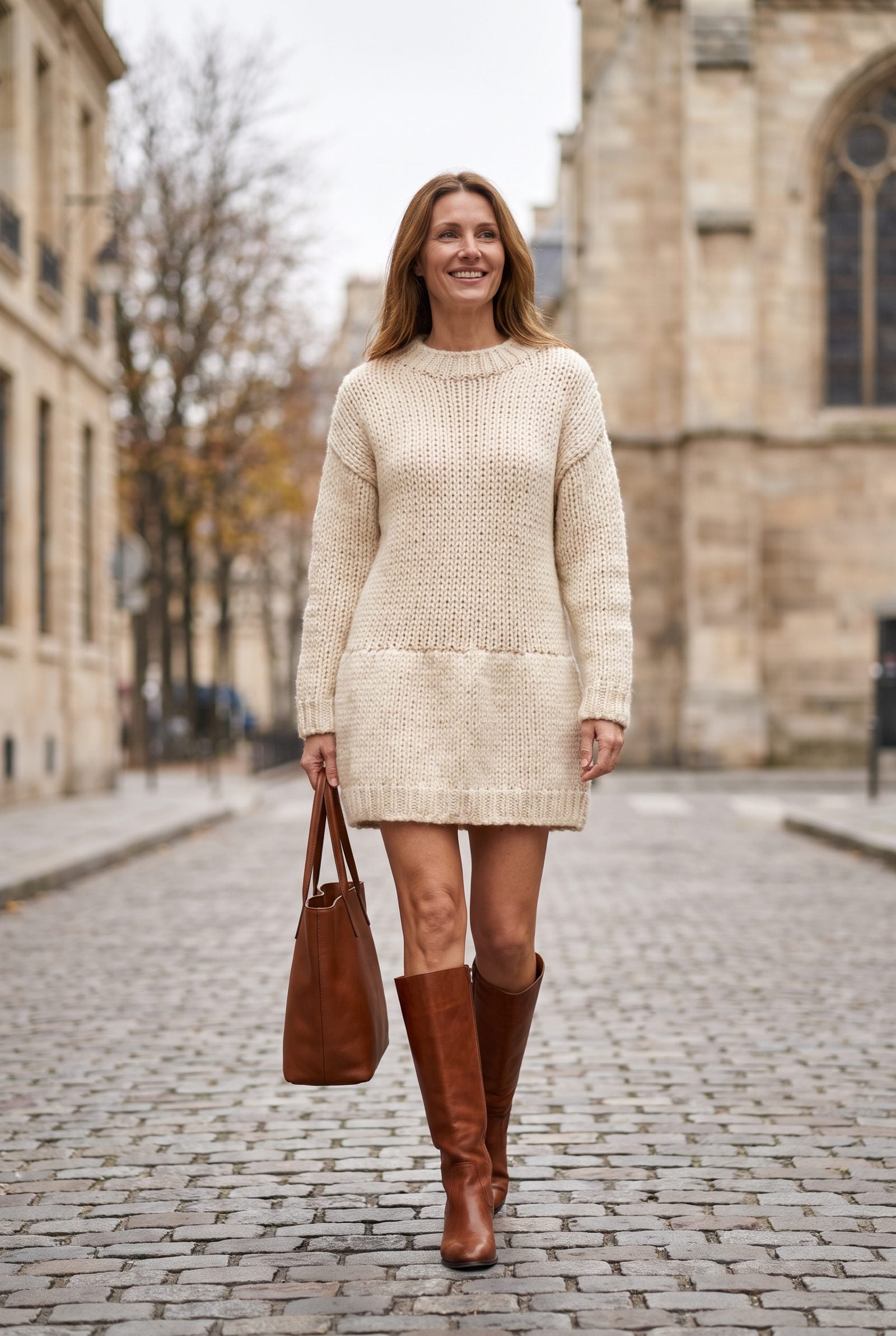
A dropped waist already pushes the dividing line low. Put it on a tall frame and the drop sinks lower still, the short skirt rides higher, and the dress starts to look like it shrank in a hot wash.
Length is relative to the person wearing it. A dropped-waist dress that falls at a modest length on a shorter woman can land several inches higher on a long torso and long legs, turning a knee-grazing cut into a thigh-skimmer.
Tall frames can carry drama, so feed them more fabric. A longer-line dropped-waist style, or one where the skirt portion is cut generously, keeps the proportion deliberate instead of accidental.
7. A Broad-Shouldered Frame in Strong Shoulder Ruffles
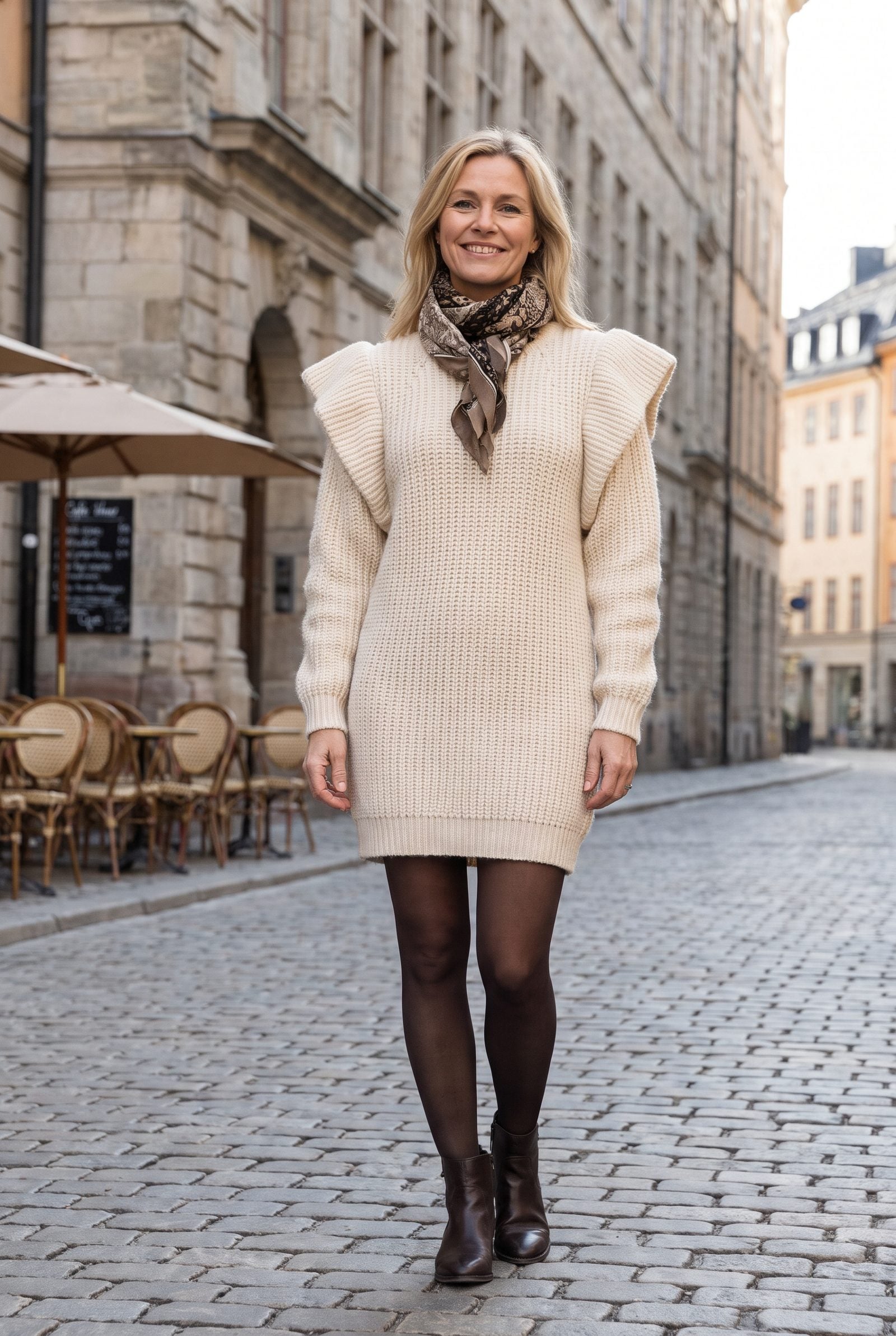
Shoulder ruffles do one thing: they build the shoulder line out and up. Put them on an already-broad frame and they amplify the widest part of the body, tipping the whole silhouette top-heavy.
Ruffles are volume, and volume reads as added width wherever it lands. Across strong shoulders, it stacks on top of structure that needs no help at all, pulling the eye up and out when you’d rather it travel down and settle.
A broad-shouldered frame balances beautifully with volume below the waist and a clean line above. Save the shoulder ruffle for a narrower upper body that actually wants the width.
6. A Pear-Shaped Frame in a Sweater Dress That Narrows at the Hem
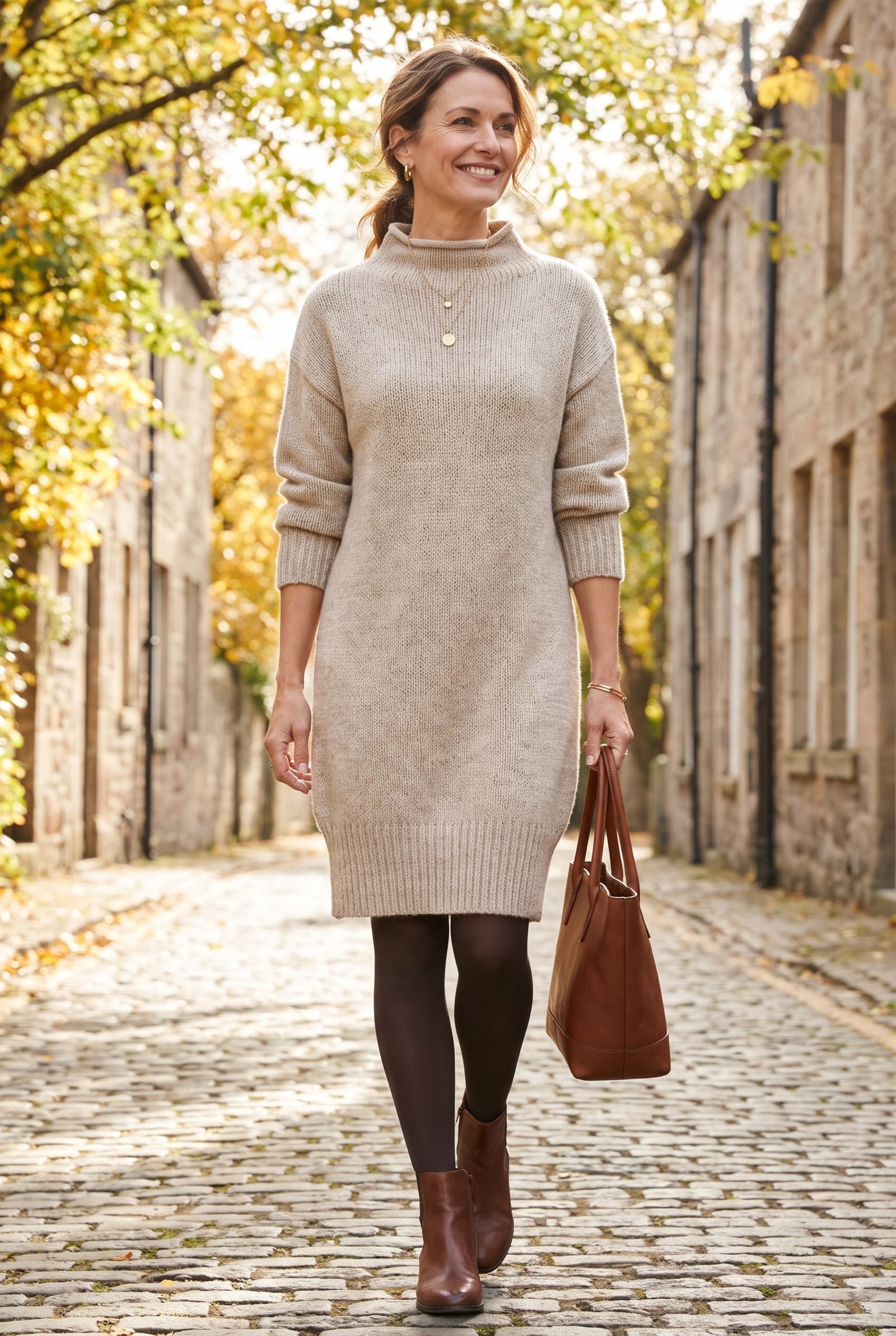
The taper at the hem is the whole problem. When a sweater dress pulls in below the knee, it funnels every line toward the hips — and on a pear-shaped frame, that’s the one zone you want fabric to float past, not cling to.
So reach for a dress that falls straight or gently A-lines from the hip and let the knit release instead of gripping. A column that skims gives the lower half room to breathe, and it reads longer top to bottom.
5. A Chunky Knit Dress With Thick Leggings and Bulky Boots
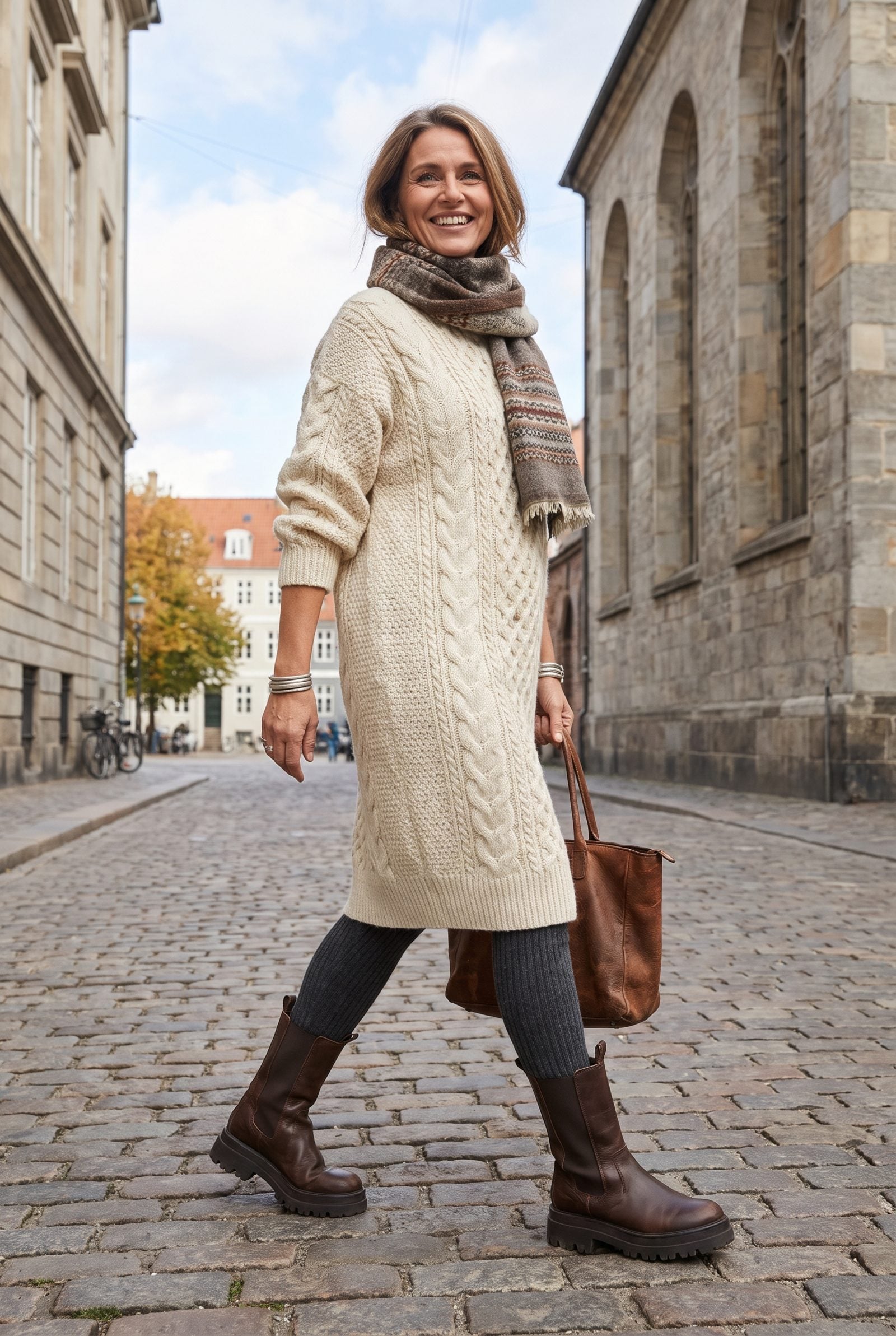
Volume on volume on volume. The cable dress is heavy, the leggings are thick, the boots are chunky, and nowhere does the silhouette pull in to let the eye rest, so you read as one solid block from shoulder to sole.
Keep one bulky piece and slim the rest. A chunky knit dress wants a sleek leg under it — a fine opaque tight in dark chocolate or black — paired with a sleek leather ankle boot that shows a sliver of ankle. That single narrow point does more work than any amount of layering ever could.
4. A Fine-Knit Sweater Dress Over Jeans With Competing Hemlines
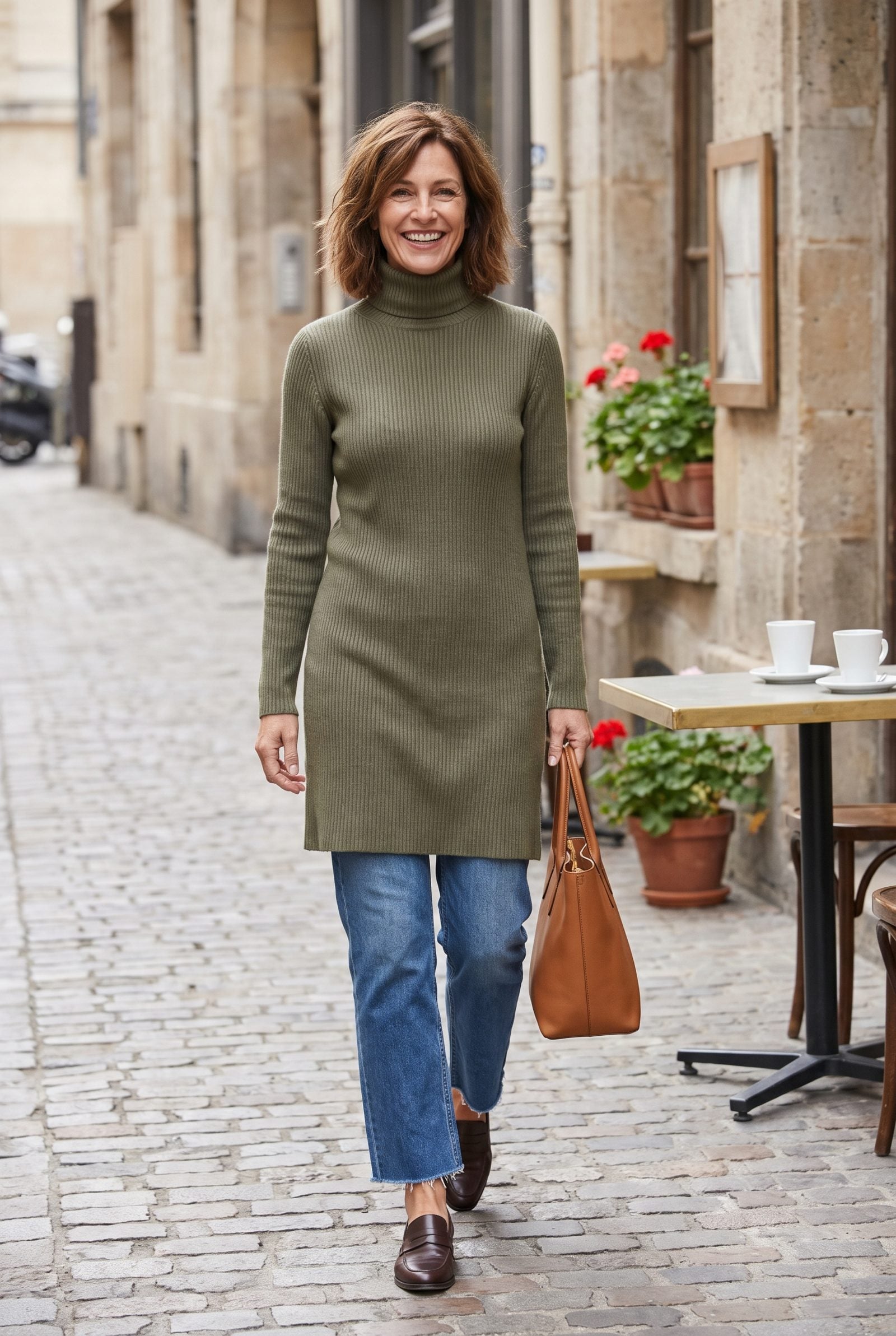
Two hemlines, but far apart — that’s why it works. The dress ends at mid-thigh, then the jeans run all the way down to the ankle, so your eye reads one long, clean line of denim instead of slicing the lower leg into stubby little sections.
Layering a knit dress over denim can look wonderful, but only when one hem clears the other on purpose. Go for jeans that stay fully hidden, or a dress short enough that the denim becomes its own long clean line beneath. A big gap or no gap. Never a close tie.
That long denim line suits most of our readers too, since 72% said full length is their go-to jeans hem, far ahead of cropped or cuffed.
3. A Sweater Dress Worn Over a Full Midi Skirt
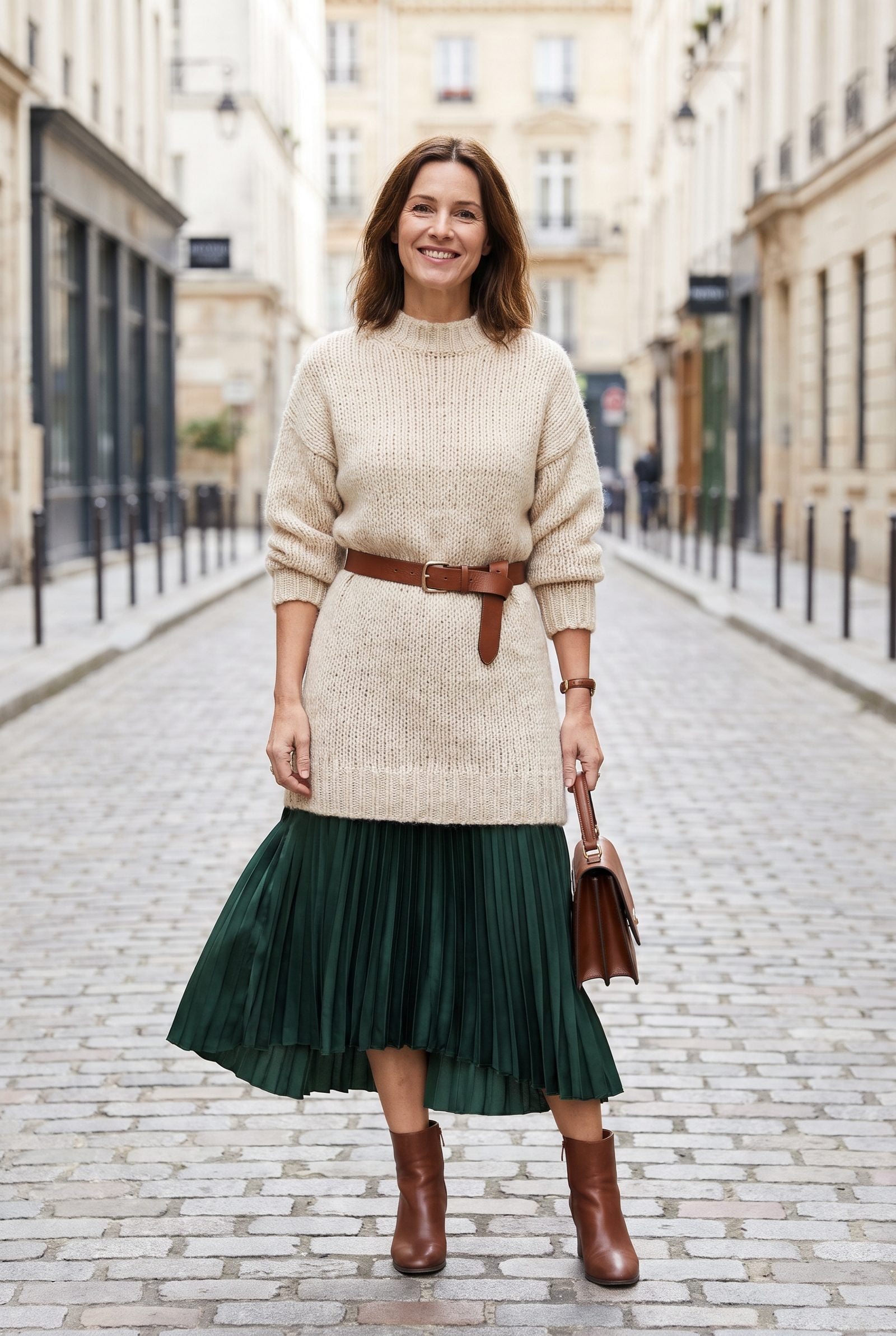
A full pleated skirt under a sweater dress doubles the fabric exactly where you least want it. The pleats push out at the hip, the knit layers on top, and the whole midsection goes wide and shapeless instead of defined.
Want the dress-over-skirt idea anyway? Keep the skirt slim — a narrow slip, or a column in rust satin peeking at the hem — and let the sweater dress carry all the volume. One generous piece per outfit. That’s the rule I break least often, and I break plenty.
2. A Long Sweater Dress With Wide-Leg Trousers Underneath
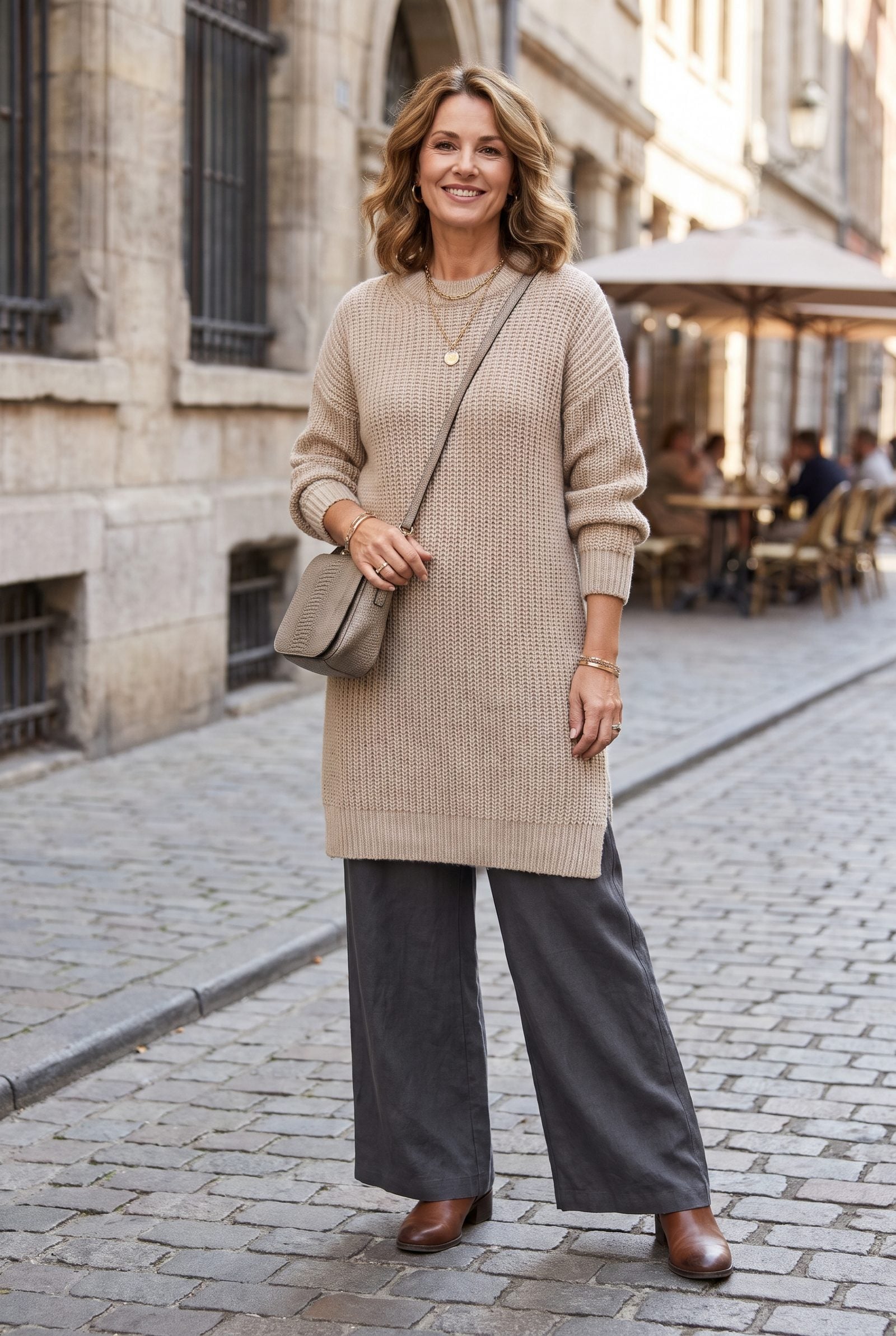
Heavy knit plus wide leg equals no line at all. A thigh-length tunic sweater is already a lot of fabric, and when it falls over a wide-leg trouser you lose the waist, the hip, and the leg in one undifferentiated block, just oatmeal on top and charcoal below.
Wide-leg trousers crave a tucked or cropped top above them — something that marks where the body narrows. Pair them with a fitted ribbed knit, not a long, thigh-skimming one. Let the trouser be the drama. The top should answer it, not echo it.
1. A Poncho-Like Sweater Dress Layered Under a Voluminous Cape
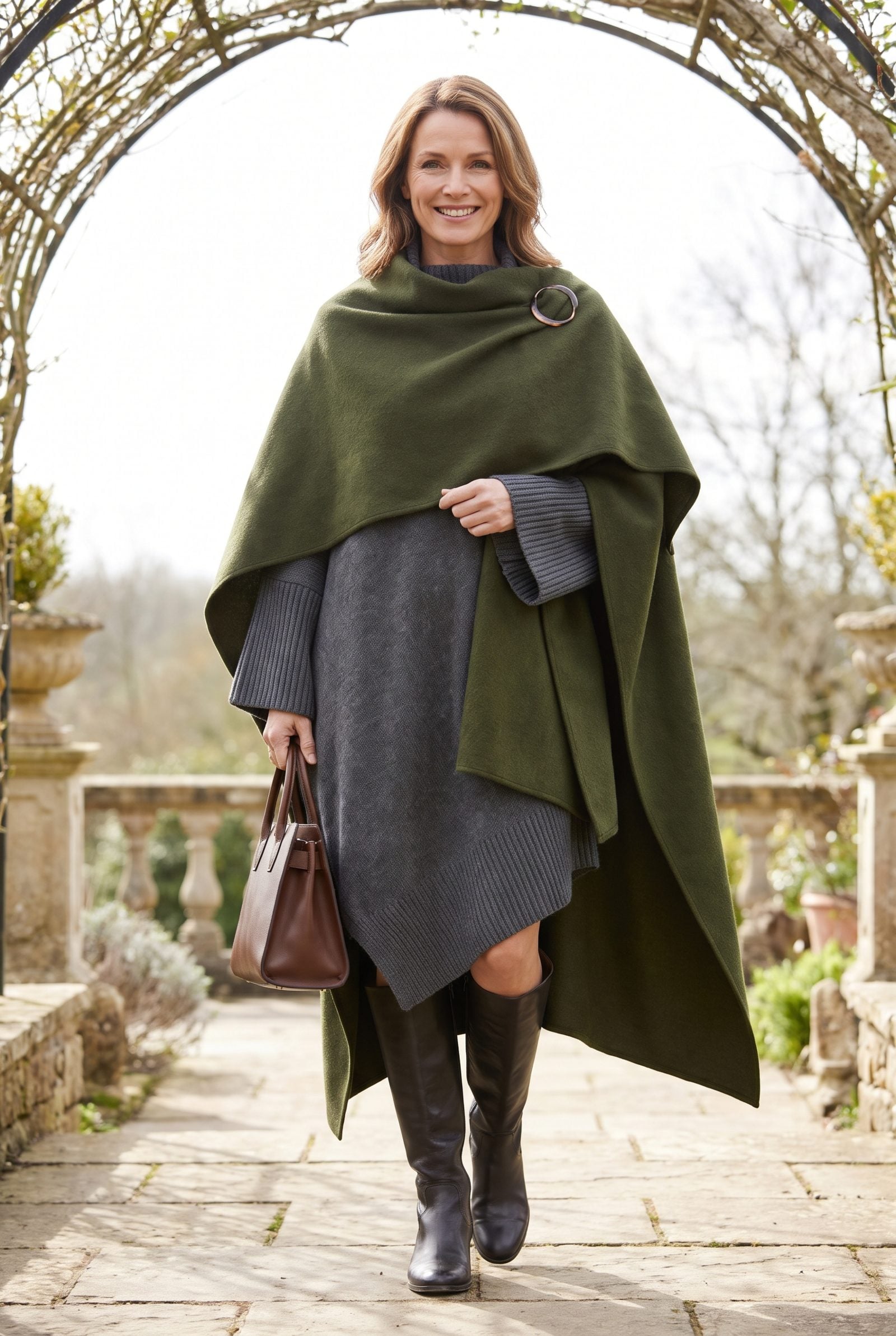
A cape over a poncho dress is two draped layers stacked at the shoulders, and the result fans you into a wide triangle with nothing to anchor the eye. Both pieces flare. Neither defines. The waist simply vanishes.
Caped silhouettes come alive when everything underneath is lean. Trade the poncho dress for a slim ribbed fitted knit dress so the cape becomes your one moment of width, draped over a narrow line. One sweep of volume, grounded by a slim column beneath it — and suddenly you have a shape again.