
❤️ Would you like to save this?
Most fit disasters happen at the mirror, standing perfectly still, in a room that has nothing to do with where the day is actually going. That’s the trap. A look that passes the standing-still test can fall apart the second you sit, walk, or step into real light. The rules below sound slightly strange out of context, but each one cuts a decision, catches a problem early, or sharpens the final read. None of them require new clothes — just a smarter order of operations.
FYI, thanks to AI imagery software, we’re able to create very specific fashion and hairstyle examples to illustrate the points being made. In some cases, imagery is exaggerated to hammer home the point. Also, assume links that take you off the site are affiliate links such as links to Amazon. this means we may earn a commission if you buy something.
47. Put the Most Restrictive Piece On First
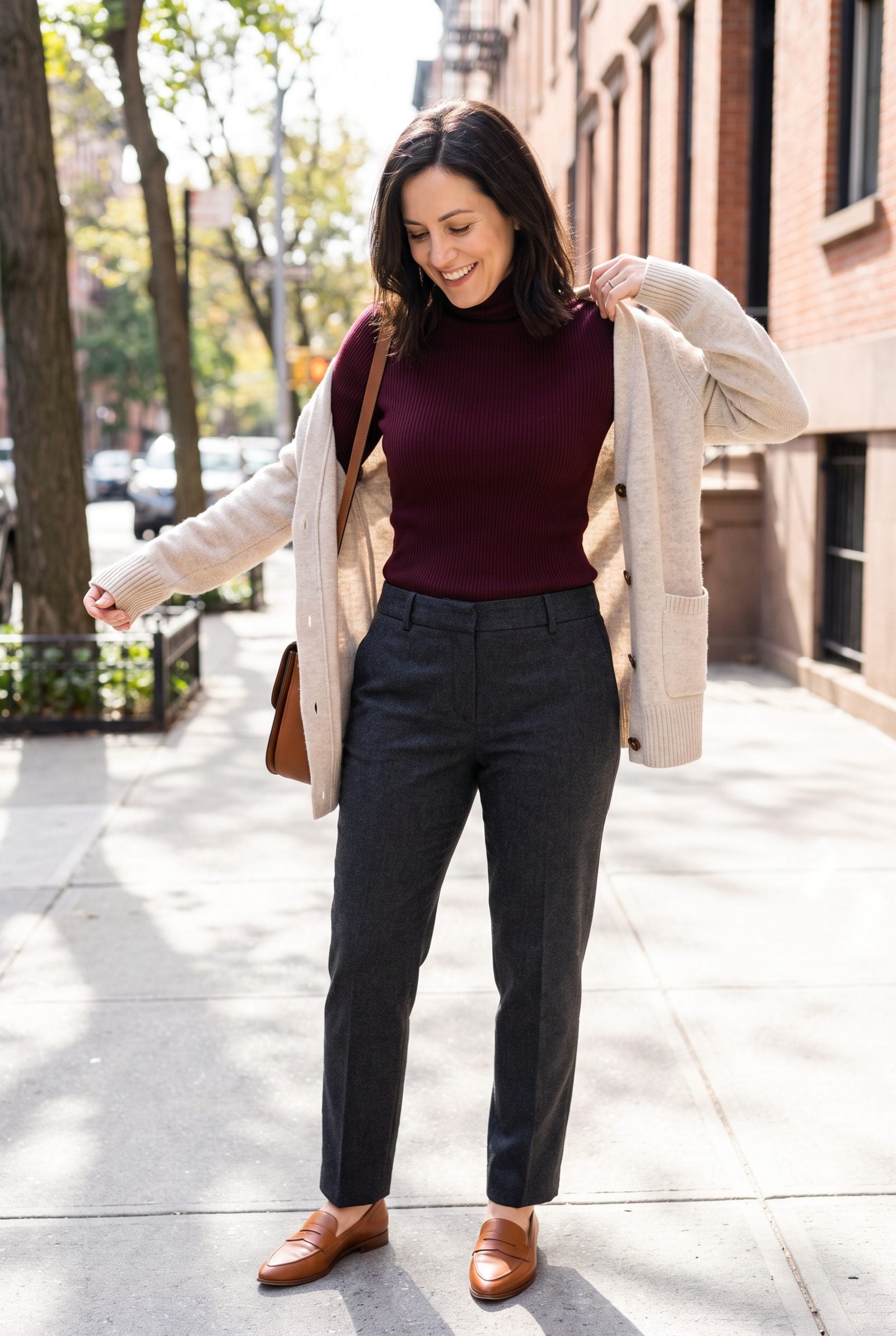
Dress in order of difficulty, hardest piece first. The snug burgundy ribbed turtleneck goes on before the cardigan, the necklace, or anything that would snag on the way down. Try it last and you’re yanking a fitted collar past earrings and a styled neckline, undoing both.
The deeper logic is a fit one. A restrictive piece dictates how everything else sits, so settle it first and you build around a fixed point instead of fighting it at the end.
46. Rings Go On After the Tights, Never Before
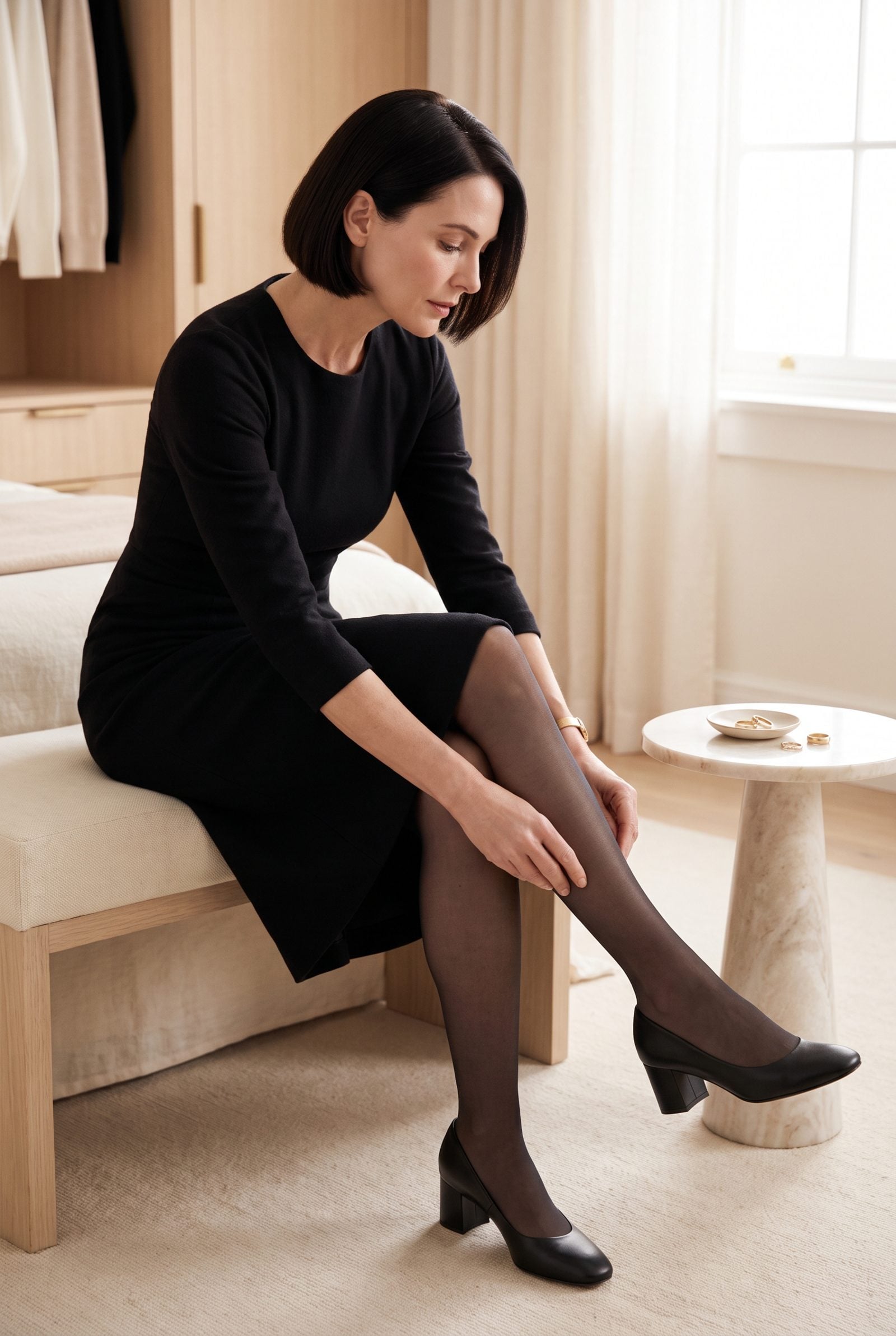
Anyone who has pulled on sheer charcoal tights over a ring knows the sound — that faint rip, then the ladder racing up your calf before you’ve even found your shoes. Rings, bracelets, anything with a prong or a sharp edge goes on after the hosiery is settled.
Small rule, real payoff. It saves a pair of tights and the five minutes of deciding whether the ladder is low enough to hide. It isn’t. Start the day over.
45. Tie the Scarf After You’ve Set the Coat Collar
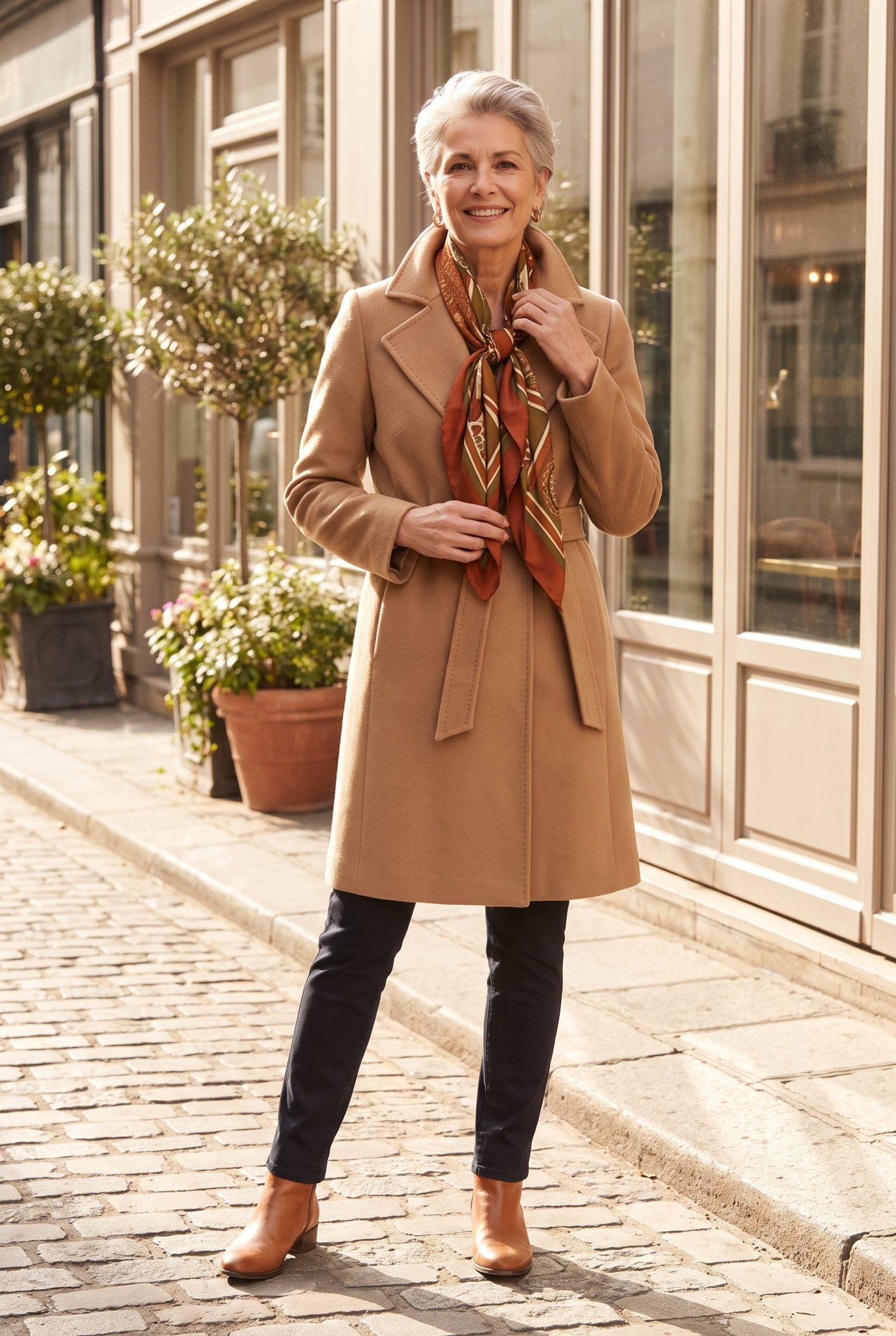
Here’s a common mistake: scarf first, coat over it, then wondering why the whole thing sat lumpy and the camel wool coat collar wouldn’t lie flat. Backwards.
Set the coat and its collar exactly where you want them, then loop the scarf over the top. Now it’s the finishing detail framing your face instead of a wad trapped under wool. A patterned rust silk scarf read against a solid coat is the whole look here, and it only works worn on the outside.
44. Test the Bag at the Weight You Actually Carry

A bag looks one way empty on the shelf and another way loaded with your phone, wallet, keys, and the three things you swear you’ll take out but never do. Test it full.
An empty tan structured bag might sit high and neat, but pack it and suddenly the strap digs, the base sags, or it swings into your hip with every step. Load it the way you’ll actually carry it, then stand in front of the mirror. What you’re checking is how it sits against the wide-leg navy trousers and where the bottom lands on your body, because that line changes the whole silhouette.
43. Check Sheer Fabrics in a Doorway, Not at the Mirror
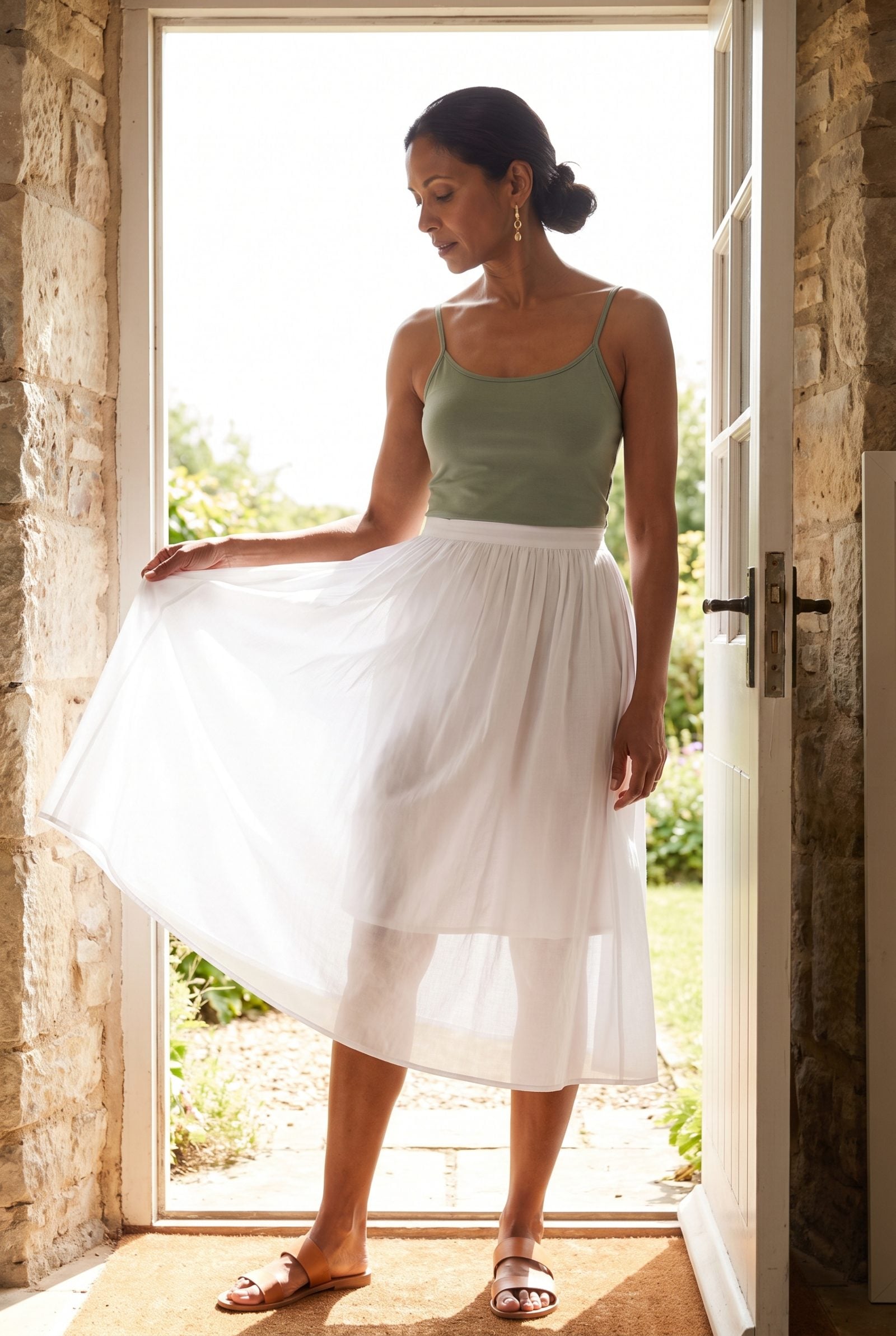
Bathroom light lies. That white white voile midi skirt that looked opaque at the vanity goes completely see-through the moment you walk past a window or stand in a sunny doorway — and you won’t know until someone behind you does.
Stand in a doorway with daylight coming through from behind. If you can see the outline of your legs, you need a slip. Simple test, ten seconds, saves you a day of tugging and self-consciousness.
42. Adjust the Belt While Sitting Down
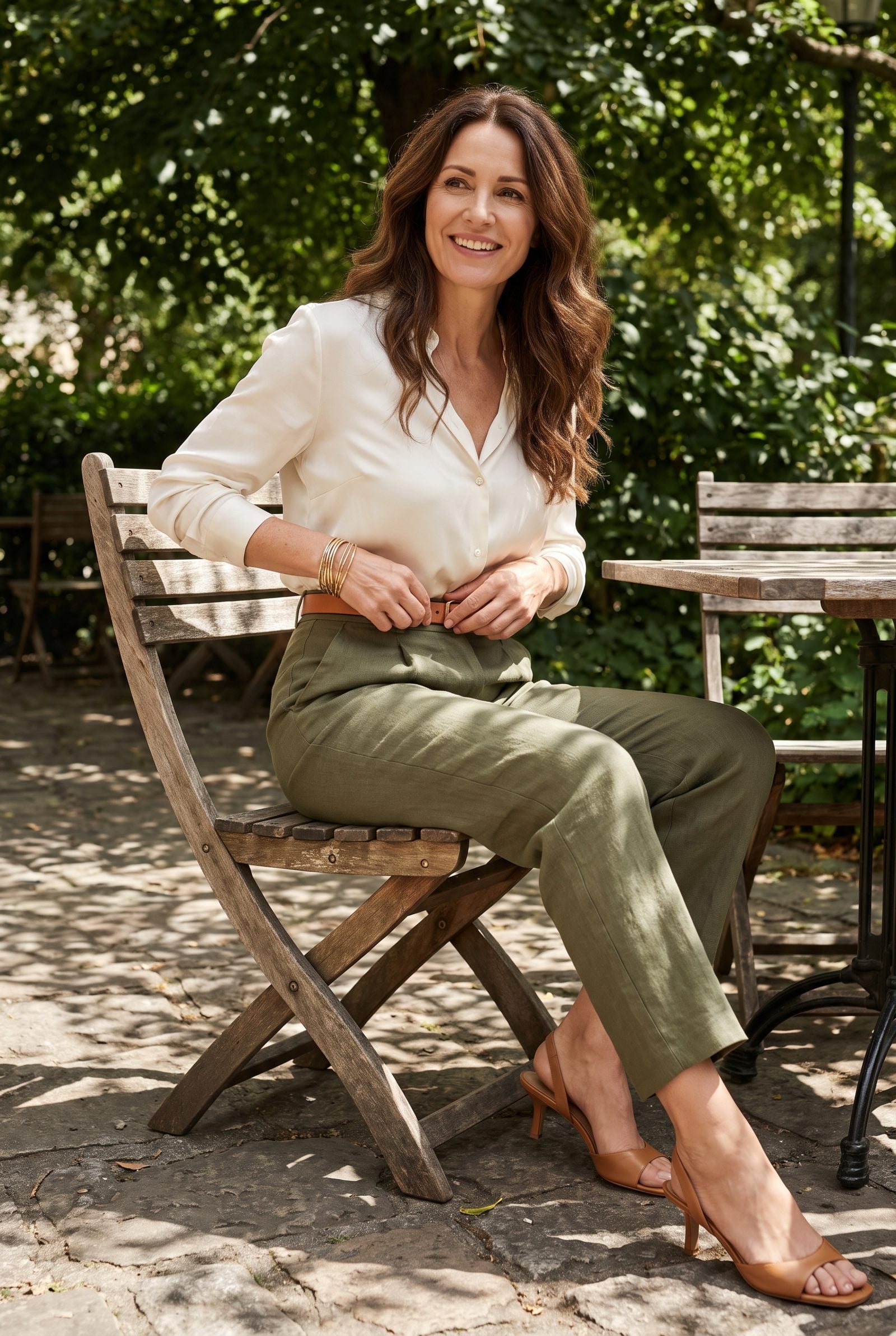
A tan leather belt cinched while standing straight will cut into you the second you sit for lunch. Your waist expands when you sit. Everyone’s does. Adjust it seated, then stand, and it’ll feel right in both positions instead of only one.
The belt is doing the real work in this look, drawing the ivory blouse into the high olive trousers to define the waist. Get the tension wrong and you spend the meal subtly unbuckling under the table. Not relaxing. Just managing.
41. Judge the Trouser Break While Walking, Not Standing Still
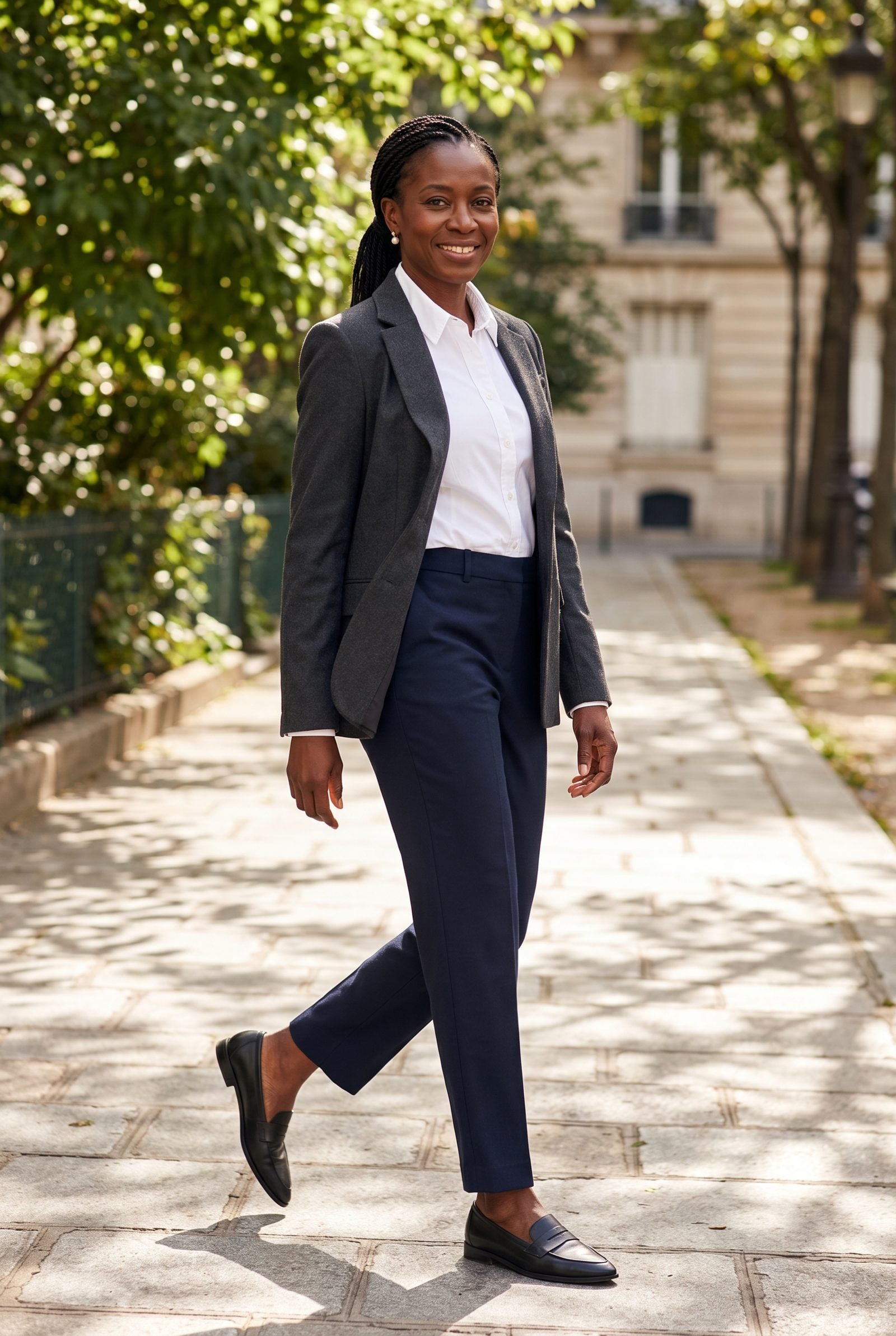
A trouser hem that looks ideal standing can pool over your shoe when you walk, or ride up to show three inches of sock. Both read as a fit mistake, and the truth only shows in motion.
Walk the length of the room before committing to a navy wool trouser length. A slightly cropped break that flashes ankle as you move keeps the line clean and modern, which is why it plays so well with a sharp charcoal-grey blazer here. Still is a lie. Walking tells the truth.
40. Dress for the Room You’ll Be In, Not the Air Outside

You’ll spend maybe ten minutes outside and most of the day in a heated office. So why dress for the sidewalk?
Dress for the room, then add a removable layer for the commute. A breathable teal silk-blend knit with a blazer carried over the arm beats a heavy sweater you’ll be peeling off and draping over a chair by mid-morning. The indoor hours are the ones that count, and comfort there reads as composure.
39. Take the Rear-View Photo Before You Walk Out
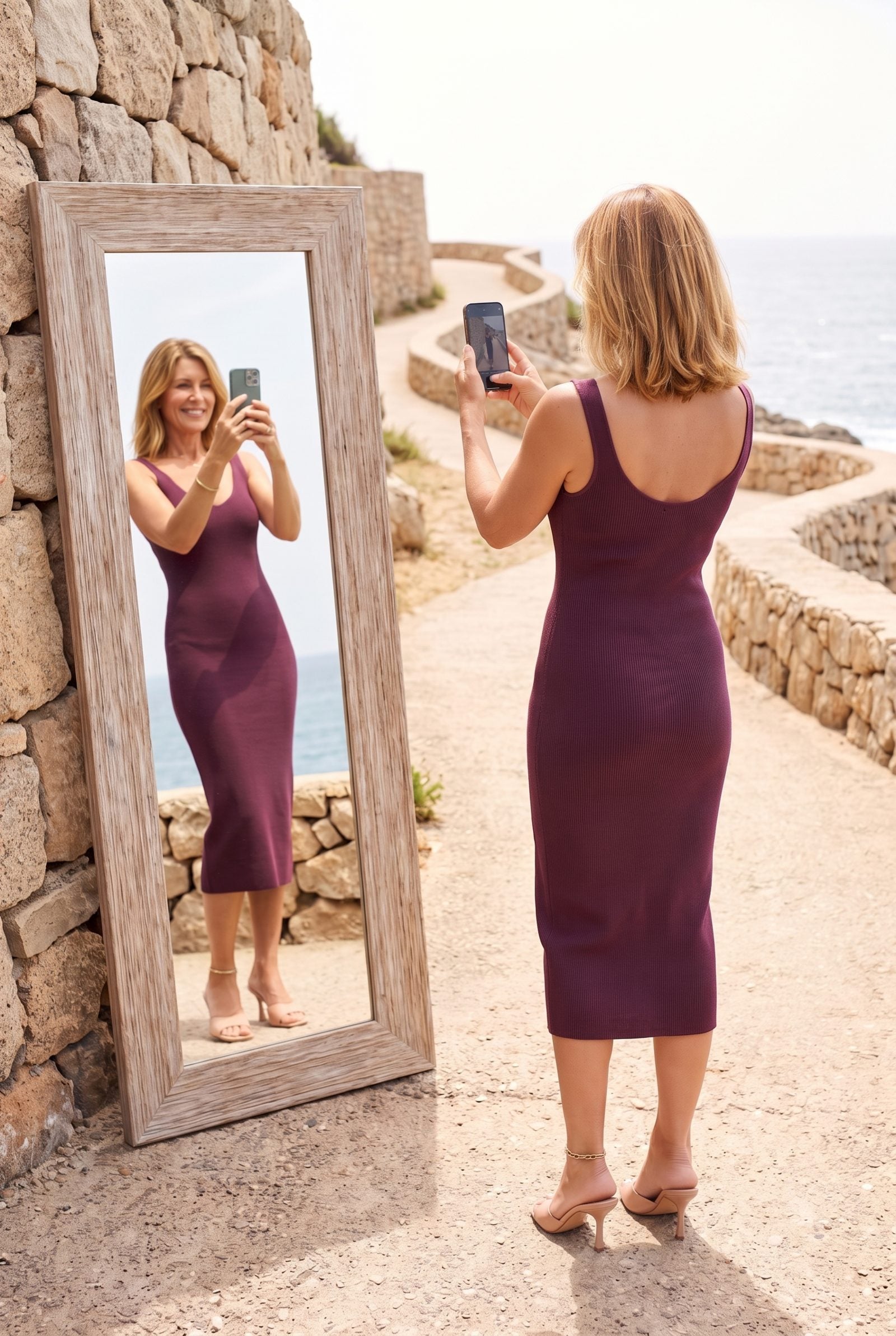
You dress facing a mirror and then spend the whole day being seen from behind. The plum knit dress that skims beautifully from the front might cling, ride, or pull across the back in ways you’ll never catch looking forward.
Snap a full-length mirror photo before leaving — then turn around and take one of your back too. A camera flattens the three-dimensional dressing-room optimism into plain fact — the riding hem, the bra line, the pull across the hips, the one thing that needed fixing. Five seconds. It’s saved us from more than one all-day regret.
38. Run a Sound Check for Squeaky Shoes and Clashing Metal
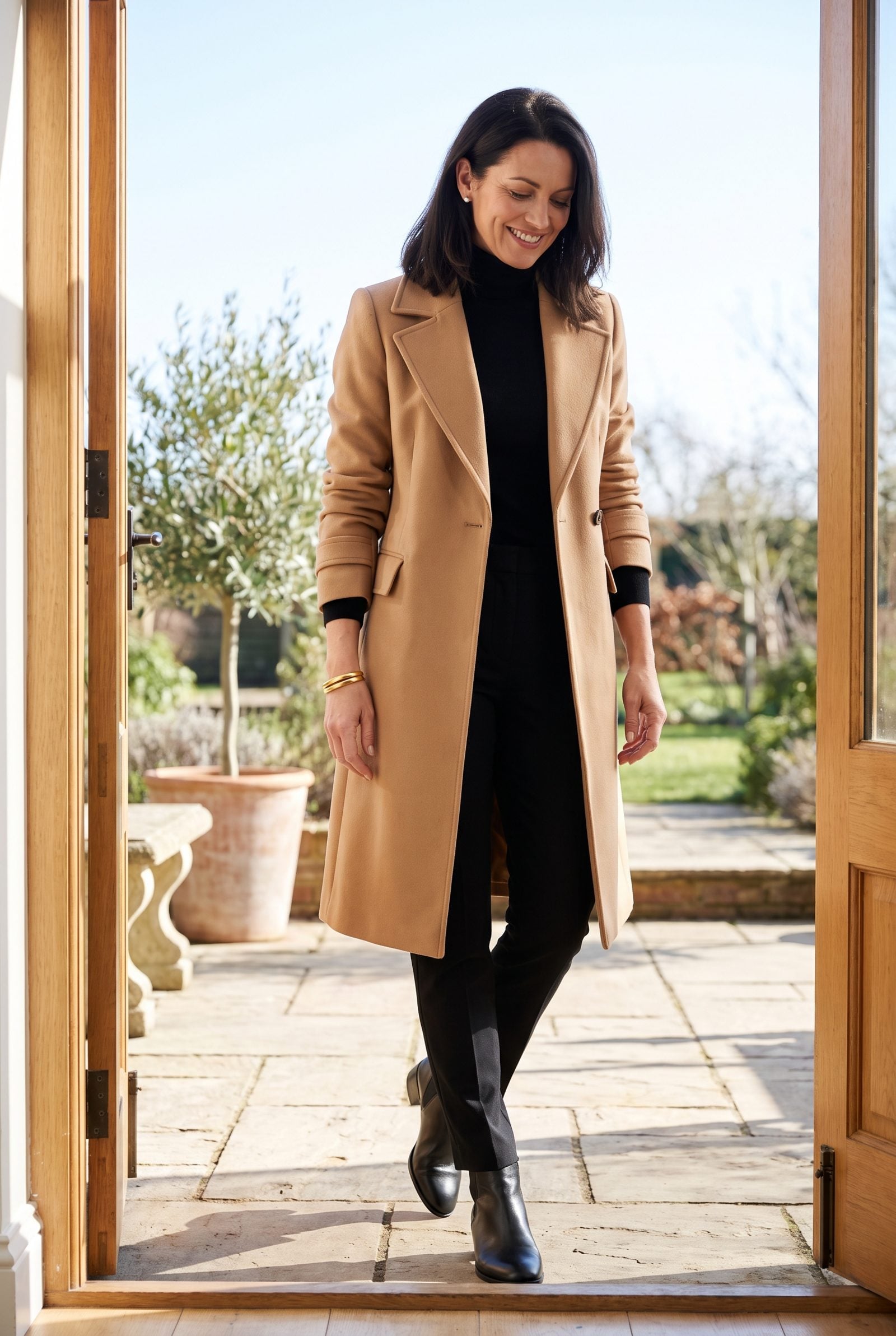
An outfit has a soundtrack, and nobody thinks about it until it’s wrong. Squeaky soles on a hard floor, a stack of bangles that clatters through every meeting, heels that announce you down a marble corridor. It undercuts the whole polished read.
Walk a few steps across a hard floor and listen before you commit. Smooth leather black ankle boots and one gold cuff bracelet instead of a jangling armful keep you as quiet as you look. We’ll die on this hill: silence is part of being put together.
37. The Sit, Reach, and Stair Test for Every Outfit
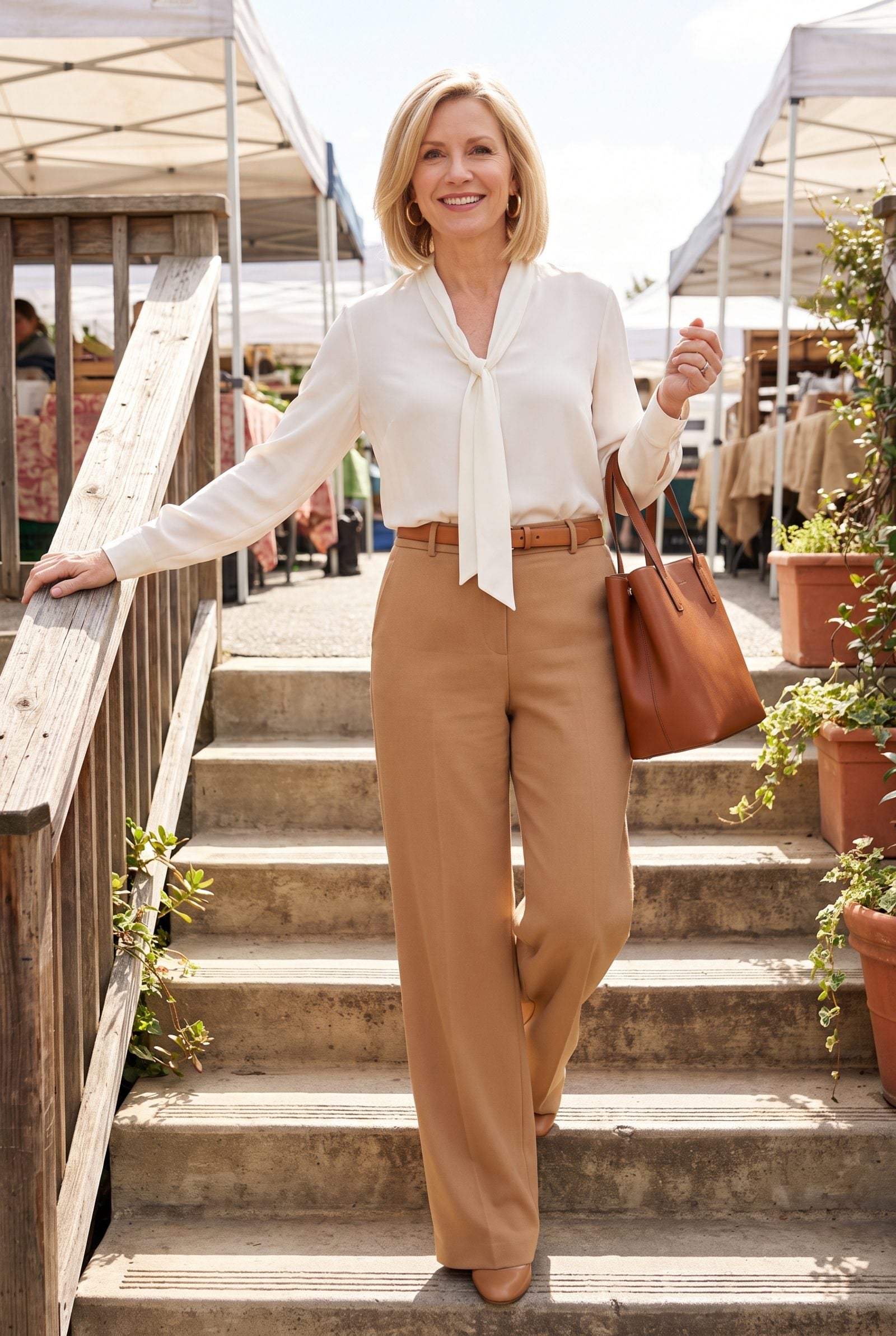
Before an outfit leaves the bedroom, it should survive three things: sitting down, reaching overhead, and taking the stairs. Most fit failures stay hidden while you stand still in front of the mirror, then show up the second your body actually does something.
The camel crepe trouser here passes because it moves with the body — no pulling across the seat on the climb, no gaping waistband when seated. The silk blouse allows a reach for the railing without untucking itself. That’s the whole test. A strained seam, a hem that rides up, a button that pops its gap during any of the three, and the clothing is wrong for your real life rather than the mirror version of it.
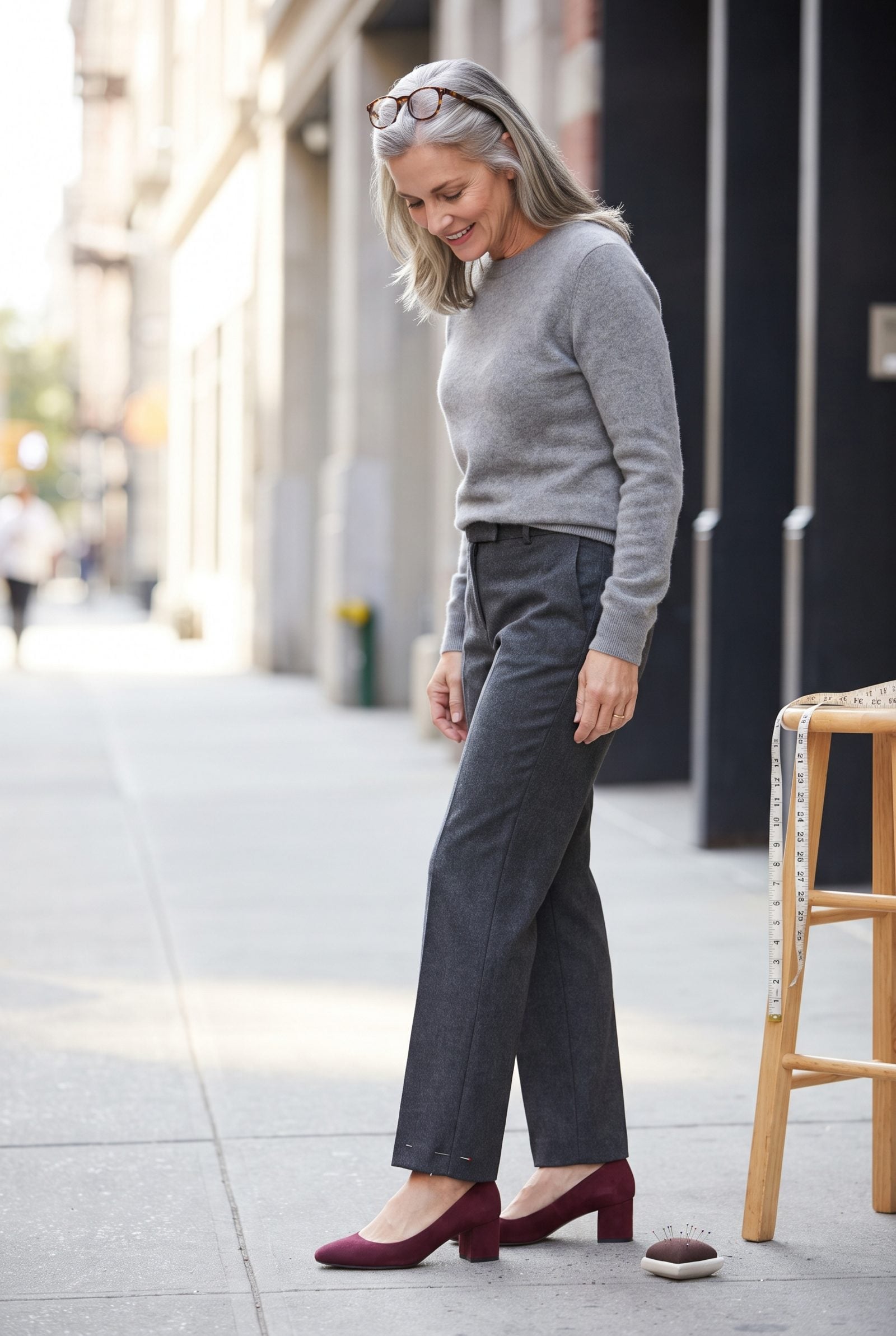
36. The Exact-Shoe Rule for Pinning Trouser Hems
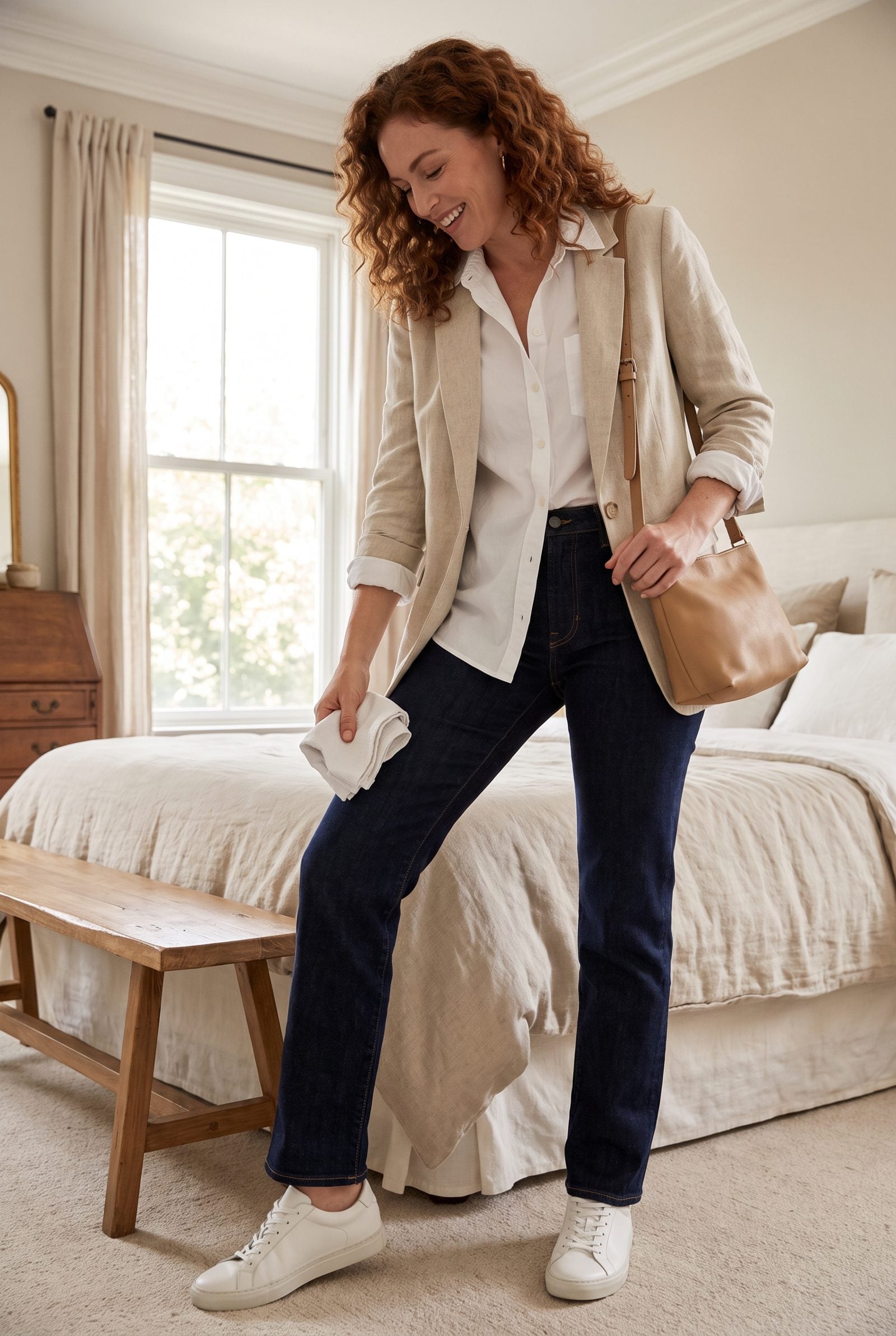
35. The White-Cloth Test for New Dark Denim
❤️ Would you like to save this?
New dark denim bleeds. Learn this before it migrates onto your white sofa, your cream handbag, or the pale blazer you just paired it with. Rub a damp white cloth firmly against the inner thigh and pocket area of any new deep-indigo jean, and if the cloth comes away blue, the dye isn’t set.
Don’t return it, though. Wash it cold inside out with a cup of white vinegar before wearing, and keep it away from light fabrics for the first few outings. The look here pairs raw indigo with a white shirt on purpose — exactly the pairing that punishes you if you skipped the test.
34. The 30-Minute Home Audition for Unfamiliar Clothes

The dressing room lies. Harsh lighting, a three-way mirror, and the pressure of a hovering salesperson tell you almost nothing about how a garment lives on your actual body. So keep the tags on, bring it home, and wear it for thirty real minutes.
Make tea. Answer an email. Reach for something on a high shelf. The sage wrap dress here either stays put through all of it or it doesn’t. By minute twenty you’ll know whether the wrap gaps when you lean forward, whether the viscose clings where you’d rather it skimmed, whether you keep tugging at the neckline. Clothes reveal their true character the moment you forget you’re testing them.
33. The Steam-It-Before-Rejecting-It Rule
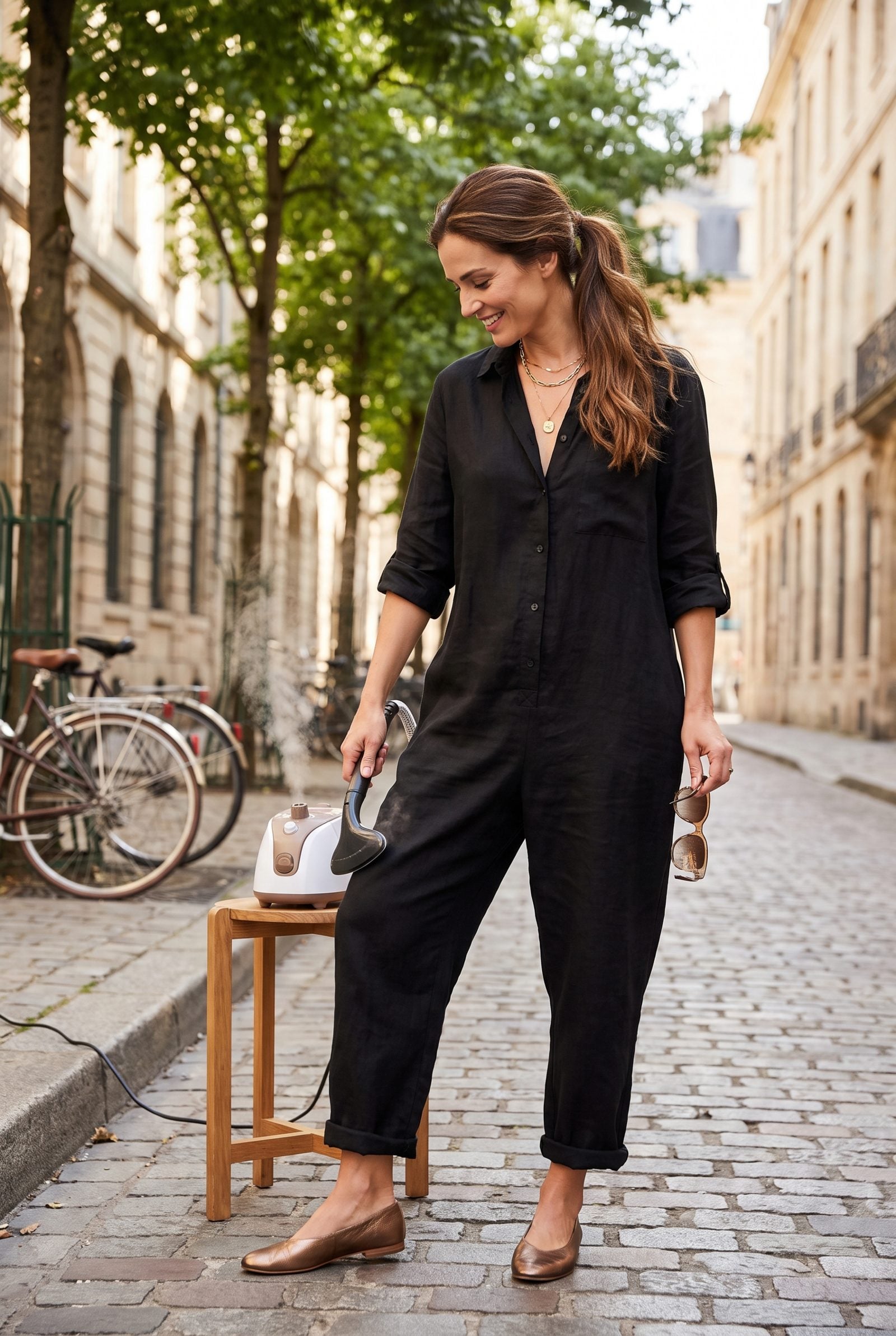
A startling number of garments get banished to the donate pile for the crime of being wrinkled. Linen out of the wash looks like a disaster, a cotton dress pulled from a suitcase looks hopeless, and jersey that sat folded for a season looks shapeless and sad.
Steam it first. The black linen jumpsuit here goes from crumpled to fluid in about ninety seconds, and suddenly it reads intentional instead of neglected. Steam relaxes fibers, drops hems back into line, and often fixes the exact flaw you were ready to reject the piece for. A handheld steamer is the cheapest styling upgrade going, and it rescues more clothes than any tailor.
32. The Outfit Log Organized by Temperature, Not Season

Seasons lie about weather. A 55-degree October morning and a 55-degree March morning call for the exact same clothes, yet most people file outfits under spring and fall and then stand frozen at the closet twice a year.
Reorganize the mental filing system around temperature bands instead. That rust merino, those olive trousers, that camel suede — the combination holds up in the fifties no matter which month it is. Save a few photos of outfits that genuinely worked, labeled by the number on the thermometer, not the page of the calendar.
31. The Two-Adjustments Rule: Cut Anything You Keep Fixing
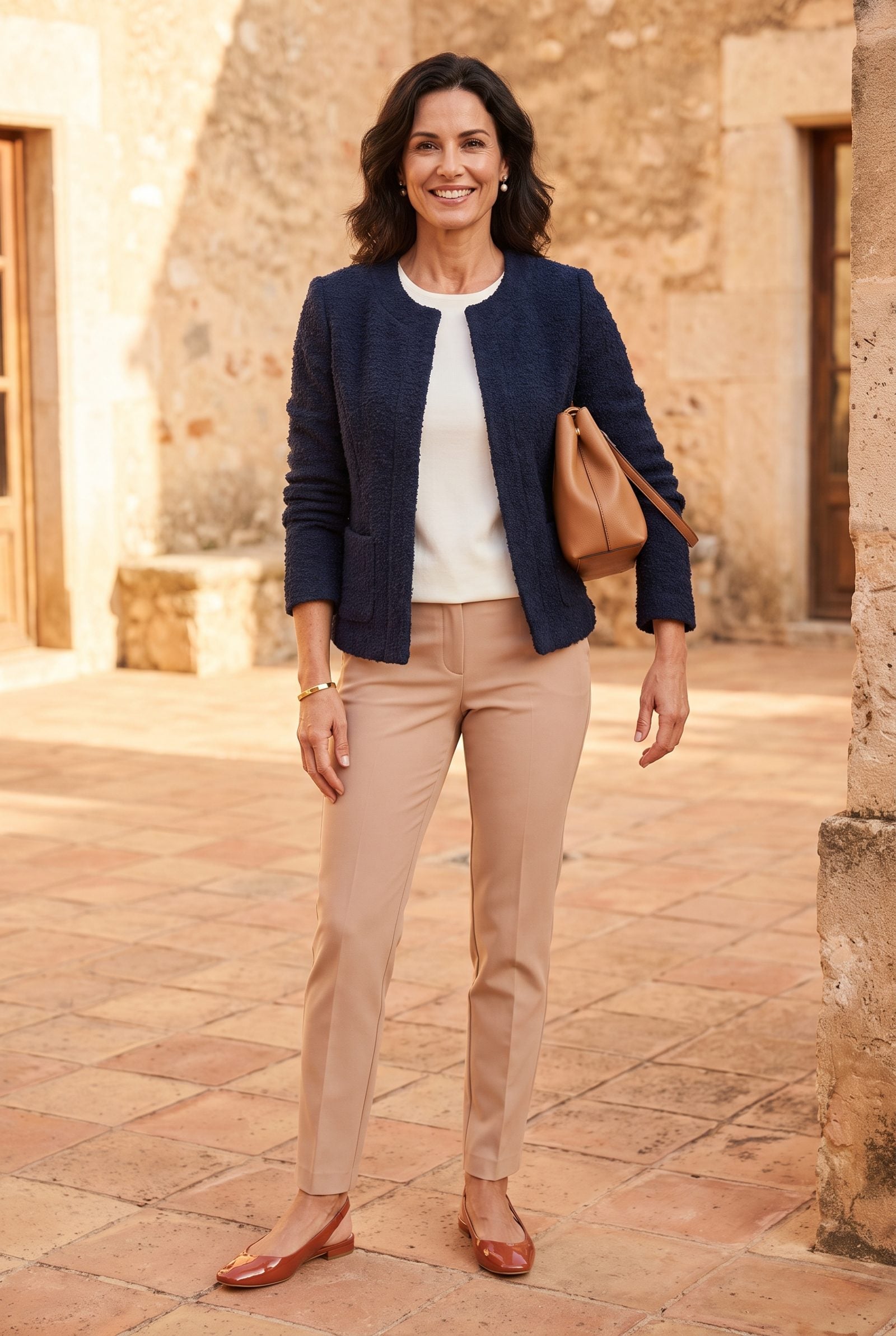
Count how many times you touch an outfit in an hour. The strapless top you keep hiking up. The skirt that spins so the zipper drifts to your hip. The blouse that gaps at the third button every time you sit. If a garment needs more than two corrections a day, it isn’t an outfit — it’s a chore.
The navy bouclé jacket here earns its place because it does nothing but stay where you put it. Constant fixing broadcasts discomfort to everyone watching, and it quietly drains your attention all day. Keep the pieces that let you forget you’re dressed.
30. The Successful-Outfit Hanger for Instant Repeats

When an outfit works, don’t take it apart. Most people wear a combination that gets compliments, feel good all day, then hang each piece back in its own section and lose the magic forever.
Keep one hanger for proven groupings. The blush silk, heather-grey flannel blazer, and matching trousers go back together, scarf and all, as a single ready unit. On a morning when thinking feels impossible, you reach for the whole thing and skip every decision. A small reserve of pre-solved outfits is the difference between getting dressed and getting stuck.
29. The Default Uniform for Each Recurring Destination
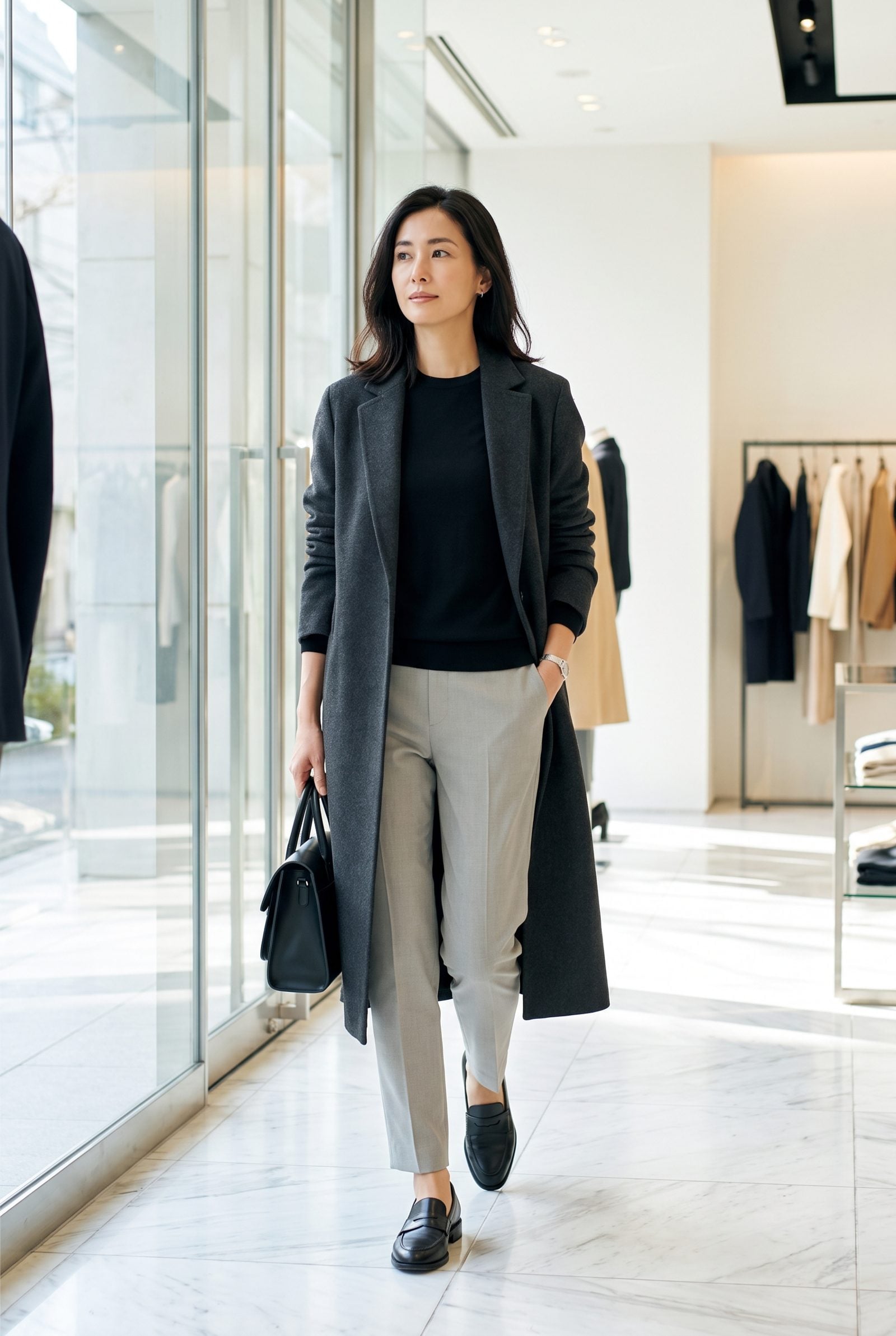
Some destinations repeat constantly: the office, the school run, dinner with the same group, the weekly client meeting. Each one deserves a default uniform you can reproduce without thought — not the same clothes every time, but a reliable formula that always lands right for that setting.
The black merino, stone cigarette trousers, and longline charcoal coat here is a tested office answer. Once a formula works for a place, it removes the single most draining daily question, which is never what looks good but what’s appropriate here. A good uniform frees up the energy you were spending on repeated decisions for things that actually matter.
28. Shoes First on Low-Energy Mornings
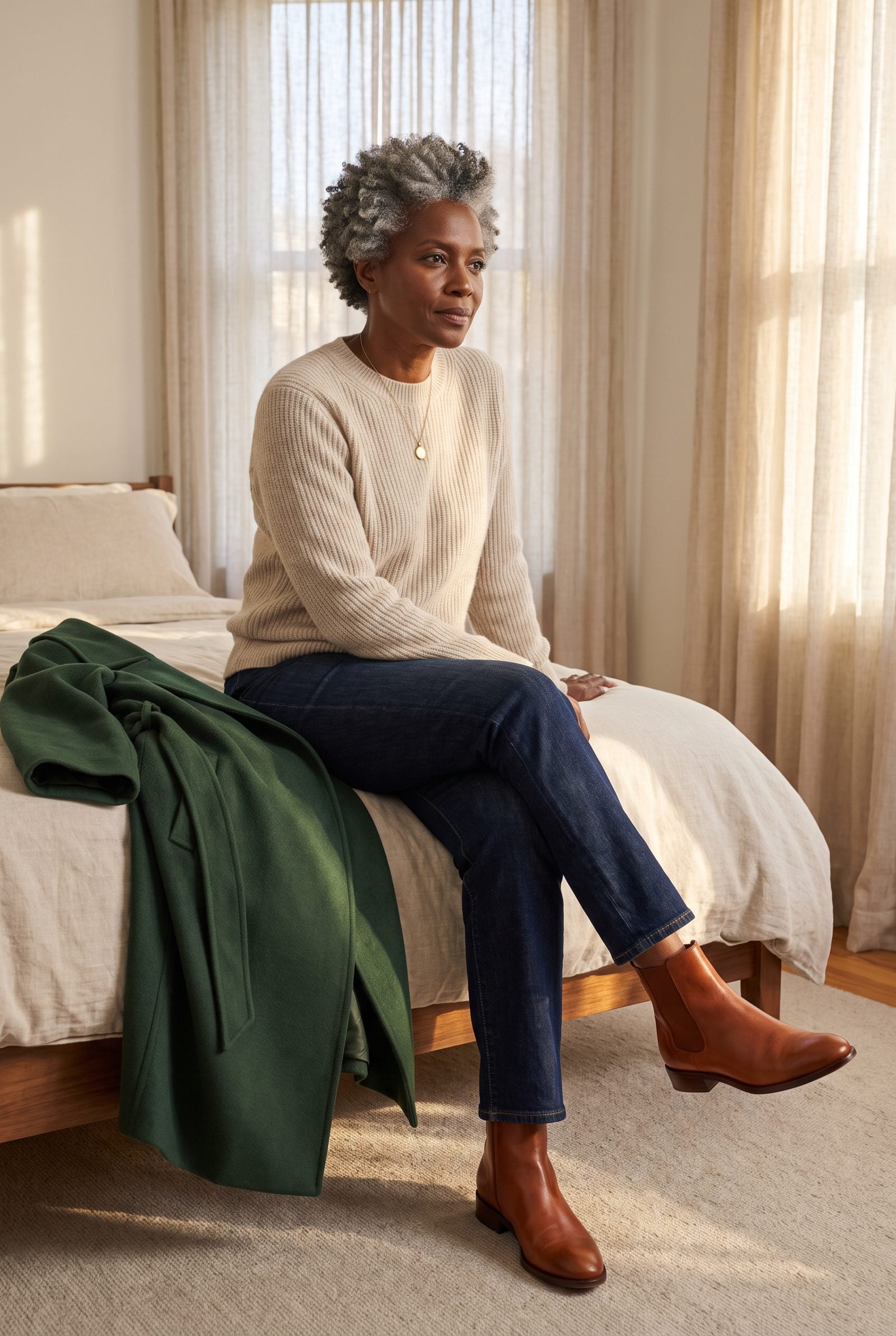
On mornings when nothing feels decidable, reverse the order. Pick the shoes first and build upward. Footwear sets the tone of a whole look — formal or relaxed, polished or easy — and choosing it first removes the biggest variable before fatigue has a chance to paralyze you.
Start with the cognac ankle boots and the rest follows almost on its own: jeans that suit the boot, a soft oatmeal knit, a forest green coat that agrees with all of it. Building from the ground up turns a foggy morning into a short sequence of easy yeses instead of one overwhelming open question.
27. Underwear Before Fabric, Match the Foundation to the Garment
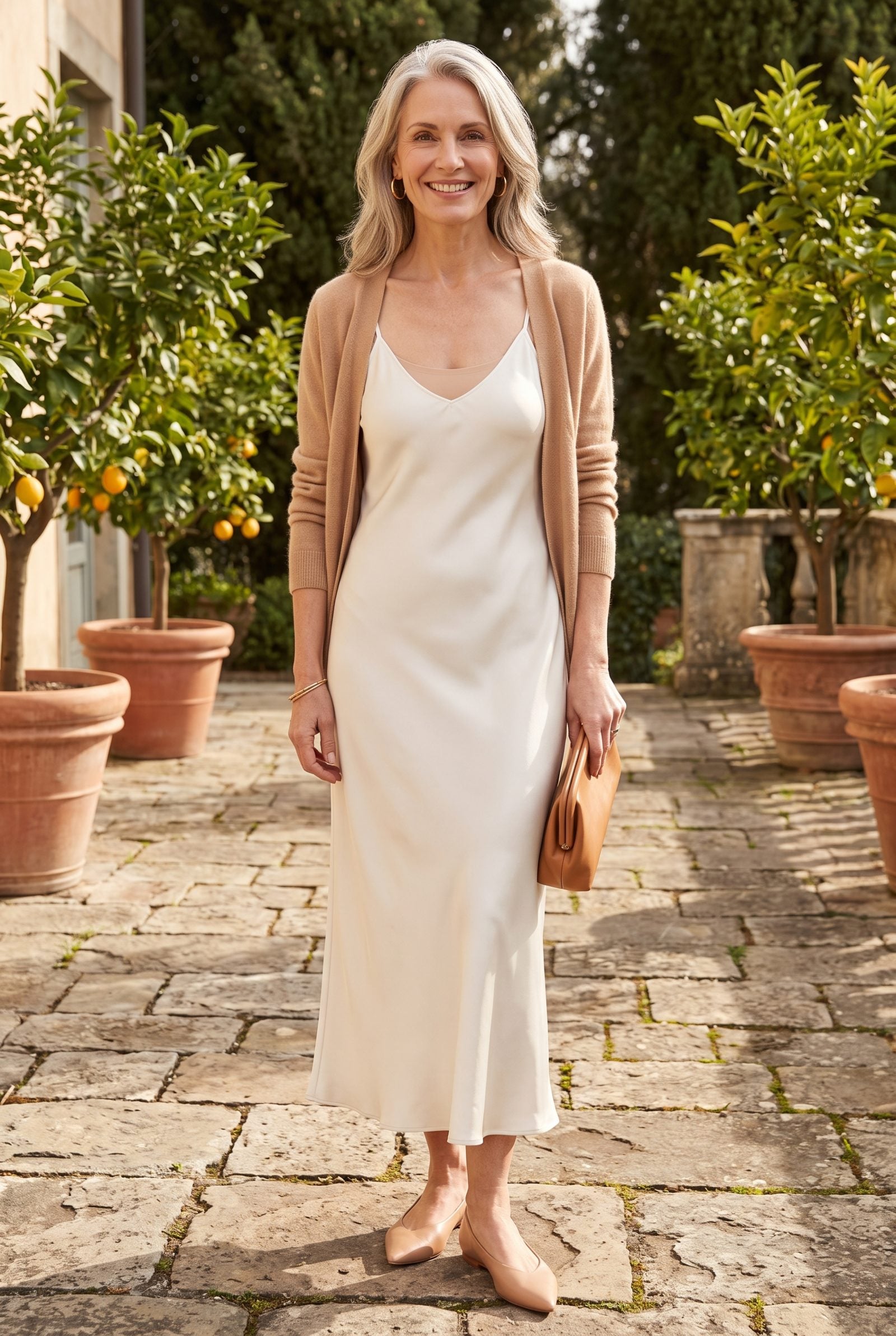
The foundation decision happens before anyone sees the dress. A liquid silk slip will betray a lace bra in a heartbeat, every scallop and seam telegraphed through the fabric like braille. Match smooth to smooth, structured to structured, and the garment finally gets to do its job.
Why does this read as polish rather than luck? Because silk and fine knits show surface, so the underlayer needs to be surface too. A seamless microfiber bodysuit under that ivory slip means one unbroken line from shoulder to hem. It’s easy to ignore this for years and wonder why your nicest pieces look slightly off. It was never the dress. Turns out the cheap thing underneath was quietly sabotaging the expensive thing on top the whole time.
26. The Side-View Rule for Checking Bra Fit

Face the mirror and everything looks fine. Turn to the side and the truth shows up. The band should run dead level around your body, parallel to the floor, not riding up your back in a hopeful little arc. If the back hikes north, the band is too big, no matter what the cup says.
The side view also catches the quiet fit crime nobody mentions: the center panel floating off the sternum instead of lying flat against it. That gap means the cup size is wrong. Check it in profile, fix it there, and a fitted turtleneck like this one reads clean instead of strained.
25. The Seated Comfort Test for Shapewear

Shapewear passes the standing test in the fitting room, then wages war on your ribs the second you sit down to dinner. Standing is not the test. Sitting is. Pull the piece on, then sit, cross your legs, lean forward like you are reaching for bread. If it rolls, digs, or forces a shallow breath, it fails.
What makes a look like this wine jersey midi work is a body that looks smooth and feels unbothered. Shapewear that only behaves upright makes you fidget, and fidgeting is the fastest way to look uncomfortable in good clothes.
24. Only One Slippery Layer Per Outfit
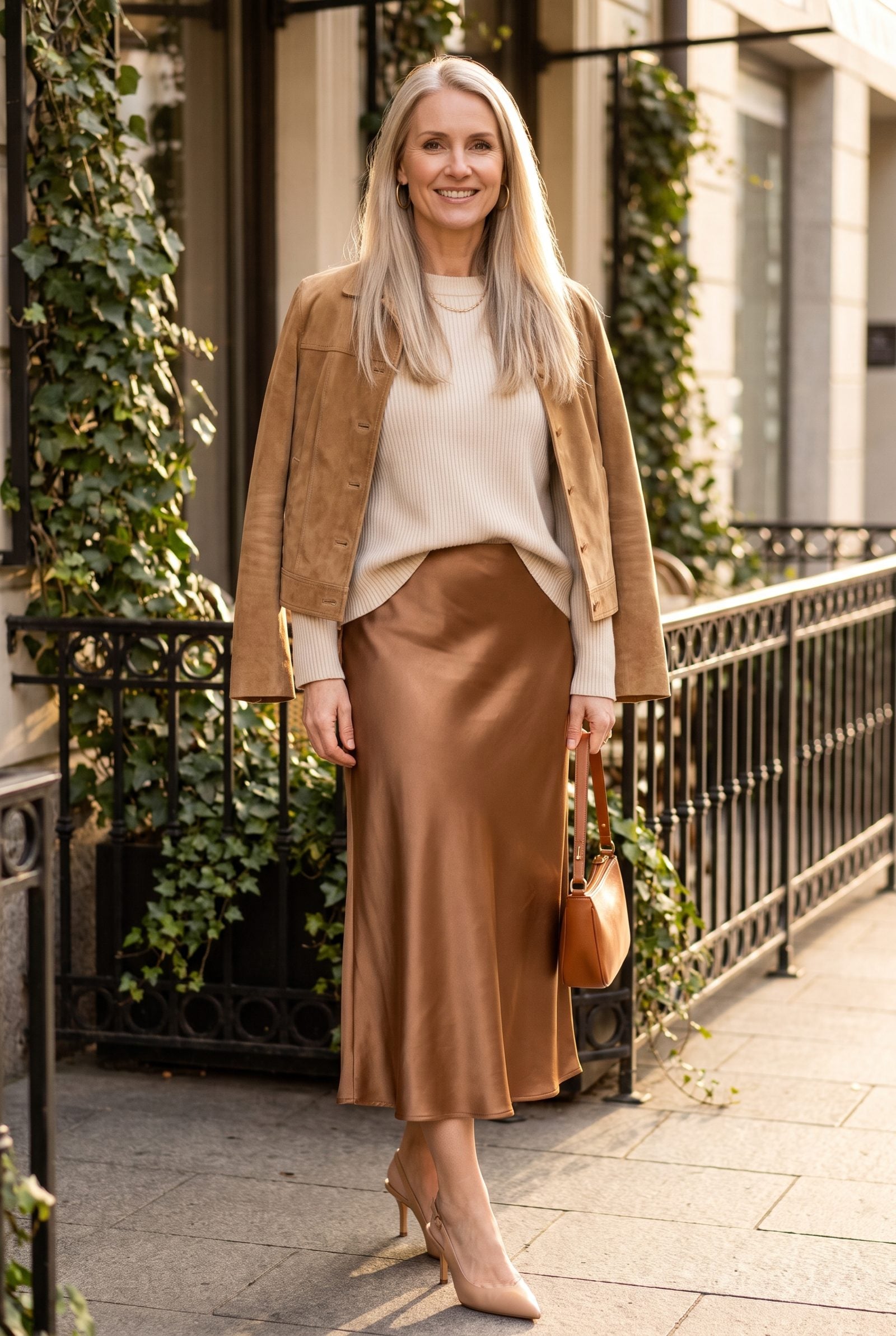
Two slippery layers fight each other all day. A satin cami under a satin blouse, or a silk slip with a silk kimono, and the fabrics slide, shift, and ride up until you are tugging everything back into place by noon. One slippery piece per outfit. The rest should have grip.
Here the bronze satin skirt is the slick one, and everything near it holds still: a ribbed knit that grabs, a suede jacket that stays put. The satin gets to move and shine precisely because nothing else is competing for attention. That keeps the whole thing together without a single safety pin.
23. Only One Fussy Closure Per Outfit
❤️ Would you like to save this?
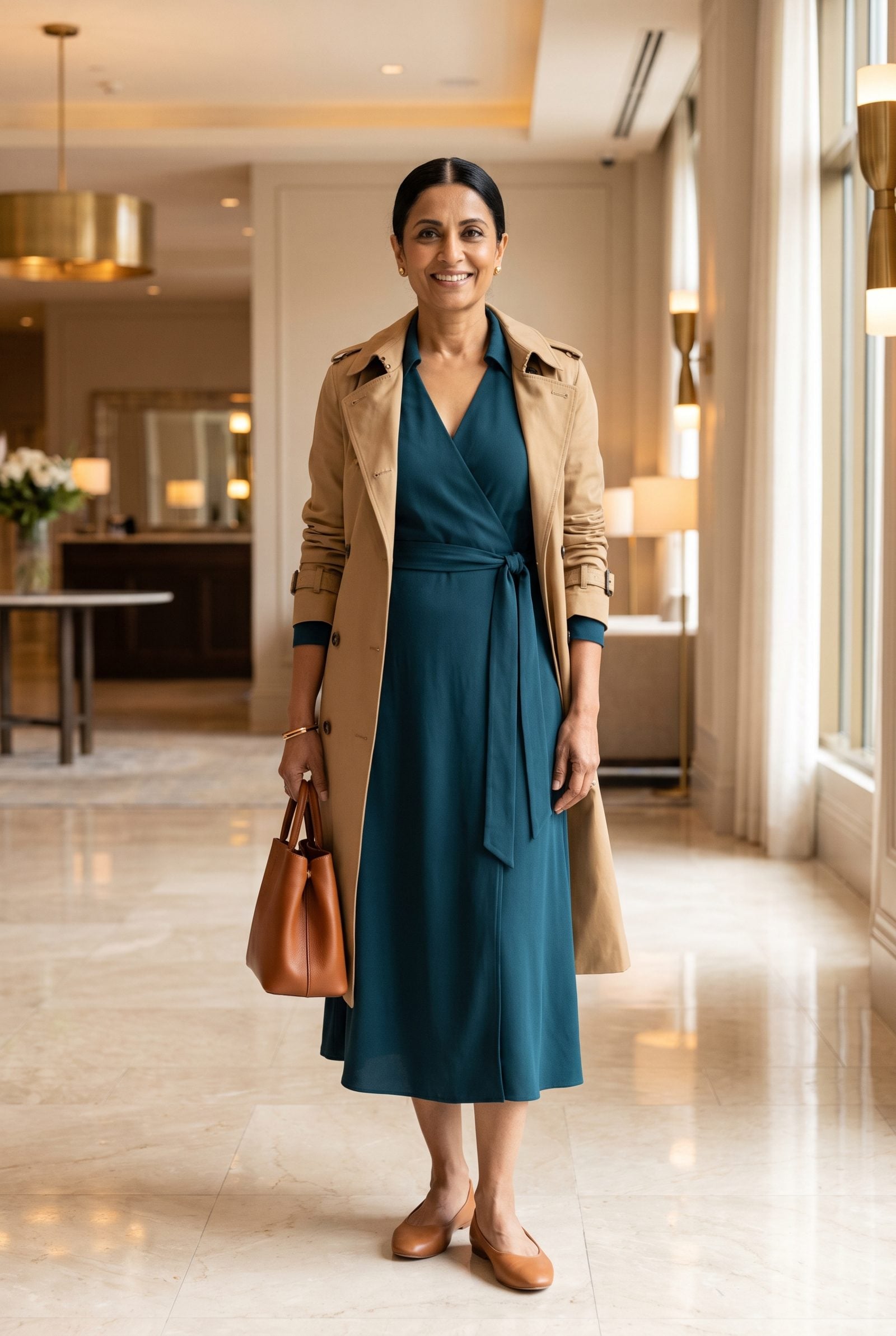
Picture getting dressed when you are already late. A back zip, a row of tiny buttons, a hook-and-eye, plus a stiff belt buckle, and the outfit becomes a negotiation. Pick one fussy closure. Let everything else be pull-on or wrap.
This teal wrap dress keeps the fuss to a single tie at the waist. The trench over it stays open, the flats slip on, the bag has a simple clasp. Fewer decisions, fewer bathroom-stall contortions, and the look stays intact because you are not forever refastening something. Easy clothes read as confident clothes, mostly because you forget you are wearing them.
22. Every Outfit Needs One Hands-Free Storage Option
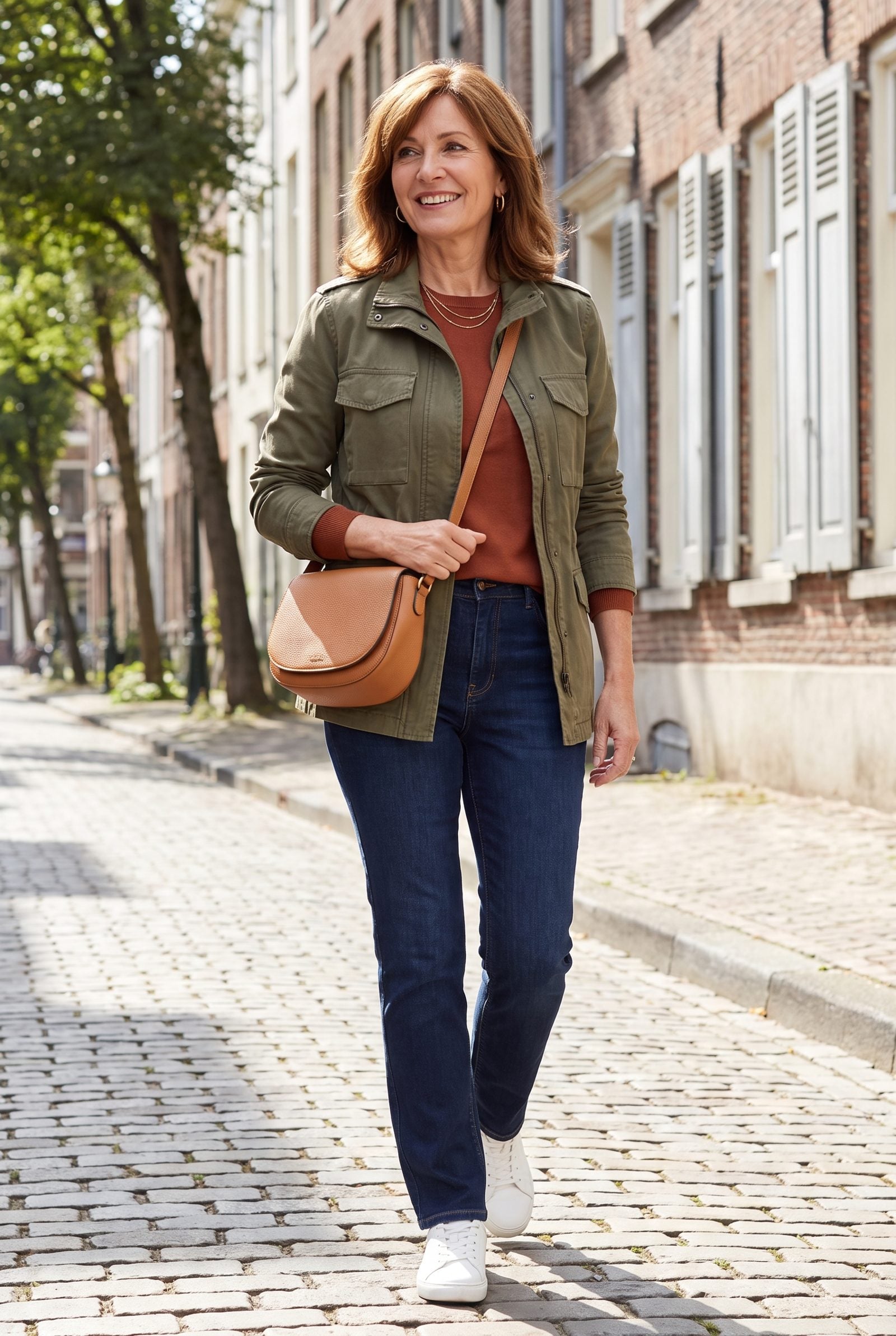
A clutch is lovely until you need to hold a coffee, your phone, and a railing all at once. Build at least one hands-free option into every outfit, a crossbody, a jacket with real pockets, a saddle bag that sits on the hip and stays there.
The crossbody here does the heavy lifting. Strap across the body, bag at the hip, both hands free to live your actual life. Pair it with a utility jacket whose pockets actually hold a key and a card, and you have an outfit that moves at your pace instead of dragging on it.
21. A Coat Must Look Good Fully Closed

Most coats get styled open, draped over a pretty outfit for the photo. Reality is colder than that. For most of winter the coat stays closed, which means closed is how it has to look. If buttoning it up produces a shapeless rectangle, the coat has failed at its one real job.
This camel wool coat works because the double-breasted front and the belt carve a waist even when it is fully done up. The burgundy scarf and chocolate boots keep the closed silhouette from going flat. Test any coat buttoned to the top in the mirror. That is the version you will actually wear for months on end.
20. A Tuck Belongs Only Where the Waistband Lies Flat

A tuck only works when the waistband underneath it lies flat. Tuck a shirt into a bottom that already bunches or rolls, and you have doubled the bulk at the one spot you wanted to streamline. The tuck magnifies whatever is happening at the waist, flattering or not.
These high-waisted olive wide-legs sit smooth against the body, so the front tuck of the poplin shirt reads crisp and deliberate. Smooth waistband, clean tuck. Bunchy waistband? Leave the shirt out, half-tuck one corner, or knot it instead. The waistband decides, not the shirt.
19. Layered Tops and Jackets Should End at Different Heights

When every layer ends at the same spot, the eye reads one thick horizontal block and your torso vanishes into it. So stagger the hems. A cropped top, a shirttail peeking below it, a long jacket framing both, and suddenly the layers have rhythm, pulling the eye downward instead of stopping it dead.
The cropped gray crew-neck at the waist, the cream linen shirt at the hip, the long rust corduroy jacket at mid-thigh, three hems at three heights. That stepped line gives the stack depth and makes it look intentional rather than piled on in the dark. Vary the lengths on purpose and layering stops reading as bulk.
18. Shoulder Fit Takes Priority Over Waist Fit
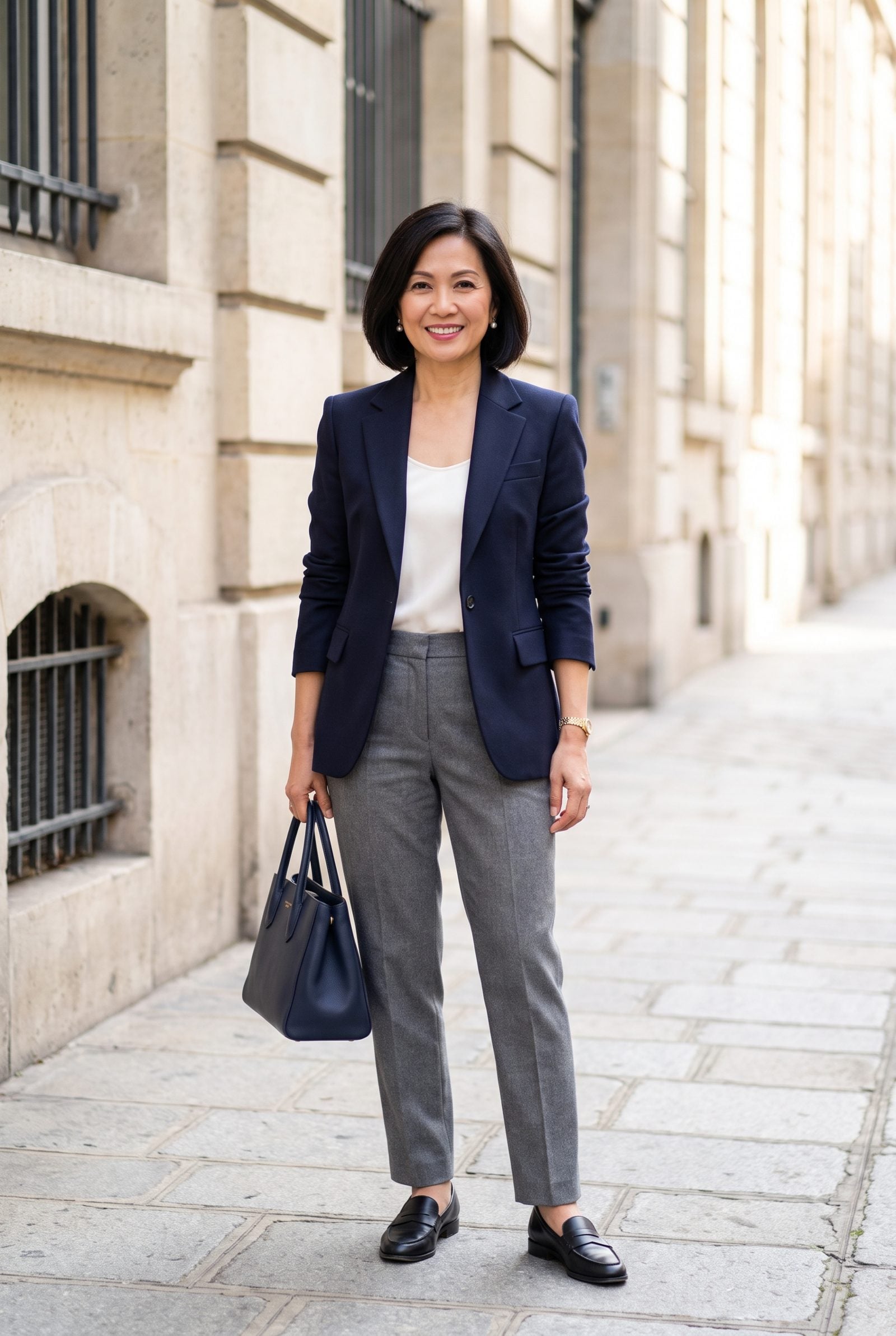
A blazer lives or dies at the shoulder. A tailor can take in a waist, shorten a sleeve, move a button. But a shoulder seam that sits an inch down your arm? Nobody fixes that without rebuilding the whole jacket, which costs more than the blazer did in the first place.
On this navy blazer the seam lands exactly at the shoulder’s edge, and that one correct line makes everything below it look sharp. Buy for the shoulders, then let a tailor handle the rest. There is something to the idea that a jacket fitting the shoulders changes how you carry yourself, and people clock that posture before they ever clock the outfit.
17. Armhole Mobility Gets Checked Before the Size Label
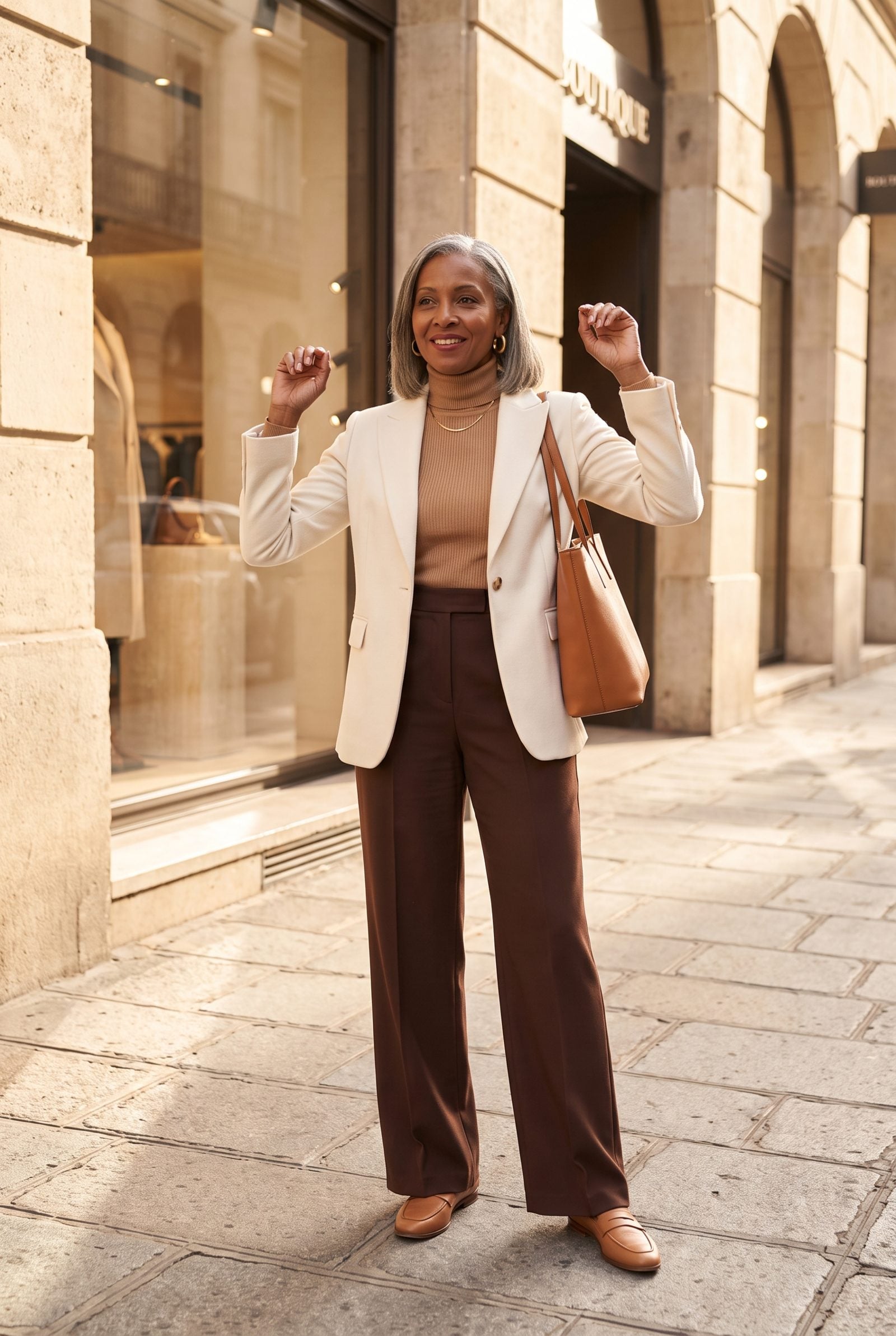
The size on the tag lies more often than anyone admits. A jacket can fit your shoulders beautifully and still trap your arms the second you reach for a coffee cup. That high, clean ivory wool blazer works because the armhole sits close to the body — you can lift, hug, and gesture without the whole garment hiking up around your ears.
Here the blazer leads, and the chocolate wide-leg trousers give it room to breathe underneath. A roomy chest with a tight armhole reads as tailored. A roomy armhole reads as borrowed from someone larger. Ignore this and nice jackets start to feel like straitjackets.
16. Pocket Basting Stays Closed Until the Drape Is Approved

See those white running stitches basted around the pockets and flaps on a new coat or blazer? Most people yank them out in the parking lot. Mistake.
Manufacturers baste pockets closed so the garment hangs in a smooth vertical line on the rack. Cut the threads and start shoving in your phone and keys, and the flaps gape — the hip gets a soft pucker no dry cleaner can fix. Keep them basted until you’ve worn the piece, confirmed the navy wool coat falls clean through the hip, and decided whether you actually need those pockets open. Half the time you don’t. The flat line down the body does more for your silhouette than a place to park your hands ever will.
15. Earrings Go On After Knitwear to Protect the Fabric

Almost every snagged sweater tells the same story: an earring went in first, before the knit came over the head. One hooked thread, one pulled loop, and a good cream cable-knit turtleneck is scarred for good.
The fix costs nothing. Knitwear first, earrings second. Gold drops, hoops, sharp studs — any of them will catch a cable or a loose weave on the way through the collar, and this one habit has saved more cashmere than any fabric comb. It feels like a non-rule until the day you ruin a sweater that cost real money.
14. Glasses Count as the First Accessory

❤️ Would you like to save this?
If you wear glasses every day, they are not a medical device. They’re the most-worn item in your entire wardrobe, parked dead center on your face, and they set the tone before anyone gets to your shoes.
So treat them like the lead accessory they are. Those tortoiseshell eyeglasses pick up the amber in the cognac tote and boots, so the frames read as a deliberate choice rather than an afterthought from the optometrist. Match the frame’s undertone to your warmest or coolest pieces and everything suddenly looks coordinated with zero extra effort. Nobody tells you this at the eye exam, which is a shame — it quietly handles half your accessorizing for you.
13. Bag Scale Matches the Volume of the Outerwear
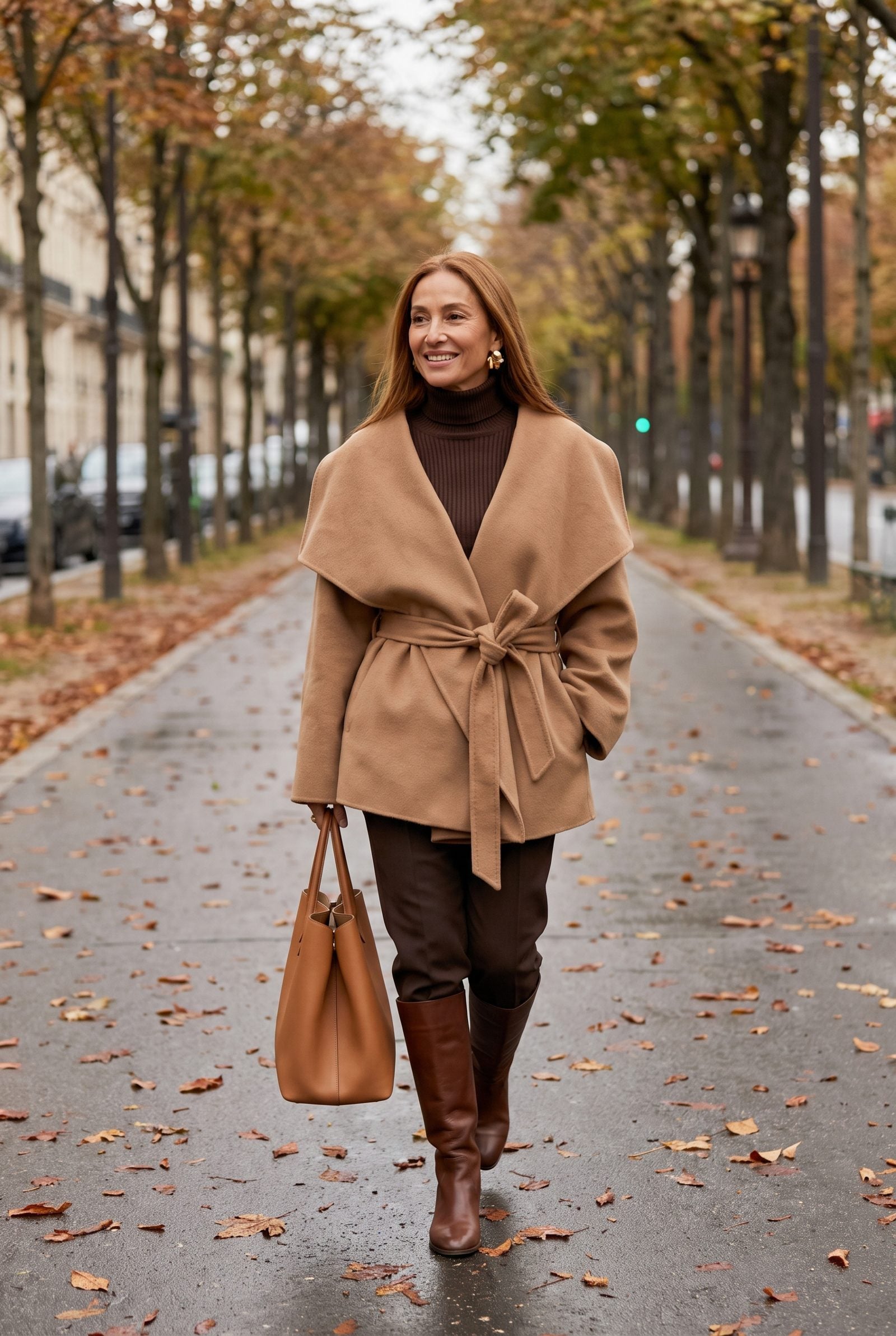
Pair a huge winter coat with a dainty little top-handle bag and watch the bag vanish. Worse, it makes the coat look even bigger by comparison, and not in a good way.
Volume wants volume. That camel wool wrap coat has real presence, so it needs a tan leather tote with enough scale to hold its own beside it. The structured shape keeps things sharp instead of sloppy. Come summer, when you’re in a slip dress and sandals, that same giant tote looks like you’re moving house — scale it down then. Match the bag’s mass to the mass of your heaviest layer, and the whole proportion reads intentional.
12. Socks Bridge the Color Gap Between Trousers and Shoes
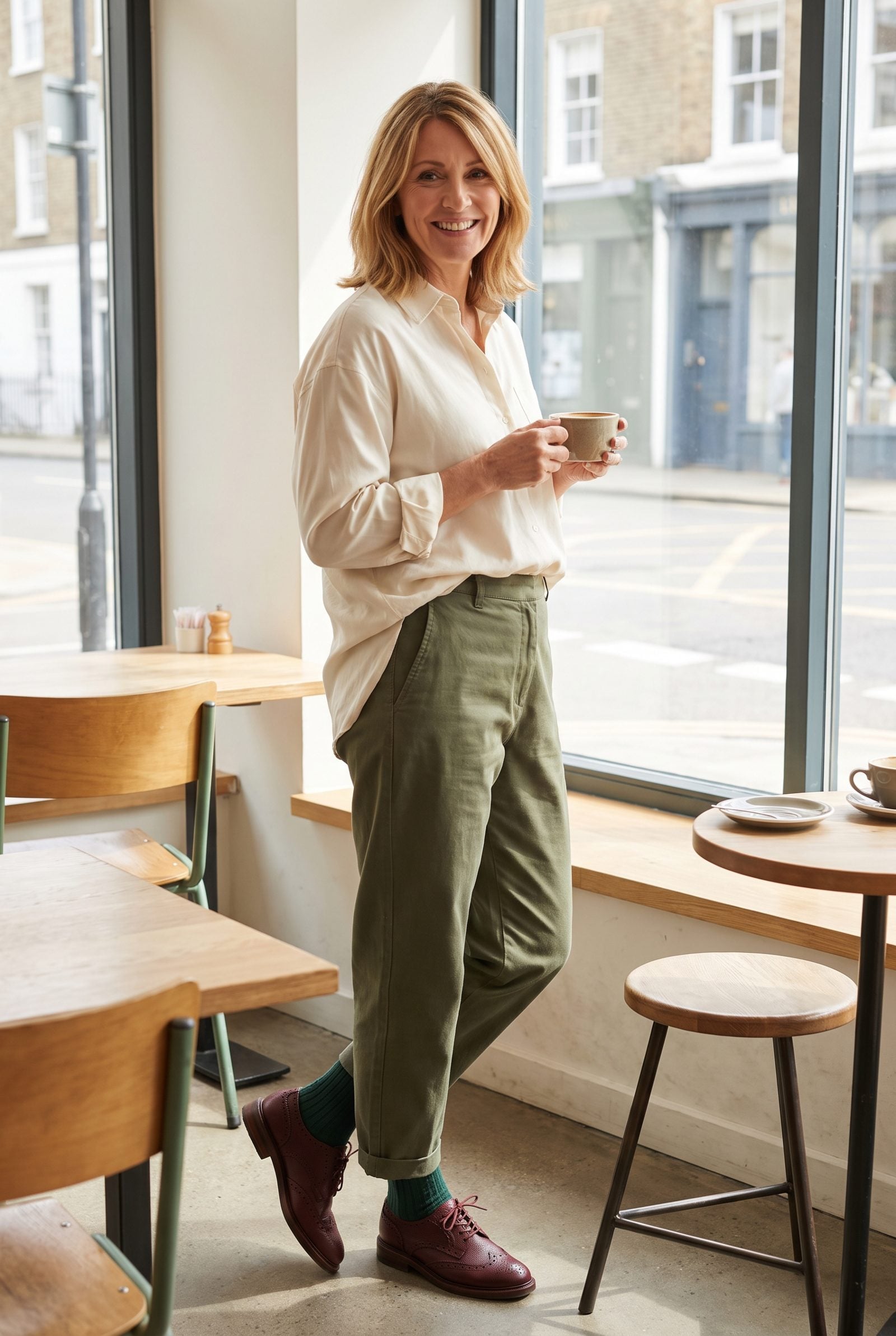
The ankle is where a lot of otherwise good outfits fall apart. Olive trousers, oxblood shoes, a hard stop of bare skin or a wrong-colored sock in between — the eye snags right there.
A sock in a shade that sits between the two colors stitches the gap together. Here the forest-green ribbed socks live halfway between the olive trouser and the oxblood brogue, so the leg reads as one continuous line rather than three disconnected pieces. Nobody consciously clocks it, but everyone registers the polish. Treat your socks as a color bridge, not an afterthought from the sock drawer.
11. Hosiery Weight Matches the Visual Weight of the Shoe
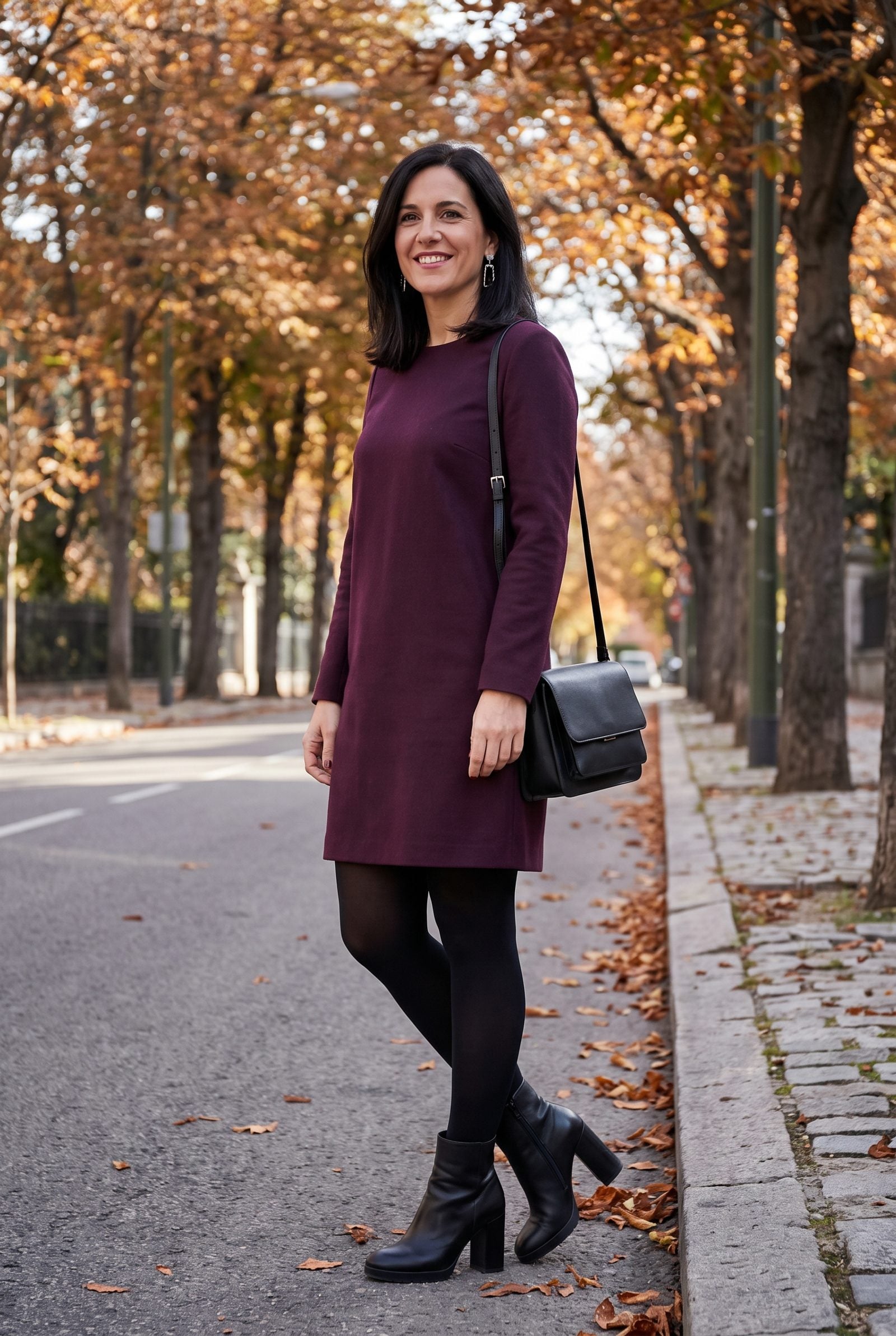
Sheer hosiery under a heavy clodhopper boot looks like an accident. So does opaque wool tights under a delicate strappy sandal. The mismatch jars because the weight of the leg and the weight of the shoe are arguing with each other.
Match them. Heavy black opaque tights belong with a solid black block-heel boot, the way they do here under the plum shift. Delicate shoes want delicate hosiery, or bare legs. When the two agree, the leg reads as a single deliberate column from hem to toe. When they don’t, your eye files the whole outfit as slightly wrong.
10. The Strongest Contrast Goes Where Attention Should Land
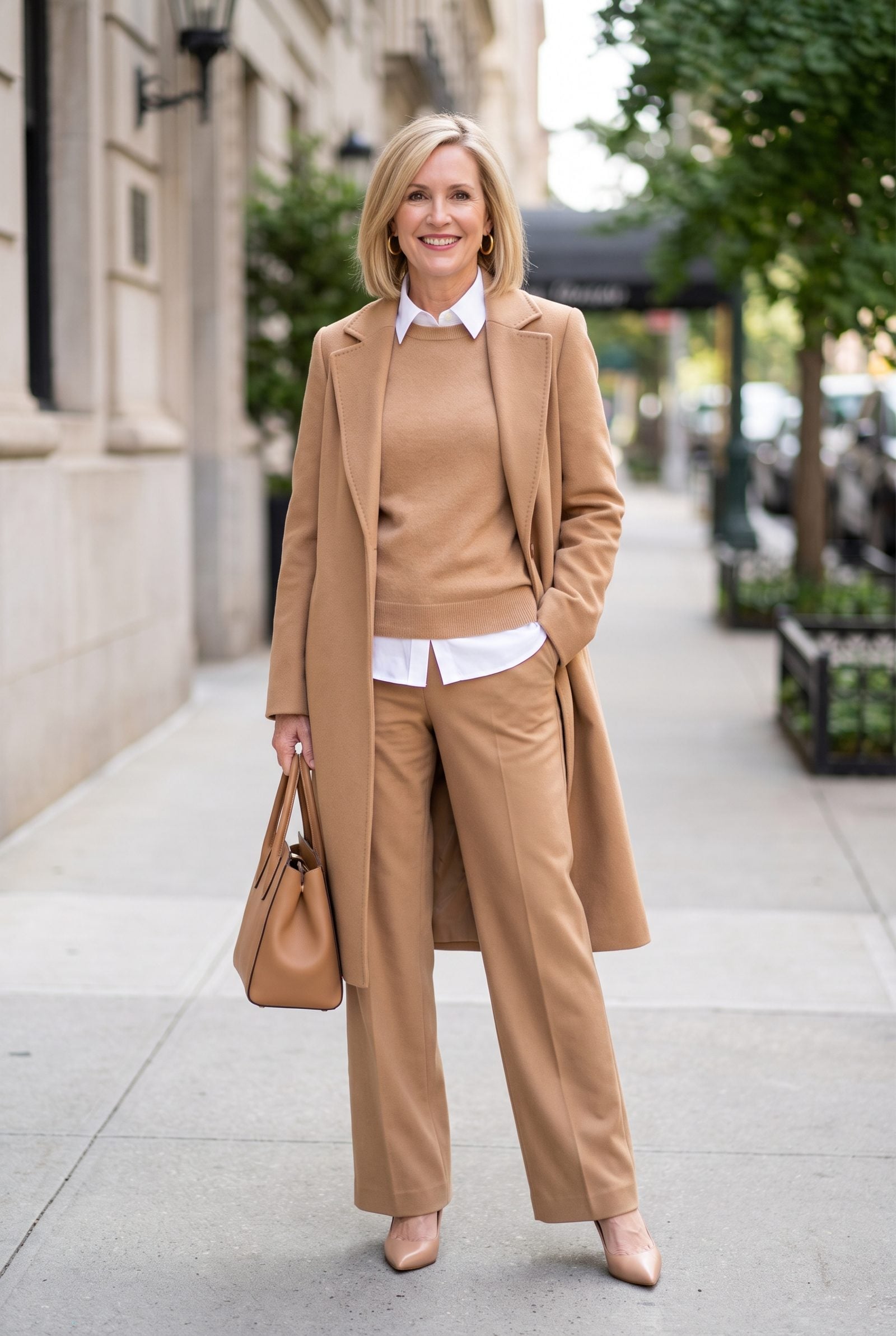
Contrast is a spotlight. Put the sharpest light-dark jump low on the body — white sneakers under dark everything — and you’ve aimed the spotlight at your feet.
Aim it at your face instead. In this tonal camel outfit, the white shirt breaks the warm beige right at the top: the crisp white collar right under the chin. The collar, framing the face, pulls the eye up to where you actually want it. The camel column does the elongating; the white collar does the directing. Decide where you want to be seen, then put your strongest contrast there. Usually that’s the neckline.
9. Face Flattery Breaks Every Color-Matching Tie

You can build a technically correct outfit that still drains the life out of your face. Two neutrals that match each other beautifully and leave you looking tired.
When two color choices are both defensible, pick the one that flatters your face and ignore the rest. That coral knit sweater bounces warmth up into golden skin and makes it glow from inside, which no amount of correct neutral pairing can do. The trouser can be anything reasonable. The piece near your face is the one that has to earn its place. Clothes photograph. You’re the one people look at.
8. A Print Containing the Hair Color Is Easier to Coordinate
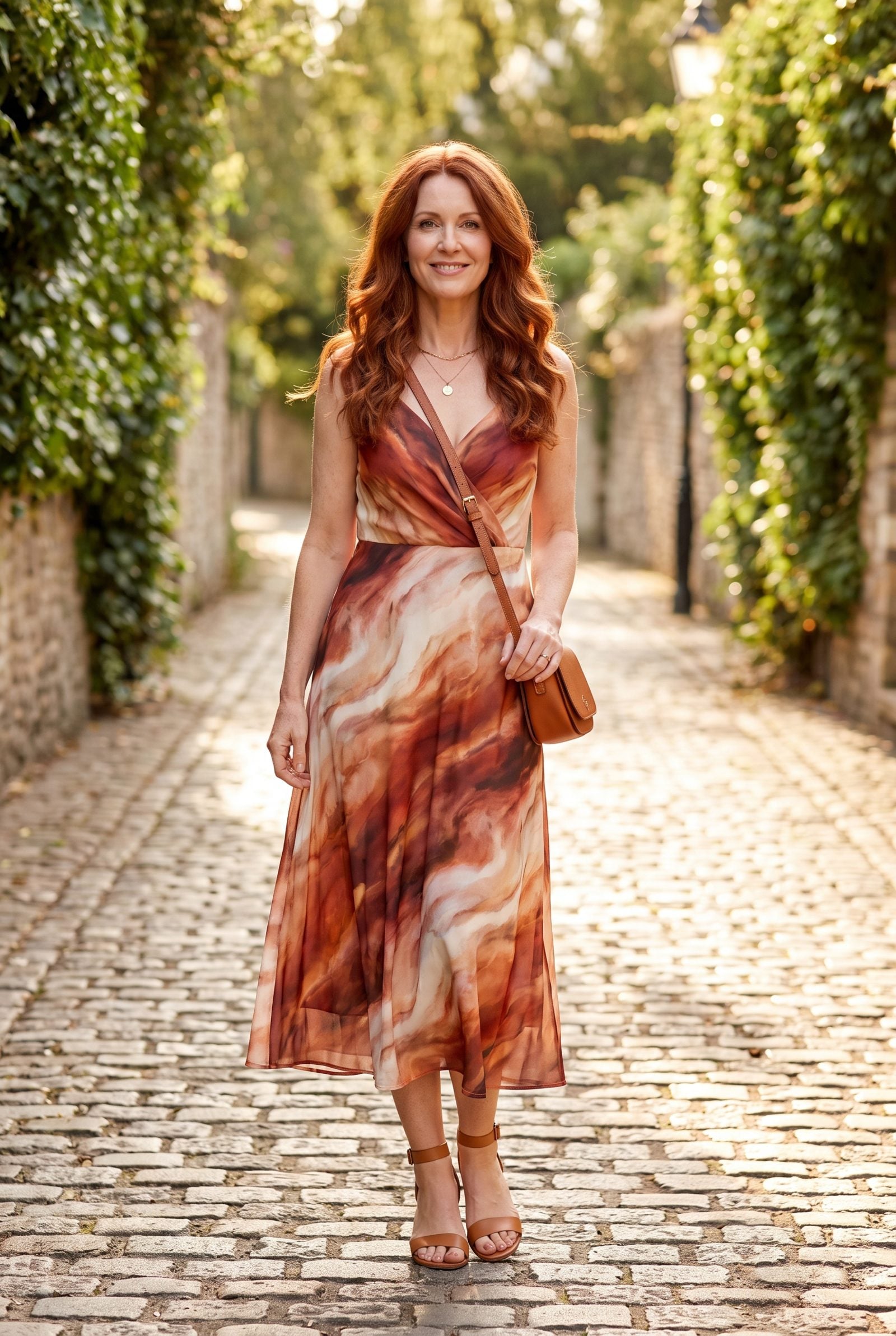
Here’s a trick nobody mentions until you stumble onto it: a print that contains your hair color is almost impossible to style badly.
Auburn hair shows up again in the rust threads of the watercolor midi dress, so the whole look hangs together on its own. The hair becomes part of the palette instead of competing with it, and every neutral accessory you add already matches. Silver-haired? A print with grey, charcoal, or soft white pulls off the same thing. Your hair is a color you wear every single day — let a print agree with it, and half your coordinating is done before you’ve left the mirror.
7. Mixed Metals Work Only When Each Finish Repeats
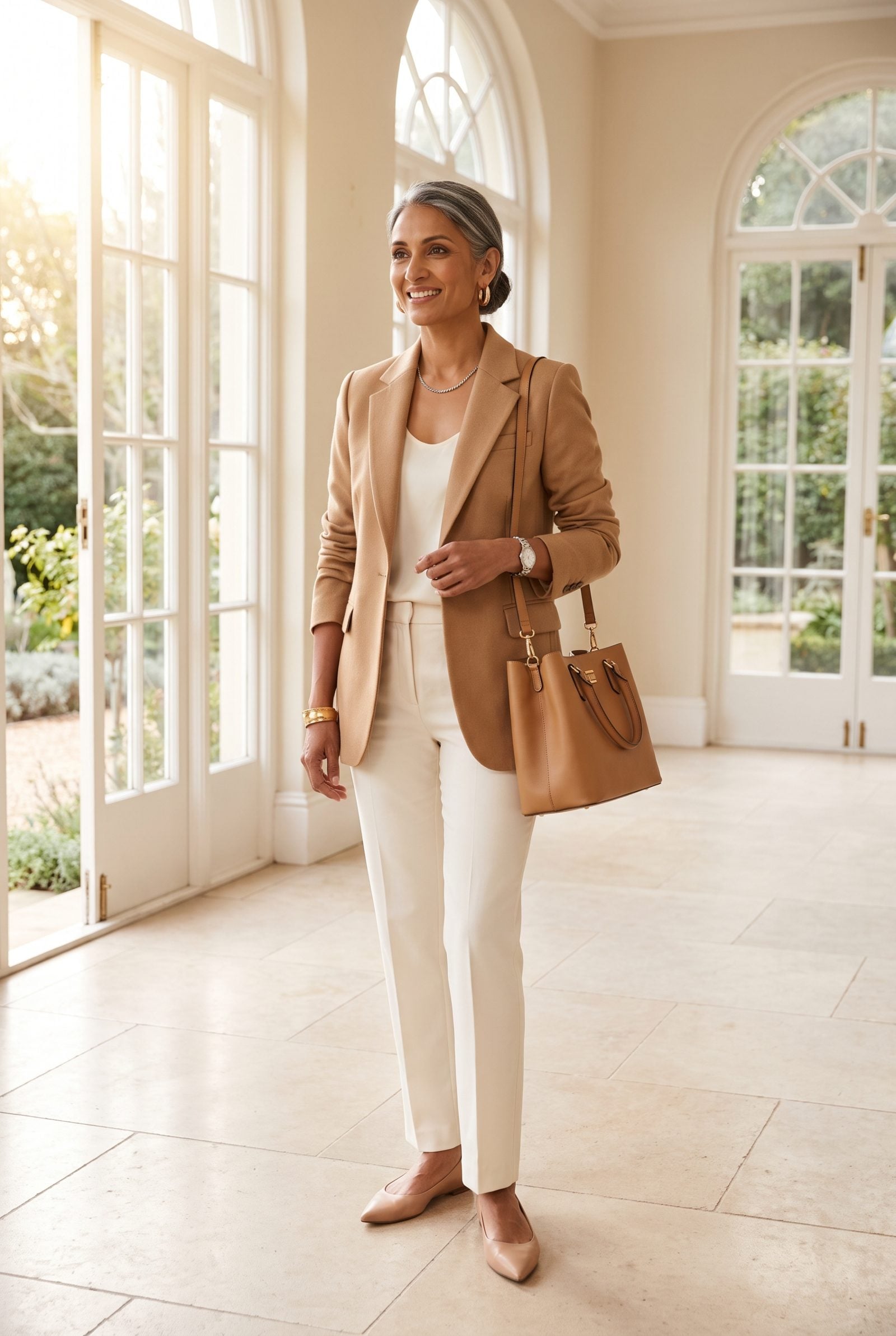
One gold earring and one silver ring looks like you got dressed in the dark. Two of each looks deliberate. Repeat every finish at least twice and your eye reads a plan instead of an accident.
Here the gold hoops answer the gold cuff while the silver watch answers the silver chain, and the tan leather tote hardware quietly backs up the gold team. The camel blazer keeps everything calm, which lets the metal mixing become the interesting part instead of a distraction.
6. Volume Is Balanced by Exposing a Wrist, Ankle, or Neckline
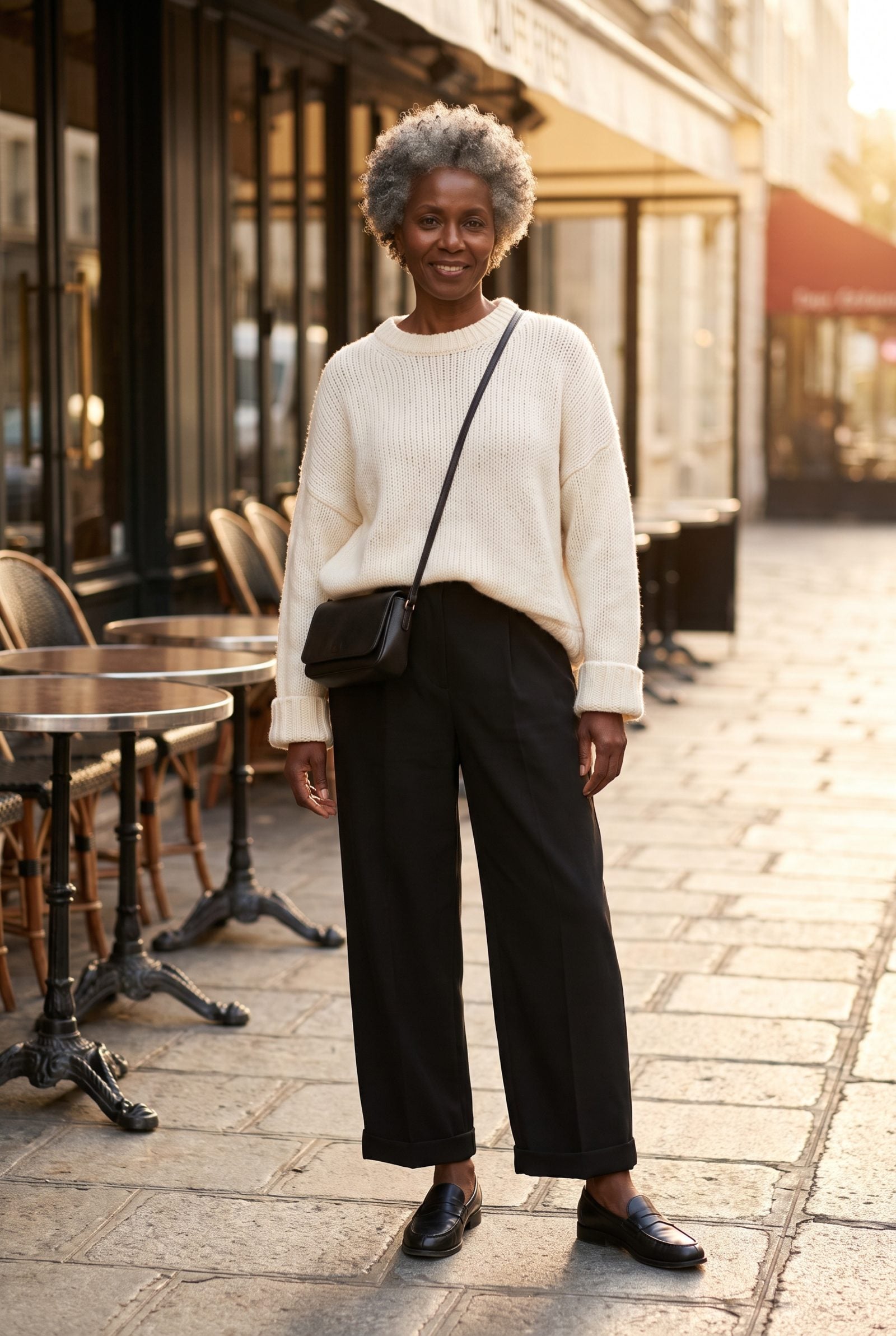
Pile on volume and the body disappears. But leave one wrist, one ankle, or the collarbone bare, and suddenly the eye has somewhere to land. That one exposed spot does the proportional work the fabric is busy hiding.
The oversized ivory wool sweater and wide trousers would read as a tent on anyone. Pushed sleeves and cropped hems rescue the whole thing. Bare wrists, bare ankles, and it suddenly looks intentional rather than enormous. One narrow sliver of skin carries an acre of wool.
5. Mixed Patterns Share a Background Color
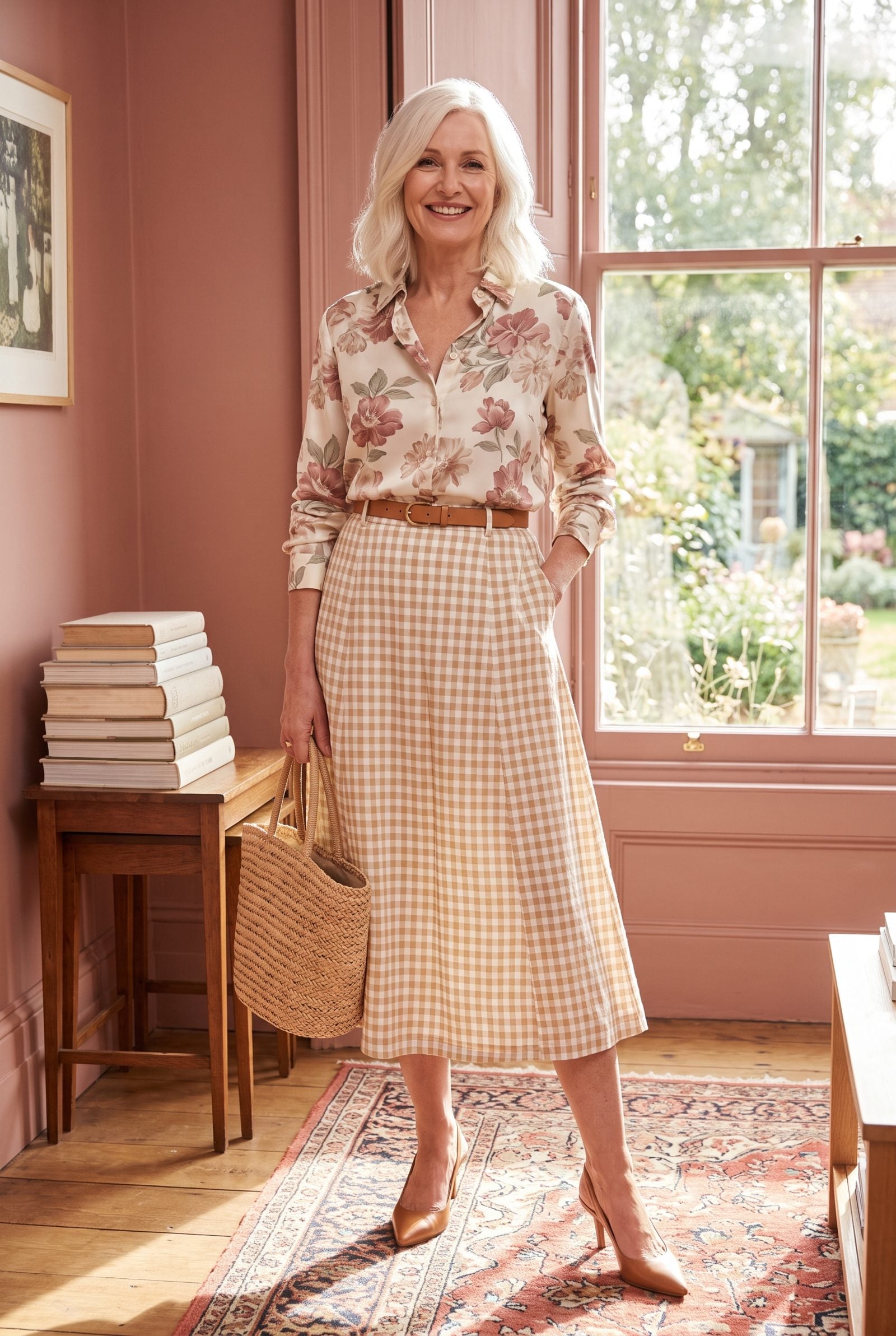
Florals with gingham sounds like a dare. It works the second both patterns sit on the same cream ground, which acts like a referee letting two busy prints coexist without shouting over each other.
Scale helps too — the small check against the larger floral keeps them from competing — but the background is the real rule. Match the base color and you can mix prints most people would never risk. The cream floral blouse and the gingham skirt read as a conversation, not a collision.
4. Monochrome Outfits Require at Least Three Distinct Textures

Monochrome flops flat when every piece shares the same surface. The fix isn’t color. It’s texture. Three distinct surfaces in one shade and the outfit gains depth without a single new hue.
Ribbed cashmere, matte suiting, brushed suede, smooth leather. Same camel, four finishes, and the light hits each one differently so the eye keeps moving. A tone-on-tone look only reads rich when the textures do the lifting color usually handles. Here the camel suede trench steals the surface show.
3. Long Open Layers Work Over an Unbroken Color Column
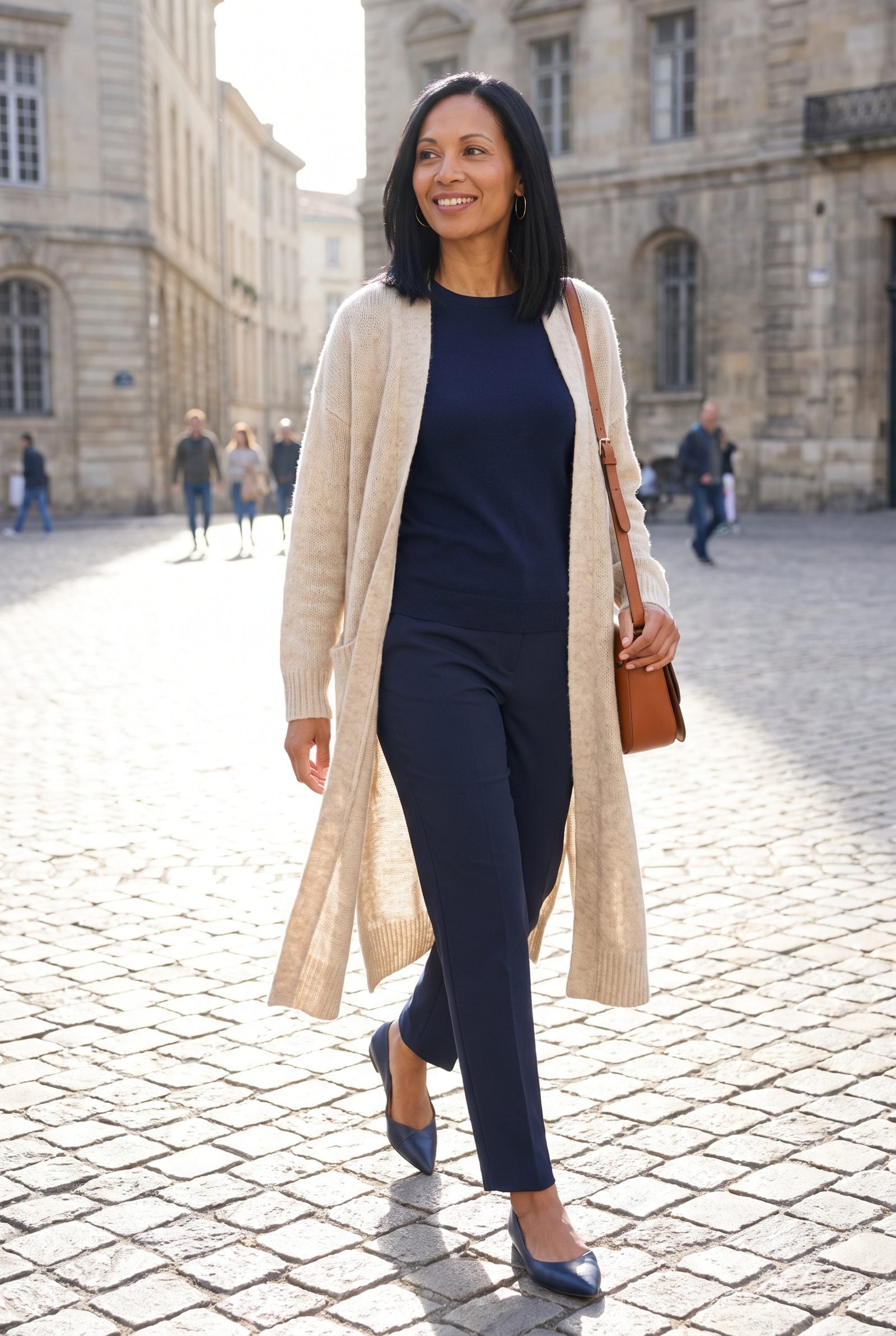
An open duster can slice you in half when what’s underneath breaks up at the waist. Put a single color from neck to floor under it and the duster frames an uninterrupted line instead of cutting across it.
Navy top, navy trousers, navy flats — one continuous column, with the oatmeal oatmeal duster cardigan hanging open like curtains on either side. Your eye travels straight down the center and reads height. Cheapest lengthening trick there is, and it costs nothing but matching your tucked-in top to your trousers.
2. Seated Events Put the Strongest Detail Above the Waist

At a dinner, a gala, a long seated meeting, nobody sees your hemline. They see you from the ribs up for three solid hours. So that’s where the good stuff goes.
The draped sapphire sapphire silk blouse and chandelier earrings carry the whole look while plain trousers do the forgettable work below the table. Spend your interest budget where the table edge cuts you off. A statement shoe is wasted when it’s hidden under linen, while a dramatic neckline is on duty the entire time.
1. Evening Outfits Get Evaluated Under Evening Lighting

That outfit looked sharp in your bright bathroom mirror. Then you walked into a candlelit restaurant, the black dress turned into a flat shadow, and the navy read as grey. Daylight and evening light are two completely different critics.
So check your evening look under the light it will actually live in. Velvet, metallics, and jewel tones come alive in warm low light the way flat matte fabrics never do. The burgundy burgundy velvet slip dress glows under amber bulbs; the same shape in flat cotton would disappear into the room.
Honestly, the easiest version of this: get dressed, kill the overheads, switch on a lamp, and look again. Whatever survives that survives the restaurant.