
❤️ Would you like to save this?
You know the fitting-room moment: wide-leg jeans that looked perfect on the hanger turn out too long, too wide, gaping at the back waist, somehow baggy and unflattering at once. The fault was never yours. It was the fit, the hem, and a leg width picked off a trend chart instead of a mirror. Wide-leg denim is one of the most forgiving silhouettes you can own once the details go right — waistband placement, drape, where the flare starts, how the hem lands on your shoe. Here is how to get all of it right.
FYI, thanks to AI imagery software, we’re able to create very specific fashion and hairstyle examples to illustrate the points being made. In some cases, imagery is exaggerated to hammer home the point. Also, assume links that take you off the site are affiliate links such as links to Amazon. this means we may earn a commission if you buy something.
34. Choose a Mid- or High-Rise Waist That Stays Comfortable When You Sit
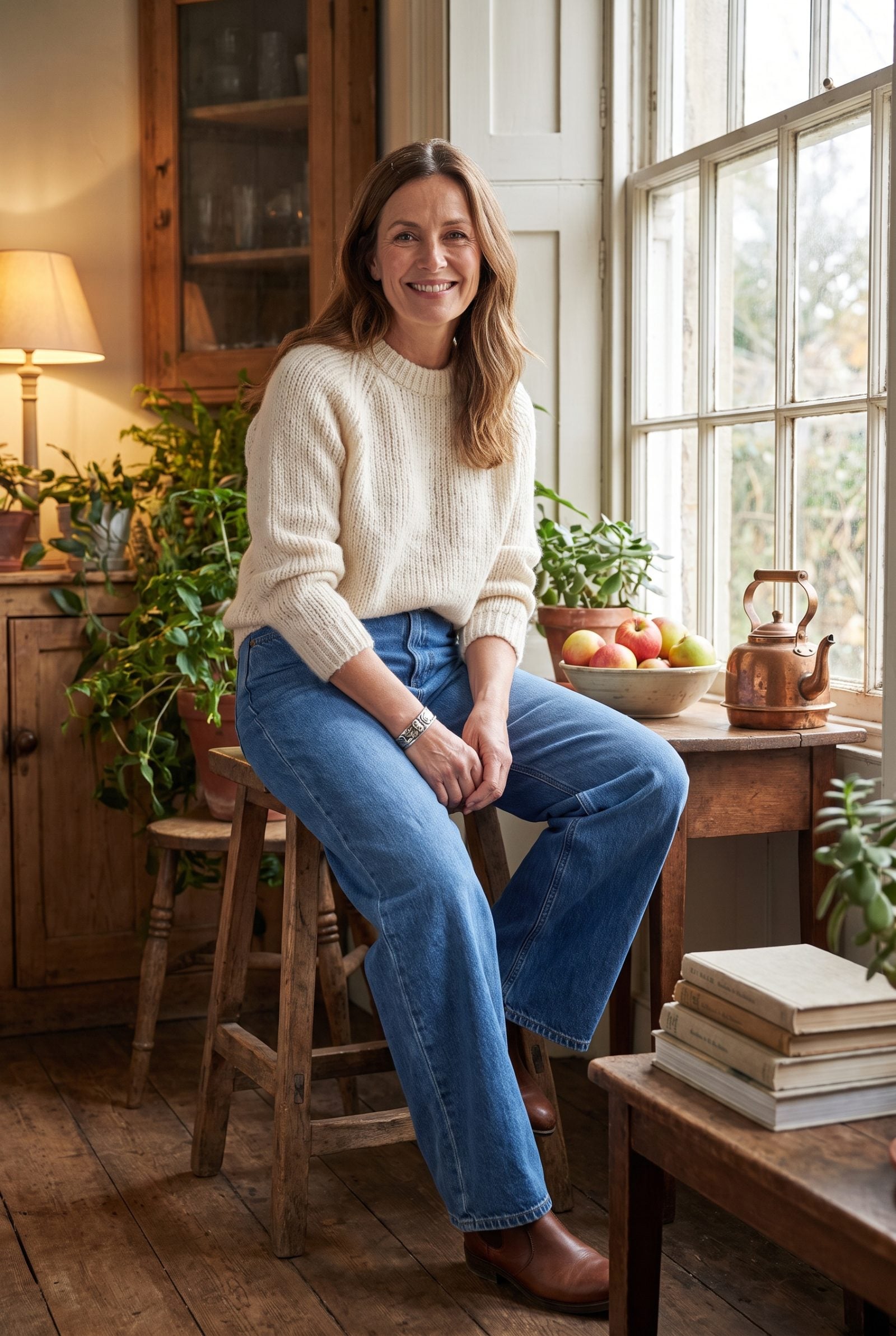
The real test of a rise happens when you sit down, not when you stand in front of the mirror sucking in. A high-rise that sits at your natural waist stays put through a two-hour lunch, while a low-rise slides south the second you cross your legs and leaves you tugging.
Mid- and high-rise wide-leg jeans also give the eye a clean vertical line from waist to floor, which is the whole reason the silhouette lengthens you. Break that line low on the hip and the effect vanishes.
33. Pick a Leg Width That Suits Your Frame Instead of Following the Widest Trend
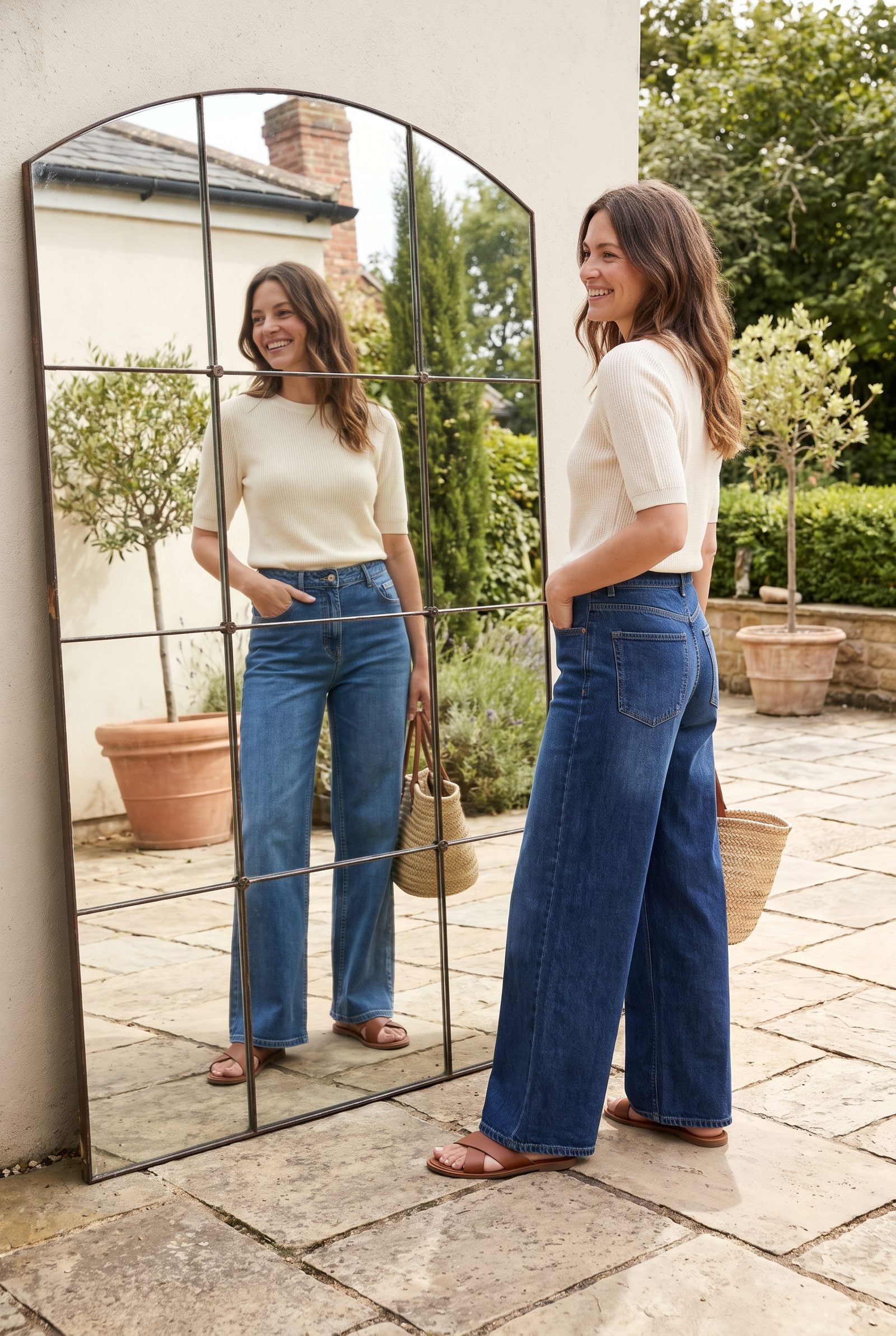
The widest pair on the mannequin is not automatically your pair. A leg opening that reads dramatic on a tall model can bury a smaller frame in fabric until you look like you raided a much taller sibling’s closet.
So match the width to your height and bone structure. A moderate wide leg drapes and lengthens on a petite frame, while a true palazzo sweep needs the height to carry it. Get it right and you build a column from waist to floor. Get it wrong and you’re wearing a curtain.
32. Make Sure the Jeans Skim the Hips Before They Flare
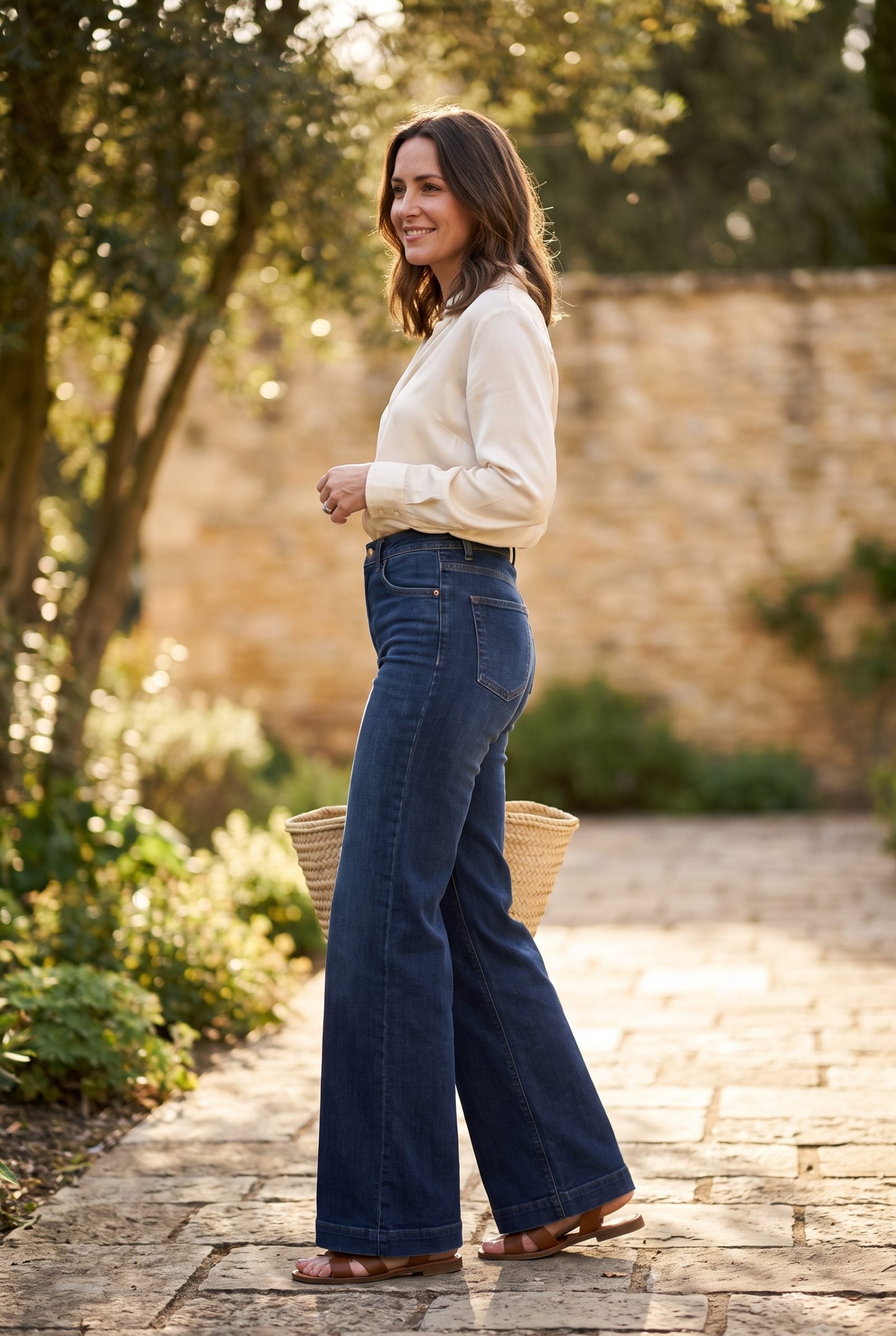
Here is where most wide-leg jeans fail curvier bodies. They cling across the hip and seat, then explode into volume, which reads as fitted-on-top-tent-on-bottom. Not the goal.
You want denim that skims the hip cleanly — no pulling, no strain lines — then falls straight or gently flares from the thigh. That smooth transition is the entire trick. It keeps the waist defined while the leg does the drama.
31. Choose Structured Denim That Holds Its Shape Throughout the Day
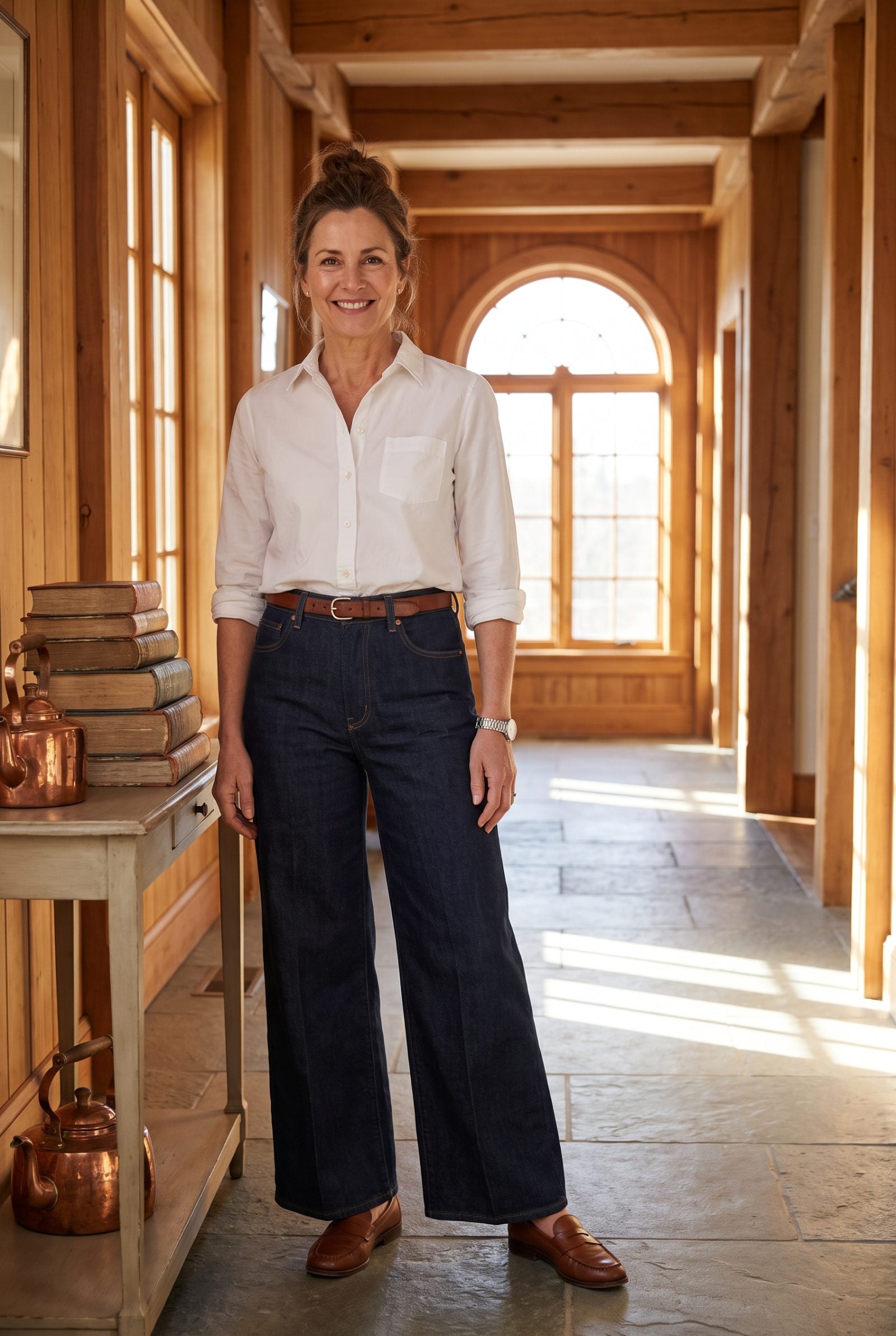
Soft, drapey denim looks great for the first hour. Then it stretches, the knees bag out, the seat goes slack, and by mid-afternoon you’re wearing a completely different pair of jeans than the one you put on.
Denim with real weight and body holds its shape through a full day of sitting and standing, keeping the clean leg line you paid for. Rigid or lightly-stretched cotton beats floppy every time here.
30. Get the Hem Tailored for the Shoes You Wear Most Often
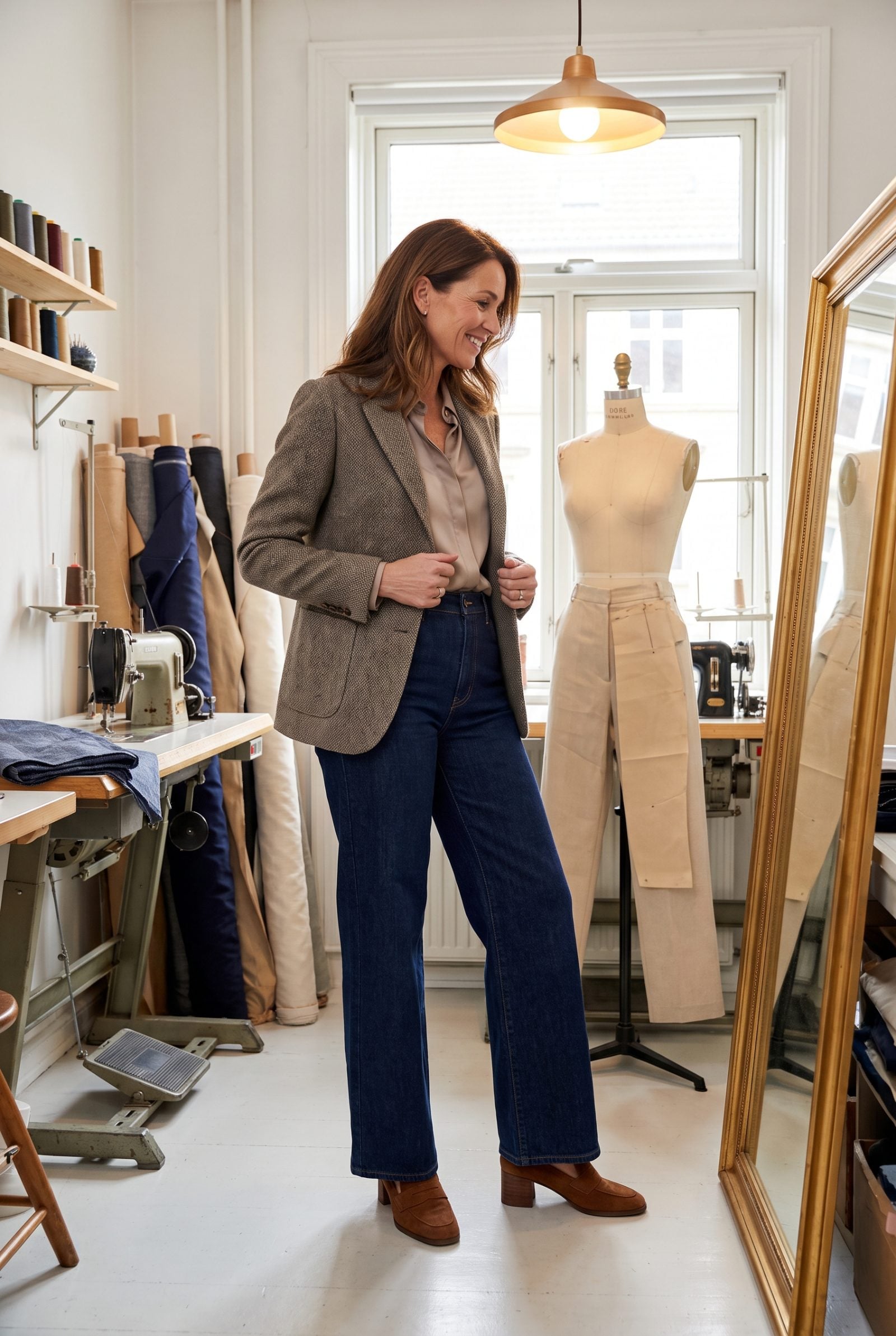
Off-the-rack hems are cut for someone six inches taller wearing heels. That someone is not you on a Tuesday.
Pick your most-worn shoe — the loafer, the sneaker, the flat — and set the hem for that exact shoe. The fabric should break gently at the vamp, grazing the top of the foot without pooling. A tailor will do this for the cost of two coffees, and it changes everything about how the jeans read.
29. Keep the Hem Just Off the Ground to Avoid Dragging and Fraying
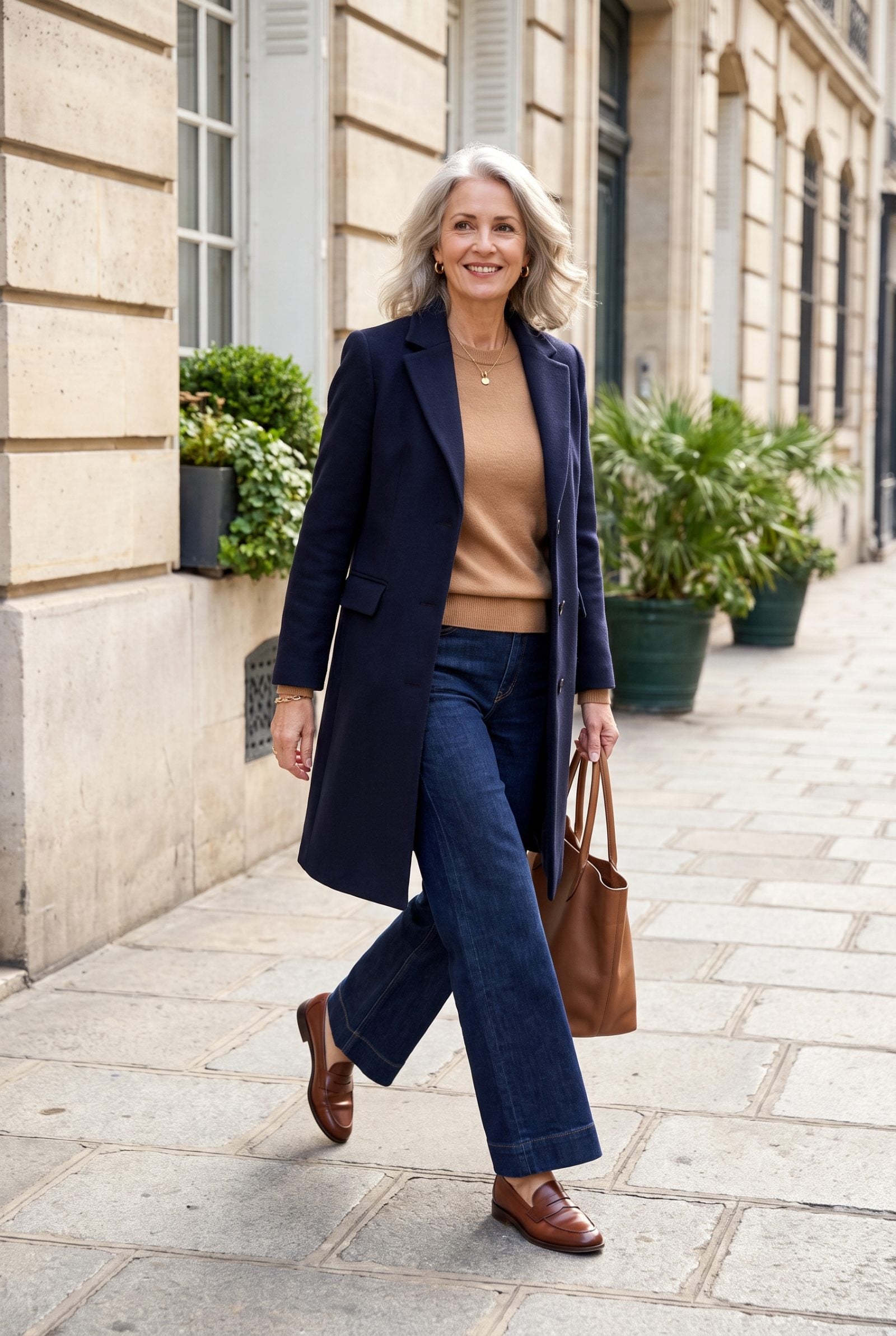
There is a specific sadness to a dragging hem — that frayed, gray, chewed-up edge that turns a good pair of jeans into laundry-day jeans inside a month.
Set the hem to hover a hair above the floor. Close enough to still look long and lean, high enough that it never touches wet pavement or gets stepped on. That tiny gap keeps the edge intact and the whole outfit looking deliberate. A single season of dragging is enough to ruin a good pair, so settle the hem length before the first wear.
28. Choose Back Pockets That Flatter Your Proportions
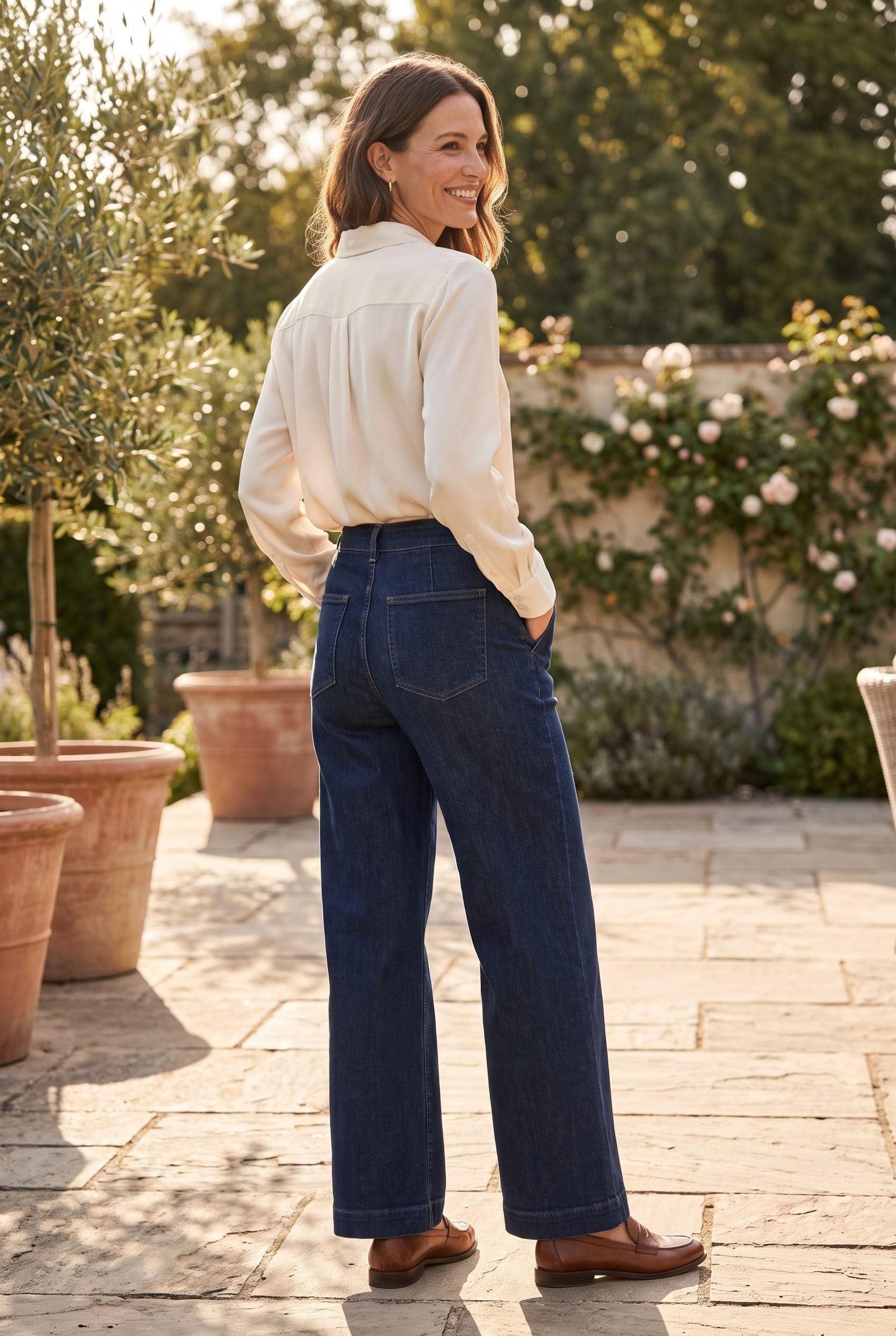
Back pockets are the most overlooked detail on any pair of jeans, and they do more work than you’d think. Tiny pockets set too far apart widen the seat. Pockets placed too low drop everything visually.
Look for medium-sized pockets sitting slightly higher and closer together. They lift and center the seat, which balances the volume of a wide leg — a small design choice with an outsized effect on your rear view.
27. Avoid Oversized Front Pockets That Add Bulk Across the Hips
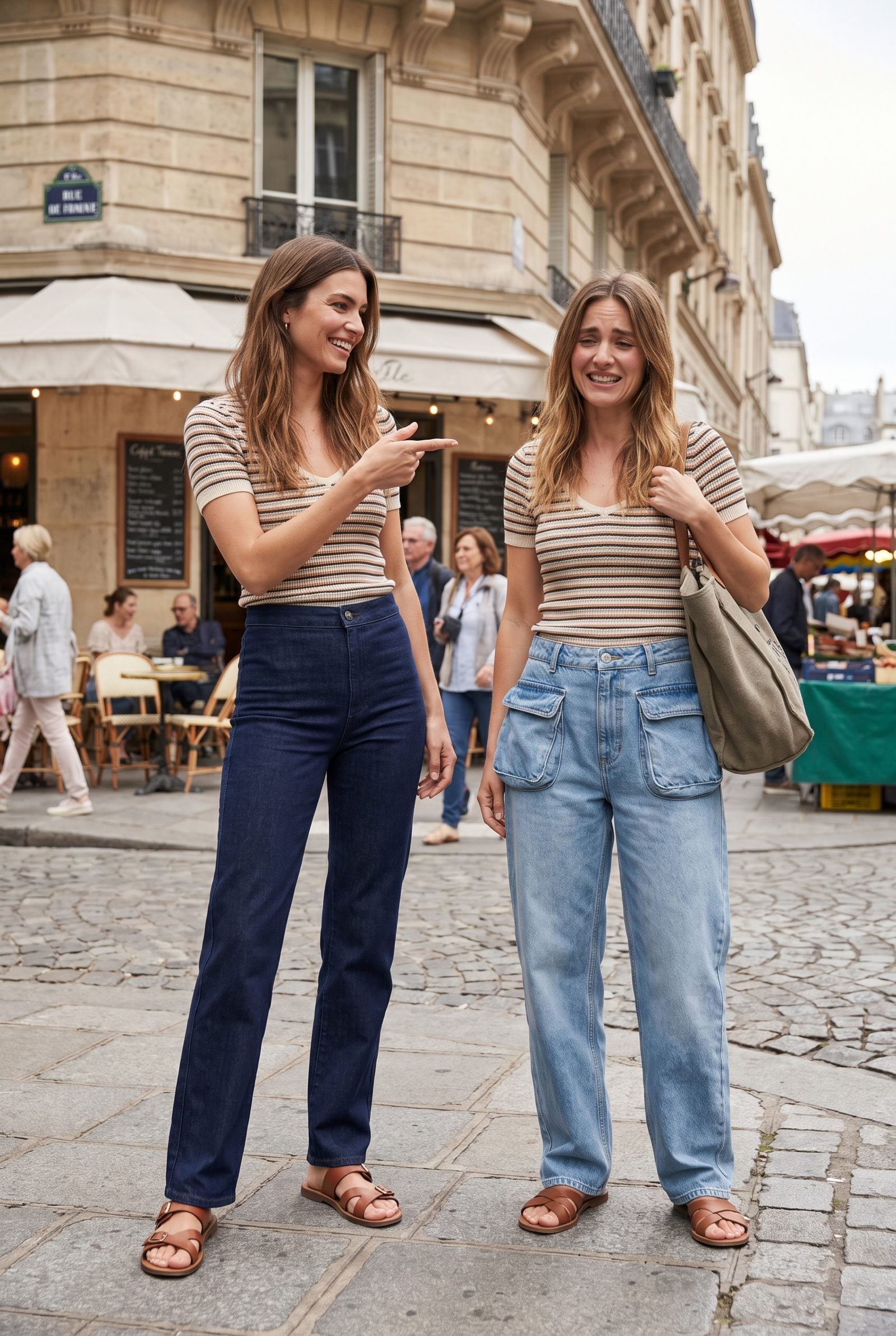
Big patch front pockets are a trap. They gape open, they pile fabric exactly where you don’t want extra volume, and they can make the hip look wider than it is.
Go for small, flat front pockets that lie smooth, or a clean slash pocket that disappears into the seam. The front of the jeans should fall in an unbroken line from waist over hip. Less bulk there means the wide leg reads as deliberate volume rather than an accident.
26. Look for a Clean Front Without Excessive Pleats or Bulky Detailing
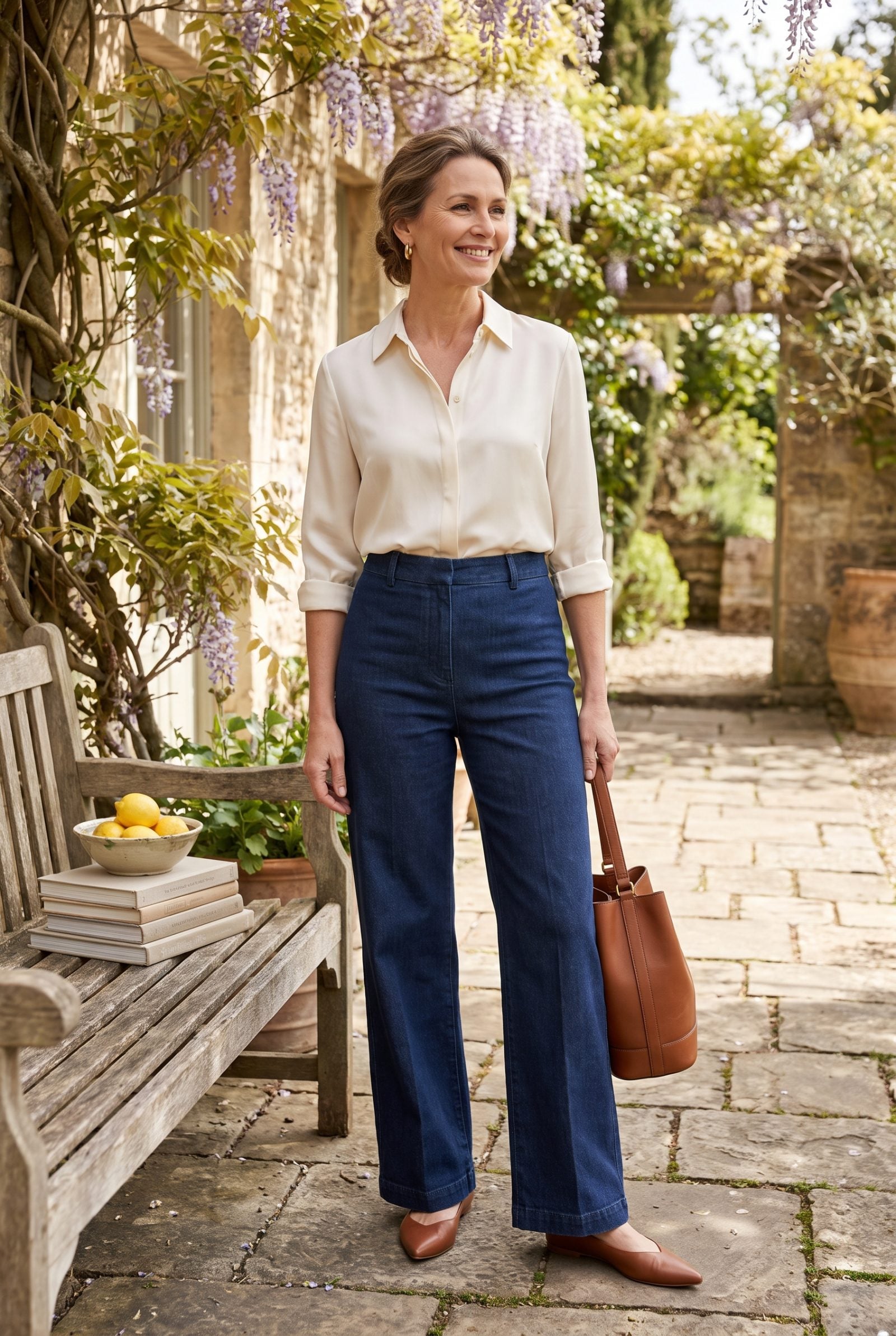
Pleats sound elegant in theory. In denim they usually just pop open across the front and add horizontal volume right where the leg is already generous.
A clean, flat front keeps the focus on the vertical line, which is what makes wide-leg jeans lengthening to begin with. Skip the pleats, the oversized hardware, the busy topstitching. The best wide-leg denim stays quiet up top so the leg can do the talking.
25. Choose a Versatile Wash That Works with Most of Your Closet

A wash decides how hard your jeans work for you. A heavily distressed, high-contrast wash is a statement piece, and a statement piece fights half your closet. A clean mid-blue or a rich dark indigo behaves like a neutral, sliding under blazers, knits, silk shirts, and sneakers without a fuss.
Pick the wash that goes with the most things you already own. If you reach for camel, navy, cream, and black, a true even mid-blue or a deep indigo partners with all of them. Call it the quiet luxury — the pair that actually earns its place in rotation.
24. Skip Heavy Distressing If You Want Maximum Outfit Flexibility
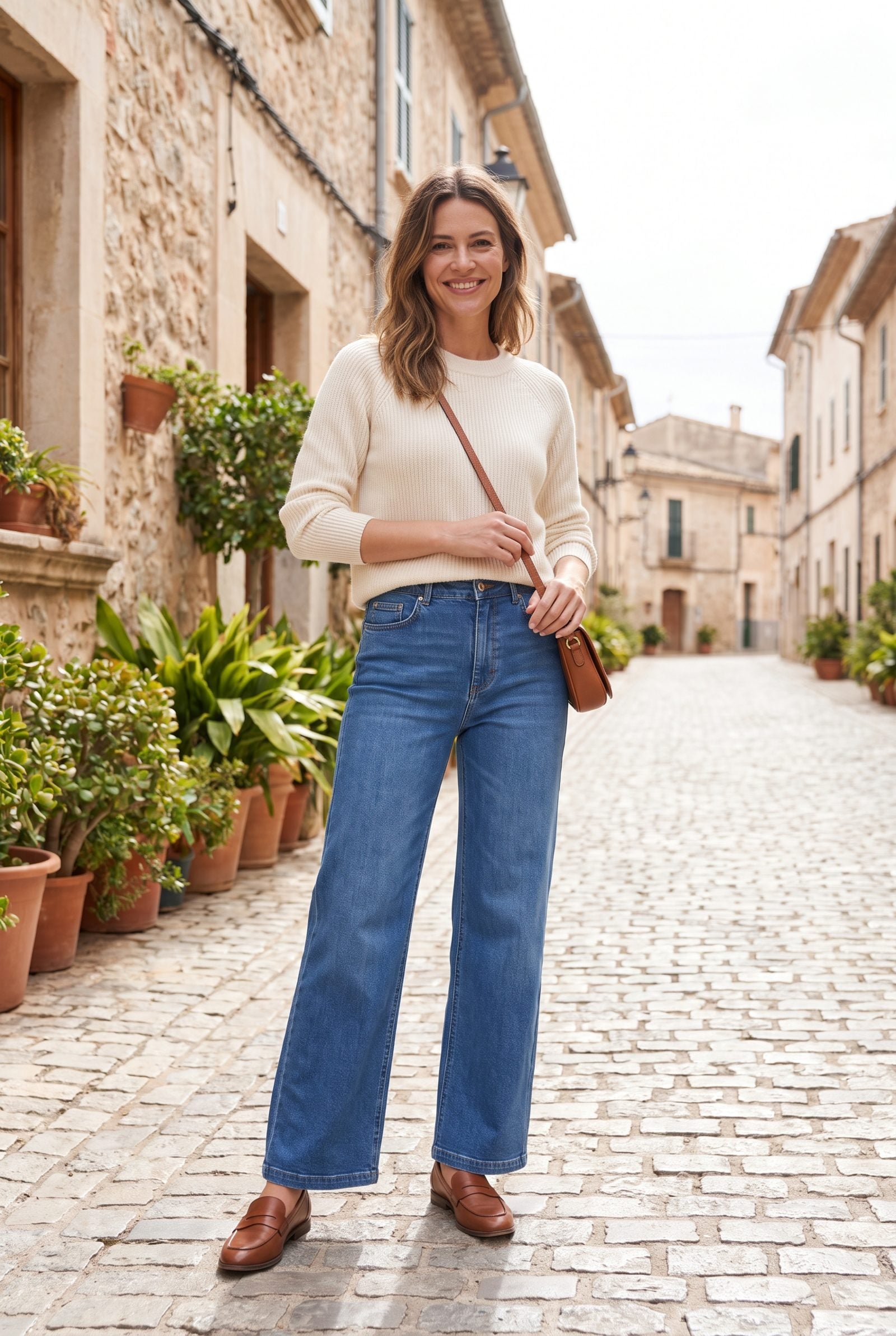
Distressing dates a jean faster than any wash ever will. The clean mid-blue denim here reads as a blank slate, which is exactly why it goes anywhere — the office, dinner, a school pickup, none of it fights the fabric.
Solid, unbroken denim lengthens the leg too. Nothing interrupts the line, so your eye travels straight from waist to hem without stopping. Want one pair of jeans to earn its keep across ten different looks? This is the surface to buy.
23. Check That the Side Seams Hang Perfectly Straight
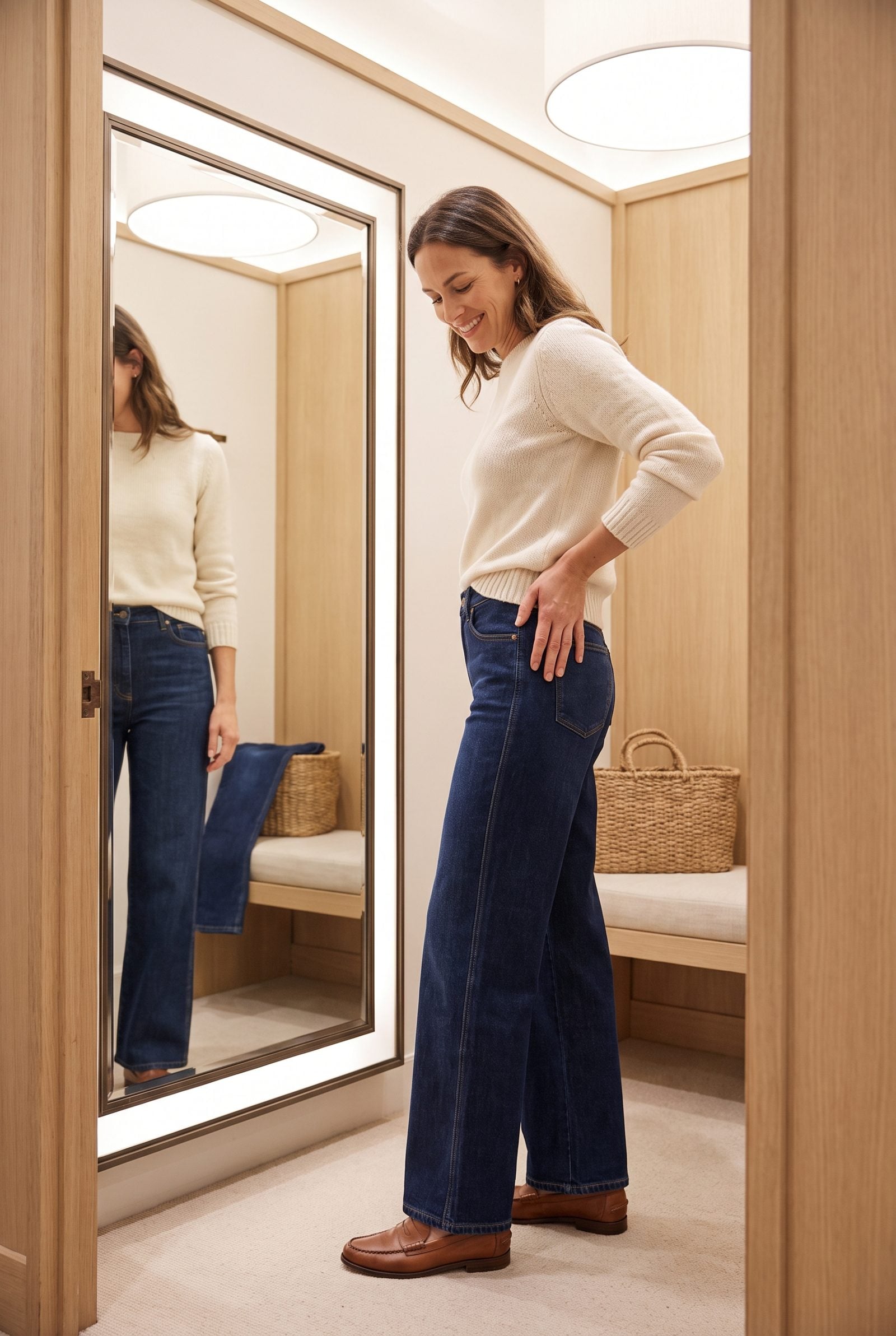
A twisting side seam is the tell of a badly cut jean, and it never improves with wear. So stand sideways in the mirror and watch that seam — it should drop like a plumb line from your hip to the floor.
When it spirals toward the front or back, the denim was cut off-grain, and no tailor can fully rescue it. On this dark-wash pair the seam runs true, which is why the whole leg falls in one clean vertical. Small detail. It decides whether the jean looks bought or looks fitted.
22. Sit Down Before Buying to Test Real-World Comfort
❤️ Would you like to save this?
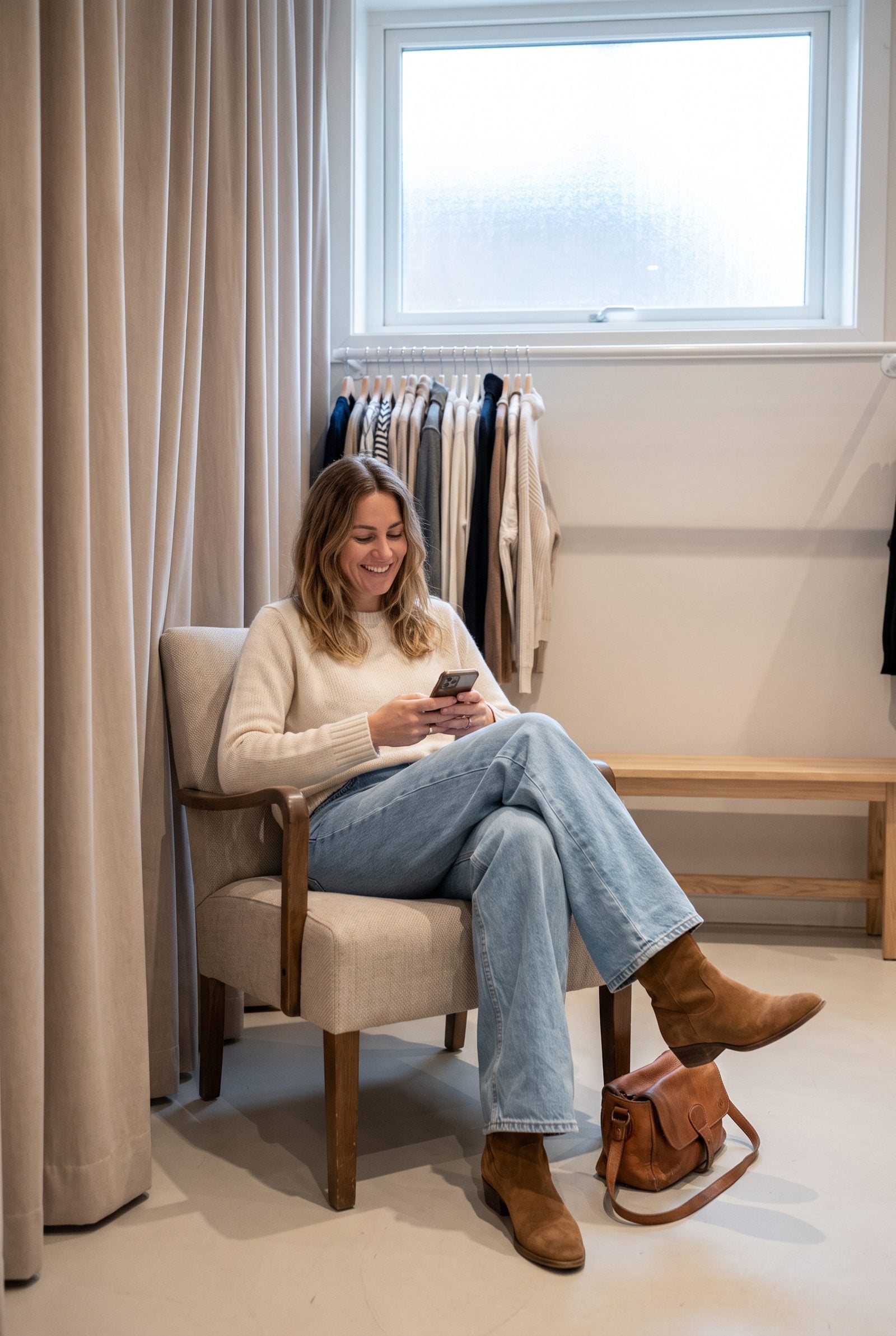
You never buy jeans sitting down, and that’s the mistake. Every fitting room has a chair for a reason. Use it.
Sit, and check three things: does the waistband dig or gape at your back, does the crotch pull tight across your lap, does the fabric cut off your circulation at the hip. A high-rise wide-leg with real crotch depth, like this mid-blue pair, folds instead of straining — the difference between jeans you wear once and jeans you live in.
21. Walk Several Steps to Make Sure the Legs Don’t Twist or Pull
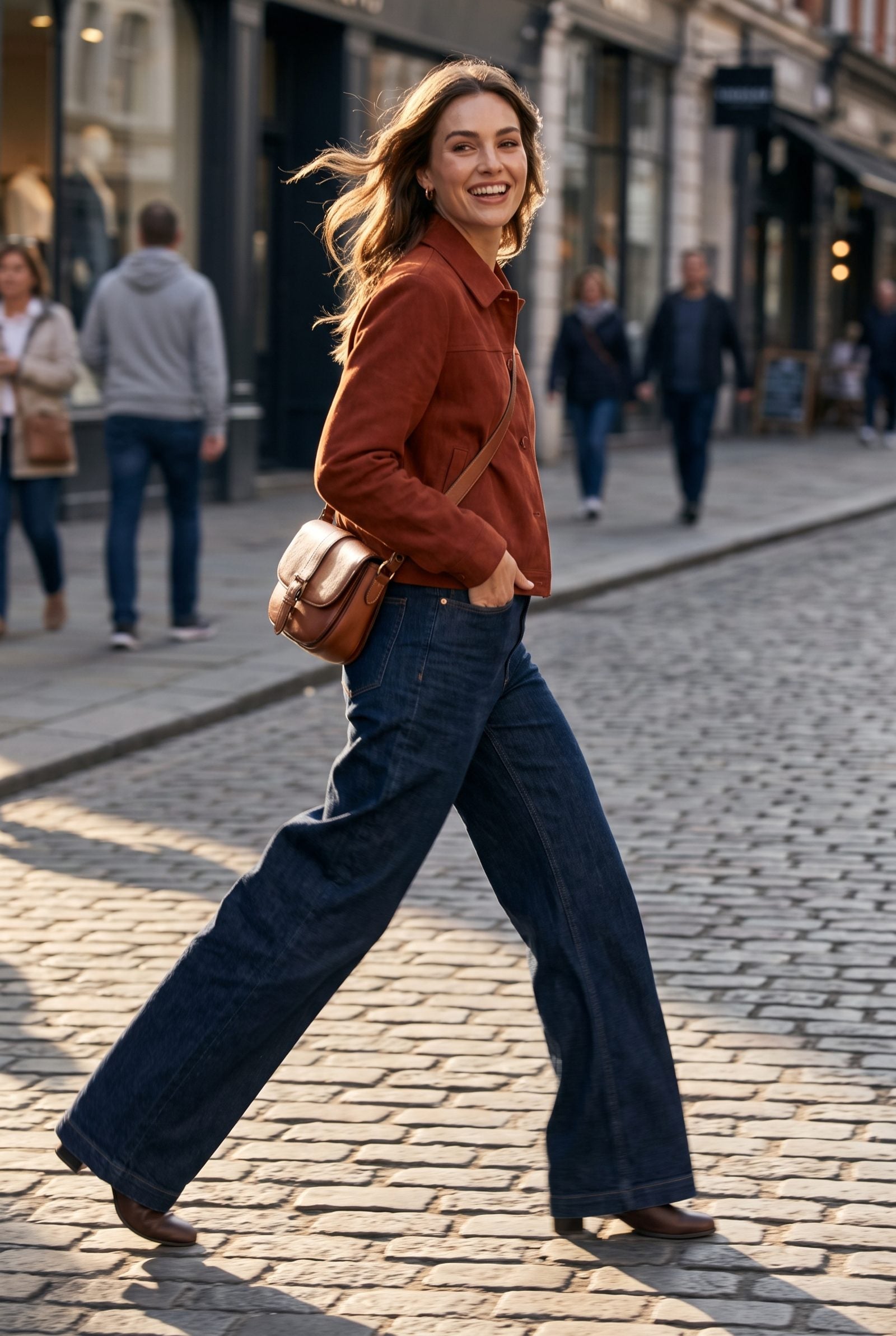
Denim behaves differently in motion than it does standing still, so take five real steps down the fitting room hallway and watch whether the legs stay in their own lane or start creeping toward the front of your shin with every stride.
That drift means the fabric is fighting its own cut. A good wide-leg, like this indigo pair, swings from the hip and settles back into a clean vertical between steps. If the denim wraps your calf like a flag around a pole, it’ll annoy you every single day you wear it.
20. Choose Tops That Hit at or Just Above the Waistband
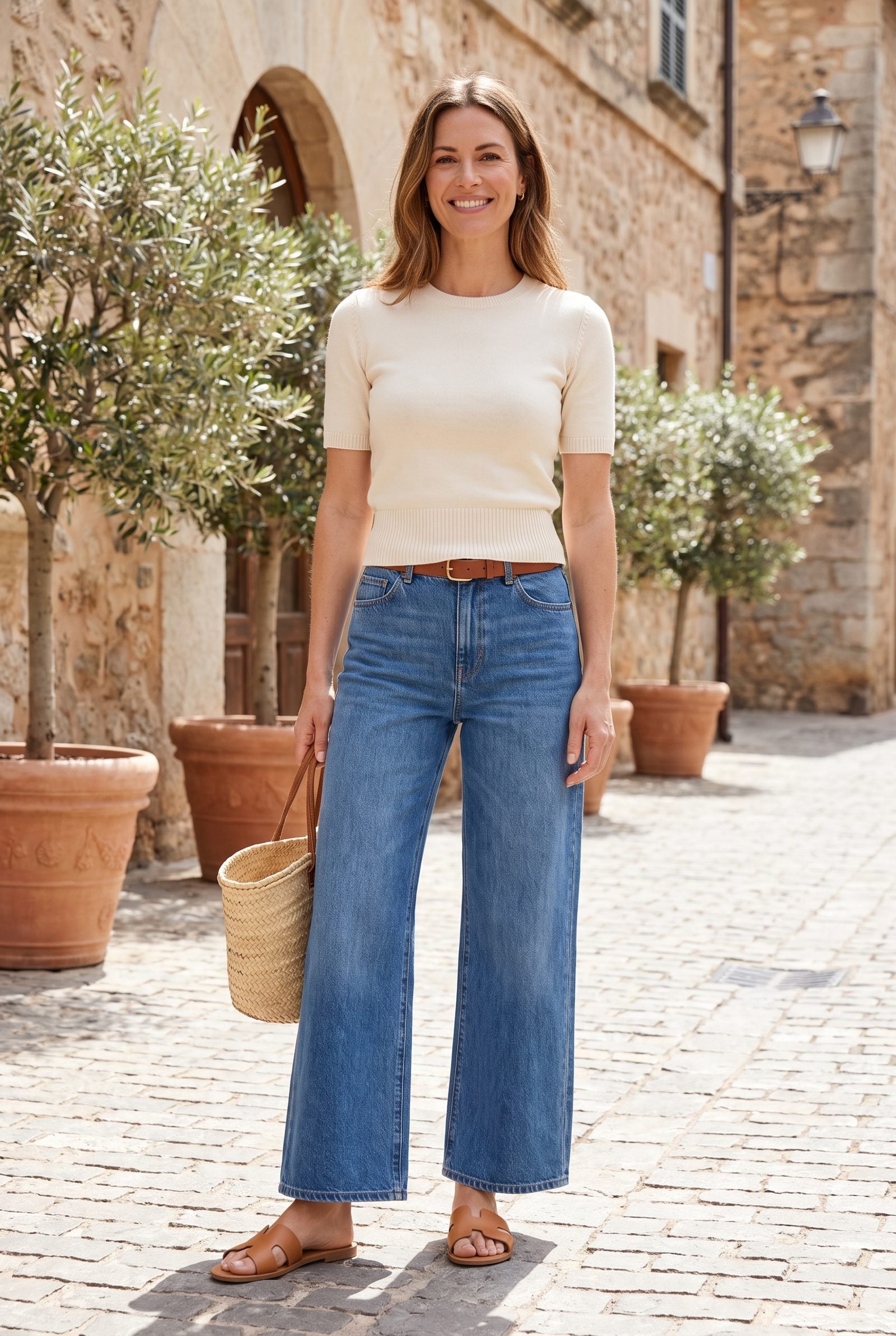
Where your top ends is where your waist appears to be. That’s the whole trick.
A top that stops right at the waistband, like this rust ribbed knit, marks the highest point of your torso and lets the wide leg fall from there — length below, definition above. Drop the hemline even two inches lower and you bury the rise, which shortens the leg and blurs the waist you paid for. High-rise athleisure jeans reward this the most, since the whole point of the rise is to be seen.
19. Use a Partial Tuck to Create Waist Definition Without Looking Overstyled
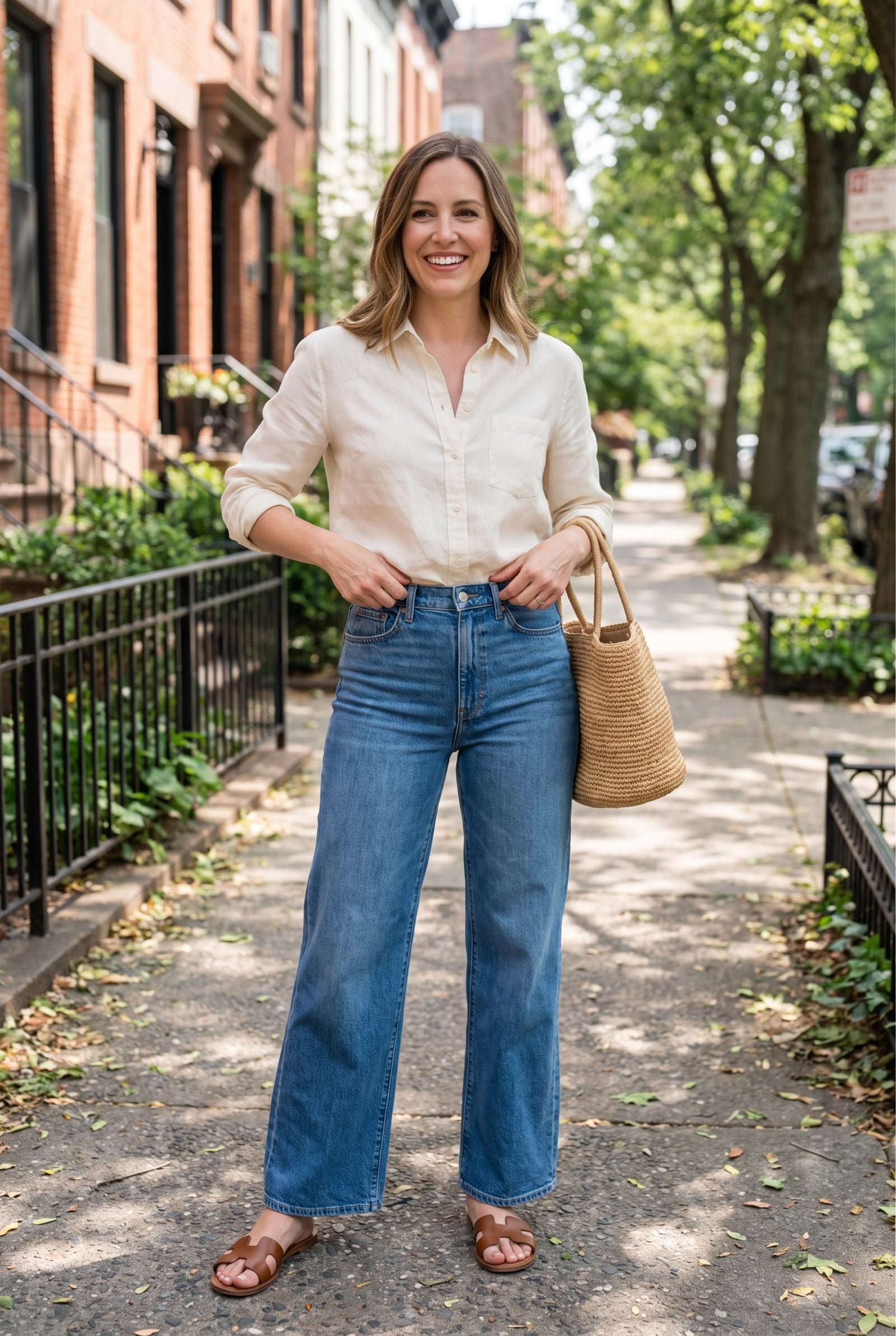
The full tuck can feel like too much effort on a Tuesday. The half-tuck fixes that.
Push just the front hem of a soft chambray shirt into the waistband and leave the sides loose. You get the waist definition of a tuck with none of the fussed-over look, because the eye catches the waistband at center front, registers the waist, then relaxes into the drape of the rest. Casual on top, deliberate where it counts.
18. Avoid Long Tunics That Hide the Shape of Wide-Leg Jeans
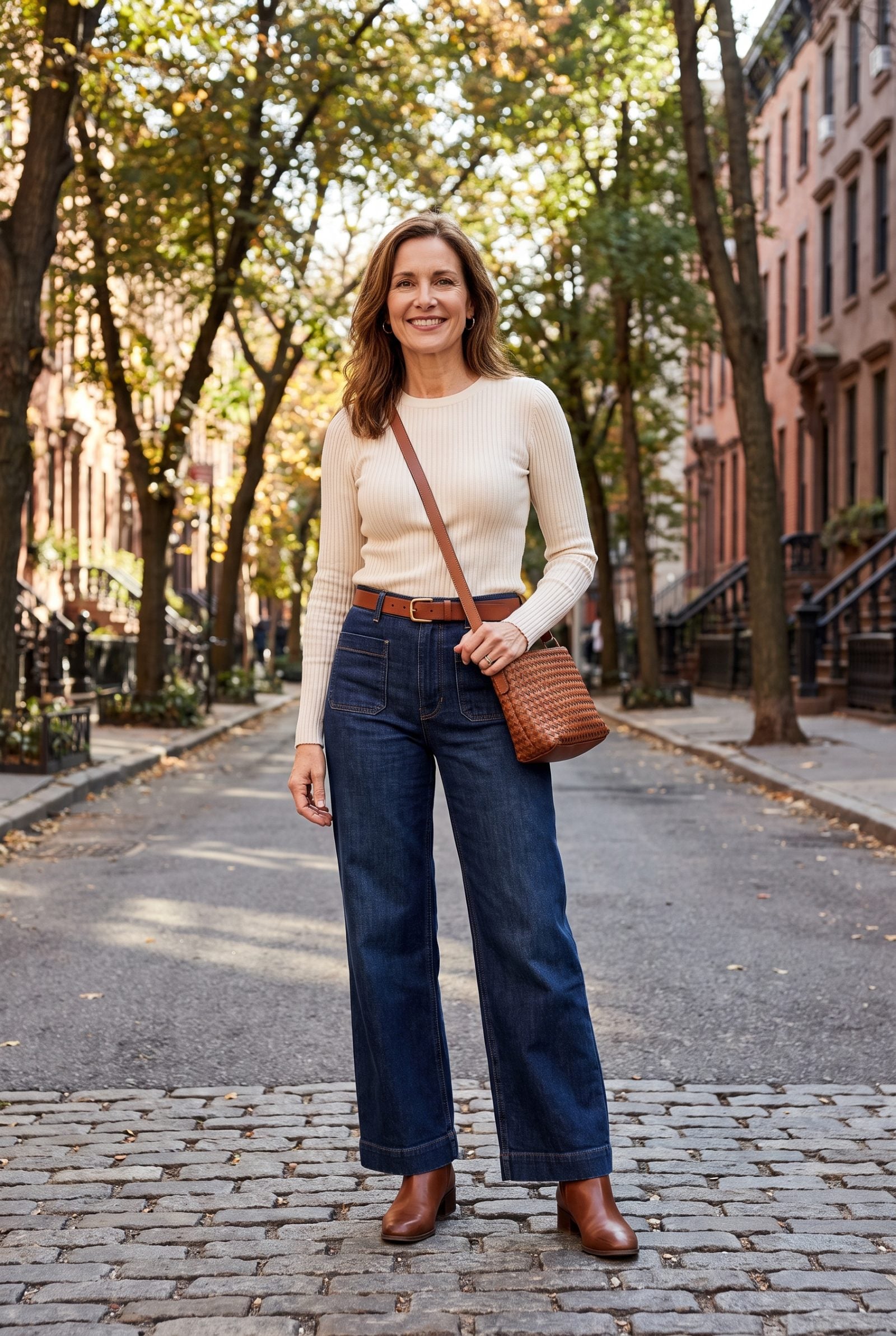
You bought the wide leg for its shape. A tunic that hangs to mid-thigh erases it.
Long, loose layers over wide denim stack volume on volume, and the eye loses the waist entirely. What’s left is a soft rectangle from shoulder to knee. The crisp white cropped shirt here does the opposite, ending at the hip so the full sweep of the leg gets its moment. If a top covers where your jeans start doing their most interesting work, it’s the wrong top.
17. Pair Them with Cropped Sweaters for Balanced Proportions
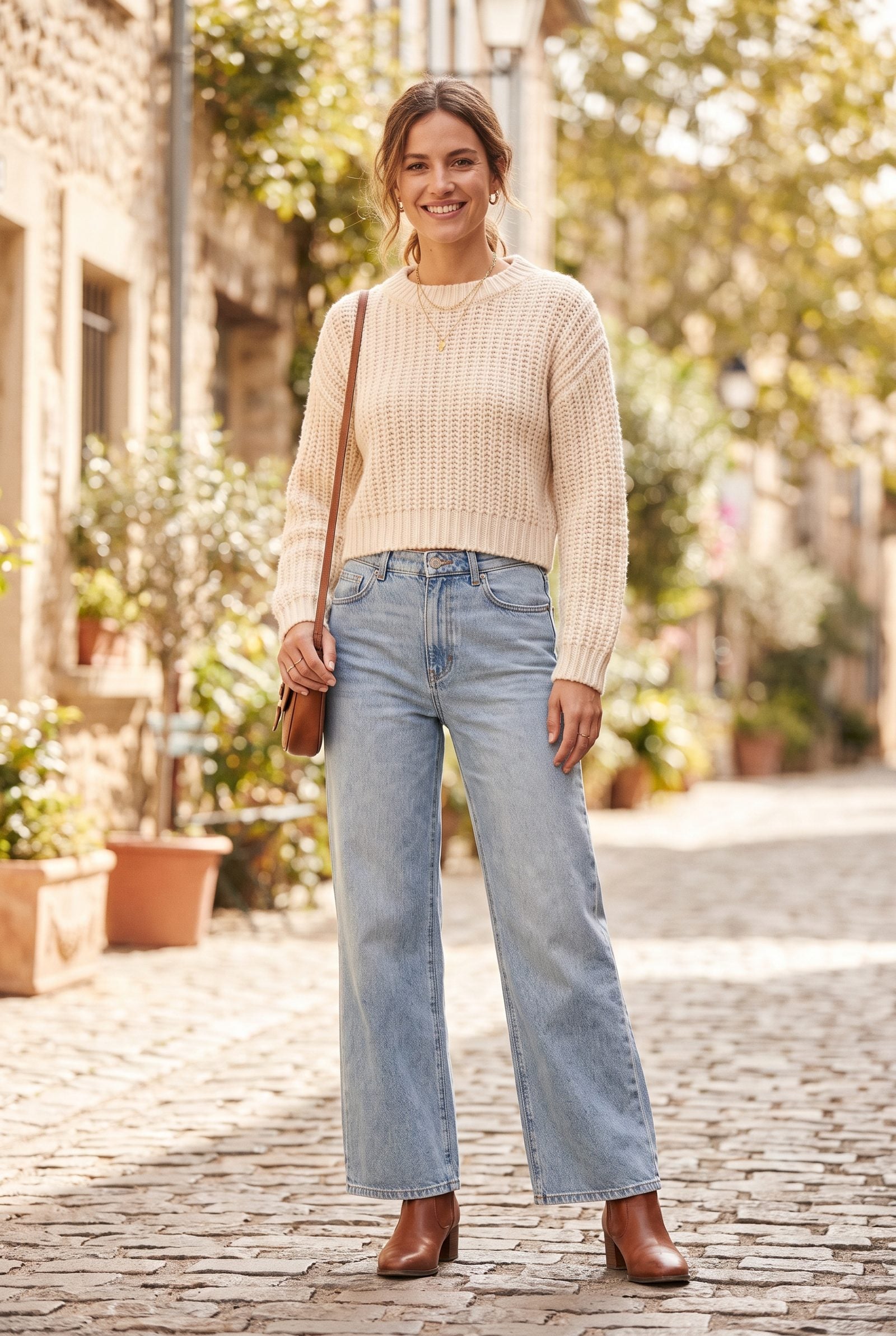
Volume needs a counterweight, and a cropped sweater is the cleanest one going.
The cream chunky knit ending at the waist keeps the top half compact so the wide denim below reads as intentional fullness, not shapelessness. Snug and short up top, generous and long below — the two halves talk to each other instead of competing. This is the proportion that makes wide-leg jeans look designed rather than defaulted into. Add cognac ankle boots and the whole column resolves.
16. Choose Shorter Jackets That Highlight Your Waist
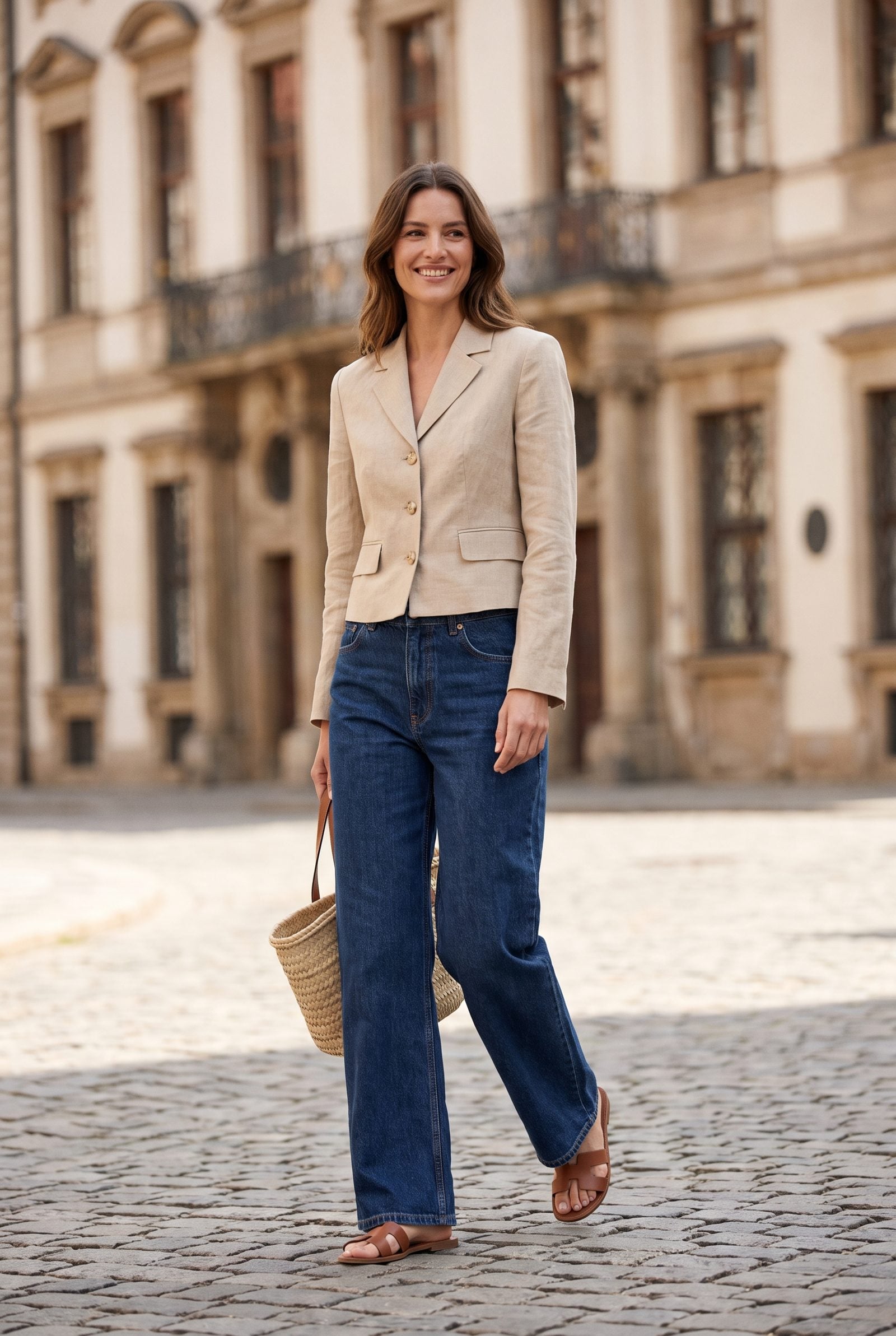
A jacket that ends at the hip drags your waistline down with it. A cropped one lifts it back up.
The cropped denim jacket here stops right at the waistband, so the outer layer echoes the high waistline the jeans establish rather than smothering it. Two shades of blue, one short jacket, and suddenly the whole silhouette stands taller. Length is the only thing that changed — and length is usually the only thing that matters.
15. Add a Structured Blazer When You Want the Jeans to Feel Elevated

Put a sharp blazer over wide-leg denim and the jeans stop being casual by association.
The structured camel wool blazer here brings a defined shoulder and a nipped waist, which reframes the fluid denim below as a deliberate choice rather than a day off. That push-pull between tailored and relaxed is what makes the outfit interesting — each piece looks better for standing next to the other. Add black pointed heels under a hem that just grazes the floor and you’ve got jeans that walk into a dinner reservation without apology.
14. Wear Substantial Shoes That Visually Balance the Wide Silhouette
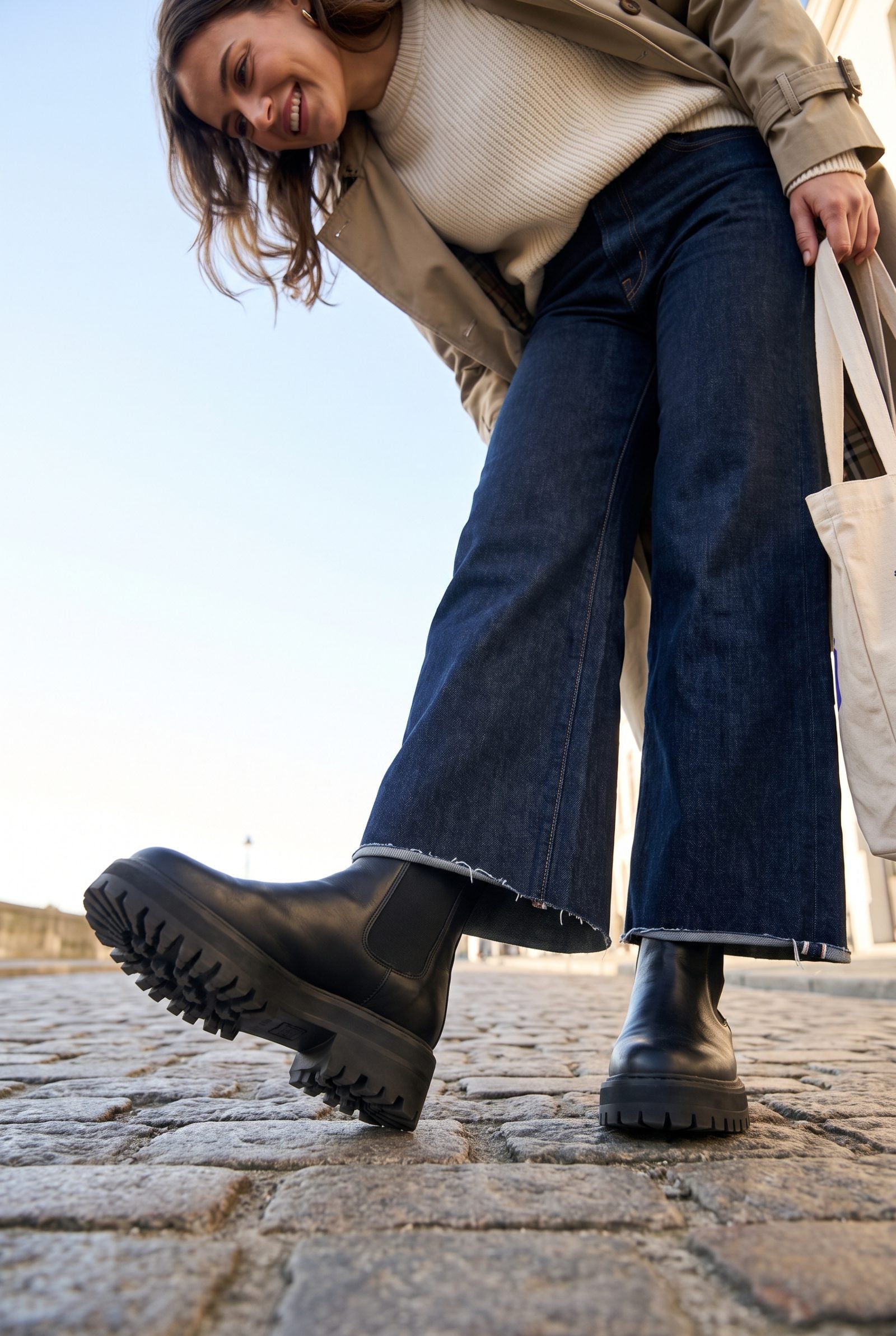
Wide-leg jeans want a shoe with weight, because a dainty little slipper just disappears under all that fabric and leaves the leg looking bottom-heavy. Give the hem something to land on.
Chunky cognac leather loafers here anchor the mid-blue denim so the volume reads intentional instead of overwhelming. The heavier sole matches the heavier hem, and suddenly the whole column has a base. Mass answers mass.
13. Use Pointed-Toe Flats or Heels to Subtly Lengthen the Leg Line
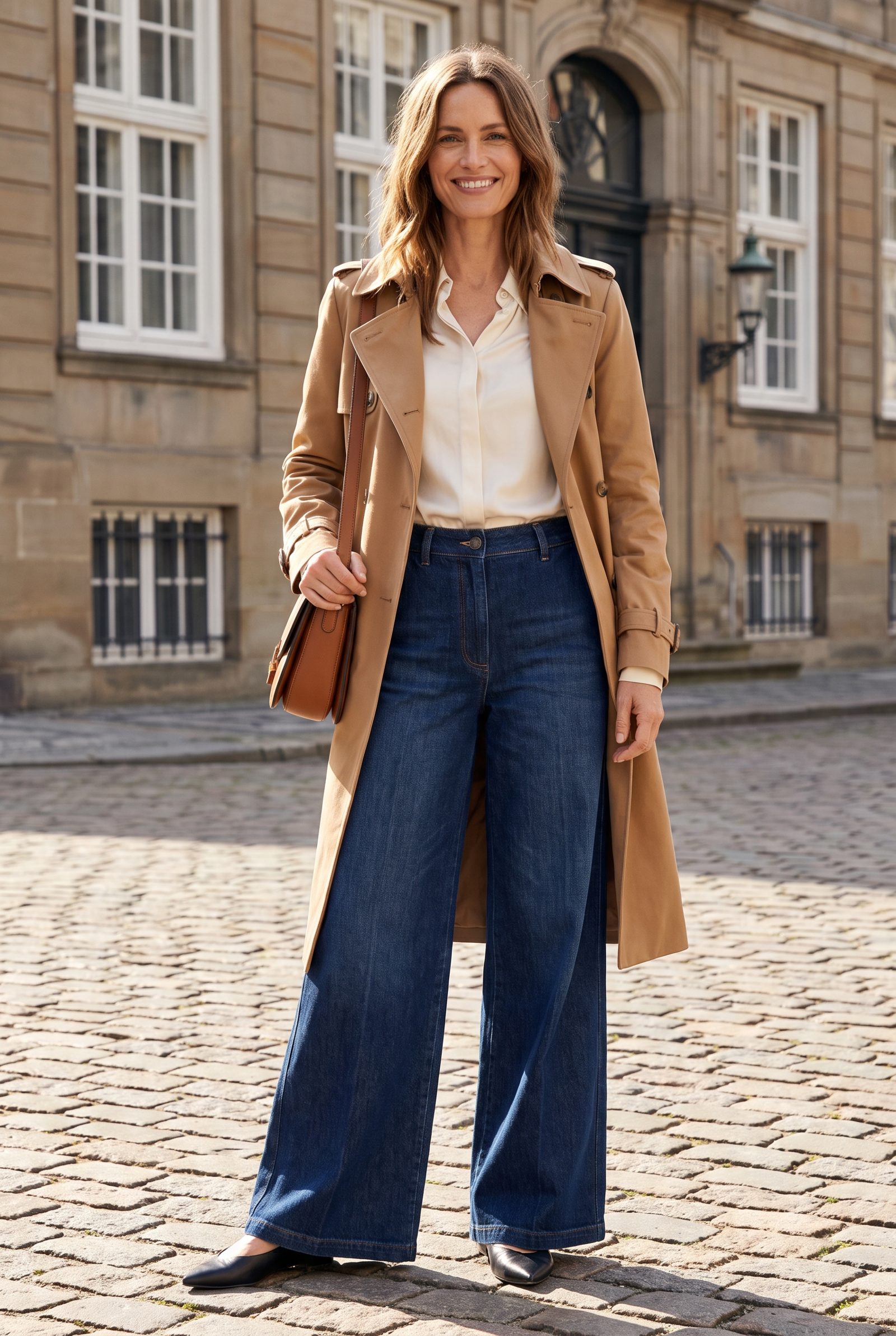
A pointed toe peeking out from under a wide hem does something quiet and clever. It draws the eye to a single point and stretches the whole line downward.
The nude flats here nearly vanish against the skin, which is exactly why the leg looks longer. Deep indigo denim and a fitted turtleneck keep the top half lean, so all the length lives below the knee. This is the outfit that makes people ask if you got taller.
12. Choose Sneakers with Enough Presence to Support the Wider Hem
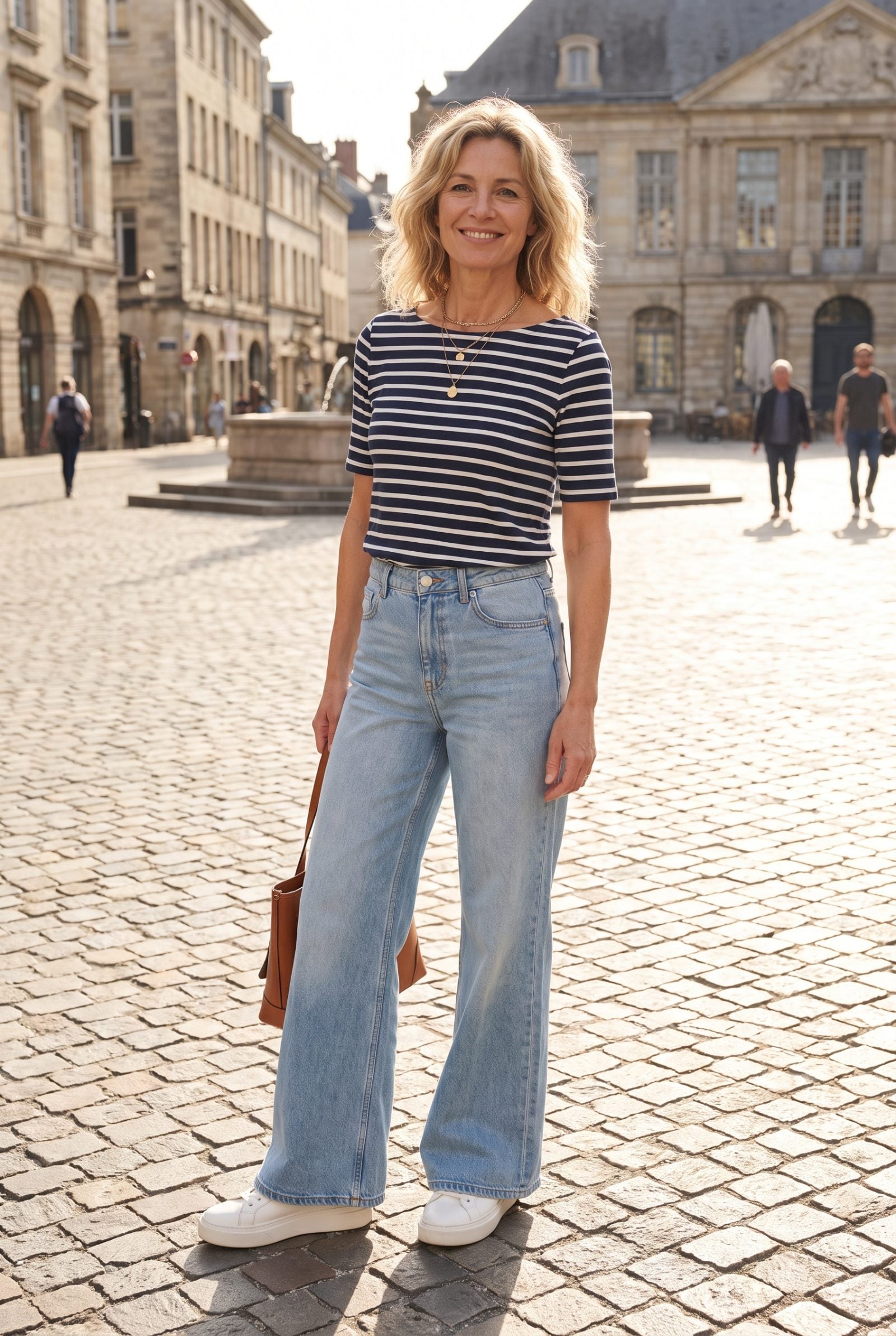
Thin canvas sneakers under wide-leg jeans look like an afterthought. The hem swallows them and the whole bottom half goes flat.
Go for a sneaker with real body. The white retro trainers here have a raised sole and enough visual bulk to hold their own against all that denim, and an ankle-length crop lets the whole shoe show. These are the athleisure jeans you actually walk miles in.
11. Wear a Belt Only When It Genuinely Improves the Outfit’s Proportions
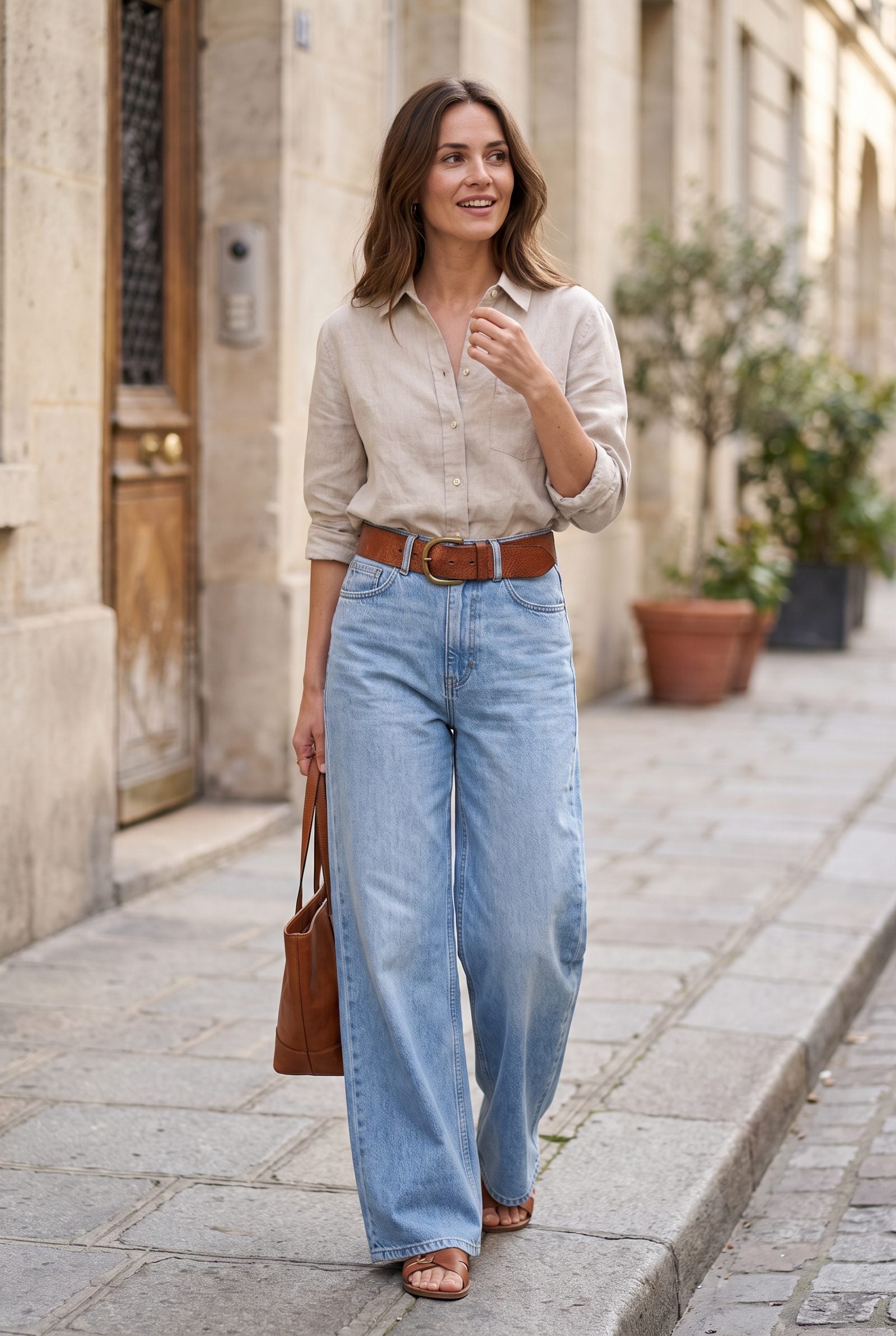
A belt is a decision, not decoration. On wide-leg jeans it earns its keep only when it clarifies where your waist ends and the volume begins.
Here the slim brown leather belt marks the waist so the rust knit tuck reads deliberate and the leg falls clean from a defined point. Skip it and the look still works. Add it and the waist gets sharper. That’s the whole justification for wearing one.
10. Keep Bulky Knitwear Outside the Waistband Instead of Stuffing It In
❤️ Would you like to save this?
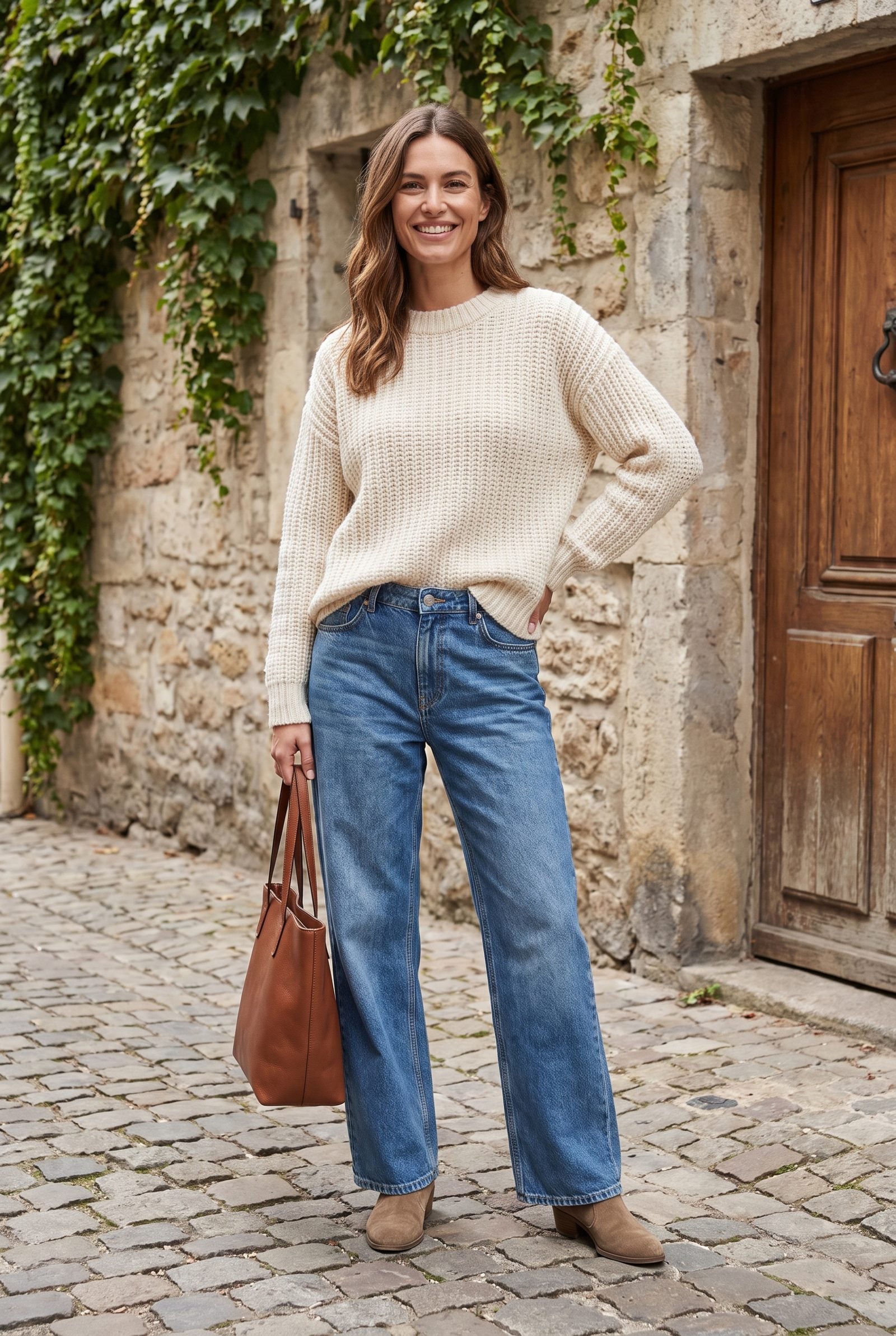
Stuffing a chunky sweater into a waistband gives you a lumpy midsection and a strained zip. Nobody wants that. Let the knit live on the outside.
The oversized cream cable-knit sweater here falls loose over the hip while the wide denim keeps flowing below it. Volume on volume works because the top ends at the hip rather than mid-thigh, so you still read as one long, unbroken line from shoulder to hem. Brown suede boots peeking out finish it.
9. Choose a Darker Wash for the Pair You’ll Wear to Dinners and Meetings
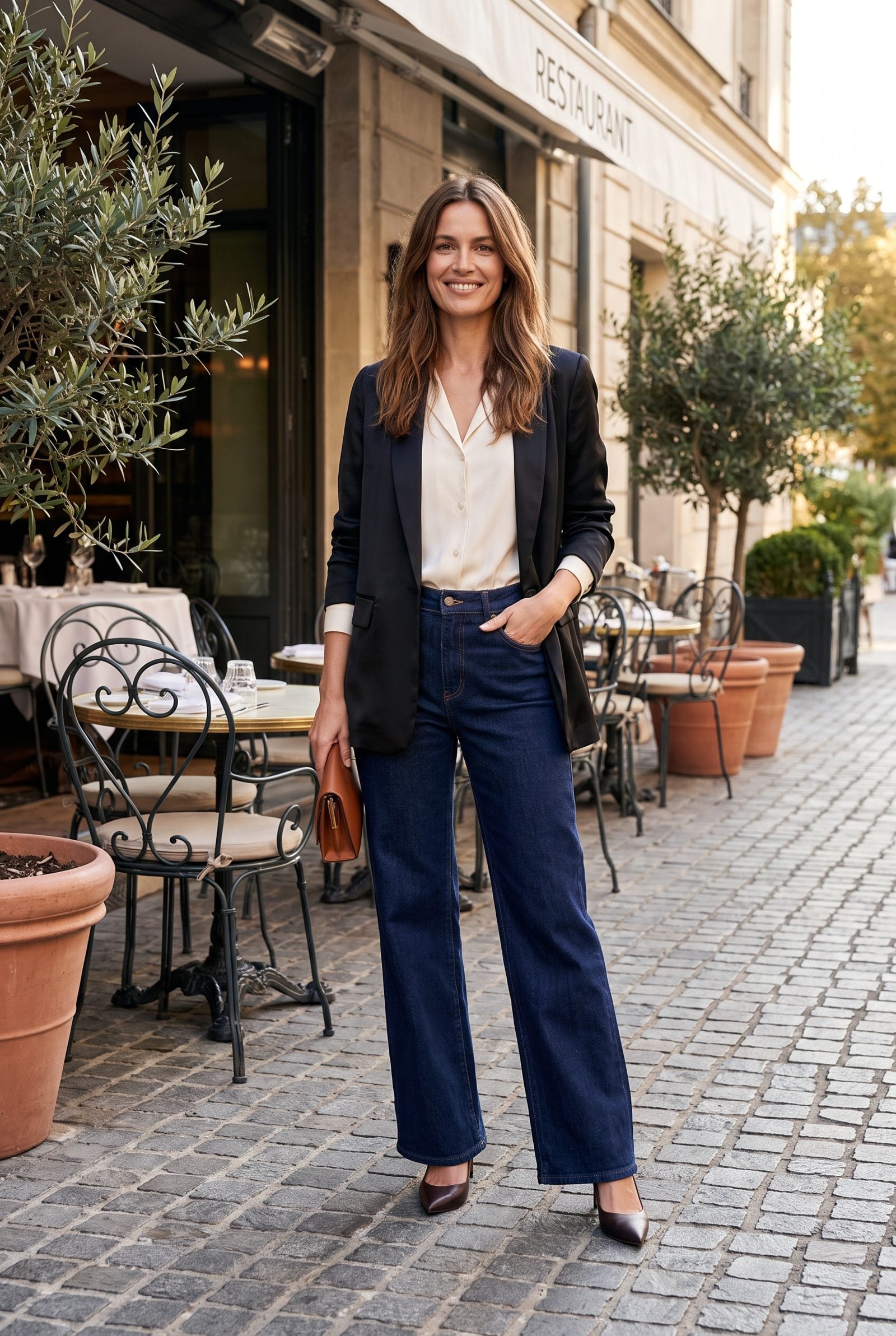
Dark denim is the grown-up move. A deep indigo wide-leg reads almost like a trouser, which is why it slides into dinners and boardrooms where a faded pair never would.
Here the near-black wash lets a charcoal blazer and black silk cami carry the outfit, the structured shoulder balancing the wide leg while the pointed mule keeps it sharp. When you’re second-guessing how dressy denim can go, look at these dark jeans and stop worrying.
A dark wash is the difference between denim you wear and denim you dress up.
8. Make Sure the Front Pockets Stay Flat Instead of Pulling Open
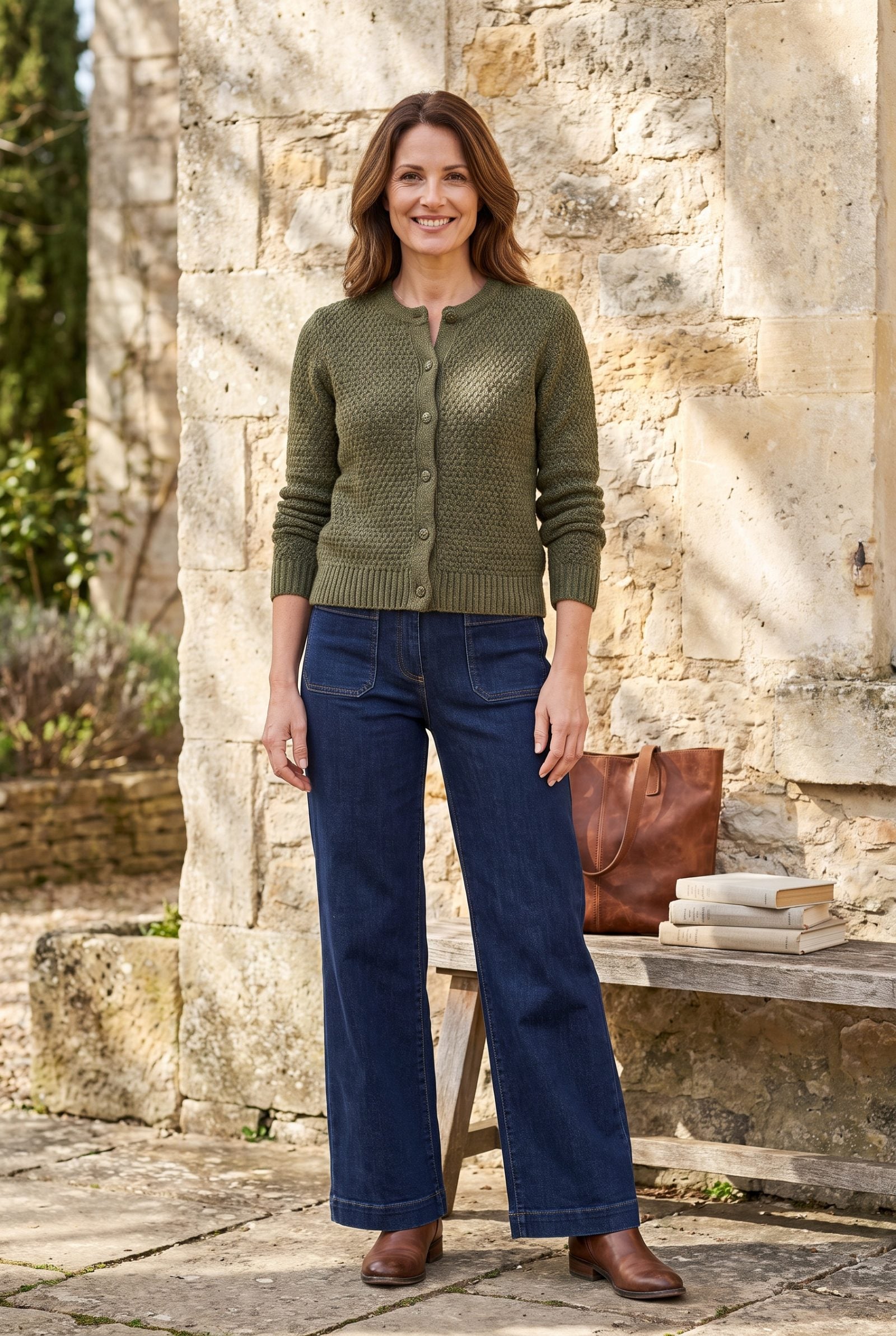
Front pockets that yawn open are the fastest way to make good jeans look cheap. They add width right where you least want it and quietly announce a fit problem.
Stand in the mirror and look at the hips. Flat, closed pockets mean the jean fits. Pockets pulling apart mean it doesn’t, no matter how nice the wash is. A tailor can tack them shut in a pinch, but honestly? Buy the pair that lies flat to begin with.
7. Check for Waistband Gapping Before Deciding to Size Up
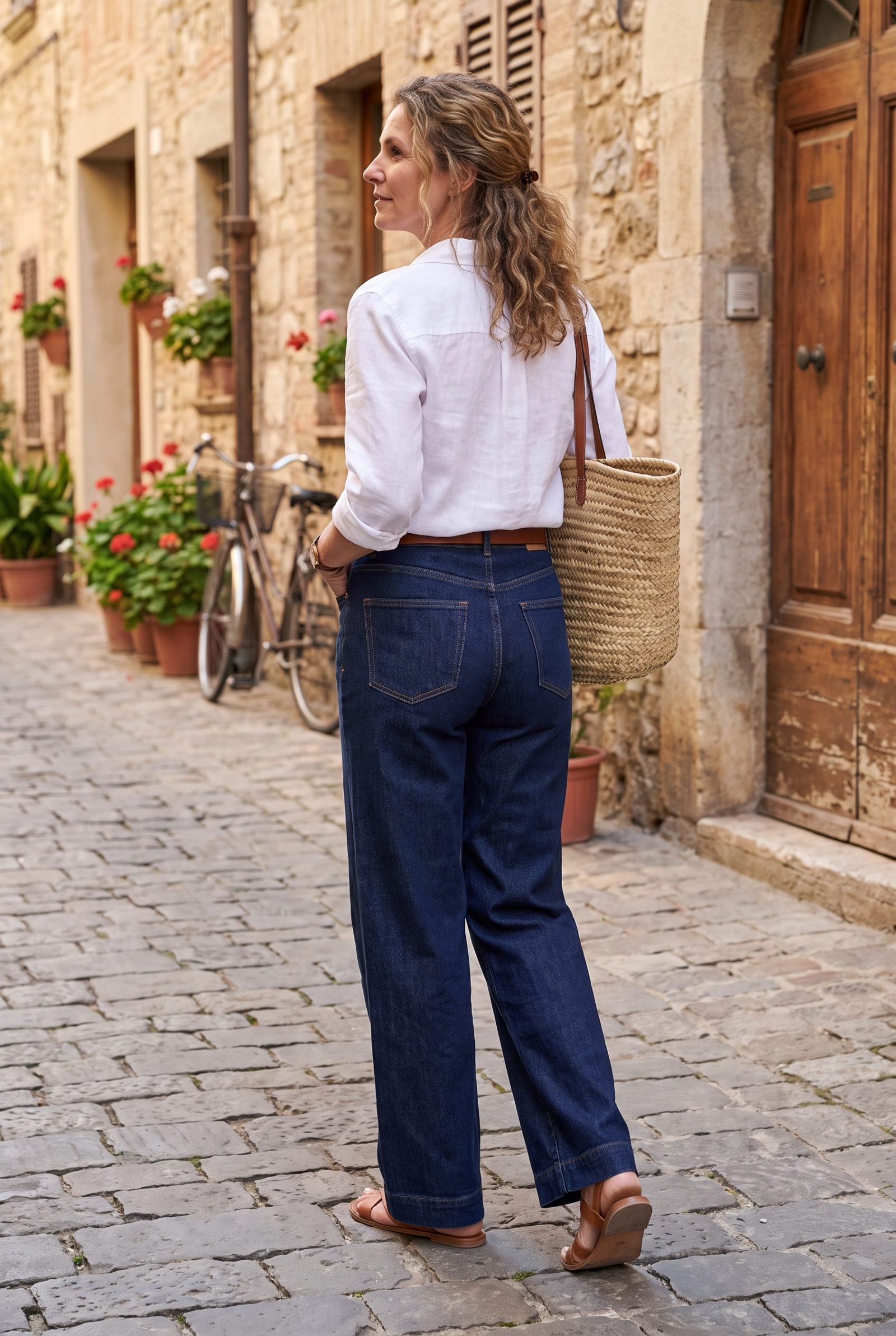
A gap at the back waistband is a nuisance, not a reason to size up. Go bigger and you trade the gap for a jean that’s suddenly loose everywhere else.
The real fix is a tailor taking in the center back seam, and it’s a quick, cheap job. The high-rise pair here sits flush against the lower back, no cold air, no fussing. Plenty of women wear jeans a size too big for years because of one small gap at the back. It’s an easy trap to avoid.
6. Choose Belt Loops That Fit the Belts You Actually Own

Belt loops sound like the dullest thing to check. They’re also the reason your favorite wide belt won’t thread through half the jeans you own.
Look at the loop size before you buy. The dark pair here has generous loops that swallow a wide tan leather belt with a brass buckle without straining a single stitch. A statement belt is useless if it won’t fit the denim.
5. Make Sure the Jeans Work with Your Everyday Ankle Boots
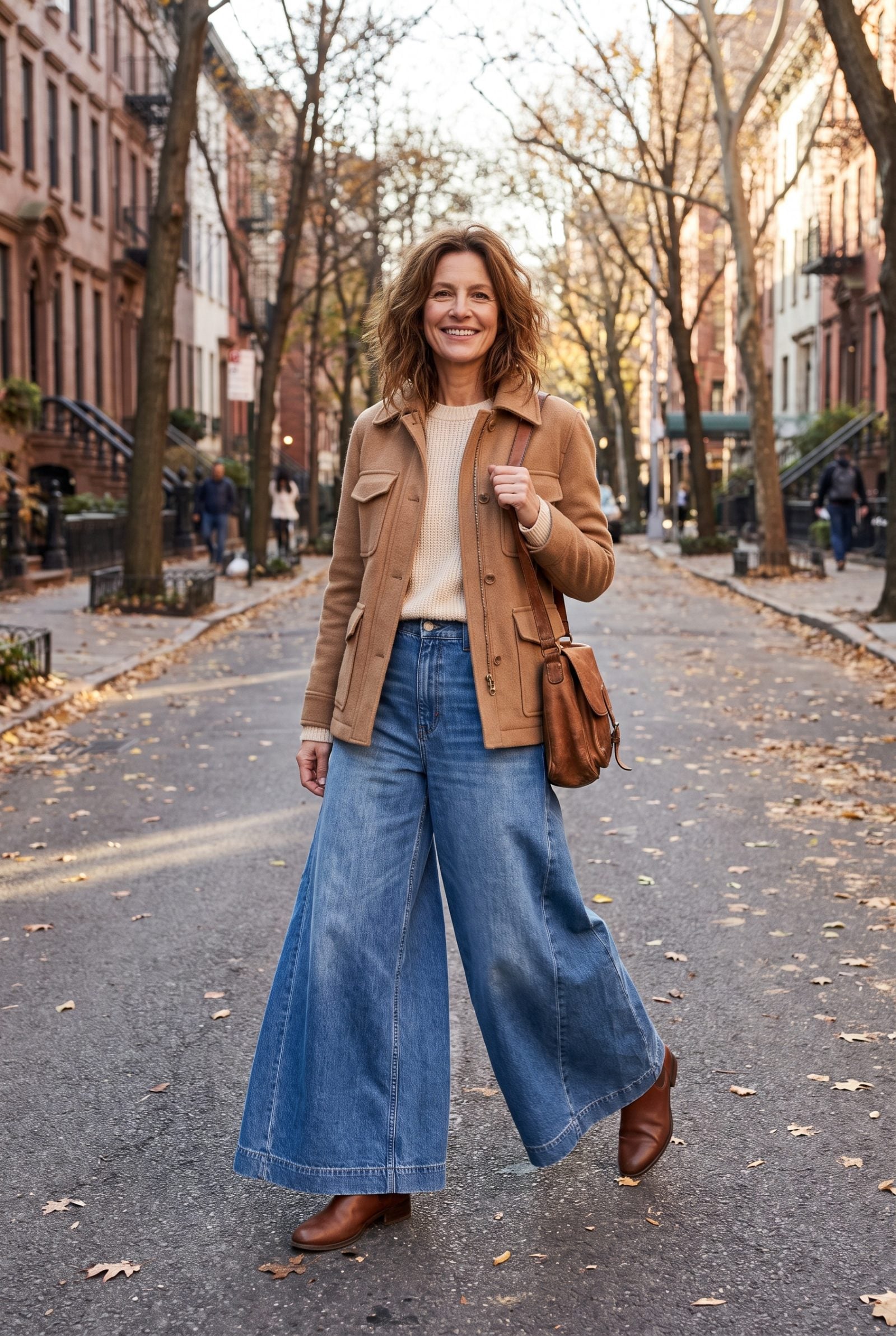
Ankle boots are the trickiest shoe under wide-leg jeans. Too short a hem and the boot shaft pokes out awkwardly; too long and it drags and puddles at the floor.
You want a hem that clears the boot top and covers the shaft, so only the foot shows and the leg keeps its line. The mid-blue pair here does exactly that over a low block heel. A camel wool coat and cream sweater turn a practical fit choice into a proper outfit.
4. Test Them with Loafers Before Buying If Loafers Are a Wardrobe Staple
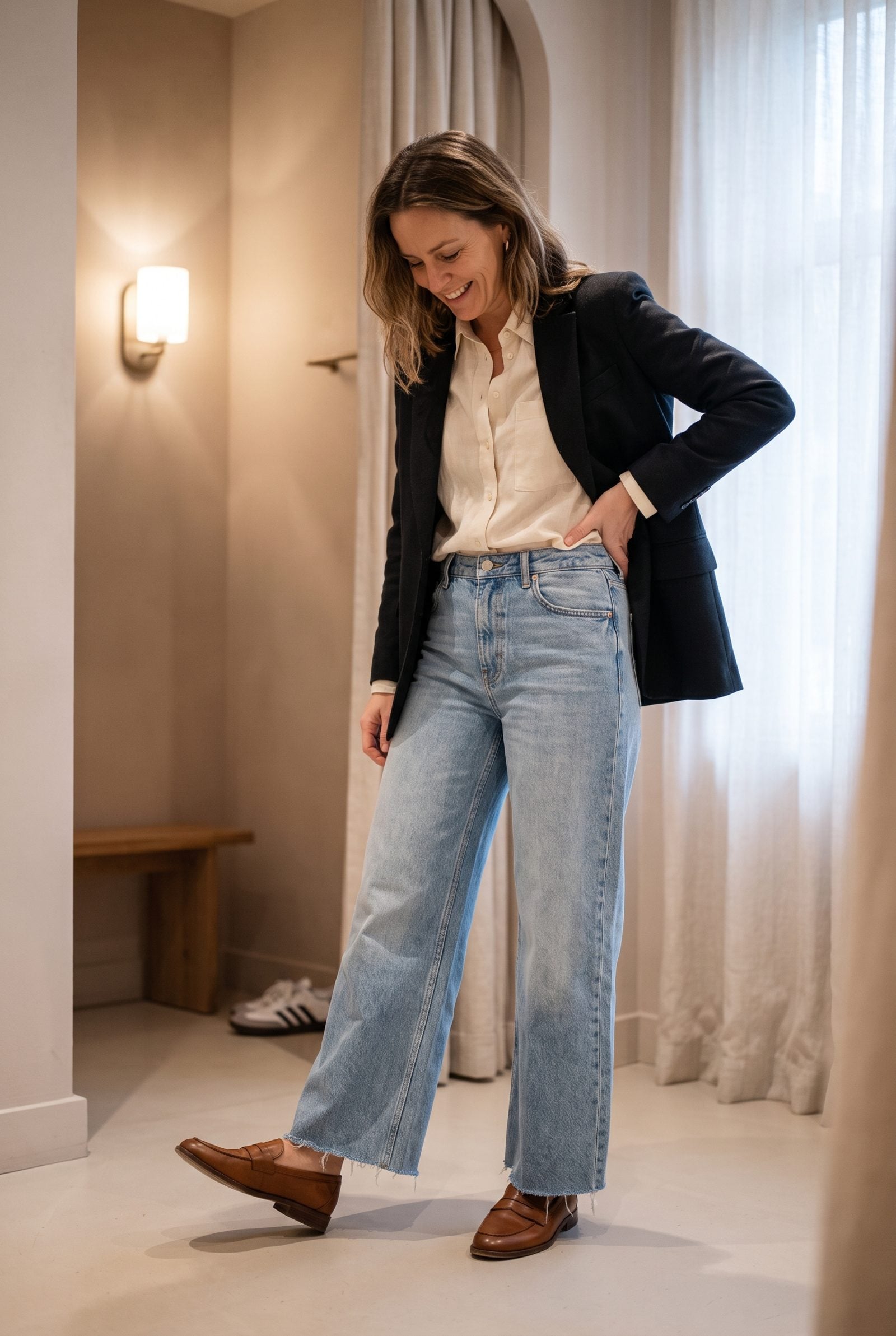
Loafers and wide-leg jeans live or die at the hem. Go too long and the denim swallows the shoe into a puddle; go too short and you flash ankle in a way that shrinks the leg and reads unfinished. So walk the fitting-room floor in your actual loafers before you decide anything.
The burgundy penny leather loafers here catch the hem at exactly the right spot, so the leg reads long and the shoe still gets its moment. That break point is the whole game.
3. Choose a Fabric Weight That Matches the Seasons You’ll Wear Them Most

A wide-leg jean in featherweight denim will cling and wrinkle by noon, and a heavy raw denim will feel like armor in July. Fabric weight decides how many months a year these actually leave the closet.
This dark indigo pair reads structured because the denim carries some heft, which is why it swings clean instead of sticking. Reach for that kind of body if you want them for fall and winter. Save the airy washes for spring.
2. Check the Rear View While Walking, Not Just Standing Still
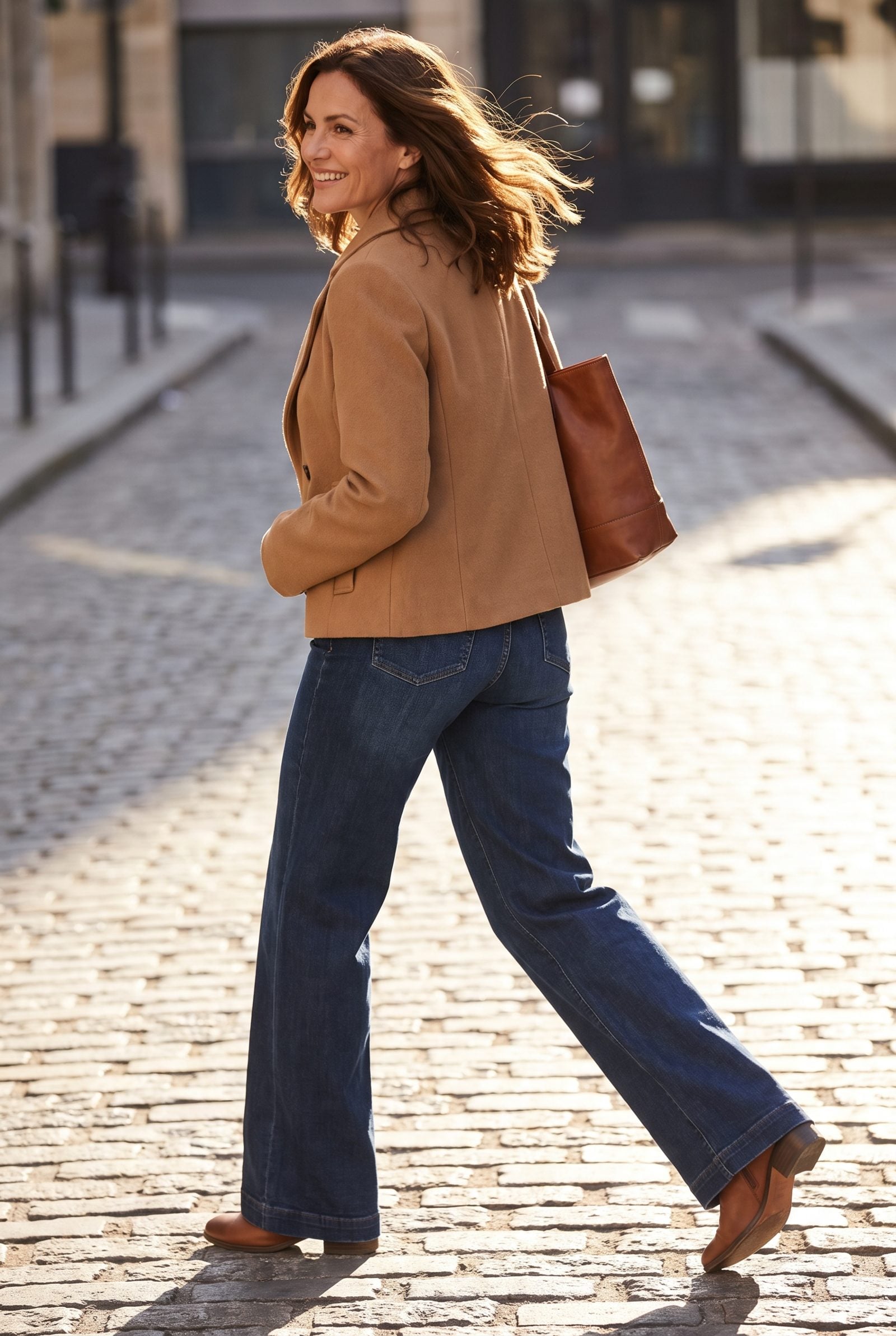
Everybody checks the front in the mirror. Almost nobody checks the back in motion, which is the view most of the world actually gets.
So take a few steps and watch how the seat behaves and where the pockets land. Denim that looks fine standing can gape at the waist or sag the second you move. Pocket placement and scale do quiet work back there, and paired with clean white leather sneakers the whole line reads long and easy from behind.
1. Build Three Outfits from Your Existing Wardrobe Before Calling Them a Great Purchase
❤️ Would you like to save this?
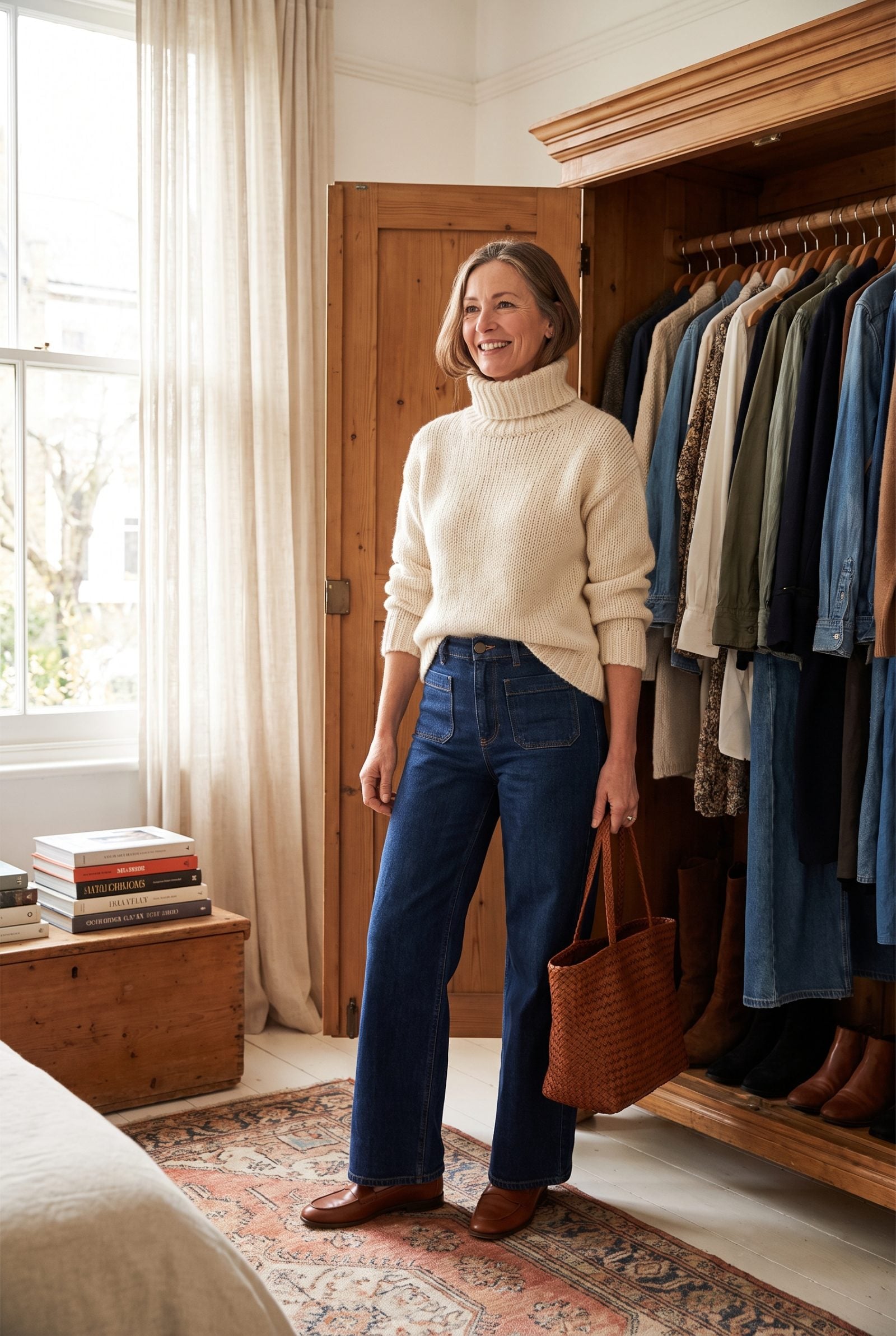
One outfit is a fluke. Three is a wardrobe piece.
Before these jeans earn permanent shelf space, style them three completely different ways from clothes you already own. Sneakers and a tee. A tucked knit and ankle boots. Then push it further: a navy structured blazer over a white tee with pointed nude heels, the way it works here, where the blazer shoulder against the wide leg builds a clean column and the heel peeking under the hem does the lengthening.
Can only manage one look? The jeans are a one-hit wonder. Send them back.