❤️ Would you like to save this?
Wide-leg jeans are the easiest win in your closet and, somehow, the easiest thing to botch. A few inches of hem, one rise decision, and whether your top actually knows its job — that’s the whole gap between looking pulled-together and looking swallowed. Most of these mistakes stay invisible until you catch yourself in a shop window and wonder who dressed you. Here are ten ways it goes sideways, and exactly how to fix each one before you commit.
FYI, thanks to AI imagery software, we’re able to create very specific fashion and hairstyle examples to illustrate the points being made. In some cases, imagery is exaggerated to hammer home the point. Also, assume links that take you off the site are affiliate links such as links to Amazon. this means we may earn a commission if you buy something.
42. Copying an Influencer’s Wide-Leg Look Without Adjusting a Thing for Your Own Frame
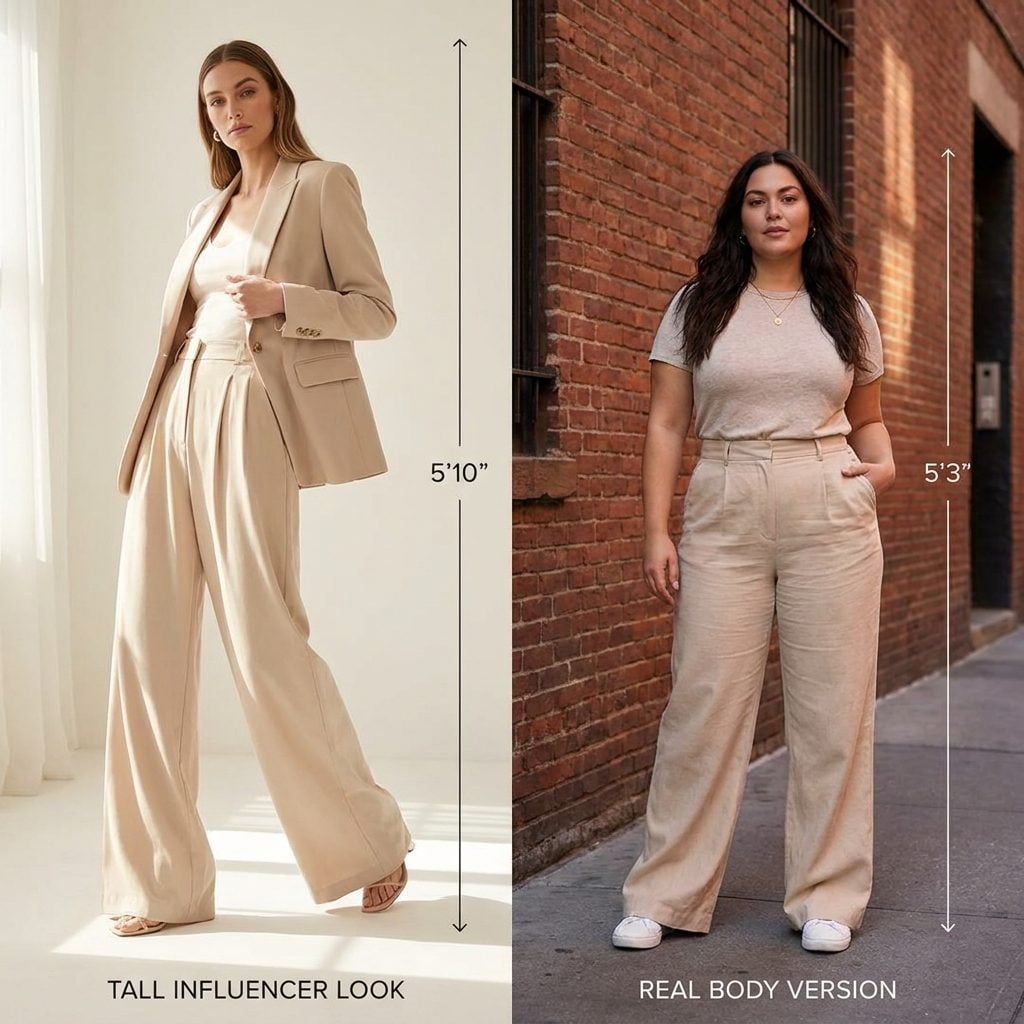
That outfit looked effortless on a 5’10” influencer because it was engineered for a 5’10” frame. Copy it inseam-for-inseam onto a different height and the tuck lands wrong, the crop hits an odd spot, the whole balance quietly shifts under you.
Take the idea, not the measurements. Maybe you need the top a half-inch longer, the rise slightly lower, the shoe with a touch more height. The concept travels fine. The exact proportions almost never do. Steal the formula, then tune it to your own build.
41. Assuming Every Pair Labeled Wide-Leg Falls the Same Way
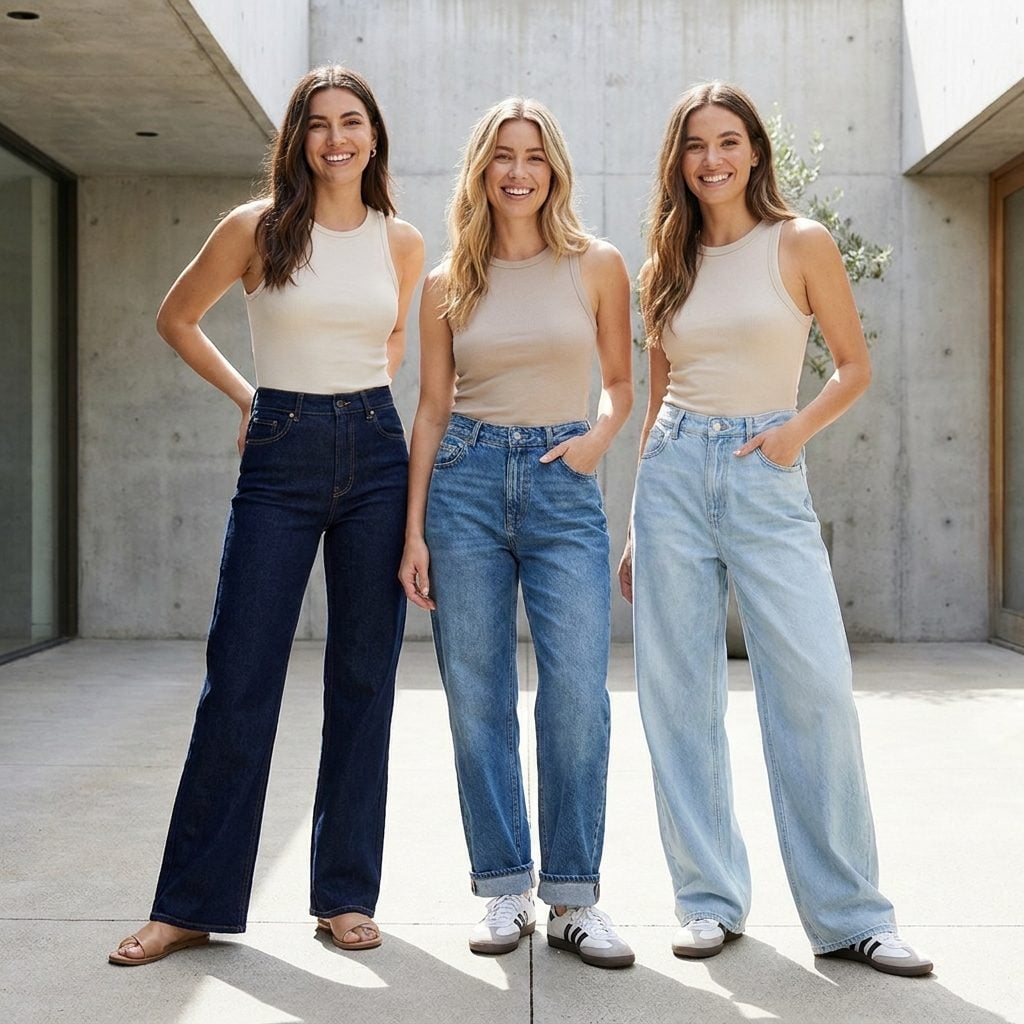
Wide-leg is a category, not a shape. Rigid heavy denim stands away from the leg in a stiff A-line, a soft Tencel-blend drapes straight and fluid, a palazzo flares from the hip. Same two words on the tag, three completely different silhouettes on your body.
So buy the shape that suits your build, not the label. Carry weight through the hip? A fluid drape skims where a rigid flare only bulks. Long and lean? Structure adds welcome presence. Try the fabric, not the marketing.
40. Wearing Them So Long They Puddle Around Your Entire Shoe
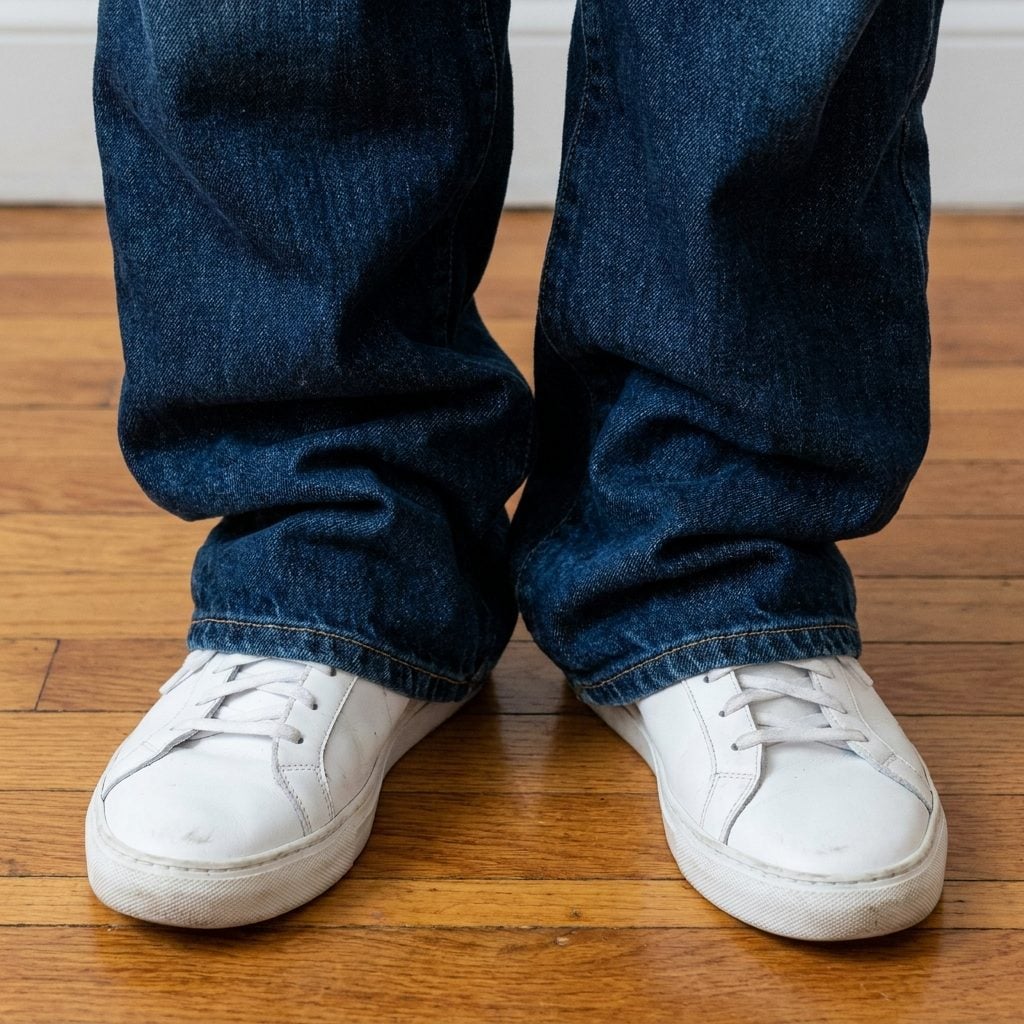
Length is where wide-leg jeans live or die. Let them puddle and the whole vertical line you were building collapses into a heap of horizontal creases at your ankle, which is exactly where you don’t want the eye to stop. The hem should graze the top of your shoe or break once, cleanly. Not five times.
The fix costs less than a coffee. Take them to a tailor, wear the shoes you’ll actually pair them with, and have the hem set to just kiss the floor. I ignored this for years and kept wondering why my jeans read as sloppy. It was never the jeans.
39. Hemming Them Too Short and Accidentally Inventing Culottes
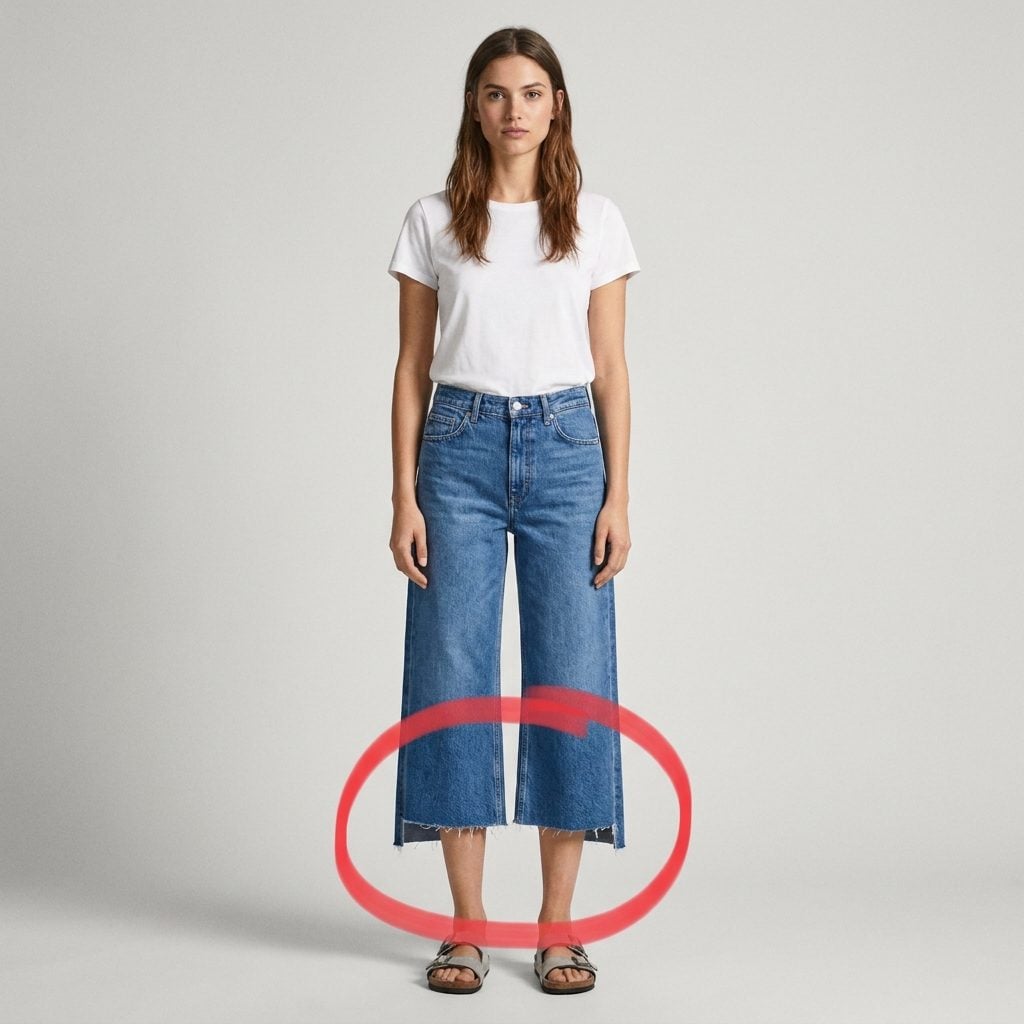
Cut too much and wide-leg jeans stop being jeans. They become culottes, and not the intentional kind. That mid-calf chop lands at the widest part of your leg and slices your height in half at exactly the wrong point.
Want a cropped wide leg? Commit above the ankle bone with a heel that gives your leg somewhere to go. Anything hovering vaguely at the calf reads like a hemming accident — because usually it is one. So cut conservatively. You can always take more off. You cannot put it back.
38. Choosing a Rise That Shrinks Your Torso to Half Its Length
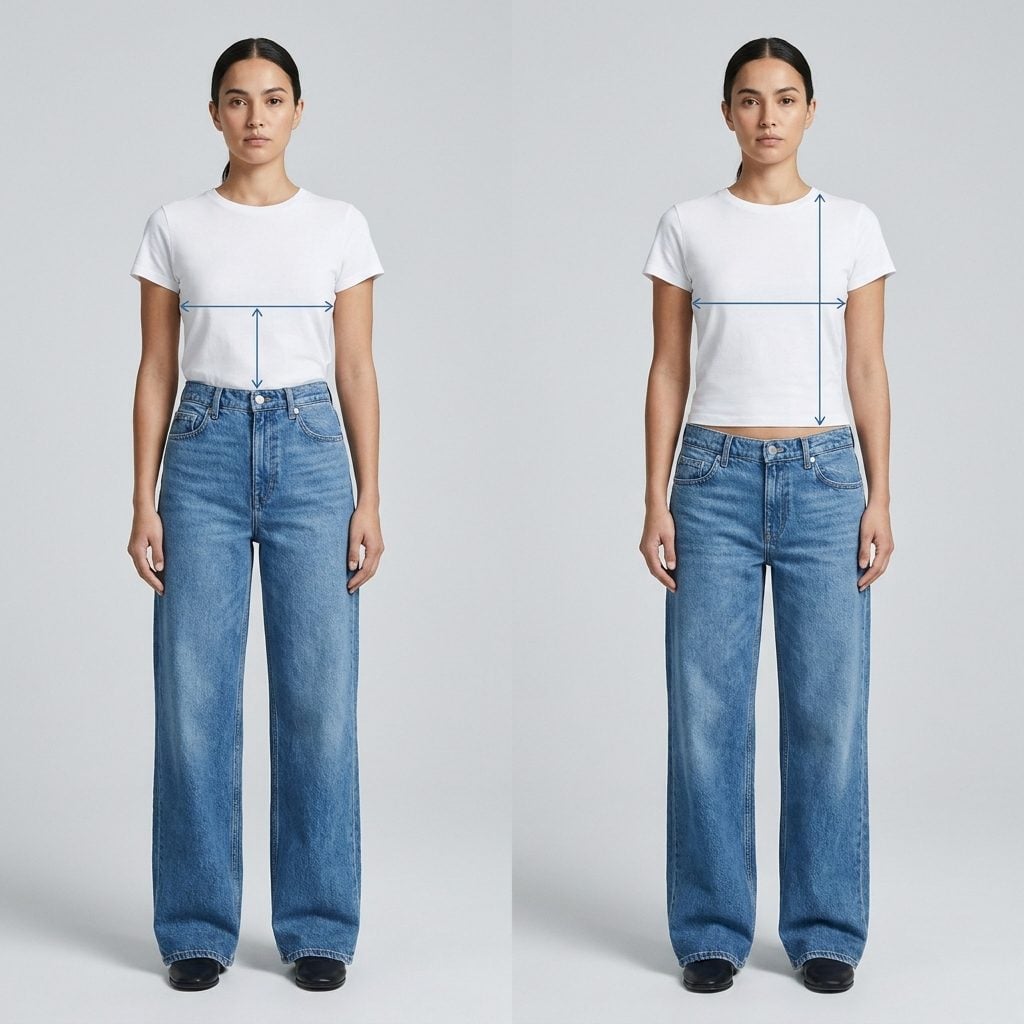
The rise sets your waistline, and your waistline sets the story your whole body tells. Get it wrong and it can look like your torso and legs quietly traded a few inches. A rise sitting too low under an untucked top erases your natural waist entirely, so everything reads shorter and heavier than it actually is.
Aim for a rise that lands at or just above your navel, then tuck or half-tuck to mark where your waist actually falls. That single line does more for your outfit than any accessory could.
37. Wearing a Low Rise That Makes Your Legs Look Surprisingly Short
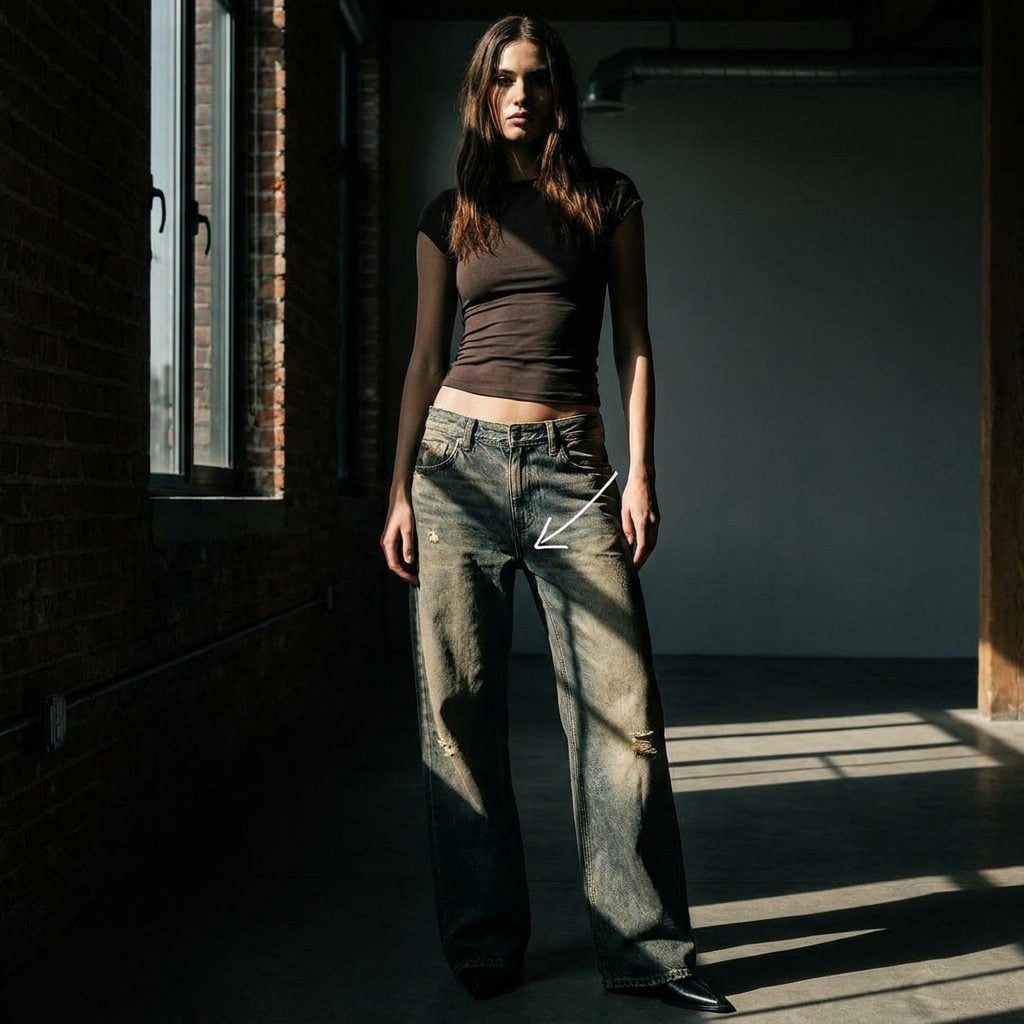
A low rise drops the crotch seam, and wherever that seam sits is where your legs appear to begin. Push it down and you shave inches off your leg line without touching your actual height. In a cut that already carries this much volume, a low rise goes bottom-heavy fast.
You don’t need to overcorrect, though. A comfortable mid-to-high rise lifts the visual start of your legs and lets all that fabric fall long and clean from a higher point. These aren’t androgynous jeans — they’re supposed to work with your frame, not against it.
36. Choosing an Ultra-High Rise That Practically Reaches Your Bra
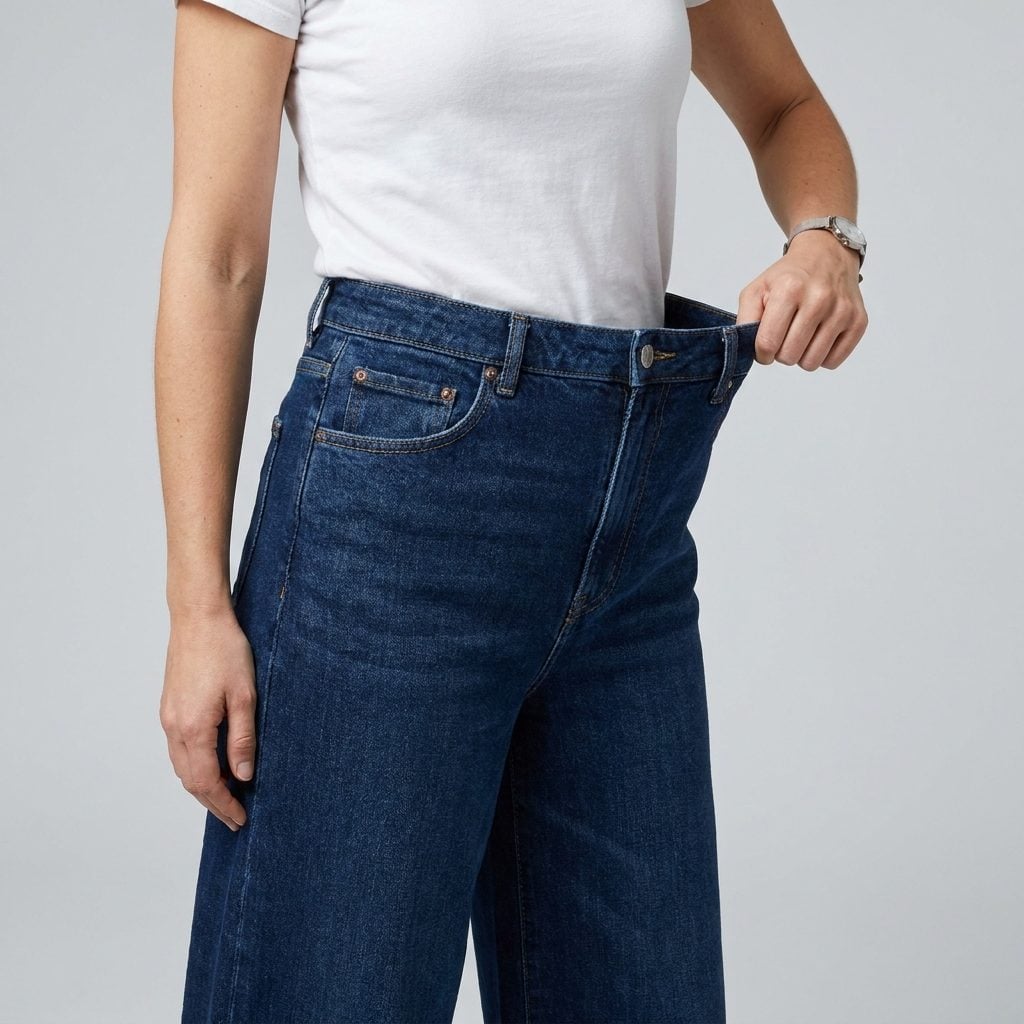
There’s a point where high rise stops flattering and starts squeezing. When the waistband creeps up toward your ribs, it compresses your torso into an unnaturally short block and draws a cinch line that has nothing to do with your real waist.
Ultra-high can look sharp on the rack and just plain strange on a body. The waistband should sit at your natural waist — the narrowest point — not two inches above it. If you’re constantly hitching them down, they’re too high. Trust the tug.
35. Pairing Them With an Oversized Top and Losing Your Shape Completely

Volume on the bottom needs restraint somewhere up top, or your shape just disappears. Pile an oversized sweater over wide legs and you’ve built a rectangle with a head — no waist, no line, no hint of the body inside.
One volume at a time. Big jeans want a fitted top, or at least a top that gets tucked or knotted to reintroduce a waist. If you love the oversized sweater, half-tuck the front or push the sleeves. Give the eye one place to figure out where you are inside all that fabric.
34. Trying to Balance Wide Legs With an Equally Voluminous Top
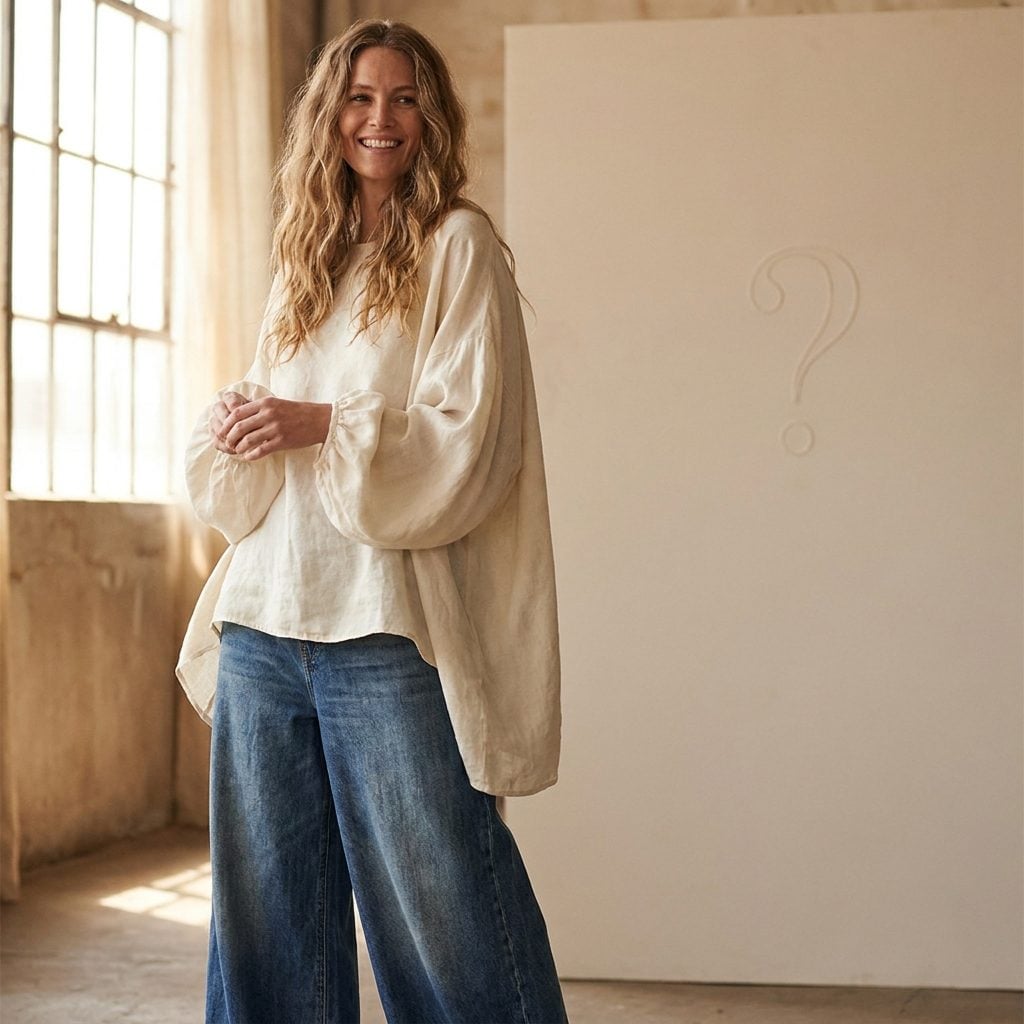
Matching wide legs with a flowy top feels like balance. It isn’t. Two volumes don’t cancel each other out — they compound, and you end up wider top to bottom with no waist to break the mass.
Contrast is what actually balances things. A slim rib top, a fitted tee, a tucked silk shell, anything that traces the upper body lets the jeans do their dramatic thing without competition. Fitted up top, full down below. That tension is what makes the whole wide-leg look work.
33. Leaving a Long Boxy Shirt Untucked Over an Already-Wide Silhouette
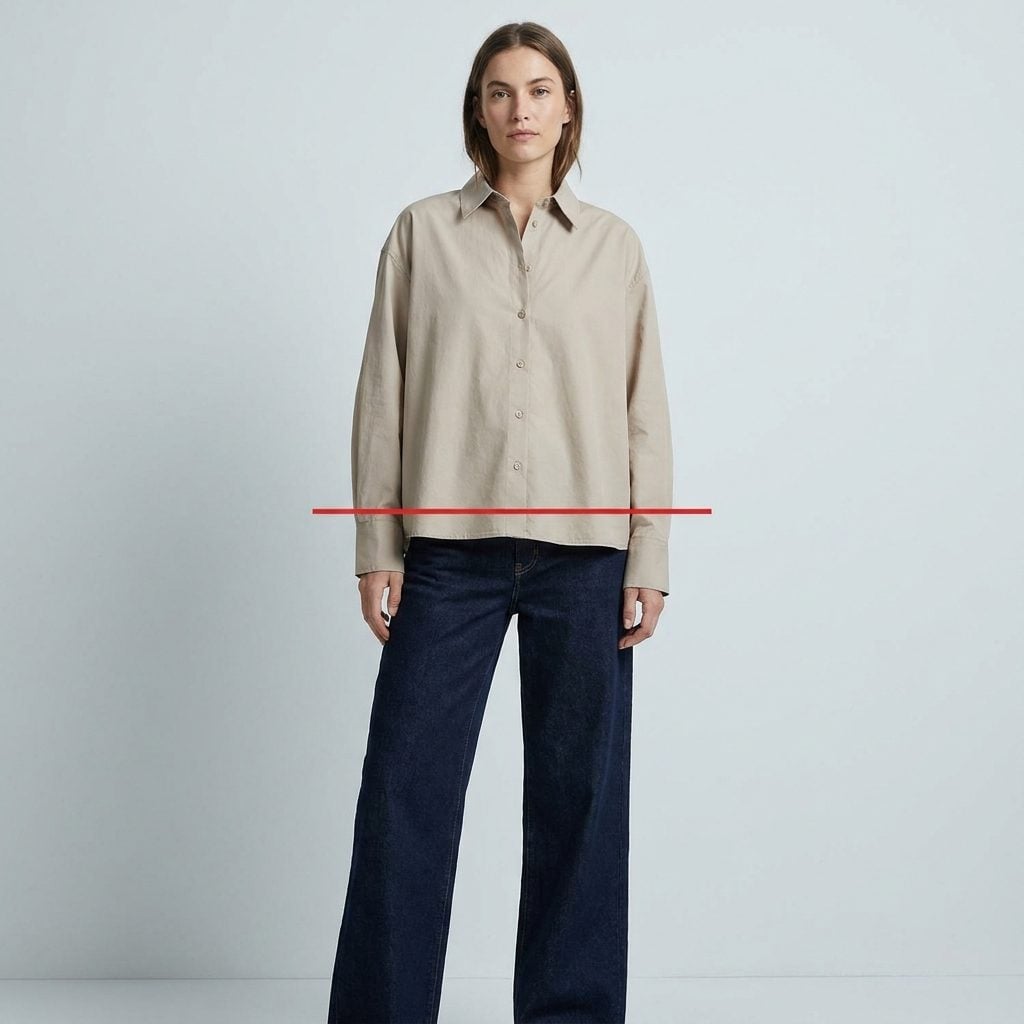
A boxy shirt left hanging over wide legs draws a hard horizontal line across your hips and squares off your entire frame. Two straight edges, top and bottom, no curve or waist anywhere in sight. It’s the most common way this look falls flat.
Front tuck it. Even a lazy, loose one works. Pulling the front hem into the waistband breaks that boxy line, reveals the waist, and lets the shirt tail relax at the sides. Same shirt, same jeans, completely different read.
32. Wearing a Tunic-Length Top That Makes Your Legs Start at Your Knees
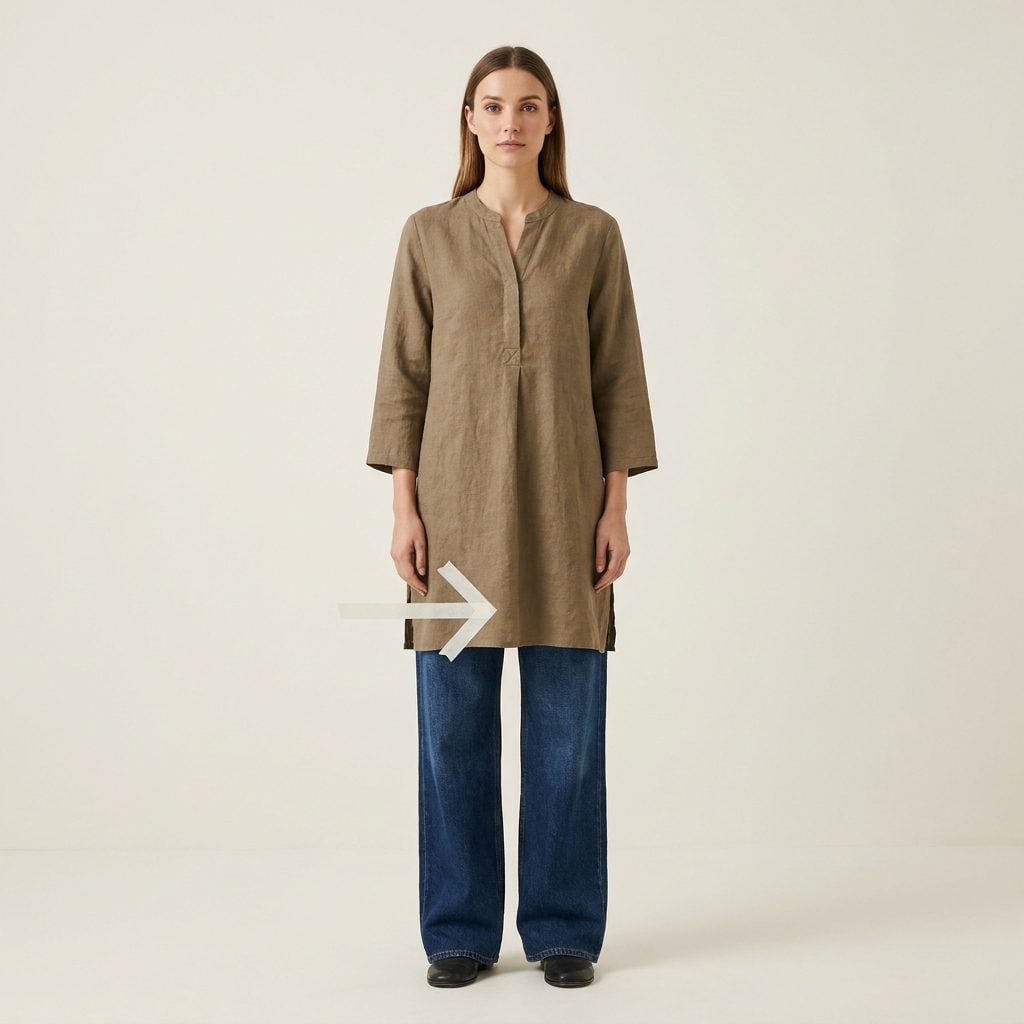
Where your top ends is where your legs appear to start. A tunic falling to mid-thigh tells the eye your legs begin at your knees, and no pair of wide-leg jeans on earth can recover from that.
Length is doing all the damage here. Hit the top at your hip bone or higher, or tuck a longer one so the leg line starts up at the waist where it belongs. This is one of those athleisure jeans traps where comfort quietly costs you every inch of leg you have.
31. Pairing a Puffy Jacket With Extra-Wide Jeans and Building a Rectangle
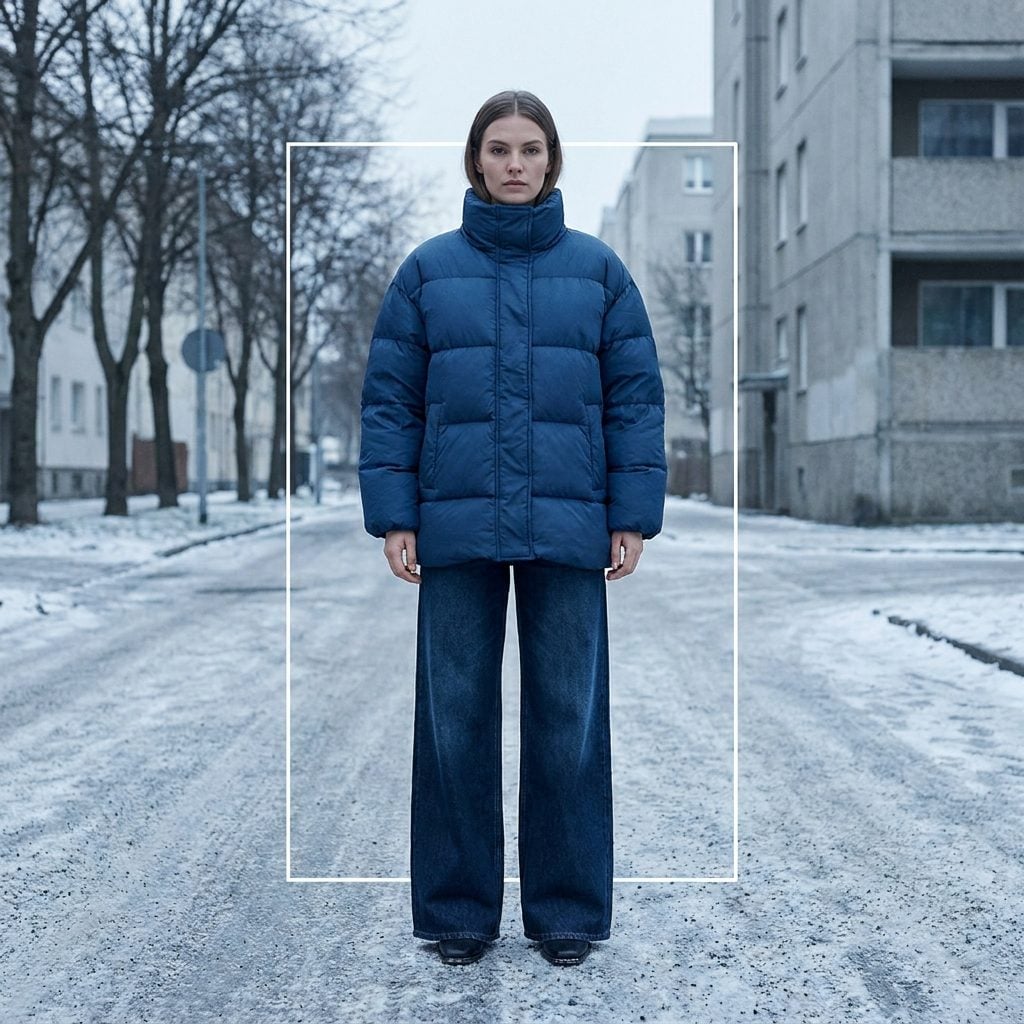
Puffers add width you never asked for, and stacked over extra-wide jeans they turn you into a single rectangle from shoulder to hem. Volume up top, volume down below, and nothing in between to give the shape any meaning.
Wearing a big puffer? Size down the jeans, or reach for a cropped puffer that stops at the waist so the wide legs still get to fall long and clean underneath. A belted or fitted coat over wide jeans keeps the vertical line intact. And no, the bag outfits and accessories you pile on top can’t fix a silhouette this blocky. Structure comes first.
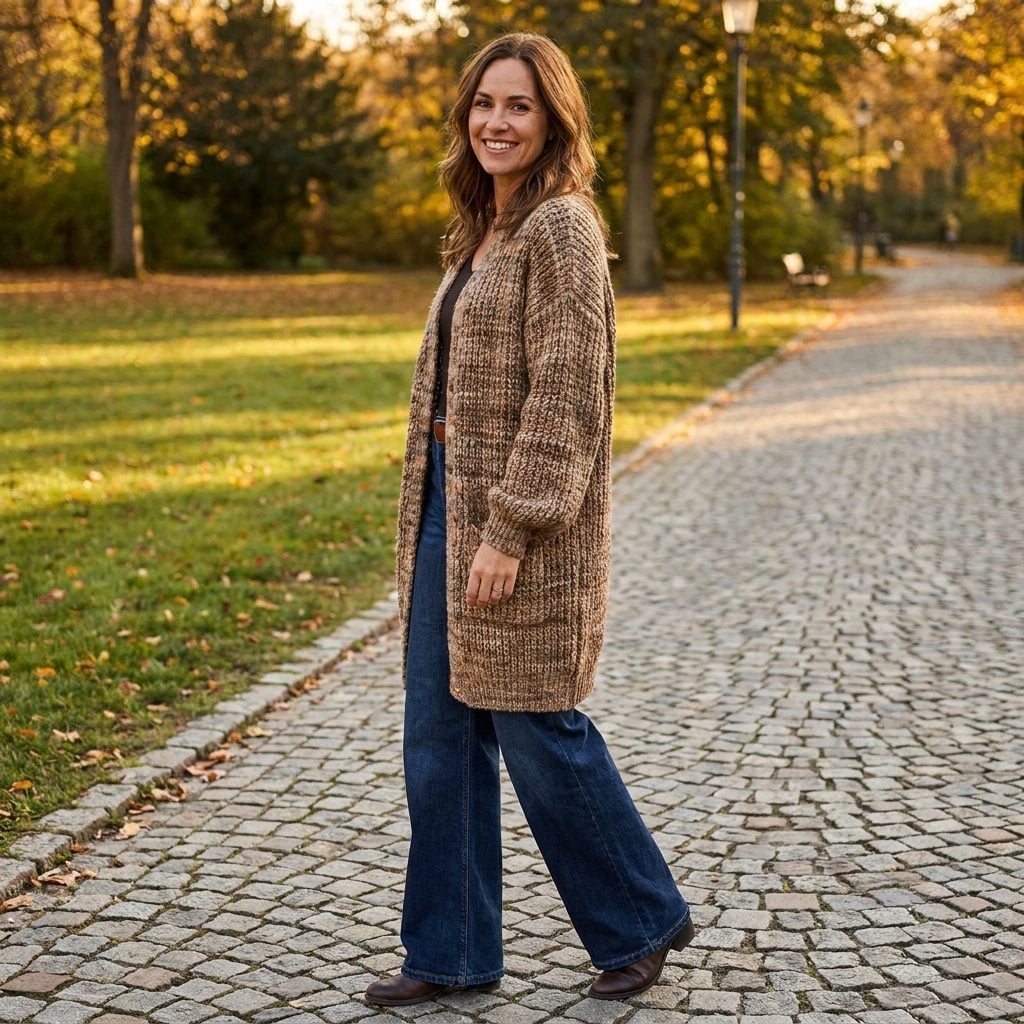
30. Wearing a Long Cardigan With Full-Length Wide-Leg Jeans and Drowning in Fabric
❤️ Would you like to save this?
Two long garments stacked on top of each other cancel each other out. The knee-grazing cardigan and the floor-skimming jean both want to be the longest line in the room, and when neither wins, your frame disappears into a soft rectangle of fabric.
The fix is embarrassingly simple. Break the vertical somewhere. A oatmeal knit cardigan works with wide-leg jeans when it hits at the hip or when you belt it. Right now this look has no anchor, and the eye slides top to bottom with nothing to grab.
29. Tucking a Bulky Sweater Into Wide-Leg Jeans and Creating Extra Bulk Around the Waist
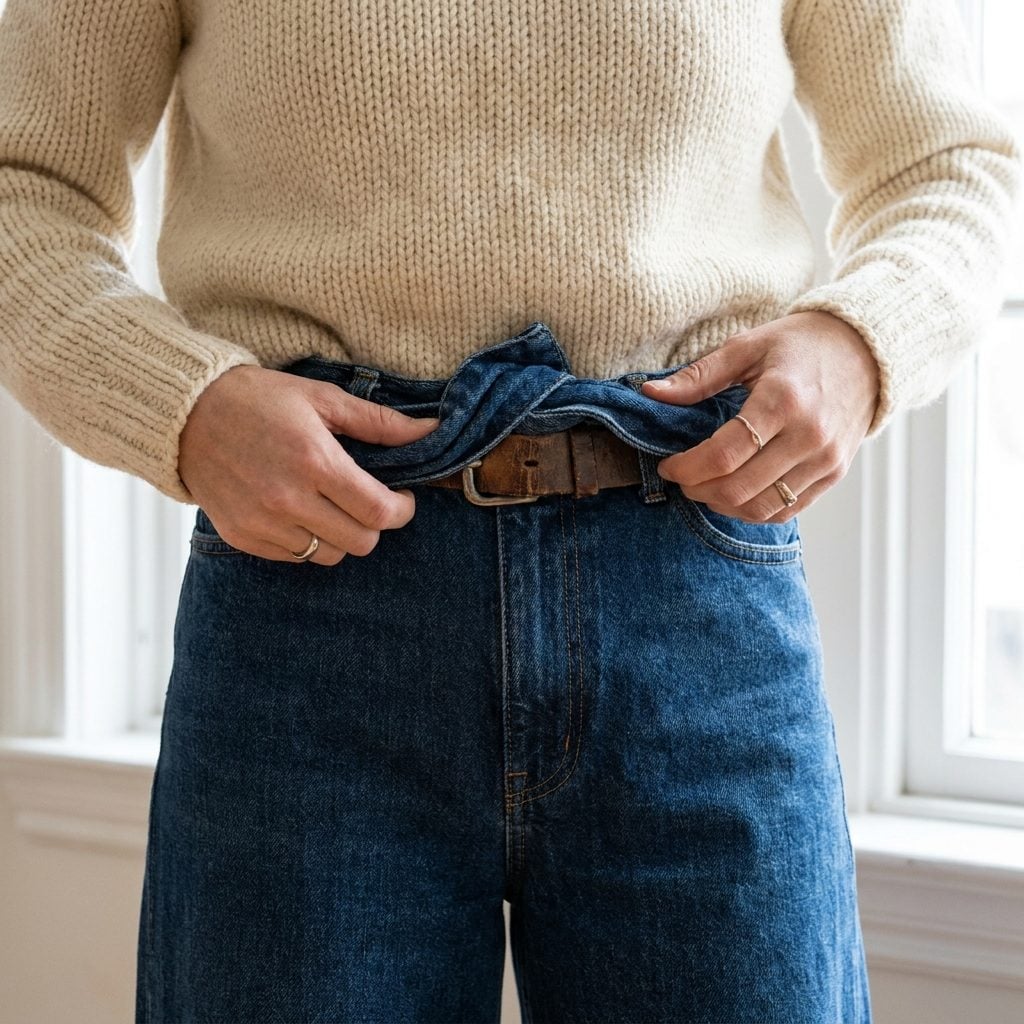
The full tuck is doing you no favors here. A heavy fisherman knit stuffed entirely into a waistband gathers into a doughnut of wool exactly where you want a clean line, and the sweater wins that fight while your waist loses it.
Try the front tuck instead. Pull only the center panel over the waistband and let the sides fall loose, so you get the leg-lengthening high waist without the padding. On a bulky cream fisherman sweater, that half-tuck is the difference between defined and stuffed.
28. Wearing an Oversized Sweatshirt With Extra-Wide Jeans Without Adding Any Structure
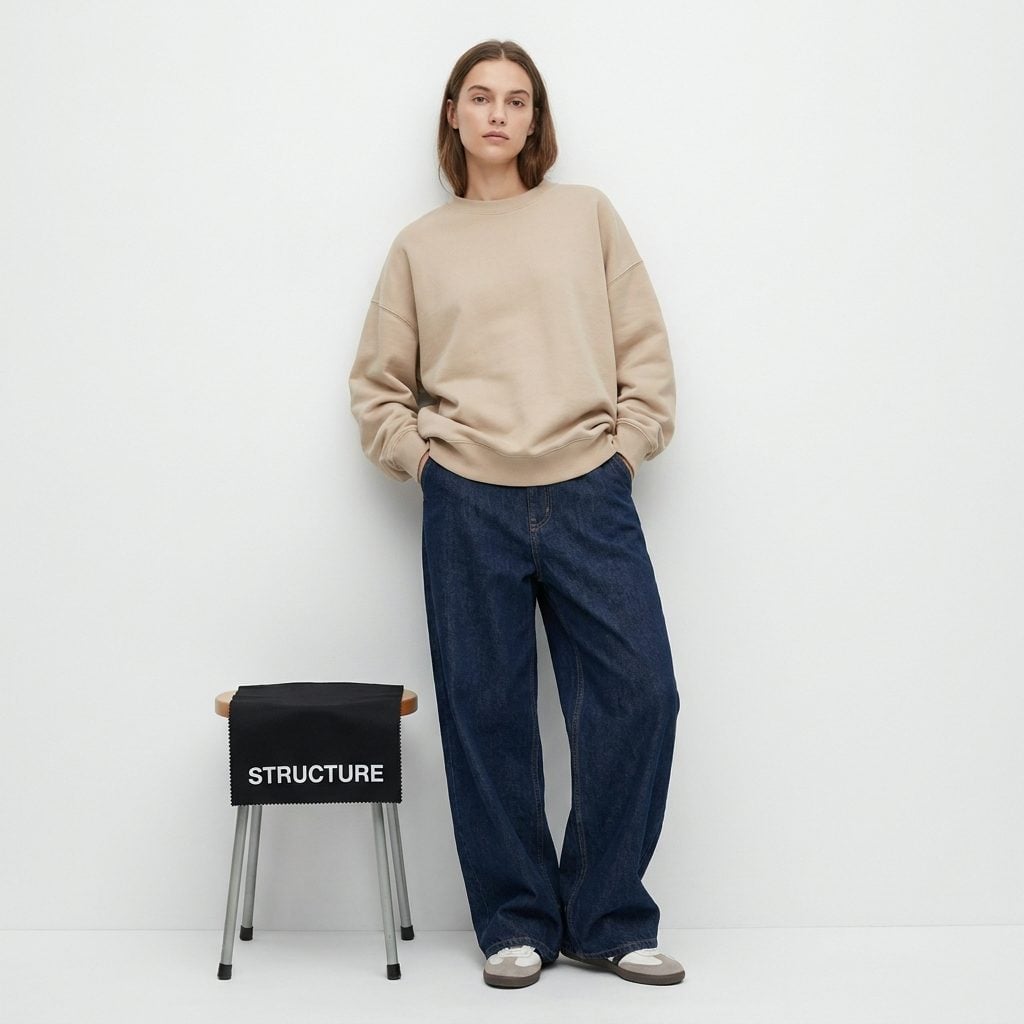
Soft on soft on soft. The slouchy sweatshirt and extra-wide jean are both begging for something firm to push against, and there’s nothing here — no belt, no structured shoe, no jacket with a real shoulder. The outfit has no skeleton.
Structure is the missing driver. One crisp element rescues the whole thing: a leather belt cinching the sweatshirt, a stiff tan trench coat thrown over, a heeled boot swapped for the sneaker. I lived in the sweatshirt-and-wide-leg combo for a whole winter before I figured out why I looked like I was returning library books in every single photo.
27. Choosing a Blazer That Ends at the Widest Part of Your Hips
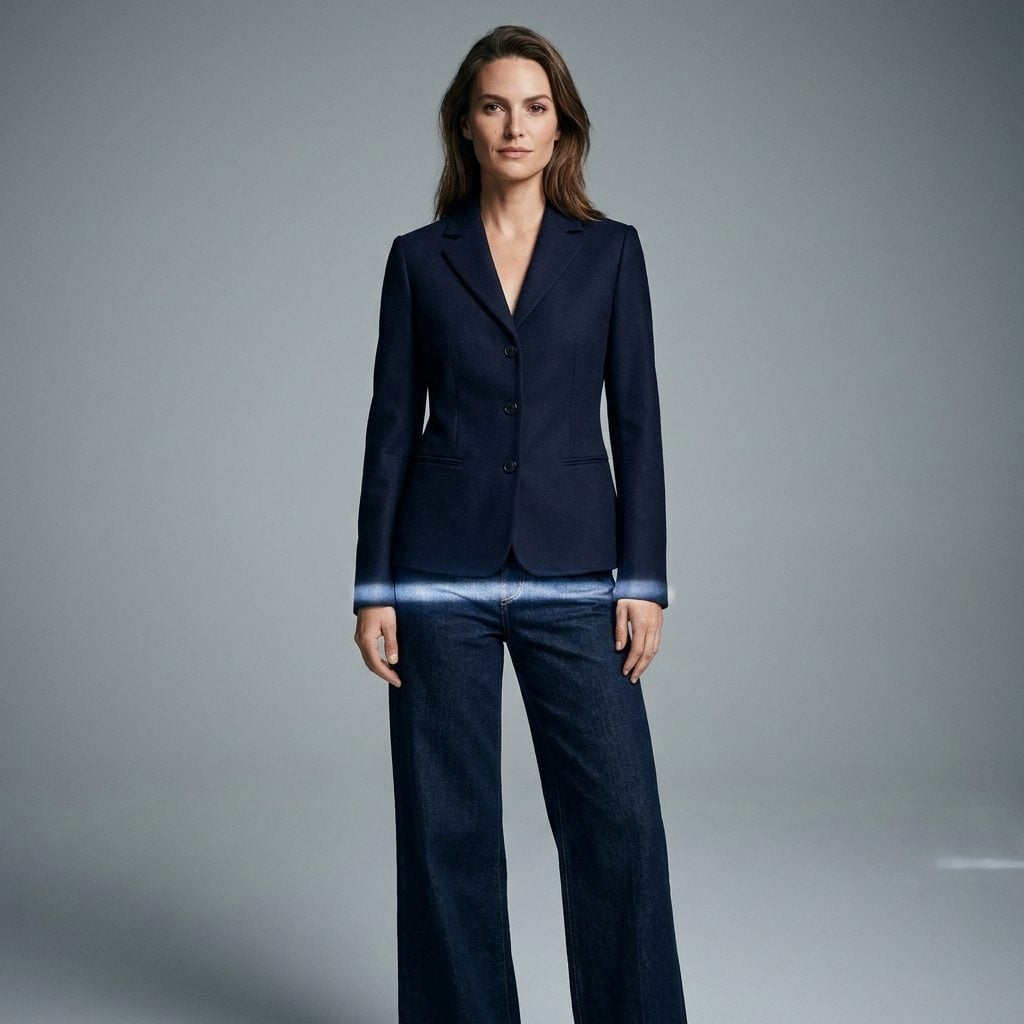
A blazer hem is a horizontal line, and horizontal lines spotlight wherever they land. This one lands at the widest part of the hip, which is the one spot nobody wants underlined in ink.
Length is everything with a blazer over wide legs. Go shorter to hit above the hip, or longer to skim past it, but never end right on it. A navy longline blazer that grazes mid-thigh keeps the vertical line unbroken and the whole column taller.
26. Wearing a Long Top That Covers the Waistband and Destroys the Leg-Lengthening Effect
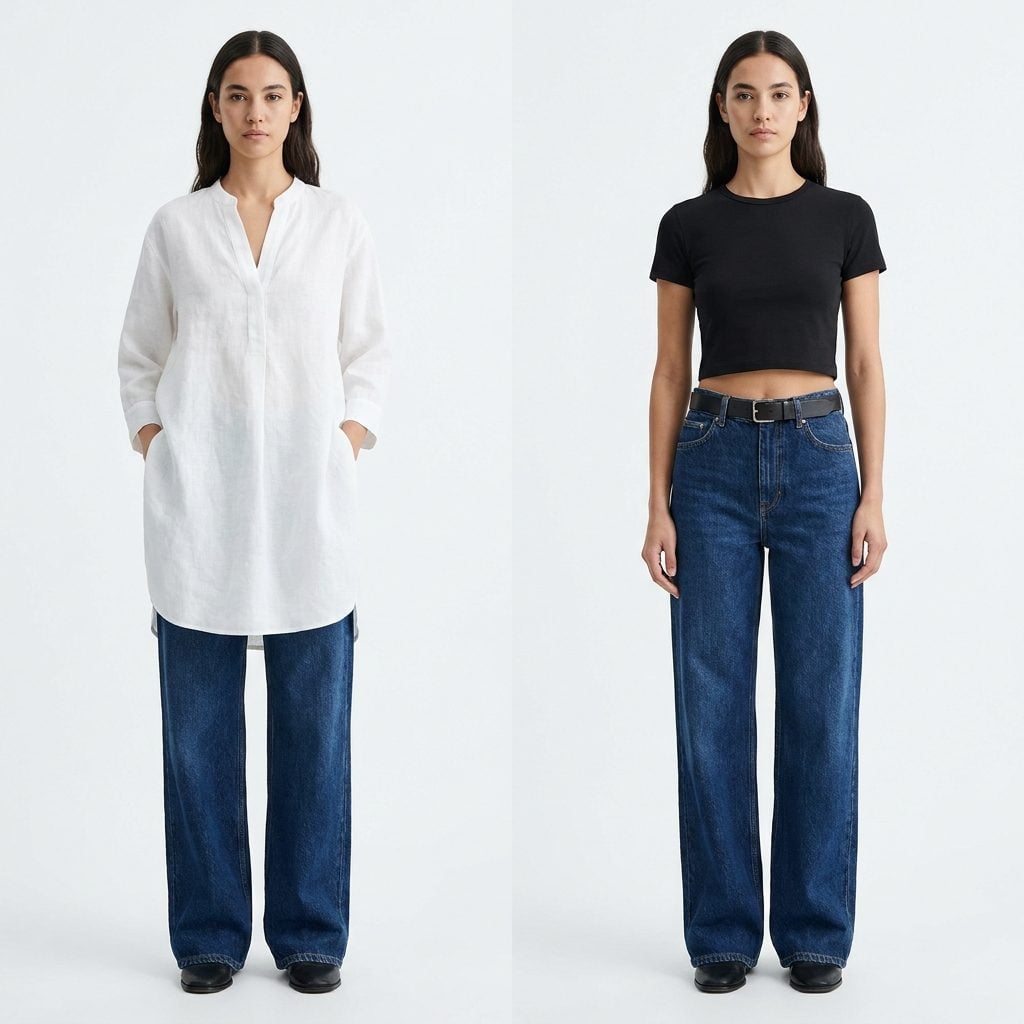
The whole point of a high-waisted wide-leg jean is that the waistband sits up high and gives you leg from the ribcage down. Cover it with a long tunic and you throw the entire benefit away, because now your legs appear to start at mid-thigh.
Even a small tuck rescues it. Knot the tunic at the hip, do a French tuck, or swap for a top that ends near the natural waist. Any outfit built on high-rise denim needs the rise to show. Hide it and you’re just wearing regular jeans with extra fabric.
25. Choosing a Wide Leg That Starts Too Wide at the Hip
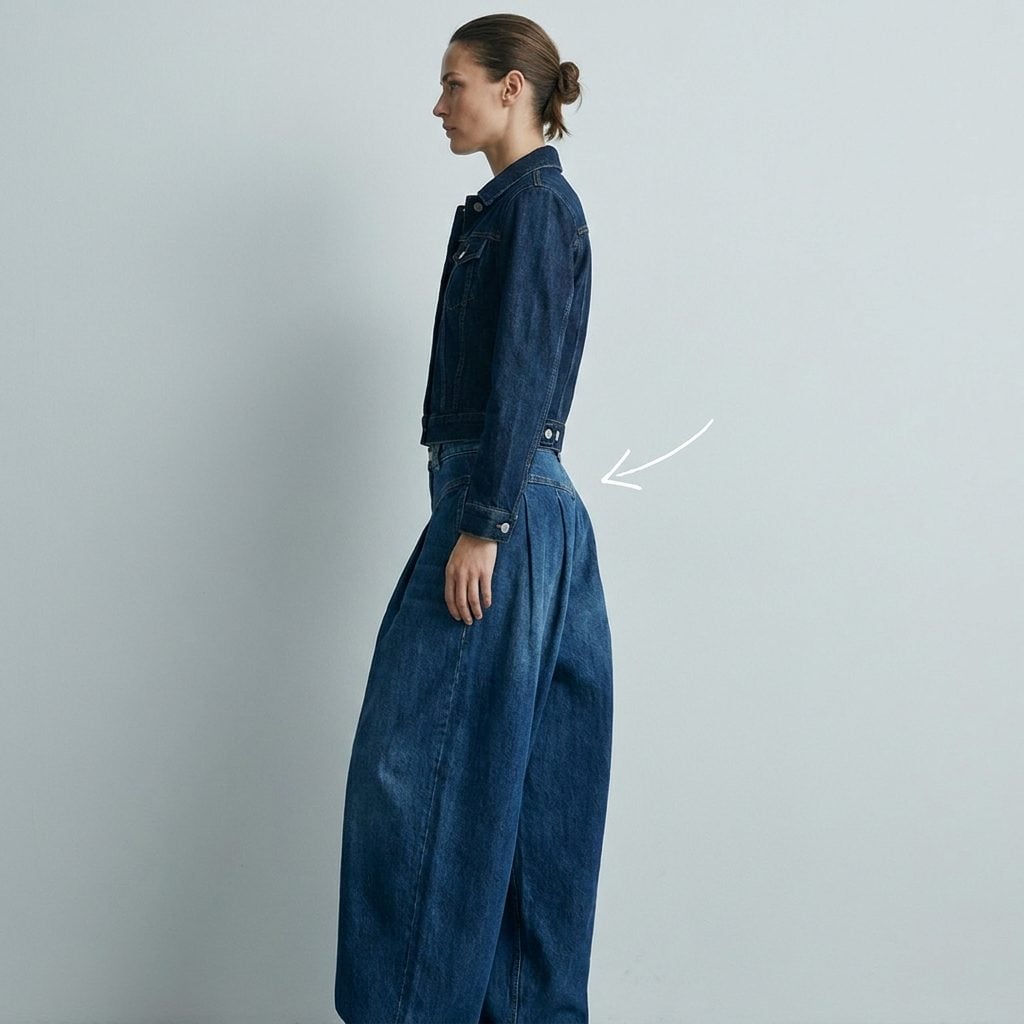
There’s a right place for a wide leg to break wide, and it isn’t the hip. When the flare begins right at the hipbone, the jean piles width onto your fullest point and skips the narrowing that makes the whole style work.
The best ones stay close through the hip and upper thigh, then release into volume from the knee down. That slim-to-wide gradient is the flattering mechanism — narrow where you want narrow, drama where drama costs you nothing. A pair that balloons from the waistband down? Just a barrel.
24. Buying the Trendiest Extra-Wide Pair Instead of the Width That Actually Flatters You
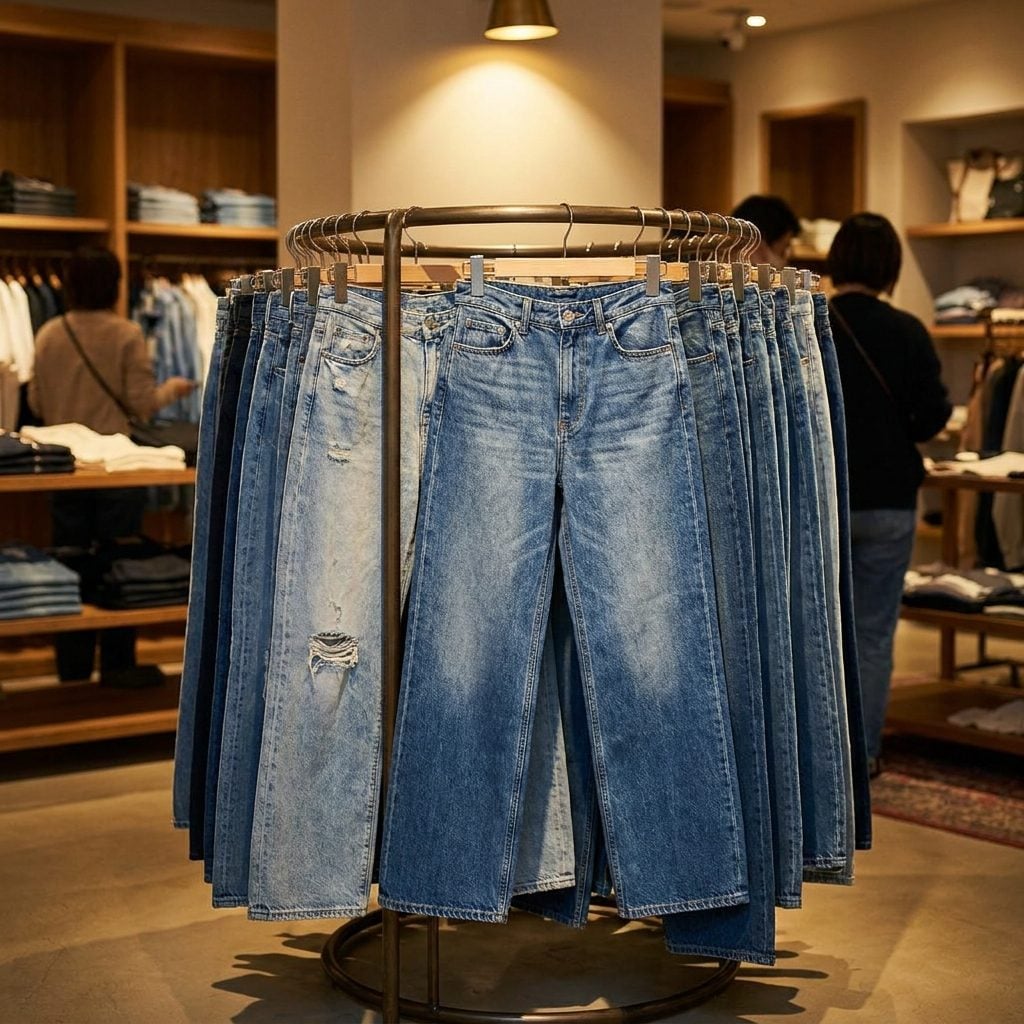
The widest pair on the rack is not automatically the pair for you. Trend width and flattering width are two different measurements, and the internet keeps confusing them.
Buy for your leg length and your frame, not the runway. If you’re petite, an extreme puddle of denim reads as fabric wearing you. A moderate wide leg with a clean drape almost always beats the most extreme cut in your closet. I chased the biggest pair one season and gave them away by spring — a costume, not athleisure jeans I actually reached for.
23. Choosing a Leg Opening So Extreme the Jeans Look More Like a Denim Skirt
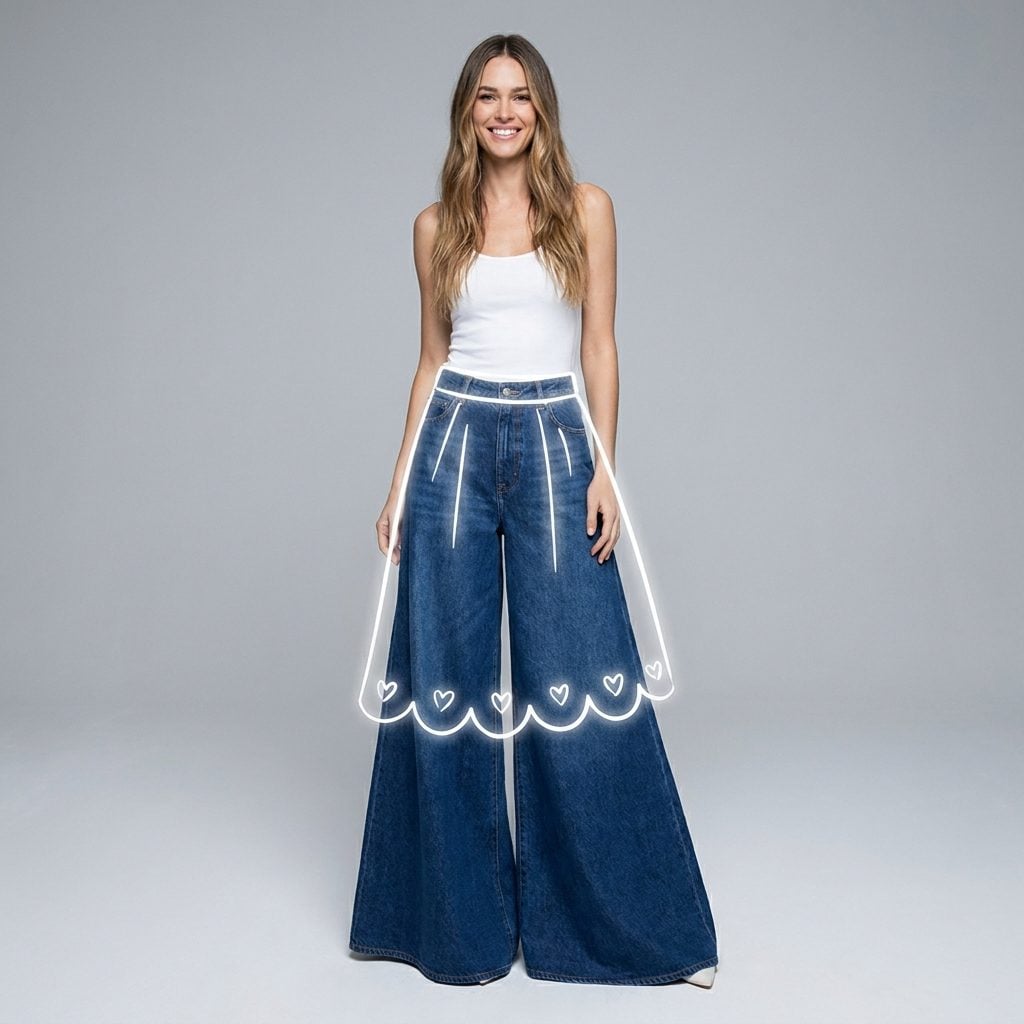
When the leg opening gets so vast the two legs read as one, congratulations, you’ve accidentally bought a denim maxi skirt. The trouser shape vanishes and any sense of movement goes with it.
A wide leg should still read as legs. You want to catch a glimpse of shoe, a hint of the ankle break, some evidence there are two limbs in there. An opening you could fit an umbrella through loses the crisp trouser line that makes the cut look intentional rather than like a mistake.
22. Choosing Stiff Denim That Stands Away From Your Body Like a Tent
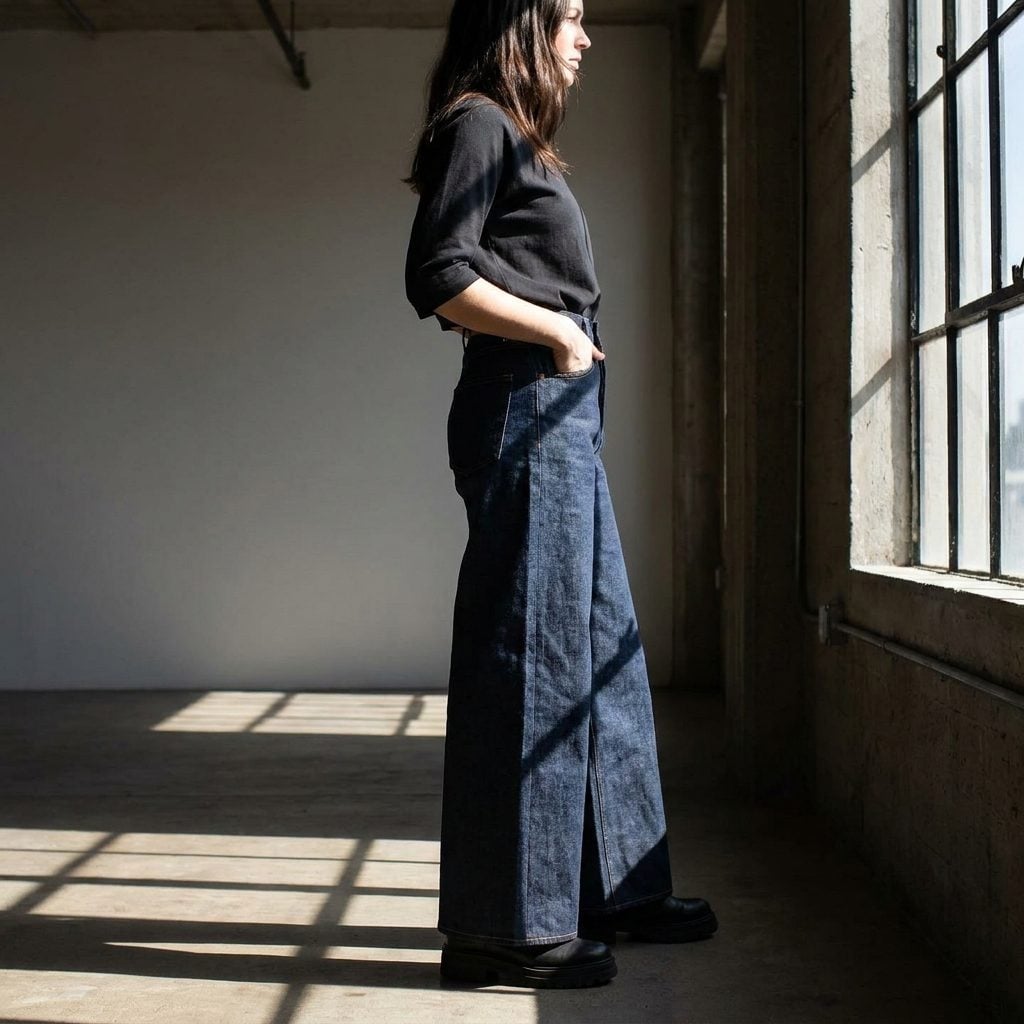
Stiff raw denim in a wide leg has a habit of standing on its own, several inches off your actual leg, like cardboard that learned to walk. Boxy, boardy, and somehow older than you are.
Look for denim with a little softness, or a touch of drape built in. The fabric should follow your movement, sway when you walk, fall back against the leg — that fluidity is what separates a modern wide-leg from a rigid work pant. Rub the fabric between your fingers before buying. If it feels like a tarp, it’ll wear like one.
21. Buying a Pair That Fits the Waist but Pulls Tight Across the Hips
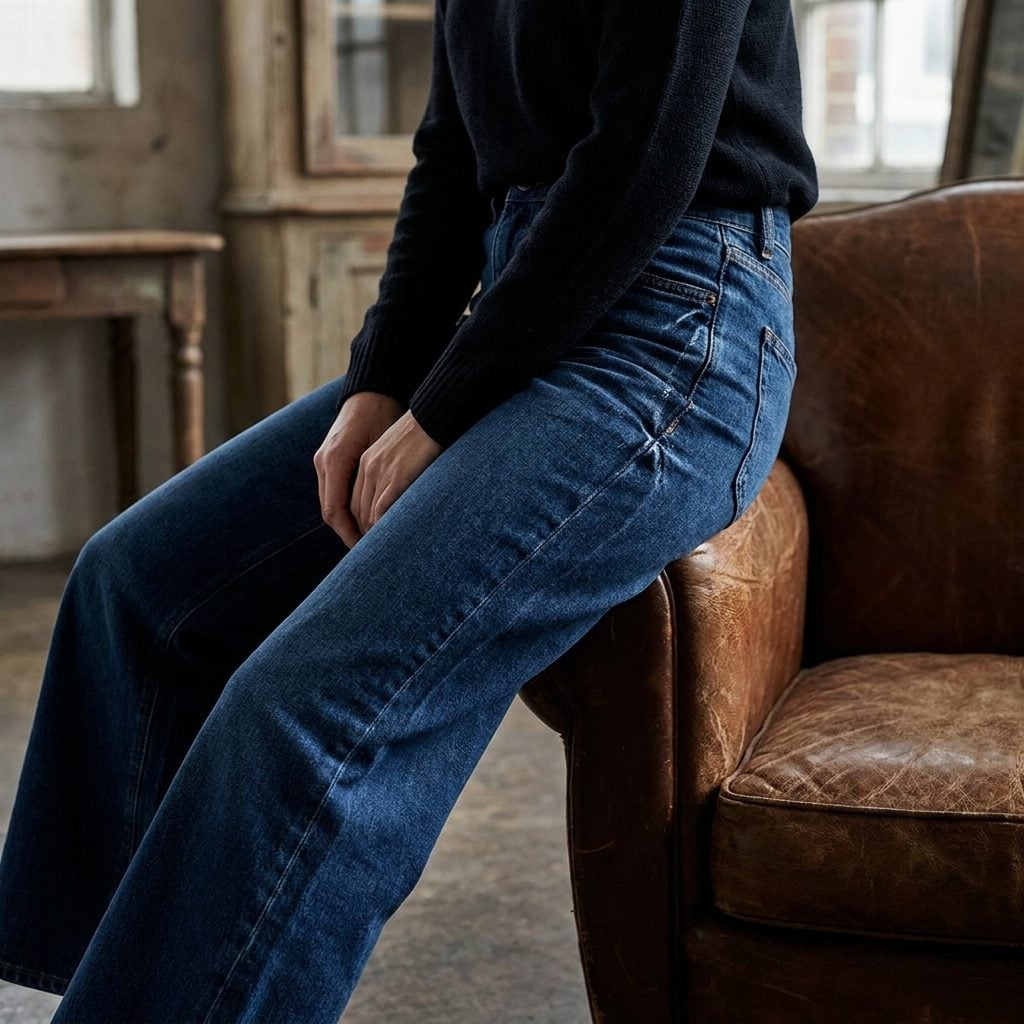
The waist fits, so you buy it. Then you sit down and the hip seams strain into little tension lines, and suddenly the jeans look a size too small everywhere below the belt. This is the most common mistake I see. It’s a fitting problem, not a body problem.
Curvier hips need a curved waistband and more room through the seat. That rust silk blouse tucked at the front pulls the eye up and keeps the proportion honest. So buy for the widest part, then take in the waist — a tailor charges less than the second pair you’ll buy to replace this one.
20. Ignoring a Waistband That Gaps Several Inches at the Back
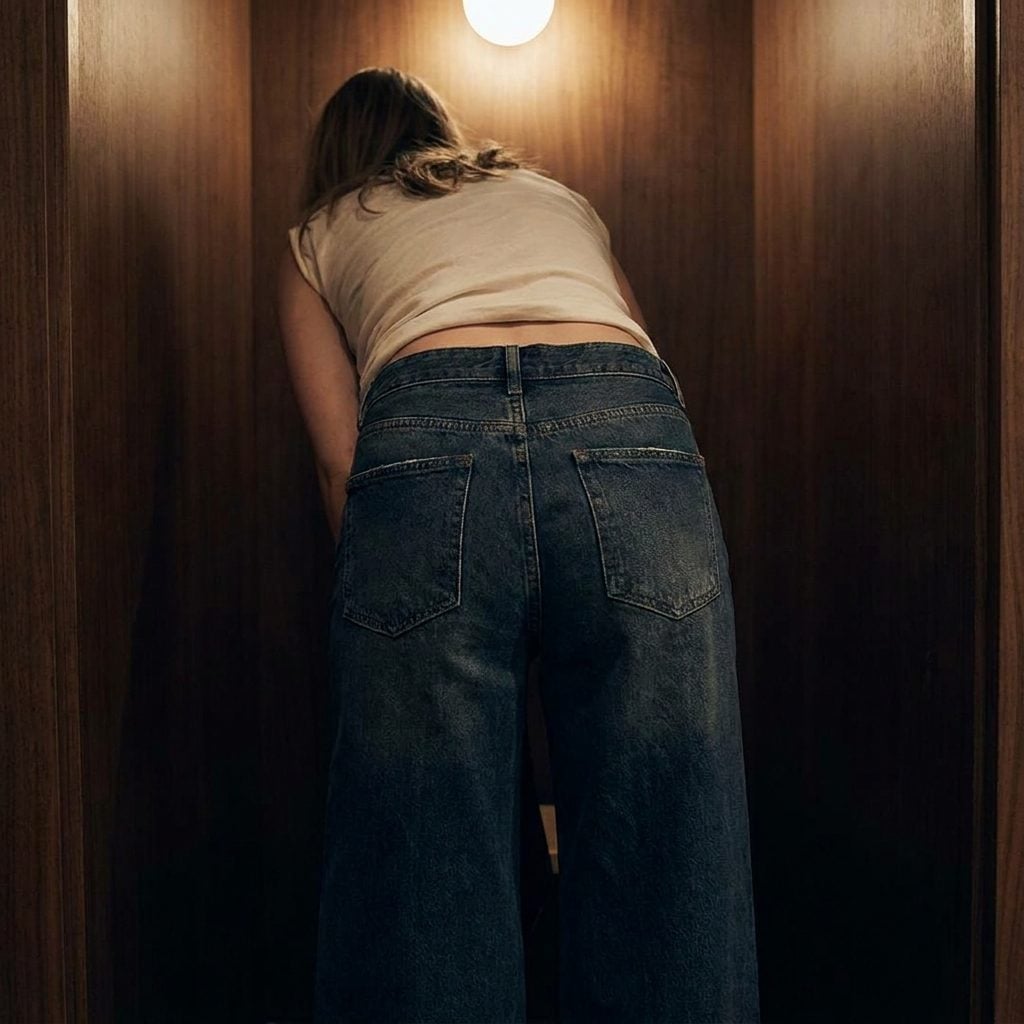
You’ve seen the gap. That gulf between waistband and lower back that flashes open every time you bend, sit, or reach. It happens when the waist is cut straight but your back curves in — which describes most backs.
And the gap isn’t a cosmetic annoyance. It undoes the whole silhouette, breaking the clean line wide-leg jeans depend on. Look for a contoured or slightly higher back rise, or have a tailor put in a simple back dart. Ten dollars, ten minutes.
19. Choosing Front Pleats That Add Bulk Through the Stomach
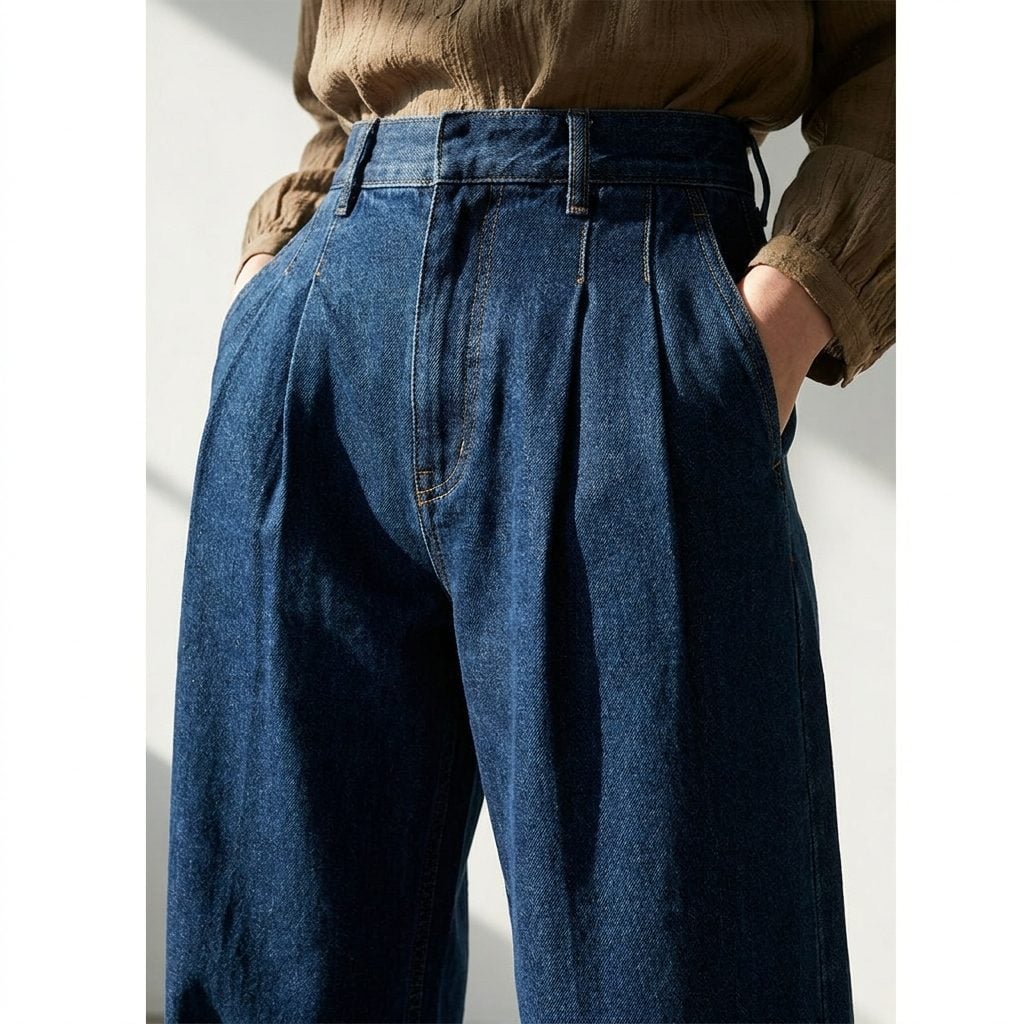
Front pleats sound elegant and photograph badly. On wide-leg jeans they open across the stomach, catch shadow, and pile volume onto the one spot most women want kept quiet. Tailored trousers can carry a pleat. Casual denim can’t.
Go flat-front instead. A smooth panel from waistband to hip lets the leg’s volume begin lower, where it actually flatters. The fitted turtleneck tucked in keeps the top half sleek, so the eye reads one clean vertical line all the way down.
18. Buying Wide-Leg Jeans With Side Pockets That Flare Open at the Hips
❤️ Would you like to save this?
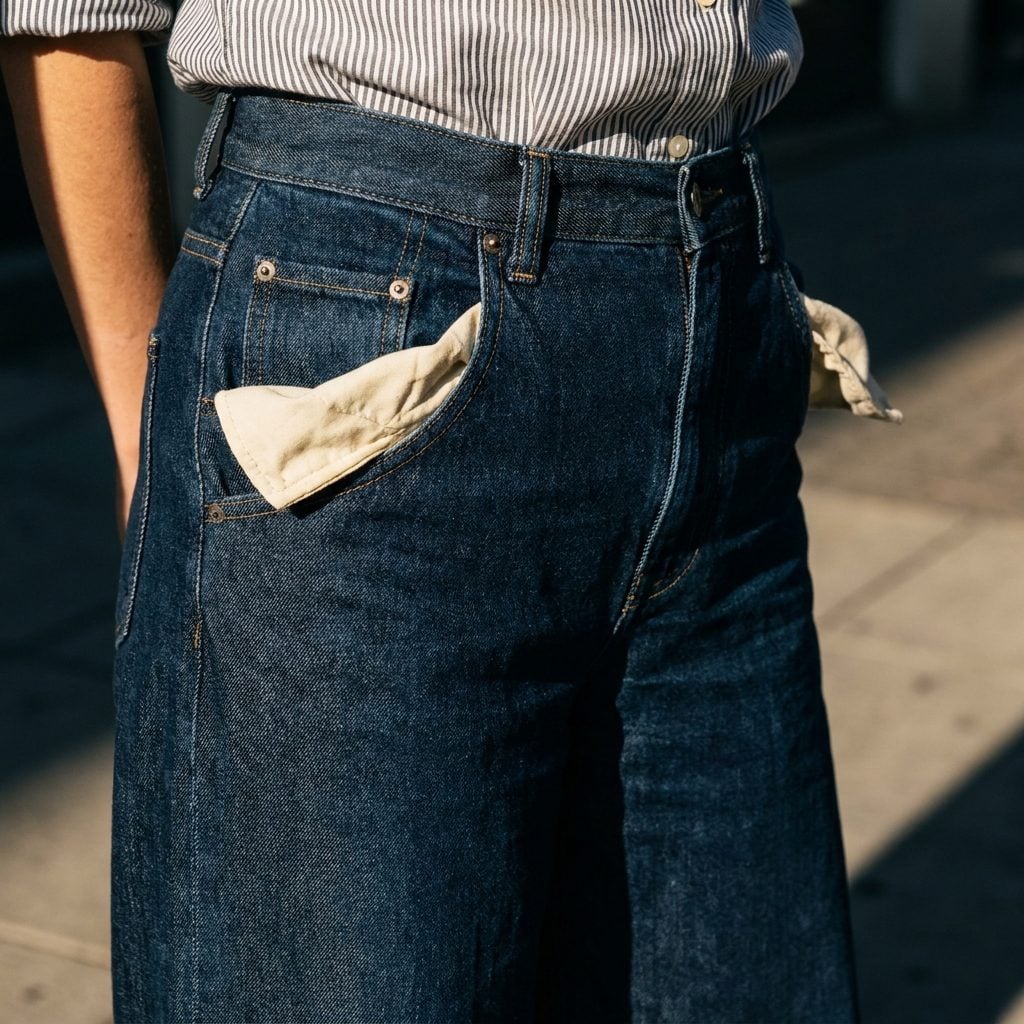
Slanted side pockets are the quiet saboteur of wide-leg denim. When the pocket bag is cut too small or set on the bias, it gapes open at the hip the second you move, piling width right where the leg already flares.
Check them in the mirror before buying. They should lie flat and stay shut, no exceptions. The camel wrap knit keeps the top half soft and narrow, so the hip stays the widest point on purpose rather than by accident.
17. Ignoring Where the Back Pockets Sit and Making Your Rear Look Lower
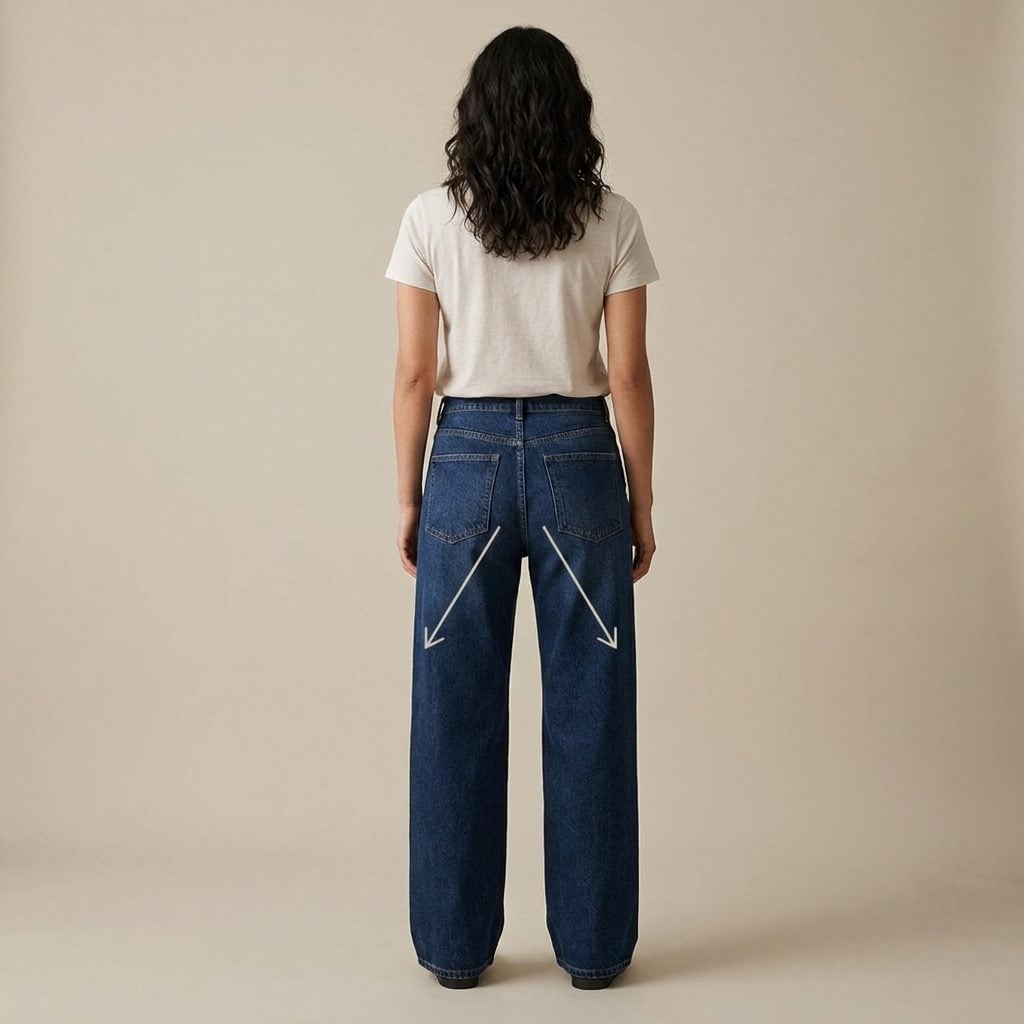
Pocket placement is the detail nobody checks and everybody clocks. Set too low or too far apart, back pockets drag the visual line of your rear down and flatten the whole silhouette. Set them high and close together and they lift, they define.
Turn around in the fitting room. Actually look. The pockets should land on the fullest part, not below it. That one decision rewrites the entire read of the jeans, and it costs you nothing but two minutes of attention.
16. Choosing Tiny Back Pockets That Make Everything Around Them Look Larger
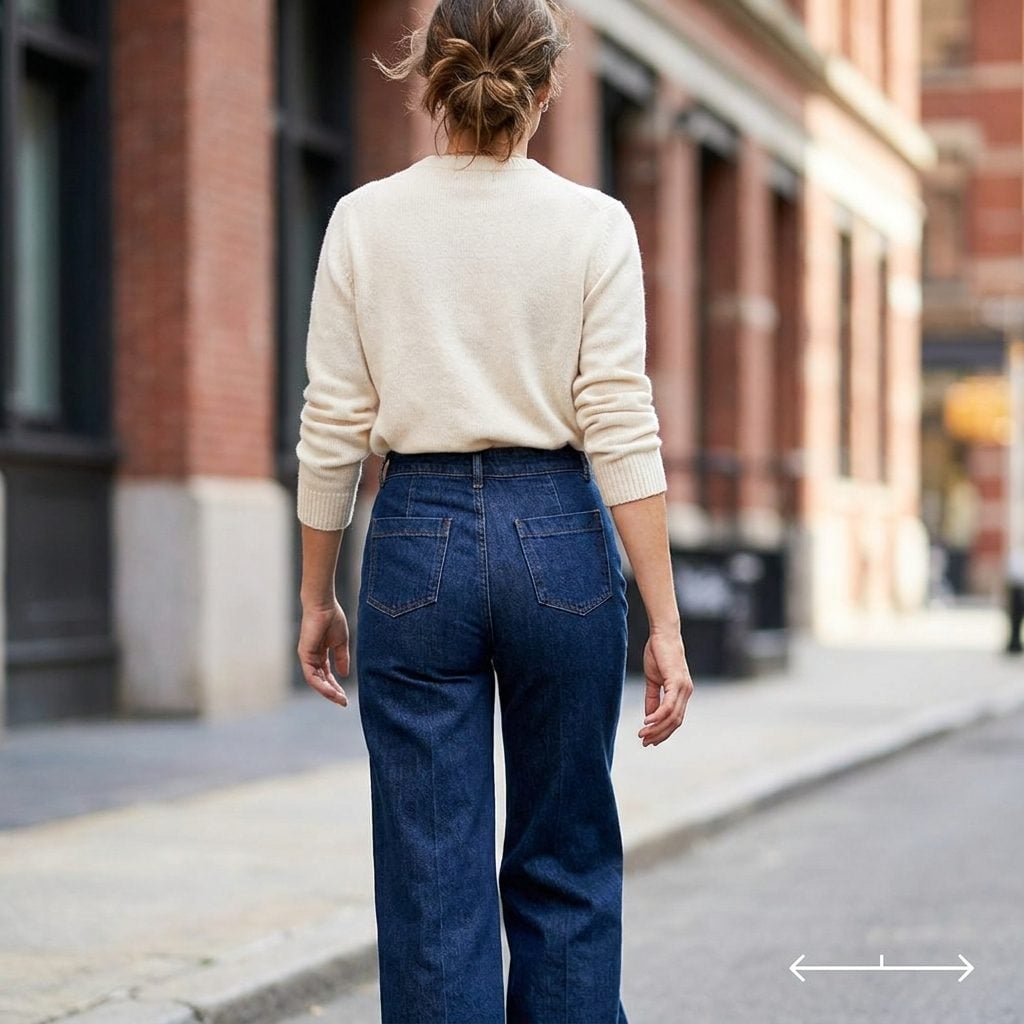
Tiny back pockets pull a cruel optical trick. Shrink the pocket and everything around it reads bigger by contrast, the way a small window makes a wall look enormous. Simple scale, working against you.
Medium, proportional pockets give the eye a reference point that sits in balance with everything else. The slim gold belt does quiet work too, marking the waist so there’s a clear high point to read from. On a curvier outfit, proportion is the whole game — and pocket size is a bigger player in it than anyone admits.
15. Choosing a Wash With Heavy Fading Across the Thighs That Visually Widens Them
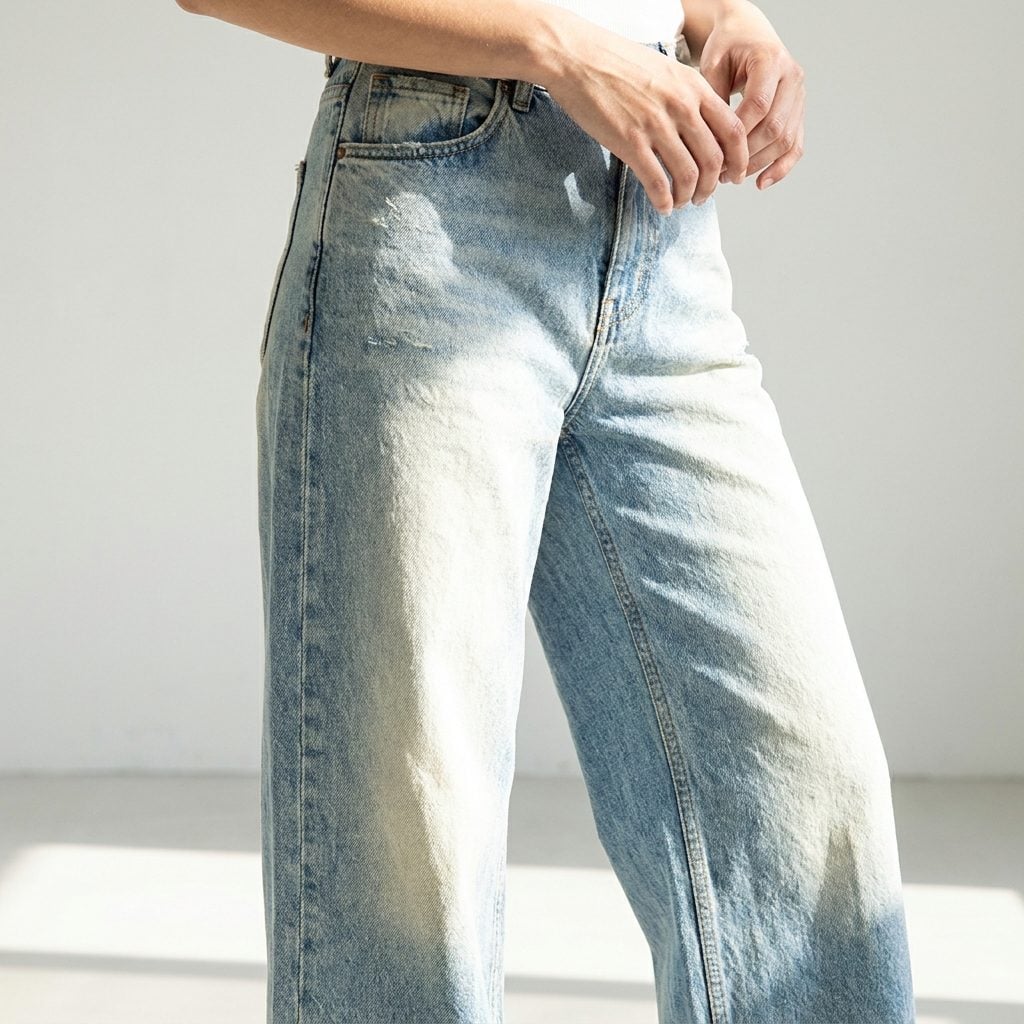
Heavy fading across the front of the thighs acts like a spotlight, dragging the eye straight to the widest part of the leg and spreading it wider still. That whiskered, blown-out wash was engineered for a skinnier silhouette, and on wide-leg jeans it works against you.
An even dark indigo does the reverse — one uniform tone reads as a single clean vertical column from waist to hem, which is the whole reason you bought a wide leg in the first place. The terracotta linen shirt adds warmth up top without starting a fight for attention. Dark and even. Every time. It’s the easiest fix on this list and, honestly, the one that changes the most.
14. Wearing Whiskering Across the Hips That Draws the Eye Straight to the Widest Area
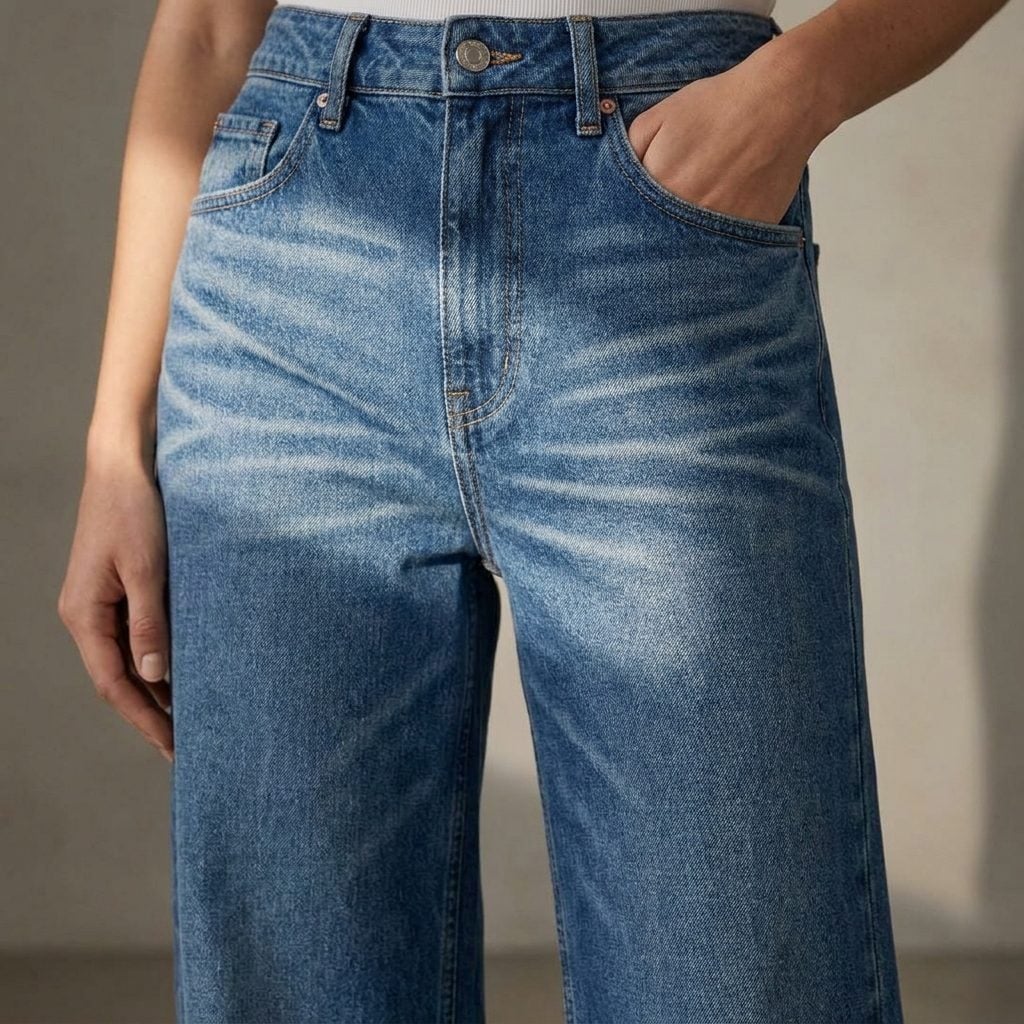
Whiskering is a spotlight, and it points wherever it lands. Fan it across the hips and it drags every eye straight to the one spot most women would rather keep quiet about, because those fade lines work like little arrows.
The fix costs nothing. Reach for dark wash wide-leg jeans with a clean, even finish — flat, uninterrupted color that runs from waist to hem and reads as one long vertical instead of a busy horizontal at the widest point.
13. Choosing Heavy Distressing That Breaks Up the Long Vertical Line
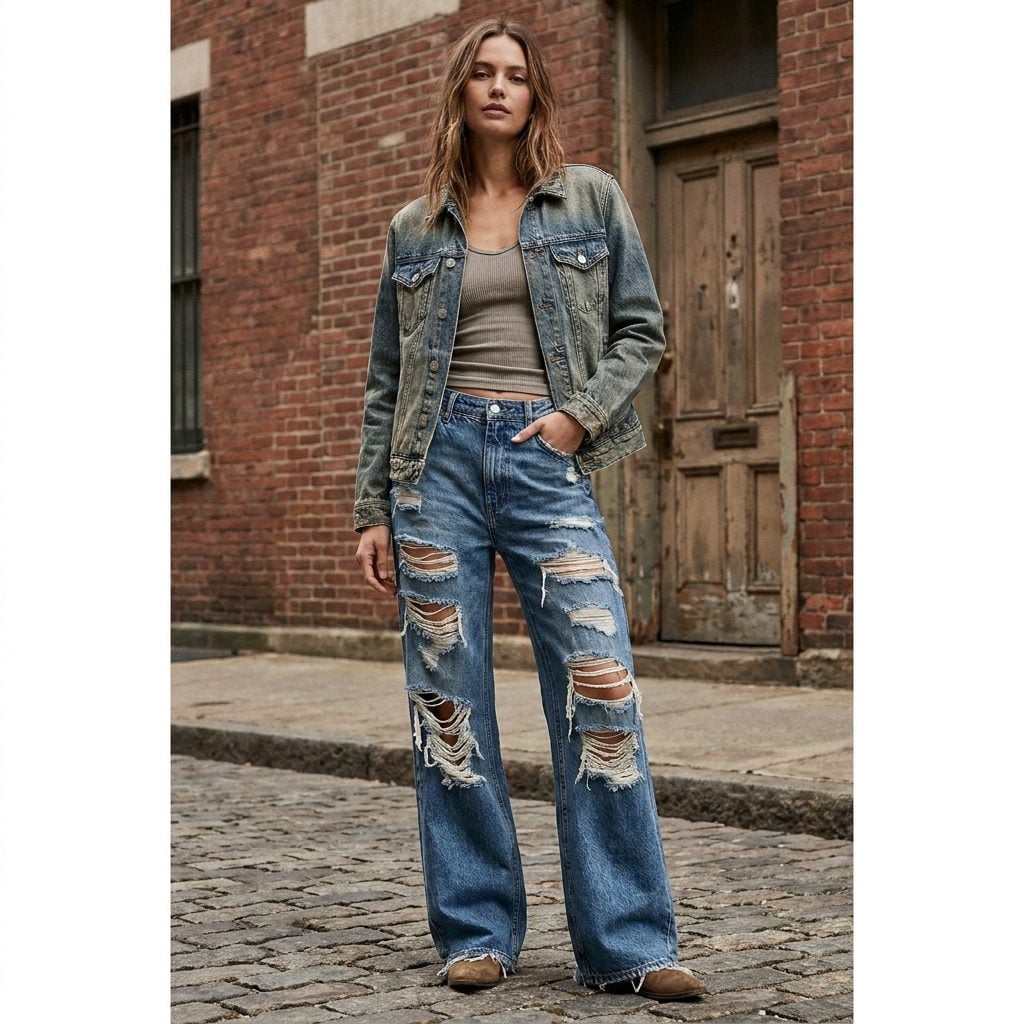
Rips are punctuation, and too many of them turn one clean sentence into a page of fragments. Every tear at the knee and thigh chops the leg into segments, and segments read as shorter. That long column you paid for? Sawed into pieces.
Wide-leg denim already carries volume, so it needs a smooth surface to balance it — not more visual noise. If you love a little edge, keep the distressing to a single subtle spot and let the rest stay intact. One frayed hem does more than five blown-out knees.
12. Wearing Wide-Leg Jeans With Flats When the Hem Was Altered for Heels
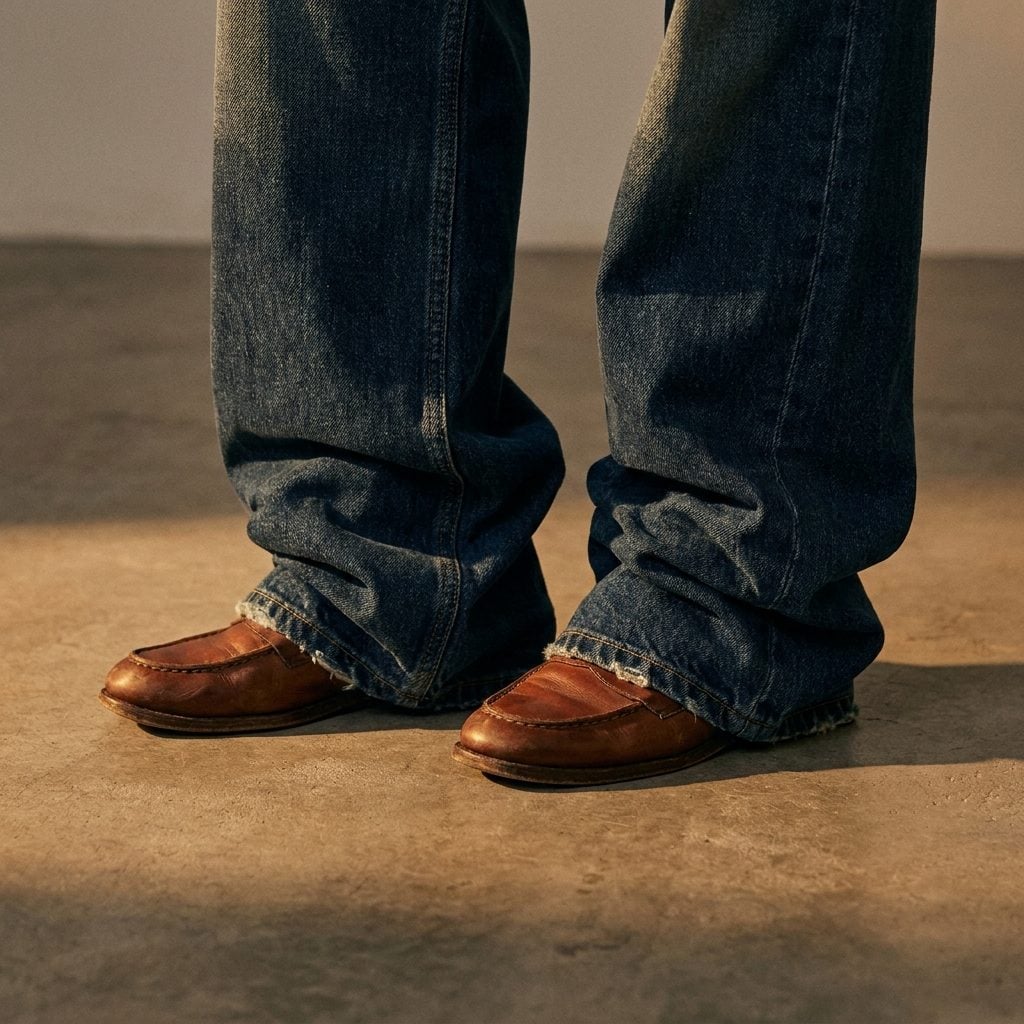
Here’s where good jeans go to die: hemmed for a three-inch heel, then worn with a flat. The extra length has nowhere to go, so it puddles at the ankle in a stack of denim folds. Reads as sloppy, not relaxed.
The rule is boring but it holds. Hem your wide-legs for the shoe you actually reach for. Flats your daily? Get them shortened for flats. One inseam serves one heel height cleanly, and pretending otherwise leaves you with a pool of fabric no styling can rescue.
11. Showing Too Much Shoe and Losing the Long, Continuous Leg Line
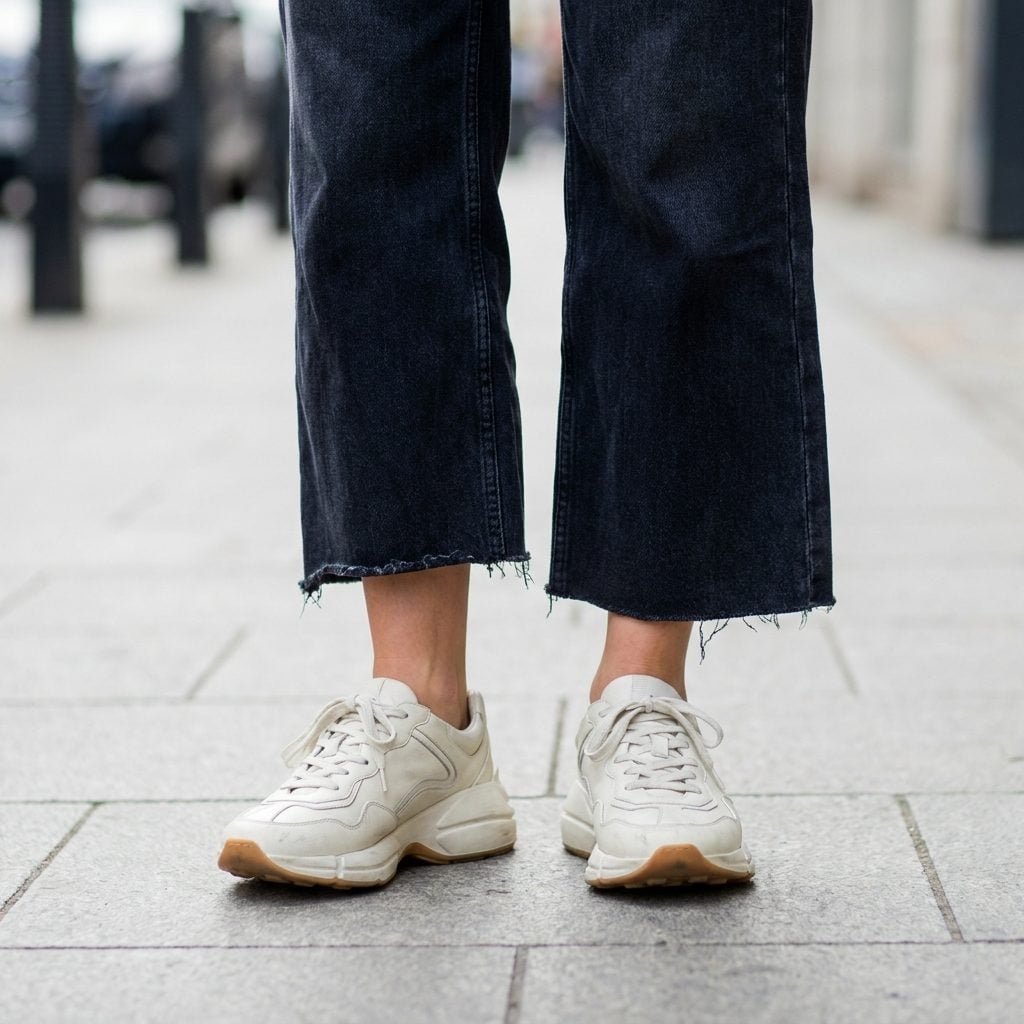
Too much shoe is its own headache. Hem the wide-leg high and suddenly the full sneaker is on display, plus a band of sock, and the leg snaps clean in two right at the ankle. That break robs you of the very height wide-legs are meant to hand over.
The window is narrow. Hem falls at the top of the shoe, covers the ankle, lets only the toe show. Nail that and the denim pours into the shoe like it was cut from the same bolt.
10. Pairing Cropped Wide-Leg Jeans With Ankle-Strap Shoes That Visually Chop Up Your Legs
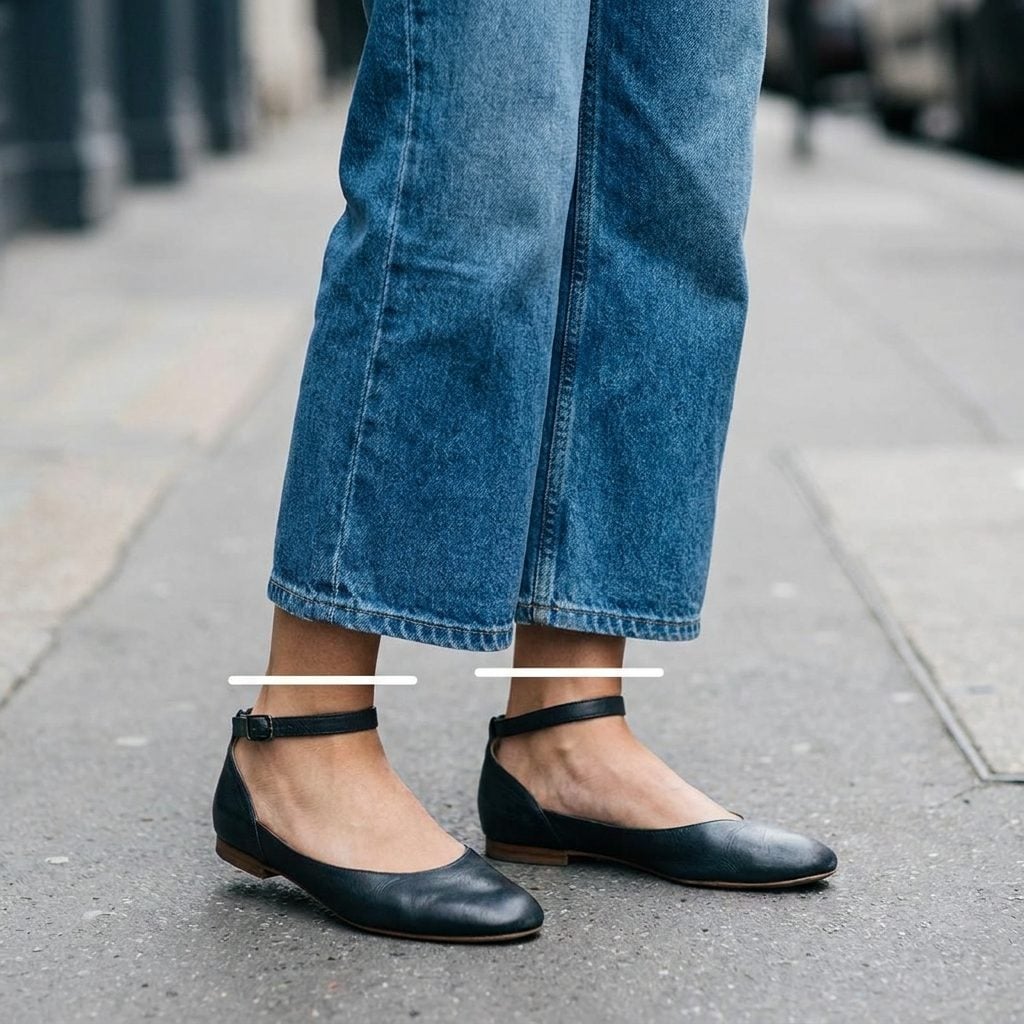
Cropped wide-legs already cut the denim off early. Add an ankle strap and you draw a second hard line across the ankle, so the leg gets sliced twice in the space of a few inches. Two horizontal breaks where you badly wanted vertical flow.
The accessory outfits that survive a crop lean on shoes that continue the line rather than chop it. Reach for a pointed mule or a low-cut pump in a tone close to your skin. An unbroken ankle keeps the leg reading long even when the hem stops short.
9. Wearing Chunky Sneakers With an Already Heavy, Extra-Wide Silhouette
❤️ Would you like to save this?
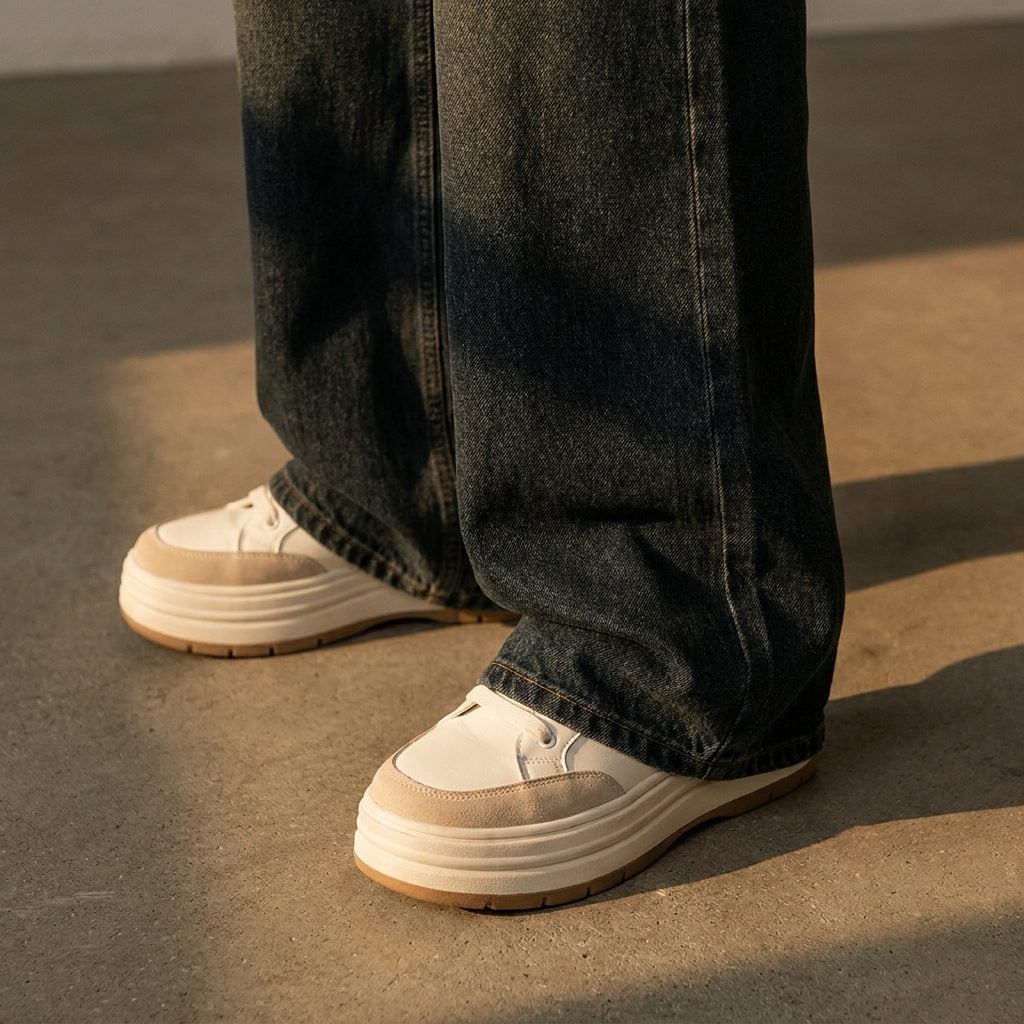
Weight on weight — that’s the trap. An extra-wide jean carries volume on its own, and a chunky platform sneaker dumps more mass right at the floor. The whole silhouette sinks, top-light and bottom-heavy, like the outfit is puddling toward the pavement.
Balance wants a lighter foot. A slim leather sneaker or a sleek loafer gives the eye somewhere to breathe under all that denim. If you love a proper sneaker moment, save the chunky pair for slimmer bottoms. Even in athleisure jeans, the low-profile shoe wins.
8. Pairing Extra-Wide Jeans With Delicate Shoes That Completely Disappear Underneath Them
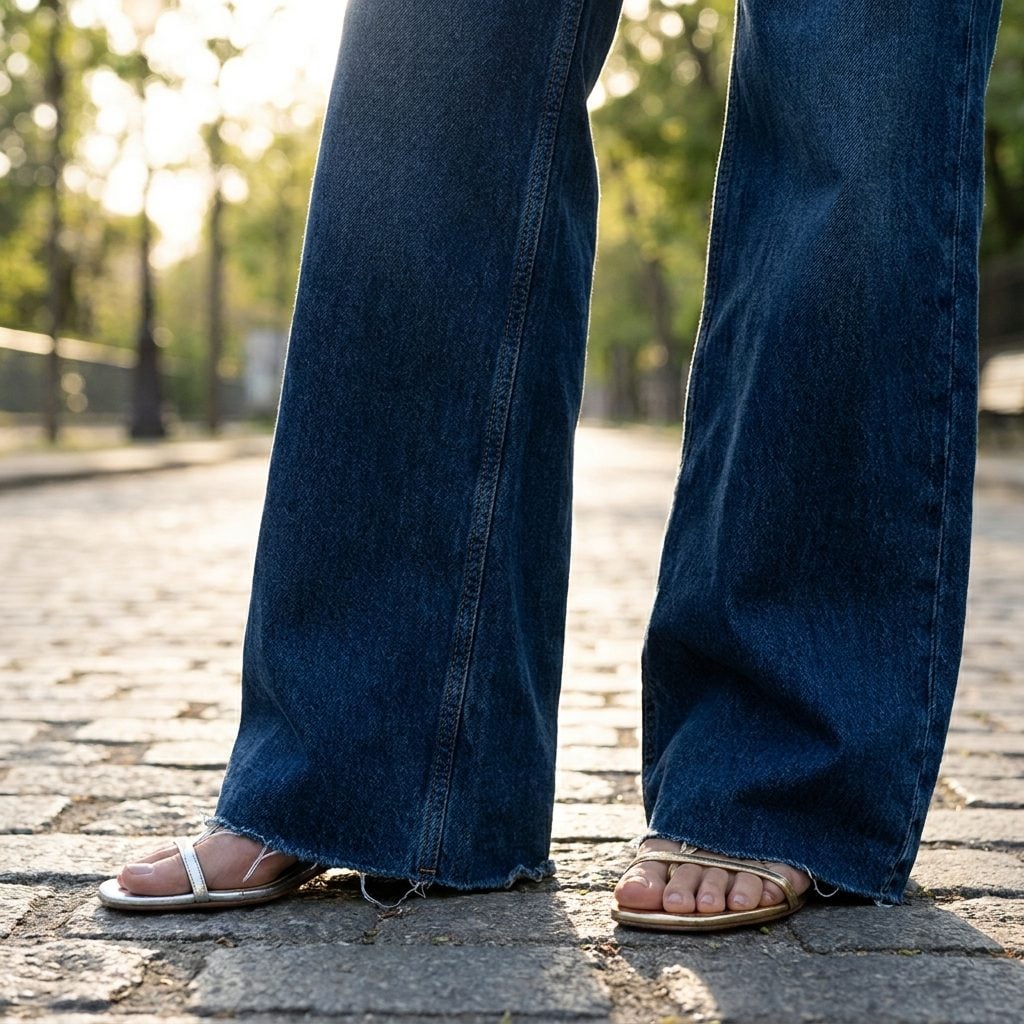
A whisper-thin sandal under a big, flowing wide-leg is a scale mismatch. The delicate straps drown in all that fabric, so the shoe registers as an afterthought and the proportion tips off balance. Volume up top wants presence down below.
So match the weight of the shoe to the weight of the jean. A sturdier heel, a substantial mule, anything with visual heft holds its ground against the fabric. The two should look like they belong in the same conversation — not like the shoe wandered in from a lighter outfit.
7. Choosing the Wrong Inseam for the Shoes You Actually Wear Most Often
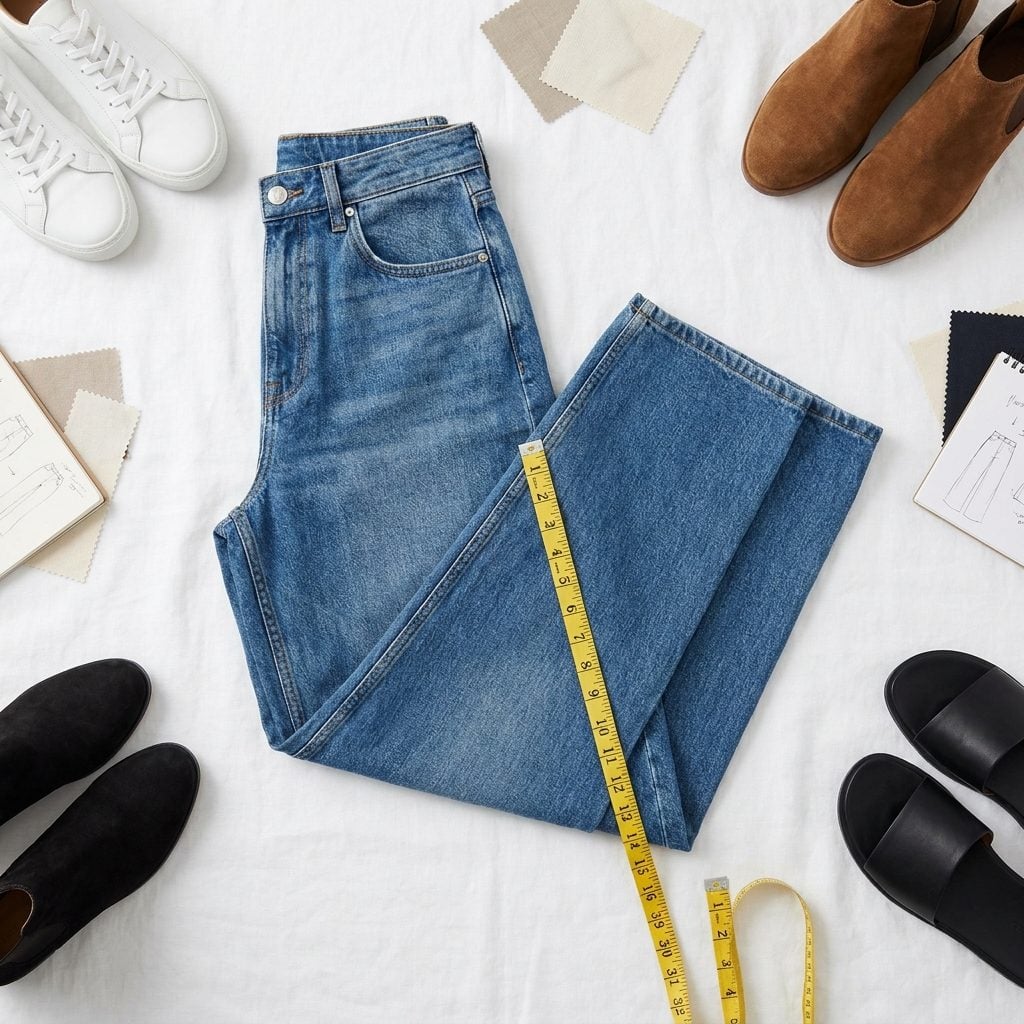
The finale is the least glamorous call on the list and the one that fixes all the rest: hem for the shoes you actually wear, not the fantasy pair sitting in a box you’ve opened twice. Most women live in one or two heel heights. Cut your inseam for those.
Get this right and every problem above just evaporates. No pooling, no high-waters, no swallowed shoe — only a clean line from waist to floor that skims your daily flat or heel and reads as one long, deliberate column. It’s the gap between an outfit that looks considered and one that looks almost-there.
6. Cinching a Wide Contrast Belt That Slices You Clean in Half
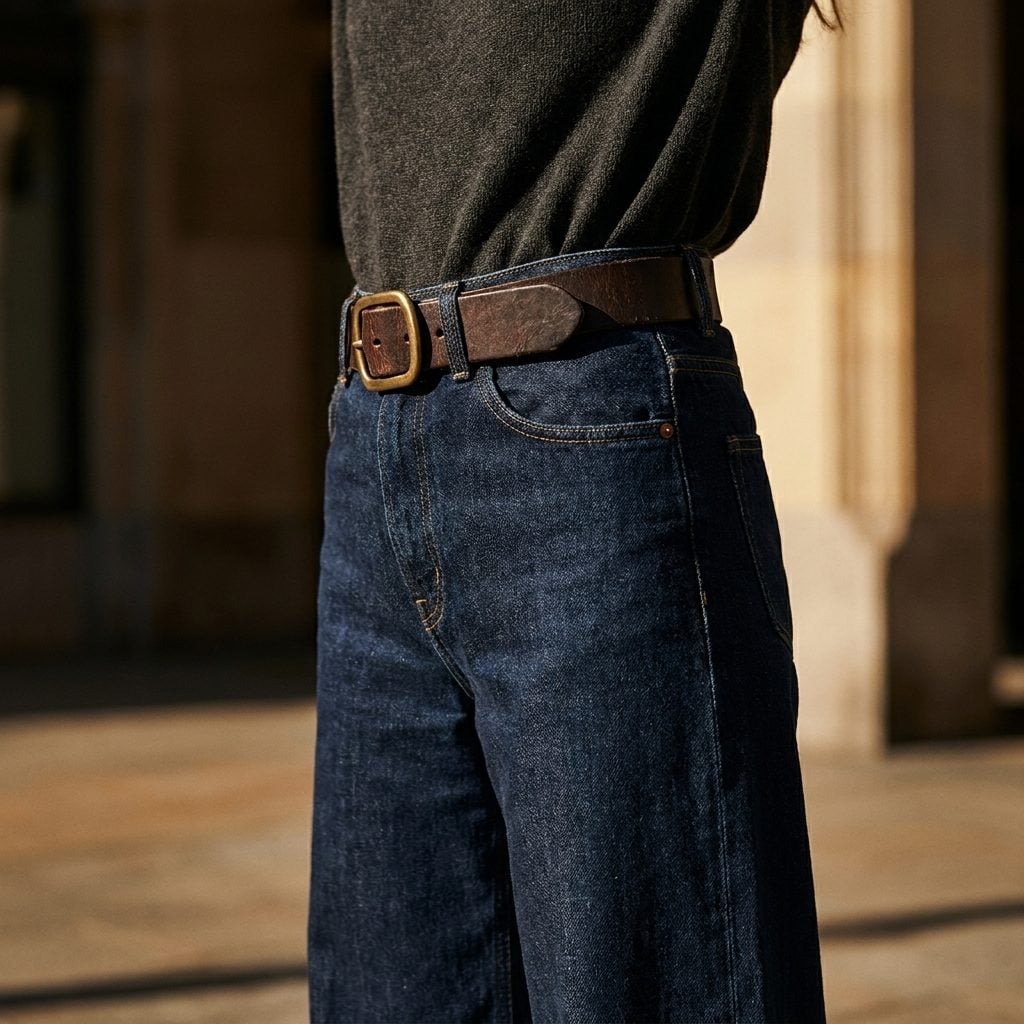
The wide belt promised waist definition. What it delivered was a horizontal stop sign across your middle. High contrast plus width draws a hard line that chops you into an upper block and a lower block, and neither one comes out looking any longer for the trouble.
Real definition comes from the belt matching or nearing the tone of your waistband, so the eye reads a continuous column with a subtle nip rather than two stacked rectangles. A skinny tonal belt does that. So does a self-fabric tie. Save the bold contrast for a dress, where the body already reads as one shape.
5. Yanking a Belt So Tight the Waistband Bunches Into Accordion Folds
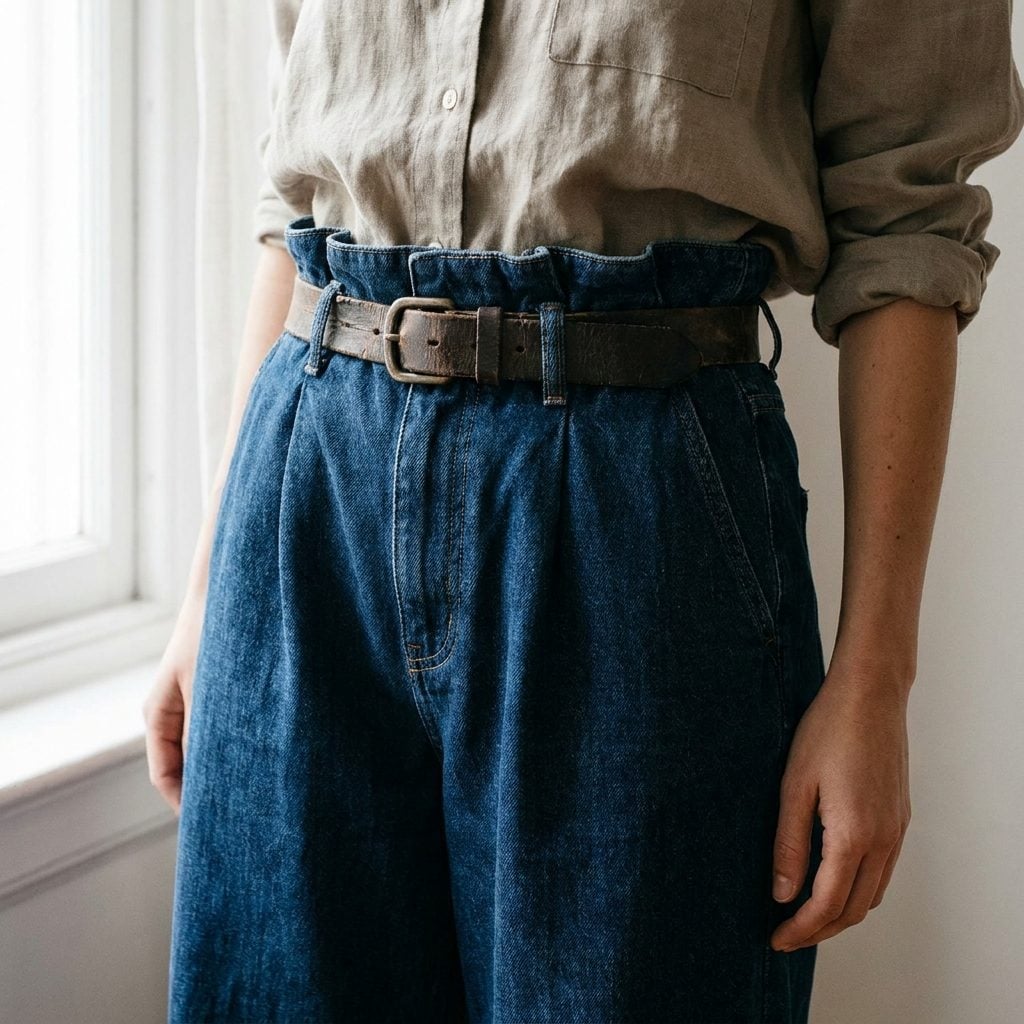
Over-tightening a belt on a too-loose waistband doesn’t look intentional. It gathers the denim into little folds that quietly confess the jeans don’t fit. Every pucker is a tell.
A waistband should sit close enough that the belt is decoration, not a load-bearing wall. If you’re counting on it to hold everything up, the size or the rise is wrong — that’s the whole diagnosis. Get the waist tailored, then let the belt do the light job it was born for. Honestly, bunched fabric ages an outfit faster than almost anything, and it’s completely preventable.
4. Pairing Very Light Wide-Leg Jeans With a Very Dark Top and Stacking Two Solid Blocks
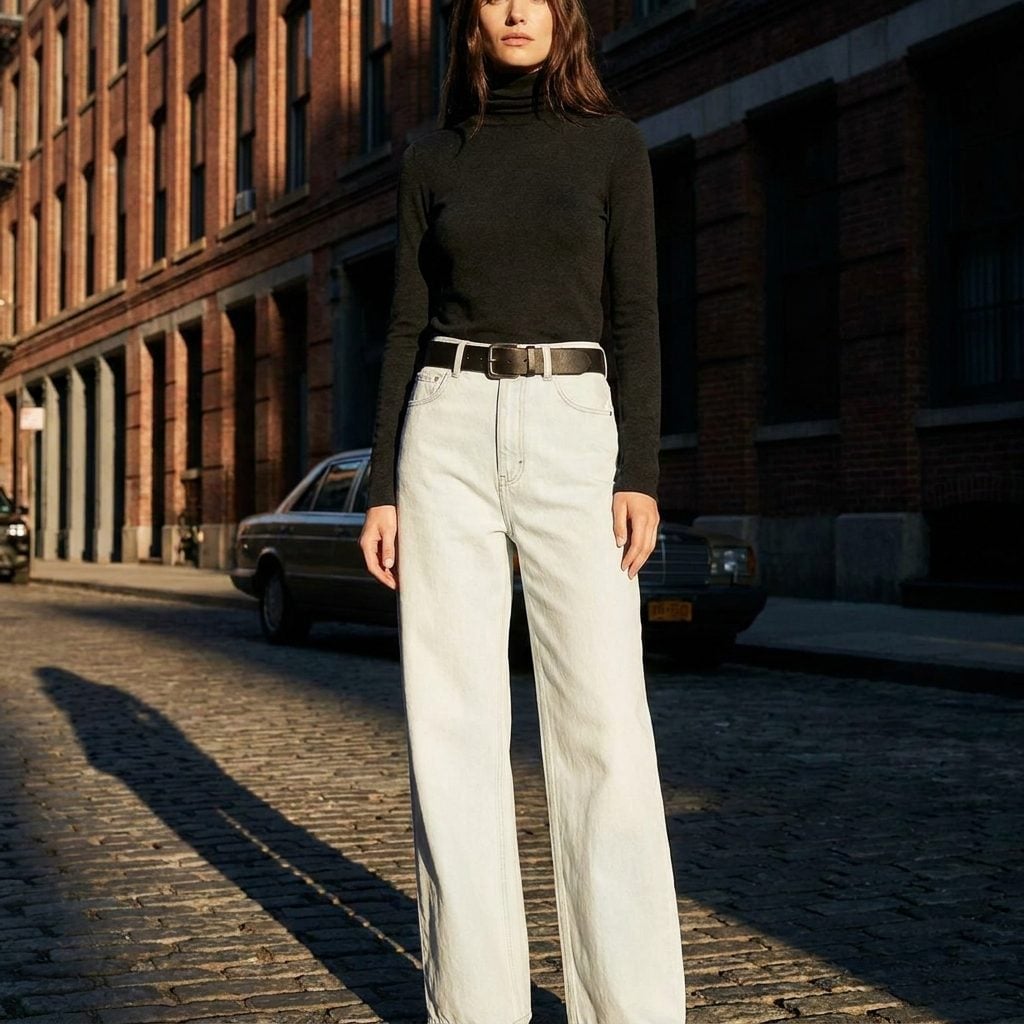
Pale jeans, dark top, hard stop at the waist. Your eye lands on the exact seam where the two colors collide, pinning all the attention to your midsection and squashing everything above and below it.
What you need is a bridge. Add a mid-tone layer that carries the darkness downward, or a shoe that echoes the top, or a jacket spanning both zones. One connecting element and the two blocks start talking to each other instead of sitting there like a paint sample.
3. Layering So Many Long Pieces You Lose Your Waist and Your Legs Entirely
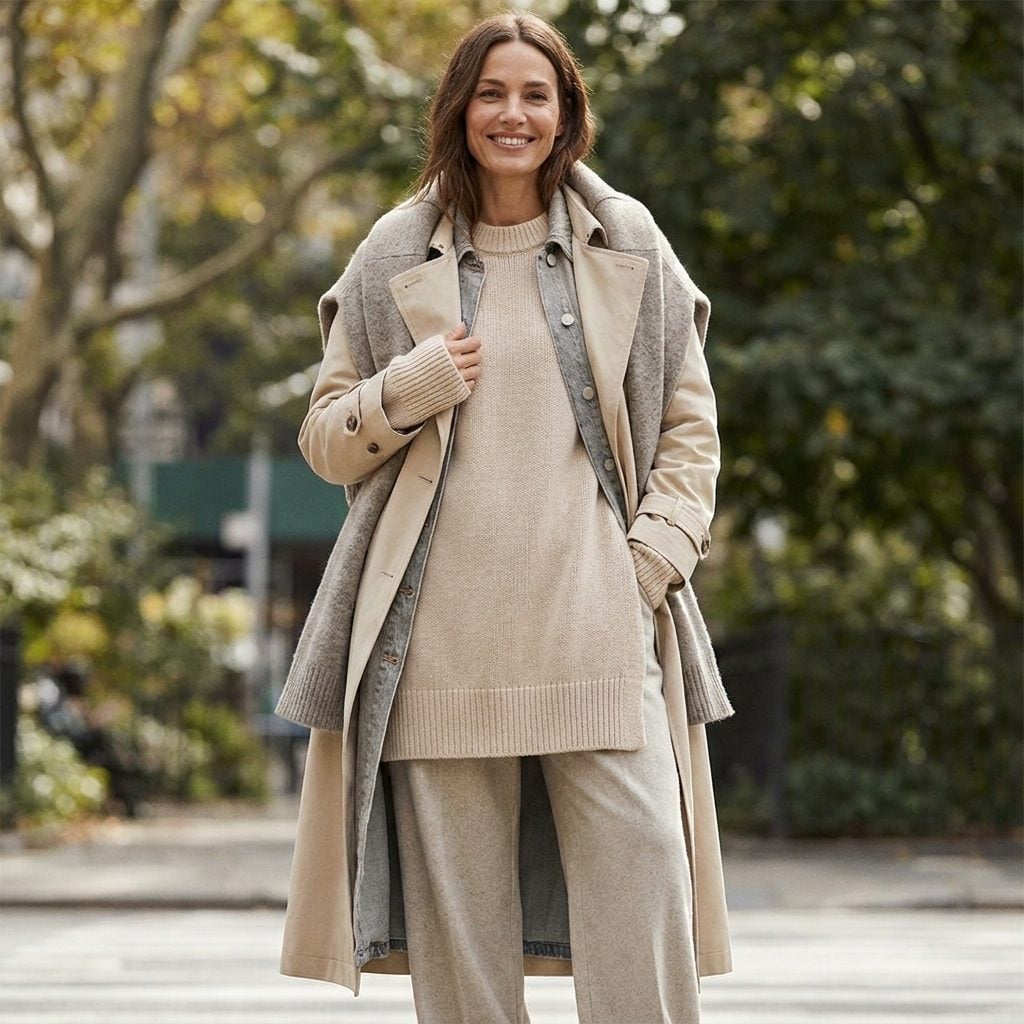
Long jeans, long sweater, long coat, all in soft tones, and now you’re one continuous rectangle with legs hidden somewhere inside it. Layering is a balancing act, and stacking three floor-reaching lengths tips it straight into pure volume.
Wide-leg jeans already bring the length. What they want is a shorter partner up top to mark where the waist lives and let the leg read as leg. A cropped jacket. A hip-length knit. A simple front tuck. Any one of them hands the eye a place to pause. One long layer with the jeans is plenty; three is where the shape dissolves.
2. Trying to Style Your Way Out of a Genuinely Bad Cut Instead of Finding a Better One
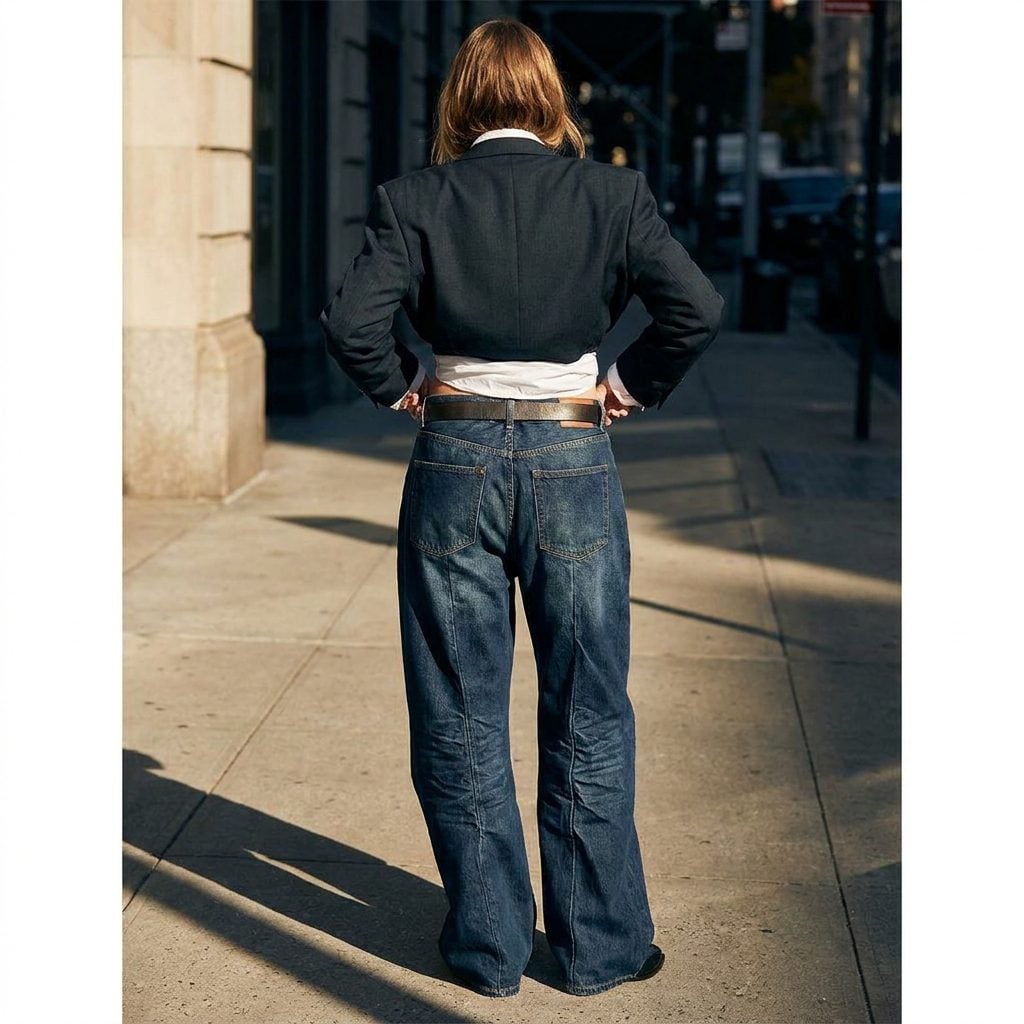
No blazer, belt, or clever tuck rescues jeans that pull across the hip or gape at the back. Pile on the styling all you want. A bad cut telegraphs through every single layer.
The honest move is to stop styling and start over. A pair that fits your hip-to-waist ratio needs almost no tricks — it just works, quietly, the way good androgynous jeans do. I spent years accessorizing around ill-fitting denim before I admitted the denim was the problem, not my styling. Embarrassing, in hindsight.
1. Keeping a Trending Pair That Clearly Fights Your Body Because the Internet Told You To

Trending doesn’t mean flattering on you specifically. If the wide-leg fights your frame every time you pull it on, no amount of runway coverage changes that. Keeping a pair out of trend-loyalty is how closets fill up with clothes you never actually reach for.
Here’s the freeing part. You already have the authority to walk away from a shape that doesn’t serve you. A relaxed straight-leg, a fluid palazzo, a barrel cut — all of them give you movement and ease without the specific proportions that clash with yours. The trend is a menu, not an order. Pick the cut that makes you stand a little taller when you catch your reflection, and let the rest scroll on by.
That confidence in the mirror outlasts any trend cycle. Wear what fits. Everything looks better on a woman who knows it does.