❤️ Would you like to save this?
Denim is one of the few clothes we can date almost by silhouette alone. A flare dragging under a platform shoe says one decade before you even notice the blouse. A pale tapered leg, cinched high under a wide belt, says another. Then the waistband drops, the ankle narrows, the hem gets cut off, the whole leg balloons outward, and suddenly the same blue cotton twill is carrying an entirely different idea about how a woman ought to occupy space.
That is what makes jeans such a good piece of fashion archaeology. The fabric stays stubbornly recognizable while nearly everything around it changes: rise, volume, wash, stretch, pocket placement, branding, shoes, posture. Some eras wanted the body poured into denim. Others wanted enough fabric to lose a skateboard inside one leg. Designer labels migrated to the back pocket so everyone behind you could read them; rhinestones followed; then logos disappeared and an unfinished hem became the thing worth noticing. Even the parts that looked accidental — fading, fraying, knees blown open, hems dragging across sidewalks — eventually became things manufacturers learned to sell back to us.
These 33 looks move chronologically from homemade 1970 bell-bottoms to where denim appears to be heading in 2027. Watch the waist climb, plunge, and climb again. Watch legs flare, taper, disappear inside boots, balloon outward, straighten up, and rediscover the bootcut. The clothes tell one story, but the rituals around them tell another: lying on the bed to close a zipper, cutting off a hem with kitchen scissors, displaying a designer’s name across your backside, refusing to surrender your skinnies, then discovering that the supposedly new pair everyone wants looks suspiciously like something you owned twenty-five years ago. Denim changes constantly, but it also has an exceptionally good memory.
FYI, thanks to AI imagery software, we’re able to create very specific fashion and hairstyle examples to illustrate the points being made. In some cases, imagery is exaggerated to hammer home the point. Also, assume links that take you off the site are affiliate links such as links to Amazon. this means we may earn a commission if you buy something.
The 1970 Patchwork Bell-Bottoms You Half-Made Yourself

Before denim companies learned to sell distressing, embroidery, patches, and carefully manufactured individuality, people were perfectly capable of attacking their own jeans with scissors.
Split the outer seam from the knee down and sew in a triangle of corduroy, bandana cotton, velvet, or whatever fabric survived the sewing basket. Add embroidered flowers if patience allowed. Let the new flare drag until the hem developed a fringe the factory would later charge extra to imitate.
These jeans looked personal because they actually were. The silhouette may have belonged to the decade, but the mistakes belonged entirely to you.
1972: The Sailor-Front Flares With the Buttons Marching Up the Hip

Those buttons were the whole reason to buy them. Marching up the hips in two tidy rows, they turned a waistband into a piece of decoration before the enormous flare even entered the conversation.
The fitted top is what makes the proportions work. Snug through the torso, controlled through the upper leg, then a dramatic sweep from the knee down. Platforms let the hem hover close to the ground without disappearing under it.
1976: The Bell-Bottoms Worn With a Peasant Blouse and No Bra to Speak Of

The blouse looked better slightly rumpled. The jeans looked better slightly too long. Together they produced an outfit whose whole achievement was making considerable styling look accidental.
Wide jeans dragged along the ground while the peasant blouse added volume through the sleeves and neckline. Hair stayed loose, shoes nearly disappeared, and the silhouette moved from shoulder to hem without many sharp interruptions.
The 1977 Gloria Vanderbilt Jeans With the Little Swan on the Pocket
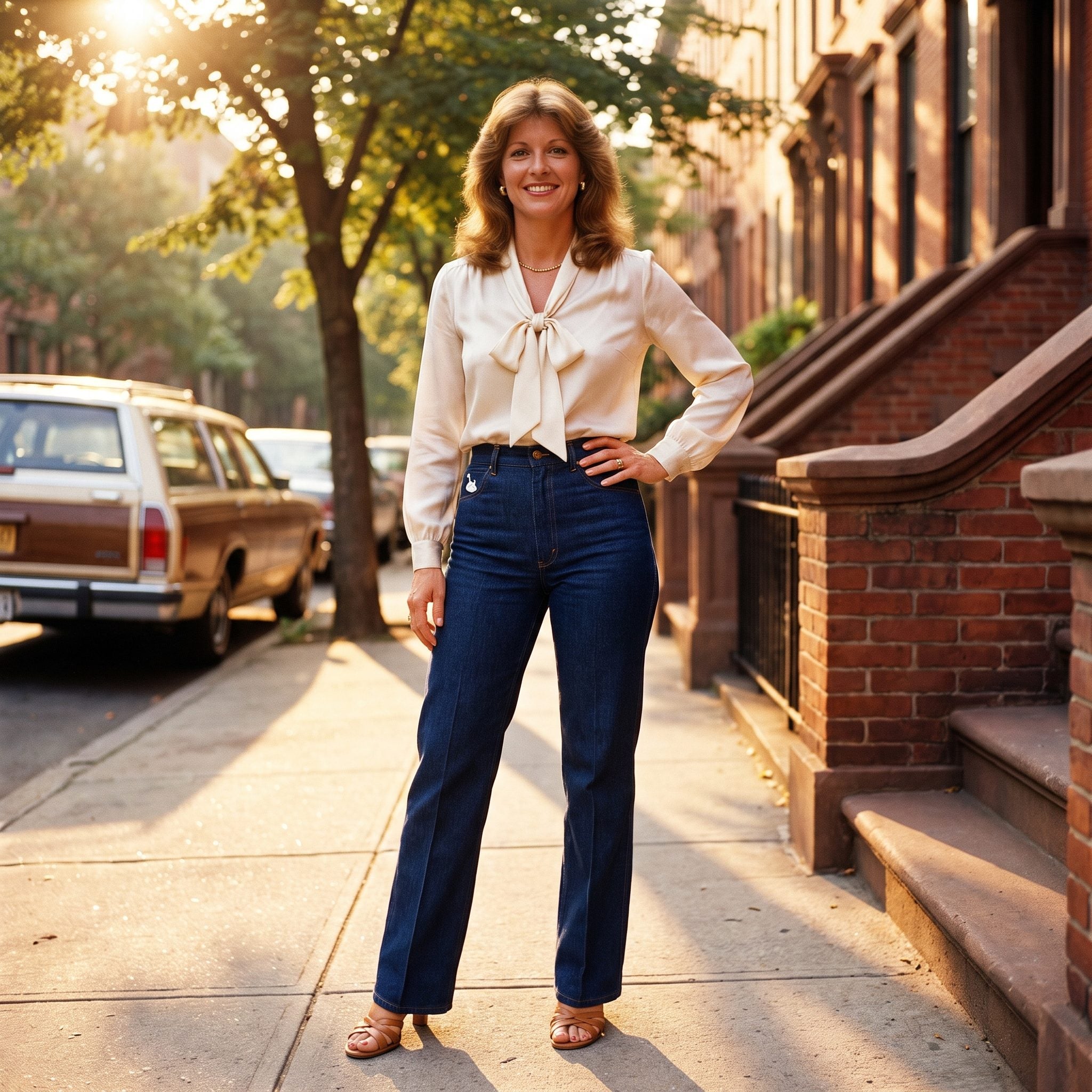
The little swan made the pocket recognizable before you could read the name.
Gloria Vanderbilt’s jeans helped turn women’s denim into something overtly fitted, branded, and aspirational. High waist, close hip, narrow leg: the cut treated jeans less like borrowed workwear and more like fashion designed specifically around a woman’s body.
Fresh denim could be brutally stiff. Getting the zipper closed became part dressing ritual, part competitive sport. Once broken in, though, the jeans molded to the wearer in a way stretch denim later made almost unnecessary.
The 1979 Designer Jeans With Someone Else’s Name on Your Back Pocket
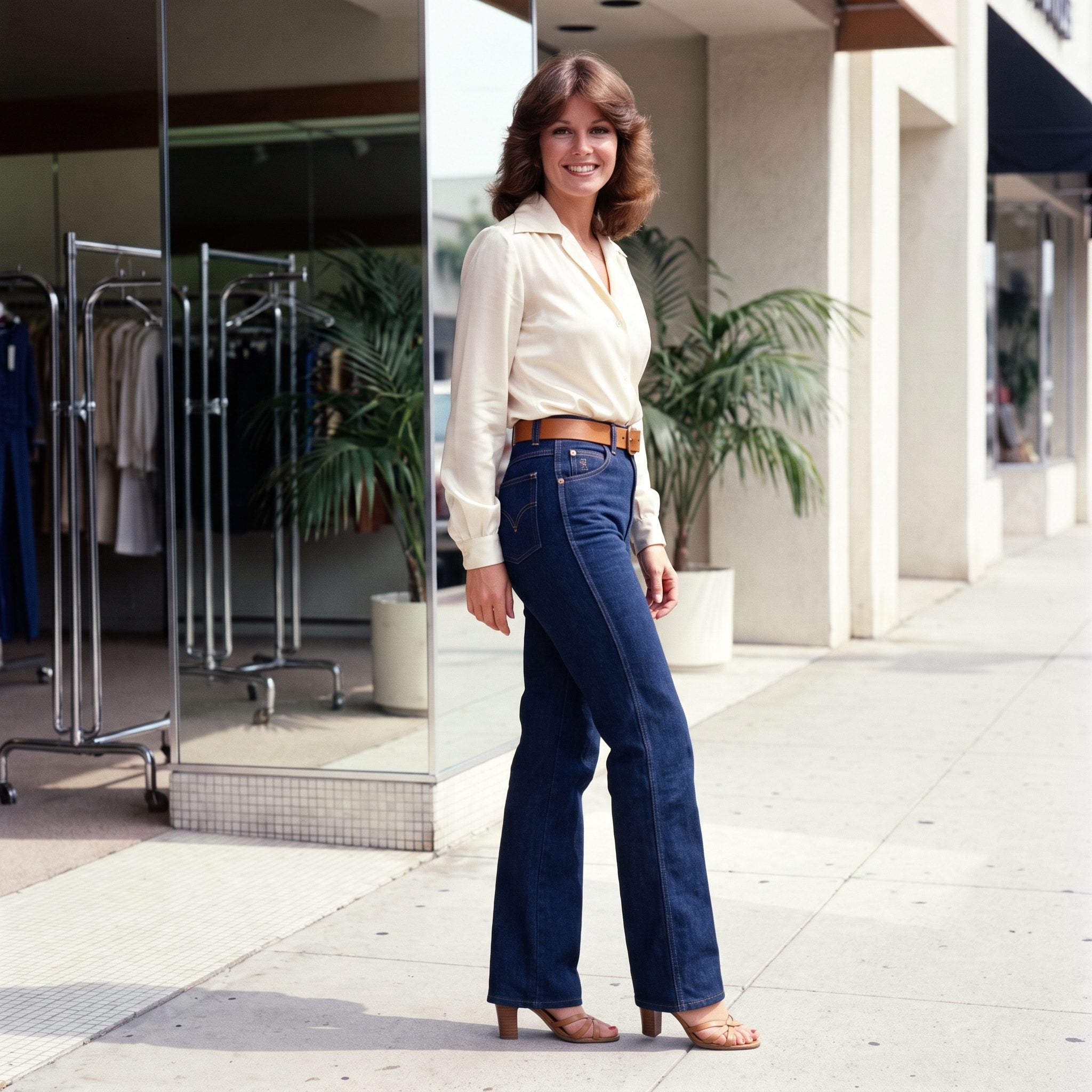
By the end of the 1970s, the back pocket had become advertising space. Gloria Vanderbilt, Jordache, Sasson — suddenly the name stitched behind you could matter almost as much as the cut.
The waist sat high, the leg stayed narrow, and getting into a fresh pair could involve lying flat on the bed and treating the zipper like stubborn machinery. These weren’t work jeans. They were going-out denim, worn with a blouse, heels, and the understanding that standing sometimes looked considerably better than sitting.
1982: Sasson and Sergio Valente Turn the Designer-Jean Wars Into a Full-Contact Sport
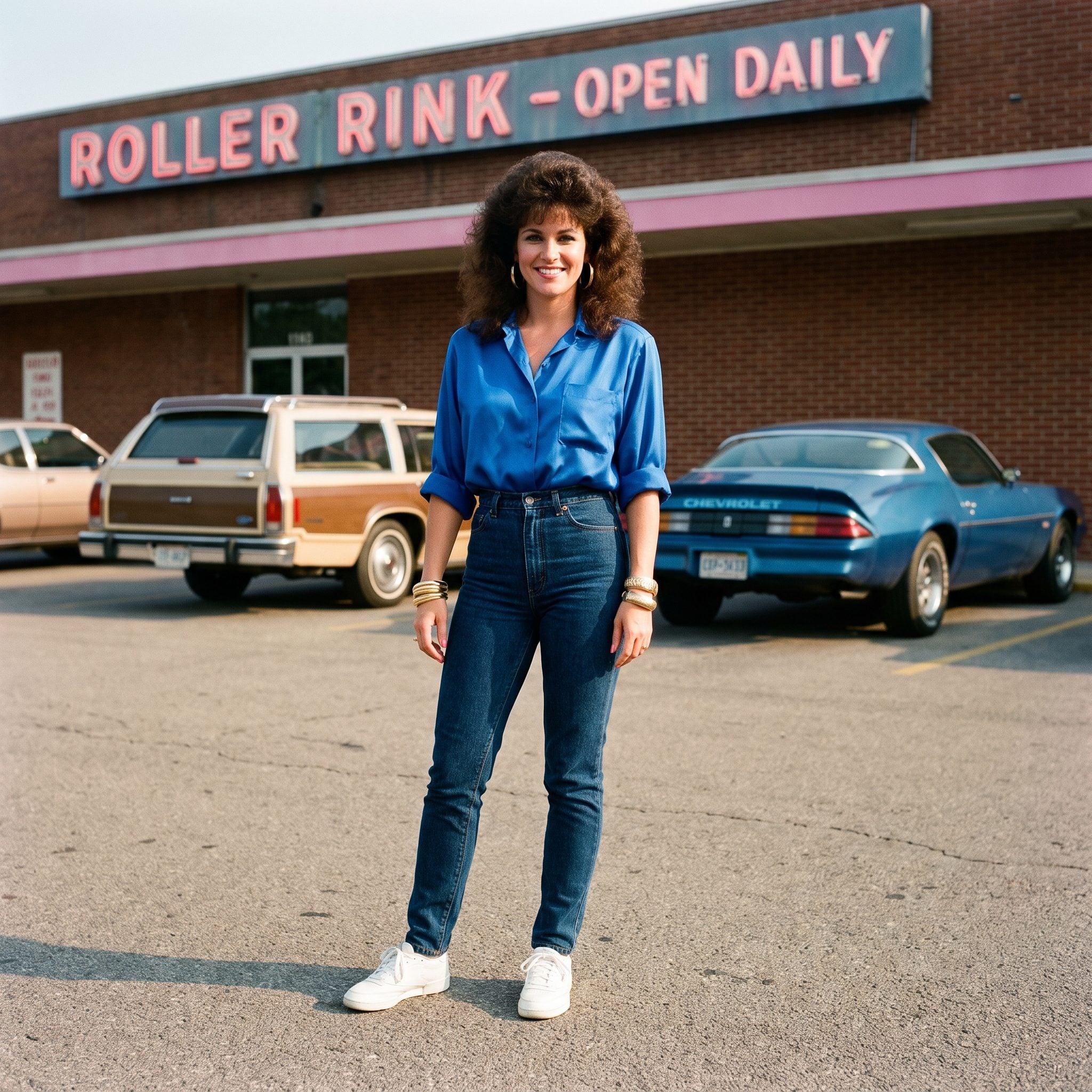
Sasson. Sergio Valente. Chic. Jordache. The names arrived fast enough that denim shopping began to resemble choosing sides.
The fit stayed unforgiving: high waist, narrow hips, tight leg, usually bought with the optimistic belief that denim would eventually surrender. Up top came shine and volume — satin blouse, boxy blazer, shoulder pads — because a close-fitting lower half gave the rest of the outfit permission to expand.
1983 and the Acid-Wash Jeans That Announced You From Across the Parking Lot
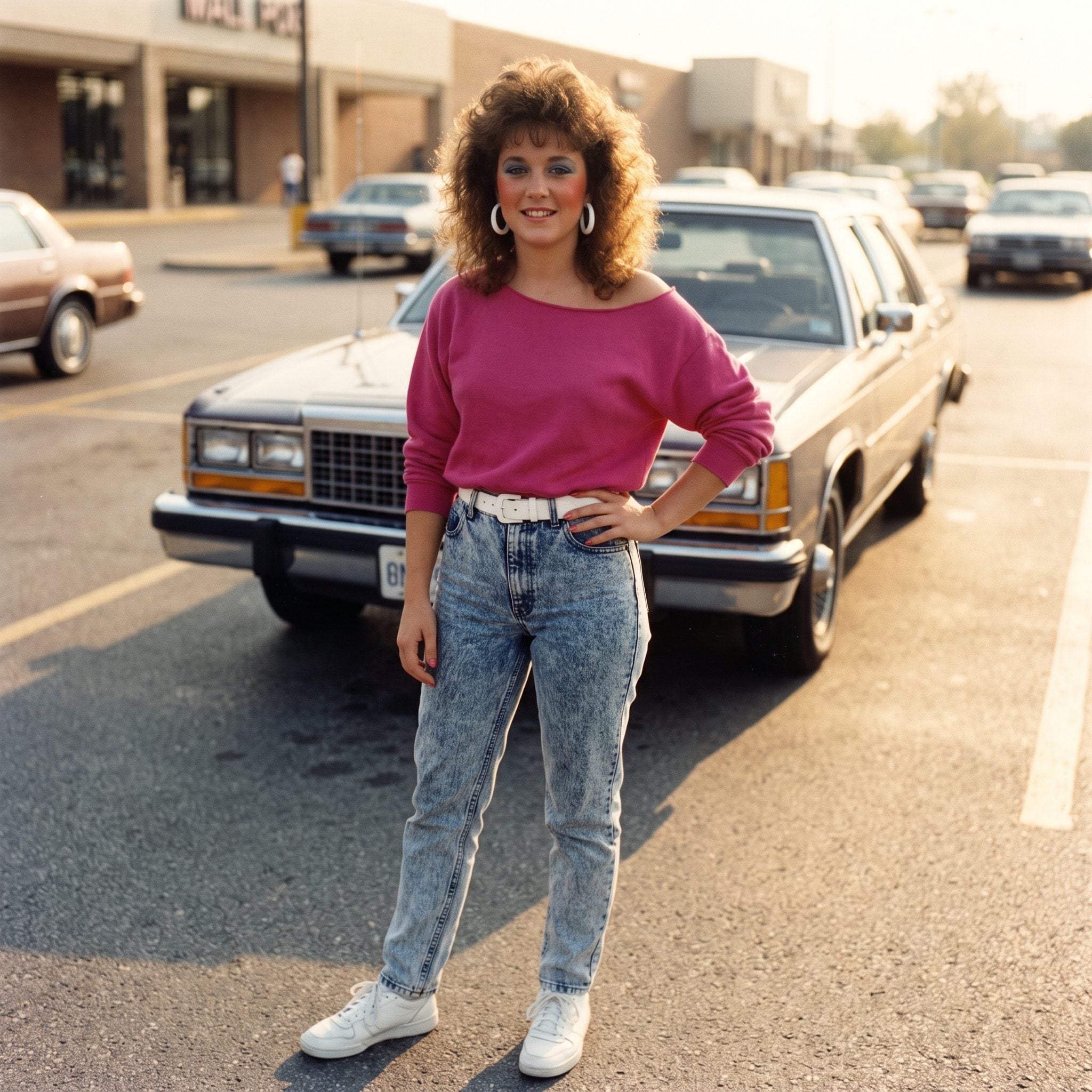
No two pairs looked quite alike. Pale bursts and dark veins ran across the denim as though somebody had developed a thunderstorm directly on your legs, and subtlety was nowhere in the brief.
These jeans came stiff, high-waisted, and usually tapered hard toward the ankle. Add a slouch sweatshirt, plastic belt, enormous earrings, and whatever shoes could survive an afternoon at the mall. Acid wash wasn’t asking to blend into an outfit. The jeans were the outfit.
1985: The Corduroy Wide-Wale Jeans Worn With a Turtleneck and No Apology

The ridges caught light in a way denim couldn’t, and anyone who owned wide-wale corduroy remembers the faint swish that followed every hallway walk.
Rust, olive, mustard, brown — the color mattered almost as much as the texture. A smooth fitted turtleneck was the right counterweight because another bulky fabric up top would have pushed the whole thing toward upholstery.
The 1987 High-Rise Stonewash Tucked Into a Wide Belt and Bigger Hair

Getting dressed meant tucking.
An oversized sweater disappeared into a waistband sitting at or near the natural waist, then a broad belt cinched the whole arrangement into submission. Pale stonewashed denim tapered toward the ankle while the upper half expanded through shoulders, knitwear, and hair.
The silhouette was basically a triangle standing on its point. Everything got bigger on the way up.
The 1988 Acid-Wash Denim Jacket-and-Jeans Set Worn Head to Toe
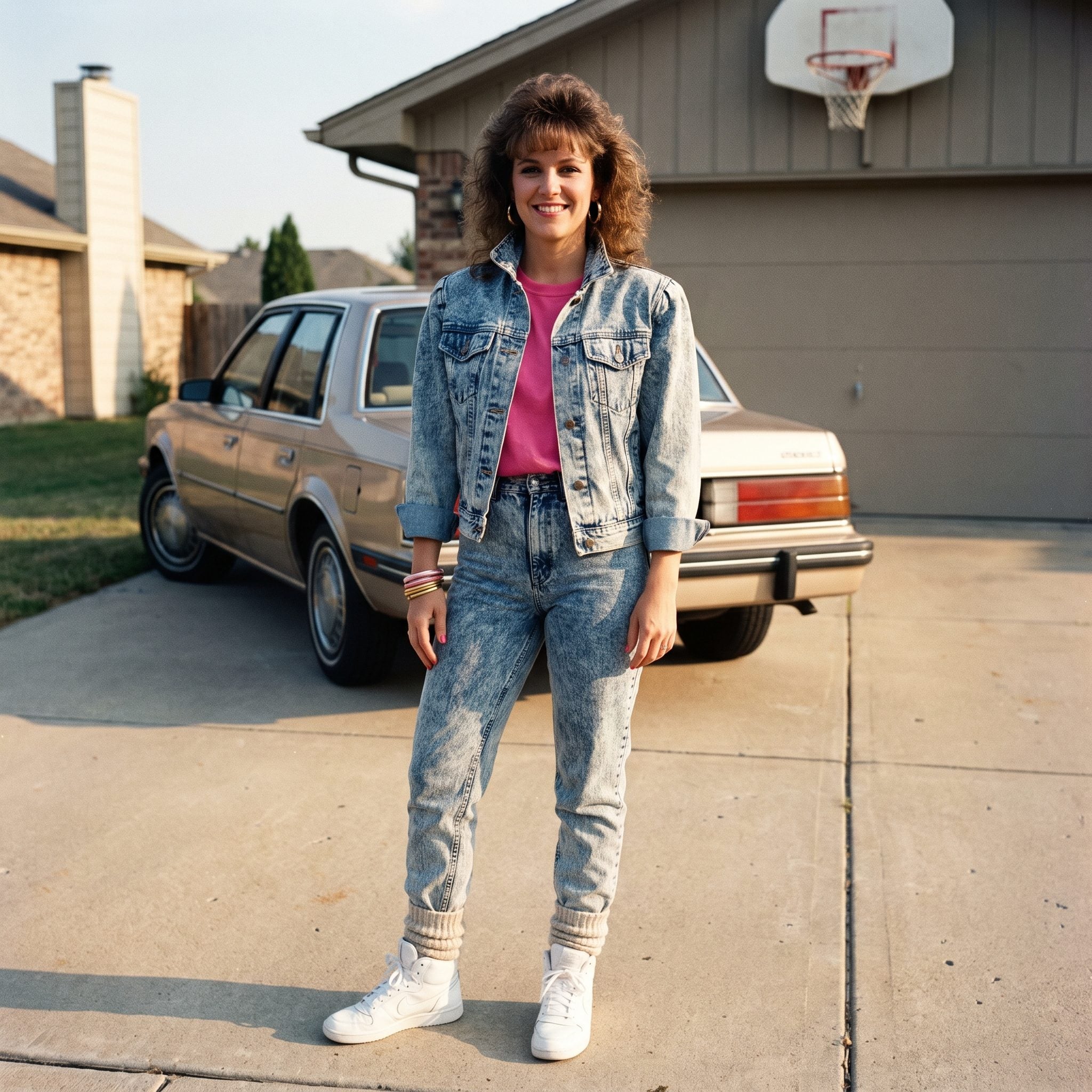
One acid-wash piece was apparently not enough.
The jacket and jeans shared the same lightning-struck finish, the shoulders went wide, the ankles went narrow, and nobody worried about separating denim washes because separation was not the assignment.
1988: The Guess Triangle Jeans That Meant You’d Made It in Junior High
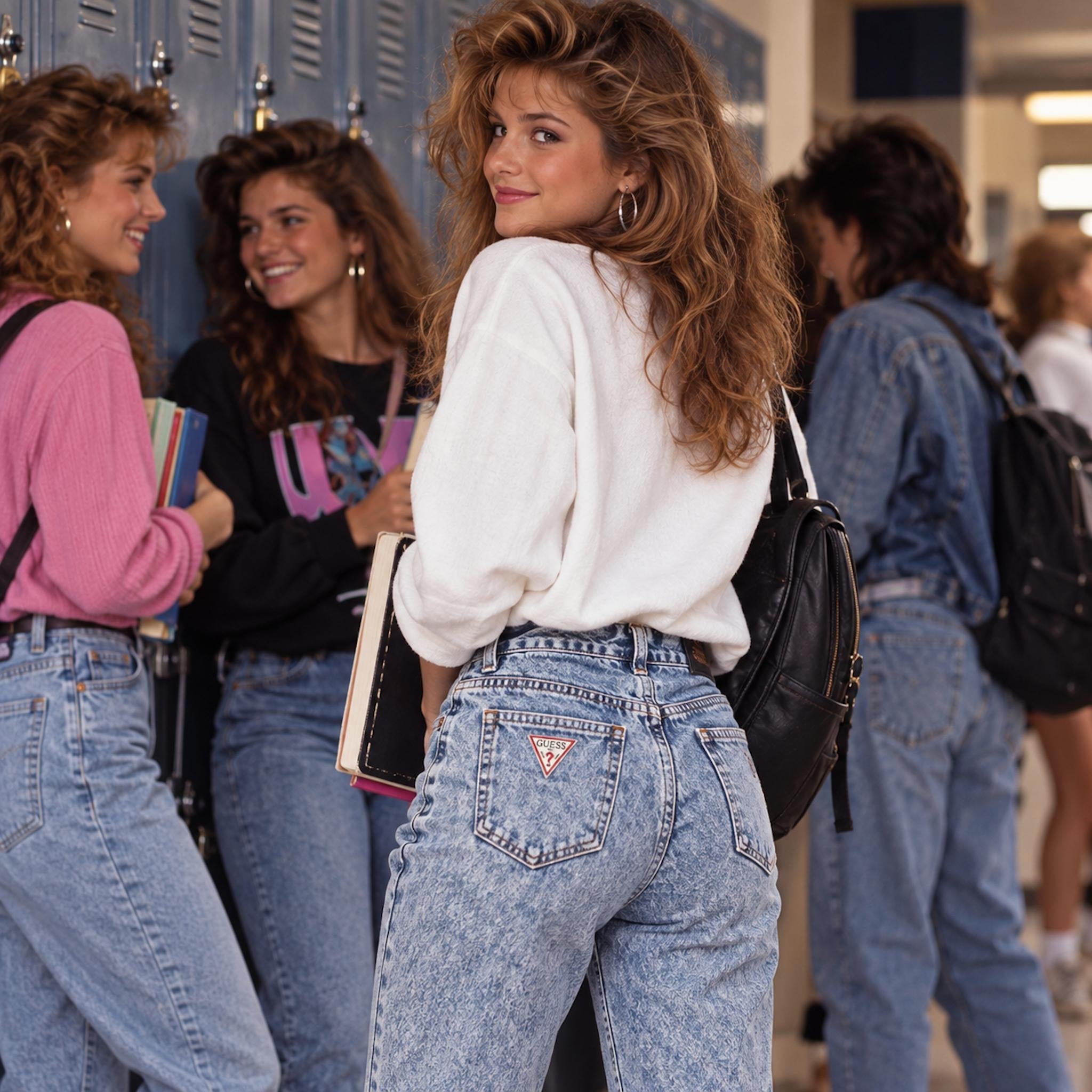
You knew a girl who had them. You wanted to be that girl.
The little Guess triangle on the back pocket was barely bigger than a playing card and somehow carried the social weight of a country-club membership. Stonewashed, high-waisted, tapered, sometimes zipped at the ankle, the jeans fit neatly into the late-’80s obsession with branding that could be recognized from several lockers away.
The 1991 Mom Jeans Nobody Called Mom Jeans Yet

High rise, roomy seat, tapered leg. In 1991 this wasn’t nostalgia, irony, or a revival. It was simply a practical everyday jean.
A floral blouse tucked into the waistband and a narrow belt made the shape look finished enough for errands, school pickup, lunch, whatever the day decided to become. The rise wasn’t a joke yet because fashion had not spent the next decade aggressively lowering it.
The mocking nickname came later. The useful proportions were there all along.
The 1991 Powder-Blue Tapered Jean That Made Saturday Dressing Almost Too Easy

❤️ Would you like to save this?
Same broad family, completely different mood.
The wash has faded toward powder blue, the leg tapers without clinging, and the whole jean looks as though it has survived enough laundry cycles to stop arguing with the body. Tuck in a white shirt, add a plain leather belt, and the outfit is essentially finished.
Comfortable, forgiving, ordinary in the best sense. The later “mom jean” joke flattened an entire category into one punchline. Plenty of women simply knew these as the jeans they could wear all day.
The 1993 Baggy Wide-Leg Jeans You Wore Slung Low Over a Flannel

The early ’90s looked at a decade of cinched waists and tapered ankles and decided everybody needed room.
These were loose rather than cartoonishly enormous: borrowed-from-the-men’s-section proportions, low-slung hips, broad legs, flannel somewhere in the equation. A belt might technically have been holding them up, but visually the jeans looked as though gravity had simply agreed to cooperate.
After years of denim that required lying down to zip, that slouch felt almost political. At minimum, it felt comfortable.
1994: The Baggy Skater Jeans Three Sizes Too Big on Purpose
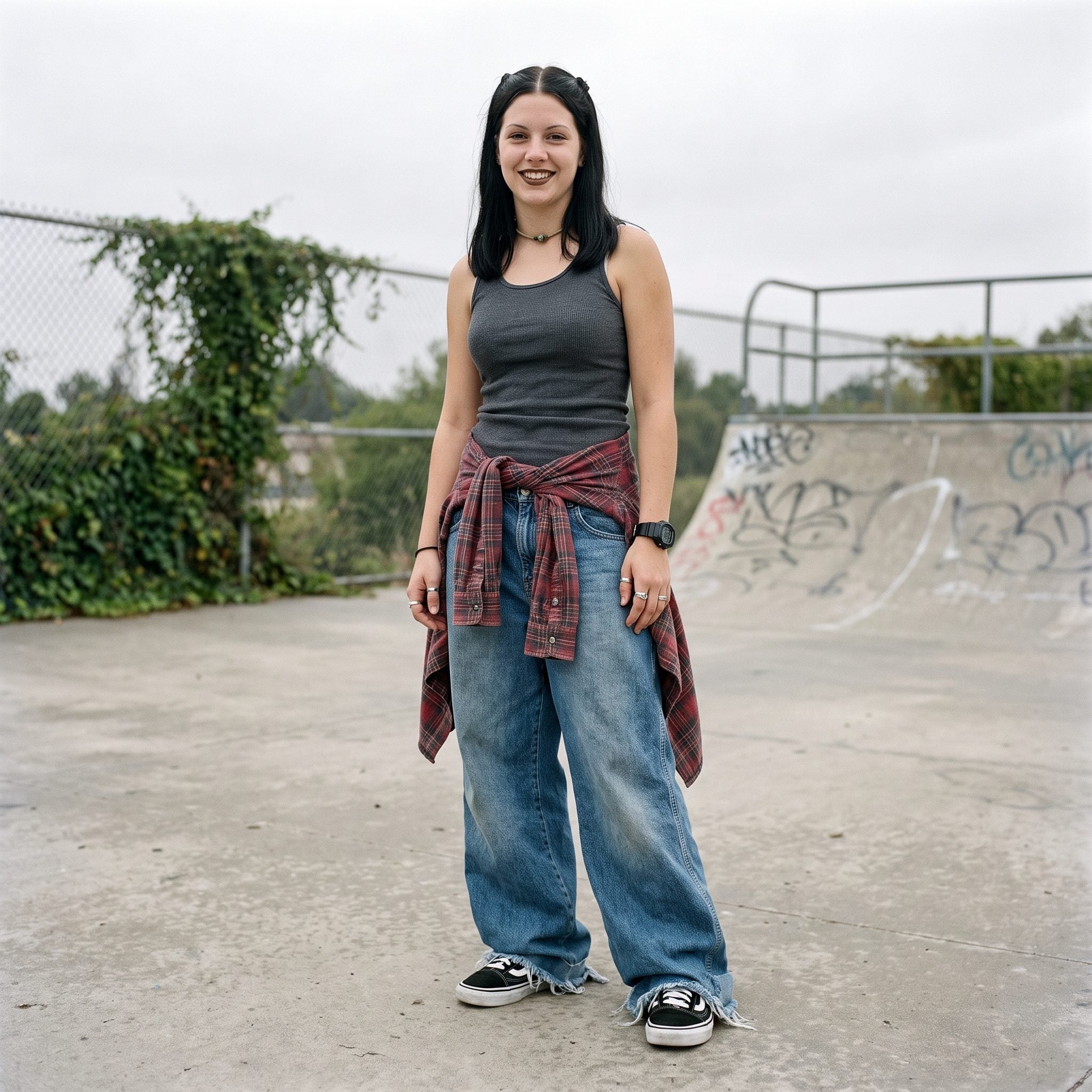
These weren’t relaxed jeans. Relaxed sounded far too responsible. The goal was enough denim to erase most evidence that legs existed underneath.
Bought from the men’s department and often sized up again, they swallowed shoes, pooled against the pavement, and frayed naturally because the hem spent its life cleaning the sidewalk. A flannel around the waist and cropped tank kept all that volume from becoming one continuous wall of fabric.
1998: The Bootcut and White Tee Uniform That Was Basically a Password

Medium-wash bootcut. Plain white tee. Nothing shouting, nothing sparkling, nothing shredded. After some of the decade’s louder experiments, the simplicity felt almost luxurious.
The rise was moderate, the thigh relatively clean, and the leg widened just enough to break over a chunky sandal or low heel. Gap could sell a wall of them because the point wasn’t novelty. The point was having a pair that worked repeatedly without introducing itself first.
The 2001 Ultra-Low-Rise Bootcut Jeans That Made Sitting Down a Tactical Decision

This pair was about the waistband — specifically, how little waistband fashion could get away with.
The bootcut balanced that low horizontal line with a small flare over a pointed heel, while a baby tee left enough midriff exposed to make layering seem beside the point. Decorative belts sat low on the hips and performed almost none of the work usually assigned to belts.
Britney Spears and Christina Aguilera made ultra-low denim part of the pop vocabulary, but the silhouette escaped celebrity wardrobes quickly. For a few years, sitting, bending, and retrieving anything from the floor became advanced movement.
The 2002 Low-Rise Flares That Made the Hem as Important as the Waistband

Low-rise denim got most of the attention at the top, but the floor was doing just as much work.
These flares sat low on the hips, stayed relatively narrow through the thigh, then widened enough to sweep over shoes and occasionally collect evidence from every sidewalk they crossed. Whiskering and factory distressing made the jeans look broken-in before you had done anything remotely strenuous in them.
A cropped tee left the waistband completely exposed. The long flare below stretched the silhouette back out again. That push-pull — very low waist, very long leg — is what made the shape unmistakably early 2000s.
The Early 2000s Low-Rise That Turned the Belt Into Jewelry

The defining accessory wasn’t technically part of the jeans at all. It was the belt sitting across the hips doing almost none of the work belts were invented to do.
Rhinestones, studs, oversized buckles — once the waistband dropped low enough, the belt moved into open view and became jewelry for the middle of the body. A baby tee above and flare below left that decorative strip as the visual hinge.
The 2005 Bedazzled Back Pocket That Announced You From the Rear

By 2005, the back pocket had become a tiny Las Vegas marquee.
Rhinestone swirls, embroidered wings, contrast stitching, studs — all of it landed on jeans that already sat spectacularly low. A plain pocket suddenly looked unfinished.
The downside arrived quickly. Crystals snagged cardigans, car upholstery, and anything else foolish enough to come close. When one disappeared, it left a little glue shadow behind. The jeans aged less gracefully than their owners, but for a while sparkle was practically structural.
The 2008 Wide-Leg Trouser Jean That Swallowed Your Heels Whole
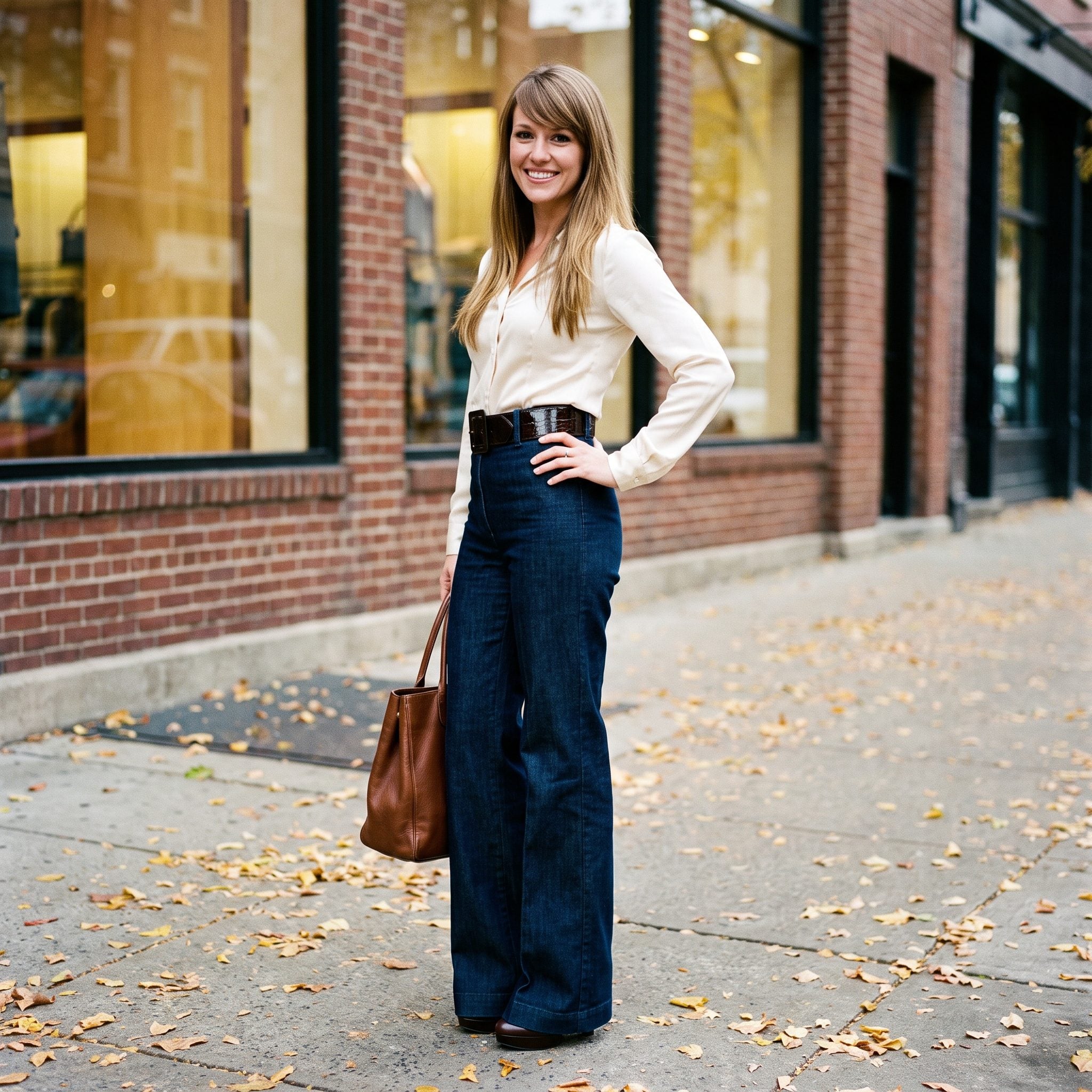
These were denim pretending it had an office job. Flat front, broad leg, dark wash, enough length to hide almost the entire shoe.
You needed height underneath because the hem was determined to reach the floor. A fitted blazer and wide belt kept the upper half controlled while the leg fell in one long column.
The 2010 Jeggings Everyone Pretended Were Actual Jeans

Part denim, part legging, entirely committed to making sitting down easier.
The jeans we’d spent years forcing ourselves into suddenly developed enough stretch to move with us. Purists could complain. Everyone else was already comfortable.
The styling leaned into the contrast: skin-tight below, oversized tunic or sweater above, tall riding boots closing off the leg. The top carried the volume so the bottom could behave almost like hosiery.
2012: The Skinny Jean and Riding Boots That Every Fall Instagram Ran On

Skinny jeans tucked into riding boots, oversized knit, scarf big enough to disappear into. Fall 2012 had a uniform and it came with leaves scattered somewhere in the background.
The jeans clung closely enough to slide into the boot without bunching, while all the volume moved upstairs into the sweater and scarf. Add a pumpkin latte and the image practically applied its own filter.
2014 and the Skinny Jeans We Swore We’d Never Give Up

Dark rinse, ankle length, close from hip to hem. The skinny jean dominated enough of the 2010s that for a while it stopped looking like a trend at all.
Ballet flats, ankle boots, oversized sweaters, blazers, a soft athleisure look — nearly everything seemed willing to cooperate. They tucked into boots cleanly and let volume move elsewhere in the outfit.
The 2014 Distressed Boyfriend Jeans Cuffed Over Ankle Boots

❤️ Would you like to save this?
While skinnies were still everywhere, the boyfriend jean offered an escape route.
Loose through the hip, ripped at the knee, cuffed twice above a suede ankle boot, it delivered the particular mid-2010s fantasy of looking thrown together after spending several minutes getting the cuff exactly right. A slouchy cardigan and crossbody bag completed that easy, slightly androgynous look.
The best part was the extra room. Fashion had rediscovered the radical possibility that knees might bend without a negotiation.
2016: The Black Skinny and Moto Jacket That Made Getting Coffee Look Deliberate

Black jeans. Black ankle boots. Black moto jacket. The outfit removed color from the decision-making process and somehow made that look intentional.
By 2016 the skinny jean had moved from fashion statement to infrastructure. The moto jacket added hardware, the pointed boot sharpened the bottom, and blogger culture supplied the flat white and apparently urgent destination.
The reason the combination lasted wasn’t mystery. Every piece pulled in the same direction: narrow line, dark palette, hard little flashes of metal. No print to date it, no complicated layering, nothing asking for interpretation.
2017 and the Frayed-Hem Straight Legs Everyone Cut Themselves

The unfinished hem managed to turn owning scissors into a styling technique.
Try the jeans on. Mark the ankle. Take them off. Hack across both legs with whatever pair of scissors lived in the junk drawer. Wash once and the edge softened into fringe convincing enough to pass as intentional.
Straight legs and exposed ankles were already loosening the skinny jean’s grip, and the raw hem made the shift visible. A pointed flat or mule left the cut edge completely exposed, which was precisely the point.
2019: The Wide-Leg Crop That Helped Push Skinnies Toward the Back of the Drawer

The ankle came back into view and the rest of the leg got room to breathe.
High waist, wide thigh, clean crop, raw or unfinished hem — this was one of several late-2010s shapes that helped loosen the skinny jean’s hold. Straight legs, crops, boyfriend jeans, and wider cuts had all been nudging the door open already; the wide-leg crop simply walked through with confidence.
A crisp white shirt and pointed mule kept all that width from looking heavy. Suddenly denim could be polished without being narrow.
The 2020 High-Rise Straight Jean We All Ordered From Our Couches

The strange thing about 2020 denim was how much effort went into buying jeans during a year when so many people had nowhere to wear them.
Rigid-looking high-rise straight legs, vintage washes, button flies — the silhouette borrowed heavily from 1990s Levi’s-style denim while rejecting some of the stretch that had defined the skinny years. The first wear could feel like cardboard. A few wears later, the fabric began behaving as though it had always belonged to you.
An oatmeal sweater and flat mule finished the uniform for a year lived disproportionately close to the sofa.
The 2023 Barrel-Leg Jeans That Divided Every Group Chat

The leg bowed outward at the thigh and came back in at the ankle like a parenthesis. Half the group chat ordered them. The other half demanded an explanation.
A clean white button-up makes the shape easier to read because the jeans are already supplying enough geometry for the entire outfit. A pointed flat gives the narrowed ankle a little length and keeps the curve from swallowing the foot.
The interesting part isn’t whether barrel jeans flatter everybody. Few strong silhouettes do. It’s how quickly denim went from “make the leg look as long and straight as possible” to “what if the leg itself became the design?”
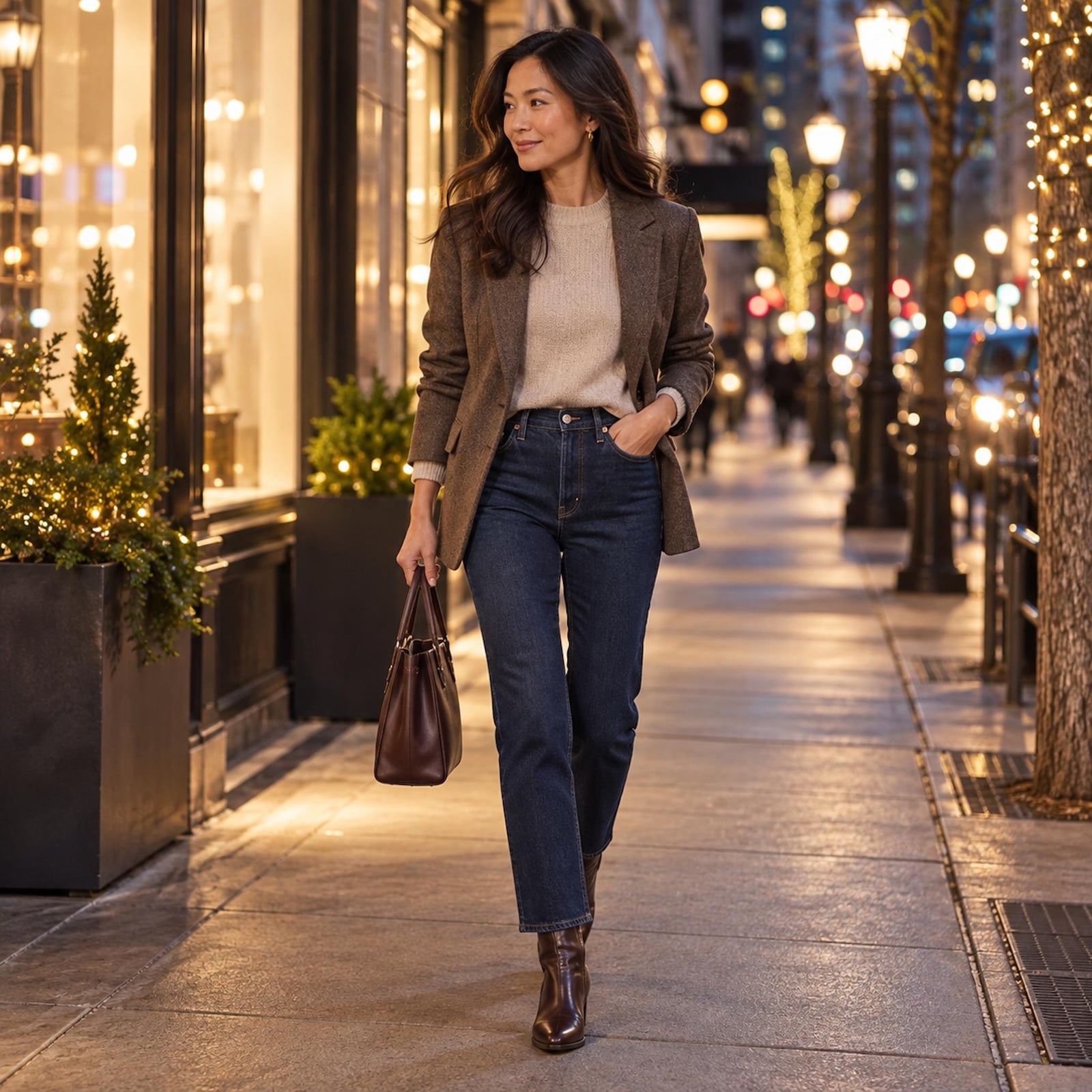
2026: The Dark-Rinse Straight Jean That Made Restraint Feel New Again
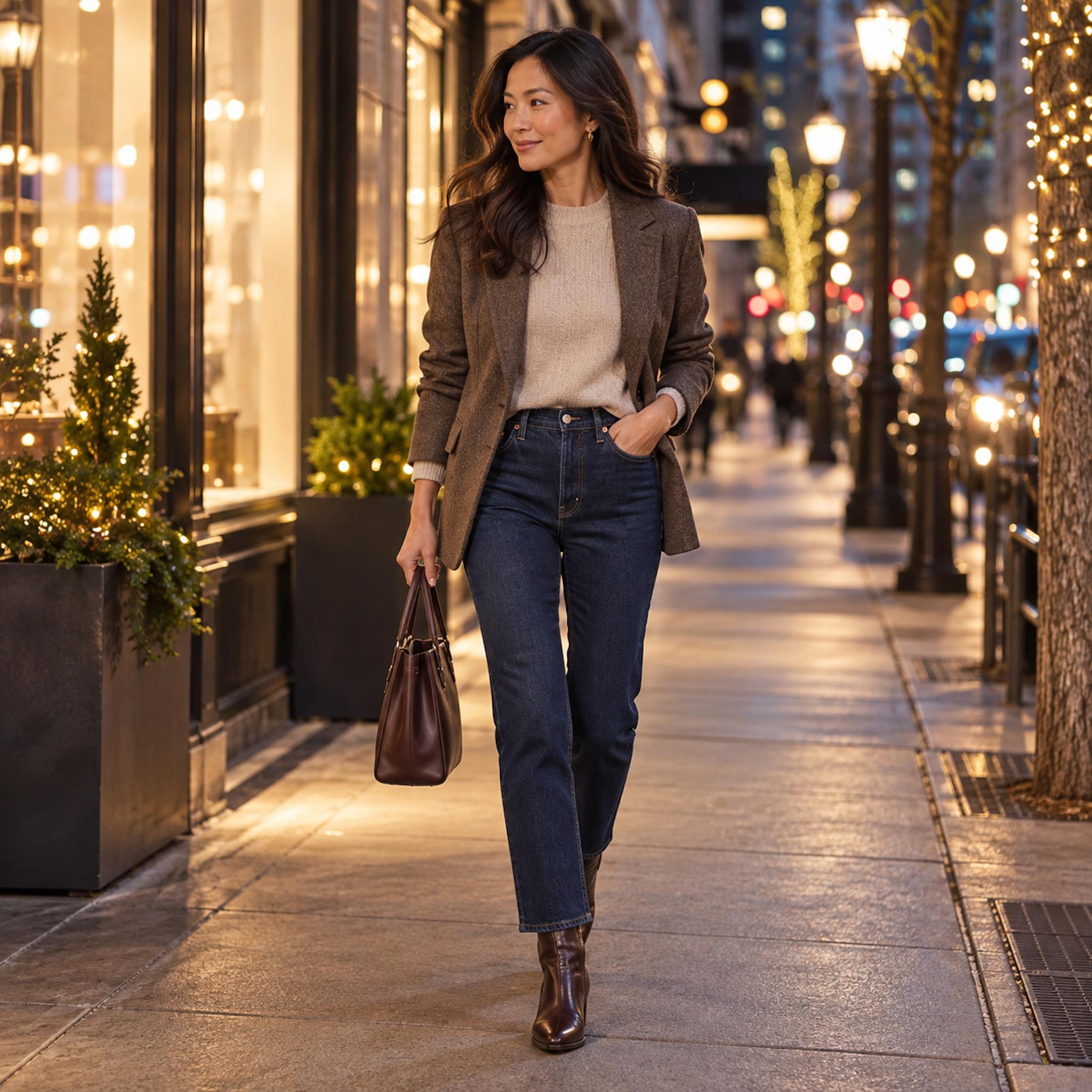
After years of puddled hems, balloon legs, exaggerated width, and denim silhouettes that practically needed architectural drawings, the surprise of 2026 was how fresh a clean straight line could look.
This pair is dark enough to read almost like tailoring under city lights: high rise, close but not painted on, straight through the leg, finished cleanly above a polished ankle boot. The blazer and fine knit sharpen the effect without turning the outfit corporate. Nothing is distressed. Nothing is shredded. Nothing is trying to explain itself from half a block away.
That’s the shift. Denim hasn’t suddenly become conservative; the eye has simply spent long enough adjusting to volume that restraint has acquired some tension again. A dark rinse puts the focus back on cut and proportion, exactly where an uncomplicated pair of jeans earns its keep.
2026: Bootcut Came Back Looking Far More Grown-Up Than We Remembered
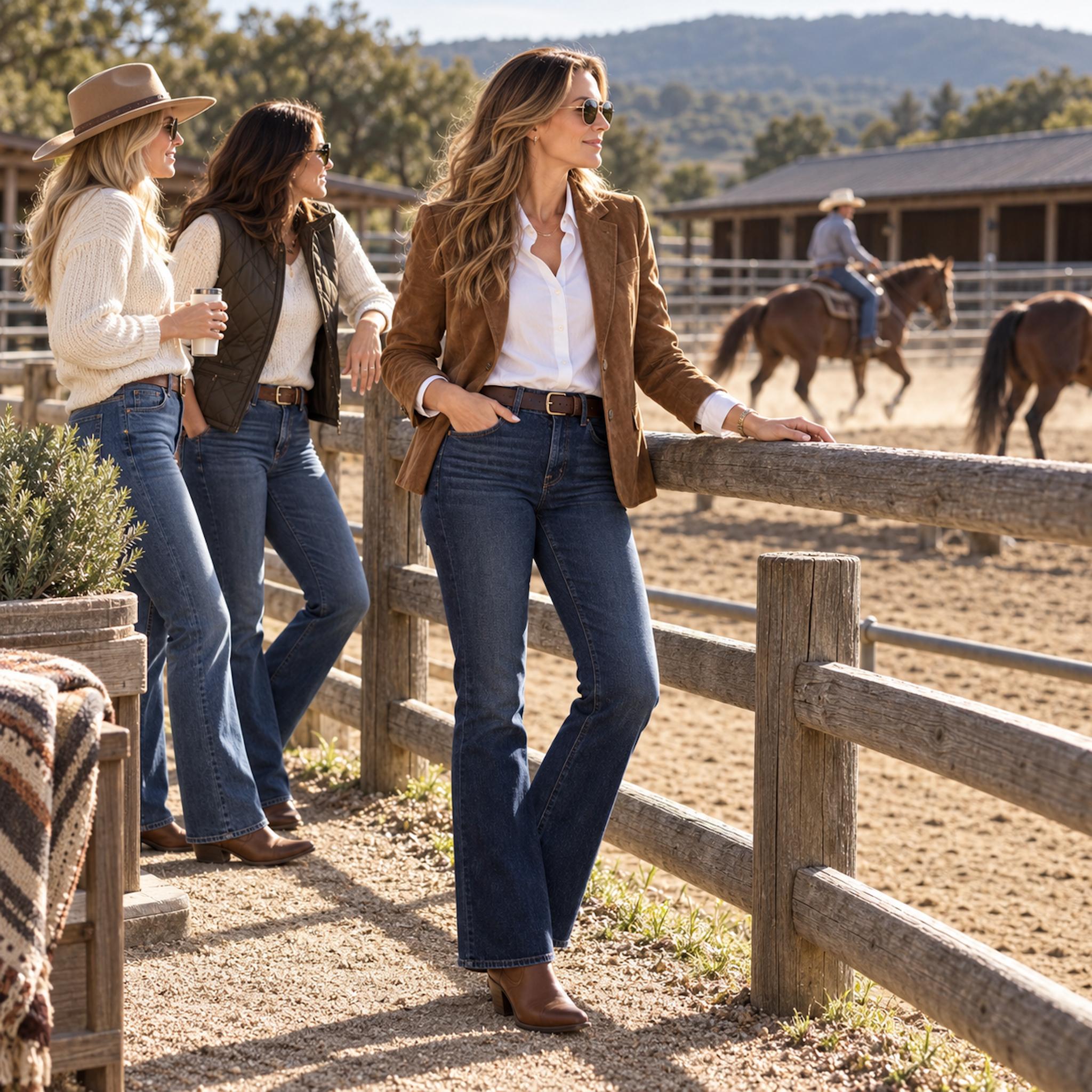
The bootcut has been here before, repeatedly, but 2026 brings it back without the parts we spent years making jokes about.
The rise is higher. The rinse is dark and clean. The flare starts quietly below the knee instead of exploding toward a frayed puddle on the ground. At this ranch, worn with a white shirt, brown suede blazer, leather belt, and heeled boots, the shape suddenly remembers where some of its Western DNA came from.
That context matters. A bootcut was designed to clear a boot long before mall denim turned it into an early-2000s social event. Here, horses circle the corral while friends lean against the fence, and the jean looks less like a revival than something that wandered home.
The best revivals don’t reproduce the old photograph exactly. They keep the proportion that worked and quietly lose the evidence against it.
2027: Denim Starts Looking Backward — and Somehow That’s the New Part

By 2027, asking which decade jeans belong to may be the wrong question.
This look borrows from several of them at once. The high waist remembers the late 1970s and early ’90s. The clean white shirt has spent decades refusing to become obsolete. The brown suede jacket carries a little California 1970s swagger. The medium-blue denim has enough ease to belong to the current decade without needing an exaggerated barrel or acres of fabric to prove it.
Put all of that on the terrace of a modernist hillside house above Los Angeles and the point becomes almost architectural. Old forms don’t disappear. They get renovated.
Early 2027 runway denim is already behaving that way — revisiting ’90s jeans, Americana, distressed finishes, old-school T-shirts, and familiar proportions, then cutting and styling them with enough disruption that the reference doesn’t become costume. After more than half a century of this gallery, denim has accumulated too much history to move forward without dragging some of it along.
Maybe that is the perfect place to leave denim after fifty-seven years of changing its mind. The future does not look like one new silhouette replacing everything that came before. It looks like a closet with a very long memory — and finally enough confidence to use all of it.