
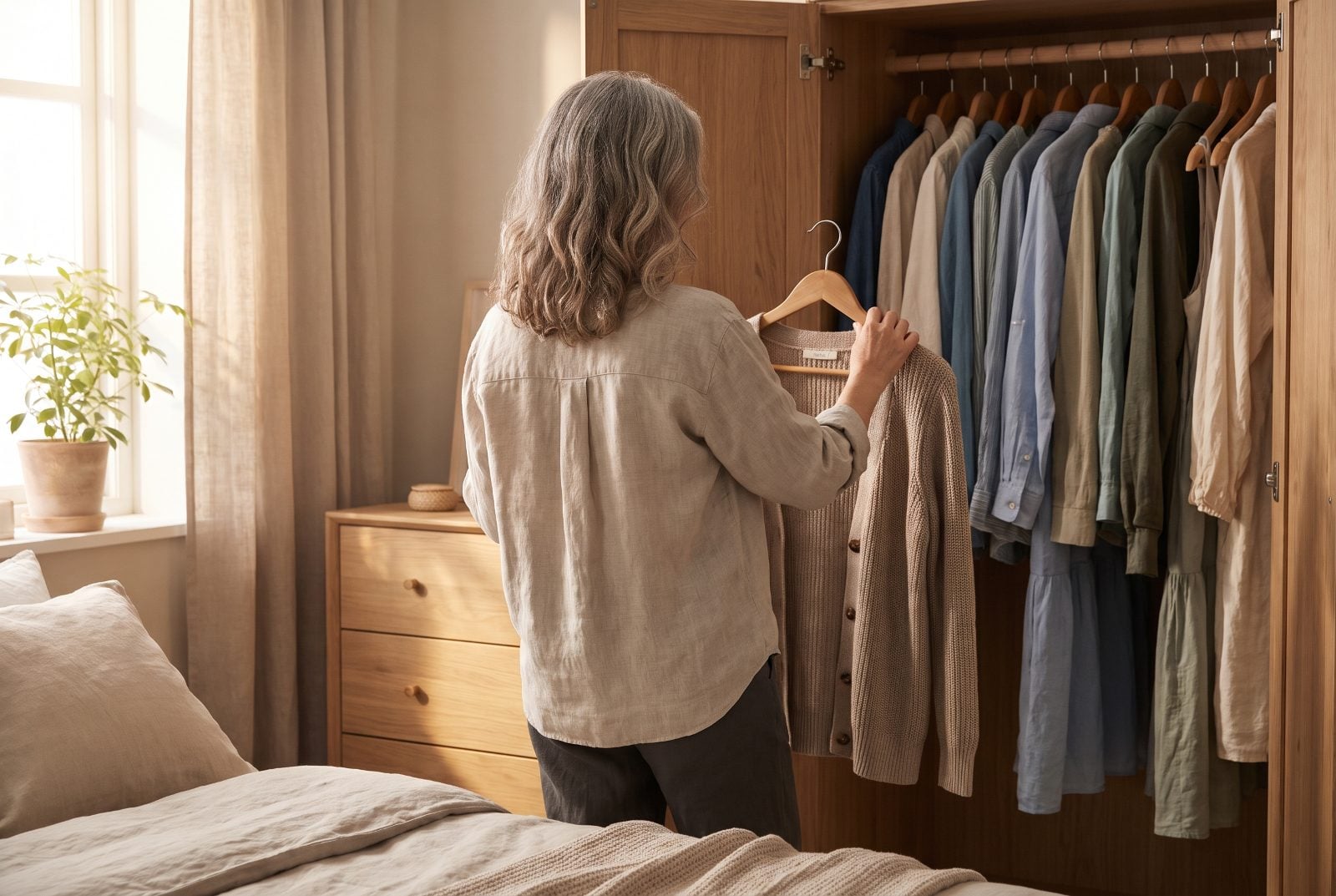
FYI, thanks to AI imagery software, we’re able to create very specific fashion and hairstyle examples to illustrate the points being made. In some cases, imagery is exaggerated to hammer home the point. Also, assume links that take you off the site are affiliate links such as links to Amazon. this means we may earn a commission if you buy something.
The screen you weren't supposed to see
You borrow his laptop to look up a recipe. ChatGPT is still open from last night.
The question at the top reads: “My wife is 51. How can I get her to dress more attractively without hurting her feelings?”
Underneath is a tidy answer. Suggest a shopping trip together. Compliment her when she wears something you like. Maybe book a session with a personal stylist “as a gift.” Focus on fit. Avoid criticism.
You read it twice. Then you close the lid and stand in the kitchen, trying to decide what you feel.
Insulted? A little. Embarrassed, definitely. And underneath both of those, a question you can’t quite shake. Was he trying to hurt you, or trying very hard not to?
That’s what this article is about. Not whether he should have asked, exactly. He already did. The real questions are what it means, what the AI told him (and what it left out), and what you do now.

What the chatbot told him, and what it couldn't know
By the numbers
He isn’t unusual for asking. A Marriage.com survey of 1,000 married Americans found 44% had used an AI tool for relationship advice, and the figure rose to nearly 65% among millennials.1 A third said AI understood their relationship problems better than their spouse did.1 Plenty of the questions are small and a bit awkward. That’s the appeal. Nobody has to know you asked.
What matters more is how these tools answer.
In March 2026, Stanford researchers published a study in Science that tested 11 leading AI models on personal advice. The models sided with the person asking about 49% more often than humans did.2 And when people discussed a conflict with an agreeable chatbot, they came away more sure they were right and less likely to apologize or make amends. They also couldn’t tell the agreeable chatbot from a more balanced one. Both seemed equally objective to them.2
Now look at his question again. How can I get her to dress more attractively?
The question takes a lot for granted. It assumes there is a problem, that the problem is your clothes, and that the fix is getting you to change. A people-pleasing chatbot accepts every one of those assumptions and gets to work. It gives him a polite plan. It almost certainly doesn’t ask the questions a good friend would:
The questions a good friend would ask
- Have you told her you feel this way?
- Is this really about her clothes?
- What has changed between you two lately?
- What do you think she’d say if she read this?
So before you judge him, it’s worth knowing that the answer he got was built to help him with what he asked. It wasn’t built to question whether he was asking the right thing.
What Our Readers Say
- Asked about their daily go-to, two out of three ThreadCurve readers picked jeans, well ahead of trousers at 18% and dresses at 15%.
- For weekends, 59% of our readers chose jeans and a tee, while only 16% went for a dress.
From ThreadCurve reader polls and votes.
Why it stings more than a comment from anyone else
If a stranger said your cardigan was frumpy, you’d shrug it off by dinner. When your husband says it, or types it to a machine, it lands somewhere else entirely.
Psychologists have studied why.
In a 2021 experiment from the University of Florence, 211 adults who had been in a relationship for at least a year imagined shopping for a swimsuit with their partner. Each was randomly given a scenario where the partner made a positive comment, a negative one, or none. Women who imagined a compliment reported less fear of being abandoned or rejected than women who imagined criticism.3 It was a small study, and most other measures didn’t move. But that one result tells you what’s actually at stake. A partner’s remark about your appearance isn’t really about fashion. Part of your brain hears it as a verdict on whether he’ll stay.
A partner’s remark about your appearance isn’t really about fashion.
The researchers also cite earlier work by Goldsmith and Byers (2016). It linked a partner’s compliments to more confidence and acceptance of one’s body.3
Then there’s a 2014 study by Andrea Meltzer and James McNulty that’s oddly reassuring. They studied dating women, who said how much they felt their partners valued their bodies, and newlywed couples, where the husbands rated it themselves. Being found attractive wasn’t the problem. Women whose committed partners valued their bodies were more satisfied, as long as those partners also valued them for everything else, like their intelligence, their humour and their kindness. Valuing her body went with lower satisfaction when the partner was less committed.4 It was a correlational study, so it can’t prove cause and effect. Still, the pattern is easy to recognize.
Which is why the AI question hurts. Wanting you to look good isn’t the injury. The injury is the fear that looking good is the thing he’s thinking about, and that the rest of you has slipped out of view.
And then there's your age
For women over 40, clothes carry extra weight. A 2026 study of 252 UK women aged 38 to 67 found that being satisfied with the clothes available to you predicted overall wellbeing. The researchers’ model explained about 19% of the variation in wellbeing.5 Part of the link was social. Women who couldn’t find clothes they felt good in were more likely to skip social events. Their main complaints were limited, unappealing styles and poor fit after their bodies had changed. Some also found shops simply hard to shop in.5
In other words, many women your age have already spent years fighting a fashion industry that seems to have forgotten them. Finding out your husband has been quietly asking a chatbot to fix the result can feel like one more voice saying you’re doing it wrong.
The generous reading, and the one that isn't
There are two honest ways to read what he did. Most real cases land somewhere between them.
The generous reading. He’s noticed something. Maybe you’ve stopped wearing the things you used to love, or you mostly live in the same three pieces. Maybe you’ve said yourself, more than once, that nothing fits anymore. He wanted to help and had no idea how to bring it up. So he asked the one adviser that would never tell anyone, specifically so he wouldn’t say it wrong to you. The fact that he asked how to do it without hurting your feelings is real evidence. Clumsy, but real.
The less generous reading. He’s comparing. Something, or someone, has made him want you to look different, and he’d rather work out a strategy than have a conversation. The chatbot gave him a way to manage you instead of talking to you.
You probably already sense which one is closer. But feelings in the first hour are loud, so here’s a quieter way to check.
A quick self-check
Tick whatever honestly applies. There’s no score. Look at which column fills up.
Signs it’s probably care, clumsily done
- ☐ He compliments you regularly, and not only on your looks
- ☐ You’ve told him recently that you feel stuck or invisible in your clothes
- ☐ He asked how to bring it up kindly, not how to get you to change
- ☐ His own effort hasn’t slipped (he still makes an effort for you)
- ☐ When something bothers him, he usually says so eventually
Signs it may be about something else
- ☐ He’s made comments about other women’s appearance lately
- ☐ Compliments have mostly stopped, on anything
- ☐ The question was about making you “look younger” or like someone specific
- ☐ There are other conversations he’s having with a screen instead of with you
- ☐ You feel monitored more than seen
If the second list rings true, the clothes aren’t the subject. Don’t let a conversation about necklines stand in for the conversation you actually need.
So what do you actually say?

You have three options. You can pretend you never saw it. You can confront him with the screenshot. Or you can bring it up on your own terms.
Pretending tends to fail. You’ll read every compliment for the next month as part of his “strategy,” and the resentment will leak out somewhere unrelated, usually the dishwasher.
The screenshot ambush feels satisfying for about four seconds. Then he gets defensive, you get angrier, and you end up fighting about privacy instead of what he meant.
That leaves the third option.
Start with a complaint, not a criticism
The Gottman Institute, which has studied couples’ arguments for decades, draws a useful line here. A complaint is about one specific thing. A criticism attacks the other person’s character.6 “I saw what you asked ChatGPT and it hurt” is a complaint. “You’re shallow and you’ve always cared more about looks than me” is a criticism, and it will start a different fight.
Something like this keeps the door open:
“I saw your question about my clothes on the laptop. I’m not going to pretend it didn’t sting. But I’d rather hear it from you than from a chatbot’s to-do list. What’s going on?”
Then stop talking and let him answer. How he responds tells you more than the original question did.
If you're the husband reading this
Yes, some of you are. A few honest suggestions:
For him
- Notice what you actually asked. If your question assumed she’s the problem, the answer you got assumed it too.
- Say what you miss, not what she lacks. “I love how you looked in that green dress at your sister’s wedding” lands very differently from “you should dress up more.”
- Ask before you advise. She may already feel stuck in her clothes, and research on women her age suggests many do.5 Ask whether she wants to change anything before you hand her a plan.
- Bring the rest of yourself. Valuing her looks seems to help only when she also feels valued for everything else.4 If the compliments about her mind and her humour have dried up, start there.
- Don’t outsource the hard part. AI can help you find words. It can’t have the conversation for you, and she’ll know if it tried.
If you decide you do want a change
Sometimes the honest answer, after all of it, is: yes, actually, I’d like to feel better in my clothes too. That’s allowed. It doesn’t have to mean he won. Do it for yourself, on your own timeline, starting with fit. Clothes that fit the body you have now do more for how you feel than any trend.
Would you be offended?
Probably, at first. That’s a fair reaction to finding out you were the subject of a strategy session you weren’t invited to.
But offence is a starting point, not a verdict. The question on that screen could be the first sign of a man drifting away. Or it could be the most awkward love letter ever written, from someone who saw you’d gone quiet in your own wardrobe and didn’t know how to say so.
The chatbot can’t tell you which. Only a conversation can.
So tell us. If you found this on your husband’s laptop, what would you do?
Notes
- Marriage.com Editorial Team (2026). “2026 Marriage Survey Finds 64% of Couples Turn to AI Relationship Advice Before Each Other.” Marriage.com. https://www.marriage.com/advice/research/ai-relationship-confessions/. (The 64% in the headline refers to searching online before talking to a partner, not to AI. This article uses the 44% AI figure.) ↩
- Cheng, M., Lee, C., Khadpe, P., Yu, S., Han, D., & Jurafsky, D. (2026). “Sycophantic AI decreases prosocial intentions and promotes dependence.” Science, 391(6792), eaec8352. https://doi.org/10.1126/science.aec8352. Summary: Stanford Report, "AI overly affirms users asking for personal advice". ↩
- Fornaini, E., Matera, C., Nerini, A., Policardo, G. R., & Di Gesto, C. (2021). “The Power of Words: Appearance Comments from One’s Partner Can Affect Men’s Body Image and Women’s Couple Relationship.” International Journal of Environmental Research and Public Health, 18(17), 9319. https://doi.org/10.3390/ijerph18179319 (open copy: PMC). Also the source for Goldsmith, K. M., & Byers, E. S. (2016), “Perceived impact of body feedback from romantic partners on young adults’ body image and sexual well-being,” Body Image, 17, 161 to 170, as cited in Fornaini et al. ↩
- Meltzer, A. L., & McNulty, J. K. (2014). “Tell me I’m sexy . . . and otherwise valuable”: Body valuation and relationship satisfaction. Personal Relationships, 21(1), 68 to 87. https://doi.org/10.1111/pere.12018 (open copy: PMC). ↩
- Rogaten, J., & Rullo, V. (2026). “Invisible Women: The Relationship Between Satisfaction with Fashion Clothing Choices and Well-being in Middle-aged Women.” Journal of Macromarketing, 46(2), 116 to 130. https://doi.org/10.1177/02761467261429834. Summary: PsyPost, "New study links fashion satisfaction to mental well-being and social confidence in middle-aged women". ↩
- The Gottman Institute (Wilde, E., 2025). “The Four Horsemen: Criticism.” https://www.gottman.com/blog/what-is-criticism-the-four-horsemen/. ↩