❤️ Would you like to save this?
A pixie is not simply long hair with most of it removed. It is architecture on a much smaller footprint. Once the hair clears the ears and neck, every decision becomes visible: where the weight sits, how the crown rises, what happens at the temples, whether the fringe moves or forms a wall, how cleanly the nape disappears into the neck. There is nowhere for a weak line to hide behind another six inches of hair.
That is also why two pixies of almost identical length can look completely different. One has air around the face, a little irregularity through the fringe, enough length at the crown to change direction and a perimeter that seems to dissolve rather than stop. The other can be technically immaculate and still feel strangely rigid because every section has been forced into the same shape. With short hair, chic usually lives in the transitions.
Color matters differently too. A long brunette or silver style has movement, shadow and several inches over which light can change. A pixie compresses all of that into a few square inches around the face. Root color becomes part of the outline. Highlights can reveal layers that would otherwise disappear. A toner that is slightly too cool suddenly occupies half the visual field. Even earrings, necklines and makeup become more noticeable because the haircut has removed the curtain around them.
These 31 examples are less a list of rules than a study in what makes a short cut feel considered. Some problems begin with the scissors. Others arrive during styling, grow-out or color appointments. A few are almost absurdly small: an extra inch left at the crown, a fringe allowed to fall instead of being pinned flat, a neckline softened rather than stamped across the nape. On a pixie, small decisions do not stay small for long.
FYI, thanks to AI imagery software, we’re able to create very specific fashion and hairstyle examples to illustrate the points being made. In some cases, imagery is exaggerated to hammer home the point. Also, assume links that take you off the site are affiliate links such as links to Amazon. this means we may earn a commission if you buy something.
31. Not Leaving Enough Length on Top for Lift and Movement

This is what enough length on top buys you. The crown can lift, the front can sweep back, and the surface has enough movement to keep the cut from collapsing into one close, uniform shape.
The strongest short cuts usually keep a clear difference between the longer top and shorter sides. Fine hair may need less length than dense or wavy hair, but the principle is the same: leave enough working material for the stylist to shape, separate and redirect.
30. When Bright Silver Creates More Contrast Than You Wanted

Silver can be spectacular against warm skin. The issue is not that the two are forbidden to meet. It is what happens when an especially icy, opaque silver creates more contrast than the wearer actually wants.
That contrast can be softened without surrendering the gray. A champagne gloss, warmer silver pieces around the face or simply more tonal variation through the crop can make the color feel less like a separate object sitting above the complexion. Sometimes the sharper contrast is exactly the point. Sometimes one degree of warmth makes the whole cut look more integrated.
29. A Curly Pixie Cut Without Accounting for Shrinkage

Curls do not finish at the length they occupy when stretched or soaking wet. How much they contract varies enormously, but on a pixie even a relatively small change can expose more temple, tighten the crown or lift the fringe well above where everybody expected it to land.
The answer is not one universal cutting method. Some curl specialists cut dry, some work wet and refine dry, and some use both depending on the pattern. What matters is that the stylist understands how your curl springs back before deciding where the finished perimeter should live.
28. Chunky Statement Earrings Fighting a Cut Already Making the Statement

A short cut exposes jewelry beautifully, which is exactly why proportion matters. A graphic pixie, strong fringe and enormous sculptural earrings can all be excellent separately. Put three equally assertive shapes within six inches of one another and nobody agrees to be supporting cast.
That does not mean a pixie requires tiny studs. It means the haircut and jewelry should have a relationship. With an architectural cut, a slim hoop, tight huggie or cleaner drop can leave more room around the face. With a softer pixie, a larger earring may be precisely the punctuation it needs.
27. The Nape Cut Too High and Too Tight

The back of a pixie can be beautifully clean without looking stamped onto the neck. Trouble starts when the neckline climbs high and then ends in one hard horizontal line.
A softer taper or graduation lets the hair narrow as it approaches the nape, so the silhouette follows the head rather than looking as though somebody drew a boundary across it. The difference may amount to very little hair. From behind, it changes the entire finish.
26. One Flat Hair Color Hiding Every Layer

A stylist can build beautiful graduation into a pixie and then watch half of it disappear under one dense, perfectly uniform color. Without changes in tone, separate layers can visually collapse into the same surface.
Dimension does not require obvious highlights. Fine ribbons, subtly lighter ends or a small shift around the hairline can be enough to show where one section ends and another begins. The cut already contains the architecture. Color simply decides how much of it you can see.
25. A Pixie Grown Into a Shape Nobody Actually Chose

The awkward stage is not really about length. It is about weight arriving in all the wrong places at different speeds. The sides puff outward, the area around the ears thickens and the nape starts making independent decisions while the top still looks frustratingly short.
A shaping trim during grow-out can remove bulk without erasing the length you are trying to gain. Clean the perimeter, control the sides and let the top and back continue their journey toward whatever comes next. Growing a pixie out works much better when somebody is still designing it.
And on the truly uncooperative days, a wide-brim hat remains a perfectly respectable emergency department.
24. One Long Sweep of Fringe Pinned Flat to the Temple

A long fringe is often the softest line in a pixie. It skims the forehead, changes direction near the brow and gives an otherwise compact haircut somewhere to move.
Pin that entire section flat against the temple and the movement disappears. If the fringe needs controlling, use styling cream, a discreet pin underneath the hair or a small adjustment to the length. The goal is not to let it fall into your eyes all day. It is to preserve the sweep instead of stapling it to the side of the head.
23. All the Volume Piled at the Back

Look at a pixie in profile and the location of the fullness matters as much as the amount. When the crown lies flat but the back expands lower down, the silhouette can start to slope rather than rise.
Moving some of that fullness upward changes the architecture. The crown gains lift, the occipital area sits closer and the profile develops a more deliberate curve. This is not about chasing maximum height. It is about putting the volume where the cut was designed to carry it.
22. Matte Foundation Under a Cut That Exposes the Entire Face

A pixie removes much of the shadow and framing that longer hair creates around the face. Suddenly there is more forehead, cheekbone, brow and jaw visible at once. Makeup that felt balanced with longer hair can look completely different after the cut.
A fully matte complexion is not inherently wrong, but if the combination feels flatter than expected, a little cream blush or restrained highlight can return dimension without turning the face glossy. The useful point is not that short hair demands makeup. It is that removing hair from the face changes the composition around it.
21. A Crown Cowlick Forced to Behave Like Straight Hair

A cowlick is not an inconvenience waiting to be disciplined. It is a growth pattern, and a pixie exposes it more clearly because there is not enough length to drag the hair in another direction.
A strong cut works with that movement. Extra lift can become crown texture; a sweep can follow the natural rotation instead of fighting it. Point the cowlick out before the first snip, especially if the hair has been flattened by a hat or blowout when you arrive. The stylist needs to see what the roots actually want to do.
20. Ultra-Short Hair With One Dense Inky-Dark Surface

There is nothing inherently harsh about dark hair. The question is whether the color has enough variation for the shape underneath it to show. On an ultra-short crop, an opaque near-black can turn the entire haircut into one strong graphic mass.
If that drama is intentional, excellent. If the goal is softer, a few warmer or slightly lighter pieces around the face can break the surface without sacrificing the depth. The difference between dimensional black and flat black can be subtler than the difference between black and brown, but on a pixie it is remarkably visible.
19. Every Face-Framing Piece Cut Away

❤️ Would you like to save this?
Clean is not the same as bare. When every small piece at the temple and cheek is removed, the perimeter can become extremely graphic, with hair ending and skin beginning almost all at once.
Leaving a few deliberate wisps or transitional pieces changes that boundary. They do not need to become bangs. Their job is simply to keep the edge from looking as though it was traced around the face with a ruler. A softer pixie often earns its softness at the perimeter rather than through extra overall length.
18. A Sun Hat That Flattens the Crown for the Rest of the Afternoon

A pixie and a snug hat can negotiate badly. The exact section that often gives the haircut its lift sits directly beneath the crown of the hat, and several hours of pressure can leave the top flattened into a shape no amount of optimism will disguise.
A looser beach hat helps. So does working a little texture through the roots before the hat goes on and roughing the crown back into place afterward. Short hair is quick to reset, provided there is still some texture for your fingers to grab.
17. The Center Part That Turns the Shape Too Symmetrical

A center part can look terrific on the right pixie. Here, though, the exact middle division sends equal weight to both sides and removes much of the asymmetry that was giving the haircut movement.
Shift the part slightly and one side suddenly gets permission to do more. The fringe travels farther, the crown stops looking mirrored and the silhouette becomes less static. The change can be an inch. On hair this short, an inch is a design decision.
16. A Damp Pixie Left to Choose Its Own Direction

Some pixies air-dry beautifully with almost nothing in them. Others emerge with the crown pointing east, the fringe heading south and one temple conducting its own private rebellion.
The deciding factors are texture, growth pattern and the cut itself. If yours needs a little persuasion, a small amount of lightweight cream or mousse worked through damp hair can establish direction before it dries. Short hair does not automatically require product. It simply makes the consequences of every strand’s decision easier to see.
15. Warm Golden Ends Meeting Cool Silver Roots

Grow-out can create its own color blocking. Cool silver appears at the root while older golden color remains through the ends, and because a pixie is so compact the two temperatures sit almost directly on top of one another.
That contrast can be used deliberately, but if it reads more accidental than dimensional, a toner can bring the older lengths closer to the new growth. You do not necessarily have to choose all warm or all cool. The useful goal is making the transition look like part of the color plan.
14. A Wispy Neckline Left Fuzzy Instead of Finished

The nape is the part of your pixie everybody else gets a better view of than you do. When wispy growth is left wandering beneath an otherwise controlled shape, the back can look unfinished surprisingly quickly.
A tapered edge, soft point or carefully cleaned natural neckline gives the cut a deliberate ending without making it severe. The exact finish depends on the growth pattern and the haircut. What matters is that the neckline looks chosen rather than forgotten.
13. A Pixie Left So Bare the Styling Feels Unfinished

Sometimes the haircut is right and the composition around it simply feels unfinished. A pixie exposes the ears, neck and collar line, creating empty space that longer hair used to occupy.
That does not mean filling every opening with jewelry. One element is enough: a brushed gold drop earring, a slim scarf, an open collar or an interesting neckline. This is where the distinction from oversized statement earrings matters. You are answering the haircut, not competing with it.
12. The Entire Top Spiked Into One Hard Silhouette

Texture needs contrast. If every strand is pushed up with equal conviction, separate pieces merge into one jagged outline and the haircut loses the softer sections that make the spikes interesting in the first place.
Lift a few sections through the crown. Let others fall forward or sideways. Leave some ends almost untouched. The point is not to make the top tidy. It is to stop all of the texture from shouting at exactly the same volume.
11. A Pixie Blow-Dried Flat Until the Movement Disappears

A good pixie can survive surprisingly little styling. What it struggles with is being ironed into submission. Dry every root in the same downward direction and the strands begin to form one surface instead of several moving sections.
Use fingers to disturb the roots while drying, change the airflow as you work around the crown and finish by separating only the pieces that need definition. The object is not enormous volume. It is keeping enough air in the cut for the layers to remain visible.
10. A Choppy Fringe Left With One Blunt Edge

A fringe can be short, graphic and even intentionally blunt. The problem comes when the rest of the pixie is textured and irregular but the fringe suddenly forms one solid bar across the forehead.
Point-cutting is one way a stylist can break up that edge. The scissors enter vertically rather than removing another horizontal strip, leaving small differences in length that let the fringe move with the rest of the cut. Same general placement, much less ruler.
9. A Damp Pixie Left to Dry Under a Beanie

A hat can flatten dry hair temporarily. Put it over damp hair and you can actually help set the new shape: compressed crown, bent fringe and a neat horizontal memory of wherever the band sat.
Dry the crown enough to establish its direction before pulling on the hat, or choose a looser shape that does not press directly across the area you are trying to lift. A pixie has very little excess length available to disguise a crease once it dries.
8. A Pixie Shape That Works Against the Face Instead of With It

Forget the old charts insisting every round face needs one haircut and every long face needs another. Faces are more complicated than geometry homework. What matters is understanding what a particular silhouette emphasizes.
Extra height makes the vertical line stronger. Width at the temples makes the horizontal line stronger. A fringe changes how much forehead is visible. Longer pieces near the cheek alter where the perimeter turns. Those are design tools, not rules. A good stylist decides which ones support the features you actually want to emphasize.
7. Root Color So Dark It Becomes the Strongest Line in the Cut

❤️ Would you like to save this?
Very dark roots can look fantastic on a pixie when the contrast is intentional. The difficulty arrives when the root becomes such a dense band that it overwhelms the lighter texture above it.
Short hair places that color transition immediately around the face, so a subtle shift in the base can make a surprisingly large difference. Blend it, soften it, or keep it deliberately dramatic. What looks less convincing is a root line that appears to have wandered in from a different color plan.
6. A Deep Side Part Combed Flat and Slick Over One Eye

A deep side part can give a pixie wonderful asymmetry. Flatten every root along that part, though, and the sweep becomes less movement than lid.
Keep the drama and restore some air. Lift the roots beside the part with your fingertips, let the fringe graze the brow instead of plastering itself across the face and allow the ends to separate. The part can stay deep. It simply does not have to look laminated.
5. An Ashy Toner Left Long Enough to Turn Silver Into One Cool Block

Silver is not one color. It contains white, charcoal, pewter, warmer gray and whatever natural pigment remains. When an ash toner overwhelms those differences, all of that variation can collapse into one cool surface.
If the result feels flatter than intended, the solution may be less toner rather than more dye. Leaving brighter pieces through the hairline or allowing a little natural warmth to remain can restore the tonal shifts that give short silver hair its sparkle.
4. The Fringe and Sides Cut to the Exact Same Length

Uniform crops can be beautiful. This particular pixie, however, is trying to sweep at the front while the sides insist on ending at almost exactly the same length. The result is a perimeter with nowhere obvious to travel.
For a swept pixie, keeping some extra length through the top and fringe gives the shorter sides something to support. Graduation creates direction: longer here, shorter there, weight moving deliberately around the head instead of stopping at one repeated measurement.
3. Skipping the Trim Until the Ears Disappear

The paradox of a pixie is that there may be less hair to style every morning and more reason to see the stylist regularly. Growth that would barely register on shoulder-length hair can change the outline of a short cut within weeks.
The first giveaways are often around the ears and nape. The sides thicken, clean negative space disappears and the silhouette becomes rounder whether you wanted it to or not. The exact trim schedule depends on growth rate and cut, but booking the next appointment before the shape has completely vanished makes maintenance much easier.
2. Sides Cut So Short They Look Shaved
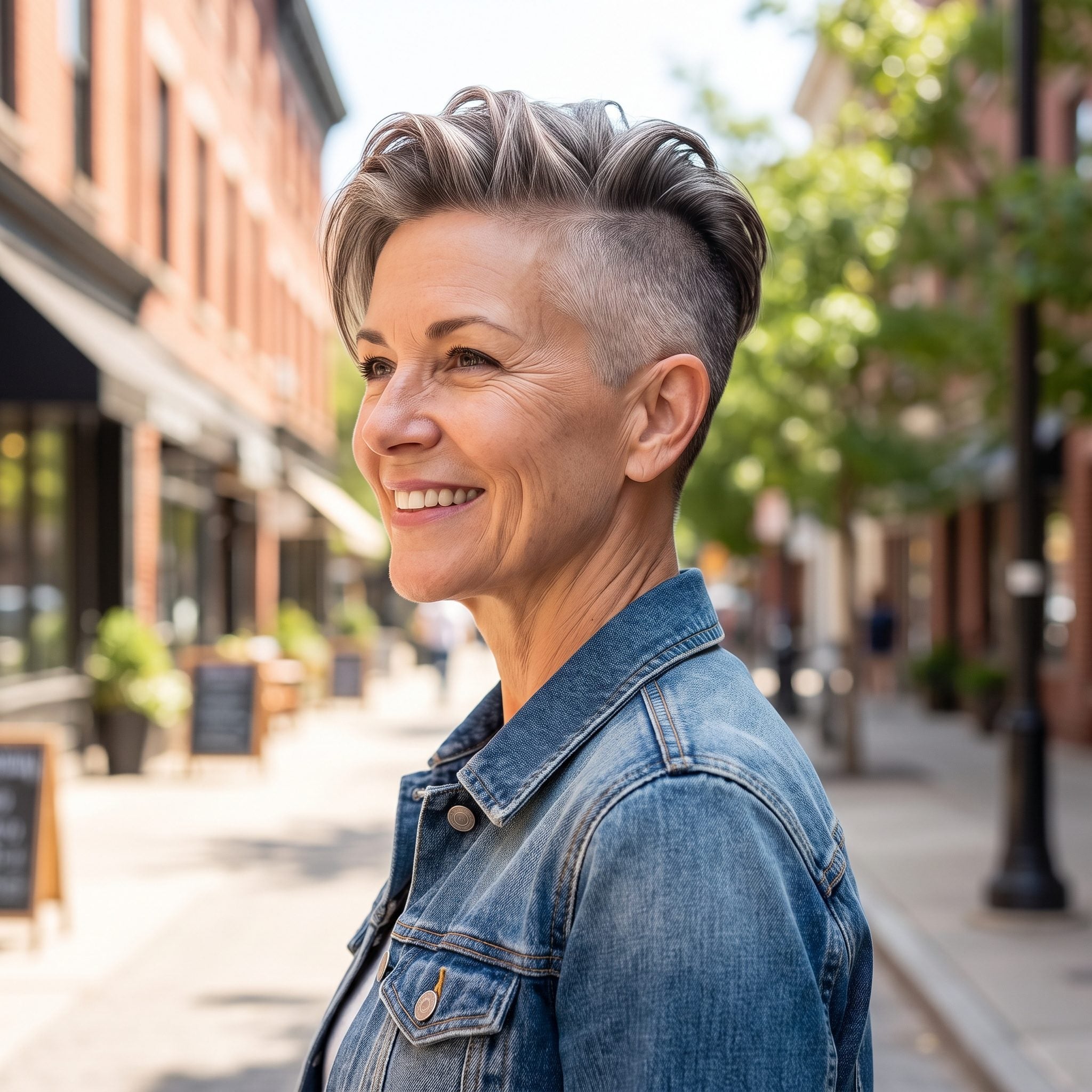
Here is the feature-image problem again, now that the rest of the gallery has shown why it matters. The issue is not simply that the sides are extremely short. A close crop can look extraordinary. The problem is the abrupt handoff from nearly bare temple to a much heavier top.
Without enough graduation between them, the head reads as two separate zones: clipped underneath, longer hair placed above. Blend that transition and the same short sides can suddenly feel sophisticated rather than severe.
1. A Trendy Pixie That Was Never Adapted to the Woman Wearing It

This is where nearly every mistake in the gallery eventually leads. A reference photo can show a great haircut and still be the wrong set of instructions for the person sitting in the chair.
Fine hair may need weight preserved where dense hair can lose it. A cowlick can dictate the direction of the crown. Natural silver changes how layers show. Curl changes finished length. A strong jaw may look terrific with an exposed perimeter while somebody else wants more movement around the cheek. Those are not defects the stylist has to overcome. They are the raw material of the haircut.
The best pixie is rarely a perfect copy. It borrows the line you loved in the photograph, the fringe that made you stop scrolling or the short nape that convinced you to book the appointment, then changes whatever has to change once it meets your actual hair. Bring the picture. Bring several. But the head in the chair is the final design brief.