
❤️ Would you like to save this?
Someone decides how to feel about you in about seven seconds. Half of that read comes from the waist down, and most of it from the denim you pulled on without thinking twice.
Rise, wash, cut, hem. Each one sends a signal you never agreed to send. The high waist that makes people listen harder. The raw indigo that reads as someone who stopped asking for permission a long time ago. The faded knee that quietly says a full life happened here. None of it is accident, and none of it is vanity.
We pulled apart visually distinct jean combinations and matched each one to the impression it leaves in a stranger’s head. Some will flatter you. A few might sting. All of them are already working on the people you meet, whether you planned it or not.
FYI, thanks to AI imagery software, we’re able to create very specific fashion and hairstyle examples to illustrate the points being made. In some cases, imagery is exaggerated to hammer home the point. Also, assume links that take you off the site are affiliate links such as links to Amazon. this means we may earn a commission if you buy something.
The Rise That Tells People Where Your Confidence Actually Lives

Rise is the first thing a stranger clocks and the last thing they could name. It sets the waistline, which sets the proportion, which sets the whole silhouette before the eye even reaches your face. A high rise draws attention up toward the torso and reads as deliberate, planted, in-control. A low rise pulls the center of gravity down and reads as looser, younger, more casual. Neither is right. But they say different things about where you’ve decided to stand in a room.
Here’s the part worth sitting with. The waistband you reach for first, every single morning without thinking, is usually the one where you feel most like yourself. That’s not vanity. That’s your body telling you something before your brain catches up. Women over 50 tend to land on a mid-to-high rise and stay there, and we’d argue it’s less about hiding anything and more about a woman who has stopped negotiating with her own waistline. For the full breakdown of why the rise anchors everything, our style guide walks through it fit by fit.
Why Raw Indigo Reads as ‘I Don’t Ask for Permission’

Deep, undisturbed indigo carries a weight no faded wash can touch. Dark blue sits at the authority end of the color spectrum, and that isn’t a fashion opinion, it’s a measured one. Three color psychologists told Parade that blue is the single best color to wear when you want to be trusted (Source), and one of them put it plainly: dark blue projects authority and seriousness more than any other shade.
Raw or rigid indigo, the kind that hasn’t been stonewashed into softness, takes that further. It looks intentional. Structured. Like a woman who ironed her intentions before she left the house. People read it as composure, and composure reads as power. The same experts note navy and true deep blue create the strongest impression of credibility in professional rooms (Source). Pair that saturated denim with a crisp white shirt and your whole style is doing the talking before you say a word.
The Fade Pattern That Signals You’ve Lived a Full Life

Whiskers at the hip. Honeycombs behind the knee. A soft halo of lighter blue where your hand rests in the pocket a hundred times a day. These aren’t flaws. They’re a map of how a person actually moves through the world, and the eye reads them as authenticity faster than it reads a logo.
Natural fade only happens one way: time, friction, repetition. A pair that has faded on its own carries evidence that it’s been somewhere, done something, been chosen over and over. That reads as a life in motion, not a life on a hanger. For women past 50, a genuinely worn-in pair signals something a new pair never can, that you have a history and you’re comfortable wearing it in plain view. The irony of our decade is that factories now manufacture these fade patterns with lasers to fake the exact thing that used to take five years of living. The eye still falls for it. But a real one, earned the slow way, hits different.
What a Perfectly Broken-In Pair Says Before You Open Your Mouth

There’s a reason the clothes you feel strongest in are rarely the newest. Comfort isn’t the opposite of authority. It’s often the foundation of it.
Clothing changes how you think, not just how you look. The research is called enclothed cognition, and the 2012 Adam and Galinsky study in the Journal of Experimental Social Psychology showed clothes carry systematic psychological effects through both their symbolic meaning and the physical experience of wearing them (Source). A broken-in pair of jeans has both working in your favor. The denim has given at the knee and the waist, so your body isn’t fighting the fabric, and that ease loops straight back into how settled you appear. A woman who isn’t tugging at her waistband all day moves like she owns the room because, for that stretch, she does. Your wardrobe is quietly running this calculation every morning whether you notice it or not.
The Wash Strangers Read as Approachable Without Knowing Why

A medium, slightly faded blue wash does something a dark wash can’t: it lowers the drawbridge. Where deep indigo signals authority, a mid-blue reads as friendly, open, easy to talk to. And it happens in the first few seconds, before anyone has formed a conscious thought about you.
Experts told Yahoo that blue is connected with emotional safety and trust, which makes the wearer seem more approachable (Source), and a write-up of color research notes that people in blue get read as reliable and non-threatening at a glance (Source). The softer, lighter version of blue warms that signal up without losing the trust. It’s the wash you reach for when you want people to come to you rather than brace against you. A classic light-blue wash with a white sneaker is the most quietly disarming thing you can put on. People relax around it and they couldn’t tell you why.
Why the Wide Leg Makes People Assume You’re the Smartest in the Room

The wide leg has a quiet trick. Its clean vertical line and tailored drape push it toward the formal end of the spectrum, and formality, it turns out, buys you perceived intelligence whether you earned it or not.
A study in Assessment & Evaluation in Higher Education found that the more formally someone was perceived to dress, the more competent and knowledgeable they were judged to be (Source). The same body of research consistently shows formal attire linked to perceived intelligence and scholastic ability. A wide-leg jean sits closer to a trouser than a casual five-pocket does, so it borrows that trouser’s authority. There’s a catch worth naming, though. The same research found increased formality also lowered ratings of friendliness and warmth (Source). So the wide leg buys you gravitas and charges you a little approachability for it. Whether that trade is worth it depends entirely on the room you’re walking into.
The Hem Detail That Quietly Announces Self-Possession
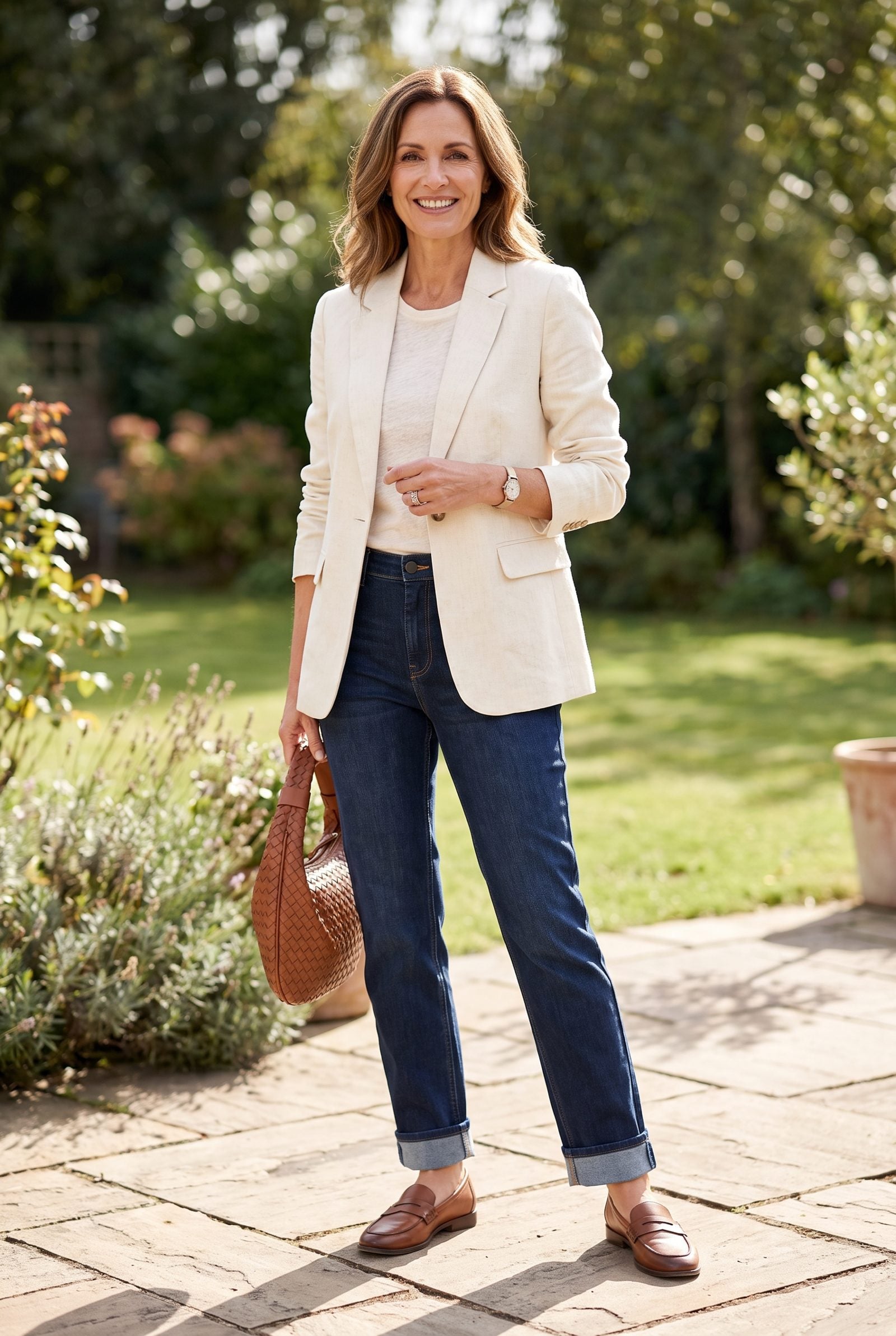
Most people never clock the hem. They just feel it. A jean that ends exactly where it should, at the ankle bone, with a clean finish, reads as a woman who checks her own details and answers to no one’s proportions but her own.
The specific move here is a deliberate hem: a raw chewed edge she chose, a precise crop that shows the ankle, a cuff folded to an exact width. It’s small. It’s also the kind of thing that only happens on purpose, and the eye registers intention even when the brain doesn’t. Nobody accidentally gets the hem right. A great crop with a loafer and bare ankle says more about a woman’s self-knowledge than any slogan on a t-shirt could. It whispers that she knows her own measurements, literally and otherwise. If you want to see how small finishing choices carry outsized weight, our take on quiet details in style in everyday dressing covers exactly this.
What Distressing Really Communicates (And It Isn’t Rebellion)
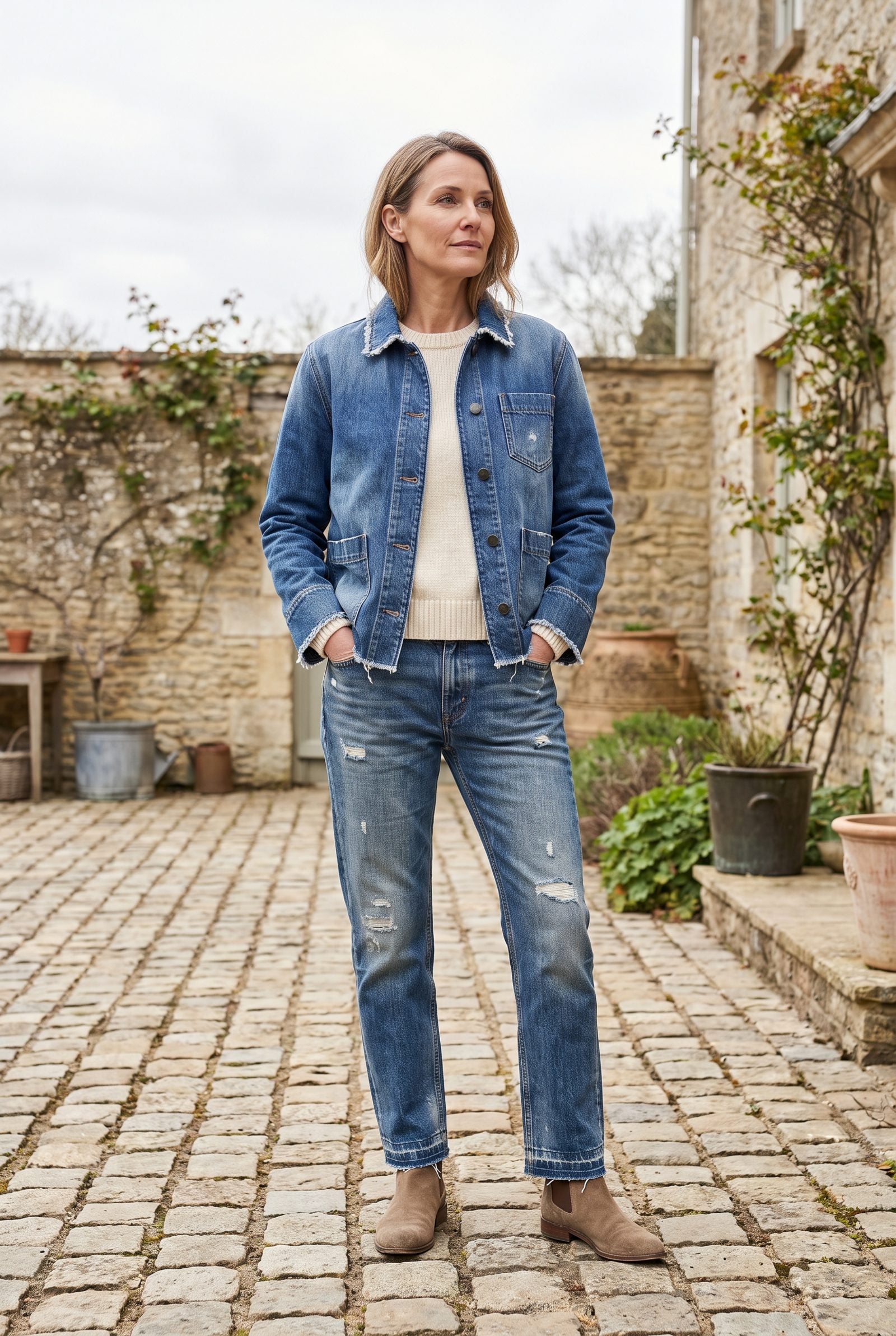
Everyone assumes torn denim says ‘rebel.’ It usually says the opposite. Buying a pre-distressed pair is a bid for belonging, not defiance. It signals a tribe, a casual confidence, an ease with imperfection that reads as security rather than protest.
Here’s the deeper mechanism. Clothing works on two tracks, its symbolic meaning and the physical act of wearing it, and that framework comes straight from the foundational enclothed cognition research by Adam and Galinsky (Source). Distressed denim leans hard on symbolism. The rips say ‘I’m relaxed, I don’t take myself too seriously, I’m one of you.’ For a woman over 50, a well-placed tear at the knee isn’t an act of teenage rebellion, it’s a statement that she’s secure enough not to need everything pristine. That’s confidence, not defiance. The pristine woman is often the anxious one. The woman in the ripped knee has made peace with a little wear, and everyone around her can feel it.
The Cut That Triggers an Instant ‘She Has Her Life Together’ Response

Someone decides you’re competent before you’ve said a word. Before you’ve smiled. Before they’ve registered your face as a face. Princeton researchers ran nine studies and found that people rate competence from clothing in as little as 130 milliseconds, barely long enough to know you saw a person at all. Source
Here’s what that means for denim. A dark-wash, clean-line jean with a tailored seam and no fading reads as deliberate. The brain files “deliberate” under “capable” faster than you can object to it. Warn people about the bias and it barely moves the needle. Source
The dark rinse isn’t the whole story of pulled-together. But it’s the opening line, and it’s read before you get a vote.
Why Black Denim Short-Circuits the Age Guessing Game
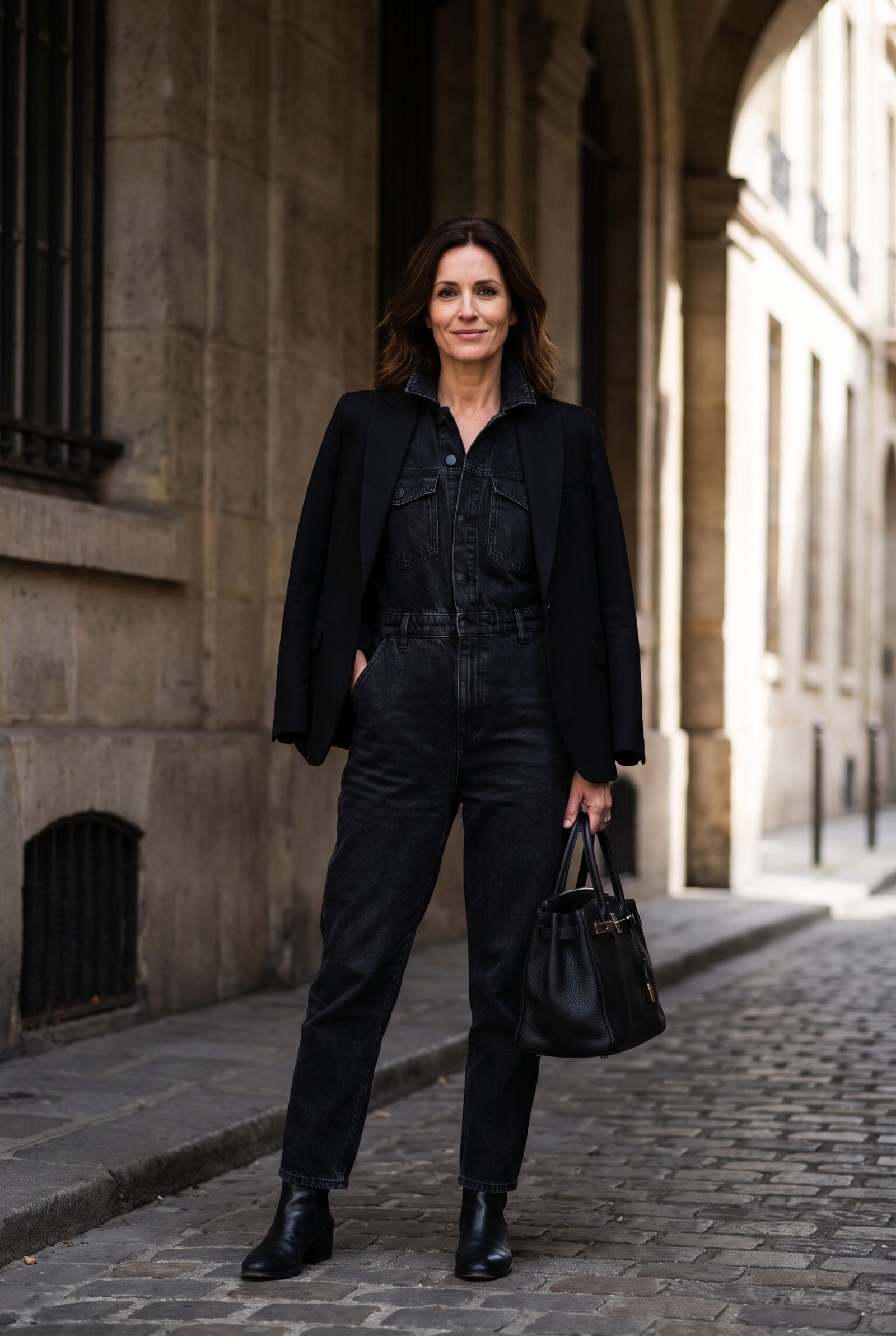
Black denim does something the eye can’t quite account for. It flattens the visual cues people usually scan to place you on a timeline. No wash lines, no whiskering, no fade patterns that date a pair to a decade. Just a solid field the brain reads as intentional rather than era-specific.
Color research backs the authority read. Black gets described as subtly strong, the shade you wear when you want to be taken seriously without raising your voice. Source One study of university students found black consistently named among the colors that made them feel most confident and most themselves. Source
Context matters more than the color alone, so black won’t do all the work on its own. But a pair of black skinny or straight jeans skips the whole question of when your jeans are “from.” Timeless isn’t a mood. It’s the absence of a timestamp.
The Straight Leg and the Psychology of People Who Keep Their Promises
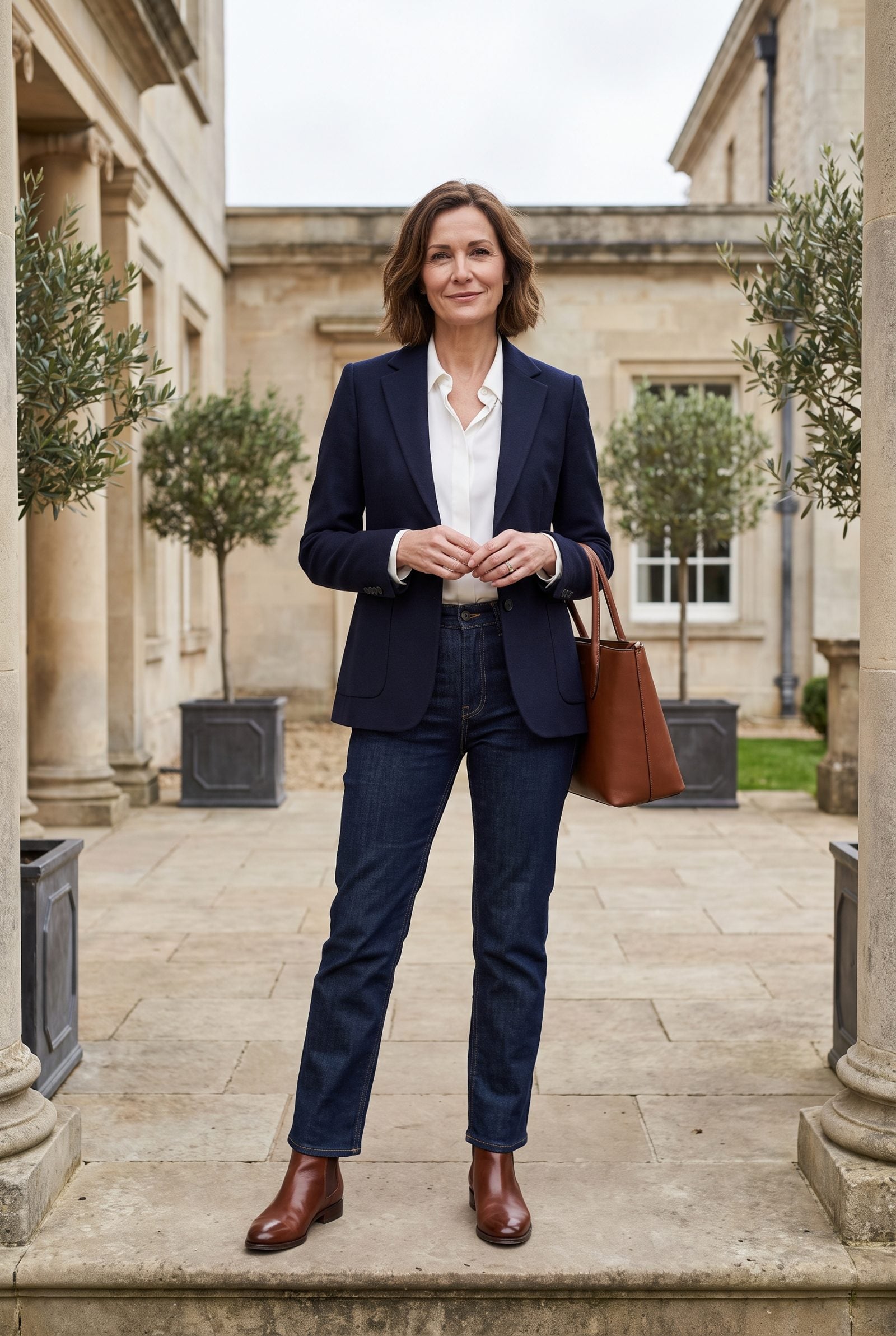
There’s a reason the straight leg never fully leaves. It doesn’t lunge toward a trend and it doesn’t apologize for sitting it out. The line runs clean from hip to hem, and the eye reads that steadiness as a kind of character.
First impressions pin personality traits onto clothing within a fraction of a second, and small construction details shift which traits land. Source A straight leg signals consistency, the visual equivalent of someone who shows up when they say they will. No drama in the silhouette. If you want to see how the cut earns its reputation for reliability, this style guide breaks down where the straight leg sits against its louder cousins.
Reliability isn’t flashy. It’s the thing you notice only when it’s missing.
What a High Rise Does to the Way People Listen to You

A high rise raises more than a waistband. It lengthens your visual line and nudges your posture upright without you deciding to stand up straighter. And posture, it turns out, is doing quiet work on the room.
A review of 130 studies found that upright, expansive body positions correlate with higher self-esteem and more positive emotion than slumped ones. Source We learn across a lifetime to associate a tall, open stance with competence. Source
Observers respond in kind. People reported stronger trust and responsiveness toward individuals holding an upright posture, reading hesitation into the slouch. Source A high rise sits you up. The room leans in. It’s a small mechanical trick with an outsized social return.
The Slouch That Reads as Power Instead of Carelessness
❤️ Would you like to save this?
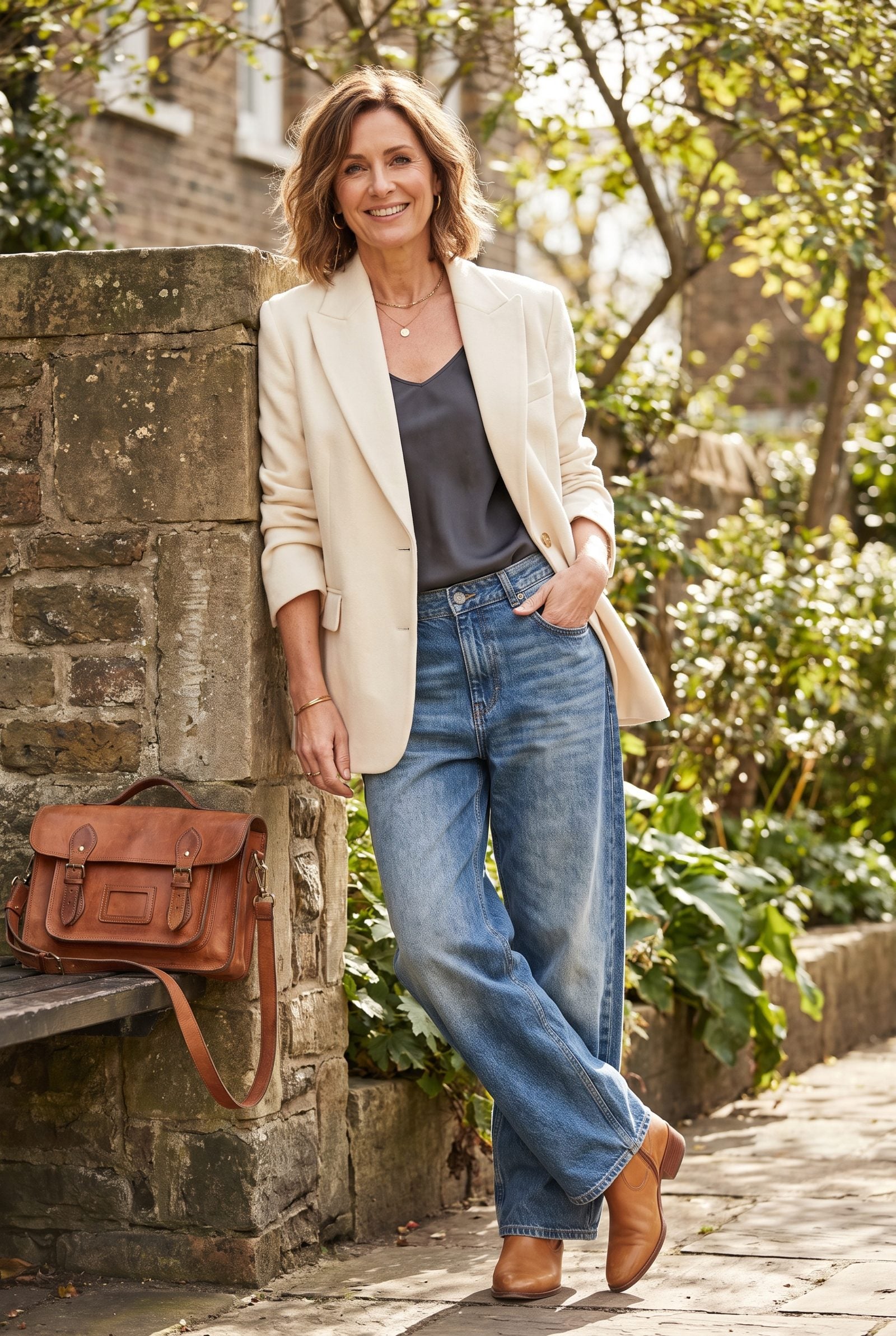
A relaxed, slouchy jean should read as casual. Sometimes it reads as the opposite. Ease at the right scale signals that you don’t need to prove anything, and that confidence is its own status marker.
Posture and clothing interact to shape how competent you look, and the two can override each other. Source Carry a loose, high-waisted slouch jean with a strong upright stance and the brain doesn’t file it under “gave up.” It files it under “chose this.”
The difference between sloppy and powerful lives in the top half. A crisp tuck, a structured shoulder, a lifted chin. The denim relaxes so the rest of you can command. That’s the trade, and it only works if you hold up your end.
Ease is only read as power when nothing else about you looks accidental.
Why the Bootcut Makes Onlookers Trust Your Judgment
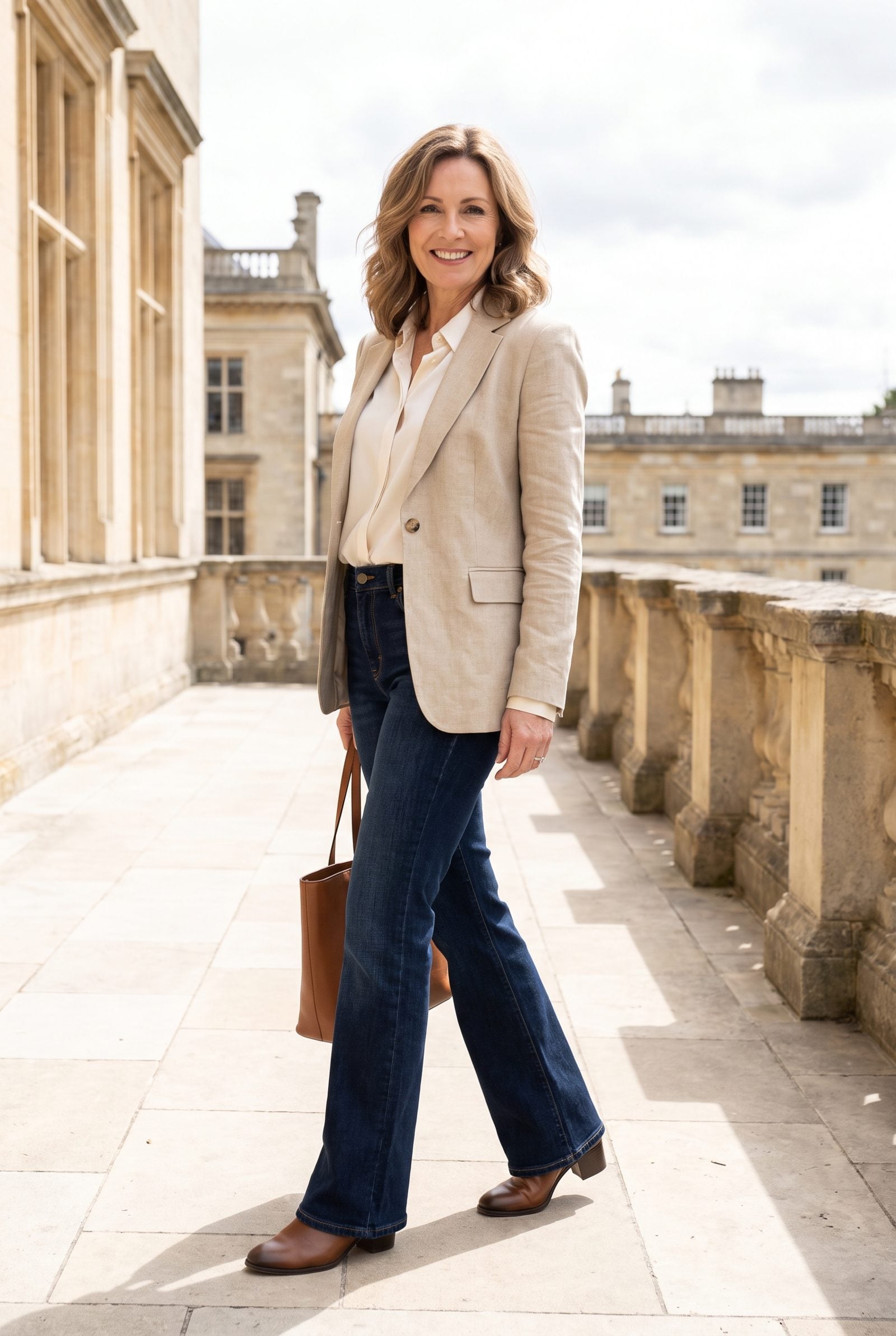
The bootcut has a proportion the eye quietly approves of. It skims the thigh, then opens at the hem just enough to balance the frame top to bottom. Symmetry and balance land as competence, because the formal, put-together look pulls the most favorable cluster of judgments: intelligent, trustworthy, reliable. Source
A bootcut reads as a decision made by someone who understands balance. And we extend trust to people whose choices look considered. There’s a borrowed authority too. The bootcut carries a faint memory of the seventies, an era-nod without the costume, which the eye reads as rooted rather than chasing.
Pair it with a heeled boot and the line runs unbroken to the floor. That clean vertical does more for perceived judgment than any logo ever could.
The Light Wash That Signals You Stopped Performing for Approval

Dark denim does the competence work. A light wash does something braver. It opts out of the whole status signal and lets the room read ease instead of armor.
Casual clothing nudges the mind toward a more relaxed, laid-back state, the opposite of the alert posture formal wear induces. Source That ease is a message. A faded, softened jean says the wearer isn’t angling to impress, and there’s a particular confidence that comes with no longer auditing every impression you make.
By a certain decade you’ve run the experiment. You know which rooms are worth performing for and which are not. The light wash is what that knowledge looks like on a weekday. Settled, not sloppy. Comfortable because you earned it. That’s what real style is.
What Your Jean Length Says About How Much You Need to Be Liked
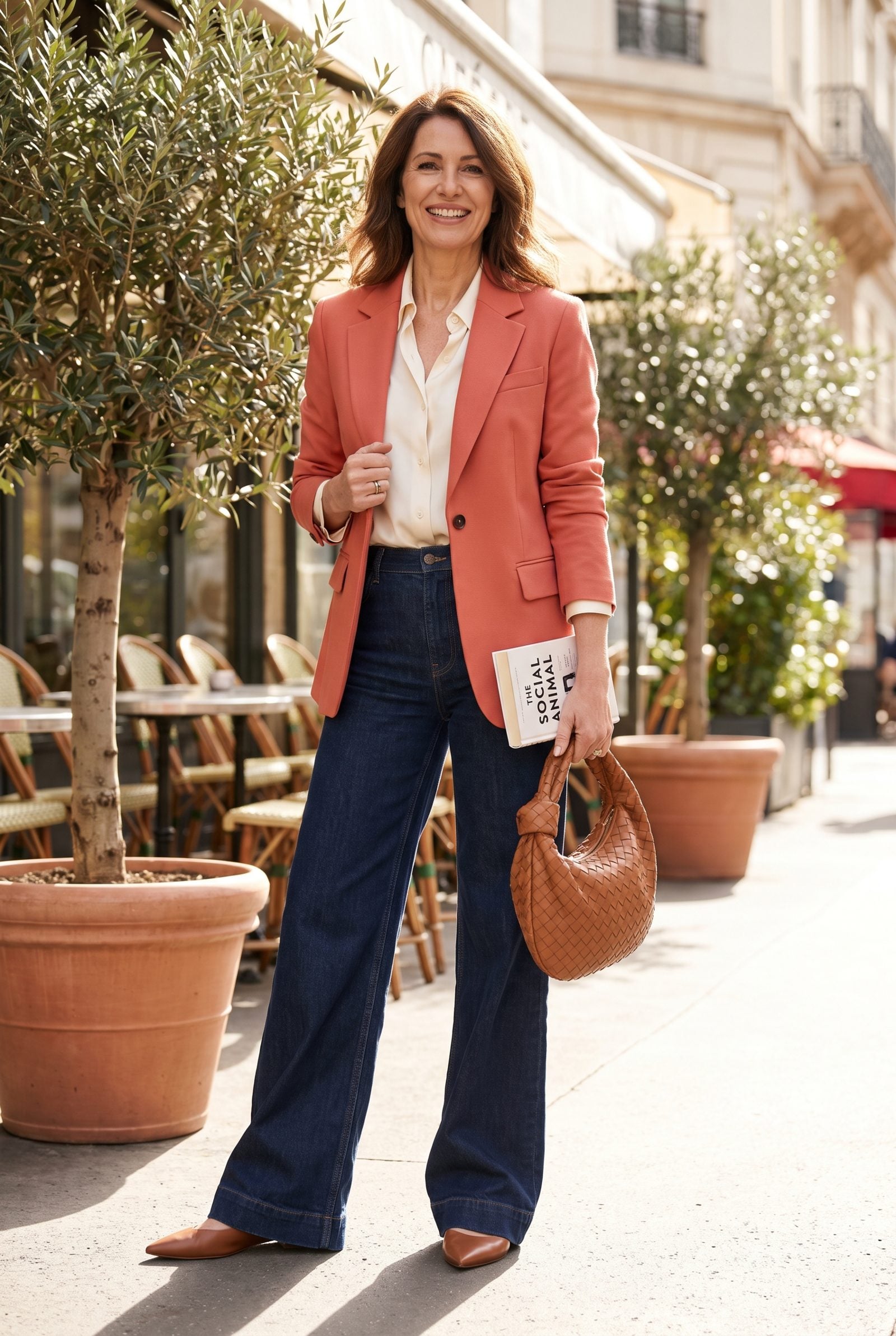
Hem length is the smallest decision in the whole outfit and possibly the loudest. A jean cropped to show the ankle on purpose reads as someone who made a call and isn’t waiting to see if you approve. A hem puddling at the shoe, or hovering nervously between lengths, reads as a decision deferred.
Small changes in clothing detail produce different first impressions, even those formed in a split second. Source A deliberate hem is a tiny act of self-possession the eye catches instantly.
The woman who crops at the ankle bone or breaks cleanly at the shoe isn’t asking a question. She’s stating a preference. That quiet refusal to seek approval is, ironically, the most likeable thing in the room. The ones who need it least tend to get it.
The Dark Rinse That Makes a Room Assume You’re In Charge

A deep indigo straight-leg jean borrows a language your eyes already speak. Dark colors carry centuries of weight. European aristocracy wore black because rich black dye took layer after layer, so it read as wealth, and judges, priests and scholars later adopted it to signal impartiality, wisdom and power (Source). Denim walks into that same room and quietly collects the same assumptions.
Here’s the part worth sitting with. In a 2021 behavioral study, darker suits earned significantly higher trust scores than lighter ones of identical cut (Source), and the specific hue mattered far less than how deep it went. Your dark rinse jean is running the same play. It gives you a cleaner starting point, which is why a crisp indigo pair with a white button-down shirt reads as intentional while faded denim reads as weekend.
By 50, you already know this instinctively. You’ve watched a room reorganize itself around the woman who walked in looking decided.
Why Cropped Hems Read as ‘I Know Exactly What I’m Doing’

Watch where a cropped hem lands. Just above the ankle bone, one deliberate inch of skin before the shoe. That gap is a signal, and the signal is control.
A full-length jean that pools at the shoe looks like it wandered in by accident. A cropped jean looks measured, because someone made a decision about exactly how much leg to show. The eye registers intention before you register why. It’s close cousin to the finding that deliberate, controlled deviations from a norm raise perceived status and competence (Source). The key word in that research is deliberate. A hem that stops short on purpose reads the way red socks with a suit read: this woman chose this.
There’s a body-image bonus too. A visible ankle narrows the lower leg and lengthens the line, which is why cropped flats or a low block-heel ankle boot finish the look so cleanly. Plenty of women resist cropped jeans for years, convinced they’re for the tall. Wrong. The crop isn’t about height. It’s about confidence in the edit.
The Boyfriend Fit and the Confidence People Can’t Explain
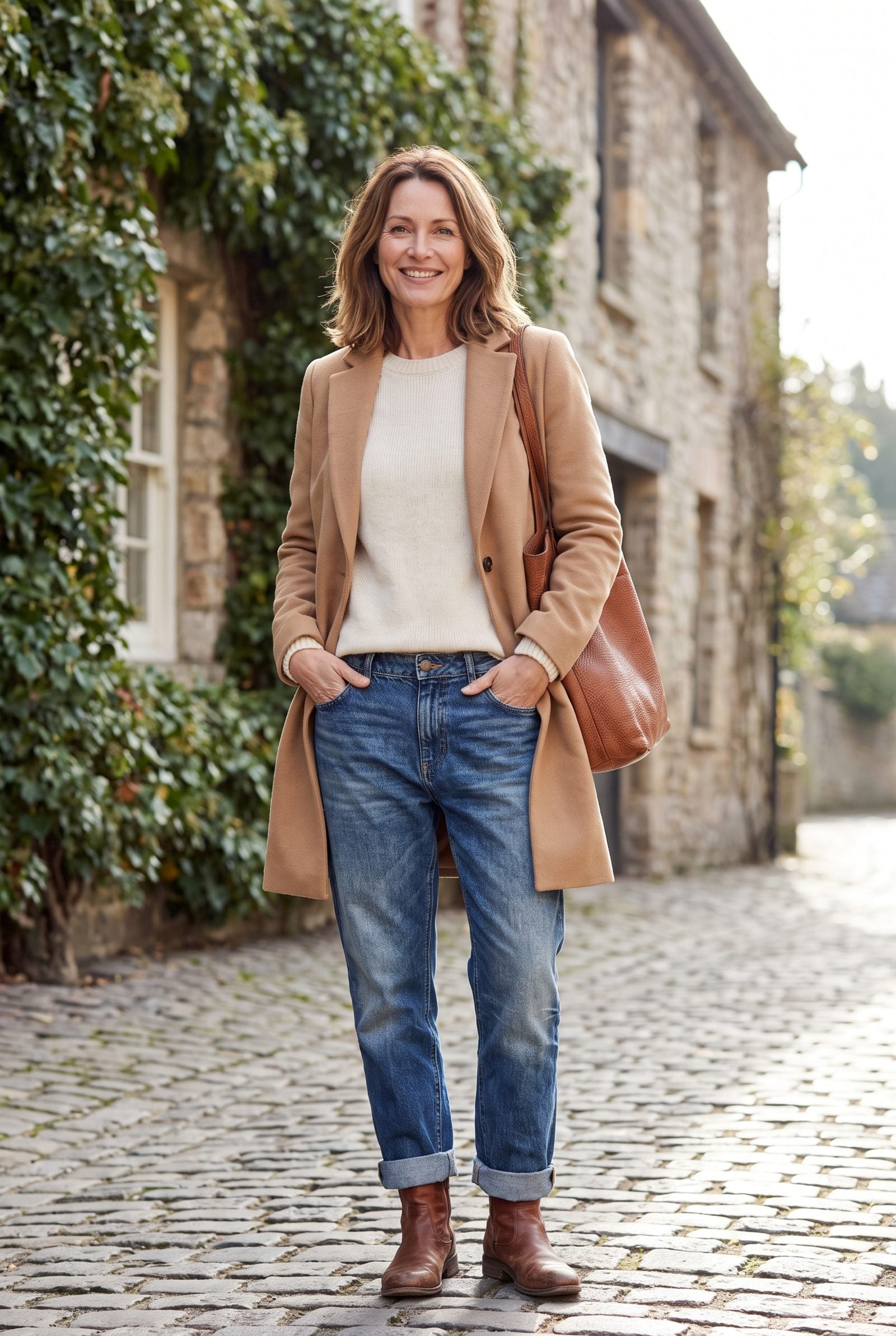
Loose denim looks like it has nothing to prove. That’s the whole trick.
The boyfriend jean sits away from the body, roomy through the hip and thigh, usually cuffed at the ankle. It reads as ease, and ease reads as security. Research on relaxed silhouettes points to a real mechanism: loose-fitting clothes tend to settle the nervous system while tight fits amplify self-consciousness (Source). When the waistband isn’t negotiating with you all day, you stop performing for your own clothes. People see the result, not the cause.
Here’s where age becomes the advantage. A looser jean on a woman over 45 doesn’t read as giving up. It reads as a woman who has stopped auditioning. Add a heeled mule and a fitted white tee so the proportion stays deliberate, and the slouch turns into a statement. If you want the full breakdown of how to keep a relaxed pair looking intentional, this style guide covers the proportions that matter.
What a Clean Front Crease Communicates About Control

A pressed crease down the front of a jean is a small act of rebellion against what denim is supposed to be. Denim is casual by birth. A sharp center crease drags it toward the language of tailored trousers, and the eye notices the contradiction instantly.
That line says the pants were considered, ironed, planned. It leans on the same wiring that makes a clean, uniform denim read as polished and intentional while faded, slouchy denim reads as off-duty (Source). The crease is the loudest possible version of intentional.
Pair it with a dark wash and you’ve built a jean that can walk into a boardroom without apologizing. Pair it with a structured blazer and the whole look tips into quiet command. There’s a hard-learned lesson here: a crease forgives almost nothing. The fabric has to be crisp and the fit has to be right, or the line just looks like you slept in them. Your whole wardrobe is only as sharp as the pieces you actually press.
The Flare That Makes Strangers Assume You’re Creative
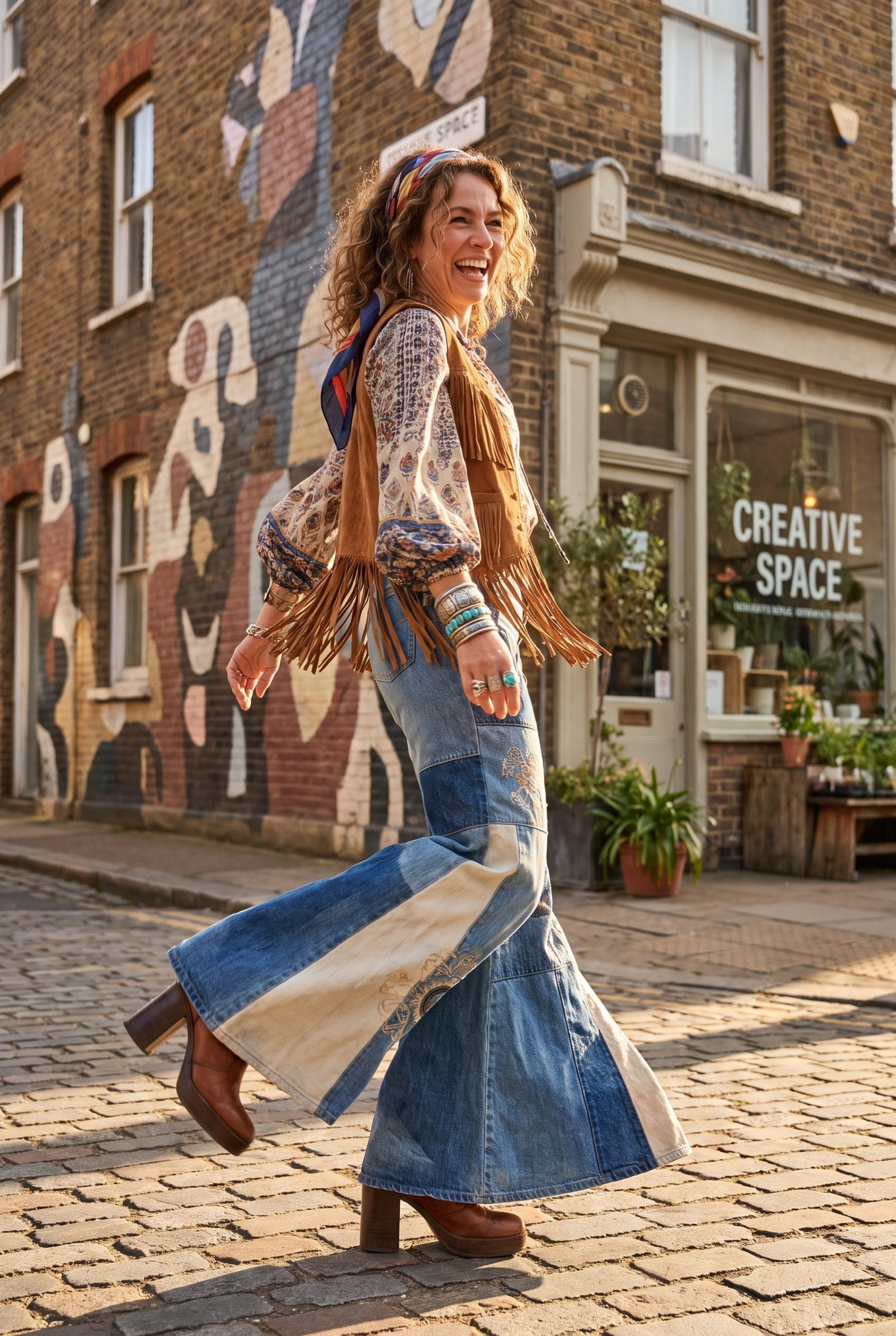
A flare breaks a rule, and that’s exactly why people read it as creative. The dominant denim silhouette for years ran straight or skinny. Choosing a leg that opens below the knee is a visible departure from the default, and the brain treats visible, deliberate departures as evidence of an independent mind.
This is the engine behind the “red sneaker effect,” where unconventional but intentional choices signal authority and accomplishment (Source). The Harvard researchers behind it found that deliberate nonconformity broadcasts a kind of confident autonomy, a sense that you don’t need outside approval (Source). A flare does that without a single word. It says you looked at the straight-leg consensus and went your own way.
The styling move that keeps it from reading as costume: a high rise, a long clean line, and a platform heel hidden under the hem so the leg reads endless. A flare over 50 isn’t nostalgia dressing. It’s a point of view.
Why a Relaxed Waistband Reads as Emotional Security

The waistband is where denim either fights you or lets you breathe. A relaxed, mid-to-high waistband that sits without digging does something quiet to how you carry yourself, and other people pick up on it before you say a word.
There’s a physical reason. A waistband that doesn’t pinch means you stop making small corrections to your clothes every few minutes, and that drop in physical awareness quietly lifts mood (Source). A woman who isn’t tugging at her waistband stands taller, moves freely, and reads as settled. Settled looks like security because it is.
Plenty of us spend years in jeans one size too optimistic, convinced the discomfort is the price of looking good. It isn’t. The relaxed waist doesn’t make you look bigger. It makes you look like you’ve stopped bracing. Finish it with a loosely tucked top and a slim leather belt for definition, and the ease reads as confidence rather than surrender. Half of good style is refusing to suffer for the look.
The Skinny Fit and the Impression It Still Quietly Makes
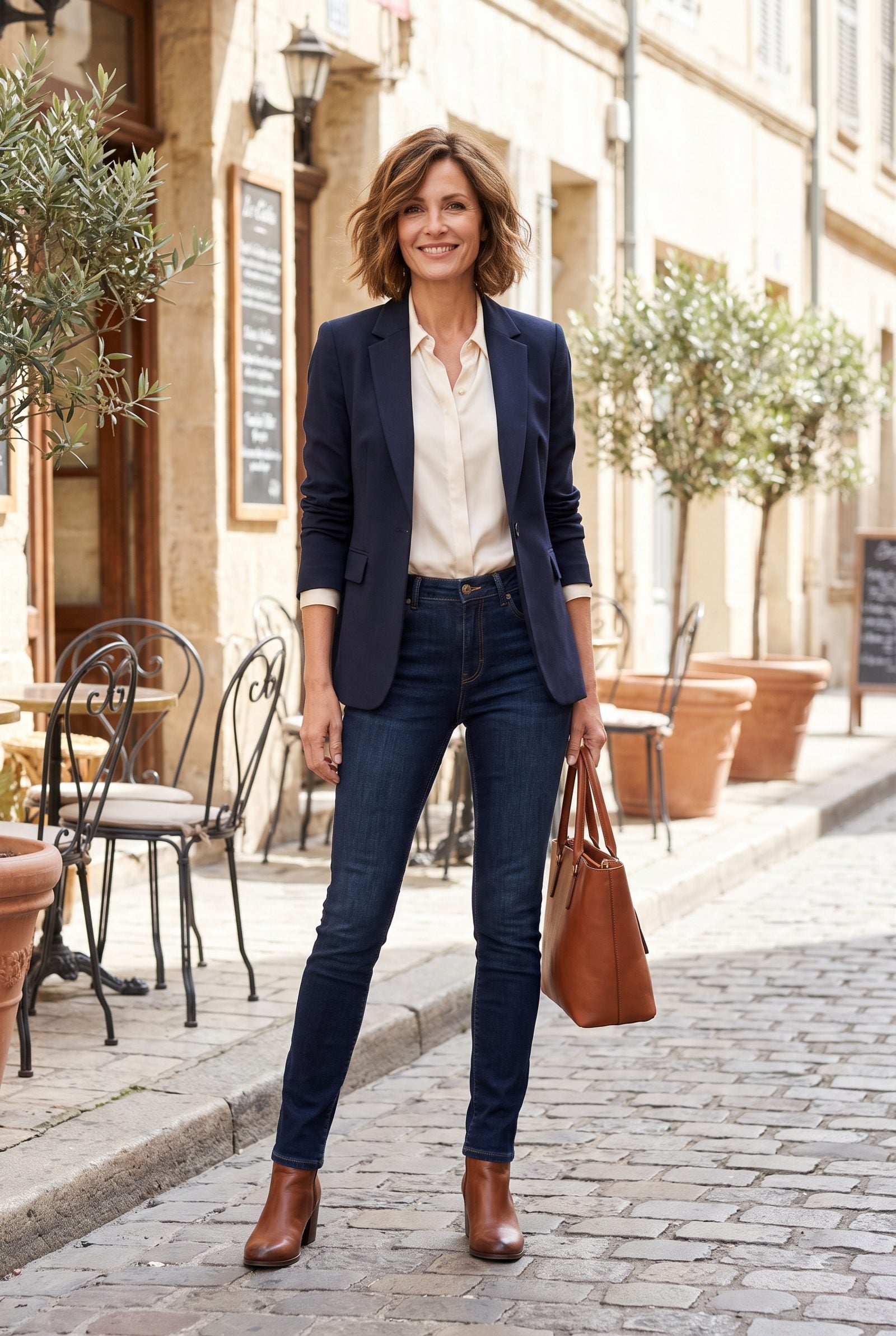
Everyone keeps declaring the skinny jean dead. It keeps not dying. And the impression it makes hasn’t changed: sharp, decisive, a little bit armored.
A skinny follows the leg all the way down, which creates an uninterrupted vertical line and a silhouette that reads as pulled-together and precise. There’s an enclothed-cognition angle too. In the 2012 Adam and Galinsky research that coined the term, clothing shapes the wearer’s own psychology through both its physical feel and its symbolic meaning (Source). A snug, structured jean keeps you aware of your own outline. For some women that reads as restriction. For others it reads as focus, the denim equivalent of a firm handshake.
Here’s my unpopular opinion: the skinny isn’t a trend, it’s a tool, and a woman over 45 who wears one well looks deliberately streamlined, not dated. The secret is balance up top. An oversized shirt, a longline wool coat, or a chunky ankle boot gives the lean line something to play against.
What Whiskering at the Hip Says About Movement and Ease
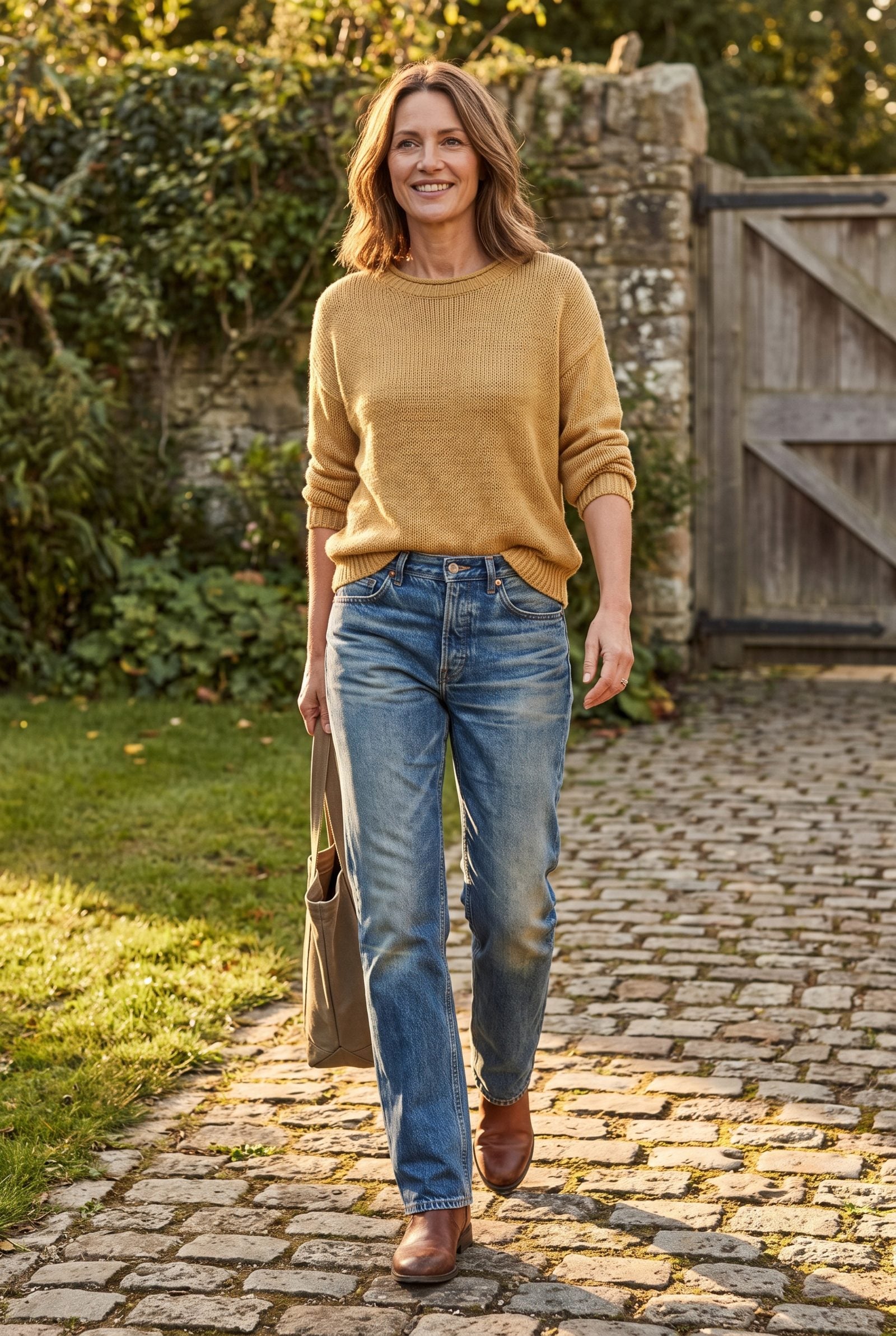
Look closely at a worn-in jean and you’ll see faint fading lines fanning out from the hip and crotch, soft creases the industry calls whiskering. They’re a map of movement, and your eye reads them as a life lived in the pants rather than a jean fresh off the shelf.
Whiskering softens a jean’s whole message. Where a flat dark rinse signals control, those lived-in lines signal ease and approachability. That tracks with how lighter and more broken-in looks read as warmer and more open than deep uniform tones (Source), which carry formality. Whiskering tells the room you’re relaxed, mobile, not precious about your clothes.
The catch worth naming: factory-faked whiskering can look loud, while natural wear on a jean you’ve actually loved looks honest. If you’re buying it pre-distressed, keep the contrast subtle and the rest of the outfit clean, a crisp white shirt and simple white leather sneakers, so the softness reads as ease instead of effort. Owning how you move is a huge part of personal style in real life.
The Mid Rise That People Register as Effortless Balance

❤️ Would you like to save this?
The waistband that sits an inch or two below the navel does something quietly clever. It splits the body at a point the eye reads as natural, so nobody clocks the jeans as “doing” anything. That invisibility is the trick. A rise that calls no attention to itself lets the person wearing it read as comfortable in her own skin, and comfort is the thing strangers register before they register the denim.
There’s real science under the hunch. Clothing choices map onto personality in measurable ways, and a 2021 Frontiers in Psychology study of nearly 800 women found that the functions people ask of their clothes, assurance, comfort, individuality, track directly with their traits. Source
Pair a mid-rise straight-leg jean with a tucked white tee and the message is settled. Not trying, not neglecting. Just balanced. For more on getting the proportions right, our style guide breaks it down.
Why Selvedge Edges Signal Patience to the People Who Notice

Roll the cuff. There it is, a thin stripe of colored thread sealing the outseam, usually red, sometimes gold. Most people walk past it. The ones who don’t walk past it are telling you something about themselves, and so are you.
Selvedge denim is woven on old shuttle looms, slower machines that produce a self-finished edge and a tighter, denser weave than mass-market fabric. Source That slowness is the whole point. A pair that fades to your body over years, not weeks, is a bet on sticking around. One guide put it plainly: a well-cared-for pair can last decades if you repair it well. Source
So the edge reads as patience. The willingness to buy once, wear long, and let the fabric record your life in creases nobody can fake. After 40, that reads as authority. You’ve stopped chasing the new thing because you’ve learned the raw selvedge jean you fade yourself beats the pre-distressed shortcut every time.
The Puddle Hem and the Psychology of Not Caring Who’s Watching
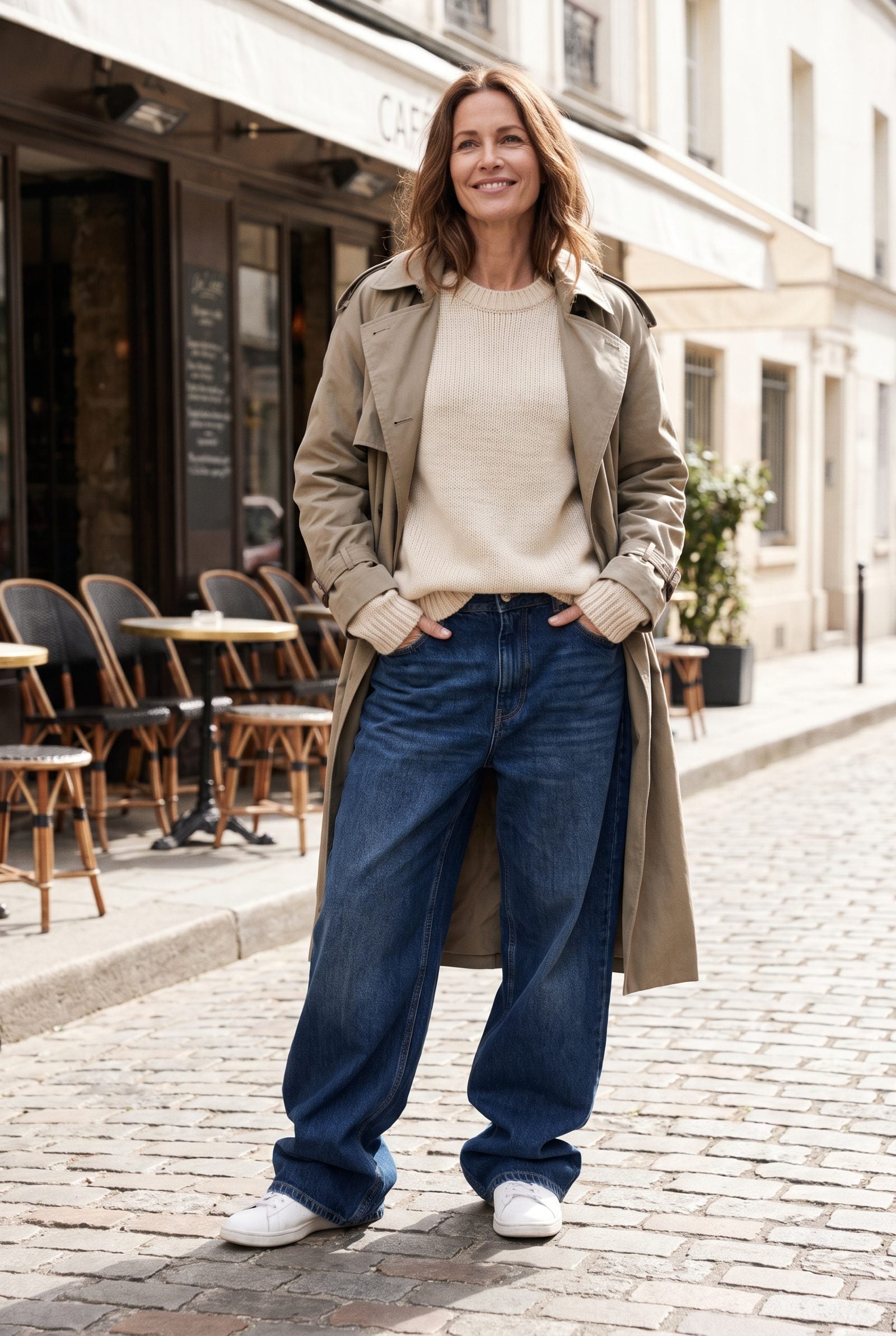
A hem that breaks and stacks over the shoe, pooling an inch past the heel, breaks a rule your mother taught you. Jeans are supposed to end where your ankle ends. The puddle hem decides not to. And that small act of refusal is exactly the message.
Length you deliberately leave long says you’re not dressing for the inspection. There’s a measured freedom in it, the look of someone who got dressed for herself and let the chips fall at the ankle. Research on fashion as nonverbal communication keeps landing on the same note: what we wear is a projection of identity and a signal of confidence, not just a response to what others expect. Source
The puddle hem works best in a wide-leg dark jean that has the fabric weight to actually pool rather than crumple. Here’s our honest take: it’s easy to resist this one because it looks like a tailoring mistake. It isn’t. It’s a decision, and decisions read as confidence.
What a Tapered Ankle Tells People About Your Precision

A leg that runs full through the thigh then draws in at the ankle does one thing the eye loves: it finishes the sentence. The taper is a deliberate narrowing, a line that knows exactly where it’s going, and we read intention into clean lines the way we read handwriting.
This isn’t only aesthetic. Enclothed cognition, the term coined by Hajo Adam and Adam Galinsky in their 2012 lab-coat experiments, shows that garments carrying a symbolic meaning actually shift how the wearer thinks and performs, including sharper, more sustained attention. Source A tapered jean reads as precise, and precise is a self-fulfilling cue.
Put a tapered ankle jean with a pointed leather flat and the whole line tightens to a point. People register someone who thought about it. Not fussily. Just enough. Your sense of style is the quiet proof.
The Faded Knee That Reads as a Life Fully Used

You can buy distressing. You can’t buy a fade. The difference sits right at the knee, where years of kneeling in gardens, sitting on floors with grandkids, and climbing in and out of cars have lifted the indigo in the exact shape of your own movement.
That whiskering is a record. Selvedge and raw denim fade according to how the owner actually lives, sculpting itself to the body and producing marks nobody else could reproduce. Source We read authenticity into things that look earned rather than applied, which is why a real fade lands differently than a factory sanded one.
After 40, that’s the whole quiet flex. A lived-in faded blue jean says you’ve been places and done things and have no interest in pretending otherwise.
Why the Fit You Reach for Most Says More Than Any Outfit You Plan

The jean you grab without thinking, before coffee, before the day asks anything of you, is the most honest thing in your closet. The planned outfit is a performance. The default is a confession.
Here’s why that matters. Clothing is a systematic method of conveying information about the person wearing it, and the choices we make without deliberating reveal traits more reliably than the ones we stage. Source One writer noted most of us get dressed more times than we’ll exercise or celebrate a birthday, so the ritual quietly records who we are. Source
If your hand always finds the same high-rise straight jean, that’s not a rut. That’s a signature you arrived at by living. A real wardrobe is built from those repeats, not from the pieces that still have tags. It’s easy to spend years thinking variety is the goal. It isn’t. Knowing your one jean is the goal.
The Bottom Line
Here’s the truth underneath all of these choices: people aren’t reading your jeans at all, they’re reading the ease with which you wear them. The fit you reach for on autopilot broadcasts how settled you are in your own body, and no wash or rise can fake that signal. So tomorrow, notice which pair your hand goes to first; that unthinking choice is the most honest thing you’ll say all day.