❤️ Would you like to save this?
Paris has never needed jeans to pretend they are anything other than denim. The interesting part is what happens around them. A razor-clean shirt cuff, a jacket ending exactly at the waistband, a loafer polished enough to argue with the pavement, a scarf tied where another outfit would reach for jewelry — small decisions keep shifting the same five-pocket garment into entirely different territory.
That is why the trick is not dressing jeans “up.” Plenty of outfits pile formal pieces onto denim and still look unresolved. The sharper approach is proportion: where a coat ends, how much ankle a crop exposes, whether a wide leg meets a compact top or a slim jean gets the long vertical of a coat. Texture matters just as much. Cashmere beside faded denim behaves differently from satin beside black denim, while velvet, leather, poplin and bouclé each change the temperature without changing the basic garment underneath.
Color does another surprising amount of work. Cognac repeated at belt, shoe and bag can make blue denim look almost tailored. Burgundy turns gray cooler. Cream softens indigo. Black becomes markedly less severe when it meets dusty rose or ivory. Nothing requires a rainbow; most of these looks work because one controlled color decision is allowed to register clearly.
The 39 outfits ahead range from baguette-run double denim to tuxedo tailoring, white poplin, sculpted knits, capes, trenches and midnight restaurant dressing. The jeans barely change their identity. Everything surrounding them changes the argument.
FYI, thanks to AI imagery software, we’re able to create very specific fashion and hairstyle examples to illustrate the points being made. In some cases, imagery is exaggerated to hammer home the point. Also, assume links that take you off the site are affiliate links such as links to Amazon. this means we may earn a commission if you buy something.
39. Dark Straight Jeans + a Black Off-the-Shoulder Fine-Gauge Knit
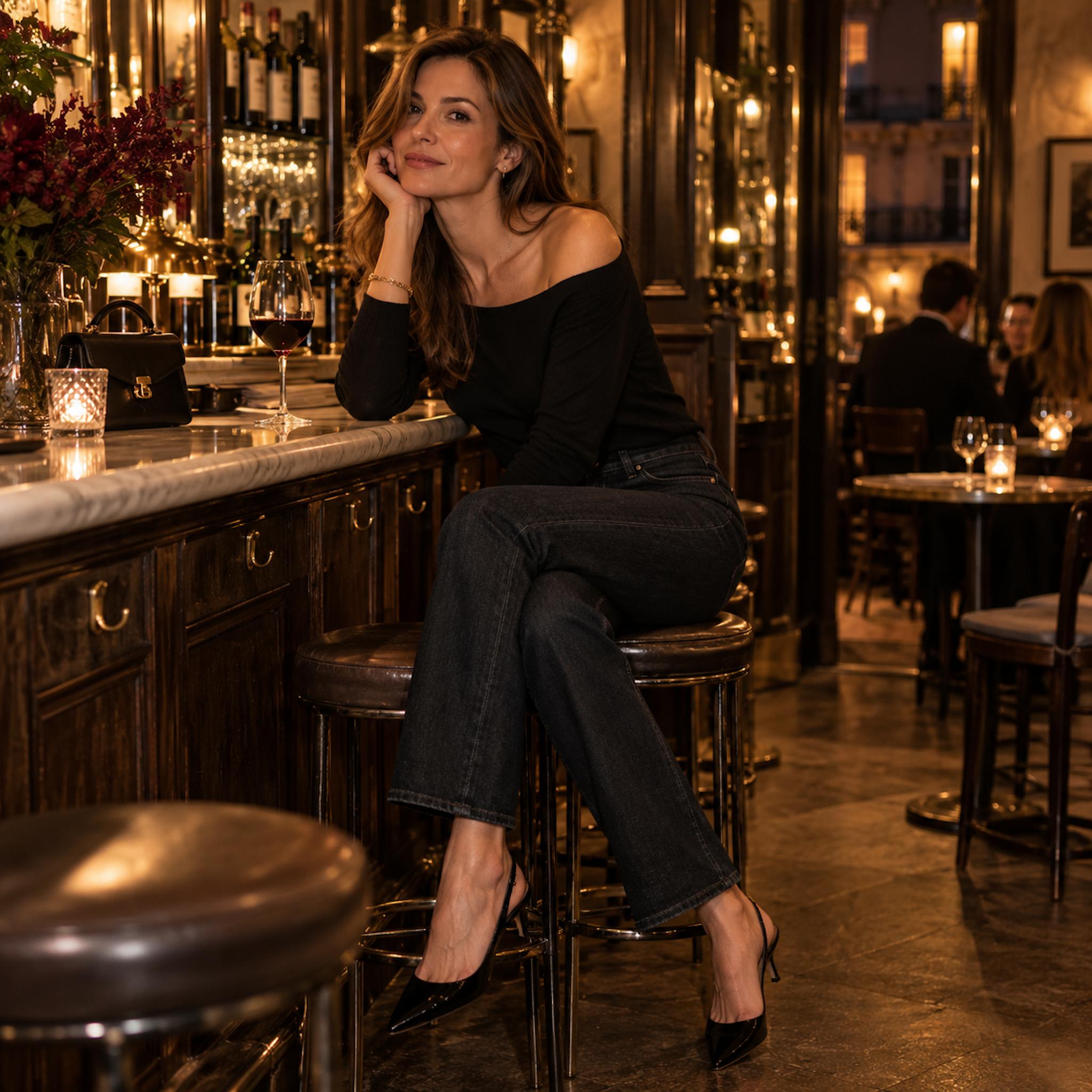
No sequins, no satin, no jacket doing the obvious evening work. A fine black knit slips off the shoulders and lets neckline rather than embellishment change the register of the dark straight jean.
The proportions stay almost severe below: clean denim, narrow slingbacks, very little jewelry. Candlelight supplies the shine the outfit refuses to add for itself, which is precisely why the combination feels so controlled.
Why It Works: Exposing the shoulder line creates enough visual occasion that the rest of the outfit can remain remarkably simple. Dark denim then becomes the quiet base rather than the casual interruption.
38. Pale Wide-Leg Jeans + a Terracotta Belted Jacket
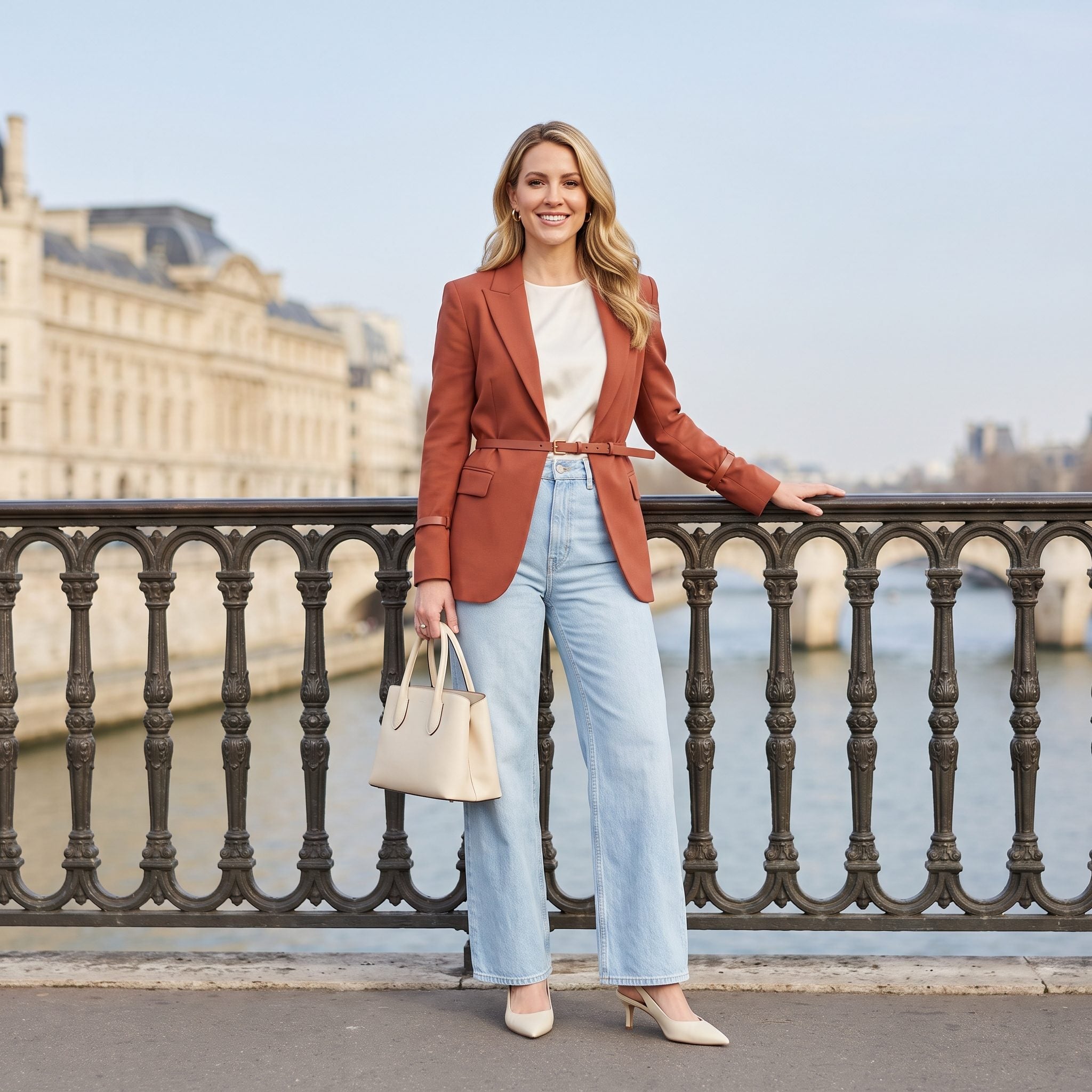
Terracotta against pale blue is the color story worth keeping: one warm, one cool, both sufficiently muted that neither starts shouting across the outfit. The jacket belt pulls the waist inward before the wide jean moves outward again.
An ivory shell leaves the neckline uncomplicated and prevents the tailoring from drifting toward office wear. The expensive-looking part is not any single piece; it is the restraint of three softened colors held in very clear proportions.
37. Mid-Blue Straight Jeans + a Crisp White Poplin Shirt With Exaggerated Cuffs
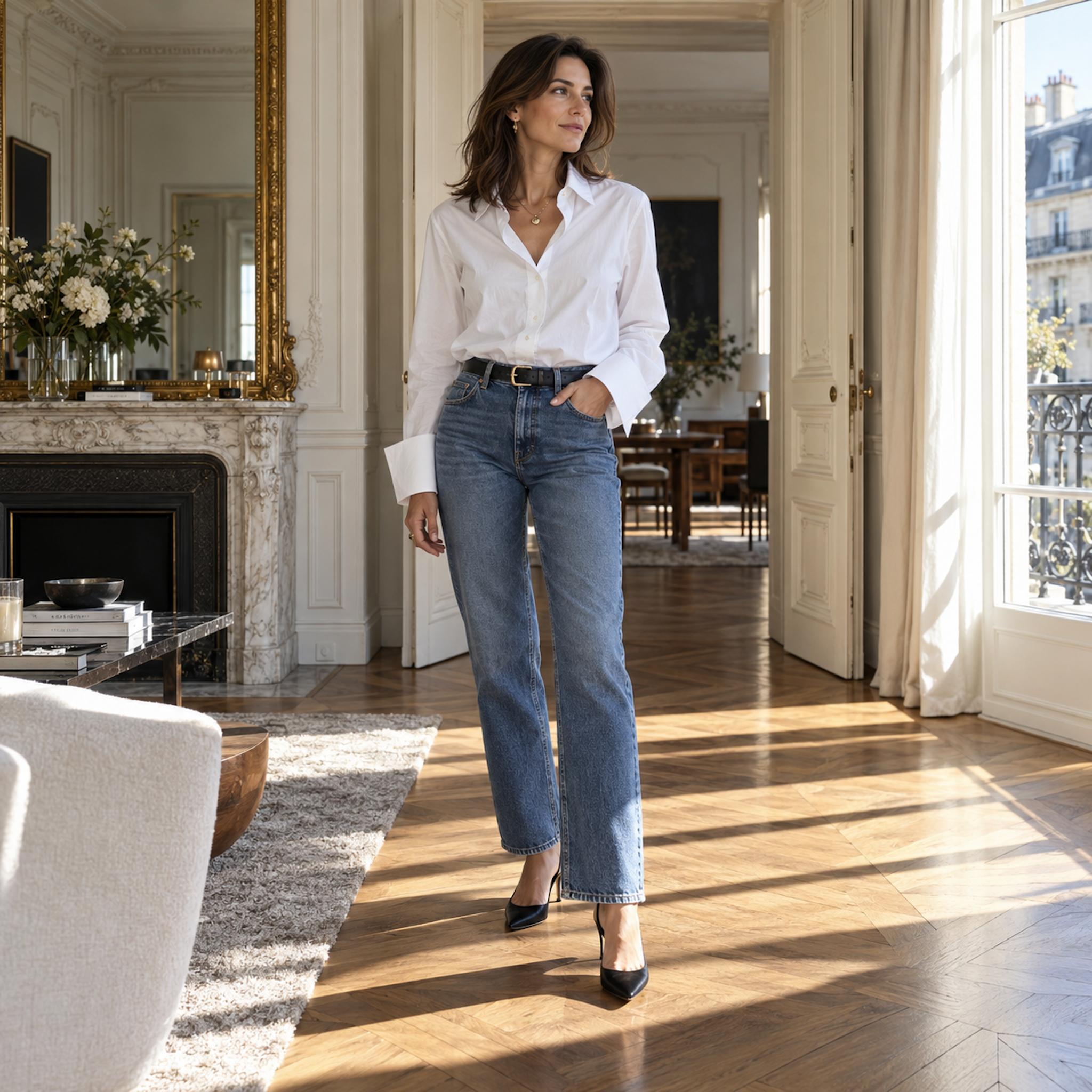
A white shirt becomes far less basic once the cuffs are allowed to take up some space. Here they extend beyond the wrist with enough volume to make the poplin feel architectural, while the rest of the shirt stays cleanly tucked into straight mid-blue denim.
Black pumps and a narrow belt give the pale shirt and medium wash a hard outline. Against ornate Parisian doors, parquet and gilded detailing, the clothes stay conspicuously simple — which makes the cut of the shirt matter even more.
Style Note: When cuffs are exaggerated, keep the rest of the shirt disciplined. Too much volume at collar, sleeve and hem would turn one sharp detail into general excess.
36. Vintage-Blue Slim Jeans + a Forest Velvet Blazer
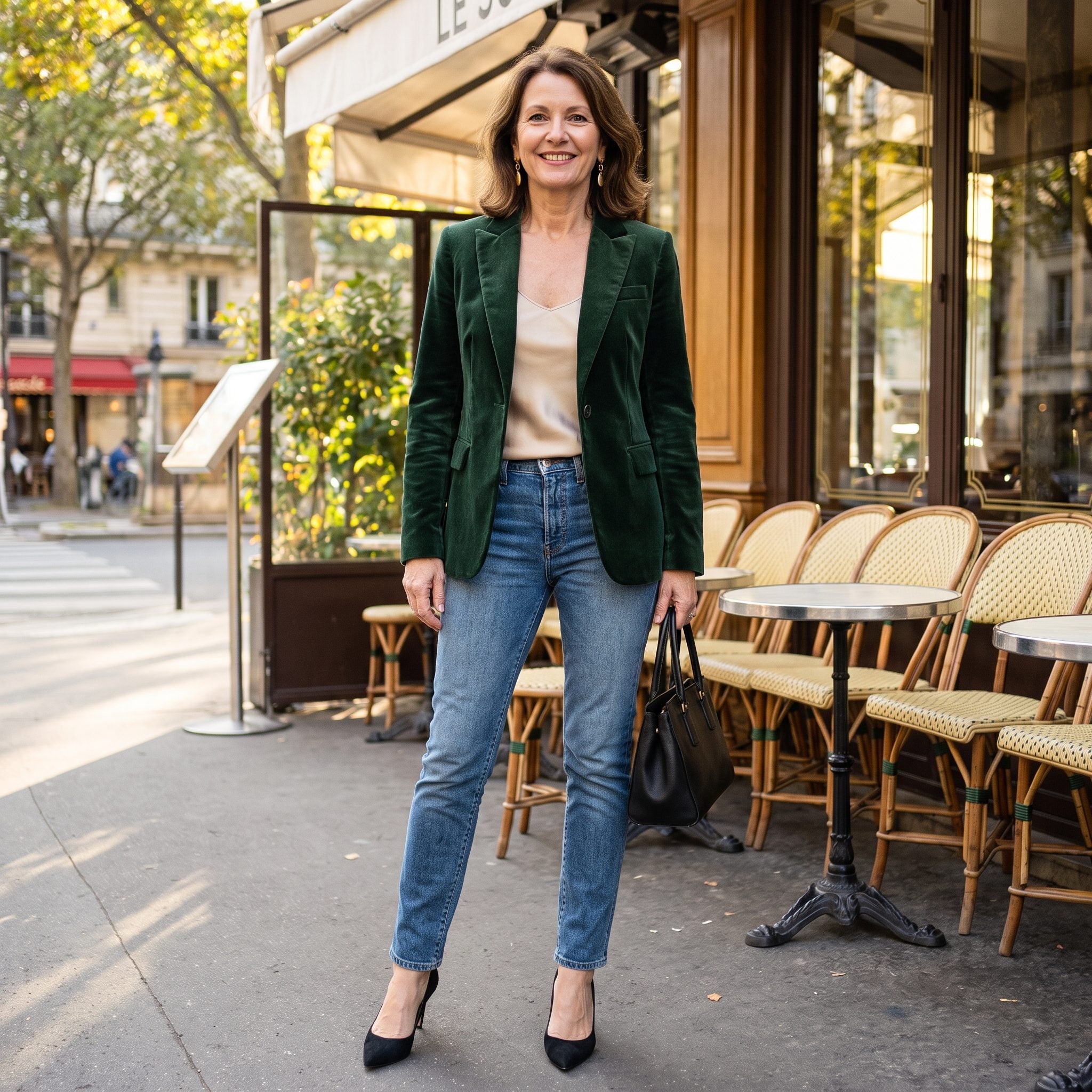
Velvet changes radically under low light. The forest-green pile darkens in one direction and flashes brighter in another, giving an otherwise straightforward blazer considerably more evening presence.
Champagne silk beneath it prevents all that deep green from becoming heavy. Vintage-blue denim then keeps the outfit from crossing fully into cocktail dressing — a useful tension between plush surface and familiar five-pocket structure.
History Corner: Velvet has a long history in formal and leisure clothing, including smoking and dinner jackets. Modern velvet blazers borrow from several strands of tailored eveningwear rather than descending from one single garment.
35. White Straight Jeans + a Black Boatneck Knit
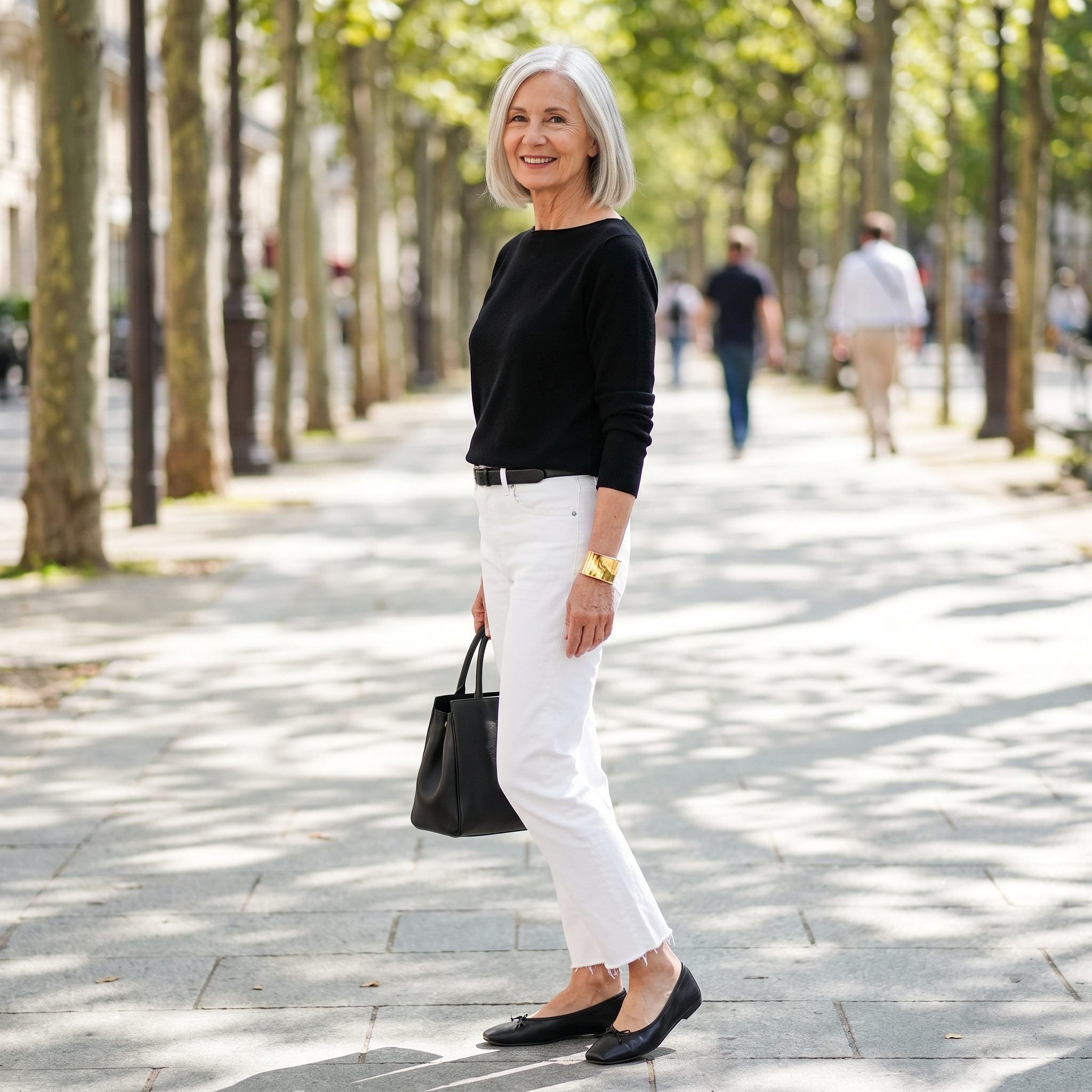
Black and white leave nowhere for muddled proportions to hide. The boatneck creates one broad horizontal above the straight white jean, while a clean ankle hem establishes another below.
Opaque denim matters because the entire effect depends on visual crispness. A single gold cuff interrupts the two-color scheme just enough to keep the outfit from feeling diagrammatic.
Why It Works: High contrast makes every boundary more visible — neckline, waistband, hem and shoe. That clarity is what gives an extremely simple outfit its graphic force.
34. Mid-Blue Straight Jeans + a Dark Denim Shirt and Silk Neck Scarf
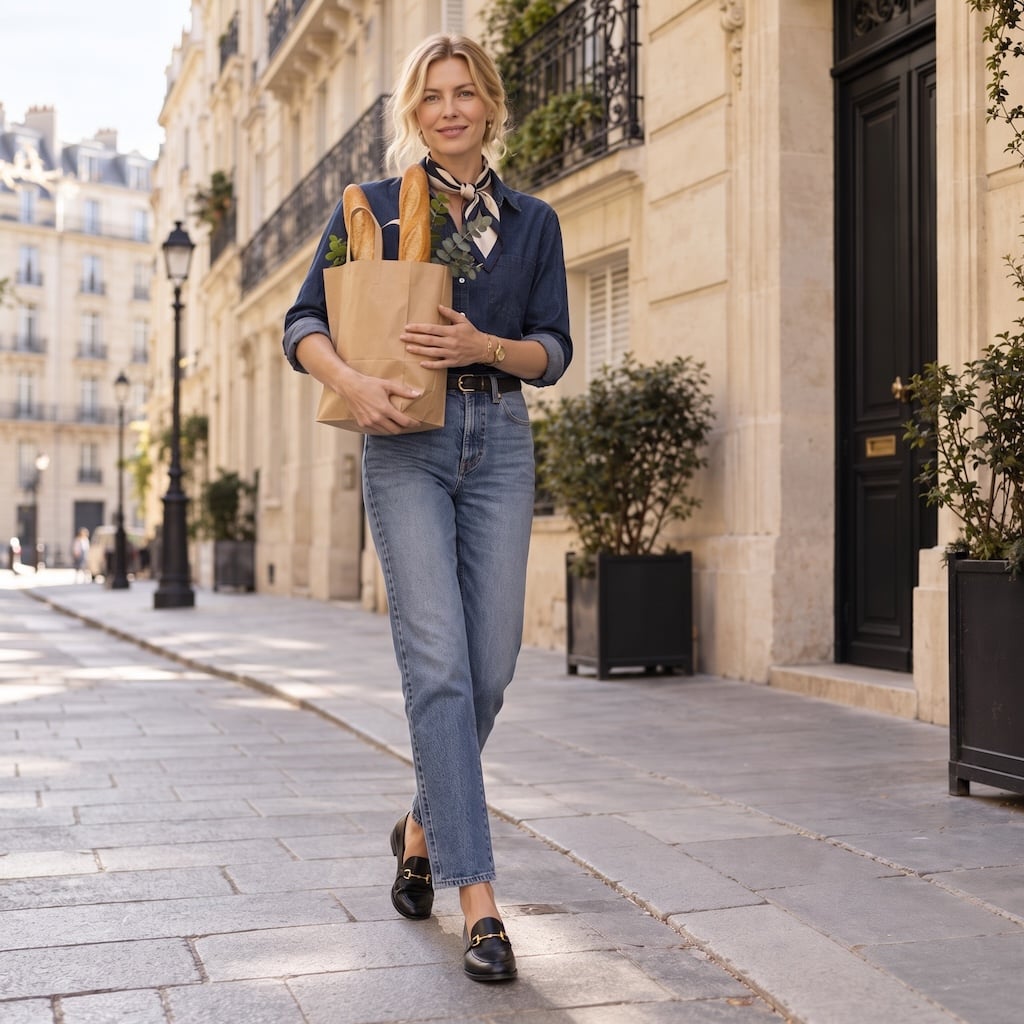
Double denim becomes much more interesting when the two blues are close enough to belong together but different enough to separate at the waist. The darker shirt gives the upper half weight; the mid-blue jean keeps the lower half lighter.
A narrow silk scarf changes the entire equation. Black-and-ivory print at the neck, a slim black belt and polished loafers introduce just enough formality to make a paper bag of baguettes look like part of the composition rather than a costume prop.
Design Detail: Tonal denim works best when something interrupts the blue field. Here, the scarf and belt establish two crisp horizontal accents while the loafers finish the darker line at the floor.
33. Black Bootcuts + a Champagne Satin Top
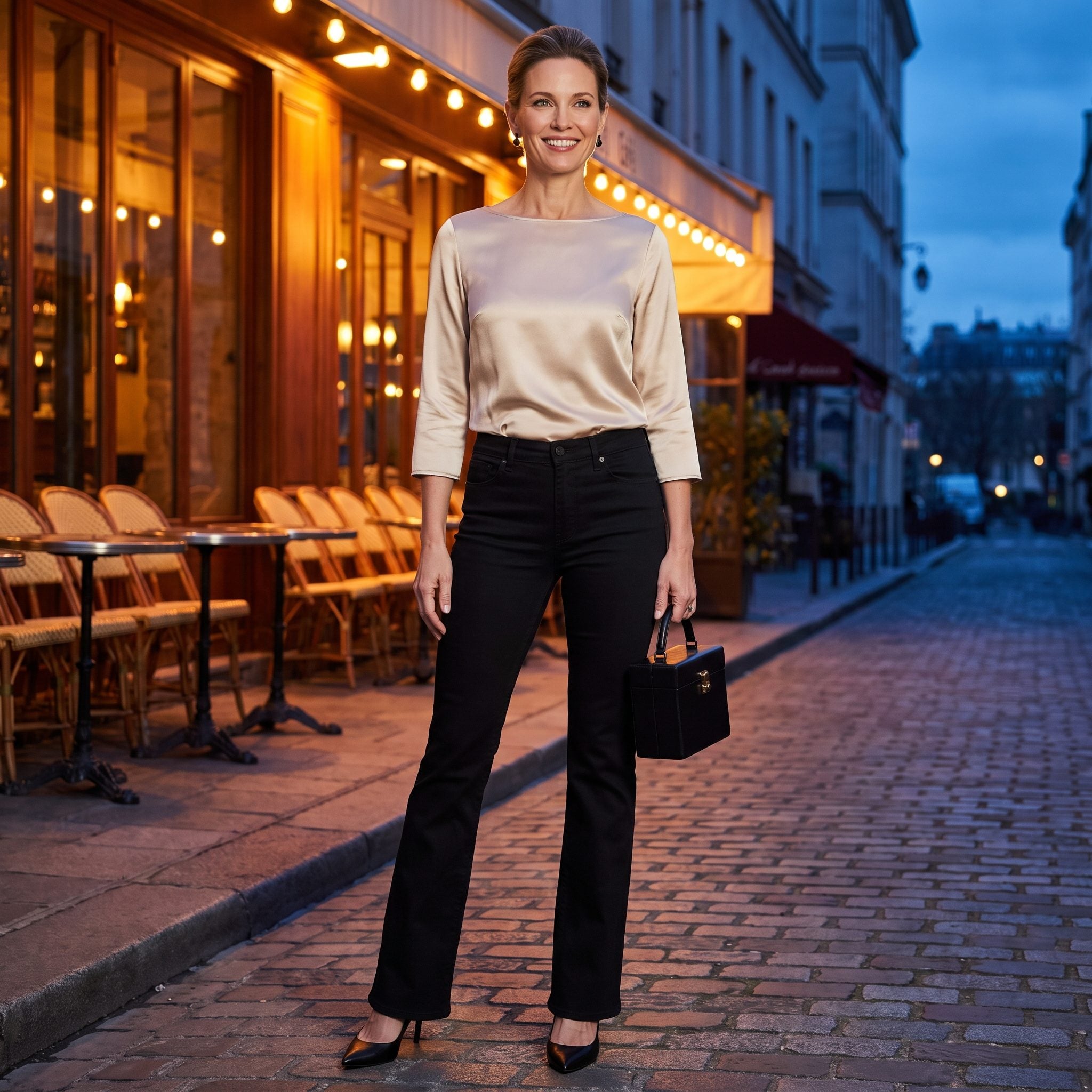
Black denim at dinner changes character the moment champagne satin enters the picture. Matte below, reflected light above: the contrast makes the fabric difference more important than the fact that one half of the outfit is still jeans.
A bateau neckline keeps the shine controlled, while the bootcut drops over a pointed pump in one nearly continuous dark line.
Material Note: Satin is conventionally associated with dressier clothing because its smooth surface returns light so readily. Against matte denim, that contrast becomes especially pronounced without requiring additional embellishment.
32. Cream Barrel Jeans + a Navy Striped Knit
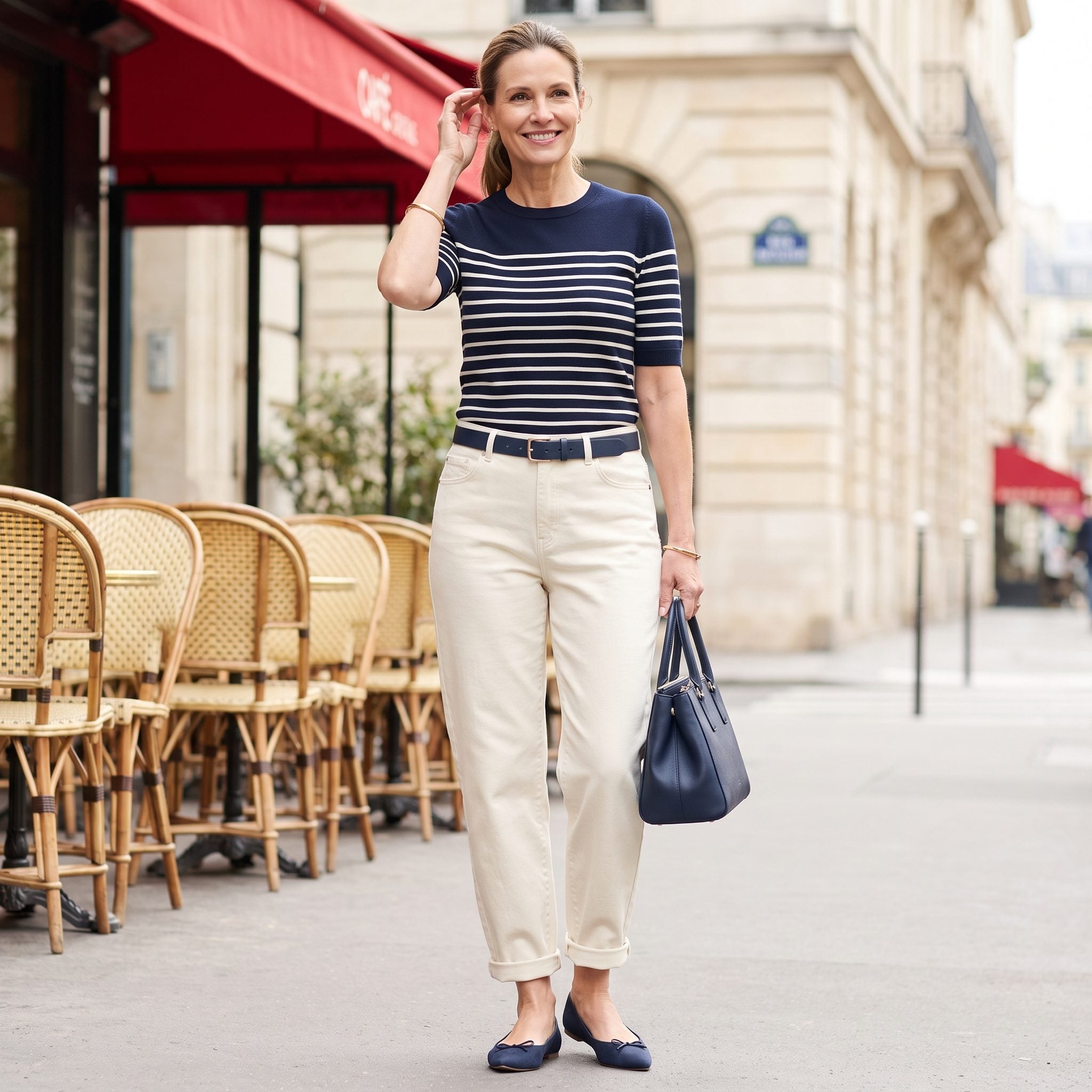
Barrel jeans already carry enough geometry through the leg, so the fitted striped knit wisely refuses to add another complicated shape. Navy outlines the torso while cream denim holds the brighter mass below.
Repeating navy at belt, flats and bag turns the stripes into part of a larger color system rather than an isolated nautical reference. One small gold bangle is plenty.
Did You Know: Striped sailor shirts became part of French naval dress in the 19th century, and designers including Coco Chanel helped carry nautical stripes into women’s fashion in the early 20th century. Their association with French style grew from that much longer exchange between uniform, resort wear and fashion.
31. Slate-Blue Trouser Jeans + a Camel Wool Cape
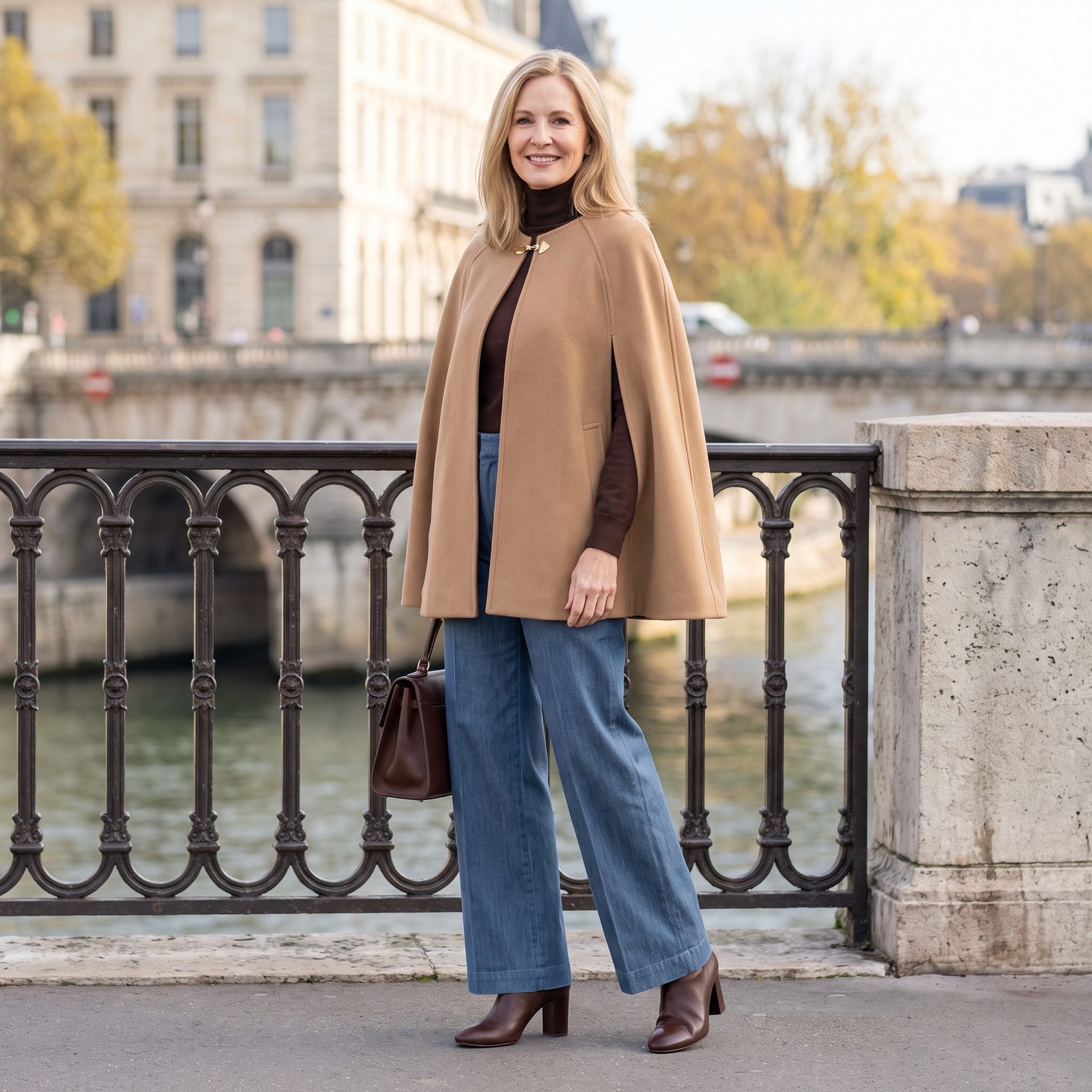
The cape does not need to be complicated to change the silhouette. Fastened cleanly at the neck, camel wool falls away from the shoulders in one uninterrupted plane while the slate-blue trouser jean remains broad and vertical below.
Chocolate knit and heeled ankle boots deepen the warm side of the palette. The jeans introduce the one cooler note, keeping a camel-and-brown combination from becoming visually heavy.
30. Gray Slim Flares + a Burgundy Mock Neck
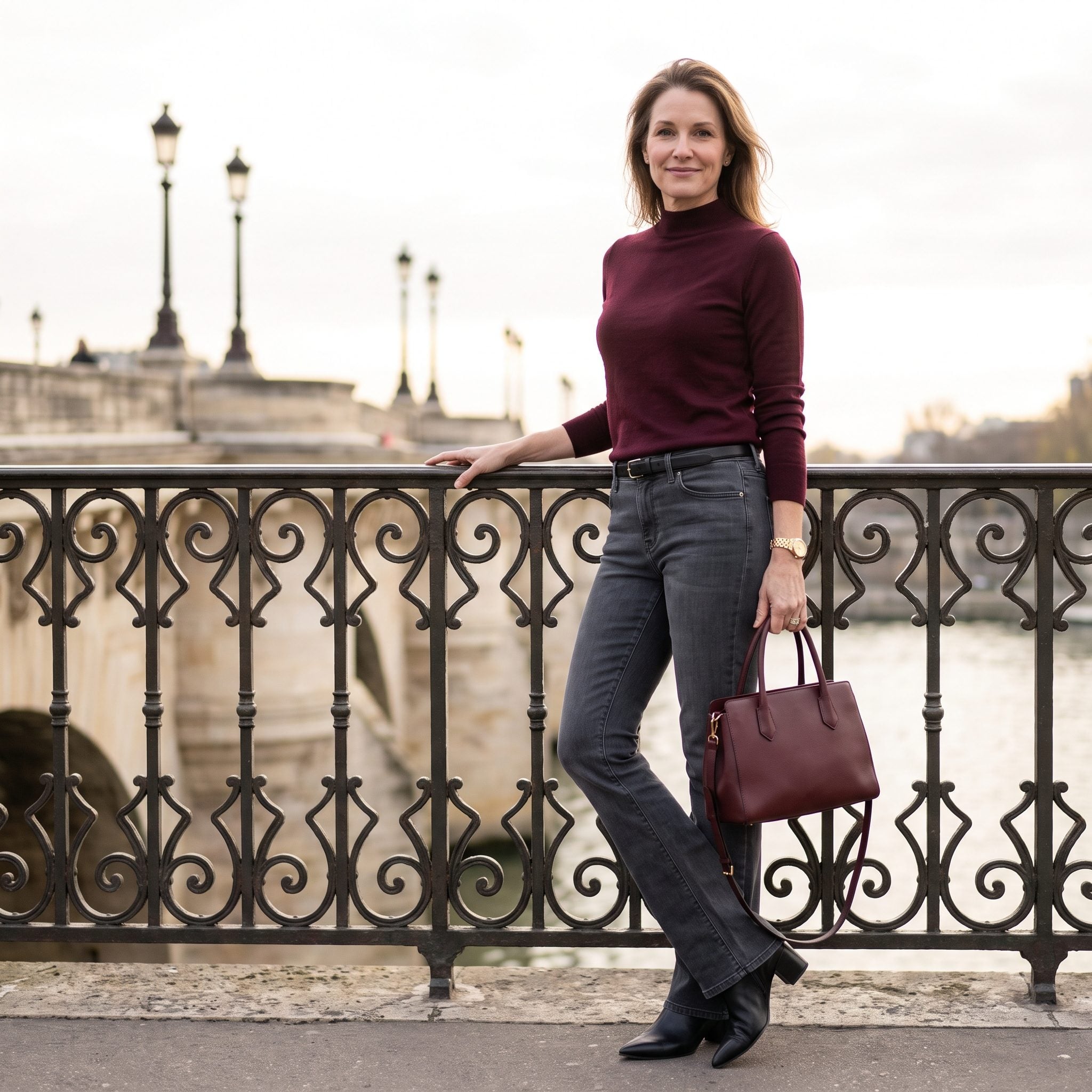
Burgundy gives charcoal denim more warmth than black would and more saturation than brown. The mock neck stays close to the body, leaving the subtle flare below to provide almost all the movement.
A full tuck exposes the waistband and keeps the middle defined, which matters when both the top and jeans live in relatively dark, low-contrast colors.
29. Dark Straight Jeans + a Black Satin-Lapel Tuxedo Jacket
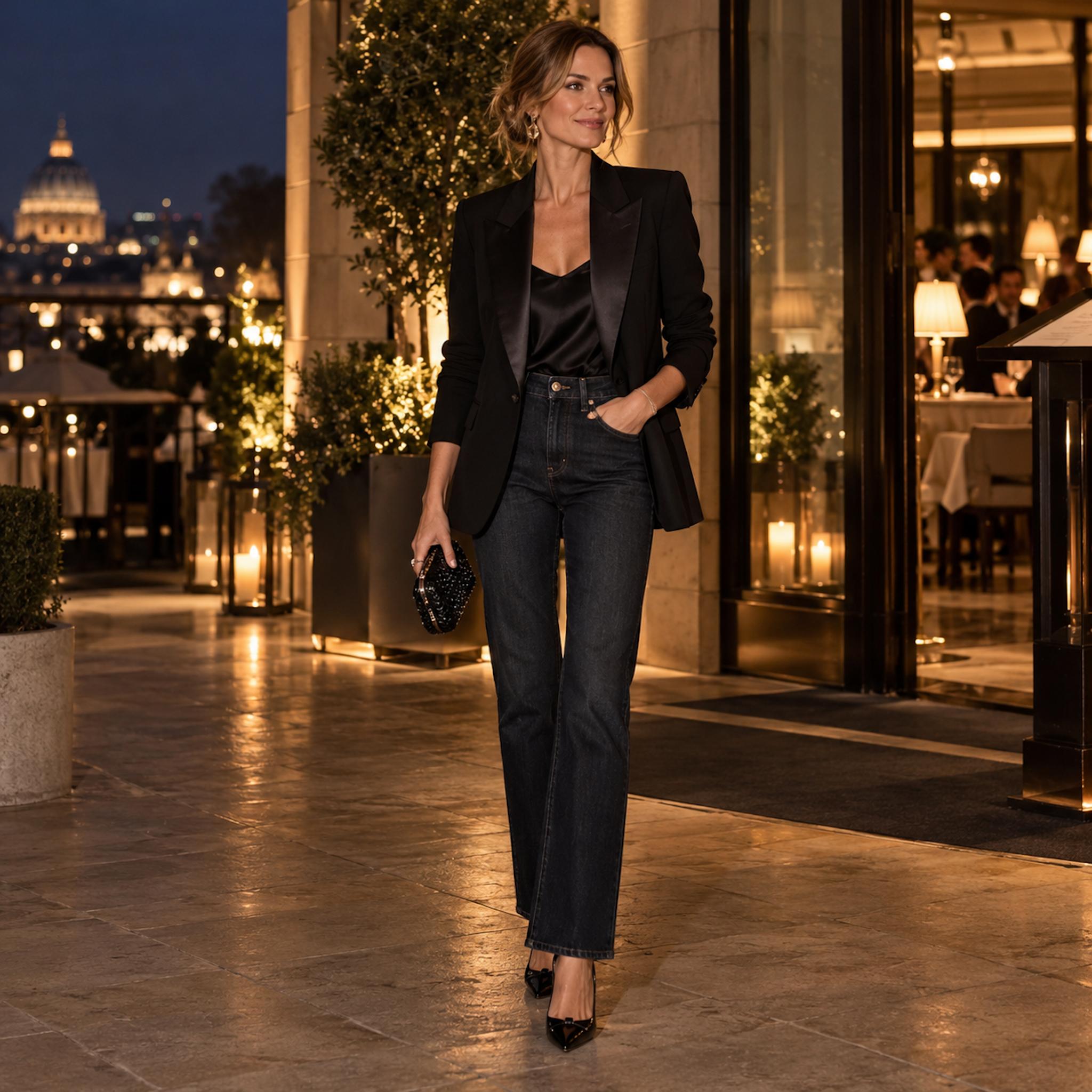
A satin lapel immediately changes the expectations around a black jacket. Put that dinner-jacket vocabulary over dark straight denim and the contrast becomes the entire premise: formal tailoring above, unmistakable jeans below.
The black silk camisole keeps the upper half nearly monochromatic, while pointed pumps and a small evening clutch sharpen the finish. Nothing about the jeans has been disguised; the dressier pieces simply refuse to treat them as a limitation.
Why It Works: The lapel provides a small but powerful patch of reflected light beside matte wool and denim. That surface change is enough to move an otherwise black-on-black combination toward evening.
28. Ecru Flares + a Honey-Beige Trench
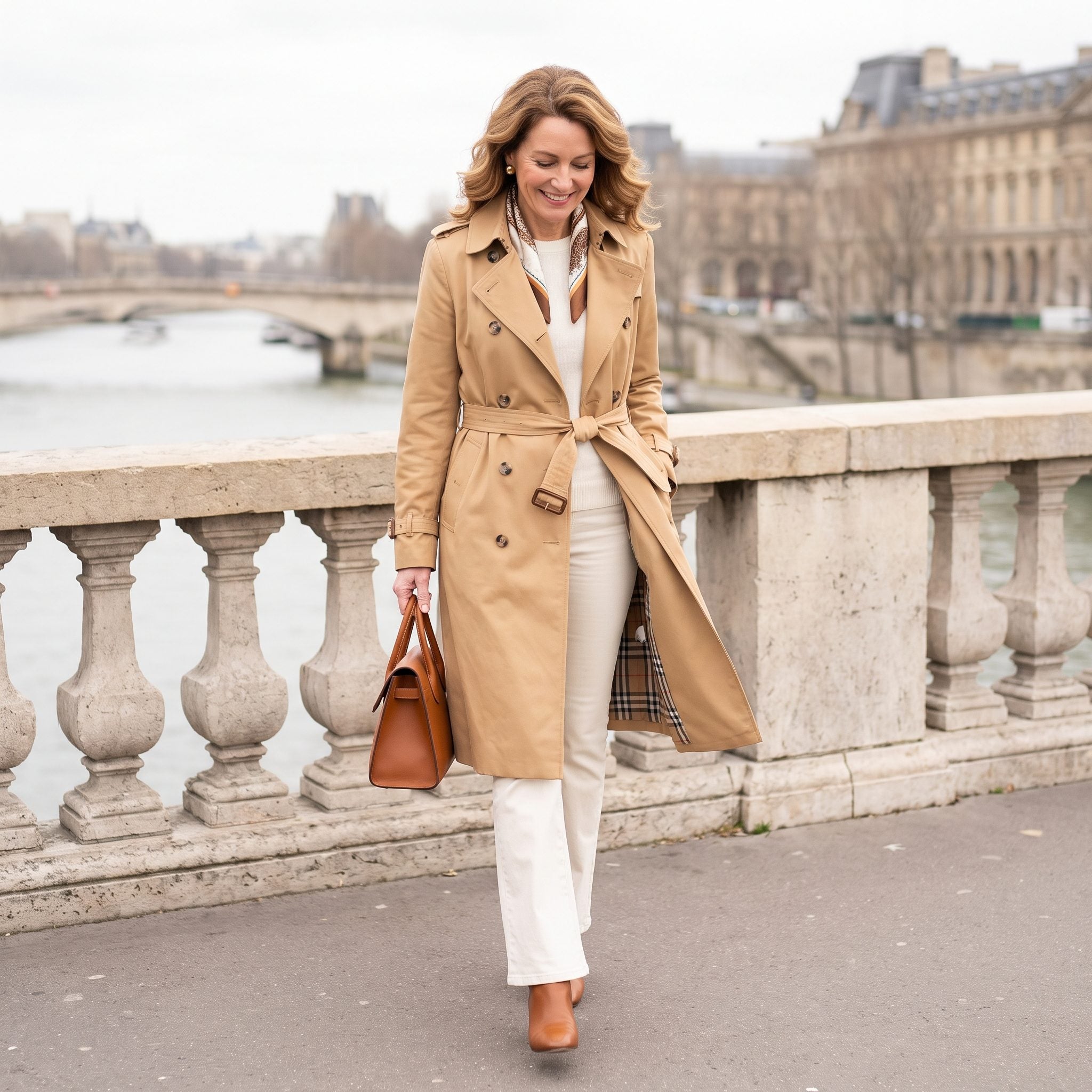
Ecru, honey and cognac create a gradual warm-neutral progression without one abrupt color break. That tonal continuity lets the flare and trench length do more of the visual work.
The honey-beige trench is belted at the waist but left open below, so the ecru flare remains visible instead of disappearing beneath a long block of fabric. A small silk scarf supplies the only pattern.
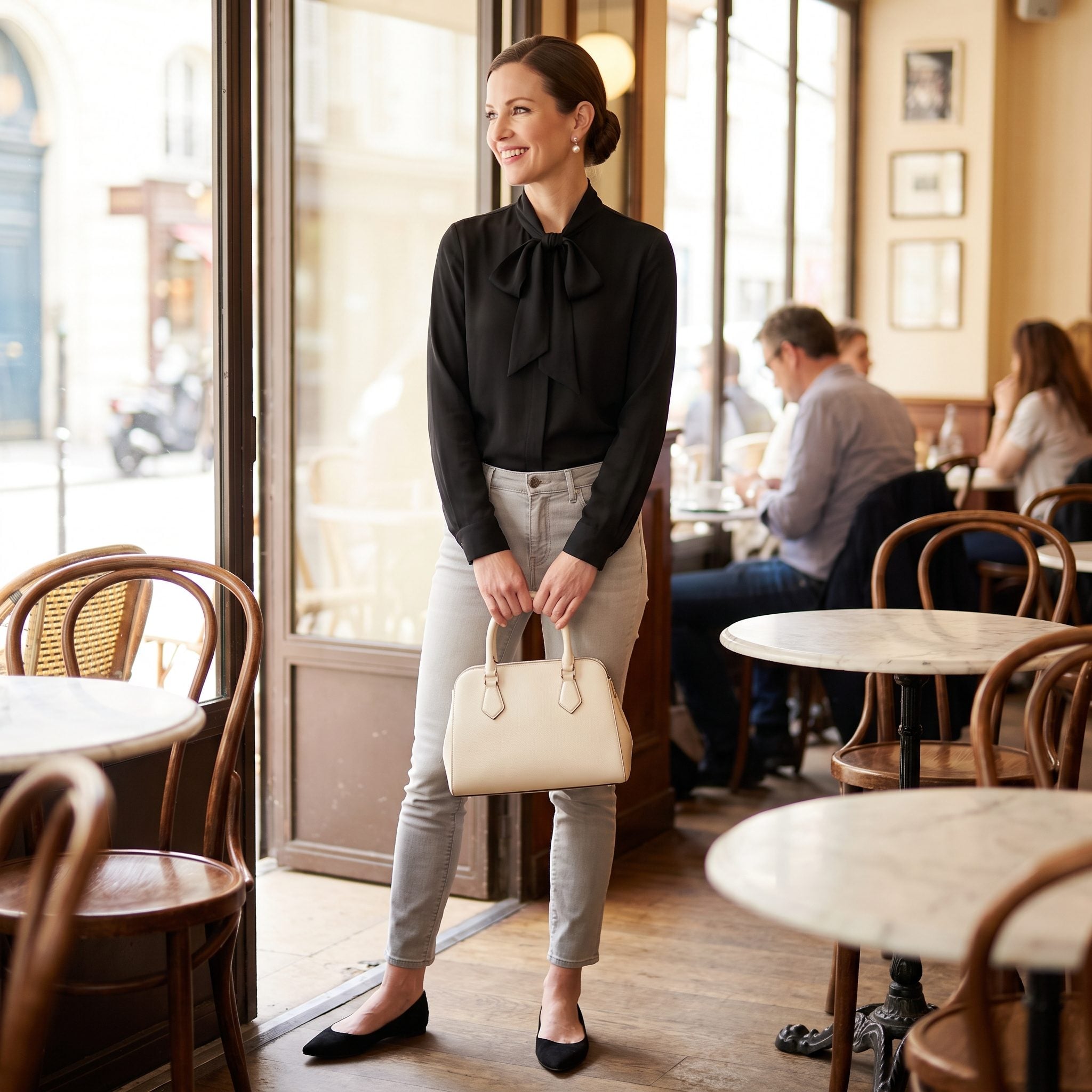
27. Light-Gray Ankle Jeans + a Black Silk Bow Blouse
❤️ Would you like to save this?
A bow-neck blouse brings its own history of polished office and occasion dressing, which makes it an effective counterpoint to pale gray denim. The black silk concentrates visual weight at the top while the jeans lighten toward the ankle.
Keeping the palette to gray and black lets the bow, sheen and crop do the talking. No additional color is required to make the distinction between soft denim and fluid silk obvious.
26. Pale-Blue Tapered Jeans + a Chocolate Blazer
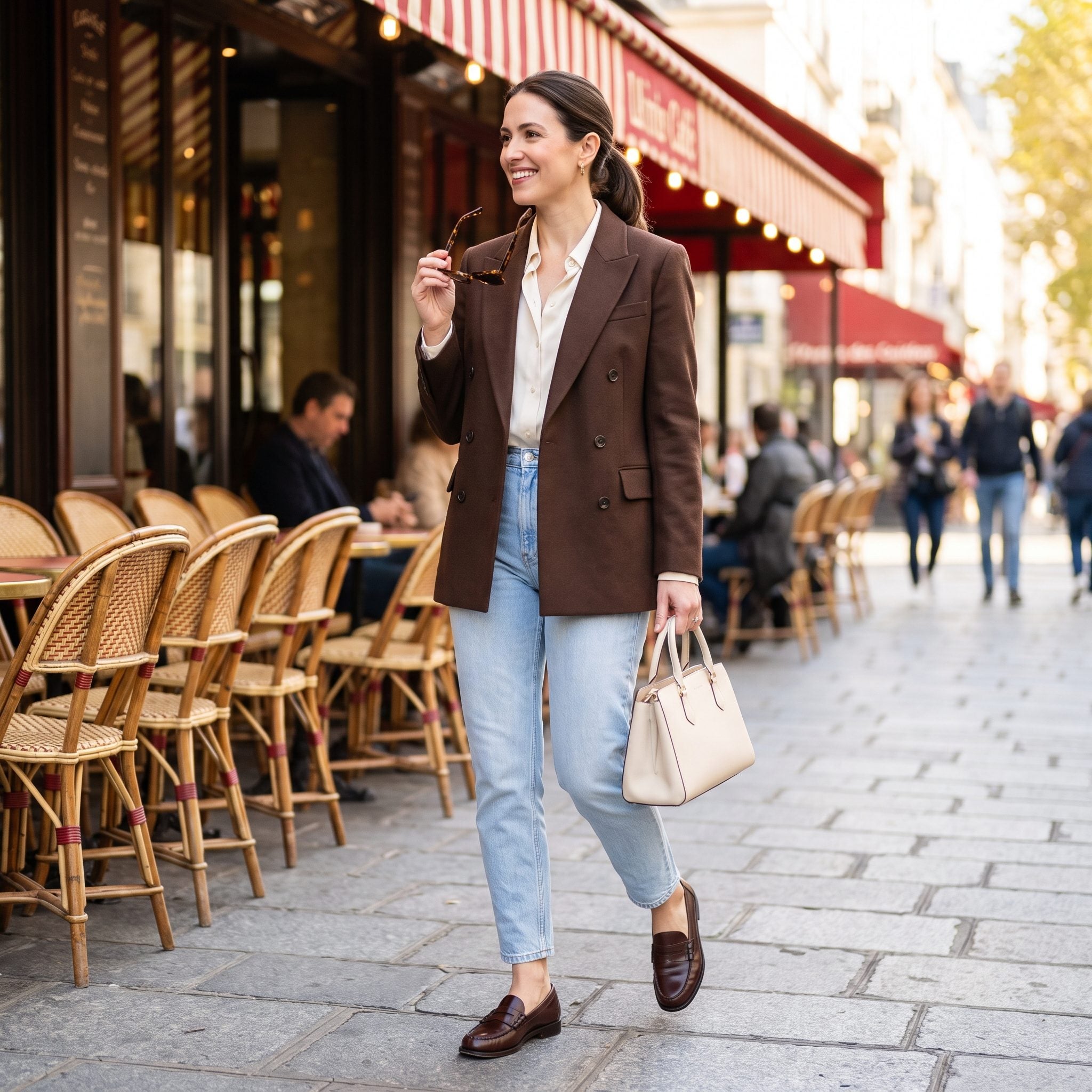
Chocolate brown has enough warmth to make faded blue denim look deliberate rather than merely casual. The deeper jacket establishes a strong frame around a much softer wash.
The double-breasted chocolate blazer brings width and structure above, while penny loafers repeat the brown at floor level and pull the two halves together.
25. Dark Indigo Straight Jeans + a Sleeveless Black Mock Neck and Camel Coat
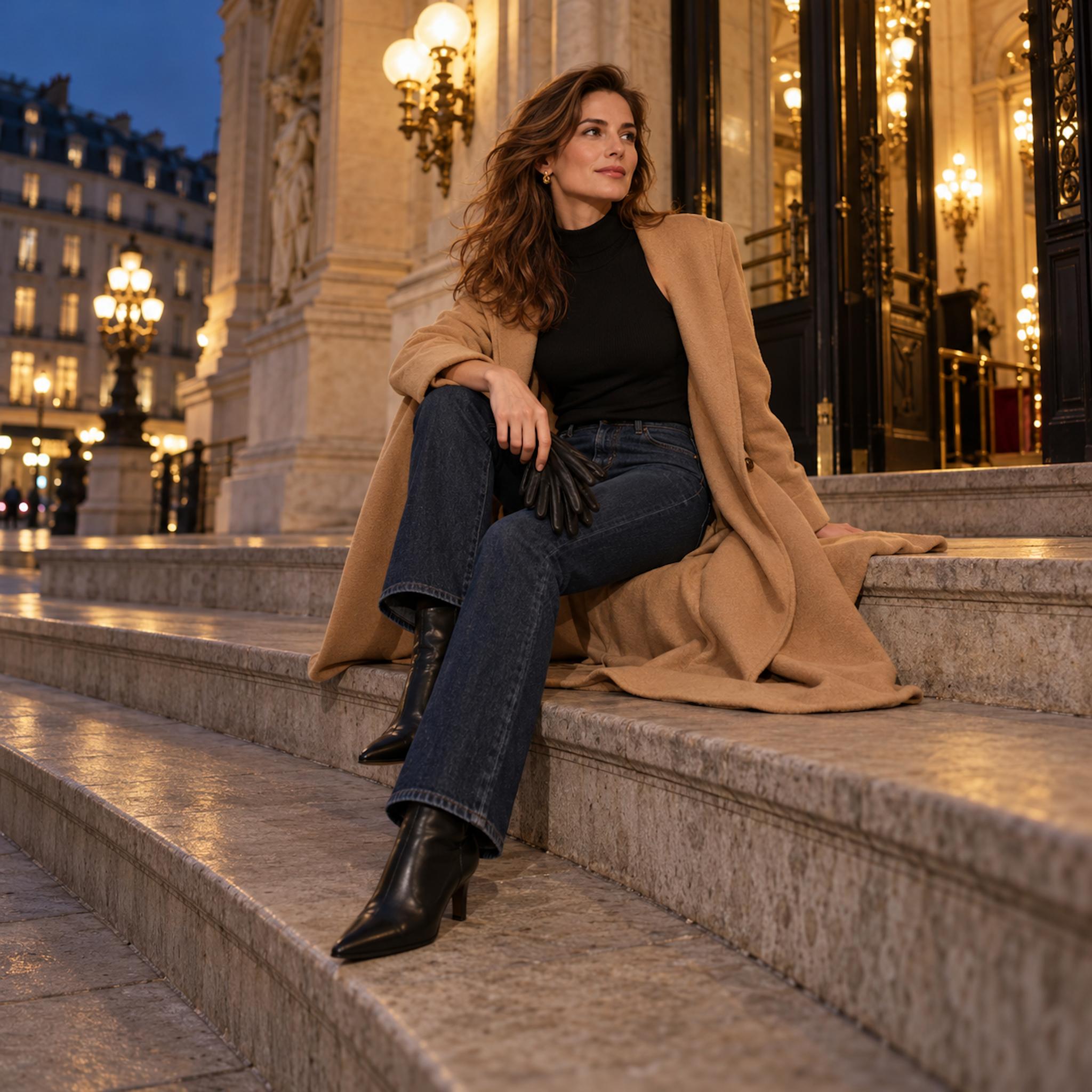
The camel coat supplies scale; the black sleeveless mock neck supplies precision. Seated on broad stone steps, the open coat falls around the body rather than hiding it, leaving the dark indigo jeans clearly visible through the center.
Pointed black ankle boots extend the black from torso to floor without turning the outfit into a monochrome column. The warm coat against the dark knit and denim creates the drama that jewelry or embellishment might otherwise provide.
Proportion Note: A long coat can overwhelm straight jeans when everything beneath it is equally loose. A close sleeveless knit keeps the center narrow and lets the coat provide the volume instead.
24. Cream Trouser Jeans + a Sage Silk Tie-Neck Blouse
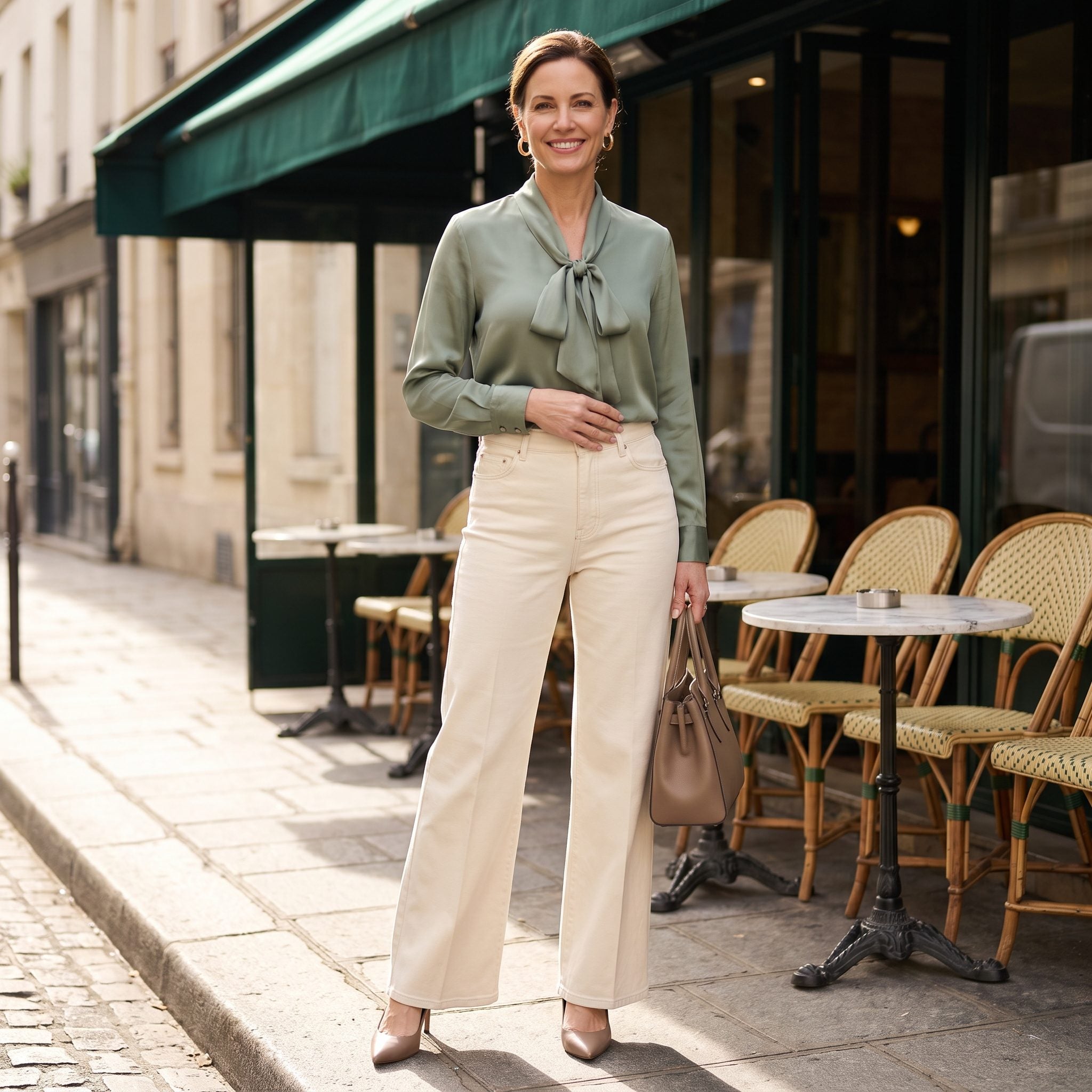
Pressed creases give cream denim some of the visual discipline of tailored trousers. Above them, sage silk introduces softness without abandoning structure completely.
The tie-neck occupies the space where a crisp shirt collar might normally sit, giving the upper half a defined focal point. Cream, sage and taupe stay within a muted range, so proportion and fabric finish remain more noticeable than color contrast.
Why It Works: A pressed crease adds a strong vertical to denim and changes how the leg hangs visually. The effect is subtle, but it borrows just enough from trouser construction to make the entire outfit feel more exact.
23. Black Tapered Jeans + a Soft-Gray Cashmere Twinset
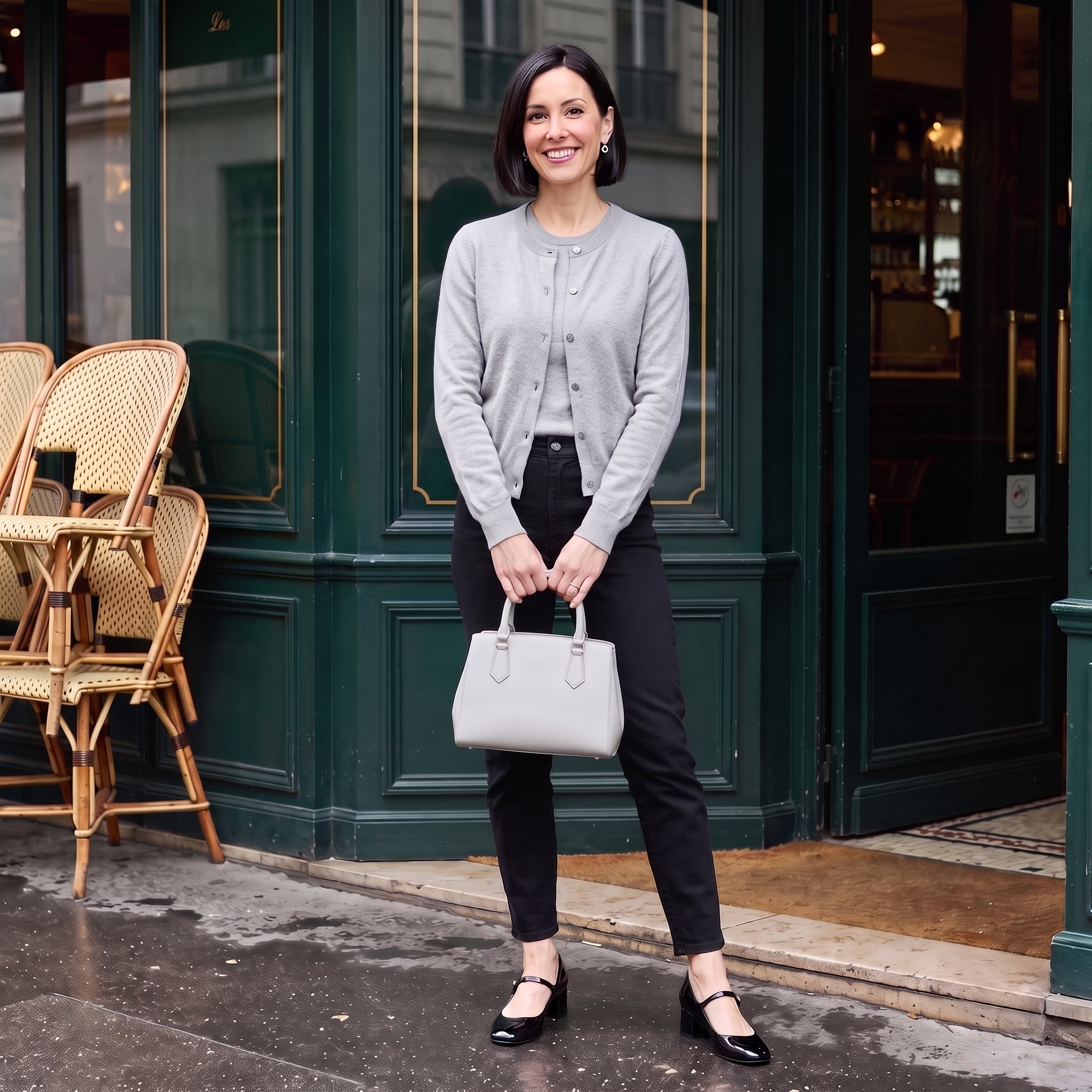
A matching gray twinset could easily drift toward nostalgia. Patent Mary Janes prevent that by putting one hard, glossy black finish beneath all the soft cashmere.
The shell stays tucked while the cardigan remains open, creating a narrow gray center over the tapered denim. Matte knit, matte jean and patent shoe give three different reactions to light within an almost colorless palette.
22. Indigo Ankle Jeans + a Dusty-Rose Silk Blouse
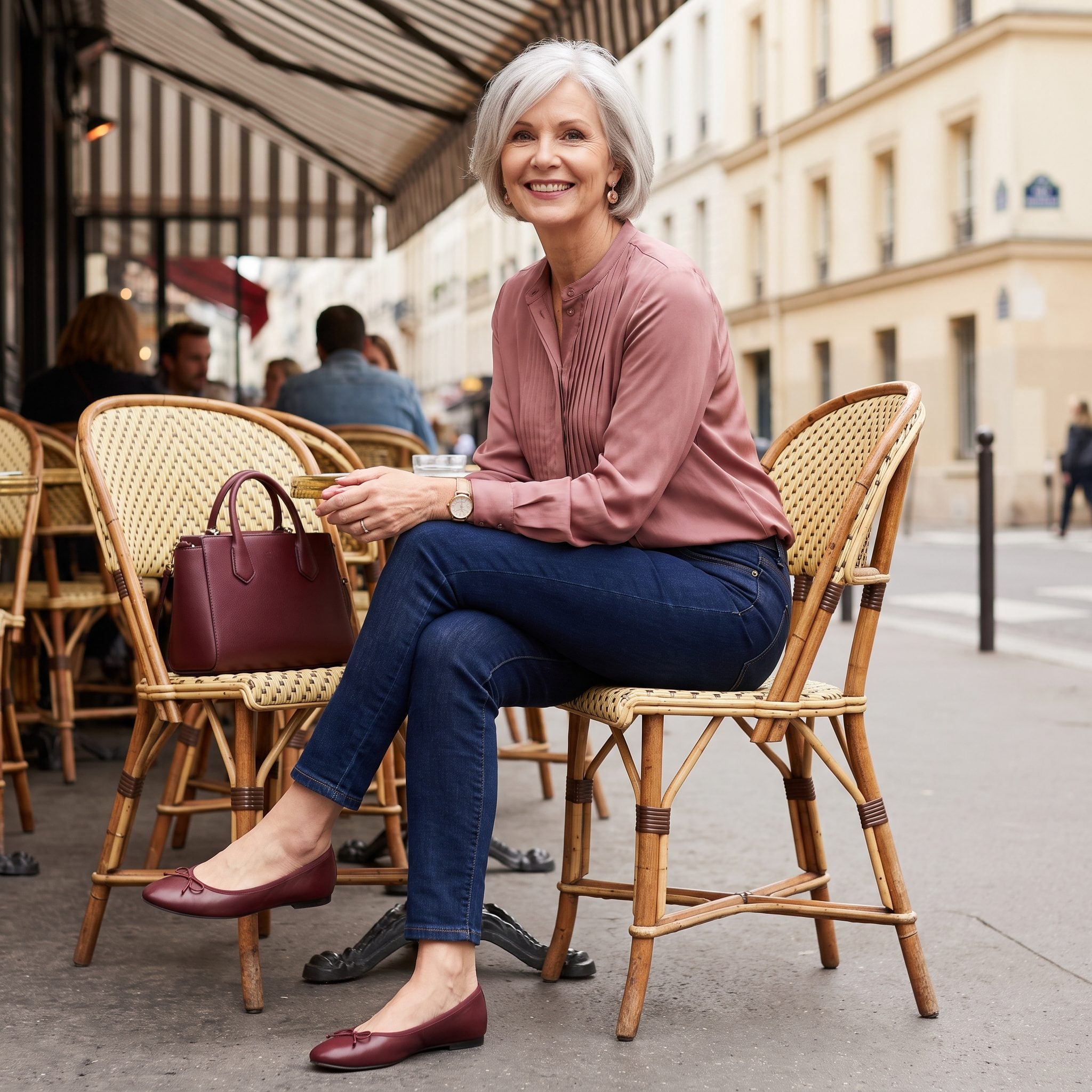
Dusty rose softens deep indigo without becoming sugary, particularly when the blouse carries enough pleating and sheen to hold its own against the dark denim.
Burgundy flats and bag deepen the pink family at the edges of the outfit. The result is less about matching than about moving from pale rose through wine into indigo without one jarring color jump.
21. Dark Denim Culottes + a Black Turtleneck
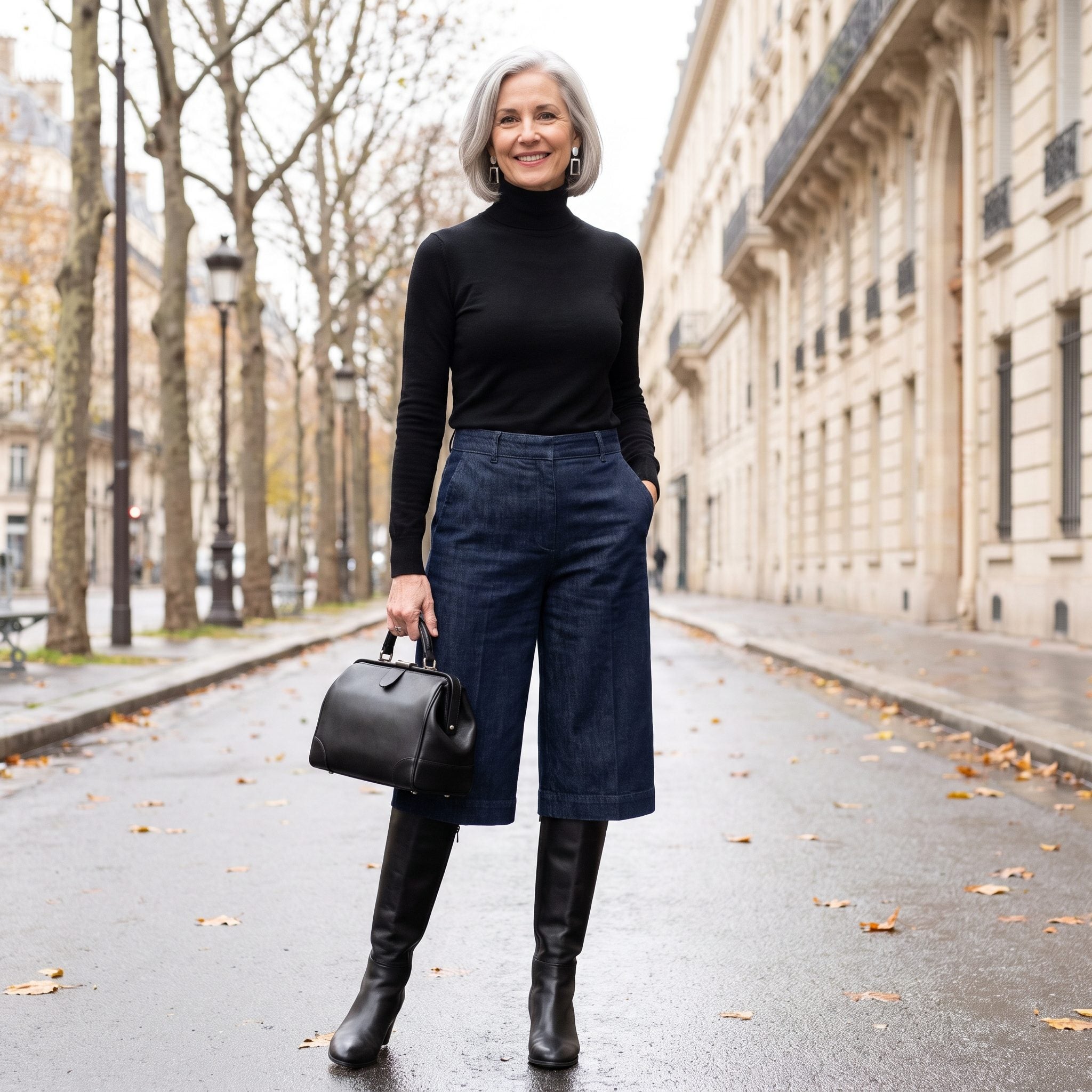
Culottes create a difficult stopping point at mid-calf, so the knee-high boot is not an accessory afterthought. It fills the space beneath the denim and turns an interrupted hemline into a deliberate dark column.
The black turtleneck repeats that vertical above the waistband. With little color contrast competing for attention, the unusual cropped volume of the denim becomes the defining feature.
20. Blue Kick Flares + a Cherry-Red Cardigan
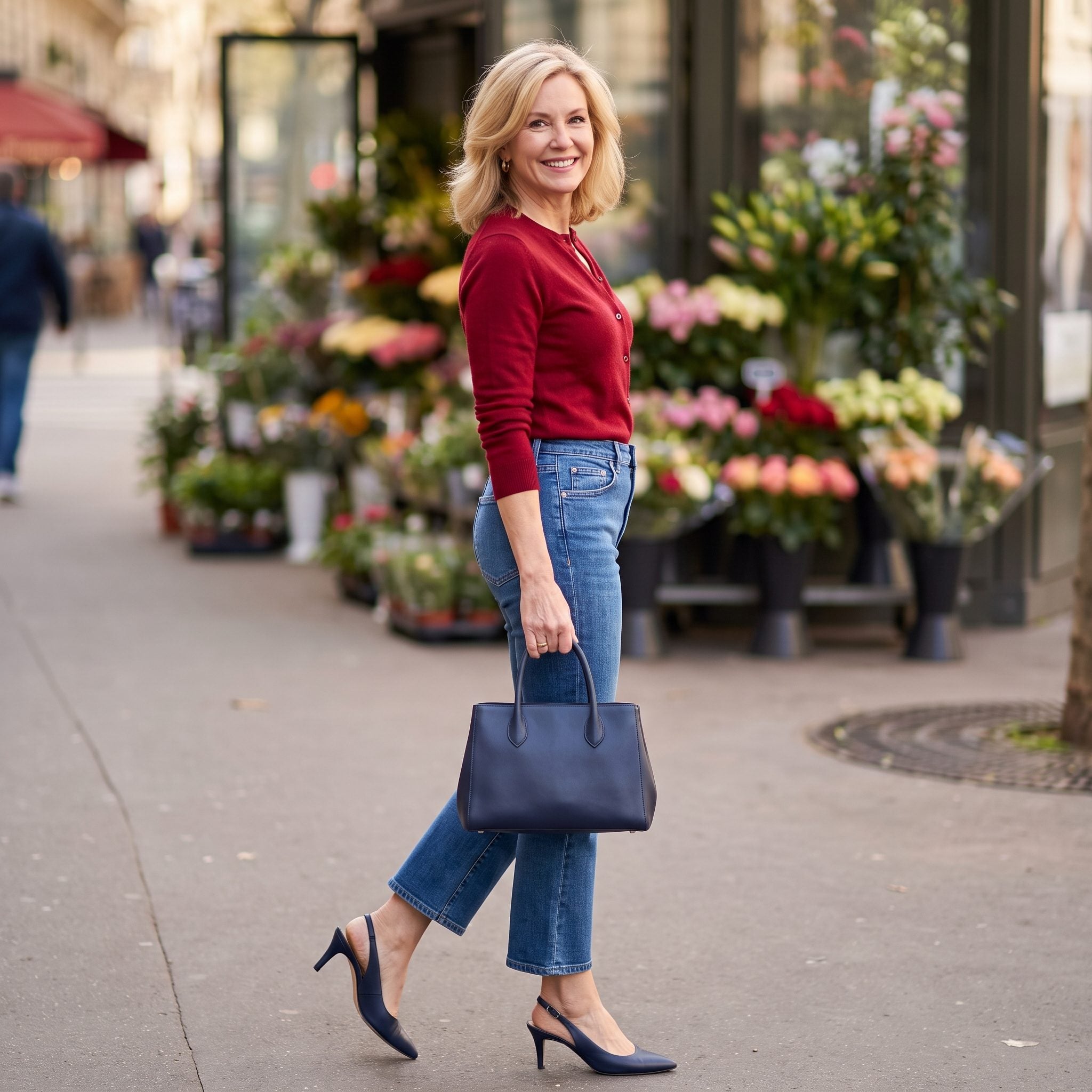
Cherry red does not need much assistance. Buttoning a fine-gauge cardigan as a top gives that saturated color a compact shape instead of letting it spread through layers.
Navy slingbacks make a softer transition from the blue denim than stark black would. The cropped kick flare leaves a deliberate strip of ankle between hem and shoe, keeping a high-impact color combination surprisingly light on its feet.
19. Espresso Slim Jeans + a Cream Cashmere Wrap Sweater
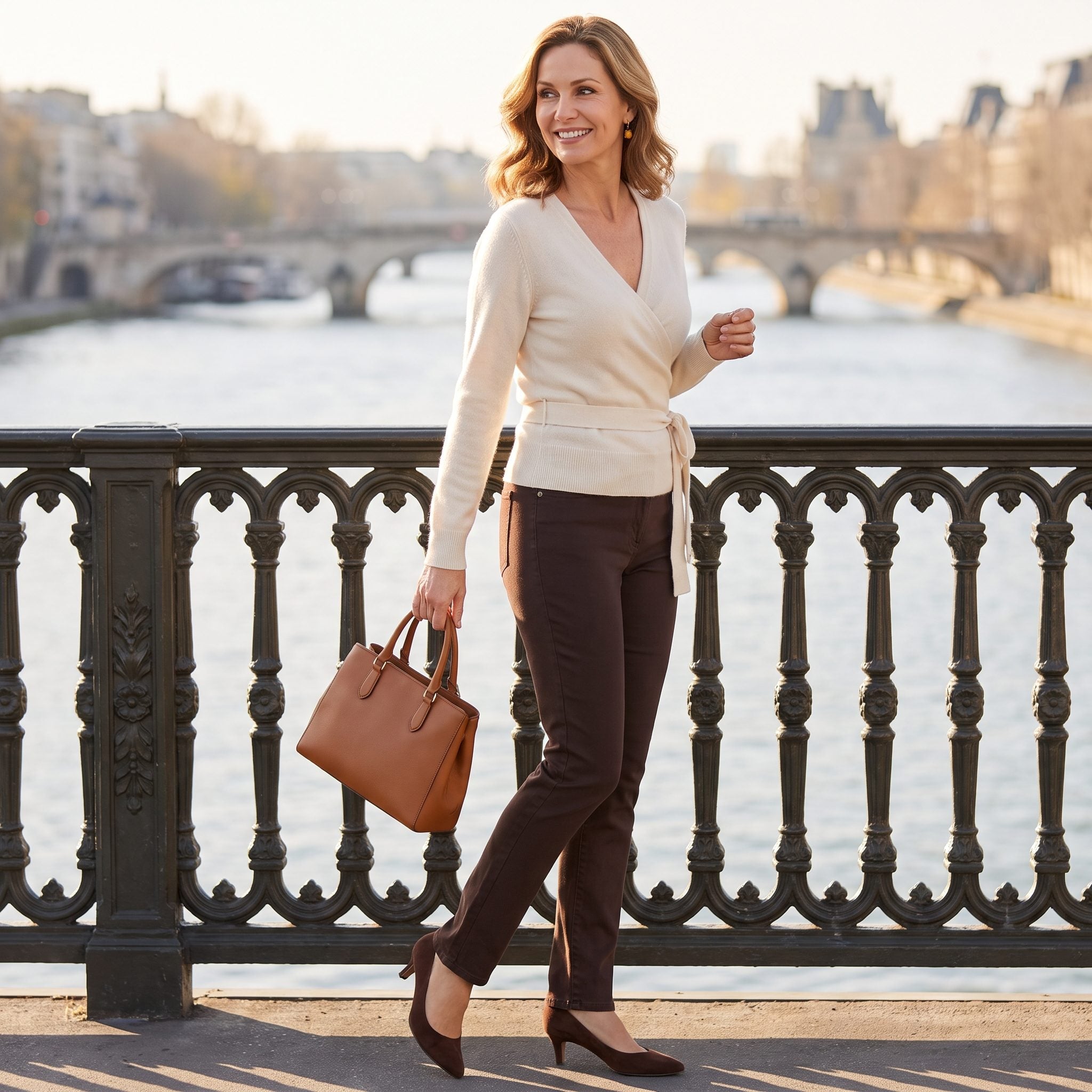
Espresso denim, cream cashmere, caramel leather and amber jewelry create a warm-neutral gradient rather than four versions of the same brown. Each material changes the color slightly.
The wrap sweater defines the waist through its crossover construction, so no belt is needed to mark the transition into the slim jean. Softness above, narrow structure below.
18. Black Cigarette Jeans + a Pearl-Gray Silk Blouse
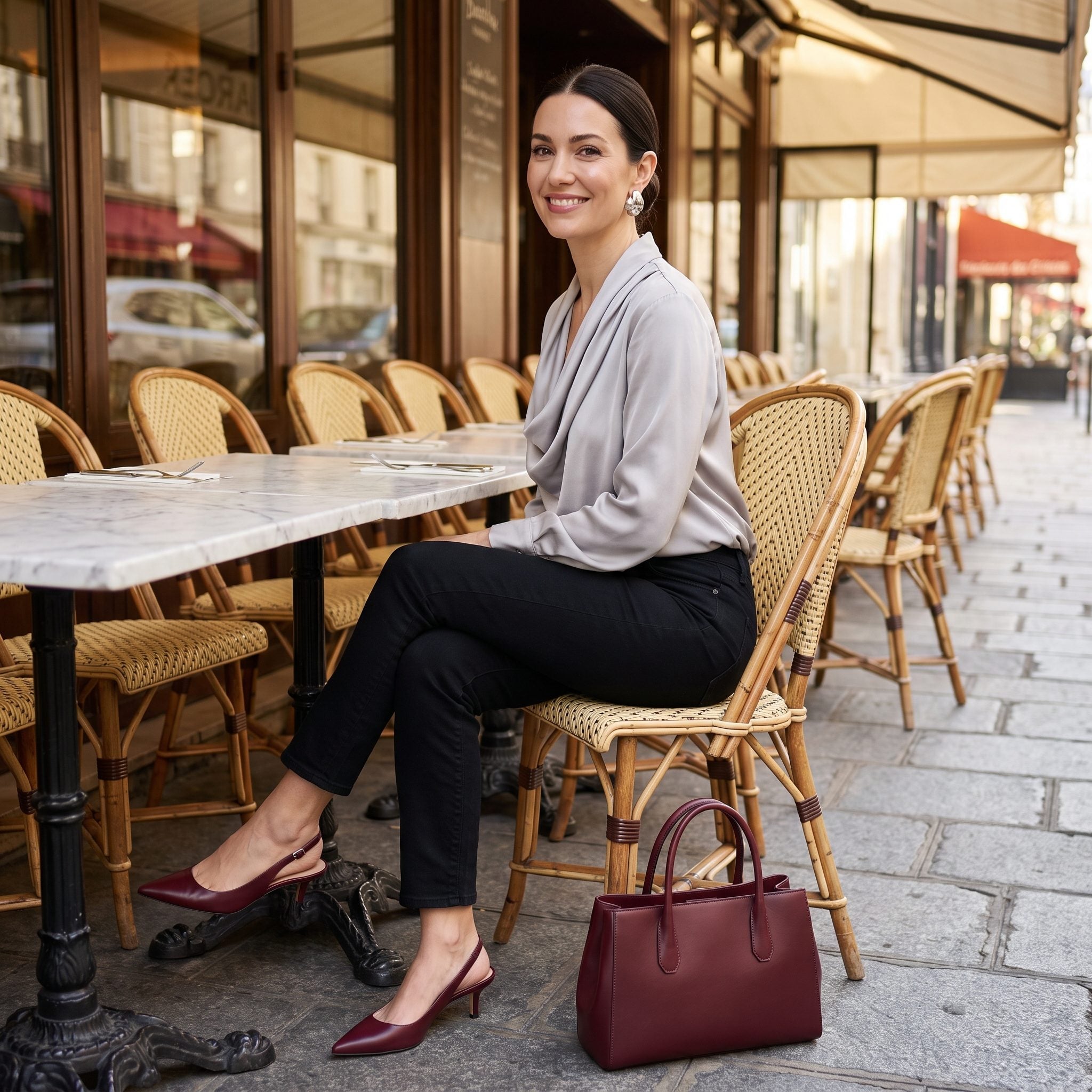
Pearl-gray silk reflects just enough light to separate itself from black denim without creating a hard color contrast. The cigarette leg remains narrow and matte while the blouse moves more freely above it.
Burgundy at the shoe and bag introduces the only strong color, placed at opposite ends of the silhouette so neither accessory feels isolated.
17. Indigo Flares + a Navy Peacoat
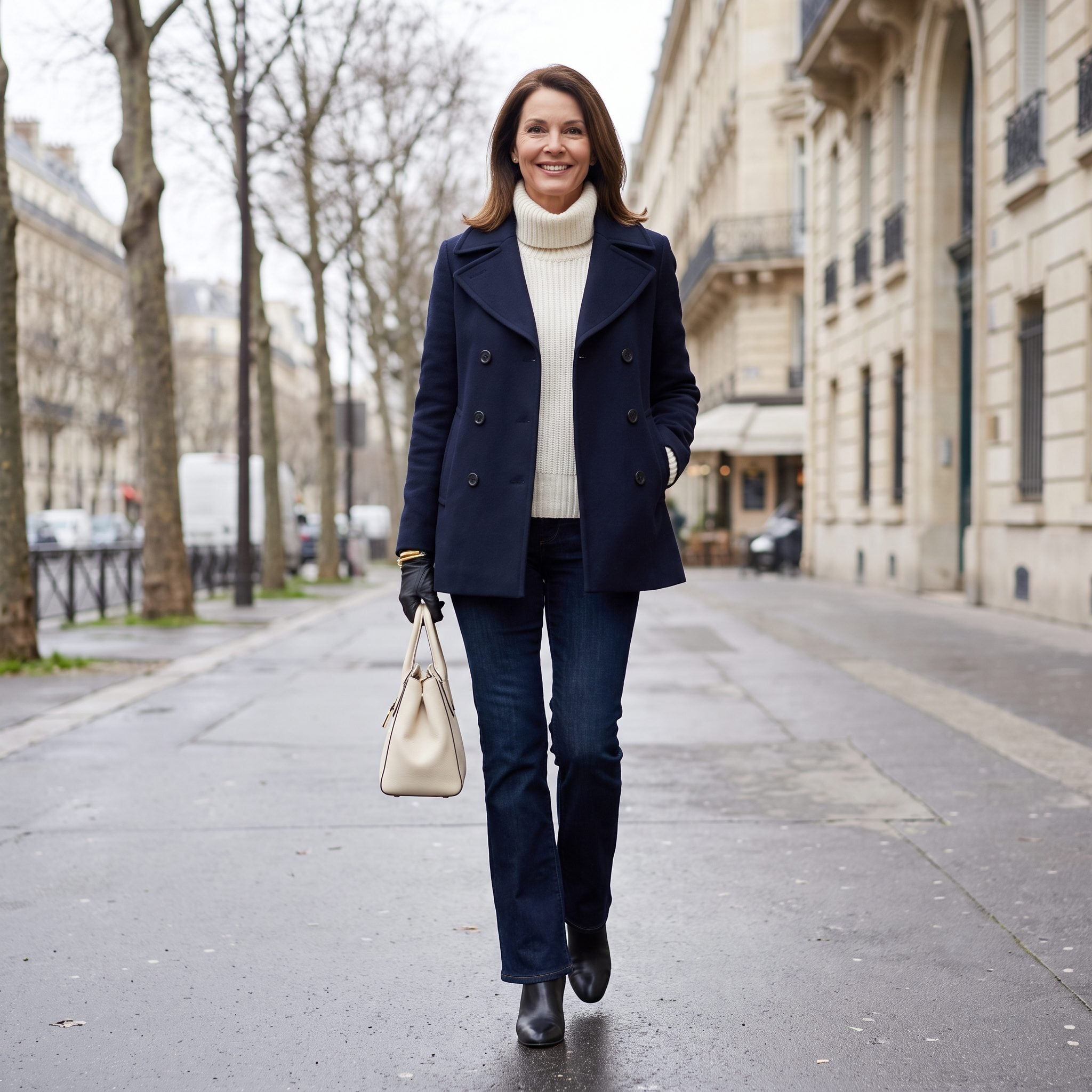
A buttoned peacoat creates a firm waist before the indigo flare begins widening below it. That sequence — fitted, narrowed, released — gives the outfit its structure.
Navy wool and indigo denim sit close enough in color that texture has to separate them. An ivory roll-neck introduces a pale break near the face without disturbing the long blue line.
Style Tip: Pairing navy with indigo is easier when the surfaces differ. Matte wool, denim twill and soft knit each catch light differently, preventing near-matching blues from collapsing into one flat block.
16. Blue Boyfriend Jeans + a Fitted Black Peplum Knit
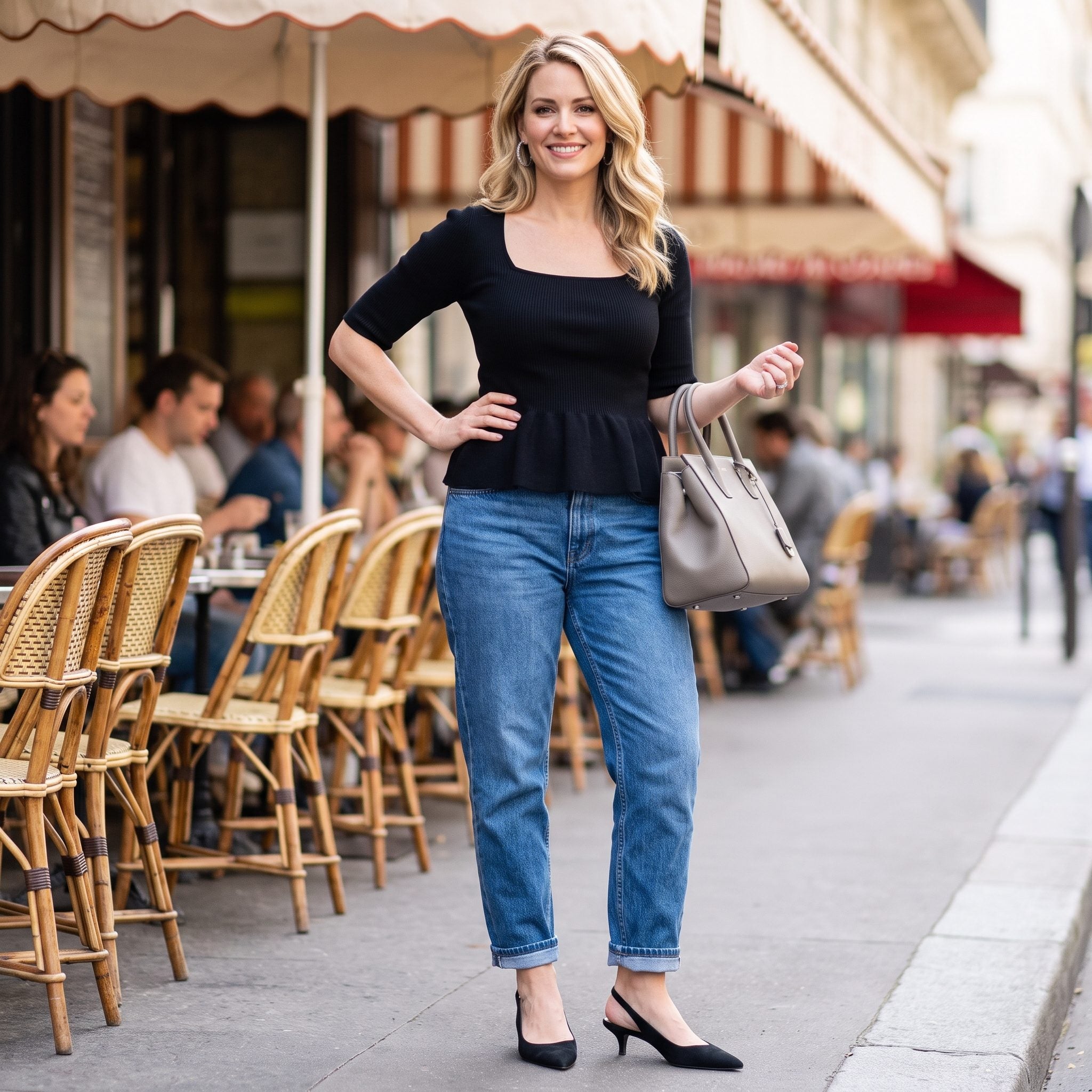
Relaxed boyfriend denim benefits from an upper half with an entirely different attitude. A fitted black peplum narrows at the waist and then flares briefly over the hip, putting structure directly against slouch.
The square neckline adds another sharp geometry above, while pointed slingbacks keep the cuffed ankle from feeling abruptly chopped off.
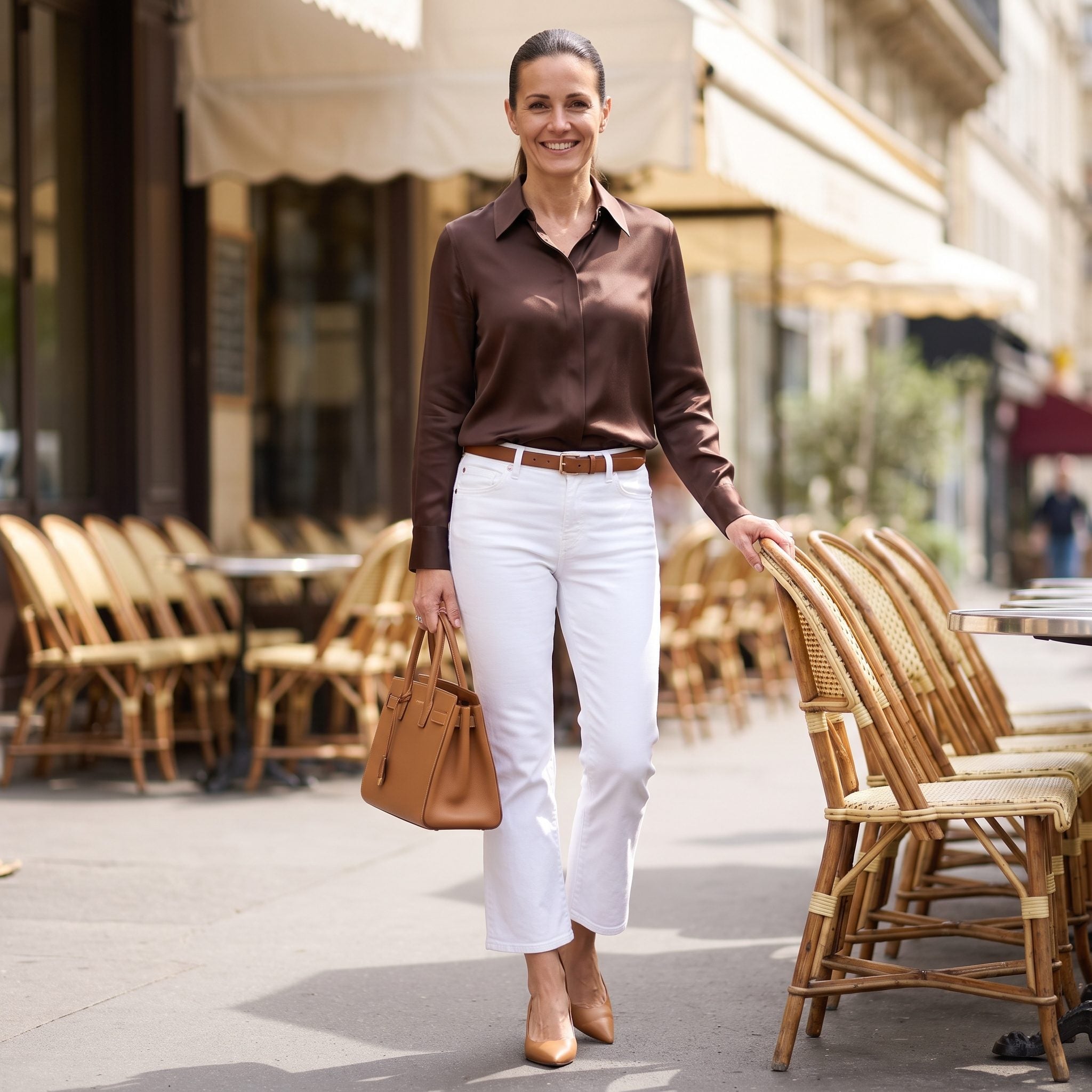
15. White Cropped Flares + a Chocolate Silk Shirt
❤️ Would you like to save this?
Chocolate silk gives white denim a deeper, warmer contrast than black. The sheen softens what could otherwise become an extremely graphic dark-over-light combination.
A full tuck and matching belt establish a clean waist, while tan pumps bridge the brown shirt and white jean. The cropped flare exposes enough ankle to stop the strong color split from becoming heavy.
14. Medium-Blue Wide Legs + a Cropped Navy Bouclé Jacket
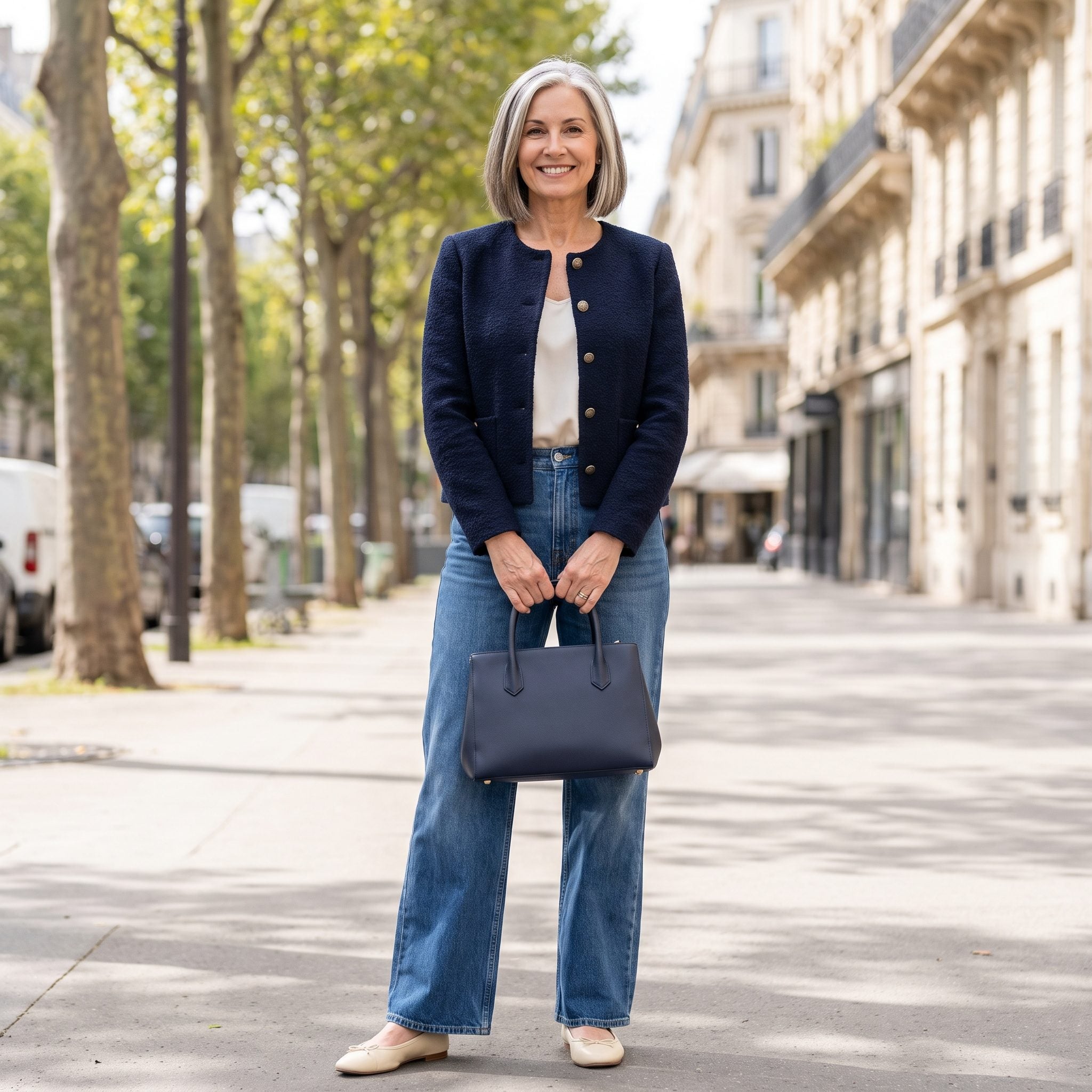
The jacket ends exactly where the high rise begins, turning two separate garments into one carefully stacked proportion. Wide denim gets all the volume below; the cropped bouclé keeps the upper half compact.
Nubby texture against smoother denim prevents two blues from becoming monotonous. Small gold buttons punctuate the navy without turning the jacket into jewelry.
Why It Works: A short jacket exposes the full rise of a wide-leg jean. That visible waistband makes the leg appear to begin higher and prevents the jacket from adding bulk over the widest part of the trouser.
13. Washed-Black Barrel Jeans + an Ivory Silk Shirt
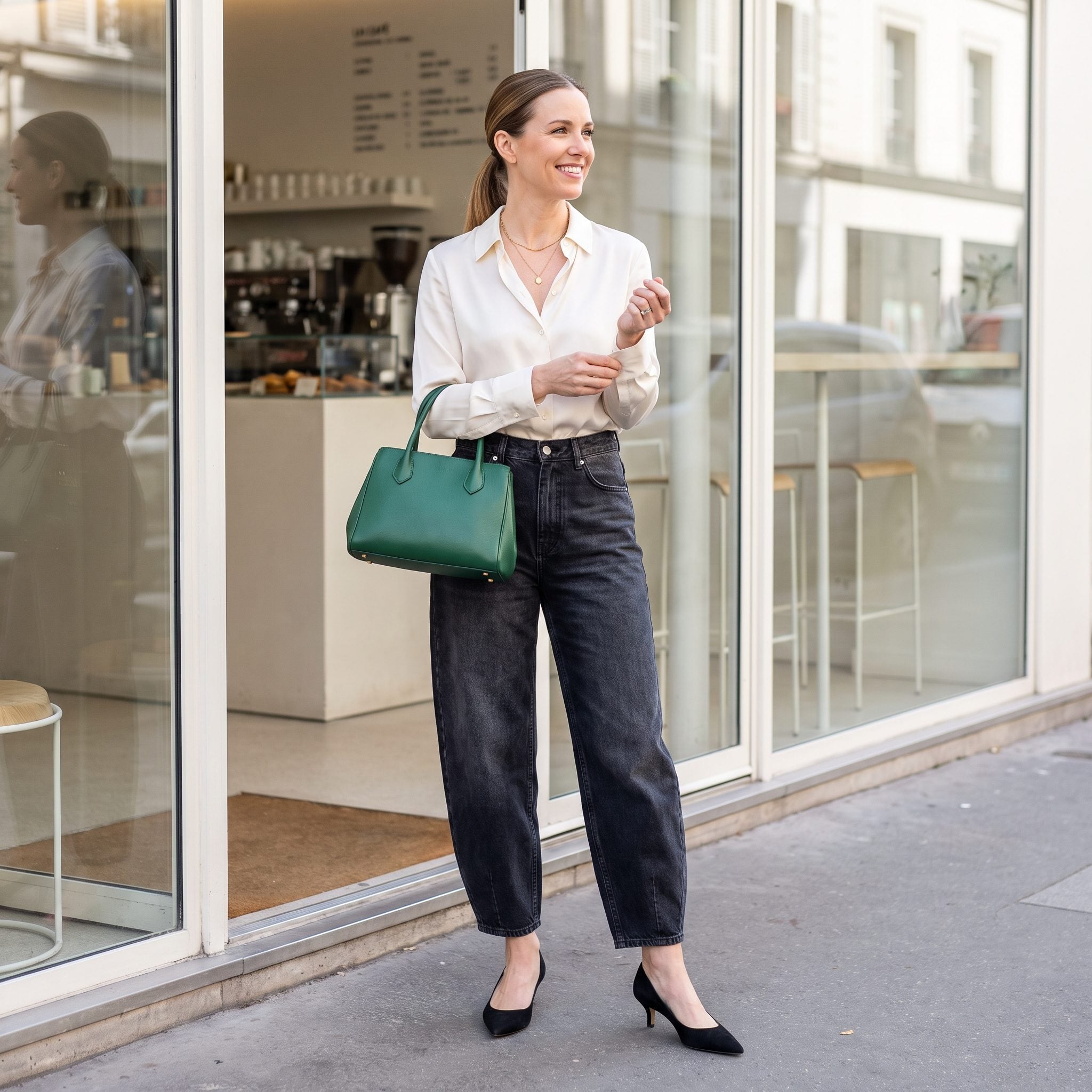
The barrel leg carries the unusual shape, so the ivory silk shirt stays tucked and relatively close to the body. That contrast keeps the curve of the jean readable rather than burying it under more volume.
An emerald handbag interrupts the black-and-ivory palette once and decisively. Nothing else needs to compete with it.
Shape Note: Curved and barrel-leg jeans add width through the middle of the leg before narrowing again. A compact top keeps that engineered shape visible and prevents the silhouette from becoming uniformly oversized.
12. Dark Tapered Jeans + a Cream Leather Jacket
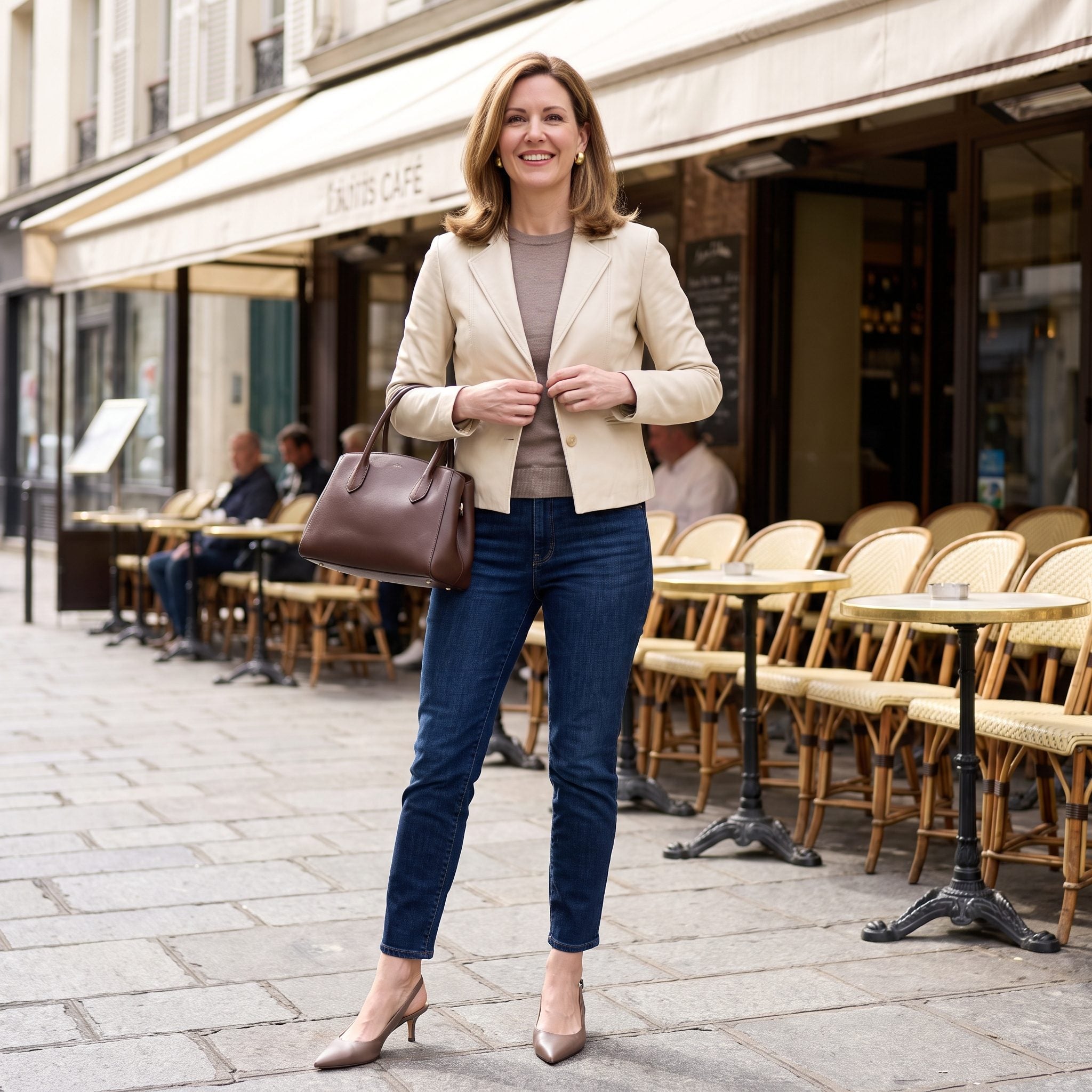
A collarless cream leather jacket takes a material associated with tougher outerwear and strips away much of its usual hardware and edge. What remains is smooth, pale and sharply cut.
The tapered jean narrows toward a taupe slingback, while cream, taupe and chocolate remain within one warm family above and around the dark denim. The jacket supplies structure without requiring a blazer.
11. Stonewashed Straight Jeans + a Sculpted Aubergine Knit
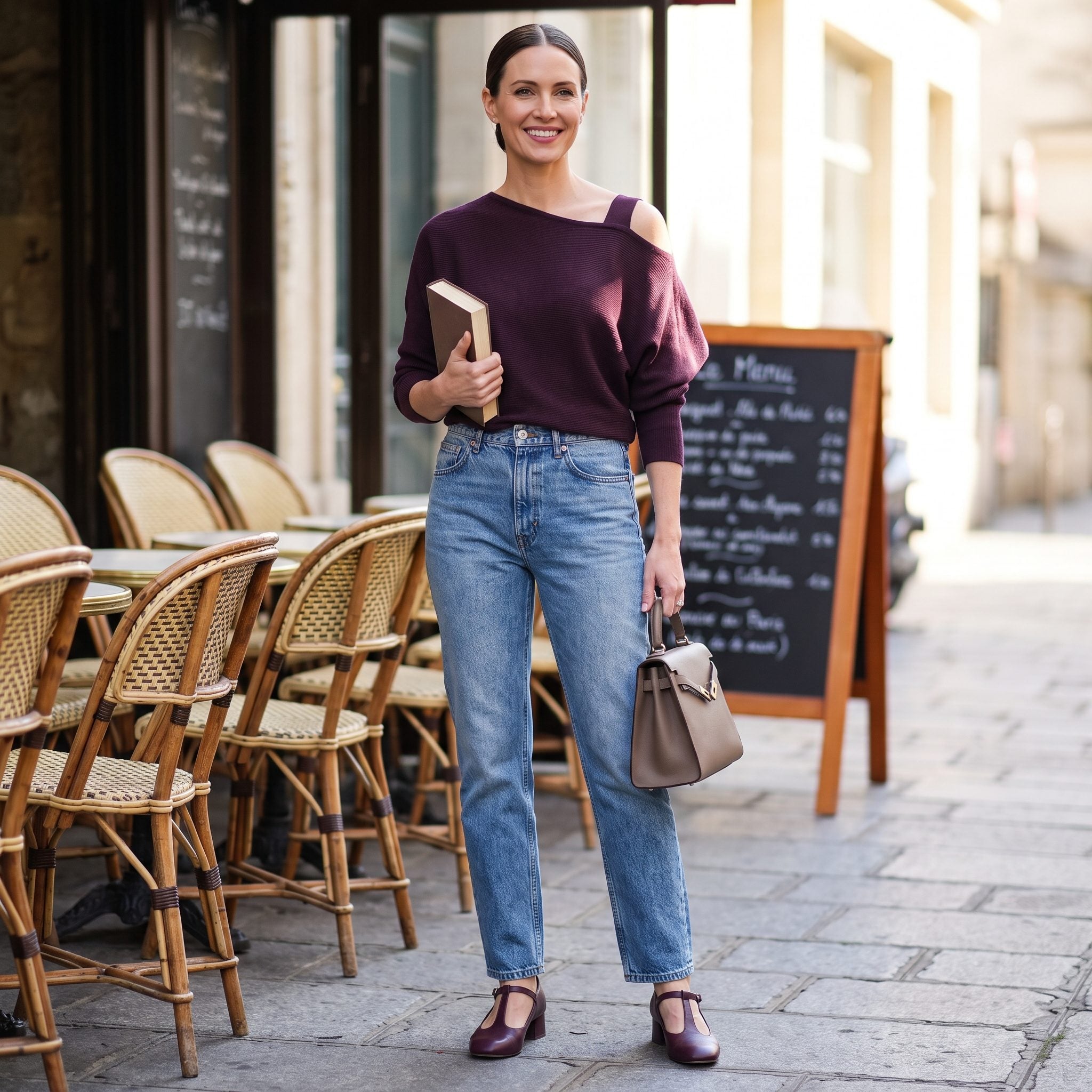
The asymmetric fold at the neckline is enough to keep a simple knit from behaving simply. One draped shoulder interrupts the expected symmetry while the straight stonewashed jean remains deliberately uncomplicated below.
Aubergine deepens faded blue without the predictability of navy or black. Plum T-straps repeat the color at the foot, giving the unusual neckline an equally deliberate endpoint.
Color Note: Aubergine contains enough red to warm faded blue but enough blue to avoid a harsh complementary contrast. That makes the pairing rich without becoming particularly loud.
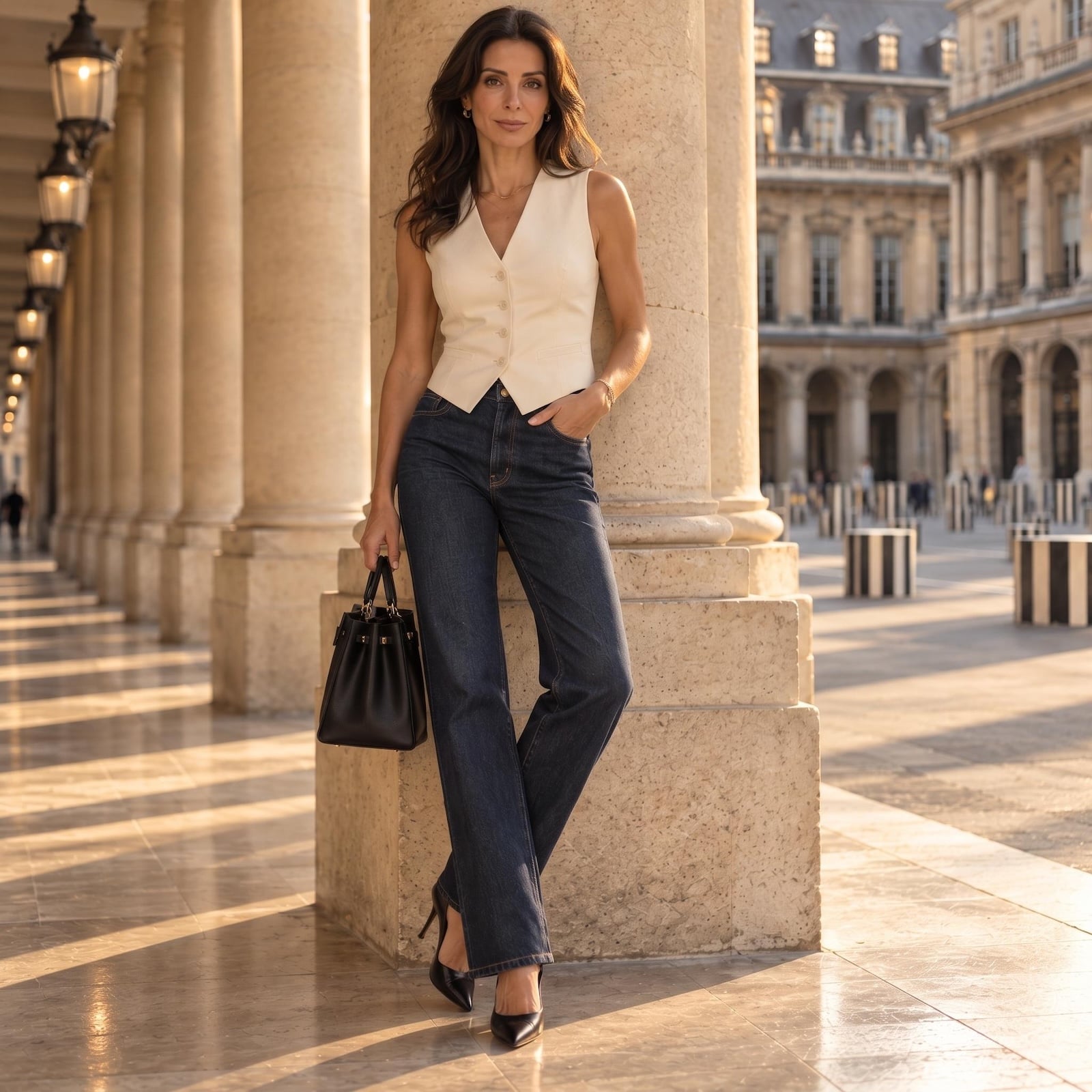
10. Deep Indigo Straight Jeans + an Ivory Fitted Waistcoat
The waistcoat is not waiting for a jacket. Worn directly as the top, ivory tailoring gives the shoulders and waist a crisp architectural outline while deep-indigo denim keeps the lower half familiar.
The V neckline introduces length above the buttoned waist, and pointed black pumps repeat the severity of the dark jean without adding another color. Against the stone columns, the outfit looks almost reduced to three ideas: pale tailoring, dark denim, sharp shoe.
Why It Works: A fitted waistcoat ends close to the waistband, so the full rise of the jean remains visible. That clean meeting point keeps sleeveless tailoring from looking like a jacket with something missing.
9. Black Wide-Leg Jeans + a Camel Cashmere Top
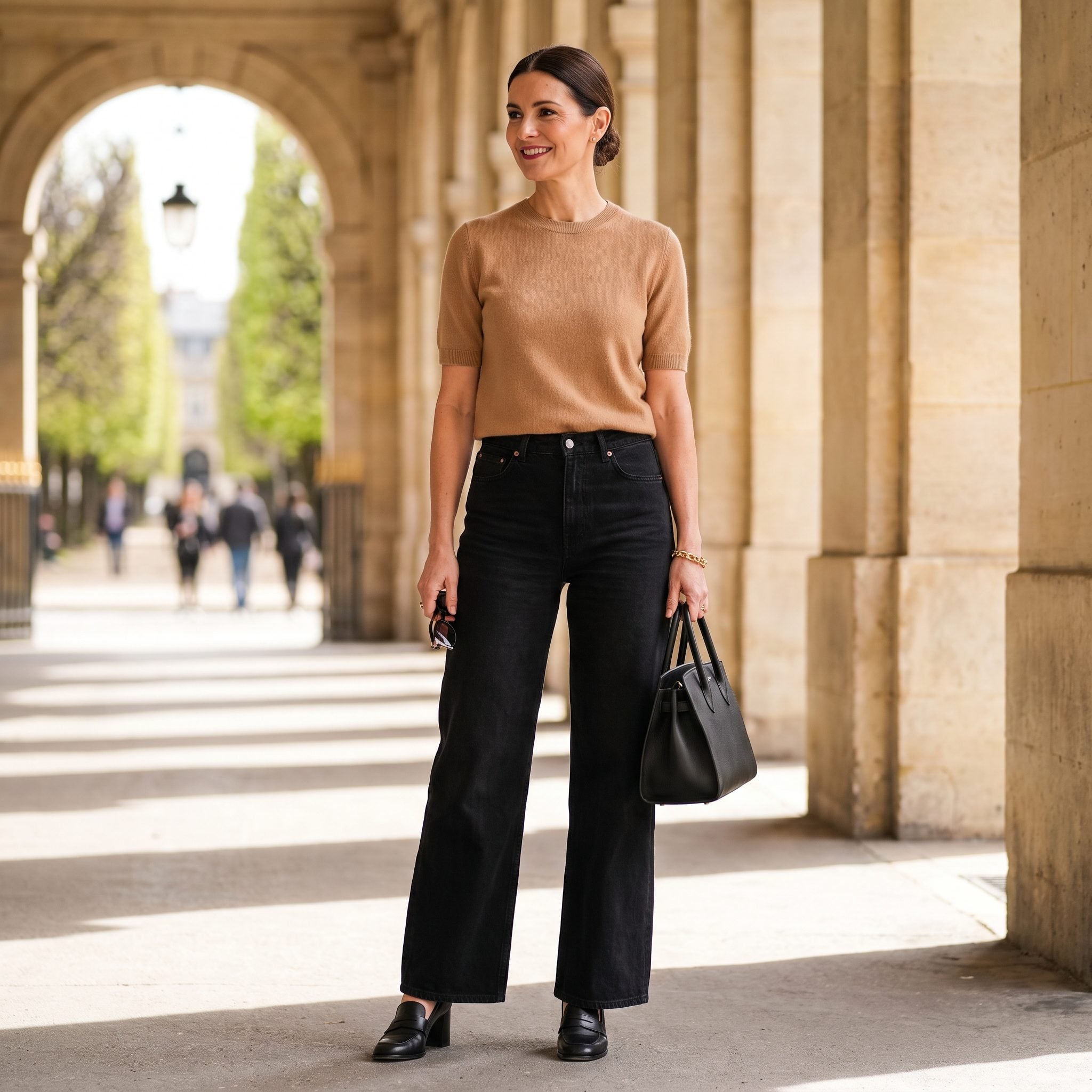
High-rise wide denim creates substantial volume, so the fitted camel cashmere above it stays close and clean. The waistband becomes the hinge between compact top and expansive leg.
Warm camel against neutral black makes the knit appear even richer, while a single gold bracelet is enough to echo that warmth without introducing another decorative layer.
8. Indigo Bootcuts + a Camel Longline Waistcoat
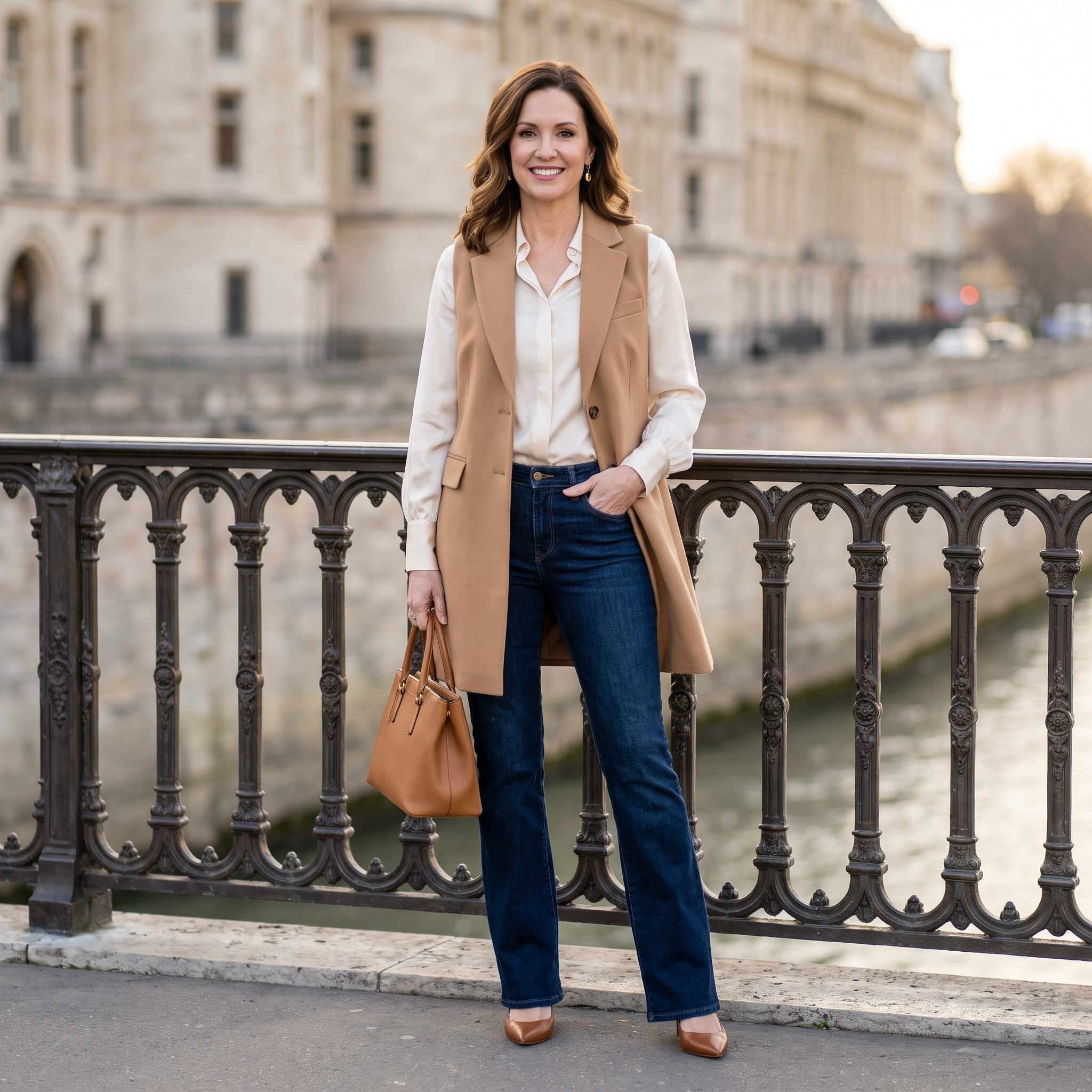
A longline waistcoat creates a vertical panel over the indigo bootcut, extending the tailored line much farther down the body than an ordinary jacket would.
The camel waistcoat warms the cool denim, while ivory silk underneath prevents the brown-and-blue combination from becoming dense. Buttoning at the waist keeps the long layer from simply hanging as a rectangle.
7. White Slim Jeans + a Black Silk Shirt and Waist Scarf
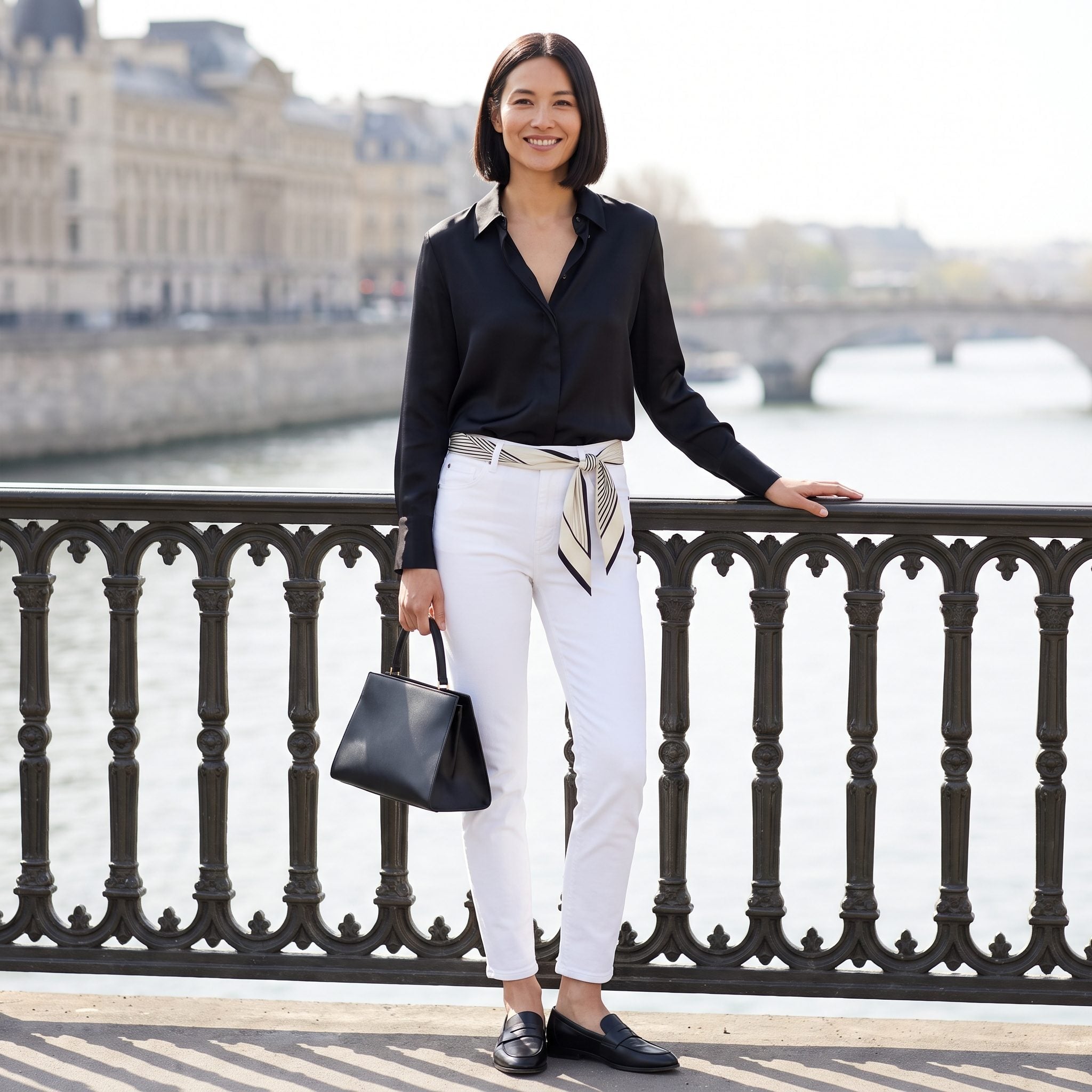
A narrow silk scarf threaded through the belt loops redirects attention to the waistband — usually the least expressive part of a pair of jeans. Against white denim and a fully tucked black silk shirt, the printed strip becomes a deliberate third element rather than an accessory added at the end.
The scarf’s black-and-ivory pattern links both halves of the outfit without introducing a new color family. Slim denim keeps the contrast crisp all the way to the shoe.
Try This: A narrow scarf can replace a belt when the denim already fits securely. Keep the knot flat at one hip so the fabric reads as a graphic line rather than a bulky bow.
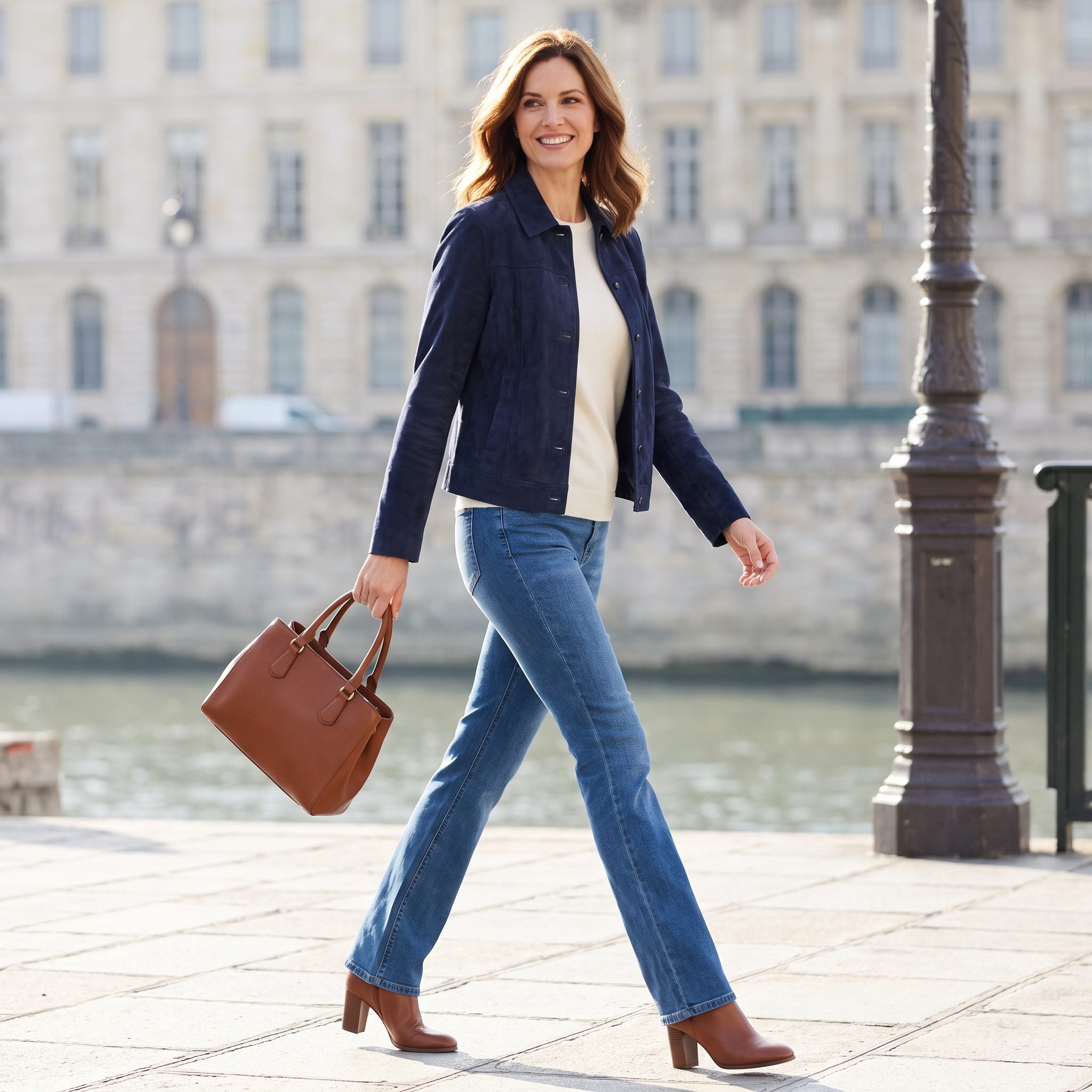
6. Medium-Blue Bootcuts + a Navy Suede Jacket
❤️ Would you like to save this?
Navy suede has a soft nap that absorbs and reflects light differently from both smooth leather and denim. Against an ivory cashmere layer, the jacket looks tactile before any hardware or embellishment enters the picture.
Bootcut jeans and a heeled chestnut boot create a clean practical partnership: the flare covers the boot shaft while the heel keeps the longer hem clear of the ground. An ivory scarf connects the pale knit to the neckline.
Why It Works: Navy is cool; ivory and chestnut are warmer. The palette succeeds because the colors remain muted while suede, cashmere, denim and leather supply the variation.
5. Ecru Cropped Wide-Leg Jeans + a Charcoal Sweater and White Collar
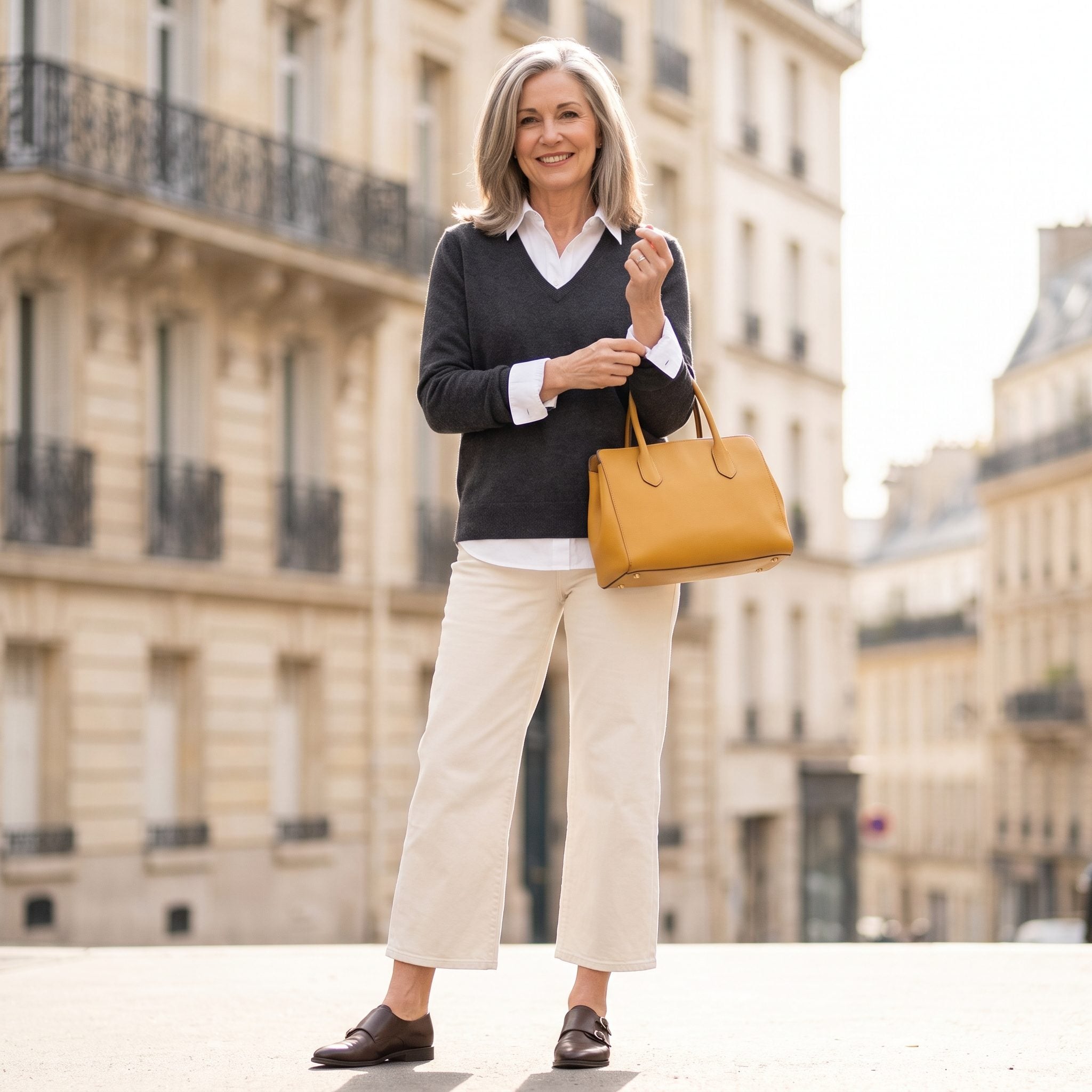
A pointed white collar breaking through charcoal knit gives the neckline enough definition that no statement jewelry is needed. The layer is small, but it immediately makes the sweater feel more considered.
Ecru cropped denim keeps the bottom half lighter, while a mustard leather handbag contributes the only saturated color. The crop prevents the wide leg from becoming too visually heavy.
Style Tip: Under a wide-leg jean, a layered sweater works best when it ends around the high hip rather than extending far over the waistband. Keeping the shirt hem tucked prevents a third horizontal line from cluttering the proportion.
4. Ink-Blue Wide Legs + a Stone Trench and Emerald Silk
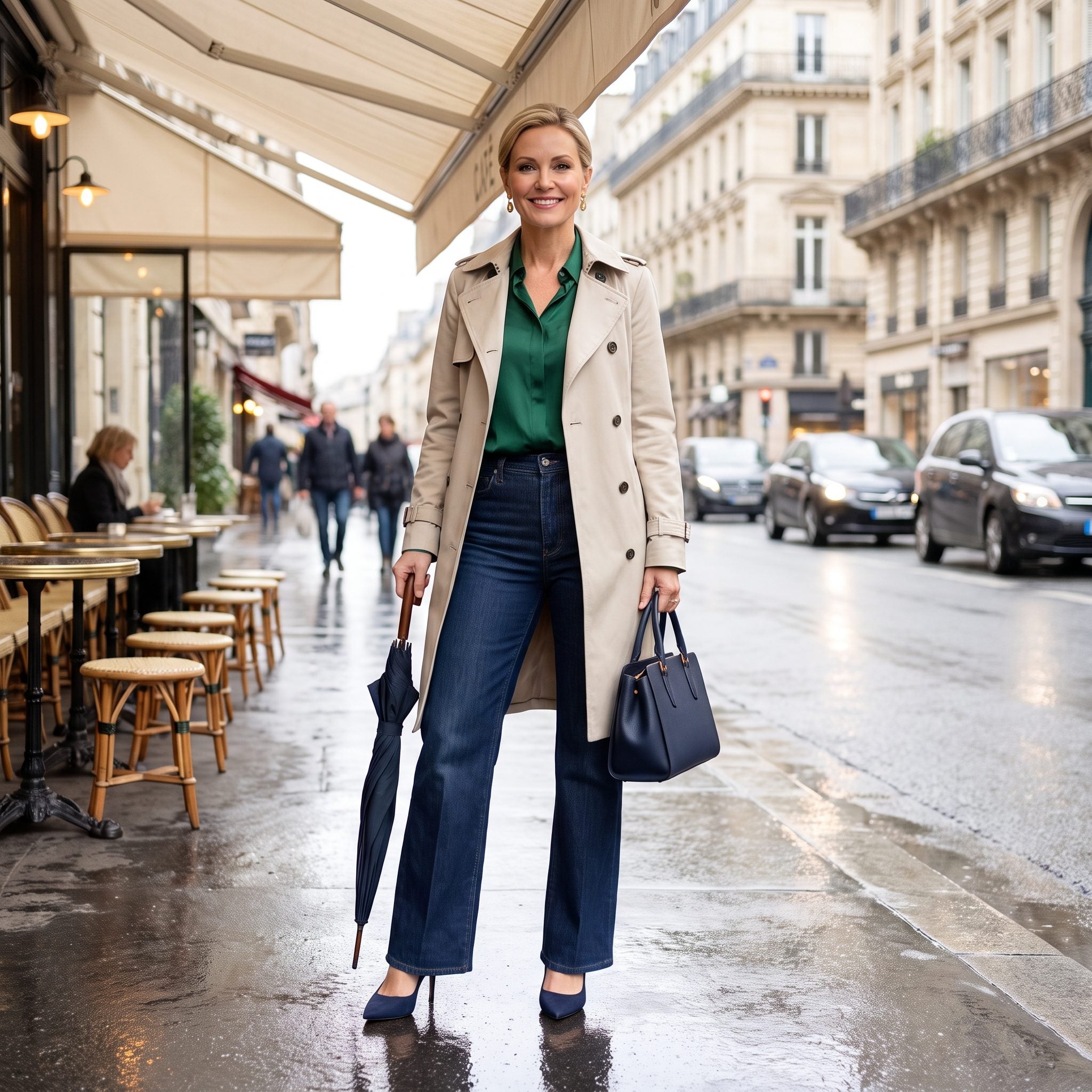
Stone and ink blue establish a restrained base before emerald silk appears at the neckline. That small saturated section is enough to change the palette without requiring the coat or denim to become colorful themselves.
Belting the trench at the back preserves its shape while leaving the high waist and wide leg visible from the front. Pointed navy pumps add a sharper finish beneath fabric that otherwise falls in broad, soft lines.
Color Note: A small area of saturated color often registers more strongly when it is surrounded by neutrals. Emerald works here because the trench and denim give it plenty of visual quiet.
3. Mid-Blue Flares + a Cream Knit Polo
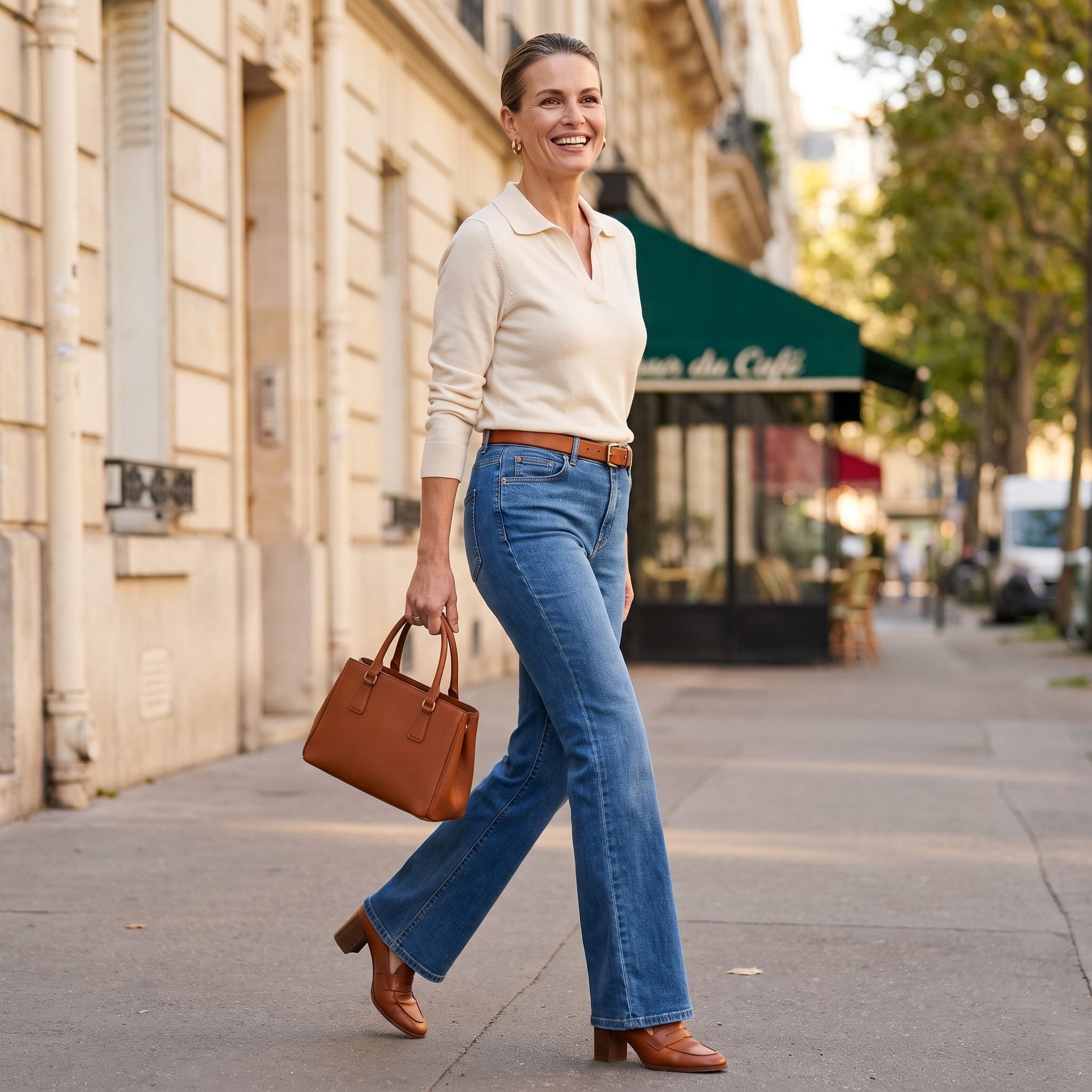
The knit polo occupies an ideal middle register: neater than a tee, less formal than a blouse, with a collar that gives the upper half immediate definition.
Cognac repeats through belt, loafers and bag, creating a warm line around the cream-and-blue center. The heeled loafer gives the full-length flare enough lift to skim rather than drag.
Why It Works: Repeating one leather color across several small accessories gives the outfit continuity without requiring the clothing itself to match.
2. Dark Straight Jeans + an Ivory Blazer
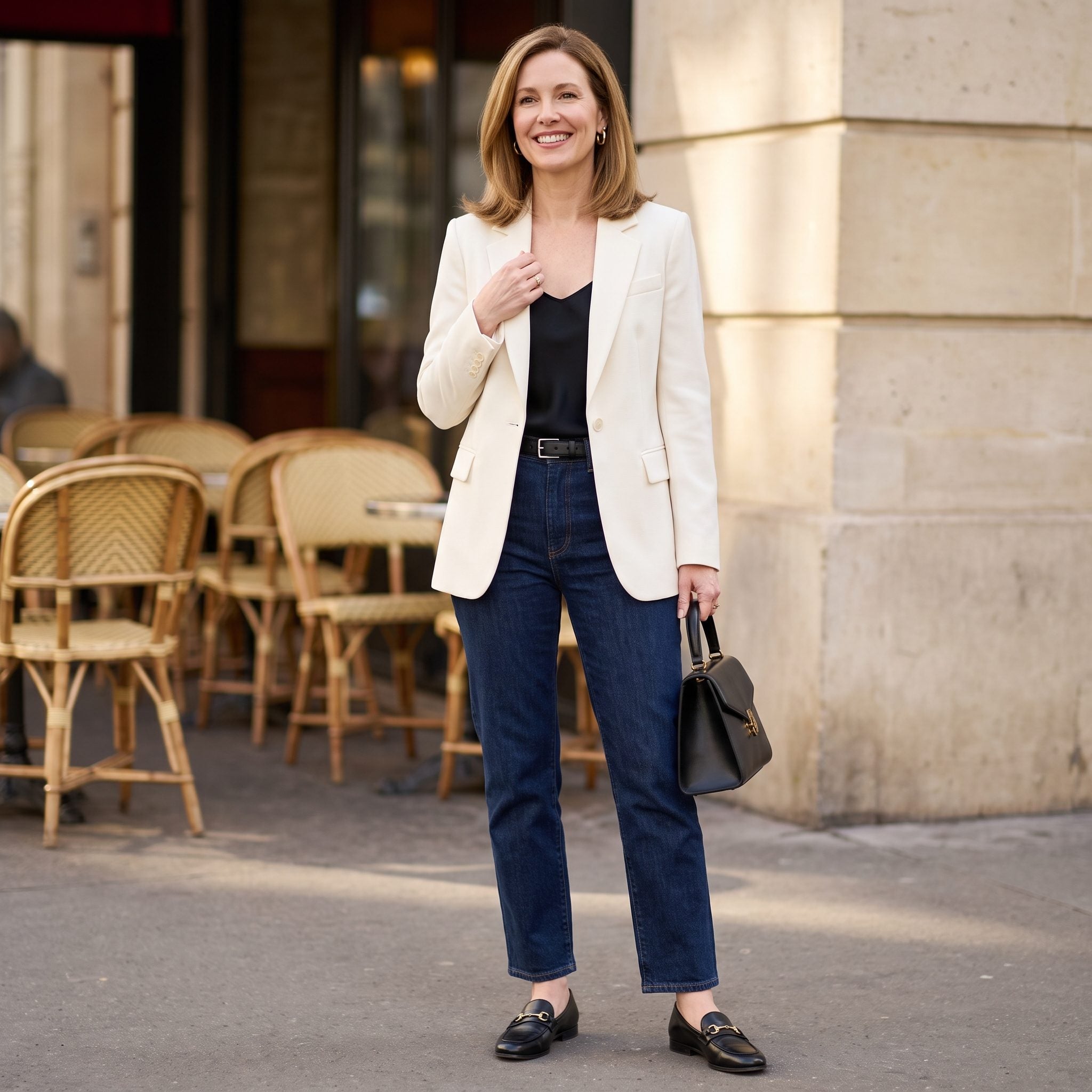
Structured ivory wool against dark indigo creates immediate friction between formal tailoring and familiar denim. Neither piece needs embellishment because the light-dark contrast already separates them so clearly.
A black silk camisole replaces the expected tee, while black horsebit loafers extend that darker center to the floor. The ivory wool blazer remains the brightest and most structured element.
Style Tip: Changing the layer under a blazer can alter the entire finish. Silk or satin introduces light and fluidity where jersey would keep the look firmly casual.
1. Deep-Indigo Slim Jeans + a Powder-Pink Silk Shell and Long Black Coat
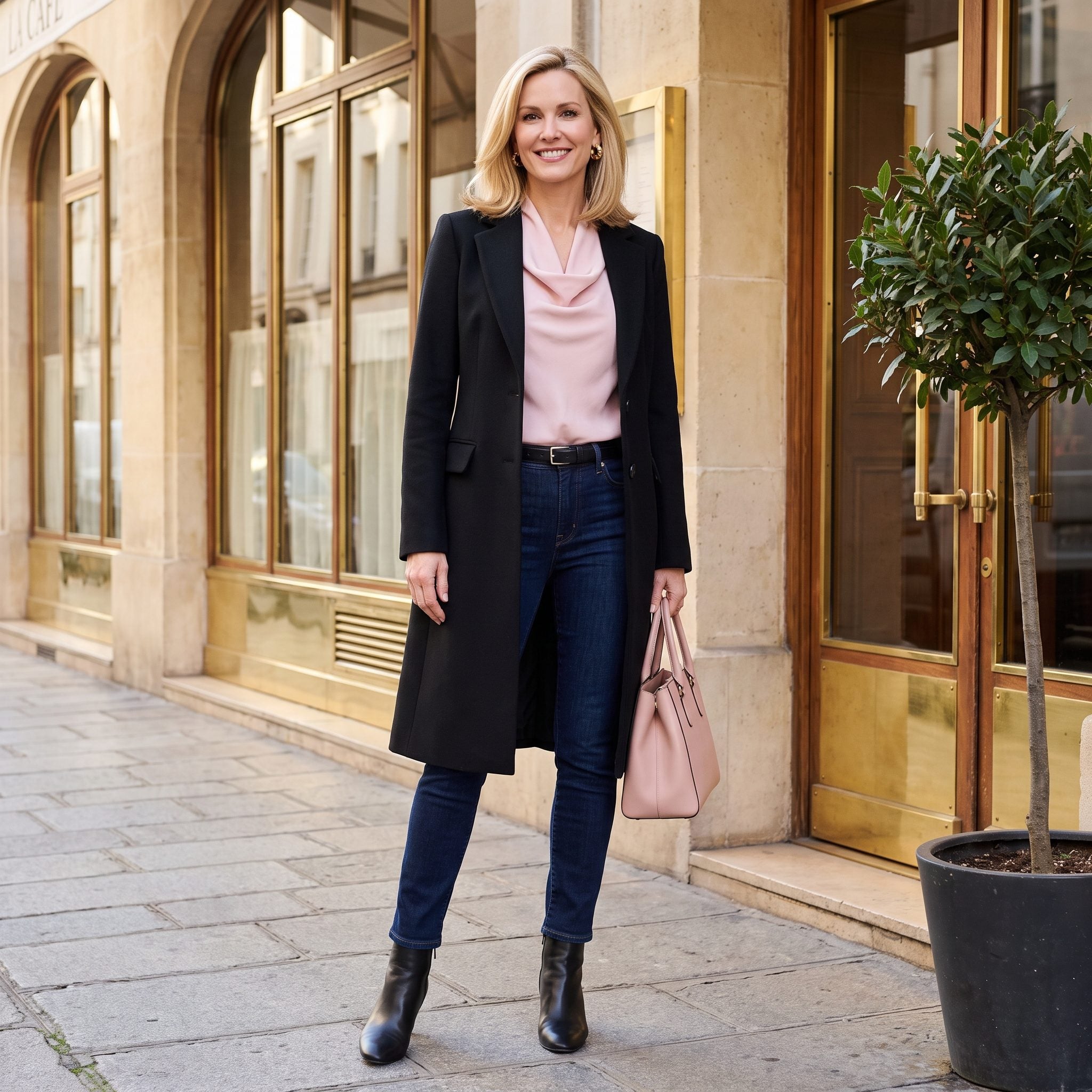
A long black coat establishes the strongest line in the entire outfit, then powder-pink silk interrupts the severity at the center. Deep-indigo slim jeans sit between those two extremes: darker than the silk, softer than the coat.
A black belt holds the coat open around the waist rather than allowing the long layer to obscure the silhouette. Matching the powder-pink handbag to the shell repeats the pale color at a second scale, while a long black wool coat supplies the final vertical frame.
Across all 39 looks, the recurring move is not hiding the denim. It is giving the denim a clear role. Sometimes that means a hard line from a blazer or waistcoat. Sometimes the change comes from satin, suede, velvet or cashmere. Sometimes a scarf, cuff, shoe or repeated leather tone does more than another entire layer could.
The result is less a rulebook than a study in proportion and finish. Jeans remain jeans. The polish comes from knowing exactly what should happen next.