
❤️ Would you like to save this?
There’s a specific exhale that happens the second the chair reclines and the warm water hits your scalp. That’s when the truth comes out. Not the small truth about wanting more layers — the big one, the thing you haven’t said to anyone with a pulse. Somewhere between the sink and the mirror, a haircut quietly turns into therapy and confession and a very long marriage debrief, all at once. You talk. She listens. She remembers the last fight you had by how far your roots have grown, which is either sweet or slightly unnerving depending on the day. The whole thing runs on the same human wiring that keeps couples in those little offices with the tissue boxes. So why has the salon chair become the most honest seat in your week, and what does that say about all of us?
FYI, thanks to AI imagery software, we’re able to create very specific fashion and hairstyle examples to illustrate the points being made. In some cases, imagery is exaggerated to hammer home the point. Also, assume links that take you off the site are affiliate links such as links to Amazon. this means we may earn a commission if you buy something.
12. You Unload the Argument Before the Cape Is Fastened

The cape isn’t even snapped and you’re already three sentences into what happened Thursday. Not the hair. The marriage — the thing he said at dinner that you’ve been carrying around like a stone in your coat pocket.
It’s the same release a couple feels the moment they sit down across from the counselor, because the setting itself signals permission. There’s a name for it: the confessional effect. Put a person in a defined, low-stakes space with someone who isn’t a stakeholder, and the guard drops faster than you’d ever predict. Your stylist can’t take sides. She has no dog in the fight, and that neutrality is exactly what makes you honest.
And just sitting right there in the chair, the black cape settling over your shoulders, helps. Hard to stay defensive when you’re mid-gesture and someone’s about to touch your hair — the body relaxes and the story follows.
11. Your Bangs Become Evidence He Never Listens

You asked him twice if you should get bangs. He said “sure, whatever you want,” which you both know is the marital equivalent of static. So here you are, turning a cosmetic decision into Exhibit A in the ongoing case of He Doesn’t Actually Hear Me.
The bangs aren’t the point. They’re a test he already failed. Call it confirmation bias dressed up as a haircut — you walked in already believing he tunes you out, so his half-shrug about your fringe gets filed as proof, while the hundred times he did listen quietly vanish from the record. Couples do this constantly, collecting evidence for the story they’re already telling.
Your hairdresser knows the real assignment. She’s not just cutting bangs. She’s agreeing that yes, it’s maddening, while gently shaping something that’ll frame your face beautifully by Friday.
10. You Ask Whether the New Color Looks Desperate

The copper looks incredible. You know it looks incredible. And yet the first words out of your mouth are: “Is this too much? Does it look like I’m trying too hard?” Translation: does this read as a woman reinventing herself at a suspicious moment.
Here’s what’s underneath. A new color after a certain age, or after a certain argument, carries meaning you’re worried everyone else will decode. It’s identity signaling, and you’re nervous about the signal. Am I announcing something I’m not ready to announce?
What you want isn’t a color consult. It’s permission to look like you feel. Research on enclothed cognition keeps finding the same thing: when we believe we look the part, we start acting it. The copper isn’t desperate. It’s a decision — and deciding how you want to show up is the least desperate thing a woman can do.
9. You Want Validation Before You Want Hair Advice

You didn’t come here to be fixed. You came to be told you were right.
Watch how it goes. You lay out the whole saga — the thing he did, the thing you said back — and if your hairdresser so much as leans toward “well, maybe he had a point,” you feel the floor shift. That’s not what this was for. It’s the same dynamic that quietly sinks half of couples therapy: one person walks in wanting a referee, and the other hears a jury.
We seek validation first and solutions second because being understood soothes the nervous system before the problem is even solved. A good hairdresser, like a good counselor, knows the order of operations. Reassure, then suggest. “That sounds exhausting. Also, have you thought about calling him on it?” One sentence, both needs met. That’s a professional.
8. You Retell His Exact Words While the Foils Develop

A good stretch of processing time, and you spend every minute of it reconstructing the fight down to the comma. “And then he said, and I quote…” You’re not summarizing. You’re delivering a transcript.
This is rumination, and the foils make a strangely perfect container for it. You can’t leave. He can’t interrupt. For once you get to run the whole argument back without anyone correcting your version.
Couples therapists see this move every week — one partner replaying the greatest hits, each retelling cementing the memory a little harder. Here’s the catch, though: repetition doesn’t bring clarity, it brings conviction. The more you say it, the truer it feels, whether or not it’s accurate.
The gift of the chair is that she lets you finish. No “but what did you say back?” Just space. And sometimes hearing your own words out loud, uninterrupted, is the first moment you catch how you sound.
7. Your Hairdresser Remembers Fights by Root-Growth Interval

“Last time you were in, that was right after the anniversary thing, wasn’t it?” And just like that, your entire marriage is being measured in six-to-eight-week increments.
Your hairdresser doesn’t track your life in dates. She tracks it in regrowth. The argument about his mother happened at an inch and a half of visible root. The reconciliation was a fresh single-process. She’s built a timeline of your relationship out of nothing but the gap between appointments, and it’s more accurate than your own calendar.
There’s something tender in being this known. Continuity of care — the same reason people stay with one therapist for a decade rather than starting over. The history is the value. You don’t have to catch anyone up, because she already knows the cast of characters, the recurring plot, and roughly how long it’s been since the last cliffhanger.
6. You Ask If the Other Woman’s Hair Is Better

It arrives sideways, usually near the end. “Does my hair look… I don’t know. Tired?” What you’re really asking lives one layer down. Is she prettier. Does she have better hair. Did I let something slip.
This is social comparison running at full volume — the upward kind, where we measure ourselves against a rival we’ve probably built up into a myth. The imagined other woman always has shinier hair, flatter abs, and a lower-maintenance disposition. She exists mostly in your head, and she is relentlessly perfect there.
Here’s where your hairdresser earns every penny. She can’t address the marriage, but she can do the one honest thing: remind you what you’ve actually got. The density. The natural wave. The color that took beautifully. She pulls you out of the comparison and back into your own reflection, because the woman in the mirror is the only one in the room, and she’s doing just fine.
5. You Practice the Difficult Conversation During the Blowout
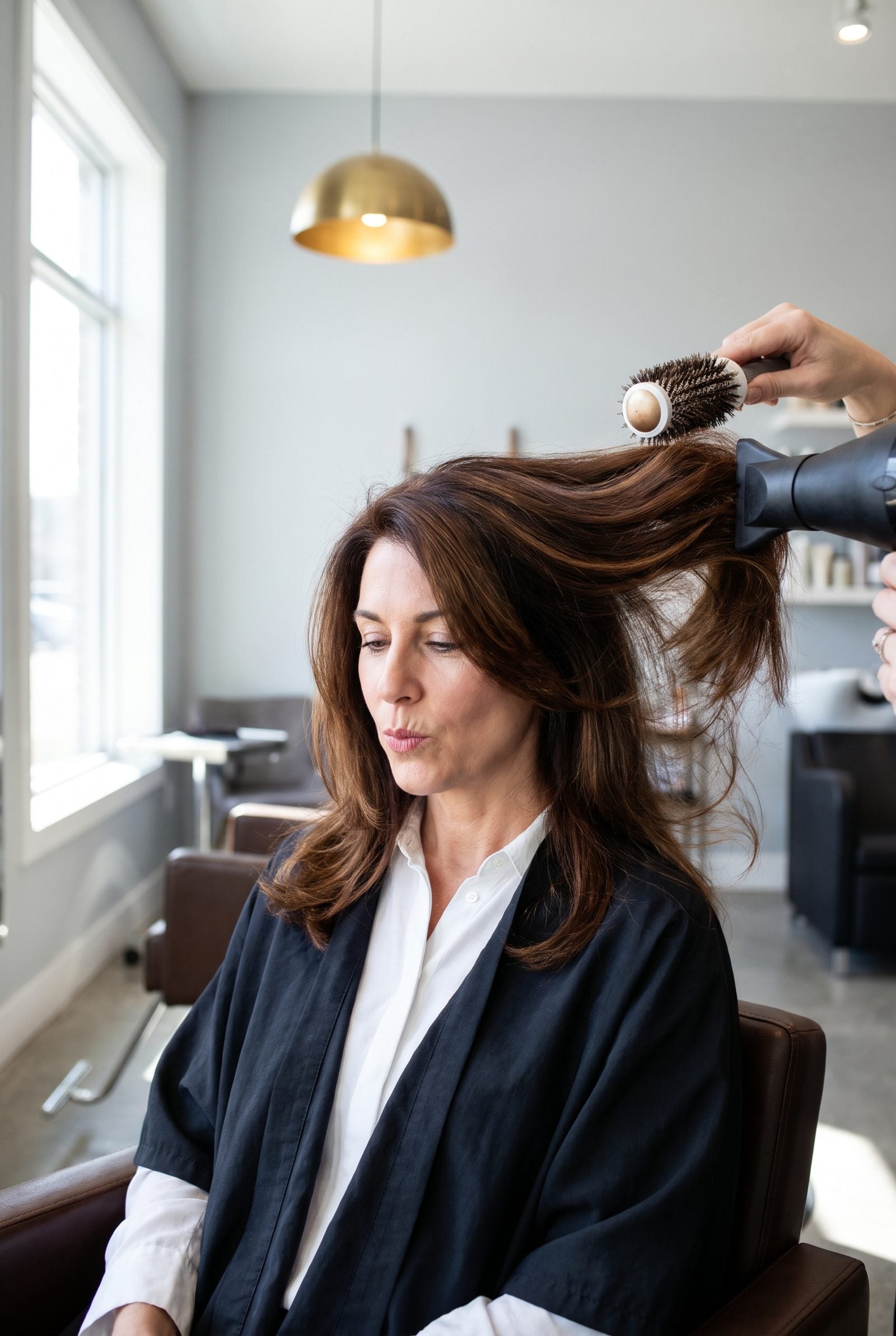
The dryer is loud, your hair is coming out gorgeous, and somewhere inside you’re running a dress rehearsal. “We need to talk about the money.” No, softer. “I’ve been thinking about us.” Too ominous. You’re workshopping the opening line like it’s a monologue.
The blowout is weirdly ideal for this. You feel put together, and that bleeds straight into feeling capable. Mental rehearsal is a real tool — the same thing athletes and public speakers use before the big moment. You’re pre-loading the hard conversation so it feels survivable by the time you’re home.
There’s also the armor effect quietly at work. A woman who likes how she looks walks into a tough conversation standing taller. The hair won’t change what he’ll say. But it changes how steady you feel saying your part.
4. You Admit What You Did After the Shampoo

Nobody warns you about the stretch after the shampoo. It’s where the real confession happens — not the grievance about him, but the one about you. The thing you did, or said, or should have done differently, that you haven’t admitted to a living soul.
Something about the warm towel, your freshly washed hair, the friendly face smiling back at you, lowers the drawbridge completely. Warmth and touch settle the nervous system, and settled people tell the truth. It’s why the hardest admissions in a relationship often come on a walk, side by side, not face to face.
You’re not fishing for validation here. You already know you were wrong. You just needed somewhere safe to say it out loud before you could carry it home. And the salon chair — calm, anonymous, gloriously nonjudgmental — is the safest booth in town.
3. Your Hairdresser Spots the Pattern Before You Do

You’ve told her the story four appointments running. Different details, same shape. And this time she says it lightly, brushing out your ends: “You know, this sounds a lot like the thing from the spring.”
And you go quiet. Because she’s right, and you hadn’t connected it.
This is the strange genius of the outside observer. She has the one thing you don’t: distance. You’re inside the marriage, too close to see the loop you keep running. She’s getting the whole saga in neat six-week installments, which makes the repetition impossible to miss. It’s exactly what a counselor does — naming the cycle the couple keeps running without noticing they’re running it.
She won’t push. She has no agenda beyond your hair and, somehow, your wellbeing. But she’ll leave the observation on the counter like a tip, there if you want to pick it up. And more often than not, the drive home is where it finally lands.
The best ones don’t just cut hair. They hand you back your own life, slightly clearer, every six weeks.
2. You Leave With Boundaries and Freshly Trimmed Ends

There’s a specific face a woman makes in the mirror after she’s finally said what she wanted. Jaw set, chin slightly lifted — the look of someone who asked for a trim and meant a trim. Not two inches. Not “a little off the length.” The inch she requested, honored to the millimeter.
It took years to get here. You used to walk in with a photo and walk out with someone else’s interpretation, then drive home rehearsing how you’d pretend to love it. Now you speak in full sentences, say no to the thinning shears, and decline the “fun” layers that always read as a mistake growing out for six months.
This is the same skill that took a decade to learn everywhere else in your life. Psychologists call it self-differentiation — staying connected to someone while holding your own position. In the chair you practice it with low stakes and a good mirror. Say what you want, kindly, and watch the sky refuse to fall.
1. The Tip Includes Hazard Pay for Emotional Labor

Watch the tip jump. The cut was good, sure — but the real number reflects the hour she spent as part colorist, part confidante, nodding along to the saga of the kids, the move, the thing you can’t tell anyone else yet. You tip for the balayage. You over-tip for the listening.
And it is listening. A stylist holds your head in her hands and your story in her memory, picking up a thread from three months ago like no time passed. That remembering builds the slow, steady trust that keeps you loyal to one person for fifteen years and wary of anyone new with scissors.
The generous tip is guilt and gratitude braided together. You know the work was emotional, not just technical, and some part of you wants to pay for the part no receipt lists. Loyalty like this? Rarer than good highlights. Protect it. Tip the hazard pay.