
❤️ Would you like to save this?
Most women don’t notice their haircut aging them. Everyone else does.
That’s because hair changes faster than we think. The cut that worked at 35 can start working against you at 45, adding heaviness, dragging features down, or making thinning hair more obvious.
The transformations here aren’t dramatic makeovers. They’re smart adjustments. A few inches off. Better layers. More flattering shape. Small changes that completely shift how a face is framed.
Each before-and-after shows exactly what was wrong, what got fixed, and why the new cut works so much better.
FYI, thanks to AI imagery software, we’re able to create very specific fashion and hairstyle examples to illustrate the points being made. In some cases, imagery is exaggerated to hammer home the point. Also, assume links that take you off the site are affiliate links such as links to Amazon. this means we may earn a commission if you buy something.
33. Chocolate Highlights on a Bob: How One Color Technique Changes the Whole Read
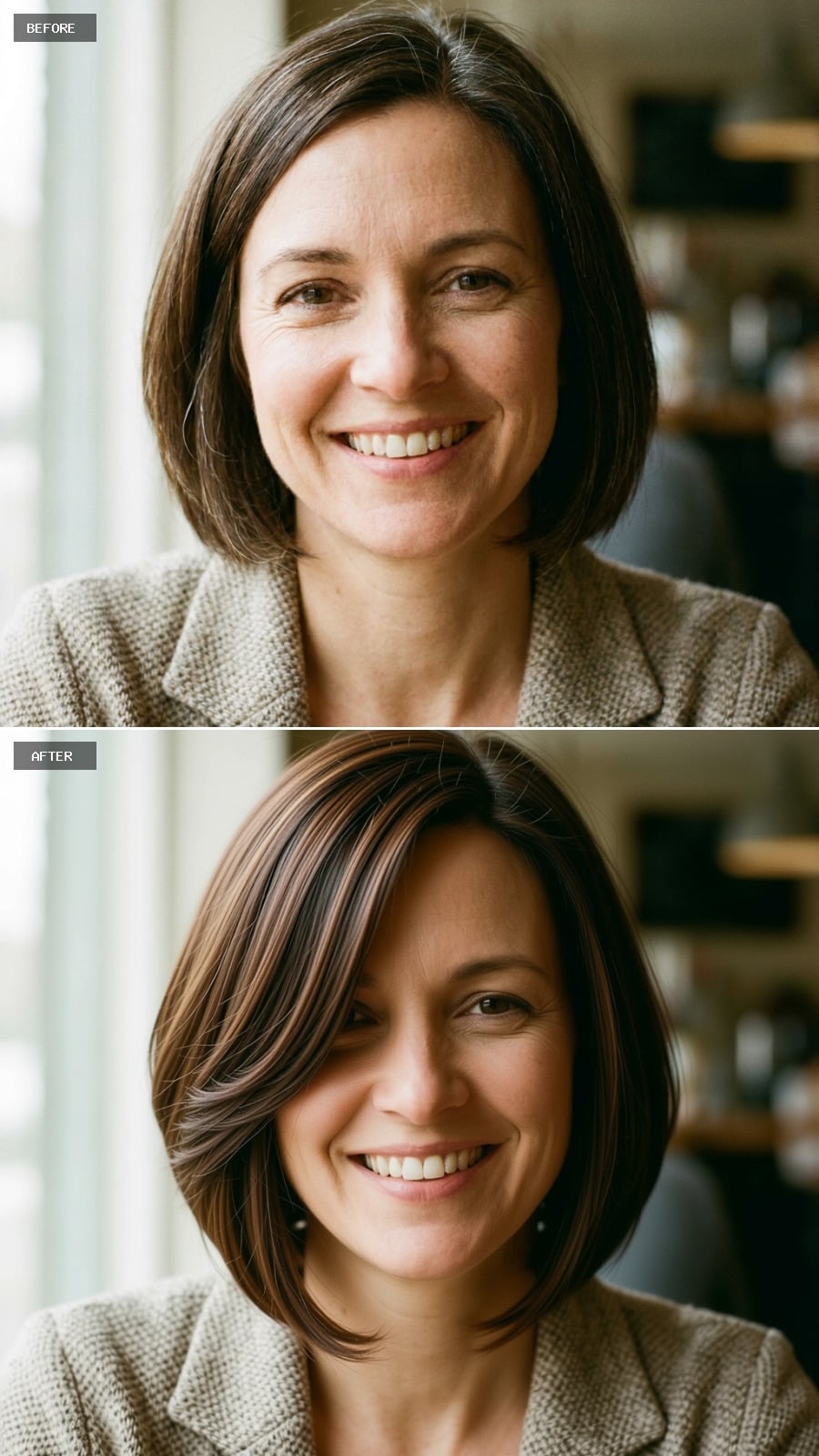
Her hair starts as a single-note dark brown, chin-length and center-parted, with a clean bluntness that reads more practical than intentional. It suits her. But the “after” tells a different story. The colorist has added caramel and warm chestnut highlights running from root to tip, and the layering gives the bob a swept, side-angled fall that the original cut was never showing off.
What the highlights actually do is create the illusion of movement before she’s even moved. The strands catch light differently at the crown versus the ends, so the bob stops looking uniform and starts looking shaped. She’s wearing the same sand-colored knit blazer in both shots, same setting, same smile. The hair is doing all the work, and it’s a lot of work.
32. Soft Blonde Layers Changed the Whole Conversation Her Hair Was Having
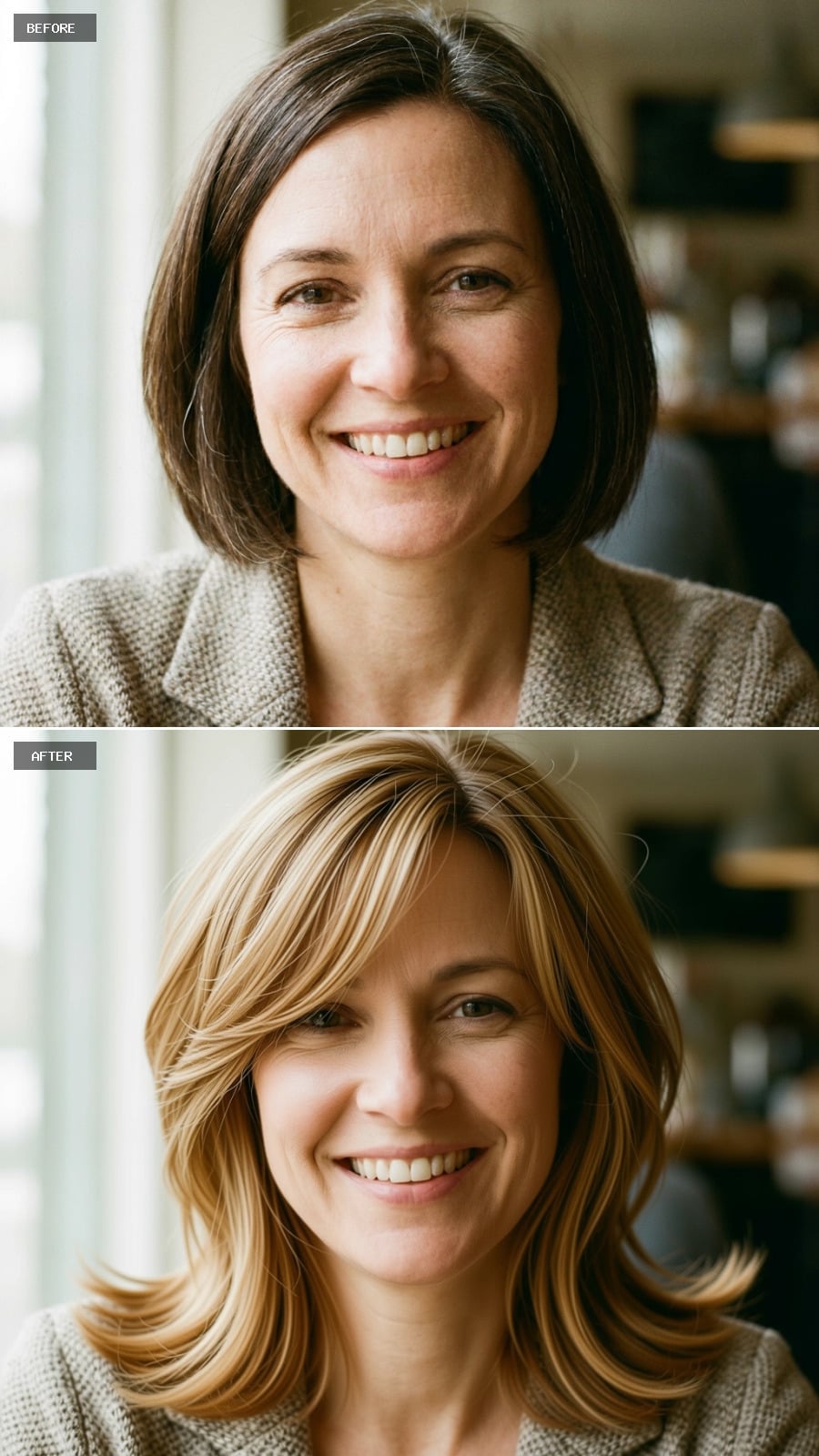
Dark brunette bobs read sharp. Clean, contained, professional. What’s happening in the after photo is the opposite of contained: shoulder-length blonde layers with visible highlights sweep across the face, and the movement alone reads at least five years lighter. The layered cut adds weight at the ends while keeping volume through the crown, which does real structural work for a face shape like hers. Same knit sweater, same warm setting. Different hair, different energy entirely.
Shopping Tip: Look for a toning shampoo specifically labeled for “bright blonde” or “beige blonde” to keep layered highlights from going brassy between salon visits. Balyage-style placement like this tends to fade warm at the roots first, so a purple or blue toning mask used once a week on dry hair before shampooing makes a visible difference. It’s a low-cost step that extends the life of an expensive color service.
31. Darker, Richer, Sharper: What a Color Depth Change Actually Does to a Bob
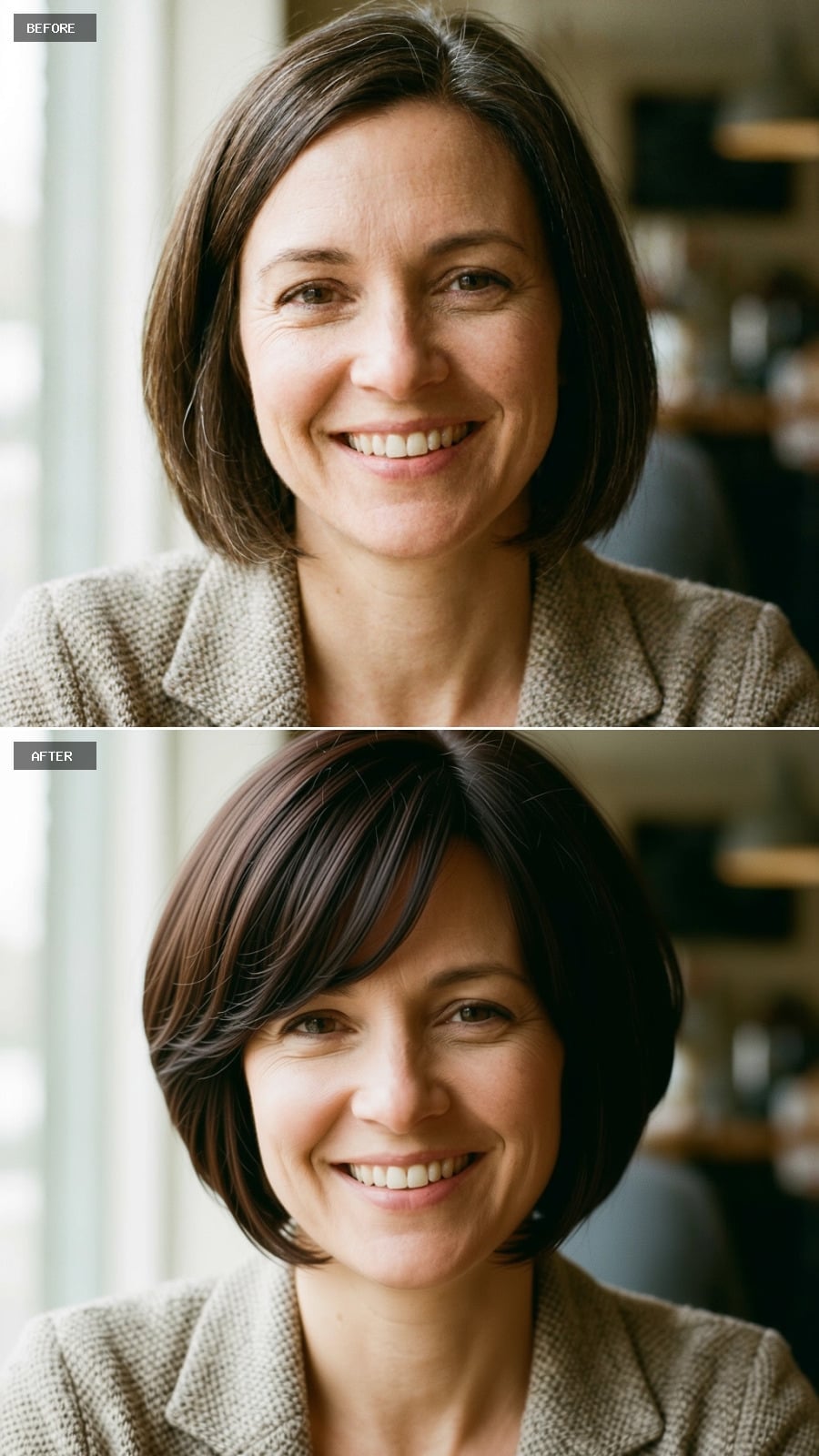
Going from ash-brown to a deep chocolate with cool undertones does something the cut alone can’t. The “after” shows hair that reads denser, more intentional, with individual strands catching light rather than blending into a flat field of color. That shift makes the bob’s blunt line feel sharper without changing a single inch of the cut. It’s the same knit blazer, the same face. The color is doing all the talking.
30. Blonde Waves at 44: What Length and Color Do Together That Neither Can Do Alone
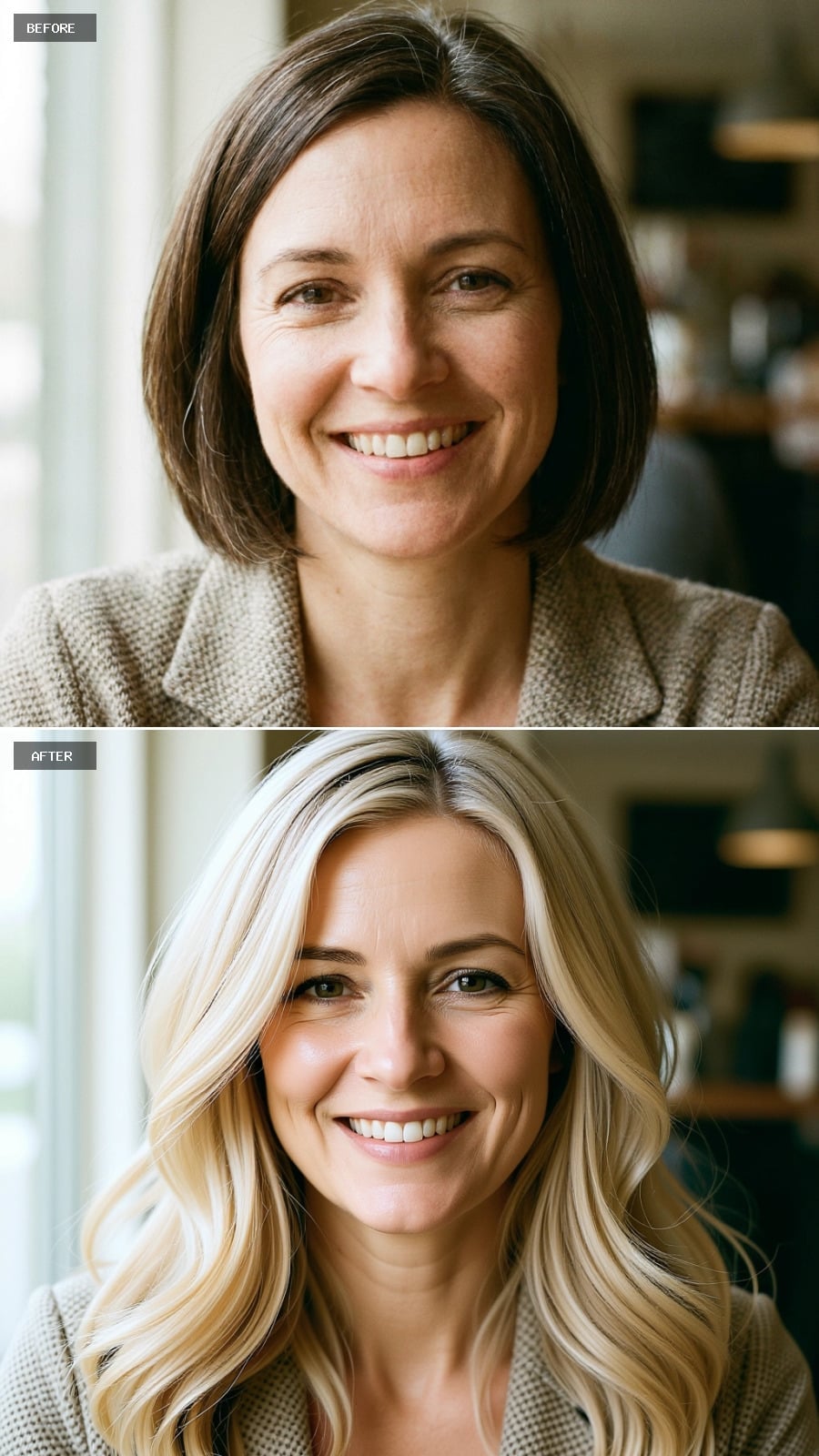
What’s happening in the “after” photo isn’t just a color swap. The shift from a chin-length dark brown bob to long, wavy blonde with soft root shadowing changes the entire proportion of her face. The waves aren’t tight or styled into submission; they fall loosely past the collarbone, which adds movement that a blunt cut simply can’t create. Root shadowing in a warm brunette keeps it from reading as high-maintenance platinum, and that contrast is doing quiet but real work on her features. Short hair can be sharp. But length like this opens everything up.
29. Shorter, Swept, and Suddenly Ten Years Lighter: Same Bob, New Geometry
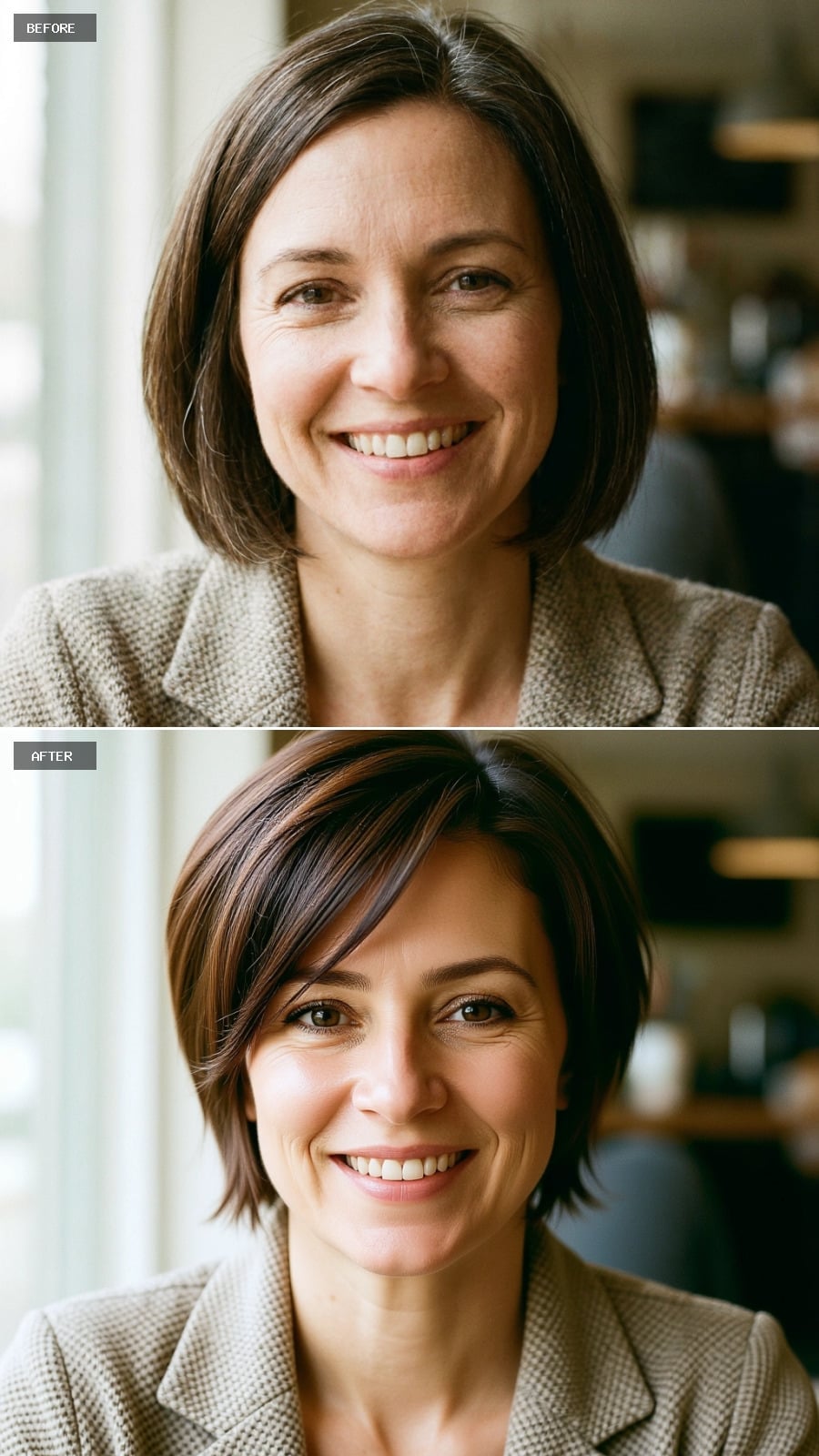
Side-swept bangs do a specific kind of work that most women don’t fully clock until they try them. In the after, the cut is shorter and more angled, with the bang falling across the forehead at a diagonal that pulls attention toward the eyes rather than settling it evenly across the face. The before bob is clean and classic, but it sits parallel to the jaw in a way that reads a little static. The after introduces movement. Highlights threading through the darker brown base add dimension without reading as color-treated, which is exactly the point at this length.
28. Blonde, Longer, and Lighter: When Color and Cut Work the Same Shift
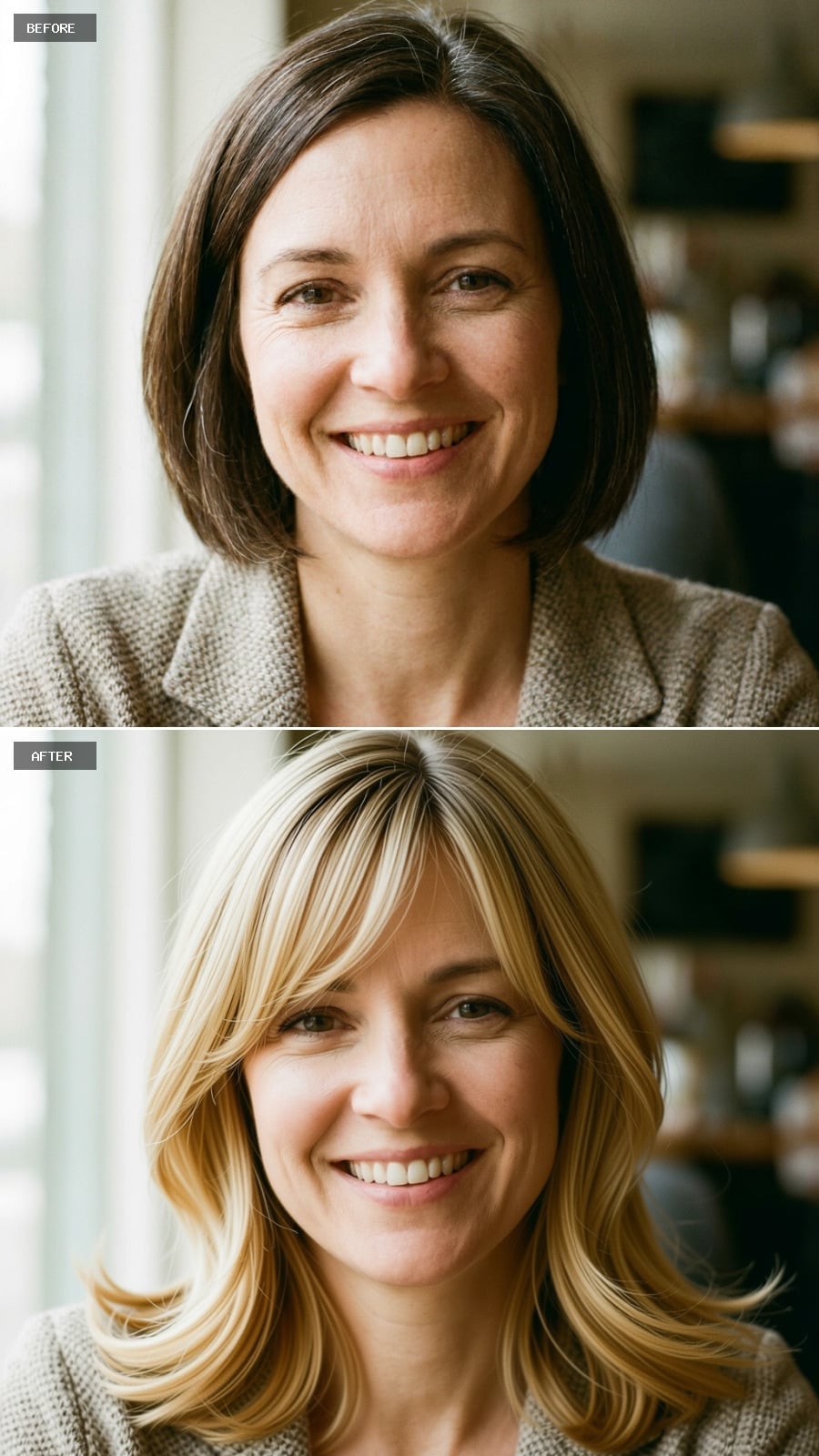
Switching from brunette to blonde is one thing. Switching the cut at the same time is another conversation entirely.
The before shows a chin-length dark brown bob, clean and precise, sitting just at the jaw. It reads polished. The after brings in honey-to-platinum blonde layering with curtain bangs and length that grazes the collarbone, and suddenly the whole face reads differently. It’s not just the color doing that work. The added movement, the way those layers break the light at multiple points, and the softness of the bangs across the forehead are all pulling in the same direction. She’s wearing the same knit in both frames, which makes it easy to see that the face itself didn’t change. The framing did.
27. Swept Bangs and a Tighter Bob Took a Decade Off Without Touching the Color
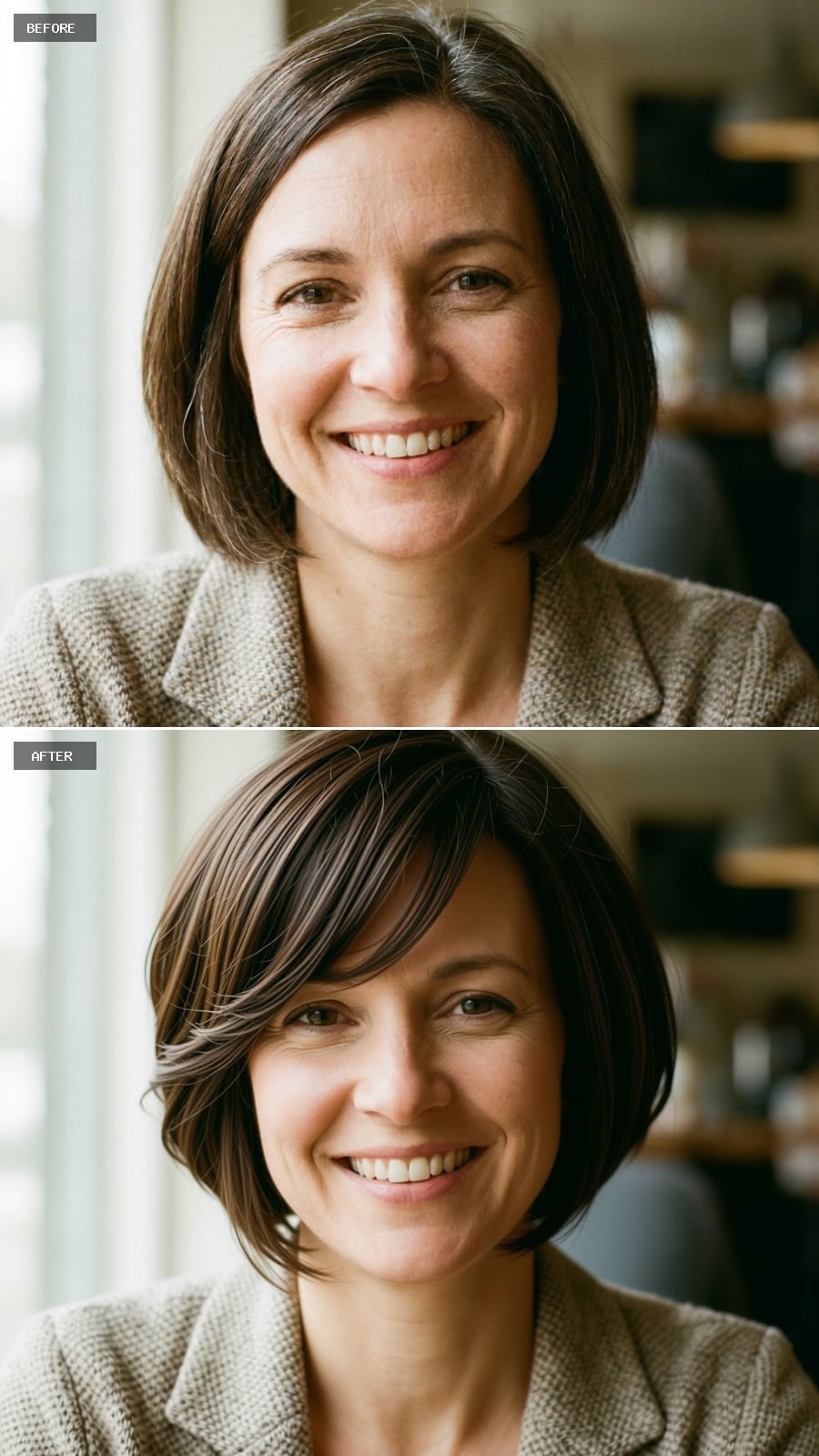
Side-swept fringe is doing a lot of work in the after photo. It cuts across the forehead at an angle that softens the brow line, and paired with a bob that’s been tightened at the back and allowed to wave slightly through the ends, the whole silhouette reads younger without reading younger, if that makes sense. Same dark brown, same knit blazer in that warm taupe-beige. But the geometry shifted enough that it’s a different conversation entirely.
Bangs get a bad reputation after 40, and honestly, most of that reputation comes from the wrong bang for the face. A blunt, full fringe is hard to carry at any age. But a swept bang that grazes one brow and moves with the cut? It doesn’t announce itself. It just quietly changes where the eye lands first, and on a bob with movement at the ends, it creates a frame that sits closer to the face than a plain parted style ever manages.
26. Brunette Bob to Blonde Waves: When Length and Color Both Change, So Does the Person
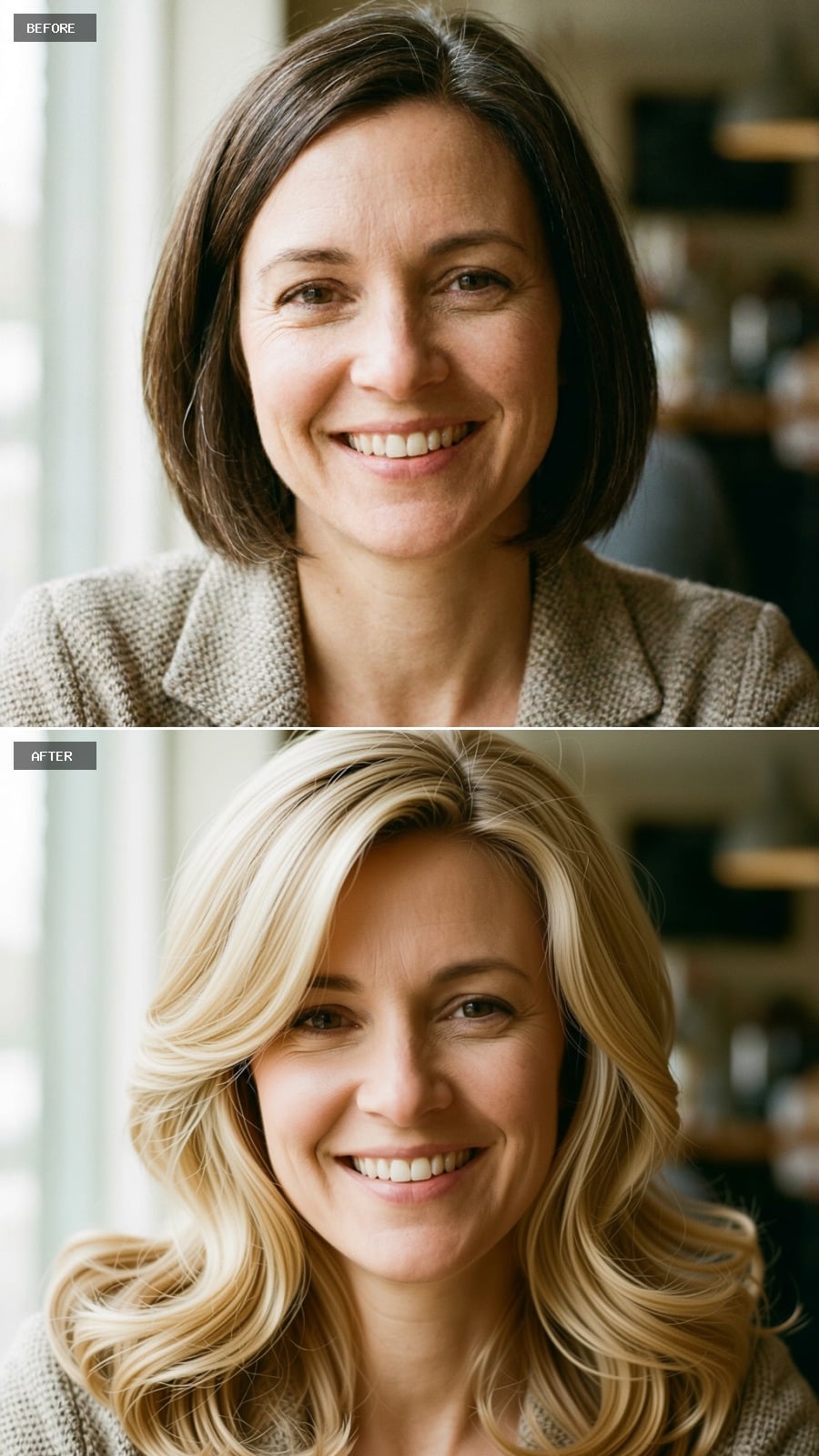
Starting with a chin-length dark brunette bob and ending with shoulder-length blonde waves, this comparison is doing a lot of work. Both cuts suit her face shape, but the longer version softens the jaw line in a way the sharper bob doesn’t. It’s the volume at the crown that shifts the balance most. Wavy blonde layers read younger not because blonde is inherently youthful, but because the movement adds dimension that flat, darker hair tends to absorb. She looks like she made a decision. That reads on camera.
25. Smooth, Sleek, and Suddenly Sharper: What Texture Does to the Same Cut
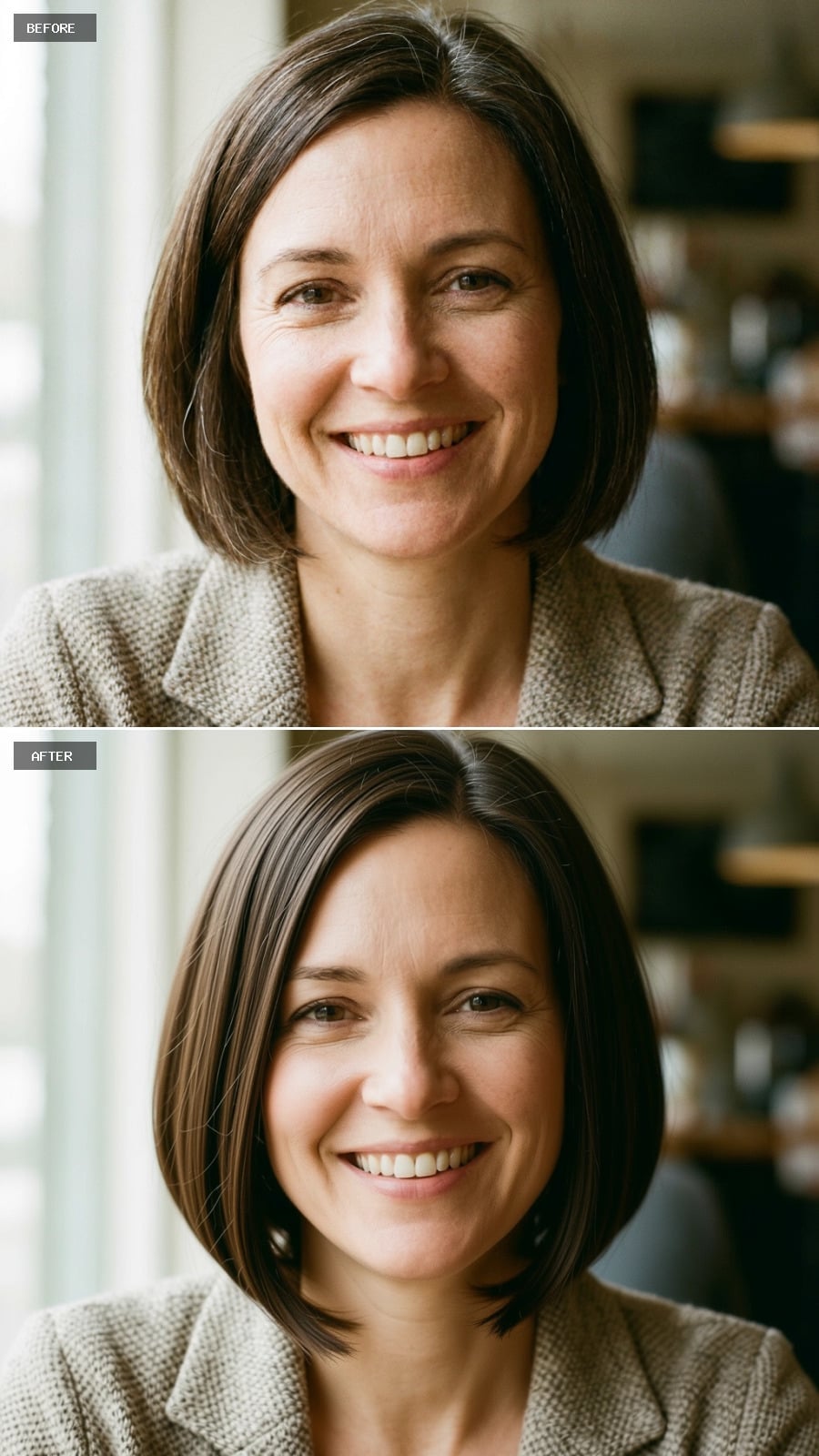
Two photos, same woman, same brown bob, same knit blazer in that warm greige-taupe that reads as effortlessly professional. But the before carries a softer, slightly wavy texture that rounds out the shape and reads as casual. The after strips all that out. The hair is flat-ironed smooth, the ends sit in a clean, deliberate line, and the whole cut reads sharper for it.
It’s the kind of change that doesn’t show up on a salon invoice. No new color, no significant length difference, just the decision to let the geometric structure of the cut actually do its job. The sleeker finish also makes the natural dark brown read richer, less diffused.
For anyone sitting with a bob that feels a little undefined, this is the argument for heat styling before assuming the cut isn’t working. Sometimes the cut is working. The texture is just softening the signal.
24. Blonde Bob, Swept Volume, and Suddenly the Whole Face Reads Differently
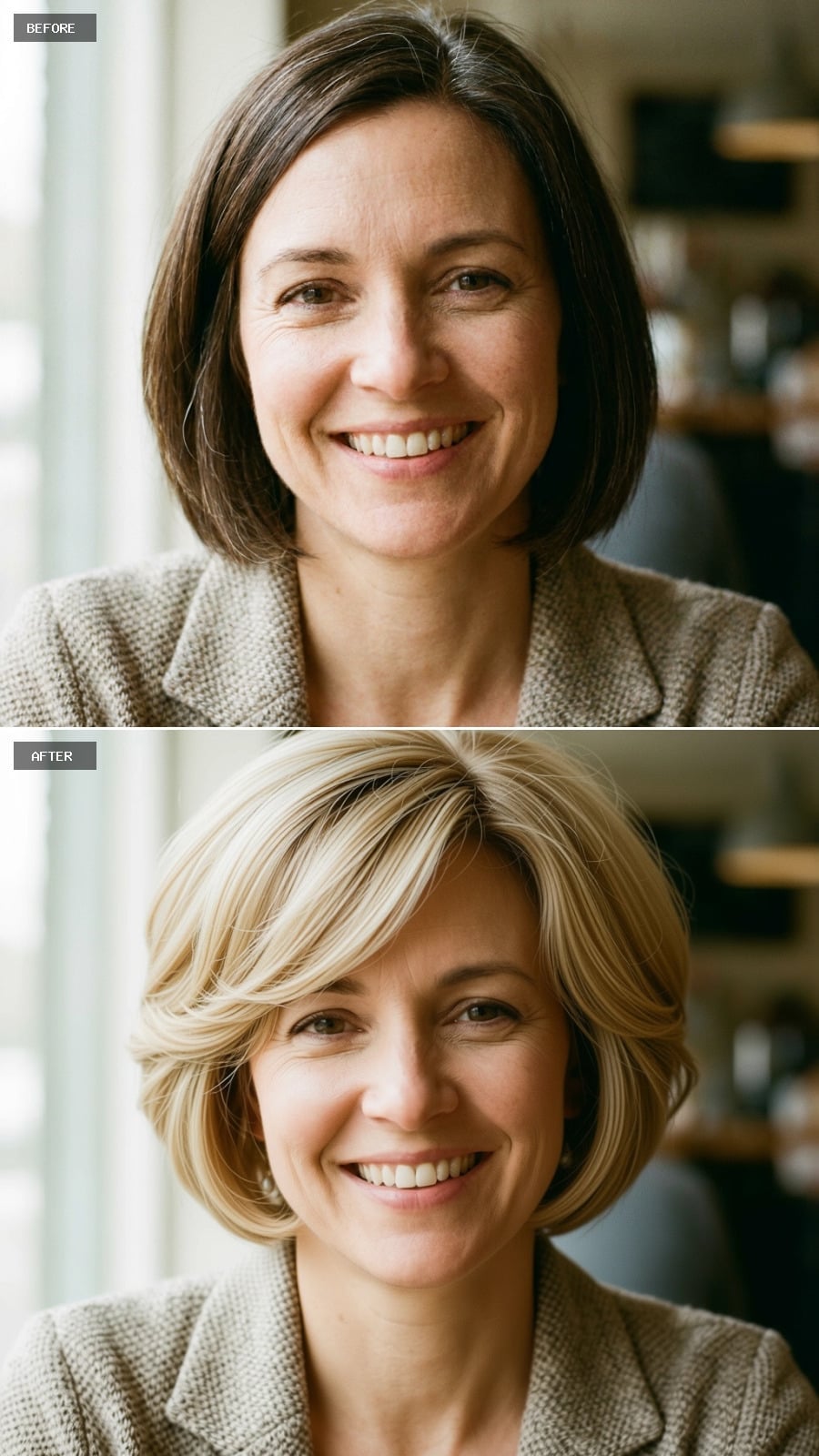
Switching from a flat, dark brown bob to a blonde one with body sounds simple on paper. It isn’t. What’s visible here is a complete shift in how light moves around the face. The before shows a chin-length cut with minimal movement, dark hair absorbing light rather than reflecting it. The after introduces a sandy blonde with dimension, soft layers that lift at the crown, and a swept style that pushes volume away from the jaw. That last part matters more than the color. Volume directed upward and outward creates width at the cheekbone level, which does more for facial framing than most cuts get credit for.
23. Cropped, Swept, and Highlighted: When a New Cut Rewrites the Whole Face
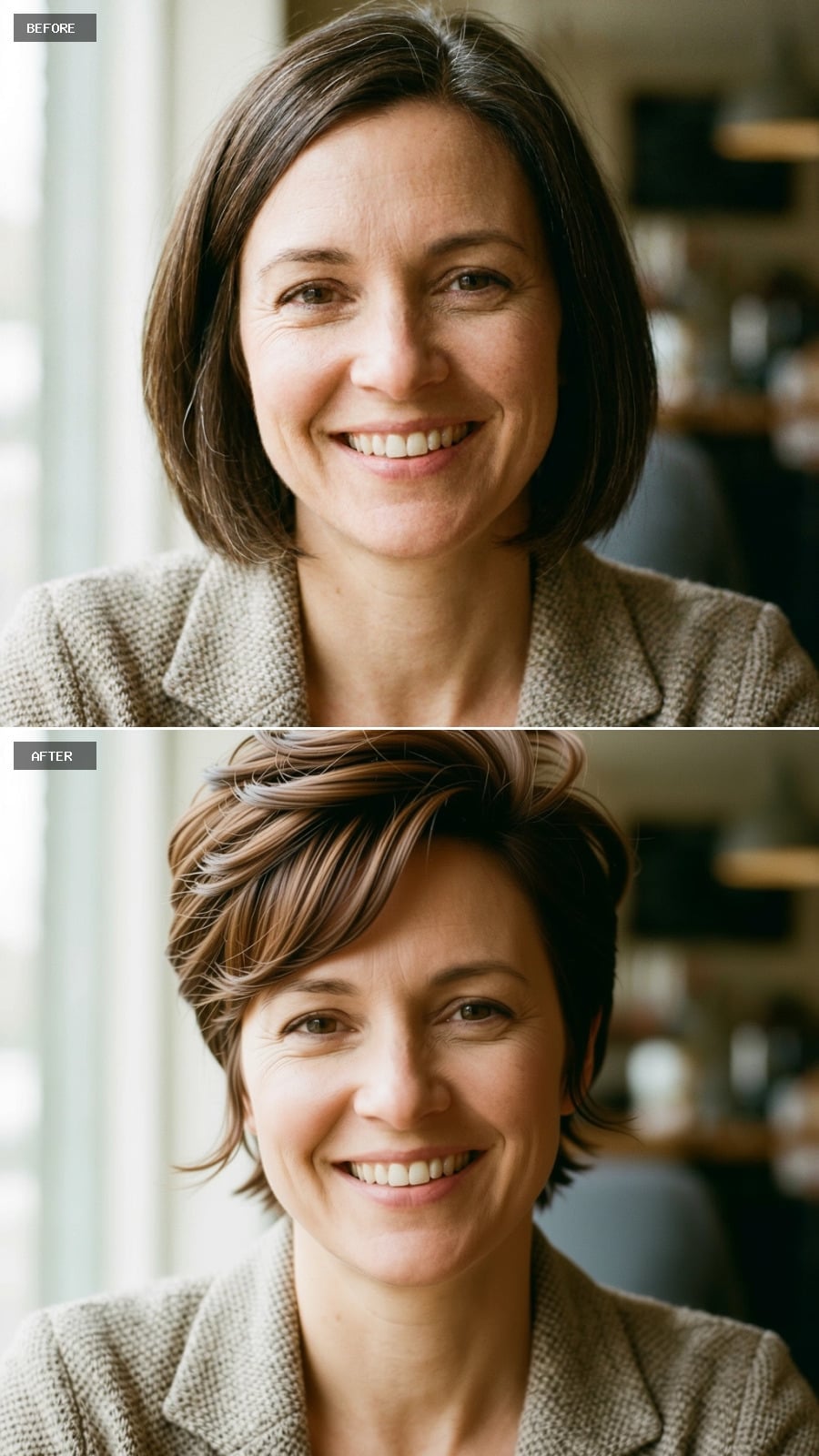
She went from a blunt dark bob sitting chin-length and flat to a cropped cut with volume swept upward and forward, and the difference isn’t subtle. The “after” shows warm brown hair with hand-painted caramel highlights running through the top layers, creating dimension that reads almost like natural light hitting the hair at the right angle. It’s the kind of color that doesn’t announce itself.
The cut itself does the real work. Cropped close at the sides and back but left longer and airy at the crown, it creates lift right where the face needs it most. That upward movement pulls attention toward the eyes instead of letting the jaw carry everything. Combined with the texture in those top layers, the whole read shifts from polished to alive.
Trend Alert: Cropped cuts with volume at the crown work particularly well for women in their 40s because they create the illusion of height without adding bulk at the sides. If you’re considering a similar shape, ask your stylist to keep length at the top slightly longer than feels comfortable at the consultation. That extra inch is usually what separates a cut that moves from one that just sits there.
22. Brunette Bob Out, Blonde Layers In — Her Face Reads a Full Decade Younger
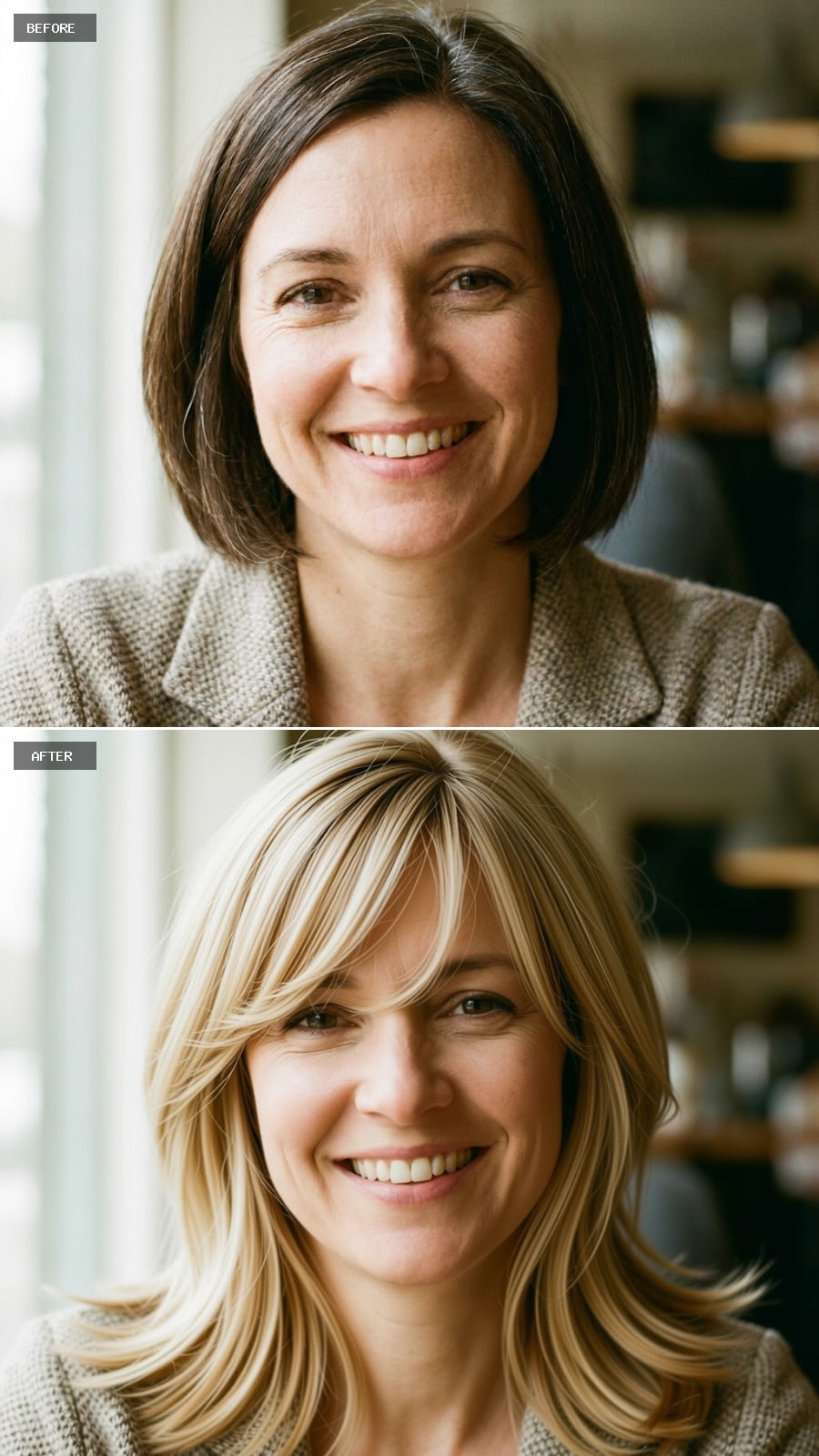
Her before shows a chin-length brunette bob, blunt and tidy, sitting flat against her jaw. Clean cut, but it compresses the face rather than opens it. After, longer blonde layers with swept bangs do the opposite: they pull the eye upward and outward, and that movement alone changes how her cheekbones read. It’s not magic. It’s geometry.
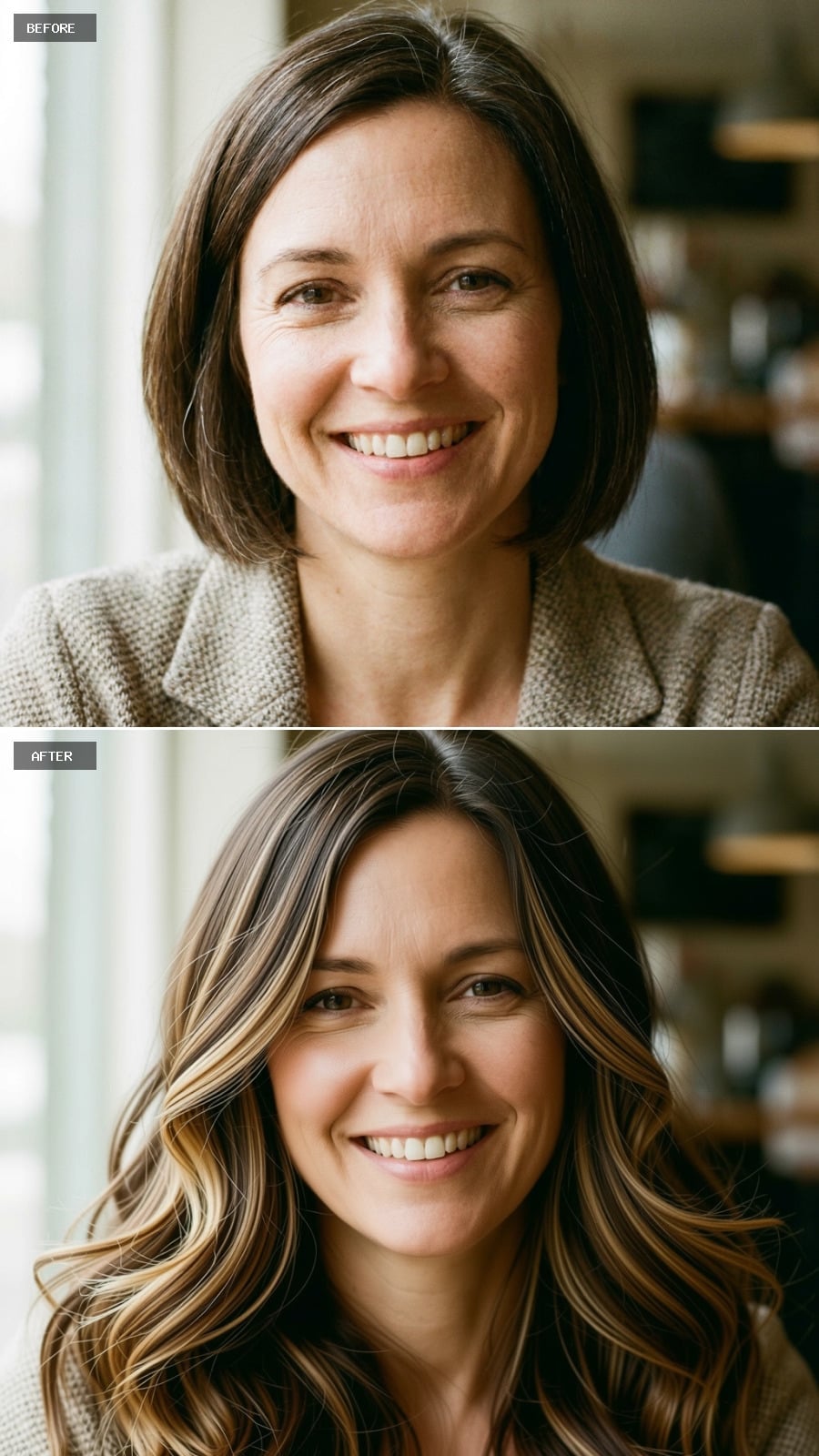
21. Long, Loose, and Highlighted: When More Hair Actually Means More Face
❤️ Would you like to save this?
Before, she’s wearing a chin-length bob in flat, uniform brunette, and it’s tidy but it closes the face down. After, the cut grows out into loose waves that fall past the collarbone, and balayage highlights in caramel and soft gold run through the mid-lengths. That shift in tone placement is what does the work. The warmth pulls forward, the face opens, and the whole result reads younger without reading like she tried.
20. Gray Hair at 44 Didn’t Age Her. It Actually Did the Opposite.
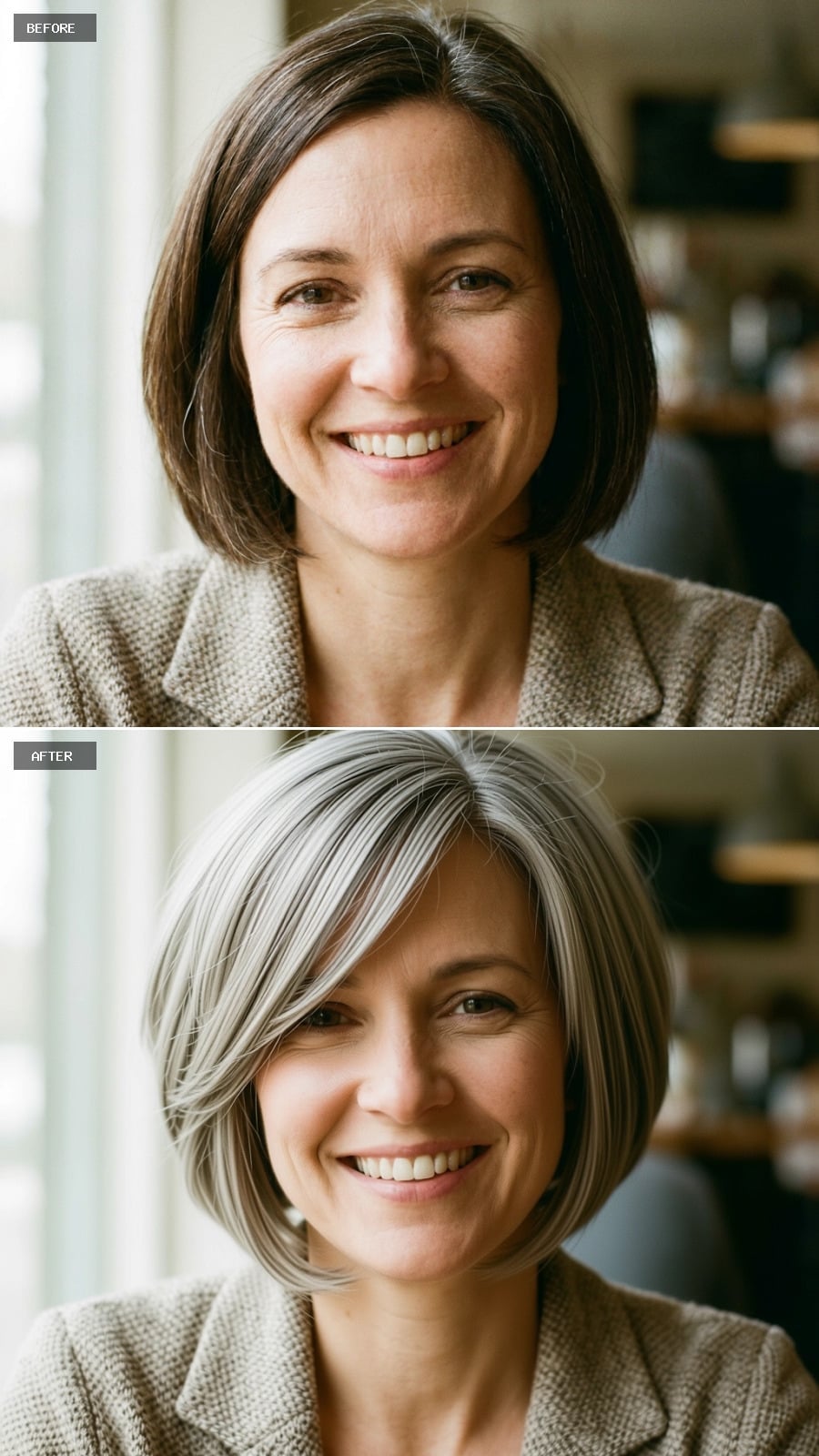
Going gray is supposed to read older. Here, it doesn’t. The dark brown bob gets replaced by a silver and white layered cut with a deep side part, and somehow the face looks fresher. Credit goes to the movement: those layers have actual swing, where the original bob sat flat. The knit jacket stays identical in both frames, which makes the hair do all the talking.
19. From Dark Bob to Blonde Bob: One Cut, Completely Different Energy
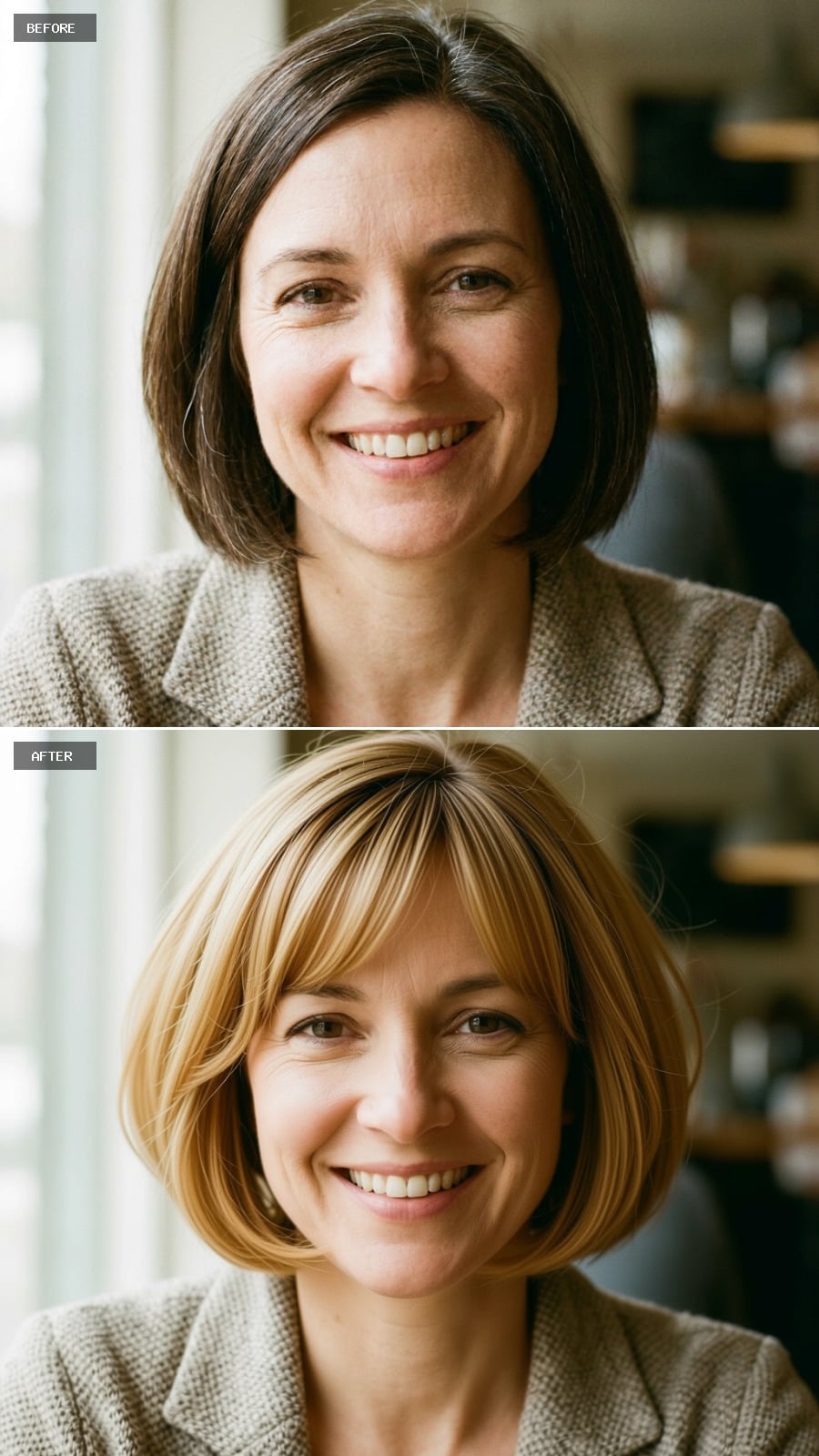
Before, she’s wearing her dark brown hair in a blunt chin-length bob with a center part, and the severity of it reads almost corporate against her oatmeal-toned knit blazer. After, the same cut gets reframed with warm honey-blonde color, grown-out dark roots, and a side-swept fringe that breaks the forehead. That fringe does most of the work. It softens the face shape in a way the center part simply didn’t, and the lighter tone bounces the window light rather than absorbing it.
18. Dark, Sleek, and Longer: How Adding Inches Quietly Reshuffled Her Whole Face
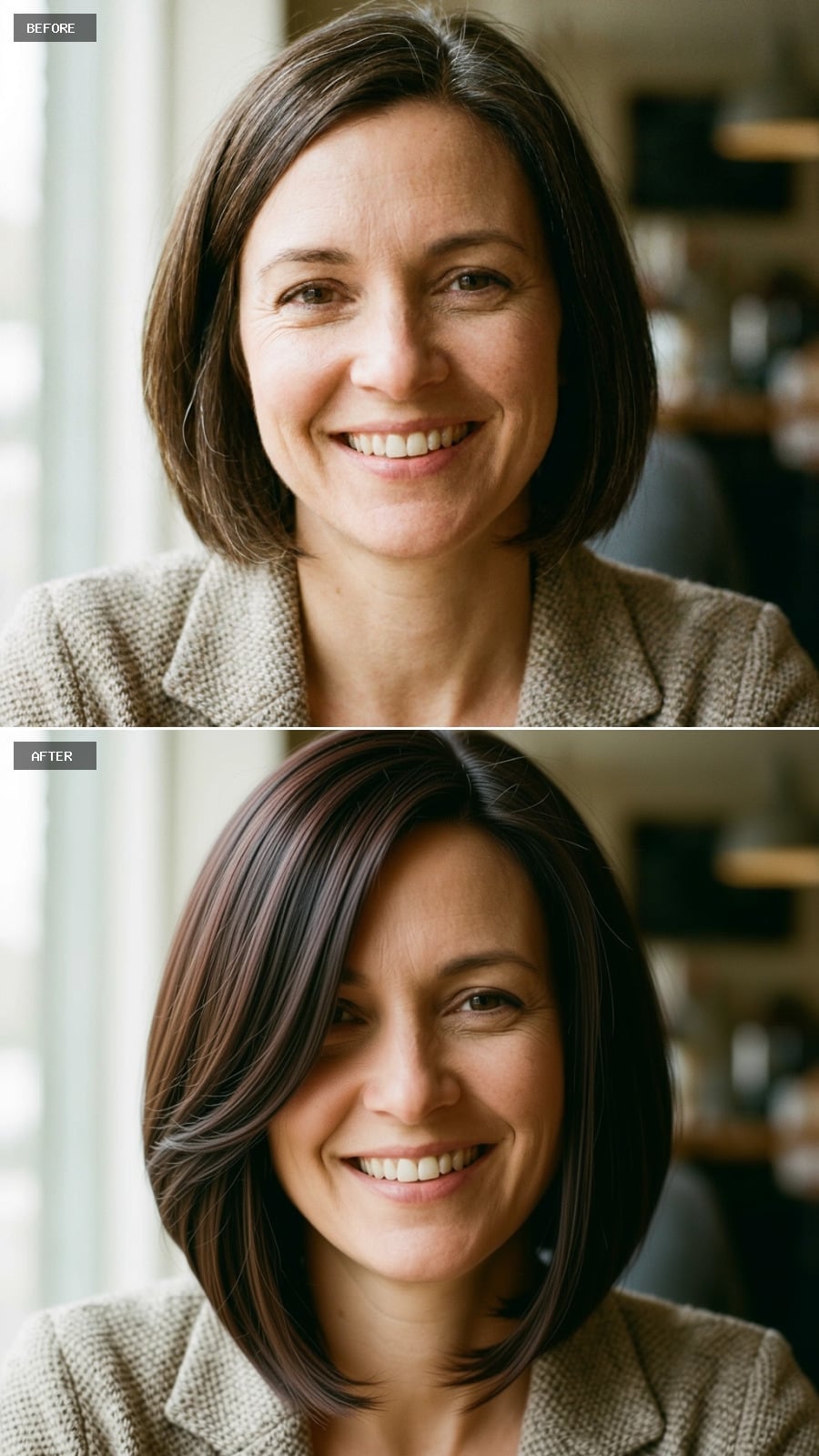
Dark chocolate hair with subtle burgundy undertones replaced a shorter, center-parted bob, and the difference isn’t just about length. Before, the cut sat just above the collarbone with a slight natural wave and an even, matte brunette tone. After, the hair falls past the shoulders in smooth, blowout-straight sections with visible shine that bounces light off her cheekbones. That gloss is doing real work. Sleeker texture reads as more deliberate than volume does, and the longer silhouette creates a soft frame that draws the eye down rather than stopping it at the jaw.
17. Brunette Bob to Blonde Waves: What Happens When Both the Cut and Color Let Go
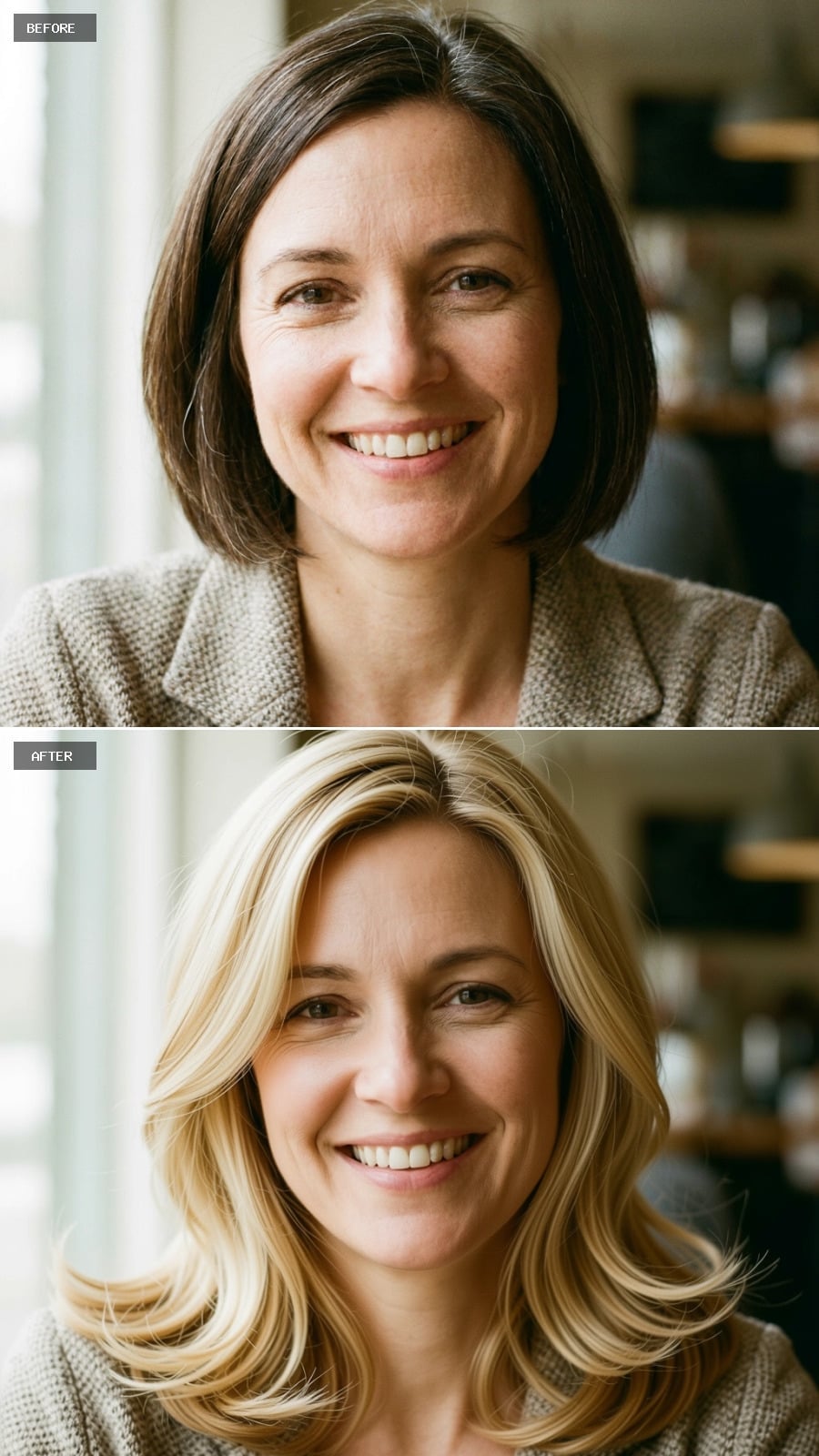
What reads most clearly in this pairing isn’t just the color shift from dark brunette to warm blonde. It’s that the length changed too, and those two decisions compounded each other. The “before” shows a precise chin-length bob with clean lines and flat texture, a cut that’s sharp but controlled. The “after” introduces shoulder-grazing layers with loose movement and honey-to-platinum highlights that vary enough to catch light at different depths.
That variation in tone is doing real work. Flat, single-process color reads as solid block; the layered blonde here has dimension because no two sections hit exactly the same shade. Add the softer perimeter where the bob’s blunt line used to be, and the face reads more open, less structured. Less structure, at 44, isn’t loss. It’s often the point.
Fit Tip: Highlights with at least three tonal values, from a deeper base through a mid-blonde to a brighter face-framing piece, will always outlast a single all-over blonde because they grow out with contrast already built in. Ask your colorist for a “lived-in blonde” technique rather than a traditional full highlight if you want that softer, multi-depth result. The difference in regrowth between the two approaches is significant enough to affect how often you need to be back in the chair.
16. Bangs Changed Everything. The Color Didn’t Move an Inch.
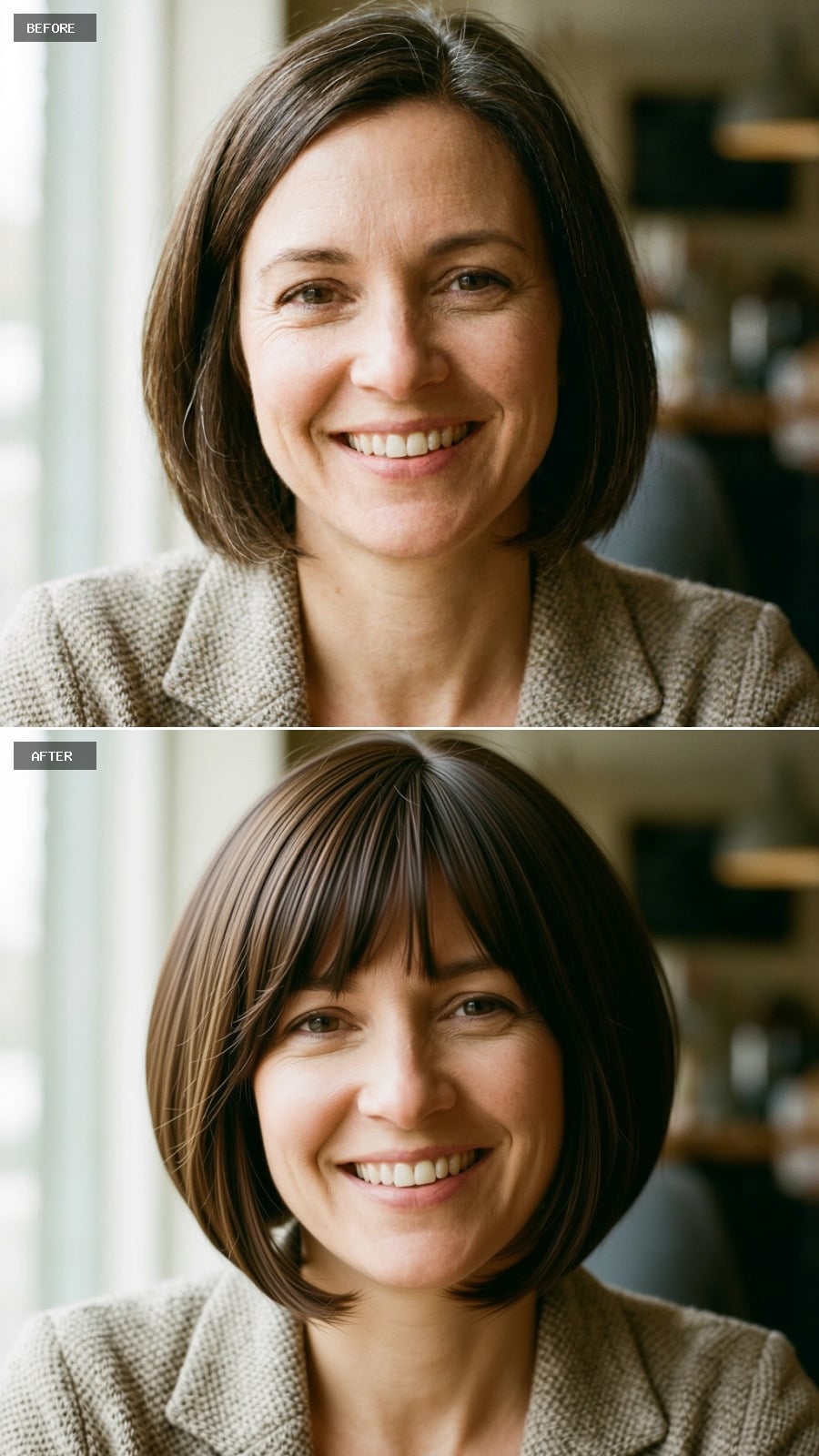
Adding a full fringe to an already-short bob sounds like a small edit. It isn’t. In the before, her part runs clean to the side and leaves her forehead fully exposed, which reads fine but doesn’t do her any particular favors. The after brings in a straight, slightly wispy fringe that cuts across just above the brows, and suddenly the proportions of her whole face shift. The bob itself tightened and rounded at the jaw, which pulls attention down and forward instead of letting it drift wide.
No color work happened here. The brown stayed exactly where it was. That’s the detail worth sitting with, because so much of the before-and-after conversation defaults to highlights or gloss as the fix. Sometimes the cut is doing all the heavy lifting, and the bangs are proof. Fringe at this length works because it narrows the visual field to the eyes and cheekbones, which are almost always a woman’s strongest features anyway.
15. Longer, Lighter, and Suddenly Her Face Has More Room to Breathe
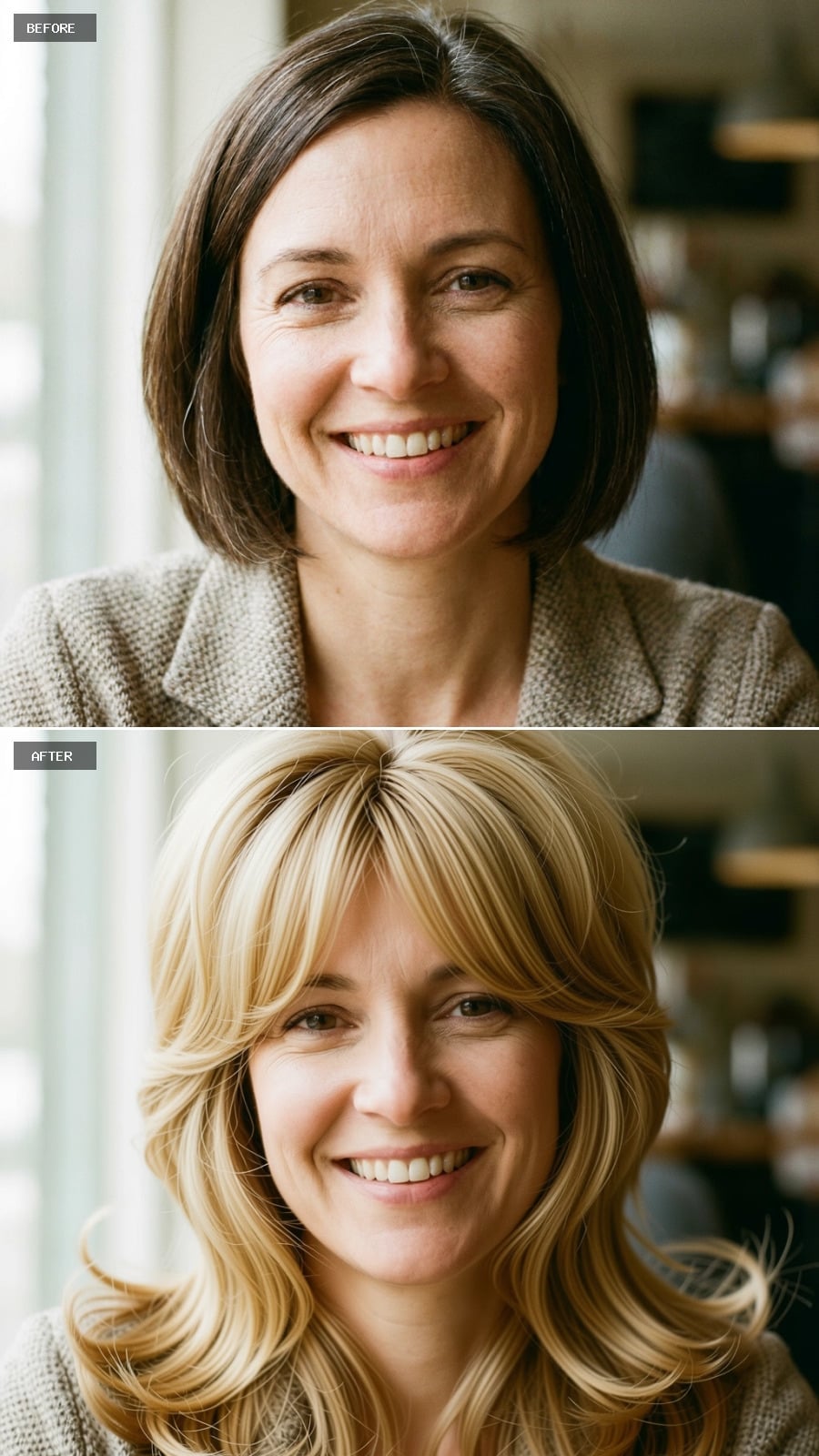
The bob in the before sits chin-length, dark brown, and blunt, framing a face that already has good structure but doesn’t quite let it show. The after adds both inches and warmth: layered blonde waves that fall past the collarbone, with face-framing pieces lighter than the rest and a curtain bang that lands just above the brows. That bang is doing more work than it looks like. It shortens the visual distance between the hairline and the eyes, which pulls attention straight to the center of her face. The knit fabric from before is the same, but it reads softer now. Volume at that length, on that face shape, wasn’t luck. It was the right call.
14. Longer, Darker, and Suddenly Her Bob Had More to Say
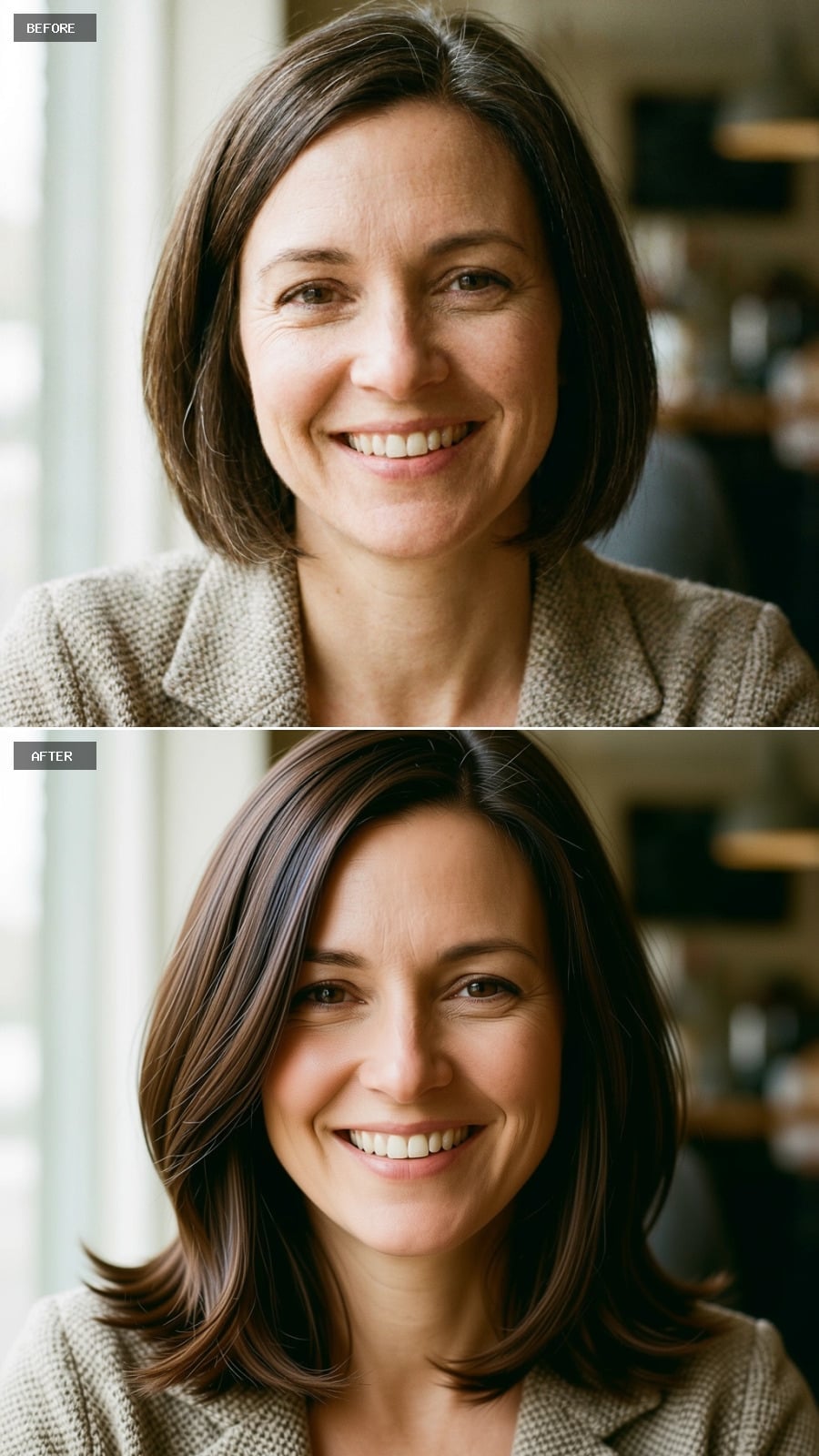
Brunette with a blunt chin-length bob in the before, center-parted and sitting flat against her jaw. It reads tidy. Clean. A little contained. Down below, she’s got the same knit blazer in a warm oat, the same setting, the same smile. But the after hair falls past her collarbone with a slight flick at the ends, the part shifted off-center, and the brown has been deepened with what looks like a chocolate glaze through the lengths. More hair means more movement, and movement is what actually reads as energy in a portrait.
13. Swept Layers on a Bob Just Quietly Rewrote Her Whole Proportions
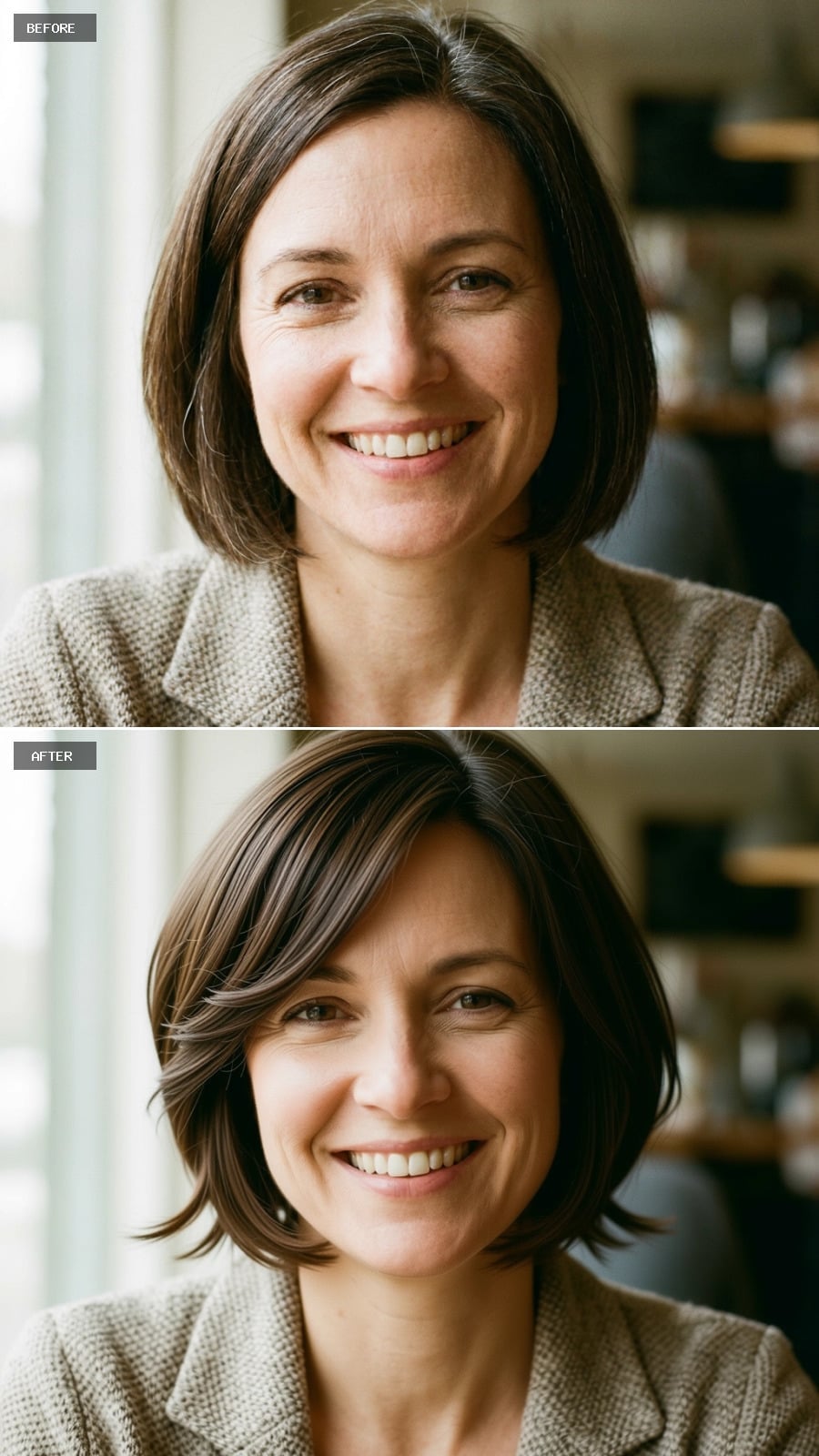
Same brown, same bob length, same beige knit blazer with that open notch collar. But the “after” has something the “before” doesn’t: movement. The layers have been cut to fall forward and sweep across the face rather than hanging blunt and even, and that single change shifts where the eye lands. It reads less like a haircut and more like a reframe. The face doesn’t change. The framing does.
12. Silver, Swept, and Shorter: How One Color Change Quietly Rearranged Her Whole Face
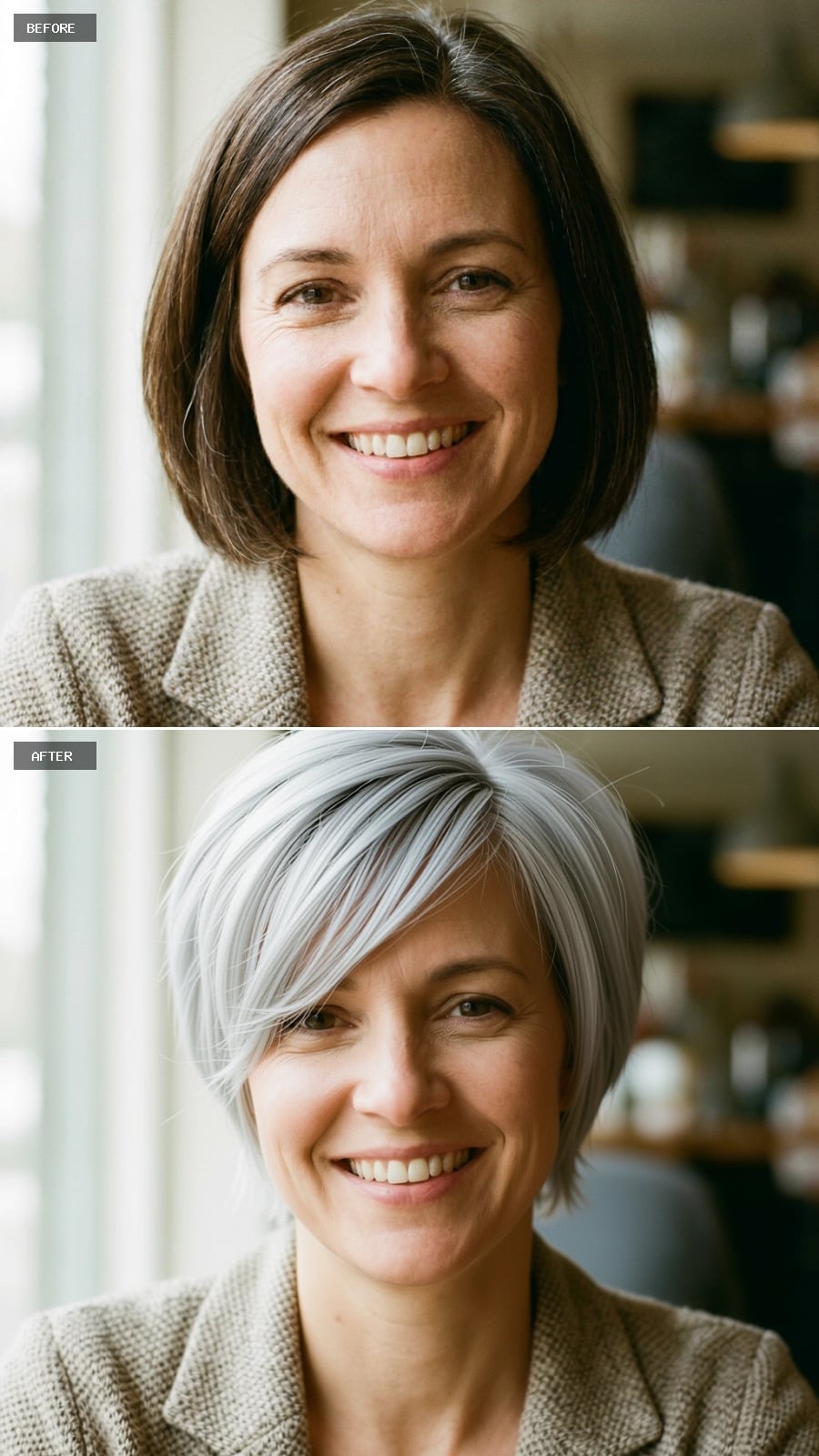
Going from a dark brunette bob to a silver-gray pixie-adjacent cut with swept fringe did something unexpected here. The gray isn’t aging her. It’s actually doing the opposite, pulling light toward her eyes and making her cheekbones read more defined than they did under the heavier brown.
The knit jacket reappears in both frames, which makes the comparison honest. Same fabric, same face. But the shorter, feathered cut with its cool silver tone shifts the visual weight off her jaw entirely. Gray hair gets a bad reputation, but when it’s this silvery and this deliberately cut, it reads modern rather than resigned.
11. Soft Waves and a Few Highlights Quietly Shifted Every Proportion on Her Face
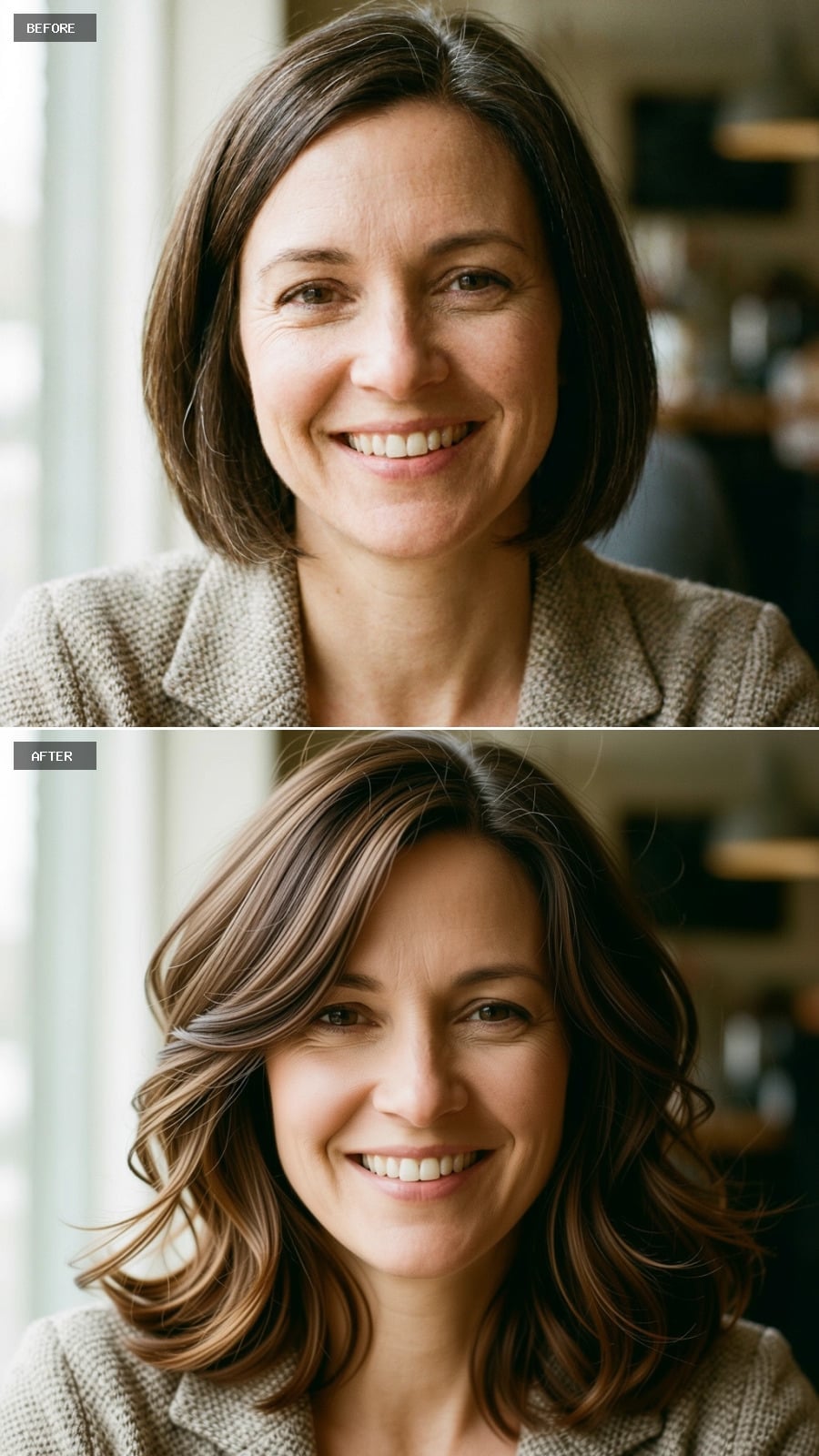
She came in with a neat, chin-length bob, dark brown and smooth, parted slightly off-center with the kind of cut that’s low-maintenance but also a little flat against the face. Good bone structure was there. It just wasn’t getting much help from the shape around it. The after shows longer layers that fall past her collarbone, with a loose wave and highlights that move from her natural brunette base into a warmer, lighter brown at the ends and around her face.
What’s doing the real work isn’t volume alone. It’s that the highlights introduce two or three distinct tonal values, and the wave gives those tones something to catch and shift with the light. Her forehead reads longer, her jaw reads softer. Nothing was restructured. Just reframed.
- Layers that taper below the chin soften a structured jawline without shortening the neck
- Face-framing pieces in a warmer tone than the base draw light toward the eyes and cheekbones
- A loose wave, not a tight curl, is what lets highlights move rather than clump
10. Highlights Did the Heavy Lifting Here, and the Cut Just Followed
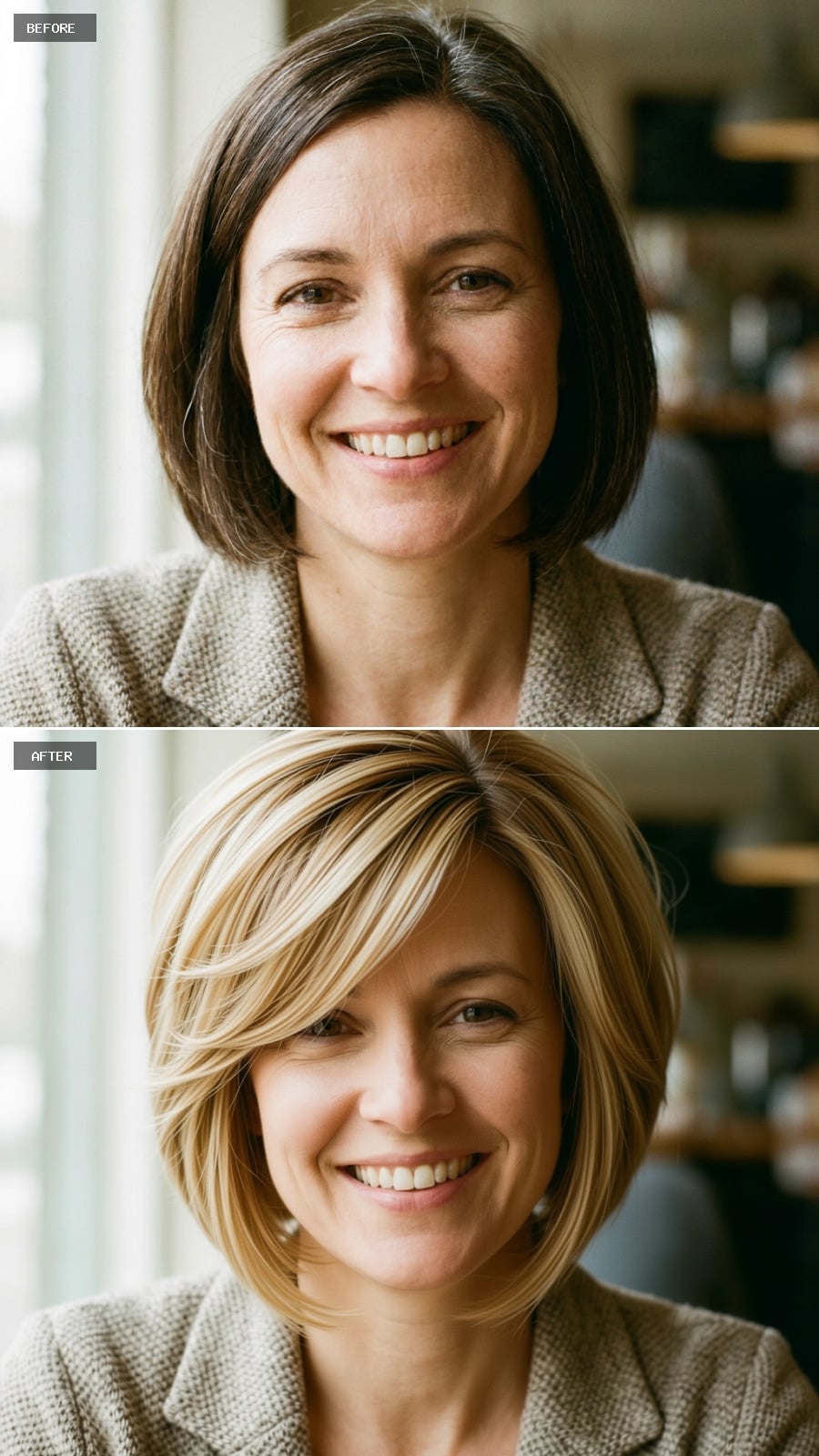
Her before shows a clean brunette bob, chin-length, with center-parted hair that sits flat against both sides of her face. It’s a good cut. But the single tone and the symmetry together create a kind of visual flatness that reads more severe than it probably feels in person.
After, the same bob length stays, but the colorist built in at least three distinct tonal levels: a deeper warm base at the root, a mid-honey through the body, and bright face-framing pieces that pull toward platinum near the front. The cut also gained movement, with ends that angle slightly rather than blunt-cut straight across. Those two changes together are what shifted her proportions. Her cheekbones read wider now, her forehead less prominent. Highlights placed specifically around the face will do that, and it’s one of the more underrated reasons women in their 40s find that going lighter tends to open up the face rather than just change its color.
9. Highlights and a Side Sweep Quietly Gave Her Bob a Completely Different Personality
❤️ Would you like to save this?
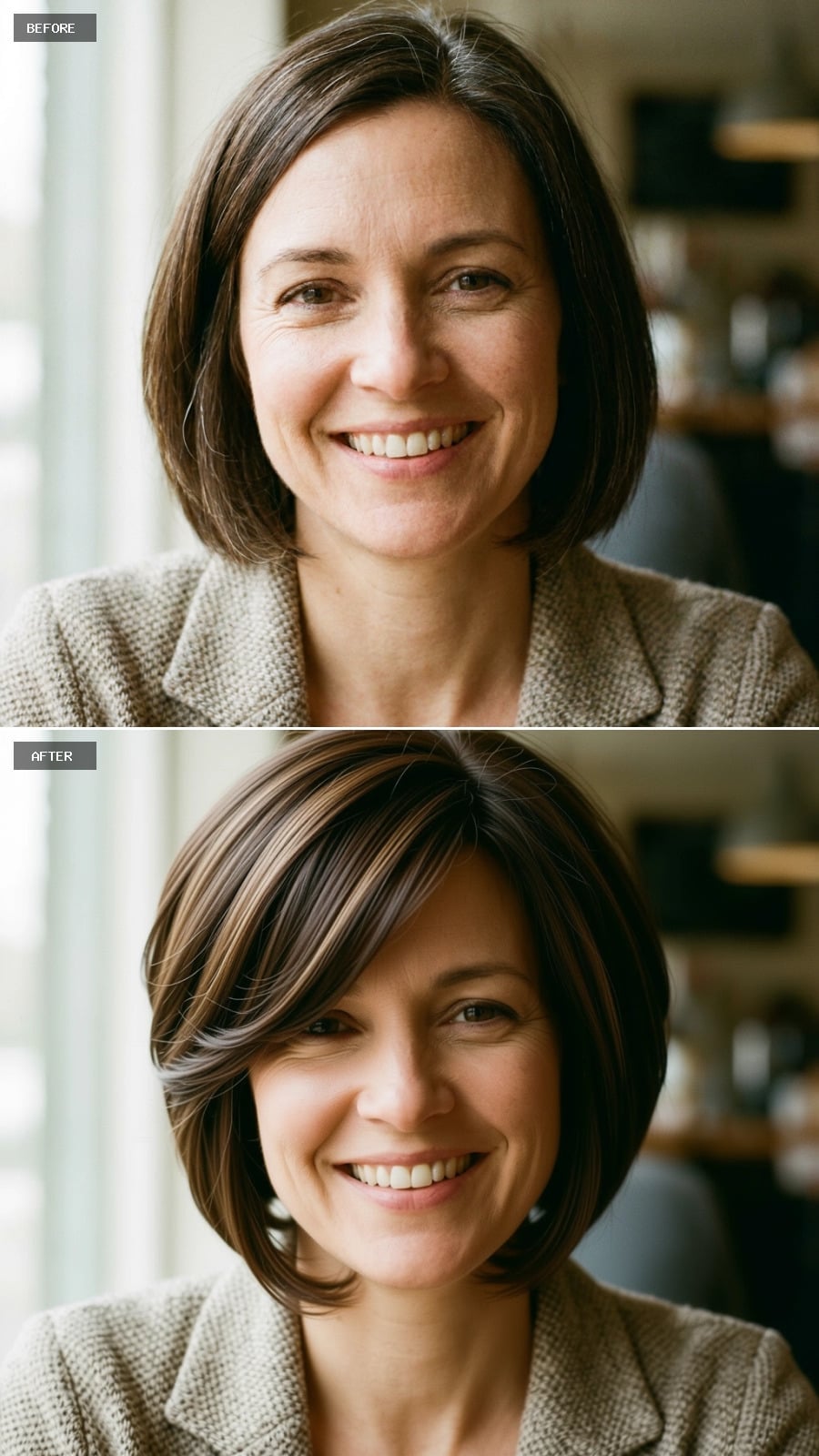
Flat, uniform brunette became layered with caramel and chestnut pieces that catch light differently at every angle. Those highlights aren’t dramatic. They’re just well-placed, running from a darker root through mid-toned strands to a brighter section near the face, and that range is exactly what gives depth to a cut that didn’t change much in actual length.
The side sweep did quiet structural work here. Parting to one side and letting the front section fall across the forehead shifted weight away from the center of her face, which softened everything without shortening anything. Her jaw looks less defined. Her cheekbones look more so.
Worth saying plainly: this is a relatively small change on paper. A highlight and a reparted bob. But the before and after sit far enough apart that you’d clock them as two different people before you’d clock them as two different appointments.
8. Blonde Waves Took Over, and Her Bob Never Stood a Chance
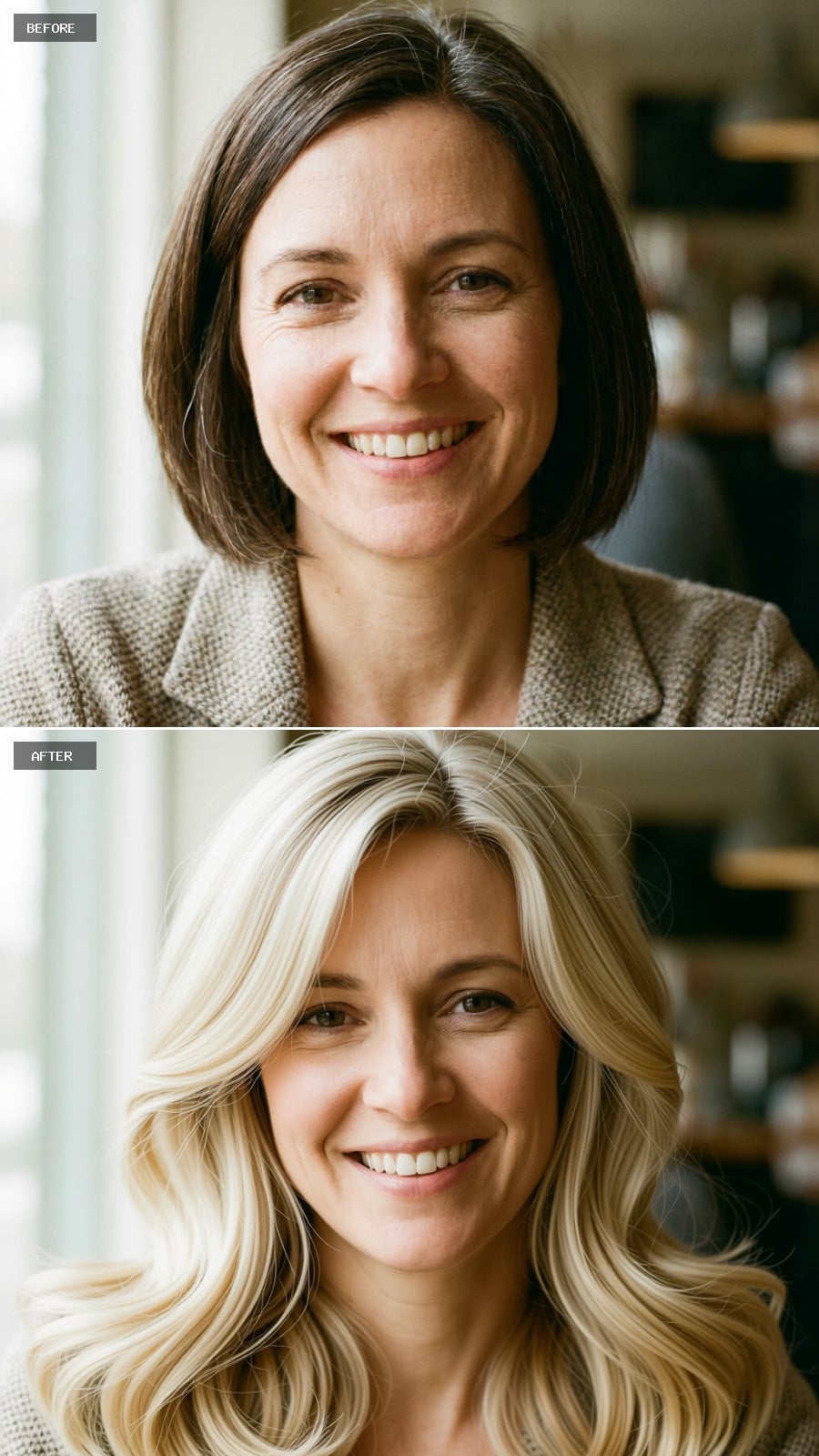
Chin-length brunette bobs are practical. They’re also, if we’re being honest, easy to stop seeing. What changed here wasn’t just the color, though going from a cool dark brown to a layered platinum-to-golden blonde is a significant shift on its own. It’s the length. Loose waves that fall past the collarbone create movement that a blunt bob simply can’t produce, and that movement redistributes where the eye lands on her face. The waves aren’t styled into tight curls; they’re soft, almost undone, which keeps the whole thing from reading as overdone. Lighter hair at this length softens the jawline without requiring any structural change to the cut itself.
7. Layers and a Side Sweep Quietly Did More Work Than Any Color Change Could
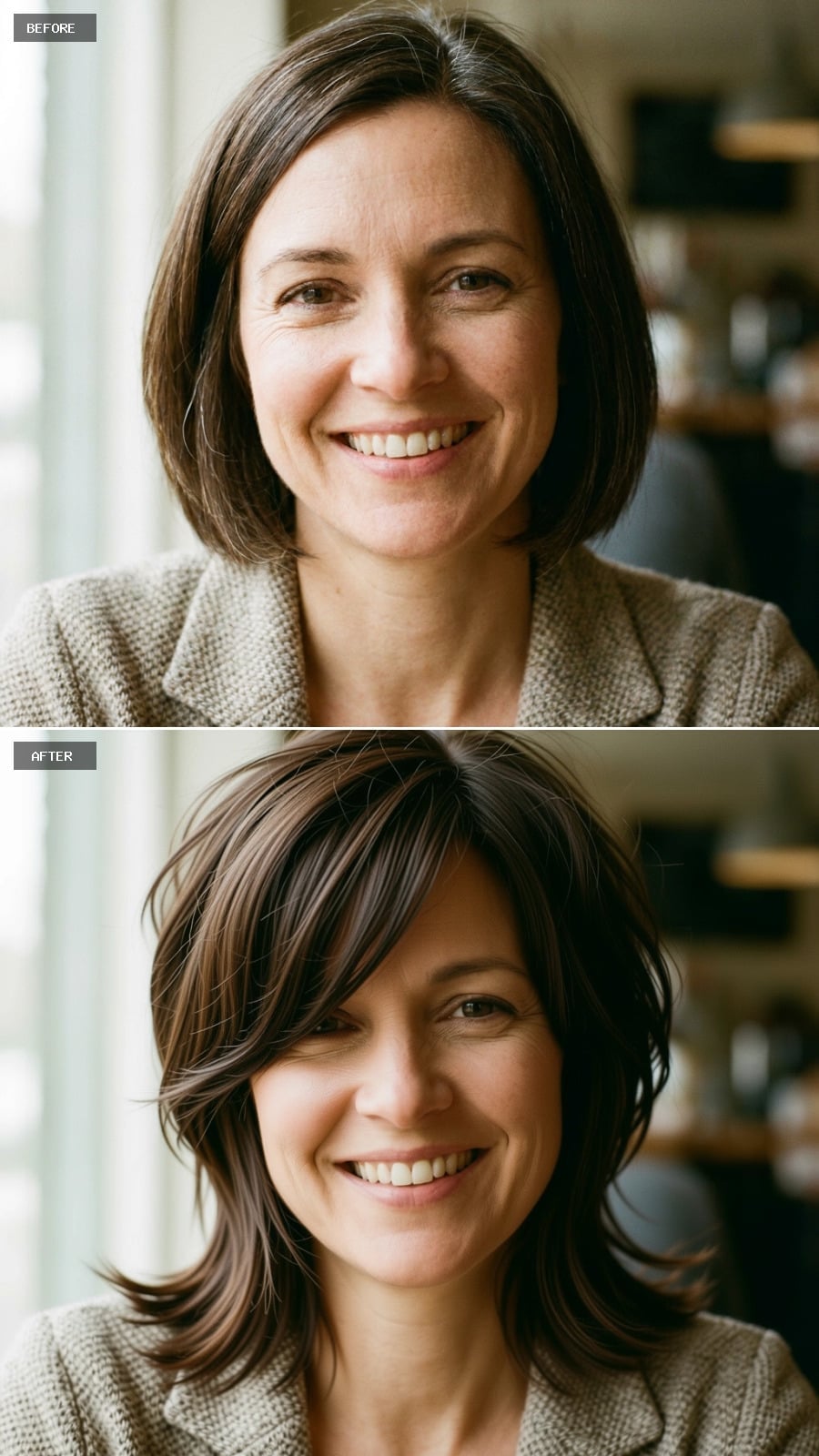
Dark chocolate brown, no highlights, no tonal contrast at all. What shifted here was purely structural: a blunt bob with center-parted, face-framing layers gave way to a voluminous shag with a deep side part and cascading layers that graze the collarbone. The fringe sweeps across the forehead rather than sitting flat, and that one change alone redistributes where the eye lands.
The knit fabric of her top is identical in both shots, which makes the hair do all the talking. Longer layers with visible movement and separation add width through the mid-section of the face while pulling attention downward, away from the forehead. Volume at the crown does the rest.
6. Blonde Waves With Bangs Quietly Made Her Bob Irrelevant
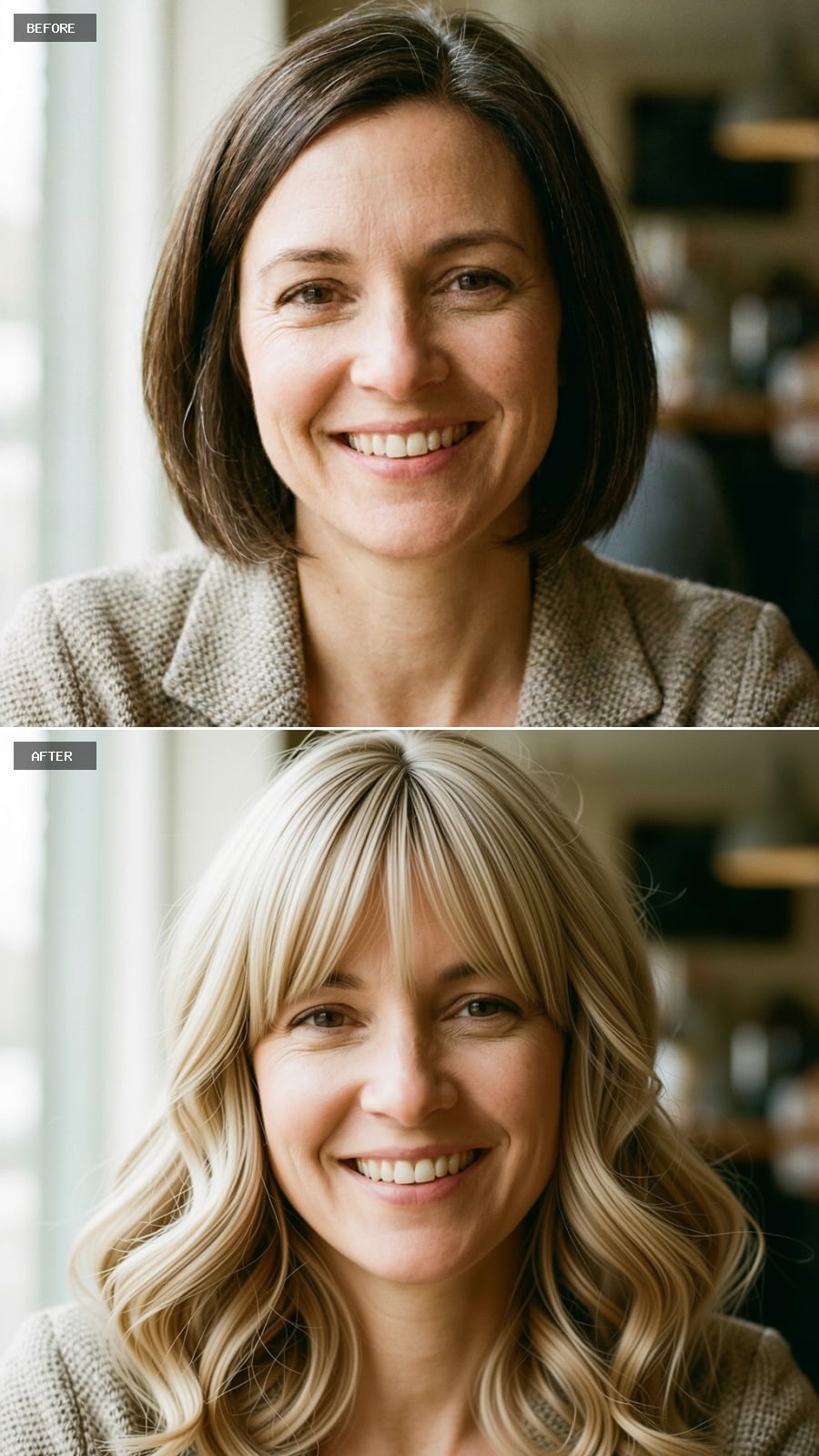
Wavy blonde layers with curtain bangs replaced a chin-skimming brunette bob, and the shift reads as more than a color change. It’s about volume placement. Where the bob sat tight against her jaw, the waves fall past the collarbone and let her face sit in the middle of the frame instead of at the bottom edge. Bangs landing just above the brow pull attention up. Warmer tones do the rest.
5. What Swept Bangs and Subtle Highlights Did to Her Whole Silhouette
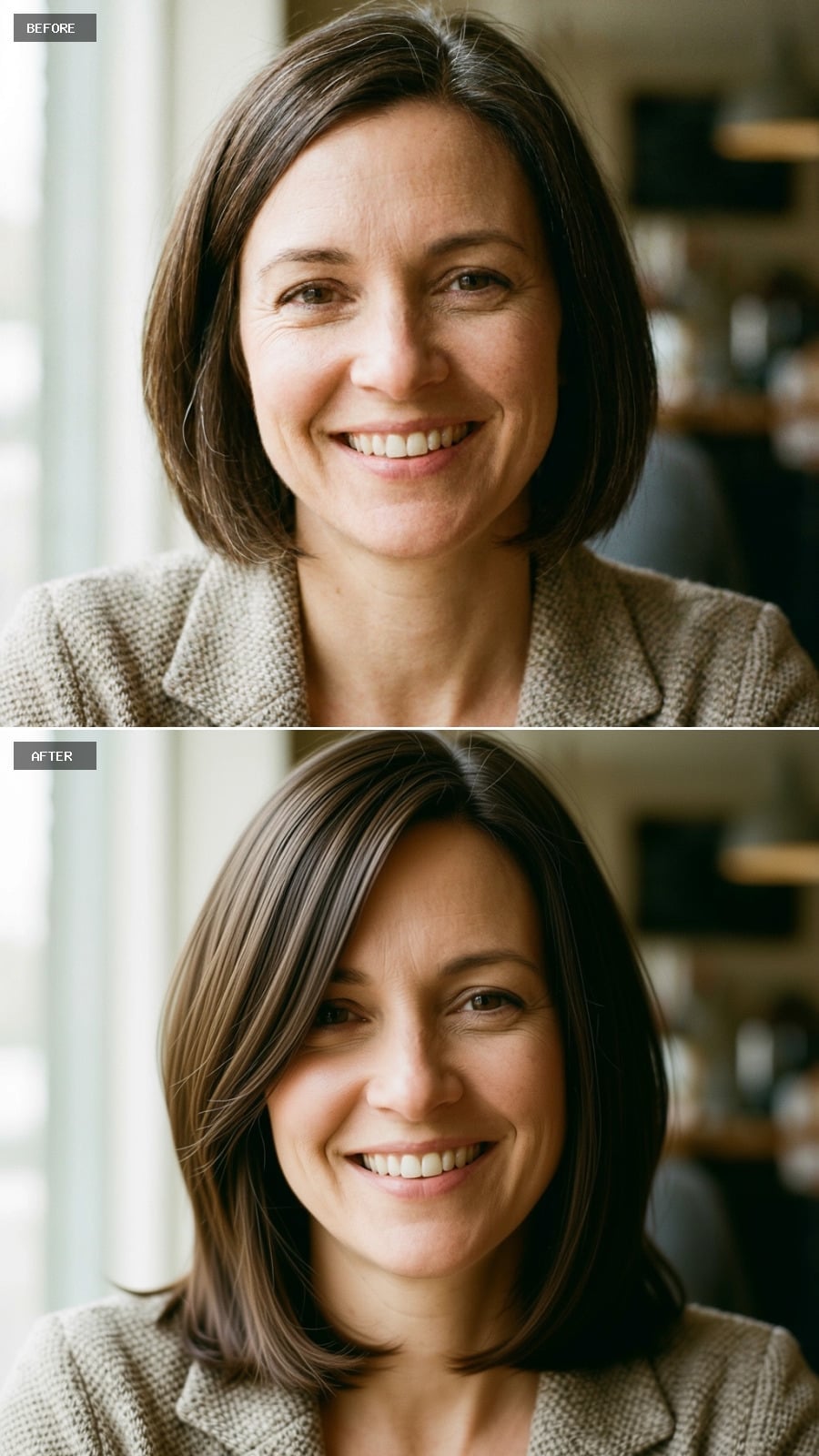
Swept side bangs changed everything here. In the before, her blunt bob sits evenly around her face, tidy but static. The after introduces a soft diagonal sweep across her forehead, and suddenly there’s movement where there wasn’t any. Warm caramel pieces around the face add dimension without reading as highlights at all.
Real Talk: If your bob has started feeling like a helmet, swept bangs are often a faster fix than a full cut change. The diagonal line they create across the forehead breaks up symmetry in a way your face reads as younger, not just different. Ask your stylist to keep them long enough to tuck behind the ear so you’re not committed to styling them every single day.
4. Blonde Took Over Her Bob and Somehow Made It Look Completely Different
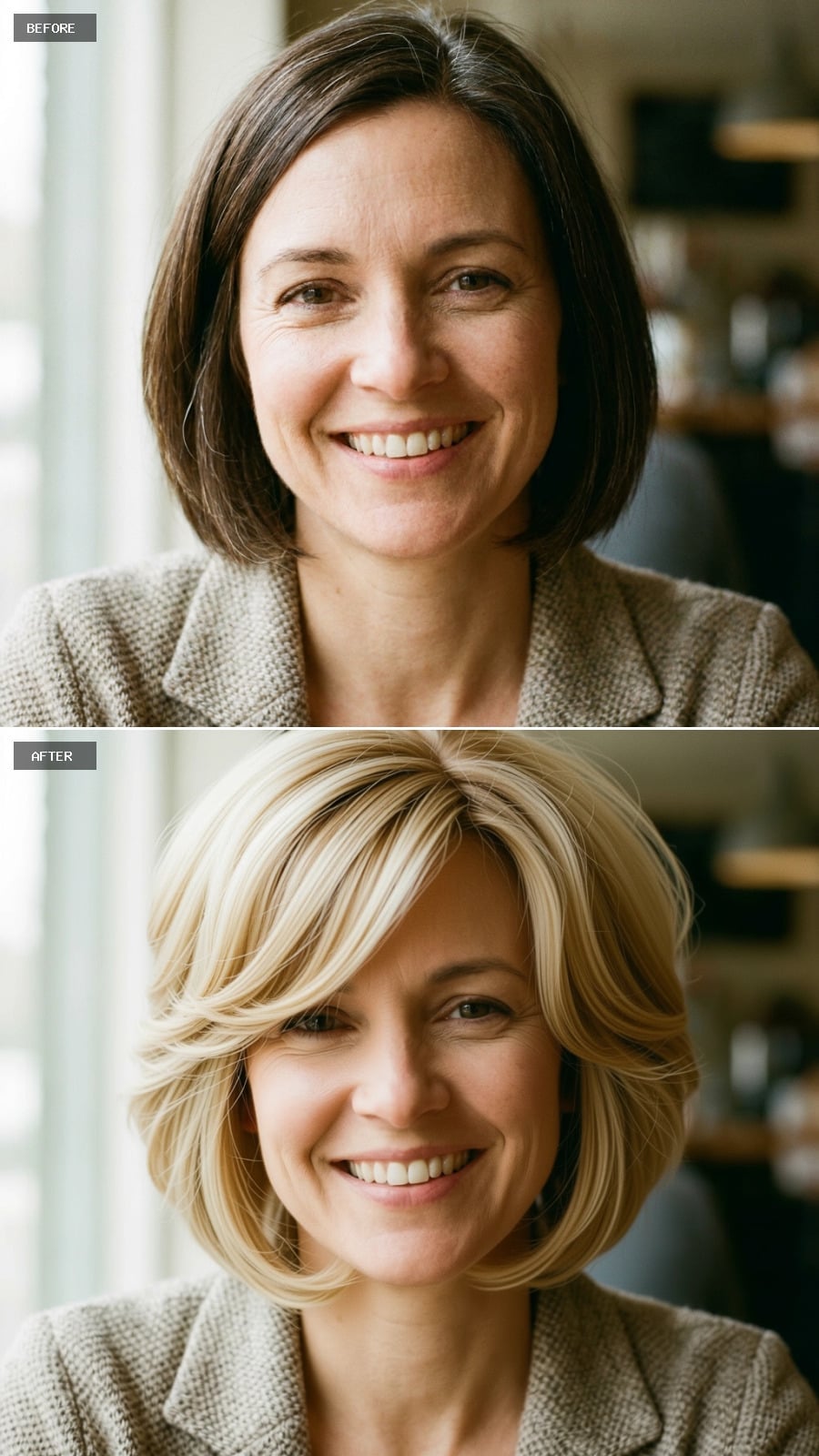
Brown, blunt, and sitting just at chin level, the before version of this cut is tidy in the way that reads as finished but not particularly alive. The after tells a completely different story. Platinum-to-honey highlights were added in at least three depths, and the cut was reshaped to allow the layers to fall open rather than stack closed. The result is volume that doesn’t sit on top of her head but wraps around her face instead.
What’s easy to miss is how much the texture shift does here. The before cut relies on the blunt edge to give it shape. The after doesn’t need that edge at all because the highlights and movement are doing that structural work. Her knit blazer, a loosely woven taupe, actually reads warmer in the after frame because the honey tones in the hair pull color down into the whole image.
3. Bangs and Length Together Pulled Off What the Bob Couldn’t Do Alone
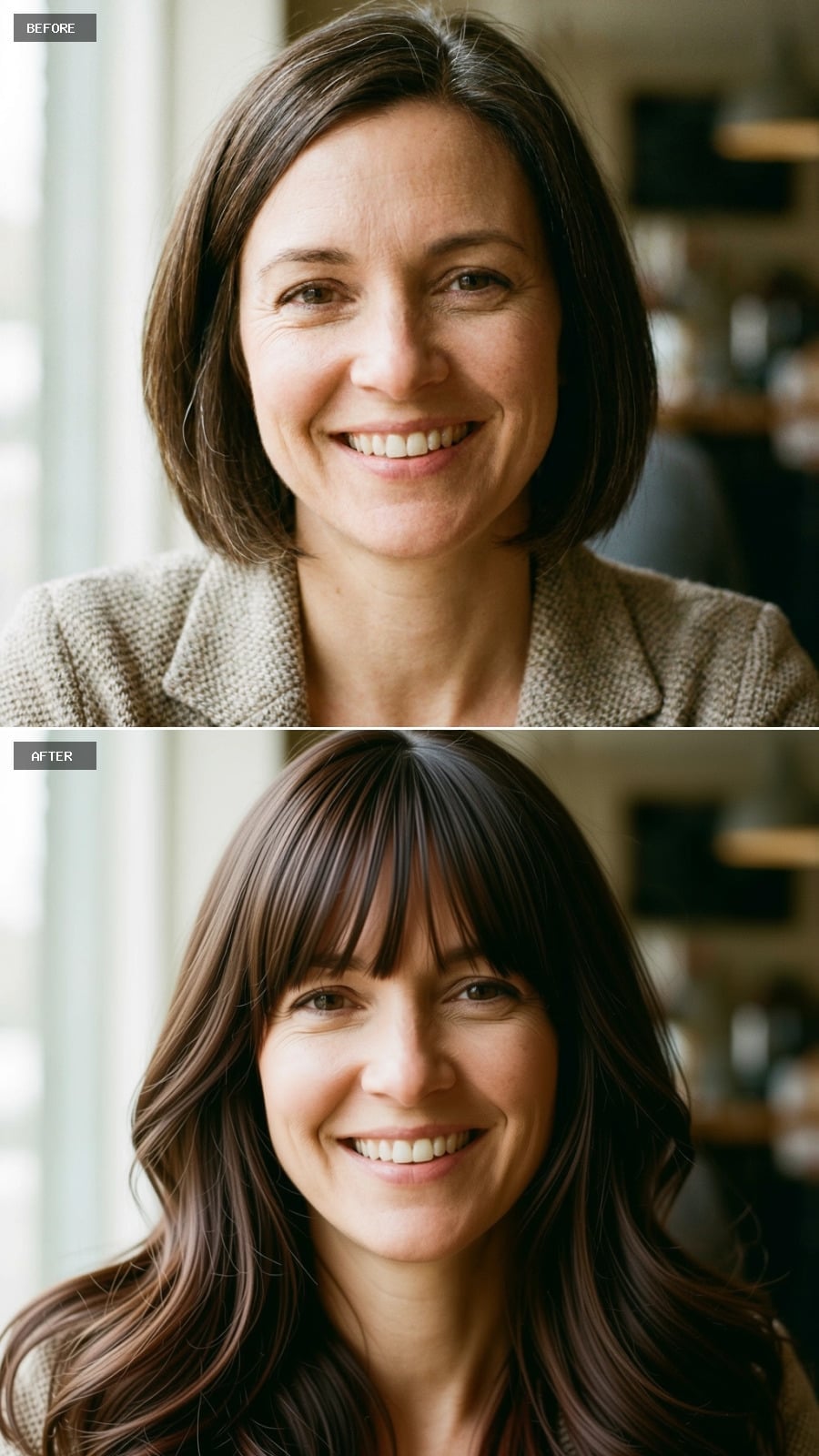
Wispy, curtain-style bangs cut just above the brow line are doing most of the work here, softening her forehead in a way the blunt bob never addressed. The length change matters too. Adding waves past the shoulder shifted the weight of the whole silhouette downward, which tends to balance the jaw rather than highlight it. It’s a quieter fix than most women expect.
2. Blonde Highlights and a Blunt Bob Quietly Rerouted Her Entire Face Shape
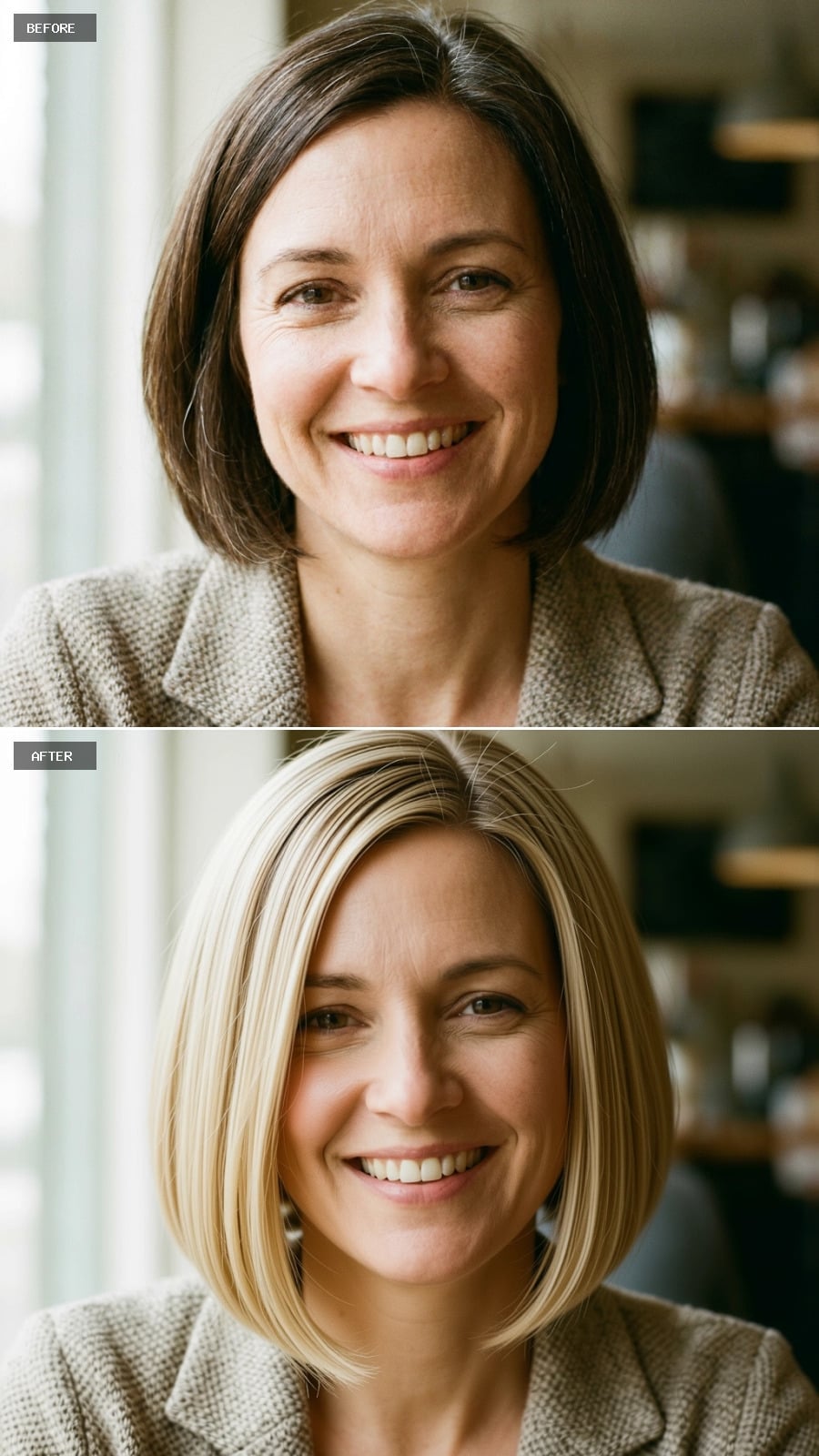
Brunette to blonde is one of the more committed moves a woman in her 40s can make, and the result here makes the case for it. The blunt cut got straighter and sleeker in the after, dropping the slight curl that was softening her jawline into something undefined. Lighter hair running from root to tip pulled the eye upward, and suddenly cheekbones that were always there just read cleaner. Same knit blazer. Completely different frame.
1. Longer, Darker, and Layered Fixed What the Bob Had Been Hiding
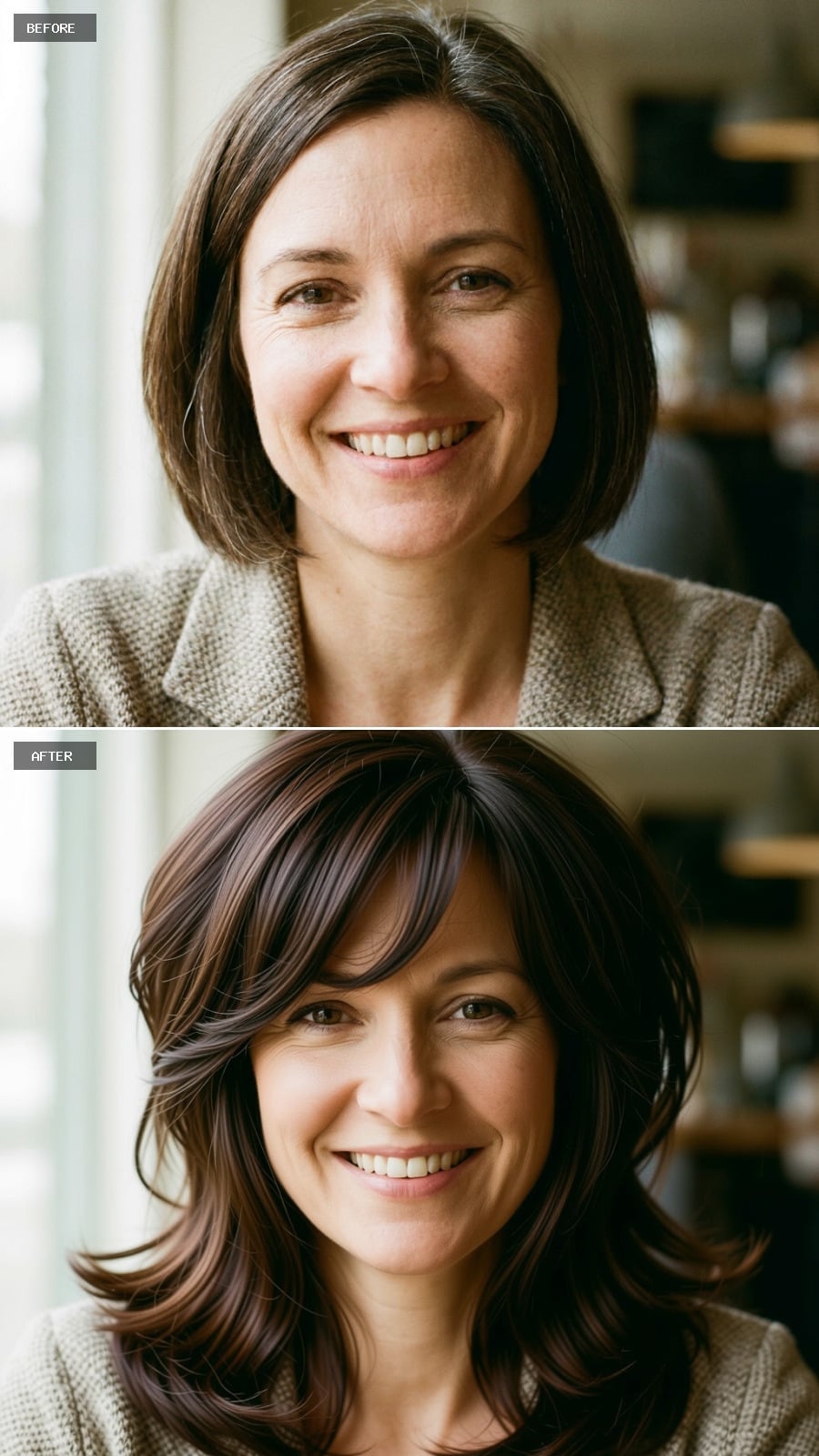
Going from a blunt chin-length bob to shoulder-grazing layers with side-swept bangs reads less like a haircut and more like a reframe. The depth shift matters here: the before shows a flat, single-tone brunette that reads a little one-note against her warm skin. The after introduces a darker base with subtle reddish-brown dimension and movement that starts at the crown and falls forward, which does something interesting to her cheekbones. Those bangs earn their place by drawing the eye diagonally rather than straight across. It’s a quieter change than it looks.