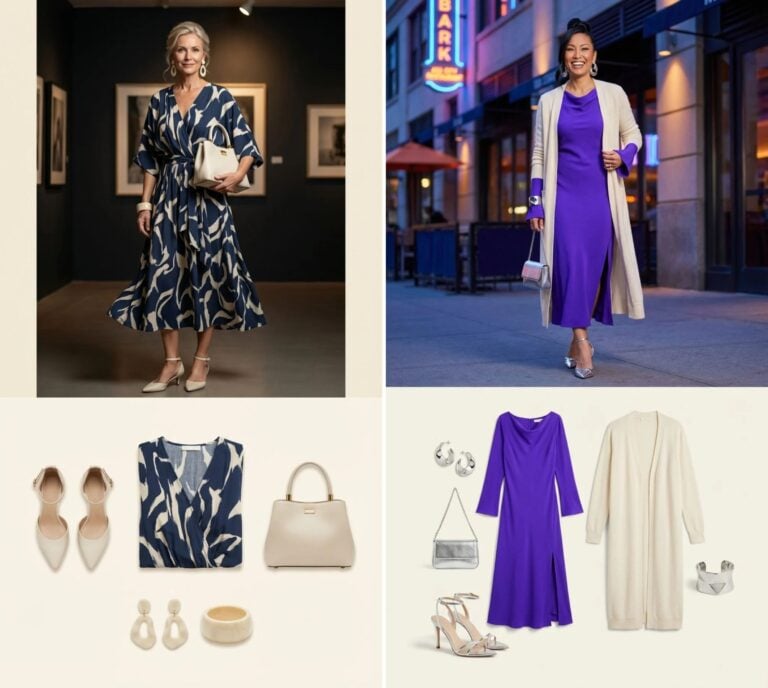

You walked in prepared. You knew your material, you dressed with intention, and you made eye contact within the first three seconds. But the woman across the table had already made a quiet, almost unconscious assessment of you, and it started somewhere you probably weren’t thinking about: the small, elective, entirely optional choice you made near your face this morning.
Earrings are one of the few things you wear that carry zero functional justification. You don’t need them. So when you choose them, or don’t, or grab whatever’s on the nightstand, that choice broadcasts something specific. The question is whether you know what it’s saying. Most women don’t. The ones who do have a significant advantage in every room they walk into.
FYI, thanks to AI imagery software, we’re able to create very specific fashion and hairstyle examples to illustrate the points being made. In some cases, imagery is exaggerated to hammer home the point. Also, assume links that take you off the site are affiliate links such as links to Amazon. this means we may earn a commission if you buy something.
The Tiny Detail That Tells a Room Full of Women You’ve Thought About Everything

There’s a particular kind of attention women pay to other women that has no male equivalent. It’s not malicious, and it’s rarely conscious. It’s a rapid, thorough scan, shoes, nails, bag, and then, almost reflexively, ears. The earrings register before a word is spoken, before a handshake, before a smile has fully formed.
The reason this scan exists at all comes down to what earrings represent in the grammar of dress. According to (Source), clothing and accessories function as signals that other people use to infer personality, competence, and intent, with women being particularly attuned to these signals in peer evaluation contexts. Earrings sit at the intersection of face and dress. They are literally adjacent to the part of you that communicates. And they are the one accessory that requires no functional justification. You don’t need them. So when you wear them, the choice is a declaration.
The signal isn’t about taste or price point. It’s about fit: did these earrings land correctly for this room, this context, this version of who you’re presenting today? A woman who reads that question and answers it thoughtfully reads as a woman who reads rooms well, full stop. That inference happens fast, and it sticks.
Why She Formed Her Opinion of You Before You Finished Your First Sentence

Princeton psychologists Janine Willis and Alexander Todorov demonstrated something that should have rearranged how we think about every professional interaction we’ve ever had: (Source), and that longer exposure doesn’t significantly change those initial impressions. A tenth of a second. Less time than it takes to blink.
What fills that tenth of a second? Everything visible near the face. The face itself, yes, but also what surrounds it. The frame. Earrings live in that frame. They’re not incidental background detail; they’re part of the foreground processing that happens before your prefrontal cortex has even engaged. The amygdala, which handles emotional salience and threat assessment, is already running calculations on what your appearance signals before you’ve said your own name.
The primacy effect means that initial read doesn’t just fade, it acts as an anchor. Subsequent information gets filtered through it. If your earring choice signaled dissonance, carelessness, or misread context in that first hundred milliseconds, the rest of the conversation is spent subtly correcting an impression that already hardened. You can do it. It just costs you something.
The Silent Signal That Separates ‘She Means Business’ From ‘She Doesn’t Know the Room’

🔥 Discover how people are putting together the perfect wardrobes and outfits with this new method =>
Context-appropriateness is one of the most sophisticated social signals a person can send, and one of the easiest to get wrong without ever knowing it. (Source), and crucially, that those inferences are steered heavily by contextual cues. The same earring that reads as polished at a creative agency pitch can read as tone-deaf at a board meeting. The same pair that feels understated at a gala reads as an afterthought at a lunch with a new client.
This is what “knowing the room” actually means in practice. It’s not about wearing expensive things or following rules. It’s about demonstrating, before you speak, that you understood the assignment, that you read the context accurately, dressed for it deliberately, and arrived as someone who pays attention to what the situation requires.
Women read this signal in other women with particular acuity, because they’ve spent their lives navigating it themselves. The woman across the table from you isn’t consciously grading your earring choice. But somewhere in her evaluation of you, an inference formed: she gets it, or she doesn’t. That inference runs much deeper than jewelry. It touches on judgment, awareness, and what you’re likely to notice in the work that follows.
What Neurologists Know About Why Faces With Adornment Get Read Differently

In 2024, researchers at the University of Bordeaux published an fMRI study with findings that should be required reading for anyone who’s ever dismissed jewelry as superficial. (Source) The results were striking.
What Lit Up in the Brain
The fusiform gyrus, the brain region specialized for face processing, activated during the task. So did the orbitofrontal cortex, which handles social evaluation and value judgments. The salience network fired, flagging the adornment as information that matters. And the hippocampus engaged, drawing on memory and associative experience to interpret what the ornament means in a social context.
That’s not a passive glance. That’s a full cognitive event. (Source), and the brain hasn’t stopped taking it seriously. The inferior frontal gyrus, associated with language processing, also activated, suggesting the brain interprets facial ornaments almost like words: as symbolic carriers of meaning, not decoration.
Every time someone looks at your face, her brain is running this program. Not because she’s judgmental. Because she’s human.
The One Earring Choice That Reads as Self-Awareness, and the One That Reads as Its Absence
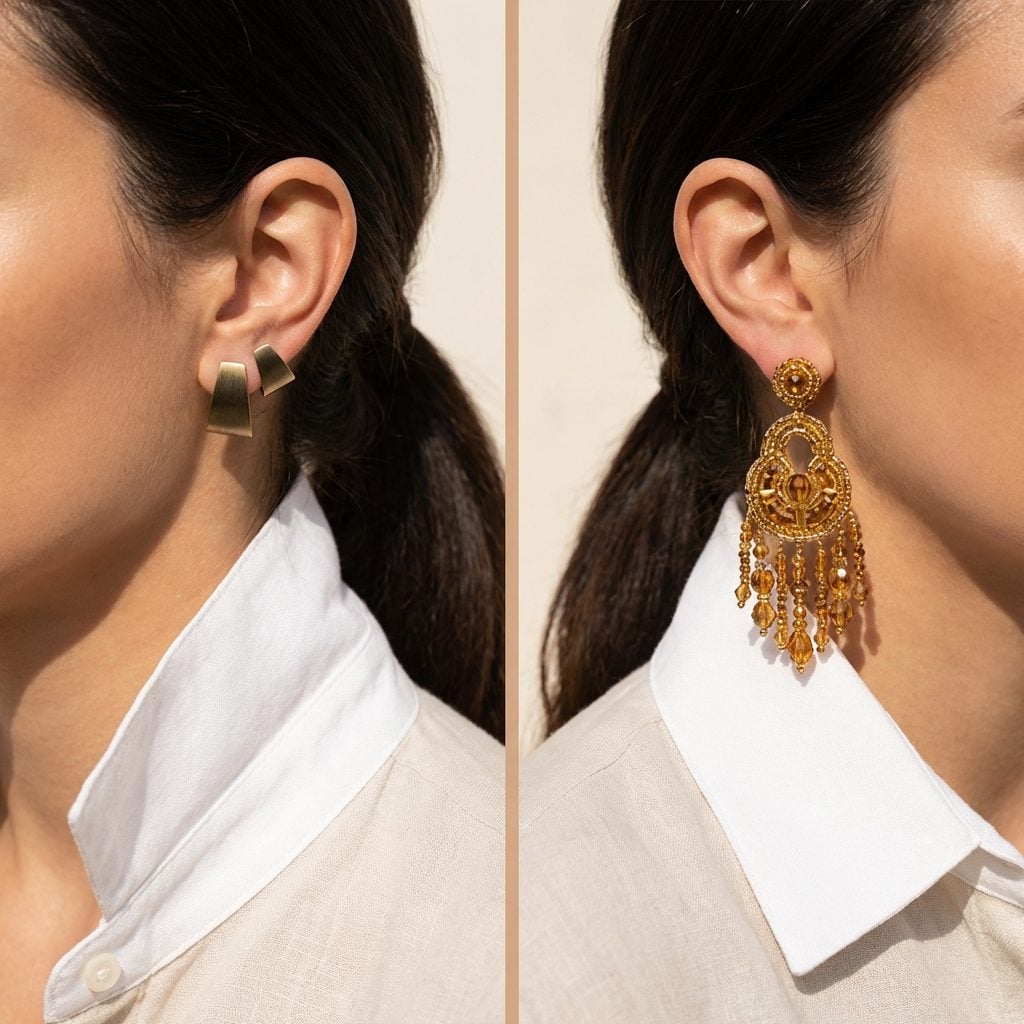
It’s not about which style you chose. It’s about whether the choice was made at all.
A woman who wears earrings that feel deliberately selected for the day, that align with her outfit, the context, and the version of herself she’s showing up as, registers as someone with a coherent inner life and a reliable sense of what she’s doing. That internal coherence is visible. You can’t quite name it, but you feel it. The signs your style is working aren’t always about trend-awareness or taste. Often it’s simply: did this person make a considered choice, or did they grab whatever was nearest the mirror?
The earring choice that reads as its absence isn’t necessarily wrong. It’s unconsidered. Overly casual earrings in a formal setting. Formal earrings that feel performative at a casual creative meeting. Earrings that look like they belong to a different outfit entirely. The signal in each case is the same: this person didn’t fully think through where they were going today. And that inference doesn’t stay contained to the jewelry.
Why Women Are Hardwired to Notice What Other Women Choose to Wear Near Their Faces

Psychologist Nalini Ambady spent her career studying what she called “thin-slicing”, the ability to extract accurate, complex social information from very brief exposures. (Source)
Women, specifically, bring an additional layer to this. A 2021 study in Frontiers in Psychology on women’s clothing practices noted that Western women are socialized to be particularly engaged with appearance as a dimension of identity and social signaling, which means the apparatus for reading those signals in others is more practiced, more finely tuned. A woman who has spent decades managing her own appearance reads another woman’s choices with the fluency of someone who speaks the language natively.
This is why the woman across the table notices your earrings more acutely than the man beside her. She has lived inside this system. She knows what a deliberate choice looks like because she makes deliberate choices herself. Her read isn’t unfair, it’s experienced.
The Purely Elective Choice That Reveals More About Your Attention to Detail Than Your Resume Does

Here is the thing that makes earrings functionally different from almost every other element of dress: they are completely optional. A coat keeps you warm. Shoes protect your feet. Even a blazer carries professional convention behind it. But earrings? There is no utilitarian argument. No cultural requirement (in most rooms). No functional pressure. You wear them because you chose to.
That election is the signal. (Source), but earrings occupy a specific position within that framework: they’re one of the few choices that can only be explained by intention. Nobody wears earrings by accident.
So when a woman looks at your earrings, she is, without knowing it consciously, asking: how much thought did this person give to showing up today? Did she make considered choices, or did she treat this context as unimportant? The answer shapes everything that follows, including how your ideas land, how your authority reads, and whether your competence gets the benefit of the doubt. Your resume describes what you’ve done. Your earrings describe how seriously you take where you are right now.
What Earrings Communicate That Eye Contact, Posture, and Tone of Voice Cannot

Eye contact says: I am present. Posture says: I am confident. Tone of voice says: I am composed. All three are performed in real time, and all three can be rehearsed, monitored, and adjusted mid-conversation. They’re dynamic signals, mutable by the second.
Earrings are something else entirely. They were chosen before you walked in the room. Before you knew exactly how the dynamic would feel. Before you had any feedback to respond to. They are a pre-commitment, a declaration made in the quiet of the morning that says: this is who I decided to be today, in this room, for this context. (Source), because clothing acts before the conscious mind engages, both in the wearer and in the observer.
That pre-commitment quality is what makes earrings, and all fixed accessory choices, a uniquely honest signal. You can warm up a cold voice in the first ten minutes. You can straighten your posture once you sense the room. But you cannot un-choose your earrings. They’re already telling everyone what you thought this moment was worth. The question is whether what they’re saying matches what you mean.
The Psychology of ‘Intentional’, and Why Women Can Detect Its Absence in Seconds

There is a concept in social psychology called thin-slicing: the brain’s ability to extract surprisingly accurate conclusions from razor-thin windows of observation. According to research on thin-slice judgment accuracy, people can reliably assess personality traits, competence, and interpersonal intent from exposures as brief as a few seconds. The kicker is that more information doesn’t always produce more accurate results. The first impression, formed almost instantly, often holds.
Now apply that to earrings. A woman sitting across a conference table doesn’t consciously think, “Did she choose those deliberately?” Her brain just knows. Intentionality has a particular signature, a coherence between the piece, the occasion, the rest of the outfit, and the energy of the wearer. When that coherence is present, it registers as competence. When it’s absent, something feels slightly off, even if she can’t name it. The gap between “I grabbed these on the way out” and “I chose these” is invisible to the mirror and fluorescent to the room.
Why the Woman Judging Your Earrings Is Not Being Cruel, She’s Being Accurate

Call it what it is: women read other women’s appearance choices with a precision that men rarely match. (Source) has found that women hold a measurable advantage over men when it comes to reading dress-related cues specifically, not just facial expression or body language, but the choices people make about what they put on. This isn’t cattiness. It’s pattern recognition built over a lifetime of being evaluated on exactly the same criteria.
Research published in The Conversation notes that women are socialized from childhood to be aware of being observed, assessed, and evaluated in ways men simply aren’t. By adulthood, that awareness has become fluency. The woman across the table has spent decades navigating appearance-based evaluation. She has developed a finely tuned sense for what a choice communicates versus what it accidentally reveals. Her read isn’t malicious. It’s just practiced.
The Credibility Signal That Has Nothing to Do With Whether Your Earrings Are Expensive

Expense is not the currency here. Appropriateness is. A woman wearing a $12 pair of brushed-bronze hoops that are exactly right for a client breakfast reads as more credible than a woman wearing $800 chandelier earrings to a 9am strategy session. The brain isn’t doing a price calculation. It’s doing a context calculation.
This connects directly to what researchers call enclothed cognition, the idea, documented in (Source), that clothing’s psychological power comes not from its monetary value but from its symbolic meaning and the wearer’s relationship to it. A piece worn with awareness of the context it inhabits carries weight that a more expensive piece worn carelessly does not. Signs your style is working for you, rather than against you, almost always trace back to context-consciousness, not cost.
The credibility signal your earrings send is essentially this: does she understand this room? And that question, once posed in someone’s mind, tends to trail everything else you say.
What Happens in the Brain When a Woman Notices Another Woman Has Dressed for the Room

Recognition is a neurological event before it’s a social one. When someone’s appearance is coherent with their context, the brain’s threat-detection system stands down. There’s no friction to process. The cognitive result is a quiet attribution of competence, not because the earrings are beautiful, but because they signal that the wearer has already done the interpretive work the situation demands.
According to (Source), certain cues act as anchors that color everything else in our perception of a person. Solomon Asch’s classic work showed that a single trait descriptor could reshape the interpretation of every other quality we observe. Earrings, as a purely elective choice with no functional necessity, operate as exactly this kind of anchor cue. When they’re right, they prime everything else positively. When they’re off, that friction quietly infects every subsequent impression. Gold geometric stud earrings read as precise and considered. A too-large, too-festive pair at a pitch meeting reads as noise, and the brain, primed for pattern, can’t unhear it.
The Detail That Tells Her Whether You Take Yourself Seriously, Long Before the Meeting Starts

❤️ Would you like to save this?
The ritual of getting dressed is, at its core, a psychological act of self-declaration. Every element you choose, or neglect to choose, sends a message about how seriously you take the occasion, and by extension, yourself. Earrings are the final punctuation mark in that declaration. They’re also the most visible: positioned at face level, worn within inches of where you speak and think and make eye contact.
What the woman across the table is reading, whether she knows it or not, is the gap between autopilot and intention. (Source) reviewing 105 effects across 40 enclothed cognition studies confirmed the core principle: what we wear influences how we think, feel, and act. But the inverse is also socially true. What you wear tells observers how you think, feel, and have prepared. Arriving in the right earring is a small thing. But small things, placed at the level of the face, are never small.
Why Context-Blindness in Accessory Choice Is Read as Context-Blindness Everywhere Else

This is where social perception gets genuinely interesting, and slightly uncomfortable. The human brain doesn’t read individual choices in isolation. It reads them as evidence of a pattern. (Source) consistently shows that a single perceived quality radiates outward, reshaping how we interpret unrelated information about the same person.
A woman wearing earrings that are wildly mismatched to the context of a professional room isn’t just sending a message about her jewelry preferences. She’s sending a signal that she may not read contexts carefully, and that signal bleeds. The person across the table starts to wonder, unconsciously, whether the same inattention applies to contracts, timelines, or client dynamics. It’s not fair. It’s also not irrational. Statement earrings have their place, the question is whether you’ve correctly identified where that place is.
- Context fit: Does the earring belong in this room, at this time of day, for this type of meeting?
- Scale awareness: Is the scale of the piece in proportion to the formality of the occasion?
- Internal coherence: Does the earring speak the same visual language as the rest of what you’re wearing?
Get all three right and no one thinks about your earrings at all, which is, paradoxically, the highest possible compliment.
The Reason Your Earrings Are the One Thing in Your Outfit She Will Remember

Memory is not a recording. It’s an edit. And the brain edits toward anomaly, proximity, and emotional charge. Earrings hit all three.
They sit at face level, the most socially loaded real estate in any interaction. (Source) shows that we process information near the face as intimately connected to the person’s social identity, not just their appearance. Everything near the face gets encoded with the face. Which means your earrings don’t get filed under “accessories.” They get filed under you.
A woman can forget what blazer you wore in three days. She will remember the earrings you wore if they were notable, in either direction. The sculptural oxidized silver drops that made her pause in admiration. The enormous rhinestone hoops that felt too loud for the room. Both stay. The forgettable ones, the afterthoughts, the ones you didn’t really choose? Those disappear. And what disappears, in memory as in credibility, is effectively as if it was never there. The silver drop earrings someone remembers a week later are doing work that no other piece in your outfit can do.
The Bottom Line
The answer is intentionality, not the earrings themselves, but the unmistakable evidence that you considered the room before you walked into it. A woman across the table isn’t judging your taste; she’s reading whether you exercised judgment, and earrings, sitting inches from your eyes and your mouth, are the clearest unguarded signal you give her. Before your next meeting, pause for ten seconds and ask yourself not whether your earrings are right, but whether they’re right for this, that pause is exactly what she’s looking for.