

❤️ Would you like to save this?
She doesn’t announce it. There’s no slow lead-up, no “thinking about going shorter,” no consultation phase. One day her hair is there, the next it’s gone—cut clean, decisively, almost clinically. To anyone watching, it looks impulsive. It isn’t.
Women over 40 don’t make sudden, visible changes without a long invisible build. By the time the scissors come out, the decision has usually been made dozens of times in quieter ways—through small refusals, shifting priorities, a growing intolerance for what no longer fits. The haircut is just the first thing other people can see.
What makes it unsettling to others isn’t the style itself. It’s the lack of explanation. There’s no story offered to smooth it over, no performance of “just for fun” or “needed a change.” That silence reads as final. And psychologically, it often is.
FYI, thanks to AI imagery software, we’re able to create very specific fashion and hairstyle examples to illustrate the points being made. In some cases, imagery is exaggerated to hammer home the point. Also, assume links that take you off the site are affiliate links such as links to Amazon. this means we may earn a commission if you buy something.
The Neurological Reason the Buzzing Sound of Clippers Feels Like a Drug
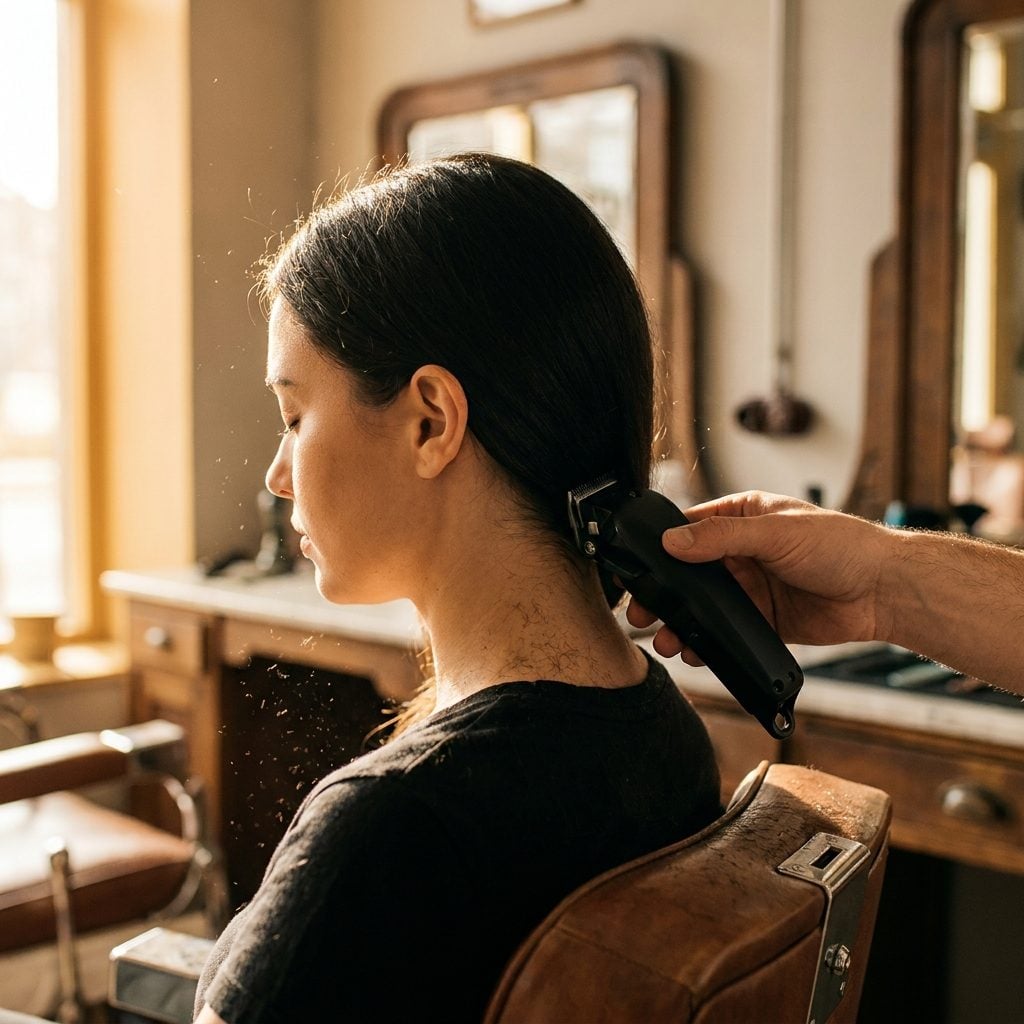
There’s a reason barbershop ASMR has billions of views. The low, steady hum of electric clippers against the scalp triggers what neuroscientists call Autonomous Sensory Meridian Response, a tingling sensation that typically starts at the crown and cascades down the neck and spine. According to Source, ASMR can trigger feelings of pleasure and relaxation by boosting hormones including dopamine and oxytocin. A 2018 study found that subjects experiencing ASMR showed significant brain activity in areas linked to both reward and emotional arousal.
So when a woman over 40 sits down and asks for the clippers instead of the scissors, she may be choosing something more pharmaceutical than aesthetic. The vibration against the skull, the repetitive sound, the warmth of the motor. Her brain is receiving a cocktail of calm that no meditation app has managed to replicate. I spent years thinking ASMR was nonsense until I let a barber use clippers on the back of my neck and nearly fell asleep in the chair.
Why She Didn’t Tell You First, And What That Silence Really Signals About Power

Most people fixate on the haircut. They miss the more interesting thing entirely: the silence that preceded it.
Not telling anyone is the point. According to existential psychotherapist Sara Kuburic, as cited by Source, impulsive hair changes often serve as a way to reclaim a sense of agency when other parts of life feel uncontrollable. But the secrecy adds another layer. By not asking for opinions, not polling friends, not posting a “should I do it?” story, she bypasses the entire social apparatus that has been weighing in on her appearance since she was twelve years old. That bypass is the real rebellion. The hair is just the receipt.
Women over 40 know something younger women are still learning: consensus is a trap. The moment you ask, you’ve already handed someone else a vote on your body. She didn’t tell you because she didn’t need to. And that silence, that refusal to make her body a group project, is one of the most powerful things a woman can do in a culture that treats female appearance as public property.
The Identity Earthquake That Happens Between the Second and Third Snip

The first cut is adrenaline. Pure nerve. You’re still the person who walked in. By the third or fourth snip, something shifts in the chest. A study discussed in Source from the journal Body Image found that women who are dissatisfied with their hair tend to have lower self-esteem, and psychologist Carl Jung believed hair symbolizes ideas and thoughts. Changing it doesn’t just change the reflection. It disrupts the internal map.
Neuroscience backs this up. The human brain processes familiar and novel visual stimuli through complex mechanisms, and when visual changes contradict stored memory patterns, the nervous system has to recalibrate, as noted in Source. That recalibration is the earthquake. The woman in the chair looks in the mirror and doesn’t fully recognize herself, not because she looks bad, but because her brain hasn’t updated the file yet.
That gap between who she was ten minutes ago and who she sees now? That’s where the real change lives. Not in the hair on the floor. In the disorientation.
The Psychological Term for What Happens When You Stop Performing Femininity for an Audience

It’s called “gender role transcendence,” and most women over 40 know it by a different name: exhaustion followed by relief.
Long hair on women isn’t just hair. It’s a cultural assignment. It signals youth, fertility, compliance, effort, willingness to be looked at on terms that were set before she was born. When a woman stops maintaining that signal, she isn’t losing femininity. She’s declining the unpaid labor of performing it. The research on enclothed cognition, a term coined by Hajo Adam and Adam D. Galinsky in their 2012 study (Source), shows that what we wear (and by extension, how we present) systematically influences our own psychological processes. The principle works in reverse, too. Remove the costume, and the performance loses its hold on you.
Why Your Brain Processes a Woman’s Short Hair as a Threat (And What That Reveals About You, Not Her)

Ask yourself honestly: when you saw her new hair, did you flinch? Even slightly? Good. That flinch is worth examining.
The discomfort people feel when a woman dramatically cuts her hair isn’t really about aesthetics. It’s about pattern violation. The brain stores familiar faces using specific visual cues, and hair is one of the primary ones. When that cue changes radically, the nervous system registers it as a form of social disruption, something that contradicts stored memory patterns (Source). But the reaction goes deeper than neurology. A woman with very short hair disrupts a gender signal that most people unconsciously rely on to categorize and predict behavior.
That’s the real threat. Not to safety. To the observer’s tidy assumptions. She’s removed a piece of visual shorthand that told strangers she was approachable, agreeable, manageable. Without it, she becomes slightly harder to read, and humans don’t like what they can’t quickly categorize. The people who react most strongly to a woman’s short hair are usually the ones who benefited most from the story her long hair was telling.
The Grief Response Hiding Inside What Looks Like a Bold Style Choice

Not every dramatic haircut is a declaration. Some are eulogies.
According to Source, cutting hair during emotional upheaval can serve several psychological functions at once, mixing emotional release, a need for control, attempts at transformation, and shifts in self-perception. It can act as a physical way to show inner pain when words feel impossible. One stylist quoted in Source described it perfectly: “The tears aren’t always sadness. They’re relief, or joy, or simply the impact of seeing yourself differently.”
Here’s what I got wrong for years. I assumed the women who cut their hair after a loss were “moving on.” Turns out, many of them are doing the opposite. They’re building a physical monument to the loss. A before and after. The long hair belongs to the woman who still had her mother, her marriage, her health, her sense of who she’d be by now. The short hair belongs to whoever comes next. It’s not boldness. It’s a boundary between two versions of a life, carved with scissors.
The Specific Age Window When Hair Becomes the Last Thing a Woman Feels She Can Control
Between roughly 40 and 55, the list of things that feel within a woman’s control starts shrinking in ways nobody adequately warned her about. Her metabolism changes on its own schedule. Perimenopause begins rewriting the rules of her body without consulting her. According to Source, a 2022 study published in the journal Menopause found that 52% of postmenopausal women experienced hair thinning or loss. The hormonal shifts often begin in the early 40s. Her own hair starts leaving before she decides to cut it.
And that’s the crux of it. Cutting it all off can be the ultimate preemptive strike: I’ll decide when and how this changes, even if I can’t decide whether it changes at all. As one researcher noted in a discussion on emotional coping mechanisms (Source), changing your hairstyle during upheaval provides a sense of control over at least one aspect of life, boosting self-esteem and offering a renewed sense of identity.
I’ll be honest: I didn’t fully understand this until I watched someone close to me deal with it. She wasn’t trying to look younger or older or edgier. She was trying to own something before it was taken. There’s a difference between a woman who cuts her hair and a woman who beats her hair to the exit. Both look the same from the outside. The psychology underneath could not be more different.
What Researchers Found When They Studied Women Who Made Drastic Appearance Changes After Silence

The quiet part matters more than the cut itself. A woman who announces her salon appointment two weeks ahead, who polls friends about pixie cuts in the group chat, who pins 47 inspiration boards, is doing something fundamentally different from the woman who walks in on a Tuesday afternoon and says, take it all off, with no warning. Psychologists who study appearance change distinguish between proactive self-expression and what’s sometimes called reactive identity action: a physical alteration made not to communicate outward, but to resolve something internal that language hasn’t caught up to yet.
According to a Psychology Today piece on hair and self-confidence (Source), hair changes often function as visible markers of invisible transitions. And a study on women’s changes of hair style and psychological satisfaction (Source) found that for women in their 30s and above, interpersonal relationships were among the primary drivers for altering their hair. The silence before the cut is worth paying attention to. It suggests the decision wasn’t made for anyone else’s consumption. It was made in a private negotiation between who she’s been and who she’s becoming.
The Reason She Keeps Touching the Back of Her Neck for Weeks Afterward

It’s not vanity. It’s a sensory recalibration.
I got this wrong for years, honestly. I assumed the constant neck-touching was self-consciousness, a woman checking whether she’d made a mistake. But it’s something stranger and more interesting than that. When you’ve had long hair for a decade or more, your nervous system literally maps it as part of your body. The weight of it against your shoulders, the brush of it across your neck in a breeze, the way you’d flip it over one shoulder before leaning forward. All of that is proprioceptive data your brain has been cataloging for years.
Remove it overnight and you create what’s called a phantom sensation, not unlike what amputees describe. According to Harvard Health’s overview of somatic therapy (Source), our bodies hold and express experiences on a deep neurological level, and unresolved shifts in physical experience can produce persistent, unusual sensations. That hand going to the back of the neck isn’t checking on the hair. It’s the body trying to locate something it remembers being there.
The Post-Cut Dopamine Spike That Tricks You Into Thinking You’ve Solved Everything

Here’s the uncomfortable truth about a dramatic haircut: it feels like an answer. For about 72 hours, you’re someone new. The mirror shows a stranger who looks decisive and brave and like she has her life sorted. Strangers notice you. Friends text all-caps reactions. Your brain floods with novelty reward. It’s the same neurochemical hit you’d get from buying a plane ticket to somewhere you’ve never been.
The neuroscience here is real but also a bit of a trick. As BBC Science Focus explains in its piece on dopamine dressing (Source), dopamine plays a fundamental part in our brain’s reward system, but whether a specific appearance change truly produces lasting mood improvement remains unproven. The spike is temporary. It’s novelty-driven. And the thing she was trying to solve, the restlessness, the feeling of being unseen, the creeping sense that her life had quietly calcified into something she didn’t choose, is still there on Thursday morning when the compliments stop.
That doesn’t mean the cut was a mistake. But the high can be misleading. I say this as someone who once chopped off eight inches and genuinely believed for 48 hours that I’d also fixed my career, my relationship, and my sleep schedule. I had not.
Why the Reactions of Other Women Hurt More Than She Expected, And the Social Psychology Behind It

She anticipated that men might not love it. She braced for that. What she didn’t brace for was the particular sting of another woman’s silence.
The compliment that never came. The friend who said “oh wow, that’s… bold” with a half-second pause before “bold” that contained an entire thesis. The colleague who looked her up and down on Monday morning and changed the subject. These micro-responses land harder than outright criticism because they come from the group whose approval is, psychologically speaking, more essential to a woman’s sense of belonging.
Research on social identity and appearance shows that within gender groups, appearance policing functions as a form of norm enforcement. According to a salon article on the link between long hair and femininity (Source), short-haired women frequently face labels like “tomboy” or “less feminine,” and those judgments cut deepest when they come from other women. A woman who cuts her hair past 40 isn’t just changing a style. She’s quietly opting out of a visual contract that other women are still honoring, and some of them experience that opt-out as a judgment on their own choices.
The ‘Samson Effect’ in Reverse: What Happens When Cutting Hair Actually Gives You Power

The biblical Samson lost his strength when Delilah cut his hair. Every woman who’s gone short after 40 knows the opposite can be true.
There’s a version of the enclothed cognition framework that applies here, even though it’s not about clothes. Adam and Galinsky’s 2012 research on enclothed cognition (Source) established that the symbolic meaning of what we wear directly influences how we think and behave. Hair operates on the same principle. Long hair carries symbolic weight: femininity, accommodation, softness, approachability. When a woman removes it, she’s not just losing inches. She’s shedding the cognitive associations her brain has attached to those inches for years.
The power surge so many women report isn’t imagined. It’s the psychological experience of removing a symbol of compliance and discovering you still exist without it. Actually, you might exist more clearly without it. I will die on this hill: the first week after a big chop is one of the most psychologically revealing periods in a woman’s adult life. Not because of the hair. Because of what you find out about yourself when it’s gone.
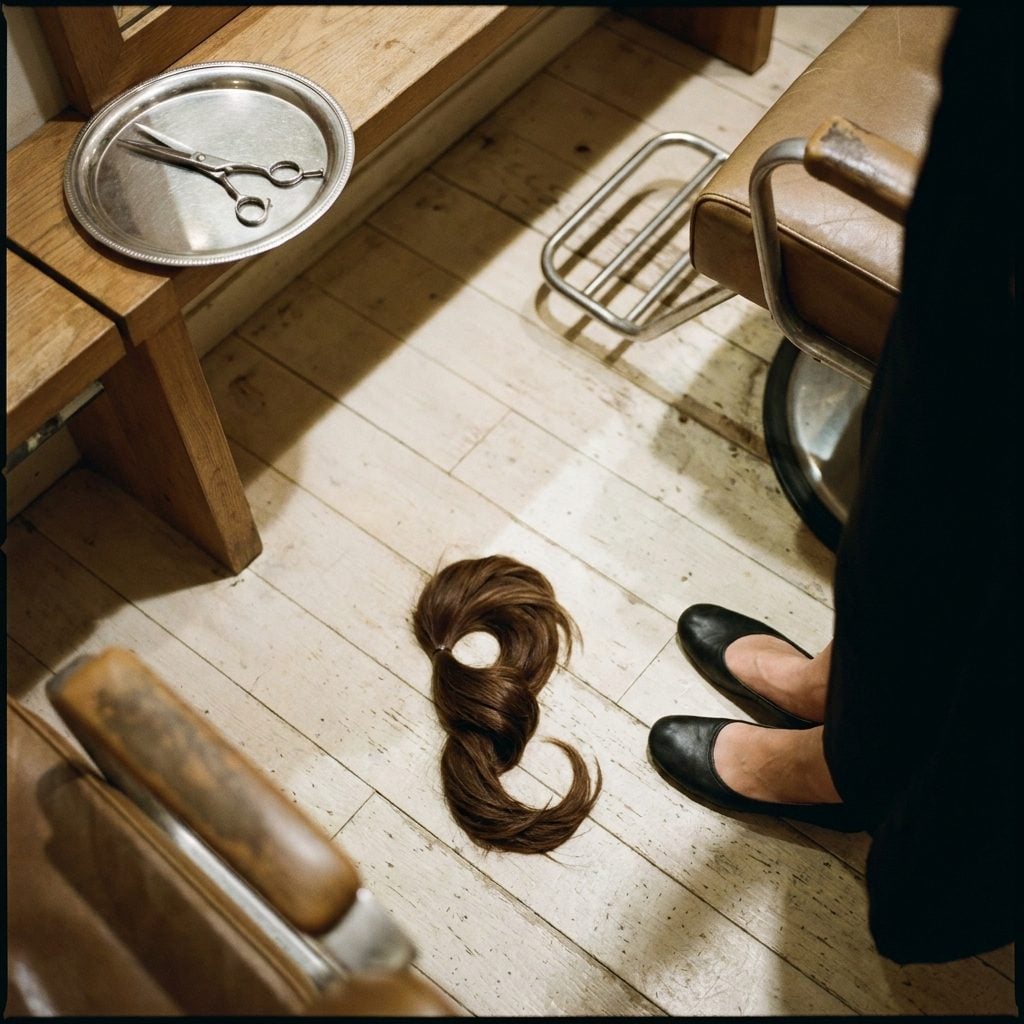
The Invisible Contract With Femininity That Breaks the Moment the Ponytail Hits the Floor
❤️ Would you like to save this?
Nobody remembers signing it, but every woman knows it exists. The contract goes something like: keep your hair long enough to pull back, soft enough to touch, maintained enough to signal effort. In exchange, you’ll be read as feminine, maternal, appropriate. You’ll move through the world with less friction.
A woman over 40 who cuts her hair very short is renegotiating that deal in public. According to Fashion Is Psychology’s analysis of whether long hair defines femininity (Source), women who cut their hair short frequently encounter assumptions about their sexuality, their priorities, even their political leanings, all triggered by a few less inches of keratin. The assumption is baked deep: long hair signals availability and conformity, short hair signals something else entirely.
But here’s what the contract never told you. The friction that follows a short haircut, the raised eyebrows, the unsolicited opinions, also comes with a strange gift. You start to see exactly which of your relationships were predicated on your willingness to perform femininity in a specific way. That information is painful. It’s also invaluable.
The Phenomenon Therapists Call ‘Somatic Declaration’, When the Body Speaks Before the Mouth Can

Sometimes the haircut comes before the conversation. Before the separation papers, before the resignation letter, before she tells her mother she’s not coming to Thanksgiving. The body makes its announcement and the rest of the life has to catch up.
Therapists who work in somatic modalities have a framework for this. A scoping review of somatic experiencing therapy (Source) describes how the body stores unresolved stress and sometimes initiates its own discharge through physical action. Peter Levine, who developed Somatic Experiencing therapy, built his entire approach around the idea that the body can complete emotional processes that the conscious mind hasn’t figured out how to articulate yet.
A radical haircut in this context isn’t impulsive, exactly. It’s pre-verbal. The woman who can’t yet say I need something to change can sit in a chair and feel the scissors and walk out looking like proof that change is already underway. Her body made the declaration. Her words will follow. Sometimes by weeks. Sometimes by months.
Why She Googled ‘Short Hair Over 40’ at 2 AM and What That Search Pattern Reveals

Two in the morning is when the real searches happen. Not the daytime browsing, the casual “oh I wonder what I’d look like with a bob” Pinterest spiral during lunch. The 2 AM search is different. It’s specific. It’s desperate. It’s short hair over 40 round face and will I regret cutting my hair and women who cut their hair and felt free.
The search pattern tells its own story. She’s not looking for a hairstyle. She’s looking for permission. She needs to see other women who look like her, who are her age, who did this thing and survived it and maybe even thrived. She’s assembling a case file for a decision her gut already made. Research on hair changes and psychological satisfaction, including an analysis of why we crave drastic hair changes (Source), confirms that the impulse toward radical change during stress isn’t random: it’s targeted at the single aspect of appearance that’s most immediately controllable.
There’s something quietly heartbreaking about a 44-year-old woman needing Google’s permission to look how she wants. And something quietly radical about the moment she closes the laptop and decides she doesn’t need one more search result to know what she already knows.
The Specific Emotion That Makes a Woman Choose Irreversibility Over Gradual Change

Most people assume anger drives the drastic chop. Or sadness. Or rebellion. But the emotion that actually pushes a woman past the tipping point, past the “maybe I’ll just get layers” safety zone, is something far less dramatic and far more unsettling: accumulated emotional compression. It’s the feeling of having held a particular version of yourself together for so long that the internal pressure needs a physical release valve. Not a slow one, either. A fast, irreversible one.
Here’s the counterintuitive part. According to a study on decision reversibility and satisfaction (Source), irreversible decisions actually produce higher post-decision satisfaction than reversible ones. The brain’s psychological immune system activates only when it knows there’s no going back, helping you rationalize and even celebrate the choice you’ve made. Reversible decisions, on the other hand, keep you trapped in a loop of second-guessing and counterfactual thinking: What if I’d gone shorter? What if I’d left it alone?
A woman over 40 who walks into a salon and says “take it all off” isn’t acting on impulse. She’s making a decision her psyche has been engineering for months, possibly years. The irreversibility isn’t a bug. It’s the entire point. She doesn’t want a way back to the person she was yesterday. And her brain, it turns out, will reward her for it.
What the Mirror Does to Your Brain in the 72 Hours After a Radical Cut

Nobody warns you about the mirror phase. That first glimpse right after the cut usually produces a rush, something close to euphoria. But the 72 hours that follow are a completely different psychological event, and they matter more than that initial high.
Neuroscience research on visual perception suggests that the brain stores familiar faces, including your own, as pattern templates. When you radically alter your appearance, the brain encounters what researchers describe as a discrepancy between the stored pattern and the new visual input, requiring deeper cognitive processing to reconcile the two. A multidimensional review of haircuts as a catalyst for identity transformation (Source) frames this as a trigger for both the halo effect and the primacy effect in self-perception. You’re essentially meeting yourself for the first time, repeatedly, every time you pass a reflective surface.
Why the Second Day Is the Hardest
Day one, you’re riding adrenaline. Day two, you wake up and the novelty has dimmed just enough for doubt to creep in. I got this wrong for years, assuming that initial post-cut regret meant the haircut was a mistake. It almost never is. What’s actually happening is that your brain is doing the hard labor of updating its self-image file, and that process feels uncomfortable before it feels right. By day three, something shifts. The face in the mirror starts to feel like yours again, except now it belongs to whoever you’re becoming rather than whoever you were.
The Bottom Line
The real reason she cut her hair without warning is disarmingly simple: she had already changed on the inside, and the outside hadn’t caught up yet. The chop isn’t the beginning of a transformation, it’s the announcement that the transformation already happened, privately, in the months or years before she ever picked up the phone to book the appointment. The next time you witness it, skip the opinion and ask the only question that matters: what did she finally decide she was done carrying?