❤️ Would you like to save this?
He said it was too tight. Too short. Too much. Too obvious. Too trying. The little black dress hung in the back of the closet for years, exiled by someone else’s opinion. Then one morning, you pull it out, hold it up to the light, and realize the dress was never the problem. Here are 31 ways to wear it like the woman he never wanted you to become.
FYI, thanks to AI imagery software, we’re able to create very specific fashion and hairstyle examples to illustrate the points being made. In some cases, imagery is exaggerated to hammer home the point. Also, assume links that take you off the site are affiliate links such as links to Amazon. this means we may earn a commission if you buy something.
31. The Morning She Put It On Again, and the Mirror Said Yes
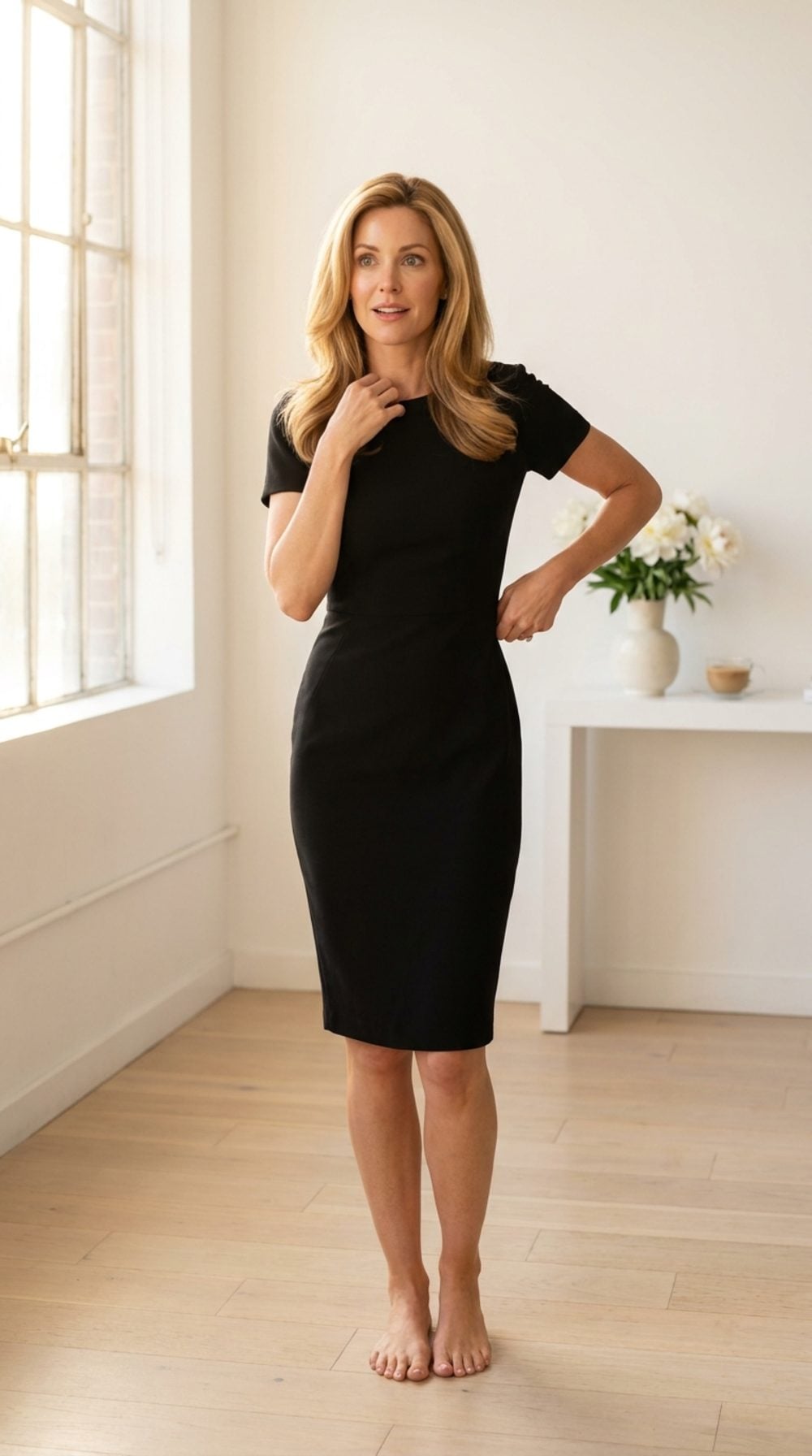
Bare feet on cool hardwood. No audience. No occasion. Just a woman and a black crepe sheath dress she hasn’t touched in three years, and the morning light saying what he never did: it fits.
The styling driver here is the absence of styling. No shoes, no jewelry, no armor. The dress against bare skin, against white walls, against quiet. That vulnerability is the entire point. She’s not dressing for an event. She’s dressing for the act of putting it back on and not flinching. The silhouette is simple and knee-length, close to the body without clinging, and the matte crepe refuses to announce itself. It just states.
This is outfit zero. The one before the thirty that follow. Every reclamation story has a private first chapter, and it usually happens alone, standing in morning light, realizing the dress was never the problem.
30. Walking Through His Neighborhood Like She Owns the Zip Code
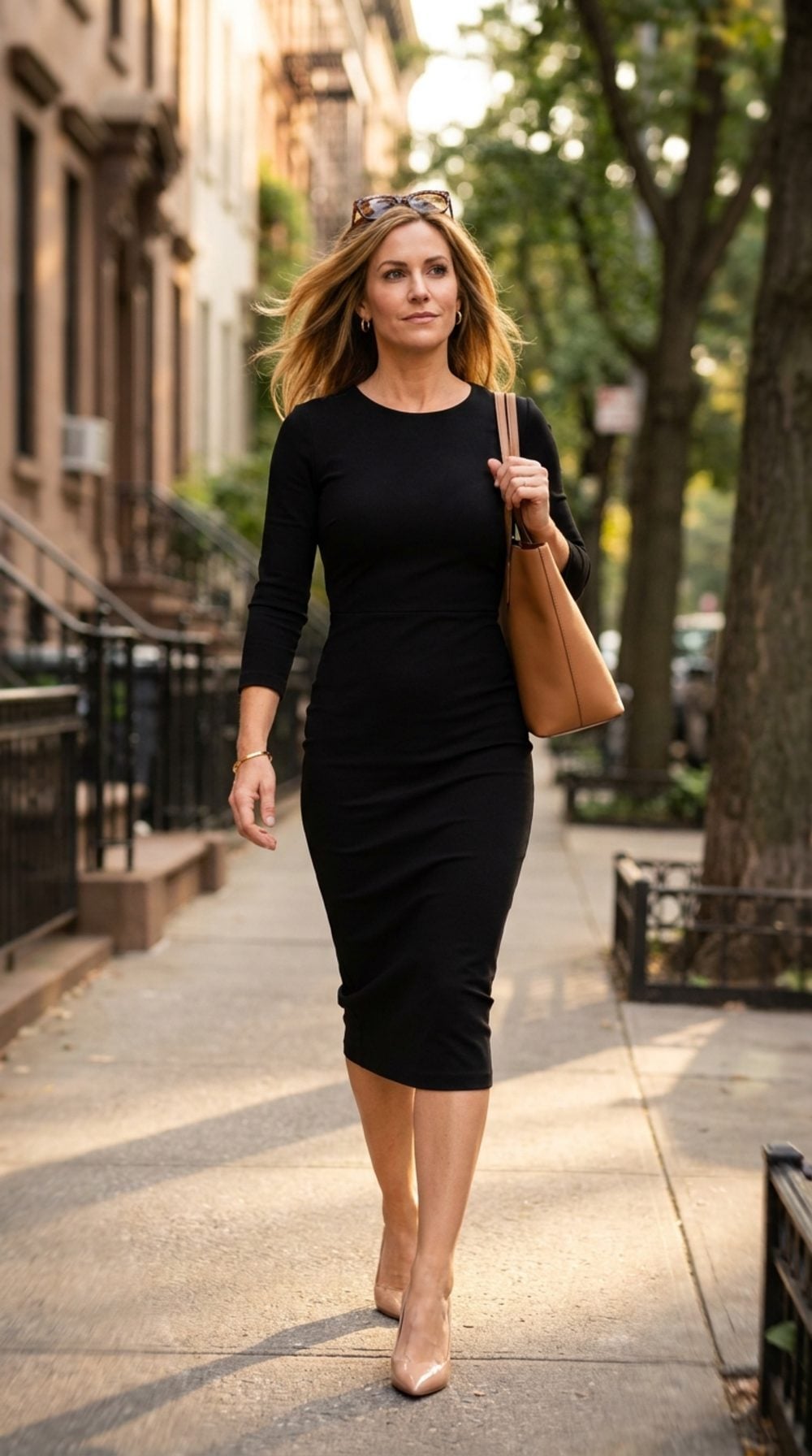
The pointed-toe nude heels are doing the work here. They extend the leg line into the black midi dress so cleanly that the whole silhouette reads as one unbroken column. That’s proportional architecture. The dress is fitted ponte, which holds its shape through movement without restricting it, and the nude heel disappears into the skin tone, adding three visual inches without announcing a thing.
A structured tan leather tote introduces the only color. Tortoiseshell sunglasses on the head, thin gold bangle, small hoops. Nothing competing. Nothing trying. The restraint is the statement.
She’s not avoiding his street. She’s taking it at a stride that says she forgot he lived here. There’s a difference between looking good as revenge and looking good as fact. This is the second one.
29. A Table for One, a Toast to the Woman Who Stayed
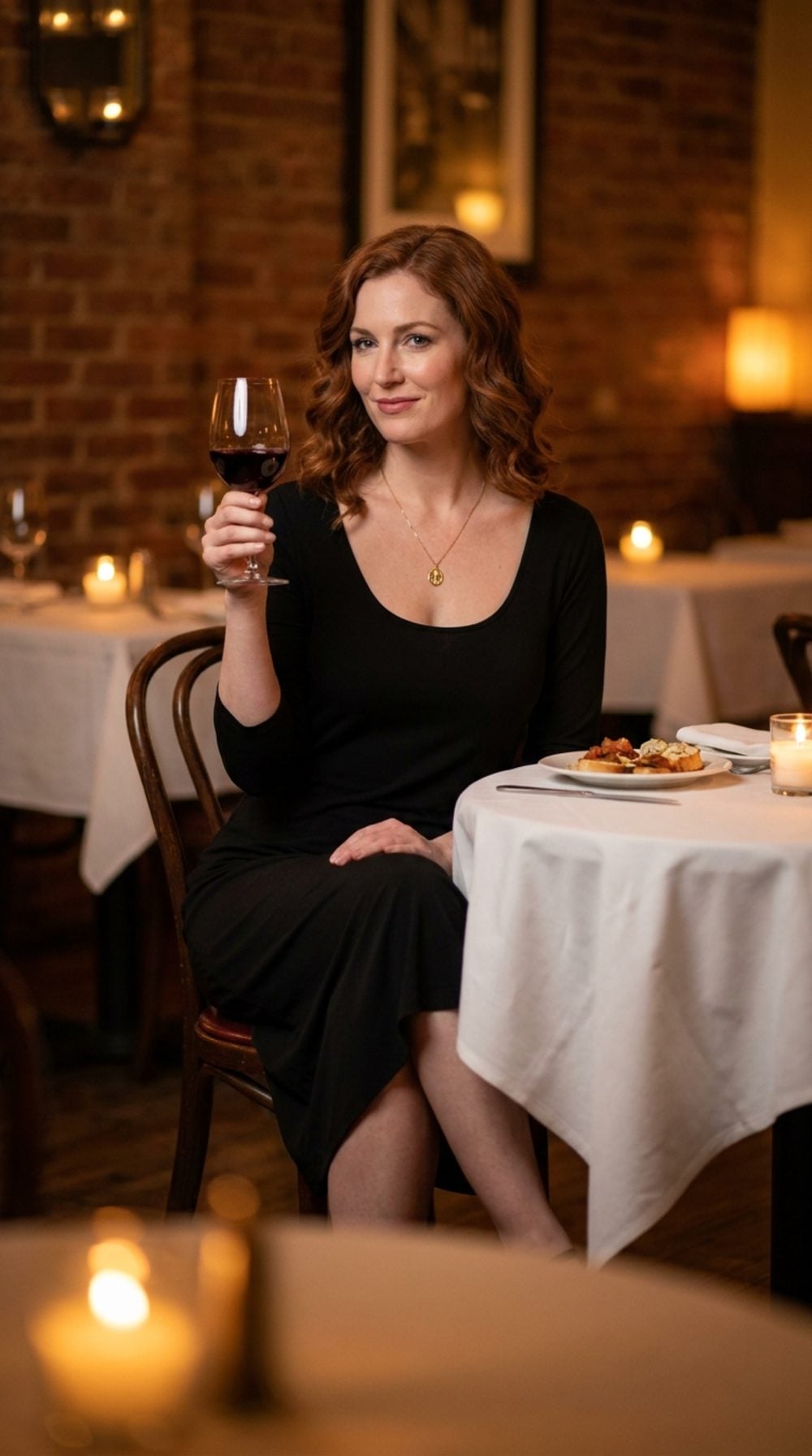
One glass. One woman. One table she reserved under her own name.
The scoop-neck black jersey dress is the right weight for this. Fluid jersey moves with her when she leans forward, catches candlelight differently than a structured fabric would. It’s sensual without performing sensuality. The scoop neckline opens just enough to let a delicate gold pendant rest against the collarbone, the single point of light that mirrors the candle on the table. Diamond studs. Nothing else.
The style driver is the setting, not the accessories. A woman dining alone in a black dress at a candlelit table radiates a specific signal: she chose this. Not waiting for someone. Not filling time. Ordering the wine she actually likes instead of the one he picked.
28. Standing in Front of Art That Actually Understands Her
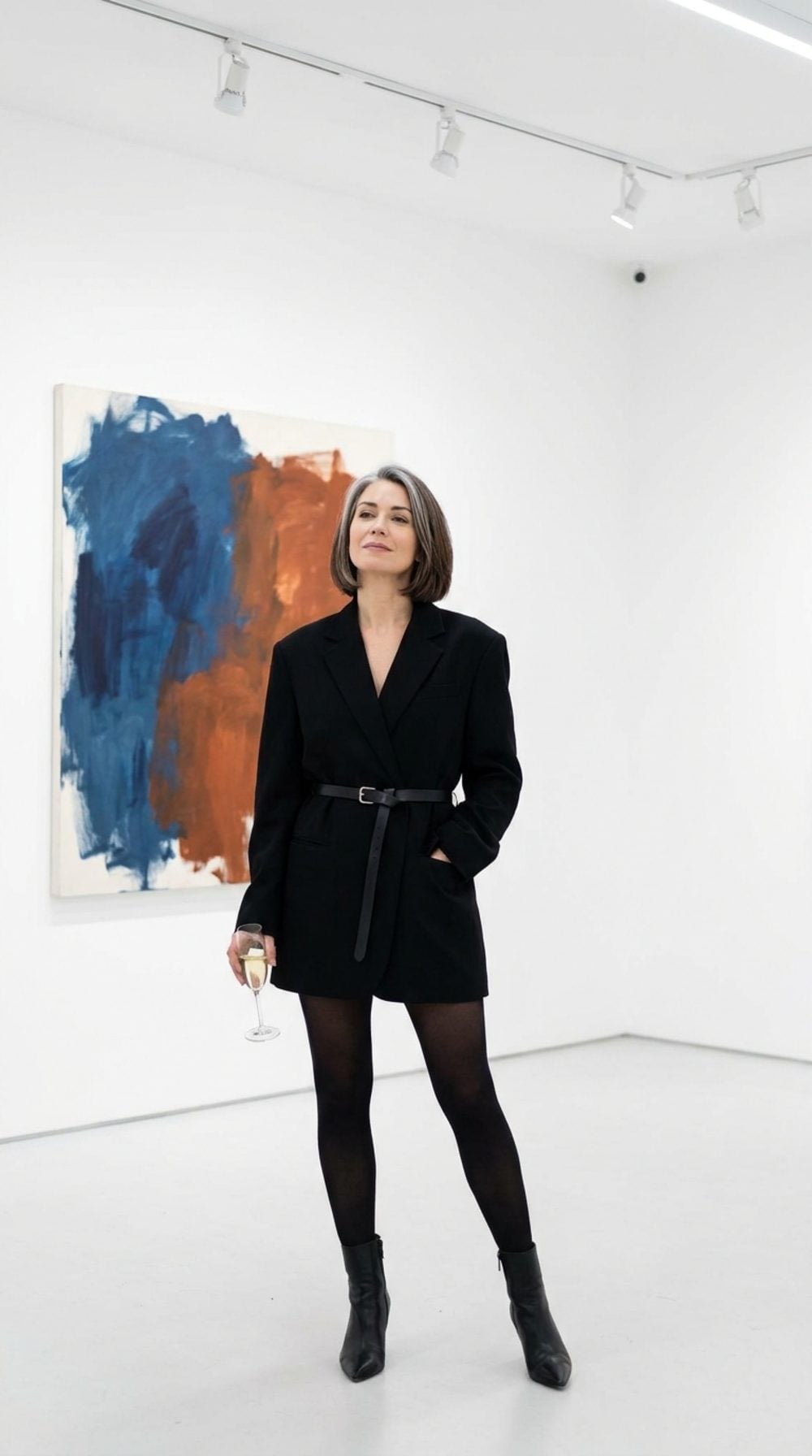
Shoulders doing the talking. The structured blazer-dress borrows its power from menswear, padded at the shoulder and cinched at the waist with a thin leather belt to create an inverted triangle that reads as authority without borrowing anyone else’s. Mid-thigh hem over opaque tights and pointed ankle boots keeps it grounded. Not cocktail. Not corporate. Somewhere more interesting than either.
One hand in a pocket, champagne at her side. She’s not performing culture. She’s in it.
The color story is almost entirely black on white, which lets the abstract art behind her supply the only color in the frame. That’s smart composition. She becomes part of the installation without trying to compete with it. He used to say she was “too much” at events. Funny how much room she takes up now by doing almost nothing.
27. Gold Chains and a Mantelpiece That Never Heard His Opinion
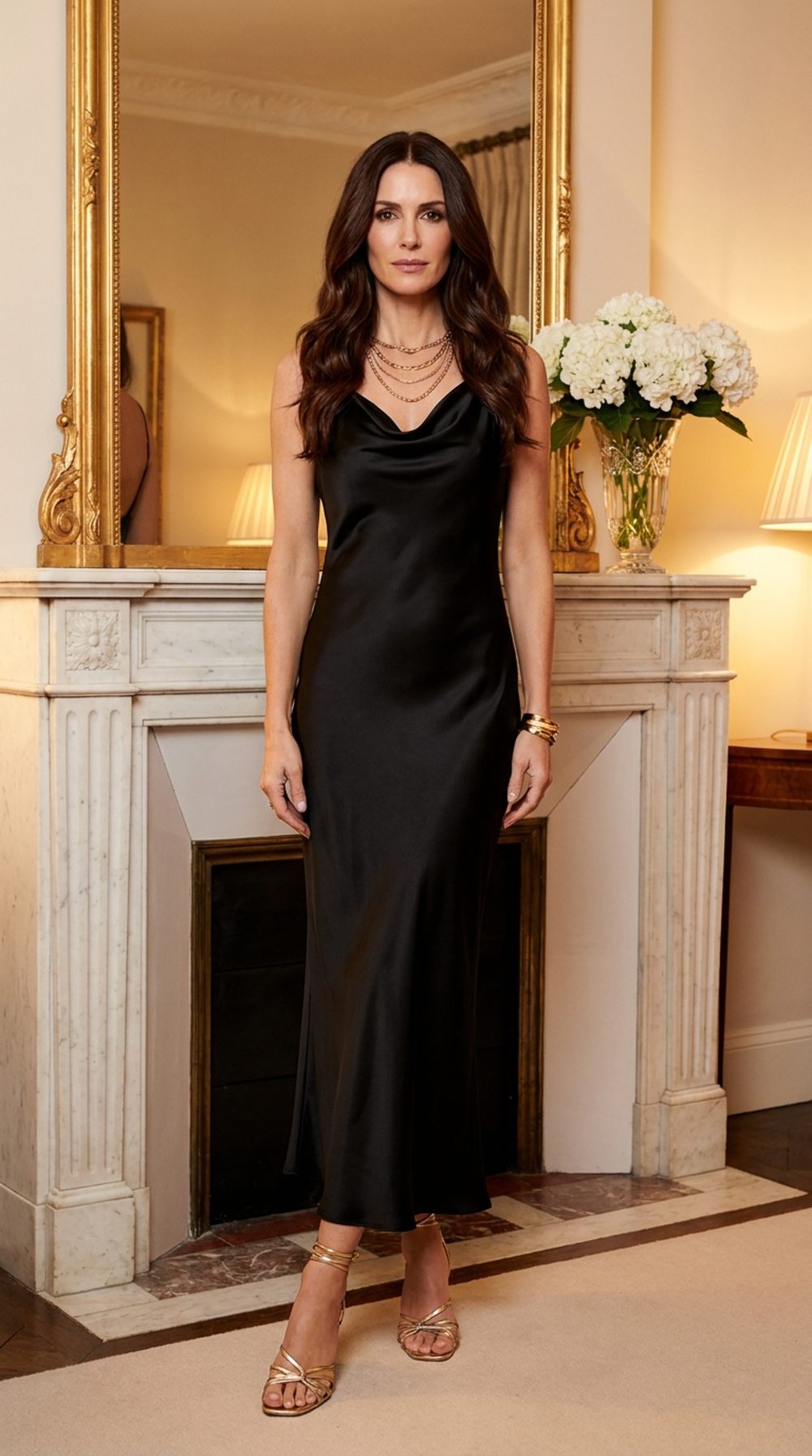
Three gold chains at different lengths turn a cowl neckline into a frame. That’s the whole trick. The liquid silk cowl dress supplies the canvas with its drape and subtle sheen, and the layered gold chains fill the negative space the cowl creates. Without the chains, the neckline is quiet. With them, it’s a destination.
The texture contrast does the heavy lifting. Matte gold against liquid silk, each making the other more visible. Strappy gold sandals echo the metal without overdoing it. One cuff. Simple hoops. She knows exactly when to stop adding.
He called her jewelry “too loud.” Turns out she was just speaking at a volume he couldn’t handle.
26. Sunday Morning, Denim Jacket, Zero Apologies
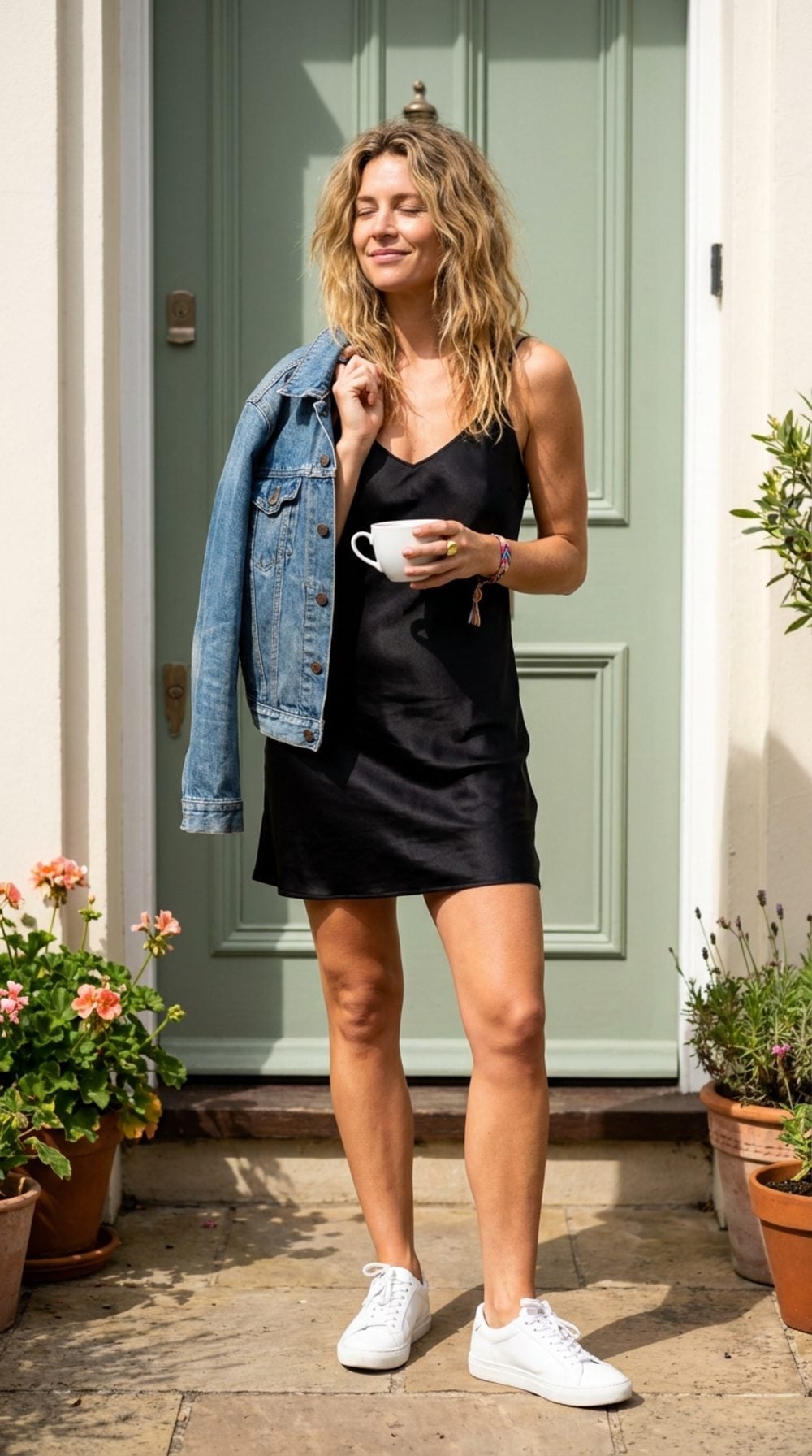
The spaghetti-strap slip dress was designed to be worn to bed or to a cocktail bar. Pair it with a vintage denim jacket and white leather sneakers, and it becomes something else entirely: a Sunday.
This is athleisure style territory, minus the athleisure. The formality of black satin against the casualness of broken-in denim creates a tension that reads as effortless, which is always a lie, but the good kind. Bare legs bridge the gap between the two moods. Sneakers commit fully to the casual direction, which is why it works. A heel here would have been a compromise, and compromises read as confused.
A friendship bracelet and a signet ring. Coffee in hand. No makeup worth mentioning. This is the outfit of a woman who woke up in her own space, on her own schedule, answerable to nobody.
25. Rooftop at Dusk, the City She Kept When He Left
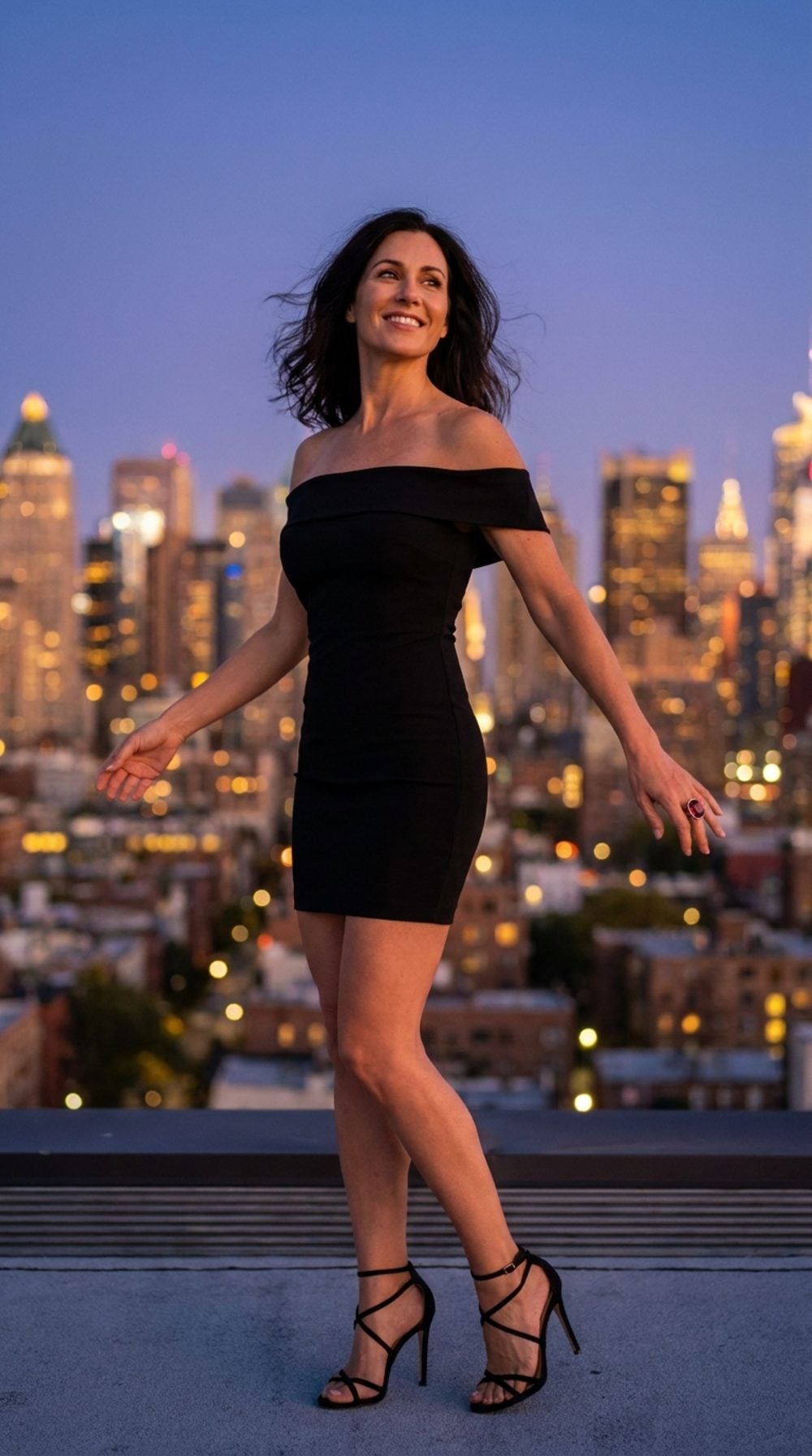
Arms out. Skyline behind. Hair doing whatever the wind wants.
The off-shoulder neckline makes this version of the LBD physically expansive. She’s taking up space. Bare shoulders and collarbones exposed to the open air, the silhouette widening at the top where the blazer-dress narrowed it. Same woman, same base garment category, completely different signal. The structured stretch fabric holds the mini-length hem clean without riding up, which is engineering as much as design.
One deep red cocktail ring. That’s it for accessories. At dusk on a rooftop with the city lit up behind you, the setting is the accessory. Adding more would be insecurity, not style. She doesn’t need a bag up here. She doesn’t need a jacket. She doesn’t need anyone to hold her drink. The breeze is enough company.
24. Between the Shelves, Reading the Life She Chose Instead
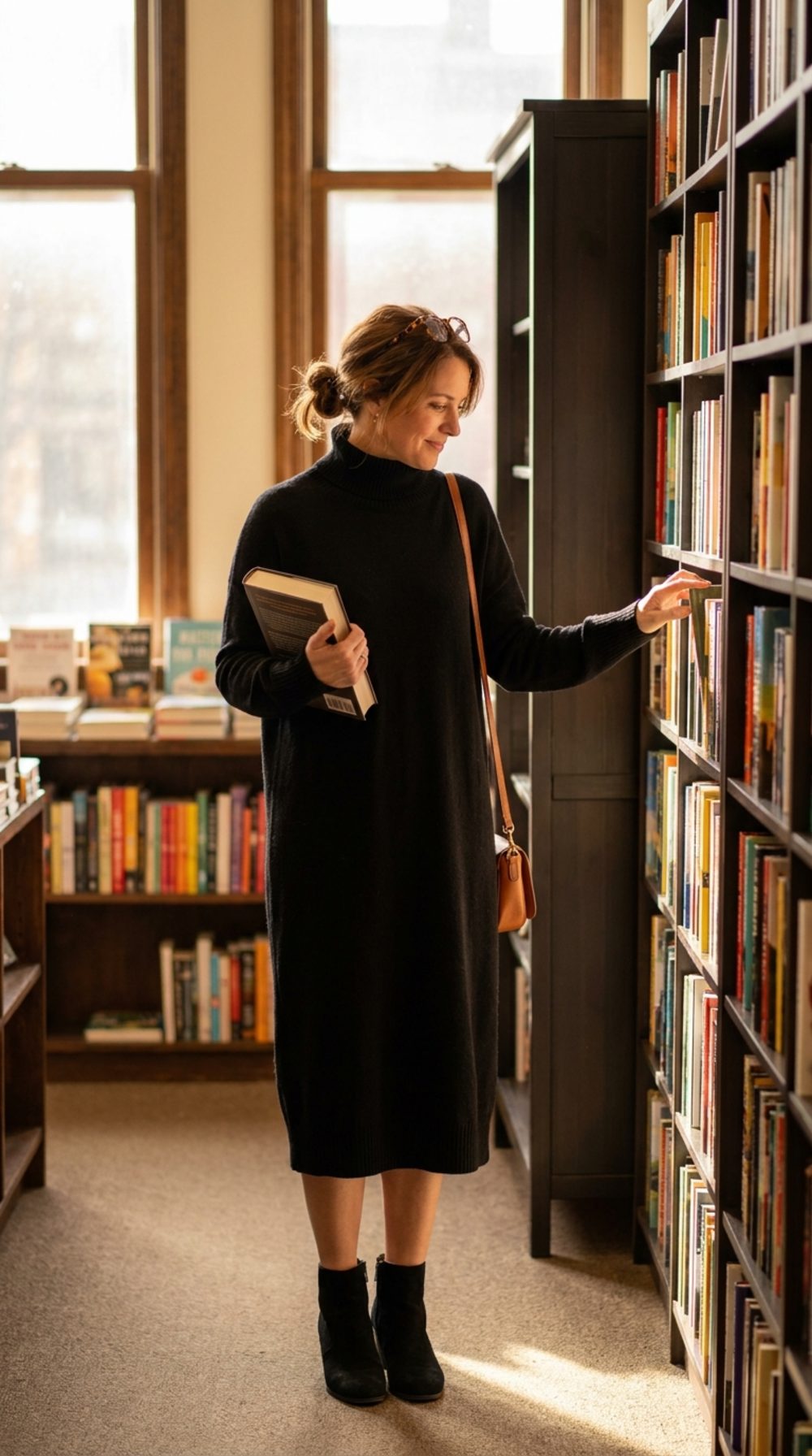
Merino wool, oversized, floor-length. This is the LBD as cocoon. The turtleneck dress swallows the body in the best way, all warmth and soft structure, the kind of garment that makes you stand a little differently because it doesn’t demand you stand at all.
Black suede ankle boots with a low heel. A cognac crossbody bag small enough to forget you’re wearing. Reading glasses on the head. A book under the arm. Every detail says: she has nowhere to be and she’s in no hurry to leave.
He used to rush her through bookstores. Said she took too long. She’s still here, three chapters deep, and the shop closes in two hours. Plenty of time.
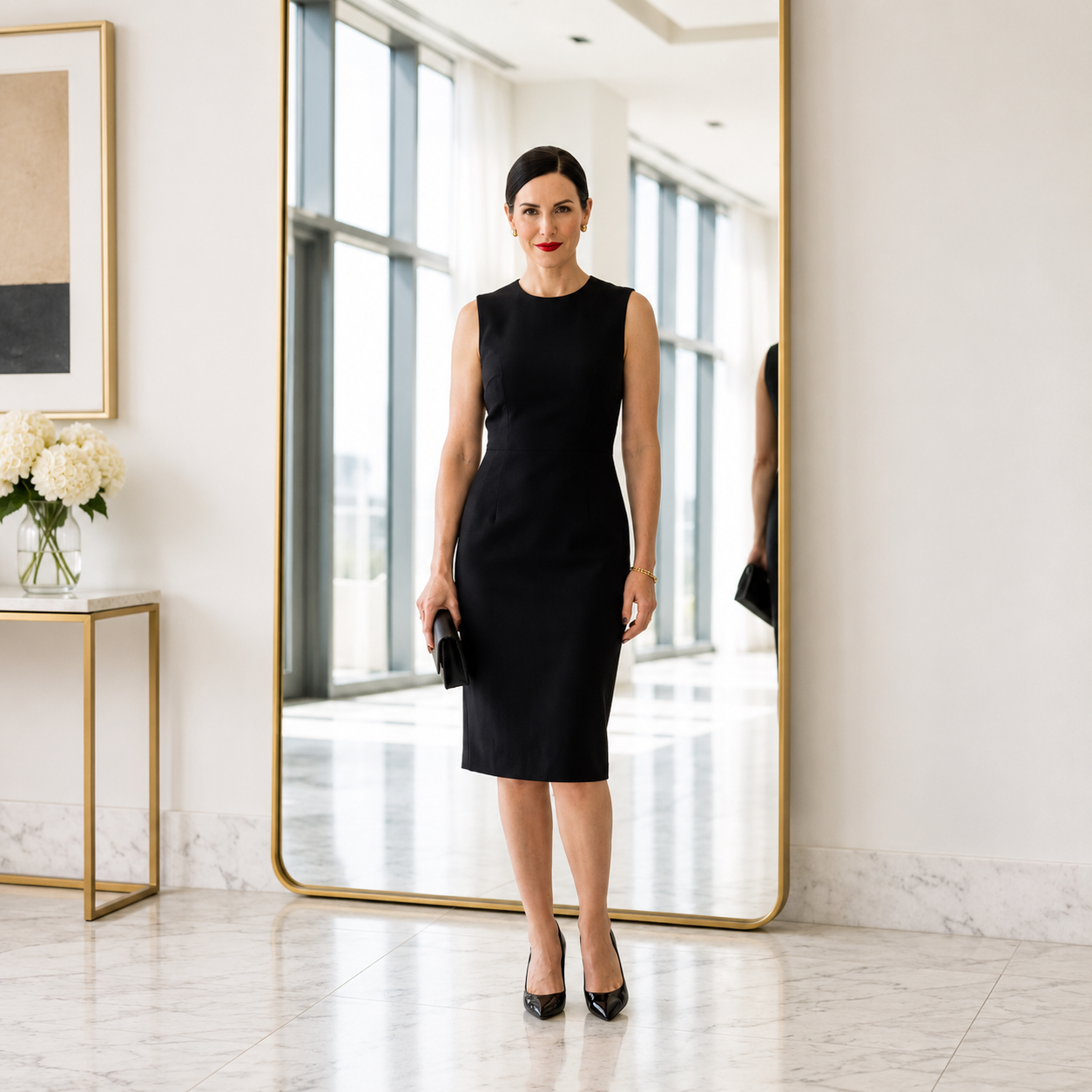
23. Hotel Lobby, Red Lip, the Gaze That Doesn’t Look Away
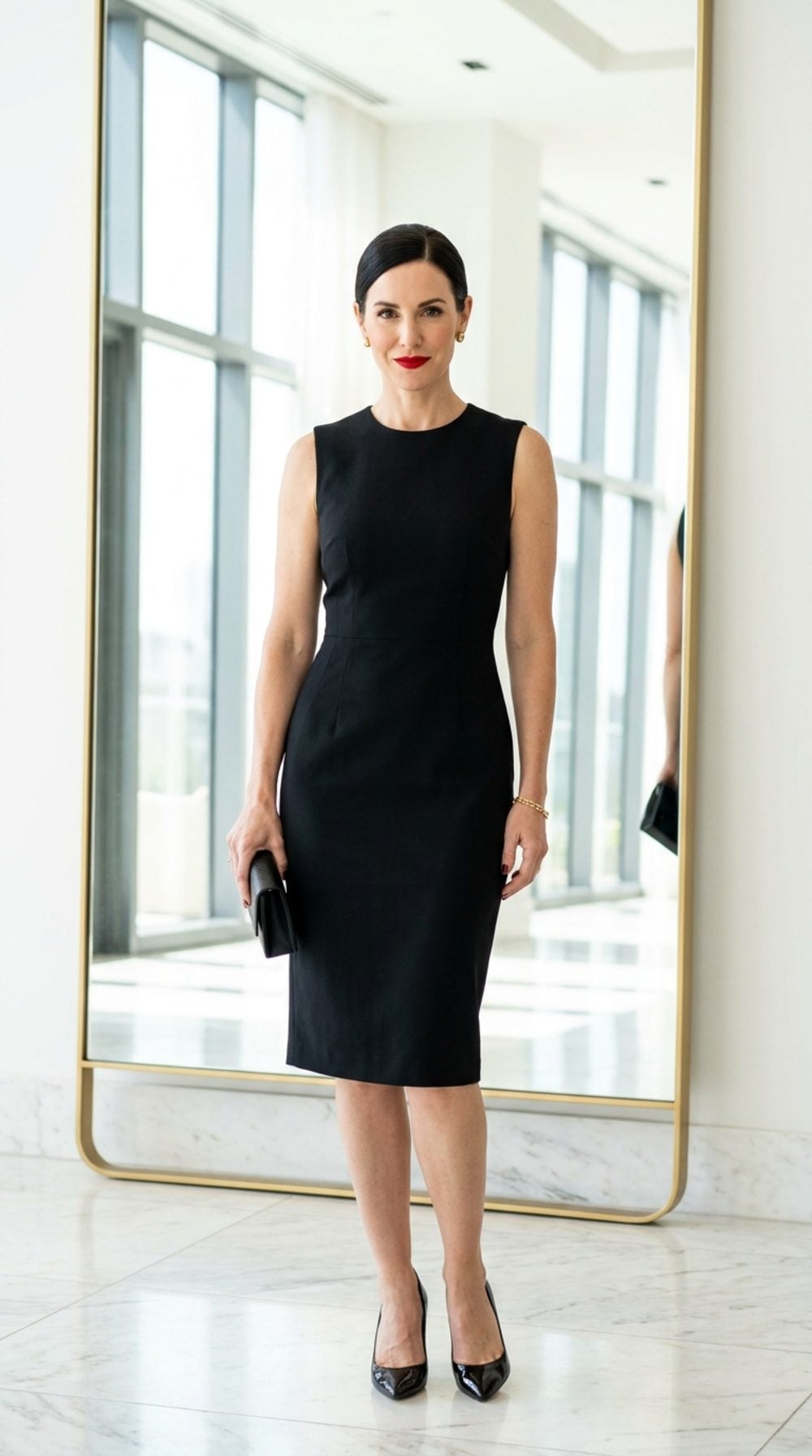
The red lip is carrying this outfit and it knows it.
Strip the look to its inventory: black wool-silk sheath, patent pumps, gold studs, thin bracelet, structured clutch. Nothing here raises its voice. The silhouette is a clean column, fitted but not tight, the kind of tailoring that communicates precision. Then the red lip arrives and rewrites the entire read. Without it, this is professional. With it, this is a woman who walked into a hotel lobby like she signed the lease.
That contrast between a quiet wardrobe and one bold beauty choice is old strategy. It works because it concentrates all the personality into one place. Your eye goes to the mouth. The mouth is smiling. The smile says: I’m not nervous. I’m not waiting. I’m exactly where I chose to be.
22. On the Dance Floor, Eyes Closed, Moving Like No One’s Scoring
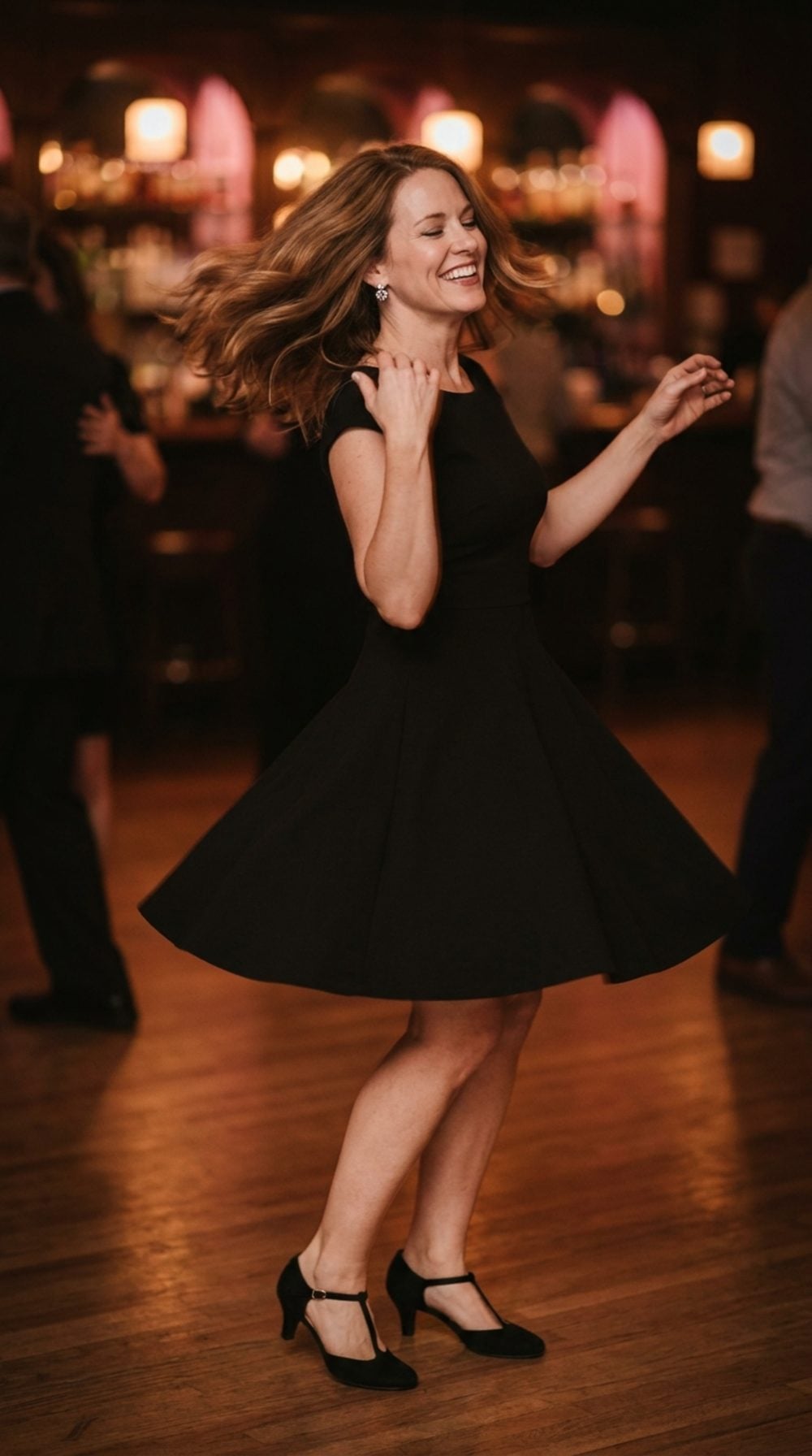
Eyes closed. Nobody watching. Nobody grading the performance.
The fit-and-flare is the only LBD silhouette that was built to move like this. Fitted through the bodice, released at the waist, the skirt catching air and turning every spin into proof of something. The black fabric becomes a blur of motion, which is the point. She’s not standing still for anyone’s assessment anymore.
T-strap low heels because she’s here to actually dance, not to look like she might. Small sparkly studs because they catch the light mid-turn. No bag. No phone. Both hands free.
You’ve seen this woman at the wedding, at the birthday dinner, at the random Tuesday bar with live music. She’s the one who hit the floor first and will leave last. She dances like the song was written specifically for this moment in her life. And maybe, after everything, it was.
21. The Waiting Room Where She Stopped Waiting for Permission
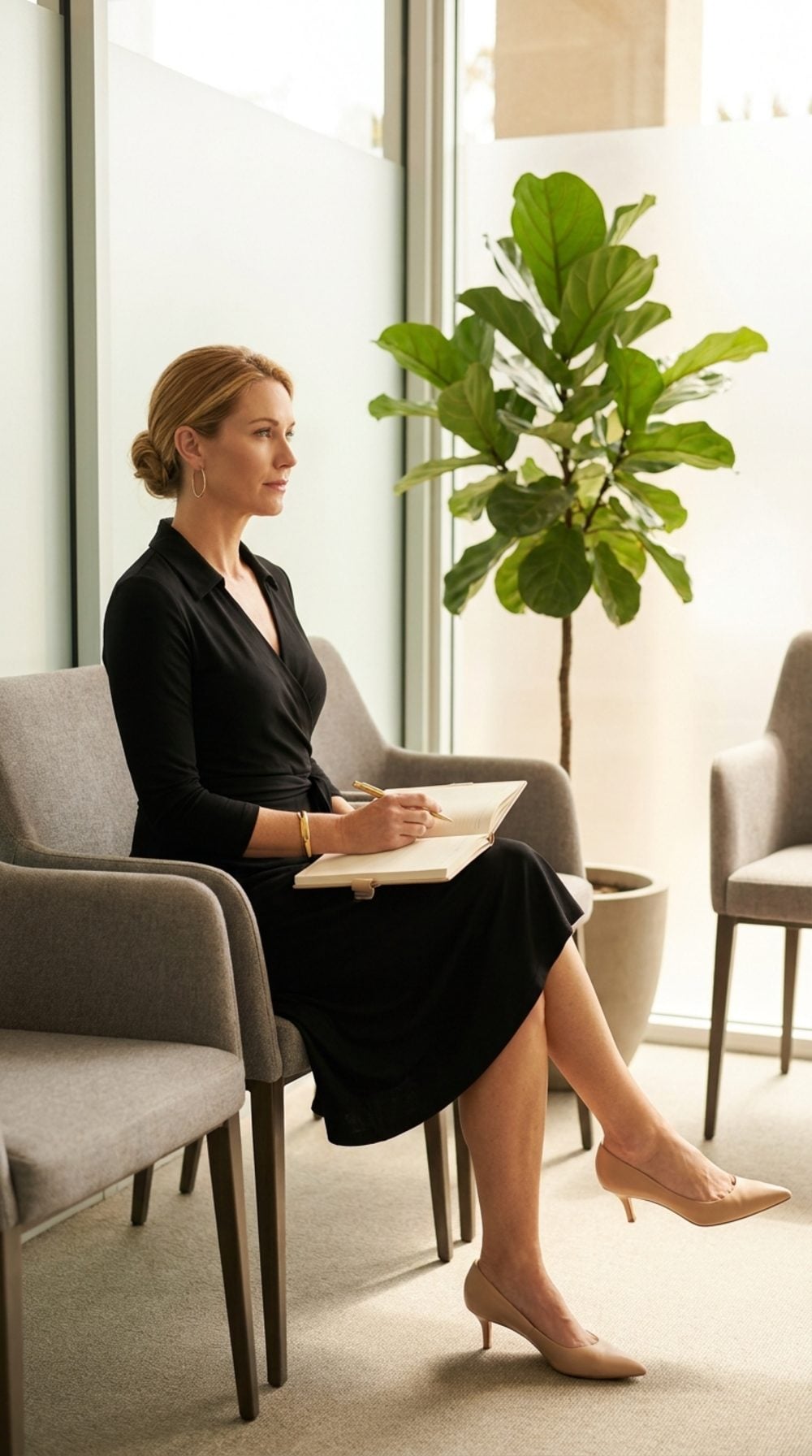
The crossed legs say something — not defensive, but decided. A black wrap dress in soft jersey does a specific thing when a woman sits down in it: it follows her posture instead of fighting it. The wrap construction creates its own waistline, so the silhouette stays defined without a belt, without boning, without any effort at all. The cut does the work. That’s all it needs to do.
The rest is restraint. Nude kitten heels lengthen the leg line without competing. Gold kept to a minimum: thin hoops, one bangle. And the journal — that’s the real accessory. It says she showed up with something to say and somewhere to write it down.
A woman waiting in a room like this used to rehearse what she’d say. Now she’s already written it.
20. Golden Hour at the Marina, No One Else’s Sunset
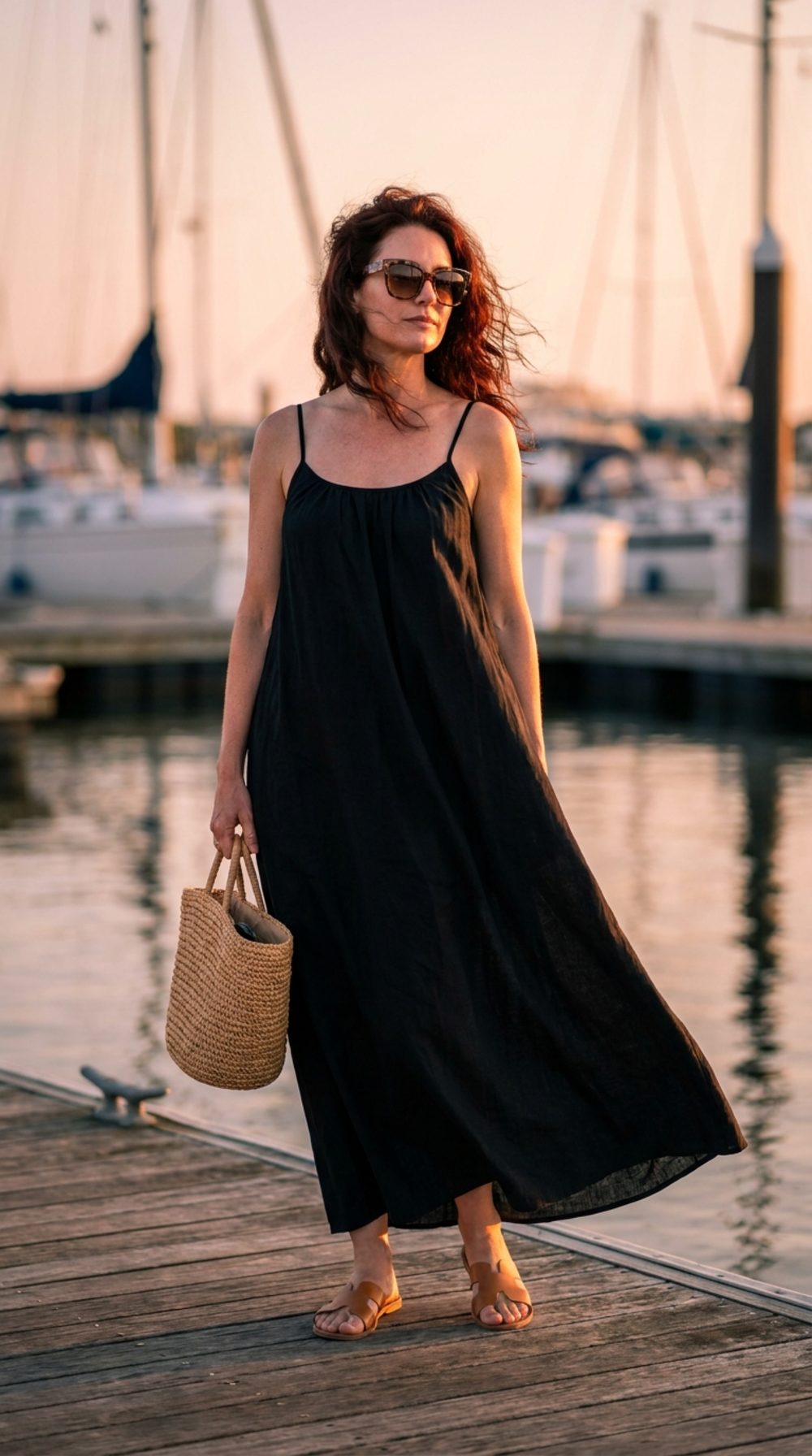
One fabric. One color. The breeze handles everything else. A black cotton-linen maxi dress in motion is a completely different garment than the same dress on a hanger — the crinkled texture catches that last golden light and creates shadow and dimension across a single plane of black. No jewelry fighting for attention, no heel lifting her out of the scene. Just tan leather sandals and a woven straw tote that says she packed light on purpose.
Column dresses are the style driver here. They erase the body’s individual proportions and replace them with one long, clean vertical. Against a sunset, that line goes almost sculptural. She’s not posing. She’s just standing where she wants to stand.
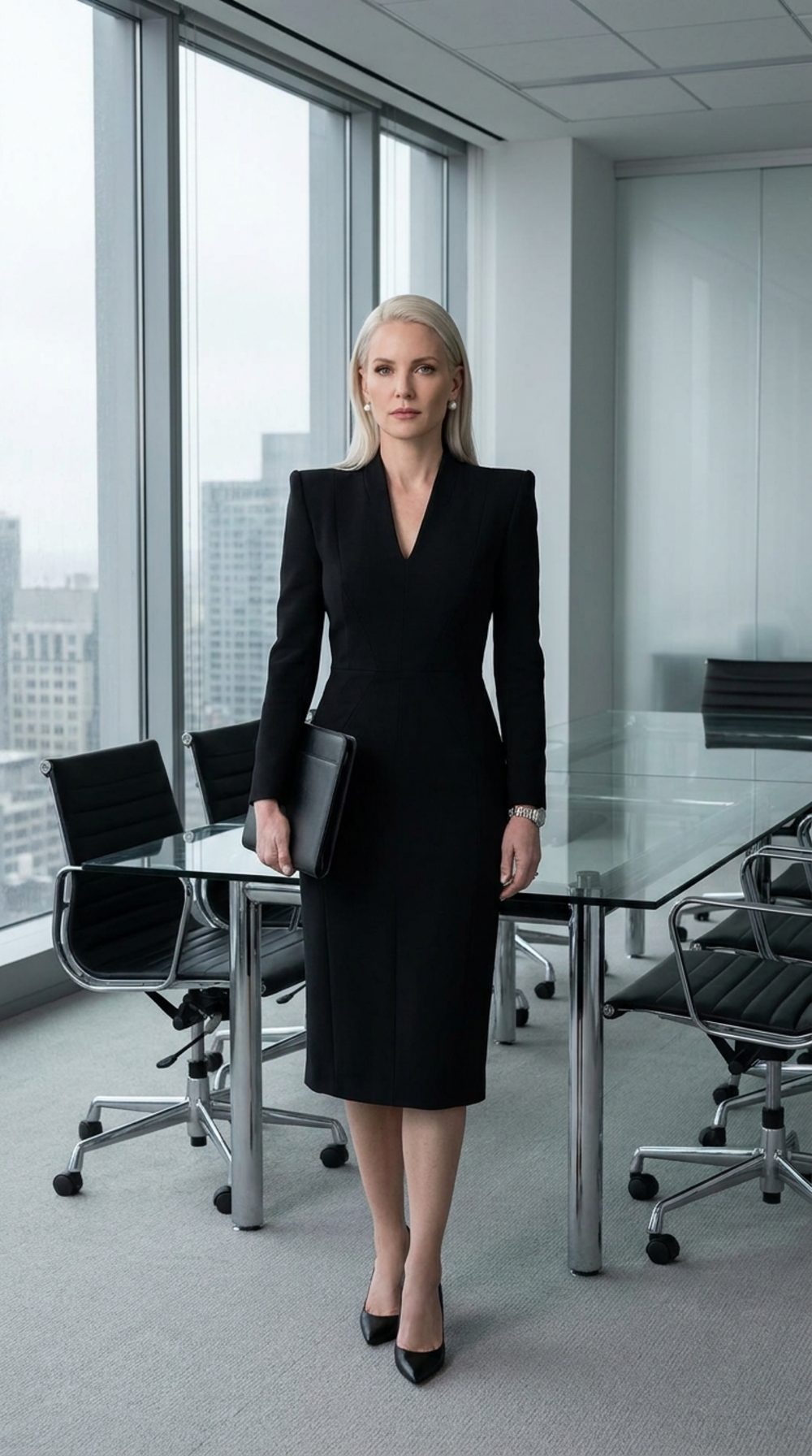
19. Head of the Table in a Shoulder That Means Business
❤️ Would you like to save this?
The shoulders are doing everything. Remove that structured pad and this is a nice black dress. Add it back and she’s the person who decides when the meeting ends.
A sharp-shouldered black dress in suiting-weight fabric reads as a suit without the second piece — the V-neck opens the chest just enough to soften the formality, and the straight skirt keeps the line clean from shoulder to knee. No belt. No detail. The proportional play between the wider shoulder and the narrow hem creates an inverted triangle that photographs as command from across a glass table.
Everything else stays quiet. Pearl studs, a slim watch, a black pump. The restraint here isn’t about being small. It’s about leaving no loose thread for anyone to pull.
18. White Peonies and Morning Light at the Flower Market
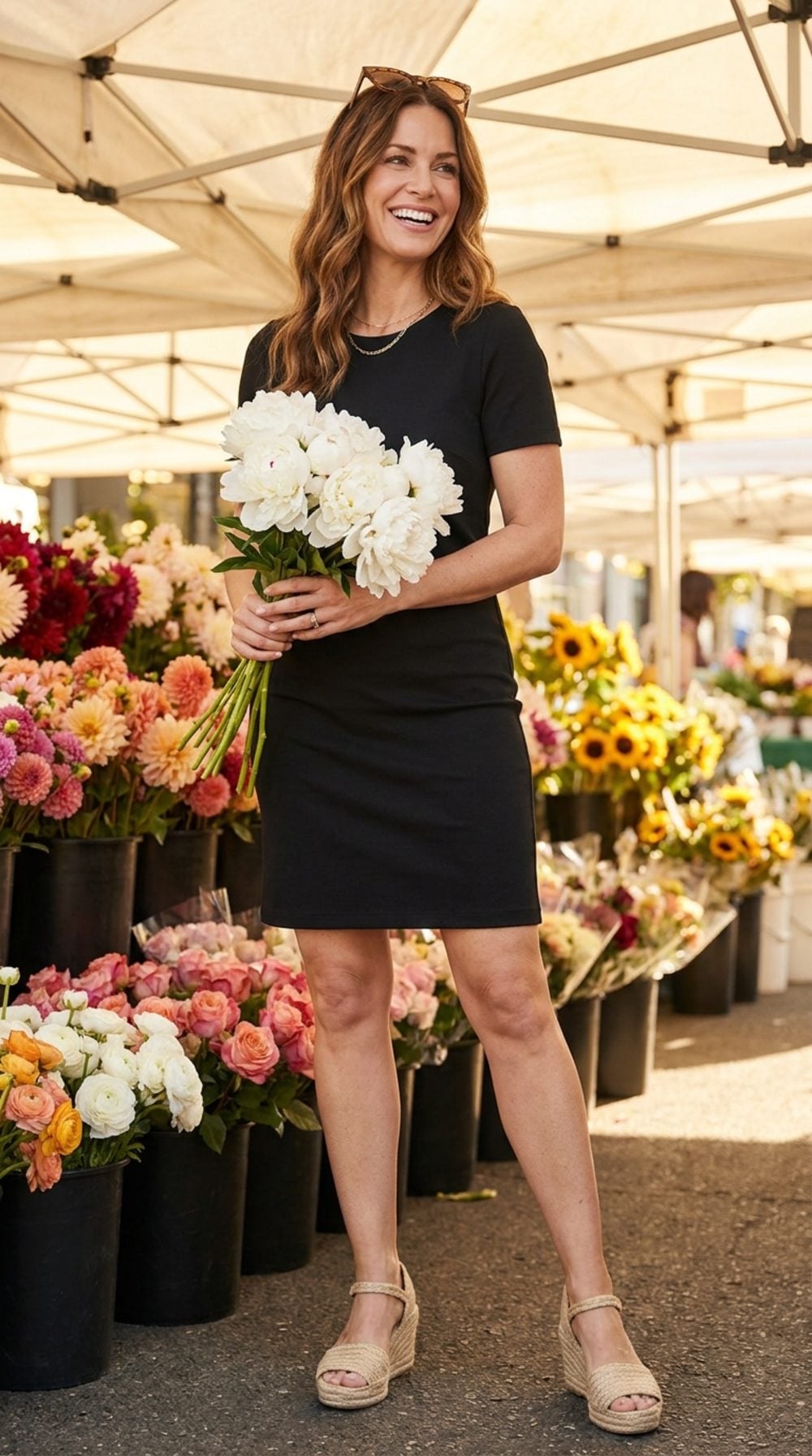
What black does that no other color can: it vanishes. Not sadly. The way a good frame vanishes around a painting. A fitted black ponte dress at a flower market becomes negative space, and every peony, dahlia, and ranunculus behind her gets louder because of it. She slots into the composition instead of competing with it.
The simplicity is strategic. Crew neck, short sleeves, just-above-the-knee hem. Nothing clever. Espadrille wedges in natural jute keep her grounded — literally, visually. And that white bouquet against the black bodice? Painters have understood this for centuries: the highest contrast in the frame is where the eye goes first.
17. Concrete Wall, Leather Jacket, Arms Crossed Like She Means It
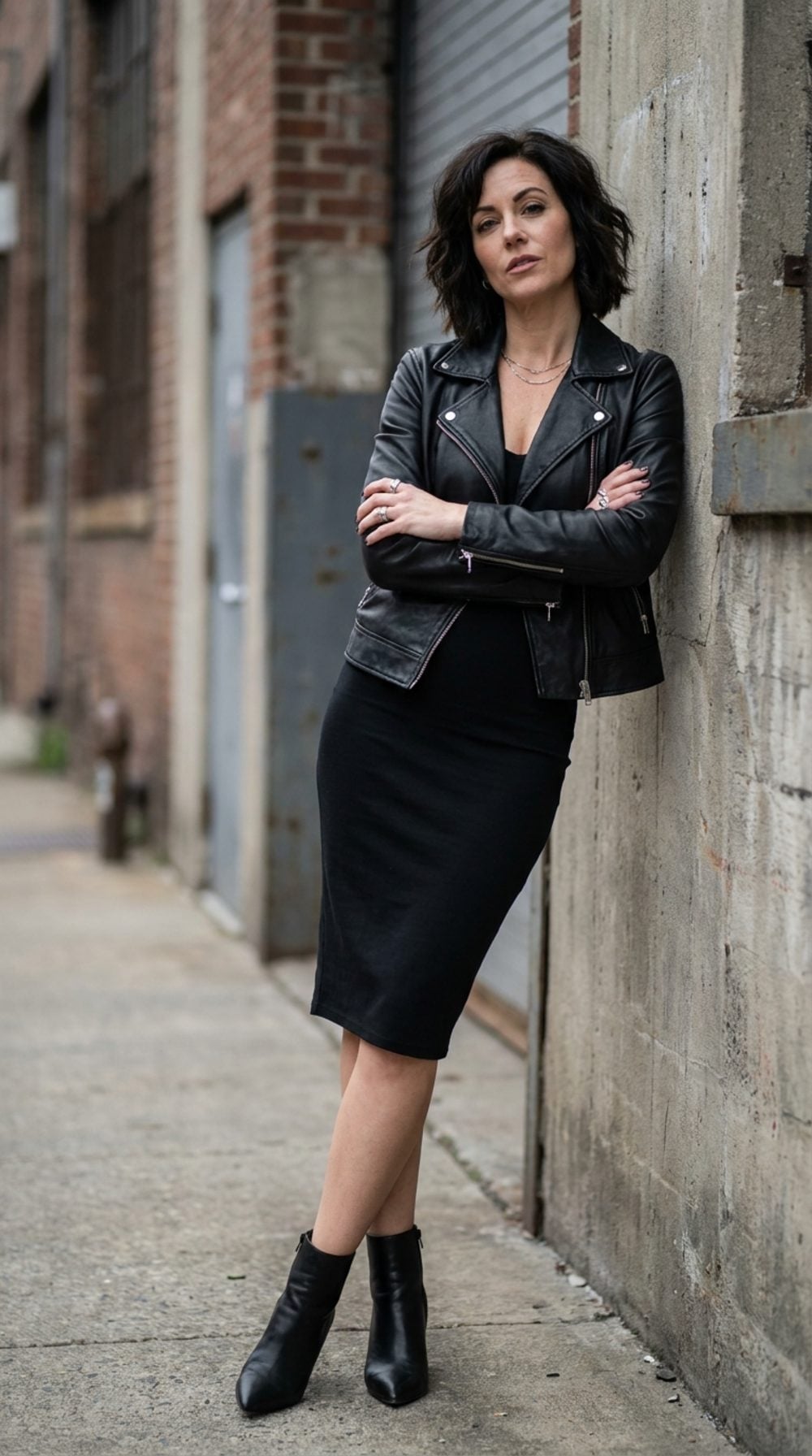
Same dress. Add a leather moto jacket and the whole personality shifts. The fitted black dress underneath shares a silhouette with the boardroom version a few outfits ago, but the language is completely different — suiting fabric says authority, while leather and silver hardware say she doesn’t need to say anything at all.
Texture contrast is the engine here. Smooth matte jersey against grained leather, that friction between two blacks keeping a monochrome outfit from reading as a uniform. Black pointed-toe ankle boots with a stacked heel sharpen the silhouette at the bottom. Silver rings, a thin chain, the jacket’s own zippers — every hard surface is small and deliberate.
Crossed arms with a moto jacket aren’t defensive. They’re decorative. The jacket falls better that way.
16. White Sneakers and a Cathedral: The Wrap Dress Goes to Europe
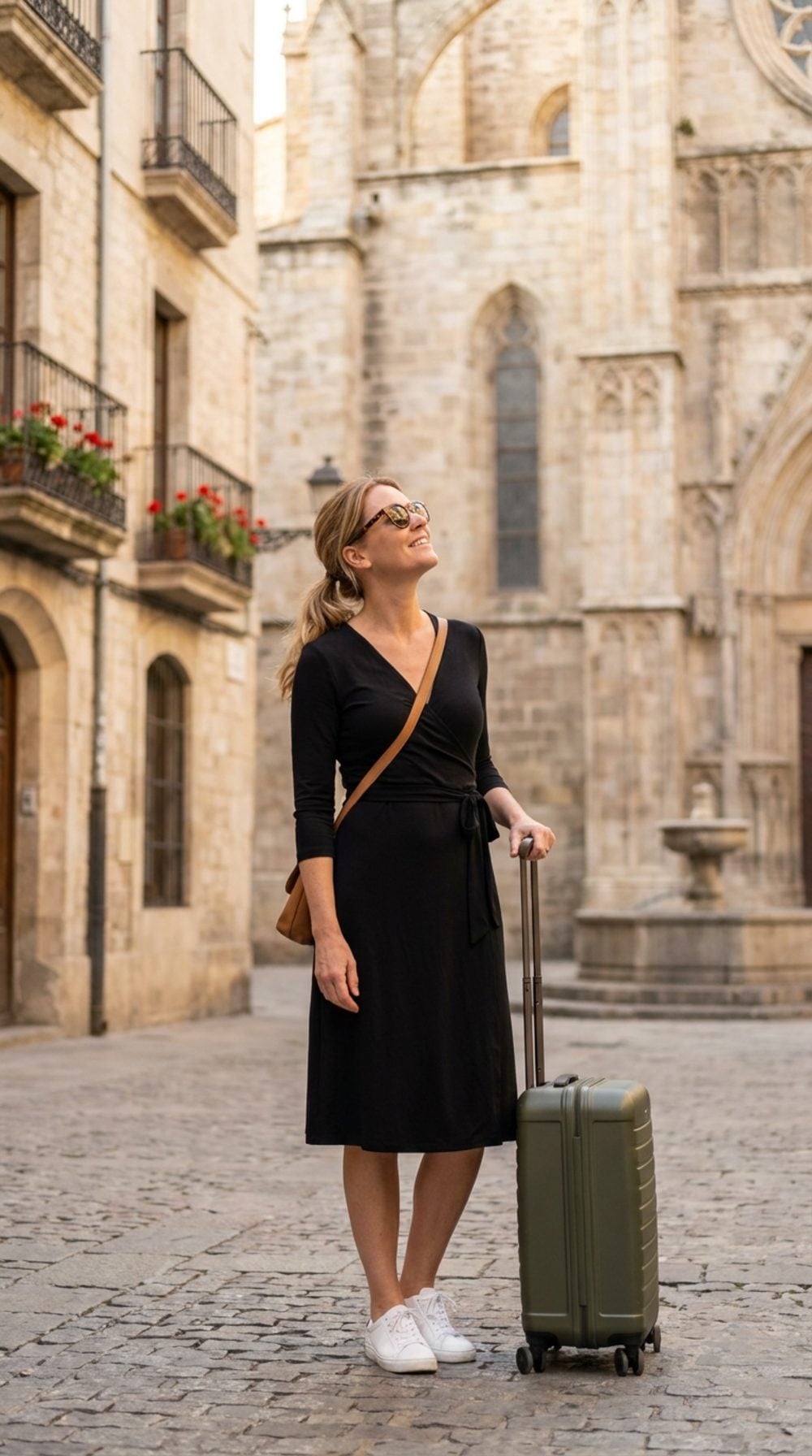
White sneakers change everything. The same wrap dress that sat in a waiting room three outfits ago now walks all day across cobblestones without asking for a blister, and that’s the test of a real anchor piece — it doesn’t just survive context changes, it invites them.
The three-quarter sleeve pushed up to the elbow is a small decision that does real work: it shortens the visual line of the arm, makes the whole look less “dressed” and more “living.” The tan crossbody bag sits flat against the body, keeping hands free for gelato and cathedral doors. And white leather sneakers against black jersey? That’s the single highest-contrast point in the outfit, pulling the eye down and anchoring the whole silhouette.
15. Ice Cream from the Carton at Midnight in Silk
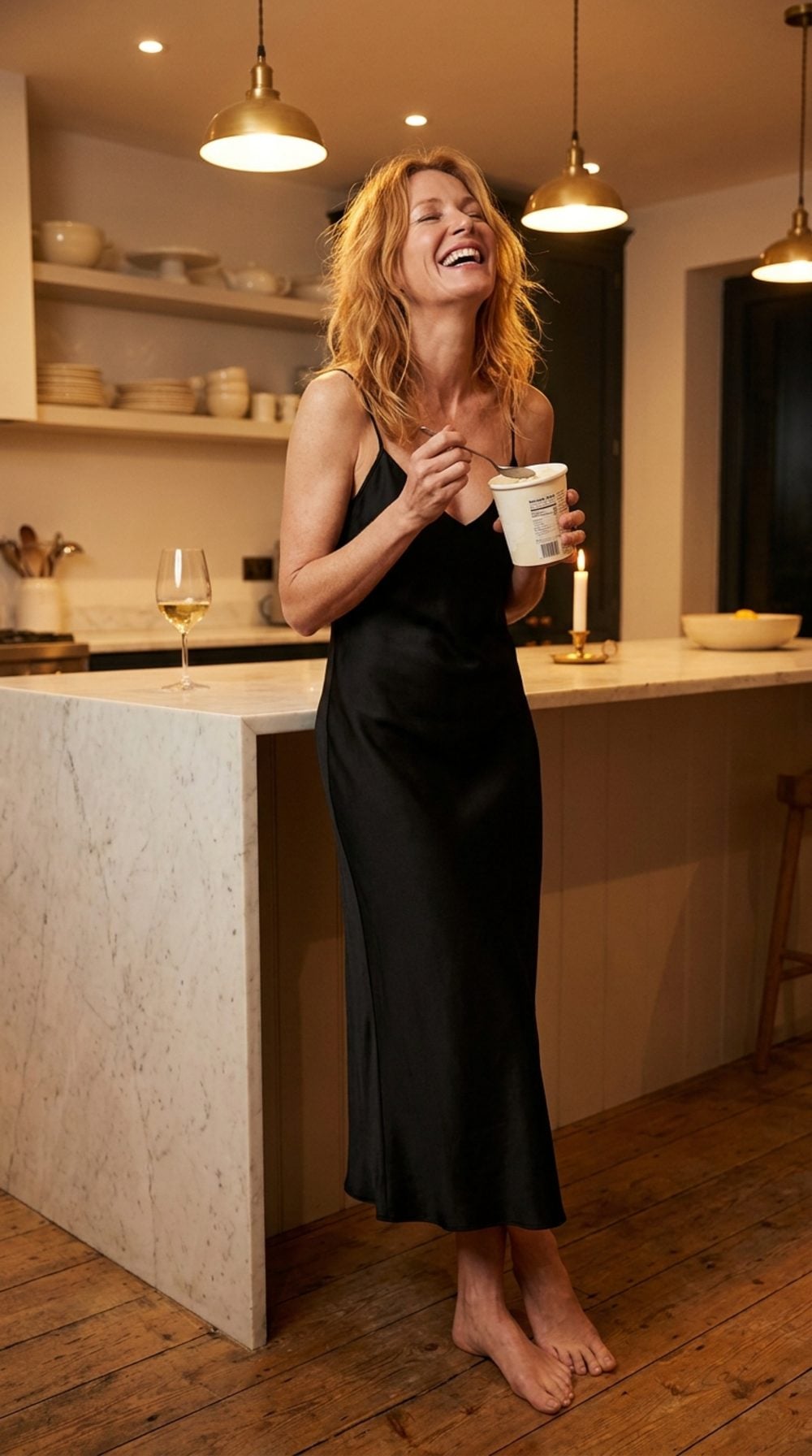
Nobody wears a slip dress to eat ice cream alone at midnight. That’s exactly why she should.
A black silk slip dress on bias cut moves like liquid — it doesn’t hold structure, it holds the body’s own shape and forgives everything around it. Barefoot on hardwood, hair down, a spoon instead of a fork. The formality of the fabric against the complete informality of the moment is what makes it. Silk says occasion. The carton says the occasion is hers.
There’s a psychological concept called enclothed cognition: what you wear changes how you feel, even when nobody sees it. Wearing something beautiful for no audience is a form of self-recognition. Worth the good fabric on a Tuesday? Yes. Always.
14. The Doorway Entrance in a Dress with Nothing to Hide
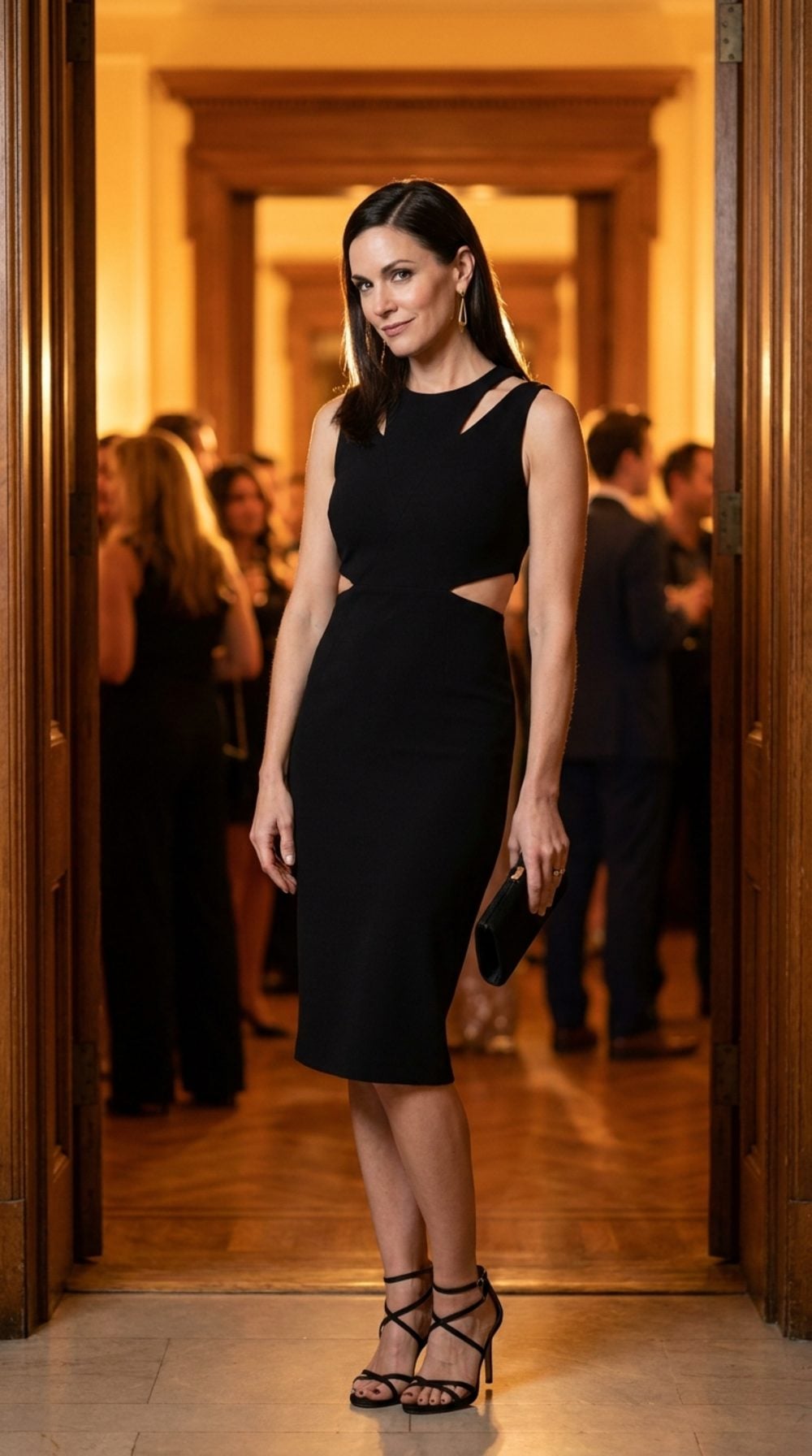
What a Cutout Actually Does
Cutout details on a black dress after 40 get treated like a confession. They’re not. A geometric opening at the shoulder and a slim reveal at the waist do what a window does in a wall: they break a solid plane and let light in. The black crepe dress stays structured, the cutouts stay small, and the effect is that she chose exactly how much to show — and where.
The threshold framing matters here. Backlight creates a silhouette before anyone registers the details, so she’s a shape first, then a dress, then the cutouts. The reveal happens in stages, which is frankly more interesting than seeing everything at once. Gold drop earrings and strappy black sandals finish a look that walks into a room like it belongs there. Because it does.
13. Golden Afternoon Joy: The Classic Black Dress Worn with Pure, Reckless Laughter
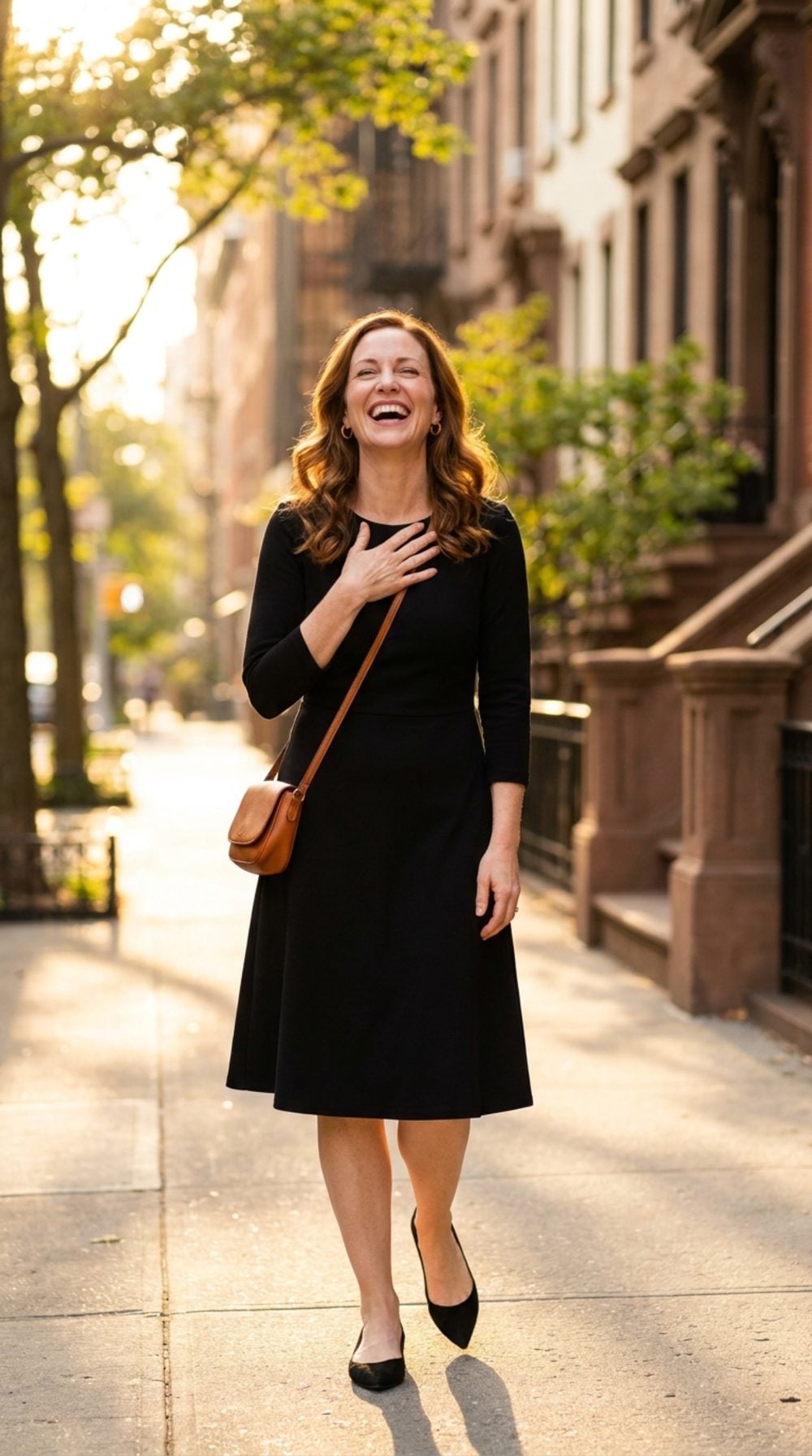
Forget the accessories for a second. Look at the body language — hand over heart, head thrown back, laughing like she stopped caring who was watching. That’s the outfit. The classic black sheath dress is the canvas, but the woman wearing it is the whole painting.
On a pure style level, what makes this sing is a dark column silhouette against warm golden light with nothing competing: no prints, no heavy jewelry, nothing yanking focus from her face. Fitted enough to hold structure, loose enough that she can throw her arms wide or break into a run if she feels like it.
The dress doesn’t hold her. She holds the dress.
12. The Blazer-as-Dress Power Move in a Minimalist Loft
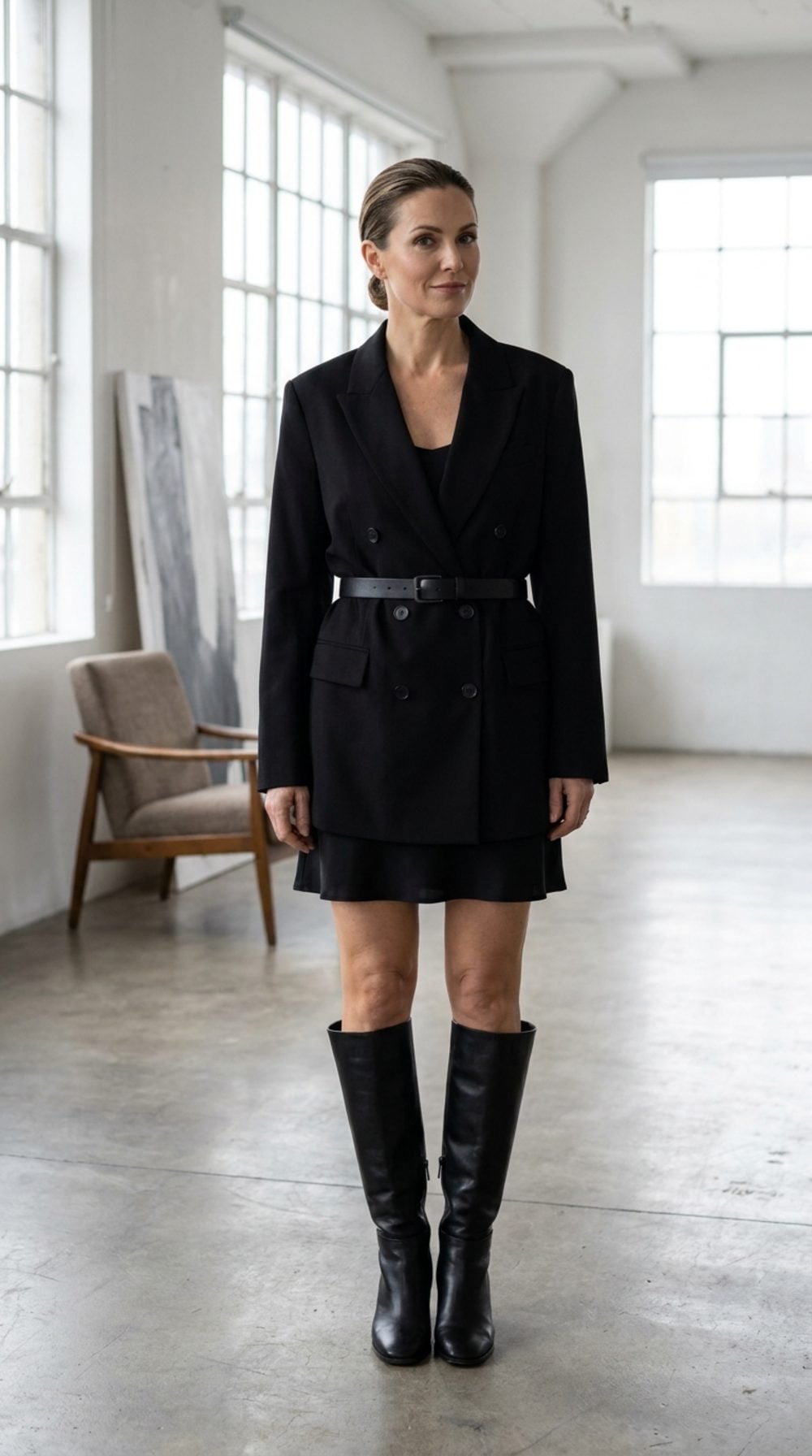
One piece doing two jobs — that’s the whole trick. A black oversized blazer belted hard at the waist stops being outerwear and starts being the dress. The LBD is still there underneath, barely visible, lending just enough length below the blazer’s hem to keep proportions honest. But visually? The blazer runs this show.
Black knee-high boots close the gap between hemline and floor, building one unbroken dark column from shoulder to toe. That vertical sweep reads tall, reads intentional. The belt provides the only interruption — and that waist definition transforms a boxy blazer into an hourglass silhouette nobody saw coming.
11. Post-Yoga Glow: A Flowing Black Dress and the Calm She Built Herself
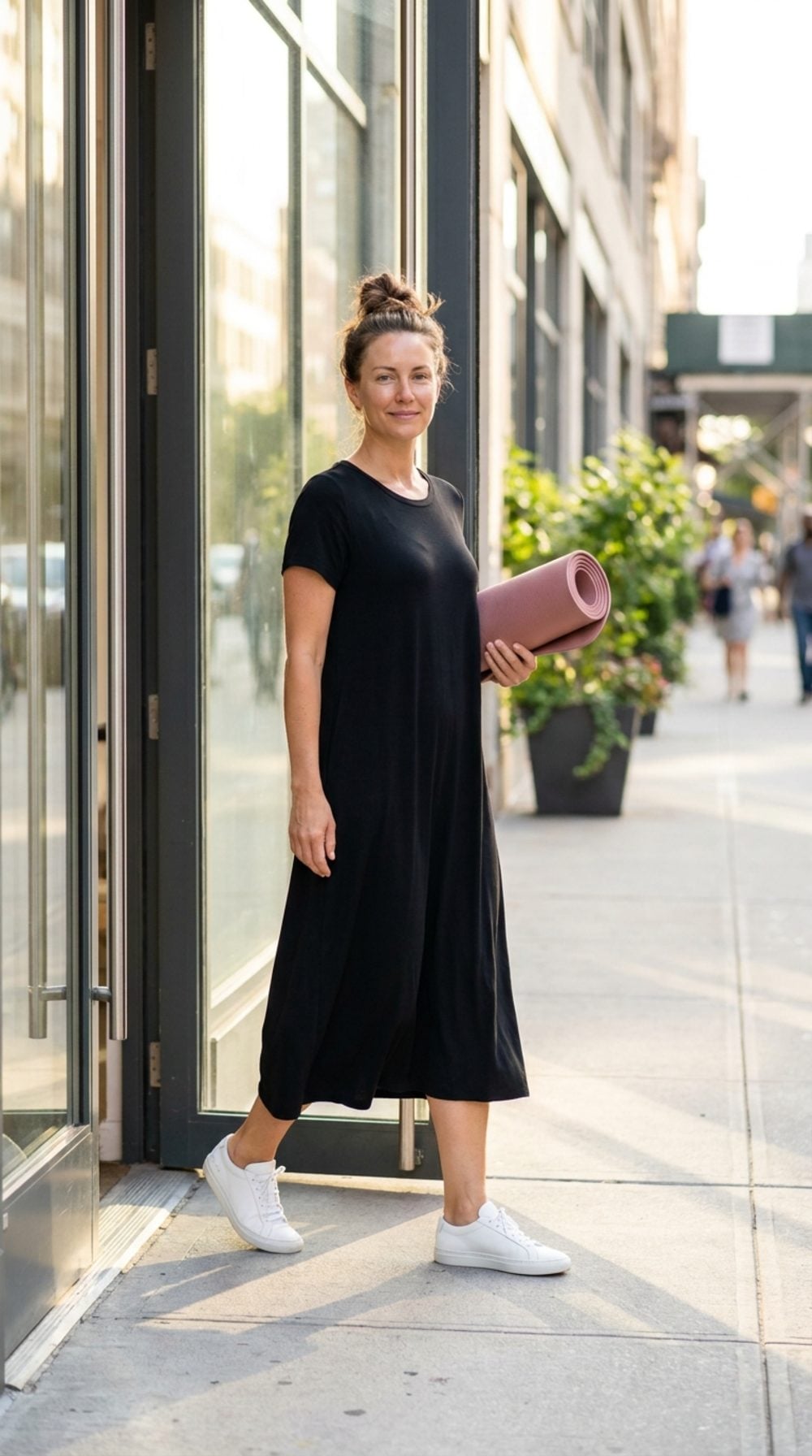
The yoga mat under her arm does more styling work than any handbag could. It reframes the entire dress — cocktail becomes casual, polished becomes lived-in, trying becomes being. A flowing black jersey dress with enough drape for a sun salutation and enough structure to walk into a coffee shop afterward without changing. Athleisure for a woman who doesn’t do logos.
Clean white sneakers ground it. No jewelry. Flushed cheeks from breathing on purpose for an hour and a half. The color story is just black and skin, and that restraint is doing all the heavy lifting.
10. Pearls Before the Mirror: The Bedroom Ritual She Never Had Permission For
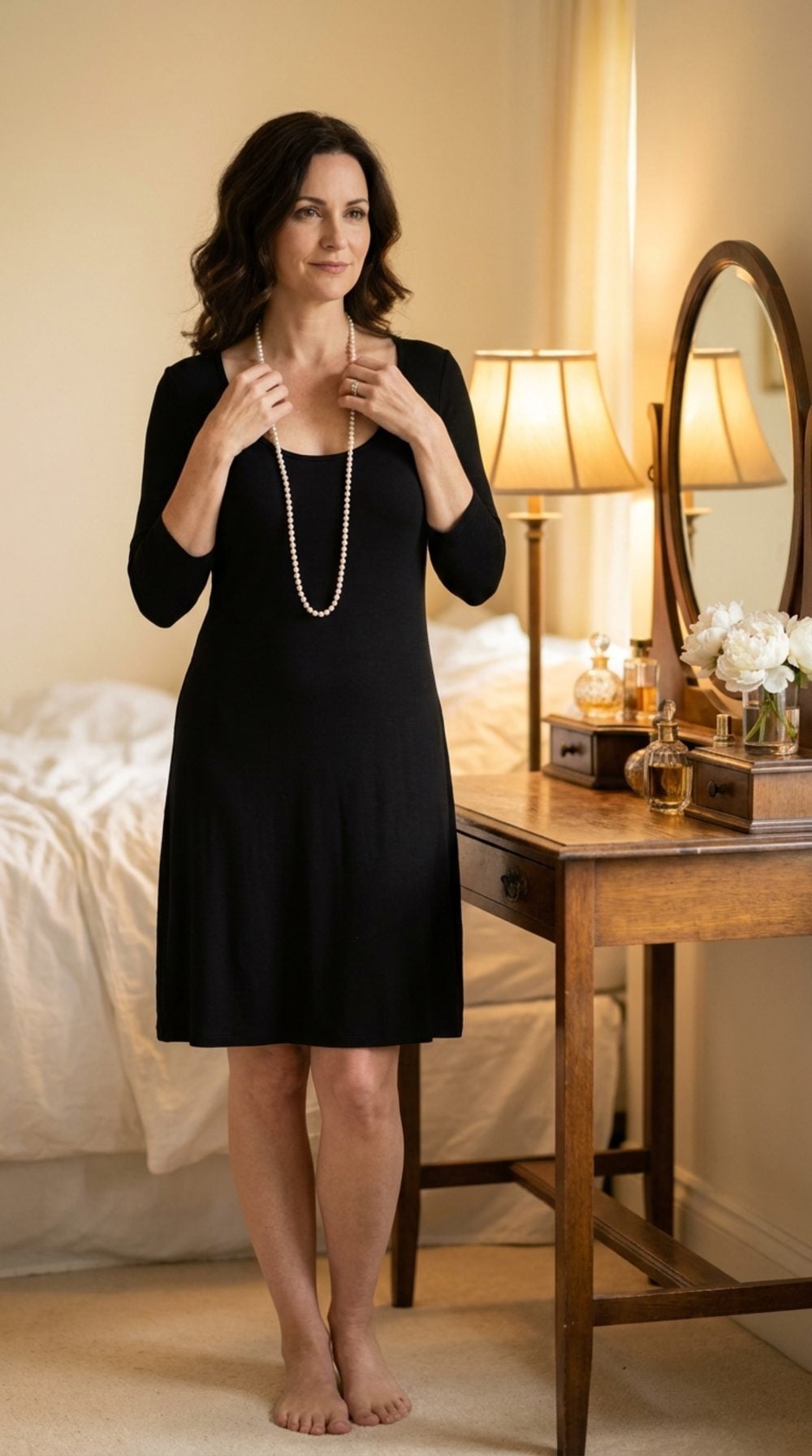
Nobody’s coming over. Nobody needs to approve. She’s standing at her own vanity draping a long lustrous pearl necklace over a simple black jersey dress because the weight of real pearls against fabric feels like something worth noticing on a Tuesday.
What drives the look is the contrast between casual jersey and formal pearls. Jersey is soft, matte, forgiving — pearls catch light, feel cool against the collarbone, carry deliberation in every bead. Worn long and undoubled, they pull the eye down the center of the body and elongate the silhouette without a single structural trick.
Bare feet on a warm floor. Tender expression in lamp light. The vanity behind her isn’t staging. It’s permission.
9. Autumn Park Walk in a Tan Trench: The Season She Started Over
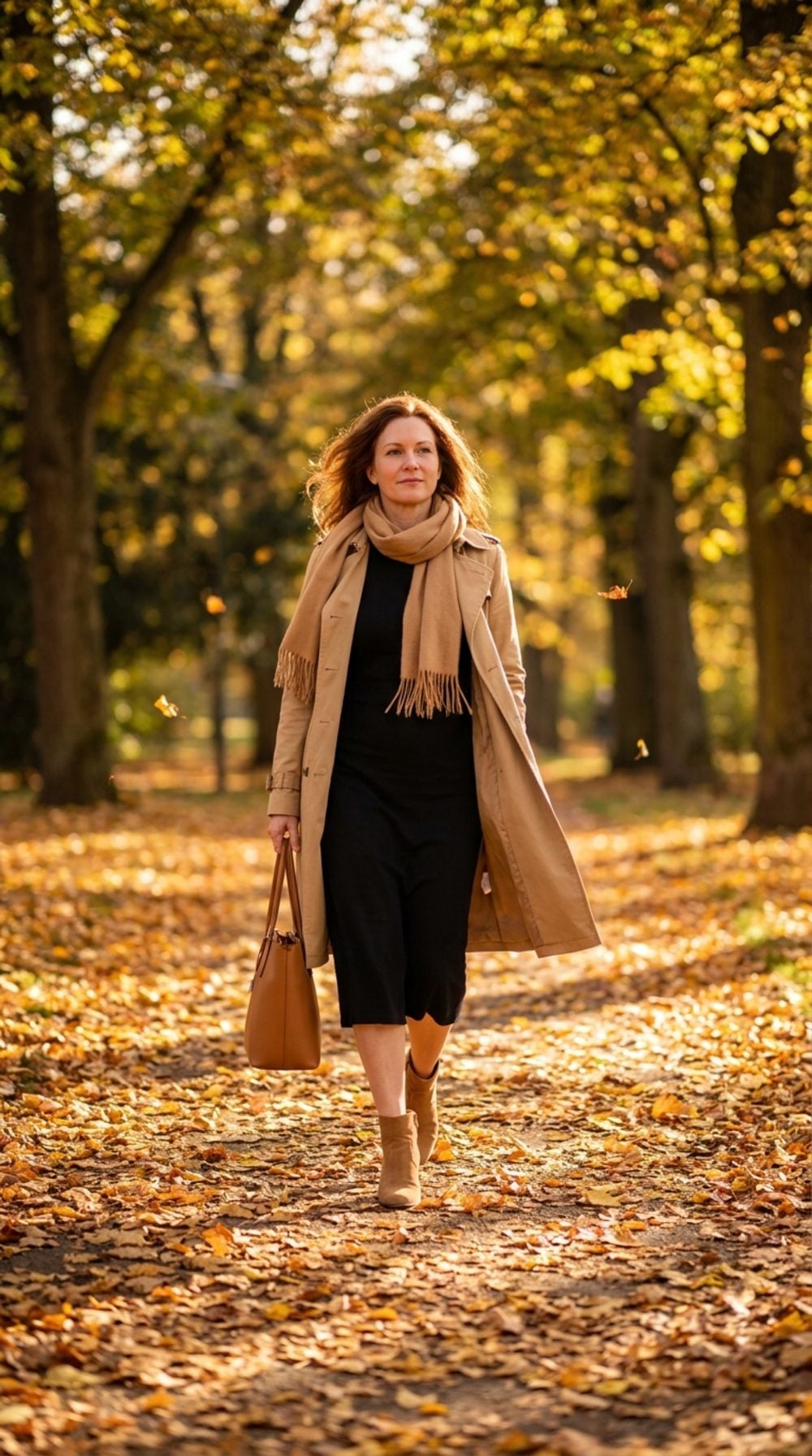
Two neutrals. That’s the whole palette. A tan trench coat hanging open over a mid-length black dress creates a frame within a frame — structured cotton on the outside, soft jersey underneath, and the friction between them makes both pieces sharper than either would be alone.
A camel wool scarf looped loosely at the neck introduces a third texture without adding a third color. Matte trench cotton, soft knit scarf, fluid dress jersey — three fabrics sharing one tonal range. That layered restraint is honestly the quietest, most effective move in autumn dressing. Nobody notices it. Everybody feels it.
8. Museum Contemplation in a Draped Neckline: Art Meets the Woman Who Became Her Own
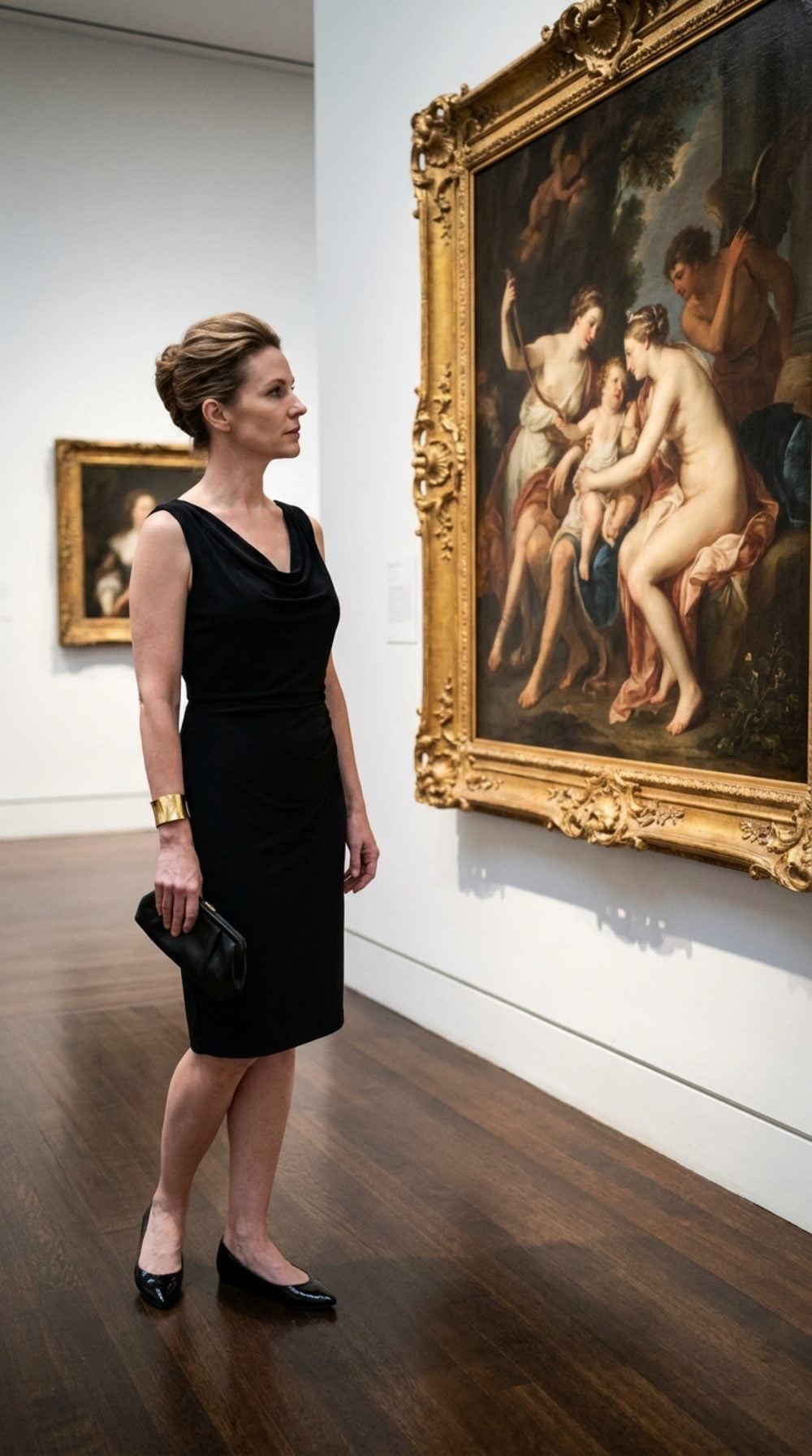
The draped neckline is doing everything here — echoing the classical folds in the painting behind her, creating a visual conversation between dress and art that most people feel before they consciously register it. Draping reads softer, more sculptural, more considered than a crew neck or a V-neck. It just does.
No loud accessories competing with a Caravaggio. One gold cuff bracelet. Pointed-toe flats in black patent. Hair swept up to expose the neckline. Every choice follows the same discipline: let the dress and the woman and the art share the frame without anyone shouting over anyone else.
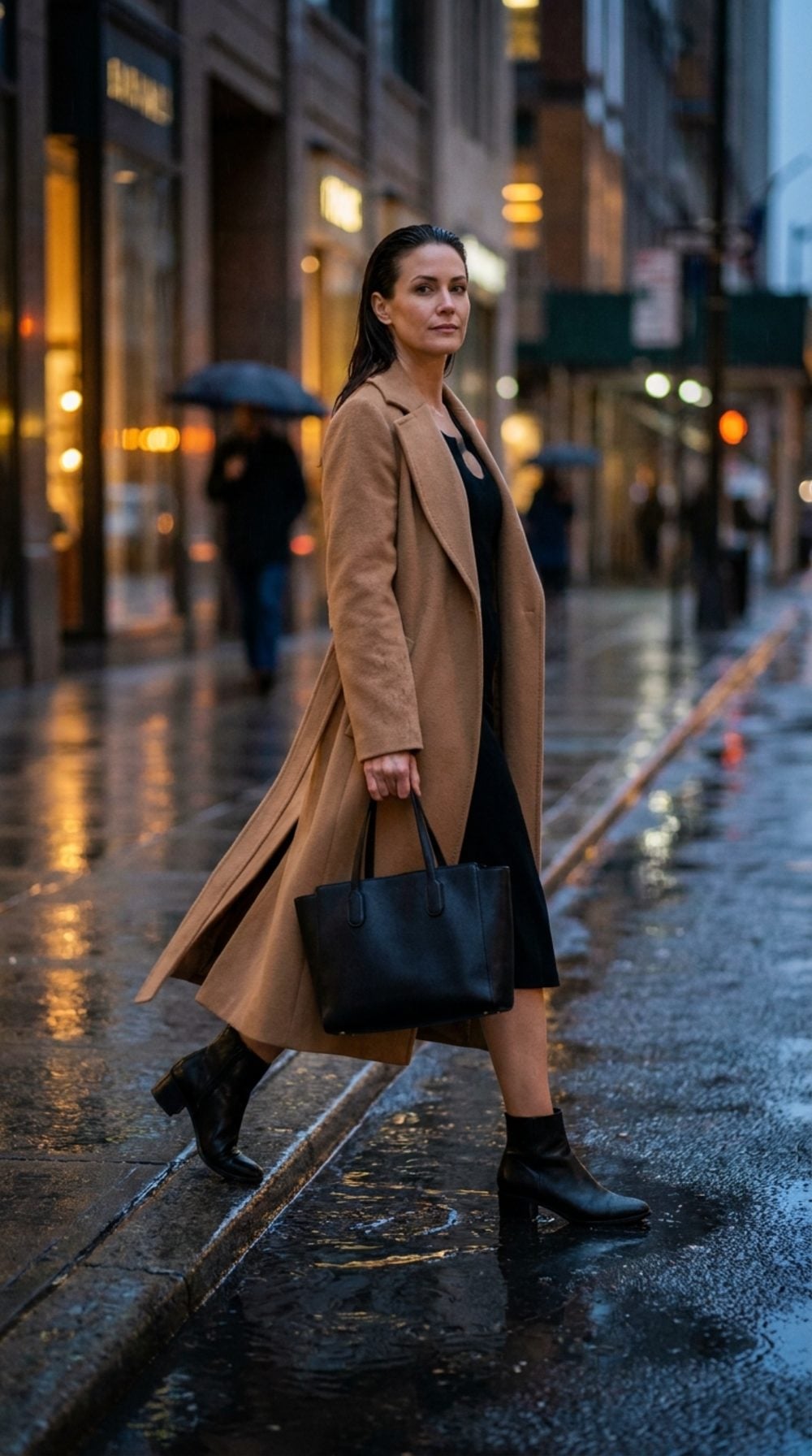
7. Rain-Slicked Confidence: A Camel Coat Over Black on a City Street That Knows Her Name
❤️ Would you like to save this?
Shoulders back. That’s the styling tip, and it costs nothing. A sweeping camel wool coat over a black dress in the rain is already a strong look, but posture turns it into a photograph. The coat’s length and weight give the silhouette a sense of sweep and forward motion — the kind of outfit that looks like it’s headed somewhere important even if the destination is just home.
Wet pavement reflects city light upward, which is why rain flatters dark clothing so absurdly well. The black dress practically glows against the sheen of the street. And no umbrella? That reads as unbothered rather than unprepared. Deliberately so.
6. Moving Boxes, Rosé, and a Black Dress: The First Night in the Apartment That’s Only Hers
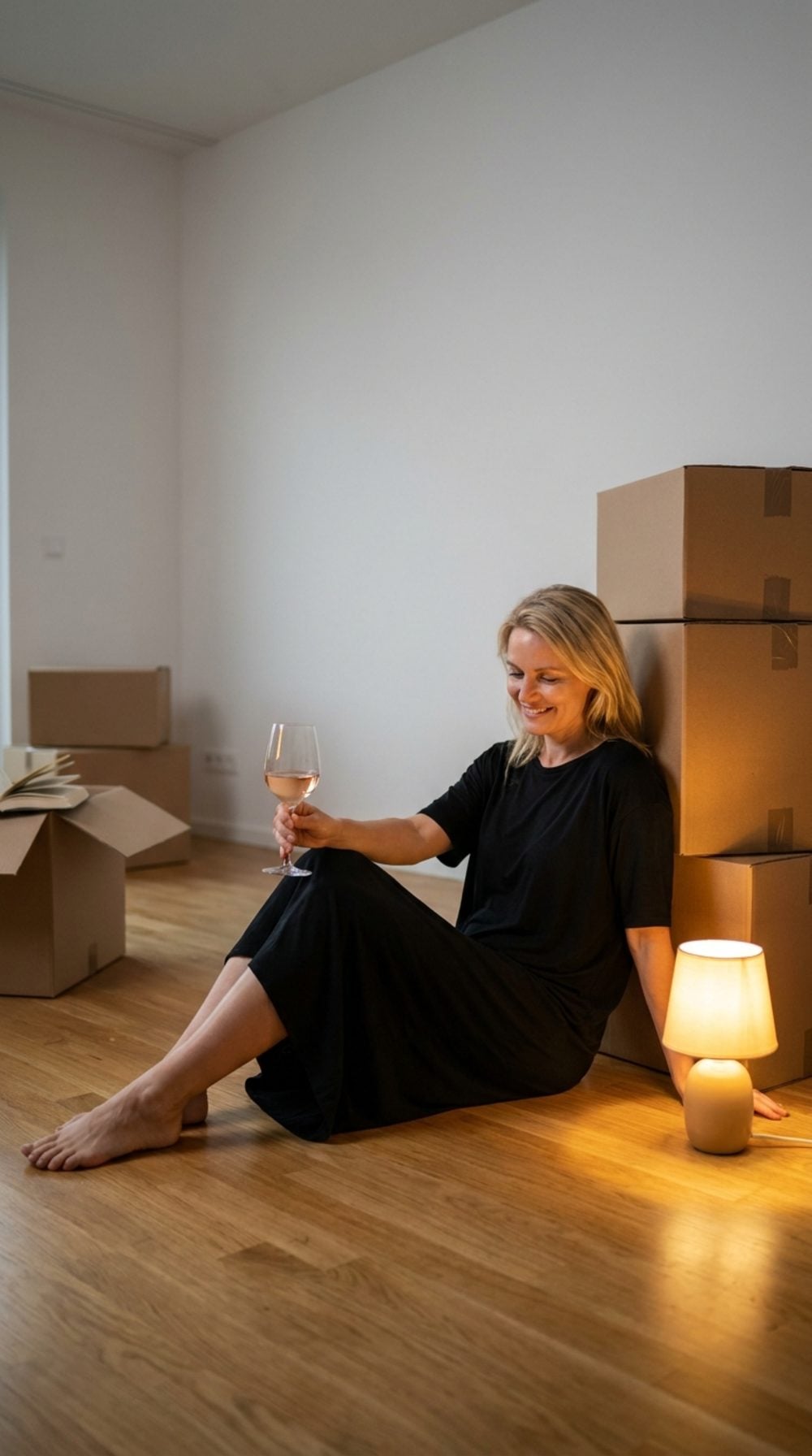
She’s sitting on the floor. That matters.
No furniture yet, no arrangement, no performance of a finished life — just cardboard boxes, bare walls, one lamp plugged into the only outlet she’s found so far, and a glass of rosé held like it’s the first drink she’s ever poured in a place where every single decision belongs to her.
The relaxed black jersey dress is crumpled around her knees. Same dress from the museum, from the rain, from the park — but here it’s just fabric, comfortable, worn soft. Nothing about this moment is styled, which is exactly why it might be the most honest outfit in the entire collection.
I say this as someone who has moved alone more than once: the first night is always this. Bare floors, bad lighting, and the sudden quiet awareness that the silence belongs to you.
5. Grand Staircase Descent in Floor-Length Black: The Gala She Attends as the Woman She Always Was
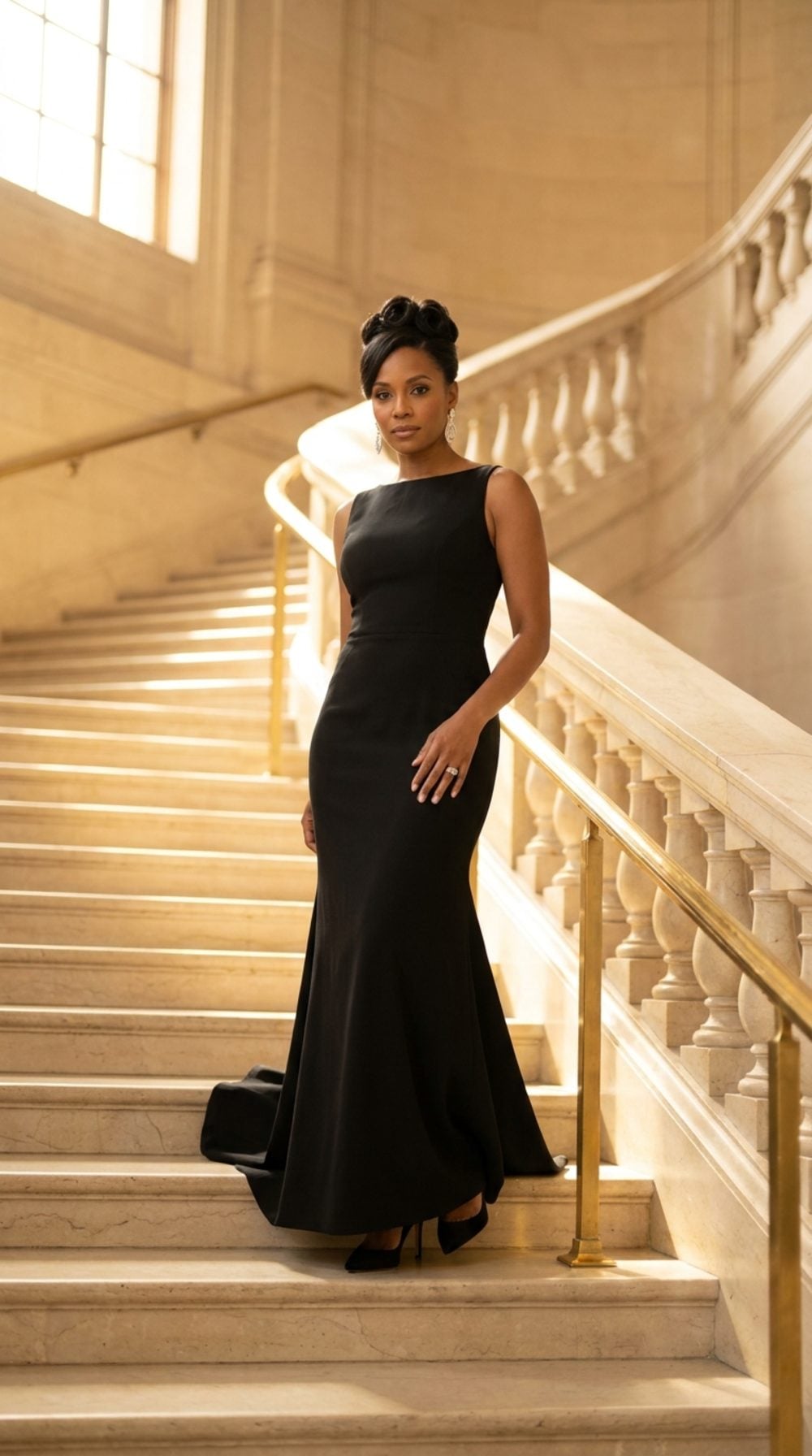
A floor-length black gown with a subtle train is a commitment. It doesn’t multitask. It doesn’t do brunch. What it does is walk into a room with the kind of authority that makes everyone in it quietly rearrange themselves.
Diamond drop earrings catch the overhead light and throw it back. Hair swept up, neck bare, the column running from shoulder to floor without interruption — tall, certain, the look of someone who chose this gown and never wavered. No second-guessing. No backup option hanging in the hotel closet.
But the expression is what sells it. She’s not smiling for the camera, not performing gratitude or sweetness. Calm. Formidable. The face of a woman descending a staircase she built for herself.
4. The Sealed Letter: Writing the Goodbye He Never Deserved to Read
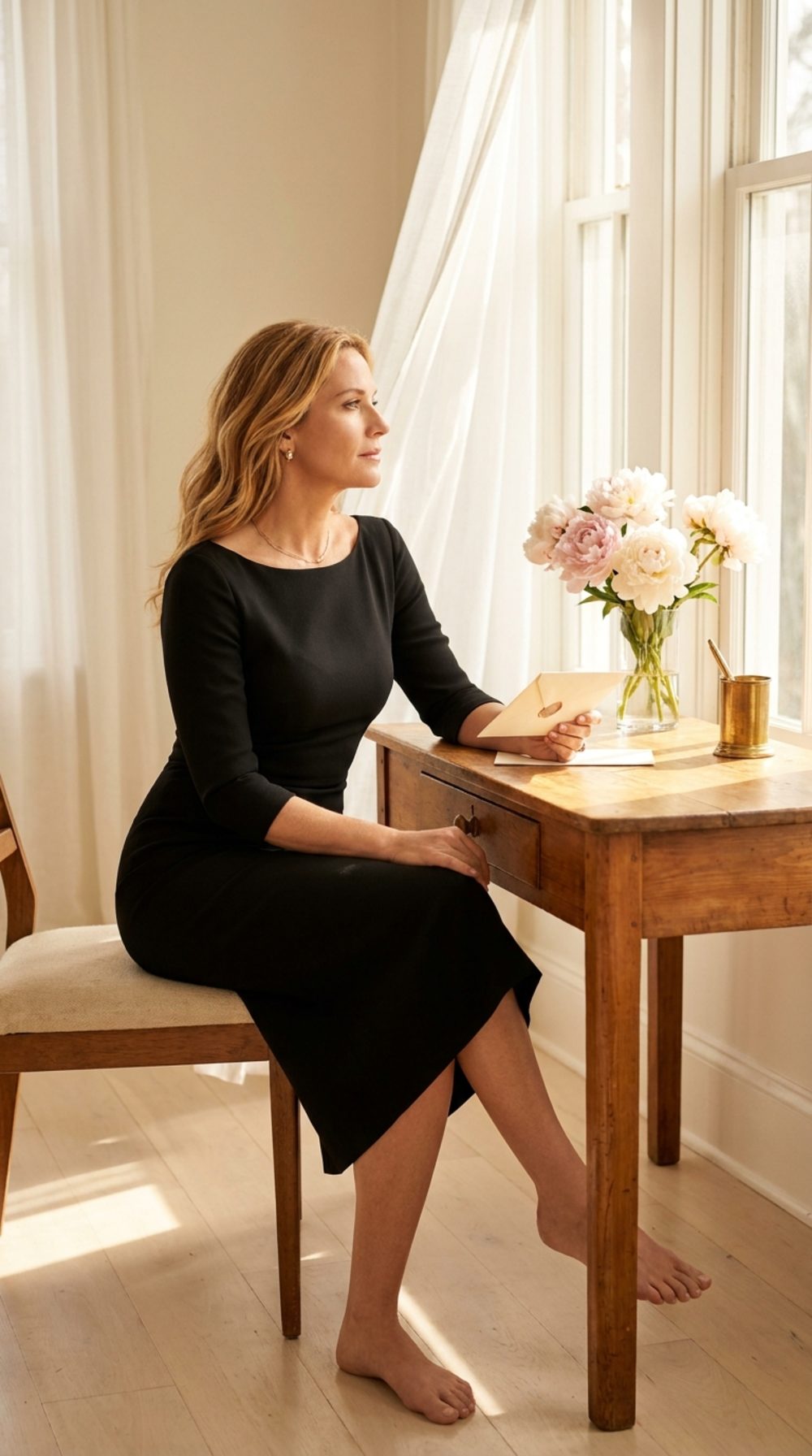
The fitted silhouette is doing quiet, deliberate work. A black crepe dress with a boat neckline and three-quarter sleeves creates a clean column — composed, never rigid. Nothing fussy. The matte fabric absorbs light rather than bouncing it back, which keeps the mood grounded even as morning sun fills the room.
A single thin gold chain at the collarbone. Bare feet on pale wood. That’s the whole accessory story, and the restraint is doing all the talking. She isn’t dressing for anyone’s approval — she’s dressing for the morning after she stopped asking for it.
3. Saturday Market in Linen: Buying Flowers for Your Own Table
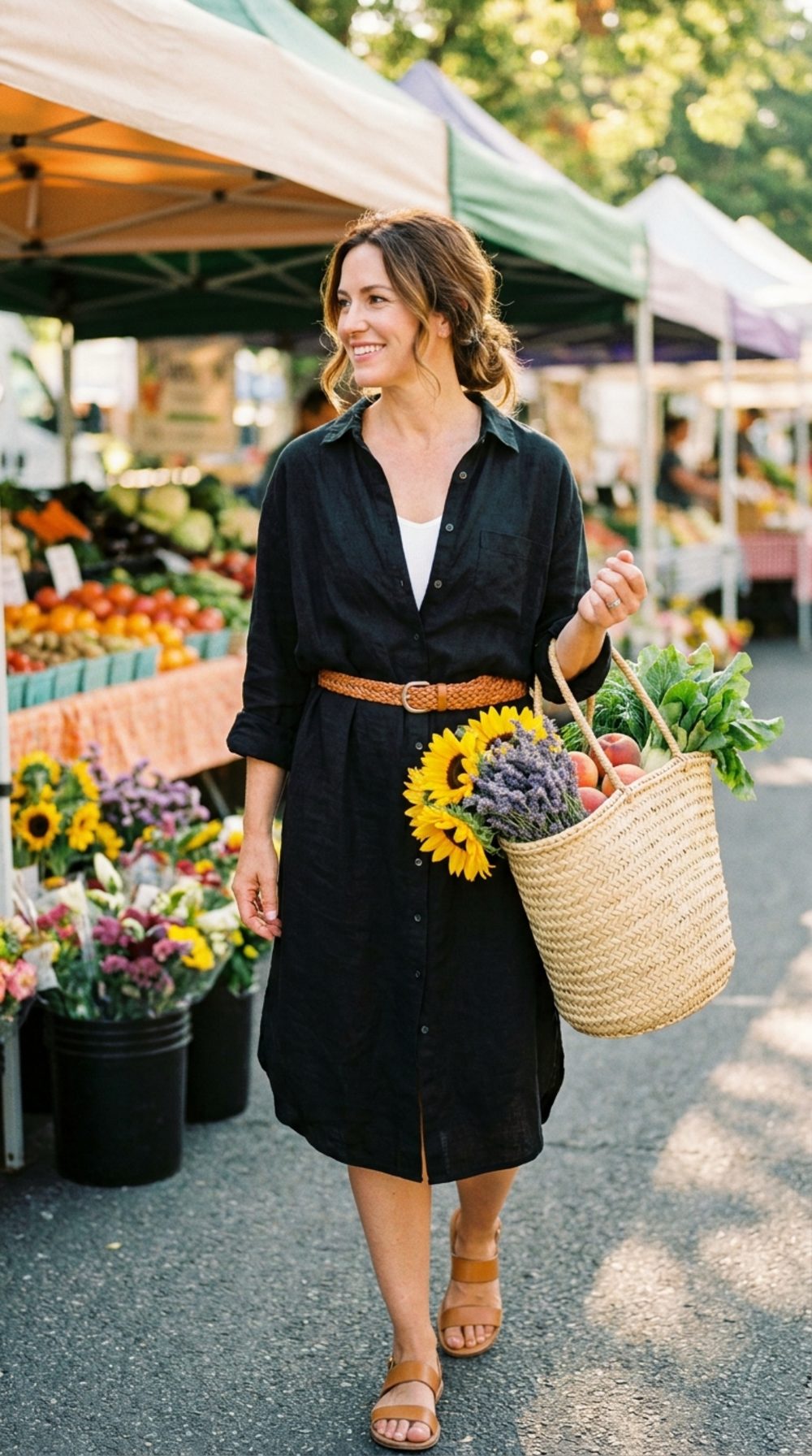
Roll the sleeves, undo two buttons, add a tan woven belt, and you’ve got a completely different dress. The same black fabric that looked like quiet ceremony at the writing desk now reads as Saturday ease — slightly oversized, slightly wrinkled on purpose, borrowing authority from the color and giving back softness through texture.
The white camisole peeking through the open neckline breaks up the black without competing. Tan leather sandals and a woven straw basket pull everything toward warmth. Notice the color conversation: tan belt, tan sandals, straw basket. Three warm neutrals framing the black so it never turns severe.
Buying yourself flowers used to feel like a consolation. Now it just feels like knowing what you like.
2. Solo Cinema Night: One Ticket, No Explanation Required
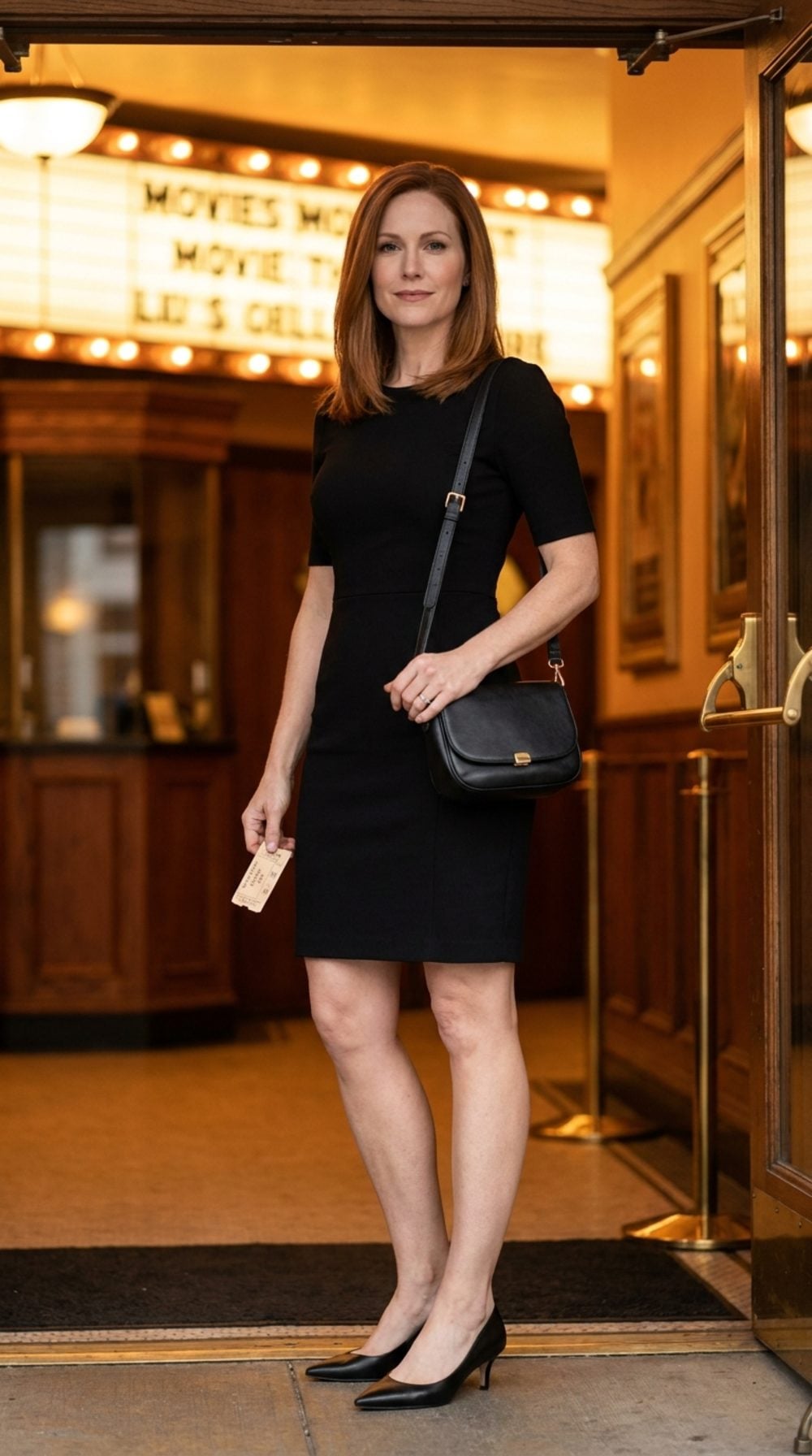
A square neckline on a black dress does something very specific: it makes the woman look like she made a decision. Not a scoop that softens, not a V that draws the eye down. A clean square that frames the collarbones and says, I’m here on purpose.
The small black crossbody keeps both hands free. Pointed kitten heels add just enough formality without the discomfort of a full heel. One gold bangle. Done.
Going to the movies alone used to feel like something that needed explaining. It doesn’t. You pick the film, you pick the seat, you don’t share the armrest. The style driver here is confidence — the dress is just what it happens to be wearing.
1. Golden Hour on the Hilltop: Arms Open, Finally Breathing
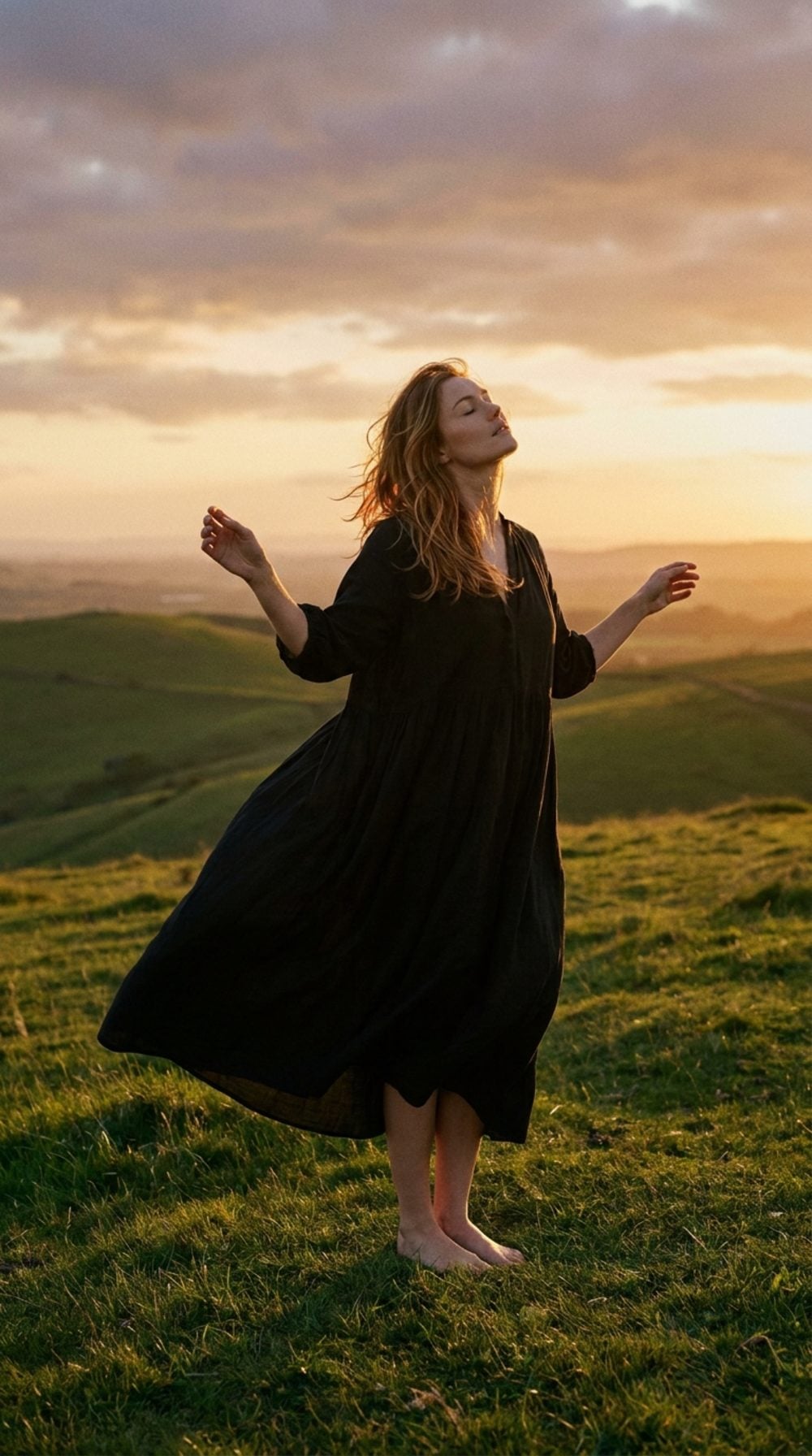
The fabric is doing everything. A fluid black midi with a fitted waist releasing into a full gathered skirt catches the wind and turns a woman standing still into something cinematic. Without the breeze? A pretty dress on a hill. With it, the entire image moves.
No shoes, no jewelry, no bag. Every accessory stripped away and the dress stands completely alone — which is the real test of any wardrobe investment piece. Can it carry a moment with nothing helping it?
This is the image at the end of the story. Not the beginning, where you bought the dress. Not the middle, where someone told you it was too much, not enough, wrong somehow. The end. Where you stand in the last golden light wearing the thing he criticized, and you are not thinking about him at all.