
❤️ Would you like to save this?
The charcoal lighter fluid smell hit you before you even opened the screen door. Somebody’s dad had Creedence on the hi-fi turned up loud enough to bleed into the yard, and your mother was out there in something polyester, something denim, something that made absolutely no sense for standing near an open grill. But she looked fantastic. She always did.
These ten pieces were the uniform of every backyard gathering between 1972 and 1979, and if you close your eyes, you can still see every single one.
FYI, thanks to AI imagery software, we’re able to create very specific fashion and hairstyle examples to illustrate the points being made. In some cases, imagery is exaggerated to hammer home the point. Also, assume links that take you off the site are affiliate links such as links to Amazon. this means we may earn a commission if you buy something.
28. High-Waisted Denim Shorts With the Braided Leather Belt That Never Came Off

That belt was doing triple duty. Holding up shorts that were already plenty snug, signaling that you owned at least one item from a leather goods booth at the county fair, and giving your outfit the one detail that separated “threw this on” from “I meant to look this good.” The braided leather belt lived on those high-waisted denim shorts permanently. It never moved to another pair of pants. It belonged to the shorts the way a ring belongs to a finger.
And the shorts themselves sat right at the belly button, which we now call “paperbag waist” and charge $90 for. Mom paid four dollars at Sears and cut them herself from a pair of Toughskins her brother outgrew. The fraying wasn’t a style choice. It was just what happened when you took pinking shears to rigid denim and then wore them every Saturday from May to September.
27. The Halter Top Tied Behind the Neck (Plus Those Oversized Sunglasses That Swallowed Her Face)
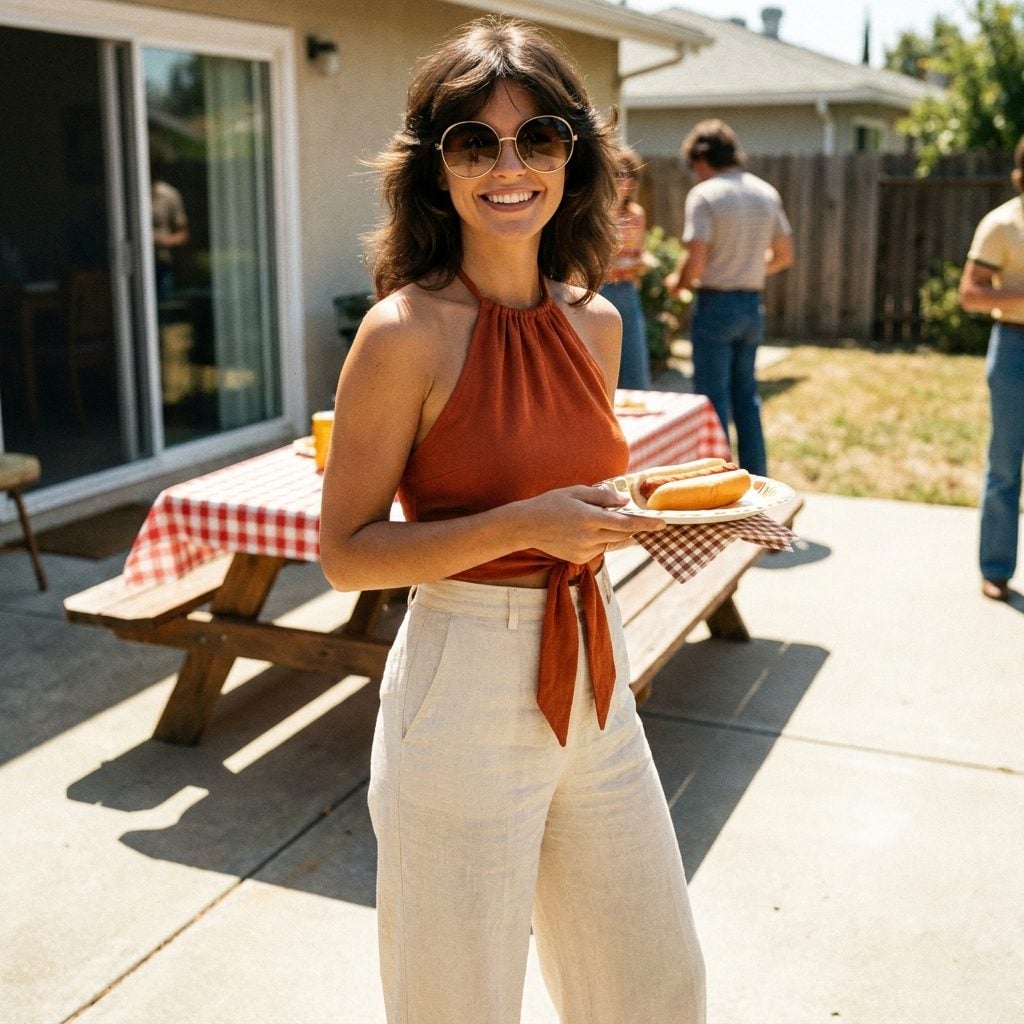
The knot at the back of the neck was a commitment. You tied it once and then spent the rest of the afternoon resisting the urge to adjust it because retying meant asking someone for help, and you were holding a paper plate of potato salad. The halter top was the official uniform of women who wanted to get some sun on their shoulders but weren’t about to wear a bikini top to a gathering where someone’s mother-in-law was present.
And those sunglasses. They covered roughly 40 percent of the face. They made everyone look like a slightly mysterious Italian actress, which was the entire point.
26. Platform Sandals Sinking Slowly Into the Lawn With Every Step She Took
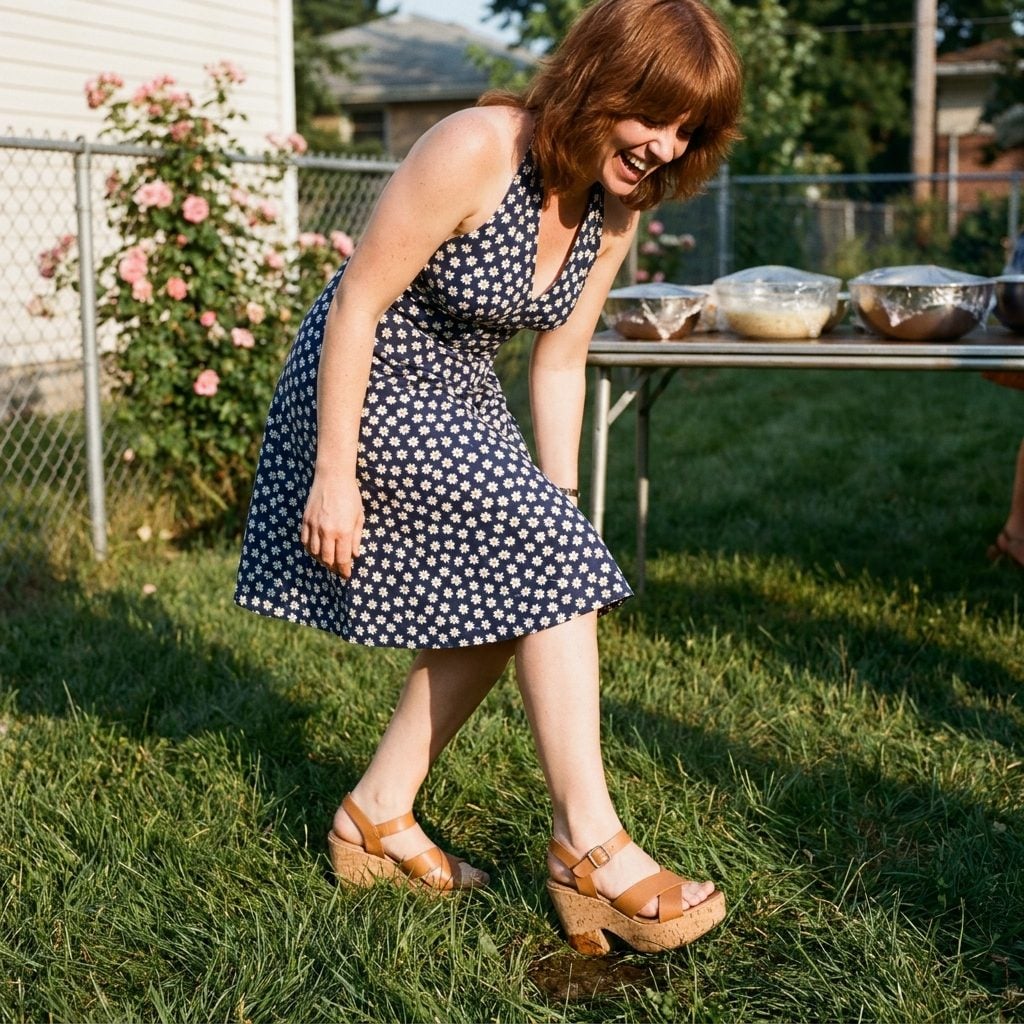
Nobody planned for this. You bought the cork platform sandals because they made your legs look incredible in the mirror at Thom McAn, and then you wore them to an outdoor party on actual earth, and with every step you sank a little deeper like you were being slowly consumed by the lawn.
By the end of the night there were little rectangular holes all over the yard. The host’s husband would find them the next morning while mowing and swear quietly to himself. Meanwhile, you’d spent three hours walking on your toes trying to stay above ground level, calves burning, pretending this was fine. It was not fine. But the legs did look great.
25. A Sleeveless Polyester Jumpsuit in a Geometric Print So Bold It Had Its Own Gravitational Pull
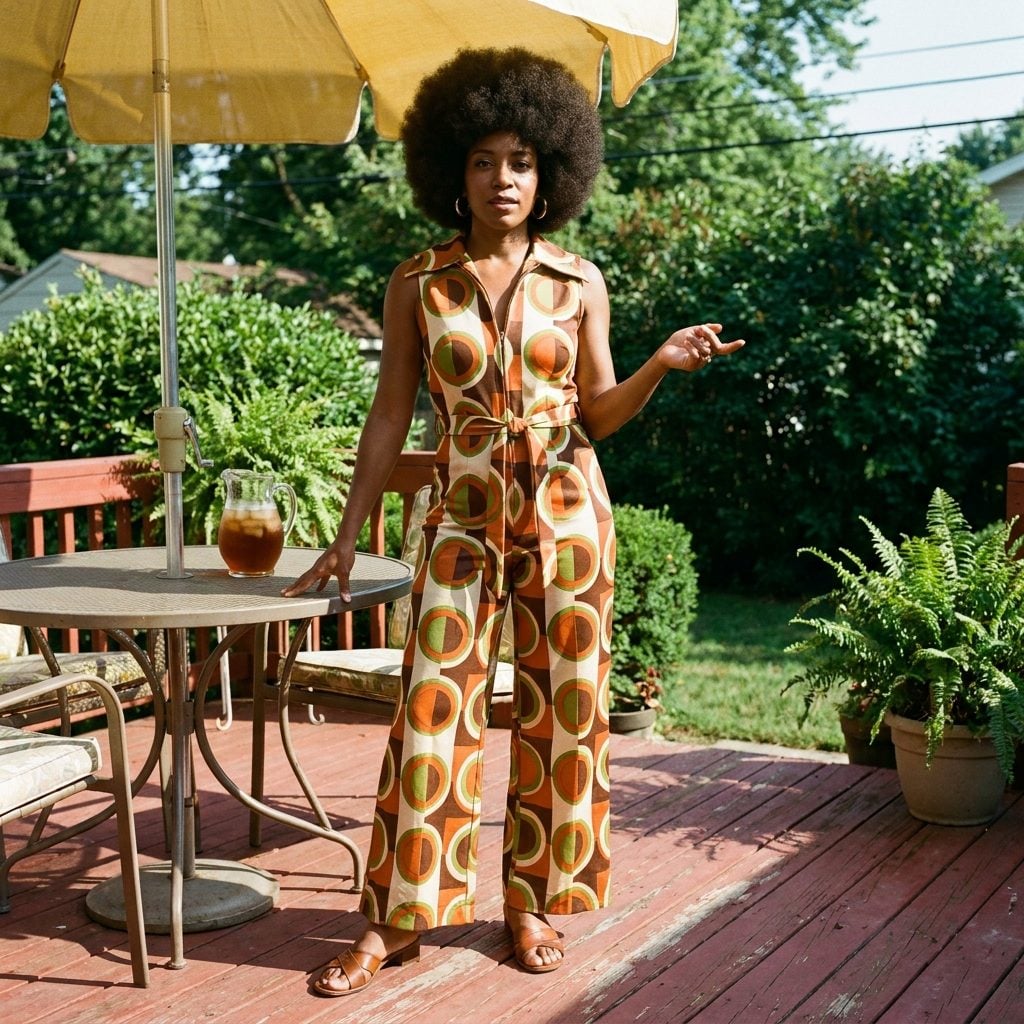
This jumpsuit was not trying to blend in. It arrived at the party and announced itself like a weather event. The geometric print jumpsuit in some combination of harvest gold, avocado, and burnt sienna was the garment equivalent of walking into a room and clapping once, loudly.
Here’s the thing about polyester in July: it did not breathe. Not even a little. You were essentially wearing a sealed plastic envelope in 90-degree heat, and somehow this was considered appropriate summer attire. But the print. The print was so committed, so aggressively patterned, that you forgot about the sweat pooling at the small of your back because you were too busy looking like a walking Marimekko ad.
The bathroom situation alone deserves its own paragraph. A jumpsuit with a back zipper at a party with one bathroom and a line. I’ll say nothing more.
24. The Tube Top and Frayed Cutoff Jean Shorts Combo That Required Constant Vigilance

One deep breath and it was over. The tube top existed in a state of constant negotiation with gravity, and gravity was patient. You couldn’t raise both arms. You couldn’t bend forward. You couldn’t sneeze with any real enthusiasm. And yet we wore them to outdoor gatherings where people were actively playing horseshoes and badminton, because looking good required suffering, and suffering was just what you did on a Saturday in 1976.
The cutoffs were the anchor. So short the front pockets hung below the hem like little white flags of surrender. Mom made them from her old bell-bottoms with a pair of kitchen scissors, and the raw edge got softer and more frayed with every wash until they were more string than denim.
23. Oversized Tinted Aviator Glasses in Amber or Smoke That Made Everyone Look Like a Cop’s Cool Girlfriend

These weren’t sunglasses. These were a personality. The oversized tinted aviators in amber or smoke turned every woman at the BBQ into someone who might have a motorcycle parked around the corner, even if she drove a wood-paneled station wagon.
The amber tint turned the whole world sepia, like you were living inside a photograph of yourself having a great time. And the size. They were practically goggles. Your entire emotional state was hidden behind those lenses, which was useful at a party where your ex-husband’s new girlfriend just showed up with a Jell-O mold.
22. The Terry Cloth Romper Worn Straight From the Pool, Still Slightly Damp, Zero Apologies
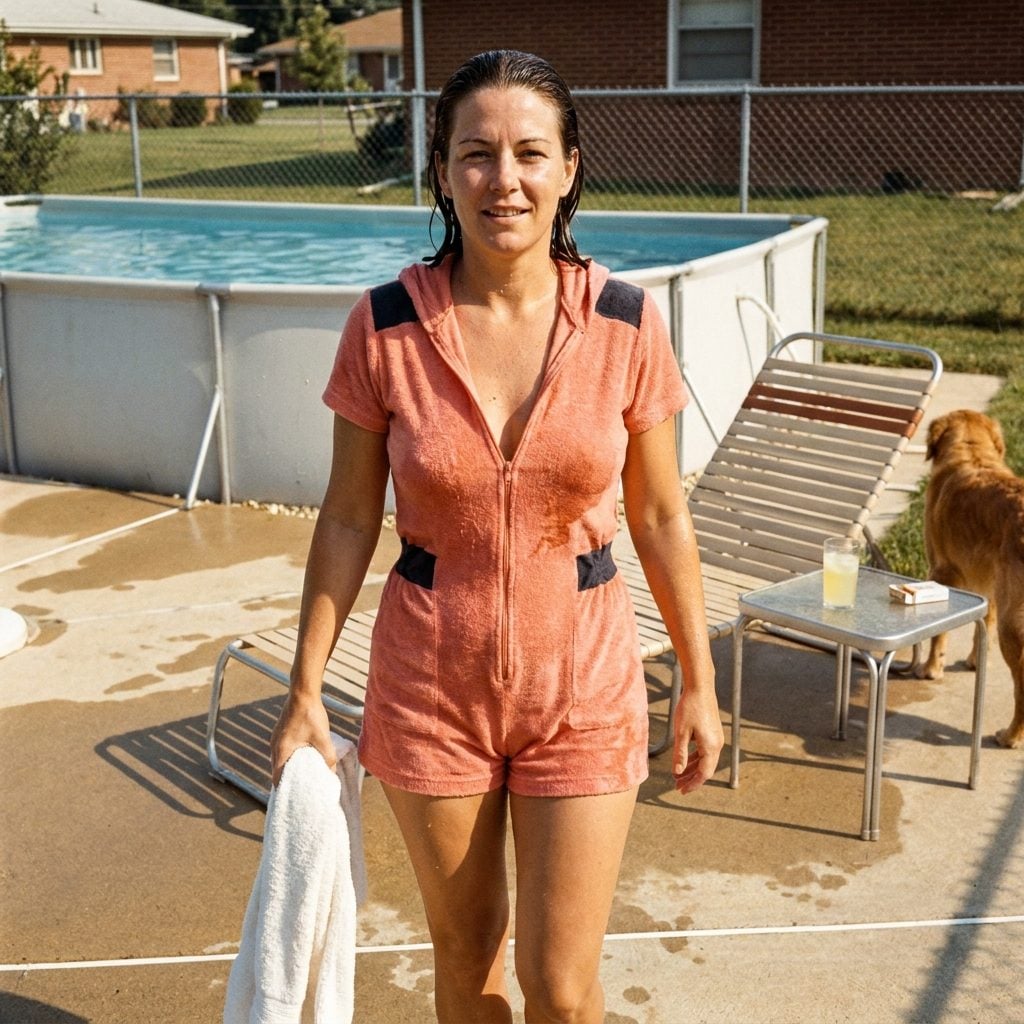
She just got out of the pool and she was not going to change. The terry cloth romper was the transitional garment of the decade: swimwear-adjacent, technically clothing, acceptable at a gathering where hamburgers were being served. It zipped up the front, it absorbed pool water like a sponge, and it made you look like you were starring in your own personal shampoo commercial.
The color was always something warm. Peach, coral, butter yellow. Never white, because terry cloth when wet becomes transparent in a way that is career-ending at a neighborhood party. The zipper pull was oversized and ring-shaped, and you wore it pulled down exactly low enough to suggest confidence but high enough to maintain your reputation with the neighbors.
21. A Flowy Peasant Blouse Tucked Into Bell-Bottoms Like She Just Walked Off a Joni Mitchell Album Cover
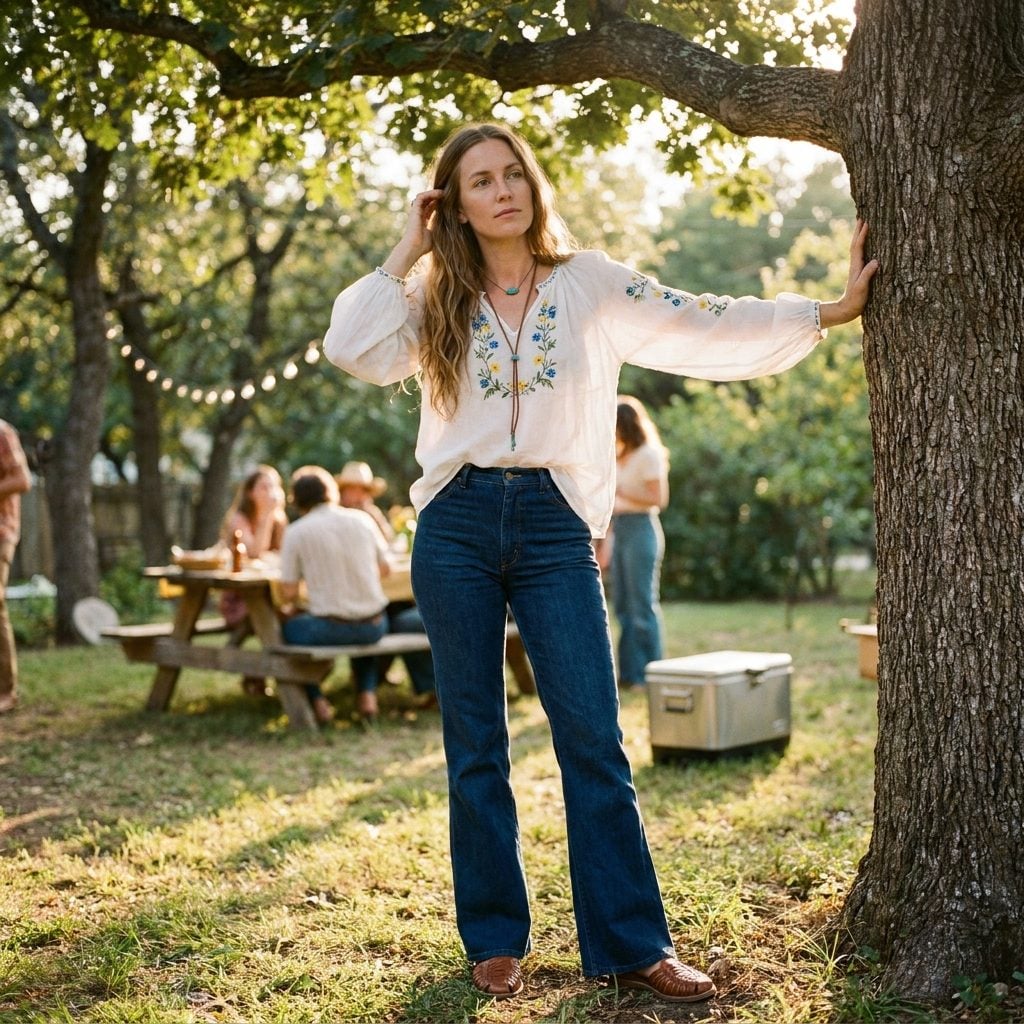
Something about this combination made a woman look like she had opinions about wheat germ and had recently attended a poetry reading. The white peasant blouse with its embroidered neckline and billowy sleeves, tucked just loosely enough into high-waisted bell-bottoms, was the most romantic outfit at any gathering. Not romantic like date-night romantic. Romantic like she might start singing in a field.
The blouse was always white or cream. Always cotton. Always slightly see-through in direct sunlight in a way that was technically accidental but also, come on. The embroidery was either Mexican-inspired florals or something vaguely Eastern European, purchased from a shop that smelled like sandalwood and had a beaded curtain over the doorway.
And the bell-bottoms. They had to be dark. They had to be long enough to completely cover the shoe. The silhouette was all drama below the knee and soft romance above the waist, and it worked in a way that I don’t think we’ve successfully replicated since.
20. Wooden Platform Clogs So Loud on the Patio They Announced Her Arrival Three Houses Down
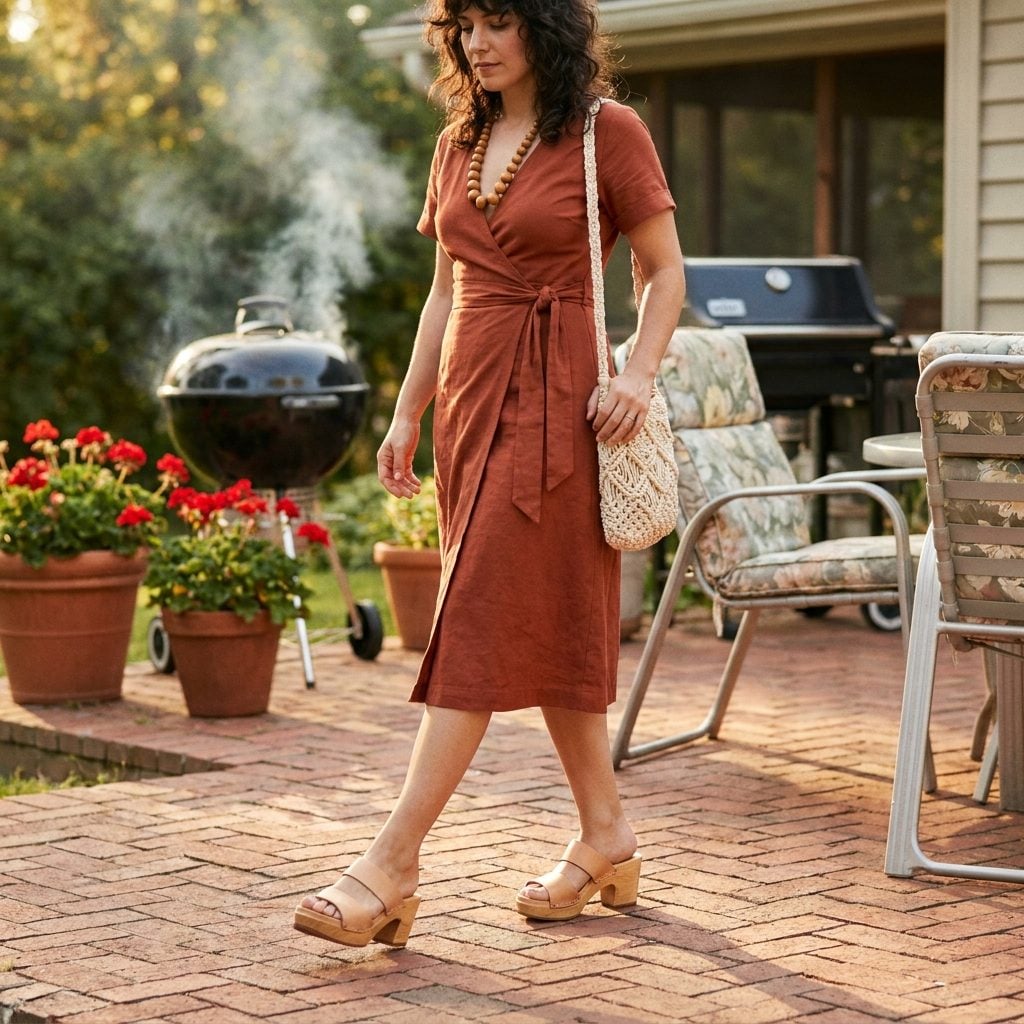
CLONK. CLONK. CLONK. You heard her before you saw her. Wooden platform clogs on any hard surface were a one-woman percussion section, and your mother walked across that patio with the confidence of someone who did not care that every single person at the party just turned to look.
They were murder on grass, useless on gravel, and deafening on concrete. The leather strap left a tan line across the top of your foot that lasted until October. The wooden sole had no give whatsoever, so walking felt like strapping two cutting boards to your feet and just going for it. And they were beautiful. Chunky, sculptural, almost architectural. They made the simplest outfit look intentional.
19. A Macramé Vest Layered Over a Ribbed Tank Top, Because She Wasn’t Going to a BBQ Without a Craft Project on Her Body
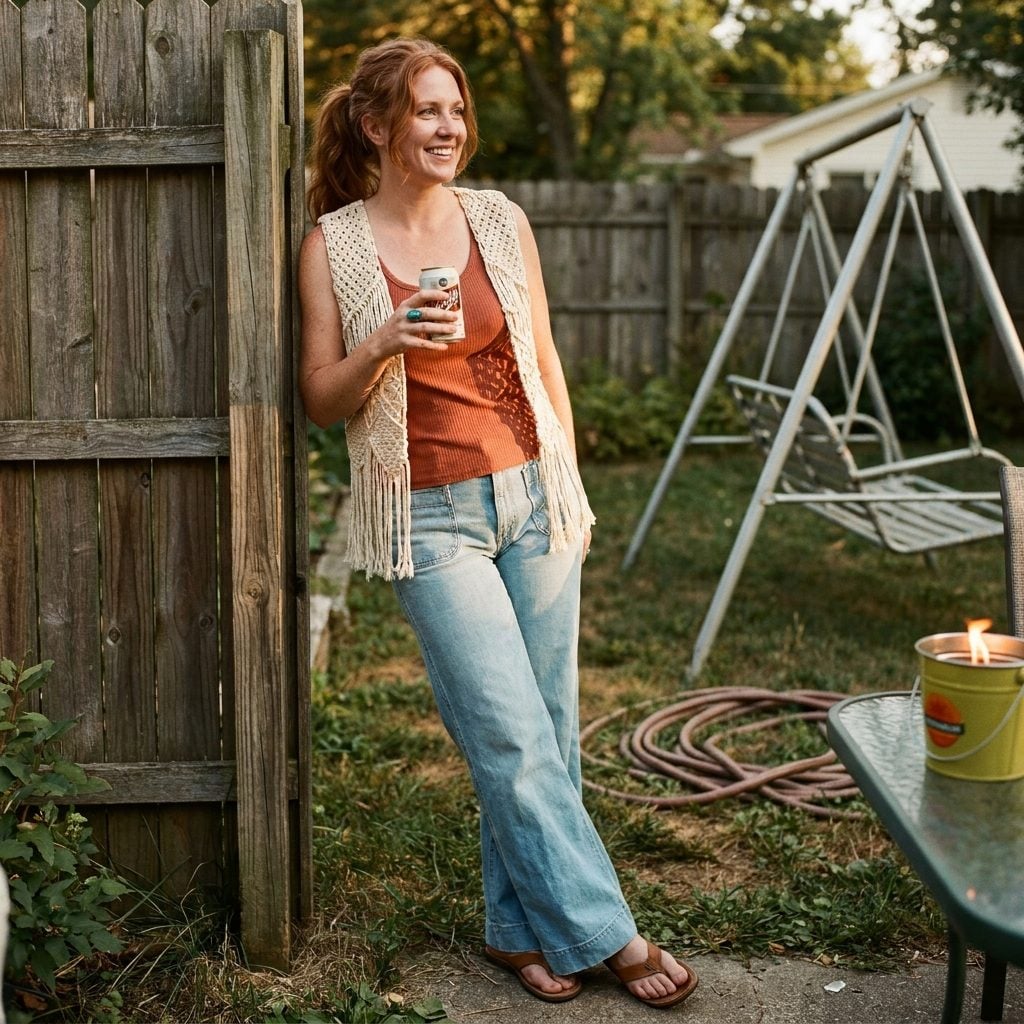
Someone made this vest. Maybe her. Maybe her friend Debbie from the craft circle. Maybe a woman selling things out of the back of a VW bus at the swap meet. But a human being sat down and tied hundreds of knots in cotton cord to create a garment that was essentially a decorative fishing net for your torso, and we all thought it was the height of personal expression.
The macramé vest over a ribbed tank top was the 1970s version of saying “I’m creative” without having to actually talk about it. It served no thermal purpose. It provided zero coverage. It was purely ornamental, a wearable art piece that got caught on doorknobs and absorbed BBQ smoke like nobody’s business.
But there was something about it. The weight of the knots against your shoulders. The fringe swaying when you walked. It made you feel handmade in an era that was starting to feel very mass-produced, and that feeling was worth every snag.
18. The Floral Wrap Dress With Wedge Sandals and Hoop Earrings Big Enough to Signal Aircraft
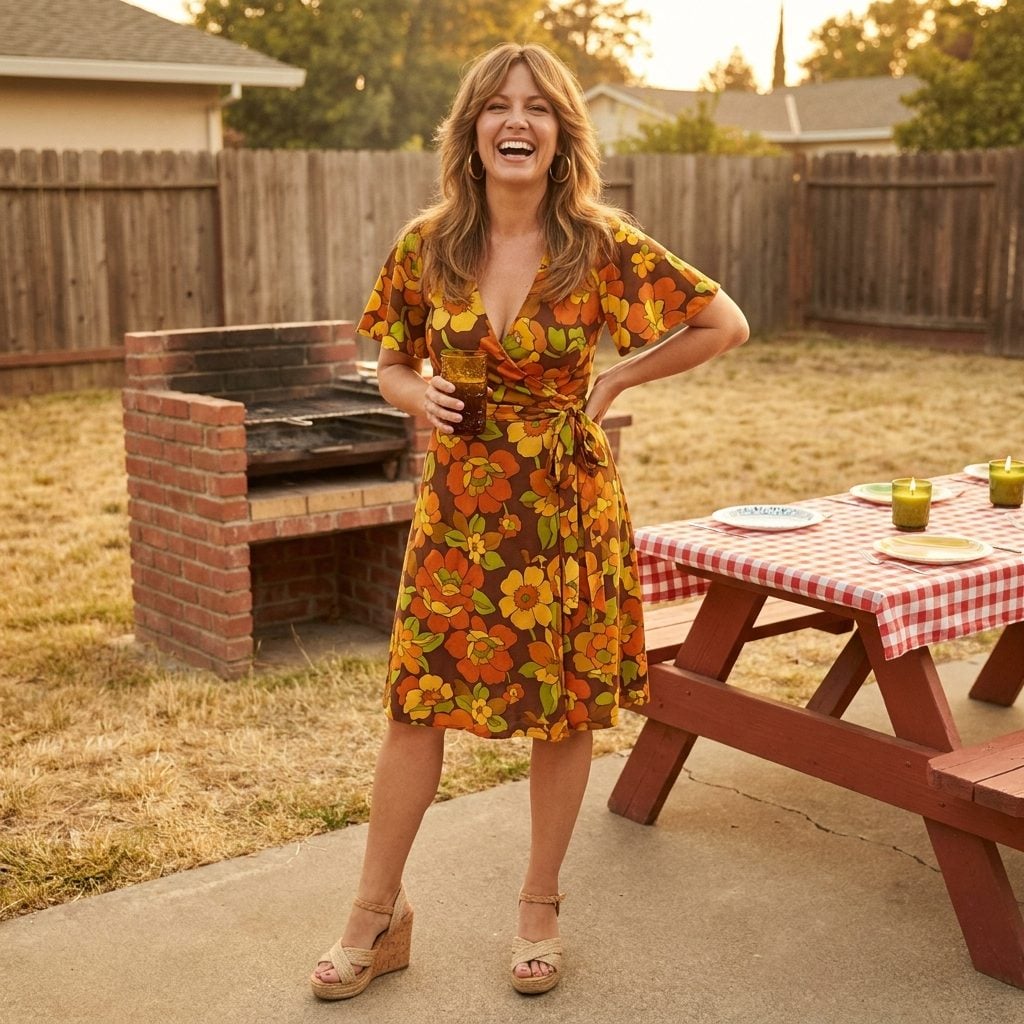
Those hoops weren’t accessories. They were a declaration of intent. Mom would thread them through her ears before she even decided what dress to wear, and the answer was almost always a floral wrap dress in some combination of harvest gold, avocado, and rust that looked like the wallpaper in every kitchen on the block.
The wrap dress was Diane von Furstenberg’s gift to women who wanted to look pulled together while still being able to chase a toddler away from the grill. Paired with cork wedge sandals, it gave her an extra two inches of height and that particular hip-forward walk that wedges force on everyone. The gold hoop earrings caught the late afternoon sun every time she turned her head, which was often, because someone’s kid was always doing something near the pool.
17. The Crochet Bikini Top Hiding Under an Unbuttoned Men’s Shirt Like a Secret Only the Seventies Kept
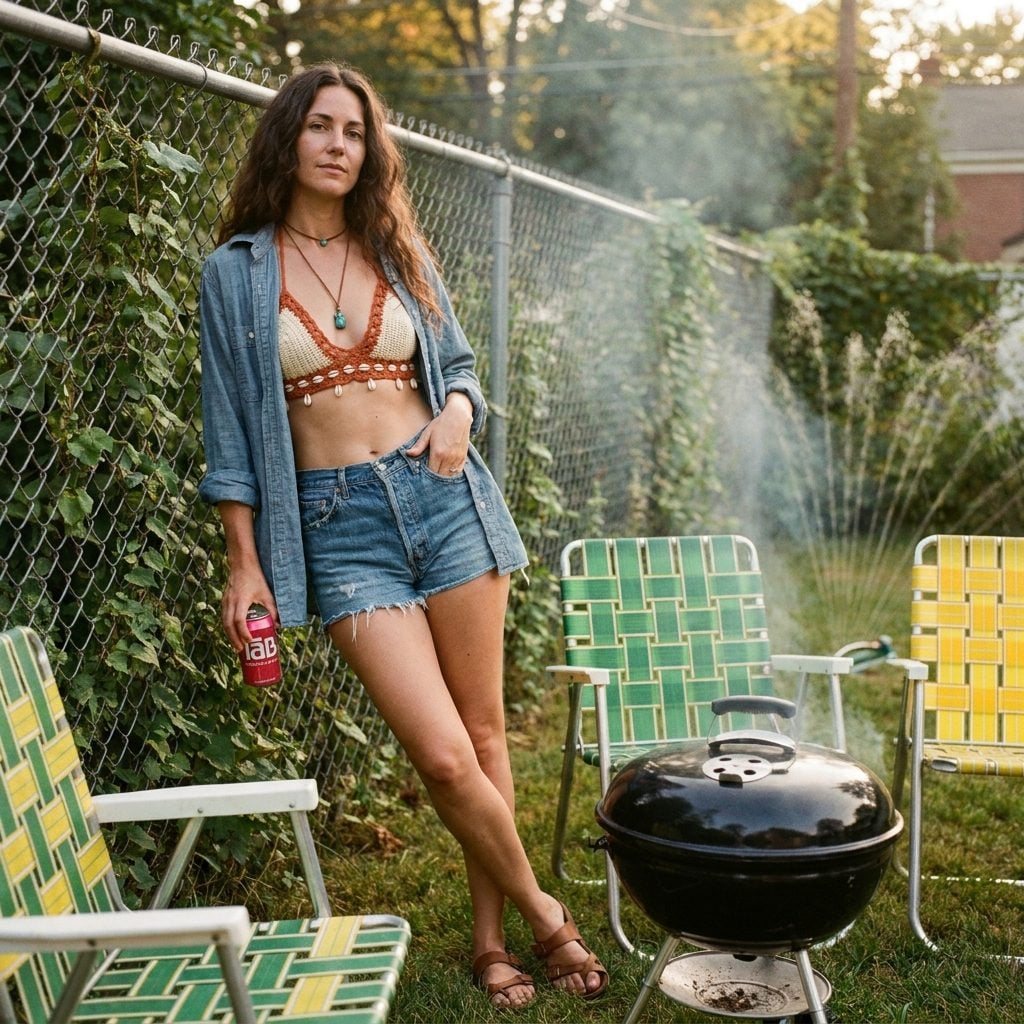
Nobody crocheted a bikini top because it was practical. Water made it sag, chlorine destroyed it, and it offered roughly the same support as a firm thought. But on a hot afternoon, with a chambray shirt draped open over it, it said something specific: I might get in the pool, I might not, and either way I look good standing next to the potato salad.
Half the time these were homemade. Your mom, your aunt, or the woman three doors down who sold macramé plant hangers at the craft fair had one on her hook at all times. The yarn was always slightly scratchy, the fit was always approximate, and somehow that was the whole point.
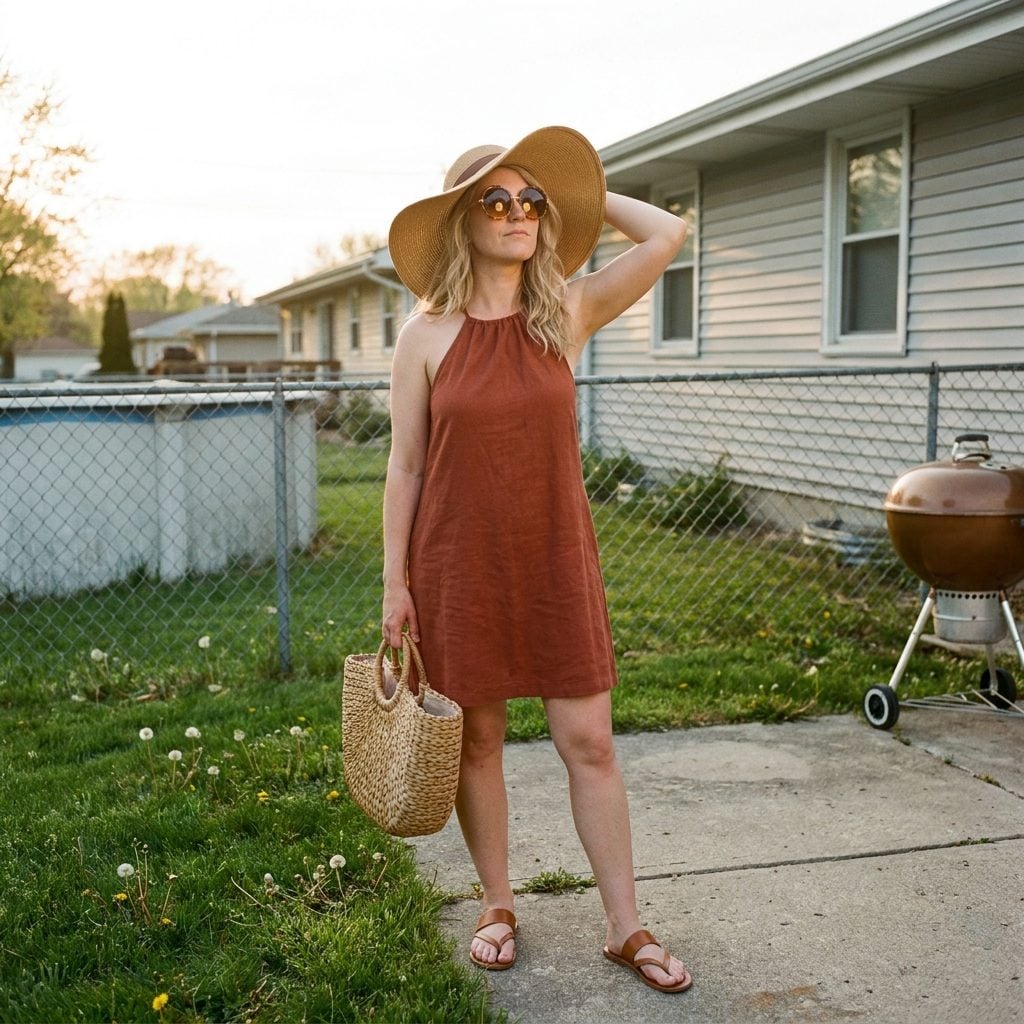
16. A Wide-Brim Floppy Hat That Screamed Malibu From a Cul-de-Sac in Suburban Ohio
❤️ Would you like to save this?
This hat had no business being in a backyard with a chain-link fence and an above-ground pool, and that was precisely its power. It belonged on a woman stepping off a yacht, and instead it was shading someone’s face while she spooned coleslaw onto a Chinet plate.
Every mom who wore the floppy straw hat in the seventies was performing a small act of aspiration. It said: I may live forty minutes from a cornfield, but my aesthetic references are strictly coastal. The hat was always slightly too big, always threatening to blow off in the breeze, and always worth the trouble.
15. White Culottes With a Sleeveless Knit Top in a Color That Didn’t Exist in Nature
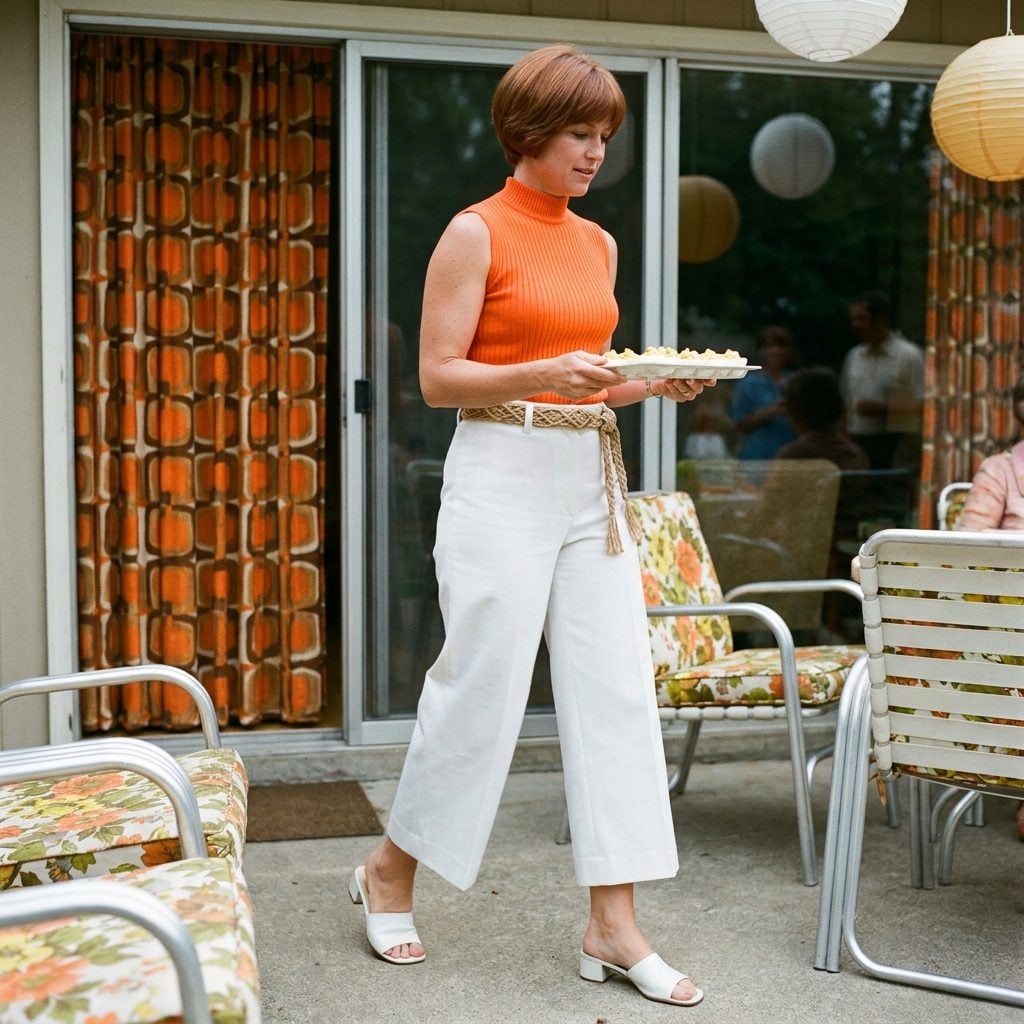
Culottes were the great compromise garment. Not quite a skirt, not quite pants, not quite flattering on anyone, and yet your mother wore them to every outdoor event from May through September like they were prescribed by a doctor.
The white culottes always came out for BBQs, which was bold considering the mustard, the ketchup, the red wine in plastic cups. She paired them with a sleeveless knit top in colors the decade invented: not orange but tangerine, not pink but coral, not green but chartreuse. Colors that existed only in polyester and in the imagination of textile designers who had recently discovered something strong.
14. The Fringed Suede Vest Worn in July Because Looking Cool Was More Important Than Being Cool
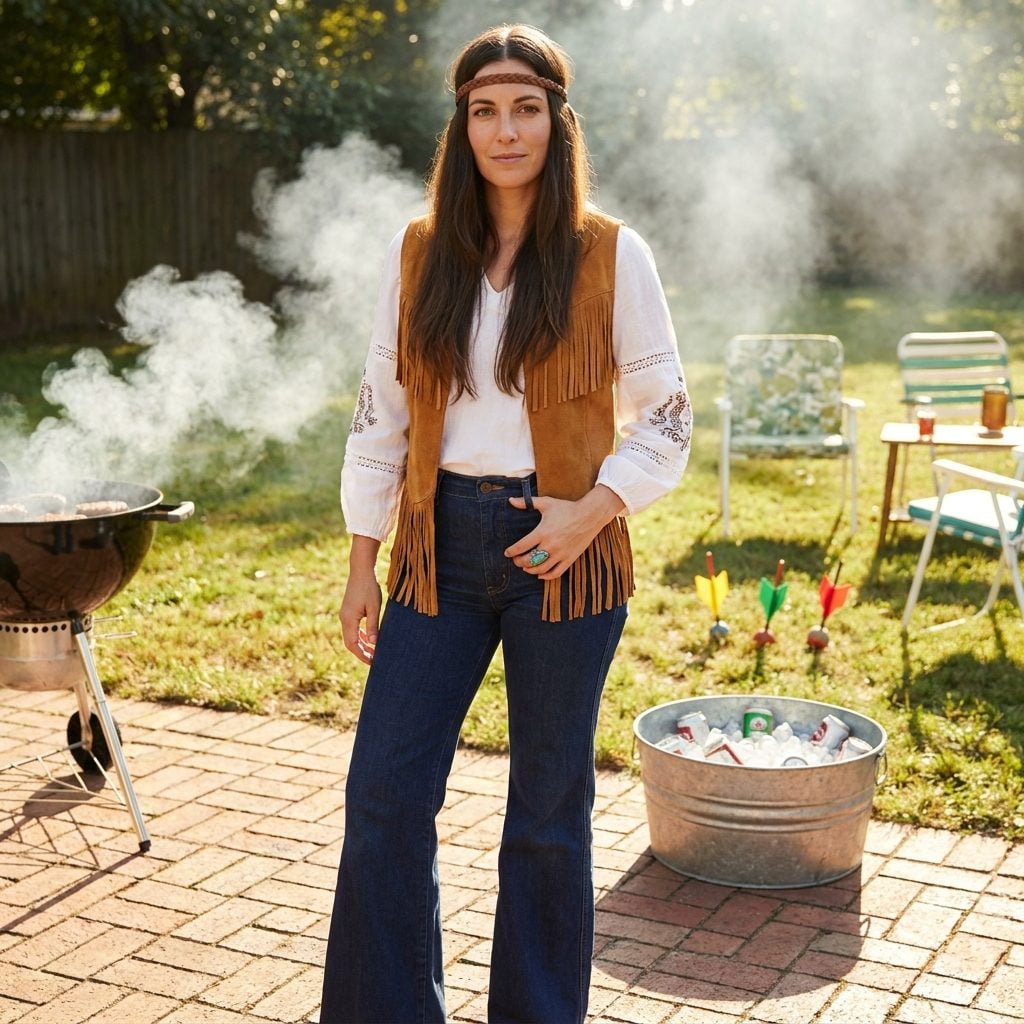
It was 93 degrees and she was wearing suede. This needs to be stated plainly because it captures something essential about how the seventies worked: the fringe vest was non-negotiable. It didn’t matter that suede and humidity were mortal enemies. It didn’t matter that the fringe got caught on lawn chair armrests. The fringed suede vest was the decade’s favorite way of saying “I have opinions about Joni Mitchell,” and you wore it until you couldn’t breathe.
Paired with a white peasant blouse and bell-bottoms, it was the complete counterculture uniform, even if the wearer’s most radical act was switching from Folgers to a pour-over.
13. Candie’s Slide Sandals Paired With Tube Socks Once the Sun Went Down
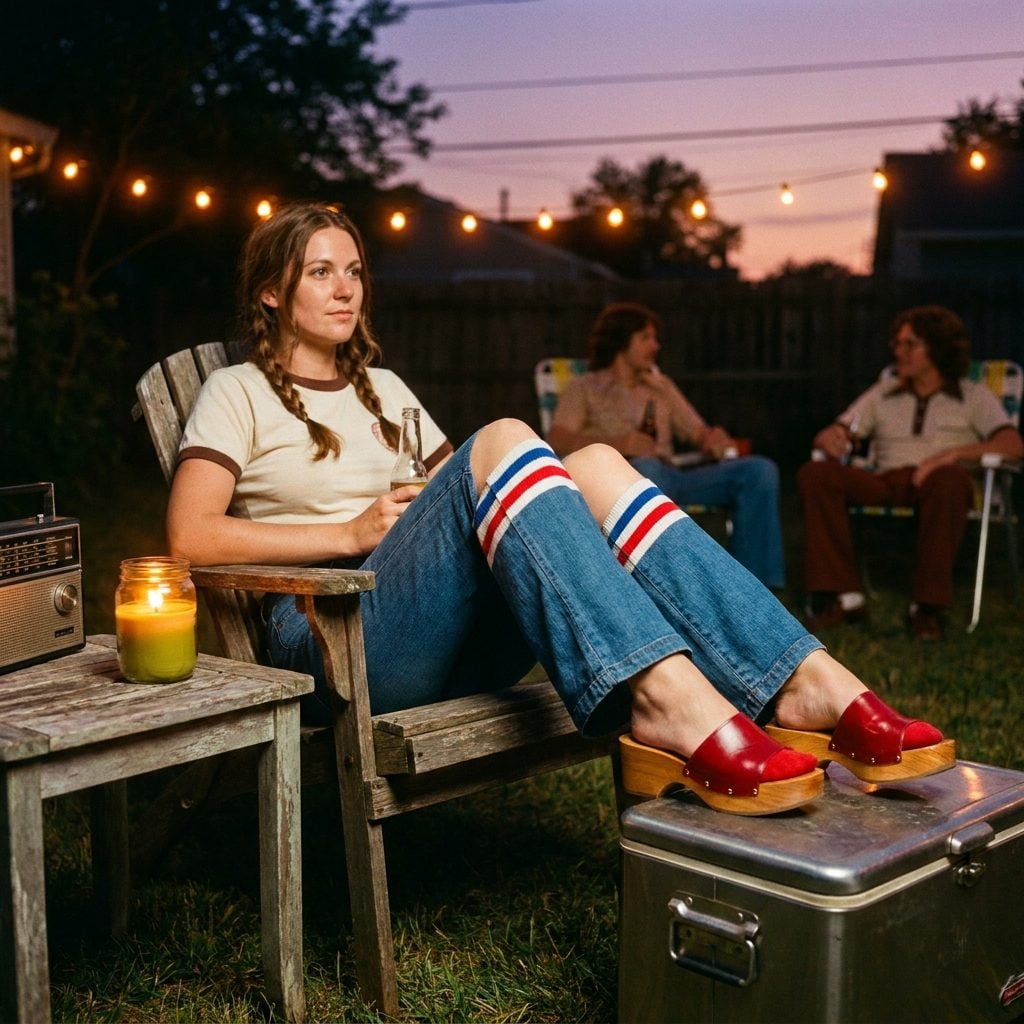
When the mosquitoes came out and the grass got cold under bare toes, someone’s mom slid on a pair of tube socks and put her Candie’s right back on top of them. And nobody blinked. This was completely normal behavior.
The wooden slide sandals clacked against the patio like a metronome all evening. They were impossible to walk on grass in, turned every trip to the cooler into a balance exercise, and the tube socks underneath made the whole thing look like something a very fashionable gym teacher would attempt. But the silhouette worked because nothing about 1970s fashion required your approval. It just happened, and you accepted it.
12. A Giant Peace-Sign Necklace Bouncing Against a Fitted T-Shirt With Absolutely Zero Irony
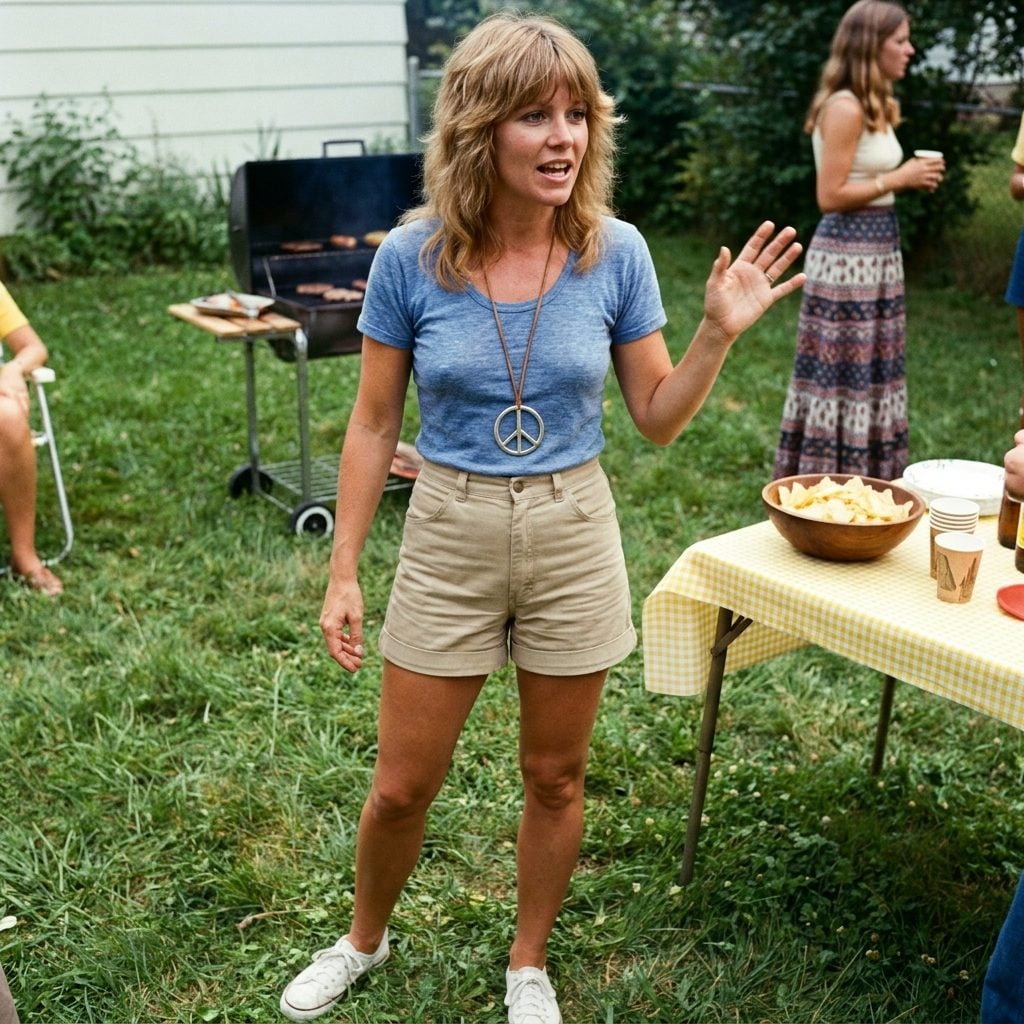
This wasn’t a costume piece or a thrift store ironic find. In 1974, your mom wore that peace sign pendant because she meant it. Or at least she meant the vibe of it, which was close enough.
The necklace was always on a leather cord, always oversized, always silver-toned (real silver if she was lucky, pewter if she was practical). It bounced against her collarbone when she walked and swung forward when she leaned over to serve herself macaroni salad. Paired with a fitted t-shirt, it was the entire outfit’s personality. Without it, she was just a woman in a blue shirt. With it, she had a worldview.
11. The Silky Disco Shirt Partially Unbuttoned With Layered Gold Chains Doing All the Heavy Lifting
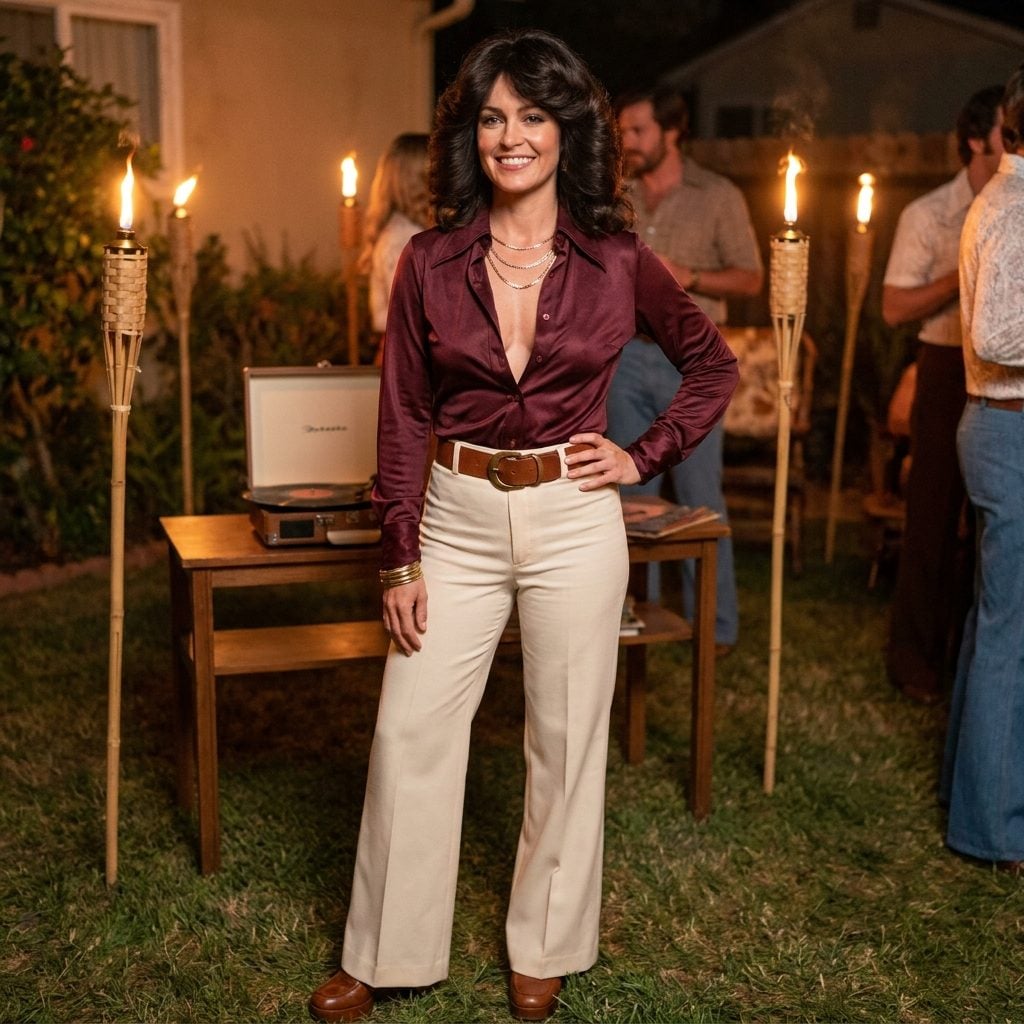
Once the burgers were done and someone put on the Bee Gees, the backyard became a disco floor, and this shirt was ready for it. The silky polyester button-down in burgundy or jade or cream, unbuttoned to a point that would make your grandmother develop a headache, was the evening uniform.
But the shirt was really just a frame for the layered gold chains. Three of them, minimum. Different lengths, different weights, all tangling together by 9 PM. The pointed collar spread wide enough to land a small aircraft on, and the whole thing caught tiki torch light like it was designed for exactly this purpose. Which, honestly, it was.
I’ll say this plainly: no modern minimalist gold layering set has ever come close to the chaotic energy of three mismatched chains from a department store jewelry counter, all worn at once, all slightly too long.
10. Patchwork Denim Jeans With Flared Legs Wide Enough to Lose a Small Child In
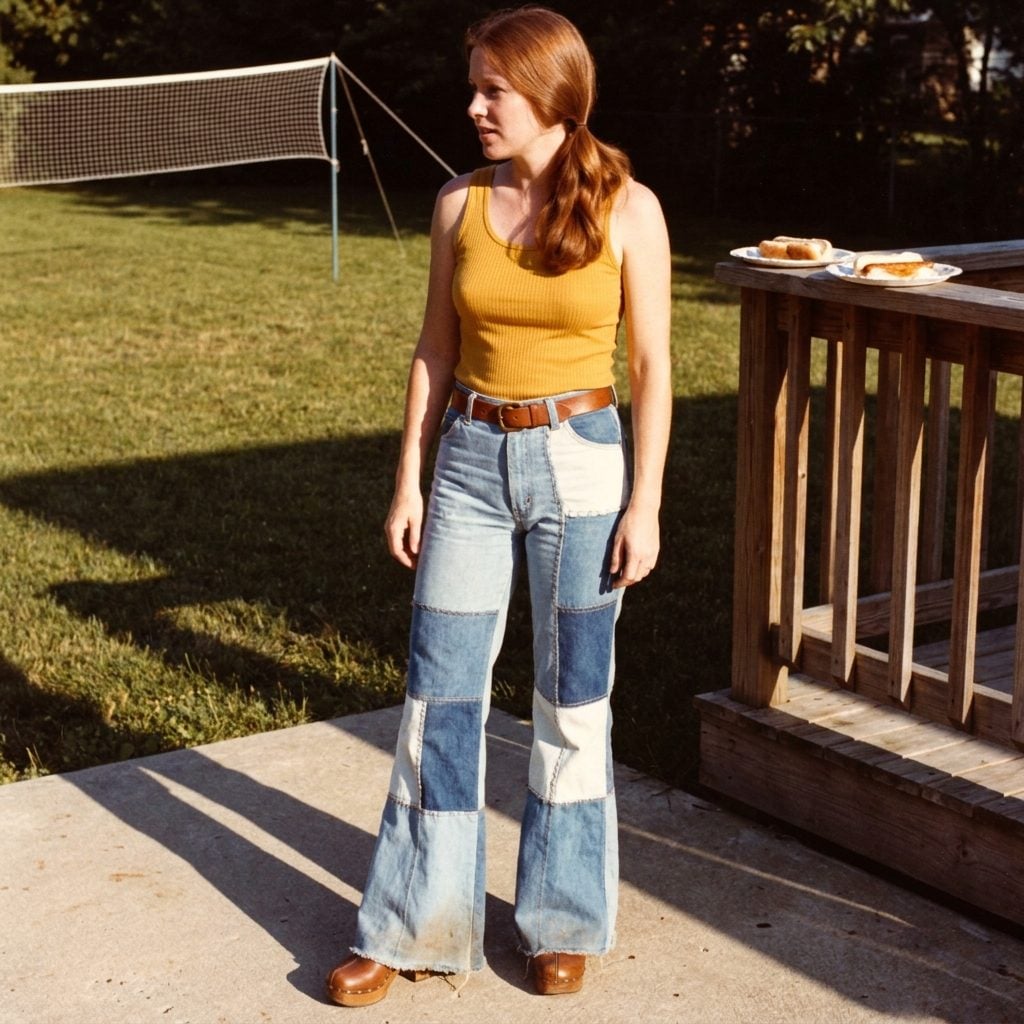
The hems were always filthy. Dragging on wet grass, sweeping across patio concrete, collecting every pebble and cigarette butt in the yard. These patchwork flares were not jeans for women who cared about the condition of their denim, and that was the point.
Each pair told you something. Store-bought patchwork meant the department store, probably Sears or JCPenney. Homemade patchwork, where the patches were actual scraps from other jeans, meant your mom had either a sewing machine or a very patient friend who did. The flare was always wider than seemed physically possible, and the waist was always high enough to reach your ribcage.
9. The Gauzy Caftan Cover-Up That Drifted Around the Picnic Table Like a Beautiful Ghost
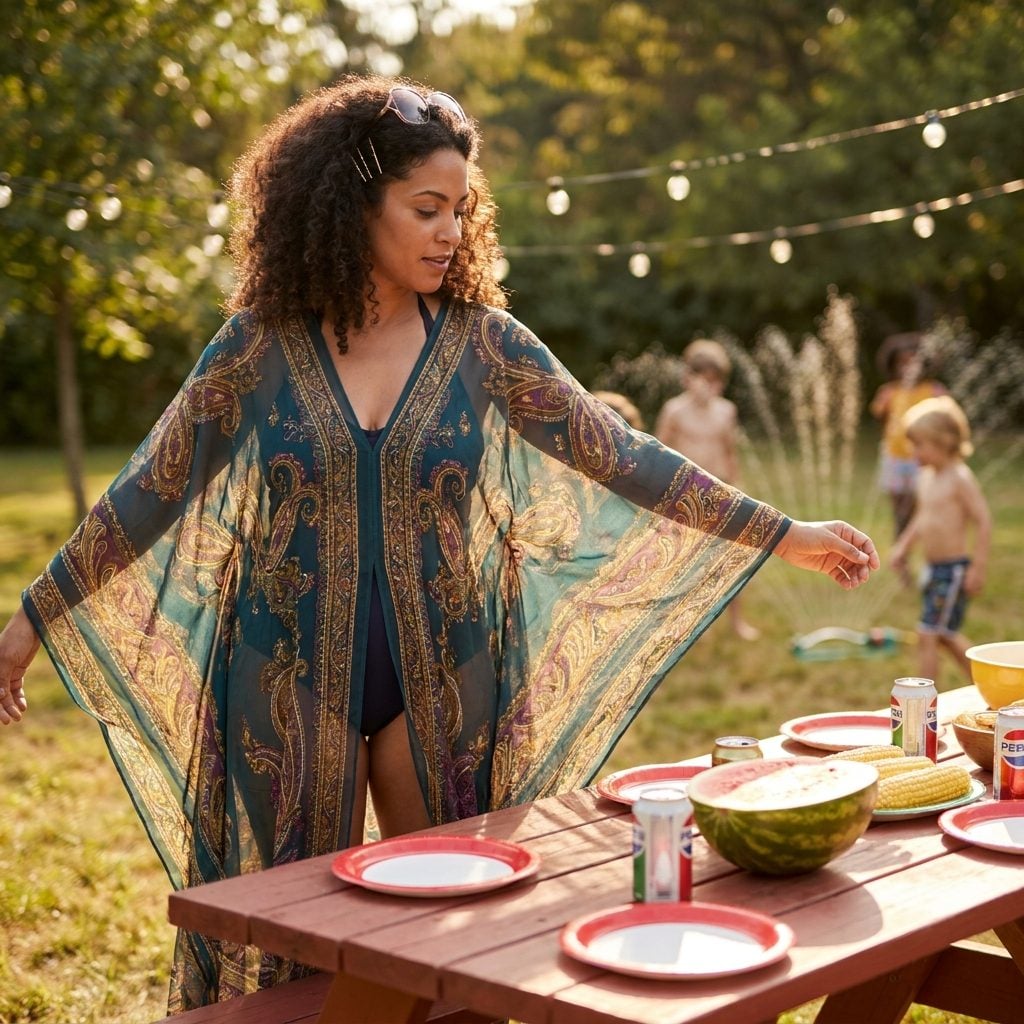
Some garments are worn. The gauzy caftan was inhabited. It moved on its own schedule, independent of the woman inside it, catching every suggestion of a breeze and turning a walk to the cooler into something cinematic.
This was the piece that said: I’m at the barbecue, but I’m also somewhere else entirely. The fabric was always slightly sheer, the print was always vaguely Indian or Moroccan, and through it you could see the dark swimsuit underneath, which was the actual outfit. The caftan was just atmosphere. Portable atmosphere.
My own mother had one in teal and gold paisley that she wore from roughly 1975 to 1982, at which point it became a beach cover-up, then a robe, then a thing she gardened in. That caftan had more lives than most of us will. And honestly, if she still had it, someone on Etsy would pay real money for it now.
8. The Tucked-In Ringer Tee With Striped Gym Shorts That Made Every Backyard a Track Meet
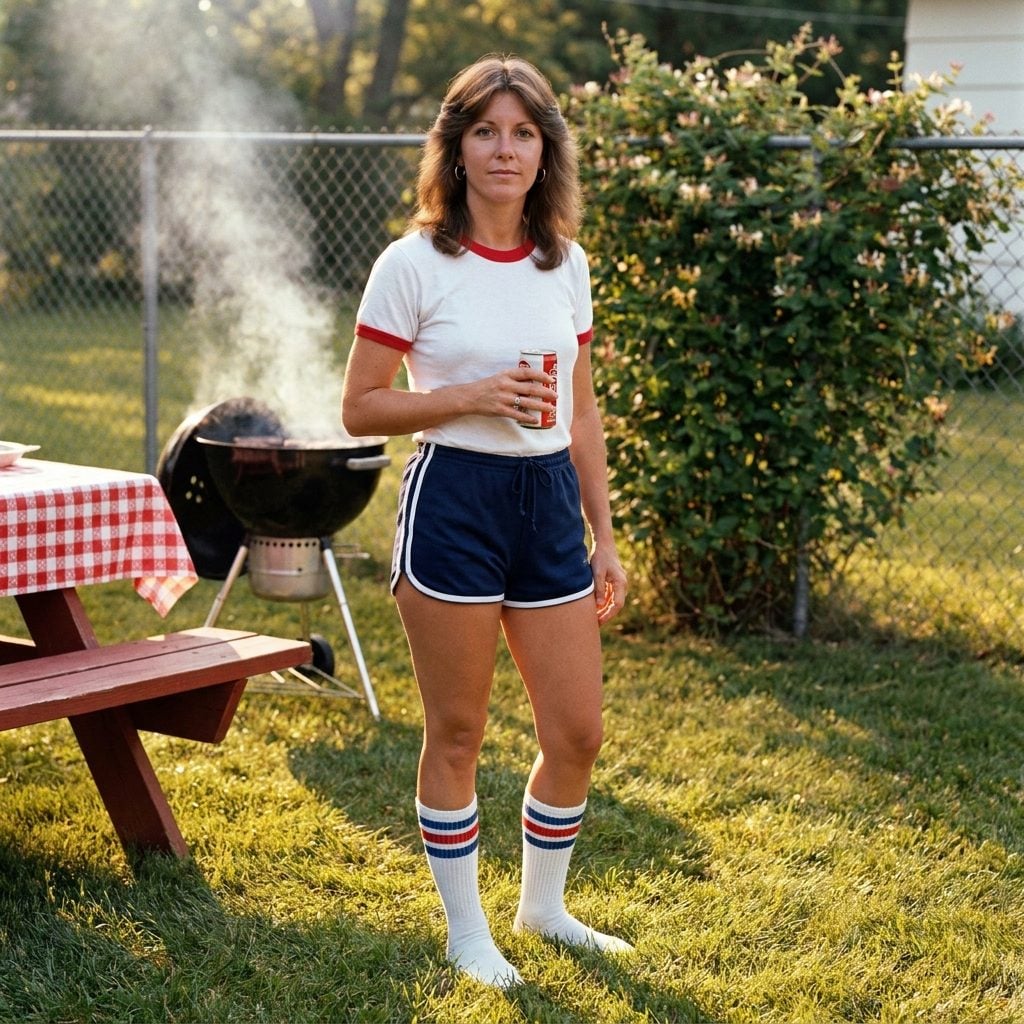
The tuck was never optional. You pulled that thin cotton ringer tee — white with red or navy piping at the collar and sleeves — down tight into those nylon gym shorts and called it a look. The shorts had a drawstring nobody ever tied and a satin-liner situation inside that made a swishing sound every time you walked to the cooler for another Tab.
Mom probably bought hers in a three-pack from Sears. And she wore striped athletic shorts like evening separates, paired with tube socks pulled high and a confidence that said, “I may be flipping burgers, but I look like I could run a 440 right now.”
7. The Prairie-Style Maxi Dress Covered in Tiny Floral Prints (Gunne Sax Energy, Whether It Was Gunne Sax or Not)
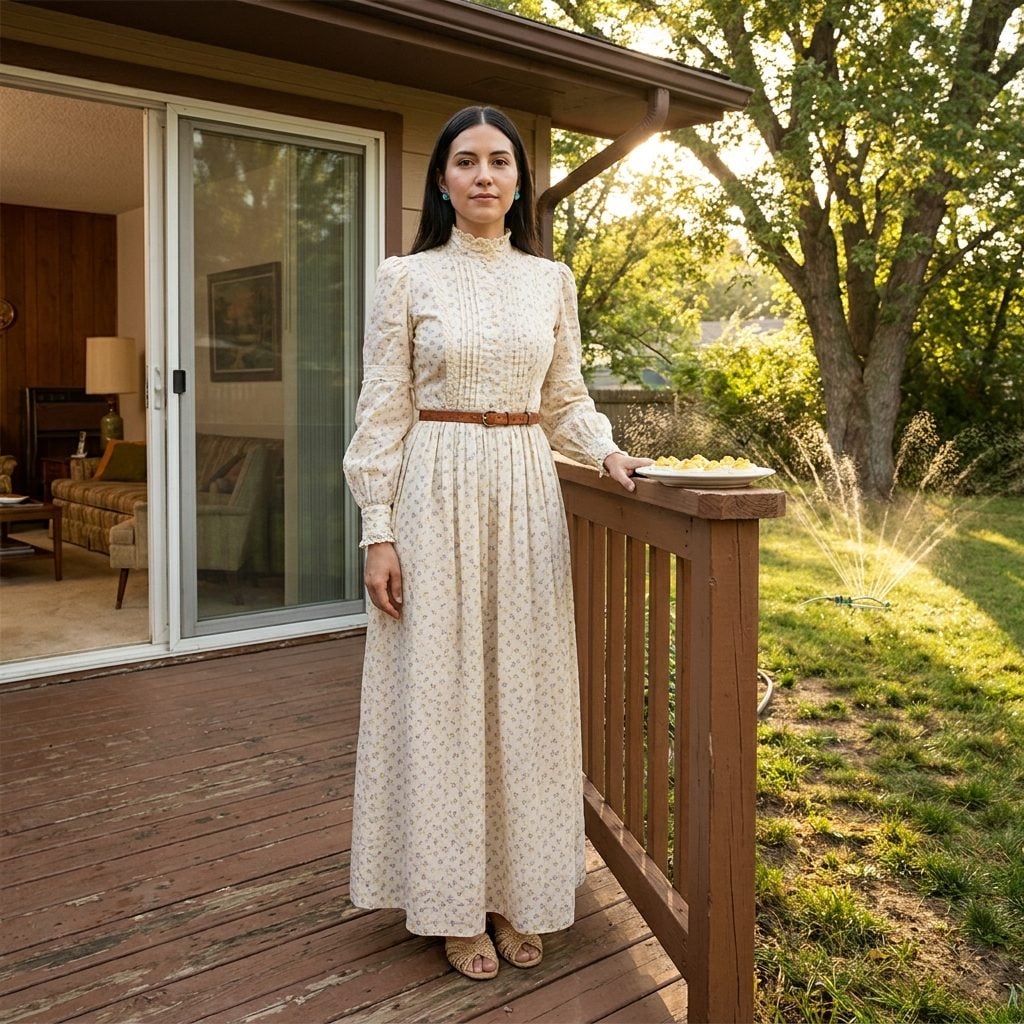
She showed up to a barbecue looking like she was about to cross the Oregon Trail, and nobody questioned it. That was the pull of the prairie floral maxi dress. High collar, lace trim at the wrists, tiny flowers so small you had to squint to see them individually, and a skirt that collected grass clippings like it had a personal grudge against bare lawns.
Gunne Sax by Jessica McClintock was the holy grail, but Simplicity pattern knockoffs were everywhere. Your mom or your aunt or someone’s neighbor had a sewing machine running hot all summer trying to recreate that Laura Ingalls-at-Woodstock vibe. And the thing is? It worked. All that fabric moving in the breeze while hamburger smoke curled around you felt genuinely romantic — even at a backyard party with paper plates and warm beer.
6. A Bikini Under Short Cutoff Overalls for ‘Casual’ Backyard Entertaining

Nothing said “I might get in the pool or I might not” quite like cutoff denim overalls with one strap unclipped, a bikini top handling all structural responsibilities underneath. Casually overdressed and underdressed at the same time. The seventies specialized in this contradiction.
The cutoff overalls were always homemade — an old pair of Landlubber or Wrangler jeans scissored into oblivion, the fringe at the hem getting more aggressive with every wash. And the bikini top pulled double duty as both swimwear and a going-out top, because nobody in 1976 was drawing that line.
5. The Rainbow-Striped Polo Shirt With White Tennis Shorts (Country Club Dreams on a Suburban Budget)
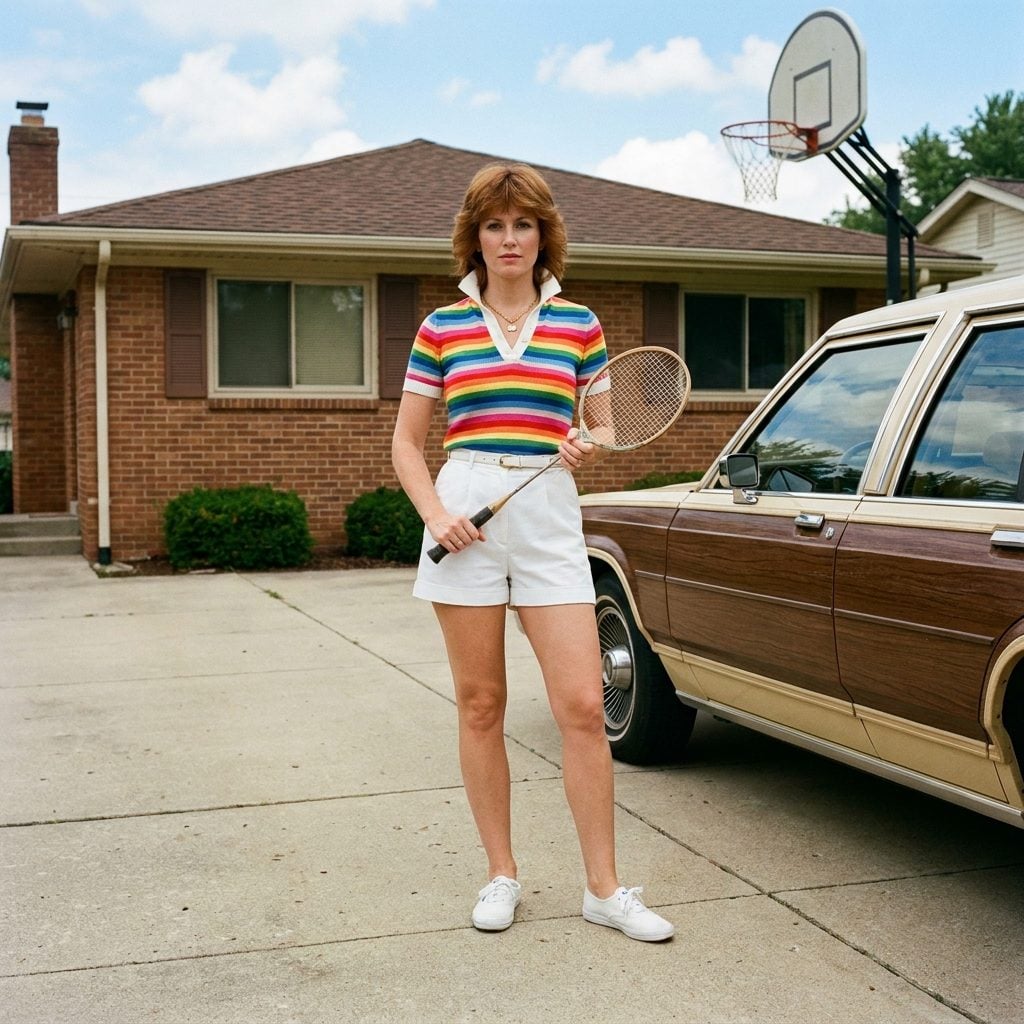
Popped collar. Always popped. The rainbow-striped polo tucked into white shorts was suburban aspiration in cotton-poly blend form — Mom might not have belonged to the tennis club, but she dressed like she did on Saturdays, and the backyard badminton net was close enough.
These shirts came from Sears or Montgomery Ward. The stripes were always slightly too wide to pass muster with anyone who actually played at the club, and that was the charm. The whole outfit cost almost nothing, and she wore it with the authority of someone who’d just finished a doubles match and was ordering a gin and tonic at the clubhouse. Which, to be clear, she was not.
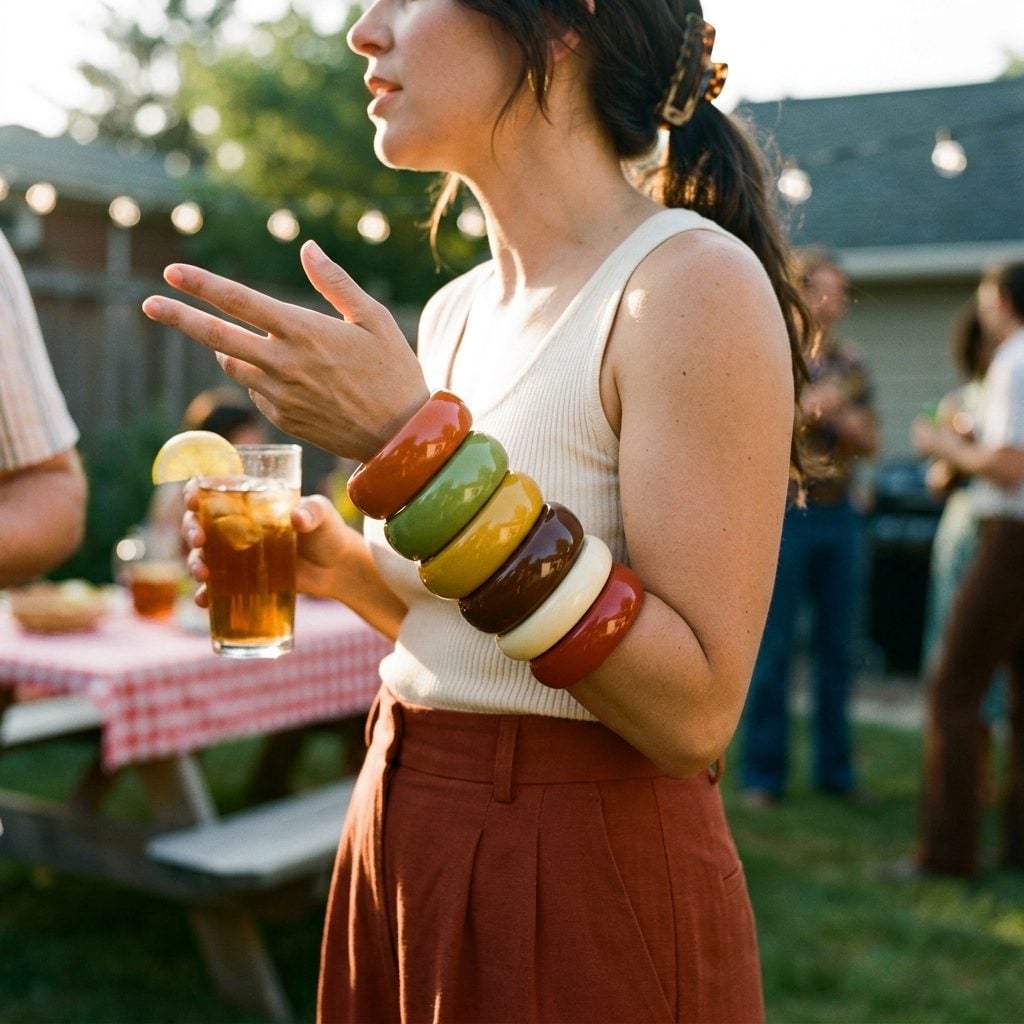
4. A Pair of Oversized Plastic Bangles Clacking Through the Entire Afternoon
❤️ Would you like to save this?
You heard Mom coming before you saw her. Those oversized plastic bangles, stacked six or eight deep on one wrist, announced every gesture like a percussionist warming up. Reaching for the potato salad? Clack clack clack. Waving at the neighbors? A full brass section.
They came in every color of the decade: avocado, harvest gold, burnt sienna, that specific muddy orange that existed nowhere in nature but on every accessory rack in 1974. Sometimes she color-coordinated them. Other times she just grabbed a handful from the dish on her dresser and walked out the door.
I say this with love: the sound of those bangles hitting each other is burned into my memory the way some people remember crickets on summer nights.
3. Earth-Tone Wedge Sandals With Cork Soles (The Unofficial Shoe of Every Patio in America)
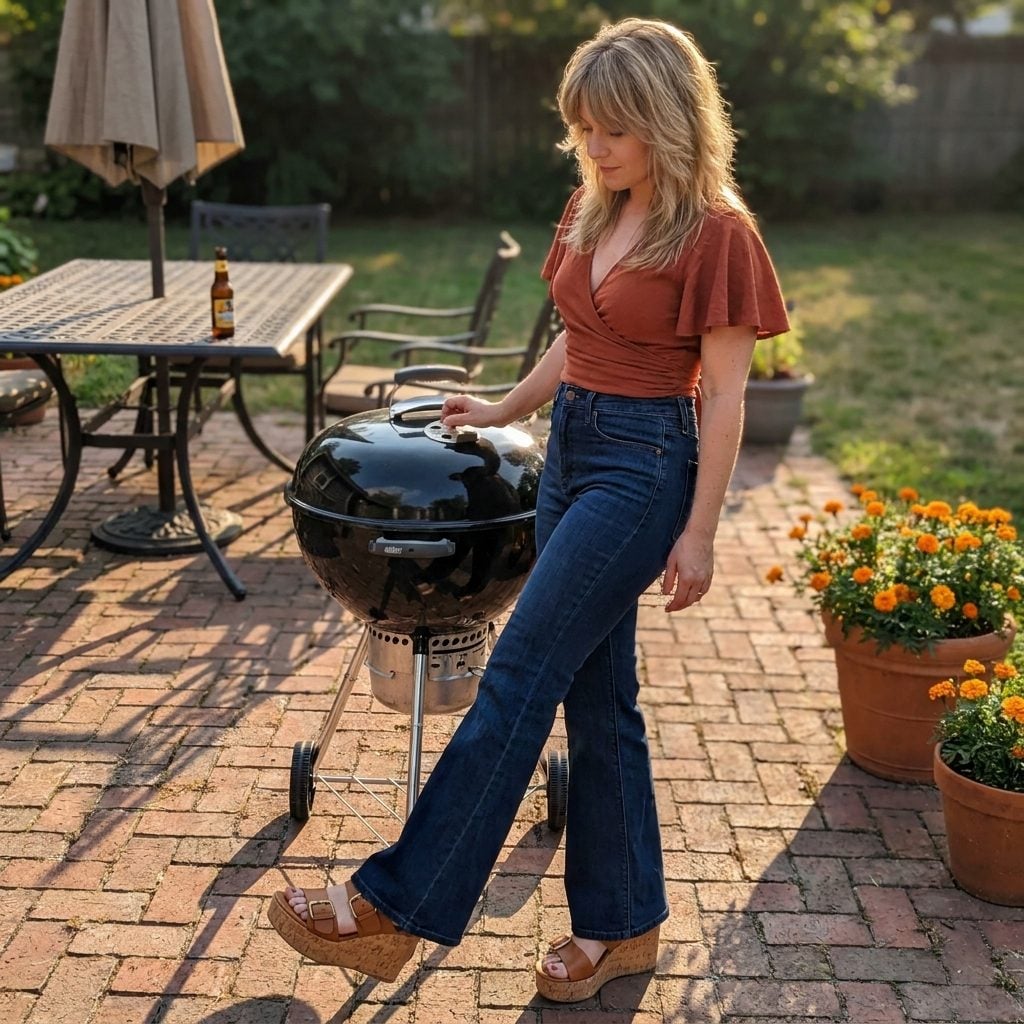
Cork and leather. That was it. These cork wedge sandals added a few inches of height and sank into every lawn you walked across, leaving little divots in the grass like the yard had been aerated by a very fashionable machine. Nobody cared. The wobble was part of the experience.
Famolares, Candies, or the no-name version from the shoe department at J.C. Penney — they were everywhere. The soles eventually developed a dark ring around the edge from grass stains and patio dirt that never fully came off. You kept wearing them anyway because replacing them meant driving to the mall, and who had the energy for that on a Saturday?
2. A String Bikini Top Paired Unapologetically With Elephant-Bell Bottoms
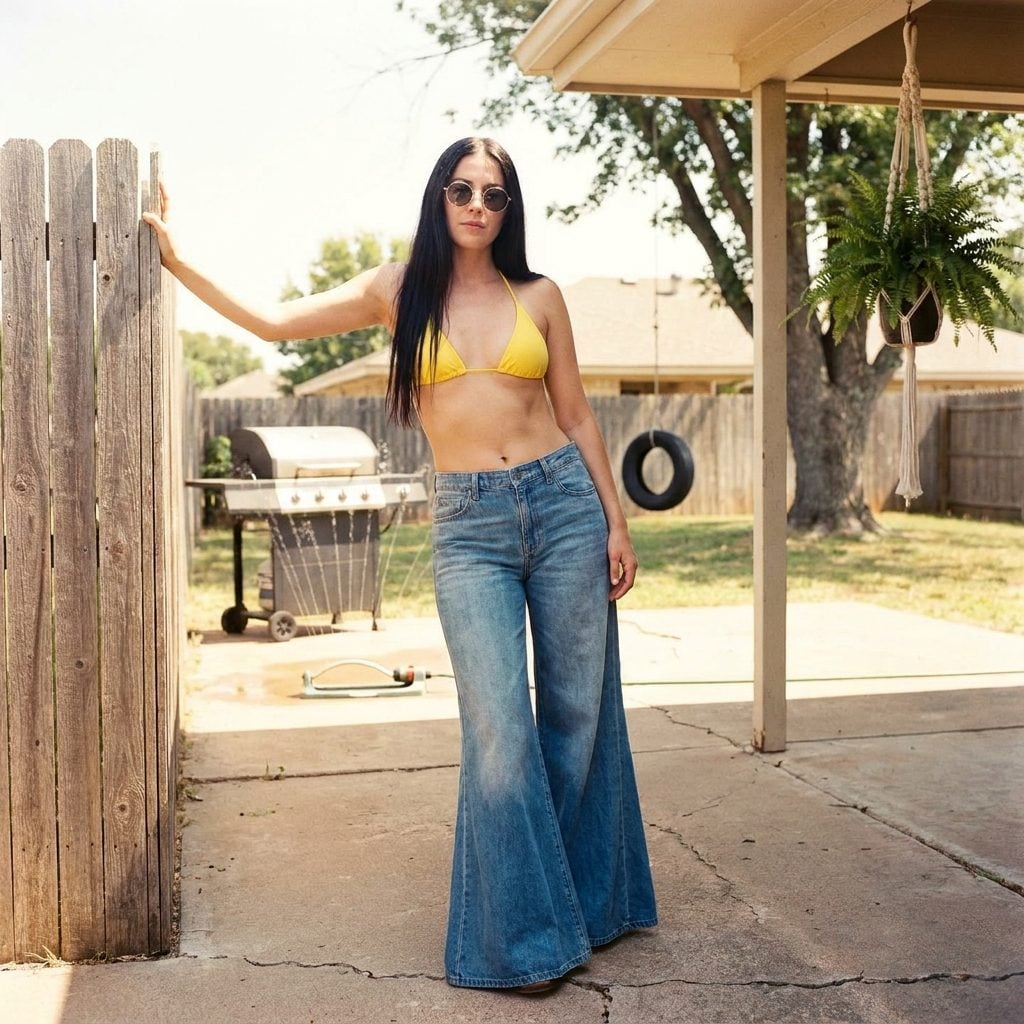
This was the power move. A triangle of fabric held on by string, an expanse of bare midriff, and then roughly four yards of denim from the waist down. The proportions made no logical sense and absolute emotional sense — free on top, grounded on the bottom, the bell-bottoms so wide they swallowed your feet entirely.
Nobody wrapped a sarong around their waist or reached for a cover-up. The bikini top WAS the top. Full stop. Mom stood at a barbecue like that, talked to the neighbors about property taxes, and it was simply what people wore in July. I genuinely don’t think she gave it a second thought.
There was an ease to 1970s dressing that we’ve spent decades chasing and never quite caught. The bikini-and-bells combo was its purest distillation: minimal effort, complete self-assurance.
1. The Sun-Faded Visor and Feathered Hair That Defined an Entire Generation of Summer
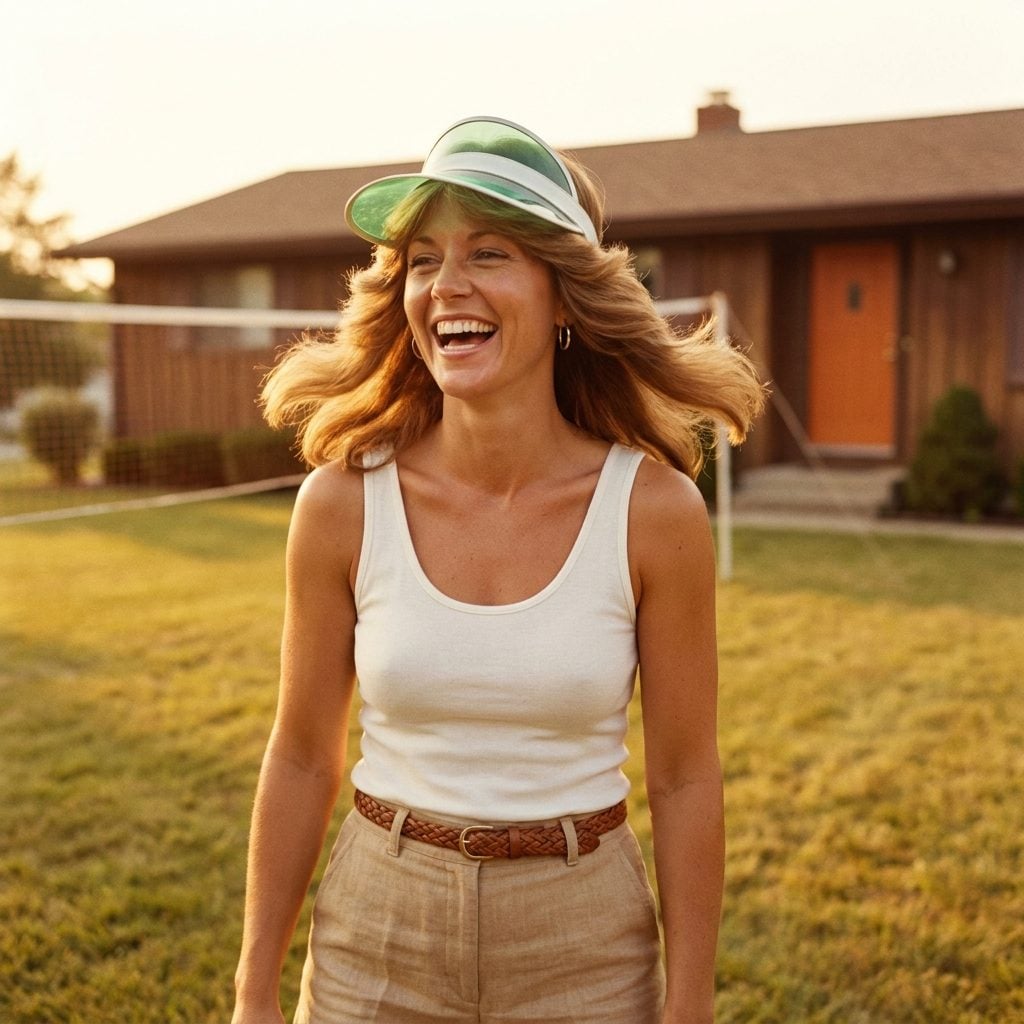
The visor existed solely to showcase the hair. We should all just admit that. It sat on top of the head like a little plastic crown, keeping nothing out of anyone’s eyes, while those feathered wings did their gravity-defying thing on either side. The sun-faded visor had usually started life as a brighter color — kelly green, hot pink, or clear with glitter embedded in the plastic — but after a summer of pool days and barbecues it faded to something ghostly. She kept wearing it anyway.
And then the hair. That blown-back, layered, wing-sculpted miracle that took thirty minutes with a round brush and a bonnet dryer to build. You walked outside into Houston humidity and had maybe nine minutes before it started to wilt. But for those nine minutes? Invincible. Completely, absurdly invincible — even if you were just standing next to a Weber grill eating a hot dog.