❤️ Would you like to save this?
The smell of Aqua Net in the bathroom, the snap of a scrunchie against your wrist, and that specific sound a boxy cotton tee made when you yanked the collar wide enough to slip off one shoulder. We didn’t call them “outfits” back then. We called it getting dressed, and somehow every combination involved a t-shirt, an attitude, and at least one accessory that weighed more than the shirt itself. These looks lived in our closets, our yearbook photos, and the deepest corners of our muscle memory.
FYI, thanks to AI imagery software, we’re able to create very specific fashion and hairstyle examples to illustrate the points being made. In some cases, imagery is exaggerated to hammer home the point. Also, assume links that take you off the site are affiliate links such as links to Amazon. this means we may earn a commission if you buy something.
28. A Tucked-In Ringer Tee With Contrast Trim and High-Waisted Acid-Wash Jeans
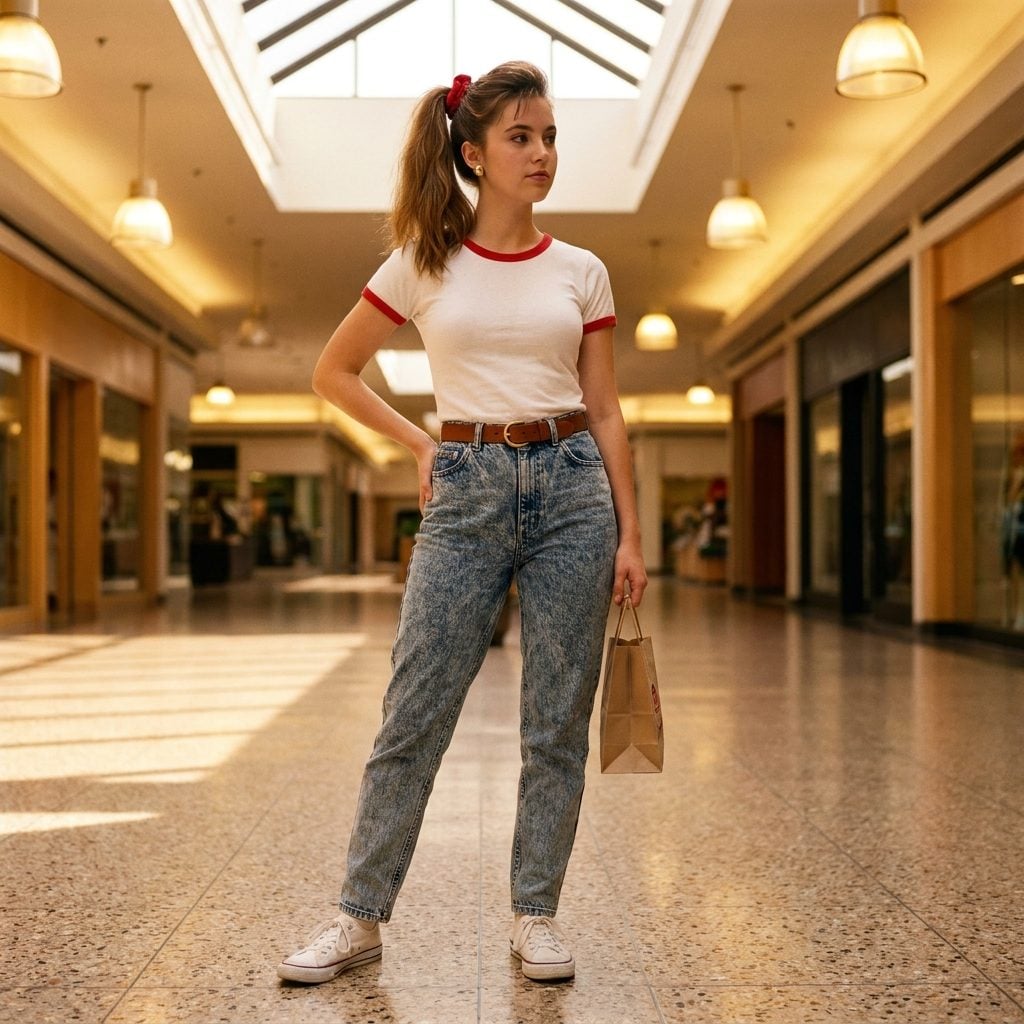
Cheap as anything. That’s what a ringer tee cost at the five-and-dime, and it worked harder per dollar than anything else in your closet. The contrast trim at the collar and sleeves — usually red or navy against white — gave a plain shirt just enough visual weight to look deliberate when you crammed it into those high-waisted acid-wash jeans.
And you tucked it in ALL the way. No French tuck, no half-tuck, no artful blousing. Straight in, belt cranked, waistband hitting your ribcage. The acid-wash handled the rest of the personality. I owned three pairs in slightly different shades of chemical damage, and I genuinely believed they looked like natural wear. They did not.
Today our readers can’t settle the waistline question: asked which jeans they would buy, mid rise and high rise came out a near coin toss.
27. The Giant MTV Logo T-Shirt With Biker Shorts and Scrunched Socks

A uniform for watching television — which in the 1980s counted as a personality trait. The oversized logo tee had to be genuinely massive, the kind of shirt that swallowed you whole because you’d borrowed it from someone twice your size. Or just bought it that way. Either excuse worked.
Biker shorts underneath addressed a modesty question nobody was actually raising. But the scrunched socks — those thick white athletic socks shoved into deliberate accordion folds around your ankles above your sneakers — that was the real finishing detail. Getting the scrunch right required technique. Too tight and you lost circulation. Too loose and you looked confused. Everyone in your homeroom knew the difference, even if they couldn’t articulate why.
26. A Cropped Concert Tee Tied in a Knot Above Pegged Jeans
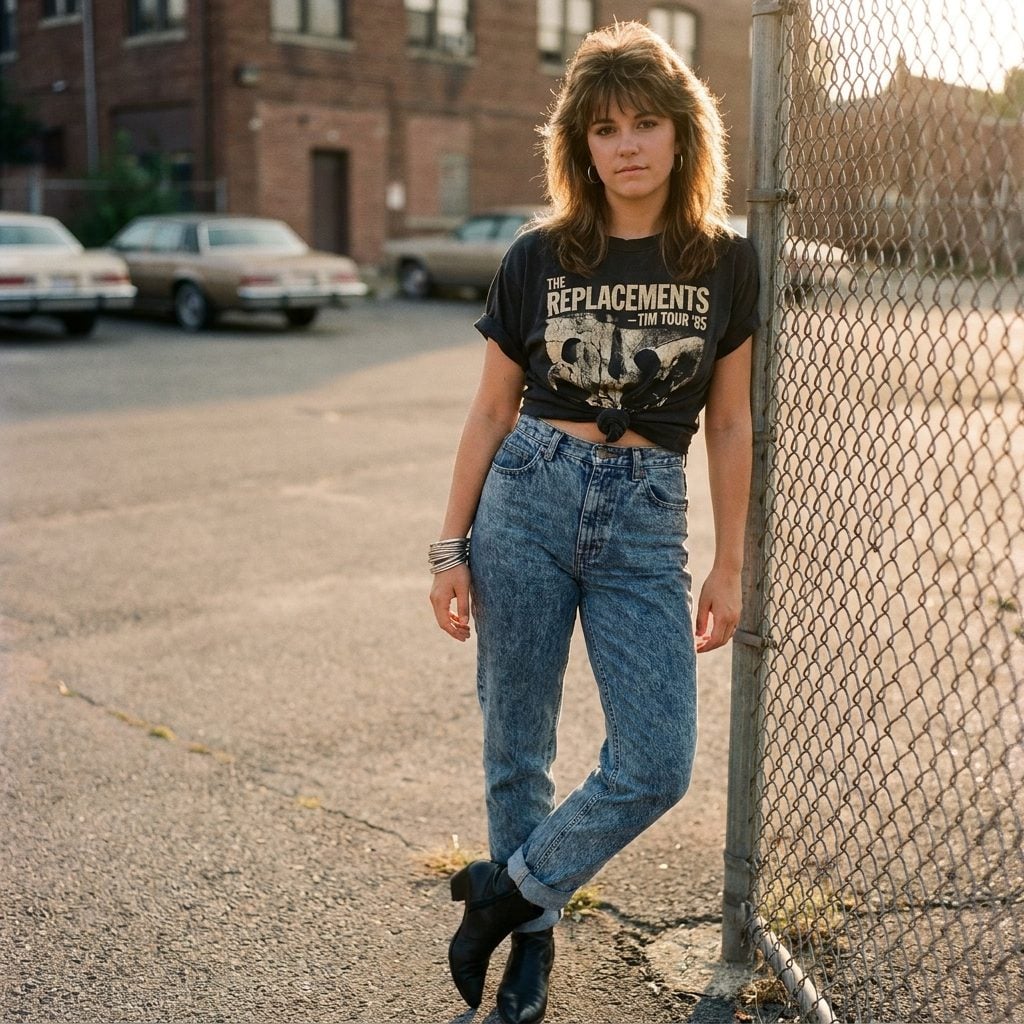
You didn’t buy this shirt. You earned it — standing in a parking lot for hours, possibly in the rain, emerging with a Bon Jovi or Def Leppard tee that was four sizes too big and reeked of arena fog machine.
So you cropped it. Or, more likely, you tied it in a knot at your ribs because cutting felt too permanent. The knot sat right above those pegged jeans, which you’d rolled and re-rolled at the ankle until the cuff squeezed like a tourniquet. The whole look communicated “I was there” — and when you were sixteen, few things mattered more.
What Our Readers Say
- Some habits never left: in our reader polls, 59% still pick jeans and a tee for the weekend, well ahead of athleisure or a dress.
From ThreadCurve reader polls and votes.
25. The Slouchy Pastel T-Shirt Layered Under Denim Overalls
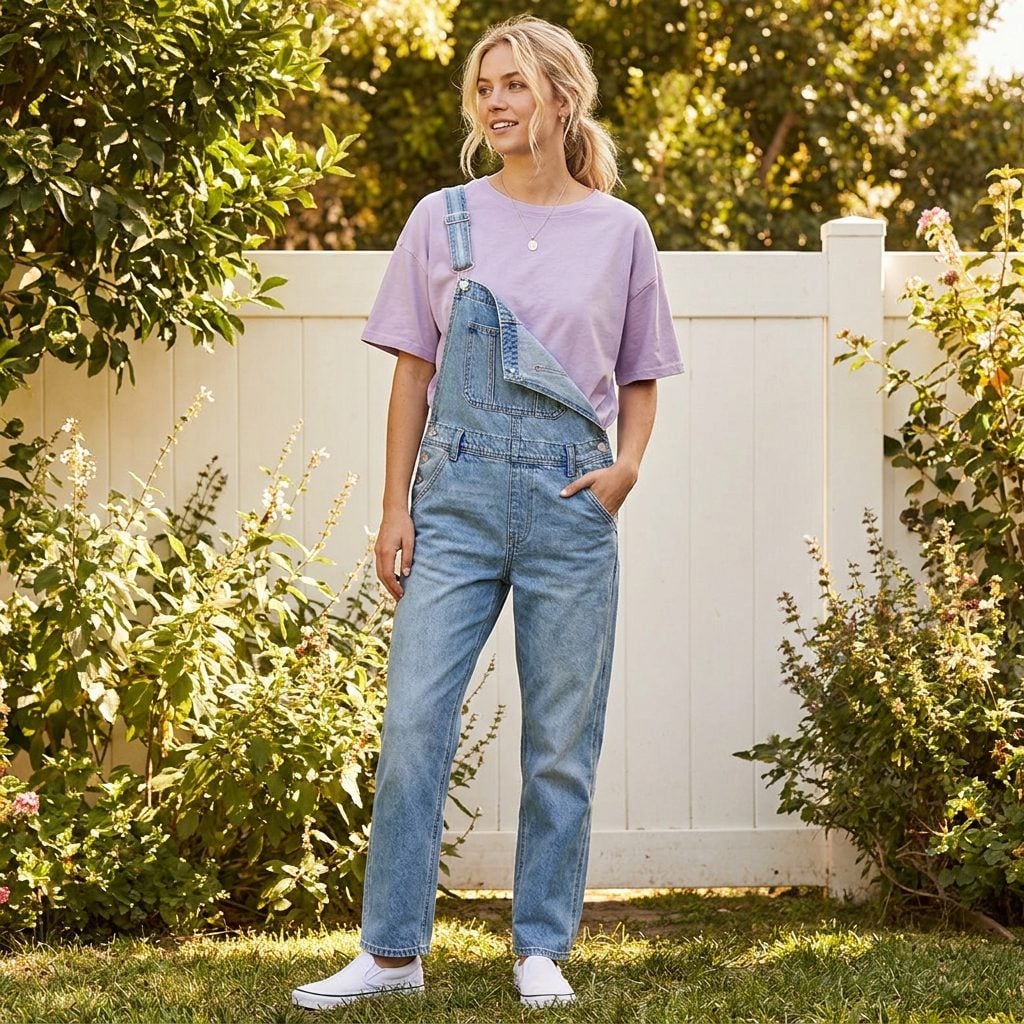
One strap down. Always. Both straps fastened and you looked like you were headed to reshingle a roof; one strap dangling meant you were cute and casual and possibly about to paint something in art class.
The pastel tee underneath had to be soft — cotton washed a dozen times until it felt like nothing. Mint, lavender, pale pink, baby yellow. Gentle colors, the wardrobe equivalent of a murmur. And somehow underneath a pair of chunky denim overalls, that quietness made sense. The denim did all the structural work. The tee just had to show up and be agreeable. Honest division of labor, that.
24. The Sleeveless Muscle Tee With Rolled Cuffs and Oversized Hoop Earrings
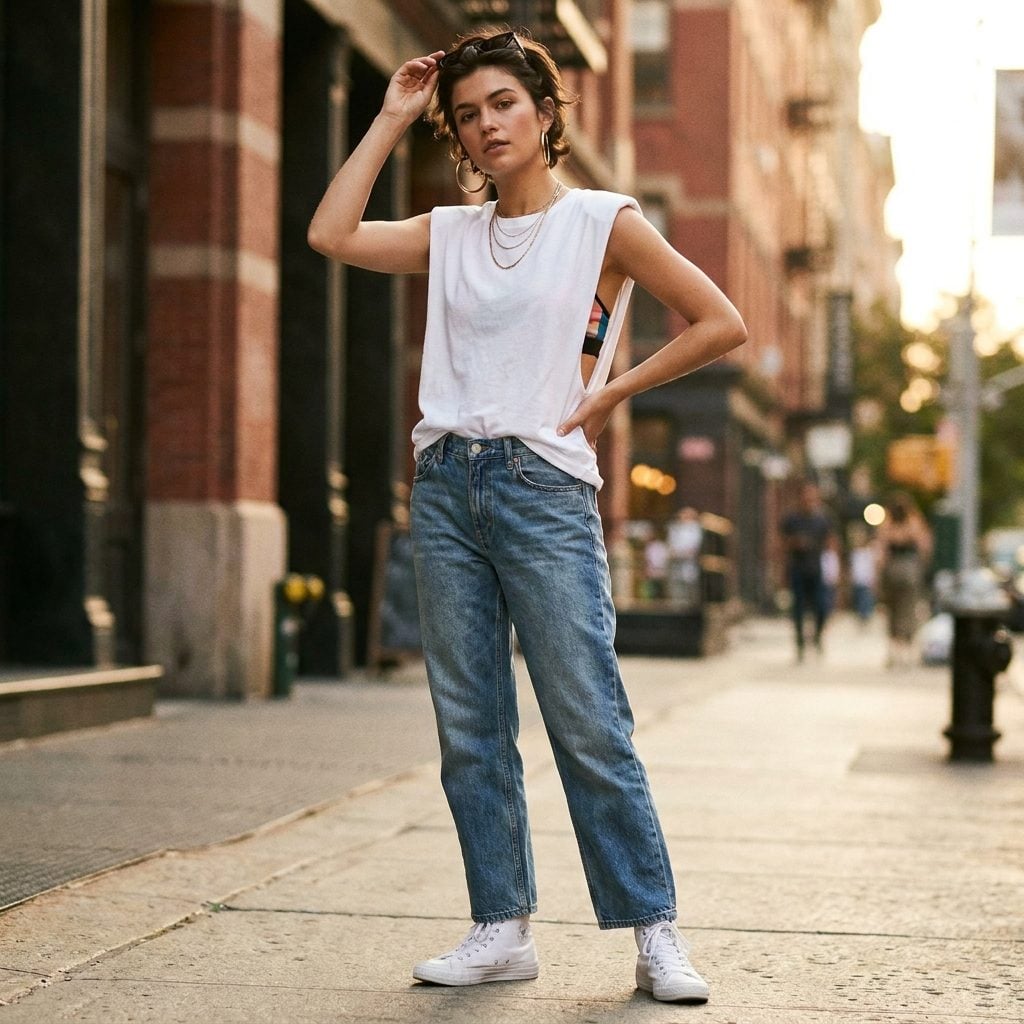
Rolling the cuffs was non-negotiable. You cut the sleeves off a crew-neck tee, then rolled what remained into tight little tubes on each shoulder — took about three tries to get them even, and they never stayed, but it didn’t matter because the oversized gold hoops were doing all the talking.
Before anyone tossed around the word “androgynous” casually, this look was already living there. The muscle tee borrowed from menswear and gym culture, but those hoops — enormous and gleaming — yanked it back toward something glamorous. Tough and feminine coexisting in the same outfit. That tension still reads beautifully four decades later, which tells you something about how well the instinct worked.
23. A Fitted Coca-Cola Logo T-Shirt Tucked Into Pleated Shorts
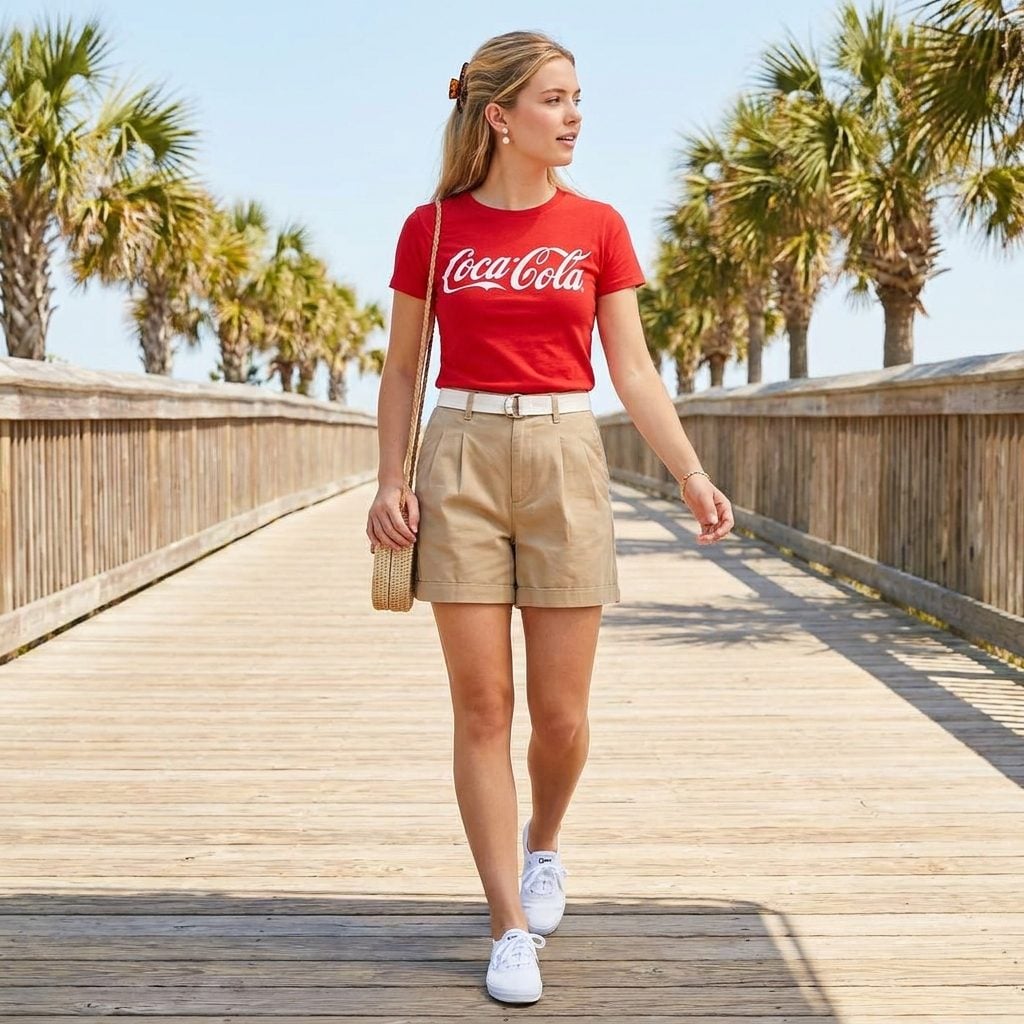
Brand-name clothing existed before the ’80s, obviously. But wearing a soda logo as a fashion choice? Fresh territory. The Coca-Cola tee wasn’t ironic, wasn’t commentary on consumerism, wasn’t a thrift store find you wore to project some personality. You bought it at the mall because it was red, it fit, and the logo felt familiar in a way that passed for cool.
Tucked into pleated khaki shorts with a thin belt, it became an entire summer personality. The pleats added volume that counterbalanced the fitted tee, producing an hourglass proportion almost by accident. Nobody was running silhouette calculations at the time — we were deciding between Cherry Coke and regular at the food court.
22. An Oversized Graphic Tee Belted at the Waist Like a Mini Dress
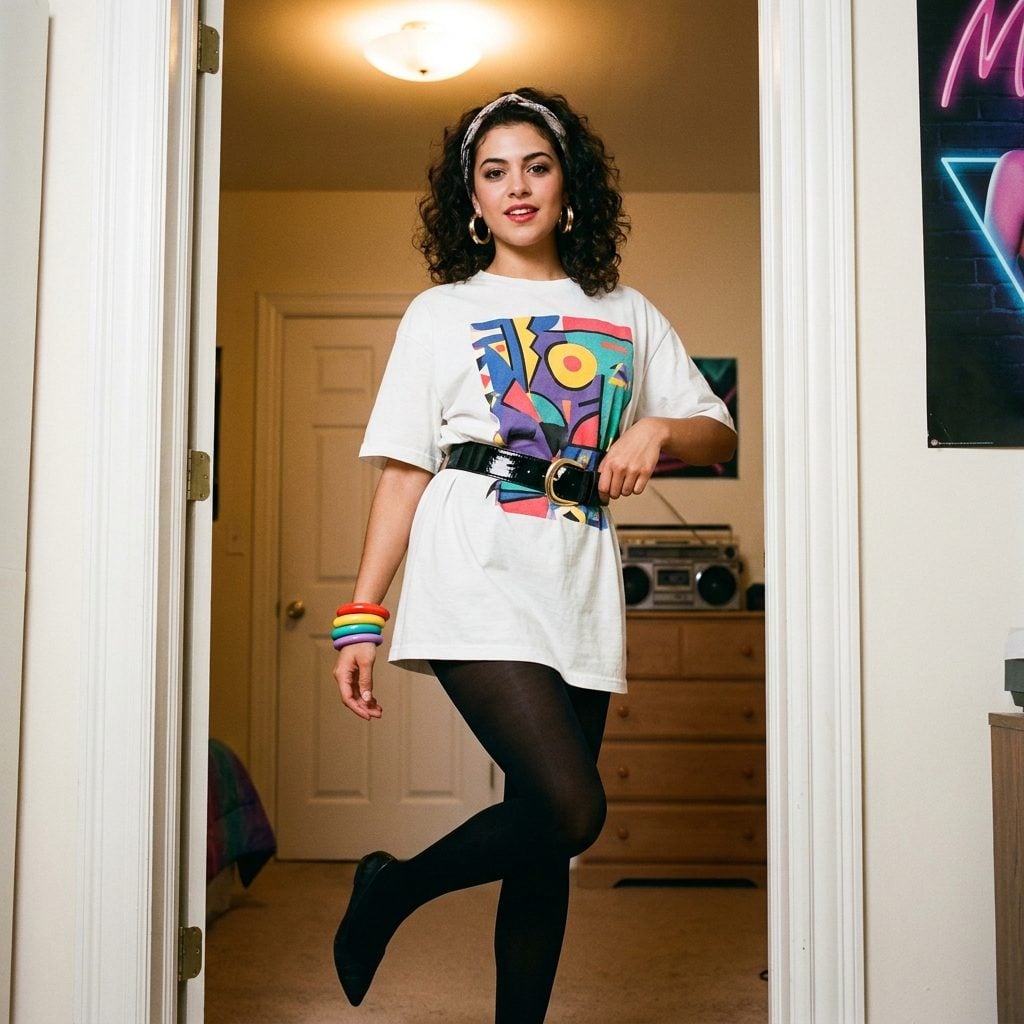
The belt carried this whole operation. Without it, you were wearing your dad’s undershirt to bed. With a wide patent leather belt cinched tight? Suddenly it’s a going-out dress that cost six dollars.
We were prototyping fast fashion and had no idea. The graphic tee had to be genuinely enormous — mid-thigh minimum — and the belt had to be wide enough to carve out a real waistline. Opaque tights underneath, always. The proportional move is actually clever: a straight column of fabric, interrupted by a defined waist, then falling again to mini length. Shape from shapelessness. You’ll find that principle in draping courses at fashion schools everywhere. We arrived at it because we were broke and resourceful, not because anyone taught us.
21. The Neon Oversized Tee Over Shiny Spandex Workout Tights
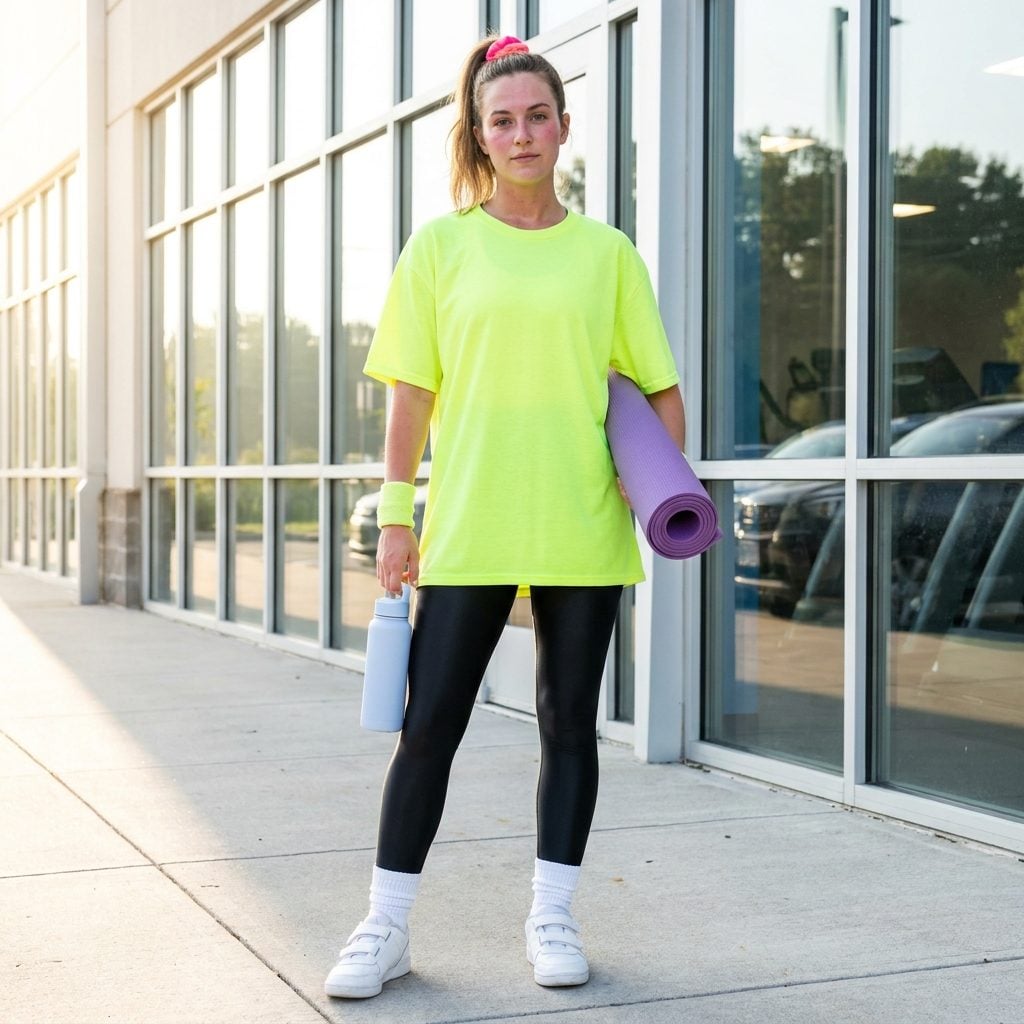
Jane Fonda’s aerobics empire didn’t just reshape exercise. It reshaped what people wore to the supermarket afterward, because nobody was going home to change. You threw a neon oversized tee over your shiny spandex tights and walked into the grocery store as if that constituted a fully realized outfit. It did.
The modern athleisure conversation starts here. The neon had to be aggressive — the kind of yellow-green or hot pink that seemed to vibrate if you stared long enough. Matte spandex wouldn’t cut it; it had to gleam. Together they announced that you were active, health-conscious, and completely unbothered by a color palette visible from passing aircraft.
20. The Polo-Style Knit Tee With Shoulder Pads and White Capri Pants
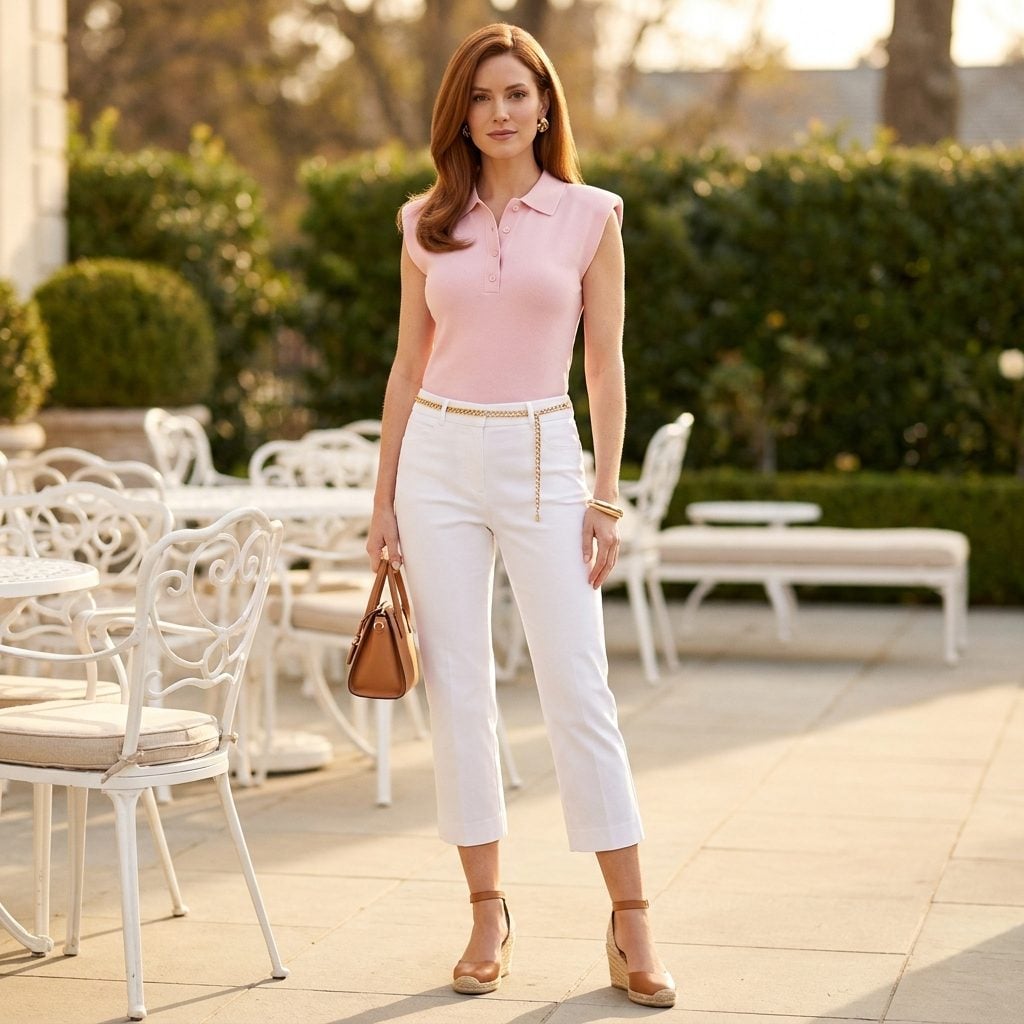
Every other look on this list borrowed from the street, the gym, the concert parking lot. This one came from the country club — or the aspiration of one. The pastel polo knit tee with its prim little collar said “I have a tennis lesson at two,” and the shoulder pads said “and I will absolutely destroy you at it.”
Those pads turned a soft knit polo into something with genuine geometry. Your shoulders looked like they could bear load, and in the ’80s, that was considered wildly attractive. Paired with white capri pants and gold jewelry, this was the outfit for your mother’s friend’s house, for a brunch that didn’t involve mimosas yet, for any occasion where looking pulled-together was the price of admission.
Maybe your life was a mess. The shoulder pads didn’t care. They handed everyone the same posture, the same quiet authority, the same illusion of having just walked out of a meeting where you’d been extremely right about something. A two-inch foam insert and suddenly you stood like you ran the place. I miss that about them, genuinely.
19. The Hard Rock Cafe T-Shirt With Stonewashed Jeans and White Sneakers You Bought on Every Vacation
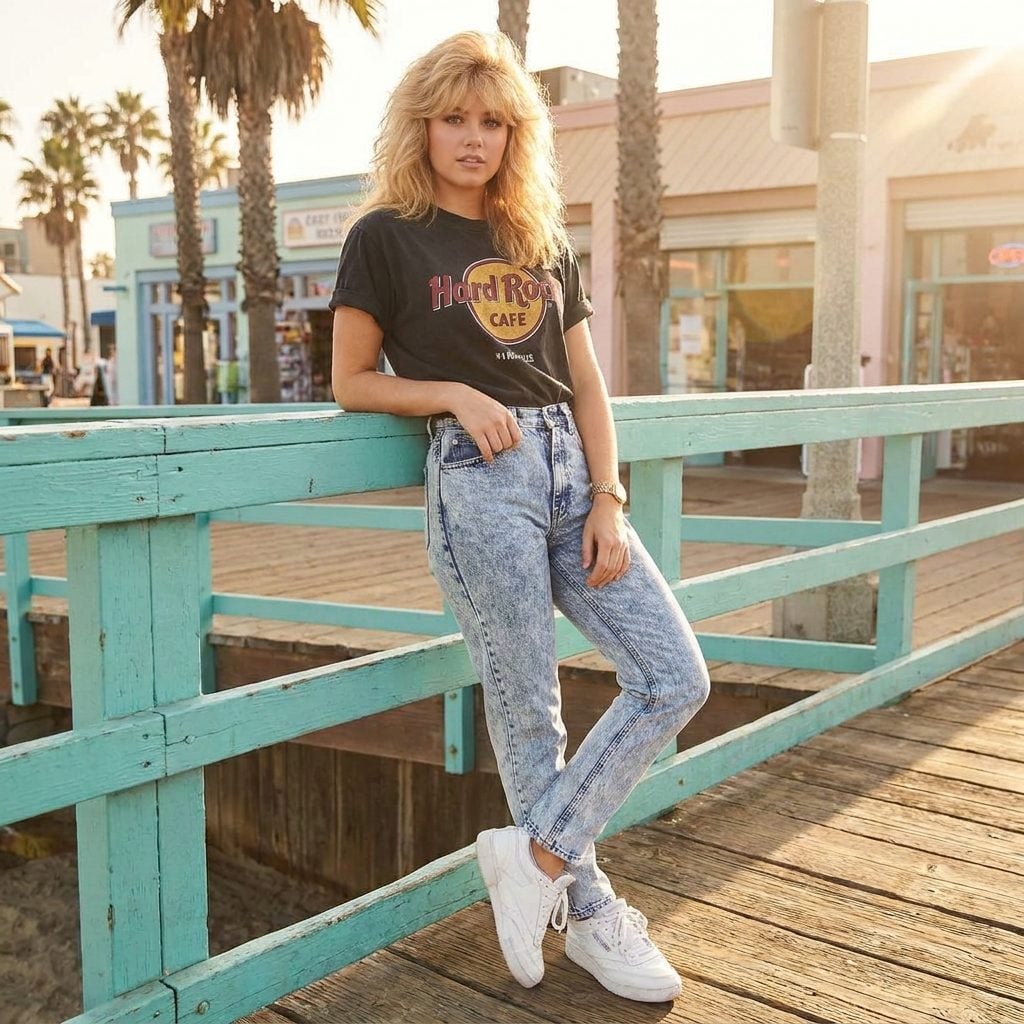
Nobody actually went to Hard Rock Cafe for the food. We went for the t-shirt, and we wore it like a merit badge proving we’d been somewhere. London. New York. Orlando, if we’re being honest, which was most of us.
The pairing never varied: stonewashed jeans rolled once at the ankle, white leather sneakers that you kept clean with a toothbrush, and that black tee with the red logo. You’d tuck the front in just enough to show the waistband. The whole outfit said “I travel” even if the furthest you’d been was the food court where your mom bought you a Cinnabon while your dad waited for a table.
18. A Tucked-In Striped Tee With Paperbag-Waist Shorts and the Skinniest Belt Known to Womankind
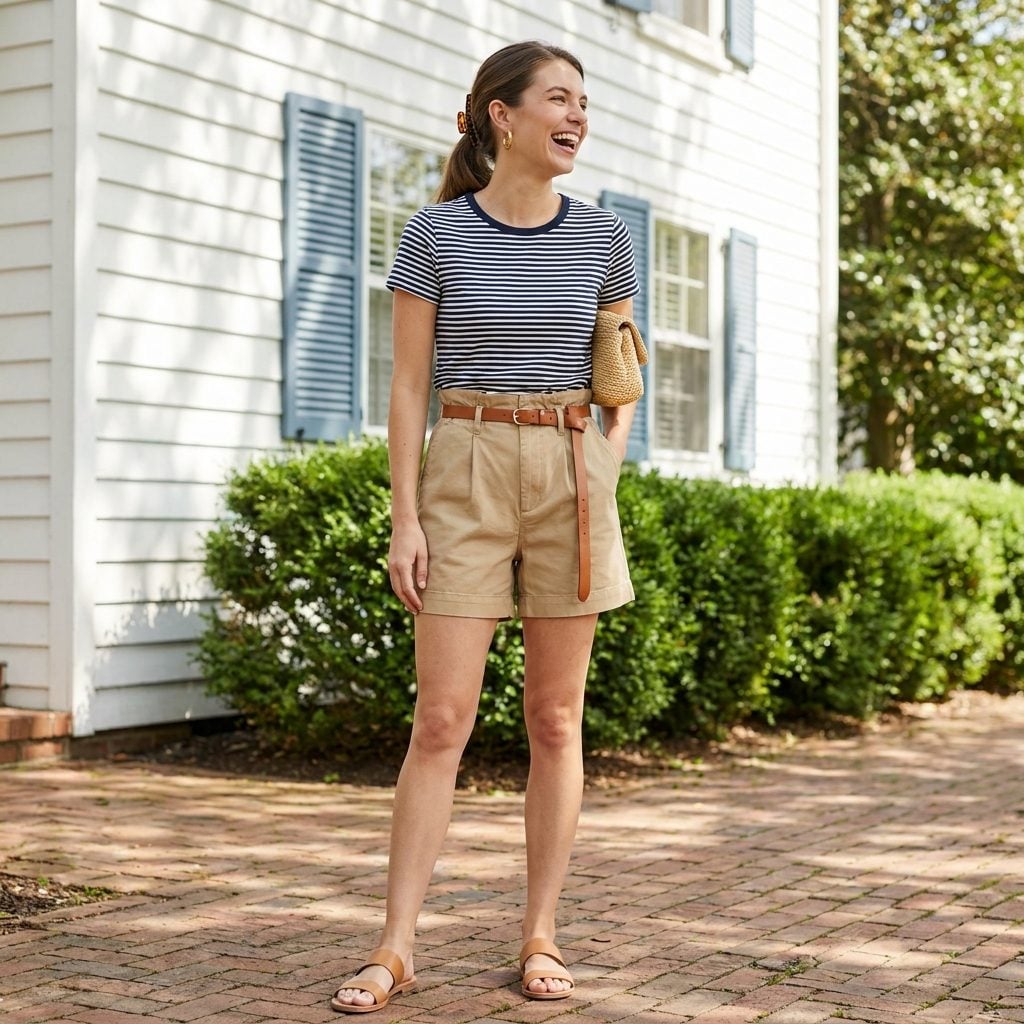
That belt was doing absolutely nothing structural. Let’s get that out of the way. It was a quarter-inch wide, barely thicker than a shoelace, and it sat right at the gathered waist of those paperbag shorts like a decorative afterthought. But without it? The outfit felt unfinished. Wrong, somehow.
The striped tee had to be fully tucked, smoothed flat against the stomach, no blousing allowed. Horizontal stripes in navy and white, usually. The proportional trick was simple but effective: a fitted top against volume at the hip, the belt acting as a visual anchor that said “yes, I meant this.” Every J.Crew catalog from 1986 to 1989 ran some version of this exact combination.
17. The “Choose Life” Slogan T-Shirt That Made You Feel Like You Were in a Wham! Video
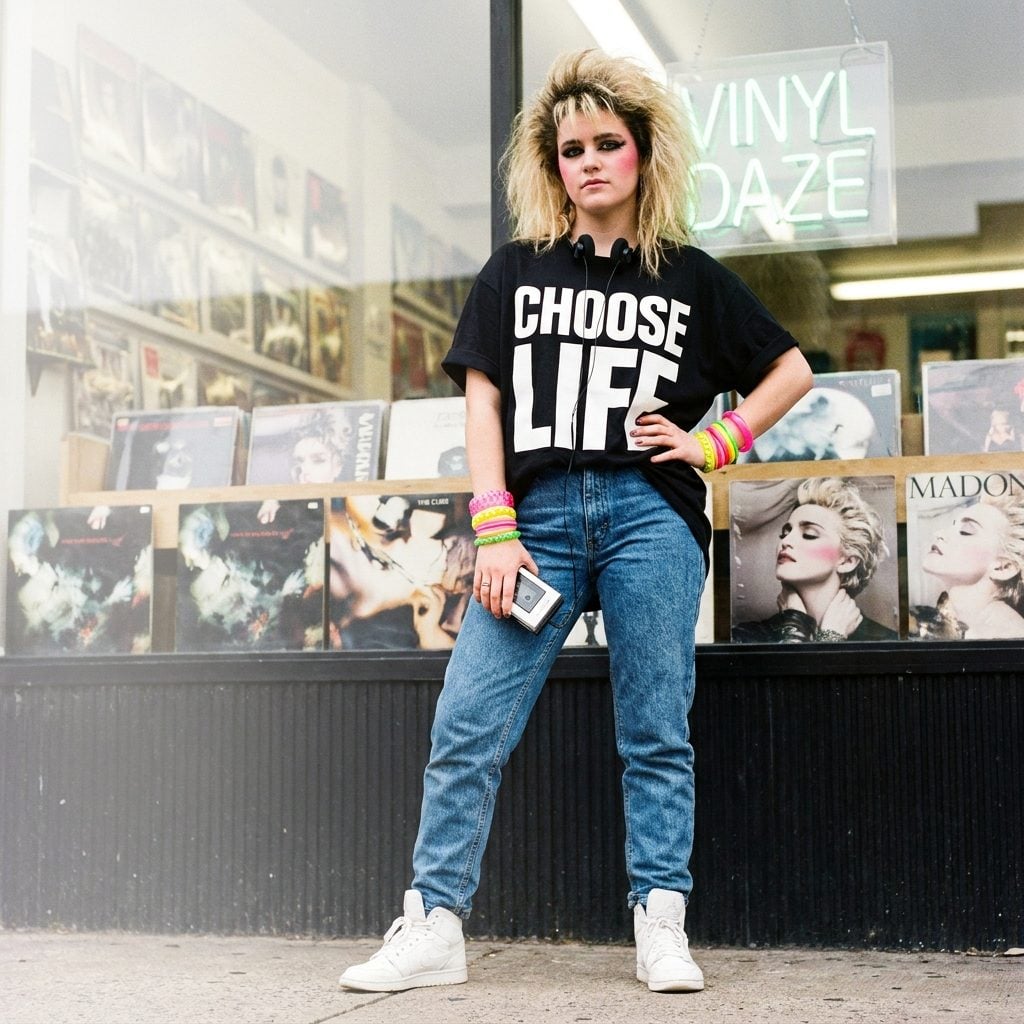
George Michael wore it in the “Wake Me Up Before You Go-Go” video in 1984, and within six months you could find knockoffs at every mall kiosk in America. Most of us had no idea the slogan was originally designed by Katharine Hamnett as an anti-drug and anti-nuclear statement. We just knew it looked cool and that wearing it made us feel connected to something bigger than seventh period.
The slogan tee as identity statement started right here, really. Before “Choose Life,” graphic tees were band merch or tourist souvenirs. After it, a t-shirt could be a manifesto. Or at least it could make you feel like one while you lip-synced into a hairbrush.
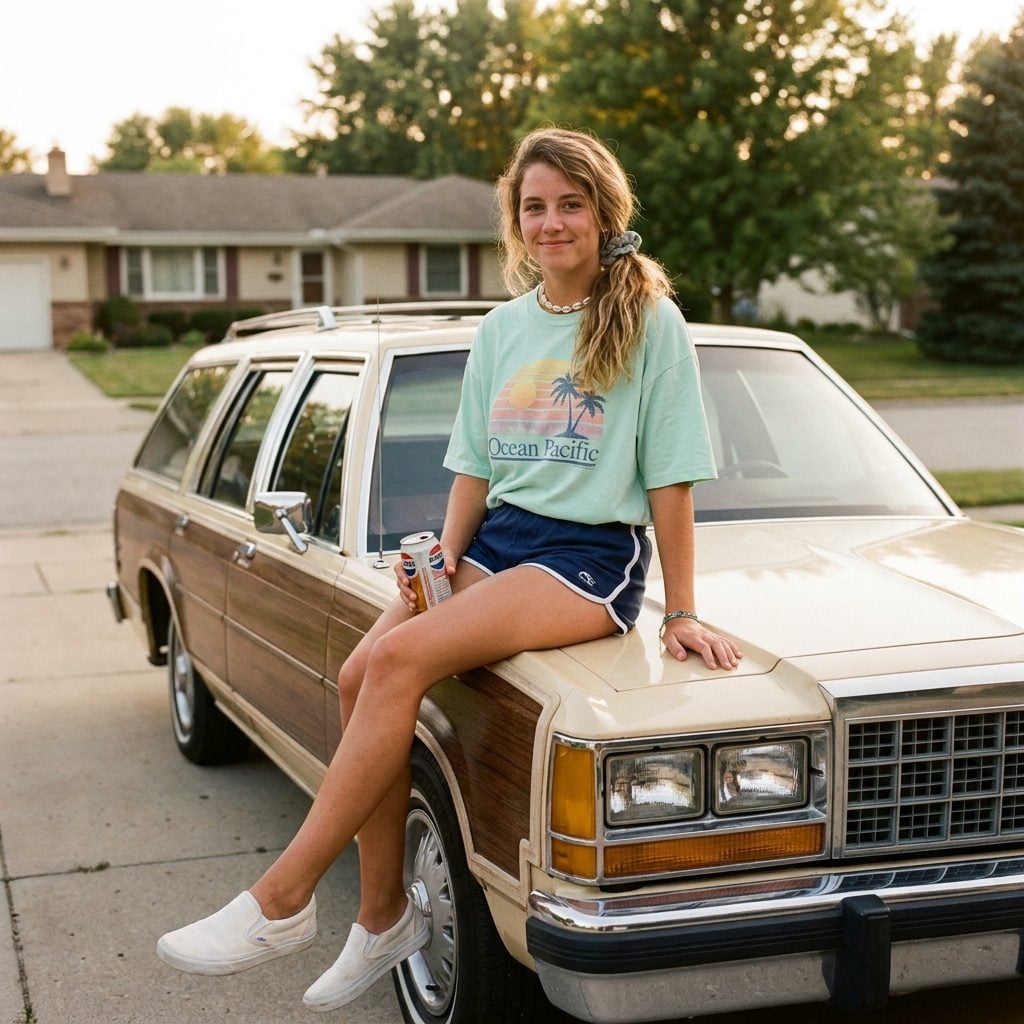
16. A Loose Surf-Brand Tee With Short Gym Shorts That Had Nothing to Do With Surfing or the Gym
❤️ Would you like to save this?
You lived in landlocked Ohio. You had never surfed. You didn’t even like the beach that much because sand got everywhere. None of that stopped you from wearing an Ocean Pacific tee three sizes too big with the shortest shorts your mother would tolerate.
OP. Gotcha. Quicksilver. Jimmy’Z. The brand on the chest mattered enormously, and the irony of a surf logo on a girl who’d never left the Midwest was completely lost on everyone. Those tiny cotton gym shorts with the contrast piping had a two-inch inseam at best, and the proportional contrast with the tent-like tee created a silhouette that was somehow both covered and revealing. The whole look said “I am casual and I might skateboard later” even if you definitely would not.
15. The Fitted Tee With Puff-Print Graphics and Bedazzled Lettering You Could Feel Through Your Jacket
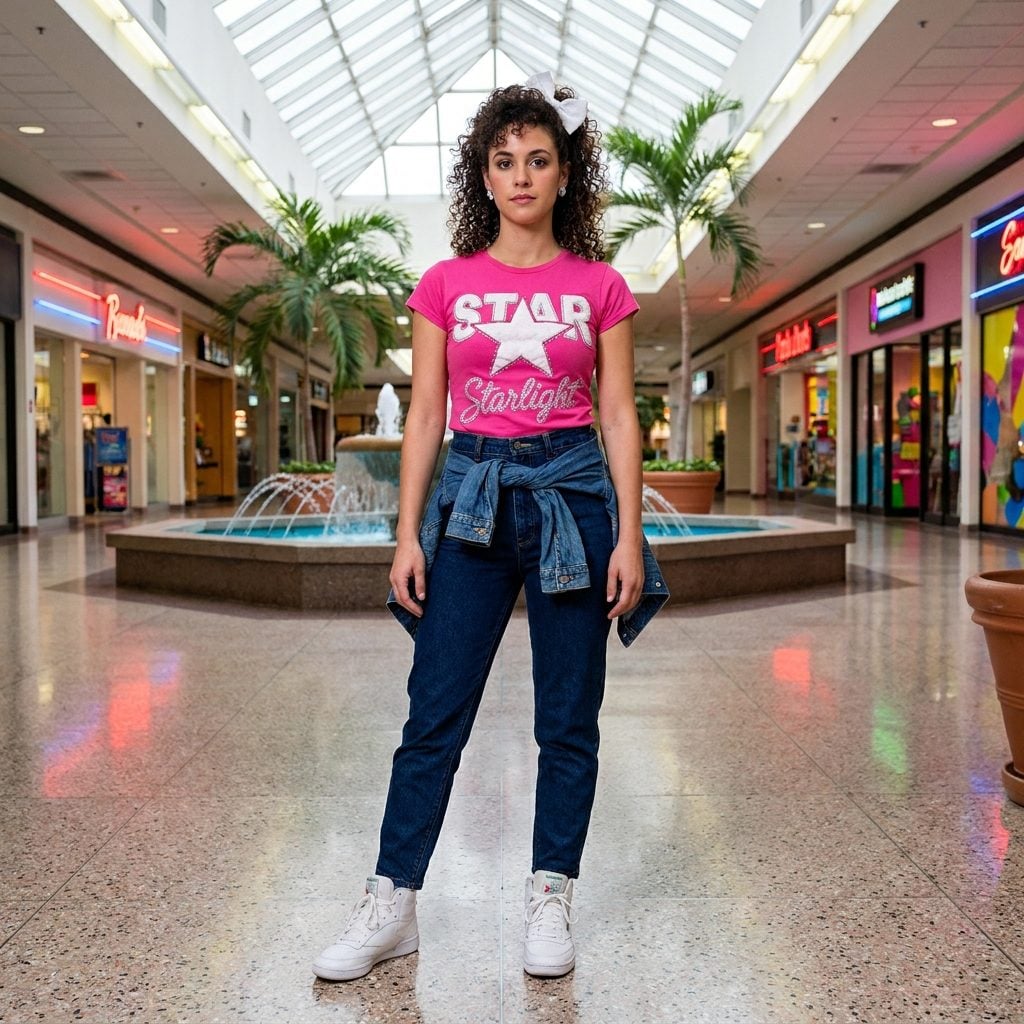
Run your hand across the front of this shirt and you’d feel every letter like Braille. Puff paint turned a flat cotton tee into something almost sculptural, the graphics rising a good quarter inch off the fabric in rubbery, slightly shiny ridges that cracked after too many washes.
The bedazzled versions were worse. Or better, depending on your commitment. Rhinestones glued directly onto cotton, shedding one by one into your locker, your car seat, your best friend’s couch. You’d find a tiny silver stone in your bra at the end of the day and just accept it. The whole point was that this tee had texture, dimension, presence. It wasn’t just worn. It was experienced.
14. A Mickey Mouse Graphic T-Shirt Layered Under a Bright Blazer Like You Were Going Somewhere Important
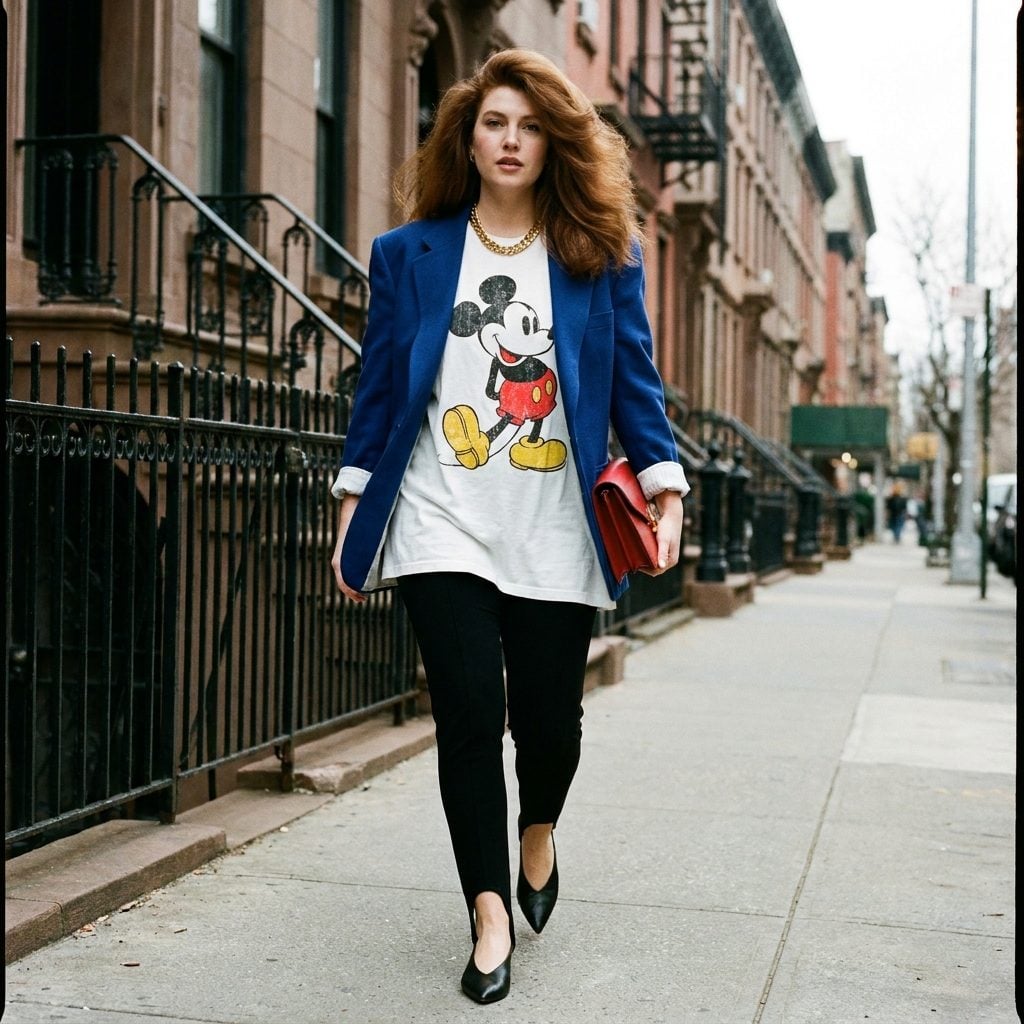
The blazer made it professional. The Mickey Mouse made it you. That was the logic, and honestly, it held up better than it should have. Something about a cartoon character peeking out from under a structured royal blue blazer with serious shoulder pads communicated a very specific kind of 1980s confidence: “I’m an adult, but I refuse to be boring about it.”
Disney character tees weren’t just for kids in the ’80s. They were everywhere, on grown women with real jobs and real commutes. The Mickey tee under a blazer with stirrup pants and flats was practically a uniform for Friday at the office. The tension between cartoon and corporate was the whole engine of this outfit, and it only worked because both pieces were fully committed to their respective roles.
13. The Boxy Shoulder-Padded T-Shirt Tucked Into Parachute Pants Like a Human Triangle
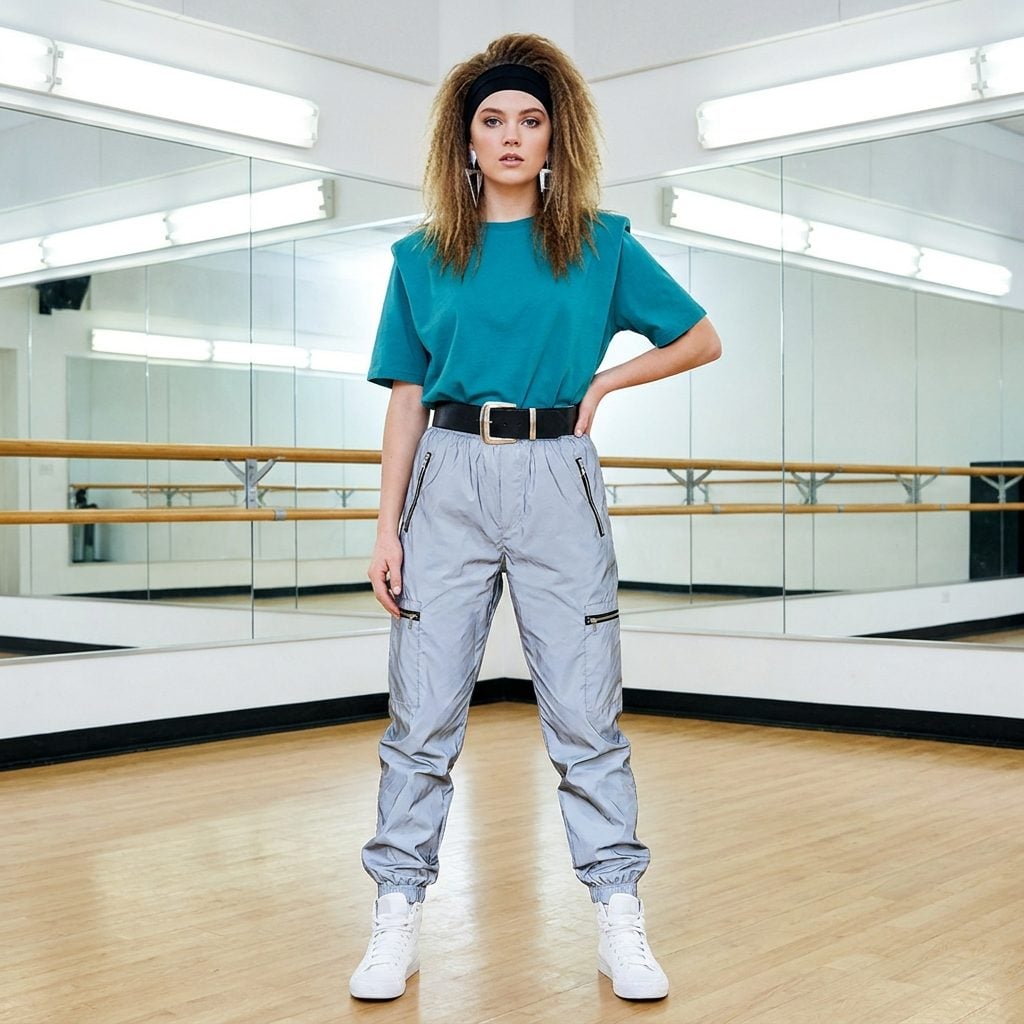
The silhouette was an inverted triangle, and we wore it on purpose. Broad padded shoulders tapering down to parachute pants gathered tight at the ankle created a shape that existed nowhere in nature, and that was fine by us.
Those shoulder pads weren’t subtle. Even in a t-shirt, a cotton t-shirt, someone decided we needed architectural shoulders. The pads were often sewn in, not removable, so the shirt held its boxy shape even on the hanger. Tucking it into those slippery nylon pants required a belt with real authority, usually wide, usually with a buckle the size of a playing card. The whole thing rustled when you walked. Every pocket on those pants had a tiny zipper that zipped to absolutely nothing useful. But it looked like the future, and in 1985, looking like the future was the entire point.
12. The Oversized Airbrushed Vacation T-Shirt From Myrtle Beach That Became Your Favorite Pajama Top
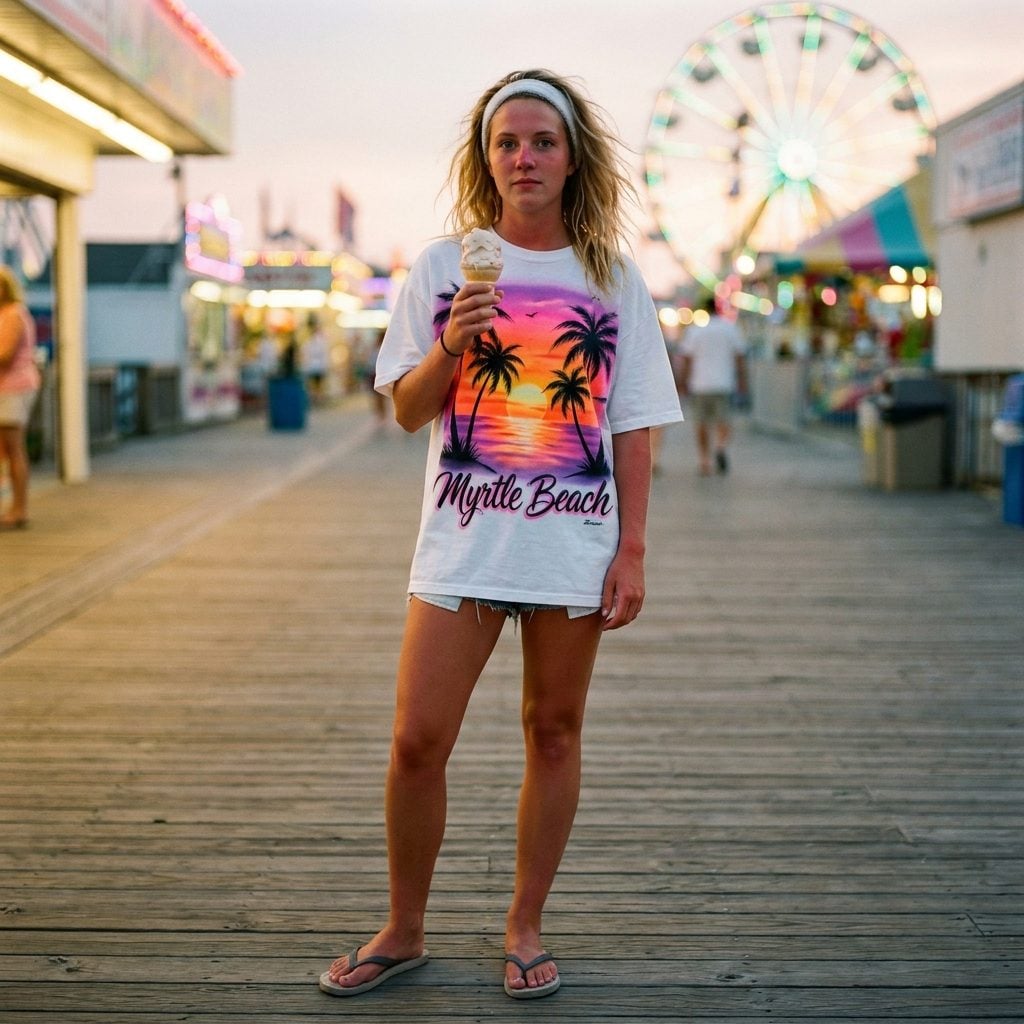
You watched a man in a booth spray this into existence with an airbrush gun while you stood in flip-flops on a boardwalk that smelled like funnel cake and sunscreen. Your name in script. A dolphin jumping over a sunset. Myrtle Beach or Daytona or Wildwood or wherever your family drove nine hours in a station wagon to spend four days.
The shirt was always enormous because you bought it from a rack of one-size-fits-all blanks, and it immediately became your favorite thing to sleep in. The airbrush colors faded after three washes into something ghostly and pastel, which somehow made it better. More yours.
11. The Slashed-Neckline Flashdance Sweatshirt Tee That Showed Exactly One Shoulder
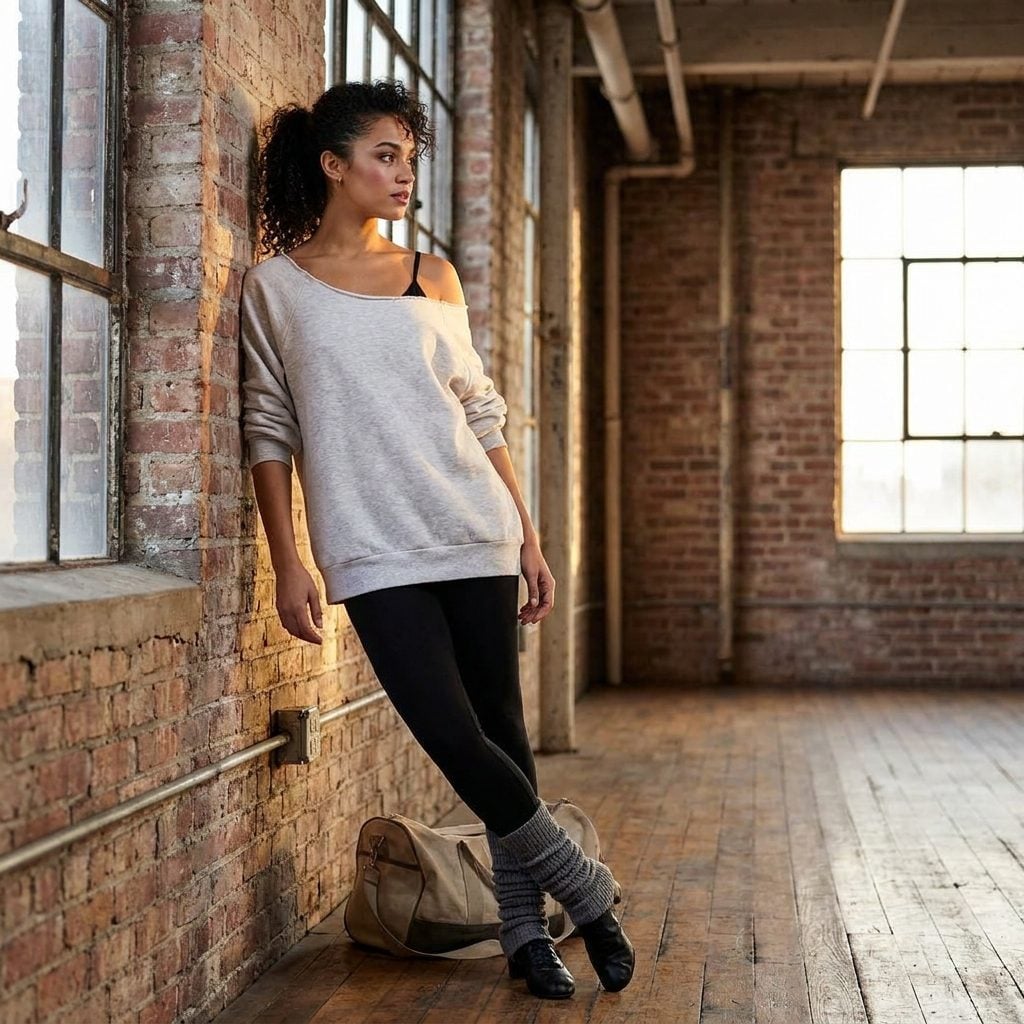
Jennifer Beals wielded a pair of scissors in 1983 and an entire generation of women attacked their sweatshirts with kitchen shears the next morning. The cut was supposed to look accidental, effortless, like the neckline just happened to stretch wide enough to slide off one shoulder. It did not look accidental. We cut these with great deliberation, usually too much, sometimes having to start over with a new sweatshirt.
One shoulder bare. One shoulder covered. A tank top strap visible underneath, always. The proportional play was genuinely interesting: that asymmetry created visual tension, drawing the eye to the collarbone and neck in a way that a regular crew neck never would. Paired with leg warmers and leggings, it was the ultimate “I just came from dance class” outfit, even for those of us whose closest encounter with dance was fast-forwarding to the good parts of the movie.
10. The Bright Esprit Logo T-Shirt With Pegged Jeans and Penny Loafers That Was Basically a Personality
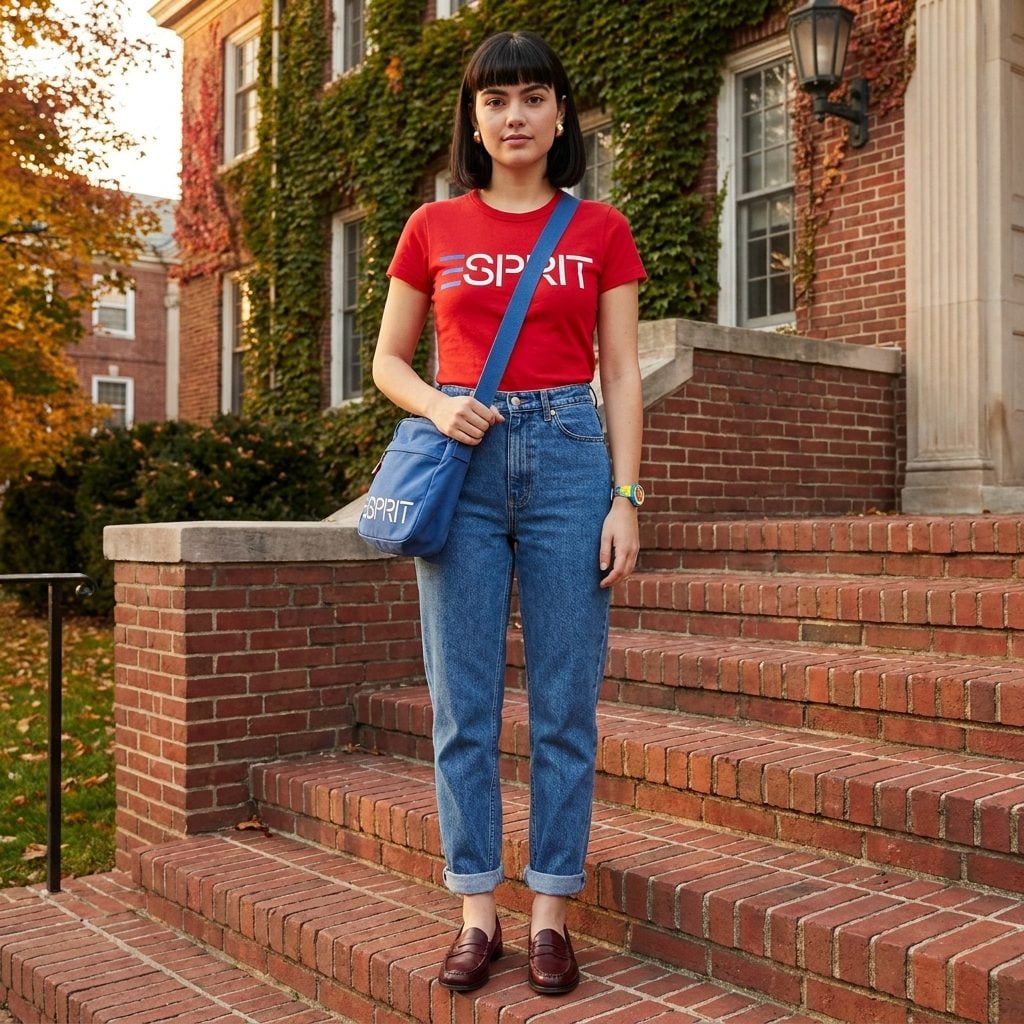
Esprit wasn’t just a brand. It was a social sorting mechanism. If you wore Esprit, you were a particular kind of girl: organized, popular-adjacent, the type who actually used a Trapper Keeper for its intended purpose. The logo was always huge and always primary-colored, usually red or cobalt blue, and you wore it like a flag.
The pegged jeans were non-negotiable. You’d fold the hem over itself into a tight roll at the ankle, sometimes pinning it, sometimes using a rubber band hidden inside the fold. The result was a tapered silhouette that funneled down into penny loafers worn sockless or with those little footie socks that always slid under your heel. And that Esprit bag, canvas with the logo in contrasting colors, slung across the body, was doing what the Hard Rock tee did for vacation kids: it announced your tribe before you opened your mouth.
9. The Tie-Dye Tee With Jelly Shoes and a Whole Arm of Plastic Bangles
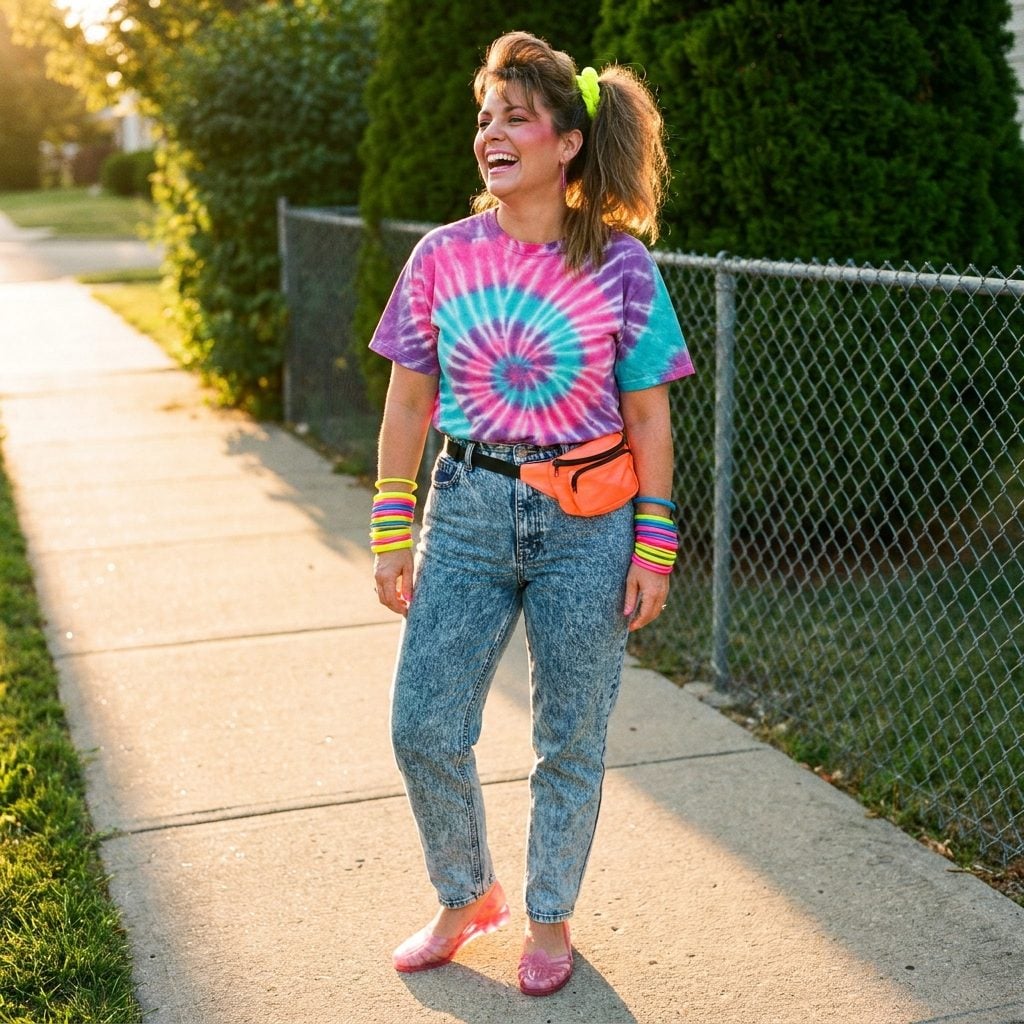
The bangles announced you before you turned the corner. That was sort of the point. A stack of neon plastic bangles climbing halfway to your elbow, a tie-dye tee that your mom may or may not have made at a church picnic, and a pair of translucent jelly shoes that smelled like a pool toy and blistered spots you didn’t know feet had.
Nobody coordinated any of this. The tie-dye was whatever colors the kit came with, the jellies were whatever the drugstore had left, and the bangles were grabbed by the fistful from a spinning rack at Claire’s. And somehow it worked—in that unhinged, maximalist way only the ’80s could pull off. You looked like a Lisa Frank folder that had gained sentience and walked into homeroom, and you were deeply proud of that.
8. A Pastel Oversized Tee With Rolled Sleeves and White Keds That Were Never Actually White
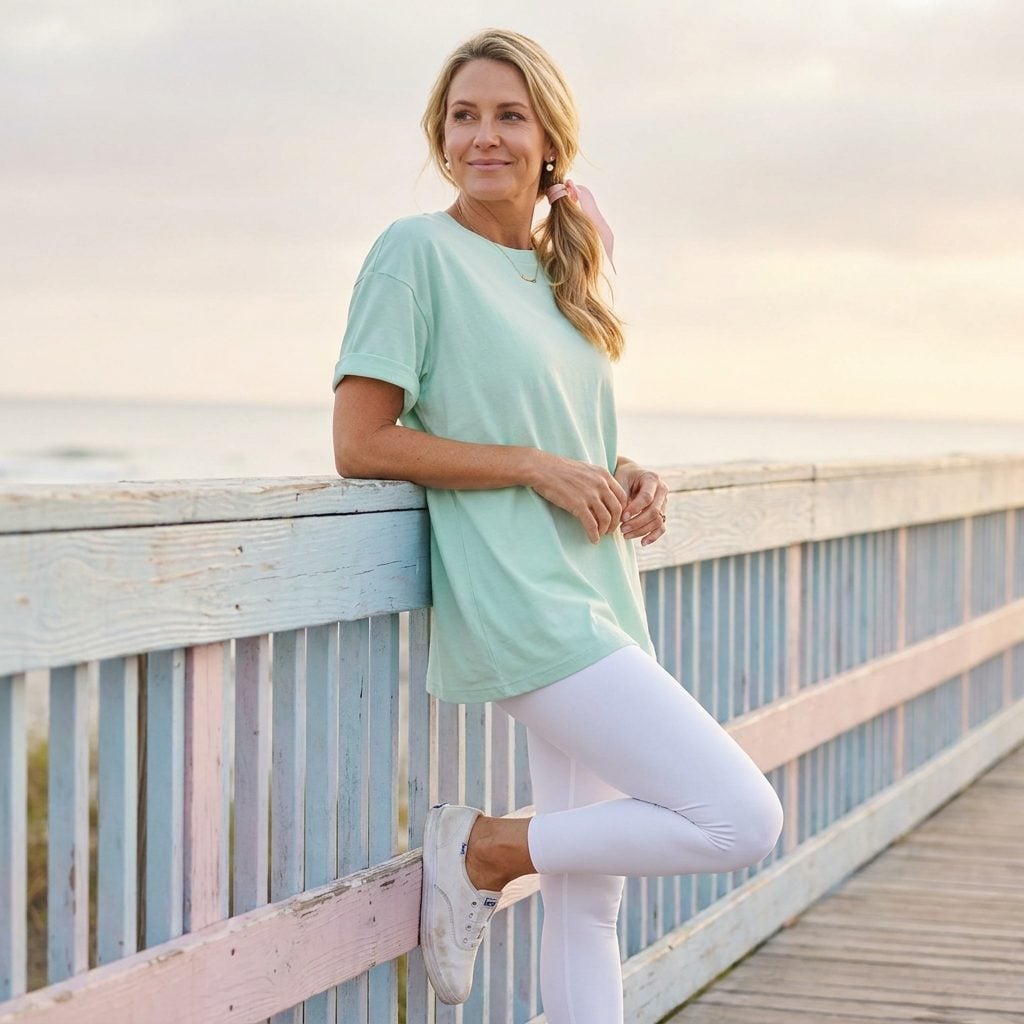
Those Keds started white. They really, genuinely did. By week two they’d settled into a shade best described as “sidewalk,” and we kept wearing them because buying new ones wasn’t an option and nobody cared anyway. The pastel oversized tee—mint, lavender, baby pink, butter yellow—was practically a dress on most of us. You rolled the sleeves exactly twice. Not once. Not three times. Twice. And you wore it with leggings or bike shorts because that was the law.
Easiest outfit of the decade, bar none. Zero thought required. It communicated “I’m going to the mall later and I might get a Cinnabon,” which was a perfectly acceptable Saturday agenda in 1988.
If you still can’t choose between white and coloured sneakers, you’re in good company, since our readers split almost evenly between the two.
7. The Fun Run Souvenir Tee You Wore for Five Straight Years After the Event

Nobody ran a fun run in the ’80s for the fun run. You ran it for the t-shirt. Then you wore that shirt until the letters cracked and the cotton went tissue-thin and your mom tried to demote it to a rag, at which point you rescued it from the pile like it was a first-edition Hemingway.
“Turkey Trot ’86.” “Walk for the Cure 1984.” “Riverside Elementary Jog-a-Thon.” The event was irrelevant. What mattered was that you had proof you’d shown up somewhere, and the proof was cloud-soft from a hundred washes. Those shirts carried more personality than anything hanging at Sears. The cracked screen printing? Patina. Character. Badge of honor.
6. A Fitted Striped Knit Tee Tucked Into a Denim Mini With Maximum Confidence

The French-ish Fantasy
A navy-and-white striped knit tee tucked into a denim mini skirt was the ’80s version of thinking you looked Parisian. You didn’t look Parisian. You looked like you were headed to Friendly’s after school, but the aspiration was genuine and it carried the whole thing.
The tuck had to be tight and precise, the belt wide and serious. Leather boots or ballet flats finished it off, and the complete package telegraphed a very specific delusion: “I have my life together and I know what a baguette is.” At thirteen. Honestly, that striped knit tee was the gateway to actually caring about clothes as a language—not just something you put on because it was cold outside.
5. The Benetton Logo Tee With a Cardigan Draped Over Your Shoulders Like You Had a Trust Fund
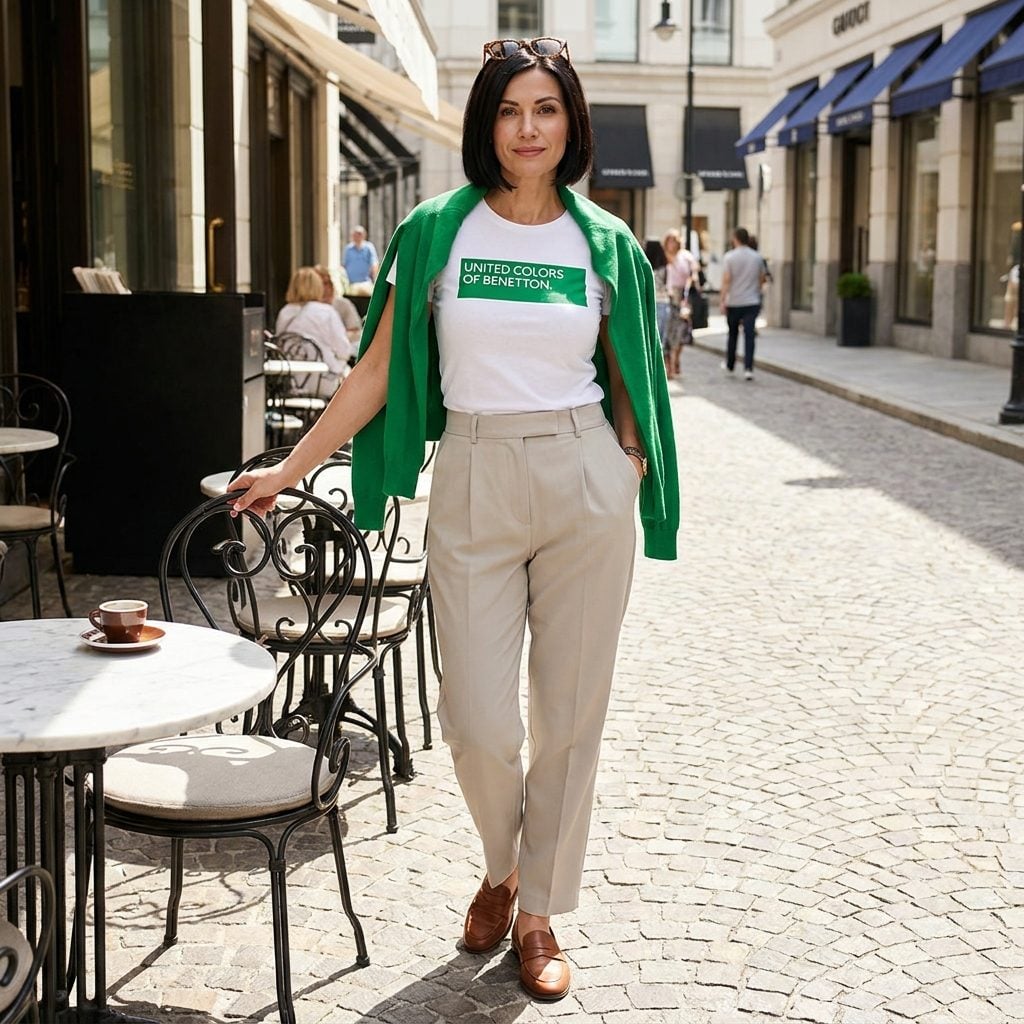
Draping a cardigan over your shoulders without putting your arms through the sleeves was the single most aspirational styling move of the decade. Pair it with a Benetton logo tee and you were practically broadcasting that you’d been to Europe—or at least that you’d loitered outside the Benetton store at Northgate Mall more than once.
United Colors of Benetton sold a worldview. The ads were diverse and artful, and they made a cotton t-shirt purchase feel like a political act and a wardrobe decision rolled into one. We bought it—the shirt and the myth—completely. Meanwhile, the draped cardigan clung to your shoulders through sheer willpower and the paralyzing fear of looking like you were trying too hard. Which, of course, you absolutely were.
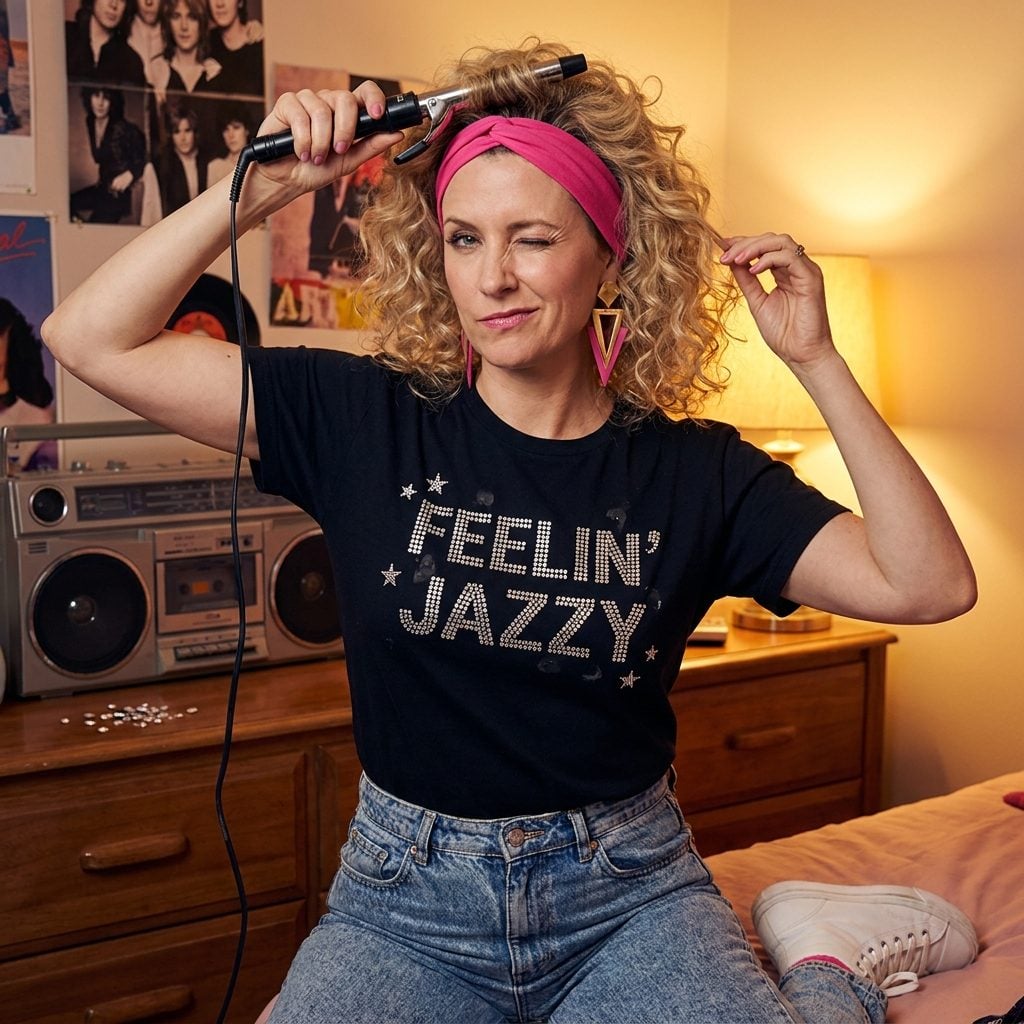
4. The Glittery Novelty Tee With Iron-On Decals That Shed Rhinestones Everywhere You Sat
❤️ Would you like to save this?
You left a trail. A sparkling, incriminating trail of tiny rhinestones on every chair, car seat, and couch cushion you touched. The iron-on decal novelty tee represented a commitment to glamour that the adhesive technology of the era simply could not honor.
“PARTY GIRL.” “FOXY.” A giant cat face made entirely of holographic sequins. Whatever the declaration, it started peeling after the second wash, and you’d try to re-iron the casualties back into place with your mom’s iron—which sometimes worked and sometimes fused the tee into a plasticky hellscape. But that first wearing? Transcendent. You sparkled under the fluorescent lights of the roller rink like a human mirror ball, and the bald patches on the shirt were a problem for future you to deal with.
3. The Beach-Town Souvenir Tee With Cutoff Denim Shorts and Zero Concern for Fit
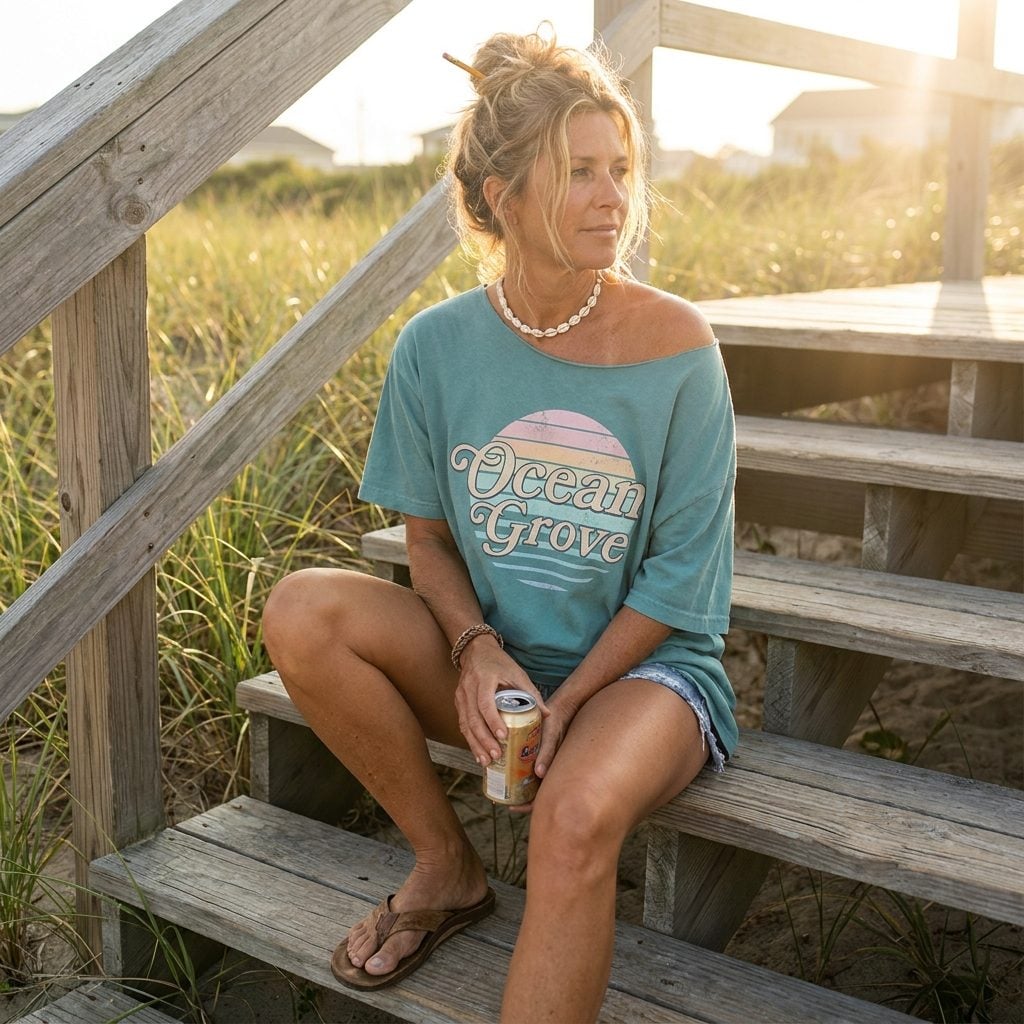
“Panama City Beach.” “Ocean City, MD.” “Myrtle Beach” in that sunset-gradient font with a palm tree silhouette. Everyone owned one, and the shirt was always three sizes too big because the beach shop only had XL left and you didn’t care—the whole look demanded enormous and slouchy anyway.
You paired it with cutoff jean shorts you’d hacked from old Levi’s with kitchen scissors, which is why the hem was never even. Not once. Ever. The outfit announced “I have been on a vacation,” and you wore it until the graphic faded to a pastel ghost, because that fading was evidence of a good time. Throwing it away would’ve been like throwing away the vacation itself.
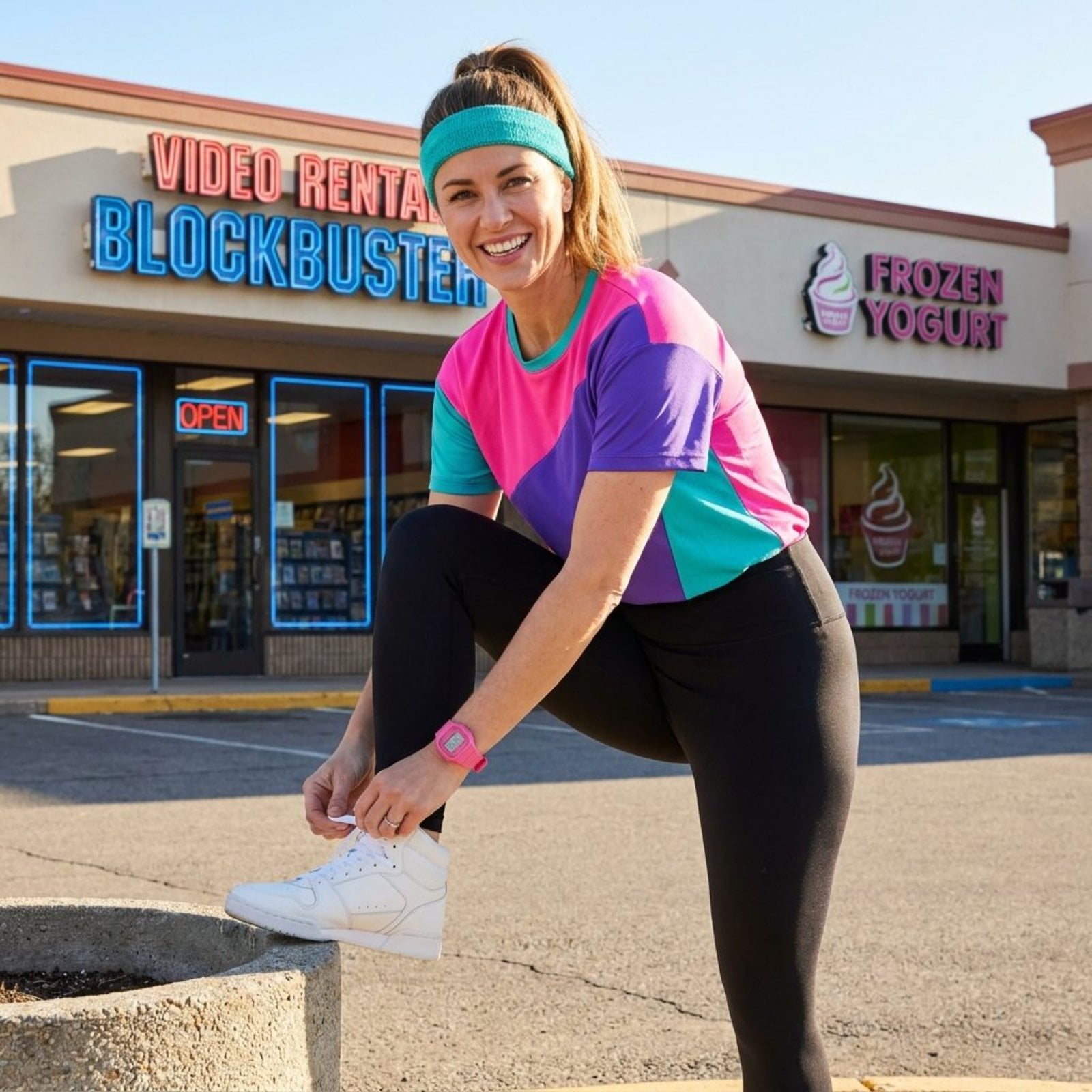
2. The Color-Blocked Athletic Tee That Made You Look Like You Did Aerobics (Even If You Didn’t)
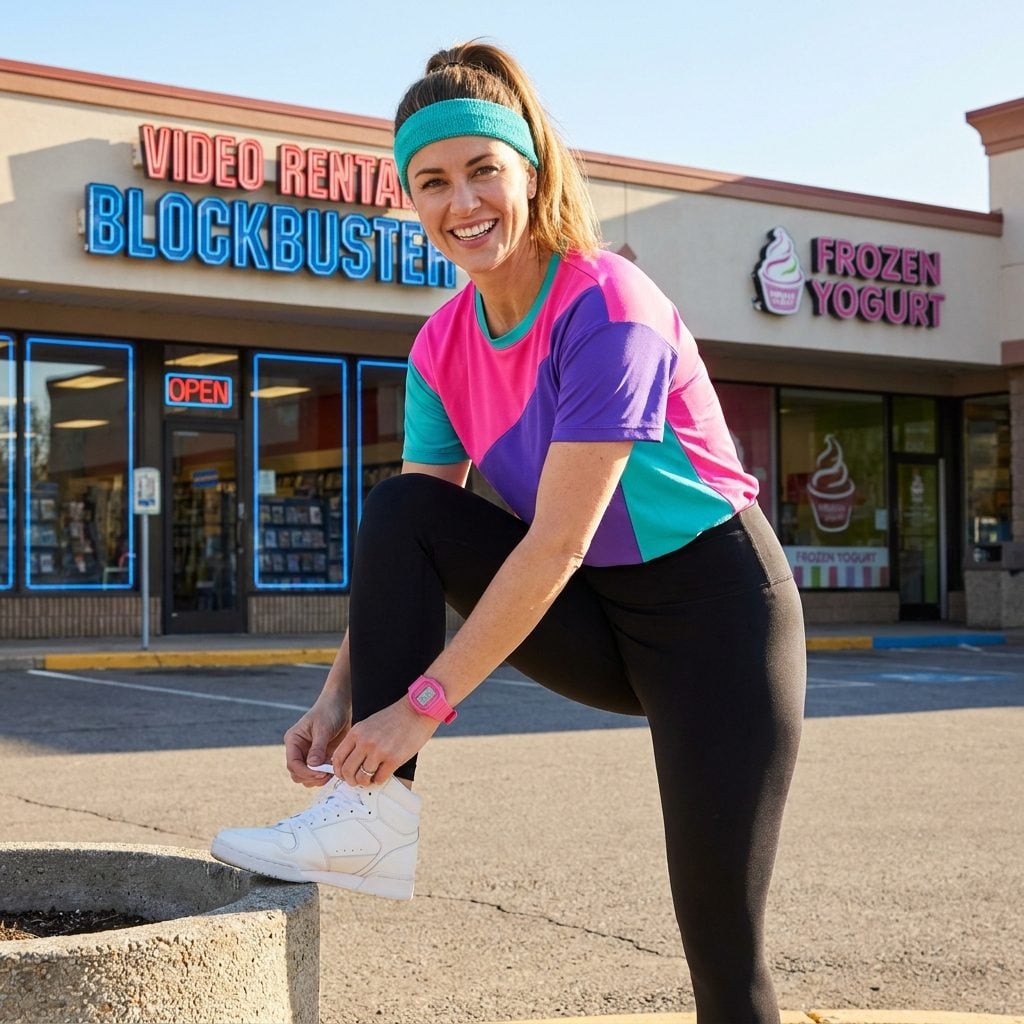
Olivia Newton-John and Jane Fonda owe us all an apology. Not because the athleisure look was bad, exactly, but because every woman in America suddenly needed a color-blocked athletic tee in pink, purple, and teal whether or not she had ever executed a single grapevine step.
The color blocking was aggressive. Three or four colors, zero subtlety, geometric panels that looked like someone had reimagined a Mondrian with a highlighter set. You wore it to the grocery store. School pickup. Actual aerobics if you were that person, though most of us were not that person.
With black spandex leggings and those chunky white high-tops, this was the uniform of a decade convinced that fitness and fashion were interchangeable. I wore this exact outfit to a birthday party at a bowling alley. In my defense, I looked incredible holding a ten-pound ball.
1. An Oversized Band Tee With Lace Gloves and Layered Necklaces, Because the MTV Era Demanded It

Twelve necklaces minimum. Lace gloves with the fingers cut out—you did that yourself with nail scissors from your mom’s bathroom, and the results were uneven at best. A band tee big enough to sleep in, yanked off one shoulder to reveal a bra strap because that was suddenly revolutionary. This was an identity crisis expressed through accessories, and every girl between 1984 and 1987 went through it.
Crucifix earrings? Required. Black lace gloves? Required. Layered necklaces mixing rosary beads with plastic pearls with whatever chain you pillaged from your grandmother’s jewelry box? Absolutely required.
The specific band on the tee barely mattered, though Cyndi Lauper and The Bangles had a slight edge. What mattered was the whole chaotic energy: the idea that you could pile on contradictions—lace and leather, crosses and ripped denim, pretty and punk—and arrive at something that felt completely, fearlessly yours. Looking back, the fact that millions of us landed on the exact same “individual” look is maybe the funniest thing about the entire decade. We were all nonconformists in perfect unison.