
❤️ Would you like to save this?
Turning 47 with plain straight shoulder-length blonde hair doesn’t mean staying there. These 30 before-and-after looks show real women at this age swapping that flat, one-note style for cuts and colors that actually work with their face and hair texture in Spring 2025. The changes range from subtle to significant, and every single one was worth making.
Some women needed more movement. Others needed less length, better layering, or a color that stopped washing them out. This listicle walks through 30 distinct looks, each one starting from the same familiar place and landing somewhere far more interesting. Spring is a natural reset point, and these hairstyles prove that the right cut at 47 can change everything about how a woman sees herself in the mirror.
FYI, thanks to AI imagery software, we’re able to create very specific fashion and hairstyle examples to illustrate the points being made. In some cases, imagery is exaggerated to hammer home the point. Also, assume links that take you off the site are affiliate links such as links to Amazon. this means we may earn a commission if you buy something.
30. Straight Bob Gets Brighter: Bold Highlights Rewrite a Classic Cut

Her shoulder-length bob picks up chunky blonde highlights in warm honey and pale gold, laid in thick ribbon-width sections from root to tip. Soft curtain bangs skim her brows, adding a fringe detail her plain, single-tone previous style completely lacked. The dark charcoal blazer and taupe button-collar shirt underneath stay the same, letting the hair do the work.
29. Flat Blonde Gets Volume, Dimension, and a Reason to Turn Heads

Soft layering breaks up what was once a single-length cut, adding movement from crown to collarbone. Chunky highlights in warm wheat and cool ash run through mid-lengths and ends, replacing a flat all-over blonde with visible depth. The waves fall loose and slightly tousled, framing the face without structured curls.
28. Bangs and Waves Turn Shoulder-Length Blonde Into a Whole New Conversation

Where straight, center-parted hair once sat flat against the jaw, layered waves now move from the crown all the way past the collarbone, adding genuine depth to what was a single-texture look. The fringe is the decisive change: curtain bangs cut to graze the brow bone and feathered outward toward the temples break up the forehead in a way that shifts the entire frame of the face. Highlighting work runs cooler at the roots, pulling toward a warmer honey-gold through the mid-lengths, which gives the waves a dimensional quality the flat before photo entirely lacked. The dark charcoal blazer and taupe silk-finish blouse stay identical in both shots, proving the hair is doing all the structural work here.
The Psychology Behind This: Women in their mid-to-late forties often report that fringe feels like a commitment too far, but curtain bangs specifically are designed to part and pin back on days when the style feels like too much. Choosing a cut with a built-in exit strategy tends to lower the mental barrier to trying something new. That practical flexibility is part of why this particular fringe shape has held consistent traction across multiple seasons.
27. Pinned Up and Swept Back, Shoulder-Length Blonde Finds a New Shape

Straight hair cut bluntly to the shoulder reads as flat in photos, and the before shot confirms exactly that. The after pulls the same blonde hair into a loose French twist anchored at the crown, with face-framing tendrils falling past the jaw on both sides. The color shifts noticeably lighter at the front sections, suggesting a few added highlights concentrated around the face rather than throughout. Her charcoal blazer with notched lapels and the taupe button-collar shirt underneath stay identical across both images, which makes the hairstyle’s structural shift do all the visible work. Pinning volume at the back of the head creates height that balances a longer face shape.
26. Wavy Highlights and a Looser Part Rewrite Shoulder-Length Blonde

Blonde that once sat flat and single-toned now moves in loose, S-curve waves that break just past the collarbone. The colorist added face-framing ribbons of cream and wheat blonde against a darker ash-brown base, creating depth that reads as dimension rather than contrast. She wears a charcoal wool-blend blazer with structured shoulders over a taupe satin blouse, the collar left open two buttons. The wave pattern is consistent but not rigid, suggesting a large-barrel iron with minimal product. The result: a profile that holds from crown to ends without looking rehearsed.
25. Dark Roots, Caramel Highlights, and Loose Waves Rewrite a Flat Baseline

Dark chocolate brown roots graduate into caramel and warm gold highlights through shoulder-length waves, creating depth that reads as dimensional rather than dyed. The curl pattern is medium-barrel throughout, with each wave breaking at a different point so the silhouette moves rather than sits. Volume starts at the crown and carries through to the ends, which previously fell flat against the collarbone. She wears a charcoal wool blazer over a taupe satin blouse with a spread collar, the shirt’s subtle sheen picking up the lighter tones in the hair. The overall effect is one of proportion: more hair presence, less face disappearing into a single flat plane.
24. Lighter Pieces, a Shifted Part, and Shoulder-Length Blonde Finds Its Edge

Colorists refer to the technique shown here as “money piece” framing, where the strands closest to the face are pulled several shades lighter than the rest of the length. On this 47-year-old, those cream-blonde face-framing pieces contrast sharply against the darker honey tones sitting through the mid-shaft. The center part shifts slightly off-center in the after image, which changes the silhouette from flat and symmetrical to something with actual movement. The black blazer, worn over a taupe button-collar shirt in what reads as a lightweight crepe, keeps the overall look anchored without competing with the hair.
23. Braided Crown Pulls Shoulder-Length Blonde Off the Face and Into Spring

The halo braid here sits high on the crown, constructed from thick, rope-like sections that spiral from ear to ear with visible texture and depth. Loose pieces fall at the temples and along the jaw, breaking up what could otherwise read as too formal. The contrast between the structured braid and those undone face-framing strands is doing real work. It keeps the style from tipping into costume territory.
The dark charcoal blazer stays exactly as it was, which is the point. Changing only the hair makes the effect of the style shift impossible to miss. The collarbone becomes more visible. The neck looks longer. Features that the previous curtain of flat hair partially obscured now read clearly. A braided crown at 47 is not a throwback look. It is a practical one: polished enough for a work portrait, personal enough to feel chosen rather than default.
Color Note: Braided updos work particularly well on medium-blonde hair because the woven sections catch light differently at each angle, creating the illusion of multiple tones without any color change. Asking a stylist to intentionally leave a few pieces loose around the face softens the overall effect and keeps the style from reading as overly structured.
22. Braided Updo Swaps Shoulder-Length Blonde for Something With Structure

Pinning medium-blonde hair into a low braided bun at the nape shifts the entire weight of the look upward, drawing attention to the cheekbones and jaw rather than letting length pull focus downward. Loose face-framing pieces in honey and ash tones fall forward at the temples, softening what could otherwise read as severe. Paired with a charcoal single-button blazer over a taupe collarless silk-blend blouse, the silhouette stays polished without reading corporate. Spring works with this, not against it.
21. Highlighted Layers and a Looser Silhouette Give Shoulder-Length Blonde Real Movement

Honey-gold highlights run through her mid-length hair in chunky sections that catch the warm ambient light from the window behind her. The layers are cut to fall past the collarbone, with the front pieces framing her face at a slight angle rather than dropping straight down. Her dark charcoal blazer in what reads as a mid-weight suiting fabric adds structure at the shoulders, while the taupe satin-finish shirt underneath keeps the neckline open and relaxed. What shifts the look most noticeably is the volume at the crown: the roots lift away from the scalp, giving the whole silhouette more height than the flat, blunt baseline from before. Spring works in the palette here because the warmer blonde tones pull toward gold rather than ash, reading brighter under natural light.
20. Bob Cut, Brightened Highlights, and a Part Change Do the Heavy Lifting

Side-swept and cut to chin length, the bob in the after photo sits noticeably shorter than the shoulder-length baseline above it. The stylist removed bulk from the ends and added face-framing layers that angle forward, pulling attention toward the cheekbones rather than the shoulders.
Ribbon-width highlights in a warm wheat tone run through the mid-lengths and ends, while the root stays a natural mid-blonde. That contrast builds depth without requiring a full color process. The side part shifts weight to one side, giving the silhouette a slight asymmetry that the straighter before cut never achieved.
She wears a collarless taupe blouse in what reads as a lightweight crepe, layered under a charcoal blazer with notched lapels and a single welt chest pocket. A small silver button-collar stud is the only visible hardware. The combination keeps the focus on the cut rather than competing with it.
19. Short, Highlighted, and Angled: Shoulder-Length Blonde Gets a Real Haircut

Cropped to just below the ear, this pixie-adjacent cut keeps length only where it counts: along the side sweep and at the crown, where pieces angle forward and catch light across the highlighted sections. The colorist layered in cool platinum streaks alongside warmer gold tones, so the hair reads multi-dimensional rather than flat. Wispy ends at the cheekbone draw attention to the face rather than away from it.
The blazer stays the same, charcoal with a notched lapel and structured shoulders, which makes the hair change hit harder by contrast. Keeping the taupe button-front shirt underneath grounds the look without competing with the cut. At 47, this kind of precision haircut does more for a face than any product routine.
Fabric Note: Short cuts with longer side-swept panels work well with lapel-heavy blazers because the exposed neckline lets the jacket’s collar line read clearly without hair interrupting it. When the blazer fabric has weight, as a mid-weight charcoal wool blend does, the sharpness of the cut reads as intentional rather than accidental. Pairing a structured shoulder with a cropped silhouette keeps the overall proportion balanced at the collarbone.
18. Half-Up Waves and Brighter Highlights Shift Shoulder-Length Blonde Into a New Season

❤️ Would you like to save this?
Soft, voluminous waves replace what was previously a flat, straight cut sitting level with the shoulders. The half-up section is gathered loosely at the crown, with a few face-framing pieces left to fall forward in loose spirals. Color is doing real work here: the base reads a warm mid-blonde while brighter, cooler highlights run through the lengths, creating contrast that reads as dimension rather than a single flat tone. She wears a charcoal blazer with visible lapels over a taupe satin blouse with a V-neckline and a small round pendant at the collar. The overall silhouette reads wider and softer than the before, which is exactly what layered waves accomplish when the ends are curled rather than blunt.
17. Rich Auburn Waves and Caramel Highlights Pull a Flat Cut Into Spring

Warm auburn base with caramel and copper highlights running through shoulder-grazing waves replaces what was flat, single-process blonde. The part sits slightly off-center, which shifts the weight of the hair and adds volume at the crown without any structural cutting. Waves fall in loose, rounded sections rather than tight spirals, landing just past the collarbone and creating movement against the lapel of a charcoal blazer.
She keeps the same grey-toned button-collar shirt underneath, which now reads warmer against the reddish-brown tones in the hair. At 47, adding depth through multi-tonal color rather than going lighter is a technique colorists increasingly recommend because it plays off natural skin warmth rather than washing it out. The overall silhouette feels fuller, and the face framing pieces around the cheekbones do quiet, precise work.
16. Chignon Swap: Straight Shoulder-Length Blonde Gets Pinned Into Spring Shape

Straight hair worn loose and center-parted reads as a default rather than a decision. Pulling it into a low chignon, as seen in the after image, changes that immediately. The bun sits at the nape with visible rope-like coiling, and the crown lifts slightly to add height above the forehead. Highlighted pieces near the face pick up window light in a way the flat before cut never allowed.
The blazer stays constant, a medium-weight charcoal with structured lapels and a notched collar, but with the neck fully exposed, its lines read more sharply against the skin. The taupe blouse underneath has a button-placket detail visible at center front. Removing all that hair from the face shifts the focal point upward, making the cheekbones and jaw read with more clarity than the shoulder-length style ever managed.
15. Bangs, Brown Base, and Blonde Highlights Pull Flat Hair Into a New Shape

Fringe changes the math on a face faster than almost any other cut decision. Here, blunt bangs land just above the brows and frame the forehead in a way her previous shoulder-length, center-parted style never attempted. The base color shifts from a single-tone blonde to a deeper brown with chunky blonde highlight panels woven through the lengths, giving the waves visible contrast rather than a flat, uniform finish. Those waves are loose and wide, curling away from the face at mid-shaft rather than at the ends, which adds width at the cheekbones.
Her blazer reads the same: a matte charcoal wool-blend with notched lapels. But with the hair sitting fuller around the face and the fringe cutting a clean horizontal line above her eyes, the blazer’s structured shoulders register differently. At 47, adding fringe is often dismissed as a bold move, but blunt-cut fringe with face-framing highlights is one of the few techniques that creates shape without requiring any change below the collar.
14. Pinned Up and Highlighted, Shoulder-Length Blonde Gets Spring Architecture

Plain hair worn down disappears under a blazer. Pinned into a voluminous French twist-style updo with face-framing tendrils left loose at the temples, her blonde reads two full shades brighter, likely from ribbon highlights added at the front sections. The charcoal blazer’s notched lapel stays visible against her collarbone. A small pendant sits at the base of her throat. The lift changes her entire silhouette.
Fun Fact: Updos styled with volume at the crown can visually add an inch or more of perceived height, which is why portrait photographers often request them for professional headshots. The loose tendrils left at the temples are a deliberate technique, not an afterthought. They soften the hairline and prevent a pinned style from reading too severe on camera.
13. Bob Cut Geometry and a Part Shift Make Shoulder-Length Blonde Work Harder
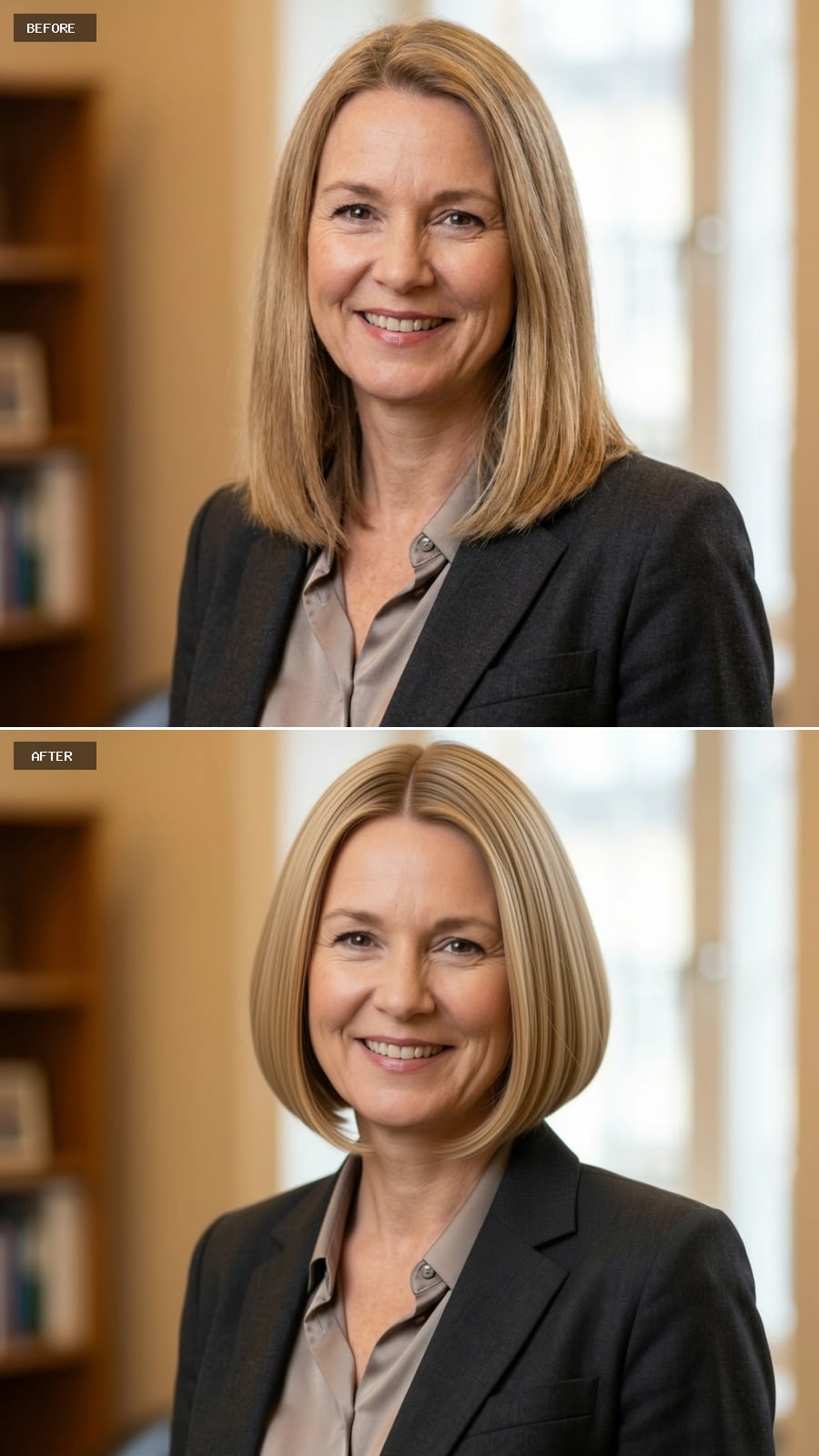
Flat, center-parted hair that falls past the collarbone gets replaced here by a blunt bob sitting just below the jaw, with the part moved slightly off-center to add immediate asymmetry. The cut angles forward toward the chin, and the color picks up brighter golden tones through the mid-lengths without touching the root, so the depth reads natural rather than processed. Against a charcoal blazer in what looks like a medium-weight crepe, the shorter silhouette keeps the lapels visible and the neckline open, which a longer cut was quietly closing off. Spring is doing the rest.
12. Wavy Layers and Curtain Bangs Pull Shoulder-Length Blonde Into a Fuller Shape

Gone is the blunt, flat cut that sat predictably at the collarbone. The after shows long layers cut to mid-chest length, with curtain bangs parted loosely at center and falling just past the brow bone. The color moves from a mid-brown base through caramel mid-lengths to bright blonde at the ends, giving each wave visual separation. Those waves are not tight ringlets but open, relaxed bends that add width at the shoulders. Paired with the same charcoal blazer and taupe woven-fabric button-through shirt, the volume change reads immediately against the lapel line.
11. Messy Updo, Loose Tendrils, and Zero Product Overhead Do What Down Hair Can’t

Her blonde hair, which sat flat and unbroken at shoulder length in the before, gets pinned into a gathered updo with deliberate looseness built into every section. Pieces at the front are left out intentionally, framing both cheeks rather than tucking behind the ears. The crown volume is achieved by teasing the gathered section before securing it, not by adding extensions or bulk products.
The charcoal blazer with notch lapels and the taupe silk-finish blouse underneath stay identical between both images, which makes the hair change read clearly on its own. Wearing the neckline open to the second button lets the updo’s exposed nape carry visual weight without competing fabric. For women at 47 who want a quick style shift without a salon visit, a gathered pin with pulled tendrils delivers that shift in under ten minutes.
10. Voluminous Waves and Dimensional Highlights Pull Straight Blonde Into Spring Shape

Dark brown roots blending into caramel mid-lengths and blonde ends give the hair a depth that flat, single-tone blonde simply cannot produce. The waves are loose and wide-set rather than tight or barrel-curled, which keeps the silhouette relaxed without reading undone. Volume at the crown adds height while the length grazes well below the collarbone, balancing the structured cut of the charcoal blazer underneath.
The blazer itself is worth noting for fit: the lapels sit flat against a taupe woven shirt with a relaxed V-neckline, and together they create a neutral column that lets the hair movement carry the visual interest. Nothing competes. The highlighted sections catch the natural window light from the right side of the frame, pulling warm gold tones forward without any added shine product visible on the surface.
9. Highlights Swept Forward and Volume Built Up: Shoulder-Length Blonde Gets Direction

Blonde hair with visible depth gets a real structural overhaul here. The “after” shows chunky highlight panels pulled forward across the cheek, with the heaviest blonde concentration framing the face rather than sitting flat along the back. Volume has been built at the crown using what reads as a round-brush blowout, creating a curved silhouette that lifts away from the neck entirely. The cut itself gained movement through internal layers, letting the ends curl under rather than hang straight. Against the dark charcoal blazer and taupe button-collar shirt beneath it, the lighter tonal range of the hair reads with considerably more contrast than the “before” version managed.
8. Side Braid Over One Shoulder Pulls Shoulder-Length Blonde Out of Autopilot

What reads as a low-effort style in the before shot gets replaced by a Dutch-style braid that sweeps left and trails past the collarbone, secured with a black elastic at the tail. The braid begins at the crown with a loose, wide weave, then tightens gradually as it descends, creating visible texture variation from root to end. Loose face-framing pieces fall at the cheeks, softening what could otherwise read as too structured for a professional setting.
The blazer remains the same charcoal wool-blend with notched lapels, which means the styling shift does all the heavy lifting here. Braiding the hair to one side exposes the right side of the neck completely, letting the collar sit cleanly without competition. For women in their forties who find down styles feel shapeless by midday, a side braid holds its structure through hours of wear without requiring any touch-ups.
Styling Hack: Braiding slightly damp hair produces a tighter, longer-lasting weave than braiding dry hair, because the moisture adds grip between sections. Pulling each cross gently outward after finishing the braid creates the wider, more relaxed silhouette visible in this look rather than a rope-like finish. Securing with a coated elastic rather than a thin band prevents the tail from slipping loose as the hair dries and sets into shape.
7. Layers Cut Into Shoulder-Length Blonde Shift the Whole Portrait Forward

Soft blonde highlights in cream and wheat tones run through the mid-lengths and ends, contrasting with the slightly darker root shadow that gives the style its depth. The cut itself sits at collarbone length, but the layers are carved so that sections fall forward over the chest, pulling the eye down the diagonal rather than across the jaw. That directional fall alone changes how the face reads in a headshot.
The blazer is charcoal with a structured shoulder and a clean lapel, worn over a taupe satin-finish blouse with a relaxed V-neckline. Neither piece competes with the hair. The absence of jewelry keeps the frame uncluttered, which lets the contrast between the lighter blonde panels and the darker underlayers register clearly.
For a 47-year-old with previously flat, single-tone shoulder-length hair, the shift here is not about adding length or changing color entirely. It is about cutting movement into what was already there and introducing tonal variation that reads as dimension under natural light near a window.
6. Messy Bun With Loose Tendrils Gives Shoulder-Length Blonde a Whole New Posture

❤️ Would you like to save this?
Pulled up into a voluminous twisted bun, the hair stacks high above the crown with pieces left deliberately loose at the temples and nape. Those tendrils aren’t random. They follow the jaw angle, drawing attention to cheekbone structure that straight, down hair was quietly covering. The bun itself has visible texture, sections crossing and layering rather than sitting flat, which keeps the silhouette from reading as stiff or formal against the charcoal blazer.
The blazer’s construction stays the same, notched lapel in a medium-weight fabric, but the cleared neckline changes what the collar does in a portrait frame. A small stud earring sits at the lobe without competing for attention. Spring color sits in the warm blonde highlights threaded through the upswept sections, catching window light along each twist. Women at 47 often find that length alone stops working; moving the weight upward and off the face does more for facial geometry than any cut change at the ends.
5. Long Waves and Highlights Added to Straight Blonde Change the Entire Scale

Straight shoulder-length hair reads contained. Long, wavy layers that fall past the collarbone change the proportion entirely, widening the silhouette at chest level rather than cutting it off at the jaw. The after look here uses loose, voluminous waves with visible highlight panels running from root to tip, creating depth across the length rather than relying on a single tone. A small clip at the crown holds the part in place without pulling everything back. The dark blazer and taupe button-front shirt stay identical between both images, which makes the hair volume do all the work of shifting attention upward and outward.
4. Victory Rolls and Waves Reframe Shoulder-Length Blonde as a Whole New Proposition

Two barrel rolls pinned at the crown and long waves released past the collarbone take the same shoulder-length blonde and change its entire frame of reference. The after shot shows honey-and-wheat tones moving through the length in broad alternating bands, which the waves make visible in a way pin-straight hair never could. She wears a charcoal wool blazer over a taupe button-collar shirt, and the volume built above her forehead now reads in proportion to those heavier lapels. Spring portrait sessions reward exactly this kind of structural contrast at the top.
3. Bangs Cut In, Length Left Long: Shoulder-Length Blonde Gains an Entirely New Scale
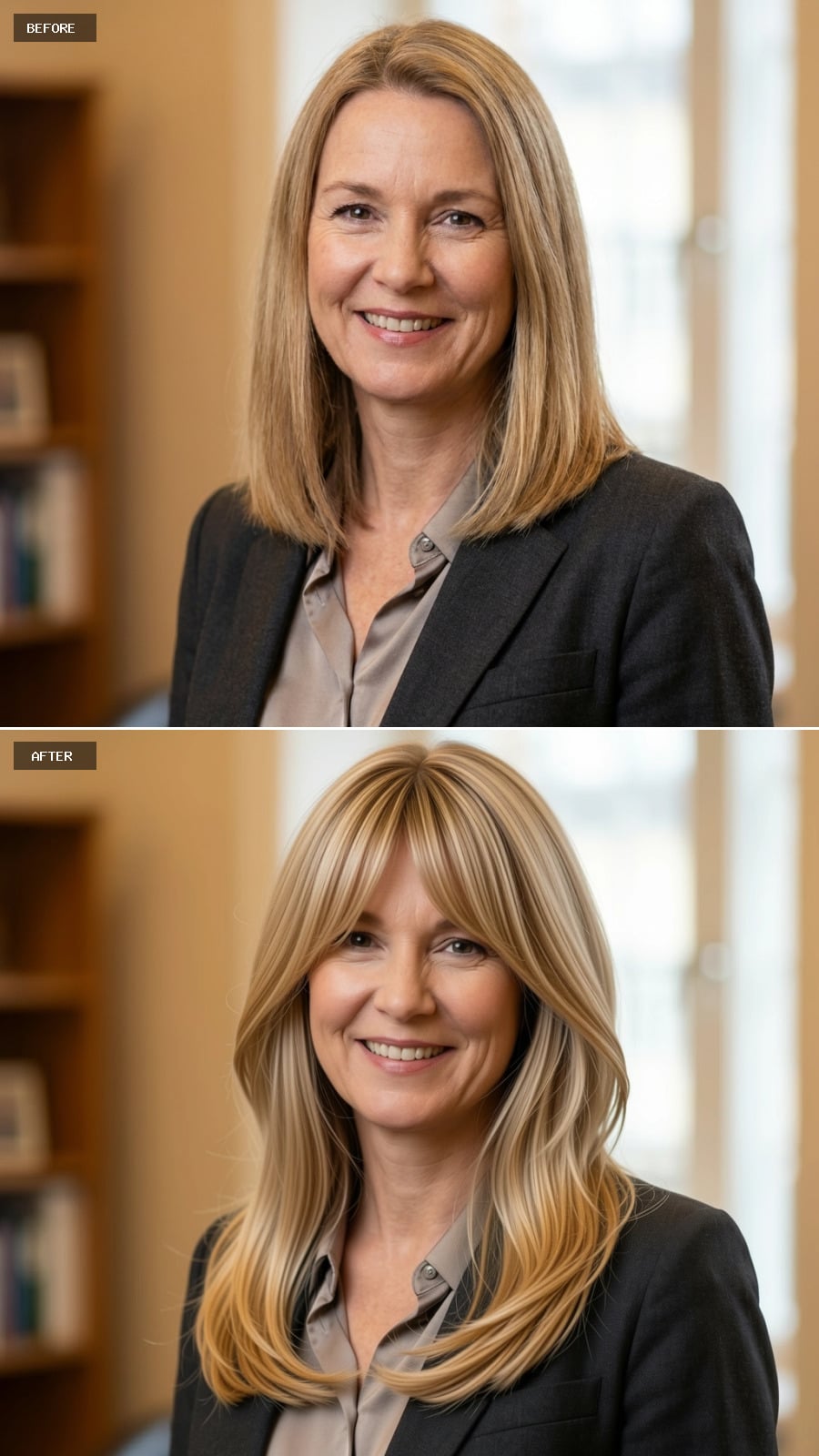
Side-swept fringe now falls across her forehead at an angle, grazing her brow line on the left and lifting away from her right eye. The cut is the real shift here. Her previous shoulder-length hair read as one flat plane; adding layers that start at the cheekbone and graduate down toward the collarbone breaks that single surface into three distinct sections.
The color work follows the layers rather than working against them. Buttery highlights concentrate near the face and along the top layer, with the underlayer kept in a slightly deeper wheat tone. That contrast makes the movement visible even when the hair sits still.
She wears the same dark charcoal blazer and taupe satin button-front shirt as before, which makes the scale shift unmistakable. The blazer’s notched lapel now sits against hair that falls well past the collarbone, changing the proportion of the whole portrait from the neck up.
2. Low Chignon With Face-Framing Wisps Gives Shoulder-Length Blonde a New Anchor

Pinned low at the nape, the chignon sits just above the collar of a charcoal blazer with notched lapels and a relaxed single-button closure. The knot itself is loosely wound rather than tight, which lets a few blonde strands pull free around the face without looking accidental. Those wispy pieces, slightly lighter than the rest, catch the window light and draw the eye upward toward the cheekbones. A taupe silk-blend blouse with a simple placket and small button detail fills the open lapels cleanly. The overall silhouette reads polished but not rigid, the kind of look a portrait photographer frames without asking for adjustments.
Occasion Guide: A low chignon works across client meetings, conference panels, and evening dinners because the structured knot reads formally without requiring any additional accessories to finish the look. For outdoor spring events, the pinned-back style also holds through wind in a way that loose shoulder-length hair simply does not.
1. Auburn Bob With Copper Highlights Closes Out Straight Blonde’s Run for Good

Rounded into a chin-grazing bob with significant interior layering, the cut swings forward at the front panels and lifts away from the neck at the back. The color is a deep auburn base with copper highlight ribbons pulled through the top sections, catching the natural window light in a way the previous flat blonde never could. She wears the same charcoal blazer with notched lapels and a taupe button-front shirt underneath, but the shorter length changes the proportion entirely, letting the collar frame read wider against the jaw.
Volume at the crown comes from a blow-dry technique that directs the root away from the scalp before the brush follows the curve down and under. No product weight is visible. The finish is polished but not lacquered, and the movement in the ends stays active even in a still photograph. Thirty looks in and the principle holds: cut and color do the structural work, and the rest follows.