❤️ Would you like to save this?
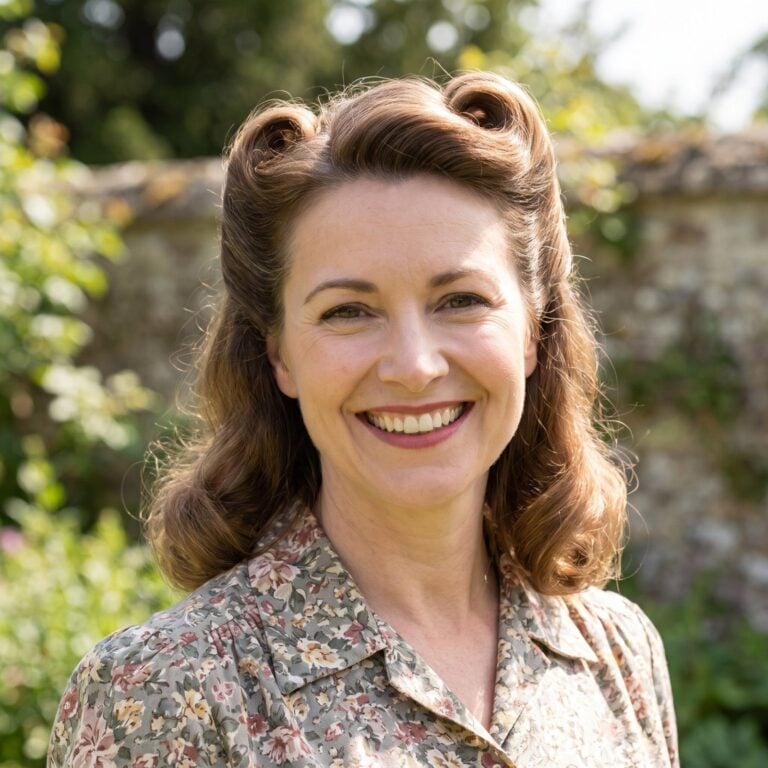
She didn’t set out to hide. It started with one comfortable sweater, then another, then a whole closet strategy built around not drawing too much attention. Plenty of women in their late forties know that slow slide into oversized everything, where the original logic was simple enough: I just want to feel like myself. Somehow, the result became a wardrobe that made her feel less visible, not more at ease.
The baggy clothes were never the real problem. The assumption underneath them was: that comfort and looking like she made an effort were somehow in conflict.
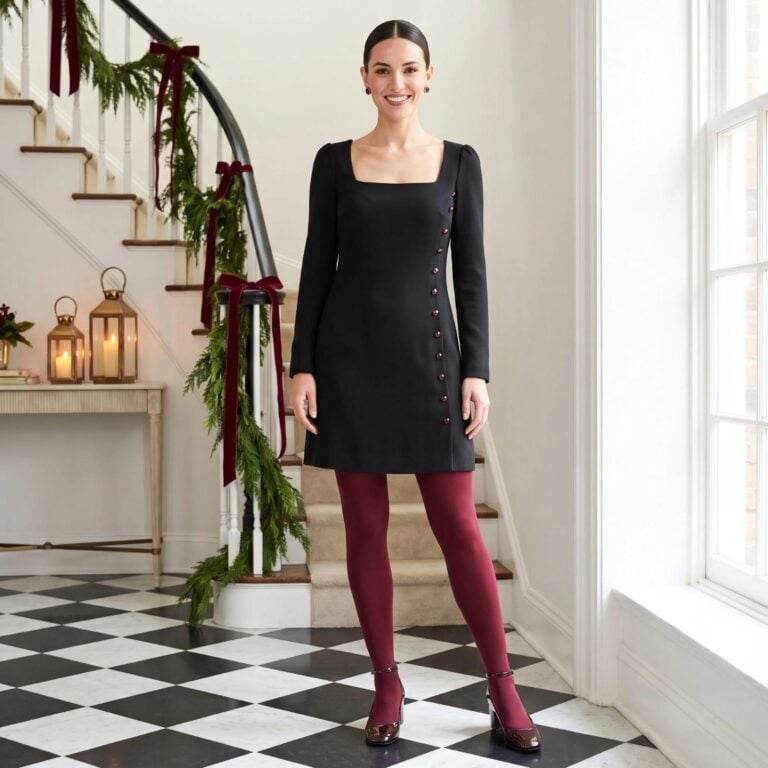
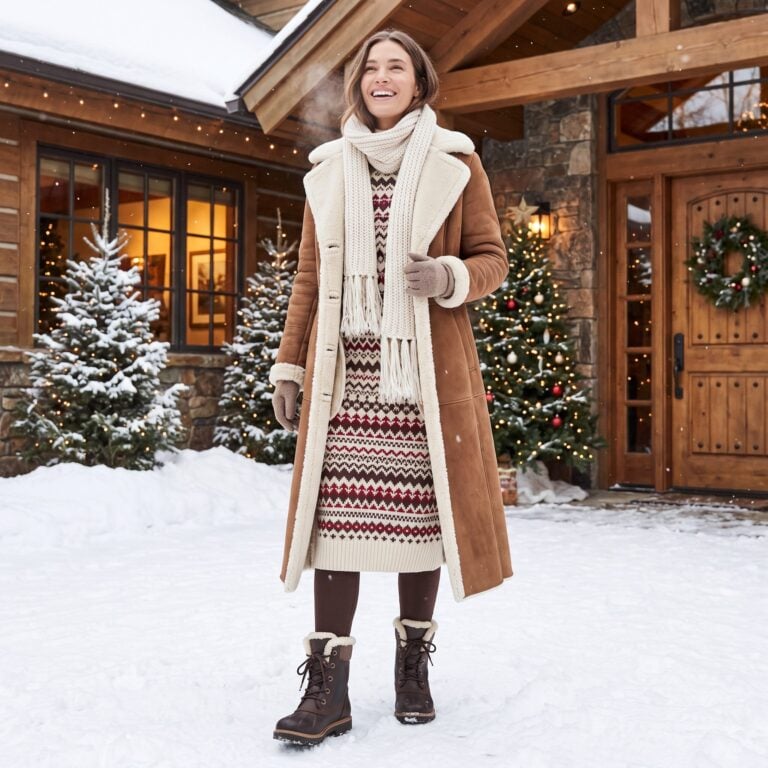
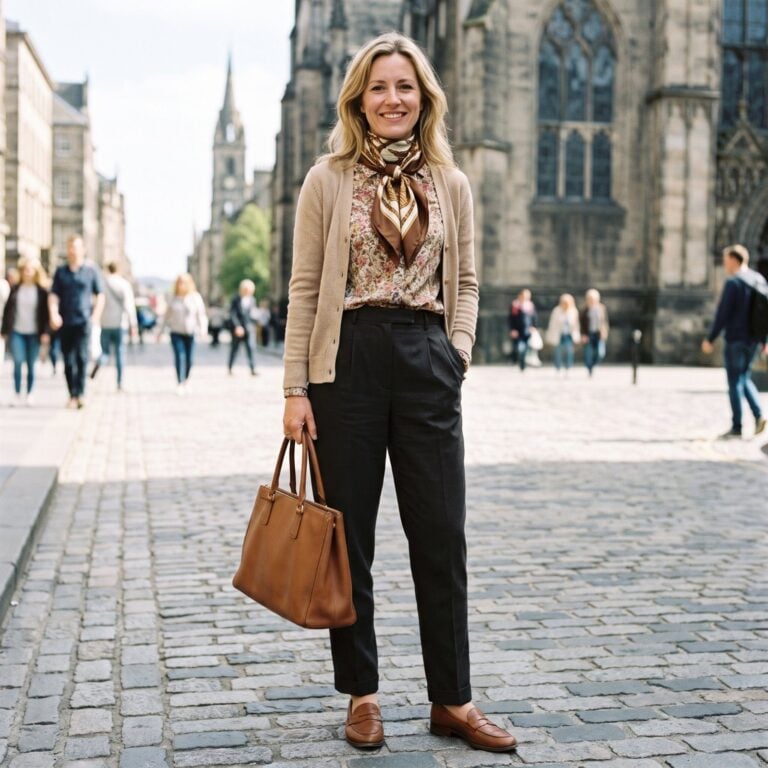
That’s what these 34 AI-generated looks push back on. Each one starts from the same premise: a 48-year-old woman who has been dressing to disappear, handed an outfit that actually fits, doesn’t require heels she won’t wear, and makes sense for a real date rather than a magazine fantasy of one. Some looks feel like a small step. A few feel surprisingly bold. But the through line is consistent: every outfit here was built around her actual body, not a corrected version of it. That is where the makeover really begins.
FYI, thanks to AI imagery software, we’re able to create very specific fashion and hairstyle examples to illustrate the points being made. In some cases, imagery is exaggerated to hammer home the point. Also, assume links that take you off the site are affiliate links such as links to Amazon. this means we may earn a commission if you buy something.
34. Cargo Pants to Rooftop Dinner: One Outfit Swap That Changes Everything
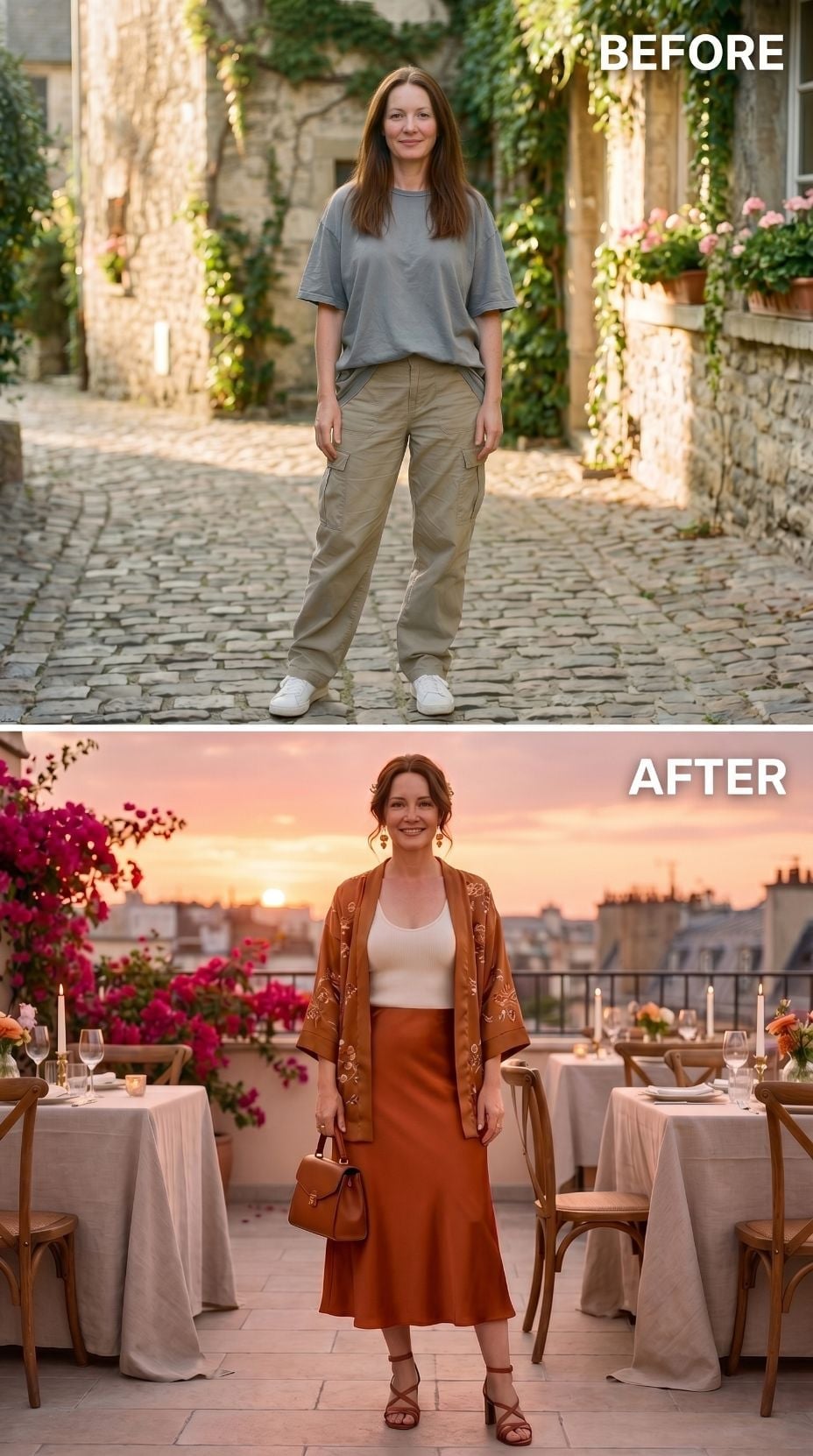
Before, she’s in an oversized gray tee and khaki cargo pants, the kind of outfit that disappears into itself. Comfortable, yes. But there’s no silhouette, no focal point, nothing that says she arrived with any particular intention. The white sneakers confirm the look’s priority: ease above all else.
The after does something worth paying attention to. A rust-orange midi skirt with a clean A-line cut sits at exactly the right length, hitting mid-calf where it creates shape without effort. Over a cream tank with a simple scoop neck, she’s layered a cognac embroidered kimono jacket, loosely open, which adds the warmth the “before” is missing without adding formality. The handbag matches the jacket almost exactly, and that tonal pull is what ties it together. Terracotta strappy heels, gold drop earrings. The whole outfit is built around one color story, and that’s why it reads as intentional rather than assembled.
33. Burgundy Plaid and Candlelight: What Happens When Comfort Gets a Framework
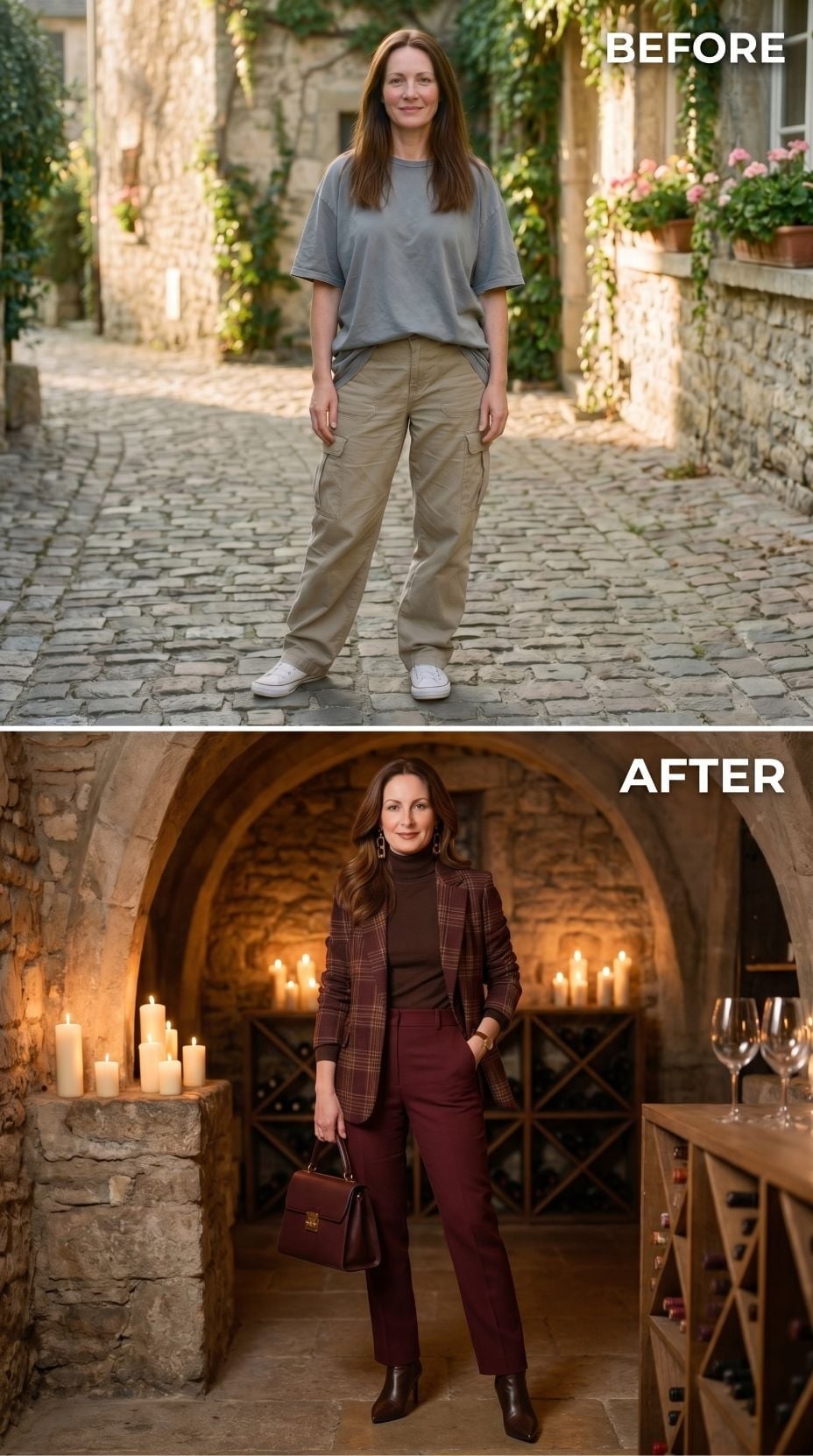
She’s traded cargo pockets for tailored burgundy trousers with a clean high waist, and the difference isn’t about dressing up. It’s about structure doing the work her old outfit refused to do. The plaid blazer keeps the palette tight, burgundy and brown with just enough gold in the check to earn the candlelit setting. A chocolate turtleneck underneath pulls it together without trying too hard. The structured bag, held at her side, adds intention without fuss.
Color and candlelight work, but sometimes the real shift comes from silhouette alone.
32. Royal Blue Wrap Dress and the Cobblestone Courtyard That Changed Her Mind
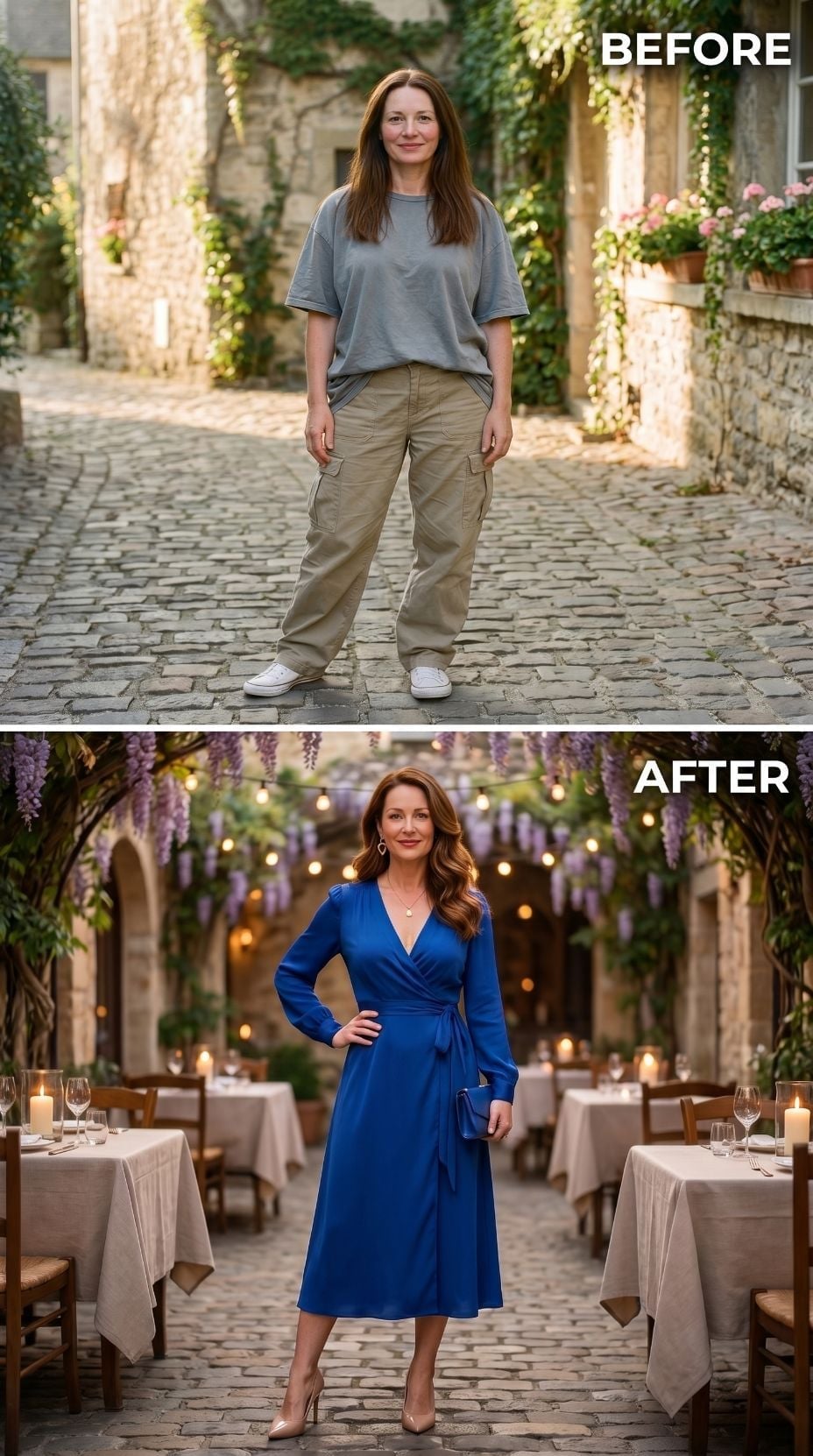
Cargo pants and an oversized grey tee read as someone who stopped making decisions. The royal blue wrap dress does the opposite. It’s a deep, saturated cobalt with long sleeves and a fluid midi length that skims rather than clings, and the V-neckline does quiet work without asking for attention. Her hair is styled with soft volume now, and the nude heels add just enough height to make the hem fall at exactly the right point on the calf. What makes it land isn’t the dress alone. It’s that she looks like she showed up on purpose.
31. Olive Suit in a Greenhouse and Why Fitted Finally Won
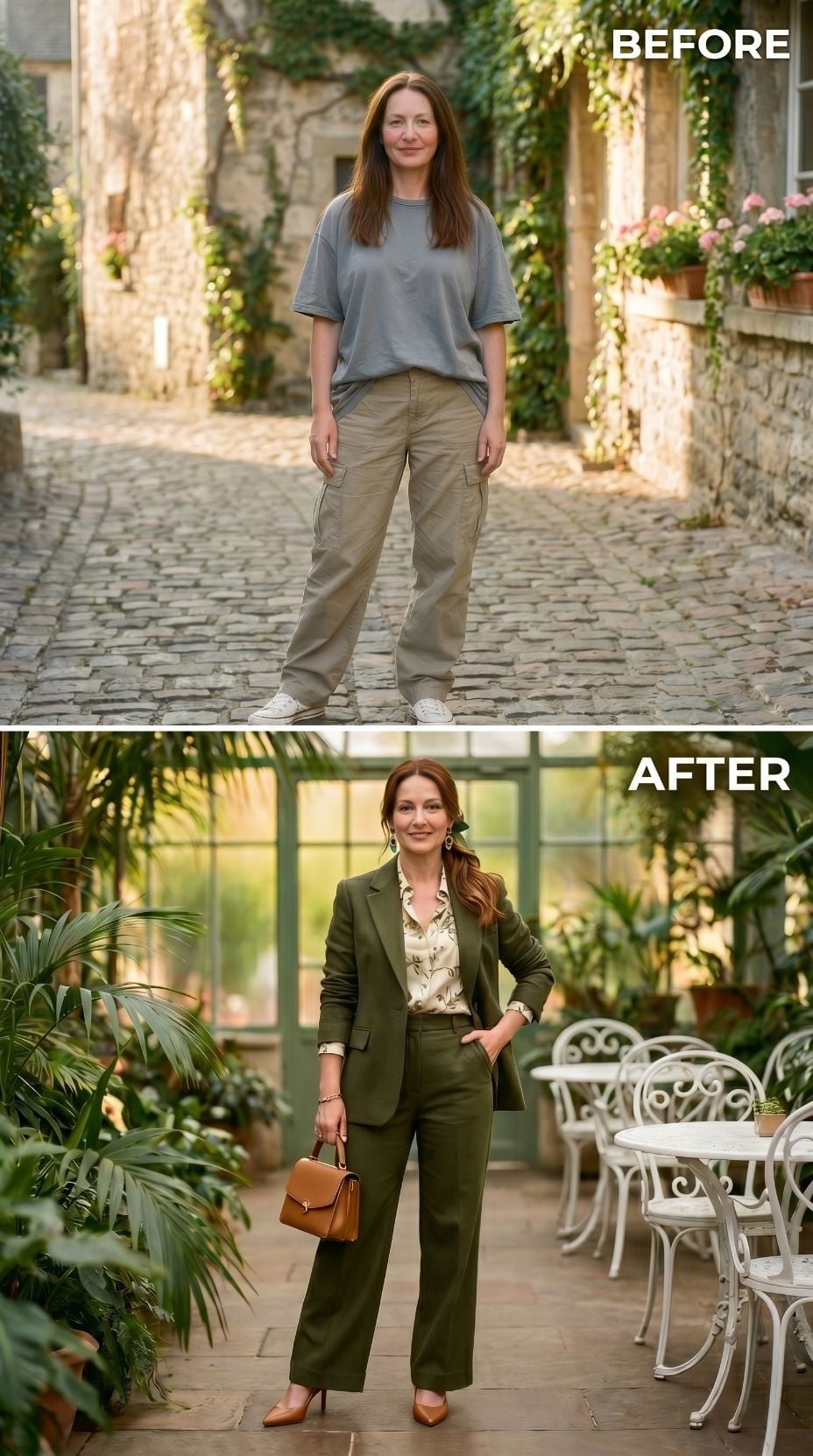
Oversized grey cotton and cargo pockets gave way to a forest-green blazer with structured shoulders and tapered trousers that break cleanly at the ankle. That break matters. It’s what lets the cognac leather handbag and pointed kitten heels read as intentional rather than dressed-up. The botanical blouse underneath keeps it from feeling corporate.
30. Satin Slip, Rooftop Light, and the Moment Baggy Stopped Making Sense
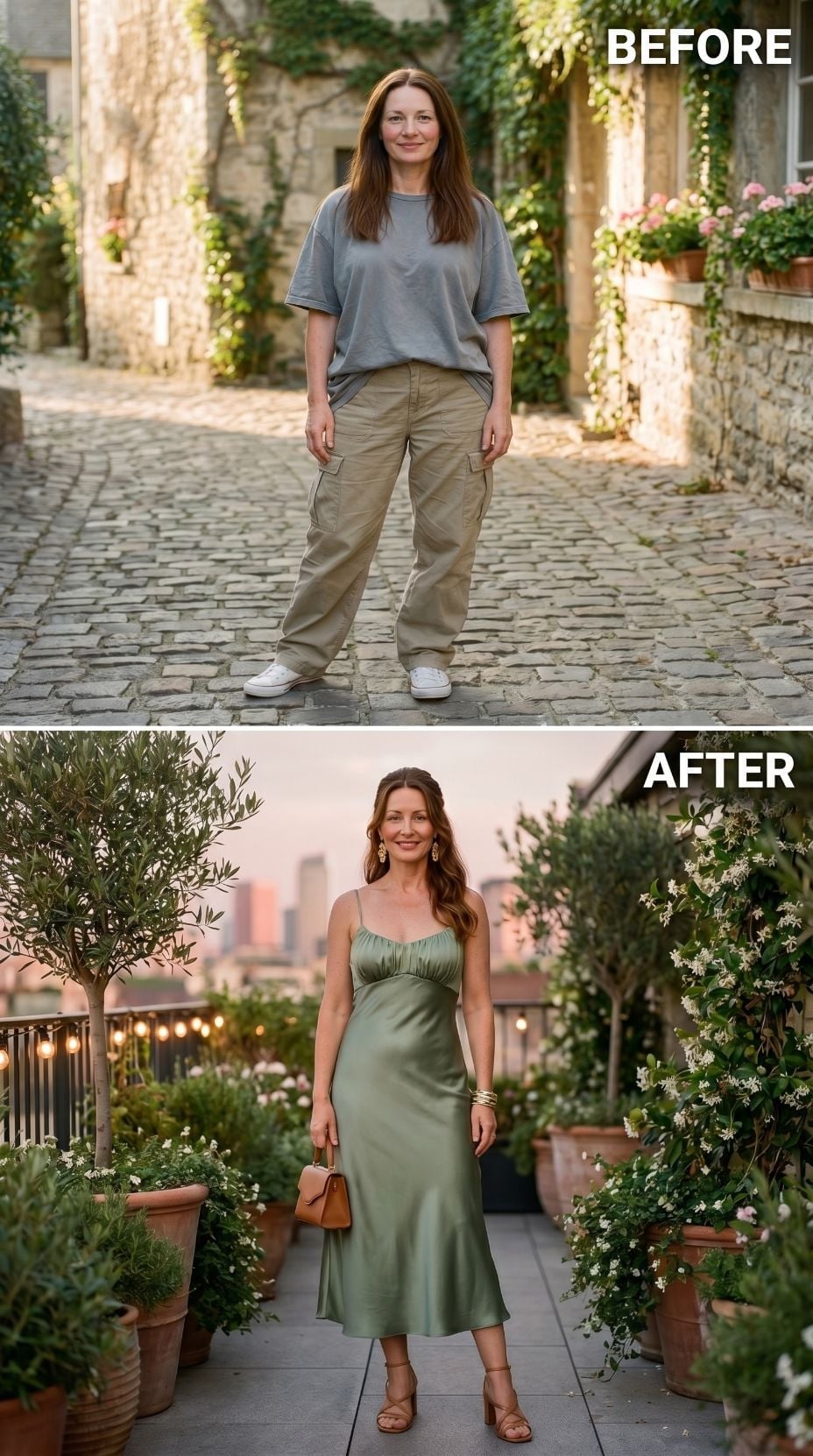
Gray cotton and cargo pockets had been doing a job, just not the right one. What replaced them was a sage green satin slip dress with spaghetti straps and a gathered bust that pulled softly across the chest without pulling tight anywhere else. The hem landed at midi length, which matters more than people admit: too short and it reads casual, too long and the straps lose their logic. At this length, it earns both. She paired it with strappy brown leather heeled sandals, a tan structured bag held at her side, and gold cuff bracelets that caught the low rooftop light. Her hair was loosely waved and half-pinned back, which kept the bare neckline from feeling exposed. The whole thing worked because the dress wasn’t trying to hide anything. It was just asking her to stop.
29. White Linen and Golden Light: When the Right Suit Does the Convincing
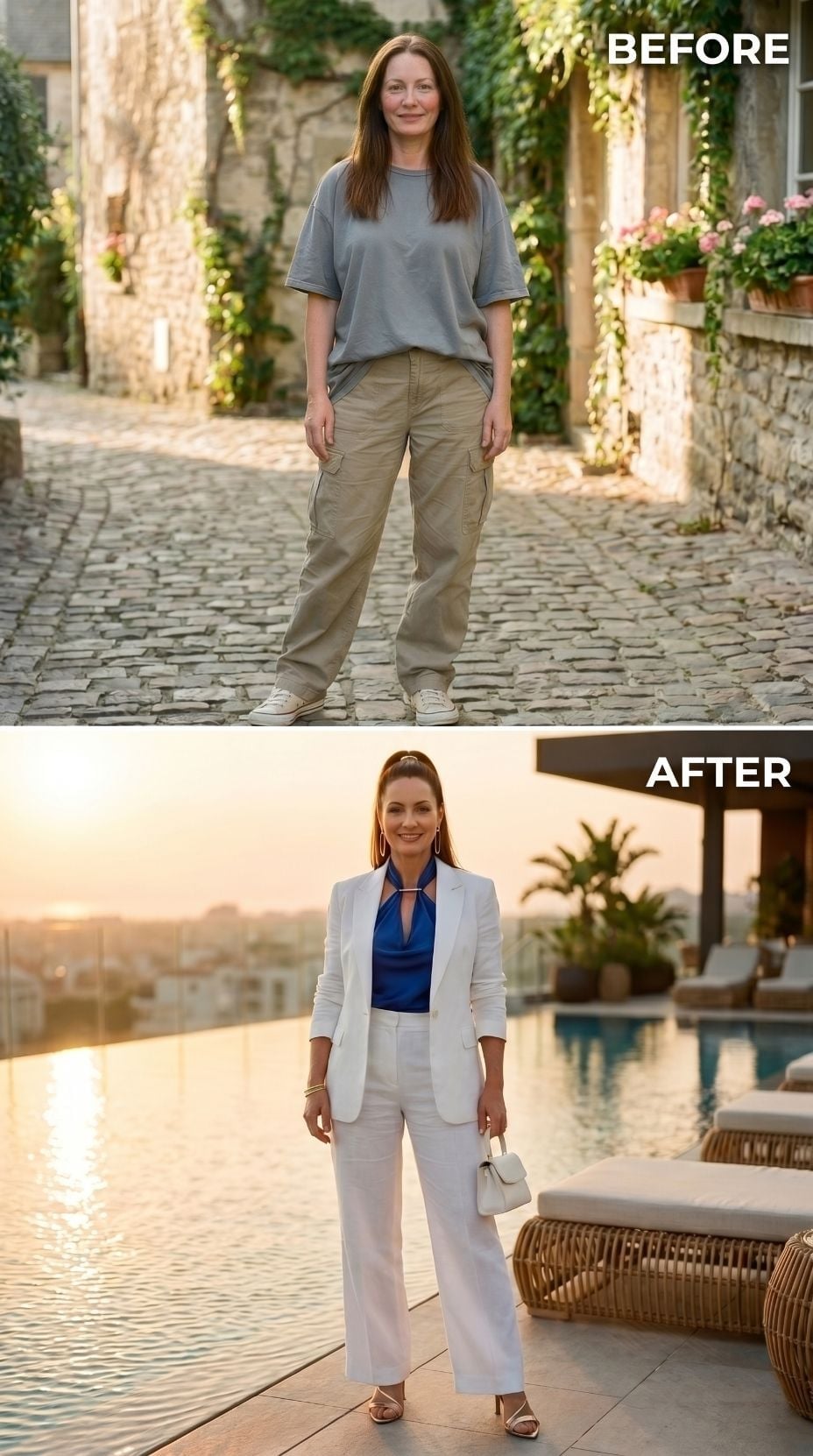
Khaki cargo pants and a loose gray tee are readable from fifty feet away as “I’ve given up on the night.” Not dramatically. Just quietly. And that quiet giving-up is exactly what the after image answers.
The white linen blazer does most of the work here. It’s structured at the shoulder but doesn’t read as corporate because the royal blue halter underneath pulls everything toward something warmer and more personal. The halter’s keyhole neckline is the kind of detail that replaces jewelry, which is why the gold hoops stay understated. White wide-leg trousers keep the proportion clean without being severe. The hem lands just right for the strappy heeled sandals, long enough to look intentional, short enough to show the shoe.
Her hair is pulled back, which matters more than it sounds. It shifts the focus upward and makes the earrings land. The small white structured bag isn’t a statement. It’s punctuation. Comfortable clothes and polished ones don’t have to negotiate with each other. This look proves they can share the same outfit.
28. Dark Academia Dressing and the Library Bar That Made Baggy Look Like a Mistake
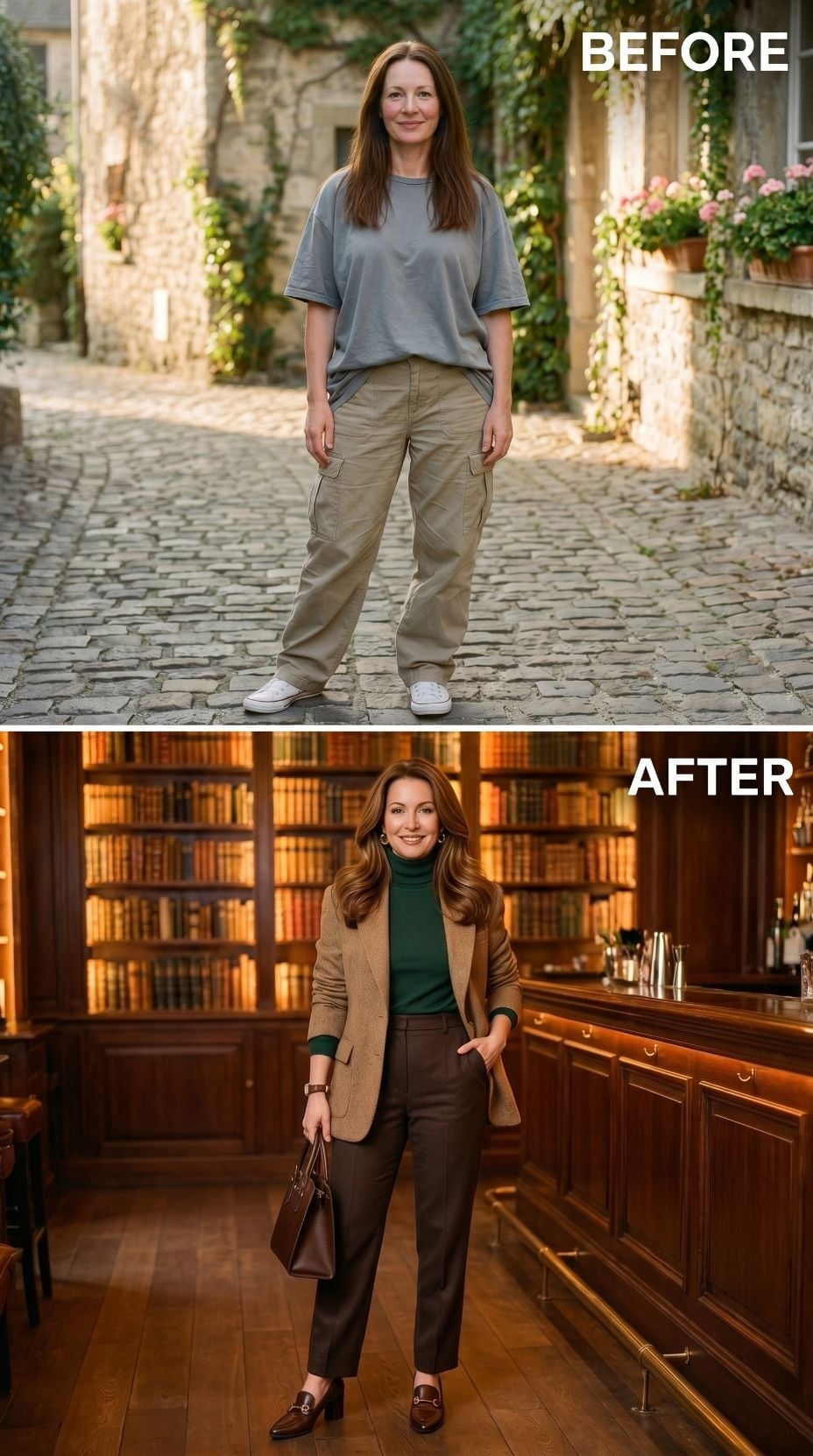
Straight from an oversized tee and cargo pants that swallowed her shape, she steps into something with actual structure. The camel blazer does a lot of the work here, its slightly longer length paired with tapered brown trousers that end right at the ankle. Underneath, a forest green turtleneck adds depth without competing. The loafers with a low block heel are the detail worth paying attention to, because flats that slight would have read casual, but these read polished. A dark burgundy leather bag, held at the hand, keeps the palette grounded and warm.
Real Talk: Turtlenecks get dismissed as frumpy, but a fitted one in a rich color under a blazer is doing more for a silhouette than most tops can manage. The key isn’t the neckline itself, it’s what it communicates: deliberate layering, not coverage. Women who’ve been hiding in volume often find this combination is where fitted stops feeling like a risk.
27. Floral Wrap Dress on a Santorini Terrace and Why Comfort Was Never the Problem
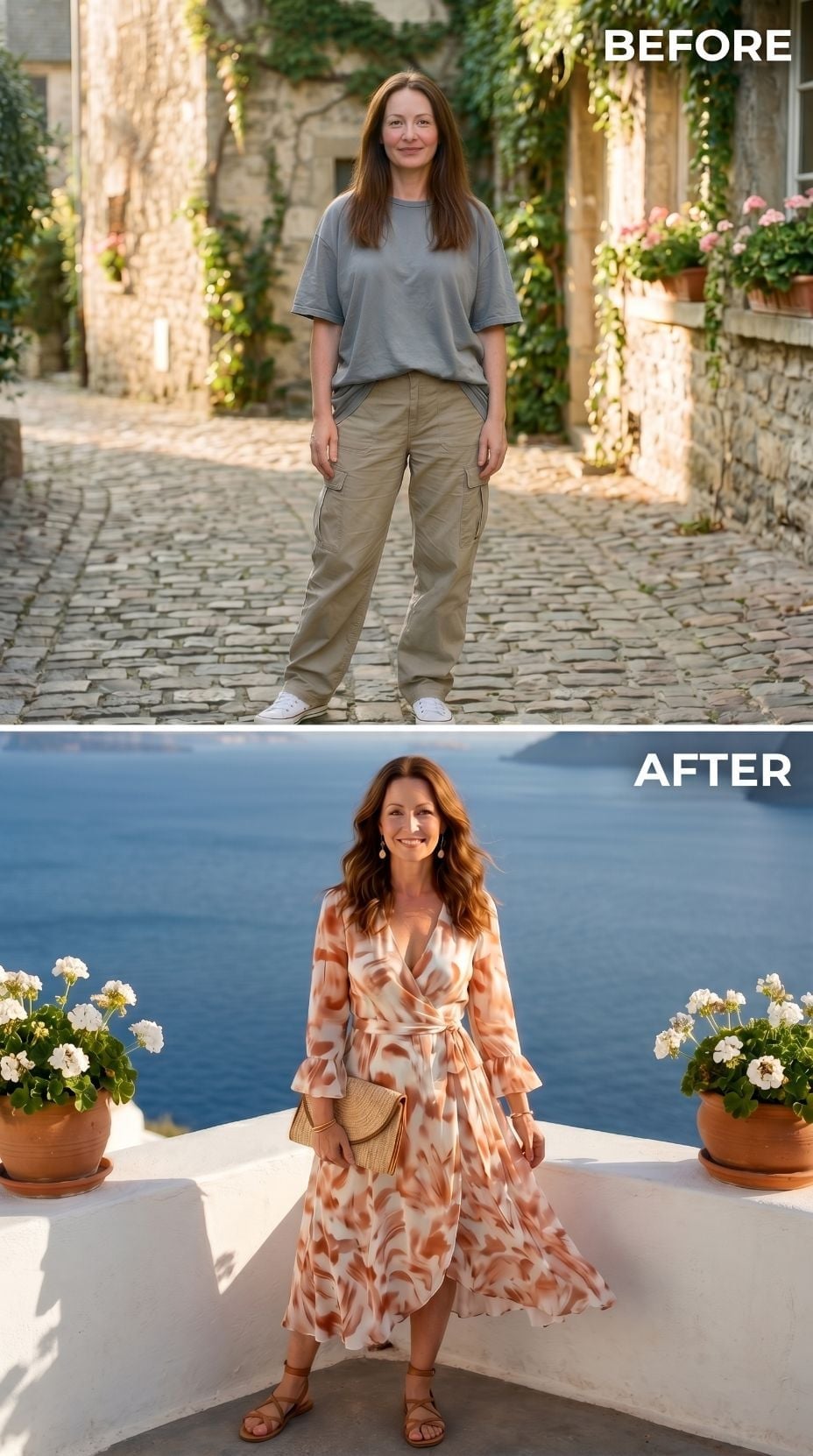
Baggy layers weren’t solving anything. The rust-and-cream printed wrap dress does what that gray tee never could: it follows the body without clinging to it, the flutter sleeves softening the arms while the self-tie waist creates shape that actually belongs to her. Wavy hair and drop earrings pull the whole read upward. The woven clutch keeps it grounded. She’s not dressed differently so much as finally dressed honestly.
26. White Suit, Art Gallery, and the Confidence That Was There All Along
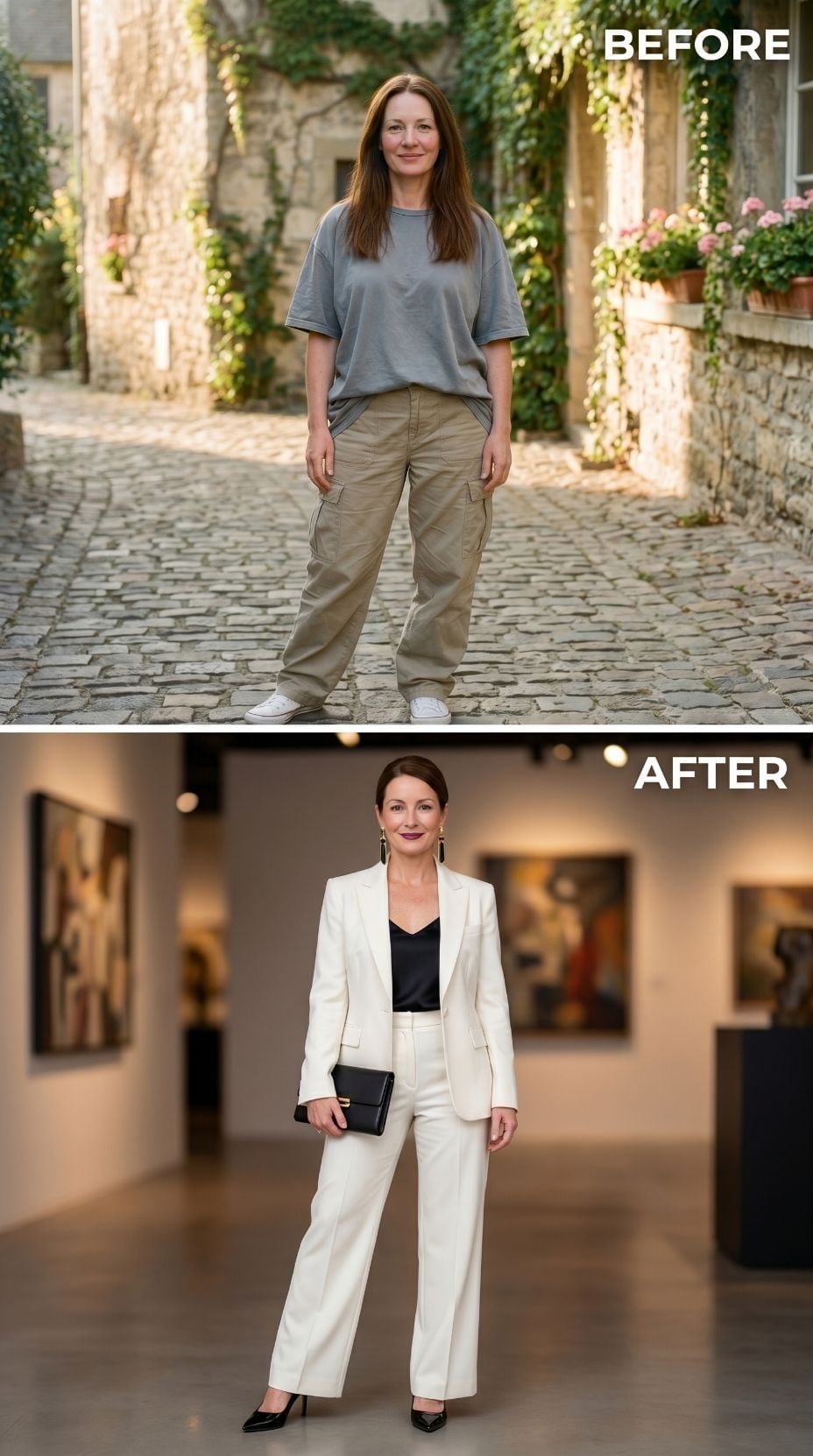
What the “before” image shows is a woman dressed to disappear. Loose khaki cargo pants, an oversized gray tee, white sneakers: nothing wrong with any of it, but nothing asking to be noticed either. The “after” puts her in an ivory blazer with structured shoulders and clean lapels, paired with wide-leg trousers in the same tone. Head-to-toe one color reads as intentional rather than monotone, especially when there’s a black silk cami underneath to break it. Gold drop earrings, a black leather clutch, and pointed-toe heels do the rest. Her hair is pulled back, which is the move that makes the jewelry land. Comfort didn’t disappear here. It just got a better outfit to live in.
25. Camel Blazer, Rust Silk, and the Proof That Fit Was the Only Thing Missing
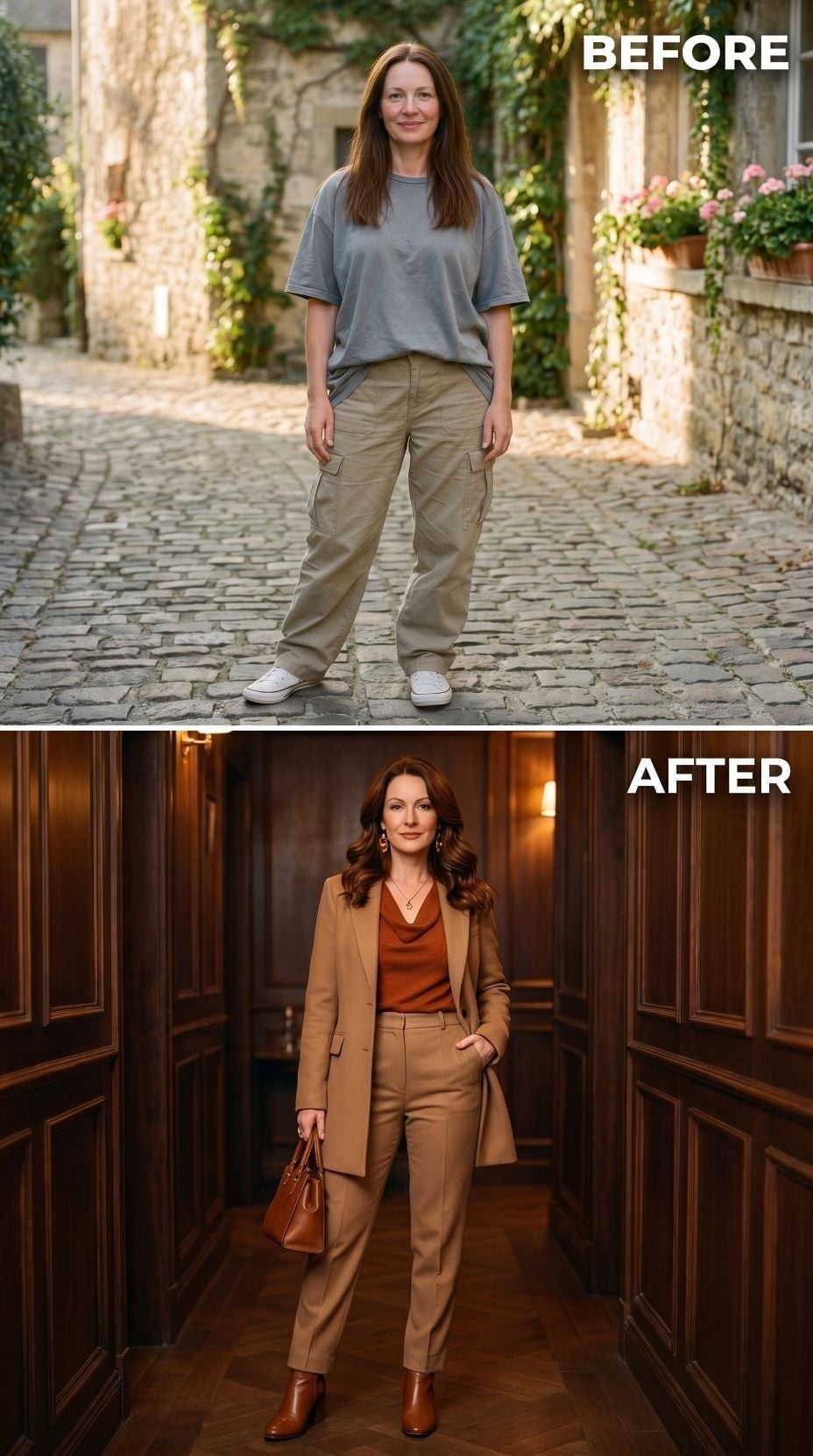
Loose cargo pants and a gray tee aren’t the problem exactly, but they’re doing nothing to show where she actually is. The “after” does something specific: a camel longline blazer with enough structure to hold a silhouette without restricting it, worn over a rust cowl-neck top that pools softly at the neckline. Tailored trousers hit at the ankle. That’s the detail that earns the whole look.
24. Red Suit, Candlelight, and the Night Baggy Finally Lost the Argument
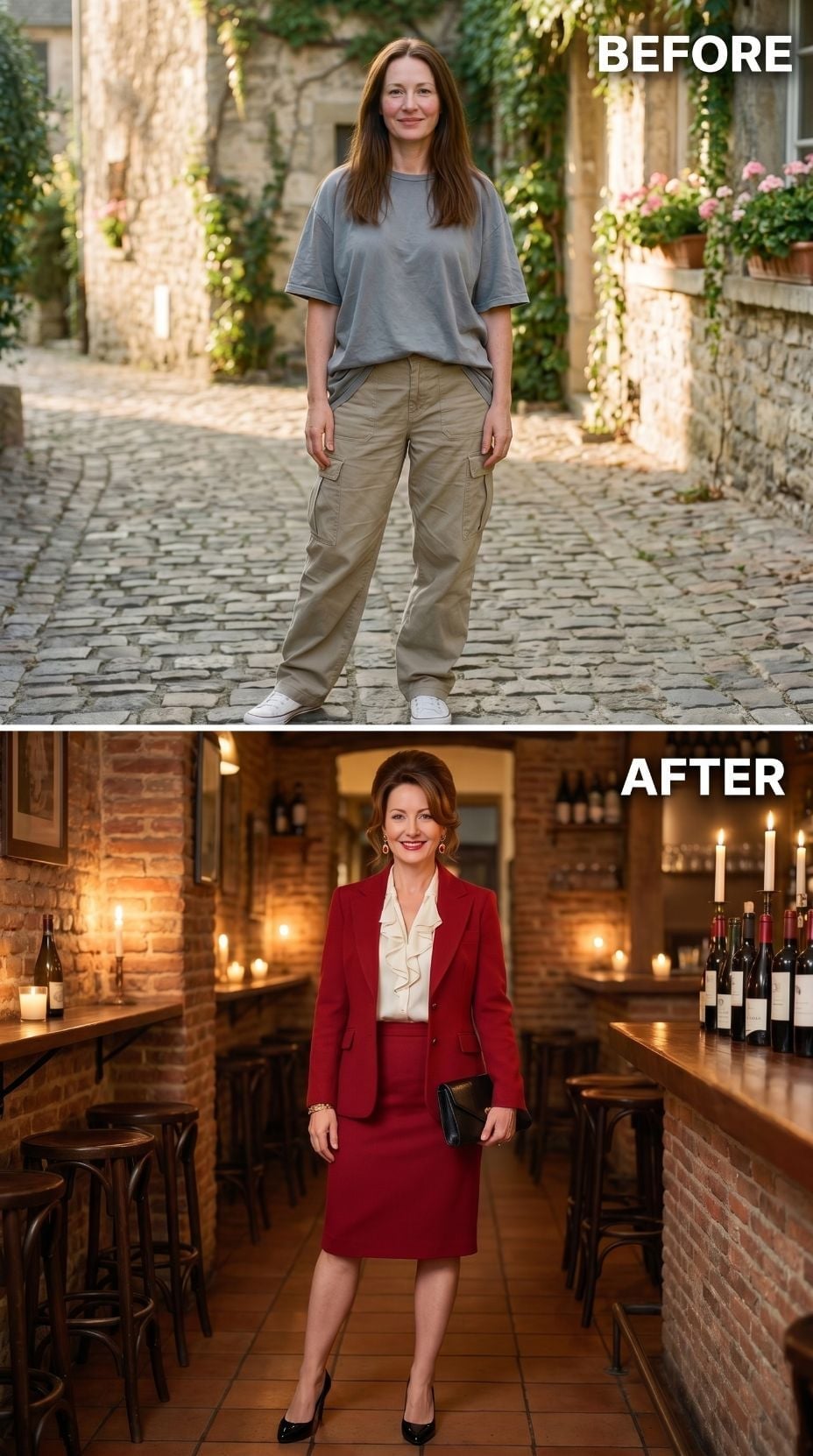
She walked into that cobblestone courtyard in a gray tee and cargo pants that had done their job well enough. But “well enough” isn’t what anyone actually wants. The after look puts her in a crimson blazer and pencil skirt, a matching set that earns its keep by giving her a waist she’d been borrowing oversized fabric to hide. The ruffled ivory blouse underneath does something unexpected: it softens the severity of the red without competing with it.
The skirt hem lands just above the knee, which is the exact length that reads polished rather than costumey in candlelight. Black pointed-toe heels and a small clutch close the look without overloading it. Her hair is swept up, and that choice alone changes the silhouette from the neck up. Fit did what comfort kept promising it would.
The Psychology Behind This: Women who’ve spent years in loose clothing often describe fit not as flattering but as exposing. That instinct isn’t vanity, it’s a protective habit built up over time. What shifts isn’t the body, it’s the realization that fitted clothes aren’t asking anything of you except to show up.
23. Camel Coat, Wine Cellar Light, and the Night Comfortable Stopped Meaning Hidden
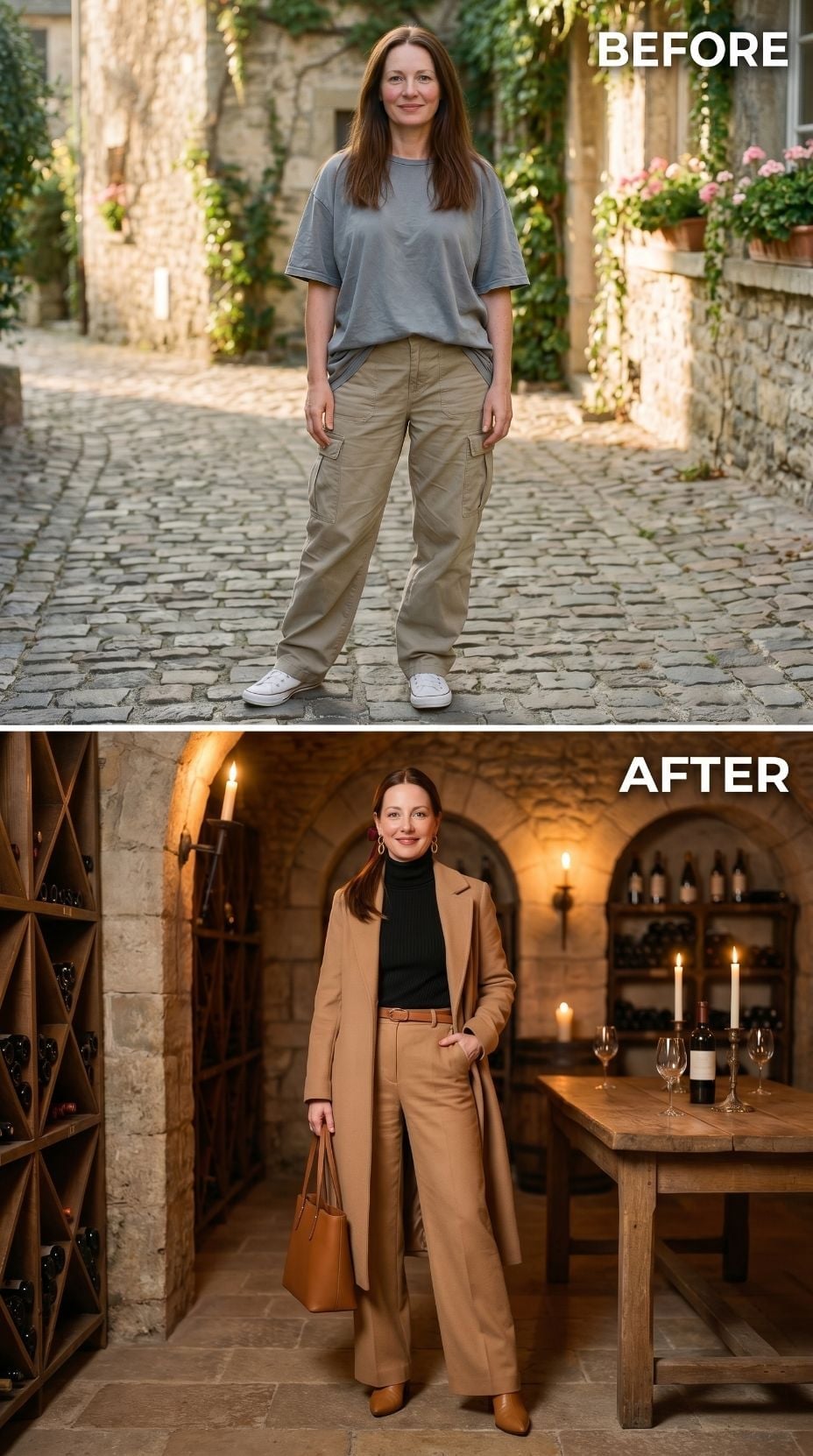
From cargo pants and a washed-out tee to a monochromatic camel look that reads like it was built for exactly this kind of room. The long coat worn open over wide-leg trousers creates one clean vertical line, and the black turtleneck underneath is doing real structural work, anchoring the warmth of the camel without breaking the silhouette. Gold hoops and a tan leather tote keep the accessories within the same tonal family. The result isn’t polished despite being comfortable. It’s both, at once.
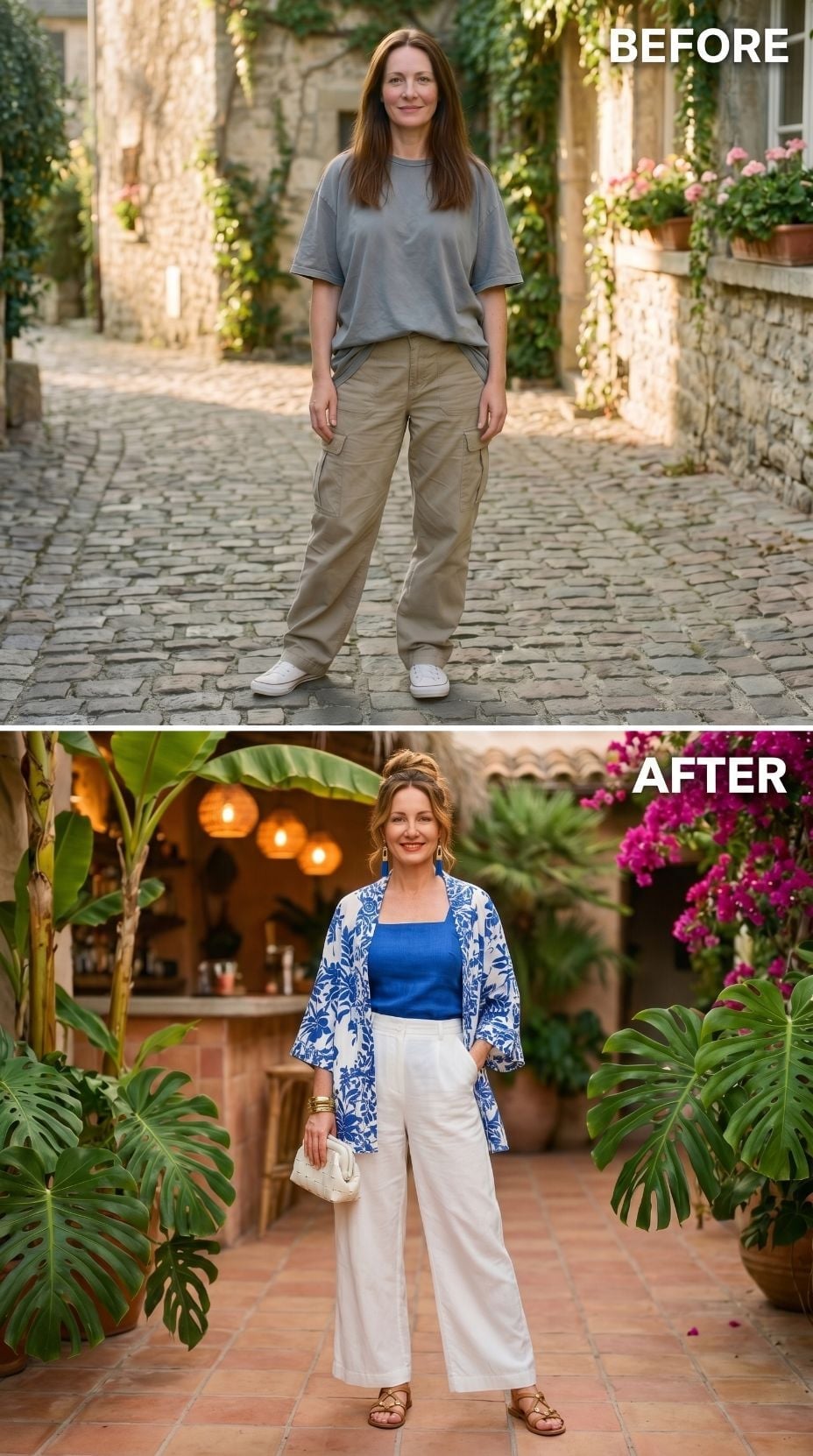
22. Blue, White, and a Floral Kimono That Made Comfort Look Like a Choice
❤️ Would you like to save this?
Neutral cargo pants and a boxy gray tee aren’t wrong, exactly. They’re just invisible. The after look builds from a cobalt blue square-neck top, the kind of saturated color that does something immediate to skin tone, then layers a white kimono printed with overscale blue botanicals over it. Wide-leg white trousers drop straight to the floor, and gold sandals keep it grounded. The updo, the drop earrings, the small woven clutch: none of it feels like dressing up. It feels like someone who finally stopped editing herself down.
21. Green Wrap Dress, Candlelit Restaurant, and the Night Fit Stopped Feeling Like a Risk
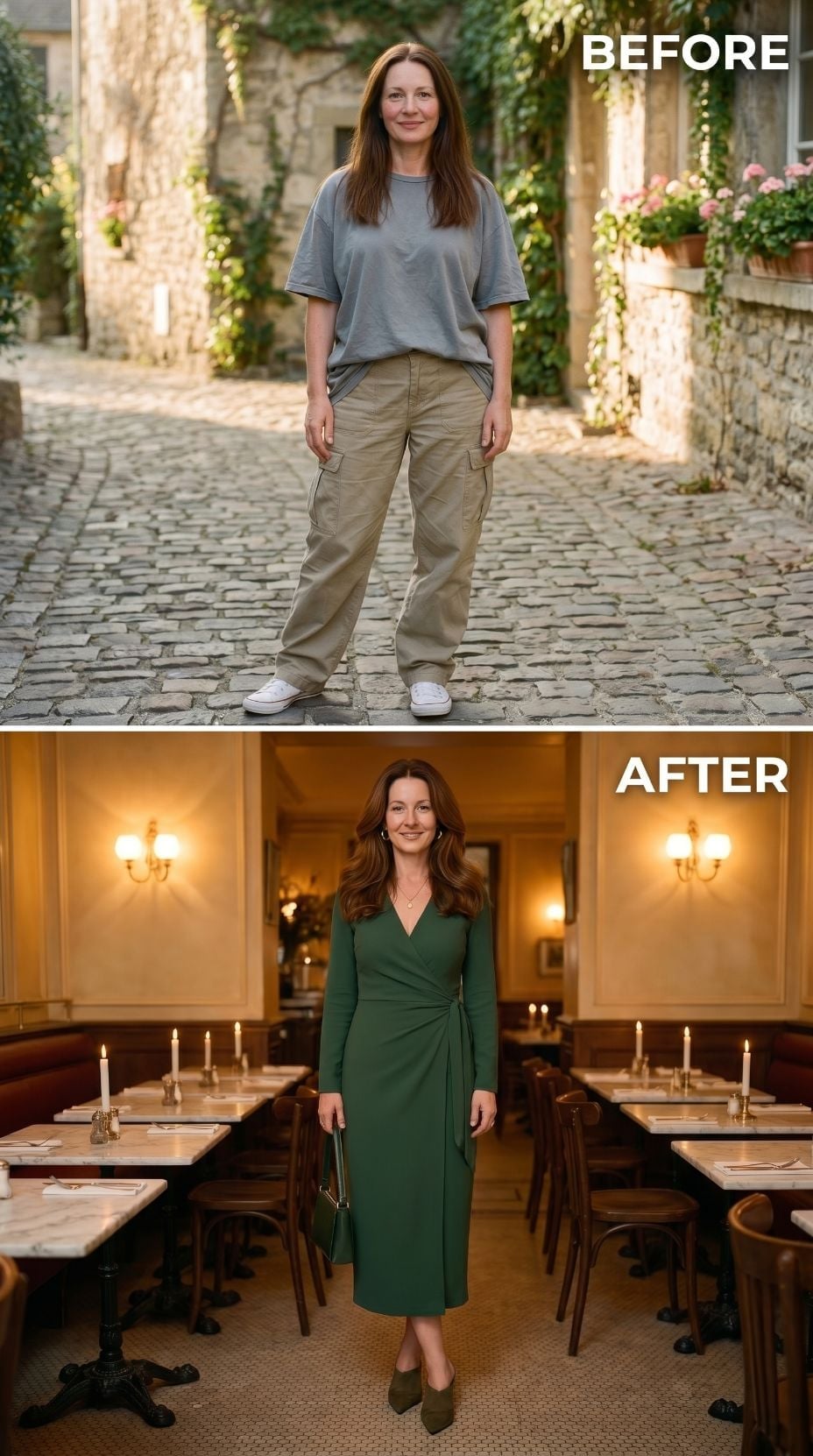
Cargo pants and an oversized tee aren’t wrong, exactly, but they do a specific thing: they opt out. The forest green wrap dress in the after does the opposite. It’s a midi length with long sleeves, so coverage isn’t sacrificed, but the wrap construction pulls everything inward at the waist and lets the silhouette speak. Wavy hair and a gold pendant necklace keep it from reading too polished. Kitten heels in the same deep green as the dress are the detail that ties it together without announcing themselves.
20. Cream Blazer, Rooftop Sunset, and Why Fit Was Never the Enemy
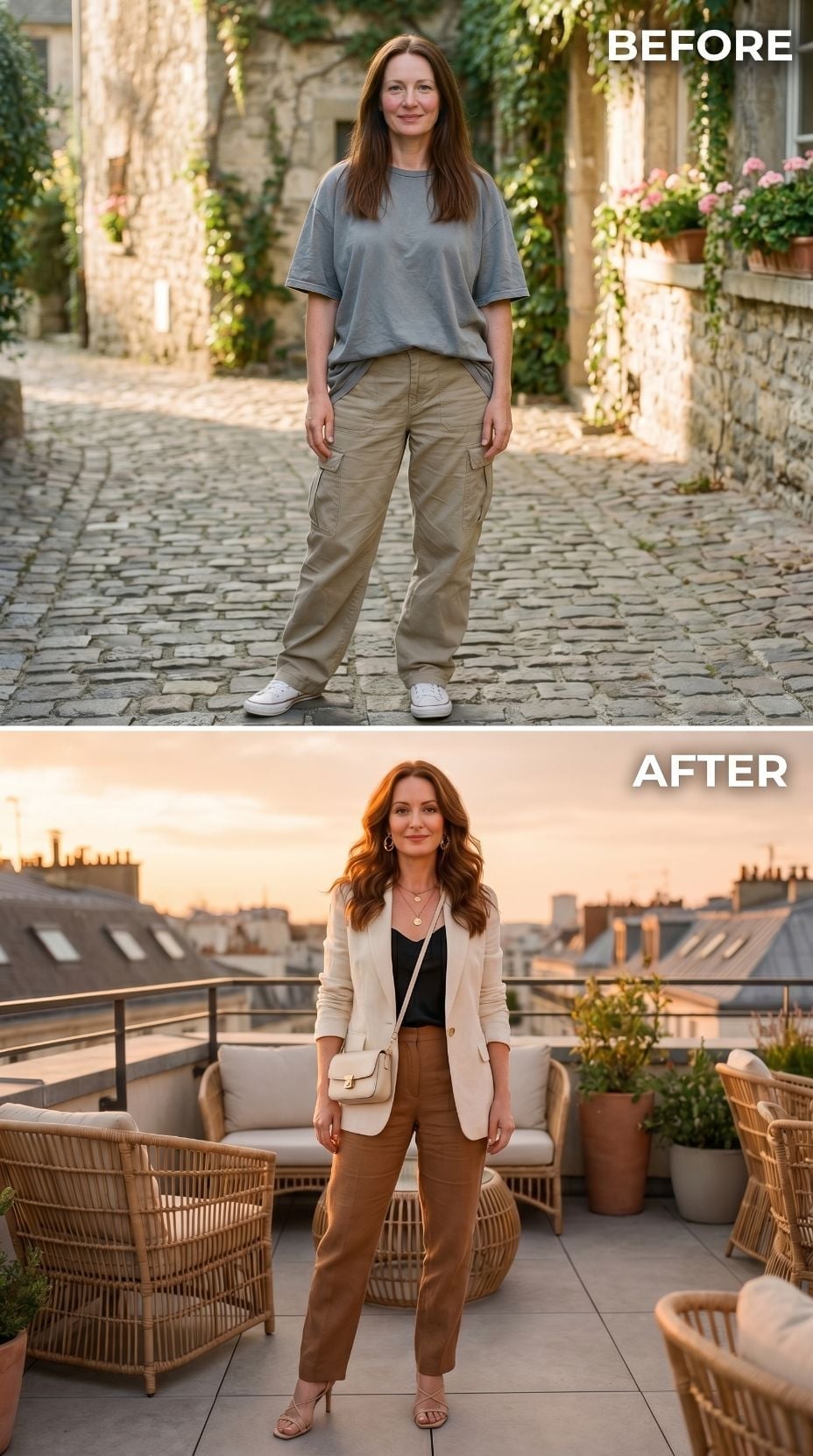
Tailored trousers in a warm tobacco brown hit right at the ankle, which is the detail that keeps heeled sandals from looking accidental. The cream blazer stays unbuttoned, letting a black V-neck do the work underneath. Gold hoops, a layered necklace, waves that have actual shape. None of it reads as trying hard. It reads as decided.
19. Green Plaid, a Greenhouse Setting, and the Blazer That Settled the Comfort Debate
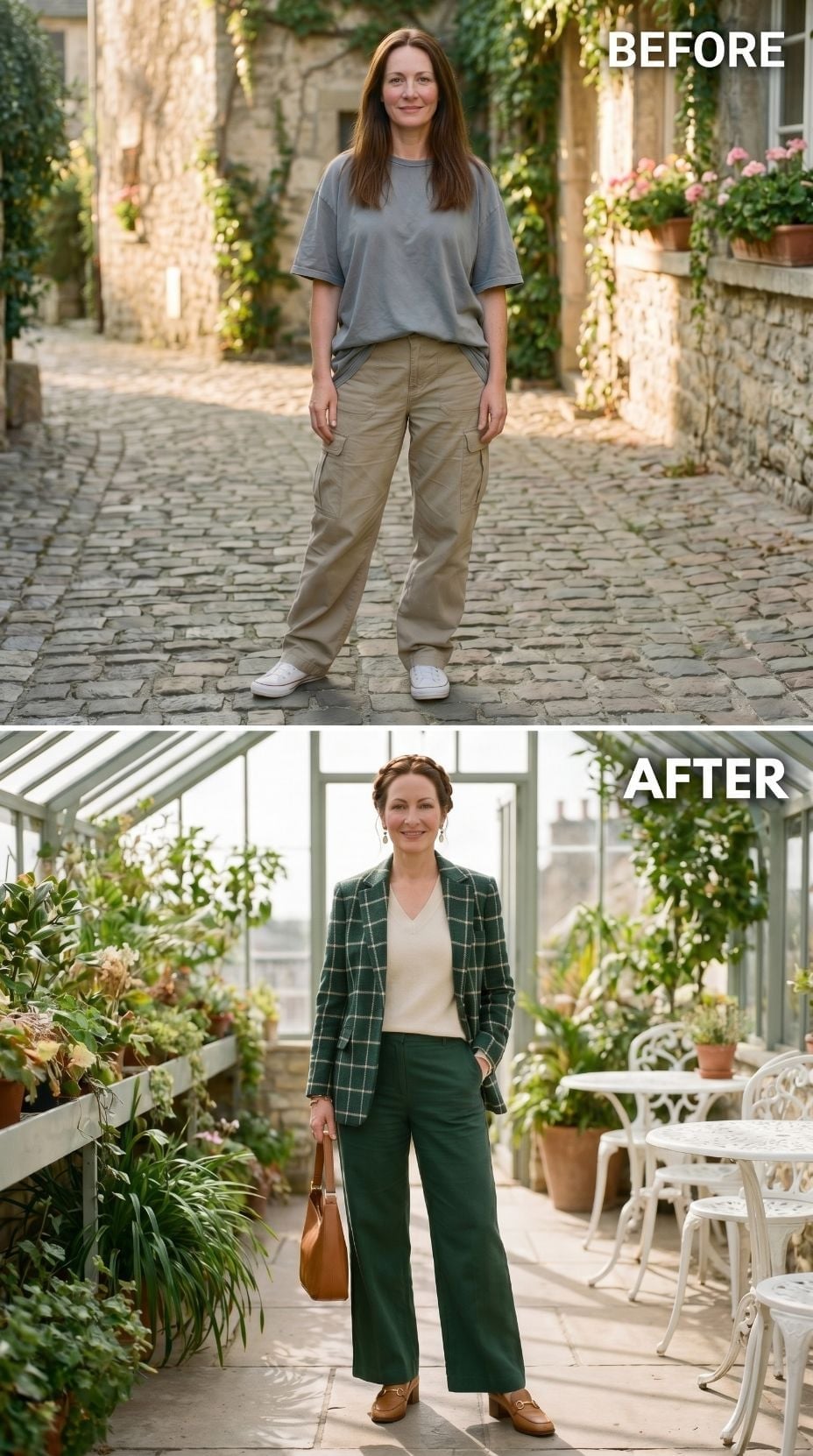
Before: an oversized grey tee and cargo pants that read as someone actively avoiding being noticed. After: a dark green plaid blazer over a cream v-neck, with wide-leg trousers in the same forest green and tan loafers that hit just right against the trouser hem. The braided updo does real work here, pulling attention to the earrings and the open neckline. It’s not a harder look to wear. It’s just one that stopped apologizing.
Try This: Wide-leg trousers get unfairly dismissed as a trend piece, but in a deep solid like forest green they read as classic and work especially well when the top half is structured. The trick isn’t balance, it’s repetition of tone: matching your blazer to your trousers in the same color family removes the need to think too hard about proportions.
18. Sage Wrap Dress, Garden Pergola, and Proof That Comfort Was Never the Issue
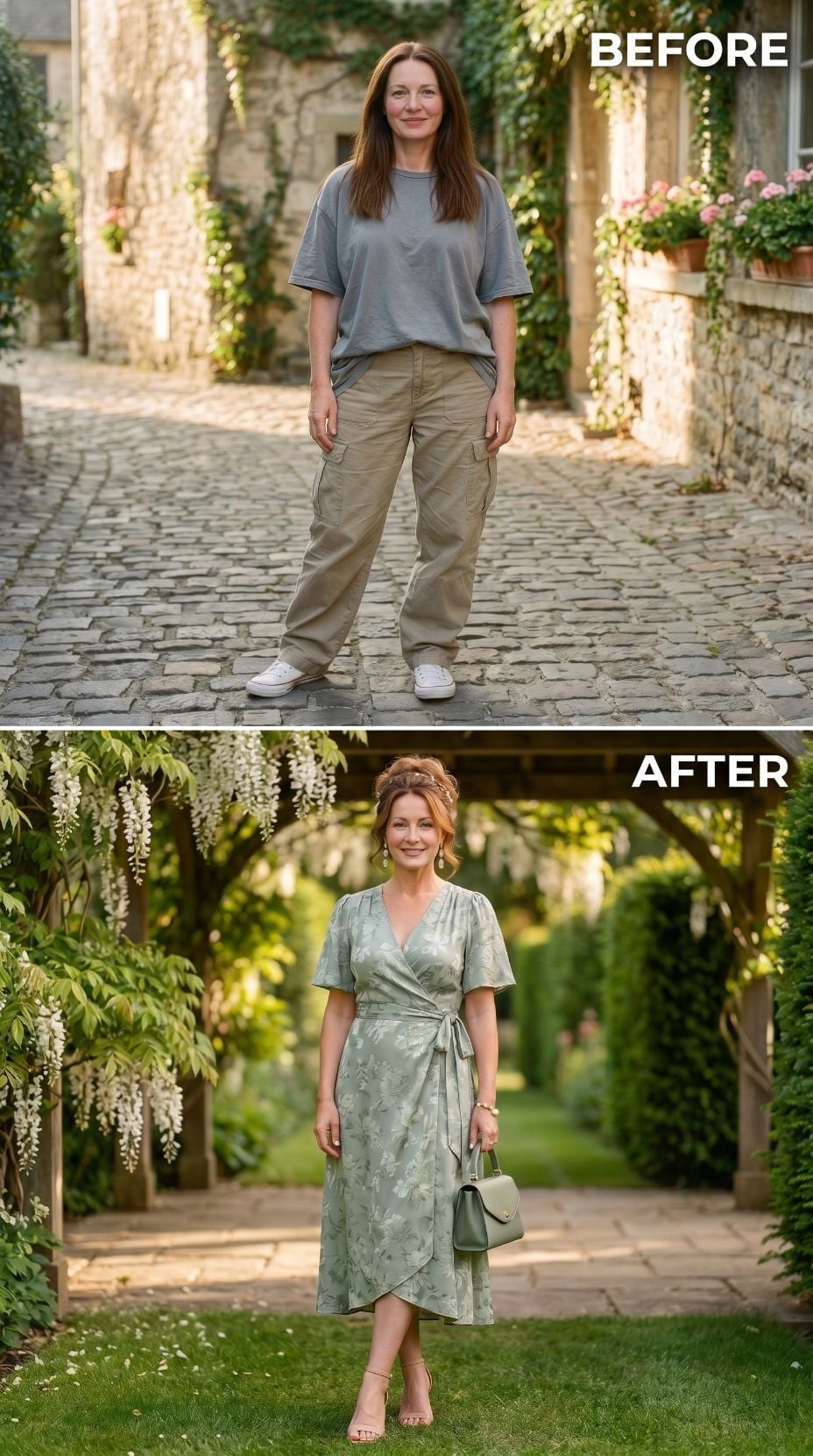
Oversized cargo pants and a grey t-shirt weren’t wrong, exactly. They just weren’t doing anything. The sage wrap dress changes the entire conversation: a V-neckline that doesn’t require bravery, flutter sleeves that move, a self-tie waist that defines without cinching. The floral print is small-scale enough to read as texture from a distance. Nude heeled sandals and a matching structured bag keep the palette clean. Hair up, drop earrings in gold. That’s all it took.
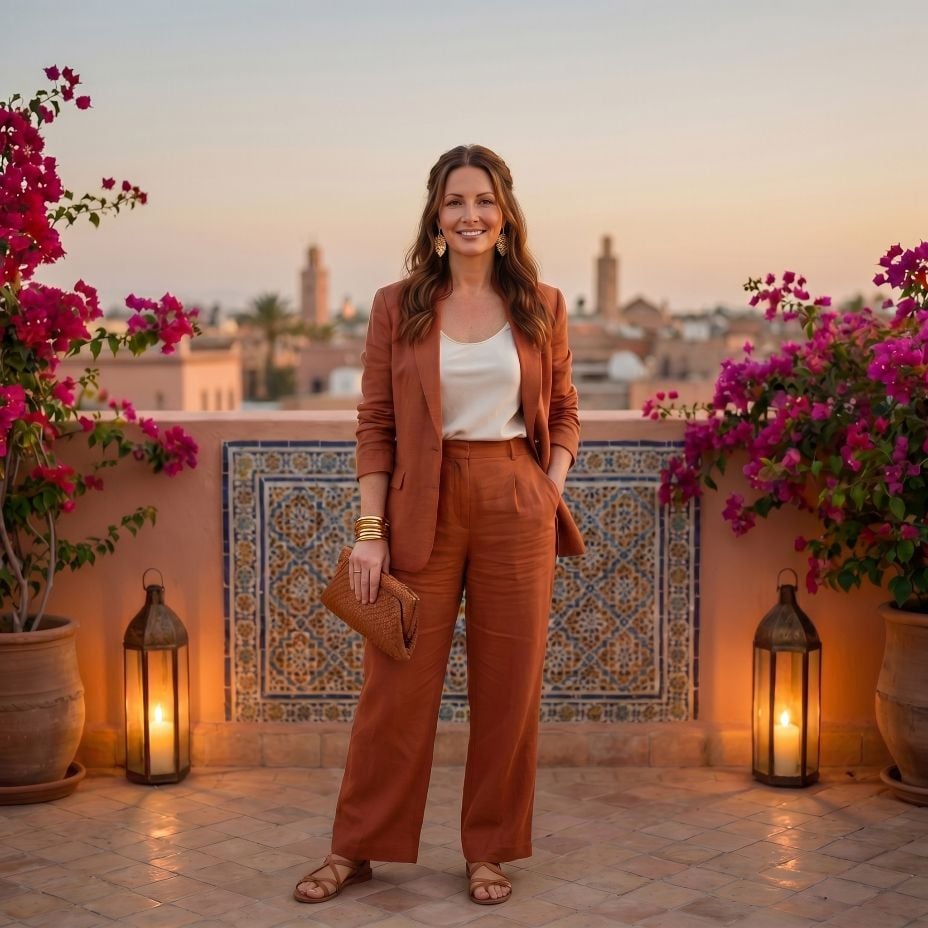
17. Rust Suit, Marrakech Rooftop, and What Happened When Comfort Got a Better Definition
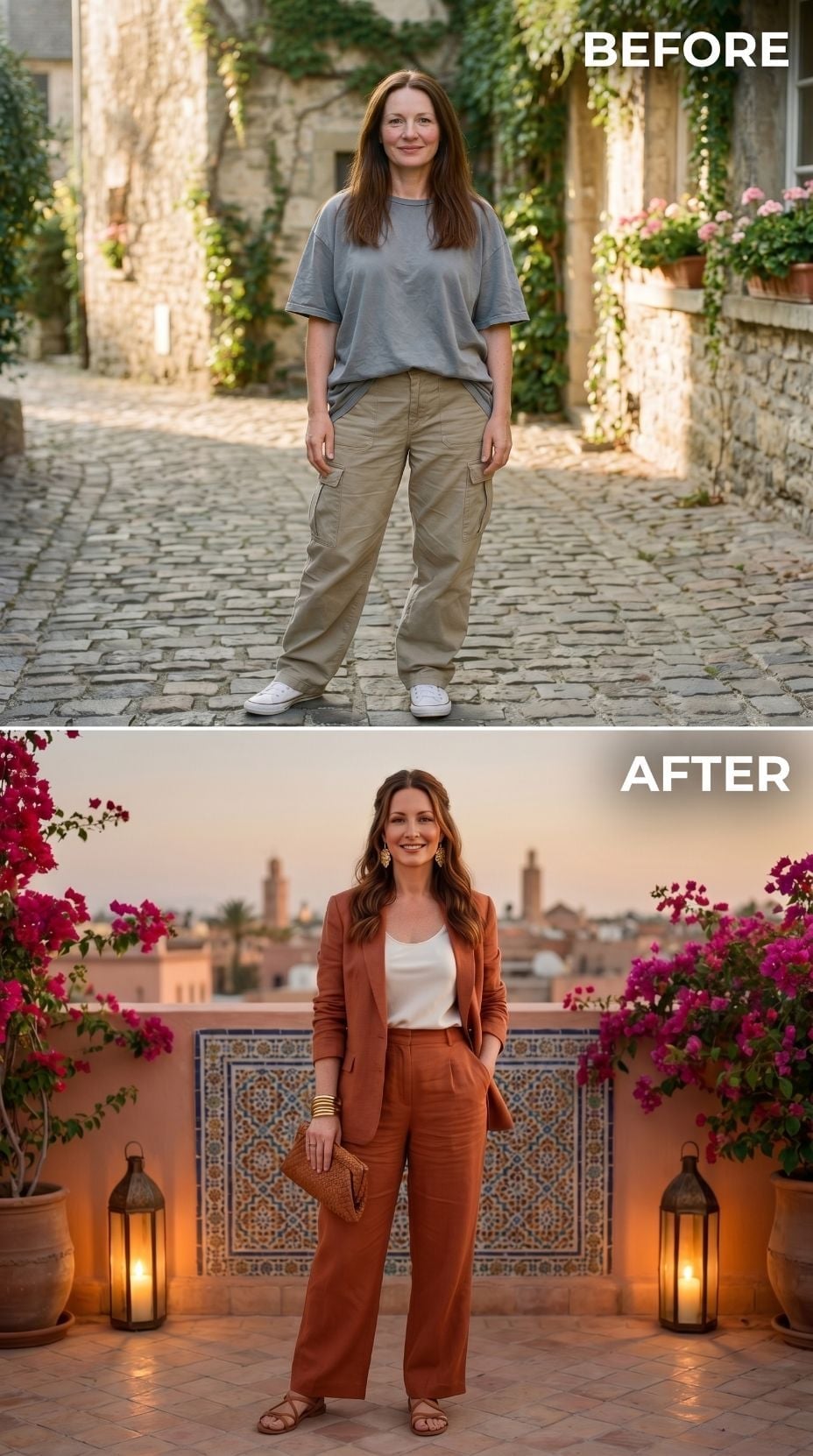
Cargo pants and an oversized tee read as someone opting out. The rust linen blazer and matching wide-leg trousers in the after shot read as someone who made a decision. That’s not a small shift. The white scoop-neck underneath keeps the palette from feeling heavy, and the gold earrings and stacked bangles add warmth without competing with the terrace’s tile work behind her. Flat sandals seal it: dressed up, not dressed uncomfortably.
16. Floral Midi, Vineyard Light, and Why Comfortable Was Never the Problem
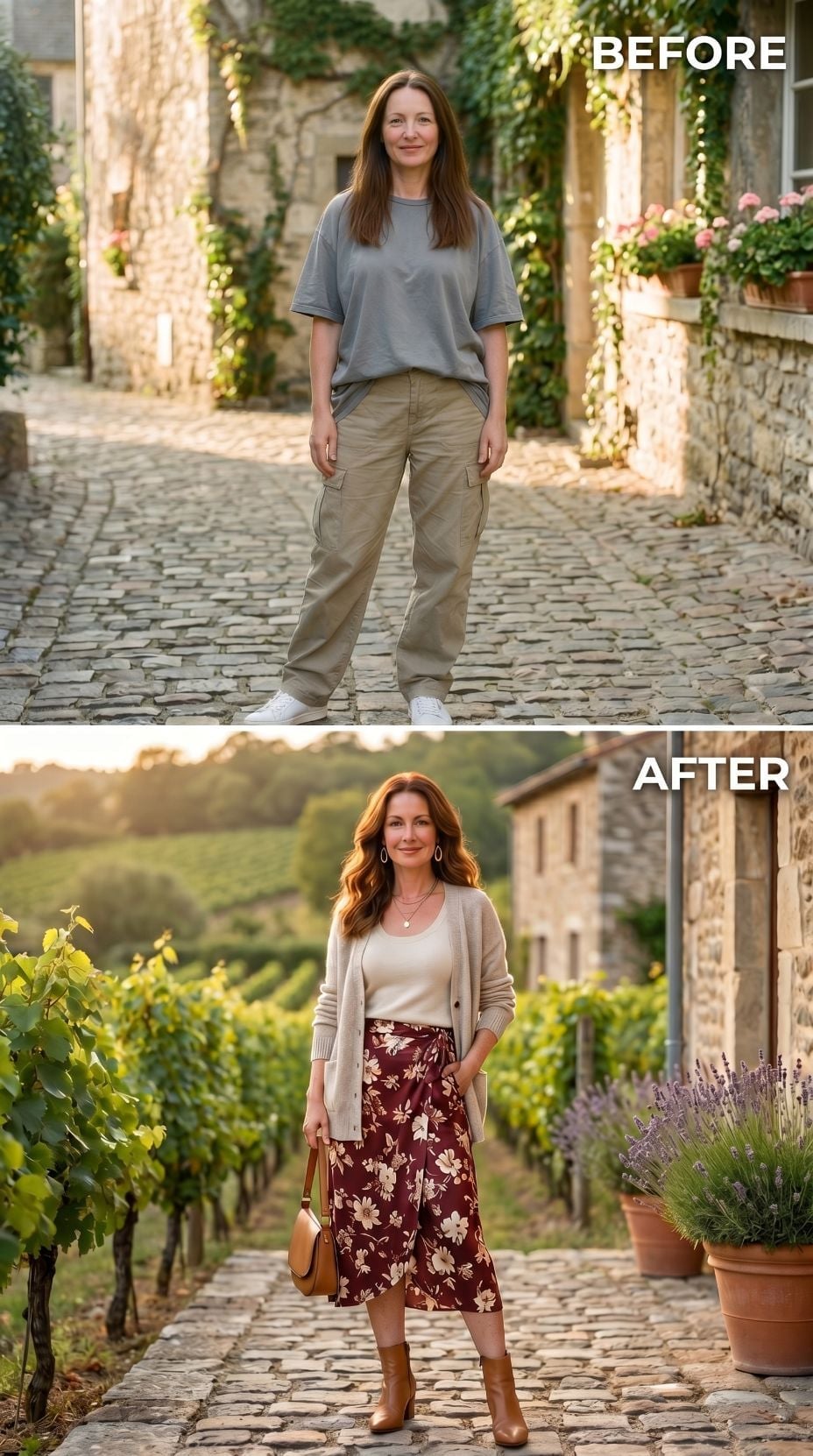
A gray oversized tee and cargo pants aren’t doing anything wrong, exactly. They’re just doing nothing. The after shot places her in a burgundy floral midi skirt with cream blooms at a generous scale, paired with a sand-colored cardigan left open over a fitted scoop-neck tank. The hem lands at mid-calf, which sounds conservative until you see it with cognac ankle boots and realize the proportion is doing real work. She’s carrying a structured tan crossbody that stays small enough not to compete. Hair is down and wavy, catching the golden hour light behind the vineyard rows. Nothing here is uncomfortable. None of it requires suffering. That’s the whole point the before image keeps missing.
15. Houndstooth Blazer, City Lights, and What Comfort Looks Like With a Point of View
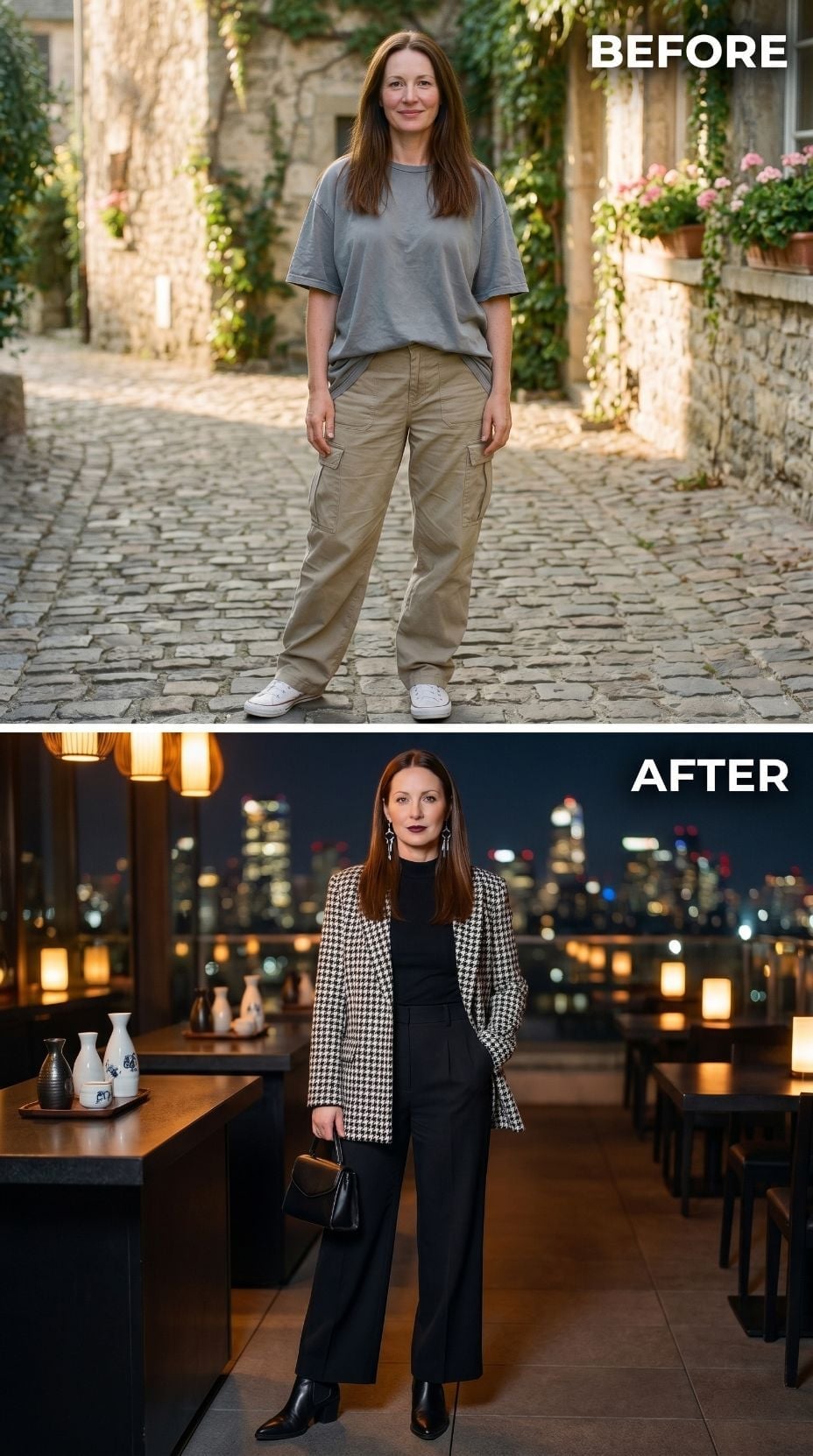
Gray tee and cargo pants aren’t the enemy, but they were doing her no favors. The “after” pairs a black turtleneck with wide-leg trousers, then layers a houndstooth blazer over both, and that pattern is doing real work: the medium-scale check reads sharp without demanding attention. Black ankle boots keep the hemline honest.
14. Linen, Golden Hour, and What Happens When Comfortable Gets Honest With Itself
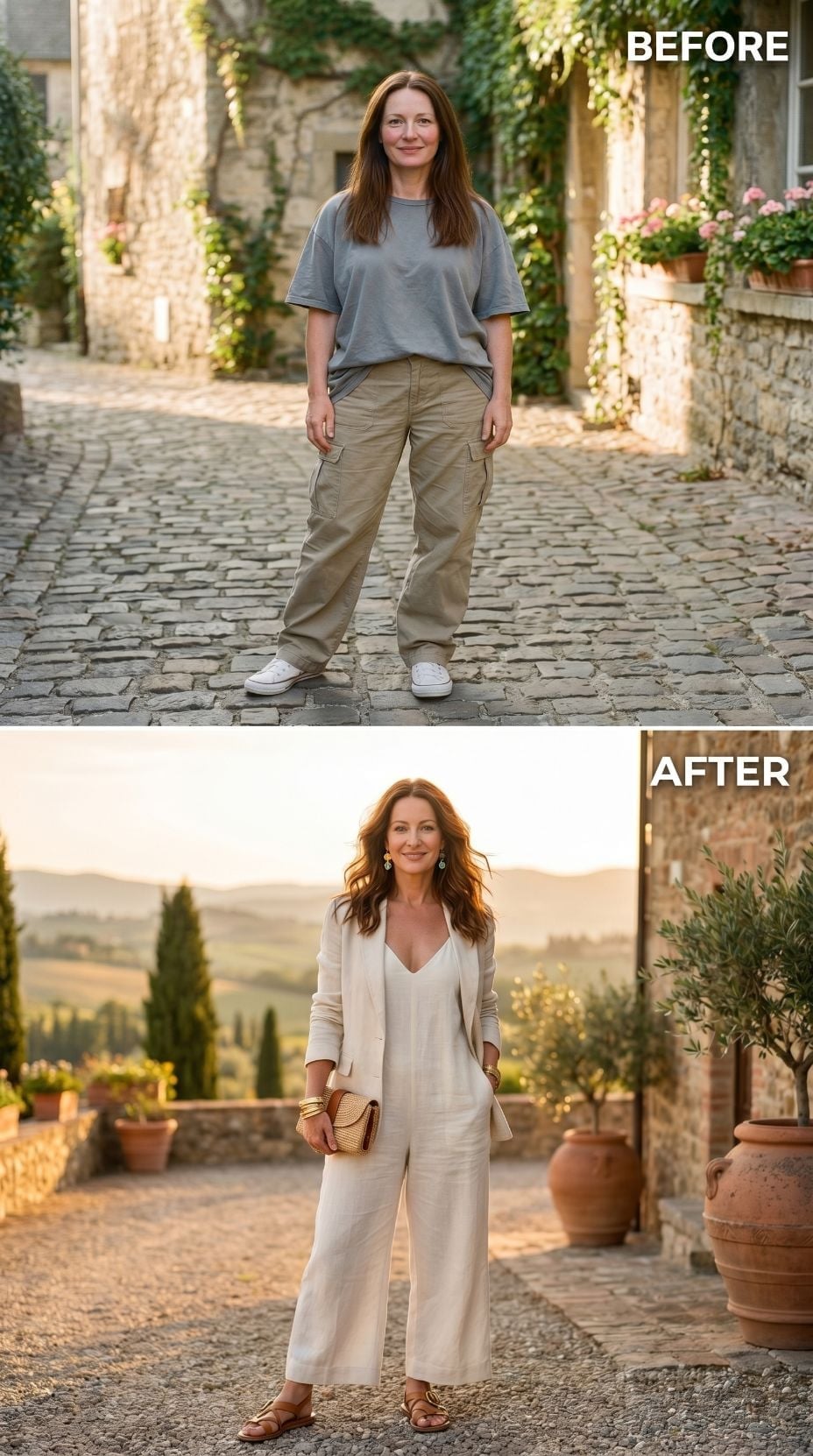
Wide-leg linen trousers in warm ivory, a V-neck cami underneath, and a loose blazer draped open rather than buttoned: none of it is structured, and yet the proportions hold together because the hem hits exactly at the ankle. That placement does the work. The blazer’s relaxed lapel keeps it casual without reading sloppy, and the flat sandals don’t undercut anything because the trouser length was already doing the legwork.
What shifted wasn’t the silhouette’s formality. It was the intention behind it. Wavy hair, drop earrings with a hint of green, a woven clutch held at the hip: small choices that signal she got dressed for somewhere specific, not just got dressed.
13. Teal Midi, Marble Bar Light, and What She Found When Baggy Stopped Feeling Safe
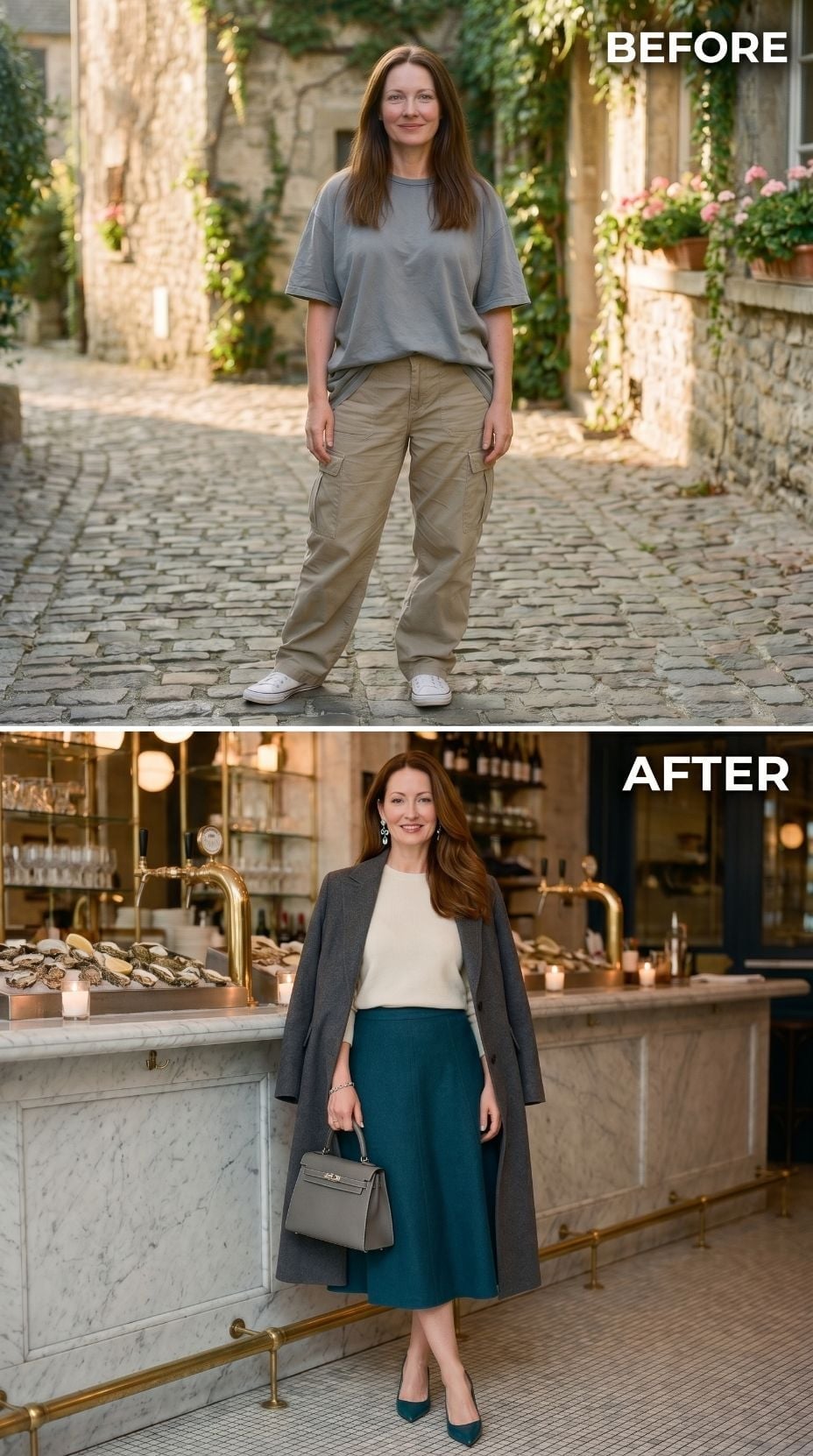
She walked in wearing khaki cargo pants and an oversized gray tee, the kind of outfit that says “I gave up negotiating with my wardrobe.” The after look doesn’t overhaul her, it just stops hiding her. A cream knit top with a simple round neckline tucks into a teal wool midi skirt that hits mid-calf, and a charcoal longline coat drapes open over both. The silhouette has weight without bulk.
What makes it land is the hem. That midi length, stopping just above the ankle, is doing quiet structural work that the cargo pants couldn’t. Teal pumps in a matching deep tone pull the whole thing into focus. The gray structured bag and drop earrings keep the accessories from competing. She looks like someone who made choices. That’s different from someone who looks like she tried.
Shopping Tip: A midi skirt in a saturated color like teal or forest green reads as dressed up without requiring anything formal from the top half. Pair it with a simple knit and a longline coat, and the coat does most of the heavy lifting for occasions that need polish. Look for a skirt with some structure, a wool blend or ponte, so it holds its shape through a full evening.
12. Houndstooth Coat, Autumn Cobblestones, and What Warm Colors Do That Neutrals Can’t
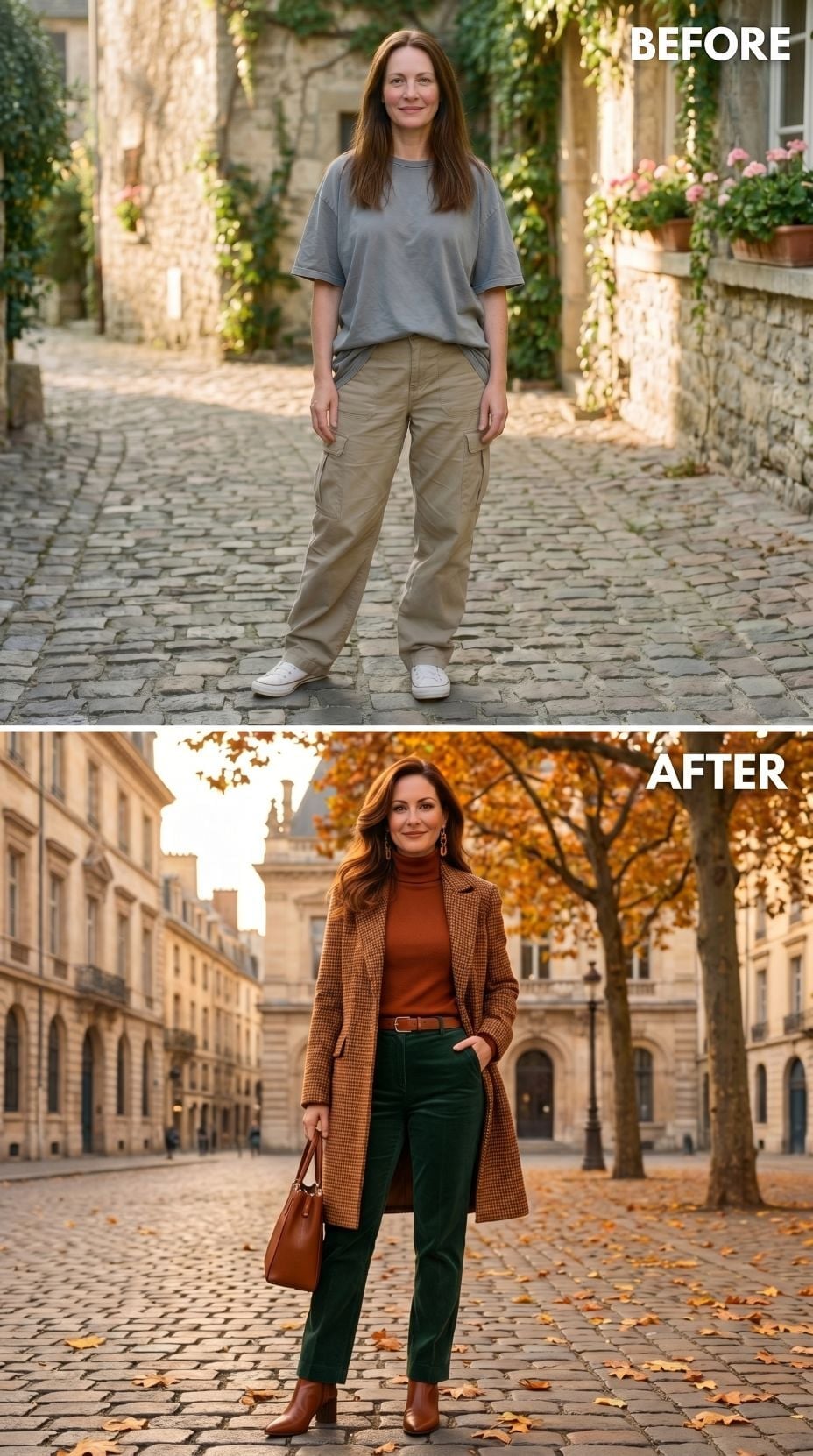
Dark forest green corduroys are doing the structural work here, fitted through the hip and tapered just enough to make the ankle boots land with intention. The rust turtleneck underneath reads as a color choice, not an accident, and the houndstooth coat in camel and brown pulls both shades together without trying too hard. She’s carrying a cognac structured bag that echoes the belt. Nothing here is complicated. But it all has a point of view, and that’s the difference between getting dressed and actually dressing.
11. Beige Coat, Warm Interior Light, and What Happened When Comfort Finally Got Dressed Up
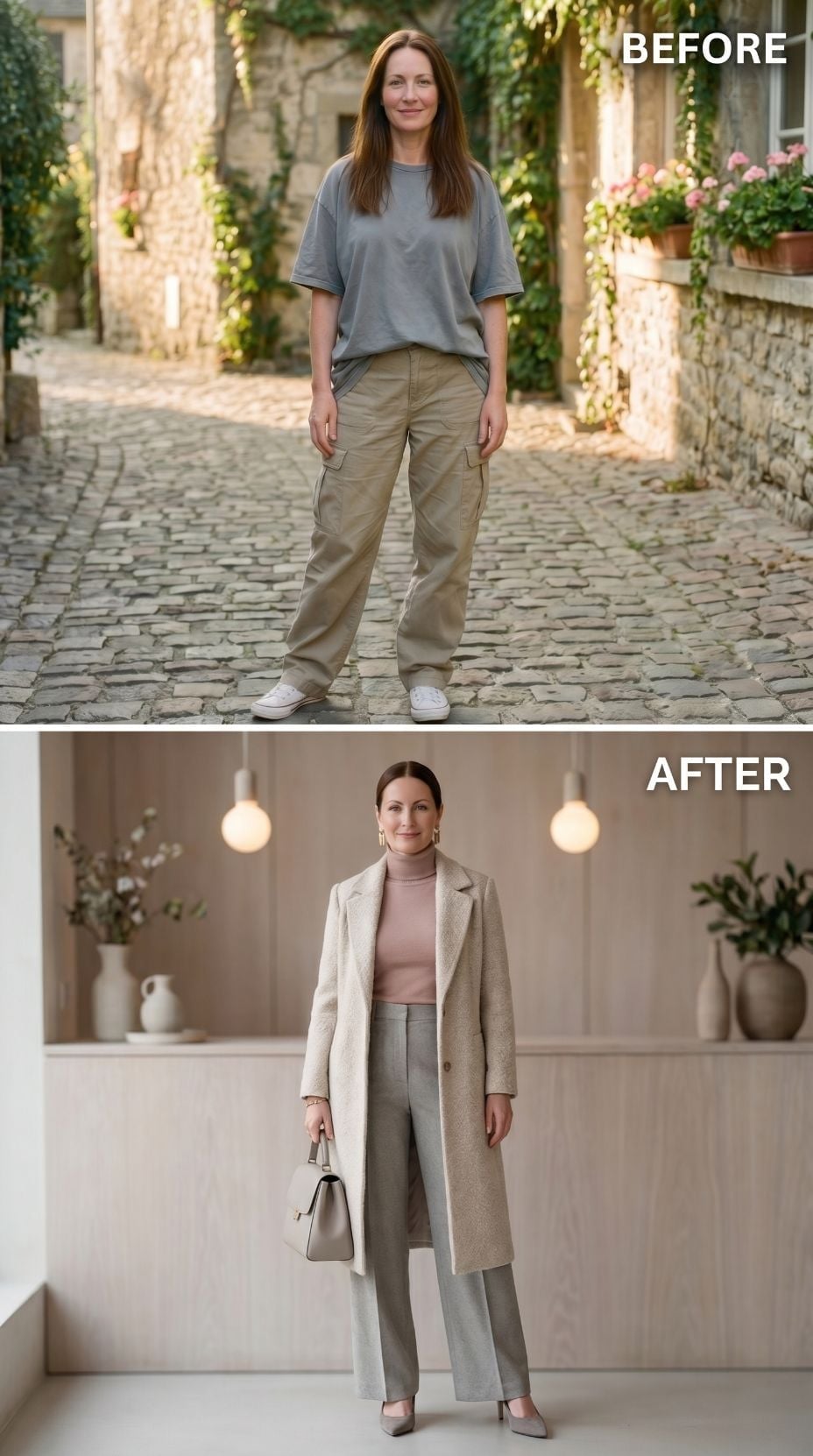
Baggy cargo pants and an oversized tee aren’t wrong, exactly. They’re just a habit that stopped being a choice. The after look pairs wide-leg grey trousers with a blush turtleneck, and the long oatmeal coat over both is doing the heavy lifting: it creates a vertical line that makes the whole outfit read as intentional rather than assembled. Gold hoop earrings and a structured grey bag add enough sharpness to keep the palette from going soft. Nothing here is fussy. But everything has a reason for being there.
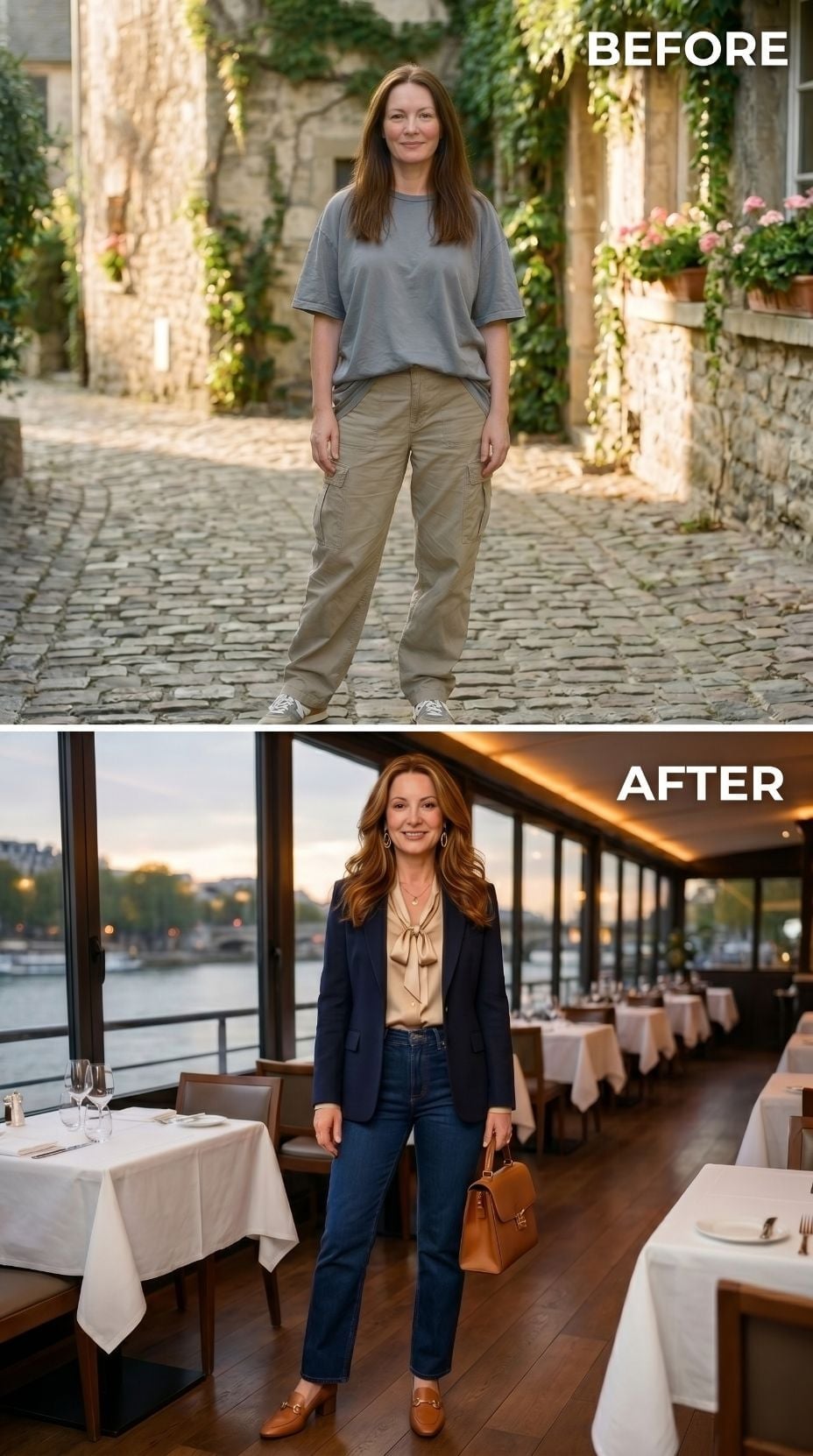
10. Navy Blazer, Seine at Dusk, and What Fitting Well Actually Feels Like
❤️ Would you like to save this?
Khaki cargo pants and a gray tee aren’t wrong, exactly. They’re just doing nothing. The after look pairs dark-wash straight-leg jeans with a navy blazer that actually closes at the waist, layered over a cream blouse with a soft neck tie. The cognac structured bag ties it together. Polished, but not stiff.
9. Lavender Linen, a Lavender Field, and What Happened When Comfort Stopped Hiding
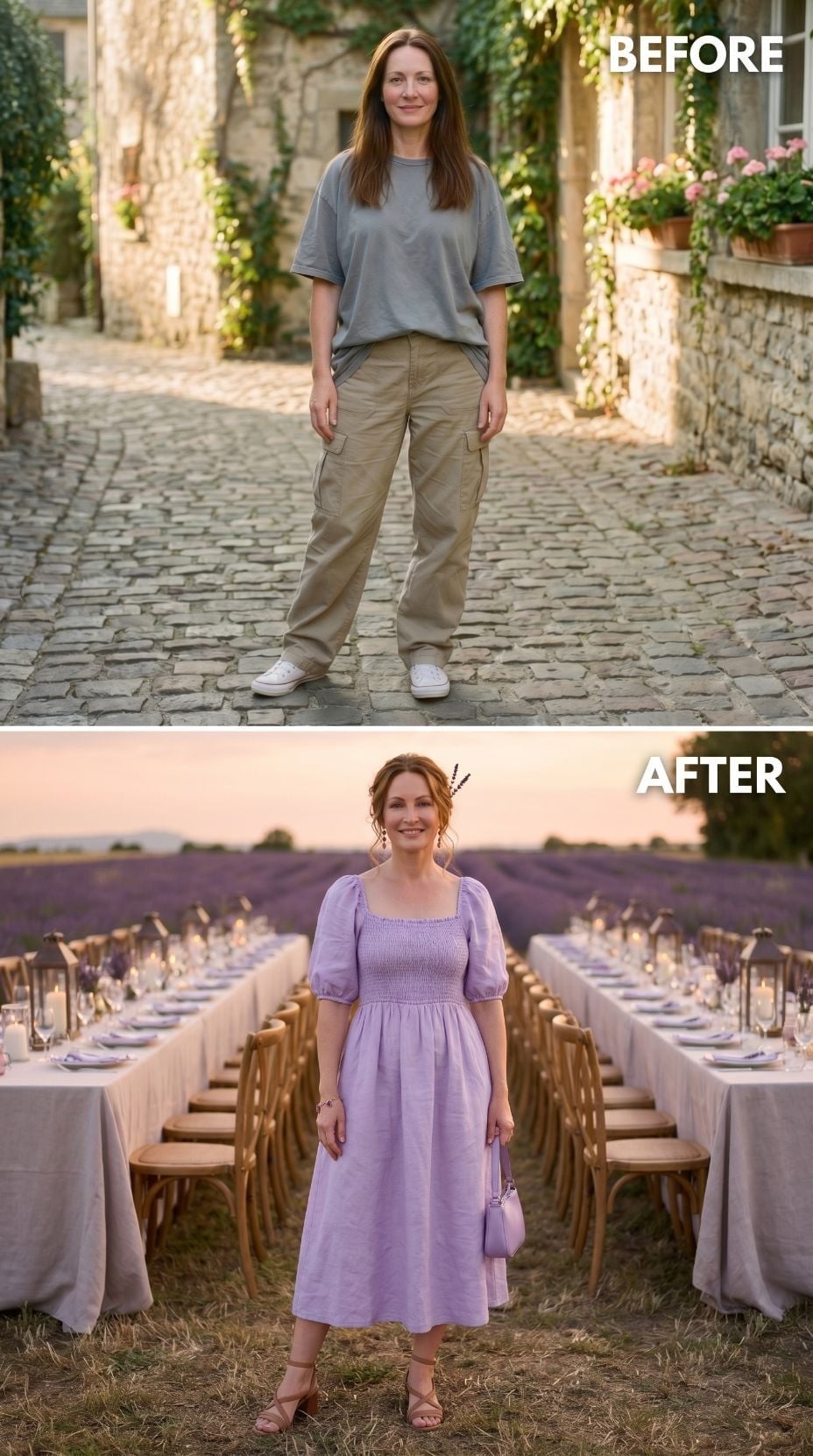
Loose cargo pants and a boxy tee aren’t uncomfortable. They’re just not doing anything for her. The AI swap makes the case with a smocked-bodice midi in lilac linen, puff sleeves cut to the elbow, and a square neckline that sits high enough to feel easy but low enough to look intentional. The hem lands at mid-calf. That’s the length that reads dressy without requiring heels, though she’s wearing them anyway, strappy sandals in a warm nude.
She’s also got her hair up, soft and loose at the crown, with a sprig of lavender tucked in. It sounds precious. It isn’t. Against the outdoor dinner setting and the pink dusk sky, it reads like someone who got dressed for the place she was going, not the place she’d been.
8. Burgundy Trousers, Brick and Edison Light, and What Happens When Fit Stops Being the Enemy
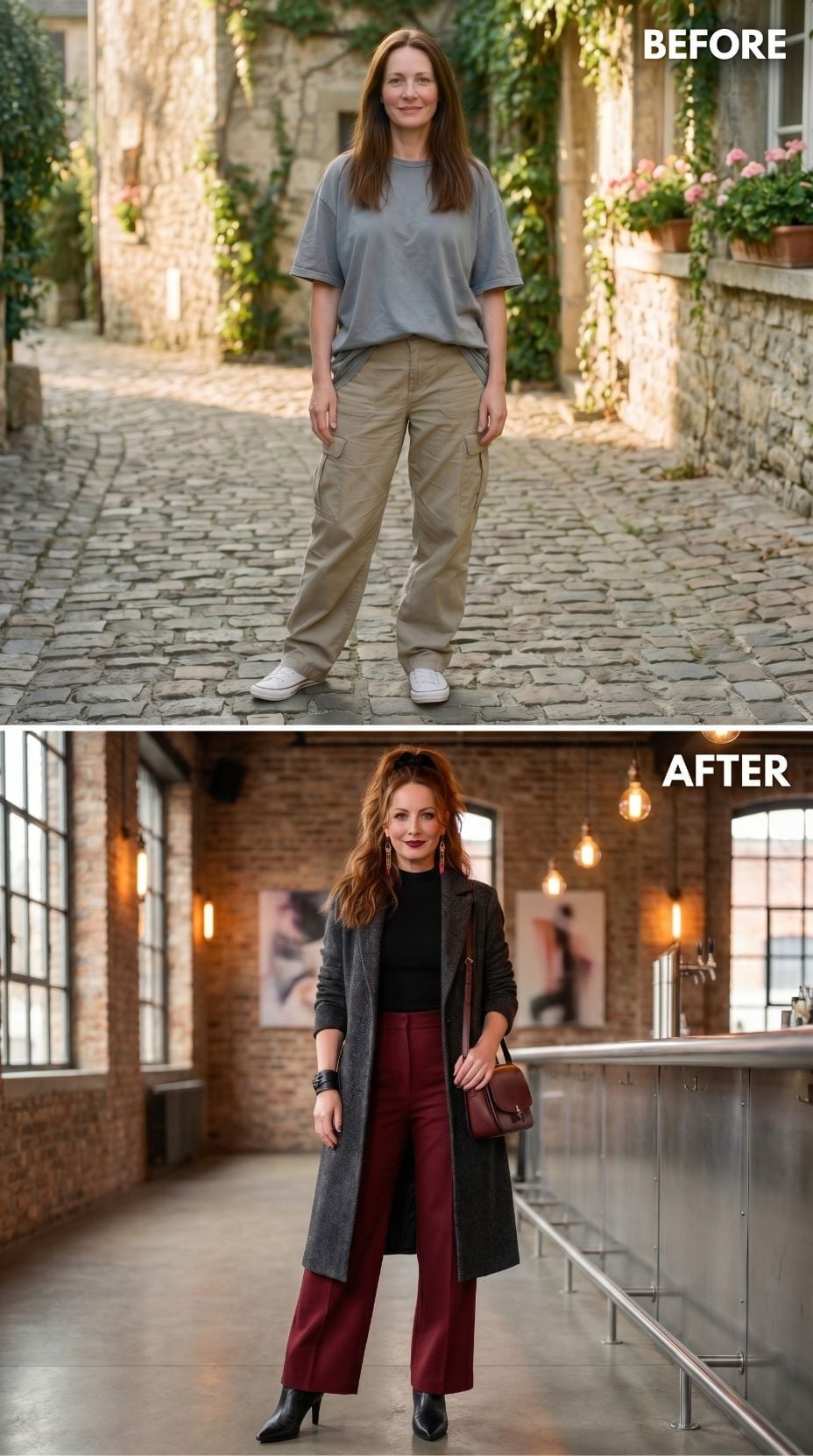
Bérénice spent years reaching for cargo pants because they felt like a fair trade: comfort in exchange for visibility. What the after image shows is that the trade was never necessary. Wide-leg trousers in a deep burgundy, cut with enough structure to hold their shape, do the same work as any loose pant while giving the silhouette something to stand on. A long charcoal coat with enough length to graze the shin keeps the proportions clean. The black fitted turtleneck underneath earns its place quietly. Block-heeled ankle boots, dark bag, warm-toned earrings. Nothing here requires discomfort. It just requires choosing fit over volume.
7. Pale Yellow Linen, Provençal Stone, and What Happens When Comfort Gets a Silhouette
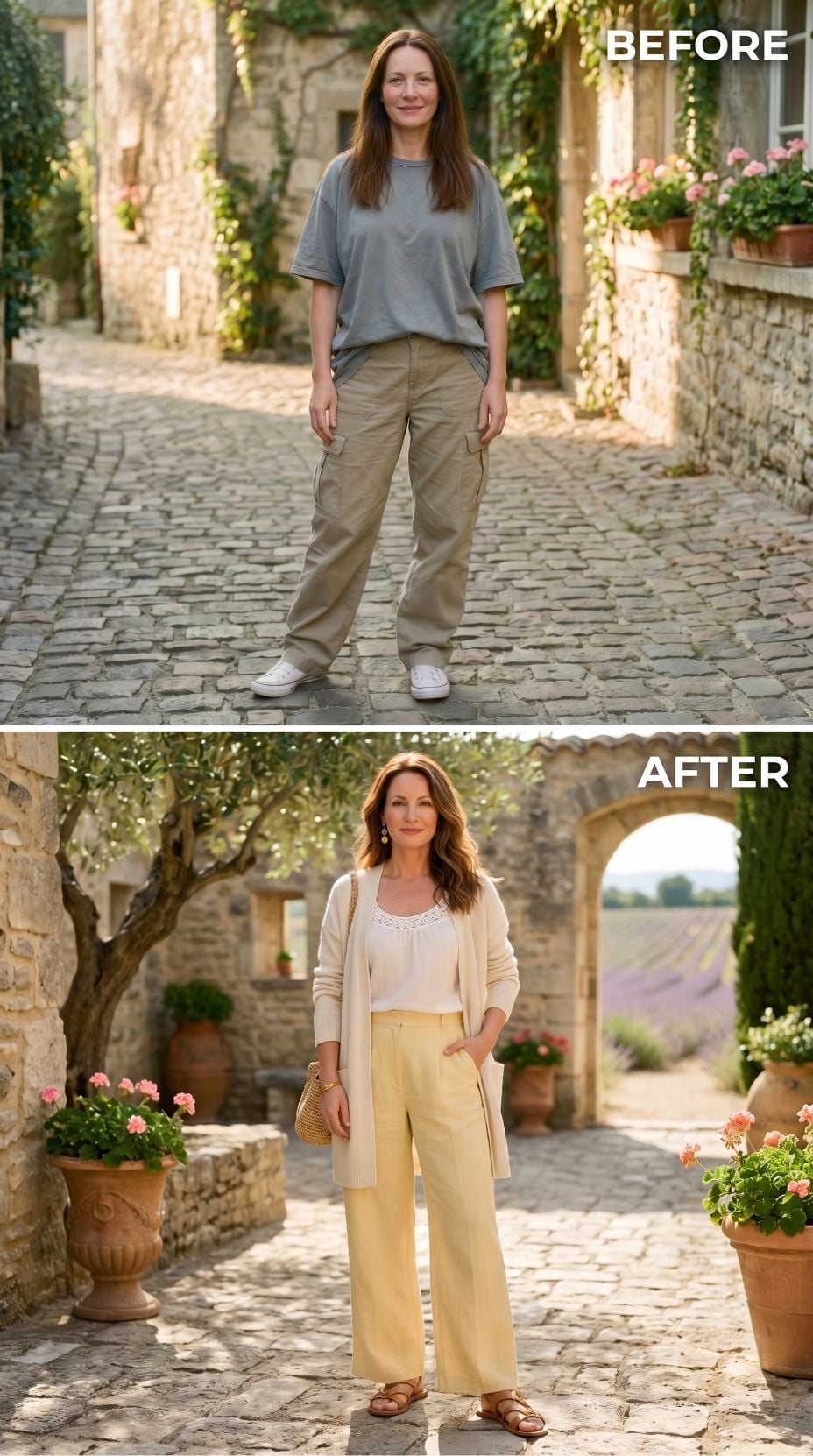
Butter-yellow wide-leg trousers in what reads as linen or a linen blend carry the whole look. The cut is relaxed but the waist sits at the right place, which means the leg falls with intention rather than accident. Layered over a white eyelet-trim tank, a cream open-front cardigan adds length without adding bulk. Flat leather sandals keep the heel height honest. Drop earrings in warm gold bring the face into the outfit. Nothing is tight. Nothing is hiding.
The cut is relaxed but the waist sits at the right place, which means the leg falls with intention rather than accident.
6. Rust Coat, Candlelight Stone, and What Happens When Warm Colors Mean Business
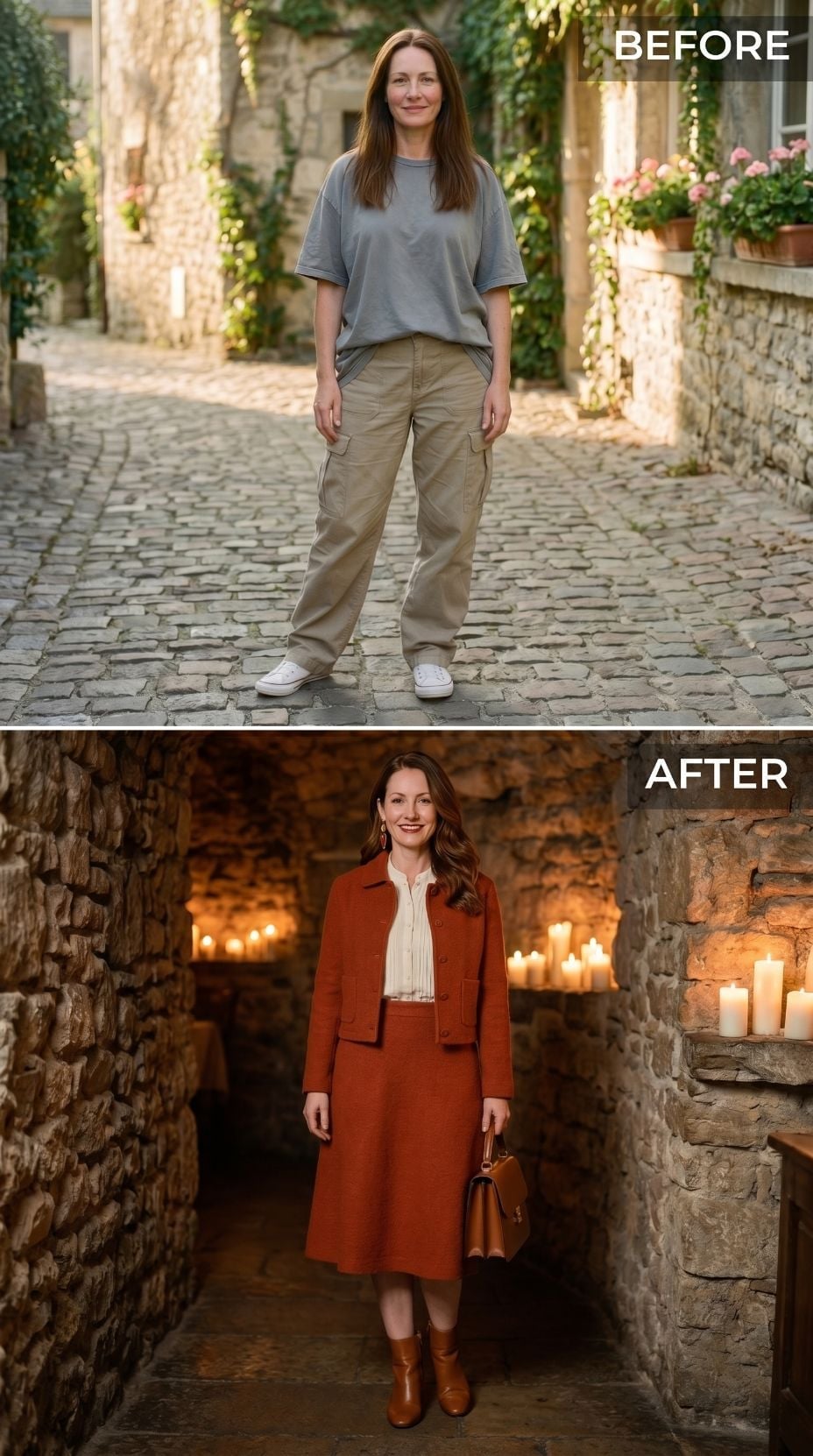
Cargo pants and an oversized gray tee read as a uniform of avoidance. Not bad clothes. Just clothes doing a job they were never meant to do forever.
The after look builds its case quietly. A rust-colored wool coat with structured patch pockets sits over a matching midi skirt, and the monochromatic effect does something a two-tone outfit rarely manages: it makes her look taller without trying. Underneath, a cream pintucked blouse adds texture without breaking the silhouette. Brown leather ankle boots with a modest block heel bring the whole thing down to earth, and a cognac structured bag in the crook of her arm ties the warm tones together without announcing itself.
What the candlelit stone corridor does is confirm what the outfit already started. Warm rust against amber light isn’t a coincidence. Colors with orange undertones pick up warmth from their surroundings rather than fighting it, which means she looks like she belongs there rather than like she walked in from somewhere else entirely.
5. Plaid Coat, Apothecary Shelves, and What Happens When Purple Stops Playing It Safe
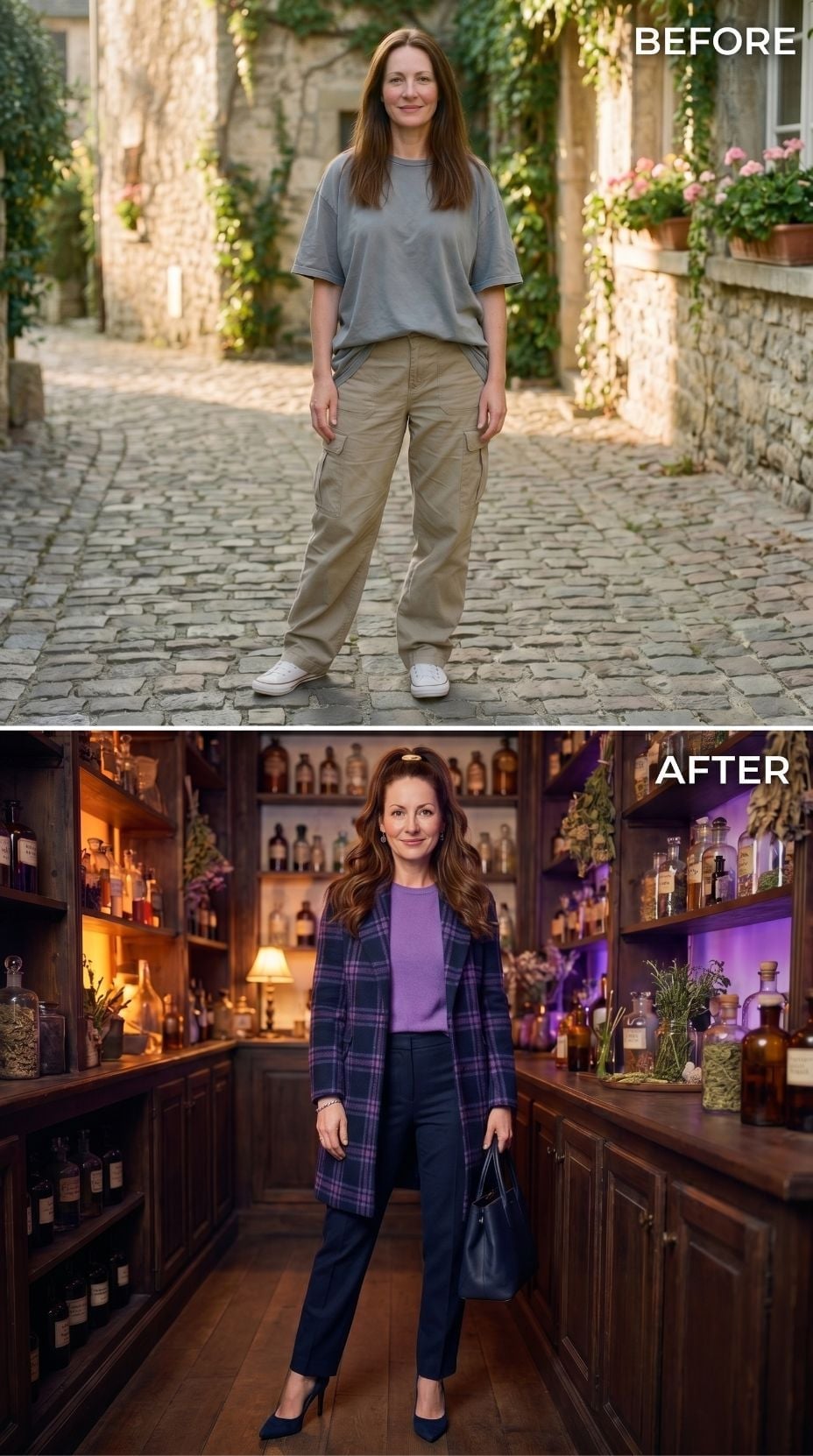
Before: cargo trousers and an oversized gray tee, comfortable in the way that’s stopped being a choice and started being a habit. After: a navy and purple plaid coat with enough structure in the shoulders to do real work, worn over a lavender crewneck that picks up the coat’s secondary color so deliberately it looks considered rather than coordinated. The trousers are slim and cropped just above the ankle, which is what makes the block-heeled pumps visible instead of buried.
The hair is styled with volume and a soft clip pulling it back on one side, and that single detail shifts the whole read from dressed to done. A dark leather tote keeps it grounded. What the AI got right here is that purple and navy together don’t need to be softened with neutrals. They can just be the outfit.
4. Camel Coat, Coastal Sunset, and What Happens When Comfort Gets to Be Beautiful
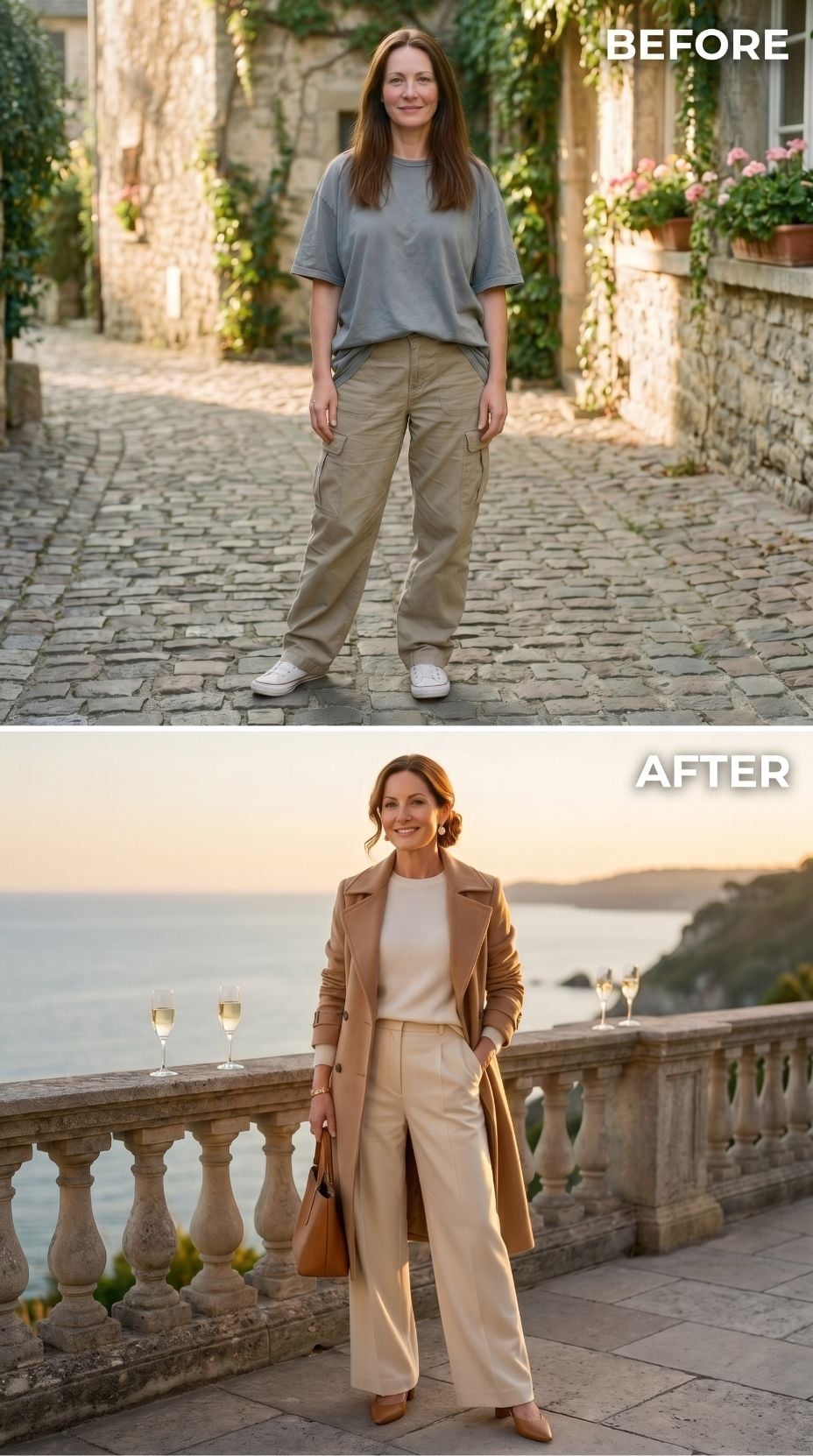
From the cobblestones and an oversized gray tee, to a stone balustrade with champagne glasses and a view that earns them. The camel coat is doing real work here: long enough to give proportion, structured enough at the shoulders to hold the whole look together. Underneath, a cream sweater with a simple round neckline keeps the warmth in the palette without competing. Wide trousers in pale ivory match the coat closely enough that the leg reads as one clean line from hip to floor.
The hair is up, softly. That’s not a small thing. When women move from the before to the after, the hair is often what signals the shift more than the clothes do. Pearl drop earrings and a tan leather bag with a short handle add just enough to feel finished. The brown block heels are low enough to be comfortable and visible enough to be intentional.
3. Cobblestones to Rooftop Bar: What a Tailored Suit Does That Cargo Pants Simply Can’t
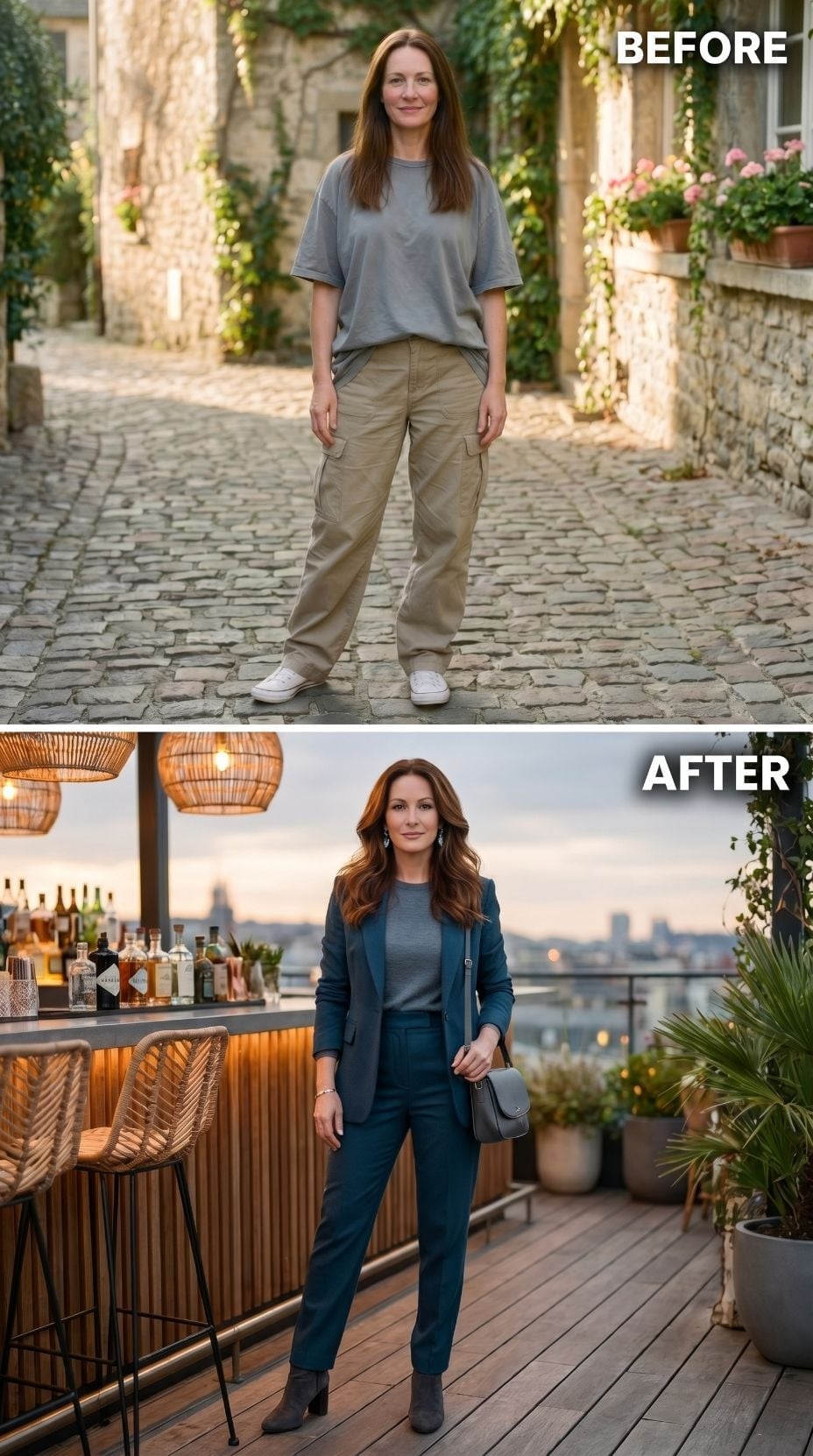
The before photo isn’t unflattering because of her body. It’s unflattering because the oversized grey tee and wide-leg cargo trousers in khaki are doing exactly what oversized clothes always do: they suggest she’d rather not be looked at. The after changes that entirely. A teal-blue suit with a slim trouser cut and a single-button blazer does the structural work, while a fitted grey crewneck underneath keeps the palette from going too formal. Her hair is down and styled with volume rather than just length, which reads as intentional rather than incidental. The crossbody bag sits at hip height, small and sleek. She looks like someone who made choices. That’s the difference.
By The Numbers: Women who shift from oversized silhouettes to tailored ones often report that the change feels exposing at first, then quickly reverses into confidence. A well-cut blazer works because the shoulder seam does the visual organizing that shapeless fabric can’t. Suits worn without a tie or formal shirt have been showing up as one of the most practical wardrobe moves for women in their 40s who want to look polished without dressing for an office.
2. Rust Tones, Cobblestone Light, and What a Cardigan Does When It’s Not Hiding Anything
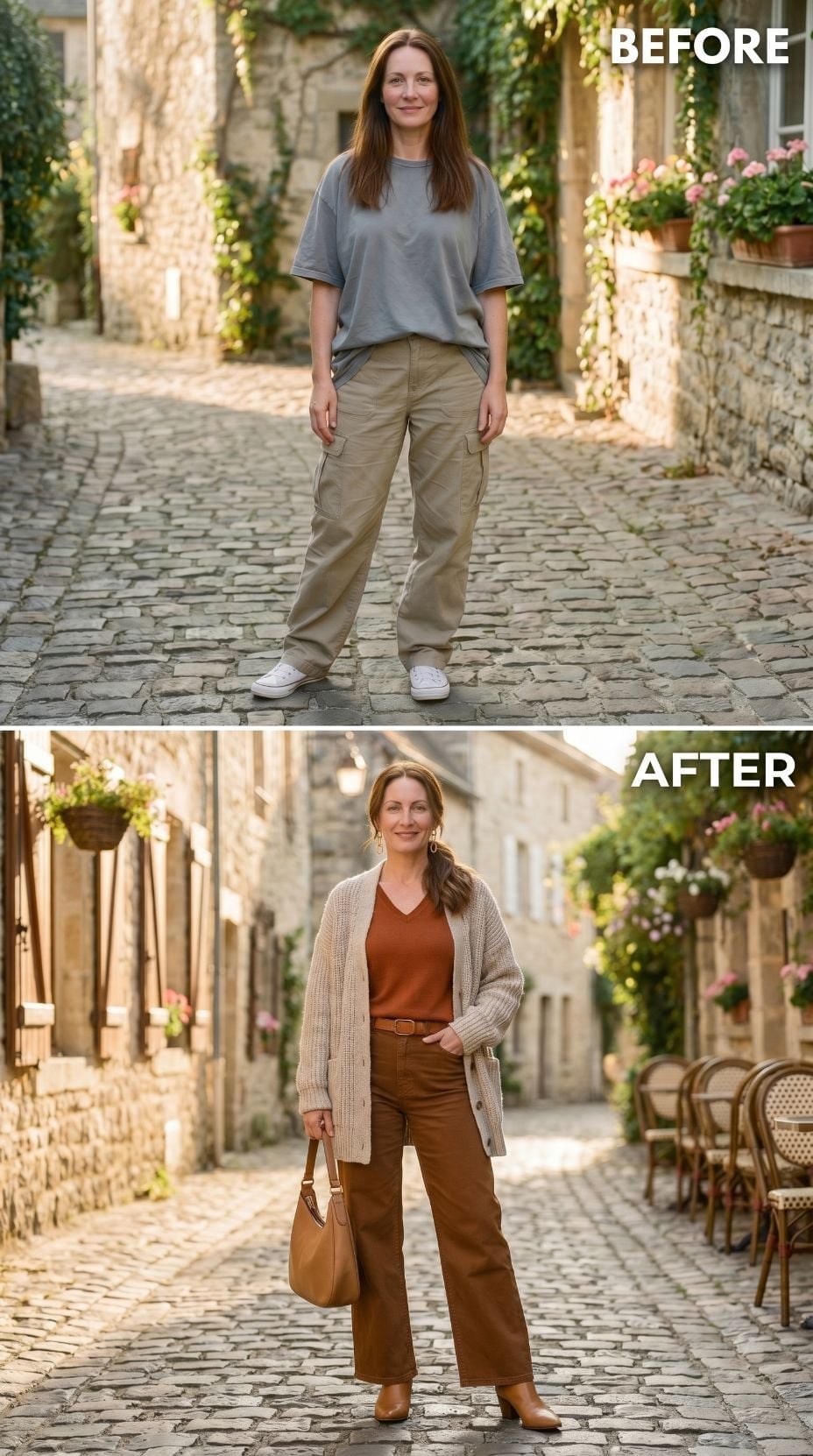
She swapped oversized gray cotton for a rust V-neck layered under a longline oatmeal cardigan, and the whole silhouette shifted without sacrificing warmth. The tobacco wide-leg trousers do the heavy lifting, grounding the warm palette so it reads polished rather than precious. A cognac leather tote and low ankle boots keep it grounded. Nothing here is complicated. It just fits.
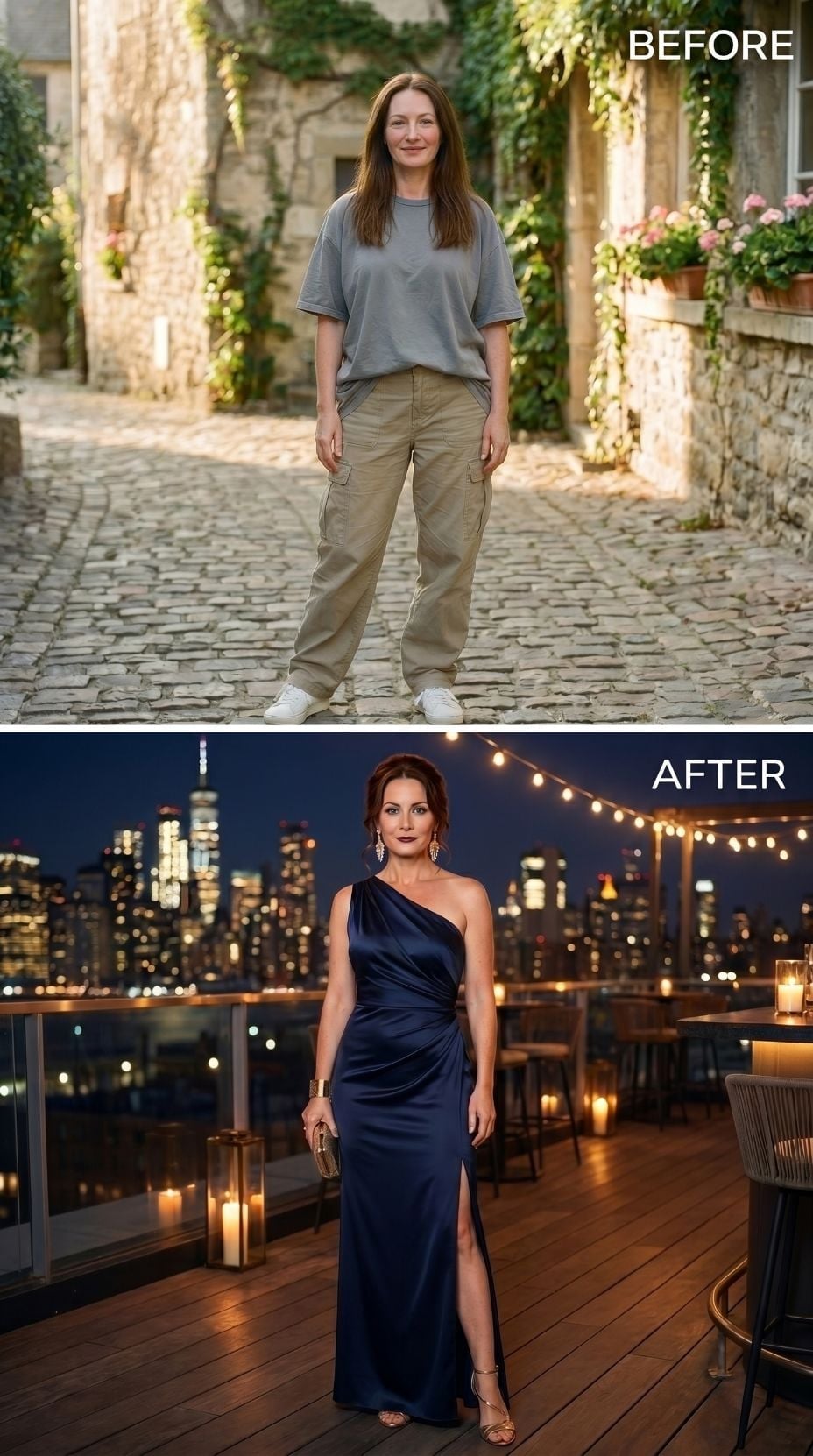
1. Cobblestone Casual to Rooftop Gown: What Satin Does When It Stops Being Intimidating
❤️ Would you like to save this?
Gray oversized tee, cargo pants, white sneakers. That’s not a style choice so much as a decision to disappear. What the AI rendered instead is a one-shoulder navy satin gown with a side slit and a ruched waist, the kind of silhouette that doesn’t need jewelry to hold a room’s attention, though she’s wearing gold drop earrings and a cuff anyway.
The before isn’t unflattering so much as uninterested. And there’s a difference. Satin scares a lot of women over 40 because it reads as high-maintenance or body-conscious, but the draping on a one-shoulder cut does actual work, pulling attention upward and giving the waist shape without anything fitted below the hip. The rooftop backdrop earns the dress. So does she.