

❤️ Would you like to save this?
There is a woman in every room who looks like she spent a lot of money. And there is a woman in every room who actually did spend a lot of money, and somehow it shows in all the wrong ways. The difference between them is not her budget, her brand, or even her taste. It comes down to a single decision she made at the mirror, probably in the last thirty seconds before she walked out the door. One piece. One choice. One moment of restraint or indulgence that her brain processed before she even reached for her keys. The psychology behind why the human eye reads certain jewelry combinations as expensive and others as effortful, despite identical price tags, is more surprising than most women realize. And once you understand it, you cannot unsee it.
FYI, thanks to AI imagery software, we’re able to create very specific fashion and hairstyle examples to illustrate the points being made. In some cases, imagery is exaggerated to hammer home the point. Also, assume links that take you off the site are affiliate links such as links to Amazon. this means we may earn a commission if you buy something.
The Moment Your Brain Decides Someone Looks ‘Too Much’ (It’s Faster Than You Think)

The judgment happens before a single word is exchanged. Research from Princeton psychologists Willis and Todorov found that it takes just a tenth of a second to form an impression of a stranger from their face (Source), and those snap assessments of competence, trustworthiness, and likeability shift very little even when given far more time. The brain isn’t being polite. It’s being efficient.
What this means for accessory choices is more unsettling than most people realize. When a look reads as visually cluttered, the brain’s amygdala, the region that processes threat and emotional salience, flags it almost instantly. In a matter of milliseconds, the brain evaluates what it sees (Source), scanning for coherence and signal clarity. Too many competing elements read as noise. And the brain, confronted with noise, does not lean in, it pulls back.
The cruel irony is that the person wearing five pieces of jewelry often added each one with great care and intention. But the observer’s brain doesn’t process intention. It processes the sum total of competing signals, and makes a call in the dark, long before logic catches up.
Why the Woman Who Stops One Piece Earlier Always Wins the Room

Restraint is not the same as minimalism. It’s a form of authority. The woman who removes the last piece before leaving the house isn’t following a fashion rule, she’s exercising editorial judgment. And the brain of every person she encounters reads that judgment, registers it, and responds to it before she has said a single word.
This connects to something deeper than style preference. When a look has a clear focal point, one piece of jewelry that anchors the eye, a single strong detail that rewards attention, the observer’s brain settles. It finds the hierarchy, follows it, and arrives at an impression of coherence. That coherence gets attributed to the wearer. She reads as decisive. Intentional. In control. The psychology of intentionality in dress is well-documented: clothing choices significantly impact the wearer’s mood, confidence, and behavior (Source).
The woman who keeps adding is searching for the right answer. The woman who stops has already found it, and the difference is visible from across the room.
The Psychological Term for What Happens When Jewelry Competes With Your Face

There’s an actual name for what happens when accessories pull attention away from the face rather than directing it there: visual hierarchy disruption. In design psychology, visual hierarchy describes the order in which the brain processes elements in a composition, and the human face sits, by evolutionary default, at the very top of that hierarchy. We are wired to read faces. It’s how we assess emotion, intention, safety, and social cues.
When statement earrings fight with a bold necklace, or stacked rings and bangles create a percussive visual chorus, the brain’s attention pathway gets redirected. Instead of landing on the face, where connection happens, the eye bounces between competing focal points and never fully settles. When a design looks too busy, the brain has to put in extra work (Source). Applied to personal presentation, that means the person looking at you is working harder to form an impression, and working harder never translates to reading you as effortless.
The most compelling faces in any room are almost always framed, not covered. The dress and the accessories exist in service of what’s above the neckline, not in competition with it.
What Expensive Actually Signals to the Human Brain (It Has Nothing to Do With Price)

The brain doesn’t read price tags. It reads coherence, restraint, and what researchers who study quiet luxury describe as the absence of visible effort. As Fortune noted in its coverage of the stealth wealth era (Source), old-wealth style works precisely because it’s unbranded and unsignposted, only those in the know notice, and to everyone else it simply reads as composed.
This is supported by what psychologists studying status signaling call “secure high status”, the psychological posture of someone who has nothing to prove. Research on quiet luxury reveals that status-insecure consumers prefer loud branding, while those secure in their position choose unmarked quality. The implication for personal style is significant: the brain reads loud visual effort as a bid for approval. And approval-seeking, however elegant the execution, has a register. It reads as need.
What actually signals expensive? Specificity. One piece of jewelry chosen with apparent conviction. Fabric that photographs well in natural light. A silhouette that holds without accessories explaining it. The look of a person who dressed for themselves, not for the room, which, paradoxically, is precisely what commands the room.
The Cognitive Load Theory That Explains Why Less Jewelry Reads as More Power
Cognitive Load Theory, first introduced by psychologist John Sweller, describes the limits of what the brain can process at once. Originally developed in educational contexts, its core insight applies far beyond classrooms: working memory can hold and process only a limited number of elements at once (Source). The brain, confronted with too much, doesn’t try harder, it disengages.
Applied to personal presentation, this principle is quietly devastating to the case for more accessories.
- Extraneous load is the cognitive drag created by visual elements that don’t add meaning. Competing necklaces. Stacked rings on multiple fingers. Each additional piece that doesn’t serve a clear purpose creates friction in the observer’s processing.
- Intrinsic load is the natural complexity of assessing a person, their face, posture, expression, energy. The brain wants to do this work. It’s meaningful.
- Germane load is the productive effort that builds understanding. A single deliberate piece of jewelry functions as germane load: it adds signal, context, personality, without cost.
As usability researchers at the Nielsen Norman Group explain (Source), reducing extraneous cognitive load doesn’t mean emptying the scene, it means organizing it so the brain can process what matters. The most powerful looks are the ones that make the brain’s job easy. And the brain rewards that ease by attributing authority to the person who achieved it.
Why Over-Accessorizing Is Really a Confidence Problem in Disguise

This one cuts close. Research has linked women’s body insecurity to owning more shoes and handbags (Source), specifically, the more insecure a woman felt about her body when exposed to idealized images, the more shoes and handbags she accumulated. The mechanism is specific: accessories enhance attractiveness without drawing attention to the figure, making them an appealing tool for managing self-consciousness rather than expressing confidence.
This is not a moral failing. It’s a deeply human pattern. Clothing choices often reflect a psychological need for comfort and concealment (Source) rather than a declaration of personal style. The layered rings and the stacked necklaces can be, underneath, a kind of visual noise screen, filling the frame so that nothing specific is exposed to judgment.
The woman who wears one considered piece is making a different psychological statement entirely. She’s offering something specific for the world to see, and that act of specificity, of singular intention, is what reads as confidence. Not fearlessness. Confidence. They are not the same thing.
The One Piece of Jewelry Psychologists Say Anchors an Entire Outfit

Every coherent visual composition has a single dominant element, what designers call the anchor or focal point. Remove it and the composition drifts. Add something that competes with it and the hierarchy collapses. In personal styling, this principle is just as structural as it is in graphic design or interior composition.
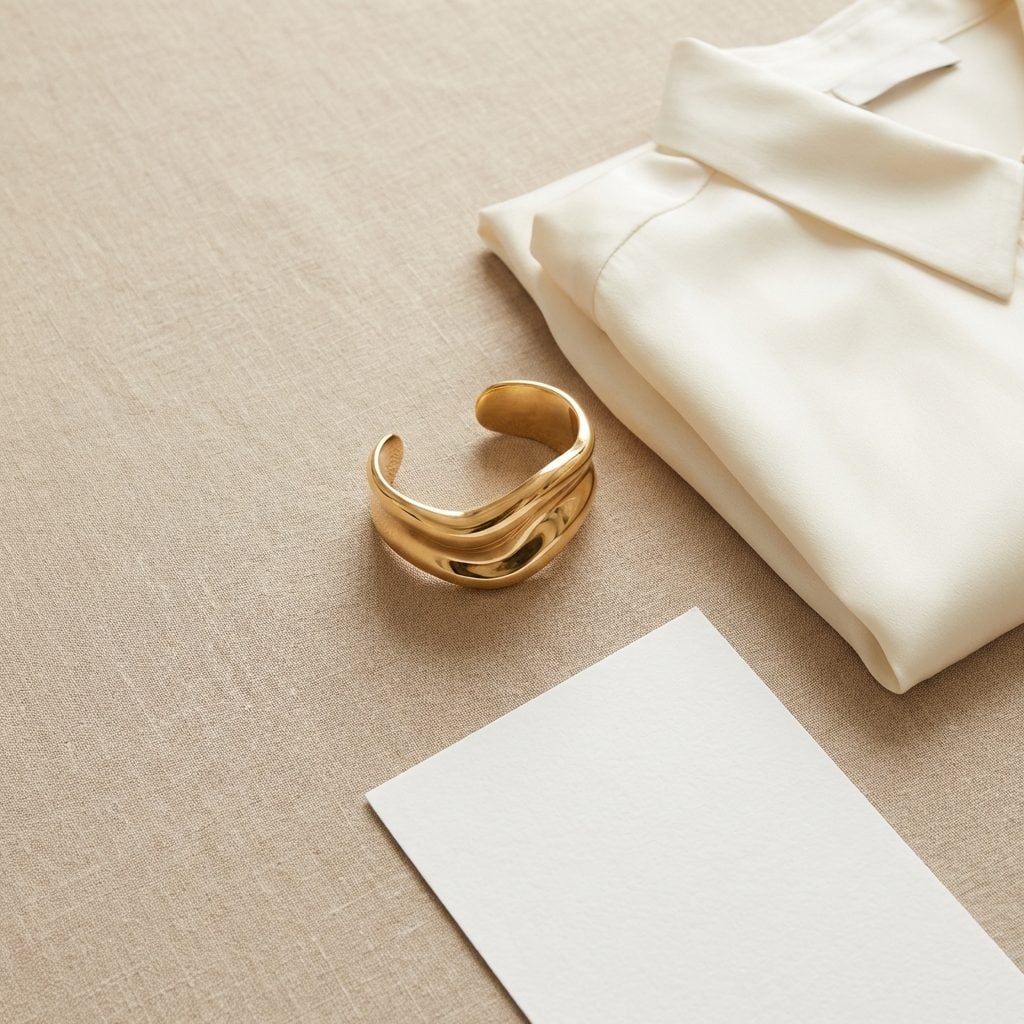
The anchor piece in an outfit operates psychologically as a declaration. It tells the observer: this is where the look lives. Everything else is context. A single sculptural gold cuff bracelet against a plain sleeve. A pearl drop earring that frames the jaw. A statement ring worn in isolation on an otherwise clean hand. Each of these functions as a period at the end of a sentence. Legible. Final. Intentional.
According to research on enclothed cognition (Source), clothing and accessories carry symbolic meaning that shapes both how others perceive the wearer and how the wearer thinks and performs. A single anchor piece, chosen with conviction, activates that symbolic meaning cleanly. Multiple competing pieces dilute it, or worse, create competing symbolic claims that the observer’s brain never fully resolves.
The anchor piece doesn’t just complete the look. It gives the look a reason to exist.
What Your Brain Is Actually Doing When It Processes ‘Clutter’ on a Person
The brain doesn’t experience visual clutter as neutral. When incoming information exceeds our ability to handle it, our performance suffers (Source). This is as true for a person standing in front of you as it is for a cluttered webpage.
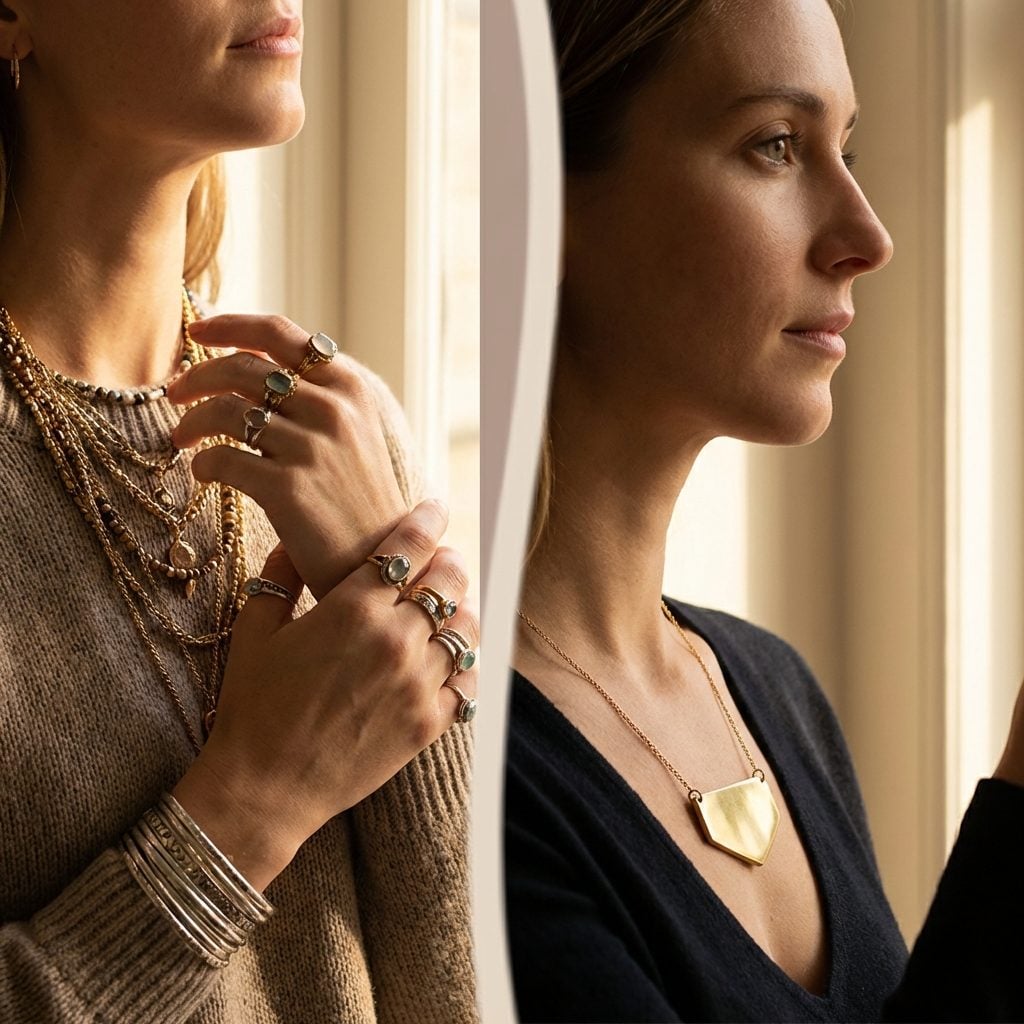
When a look has too many competing elements, something specific happens in the observer: the brain spends its resources on decoding the visual noise instead of connecting with the person generating it. The impression formed is never quite as warm, as memorable, or as trusted as one formed in a low-clutter encounter. This is not a conscious judgment. It’s a processing outcome.
What makes this particularly interesting is the asymmetry of awareness. The person wearing the clutter usually feels like they’ve put real thought and care into each piece. The observer experiences a vague sense of overwhelm and can’t always say why. Cognitive load theory holds that we have limited resources to process information (Source). In fashion terms: the more of the observer’s processing power your accessories consume, the less capacity is left over for them to actually see you.
The Invisible Rule That Separates Editorial Style From Costume

There is no written rule. That’s what makes it invisible, and what makes it so hard to teach. It lives in the gap between a look that feels authored and one that feels assembled. Between a person whose clothes are in service of something and a person whose clothes are the thing.
Editorial style is, at its core, an act of subtraction. It is rooted in quiet elegance and the concept that luxury doesn’t need to shout (Source), the understanding that the look doesn’t need to explain itself. When a look over-explains, when every surface is decorated, every detail announced, it tips from style into costume. Costume requires an audience. Style doesn’t.
This is where jewelry becomes the tell. The quietly wealthy tend to choose dainty, understated, minimalist jewelry (Source), thin bands, single pieces, things chosen for their relationship to the whole rather than for their own visibility. The woman in the dress who keeps adding the next piece isn’t styling herself anymore. She’s reassuring herself. And reassurance, unlike confidence, has a register that rooms pick up on without ever knowing why.
The woman who looks expensive chose one piece and stopped, real or not, it reads as intentional. The woman who looks overdressed kept going, and every additional piece of costume jewelry she added was the wardrobe equivalent of explaining the joke.
Why Women Who Feel Unseen Reach for More Jewelry (And Why It Backfires)

The impulse is almost biological. When a woman feels overlooked, her instinct is to add. Another ring. Another layer of chain. A bolder earring to fill the silence of a room that hasn’t noticed her yet. This behavior has deep psychological roots: Alfred Adler, whose work on inferiority and compensation remains foundational in psychology, argued that when a person perceives themselves as inadequate, they often overcompensate by dramatically emphasizing an opposing trait. The goal isn’t decoration. It’s proof. (Source)
The painful irony is that overcompensation tends to do the opposite of what the person intends. Research published in the Journal of Experimental Social Psychology found that overcompensatory behavior creates “conflicting thoughts” in observers, their instinct is not to be impressed, but to sense something strained, something being hidden. (Source) A woman reaching for more jewelry to signal worth may instead be broadcasting its absence. The stack doesn’t communicate power. It communicates the desire for it. And a room full of people, even without consciously processing it, can feel the difference.
The Signal That Tells a Room You Chose This, and Didn’t Need More

There is a very specific thing that happens when someone walks into a room wearing one considered piece of jewelry and nothing else. It registers before you know why. The word for what you’re responding to isn’t taste. It’s intention, and intention reads as self-assurance in a way that volume simply cannot replicate.
The concept of enclothed cognition, introduced by researchers Hajo Adam and Adam D. Galinsky in a landmark 2012 study, proposes that clothing and accessories carry symbolic meaning that the wearer internalizes. The physical experience of wearing something, and knowing what it symbolizes, changes how you carry yourself. (Source) A single sculpted gold cuff chosen with absolute certainty communicates something entirely different from five stacked bracelets chosen with uncertainty. One says: this is who I am. The other says: I’m still deciding.
The signal isn’t the jewelry itself. It’s the decision to stop. To choose. To be done. In a culture that consistently tells women they need more, the woman who disagrees, quietly, by her wrist, is doing something psychologically rare.
What Restraint in Jewelry Communicates That No Amount of Sparkle Ever Can

Restraint is not the same as minimalism. Minimalism is an aesthetic. Restraint is a psychological state, one that communicates control, selectivity, and the absence of need for external validation. These are the invisible qualities that read, across a room, as something money genuinely can’t buy.
Research on minimalist design and consumer perception consistently finds that stripped-back presentation signals higher perceived quality and confidence. A 2025 study examining minimalist aesthetics and consumer psychology found that restraint in visual presentation “significantly improves consumers’ perceived product quality” and creates an association with the “high-end” in observers’ minds. (Source) The same psychological mechanic applies to a woman’s body. The dress and the skin around a single fine chain aren’t empty. They’re confident.
There’s a precision to this. Restraint only reads as sophistication when it’s clearly a choice, not a limitation. The woman wearing one piece of fine jewelry needs to inhabit it, own it with her posture, her ease, her total lack of fidgeting with it. The piece becomes an extension of self-assurance rather than decoration layered over it.
The Bottom Line
The specific decision that separates expensive from overdressed is simply this: the woman who looks expensive removes the last piece she put on. That single act of subtraction, choosing the deliberate gap over the extra layer, is what communicates to every room, before you speak a word, that you needed nothing more. Before you get dressed tomorrow, add everything you want, then take off whatever you reached for last.