
❤️ Would you like to save this?
Close your eyes and you can still smell it: Aqua Net hairspray and the faint chemical promise of a spiral perm. Getting dressed in the ’80s was a full-contact sport, it required shoulder pads, determination, and at least one item that made a sound when you walked. There were rules nobody wrote down but everyone somehow knew, and breaking them meant you clearly hadn’t watched enough MTV. Here’s what we were working with.
FYI, thanks to AI imagery software, we’re able to create very specific fashion and hairstyle examples to illustrate the points being made. In some cases, imagery is exaggerated to hammer home the point. Also, assume links that take you off the site are affiliate links such as links to Amazon. this means we may earn a commission if you buy something.
18. The Shoulder Pads You Wore in Literally Everything, Including T-Shirts

Not just blazers. Not just suits. The shoulder pad migrated into every fabric known to mankind in the ’80s, into jersey tees, into velvet dresses, into literal dress designs that had no business being so architectural. We were building silhouettes like we were designing office towers.
The genius (and the madness) was that we believed the wider the shoulder, the more powerful the woman. And honestly? There was something to it. But when your cotton knit top had the same shoulder structure as a linebacker’s jersey, you had to wonder who exactly we were dressing to intimidate.
17. Crimped Hair So Stiff It Could Have Been Load-Bearing

The crimping iron was the second-most-dangerous appliance in any teenage girl’s bathroom, right behind the spiral perm kit. You’d section, clamp, wait, and repeat for forty-five minutes until your hair looked like it had been folded by an enthusiastic origami student.
Paired with a side ponytail or left fully down with the volume of a small weather system, crimped hair signaled one thing: you were ready for a school dance or a Tiffany concert, and those two events had essentially identical dress codes.
Today the pendulum has swung back a little: in our reader polls, 54% picked flat and smooth hair over volume, though 46% are still holding the line for big hair.
16. The Jelly Shoes That Left Grid-Pattern Sunburns on Your Feet

Completely waterproof. Completely breathable in the way a plastic bag is breathable. Jelly shoes were sold as the fun, affordable, summer-ready footwear option and they delivered on exactly one of those promises.
By noon on any hot day, your feet were essentially marinating inside a translucent plastic mold. The pattern pressed into your skin like a waffle iron. And still, still, we wore them everywhere. In every color. With socks sometimes. The ’80s were a specific kind of brave.
15. The Slap Bracelet That Got Banned in Schools Nationwide

A steel ruler wrapped in printed fabric that you slapped against your wrist for the dopamine hit of the snap. Every middle school in America eventually banned them when someone figured out the metal core could, in theory, break through the fabric and slice skin. Which somehow made them more desirable.
You collected them by color. You traded them at lunch. The holographic ones were worth at least two plain metallic ones in the unofficial exchange rate. No accessory before or since has generated quite that level of interpersonal commerce among twelve-year-olds.
14. Stirrup Pants, Because Your Foot Needed Something to Anchor

The stirrup was purely functional: it kept your pants from riding up. But it also anchored your entire lower body to your footwear in a way that created one continuous, slightly unsettling line from hip to floor. They came in every color imaginable, from dusty mauve to electric teal, and the fabric had a distinctive pull-y stretch that meant every pair eventually developed small stress wrinkles at the knee by mid-afternoon.
You wore them with flats, with boots, with loafers. The stirrup peeked out either way and that was somehow the point, evidence of the engineering holding the whole operation together.
13. The Banana Clip That Held Half a Head of Hair in a Structural Miracle
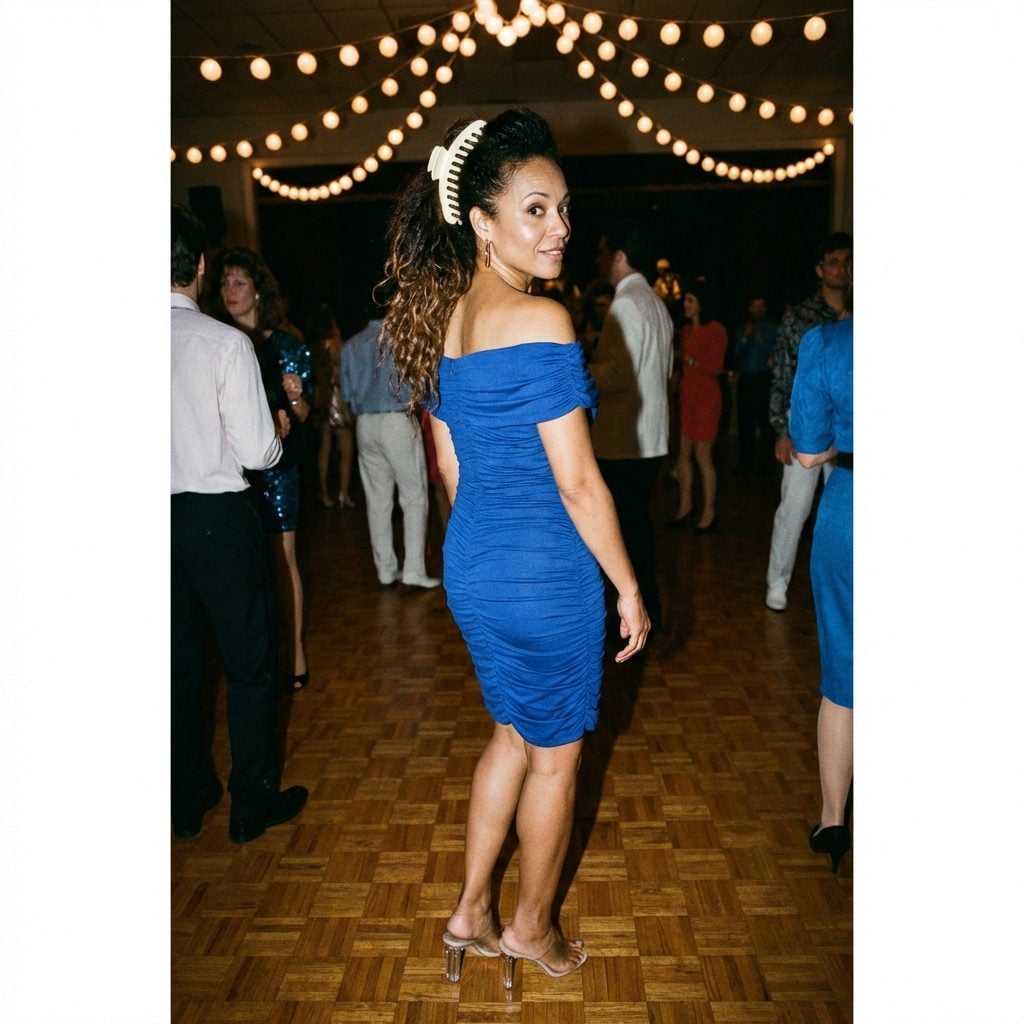
The banana clip operated on a principle that would require at least a semester of structural engineering to fully explain. You gathered your hair into a loose bundle, positioned the two curved plastic arms around it, and snapped them together, and somehow, improbably, the weight of a full head of hair stayed up, fanned out like a peacock tail above the clip.
The bigger your hair, the better the clip looked. Which meant that for a solid five years in the mid-’80s, the banana clip and the spiral perm existed in a mutually beneficial relationship that kept them both relevant.
12. Acid-Wash Denim, Head to Toe, No Apologies

Head-to-toe matching acid-wash denim was not considered excessive. It was a commitment, and commitment was respected. The jacket-and-jeans acid-wash set was the power suit of the Saturday afternoon mall visit, and you wore it with the confidence of someone who had absolutely no doubts.
The mottled bleach pattern looked like clouds, or maybe a Rorschach test, or maybe just whatever you needed it to look like when your mother asked why you spent forty dollars on jeans that looked destroyed. You told her it was art. She did not agree.
What Our Readers Say
- Denim never really left: in our reader polls, 66% of ThreadCurve readers named jeans as their daily go-to, well ahead of trousers and dresses.
From ThreadCurve reader polls and votes.
11. The Off-Shoulder Sweatshirt You Wore One Shoulder Out Like Jennifer Beals Had Personally Instructed
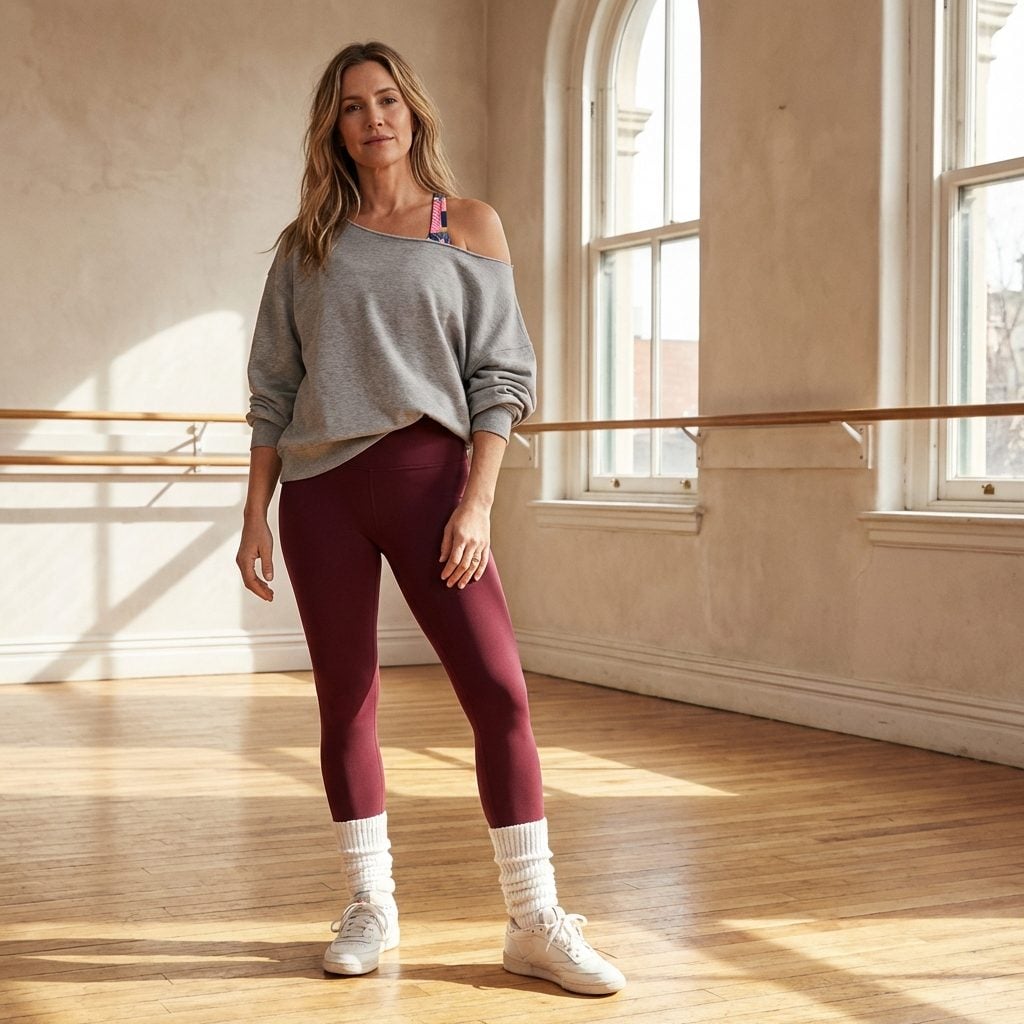
Flashdance came out in 1983 and within six months every woman in North America had cut the neck out of at least one sweatshirt. Not a subtle widening. A full off-shoulder situation where one sleeve hung limp and you were constantly readjusting the exposed shoulder back into position, which defeated the entire purpose, but nobody acknowledged that.
“Jennifer Beals did it in one movie and we did it for the rest of the decade. That is the power of a single costume choice.”
Paired with athleisure staples like leggings and leg warmers, the cut-sweatshirt was the uniform of a generation of women who believed they were either about to break into spontaneous dance or had just finished doing so.
10. Leg Warmers Over Jeans, Over Tights, Over Everything

Leg warmers started in ballet studios and lasted approximately thirty seconds before they escaped into everyday fashion and refused to leave. By 1984 they were being worn over jeans, over dress pants, over tights under skirts, in colors that had no relationship to any color occurring in nature.
The ribbed knit ones were the standard. The mohair ones were aspirational. The neon ones were for people who had fully committed to the decade without reservation. Scrunched down to the ankle over sneakers, they communicated a very specific message: I have somewhere interesting to be, and I’m warm about it.
9. The Permed Hair That Required a Standing Saturday Appointment

The spiral perm was not a styling choice. It was a quarterly ritual, a financial commitment, and for about three days post-appointment, a genuine source of pride before the humidity got involved and introduced new opinions.
You smelled like the chemicals for at least a week. You were told not to wash it for 48 hours. You slept on a satin pillowcase and spent ten minutes every morning scrunching in mousse with the specific technique the stylist had demonstrated. The maintenance was a part-time job. The curls were worth it. Sort of.
8. Oversized Blazers With the Sleeves Pushed Up, Because Don Johnson Said So

Miami Vice premiered in 1984 and men started rolling up their suit sleeves. Women watched this and immediately applied the technique to their own blazers, which were already sized for someone three times their frame. The pushed-up sleeve created a casual authority, you were important enough for a blazer but relaxed enough to not care about wrinkles.
The unwritten rule was that the blazer had to be at least two sizes too large for this to work correctly. Fitted blazers were for the office. The enormous borrowed blazer with the shoved-up sleeve was for everywhere else, brunches, dates, concerts, airports, the mall on a Tuesday.
Today, about two out of three ThreadCurve readers pick a fitted blazer over an oversized one, so the Miami Vice silhouette has lost a fair bit of ground.
7. The Scrunchie in Every Fabric, Worn on the Wrist When Not in the Hair

The velvet one was the best. The satin one was for special occasions. The printed cotton one was the everyday workhorse. And all of them lived on your wrist when they weren’t in your hair, which meant you were walking around with anywhere from two to seven fabric loops on your arm at any given moment, a wearable inventory system for your hairstyling needs.
Scrunchies replaced elastics because they didn’t crease the hair as severely, and also because you could match them to your outfit, which was the kind of coordinated accessorizing detail that consumed a meaningful amount of our mental energy in 1987.
6. High-Waisted Jeans Pulled to a Waistband You Could Have Used as a Shelf

❤️ Would you like to save this?
These were not the modern high-rise jean with its tasteful inch above the hip. These were jeans that climbed to the actual waist, the narrow part, and kept going. The waistband was a structural feature. It divided the torso. It required a specific tuck-and-belt configuration to manage, and every woman you knew had a different theory about the correct way to achieve it.
The blessing was that they had enough room in the seat and thigh to actually move in. The compromise was that they looked best when belted, which added one more layer to an already complex getting-dressed situation.
The waistband question is still a coin toss today: asked which jeans they would buy, our readers split almost evenly between mid rise at 51% and high rise at 48%.
5. The Sweaterdress in Pastel Knit Worn Over a Collared Shirt

Wearing a collared shirt under a dress was the preppy-casual uniform of the mid-’80s, and it required a specific layering logic that baffles people raised on the rule that collars should match the formality of the garment above them. Here, the collar from a cotton Oxford spread wide over the neckline of a soft knit dress, and the whole outfit said: I have read some books and I am comfortable at a football game.
The belt was non-negotiable. Without it, the dress was a very long top. With it, the outfit had intention. This is the lesson that never actually went out of style.
4. The Hypercolor T-Shirt That Changed Color With Your Body Heat (And Showed Every Hug)

Generra introduced Hypercolor in 1991, but it captured the pure ’80s spirit of technology-as-novelty perfectly. The shirt changed color with body heat, which sounded like science fiction and looked, in practice, like you had a permanent sweat stain that shifted colors in real time.
The armpits turned pink. Your friends pressed their palms against your back to leave handprints. You spent the entire day moderately self-conscious about the thermal map your shirt was broadcasting to anyone nearby. We wore them anyway because they were incredible and also because we were seventeen and consequences were theoretical.
3. Hypercolor T-Shirts That Changed Color Wherever You Touched Them

The most self-defeating garment ever invented.
Hypercolor shirts were heat-sensitive, which meant they changed color in response to body warmth. The armpit area turned a different shade. So did anywhere your hands lingered. You were essentially wearing a shirt that broadcast your sweat patterns to the entire school cafeteria. This was presented as a feature. We all bought one immediately.
They came in teal-to-pink, purple-to-magenta, green-to-yellow. You could press your handprint onto someone else’s shoulder and it would hold for a few seconds. Boys thought this was an excellent excuse to touch people. The shirts lost their color-changing ability after about fifteen washes and then just looked sad and muddy. We wore them until that point anyway.
2. The Lace Fingerless Gloves That Made You Feel Exactly Like Madonna

They came in white or black. White if you were going for the “Like a Virgin” moment, black if you were feeling more Desperately Seeking Susan. Either way, they were made of stretchy lace that went from your knuckles to mid-forearm and did absolutely nothing in terms of warmth or functionality. They were pure aesthetic declaration.
You wore them with a off-the-shoulder sweatshirt, a crucifix necklace (also Madonna’s fault), and rubber bracelets stacked from wrist to elbow. This was the complete uniform. If you had at least three of those four elements, you were living your best 1984 self. The fingerless gloves were the linchpin. Nothing else communicated “I have seen the Material Girl video seventeen times” quite as efficiently.
1. The Catalog You Dog-Eared Obsessively Because the Internet Did Not Exist
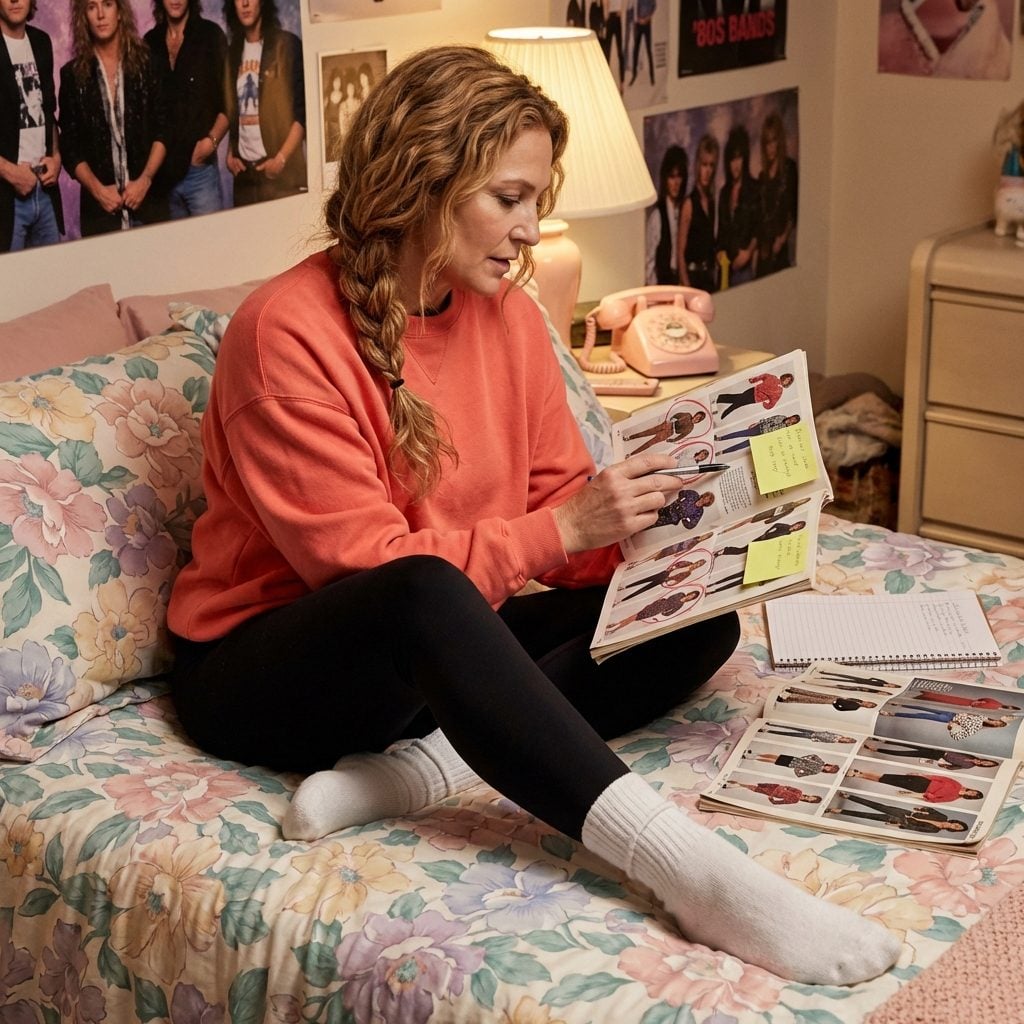
Delia’s. Spiegel. The Limited Express catalog. JCPenney’s fall fashion edition. These arrived in the mailbox and you went through them with a highlighter, a pen, and genuine sustained focus that you will probably never apply to anything ever again. You folded corners. You circled items in pen. You made lists with total prices that added up to three times your available budget and then made hard choices.
The catalog was social currency, too. You brought the Delia’s catalog to school. You pointed at things. Your friend pointed at different things. You negotiated who was “allowed” to order which item, a system that made no real sense but felt completely serious. The clothes took three weeks to arrive. You tracked the order by calling an 800 number and pressing buttons on a phone keypad. All of this was normal and fine.