

❤️ Would you like to save this?
You planned the outfit weeks in advance. The dress is right, the accessories are right, you feel like yourself when you walk out the door. And then, somewhere between the second glass of rosé and a conversation you were genuinely loving, something shifts. The clock becomes the most interesting thing in the room. You start calculating exit windows. You leave before the best part of the night, and you can’t quite explain why.
The easy answer is that heels just hurt. But that’s not actually what’s happening. What’s happening is a cascade of psychological events that most women over 45 have never been told about, and once you understand it, you’ll never think about summer footwear the same way again.
FYI, thanks to AI imagery software, we’re able to create very specific fashion and hairstyle examples to illustrate the points being made. In some cases, imagery is exaggerated to hammer home the point. Also, assume links that take you off the site are affiliate links such as links to Amazon. this means we may earn a commission if you buy something.
The Invisible Tax Your Feet Are Charging Your Brain All Night Long
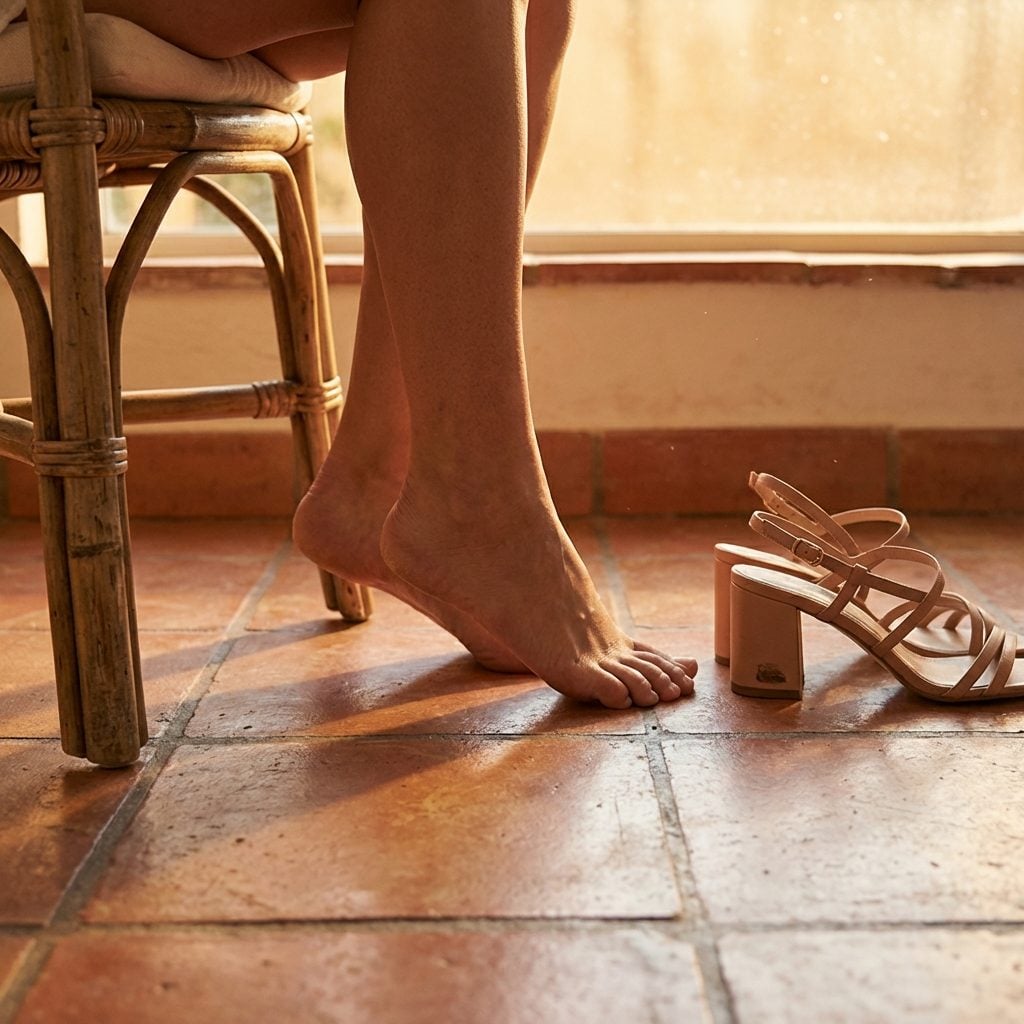
Your brain runs on a finite pool of cognitive resources at any given moment. Pain, even low-grade, background pain, doesn’t politely wait its turn. It competes. A review published in Frontiers in Psychology confirms a bidirectional relationship between cognition and pain, noting that “continued painful stimuli impact attentional control mechanisms required to remove task-irrelevant stimuli”, in plain English, your brain can’t stop paying attention to your feet, even when you’re trying to focus on a conversation. (Source)
Now scale that to a summer party lasting four hours. Every step, every shift from one foot to the other, every moment of standing on hard patio stone is a small withdrawal from your attentional bank account. By 9pm, that account is running low, not because the party is dull, but because your nervous system has been quietly processing a distress signal since the second hour. The woman who leaves early isn’t socially depleted. She’s neurologically depleted. And she may not even know why.
Why the Shoe That Felt Fine at 7pm Becomes a Psychological Exit Sign by 9pm

There’s a specific reason that first hour in heels feels manageable and the third hour feels like an emergency. At 7pm, the novelty and excitement of an evening out are doing real neurological work, they’re generating just enough cognitive engagement to suppress the early signals of discomfort. Research on pain and distraction consistently shows that higher cognitive load reduces perceived pain intensity, because the brain’s attentional resources are occupied elsewhere. (Source)
But novelty fades. By 9pm, you’ve greeted the room, you’ve settled into conversations, the initial social stimulation has leveled off, and suddenly there’s nothing left to crowd out what your feet have been trying to tell you for the past ninety minutes. The shoe hasn’t changed. The heel height hasn’t changed. What changed is that your brain ran out of distractions.
This is the cruel math of it: the better the party outfit, the more the evening should theoretically hold your attention. But even the most vivid social experience eventually normalizes. And the moment it does, the exit sign starts blinking.
The Confidence Cliff: What Happens to Your Posture, and Your Mood, the Moment Discomfort Kicks In

Heels create confidence through a very specific physical mechanism. They shift your center of gravity, lift your chest, lengthen your stride, and signal authority through both gait and height. Research into embodied cognition confirms that this posture change isn’t cosmetic, it feeds back into how you actually feel about yourself. When your body holds a powerful position, your internal state follows.
The problem is that this mechanism works in reverse just as efficiently.
The moment foot pain crosses the threshold from background noise to active distraction, posture collapses. Shoulders drop forward. Weight shifts off the ball of the foot. The deliberate stride shortens into a careful shuffle. And because your brain reads your own body language the same way others do, the physical surrender communicates defeat inward. You stop feeling like someone who owns the room. You start feeling like someone who needs to find the nearest chair.
That’s not a personality shift. It’s not introversion surfacing. It’s a biomechanical chain reaction triggered by the wrong shoe, at the wrong hour, on the wrong floor surface.
The Pain-Attention Trade-Off That Steals You From Every Conversation You’re Actually Enjoying

Pain demands attention. That’s not a metaphor, it’s the clinical description of how nociceptive signals operate in the human brain. Research published in Frontiers in Psychology describes pain’s capacity to “steal” attentional resources, noting that EEG studies show a measurable reduction in the brainwave activity associated with focused engagement when a pain stimulus is present. (Source)
At a summer party, that theft is invisible to everyone but you. You’re nodding, you’re laughing, you’re holding your drink with easy confidence. But a quiet, insistent part of your processing power is already elsewhere, calculating how far the nearest seat is, wondering how obvious it would be to take your shoes off, mentally rehearsing your exit. You’re present in body and partially absent in mind.
The conversations you most want to have, the ones with real depth, real wit, real connection, require full cognitive presence. Foot pain doesn’t just make your feet hurt. It makes you slightly less of yourself for the entire evening.
Why Your Brain Reads Foot Pain as Social Threat (And What It Does Next)

Here’s the part that feels almost absurd until you understand the neuroscience behind it. Persistent physical discomfort activates the sympathetic nervous system, the same system responsible for stress and threat detection. According to research on the relationship between pain and the fight-or-flight response, pain can trigger the release of cortisol and adrenaline, putting the body into a low-grade state of alert. (Source)
Your brain doesn’t distinguish cleanly between “my feet hurt” and “I am in an unsafe situation.” Both read as threat. Both trigger the same ancient survival calculus: scan for the exit.
The decision to leave the party early rarely announces itself as a decision. It feels like instinct. Like suddenly the room is too loud, the air is too warm, you’ve done your socializing. What’s actually happening is that a mild but sustained stress response has been running in the background all evening, and at some point, the system tips. The urge to leave isn’t social exhaustion. It’s a nervous system saying, with increasing urgency, that the threat needs to be resolved.
The Ritual She Gave Up Without Realizing It, and Why It Cost Her More Than a Party
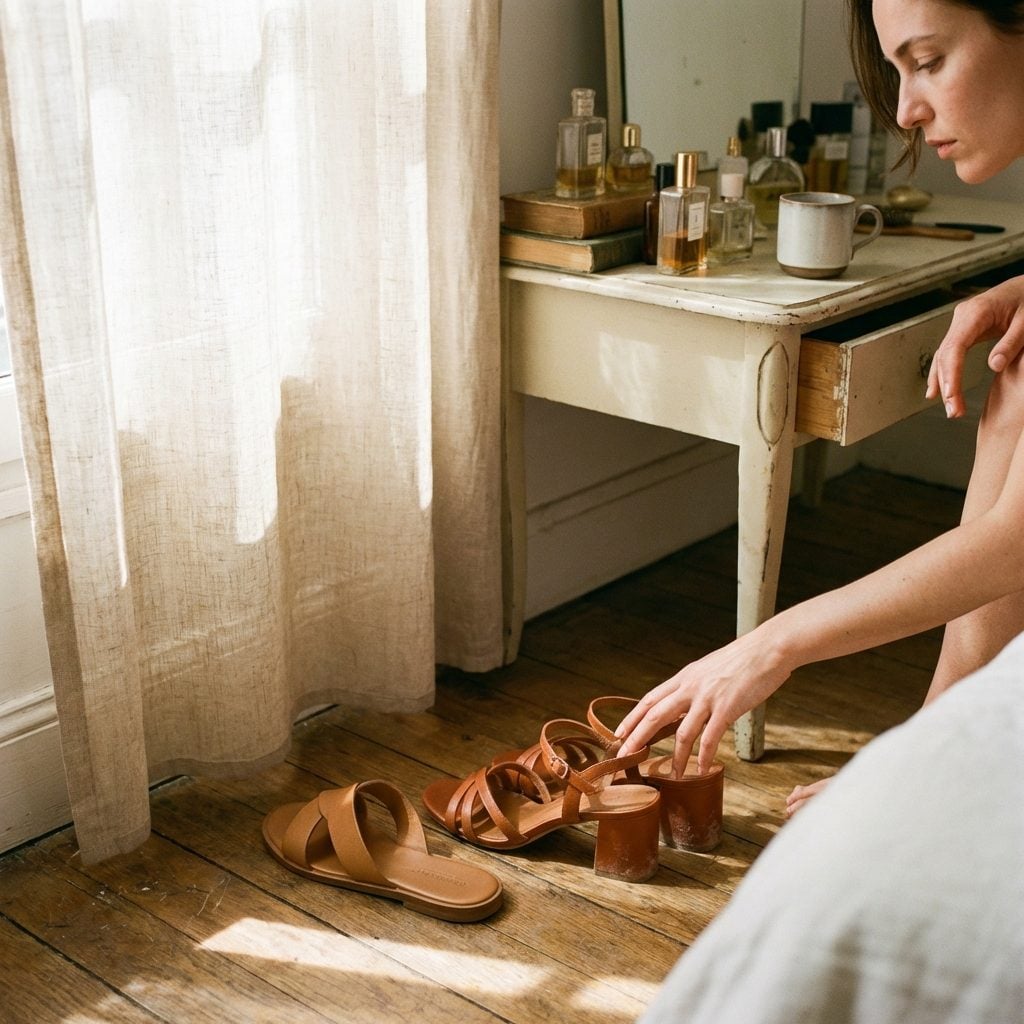
For many women, getting dressed for a summer evening used to be more than a task. It was preparation. A ritual that said: tonight, I am fully here, fully present, fully myself. The shoes were part of that ritual. Not just what they looked like, what they meant. Height. Intention. The specific click of a heel on pavement that signals arrival.
Psychologists who study ritual behavior note that repeated intentional actions, including the act of getting dressed, create what researchers call “a sense of continuity and predictability” essential for a stable self-concept. (Source) When a ritual is disrupted, the psychological loss is disproportionate to the physical act. It’s not just the shoes that are missing. It’s the version of yourself that the shoes summoned.
The woman who stops wearing heels because they’ve become unreliable doesn’t just lose a footwear choice. She loses a piece of her pre-party ritual, the moment at the mirror where she recognized herself as someone ready for the room. That loss is quiet. Gradual. And it compounds across dozens of summer evenings into something that starts to feel like shrinking.
The Dopamine Dress Doesn’t Work If the Shoes Are Sending a Different Signal

Fashion psychologist Dr. Dawnn Karen coined the term “dopamine dressing” to describe the practice of using clothing intentionally to shift emotional state, and the science behind it, while nuanced, is real. A 2012 study by researchers Hajo Adam and Adam Galinsky confirmed that the symbolic meaning of clothing influences psychological performance, a phenomenon they called enclothed cognition. (Source) The dress you chose because it makes you feel like the best version of yourself is doing genuine psychological work.
But here’s what nobody mentions: enclothed cognition requires the full outfit to be coherent. The meaning you’ve assigned to that bold printed party dress, joyful, confident, present, can be quietly undermined by footwear that contradicts every signal the dress is sending. If your shoes are generating a low-grade stress response, your nervous system isn’t receiving the confidence message. It’s receiving competing signals: elation from the dress, distress from the feet.
Your brain integrates the whole outfit. Not just the part that photographs well.
What the Mirror Doesn’t Show You: The Psychology of How Heels Change the Way You Hold Yourself

The mirror shows you how you look in heels. It does not show you what heels are doing to your neurology.
Heels shift the body’s center of gravity forward, which forces an automatic postural correction: chest lifts, spine lengthens, hips find a new rhythm. This isn’t vanity, it’s physics creating psychology. Studies suggest that the altered gait produced by heels generates observable changes in how the wearer is perceived by others, and critically, in how the wearer perceives herself. (Source) The posture shift feeds back into the brain as a signal: you are someone who takes up space intentionally.
What the mirror also can’t show you is the moment that signal cuts out. A heel that creates postural confidence at hour one becomes a liability by hour three, not because the heel changed, but because the foot underneath it has changed. Swelling. Fatigue. The subtle repositioning of weight that begins to compromise the very alignment the shoe was supposed to produce. By then, the confidence the heel was engineered to create has already left the building.
The shoe that can’t last the evening can’t hold the identity either.
The Anticipatory Dread Loop That Starts Before You Even Leave the House

This one begins long before the party. Maybe while you’re getting dressed. Maybe in the car. A quiet, nagging projection: how long before my feet give out tonight? That question is not harmless. Psychologists describe anticipatory anxiety as an experience in which “the dread can be just as intense, if not worse, than the event itself,” because the brain fixates on worst-case scenarios before any evidence exists to contradict them. (Source)
When a woman has had enough evenings end early because of foot pain, her brain begins to anticipate that outcome as the default. She arrives at the party having already, in some small but real way, begun her exit. She’s already mentally located the chairs. She’s already done the math on how long she can realistically stay. She’s already told herself a story about when the evening will end, and that story becomes a self-fulfilling architecture.
The cruelest part: anticipatory anxiety research shows this dread loop can generate physical tension in the body even before the feared event occurs. (Source) Which means she may arrive at the party already bracing, already slightly contracted, already slightly absent, not because of what’s happening, but because of what she’s certain is coming.
The shoe problem isn’t just physical. It has become a story. And stories, once repeated enough times, become the truth the body prepares for before the evening even begins.
Why Suffering in Silence at a Party Is Quietly Eroding Something Bigger Than Your Evening

There is a specific kind of social cost that comes from enduring discomfort without naming it. Not the physical toll, but the psychological one. When you spend three hours managing pain rather than engaging with the room, your brain logs that as a failed social experience. The effort of masking discomfort, keeping your face neutral, your posture steady, your laughter convincing, depletes the same cognitive resources you need to be present, warm, and spontaneous.
Researchers studying emotion regulation in uncomfortable social situations found that people who passively endure discomfort without taking proactive steps show a pattern consistent with a lack of confidence in their own ability to change the situation (Source). That passive endurance isn’t neutral. It quietly teaches your nervous system that social settings are something to survive, not savor. And each summer party spent watching the clock reinforces that story a little more firmly.
The Bottom Line
The answer the entire article has been circling is this: she is not socially anxious, easily overwhelmed, or secretly antisocial, she is in pain, and her brain is doing exactly what brains are designed to do, which is get her out of the situation causing it. Every early goodbye, every glazed-over conversation, every deleted invitation is downstream of that single physical fact. So the most radical thing she can do before the next party is not work on her mindset, it is work on her shoes.