❤️ Would you like to save this?
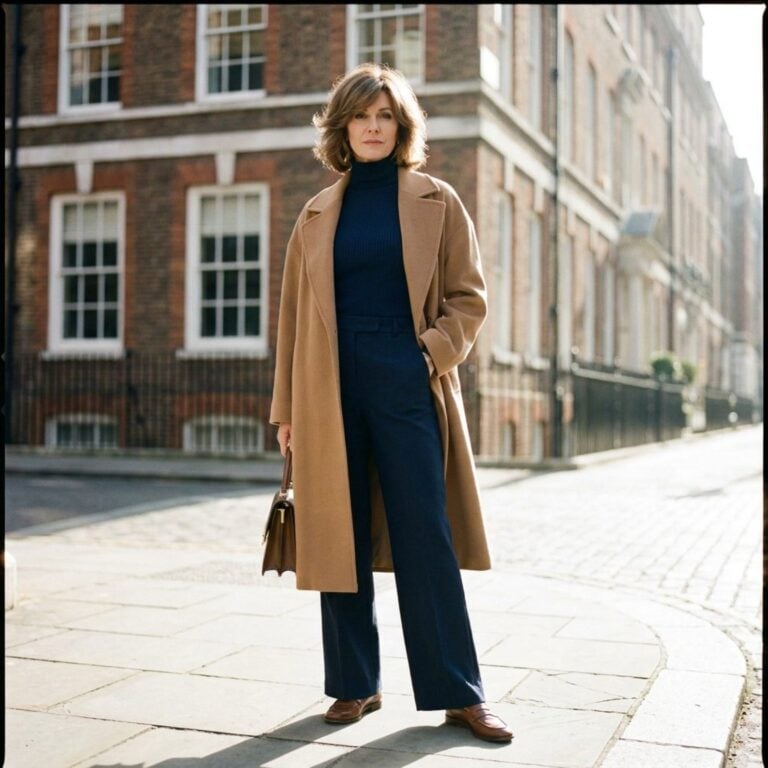
Every Mother’s Day, millions of women open a gift bag and pull out something floral, something soft, something that says Mom in capital letters. And every year, the most stylish ones quietly set it aside and reach for something else entirely. Not because they’re ungrateful. Because something in them already knows: the outfit that makes you look most like yourself is never the one someone else imagined for you.
The psychology behind why this happens is more fascinating than you’d expect. It turns out the clothes that photograph best, feel best, and project the most effortless confidence on Mother’s Day are the ones that were never chosen for the occasion at all. Here’s what the research actually says about identity, dressing, and the subtle power of knowing exactly who you are.
FYI, thanks to AI imagery software, we’re able to create very specific fashion and hairstyle examples to illustrate the points being made. In some cases, imagery is exaggerated to hammer home the point. Also, assume links that take you off the site are affiliate links such as links to Amazon. this means we may earn a commission if you buy something.
The Psychological Reason a Gifted Outfit Rarely Feels Like ‘You’

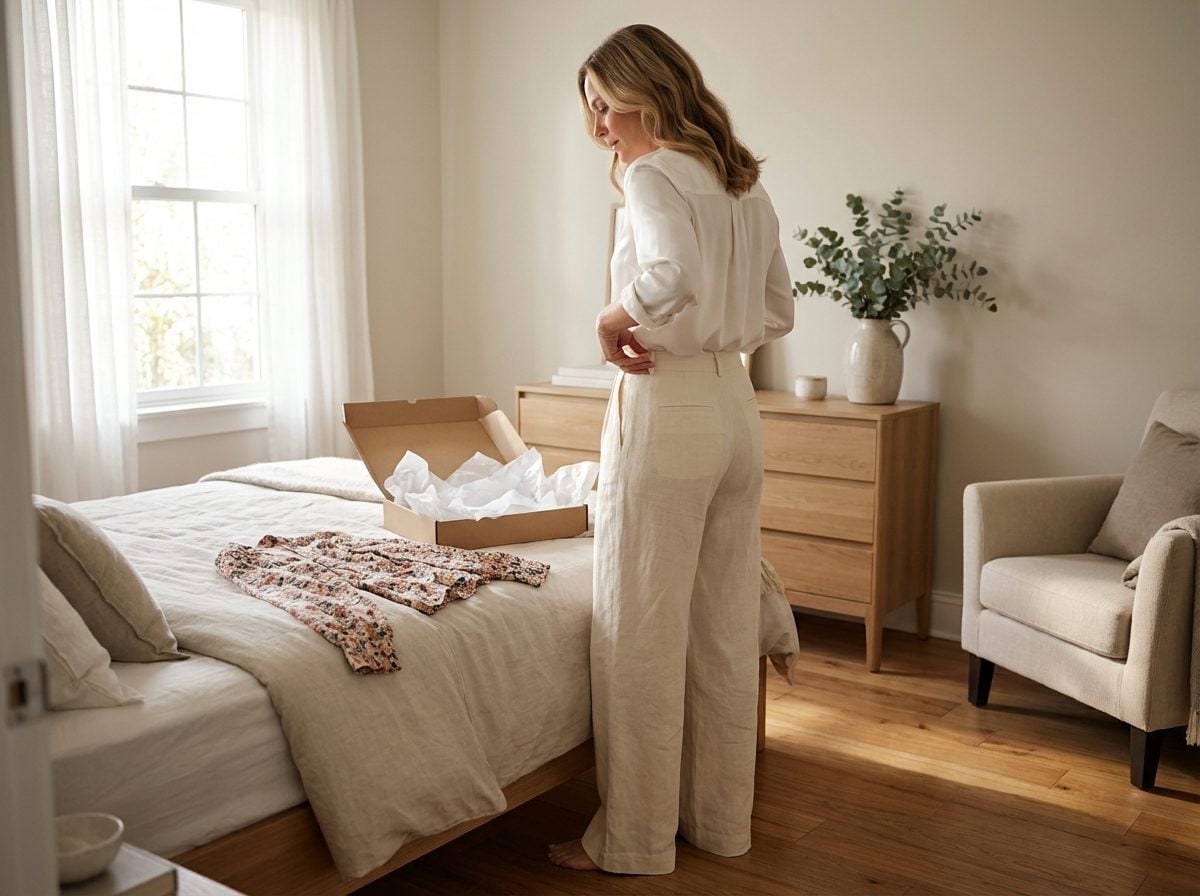
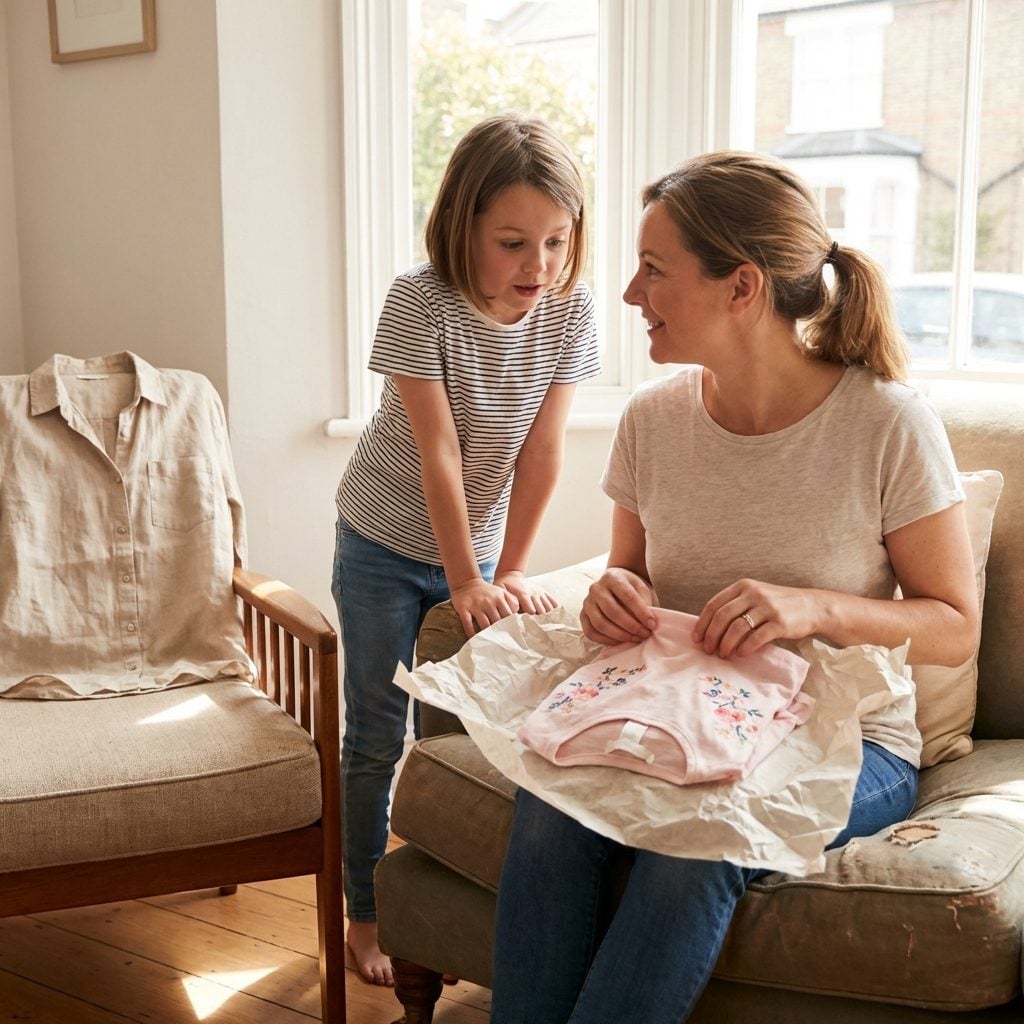
Pull the tissue paper aside, hold up the blouse your daughter chose, and notice what happens in your body before a single rational thought forms. There’s a flicker of something, not ingratitude, not disappointment exactly, but a kind of quiet wrongness. Psychologists have a precise name for what’s happening: self-image congruity, or the degree to which a garment matches how you actually see yourself. A critical review of the social psychology of dress published in Fashion and Textiles found that people are motivated to choose and purchase clothing that is congruent with either their actual self-image or their ideal self-image. When that congruency is missing, the garment feels psychologically foreign, regardless of its price or the love behind it.
Your kids, no matter how perceptive, are choosing from their perception of you, which is filtered through their needs, their memories, their idea of “Mom.” That image may have very little to do with who you understand yourself to be on a Tuesday morning when you feel most like yourself. Research published in Frontiers in Psychology exploring clothing practices among 792 women confirmed that a person’s private relationship with clothing, self-perception, and self-evaluation consistently matters more than how any outside observer reads their appearance. The gift doesn’t fit because it was never dressed for you, it was dressed for their version of you. Those are two very different people.
Why the Clothes That Make You Feel Most Powerful Are Never the Ones Chosen for You
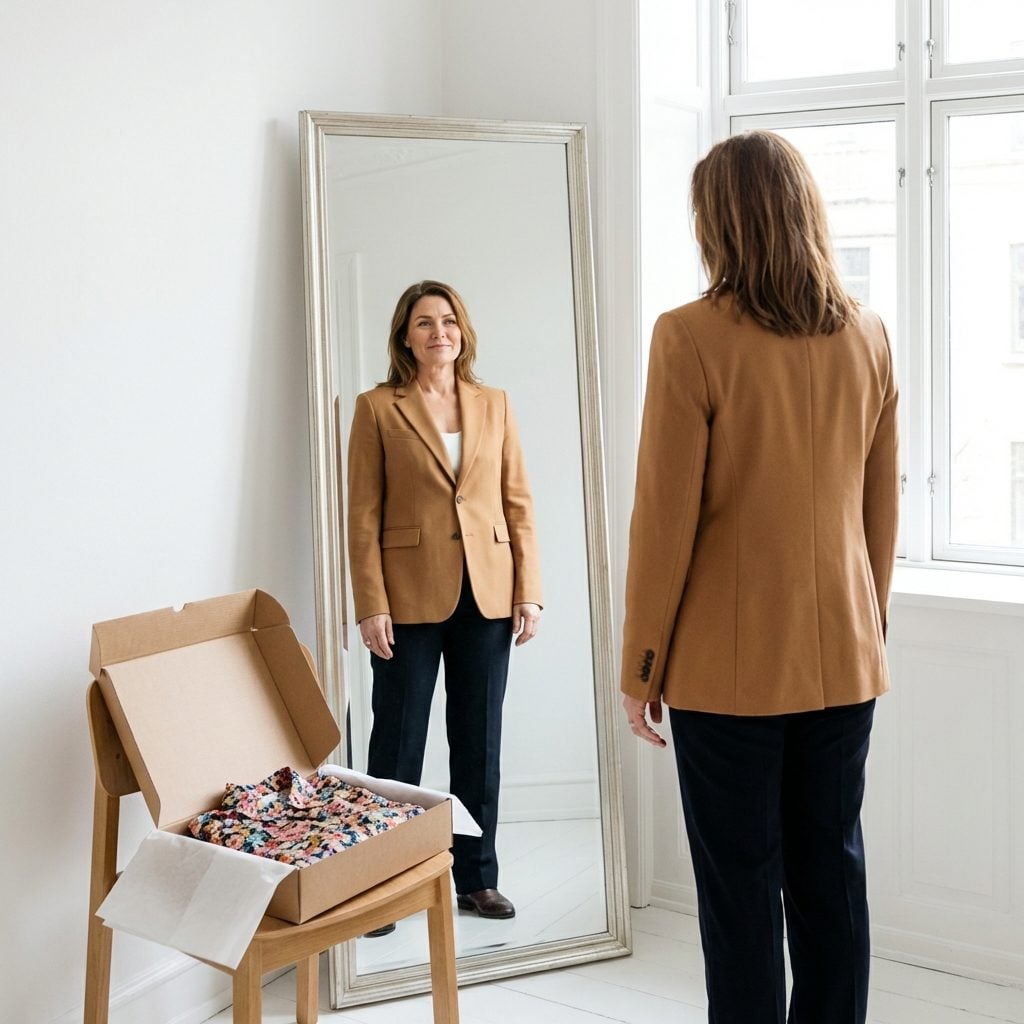
Power in clothing isn’t about cut or color. It’s about authorship.
The psychological mechanism is specific: Adam and Galinsky’s landmark 2012 enclothed cognition study in the Journal of Experimental Social Psychology demonstrated that clothing exerts its psychological influence through two conditions occurring simultaneously, the symbolic meaning of the garment, and the physical act of wearing it. But there is a third variable the study didn’t measure, one that becomes obvious when you think about why a gifted blazer never quite lands: agency. The clothes that activate your sense of capability are always ones you chose, because the act of choosing is itself an assertion of identity.
When you select your own outfit, you are making a series of small, fast decisions that align with your self-concept. That alignment is what generates the feeling of confidence. A garment handed to you skips the agency entirely, you inherit its symbolic meaning without having participated in constructing it.
The Science Behind Why Mothers Lose Their Style Identity (And Exactly When They Get It Back)

Researchers who study maternal identity use a striking phrase for what happens to a woman’s sense of self after she becomes a mother: a “fracturing” of previous identities. (Source) describes how mothers begin to “reevaluate how their autonomy, physical appearance, sexuality, and occupations influence their identities differently than they had before motherhood.” Physical appearance. It’s right there in the literature, and yet nobody talks about what it does to a woman’s wardrobe.
The fracture doesn’t happen all at once. It accumulates across thousands of small concessions: the silk blouse replaced by something washable, the heels swapped for flats because she’s always running, the structured coat abandoned because it doesn’t work with a baby on her hip. Each individual swap is sensible. The cumulative effect is a closet that belongs to a role, not a person.
When Does She Get It Back?
The research on maternal identity suggests the timeline isn’t fixed, it’s tied to identity re-consolidation, not to the age of her children. (Source) found that changes in maternal roles are most intense during the preschool period, when children’s dependence is greatest. The reclamation of personal style, then, often begins not when the kids grow up but when a woman stops organizing her wardrobe around their needs and starts organizing it around herself again. Some women do this at 34. Many do it at 47. A few are still waiting.
What Researchers Call the ‘Enclothed Cognition’ Effect, And Why It Explains Every Bad Mother’s Day Photo
The term was introduced by researchers Hajo Adam and Adam Galinsky in 2012, and the core finding is this: (Source) depends on two simultaneous factors, the symbolic meaning of the clothing, and the physical experience of wearing it. Meaning: it’s not enough to own a piece that represents something. You have to wear it, and it has to carry the right associations for you personally.
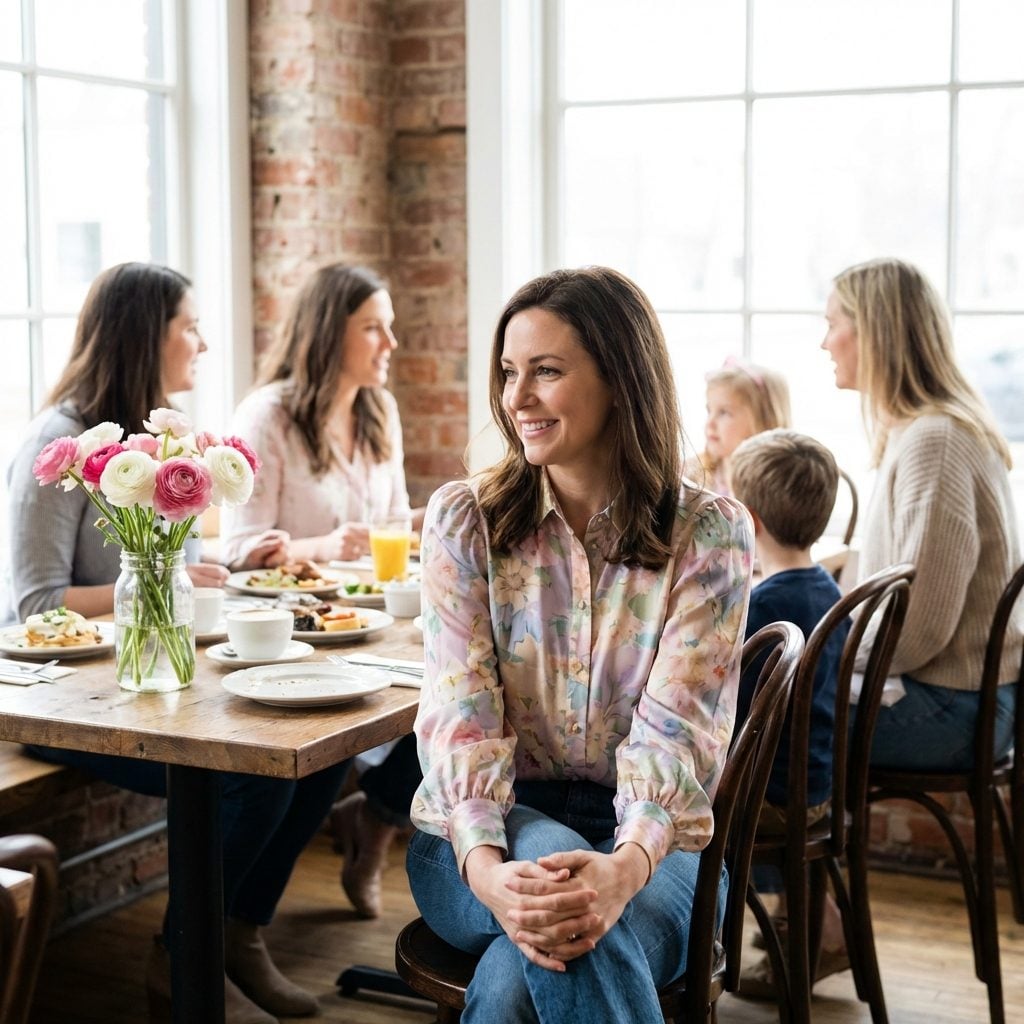
Now apply this to Mother’s Day. The floral blouse your kids picked out carries symbolic meaning, but whose? It carries their idea of “mom on a special day,” a role loaded with cultural expectation, softness, approachability, occasion. When you put it on, you’re not activating your own identity. You’re activating theirs.
The enclothed cognition effect predicts the outcome: you’ll feel subtly unlike yourself all day. You’ll smile a little stiffly in the photos. The camera will catch something in your eyes that’s not quite present, because, cognitively speaking, you aren’t quite present. You’re performing a version of yourself that belongs to someone else’s imagination.
The Subtle Signal Every Stylish Mother Sends Without Saying a Word

There’s a particular quality you notice in women who dress consistently well, not expensively, not trendily, but personally. They read, without effort, as someone who knows exactly who they are. The research on this is direct: a 2023 review in Personality and Social Psychology Review proposed that observers infer four types of information from dress: social identity, mental state, social status, and aesthetic taste. All four are being transmitted simultaneously, every single time someone looks at you.
What stylish mothers send, specifically, is a fifth signal the review doesn’t formally name but that anyone can read: psychological settledness. The signal says: I have a point of view about myself that is stable. I didn’t dress this morning to manage your impression of me or to perform the occasion. I dressed because this is what I wear when I feel good.
That signal is quiet, but it is not subtle to the people receiving it. Children, especially, pick it up immediately. There is a version of “Mom looks like herself” that every child recognizes, and it carries more authority than any occasion outfit ever could.
Why Your Brain Rejects the Floral Blouse Even Before You Put It On
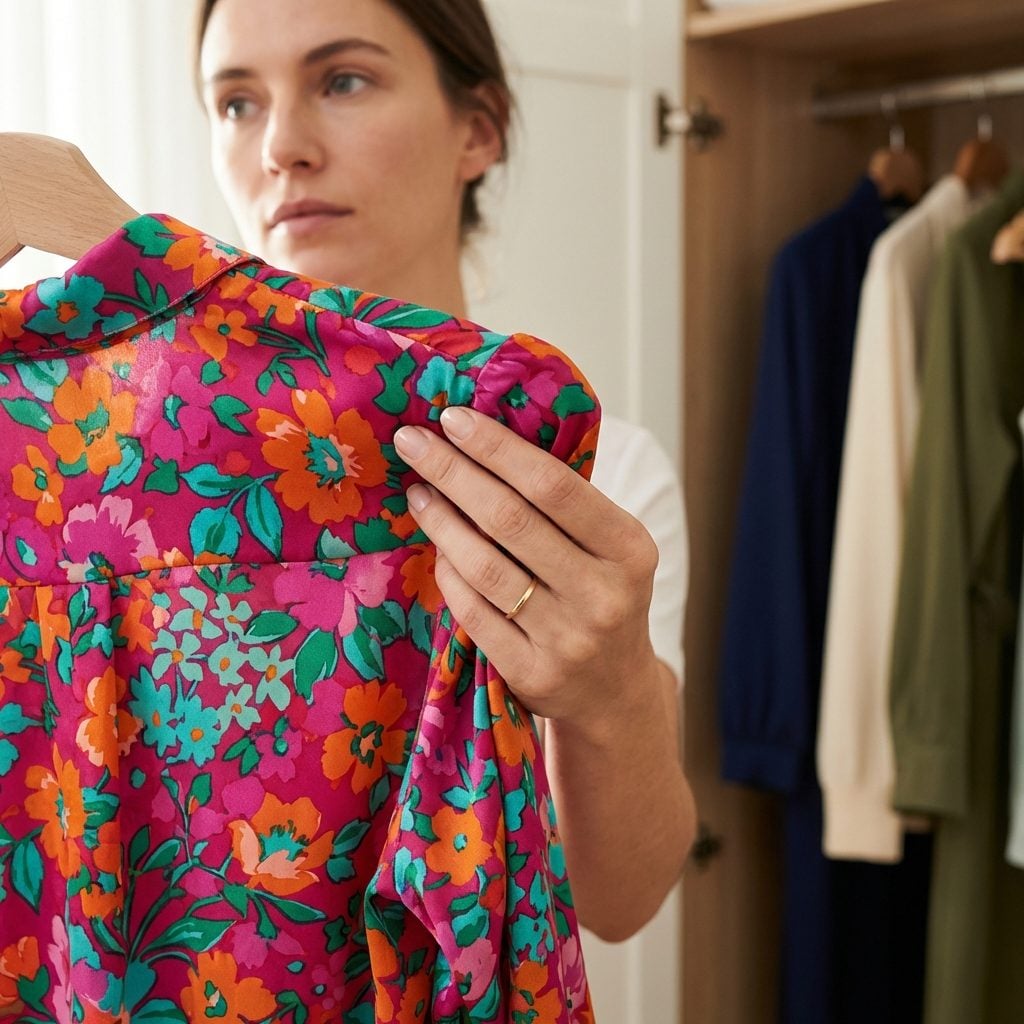
The rejection happens faster than you’d expect. Research on self-image congruity in clothing suggests that the brain is evaluating fit, not physical fit, psychological fit, almost instantaneously upon visual contact with a garment. Research on personal clothing style and self-concept published in Fashion, Style and Popular Culture found that women use clothing to create positive and coherent images of themselves that reflect aspects of their identity, which implies the inverse: clothing that contradicts that identity registers as a threat to coherence.
The floral blouse isn’t rejected because it’s floral. It’s rejected because it doesn’t belong to the story you tell yourself about who you are. Maybe you’re a woman who lives in clean lines and muted structure. Maybe your wardrobe speaks in navy, ecru, and black. The blouse, covered in pink blooms, is talking in a dialect you don’t speak, and your nervous system knows this before your frontal cortex has even formed an opinion.
The Psychological Phenomenon That Makes ‘Occasion Dressing’ Feel Like a Costume

Psychologists who study costume and identity have documented something most of us have felt: (Source), because clothing sends cues to your own brain about who you are being in that moment. Occasion dressing does exactly this, and not always in your favor.
When you dress for an occasion rather than for yourself, you are activating a role, not an identity. “Mother’s Day” is a role. “Brunch with the family” is a role. The clothes you reach for to honor those occasions are role-costumes, and the psychological consequence is the same as any costume: you slip, slightly, into character. The character may not be you.
This is why the most self-possessed women at any celebration tend to look the same way they look on a random Saturday they feel good about. They are not performing the occasion. They skipped that step entirely, not out of indifference, but because their relationship with their own identity is settled enough that the occasion doesn’t require a costume. That’s not a style secret. It’s a psychological one.
What the Research on Identity-Based Dressing Reveals About Mothers Over 40

By 40, something has shifted in a woman’s relationship with her wardrobe, and the research hints at why. A study of 792 women published in Frontiers in Psychology, with a mean participant age of 42, found that women who demonstrated higher openness to experience were significantly more likely to dress for individuality rather than camouflage, and to choose clothing that promoted self-validation rather than social approval. Midlife, in other words, is when the relationship between a woman and her wardrobe stops being about performance and starts being about accuracy.
(Source) puts it simply: personal style is shaped over time and anchored in personal identity, which can be therapeutic. The word “therapeutic” is doing a lot of work there. For women who have spent years dressing for roles, new mother, professional, partner, the person who shows up dressed appropriately for whatever the occasion demands, dressing for identity can feel almost radical.
What that looks like in practice, on a day like Mother’s Day, is a woman who puts on the outfit she’d put on any Sunday she felt good. Not the occasion outfit. Not the gift. Not the costume. Just the clothes that, when she looks in the mirror, reflect back something accurate. Something she recognizes as herself. The researchers call it identity-based dressing. Everyone else just calls it style.
The Real Reason the Most Pulled-Together Mothers Dress the Same Way Every Sunday

There’s a pattern that’s easy to miss until someone points it out: the women who always look right in photographs aren’t reinventing themselves for each occasion. They’re wearing something that looks exactly like something they’d wear any other week. Same silhouette. Same palette. Same register of effort. Not because they’re lazy, but because something deeper is at work.
Psychologists call it self-consistency. Source The theory, first proposed by Prescott Lecky, holds that individuals are fundamentally driven to maintain a coherent, stable sense of self, and that any behavior which violates that internal image creates genuine psychological discomfort. Clothing is behavior. Getting dressed is, in this sense, a small daily negotiation with identity.
What this means in practice: a woman who has spent four decades figuring out what she actually likes, in fabric, in cut, in color, has built an internal reference point that’s hard to fake and harder to override. When she gets dressed on Mother’s Day, she isn’t reaching for something “appropriate.” She’s reaching for herself. The consistency isn’t repetition. It’s fluency.
Why Role-Dressing Makes You Look Less Like Yourself in Every Single Photo

Every family has at least one photograph like this: a woman who looks slightly unlike herself, wearing something too flowery or too formal, standing slightly stiffly in a way she never stands in candid shots. Nobody intended it. It happened because she dressed for the occasion rather than for herself.
This is role-dressing, the phenomenon of selecting clothes that signal a social identity (“mother on Mother’s Day,” “guest of honor,” “person being celebrated”) rather than clothes that simply reflect who you are. Research in the social psychology of dress has found that clothing choices carry deep symbolic meaning connected to the self, and that when (Source), the incongruence tends to manifest in how a person carries themselves. Posture changes. Eye contact softens. The body communicates what the outfit already said: I’m playing a part.
There’s a photographic dimension to this, too. Research by Wharton’s Jonah Berger found that (Source), the absence of performance. A woman in her usual clothes, relaxed, laughing at something real, reads as more present in a photograph than the same woman in a floral blouse she’s been quietly tugging at all afternoon.
The Cognitive Dissonance That Happens When You Dress for Someone Else’s Version of You

Put on a floral cardigan because your daughter chose it with love, and something slightly uncomfortable happens inside. Not guilt, you’re grateful, genuinely. But there’s a quiet friction, a small gap between who you know yourself to be and the version currently walking around the dining room. That gap has a name.
Leon Festinger’s cognitive dissonance theory describes the psychological discomfort that arises when a person’s behavior conflicts with their internal self-image. Source The discomfort isn’t always conscious. It can arrive as a vague restlessness, a slight self-consciousness about how you’re moving, a sense that you’re performing rather than just living the day. What clothing researchers have observed is that (Source), as a faint lack of ease, a quality that reads as slightly off even without the observer knowing why.
This dynamic gets quietly complicated on days like Mother’s Day, where the social pressure to receive graciously and wear the gift runs up against the psychological cost of presenting as someone you’re not. The woman who knows this about herself doesn’t dismiss the gift. She just doesn’t build her outfit around it.
What Behavioral Scientists Call ‘Self-Concept Consistency’, And Why It’s the Secret to Always Looking Right

Ask women in their forties and fifties why certain people always look pulled-together, and the answers tend to circle around some vague notion of confidence or taste. Both are probably right. But underneath both of those words is something more specific: self-concept clarity, how clearly, confidently, and consistently a person defines who they are.
Psychologists distinguish between self-concept clarity (SCC) and self-concept differentiation, roughly, the difference between having a stable core sense of self versus shifting that sense depending on social context. (Source), while lower SCC is associated with greater self-consciousness and neuroticism. Applied to fashion, this maps almost perfectly onto what we observe: women with high self-concept clarity tend to dress in a way that is immediately recognizable as them, not because they wear a uniform, but because their choices are coherent from the inside out.
Behavioral research on dress also supports the idea that clothing serves as a tool for self-continuity. One particularly striking finding, noted in research published by Manchester Metropolitan University, found that clothing’s role in maintaining identity persisted even in elderly people with dementia, as though the self holds onto its aesthetic language long after language itself begins to fail. Source
- Self-concept clarity predicts more stable, coherent clothing choices.
- Dressing consistently with your self-image reduces the low-grade psychological tension of inauthenticity.
- Other people read that coherence as confidence, often without knowing why.
The Surprising Reason Children’s Gift Picks Reveal More About Their Anxiety Than Your Style
❤️ Would you like to save this?
Here’s a thought that lands differently once you consider it: when a child chooses a floral blouse, a pastel scarf, or a novelty hat for Mother’s Day, what are they actually selecting? Not a garment that reflects how they see their mother. More often, a garment that reflects how they hope she’ll be seen, as soft, as gentle, as occasion-appropriate. As unmistakably a mother.
Research on the psychology of gift-giving reveals that (Source), particularly when the relationship carries emotional stakes. Children giving gifts to mothers are navigating something surprisingly complex: they want to demonstrate their affection, yes, but they also want to present something that looks like the right answer. And the right answer, to a child, often looks like a culturally legible version of “mom.”
That says almost nothing about her actual style. It says a fair amount about how much they love her and how much they want to get it right. The gift is a mirror of their care, not her closet.
Why the Outfit That Photographs Best on Mother’s Day Is Never the ‘Special’ One

There’s a well-documented paradox in photo psychology: the more deliberately someone is performing for the camera, the less compelling the resulting image. Wharton marketing professor Jonah Berger found in his research that (Source), more interested in knowing them, more likely to trust them. The mechanism is genuineness: we pick up, often unconsciously, on whether someone is showing us themselves or showing us a performance of themselves.
Now apply that to Mother’s Day photos. The “special” outfit, the one purchased or selected for the occasion, carries the energy of being chosen for an audience. It signals: this is how I want to be seen today. And paradoxically, that signal introduces a subtle distance between the woman and the image. The camera catches it, even if no one articulates what they’re seeing.
The photographs that get framed, that surface in slideshows decades later, are almost always the ones where the person looks exactly like themselves: relaxed linen top, familiar earrings, the particular way she laughs when she isn’t thinking about how she looks. That consistency reads as presence, and presence is what photographs actually capture.
The Identity Signal That Disappears the Moment You Dress for the Role Instead of the Person

Clothing transmits information, four distinct categories of it, according to a 2023 review published in Personality and Social Psychology Review: social identity, cognitive state, status, and aesthetic taste. Source Of those four, aesthetic taste is perhaps the most personal, the most hard-won, and the most revealing. It’s also the one that evaporates most completely when a woman dresses for a role rather than for herself.
Think about what a well-developed personal aesthetic actually communicates: decades of editing, discarding, returning to, and refining. It signals self-knowledge. Secure women over forty often wear it with a quiet authority that has nothing to do with trend-following and everything to do with knowing what they actually like. Research supports the idea that clothing functions as an extension of self, allowing individuals to uphold and communicate a true self across contexts, a function that becomes more coherent, not less, with age. Source
Dress for “Mother’s Day” and that signal gets replaced by a different one: I am performing the occasion. The aesthetic personality, the thing that makes her look like her in every photograph taken over twenty years, goes quiet. The role takes over. And the woman, briefly, disappears.
“The most stylish thing isn’t the outfit. It’s the unmistakable sense that the person inside it is entirely at home there.”
The Bottom Line
The most stylish mothers on Mother’s Day are wearing exactly what they would wear on any other Sunday, because style that reads as effortless is simply self-concept made visible, and the women who look most themselves in photos never dressed for the occasion at all. The definitive answer the research points to, and what every heading in this article has been circling, is this: the outfit that makes you look best on Mother’s Day is the one you chose entirely for yourself, with no role to perform and no one else’s expectation to fulfill. This Sunday, before you get dressed, ask yourself one question, am I putting on a person, or putting on clothes?