
❤️ Would you like to save this?
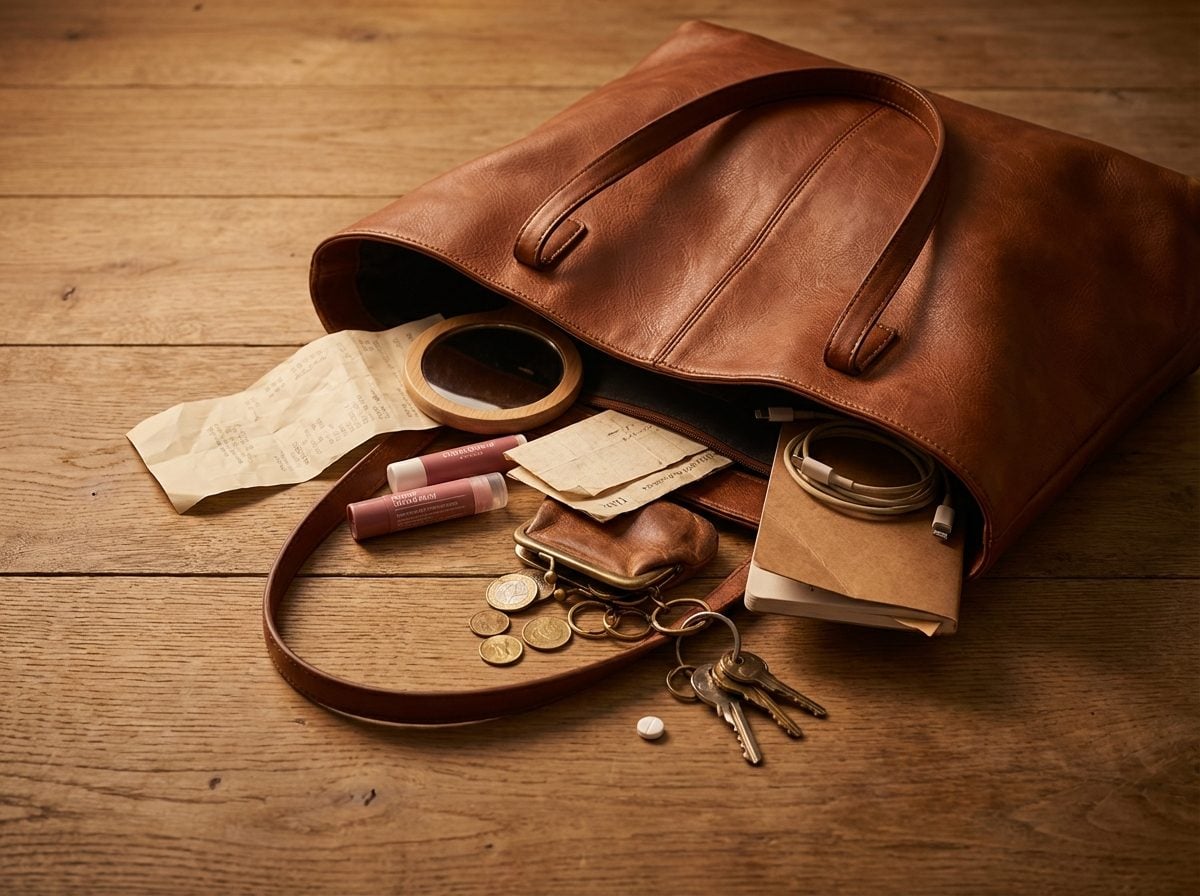
Your handbag is the one space in your life you never clean up for company. Nobody’s coming to judge it. Nobody’s going to open it at a dinner party and raise an eyebrow. So what happens inside it is completely, uncomplicatedly you, the real you, not the version that makes the bed before guests arrive.
Therapists have started paying attention to this. Not the brand on the outside, not the price tag, but what’s actually living in there: the receipts from three months ago, the six lip balms, the thing you’ve been meaning to throw away since February. It turns out, the inside of your bag is less a storage system and more a psychological self-portrait. And once you know what to look for, it’s impossible to unsee.
FYI, thanks to AI imagery software, we’re able to create very specific fashion and hairstyle examples to illustrate the points being made. In some cases, imagery is exaggerated to hammer home the point. Also, assume links that take you off the site are affiliate links such as links to Amazon. this means we may earn a commission if you buy something.
The Unexpected Tool Therapists Use to Understand Their Clients
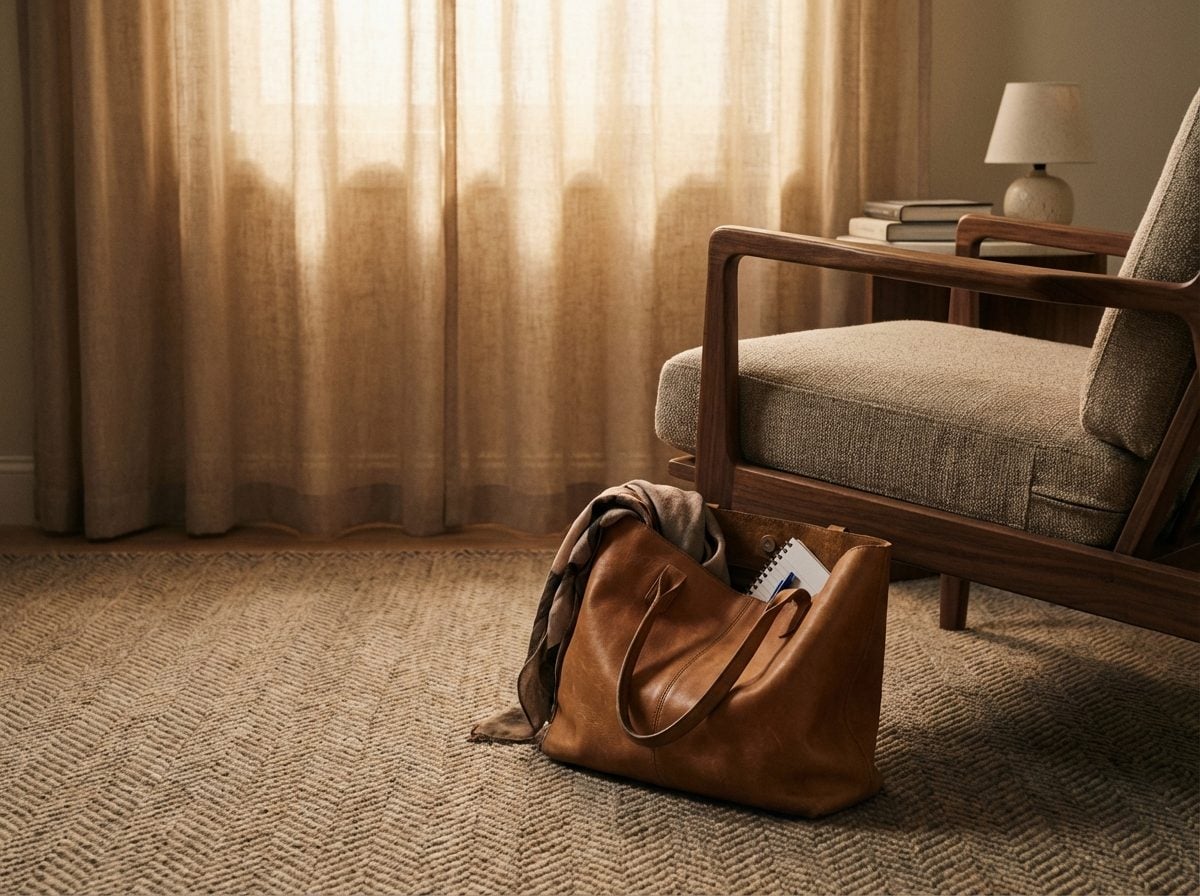
Before a single word is spoken in a therapy session, the room is already reading you. Trained therapists notice things that nobody organizes for an audience: the way a coat gets dropped, the items placed on the side table, the bag that comes off a shoulder and lands, heavily or lightly, on the floor. Personal objects, it turns out, are a form of nonverbal communication that can be more honest than anything said out loud.
According to a clinical guide on decoding body language in therapy sessions, therapists pay close attention to how clients interact with objects, fidgeting, gripping, arranging, because gestures with objects give valuable insight into a client’s psychological state. And then there’s what those objects contain. The handbag is a closed world. It travels everywhere you go, accumulates without being curated, and no one ever looks inside it but you. That makes it one of the few spaces in your life where you haven’t performed for anyone. What it holds, and how it holds it, might be one of the most unguarded self-portraits you’ll ever make.
Psychologists like Russell Belk have long argued, as noted in this piece on the psychology of possessions from the British Psychological Society, that our things are extensions of the self, not decoration, but identity made physical. If that’s true of possessions generally, imagine what it means for the one container you carry your whole life inside, every single day.
Why Your Bag Is the One Space Nobody Organizes for an Audience
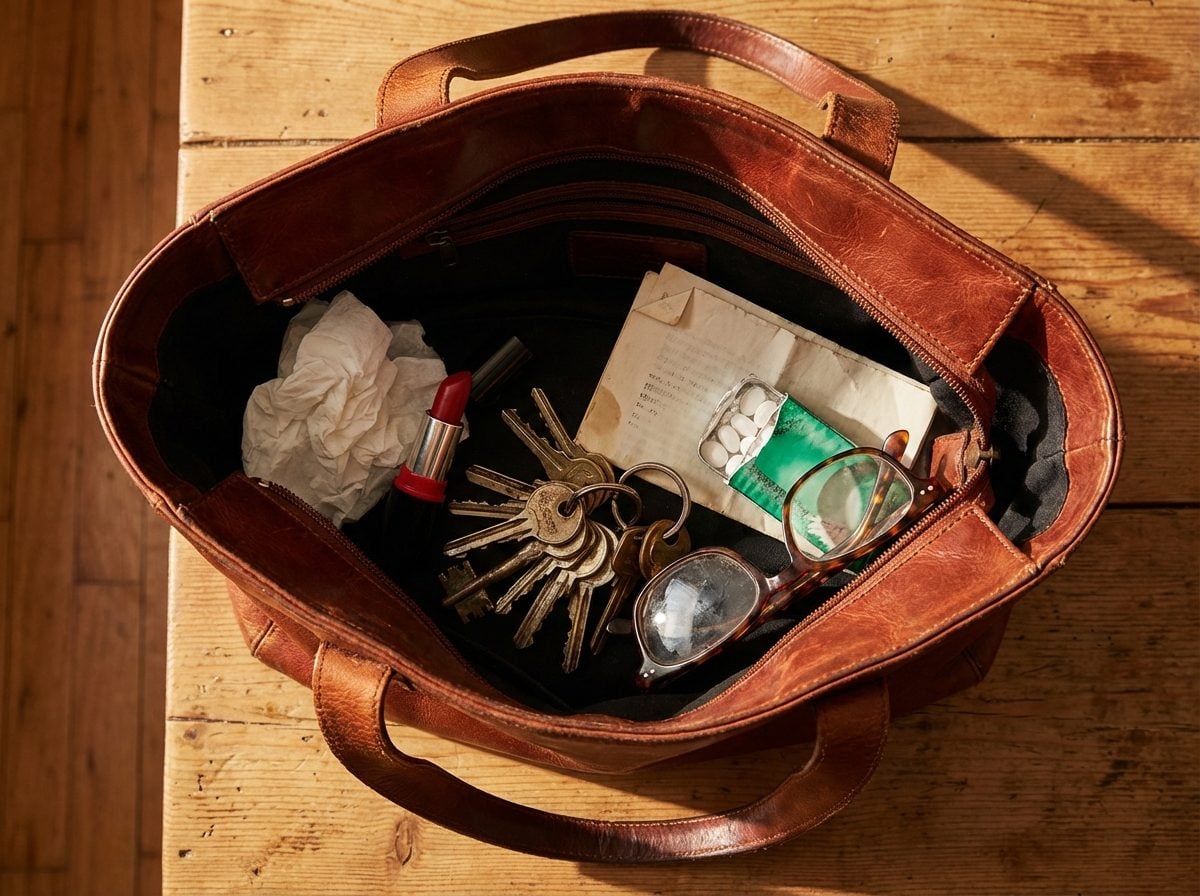
Your home gets tidied before guests arrive. Your desk gets cleared before a video call. Your outfit is considered before you walk out the door. But your bag? Your bag is organized, or not, entirely for yourself. Nobody ever says, “I should clean out my handbag before she comes over.”
That absence of social pressure is exactly what makes it so psychologically interesting. A Psychology Today analysis of clutter and mental load makes the case that women in particular carry the cognitive weight of organization in most areas of their lives, noticing, remembering, delegating. The mental load is constant and largely invisible. The bag, then, becomes one of the few honest artifacts of that load. Nobody is grading it. Nobody will see it. It simply accumulates, day after day, in direct proportion to how stretched or settled you are.
There’s something almost confessional about that. The bag doesn’t lie. It doesn’t perform calm when you’re overwhelmed, or project chaos when you’re actually on top of things. It just reflects, quietly and without judgment, whatever is actually going on.
The First Thing You Reach For (And How Long It Takes to Find It)
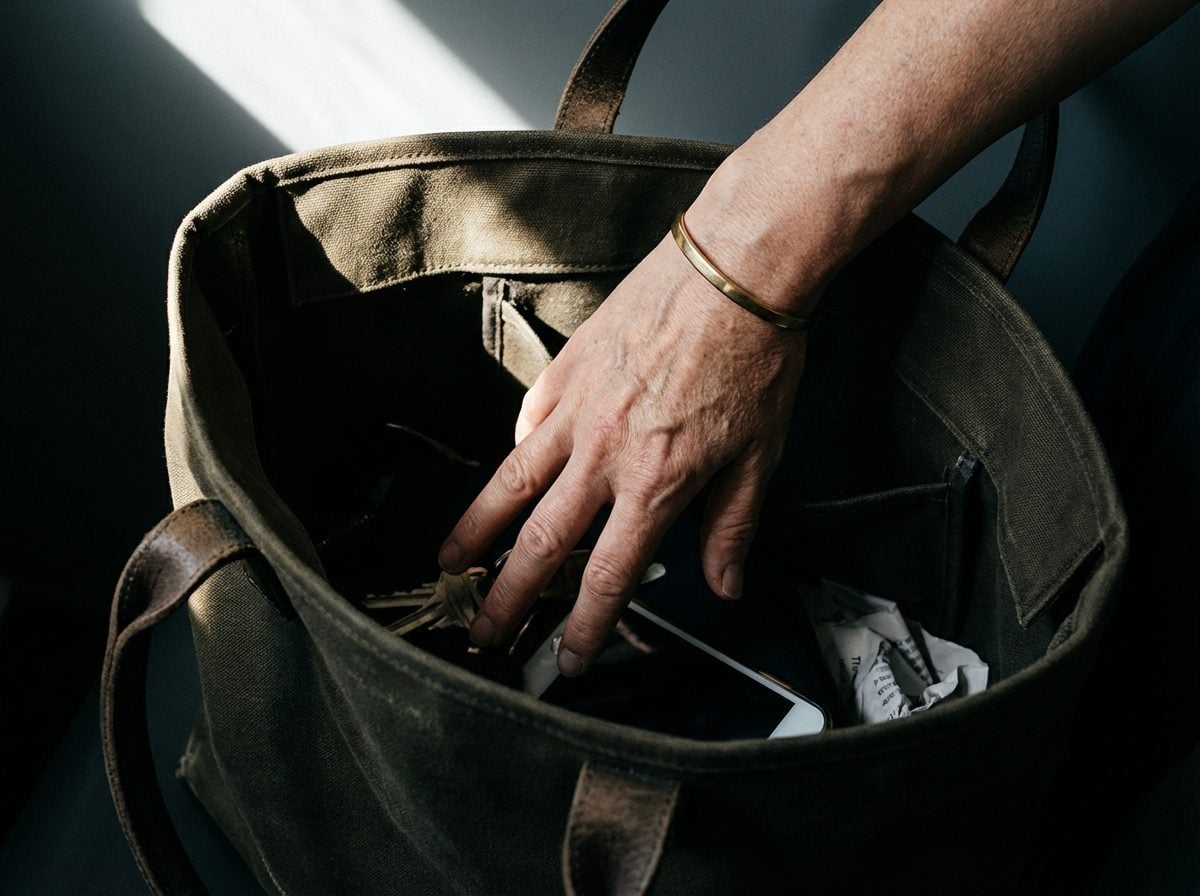
Time yourself the next time you need your keys. Or your phone. Or a pen. The seconds you spend searching, wrist-deep in a bag, fingers brushing receipts and lip balm and a charger that doesn’t belong to anything you currently own, those seconds are data.
Disorganized environments don’t just reflect stress. They create it. Research on how clutter affects the brain consistently shows that visual and tactile disorder competes for the brain’s limited attentional resources, raising cognitive load even in moments that should be simple. Your bag is a micro-environment. And if retrieving a single object from it requires a minor excavation, your nervous system registers that friction every single time.
There’s also the deeper question of what you reach for first. The item you need most urgently, or reach for out of habit, says something about what you’re anchoring your day around. Is it your phone, tethering you to everyone else’s demands the moment you step out? Your keys, exit and entry, control of where you can and can’t go? Your medication, your lip balm, your notebook? The first reach is almost reflexive. And reflexes are habits. And habits are, eventually, a portrait of the life you’re living.
What Lives at the Very Bottom of Your Bag
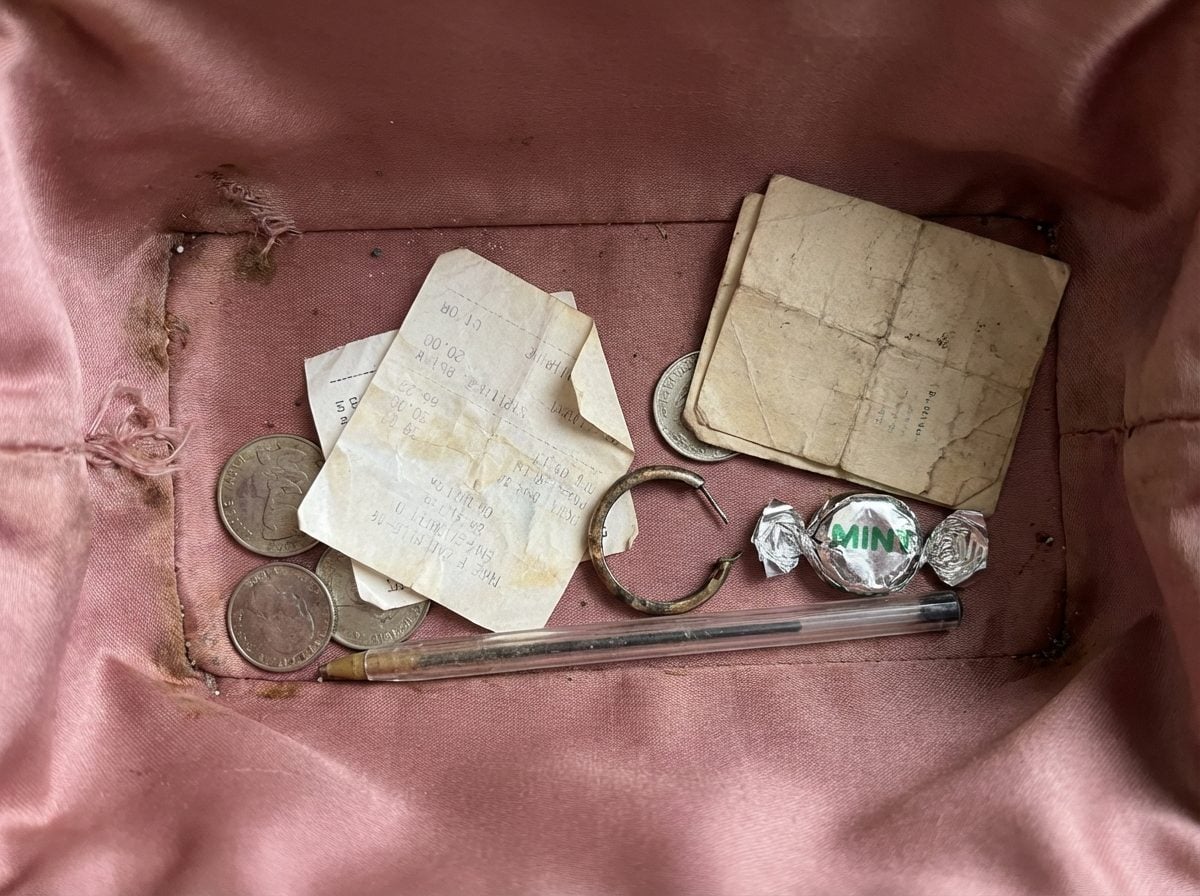
The bottom of a bag is an archaeological site. Not a dramatic one, no gold artifacts, no ancient bones, but a record of time passing, decisions deferred, and things that once mattered enough to put in, but never mattered enough to take out.
Psychologists who study our relationship to possessions note that objects at the bottom of bags and drawers often have something in common: they exist in a state of decision avoidance. According to research into the psychology of clutter, every unresolved object creates what’s known as the Zeigarnik Effect, the mind’s tendency to stay preoccupied with unfinished tasks. The broken earring you keep meaning to repair. The phone charger for a phone you no longer own. The folded note from a meeting six months ago.
- Objects you’re keeping out of guilt, the loyalty card for a shop you haven’t visited in a year, the vitamin sample you’ll “definitely use.”
- Objects you forgot you had, things so long buried they’ve become permanent fixtures, invisible until a bag-emptying moment of mild horror.
- Objects that genuinely belong there, and the ratio of this category to the others tells you something important.
The bottom-of-bag layer accumulates in direct proportion to how little bandwidth you have for small decisions. It’s not laziness. It’s cognitive overload wearing a different face.
The Receipts You Never Throw Away
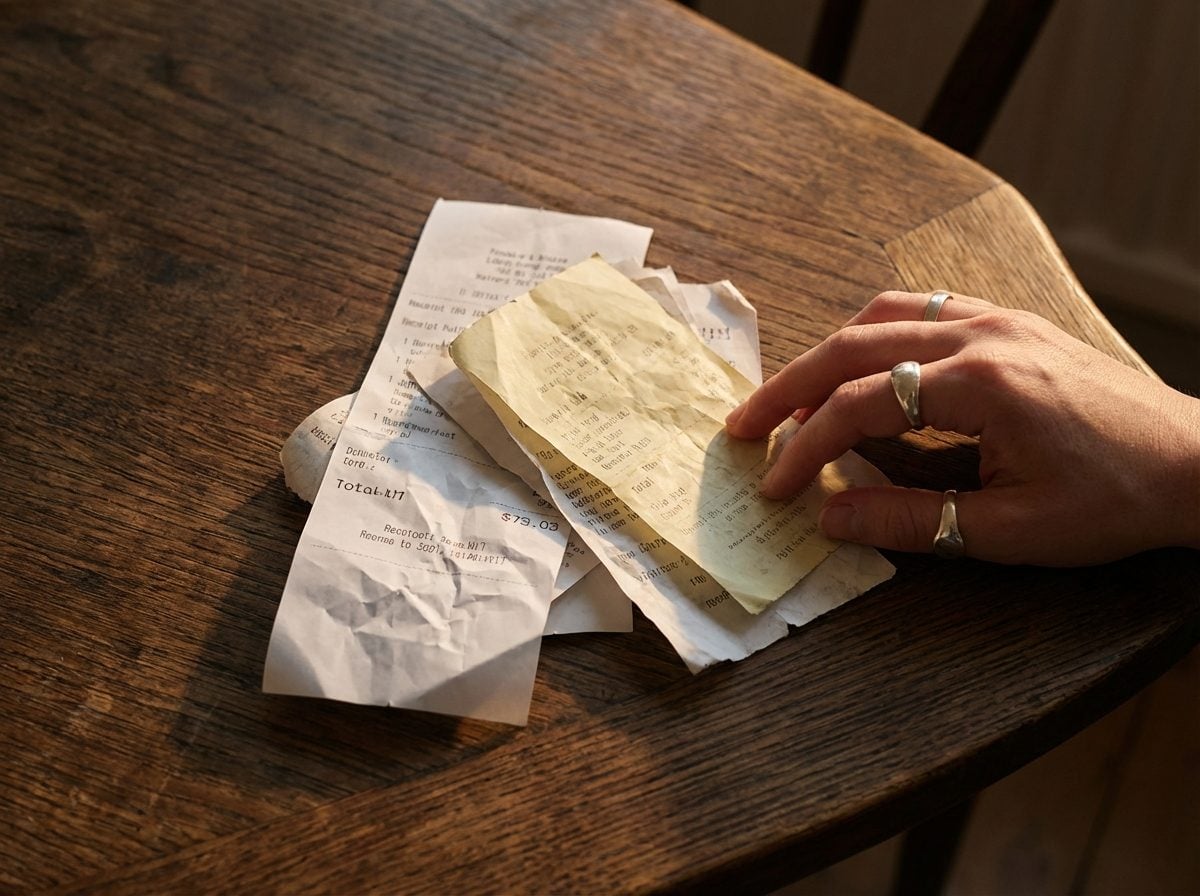
Most of us know, intellectually, that the thermal paper receipt from a coffee shop in March doesn’t need to be in our bag in October. And yet.
Receipt-keeping is one of those behaviors that sits right at the intersection of practicality and psychology. On the functional end, it’s sensible. On the compulsive end, it starts to reveal something else: a quiet anxiety about being caught out, proven wrong, or left financially unprotected. As a financial anxiety resource from Serenity Space Therapy notes, hoarding receipts is a recognized behavioral marker of financial anxiety, something therapists observe alongside bill avoidance and compulsive budget-checking.
The receipt as object is interesting in its own right. It’s paper-thin proof that a transaction happened, that something was exchanged, that you were present, that money moved. Psychology research on receipt-saving habits suggests that people who hold onto them often share a common trait: a need for documented evidence of their own reliability. “Trust but verify” extends inward, they want proof of their own good decisions.
A bag with twelve old receipts isn’t necessarily the sign of a disordered mind. But it might be a sign of a mind that doesn’t feel quite safe enough to let go.
How Many Versions of “Just in Case” Are in There Right Now
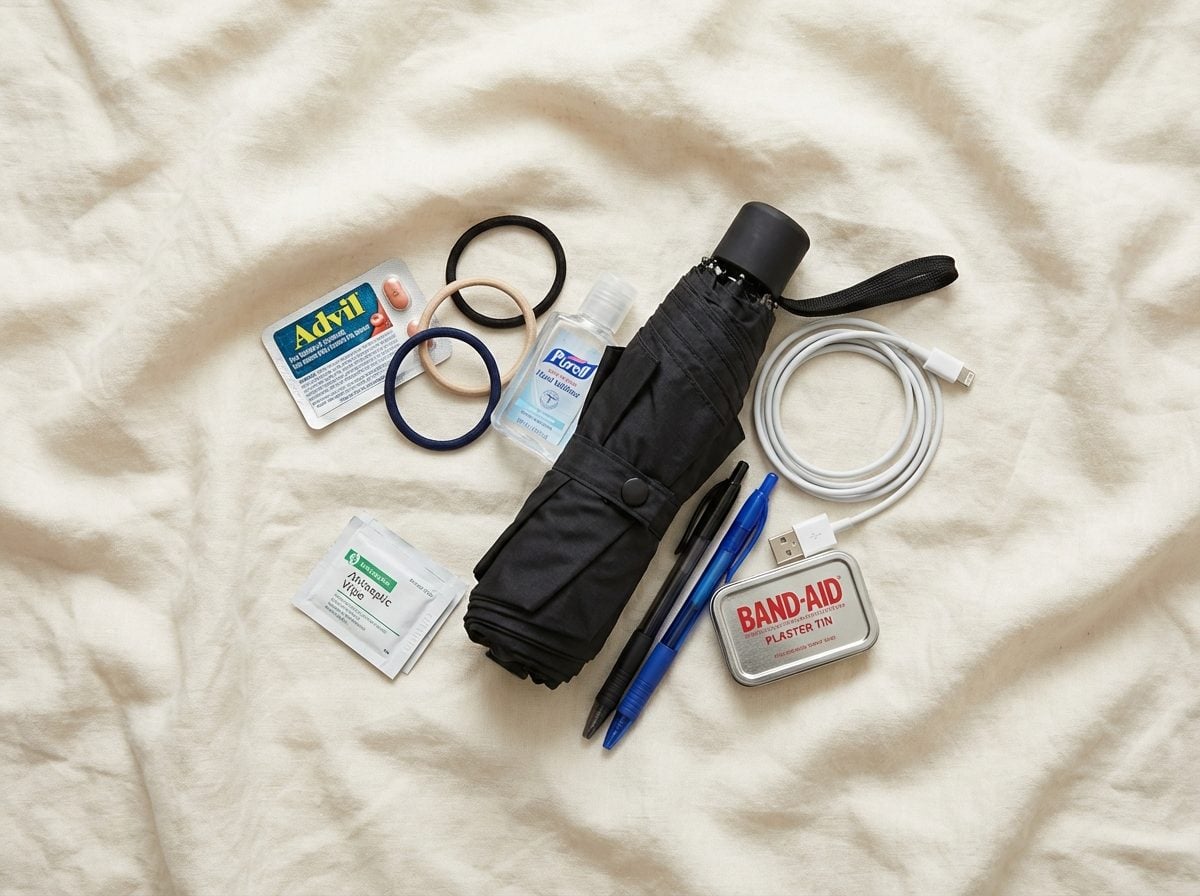
Count them. The travel-sized pain reliever. The spare hair tie (or five). The backup charger. The folded tote-within-a-tote. The plasters you’ve never used. The extra pen alongside the pen you actually use. The individually wrapped wipe from a restaurant visit months ago.
Each of these objects is a physical manifestation of a hypothetical future, a scenario you imagined, named, and prepared for. And that’s worth sitting with, because according to University of Chicago clinical psychologist Dr. Gregory Chasson writing for Psychology Today, “just in case” is one of the most common driving forces behind anxiety-related safety behaviors. These behaviors work in the short term, they provide relief, but through a mechanism called negative reinforcement, they quietly reinforce the belief that danger is always imminent and preparation is the only protection.
“Safety behaviors maintain anxiety over the long run… they provide momentary relief from a bad feeling, and because of that rewarding relief, we are more likely to use that behavior again.”, Dr. Gregory Chasson, Psychology Today
This doesn’t mean your backup charger is evidence of a clinical problem. Preparedness is practical and often wise. But there’s a spectrum. At one end: a woman who carries a spare lip balm because she likes having one. At the other: a bag so heavy with contingencies that lifting it becomes a daily reminder of everything that could go wrong. Somewhere between those two points is a very honest question about how safe you currently feel in your life.
The Condition of the Things You Carry Every Single Day
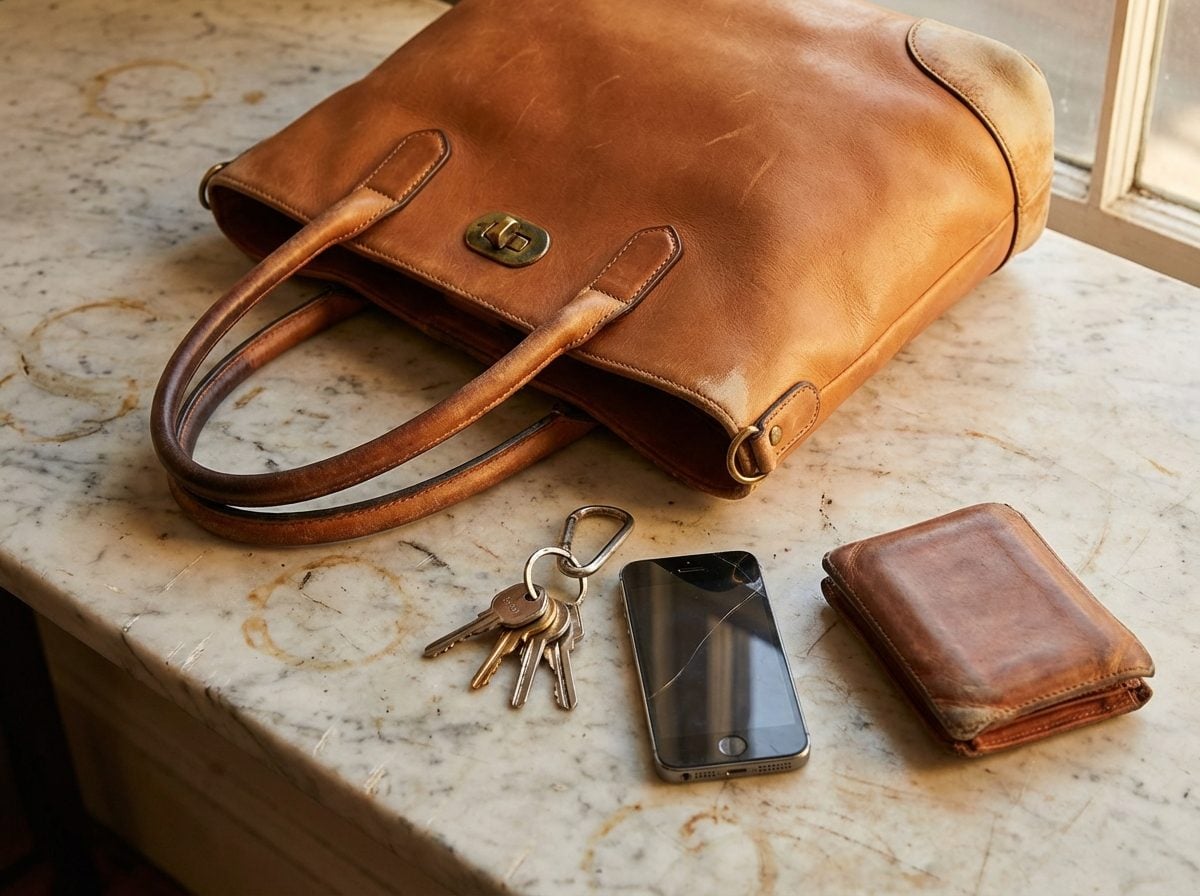
Not what’s in the bag. The bag itself. The wallet. The keys. The phone case. The items that make the journey every single day, that get touched a dozen times, that live at the center of your daily life, what condition are they in?
There’s a particular kind of revelation in a cracked phone screen that’s been cracked for eight months. Or a wallet held together by a rubber band. Or a bag with a broken zip that gets worked around every time rather than fixed. These aren’t criticisms. They’re observations. Because research on how possessions function as extensions of the self, extensively documented by psychologist Russell Belk, shows that we experience damage to our possessions as a kind of damage to ourselves. If that’s true, and the evidence suggests it is, then the reverse might also hold: neglecting to repair the things we use constantly may mirror a pattern of self-neglect, or at least self-deferral, that runs deeper than the object.
Women who are under sustained stress, overwhelmed by caregiving, or chronically running on empty often describe the same pattern: they handle everything for everyone else, but the small repairs they need for themselves, the bag zip, the replacement card holder, the new notebook, stay on a mental list that never quite gets addressed. The cracked screen isn’t carelessness. It’s a quiet record of where the bandwidth went.
The condition of the things you carry every day might be one of the most honest answers to the question: how well are you taking care of yourself right now?
What the Inside of Your Bag Looks Like After a Hard Week Versus a Good One
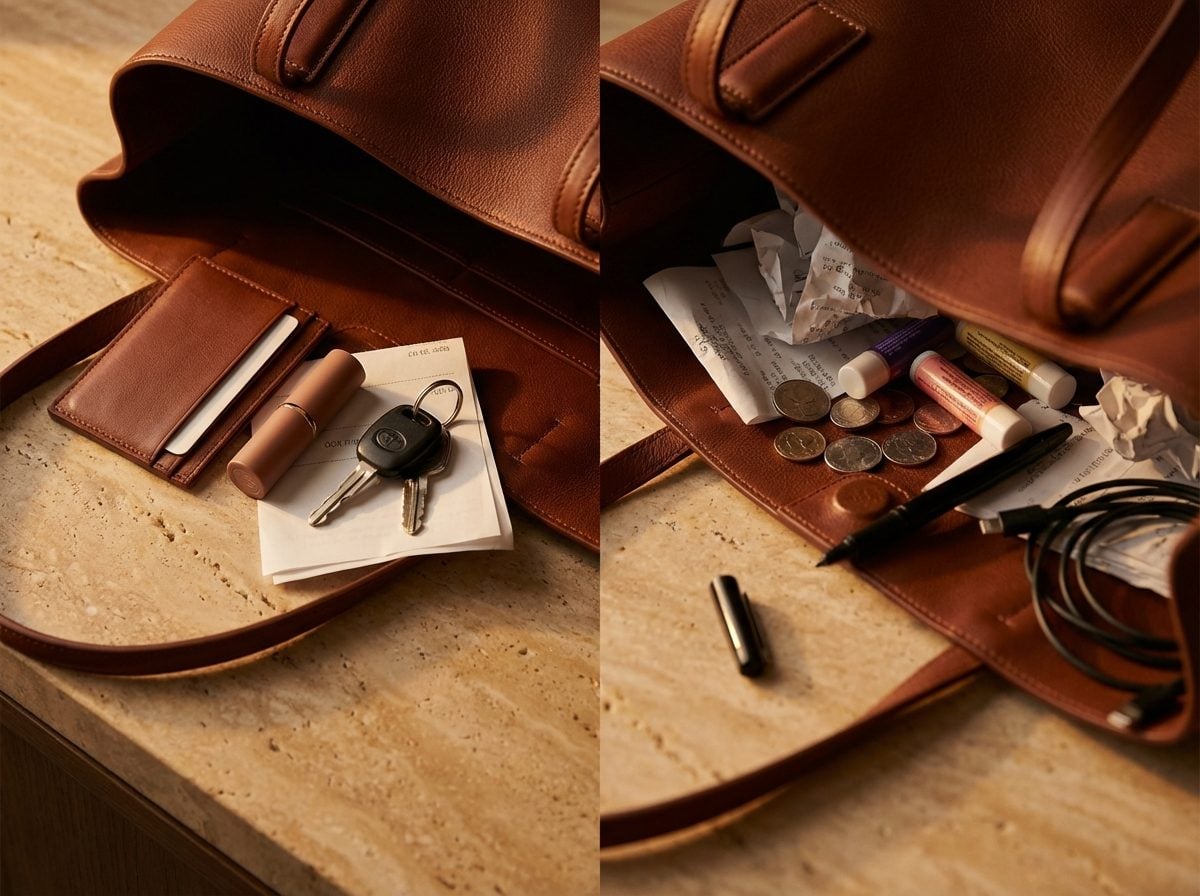
Pull your bag open right now. Not to find something, just to look. On a week when everything is running smoothly, you probably know where the lip balm is, the receipts aren’t multiplying, and there isn’t a fossilized granola bar wedged under the card holder. On a week when life is coming at you from every direction, the inside of that bag tells a different story. Crumpled parking tickets. Three pens but none that work. A hair tie from last Tuesday still on your wrist because you never had a spare moment to put it back.
This isn’t trivial. A 2024 Psychology Today piece on clutter and mental load explains that physical disorder directly reflects cognitive overload, and that when the brain is already managing too much, the effort needed to impose order on small spaces simply drops off the priority list. Your bag isn’t just a bag on those weeks. It’s a real-time printout of your mental bandwidth. The question isn’t whether the chaos is there. It’s what it’s quietly telling you.
The Items That Have Been in There So Long You’ve Stopped Seeing Them
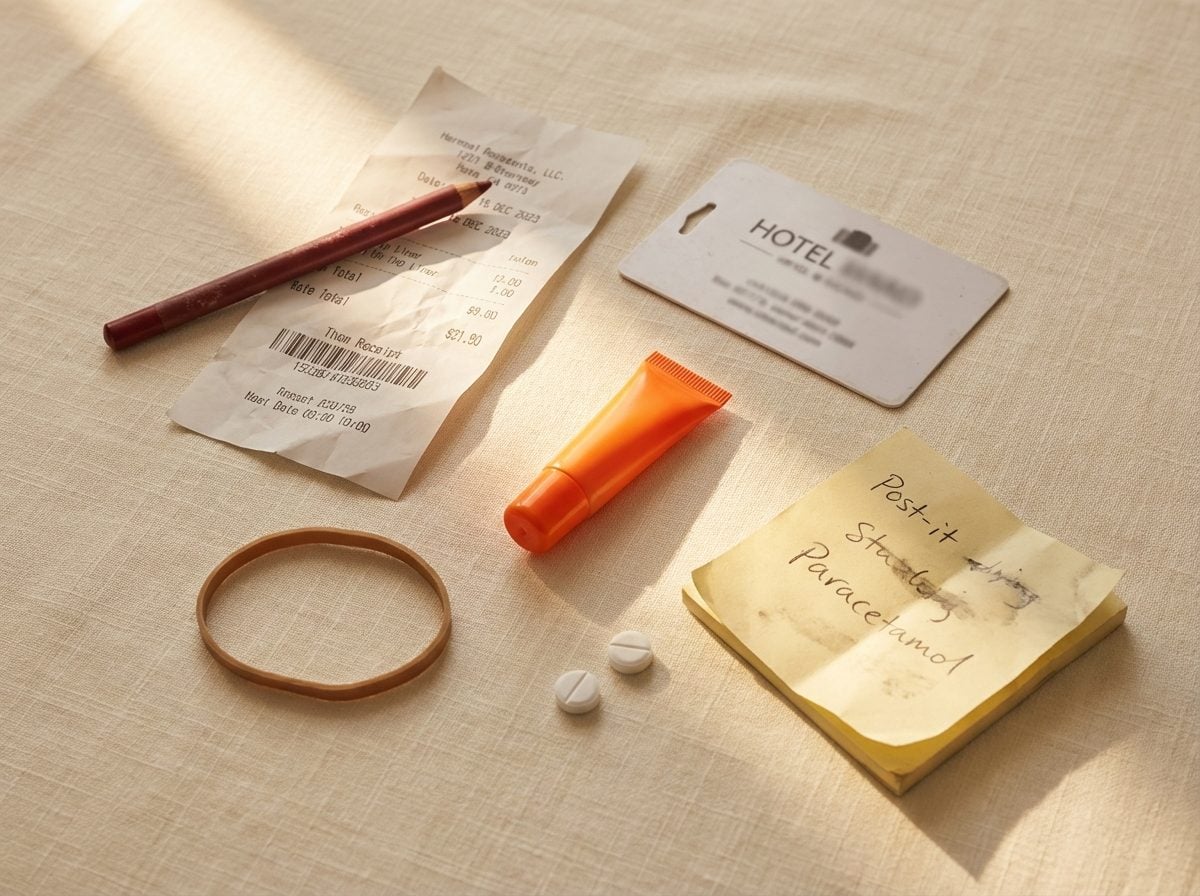
There’s a hand cream in the inside zip pocket you haven’t used in four months. A business card from someone you can’t quite place. Maybe a lip liner in a shade you stopped wearing in 2021, still there because removing it has never once made the list. You aren’t lazy. You’re experiencing something psychologists call habituation, the brain’s way of filtering out stimuli it has catalogued as non-threatening and non-urgent.
The mechanism is efficient by design, but research on how cluttered environments affect cognition suggests that even when we stop consciously noticing these objects, our brains don’t fully stop processing them. Every extra item costs a small fraction of working memory, the brain’s short-term sticky note. Over time, that adds up. Psychologists call the accumulated toll decision fatigue: each unresolved object quietly asking keep me? move me? deal with me? even below the threshold of conscious thought.
The items you’ve stopped seeing may be the most psychologically loaded ones of all. They represent unfinished decisions, tiny open loops. And open loops, as anyone who’s lain awake at 2am mentally cataloguing tomorrow knows, have a way of accumulating weight.
Why Women With the Most Responsibilities Often Carry the Heaviest Bags
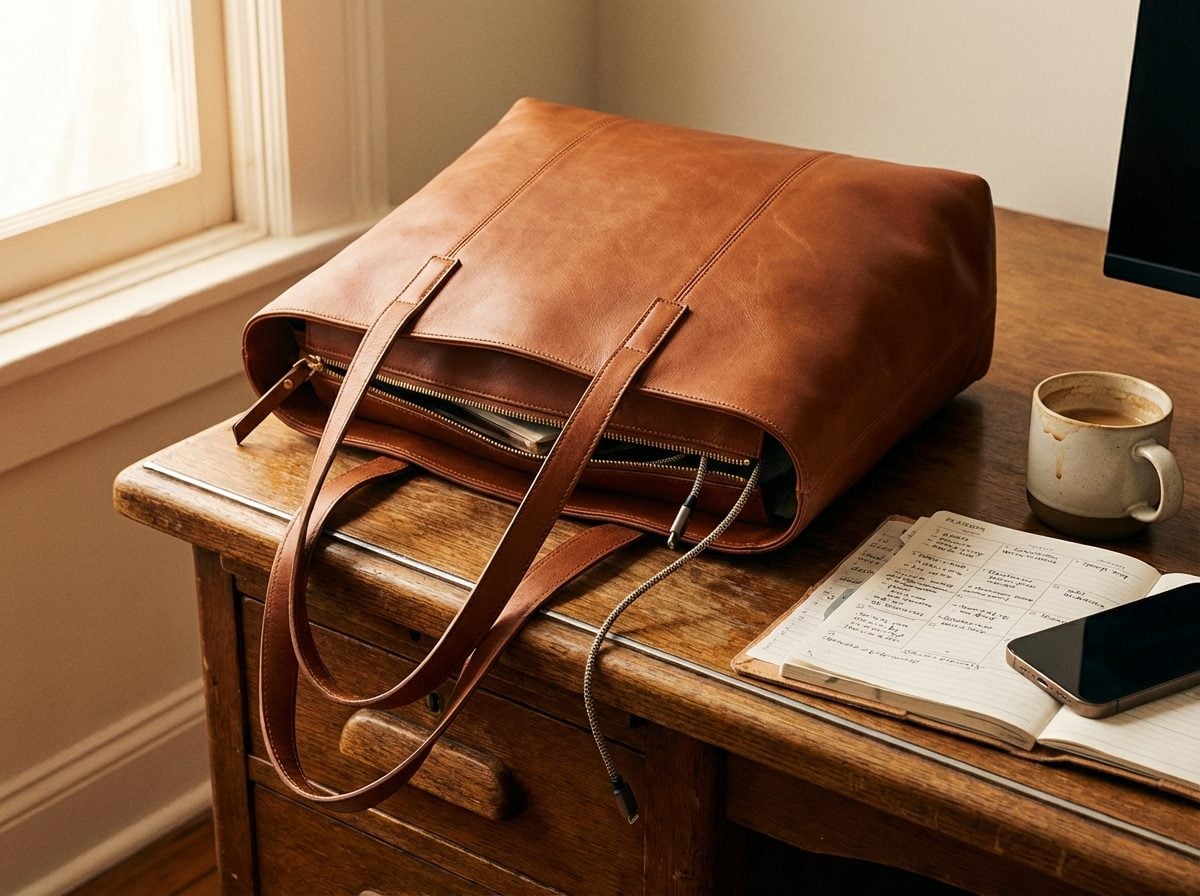
The bag gets heavier as the list gets longer. Snacks for a meeting that might run late. A charger for someone who forgot theirs. Medication, both yours and possibly someone else’s. The tote that started as a work bag slowly becomes a mobile command center, and the weight on your shoulder by 6pm is, in a very literal sense, the weight of everything you’ve agreed to hold.
This isn’t coincidental. A widely shared piece on the psychology of handbags articulates it plainly: excess objects in a bag signal unfinished tasks, contingency plans, and responsibilities waiting in the wings. The “just in case” logic, an extra cardigan, a backup umbrella, a second lip balm, is the logic of someone who has learned not to rely on circumstances going smoothly. And that learned vigilance doesn’t come from nowhere.
Research on mental load and gender consistently finds that women carry a disproportionate share of what researchers call “cognitive labor”, the noticing, anticipating, and pre-solving that happens before a problem even becomes visible to anyone else. The bag is just where that labor becomes tangible. It has a zip. You can see exactly how much it weighs.
The Bag You Carry on Weekends Versus the One You Carry to Work
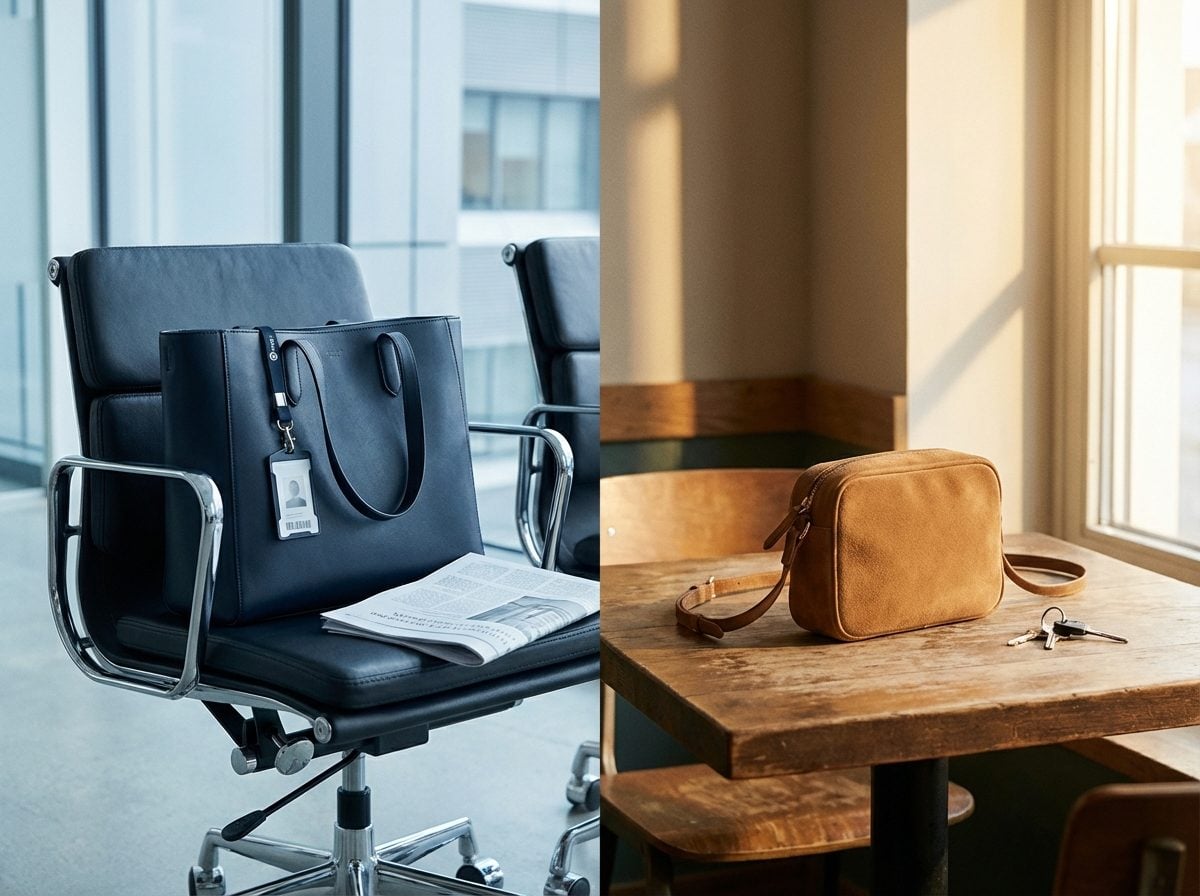
It’s the same woman. Completely different bag. On Tuesday she has the structured leather tote, navy, organized, with a dedicated laptop sleeve and her security pass clipped to the inner ring. On Saturday she has a small crossbody in tan suede that holds a card, her keys, and little else. Same hands, same person, entirely different interior logic.
Researchers who study social identity describe this as identity switching, the process by which people move between different group memberships and self-concepts depending on their context. The work bag isn’t just carrying different things. It’s carrying a different version of you: the one who is accountable, prepared, professional, alert. The weekend bag gives that version a rest. It says: today I only need to be myself.
What makes this psychologically interesting is how deliberate the switch can feel, and how much relief it carries. The act of reaching for the small suede crossbody on a Saturday morning is, in a quiet way, a micro-ritual of permission. You are choosing, consciously or not, to set down the apparatus of obligation for a few hours. The bag change signals the identity change before the day has even started.
“What we carry outside often reflects how much we are carrying inside.”
What Organizational Psychologists Say About the Spaces Only We See
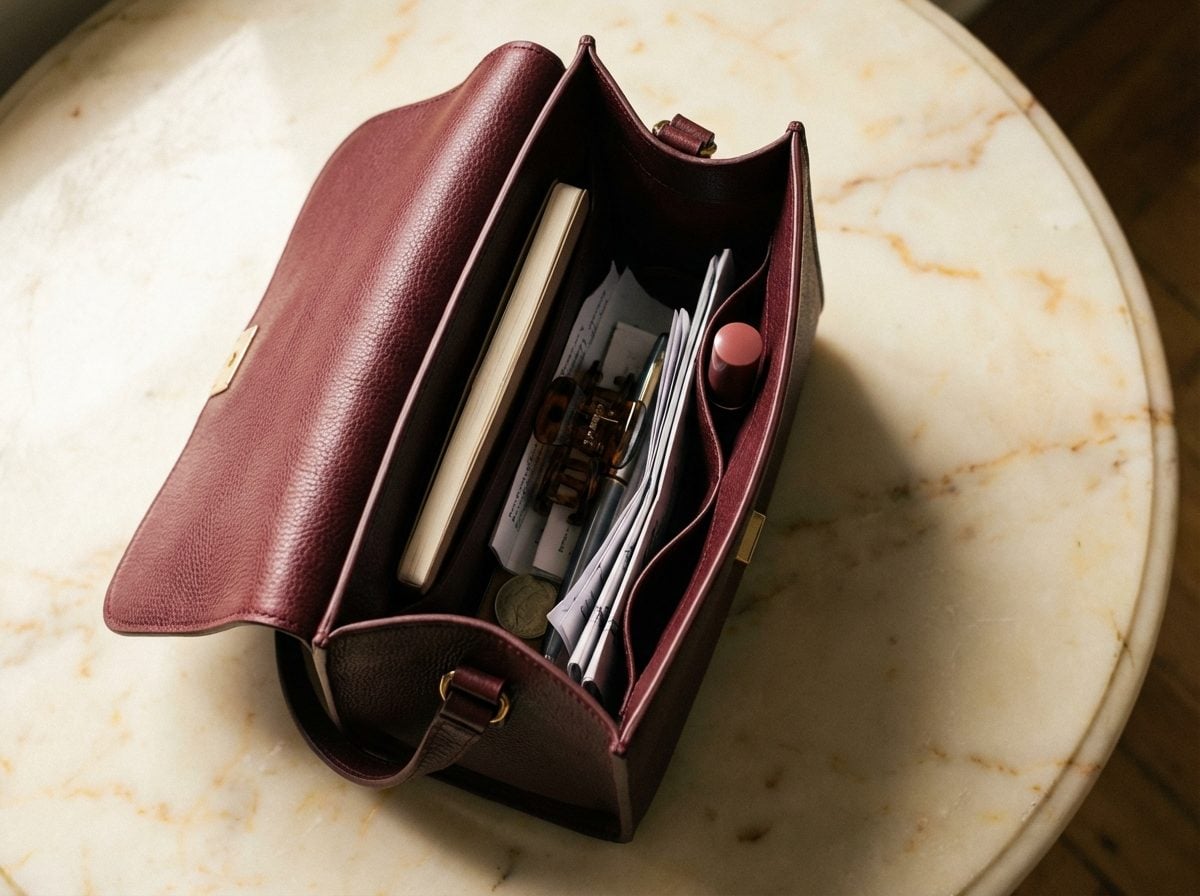
Your bag interior is arguably your most private physical space. More private than your desk, which colleagues pass. More private than your car, which passengers enter. Nobody goes into your bag without asking. Nobody reorganizes it while you’re not looking. It belongs, entirely, to you, and that privacy is exactly what makes it psychologically significant.
Research in environmental psychology has found a direct link between order in one’s personal environment, including a handbag, and feelings of control, calm, and mental clarity. A bag stuffed with irrelevant items and unresolved objects isn’t neutral. It can register, below conscious awareness, as evidence of internal overload. Not because you’re disorganized by nature, but because the bag is where life accumulates when you don’t have a spare moment to filter it.
What organizational psychologists observe in private spaces is revealing precisely because those spaces aren’t performative. Nobody tidies their bag for company. The desk gets cleared before a big meeting; the bag rarely does. So its state at any given moment is unusually honest, a snapshot of where your attention actually is, rather than where you’d like it to be.
Three Things Your Bag Interior May Actually Reveal
- Your current decision-making capacity. When the bag is disordered, it often reflects a period of decision fatigue, the mental resource most depleted by sustained high-responsibility living.
- Your relationship with contingency. The more backup items you carry, the more uncertainty you’re unconsciously braced for.
- Your real recovery state. Not how you appear at work, but how much mental space you actually have to spare.
The One Thing Almost Every Woman’s Bag Has in Common
❤️ Would you like to save this?
Ask a hundred women to empty their bags and you’ll find different lipstick shades, different notebooks, different loyalty cards for different coffee shops. But probe the researchers who study what women carry and a quieter pattern keeps surfacing: almost every bag holds something that was once needed and is no longer removed. Something whose original purpose has long passed, but whose presence has never been questioned.
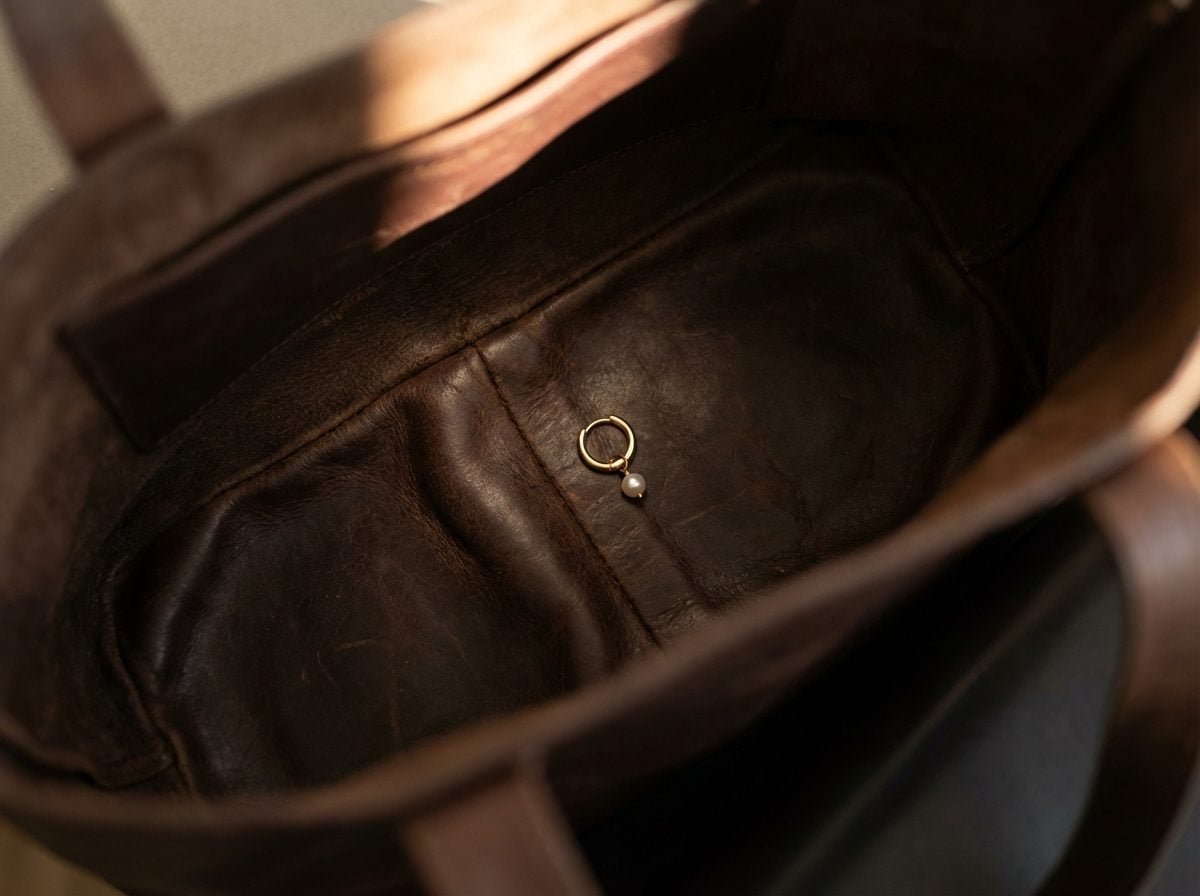
The half-used gift card. The folded receipt for something returned months ago. The single earring without its pair. These aren’t signs of carelessness. Psychologists who study how people relate to their possessions point to something called emotional attachment to objects, the way certain items become harder to discard because they carry a residue of meaning, or because letting go requires a decision that costs energy we don’t currently have.
The universal item isn’t a thing, it’s a tendency. Almost every woman’s bag holds at least one small piece of unfinished business. One object that hasn’t been decided on. And whether that single item represents an overdue phone call, an errand not yet run, or simply a moment when life moved faster than the ability to keep up, it sits there, faithfully, every day.
That, perhaps more than anything, is what therapists and psychologists have quietly noticed. Not the chaos. Not the weight. The one unanswered thing that travels everywhere you go.
The Bottom Line
The definitive answer therapists and organizational psychologists keep arriving at is this: a chaotic, overstuffed bag is rarely about disorganization, it’s a physical map of how much you’re holding that no one else can see. The weight, the clutter, the receipts you can’t let go of, the seventeen “just in case” items, they are stress made tangible, carried on your shoulder every day. The next time you dig through your bag in frustration, pause for a second and ask yourself not what needs to be cleaned out, but what needs to be put down.