
❤️ Would you like to save this?
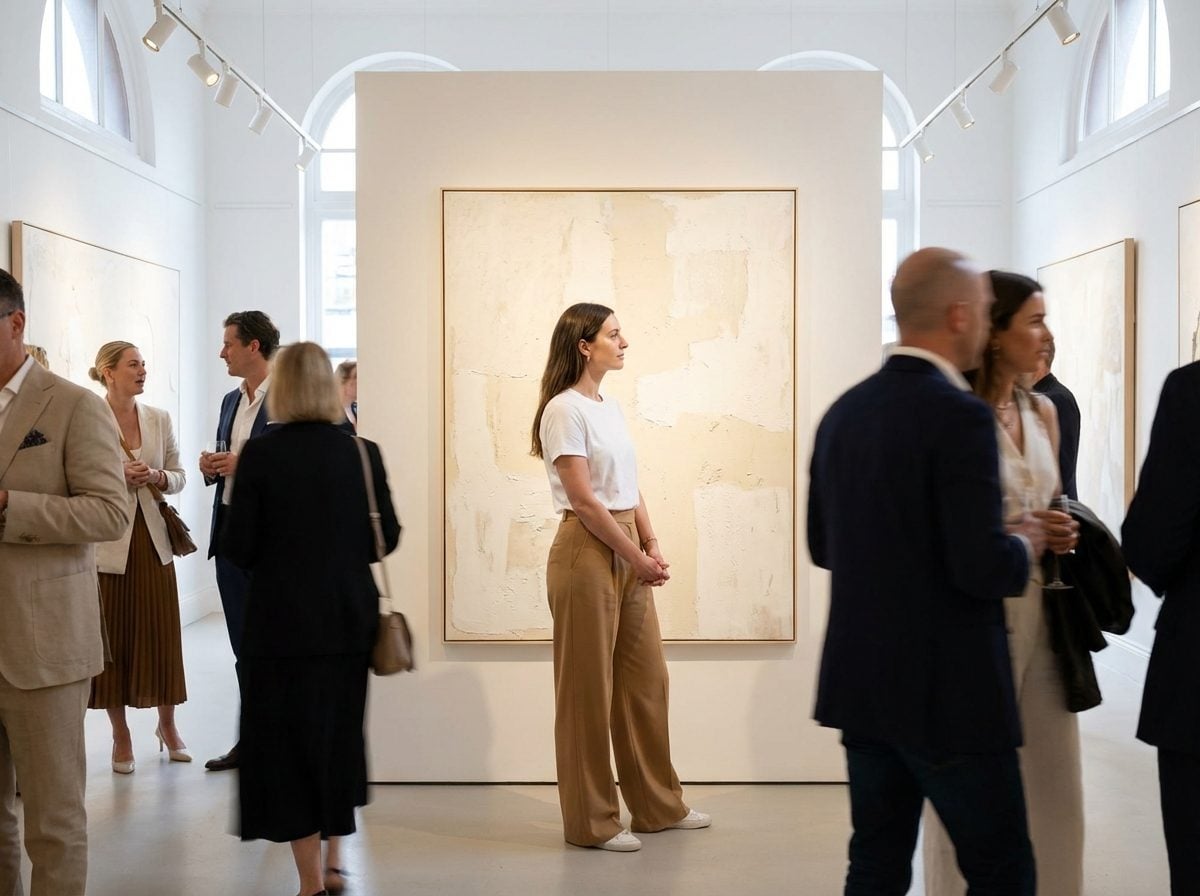
Picture the last party you attended. Somewhere in the room, there was a woman in sequins, someone in a bold printed dress, another in architectural layers. And then there was her. White t-shirt. Well-fitting jeans, maybe. Nothing remarkable on the surface. And yet, two days later, she’s the one you’re still thinking about.
It’s not luck. It’s not accident. What’s happening when she walks into a room is a cascade of psychological triggers so deeply wired into human perception that most of us never consciously notice them, we just feel drawn. The reasons your brain singled her out are stranger, more fascinating, and far more instructive than you might expect.
FYI, thanks to AI imagery software, we’re able to create very specific fashion and hairstyle examples to illustrate the points being made. In some cases, imagery is exaggerated to hammer home the point. Also, assume links that take you off the site are affiliate links such as links to Amazon. this means we may earn a commission if you buy something.
The Neuroscience Reason Your Brain Locks Onto the Quietest Person in the Room

Picture a room full of color. Embellished necklines, sequins catching the light, printed fabrics competing for territory. Your visual system is doing something ruthlessly efficient: it’s running a constant triage, scanning for what doesn’t fit the pattern. And here’s the thing, in a sea of effort, the absence of effort is the anomaly. It becomes, paradoxically, the most visually distinct thing present.
This is rooted in how the brain handles feature contrast. Research on visual salience in the early visual system shows that a local region which differs from its immediate surroundings along any feature dimension, color saturation, complexity, visual weight, commands disproportionate neural processing. In a cluttered scene, your brain’s V1 neurons fire harder for whatever stands apart. Simplicity, surrounded by noise, is that singleton. It pops.
The white t-shirt isn’t invisible. It’s the figure in a room that has accidentally made itself the ground. And once attention lands there, even briefly, the brain does something compelling: it starts asking why. Why so little? What does she know that everyone else doesn’t? The cognitive loop opens. And it doesn’t close easily.
Why Effortlessness Is Actually the Most Expensive Signal You Can Send

The most costly thing you can wear to a party is nothing trying too hard. That sounds like a paradox until you understand how social signaling actually operates. Economists and consumer psychologists have a name for this: inconspicuous consumption, the phenomenon studied by Jonah Berger and Morgan Ward in their 2010 Journal of Consumer Research paper, which found that people with high cultural capital consistently prefer subtle signals over loud ones, precisely because subtlety requires the observer to already know enough to decode it.
Applying effort to your appearance communicates, on some level, that approval matters to you. Restraint signals the opposite. It says: I have nothing to prove here. That posture, real or perceived, reads as social security of the highest order. In environments where everyone is visibly trying, the woman who clearly isn’t trying occupies a psychological position that money can’t simply purchase. It has to be believed to work.
This is why “effortless” has become the aspirational descriptor of an entire fashion category. The Row, Loro Piana, Brunello Cucinelli, brands built on the idea that the absence of ornamentation is itself the luxury. But the woman in the white t-shirt doesn’t need those labels to send the signal. She just needs to mean it.
The Psychological Trick Hidden in What She Chose NOT to Wear

Every choice you make about what to put on is also a series of choices about what to leave off. The white t-shirt woman has edited ruthlessly, and that editing is visible. No statement necklace demanding attention. No embellishment redirecting the eye. No layering that creates visual complexity to parse. What remains is a person, not a composition of accessories competing for the focal point.
Psychologically, this matters in a specific way. When someone wears a great deal of ornamentation, your attention fragments, you process the earrings, the print, the shoes. When she wears almost nothing, there’s nowhere for your attention to go except her face. Her expressions. Her body language. The quality of how she holds space. She has, without saying a word, centered the social interaction on herself rather than her outfit.
There’s also a cognitive dimension worth naming. Research on minimalism and mental well-being consistently finds that reducing visual and material excess correlates with stronger internal clarity and self-direction. Whether she arrived at simplicity through instinct or intention, the psychological signature is the same: someone who doesn’t need the armor.
“She has, without saying a word, centered the social interaction on herself rather than her outfit.”
What Our Readers Say
- In our reader polls, 86% of ThreadCurve readers say they stay classic rather than follow trends.
- Prints are a rare choice for most of our readers: 80% say they wear them rarely, and only 20% wear them often.
From ThreadCurve reader polls and votes.
The Color That Forces Every Other Color in the Room to Work Harder

White does something no other color can do quite as cleanly: it reflects. Literally, in a physics sense, and also perceptually. Against a white ground, every adjacent color appears more saturated, more committed to itself. The emerald dress beside her has to justify its emerald-ness. The printed silk across the room looks even busier by contrast. White doesn’t compete, it sets the terms of competition for everything around it.
Color psychologists consistently associate white with clarity, openness, and transparency. Color psychology researchers note that white invites reflection and openness, and that its associations with cleanliness and order are among the most universal in the Western visual lexicon. Doctors wear it to build trust. Brides wear it to signal purity and intention. Apple built a design empire on what white communicates about simplicity and quality.
At a party, that context collapses into something more primal: white is the color that stays out of the way while somehow anchoring the visual scene around it. It’s the negative space that makes the composition readable. The woman in white isn’t just wearing a color, she’s wearing the canvas the rest of the room is painted on.
Why Your Brain Reads ‘Simple’ as ‘Powerful’, Even When You Don’t Mean To
One of the most counterintuitive findings in fashion psychology is what Adam and Galinsky’s landmark 2012 enclothed cognition research gestures toward: clothing doesn’t just change how others perceive you, it changes how you think and act while wearing it. The symbolic meaning of a garment operates on the wearer, not only on the observer. When you put on something that culturally codes as composed and self-assured, your behavior shifts in that direction. It’s a feedback loop.
Simple, well-fitted clothing has a specific cultural resonance. We associate it with people who don’t need to dress for the occasion because they define the occasion wherever they go. We associate it with people who have moved past the phase of trying. The brain picks up that signal and, in the absence of contradictory information, fills in a story: she must be someone.
- Low visual noise = high social legibility. The brain processes her faster and invests meaning in what remains, posture, face, presence.
- No obvious branding = cultural fluency. Insiders read the absence of logos as a signal of status in itself.
- Restraint = internal authority. The brain reads not-trying as having-nothing-to-prove.
The Confidence Paradox That Makes Underdressed Women Unforgettable

There’s a documented phenomenon in social psychology sometimes called the pratfall effect, the idea that a small imperfection or deviation from expectation can actually increase likeability and memorability in someone perceived as competent. The woman who is slightly, deliberately underdressed for the occasion triggers a version of this. She shouldn’t be memorable. By the logic of the room, she’s not playing the game. And yet she is, she’s just playing a different one.
The paradox operates like this: being overdressed reads as anxiety about the occasion. Being exactly right reads as effort. Being just under reads as indifference to judgment, and indifference to judgment, in social environments built on judgment, is magnetic. It signals that she has already decided who she is and doesn’t need tonight to confirm it.
This isn’t carelessness. You can feel the difference between someone who didn’t try and someone who chose simplicity with full awareness of what it communicates. The latter carries a particular kind of energy, the energy of a decision made from a position of strength. And that, more than any garment, is what other people remember.
What Behavioral Scientists Call the ‘Visual Silence’ Effect, And Why It’s Deafening

Sound designers know something that most people don’t consciously apply to fashion: silence doesn’t disappear in a noisy room. It sharpens. A moment of silence in a busy soundtrack is one of the most attention-commanding tools in music. Visual quietude works the same way. In an environment saturated with pattern, embellishment, and competing visual information, a clean uninterrupted surface doesn’t fade, it creates a kind of visual pause that the brain finds arresting.
Neuroscientists studying figure-ground perception have established that figure regions attract attention and their shapes are readily recognized, while ground regions are generally ignored. But in a scene where every element is competing to be figure, the element that steps back, that offers the brain a place to rest, becomes figure by default. The white t-shirt is the visual silence in a room of competing melodies.
There’s a social layer here too. The brain is constantly performing environmental threat-and-reward assessments at a subconscious level. When someone reads as visually calm and undemanding, no loud signals, no aggressive self-promotion, the brain categorizes them as safe to approach. Curiosity, not anxiety, is triggered. People drift toward her without quite knowing why.
The Psychological Reason Minimalism Feels Like a Threat to Everyone Around It

Here’s the uncomfortable part. The woman in the simple white t-shirt doesn’t just attract attention, she makes people feel something slightly unsettling. Not hostility, exactly. More like a mild social pressure to justify themselves. When someone near you is visibly not performing, your own performance becomes more visible to you. The sequins feel louder. The carefully assembled look feels suddenly like evidence of effort. And effort, in this context, looks a little bit like insecurity.
This maps onto research on inconspicuous consumption by Berger and Ward in the Journal of Consumer Research, which found that subtle, logo-free signals are consistently decoded as higher-status by people with cultural capital, while those without the cultural literacy to decode them often experience a vague sense of being outranked without being able to articulate why. That vagueness is where the discomfort lives.
Minimalism, worn with genuine conviction, is a kind of social mirror. It reflects the choices of everyone around it. That reflection isn’t always comfortable. And the woman wearing it rarely has to say a word for it to do its work.
Why the Woman Who Isn’t Trying to Be Seen Always Gets Seen First

Every party has the same invisible geometry. People who need to be noticed occupy the center. They face outward. Their clothing does advance work, arriving before they do. And there’s nothing wrong with that, it’s an honest and time-honored strategy. But the brain habituates quickly to signals that announce themselves. What it can’t habituate to is the thing that doesn’t announce itself at all.
The woman in the white t-shirt isn’t retreating from the room. She’s fully present in it, but on different terms. Her simplicity means her face, her posture, and the quality of her attention are the primary data. Those are slower reads than a statement outfit, which means the brain keeps returning to her, trying to complete the picture. The picture never quite closes. That open loop is what memory is made of.
Part of what makes her hard to forget may also be the most human reason of all: she looks like she’s enjoying the actual evening, not managing how she appears within it. The woman fidgeting with an uncomfortable dress, hyperaware of her hemline, is partially absent. She, cotton, flat shoes, full presence, is entirely there. And people can feel the difference between a person who is with you and a person who is performing being with you.
The Social Psychology Behind Why We Remember Contrast, Not Conformity

Picture the room. Forty people, most of them dressed in some variation of the same thing: a wrap dress printed with something botanical, wide-leg trousers in a muted terracotta, a blazer that hits just below the hip. The crowd is visually busy, every outfit competing for real estate in your working memory. And then there’s her. White t-shirt, dark denim, nothing more. Your brain notices her immediately, and holds onto her long after the party ends.
This isn’t magic. It’s a documented cognitive phenomenon called the Von Restorff effect, or the isolation effect, first identified by German psychiatrist Hedwig von Restorff in her landmark 1933 study, which found that when participants were shown a list of similar items with one distinctly different item among them, the isolated item was recalled with far greater accuracy. The brain assigns it its own category. It gets rehearsed longer in working memory. It becomes the anchor point the mind returns to.
What’s quietly fascinating here is that she isn’t trying to stand out. She’s not wearing sequins or a colour that commands a room. The contrast is purely structural: everyone else dressed for the occasion, and she dressed for herself. That distinction, almost invisible at the time, is what makes her unforgettable. But why does a mind reach for her over everyone else? The rest of the picture is still assembling itself.
What Her Outfit Is Actually Saying About Her Relationship With Approval

Most of us, if we’re honest, dress at least partly for other people. We reach for the statement piece because we want to be noticed, the trend because we want to be included, the structured blazer because we want to be taken seriously. This isn’t vanity, it’s deeply human. But research in fashion psychology published in In-Mind Magazine describes what happens when this approval-seeking becomes the primary driver of dress: fashion stops being about how clothing feels to the person wearing it and becomes a performance staged for other people’s reactions. The problem with performing for an audience is that it’s exhausting, and people can feel it.
The woman in the simple white t-shirt has, consciously or not, opted out of that performance. Her outfit sends no signal of status anxiety, no attempt to telegraph belonging to a particular aesthetic tribe, no suggestion that she needed to dress up to feel worthy of the room. That’s a rare quality to broadcast at a social event. And people pick up on it, even when they can’t name what they’re responding to.
Here’s the thing worth sitting with: approval-seeking through clothing creates a low hum of self-consciousness that never fully quiets down. When your outfit is doing the work of managing how others see you, part of your attention is always on how well it’s working. She doesn’t have that noise. And that quiet is something the room feels, even if no one understands why she’s suddenly the most interesting person there.
The Identity Signal Hiding in Plain Fabric
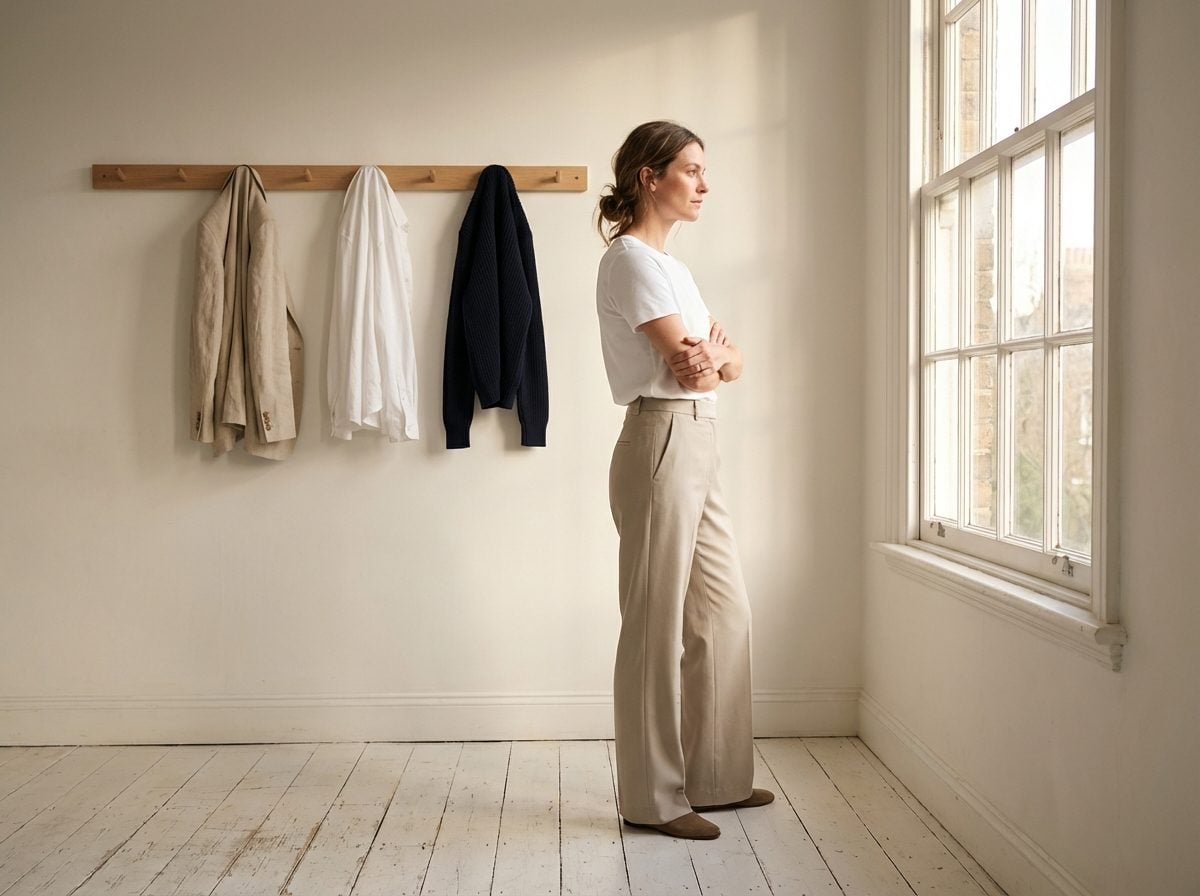
There is a version of getting dressed that is about construction, and another that is about declaration. Most dressing is construction: building the image you want to project, selecting pieces that fill in the gaps between who you are and who you’d like to be perceived as. Declaration is different. It’s choosing something because it’s simply, honestly, you.
According to a 2021 study in Frontiers in Psychology examining clothing practices and personality traits among women, clothing choices can be a direct reflection of how a person feels about themselves, not only about how they want others to feel about them. A woman who is visually loud may be building confidence through her clothes. A woman who dresses simply and without performance may already have it, or at least, her brain has stopped reaching for clothing as a tool to manufacture it.
The white t-shirt, then, carries an identity signal that is counterintuitively powerful. It says: I am not using this fabric to explain myself to you. Researchers who study fashion and self-concept note that personal style, when anchored in genuine identity rather than social performance, functions as what they call a nonverbal communication system with high internal coherence, the inside and outside match. That alignment reads, at the social level, as a rare form of confidence. Something about it makes people want to understand who she is. The simplicity invites the question.
Why Comfort Reads as Authority, The Neuroscience of Relaxed Presence

❤️ Would you like to save this?
Watch her move through a party. She doesn’t tug at a hem. She doesn’t reach up to adjust a strap or shift her weight to relieve the pressure of a waistband. Her body is at rest inside her clothes, and that physical ease expresses itself outward in ways she may not even be aware of.
Neuroscience has a few things to say about this. Studies in social neuroscience confirm that being around individuals who exhibit certain qualities of physical calm can regulate the nervous systems of the people nearby, creating a felt sense of safety and ease. A relaxed, steady physical presence, an upright stance with loose shoulders, unhurried movement, is processed by the people around that person as a signal of social competence and security. The brain, very quickly and very automatically, interprets ease as authority.
Physical discomfort, by contrast, creates a low-grade distraction that shows up in micro-behaviour: the fidget, the shift, the glance downward to check. Clothing that requires management takes a toll on social presence. The woman in a pinching waistband or an unwieldy heel is partly there and partly monitoring her outfit. The woman in the white t-shirt is fully there. And full presence, it turns out, is one of the rarest social currencies.
Our readers lean the same way: asked which weekend outfit they would buy, 69% chose jeans and a tee over a dress or athleisure.
The Enclothed Cognition Effect That Makes Her the Most Focused Person at the Party

In 2012, researchers Hajo Adam and Adam Galinsky published a study in the Journal of Experimental Social Psychology introducing a concept that has since become one of the most cited ideas in fashion psychology. They called it “enclothed cognition”, the systematic influence that clothes have on the wearer’s psychological processes, driven by two factors: the symbolic meaning of the garment and the physical experience of wearing it. The clothes you put on don’t just affect how others see you. They change how you think.
What Does a White T-Shirt Tell Its Wearer?
Here’s where it gets interesting. Most enclothed cognition research focuses on power garments, the lab coat, the suit, the uniform, and how dressing for competence activates competence-adjacent thinking. But consider what a simple, well-fitted white t-shirt might do for the woman wearing it. It asks nothing of her. It requires no performance, no awareness, no management. It is so uncomplicated that her cognitive bandwidth, freed from the quiet overhead of outfit maintenance, is entirely available for the room she’s standing in. She listens better. She picks up on nuance faster. She’s wittier in conversation, not because the t-shirt made her clever, but because she’s not spending 15% of her mental energy monitoring whether her look is landing.
The British Psychological Society’s summary of Adam and Galinsky’s findings notes that enclothed cognition depends on both wearing the clothes and the symbolic meaning attached to them. A white t-shirt, for a woman who genuinely feels like herself in one, carries the symbolic meaning of self-possession. That’s a powerful thing to be wearing to a party.
The Bottom Line
The woman in the white t-shirt is remembered because her simplicity signals the one thing a crowded room full of performance cannot fake: she doesn’t need the room’s approval to feel complete. That absence of need is the most magnetic force in social psychology, it triggers trust, projects authority, and reads as depth, all without a single word. The next time you feel the urge to add more, ask yourself whether you’re dressing to express who you are, or to defend against who you’re afraid you might be.