
❤️ Would you like to save this?
According to a 2012 study published in the Journal of Experimental Social Psychology, what we wear literally changes how we think and perform. So when getting dressed feels fraught, everything downstream shifts too. The reasons behind that Sunday morning spiral run deeper than most women realize, and they have almost nothing to do with clothes.
FYI, thanks to AI imagery software, we’re able to create very specific fashion and hairstyle examples to illustrate the points being made. In some cases, imagery is exaggerated to hammer home the point. Also, assume links that take you off the site are affiliate links such as links to Amazon. this means we may earn a commission if you buy something.
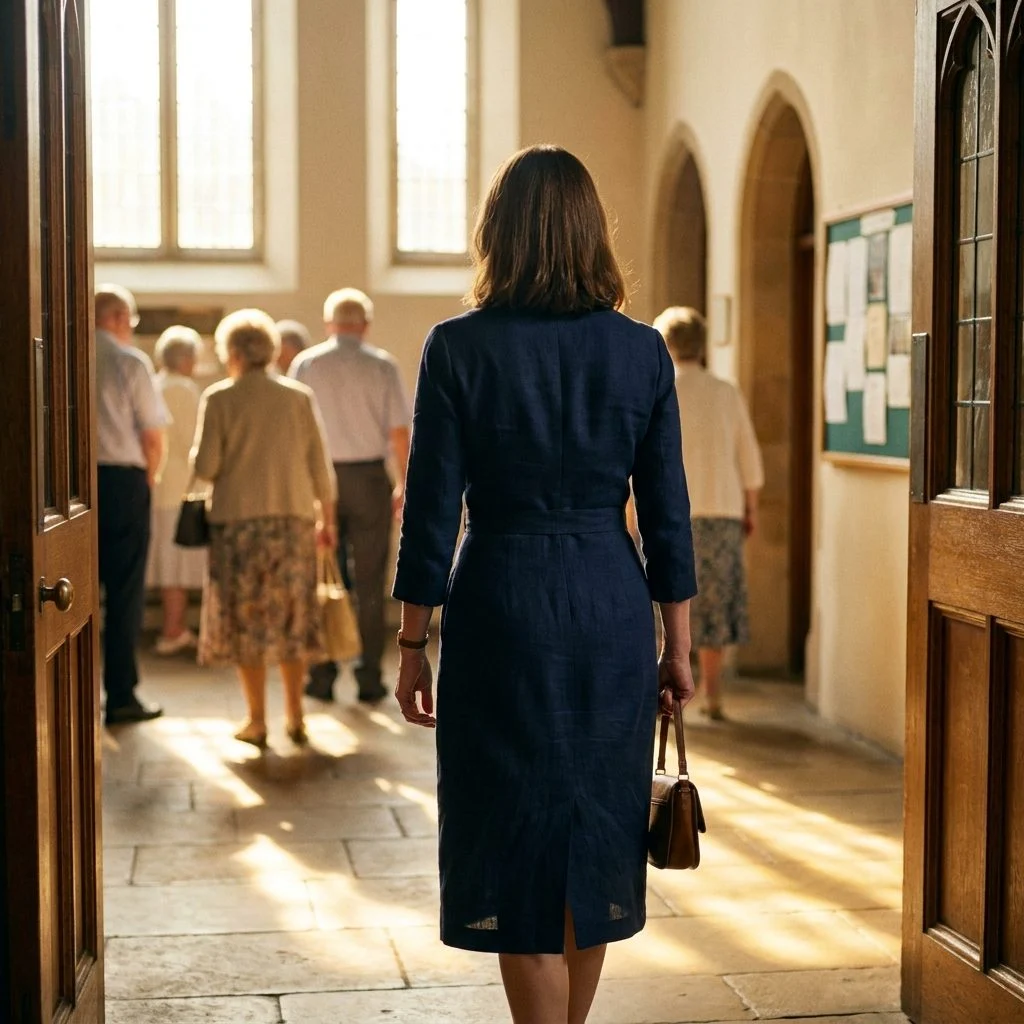
The Invisible Audience That Follows You Down the Center Aisle

Here’s something I got wrong for years: I thought the dread of walking into Sunday service was about the outfit itself. It’s not. It’s about the eyes. A church sanctuary is one of the few remaining social spaces where a woman physically walks past rows of seated, forward-facing people who have nothing to do but watch her approach. It mimics, almost perfectly, the conditions psychologists use to trigger what’s called self-objectification: the shift from experiencing your body as your own to viewing it from a third-person perspective, like a thing on display.
In Fredrickson and Roberts’ objectification theory, this happens when women internalize an observer’s perspective of their physical selves, leading to heightened body shame and appearance anxiety. Source. Their landmark 1998 study found that simply wearing a swimsuit (versus a sweater) was enough to increase body shame and even diminish cognitive performance in women. The center aisle of a church functions as a low-grade version of that same exposure: you’re visible, you can’t hide behind a table or a screen, and you know people can see you from the waist up, the waist down, every angle. That awareness alone shifts your brain into monitoring mode.
Why Your Brain Treats the Church Foyer Like a Performance Stage, and What That Does to Your Outfit Choices

The foyer is the problem, not the pew. By the time you’re seated, the worst is over. But those four to seven minutes of standing in the church lobby, holding a coffee, making small talk with women you see exactly once a week, is where the real psychological pressure builds. And there’s a name for the mechanism driving it.
UCL anthropologist Daniel Miller, in his research on fashion and anxiety, found that “individuals do not really know what they like, or what their taste in clothing is, at least outside of various social and institutional supports that give them the confidence that they do know.” Source. The church foyer strips away those supports. You can’t adjust lighting. You can’t curate an angle. You’re standing in fluorescent or harsh morning light, surrounded by women whose opinions you half-value and half-fear, and there is no exit that doesn’t look like retreat.
This is why women over 40 often describe church outfit selection as requiring more mental energy than dressing for a dinner party or even a job interview. A dinner party has wine. An interview has a clear dress code. The church foyer has unspoken rules that nobody wrote down but everyone somehow knows.
The Specific Body Part Most Women Over 40 Try to Hide First (and the Psychological Cost of Covering It in July)

Arms. It’s almost always arms.
I say this as someone who spent two entire summers in three-quarter sleeves before admitting what I was doing. And the research backs up the instinct, if not the strategy. Frith and Gleeson (2008) noted that women often use clothing to manage their body’s appearance and feelings of bodily anxiety, with Kwon and Parham (1994) finding that women choose clothing for camouflage over self-expression when they feel dissatisfied with their bodies. Source. Upper arms occupy an unusual psychological position for women over 40: they’re one of the first places to show visible change from aging, they’re impossible to hide in summer without overheating, and they exist in a cultural dead zone where showing them reads as “trying too hard to be young” to some audiences and “letting yourself go” to others.
The cost of covering them in July heat isn’t just physical discomfort, though that’s real enough. It’s cognitive. Every time you tug a sleeve down or check whether the fabric is clinging, you’re spending mental resources on body monitoring instead of, say, actually listening to the sermon or enjoying the company of people you care about. That mental tax is cumulative, and by the time you get home, you’re not just warm. You’re exhausted in a way that has nothing to do with the temperature.
The ‘Modesty Paradox’ That Makes Summer Dressing Feel Like an Impossible Equation
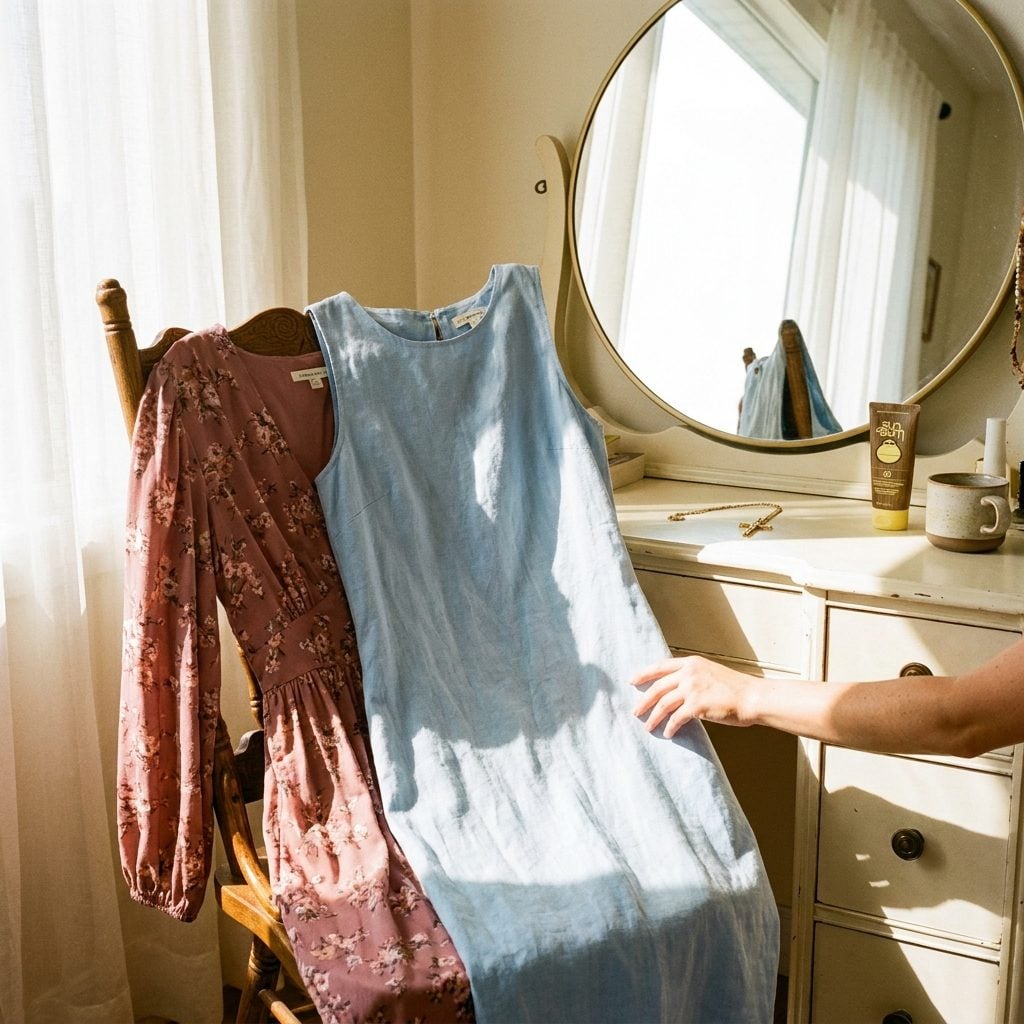
Something nobody talks about enough: for women over 40 in many church communities, summer creates a dress code conflict that is genuinely unsolvable. Cover more skin and you look “appropriate” but overheat, feel matronly, and signal that you’ve surrendered to someone else’s definition of your body. Reveal more skin and you risk silent judgment, unwanted attention, or the uncomfortable feeling that you’ve crossed a line only you can sense but can’t articulate.
This is a paradox in the truest psychological sense. Research on clothing and religiosity from a 2024 study published in Frontiers in Psychology (Source) found that body image research often overlooks the role of clothing in fostering body appreciation. The study explored both secular and religious women and discovered that clothing functions can shift when examined through a body-positive lens, but the modesty expectations of religious contexts often override that shift entirely.
The paradox intensifies with age. A 25-year-old in a sundress at church might get a raised eyebrow. A 48-year-old in the same dress gets a whole narrative projected onto her: is she dressing too young, is she trying to prove something, has she given up caring what people think? The math doesn’t balance because it was never designed to.
Why the Mirror Lies to You More on Sunday Morning Than Any Other Day of the Week

You looked fine ten minutes ago. Then you grabbed your Bible, your keys, your bag, and glanced at the hallway mirror one more time, and suddenly everything was wrong. The hemline was weird. The color washed you out. Your arms looked different than they did in the bedroom. This isn’t vanity and it isn’t madness. It’s a well-documented perceptual distortion that intensifies under conditions of anticipated social evaluation.
According to Psychology Today’s overview of social comparison theory (Source), as much as 10 percent of our thoughts involve comparisons of some kind. On Sunday morning, those comparisons spike because you’re about to enter a closed social group where everyone shares a reference point for how “a woman like you” should look. That anticipation warps your self-perception before you ever leave the house. Perimenopause can intensify this further: the neurochemical shifts of midlife have been shown to directly increase anxiety, self-criticism, and negative self-referential thinking. Source.
The Social Comparison Trap That Activates the Moment You Pull Into the Parking Lot

Leon Festinger’s social comparison theory, first published in 1954, proposed something that still stings: humans have a basic drive to evaluate themselves, and when objective measures aren’t available, they do it by comparing themselves to others. Source. The church parking lot is a social comparison laboratory. You pull in. You see Linda getting out of her car in that linen midi dress that drapes like it was made for her. You see the new pastor’s wife in something you couldn’t name but immediately want. And your brain, which was perfectly calm five minutes ago, starts running calculations you never asked it to run.
Festinger found that people tend to compare themselves most actively to those who are similar to them. Source. And that’s exactly what makes church comparison so vicious: these are women your age, your socioeconomic bracket, your community. They’re close enough that the comparison feels legitimate. A supermodel on Instagram is easy to dismiss. The woman in the third pew who’s your exact height and somehow looks ten years younger? That comparison lands.
The Forgotten Reason Your Mother’s Voice Still Edits Your Outfit at 45

Nobody warned me that at 46, reaching for a sleeveless top would trigger a voice that sounds suspiciously like my mother circa 1994, saying something like you’re not really wearing that, are you? And I will die on this hill: that voice is not about your mother. It’s about something psychologists call introjection, the process by which external authority figures become internal ones, their rules absorbed so deeply they feel like your own thoughts.
UCL research on fashion and anxiety found that the relationship between mothers and daughters around clothing is one of the most persistent sources of wardrobe anxiety in adult women. The anxiety generated by “knowing what to like” was visible in women who wanted to completely re-evaluate their wardrobes but kept circling back to their mothers’ preferences. Source. Church amplifies this because it’s one of the few places where generational style expectations collide in real time. Your mother may be sitting in the same room. Or her generation is. Either way, the editing loop activates.
The insidious part? You don’t hear it as her voice anymore. You hear it as your own taste, your own preference, your own “I just don’t feel comfortable in that.” But if you trace that discomfort back honestly, many women find it leads to a specific person, a specific correction, a specific look of disapproval from decades ago.
Why Sleeveless Anxiety Is Actually About Something Much Deeper Than Arms
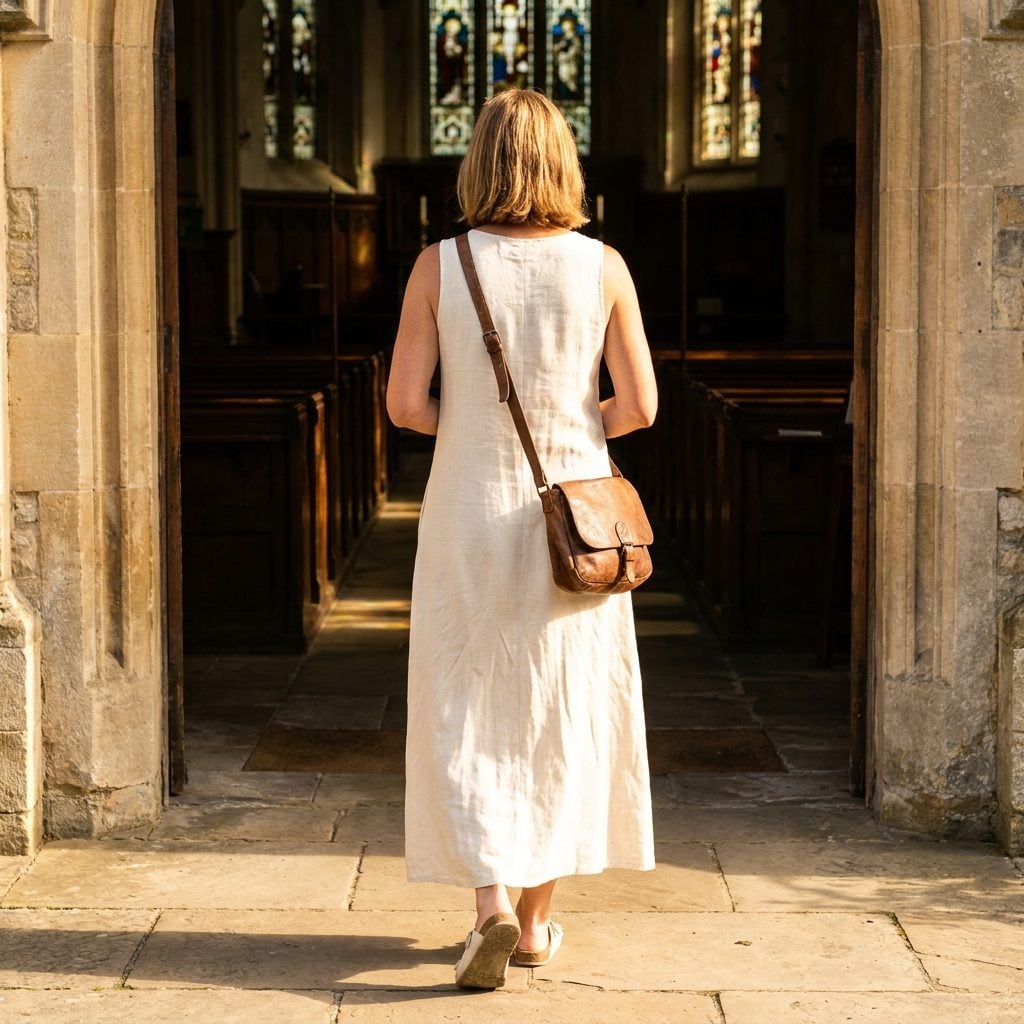
If the entire article has been assembling a puzzle, this is the piece that makes the picture click into focus, or at least sharpen: sleeveless anxiety isn’t really about arms. It’s about visibility. Specifically, it’s about whether a woman over 40 believes she has the right to take up space in a body that has changed.
The Mental Health Foundation found that older women may feel disconnected from their bodies as they age, because their external appearance no longer matches their internal sense of self. Source. That disconnect creates a specific kind of grief: you don’t feel old, but the mirror (and the church foyer, and the parking lot, and the pew) tells you the world sees you differently than you see yourself.
A 2020 study on postmenopausal women found that body image was a direct predictor of both depression and anxiety, with over 83% of participants experiencing mild to severe anxiety. Source. The black dress you default to every Sunday isn’t a style choice. It’s armor. And the sleeveless blouse you put back on the hanger isn’t about your upper arms being imperfect. It’s about the risk of being fully seen in a space that might not see you the way you see yourself.
Which is maybe the real answer to the article’s central question. The dread isn’t about the outfit. It never was.
The Temperature-Shame Conflict Your Brain Cannot Solve

Here’s the bind nobody talks about openly: your body is begging for bare arms, breathable linen, and as little fabric as possible. But the social context you’re walking into, a sanctuary of modesty and tradition, is asking you to cover up. Your brain literally cannot satisfy both demands at once, and it knows it.
Research in the social psychology of dress has shown that even thinking about wearing revealing clothing can increase body shame and self-objectification. According to a study published in the journal Fashion and Textiles (Source), the mere thought of wearing a bathing suit versus a sweater produced higher state body shame, higher body dissatisfaction, and more negative mood in female participants. Now translate that to a July Sunday when you’re standing in your closet, mentally negotiating between a sleeveless dress and a cardigan you know will make you sweat through the sermon. The negotiation isn’t between two garments. It’s between physical comfort and social safety, and there’s no outfit on earth that resolves it perfectly.
The Psychological Weight of Being ‘Appropriate’, and Who Actually Decides What That Means
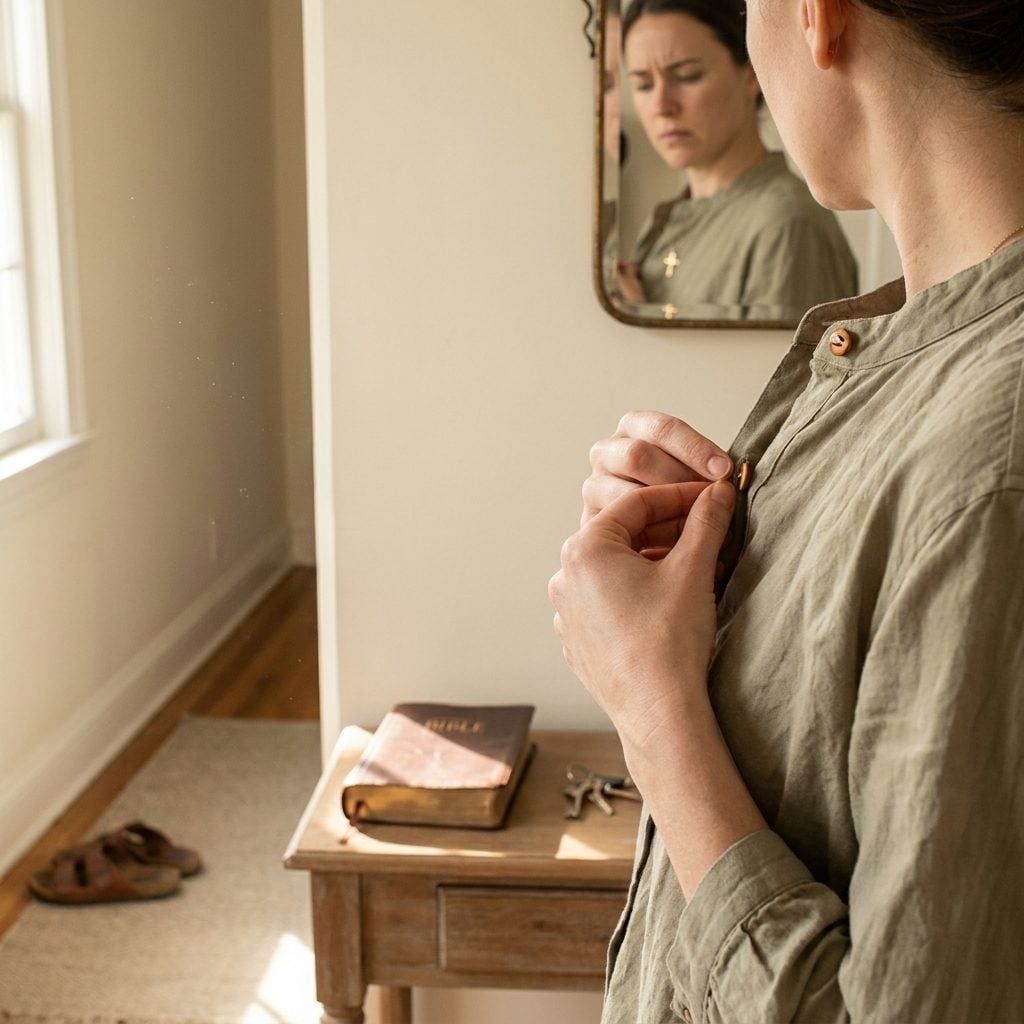
Nobody hands you a printed dress code when you join a congregation. The rules arrive through side-glances, through compliments that feel like corrections, through the silence that follows when someone shows too much collarbone. Psychologist Dawnn Karen calls this phenomenon fashion situational code-switching, and as noted, the definition of “appropriate” shifts dramatically depending on denomination, region, generation, and even the specific pew you sit in.
What makes this so psychologically taxing for women over 40 is the layering of expectations. You’re managing modesty norms inherited from your mother’s era, the more relaxed attitudes of younger congregants who show up in jeans, and your own shifting relationship with your body. A sociological study of women’s modest dress in religious contexts found that moral judgments about clothing “may be internalized” or “informally policed through social interaction,” according to Aune, Lewis and Molokotos-Liederman’s 2022 study in Sociology of Religion (Source). The policing is real, but it’s often invisible. And it falls disproportionately on women.
Why You Own 47 Summer Tops and Still Say You Have Nothing to Wear on Sunday

Forty-seven is probably conservative. Maybe it’s sixty. The point is, the closet is full and the feeling is empty, and this contradiction has a name. Psychologist Barry Schwartz calls it the paradox of choice: the more options we have, the harder it becomes to decide, and the less satisfied we feel with whatever we pick. A 2026 report from Vestiaire Collective surveying over 5,000 consumers found that 84 percent of respondents have experienced the “nothing to wear” feeling, despite owning an average of 100-plus items.
But Sunday morning amplifies this paradox in a specific way. Every other day of the week, you’re dressing for contexts where the stakes feel manageable: work has a uniform rhythm, errands don’t require deliberation, weekends are forgiving. Church compresses multiple psychological demands into a single outfit. It needs to say “I respect this space” and “I haven’t given up on myself” and “I’m not trying too hard” and “I’m comfortable in 95-degree heat,” all simultaneously. No wonder the cotton blouse you wore confidently to brunch last Saturday suddenly feels wrong at 8:45 on Sunday morning.
The Identity Collision That Happens When ‘Faithful Woman’ and ‘Aging Woman’ Share a Closet
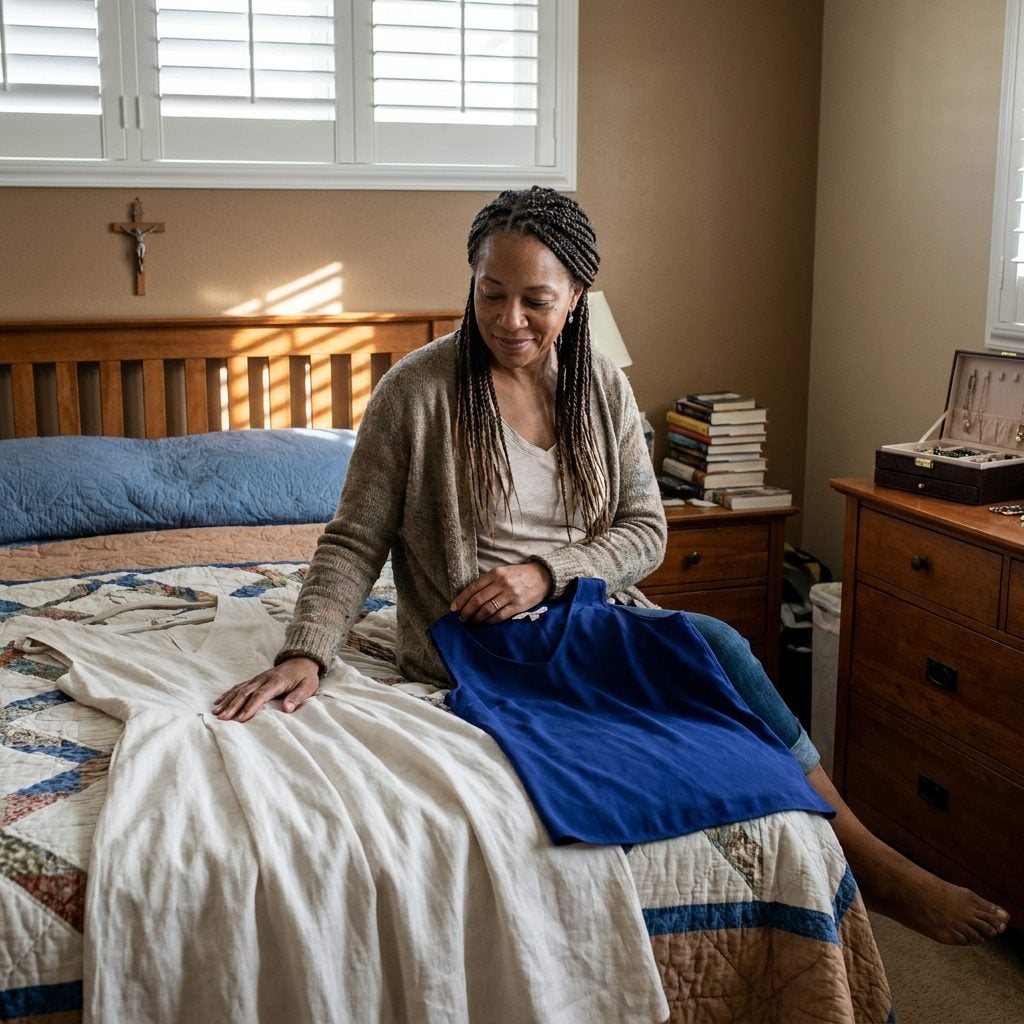
This one’s personal for me, because I spent a solid two years buying wrap dresses I never wore. They were “age-appropriate” and “church-friendly” and I hated every single one. I couldn’t articulate why until I realized I was shopping for a woman I thought I was supposed to become, not the one I actually am.
Here’s what’s happening underneath: after 40, women are navigating a slow collision between two identity narratives. One says your faith is deepening, your values are clarifying, and your presentation should reflect seriousness and humility. The other says your body is changing, the culture is telling you to become invisible, and every sartorial choice feels like either resistance or surrender. Research published in Frontiers in Psychology confirms that women use clothing to both present and disguise their bodies, and that these clothing practices are directly predicted by body image. When your body image is in flux, so is your closet. When your closet is in flux on the one morning a week that carries the most social weight, the dread makes perfect sense.
The collision isn’t between faith and vanity. It’s between two legitimate parts of yourself that haven’t figured out how to coexist in the same midi dress yet.
The 10-Second Judgment Window That Rewires How You Get Dressed
❤️ Would you like to save this?
You already know people judge quickly. But the science is more unforgiving than the instinct. Psychology Today reports that it takes a mere seven seconds to form a first impression, and those impressions lean heavily on how a person looks and sounds, more than their actual words. Psychologist Nalini Ambady’s foundational research on “thin-slicing” demonstrated that people form surprisingly detailed personality assessments from exposures of just a few seconds, with accuracy levels that barely improve even when given more time, as detailed in Simply Psychology’s overview of thin-slicing judgments in psychology (Source).
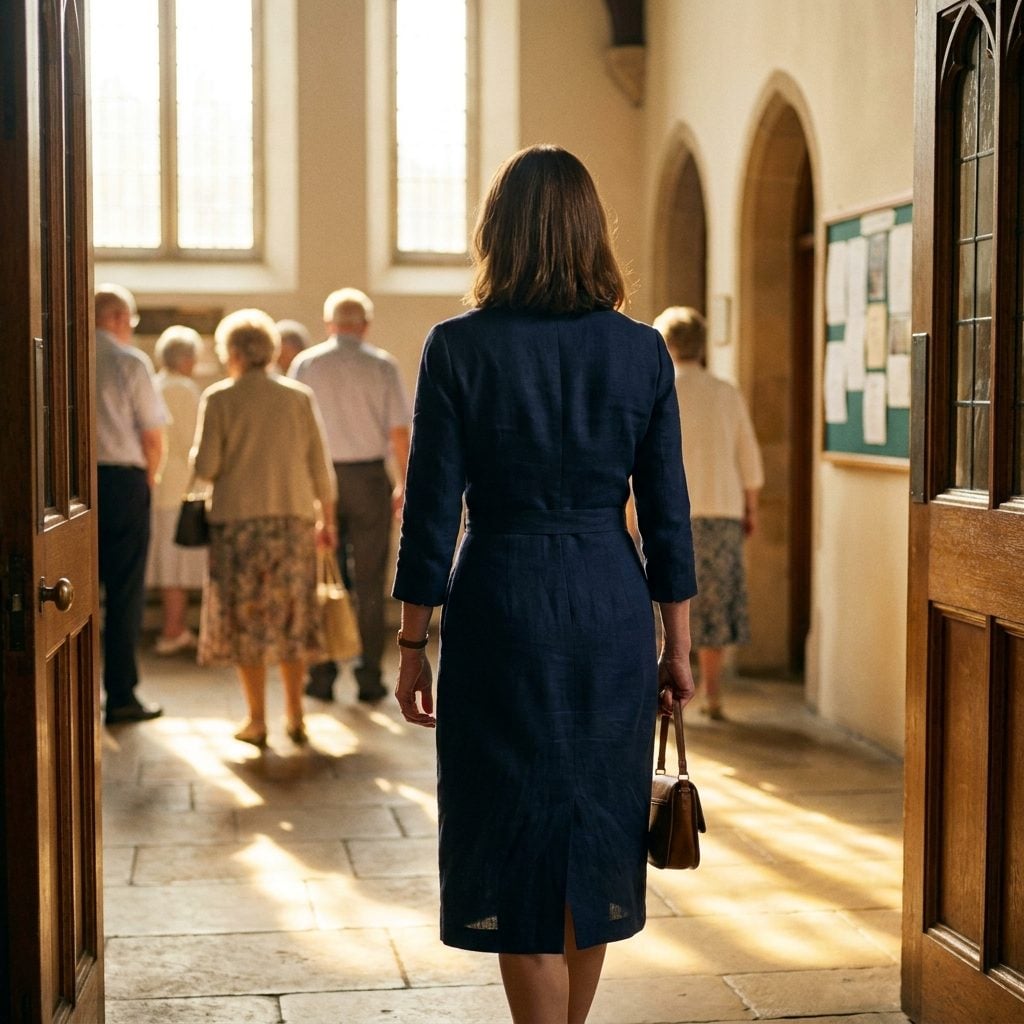
Now picture the church foyer. You walk through those double doors and you’re immediately thin-sliced by people who know your name, your family, your history. The stakes feel higher than a stranger’s glance on the street because these judgments happen inside a community you belong to. Your brain, well aware of this window, starts working backward: it reverse-engineers Sunday outfits not from what feels good, but from what will survive scrutiny during those first few seconds of eye contact in the narthex. I’ve done it. I suspect most of us have. That’s not vanity. That’s threat management.
Why the Women Who Seem Effortlessly Put Together on Sunday Are Fighting the Same Battle You Are

She’s sitting three rows ahead of you. Perfectly pressed linen pants, a structured linen blazer that somehow isn’t wrinkled, the right shoe, the right earring. She looks like Sunday morning dressing cost her nothing. And that perception alone is enough to make your own outfit feel like a mistake.
But research on fashion and self-perception tells a different story. According to an In-Mind article on the psychology of fashion (Source), when people choose clothes mainly to gain approval, they may feel “constantly observed, as if others are always judging how they look,” leading to more appearance anxiety and less confidence that their clothes reflect who they truly are. The woman who looks effortless is not immune to that loop. She may be deeper inside it.
The performance of ease is its own kind of labor
Confidence and composure read as ease from the outside. From the inside, they can be the result of trying on four outfits, rejecting three, and arriving just in time because the last mirror-check ran long. That polished pearl stud earring is doing the same psychological work for her that your own getting-dressed ritual is doing for you. The difference isn’t effort. It’s visibility of effort.
The One Mental Shift That Turns Sunday Morning Dread Into Something Closer to Freedom

I won’t pretend there’s one magic trick that makes a lifetime of internalized modesty rules and body-image arithmetic vanish before the opening hymn. There isn’t. But there is a concept from fashion psychology that genuinely changes the morning calculus, and it starts with asking a different question.
Instead of “What will they think?” the question becomes “How do I want to feel?” This isn’t motivational-poster advice. It’s grounded in the principle of enclothed cognition: the idea that what you wear directly influences how you think, feel, and behave. Hajo Adam and Adam Galinsky’s 2012 research in the Journal of Experimental Social Psychology (Source) demonstrated that clothing’s impact depends on both its symbolic meaning and the physical experience of wearing it. When you dress for how you want to feel rather than for how you want to be perceived, you’re leveraging the same mechanism, just pointing it inward instead of outward.
For women over 40, this shift is particularly potent because you actually have the self-knowledge to answer the question honestly. At 25, “How do I want to feel?” might have drawn a blank. At 45 or 55, you know. You know the silk scarf that makes you feel like yourself. You know the shoe that changes your posture. You know the color that makes you feel steady. That self-knowledge is the advantage no 25-year-old has, and it’s the thing that can, on a good Sunday, turn getting dressed from a negotiation into a small, private act of authority.
The Bottom Line
The reason getting dressed for summer church feels so disproportionately hard is that it’s the one weekly moment where your oldest wounds, about worthiness, belonging, aging, and being watched, all activate at the same time, in a space where you feel you cannot afford to get it wrong. It was never about the clothes. The next Sunday morning you stand paralyzed in front of your closet, try asking yourself one question before you reach for a single hanger: “Am I dressing for people who are judging me, or for a God who already isn’t?”