❤️ Would you like to save this?
You know that moment when you pull a dress off the hanger, hold it up to your body, and immediately put it back? The neckline sits wrong. The waist hits two inches below where your waist actually lives. The fabric clings to your hips like it has something to prove.
Getting dressed shouldn’t feel like solving a puzzle every morning.
The problem usually isn’t your body. It’s the silhouette. Specific cuts work with how bodies naturally change after 50, and others fight against it. A wrap that ties at the right spot. A structured layer that creates definition without squeezing. A hemline that actually accounts for real proportions.
These 33 combinations were designed with those parameters in mind. No runway proportions. No twenty-year-old models. Just practical outfits that let you wear dresses again without that nagging feeling that something looks off.
FYI, thanks to AI imagery software, we’re able to create very specific fashion and hairstyle examples to illustrate the points being made. In some cases, imagery is exaggerated to hammer home the point. Also, assume links that take you off the site are affiliate links such as links to Amazon. this means we may earn a commission if you buy something.
33. The Side-Tie Wrap in Steel Blue That Does the Work for You
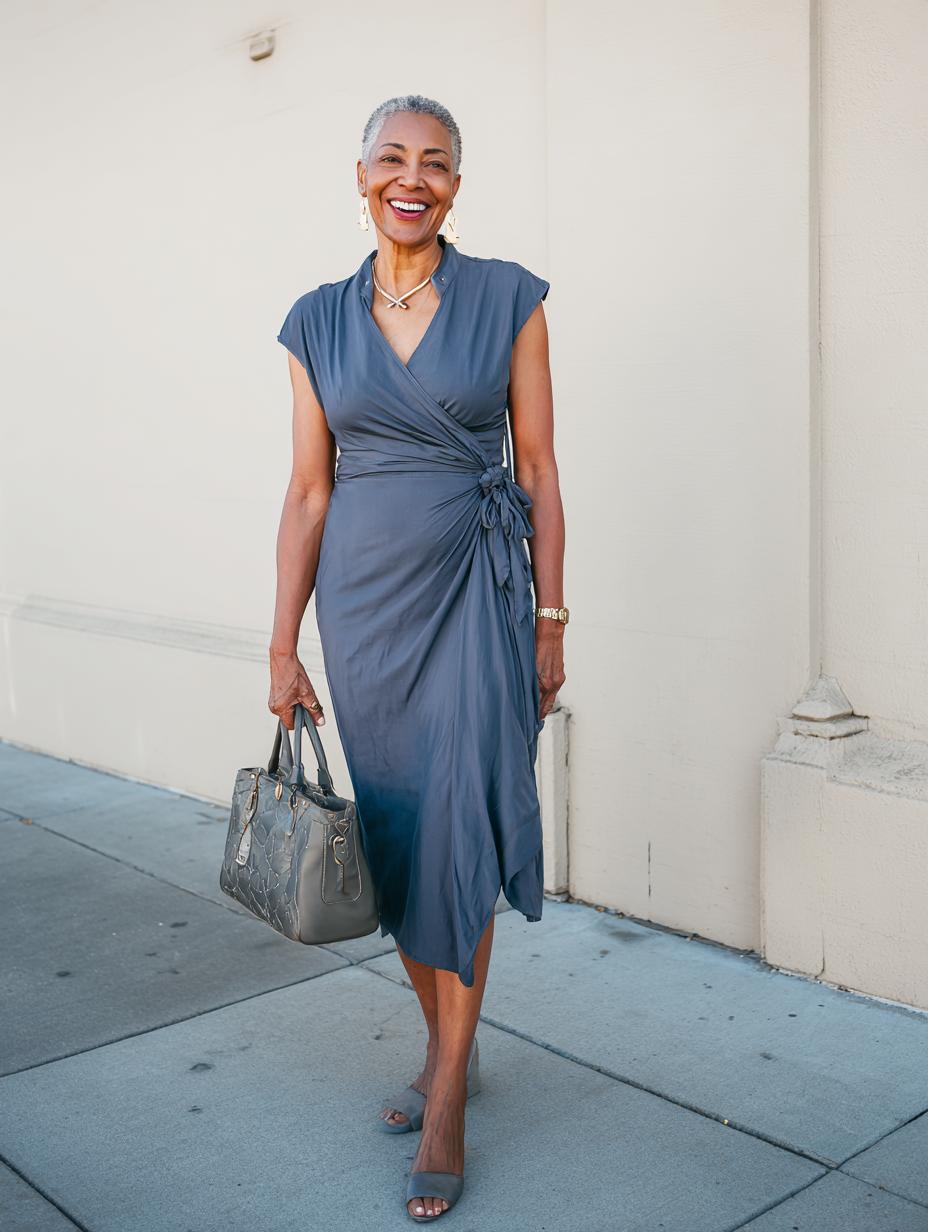
Notice where that fabric gathers at the hip with the rosette tie detail. That placement pulls focus toward a defined waist while the soft jersey falls away from the thighs without hugging them. Cap sleeves land at the shoulder’s widest point, which creates a clean horizontal line and makes arms appear balanced with the rest of your frame.
This muted slate blue functions as a neutral but carries more depth than black or navy would. Against her close-cropped silver hair and those geometric gold drop earrings, the cool undertone builds contrast without competing. The embossed dove gray tote keeps everything tonal. Nothing here is fighting for attention.
Wrap silhouettes create a diagonal line from shoulder to opposite hip. Your eye follows that angle naturally, which makes the body read as longer and narrower than it would in a straight-cut dress. The adjustable tie also means you decide exactly where your waist appears.
32. Navy Jersey and Layered Gold Chains Against Terracotta
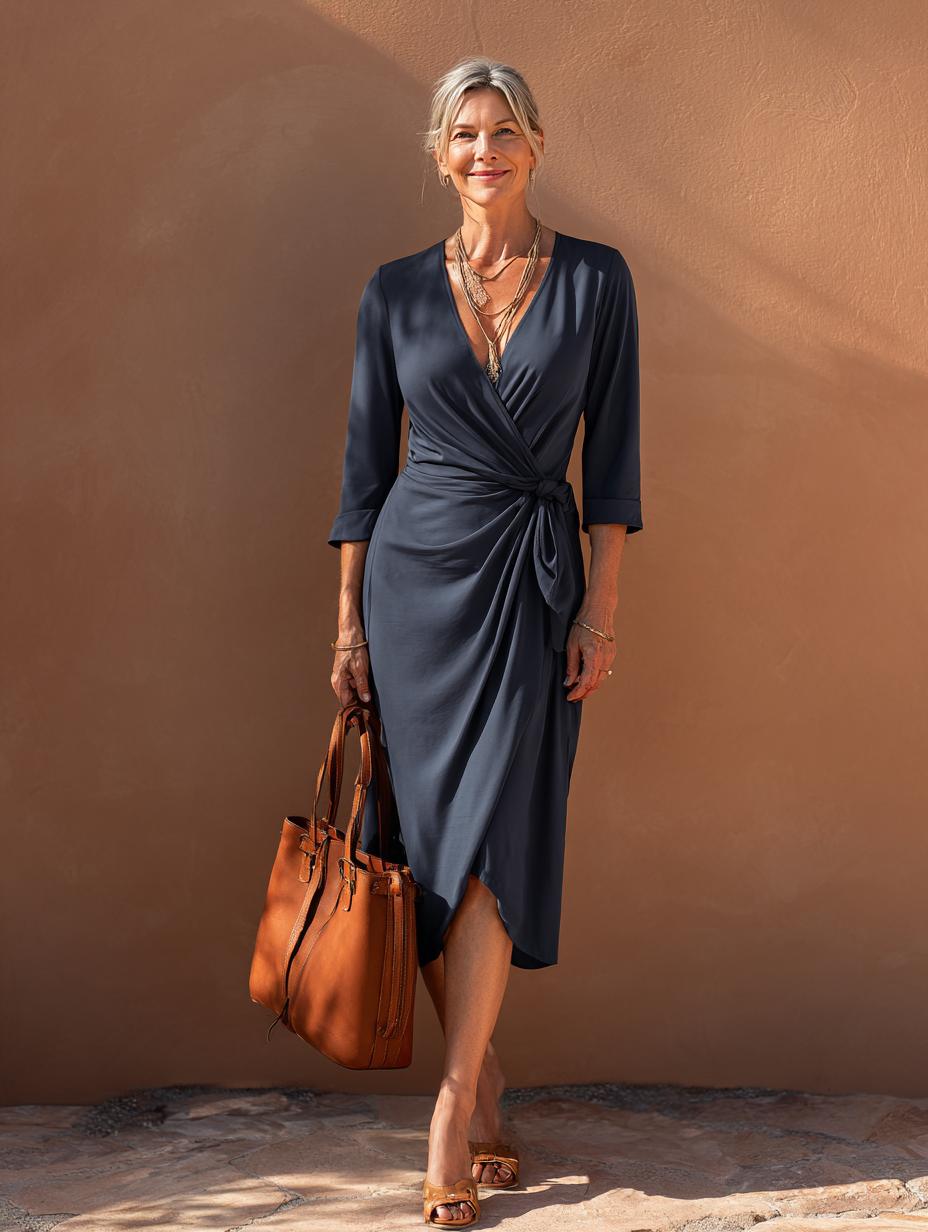
That V-neckline drops low enough to lengthen without revealing too much. The layered gold chains fill the space and pull your eye upward toward her face rather than down toward her midsection. Her warm brown strappy sandals and cognac leather tote bring the adobe wall behind her into the outfit itself, anchoring the cool navy in earthy tones.
Three-quarter sleeves land at the narrowest part of the forearm. This placement matters more than most people realize. Tailors use the same principle when they cuff a blazer just so.
The asymmetric hem adds movement when you walk. Static hemlines can make dresses feel stiff. This one has life in it.
31. How to Layer a Teal Midi With a Railroad Stripe Jacket
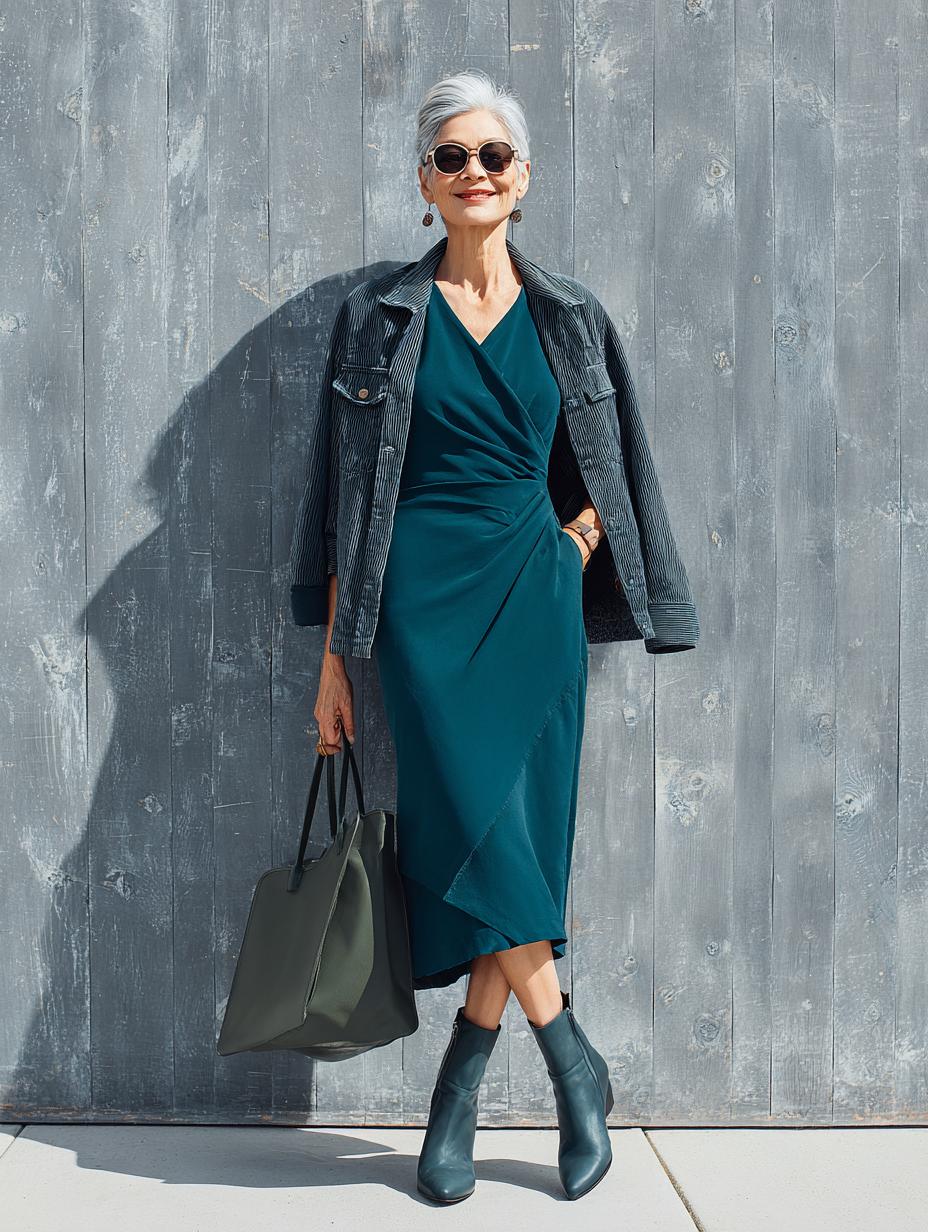
Draping that pinstripe railroad jacket over your shoulders creates vertical emphasis without the bulk of wearing it properly. Old styling trick. Still works. The deep teal beneath has that saturated jewel quality that holds up in person and photographs well. Her boots match the dress so closely they appear to be part of the same garment, which extends the visual line from hip to floor.
Against weathered gray wood planks, every color in this outfit reads clearly. The olive tote adds a slight military edge. Round tortoiseshell sunglasses soften what could otherwise feel too severe.
Diane von Furstenberg introduced the modern wrap dress in 1974. By 1976, she had sold over a million of them. The design targeted working women who needed to dress quickly, look professional, and adjust their fit throughout the day. Nearly fifty years later, the mechanics remain unchanged.
30. All Black, But Make It the Subject of Conversation
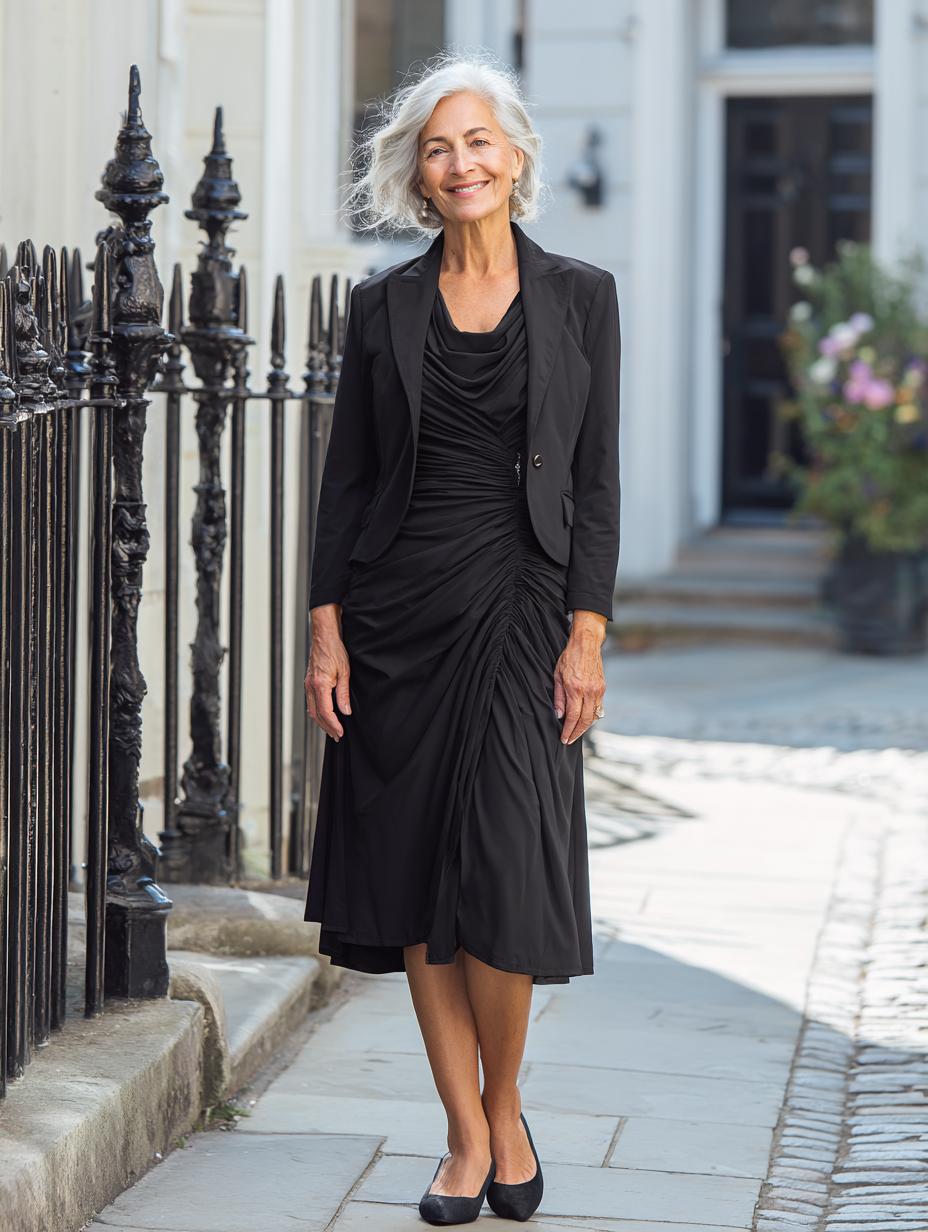
This is not the default black outfit you throw on when nothing else works. The cowl neckline creates soft folds across the chest, adding dimension where a crew neck would fall flat. That cropped blazer hits just above her natural waist, and the single button closure at center becomes an anchor point for the whole silhouette.
Her silver waves catch the light because nothing else competes for attention. That’s the real advantage of monochrome: your face becomes the subject.
Ruched detailing along the hip draws fabric inward rather than letting it hang loose. Behind her, ornate black iron fence creates repetition without distraction. Black flats keep the formality grounded in something wearable.
29. Cream and Taupe Stripes You Can Actually Wear to Lunch
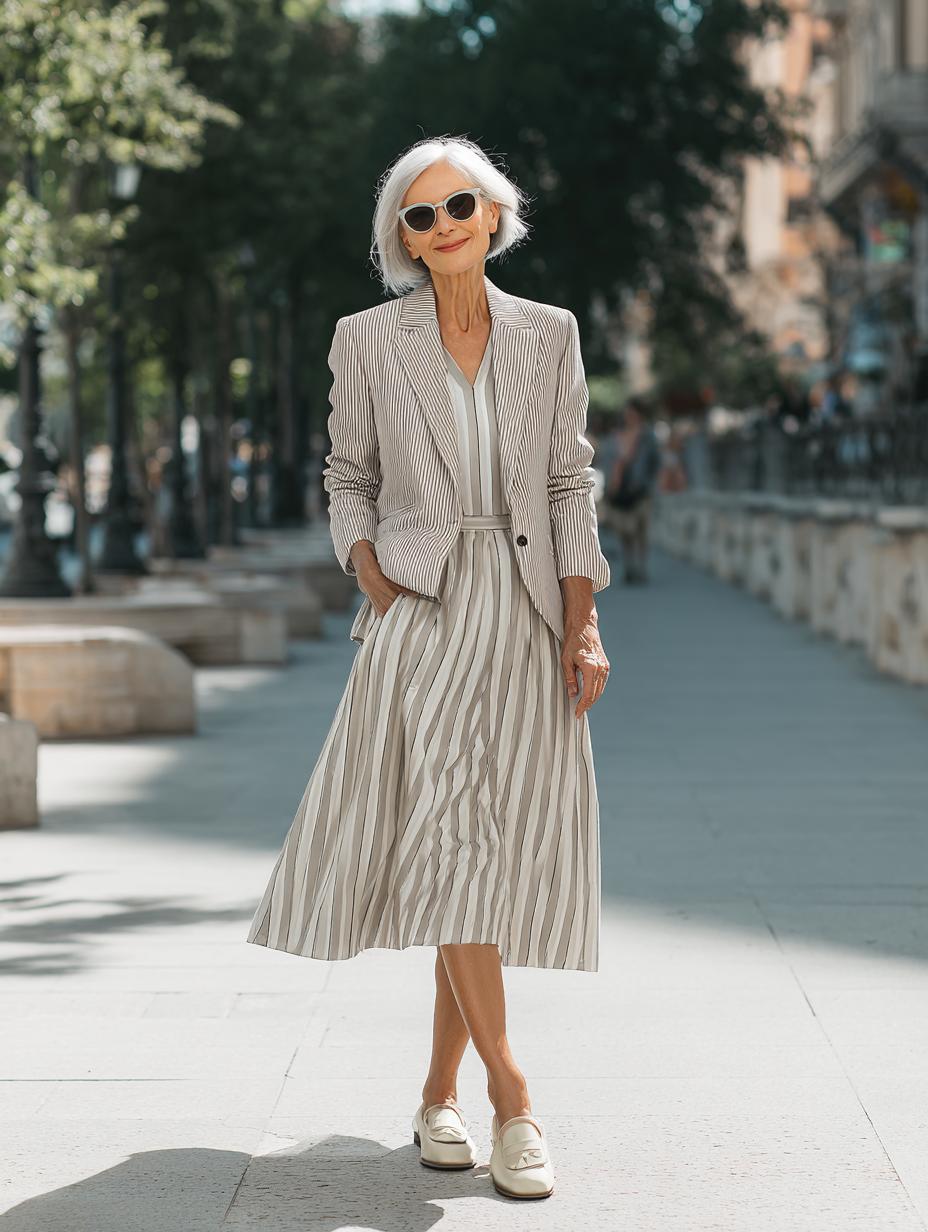
Matching your blazer to your skirt carries risk. Done poorly, it reads as a uniform. Here, the stripe width varies slightly between the two pieces, creating enough differentiation to feel intentional. Cream loafers pull the lighter stripe outward, grounding the whole look in that pale end of the spectrum.
White sunglasses are a specific choice. They’re not trying to disappear into the outfit. They’re punctuation.
Those pushed-back sleeves on the blazer show the lining, adding a small detail that signals she isn’t taking any of this too seriously. On a sun-drenched plaza with stone benches and leafy trees, this palette belongs.
28. Open Cardigan Over a Navy Shift Creates Three Vertical Lines
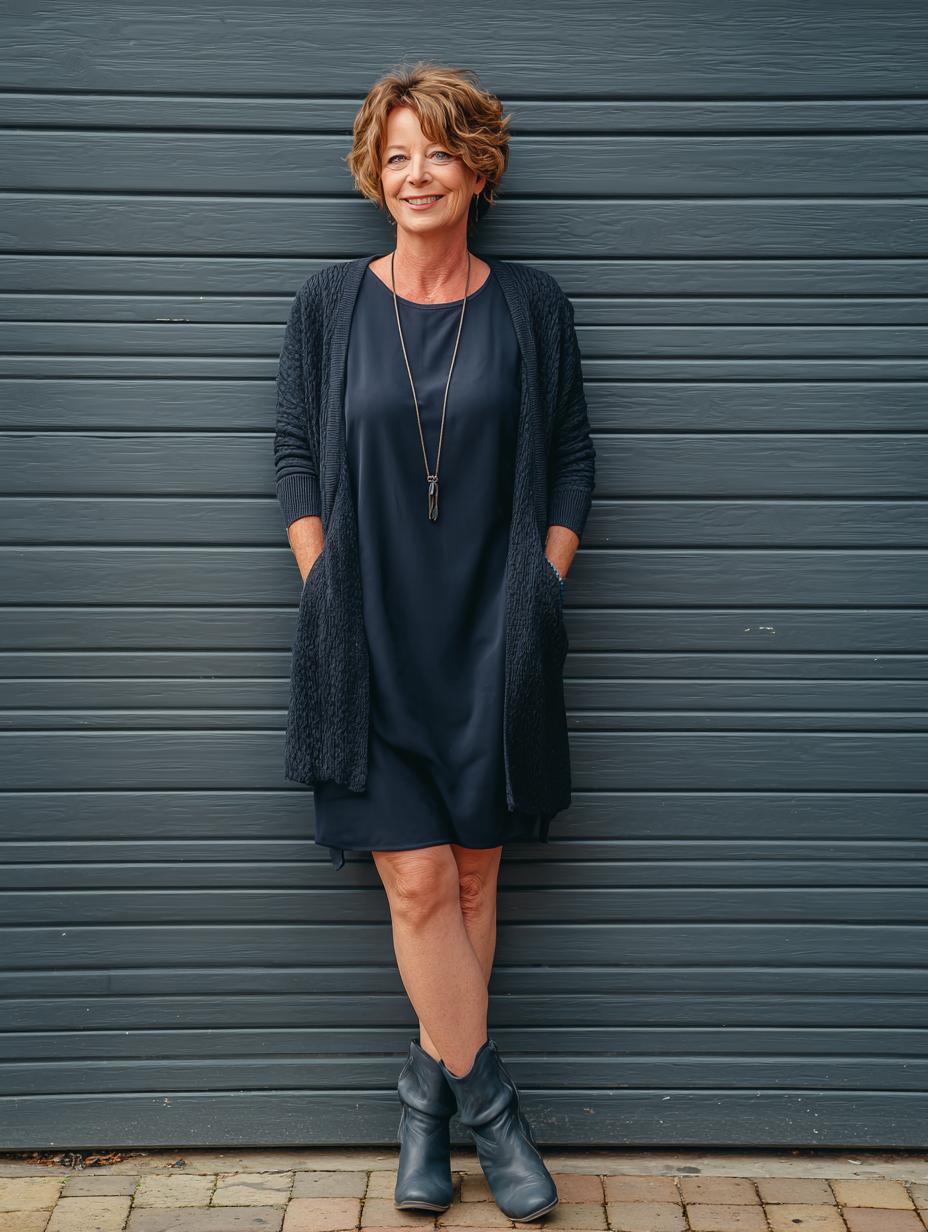
The open textured cardigan creates two vertical panels that frame your figure. This visual trick narrows the torso even when the cardigan itself runs oversized. Her pendant hangs at sternum level, centering attention in that framed space.
Slate blue ankle boots with a modest block heel continue the color story without breaking it. When boots match your dress this closely, your legs read longer than they actually are. The charcoal horizontal siding behind her makes those vertical lines even more pronounced by contrast.
Layer an open cardigan over a shift dress and add a long pendant. The three vertical lines you create (both cardigan edges plus the necklace chain) work together to lengthen your silhouette without any tailoring required.
27. A Cognac Belt Turns a Shapeless Shirtdress Into Something Worth Wearing
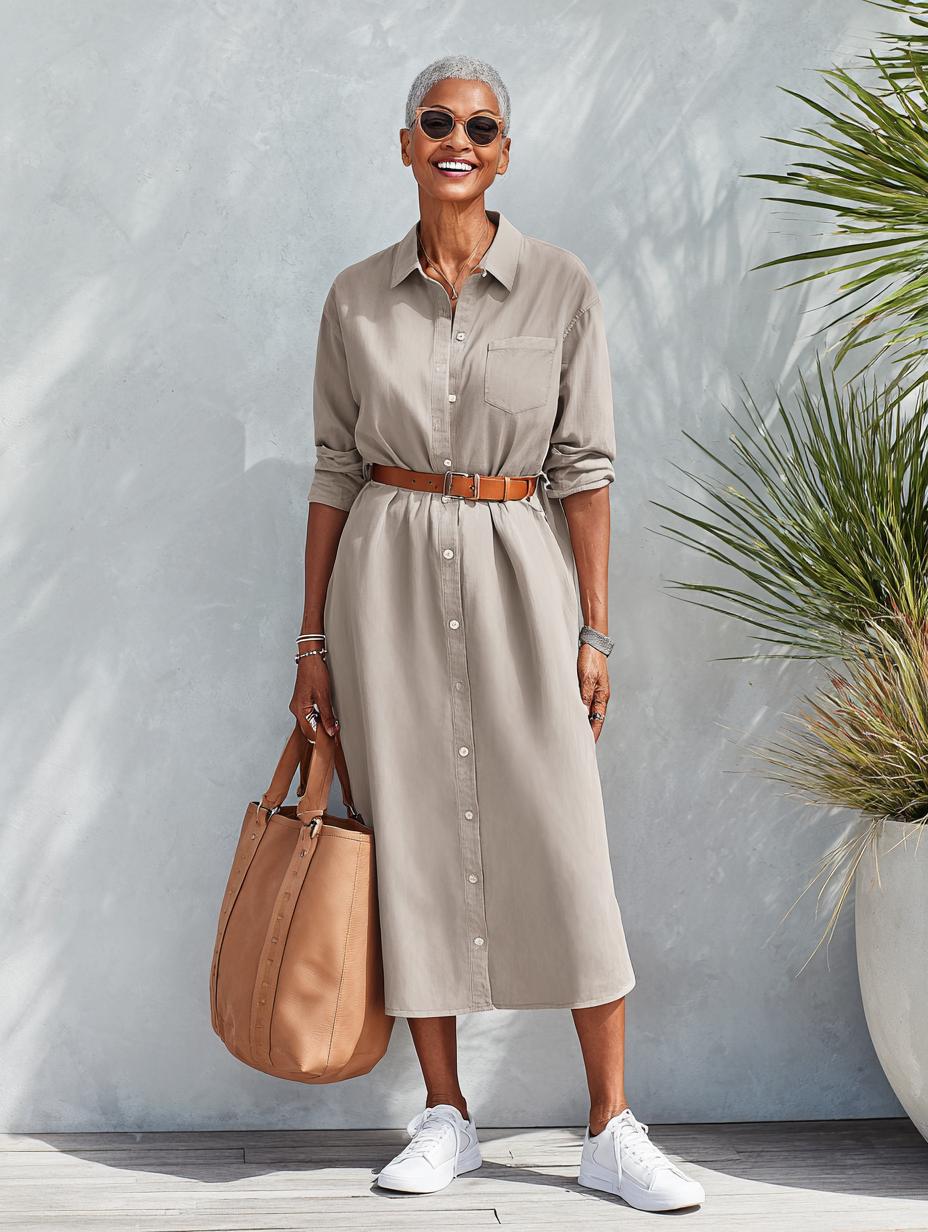
Without the belt, this sage cotton shirtdress would be a column. Pleasant enough, but shapeless. The cognac leather cinches at her natural waist, gathering the cotton so it blooms above and falls straight below. The button-front detail gives your eye a path to follow, and those rolled three-quarter sleeves add a casual note that keeps this from feeling too buttoned-up.
White leather sneakers are unexpected here. They work because everything else in the outfit has intention. The camel tote and belt relate to each other without matching exactly. Against that pale sage wall with the tropical plant beside her, she looks like she’s about to walk to a farmer’s market and then to brunch. Which is exactly right for this kind of dress.
26. Charcoal Linen and the Power of a Hidden Pocket
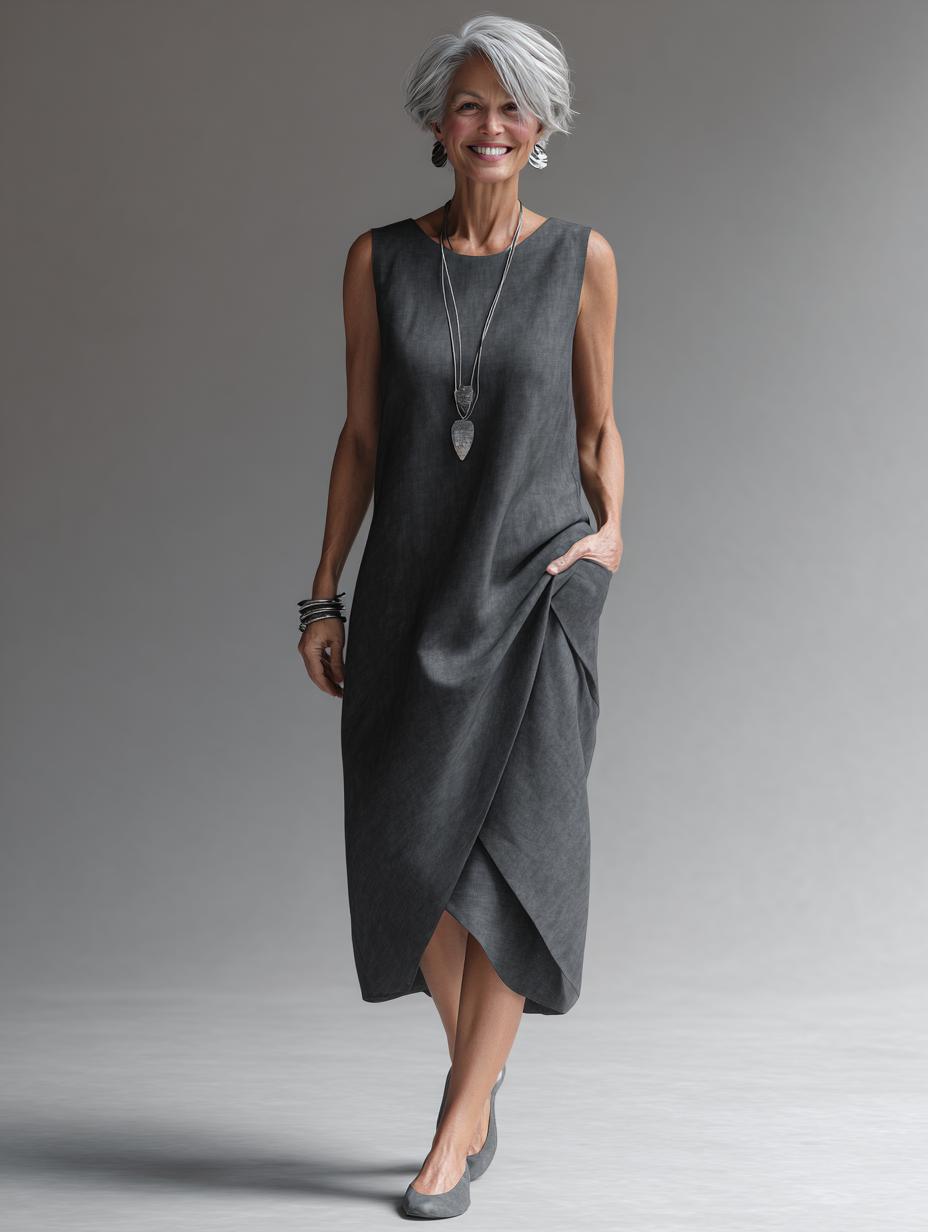
Notice how the tulip hem creates that overlapping wrap at the ankles. You get movement without bulk, which is exactly what you want from a column silhouette. The charcoal linen here has that slightly heathered quality that photographs as slate in some lights and graphite in others.
Her hand disappears into a hip pocket you wouldn’t spot unless she showed you. That detail alone tells you the designer actually thought about how women live in clothes. The silver pendant falls to mid-sternum, hitting the sweet spot where jewelry draws the eye upward without competing with the neckline. Stacked wooden bangles on one wrist. Hammered silver geometric earrings catching the studio light. Gray suede flats keep the entire look grounded in a single tonal family, from her silver pixie cut down to her shoes.
25. Why Navy Accordion Pleats Read So Polished
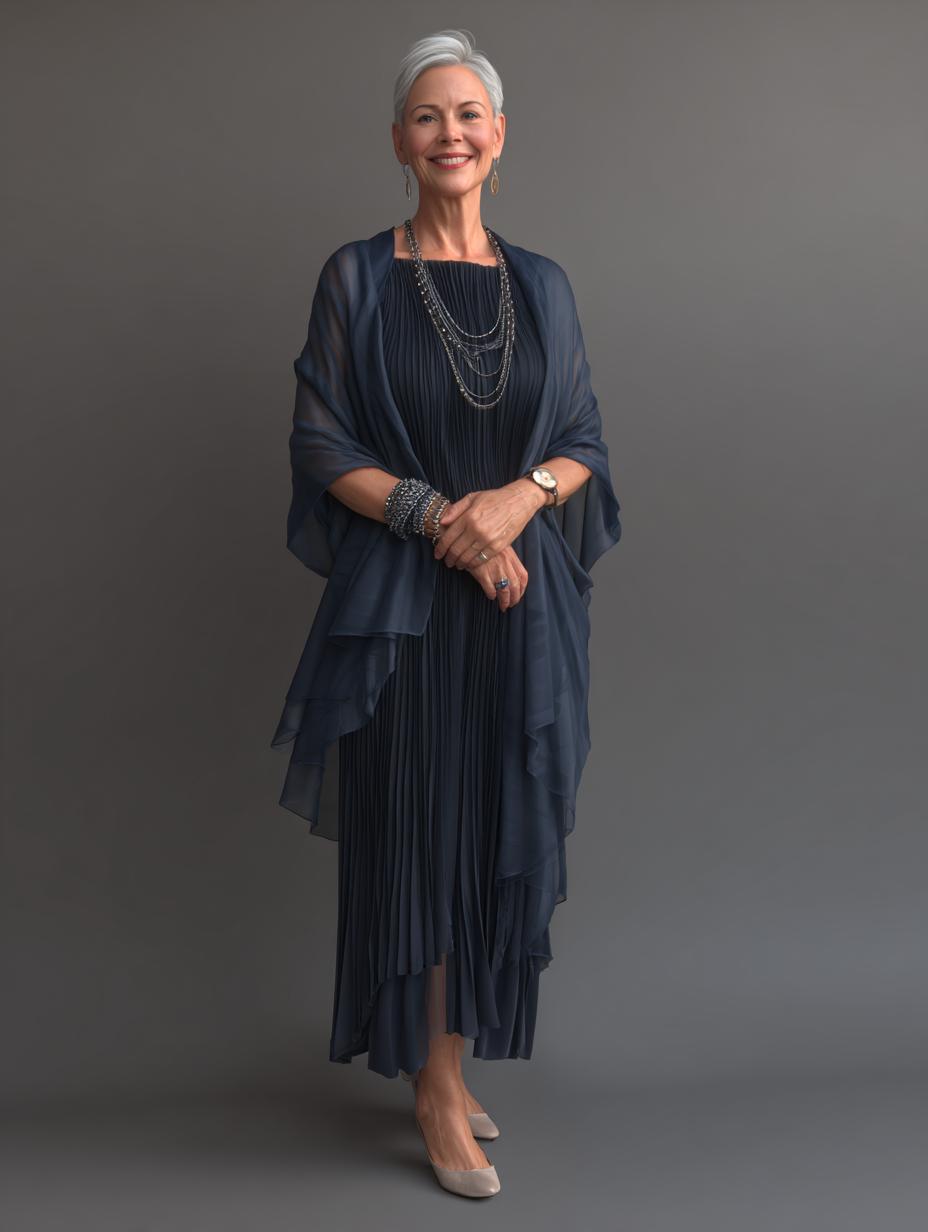
Vertical pleating from neckline to ankle does serious visual work. Those unbroken lines pull your eye straight down, creating the illusion of height even on petite frames. The deep navy chiffon layers over itself in places, sheer enough to catch different amounts of light with each step.
A matching wrap crosses her shoulders and drapes loosely at the elbows, adding coverage without weight. Three strands of mixed-metal beaded necklaces sit at graduated lengths. The beaded cuff bracelet on her left wrist contrasts with a simple leather-strap watch on her right. Pale taupe pumps nearly vanish against the neutral backdrop. Her silver hair pulled tight into a low chignon shows off Art Deco drop earrings. You could wear this to an opening at MoMA or a wedding in Napa and fit right in at either.
History Corner: Mariano Fortuny patented his silk pleating technique in 1909. His original Delphos gowns now sell for six figures at auction when they surface.
24. Dusty Mauve and Oversized Earrings That Actually Work
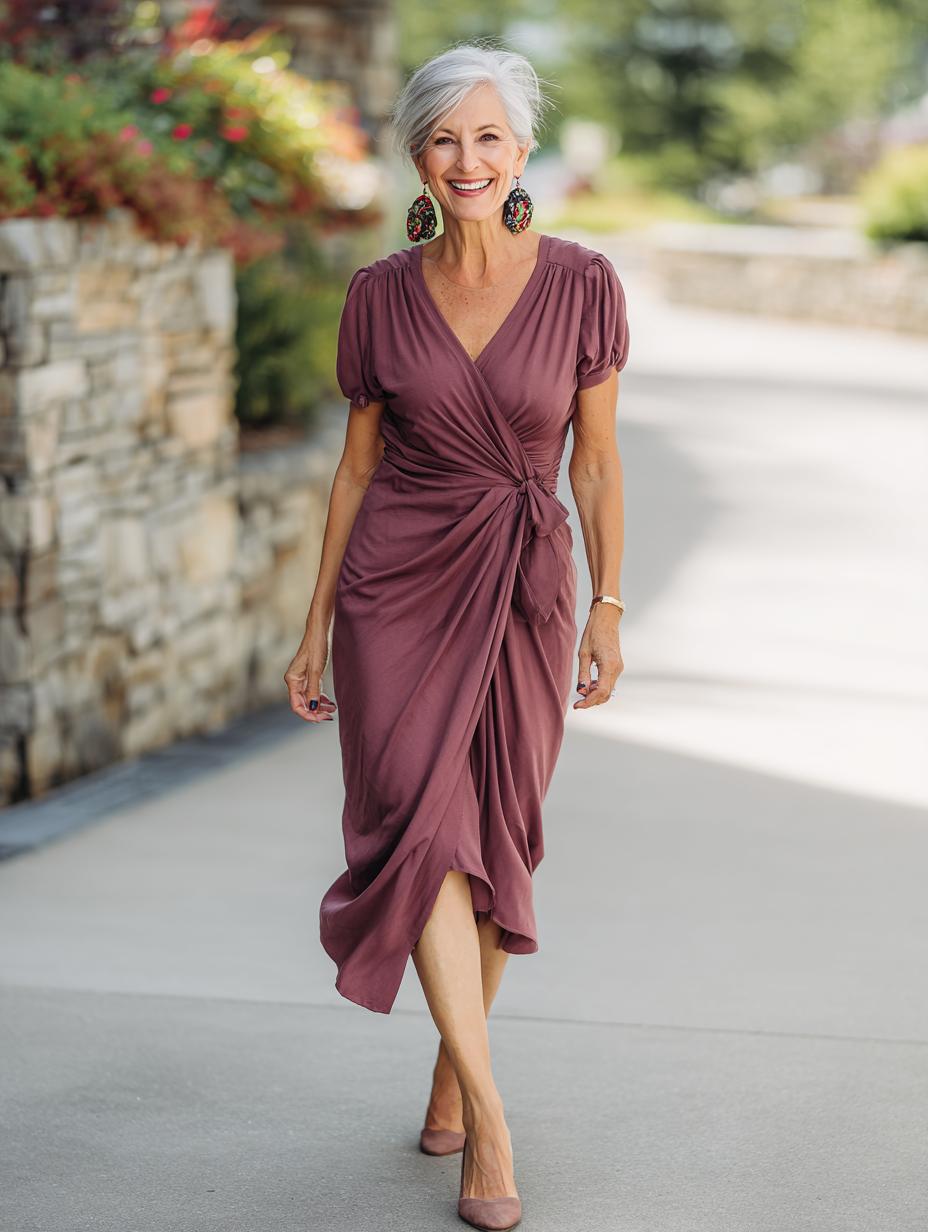
That color sits somewhere between dried rose petals and crushed berries. Against silver hair and sun-warmed skin, it reads as warm and healthy rather than washed out. The gathered puff sleeves end just below the shoulder, leaving your collarbone exposed. A true wrap construction means you can cinch it tighter or looser depending on what you’ve eaten for lunch.
Those earrings deserve a second look. Large, almost tribal in shape, with embroidered detailing in green and coral tones. They should overwhelm a simple dress. They don’t. The scale works because the soft fabric gives them nothing to compete with. She’s walking along a quiet street, stacked stone wall behind her, summer greenery blurred in the background. Mauve suede flats match the dress precisely. When you’re playing with one statement piece, you let everything else recede.
23. A Denim Jacket Has No Business Looking This Good Over Satin
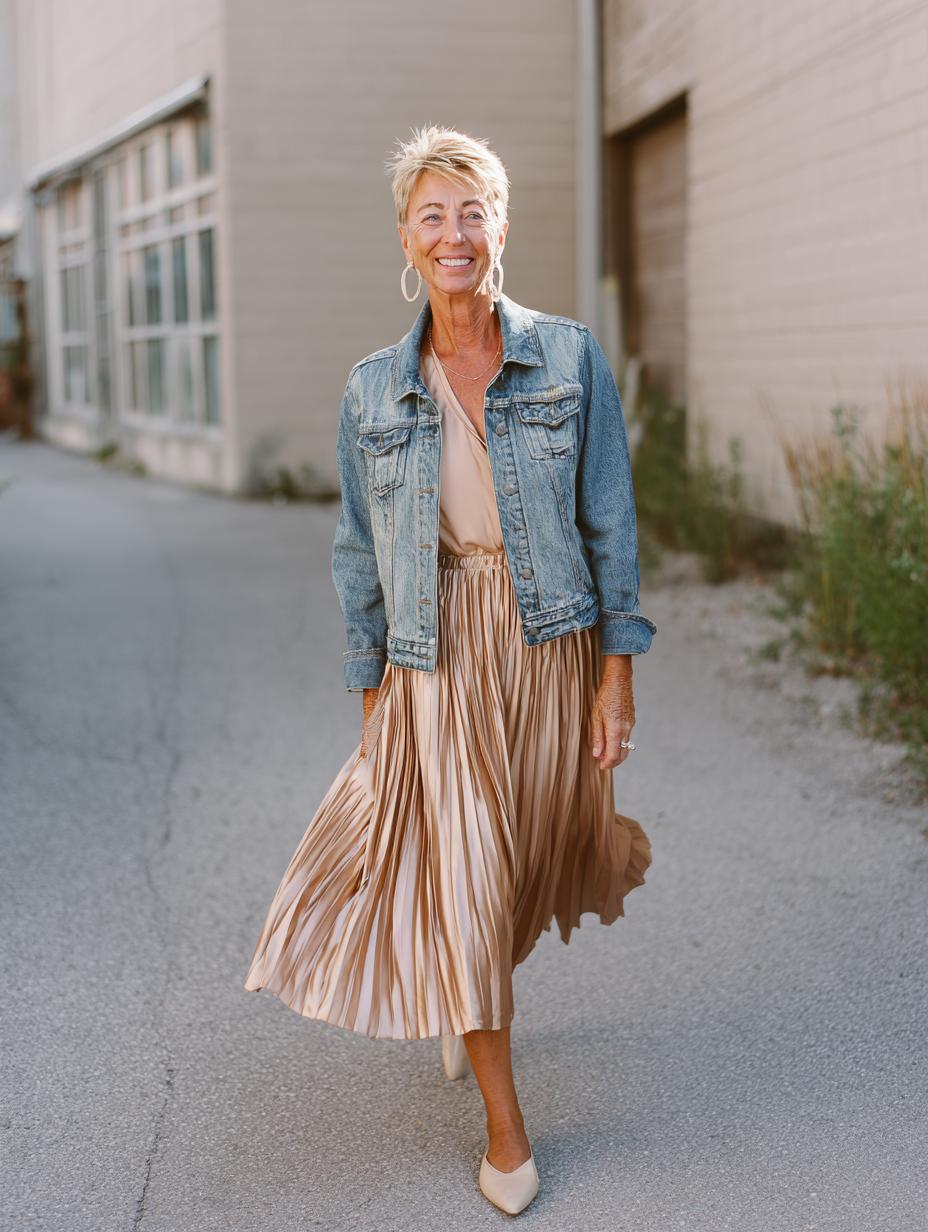
Champagne satin pleated dress. Mid-wash denim jacket with visible fading at the shoulders. On paper, this combination shouldn’t hold together.
The pleats catch afternoon light and shimmer faintly while the denim anchors everything, keeping the look from tipping into cocktail territory. Her cropped blonde hair and simple oval hoop earrings suggest someone who’s done this before. D’Orsay flats in blush open at the sides, elongating the foot. She’s mid-stride on an industrial road, steel and concrete in the background, golden grasses growing wild at the edges. The contrast between raw setting and refined fabric makes both more interesting. Sometimes the best outfits come from combinations you’d never think to try.
“Too much harmony bores the eye. Your best outfits create tension between at least two elements.”
22. Terracotta Jersey in Its Natural Habitat
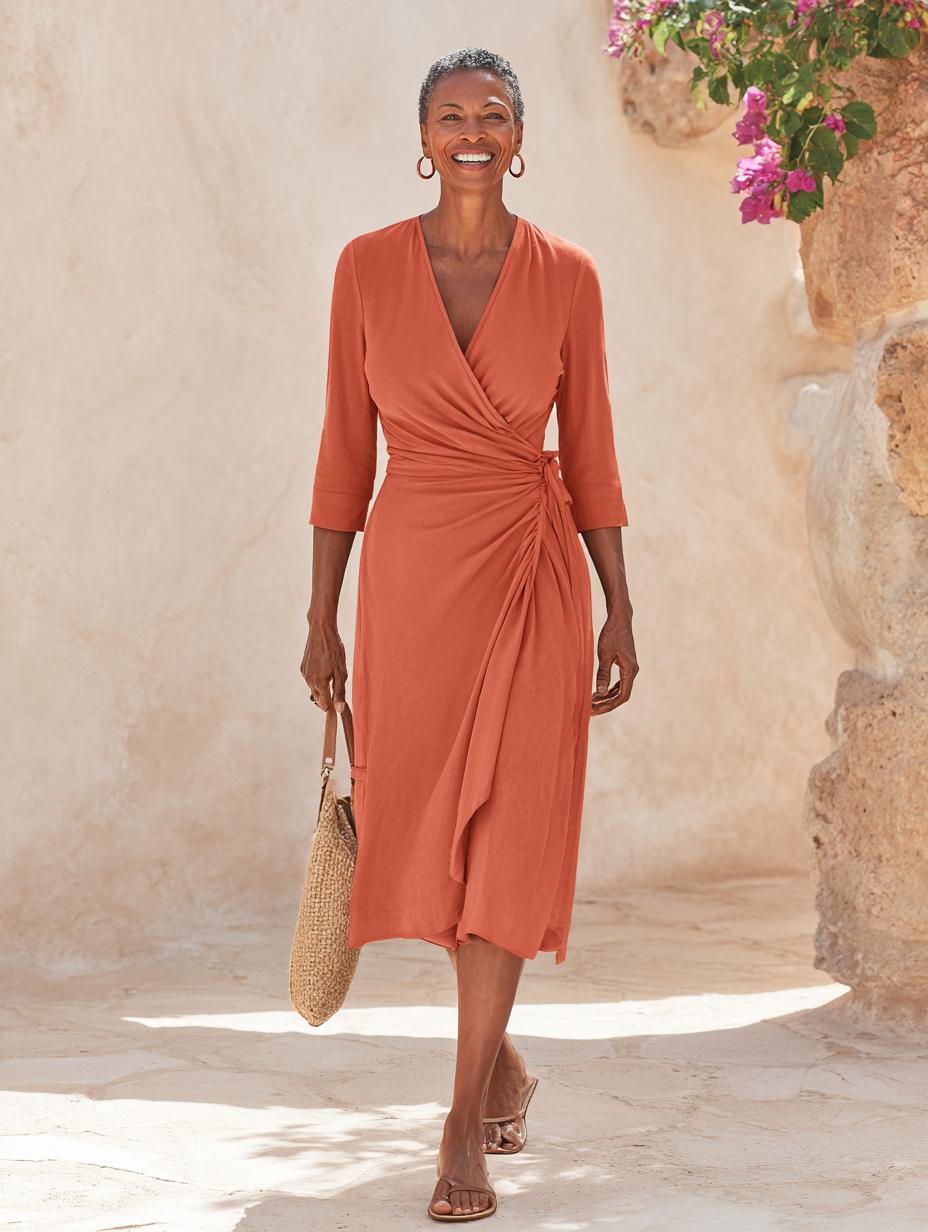
Diane von Furstenberg introduced the modern wrap dress in 1974. Fifty years later, you can see why it endures. The V-neck creates a clean diagonal line. The fabric gathers at the waist before cascading into an asymmetrical hem. Three-quarter sleeves hit at the narrowest part of your forearm.
This terracotta version belongs exactly where she’s wearing it. Sun-baked stucco walls. Bougainvillea in hot pink spilling over weathered limestone. The woven raffia tote picks up sandy tones from the architecture around her. Gold hoop earrings, nothing more. Clear-strap sandals that disappear against her skin. Her close-cropped natural hair and wide smile read as someone genuinely at ease. When a dress works this well with its environment, you stop thinking about clothes and start thinking about where you want to go.
21. Four Textures, One Color Family
❤️ Would you like to save this?
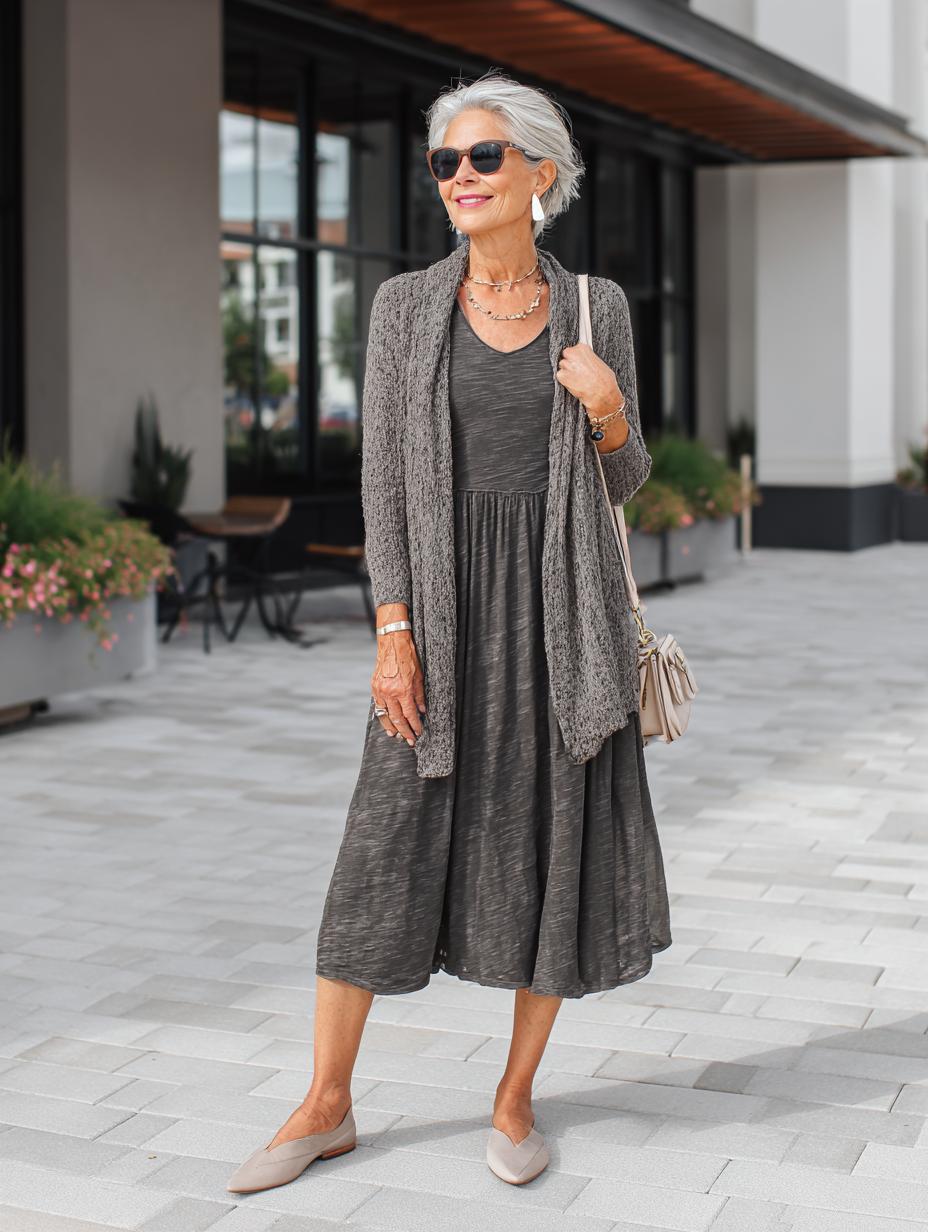
Slubby jersey dress in charcoal. Open-weave cardigan in lighter gray. Matte leather loafers in warm taupe. Structured crossbody bag in pale blush. Four distinct finishes working within a tight tonal range. This is how you keep monochromatic from reading as boring.
The empire waist releases into a gentle A-line that skims rather than clings. Her open cardigan hangs loose, adding width at the shoulders while narrowing the visual effect below the waist. She’s reached up to adjust her bag strap, showing off stacked bracelets in mixed metals and a silver cuff. Dark sunglasses, white teardrop earrings, silver pixie hair catching sunlight. Pink flowers bloom in planters behind her, providing the only color pop in the entire frame. She doesn’t seem to need it.
Try This: Layer an open-weave cardigan over any solid dress to add visual interest without competing patterns. Keep both pieces in the same color family but choose different textures.
20. Hunter Green Cotton Built for Autumn Walks
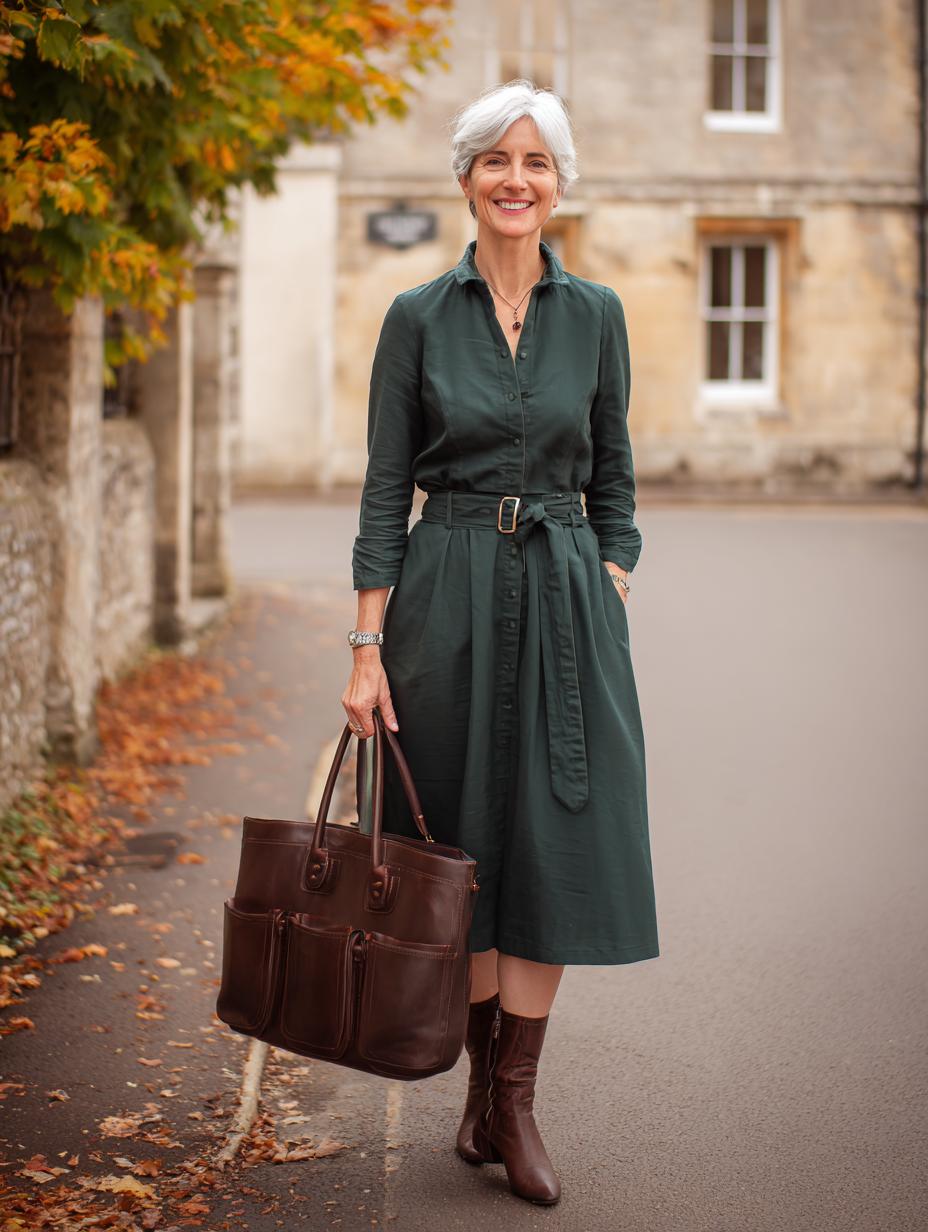
Button-front shirtdresses give you structure without stiffness. This deep hunter green version has full-length sleeves rolled to three-quarter, a pointed collar, and a self-belt that cinches at the natural waist. The A-line skirt falls to mid-calf with enough ease for real movement.
Cognac leather ties everything together. Knee-high boots with a modest stacked heel. A structured tote with exterior pockets. What looks like a watch strap visible at the wrist. Golden leaves scatter the Cotswold-style stone street behind her. Honey-colored limestone buildings glow in late afternoon autumn light. Her silver bob frames her face in a way that feels modern. One hand rests in a pocket. She looks like someone heading somewhere specific, unhurried but purposeful.
19. Side Ruching Does More Work Than You’d Think
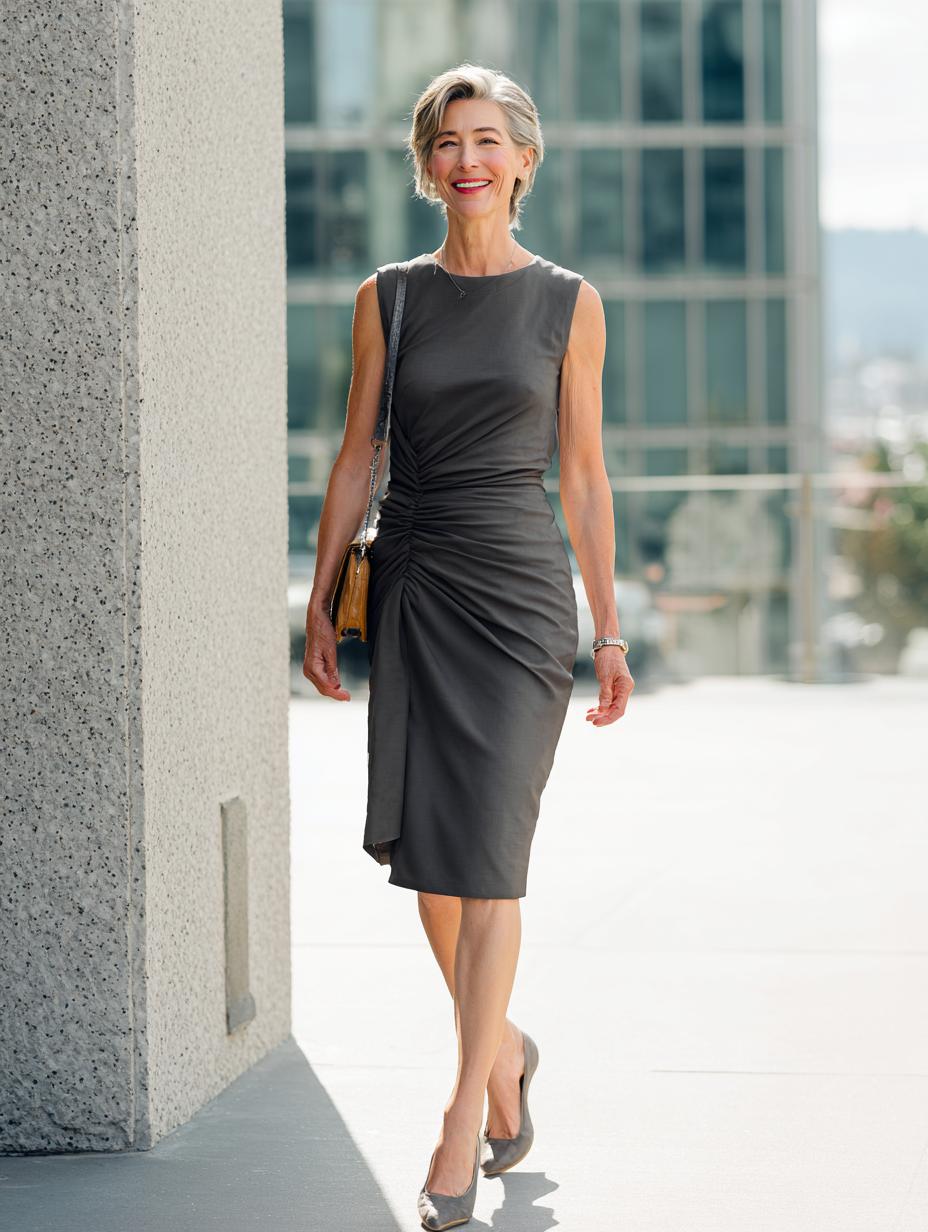
That gathered fabric at one hip creates a diagonal line your eye naturally follows. It draws attention away from the midsection while adding enough visual interest to keep a solid-color sheath from reading as corporate. The sleeveless cut shows off toned arms. The hemline hits just above the knee.
Glass towers reflect behind her. Speckled granite columns frame the shot. Metallic gray pumps match the slate dress exactly. A mustard crossbody bag with a chain strap provides the only warm color in the entire frame. Her highlighted bob, red lipstick, silver bracelet watch. Every element feels considered without looking overthought. You could wear this to a client meeting at noon and dinner reservations at seven without stopping home to change.
18. One Gathered Knot Changes Everything
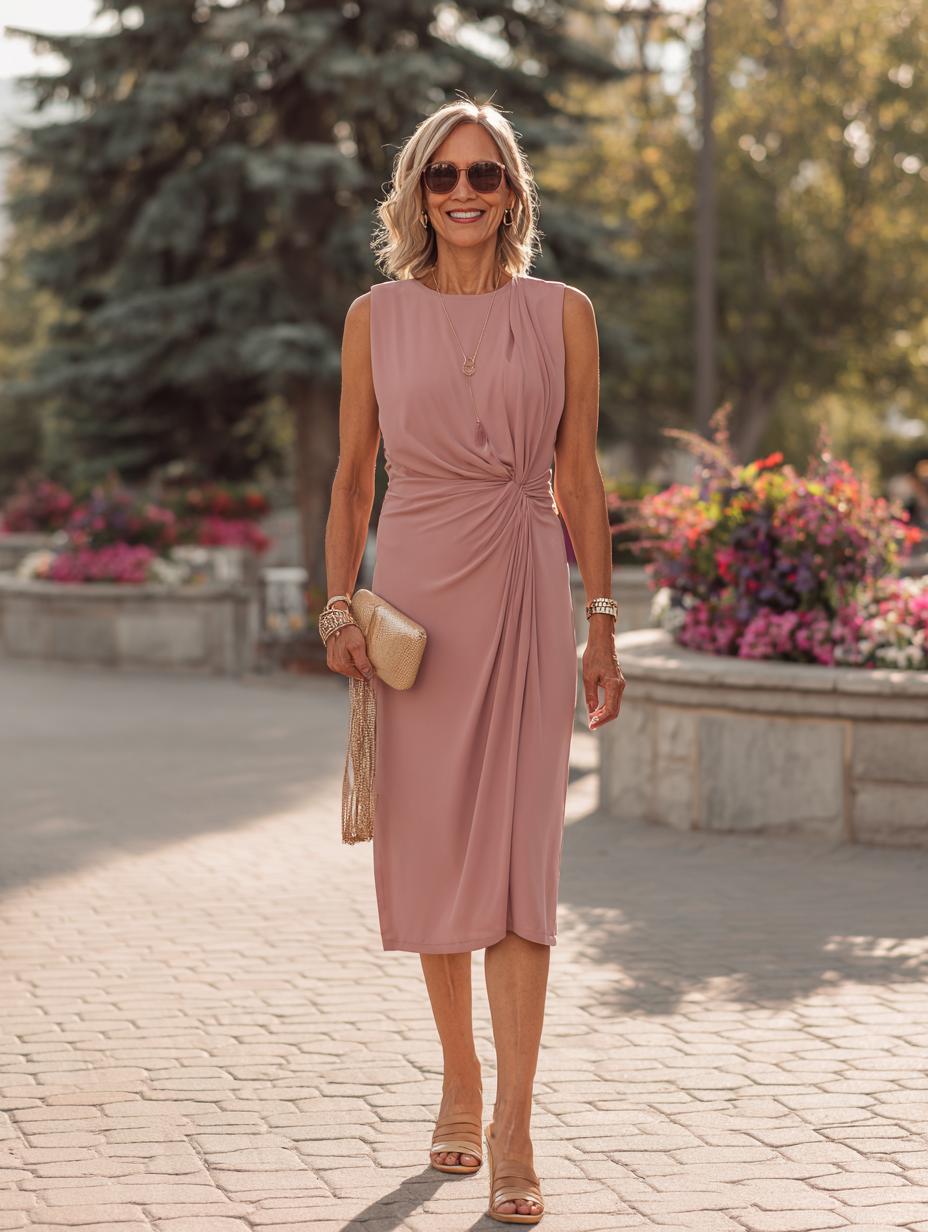
Look at where your eye lands first. That single twist of dusty rose jersey at the hip bone pulls the entire composition together, creating diagonal lines that travel from the gathered shoulder down to the knot. The matte finish of this fabric absorbs late afternoon light rather than reflecting it, which keeps the silhouette smooth against the cobblestone plaza.
You can learn a lot from the accessories here. The textured gold clutch with its chain tassel adds visual weight to the right side, counterbalancing that asymmetrical drape. Nude block-heel sandals nearly disappear against the paver stones, a trick that makes your legs read several inches longer than they actually are. Pink petunias and purple blooms blur into soft background color that echoes the dress without fighting for attention. The tortoiseshell sunglasses and honey-blonde waves complete a look built entirely on strategic restraint.
17. The Shirt Dress Has Earned Its Place in Your Closet
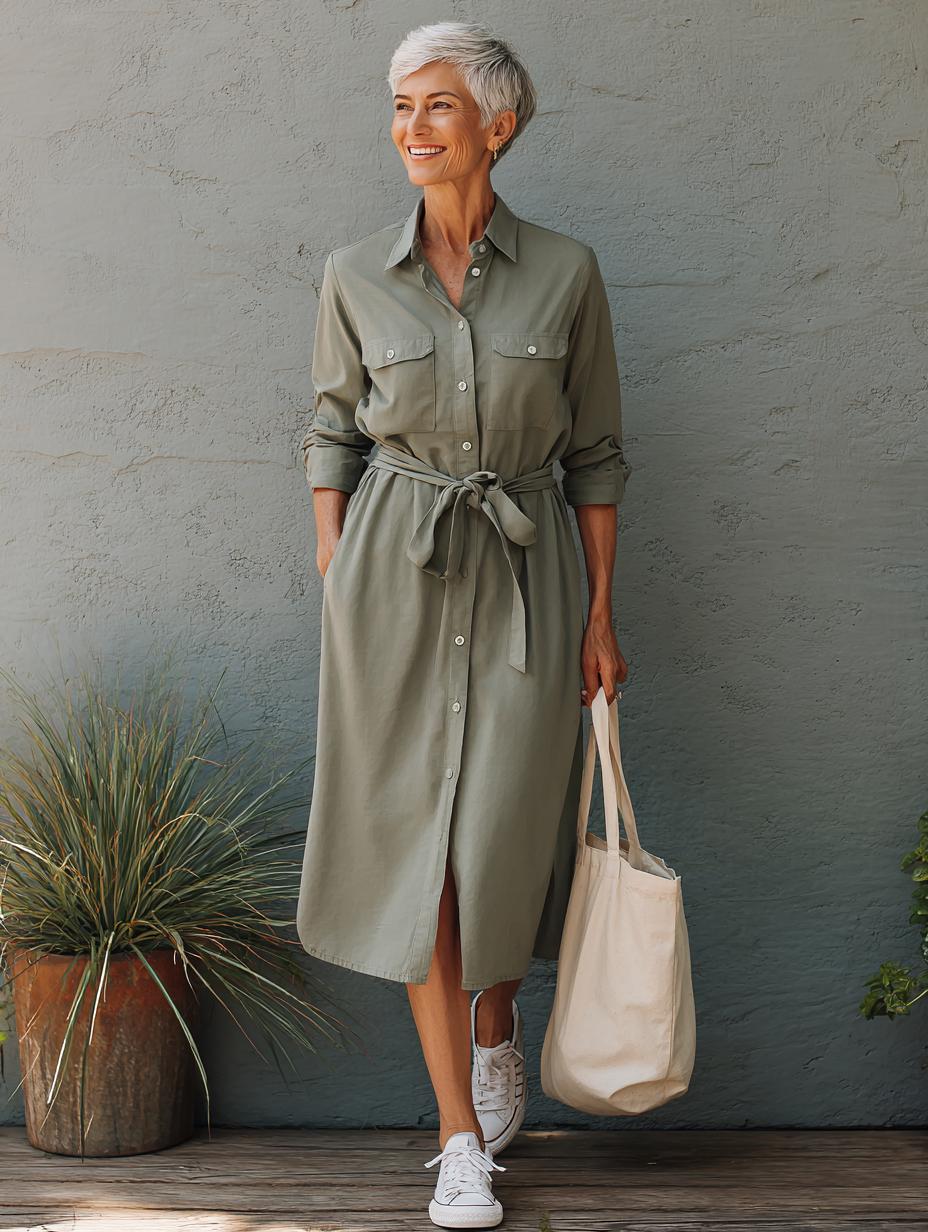
Sage green cotton twill. Bone buttons from collar to hem. Two chest pockets positioned at exactly the right height. Sleeves rolled to mid-forearm. A self-fabric belt tied into a relaxed bow at your natural waist. Designers have been returning to this formula since the 1950s because the proportions simply work on nearly every body type.
Against that textured blue-gray stucco, the sage takes on an almost eucalyptus quality. The silver pixie cut catches California light beautifully. White canvas sneakers and an unbleached cotton tote finish everything with the kind of ease that reads as deliberate rather than thrown together. Notice how the ornamental grasses in that terracotta pot add a single stroke of movement to an otherwise still composition. You could wear this exact outfit to a Saturday farmers market, then again to a Monday client meeting, then again on a Wednesday flight without changing a single element.
History Corner: Claire McCardell introduced the shirt dress to mainstream American fashion in the 1940s. Her cotton poplin versions retailed for under $7 and were designed to carry working women from factory floor to dinner table without a costume change.
16. When Your Layers Share a Temperature
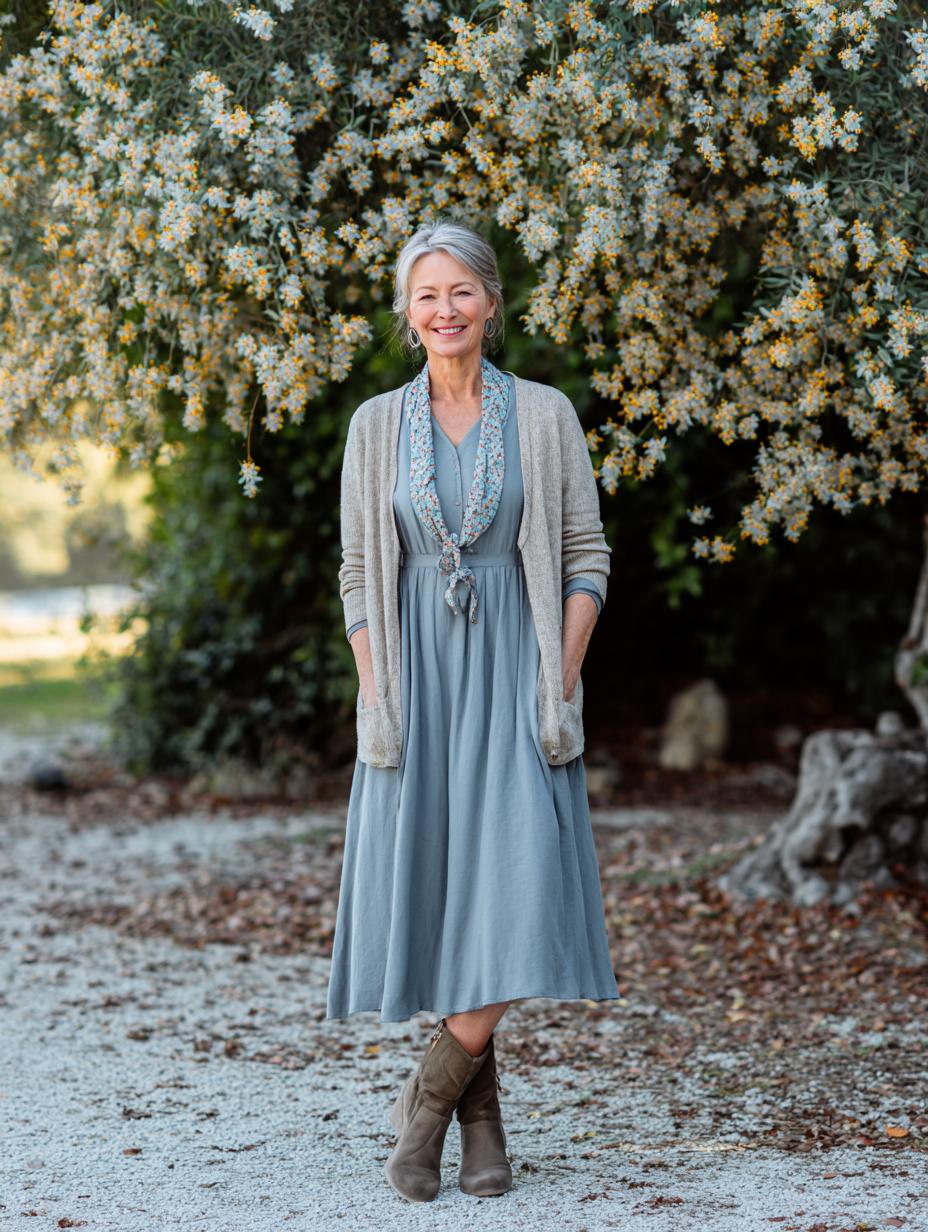
Steel-blue midi with an empire waist and button placket. Oatmeal cardigan washed into perfect softness over dozens of cycles. The reason this layering works comes down to color temperature. Cool blue dress. Warm beige knit. A floral scarf in dusty rose and sage knotted at the throat bridges the gap between them without actually touching the dress itself.
Olive leather boots with low block heels anchor the whole composition. Yellow blossoms cascade from an ancient olive tree behind her while dried leaves scatter across the gravel path. This is what happens when you stop experimenting and settle into what works. Gray hair pulled back loosely. Small hoop earrings. Hands tucked into cardigan pockets. There’s a quality of resolution here that holds more interest than any trend could.
15. Your Wide Belt Is Doing More Than You Think
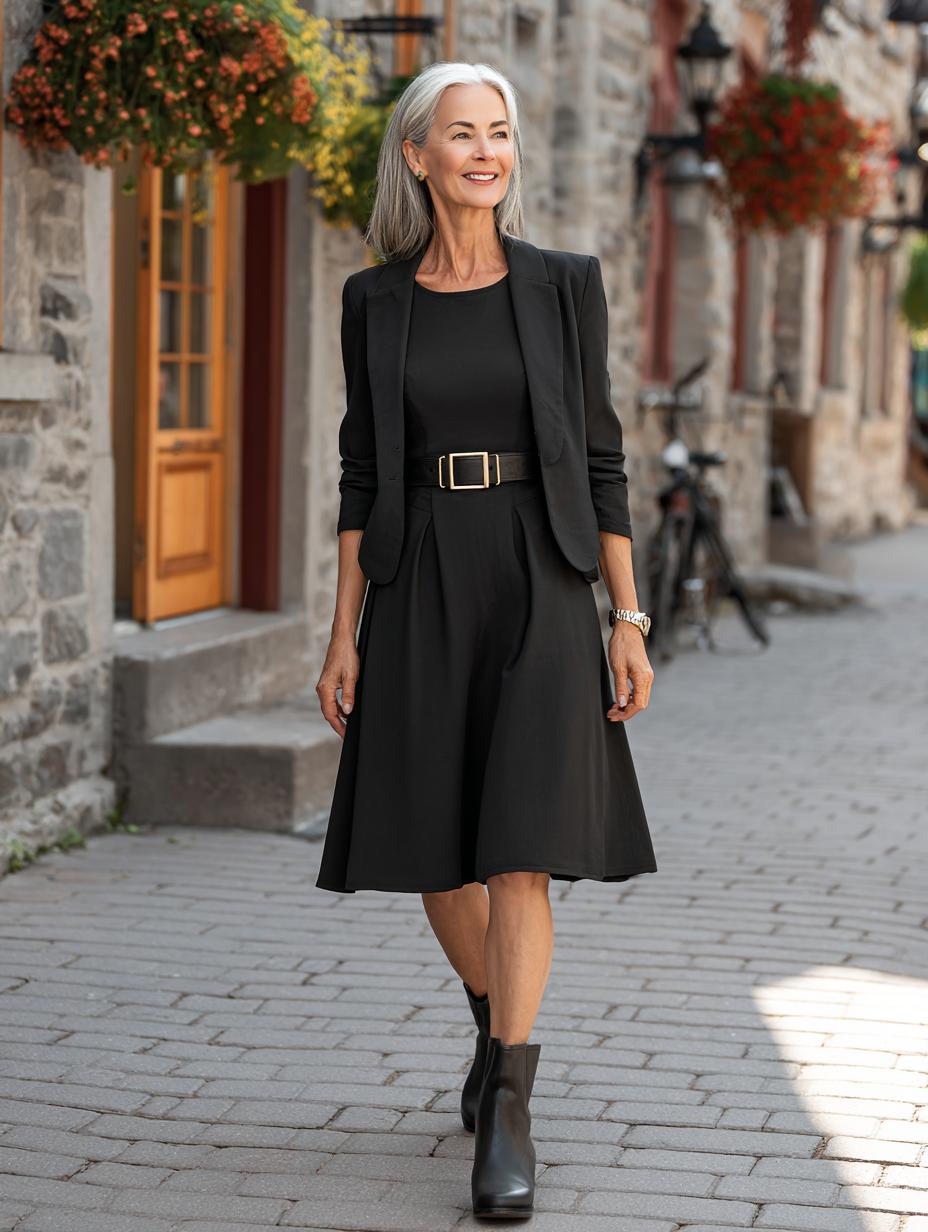
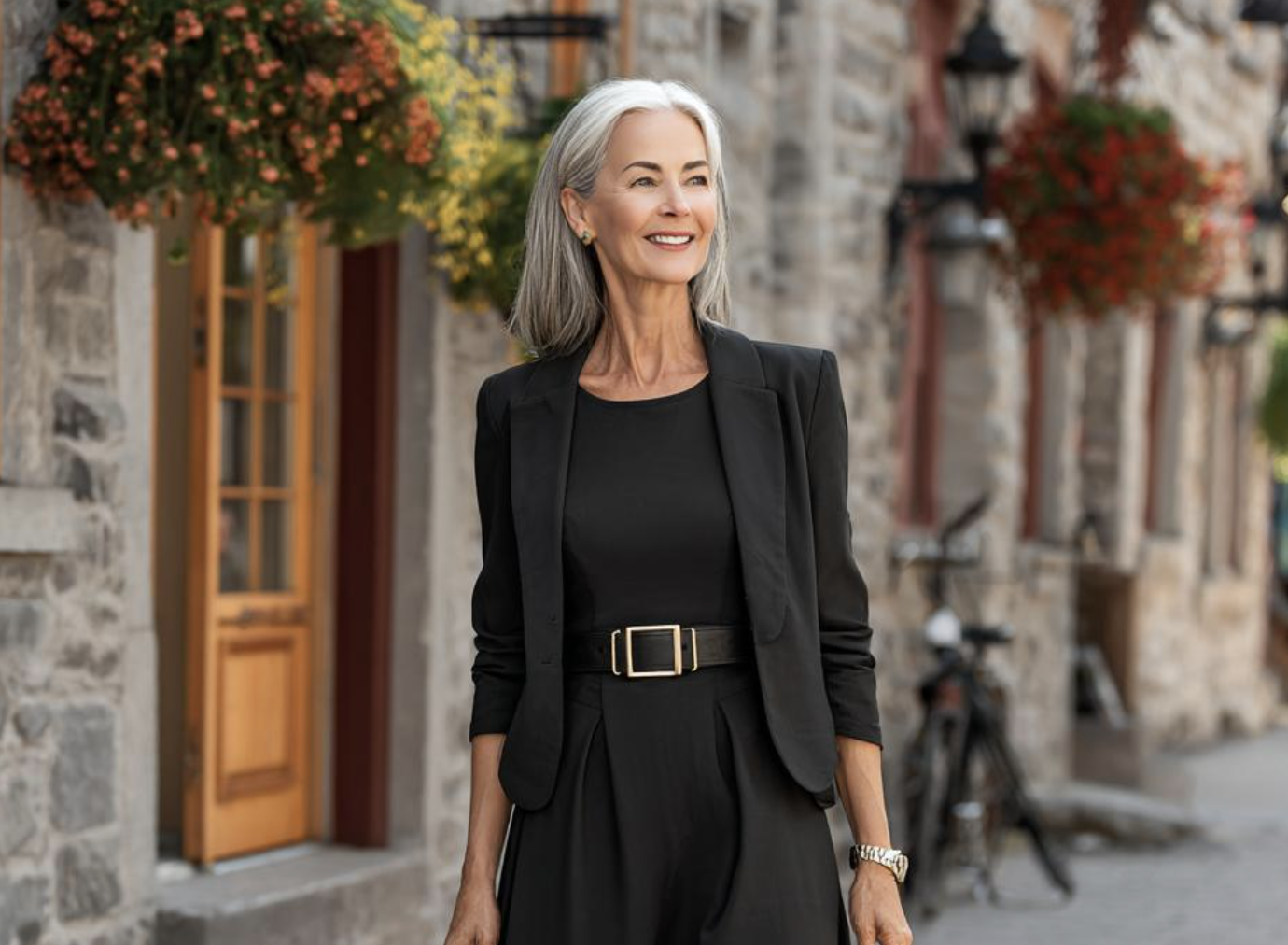
Black scoop-neck dress with an A-line skirt hitting just below your knee. Black blazer with notched lapels and pushed-up sleeves worn open. Black leather ankle boots with a low stacked heel. Everything reads as one continuous column until you add the wide leather belt with that oversized gold rectangular buckle at your natural waist.
The Proportion Shift
That belt creates a visual break separating your torso into two distinct sections, which makes your legs appear longer than their actual measurement. European cobblestones and gray stone buildings with hanging baskets of orange and red geraniums set the scene. A silver watch glints at the left wrist. Silver-gray hair falls straight past the shoulders. The whole outfit came together in maybe eight minutes and will carry you from a café lunch through evening aperitivo without requiring a single adjustment.
“The wide belt at your natural waist remains the oldest trick in tailoring. It costs almost nothing and changes almost everything.”
14. How to Actually Wear Your Trench Coat
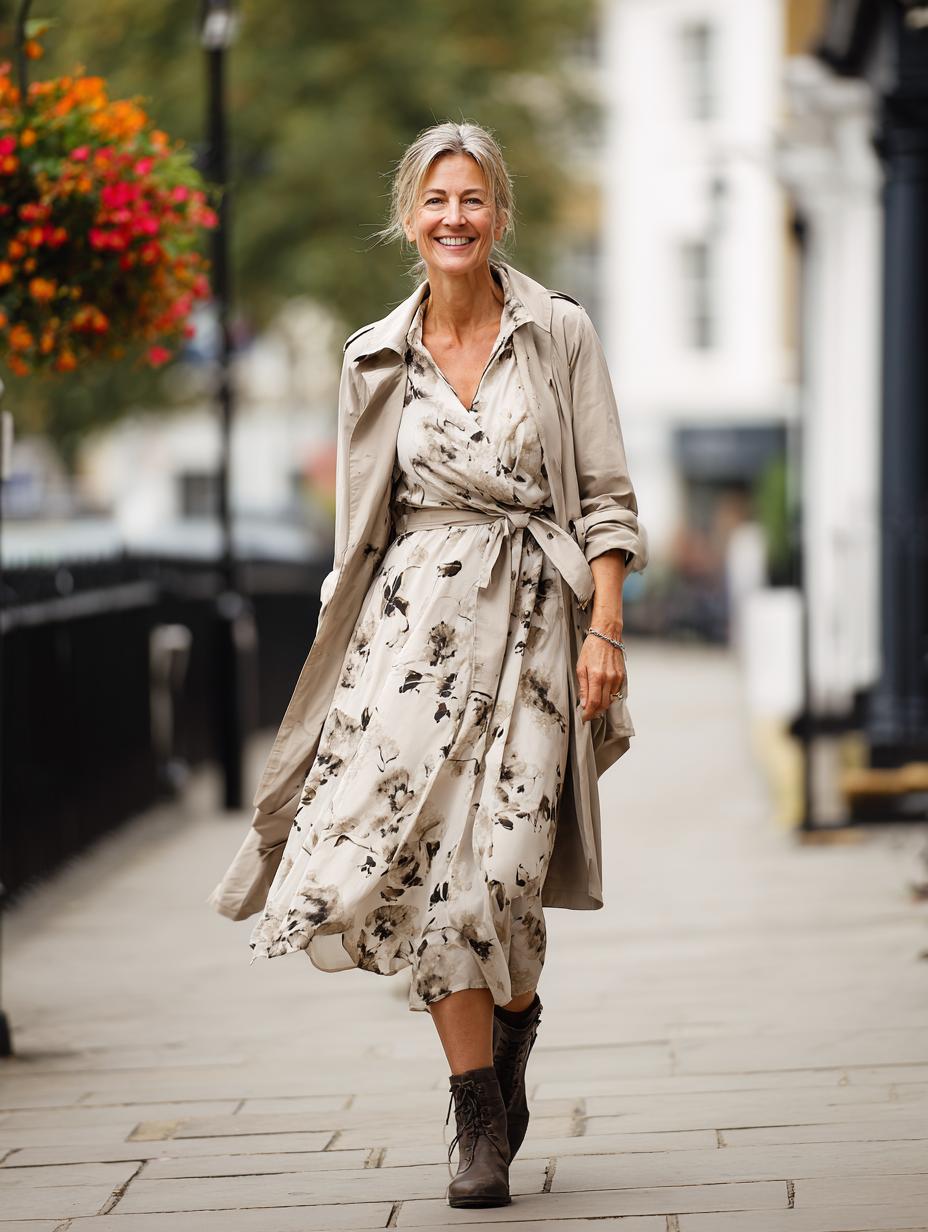
You probably own a trench coat that hangs unworn because it adds bulk when you button it. Here’s the solution: leave it completely open and let it swing as you walk. This khaki cotton trench falls open to reveal a cream wrap dress printed with abstract sepia florals. The dress handles all the shape definition while the coat contributes movement and dimension.
Chocolate brown lace-up boots hitting mid-calf anchor what would otherwise be too floaty a silhouette. Salt-and-pepper hair twisted up loosely catches the overcast London light. Red geraniums spill from a hanging basket behind her while a bicycle leans against iron railings. Pay attention to the trench sleeves pushed up past the wrist. This single adjustment prevents that swallowed-by-outerwear feeling and keeps your proportions human-scaled rather than lost in fabric.
13. This Garden Party Dress Survives Actual Gardens
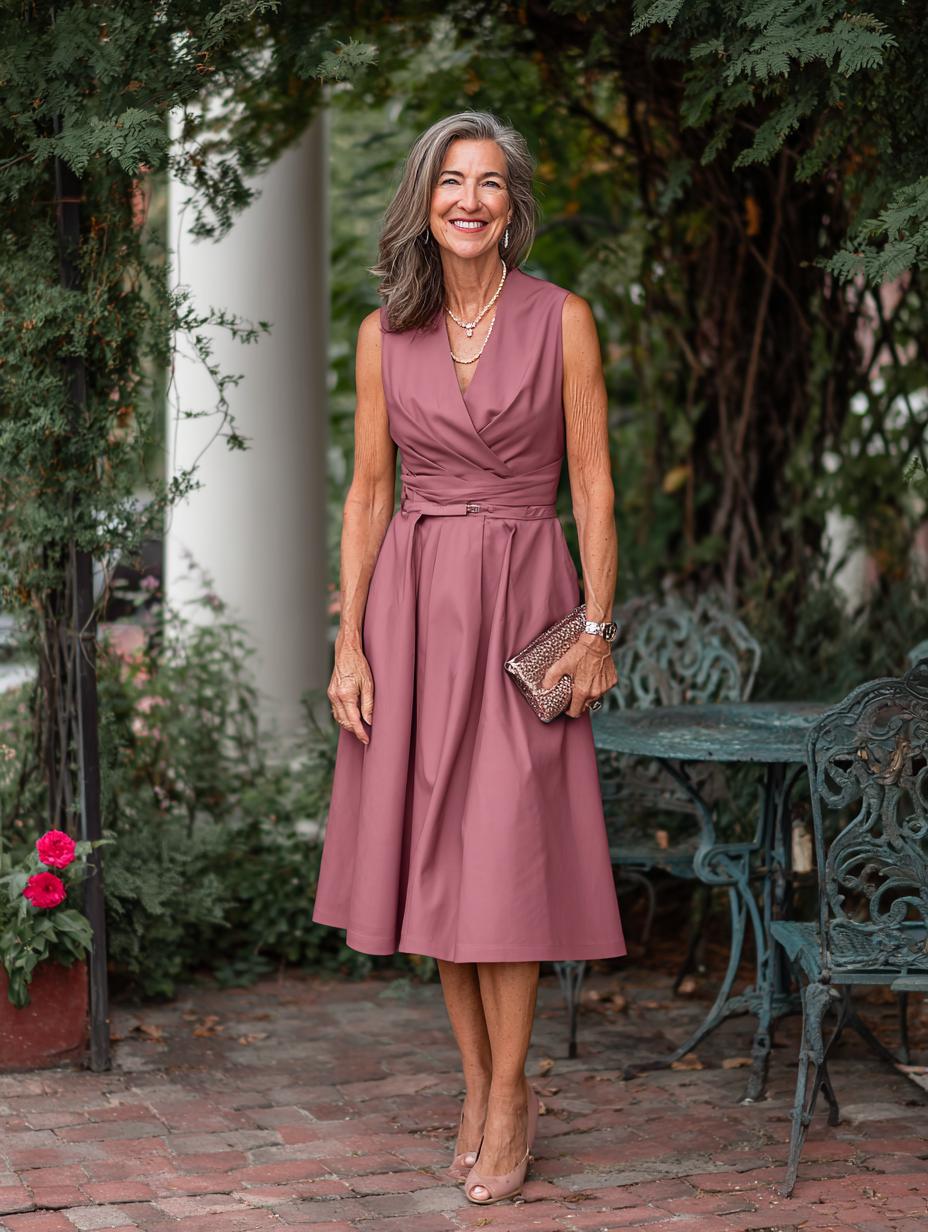
Mauve taffeta with a surplice neckline and matching self-belt that buckles at your smallest point. The A-line skirt falls to mid-calf with enough volume for movement but not so much that it reads as costume. She stands in a courtyard with patina-green wrought iron furniture and climbing vines, holding a metallic python-print clutch that provides the single unexpected element every solid outfit needs.
Nude peep-toe pumps match her skin tone closely enough to extend the leg line visually. A delicate strand of pearls and drop earrings keep jewelry traditional without tipping into matronly territory. Gray-streaked hair falls in loose waves past the shoulders. Red roses bloom in a terracotta pot at her feet. Save this dress for your nephew’s wedding, your best friend’s grandchild’s christening, the anniversary dinner you’ve been planning for months. The color photographs as neutral on camera while reading as distinctive in person.
12. Terracotta Works Because It Always Has
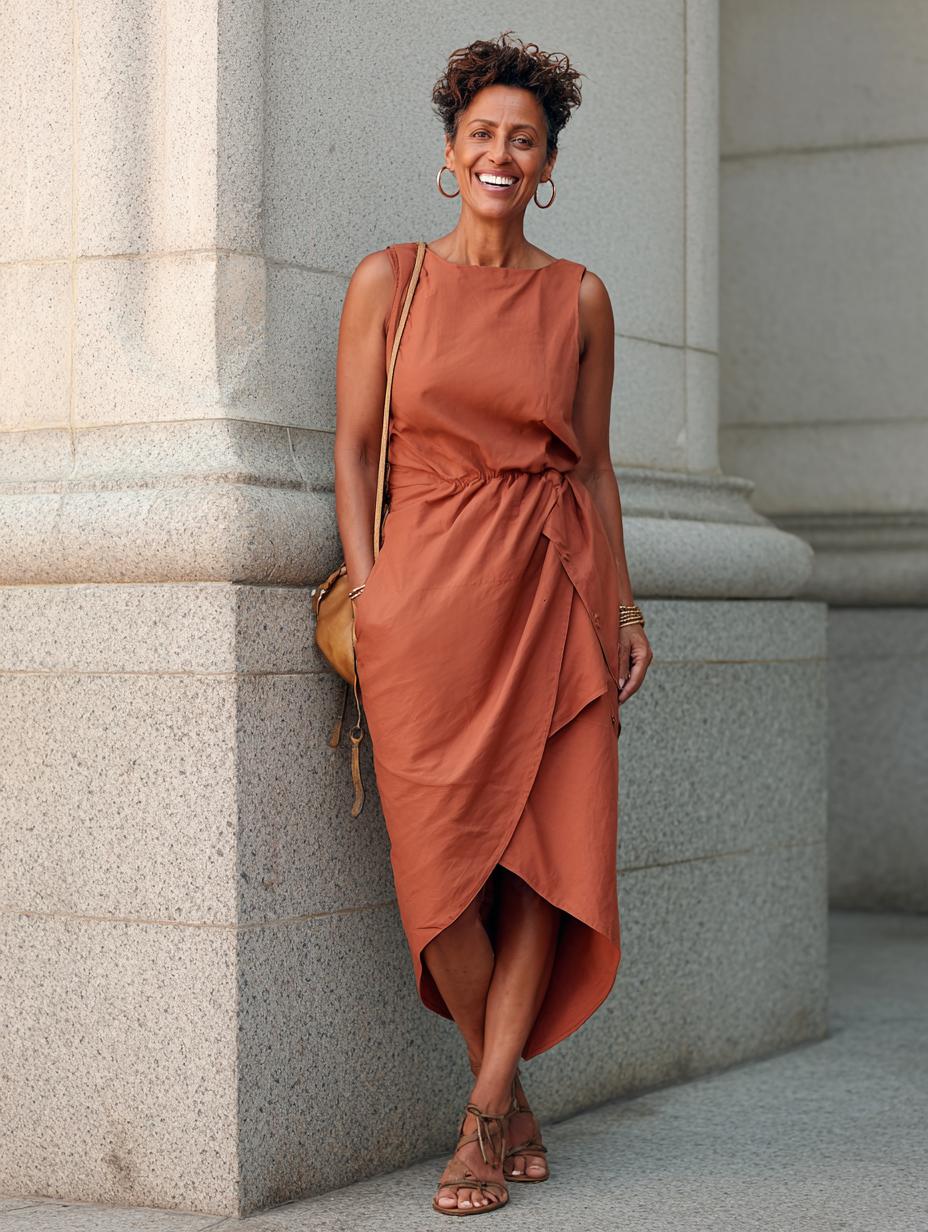
The best colors don’t cycle through trends. They just exist.
Burnt sienna cotton gathered at the waist with a drawstring, falling into an asymmetrical tulip hem. Sleeveless cut showing off toned arms. Against granite civic building columns, that warm orange pops against cool gray stone in a way that feels almost architectural. Gold hoop earrings catch direct sunlight. A mustard leather crossbody bag hangs at hip level. Strappy tan sandals with flat soles suggest walking is actually planned for after this photograph gets taken.
This shade sits in the warm earth-tone family that flatters nearly every skin tone across the spectrum. AI-generated style mood boards push terracotta heavily right now, probably because algorithms trained on 2019-2022 design trend data. But the color existed long before Pinterest discovered it, and it’ll keep working long after trend forecasters move elsewhere. Natural curls, unforced smile, the easy posture of someone who stopped worrying about this years ago.
11. Give Your Knit Dress a Second Look
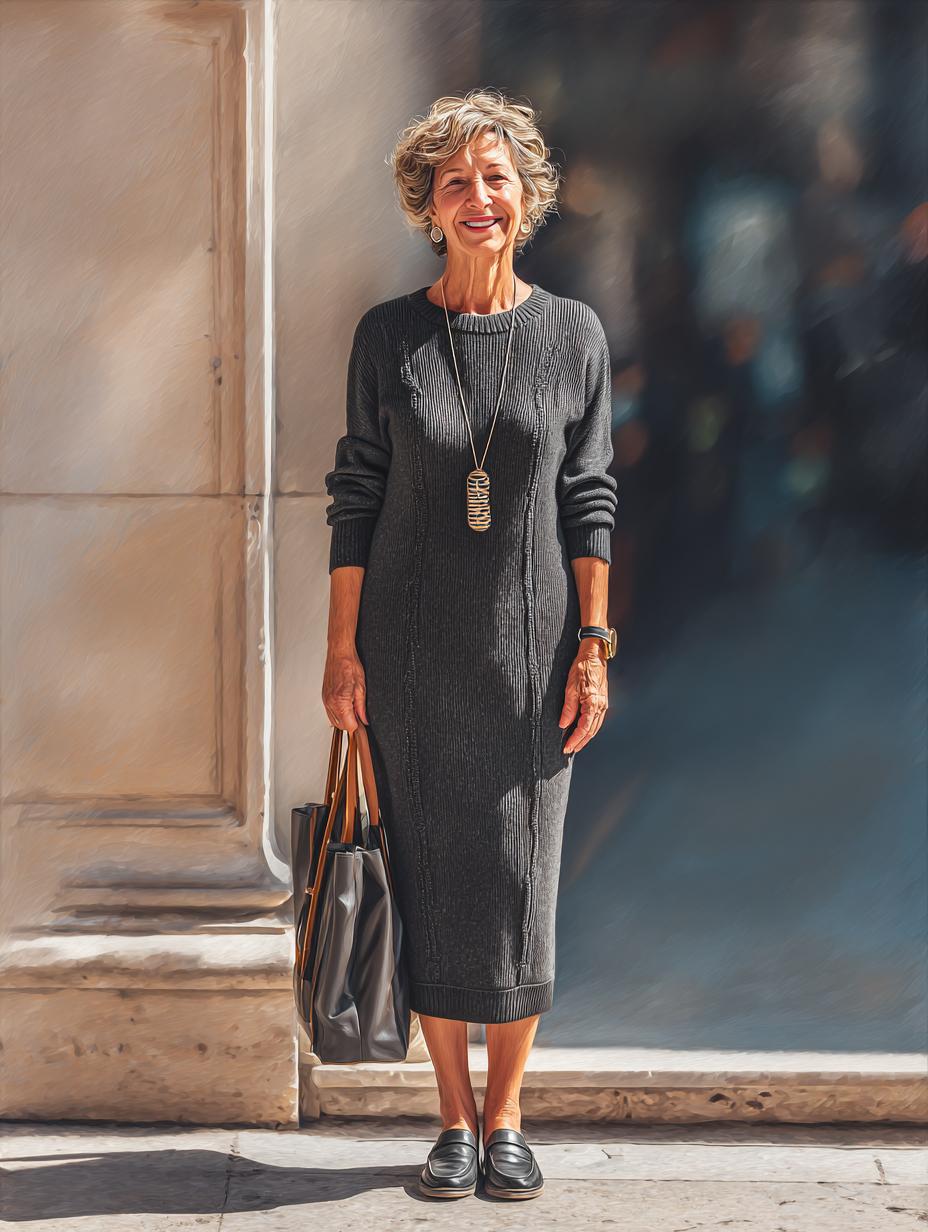
Charcoal ribbed knit. Crew neck. Long sleeves ending just above the wrist bone. The dress skims from shoulder to mid-calf without grabbing anywhere. A center seam running from neckline to hem adds subtle vertical emphasis that your eye follows automatically. European sidewalk, limestone doorframe, gray leather tote with cognac handles.
That pendant necklace earns its place here. An abstract gold-and-cream piece on a long chain falling to sternum level breaks up the solid color block without competing for attention. Black penny loafers with a low vamp complete the look. Curly gray-blonde hair cut short and left natural. Brown leather-strapped watch on the left wrist. Everything accounted for, nothing excessive.
Why It Works:
Ribbed knit reads more polished than smooth knit at identical price points. The texture creates inherent vertical lines while hiding minor inconsistencies in how the fabric drapes across your body.
10. Your Coastal Uniform: Linen Shift Plus Woven Raffia
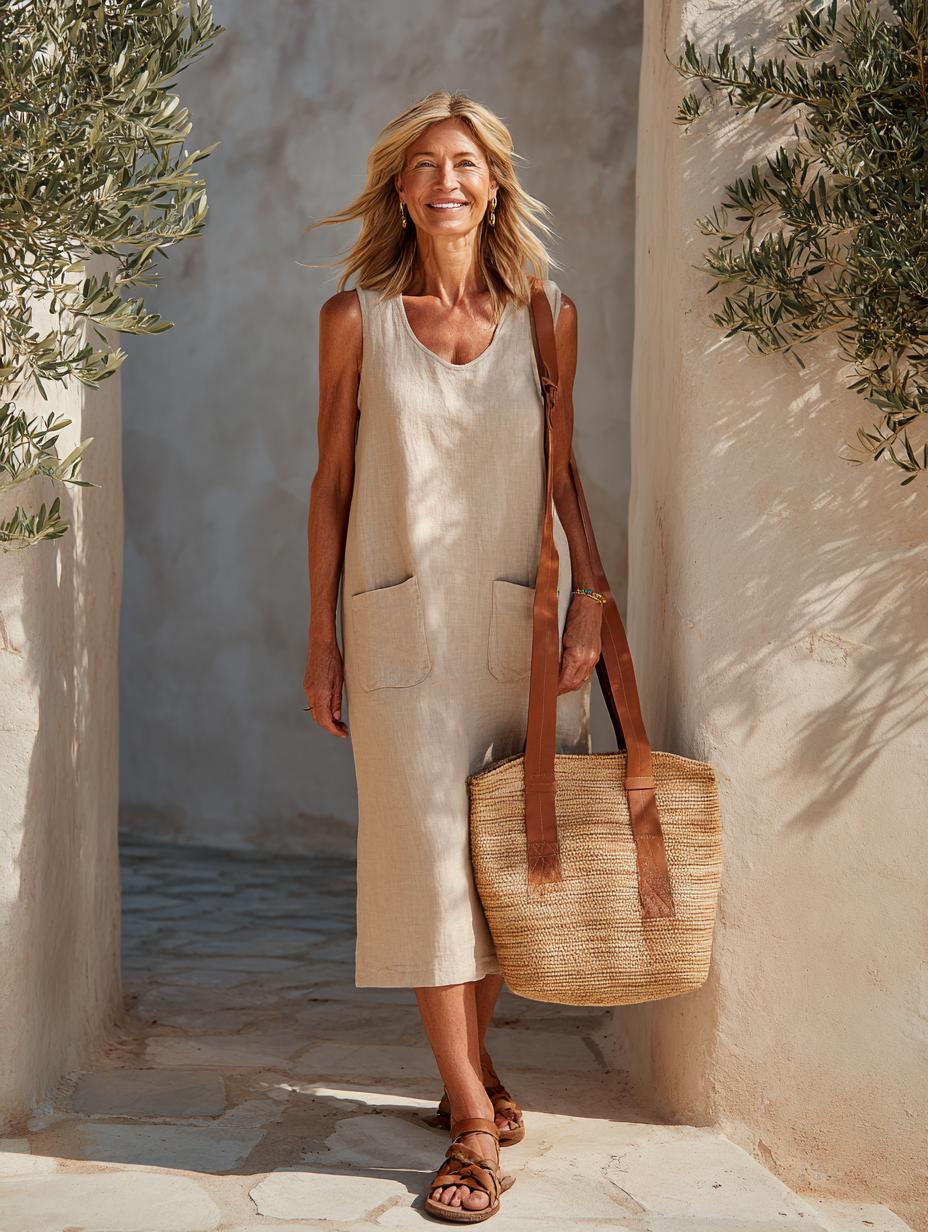
Oatmeal-colored linen has this particular quality in direct sunlight. It reads almost like raw silk, catching and releasing light as the fabric shifts. The sleeveless silhouette here sits close without clinging, and those two patch pockets land low on the hips rather than at the waist. Smart placement. You get the practical benefit of pockets without adding bulk where most of us don’t want it.
Notice the cognac leather sandals with their knotted straps picking up the caramel tones in that oversized woven tote. The bag’s long crossbody strap cuts a diagonal across the body, breaking up what could otherwise read as a straight column. Against whitewashed stucco and silvery olive branches, you could mistake this for someone who actually lives on the Mediterranean rather than someone visiting for a week.
9. How to Layer Chocolate Tones Without Looking Washed Out
❤️ Would you like to save this?
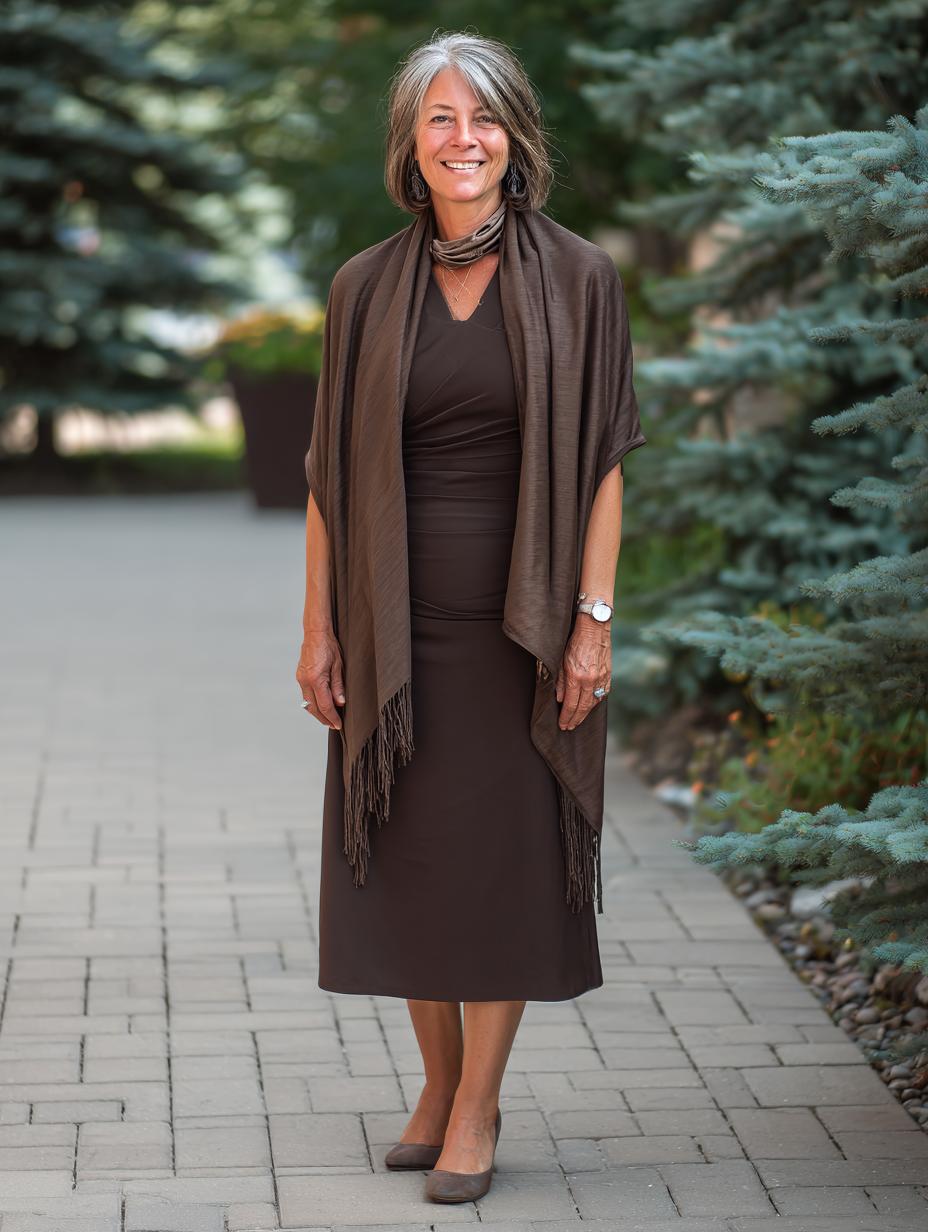
Deep cocoa jersey sits flush against the body. The V-neckline opens just enough to avoid any matronly feeling. Over it, a pashmina in slightly lighter taupe drapes from the shoulders, fringed edges hitting right at hip level. Silver-streaked hair provides the only real contrast here.
Worn open like this, the shawl creates two vertical lines that frame your torso. Your eye travels up and down rather than side to side. Taupe suede flats maintain an unbroken line from hem to floor. Statement earrings with an oxidized finish add a bit of edge. The whole thing looks like nothing special on a hanger, but worn together, each piece feels deliberate.
Monochromatic dressing taps into what visual perception researchers call the continuity principle. When nothing interrupts the color flow, your eye processes the outfit as a single vertical unit. The brain doesn’t stop to parse separate garments. You simply appear taller, more cohesive, more intentional.
8. The Twist-Front Detail You Keep Seeing Everywhere
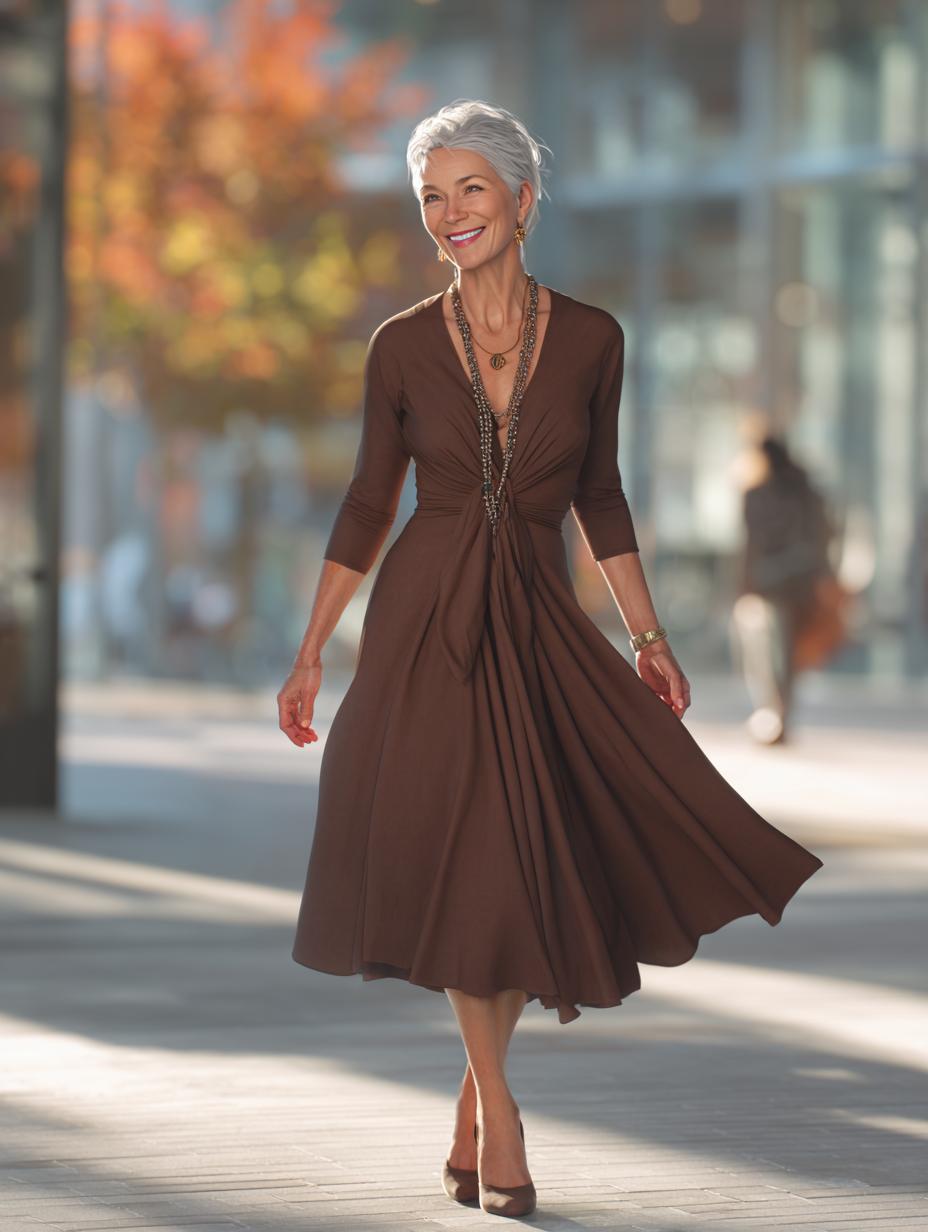
That center-front twist knot sits at the natural waist and pulls matte jersey into folds that fan outward toward the hem. In rich espresso brown, the effect reads polished rather than boho. The skirt catches air mid-stride. It lifts.
Three-quarter sleeves end at the narrowest part of the forearm. The plunging V creates a vertical line from collarbone to waist. Nude pumps disappear into skin tone, lengthening your leg without adding visual noise. Layered beaded necklaces in bronze and copper fill that open neckline and keep attention moving upward. Even standing still on a city sidewalk with autumn light filtering through glass, this dress has movement built into its construction.
7. Powder Blue Jersey and Tall Gray Suede Boots? Yes, Actually.
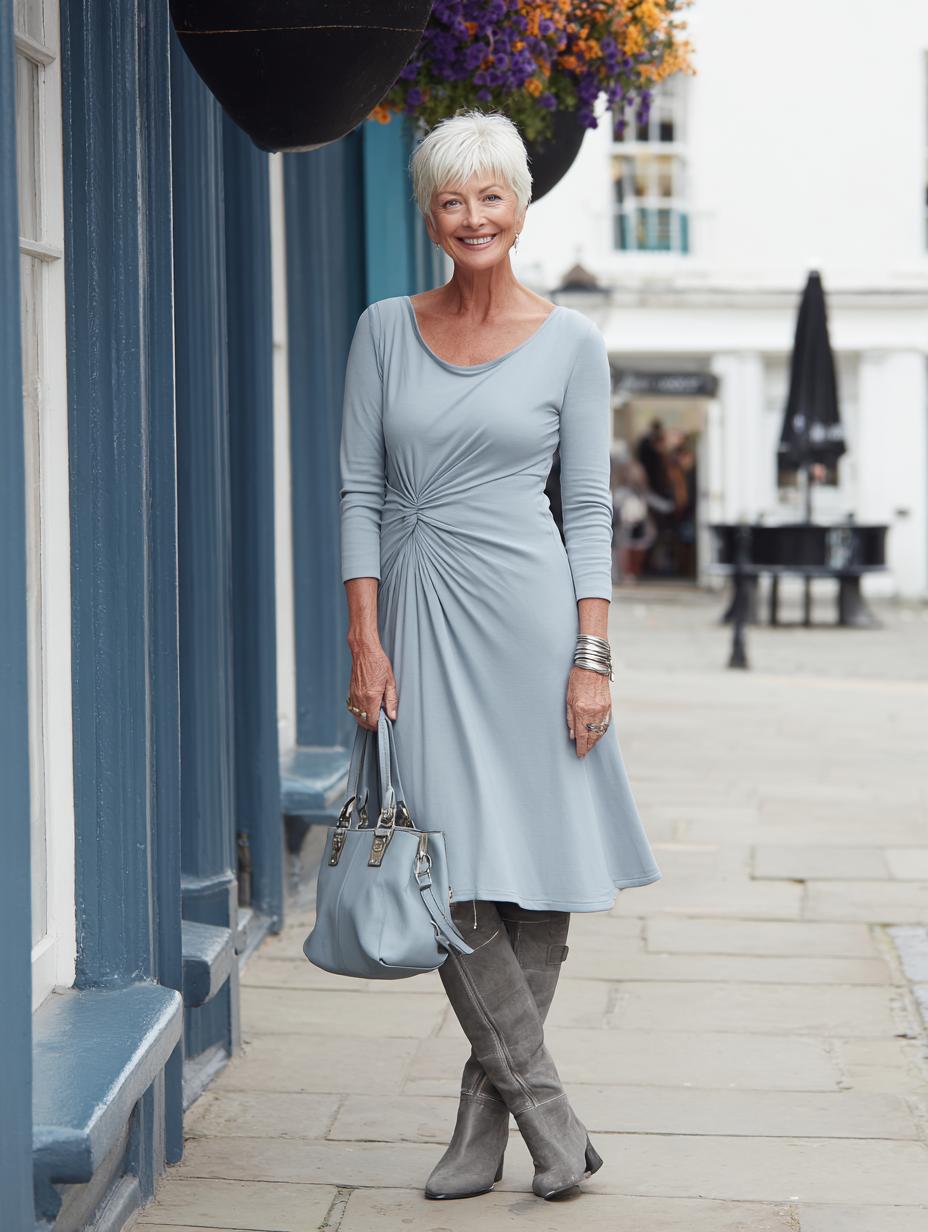
On paper, this pairing shouldn’t work. A dusty blue fit-and-flare with a gathered waist knot paired with knee-high gray suede boots? But look at it. The soft scoop neck and three-quarter sleeves keep the top half simple. The boots rise to just below where the skirt begins its gentle swing, creating a clean transition.
Context matters here. The teal-painted storefront behind her, the hanging basket with purple blooms, the short platinum pixie that echoes the silvery gray of the boots. Stacked silver bangles catch light. A structured dove-gray handbag sits in her hand rather than hanging from her shoulder. This whole look reads as someone who figured out what she likes and stopped second-guessing herself years ago.
6. Can You Wear Sage Green in a Garden Without Looking Obvious?
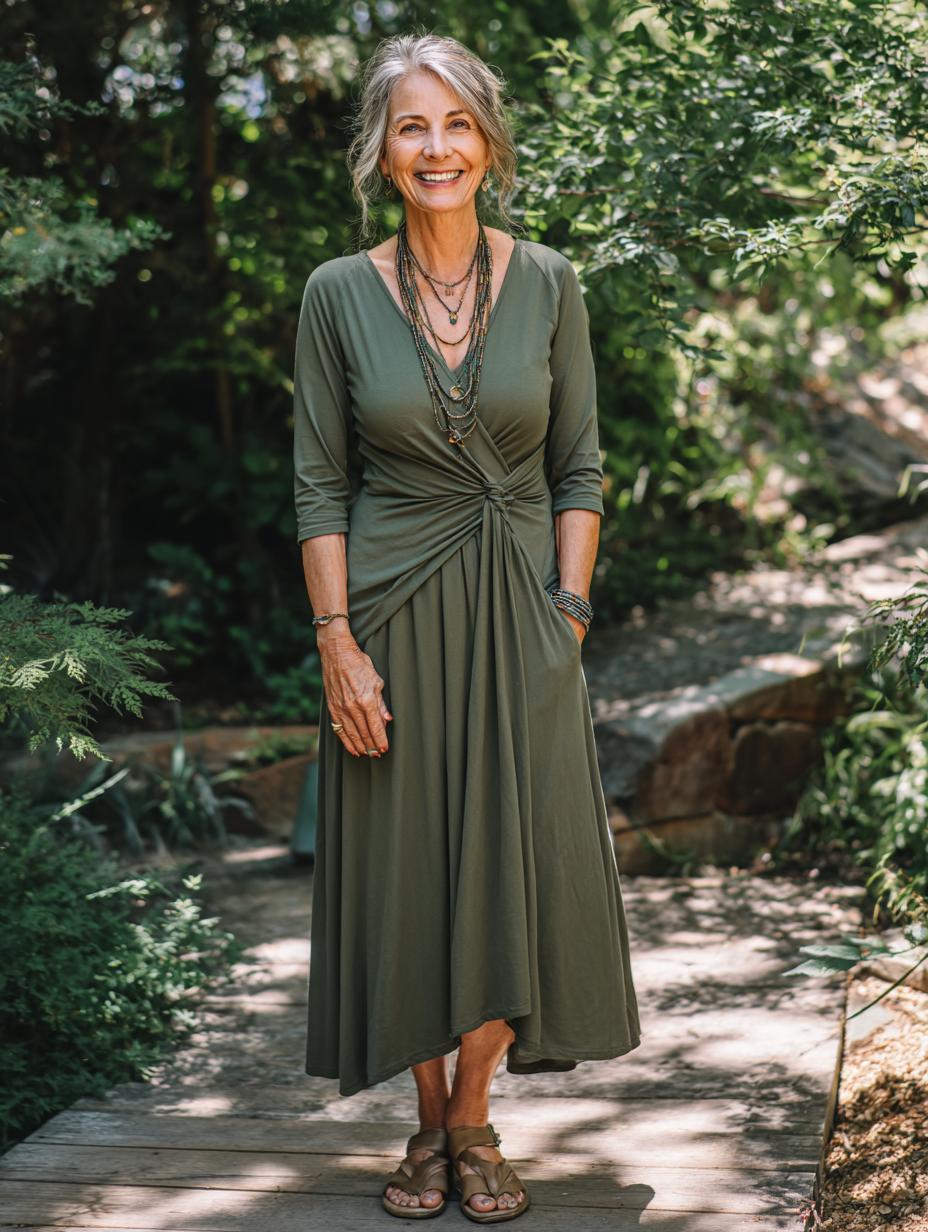
Olive-toned jersey falls in a soft A-line with that twist-front waist anchor. Dappled sunlight filters through branches, catching the fabric differently where it gathers versus where it hangs smooth. The V-neck dips to a flattering depth without revealing too much.
Layered necklaces in mixed metals, beads, and natural stones fill your neckline and add visual weight at the décolletage. Wide-strap leather sandals in olive-brown keep everything grounded. Salt-and-pepper hair pulled loosely back frames without competing. Standing on a wooden boardwalk surrounded by ferns and boulders, you look like someone who gardens in this dress and doesn’t worry about kneeling in the dirt.
5. What Happens When You Pair a Formal Shirtdress With Sneakers
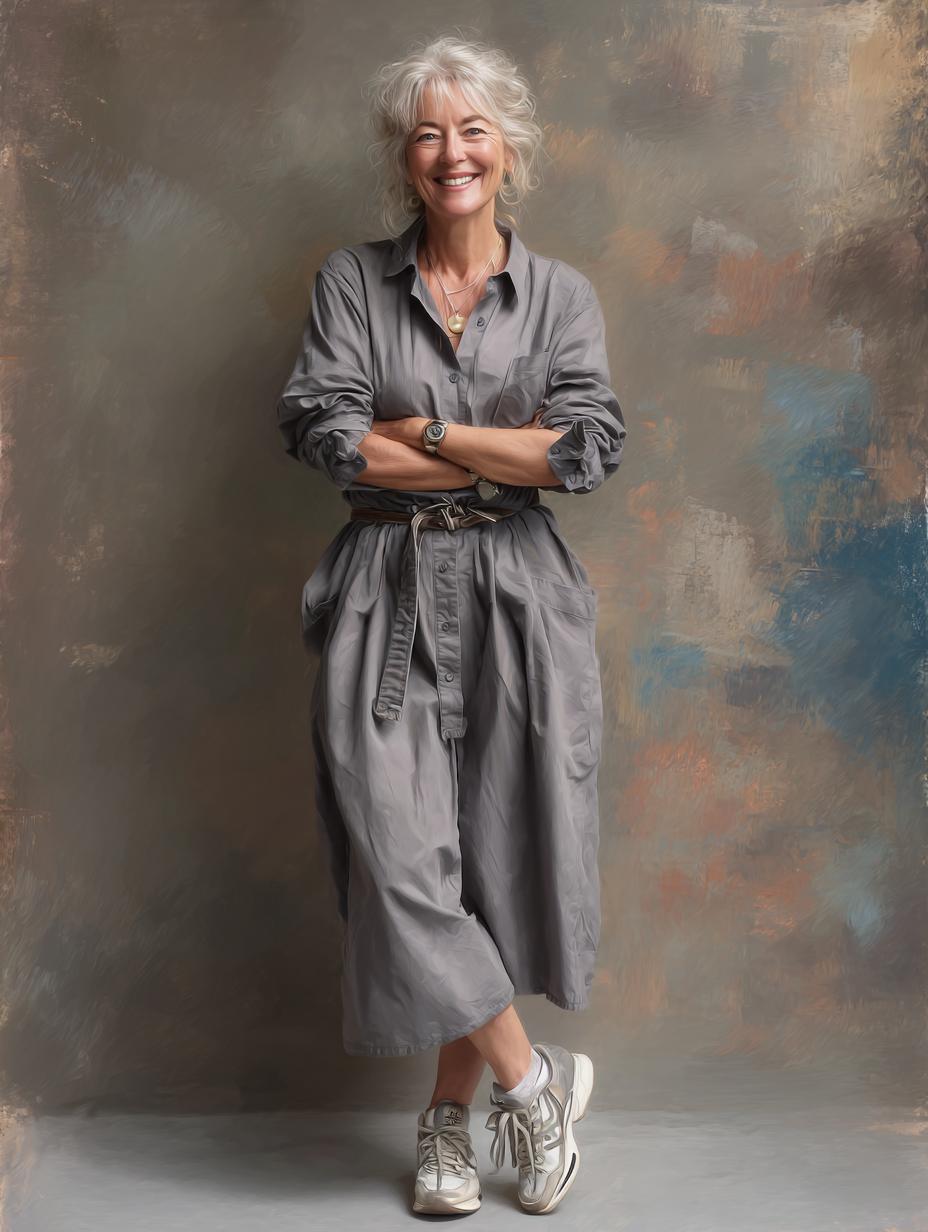
Dove gray cotton poplin. Button-front. Self-belt tied at the waist. Sleeves rolled to the elbow. Standard fare. Then you look down: chunky cream and gray New Balance sneakers peeking out below the midi hem. Arms crossed, weight shifted to one hip, leaning against what looks like a painted canvas backdrop.
A single gold pendant on a fine chain. A wristwatch. Nothing else. White-blonde waves fall naturally. The rust and teal brushstrokes in the backdrop pull out warmth from the neutral gray. This says you have somewhere important to be but you plan to walk there and enjoy the route.
Pull your most polished midi dress from the closet. Pair it with your most comfortable sneakers. If the combination makes you slightly uncomfortable, you’re heading in the right direction. Good style often lives in that tension between what should go together and what actually works when you commit to it fully.
4. Charcoal Gauze and Bouclé Against Blue-Gray Slats
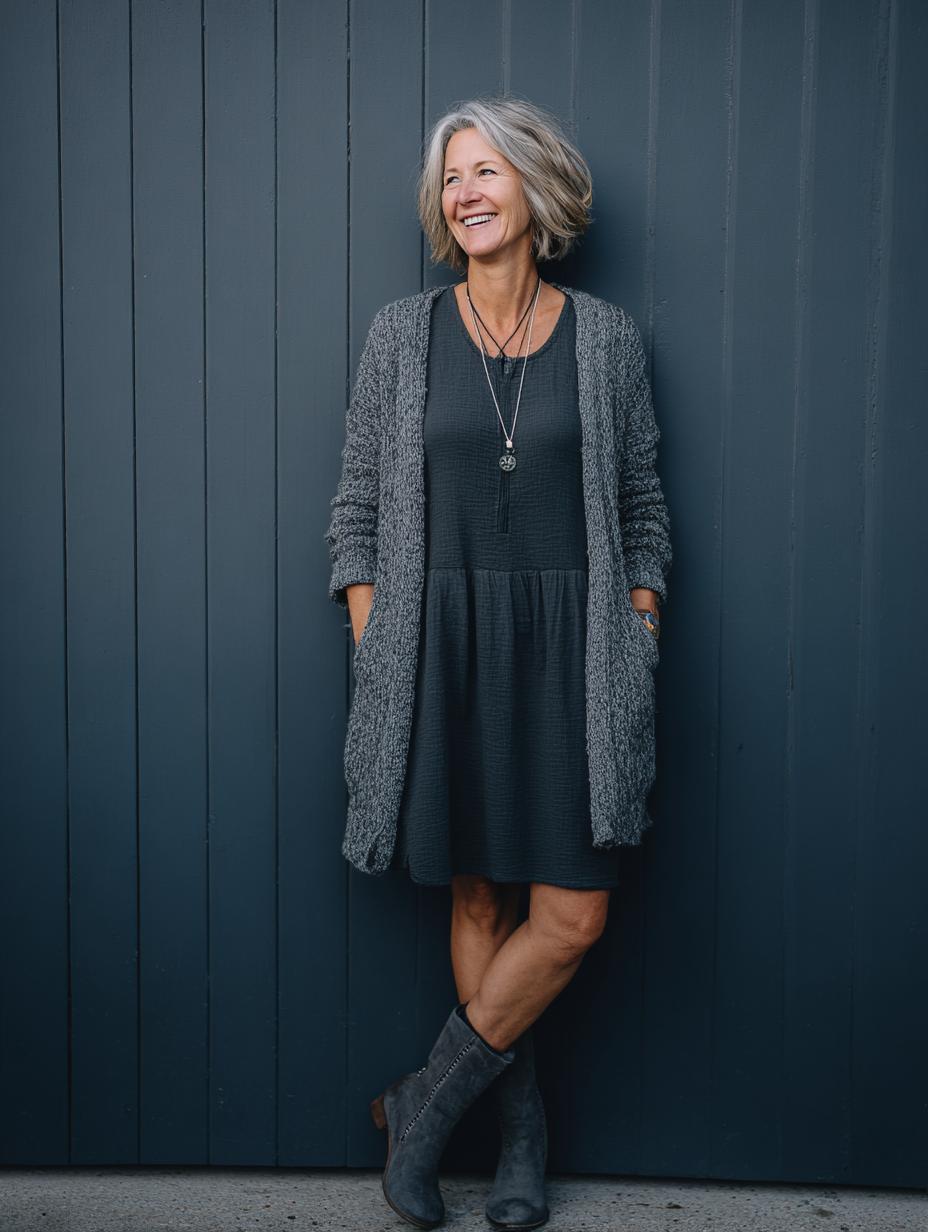
Dark gray gauze in a babydoll shape with a scoop neck and gathered waist. Over it, an open marled charcoal bouclé cardigan with patch pockets at the hips. Weathered gray suede ankle boots with a low stacked heel. A pendant on a long cord hanging at sternum level.
The painted vertical slats behind create a striped effect that plays off the textural contrast between smooth gauze and nubby knit. One leg crosses in front of the other, head tilted back mid-laugh. You throw this on when you want to look like you didn’t try while still looking put-together. The shorter dress length with boots rather than flats keeps proportions from tipping into dowdy territory.
3. The Burgundy Wrap Dress That Understands Asymmetry
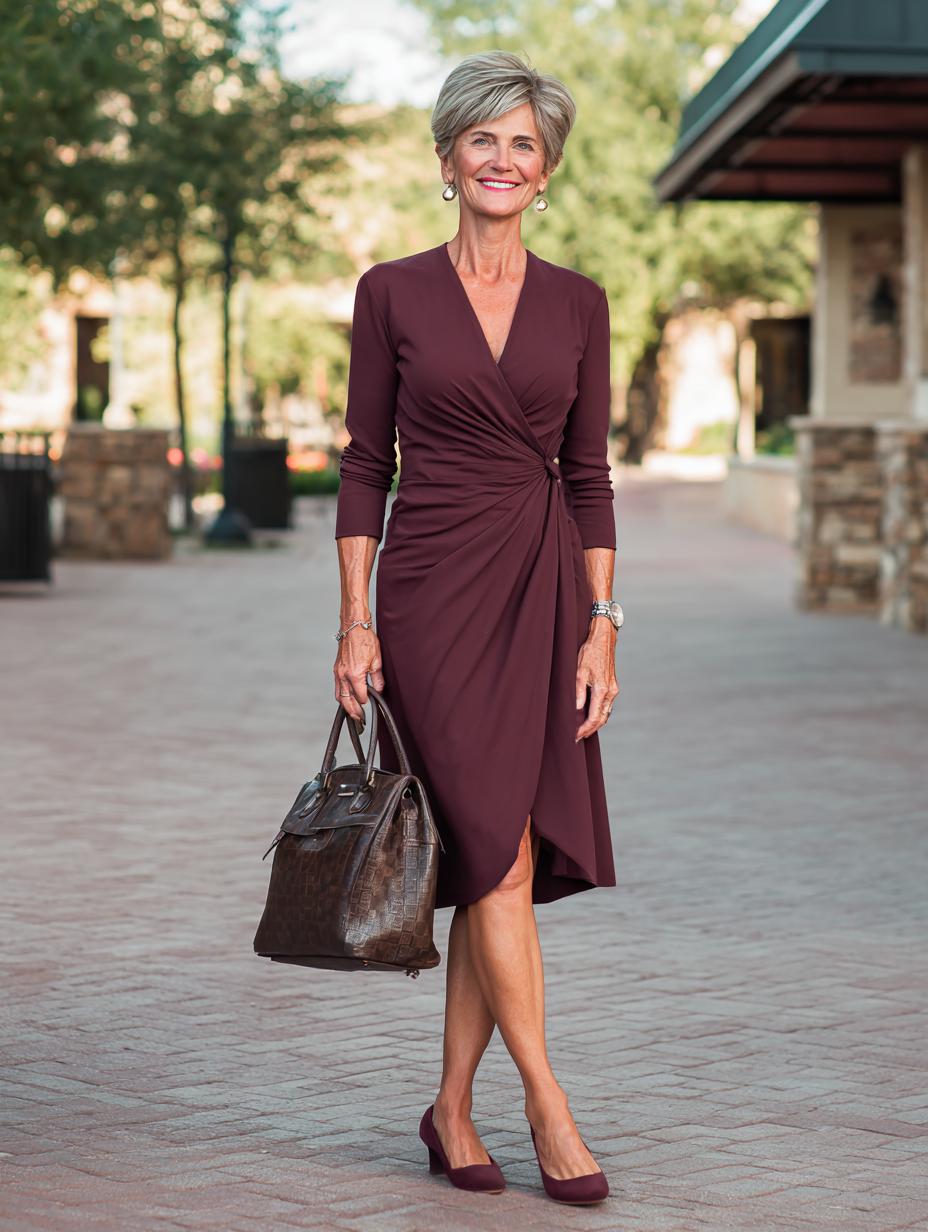
Wine-colored stretch jersey wraps and ties at the left hip, creating an asymmetric hemline that dips lower on one side. The surplice neckline forms a deep V. Three-quarter sleeves end at the narrowest point of the forearm. Matched burgundy pumps and a chocolate croc-embossed bag complete the picture on a stone-lined courtyard.
Pearl drop earrings. A silver watch on one wrist. Enough structure to hold its shape, enough stretch to move without restriction. This works for a rehearsal dinner, a client meeting, any occasion where you want to register without appearing to try too hard. The asymmetric hem adds visual interest and suggests longer legs even at midi length. Nothing kills a dress silhouette faster than a hem hitting at exactly the wrong spot on your calf.
2. Monochromatic Burgundy: A Color Strategy That Works
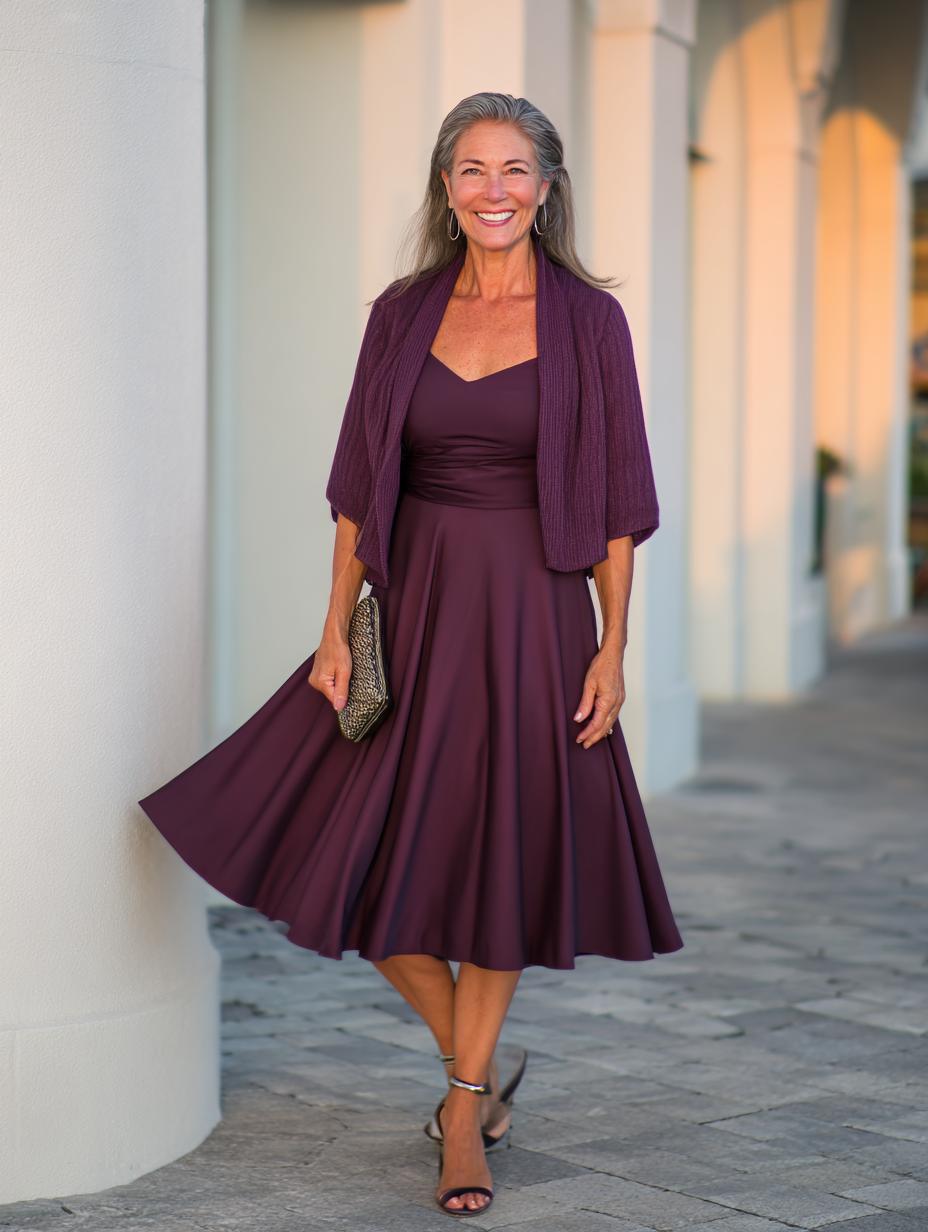
Look at the sweetheart neckline on this wine-purple midi. The ribbed knit cardigan draped over her shoulders shares the identical shade, and that repetition creates an unbroken vertical line from collarbone to hem. Your eye travels the full length of her body without stopping at a color break.
The ruched waistband cinches just below the bust, then the fabric releases into a full circle skirt with real movement to it. Against her silver-streaked hair, that deep burgundy creates genuine contrast. A leopard-print clutch introduces pattern without overwhelming the look, and the strappy metallic sandals keep things grounded. Simple silver hoops, nothing more. You can tell thought went into this, but it never announces itself.
1. Vertical Seaming Does the Work for You
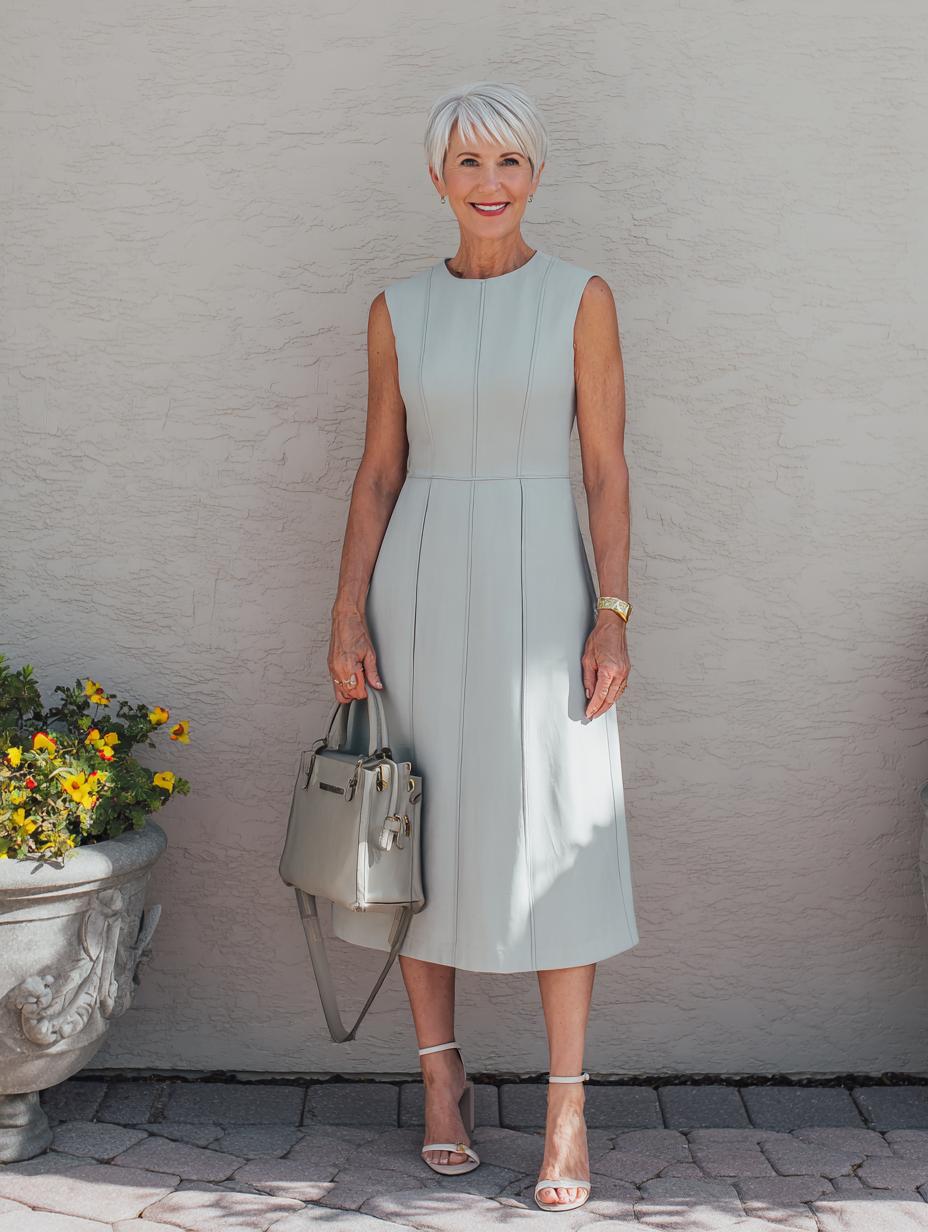
Princess seams run shoulder to hem on this pale sage sheath. Those vertical lines create structure and visual length without shapewear or tricks. The sleeveless cut works for warm weather while the high crew neckline keeps things polished for an office or afternoon event. Fair skin can wash out in certain pale colors, but her bold red lip anchors the whole look and prevents that problem entirely.
Why It Works: Matching your bag to your dress, then choosing shoes one shade lighter, builds a gradient from dark to light. The effect elongates without looking coordinated to the point of costume.
Her greige leather satchel and ivory ankle-strap sandals follow that exact formula here. One wide gold cuff on her wrist, nothing else. The yellow pansies in the stone planter beside her add warmth to the photograph, but this outfit needs no help. Precise construction, a single well-chosen color, minimal metal. That discipline is worth more than a closet full of complicated pieces you never quite figure out how to wear.