❤️ Would you like to save this?
The click of wooden-heeled clogs on office linoleum. The faint sting of Aqua Net in the elevator. The unmistakable rustle of a polyester blouse that could survive a nuclear event and still not need ironing. Going to work in the 1970s meant dressing for a world that was still figuring out what “professional woman” even looked like, and we styled our way through that confusion with terrifying confidence.
Some of these choices were genuinely brilliant. Some were crimes against fabric. All of them were real, and if you lived through it, you’re about to feel every single one.
FYI, thanks to AI imagery software, we’re able to create very specific fashion and hairstyle examples to illustrate the points being made. In some cases, imagery is exaggerated to hammer home the point. Also, assume links that take you off the site are affiliate links such as links to Amazon. this means we may earn a commission if you buy something.
33. The Polyester Pussy-Bow Blouse Tucked Into a Plaid A-Line Skirt, Because That’s How You Got Taken Seriously
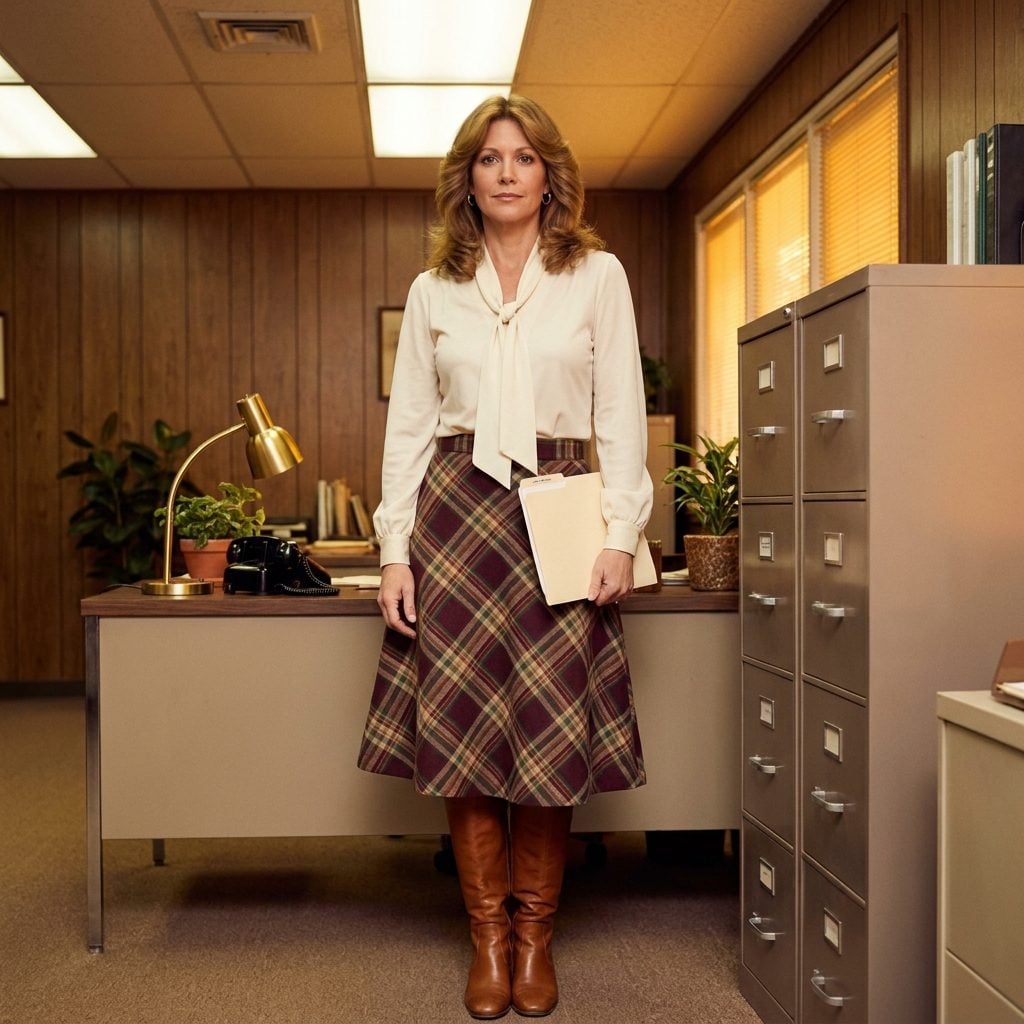
The bow was enormous. Not a dainty ribbon, not a subtle knot, but a full, floppy polyester bow that sat right under your chin and announced you were a professional woman who also possibly owned several cats. Every office had at least three of these blouses rotating through the week, and the cream version was the workhorse.
Tucked into a plaid A-line skirt that hit right at the knee, belted or not, this was the unofficial uniform for any woman who wanted to signal competence without making anyone in the corner office uncomfortable. The knee-high leather boots added just enough personality to keep things from feeling like a costume. You ironed this blouse on Sunday night. You did not skip that step.
32. The Burnt Orange Wrap Dress That Made Every Woman in the Typing Pool Feel Like Diane von Furstenberg
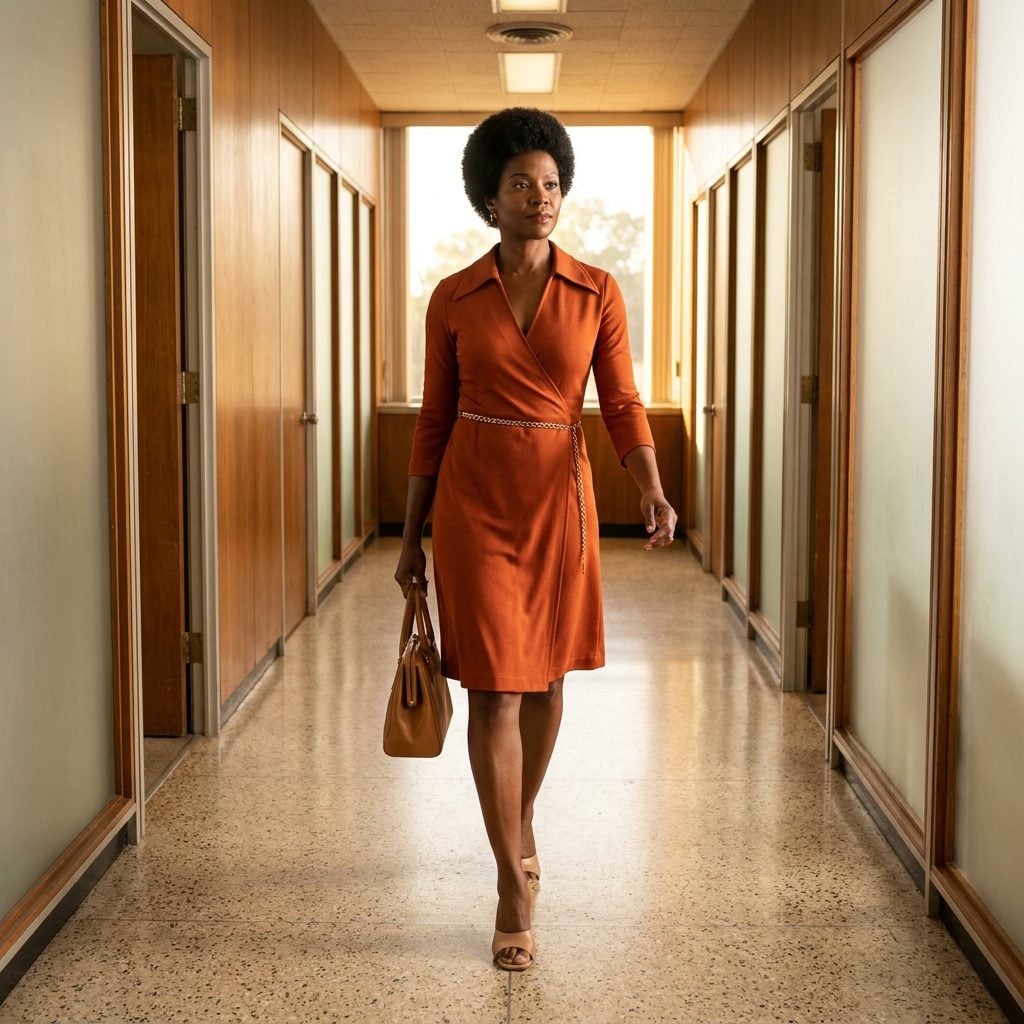
Diane von Furstenberg introduced the wrap dress in 1974 and within a year, some version of it lived in nearly every working woman’s closet. The burnt orange version hit different. It was warm enough to read as approachable, bold enough to hold a room.
What made it revolutionary wasn’t the color or even the silhouette. It was the fact that you could get dressed in under a minute, look polished, and breathe at the same time. No zippers, no hooks, no lying on the bed to close anything. Just wrap, tie, go. The thin gold chain belt draped over the tie was optional but universal.
31. Brown Corduroy Blazer Over a Mustard Turtleneck, or: The Entire 1970s Color Palette in One Outfit
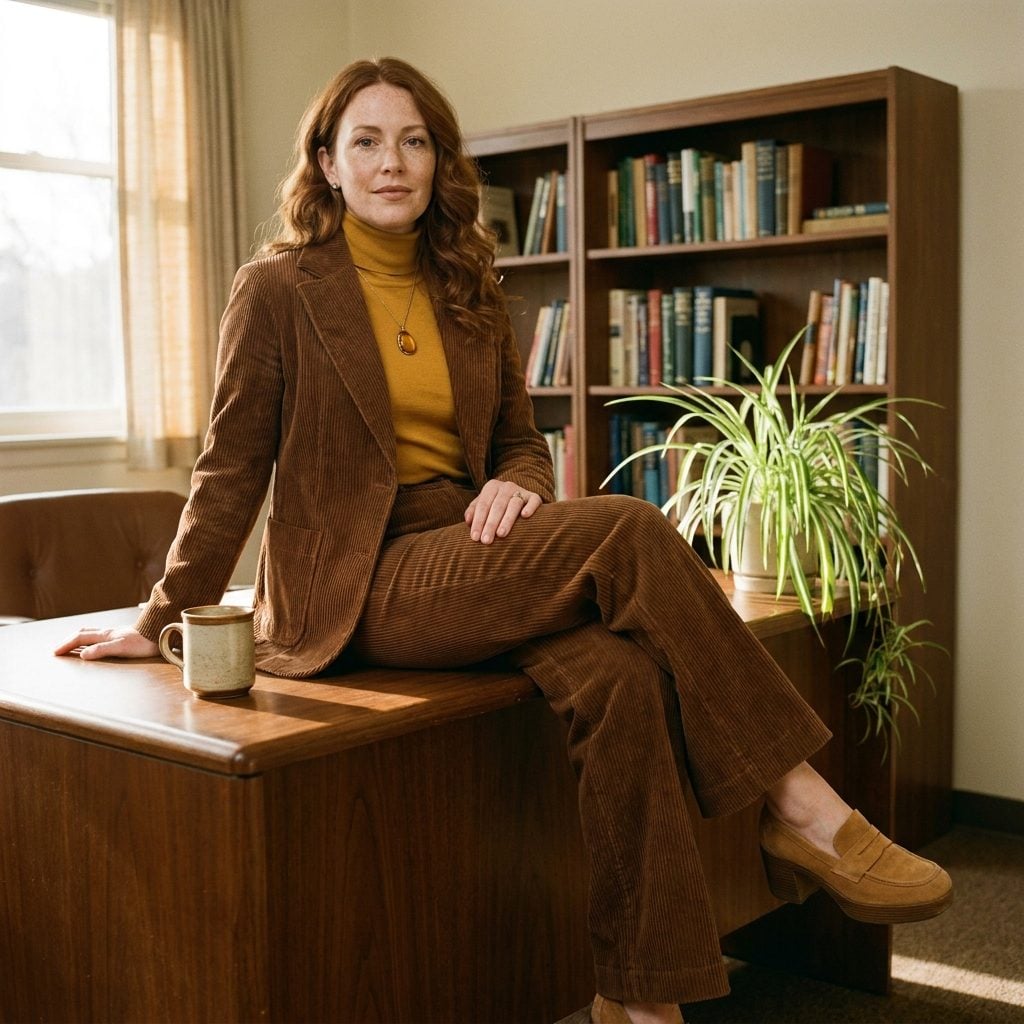
Every shade between mustard and mahogany was fair game. This particular combination looked like autumn decided to get a desk job, and honestly, it looked fantastic.
The brown corduroy blazer was substantial. Wide-wale, wide lapels, heavy enough that you could feel it on your shoulders. Under it, the mustard turtleneck in ribbed knit did all the quiet work. And matching the blazer fabric to the trousers? That took commitment. You walked into a room looking like one continuous warm thought. Nobody questioned your authority when you wore head-to-toe corduroy. I genuinely believe that.
30. The Olive-and-Rust Plaid Pantsuit With a Silk Scarf Knotted at the Throat Like You Had Somewhere Important to Be
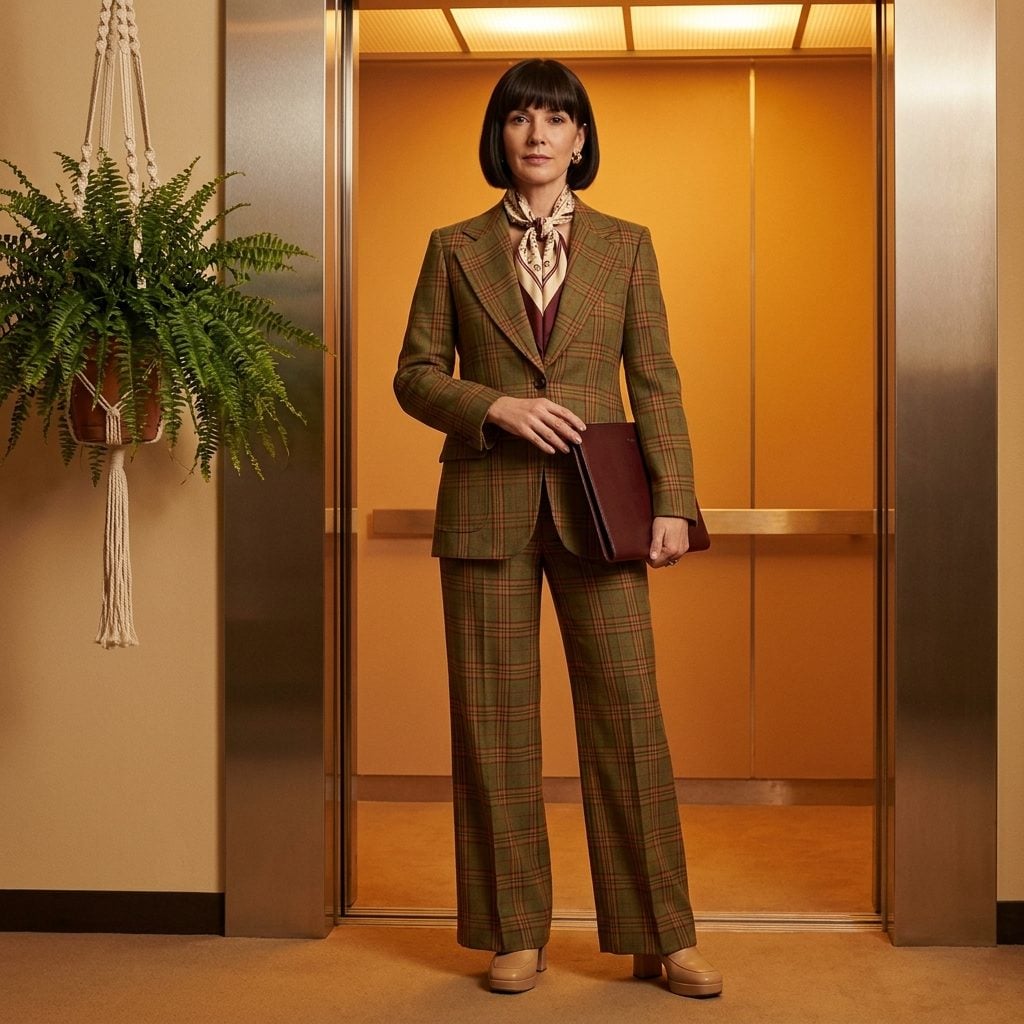
The pantsuit was a statement before it was a wardrobe staple. In the early ’70s, many offices still had policies against women wearing trousers. So putting on a plaid pantsuit wasn’t just getting dressed. It was a small act of defiance wrapped in wide-leg wool blend.
This particular version, olive and rust plaid with a boxy cut, borrowed heavily from menswear and didn’t apologize for it. The silk scarf knotted at the throat was the finishing move. Not an ascot exactly, more of a soft punctuation mark that said: I dressed like this on purpose.
You wore this to the meeting where you knew you’d be the only woman in the room. And the scarf stayed tied all day because you knotted it tight enough to survive anything.
29. The Chocolate Brown Knit Dress With the Chunky Tortoiseshell Belt Buckle That Weighed More Than Your Lunch
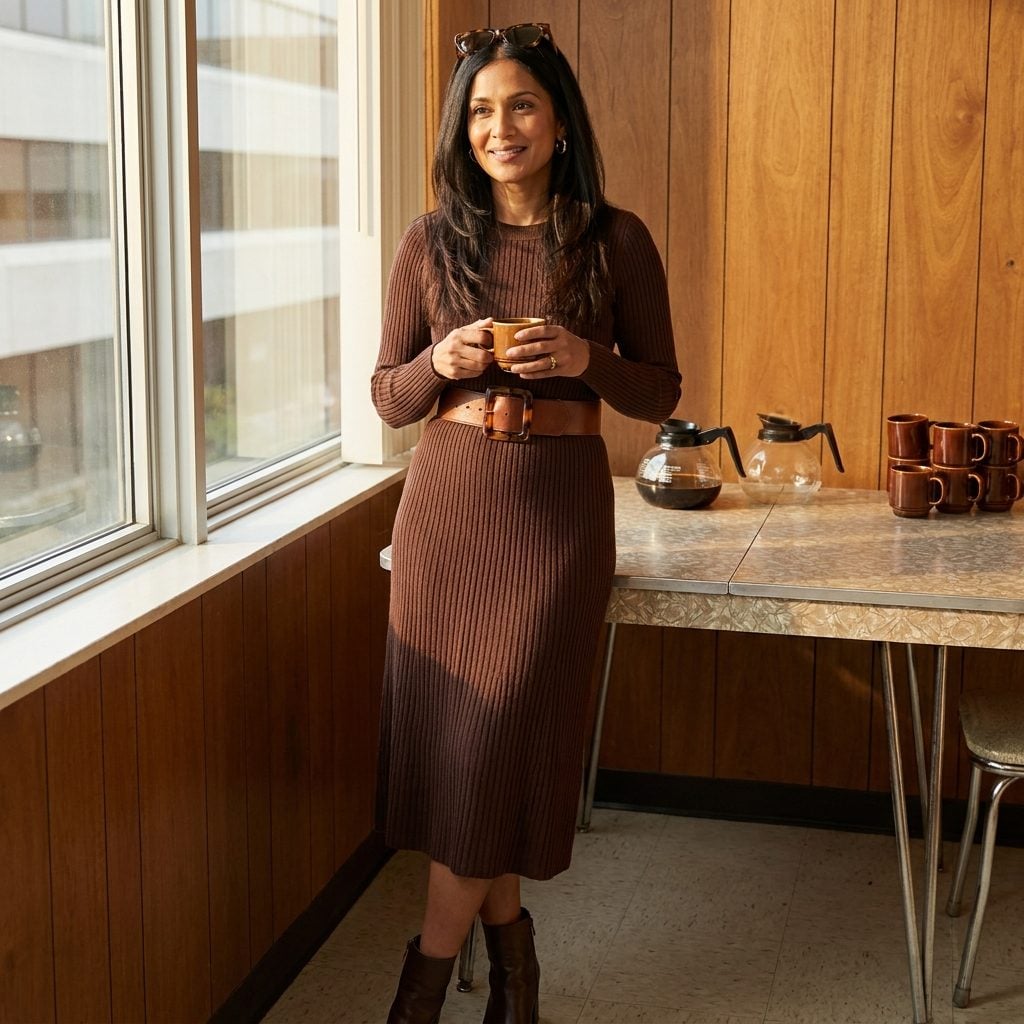
That buckle. It was the size of a small saucer, made of actual tortoiseshell or some convincing plastic approximation, and it anchored the entire outfit like a piece of architecture. The chocolate brown knit dress underneath was simple by design: long sleeves, fine-gauge ribbing, a hem that grazed mid-calf. Nothing competed with that belt.
This was the dress you grabbed when you were running late but still wanted to look like you’d thought about it. The knit moved with you, didn’t wrinkle in your car, and the tortoiseshell buckle belt did all the heavy lifting. Literally. Those buckles were not light.
28. A Houndstooth Blazer With Pleated Tan Trousers and a Chiffon Ascot, Because We Were Deeply Committed to Looking Like Newscasters
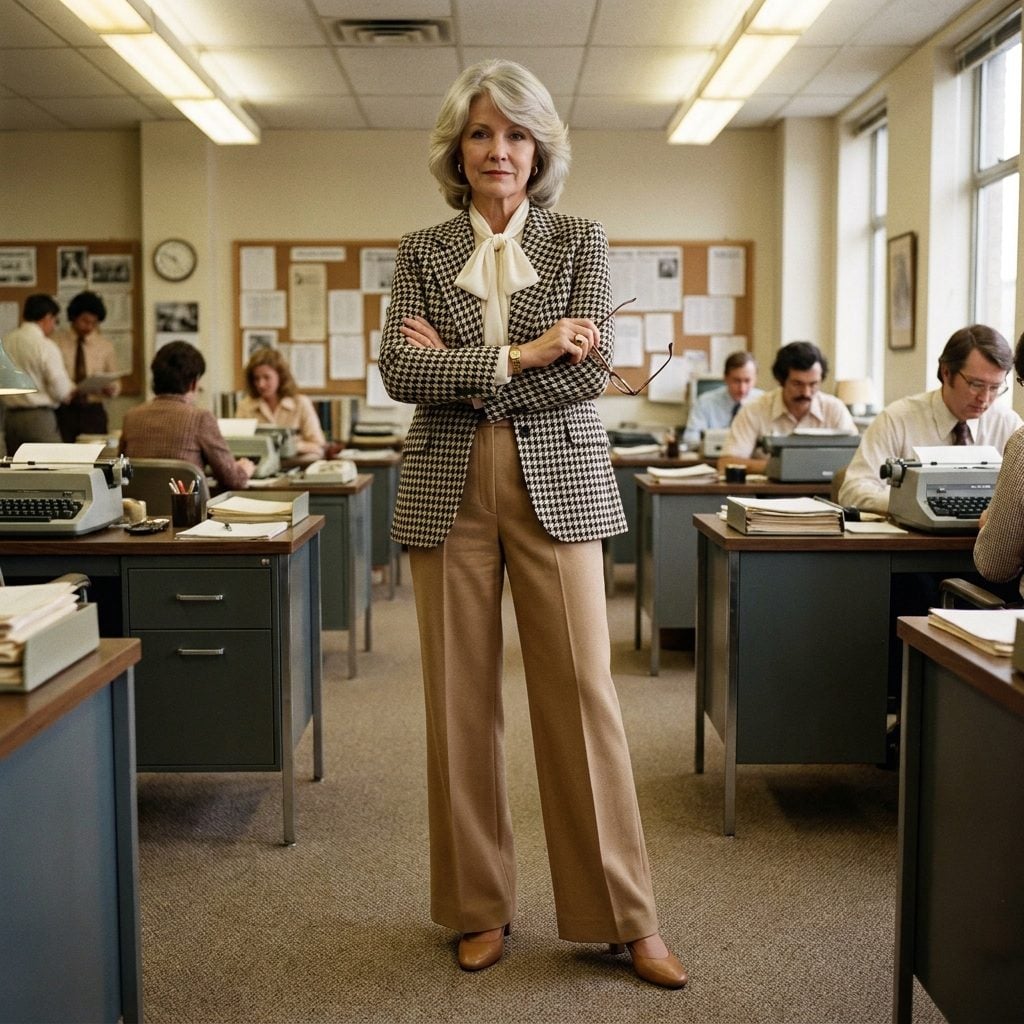
We wanted to look like Barbara Walters. Or maybe Jessica Savitch. Or just any woman on television who seemed to know things and got paid to say them out loud.
The houndstooth blazer was the foundation. Classic, sharp, borrowed from menswear but tailored closer to the body than anything the men were wearing. The pleated tan trousers gave it room and authority. And the chiffon ascot? That was the detail that turned “office outfit” into “I am prepared to deliver breaking news at any moment.”
Nobody actually delivered breaking news. But the ascot didn’t know that.
27. The Forest Green Polyester Dress With Bishop Sleeves That Made You Feel Like a Renaissance Painting at a Staff Meeting
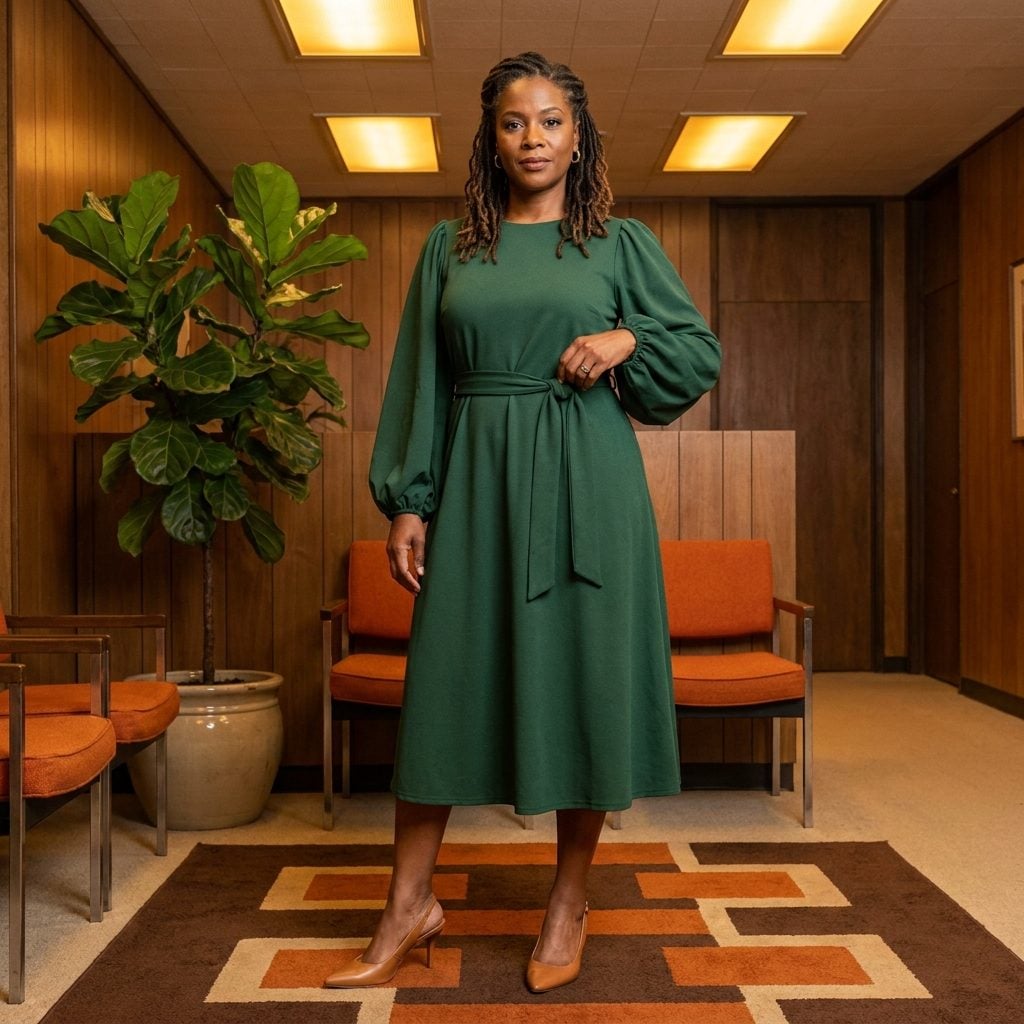
Those sleeves. Billowing from the shoulder, gathering into a tight cuff at the wrist, holding enough fabric to upholster a small chair. Bishop sleeves were everywhere in the ’70s, and in forest green polyester they had a particular gravity. You couldn’t type very fast in them, which was maybe the point.
The self-tie sash pulled everything together, literally. Without it, the dress was a tent. With it, you had a waist, a silhouette, and the vague air of someone who might start reciting poetry at the copier. The color was gorgeous against every skin tone, which is probably why this exact dress showed up in Sears, JCPenney, and about forty other catalogs simultaneously.
26. The Camel Three-Piece Skirt Suit With the Coordinating Waistcoat, a.k.a. the Outfit That Said “I Will Be Running This Department Soon”
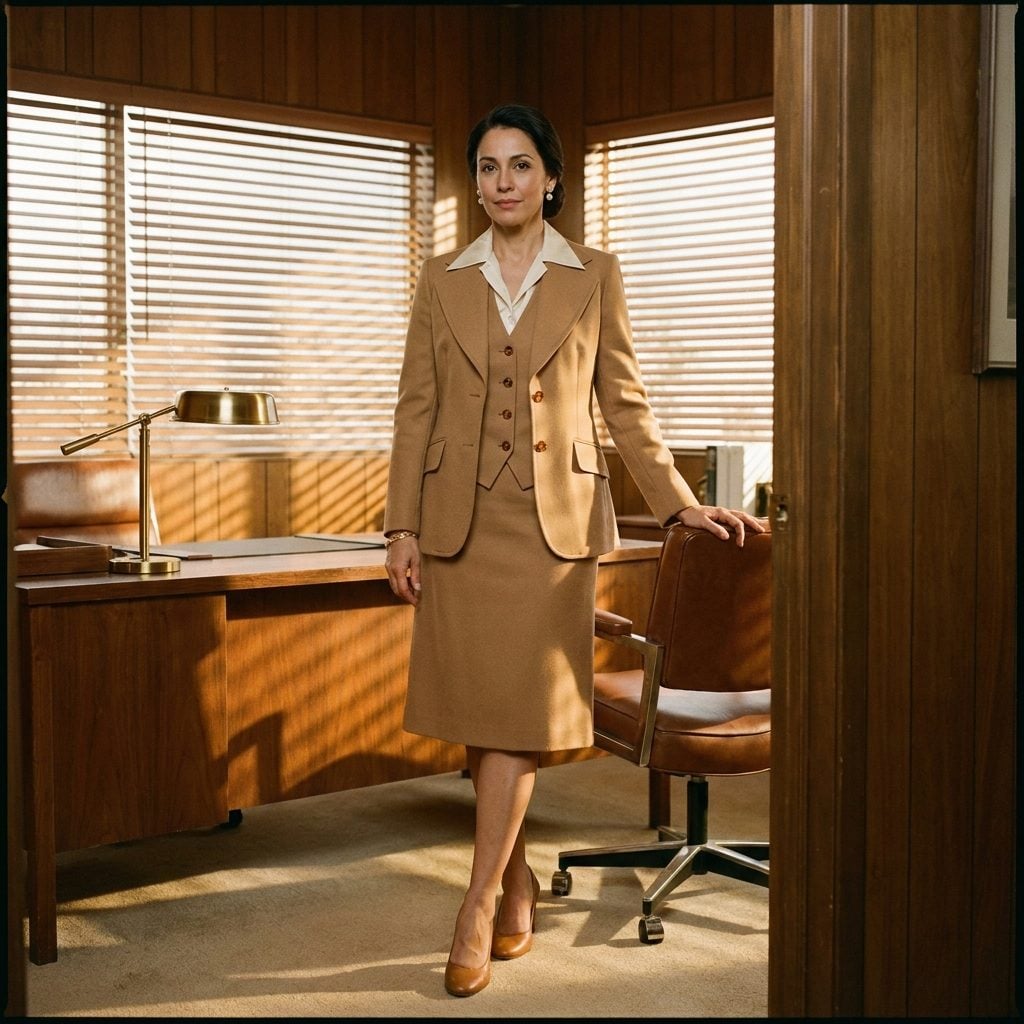
Three pieces. Blazer, waistcoat, skirt. All matching. All camel. If you showed up wearing this in 1976, people moved out of your way in the hallway and they were right to do so.
The waistcoat was the power move. Men had been wearing three-piece suits forever, and borrowing that structure for women’s workwear felt pointed, intentional. The camel wool suit was impeccable because it had to be. The tortoiseshell buttons ran through all three pieces like a quiet signature. The cream silk blouse peeked out at the collar and cuffs, the only softness in an otherwise architectural outfit.
This wasn’t about fitting in. This was about showing up in a uniform your boss recognized as his own, then out-performing him in it. And you did.
25. The Pucci-Print Blouse Tucked Into a Pencil Skirt Like You Were Running a Gallery, Not Filing TPS Reports
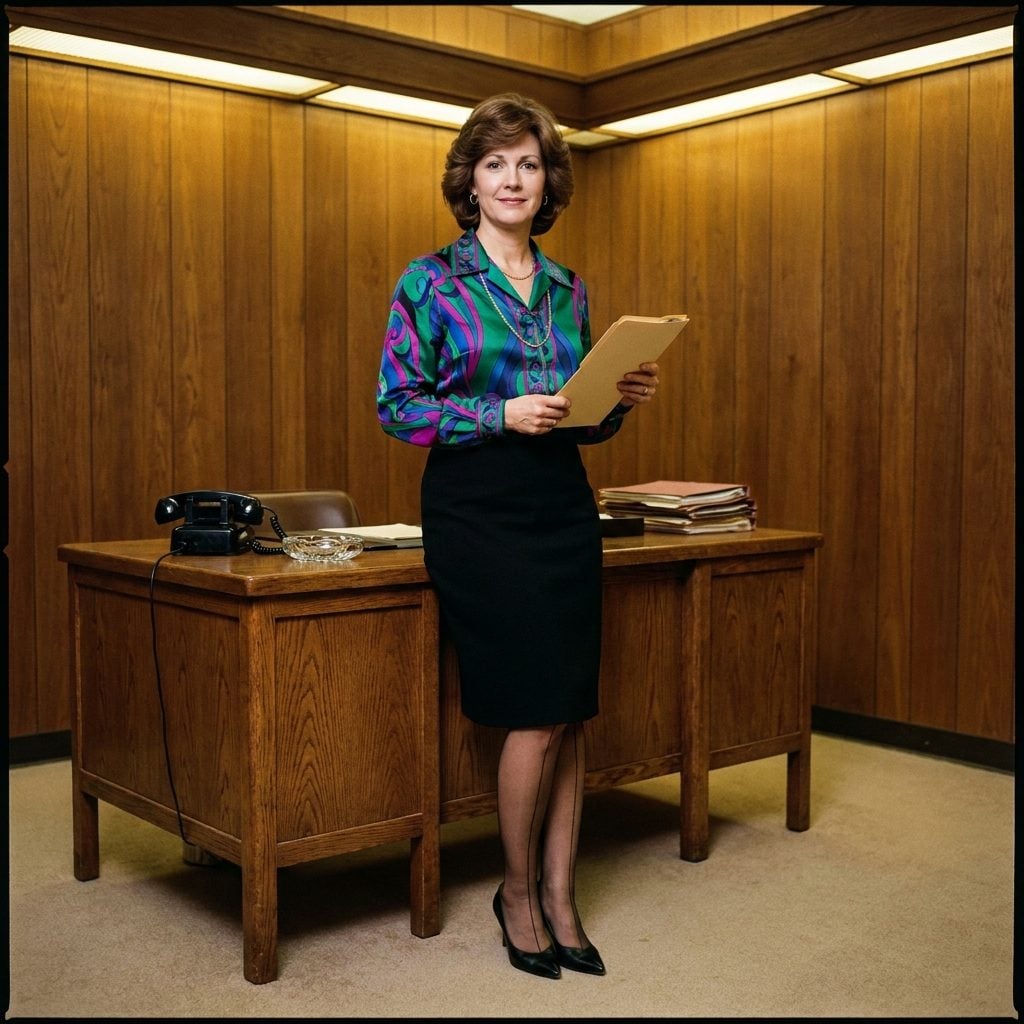
The print did all the talking, and honestly, it was saying a lot. These jewel-toned swirling blouses in emerald and sapphire and magenta looked like someone had poured a Murano glass factory onto fabric. You tucked them into a high-waisted black pencil skirt, smoothed everything down, and suddenly you weren’t just the new girl in accounts receivable. You were someone with opinions about modern art.
The seamed pantyhose were non-negotiable. Not because anyone required them, but because the whole outfit fell apart without that single dark line running down the back of each calf. It was the finishing stroke. I sometimes wonder if the entire 1970s office aesthetic was just women finding increasingly bold ways to assert themselves in rooms full of brown furniture and cigarette smoke.
24. That Cream Gauze Blouse Under a Suede Vest, Because Apparently We All Worked on a Ranch in 1974
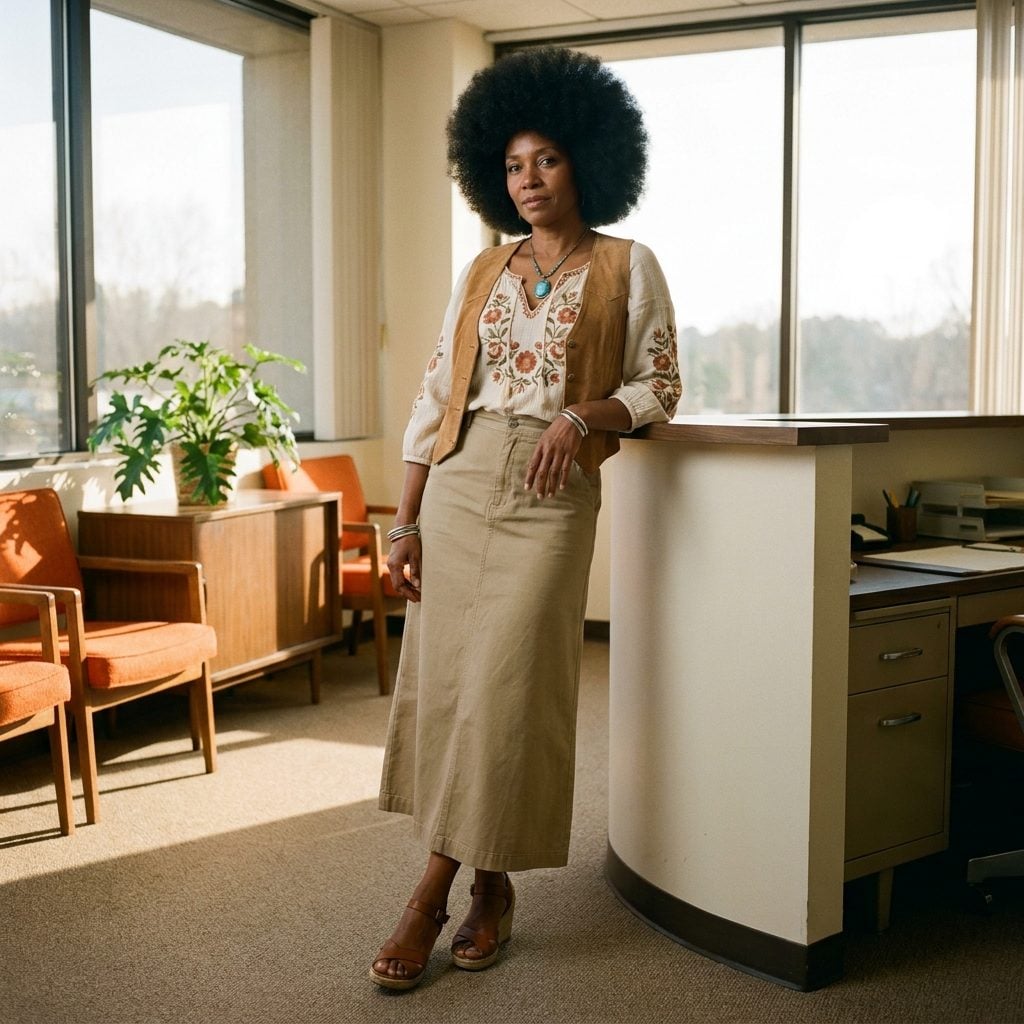
Nobody questioned why we dressed like frontier schoolteachers to answer phones. That cream gauze blouse was practically see-through in direct sunlight, which is why the suede vest wasn’t optional. It was structural support. And also, yes, deeply cool.
The embroidered yoke made you feel like each blouse had been hand-stitched by someone who lived near a canyon. They were not. They came from Sears. But the fantasy held together, especially once you added that tan suede vest and a pendant necklace with an actual rock on it. The khaki midi skirt grounded the whole thing just enough to pass muster with HR, assuming your office even had HR in 1974.
23. The Navy Double-Knit Blazer With Brass Buttons You Bought to Look Serious (It Worked)
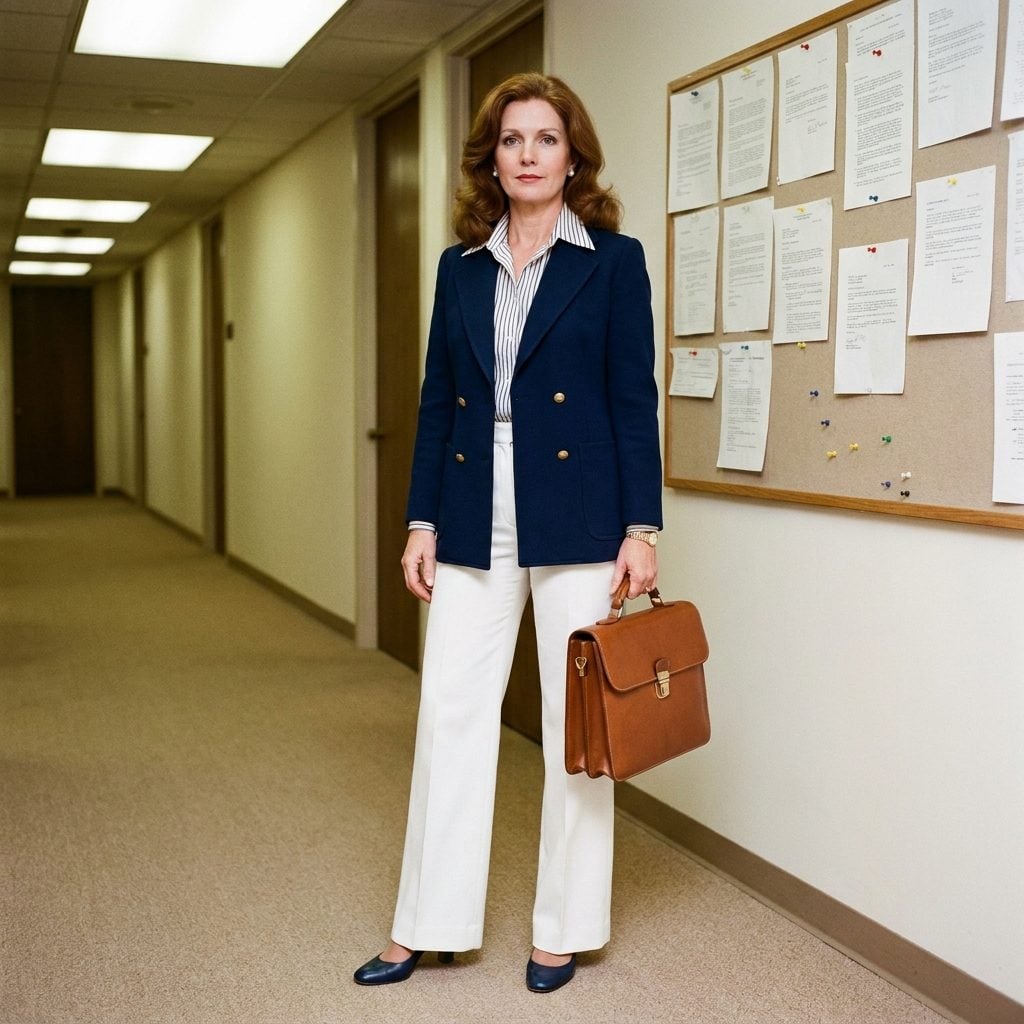
This was the power move before anyone called it a power move. The navy double-knit blazer was stiff enough to stand up on its own, which felt like a metaphor for something. Those brass buttons meant business. Actual, literal business. You wore this to meetings where you were the only woman in the room, and the blazer did some of the talking for you.
White wide-leg pants in an office took nerve. One coffee spill and your morning was over. But the combination of that nautical blazer and those crisp white trousers read as someone who had her life together, even if you absolutely did not. The striped blouse underneath was the quiet workhorse, always cotton, always slightly wrinkled.
22. A Rust Shirtdress With Knee-High Boots, a.k.a. the Outfit That Made You Feel Like a Magazine Editor Even If You Were a Typist
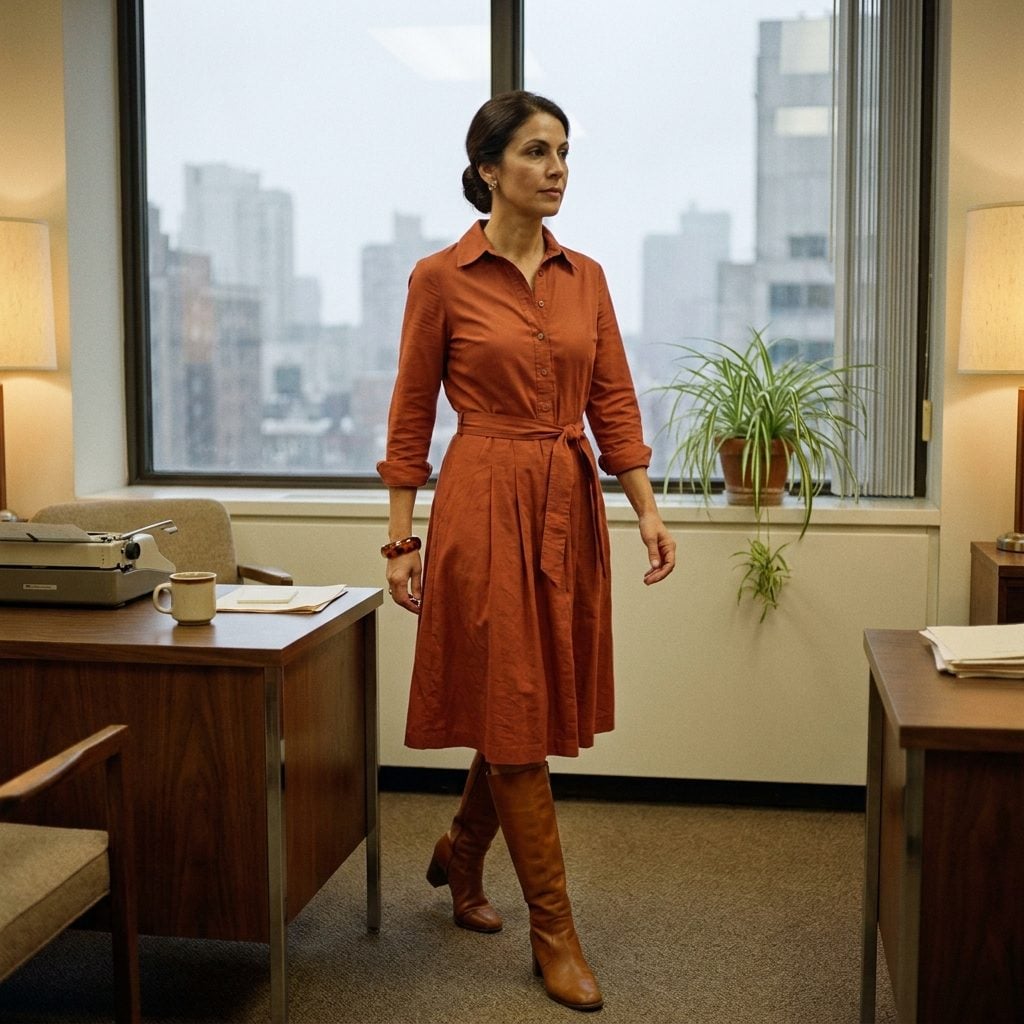
Rust was the color of 1975. Not orange, not brown, not terracotta. Rust. And you knew the difference because your mother’s entire living room was also this color.
The shirtdress itself was deceptively simple: button front, collar, self belt, done. But the pleated front gave it just enough movement when you walked, and that’s where the boots came in. Stacked-heel knee-highs in caramel leather, not quite tall enough to disappear under the hemline, leaving this deliberate two-inch gap of pantyhose-covered knee that somehow read as both modest and bold. You felt pulled-together in this outfit in a way that was hard to replicate. The belt did a lot of the heavy lifting, honestly. Without it, you were wearing a very expensive pillowcase.
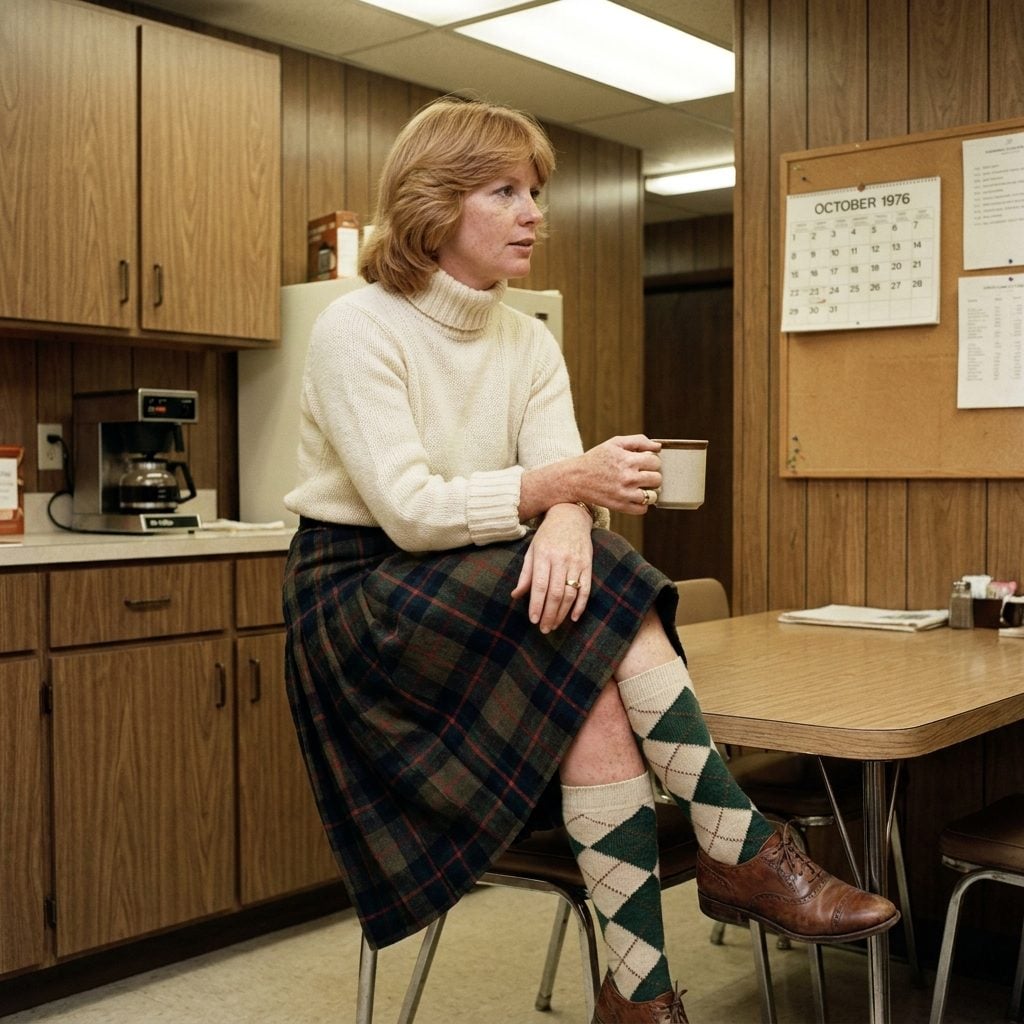
21. The Plaid Wool Kilt With the Cable-Knit Turtleneck, Because We Were All Trying to Look Like We Went to a School We Didn’t
❤️ Would you like to save this?
We were cosplaying as prep school girls who summered in Connecticut. Not a single one of us summered in Connecticut. But that plaid wool kilt with its little leather buckle and the cable-knit turtleneck said otherwise, and nobody was checking credentials.
The loafers completed the illusion. Brown leather, brogue detailing, the kind of shoes that suggested you owned a horse somewhere. Add argyle knee socks and you could practically hear the phantom school bell. I think half of us got this look from Ali MacGraw in Love Story and just never fully let it go.
20. The Burgundy Velvet Blazer With Satin Lapels That Made Every Holiday Party Feel Like a Film Premiere
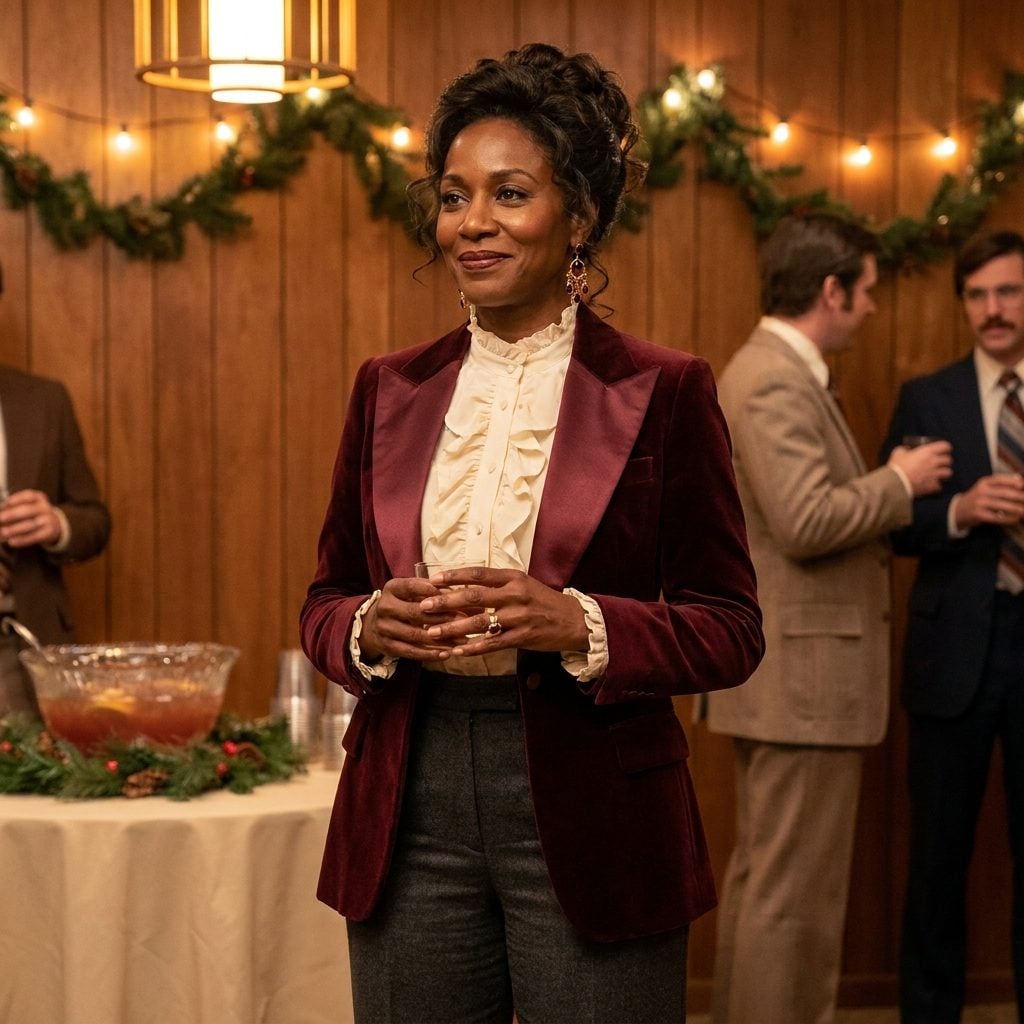
Velvet in an office was a dare. Burgundy velvet with satin lapels was a declaration. This blazer lived for the space between Thanksgiving and New Year’s, when the rules got a little softer and you could wear something that reflected light without being called dramatic.
The ruffled cream blouse underneath was the secret weapon. All that fabric at the collar and cuffs softened the richness of the velvet, made it feel less costume-y and more intentional. Dark trousers kept everything grounded. You felt like you were in a Robert Altman film, even if you were just eating sheet cake in the conference room.
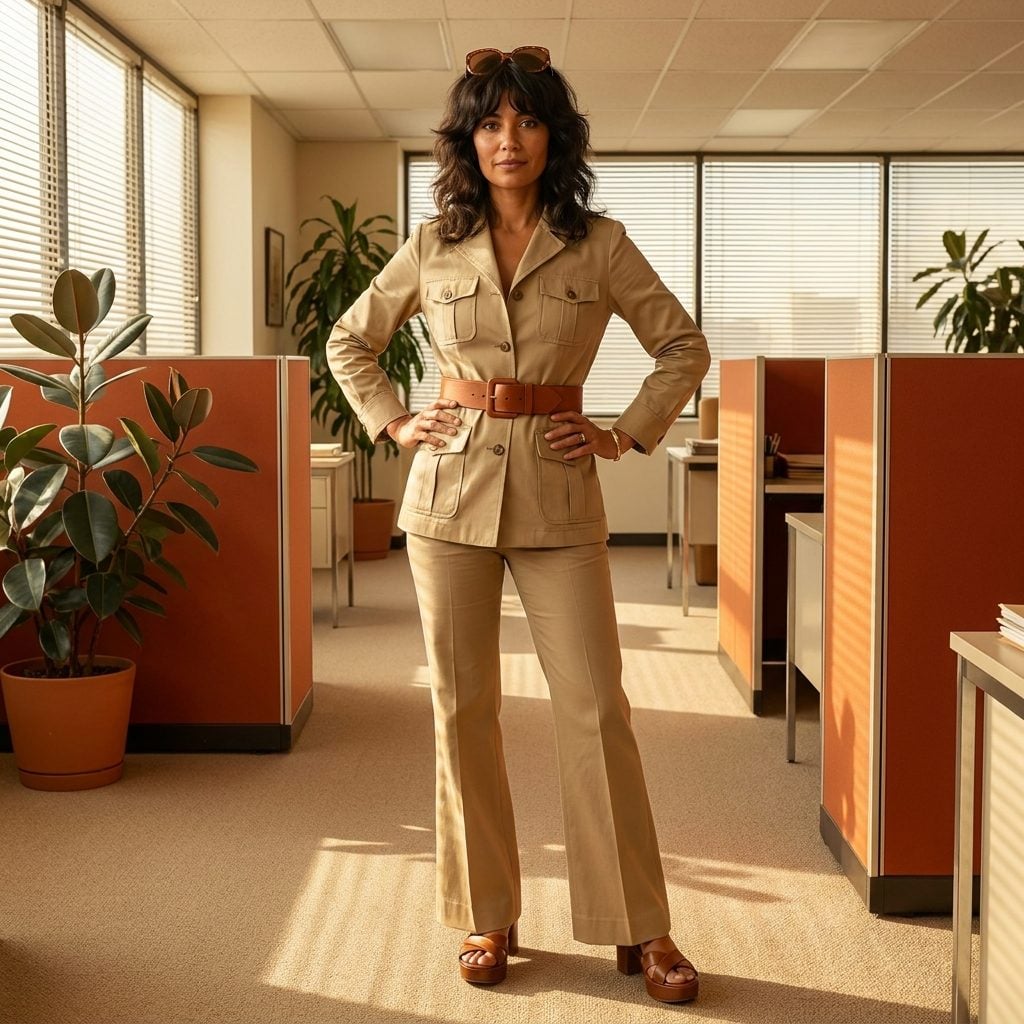
19. The Safari Suit That Said ‘I Could Lead an Expedition but I’m Choosing to Work in Accounts Payable’
 Work in Accounts Payable'” class=”wp-image-75585″ />
Yves Saint Laurent put this on the runway in 1968 and by 1975 every woman with access to a Simplicity pattern was wearing some version of it to the office. The patch pockets. The epaulets. The wide leather belt that made your waist disappear. You looked like you were about to cross the Serengeti, not proofread quarterly reports.
What made the safari suit work in an office context was its military precision. Everything buttoned, everything belted, everything had a pocket with a purpose. It was structured in a way that read as competent, which mattered more than most people admitted. And there was something deeply satisfying about having four functional pockets on your jacket when most women’s clothing at the time gave you zero.
18. The Forest Plaid Pantsuit With the Matching Vest, a.k.a. Three Pieces of Polyester That Made You Invincible
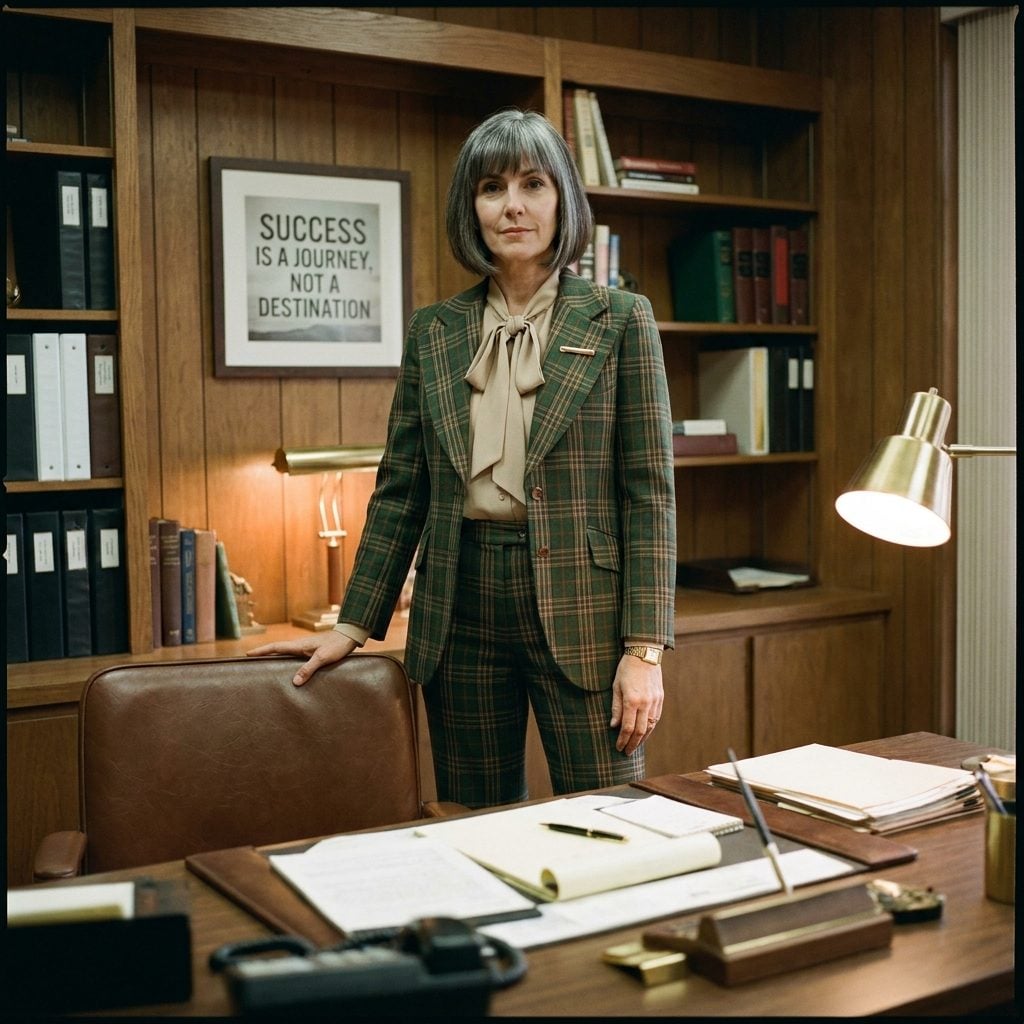
Three matching pieces. Three. The jacket, the vest, the trousers, all in the same forest plaid, all in the same unbreathable polyester blend that could survive a house fire. You put this on in the morning and you were done making decisions. Everything matched. Nothing could go wrong. You were a system.
The matching vest was the piece that really committed the look. Without it, you had a plaid suit. Fine. Respectable. With it, you had an outfit that said, “I coordinated harder than anyone in this building and I did it before 7 a.m.” The flared trouser leg was wide enough to hide platform shoes, which everyone did, adding two secret inches of authority.
A beige blouse with a soft bow at the neck kept the whole thing from tipping into menswear territory, though looking back, tipping into menswear territory would have been perfectly fine too.
17. The Paisley Jersey Midi That Made You Look Like You Ran the Typing Pool and the Entire Building
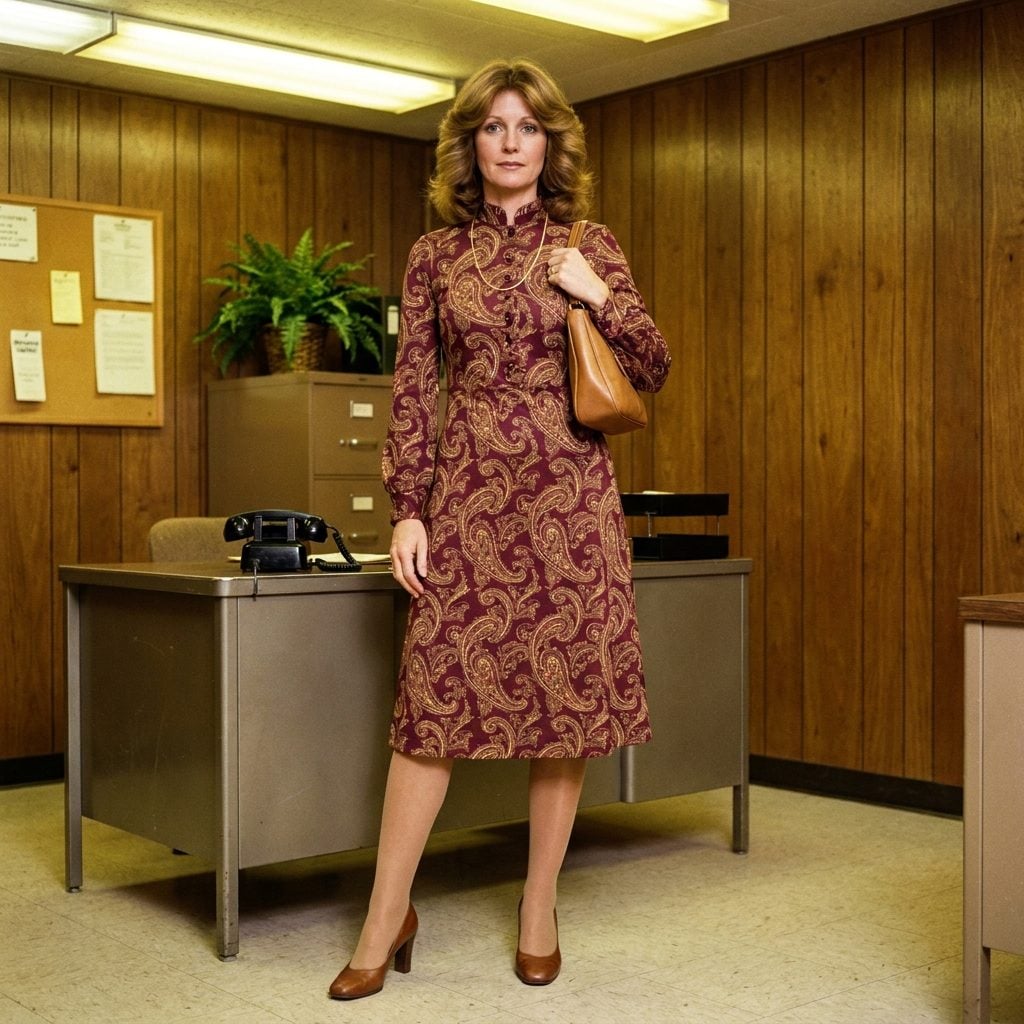
That fabric had a weight to it, a slippery cool feeling against your arms that somehow made sitting at a metal desk for eight hours slightly more bearable. The paisley jersey midi was the dress you reached for on mornings when you needed to feel put together but couldn’t face a zipper. Covered buttons up the front, a collar that brushed your jaw, and a print busy enough to hide the coffee you inevitably spilled by 10 a.m.
The real trick was the belt. You either cinched it with a skinny leather belt or let it hang straight, and those were two completely different women making two completely different statements.
16. The Cream Silk Blouse Tucked Into Chocolate Trousers, a.k.a. the Outfit That Said ‘I Have a Corner Office in My Future’
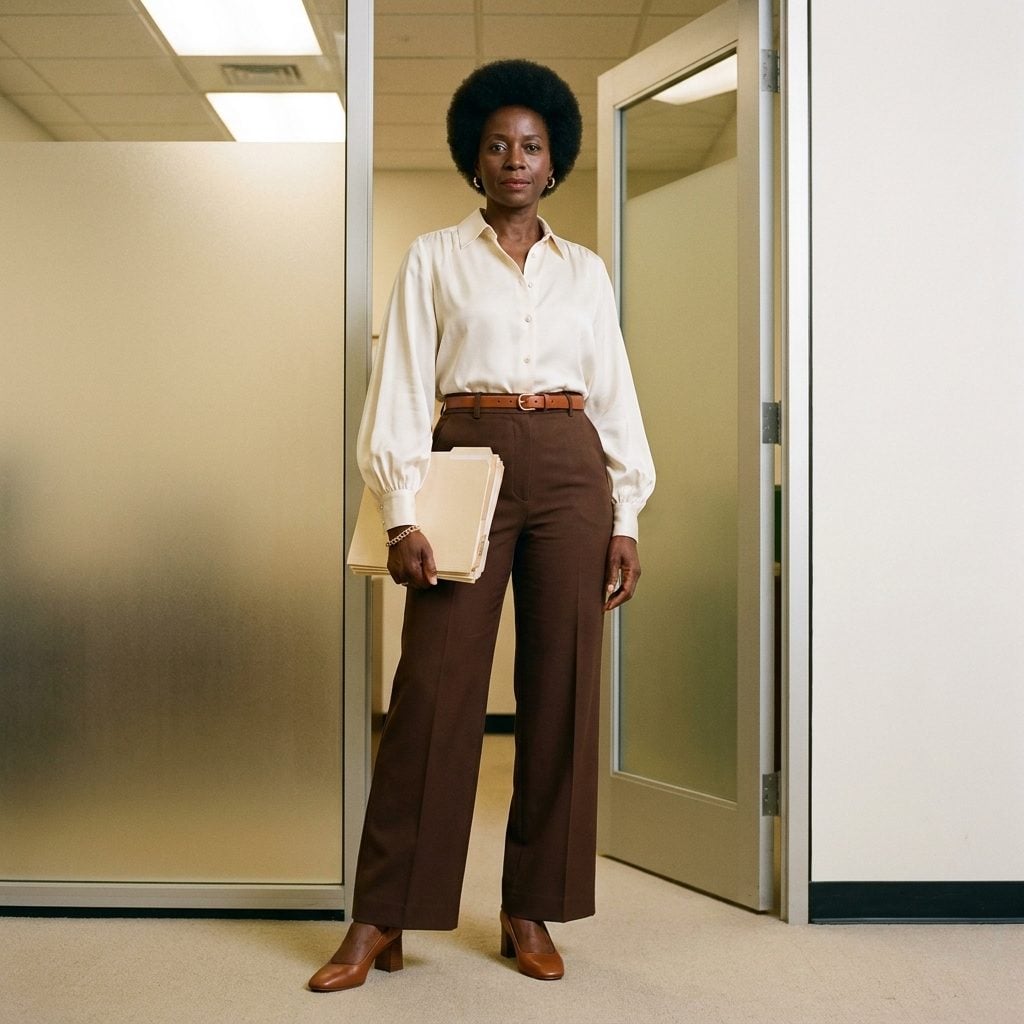
Silk against your collarbone, gabardine swishing past your ankles. This combination was practically a uniform for women who wanted to be taken seriously in rooms where they were still the only woman present. The cream silk blouse did the heavy lifting: those enormous sleeves gave the whole outfit a sense of authority that a simple button-down never could.
And the chocolate gabardine trousers? They had to be wide-leg. Anything tapered would’ve read secretarial. Wide-leg read executive, or at least executive-adjacent. We knew the difference instinctively.
15. The Taupe Twinset and Tweed Skirt Combo Your Mother Swore Was ‘Classic’ (She Was Right, Annoyingly)
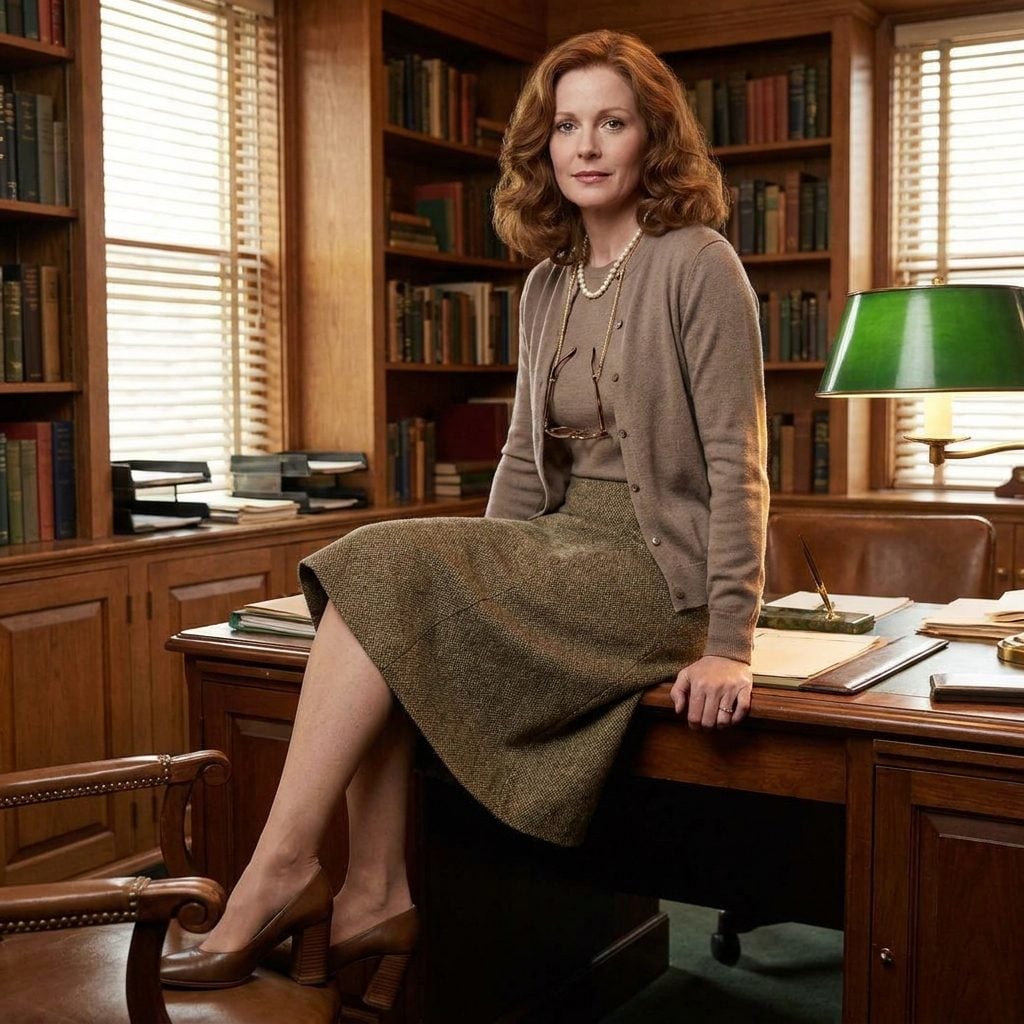
Nobody ever got excited about a twinset. That was the whole point.
This was the outfit that required zero thought and projected total competence. The taupe cardigan buttoned over its matching shell, the tweed skirt pressed and ready, the stacked heels comfortable enough to survive a full day without limping to the parking lot. It was your mother’s advice made fabric. She’d tell you to buy quality basics, and you’d roll your eyes, and then ten years later you’d find yourself reaching for this exact outfit every single Monday.
The pearls were optional but almost inevitable.
14. A Canary Yellow Blouse Tied at the Chest With White Culottes, Because Apparently That Flew in 1976
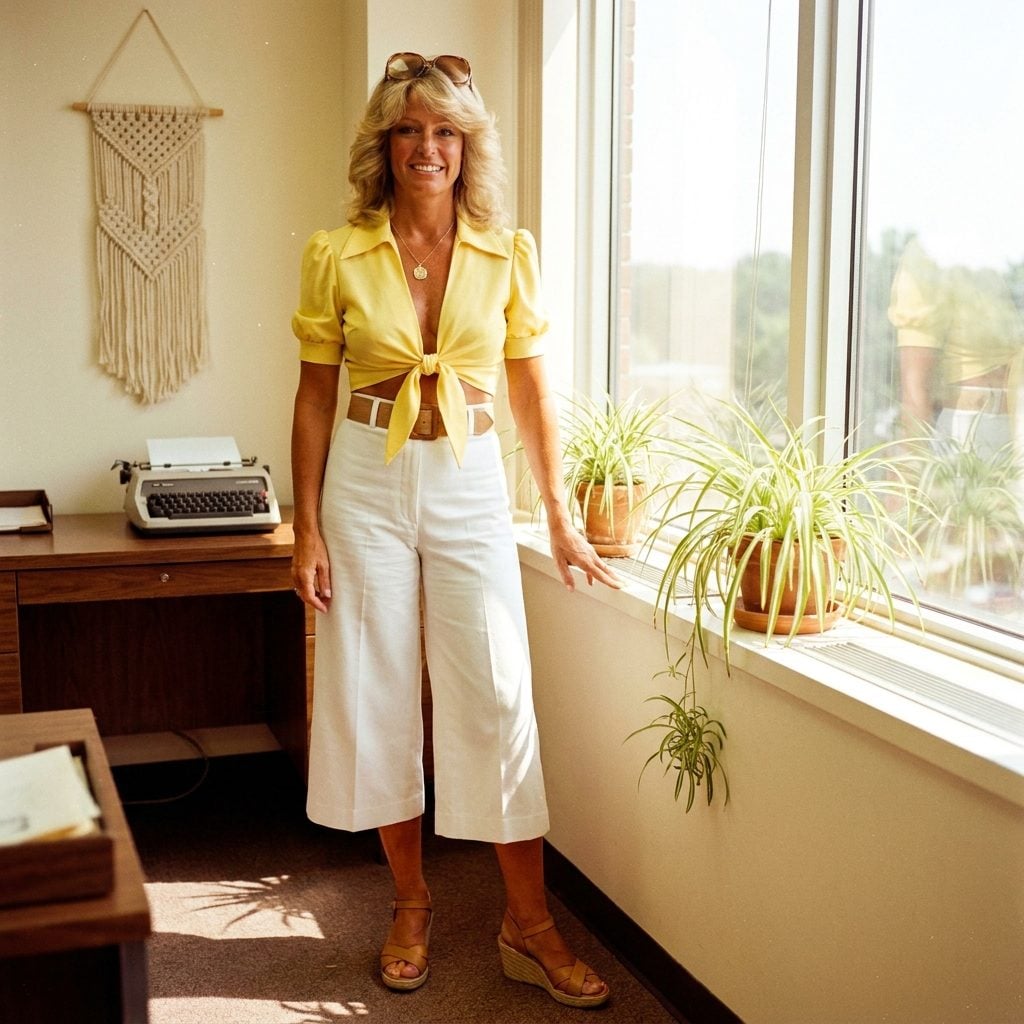
Try explaining this outfit to a modern HR department. A blouse tied at the chest, a visible strip of stomach, white culottes that could’ve passed for a skirt if you stood very still. And yet in 1976, this was a perfectly normal way to walk into a real estate office or an advertising firm on a Friday in July.
The canary yellow wasn’t subtle, and it wasn’t trying to be. It said “I have plans after work and I’m not changing.” Culottes made it office-appropriate, or at least that’s what we told ourselves.
13. The Brown Pinstripe Vest Over a Striped Oxford, or How We Borrowed From the Boys and Did It Better
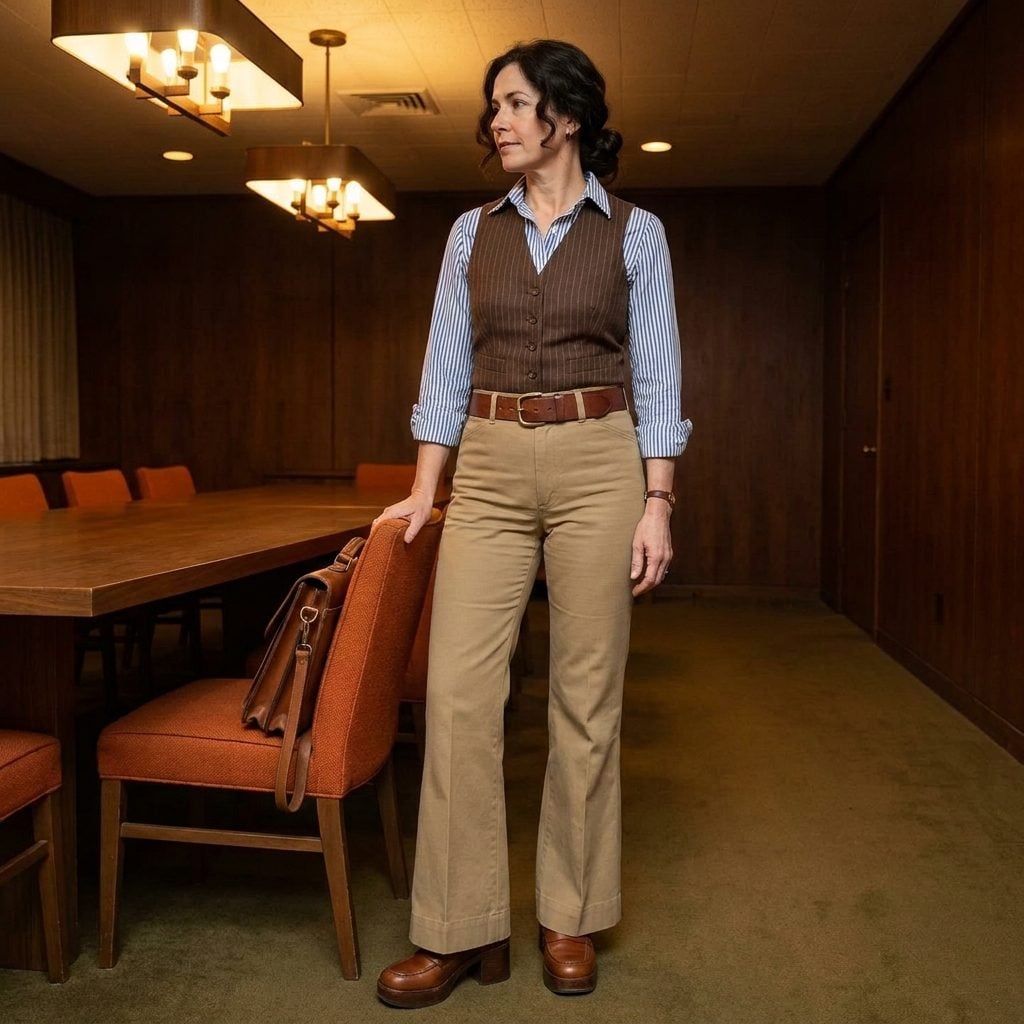
Diane Keaton wore this look in Annie Hall in 1977 and suddenly every woman with access to a menswear department was layering vests over button-downs like she’d invented the concept. But the truth is, women in offices had been quietly stealing this silhouette for years before Woody Allen’s costume designer got the credit.
The pinstripe vest cinched your waist in a way a blazer never quite managed. Under it, the striped Oxford’s collar popped out just enough to say “I’m serious, but not boring.” The khaki bell-bottoms grounded the whole thing in the decade.
I’ve always thought this was the seventies at its sharpest. An androgynous hat would’ve completed it perfectly, but the vest alone did most of the talking.
12. The Geometric Polyester Maxi Dress That Could Survive a Nuclear Event and Still Look Office-Ready
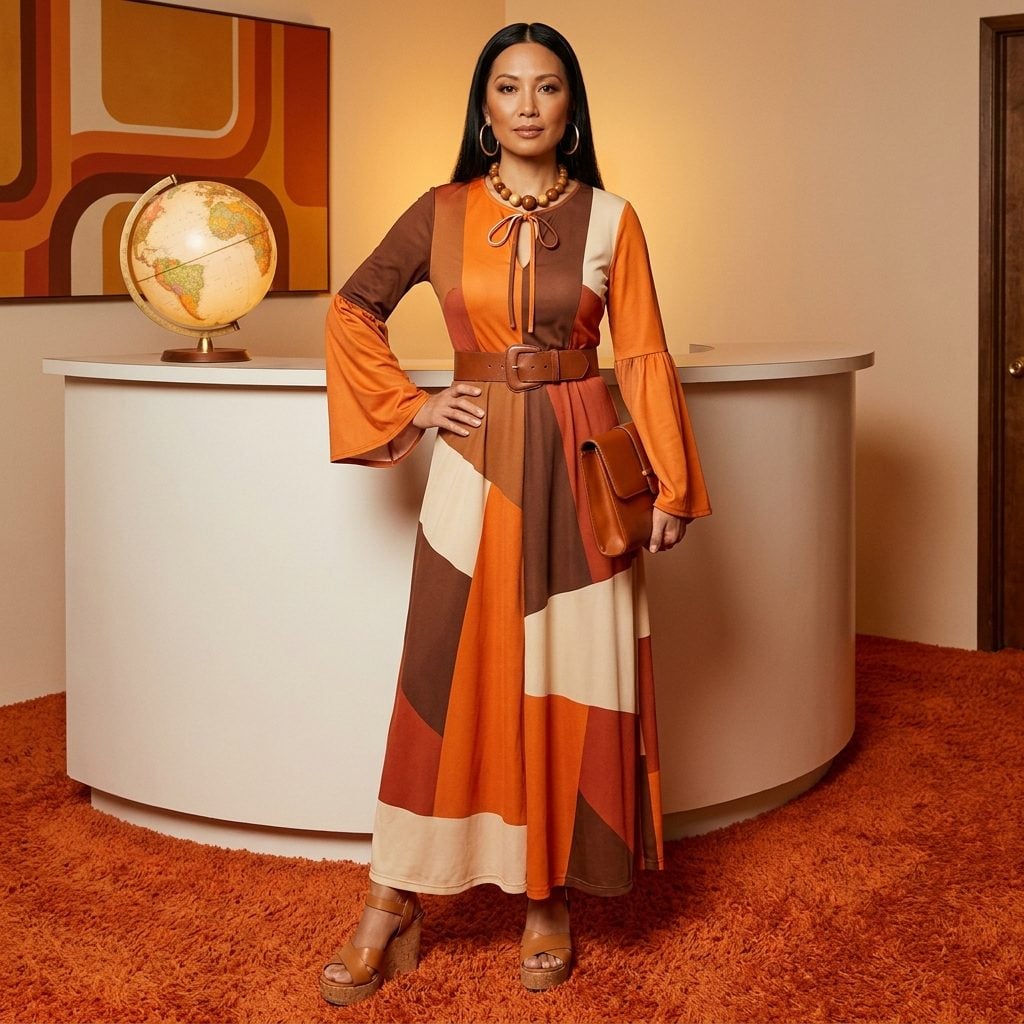
Polyester got a bad reputation later, but in the seventies, it was practically miraculous. You could wash this dress, hang it up still dripping, and it would be ready to wear by morning with zero wrinkles. No iron, no dry cleaner, no drama. For a working woman managing everything, that mattered more than any fashion magazine’s opinion.
The geometric print on these was always bold. Orange and brown color blocks, or rust and cream zigzags, patterns loud enough to read from across a conference room. The bell sleeves were impractical near a typewriter, and nobody cared.
11. A Herringbone Blazer With Elbow Patches Over a Cream Turtleneck, the Outfit That Whispered ‘I Read’
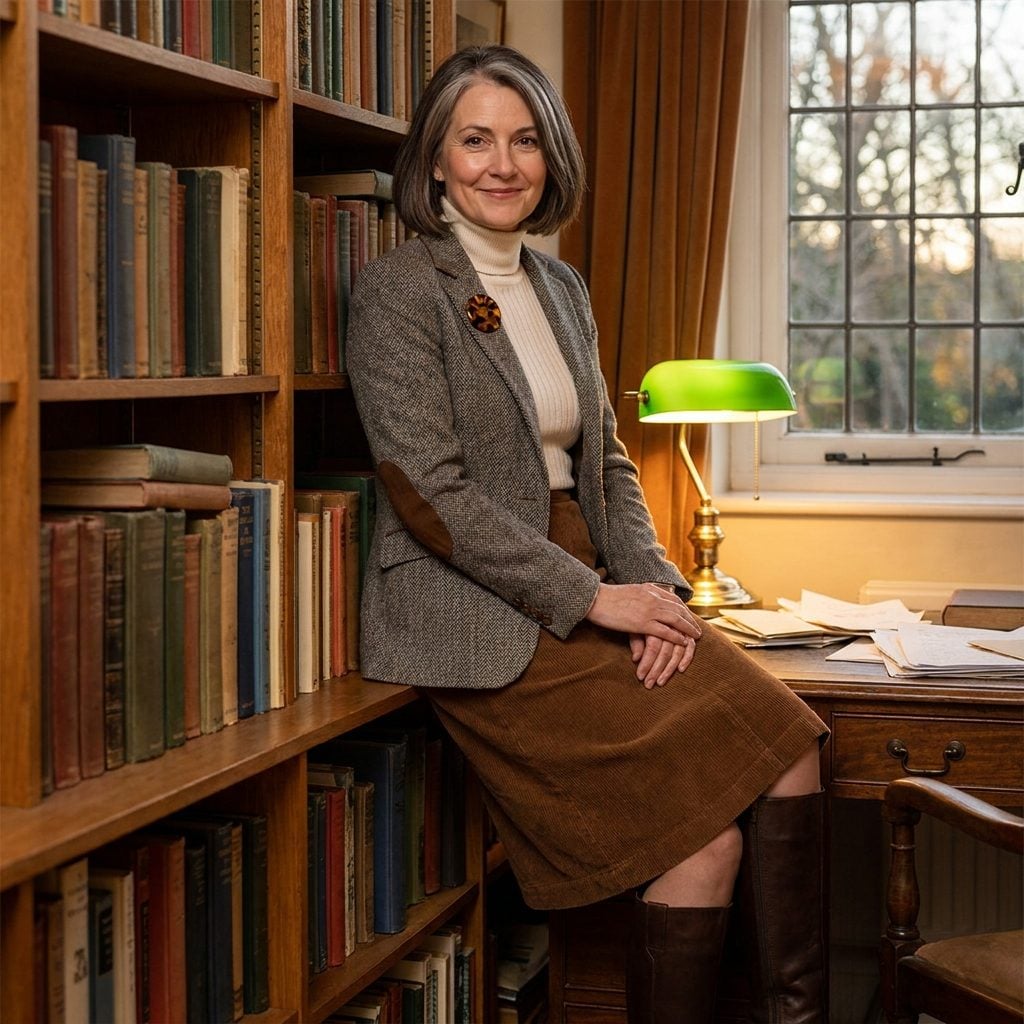
If you worked in academia, publishing, or anywhere near a library in the 1970s, this outfit was your armor. The herringbone blazer with its patched elbows was borrowed directly from the men’s faculty lounge, and wearing it felt like a quiet act of defiance.
Under it, the ribbed cream turtleneck was the great equalizer. Everyone owned one. Everyone. It went with everything, it kept you warm in buildings where the thermostat was perpetually set to “Arctic,” and it required exactly zero styling decisions.
The corduroy skirt made the soft shushing sound when you walked that I can still hear if I close my eyes. I say this as someone who wore out two of these skirts before 1979.
10. The Teal Pussycat Bow Blouse With a High-Waisted Leather Skirt, for When You Meant Business and Everyone Knew It
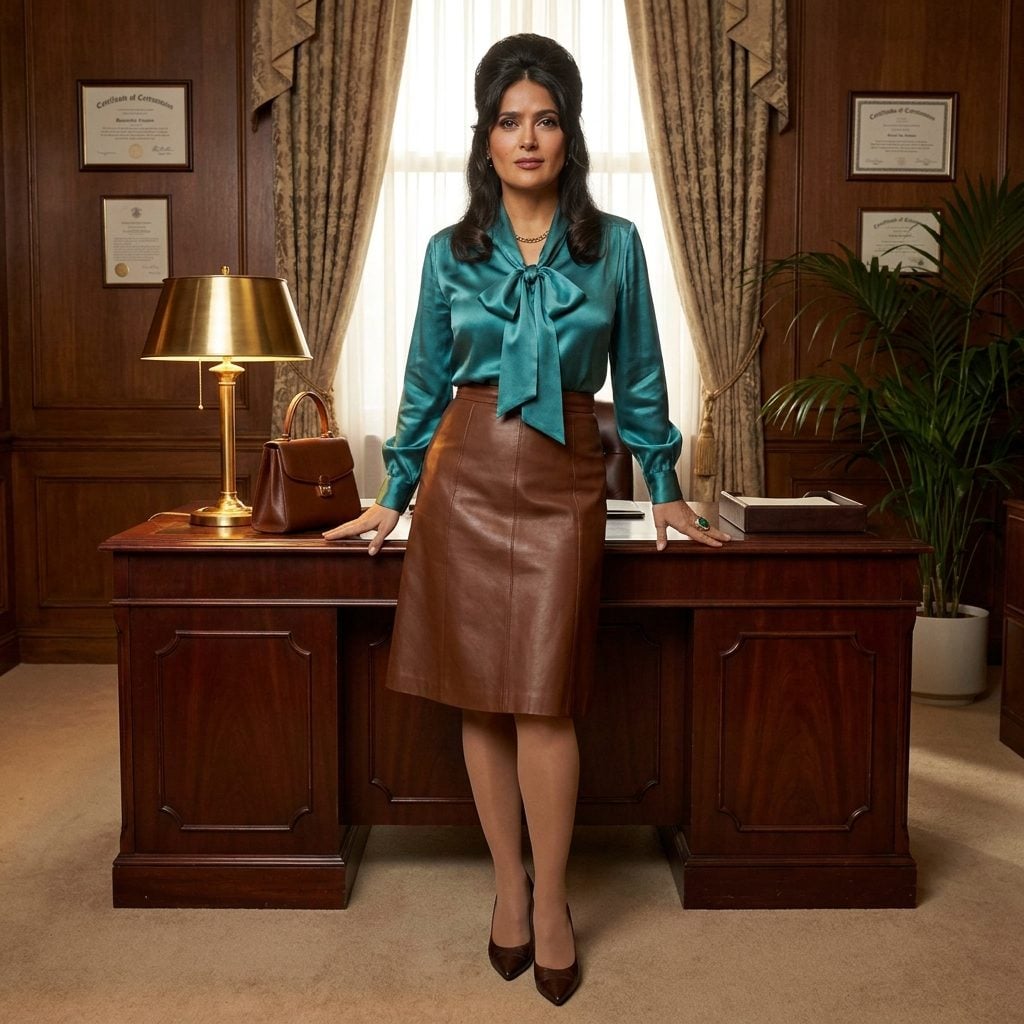
The pussycat bow was the power move disguised as femininity. That enormous floppy bow at your throat said “ladylike” while the teal silk and razor-sharp tuck into a brown leather skirt said something else entirely.
Margaret Thatcher would later make this bow famous in the eighties, but by then American working women had already been deploying it for a decade. The leather skirt was the real statement here. It wasn’t common, it wasn’t cheap, and it wasn’t apologetic. You saved up for that skirt. You wore it on days when the presentation had to go perfectly or the negotiation couldn’t fail.
“The pussycat bow let us look traditional from the neck up while the leather skirt told everyone we weren’t playing by old rules.”
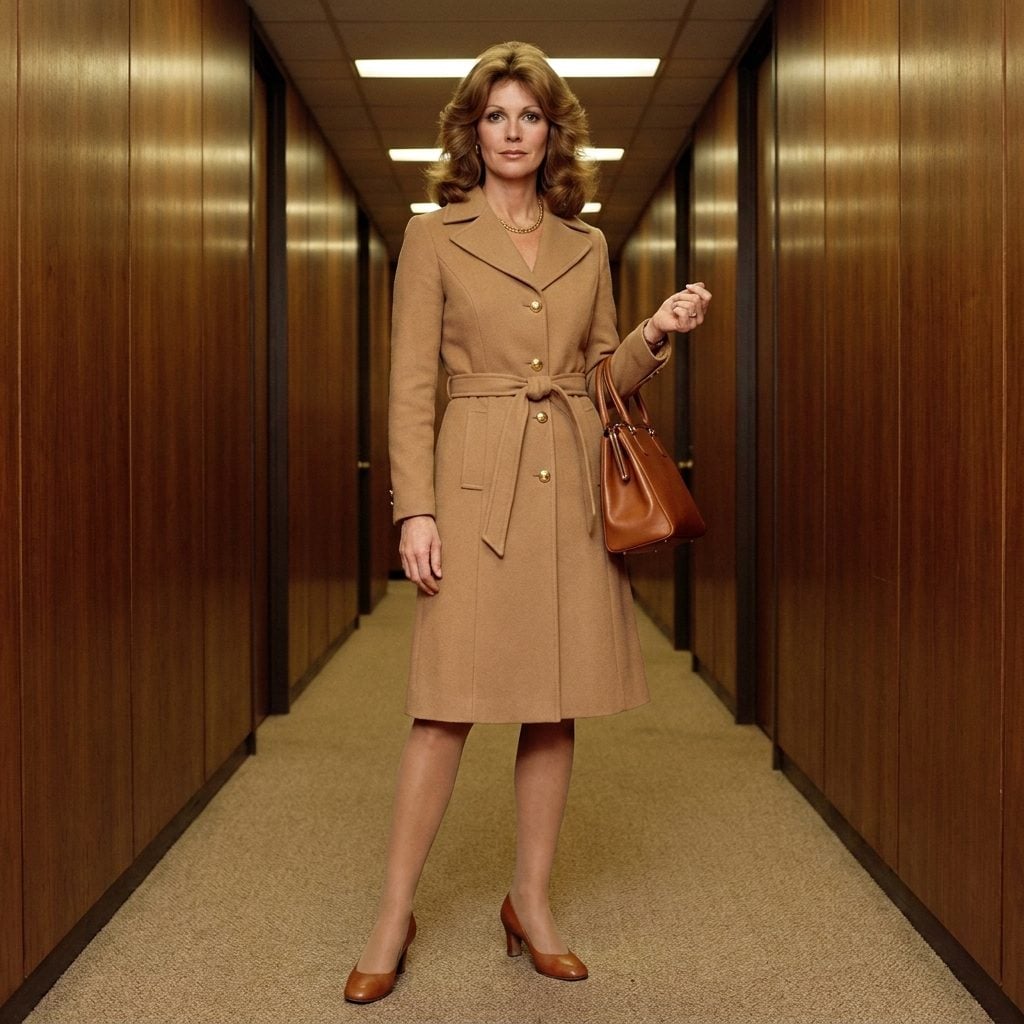
9. The Camel Coat Dress With Brass Buttons That Made You Feel Like You Ran the Building
❤️ Would you like to save this?
Every brass button on this thing was doing serious work. The camel coat dress was the closest thing the 1970s office had to armor, and women who wore one knew it. You’d walk into a meeting and the lapels alone said everything your job title couldn’t.
The self-belt was critical. Tied too loose and you looked like you were wearing a bathrobe. Tied right, with those buttons catching the overhead fluorescent light, you looked like a woman who had read every memo and written half of them. The fabric was usually a stiff wool blend that held its shape through an eight-hour day and a two-martini lunch.
8. The Tweed Pencil Skirt Suit With a Velvet Collar (Because Texture Was a Personality Trait)
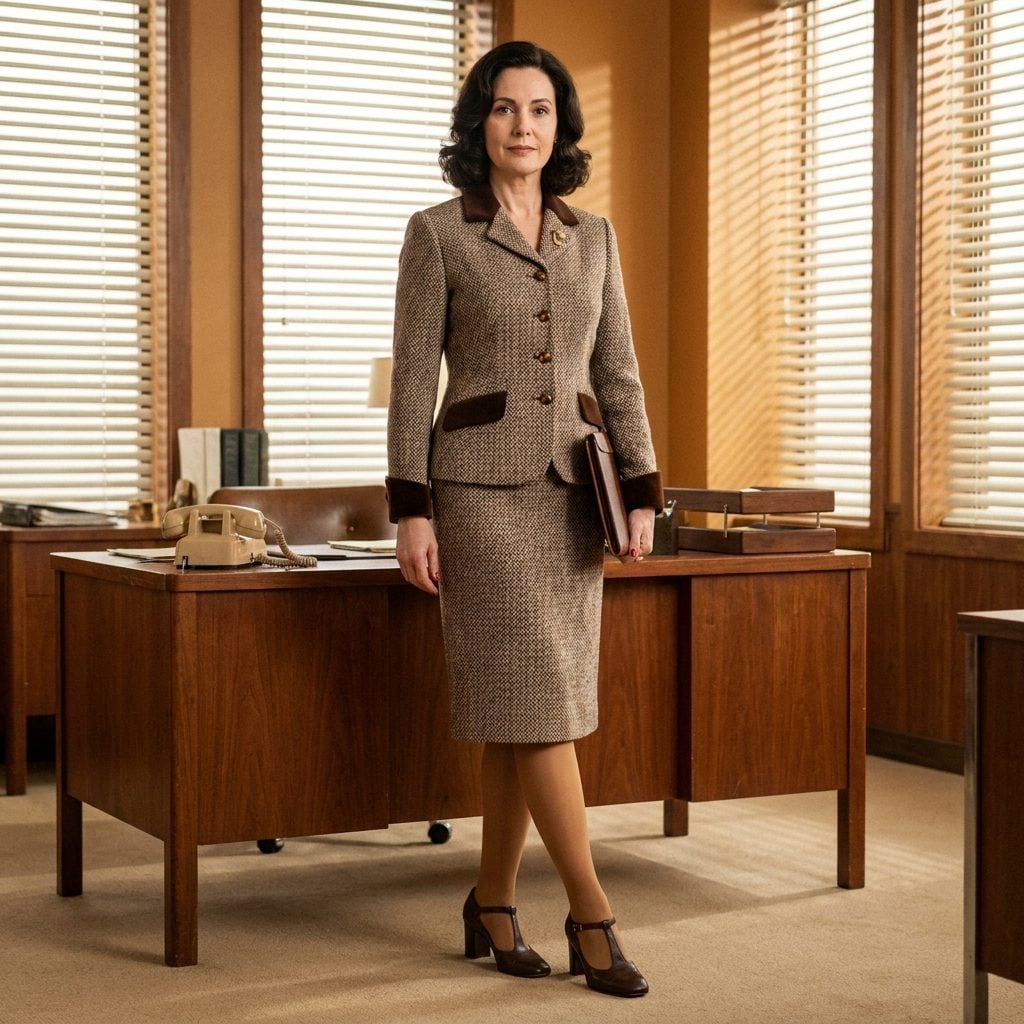
That velvet collar wasn’t decorative. It was a statement of rank. The women who wore tweed suits with velvet trim to work in the ’70s were borrowing from decades of British tailoring tradition and making it entirely their own.
The pencil skirt sat high on the waist, hit the knee exactly, and did not negotiate. You sat down carefully. You crossed your ankles. The tweed itself was heavy enough that it didn’t wrinkle during a full day of typing, filing, and pretending to agree with your boss.
Tortoiseshell buttons, always. And a brooch, because jewelry below the neck was considered “too much” for the office, so women channeled everything into one gold pin placed exactly two inches below the left shoulder.
7. A Mustard Turtleneck Under a Brown Plaid Pinafore, Plus the Mary Janes You Polished Every Sunday
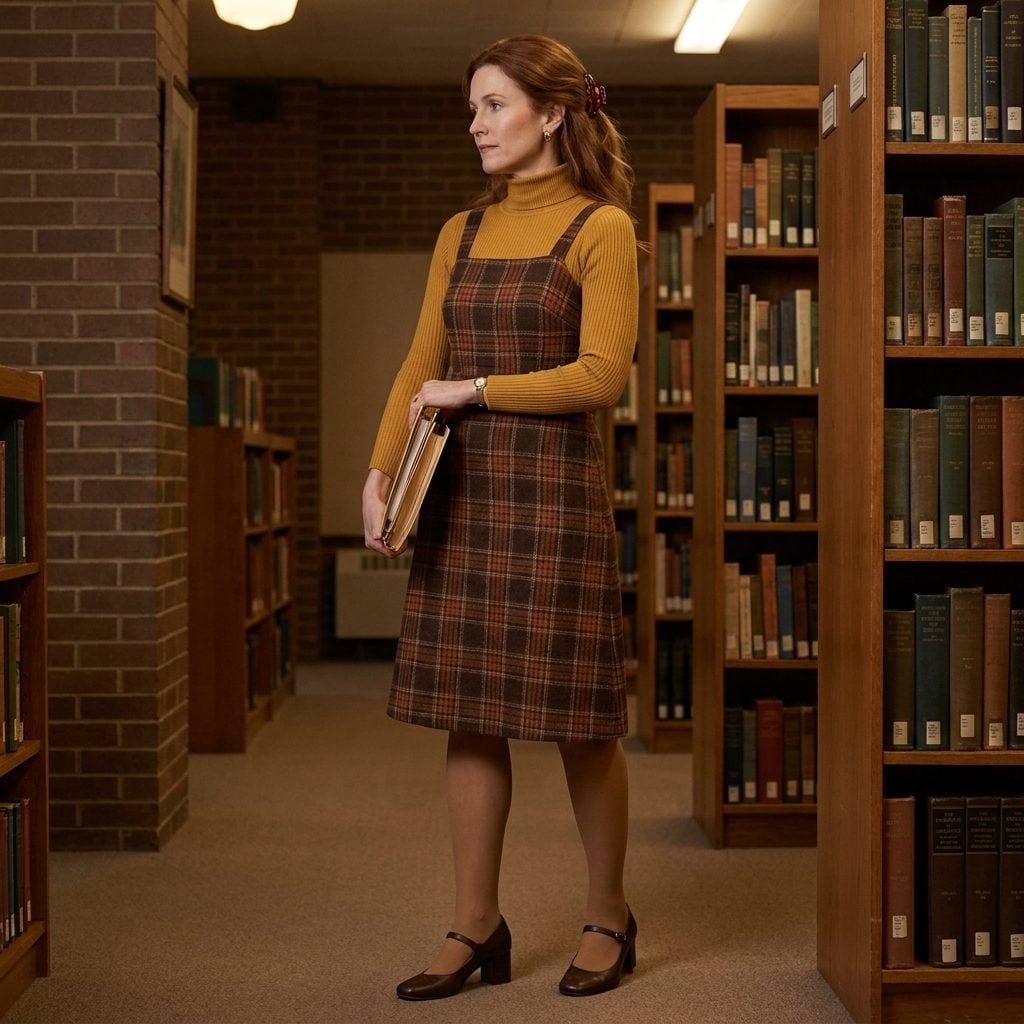
Mustard was not a condiment in the 1970s. It was a lifestyle. And paired with a brown plaid pinafore, it turned every teacher, librarian, and junior copywriter into someone who looked like she belonged in a European film about intellectual women having complicated feelings.
The ribbed turtleneck was always slightly too warm for the office. Nobody cared. The pinafore did the heavy lifting of looking “put together” while the turtleneck underneath did the heavy lifting of not freezing in buildings where men controlled the thermostat. The brown leather Mary Janes tied the whole thing together with a sweetness that was slightly misleading.
6. The Cream Button-Down With the Impossibly Long Pointed Collar Under a Chunky Cardigan and Plaid Trousers
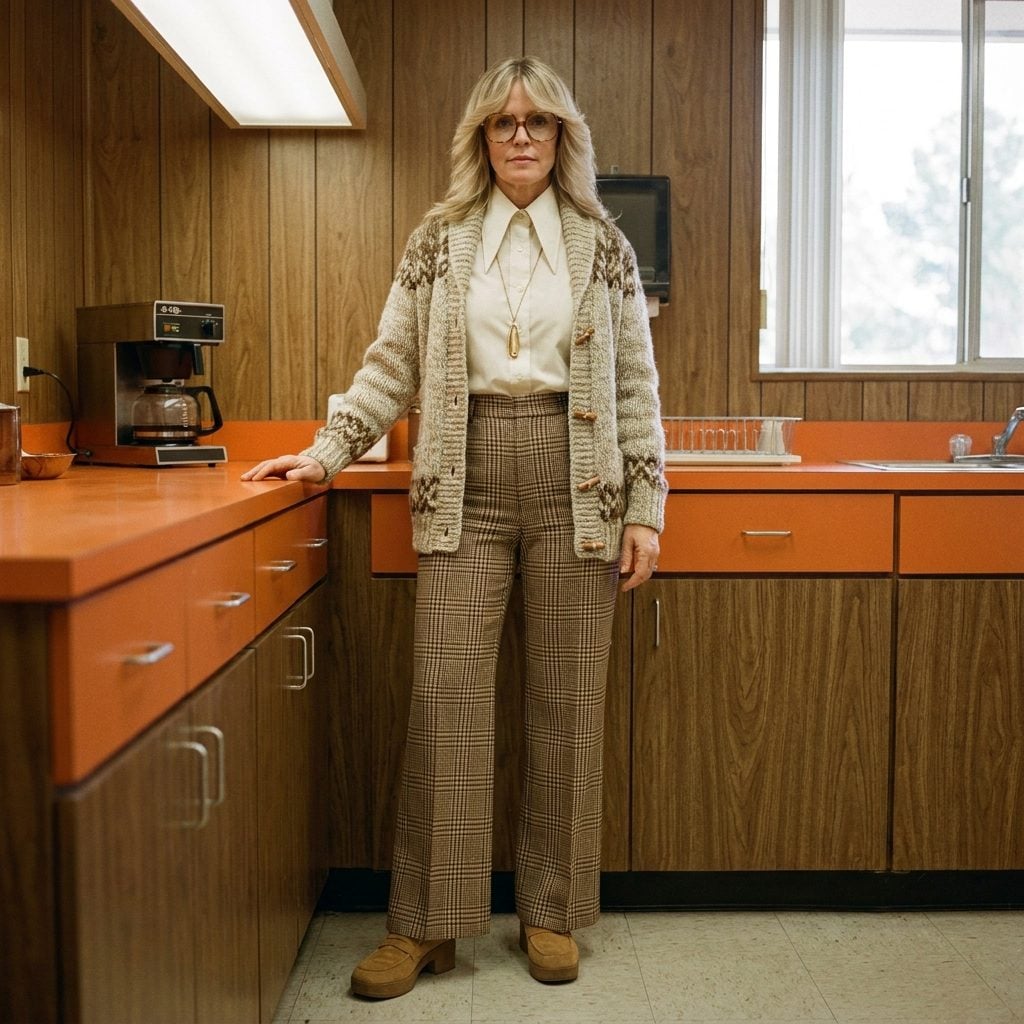
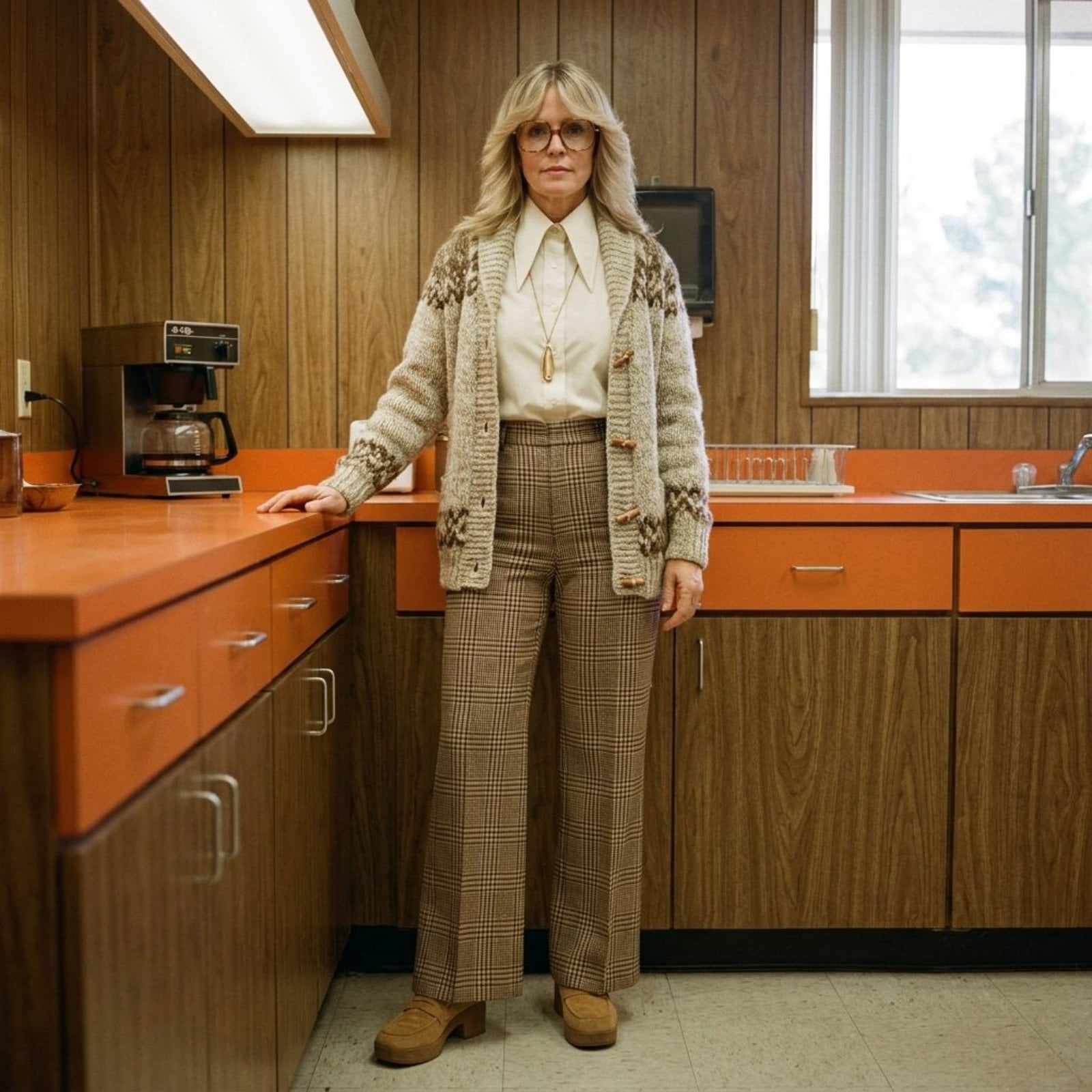
Those collar points could take an eye out. We are not exaggerating. The cream button-down with a collar wingspan wider than some birds was the foundation garment of 1970s office dressing, and it got layered under everything: blazers, vests, and most importantly, the chunkiest cardigan you could find.
The cardigan was usually hand-knit or at least looked like it. Oatmeal. Brown. Maybe a cable pattern if you were feeling fancy. It hung open because buttoning a cardigan over a collar that aggressive would have been a structural engineering problem.
Below the waist, plaid trousers in earth tones completed what was essentially the uniform of every woman who worked in publishing, education, or local government between 1973 and 1978. I say this with deep affection: it was a lot of fabric, and not one inch of it was wasted.
5. High-Waisted Flares, a Fitted Turtleneck, and the Chunky Belt That Held It All Together (Literally)
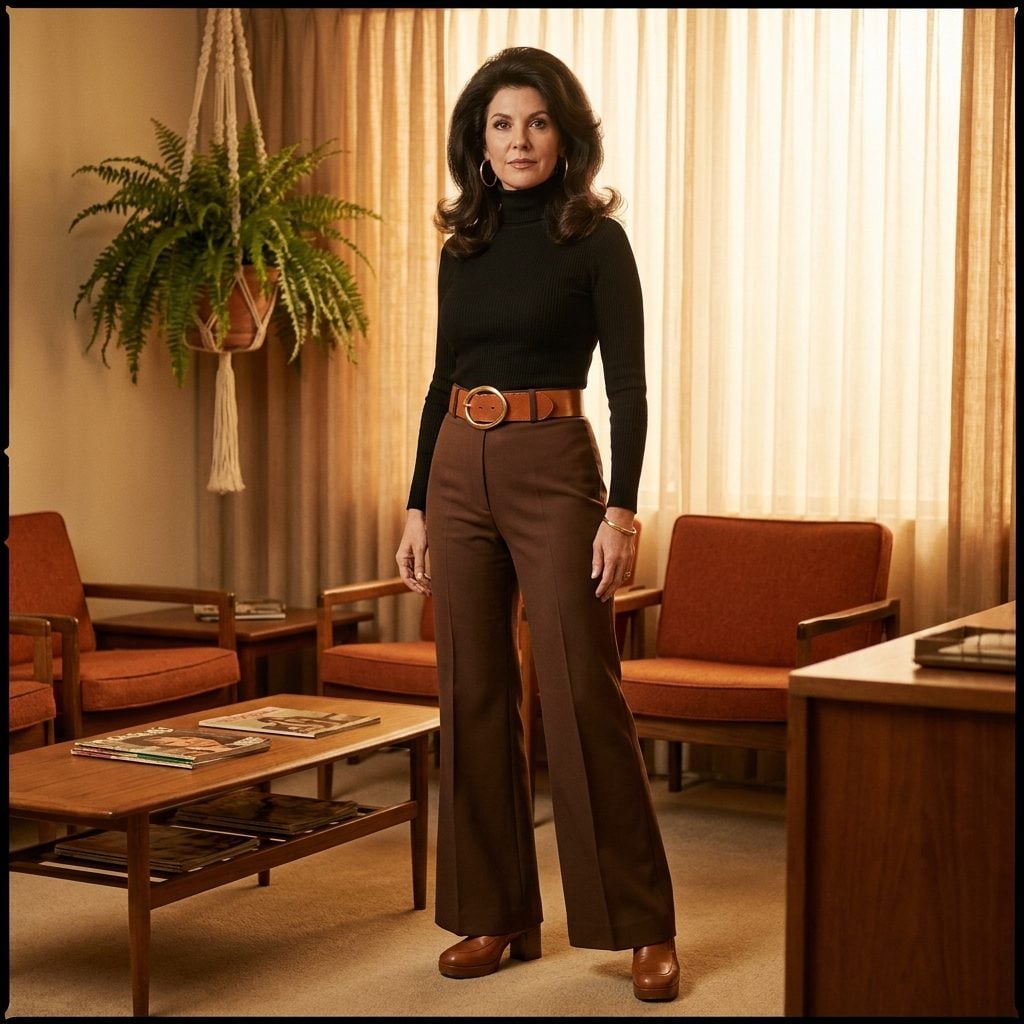
The belt was doing about 80% of the work in this outfit. A wide leather belt with an oversized brass buckle was the visual anchor that turned two simple separates into a look. Without it, you had pants and a sweater. With it, you had an outfit that said “I have opinions about the Equal Rights Amendment and I will share them.”
The turtleneck had to be fitted. Not tight, fitted. Tucked in smooth with zero bunching at the waistband, which required a level of patience most of us have since abandoned. And the flares needed to be long enough to graze the floor, which meant hemming them for your highest shoes and then tripping in flats for the rest of your life.
4. The Knee-Length A-Line Skirt and Patterned Blouse That Was Basically a Work Uniform Nobody Agreed On
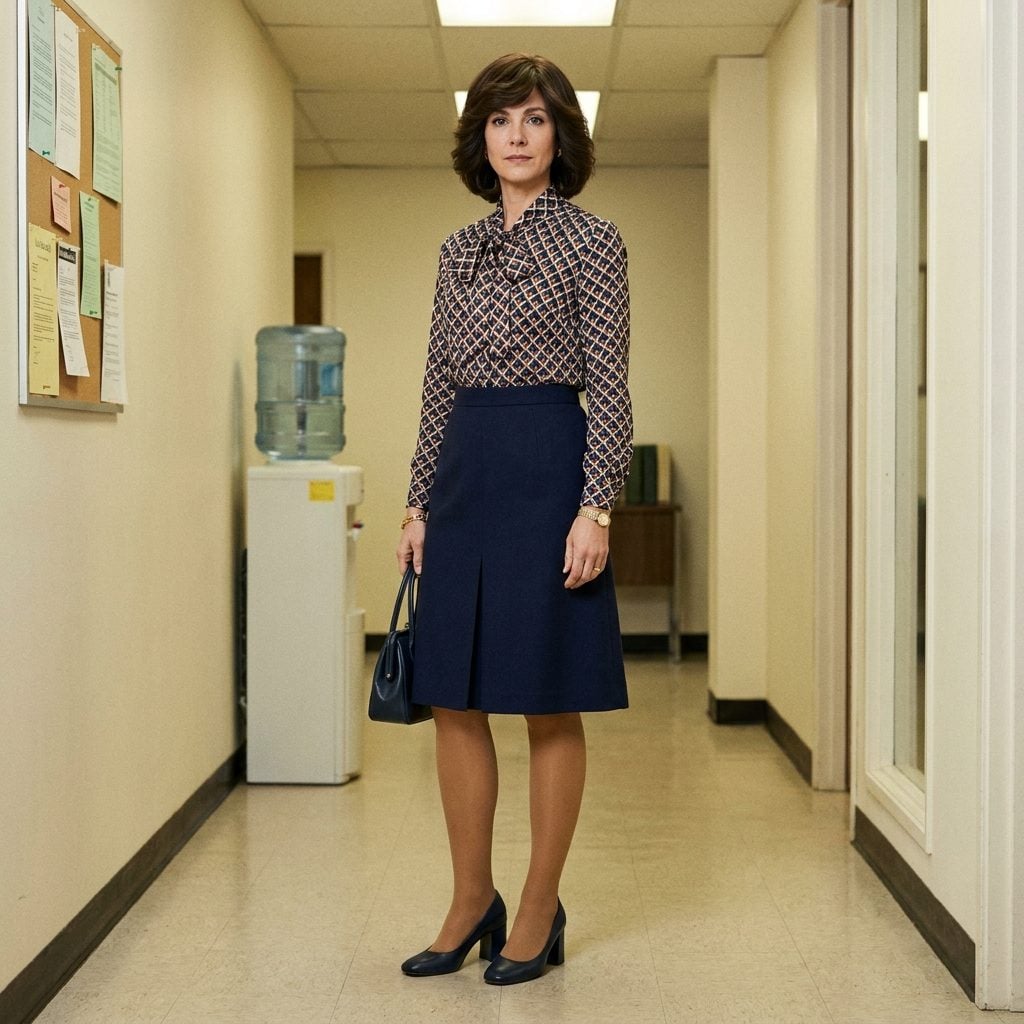
Nobody told us this was the uniform. We all just showed up wearing it.
A solid navy A-line skirt, a blouse with some kind of geometric or floral print, and low block heels that made exactly the right sound on linoleum. The skirt hit the knee because above the knee was “inappropriate” and below was “frumpy,” so we all navigated a two-inch window of professional acceptability.
The blouse usually had a bow at the neck. Sometimes a ruffle. The print was busy enough to hide the coffee stain you’d inevitably get at 10 a.m. but restrained enough that your supervisor wouldn’t comment. It was a careful calculation disguised as something simple, which pretty much describes how women dressed for work throughout the entire decade.
3. The Double-Breasted Blazer With Wide-Leg Slacks That Borrowed From the Boys and Made It Better
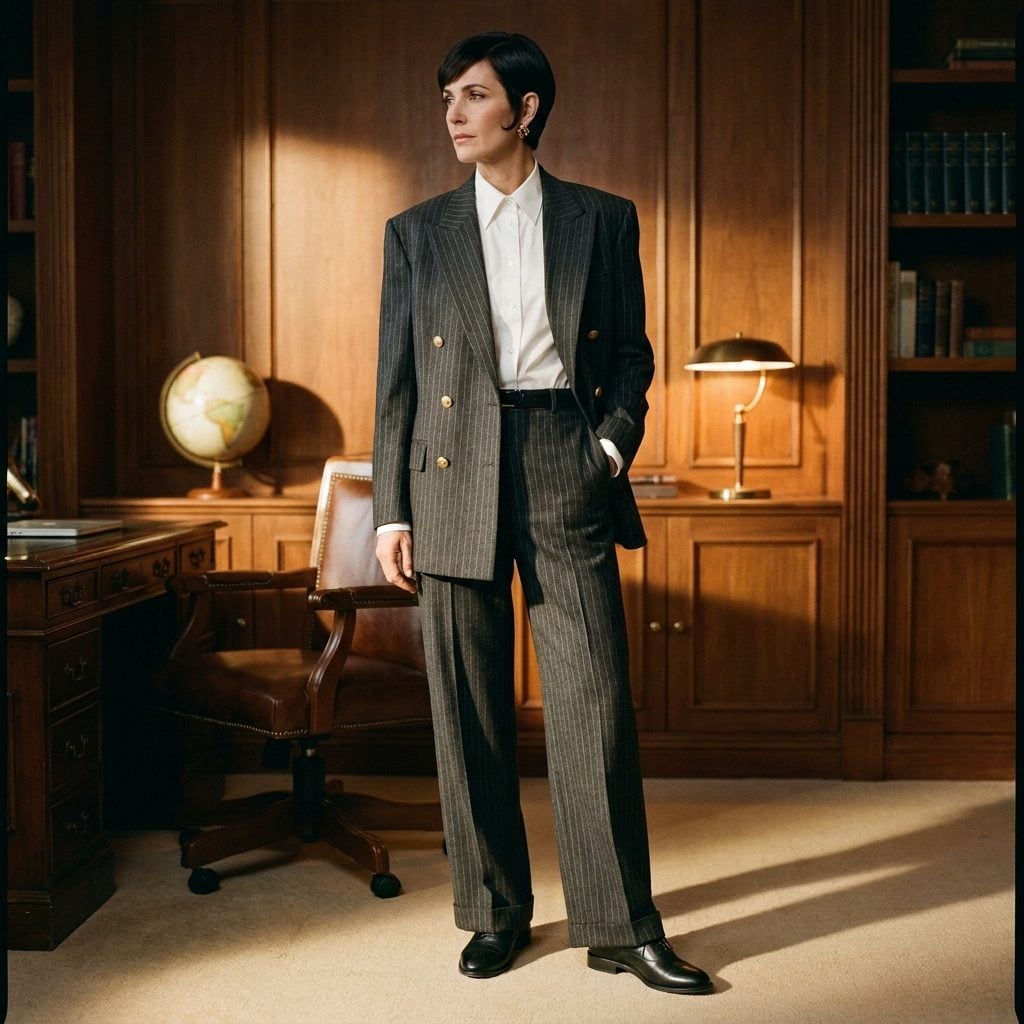
This was the suit that started arguments. A woman in a double-breasted pinstripe blazer and matching wide-leg trousers in 1977 was making a decision that had consequences. Some offices sent women home for wearing pants. Others pretended not to notice. Either way, the woman wearing this suit noticed everything.
The blazer was borrowed from menswear but the fit was recalibrated: slightly nipped at the waist, shoulders that extended just past natural, peaked lapels that framed the face. It was an androgynous look before that word entered the fashion vocabulary. Diane Keaton wore a version in Annie Hall and suddenly every woman in America wanted one.
2. Diane von Furstenberg’s Wrap Dress in a Bold Print With Platform Heels, a.k.a. the Dress That Changed Everything
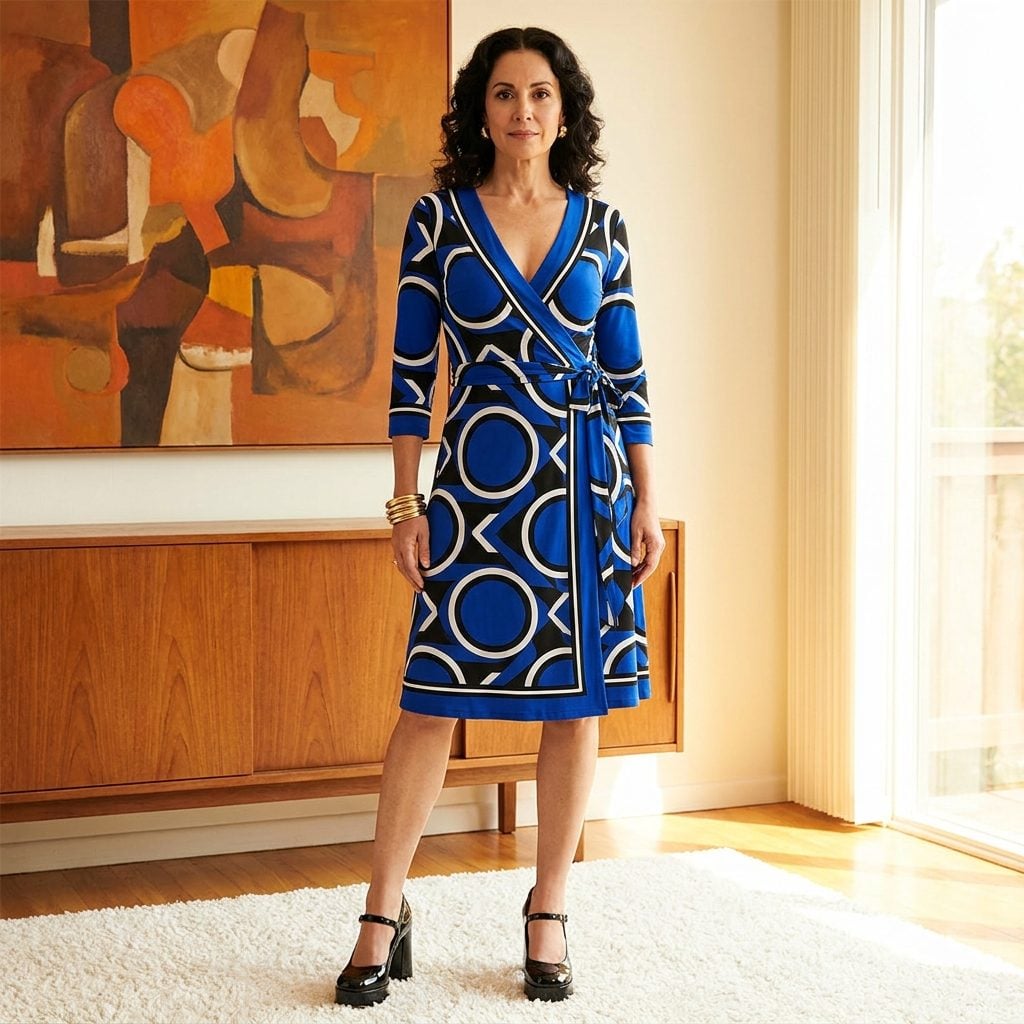
You could go from the office to a cocktail party in this dress without changing a single thing except your expression. That was the entire point.
Diane von Furstenberg introduced her jersey wrap dress in 1974, and within two years she’d sold over five million of them. Five million. The dress was flattering on virtually every body because the wrap construction let the fabric do the fitting instead of forcing the woman into the garment. You pulled it on, tied it at the waist, and you were done.
The prints were always bold. Geometric, graphic, unapologetic. Paired with black patent platform heels and a stack of gold bangles, this was the dress that made women feel powerful without borrowing a single detail from menswear. It was feminine and authoritative at the same time, which in the 1970s workplace was practically revolutionary.
1. The Corduroy Blazer Over a Knit Top With Straight-Leg Trousers (The Outfit That Meant You Were Serious)
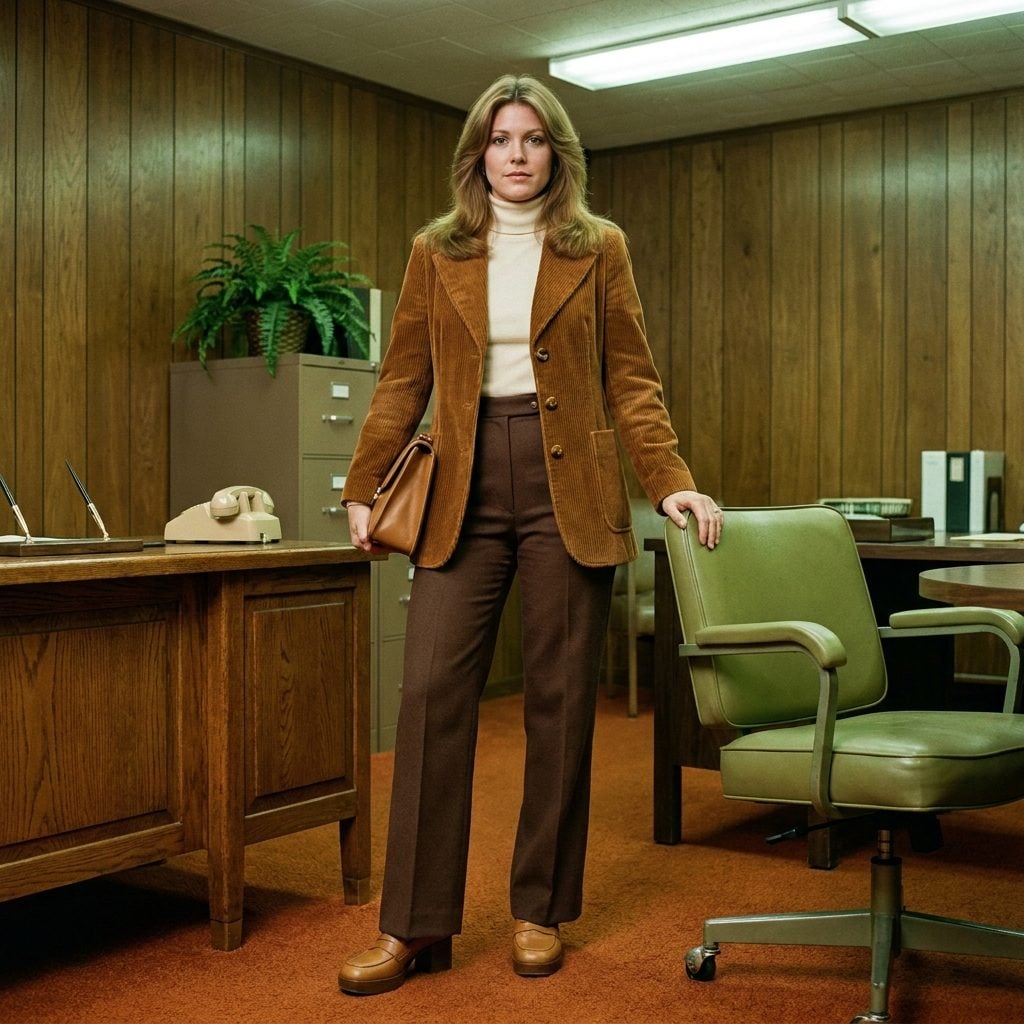
That corduroy blazer wasn’t soft. People forget that. Wide-wale corduroy in the seventies had a stiffness to it, almost architectural, and you could hear the faint whish-whish of the wales rubbing together every time you moved your arms. We wore it over everything, but the real look was a fitted ribbed knit underneath, usually a turtleneck in cream or mustard, tucked into high-waisted straight-leg trousers.
The whole point was to walk into a meeting looking like you belonged at the table, even when half the room wasn’t sure you did. A caramel corduroy blazer paired with brown straight-leg trousers and a cream ribbed turtleneck was basically office armor. You looked serious without looking like you were trying to dress like a man. You looked like yourself, just with better posture.