❤️ Would you like to save this?
The pantsuit hadn’t fully won yet. Power dressing still meant shoulder pads and a spritz of Giorgio that preceded you into the conference room by a full ten seconds. We showed up to our jobs in things that would, today, generate a gentle calendar invite from someone in Human Resources titled simply “Quick Chat.” Not because we were inappropriate. Because we were nineties. Here are 34 relics from the working-woman wardrobe that somehow made it past the front desk.
FYI, thanks to AI imagery software, we’re able to create very specific fashion and hairstyle examples to illustrate the points being made. In some cases, imagery is exaggerated to hammer home the point. Also, assume links that take you off the site are affiliate links such as links to Amazon. this means we may earn a commission if you buy something.
Leather Pants and a Satin Blouse: The Power Combo That Confused Everyone
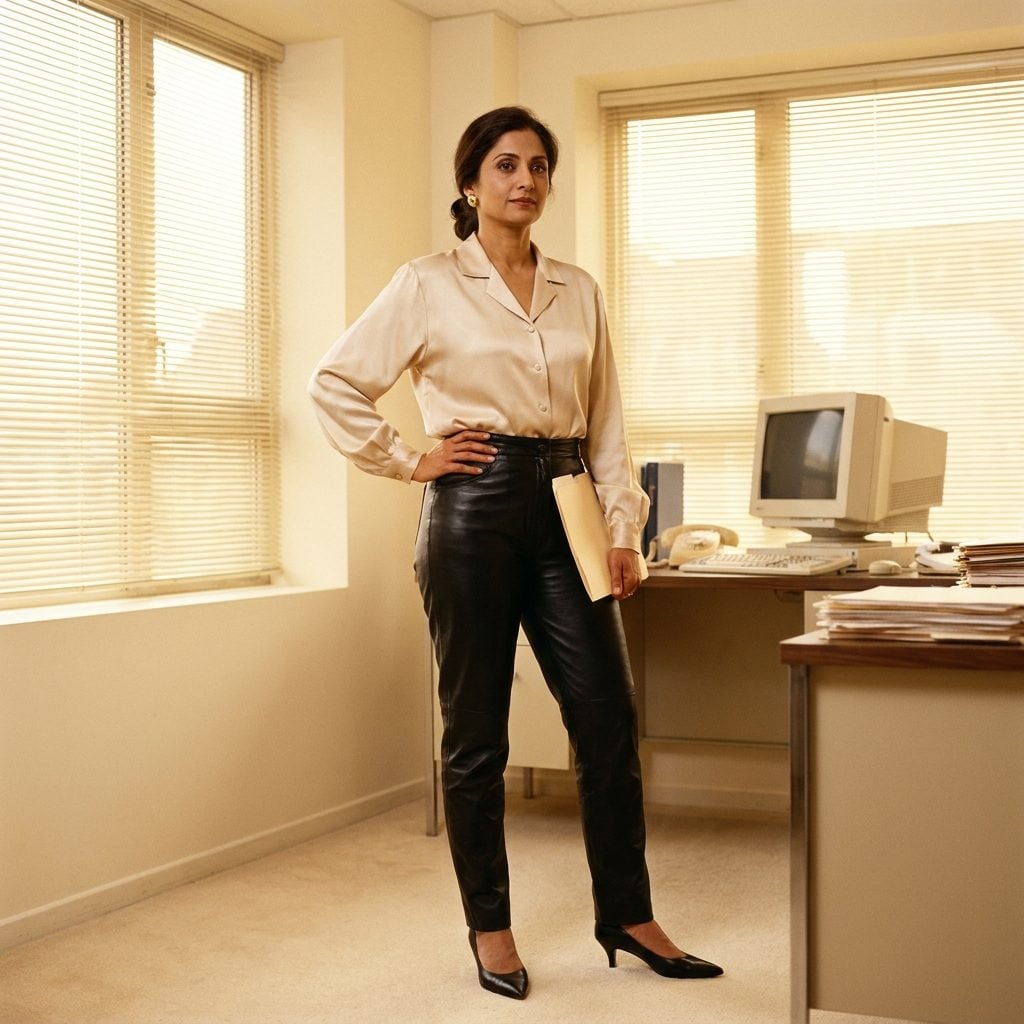
You had to commit to leather pants in a way that cotton trousers never asked of you. They didn’t breathe, they made a faint noise when you crossed your legs in a meeting, and you absolutely had to do a standing stretch every time you got up from your chair or risk an unfortunate sound. And yet. Paired with a whisper-weight satin blouse tucked in just so, the whole look said I am absolutely in charge here in a way a sensible blazer never could.
The satin blouse was doing a lot of heavy lifting. Cream, champagne, or that particular shade of dusty mauve that existed only in the 1990s. You bought it at Express or maybe work-appropriate sections of department stores that don’t exist anymore. HR said nothing because honestly, what would they even say? The pants were technically trousers.
The Cropped Twin Set That Became a Problem Around the Filing Cabinet
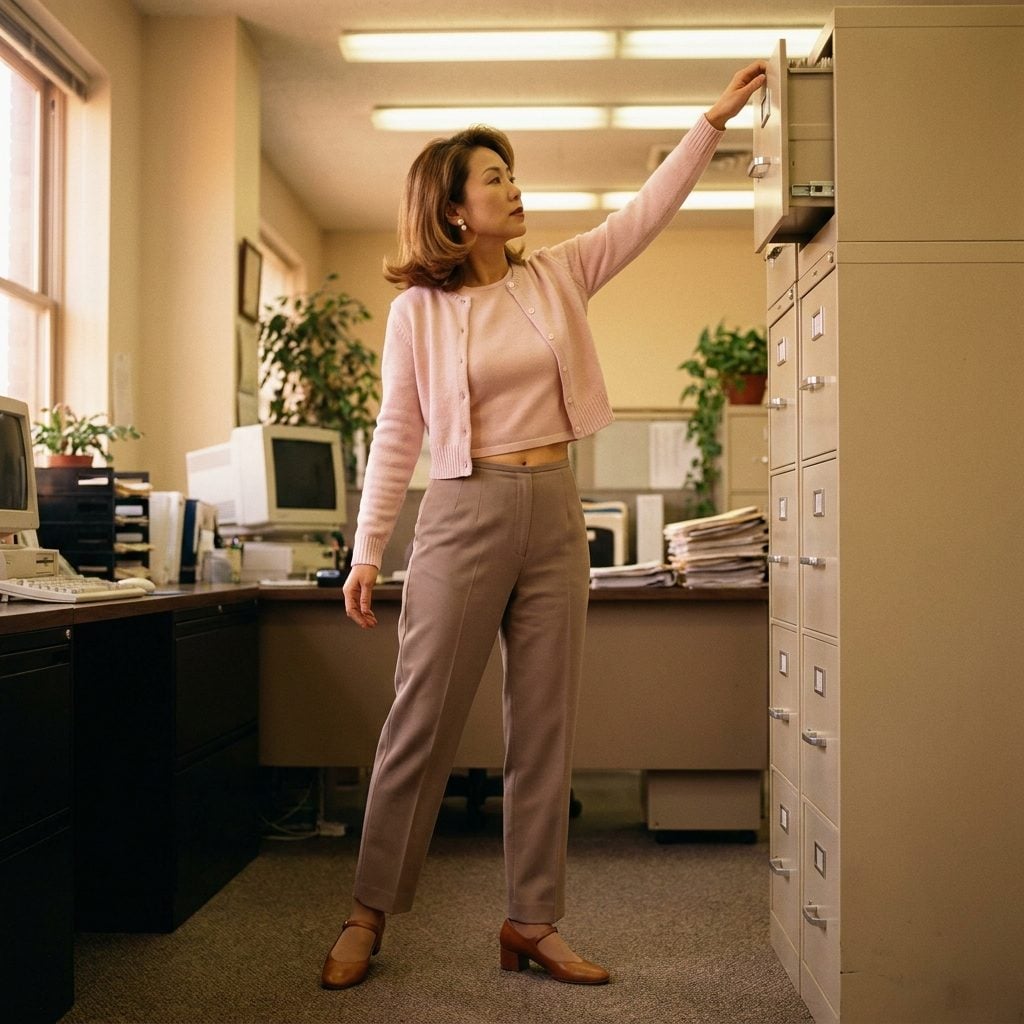
Nobody bought the cropped twin set intending for it to show anything. That’s the detail that made it so gloriously innocent. You’d reach up to grab a binder from the top shelf or wave someone down across the open-plan floor and there it was: about two inches of midriff, completely unplanned, absolutely noted by everyone in the vicinity.
The twin set itself was a staple of trying very hard to look professional while also being twenty-something and interested in looking like yourself. Pale pink, ivory, or that dusty sage color that felt extremely sophisticated. You bought the set together so the colors matched perfectly, which somehow made the accidental reveal feel even more confusing to management. It was technically a cardigan and a shell top. Totally office-appropriate. Mostly.
The Bandage Dress in ‘Neutral’ Colors That Fooled Absolutely No One
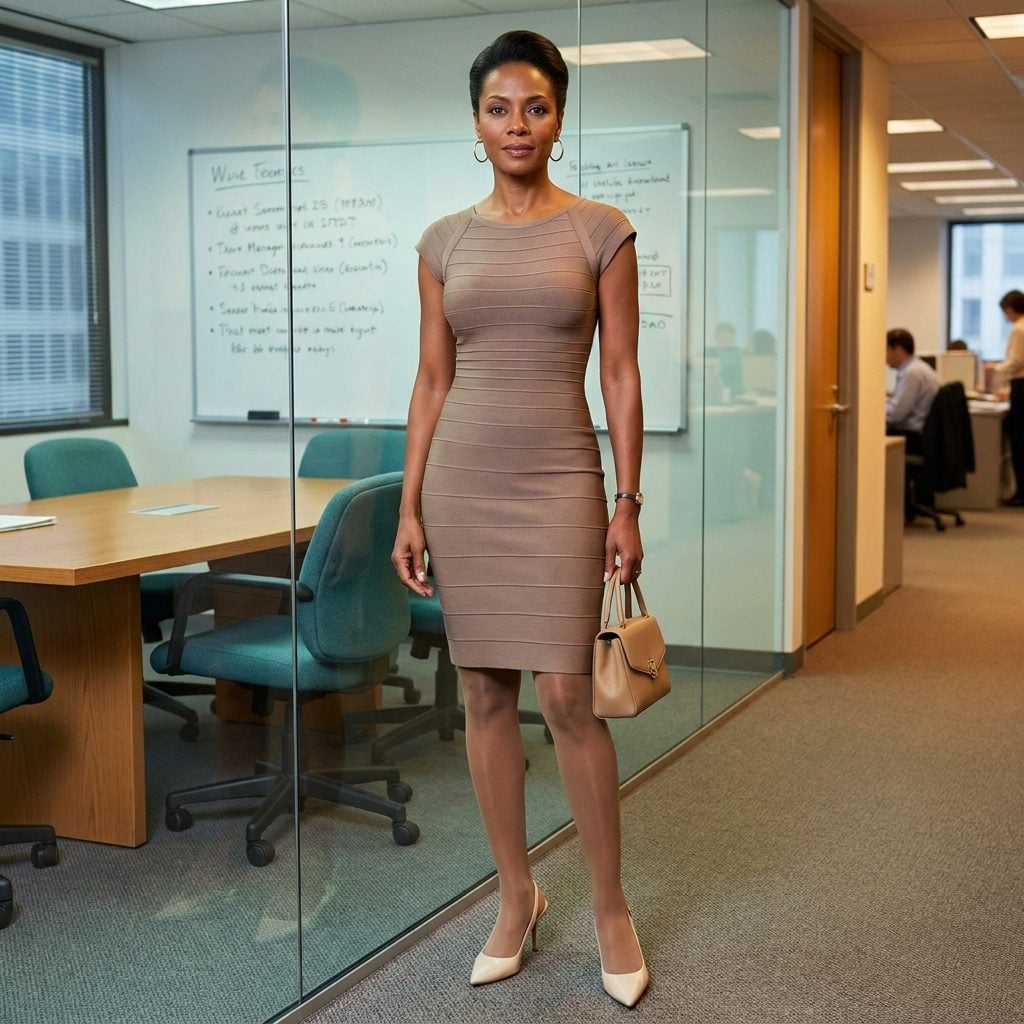
The genius of the bandage dress was the plausible deniability of beige. It wasn’t red. It wasn’t sequined. It was neutral, technically speaking, in the same way that a fitted dress engineered to compress and contour your entire body while you present Q3 projections is technically workwear.
Hervé Léger made the bandage dress a cultural moment in the early 90s, and by mid-decade the concept had trickled down to every mall anchor store in America at a fraction of the price. You wore yours with nude pantyhose, always, always the pantyhose, this was non-negotiable, and told yourself the knee length made it appropriate. It did not make it appropriate. It was a great dress, though.
‘Nude pantyhose were load-bearing garments in the 1990s office. They were doing structural and diplomatic work simultaneously.’
The Mesh Long-Sleeve Under a Fitted Vest: Office Goth’s Respectable Cousin

This look required you to convince yourself, and everyone else, that the mesh layer was purely functional, like a base layer. It wasn’t. The whole point was that you could see the mesh. That was the point. You were wearing a net to the office and the fitted vest on top was technically doing the covering but spiritually the mesh was running the whole operation.
It was edgy office dressing in a way that felt low-stakes enough to try. Not a crop top. Not a sheer blouse. Just a very interesting choice of underlayer that made your Tuesday performance review feel slightly more like a situation.
The Halter Top That Always Outlasted Its Blazer
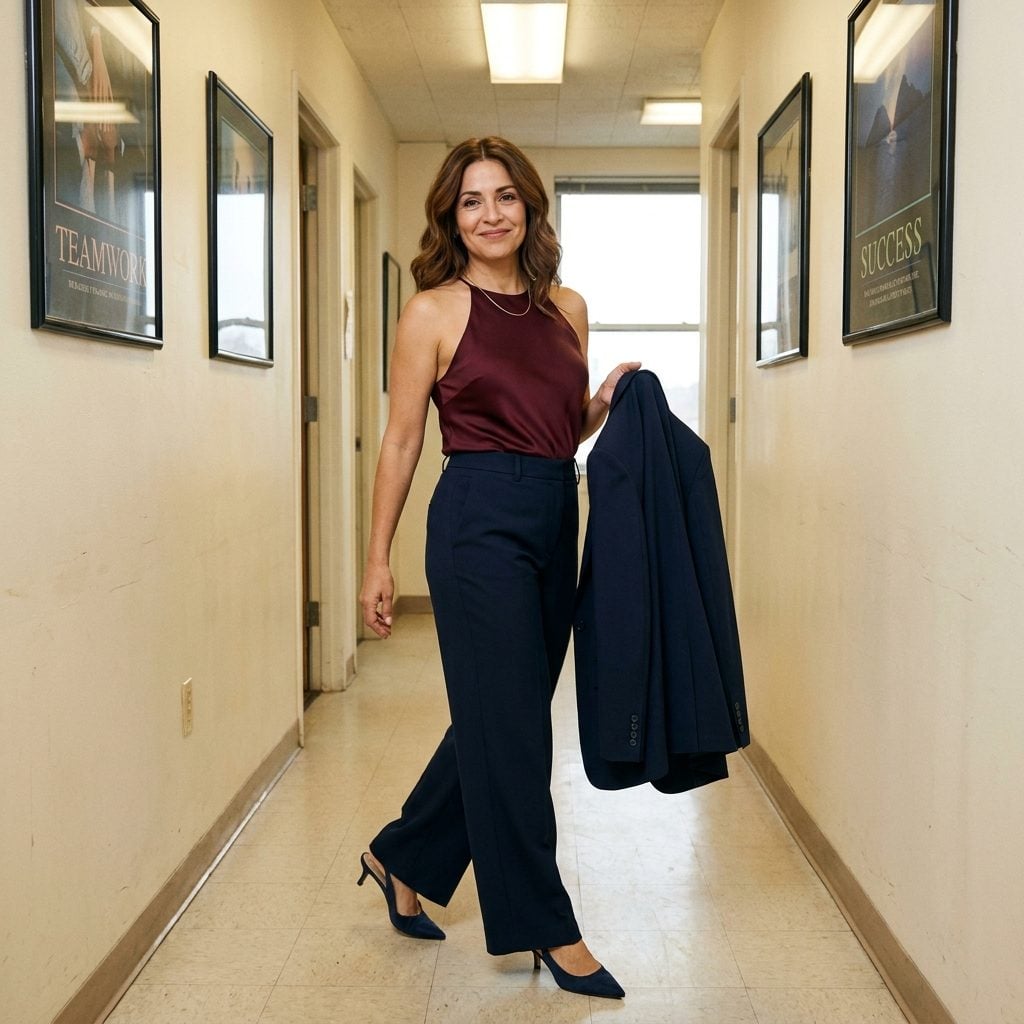
The blazer was always the plan. You walked in wearing the blazer. You sat down in the blazer. But office buildings in the 1990s ran on one temperature, somewhere between a greenhouse and the surface of the sun, and by 10:30 a.m. the blazer was coming off, draping over the chair, and suddenly you were in a burgundy silk halter top presenting your department budget to a roomful of people.
This wasn’t even accidental. You knew the halter was under there. You just didn’t think about what would happen when your body decided it was done with polyester blazer lining for the day. The halter top was always the real outfit. The blazer was a formality. Everyone eventually understood this.
The Pencil Skirt With the Back Slit That Made Walking an Event
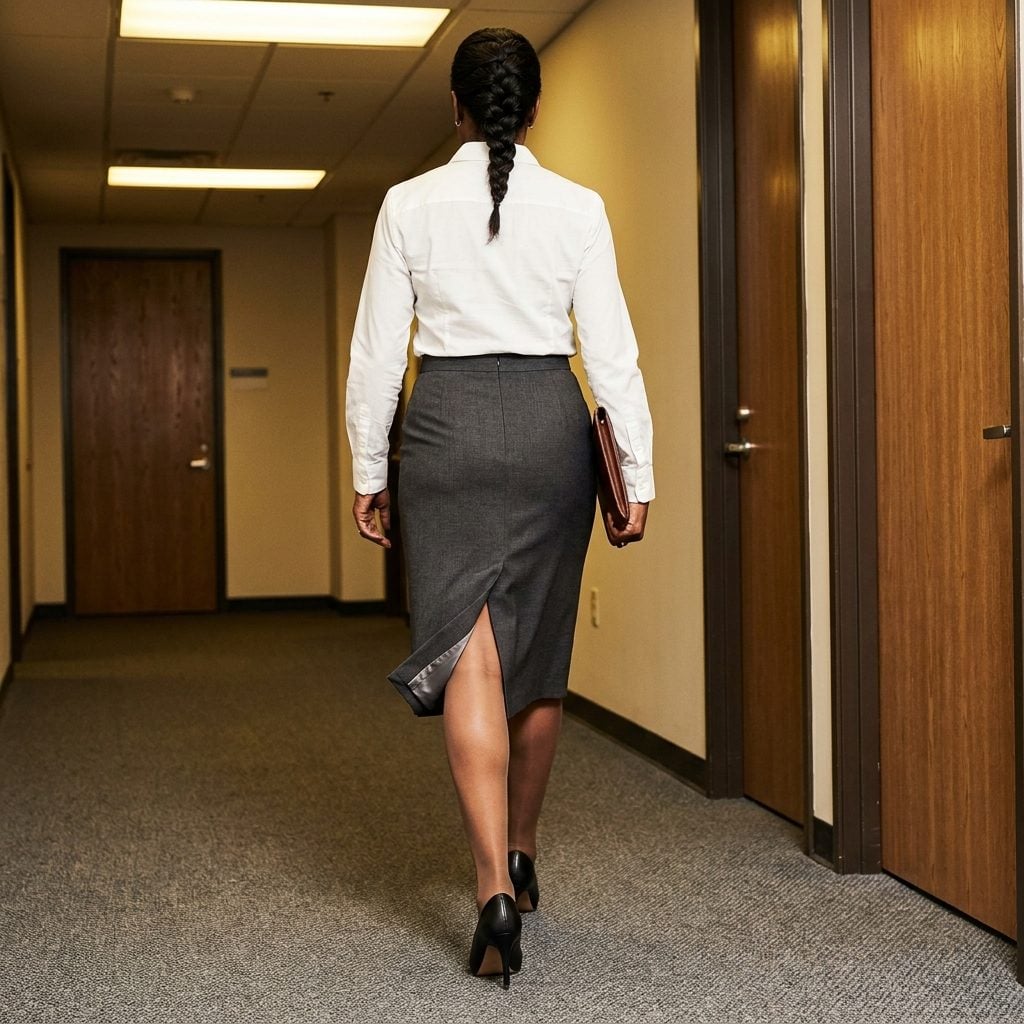
The back slit was a structural necessity, not a design statement. You simply could not walk in a pencil skirt without one. You knew this. The slit knew this. HR would eventually know this, too, but that conversation was still two promotional cycles away.
The slit started modest. Respectable. Maybe four inches, just enough to allow a full stride. But pencil skirts had a way of migrating upward throughout the day, and by the afternoon commute that slit had revealed ambitions nobody discussed at the morning all-hands. You wore them in charcoal, black, and deep plum, always with the pantyhose, and you felt absolutely devastating walking to the printer.
The pencil skirt hasn’t gone anywhere: when we asked our readers which skirt they’d pick, pencil and A-line were essentially a coin toss, at 40% and 43%.
The Strapless Dress and Sheer Shrug: A Construction That Made Structural Engineers Nervous
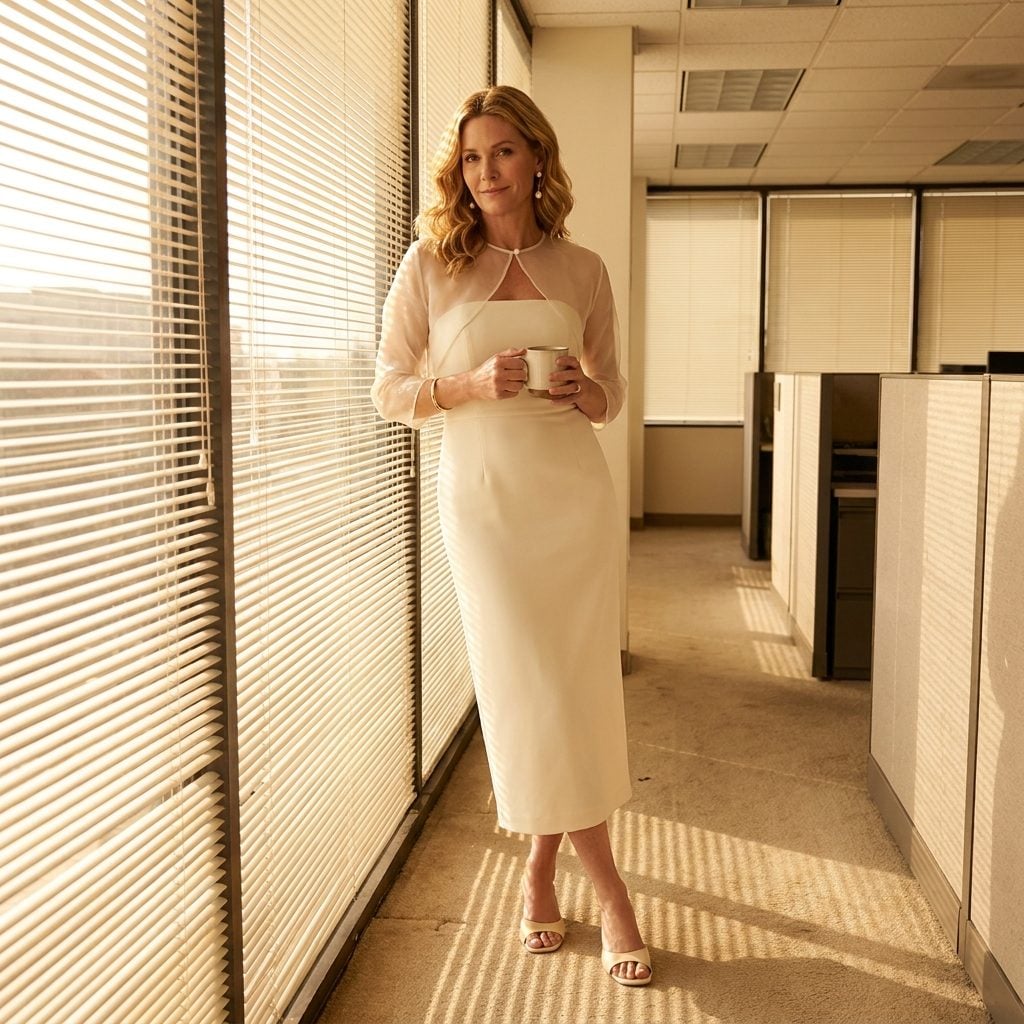
The shrug was doing the same work as a fig leaf in a Renaissance painting: technically providing coverage while leaving nothing particularly to the imagination. Three or four inches of sheer organza over the shoulders did not constitute sleeves in any practical sense, but it was enough in the 1990s to pass the blazer test at most companies, provided nobody looked too closely.
What made the strapless-plus-shrug combination uniquely ambitious was the physics involved. The strapless dress was, by definition, operating without infrastructure. The shrug added nothing structural. You essentially spent the workday hoping for the best and adjusting your posture like a ballet dancer who’d just remembered the recital was tonight.
The Bodysuit Snapped Into Low-Rise Trousers: Office Outfit or Optical Illusion?
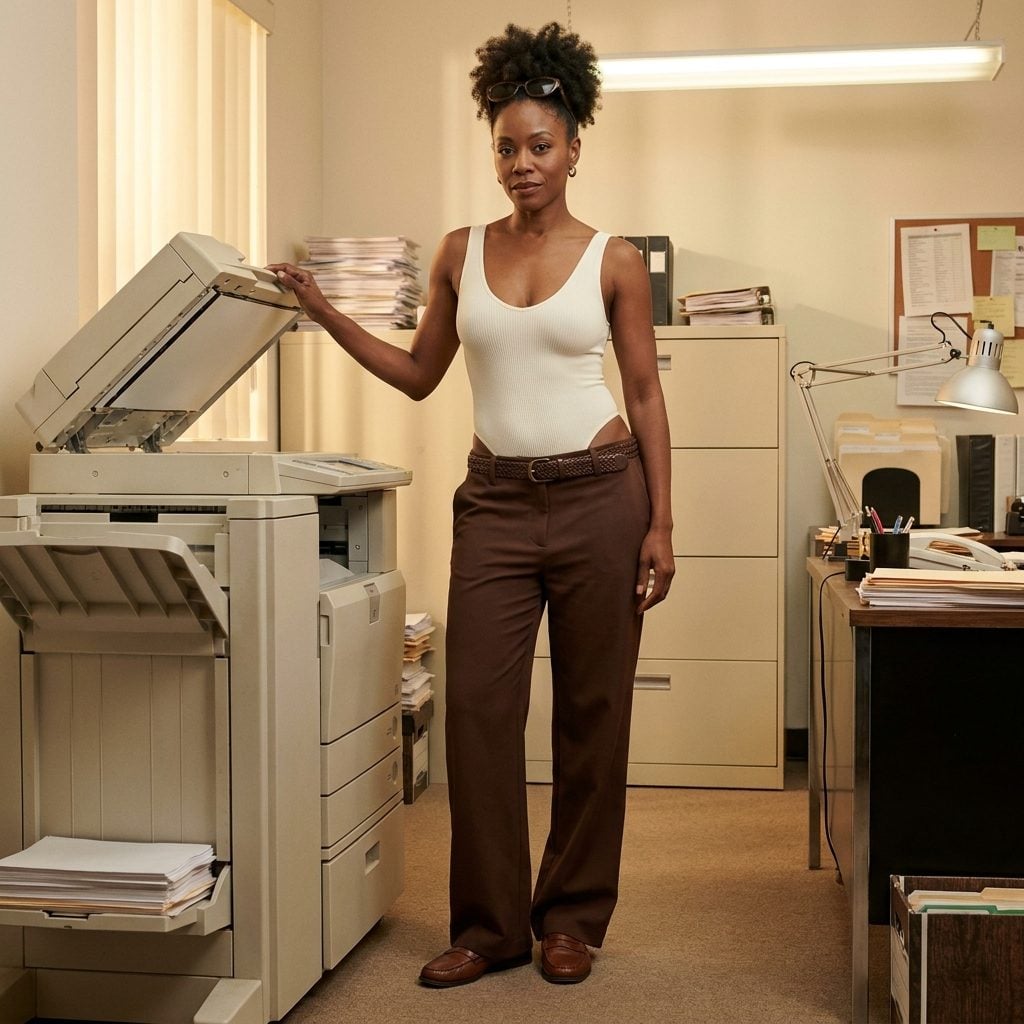
The entire value proposition of the bodysuit was the tuck. It stayed. It did not untuck at 2 p.m. It did not bubble up over your waistband when you leaned forward in your chair. It was physically incapable of the betrayal that every regular shirt committed against you on a daily basis. For this, we forgave it everything, including the snaps.
The snaps. If you’ve worn a bodysuit, you know about the snaps. The small metal closures at the gusset that made every bathroom break a commitment. You had to actually think through the logistics beforehand. It was like a puzzle you solved three times a day in a fluorescent-lit stall while someone waited outside.
Worn under work-appropriate low-rise trousers with a neat belt, the bodysuit read as perfectly composed and professional. And it was, right up until the moment someone asked you to explain what it was and you had to say the word ‘snaps’ to your manager.
Sheer Black Hosiery With a Back Seam and Pointed Stilettos (We Felt Like We Were Running the Place)
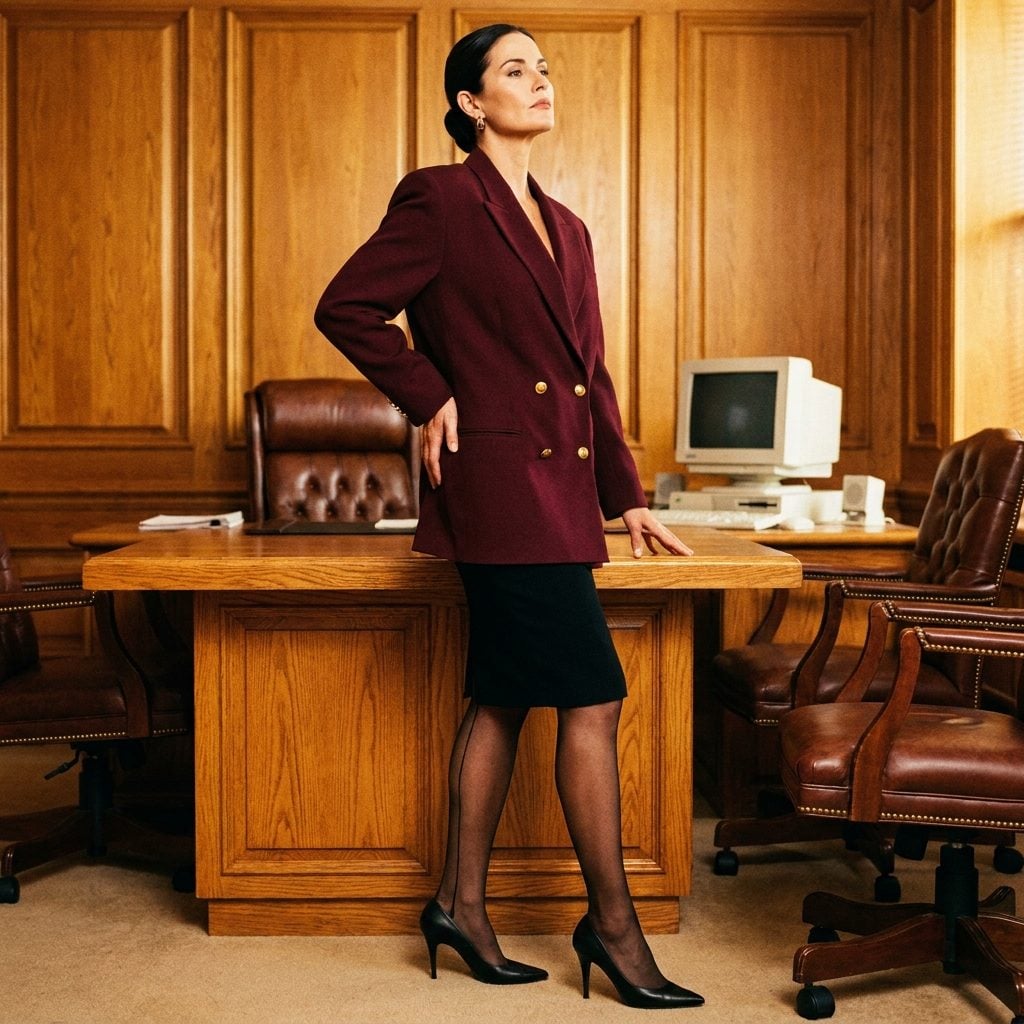
Getting that seam perfectly straight was a daily ritual that required either a hand mirror, a patient coworker, or just accepting you’d spend the morning subtly rotating your leg. We wore these to every meeting, every presentation, every performance review. They felt serious. They felt like armor.
The pointed stilettos were non-negotiable. pointed-toe black stilettos on a hard office floor made a sound that announced you before you walked into a room, and we knew it. Today, ergonomic sneakers and block heels rule the floor. Back then, we clicked down marble hallways like we were closing deals with every step.
The Bustier Top Under a Blazer, Lingerie Logic That Somehow Passed the Dress Code

The logic was: blazer on top, anything goes underneath. And we took that personally. The bustier-under-blazer combination was the great unspoken negotiation of 1990s office dressing, technically covered, technically professional, technically a decision HR had no written policy against yet.
Brands like Express and bebe made satin bustier tops specifically for this use case, in ivory, black, and a deep forest green that looked incredible under a camel blazer. We weren’t dressing inappropriately. We were dressing efficiently. One outfit, two settings. Remove the blazer at 6pm and you were ready for the restaurant down the street.
What Our Readers Say
- Today, when we asked ThreadCurve readers about workwear, blazer and trousers came out on top with 57%, well ahead of knit and skirt at 28% and dresses at 15%.
- In our reader polls, 86% said they would rather stay classic than follow trends, which is a long way from the decade of bustiers under blazers.
From ThreadCurve reader polls and votes.
The Deep-V Wrap Dress, No Camisole, Full Commitment
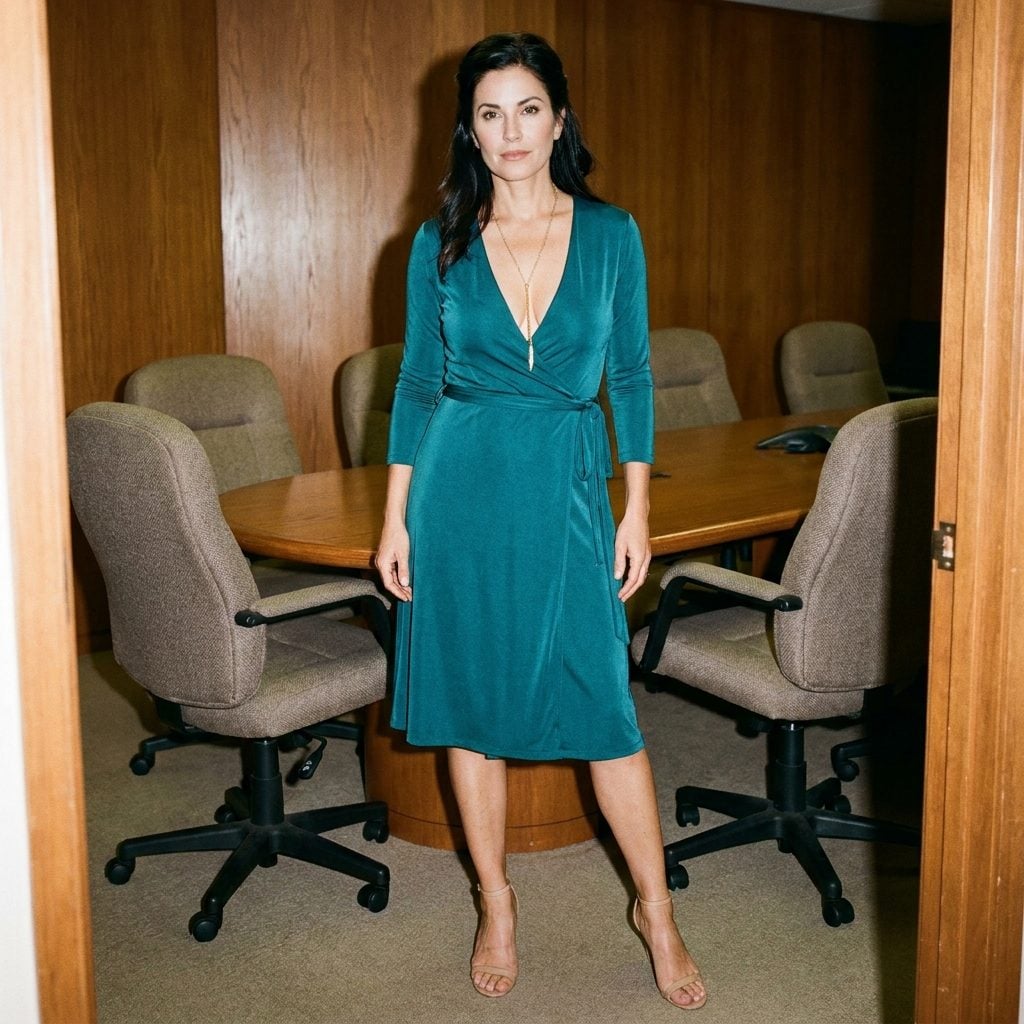
Diane von Furstenberg invented the wrap dress in 1974 but the 1990s working woman made it her own personal statement, and that statement was: I am extremely competent, and also this neckline is deliberate.
Nobody wore a camisole under it. The camisole would have defeated the entire architectural point of the neckline. The deep V wrap dress in jersey fabric was genuinely perfect for the office, comfortable for long meetings, professional enough from 10 feet away, and worn with the breezy confidence of someone who had stopped apologizing for taking up space. Today’s HR handbook has roughly three pages dedicated to neckline depth minimums. We had none of those pages.
Leopard Print Pencil Skirt With a Fitted Turtleneck, Every Single Season, No Exceptions
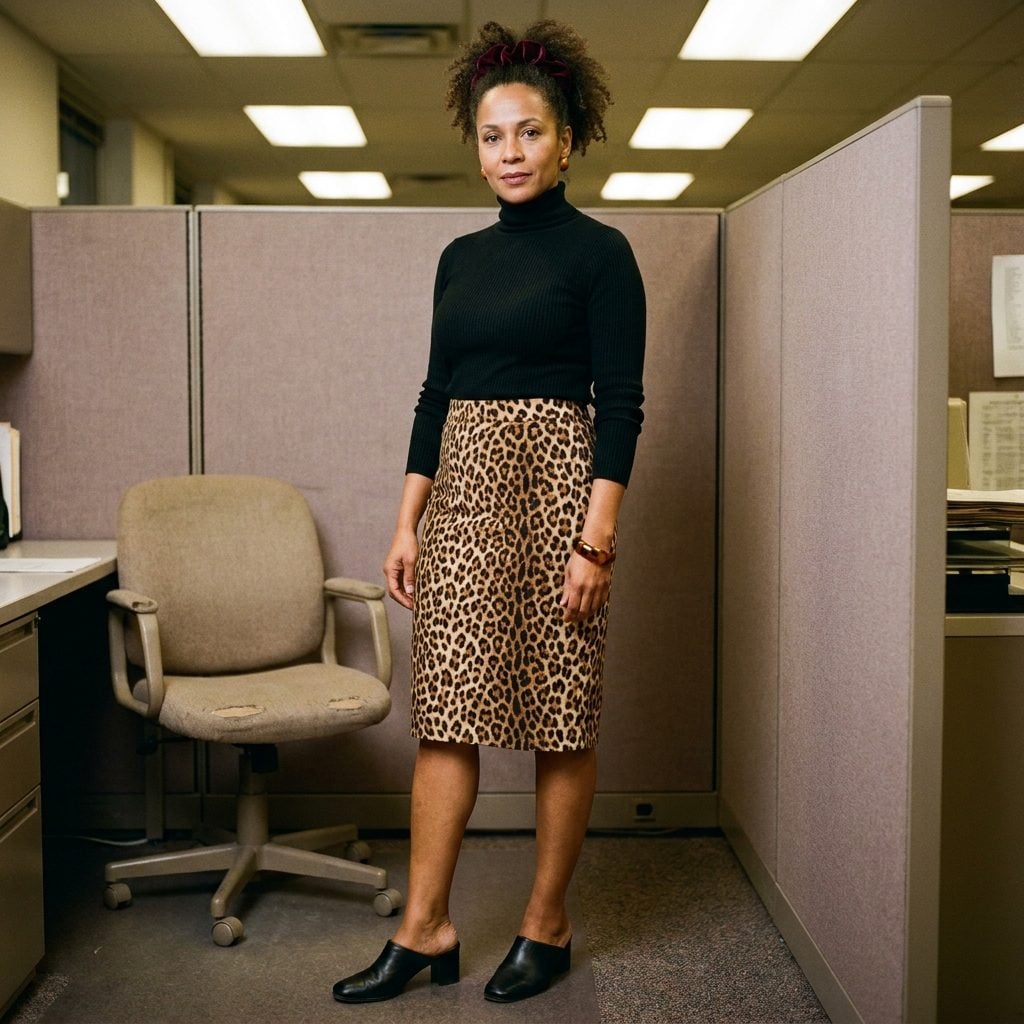
Leopard print was the 1990s working woman’s neutral. We genuinely believed this and we were not wrong. Paired with a fitted black turtleneck, a leopard print pencil skirt read as chic and intentional rather than chaotic, and we understood the rule about keeping everything else simple even if we couldn’t have articulated it as “letting the print be the story.”
The turtleneck was key. It covered everything from chin to waist and somehow made the skirt more powerful for it. Stores like Ann Taylor and Banana Republic offered versions every single autumn without fail, and we bought them every single autumn without question. Animal print remains relevant four decades running, which means we weren’t wrong about this one.
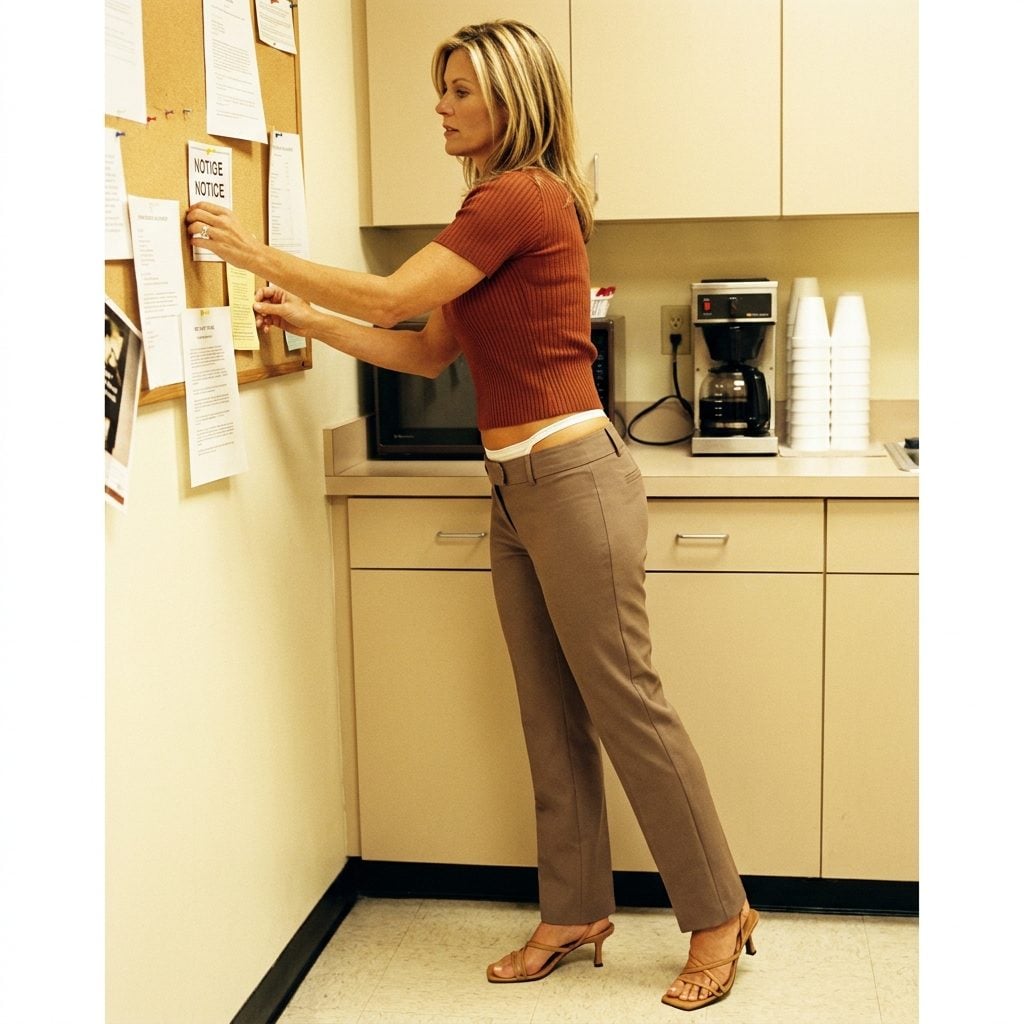
The Visible Thong Waistband Above Low-Rise Dress Pants (We Did This at Work. We All Did This.)
❤️ Would you like to save this?
There is no defense. There is only acknowledgment. The visible thong waistband above low-rise dress trousers was not an accident, it was, bafflingly, the aesthetic. The lower the pant, the more intentional the reveal, and we wore this to quarterly reviews and client presentations with full confidence.
Low-rise low-rise dress pants from BCBG and Nine West hit a waist height that made a standard waistband essentially decorative. The thong was the only underwear solution that worked, and the visible waistband was simply part of the silhouette. We accepted this the way we accepted dial-up internet: without question, as a simple fact of modern life.
“We wore this to quarterly reviews. With a blazer. We shook hands with our bosses dressed like this and nobody blinked.”
Cropped Cigarette Pants, a Camisole, and an Open Cardigan, Business Casual’s Most Chaotic Era

The open cardigan was doing a lot of heavy lifting in this outfit, and everyone knew it. The premise was that the cardigan counted as a layer, that it converted the camisole underneath into a legitimate work outfit, and the 1990s office largely agreed.
Cropped cropped cigarette pants were borrowed from menswear and made aggressively feminine by pairing them with a satin camisole and something flowy on top. The cardigan was ideally oversized, ideally in a neutral, and ideally worn with the kind of loose authority that said you’d been here long enough to make your own rules about what constituted a blouse.
The Satin Cowl-Neck Halter Top With Tailored Trousers, Because Cocktail-Hour Logic Applied to Tuesdays

This outfit made absolutely no sense for a workday and we wore it anyway, every time we had something important on the calendar. The satin cowl-neck halter top was technically a going-out top and we were not confused about that. We just decided the tailored trousers made it office-appropriate, the way you decide the parking meter has definitely not expired yet.
The cowl neck draped beautifully, the satin caught the light in every fluorescent conference room, and the open back was only visible if you took the blazer off, which you always did by 2pm. It was a perfect crime.
A Bias-Cut Slip Skirt With a Ribbed Tank Tucked In, The Outfit That Ended the Decade
The bias-cut slip skirt was Kate Moss’s fault and also Calvin Klein’s fault and also the fault of every magazine that summer, and we have made our peace with that.
What we haven’t entirely made peace with is how confidently we tucked a thin ribbed tank into a bias-cut slip skirt made of fabric that hid nothing, grabbed everything, and somehow still felt like dressing professionally. The skirt whispered against your legs when you walked. It clung after you sat down. We rewore this combination to every important meeting we had in 1998 and 1999.
The ribbed cotton tank was a specific touch of studied nonchalance that said “I didn’t try too hard,” which was, of course, the whole point. The lace trim at the hem caught on chair legs. We acted like that wasn’t happening.
Open-Toe Stilettos, a Visible Pedicure, and an Ankle Bracelet That Caught the Light in Every Meeting
The ankle bracelet was the detail that really did it. Not a delicate thing you had to squint at, a proper gold chain that caught the fluorescent overhead light every time you crossed your legs in a conference room. You bought it at Icing or Claire’s, maybe Contempo Casuals, and you absolutely considered it office-appropriate because your nails matched your lipstick and that felt professional enough.
The open-toe stiletto in the 1990s corporate world was a statement that nobody officially approved but nobody could technically stop. Today it reads as a footnote in an HR-mandated dress code update. Back then it just meant you had somewhere better to be after five o’clock, and everyone in the room knew it.
The Velvet Choker Over a Sleeveless Sheath Dress, Worn Completely Unironically to a Tuesday Budget Meeting
The velvet choker was doing a lot of heavy lifting in the mid-nineties. It started with the teenagers, crept into the college crowd, and somehow landed in the Tuesday morning staff meeting without anyone stopping to ask how. Paired with a sleeveless sheath, the kind you found at Express or Ann Taylor for $60, it created an extremely specific energy that was half career woman, half someone who had just seen Reality Bites three times in one weekend.
What makes this truly peak nineties is the confidence. Nobody hedged the velvet choker. You put it on, you grabbed your Day-Timer, and you walked into that budget review like the combination was completely unremarkable. The fact that HR would quietly circle back to you about “professional neckwear” today only confirms what we already suspected: we were ahead of ourselves.
Capri Pants, Bare Ankles, and Mules: The Outfit That Meant You’d Read Every Issue of InStyle

Capri pants in the nineties workplace occupied a genuinely fascinating gray zone. Too casual for a formal office, too structured for a casual one, and somehow completely correct in the world of the business-casual creative department where everyone was figuring out the rules in real time. You wore them with mules because bare ankles in a slip-on shoe read as intentional. You wore them with a crisp tuck because the waist detail said “I have read the style pages.”
The specific length mattered enormously. Too short and you were summering. Too long and you were just pants. The exact mid-calf hit, the one that made your ankle look elegant and your mule look considered, took approximately three seasons of trial and error to locate. Once you found it, you bought the pants in black, chocolate, and camel and called it a capsule wardrobe before anyone used that phrase.
The Silk Camisole With Lace Trim Peeking Out That Technically Qualified as Layering
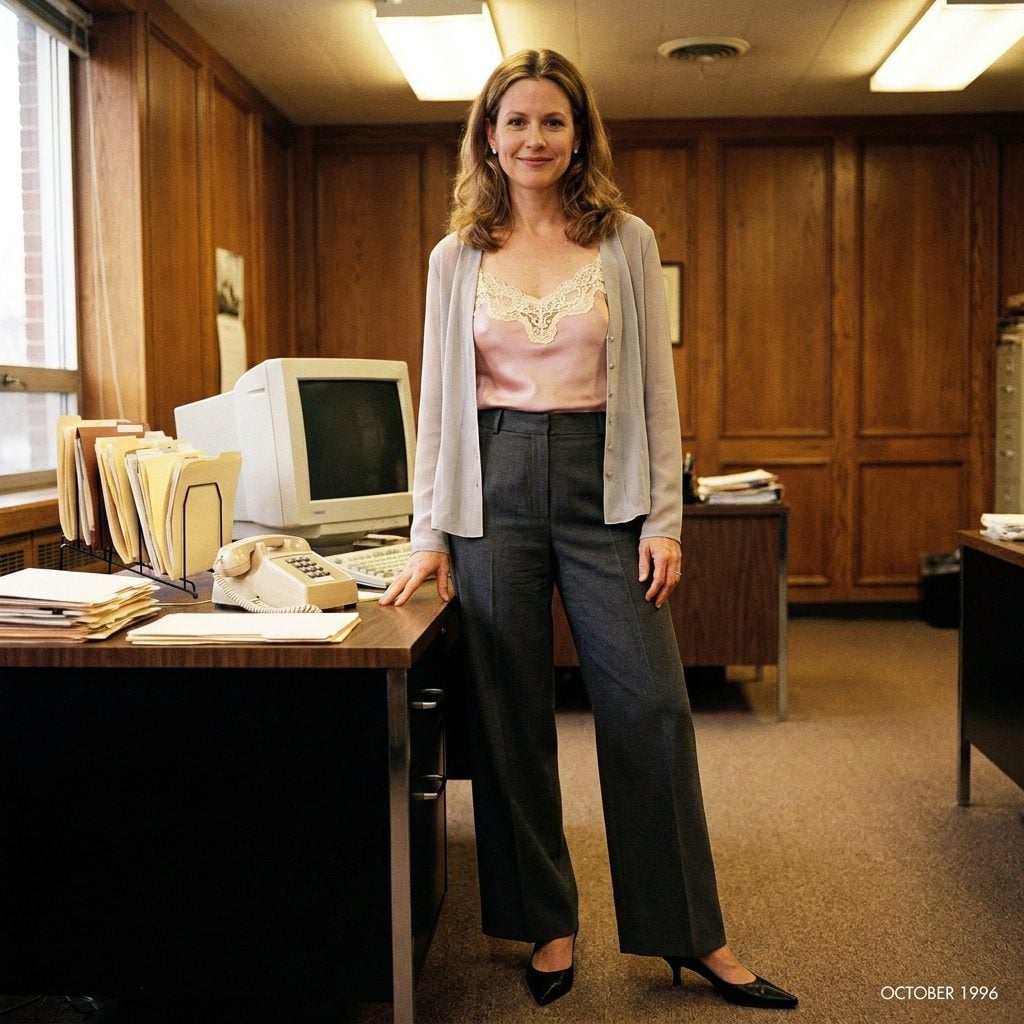
Technically, you were layering. The cardigan was right there. Open, yes, but present.
The silk camisole with lace trim walked a very specific line that the nineties working woman had mapped with precision. It wasn’t lingerie, it was a top, and the distinction lived entirely in the confidence of the person wearing it. Yours was from Victoria’s Secret or maybe Nordstrom’s basics section, and the lace at the neckline was styled as a detail, not an accident. You wore it with high-waisted trousers and kitten heels and a cardigan that technically counted as outerwear if you tilted your head.
The HR quiet-word version of this story usually involved the phrase “foundation garment” used in a sentence where it did not belong, and then an awkward silence that lasted the rest of the quarter.
The Oversized Power Suit With Shoulder Pads So Pronounced You Needed to Angle Through Doorways
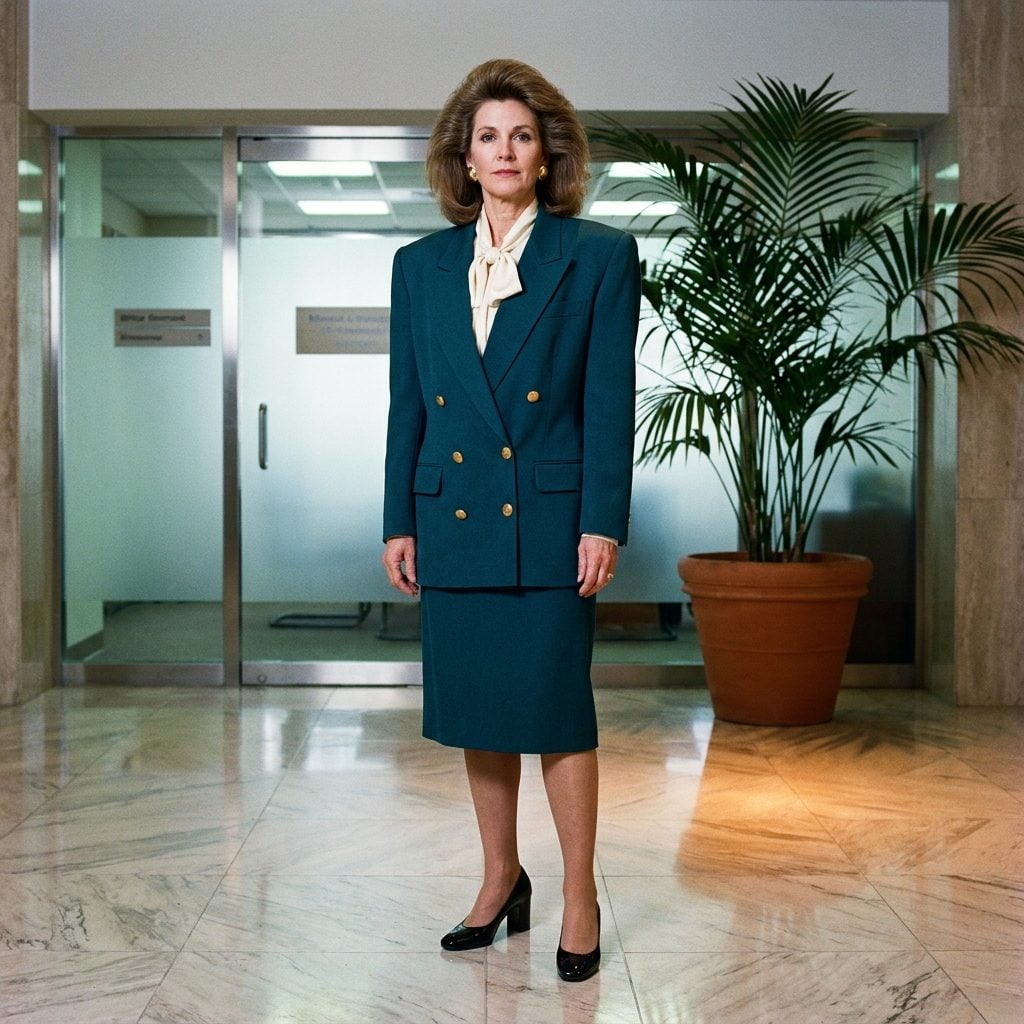
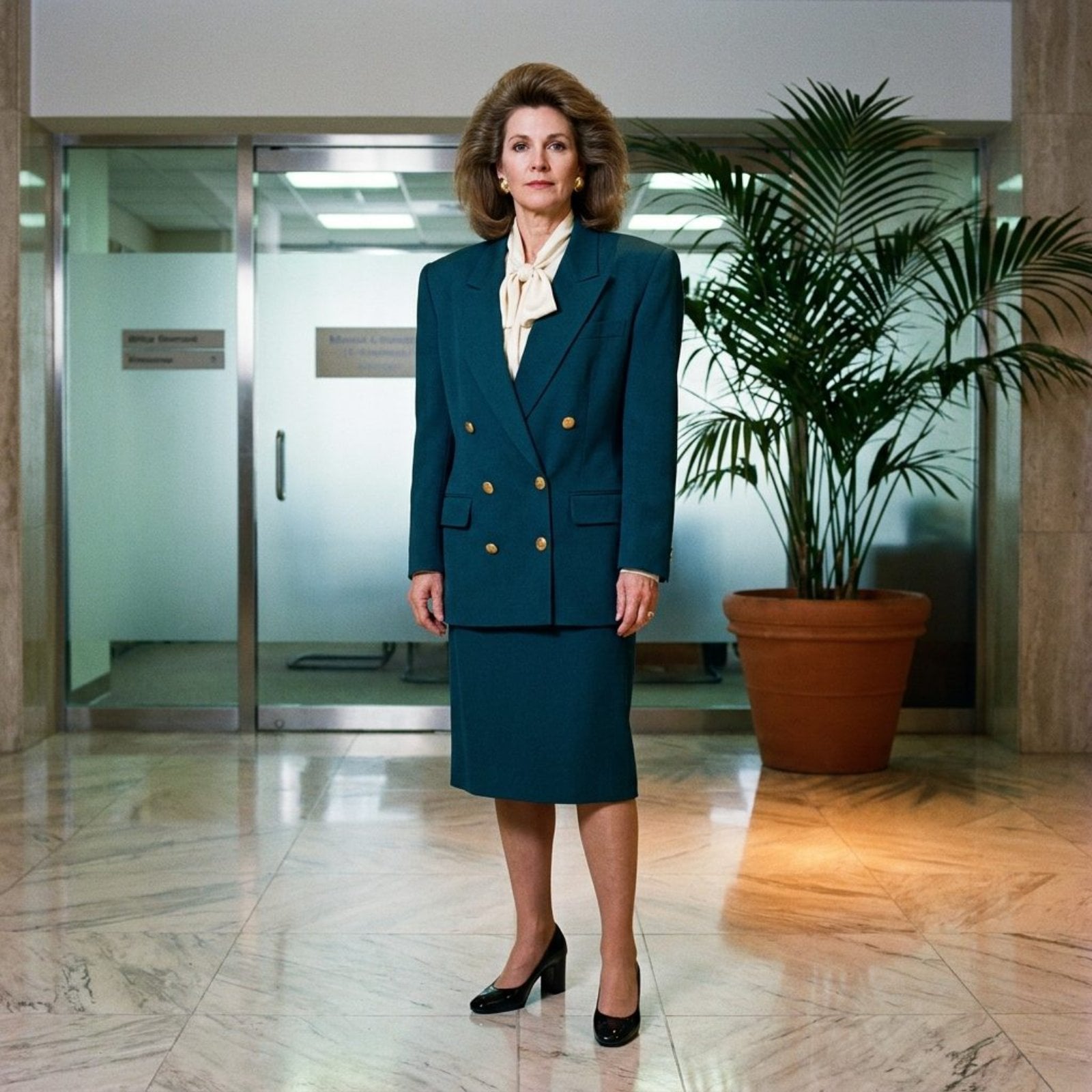
The shoulder pads were not subtle and they were not meant to be. This was architecture. This was a woman walking into a room and requiring it to rearrange itself slightly. The early-nineties power suit was the direct descendant of the Dynasty blazer, toned down from full television drama to something that said “I have a 9am with the VP” rather than “I am about to push someone into a swimming pool.”
You bought yours at Lerner New York or The Limited, or if you were doing well, at Talbots or Saks. The color was always a commitment: teal, cobalt, berry, aubergine. Neutral power suits existed, but the truly confident woman went chromatic. The shoulder pads extended past what physics would consider natural, and you walked through every doorway in your office building fully aware of your own wingspan.
High-Waisted Pleated Trousers With a Silky Blouse Tucked In So Crisply It Looked Like Architecture
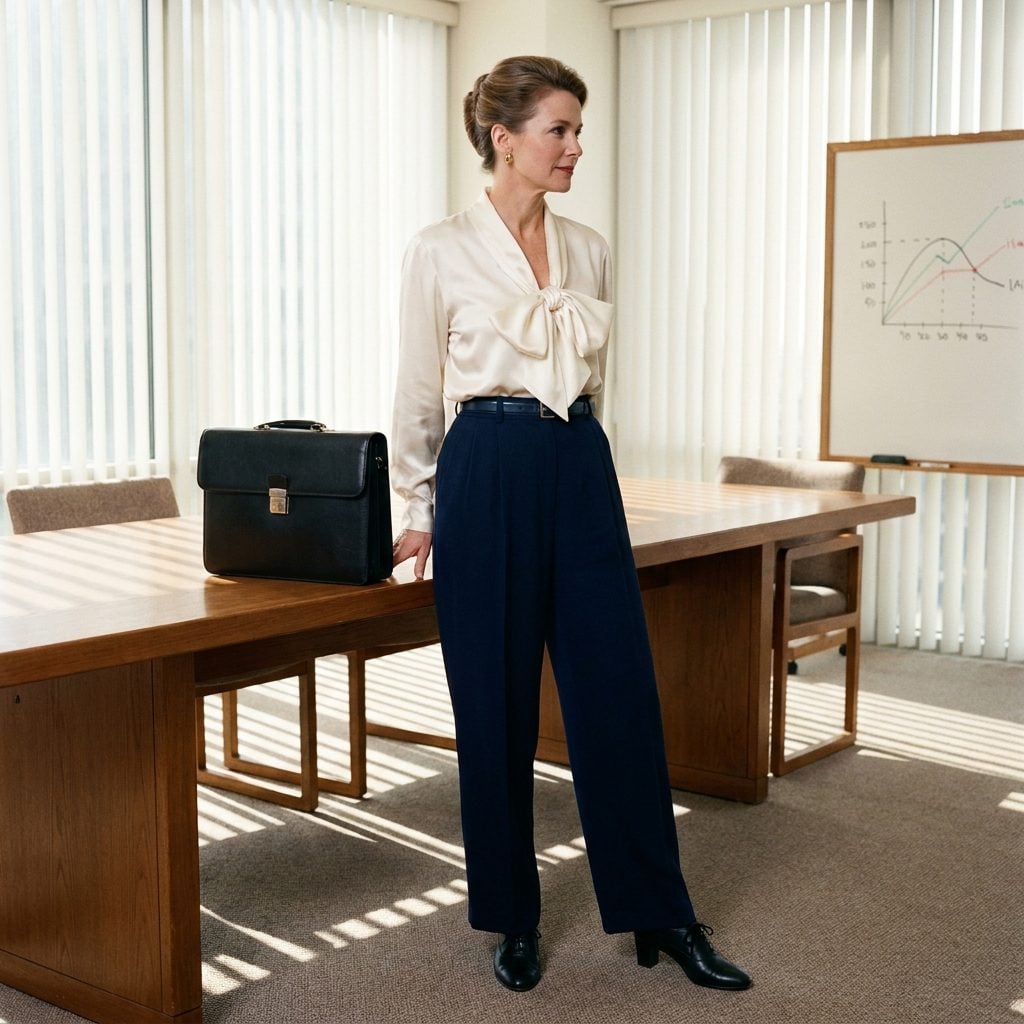
The pleated front trouser was a whole philosophy. It said: I have read the memo about business casual and I am declining. It said: I own an iron and I use it. The high waist hit above the navel, the pleats added structure and volume through the hip, and the whole silhouette was very specific about the kind of woman wearing it, one who considered “pulled together” a baseline, not an achievement.
The blouse tuck was its own skill. Not a full-send military tuck, not a lazy front-tuck. The nineties office tuck bloused the fabric deliberately over the waistband just enough to show you’d thought about it. You smoothed it down approximately fourteen times between your car and the elevator. By noon it had shifted exactly one centimeter and you fixed it without looking while taking notes in a budget meeting.
“The pleated front trouser said: I have read the memo about business casual and I am declining.”
The Double-Breasted Pinstripe Skirt Suit That Walked Into Every Room Like It Already Owned the Corner Office
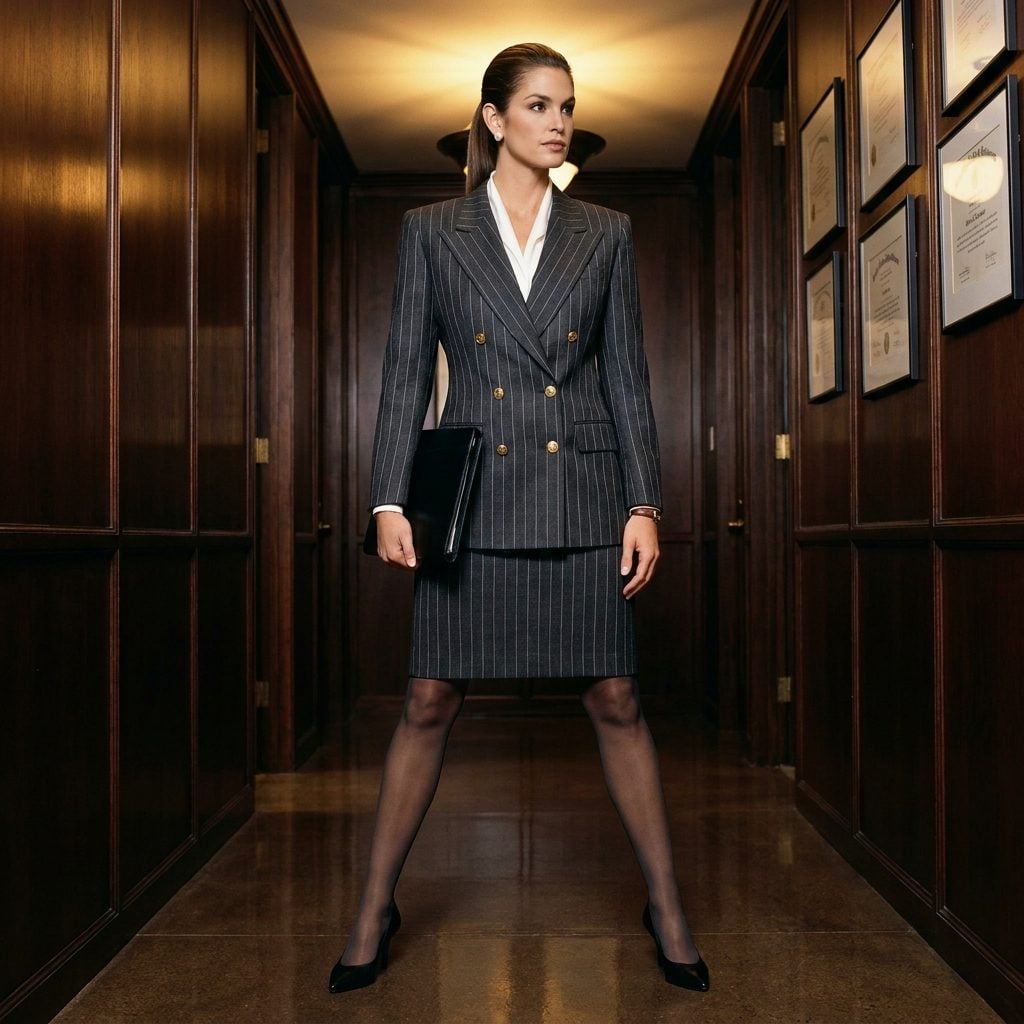
This was the suit you bought when you got the promotion, or when you needed someone to believe you deserved one. The pinstripe double-breasted skirt suit in the mid-nineties wasn’t borrowing from menswear, it was taking it apart and rebuilding it on completely different terms. Wide lapels, gold buttons, a waist seam that meant business. The skirt kept the femininity just present enough to be deliberate.
You wore it with a white blouse buttoned to the collar and heels that added exactly the right amount of height, and when you walked into a room in it, you gave people a moment to recalibrate. That was the point.
Today the double-breasted pinstripe skirt suit is back, currently circulating through every work wardrobe edit on the internet. Which means we were simply early. We were always simply early.
The Denim Skirt You Wore to a Board Meeting Like It Was Totally Fine
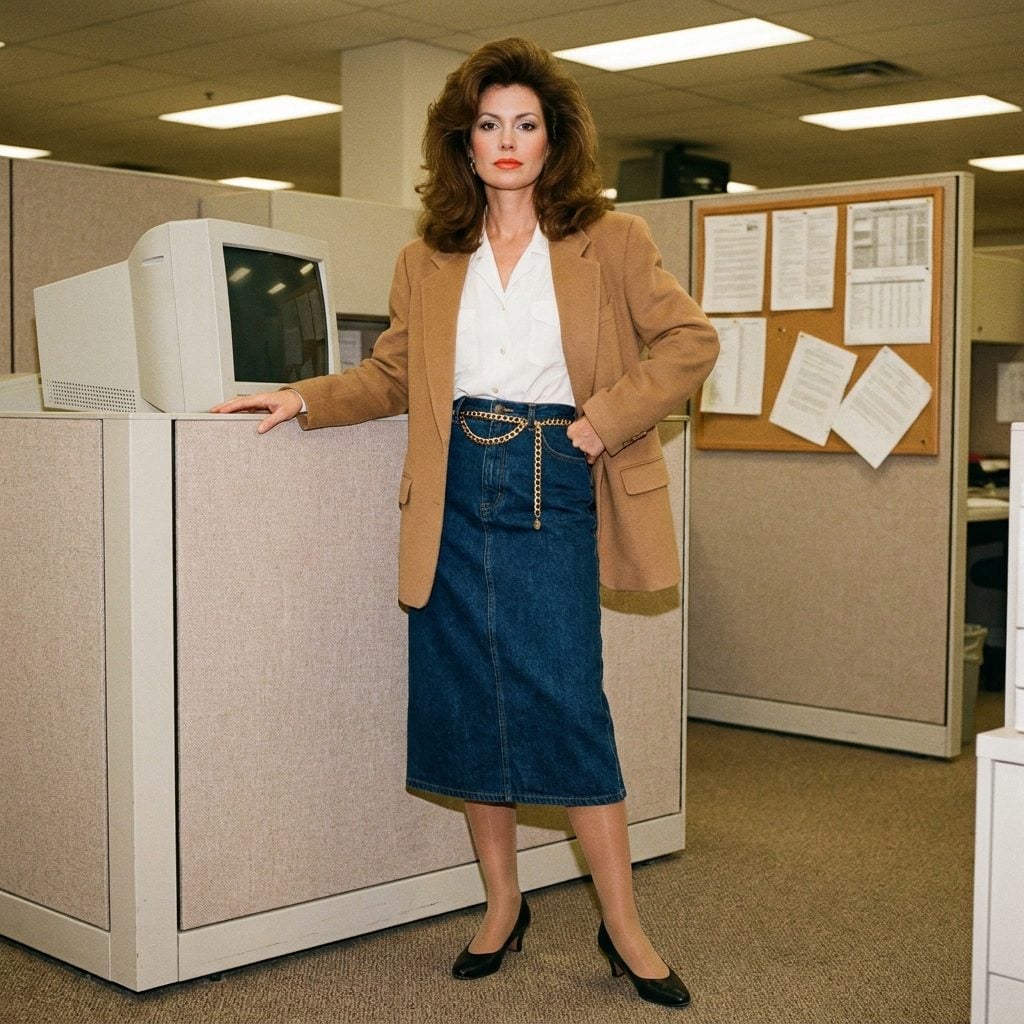
The confidence it took to walk into a quarterly review in a denim skirt and just believe you were dressed for success. And we all did it. You’d pick your darkest wash, pair it with a structured blazer from Ann Taylor, and tuck in a silk-adjacent blouse that definitely came from The Limited, and somehow the whole thing felt polished. The denim was doing a lot of heavy lifting in that sentence.
The unspoken rule was that denim below the knee was basically formal. Add pantyhose and a low heel and you’d practically invented work wear. Nobody questioned it. HR certainly didn’t question it, not yet, not until at least 2003 when someone finally wrote it into the dress code. Until then, the dark wash denim skirt was a legitimate corporate garment and we stand by that completely.
That instinct to reach for the darkest wash still holds, since 60% of ThreadCurve readers picked dark denim over light or black.
The Micro-Mini Skirt With Sheer Tights and a Blazer You Called ‘Business Appropriate’
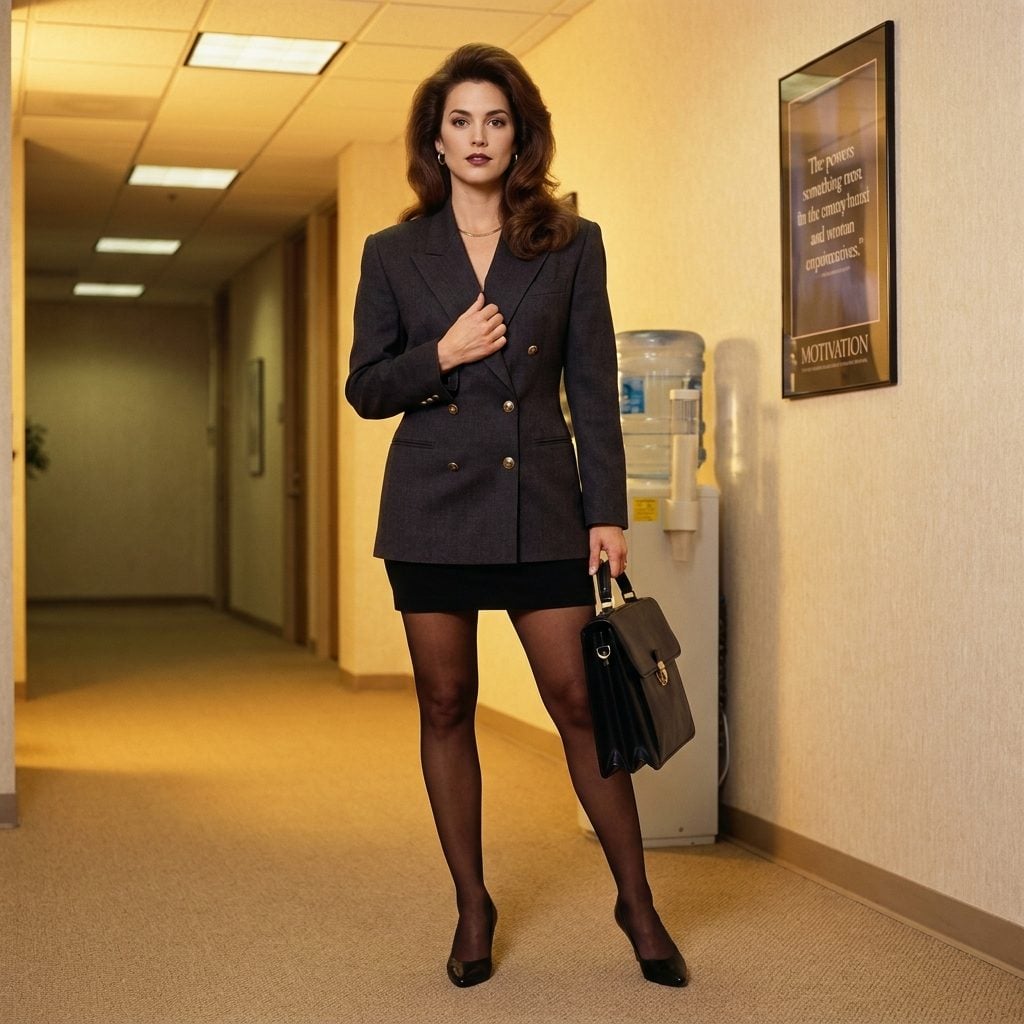
The math was simple: if the blazer had shoulder pads and the tights were opaque enough, the skirt could be as short as you wanted. That was the unspoken rule, and we followed it with the conviction of constitutional scholars. The blazer was your alibi. It said I’m serious while the black micro-mini skirt said something else entirely.
Ally McBeal didn’t help. Or maybe she helped too much. By 1998, every woman in a mid-level office job owned at least one skirt that would qualify as a belt by today’s standards. Paired with sheer black tights and a pair of pointed-toe pumps, it read as polished. Professional, even. Your male boss absolutely did not know where to look during your quarterly review, and that was considered his problem, not yours.
The Satin Slip Dress With a Thigh-High Slit That You Swore Was ‘Just a Dress’

You wore your nightgown to work. That’s what your mother said, and she wasn’t wrong. The champagne satin slip dress was literally cut like lingerie, with spaghetti straps thin enough to floss with and a slit that revealed your entire leg when you sat down. The blazer thrown over it was supposed to make it office-appropriate. It did not.
Carolyn Bessette-Kennedy made this combination look like old money restraint. On the rest of us, walking through the fluorescent-lit break room at 2 p.m., it looked like we’d gotten dressed in a hurry after something we weren’t going to talk about. And yet. We wore it to presentations. To client lunches. To the company holiday party where the VP from accounting spilled red wine on himself trying not to stare.
A Ribbed Turtleneck Tucked Into Low-Rise Trousers That Showed Your Hip Bones to the Entire Accounting Department
Every rib of that turtleneck was visible. Every single one. The fabric clung like it had been vacuum-sealed to your torso, and you tucked it into trousers that sat so low your belly button was basically the focal point of your outfit. The gap between where the turtleneck ended conceptually and where the low-rise trousers began was a no-man’s-land of exposed hip bone and lower abdomen.
The turtleneck was the genius part. It covered your neck, your arms, your collarbone. It said modest. Meanwhile, everything below the belt line told a completely different story. This was the ’90s version of a loophole: technically covered, spiritually not.
The Sheer Chiffon Blouse Over a Very Visible Lace Camisole

See-through. The blouse was see-through and everyone knew it and nobody said anything. That was the social contract of the sheer chiffon blouse.
The black lace camisole underneath wasn’t hiding. It was the point. You could see the scalloped edge, the ribbon straps, the little bow between the cups on certain versions from Victoria’s Secret. This was lingerie-as-outerwear before that phrase existed in fashion criticism. We just called it “layering.”
I remember sitting in a Monday morning status meeting in a blouse you could literally read a newspaper through, and my manager, who was also wearing one, complimented it. That’s how normal this was. Two women in transparent shirts discussing Q3 projections without a trace of irony.
The Tailored Vest Worn as a Top, Full Stop, Nothing Underneath
❤️ Would you like to save this?
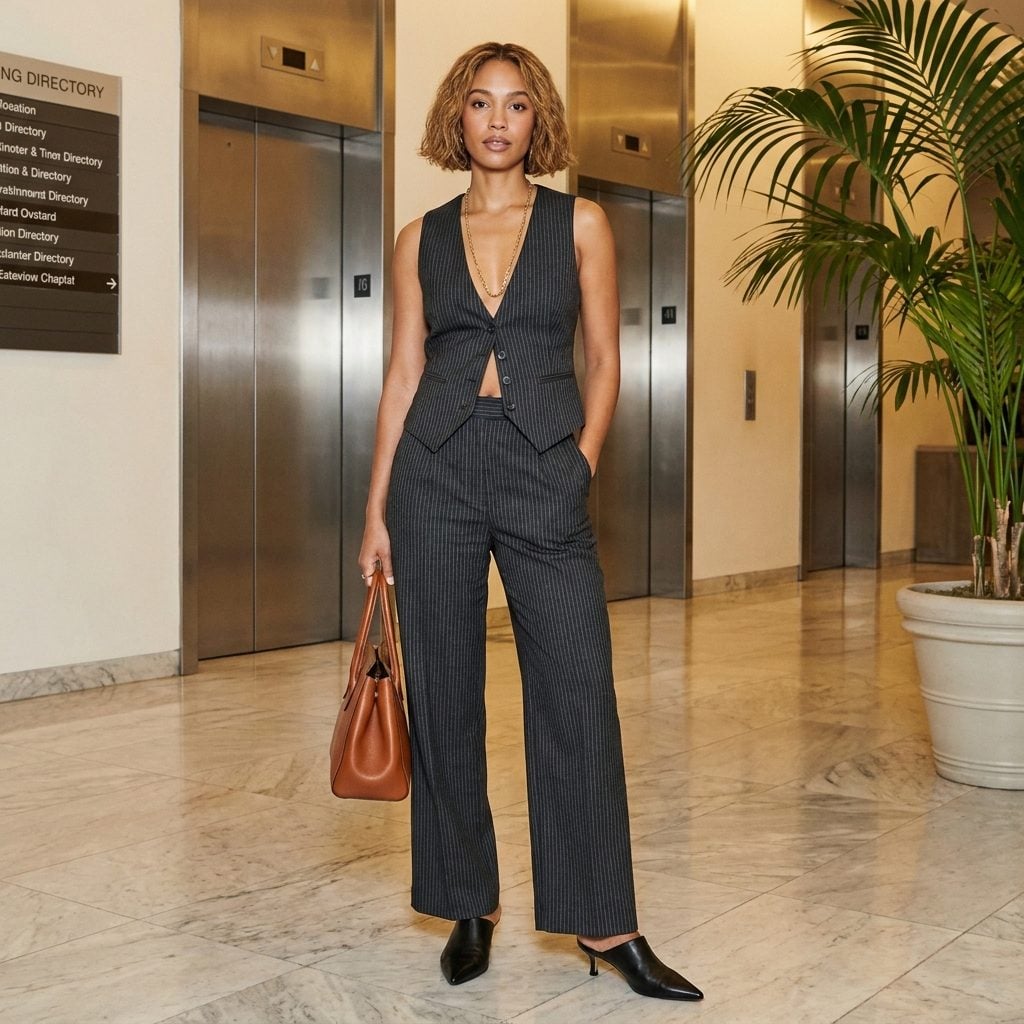
This was the power move. A vest. Just a vest. Three buttons between you and a call from human resources, and you only fastened two of them. The pinstripe vest said Wall Street; the bare shoulders and visible collarbones said something your quarterly review couldn’t quite articulate.
Uma Thurman. Sharon Stone. The women in Robert Palmer music videos, arguably. The vest-as-top was everywhere by the mid-’90s, and the fact that it was technically menswear gave it a veneer of respectability that it absolutely did not deserve. One deep breath, one enthusiastic arm gesture in a presentation, and the whole arrangement could go sideways. We wore them anyway. Confidence, or recklessness. Hard to tell the difference at 27.
A Glossy Patent Leather Skirt That Squeaked When You Crossed Your Legs in the Conference Room
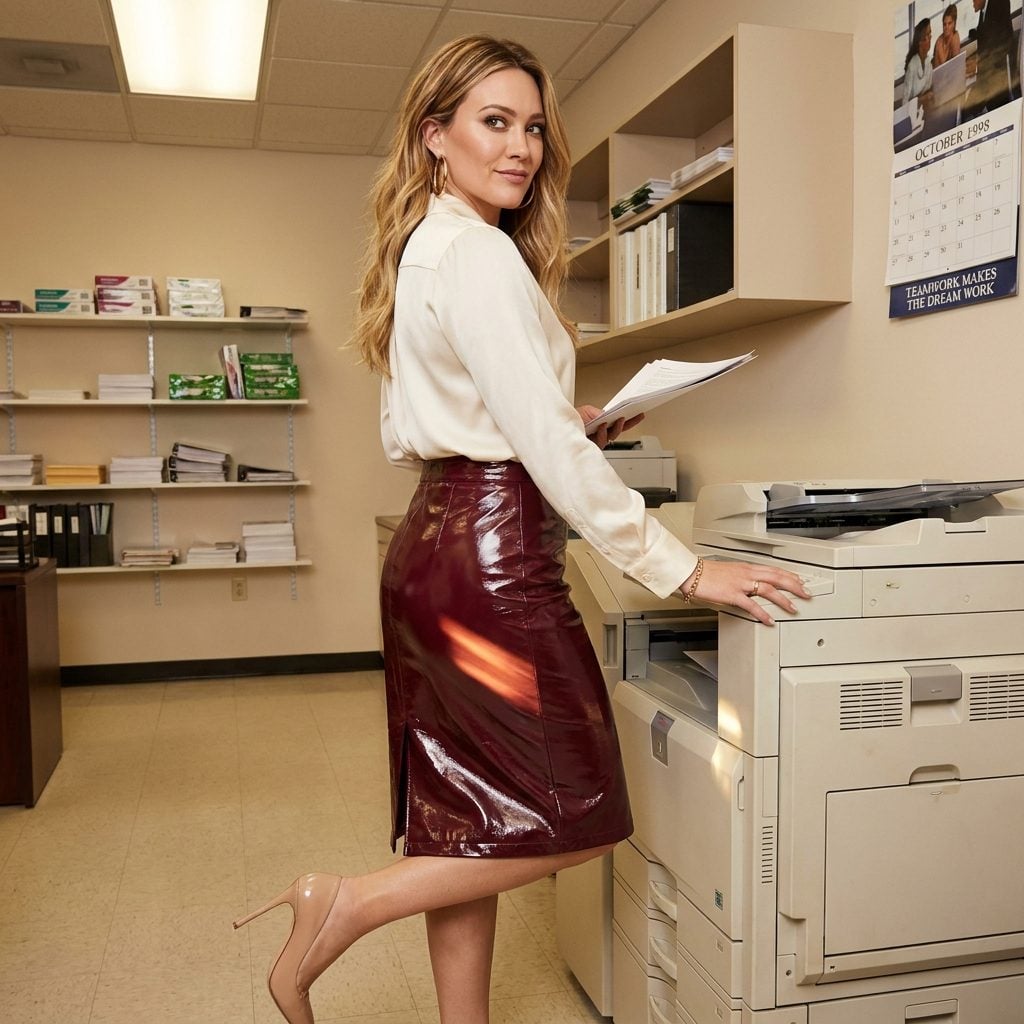
That sound. You know the one. The sticky, slightly obscene squeak of patent leather shifting against a vinyl conference chair every time you uncrossed and re-crossed your legs. It was not subtle. The entire room heard it. You pretended it didn’t happen and kept talking about the Henderson account.
The skirt itself was gorgeous, I’ll give it that. Slick, sculptural, catching every fluorescent light in the room like a mirror. Paired with a tucked-in cream silk blouse, it looked expensive and intentional. But there was no world in which a shiny, squeaky, body-hugging leather skirt was office-neutral, and we all knew it. We just chose not to know it.
The Cropped Cardigan Buttoned Low and Worn as a Top With Your Favorite Pencil Skirt
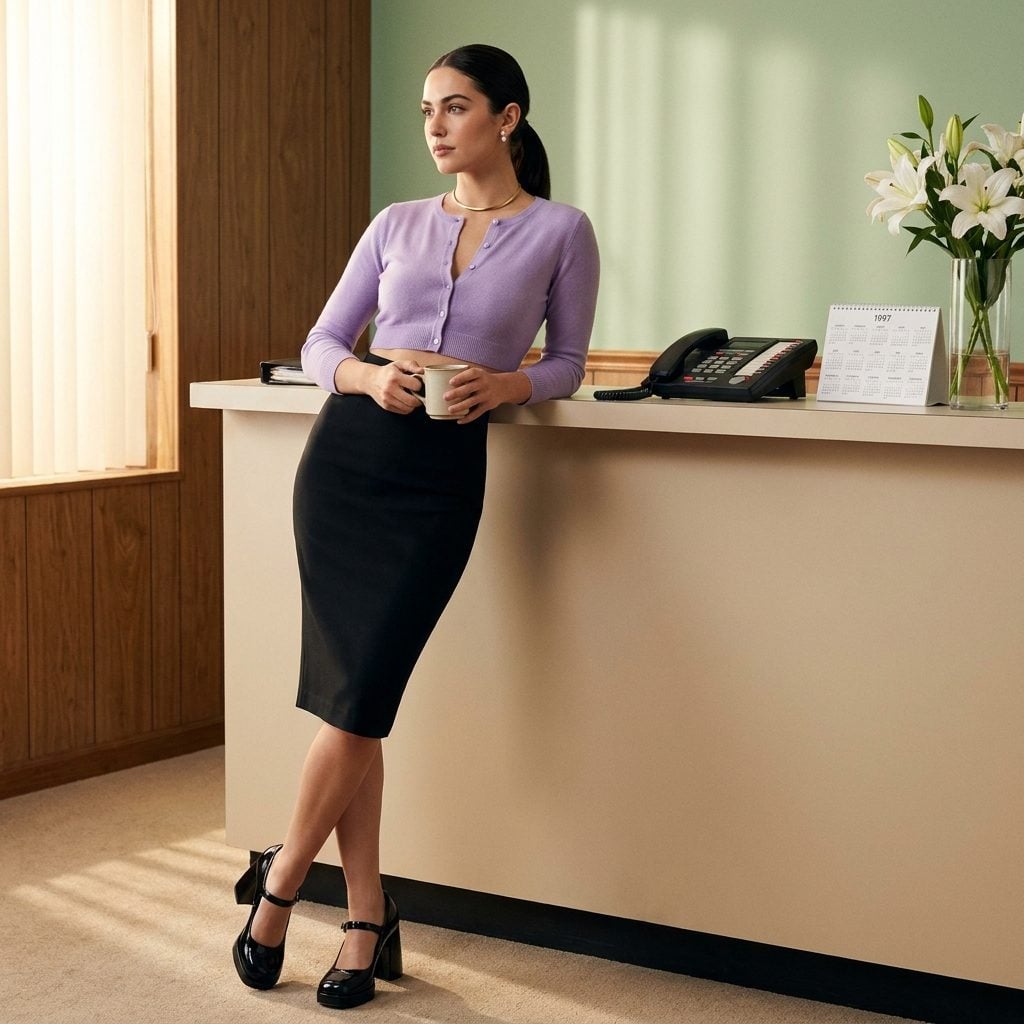
Technically, it was a sweater. You could argue it was a sweater. You would need to argue it was a sweater if anyone from management asked, because the cropped cardigan buttoned over bare skin with only two middle buttons fastened was not, by any reasonable definition, a blouse.
But it was soft. And pretty. And it had pearl buttons, which felt ladylike, which felt like permission. The pencil skirt grounded it in office territory, and you kept your arms strategically close to your sides because raising them too high revealed a flash of midriff that would complicate the “it’s just a sweater” argument considerably.
A Plunging Camisole Under a Blazer That Never, Not Once, Got Buttoned
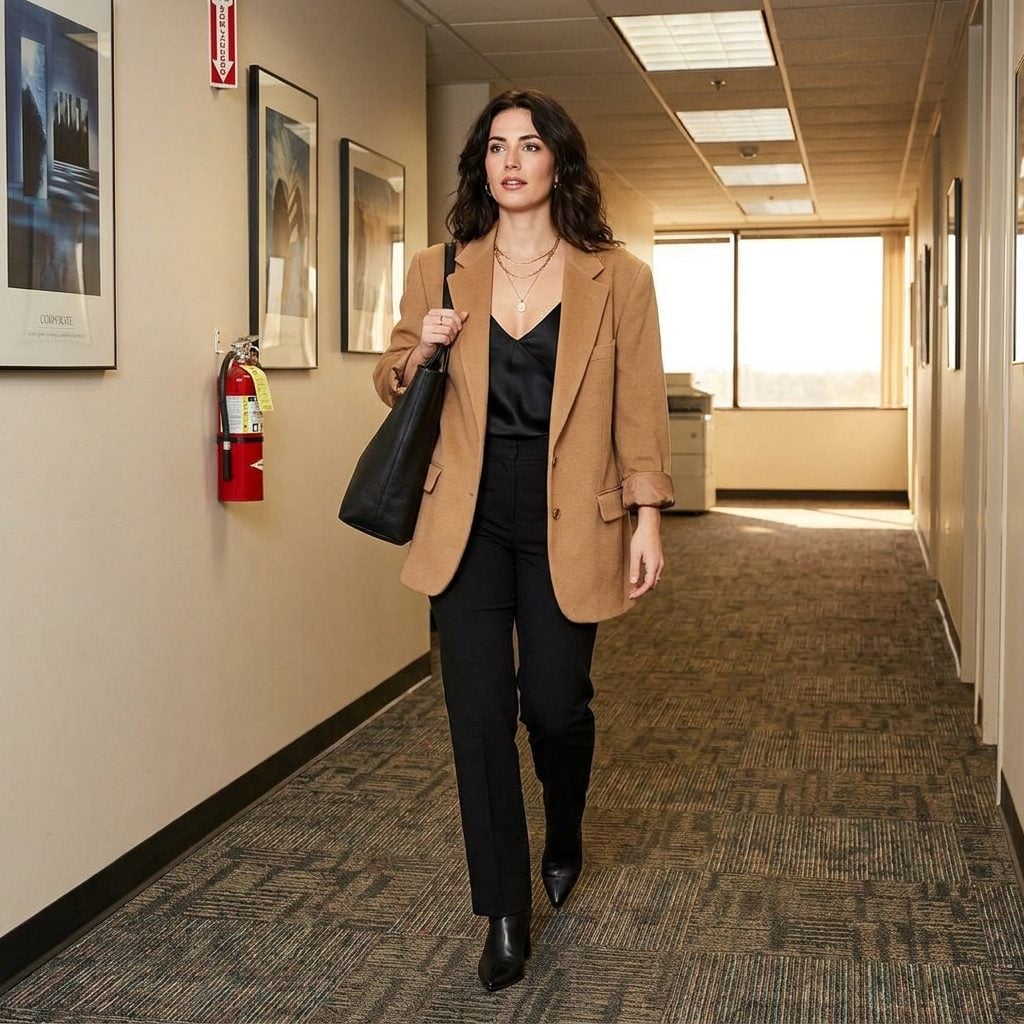
The blazer was your permission slip, and it was never going to close. Everybody understood this. The camel blazer hung open at all times, revealing the black satin camisole plunging to a depth that could only be described as “ambitious for a Tuesday.”
You layered three gold chains in the neckline, which somehow made it feel more intentional and less like you forgot a layer. The blazer sleeves got pushed up to the elbows because that’s what we did in the ’90s: we bought blazers to push the sleeves up. It was a look that said, “I have authority and also I might be going to a jazz club directly after this all-hands meeting.” And honestly? It worked. It absolutely worked.
The Fitted Mini Dress With Sheer Tights and a Longline Blazer You Wore to Actual Client Meetings
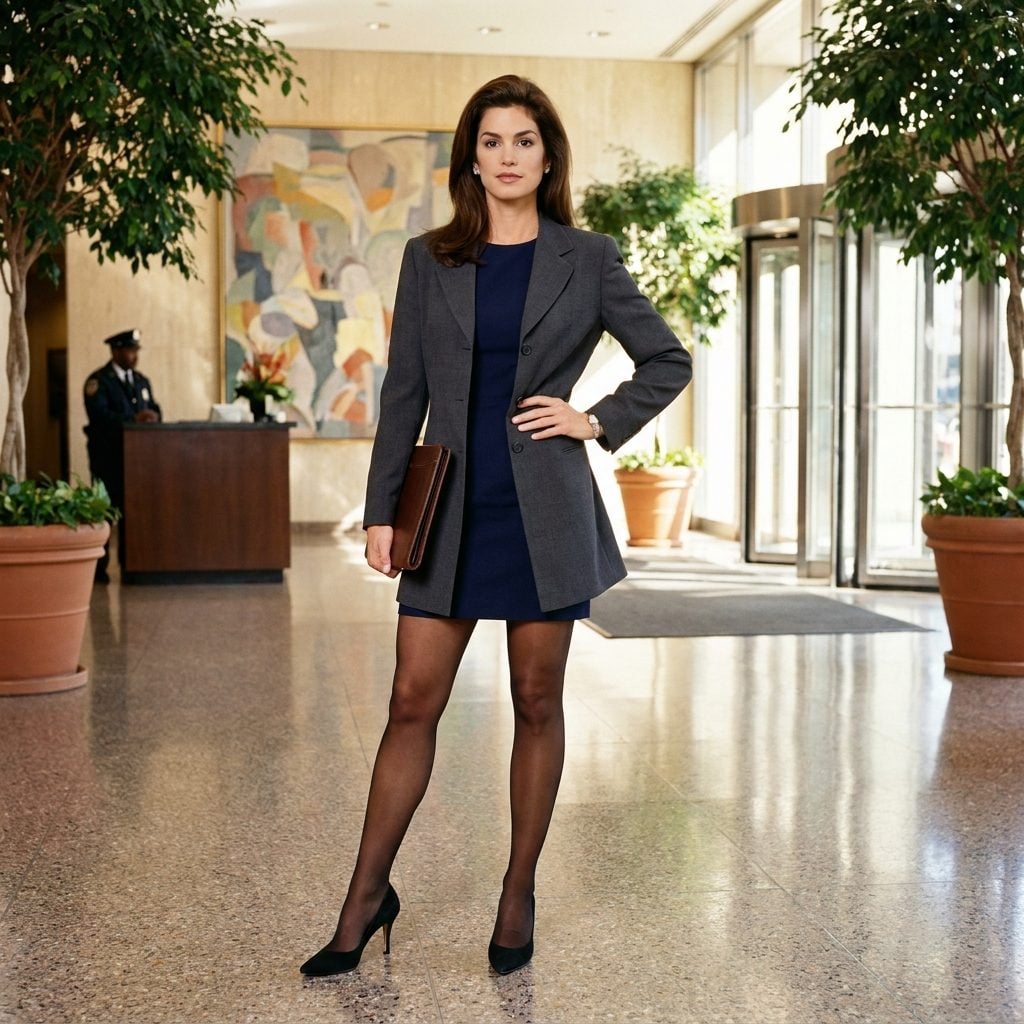
This is where length math got creative. The dress was short. Undeniably short. But the longline blazer fell to mid-thigh, and if you kept it buttoned, you could pretend the dress was just… a long top? A tunic? Something that definitely warranted sheer tights and heels and a firm handshake with the client from Minneapolis?
We told ourselves the blazer made it professional. The blazer was doing a lot of emotional labor in the ’90s, frankly. It was the garment we threw over literally anything questionable and declared it boardroom-ready.
Low-Rise Trousers, a Cropped Blazer, and a Top So Small It Was Basically a Theory

This was the final boss of ’90s office fashion. The complete trifecta. Low-rise trousers that started somewhere around your pubic bone. A cropped blazer that stopped at the waist and therefore covered nothing the trousers didn’t. And between them, a strip of exposed stomach bridged by what could generously be called a top but was really just a reinforced bra with ambition.
The belly chain. I forgot about the belly chain until just now, and remembering it physically hurts. A delicate little chain resting on that exposed strip of midriff, glinting under the same fluorescent lights that illuminated your TPS reports. We wore this to work. To our jobs. Where we had responsibilities and 401(k)s and direct reports who had to pretend they didn’t notice our navels.
And here’s the thing that gets me: we felt powerful in it. Not exposed, not vulnerable. Powerful. That cropped blazer with its sharp shoulders and its three-quarter sleeves was armor, even if it technically covered less than a sports bra. The ’90s office was wild, and I say that with complete love and zero regret. Mostly zero regret. Maybe 5% regret about the belly chain.